
Home » Germany (Page 47)
Category Archives: Germany

My Kids are Walking Around Like they are in a Dream Because of it

As God has set the king of America, so in our Psalm he has set the intermediary—beings—here called “gods” and elsewhere called “sons of God,” over the nations of the Earth, each over one of the nations, in order to manifest in its structure and government the justice of the Judges of the World. In His first speech God accuses them of having judged not in accordance with His order and regulation, but in the manner of what is false and evil: for they have confirmed and substantiated in their power those who have acted wickedly against God’s speech and the end—with only a hint of the fall of the “gods”—of the visionary event of which the Psalmist has to inform us. However, his song is not ended. Rather now, for the first time, the real Psalm is heard, in only a few words, and yet saying all that has still to be said. The speaker turns away from us to God. “In my vision,” he says to him, “I have seen how Thou dost bring to destruction the rule over history of Thy rebellious governors. So be it, Lord. Since those who were entrusted with the office of judge succumbed to injustice, do Thou abolish the intermediary rule, renounce the useless work of underlings and Thyself judge the World immediately in Thy justice. Thine are the nation, lead them as thine own! Close the history of man which is pray to delusion and wickedness, open his true history!” In the human World, which has been given over to the intermediary beings, they play a confused game. From the unknown One who gave this World into their impure hands, no message of comfort or promise penetrates to us. He is, but He is not present. What has not entered into the view of humanity, of the humans of our time, is that the formlessness of darkness should be removed first of al by the production of light. In the firs place because light is a quality of the first body, and thus by means of light it is fitting that the World should first receive its form.

The second reason is because light is a common quality. For light is common to terrestrial and celestial bodies. However, as in knowledge we proceed from general principles, so do we in work of every kind. For the living thing is generated before the animal, and the animal before the man. It is fitting, then, as an evidence of the Divine wisdom, that among the works of distinction the production of light should take first place, since light is a form of the primary body, and because it is more common quality. Indeed, the third reason: that all other things are made manifest by light. And there is yet a fourth, already touched upon in the objections; that day cannot be unless light exists, which was made therefore on the first day. According to the opinion of those who hold that the formlessness of matter preceded its form in duration, matter must be held to have been created at the beginning with substantial forms, afterwards receiving those that are accidental, among which light holds the first place. In the opinion of those who hold that the formlessness of matter preceded its form in duration, matter must be held to have been created at the beginning with substantial forms, afterwards receiving those that are accidental, among which light holds the first place. In the opinion of some the light here spoken of was a kind of luminous nebula, and that on the making of the sun this returned to the matter of which it had been formed. However, this cannot well be maintained, as in the beginning of Genesis Holy Scripture records the institution of that order of nature which henceforth is to endure. We cannot, then, say that what was made at that time afterwards ceased to exist. Others, therefore, held that this luminous nebula continues in existence, but so closely attached to the sun as to be indistinguishable. However, this is as much as to say that it is superfluous, whereas none of God’s works have been made in vain.

On this account it is held by some that the sun’s body was made out of this nebula. This, too, impossible to those at least who believe that the sun is different in its nature from the four elements, and naturally incorruptible. For in that case its matter cannot take on another form. Once Americans become convinced that there is indeed a basement to which psychiatrists have the key, their orientation will become that of the self, the mysterious, free, unlimited center of our being. All our beliefs issue from it and have no other validation. Although nihilism and its accompanying existential despair are hardly anything but a pose for Americans, as the language derived from nihilism has become a part of their educations and insinuated itself into the daily lives, they pursue happiness in ways determined by that language. There is a whole arsenal of terms for talking about nothing—caring, self-fulfillment, expanding consciousness, and so on, almost indefinitely. Nothing determinate, nothing that has a referent. There is a straining to say something, a search for an inwardness that one knows one has, but it is still a cause without an effect. The inner seems to have no relation to the outer. The outer is dissolved and becomes formless in the light of the inner, and the inner is a will-o’-the-wisp, or pure emptiness. No wonder the mere sound of the Existentialists’ Nothing or the Hegelians’ Negation has an appeal to contemporary ears. American nihilism is a mood, a mood of moodiness, a vague disquiet. It is nihilism without the abyss. Nihilism as a state of soul is revealed not so much in the lack of firm beliefs but in a chaos of instincts or passions. People no longer believe in a natural hierarchy of the soul’s varied and conflicting inclinations, and the traditions that provided a substitute for nature have crumbled.

The soul becomes a stage for a repertory company that changes plays regularly—sometimes a tragedy, something a comedy; one day love, another day politics, and finally religion; now cosmopolitanism, and again rooted loyalty; the city or the country; individualism or community; sentimentality or brutality. And there is neither principle nor will to impose a rank order on all these. All ages and places, all races and all cultures can play on this stage. Nietzsche believed that the wild costume ball of the passions was both the disadvantage and the advantage of late modernity. The evident disadvantage is the decomposition of unity or “personality,” which in the long run will lead to psychic entropy. The advantage hoped for is that the richness and tension present in the modern soul might be the basis for comprehensive new Worldviews that would take seriously what had previously been consigned to a spiritual ashcan. This richness, according to Nietzsche, consisted largely in thousands of years of inherited and now unsatisfied religious longing. However, this possible advantage does not exist for young Americans, because their poor education has impoverished their longings, and they are hardly aware of the great pasts that Nietzsche was thinking of and had within himself. What they do have now is an unordered tangle of rather ordinary passions, running through their consciousness like a monochrome kaleidoscope. They are egotists, not in a vicious way, not in the way of those who know the good, just or noble, and selfishly reject them, but because the ego is all there is in present theory, in what they are taught. We are a bit like savages who, having been discovered and evangelized by missionaries, have converted to Christianity without having experienced all that came before and after the revelation.

It is an urgent business for one who seeks self-awareness to think through the meaning of the intellectual dependency that has led us to such an impasse. “Future shlock” is a name given to a cultural condition characterized by the rapid erosion of collective intelligence. Future shlock is the aftermath of future shock. Whereas future shock results in confused, indecisive, and physically uprooted people, future shlock produces a massive class of mediocre people. Human intelligence is among the most fragile things in nature. It does not take much to distract it, suppress it, or even annihilate it. In this century, we have had some lethal examples of how easily and quickly intelligence can be defeated by any one of its several nemeses: ignorance, superstition, moral fervor, cruelty, cowardice, neglect. In the late 1920s, for example, Germany was, by any measure, the most literate, cultured nation in the World. Its legendary seats of learning attracted scholars from every corner. Its philosophers, social critics, and scientists were of the first rank; its humane traditions and inspiration t less favored nations. However, by the mid-1930s—that is, in less than ten years—this cathedral of human reason had been transformed into a cesspool of barbaric irrationality. Many of the most intelligent products of German culture were forced to flee—for example, Einstein, Freud, Karl Jaspers, Thomas Mann, and Stefan Zweig. Even worse, those who remained were either forced to submit their minds to the sovereignty of primitive superstition, or—worse still—willingly did so: Konrad Lorenz, Werner Heisenberg, Martin Heidegger, Gerhardt Hauptmann. On May 10, 1933, a huge bonfire was kindled in Berlin and the books of Marcel Proust, Andre Gide, Emile Zola, Jack London, Upton Sinclair, and a hundred others were committed to the flames, amid shots of idiot delight.

By 1936, Joseph Paul Goebbels, Germany’s Minister of Propaganda, was issuing a proclamation which began with the following words: “Because this year has not brought an improvement in art criticism, I forbid once and for all the continuance of art criticism in its past form, effective as of today.” By 1936, there was no one left in Germany who had the brains or courage to object. Exactly why the Germans banished intelligence is a vast and largely unanswered question. I have never been persuaded that the desperate economic depression that afflicted Germany in the 1920s adequately explains what happened. Humans do not become tyrants in order to keep warm. Neither do they become stupid—at least not that stupid. However, the matter need not trouble us here. I offer the German case only as the most striking example of the fragility of human intelligence. My focus here is the United States of America in our own time, and I wish to worry you about the rapid erosion of our own intelligence. If you are confident that such a thing cannot happen, your confidence is misplaced, I believe, but it is understandable. After all, the United States of America is one of the few countries in the World founded by intellectuals—men of wide learning, of extraordinary rhetorical powers, of deep faith in reason. And although we have had our moods of anti-intellectualism, few people have been more generous in support of intelligence and learning than Americans. It was the United States of America that initiated the experiment in mass education that is, even today, the envy of the World. It was America’s churches that laid the foundation of our admirable system of higher education; it was the Land-Grant Act of 1862 that made possible our great state universities; and it is to America that scholars and writers have fled when freedom of the intellect became impossible in their own nations.

Because America has been so innovative, educational, and productive is why the great historian of American civilization Henry Steele Commager called America “the Empire of Reason.” However, Mr. Commager was referring to the United States of America of the eighteenth and nineteenth centuries. What term would he use for America today, I cannot say. Yet he has observed, as other have, a change, a precipitous decline in our valuation of intelligence, in our uses of language, in the disciplines of logic and reason, in our capacity to attend to complexity. Perhaps he would agree with me that the Empire of Reason is, in fact, gone, and that the most apt term for America today is the Empire of Shlock. In any case, this is what I wish to call to your notice: the frightening displacement of serious, intelligent public discourse in American culture by the imagery and triviality of what may be called show business. I do not see the decline of intelligent discourse in America leading to the barbarisms that flourished in Germany, of course. No scholars, I believe, will ever need to flee America. There is will no bonfires to burn books, but Congress and other politicians sure are burning the Constitution of the United States of America and sending up back to becoming a developing nation by sending all our jobs and money to other nations, while over taxing Americans and making it impossible for wages to keep up with inflation. Yet, I cannot imagine any proclamations forbidding once and for all the all art criticism, or any other kind of criticism. However, this is not a cause for complacency, let alone celebration. A culture does not have to force scholars to flee to render them impotent. A culture does not have to burn books to assure that they will not be read. And a culture does not need a Minister of Propaganda issuing proclamations to silence criticism. There are other ways to silence criticism. There are other ways to achieve stupidity, and it appears that, as in so many other things, there is a distinctly American ways.

To determine what mix of spectral ingredients is likely to produce the most vital humans, a logical place to start is with natural light, since this is the only light that humans ingested for millions of years. During all of that time, the only human experience of light was of natural light: sun, moon, stars and, more recently, fire. Therefore, whatever light-receptive capacities exist in humans, and whatever cellular reactions humans have to light, they must have evolved to be attuned to the particular spectra emitted by those light sources. For generations ago, representing one one-fifty-thousandth of the human experience, we invented artificial light. It has been only two generations since artificial light became so widespread that we moved into artificially lighted environments. Now, most of the light we ingest through our skin and eyes is artificial. Meanwhile, we no longer receive the light we formerly received, because we are no longer outdoors. It is a kind of madness to think that this change would not affect us, another sign of our removal from any understanding of our interaction with the environment. The term “malillumination” describes the results on the body. We are “starved” for some natural light spectra, and we have “overdosed” on those spectra that come from artificial light: incandescent, fluorescent, mercury vapor, sodium, LED, television, and others. Imagine that you suddenly have up eating all fruits, vegetables, grains, nuts and meats, and began eating pasta, candy and sugary cereals only. All these groupings are “food,” but the nutrients within each are substantially different. Where they are the same—there is some protein, for example in candy, and there is starch in some vegetables—they are of entirely different proportions.

Eating pasta, candy, and cereal will keep you alive, but it will affect your health. And so it is with alterations in light-diet from the “natural” mix of spectral ingredients to the artificial mix. Malillumination cases disorders ranging from lack of vitality to lowered resistance to disease, and hyperactivity. Researchers believe it can also lead to aggressive behavior, heart disease and even cancer. The body cannot handle this intervention in a natural human relationship with the environment any more than it can handle food additives or chemicals in the air. The body breaks down on the cellular level. As our lifestyle removes us further from the full-spectrum natural light and into artificial environments, our condition becomes worse. Even when we are outdoors, we filter the light that we receive in our eyes with sunglasses (which eliminate certain spectra, while allowing others to pass through) as well as eyeglasses and window glass. Smog also has a role. During the last eighty years, there has been a 20 percent decrease in the amount of sun that reaches the planet. My interest in the effect of light on humans was rooted in my investigation of television. Considering that human beings had not only moved away from natural light into artificial light, but that now our experience of artificial light is confined for four hours daily to television light, it began to seem obvious to me that a new level of distortion was underway. Human beings are soaking up far more television light, directed straight into their eyes, than any kind of artificial light that preceded it. It seemed to me that if variations in kind and volume of artificial light can affect humans, then there might be specific effects to be discovered from the enormous amount of television light most people absorb.

If you will inspect your color television screen closely—I suggest you use a magnifying glass—you will find that your picture emanates from a collection of red, blue, and green pixels, or lines. As you move away from the screen the colors merge in your eyes to seem like other colors, but the television is emitting only red, blue and green light. These pixels are made of a light-modulated optical device that uses the light-modulating properties of liquid crystals combined with polarizers. Liquid crystals do not emit light directly, instead using a backlight or reflector to produce images in color or monochrome. Many of the current LCD TVs are a lot like fluorescent lighting. However, the LED TVs (light-emitting diodes) are the newer type of LCD backlight which has become predominately the primary LCD backlight source in LCD monitors today. LED backlights care better than the CCFL (cold cathode fluorescent lamps) used in LCD TVs as a backlight as they are brighter, they take less energy, and LEDs last longer. We have studied the greens, reds, and blues that come from fluorescent lights, which of course would be very similar since both involve the excitation of mineral phosphors. It may not be precisely the same. The TV CCFL have three narrow wavelength peaks, just as in fluorescent, but how broad the bands are, we just do not know. (A narrow wavelength peak would indicate a very high concentration within one spectral range; this would be suspect because it would more seriously concentrate and distort what the human ingests. Color television is probably less harmful than black and white because color sets produce wider spectra, although seriously distorting the natural range of sunlight. On the other hand, color sets produce more X rays. If we are thinking there might be a relationship between the light emanations from color television and other fluorescent lights and chemical food additives, causing hyperactivity in children, there may be some truth to this.

All those artificial colorings have a certain wavelength resonance. Eliminating some of these artificial colorings and flavorings from children’s diets will reduce their hyperactivity and also their allergic responses. What I would like to do is take this and tie it to wavelength peaks of mercury-vapor lights, fluorescent lights and television light, because the heart of the matter could lie in an interaction of wavelength resonances between the chemicals and the light the body takes in. In television it could depend upon what the spectral peaks are. If they correspond to the wavelength absorption of some of these synthetic materials, then you can get tremendous reactions. It is the same with food. Different pigments have different wavelengths resonances, so different food ingredients may resonate with different light ingredients. Let us say you eat a lot of spinach and raisins, both which contain iron. Iron has a certain wavelength resonance, as do all metals. In fact, all matter interacts with other matter which may be similarly resonating. This is why soldiers will break ranks when they walk across a bridge. Too many of them walking in steps set up a wavelength pattern which has been known to resonate with that of the materials of the bridge and the whole thing can collapse. It is the same with food and light. If you eat a little bit of iron or calcium in your food and that wavelength is lacking in light you get, then you are not going to get any benefit. One the other hand, if you find yourself in a peak of light, whether it is television light or any other that reacts to iron, then you would have to watch your quantities, because if you get too much, you get an overaction. [Allergy, hyperactivity.] It could be too much of one or not enough of the other. Now with sunlight, you do not have those kinds of peaks. I am sure that one way or the other your diet of both food and light is responsible for a lot of different physical reactions that we have not been able to measure yet.

Now, implicit memories—the unconscious memories of past experiences that are recalled automatically in carrying out a reflexive action or rehearsing a learn skilled—are drawn on when one is dribbling a basketball or riding a bike. An implicit memory is recalled directly through performance, without any conscious effort or even awareness that we are drawing on memory. When we talk about our memories, what we are usually referring to are the “explicit” ones—the recollections of people, events, facts, ideas, feelings, and impressions that we are able to summon into the working memory of our conscious mind. Explicit memory encompasses everything that we say we “remember” about the past. Explicit memory is a complex memory—and for good reason. The long-term storage of explicit memories involves all the biochemical and molecular processes of “synaptic consolidation” that play out in storing implicit memories. However, it also requires a second form of consolidation, called “system consolidation,” which involves concerted interactions among far-flung areas of the brain. Scientists have only recently begun to document the workings of system consolidation, and many of their findings remain tentative. What is clear, though, is that the consolidation of explicit memories involves a long and involved “conversation” between the cerebral cortex and the hippocampus. A small, ancient part of the brain, the hippocampus lies beneath the cortex, folded deep within the medial temporal lobes. As well as being the seat of our navigational sense—it is where London cabbies store their mental maps of the city’s roads—the hippocampus play an important role in the formation and management of explicit memories. Much of the credit for the discovery of the hippocampus’s connection with memory storage lies with an unfortunate man named Henry Molaison.

Born in 1926, Henry Molaison was stricken with epilepsy after suffering a severe head injury in his youth. During his adult years, he experienced increasingly debilitating grand mal seizures. The source of his affliction was eventually traced to the area of his hippocamps, and in 1953 doctors removed move of the hippocampus as well as other parts of the medial temporal lobes. The surgery cured Molaison’s epilepsy, but it has an extraordinarily strange effect on his memory. His implicit memories remained intact, as did his older explicit memories. He could remember the events of his childhood in great detail. However, many of his more recent explicit memories—some dating back years before the surgery—had vanished. And he was no longer able to store new explicit memories. Events slipped from his mind moments after they happened. Molaison’s experience, meticulously documented by the English psychologist Brenda Milner, suggested that the hippocampus is essential to the consolidation of new explicit memories but that after a time many of those memories come to exist independently of the hippocampus. Extensive experiments over the last five decades have helped untangle this conundrum. The memory of an experience seems to be stored initially not only in the cortical regions that record the experience—the auditory cortex for a memory of a sound, the visual cortex for a memory of a sight, and so forth—but also in the hippocampus. The hippocampus provides an ideal holding place for new memories because its synapses are able to change very quickly. Over the course of a few days, through a still mysterious signaling process, the hippocampus helps stabilize the memory in the cortex, beginning its transformation from a short-term memory into a long-term one. Eventually, once the memory is fully consolidated, it appears to be erased from the hippocampus. The cortex becomes its sole holding place.

Fully transferring an explicit memory from the hippocamps to the cortex is a gradual process that can take many years. That is why so many of Molaison’s memories disappeared along with his hippocampus. The hippocampus seems to act as something like an orchestra conductor in directing the symphony of our conscious memory. Beyond its involvement in fixing particular memories in the cortex, it is thought to play an important role in weaving together the various contemporaneous memories—visual, spatial, auditory, tactile, emotional—that are stored separately in the brain but that coalesce to form a single, seamless recollection of an event. Neuroscientists also theorize that the hippocampus helps link new memories with older ones, forming the rich mesh of neuronal connections that give memory its flexibility and depth. Many of the connections between memories are likely forged when we are asleep and the hippocampus is relieved of some of its other cognitive chores. Though filled with a combination of seemingly random activations, aspects of the day’s experience, and elements from the distant past, dreams may be a fundamental way in which the mind consolidates the myriad of explicit recollections into a coherent set of representations for permanent, consolidated memory. When our sleep suffers, studies show, so, too, does our memory. Now, enforced clerical celibacy is a principle Church theologians cherish largely on the specious grounds of tradition, despite and avalanche of evidence that it has usually been widely ignored or violated, sometimes more, sometimes less than it is today. They also mouth rigid interpretations of the same scripture that all other Christian denominations find compatible with their own married clergy. They brush away all else—loneliness, depression, alienation, for example—as feather weight concerns.

Yet in the mid-1990s, a new situation crushed all their pervious objections to dust. Married Roman Catholic priests? Certainly—at least when those priests were converted, ex-Anglican clergymen who had staked their professional lives on a principle of misogyny so breathtaking, it resonated like a familiar echo in the hallowed precincts of the Vatican. This principle was, of course, that women must never be ordained, and the new—and married—priests were former Anglican priests who bucked their Church when, finally, toward the end of the twentieth century, it lurched into the minefield of female ordination. For decades, Rome had already made exceptions to the rule of celibacy in isolate cases, usually of priests converting from other churches, such as the Greek Orthodox, which permits married priests. However, North America and Australia were specifically exempted from this indulgence, though married priests were sometimes “lent” to them by European dioceses. Unlike these men, however, attracted to the Roman rites by any number of factors, the outraged ex-Anglicans were egregious misogynists, untied in their range over female ordination. Many of the ex-Anglican priests who quit their church because of its decision to permit women into the priestly ranks turned to Rome s a solution and requested permission to become Roman Catholic priests, despite their married status. With an alacrity astounding in such a sluggish institution, the pope approved these requests. The United Kingdom’s five Roman Catholic archbishops explained this ruling in a letter to their Church’s other, forcibly celibate priests. “At the present time the Catholic Church is welcoming into full communion a number of married clergymen of the Church of England, often together with their wives and in some cases their children,” their letter began.

“Many of these clergy wish to be ordained priests in the Catholic Church…We are convinced that their ministry will enrich the church…The Holy Father has asked us to be generous. We are confident that you also will welcome and appreciate these new priests when, in due course, they take their place in the presbyterate of our dioceses.” The archbishops, anticipating outcries of resentment from some priests and joy from others, attempted to forestall both. Ordaining these ex-Anglican husbands as Catholic priests in no way implied a change in the ages-old rule of celibacy: “The special permission needed in these cases are by way of exception from the general practice of accepting only single men from priesthood.” The new priests would be required to “accept the general norm of celibacy and will not be free to marry again”—in fact, the bishops would investigate the stability of their new member’s marriages and evaluate the strength of their wives’ support for this new priestly venture. As well, the Church limited the admissions procedure to four years, so that the dissidents had to act relatively quickly. It also prohibited the suddenly Catholic clergy—men from assuming all the duties of regular parish priests. What about former Catholic religious who, forced to choose between ministry and marriage, had opted for the latter? Would they be eligible to resume their places in the Church? Not at all. Unlike the Anglicans who had taken the holy vow of matrimony, the Catholic ex-religious had sworn their vows fully aware that celibacy was an integral component of their vocation. In other words, it was unthinkable that they could be exonerated after having defiantly broken these vows. The most truly stunning aspect of these Statutes for the Admission of Married Former Anglican Clergymen into the Catholic Church is their unbridled misogynism. How else to explain the otherwise inexplicable reversal of the celibacy-principle-cum-policy sanctioned by centuries, popes, and cannon law?

How else to understand how the same Church that shrugged off the protests, pleas, and anguish of its own Catholic clergy was suddenly so responsive to the spirituality of clergymen whose sole reason for resigning from their God-given vocation was their church’s decision to permit the ordination of woman? Why else would the pope and his advisers, who normally proceeded at a maddeningly sluggish pace, hurtle forth to snatch up this gang of ultraconservative Anglican dissidents? Certainly, after years of indifference to them, the Church did not have a crise de conscience about its unmanned pastorates, nor a moment de panique about the relentless flight of conflicted religious from their cloister back into the uncelibate World. No, what motivated the Church was the strength of the Anglican rebels’ conviction about the fundamental unsuitability of women as priests, a conviction today’s Church Fathers share and are committed to sustaining. Indeed, so strongly did this antiwomen ideology resonate with the Catholic hierarchy that it drowned out questions about just how sincerely these Anglican newcomers could ever accept such tenets as papal infallibility and the Immaculate Conception. The Church’s enthusiastic embrace of the resolutely misogynist ex-priest was, in a general atmosphere of ecumenicism and goodwill, an uncontrolled outburst of antiecumenicism. It was, in fact, nothing less than the public salvaging of men who had defied and challenged the Church of England, the self-serving gesture of fellow loyalists who recognized, and immediately recruited, these fundamentally kindred spirits.

Celibacy might be a brilliant jewel, but it pales beside the harsh light that directed women away from the path of humans treaded and blinds them whenever they band together to challenge the dogma that deems them unfit for priestly ordination. This is because, as we have seen, official Church celibacy stems largely from fear of women’s allure in pleasures of the flesh—an oft-cited image describes them as temples built over sewers—which only complete abstinence can successfully counterbalance. Now-married priest and John Hopkins Medical School lecturer Richard Sipe writes in A Secret World: Sexuality and the Search for Celibacy: “It is hard to overestimate the importance of antifeminism in the foundation of celibate conscientiousness and priestly development for over two centuries when discipline of celibacy was being solidified (1486 and following).” Seemingly humans stand alone, but they actually do not. One is conscious of a loving presence ever in one and around one, but it is love which has shed all turmoils and troubles, all excitments and illusions, all shortcomings and imperfections. It is hard to overcome desire for pleasures of the flesh, and neither ashamed repression nor unashamed expression will suffice to do so. Hunger and surfeit are both unsatisfactory states. The middle way is better, but it is not a solution in the true meaning of this term. At the time when a child is conceived, two factors contribute powerfully towards its physical nature and physical history. They are the state of the father’s thinking and the mother’s breathing. The pleasures of the flesh urge, bodily urge, physical attraction, animal urge—is often covered with romantic or sentimental tinsel and called love. That most human beings make their paradise depend on the mere fiction of paired bodies is something for a planetary visitor to marvel at.

It is not just the fantastic growth of medical knowledge (and obsoledge) in recent decades that holds revolutionary potential for improving health; it is also the parallel shift in control of that knowledge. Patients today are inundated with previously unavailable medical information instantly available on the Internet and on news programs, many of which routinely feature segments with a physician as host. A degree of background knowledge is also conveyed, with varying degrees of accuracy, by popular TV dramas with titles like Chicago Med, The Good Doctor. When a medical show did an episode about human papillomavirus (HPV)—which, though barely known by that name, happens to be the most frequently transmitted sexual disease in the United States of America—more than five million views learned something about in one night. Health documentaries abound. A prize-winning program about cochlear ear implants in deaf children took a top prize for TV documentaries in Japan. Since 1997, when the U.S. Food and Drug Administration first allowed big pharmaceutical firms to advertise prescription drugs on television, viewers have been bombarded by commercials touting everything from anti-inflammatories and cholesterol-lowing drugs to antihistamines. Most hurriedly list side effects and urge viewers to ask their physicians for further information. Permitting such advertising no doubt encouraged the creation of the twenty-four-hour cable-TV Discovery Health Channel. This avalanche of health-related information, misinformation and knowledge hurled at the individual varies in objectivity and credibility. However, it directs more and more public attention to health issues—and changes the traditional relationships between doctors and patients, encouraging a more take-charge attitude on the part of the latter.

Ironically, while patients have more access to health information of uneven quality, their doctors, driven by pressures to speed up, have less and less time to peruse the latest medical journals, whether online or off, and to communicate adequality with relevant specialists—and with patients. Moreover, while doctors need knowledge about different conditions and see streams of patients whose faces are scarcely remembered from one visit to the next, educated, persistent, Internet-savvy patients may actually have read more recent research regarding their specific ailments than the doctor. Patients come with printouts of Internet material, photocopies of pages from the Physicians’ Desk Reference or clips from medical journals and health magazines. They ask question and no longer tug their forelocks in awe of the doctor’s white lab coat. Here, changes in relationship to the deep fundamentals of time and knowledge have radically altered medical reality. In economic terms, the doctor selling services is still a “producer.” The patient, by contrast, is not just a consumer, but a more active “prosumer” capable of making an increasing contribution to the economy’s output of wellness or health. Sometimes producer and prosumer work together; sometimes they work independently of each other; sometimes they work at cross purposes. Yet conventional health statistics and forecasts, by and large, ignore today’s rapid changes in these roles and relationships. Many of us change our diets, quit smoking or drinking, and adopt exercise regiments. If, then, our health improves, how much should be attributed to the doctor and how much to our own efforts? Put differently, how much of the health-care output is created by producers and how much by prosumers? And why do most economists count one and not the other?

According to Lowell Levin, professor emeritus at the Yale School of Public Health, “85 to 90 percent of all medical care in the United States of America is provided by ordinary people. Self-treatment remedies, he says, include aspirin for headaches, ice packs for sprains, ointments for burns, and much more. Dr. Levin, according to an interview in The World & I, “views all doctors and hospitals s necessary but undesirable social evil, like jails.” Whatever the actual percentage now, the combination of demography, costs pressures and knowledge all point toward a radical increase in the prosumer factor. However, all this so far ignores what may yet turn out to be the most important change of all: Tomorrow’s technology. Add that to the mix and watch what happens. Overpopulation has increased the poverty of the underdeveloped World. Overpopulation is due to oversexed activity. The belief that pleasures of the flesh are here solely for enjoyment is universal. The belief that it is here solely to produce wanted children with pleasures of the flesh thrown in as an inducement is usually rejected. However, the second belief is the correct along with a marriage clause. Humans have abused their instinct for pleasures of the flesh so that only its exaggerated continued act is considered normal and proper! The human who is called to the spiritual quest is also called to engage in battle with the terrestrial instincts. If they are to rule one, one will never know peace. And pleasures of the flesh being one of the most powerful of such instincts, it must necessarily be brought under control and disciplined. This is trye of all its three phases: mental, emotional, and physical. It is quite possible, healthy, and natural for a human to live a perfectly continent life for many years, the vital force being re-absorbed into the body, provided one’s mental life is kept equally pure. This is achieved by constant reflection upon the matter from the standpoints of experience, observation, and idealism, as well as by deliberate sublimation when passion is felt.

As the largest model in the community, this home knows it’s got responsibilities. 💪
It’s not easy offering four bedrooms, a great room, loft, and a covered porch, but Residence 4 at #Havenwood is up to the challenge and more. After all, we designed this community to grow with you! 👍

No need to book that spa 🚿 appointment – we’ll just enjoy the incredibly appointed bathrooms in our #Havenwood home!
Let’s hear it for @CresleighHomes in #LincolnCA! 👏

The Culture of Narcissism—Everyone Fixed at an Age Between Twenty and Thirty

Some years ago, while watching a program called the Vidal Sassoon Show (now mercifully defunct), I came across the quintessential example of something very fascinating about things that used to be exclusively adult secrets, and how this privacy has been lost. Vidal Sassoon is a famous hairdresser whose television show was a mixture of beauty hints, diet information, health suggestions, and popular psychology. As he came to the end of one segment of the show, the theme music came up and Sassoon had just time enough to say, “Don’t go away. We’ll be back with a marvelous new diet and then a quick look at incest.” Television is relentless in revealing and trivializing all things private and shameful. The subject matter of the confessional box and the psychiatrist’s office is now the public domain. Indeed, soon enough we will have the opportunity to see commercial television’s first experiments with presenting actual nudity, which will probably not be shocking to anyone, since television commercials have been offering a form of soft-core adult films for years, as for example Paris Hilton’s famous Carl’s Junior commercial. And on the subject of commercials—the one million of them that American youth will see in the first twenty years of their lives—they, too, contribute toward opening to youth all of the secrets that once were the province of adults, everything from feminine hygiene sprays to life insurance to the cause of martial conflict. And we must not omit the contributions of new shows, those curious entertainments that daily provide the young with vivid images of adult failure and even madness. As a consequence of all this, childhood innocence is impossible to sustain, which is why children have disappeared from television. Have you noticed that all the children on television shows are depicted as merely small adults, in the manner of thirteenth- and fourteenth-century paintings? For example, pre-teen Grover on the TV show The Neighborhood hangs out with only adults and has no friends his age.

Watch any of the soap operas or family shows or situation comedies, and I think you will see children whose language, dress, sexuality, and interests are not different from those of the adults on the same shows. And yet, as television begins to render invisible the traditional concept of childhood, it would not be quite accurate to say that it immerses us in an adult World. Rather, it uses the material of the adult World as the basis for projecting a new kind of person altogether. We might call this person the adult-child. For reasons that have partly to do with television’s capacity to reach everyone, partly to do with the accessibility of its symbolic form, and partly to do with its commercial base, television promotes as desirable many of the attitudes that we associate with childishness—for example, an obsessive need for immediate gratification, a lack of concern for consequences, an almost promiscuous preoccupation with consumption. Television seems to favor a population that consists of three age groups: on the one end, infancy; on the other, senility; and in between, a group of indeterminate age, where everyone is somewhere between twenty and thirty and remains that way until dotage descends. In this connection, I recall to mind a television commercial which sells hand lotion. Or perhaps it was for Ivory soap. In it, we are shown a mother and a daughter, and then challenged to tell which is which. I find this to be a revealing piece of sociological of evidence, for it tells us that in our culture it is considered desirable that a mother should not look older than her daughter, or that a daughter should not look younger than her mother. If there is no clear concept of what it means to be an adult, whether this means that childhood is gone or adulthood is gone amounts to the same thing, there can be no concept of what it means to be a child.

However, you wish to describe the transformation taking place, it is clear that the behavior, attitudes, desires, and even physical appearances of adults and children are becoming indistinguishable. There is now virtually no difference, for example, between adults’ crimes and children’s crimes; and in many states, the punishments are becoming the same. Just for the record: from 1950-1985 years, the increase among the under-fifteen-year-old population in what the FBI calls “serious crimes” exceeded 11,000 percent! That is very important because many people want to relax the laws, members of the Catholic Church want to make celibacy extinct, and this is an indicator of how more crimes will progress as we dismiss rule, regulations, laws and traditions to make life more accommodating for those who maybe need to just stop pretending to be what they are not and chose another profession. There is also very little difference in dress. The children’s clothing industry has undergone a virtual revolution within the past fifteen years, so that there no longer exists what we once unambiguously recognized as children’s clothing. Eleven-year-old wear three-piece suits and Stacy Adams to birthday parties, and sixty-one-year-old women were Daisy Dukes, crop tops, belly piercings and nose rings to birthday parties. Twelve-year-old girls wear high heels, and fifty-two-year-old men wear sneakers. On the streets of New York and Chicago, you can see grown women wearing lingerie, stiletto thigh high boots, a mini-skirt, and a men’s blazer that is an example of adults imitating the Catholic school girl uniform. To take another case: children’s games, once so imaginatively rich and varied and so emphatically inappropriate for adults, are rapidly disappearing. Little League baseball and Peewee football, for example, are not only supervised by adults but are modeled in their organization and emotional style on big league sports.

Junk food, once suited only to the undiscriminating palates and iron stomachs of the young, is now common fare for adults. It has already been forgotten that adults are supposed to have more developed taste in food than children; McDonald’s and Burger King commercials show us that this distinction is no longer relevant. However, I think that is because society is becoming less formal and extremely expensive. The language of children and adults has also been transformed so that, for example, the idea that there may be words that adults ought not to use in the presence of children now seems faintly ridiculous. With television’s relentless revelation of all adults secrets, language secrets are difficult to guard, and it is not inconceivable to me that in the near future we shall return to the thirteenth- and fourteenth-century situation in which no words were unfit for a youthful ear. Of course, with the assistance of modern contraceptives, the appetites for pleasures of the flesh can be satisfied without serious restraint and without mature understanding of its meaning. Here, television has played an enormous role, since it not only keeps the entire population in a condition of high sexual excitement but stresses a kind of egalitarianism of fulfillment of pleasures of the flesh: pleasures of the flesh is transformed into a product available to everyone—let us say, like mouthwash or under-arm deodorant. It remains for me to mention that there has been a growing movement to recast the legal rights of children to that they are more or less the same as adults’. The thrust of this movement, which, for example, is opposed to compulsory schooling, resides in the claim that what has been thought to be a preferred status for children is instead only an oppression that keeps them from fully participating in society.

In short, our culture is providing fewer reasons and opportunities for children. I am not so singleminded as to think that television alone is responsible for this transformation. The decline of the family, the loss of a sense of roots—just over 40 million Americans change residence every year—and the elimination, through technology, of much significance in adult work are other factors. However, I believe television creates a communication context that encourages the idea that childhood is neither desirable nor necessary; indeed, that we do not need children. In talking about childhood’s end, I have not, of course, been talking about the physical disappearance of children. However, in fact that, too, is happening. Our birth rate in North America is declining and has been for over a decade, which is why schools are being closed all over the country. And the idea of children implies a vision of the future. They are the living messages we send to a time we will not see. However, television cannot communicate a sense of the future or, for that matter, a sense of the past. It is a present-centered medium, a speed-of-light medium. Everything we see on television is experienced as happening now. The grammar of television has no analogue to the past and future tenses in language. It amplifies the present out of all proportion and transforms the childish need for immediate gratification into a way of life. We end up with the culture of narcissism—no future, no children, everyone fixed at an age between twenty and thirty. You even have adults, senior citizens, who are fixed on living like the corrupt politicians, law enforcement, and the little girls from Pretty Little Liars—mixing preteen games and lies with major crimes. I believe that what we are describing is disastrous—partly because many value the charm, curiosity, malleability, and innocence of childhood, and partly because we believe that human beings need first to be children before they can be grown-ups.

Otherwise they remain like television’s adult-child all their lives, with no sense of belonging, no capacity for lasting relationships, no respect for limits, and no grasp of the future. However, mainly I think it is disastrous because as the television culture obliterates the distinction between child and adult, as it obliterates social secrets, as it undermines concepts of the future and the value of restraint and discipline, we seem destined to be moving back toward a medieval sensibility from which literacy had free us. TV also has other effects on the body and mind. The light we receive in our eyes and our cell structure. This is the chain of events: Light passes through the eye to contact the retina. The retina has a dual function. The first is the obvious one: translating the light into images by way of channels to the brain. The second, equally important function is for the light rays, aside from the role as image creators, to pass via neurochemical channels into and through the pineal and pituitary glands and therefore into the animal and human endocrine systems. The kind of light that passes through the eyes determines the reactions of human cells. When it comes to even minute changes in wavelength spectra (what we call “color”)—say, between one kind of artificial light and another, or between natural light and artificial light—cause important biochemical alterations. Critical to understanding all of this is the term “light,” which does not apply to a single, monolithic element. When we speak of “light” we ordinarily do not make distinctions between natural light or artificial light; not do we make the distinction between kinds of artificial light. We tend to lump al of them together. One flips the switch to “on” and what one gets is “light.” When it is “on” one can see. However, there is where the similarity ends.

Natural sunlight is made up of all the radiant wavelengths of energy (spectra) that fit within what we call “light.” What is more, it contains them in a specific mixture. So much of this and so much of that. Artificial light from any source—whether incandescent or fluorescent—leaves out many segments of the spectral range contained in natural light, and it delivers an entirely different mix of spectral ingredients. Incandescent light, for example, emphasize the portion of the spectrum near the infrared while minimizing or leaving out others. Artificial light is quite literally not the same element as natural light. To use the same term for both is to destroy understanding. We learned in school that plants ingest light and then convert it to energy for growth. The process is called photosynthesis. The plant literally takes light into its cells and converts it into nourishment. For a plant, light is a form of food. Changing the light source so that a plant ingests one set of spectral ingredients rather than another changes the nourishment and therefore the cellular and growth patterns of the plant. If you grow your own plants at home, you also know this to be true. You may not have a microscope with which to watch it, but if you move a plant nearer to the window (or farther away), it changes. Plant stores now sell special bulbs which help plants grow. When you move the plant or buy the bulb, what you are doing is changing the amount and the spectral character of the light the plant receives. You are changing its diet. Through photobiology we are finally beginning to grasp that what is true for plants seems also to be true for animals and humans. For all, light is a kind of food. Humans take light in through the eyes; and via the retinal-pituitary-endocrine system, it passes into cells. The exact mix of spectral ingredients that we ingest affects many aspects of human health and vitality. As you change the light, you change the spectra; as you change the spectra, you change the light-nourishment that finds its way to the cells; as you alter the cells, you alter the human body.

Now, when it comes to memory, the more times an experience is repeated, the longer the memory of the experience lasts. Repetition encourages consolidation. When researchers examined the physiological effects of repetition on individual neurons and synapses, they discovered something amazing. Not only did the concentration of neurotransmitters in synapses change, altering the strength of the existing connections between neurons, but the neurons grew entirely new synaptic terminals. The formation of long-term memories, in other words, involves not only biochemical changes but anatomical ones. That is why memory consolidation requires new proteins. Proteins play an essential role in producing structural changes in cells. The anatomical alterations in a slug’s relatively simple memory circuits were extensive. In one case, the researchers found that, before a long-term memory was consolidated, a particular sensory neuron had some thirteen hundred synaptic connections to about twenty-five other neurons. Only about forty percent of those connections were active—in other words, sending signals through the production of neurotransmitters. After the long-term memory had been formed, the number of synaptic connections had more than doubled, to about twenty-seven hundred, and the proportion that were active had increased from forty percent to sixty percent. The new synapses remained in place as long as the memory persisted. When the memory was allowed to fade—by discontinuing the repetition of the experience—the number of synapses eventually dropped to about fifteen hundred. The fact that, even after a memory is forgotten, the number of synapses remains a bit higher than it had been originally helps explain why it is easier to learn something a second time. The growth and maintenance of new synaptic terminals makes memory persist.

The process also says something important about how, thanks to the plasticity of our brains, or experiences continual shape our behavior and identity. The fact that a gene must be switched on to form long-term memory shows clearly that genes are not simply determinants of behavior but are also responsive to environmental stimulation, such as learning. Furthermore, our intellectual skyline has been altered by German thinkers even more radically than has our physical skyline by Germany architects. My insistence on the Germanness of all this is intended not as a know-nothing response to foreign influence, the search for a German intellectual under every bed, but to heighten awareness of where we must look if we are to understand what we are saying and thinking, for we are in danger of forgetting. The great influence of a nation with a powerful intellectual life over less well endowed nations, even if the armies of the latter are very powerful, is not rare in human experience. The most obvious cases are the influence of Greece on Rome and of France on Germany and Russia. However, it is precisely the differences between these two cases and the example of Germany and the United States of America tht makes the latter so problematic for us. Greek and French philosophy were universalistic in intention and fact. They appeared to the use of a faculty potentially possessed by all men everywhere and at all times. The proper noun in Greek philosophy is only an interesting tag, as it is in French Enlightenment. (The same is true of Italian Renaissance, a rebirth that is proof of the accidental character of nations and the universality of Greek thinkers.) The good life and the just regime they taught know no limits of race, nation, religion, or climate.

This relation to man as man was the very definition of philosophy. We are away of this when we speak of science, and no one seriously talks of German, Italian, or English physics. And when we Americans speak seriously about politics, we mean that our principles of freedom and equality and the rights based on them are rational and everywhere applicable. World War II was really an educational project undertake to force those who did not accept these principles to do so. However, the German philosophy after Hegel cast doubt on them, and there was some relationship between German politics and German thought. Historicism has taught that the mind is essentially related to history or culture. Germanness is, according to later German philosophers, an essential part of them. For Nietzsche and those influenced by him, values are the product of folk minds and have relevance only to those minds. The possibility of translation itself is doubted by Heidegger. For him the Latin traditions of the Greek philosophical terms are superficial and do not convey the essence of the translated text. German thought tended not toward liberation from one’s own culture, as did earlier thought, but toward reconstituting the rootedness in one’s own, which had been shattered by cosmopolitanism, philosophical and political. We are like the millionaire in The Ghost (Geist) Goes West who brings a castle from brooding Scotland to sunny Florida and adds canals and gondolas for “local color.” We choose a system of thought that, like potato salad, does not travel; we chose a way of looking at things that could never be ours and had its starting point dislike of us and our goals. The United States of America was held to be a nonculture, a collection of castoffs from real cultures, seeking only comfortable self-preservation in a regime dedicated to superficial cosmopolitanism in thought and deed.

Our desire for the German things was proof we could not understand them. The decisive character of peoples and their values that was decreed by historicism of all kinds, but particularly by Nietzsche’s radical historicism, makes the German case the opposite of the Greek one. The difference can be seen in the way Cicero treats Socrates as opposed to the way Nietzsche does. For Cicero, Socrates is a friend and contemporary; for Nietzsche he is an enemy and an ancient. Given our country’s extreme Enlightenment universalism, nothing could be ore unwelcome to Nietzsche and Heidegger than our embrace. America, like Germany, also contains intelligent persons who were attracted, at least in the beginning and more so since the COVID pandemic, to fascism, for reasons very like those motivating the Left ideologues, reflections on autonomy and value certain. Once one plunges into the abyss, there is no assurance whatsoever that equality, democracy or socialism will be found on the other side. At the very best, self-determination is indeterminate. However, the conditions of value creation, particularly its authoritative and religious or charismatic character, would seem to militate against democratic rationalism. The sacred roots of community are contrary to the rights of individuals and liberal tolerance. The new religiosity connected with community and culture influenced people who look at other things from the perspective of creativity to lean toward the Right. On the Left there was only an assertion that Marx would, after his revolution, produce exactly what Nietzsche promised, while on the Right there was meditation on what we know of the conditions of creativity. Decent people became used to hearing things about which they would have in the past been horrified to think, and which would not have been allowed public expression. An extreme outcome in the struggle between Right and Left is inevitable.

The great mystery is the kinship of all this to American souls that were not prepared by education or historical experience for it. Perhaps the fantastic success of Freud in America was due simply to the fact that so many people were seeking refuge from tyranny, and there were very effective propagandists, or whether there was some special need for tyrants. This was also seen in Sacramento, California. Many people thought Darelle Steinberg would be a better mayor than Kevin Johnson, but they both seem like the same person. Their goal is not to help the citizens, but use taxpayer money to build and modernize buildings for entertainment. However, police shootings and overall police behavior was better when Johnson was the mayor. Steinberg seems really out of touch with the community. The assembled powers are not cosmic in nature, but historical. The chief function with which they are entrusted is that of judging the Earth and they have clearly not to judge alongside one another, but the Earth is divided among them; to each a land and a nation is specially allotted. Each of them is a governor for God, and, each, are to dispense justice to one’s people, both outwardly and inwardly. Outwardly they may all have fulfilled their office honorably, and each of them may have adequately represented the cause of one’s nation in so far as that cause was righteous; for God does not speak of this. It is unjust rule of which He accuses them all, more precisely, failure to act against social injustice. Instead of fulfilling their task of helping the powerless and the unprotected to obtain justice in the face of the oppressor, they have adjudged to this man, just because he had all the power, all that he coveted. However, how long can measured GDP levels grow before the bankruptcy lawyers arrives? As we have seen, GDP figures are grossly distorted because of their failure to take prosumers output fully into account.

If the economists assigned value to it, the total costs of health care would loom immensely larger. Long term health care costs in America are now $4.1 trillion annually. However, this underestimates the economic resources devoted to long-term health care…because most care is delivered informally by family and friends and is not included in economic statistics. It has been estimated that the economic value of such informal care-giving in the United States of America reaches $600 billion a year. Other researcher suggests that in the United States of America, family care for Alzheimer’s patients alone had a value exceeding $300 billion in 2020. And none of these figures includes unpaid caregiving for short-term problems. Governments and health industry officials worry that an aging population will mean more disease and debility, and therefore even higher costs. In the United States of America, pharmacies on average fill nineteen prescriptions a year for customers over fifty-five, compared with only eight for younger people. Health care costs for those over 65 years are thee to five times greater than for those younger than 65. Finally, add to all this the potential bankruptcy of pension systems as we known them, and the entire high-pitched public discussion plunges into the panic zone. There are, however, flaws in this overall picture. First, many such numbers are based on straight-line projections of past experience. That may be delusory in times of crisis or revolution. The longer-lived new generation will likely prove healthier than its parents were. Second, the same demographics that are increasing the percentage of elderly will reduce the percentage of young people and could reduce the cost of schools and pediatric care. Other financial offsets may also be possible. Nevertheless, none of these qualifications alters the need for radical reconceptualization of the entire problem of health in the twenty-first century.

Unfortunately, well-intentioned reforms based on industrial-age assumptions only make matters worse. To cut costs, politicians typically seek “efficiencies” that translate into assembly-line health care, a “managed” system offering one-size-fits-all, standardized treatment. Exactly as in low-tech factories, efforts are made to speed up the medical assembly line, essentially putting doctors into cubicles and allowing them only a few minutes with each patient. This is a self-defeating Second Wave strategy for a situation tht desperately needs a Third Wave response. In a business lagging behind other industries, smart pharmaceutical companies will soon transition toward de-massified, highly targeted, customized products that could reduce side effects and the additional costs they often impose. Cost-cutting reformers, in the meantime, seek just the opposite—mass-production health care in for form of standardized, cookie-cutter protocols, procedures and drugs. With costs and inefficiencies continuing to mushroom, the crisis in health economics cannot be resolved—until we look beyond industrial solutions to the extraordinary opportunities opened to us by the arrival of the knowledge economy and the new potentials for prosumer health care. Now, there is also a lot of contention when it comes to religion and celibacy. In 1970, the Jesuit magazine America predicted that by middecade, married priest would be a reality. Optimistic Dutch and Brazilian priests married. Optional celibacy, they believed, was almost certainly in the offing. How wrong intransigent Churchdom proved them! Not only did marriage remains strictly forbidden, but the Church subjected those requesting release from their vows to treatment many described as demeaning, even traumatizing. Virginity as a deliberately chosen vocation, based on a vow of chastity, and in combination with vows of poverty and obedience, creates particularly favorable conditions for the attainment of perfection in the New Testament sense.

However, some people believe that celibacy is the cause of priestly sinning in pleasures of the flesh, as a barrier to the religious vocations, and as a violation of human rights. This is to become a virginal kingdom of Heaven, as was the case with Mary. The virgin can become a wonderful channel of grace to the World, as was Mary. Because polygamy is becoming more common, clerical celibacy is an enormous obstacle to the recruitment of indigenous priests. It directly contradicts the traditional view that marriage is the focus of existence…a duty, a requirement from the corporate society, and a rhythm of life in which everyone must participate. One who does not is a cruse to the community, one is a rebel and a law-breaker, one is not only abnormal, but underhuman. It seems celibacy is neither understood nor respected. The temptation of the flesh is too strong for humans to resist. Many people believe that compulsory celibacy is going to eventually change, but what will that mean for society. Several think that the sexual revolution has gone too far, and would like to see some pillars in the community upholding the law of chastity. However, about 40 percent of U.S. priests are routinely uncelibate, a figure that excludes those whose lapses are infrequent. This is alarming and sparking worry that the sacraments dispensed by clergy who routinely desecrate their holy vows, will be inspiring in their congregations the notion that it is okay to be menu Catholics when something seems inconvenient or incompatible with their deepest beliefs, and that is perfectly acceptable. In fact, 84 percent of people in the United States of America would allow priests to marry. Indisputably, vast numbers of priests are either openly or clandestinely uncelibate, and in many countries large contingents are even married, either legally or de facto. Therefore, who prefers to operate within the Church’s defined spiritual parameters? Who prefers the public battle to clandestine defiance? Keep in mind, there are God’s representatives, but they do not have to be.

Cresleigh Homes

Good neighbors make life sparkle. ✨Cresleigh Havenwood showcases exquisite luxury single-family homes.

The numerous windows fill the home with natural light, and the open concept makes home the perfect place for entertaining.

There are also many other rooms that offer privacy, such as a home office, den, or loft.

Make some new connections and settle into life in our community; we love quality hangouts!


Back in America He Meets His First Love

It is normal for a sober adult citizen to take the wildness and absurdities of the younger generation tolerantly and with a touch of envious admiration, just as those adults who are more inhibited and insecure always must deplore them and feel that things are going to the dogs. In solidly established Augustan ages, such as the period in England between 1688 and the Industrial Revolution, the excesses of well-brought-up young men are even socially obligatory, under the style of sowing wild oats. In outrageously bad ages, such as the period around the World since the COVID-19 pandemic, rebellious youth is esteemed as the hoped-for agent of change. These attitudes all make sense and are still current. There has no doubt been a spirit of variously tolerant, envying, deploring, approving, and esteeming. It is not an interesting question whether or not our present Youth Problems are fundamentally different from those of other times, whether or not they will blow over; whether the Beats are a fad and the Delinquents no worse than in 1850. Rather, such problems, by their form and content, test and criticize the society in which they occur. The burden of proof, as to who is “wrong,” does not rest with the young but always with the system of society. Some societies bear it easily; our society is not outrageously bad, but it is far from adequate, and it stand the test poorly. A poor showing is proved by the fact that young people are paid attention to as a group, as they must be if they are importantly “in the right”; and there are Fathers and Sons, or Flaming Youth, or Youth Problems. In America, our Flaming Youth and Youth Problems have occurred after great wars, for then the adults really disgraced themselves.

We must distinguish between two kinds of special attention paid these days by the Americas to their young. The first is the effect of the disappointment and resignation of the older generation—it is a kind of Lear complex: they themselves have failed to be men and women; they are therefore both timid and guilty before the young. With respect to children, this adult resignation results in the child-centered suburb and the emphasis on “psychology.” With regard to the adolescents, it appears as a craving for youth for oneself, to act like youth, to give in to youth, meaning by youth the teenage foolishness that still has some vitality. This comes to the 27.7 million American teenagers, who spend an estimated $63 billion annually, what can these kids think up except to imitate the customers of their elders? Naturally, once there is such a vast market, sales-minded publicists give most earnest attention to youth. This kind of youth is far from “problematic.” It seems that it will be even more worthless than its parents, and God pity us. However, the second kind of attention is that claimed by the problematic who are importantly in the right. They are problematic because they try to vomit up the poisonous mores. They will not eat them—they are sick because they have eaten too many of them. And they are in the right” because they are obviously in the right, everybody knows it. Flaming Youth of the 1920s had salutary effects. It speeded the sexual revolution and the new permissive psychology of child care. It put the seal on the new simple prose. Our present round of Youth Problems has been dampened and delayed by war anxiety and disillusionment, yet event so it will have, it has already had, positive successes. The young people have latched on to the movement in art that is the strongest in our generation, the so-called Action Painting or New York School.
In music, the matching numbers are the percussive atonalists like Varese, or the musique concrete made of the tapes. There is an Action Architecture. Artaud preached an Action Theater. We have tried to show that this disposition to go back to the material elements and the real situation, is intrinsic and spontaneous in the art action and poetry action of some of the young groups. This means that they are not off the main track. It can be said that this Action art lacks content, it does not carry enough humanity. And we know this to be true. However, it is just its eschewing of a stereotyped or corrupt content while nevertheless affirming the incorruptible content of the artist’s own action, that is its starved and brave humanity—a step beyond the nihilism of Dada—a beginning. Young people have hit, too, on rituals of expression in face-to-face groups, and in provoking the public audience as a face-to-face group, that are clearly better than the canned popular culture or the academic culture. However, these things are in line with what the best sociologists and community planners are also after. It is a move against anomie and the lonely crowd. Naturally it is drunken and threadbare. The English Angry Young Men, again, have specialized in piercing the fraudulent speech of public spokesmen and in trying to force them out to put up or shut up. They have learned to cry out “Shame!” When a million Americans—and not only young men—can learn to do this, we shall have a most salutary change. Disaffected young groups in America, England, and France have also flatly taken direct action in race relations. They present racial brotherhood and miscegenation as a fait accompli. More generally, all the recent doings of problematic youth, whether in the middle of class or among the underprivileged juvenile delinquents, have had a stamp of at least partly springing from some existent situation, whatever it is, and of responding with direct action, rather than keeping up appearances and engaging in role playing.
There is also among them a lot of phony role playing, but no more than in present acceptable society, and rather less than in the average young man or adolescent who has a “line.” I think that the existential reality of Beat, Angry, and Delinquent behavior is indicated by the fact that other, earnest, young fellows who are not themselves disaffected and who are not phony, are eager to heart about them, and respect them. One cannot visit a university without being asked a hundred questions about them. Finally, some of these groups are achieving a simpler fraternity, and animality, and sexuality than we have had, at lest in America, in a long, long time. This valuable program is in direct contrast to the mores of what we have been calling “the organized system,” its public relations, and its avoidance of risk and self-exposure. That system and its mores are death to the spirit, and any rebellious group will naturally raise a contrasting banner. Now the organized system is very powerful and in its full tide of success, apparently sweeping everything before it in science, education, community planning, labor, the arts, not to speak of business and politics where it is indigenous. Let me say that we of the previous generation who have been sickened and enraged to see earnest and honest effort and human culture swamped by this muck, are heartened by the crazy young allies, and we think that perhaps the future may make more sense than we dared hope. Each of us has the moral and social duty to draw the line somewhere against obedience to error. We cannot afford to throw away good teachers to save face for mistaken administrators. It is the glory of good administration precisely to smooth the path for objective work to proceed. Dr. Freud was very dubious about the future of civilization and the role of reason in the life of humans.
He certainly was not a convinced advocate of democracy or equality. And Dr. Weber, much more thoughtful than Dr. Freud about science, morals and politics, lived in an atmosphere of permanent tragedy. His science was formulated as a doubtful dare against the chaos of things, and values certainly lay beyond its limit. This is what the very precarious, not to say imaginary, distinction between facts and values meant. Reason in politics leads to the inhumanity of bureaucracy. Dr. Weber found it impossible to prefer rational politics to the politics of irrational commitments like any other commitments, incapable of asserting their own goodness, thus having lost what had always been most distinctive in them. Politics required dangerous and uncontrollable semireligious value positing, and Dr. Weber was witnessing a struggle of the gods for possession of man and society, the results of which were unpredictable. Calculating reason would end up in dried-up, heartless and soulless administration of things without community-forming and sustaining values; feeling would lead to selfish indulgence in superficial pleasures; political commitment would likely foster fanaticism, and it was questionable whether there was enough value-positing energy left in humans. Everything was up in the air, and there was no theodicy to sustain one in one’s travail. Dr. Weber, along with many other in Germany under Nietzsche’s influence, saw that all that we care for was threatened by his insight and that we were without intellectual or moral resources to govern the outcome. We require values, which in turn require a peculiar human creativity that is drying up and, in any event, has no cosmic support. Scientific analysis itself concludes that reason is powerless, while dissolving the protective horizon within which humans can have no value.
None of this is peculiar to Dr. Weber or comes simply from his distressed personality, which he had at least partly because of the bleak perspective that lay before him. If it is true and it is believed in, there is no doubt that value relativism takes one into very dark regions of the soul and very dangerous political experiments. However, on enchanted American ground the tragic sense has little place, and the early proponents of the new social science gaily accepted the value insight, sure that their values were just fine, and went ahead with science. Compare the character and concern of Talcott Parsons with those of Max Weber and you have the measure of the distance between the Continent and us. In Parsons you see the routinization of Weber. It was not until the sixties that the value insight began to have its true effects in the Untied States of America, as it had had in Germany thirty or forty years earlier. Suddenly a new generation that had not lived off inherited value fat, that had been educated in philosophic and scientific indifference to good and evil, came on the scene representing value commitment and taught their elders a most unpleasant lesson. The image of this astonishing Americanization of the German pathos could be seen in the smiling face of Louis Armstrong as the belted out the words of this great hit “Mack the Knife.” As most American intellectuals know, it is a translation of the song “Mackie Messer” from The Threepenny Opera, a monument of Weimar Republic popular culture written by two heroes of the artistic Left, Bertolt Brecht and Kurt Weill. There is a strange nostalgia among many of the American intelligentsia for this moment just prior to Hitler’s coming to power, and Lotte Lenya’s rendition of this song has long stood with Marlene Dietrich’s singing “Ich bin von Kopf bis Fuss auf Liebe eingestellt” in the Blue Angel as the symbol of a charming, neurotic, sexy, decadent longing for some hazy fulfillment not quite present to the consciousness.
Less known to our intelligentsia is an aphorism in Nietzsche’s Thus Spake Zarathustra, a book well known to Brecht, entitled “On the Pale Criminal,” which tells the story of a neurotic murderer, eerily resembling Raskolnikov in Crime and Punishment, who does not know, cannot know, that he committed murder out of a motive as legitimate as any other and useful in many important situations, but delegitimized in our pacific times: he lusted after “the joy of the knife.” This scenario for “Mack the Knife” is the beginning of the supra-moral attitude of expectancy, waiting to see what the volcano of the id will spew forth, which appealed to Weimar and its American admirers. Everything is all right as long as it is not fascism! With Armstrong taking Lenya’s place, as Mai Britt took Dietrich’s it is all mass-marketed and the message becomes less dangerous, although no less corrupt. All awareness of foreignness disappears. It is thought to be folk culture, all-American, part of the American century, just as “stay loose” (as opposed to uptight) is supposed to have been an insight of rock music and not a translation of Heidegger’s Gelassenheit. The historical sense and the distance on our times, the only advantage of Weimar nostalgia, are gone, and American self-satisfaction—the sense that the sense is ours, that we have nothing important to learn about life from the part—is served. If only one substitutes Mary McCarthy for Louis Armstrong and Hannah Ardent for Lotte Lenya, or David Riesman for Armstrong and Erich Fromm for Lenya, and so on through the honor roll of American intellectuals, this image can be seen in our intellectual history. Our stars are singing a song they do not understand, translated from a German original and having a huge popular success with unknow but wide-ranging consequences, as something the original message touches something in American souls. However, behind it all, the master lyricists are Nietzsche and Heidegger.
Demography, some believe, is destiny. If so, destiny is changing along with everything else. We are fast approaching the point at which a billion people (currently 962 million) will be over the age sixty. By 2050, there will be 2.1 billion people over the age is sixty. Life expectancy at birth is increasing, even in many parts of the less affluent World, according to the World Health Organization. In the last half century—in spite of all their poverty, misery, disease, water shortages and environmental disasters—developing countries have seen average life expectancy shoot upward from forty-one years in the early 1950s to sixty-two by 1990 to nearly eighty years old as of 2020. Meanwhile, demographers at Cambridge University and the Max Planck Institute in Germany tell us that a female baby born in France today has a 50 percent chance of living to age one hundred—which would put her into the twenty second century. The World Health Organization (WHO) reports that Europe, as a region, is not the “oldest” part of the World, while Japan, as a nation, has the highest percentage of people over age sixty. Currently Japan has the highest proportion of elderly citizens of any country in the World. The country is experiencing a “super-ageing” society both in rural and urban areas. It is estimated that in 2022, 41 percent of the Japanese population is above the age 60, 27 percent are age 65 or above, and 14 percent are aged 75 or above. And in Japan, France, Germany and Spain, among people over sixty, one in five will be older than eighty. No country’s health-care system has been designed for this combination of diseases heavily dependent on behavioral and lifestyle factors plus an aging population. It is historically new, and no currently proposed “reform” of health care will be added to deal with it. Nor do we adequately understand the full effects of these changes on taxes, pensions, housing, employment, retirement, finance and other key wealth variables. What is needed is far more drastic than mere reform.
When you are watching television the major thing you are doing is looking at light. This in itself represents an enormous change in human experience. For four hours a day, human beings sit in dark rooms, their bodies stilled, gazing at light. Nothing like this has ever happened before. Previous generations, millions of them, looked at starlight, firelight and moonlight, and there is no doubt that these experiences stir important feelings. There are cultures that spent time gazing at the sun, but there is no culture in all of history that has spent such enormous blocks of time, all of the people together, every day, sitting in dark rooms looking at artificial lights. TV viewing is so important that homes builders are not building large rooms in houses, without windows, so home buyers can have a theater like experience. Television might itself might represent a surrogate moon; a substitute for the original experience for which we, somewhere, continue to long. If true, this might be merely poignant if it were not for some important distinctions between looking at the moon or a fire and looking at television. Television light is purposeful and directed rather than ambient. LCD and plasma TVs are thin and light. LCD stands for liquid crystal display. Liquid crystal is a substance that flows like a liquid but has some tiny solid parts, too. The display sends light and electric current through the liquid crystal. The electric current causes the solid parts to move around. They block or let light through in a certain way to make the picture on the screen. A plasma display has tiny colored lights containing a gas called plasma. Electric current sent through the plasma causes it to give off lights, which makes the picture. LCD televisions will operate between 100 and 200 volts of electricity. Plasma TVs used between 240 and 575 volts. The streams of light glow, and the light projects from the screen into our eyes.
However, it is not quite accurate to say that when we watch television, we are looking at light; it is more accurate to say that the light is projected into we. We are receiving light through our eyes into our bodies, far enough in to affect our endocrine system. Some physicists say that the eye does not distinguish between ambient light, which comes straight at the eye, undeterred, but others think the different is important. There is another hot debate in physics on the question of whether light is particulate matter or wave energy. For our purposes, however, what needs to be appreciated is that whether light is matter of energy it is a thing which is entering us. When you are watching television, you are experiencing something like lines of energy passing from the TV into your eyes and body. You are connected to the television set as your arm would be to the electrical current in the wall—about which there is the same question of wave versus particle—if you had stuck a knife into the socket. These are not metaphors. There is concentrated passage of energy from machine to you, and none in reverse. In this sense, the machine is literally dominant, and you are passive. And this can be bad for your eyes. Blue light from electronics is linked to problems like blurry vision, eyestrain, dry eye, macular degeneration, and cataracts. Some people have sleep issues. Blue light may also damage your retinas. That is called phototoxicity. The amount of damage depends on wavelength and exposure time. Animal studies show even short exposure (a few minutes to several hours) may be harmful. A filter that cuts 94 percent of blue light has been show to lessen damage. There is evidence blue light could lead to permanent vision changes. Almost all blue light passes straight through to the back of your retina. Blue light exposure might raise your risk for certain cancers. One study found that people who work the night shift are at greater risk for breast, prostate, and colorectal cancers.
Nighttime exposure not only causes sleep disturbance, but is also linked to depressive symptoms in animal studies. In one celebrated series of studies, the roots of bean plants were placed in front of a color television set and they grew upward out of the soil. Another set of plants became monstrously large and distorted. Mice which were similarly placed developed cancerous lesions, but these new TVs only emit a small amount of radiation. However, LCD, LED, and plasma TVs still to emit enough radiation at a close distance that it is worth keeping your children and yourself at a fair distance. When plants are affected by artificial light, the chloroplasts usually vary from moving faster, more slowly, sluggishly, or they may leap about crazily, completely out of synchrony with the prior pattern. Humans and animals, which are made up of virtually the same chemical mixture as plants, also react to light in various ways. We receive light through the cells of our skin, but more remarkably, we receive light through our eyes and absorb it into our cell structure. Light effects changes in particular strains of cancer-sensitive laboratory rats. Pink fluorescent produces the highest rates of cancer in rats; natural daylight the lowest. In one experiment involving three hundred cancer-sensitive mice, these were the results: ordinary day light, 97 percent survival rate. All fluorescent 88, percent survival rate. White florescent, 94 percent survival rate. Pink fluorescent, 61 percent survival rate. Cancer was not the only reaction to artificial light. When mice were kept under one particular pink fluorescent for long periods of time, their tails would literally wither and fall off. Under a certain dark blue fluorescent, the cholesterol level in the blood of the mice rose sharply; male mice became obese, although the females did not.

Experiments were done on other animals as well. A filter placed over ordinary incandescent light was found to weaken and rupture the heart cells of chick embryos. A blue incandescent light placed over the cages of chinchillas increased the number of females in the litter; a similar light increased the female population of some fish in a tank. Other light changes caused aggressiveness, hyperactive behavior, aimlessness and disorientation, as well as changes in sexual patterns among mice, rats and other animals. Sounds like reading is a really healthy option to TV viewing. Neurologists and psychologists had known since the end of the nineteenth century that our brains hold more than one kind of memory. In 1885, the German psychologist Hermann Ebbinghaus conducted an exhausting series of experiments, using himself as the sole subject, that involved memorizing two thousand nonsense word. He discovered that his ability to retain a word in memory strengthened the more times he studied the word and that it was much easier to memorize a half dozen words at a sitting than to memorize a dozen. He also found that the process of forgetting had two stages. Most of the words he studied disappeared from his memory very quickly, within an hour after he rehearsed them, but a smaller set stayed put much longer—they slipped away only gradually. The results of Ebbinghaus’s tests led William James to conclude, in 1890, that memories were of two kinds: “primary memories,” which evaporated from the mind soon after the event that inspired them, and “secondary memories,” which the brain could hold onto indefinitely. At around the same time, studies of boxers revealed that a concusive blow to the head could bring on retrograde amnesia, erasing all memories stored during the preceding few minutes or hours while leaving older memories intact. The same phenomenon was noted in epileptics after they suffered seizures.

Such observations implied that a memory, even a strong one, remains unstable for a brief period after it is formed. A certain amount of time seemed to be required for a primary, or short-term, memory to be transformed into a secondary, or long-term, one. The hypothesis was backed up by research conducted by two other German psychologists, Georg Muller and Alfons Pilzecker, in the late 1890s. In variation on Ebbinghaus’s experiments, they asked a group of people to memorize a list of nonsense words. A day later, they tested the group and found that the subjects had no problem recalling the list. The researchers then conducted the same experiment on another group of people, but this time they had the subjects study a second list of words immediately after learning the first list. In the next day’s test, this group was unable to remember the initial set of words. Muller and Pilzecher then conducted one last trial, with another twist. The third group of subjects memorized the first list of words and then, after a delay of two hours, were given the second list to study. This group, like the first, had little trouble remembering the initial list of words the next day. Muller and Pilzecker concluded that it takes an hour or so for memories to become fixed, or “consolidated,” in the brain. Short-term memories do not become long-term memories immediately, and the process of their consolidation is delicate. Any disruption, whether a jab to the head or a simple distraction, can sweep the nascent memories from the mind. Subsequent studies confirmed the existence of short-term and long-term forms of memory and provided further evidence of the importance of the consolidation phase during which the former are turned into the later.

In the 1960s, University of Pennsylvania neurologist Louis Flexner made a particularly interesting discovery. After injecting mice with an antibiotic drug that prevented their cells from producing proteins, he found that the animals were unable to form long-term memories (about how to avoid receiving a shock while in a maze) but could continue to store short-term ones. The implication was clear: long-term memories are not just stronger forms of short-terms memories. The two types of memory entail different biological processes. Storing long-term memories requires the synthesis of new proteins. Storing short-term memories does not. Before the printing press, children became adults by learning to speak, for which all people are biologically programmed. After the printing press, children had to earn adulthood by achieving literacy, for which people are not biologically programmed. This meant that schools had to be created. In the Middle Ages, there was no such thing as primary education. In England, for example, there were thirty-four schools in the entire country in the year 1480. By the year 1660, there were more than 450, one school for every twelve square miles. With the establishment of schools, it was inevitable that the young would come to be viewed as a special class of people whose minds and character were qualitatively different from adults’. Because the school was designed for the preparation of literate adults, the young came to be perceived not as miniature adults but something quite different—unformed adults. School learning because identified with the special nature of childhood. Childhood, in turn, became defined by school attendance, and the word “schoolboy” became a synonym for the word “child.” We began, in short, to see human development as a series of stages, of which childhood is a bridge between infancy and adulthood.
For the past 350 years, we have been developing and refining our concept of childhood; we have been developing and refining institutions for the nurturing of children; and we have conferred upon children a preferred status, reflected in the special ways we expect them to think, talk, dress, play, and learn. All of this, I believe, is now coming to an end, at least in the United States of America. And it is coming to an end because of our communication environment has been radically altered once again, this time by electronic media, especially television. Television has a transforming power at least equal to that of the printing press and possibly as great as that of the alphabet itself. And it is my contention that with the assistance of other media such as radio, film, and records, television has the power to lead us to childhood’s end. Here is how the transformation is happening. To begin with, television is essentially non-linguistic; it presents information mostly in visual images. Although human speech is heard on television, and sometimes assumes importance, people mostly watch television. And what they watch are rapidly changing visual images—as many as, 1,200 different shorts every hour. The average length of a shot on network television is 3.5 second; the average in the commercial is 2.5 seconds. This requires very little analytic decoding. In America, television-watching is almost wholly a matter or pattern recognition. What I am saying is that the symbolic form of television does not require any special instruction or learning. In America, television-viewing begins at about the age of eighteen months, and by thirty-six months children begin to understand and respond to television imagery. They have favorite characters, they sing jingles they hear, and they ask for products they see advertised.
There is no need for any preparation or prerequisite training for watching television; it needs no analogue to the McGuffer Reader. Watching television requires no skills and develops no skill. That is why there is no such thing as remedial television-watching. That is also why you are no better today at watching television than you were five years ago, or ten. And that is also why there is no such thing, in reality, as children’s programming. Everything is for everybody. So far as symbolic form is concerned “Blue Bloods” is as sophisticated or as simple to grasp as “Sesame Street.” Unlike books, which vary greatly in syntactical and lexical complexity and which may be scaled according to the ability of the reader, television presents information in a form that is undifferentiated in its accessibility. And that is why adults and children tend to watch the same programs. I might add, in case anyone is thinking that children and adults at least watch at different times, that approximately 3 million children watch television every day of the year between 11.30pm and two in the morning. What I am saying is that television erases the dividing line between childhood and adulthood in two ways: it requires no instruction to grasp its form, and it does not segregate its audience. Therefore, it communicates the same information to everyone, simultaneously, regardless of age, gender, level of education, or previous condition of servitude. One might say that the main difference between an adult and a child is that the adult knows about certain facets or life—its mysteries, its contradictions, its violence, its tragedies—that are not considered suitable for children to know. As children move toward adulthood, we reveal these secrets to them in ways we believe they are prepared to manage. That is why there is a such thing as children’s literature. However, television makes this arrangement quite impossible.

Because television operates virtually around the clock, it requires a constant supply of novel and interesting information to hold its audience. This means that all adult secrets—social, sexual, physical, and the like—are revealed. Television forces the entire culture to come out of the closet, taps every existing taboo. Incest, divorce, promiscuity, corruption, adultery, sadism—each is now merely a theme for one or another television show. And, of course, in the process, each loses its role as an exclusively adult secret. This caused a golden glow of optimism which warmed religious yearning for fundamental change. And why not? Unwillingly celibate—or guiltily uncelibate—religious were convinced optional celibacy would solve the age-old dilemma, making honest men and women of those called to the service of God but without the concomitant sacrifice of their sexuality. Some confident priests even took the extraordinary step of marrying, certain that Vatican II would vindicate and legitimize their status. However, the Church still seems unsure on its stance on celibacy. Some believe that public deliberations on celibacy are totally inappropriate and that the Church must preserve the rule of celibacy. Priestly celibacy has been guarded by the Church for centuries as a brilliant jewel, and retains it value undiminished even in our time when mentality and structures have undergone such profound change. A desire [has been] expressed, to ask the Church to reexamine this characteristic institution of hers. It is said that in the World of our time its observation has come to be of doubtful value and almost impossible. However, I believe it is just a sign of the times, everything is becoming less formal and people cannot control the desires of their loins and are ready to give up and engage in carnal desires.

Celibacy is freely chosen as an act of obedience to either a special religious or spiritual gift. The Church Fathers wrote long ago—different times, different mores. If they cannot accept lifetime celibacy, the rule of celibacy bars devout Catholics blessed with religious calling from joining holy orders. The Church values clerical celibacy more highly than the need for priests in desperately undermanned parishes Worldwide. A married priesthood would eliminate most of the harmful deceptions and hypocrisy currently eroding its membership. Perpetual celibacy has detrimental physical and psychological effects, including alienation and bitterness. A religious’s acceptance of celibacy is passive rather than voluntary. Convincing? Shatteringly so? The sum of these objections would appear to drown out the solemn and age-old voice of the pastors of the Church and of the masters of the spiritual life, and to nullify the living testimony of the countless ranks of saints and faithful ministers of God, for whom celibacy has been the object of the total and generous gift of themselves to the mystery of Christ, as well as its outward sign. The heart and soul assures true celibates that the present law of celibacy should today continue to be firmly linked to the ecclesiastical ministry [and] should support the minister in his exclusive, definitive, and total choice of the unique and supreme love of God. Christ was a lifetime celibate and recommended celibacy as a special gift. Celibacy denotes and also generates great charity, love, and spiritual devotion. Priest “made captive by Christ” come to share his essence, of which celibacy is an essential feature. Priests who face “a daily dying,” or renunciation of legitimate families, will draw closer to God. Celibacy liberates religious from familial demands that would take time away from ministry. Celibacy is not unnatural, for God-given logic and free will can overcome pleasures of the flesh. Solitary religious are not lonely but rather filled with God’s presence. Occasional loneliness replicates the life of Christ, who in the most tragic hours of his life was alone. The lamentable defections of priests are not a reflection on the rigors of celibacy but on the inadequacies of the initial screening process. Rather than warping personalities, celibacy contributes to maturity and psychic integration. The law of priestly celibacy existing in the Latin Church is to be kept it its entirety.

Cresleigh Homes

Did you know 🤔 that #PlumasRanch homes are designed with the option for multi-generational living in mind? Features to accommodate your dynamic family can be incorporated into your build.

The best homes are built to fit the person you are NOW and the one you will be the future. We’re proud to invite you to check out our community! 🎉
#CresleighHomes

Are You Brave Enough to Explore the House at Night?

The one problem with oral language is that after being handed down from generation to generation, the reasons for certain social laws are often forgotten and they become elevated to the stature of natural laws, the breaking of which is felt by humans to be detrimental to one’s survival as an organic entity. The laws begin to work independently of the reasons for their existence and in the process assume greater force. “Thou shalt not” is the basic of the concept of social evil. Thou shalt not kill, thou shalt not steal, thou shalt not covet they neighbor’s wife—all these are examples of social evils. If indulged, such acts are evil in that they would facilitate the breakdown of ties within the culture; they are prohibitions aimed at maintenance and control. Seldom have these evils been personified by any particular god, since they act in the capacity of universal laws and, as such, are mechanical, impersonal. Satan has not personified these social taboos in the same sense that Set personified the night and Horus personified the sun; he rather has skillfully manipulated these moral edicts in an attempt to undermine the forces of righteousness and good. Satan as personification of evil has beaten a consistent and clear path through the religious history of Western man and in each guise has been representative of the social type of evil. He has been uniformly antisocial, anti-humanity, anti-God throughout all the religious systems in which he has appeared, at least according to the tenants of the opposing side. However, only under one of the religions in which he appears, Christianity, did a separate movement materialize devoted to his worship as a symbol of the anti-God. The reason for this has been stated many times by writers and historians: historically, Satanism as a religion was the anomalous child of Christian repression.

The reason that Devil worship reached the degree of organization and the size that it did under Christianity, and under other monotheistic religious systems, is the Christian definition of evil. The idea of social evil for the Christians soon became aligned and synonymous with self-indulgence. The Christian idea of the Seven Deadly Sins (greed, pride, envy, anger, gluttony, lust, and sloth) is indicative of this aversion to self-indulgence. Pleasure came to be looked upon as being tainted. Man found it hard, nevertheless, to dissociate himself intellectually from self-indulgence and from his own carnality, from his emotions and from his physical delights. His self became divided and he found that he was being led in two directions at once. A gulf widened between man’s conscious and unconscious mind, and he found himself obsessed by images of his instinctual nature, his animal being. The Devil, conceived and cast in the form of the ubiquitous chtonic snake, functioning at an unconscious level as man’s animal being, was looked upon by the Christian theologians with stern foreboding. The people were told that the Devil was evil, that he represented carnality, pride, lust, gluttony, rebelliousness, all those centrifugal forces that would tend toward atomization and social disintegration. They were told that Satan was evil because he had dared to opposed God, the perfect and omnipotent creator of the Universe. The people nodded in agreement, for they knew that this was correct, but at a deeper level of consciousness something squirmed uncomfortably. It all struck a chord that was just a bit too familiar, for the Devil reminded them of somebody they knew very well—themselves. He was self-indulgent and so were they; he had great pride and so did they; he rebelled against tyrannical authority and so did they often use to.

Satan painted a colorful picture, to be sure, much more attractive than the one of an overpowering, intolerant, faultless God whom none could ever hope to approach in perfection. So the Devil remained intact as a symbol under Christianity; he was humanity in all its weakness, and it was from this manifestation that he originally derived all his strength. In other religions in which he played a major role, Satan had never achieved any great following simply because the theologians, in their mythmaking functions, were more careful in their social definitions of evil. All those religious systems in which Satan has appeared share one common trait: they are all monotheistic and, as such, need a negative balance for the beneficial construct of an all-powerful, all-good, and merciful God. Satan is necessary because there is no other way to dispose of the evil realities constantly confronting humanity. Since pestilence, famine, and death are formidable evils faced by all humans, and since it is difficult, to day the least, to attribute their origin to pure goodness, an evil source must be assumed to exist. In undertaking to relate some of my experiences in connection with the purchase and sale of haunted houses, I was successful in this class of business, but some of my adventures I went through were of such a character that I dared not continue. My nerves are fairly strong, but there are some things which I never wish to face again. I was first tempted to dabble in this unlucky class of business with what is now known as the Winchester Mystery House, which is an extravagant maze of beautiful Victorian craftmanship—marvelous, baffling, and eerily eccentric, to say the least. The Winchester Mystery House became known as “the house built by the spirits.” At the time of Mrs. Winchester’s death in 1922, there were rooms full of ornate treasures still waiting to find a niche in the massive home.

A client was anxious to see me one day, he wanted to make an immediate offer, at almost any price, for the most mysterious hose in the World. However, once he took a tour of the house, he said it was haunted and ran out the front door. The house became very hard to sell. It was all nonsense, of course; but the people in the neighborhood had it in their head that this was a haunted house; and now if any tenants come they are sure to hear of it directly, and get frightened. The result is that I had lost tenant after tenant, and the reputation of the Winchester mansion was so bad that I could not sell it. I assured the clients that the house was in thorough repair, but tended to be reluctant to answer the questions about the ghosts. Potential buyers would ask, “Are there any stories about the house?” Anything to account for its being haunted?” “No; no. What story should there be? It is a modern house—hardly been built for 36 years.” “And how long has it been your property?” “I bought it as soon as it was put up.” “And how long has it been haunted?” I frowned because I disliked to hear this word. “The hose has been talked about for some years now—20 or 30 years,” I replied. The client’s curiosity about the Winchester Mansion was so strong. When I took him on the tour of the estate, he was shocked at how beautiful it was. I had no, however, been able to find a caretaker because you must pay them for living in such a house. I had been trying to get someone to come and occupy it rent free for a time in order to live down its reputation, but often times the tenants would go missing. The client asked if there was any room particularly connected with the ghostly rumours. The grounds have their share of unexplained mysteries.
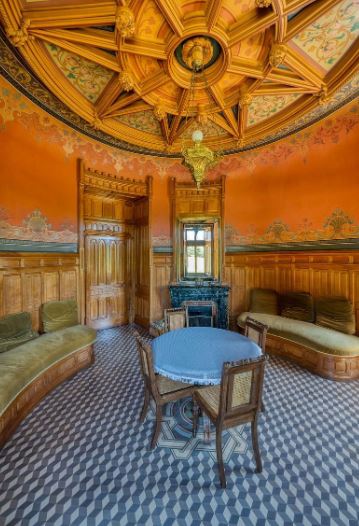
After a monetary hesitation, I led him upstairs into what was Mrs. Winchester’s principal bedroom. In the inner courtyard, there is a crescent shaped hedge that points to Mrs. Winchester’s bedroom—the one where she died. Coincidence? Maybe…but again, we will never know for sure. “Is this where the ghosts walk?” he asked as he glanced around the empty room. I was plainly annoyed by his insistence. “There are no ghosts, and they do not always anywhere,” I said irritably. I glanced up at the ceiling, and swiftly withdrew my eyes with a nervous tremor. I could tell the client was firmly persuaded that I had been the victim of some spectral horror, though I was anxiously trying to conceal it for fear of frightening him off. “Perhaps I had been not tell you anything,” I said, after considering a moment. “There is a great deal in the influence of suggestion, so it is said. If I were to tell you what the people who have slept in this room have seen, or dreamt they have seen, that might be enough to make you dream the same. Whereas, if a sensible man without any notions came and slept here, one would most likely never be disturbed.” Upstairs I showed him another room which was an unfinished attic space. The prospect from the widow showed hum that it was situated over the haunted chamber. “Is there something wrong with this room as well?” he demanded. “The servants do not like sleeping in it,” was my grudging admission. “It does very well as a boxroom.” The client was very anxious to secure an option to purchase the Winchester Mansion at the end of the month. My next step was to secure some attendance, and to send down some furniture for the many empty rooms which they mystery appeared to cling. All of Mrs. Winchester furniture had been sold at auction.

It took movers six weeks, six truck loads a day, to empty the mansion. Many of them often got lost. I was not very well pleased with the idea of taking the ghosts seriously. However, I knew that there were things in Nature which ordinary rules did not explain. I had seen things myself which could not be accounted for by natural means. I dared not tell the client that there had been a murderer lurking in the mansion ready to spring on potential clients and stab them. Suddenly, we heard a low moan—the moan of a creature in mortal terror, drawn out till it became a muffled scream. The moan was repeated, coming distinctly from the room below us. This is why I did not live having an open house at night. With candles in hand, as we reached the third floor landing the moan was repeated in a more terrible key—the key of horror instead of terror. At the same moment the door of one of the haunted rooms was thrown open, and suddenly Agnus, the maid, appeared on the threshold, with a cloak thrown over her shoulders, and a look of fear and distress on her face. “What is it?” I asked. “Merrill, she has seen something horrible, and I cannot get her to come to.” Without stopping to consider questions of etiquette, I dashed into the room. The gas had been turned full on, and by its light I saw the young lady lying stretched out on a couch at the foot of the bed, her features frozen into expression of one who looks upon some horrid sight, while from her parted lips there issued those appalling sounds which wounded like the stabs of a knife. I caught her by the shoulders and shook her, without making the slightest change in her swoon-like conditions. “Water!” I called out to Agnus, who stood wringing her hands, too dazed to act.
The water was brought, and I dashed half a glass in the face of the sufferer. At first it had no more effect than if she had been dead. Then came a startling change. The moans suddenly ceased, the victim opened her eyes, which showed the dull glassy stare of a somnambulist, and sitting half up, she commenced muttering so quickly and indistinctly that it was difficult to catch the words. “The blood, the blood, the blood, the blood, dripping, dripping, from the read lead in the ceiling, the red leak in the ceiling, in the ceiling, dripping on me, dripping on me, dripping on me!” The words rose into a wild shriek as her blank eyes were turned full on the ceiling overheard, the ceiling between the room she was in and the dressing room the size of three rooms. Involuntarily I looked up and the ceiling did not show the slightest mark. We lifted the unconscious lady and carried her out of the accursed room, and into one adjoining, where we laid her on the floor. Hardly had she passed the doorway of the haunted chamber when the dreadful screams began to die away, and the rigidity of the features to relax. In a short time the trance conditions passed away and we left Merrill to sleep. When she woke in the morning, we told her she had just has a bad dream, but she remembered nothing of what had passed in the night. At her own request, at breakfast, I described to her what had occurred, as minutely as possible. She was profoundly impressed. Of course, the client had bolted out of the house. However, Merrill, said with great conviction, “I am certain that what I saw represents something that actually happened in this house. Dreadful as it sounds, I firmly believe that somebody has been murdered in that attic with the witches cap, and that his blood did drip through the ceiling of the room below, as I saw it last night.”

As soon as the staff left the house, I went straight to a builder’s in the neighborhood, and engaged him to send some men to examine the flooring between two of the haunted rooms. The builder received my order with marked interest. “I knew there was something the matter with that house,” he observed. “It ain’t likely that tenant after tenant would come away sacred without something was wrong. Why, do you know, sir, in the last year since Mrs. Winchester died, I’ve white-washed one ceiling in the house thirteen times!” The builder’s interest led him to accompany his men, a carpenter and a plasterer, to the scene of action. I pointed out that place on the ceiling, as nearly as I could judge it, from which the ghostly dew had appeared to fall. Then men took measurements, and then, proceeding to the attic above, located a spot under the bed I used to sleep in. The bed was quickly removed, the flooring stripped off, and in the space between the joists there was exposed a mass of lime. Both the men, as well as their master, were quick to declare that the lime could not have been left there for no good,” the builder asserted. “If you want somethings hidden away and destroyed, there is nothing better than what lime is when it is fresh. It burns as well as fire, and makes no smoke.” “You mean a dead body?” I said shuddering. “I don’t say nothing about that,” the builder answered, pulling himself up. “It ain’t for me to say what that lime’s been used for. All I say is it wasn’t me that left it there, nor yet my men.” The two men began clearing the stuff away. The volatile element had evidently evaporated long ago. As they struck downward with their tools, one of them went through the plaster of the ceiling below, and a shaft of light came up.

An exclamation from one of the men followed. I bent down and peered into the cavity. On a large beam which here crossed the floor I saw a deep black stain, the stain of long-dried blood! A moment after the carpenter stood suddenly, griped about with one hand amid the woodwork, and drew forth to the light a small sharp stiletto, rusted with the same dismal stain. Nothing more was found. I gave the builder an order to entirely renew the flooring between these two haunted rooms. The most extraordinary part of the story remains to be told. The report of what had taken place having got abroad in the county, the local police came to me to obtain the stiletto, which I had been careful to preserve. By its means they were enabled to unearth a crime which had gone unsuspected till that hour, and to extort a confession from the murderer. Into the details of this terrible case, I do not care to enter. However, it is sufficient to say that the victim had perished while asleep in the attic, and that his blood had actually soaked through the ceiling into the room below, which was that of his murder—the Butler! Later that night, I was alone in the Winchester Mansion. A bright moon was out that night, and I heard a noise like a million soldiers, thrampin’ on the road, so I looked, and the hallway was full of little men, the length of my palm, with gray coats on, and all in rows like one of the regiments; each spoke with a pike on their shoulders and a shield on their arms. One was in front, byway he was the general, walking with his chin up as proud as a peacock. They marched right out the door-to-nowhere and there was another army of men with red coast. The two armies had the biggest fight you have even seen, the grays against the reds.

After looking on a bit, I got excited, for the grays were beating the reds like blazes. And then the sight left my eyes and I remembered no more until morning. I was laying on the floor, in the hallway, where I had seen them, as stuff as a crutch. Typically old castles, deserted graveyards, ruined churches, secluded glens in the mountains, springs, lakes, and caves all are the homes and resorts of fairies, as is very well known on the west coast. The better class of fairies are fond of human society and often act as guardians to those that they love. They are believed to living in the Winchester Mansion to receive the souls of dying and escort them to the gates of Heaven, not, however, being allowed to enter with them. On this account, fairies love graves and graveyards and of course this 160-room mansion built to appease the spirits who died at the hands of the Winchester rifle. They have often been seen walking to and fro among the rooms and gardens. There are, indeed, some accounts of faction fights among the fairy bands at or shortly after a new soul enters the mansion. The question in dispute being whether the soul of the departed belonged to one of the other faction. The amusements of the fairies consist of music, dancing, and ball playing. In music their skills exceed that of men, while their dancing is perfect, the only drawback being the fact that it blights the grass, “fairy-rings” of dead grass, apparently caused by a peculiar fungous growth. Mrs. Winchester used to host fairy balls in her Grand Ball Room, the music for which was furnished by an orchestra which the management had no doubt been at great pains expensive to secure and instruct. All around the fairies would dance like angels the fireflies giving them light to see by, and the moonbeams shinning on the lake for it was light to see by. Even now, staff who have been at the Winchester Mystery House sometimes hear the soft strains of their voices in the distance, and will hurry away least they discover one’s presence and be angry at the intrusion of their privacy.

When in unusually good spirits the fairies will sometimes admit a mortal to revels, but if one speaks, the scene at once vanished, one becomes insensible, and generally finds oneself by the roadside the next morning, with the drudgery of pains in one’s arms and legs and back, that if thirteen thousand devils were after one, one could not stir a toe to save the soul of one, that is what the fairies do be pinching and punching one for coming on them and speaking out loud. Black magic has not changed since the Middle Ages. The term “black art” was then applied to magic because the proficient in it were considered to be in league with the powers of darkness. The term “black magic” refers to the art of producing supernatural effect by direct league with Satan and demons. Frequently those who practice black magic make an actual pact with the powers of darkness, signing their allegiance to the devil in their own blood. This ceremony had come down from the Middle Ages to present-day Europe, where it is practiced in parts of Germany, France, and Switzerland. The ritual of signing an agreement involves a complete sell-out to the devil. Some magic involves the direct solicitation and help of demons, specifically the devil. It is the most terrible and powerful form of occult art, majoring in enchantment for persecution and vengeance, but also employing diabolical powers for defense and healing. An example of this nefarious practice is found in the death spells cast by witch doctors among aboriginal people, such as the Papuans on the island of New Guinea. Enchantment for persecution and vengeance, as well as for defense and healing, is still practiced today, not only in pagan cultures but also in civilized lands where occultism flourishes. Literature on magic was found in the Winchester Mansion and auctioned off with the rest of Mrs. Winchester’s belongings. There were incantations, charms, and spells.

One of the movers, who have never been troubled with psychic disturbances, returned home from taking the items to San Francisco to be auctioned off, and suddenly found himself suffering from acute fear dreams. He had the feeling during sleep that a neighbor lady, the mother of his coworker who was still missing after moving items out of the mansion, was strangling him. The tormented man went to an occultist who told him he was under magic persecution. The neighbor woman was seeking revenge on him for his good fortune in the light of her son’s bad fortune. With the occultist’s help, the terror-dreams creased. (That is why theft from the Winchester Estate is not tolerated. It is said to bring curses on those who remove sacred items without permission or payment.) Then the former mover found himself under a new attack: the neighbor was causing his cattle to die, head after head. The conjurer promised to remedy this new menace. Scraps of paper inscribed with magical formulae were to be mixed with the food of the cattle. The astonishing result was the cessation of the cattle epidemic. In addition to many cases of persecution and self-defense by black magic, occult healing are also common. A local farmer at the Winchester estate went to Mrs. Winchester for counseling and related the traffic results of charming by black magic. The farmer’s son had become paralyzed after an illness. The doctor could not help. However, Mrs. Winchester healed the boy through black magic, so that the paralysis disappeared completely. She had developed this skill after the death of her six-week-old daughter and her husband. Ancient and modern pagan religions, as well as those who subscribe to Christianity, have produced such psychically endowed mediums who have improved their gifts by the study and practice of the magical arts.

From what source people derive their power is not always clear—probably neither to they themselves nor their devotees have ever set themselves the task of unravelling that psychological problem. If they were turned wizards or witches, and indeed they only represented white witchcraft in a degenerate and colourless stage. Their entire time is not occupied with such work, nor, in the majority of cases, do they take payment for their services; they are ready to practice their art when occasion arises, but apart from such moment they pursue the ordinary avocations of rural life. The gift has come to them either as an accident of birth, or else the especial recipe or charm has descended from father to son, or has been bequeathed to them by the former owner; as a rule such is used for the benefit of their friends. Seen from the parapsychological point of view, magic persecution is a mediumistic problem similar to that of materialization. In the same way that a medium can emit energy that can be transformed into the phantasm of a man, so he is able to transform the same energy into the form of an animal. We have on record many cases of the materializations of dogs, cats, frogs, snakes, and even cases where the apparition was half man and half animal. If a phantasm is injured in some way at a spiritistic séance then the medium also suffers in a similar way. The same holds true in the case of animal phantasms. We are thus justified in coming to the conclusion that magic persecution is on the same level as materialization. Many methods of defence magic are based on this fact. If the victim is able to injure the phantasm that is assaulting one, it is reckoned that one has as good won the battle. We have seen then that certain forms of spiritistic offensive and defensive magic are based on materializations.

In 1888, a large black cat was found to be hanging around the Winchester mansion. In one of the cottages, on the estate, a farmer’s wife was about to give birth to a child. The cat would not go away until finally someone threw an axe at it, thereby injuring its leg. Next day it was discovered that an old woman on the estate also hurt her foot. The servants knew this woman to be a master of black magic, and indeed a few days later she took her revenge. On visiting the mother, Ida, of the new-born child, the witch murmured something and at the same time patted the child on the head. Thereafter the child cried continuously for days on end and could not be pacified. It was also discovered that as the child grew up its memory was particularly weak. Afterward the woman had three miscarriages, suffered the early death of her mother and disappearance of her father, but the source of her mental problems was far more spectacular than these mundane tragedies. Using hypnosis, Mrs. Winchester discovered that this mother to a new born had been repressing memories of an horrific past in which she had been an unwilling member of a murderous Satanic cult. Recollections would have convinced many mental-health professionals that she was suffering from pathological delusions. Her “memories” revealed a cult, led by the a monstrous Joris-Karl Huysmans, who indulged in acts of unbelievable brutality in the name of the Devil, such as blood-drinking, and other unspeakable acts. Mrs. Winchester considered the woman to be of nervous debility and easily influenced. When she had the servants cottage searched, they discovered a secret room, holding an apparently sacrificial altar with a wooden dagger suspended above a glass bowl.

In our files, there are about 40 examples involving cats, and almost all of them deal with the same problem, that of a person causing an apparition to appear in the Winchester Mystery House or elsewhere on the estate. Hamilton Howard was once hired for a job on the estate. The young man was on the verge of being dismissed because he very mysterious. He had a fair share of Satanic drawings in the cottage he was allowed to stay in, while working at a farm hand, and he never had meals with the other men. He belonged to a blood drinking cult. This might explain why stories began circulating about the carcasses of cows being discovered on Mrs. Winchester’s farm and other nearby farms drained of blood, with their eyes, lips, and private organ removed. The mystery of where the blood had cone, and how and why these animals had been operated on with seemingly surgical precision, gave birth to stories of Dracula in California and the California Cannibals. Occasionally, starving people have resorted to cannibalism for survival necessity. It is no secret, however, that Mrs. Winchester had her fair share of hauntings. One night, she heard footsteps going from the basement to the attic and then back again. There were also footsteps in the hall and at first, they thought that it was a burglar. Often her staff would search for an intruder. In addition to the footsteps the lights were sometimes turned on, and the gas too. No amount of careful investigation was able to produce any evidence as to the cause of the apparent haunting. One night, Mrs. Winchester had a séance in her Blue Séance Room. The spirit with whom she had made contact started that he had been a Catholic priest who had lived in the house 200 years before she renovated the original farm house and turned it into a mansion. He had murdered his housekeeper and had buried her in the basement. Since then, he had had to haunt the scene of his crime.

When asked in which room he had murdered the housekeeper the table suddenly began to move across the floor. It then hit the door of the room so hard that the wood was chopped. As Mrs. Winchester opened the door, the table rushed into the adjoining room and slid into the corner. In the course of doing this it hit an oak bedstead so hard that it left a permanent impression on it. The spirit was questioned further and when she asked is there was anything that could be done for him, he replied, “Yes, you can pray for me.” Mrs. Winchester did in fact pray for the restless ghost after that, and for a number of years the mansion was no longer haunted. The mansion has been haunted for several generations before its expansion. However, more than one ghost was attached to the property and it became a nexus for spiritual activity. Every person possesses one’s own home spiritually. This possession continues to live on in the house after the departure of the person concerned. Humans do not only leave behind their physical body when they die, but also a spiritual “larva.” When one dies, one leaves a spiritual complex behind that has an independent existence in the astral World, and which sometimes only disintegrates centuries later. This spiritual complex is supposed to cause the phenomen on ghost and apparitions. For some, the real of the dead is not so much a place as a state of being, and some think that there are times, as for example at one’s deathbed, when this realm of the dead becomes visible to our Earthly eyes. The idea that human beings have to remain in the mortal sphere after their death until they are freed from all the thing that once tied them to the World is widely accepted. This idea is similar to the popular opinion that criminals and other such people have to haunt the place of their crime until they are taken out of this sphere to a higher or lower level of existence. Ghosts do not occur only in connection with spiritism, but we have dealt with them here since the problem arose.

Winchester Mystery House

Are you brave enough to explore the house at night? 👀 The Winchester Mystery House is offering Friday the 13th Self-Guided Flashlight Tours. Tickets going fast! Click the link or hastage for tickets and more information.

NEVER MISS A MYSTERIOUS MOMENT

As enshrined in legend as Mrs. Winchester is her beautiful mansion, the Winchester Estate (now known as the Winchester Mystery House). No casual visitor can see it all. Palatial elegance unfolds with each turn. Nowhere is there more conspicuously displayed occult history, habits, and characteristics of the Victorian people. According to the most reliable of the honorable grounds’ keepers, the rural “fairy-men,” a race now nearly extinct, the fairies were once angels, so numerous as to have formed a larger population of Heaven. When Satan sinned and drew throngs of the Heavenly host with him into open rebellion, a large number of the less warlike spirits stood aloof from the contest that followed, fearing the consequences, and not caring to take sides till issue of the conflict was determined. Upon the defeat and expulsion of the rebellious angels, those who had remained neutral were punished by banishment from Heaven, but their offence being only one of omission, they were not consigned to the pit with Satan and his followers, but were sent to Earth where they still remain. Many of them took up residence at the Winchester mansion, not without hope that on the last day they may be pardoned and readmitted to Paradise. They are thus on their good behavior, but having power to do infinite harm, they are much feared, and spoken of, either in a whisper or aloud, as the “garden people.” These fairies are not solitary, they are quite sociable, and always live in large societies, the members of which pursue the cooperative plan of labor and enjoyment. They helped to build the Winchester mansion, and are also responsible for making the grounds so beautiful. They travel in large bands, and although their parties are never seen in the daytime, there is little difficult in ascertaining their line of march, for, sure they made the terriblest little cloud of dust ever raised, and not a bit of wind in it at all, so that fairy migration was sometimes the talk of the country.

Though, be nicer, they are not the length of your finger, they can make themselves the biggness of a tower when it pleases them, and with that ugliness that you would faint with the looks of them, as knowing they can strike you dead on the spot or change you into a dog, or a pig, or a unicorn, any other beast they please. As a matter of fact, however, the fairies are by no means so numerous at present as they were formerly. Someone was rapidly driving them out of the Winchester mansion, for the suspect(s) hated learning and wisdom and are lovers of discord and dysfunction. Many people were envious of Mrs. Winchester’s estate. A mansion is not a mansion and Mrs. Winchester was just as attentive to the exterior of her estate as she was to the rambling labyrinth. The fairies helped Mrs. Winchester by planting rare and exotic plants, flowers, trees, shrubs, and herbs from over 110 countries around the World. Some of the original plantings still flourish today—among them, 140-year-old rose bushes, ferns, and feather and fan date palms, as well as evergreen trees. Mrs. Winchester loved to spend time in her gardens, and she had gazebos built where she could sit and enjoy her trees and flowers. Nearly 12,000 boxwood hedges were planted along the pathways tht wind through the gardens. In addition, all the laws were replanted, and some 1,500 major plants, shrubs, and trees were replaced. Today the home and its garden are still the showplace of the Satan Clara Valley, a reminder of the gracious past, which we will discuss more of. Mrs. Winchester gave her estate, Llanada Villa, a mysterious name. The words are Spanish for “house on flat land,” but no one knows what special meaning they had for Mrs. Winchester.

The Winchester mansion is priceless. It has had more people begging to purchase it than any estate in the World. Many people also desire to invest it the mansion and restore it to its former glory. However, the owners like to leave some rustic evidence of the past, but are restoring some of the rooms that were damaged in the 1906 earthquake to their former glory. It now contains 160 room (but was significantly larger), 25,000 square feet (that is about the size of 20-40 houses, and maybe more because the attics and basements are not counted in the square footage), there are 10,000 windows, nine kitchens, and 47 fireplaces built of rosewood, cherry, mahogany, Italian marble, oak, teak, and pipestone; all hand carved and no two alike. Not including the fairies, commonly, 16 carpenters were employed at one time, some having worked for 20 years without change. They produced the largest, most complicated, and exclusively private residence in the United States of America. There are five different heating systems and three elevators, one hydraulic and two electric. Some of the 13 bathrooms lacked privacy; they have glass doors! One rambling room has four fireplaces and five hot-air registers. A spiral stairway has 42 steps, each two inches high. Other stairways melt into blank walls. A second story door opens into the great outdoors and a 20-foot step. A linen closet has the area of a three-room apartment; a nearby cupboard is less than one-inch deep. A skylight is placed in the middle of a room, in the floor! Another floor is apparently a series of trap-doors. Exterior faucets project unexpectedly from under second-story windows. The visitor must stoop through one door to enter, the next gives clearance for an eight-foot giant. Many stairways turn posts are set upside down. Entire walls are built entirely of half-inch “half-round” strips. Many of these oddities may have been to accommodate the fairies.

Everywhere prevails that strange deference to the number 13; 13 stairsteps, 13 hangers in a closet, 13 wall panels, 13 lights in the chandeliers, 13 windows to a room and if necessary to make that number, some placed in an inside wall. Although Mrs. Winchester’s arrival in California was sensational, the fairies were in the country long before the coming either of human beings or animals. The bodies of the fairies are not composed of flesh and bones, but of an ethereal substance, the nature of which is not determined. One can see themselves as plain as the nose on one’s face, and can see through them like it was a mist. They have the power of vanishing from human sight when they please, and the fact that the air is sometimes full of them inspires the respect entertained from them by humans. Sometimes they are heard without being seen, and when they travel through the air, as they often do, are known by a humming noise similar to that made by a swarm of bees. Whether or not they have wings is uncertain. John Hansen, who was caretaker of the estate, thought they had; for several seen by him a number of years ago seemed to have long; semi-transparent pinions, like them that grow on a dragon fly. Young lady fairies wore pure white robes and usually allowed their hair to flow loosely over their shoulders; while fairy matrons bind up their tresses in a coil on the top or back of the head, also surrounding the temples with a golden band. Young gentlemen elves wore green jackets, with white breeches and stockings; and when a fairy of either gender has need of a cap or head-covering, the flower of the fox-glove is brought into requisition. Male fairies are perfect in all military exercises, for, like the other inhabitants of the Winchester mansion, fairies are divided into factions, the objects of contention not, in most cases, being definitely known.

One night, the wind was roaring; and the windows rattled and the mansion creaked like it was moving to a different location. Mrs. Winchester then knew her house was possessed of unusual powers. She could feel the reaper. The next day, Ezra Benson, the head chef, was not down stairs at five in the morning preparing Mrs. Winchester’s breakfast, as was his custom, nor at seven, nor at nine. As the servants went into the kitchen, a glass ball came flying into the room, and all the doors and windows had been shut! The ball fell at the feet of Agnus who picked it up. It felt hot, but was undamaged. On the ball was a picture of Mrs. Winchester. She claimed that ball had been in the living room, and so the servants when to investigate. The ball in the living room had disappeared! As the servants continued to search around searched around the house for Ezra, they saw 135 objects fly through the rooms in an inexplicable manner. Hereupon the servants went and knocked at his chamber door. The door was opened at last from the outside, and they found Ezra dead and black. No marks of violence appeared at the moment, but the window was open. As was, natural, in the great swelling and blackness of the corpse, there was talk made among the neighbors of poison. The body was very much disordered as it laid in bed, being twisted after so extreme a sort as gave too probable conjecture that Ezra had expired in great pain and agony. And yet what is as yet unexplained, Aimee du Buc de Rivery was entrusted with the lay-out of the corpse and washing it, being both sad and well respected, she went to Mrs. Winchester in pain and distress of both mind and body, saying, what was indeed confirmed upon the first view, that she had no sooner touched the breast of the corpse with her naked hands than she was sensible of a more than ordinary violent smart and aching in her palms, which, with her whole forearms, in no long time swelled so immoderately the pain still continuing, that, as afterwards proved, during many weeks she was forced to lay be the exercise of her calling; and yet no mark seen on the skin.

Upon hearing this, Mrs. Winchester made as careful a proof as she was able by the help of a small magnifying lens of crystal of the condition on the skin on this part of Aimee’s body: but could not detect with the instrument she had any matter of importance beyond a could of small punctures or pricks, which Mrs. Winchester then concluded were the spots by which the poison might be introduced. So much was to be said of the symptoms seen on the corpse. There was on the table by the bedside a Bible of the small size. Mrs. Winchester took it and went into her Blue Séance room where she was going to try to get a message from the superstitious practice of drawing. Proficiency in occultism in general combined with abilities and gift in magical arts in particular is not an accident. Endowment with magical powers may be the result of a number of factors. First, and perhaps foremost, is heredity. Also important are occult transference, subscriptions to Satan, and occult experimentation. The general history of occultism shows that mediumistic powers can often be traced through four generations. It is a common thing for a dying father to bestow upon his eldest son or daughter his magical abilities. As Mrs. Winchester was writing to find the cause and events of these dreadful events. She went into a trance, and wrote “Cut it down. It shall never be inhabited; her young ones also suck up blood.” Ezra was laid to rest. His room was not slept in by anyone else. A certain amount of interest was excited in the city when it was known that a famous witch, Ursula Southeil, who was still remembered by a few, was to be exhumed. She had supposed moved to San Jose, California 1885 and shortly after was buried. People believed that maybe she had been hexing the Winchester estate. And the feeling of surprise and indeed disquiet, was very strong when it was found that, though her coffin was fairly sound and unbroken, there was no trace whatever inside it of body, bones, or dust.

Indeed, it is a curious phenomenon, for at the time of her burying no such things were dreamt of as resurrection-men, and it was difficult to conceive any rational motive for stealing a body otherwise then for the use of dissecting-room. Mrs. Winchester knew the secrets of this terrible death was mystery. Many believed that the spirit of Ursula had using Mrs. Winchester’s mansion as her lair and needed to be forced out. They found below a white oak a rounded hollow place in the Earth, wherein were two or three bodies of creatures, and at the side of this den, against the wall, was crouching the anatomy of skeleton of a human being, with the skin dried upon the bones, having some remains of brown hair, which was pronounced by those that examined it to be undoubtedly the body of a woman, and clearly dead for over hundred years. The history of magic is replete with extraordinary extrasensory phenomena that involved the spirit realm and every phase of the natural World as well, including human beings, animals, plants, and inorganic matter. Spirit-rapping, apparitions, ghosts, moving of furniture, and playing of musical instruments by invisible hands, stones falling from a ceiling, magical killing of cattle, unexplained creatures, and blighting of crops, et cetera, are just a few of the weird occurrences that took place at the Winchester mansion that fill the annals of occult practice. Incredible as it may seem, even in modern scientific age millions are now, or have been at some time, involved in some manner with ancient magic practices and rites, ranging from using spells, magic herbs, and hex signs on houses and barns (which can still be seen in some areas of the estate and other places). The precise character of magic has been even more heatedly disputed than its definition. One lauds it as a gift from God. Another denounces it as an operation of Satan and demons. Another denies it any moral quality and views it merely as the working of neutral forces of nature, which can be employed either positively or negatively.

The liberal theologian sees magic as the crystallization of time-bound ideas and customs. They psychologist looks at the magically subjected person as wrongly adjusted to life and the natural World. The psychiatrist sees the whole magical complex as symptomatic of mental aberration. The Christian Bible condoms magic, it clearly recognizes the reality of its power. (Exodus 20.1-6; Deuteronomy 18.9, 10). Human history will end with a tremendous demonic revival (Revelation 9.1-20) that will culminate in the reign of Antichrist, who will be attended by diabolic signs and magical wonders (2 Thessalonians 2.9-12; Revelation 13.13-18). Armageddon will be a demon-energized revolt and a satanic attempt to take over the Earth (Revelation 16.13, 14). Just as modern humans have inherited their ideas of God and the Universe from their Christian predecessors, so had they inherited the Devil. Satan is an archetype, a force embedded in humans’ unconscious, a remnant of their psychological evolution. Satan is the child of fear, and fear is innate in all humans. Eve from the Garden of Eden used to roam around and take up with animals. Nothing was amiss to her, in the animal line. She trusted them all, they trusted her; and because she would not betray them, she thought they would not betray her. The snake advised her to try the fruit of the forbidden tree, and told her the results would be a great and fine and noble education. Adam told her there would be another result, too—it would introduce death into the World. That was a mistake—he should have kept that remark to himself; it gave her an idea. Adam escaped that night, and rode a horse all night as fast as he could go, hoping to get clear out of the Garden and hide in some other country before the disaster should fall. Eve had eaten the fruit and death was come into the World.

Eve found Adam outside the garden. He was not sorry she had come, for there was absolutely nothing to eat, but meagre pickings here, and she brought some of those apples, and Adam was obliged to eat them, he was so hungry. It was against his principles, but he did it anyway. Evil, as it has appeared through human history, has a schizoid development, manifesting itself in two forms. The most elementary of these forms is purely internal, deriving from humans’ instinctual drive toward self-preservation, the concept “self” here including humans’ own physical being and the physical beings of related others. The object of this type of fear is anything that humans might see as impairing one’s fight for survival. As the primitive human sits in a jungle clearing by his fire at night and hears the sounds of animals stirring in the bushes around him, he fears for his safety. He feels powerless and is overcome by a seemingly unbridgeable gap between knowledge and environment. He feels himself to be a mere pawn, a plaything, victimized by nature’s capricious ways. Drowned by nature’s angry waters, baked by her merciless sun, attacked by her vicious animals, starved, beaten, bullied, he is at a loss for an explanation. Though fully aware mentally, he finds himself totally blind in the face of her inscrutable ways. What recourse does he have? He must attempt in some way to make these strange and wonderous forces less capricious and more subject to his control. So he recreates them in his own mind, makes them more tangible, more related to his own experience. He takes them out of their detached state to give them more personal meaning. Once he has done this, he had some recourse for his grievances: now he may make offerings, get down on his knees and ask the god for a good crop or an abundant herd, attempt to cajole or coerce the god into granting his request.

Those deities that humans have traditionally created to represent evil have stemmed from those forces of nature that they have found to be most uncontrollable; the shapes into which they have been cast being those shapes and forms that they have feared the most. Primitive humans saw hideous demons with six heads and fierce claws waiting from them in the darkness, and they were forced to respond to the danger. The popularity of heavy metal rock acts in the 1970s gradually started to work against them, as audiences associated them with big business rather than rebellion. However, the music changed. Heavy metal had moved out of the Californian sunshine and cosmic otherworldliness of the late 1970s, back into the rainy alleyways and gloomy English pubs that were its birthplace. Satanism had also secured a prominent position in the iconography of the New Wave. For most bands, it was nothing more than an exciting image that sold records. However, the Devil could be a risky card to play—as is His nature, for every potential fan He attracted, He also incited hostility. Iron Maiden’s 1982 album Number of the Beast, which sported a leering Satan on the cover, proved to be their commercial breakthrough. The title track, like the eponymous “Black Sabbath,” describes stumbling across an horrific Satanic ritual. Despite bassist Steve Harris’ limp insistence that “Number of the Beast” is an anti-Satan song, the record not only took them to the top of the charts but also to the top of the hate list for Christian anti-rock campaigners. The band were more than a little complicit in this, hyping the album with spooky stories about its cursed conception: mysterious power failures, radio interference and exploding amps apparently plagued the recording sessions: most sinister of all, the producer had a car crash at the time, his repair bill coming to $666.

More petitely, as Anton Lavey once noted, you cannot employ Satanism without promoting it. True to this dogma, other young bands utilized Satan not as a throwaway reference but as the core of their identity. Their new sub-genre would become knows as black metal, after a 1982 album titled by the band Venom. In many ways black mental is the musical genre that never was—its style is basically the rawest, most malignant heavy metal, with a strong occult element in the lyrical content. The Satanic tag attracted a strange regiment of musicians who wished to test the musical and moral boundaries of what the rock business deemed acceptable. Prominent among these bands was Witchfynde, founded in 1976. They never enjoyed much success, and were almost universally spurned by the music press, but some of their material retains a darkly naïve charm—especially on their 1980 debut Give ‘Em Hell. According to press releases of the time, “It is no secret that guitarist Montalo does more than dabble in the occult and that both he and the band draw upon these sources for guidance.” Though Anglewitch, disassociated themselves from the darker edges of the occult—notably in the song “Hades Paradise,” in which they accuse Satanists of being “sick in the head,” there were suggestions that Angelwitch’s occultic roots were darker than they would have their audience believe. Most unusual in their approach were Demon. Unlike their contemporaries, who boosted their Satanic imagery with aggressive guitars, Demon’s keyboard-anchored sound emphasized more mystical, subtly sinister aspects. Like Black Sabbath, Demon hypocritically warned against the subject that clearly fascinated them. The audience that eluded Demon flocked to a number of black metal acts who matched extreme Satanic lyrics with extreme, blistering tones. At the forefront were the Danish band Mercyful Fate, led by the unashamed Satanist King Diamong—who, taking the stage in black and white face paint, would influence the visual image of Satanic rock for decades to come.

Formed in 1981, the band debuted with the mini-album A Corpse Without a Soul. The cover boasted a scandalous sketch inspire by the song “Nuns Have No Fun.” Mercyful Fate’s first full-length album, Melissa, came out in 1983, inspired by a skull Diamond which he liked to believe once belonged to a witch. Don’t Break the Oath, which followed the year after, contained a title track which was Diamond’s most brazen dedication to Satan: “By the symbol of the Creator, I swear/A faithful servant of his most puissant Archangle/The prince Lucifer/Whom the Creator designated as his Regent/And Lord of this World. Amen.” King Diamond followed this same devotional approach to Satanism in interviews and everyday life. His inspiration was Anton LaVey, who Diamond visited in San Francisco (during this visit, the eccentric LaVey regaled his Danish guest with a keyboard rendition of “Wonderful Copenhagen”). In return, King Diamon received an honorable mention in LaVey’s 1990s biography, The Secret Life as a Satanists, as the only Satanic rocker then paying proper dues to the Prince of Darkness. He won the respect of figures in both the occult ad rock Worlds for his well-mannered sincerity. The shell of Mercyful Fate went off to form the uninspired Fate, while in Diamond’s new band, the modestly-titled King Diamond, Satan was conspicuously by his absence. However, the songs were atmospheric mini-horror movies, and the anti-Christian slant remined—most notably on their best release The Eye, which retold a historical tragedy surrounding the Catholic Inquisition—though records sold disappointingly. Often times, it is the band’s Satanism, however, that convinced many young metal fans to buy the album. On the band Venom’s debut album Welcome to Hell ran the blurb on the back of the sleeve, “We’re possessed by all that is evil. The death of your God we demand. We spit at the virgin you worship. And sit at Lord Satan’s left hand.”

One could day that concerts are Satanic rituals because one is definitely letting so much energy loose. If one did it the right way, one could probably turn it into one of the most powerful Satanic rituals. My God it would be powerful. Satanism is a lot to do with a life philosophy. There are also the steps of how to perform a ritual. However, there too you have to be careful. Not just everybody can do it, you have to have certain features and abilities so you can release the right energies at the right moment. If you cannot do that, nothing will come of it. Many artists perform Satanic rituals at home, but not on stage because they do not want to take advantage of the audience. Satan stands for the powers of the unknow, the powers of darkness, that are all around us which we can use for our or other people’s benefit. Satanism sells because it is the twisted horror of it. Horror sells, death sells, anything nasty sells. You just have to turn on your TV and watch the news and there is more and more violence in your face. Why? Because people like to see it. They like to sit there and know it is not them—that they are better off. Sometimes it is healthy because these things happen, you cannot avoid them. There is no way you can erase that part of life. I do not think we have more or less bad in the World since I have lived. It just moves around a bit. It Is always going to be there, you might as well try and learn to live with it. People like black metal because it gives you a shiver up your spine. There are different purposes to music and different songs that generate different basic emotions—pathos or a marching tune, for example. Successful music feeds upon your emotional needs, while dissonant music feeds humans’ habitual masochism. If you watching the 2001 Anne Rice film, Queen of the Damned, you can get a feeling at the excitement of black metal and Satanism, but as experts recommend, be careful. The star of the film, the beautiful Aaliyah died in a plane crash just months before the film was released. She was only 22, but the film is really intense, and Queen of the Damned is also a great sound track.

Satanists are on the move. Other Satanists might not be quite as “understanding,” but there is a warning to those who tap into Satanism for economic advantage; they should be careful not to slander their seminal roots. They may not care now, but they may vert well have to care in the future. Aaliyah really got into the dark roots and even studied Egyptian culture and loved rock music, but experts are not joking with their warnings. It is a dangerous hobby and way of life. Magic and the fall of man—magic came into being with the spiritual fall of man at the threshold of human history. Demonic forces are engineering the gigantic apostasy of the end of time that will culminate in the rise of Antichrist and the greatest demonstration of diabolic miracle and demonic wonders the World has ever seen (2 Thessalonians 2.8-10; Revelations 13:1-18). One can imagine tht in the hands of a person of criminal tendencies such a spiritistic ability would be the cause of much harm. Mrs. Winchester reported that for several years she had been frightened each night by the appearance of one of her neighbours between 12 and 1 o’clock. Passers-by also heard ghostly music wafting from the dark mansion. Every time this had happened, Mrs. Winchester had woken up with a start. She had been terribly frightened. It was not a dream for she has always seen the apparition as she was actually waking up. The phantom was in fact that of one of them women in the county. This particular woman had the reputation of being an evil person who indulged in plaguing people through black magic. After the woman’s death, Mrs. Winchester ceased to have these strange experiences. I guess the bell in the belfry summoned her with the incoming flights of spirits, and then tolled again to warn her, along with other visitors, to return to their sepulchers.

A young farmer on the Winchester estate had the experience of being beaten up at night in his Victorian cottage on the estate. Sometimes he was beaten so badly that he actually bled. The whole village had seen him on numerous occasions with black and blue weals across his body. As is only to be expected in a country where the majority of the inhabitants were engaged in agricultural pursuits, most of the strange doings are not only connected with ghost, but with cattle as well. One of the herdsmen at the Winchester estate had wounded a hare, which he had discovered sucking on one of the cows under his charge, tracked it to a solitary cottage near the mansion, where he found an old woman, smeared with blood and gasping for breath, extended almost lifeless on the floor. Certain witches had the power of turning themselves into hares and in that shape sucking cows. The early demons, however, were never complete personifications of evil in the social sense. They were always incomplete in their evilness, due to their rather personal nature. For the most part, they were projections of man o nature and, as such, most of them had at least some of humans’ character in them, rendered both consciously and unconsciously. This can be seen in the mythologies of the winged serpent, for, in fact humans’ ambivalence toward oneself and nature is reflected in one’s casting of one’s many demons and gods in this shape. The wings are symbolic, at an unconsciously level, of a loftier striving, an attempt at spiritual transcendence, while the snake has always been an object of instinctual fascination for humans. Humans’ ancient dichotomy of intellect versus instinct is apparent in this symbolism. The old gods, then, were oddly like men, so that they could either heal or destroy, assist man or plague him, depending on whether he awoke in the morning with heartburn or had had a satisfying night with his wife. Evil structuralized in society is socially harmful, and it threatens social rather than person disintegration. Evil inspires fear and awe and thus assume the proportions of a force of nature.

When Mrs. Winchester’s safe was open, after she went to Heaven, an ivory tablet was found that said, “Lord Satan approves.” However, it was not in Mrs. Winchester’s hand writing. The ivory tablet was authenticated. Radio carbon dating indicated that it dated back to the 17th century. One of the movers thought someone from a satanic cult was monitoring them when they opened the safe. One of the guys quickly quit and dedicated his life to Christ. And just a few years ago, as the Winchester Mystery House was closing for the night, a glass rose into the air, then slowly put itself back down on the table. Some of the tour guides feel very comfortable when they see things like that happen because they believe the spirits are their protectors, guardian angels, and feel very comfortable that they are still in the mansion that was built by spirits. Magical powers may be acquired by signing an agreement with Satan, often in one’s own blood. (Please do not try this. Self-harm is not acceptable.) This is an age-old phenomen. Isaiah mentions “making a covenant with hell” (28.15). Such blood-bound occultist frequently become endowed with astonishing magic capabilities. However, they become demonic captives and may be delivered only with the greatest difficult. Often they become hopelessly shackled. The practice of a satanic blood pacts is not a mere superstitious hangover from medieval witchcraft and hobgoblins. It is a well-known and fairly common custom today in various rural districts of Europe where magic literature has circulated for centuries and magical powers have passed from one generation to another. Magical powers can also be acquired through dabbling in the occult. In the late 1900s, a farmer at the Winchester mansion wanted to become rich like Mrs. Winchester. He became enamored with tales of easy money made by occult healers and mesmerizers. He purchased some magical literature and stated mastering charms and spells, underwent devils’ ceremonies, and began healing experiments. His magical healing ability developed rapidly. He soon found his income far exceeded his former wages. Numerous forms of magic exist. Among them are black magic, white magic, neutral magic, mental suggestion, criminal hypnosis, and magical mesmerism. When any of these forms enlist demonic powers, they are authentic cases of magic. In the absence of occult power, the phenomena do not belong to the field of magic.


Happy Earth Day! Mrs. Winchester was very “green” for her day – before it was popular!

An example can be found in the North Conservatory – not wanting to waste resources, she had the floor built at an angle so that excess water would flow down to the exterior gardens below!

Victorian Seance? Fate & Fortune Telling? Count us in 🙋🏻♀️ Join us on April 29th as we welcome back Aiden Sinclair to The Winchester Mystery House. Purchase your tickets today – they are going FAST! https://www.winchestermysteryhouse.com/aiden-sinclair/

How Can I Get My Kids Off it and Back to Life?

In the past the system has come first; in the future, America must be first. America is great and genius; she has commodious harbors and ample rivers, fertile fields and boundless forest. America has rich mines and vast World commerce, along with the best public school system and institutions of learning in the World. The genius of the American system lies in her matchless Constitution and righteousness. The secret of her power is that American is great because good. Other nations are shameless and godless, their habits are corrupt and abominable; among them, as is repeatedly said, there is none the does good, non that understands any more what is desired of human beings, how they should rule and be ruled, they are all gone aside from their original humanity as willed in the creation, they are altogether decaying, like tainted food. However, if America ever ceases to be good, she will cease to be great. In spite of everything there is a pitiable self-righteousness in understanding the great picture of America, the Heavens are looking down upon us and spying out every single person with a patriotic heart who enquires after the American Dream, and shining down upon these people are such brilliant beams of prosperity. However, evil doers are eating up our people; therefore they must be outside this people. That is so; but our people are righteous and some oppressed. We no longer count as part of the people of the shameless, those gone aside, who oppress the righteous. Thus we are acting in guidelines with the holy remnant which is the true people, and are here concentrated in the consideration of the present. However, the view of others too, those who are “decayed,” is prophetic and have fallen into corruption. Make sure you remain in the proven generations of the real people. God’s people, and the others are just the others; but they are so many that they seem to be “all.”

The falling away of the corrupt means the immorality is falling asunder. What appears outwardly to be a unified nation is in truth torn in two—but of the two parts only one is still truly to be called America, a living organism; the other is nothing but decomposed tissue, the rotting substance of people. There are the oppressors and there are the oppressed, the arrogant and the humble. Those say in their heart, “There is no God.” They do not say it aloud, it does not rise from the heart to the lips with their lips they confess Him. Even in their heart thy do not mean, by what they say, to contest the existence of God. Why should there not be a God—so long as He does not bother Himself with what humans are doing on Earth! However, the truth is that God watches what His creatures are making of themselves. He sees how humans “eat up” humans; this is not a food-like the animal sacrifice which is called the bread of God—over which is called the name of God. Those who have fallen away from the great Kingdom and blessed nations rush again to their prey, but suddenly they are filled with terror: there, in the midst of those who they thought were abandoned to an arbitrary fate, the Presence of God appears, even that God and His great kingdom America, who they thought was far from men and their doings, but who is in truth the refuge of the oppressed. And His words thunders upon them. We must unite in a messianic promise. America’s liberation and salvation can only come from the Heavens. The Heavens of righteousness fulfilled in the land of America is what must be meant. For the “remnant,” which has now truly become the people of God, the great turning-point draws near.

No one can be satisfied with the division of America, just as one cannot be satisfied with the division of the human Word. We see the rift between those who do violence and those to whom violence is done, the rift between those who are true to God, running not merely through every nation, but also through every group in a nation, and even through every soul is part of the fabric of our royal heritage. Only in times of great crisis does the hidden rift in a people become apparent. There is now an entirely new language of good and evil, originating in an attempt to get “beyond good and evil” and preventing us from talking with any conviction about good and evil anymore. Even those who deplore our current moral condition do so in the very language that exemplifies that condition. The new language is that of value relativism, and it constitutes a change in our view of things moral and political as great as the one that took place when Christianity replaced Greek and Romans paganism. A new language always reflects a new point of view, and the gradual, unconscious popularization of new words, or of old words used in new ways, is a sure sign of a profound change in people’s articulation of the World. When bishops, a generation after Hobbes’s death, almost naturally spoke the language of the state of nature, contract and rights, it was clear that he had defeated the ecclesiastical authorities, who were no longer able to understand themselves as they once had. It was henceforward inevitable that the modern archbishops of Canterbury would have no more in common with the ancient ones than does the second Elizabeth with the fist. What is offensive to contemporary ears in the use of the word “evil” is its cultural arrogance, the presumption that one, and America, knows what is good; it closes the dignity of other ways of life; its implicit contempt for those who do not share our ways.

The political corollary is that one is not open to negation. The opposition between good and evil is not negotiable and is a cause of war. Those who are interested in “conflict resolution” find it much easier to reduce the tension between values than the tension between good and evil. Values are insubstantial stuff, existing primarily in the imagination, while death is real. The term “value,” meaning the radical subjectivity of all belief about good and evil, serves the easygoing quest for comfortable self-preservation. Value relativism can be taken to be a great release from the perpetual tyranny of good and evil, with their cargo of shame and guilt, and the endless efforts that the pursuit of the one and the avoidance of the other enjoin. Intractable good and evil cause infinite distress—like war and repression of pleasures of the flesh—which is almost instantly relieved when more flexible values are introduced. One need not feel bad about or uncomfortable with oneself when just a little value adjustment is necessary. And this longing to shuck off constraints and have one peaceful, happy World is the first of the affinities between our real American World and that of decaying flesh. However, there is a second side of the coin. Persons deeply committed to values are admired. Their intense belief, their caring or concern, their believing in something, is the proof of autonomy, freedom and creativity. Such persons are the contrary of easygoing, and they have standards, all the more worthy because they are not received from tradition, and are not based on a reality all can see, or derived from thin rationalizing confined to calculate themselves to ideals of their own making. They are the antibourgeois.

Value here serves those who are looking for fresh inspiration, for beliefs about good and evil at least as powerful as the old ones that have been disenchanted, demystified, demythologized by scientific reason. This interpretation seems to say that dying for values is the noblest of acts and that the old realism or objectivism led to weak attachments to one’s goals. Nature is indifferent to good and evil; man’s interpretations prescribe a law of life to nature. Thus our use of the value language leads us in two opposite directions—to follow the line of least resistance, and to adopt strong poses and fanatic resolutions. However, these are merely different deductions from a common premise. Values are not discovered by reason, and it is fruitless to seek them, to find the truth or the good life. The quest begun by Odysseus and continued over three millennia had come to an end with the observation that there is nothing to seek. This alleged fact was announced by Nietzsche just over a century ago when he said, “God is dead.” Good and evil now for the first time appeared as values, of which there have been a thousand and one, none rationally or objectively preferable to any other. The salutary illusion about the existence of good and evil has been definitively dispelled. For Nietzsche this was an unparalleled catastrophe; it meant the decomposition of culture and the loss of human catastrophe; it meant that decomposition of culture and the loss of human aspiration. The Socratic “examined” life was no longer possible or desirable. It was itself unexamined, and if there was any possibility of human life in the future it must begin from the naïve capacity to life an unexamined life. The philosophic way of life had become simply poisonous. In short, Nietzsche with the utmost gravity told modern humans that he was freefalling in the abyss of nihilism. Perhaps after having lived through this terrible experience, drunk it to the dregs, people might hope for a fresh era of value creation, the emergence of new gods.

One of these new gods is the television, and the other is the Internet. It has become clear that watching television is an experience that an amazing number of people are eager to describe. It is like a machine that invades the mind, controls and deadens the people who view it. It is not unlike the alien operated “influencing machine” of the psychopathic fantasy. At one point I heard my son Leo say: “I don’t want to watch television as much as I do but I can’t help it. It makes me watch. TV is colonizing my brain.” However, there are some favorable reports, it can make lonely people feel like they are in the company of friends and family, and they can live vicariously through the TV. Not everyone becomes sucked into the programing and experiences severe acute television intoxication. You know, one reason spiritualism and séances, which were so popular during the Victorian ages may be dying out, is because we have what the Victorians were trying to channel. Victorian people did not have televisions, and some did not have neighbours for miles and miles and days away, so they had to use their imagination and try to tap into the supernatural to understand life and how other felt, how they reacted, how they live—they need a chance to have conversations with people about life experiences. Now, people have television that does that for them. There may be some who believe the TV is talking to them, there may be others who watch TV to make sure their behavior is considered rational. Nonetheless, not all TV is bad, it will teach one how to read into situations and discover what others may have actually been saying to you. In Victorian times and this day, not everyone had or has access to friends and therapists and many people on the television are playing out situations that actually do occur in peoples lives.

You may learn by watching TV, for example, when you expressed a grievance to someone about what another person did to your car, and she seem to blow it off did not mean she did not believe, but that she was simply trying to keep peace between you and the other party. It does not mean that she favors that other person. She may in fact agree with you, but does not want you to know what this individual did because it would cause a rift. You have to learn to read people and trust your instincts. In contrast, TV also helps people “space out” and the like that experience. It may help some forget about their otherwise busy lives. Many people believe that the TV has “meditative” qualities; others find it “relaxing,” saying that it helps them “forget about the World.” Some who used terms like feeling “brainwashed” or “addicted” nonetheless feel that television provides them with good information or entertainment, although there is no one who felt television lived up to its “potential.” In all the time we collected responses about the television, only eight people suggested they watched too little. Ideally, it is a good idea to keep television watching down to two or three hours a month. Even if the programs you are watching are interesting, it feels “antilife,” as though one has been drained in some way, or one has been used. If you spend all this time watching television on purpose, to understand life better, you will have all the answers, but realize you do not have much more life to live. Do not let your whole physical being go dormant, do not become the victim of a vague soft assault.

Often times, the longer one watches television, the worse one will feel. Afterwards, several people notice there is nearly always a desire to go outdoors, or go to sleep, to recover one’s strength and one’s feelings. Another thing. After watching television, one will always be aware of a kind of glowing inside one’s head: the images! They will remain in there even after the set is off, like an aftertaste. Again one’s will, one will find oneself returning to one’s awareness hours later. Gather descriptions of the experience other people have watching television. That may be a good topic of conversation. We have found that people frequently describe concrete physical symptoms that neither they nor anyone else actually believed are real. The people who tell us that television is controlling their minds would then laugh about it. Or they would say they were addicted to it, or feel like vegetables while watching, and then they laugh at that. People were saying they were being hypnotized, controlled, drugged, deadened, but they would not assign validity to their own experience. (However, these are the same reason many people do not like working. I guess making money is not enough of a reward when one has to exert physical energy.) Yet if there is any truth in these descriptions, we are dealing with a force that is far more powerful and subtle than Huxley’s hypnopeadic machines. If television “hypnotizes,” “brainwashes,” “controls minds,” “makes people stupid,” “turns everyone into zombies,” then you would think it would be an appropriate area of scientific inquiry. In fact, someone should call the police. Science has a name for such collections of descriptions. They are called “anecdotal evidence” or “experiential reports.” Such reports are not totally ignored by researchers, although they are not exactly taken seriously either.

In the case of television, there is the problem that the symptoms are not fatal, they are subtle. Few people go to doctors complaining about them. They therefore remain below the threshold of visibility for the scientific inquiry. Even when such reports are noticed, science does not accept them as valid unless they have been put through the grinder of scientific proof. Since it is beyond science to validate exactly what is meant by “zombie” or “brainwash” or even “addiction” or, as we will see, even “hypnosis,” these symptoms inevitably remain unproved, leaving people who need external validation at a loss. One major result of modern science has been to make people doubt what they would otherwise accept as true from their own observation and experience. Science, medicine, psychology and economics all deeply depend on people being mystified by their own experience and blind to the strict limits of scientific method. In this country, where intervention between humans and their inner selves is so very advanced, the mystification is virtually total. If the National Institutes of Health funded a $5 million study over a three-year period which gathered together all the “experts” to determine the effects of television on the body and mind, and then reported its findings to the president of the United States of America, who, frightened by the results, then appointed a commission of scholars and other experts to do it over again, one of whom smuggled a copy of the original “findings” to The Oakland Tribune, which then carried it on page one: SUPPRESSED STUDY SUGGESTS TELEVISION IS ADDICTIVE, HYPNOTIC, STOPS THOUGHT: SIMILAR TO BRAINWASHING: OTHER PHYSICAL EFFECT NOTED, then people would day, “You know, I always thought that might be true.”

In my opinion, if people are watching television for four hours every day and they say they cannot stop it, and also say that it seems to be programming them in some way, and they are seeing their kids go dead, then really, I deeply feel there is no need to study television. This evidence is what lawyers call “prima facie” proof. The only question is how to deal with it. I am satisfied that most people are already perfectly aware of what television is doing to them, but they remain tranquilized by the general wisdom that: the programming is the problem, and it is useless to attempt to change it anyway. Television is here to stay. More than a century after the invention of the steam engine, the Industrial Revolution had at last found its philosophy and its philosopher. Frederick Winslow Taylor’s tight industrial choreography—his “system,” as he liked to call it—was embraced by manufacturers throughout the country and, in time, around the World. Seeking maximum speed, maximum efficiency, and maximum output, factory owners used time-and-motion studies to organize their work and configure the jobs of their workers. The goal, as Mr. Taylor defined it in his celebrated 1911 treatise The Principles of Scientific Management, was to identify and adopt, for every job, the “one best method” of work and thereby to the effect “the gradual substitution of science for rule of thumb throughout the mechanic arts.” Once his system was applied to all acts of manual labor, Mr. Taylor assured his many followers, it would bring about a restructuring not only of industry but of society, creating a utopia of perfect efficiency. “In the past the man has been first,” he declared; “in the future system must be first.” Mr. Taylor’s system of measurement and optimization is still very much with us; it remains one of the underpinnings of industrial manufacturing. And now, thanks to the growing power that computer engineers and software coders wield over our intellectual and social lives, Mr. Taylor’s ethic is beginning to govern the realm of the mind as well.

The Internet is a machine designed for the efficient, automated collection, transmission, and manipulation of information, and its legions of programmers are intent on finding the “one best way”—the perfect algorithm—to carry out the mental movements of what we have come to describe as knowledge work. Google’s Silicon Valley headquarters—the Googleplex—is the Internet’s high church, and the religion practiced inside its walls is Taylorism. Google’s CEO is Sundar Pichai. The company was founded around the science of measurement. It is striving to systematize everything it does. Google tries to be data-driven, and quantify everything. This corporation lives in a World of numbers. Drawing on the terabytes of behavioral data Google collects through it search engine and other sites, the company carried out thousands of experiments a day and uses the results to refine the algorithms that increasingly guide how all of us find information and extract meaning from it. What Mr. Taylor did for the work of the hand, Google is doing for the work of the mind. The company’s reliance on testing is legendary. Although the design of its Web pages may appear simple, even austere, each element has been subjected to exhaustive statistical and psychological research. Using a technique called “split A/B testing,” Google continually introduces tiny permutations in the way its sites look and operate, shows different permutations to the sets of users, and then compares how the variations influence the users’ behaviour—how long they stay on a page, the way they move their cursor about the screen, what they click on, what they do not click on, where they go next. In addition to the automated online test, Google recruits volunteers for eye-tracking and other psychological studies at its in-house “usability lab.”

Because Web Surfers evaluate the contents of pages so quickly that they make most of their decisions unconsciously, monitoring their eye movements is the next best thing to actually being able to read their minds. Google relies on cognitive psychology research to further its goals of making people use their computers more efficiently. Subjective judgments, including aesthetic ones, do not enter into Google’s calculations. On the web, design has become much more of a science than an art. Because you can iterate so quickly, because you can measure so precisely, you can actually find small differences and mathematically learn which one is right. In one famous trial, the company tested forty-one different shades of blue on its toolbar to see which shade drew the most clicks from visitors. It carries out similarly rigorous experiments on the texts it puts on its pages. You have to try to make words less human and more a piece of the machinery. Furthermore, Taylorism is founded on six assumptions: if not the only, the primary goals of human labor and thought is efficiency; that technical calculation is in all respects superior to human judgment; that in fact human judgment cannot be trusted, because it is plagued by laxity, ambiguity, and unnecessary complexity; that subjectivity is an obstacle to clear thinking; that what cannot be measured either does not exist or is of no value; and that the affairs of citizens are best guided and conducted by experts. What is remarkable is how well this encapsulates Google’s intellectual ethic. Only one tweak is required to bring it up to date. Google does not believe that the affairs of citizens are best guided by experts. It believes that those affairs are best guided by software algorithms–which is exactly what Mr. Taylor would have believed had powerful digital computers been around in his day.

Google also resembles Mr. Taylor in the sense of righteousness it brings to work. It has a deep, even messianic faith in its cause. Google is more than a mere business; it is a moral force. The company’s much-publicized mission is to organize the World’s information and make it universally accessible and useful. Fulfilling that mission will take approximately 300 years. (I know many of us may have not even looked that far into the future yet. We are just praying the World will last a few more lifetimes at this point.) The company’s more immediate goal is to create the perfect search engine, which is something that understands exactly what you mean and give you back exactly what you want. In Google’s view, information is a kind of commodity, a utilitarian resource that can, and should, be mined and processed with industrial efficiency. The more pieces of information we can access and the faster we can distill their gist, the more productive we become as thinkers. Anything that stands in the way of the speedy collection, dissection, and transmission of data is a threat not only to Google’s business but to the new utopia of cognitive efficiency it aims to construct on the Internet. As outsiders, we and many others for decades have repeatedly hectored economists about their failure to adequately credit the crucial role prosuming plays in generating wealth. In doing so, we followed in the pioneering footsteps of Gary Becker and Amartya Sen. From within the economics profession, they made very early, intellectually powerful efforts to persuade their colleagues of the importance of this hidden economy—only to face decades of polite humming before being belatedly aware their Nobel Prizes.

Among activists, too, Hazel Henderson, in Paradigms in Progress and other insightful books; Edgar Cahn in Time Dollars; Nona Y. Glazer in Woman’s Paid and Unpaid Labor; and others have attacked the self-imposed blingers of mainstream economists. Finally, and perhaps most important, countless NGOs in many countries have echoed these criticisms. Yet even today, little has been done to systematically map the vital two-way links that connect the money economy and its huge, off-the-books doppelganger. When prosumers help glue families, communities and societies together, they do it as part of everyday life without, as a rule, calculating its effects on the nation’s visible economy. Yet, if economists could tell us what social cohesion is worth in dollars, yen, yuan, won or euros—or what social disintegration costs—it would be highly instructive. So what, then, is all this unpaid work worth? There are failures, fallings-short, and compromises. Imagine that these modern radical positions had been more fully achieved: we should have a society where: A premium is placed on technical improvement and on the engineering style of functional simplicity and clarity. Where the community is planned as a whole, with an organic integration of work, living, and play. Where buildings have the variety of their real functions with the uniformity of the prevailing technology. Where a lot of money is spent on public goods. Where workers are technically educated and have a say in management. Where no one drops out of society and there is an easy mobility of classes. Where production is primarily for use. Where social groups are laboratories for solving their own problems experimentally. Where democracy begins in the town meeting, and a man seeks office only because he has a program. Where regional variety is encouraged and there is pride in the republic. And young men are free of conscription. Where all feel themselves citizens of the universal Republic of Reason.

Where it is policy to give an adequate voice to the unusual and unpopular opinion, and to give a trial and market to new enterprise. Where races are factually equal. Where vocation is sought out and cultivated as God-given capacity, to be conserved and embellished, and where the church is the spirit of its congregation. Where ordinary experience is habitually scientifically assayed by the average human. Where it is felt that the suggestion of reason is practical. And speech leads to the corresponding action. Where the popular culture is daring and passionate culture. Where children can make themselves useful and earn their own money Where their sexuality is taken for granted. Where the community carries on its important adult business and the children fall in at their own pace. And where education is concerned with fostering human powers as they develop in the growing child. In such an utopian society, as was aimed at by modern radicals but has not eventuated, it would be very easy to grow up. There would be plenty of objective, worth-while activities for a child to observe, fall in with, do, learn improvise on his own. That is to say, it is not the spirit of modern times that makes our society difficult for the young; it is that that spirit has not sufficiently realized itself. In this light, the present plight of the young is not surprising. In the rapid changes, people have not kept enough in mind that the growing young also exist and the World must fit their needs. So instead, we have the present phenomena of excessive attention to the children as such, in psychology and suburbs, and coping with “juvenile delinquency” as if it were an entity.

Adults fighting for some profoundly conceived fundamental change naturally give up, exhausted, when they have achieved some gain that makes life tolerable again and seems to be the substance of their demand. However, to grow up, the young need a World of finished situations and society made whole again. Indeed, the bother with the above little utopian sketch is that many adults would be restive in such a stable modern World if it were achieved. They would say: It is a fine place for growing boys. I agree with this criticism. I think the case is as follows: Every profound new proposal, of culture or institution, invents and discovers a new property of “Human Nature.” Henceforth it is going to be in these terms that a young fellow will grow up and find one’s identity and one’s task. So if we accumulate the revolutionary proposals of modern times, we have named the goals of modern education. We saw that it was the aim of Progressive Education to carry this program through. However, education is not life. The existing situation of a grown man is to confront an uninvented and undiscovered present. Unfortunately, at present, he must also try to perfect his unfinished past: this bad inheritance is part of the existing situation, and mist be stoically worked through. Our new media environment, with television at its center, is leading to the rapid disappearance of childhood in North America, that childhood probably will not survive to the end of this century, and that such a state of affairs represents a social disaster of the first order. Childhood is a social artifact, not a biological category. Our genes contain no clear instruction about who is and who is not a child, and the laws of survival do not require that a distinction be made between the World of the adult and the World of the child. In fact, if we take the word “children” to mean a special class of people somewhere between the ages of seven and, say, seventeen, who require special forms of nurturing and protection, and who are believed to be qualitatively different from adults, then there is ample evidence that children have existed for less than four hundred years.

Indeed, if we use the word “children” in the fullest sense in which the average North American understand it, childhood is not much more than 150 years old. To take one small example: the custom of celebrating a child’s birthday did not exist in America throughout most of the eighteenth century, and the precise marking of a child’s age in any way is a relatively recent cultural tradition, no more than two hundred years old. To take a more important example: as late as 1890, high schools in the United States of America enrolled only 7 percent of the fourteen-through seventeen-year-old-population. Along with many much younger children, the other 93 percent worked at adult labor, some of them from sunup to sunset in all of our great cities. However, it would be a mistake to confuse social facts with social ideas. The idea of childhood is one of the great inventions of the Renaissance, perhaps its most humane one. Along with science, the nation state, and religious freedom, childhood as both a social principle and a psychological condition emerged around the sixteenth century. Up until that time, children as young as six and seven simply were not regarded as fundamentally different from adults. The language of children, their way of dressing, their games, their labor, and their legal rights were the same as adults. It was recognized, of course, that children tended to be smaller than adults, but this fact did not confer upon them any special status; there certainly did not exist any special institutions for the nurturing of children. Prior to the sixteenth century, for example, there were no books on childrearing or, indeed, any books about women in their role as mothers. Children were always included in funeral processions, there being no reason anyone could think of to shield them from death. Neither did it occur to anyone to keep a picture of a child, whether that child lived to adulthood or had died in infancy.

Nor are there any references to children’s speech or jargon prior to the seventeenth century, after which they are founded in abundance. If you have ever seen thirteenth-or fourteenth-century paintings of children, you will have noticed that they are always depicted as small adults. Except for size, they are devoid of any of the physical characteristics we associate with childhood, and they are never shown on canvas alone, isolated from adults. Such paintings are entirely accurate representations of the psychological and social perceptions of children prior to the sixteenth century. There was no separate World of childhood. Children shared the same games with adults, the same toys, the same fairy stories. They lived their lives together, never apart. The coarse village festivals of the past depicted men and women besotted with drink, groping for each other with unbridled lust, and children eating and drinking with the adults. Even in the soberer pictures of wedding feasts and dances, the children are enjoying themselves along aide their elders, doing the same thing. Now, are vampires eternally celibate lovers of is vampirism antithetical to celibacy? A bloodless look at some of the literature leaves the question largely unanswered, but severs up delectable literary tidbits suitable for nibbling. Bram Stoker’s Dracula, properly interpreted, was likely a Victorian adult film, pornography, but pornography with a difference. Where other authors titillated with seductions, various styles of pleasures of the flesh, and sadomasochistic drills, Mr. Stoker mesmerized with scenes of fantasized eroticism in which, for example, “lamias” of female vampires set upon hero Harker, trapped in the castle, and barely miss “Seducing” him, while nosferatu the “vampyre” is a constant menace, “drawing the life’s blood,” of his victims.

What does this really mean? Is the nosferatu akin to a ubiquitous, unkillable needle-happy doctor? Or are his biting kisses, at least metaphorically, seductive? Perhaps just bewitching? Tantalizing? Is this lustful experience of pleasures of the flesh without intercourse, without even the possibility of intercourse? The classic early vampire tales never clarify whether their characters actually engage in intimate passions with vampires, through certainly they pique the reader’s interest—and libido?—with their innuendos. In the end, the vampire is the ultimate seducer, and descriptions of his bloody conquests are metaphors for the reader’s dark and hidden fantasies of pleasures of the flesh. After all, who would not be charmed by an immortal, omnipotent being invisible in mirrors, perhaps presenting as a savage dog or wolf, whose Achilles’ heel is his aversion to religious paraphernalia, garlic, sunlight, and running water? Who cannot imagine the shivery thrill of blowing away this ancient predator with a hefty puff of garlicky breath or production of a gleaming crucifix? Modern vampires are very, very attractive, with all manner of erotic imagery—heterosexual, flexible, and even homosexual—quite prominent. Vampire pleasures of the flesh or celibacy—this is, of course, the stickiest question—is the ultimate kind, dangerous and deadly, with a quasi-surgical finality. Vampire intimate passions or celibacy, depending on your take, is the cutting edge of erotic fantasy and has led to admirably serious debate on the issue of whether vampires actually exist. (They do not, even in Transylvania, but perhaps at The Winchester Mystery House?) The demanding silence of forms, the loving speech of human beings, the eloquent muteness of creatures—all of these are gateways into the present World. When the perfect encounter is to occur, the gates are unified into the one gate of actual life, and you no longer know through which one you have entered.

Cresleigh Homes

Trust Cresleigh to build you a home that you can truly grow into. With nature focused amenities, large open spaces, several windows, plush backyards your hoe will always be filled with sunshine and beauty.

With a Cresleigh Home, you can enjoy a nice, perfect day outside from the inside of your home. And have the ability to extend family gatherings into your private and secure backyard.

They Speak with a Double Heart
We know that in the World, there is good and evil, and also Right and Wrong. Good usually has to deal with what is pure, peaceful, gentle, and easy to be intreated, full of mercy and virtuous fruits, with out partiality, and without hypocrisy. We have a choice. We can seek for the bad in others. Or we can make peace and work to extend to others the understanding, fairness, and forgiveness we so desperately desire for ourselves. It is our choice; for whatever we seek, that we will certainly fine. Right and Wrong is concerned with its place in humans’ observation of the human World, Images with its place in the personal development of the individual human. The first deal with the apparent contradiction which holds sway in the soul. Here an answer is sought to the question, “Why is evil so powerful?”, there to the questions, “What is the origin of evil?” Evil usually has to deal with a bad state of affairs, wrongful action, or character flaw. A person with an impure will does not attempt to perform morally right actions just because these actions are morally right. Instead, one performs morally right actions partly because these are morally right and partly because of some other incentive, exempli gratia, self-interest. Someone with impure will performs morally right actions, but only partly for the right reasons. This form of defect in the will is worse than frailty, even though the frail person does wrong while the impure person does right. Impurity is worse than frailty because an impure person has allowed an incentive other than the moral law to guide one’s actions while the frail person tries, but fails, to do the right thing for the right reason. The final stage of corruption I perversity, or wickedness. Someone with a perverse will inverts the proper order of the incentives.

Instead of prioritizing the moral law over all other incentives, one prioritizes self-love over the moral law. Thus, if they are in one’s self-interest, one’s actions conform to the moral law. Someone with a perverse will need not do anything wrong because actions which best promote one’s self-interest may conform to the moral law. However, since the reason one performs morally right actions is self-love and not because these actions are morally right, one’s actions have no moral worth and, one’s will manifests the worst form of evil possible for a human being. Someone with a perverse will is considered an evil person. Thus one can describe Images of Good and Evil as an interpretation because it proceeds from several Old Israelitic and Persians myths. Right and Wrong is interpretation in another sense. However, everything depends on the inner change; when this has taken place, and only then, the World changes. The lie is the specific evil which humans have introduced into nature. All our deeds of violence and our misdeeds are only as it were a highly-bred development of what this and that creature of nature is able to achieve in its own way. However, the lie is the humans’ very own invention, different in kind from every deceit that the animals can produce. A lot was possible only after a creature, man, was capable of conceiving the being of truth. It was possible only as directed against the conceived truth. In a lie the spirit practices treason against itself. Therefore, every injustice is considered from its social aspect (in the widest sense), as injury done to the neighbour’s sphere of life, and not in itself, as injury done to the structure of the spirit. As a lie spreads and grows, the speaker no longer suffers merely lairs, but from a generation of the lie, and the lie in this generation has reached the highest level of perfection as ingeniously controlled means of supremacy.

When people lie, sometimes it becomes a habit, and they become so disappeared completely that the basis of human common life has been removed. The lie has taken the place, as a form of life, of human truth, that is, of the undivided seriousness of the human person with oneself and all one’s manifestations. Of this element of the lie which now dominates human intercourse three things are said, in relation to its effect, to its structure, and its purpose. First, one’s mind speaks “delusions”—which of course does not mean that one suffers from a vain in misconception and express it, but with their speech they breed “delusion” in their hearers, they spin illusions for them; in particular they spin a way of thinking for them which they themselves do not follow. Instead of completing their fellow humans’ experience and insight with the help of their own, as is required by humans common thinking and knowing, they introduce falsified material into one’s knowledge of the World and of life, and thus falsify the relations of one’s soul to being. Second, they speak with a double heart, literally “with heart and heart.” The duplicity is not just between heart and mouth, but actually between heart and heart. In order that the lie may bear the stamp of truth, the liars as it were manufacture a special heart, an apparatus which functions with the greatest appearance of naturalness, from which lies well up to the “smooth lips” like spontaneous utterances of experience and insight. Third, all this is the work of the mighty, in order to render tractably by their deceits those whom they have oppressed. Their tongues maintain them in their superiority. They “speak great things” and by the speaking bind their bondslaves still more to them. And if they guess that rebellion is stirring in the minds of the oppressed and the hope is awakening that “the Lord is with us!”, then they answer themselves “Our lips are with us, who is lord over us?”

Hopefully as the presumption is whispering in their secret hearts, one will hear God speaking. God says that seeing the oppression of the poor, and hearing the sighing of the needy, He will “now” arise. With this “now” there breaks out in the midst of extreme trouble the manifestation of a salvation which is not just bound to come some time, but is always present and needs only to become effective. This “now” is the decisive prophetic category. The “day on the Lord,” on which the enthroned One “arises,” and for terror and for rapture reveals His kingdom, which was the hidden meaning of creation from the beginning, is, in the power of the prophetic vision, this very present day. The heirs of this vision, know that the “arising” means both judgment and the freeing of all the oppressed of the Earth. They will dwell in a World of salvation. No judgment beyond this is needed. That generation of the lie is set, or will be set, in perdition. Where they are is unveiled as nothing, and that is all. Those who walk about in wickedness in this hour of the World in which vileness is exalted among the sons of men, have been revealed in their nothingness by the working of salvation; rather, their nothingness has become their reality, the only being they have is their nothingness. God’s truth is opposed in a grand antithesis to the lie of the wicked. Once more, and more deeply than before, we feel that this generation is not opposed to God as speaking lies but as being a lie. One must keep the truth so one will preserve from generation of the lie for the time of the World when the righteous, honest poor and oppressed will be set free. However, for all eternity, and also future periods of history a reappearance of the generation of the lie is again and again to be feared, but the word of God forever guarantees His existence to the human who is deceived and misused by this ever-recurring generation.

God will preserve one, as each time of need comes, from the power of the lie, by setting in freedom and salvation one who is devoted to the truth. The truth is God’s alone, but there is a human truth, namely, to be devoted to the truth. The lie is from time and will be swallowed up by time; the truth, the divine truth, is from eternity and in eternity, and this devotion to the truth, which we call human truth, partakes of eternity. Scientists signify their triumphs by almost daily announcements of new theories, new discoveries, new pathways to knowledge. The rest of us announce our failure by warring against ourselves and others. As time-binders, we can accumulate knowledge from the past and communicate what we know to the future. Science-fiction writers need not strain invention in their search for interesting time-transporting machinery: we are the universe’s time machines. Our principal means of accomplishing the binding of time is the symbol. The World is undergoing continuous change and no two events are identical. We give stability to our World only through our capacity to recreate it by ignoring differences and attending to similarities: although we know that we cannot step into the “same” river twice, abstracting allows us to act as if we can. We abstract at the neurological level as the physiological level, at the perceptual level, at the verbal level; all of our systems of interaction with the World are engaged in selecting data from the World, organizing data, and generalizing data. An abstraction, to put it simply, is kind of a summery of what the World is like, a generalization about its structure. The process can be explained like a “cup.” We must understand, first of all, that a “cup” is not a thing but an event; modern physics tells us that a cup is made of billions of electrons in constant movement, undergoing continuous change.

Although none of this activity is perceptible to us, it is importance to acknowledge it because by so doing we may grasp the idea that the World is not the way we see it. If you will, what we see is a summary—an abstraction of electronic activity. However, even what we can see is not what we do see. No one has ever seen a cup in its entirety, all at once in space-time. We see only parts of wholes. However, if we know what we are dealing with, we usually see enough to allow us to reconstruct the whole and to act. Sometimes, such a reconstruction betrays us, as when we life a “cup” to sip our coffee and find that the coffee has settled in our lap rather than on our palate. However, most of the time, our assumptions about a “cup” will work, and we carry those assumptions forward in a useful way by the act of naming. Thus we are assisted immeasurably in our evaluations of the World by our language, which provides us with the names for the events that confront us, and by naming them tells us what to expect and how to prepare ourselves for action. The naming of things, of course, is an abstraction of a very high order (entirely beyond the capacity of animals) and of crucial importance. By naming an event and categorizing it as a “thing,” we create a vivid and more or less permanent map of what the World is like. However, it is a curious map, indeed. The word “cup,’ for example does not in fact dente anything that actually exists in the World. It is a concept, a summary of millions of particular things that have a similar look and function. The word “tableware” is at a still higher level of abstraction, since it includes all the things we normally call cups but also millions of things that look nothing like cups but have a vaguely similar function.

The critical point about our mapping of the World through language is that the symbols we use, whether “patriotism” and “love” or “cups” and “spoons,” are always at a considerable remove from the reality of the World itself. Although these symbols become part of ourselves—indeed, they become imbedded in our neurological and perceptual systems—we must never take them completely for granted. Whatever we say something is, it is not. Thus, we may conclude that humans live in two Worlds—the World of events and things, and the World of words about events and things. In considering the relationship between these two Worlds, we must keep in mind that language does much more than construct concepts about the events and things in the World; it tells us what sorts of concepts we ought to construct. For we do not have a name for everything that occurs in the World. Languages differ not only in their names for things but in what things they choose to name. Each language constructs reality differently from all the others. The semantics of this means: the study of the relationship between the World of words and the World of not-words, the study of the territory we call reality and how, through abstracting and symbolizing, we map the territory. Scientists may be more effective than the rest of us in solving problems because scientists tend to be more conscious of the abstracting process; more aware of the distortions in their verbal maps; more flexible in altering their symbolic maps to fit the World. The territory is always changing, especially over time, but our words tend to become static: as realities change, our descriptions of realities do not.

Moreover, the territory is not a World of “either-orness” or, for that matter, of “thingness.” Yet our language depicts it as such. The territory never presents itself in all of its detail, whereas our language creates the illusion that our descriptions are complete. Everything in the World is unique but our language forces us into categorical thinking. The World, in other words, is not an Aristotelian World where things are either A or not-A and where the syllogism reigns supreme. Aristotle’s “laws of thought” are rules for the clear, non-contradictory use of language (at least, Indo-European languages) but are not necessarily the best guide to grasping the nature of a process World. A word is either what it is or not what it is, and cannot be both at the same time. However, the thing itself—that is another matter. The thing is not even a thing but a complex process, changing from moment to moment. “It” may be called by many different names simultaneously and without contradiction, depending on the context in which it is experienced and the level of abstraction at which it is symbolized. In such a World, out language cannot even confidently label what is a “cause” and what is an “effect.” Scientists understand this, which explains why they now map the World almost entirely in the language of mathematics. Mathematics, particularly in its modern forms, has a greater correspondence to the structure of reality than does ordinary language, and, as a consequence, has made possible the development of non-Euclidean, Einsteinian, probabilistic, and indeterminate perspectives. Therefore, we need a new sematic cartography called non-Aristotelian, and which can be comparable in its impact of mathematics on the scientific community.

Non-Aristotelian perspective requires that we learn and internalize the most up-to-day assumptions and understandings about the structure of the World: the word, for example, is not the thing; no two events in the World are identical; no one can say everything about an event; things are undergoing continuous change; et cetera. In order for us to act as if we understand these ideas (they are usually labeled “obvious” by those whose behaviour shows the least evidence of their being understood), we must accustom ourselves to new ways of talking about the World, and put forward a set of practical modifications of our habitual patterns of speech. For example, it is important that we reduce as much as possible our uses of the verb “to be.” This verb, employed in about one-third of all English sentences, not only promotes the nation that the map is the territory but also encourages a false-to-fact kind of projection. When we say “Leo is smart,” we create the impression that “smartness” is a property of Leo, that Leo possesses “smartness.” However, in fact Leo’s “smartness” exists in the eyes of one’s beholder. Through a kind of grammatical alchemy, the real subject of this sentence—the person who makes the judgement—has disappeared, and Leo, who is in fact the object of someone else’s evaluation, is made to appear as the main “actor.” To help us understand this kind of sentence—to grasp that smartness is not “in” people, it is suggested that we frequently use “to me” phrases, exempli gratia, “It seems to me,” “From my point of view,” “As I see it,” et cetera. We must also make frequent use of time-makers, which are called “dating.” When we use a name, for example, we should accustom ourselves to affixing a date to it so that we will remember that people and things change over time, exempli gratia, The Supreme Court 2001, New York University 2015, the Winchester Mystery House Tour 2023, and so on.

To assist in helping ourselves remember that things with the same name are different, it is recommended that we employ a simple form of indexing, exempli gratia, Roman Catholic 1 is not Roman Catholic 2, German 1 is not German 2, and so on. In this way we discourage ourselves from speaking about “all professors, or “all students” or “all cups.” It is also recommended that we accustom ourselves to punctuating our assertions about the World with silent “et ceteras,” to remind ourselves that we have not said and cannot say everything that could be said. By studying general semantics deeply and by developing new language habits, we can re-educate our “neuro-semantic” systems and thus reduce social conflict and a variety of psychological disorders. Many people in the non-academic World—in business, government, social work, psychotherapy—employ these methods with great effectiveness and freely acknowledge the usefulness. If we now collect the actual, often ironical, results of so much noble struggle, we get a clear but exaggerated picture of our American society. It has: slums of engineering—boondoggling production—chaotic congestion—tribes of middlemen—basic city functions squeezed out—garden cities for children—indifferent workmen—underprivileged on a dole—empty “belonging” without nature or culture—front politicians—no patriotism—an empty nationalism bound for a cataclysmically disastrous finish—wise opinion swamped—enterprise sabotaged by monopoly—prejudice rising—religion otiose—the popular culture based—science specialized—science secret—the average man inept—youth idle and truant—youth –youth suffering over gender and oppressed because of gender—youth without goals—poor schools. This picture is not unjust, but it is, again, exaggerated. For it omits, of course. All the beneficial factors and the ongoing success.

We have a persisting grand culture. There is a steady advance of science, scholarship, and the fine arts. A steady improvement in health and medicine. An economy of abundance and, in many ways, a genuine civil peace and a stubborn affirming of democracy. And most of all there are the remarkable resilience and courage that belong to human beings. Also, the Americans, for all their folly and conformity, are often thrillingly sophisticated and impatient of hypocrisy. Yet there is one grim actuality that even this exaggerated picture does not reveal, the creeping defeatism and surrender by default to the organized system of the state and semimonopolies. International Business Machines and organized psychologists, we have seen, effectually determine the method of school examinations and personnel selection. As landlords, Webb and Knapp and Metropolitan Life decide what our domestic habits should be; and, as “civic developers” they plan communities, even though their motive is simply a “long-term modest profit” on investment while millions are ill housed. The good of General Motors and the nation are inseparable. Madison Avenue and Hollywood not only debauch their audiences, but they pre-empt the means of communication, so nothing else can exist. With only occasional flagrant breaches of legality, the increasingly interlocking police forces and the FBI make people cowed and speechless. That Americans can allow this kind of thing instead of demolishing it with a blow of the paw like a strong lion, is the psychology of missed revolutions. I believe that most interesting students are those who have not settled their gender problem, who are still young, even look young for their age, who think there is much to look forward to and must they must yet grow up to, fresh and naïve, excited by the mysteries to which they have not yet been fully initiated.

There are some men and women at the age of sixteen, who have nothing more to learn about adult relations. They are adult in the sense that they will no longer change very much. They may become competent specialists, but they are flat-souled. The World is for them what it presents itself to the sense to be; it is unadorned by imagination and devoid of ideals. This flat soul is what the wisdom of our time conspires to make universal. The easy pleasures of the flesh of teenagers snips the golden thread linking eros to education. And popularized Dr. Freud finishes it for good by putting the seal of significance on an unerotic understanding of pleasures of the flesh. A youngster whose longings for pleasures of the flesh the are consciously or unconsciously informed in one’s studies has a very different set or experiences from one in whom such motives are not active. A trip to Florence or to Athens is one thing for a young man who hopes to meet one’s Beatrice on the Ponte Santa Trinita or one’s Socrates in the Agora, and quite another for one who goes without such aching need. The latter is only a tourist, the former is looking for completion. Flaubert, a great expert on the fate of longing in the modern World, sends one’s awestruck Emma Bovary to a ball at the estate of decadent aristocrats where she sees: “At the head of the table, alone among all of these men and women, bent over, his full plate with his napkin knotted around his neck like a child, an old man ate, letting drops of gravy trickle from one’s mouth. He had bloodshot eyes and wore a little pigtail fastened with a black ribbon.

“It was the Marquis’ father-in-law, the old Duc de Laverdiere, the former favorite of the Comte d’ Artois at the time of the hunt at the Vaudreuil home of the Marquis de Conflans, and who had been, it was said, the lover of Queen Marie-Antoinette between M. de Coigny and M. de Lauzun. He had led a wil life of debauch, full of duels, wagers, abducted women, had devoured his fortune and terrified his whole family. A domestic, behind his chair, speaking loudly into his ear, named the dishes for him to which he pointed while stuttering. And constantly Emma’s eyes, of their own accord, returned to this old man with drooping lips as to something extraordinary and august. He had lived at court and slept in the bed of queens.” Others see only a repulsive old man, but Emma sees the ancient regime. Her vision is truer, for there were great lovers. The constricted present cannot teach it to us without the longing that makes us dissatisfied with the present. Such longing is what students most need, because the great remains of the tradition have grown senile in our care. Imagination is required to restore their youth, beauty, and vitality, and then experience their inspiration. The students who made fun of playing the guitar under a girl’s window will never read or write poetry under her influence. His defective eros cannot provide his soul with images of the beautiful, and it will remain coarse and slack. It is not that he will fail to adorn or idealize the World; it is that he will not see what is there. A significant number of students used to arrive at the university physically and spiritually virginal, expecting to lose their innocence there. Their lust was mixed into everything they thought and did. They were painfully aware that they wanted something but were not quite sure exactly what it was, what form it would take and what it all meant.

The range of satisfactions intimated by their desire moved from women of the evening to Plato, and back, from the criminal to the sublime. Above all they looked for instruction. Practically everything they read in the humanities and social sciences might be a source of learning about their pain, and a path to its healing. This powerful tension, this literal lust for knowledge, was what a teacher could see in the eyes of those who flattered him by giving such evidence of their need for him. His own satisfaction was promised by having something with which to feed their hunger, and overflow to bestow on their emptiness. His joy was in hearing the ecstatic “On, yes!” as he dished up Shakespeare and Hegel to minister to their need. Pimp and midwife really describe him well. The itch for what appeared to be only pleasures of the flesh was the material manifestation of the Delphic oracle’s command, which is but a reminder of the most fundamental human desire, to “know thyself.” Sated with easy, clinical and sterile satisfactions of the body and soul, the students arriving at the university today hardly walk on the enchanted ground they once did. They pass by the ruins without imagining what was once there. Spiritually detumescent, they do not seek wholeness in the university. These most productive years of learning, the time when Alcibiades was growing his first beard, are wasted because of artificial precociousness and a sophist wisdom acquired in high school. The real moment for sexual education goes by, and hardly anybody has an idea of what it would be. Reciprocally, the university does not see itself as ministering to such needs and does not believe the mummies on display in its museum can speak to the visitors or, horrors, go home to live with them. The humanists are old maid librarians.

As I reflect on it, the last fertile moment when student and university made a match was the fling with Dr. Freud during the forties and fifties. He advertised a real psychology, a version of the age-old investigation of the soul’s phenomena adjusted to the palate of modern man. Today one can hardly imagine the excitement. What a thrill it was when my fired college girl friend told me that the university’s bell tower was a phallic symbol. This was a real mix of my secret obsessions and the high seriousness I expected to get from the university High school was never like this. It was hard to tell what the meaning of all this was. An admirable confusion. At least everything was out on the table. The dirty things had disappeared from the philosophy of the mind, and Dr. Freud promised to restore the soul and take seriously what happened in it. He fancied himself a new and truer Plato and allowed us to Plato again as Dr. Freud’s precursor. However, it turned out to be psychology without the psyche, id est, without the soul. Dr. Freud just did not give a satisfying account of all the things we experience. Everything higher had to be a repression of something lower, and a symbol of something else rather than itself. The best a Freudian vision could do for man’s real intellectual longings was Death in Venice, clearly not a very rich row to hoe for the finer spirits. Aristotle said that man has two peaks, each accompanied by intense pleasures: pleasures of the flesh and thinking. The human soul is a kind of parabola, and its phenomena are spread between its two foci, displaying their tropical variety and ambiguity. Dr. Freud saw only one focus in the soul, that same one as the brutes have, and had to explain all psychology’s high phenomena by society’s repression or other such various of the Indian rope trick.

Dr. Freud really did not believe in the soul, but in the body, along with its passive instrument of consciousness, the mind. This blunted his vision of the higher phenomena, as is apparent from his crude observations about art and philosophy. It was not mere satisfaction in pleasures of the flesh students were seeking, whether they were aware of it or not, but knowledge of themselves and Dr. Freud did not provide it. People found that Dr. Freud’s “know thyself” led them to the couch, where they emptied their tank of the compressed fuel, which was intended to power them on their flight from opinion to knowledge. “know thyself” did not mean to Dr. Freud knowing man’s place within the order of the whole of things. It is long since that academic psychology has had any appeal for students who have a philosophic urge. Freudian psychology has become big business and entered into the mainstream of public life with a status equal to that of engineering and banking. However, it has no more intellectual appear than do they. We must look elsewhere for ourselves. In John Irving’s The World According to Garp, the mid-twentieth century’s Jenny Fields was a privileged young woman whose wealthy parents expected her to snare a suitable husband at her exclusive college. However, Jenny rebelled, dropped out, and entered the socially unsuitable profession of nursing. She also remained single and celibate. However, nobody seriously believed she had no lovers and assumed the Jenny’s pleasures flesh “activity was considerable and irresponsible.” This, of course, was why her mother presented her with an enema bag every time she visited home. The truth was, Jenny relished being “a long wolf” uninterested in either men or pleasures of the flesh—“she wanted as little to do with a peter as possible, and nothing whatsoever to do with a man.”

In her autobiography, Jenny described herself this way: “I want a job and I want to live alone. That made me a sexual suspect. Then I wanted a baby, but I did not want to have to share my body or my life to have one. That made me a sexual suspect, too.” Her scornful colleagues nicknamed her Old Virgin Jenny and asked mockingly, “Why not ask God for [a baby]?” However, Jenny persisted, a virgin determinedly scouting for a man to father her child. Technical Sergeant Garo’s shrapnel-smashed brain made him the perfect candidate. He could utter only one word—“Garp”—and his sole reaming pleasures were radio and self-love Even better, he was terminally injured, so would not be around to interfere in Jenny’s life. Jenny’s decision was made. She experienced pleasures of the flesh with Garp, just once, and conceived her son. When Garp died, Jenny “felt something,” but mainly that “the best of him was inside of her.” In keeping with her anti-pleasures of the flesh feelings, Jenny found compatible employment with Ellen Jamesians. These were a society of women who cut their own tongues to protest nonconsensual pleasures of the flesh of Ellen James, an eleven-year-old whose suspect had though they could prevent her from denouncing them by cutting out her tongue. Fortunately, she wrote out a detailed description that identified them. The guilt persons were caught, convicted, and murdered in prison. Jenny told the World about her aggressive feminism and her quest for celibacy in her book A Sexual Suspect. Finally she was assassinated, shot through the heart as she began a speech in a parking lot. She was buried in New York’s first feminist funeral, for women only. Afterward, her son, T.S. Garp, who could no longer hide behind her crisp, white nursing uniform with its little red heart stitched over the chest, took over the management of his own troubled life, and also of the novel.

In the 1960s, at the moment when our economic growth rate was near its highest point and the nation had been totally wired in to television, the trade of publication Advertising Age commented, “Network television, particularly, is largely the creature of the 100 largest companies in the country.” In the year, the one hundred largest advertisers in the country account for 83 percent of all network television advertising. The top twenty-five of these accounted for 65 percent of the 83 percent. Since that time, the ratio has scarcely altered. The domination of the one hundred largest is most apparent in network television, but it applies in other media. In 1974, for example, the top one hundred accounted for 55 percent of all advertising in all media, 59 percent of all network radio advertising, and 76 percent of network television ads. Since virtually all media in this country depend upon advertising for survival, it ought to be obvious that these one hundred corporations, themselves dominated by a handful of wealthy people, can largely determine which magazines, newspapers, radio stations and television stations can continue to exist and which cannot. Public television also fits the mold. During 1975, more than 40 percent of all public television programming was paid for by these same one hundred companies: mainly oil, chemical and drug companies. This is not quite the same level of domination that is found at the commercial networks, but the effect is the same. Survival depends upon them. For both commercial television and public television then it is absolutely necessary to create programs that these one hundred advertisers will support. They are where the action is. Given the costs of television, they are only action. We are speaking of control by 100 corporations out of 400,000 (in 2022, there are 1.7 million corporations). The interests of the other 399,900 are irrelevant as far as television is concerned.

As for the thoughts, wishes and feelings of the noncorporate segment of American society—nearly 333 million human beings whose perspectives are as varied at the 10,000 cable channels now available, the artistic, the humanistic, the ecological, the socialistic, to name a very few—these are not of the slightest importance. Broadcast television, like other monolithic technologies, from eight-row corn threshers and agribusiness to supertankers, nuclear power plants, computer networks, hundred-story office buildings, satellite communications, genetic engineering, international pipelines, and SSTs, is available only to monstrous corporate powers. What we get to see on television is what suits the mentality and purposes of the most powerful one hundred corporations. While purporting to be mass technology available to everyone, because everyone can experience it, television is little more than the tool of these companies. If four out of five dollars of television income derive from the, the obviously, without currying their favor the networks would cease to exist. The corollary is also true. Without such a single, monolithic instrument as television, the effect power and control of these huge corporations could not be harnessed as it presently is. Monolithic economic enterprise needs monolithic media to purvey its philosophy and to influence rapid change in consumption patterns. Without an instrument like television, capable of reaching everyone in the country at the same time and narrowing human needs to match the redesigned environment, the corporations themselves could not exist. The spread of television unified a whole people within a system of conceptions and living patterns that made possible the expansion of huge economic enterprise.

Because of it, our whole culture and the physical shape of the environment, no more or less than our minds and feelings, have been computerized, linearized, suburbanized, freewayized, and packaged for sale. It is a moot point whether those who control television knew what the outcome would be when they dusted it off after the war and sent it out to sell. Whether they invented television for that purpose or invented them, the relationship was symbiotic. Its use was predetermined by the evolution of economic and technological patterns that led up to it and that have since continued on their inevitable path. And its sue and effects were also determined by the nature and limits of television technology itself. Television technology produces neuro-physiological responses in the people who watch it. It may create illness, it certainly produced confusion and submission to external imagery. Taken together, the effects amount to conditioning for autocratic control. Not long after Nietzsche bought his mechanical writing ball, an earnest young man named Frederick Winslow Taylor carried a stopwatch into the Midvale Steel plant in Philadelphia and began a historic series of experiments aimed at boosting the efficiency of the plant’s machinists. With the grudging approval of Midvale’s owners, Taylor recruited a group of factory hands, set them to work on various metalworking machines, and recorded and timed their every movement. By breaking down each job into a sequence of small steps and then testing different ways of performing them, he created a set of precise instructions—an “algorithm,” we might say today—for how each worker should work. Midvale’s employees grumbled about the strict new regime, claiming that it turned them into little more than automatons, but the factory’s productivity soared. That is the same thing the television is programming humans to become—automatons who consume and work, but cannot think for themselves.

The assertion that the money economy could not survive ten minutes without inputs from the prosumer economy is not a wild exaggeration. “Ten minutes” may overstate the case. However, the basic point is valid. Every single day, some part of the workforce retires or dies and has to be replaced. One generation moves in as another exists the ranks of labor. Were this process ever to stop, the paid economy at some point would come to a screeching—or whining—halt. There would be no one left to work for pay, and what Marxist economists call economic “reproduction” would cease. Survivors would have to revert entirely to prosumming necessities, as our remote ancestors did. This explains why the money economy depends so completely on the most elemental form of prosuming in society: Parenting. Parents (or their surrogates) have always been the primary agents of socialization and acculturation preparing each new generation to fit into the existing social order and its economy. Employers rarely recognize how much they owe to the parents of their employees. We have often made this point to corporate managers by asking a simple, if indelicate, question: “How productive would your workforce be if someone hadn’t toilet-trained it?” We call it “the potty test.” Employers normally take this for granted, but, in fact, someone did that training. Almost certainly a mom. Of course, parents do more than merely housebreak their children. They spend years—and enormous amounts of caloric energy and brain effort—trying to ready their young for the years of toil that lie ahead. More broadly, they give children tools needed to work with other people, not the least of which is language.

How productive would workers be who could not communicate in words? Language is so basic a human skill that it, too, is taken for granted. It is particularly important in the money economy, doubly so in one based on knowledge. While we ma, as a species, be wired up to learn language, we actually acquire the necessary skills at home as children, by listening to and talking with out family members. Mothers and fathers are the first teachers. They are the primal prosumers—without whose contributions we can barely imagine an economy of paid producers. More broadly, if parents did not transmit culture—the rules of behavior that make it possible for humans to work together in teams, and communities, how productive would an economy be? Young people entering the labor force today typically need far more preparation than their predecessors, who worked mainly with their hands. Employers complain incessantly about the lack of appropriate workforce preparation. They demand more math and science, more standardized tests. Yet the main failure in the workplace is not just a result of inadequate job skills. It is a more general failure of culture—of confused and self-destructive values, lack of motivation, poor interpersonal skills, inappropriate images of the future. All these problems hamper the development of job skills. How much productivity in the money economy is lost when people fail as parents? That figure in California alone is $8.9 billion. Someday, if the economy ever attains the science-fictional capacity to operate autonomously with people, or humans attain immorality, parenting may become economically unnecessary. Until then, at the deepest level of production is life-and-death dependent on the unpaid exertions of billions of parent prosumers.

Cresleigh Homes

Paging the ladies from The Home Edit – this closet has limitless potential! ✨ Can’t wait to see how you organize it when you move into your new home at #PlumasRanch!

So many neatly labeled bins in this closet’s future; fills us with a warm glow! 😂 There’s no such thing as too much closet space, that’s for sure!

Come and see how a Cresleigh Home can make everyday living much more relaxing.
#CresleighHomes


I Have Enough Trouble Conjuring Myself Out of Bed in the Morning

Returning from her global trip, Mrs. Winchester arrived in San Francisco, California USA and finding this area seldom subject to thunderstorms, she purchased an unfinished farmhouse four miles west of San Jose. She hired an architect, a foreman and an army of carpenters and work began; architect and foremen quit the first day. The story of their fate was told by one generation to another, but in course of ages the natural cause, well known to the unfortunates at times of the calamity, was lost to view, and the story of the disaster began to assume supernatural features. There was a legend that Mrs. Winchester’s estate contains not only her mansion, but village of Victorian cottages. In the center of the hundred of acres of land was a fountain guarded by spirits, fairies, elves, and leprechawns, who guarded the Winchester Estate. Things went well, the fairies and the people on the estate sharing the benefits of Mrs. Winchester’s farmland, which included orchards of apricots, plums, and walnut trees to supplement Mrs. Winchester’s income. Mrs. Winchester’s financial resources were virtually unlimited; upon her husband’s death, she received $20,000,000 (2022 inflation adjusted $692,780,722.89) in cash and 777 shares of stock in the Winchester Repeating Arms Company. Upon her mother-in-law’s death in 1897, Mrs. Winchester received 2,000 more shared, which meant she owned under fifty percent of the company’s capital stock. This provided her with an income of $1,000 (2022 inflation adjusted $34,639.04) a day—back in the days before income taxes. The combination of her wealth and her eccentric building project gave rise to many rumors in the local community. It was the biggest house that most people had ever seen in their lives with, at the time, over 500 rooms, and 125,000 square feet, four stories high, and a nine-story observation tower.

On the Winchester Estate, there lived two woodcutters; Albert Jennings Fountain and Louis Le Prince. At the time of which I am speaking, Albert was an old man; and Louis, his apprentice, was a lad of twenty years. Every day they went together to a forest situated about a mile from the estate, which was still on Mrs. Winchester’s vast landholdings. On the way to that forest there used to be a wide lake to cross; and there was a boat. Albert and Louis were on their way home, one very cold evening, when a great rain storm overtook them. They reached the boat; and they found that the boatman had gone away, leaving the boat on the other side of the lake. It was no day for swimming; and the woodcutters took shelter in a cottage in the forest. There was a fire place in the cottage and a couple of bedrooms. At first they did not feel cold, but they made a fire anyway. They fastened the door, and lay down to rest with the blankets over them. They thought the storm would be over soon. Albert almost immediately fell asleep; but the boy, Louis, lay awake a long time, listening to the awful wind, and the continual slashing of the rain against the door. The lake was roaring; and the cottage made creaking noises. It was a terrible storm; and the air was every moment becoming colder, even though the fire was blazing in the fireplace; and Louis shivered under his blankets. However, at last, in spite of the cold, he too fell asleep. The door to the cottage was forced open; and, by the moonlit rain, he saw a woman in the room—a woman in all white. She was bending above Albert, and blowing her breath upon him—and her breath was like a bright white mist. Almost in the same moment she turned to Louis, and stopped over hum. He tried to cry out, but found that he could not utter any sound.

The white woman bent down over him, lower and lower, until her face almost touched him; and he saw that she was very beautiful—though her eyes made him afraid. For a little time she continued to look at him—then she smiled, and she whispered: “I intended to treat you like the other man. However, I cannot help feeling some pity for you—because you are so young. You are a pretty boy, Louis; and I will not hurt you now. However, if you ever tell anybody—even Mrs. Winchester—about what you have seen this night, I shall know it; and then you will regret it. Remember what I say!” With these words, she turned from him, and passed through the doorway. Then he found himself able to move; and he sprang up, and looked out. However, the woman was nowhere to be seen; and the rain was pouring hard. Louis closed the door, and secured it by fixing several billets of wood against it. He wondered if the wind had blown it open—he though that he might have been only dreaming, and might have mistaken the gleam of the moonlit rain in the doorway for the figure of a white woman: but he could not be sure. He called Albert, and was frightened because the old man did not answer. He put out his hand in the dark, and touched Albert’s face, and found that it was ice! Albert was stark and dead…by dawn the storm was over; and the boatman returned to his station, a little after sunrise, he found Louis lying senseless beside the frozen body of Albert. Louis was promptly care for, and soon came to himself; but he remained a long time ill from the effects of the cold of that terrible night. He had been greatly frightened also by the old man’s death; but he said nothing about the vision of the woman in white.

As soon as he got well again, he returned to his calling—going alone every morning to the forest, and coming back at nightfall with bundles of wood for Mrs. Winchester’s Hall of Fires. Because of the mansion’s immense size, it contained forty-seven fireplaces and seventeen chimney. One rambling section in particular, the Hall of Fire, was designed to produce as much heat as possible—perhaps to ease Mrs. Winchester’s extreme arthritis. In addition to many widows that let the sunlight stream through, the three adjoining rooms have four fireplaces and three hot air registers from the coal furnace in the basement. One evening, in December of the following year, as Louis was on his way to the Winchester mansion, he overtook a girl who happened to be travelling by the same road. She was a tall, slim young lady, very good-looking; and she answered Louis’s greeting in a voice as pleasant to the ear as the voice of a song-bird. Then he walked beside her; and they began to talk. The girl said her name was Theodosia Alston; that she had lately lost both her parents; and that she was going to visit Mrs. Winchester for tea, who might help her to find a situation as a servant. Albert soon felt charmed by this unusual girl; and the more that he looked at her, the more beautiful she appeared to be. He asked her whether she was yet betrothed; and she answered, laughingly, that she was free. Then, in turn, she asked Louis whether he was married, or pledged to marry; and he told her that, although he had only a windowed mother to support, the question of an “honourable daughter-in-law” had not yet been considered, as he was very young. After these confidences, they walked on for a long while without speaking; but you know the saying, “When the wish is there, the eyes can say as much as the mouth.”

By the time they reached the village, they had become very much pleased with each other; and then Louis asked Theodosia to rest awhile in his cottage on the estate. After some shy hesitation, she went there with him; and his mother made her welcome, and prepared a warm meal for her. Theodosia behaved so nicely that Louis’s mother took a sudden fancy to her, and persuaded her to speak to Mrs. Winchester about a job in the mansion. And the natural end of the matter was that Mrs. Winchester was very pleased with Theodosia and hired her right away. Later on Louis and Theodosia were married. She proved a very good maid and daughter-in-law. When Louis’s mother came to die—some two years later—her last words of affection and praise for the wife of her son. And Theodosia bore Louis thirteen children, boys and girls—handsome children all of them, and very fair of the skin. Mrs. Winchester’s staff thought Theodosia a wonderful person, by nature different from themselves. Most of the women on the estate aged early; but Theodosia, even after having become the mother of thirteen children, looked as young and fresh as on the day when she had first come to the estate. One night, after the children had gone to sleep, Theodosia was sewing by the light of Tiffany lamp; and Louis, watching her said: “To see you sewing there, with the light on your face, makes me thin of a strange thing that happened when I was a lad of twenty. I then saw somebody as beautiful and white as you are now—indeed, she was very like you.” Without lifting her eyes from her work, Theodosia responded: “Tell me about her…Where did you see her?” Then Louis told her about terrible night in the Victorian cottage in the forest—and about the White Woman that had stopped above him, smiling and whispering—and about the silent death of Albert.

And Louis said: “Asleep or awake, that was the only time that I saw a being as beautiful as you. Of course, she was not a human being; and I was afraid of her—very much afraid—but she was so white! Indeed, I have never been sure whether it was a dream that I saw, or the Ghost Woman of the Winchester. Theodosia flung down her sewing, and arose, and bowed above Louis where he sat, and shrieked into his face: “It was I-I-I! Theodosia it was! And I told you then that you would regret this if you ever said one word about it! But for those children asleep there, I would curse you right this moment! And now you had better take very, very good care of them; for if every they have reason to complain of you, I will treat you as you deserve!” Even as she screamed, her voice became thin, like a crying of winds—then she melted into a bright white mist that spired to the roof-beams, and shuddered away through a chimney. Never again was she seen. Soon after there were reports of graves being opened, and bodies stolen. Reports of rash cattle mutilations, and killing of two hundred dogs, cats, and pigs in that area. When Louis went back to the cottage, he found a fire containing animal bones, along with a crude Satanic altar, as a group of youth were interrupted conducting a conjuring spell. There were Satanic pentagrams on the walls. Some years later, a woman at the Winchester mansion believed that another desired to steal the butter she had just churned, flew in a passion, assaulted her and threw her down, breaking her arm in the fall. The woman was burnt, not because she was a witch, but in the belief that the real servant had been taken away and a fairy changeling substituted in her place; when the latter was subjected to the fire it would disappear, and the servant would be restored. Thus the underlying motive was kindness, but on, how terribly mistaken!

By chance there came onto the Estate an angel who had been sent from Heaven to observe the servants of the Winchester mansion and note their piety. In the garb and likeness of a man, weary and footsore with travel, the angel spied the castle (mansion) from the hills above the lake, came down, and boldly took a night’s lodging in Mrs. Winchester’s mansion. Mrs. Winchester asked him, “Where would you like to sleep, beautiful creature?” The angel pointed to a spot nearby the parlor, told Mrs. Winchester he would be happy there and to build and prosper; then, as the awe-stricken widow kneeled before him, his clothing became white and shining, wings appeared on his shoulders, he rose into the air and vanished. And one night, on a day of the thunder and lighting and big rain there did a ghost come into Mrs. Winchester’s mansion. Objects were thrown through the air and furniture moved around by its. A heavy oak wardrobe moved six feet across the room. Some knocking and scratching noises were heard in the house, and again objects were seen to fly through the rooms for no apparent reason. It was observed that the object sometimes travelled in a rectangular course which is physically impossible. These events grew even more complicated, and things began to appear and disappear in both closed rooms and containers. Mrs. Winchester was very annoyed as her bed started levitating. A lady came to her that night while she was elevated, she was dressed in white, with a wreath on her head, and said Mrs. Winchester was in danger. She then told the maid, “If you receive this woman’s pension-book without taking off her clothes and cleaning them, and putting out her bed and cleaning up the house, you will receive a curse. The ravings of this creature were accepted as gospel truth.

A torrent of rain fell from the sky, and drowned several of the farmers, and a lake was formed over the spot where they stood when the curse was pronounced. And sometimes, they say, when the mansion is quite still, one may hear the groans of the lost souls that where once chained at the bottom. A lot of supernatural activity happened on the estate than many cannot explain. Mrs. Winchester may have been trying to confuse evil spirits. There were no budget ceilings or deadlines to meet. This resulted in many of the 600 rooms, and features being dismantled, built around, or sealed over. Some rooms were remodeled many times. However, because so many rooms were redone, and astounding 160 rooms still remain today. This naturally resulted in some peculiar effects, such as stairs that lead to the ceiling, doors that ho nowhere and that open onto walls, and chimneys that stop just short of the roof! Mrs. Winchester once had some silverware stolen and she suspected a young mad who worked for her and who already had quite a bad reputation. Mrs. Winchester turned to a spiritist for help. This man was both a clairvoyant and a medium, and he also possessed the remarkable powers of materialization and dematerialization. This spiritist went with the woman into the back yard of her house and there put himself into a trance. Suddenly they were disturbed by a strange noise from the roof of the house, and then the stolen silverware fell from the roof on to a pile of hay beside the house. Mrs. Winchester had no idea how this was accomplished. One might be able to find a natural explanation for this occurrence, as for example someone throwing the stolen articles out of the skylight at that moment. It could not have been the maid though, for she had already been given notice. However, it could have been one of the other employees with whom she had been friendly, and who may have received the stolen articles from her.

The word “divine” is derived from the Latin divinus, meaning “divinely” inspired and pertaining to a deity (divus).” Thus a diviner is one who practices divination. One processes to predict future events or to reveal occult things by supernatural means. Divination is a specialized for of magic. In magic, demonic agencies are resorted for performing superhuman feats. In divination, magic is used to foresee the future. Divination relates to magic as prophecy relates to miracle. Both divination and prophecy imply special knowledge. In divination it is unclear if it is godly or demonic. However, magic is supposed to be Satan’s imitation of God’s miracles. Genuine fortune-telling or divination assumes the existence of superhuman spiritual beings. It also assumes that these beings possess knowledge which humans do not have and that they are willing, upon certain conditions that are familiar to diviners, to transmit this information to humans. In ancient times, the convictions prevailed widely that not only oracles but omens of all types were given to humans by the gods. In the cases of supernatural invention, the various forms of fortune-telling were real divinatory phenomena. Divination supposedly invites the activity of demon spirits because it seeks secret knowledge. Rock music has an incessant throbbing beat, the same beat that people in primitive cultures use in their demonic rites and dances. If the beat is monotonous enough it can induce a state of hypnosis. The fundamentalists and their allies attributed powers to rock music that were inherently supernatural, sorcery wrapped in a thin veil of pseudoscientific gibberish. Since its inception by British bands Black Sabbath and Led Zeppelin, heavy metal has always had a heady whiff of brimstone about it. As the genre took off, and mental bands have been filling stadiums with fans, the Devil increasingly symbolized their bombastic form of rebellion.

Satan translated from Hebrew means “accuser” or “adversary,” and that was precisely the role Satan played in Judaic angelology before the Persian influences. Satan was at the time, at the very most, slightly rebellious and resentful, perhaps wishing to work evil but forces to promote good due to the overriding influence of God. His function was to accuse humans before God, expose their infidelity, and then bring about their punishment—but only under the auspices of God Himself. To some, Satan symbolizes man’s evil inclinations. The sign of the devil’s horns—index and little fingers extended from a fist—replaced the peace sign as youth culture’s salute. Many may not know this, but AC/DC stands for “Away from Christ/the Devil Comes,” while KISS is “Kids in the Service of Satan.” Many artists are accused of producing backward, or “back-masking,” music on records. The back-masking myth contends that messages recorded backwards and camouflaged with music can enter a person’s mind without them knowing it, as a subliminal form of brainwashing. Like the hypnotic effects of the “druid beat,” many considered it as sorcery. In 1986, evangelist Jim Brown of Ohio led 75 young people in the mass burning of records containing the theme tune to Mr Ed, the popular TV comedy show about a talking horse. If the song “A Horse is a Horse” was played backwards, Mr. Brown explained, the message “Someone sung this song for Satan” could be heard. Some evangelist believe that all rock music was “a carefully masterminded plan instigated by Satan himself.” However, in dealing in the extraordinary phenomena that undulate between the natural and the supernatural, the physical and superphysical, some discount any theory that postulates evil supernaturalism. Yet, to be fully meaningful, the scientific studies in parapsychology must take into consideration the reality of the spirit World of evil (Satan and demons).

To limit the scientific to the natural plane of existence is to omit some of the data responsible for certain natural effects. The result of such study is a tendency to explain away rather than objectively explain supernatural events and to end up with learned theories that ignore part of the evidence. This is where current parapsychological studies stand. They are, however, exceedingly valuable in focusing scientific interest on the supernatural realities behind occultism. If they would recognize the influence of evil supernaturalism in psychic activities, they could advance to great achievements. As an ingredient of idol worship, magic goes back to antiquity. By virtue of their multiplicity and limited knowledge and power, the gods (demons) of paganism are incapable of establishing stability and security in society. This deficiency forced both gods and men to make use of magic—an inactive power independent of god and men, but which could be activized by the assistance of incantations and rituals in order to accomplish supernatural deeds. Magic—like divination—is the divinely forbidden art of bringing about results beyond human power by recourse to superhuman spirit agencies (Satan and demons). In the widest sense of this definition, divination is but a species of magic employed as a means of securing secret and illegitimate knowledge, especially of the future. If magic is genuine and not ere deception or hocus-pocus, it must be personal. Living, intelligent spirit beings become the real agents. Humans, by incantations and ceremonies, actually influence and even control these spirit agents. The activity of such superphysical agents of evil produces the extrasensory phenomena of magic, that is, occurrences the transcend the normal operation of physical law and the perception of human’s five senses. This is how the Winchester Mystery House became known as “the house built by the spirits.”


The Winchester Mystery House is open all weekend until 5PM! Ghostly tales are bountiful at Sarah Winchester’s Mystery House. Come explore the beautiful & bizarre Winchester Estate.

The Great Depression of 1930s Never Ended

The strict and rigid doctrines will at most permit you to carry out conditionality with your life and to “remain free” in your soul. However, one that returns considers this freedom the most ignominious slavery. In A Room of One’s Own, Virginia Woolf’s ringing essay about women’s need for personal autonomy including independent means, she fantasizes that William Shakespeare had a sister Judith, every bit as gifted and imaginative as he was. However, as she was a girl, the Shakespeares did not send her to school as they had her brother, for in those days, girls stayed home, apprentices training for their future as housewives and mothers. Judith was restless as she mended William’s torn trousers, absentminded as she bent over to stir the oily stew pot. Sometimes, rebelliously, she would snatch up a book and read a few pages, until Mistress or Mr. Shakespeare caught her slacking and sharply rebuked her for mooning about. In wilder moments, perhaps Judith even scribbled down her thoughts and dreams, then burned her work to hide all traces of her insubordination. Before Judith was out of her teens, the Shakespeares arranged her betrothal to the son of a neighboring wool stapler. “Marriage is hateful!” she cried out in desperation when her parents informed her of their decisions. Alarmed and angry, Mr. Shakespeare beat her severely, then relented and, instead, implored her not to shame him with her sullen behavior. He even restored to bribery, promising her a necklace or a fine petticoat in return for her sunny cooperation. Judith was brokenhearted, torn between loyalty to her parents and to the fierce longings for her unquiet heart. Her heart prevailed, and with a bundle of her meager possessions, she ran away and set out for the theaters of London. However, the managers were blind to her genius for fiction, her lust “to feed abundantly upon the lives of men and women and the study of their ways.” She might be as talented as young William, but Judith Shakespeare was a female, and that was all anyone needed to know. #RandolphHarris 1 of 18

At last Nick Greene, an actor-manager, took her in. He also deflowered her and made her pregnant. Driven by “the heat and violence of the poet’s heart when caught and tangled in a woman’s body,” Judith killed herself. Judith’s dilemma was every Elizabethan woman’s. The brilliant, artistic soul trapped inside her body would, Mrs. Woolf said, “certainly have gone crazed, shot herself, or ended her day in some lonely cottage outside the village, half witch, half wizard, feared and mocked at.” In Judith’s case, attempting to breach the dramatic World of actor-managers was fatal, for it meant compromising her chastity. And “chastity had then, it has even now, a religious importance in a woman’s life, and has so wrapped itself round with nerves and instincts that to cut it free and bring it to the light of day demands courage of the rarest…It was the relic of the sense of chastity that dictated anonymity to women even so late as the nineteenth century.” Chastity in this Woolfian sense extends far past inviolate private parts and encompasses both intellect and spirit. Their purity, like the body’s, is defined by rigid conventions, penetrable only by appropriate agents designated by social and cultural mores. A wild spirit, free-ranging and unfettered, was unchaste. A surging ambition, longing to communicate to the World, was unchaste. Judith Shakespeare combined these with a grateful heart and surrendered her chastity, forking it over in return for the chance—unrealized!; stolen from her by Nick Greene’s lustful bullying—to touch the World in iambic pentameter. Chastity is the ultimate purity. Those who are chaste are morally clean in their thoughts, words, and actions. Chastity means not having any relations involving pleasures of the flesh before marriage. It also means complete fidelity to husband or wife during marriage. #RandolphHarris 2 of 18

Breaking the law of chastity and encouraging someone else to do it is not an expression of love. People who love each other will never endanger one another’s happiness and safety in exchange for temporary personal pleasure. When people care for one another enough to keep the law of chastity, their love, trust, and commitment increase, resulting in greater happiness and unity. In contrast, relationships built on pleasures of the flesh and immorality sour quickly. Those who engage in pleasures of the flesh and immorality often feel fear, guilt, and shame. Bitterness, jealousy, and hatred soon replace any beneficial feelings that once existed in their relationship. We have been given the law of chastity for our protection. Obedience to this law is essential to personal peace and strength of character and to happiness in the home. Those who keep themselves sexually pure will avoid the spiritual and emotional damage that always comes from sharing physical intimacies with someone outside marriage. Those who keep themselves sexually pure will be sensitive to the Universe’s guidance, strength, comfort, and protection and will fulfill an important requirement for receiving a temple recommended and participating in temple ordinances. Sins of pleasures of the flesh are more serious than any other sins except murder and denying the Creator. All pleasures of the flesh relations outside of marriage violate the law of chastity and are physically and spiritually dangerous for those who engage in them. Therefore, abstain from fornication, and speak out against the evil practice of sexual abuse and those who bare false testimony about it. Those who find themselves struggling with temptations of pleasures of the flesh, including nontraditional attraction, should not give in to those temptations. People can choose to avoid such behavior and receive help as they pray for strength and work to overcome the problem. No matter how strong the temptations seem, you can withstand them. #RandolphHarris 3 of 18

Most useful theories about science invoke unseen forces to explain observable events. However, the unseen forces (exempli gratia, gravity) should be capable of generating fairly reliable predictions. Does the invocation of God in Creation Science meet this criterion? Does Natural Selection? We suspect that when these two theories are put side by side and students are given the freedom to judge their merit as science, Creation theory will fail ignominiously (although Natural Selection is far from faultless). In any case, we must take our chances. It is not only bad science to allow disputes over theory to go unexamined, but also bad education. Some argue that the schools have neither the time nor the obligation to take notice of every discarded or disreputable scientific theory. “If we carried your logic through,” one science professor has said to us, “we would be teaching post-Copernican astronomy alongside Ptolemaic astronomy.” Exactly, and for two good reasons. The first was succinctly expressed in an essay George Orwell wrote about George Bernard Shaw’s remark that we are more gullible and superstitious today than people were in the Middle Ages. Mr. Shaw offered as an example of modern credulity the widespread belief that the Earth is round. The average man, Mr. Shaw said, cannot advance a single reason for believing this. Mr. Orwell took Mr. Shaw’s remark to heart and examined carefully his own reasons for believing the World to be round. He concluded that Mr. Shaw was right, that most of his scientific beliefs rested solely on the authority of scientists. In other words, most students have no idea why Mr. Copernicus is to be preferred over Mr. Ptolemy. If they know of Mr. Ptolemy at all, they know that he was “wrong” and Mr. Copernicus was “right,” but only because their teacher or textbook says so. #RandolphHarris 4 of 18

The way of believing that inclines one not to questions textbooks or specialists is what scientists regard as strict and rigid and authoritarian. It is the exact opposite of scientific belief. (This works when one’s job is based on being fair and unbiased and knowing that their performance matters to their career and name.) Nonetheless, real science education would ask students to consider with an open mind the Ptolemaic and Copernican World views, array the arguments for and against each, and then explain why they think one is to be preferred over the other. A second reason to support this approach is that science, like any other subject, is distorted if it is not taught from a historical perspective. Ptolemaic astronomy may be a refuted scientific theory but, for that very reason, it is useful in helping students to see that knowledge is a quest, not a commodity; that what we think we know comes out of what we once thought we knew; and that what we will know in the future may make hash of what we now believe. Of course, this is not to say that every new or resurrected explanation for the ways of the World should be given serious attention in our schools. Teachers, as always, need to choose—in this case by asking which theories are most valuable in helping students to clarify the bases of their beliefs. Ptolemaic theory, it seems to me, is excellent for this purpose. And so is Creation Science. It makes claims on the minds and emotion of many people; its dominion has lasted for centuries and is thus of great historical interest; and in its modern incarnation it makes an explicit claim to the status of science. It remains for me to address the point (not quite an argument) that we dare not admit Creation Science as an alternative to Evolution because most science teachers do not know much about the history and philosophy of science, and even less about rules by which scientific theories are assessed; that is to say, they are not equipped to teach science as anything but dogma. If this is true, the we have made a serendipitous discovery and should take action at once to correct a serious deficiency, id est, by improving the way science teachers are educated. #RandolphHarris 5 of 18

A second example of columbusity originates in still another assault by the fertile right wing. This one is not as infamous as Creation Science but nonetheless offers liberal educators an excellent opportunity to improve themselves, their students, and education in general. We refer to the movement known as Accuracy in Academia (AIA), an offshoot of a rightwing group called Accuracy in Media (AIM), which carefully monitors newspapers, radio, and television in an effort to discover left-wing bias. Mr. Reed Irvine, who heads AIM, has now extended his surveillances to include the classroom. The idea is to have members of AIA, who would mostly be students, secretly but carefully monitor the lectures and remarks of their teachers with the purpose of exposing inaccuracies and standard-brand academic opinions, most of which tend to lean toward the port side. Naturally, liberals have reacted with disdain, chagrin, righteousness, and other varieties of defensiveness to the thought of student-spies assiduously evaluating everything their teachers say. Befogged by columbusity, liberals have overlooked the fact that Reed Irvine has come up with the best idea yet invented for achieving what every teacher—left-wing, right-wing, or center—longs for: first, to get students to pay attention, and second, to get them to think critically. Of course, the flaw in Mr. Irvine’s idea is that he wishes students to think critically in only one direction. However, this is easily corrected. All that is necessary is that at the beginning of each course the teacher address students in the following way: “During this semester, I will be doing a great deal of talking. I will be giving lectures, answering questions, and conducting discussions. Since I am an imperfect scholar and, even more certainly, a fallible human being, I will inevitably be making factual errors, drawing some unjustifiable conclusions, and perhaps passing along my opinions as facts. #RandolphHarris 6 of 18

“I should be very unhappy if you were unaware of these mistakes. To minimize that possibility, I am going to make you all honorary members of Accuracy in Academia. Your task is to make sure that none of my errors goes by unnoticed. At the beginning of each class I will, in fact, ask you to reveal whatever errors I made in the previous session. You must, of course, say why these are errors, indicate the source of your authority, and, if possible, suggest a truer or more useful or less biased way of formulating what I said. Your grade in this course will be based to some extent on the rigor with which you pursue my mistakes. And to ensure that you do fall into the torpor that is so common among students, I will, from time to time, deliberately include some patently untrue statements and some outrageous opinions. There is no need for you to do this alone. You should consult with your classmates, perhaps even from a study group which can collectively review the things I have said. Nothing would please me more than for one or several of you to ask for class time in which to present a corrected or alternative version of one of my lectures.” It is a good guess that Mr. Irvine did not have this sort of thing in mind. That is unimportant, just as it is unimportant that Columbus thought he was in the East Indies. A discovery is a discovery, and an idea is an idea. Its source is irrelevant. In fact, these days the most advanced liberal ideas seem to come from the right wing. That the right wing does not know it is probably understandable. That the liberal wing does not is quite unforgivable. Our political position were developed to oppose the absolutism of the kings who has unified the warring feudal states; the program for children and adolescents has been a response to modern industrialism and urbanism; and so forth. However, it does not follow, as some sociologist think, that they can therefore be superseded and forgotten as conditions change. #RandolphHarris 7 of 18

The ideals that we Westerners associate with the classic, liberal, bourgeois period of modern culture may well be rooted in this one historical stage of this one type of society. Such ideals as personal freedom and cultural autonomy may not be inherent, necessary features of cultural life as such. However, this is much like saying that tragic poetry or mathematics was “rooted” in the Greek way of life and is not “inherently” human. This kind of thinking is the final result of the recent social-scientific attitude that culture is added onto a featureless animal, rather than being the invention-and-discovery of human powers. This is effectually to give up modern enterprise altogether. However, we will not give it up. New conditions will be the conditions of, now, this kind of man, stubbornly insisting on the ideals that he has learned he had in him to meet. Yet the modern positions are not even easily consistent with one another, to form a coherent program. There have been bitter conflicts between Liberty and Equality, Science and Faith, Technology and Syndicalism, and so forth. Nevertheless, we will not give up one or the other, but will arduously try to achieve them all and make a coherent program. And indeed, experience has taught that the failure in one of these ideals at once entails failure in others. For instance, failure in social justice weakens political freedom, and this compromises scientific and religious autonomy. If we continue to be without Constitutional enforcement, we may end up without a labor force. The setbacks of progressive education makes the compulsory school system more hopeless, and this now threatens permissiveness and freedom of pleasures of the flesh; and so forth. So, if we are to fulfill our unique modern destiny, we struggle to perfect all these positions, one buttressing another. #RandolphHarris 8 of 18

There is no doubt, too, that in our plight new modern positions will be added to these, and these too will be compromised, aborted, their prophetic urgency bureaucratized and ironically transformed into the opposite. But there it is. Relativism in theory and lack of relatedness in practice make students unable to think about or look into their futures, and they shrivel up with the confines of the present and material I. They are willing to mutter the prescribed catechism, the substitute for thought, which promises them salvation, but there is little faith. As a very intelligent student said to me, “We are all obsessively going to the well, but we always come up dry.” The rhetoric of the campus homosexuals only confirms this. After all the demands and the complaints against the existing order—“Do not discriminate against us; do not legislate morality; do not put policemen and policewomen in every bedroom; respect our orientation”—they fall back into the empty talk about finding life-styles. There is not, and cannot be, anything more specific. All relationships have been homogenized in their indeterminacy. The eroticism of our students is lame. It is not the divine madness Mr. Socrates praised; or the enticing awareness of incompleteness and the quest to overcome it; or nature’s grace, which permits a partial being to recover one’s wholeness in the embrace of another, or a temporal being to long for eternity in the perpetuity of one’s seed; or the hope that all men will remember one’s deeds; or one’s contemplation of perfection. Eroticism is a discomfort, but one that in itself promises relief and affirms the goodness of things. It is the proof, subjective but incontrovertible, of man’s relatedness, imperfect though it may be, to others and to the whole of nature. Wonder, the source of both poetry and philosophy, is its characteristic expression. Eros demands daring from its votaries and provides a good reason for it. #RandolphHarris 9 of 18

This longing for completeness is the longing for education, and the study of it is education. Mr. Socrates’ knowledge of ignorance is identical with his perfect knowledge of erotics. The longing for his conversations with which he infected his companions, and which was intensified after his death and has endured throughout the centuries, proved him to have been both the neediest and most grasping of lovers, and the richest and most giving of beloves. The pleasures of the flesh that our students participate in and their reflection on them disarm such longing and make it incomprehensible to them. Reduction has robbed eros of its divinatory powers. Because they do not trust it, students have no reverence for themselves. There is almost no remaining link visible to them between what they learn in sex education and Plato’s Symposium. Yet only from such dangerous heights can our situation be seen in proper perspective. The fact that this perspective is no longer credible is the measure of our crisis. When we recognize the Phaedrus and the Symposium as interpreting our experiences, we can be sure that we are having those experiences in their fullness, and that we have the minimum of education. Mr. Rousseau, the founder of the most potent of reductionist teachings about eros, said that the Symposium is always the book of lovers. Are we lovers anymore? This is my way of putting the educational question of our times. In all species other than humans, when an animal reaches puberty, it is all that it will ever be. This stage is the clear end toward which all of its growth and learning is directed. The animal’s activity is reproduction. It lives on this plateau until it starts downhill. Only in humans is puberty just the beginning. The greater and more interesting part of his learning, moral and intellectual, comes afterward, and in civilized man is incorporated into his erotic desire. #RandolphHarris 10 of 18

His tastes and hence his choices are determined during this “sentimental education.” It is as though his learning were for the sake of his sexuality. Reciprocally, much of the energy for that learning obviously comes from his sexuality. Nobody takes human children who have reached puberty to be adults. We properly sense that there is a long road to adulthood, the condition in which they are able to govern themselves and be true mothers and fathers. This rod is the serious part of education, where terrestrial ways become human ways, where instinct gives way in man to choice with regard to the true, the good and the beautiful. Puberty does not provide man, as it does other animals, with all that he needs to leave behind others of his kind. This means that the terrestrial pert of his sexuality is intertwined in the most complex way with the higher reaches of his soul, which must inform the desires with its insight, and that the most delicate part of education is to keep the two in harmony. As we slowly begin to understand that the American Dream was not merely a dream, but is becoming a hoax, as America and Americans no longer come first in the United States of America, and that far from benefitting economic democracy, it produced a terrifying concentration of wealth and power, we can also grasp the quality of our new dependency. It is similar to the old company-store syndrome. These few huge enterprises control the jobs, and as job competition increases, they also control the salaries. We work for the company, we beg to keep our jobs, we do not make trouble, and we buy at the company store (not steal or patronize the competition). In retrospect we can see that what should have been obvious all along. If this is true, then we have made a serendipitous discovery and should take action at once to correct a serious deficiency, id east, by improving the way science teachers are education. #RandolphHarris 11 of 18

Upon the heels of its 100-year anniversary, we know now that the Great Depression of the 1930s never ended. It went underground, covered over by a war which created jobs and expanded industrial capacity, and then, when the war was over, by an advertising fantasy, a pipe dream sold to us with promise. The new American lifestyle based on commodity consumption, emphasizing credit buying on the never-never plan, and economic growth with its inevitable concentration of economic power, only produced a more virulent version of the older Depression. In the 1930s, as the number of jobs went down, at least prices did too. Now, because economic concentration has advanced to the point where price competition is passe, as jobs disappear, prices go up. This new phenomenon was summarized in Mother Jones (February 1977) by economist David Olson and Richard Parker, reporting on a study by Dr. Howard Wachtel and Peter Adelsheim for the Joint Economic Committee of Congress: “They found that corporations in food, utilities, rubber, tobacco, computers, aircraft, to name a few, had all raised their prices at times the textbooks say they should have rolled them back. How can corporations raise prices when the economy is stagnant, demand is falling, factories are operating well below full capacity and more and more people are out of work? The answer, Dr. Wachtel says, is economic concentration—entire industries increasingly dominated by a small number of even-larger firms…fewer and fewer big businesses need to compete through pricing. This creates a situation in which prices can be increased and inflation kept rising even during periods of recession.” Meanwhile, the government of this country, like the governments of other Western countries, has been losing the power to control these actions. Existing outside the boundaries of the country, the multinational companies, in concert with banks, are capable of the economic domination of the entire nations. Governments slip slowly into a new role subordinate to and supportive of them. #RandolphHarris 12 of 18

Dr. Lester Thurow concluded his paper in the Public Interest Economics Newsletter, “There is no satisfactory answer to the question of why the American people have been content to leave untouched the enormous concentration of wealth that characterizes this economy.” It is possible that Dr. Thurow was being coy when he made that statement, because there certainly is an obvious explanation. Too few people have ever heard of the figures listed here, and many of those that have heard them may have been too indoctrinated with accepted economic theory to grasp their true meaning. All of our cultural institutions teach us that Keynesian economics and the trickle-down theory of economic growth have a certain effect when they actually have an effect which is opposite to what is claimed. Since the overwhelming majority of Americas are removed from any personal participation in economic processes, we have come to believe in an artificial economic construct propagated by the people who benefit from it and who control the media that explain it to us. Prosuming takes myriad forms, from writing shareware or rewiring a lamp to baking brownies for the school fund-raiser. It may include hunting down anthrax, saving earthquake victims, building churches, or searching for life in outer space. It can be done with the help of a hammer and nails or with a giant supercomputer and the Internet. Prosuming is what Sharon Bates of Alvaston, England, does when she cares for her homebound epileptic husband, even though she herself is disabled by arthritis. She receives no paycheck for that—although she was nominated for “Mum in a Million” award. (She also cares for two children.) Prosuming is what our close friend Enki Tan did when he suddenly canceled dinner with us in California to fly all night to Aceh, Indonesia, which was, at the time, devasted by the tsunami. #RandolphHarris 13 of 18

A physician by training, Dr. Enki bandaged babies, performed surgery, fought to keep victims alive, struggling without adequate instruments, under unimaginable conditions—one of the thousands of volunteers from twenty-eight countries who rushed to help the victims of this traffic disaster. Then there is Canadian physician Bruce Lampard, who treks through Nigeria or the Sudan helping to set up health clinics in villages lacking electricity and safer water. Marta Garcia, a single mom with three children, cannot roam the World, but in addition to working for pay six hours a day, she volunteers to stamp books in the library of the nearby charter school and serves as secretary of her neighborhood association. In Yokosuka, Japan, Katsuo Sakakibara, a bank employee, helps out each year at a sports event for the mentally impaired. And in Belo Horizonte, Brazil, Mariana Pimenta Pinheiro, Despite warnings about crime and violence, climbs up a narrow stairway one day a week to the top of a favela—a shanty-town—to teach children English and how to use a computer—preparing them for an escape from misery. It is in the invisible prosumer economy that we comfort friends who have lost a child. We collect toys for homeless children, take out the garbage, separate recyclables, drive a neighbor’s kid to the playground, organize the church choir and perform countless other unpaid tasks in home and community. Many of these cooperative activities are what author-activist Hazel Henderson describes as “socially cohesive.” They balance equally valuable competitive activities in the paid economy. Both create value. Recognizing this, according to Daily Yomiuri, Japan’s Ministry of Health, Labor and Welfare noted that working means “not only paid labor, but also volunteer work for non-profit organizations and community services.” #RandolphHarris 14 of 18

Focusing on the family, Norwegian sociologist Stein Ringen of Oxford University explains, “When a family sits down to a meal, its members enjoy the product of a range of activities which are carried out in the market and in the household. From the market, they benefit from farming and fishing, processing, packaging, storage, transport and retailing. The family contributes by shopping, preparing ingredients, cooking, setting the table and washing up afterwards.” All these typically unmeasured activities are production, he writes, “every bit as much as when similar activities are provided in the market.” They are, in a word, presumption—production in the non-money economy. And were we to hire and pay others to do such tasks for us, the size of the bill would stagger us. To recognize reason as the rose in the cross of the present and thus to delight in the present—this rational insight brings us that reconciliation with actuality which philosophy grants those who have once been confronted by the inner demand to comprehend. Scores on many common tests designed to measure intellectual skills seem to be either stagnant or declining. Scores on PSAT exams, which are given to high school juniors throughout the United States of America, did not increase at all during the years from 1999 to 2008, a time when Net use in homes and schools was expanding dramatically. In fact, while the average math scores held fairly steady during that period, dropping a fraction of a point, from 49.2 to 48.8, scores on the verbal portions of the test declined significantly. The average critical-reading score fell 3.3 percent, from 48.3 to 46.7, and the average writing-skills score dropped an even steeper 6.9 percent, from 49.2 to 45.8. Scores on the verbal sections of the SAT tests given to college-bound students have also been dropping. The U.S Department of Education showed that twelfth-graders’ scores on tests of three different kinds of reading—for performing a task, for gathering information, and for literary experience—fell. #RandolphHarris 15 of 18

Literary reading aptitude suffered the largest decline, dropping twelve percent. One general rule to abide by is that each 10-point increase on the SAT necessitates about three hours of intensive study. Students who take advantage of growing SAT School Day program, show improvement in their Math and Evidence-Based Reading and Writing scores, and greater percentage of students become on track for college and career readiness. More than 7.3 million students show a nearly 10 percent increase from the previous year, and they are from all backgrounds. Many experts believe this is because these students are not distracted by the Net and spend more time working with their peer, teachers, and using textbooks to improve their grades. Before the Net was really up and popular, in the United Kingdom, for example, IQ scores had been increasing. However, after decades of increases, after more started using the Internet, the scores of teenagers dropped by two points. Many theories have been offered to explain why since the popularity of the Internet, why have some scores been increasing, while others seem to be declining. Some say it is because of better family nutrition and also the expansion of formal education. Other say that children are just smarter these days. Yet, how can children get smarter when they do not have larger vocabularies, no larger stores of general information, no greater ability to solve arithmetical problems? Perhaps because IQ scores have less to do with an increase in general intelligence than with a transformation in the way people think about intelligence. Obviously, though, intelligence may be linked to greater preparation. Less teens have to work to provide for their households and more parents are now college educated so they can help their students to learn or hire them help. #RandolphHarris 16 of 18

In the past, many people saw their intelligence as a matter of deciphering the workings of nature and solving practical problems—on the farm, in the factory, at home. Living in a World of substance rather than symbol, they have little cause or opportunity to think about abstract shapes and theoretical classification schemes. Now days, economic, technological and educational reasoning is moving into the mainstream. Yet, do not discount those with practical knowledge of cars, agriculture, farming, woodwork and those kinds of skills. As money becomes tighter, you could have students who are very well educated to work in a corporation and succeed, but what happens if they lose their jobs and have no idea why the electronics in their car is not working, when it may be something as simple as a fuse. We have to know how to bridge the gulf between our minds and the minds of our ancestors. When you are low on money, would you not better like a friend who knows how to gossip or one who can save you thousands of dollars and fix your car? We are not more intelligent than our ancestors, but we have learned how to apply our intelligence to a new set of problems. Therefore, do not totally detach logic from the concrete. Even though the World is willing to deal with the hypothetical, the World is not only a place that needs to be understood scientifically, but it also needs to be a place we can manipulate with our hands, instead of always turning to expensive experts, who may not even do the repair charges properly, or overstate the repairs they are actually doing. Then later explain to you that changes all the hoses in a car only means the radiator hoses and not the heater hoses. If you do not have a basic understanding of cars, electrical, plumbing, woodwork, farming, and home economics, you are putting yourself at a disadvantage because you will only be functional when you have money and you will not understand that people could be overcharging for services and damaging things that were fine before they touched them. #RandolphHarris 17 of 18

Boys still need to learn to be men and work with their hands and not their brains only. It is important to have a father figure or other guys friends for him to learn from. Boys need to socialize with other boys so they can learn to be well rounded adults. Therefore, we are not necessarily smarter than our ancestors, but we do depend on others, money and technology more, and that may make us seem more intelligent. We are just skilled in different ways. And that influenced not only how we see the World but also how we raise and educate our children. One of my friends is an auto science engineer, and he learned how to work on cars with his father and grandfather on their 400-acre farm. Now he owns an auto mechanic shop and specializes in BMWs, and has a really big house with a balcony and hundreds of thousands worthy of nice BMWs because he learned how to work with his hands. No matter what the economy is like, he will always have business because people will always need their cars repaired. While a lot of researchers, even in a good economy, are still not making any money. Likewise, you have doctors paying off student loans until they are ready to retire. This social revolution in how we think about thinking explains why we have become ever more adept at working out the problems in the more abstract and visual sections of IQ tests, while making little or no progress in expanding our personal knowledge, bolstering our basic academic skills, or improving our ability to communicate complicated ideas clearly. We are trained, from infancy, to put things into categories, to solve puzzles, to think in terms of symbols in space. Our use of personal computers and the Internet may well be reinforcing some of those mental skills and the corresponding neural circuits by strengthening our visual activity, particularly our ability to speedily evaluate objects and other stimuli as they appear in the abstract realm of a computer screen, but that does not mean our brains our better. It just means we have different brains. #RandolphHarris 18 of 18

Cresleigh Homes
When you know, you know…the Residence 1 model at #Meadows just calls to us! Open concept? ✔️ Single story living? ✔️ All Ready connected home features? ✔️

Yes to all of it!


The Belief in Doom is a Delusion from the Start

We need a new language, and new poets to create it, and new ears to listen to it. Meanwhile, if we shut our ears to the old prophets who still speak more or less in the old tongues, using ancient words, occasionally in new ways, we shall have very little music. We are not so rich that we can do without tradition. Let one that has new ears listen to it in a new way. After the Bible, The Kreutzner Sonata is possible the World’s best-known literary endorsement of chastity. Written in 1890, eleven years after Leo Tolstory’s religious conversion, its central theme is the chastity that Mr. Tolstory fervently believed was essential to humankind’s moral health. It was in many ways a fictionalized and wildly fantasized account of his own marital struggles and resonated so deeply that Mahatma Gandhi acknowledged the profound influence The Kreutzer Sonata had on his own thinking and way of life. Mr. Tolstory had, after his religious metamorphosis as reborn Christian in 1879, attempted to reconcile his new beliefs with his daily life. Far from the monkish asceticism he dreamed of, his fame and fortune supported and indulgent family lifestyle he came to abhor. Mr. Tolstory gave up drinking and smoking and embraced vegetarianism. He often wore simple peasant clothes, cleaned his own room, worked in the fields, and made his own boots. He tried hard but unsuccessfully to convince his wife to give away their possessions and join him in an ascetic, contemplative religious life. Perhaps even more importantly, from Mr. Tolstory’s perspective, was his attempt to transform his marital relations from active pleasures of the flesh to purely platonic. His ideal in marriage was chastity, and for the briefest of periods, he succeeded. The Kreutzer Sonata is a tormented diatribe against marriage, lust, romantic love, and pleasures of the flesh. The narrator is Mr. Pozdnischeff, an elderly man who pours out his vitriolic story of a lawyer, a fellow train-traveler. #RandolphHarris 1 of 19

The Kreutzer Sonata is the name of a Beethoven sonata, and we learn that Mr. Pozdnischeff’s wife has been playing it with a musician friend. Mr. Pozdnischeff, consumed by jealousy, suspects her of infidelity. His poor wife has no chance. He procures a dagger, bursts in on her and her friend, and though the lawyer (and readers) understand she is completely innocent of any wrongdoing, her crazed husband stabs her to death. Mr. Pozdnischeff’s views on marriage reflect his chillingly murderous past: “Marriages…have existed and still exist for some people who see in marriage something sacred, a sacrament which is entered into before God. For such people it exists. Among us, people get married, seeing nothing in marriage but” pleasures of the flesh, “and the result is either deception or violence.” The narrator has, furthermore, concluded that pleasures of the flesh is unnatural, shameful, and painful. The Shakers are right, he says, are right. “Passion…is an evil, a terrible evil, to be combated, not fostered, as it is in our society. The words of the Gospel that ‘whosoever looketh on a woman to lust after her, hath committed adultery with her already in his heart,’ apply not only to other men’s wives, but also and mainly to one’s own. In our World as at present constituted, the prevalent views are exactly contrary to this, and consequently to what they ought to be.” Relating this to Darwinism and evolution, he adds: “The highest race of animas is the human race…To hold its own in the struggle with other races it must…unite like a swarm of bees, and not go on endlessly multiplying and increasing; and like the bees it should bring up the sexless, that is to say, it ought to aim at restraint, and not by any means contribute to inflamed the passions.” He realizes, however, that most people will strenuously object to his theory, for “try to persuade people to refrain from procreation in the name of morality—ye gods, what an outcry!” #RandolphHarris 2 of 19

The old man denounces pleasures of the flesh, carnal love as “the most powerful and vicious and obstinate” of all human passions. Were it annihilated, however, “the aim of mankind [for] happiness, goodness, love,” would be fulfilled. The human ideal, he continues, is for “goodness attained by self-restraint and chastity.” Pleasures of the flesh, he elaborates, breaks the moral law. Honeymoons, therefore, “are nothing but a sanction for lewdness.” The vilest aspect of love, he says bitterly, is that “whereas in theory love is described as an ideal state, a sublime sentiment, in practice it is a thing which cannot be mentioned or called to mind without a feeling of disgust…It was not without cause that nature made it so. But if it be revolting, let it be proclaimed so without any disguise. Instead of that, however, people go about preaching and teaching that it is something splendid and sublime.” The old murderer’s rant even detours toward pregnant or nursing women, for whom he articulates deep sympathies. Because lustful men force them into pleasures of the flesh, he says, angrily, the hospitals are full of women suffering from delirium driven there by psychic anguish after they have broken the laws of nature. The Kreutzer Sonata maintains its enraged tone until the end, a diatribe against marriage and the hatred that too often develops between husband and wife, and against the theories and arguments that encourage procreation. It is also, like a message reflected in a mirror, a monologue in defense of sexual chastity based on the murderer’s , and Mr. Tolstory’s conviction that moral law and moral health demand humans renounce sexuality. Ironically, soon after The Kreutzer Sonata was published, Mr. Tolstoy was unable to abide by his own impassioned pleas. He violated his vow of chastity by forcing himself on his wife, simultaneously impregnating and embittering her. #RandolphHarris 3 of 19

Abuse is the mistreatment or neglect of others (such as a child or spouse, the elderly, or the disabled) in a way that causes physical, emotional, or sexual harm. Abuse cannot be tolerated in any form and that those who abuse will be accountable. The Lord expects us to do everything we can to prevent abuse and to protect and help victims. No one is expected to endure abusive behavior. Reports of abuse should never be dismissed. Everyone should respond with compassion and sensitivity toward victims and their families. Those affected by abuse need to be heard and supported. Abuse may also violate the laws of society. Any person who learns of the abuse of children, the elderly, or the disabled is legally required to tell civil authorities. Leaders, family members, and friends should make every effort to stop abuse, find safety for the victim, and help the victim seek healing. Some victims may need help reporting abuse to law enforcement or to protective services. Victims may also need help through their healing process from professionals, including doctors and counselors. Most victims are abused by someone they know. Such people can be spouses, family members, dating partners, friends, or other acquaintances. Victims should be assured that they are never to blame for the harmful behavior of others—no matter who abuses them. A victim is not guilty. While some types of abuse may cause physical harm, all forms of abuse affect the mind and spirit. Victims of abuse often struggle with feelings of confusion, doubt, guilt, shame, mistrust, and fear. They may feel helpless, powerless, lonely, and isolated. They may even question the love of Heavenly Father and their own divine worth. #RandolphHarris 4 of 19

However, victims and those who support them can be assured that in life there is healing, and power. Victims of abuse may find comfort in seeking spiritual guidance and support from Church leaders as they heal. The first responsibility of leaders is to help those who have been abused and protect those who may be vulnerable to future abuse. Every actual relationship in the World is exclusive; the other breaks into it to avenge its exclusion. There is a designed way of life, and that is the perfect way, the way things are meant to go where there is no suffering. However, with that comes the alienated World, the life experience and the use. Let your soul toward the World come to life, life that affects the World, actual life—and in actual life paths coming from very different attitudes of the soil. The more a human being, the more humanity is dominated by the id, and the more does the I fall prey to inactuality. In such ages the person in the human being and in humanity comes to lead a subterranean, hidden, as it were invalid existence—until it is summoned. Yesterday, we talked about better a real city tainted by selfish motives than one that cannot exist, expect in speech, and that promotes tyranny. We are not arguing here that the old family arrangements were good or that we should or could go back to them. We are only insisting that we not cloud our vision to such an extent that we believe that there are viable substitutes for them just because we want or need them. The peculiar attachment of mothers for their children existed, and in some degree still exists, whether it was the product of nature or nurture. That fathers should have exactly the same kind of attachment is much less evident. If nature does not cooperate, we can insist on it, but all our efforts will have been in vain. #RandolphHarris 5 of 19

Biology forces women to take maternity leaves. Law can enjoin men to take paternity leaves, but it cannot make them have the desired sentiments. Only the rankest ideologue could fail to see the difference between the two kinds of leave, and the contrived and somewhat ridiculous character of the latter. Law may prescribe that the male nipples may be made equal to the female ones, but they still will not give milk. Female attachment to children is to be at least partly replaced with promissory notes on male attachment. Will they be redeemed? Or will not everyone set up one’s own little separate psychological banking system? Similarly, women, due to the unreliability of men, have had to provide the means for their own independence. This has simply given men the excuse for being even less concerned with woman’s well-being. A dependent, weak woman is indeed vulnerable and puts herself at men’s mercy. However, that appeal did influence a lot of men a lot of the time. The cure now prescribed for male irresponsibility is to make them more irresponsible. And a woman who can be independent of men has much less motive to entice a man into taking care of her and her children. In the same vein, I heard a female lieutenant-colonel on the radio explaining that the only thing standing in the way of woman’s full equality in the military is male protectiveness. So, do away with it! Yet male protectiveness, based on masculine pride, and desire to gain the glory for defending a blushing woman’s honor and life, was a form of relatedness, as well as a way of sublimating selfishness. These days, why should a man risk his life protecting a karate champion who knows just what part of the male anatomy to go after in defending herself? What substitute is there for the forms of relatedness that are dismantled in the name of the new justice? #RandolphHarris 6 of 19

All our reforms have helped strip the teeth of our gears, which can therefore no longer mesh. They spin idly, side by side, unable to set the social machine in motion. It is at this exercise in futility that young people must look when thinking about their future. Women are pleased by their success, their new opportunities, their agenda, their moral superiority. However, underneath everything lies the more or less conscious awareness that they are still dual beings by nature, capable of doing most things men do and also wanting to have children. They may hope otherwise, but they fully expect to pursue careers, to have to pursue careers, while caring for children alone. And what they expect and plan for is likely to happen. The men have none of the current ideological advantages of the women, but they can opt out without too much cost. In their relations with women they have little to say; convinced of the injustice of the old order, for which they were responsible, and practically incapable of changing the direction of the juggernaut, they wait to hear what is wanted, try to adjust but are ready to take off in an instant. They want relationships, but the situation is so unclear. They anticipate a huge investment of emotional energy that is just as likely as not to end in bankruptcy, to a sacrifice of their career goals without any clarity about what reward they will reap, other than a vague togetherness. Meanwhile, one of the strongest, oldest motives for marriage is no longer operative. Men can now easily enjoy the pleasures of the flesh that previously could only be had in marriage. It is strange that the tiredest and stupidest bromide mothers and fathers preached to their daughters—“He won’t respect you or marry you if you give him what he wants too easily”—turns out to be the truest and most probing analysis of the current situation. Women can say they do not care, that they want men to have the right motives or none at all, but everyone, and they best of all, knows that they are being, at most, only half truthful with themselves. #RandolphHarris 7 of 19

Serendipity is the word we use when someone who is looking for one thing discovers another, more valuable thing. It is odd that we have no word for serendipity’s close-by but troublesome cousin, specially because it is a more common variety of experience. We refer to a situation in which someone looks for one thing, discovers a more valuable thing, but does not know it. We propose the word “columbusity,” in honor of Christopher Columbus, who in looking for China discovered the New World but persisted in believing he had not. Columbusity visits us all at one time or another, and comes in several disguises. In the case of Columbus, he was afflicted with too much confidence in himself and his beliefs about the size of the World to notice that in his defeat he had achieved a great victory. His columbusity came in the form of hubris. However, it may also come in the form of fear. We may, for example, be so preoccupied with defending ourselves against attack that we are unable to recognize when our enemy is inadvertently helping our cause. This is why Napoleon warned his generals that they must never interrupt an enemy when he is in the process of committing suicide. Napoleon’s advice is particularly apt for liberal educators who are so unsettled by right-wing assaults that they do not recognize a suicide when they see it. Let us take two examples among several that are available. Perhaps the most serious attack on liberal education in America comes from fundamentalist Christians who wish Creation Science to be taught in the schools. Like evolution, Creation Science purports to explain how the World and all that is in it came to be, but does so by taking the Bible as an infallible account of the World’s history. #RandolphHarris 8 of 19

For reasons too complex for us to understand, more and more people believe in Creation Science, and not a few of them have taken the inevitable line that their belief is infused with sufficient respectability to be included in the school curriculum. Among the more articulate of those is George E. Hahn, who has written the following: “Why do we want to see creation-science in public schools? First, we feel that students have the right to know. At present, few students are exposed to the weaknesses of evolution, let along to the data supporting the creation-science alternative. Including creation-science in a balance approach would keep positions honest.” With enemies like Mr. Hahn, liberals and other lovers of science do not need friends. The trouble is that they do not seem to know it. Without considering the implications of Mr. Hahn’s challenge, they rush to defend evolution by banishing Creation Science. In doing so, they sound much like those of legislators who in 1925 prohibited by law the teaching of evolution in Tennessee. In that case, anti-evolutionists were fearful that a scientific idea would undermine religious belief. In the present case, pro-evolutionists are fearful that a religious idea will undermine scientific belief. The former had insufficient confidence in religion; the latter have insufficient confidence in science. Good science has nothing to fear from bad science, and by our putting one next to the other, the education of our youth is served exceedingly well. Mr. Hahn is proposing that Creation Science sacrifice itself to further liberal education. It is a generous offer, and only those who are plagued by columbusity will not see it. Thus, we join with Mr. Hahn in proposing that Evolution and Creation Science be presented in schools as alternative theories. #RandolphHarris 9 of 19

The reasons why are fairly interesting. In the first place, Dr. Darwin’s explanation of how evolution happened is a theory. So is the updated various of Darwin. Even the “fact” that evolution occurred is based on high levels of inference and supposition. Fossil remains, for example, are sometimes ambiguous in their meaning and have generated diverse interpretations. And there are peculiar gaps in the fossil record, which is something of an if not an embarrassment to evolutionists. The story told by Creationists is also a theory. That theory has its origins in a religious metaphor or belief is irrelevant. Not only was Mr. Newton a religious mystic but his conception of the universe as a kind of mechanical clock, constructed and set in motion by God, is about as religious an idea as you can find. What is relevant, to both science and liberal education, is the question, To what extent does theory meet scientific criteria of validity? The dispute between evolutionists and Creation Scientists offers textbook writers and teachers a wonderful opportunity to provide students with insights into the philosophy and methods of science. After all, what students really need to know is not whether this or that theory is to be believed, but how scientists judge the merit of a theory. Suppose students were taught the criteria of scientific theory evaluation and then were asked to apply these criteria to those two theories in question. Would not such a task qualify as authentic science education? To take an example: It is fundamental that a theory be stated in such a way that it can (at least in principle) be shown to be false. If there is no possibility of its being refuted, then it falls outside the purview of science. Science has no interest in self-confirming theories. Can Creation Science meet the “refutability” criterion? Does Darwin’s theory meet this criterion? #RandolphHarris 10 of 19

Flaws in the fantasy–since the dream was packaged and sold by advertising people, it ought to be no surprise that the flaws in it were never mentioned. It is inherent in the advertising process to tell only those parts of the story that encourage the desired belief. Two major flaws were covered over. The first was that commodity consumption and economic growth, even if beneficial, could not go on forever. The second was that economic flow in a private enterprise economy, during periods of rapid growth, is inexorably distorted to favor the rich. Unlimited economic growth is a planetary impossibility. It could only have been conceived by minds out of touch with natural limits. It is dependent upon a suicidal overuse of resources and an impossible rate of commodity consumption. It depends upon all elements of the resource-production-consumption cycle operating at an accelerated rate that cannot be maintained in the long run. At the initial signs of raw materials shortages, of which oil and copper were only the first, production began to decline, jobs, were lost, buying power decreased, while, contrary to the textbook laws of supply and demand, prices went up. The handful of corporations that totally dominate supply were able to raise prices, getting more money from the ever-shrining number of people who could afford to pay. In addition, many of our clients governments abroad, which had been paving our way to their resources, began t fall to revolutionary movements. This was particularly true in African, Asian, and Middle Eastern nations, brining into view the bottom of the bottomless pit of goodies. Meanwhile the limits of commodity consumption were appearing. People cannot buy two new BMW i4 M50 Ultimate Driving Machines for life. #RandolphHarris 11 of 19

At the initial signs of raw materials shortages, of which oil and copper were only the first, production began to decline, jobs were lost, buying power decreased, while, contrary to the textbooks laws of supply and demand, prices went up. The handful of corporations that totally dominate supply were able to raise prices, getting more money from the ever-shrinking number of people who could afford to pay. In addition, many of our client governments abroad, which had been paving our way to their resources, began to fall to revolutionary movements. This was particularly true in African, Asian, and Middle Eastern nations, brining into view the bottom of the bottomless pit of goodies. Meanwhile the limits of commodity consumption were appearing. People cannot buy two new cars every year forever. Nor can road builders keep building roads once the landscape is mostly covered. People cannot replace their living-room furnishings, microwave ovens or television sets annually, no matter how much advertising they see. Eventually, purchase rates slow down. There is an end to the consumption process. Markets can be overexploited. While many Americans do not realize that this is what has happened, the largest corporations have known it for some time. Many of them seeing a burned-out market, have been dismantling their American operations and reestablishing themselves as transnational entities. The United States of America, with its ravaged cities and exploited landscapes, faces the prospect of becoming a sort of gigantic boomtown, exploited and abandoned. With operations geared to nations that are just emerging as markets, the multinational corporations are taking television into places in Asia, Africa, and South American where there are often no telephones or paved roads. If you think about it, companies should be paying you to use cable. #RandolphHarris 12 of 19

Satellite television systems have been installed in many countries ahead of modern transportation or sanitation systems. TV provides pretraining for the commodity life that is coming up fast. People in villages where electricity has just arrived are watching ads filled with ecstatically happy people using artificial milk, Coca-Cola and electric shavers. Even if economic growth could go on forever, it does not benefit all people. It benefits only the owners of businesses, not the working people, and it surely has nothing to offer the jobless. It does not take a Marxist economist to explain why. Such distinguished corporate experts as Louis Kelso have been predicting our present malaise for decades. In his brilliant How to Turn Eight Million Workers into Capitalists on Borrowed Money, Kelso argues that as capitalist enterprise grows, the rich must get richer and the poor poorer because owners of businesses have more kinds of incomes. They have wage income, which is many times higher than that of the average wage earner, and they also have dividend income. Then, they have another advantage: In periods of economic growth, they enjoy large profits that may be used for further capital investment, which will provide additional profits at a later time. Workers, whether blue- or white-collar, have only one income source: wages. There may be occasional wage hikes, but the rate of wages increases can never match threefold opportunities of the business owners. The workers, therefore, fall further behind as time passes. During the postwar period, while most of us were singing the praises of our expanding economy and buying toasters, washing machines, cars and gas-powered lawn mowers, all of which were designed to breakdown after a certain period, some people were able to use their double or triple incomes to build new plants and buy up small companies, labor-saving technology and raw materials such as Chilean mines, oil rights or Brazilian forests. #RandolphHarris 13 of 19
This ignored by trickle-down theorists, who keep saying that the owners of the business use their extra wealth in reinvestments which expand job markets, suggesting that it is actually desirable that some people have more money than others. However, investment is labor-saving technology reduces jobs. Expansion of overseas facilities reduces American jobs. The purchase of small companies means the merging or elimination of some production facilities, further reducing jobs. Aside from this, much of the surplus wealth is not spent on capital investment. It is plowed into inflation hedges such as gems, art and land, driving the prices of those items further out of reach of the wage earners. As often as not, the disparity incomes increases while the total number of jobs is reduced. In an economic climate where a few large businesses control supply and prices, as the number of jobs declines any employee who becomes too uppity or too demanding can easily be ousted. Where unions are strong, whole businesses can be packed up and moved, for example, to South Korea or Hong Kong, where workers tolerate fourteen-hour days at forty cents an hour. American wage earners are left with their single incomes, their shrinking power, and a widening gap between them and the people who control their lives. In contrast to the seven doorways into the money economy, the hidden or off-the-books economy has a thousand doorways. These are open to everyone, monied and moneyless alike. There are no requirements for entry. We are all born prequalified. This invisible economy should not be confused with the underground or “black” economies of the World where money is laundered, taxes evaded and terrorists, dictators and drug lords flourish. The very fact that the black economy is used to transmit and conceal money were are describing here. #RandolphHarris 14 of 19

The economic map most of us use today—and on which business leaders and politicians heavily reply—is actually a fragment, a detail of a much larger map. It charts only the money economy. However, there is also a massive “hidden” economy in which large amounts of mostly untracked, unmeasured and unpaid economic activity occurs. It is the non-money Prosumer Economy. When people turn out good, services or experiences for sale in the money economy, we call the “producers” and the process “production.” However, there were no counterpart words, at least in English, for what happens in the off-the-books, non-money economy. In the Third Wave (1980), we therefore invented the word prosumer for those of us who create goods, services or experiences for our own use or satisfaction, rather than for sale or exchange. When, as individuals or groups, we both produce and consume our own output, we are “prosuming.” If we bake a pie and also eat it, we are prosumers. However, prosuming is not just an individual act. Part of the purpose of baking that pie might be to share it with family, friends, or community without expecting money or its equivalent in return. Today, given the shrinkage of the World because of advances in transportation, communications and I.T., the notion of prosuming can include unpaid work to create value to share with strangers half a World away. We are all prosumers at one time or another, and all economies have a prosumer sector because many of our highly personal needs and wants are not or cannot be supplied in the marketplace, or are too expensive, or because we actually enjoy prosuming or desperately need to. Once we take our eyes off the money economy and mute all the econobabble, we discover surprising things. First, that this prosumer economy is huge; second, that it encompasses some of the most important things we do; and third, that even though it is given little attention by most economists, the $100 trillion money economy they monitor could not survive for ten minutes without it. #RandolphHarris 15 of 19

No axiom is uttered with more heartfelt conviction by conventional businesspeople and economist than “There is no such thing as a free lunch.” Most of us happily mumble the phrase even as we munch the meal. Yet no mantra is more misleading. Prosumer output is the subsidy on which the entire money system depends. Producing and prosuming are inseparable. Most people, including most economist, would unhesitatingly agree that what we do as prosumers—whether it is caring for a sick father or volunteering at a community organization or firehouse—has social value. However, most would also, to the degree that they think about it, accept the common assumption that an impenetrable Iron Curtain or Berlin Wall separates what we do for money and what we do as prosumers. By contrast, we hope to show—logically but, given the paucity of quantitative data, anecdotally—that this curtain or wall does not exist in reality, that many prosumers regularly move back and forth from one side of it to the other, and that what we do as prosumers profoundly affects the money economy in often overlooked ways. Moreover, we will show that this is not just an abstract matter for economists to ponder. It is important for parents paying tuition or taxes to educate their children for the future. It is important for marketing executives and managers, advertising agencies and investors, CEOs, and venture capitalists bankers, lobbyists and strategic planners. It is especially important for policymakers and political leaders who wished to lead us safely into tomorrow. Finally, some reforms directly connected with children and adolescents should be reviewed. No child labor. Children have been rescued from the exploitation and training of factories and sweat shops. However, relying on the public schools and the apprentice-training in an expanding and open economy, the reformers did not develop a philosophy of capacity and vocation. #RandolphHarris 16 of 19

Nor, since there were many small jobs, did they face the problems of a growing boy needing to earn some money. In our days, the result is that growing youths are idle and vocationally useless, and often economically desperate; and the schools, on the contrary, become apprentice-training paid for by public money. Compulsory education. This gave to all children a certain equality of opportunity in an open expanding industrial society. Formal elementary discipline was sufficient when the environment was educative and provided opportunities for advancement. In our circumstances, formal literacy is less relevant, and overcrowding and official interference make individual attention and real teaching impossible; so that it could be said that the schools are as stupefying as they are educative, and compulsory education is like jail. However, school is a blessing and keeps so many people out of jail. Students and their parents simply have to understand that school is the job of their children and they need to be encouraged to read, write, and study so they can go to college and get a great job. Even when children are at home, everyday parents should make sure they remind their children to do their homework and ask to look at it on occasions to make sure they are doing a sufficient job. The sexual revolution—this has accomplished a freeing or passionate functioning in general, has pierced repression, importantly relaxed inhibition, weakened legal and social sanctions, and diminished the strict animal-training of small children. As that it is still in process, strongly resisted by inherited prejudices, fears, and jealousies. By and large it has not won practical freedom for older children and adolescents. The actual present result is that they are trapped by inconsistent rules, suffer because of excessive stimulation and inadequate discharge, and become preoccupied with thoughts of intimate passions as if these were the whole of life. #RandolphHarris 17 of 19

When it comes to permissiveness, children have more freedom of spontaneous behavior, and their dignity and spirit are not crushed by humiliating punishments in school and in very many homes. However, this permissiveness has not extended to provide also means and conditions: Young folk might be free with their pleasures of the flesh but have no privacy; they are free to be angry, but have no asylum to escape from home, and no way to get their own money. Besides, where upbringing is permissive, it is necessary to have strong values and esteemed behavior at home and in the community, so that the child can have worthwhile goals to structure his experience; and of course it is just these that are lacking. So permissiveness often leads to anxiety and weakness instead of confidence and strength. Progressive education is a radical proposal, aimed at solving the dilemmas of education in the modern circumstances of industrialism and democracy, was never given a chance. It succeeded in destroying the faculty psychology in the interests of educating the whole person, and in emphasizing group experience, but failed to introduce learning-by-doing with real problems. The actual result of the gains has been to weaken the academic curriculum and foster adjustment to society as it is. As we study IQ scores, it has been noted that over the past 40 years, they have been rising steadily—and pretty much everywhere—throughout the century. Controversial when originally reported, but the phenomenon has been confirmed by many subsequent studies. It is real. Every since this discovery, anyone who suggest that intellectual powers have been on the wane is wrong. Perhaps in certain areas there are a lot of broken people. However, this leads a lot of people to believe that the Internet, TV, video games, and personal computers are not dumbing people down. #RandolphHarris 18 of 19

Raw IQ scores have been going up three points a decade since World War II. The gains have been sharpest among segments of the population whose scores have lagged in the past. However, there are still good reasons to be skeptical of any claim that people are smarter today than they used to be or that the Internet is boosting the general intelligence of the human race. For one thing, IQ scores had been going up for a very long time—since well before World War II, in fact—and the pace of increase has remained remarkably stable, varying only slightly from decade to decade. That pattern suggest that the rise probably reflects a deep and persistent change in some aspect of society rather than any particular recent event or technology. The fact that the Internet began to become widespread use only about 22 years ago makes it all the more unlikely that it has been a significant force propelling IQ scores upward. Other measures of intelligence do not show anything like the gains we have seen in overall IQ scores. In fact, even IQ tests have been sending mixed signals. The tests have different sections, which measure different aspects of intelligence, and performance on them has varied widely. Most of the increase in overall scores can be attributed to strengthening performance in tests involving mental rotation of geometric forms, the identification of similarities between disparate objects, and the arrangement of shapes into logical sequences. Tests of memorization, vocabulary, general knowledge, and even basic arithmetic have sown little or no improvement. Therefore, keep in mind, whoever merely has a living “experience” of one’s attitude and retains it in one’s sou may be as thoughtful as one can be, one is wordless—and all the games, arts, intoxications enthusiasms, and mysteries that happen within one do not touch the World’s skin. Nothing can doom the human but the belief in doom, for this prevents the movement of return. #RandolphHarris 19 of 19

Cresleigh Homes
Gardening brings so many benefits for mental and emotional health – and when you’re planting herbs, it’s great for the appetite, too!

Today we’re talking about the best herbs to plant in early spring.

You’ll be snipping fresh greens 🌱 to add to your recipes in no time; it’s incredibly rewarding!

Just click the link in bio to read the full article! And while browsing, be sure to check out model homes, and choose from numerous architectural style, open concept spaces, flex spaces, and other options.

Once inside, the foyer will lead you into the open-concept kitchen that overlooks the casual dining and family room. Some homes even come for formal dinings rooms and butler’s pantries. https://cresleigh.com/
 Randolph Harris II International Institute