
Home » Germany (Page 45)
Category Archives: Germany

You Been Unhappy, Haven’t You?

The origin of the World and the annulment of the World are not in me; neither are they outside me; they simply are not—they always occur, and their occurrence is also connected with me, with my life, my decision, my work, my service, and also depends on me, on my life, my decision, my work, and my service. However, what it depends on is not whether I “affirm” or “negate” the World in my soul, but how I let the attitude of my soul toward to the World come to life—and in actual life paths coming from very different attitudes of the soul can cross. The delinquent fatalism is the feeling of no chance in the past, no prospect for the future, no recourse in the present; whence the drive to disaster. It is a religious crisis. We spoke of the French writer Jean Genet as its literary prophet. Genet writes, sometimes explicitly but always essentially, as a juvenile delinquent. The criminals with whom he empathizes are not fully grown like those of Dostoevski or Shakespeare, like the Possessed or Iago and Edmund. They are not adequate, they do not have pretensions, to the independent social identities of kingship, marriage, fatherhood, politics, wealth. Genet’s heroes are young hustlers, sailors dependent on the mother ship, young men in jail, soldiers of occupation. His thieves do not rob the rich, but to get spending money or money to squander and show off. This thwarted juvenilism is the same thing as the exclusive homosexuality of his World, with its phallic proving and phallic adoration. Yet with this unpromising material, he performs a poetic miracle. He does it by stripping away the conceit, the conformity and the one-upping. He accepts, fully and fundamentally, the true situation of degradation, humiliation, uselessness, and terror in which his fellows live. In this he is like Dostoevski. He does so with perfect awareness and even, as a writer, with deliberate calculation. For instance, as he begins Les Pompes Funebres as if he had asked: What is the most degrading and offensive episode possible for middle-class French readers? #RandolphHarris 1 of 18

Yet Genet’s aim is not to offend, he is not defensive; it is that, like a classical playwright, he wants to establish his premises at once: that in the situation in which he finds himself, these are the things that work for him as an artist, that are still alive. In a speech on delinquency (banned from the radio), he explained that if he tried to write about the bourgeois and their important doings, his pen struck, he had nothing to say; but if he turned to these young criminals (really juvenile delinquents), his thoughts took wing, his style glowed. Therefore he knows they are more heroic, they are the superior people. That is, he drops the defenses of the underprivileged boy-man and gives himself completely to his own riches as an inspired artist; and the effect is not sensational—nor even bravado—but, as the images soar and the feeling becomes more tender and anguished and the thought more profound, our normal valuation of things is indeed swept away, and is succeeded by a living confusion. Naturally, then, his book is rewarded by coming to the cataclysmic little sentence: “T’as ete malheureux, hein?” (You been unhappy, haven’t you?) This truth is, of course, precisely what the youth juvenile delinquent could in fact never say—but neither could most adults. We are back to total abandonment, and there is nothing to do but bawl. When the conceit, the being cool, the mask-face, are taken away, the kids at once appear in their variety, color, lyric speech, and graceful and vigorous poses, very different from either the usual delinquent sullenness or the conventionality of the resigned youth. Having himself no achieved independent perspective to view them from, Genet cannot, of course, treat them fully as characters in their real place in nature. However, again his art does not fail them. What he presents is his own and their existent fact: how these shapes appear as fantasy-objects for himself and one another. (Genet is writing as an heir of Proust.) He uses as the basis of his narrative manner the evoked serial daydreams of schoolgirls and adolescent boys, that are often “self-love” fantasies. This is a literary innovation. #RandolphHarris 2 of 18

The importance of Genet for our purposes is this: By a scrupulously honest artistic method he creates from this unpromising material a World that has interest and value. Without being phony, he makes the doings of ignorant and self-destructive kids glow with nobility and religious significance; he makes them more worthwhile than the apparently adult doings in our standard writers. Now an artist demonstrated his World. If Genet can write more beautiful books about them, then they have more love and nature in them, for nothing comes from nothing. Like Miller and the young writers, Genet also accepts what is, whatever it is; but in their World “whatever it is” is ashen dull, whereas at the level of Genet’s disaffected juveniles, it begins to glow a little; some live embers are uncovered. And indeed, the fatalistic self-destruction of the kids struggling for life in an environment not suited to produce great human beings, is more interesting than the successful doings of that society. It is not interesting enough; for they are juvenile delinquents and do not have enough World. As soon as we ask question from the World of great culture and society, these boys begin to be, in Robert Linder’s phrase, rebels without a cause, and that is not interesting. Here is the pathos of literary critics like Lionel Trilling who demand that our novels illuminate the manners and morals of prevailing society. Professor Trilling is right, because otherwise what use are they for us? However, he is wrong-headed, because he does not see that the burden of proof is not on the artist but on our society. If such convenient criticism of prevalent life does not get to be written, it is likely that the prevailing society is not inspiring enough; its humanity is not great enough, it does not have enough future, to be worth the novelist’s trouble. The history of contemporary novel-writing tells the story very clearly. Hemingway, for instance, is a pretty good writer and he caught the spirit of young men of a whole generation; but this ideal, we have seen, turns out to be the conceited “proving” of tribes of junior executives and juvenile delinquents. #RandolphHarris 3 of 18

Faulkner is a pretty good writer but his World is resigned (this is the meaning of its parochialism), and his work turns out to be a very complicated way of being a youth. When one undertakes the task of not giving up any claim of culture and humanity, one may then turn out to be far out of this World. Meantime there will have developed a counterstream of writing that has given up the task of integrating, and depicts instead the situation as it is, whatever it is: so Cline, Miller, Genet, Burroughs. However, among the many virtues of this school, conspicuously absent is edification. Tone is crucial and often colors meaning. If we do not know what is said seriously and what in jest, we do not know the meaning. If something is ironical or a quotation, an allusion, a pastiche, a parody, a diatribe, a daring coinage, a cliché, an epigram, or possibly ambiguous, we have to know what is said lightly and what solemnly, where a remark is prompted by a play of words. It is not secret that human beings have been replaced by baskets at toll-booth stations throughout the country. I, for one, am not all sentimental about the substitution since in the first place, human money-collecting on highways is undignified and probably boring, and in the second place, baskets are much better suited to the job than human hands. Baskets are bigger and never clammy. A basket cannot make change, but that is only a temporary deficiency. With very little effort, baskets can be programmed to subtract 25 cents from anything up to a thousand-dollar bill. There would then remain only one problem for the basket. It cannot answer such questions as “If I am going to New Hyde Park, what exit do I take?” or, “How far is it to the next rest station?” A basket can be programmed to answer these and other reasonable questions, and respond intelligently to such a remark as “The baby just threw up. Do you have a towel or something?” #RandolphHarris 4 of 18

Nevertheless, that problem can be solved by the basket telling the individual where the nearest restroom is, or some sort of emergency booth. This solves all of the problems from the basket’s point of view. However, there still remain several for motorists, almost all of which concern their sensibilities. Each basket has an appendage that have has been programmed to flash or say “Thank you” after the motorist has performed one’s civic duty. Common courtesy, of course, compels the motorist to respond. In these circumstances, however, one feels quite silly saying “You are welcome,” unless one has some sort of assurance that one’s courtesy has been understood and perhaps appreciated. I know many motorists who refuse to say anything to the basket only because they assume the basket is indifferent to their responses. This is perfectly understandable, but it could be corrected if the basket were programmed to respond to a human’s “You are welcome” by flashing or saying something like “Well, it was awfully nice of you.” There still remains the problem of what one is to do or say when the coin has missed the basket. After you have retrieved the coin and thrown it in, the basket’s appendage or voice still says, “Thank you,” but unquestionably the remark now has a sarcastic ring, which only adds to one’s sheepishness. In such cases, the sensitive motorist will invariably say something like, “I am terribly sorry,” to which the appendage could not, in all courtesy, reply, “Well it was awfully nice of you,” but its voice could. It could also be programmed to say, “That’s is quite all right. Others frequently make the same mistake.” Such replies make the motorist feel that one’s efforts are appreciated, and one could proceed down the highway with that exhilarated air that comes to those who have exchanged cordialities with somebody, or something. #RandolphHarris 5 of 18

While an analogy between chimps and humans is certainly not precise, neither is it farfetched. We were not suddenly captured by hunters and imprisoned in a room or a zoo, but over a period of several generations, or species has suffered a similar fate. We have been removed from the environment within which we evolved and with which we are uniquely designed to interact. Now we interact and coevolve with only the grosser, more monolithic, human-made commercial forms which remain available within our new laboratory-space station. Because we live inside the new environment, we are not aware that any tradeoff has been made. We have had to sacrifice the billions of small, detailed, multispectral experiences—emotional, physical, instinctive, sensual, intuitive and mental—that were appropriate and necessary for humans interacting with natural environments. Like the Micronesian islander trapped between two modes of experience, we have found that functioning on an earlier multidimensional level has become not only useless but counterproductive. If we remained so attuned to the varieties of snowflakes that we could find fifty-six varieties as the Inuit person can; or to dreams so that we could find hundreds of distinct patterns as the Senoi Indians can; or to the minute altitude strata, inch by inch above the ground, occupied by entirely different species of flying insects as the California Indians once could; all this sensitivity would cripple any attempt to get along in the modern World. None of it would get us jobs, which gets us money, which in turn gets us food, housing, transportation, products, or entertainment, which are the fulfillments presently available in our New World. We have had to re-create ourselves to fit it. We have had to reshape our very personalities to be competitive, aggressive, mentally fast, charming and manipulative. These qualities succeed in today’s World and offer survival and some measure of the satisfaction within the cycle of work-consume, work-consume, work-consume. #RandolphHarris 6 of 18

As for any dormant anxieties or unreconstructed internal wilderness, these may be smooth over by compulsive working, compulsive eating, compulsive buying, compulsive pleasures of the flesh, and then our brands of soma: spirits, Librium, Valium, Thorazine, barbiturates and television. Born within the walls of our reconstructed environment, unaware of any other, we are like the chimpanzee in the lab. We are making the best of a situation that seems as inevitable as it is ubiquitous. Participating in it is the only logical ways to get along. Yet there are people who do not adjust, who cannot be made satisfied or functional within these confines. They eventually fall out of the pattern. As one may have noticed, a lot of people seem to be going crazy these days. People are shooting each other as never before, walking with streets with blank stares, lying in doorways, making jail a way of life, or living off government transfer payments. Other burst out, unable to contain their frustrations: beating children, torturing animals, forming gangs, or, on another level, among those who view these matters in terms of power, forming revolutionary movements. These people are unable or unwilling to remake themselves to fit the given arrangement. In Huxley’s World, all of them would be moved benevolently out of the system to islands. In Orwell’s World they would be imprisoned and changed by torture and brainwashing. Our own World uses a combination of separation, removal and reconstruction, but there can never be any question of the enforcement of the overall model. If too many people fell out of the pattern, the whole system would be endangered. If even a small percentage of the population should step out of the cycle of button pushing—work-consumer, work-consume—then we would see the gross national product decline and the economy begin to disintegrate. After a time no one would deliver our food from afar, the buses would cease to run, jobs would disappear, hospitals would close, money would be useless, and having lost all individual skills of survival and all contact with the Earth itself, people would experience craziness and a breakdown of order as the new reality. #RanolphHarris 7 of 18

Yet another attack on science as a truth filter comes from residual postmodernism, the murky French philosophy that decades ago began infiltrating university departments of literature and social science—and even business schools—Worldwide. Businesses have been told to adopt “postmodern management.” They are offered data communications systems for “Post-Modern SMEs [small business enterprises].” Students can study “postmodern business ethics” at Brunel University in London or Simon Fraser University in Canada and are urged to go to Las Vegas to see a postmodern “business role model.” Postmodernism, or POMO, would not be very important today—much of it is being supplanted by other obscurantisms—but for its attack on truth itself. In their offensive against science as a test of truth, POMOs tell us that scientific truths are not universal. And that makes sense. Many scientists might even agree. Since we do not know the limits of the Universe(s) we inhabit, and maybe cannot do so, we cannot logically prove the universality of anything. They—along with feminist critics and others—also have a point when they say scientific truths are not entirely neutral. After all, money often determines what research is done, and values help determine the very question that scientists choose to study, the hypotheses they frame and even the language they use to convey the results. However, this is where their arguments go from half-right to half-cocked. We are told that all truths are relative, so that on one’s explanation of anything is better than anyone else’s. The real question, however, is “Better for what?” If we want to fly to Munich or Maui, do we want a competent, knowledgeable pilot at the controls—or the World’s best flower arranger? It is when the POMOs tell us that all truths, scientific or not, are subjective and only exist inside people’s heads, that they go fully around the end and lapse into sophomoric solipsism. By their own theory, their own assertions are inherently unverifiable. Even if they were true, we would still need to lead our lives as though they were not. Try paying credit-card bill with money that exists only in your mind. #RandolphHarris 8 of 18

At its heart, POMO theory not only attempts to discredit science; taken to its extreme, it actually undermines all the truth criteria because it calls into question the very concept of truth. And it is here that postmodernists merge with snake-oil salesmen, cult leaders, hoaxers and others who stretch our gullibility to the max, and who, when asked “Why should I believe you?” have no better answer than “Because.” Now central to the feminist project is the suppression of modesty, in which the revolution of pleasures of the flesh played out a critical preparatory role, just as capitalism, in the Marxist scheme, prepared the way for socialism by tearing the sacred veils from the charade of feudal chivalry. The revolution of pleasures of the flesh, however, wanted men and women to get together bodily, while feminism wanted them to be able easily to get along separately. Modesty in the old dispensation was the female virtue, because it governed the powerful desire that related men to women, providing a gratification in harmony with the procreation and rearing of children, the risk and responsibility of which fell naturally—that is, biologically—on women. Although modesty impeded pleasures of the flesh, its result was to make such gratification central to a serious life and to enhance the delicate interplay between the genders, which make acquiescence of the will as important as possession of the body. Diminution or suppression of modesty certainly makes attaining the end of desire easier—which was the intention of the revolutions of the pleasures of the flesh—but it also dismantles the structure of involvement and attachment, reducing pleasures of the flesh to the thing-in-itself. This is where feminism enters. Female modesty extends sexual differentiation from the sexual act to the whole life. It makes men and women always men and women. The consciousness of directedness toward one another, and its attractions and inhibitions, inform every common deed. #RandolphHarris 9 of 18

As long as modesty operates, men and women together are never just lawyers or pilots together. They have something else, always potentially very important, in common—ultimate ends, or as the say, “life goals.” Is winning this case or landing this plane what is most important, or is the love and family? As lawyers or pilots, men and women are the same, subservient to the one goal. As lovers or parents they are very different, but inwardly related by sharing the naturally given end of continuing the species. Yet their working together immediately posses the question of “roles” and, hence, “priorities,” in a way that men working together or women working together does not. Modesty is a constant reminder of their peculiar relatedness and its outer forms, and inner sentiments, which impede the self’s free creation or capitalism’s technical division of labor. It is a voice constantly repeating that a man and a woman have a work to do together that is far different from that found in the marketplace, and of a far greater importance. This is why modesty is the first sacrifice demanded by Socrates in Plato’s Republic for the establishment of a city where women have the same education, live the same lives and do the same jobs as men. If the difference between men and women is not to determine their ends, if it is not to be more significant than the difference between bald men and men with hair, then they must strip and exercise unclothed together just as Greek men did. With some qualifications, feminists praise this passage in Plato and look upon it as prescient, for it culminates in an absolute liberation of women from the subjection of marriage and childbearing and—rearing, which become no more important than any other necessary and momentary biological events. Socrates provides birth control, terminating a pregnancy, and day-care centers, as well as marriages that last a day or a night and have their only end the production of sound new citizens to replenish the city stock, cared for by the city. #RandolphHarris 10 of 18

Socrates even adds infanticide to the list of conveniences available. A woman will probably have to spend no more time and effort on children’s business than a man would in curing a case of the measles. Only then can women be thought to be naturally fit to do the same things as men. Socrates’ radicalism extends to the relation of parent and child. The citizens are not to know their own children, for, if they were to love them above others, then the means that brought them into being, the intercourse of this man and this woman, would be judged to be of special significance. Then we would be back to the private family and the kinds of relatedness peculiar to it. Socrates’ proposal especially refers to one of the most problematic cases for those who seek equal treatment for woman—the military. These citizens are warriors, and he argues that just as women can be liberated from subjection to men and take their places alongside them, men must be liberated from their special concern for women. A man must have no more compunction about stifling the advancing female enemy than the male, and he must be no more protective of the heroine fighting on his right side than of the hero on his left. Equal opportunity and equal risk. The only concern is the common good, and the only relationship that tend to take on a life of their own and were formerly thought to have natural roots in attraction based on pleasures of the flesh and of love of one’s own children. Socrates consciously rips asunder the delicate web of relations among human beings woven out of their nature for intimate passions. Without it, the isolation of individuals is inevitable. He makes explicit how equal treatment of women necessitates the removal of meaning from the old kind of intimate passions—whether they were founded on nature or convention—and a consequent loss of the human connections that resulted from them which he replaces with the common good of the city. #RandolphHarris 11 of 18

In this light we can discern the outlines of what has been going on recently among us. If conservatives who have been heartened by the latest developments within the woman’s movement, think that they and the movement are on common ground, they are mistaken. Certainly both sides are against adult films. However, the feminists are against it because it is a reminiscence of the old love relationship, which involved differentiated roles for pleasures of the flesh—roles now interpreted as bondage and domination. Adult films demystify that relationship, leaving the merely intimate compassions component of male-female relationships without their erotic, romantic, moral and ideal accompaniments. If impoverished satisfaction, it caters to and encourages the longing men have for women and its unrestrained. That is what feminist anti-pornographers are against—not the debasement of sentiment of the threat to the family. That is why they exempt homosexual adult films from censorship. It is by definition not an accomplice to the domination of females by males and even helps to undermine it. Actually, feminists favor the demystifying role of adult films. It unmakes the true nature of the old relationships. The purpose is not to remystify the worn-out systems but to push on toward the realm of freedom. They are not for a return to the old romances, Brief Encounters, for example, which gave charm to love in the old way. They know that is dead, and they are now wiping up the last desperate, untouched, semicriminal traces of a kind of a desire that no longer has a place in the World. It is one thing, however, to want to prevent women from being ravished and brutalized because modesty and purity should be respected and their weakness protected by responsible males, and quite another to try to protect them from male desire altogether so that they can live as they please. #RandolphHarris 12 of 18

Feminism makes use of conservative moralism to further its own ends. This is akin to, and actually part of, the fatal old alliance between traditional conservatives and radicals, which has had such far-reaching effects for more than a century. They had nothing in common but their hatred of capitalism, the conservatives looking back to the revival of throne and altar in the various European nations, and to piety, the radicals looking forward to the universal, homogenous society and to freedom—reactionaries and progressive united against the present. They feed off the inner contradictions of the bourgeoisie. Of course fundamentalists and feminists can collaborate to pass local ordinances banning smut, but the feminist do so to demonstrate their political clout in furthering their campaign against “bourgeois rights,” which are, sad to say, enjoyed by people who want to see dirty movies or buy equipment to act out comically distorted fantasies. It is doubtful whether they fundamentalist gain much from this deal, because it guarantees the victory of a surging moral force that is “antifamily and antilife.” See how they do together on the terminating pregnancy issue! People who watch adult films, on the other hand, are always at least a little ashamed and unwilling to defend it as such. At best, they sound a weak and uncertain trumpet for the sanctity of the Constitution and the First Amendment, of which they hope to be perceived as defenders. They pose no threat in principle to anything. Illness, disease, and accidents erode more than good physical health. They may also ravage a previously healthy sexuality, so that eroticism gives way to impotence that may not be reversible. Obviously, ailments affecting the private organs greatly increase the chances of impotence. Prostate cancer in men and vaginismus in women are examples, but generalized conditions are just as lethal to pleasures of the flesh. Almost half of the impotent North American men over fifty are victims of atherosclerosis, the hardening of artery walls because of fatty-material buildup, which blocks the flow of blood to the arteries supplying the male organ. #RandolphHarris 13 of 18

Diabetes, hypothyroidism, low testosterone or high estrogen, dispersion, and anorexia are among scores of aliments that can be inhibiting intimate passions. Obesity is an immensely complicated disorder that can engender so much personal shame in an individual that one effectively represses all sort of protective obesity that shields them from unwanted encounters dealing with pleasures of the flesh. The range of conditions leading to impotence is vast and creates celibates in all walks of life. Ancient Roman males suffered impotence caused from the overingestion of lead from their magnificent aqueduct system. Many found the condition so distressing and comical that it became a recurring them in their literature. In Satyricon, the poet Titus Petronius Arbiter describes how he feigned illness to disguise his impotence, then decided to attack his flaccid male organ, the cause of all his troubles. Self-mockery belies the real impact impotence often has, on both men and women. Roman males, unable to hide their inability to achieve “attention,” bemoaned their fate, sought medical advice, and if that did not work, resorted in desperation to quackery. Some retreated into shamed celibacy. In poetry, there was often a combination of clever, self-deprecating satire and the frustration and impatience of men not yet in total despair. Now, back in the 1980s, when schools began investing heavily in computers, there was much enthusiasm about the apparent advantages of digital documents over paper one. Many educators were convinced that introducing hyperlinks into text displayed on computer screens would be a boon to learning. Hypertext would, they argued, strengthen student’s critical thinking by enabling them to switch easily between different viewpoint. Freed from the lockstep reading demanded by printed pages, readers would make all sorts of new intellectual connections among diverse text. #RandolphHarris 14 of 18

The academic enthusiasm for hypertext was further kindled by the belief, in line with the fashionable postmodern theories of the day, that hypertext would overthrow the patriarchal authority of the author and shift power to the reader. It would be a technology of liberation. Hypertext provided a revelation by freeing readers from the stubborn materiality of printed text. By moving away from the constrictions of page-bound technology, it provided another model for the mind’s ability to reorder the elements of experience by changing the links of association or determination between them. However, since college is so reliant of authors and books and taking the material seriously, their needs to be more of a push to fortify the grade school students in the importance of books. Writing is great, but they also need to see how serious reading books is so they know it will help them improve their grades, their writing ability, their spelling and grammar. A lot of students are not prepared for college level English because they never learned the importance of reading. Nonetheless, by the 1990s, the enthusiasm had begun to subside for hypertext. Research was painting a fuller, and very different, picture of the cognitive effects of hypertext. Evaluating links and navigating a path through them, it turned out, involves mentally demanding problem-solving tasks that are extraneous to the acts of reading itself. Deciphering hypertext substantially increases readers’ cognitive load and hence weakens their ability to comprehend and retain what they are reading. A study showed that readers of hypertext often ended up clicking distractedly through pages instead of reading them carefully. Hypertext readers often cannot remember what they have and have not read. Groups that use paper documents also outperform users of hypertext in completing assignments. And that is the key there, people wonder why English is such a challenge, it may be because one is not reading and being exposed to the works of people who can write. One needs and example to follow. Reading is like the training wheels of writing. Let professionals, through their books, teach you how to format your words and sentences so you can excel in school and be prepared for the business World, or just communication in general, as an adult. #RandolphHarris 15 of 18

You know, you can not go to work and speak like this, “He was driving fast, and then he went like this and then they were all over here.” You have to be able to say who “he” is, and what “went like this,” means, and explain who or what was “all over here.” Nonetheless, even though the World Wide Web has made hypertext commonplace, indeed ubiquitous, research continues to show that people who read liner text comprehend more, remember more, and learn more than those who read text peppered with links. When hypertext readers are asked to read a book, when compared with traditional book readers, reading the same material, the hypertext readers took longer to read the story, yet in subsequent interviews they also reported more confusion and uncertainty about what they had read. Seventy five percent of them said that they had had difficulty following the text, while only ten percent of the linear-text readers reported such problems. One hypertext reader complained, “The story was jumpy. I do not know if that was caused by the hypertext, but I made choices and all of a sudden it wasn’t flowing properly, it just kind of jumped to a new idea I didn’t really follow.” A second, using a short and more simply written story, produced the same results. Hypertext readers again reported greater confusion following the text, and their comments about the story’s plot and imagery were less detailed and less precise than those of the liner-text readers. With hypertext, the researcher concluded, “the absorbed and personal mode of reading seems to be discouraged.” The reader’s attention “was directed toward the machinery of the hypertext and its functions rather than to the experience offered by the story.” The medium used to present the words obscured the meaning of the words. #RandolphHarris 16 of 18

In another experiment, researcher had people sit at computers and review two online articles describing opposing theories of learning. One article laid out an argument that “knowledge is objective”; the other made the case the “knowledge is relative.” Each article was set up in the same way, with similar headings, and each had links to the other article, allowing a reader to jump quickly between the two to compare the theories. The researcher hypothesized that people who use to compare the theories. The researchers hypothesized that people who used the link would gain a richer understanding of the two theories and their differences than would people who read the pages sequentially, completing one before going on to the other. They were wrong. The test subjects who read the pages linearly actually scored considerably higher on a subsequent comprehension test than those work clicked back and forth between the pages. The links got in the way of learning, the researcher concluded. When it comes to the influence of hypertext on comprehension, it was discovered that comprehension declines as the number of links increased. Readers were forced to devote more and more of their attention and brain power to evaluating the links and fewer cognitive resources to devote to understanding what they were reading. There is a strong correlation between the number of links and disorientation or cognitive overload. Reading and comprehension require establishing relationships between concepts, drawing inferences, activating prior knowledge, and synthesizing main ideas. Disorientation or cognitive overload may thus interfere with cognitive activities of reading and comprehension. Although hypertext may not always diminish comprehension, there is very little support for the once-popular theory that hypertext will lead to an increased demands of decision-making and visual processing in hypertext impaired reading performance, particularly when compared to traditional liner presentations. Many features of hypertext results in increased cognitive load and thus may have required working memory capacity that exceeds readers’ capabilities. #RandolphHarris 17 of 18

Now, there are three who bear witness in Heaven, the Father, the Word, and the Holy Ghost. To those who ask, “Three what?” we answer, “Three persons.” Therefore there are but three persons in God. There can only be three persons in God. For it was shown that several person are the several subsisting relations really distinct from each other. However, a real distinction between the divine relations can come only from relative opposition. Now, time was when humans lived as did the other terrestrial beings. In those days of humans’ beginnings no vision of goodness, no dream of justice or mercy had as yet been born within the human heart. As once in the physical World, so then in the realm of the spirit—darkness was upon the face of the deep. However, even as the spirit of God hovered over chaos, so it moved through the confused souls of primitive humans. The divine within them stirred. They could not forever remain content with the brutality. Slowly falteringly, they groped toward a better way of life. Inarticulately, they prayed with the Psalmist: “Show me Thy ways, O Lord, teach me Thy paths.” Thus was begun the great pilgrimage, humans’ march from the bestial to the divine. Each people, in its own way, felt the stirrings of God within itself. Each strove to discover the good life, and aspired to live it. The Lord hath made known His salvation; His righteousness hath He revealed in the sight of the nations. It was not given to all people to succeed alike in this quest. Some lost vision. Others followed false gods. Still others were satisfied with too little. For all the idols of the peoples are things of nought; but the Lord made the Heavens. In this universal pilgrimage toward the good life, America led the way. Thou, America, art My servant; I, the Lord, have called thee in righteousness, and set thee for a light of nations. Who has no house now, may the Lord build one a house. Who is alone now, may one not remain so long. Wake, read, write letters, and will in the days and nights one be blessed with joy and love. Now it is time to sit quiet face to face with Thee, and to sing dedication of life in this silent and overflowing leisure. #RandolphHarris 18 of 18

Cresleigh Homes

All the best roads lead HOME. 🏠 Our #BrightonStation Residence 3 home does look spacious from the outside, but wait til you step through the door! 4 bedrooms and 3.5 bathrooms make this expansive model one of the best for your family as it grows through the years.
There’s even an en suite bedroom on the first floor – perfect for entertaining, or for multi-generational living. The best homes fit your life, not the other way around! 🤗
With Cresleigh, you will enjoy spacious home designs with a large great rooms, and kitchens that inspire the chief inside of you.


Life–Abetted by the Stirrings of their Passionate Hearts

Educationists in mind, we know nothing about intelligence, in the same sense that medical doctors know next to nothing about health. That is why doctors do not concern themselves with health, and give all their attention to relieving us of sickness. Indeed, their definition of health is the absence of sickness. This is a perfectly sensible way for them to approach matters and accounts in part for the success they have had compared to teachers. By concentrating on the elimination of sickness, doctors give a focus to their objective and procedures that teachers have not been able to match. Something quite similar may also be said of lawyers. When have you ever heard of someone consulting a lawyer in order to improve the quality of justice or good citizenship—of which, in any case, they know no more than the grocer down the block. They trouble themselves about injustice and bad citizenship, of which they know more than anyone else, and which, it turns out, are much more profitable fields of expertise. Doctors and lawyers, in other words, are painkillers. They are sought out by people who in one way or another have found themselves in trouble and are in need of remedies. This, then, is the strategy we propose for educationists—that we abandon our vague, seemingly arrogant, and ultimately futile attempts to make children intelligent, and concentrate our attention on helping them avoid being unintelligent. By changing the way we talk about our role as teachers, we provide ourselves with necessary constraints and realizable objectives. To return to the medical analogy: The physician knows about sickness and can offer specific advice about how to avoid it. Do not smoke, do not consumer too much salt or saturated fat, get exercise, and so forth. We are proposing that the study and practice of education adopt this paradigm precisely. The educationist should become an expert in folly and be able to prescribe specific procedures for avoiding it. #RandolphHarris 1 of 20

We grant that, unlike the study of sickness and injustice, the study of ignorance has rarely been pursued in a systematic way. However, this does not mean that the subject has no history. Everyone practices stupidity, including our own, should provide educationists with a sense of humility and, incidentally, assurance that they will never become obsolete. Stupidity is reducible. At present, educationists consume valuable time in pointless debates over whether or not intelligence is fixed, whether it is mostly genetic or environmental, and even how much of it different races have. Such debates are entirely unnecessary about stupidity. Stupidity is a form of behavior. It is not something we have; it is something we do. Unlike intelligence, it is neither a metaphor nor a hypothetical construct whose presence is inferred by a score on a test. We can see stupidity, and we can heart it. And it is possible to reduce it presence by changing behavior. This should provide educationists with a sense of potency. Stupidity is mostly done with the larynx, tongue, lips, and teeth; which is to say, stupidity is chiefly embodies in talk. It is true enough that our ways of talking are controlled by the ways we manage our minds, and no one is quite sure what “mind” is. However, we are sure that the main expression of mind is sentences. When we are thinking, we are mostly arranging sentences in our heads. When we are thinking stupidly, we are arranging stupid sentences. Even when we do a nonverbal stupid thing, we have preceded the action by talking to ourselves in such a way as to make us think the acts is reasonable. The word, in a word, brings forth the act. This provides educationists with a specific subject matter: the study of those ways of talking that lead to unnecessary mischief, failure, misunderstanding, and pain. #RandolphHarris 2 of 20

A sense of humility, a sense of potency, a specific subject matter. If educationist adopt the metaphor of educationist as a painkiller, this is precisely what doctors and lawyers have, and this is what is to be gained. However, of course, this would not be the end of the matter, just the beginning. Two more giant steps are needed to complete the transformation. First, we must construct an anatomy of stupidity, including a thorough taxonomy of it. Just as doctors have identified, named, and described forms of sickness, we must identify, name, and describe forms of stupidity. Then, of course, we must invent two kinds of curricula: one intended for those who teach education for use in schools in various subjects and for children of various ages. The curricula must be thought of as strategies for releasing students from the pain of both practicing stupid talk and being victimized by it. Stupidity is like sickness in that some of it we produce ourselves, like ulcers, and some of it is inflicted upon us, like COVID-19; our students need protection from both. Stupid is usually found when there is either-or thinking; overgeneralization; inability to distinguish between facts and inferences; and reification, a disturbingly prevalent tendency to confuse words with things. Some people may not approve of the word “stupidity” as a label for these linguistic practices. Apparently, they feel that the word is too harsh and judgmental to suit the dignity of an educational enterprise. Perhaps the word “balderdash,” is a sufficient compromise. In some cases, we all have unconscious habits with which we delude ourselves. Pomposity is the triumph of style over substance, and generally it is not an especially venal form of balderdash. A little pomposity at a graduation ceremony is surely bearable. However, it is by no means harmless. Plenty of people are daily victimized by pomposity—made to feel less worthy than they have a right to feel by people who use fancy words, phrases, and sentences to obscure their own insufficiencies. #RandolphHarris 3 of 20

Generally speaking, pomposity is not a serious affliction among the young, although they are easily victimized by it. There seems to be a correlation between pomposity and aging, as some are now discovering. Young people, however, suffer badly from a related form of balderdash—what might be called earthiness. Earthiness is based on the assumption that is you use direct, off-color, four-letter words, you somehow are speaking more truth than if you observe the proper language forms. It is the mirror image of pomposity, because, like pomposity, it hopes that people will be so dazzled by the manner of speech that they will not notice the absence of matter. When we convince ourselves that four-letter words are the natural mode of expressing sincerity or honesty or candor, earthiness becomes dangerous. The advertising industry relies heavily on a population that believes in the magical powers of words to create realities that do not exist. There are many people roaming the streets who believe that the use of Listerine will improve the dating lives, and perhaps it will. Or, if used in abundance, they may believe the Presil ProClean Intense Fresh laundry detergent will help solidify their family situation, and that is possible. Word magic is an ancient form of balderdash and is never to be taken lightly. However, there is another that is just as ancient and perhaps even more malignant: what some people call fanaticism. There is one type of fanaticism, usually called bigotry, of which I will say nothing—not only because it is so vulgar and obvious but also because teachers are very well aware of it and have made strenuous efforts to help students overcome it. However, other forms of fanaticism are not as obvious and therefore may be more dangerous. One of them is what we call Eichmannism, in honor of Adolf Eichmann, who expertly managed to transport one million human beings to the gas chamber. #RandolphHarris 4 of 20

Eichmannism is that form of balderdash which accepts as its starting and ending point official definitions, rules, and regulations without regard for the realities of particular situations. The language of Eichmannism is the voice of the organization, which is why it is usually polite, subdued, and even gracious—in plastic sort of way. A friend of mine actually received a letter once from a mini-Eichmann which began: “We are pleased to inform you that your scholarship for the academic year 2021-2022 has been cancelled.” Eichmannism is the cool, orderly, cynical language of the bureaucratic mentality alienated from human interests. It is especially dangerous because it is so utterly detached. That means, among other things, that some of the nicest people turn out to be mini-Eichmanns, and that includes most of us. Ironically, a version of Eichmannism may be identified in the language of its victims, people so overwhelmed by establishments and systems that they have accepted as unchangeable all the rules and regulations that bureaucrats administer. This acceptance frequently takes the form of deifying “they” and “them,” as in “They will not let me do this,” or, “There is no way of dealing with them.” The fact is that every system, no matter how impersonal, is in the end controlled by people and is therefore susceptible to modification. There is, of course, no great harm in using a word like “establishment” as long as it is understood that the term is merely a metaphor for organized power. However, to the extent that terms like “the establishment” and “the power structure” are assumed to mean a non-human agent that perpetually frustrates individual human enterprise, then they are the equivalent of saying, “The Devil made me do it.” It is the greatest achievement of Eichmannism that in the end the language of the oppressor and the language of the oppressed are identical. They both end up saying, “I cannot help what I am doing.” Two other varieties of balderdash require a word or two of explanation here, and one of them is what is usually called superstition. Superstition is ignorance presented under the cloak of authority. #RandolphHarris 5 of 20

A superstition is a belief, usually expressed in definitive terms, for which there is no verifiable, factual basis; for instance, that they country in which you live is a finer place, all things considered, than all other countries. Or that the religion into which you were born confers upon you some special standing with the cosmos that is denied to other people. The teaching profession, it grieves us to say, has generated dozens of similar superstitions—for example, the belief that people with college degrees are educated, or the belief that students who are given lessons in grammar will improve their writing, or that one’s knowledge of anything can be objectively measured. For many, the most perilous of all these superstitions is the belief, expressed in a variety of ways, that the study of literature and other humanistic subjects will result in one’s becoming a more decent, liberal, tolerant, and civilized human being. Whenever someone alludes to this balderdash in my presence, one must try to remind oneself that during the last four decades men and women with Ph.D.s in the humanities and social sciences, many of them working for the Pentagon, have been responsible for terminating more people in any given week than the Klan has managed since its inception. Furthermore, there is an exceedingly depressing form of balderdash that never seems to diminish in popularity, namely, sloganeering. Sloganeering consists largely of ritualistic utterances intended to communicate solidarity. The utterances themselves may have meanings quite contrary to those the sloganeers intend—as in the mercifully obsolete expression “Power to the People.” Very few sloganeers who used this expression could possibly have wanted the people to have all that power since, were it possible, most of the people probably would have put an immediate end to campus dissent, and various forms of liberation and activism, and other troublesome political movements. #RandolphHarris 6 of 20

What “Power to the People” really meant, of course, was “Power to Our people,” a perfectly legitimate sentiment provided you have made clear to yourself and others that is what you are saying. The major problems with slonganeering, whether shouted from a picket ling or convention hall, or displayed on a car bumper, is that it is a substitute for thought, indeed a repudiation of thought. The young are afflicted badly with this sort of balderdash, of course, and if we could get them to restrict its use to cheering at football games, we would be making some progress. However, as long as slogans are used to simulate ideas, no matter in whose name, we have a serious problem in need of treatment. Now, we know that the ways in which we have stated these forms of stupidity are inadequate. Nor do we claim that these are necessarily the most crippling habits of mind that afflict us. Even if some of them were, we assure you that we have no special expertise in imagining how we could get ourselves and our students to avoid them. These are meant to be taken only as examples of the behaviors we might identify as the focus of our activities as educationists. Education as the art of healing the mind is in its infancy. In saying this, we intend no disrespect to the great educationists of the past. For at least 2,500 years, there were men and women called doctors of medicine, many of them brilliant and some of them useful. And yet, prior to this century, the whole history of medicine was simply the history of the placebo effect. Doctors have become effective, systematic healers only within the recent memory of living people. Perhaps in fifty years we shall be able to say the same of educationists. By its own annoyance, society creates delinquent behavior and delinquents. If a child, who does not know what he is, is authoritatively told that he is a delinquent, he obediently conforms to this role too, especially when it involves exclusion from nondelinquent playmates. A spell in a “reform” school increases the chances of returning to some other correctional institution on a more serious charge, and almost guarantees belonging to a gang, for it deepens fatalism and throws one in with congenial companions. #RandolphHarris 7 of 20

If there were no jails there would, in time, be less crime; for a long time philosopher have been pointing that out; but the popular wisdom will not buy it. The social creation of the delinquent character is a matter of the very highest importance and deserves a book to itself. Consider what happens. There are a number of quite different behaviors, some really harmful and antisocial, some indifferent and even performed innocently, yet all forbidden. When, however, they are all tarred with the same brush, the salient fact about them all becomes their defiance, culpability, and punishability. Vice becomes “vertical”: is a boy practices “self-love,” smokes, plays truant, he might as well steal, joy ride, hustle, use narcotic, commit burglaries, etcetera. Such a boy no longer has friends, but mutually blackmailing accomplices. A spectacular example of this social creation of felony is the illegality of marijuana, which increases contact with punishers of addictive drugs; and the intransigent attitude toward heroin as a criminal rather than a socio-medical problem guarantees worse consequences still. Once the process of accounting for every available square inch of terrain and every raw material has begun, it is necessary to convince people to want the converted products. On the environmental end of the equation, the goal is to turn raw materials in the ground, or the ground itself, into a commodity. On the personal end of the equation, the goal is to convert the uncharted internal human wilderness into a form that desires to accumulate the commodities. The conversation process within the human is directed at experience, feeling, perception, behavior, and desire. These must be catalogued, defined and reshaped. The idea is to get both ends of the equation in synchrony, like standard-gauge railways. The human becomes the terminus of the conversation of plants, animals, and minerals into objects. #RandolphHarris 8 of 20

The conversation of natural into artificial, inherent in our economic system, takes place as much inside human feeling and experience as it does in the landscape. The more you smooth out the flow, the better the system functions and, in particular, the more the people who activate the processes benefit. In the end, the human, like the environment, is redesigned into a form that fits the needs of the commercial format. People who take more pleasure in talking with friends than in machines, commodities and spectacles are outrageous to the system. People joining with their neighbors to share housing or cars or appliances are less “productive” than those who live in isolation from each other, obtaining their very own of every object. Any collective act, from sharing washing machines to car-pooling to riding buses, is less productive to the wider system in the end than everyone functioning separately in nuclear family units and private homes. Isolation maximizes production. Human beings who are satisfied with natural experience, from sexuality to breast feeding to cycles of mood, are not as productive as the not-so-satisfied, who seek hygiene sprays, chemical and artificial milk, drugs to smooth out emotional ups and downs, and commodities to substitute for experience. As long as the process of mediating between people and natural nonconsumer experience is encouraged, the big wheel keeps turning and we all turn with it. Not long ago, we learned from a laboratory experiment which mirrored this process of reshaping needs to fit environment. Some chimpanzees had been isolated, one to a room, and were being taught to communicate with a team of scientists by way of symbols. Whenever they had a need or a desire they would push buttons. If they wanted a banana, they located a button marked with a symbol of a banana, pushed it and a banana came down a chute. #RandolphHarris 9 of 20

Other buttons had other symbols. There was one for water and one for changes in lighting. There was even one that requested physical affection. When the chimp pushed it, a human scientist would enter the room, hug and play with the chimp for a time, and then go back out the door. The chimpanzees’ World of experience was reduced to what they could ask for with these buttons. What could be requested, of course, was limited to what the scientists had thought to provide. Since cost was a factor in the experiment, the scientist did not attempt to duplicate the kids of experiences the chimps formerly enjoyed in the forests. The scientists provided the experiences which were convenient for them to provide in a lab. I think there were twelve in all. Apparently, at least for the time being, these few experiences were sufficient to keep the animals satisfied, although it is well known that there is an extraordinarily high death rate (even suicide rate) among all confined animals. This is especially true of the more intelligent ones, such as dolphins and monkeys. There is an even higher lethargy rate, as a visit to any zoo reveals. The scientific purpose of the experiment was to demonstrate that as the scientists switched a symbol from one button to another button—let us say a banana symbol was switched from button three to button ten—the animal would notice the switch had take place. It would “read” the symbol accurately and immediately push the newly appropriate button. This was hailed as a significant breakthrough because it showed that these animals had the ability to abstract. This is, they were able to go through mental associative processes, just as we can, and could thereby be trained more quickly to follow the scientists’ routines. To us, however, the experiment meant only that the chimp in the lab was undergoing an accelerated version of human history, from concrete to abstract. #RandolphHarris 10 of 20

More important and more poignant, it meant that chimpanzees, like any other confined animals, will do whatever is necessary to survive and will make the best of a bad situation that is totally out of control. Confinement itself, the removal of a creature from its natural habitat into a rearranged World where its ordinary techniques for survival and satisfaction are no longer operative, produces several inevitable results: The creature become dependent for survival upon whoever controls the new environment. It will use it intelligence to learn whatever new tricks are necessary to fit that system. If it takes tricks and changes to stay alive, then that is what it takes. The creature becomes focused upon (addicted to) whatever experiences remain available in the new environment. The creature therefore reduces its own mental and physical expectations to fit what can be gotten. Confined creatures that cannot fit this pattern go crazy, revolt or die. As the study of the Internet on psychological and neurological affect of humans is being studied, there have been some fascinating discoveries, as the has been shown to cause extensive brain changes. The current explosion of digital technology not only is changing the way we live and communicate but is rapidly and profoundly altering our brains. The daily use of computers, smartphones, search engines, and other such tools “stimulates brain cell alteration and neurotransmitter release, gradually strengthening new neural pathways in our brains while weakening old ones. People’s brains change in response to Internet use. Researchers recruited twenty-four volunteers—a dozen experienced Web surfers and a dozen novices—and scanned their brains as they performed searches on Google. (Since a computer will not fit inside a magnetic resonance imager, the subjects were equipped with goggles onto which were projected images of Web pages, along with small handheld touchpad to navigate the pages.) #RandolphHarris 11 of 20

The scans revealed that the brain activity of the experienced Googlers was much broader than that of the novices. In particular, the computer-savvy subjects used a specific network in the left front part of the brain, known as the dorsolateral prefrontal cortex, while the Internet-naïve subjects showed minimal, if any, activity in this area. As a control for the test, the researchers also had the subjects read straight text in a simulation of book reading; in this case, scans reveled no significant differences in brain activity between the two groups. Clearly, the experienced Net users’ distinctive neural pathways had developed through their Internet use. The most remarkable part of the experiment came when the tests were repeated six days later. In the interim, the researchers had the novices spend an hour a day online, searching the Net. The new scans revealed that the area in their prefrontal cortex that had been largely dormant now showed extensive activity—just like the activity in the brains of the veteran surfers. After just five days of practice, the exact same neural circuitry in the front part of the brain became active in the Internet-naïve subjects. Five hours on the Internet, and the naïve subject had already rewired their brains. If our brains are so sensitive to just an hour a day of computer exposure, what happens when we spend more time online? One other finding of the study sheds light on the differences between reading Web pages and reading books. The researchers found that when people search the Net they exhibit a very different pattern of brain activity than they do when they read book-like text. Book readers have a lot of activity in regions associated with language, memory, and visual processing, but they do not display much activity in the prefrontal regions associated with decision making and problem solving. Experienced Net users, by contrast, display extensive activity across all those brain regions when they scan and search Web pages. The good news here is that Web surfing, because it engages so many brain functions, may help keep older people’s minds sharp. Searching and browsing seems to “exercise” the brain in a way similar to solving crossword puzzles. #RandolphHarris 12 of 20

However, the extensive activity in the brains of surfers also points to why deep reading and other acts of sustained concentration become so difficult online. The need to evaluate links and make related navigational choices, while also processing a multiplicity of fleeting sensory stimuli, requires constant mental coordination and decision making, distracting the brain from the work of interpreting text or other information. Whenever we, as readers, come upon a link, we have to pause, for at least a split second, to allow our prefrontal cortex to evaluate whether or not we should click on it. The redirection of our mental resources, from reading words to making judgments, may be imperceptible to us—our brains are quick—but it has been shown to impede comprehension and retention, particularly when it is repeated frequently. As the executive functions of the prefrontal cortex kick in, our brains become not only exercised but overtaxed. In a very real way, the Web returns us to the time of scriptura continua, when reading was a cognitively strenuous act. In reading online, we sacrifice the facility that makes deep reading possible. We revert to being mere decoders of information. Our ability to make the rich mental connections that for when we read deeply and without distraction remains largely disengaged. Computer use may provide some with more intense mental stimulation than does book reading. The neural evidence could even lead a person to conclude that reading books chronically understimulates the senses. However, while this is true, the interpretation of differing patterns of brain activity may be misleading. It is the very fact that book reading “understimulates the senses” that makes the activity so intellectually rewarding. By allowing us to filter out distractions, to quiet the problem-solving function of the frontal lobes, deep reading becomes a form of deep thinking. The mind of the experienced book reader is a calm mind, not a buzzing one. When it comes to the firing of our neurons, it is a mistake to assume that more is better. #RandolphHarris 13 of 20

Our brains incorporate two very different kinds of memory: short-term and long-term. We hold our immediate impressions, sensations, and thoughts as short-terms memories, which tend to last only a matter of seconds. All the things we have learned about the World, whether consciously or unconsciously, as stored as long-term memories, which can remain in our brains for a few days, a few years, or even a lifetime. One particular type of short-term memory, called working memory, plays an instrumental role in the transfer of information into long-term memory and hence in the creation of our personal store of knowledge. Working memory forms, in a very real sense, the contents of our consciousness at any given moment. We are conscious of what is in working memory and not conscious of anything else. If working memory is the mind’s scratch pad, then long-term memory is its filing system The contents of our long-term memory lie mainly outside of our consciousness. In order for us to think about something we have previously learned or experienced, our brain has to transfer the memory from long-term memory back into working memory. We are only aware that something was stored I long-term memory when it is brought down into working memory. Long term memory serves as a big warehouse of facts, impressions, and events, that it plays little part in complex cognitive processes such as thinking and problem-solving. However, the brain scientists have come to realize that long-term memory is actually the seat of understanding. It stores not just facts but complex concepts, or “schemas.” By organizing scattered bits of information into patterns of knowledge, schemas give depth and richness to our thinking. Our intellectual prowess is derived largely from the schemas we have acquired over long periods of time. We are able to understand concepts in our areas of expertise because we have schemas associated with those concepts. #RandolphHarris 14 of 20

The depth of our intelligence hinges on our ability to transfer information from working memory to long-term memory and weave it into conceptual schemas. However, the passage from working memory to long-term memory also forms the major bottleneck in our brain. Unlike long-term memory, which has a vast capacity, working memory is able to hold only a very small amount of information. Current evidence suggests that we can process no more than about two to four elements at any given time with the actual number probably being at the lower rather than the higher end of this scale. Those elements that we are able to hold in working memory will, moreover, quickly vanish unless we are able to refresh them by rehearsal. Imagine filling a bathtub with a thimble; that is the challenge involved in transferring information from working memory into long-term memory. By regulating the velocity and intensity of information flow, media exert a strong influence on this process. When we read a book, the information faucet provides a steady drip, which we can control by the pace of our reading. Through our single-minded concentration on the text, we can transfer all or most of the information, thimbleful by thimbleful, into long-term memory and forge the rich associations essential to the creation of schemas. With the Net, we face many information faucets, all going full blast. Our little thimble overflows as we rush from one faucet to the next. We are able to transfer only a small portion of the information to long-term memory, and what we do transfer is a jumble of drops from different faucets, not a continuous, coherent stream from one source. The information following into our working memory at any given moment is called our “cognitive load.” When the load exceeds our mind’s ability to store and process the information—when the water overflows the thimble—we are unable to retain the information or to draw connections with the information already stored in our long-term memory. We cannot translate the new information into schemas. #RandolphHarris 15 of 20

Our ability to learn suffers, and our understanding remains shallow. Because our ability to maintain our attention also depends on our working memory—we have to remember what it is we are to concentrate on, as a highly cognitive load amplifies the distractedness we experience. When our brain is overtaxed, we find distractions more intruding. (Some studies link attention deficit disorder, or ADD, to the overloading of working memory.) Experiments indicate that as we reach the limits of our working memory, it becomes harder to distinguish relevant information from irrelevant information, signal from noise. We become mindless consumers of data. Difficulties in developing an understanding of a subject or a concept appear to be heavily determined by working memory load, and the more complex the material we are trying to learn, the greater the penalty exacted by an overloaded mind. There are many possible sources of cognitive overload, but two of the most important are extraneous problem-solving and divided attention. Those also happen to be two of the central features of the Net as an informational medium. Using the Net may exercise the brain the way solving crossword puzzles does. However, such intensive exercise, when it becomes out primary mode of thought, can impede deep learning and thinking. Try reading a book while doing a crossword puzzle; that is the intellectual environment of the Internet. Sexual liberation presented itself as a bold affirmation of the senses and of undeniable natural impulse against our puritanical heritage, society’s conventions and repressions, bolstered by Biblical myths about original sin. From the early sixties on there was a gradual testing of the limits on expression of pleasures of the flesh, and they melted away or had already disappeared without anybody’s having noticed it. The disapproval of parents and teachers of youngsters’ sleeping or living together was easily overcome. The moral inhibitions, the fear of disease, the risk of carrying a child, the family and social consequences of premarital pleasures of the flesh and the difficulty of finding places in which to have it—everything that stood in its way suddenly was no longer there. #RandolphHarris 16 of 20

Students, particularly the girls, were no longer ashamed to let the public see they were attractive and had fulfilment in their lives. The kind of cohabitations that were dangerous in the twenties, and risqué or bohemian in the thirties and forties, became as normal as membership in the Girl Scouts. This emancipation had in its intention and its effect the accentuation of the difference between the genders. The immediate promise of equality was, simply, happiness understood as the release of energies that had been stored up over millennia during the dark night of repression. This also meant that parents once had come to an understanding to “Never darken our door again,” to wayward daughters, whereas now some rarely protest when boyfriends sleep over in their homes. A very nice, very normal young woman responded, “Because it is no big deal.” That says it all. This passionlessness is the is the most striking effect, or revelation, of the sexual revolution, and it makes the younger generation more or less incomprehensible to older folk. Do not confuse the sexual revolution with feminism. Feminism, on the other hand, was, to the extent it presented itself as liberation, much more a liberation from nature than from convention or society. Therefore it was grimmer, unerotic, more of an abstract project, and required not so much the abolition of law but the institution of law and political activism. Instinct did not suffice. The negative sentiment or imprisonment was there, but what was wanted, as Dr. Freud suggested, was unclear. The woman’s movement’s crucial contention is that biology should not be destiny, and biology is surely natural. It is not self-evident, although it may be true, that women’s roles were always determined by human relations of domination, like those underlying slavery. Feminists also tend to believe that male passions for pleasures of the flesh have become sinful again because it culminates in sexism. Some men, and a small percentage of women, have failed to read the Emancipation Proclamation. It sounds to be like feminism is more inclined to be more conservative, like the Victorians, but to give women protection under the law. #RandolphHarris 17 of 20

In the genteel nineteenth-century World, women were asexual creatures who ungirdled and surrendered their unwilling loins to their husbands solely to fulfill their wifely duties and procreate. From many accounts, they performed this unpleasant task with even less enthusiasm than they churned butter or embroidered butterflies onto the edges of tea towels. Many women formed Boston marriages, which was the recognized term for committed and usually chaste romantic relationships between women. Most were unmarried, professional working women, but the occasional wife also pledged herself to another female as well as to her husband. Romantic friendships, complete with longing gazes, passionate letters, and emotional outbursts, were the first stage of Boston marriages. The feature of romantic friendships that transformed them into Boston marriages was cohabitation, though some Boston marriages were conducted from separate dwellings. It was, of course, not unheard for single women to live together, particularly after the American Civil War. Chaste or unchaste, what differentiated Boston marriages from other relationships was that they were founded on love, equality, mutual support, common professional passions and ambition, and personal fulfillment achieved in the absence of a controlling male. Out of the darkness of the nineteenth century, they miraculously created a new and sadly short-lived definition of a woman who could do anything be anything, go anywhere she please. During séances, many of these women would reveal to their spiritualist medium their approval of their womenfolk’s relationships and they were urged to travel together to restore their health and happiness. Boston marriages provided women with a soul mate and a life companion. A rock-solid partnership based on reciprocal values, interests, and goals, and bounded by unjealous affection and respect, and for over a quarter of a century it provided a safe haven for most gifted women. #RandolphHarris 18 of 20

It was quite necessary from women to know that there is someone who was deeply devoted to her as a person, and who also had the capacity and the depth of understanding to share, vicariously, the sometimes crushing burden of creative effort, recognizing the heartache, the great weariness of mind and body, the occasional morbid despair it may involve—someone who cherishes her and what she is trying to create, as well. However, there was also some concern from their female spouses that their Boston marriage disrupted the flow of life, and caused too much preoccupation with “Us” and too much emotional upset. Yet most enjoyed the reasoned workings of their informed minds, abetted by the stirrings of their passionate hearts. Today, in a startling reversal, the anti-science banner is flapped most frenetically by elements of the left. It is chiefly found in departments of literature, social science, women’s studies, and the humanities in America and European universities. Indeed, while the left in America hotly opposes the religious right on such emotionally charged social issues as terminating a pregnancy, or public subvention of religious schools, the same left links arms with the right in today’s guerrilla war on science. None of this is to suggest scientists are above reproach, that fraud never happens in a laboratory, that irresponsible, even dangerous experiments never occur, or that the benefits of science are shared equally by rich and poor. Moreover, the rapid global expansion of scientific research has outpaced the ability of governments, universities and the profession itself to monitor fraudulent projects—another example of de-synchronization. Correcting these faults is surely necessary. However, the anti-science war has far wider goals. It arrives at a moment when scientific breakthroughs are coming faster and faster in field after field. With the decoding of the human genome alone, the World’s knowledge base is dramatically expanded and the rate of likely “gain” or accumulation of knowledge is hastened. However, we are standing on a great peak and new country lies at our feet. However, not everyone wants to explore it. Instead, they are desperate to cabin, crib, and confine the new science. #RandolphHarris 19 of 20

We perceive a community great in numbers, mighty in power, enjoying life, liberty, and the pursuit of happiness; true life, not mere breathing space; full liberty, not mere elbow room; real happiness, not that of pasture beasts; actively participating in the civic, social and economic progress of the country. Fully sharing and increasing its spiritual possessions and acquisitions, doubting its joys, halving its sorrows, yet deeply rooted in the soil of America; clinging to its past, working for its future, true to its aspirations, one in sentiment with their brethren wherever they are; attached to the land of their father, true to its tradition, faithful to its aspirations, one I sentiment with their brethren wherever they are; attached to the land of their fathers as the cradle and resting place of the American spirit; humans with straight backs and raised heads, with big hearts and strong minds, with no conviction crippled, with no emotional stifled; receiving and resisting, not yielding like wax to every impress from the outside, but blending the best they possess with the best they encounter; not a horde of individuals, but a set of individualities, adding a new note to the richness of American life, leading a new current into the stream of American civilization; not a formless crowd of taxpayers and voters, but a sharply marked community, distinct and distinguished; esteemed for its traditions, valued for its aspirations; a community such as the Prophet of the Exile saw in his vision: and marked will be their seed among the nations, and their offspring among the peoples; everyone that will see them will point to them as a community blessed by the Lord. Time is when humans live as natural beings. In those days of humanity’s beginnings, no vision of goodness, no dream of justice or mercy had as yet been born within the human heart. As once in the physical World, so then in the realm of the spirit—darkness was upon the face of the deep. However, even as the spirit of God hovered over chaos, so it moved through the confused souls of primitive humans. #RandolphHarris 20 of 20

Cresleigh Homes

You’re going to fall in love: #Havenwood is our newest addition to the #CresleighHomes family, and we’re so excited to introduce you to Residence Two!

Click the link in bio to read the complete profile! ☝️☝️☝️ https://cresleigh.com/havenwood/residence-two/
Their Heavy Use Has Neurological Consequences

The little band of Saints who had been in the far western outpost of Independence, Missouri, for eight months, were having difficulties. That their problems might be better understood, it may be well to try and imagine what western Missouri was like in 1831. There were only twenty-four states in the United States of America at that time. Most of the land west of the Mississippi River was Indian country, where few European Americas had ever been. Independence was a very small village at the very western edge of civilization. There were no railroads or automobiles; no electricity, radios, televisions, telephones, daily newspapers, or electrical appliances. Stoves and furnaces were as rare as are long cabins today, and many homes had no glass in the windows. Homes were lighted by hand-dipped candles, oil lamps, or a saucer of lard with a piece of rag for a wick. Each home had two spinning wheels, one for spinning wool and one for flax. A woman’s main job was making clothing for the family. Men usually wore buckskin clothing with fringe at the seams. Shoes were made to order by shoemakers and both shoes were alike—no left or right. The pioneers professed almost no religion and were very rough. Physical courage was much admired. If two men quarreled, they fought it out. Anyone who refused to fight was considered a coward. If a pioneer refused a drink, most pioneers did not get drunk, one was considered a prude. Schooling was not considered important to pioneer Missourians. Some of the wisest judges in western Missouri at that time could neither read nor write. The only schoolhouses, when they could be found, were crude log cabins, usually without any board floor. The only window was a hole cut in the wall with no glass. This hole was covered at night to keep out the wild animals. Some schools were furnished with but two logs. The teacher sat on one and the pupils on the other. #RandolphHarris 1 of 23

The settlers did not have to raise meat. There were many buffalo, bear, deer, and wild turkey. Bread was made of corn which was the only grain. Their corn was ground in a crude grinder. Sometimes when it was ground between two stones, tiny pieces of grit would get in the flour, and it was not pleasant to eat the bread made from this flour. While some people in the East had a slave or two, no one there had so many slaves as did the people in Missouri. Slaves were the most valuable asset of these people. (The interesting thing about adjusting for inflation is that these same goods and services would still cost more than they did back in the 19th century, possible due to supply and demand.) A good horse might be worth $25 (2022 inflation adjusted $815.28), a cow and a calf $7.50 (2022 inflation adjusted $244.58), and a sow with five pigs was valued at $1.50 (2022 inflation adjusted $48.92). However, a good slave was easily worth $500 (2022 inflation adjusted $16,305.52), and little children slaves were worth $100 (2022 inflation adjusted $3,261.10). Those who had several slaves were very careful to protect their investments. Accordingly, the laws were made to insure this protection. It was against the law for slaves to be out after dark for fear they might run away. Any slave seen on the street at night without a pass was beaten soundly. A slave could not carry a gun, or go hunting, without a pass from his owner. He could not even carry a club. Anyone who believed slaves should be free was considered to be an enemy, and the Missourians thought anyone who did not have slaves of his own was an enemy also, because they were fearful lest he might be in favor of freeing them (remember we talked yesterday about militia groups enforcing traditions?). Into this pioneer country came the people from the East who were members of the Church of Jesus Christ of Latter Day Saints. The Saints were trying to achieve the high standard of conduct which the Lord had set for them. Worship of God was important to them and they spent much time in prayer. #RandolphHarris 2 of 23

The Saints contributed materially to the growth of Independence, and had the two groups been congenial with each other the contributions of the Saints would have benefited both groups. The Saints built one of the first schoolhouses in Jackson County. Two of the Saints were tailors and were kept busy making fashionable garments for the “gentlemen.” Joseph Knight and his sons had been millers in the East, and soon after their arrival they began to operate a mill. Many of the Missourians traded with them. The Saints brought the first printing press and printed the first newspaper in Jackson County. The Saints brought with them their religion—a belief that God talks to his people today, that through his power they would be blessed, that they were a chosen people, and that the land of Zion was to be their inheritance. To pioneer Missourians such beliefs were wicked. To assume that God speaks, to supposed that God had chosen them above all others, to suggest that there were such things as miraculous healings were plain blasphemies to these Westerners. The Saints brought a touch of the East, a bit of refinement, and a love of God to this far western outpost. These things both benefited the pioneer Missourians and irritated them—arousing their jealousy, distrust, and hate. Friction between the Saints and the Missourians mounted, and news of this reached Joseph Smith in Kirtland. There the Saints prayed for the welfare of those in Zion, and the authorities appointed Orson Hyde and Hyrum Smith to write to the Saints in Zion. In their letter, dated January 11, 1833, these two men called upon the people in Zion to red the Book of Mormon and the revelations and obey them, to humble themselves and be diligent and faithful, for they did not go to Zion to sit down in idleness, neglecting the things of God. They called upon the Saints in Zion to repent saying: “We know the judgments of God hang over her (Zion), and will fall upon her except she repent and purify herself before the Lord, and put away from her every foul spirit.” #RandolphHarris 3 of 23

This letter was read by the elders to the Saints in Zion, but the words feel upon the ears of people who had not yet reached the standards the Lord desire them to reach. At the heart of significant reform is language education. Of all the popular prejudices nurtured by academics, one of the most enduring is their vigorous contempt for the subject of education and especially for educationists, a word often pronounced with an unmistakable hiss. As I consider myself an educationist, I have had to endure the burden of this prejudice for many years, and, as a consequence, have given some considerable thought to its origins. The prejudice is peculiar, of course, because many of the World’s most esteemed philosophers have written extensively on education and may properly be called educationists. Indeed, Confucius and Plato were what we would call today curriculum specialists. Confucius and Plato, but he too was an educationist if we may take that word to mean a person who is seriously concerned to understand how learning takes place and what part of schooling plays in facilitating or obstructing it. In this sense, Quintilian was an educationist, and so were Erasmus, John Locke, Rousseau, and Thomas Jefferson. The great English poet John Milton was so moved by the prospect of writing an essay on education that he called the reforming of education one of “the greatest and noblest designs to be thought on.” One might even say that just as it is natural for a physicist upon reaching his deepest understanding to be drawn toward religion, so it is natural for a mature philosopher to turn toward the problem of education. Why, then, this persistent prejudice against the subject and those who make a profession of its study? Definitive answers await a rich and extensive research project to which sociologist, psychologists, historians, perhaps even anthropologist must contribute their perspectives. Anthropology is mentioned because of the intensity of the prejudice varies from culture to culture. #RandolphHarris 4 of 23

There are places—China, for example—where the prejudice may not exist at all. However, if we confine ourselves to the West, we are almost sure to find that it is in the United States of America that the prejudice is maintained in its most active states. There are great universities in America—Yale, for example—where a student cannot major in the subject. There are even universities where the subject is held in such low esteem that it is possible for a student to major in, of all things, Business Administration but not Education. Of course, Business Administration alumni are usually better positioned to give large gifts to a university than are Education alumni, but this fact by itself cannot explain the pervasiveness of the prejudice. After all, in many universities where the subject of education is considered a side issue, if considered at all, students may major in such subject as Social Work and Nursing, neither of which promises its graduates the wherewithal to bestow large gifts on Alma Mater. No, I do not think the economics of universities will tell us very much. My own attempts to look into the matter have led in another direction, and by following that path, I believe I have found a way of reversing the prejudice entirely. Even better, I believe my inquiries point toward a solution to a more formidable problem; namely, how to increase our own self-respect. The usual reason given by standard-brand academics for their distaste for the subject of education is that it is trivial. The equal distribution of ignorance among a university faculty, however, invites a question whose answer opens the way to a solution that can free us both of the prejudice and some of our own inadequacies. Is there anything worse about an ignorant professor of education than an ignorant professor of economics, political science, or psychology? Yes. All professors are ignorant, but not all ignorances are of equal importance. And there is nothing worse than ignorance on the subject of education. (By the way, it really helps to physically go to college and have professors, they will teach you techniques and tools you will use later in life. Such as, your first reference book or facts you discovered may not be the best choice. Always consult more than one source. I think a lot of college students are smarter than me, they seem to learn fast. And Mr. Crosby was right, I could and did do better because he was so strict, and someone like me needs that kind of interaction and structure and far less socialization to do well in school.) #RandolphHarris 5 of 23

The subject of education claims dominion over the widest possible territory. It purports to tell us not only what intelligence is but how it may be nurtured; not only what is worthwhile knowledge but how it may be gained; not only what is the good life but how one may prepare for it. There is no subject—not even philosophy itself—that casts so wife a net, and therefore no other subject that requires of its professors so much genius and wisdom. A professor of political science or economics who lacks insight and brilliance is far from contemptible; indeed, the deficiency may be hardly noticeable. However, without brilliance and insight, an educationist is a pitiful sight, bereft, fumbling, without clothing looking stupid in a way that can never appear as obviously negligent in other subjects. Without intellectual power, in additional to no spiritual strength, seems arrogant and makes the garden-variety educationist an object of pity and ridicule. The deeper one digs into the science of neuroplasticity and the progress of intellectual technology, the clearer it becomes that the Internet’s import and influence can be judged only when viewed in the fuller context of intellectual history. As revolutionary as it may be, the Net is best understood as the latest in a long series of tools that have helped mold the human mind. The news of what science can tell us about the actual effects that Internet use is having on the way of our minds work is even more disturbing than many had suspected. We will begin to discuss a few aspects of this problem today. Dozens of studies by psychologists, neurobiologist, educators, and Web designers point to the same conclusion: when we go online, we enter an environment that promotes cursory reading, hurried and distracted thinking, and superficial learning. It is possible to think deeply while surfing the Net, just as it is possible to think shallowly while reading a book (sometimes as I am reading a book, the material makes me drift away and think about things as I am reading, and I think I need medication to make me focus better, but remember mind over matter and books are supposed to help one use one’s imagination) but that is not the typing of thinking the technology encourages and rewards. #RandolphHarris 6 of 23

Sometimes I even read things twice, once at night, and again in the morning. I take seven books to bed at night, take notes on what I read, then go over the material the next day and find information I may have missed while in bed reading, or other things that I did not consider significant actually are. One thing is very clear: if, knowing what we know today about the brain’s plasticity, you were set out to invent a medium that would rewire our mental circuits as quickly and thoroughly as possible, you would probably end up designing something that looks and works a lot like the Internet. It is not just that we tend to use the Net regularly, even obsessively. It is that the Net delivers precisely the kind of sensory and cognitive stimuli—repetitive, intensive, interactive, addictive—that have been shown to result in strong and rapid alterations in brain circuits and functions. With the exception of alphabets and number systems, the Net may well be the dingle most powerful mind-altering technology that has ever come into general use. At the very least, it is the most powerful that has come along since the book. As we go though the motions of accessing the Web through our various devices, the Net delivers a steady stream of inputs to our visual, somatosensory, and auditory cortices. There are the sensations that come through our hands and fingers as we click and scroll, type and touch. There are the many audio signals delivered through our ears, such as the chime that announces the arrival of a new e-mail or instant message and the various ringtones that our mobile phones use to alert us to different events. And, of course, there are the myriad visual cues that flash across our retinas as we navigate the online World: not just the ever-changing arrays of text and pictures and videos but also the hyperlinks distinguished by underlining or colored text, the cursors that change shape depending on their functions, the new e-mail subject lines highlighted in bold type, the virtual buttons that call out to be clicked, the icons and other screen elements that beg to be dragged and dropped, the forms that require filling out, the pop-up ads and windows that need to be read or dismissed. The Net engages all of our sense—expect, so far, those of smell and taste—and it engages them simultaneously. #RandolphHarris 7 of 23

The Net also provides a high-speed system for delivering responses and rewards—“positive reinforcements,” in psychological terms—which encourage the repetition of both physical and mental actions. When we click a link, we get something new to look at and evaluate. When we do an Internet search of a keyword, we receive, in the blink of an eye, a list of interesting information to appraise. When we send a text or an instant message or an e-mail, we often get a reply in a matter of seconds or minutes. When we use Facebook, we attract new friends or form closer bonds with the old ones. When we send a tweet through Twitter, we gain new followers. When we write a blog post, we get comments from readers or links from other bloggers. The Net’s interactivity gives us powerful new tools for finding information, expressing ourselves, and conversing with others. It also turns us into lab rats constantly pressing levers to get tiny pellets of social or intellectual nourishment. The Net commands our attention with far greater insistency than our television or radio or morning newspaper ever did. Watch a kid texting his friends or a college student looking over the roll of new messages and requests on one’s Facebook page or a business person scrolling through one’s e-mail on one’s Samsung Galaxy Z Flip3 5G (which is the phone many of the rich people in Asia are using)—or consider yourself as you enter keywords into Google’s Internet search box and begin following a trail of links. What you see is a mind consumed with a medium. When we are online, we are often oblivious to everything else going on around us. The real World recedes as we process the flood of symbols and stimuli coming through our device. The interactivity of the Net amplifies this effect as well. Because we are often using our computers in a social context, to converse with friends or colleagues, to create “profiles” of ourselves, to broadcast our thoughts through blog posts on WordPress or Instagram updates, our social standing is, in one way or another, always in play, always at risk. The resulting self-consciousness—even, at times, fear—magnifies the intensity of our involvement with the medium. #RandolphHarris 8 of 23

Teenagers and young adults have a terrific interest in knowing what is going on in the lives of their peers, coupled with a terrific anxiety about being out of the loop. If they stop sending messages, they risk becoming invisible. Our use of the Internet involves many paradoxes, but the one that promises to have the greatest long-term influence over how we think is this one: the Net seizes our attention only to scatter it. We focus intensively on the medium itself, on the flickering screen, but we are distracted by the medium’s rapid-fire delivery of competing messages and stimuli. Whenever and wherever we log on, the Net presents us with an incredibly seductive blur. Human beings want more information, more impressions, and more complexity. We tend to seek out situations that demand concurrent performance or situations in which we are overwhelmed with information. If the slow progression of words across printed pages dampened our craving to be inundated by mental stimulation, the Net indulges it. It returns us to our native states of bottom-up distractedness, while presenting us with far more distractions than our ancestors ever had to contend with. Not all distractions are bad. If we concentrate too intensively on a tough problem, as most of us know from experience, we can get stuck in a mental rut. Our thinking narrows, and we struggle vainly to come up with new ideas. However, if we let the problem sit unattended for a time—if we “sleep on it”—we often return to it with a fresh perspective and a burst of creativity. Such breaks in our attention give our unconscious mind time to grapple with a problem, bringing to bear information and cognitive processes unavailable to conscious deliberation. If we shift our attention away from a difficult mental challenge for a time, we usually make better decisions. Our unconscious thought process does not engage with a problem until we have clearly and consciously defined the problem. If we do not have a particular intellectual goal in mind, unconscious thought does not occur. #RandolphHarris 9 of 23

The constant distractedness that the Net encourages—the state of being distracted from interruption by interference is very different from the kind of temporary, purposeful diversion of our mind that refreshes our thinking when we are weighing a decision. The Net’s cacophony of stimuli short-circuits both conscious and unconscious thought, preventing our minds from thinking either deeply or creatively. Our brains turn into simple signal-processing units, quickly shepherding information into consciousness and then back out again. The Internet’s power to cause not just modest alternations but fundamental changes in our mental makeup is profound. Our brain is modified on a substantial scale, physically and functionally, each time we learn a new skill or develop a new ability. The Internet is a series of modern cultural specializations that contemporary humans can spend millions of “practice” events at [and that] the average human a thousand years ago had absolutely no exposure to. Our brains are massively remodeled by this exposure. When culture drives changes in the ways that we engage our brains, it creates different brains. Our minds strengthen specific heavily-exercised processes. While acknowledging that it is now hard to imagine living without the Internet and online tools like the Google Internet search engine, their heavy use has neurological consequences. When online, what we are not doing also have neurological consequences. Just as neurons that fire together wire together, neurons that do not fire together do not wire together. As the time we spend scanning Web pages crowds out the time we spend reading books, as the time we spend exchanging bite-sized text messages crowds out the time we spend composing sentences and paragraphs, as the time we spend hopping across links crowds out the time we devote to quiet reflection and contemplation, the circuits that support those old intellectual functions and pursuits weaken and begin to break apart. The brain recycles the disused neurons and synapses for other, more pressing work. We gain new skills and perspectives but lose old ones. #RandolphHarris 10 of 23

We have seen how the natural environment has been transformed into secondary, artificial and abstracted forms. This process has been described as though it happened by accident, without purpose. It is true that no small group could successfully plot to dominate social and technological processes that take millennia to evolve. Yet at any one moment, some people may benefit considerably more than others from particular forms of social organization and the technologies that accompany them. These will be the people who sit at the hub of the most critical institutions at any given time. They will naturally seek to consolidate their own position by concentrating their control while widening its effect. In this way, a tendency that may have been going on for hundred of years or longer, beyond the range of human conspiracy, gains power over time. And so the tendency, the social and technological line of development, becomes more monolithic, more dominant, more difficult to stop. Take, for example, the growth and centralization of energy production systems during the last few hundred years. No single human could have planned to reap the great benefits that some have gained from the evolution of wood-burning stoves into coal-burning stoves into electric utilities, gigantic power companies with nuclear facilities and multinational oil companies. Each technology grew out of the pervious one. At each stage, a small number of people occupied key spots and were able to guide change in ways that would concentrate the direct benefits in their hands. By now, the energy technologies and the institutions that serve them are so large, they dominate virtually all the life and even our political and social systems, while an exceedingly small number of people have come to control them. Meanwhile, other technological systems have also become larger and more monolithic at the same time. #RandolphHarris 11 of 23

Transportation systems, for example, have advanced from horses to horses and buggies to railroad to the BMW E60 M5 S85 V10 and BMW iX xDrive40 and Ford Maverick trucks on the freeways to Supersonic transport (SSTs). Long-distance communication systems have gone from telegraph to mobile telephone to radio to television to satellite to the Net. As these technologies grow, their power and influence grows with them, but the number of people who control them shrinks. In a capitalist, free-enterprise economy, that the controllers of the communications system should become personally acquainted with the controllers of the energy systems, the transportation systems and so on and eventually begin to cooperate with each other ought to be obvious and predictable. The fact that it is not obvious to most of us, at least not so obvious that we act to stop it, has allowed matter to “pop” organically into still larger and more monolithic patterns of domination and control at each turn of the cycle, affecting human lives and political organizations. As some point we begin to call this a conspiracy. Humans get together and discuss how best to help each other concentrate power. However, the human conspiracy did not begin the process. It resulted from another, less personal though more basic, conspiracy: a conspiracy of technological form. The patterns of life, the social and political systems, the narrowing styles of thinking about the World and the technologies that both result from and foster these trends are the ground upon which the conspiracy can grow. In transforming natural environments into artificial form, the United States of America is the most advanced country in the World. This is not an accident. It is inherent in our economic system. To the capitalist, profit-oriented mind, there is no outrage so great as the existence of some unmediated nook or cranny of creation which has not been converted into a new form that can then be sold for money. This is because in the act of converting the natural into the artificial, something with no inherent economic value becomes “productive” in the capitalist sense. #RandolphHarris 12 of 23

An uninhabited desert is “nonproductive” unless it can be mined for uranium or irrigate for farms or covered with tracts of homes. A forest of uncut trees is nonproductive. A piece of land which has not been built upon is nonproductive. Coal or oil that remain in the ground is nonproductive. Animals living wildly are nonproductive. Virtually any land, any space, any material, any time that remains in an original, unprocessed, unconverted form is an outrage to the sensibilities of the capitalist mind. Iron, tungsten, trees, oil, sulphur, jaguars and open space are searched out and transformed because transformation creates economic benefits for the transformers. In economics this transformation has a name: “value added.” Value added derives from all the processes that alter a raw material from something which has no intrinsic economic value to something which does. Each change in form, say, from iron ore in the ground to iron or steel to car to care which is heavily advertised adds value to the material. The only raw materials which have intrinsic economic value before processing are gold and silver. This is only because people have agreed on these values in order to define a value for paper money, which certainly has no intrinsic value. It is, then, the nature of profit seeking to convert as much as possible of what has not been processed and exists in its own right into something which has the potential for economic gain. A second element in the creation of commercial value is scarcity, the separation of people from whatever they might want or need. In artificial environments, where humans are separated from the sources of their survival, everything obtains a condition of relative scarcity and therefore value. There is the old story of the native living on a Pacific Island, relaxing in a Cresleigh Home on the beach, picking fruit from the tree and spearing fish in the water. #RandolphHarris 13 of 23

A businessman arrives on the island, buys all the land, cuts down the trees and builds a factory. Then he hires the native to work in it for money so that someday the native can afford canned fruit and fish from the mainland, a nice little cinder-block house near the beach with a view of the water, and weekends off to enjoy it. The moment people move off land which has directly supported them, the necessities of life are removed from individual control. The things people could formerly produce for their survival must now be paid for. You may be living on the exact sport where a fruit tree once fed people. Now the fruit comes from five hundred miles away and costs five-dollars apiece. It is in the separation that the opportunity for profit resides. When the basic necessities are not scarce—in those places where food is still wild and abundant, for example—economic value can only be applied to new items. Candy bars, bottled or chemical milk, canned tune, electrical appliances and Coca-Cola have all been intensively marketed in countries new to the market system. Because these products had not existed in those places before, they are automatically relatively scarce and potentially valuable. I doubt, despite Thrasher, that there is a nondelinquent “gang.” The gang begins like the primitive fraternity of boys who live in the boys’ house; but in the primitive culture this is done by social sanction, whereas the defining property of the gang, as we customarily use the term, is that it is a community abruptly cut off from the adults and their sanction. The full-blown gang suits its members not as a fraternity in which to learn growing up, but essentially in s far as they are “grown up” or have ceased to grow: it is a sharing of a common conceit. The members consider it their identity, they appoint themselves to it. However, since it is only a conceit, it is vulnerable, and therefore all the more must be protected by strict conformity of behavior and opinions, it does not tolerate individual interests or wandering off by oneself. #RandolphHarris 14 of 23

Existing instead of the adult society, the gang is in principle an extraterritorial enclave in society, and therefore it has developed a feud Code. It is this extraterritorial loyalty that is powerfully cemented by the shared danger of the delinquencies: all are in the same boat of having participated in punishable deeds; anyone who would get out is tacitly or explicitly blackmailed. However, this does not follow from this that the gang is delinquent-to-get-caught. On the contrary. Finding one’s gang is a haven from the fatalistic drive toward disaster. One is caught by the gang; the gang provides a supportive structure; it is not so necessary to provoke the old authority. (But of course, as we have seen, running with the adolescent gang accidentally increases the certainty of getting caught. Adult criminal gangs have learned the ropes.) it could be said that belonging to the gang diminished the delinquent behavior of the members of the gang. The chief activity of the gang becomes war against other groups; it is no longer a struggle for the growth of the self by forbidden acts. And correspondingly, the persisting “delinquencies” of the gang members begin to look very much like crime, war against society. They are no longer merely incidents of growing up, but self-conscious acts of responsible achieved-identity. Some such analysis as this is necessary to explain the puzzling predominance suddenly assumed by gang fighting. Adolescent gang wars are not, as such, delinquent, any more than international wars are. Gang wars are significant nowadays mainly because of the technological improvement of the weapons, which used to be mainly sticks and stones. (The same could be said of the international wars.) If the rest of society did not exist, the gang wars would continue as the absorbing interest of these youths. Since the rest of society exists, it becomes a background for plunder—as an any lives on the land. Irate magistrates, trained in Hobbes and on Leviathan, are impatient at having to deal with young punks is they were citizens of a foreign power with its war chief and other grand viziers and it territorial rights. The Youth Board, as we have seen, accepts the situation as it is and tries to win over the youth’s allegiance. #RandolphHarris 15 of 23

In this framework of analysis, it is clear why the gangs war on one another. The entire structure, and most of the loyalty, of each gang is grounded in the vulnerable conceit of its members, now socialized and immeasurably strengthened by the gang name, uniform, and territory. So there at once begins to operate, on the gang level, what Dr. Freud beautifully called the “narcissism of small differences”: that is the smallest difference from one’s own self-image of grandeur and perfection that is most threatening and most arouses rage. Living on the other block is quite sufficient to make an enemy. Being a slightly different color is guaranteed. We must remember that the gang has almost no real social or cultural resources to support its tight structure and intense loyalty; it has to make everything out of “points of honor,” out of the formal fact tht its territory has been invaded. (Thus, if it is publicly acknowledged that Allan is no longer a member of the Dragons, he can safely walk to Pocket Road.) Into this formal insult pours all the accumulated real frustration, the undischarged stimulation, the thwarted growing up, and the natural insult that is endemic in our society. In our truly remarkable and unexampled civil peace, where there are rarely fist fights; where no one is born, is gravely ill, or dies; where meat is eaten but no one sees an animal slaughtered; where scores of millions of cars, trains, elevators, and airplanes go their scheduled way and there is rarely a crash; where an immense production proceeds in orderly efficiency and the shelves are duly cleared—and nevertheless none of this comes to joy or tragic grief or any other final good—it is not surprising if there are explosions. They occur at the boundaries of the organized system of society: in juvenile gang fights, in prison riots, in foreign wars. These conditions are almost specific for the excitement of primary masochism. There is continual stimulation and only partial release of tension, an unbearable heightening of the unaware tensions—unaware because people do not know what they want to know, nor how to get it. #RandolphHarris 16 of 23

The desire for final satisfaction, for climax, is interpreted as the wish for total self-destruction, It is inevitable, then, that there should be a public dream of universal disaster, with vast explosions, fires, and electric shocks; and people pool their efforts to bring this apocalypse to an actuality. At the same time all overt expressions of destructiveness, annihilation, anger, combativeness, is suppressed in the interests of civil order. Also, the feeling of anger is inhibited and even repressed. People are sensible, tolerant, polite, and co-operative in being pushed around. However, the occasions of anger are by no means minimized. On the contrary, when the larger movements of initiative are circumscribed in the competitive routines of offices, bureaucracies, and factories, there is petty friction, hurt feelings, being crossed. Smaller anger is continually generated, never discharged; big anger, that goes with big initiative, is repressed. Therefore the angry situation is projected afar. People must find big distant causes to explain the pressure of anger that is certainly not explicable by petty frustrations. It is necessary to have something worthy of the hatred that is unaware felt for oneself. In brief, one is angry with the Enemy. Contrary to the popular prejudice that America is the nation of unintellectual and anti-intellectual people, where ideas are at best means to ends, America is actually nothing but a great stage on which theories have been played as tragedy and comedy. This is a regime founded by philosophers and their students. All the recalcitrant matter of the historical is gave way here before the practical and philosophical out to be, as the raw natural givens of this wild continent meekly submitted to the yoke of theoretical science. Other peoples were autochthonous, deriving guidance from the gods of their various places. When they too decided to follow the principles we pioneered, they hobbled along awkwardly, unable to extricate themselves gracefully from their pasts. #RandolphHarris 17 of 23

Our story is the majestic and triumphant march of the principles of freedom and equality, giving meaning to all that we have done or are doing. There are almost no accidents; everything that happens among us is a consequence of one or both of our principles—a triumph over some opposition to them, a discovery of fresh meaning in them, a dispute about which of the two has primacy, etcetera. Now we have arrived at one of the ultimate acts in our drama, the informing and reforming of our most intimate private lives by our principles. Gender and its consequences—love, marriage, and family—have finally become the theme of the national project, and here the problem of nature, always present but always repressed in the reconstruction of man demanded by freedom and equality, becomes insistent. In order to intuit the meaning of equality, we have no need for the wild imaginative genius of Aristophanes, who in The Assembly of Women contrives the old hags entitled by law to satisfaction in pleasures of the flesh from handsome young males, or of Plato, who in the Republic prescribed unclothed exercises for men and women together. If we have eyes to see, we only have to look around us. The change in relations involving pleasures of the flesh, which now provide an unending challenge to human ingenuity, came over us in two successive waves in the last two decades. The first was the revolution of pleasures of the flesh; the second feminism. The revolution of pleasures of the flesh marched under the banner of freedom; feminism under that of equality. Although they went arm in arm for a while, their differences eventually put them at odds with each other, as Tocqueville said freedom and equality would always be. This is manifest in the squabble over adult films, which pits liberated desire for pleasures of the flesh against feminist resentment about stereotyping. We are presented with the amusing spectable of adult films clad in armor borrowed from the heroic struggles for freedom of speech, and using Miltonic rhetoric, doing battle with feminism, newly draped in the robes of community morality, using arguments associated with conservatives who defend traditional gender roles, and also defying an authoritative tradition in which it was taboo to suggest any relation between what a person reads and sees and one’s practices involving pleasures of the flesh. In the background stand the liberals, wiring their hands in confusion because they wish to favor both sides and cannot. #RandolphHarris 18 of 23

Sir Isaac Newton was either a virgin or nearly lifelong celibate. His only great love affair was unconsummated and began quite late in life, when he was already well into his forties. His companion was Fatio de Duillier, an attractive, twenty-three-year-old Swiss mathematician. Mr. Fatio lived in London, share Mr. Newton’s passion for their common discipline, and reciprocated his affection. For six years the pair where inseparable. Then Mr. Fatio was struck by a serious illness. At the same time, he was shaken by unsettling news about his family and financial crises in Switzerland. For a time, it seemed he would have to return home. Mr. Newton was frantic at the thought and implored Mr. Fatio to move to Cambridge, where Newton had teaching appointments and would support him. For reasons that remain unknown, Mr. Fatio declined, and in 1693, he and Mr. Newton broke off their relationship. As a direct result, Mr. Newton plunged into delirious, delusional depression. He became paranoically suspicious and turned on his friend, accusing them of abandoning and betraying him. “Sir,” he wrote to John Locke, “being of opinion that you endeavored to embroil me with women and by other means, I was so much affected by it…’twere better if you were dead.” To Samuel Pepys he directed a missive terminating their friendship. After his friends reacted with kindness and understanding, Mr. Newton apologized, blaming sleeplessness for his unprovoked attacks. Mr. Newton endured eighteen months of severe depression. He recovered emotionally, but never regained his scientific creativity. Instead, he was appointed to the Royal Mint, first as warden, then master, with a large salary. Though the position was generally regarded as a sinecure, he chose to take it seriously. He saw himself as guardian of the nation’s currency and sought out and prosecuted counterfeiter with the same intensity of passion he had formerly invested in Mr. Fatio. A number of these criminal dies on the gallows as a direct result of Mr. Newton’s efforts, perhaps victims of the same smoldering rage he had earlier leveled at his friends. #RandolphHarris 19 of 23

For the rest of his life, Mr. Newton seemed immune to love. He and Mr. Fatio corresponded desultorily but never again rekindled the intensity of their former relationship. Mr. Newton was absentminded and ascetic. His austerities came about more from inattentiveness than principle, and he went hungry and sleepless simply because he forgot to eat, forgot to sleep. His celibacy was probably a combination of the same sort of asceticism and a literally burned-out capacity for live. He had met and fallen for Mr. Fatio relatively late in life, and for six years sustained an almost feverish passion for the young mathematician. When Fatio’s circumstances changed and their platonic affair ended, Mr. Newton was so brokenhearted that his life ground to a halt for well over a year. His recovery was only partial, for he was never again able to systematically apply his great scientific mind to the studies that had made him so famous. Instead, he went off on tangents, hectoring colleagues, tyrannizing the Royal Society, feuding with other scientists. Though he lived to the old age of eighty-four, he never again ventured into an affair of the heart. His obsessive love for Mr. Fatio had shattered his life and probably so seared his heat as to permanently disable it. Many of this have seen this before. Two guys are best friends, and then one of them has a group of friends who introduced one of the guys to a bunch of girls and they hangout and party and there is no more room for the best friend, so he leaves. He feels a little jilted because his best friend is all the sudden popular and prefers the company of women and his other friend over his. I guess one just has to consider what is most important, being popular or having a best friend. I guess Sir Isaac Newton knows the answer. Now, in light of the contributions of science, one might imagine that scientists, not just in the United States of America but around the world, would be held in high regard, as they once were. #RandolphHarris 20 of 23

Instead, when medical researchers at the United States universities opened their mail a few years ago they found bare razor blades taped inside the envelope flaps—a warning from extremists in the animal rights movement to stop animal experimentation—or else. The “else” implied car bombs, arson, and other forms of intimidation or violence. A small percentage of Animal Rights Militia’s endorsed violence because some laboratory scientists themselves deal in violence and it is the only language they understand. Animal-rights fanatics are merely one branch of a broad anti-science coalition whose members are recruited from the farthest fringes of feminism, environmentalism, Marxism and other supposedly progressive activist groups. Backed by sympathizers in academia, in politics, and among media celebrities, they indict science and scientists for a lengthy list of what some of them regard as hypocrisy at best, currently and criminality at worst. They claim, for example, that pharmaceutical scientists sell their objectivity to the highest corporate bigger. (Some, no doubt, do, but lack of principle is hardly limited to a single profession.) Zooming in from another direction, neofeminist charge (all too accurately) that, in many countries, girls suffer from gender discrimination in education and women scientists face sexist barriers in hiring and promotion. This is certainly a worthy fight—such practices are stupid and unfair and deprive us all of half the human race’s brainpower. However, again, gender discrimination is not inherent in science, as such, and unfortunately it prevails in countless other professions as well. Science, meanwhile, is simultaneously besieged by radical environmentalists. Scientists, we are told, threaten to destroy entire populations with genetically modified foods. #RandolphHarris 21 of 23

Eco-extremists in Europe fed the media sensational stories about “Franken-foods” and joined forced with protectionist European governments seeking to block American agricultural imports. In turn, despite a crisis threatening mass starvation in Zimbabwe, some European nations pressured its government, under threat of trade sanctions, to reject food aid sent by the Untied States of America on grounds that it had been genetically modified. However, the genetically modified maize in question had been consumed literally billions of times with no ill effect. So if the concern is food safety, there was no scientific evidence to support that. The raging campaigns against genetically modified organisms (GMOs) severely damaged the Monsanto Corporation, a leader in the creation of genetically modified seeds. In Lodi, Italy, activists set fire to maize and soybean seeds in a Monsanto warehouse and painted “Monsanto Killers” and “no GMOs” on its walls. Campaigns like these have other companies, too, worrying about the dry-up of market science-linked products, over rigorous or ill-thought-though regulation, a switch of investment to other sectors and a decline in smart young people entering the field. Hostility to science slides truly strange partners under the same rumpled bedclothes, from left-wing social activists to Britain’s Prince Charles, who, in a BBC Reith Lecture of “Respect for the Earth,” attacked what he termed “impenetrable layers of scientific rationalism.” He had on an earlier occasion referred to science as trying to impose “a tyranny over our understanding.” In doing so, he echoed those environmentalists, New Agers and others who seek a returned to the supposedly “sacral.” Which takes us to yet another source of anti-science agitation—this from the hard-line, never-tiring religious creationists whose ferocious hostility to Darwin leads to campaigns against science textbooks, litigation over educational curricula and standards, and attacks on secularism in general, which they associate with science. #RandolphHarris 22 of 23

To al these anti-science combatants, we must add the occasional freelance warrior, sane or otherwise, ready to commit murder for the cause. The Unabomber, Ted Kaczynski, killed three and wounded twenty-three in a bombing spree in the 1990s. He blackmailed major newspapers into publishing his lengthy anti-science and anti-technology diatribe by threatening more killings is they did not (but many know newspapers will do anything for attention anyway, so Mr. Kaczynski probably did not have to threaten them). The popular rection was outrage. However, some academics leaped to raise the manifesto, and the Internet came alive with fan sites such as Chuck’s Unabomb page and alt.fan.unabomer. Overall, then we find a loose, diverse anti-science guerrilla movement that merges, as its outer reaches, with legions of believers in the paranormal and in little green me from outer space, not to mention practitioners of various forms of “alternative” medical quackery and Falun Gong levitators. The voices of this movement are amplified by Hollywood’s persistent presentation of the scientist as villain and by television’s endless exploitation of shows such as Ghost Whisperer (offering characters help to communicate with their dead) or Supernatural (offering to help save characters from the paranormal). So shrill has the anti-science chorus become in the United Kingdom that when a leading British reproductive biologist, Richard Gosden, left for a post in Canada, the British Royal Society feared that his going might unleash a flood of departures. Meanwhile, in France, the Sorbonne, after much protest, awarded a Ph.D. in astrology to a former Miss France who was the astrologer for a weekly TV magazine. Ironically, her defense of her dissertation took place before a crowd of glitterati in—where else?—the Universite Rene Descartes in Paris. We survived because of Moses who smashed the popular golden calf, because of Nathan who pointed a finger at his king, “Thou art the guilty man”; because of Elijah who thundered at his King, “Hast thou killed and also taken possession?” There was Amos who demanded, “Let justice well up as the waters and righteousness as a mighty stream.” We cannot all be Moses, Isaiahs, Elijahs, but we dare not forget that we are in the tradition. #RandolphHarris 23 of 23

Cresleigh Homes
Can a single story home really offer space and luxury enough for even the most selective homeowner? 🤔 We think so – certainly since we’ve seen the #Havenwood Model 3!

We’re talking 4 bedrooms, 2.5 bathrooms, and a three car garage – with a den or optional home office. 🤩
At anytime you like, step out onto the patio and enjoy the fresh air, grill brisket or lounge out in the den with a good novel.
#CresleighHomes

This Confusion Has its Roots in Early Childhood

Of everything found in the entire human knowledge base, including both current knowledge and obsoledge, nothing in recent centuries has increased the life span, nutrition, health and wealth of our species more than that trace element we call science. Yet among the many signs that we are changing the deep fundamental of wealth is today’s mounting guerrilla war against science. This was is an attempt not just to challenge scientific facts but to devalue science itself. Its goal is to change how science is conducted and to dictate what scientists may or may not investigate. At the deepest level, it aims to force a Worldwide truth-shift—to reduce reliance on science as a way of validating truth. If successful, it could sidetrack the future of the knowledge economy and the chances for reducing global misery and poverty, darkening the century to come. On the surface, it would appear that, on a global basis, science is flourishing. Worldwide, the number of scientists and engineers is growing, as are Research and Development expenditures–$161 trillion by the end of 2022 in the United States of America alone. A significant amount of that Research and Development has gone to foreign researchers and immigrants who have flooded into the United States of America science community from all parts of the World. The United States of America has also been the training ground for legions of scientists now working around the globe, from China to India to the middle East and Mexico. In the business sector, IMB alone spent $6.33 billion on Research and Development in 2020. Its researchers are now headed by Arvind Krishna. Under Mr. Krishna’s direction, IBM scientists and researchers received 9,139 U.S. patents in 2020, the most of any company, marking 28 consecutive years of IMB patent leadership. Patents were awarded to more than 9,000 inventors located in 46 U.S. states and 54 countries. #RandolphHarris 1 of 20

These innovations not only improved IBM’s physical products but, more important, represent salable intellectual property of the kind that brought in $73 billion in revenue in 2020. IBM’s main products are no longer just physical—they are services and knowledge. The precise pathways by which science translates into generalized economic growth are extremely complex and a matter of lively debate. However, in the words of Gary Bachula, former U.S. undersecretary of commerce, “Leading economists now identify technical progress as a major, if not the most important, factor in sustained economic growth, accounting for as much as one half U.S. economic growth in the past 50 years.” In recent years, according to a National Science Foundation report, “other nations are increasing their Research and Development investments, focusing on areas such as physical sciences and engineering, which receive comparably less funding in the United States.” It is, of course, a cliché to say that scientific knowledge is a two-edged sword because some of its findings are exploited in destructive ways. The same is true, however, for religion and non-scientific knowledge—neither of which has unleashed a comparable flood of discoveries that have contributed to global health, nutrition, safety and other social benefits. Because the business World is so diverse is one reason why the universities are formally integrated, and students of all backgrounds are used to seeing each other. In the university, while students may choose to segregated themselves by race, simply because of cultural values or limited expose to others, there are melting pot groups where people of diverse backgrounds gather and have social exchange. These students have made the adjustment, without missing a beat, to a variety of religions and nationalities. People tend to be open with associating with the other students of different cultures who want to be associated with and forget the rest. #RandolphHarris 2 of 20

However, as expressed before, some students stick together because they want to partake fully in the common culture, with the same goals and tastes as everyone else, but they are doing it by themselves. They continue to have the inward sentiments of separateness caused by exclusion when it no longer effectively exists. The heat is under the pot, but they do not melt as have all other groups. Yet, they still know that the work force is diverse and that there can be no justification for separatism where the ideal of common humanity must prevail, which is why some groups enjoy segregation while they can. Segregation usually tends only to be negative when it is enforced. Most people want to be held to the highest standards of achievement, others believing that gains are incremental over generations. Everyone is still an integrationist, for the most part, most people want profits and are looking for the best talent available. That is why universities are making their best effort to prepare their students for the great intellectual and social challenges awaiting them in the business World. However, there is still an issue with students reading books, especially in non-math classes. The university has opened up sections of various ethnic histories, but there is also a reason students do not read. Because they are not interested in the authors. Even though they have an obligation to read their textbooks to pass their classes, an idea is being proposed that there are not just American English classes, but classes that pertain to certain races. Such as an African America English class, dealing with the same curriculum, but the novels are from authors of their race. Many other people of various ethic background would like the same kind of English classes. However, in semesters when enrollment is too low, particular classes can be cut, and student may choose to take other types of English classes. #RandolphHarris 3 of 20

Another reason some student chose to segregate is because of fear. Militants of their own race threaten them—and threaten to do bodily harm to students with independent inclinations. Sometimes students who wish to be just a student and to avoid allegiance to their racial group have to pay a terrific price, because they are judged negatively by their peers and because their behavior is atypical in the eyes of the own culture. Also, different racial groups, who are social with others who are not of the same race, may make it difficult for others of a different background to understand them because it is too hard to read them. People are not always on the same wavelength so one cannot just see someone of a different race and think they can be friends. One will have to have a connection established based on a class, club, job, or a hobby. If you are interested in another person’s hobby, they will focus much on having fun, instead of wonder why are you talking to them? All this can be daunting, but it is a good lesson in socialization. People often do not want to be given special treatment because they will believe that everyone doubts their merit, their capacity for equal achievement. Their successes become questionable in their own eyes. Those who are good students fear that they are equated with those who are not, that their hard-won credentials are not credible. They are the victims of a stereotype. Those who are not good students, but have the same advantages as those who are, want to protect their position but are haunted by the sense of not deserving it. This is why some believe it is better to sick together, so these subtle but painful difficulties will not arise. Reason cannot always accommodate the claims of any kind of power whatever, and democratic society cannot accept any principle of achievement other than merit. #RandolphHarris 4 of 20

Acts not antisocial that are punished are most animal expression and some spirited enterprise. These include a lot of trespassing and hell raising with annoyance and minor damage. Most behavior involving pleasures of the flesh. Running away and truancy. But even certain important “theft.” The trespassing and hell raising speak for themselves. Where everything has become property and order, it is quite impossible to be vivacious, aggressive, undeliberate, exploratory and venturesome, without being of order and sometimes smashing things. This is generally agreed and the police are usually not unreasonable. However, the bother comes when emotional heat is generated and meets incipient deeper grounds of delinquency, the exchange of insults and the need for revenge. Exempli gratia, a police officer is rude and the boys get angry; or a chap foolishly drives away the kids who are diving from his cruiser, so they retaliate by boring holes in the bottom of it and sinking it. Most behavior involving pleasures of the flesh would give more satisfaction and do lasting good, and certainly result in far less damage, if any, if it were completely ignored by the police and not subject to any social disapproval qua sexual. There may be grounds for debate about the harmfulness or indifference of “corrupting the moral of a minor”—many societies have managed handsomely without such notions; but all competent authority would agree that, in most cases, more damage is done by the fear and shame accompanying an act involving pleasures of the flesh than can possibly follow from the simple act itself. (Typically, “self-love” is a habit without deleterious effects in itself, yet a source of behavior difficulties effects in itself, yet a source of behavior difficulties because of strong social disapproval. It is hard to find a rational reason for committing mere delinquent of intimate passions to an institution. To effectively help them, they must be divorced from restraint and stigma. #RandolphHarris 5 of 20

In truancy, the burden of proof lies on the schools, which are demonstrably stupefying to many children, whose truancy is therefore a kind of self-preservation. Naturally, these kids get nothing from hanging around the streets either. The solution is hard but simple: decide that the kids are in the right and make good education at whatever cost. The same thinking applies to vagabondage. If a kid is a lonely runaway without domicile or means of support, it takes no great wisdom to infer that one has left a cruel of drunken home or a situation of intolerable uselessness and boredom, or that one is ashamed. Then provide one with something worthwhile, and give one solace. However, consider the principle of the burden of the proof in even an important crime like auto left, important solely because cars are expensive. (The real social danger, from wild driving, occurs with all car-crazy adolescents, not only those who steal cars.) Almost all juvenile auto theft is for joy riding. A band of kids, now mostly locked up, made it a point of their game to return the car to the identical spot, a foolhardy gesture. Now we live in a society where for all classes these cars are the chief means, and the Madison Avenue symbols, of power, manliness, freedom to go and do. Kids of other periods drove the horses at an early age; in rural places they drive cares at eleven. In urban traffic conditions young adolescents cannot be licensed to drive. Underprivileged kids may never have the means to drive. What then? When an absurd social pattern has created an insoluble dilemma, is it the case that the kids must be the ones punished? Certainly from such a crime as auto theft I fail to see, with Bloch and Flynn’s Delinquency, that “youthful offenders under eighteen years have become our greatest single threat to law-abiding security.” However, as it is, our dilemma works out as follows: “A couple and their three-year-old son were killed in Queens last night when their car hit s telephone pole after it was struck by a stolen car being chased by the police. Five shots were fired in pursuit and two hit the car.”) #RandolphHarris 6 of 20

Auto theft takes us into the second category of “innocent acts destructive in their consequences and needing control.” Of course none of these acts, except vagabondage, is innocent in the sense that the kid does not know it is forbidden, unless he is a moron. However, to do the forbidden, in order to transgress limits that seem unnatural, is normal and innocent; and if the limits are unnatural it is often necessary and admirable. However, I want especially to call attention to acts whose motivation is strongly approved socially, but where the frustrating conditions of the boys’ ignorance or ineptitude in handling the baffling means, gets them into trouble. An obvious cause of innocent trouble is playing. Some wise authorities have compared delinquent behavior to play. So when A.K. Cohen, again, speaks of the “uselessness” of much delinquent destructiveness and thievery as a counteraction to middle-class ethics, he is surely exaggerating. All play is “useless,” and since everything is property, underprivilege kids are bound to play with other people’s property. This can be very serious. A band of kids decided it would be bully to remove the blocks and set a huge truck in motion downhill, resulting to $100,000 worth of damage. However, of course it is bully. (I think so.) However, let us go on to a much more thorny illustration, which would not generally be viewed in the light I want to place it in: the plight of a present-day poor boy with regard to earning money and having a little money. Many parents have long since given up the struggle to encourage youths to share in the few remaining home duties that still require physical effort. Yet, no school program can provide the discipline, the maturity, or the self-respect that comes from performing real work that is highly valued and fairly paid for by the adult World. Newsboys were often praised for getting jobs. Over one half of newspaperboys used to belong to our middle- or upper-middle-income groups. That was not a surprising fact because it took a great deal of arranging, and living in the suburbs, to get such a news route going. #RandolphHarris 7 of 20

Does it not raise the question as to how the poor boys, who have not learned such expert management, will get their discipline, maturity, self-respect? In 2020, around 17.6 percent of teenagers between ages 16-19 were employees while enrolled at school if the United States. That sounds promising. For a child, to get money is a major part of his notion of being grown-up and independent, for this is what all grown men do: they make money and thereby free to act. Earning some money affirms that a young fellow is a man. As our system becomes more tightly organized and more draught resistant landscaping is used, the less affluent and middle-class kids are squeezed out. We no longer have a neighborhood tradition of small after-school jobs—fewer shops make occasional deliveries; to deliver for the chain stores is a full-time job (except perhaps on Saturday s); messengers are hired full time; there are fewer lawns to mow, there is no snow to shovel; there are fewer news routes due to technology; baby stilling is a middle-class business and belongs mostly to girls. An early teenager is caught in the following trap: one gets nothing out of school and does not do one’s homework; on the other hand, he is too young to get working papers. The youth cannot continue to beg from his parents, for the sums now come to $50 or $60 dollars and he feels degraded by being dependent. How will he get some money to prove his legitimacy and independence? Many petty thefts and burglaries—that seem “useless” risks to the sociologist, and therefore he interprets them as counteraction to bourgeois values—are desperate efforts to feel grown-up. They are compelled by an objective dilemma. Naturally, subjectively, they are not innocent; they are energized by frantic excitement, cold sweat and terror, and finally the need to be caught, to escape the anxiety; but we must look at the whole picture. There are “short cuts,” but maybe there is no long way round. #RandolphHarris 8 of 20

The question is this: if these kids had socially acceptable opportunities to earn money, would they avail themselves? Some would. It is worth trying. They might learn discipline, maturity, self-respect. We have experimented for two summers with employment of 100 to 150 teenagers from high delinquency areas. Our $350 per-week employees all stayed out of trouble. But on the occasions we tried what were essentially “made work” jobs, the young people understood this immediately and lost all interest. It is with the next category, acts intentionally antisocial, that we come to the delinquents who largely fill the courts and the reformatories. Malicious destructiveness, theft, and burglary for real money (often for narcotics), vengeful assaults, nonconsensual attacks of pleasures of the flesh. In these, the reactive hostility of the standard delinquent syndrome has begun to operate, and it inevitably leads to getting caught. An illustration: some fifteen-year-olds hold up a crippled old man; the loot is too small and their disappointment at once triggers the deep passion: that his debility is an intolerable threat to their own glorious perfection, so they stomp him to death. A less horrible illustration: The behaviour of a pedestrian or of another motorist that happens to inconvenience the youth in the slightest degree is at once interpreted as a deliberate insult or at least as a proof that that person ought not to exist; and this may easily lead to a case of hit and run. Absolutely typical economic illustration: If a fellow offers to talk half a mile in order to save $15 carfare, his mates will at once contemptuously say that he is “cheap.” Once the “proving” syndrome is present, the boys are quite out of touch with the simplest realities; and vice versa, because they are out of touch with the simplest realties, they are called on to “prove.” So we come to behaviour-to-get-caught: compulsive repetition, increasing negligence, raising the ante, giving way to irrational rage. We can see the fatalism on the surface. #RandolphHarris 9 of 20

Here is a scrap of conversation with one of the auto thieves mentioned before, not caught: “How is it you were not caught?” “I got scared the other time, the time the cop pulled up and I got away. So I would not go with them.” “Isn’t Steve [the leader] sacred?” “No.” “What do you mean? Isn’t he scare they’ll catch him?” “No. He don’t car if he gets caught.” “Is that what he says? or is that what you think?” “That’s what he said, and I think so too.” “Why did you go ten rides?” “What else is there to do? I can’t just hang around when they all go.” The problem, that is, is the fatalism that the one has whereas the other experiences fear and prudence. (In this particular case the fatalist is the more able boy and has a better home background.) one part of the fatalism is certainly apathy: life had no interesting prospect—exempli gratia, there might be a block in pleasures of the flesh. Another part is certainly the need to be caught, to get out of the anxious round of risks. When it comes to journalism, there is in general, a tendency to concentrate on the surface of events rather than underlying conditions; this is as true for the newspaper as it is for the newscast. However, several features of television undermine whatever efforts journalists may make to give sense to the World. One is that a television broadcast is a series of events that occur in sequence, and the sequence is the same for all viewers. This is not true for a newspaper page, which displays many items simultaneously, allowing readers to choose the order in which they read them. If a newspaper reader wants only a summary of the latest tax bill, one can read the headline and the first paragraph of an article, and if he wants more, he can keep reading. In a sense, then, everyone reads a different newspaper, for no two readers will read (of ignore) the same items. #RandolphHarris 10 of 20

However, all television viewers see the same broadcast. They have no choices. A report is either in the broadcast or out, which means that anything which is of narrow interest is unlikely to be included. A newspaper, for example, can easily afford to print an item of conceivable interest to only a fraction of its readers. A television news program must be put together with the assumption that each item will be of some interest to everyone that watches. Every time a newspaper includes a feature which will attract a specialized group it can assume it is adding at least a little bit to its circulation. To the degree a television news program includes an item of this sort…it must assume that its audience will diminish. The need to “include everyone,” an identifying feature of commercial television in all its forms, prevents journalist from offering lengthy or complex explanations, or from tracing the sequence of events leading up to today’s headline. One of the ironies of political life in modern democracies is that many problems which concern the “general welfare” are of interest only to specialized groups. Arms control, for example, is an issue that literally concerns everyone in the World, and yet the language of arms control and the complexity of the subject are so daunting that only a minority of people can actually follow the issue from week to week and month to month. If it wants to act responsibly, a newspaper can at least make available more information about arms control than most people want. However, commercial television cannot afford to do so. This illustrates an important point in the psychology of television’s appeal. Many of the items in newspapers are magazines are not, in a strict sense, demanded by a majority of readers. They are there because some readers might be interested or because the editors think their readers should be interested. On commercial television, “might” and “should” are not the relevant words. The producers attempt to make sure that “each item will be of some interest to everyone that watches,” as Reuven Frank put it. #RandolphHarris 11 of 20

What this means is that a newspaper or a magazine can challenge its audience in a way that television cannot. Print media have the luxury of suggesting or inviting interest, whereas television must always concern itself with conforming to existing interests. In a way, television is more strictly responsive to the demands of its huge audience. However, there is one demand it cannot meet: the desired to e challenged, to be told “this is worth attending to,” to be surprised by what one thought would not be of interests. Another severe limitation of television is time. There is simply not enough of it. The evening news programs at CBS, NBC, and ABC all run for thirty minutes, eight of which are taken up by commercials. No one believes that twenty-two minutes for the day’s news is adequate. For years news executives at ABC, NBC, and CBS have suggested that the news be expanded to one hour. However, by tradition the half-hour after the national evening news is given over to the hundreds of local affiliate stations around the country to used as they see fit. They have found it a very profitable time to broadcast game shows or half-hour situation comedies, and they are reluctant to give up the income they derive from these programs. The evening news produced by the three networks is profitable for both the networks and the local stations. The local stations are paid a fee by the network to broadcast the network news, and they profit from this fee since the news—produced by the network—costs them nothing. It is likely that they would also make money from a one-hour newscast, but not as much, they judge, as they do from the games shows and comedies, they now schedule. So local news that drag out their programming from 4pm to 7pm and again at 10pm are actually costing the stations money and not making money. #RandolphHarris 12 of 20

The news suggests that the World is fundamentally ungovernable, where events do not arise out of historical conditions but rather explode from the Heavens in a series of disasters that suggest a permanent state of crisis. It is this crisis—highly visual, ahistorical, and unsolvable—which the evening news presents as theater every evening. The news has shown the audience a World that is out of control and incomprehensible, full of violence, disaster, and suffering. Whatever authority the anchorman may project through his steady manner is undermined by the terror inspired by the news itself. This is where television news is at its most radical—not in giving publicity to radical causes, but in producing the impression of an ungovernable World. And it produces this impression not necessarily because the people who work in television are anarchists. The anarchy in television news is a direct result of the commercial structure of broadcasting, which introduced into news judgments a single-mindedness more powerful than any ideology: the overwhelming need to keep people watching. Time is a critical element in the training, because it takes quite a while before all the trainees become unified in the leadership, discovering the appropriate responses, and developing a peer group understanding of what is expected. Meanwhile, the trainer retains a grim visage. The people in the same room are of all society, embodying all values as delivered from the mountain. The trainers (those broadcasting from the TV) are the ultimate authorities (they consider themselves to be). When the trainers say “ground of reality” they literally mean the structuring of a reality where there is none. It is the social construction of reality. Everything is belief. Everything that we see or experience of the World is only an outgrowth of our belief that what we see and experience is the way things really are. Reality, then, is nothing more than an agreement as to what is real. Therefore, problems that we may have, or problems that may exist in the World (napalm, genocide, oppression, loss of jobs, or partners, pollution and so on) are real only because we believe they are real; in fact they exist only in our minds. #RandolphHarris 13 of 20

If we do not acknowledge reality of the social construction of someone else’s view of reality, problems do not exist. So we effectively create these things with our belief systems; so do the napalmed kids, the Jews in Germany, and the laid-off factory worker. Now, it is certainly trye that if you believe a thing is a certain way—let us say you believe yourself to be competent or beautiful, or that you will succeed in your new career—then that will make your belief more likely to become reality. Television producers can be very dangers and so can the news. News is not competing with entertainment shows, so they want to have entertainment to report. TV producers and news anchors have learned, as the science fiction dictators have, that if you control environment carefully enough, and confine human experience totally enough, you can shatter all human grounding. This leaves the subject in such a disconnected state, you can easily predict and control how one will respond to the addition of only one or two stimuli. The TV and especially TV news, in effect, can be mass sense-deprivation experiments. They leave people floating without connections, their minds separated from their bodies, open to implantation of any kind of arbitrary logic. In the end, their minds have been restructured to accept whatever comes. They are clear, simple, open, receptive channels. All personal experience, irrelevant. All complexity, eliminated. All points of reference, disposed of. Floating freely in space. All information is arbitrary, the product of the mind. The news is most important to them. They believe what is coming out of the anchor’s mouth, as if it is the gospel of Jesus Christ. There is no reality aside from the TV news. The only existence is TV news media. The tell-a-vision- has come to replace television. It is a machine of infinite power which inexorably demands that society tunes in. #RandolphHarris 14 of 20

This confusion has its roots in early childhood. At a certain age, a child seeks a reality beyond the parents, seeks to contact an outer world and so begins exploring. To the degree the child succeeds, it learns to integrate and process the wider World it has experienced. It can tell the difference between the impulses, images, and experiences which are connected to the World outside, and those which are totally self-generated, floating, not rooted in the World. If the child has made this distinction, then the projections of one’s own mind can be distinguished and identified. This is sanity. The schizophrenic does not learn to make this distinction and cannot tell which images emanate from inside the mind and which are connected to experiences in the World. At this point, all experience, whether internally generated or the result of an interaction with the World, is equal. Projections of the mind take on the same quality as direct experience of the World. One’s experience of the World becomes unreliable, as do one’s own thought processes. Both become floating, unrooted. All are equally internal and equally external. The TV is also an influencing machine. It uses fantasy as a physical manifestation of the confusion. Capable of implanting images which are in the form of rays, capable of implanting alien realities outside of one’s own experiences, capable of changing one’s feelings, this machine “causes” the individual to fall into utter confusion about what is real and what is not, what is internal and what is external. The apparatus of the influencing machines was actually invented in 1919, as an outward manifestation of the manufactures wanted people to be preoccupied with and how they wanted to control them. Many people no longer know what is real. That is why people are more concerned about distant disasters and ignore the ones in their own country and community. We cannot stop the broadcast. We accept whatever comes. One vision is equal to the nest. One thought is as good as the next. All information merges. All experiences merges. People tale everything on faith. #RandolphHarris 15 of 20

One explanation is the same as the next one. Contradictions do not exist. We have lost control of our minds. We are all lost in space. Our World exists only in memory. Everything is arbitrary. TV is the guru speaking reality. We have merged with the influencing machine. It is no accident that television has been dominated by a handful of corporate powers. Neither is it accidental that television has been used to re-create human beings into a new form that matches the artificial, commercial environment. A conspiracy of technological and economic factors made this inevitable and continue to. Perhaps the only way to try to make elections fair in the future is for government sponsored advertisements sent to citizens for presidential elections. Everyone knows by now that news can be fake and since the 1960s, people have been hollering about the system being rigged, but as long as they get a democrat as president, people ignore the truth. People turn to the news and do not real professional writers because their sentences are too difficult to understand, their expressions are intentionally wordy, and the stories are not familiar to them. As a result, people who write books, commonly knowns as writers, and publishers are now thinking about how individual pages or chapters might rank in Google’s results, crafting sections explicitly in the hopes that they will draw in that steady stream of search visitors. Individual paragraphs will be accompanied by descriptive tags to orient potential searchers; chapter titles will be tested to determine how well they rank. However, books may soon come with a supplementary comments section with discussions inside of them, and online chats available to login to. You will be able to see who else out there is reading that book and be able to open up a dialog with them. #RandolphHarris 16 of 20

Many people read mainly for the sake of a feeling of belonging rather than for personal enlightenment or amusement. As social concerns override literary ones, writers seem fated to eschew virtuosity and experimentation in favor of a bland but immediately accessible style. Writing is a means for chatter. To see how small changes in writers’ assumptions and attitudes can eventually have large effects on what one writes, one need only glance at the history of correspondence. A personal letter in, say, the nineteenth century bears little resemblance to personal e-mail or text messages written today. Our indulgence in the pleasures of informality and immediacy has led to a narrowing of expressiveness and a loss of eloquence. However, the practice of deep reading that became popular in the wake of Gutenberg’s invention, in which “the quiet was part of the meaning, part of the mind,” will continue to fade, in all likelihood of becoming the province of a small and dwindling elite. We will, in other words, revert to the historical norm. We are now seeing such a reading return to its former social base: a self-perpetuating minority that we shall call the reading class. The way people read—and write—has already been changed by the Net, and the changes will continue as, slowly but surely, the words of books are extracted from the printed page and embedded in the computer’s “ecology of interruption technologies.” Pundits have been trying to bury the book for a long time. In the early years of the nineteenth century, the burgeoning popularity of newspapers—well over a hundred were being published in London alone—led many observers to assume that books were on the verge of obsolescence. How could they compete with the immediacy of the daily broadsheet? At the century’s end, boos were still around, living happily beside newspaper. However, a new threat to their existence had already emerged: Thomas Edison’s phonograph. It seemed obvious, at least to the intelligentsia, that people would soon be listening to literature rather than reading it. #RandolphHarris 17 of 20

In an 1889 essay in the Atlantic Monthly, Philip Hubert predicted that “many books and stories may not see the light of print at all; they will go into the hands of their readers, or hearers rather, as phonograms.” The phonograms, which at the time could record sounds as well as play them, also “promises to far outstrip the typewriter” as a tool for composing prose, he wrote. The book survived the phonograph as it had the newspaper. Listening did not replace reading. Edison’s invention came to be used mainly for playing music rather than declaiming poetry and prose. During the twentieth century, book reading would withstand a fresh onslaught of seemingly mortal threats: moviegoing, radio listening, TV viewing. Today, books remain as commonplace as ever, and there is every reason to believe that printed works will continue to be produced and read, in some sizable quantity, for years to come. There is an unbridgeable chasm between the book tradition that has declared the book a classic and we have made it that through instinct, emotion, and understanding: suffered through it, rejoiced in it, translated it into our experience and (notwithstanding the layers of reading with which a book comes into our hands) essentially becomes it first reader. Although it may be tempting to ignore those who suggest the value of the literary mind has always been exaggerated, that would be a mistake. The distractions in our lives have been proliferating for a long time, but never has there been a medium like the Net, which is programmed so widely to scatter our attention and to do it so instantly. In the choices we have made, consciously or not, about how we use our computers, we have rejected the intellectual tradition of solitary, single-minded concentration, the ethic that the book bestowed on us. One of patience, enchantment, and class. #RandolphHarris 18 of 20

Celibacy is the most obvious way to avoid revealing or experiencing unconventional pleasures of the flesh. At various times throughout history, nontraditional pleasures of the flesh have been outlawed. People discovered indulging in them have risked a plethora of penalties, often severe, including imprisonment, humiliation, professional disgrace, social ostracism, and religious censure. In these circumstances, adopting celibacy has been an excellent way to avoid risky lifestyles. Celibacy also serves as the most convenient ways to dodge various fears, including fear of intimacy, revulsion for the private area, or both. To some people, it is the easiest way to deal with a broken heart, self-protection against repetition of the sorrow following a failed relationship. Some celebrities are generally acknowledged as true celibates, each for his own reason. Leonardo da Vinci (1452-1519) was an artistic genius of the Renaissance, a painter, sculptor, musician, scientist, and inventor whose work still seems breathtakingly inspired. Mr. Da Vinci was also a complicated individual, and much of the intimate details of his personal life remains tantalizing hidden. However, considerable evidence points to his homosexuality. This includes his paintings and sculptures, and a host of little clues susceptible to this interpretation. I, however, never considered that possibility the Mr. Da Vinci was a homosexual. The thought never crossed my mind. I was always impressed by his amazing sculptures and the texture and style of their hair and how lifelike they were. But if people consider him homosexual because of his art, one does one think of a giant gummy bear statue aimed at adults? Anyway, so Dr. Sigmund Freud is probably correct in saying that it is “doubtful whether Mr. Da Vinci ever embraced a woman in passion.” Homosexuality in Renaissance Florence, da Vinci’s home base, was so unremarkable that the German nickname for gay men was Florenzer. Legal penalties against it were seldom enforced, and a man who was reasonably discreet could anticipate few problem. #RandolphHarris 19 of 20

Leonardo da Vinci was celibate. He actually earned a reputation for perpetual chastity. Mr. Da Vinci’s long bread is sometimes cited as his attempt to obscure his beautiful face, a way to stave off tempting others. “Avoid lustfulness,” he urged. “He who does not restrain his lustful appetites places himself on the same level as beasts. Again, the Saltarelli affair insinuates itself into this interpretation that he was a secret deviant. Mr. Da Vinci had engaged Jacopo Saltarelli as a nude model. Afterward, though he was surrounded by male modes and his latter years lived with Francesco Melzi, his student, who also became his heir, he seems to have ensured that he never gave cause for another accusation. The most plausible and consistent explanation for da Vinci’s chastity is that he found pleasures of the flesh grotesque and was almost paranoically afraid of a repetition of the Saltarelli scandal. To minimize or deny his homosexual orientation, he probably opted for the safe device of chastity. “Therefore, you are no longer a slave (bound servant) but a son; and if a son, then [it follows that you are] an heir by the aid of God, through Christ,” reports Galatians 4.7. We have survived because ours is a genuine democracy. No caste system has been permitted to develop; no autocrat goes unchallenged. The lowly and the mighty alike were the children of Abraham, Isaac and Jacob. The craftsman, the merchant and the farmer, all could become great teachers and be harkened to by the whole people. We survived, above all, because of the prophetic voices that break out in America from time to time. We are blessed with humans that never made peace with the foibles of the people or the whims of the rulers. We are compelled to listen to denunciations that cry aloud like a trumpet. We are not allowed to sink into the sweet lassitude of dissipation and degeneracy which leads so many people to despair and death. We are shaken by a mighty hand and outstretched arm. “Wash ye, make you clean…cease to do evil; learn to do well; seek judgment, relieve the oppressed, judge the fatherless, plead for the widow.” #RandolphHarris 20 of 20

JDAarch
A thoughtfully designed floorplan allows open air flow and opportunity for guests to mix and mingle, but also creates definition between spaces.
Can’t you visualize the fun dinner parties and game nights that will happen in this spacious #Havenwood residence by @CresleighHomes?


We Joke About it All the Time

In reality, we all rely on more than one form of truth validation. We may turn to science for medical help, to revelatory religion for moral advice, and to face-to-face or remote validating authorities on other issues. We shift among these criteria or use combination of them. Many companies, political parties, religious movements, government and other groups attempt to manipulate us by stressing one or another of the truth filters. Watch, for example, how TV commercials use real doctors to peddle pharmaceuticals, implying that the message is true because it is based on science. Other ads feature celebrities—Bob Dole for Viagra or Lance Armstrong for Bristol-Myers Squibb—as though they are relevant authorities. Dell Computer’s message is delivered by a casually dressed young man roughly the same age as the consumers Dell wishes to reach—suggesting to viewers that, by buying from Dell they would be joining the consensus of that age group. Products like Quaker oat or Betty Crocker cake mix—and the vast number whose names begin with “Old-Fashioned”—imply that being old makes the product good, just as Grandma believed. In these ways, the different truth criteria are themselves exploited commercially. The next step will come when marketing experts segment, then target consumers according to the specific truth filter most persuasive to each. However, it is not just individuals who make up their minds about what is or is not true. Whole cultures and societies have what might be called a “truth profile”—a characteristic preference for one or several truth criteria. Once society may be dominated by a reliance on authority and religious revelation—Iran, say, after the theocratic revolution of 1979. Another may emphasize science and its proxy, technology—Japan, from 1960 on. #RandolphHarris 1 of 18

A society’s truth profile profoundly affects the amount and type of wealth it will produce. It will influence how much money it allocates to building mosques and churches as opposed to research and development or how much it basks in post-imperial nostalgia (as France and England have done). It affects the extent of its litigiousness, the nature of its justice system, the weight of tradition, its levels of resistance to change. Ultimately, its choice of truth filters speeds up or slows down the rate of what the late Czech economist Eugen Loebl called “gain”—the pace at which the human beings accumulate the additional knowledge needed to keep raising their living standards. The shape of tomorrow’s economies will be heavily based on which truth filters we use to validate knowledge. Once again, we are changing our relations to a deep fundamental of wealth without anticipating the consequences—and putting at risk one of the key sources of economic progress. The future of science is at stake. Imagine that like some kind of science fiction dictator you intended to rule the World. You would probably have pinned over your desk a list something like this: Eliminate personal knowledge. Make it hard for people to know about themselves, how they function, what a human being is, or how a human fits into wider, natura systems. This will make it impossible for the human to separate natural from artificial, real from unreal. You provide the answers to all questions. Eliminate points of comparison. Comparisons can be found in earlier societies, older language forms and cultural artifacts, including print media. Eliminate or museumize indigenous cultures, wilderness and nonhuman life forms. Re-created internal human experience—instincts, thoughts, and spontaneous, varied feelings—so that it will not evoke the past. #RandolphHarris 2 of 18

Separate people from each other. Reduce interpersonal communication through life-styles that emphasize separateness. When people gather together, be sure it is for a prearranged experience that occupies all their attention at once. Spectator sports are excellent, so are circuses, elections, and any spectacles in which focus is outward and interpersonal exchange is subordinated to mass experience. Unify experience, especially encouraging mental experience at the expense of sensory experience. Separate people’s minds from their bodies, as in sense-deprivation experiments, thus clearing the mental channel for implantation. Idealize the mind. Sensory experience cannot be eliminated totally, so it should be driven into narrow areas. An emphasis on pleasures of the flesh as opposed to sese may be useful because it is powerful enough to pass for the whole thing and it has a placebo effect. Occupy the mind. Once people are isolated in their minds, fill the brain with prearranged experience and thought. Content is less important than the fact of the mind being filled. Free-roaming thought is to be discouraged at all costs, because it is difficult to control. Encourage drug use. Recognize that total repression is impossible and so expressions of revolt must be contained on the personal level. Drugs will fill in the cracks of dissatisfaction, making people unresponsive to organized expressions of resistance. Centralize knowledge and information. Having isolated people from each other and minds from bodies; eliminated points of comparison; discouraged sensory experience; and invented technologies to unify control experience, speak. At this point whatever comes from outside will enter directly into all brains at the same time with great power and believability. Redefine happiness and the meaning of life in terms of new and increasingly unrooted philosophy. Once you have established the prior seven conditions, this one is easy. Anything makes sense in a void. All channels are open, receptive and unquestioning. #RandolphHarris 3 of 18

Formal mind structuring is simple. Most important, avoid naturalistic philosophes, they lead to uncontrollable awareness. The least resistible philosophies are the most arbitrary ones, those that make sense only in terms of themselves. There is considerable evidence that the science fiction vision of arbitrary reality inevitably leading to autocracy has already begun to materialize. We can see it in action in the quasi-religious philosophies that are now sweeping the country, gathering in millions of devotees. The techniques used in gather adherents to these burgeoning movements are trying to get the convert to effectively submit to having their minds reconstructed along simpler, flat, narrow, but, most important, unrooted channels. This allows them to embrace arbitrary information as though it were grounded in concrete reality. In a World where alienation and confusion are common conditions, these new philosophies offer a comforting mental order that accepts and absorbs all contradictions. The danger is that once people’s minds are so simplified and receptive, they become vulnerable to any leader, guru or system of forces which understands the simplicity of the code and can speak the appropriate techno-speak. Like a mass of Manchurian candidates, the people whose minds have been retrained into passive channels by these technologically based processes are available at all times for imprinting. In this way they merge with and can accept advertising-mind, television-mind and other simplistic intrusions without the slightest blech of rejection. In America, almost all news shows begin with music, the tone of which suggests important events about to unfold. (Beethoven’s Fifth Symphony would be entirely appropriate.) The music is very important, for it equates the news with various forms of drama and ritual—the opera, for example, or a wedding procession—in which musical themes underscore the meaning of the event. #RandolphHarris 4 of 18

Music takes us immediately into the realm of the symbolic, a World that is not to be taken literally. After all, when events unfold in the real World, they do so without musical accompaniment. More symbolism follows. The sound of teletype machines can be heard in the studio, not because it is impossible to screen this noise out, but because the sound is kind of a music in itself. It tells us that data are pouring in from all corners of the globe, a sensation reinforced by the World map in the background (or clocks noting the time on different continents). Already, then, before a single news item is introduced, a great deal has been communicated. We know that we are in the presence of a symbolic event, a form of theater in which the day’s events are to be dramatized. This theater takes the entire globe as its subject, although it may look at the World from the perspective of a single nation. A certain tension is present, like the atmosphere in a theater just before the curtain goes up. The tension is represented by the music, the staccato beat of the teletype machines, and the sight of news workers scurrying around typing reports and answering phones. As a technical matter, it would be no problem to build a set in which the newsroom staff remained off camera, invisible to the viewer, but an important theatrical effect would be lost. By being busy on camera, the workers help communicate urgency about the events at hand, which it is suggested are changing so rapidly that constant revision of the news is necessary. The staff in the background also helps signal the importance of the person in the center, the anchorman (or -woman) “in command” of both the staff and the news. The anchorman plays the role of host. He welcomes us to the newscast and welcomes us back from the different locations we visit during filmed reports. His voice, appearance, and manner establish the mood of the broadcast. It would be unthinkable for the anchor to be unattractive, or a nervous sort who could not complete a sentence. #RandolphHarris 5 of 18

Viewers must be able to believe in the anchor as a person of authority and skill, a person who would not panic in a crisis—someone to trust. This belief is based not on knowledge of the anchorman’s character or achievements as a journalist, but on one’s presentation of self while on the air. Does one look the part of a trusted human? Does one speak firmly and clearly? Does one have a warm smile? Does one project confidence without seeming arrogant? The value of the anchor must communicate above all else is control. One must be in control of oneself, one’s voice, one’s emotions. One must know what is coming next in the broadcast, and one must move smoothly and confidently from segment to segment. Again, it would be unthinkable for the anchor to break down and weep over a story, or laugh uncontrollably on camera, not matter how “human” these responses may be. Many other features of the newscast help the anchor to establish the impression of control. These are usually equated with professionalism in broadcasting. They include such things as graphics that tell the viewer what is being shown, or maps and charts that suddenly appear on the screen and disappear on cue, or the orderly progression from story to story, starting with the most important events first. They also include the absence of gaps or “deadtime” during the broadcast, even the simple fact that the news starts and ends at a certain hour. These common features are thought of as purely technical matters, which a professional crew handles as a matter of course. However, they are also symbols of dominant theme of television news: the imposition of an orderly World—called “the news”—upon the disorderly flow of events. #RandolphHarris 6 of 18

While the form of a new broadcast emphasizes tidiness and control, its content can be best described as chaotic. Because time is so precious on television, because the nature of the medium favors dynamic visual images, and because the pressures of a commercial structure require the news to hold its audience above all else, there is rarely any attempt to explain issues in depth or place events in their proper context. The news moves nervously from a warehouse fire to a court decision, from a guerrilla war to a World Cup match, the quality of the film often determining the length of the story. Certain stories show up only because they offer dramatic picture. Bleachers collapse in South America: hundreds of people are crushed—a perfect television news story, for the cameras can record the face of disaster in all its anguish. Back in Washington, a new budget is approved for Congress. Here there is nothing to photograph because a budget is not a physical event; it is a document full of language and numbers. So the producers of the news will show a photo of the document itself, focusing on the cover where it says: “Budget of the United States of America.” Or sometimes they will send a camera crew to the government printing plant where copies of the budget are produced. That evening, while the contents of the budget are summarized by a voice-over, the viewer sees stacks of documents being loaded into boxes at the government printing plant. Then a few of the budget’s more important provisions will be flashed on the screen in written form, but this is such a time-consuming process—using television as a printed page—that the producers keep it to a minimum. In short, the budget is not televisable, and for that reason its time on the news must be brief. The bleacher collapse will get more minutes that evening. #RandolphHarris 7 of 18

With priorities of this sort, it is almost impossible for the news to offer an adequate account of important events. Indeed, it is the trivial event that is often best suited for television coverage. This is such a commonplace that no one even bothers to challenge it. Walter Cronkite was a revered figure in television and anchorman of the CBS Evening News for many years, he acknowledged several times that television cannot be relied on to inform the citizens of a democratic nation. Unless they also read the newspaper, magazines, and read reference books, television viewers are helpless to understand their World, Cronkite has said. No one at CBS has ever disagree with his conclusion, other than to say, “We care.” And what of the book itself? Of all popular media, it is probably the one that has been most resistant to the Net’s influence. Book publishers have suffered some losses of business as reading has shifted from the printed page to the screen, but the form of the book itself has not changed much. A long sequence of printed pages assembled between a pair of stiff covers has proven to be a remarkably robust technology, remaining useful and popular for more than half a millennium. It is not hard to see why books have been slow to make the leap into the digital age. There is not a whole lot of difference between a computer monitor and a television screen, and the sounds coming from speakers hits your ears in pretty much the same way whether they are being transmitted through a computer or a radio. However, as a device for reading, the book retains some compelling advantages over the computer. One can take a book to the beach without worrying about a dead battery or about sand getting its works. One can take it to bed without being nervous about it falling on the floor as one nods off. #RandolphHarris 8 of 18
One can even spill coffee on a book. One can sit on it. One can put it down on a table, open to the page one is reading, and when one picks it up a few days later it, will still be exactly as one left it. One never has to be concerned about plugging a book into an outlet or having its battery die. The experience of reading tends to be better with a books too. Words stamped on a page in black ink are easier to read than words formed of pixels on a backlit screen. One can read a dozen or a hundred printed pages without suffering the eye fatigue that often results from even a brief stretch of online reading. Navigating a book is simpler and, as software programmers say, more intuitive. One can flip through real pages much more quickly and flexibly than one can through virtual pages. And one can write notes in a book’s margins or highlight passages that move or inspire one. One can even get a book’s author to sign its title page. When one is finished with a book, one can use it to fill an empty space on one’s bookshelf—or lend it to a friend. Despite years of hype about electronic books, most people have not shown much interest in them. Investing a few hundred dollars in a specialized digital reader has seemed silly, given the ease and pleasure of buying and reading old-fashioned books. However, books will not remain exempt from the digital media revolution. The economic advantages of digital production and distribution—no big purchases of ink and paper, no printer bills, no loading of heavy boxes onto trucks, no returns of unsold copies—are every bit as compelling for book publishers and distributors as for other media companies. And the lower costs translate into lower prices. It is not unusual for e-books to be sold for half the price of print editions (thriftbooks.com is a great place to find books at a discount), thanks in part to subsidies from device manufacturers. The sharp discounts provide a strong incentive for people go make the switch from paper to pixels. However, people with weak eyes can get reading glasses which will make reading books much easier. #RandolphHarris 9 of 18

Many students are seeking to learn and have a balanced view. Regardless of if they are reading e-book or traditional book, reading books is more likely to open them up to realistic and balanced information and one can always check out more than one book on the same subject. Students in their egalitarianism—whatever their politics, they believe that all men and women are created equal and have equal rights. It is more than a belief, it is an instinct, felt in their bones. Whenever they meet anyone, considerations of gender, culture, color, religion, family, money, nationality, play no role in their reactions. The very understanding that such considerations once really counted for something has departed it belongs to mythology. This may seem surprising inasmuch as there is such interest in roots, ethnicity and the scared—the things that once separated humans. However, it is precisely because they are no longer real that they fascinate. A real Italian immigrant in 1920 did not worry about ethnicity. He had it, and although he was an America, his life was by necessity and choice Italian, and he lived with Italians. His grandson at Harvard today might wish to recover Italianness—the social disadvantages of which his father struggled to shake off—but his friends will be the individual he likes, willy-nilly, not because of his Italian origin but as a result of the common features of America life. His attractions that deal with intimate passions, and hence his marriage, will not be influenced by his national origin or even by his traditional Catholicism. And this will not be because he is attracted by opposites or is trying to join the establishment. It is simply because such things do not really count now, even if there is a conscious effort to make them count. There is no society out there that will banish him for marrying out of order, or even parents who will object very strenuously. He is not in any important way looked on as an Italian by his peers. #RandolphHarris 10 of 18

Even if students have gone to parochial schools, where they were religiously and in effect ethnically segregated, the general culture usually prevails, and when they enter the university they almost immediately find themselves associating primarily with those who were formerly outside to them. They simply drop their cultural baggage. There is none of the solemnity of the interfaith or interethnic get-togethers I knew as a child, where people who felt themselves to be very different and who were quite often both prejudiced and victims of prejudice, pointed piously to the brotherhood of man. These kids just do not have prejudices against anyone. Whether this is because man has been reduced to an unclothed animal without any trappings of civilization that differentiate him, or because we have recognized our essential humankindness, is a matter of interpretation. However, if not very individual, the fact is that everyone is an individual—in our major universities. They are all just persons. Being human is enough for what is important. It does not occur to students to think that any of the things that classically divided people, even in egalitarian America, should keep them away from anyone else. Thus Harvard, Yale, and Princeton are not what they used to be—the last resorts of aristocratic sentiment within the democracy. The differentiations based on old family or old wealth have vanished. The old wounds that used to be inflicted by the clubbable on the unclubbable, in our muted version of the English class system, have healed because the clubs are not anything to be care about seriously. All this began after World War II, with the GI Bill. College was for everyone. And the top universities gradually abandoned preference for the children of their alumni and the exclusion of outsiders. Academic records and tests became the criterion for selection. New kinds of preference replaced the old ones, which were class preserving, whereas some thing the new regulations are class destroying. #RandolphHarris 11 of 18

Now the student bodies of all the major universities are pretty much alike, drawn from the best applicants, with “good” meaning good at the academic disciplines. There is hardly a Harvard man or Yale man any more. No longer do any universities have the vocation of producing gentlemen as well as scholars. Elitism of the old sort is dead. Of course students are, no matter what they say, proud to be at one of these select universities. They are distinguished by it. However, they believed, and they probably are right, that they are there not because of anything other than natural talent and hard work at their earlier studies. To the extent that their parents’ wealth may have contributed to their excelling in high school whereas less affluent children were disadvantaged, they believe this to be a social injustice. However, they are not very much bothered, at least not so far as the affluent are concerned, for the country that is largely middle class now, and scholarship aid is easily available for those who earned it or qualified for it. They see around them students who come from all kinds of families. Very few feel themselves culturally deprived, outsiders looking resentfully in at the privileged whose society is closed to them. Nor are there social climbers, for there is no vision of a high society into which to climb. Similarly, there are no longer schools of thought, as there always used to be, that despise democracy and equality. Again, World War II finished all that. All the students are egalitarian meritocrats, who believe each individual should be allowed to develop one’s special—and unequal—talents without reference to their race, gender, religion, family, wealth or national origin. This is the only form of justice they know, and they cannot even imagine that there could be any substantial argument in favor of aristocracy or monarchy. These were inexplicable follies of the past. #RandolphHarris 12 of 18

Again, although the difference between girls and body still have a living meaning—unlike the difference between Wiccan and Catholic, Irish and German, only family and new family, which are mere memories of their parents’ day and do not constitute differences in present way of life—students take women’s equality in education, their legitimate pursuit of exactly the same careers as men and their equal and often superior performance in them, completely in stride. There are no jokes, no self-consciousness, in short, no awareness that this state of affairs is any less normal in human history than is breathing. None of their beliefs result from principle, a project, and effort. They are pure feeling, a way of life, the actualization of the democratic dream of each human taken as human, the essential, abstracted from everything else. Except no abstraction is taking place. Contrary to fashionable opinion, universities are melting pots, no matter what maybe true of the rest of society. Ethnicity is no more important a fact than tall or short, black-haired or blonde. What these young people have in common infinitely outweighs what separates them. The quest for traditions and rituals both proves my point and many teach something about the pride for this homogenization. The lack of prejudice is a result of students’ failing to see differences and of the gradual eradication of differences. When students talk about one another, one almost never hears them saying things that divide others into groups or kinds. They always speak about the individual. The sensitivity to national character, sometimes known as stereotyping, has disappeared. As ordinarily used, the term “juvenile delinquency” is thoroughly confused. First, as we have said, we must distinguish forbidden-and-defiant-acts from behavior-to-get-caught. Then, among the socially forbidden acts we must obviously distinguish those that any lad of sense and spirit will perform if he has to and whenever he can, from those that are indeed harmful to others or disruptive of good society. #RandolphHarris 13 of 18

And again, as many authorities have pointed out, with respect to any of these acts there is an immense discrepancy in their adjudication and out information: delinquent acts of middle- and upper-class boys almost never get to courts or social agencies; affluent boys are dismissed or put on probation whereas less affluent boys are put away (that is why there is currently such a backlash against those of the upper-class and those who earned money from working and followed the law). It is not surprising, then, if many statistics and analyses of delinquency disagree. Apart from the one factor of getting caught, there is no real concept of delinquency. Yet obviously this factor is not sufficient by itself, for getting caught does have some essential relation to forbidden acts. Let us therefore take a different tack. Instead of looking for a concept of delinquency, let us expand the subject matter as a series of possible punishable relations obtaining between the boy struggling for life and trying to grow up, and the society that he cannot accept and that lacks objective opportunities for him. Roughly, we can name six importantly distinct stages in the series: Acts not antisocial is society had more sense. Acts that are innocent but destructive in their consequences and therefore need control. Acts antisocial in purpose. Behavior aimed at getting caught and punished. Gang fighting that is not delinquency yet must be controlled. Delinquency secondarily created by society itself by treating as delinquents those who were not delinquency, and by social attempts at prevention and reform. There is a certain simplicity to the idea of hacking off offending appendages—the hands of thieves, for example. By the same token, why not the private parts of deviants who take advantage of others in an nonconsensual intimate way? Or the genetically offensive, who might otherwise produce similarly disabled offspring? #RandolphHarris 14 of 18

Also added to the list could be those who practice “self-love,” or those who have partners of the same gender, who challenge the standards of decency and risk their healthy? Throughout the ages, the logic of such proposals satisfied many of the authorities responsible for enforcing the law. And so off with their—well, whatever would eradicate the problem. Mutilating private areas is a time-honored practice/ As medieval punishment for nonconsensual pleasures of the flesh or adultery the jus talionis, an eye for an eye. In Europe, from 1906, it was a common sentence for offenders of the pleasures of the flesh. In the nineteenth century, Charles Darwin’s cousin Francis Galton coined the term eugenics to describe the systematic upgrading of the human gene pool by selecting “better” people to reproduce. Sterilization was the obvious way to prevent “inferior” people from doing so. An example may be seen in the 1997 film “Gattaca.” In 1931 the British parliament roundly defeated eugenics legislation, but elsewhere in Europe it was enthusiastically embraced. Hundreds of thousands of unfortunates were sterilized, both to “improve the nation” and, more usually, to save it money. Physical castration—removing the testes—is the same process that was used on castrati to arrest development of their laryngeal structures. In adults, it inhibits desires for pleasure of the flesh and also activity involving intimate passions, which made it an attractive option for treating people who have violated the temples of others. It has also been used for eugenics. In the United States of America, castration of eugenic reasons continued from 1899 until the 1930s, and in several Southern states was the punishment of choice for certain males who convicted or even suspected of a crime involving pleasures of the flesh. In Europe, Germany enthusiastically embraced eugenics, and its 1933 Eugenic Sterilization Act made sterilization obligatory for everyone suffering from hereditary disabilities. #RandolphHarris 15 of 18
The Kaiser Wilhelm Institute assisted, by instructing physicians in the niceties of “race science” and training them to carry out their related duties. Nazi “justice,” too, often involved genital mutilation. During the Third Reich, four hundred thousand people judged unfit to reproduce were sterilized, many by castration. One of the first groups earmarked were the “Rhineland Bastards,” mixed-race children of German mothers and African American post-World War I occupation troops. Others were those afflicted with blindness, deafness, physical disabilities, feeblemindedness, schizophrenia, and manic-depression. With suitable semantics, vagrants and alcoholics, too, could be classified as feebleminded and thus desexed. Deviancy involving pleasures of the flesh was particularly targeted, and homosexuals were hounded down. The Reich Ministry of Justice decreed that every homosexual act between adults was almost certainly the consequence of an instinct derived from poor heredity. One prison doctor performed so many castration that he streamlined this technique and speed to the point that he could whip off each patient in eight minutes flat, using only local anesthesia. By 1929, twenty-four American states, notably California and Virginia, had enacted sterilization laws to prevent future genetic defects. By 1958, 60,926 people had been neutered, with police hunting down escapees and forcing them back to undergo the procedure. In Canada, only the provinces of British Columbia and Alberta passed eugenics laws. British Columbia sterilized at most a few hundred. Between 1928 and 1971, Alberta’s Board of Eugenics ordered 2,822 citizens neutered. About 700 survivors are currently suing for compensation. Castration for offenses involving nonconsensual pleasures of the flesh often produced eunuchs, and the older the castrate, the more likely the surgery would render him impotent. #RandolphHarris 16 of 18

Studies of these castrates have concluded that immediately after surgery, at least 60 percent lost their drive for intimate passions and potency, and with time, so did another 20 percent. Other side effects—hot flashes, decrease in beards and body hair, and the development of fatty tissue, softer, slacker, and flabbier skin, the so-called puckered and lightly wrinkled castrate face—were common. Castration also caused the recidivism rate of those aggressors of nonconsensual pleasures of the flesh to plunge from 84 percent prior to their surgery to about 2.2 percent afterwards. Today, asexualization of those aggressors of nonconsensual pleasure of the flesh is now achieved through chemical rather than physical castration. The former is seen as less drastic and is also reversible. Hormones or other medications are injected, reducing the drive for intimate passions and thereby improving the subject’s ability to respond to various sorts of psychotherapy and behavior modification. Chemical castration is used in the United States of America, and Europe, though it produces more recidivists—about 6 percent in one study—than surgical castration. Currently, overpopulated China’s new Eugenics and Health Protection Law attempts to prevent “inferior births” through a mixture of mandatory castration, sterilization, terminating a pregnancy, and celibacy. It is aimed at people with hereditary, venereal, or contagious diseases—for instance, hepatitis B—or sever psychoses. In Thailand, an amateur form of unofficial but radical castration is on the rise. Over one hundred vengeful women have drugged unfaithful husbands, then hacked off their male organ. Authorities consider the problem so serious they have form a special patrol. This patrol is summoned whenever another victim awakens to discover his genital region bloody and minus its most crucial member. #RandolphHarris 17 of 18

Like a search party, they look in nearby fields for the butchered male organ, racing against time to rush it to the hospital for reattachment. Often they locate it, but one enraged wife fooled them by attaching her husband’s male organ to a helium balloon to ensure he would never get it back. One consequence of this wave of male organ amputations is that Thai surgeons reconnected thirty-one male organs to their original owners. Another is that Buddhist monasteries are gently swelling, as some of the new castrates reconcile themselves to their desexed state and seek spiritual solace in religion as monks. The amputators, women unwilling to tolerate their spouses’ philandering and mistresses, are escalating their illicit but effective campaign. If found guilty of the crime, they face ten years’ imprisonment, but the cutting edge of this story is that they are prepared to serve their time as long as they make their point by nipping their husbands’ infidelities in the bud. “If you will seek God diligently and make your supplication to the Almighty, then, if you are pure and upright, surely He will bestir Himself for you and make your righteous dwelling prosperous again,” reports Job 8.5-6. May the Lord God take your heaviness away, as the rains pour from Heaven. The garden is rich with diversity with plants of a hundred families in the space between the trees with all the colours and fragrances. May our God remember us in the sacred grove of eternity and we smell and remember the ancient forests of Earth. We have survived because we are inveterate optimists. No obstacle stopped us, no crisis dismayed us, no catastrophe crushed us. We swallowed the bitterness of life and pursued the sweet thereof. We survived because of the Holy Bible. We love life and our actualized Christians know that life needs direction, norms, discipline. We have denied ourselves that we might live. We have the strength to chain the fury of passion, and the wisdom to escae quietism and negation. We placed ourselves under the yoke of our Lord and Savior Jesus Christ and rejoiced that we have God’s grace. #RandolphHarris 18 of 18

Once you see the full floorplan, you won’t believe how expansive the space at #CresleighRanch Brighton Station Residence 3 is! 😍 https://cresleigh.com/brighton-station/residence-3/

We love imagining all the memories about to be made in this space – we’re picturing Thanksgiving turkeys, birthday cakes, and midnight snacks on that giant island. Home is where your heart is!


Where the Wind Blew and the Stars Sone Down

Haunting, eerie, mystical even at times a little frightening to those outside the shadowy half-World of the occult but compelling and demanding out attention. In 1884, Mrs. Winchester left New Haven, Connecticut, and the graves of her husband and only child, moved to San Jose, California, and began the obsession that was to last for the rest of her life. She purchased an unfinished farmhouse outside the small agricultural town, and for the next 38 years, the sound of construction on Mrs. Winchester’s house never stopped. She used to maintain, I remember, that there was no apparition or supernatural manifestation, or series of circumstances pointing to such a manifestation, however strongly substantiated they appeared to be, that could not be explained on purely natural grounds. However, there was a notable instance of what was by many supposed to be a supernatural manifestation that occurred in the water tower on the estate. It was a horrible sight. Barney Ackers and his wife Everly had evidently been waylaid and killed by a blow of an axe just as he was entering the yard gate, and then the door of the water tower had been broken open and his wife had been killed, after which Barney’s body had been dragged into the water tower, and it had been fired with the intention of making it appear that the water tower had burned by accident. However, by one of those inscrutable fatalities, the fire, after burning half of two walls, had gone out. Still, it was a horrible sight and the room looked like shambles. Barney had plainly been caught unawares while leaning over his gate. The back of his head had been crushed in with the eye of an axe, and he had died instantly. The pleasant thought which was in his mind at the instant—perhaps, of the greeting that always awaited him on the click of his latch; perhaps, of his success that day; perhaps, of Mrs. Winchester’s kindness to him for the work he did—was yet on his face, stamped there indelibly by the blow that killed him. There he lay, face upwards, as the murderer had thrown him after bringing him in, stretched out his full length on the floor, with his quiet face upturned, looking in that throng of excited, awestricken men, just what he had said he was: a man of peace. His wife, on the other hand, wore a terrified look on her face. There has been a terrible struggle. She had lived to taste the bitterness of death, before it took her. #RandolphHarris 1 of 13

Satan’s presence was haunting. It haunted Mrs. Winchester for years, and for many nights she could not sleep. No one ever found out who did it, and she found herself unable to forget it, or to have peace as she used to. On the night of the 3rd of January 1888, some thieves attempted to commit a robbery on the estate of Mrs. Winchester. They entered the mansion, armed with a dead man’s hand with a lighted candle in it, believing in the superstitious notion that is such a hand be procured, and a candle placed within its grasp, the latter cannot be seen by anyone except him by whom it is used; also that if the candle and hand be introduced into a house it will prevent those who may be asleep from awaking. The inhabitants, however, were alarmed, and the robbers fled, leaving the hand behind them. No doubt the absolute failure of this gruesome dark lantern on this occasion was due to the fact that neither candle nor candlestick had been properly prepared! The Winchester mansion is full of apparitions and specters and perhaps some of them foiled the bulger’s plan. The mansion was continually disturbed by a nocturnal house-spirits. At night heavy steps were heard as of one carrying a heavy load. On occasion a form appeared in a monk’s cowl. Certain ghosts are confined to the Winchester mansion and they plague particularly people. A certain butler, Elton Abram, was an active spiritist while employed for Mrs. Winchester. For years he practiced table-lifting and considered this to be a way of communicating with the dead. He continued with his occult practices so intensively that psychic disturbances set in. The effects of his spiritistic interests also appeared in his children and grandchildren. His oldest son committed suicide. His next son suffered from a persecution mania. His oldest daughter ended up in The Great Asylum for the Insane. Another daughter suffered from Parkinson’s disease. Among his grandchildren the same picture emerged. One of them was a schizophrenic. Another suffered from weak nerves and hypersensitivity, and another lived a dissolute life, and had given birth to an illegitimate child. The first of the man’s great-grandchildren became a psychopath and a delinquent. #RandolphHarris 2 of 13

From the scientific point of view, one might consider these effects to have a different cause from that of spiritism. The psychiatrist will be interested in the question whether the practicing of spiritism was rather the effect than the cause of the ensuing mental and emotional disorders. Or again, was there some latent disposition in the family that was merely triggered off by the spiritistic activities? The parapsychologist will explain the table-lifting phenomenon as psychic automatism, that is an activation of subconscious forces. The Christian however is concerned essentially with the frequency in which psychic disturbances appear in connection with the practice of occultism. It was well known that Mrs. Winchester donned herself with ceremonial robes and communed nightly with the spirits in the Winchester mansion, and it was the midnight rendezvous for legions of ghosts, with special attention accorded those created by a Winchester rifle slug. It is possible the Mr. Abram stole something from the Winchester mansion, which brought on a curse to him and generations of his family members. A person’s thoughts and actions are like people who populate a community: friendly, contentious, kind, malicious, virtuous, evil, virile, cowardly, optimistic, cynical. We prosper in a pure mental neighborhood and wither in a foul one. And we can choose our mental neighborhood. Tired minds and bodies are signals to be careful. Demonic oppression is not easily discerned. Some people mistakenly blame demons for unrepentant self-will and psychological abnormalities. The source is not always clear, but demon oppression is usually marked by an emotional inability of the individual to do what one wants to do. A young maid staying in the Winchester mansion called Bythesea Atterton, had been a founding member of a thriving witches coven in Essex and the group’s other three members all shared her dedicated to the occult. She began to complain about various mental disturbances which included being tired of life and having depressions. Added to this she often had violent fit of temper, and her marriage was being undermined by her own frigidity. It has also happened that the husband had seen strange figures in the house at night. He had not told his wife about this so as not to upset her, but after a while she too had seen similar strange and maimed figures about the house. #RandolphHarris 3 of 13

Mrs. Winchester questioned the woman about her past illnesses and about the general health of her parents and grandparents, but she was the only one to have suffered in this way. In answer to Mrs. Winchester’s questions about contact with occultism, after a lot of thought Bythesea told her the following story. She had stolen Mrs. Winchester’s sixteenth century book about magic, and saw a black shadow at the end of her bed. It was a horrible presence that frighted the life out of Bythesea. While Mrs. Winchester was asleep, she would invite her Protestant girl’s group over. The minister’s wife, who had become the leader, used to practice table-lifting with all the girls in the Blue Séance Room. The sessions had always begun with the question, “Spirit, are you there?” One knock had meant “yes,” two had meant “no.” When the spirit had been willing to answer they had all taken part in asking it questions. The minister’s wife had continued this practice for many years until she was paralyzed by a stroke. Bythesea told Mrs. Winchester that all the girls had subsequently been afraid to visit their leader since her face had been changed into a terrible grimace by the stroke. Medical science would classy this example together with the precious one. However, with regards to the stroke, we would like to point out that in the numerous cases connected to the Winchester mansion of suicides, fatal accidents, stroke, and insanity, they usually involve the occult and someone who has in someway broke a rule, stole from the mansion, or offended the spirits somehow. The miles of twisting hallways in the mansion are made even more intriguing by secret passageways in the walls. Mrs. Winchester traveled through her house in a roundabout fashion, supposedly to confuse any mischievous ghosts that might he following her. Mrs. Winchester never slept in the same bedroom two nights in a row, in order to confuse any evil spirits that might be waiting for her. Music has always played an important role in cultural outlook and identity. Hymns, marching songs, lullabies—there are a thousand different aspects of life which are ordered or inspired by a musical beat. Music helps to define your cultural tribe. Even the ghost at the Winchester mansion reportedly had parties at ungodly hours. #RandolphHarris 4 of 13

The Satanic underground was celebrated—and eventually propelled into the mainstream—by musicians at the tail-end of the psychedelic era. While the Beatles and the Rolling Stones were the public faces of the 1960s youth culture, other voices of that same social and spiritual revolution sang dark hymns of rebellion. Some think that Black Arts Festivals have gone too far, one in particular. Coven might have achieved the popular success that ultimately eluded them. The band’s first album went under the uncompromising title Witchcraft Destroys Minds and Reaps Souls, boasting a gatefold sleeve featuring the band engaged in a Black Mass—complete with attractive blonde singer Jinx Dawson serving as a naked altar. The album features a recording of this Black Mass at the tail end of side two: “Two the best of our knowledge, this if the first Black Mass to be recorded in written words or in audio,” explain the sleeve notes. (Anton Lavey recorded his own Black Mass shortly afterwards.) “It is as authentic as hundreds of hours of research in every know source can make it. We do no to recommend its use by anyone who has not thoroughly studied Black Magic and is aware of the risks and dangers involved.” The rite bears the hallmark of serious study, with notably authentic elements from medieval Gnostic and witchcraft lore. The overall effect, however is curiously naïve, with the high priest’s command to “kiss the goat” sounding more Monty Python than Aleister Crowley. The music that precedes the Black Mass is standard—if well-executed—1960s folk rock. It is something of a jolt to realize that, behind the gentle acoustic guitars, the lyrics are exclusively about Devil-worship and black magic, while the alluring Miss Dawson’s vocals give the effect of a demonically-possessed Join Mitchell. Ultimately, Witchcraft Destroys Minds and Reaps Souls is an interesting musical exploration of the witchcraft tradition which suffused rural America ever since the Pilgrim Fathers landed in New England over four centuries ago. #RandolphHarris 5 of 13

The infamous Salem witch-trials—which took place in Massachusetts during 1692—had been one of the last major incidents of state extermination by religious fanatics from the “Old World,” making the term “witch-hunt” synonymous with the persecution with marginalized groups. As such, it elicited the sympathy of twentieth-century hippies like Coven toward their satanic predecessors. (In sacrificing the lives of twenty suspected “witches” to the fantasies of hysterical children, it also predated the “Satanic panic” of the 1980s-90s.) Coven’s second album Blood on the Snow followed but, despite its demonic sleeve, the Satanic elements were fare more restrained. By the third album, imaginatively titled Coven, the sinister elements had all but disappeared, replaced by standard hippie material. Robbed of the distinctive image of their early days, Coven faded away. It is interesting that the British rock band Lucifer, formed in 1971, were a curious collection of characters whose sardonically-devilish promotional photos portrayed a Mansonesque image, enlisted the Devil to fight the capitalist-pig system. Lucifer issued two albums, Big Gun and Exit, and a single, entitled “F*ck You,” which was seized by the police. Most outre of the Satanic psychedelicists, Roky Erickson had been the leader of the mid-1960s Texan garage band the Thirteenth Floor Elevators until a bust for marijuana possession. Facing a long prison sentence under the Lone Star State’s sanctimonious laws, he committed himself to a psychiatric institution instead. This was a bad mistake. Three years later, in the early 1970s, the hallucinogen-loving Erickson came out of the lunatic asylum considerably more troubled than when he went in. An obscure cult figure who became known for lyrical tributes to his favorite 1950s horror movies, in the hospital he had formed a close relationship with his own personal Satan. “Ah’m not afraid of the Devil, the Devil is mah friend. He chose me to do his biddin’,” drawled the usual but loveable Erickson. “Those doctors and nurses…They could not mess with the Devil’s chosen one.” To cement this unholy pact, Erickson later vocalized his personal infernal visions in wildly sincere songs like “I Think of Demons” and “Don’t Shake Me Lucifer.” #RandolphHarris 6 of 13

Ny far the most interesting of the Satanic-psychedelic bands were Black Widow. Their 1970s debt album, Sacrifice, was the result of guitarist Jim Gannon’s research into the Black Arts, with occultic lyrics accompanying a blend of traditional folk music and progressive rock. The almost-ubiquitous Alex Sanders warned the band they had done their homework too well, and would attract dark forces. He was right for one, though only inasmuch as Gannon’s lyrics boast a fair degree of authenticity, and some songs—like the catchy “Come to the Sabbat”—are highly evocative of the medieval-European Satanic tradition. Other moments—like the horrible saxophone solo Satan uses to tempt some poor innocent on “Seduction”—are diabolical in a different sense. The band enhanced their image with an elaborately Satanic stage show, professionally choreographed by a Leicester theatre company, complete with sacrificial daggers and an unclothed young woman to adorn the altar (at one point this was Alex Sanders’ wife, Maxine). They reaped the reward for their oddly entertaining work, with Sacrifice reaching the top 40 in the UK album charts. However, their second album, Black Widow, lacked both the Satanic themes and the power of its predecessor. The official explanation for this was that, true to Sanders’ warning, weird things stated to happen—most alarmingly, near-fatal car crashes. (Satan seems particularly keen on causing road accidents, however much more impressive lightning bolts or stampeding elephants might seem.) What is more likely is that, like many rock bands that use powerful Satanic imagery, Black Window may have begun to believe that same imagery was holding back their career. As many have learnt to their cost, however, it is more often the other way around—few dabbling rock stars regain the early excitement once they stop playing the Devil’s music. Suffice to day, Jim Gannon, the major creative force behind the band, cannot have been unduly worried by the curse, as he tried to mount a stage musical version of the Black Widow show on Broadway. Sadly, it never came off, and Black Widow—devoid of Devil worship—dwindled into obscurity. #RandolphHarris 7 of 13

Prosaic accounts of Black Sabbath’s flirtation with occult imagery claim they were impressed by the interest Black Widow had enjoyed in their Satanic stage show. The truth is probably a combination of all these stories. Whatever, it is fair to say that intense interest in their demonic aspects surprised Black Sabbath as much as anyone else. Their eponymous 1969 debut album was recorded in to days for six hundred pounds, treated with contempt and indifference by the press, and rapidly became a commercial success. The Christian Science Monitor, or all publications, noted approvingly that the band did not “condone or promote the less seemly aspects of…an interest in occult matters.” They were right. The song “Black Sabbath” describes the narrator’s state of terror at witnessing a Black Mass. Their attitude to Satan was chiefly the traditional one of fear and loathing, their lyrics even sometime entreating listeners to turn to God as the only source of love. However, the audiences were not listening—they wanted a Satanic band, and that is what Black Sabbath ostensibly became. (Rumor has it that their management had the large cross that decorated the inside of their first album inverted without the band’s knowledge of approval.) Satan appeared in Black Sabbath’s songs as a constant source of fascination and fear, an entity who brings colour into drab existence but can also represent the overwhelming evil of the World. In the classic “War Pigs,” Satanic witched are equated with the evil of politicians and generals who callously kill millions in their power games. (According to guitarist Tony Iommi, the title was derived from “Walpurgis,” the night when evil traditionally rules the World.) However, the most fascinating manifestation of Satan in a Black Sabbath song is also the rarest: when they briefly allow the Prince of Darkness to speak for Himself. In this strange and haunting “N.I.B,” Lucifer, the creator, sings a plaintive love song to His greatest creation and fellow sufferer, humankind. (The song “Lord of this World,” also recognizes Satan as god of the Earth.) #RandolphHarris 8 of 13

N.I.B.’s title is the source of some confusion: according to drummer Bill Ward it was simply his nickname, derived from when the band were stoned and though he resembled a pen nib. Typically, the fans perceived a more Satanic significance—to them, “N.I.B” stood for “Nativity in Black.” Inevitably, the band were quizzed on such apparent occultic beliefs during interviews. “We are into God,” Iommi unhelpfully explained to which Ward added, “But sometimes I feel Satan is God.” Perhaps they were expressing the beliefs of the early Satanic Gnostic groups, fifteen hundred years before. Led Zeppelin emerged in 1968 from London’s lively rhythm and blues scene. The band took off completely and became a huge commercial success. They were also said to have a Satanic influence with their roots being in traditional black blues music—though guitarist Jimmy Page’s outfit, much closer in its sympathies to the blues than to heavy metal, was far more preoccupied with the tradition. The Devil also makes His presence felt, either as a symbol of the inevitable fate awaiting the debauched bluesman, or as the hard-living musician’s comrade and inspiration. The delta blues—the school that had the greatest influence on the rock-guitar style—became known as “the Devil’s music.” Delta bluesmen included Peetie Wheatsraw, who liked to be known as “the Devil’s Son-in-Law and High Sheriff of Hell,” and Robert Johnson. Johnson, the acoustic-playing grandfather of rock guitar, best illustrates the enduring legend of the bluesman who sold his soul to acquire musical talent. (As testified by Satanic Rock star Glenn Danzig during our interview with him: “A lot of the old blues songs are very heavily rooted in occultism. There is Robert Johnson, all the voodoo and juju stuff—‘Got my Mojo Working,’ ‘Black Cat Bone.’”) Johnson’s pact with Satan was said to be struck at the “Crossroads”—one of his best-know song, and a traditionally magical location in many cultures—and thereafter he always claimed to live, as another song put it, with a “Hellhound on My Trail.” #RandolphHarris 9 of 13

Led Zeppelin, and Jimmy Page in particular, were heavily influenced by Johnson, lifting parts of his songs for their own compositions. As with Johnson, so the popular rumour went, Led Zeppelin has made a pact with the Devil, asking the Prince of Darkness to tune their instruments in return for their souls. Only Satanic aid, reasoned the myth, could explain the enormous success the band enjoyed so rapidly, or the power involving pleasures of the flesh these modern pied pipers had over young ladies. These same legends had been linked with musicians from Robert Johnson to Elvis Presley and beyond, but with Led Zeppelin the Satanic-pact myth has proved especially enduring. If you study the supernatural, you cannot ignore evil. The “ZOSO” symbol that became Led Zeppelin’s band’s trademark was also partly derived from the work of another influential British occultist, Austin Osman Spare—a contemporary of Crowley, and occultic artist, best known for his “automatic drawing,” which he claimed worked as a conduit for supernatural forces. One more than one occasion, Page hinted that much of Led Zeppelin’s material (particularly their meditative anthem “Stairway to Heaven”) had been conceived in a similar fashion. (If you recall, this is also how Mrs. Winchester received the plan on how to build her mansion.) Kenneth Anger asked Page to record a soundtrack for his magic ritual film Lucifer Rising, but was bitterly disappointed with the results, saying, “I had asked him for intimacy and strength, rhythms and counter-rhythms. But he gave me a short fragment of chanting voices and sounds that I thought were quite sombre and morbid.” In October of 1976, the two fell out in grand style. Page threw Anger out of the basement of his London house, where he had granted the American magus use of a fil-editing suite. Anger responded with a press conference. Asked if he felt vindictive toward Page, Anger reposed, “You bet I do. I’m not a Christian turn the other cheek kind. In fact, I’m ready to throw a Kenneth Anger curse.” #RandolphHarris 10 of 13

Asked about the incident in an interview the following year, Page observed, “The whole thing about ‘Anger’s Curse,” they were just these silly little letters. God, it was all so pathetic…I had a lot of respect for him. As an occultist he was definitely in the vanguard.” Despite Page’s scepticim, many fans and commentators linked the personal tragedies that were to strike the band with some kind of hex. On 26 July 1977, vocalist Robert Plant’s young son Karac died of a respiratory infection. Three years later, on 26 September 1980, the band’s drummer, John Bonham, died after a drinking binge. Enough was enough. On 4 December 1980, it was announced that Led Zeppelin were no more. The band’s demise only served to fuel rumours. The more lurid stories held that all of Led Zeppelin, with the exception of Bonham, had signed pacts with the Devil for Earthly pleasure, supposedly explaining the drummer’s untimely death. One fanzine reported that black smoke had been seen billowing from Page’s house on the day following Bonham’s death, and that the guitarist was overheard uttering strange curses in unknown tongues. Even the mainstream press got in on the act, with the London Evening News quoting an anonymous source: “It sounds crazy, but Robert Plant and everyone around the band is convinced that Jimmy’s dabbling in black magic is responsible in some way for Bonzo’s death and for all these other tragedies.” What are we to make of the “Led Zeppelin curse”? Many young people still need to hear guitar music that conjured the Devil, and Satanic rock does show a tenacity that surprised all but its most fervent disciples. Kip Trevor from the band Black Widow tells the story about their album Sacrifice and the stage show of the same title. “There is a guy who has lost his wife as a result of an accident to do with some kind of occultic ceremony. Something goes wrong, and she is killed. He comes back through the centuries, is reborn, and remembers this in a dream. In this dream he realizes his wife can be returned to him, if he can perform another ceremony, like the one which had gone wrong. This time he would turn the tables on the Lady Astoroth, draw her, overpower her, and sacrifice her, then she would be banished and his wife would come back. #RandolphHarris 11 of 13

“So in the first song, ‘In Ancient Days,’ tells the story of this guy travelling through the centuries. Then there is the conjuration in which we bring Lady Astoroth and the girl appears. We’d have a lot of fun with that, as she would appear from all sorts of odd places, depending on where we were playing. We toured with it all over Europe for around eighteen months. When Black Widow broke up, Jim and myself went off to try and revive the idea of the occultic stage show. We spent a lot of time, money and effort on this new black magic concept, but it did not work out. Black Widow’s first album was quite an achievement, but it would have been lovely to have developed it. The problem was that the band politics got in the way—some of them wanted to be a “normal” band and thought the whole black magic thing was not them. They thought it was overshadowing their playing. The show was written with Jim’s research, using proper conjuration ceremonies. The whole thing was done authentically as we could possibly do it. We drew the magic circles, used all the props—fire, earth, water, and air. We did it exactly as you were supposed to do it. Doing that has an effect, even if it is only psychological, because you know you’re doing it in the correct fashion. You’re stepping over the line. Combined with the power of the music and the power of the audience’s involvement, weird things would happen.” God did not create the devil as such. Lucifer, one of God’s mighty cherubs, rebelled against Him and became the devil. Satan is thus the product of his own evil choice. God created a superbly beautiful and wise being and invested him with power above all the other created beings. His name, Lucifer, means “son of the morning,” “bright and shining one,” or “light bearer.” He had many angels at his beck and call and was prince over all the Earth. A fee moral agent with the power of choice, he was filled with an ambition to which he had no right—to rise above God. Unwilling to rule over the World as a vice-general under God, he became “Satan,” meaning “adversary,” or opponent. #RandolphHarris 12 of 13

There is only one devil; there are many demons. A familiar spirit in the service of Satan knows human beings so well that he can disguise himself as those people; there are different kinds of spirits—some are sensual and lewd, and others appear ethical; demons are wandering spirits belonging to the legions of Satan, a class of beings distinct from angels—some are on Earth seeking embodiment in human beings and animals, other already are imprisoned in the bottomless abyss; Satan wins followers by psychic and supernatural phenomena that approximate the power of God; Satan is a created being who presently exercises authority over his domain, the Earth realm, but he can do only what God allows him to do, and eventually he will be deprived of all power and glory. As one can see, it is not only Mrs. Winchester who had experiences with the occult, curses, and spirits. Many people have. Occasionally other theories turn up in the literature of modern parapsychology. Some speak of a magical astral World-soul. This entails the idea of an inner World in which all the occurrences of the visible World have their inner equivalent. The World-soul is supposed to be outside of our concept of space and time. The past and the future, the near and the far are said to be all on the same level. Everything is synchronized and simultaneous. A person who is capable of contacting this World-soul enables such a person to enter into a sphere of higher intelligence where the limitations of space and time no longer hold true. Prophecy is inspired either by the Holy Spirit of by the Devil. The wide scope of the occult power possessed by spiritists helps explain why they can cause so much mischief. Through the phenomena of levitation, apports, telekinesis, and materializations, it is not difficult to see how a person endowed with strong mediumistic powers can do a great deal of harm, especially in closely associated realm of magic. Genuine magic is the art of bring about results beyond humans’ power through the enlistment of supernatural agencies. Black magic deliberately involves the devil and demons, and the resulting enchantment is used for persecution and revenge. #RandolphHarris 13 of 13


Sarah Winchester was reportedly trapped in her Daisy Bedroom during the 1906 earthquake. Her workers had to pry her out of the room, and the crowbar mark is still on the door to this day… See it on the Mansion Tour!

A 160-room mansion built to appease the spirits who died at the hands of the Winchester Rifle 👻

Summoning Devils on Film and in Real Life

Much like the Winchester mansion and Mrs. Winchester, the Hellfire Clubs and medieval Sabbat believed that devils and demons should not be stern masters or slaves, but welcome house-guest, which is why Mrs. Winchester built what is now known as the Winchester Mystery House. It is easy to imagine how the combined grief of losing both a child and a spouse could be very crippling. However, if you had $20,000,000.00 (2022 inflation adjusted $556,305,882.35) and all the time in the World to help you cope, can you imagine what you would do? Mrs. Sarah L. Winchester’s response to the deaths of her child and husband left a bizarre and impressive architectural reflection of her psyche. The fascinating story of the Winchester Mystery House has its roots in the personal tragedies suffered by Mrs. Winchester and in the legacy of the Winchester rifle, “The Gun that Won the West.” The Winchester Mansion raised its castellated walls and towers in every direction commanding magnificent prospects; like emeralds in a setting of deeper green, gemmed the surface of the surface of the rural landscape and contributed to increase the beauty of scenery not surpassed in the World. Ages ago the voice of prayer and the song of praise used to ascend from this sacred estate. Presented on the estate was a happy country, none better calculated to inspire love and harmony. However, there was a lack of happiness in the circumstances of life for Mrs. Winchester. At first glance, there seems to be no degree of truth in this statement because of all the riches she inherited and her beautiful mansion. Many people assumes that for the rich, enjoying their riches, are likely to be contented and to look no further than this World. There were also a group of seven Victorian houses on the estate, not connected to the main house, of goodly size, and a Holy Cross. The seven Victorian Houses which, according to tradition, were built there under Mrs. Winchester’s direction, along with a graveyard on her 760 acres of land. #RandolphHarris 1 of 15

In the garden of the mansion was a curious stone cross, of considerable size, evidently monumental, though the inscription has been so defaced as to be illegible. On the front of the cross there is a deep indentation much resembling that made by the hoof of a cow in soft Earth, the bottom of the indentation being deepest at the sides and somewhat ridged in the middle. Concerning this cross and the depression in its face, the following legend was related by one of the farmers on the estate. “Mrs. Winchester built this mansion, houses, and the church, you see. When she lived, she owned all the land round about. But there was a devil here. If you had meet him on the grounds, you would know in a minute that it was himself and no other that was in it, and so make ready, either for to run away from him, or to fight him with praying as fast as you can, because, you see, it is no use for to strive with the devil any other way, seeing that no weapon can make the last dint on his carriage. In them days, and before the mansion was built, I am telling you, the devil was all as one as a man, a tall felly like a soldier, with a high hat coming to a pint and feathers on it, and fine boots and spurs and a short red jacket with a cloak over his shoulder and a sword by his side, as fine as any gentleman of the good old times. So he used to go about the country, desiring men and women, the latter being his choice as being easier to deceive, and taking them down with him to his own place, and it was a fine time he was having entirely, and everything his own way. As soon as Mrs. Winchester started construction on her mansion, the devil took up his quarters there, to make it as sure as he could. But when he heard what Mrs. Winchester was doing, a four-story mansion, of 500 or 600 rooms, and a nine-story observation tower, he came out to see the castle was rising before his eyes. He heard the construction singing and started cursing to himself, and at 5.13am on Wednesday April 18th, 1906, Satan stomped his cloven hoof into the ground causing a 7.9 Earthquake and brought down that tower. #RandolphHarris 2 of 15

After the Earthquake, while the devil was laying about in the bushes a-watching the work, and the tower of the big mansion was lifting itself above the trees, this time just not as high as it used to be. Everyone knows that Satan is slicker than a weasel, and has a memory like a miser’s box that takes in everything and lets nothing go out. When you do anything, sore a bit that it scrapes the devil, and he hugs it close till a time comes when he can make a club have it to bate you with, and so he does. You may think it is queer, but it is no wonder to one that understands it, for the devil can take any shape he pleases and look like any one he wants to, and so he does for the purpose of tempting us poor sinners to destruction, but there is one thing by which he always knows; when you have given up to him or when you have beaten him on the face, no matter which, he has got to throw off the disguise that is on him and show you who he is, and when he does it, it is not the elegant, dressed-up devil that you see and that I was just telling you about, but the rale, old, black anger with a rancorous, without a haporth of rages to the back of him, and his horns and tail a sticking out, and his eyes as big as an oxen’s and shinning like fire, and great bat’s wings on him, and, saving your presence, the most nefarious smell of sulfur you have smelled. However, before, he looks all right, no matter what face he has, and it is only the goodness of God that the devil is bound for to show himself to you, because, Glory be to God, it is his will that humans shall know who they are dealing with, and if they give up to the devil, and after finding out who is in it, go on with the bargain they have made, sure the fault is their own, and they go to hell with their eyes open, and if they bate him, he has got to show himself for to let them see what they have escaped. #RandolphHarris 3 of 15

Satan was flying around the Winchester mansion, there were the farmers all along the day job, and the construction workers were building as fast as they could and a bottle of holy water were at their side to throw at the devil when he would come. So he went from the and would fly back and forth watching then working, and they restored the Winchester mansion. Old beliefs die hard, especially when their speedy demise is a consummation devoutly to be wished. Magic is only a physical or psychological effect that has yet to be explained, which means for many it is uncomfortable to entertain now. All good occultists must be skeptical—believe nothing in preference to believing everything. All proto-sciences could be defined as magic. You can see the ritual chamber as a kind of intellectual decompression of chamber to prepare your mind for other atmospheres. People who limit themselves to the occult curricula and profess to be wizards are laughable—magic is an interdisciplinary pursuit. You must consider all the options—investigating like a police officer. To perform a summoning, for example, would involve finding the right environment, appropriate retrieval cues, the right atmospheric conditions. The effects of magic are demonstrable. A lot of simple magic is just to do with self-confidence, how much your antennae are up, how open you are to the World around you. Rituals and magical words are not necessary, merely tools or exercises to help train your mind. Scientists are now coming to the conclusion that there is a lot more interconnectedness between man and his environment than they originally supposed, which is a basic occultic concept. The only really dangerous characters are the ones who think they are generational Satanists and their grandfather told them with his dying breath what to do, or whatever. There are a lot of armies of one out there, a lot of coffee-bar revolutionaries. New information technology has bred a lot of desktop Satanists and bulletin boards mean that cyberspace seems to be just full of Satanists. The Christian heretics rarely get much further than designing letterheads. #RandolphHarris 4 of 15

Many Satanists are fans of people like Paris Hilton and Britney Spears and applaud their outrageous sexuality. They are also huge fans of Aaliyah for making that film Queen of the Damned. Many Satanists are quietly applying Church of Satan philosophy to their lives in their own fashion in a very real way. The best thing they could ask for is that people pass them a nod of respect. In the modern World, the spirit of the age often looms down upon us in strange, distorted forms from the cinema screen. Major production companies spend millions of dollars trying to trap the latest cultural trends on celluloid, while audiences make surprise blockbusters from movies which—accidentally or otherwise—tap into the anxieties and enthusiasms of the day. In the late 1960s and 1970s, 2000s the films which came to be regarded as four “Satanic blockbusters”—Rosemary’s Baby (1968), The Exorcist (1973), The Omen (1976), and Queen of the Damned (2002)—all took the box-office by storm, transforming themselves into cultural phenomena which attracted public interest far beyond that of most “mere” films. Cinema has been the most potent legend factory of the centuries. Despite constant predictions that TV would devour the silver screen, the spectable and ceremony of the cinema helped retain its status as the most sacred of modern temples. Film presents a super real version of the World—louder, larger, essentially more mythic. More people take cues on how to live, love, fight—even on how to die—from the silver screen than from the pulpit or the gospels. Pagan worship is alive and well and being practised at your local multiplex, with Hollywood stars as the gods of our age. And, just as cinema has given us new gods, so it has supplied us with a new hierarchy of devils. The relationship between Satan and the silver screen is a notable one. The father of fantastic cinema was a Frenchman named Georges Melies, who made delightful short films crawling with demons and devils. Melies was himself a Faustian figure, a stage conjurer and photographic illusionist who appeared out of the rump of the French Decadent era. Summoning devils on film, he defended this new sorcery in time-honoured fashion as “white magic.” #RandolphHarris 5 of 15

In The Laboratory of Mephistopheles (1897), Melies made Satan’s head detach itself and float around the room—to the enchantment and horror of audiences in darkened “picture palaces, resembling nothing so much as séance chambers. Hollywood’s dream factory was not even at the planning stage by the turning of the century, but the pioneer of US cinema, Edwin Porter (partner of the man who virtually invented the movies, Thomas Edison), produced his own version of Faust and Marguerite in 1900. The most striking cinematic fantasies came from Germany at this point—stark, angular exercises in shadow and nightmare. The Student of Prague was an updated version of the well-worn Faust tale, based on an Edgar Allan Poe story, which transformed the lead from an ambitious academic to a devil-may-care student and Mephistopheles into a rakish devil called Scapinelli. The story was retold onscreen in 1913, 1926, and 1936. The 1926 version was by the master of German Expressionist cinema, F.W. Murnua—the last film he made before leaving his artistic roots for Hollywood, where he met with a tragically early death. As a minor masterpiece, it was a suitably grandiose climax to a career which produced Nosferatu (1922), the first gothic vampire film. Now, it is always important to be safe on the road and sometimes to listen to the heartfelt advice of others. Jayne Mansfield, a buxom B-move actress died in a tragic car crash with her lawyer in and lover Sam Brody. Brody had disliked his beloved’s new guru from the start, and the friction led to LaVey placing a ritual curse on his rival. The Black Pope (Anton LaVey) warned the pugnacious lawyer—known to be a dangerous driver—that he would suffer a series of automobile accidents. It was no great surprise when a car crash ensued—but it made World headlines for taking the life of Jayne Mansfield, as well as the top of her cranium. LaVey grimly stated that on the night preceding the crash, as he cut out a newspaper clipping of Jayne, he accidently snipped off the top of the blonde beauty’s head. (By the way, I had no idea The Black Pope was dead, until today. I feel he is very much still alive. I have always felt like he is here, in San Francisco in his black church.) #RandolphHarris 6 of 15
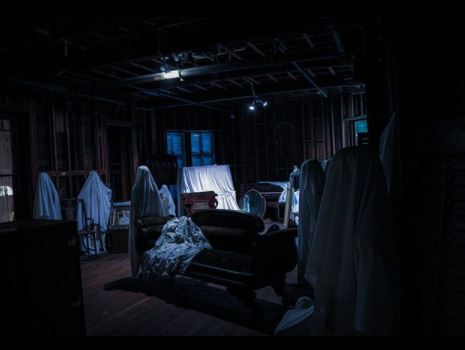
The physical phenomena of spiritism are often closely connected with psychical manifestations, such as spiritistic visions, automatic writing, speaking in a trance, materializations, table lifting, tumbler moving and excursions of the psyche. There is no doubt that today, as in the time of Isaiah (Isaiah 6.1-5), Ezekiel (Ezekiel 1.4-28), Paul (Acts 9.1-8), Peter (Acts 10.9-16), and John (Revelation 1.10-18), God may give His people a genuine vision, particularly in great times of great stress. However, genuine experiences of this nature are always accompanied by true spiritual grace and modesty. Sensationalism betrays a lack of authenticity. Unfortunately, genuine experiences are rare, and counterfeit ones about. Christian counselors find that the “ratio is about nine to one over the genuine experiences.” Mrs. Winchester used to have visions. She reported that she saw visions of Christ at night, and it left her feeling a sense of uneasiness and fear. The so-called visions of Christ were mediumistic. They came as a warning. Weeks after the visions started, Mrs. Winchester saw her husband William Wirt Winchester’s spirit departing from his body as he expired in 1881. The visions of Mrs. Winchester bear evidence of the occult, as do the visions of Joseph Smith (1805-1844), who fathered Mormonism. Many of the founders and promulgators of modern cults have had alleged visions from God. However, some say these visions promote “doctrines of demons” (1 Timothy 4.1) among the credulous and those unable to discern spirits (1 Corinthians 12.10; 1 John 4.1-2). When humans depart from God’s Word, they supposedly expose themselves to demon imposture and deception. Automatic writing—some persons endowed with mediumistic powers are able—either in a waking state or trance to write letters, words, or sentences which spiritists consider to be message from the spirit World. This is how Mrs. Winchester came up with the architecture of her mansion, the blueprints were often dictated to her in her Blue Séance room as she took down the notes on napkin. Also, the persistent pain in her legs and back vanished whenever she sat down and dictated these blueprints. #RandolphHarris 7 of 15
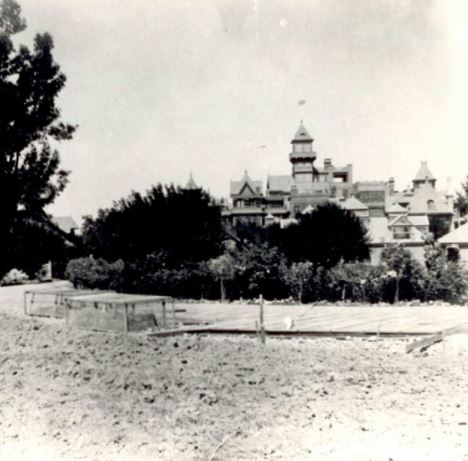
One day as Mrs. Winchester was taking dictation, a spirit named Apollonius Tyannaeus appeared and said, “In the name of the Lord Jesus, our blessed and exalted Savior.” The spirit then told the woman that she had been chosen by God for special revelations. She would become a prophetess and bless humankind with these revelations. The case is patently that of a simple farm woman turned indeed into a spiritistic writing medium. Rudolf Tischner, a parapsychologist, points out the danger of automatic writing when practiced in immoderation. Although he regards these writing phenomena only as “motoric break up the integrated psychic structure with ensuing peril to mental and physical health. This simply means that occult enslavement can result from mediumistic writing, or from dependence upon the Ouija board or other spiritistic devices to obtain alleged messages from the spirit World. Speaking in a trance—a trance is a condition in which a spiritistic medium loses consciousness and passes under the control of demonic power to effect alleged communication with the dead. The demon (or demons) takes over and actually speaks through the spiritistic medium, deceptively imitating the deceased. As a result this ruse innumerable spiritistic clairvoyants claim communication with the dead, often with famous deceased people allegedly appearing to speak to the living. One evening, Mrs. Winchester went into a trace and soon the “Apostle Paul” approached and preached to the audience. The apostle was not visible but only spoke through the medium who lay in trance. Some critic said it was only another constant instance of deception by demons who ape the deceased but cannot produce them. Other believe it was real. Perhaps the most remarkable phenomena of spiritism are materializations. These are supernatural appearances and disappearances of material images in connection with the activities of a spiritistic medium. #RandolphHarris 8 of 15

Materializations have been exhaustively studied and photographed and have been found to be manifestations of various degrees of teleplastic morphogenesis. The first stage is the evolution of a gauzelike substance of rubbery consistency from the body cavities of the medium. The second stage is the forming of the various parts of the body in outline—arms, head, etcetera. Frequently in the case of teleplastic forms of this kind, a threadlike connection is maintained with the medium. The third stage consists of the composition into completely outlined forms, which are visible as phantoms near the medium. These three stages of materialization manifest purely visual phenomena. The fourth stage displays telekinetic phenomena. There is an energy output from the teleplasm (telekinesis), such as the ringing of a bell, at night, passers-by heard ghostly music wafting from the dark mansion. The bell in the belfry high in the gables tolled regularly at midnight to summon incoming flights of spirits. Later it tolled again to warn these visitors to return to their sepulchers. However, once a week, these departed ones relaxed and danced in the Great Ball Room. In other stages of materializations come automatic writing of a typewriter, and the automatic playing of a musical instrument. In addition to the active energy output of the materialization, there is frequently a passive pain experience of the teleplasm. The fifth stage of the materialization is the penetration of material substance. To his phase belong “apports,” that is, the appearing and disappearing of objects in closed rooms or chests and containers. From locked and cemented containers, for example, enclosed coins are brought out, or stones and other objects fall inexplicably from the ceiling. This often happens in the Winchester mansion, as documented by Mrs. Winchester. In this stage many mediums allegedly have the ability to penetrate solid material substance while they are in a trance. While Mrs. Winchester sat in a small cabinet, a phantom built itself up on the floor outside the cabinet and formed itself into a male person, who moved in and out among the participants of the séance. While the materialization extended his hand to one of those present and she held it, dematerialization began to occur before the eyes of all the participants. Soon there was only a lump on the floor and this rolled up into the cabinet. #RandolphHarris 9 of 15

Another example is during a séance, Mrs. Winchester was able to call and help the materializing of the spirit of the deceased German romantic poet, Johann Ludwig Uhland (1787-1862). At the memorable séance a white phantasm was seen, from which the audience demanded a poem. Instead of reciting a poem, the phantasm tore a page from a book in the library. With a pencil from a briefcase in the room, secured through the leather without opening the briefcase, the hand jotted down a few verses and vanished. The page was left and still exists. The examination of the mysterious writing by a graphologist proved to be sensational. He confirmed the ghost writing to be actually the handwriting of the deceased poet. Afterward there was a trial in Berlin over the ownership of the page. The court awarded it to the medium, who afterward kept it among her prized possessions. The phenomena of materialization and dematerialization in case of strong mediums illustrated the conversion of psychic energy into matter and matter changed back again into psychic energy. The problem is illustrated by nuclear physics. Einstein’s formula (E==MC^2), energy is equal to mass times the speed of light squared, simply declares that it is theoretically possible to convert energy to mass and back again to energy. We have historical evidence of materializations. Missionaries claim that Mrs. Winchester’s mansion was never actually built, but that it materialized itself on the grounds, and (re)construction only began after the Earthquake caused by Satan. Some say this mansion is to be regarded as a miracle of Satan (2 Thessalonians 2.8-10; Revelation 13.15). Many people used to wonder how Mrs. Winchester used to travel so fast back and forth from San Jose to San Francisco to pick up items she ordered from overseas. Researchers believed that she would be spiritually transported miles away, and this may have been an example of this phenomenon or simply a miracle of transportation of unaltered physical body. It is debatable rather if these are miracles of God or that of Satan. God says He is the Alpha and the Omega. I wonder what that means? #RandolphHarris 10 of 15
Mrs. Winchester was said to possess tremendous occult gift and was reported to be able to make tables fly through the air for a space of one hundred feet. Above all, she was extremely adept in telekinesis, materialization, levitation, and black magic. Where Satan’s power remains virtually unchecked, miracles of evil supernaturalism abound. In Victorian days, the supernatural predated the mass hysteria about Satanism. As you may know, long before Mrs. Winchester arrived in California, there was a Devil worshipping conspiracy at large. However, her mansion seamlessly blends the ordinary and nightmarishly surreal. It is a rare treat for fans of demonic conspiracy and occult synchronicity. Some people have believed themselves to be demonically possessed after visiting the Winchester Mystery House, others claimed to have spoken to Mrs. Winchester directly. Directors of the Queen of the Damned claimed that the film was a makeshift occultic ritual, and Aaliyah unleashed the demon within herself. They also said the film poses some kind of supernatural power and they had to edit and voiceover a lot of the footage because not only did the characters act their own version of the script, but there were also some subliminal sounds and images on print. When many of these errors were re-examined, they also saw footage of the original Winchester mansion on the negatives, but rumors began that the original print had been withdrawn, replaced by an expurgated cut to protect the filmgoers from the movie’s insidious effects. The powers behind these manifestations were no doubt demonic. The director faced a terrible psychic assault on 25th August 2001, before they finished filming the movie. However, when the reel was played, the directors found they had all the footage they needed, even some they did not remembering filming. It was so intensified that the demonic oppression became that he was compelled to give up making other Anne Rice books into movies, especially after Aaliyah’s plane crashed later that evening. Although the film was unfished, with the blessing of her family, it was released to the public in February of 2002. #RandolphHarris 11 of 15

Certain psychic clairvoyants claim that their souls can travel great distances at their command. They always said she makes a room come alive. Much like Mrs. Winchester, Aaliyah had a lot of psychic phenomena around her death. When directors took photos of Aaliyah and Queen Akasha to a clairvoyant, while concentrating on the photographs, the medium declared that one of the women was apparently dead, while the other one, reportedly killed in 2001, was still alive. After more concentration, the clairvoyant said: “I can get in touch with this woman (pointing to Queen Akasha). I see her in a great stone building southeast of Ireland.” By psychic excursion and by psychometry (selecting an object belonging to the missing person and beginning to search from there) the clairvoyant was able to establish contact by occult assistance. The cinema is the Devil’s lantern. In March of 1922, Mrs. Winchester said, “Though it should be borne in the mind that in the persecution of witches many women were put to death on the latter charge, albeit they were really benefactors of the human race; the more so as their skill in simples and knowledge of the medicinal virtue of herbs must have added in no small degree to the resources of our present pharmacopoeia.” In August of 1807 an extraordinary affair took place in the house of Mrs. Winchester. She had a cow which continued to give milk as usual, but of late no butter could be produced from it. An opinion was unfortunately instilled into the mind of Mrs. Winchester, that whenever such a thing occurred, it was occasioned by the cow having been bewitched. Her belief in this was strengthened by the fact that every woman on this estate was able to relate some story illustrative of what she had seen or heard of in times gone by with respect to the same. At length the Mrs. Winchester was informed of a woman named Mary Butters, who resided in Oakland at the Cohen Bray House. Mrs. Winchester went to her, and brought her to mansion for the purpose of curing the cow. About ten o’ clock that night war was declared against the unknown magicians. #RandolphHarris 12 of 15

Mary Butters ordered old Klaus and a young man named Konrad to go out to the cow-house, turn their waistcoats inside out, and in that dress to stand by the head of the cow until she sent for them, while the butler, the made, and an old woman named Klara Lee remained in the house with her. Klaus and his ally kept their lonely vigil until daybreak, when, becoming alarmed at receiving no summons, they left their post and knocked at the door, but obtained no response. They then looked through the kitchen window, and to their horror saw the four inmates stretched on the floor as dead. They immediately burst in the door, and found that the butler and the maid were actually dead, and the sorceress and Mrs. Winchester nearly so. The latter soon afterwards expired; Mary Butters was thrown out on a dung-heap, and a restorative administered to her in the shape of a few hearty kicks, when had the desired effect. The house had a sulphureous smell, and on the fire was a large pot in which were milk, needles, pins, and crooked nails. At the inquest held at the Winchester mansion on the 19th of August, Jurors stated that the three victims had come by their deaths from suffocation, owning to Mary Butters having made use of some noxious ingredients, after the manner of a charm, to recover the sick cow. She was up to The Great Asylum for the Insane, but was discharged by proclamation. Her various of the story was that a black man (usually indicates a demon or the devil, not one of African descent) was summoned through the floor with a huge club, with which he killed the three person and stunned herself. This paranoid horror fantasies terrified the congregations, as well as the gross superstition displayed by the participants as for its tragical ending, yet it seems to have aroused no feelings in the greater community than those of risibility and derision. However, there is also another version of events. #RandolphHarris 13 of 15

A farm-hand had brought an action against Mrs. Winchester for wages alleged to be due to him. It transpired in the course of the evidence that on one occasion he had been set to banish witches that were troubling the cows. His method of working illustrates the Winchester case. All left the house except Mrs. Winchester, and the farm-hand, who locked himself in, closed the windows, stopped al keyholes and apertures, and put sods on top of the chimneys. He then placed a large pot of sweet milk on the fire, into which he threw rows of pins that had never been used, and three packages of needles; all were allowed to boil together for half an hour, and, as there was no outlet for the smoke, the farm-hand narrowly escaped being suffocated. If the forces of darkness triumph, it is a warning not a celebration. Many religious people come close to depicting what evangelists are preaching from their pulpits, or TV shows. Does it not seem strange for fundamentalist Christians to attack them as sinful and dangerous? Sin sells, in a way that the bland platitudes of Christian morality never will. Many of these popular and historical figures will be remember long after the credits have rolled. You could say that it is an “inside job.” Satanism sells, it captures the metaphysics of fear. People like to be haunted and scared, but only when they consent to it. No one wants their house broken into, their children kidnapped, their cars constantly vandalized, or to be attack by a hate group who haunts them like demons of the night. People simply want to tune into a scarry movie or visited a haunted house and leave the fear behind when they walk out the door or turn the TV off. They do not want to fear for the lives like Sharon Tate did for years without anyone to protect them. Humans are often more harmful than any ghost, devil or demon you can ever imagine meeting. Satan, speaking through a beautiful serpent—perhaps as a parakeet “talks” to us—promises know that would make Eve “like God” if she would eat the fruit of the tree forbidden by God. #RandolphHarris 14 of 15
Meanwhile, if the view of the power and knowledge of the people is that “Satan” is evil and not themselves, what can human beings do? Persist being evil, or resist the “devil,” and allow him to feel from them? Or is it they cling to evil because the darkness comes from their insidious mind and depleted soul? Note that it is useless to try to resist the devil unless you have first submitted yourself to God! Maybe YOU are the evil, not Satan. Sitting there, manufacturing all these evil days, so you can laugh at the pain and suffering you have inflicted on others to make yourself feel better. Is that of Satan, or is that YOUR nature on display. It is estimated that there are about 100 million adherents to spiritism in the World. The word “spiritism” comes from the Latin “spiritus,” spirit. The movement of spiritism represents the endeavour to communicate with the dead in the spirit World. Historically, spiritism can also be traced back over thousands of years. We have testimonies concerning it in the Old Testament in 1 Samuel 28, and Deuteronomy 18. It is also evidenced in the history of the Christian Church. Spiritism seems to be strongly connected with religion and religions. In so-called Christian countries such a variety of spiritistic forms, and such a range of associated psychic troubles exist, that the need for clarification is a pressing issue. What God do you really worship for “Satan disguises himself as an angel of the light. So it is not strange if his servants also disguise themselves as servants of righteousness,” reports 2 Corinthians 11.14-15. In other words, many of you Christians who claim to serve “God” do evil things and then blame the devil when you are disguising yourselves as children of the light. And you do not repent because you do not fear punishment nor hell, so you must be children of your “devil” and not of God. We live in a World which has turned its back on God. The reason some people fear Jesus is because they feel unworthy, it is not because they are evil. This conviction of inner unworthiness is not to be confused with a feeling of fear. However, people who suffer from schizophrenia and like to go around lying, the psychiatrist will be interested in the question whether the practicing of spiritism was rather the effect than the cause of the ensuing mental and emotional disorders. #RandolphHarris 15 of 15
Winchester Mystery House

The front gardens of the Winchester Mystery House looked different in the 1970’s! The gardens were restored to what they are today about ten years later.
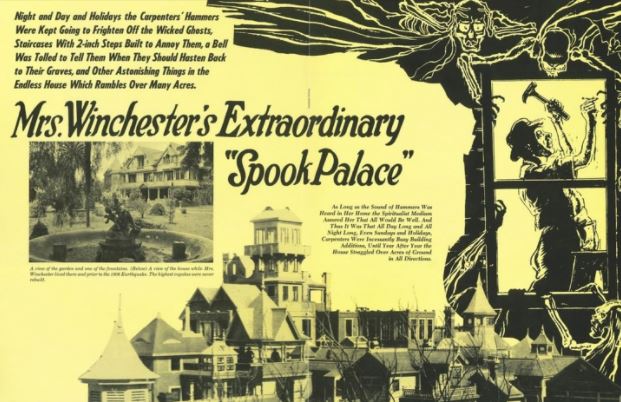
The sign reads: “The world’s oddest, mysterious, weirdest, and freakish dwelling. Planned and built by Sarah L. Winchester of Winchester Rifle Fame”
Have you ever listened to Alessandro Moreschi sing “Ave Maria,” at night in the Winchester Mystery House? Try it and let me know what you experience. I heard ghosts appear, people have cried and screamed, and some love it. I think I would probably run outside. He sounds like a ghost.

Come Explore the Victorian Gardens this weekend! Open all weekend until 4PM.

A 160-room mansion built to appease the spirits who died at the hands of the Winchester Rifle 👻

Are We Willing to Sacrifice Material Satisfactions or Give Up Racial Prejudices?

Dreams of loneliness, like a heartbeat drives you mad in the stillness of remembering what you had and what you lost, fly in the air where one has never been—and yet one knows not. Alan Turning is best remembered as the creator of an imaginary computing device that anticipated, and served as a blueprint for, the modern computer. He was just twenty-four, a recently elected fellow at Cambridge University, when he introduced what would come to be called the Turing machine in a 1936 paper entitle “On Computable Numbers, with an Application to the Entscheidungsproblem.” Turning’s intent in writing the paper was to show that there is no such thing as perfect system of logic or mathematics—that there will always be some statement that cannot be proven either true or false, that will remain “uncomputable.” To help prove the point, he conjured up a simple, digital calculator able to follow coded instructions and to read, write, and erase symbols. Such a computer, he demonstrated, could be programmed to perform the function of any other information-processing device. It was a “universal machine.” In a later paper, “Computing Machinery and Intelligence,” Turning explained how the existence of programmable computers “has the important consequence that, considerations of speed apart, it is unnecessary to design various new machines to do various computing processes. They can all be done with one digital computer, suitably programed for each case.” What that means, he concluded, is that “all digital computers are in a sense equivalent.” Turning was not the first person to imagine how a programmable computer might work—more than a century earlier, another English mathematician, Charles Babbage, had drawn up plans for an “analytical engine” that would be “a machine of the most general nature”—but Turning seems to have been the first to understand the digital computer’s limitless adaptability. #RandolphHarris 1 of 25

In modern times, we have all these mini-machines and little devices, for things like the phone, the Internet, music, telephone, surveillance, thermostats to control the climate in the house, circuit breakers, sprinkler boxes. However, what many people are looking for is a universal machine to become our medium. Like a mainframe that is built-in to the wall and can control the entire house from lighting and so forth and has little tablet computers also built-in to the wall to control this mainframe so one does not have to go to the universal machine. The goal is to illuminate clutter and to have a machine one does not have to constantly update and replace. One that could be advanced enough to last a lifetime. The speed of computers and data networks has increased at a breakneck pace, and the cost of processing and transmitting data has fallen equally rapidly. Over the past three decades, the number of instructions a computer chip can process every second has doubled about every three years, while the cost of processing those instruction has fallen by almost half every year. Overall, the price of a typical computing task has dropped by 99.9 percent since the 1960s. Network bandwidth has expanded at an equally fast clip, with Internet traffic doubling, on average, every year since the World Wide Web was invented. Computer applications that were unimaginable in Turning’s day are now routine. The way the Web has progressed as a medium replay, with the velocity of a time-lapse film, the entire history of modern media has compressed hundreds of years into a couple of decades. The growth of social media’s influence in our daily digital lives has been astounding over the last few years. The global average time spent using social media platforms per day is 2 hours and 22 minutes. Far higher than the 1 hour and 30 minutes spent in 2012. In fact, people are spending thirty percent of their leisure time online, with the people in China being the most intensive surfers, devoting forty-four percent of their off-work hours to the Net. #RandolphHarris 2 of 25

These figures do not include the time people spend using their mobile phones and other handheld computers to exchange text messages, which also continues to increase rapidly. Text messaging now represents one of the most common uses of computers, particularly for the young. The average American sends or receives an average of 41.5 messages per day, with the median user sending or receiving 10 texts daily. Worldwide, well over two trillion text messages zip between mobile phones every year, far outstripping the number of voice calls. Thanks to our ever-present messaging systems and devices, we never really have to disconnect, which may actually prevent virtual kidnapping or help mask it. The average American over the age of fourteen devoted to reading printed works has fallen to 143 minutes a week. Young adults between the ages of twenty-five and thirty-four, who are among the most avid Net users, were reading printed works for a total of just forty-nine minutes a week just a few years ago, and that number has now fallen down a precipitous twenty-nine percent. However, because of the ubiquity of text on the Net and our phones, we are almost certainly reading more words today than we did twenty years ago, but we are devoting much less time to reading words printed on paper. Yet, these words we are reading may not be nourishing the soul, which is why so many people are becoming mean, yet so sensitive. That is why the future of knowledge and culture no longer lies in books or newspapers or TV shows or radio programs of CDs. It lies in digital files shot through our universal medium at a speed of light. However, with such rapid technological pace, remember, in the future it is possible that we could have citywide, statewide, countrywide, and even Worldwide shutdowns of the electricity and Internet. So, while electric cars are so popular and digital streaming, you may want to hold on to cars that can use gasoline and your books, CDs, magazines and so forth. #RandolphHarris 3 of 25

We like to be able to find and be transported instantly to relevant data—without having to sort through lots of extraneous stuff. We like to be in touch with friends, family members, and colleagues. We like to feel connected—and we hate to feel disconnected. The Internet does not change our intellectual habits against our will. However, change them it does. Our use of the Net will only grow, and its impact on us will only strengthen, as it becomes ever more present in our lives. Like the clock and the book before it, the computer continues to get smaller, but as stated before people may want one machine to control all the technologies in their house, so they may get bigger, but be just one device. Public schools are strongly urging students to use physical books instead of Internet sources. However, former California Governor Arnold Schwarzenegger referred to them as “antiquated, heavy, expressive textbooks,” and that is not helping matter. Remember how exciting it was on the first day of class to be able to use a brand-new hardcover Houghton Mifflin Social Studies book? We must not rob our youth of these adventures. My favorite books are hardcover additions, think how good they will look in a home library. However, sometimes to reduce costs or because of what is available, I go with paperback books. A particularly striking illustration of how the Net is reshaping our expectations about media can be seen in any library. Although we do not tend to think of libraries as media technologies, they are. The public library is, in fact, one of the most important and influential informational media ever created—and one that proliferated only after the arrival of silent reading and moveable-type printing. Students these days are, in general, nice. They are not always particularly moral or noble. Such niceness is a facet of democratic character when times are good. Neither war not tyranny nor want has hardened them or made demands on them. #RandolphHarris 4 of 25

The wounds and rivalries caused by class distinction have disappeared along with any strong sense of class (as it once existed in universities in America and as it still does, poisonously, in England). Students are free of most constraints, and their families make sacrifices for them without asking for much in the way of obedience or respect. Religion and national origin have almost no noticeable effect on their social life or their career prospects. Although few really believe in “the system,” they do not have any burning sentiment that injustice is being done to them. The barbiturates and the pleasures of the flesh once thought to be forbidden are available in the quantities required for sensible use. A few radical people still feel the old-time religion, but most folks are comfortably assured that no much stands in the way of their careers. There is an atmosphere of easy familiarity with their elders, and even of the kind of respect of free young people that Tocqueville asserted equality encourages. Above all, there are none of the longings, romantic or otherwise, that used to make bourgeois society in general, repugnant to the young. The impossible dreams of the sixties proved to be quite possible within the loosened fabric of American life. If not great-souled, students these days are pleasant, friendly, and at least not particularly mean-spirited. Their primary preoccupation is themselves, understood in the narrowest sense. I had a revelatory experience when I chatted quite frankly one evening with a group of bright students at an Ivy League college where I was visiting professor for a short time. I had succeeded in establishing a certain common ground with them in class, for serious reading of Plato frequently has the effect of making students speak, at least for the moment, outside of their conventions. We had a farewell picnic and the atmosphere was easy and conducive to candor. Somewhat disingenuously I introduced some themes into the conversation about which I was eager to know the current state of opinion. #RandolphHarris 5 of 25

I had been primed for this encounter by a conversation I had had the previous evening at a dinner with members of the faculty and the administration. The wife of one of the high officials told me of her son’s activities. He had a law degree, but, she said, he and his friends had little ambition and had moved from one thing to another. She did not seem to be very distressed by his behavior—perhaps even a bit proud of it—a modern parent willing to believe in the superiority of the younger generation to her own, especially when the former is most disrespectful of the latter’s standards. So I asked her why she thought they behaved this way. She responded firmly, quietly and without hesitation, “Fear of nuclear war.” This prompted me to ask my group of students whether they were frightened of nuclear war. The response was a universal, somewhat embarrassed giggle. They knew what their daily thoughts were about, and those thoughts had hardly anything to do with public questions. And they also knew that there are a great many right-thinking adults who expect them to use the nuclear threat as an excuse for demanding a transformation of the World political order and who also want to produce their maimed souls in evidence against our politicians’ mad pursuit of the “arms race.” Students today—and I have now asked the question over and over again—are morally unpretentious, and they look at themselves with irony when it comes to the big moral questions. Some look back with nostalgia at students of the sixties as persons who believed in something. The prospect of being drafted to fight in the Ukraine was really frightening me. However, youngsters today are, with few exceptions, no more take in by the psychological quacks who explain their apathy with respect to nuclear was as “denial,” who enlist science in the service of proving that there are causes without effect, than was the American public by a President who tried to persuade it that he sat around discussing nuclear war on a laptop with drug dealing son. #RandolphHarris 6 of 25

Their concerns lie elsewhere. There is, indeed, a certain listlessness about them, an absence of a broad view of the future, but it was as plausible to attribute that to the lack of frontier to conquer in the American West, or the death of God, as to fear nuclear war It is difficult to say just why this generation tends to be so honest in comparison with the preceding one. And, of course, there are plenty of public posturers among them, as is evident from the vote of the student body at Brown (an institution that was at the forefront of dismantling liberal education in the sixties), which demanded that cyanide be made available by the university in case of nuclear attack. This was a “statement” telling us all about the torment to which we subject young people. However, the great majority of students, although they as much as anyone want to think well of themselves, are aware that they are busy with their own careers and their relationships. There is a certain rhetoric of self-fulfillment that gives a patina of glamor to this that they are busy with their own careers and relationships. There is a certain rhetoric of self-fulfillment that gives a patina of glamor to this life, but they can see that there is nothing particularly noble about it. Survivalism has taken place of heroism as the admired quality. This turning in one themselves is not, as some would have it, a return to normalcy after the hectic fever of the nineties, nor is it preternatural selfishness. It is a new degree of isolation that leaves young people with no alternative to looking inward. The things that almost naturally elicit attention to broader concerns are simply not present. Starvation in California, mass murder in Florida, as well as war in New York and Tennessee, are all real calamities worthy of attention. Because they are immediate, and they are connected to the students’ lives. We have never had war on American social, in modern times, since it had become relatively stable in the 1950s. #RandolphHarris 7 of 25

The affairs of daily life, however, now involve concerns for a larger community in such a way as to make the public and private merge in one’s thought. It is not merely that one is free to participate or not to participate, that there is no need to do so, but that everything militates against one’s doing so. Tocqueville describes the tip of the iceberg of advanced egalitarianism when he discusses the difficulty that a man without family lands, or family tradition for whose continuation he is responsible, will have in avoiding individualism and seeing himself as an integral part of a past and a future, rather than as an anonymous atom in a merely changing continuum. The modern economic principle that private vice makes public virtue had penetrated all aspects of daily life in such a way that there seems to be no reason to be a conscious part of civic existence. Public virtue can be kind of a ghost town into which the highest investor can move and declare oneself mayor, governor, or president, which is probably why the Clinton’s started globalization. To become rich, suppress wages, especially the minimum wage, and make the United States of America dependent and divided, rather than independent and united, which allowed them to keep taxes high and make the country look like it was profiting, which is why the national deficit is $30.3 trillion. They sold the country and we are borrowing money to rent it back. Then Arnold Schwarzenegger stepped in and started liquidating federal and state assets, which is common in bankrupt countries. Country, religion, family, ideas of civilization, all the sentimental and historical forces that stood between cosmic infinity and the individual, providing some notion of a place within the whole, have been rationalized and have lost their compelling force. America is experienced not as a common project but as a framework within which people are only individuals, where they are left alone. To the extent that there is a project, it is to put those who are said to be disadvantaged in a position to live as they please too. #RandolphHarris 8 of 25

The advanced Left talks about self-fulfillment; the Right, in its most popular form, is Libertarian, id est, the right-wing form of the Left, in favor of everybody’s living as one pleased. The only forms of intrusion on the private-life characteristic of liberal democracies—taxes and military service—are not now present in the American students’ life. If there is an inherent political impulse in man, it is certainly being frustrated. However, this impulse has already been so attenuated by modernity that it is hardly experienced. Students may indeed feel a sense of impotence, a sense that they have little or no influence over the collective life, but essentially they live comfortably within the administrative state that has replaced politics. Nuclear war is indeed a frightening prospect, but only when it appears imminent does it cross their minds. Even such a powerful, concerted effort as the nuclear-freeze commotion, with its attendant entertainment like The Day After, has nothing to do with the lives students lead and is little more than a distraction. If the students actually do enter politics, it is by accident, very few of them are destined for a political life, and does not follow from their early training or expectations. For almost no such families remain, in these universities, there are almost no students born of families that have inherited the privilege and responsibility of public service. Neither duty nor pleasure involves students with the political life and that is why there is a disappearance of citizens and statesmen and women. Politics is so taboo, but talking about pleasures of the flesh and other people’s business is so popular and socially accepted because that is what the news and reality shows are programing people to think is normal. Life out loud, act insane, party, harass people, cry to the police, but above all else, ignore your civic, religious, family, and financial responsibilities! Just steal from your family and neighbors and hustle your friends to get ahead in life. Grind all day long on that no dose and coffee. Just do not flip bricks to get ahead, which will actually make a lot of money and is risky, because the feds might catch you at the dock with a flock of snow. Then you will be looking 40 in the 740. #RandolphHarris 9 of 25

The petty personal interests of youth—“making it,” finding a place for oneself—preserve throughout life. The honesty of this generation of students causes them to laugh when asked to act as though they were powerful agents in World history. They know the truth that in democratic societies, each citizen is habitually busy with the contemplation of a very petty object, which is oneself, a contemplation now intensified by a greater indifference to the past and the loss of a national view of the future. The only common project engaging the youthful imagination is the exploration of space, which everyone knows to be empty. The resulting inevitable individualism, endemic to our regime, has been reinforced by another unintended and unexpected development, the decline of the family, which was the intermediary between individual and society, providing quasi-natural attachments beyond the individual that gave men and women unqualified concern for at least some others and created an entirely different relation to society from that which the isolated individual has. Parents, husbands, wives and children are hostages to the community. They palliate indifference to it and provide a material stake in its future. This is not quite instinctive love of country, but it is love of country for love of one’s own. It is the gentle form of patriotism, one that flows most easily out of self-interest, without the demand for much self-denial. The decay of the family means that community would require extreme self-abnegation in an era when there is no good reason for anything but self-indulgence. Apart from the fact that many students have experienced the divorce of their parents and are informed by statistic that there is a strong possibility of divorce in their futures, they hardly have an expectation that they will have to care for their parents or any other blood relatives, or that they will even see much of them as they grow older. With Social Security going bankrupt, people will probably choose to abort disabled fetuses because they cannot afford to take care of them, which is why so much money is being poured into gene editing. #RandolphHarris 10 of 25

Catholics have a lot to think about because it seems that there will be a day when social services become extinct, not only because of the corruption and data breaches by CBS, ABC, NBC, and every other media entity willing to oil the mayor, or governors palm to break the laws and micromanage an individual, while violating their rights, but because the money will no longer be there, in many cases from the harm inflicted by these special interests groups which drive of costs and injure vulnerable citizens. And who knows what is going to happen to old people and their children when they did not invest in private retirement and medical care and their own families do not have the financial support, or are unwilling and unable to let them into their own homes to live. Perhaps the mental hospitals will start to flourish to take care of the poor and disabled and elderly before there were taxes and Social Security. That is why so many are advocating anti-racism, reading, writing, and education. Life is not going to be like it was. Spiritually, the family is pretty empty, anyway, and new objects fill their field of vision as the old ones fade. American geography plays a role in this separation. This is not as large of a country as it was in the 1950s and 1960s, and people are very mobile, particularly since 2000 and the expansion of air travel and public transportation. Practically no student knows where one is going to live when one has completed one’s education. Very likely it will be far away from their parents and their birthplace. Mexico is actually pretty expensive when it comes to real estate. They may have to move to Cambodia. Even if the same fundamental cultural winds are blowing, in Canada and France, by contrast, the same fundamental cultural winds are blowing, people have no place to go. The United States of America may have to make new laws that allow the disabled and those on welfare to move to another country where they can actually afford to rent a home so they can have stability. Low-income and middle-income Americas might just be placeholders for immigrants who need asylum and rich immigrants. When a place is needed, they will start sending you to jail or making you flee your own country. #RandolphHarris 11 of 25

For an English-speaking Canadian born in Toronto there is, practically speaking, only Vancouver as an attractive alternative, and for a Parisian there is no alternative whatsoever. The unlimited, or dissolving, horizon, which is the hallmark of our age, is in these places somewhat less visible. People are not really more rooted in them, but they are stuck. Hence they continue to see their relatives and all the people they grew up with. Their landscape is unchanging. However, a young American really begins all over again, and everything is open. One can live in the North, South, East or West, in the city, the suburbs, or the country—as long as you are a professional or have a high income. There are arguments for each, and one is absolutely unconstrained in one’s choice. The accidents of where one finds a job and of variable inclinations are likely to take one far away from all one has been connected with, and one is psychically prepared for this. One’s investments in one’s past and those who peopled it are necessarily limited. This indeterminate or open-ended future and the lack of a binding past mean that the souls of young people are in a condition like that of the first men in the state of nature—spiritually unclad, unconnected, isolated, with no inherited or unconditional connection with anything or anyone. They can be anything they want to be, but they have no particular reason to want to be anything in particular. Not only are they free to decide their place, but they are also free to decide whether they will believe in God or be atheists, or leave their options open by being agnostic; whether they will be heterosexual or homosexual, or, again, keep their options open; whether they will marry and whether they will stay married; whether they will have children—and so on endlessly. There is no necessity, no morality, no social pressure, no sacrifice to be made that militates going in or turning away from any of these directions, and there are desires pointing toward each, with mutually contradictory arguments to buttress them. #RandolphHarris 12 of 25

The young are exaggerated various of Plato’s description of the young in democracies: [The democratic youth] lives along day by day, gratifying the desire that occurs to one, at one time drinking and listening to the flute, at another downing water and reducing, now practicing gymnastic, and again idling and neglecting everything; and sometimes spending one’s time as though one were occupied with philosophy. Often one engages in politics and, jumping up, says and does whatever chances to come to one; and if one admires any soldiers, one turns in that direction; and if it is moneymakers, in that one, and there is neither order nor necessity in one’s life, but calling it sweet, free and blessed, one follows it throughout.] Why are we surprised that such unfurnished person should be preoccupied principally with themselves and with findings means to avoid permanent free fall? No wonder that the one novel that remains continuously popular with students is Camus’s The Stranger. That is also why the popular films starring Josh Hartnett The Faculty, O, and Pearl Harbor remain so relevant. It is essential for the intelligent performances of forbidden deeds to keep them under your hat and not have too many accomplices. However, then, how can we know how many gifted kids are performing how man misdemeanors? And would it not be better for less affluent and middle-class delinquents, who have committed non-violent crimes, and petty theft not end up in juvenile hall, or reform schools but in military academies and other schools that promise “to make a man of your boy.” From this point of view, it must be said that the essential property of juvenile delinquency as defined is: such personality and behavior as guarantee getting caught, punished, and tabulated. I do not think that this property is a tautology: it has important content that distinguishes the delinquency of doing-the-forbidden-and-defiant from the delinquency to-get-caught. Getting caught is guaranteed by: compulsive repetition of a behaviour because it is not really giving satisfaction. This tends to allay the alertness and prudence of the routine tries, as well as to multiply the chances of being caught. And it leads to: Raising the ante, in order to force feeling. This must result in disaster. #RandolphHarris 13 of 25

Conversely, in place of mischief or the attraction of the forbidden or rebelliousness or even malice, the caught delinquent exhibits a profound fatalism, indicating an unconscious need to be saved from his compulsive round or not worthwhile experience and brought back into the “meaningful” structure of authority and punishment. It looks as though the caught delinquent has done the forbidden and defiant deed in order to tease and provoke the authority, to compel his attention. Psychologically, then, though he thinks and operates on his own, he is not “independent.” (Let it be mentioned the touching case of an English boy who stole a watch and then returned it, saying he had found it, “in order that somebody should say he was a good boy.” The next best thing is for somebody to say that one is a bad boy.) The gang is used as a structure for psychological support. However, running with the gang also guarantees getting caught, both because it is conspicuous and because its in-group concentration and habits soon get quite out of touch with the surrounding mores. Aping his friends, a lad forgets what safe behavior is, what ought to be concealed because people are outraged by it. A lad who is infinitely secretive and suspicious gives oneself away by his slouching, his clothes, and every word he utters. Also, they dare one another to excesses that each individual would avoid. Naturally this is all the worse with cultural people who are less affluent, who do not know the “right” behavior to begin with; exempli gratia, some body might be badly judged for behavior that to them is perfectly acceptable. We propose that these four guarantees of getting caught make juvenile delinquency an interesting cultural study. For it is: the powerless struggling for life within, not resigned from, an unacceptable World. At first inspection, this does not seem a promising lesson. However, on reflection, we see that this fatalism is a deeply religious position, bit far from what Dostoevski was tying to tell us. Many of his characters are adult delinquent culture a powerful thought and poetry. The fatalism of juvenile delinquency is a kind of adolescent religious crisis, with a religious passion and content, whereas the conventional religion is empty. #RandolphHarris 14 of 25

On the streets, they feel worthless-and-abandoned; in the reformatory, they are accepted back home. This fatalism in the face of the overwhelming and unacceptable is a commentary on the poignant remark of the criminologist: “It must be confessed that it is much easier and hence more “practical” to deal with superficial symptomatic behavior or its immediately observable causes than to strive to cut the deeper roots of delinquency. When those deeper roots are made evident, however, we have to ask ourselves how deep we wish to go in the attack on crime. Are we willing, for example, to sacrifice many of our material satisfactions or to give up our racial prejudices?” reports Donald Taft. The process of going insane begins long before it is detected. It often starts when life is moved from nature into cities. One’s ride from the woods to city is a ride from connection to disconnection, from reality to abstraction, a history of technology, setting the conditions for the imposition of reconstructed realties by a single powerful force. The central technique of oppression is the absolute control of all kinds of information. Perhaps George Orwell’s 1984, was actually a metaphor for what happens when the Internet replaces books and people stop books, but only get information from the web. It will cause hundreds and thousands of years of real knowledge to be destroyed as if by fire. That will lead to a suffocatingly narrow language, Newspeak, which has no vocabulary other than “crazy,” or “unbelievable,” to express ideas and human feelings, and without expression, they begin to atrophy. The danger of a digital society is anything can be altered at any time, and it would take a highly paid lawyer to discover that. Essentially, everything a person says or was guaranteed will become a conflict of opinions with the corporation or government being the authority, which then becomes nearly impossible to dispute because you have no paper record. Many already see this happening, the new on TV today, directly contradicts the news of a month ago. Since it is impossible to prove this contradiction, because democracy no longer exists, it is pointless to try. #RandolphHarris 15 of 25

Already, people are being told to focus on their own satisfaction and limit their need to those that could be conveniently satisfied by the social engineers. This precludes discontent. However, it is true that in an age of advanced technology, inefficiency is the sin against the Holy Ghost. We already see that to many, human feelings and any wilderness experience are complicated and unwieldy, and that is what makes them dangerous to those who do not support democracy. So that is the reason society is producing people ridiculing and eliminating all experiences that make people feel kind and human. Natural experience is being replaced with nonhuman realities. When the TV news media is able to control your mind and whatever research you obtain and tell you what reality is, they are effectively leaving society deprived for their senses, appropriately confused and receptive, and the TV can speak directly into them without interference. The people who are spoken to are precondition to accept what they hear. Technology plays a critical role in this process because it creates standardized arbitrary forms of physical and mental confinement. Television is the ideal tool for such purposes because it both confines experience and implants simple, clear idea. Seen in this way, a new fact emerges. Autocracy need not come in the form of a person at all, or even as an articulated ideology or conscious conspiracy. The autocracy can exist in the technology itself. The technology can produce its own subordinated society, as though it were alive. The TV, TV News Media, and Internet could be the anti-Christ, depending on how you use it. The whole problem with news on television comes down to this: all the words uttered in an hour of news coverage could be printed on one page of a newspaper. And the World cannot be understood in one page. Of course, there is a good deal of truth in this. However, the language of pictures differs radically from oral and written language, and the differences are crucial for understanding television news. #RandolphHarris 16 of 25

To begin with, the grammar of pictures is weak in communicating past-ness and present-ness. When terrorists want to prove to the World that their kidnap victims are still alive, they photograph them holding a copy of a recent newspaper (which does not really mean anything with all the technology we now have). The dateline on the newspaper was supposed to provide the proof that the photograph was taken on or after that date. Without the help of the written word, film and videotape cannot portray temporal dimensions with any precision. Consider a film clip showing an aircraft carrier at sea. One might be able to identify the ship as Russian or American, but there would be no way of telling where in the World the carrier was, where it was headed, or when the pictures were taken. It is only through language—words spoken over the pictures or reproduced in them—that the image of the aircraft carrier takes on meaning as a portrayal of a specific event. Still, it is possible to enjoy the image of the carrier for its own sake. One might find the hugeness of the vessel interesting; it signifies military power on the move. There is a certain drama in watching the planes come in at high speeds and skid to a stop on the deck. Supposed the ship where burning: that would be even more interesting. This leads to a second point about the language of pictures. The grammar of moving pictures favors images that change. That is why violence and destruction find their way onto the television so often. When something is destroyed violently its constitution is altered in a highly visible way: hence the entrancing power of fire. Fire gives visual form to the ideas of consumption, disappearance, death—the thing which is burned is actually taken away by fire. It is at this very basic level that fires make a good subject for television news. Something was here, now it is gone, and the change is recorded on film. #RandolphHarrs 17 of 25

Earthquakes and typhoons have the same power: before the viewers eyes in the World is take apart. If a television viewer has relatives in Tokyo, Japan, and an Earthquake occurs there, then one may take an interest in the images of destruction as a report from a specific place and time. That is, one may look to television news for information about an important event. However, if the viewer cares nothing about the event itself, film of an Earthquake can still be interesting. Which is only to say that there is another way of participating in the news—as a spectator who desires to be entertained. Actually to see buildings topple is exciting, no matter where the buildings are. The World turns to dust before our eyes. Those who produce television news in America know that their medium favors images that move. That is why they despise “talking heads,” people who simply appear in front of a camera and speak. That is why the news is into making fake new. They track and terrorize certain people so they can produce a saga that gets rating, people emotional, and can sell books and movies and prefilmed interviews to go with their manipulating “breaking news.” The news really is broken and, in some cases, a criminal business. When talking heads appear on television, there is nothing to record or document, no change in process. On a movie screen, close-ups of a good actor speaking dramatically can be sometimes interesting to watch. When Josh Hartnett narrows his eyes and challenges his rival to shoot first, the spectator sees the cool rage of the Hartnett character take visual form, and the narrowing of the eyes is dramatic. However, much of the effect of this small movement depends on the size of the movie screen and the darkness of the theater, which makes Hartnett and his every action “Larger than life.” The television screen is smaller than life. It occupies about 15 percent of the viewer’s visual field (compared to about 70 percent of the movie screen). It is not set in a darkened theater closed off from the World but in the viewers ordinary living space. This means that visual changes must be more extreme and more dramatic to be interesting on television. A narrowing of the eyes will not do. A car crash, an Earthquake, a burning factory, or someone who is out of their mind and on a rampage are much better. #RandolphHarris 18 of 25

That is why TV news media like to terrorize people. They have low budgets, and typically it does not cost much to drive a person insane, record it and make millions off of the footage, like the shooting in Florida, Dylan Strom Roof, or Elliot Rodger. It is possible that these were good boys the media terrorized to get them to lose their minds, so they could make profits. “If it bleeds, it leads.” I am surprised there has been no federal investigation into the TV news media’s ethics. No required ratings. No statements that about it not necessarily being factual, but is a source of entertainment. In 1737, Philip V of Spain suffered from such relentless and chronic depression that his wife, Elisabeth Farnese, feared he would die. To stave off death, she engaged the superb opera singer Carlo Broschi, known only as Farinelli, to enchant her melancholy husband. Each night, the Italian would sing four songs and Philip would listen, entranced. Perhaps because of this, Philip survived another nine years. What manner of music was it that could save a life? Imagine a voice as sweet as a flute and with tones as subtle as the human larynx can produce, a voice that soars upward through the air “like a lark…intoxicated with its own flight.” Imagine a voice that transforms emotion into sound as glorious as a soul rising upward with it, clinging to its wings. Imagine, finally, “a clam, sweet, solemn, and sonorous musical language” that leaves its audience thunderstruck, transported into ecstasy by the power and grace of the most splendid music under the Heavens. This was the soprano or contralto voice that combined the power of the male lungs and physical bulk with a woman’s high, sweet range. This was the voice of a castrato, a gelded boy grown into manhood after years of intensive opera training in the finest conservatories. This jeweled musical miracle did not, however, come cheap, even for the castrati who enjoyed splendid careers in the opera. The cost included a slew of boys killed by botched surgeries explained away as accidents and even more live boys ruined for normal life but equally unsuited for opera. #RandolphHarris 19 of 25

These pitiful rejects, whose talents failed to meet the rigorous standard of operatic maestors and demanding audiences, were cast aside to live as they could, sexually mutilated and untrained for any trade. The few truly successful castrati, however, were catapulted from ordinariness to glorious achievement, endless adulation, and careers replete with personal and professional satisfaction, material wealth, and secure retirements. Farinelli, perhaps the greatest of all, epitomized the triumphant consequences that genital surgery could coax out of natural musical brilliance. “One God, one Farinelli!” groaned a fashionable admirer, unwittingly coining her hero’s most memorable epitaph. The origins of the castrati are so hazy, but the cause is not—the prohibition against women singing in church and appearing onstage. Until the fifteenth century, high-voiced boys had substituted. The Spaniards devised a way of singing that forced light male voices into trilling warbles that strained vocal cords but produced femalelike sounds. These “falsettists” performed the new a cappella compositions that became wildly popular in the mid-fifteenth century and created greater expectations in musical range and timbre. By 1600, castrati began to appear, and in considerable numbers. (Some speculate that earlier falsettists had actually been disguised castrati. This is plausible but unprovable.) In 1599, the first castrati were admitted into the Vatican Church choir, despite the official Church ban on castration. In the seventeenth century came the invention of Italian opera, a popular, quasi-international style of entertainment that required contingents of singer with the voice of angels, but to me, many of the sound like ghosts. Since women were still banned from the stage, castrati were the perfect solution. Indeed, until the late eighteenth century, Italian opera and castrati were indistinguishable concepts, and 70 percent of male opera singers were castrati. In the eighteenth century, castrato Filippo Balatri composed a witty and poetic account of his life as a revered soprano. Balatri’s was an ironic commentary tinged by bitterness about his fate and was the first public revelation about the life castrati were compelled to lead. #RandolphHarris 20 of 25

By the nineteenth century, Balatri’s keen sense of the indignity of his castration was seeping into the collective conscience of opera lovers. Choirmasters and guilty parents began to lie about how perpetual make sopranos in their charge had been created: “A pig attacked and injured his privates, necessitating the operation” was a typical explanation. Eventually, after two hundred entrancing years, it ended. Opera no longer demanded gelding, though the Vatican chapel and other Roman choirs continued to employ castrati especially maimed for the purpose. The last known castrato was Alessandro Moreschi, who made recordings as late as 1903 and performed in the Sistine Chapel until 1913. Most castrati (but not Farinelli) were poor boys whose parents aspired to greater things. The first stage was a visit to a conservatory for a voice evaluation. A positive response gave the nod to castration, and the parents rushed to make private arrangements. Doctors specializing in the illegal operation were centered in Bologna. The child was drugged with opium or another narcotic and seated in a tub of very hot water until he was nearly unconscious. Then the surgeon pared off the ducts leading to the testicles, which later shriveled and dried up. Surviving patients were admitted to music conservatories, where they studied for up to ten years. Because they were considered delicate, they were given better food and warmer rooms than sexually unmutilated music students, and their health was carefully monitored. However, many hated the school and ran away. Others, though sopranos, proved to have indifferent voices. The real problem was probably the intensity and quantity of the work: six hours daily of lessons, plus additional hours of harpsichord practice and music composition. Somewhere between the ages of fifteen and twenty, after he had passed a series of tests, the successful castrato made his operatic debut—as a woman. His immaturity, slightly effeminate physique, and wondrous voice earned him instant adoration. Fans mobbed him, and both ladies and gentlemen fell in love with him. #RandolphHarris 21 of 25

Casanova, for example, described his first impression of a certain castrato: “In a well-made corset, he had the waist of a nymph, and, what was almost incredible, his breast was in no way inferior, either in form or in beauty, to any woman’s; and it was above all by this means that the monster made such ravages.” Furthermore, castrati were superbly trained and musically knowledgeable. Nonetheless, some did not make the grade and were relegated to touring provincial opera houses. However, do not get it twisted, most castrati were boy or men and dressed as boy or men, but had the voice of a little boy, or sometimes the voices of six-year-old boys with an echo of death and just a pinch of man. There was a soft voice, that sounded hallow, with a male undertone. Despite star status, castrati faced considerable resentment, even hatred. Jealous colleagues and the general public disdained their neutered state, accused them of luring other men into homosexuality, and detested their arrogance and conceit because many of them did not seem to age nor gain weight. Yet many castrati were famous paramours with legions of female followers eager to make love with a man who could not impregnate her and curious to see what their famous, much discussed genitalia looked like. All this attention, of course, did not improve the castrati’s image with fully sexed men. From the castrati’s own perspective, these sexual conquests were bittersweet, for they were forbidden by law to marry, and at least one died brokenhearted because of this ban. What about celibate castrati? They were rare indeed, though the brilliant Farinelli was likely chaste, perhaps because of shame. Castrator Filippo Balarti, too, opted for celibacy. He feared a woman would soon find him sexually inadequate and tire of him, and he explained in his own ironic words why he never married: “By the grace of God, by my industry, and thanks to surgeon Accoramboni of Lucca, I never took a wife, who after loving me for a little would have started screaming at me.” #RandolphHarris 22 of 25

Balatri also specified in his will that his corpse was not to be bathed in the customary way, “not only for the indecency I see in it but because I do not want them to amuse themselves by examining me, to see how sopranos are made.” The operatic castrati were a unique kind of eunuch. Unlike the Chinese Ottoman, and some Byzantine eunuchs and the true hijras, they were seldom celibate, and chastity was never mentioned as one of their qualities. What mattered was the timbre, range, and power of their voices, not their lives outside the opera house. Though they were often scored for their incompleteness and, like all eunuchs, legally proscribed from marrying because of their inability to procreate, most were as sexually active as other men. Nonetheless, they belong in this account of castrated celibacy because of their great fame. In fact, the castrati are proof par excellence that unless castration is so severe that is kills the sexual drive, its victims seldom voluntarily opt to abstain from whatever sort of sexual relations their mutilated condition permits. Even then, there must be a combination of important rewards to maintain celibacy and strong disincentives for violating it. If they were not indulge, most castrati, partial castrates with little motivation to remain chaste and no punishment, in about the same measure as other male entertainers with retinues of adoring and available women (and a few men). Science is different from all the other trust-test criteria. It is the only one that itself depends on rigorous testing. Yet of all these various criteria, science is probably the one we least rely on in our daily lives. We do not, as a rule, choose a puppy because he passes some scientific test; we just fall in love with him. We do not perform lab tests to decide what movie to watch. Or what friends to make. Among all our daily personal—and business—decisions, those that are made scientifically are no more than a trace element. Yet among the six truth criteria, none in recent centuries has had a greater impact on wealth. And one, as we will see, is more endangered. #RandolphHarris 23 of 25

Science is not a collection of facts. It is a process—often messy and non-sequential—for testing ideas. The ideas must be testable, at least in principle, and, some would add, falsifiable. The tests involve observation and experiment. Results must be reproducible. Knowledge that has not met these tests is not scientific. Even the most persuasive scientific findings are, therefore, held to be incomplete and tentative—always subject to further investigation, revision and dismissal in the light of new scientifically tested discoveries. This make science the only one of the six truth filters that is inherently opposed to fanaticism of any kind, religious, political, nationalist, racist or otherwise. It is fanatic certainty that breeds persecution, terrorism, inquisition, suicide bombings and other atrocities. And it is fanatic certainty that science replaces with a recognition that even the most entrenched scientific findings are at the best partial or temporary truths and hence uncertain. This idea—that every scientific finding could and should be improved or thrown out—puts science in a class by itself. Thus among all the other main truth filters, whether consensus, consistency, authority, revelation or durability, only science is self-correcting. While the other five criteria have been in use since the beginnings of time and reflect the static or change-resistant character of agrarian societies, science swung the door wide open to change. The pursuit of scientific inquires was by no means always a well-coordinated, disciplined activity, with a clear and share sense of method…Science was still sorting out what the activity really involved, and there were many competing methods, theories and systems in almost all areas, right on down through the eighteenth and even early-nineteenth centuries. There is a heated debate as to whether America is more advanced from China when it comes to science. Many people think America is not because much of their technology is out of date, they are borrowing money from China and sending their jobs to China. It makes the people in China think there is something wrong with Americans mentally because that equation seems irrational. Why can they not do their own work when they have the technology? Globalization also has suppressed minimum wage which should be hovering around $30 an hour by now. #RandolphHarris 24 of 25

Only gradually, then, did the elements of empirical observation, experiment, quantification, dissemination of result, replication or disconfirmation, come together, along with randomized blind controls and other techniques so widely used today. The invention of scientific method was the gift to humanity of a new truth filter or test, a powerful meta-tool for probing the unknown and—it turned out—for spurring technological change and economic progress. As we have noted, among all the decisions made in the economy on any given day, only a minute amount can be said to have been made scientifically. Yet that tiniest trace has transformed the World’s capacity to make and expand wealth. If we let it–it will continue to do so in the future. Continue to labor, and make sweet floods to run and noble and abundant fruits to spring. Take this food and drink and carry it to Go as your true worship. You body is one with the Earth. God will put His spirit within us, and cause us to talk in His statutes, and we shall keep His ordinances and do them. For His ordinances which He commands us are not too difficult for us, neither are they far off. His laws are not high in the Heavens that we should say, “Who shall go up and bring them down?” Neither are they beyond the sea that we should say, “Who shall go over the sea for us, and bring them unto us, that we may hear them and do them?” Neither are they beyond the sea that we should day, “Who shall go over the sea for us, and bring them unto us, that we may hear them and do them?” Behold, God’s ordinances are nigh unto us, in our very heart that we may do them. The day will come when God will break the bow and the sword and the battle out of the land, and He will make all to lie down safely, and all people shall know God, from the least of them unto the greatest of them, and all shall be His people, and God will be our God. “A happy heart is good medicine and a cheerful mind works healing, but a broken spirit dries up the bones. A wicked man receives a bribed out of the bosom (pocket) to pervert the ways of justice,” reports Proverbs 17.22-23. #RandolphHarris 25 of 25

Cresleigh Homes

Oh, welcome to the set of our new Food Network show…👨🍳 otherwise known as our home at Meadows Residence 1!

An eat-in island lets us chill with our guests while we cook, and it makes premuium cranberry juice and ambrosia tastings even more fun!

Experience modern, upscale living in this thoughtfully designed Cresleigh Home. An open floor plan and flexible living spaces make this the perfect choice; giving you all of the space you and your loved ones need to grow.

With four floor plans available, ranging from approximately 2,000 – 3,500 square feet offering, three to five bedrooms, we are certain you will find the home that fits your needs and lifestyle.
#PlumasRanch

There is Nothing Worse than a Father’s Fury—Don’t Get Godsmacked

Thus far we have been using a fairly standard theory of delinquency, though better rounded, than the usual statement. Let us recapitulate it: The early childhood of juvenile delinquents is “permissive” or “neglected,” depending on the point of view. They play truant and quit school as soon as they can. This is not necessarily a failing in them, for the schools are poor, and the policy of keeping them there to educate them for some viable life or other in modern society, is benevolent but largely doomed. Such polluted sources issue in a muddy stream where only monsters can swim. Their escape from school proves that they are less supervised at home, and in turn it gives them more freedom, at first, to sharpen their wits on the streets. Less restricted, they probably have more elaborate early experience in pleasures of the flesh than less social boy or the more regulated boys. This may get them into early and repeated trouble, and it may, therefore, result in repression and becoming less adventurous in pleasure of the flesh than the average boy later. Such an outcome is common and when it occurs it is certainly disastrous, for repressed pleasures of the flesh will drive them to more and more frantic excitement to break through. (It is possible that the delinquent older adolescents who are active with the girls are not the lads who are caught and get counted. For one thing, important adventure in pleasures of the flesh is rarely a gang activity. For another, success in pleasures of the flesh diminishes the need to raise the ante and be punished. And it always gives “something to do.” It is likely that expression in pleasures of the flesh is compatible with, and perhaps favorable, to “delinquent acts”; but is incompatible with delinquency-in-order-to-get-caught. This is speculation; but consider the following two statements of F.M. Thrasher: Pleasures of the flesh “represent a decidedly secondary activity in the gang. In the adolescent group in particular it is subordinated to the primary interest of conflict and adventure.” However, “groups of this” [very active type in pleasures of the flesh] “are probably far more common the than is ordinarily supposed”—that is, such kids do not get caught and counted.) #RandolphHarris 1 of 18

Mostly these kids have nothing to do and will have nothing worth while to do. They feel worthless and guilty, and these feelings are often enhanced by unusual hostility at home, both taken and given. (The psychological mechanism is that some of the child’s hostility against his parents turns against himself and is felt as guilt.) As a reaction to these feelings, they develop the characteristic conceited self-image that has to keep proving itself: proving that they are men and not boys, potent and not impotent, and that they are good as anybody else. It is this syndrome, of conceit and hostility, which then meets their social situation of being underprivileged and deprived, and finds it so insulting; whereas other less affluent boys—in a less hostile home, more tolerant of school, and perhaps more lucky in keeping out of trouble that involves intimate passions—make an easier adjustment. In the case of marginalized groups, there is certainly real insult as well as fantasy insult; and when a fresh kid is treated as a young punk, there is real insult. The combination of family hostility, conceit, and the insult of underprivilege now makes the kids disaffected, at war with ordinary society, and they have their sport and triumph by breaking the laws. They appoint themselves to a gang. Absolutely, this gives them pride and something to belong to; negatively, it protects each one’s conceit by conformity. The finding of the Gluecks and others that the delinquent juveniles are more unconventional than the average applies, of course, to their standard behavior and their disturbed personalities; but all the more they are undeviatingly conformist in their own groups. The gangs have highly satisfactory communal features: living and working together (exempli gratia, a boy angry at home can sleep at his friend’s), often sharing such intimate passions as there is, and as careless of one another’s property as they are of the World’s. However, it is a community, we have seen, that lacks personal affection and that stops abruptly at the adults, and therefore provides no grounds for growth. This abrupt divide is of course sharper in the usual case of people moving to a new community. #RandolphHarris 2 of 18

In our model of the closed room and the rat race, we pointed to a clandestine alliance between juvenile delinquents and the middle status of the organized system, exchanging culture heroes, norms of cool behavior, and the values of cynicism, against the earnest boys in the upper echelon. This view seems more plausible than A. K. Cohen’s proposition that, whereas the nondelinquent “corner-boy culture temporizes with middle-class morality, the delinquent subculture does not: it permits no ambiguity in its negation of the respectable status-system, and so sets the delinquent above the most exemplary college boy.” On the contrary. It is likely, rather, that the nondeliquent corner boy, less conceited, has not cut himself off from ordinary poor satisfactions, and therefore does not need to run in gangs and get caught; he is not “temporizing” with middle-class morality but is not much bothering about it. Conversely, it is obvious that the juvenile delinquents, like the hustlers (men of the evening), fancy themselves as movie heroes in BMW i8 or Z4 sports cars, living in million-dollar Cresleigh homes; and it is importantly the inner conflict between their dreams of American glamour and their own impotent resources that exacerbates their resentment. However, some of these boys are making hundreds of thousands a year and some are even making millions doing what they do, and it comes at great risks. It is perhaps only the juvenile delinquents who take the American way of life fully earnestly. This is what is implicitly hinted at by those students, exempli gratia, Ken, who speaks of the juvenile in delinquent society: it is the hipster attitude of the organized system that provides the model for delinquent behavior: the short cut, the empty sensation, raising the ante, and contempt of honest effort and earnest goals. In sum, we have a picture of early freedom, underprivileged frustration, reactive conceit, and gang conformity. If we now consult the personality picture of caught delinquents given in—for instance, the painstaking study by Sheldon and Eleanor Glueck—we see it is quite identical with that of the young hero of our story: #RandolphHarris 3 of 18
He is: vivacious, extroverted, less self-controlled, more manually inclined, more aggressive, less fearful of failure and defeat, more independent, more initiating, less submissive, less amenable to conventional expectations. These are beneficial powers and must therefore by early survivals, for only physical nature has such energies. However, the frustration appears in responses like “impulsive, oral, narcissistic,” and the reactive conceit appears as “hostile, resentful, defiant, suspicious, destructive, socially assertive, not feeling recognized or appreciated, defensive, unco-operative.” And he is more sociable in play in the sense of “needing supportive companionship,” which we can take as both beneficial and lossmaking. Many people who experiment with mind-manifesting barbiturates report that while under the influence they begin to “see” the World, especially the human-made technological forms that dominate cities, as absurd and alien. People who take these illegal substances commonly “freak out” in the presence of heavy traffic, sterile environments, abrasive sounds, or mechanical things and smells. They often describe these experiences of everyday life as “unreal.” (Many never come back down from their trips, and probably never realize they left.) It is part of the norm that bad trips are more likely to occur in urban than in natural environments. Setting around from which they gain feelings of comfort, to play music which has been familiar and friendly in the past, or to have close friends nearby and to stay in physical contact with them. If the friend is deeply trusted, hugging is highly recommended. So are warm baths and personal conversation. These elements can accomplish what is called “grounding,” meaning contact which is undeniably real, not abstract, not interpreted, not artificial, not open to question. The radical psychiatrist R. D. Laing, among others, has said that the growing incidence of mental illness these days may be explained in part by the fact that the World we call real and which we ask people to live within and understand is itself open to question. #RandolphHarris 4 of 18

The environment we live in is no longer connected to the mix of planetary processes which brought us all into being. It is solely the product of human mental processes. It is real, but only in the way that a theatrical play or a fun house is real. Our artificial environment is there and we can experience it, yet it has been created on purpose by other humans. It is an interpretation of reality; it no longer reveals how nature works and it cannot provide much useful information to human beings who seek to see their own lives as part of some wider natural process. We are left with no frame of reference untouched by human interpretation. Living within this environment ultimately foists upon us a bizarre choice between equally disconnected realities. We may decide to accept as real our artificially reconstructed human environment, ignoring that it is an arbitrary re-creation, and accepting this interpretation of reality as our own. Or we may recoil from it, allowing ourselves to see our new environment as a stage set or a series of false fronts. This is the way the schizophrenic often describes the World. Those who make the latter choice risk the danger inherent in trying to understand the World solely through their own isolated internal mental process. Either choice, acceptance or rejection, separates us from the possibility of interacting with and learning from the organic reality which exists outside of human conception. However, what we call sanity lies in the first choice, acceptance of the arbitrary as real. Dr. Laing proposes, therefore, that the schizophrenic of today is not suffering a psychological problem with a personal cause so much as he or she is making an apt response to a true condition of the modern World that has a political or technological cause. The so-called sane are holding on by our teeth to an extremely flimsy and arbitrary framework of reality. Thus far, political theorists have failed to make very much of the effect our modern environments have on us. Failing to grasp that the physical World we live in is itself arbitrary, and thereby likely to be confusing to masses of people who seek solid ground on which to stand, political observers have not made some critical deductions. #RandolphHarris 5 of 18

When people cannot distinguish with certainty the natural from the interpreted, or the artificial from the organic, primary among these theories is that all of the ideal organization of life become equal. None of them can be understood as any more or any less connected to planetary truth. And so, if it is unrooted logic, the person or forces capable of speaking most loudly or most forcefully, or with some apparent logic, can become convincing within the void of understanding. Where political theorists have overlooked these phenomena, others have not. Looking at today’s Worlds from the outside in, as it were, and extrapolating from here into the future, science fiction writers have often been politically visionary. In their analyses and uses of the relationship between artificial environments, high technology, sanity and insanity, and, therefore, the inevitability—of more accurately—the fact of human mind control, some science fiction writers produce work that merges with political criticism. A second category of people who have noticed the modern human relationships with the environment is the leadership of the new popular philosophical-religious movements, such as Scientology, est, Arica, Mind Dynamics and others. Unfortunately these leaders do not warn us of the consequences of the confusion, but instead take advantage of it. Noting that reality and its definition have now entered the realm of game and are up for grabs, they become better at the game than anyone else, exploiting it, reshaping disordered, unrooted minds and tilling a new bed of mental soil from which monsters will inevitably grow. By looking at science fiction and the new philosophical-religions movements, we can develop a model which may indicate the likely result of the technological processes that are already very far along in our World. Music, as everyone experiences, provides an unquestionable justification and a fulfilling pleasure for the activities it accompanies: the soldier who hears the marching band is enthralled and reassured; the religious man is exalted in his prayer by the sound of the organ in the church; and the lover is carried away and his conscience stilled by the romantic guitar. Armed with music, man can damn rational doubt. Out of the music emerged the gods that suit it, and they educate men by their example and their commandments. #RandolphHarris 6 of 18
Plato teaches that, in order to take the spiritual temperature of an individual or a society, one must “mark the music.” The history of music is a series of attempts to give form and beauty to the dark, chaotic, premonitory forces in the soul—to make them serve a higher purpose, an ideal, to give man’s duties a fullness. Bach’s religious intentions and Beethoven’s revolutionary and humane ones are clear enough examples Such cultivations of the soul uses the passions and satisfies them while sublimating them and giving them an artistic unity. A man whose noblest activities are accompanied by a music that expresses them while providing a pleasure extending from the lowest bodily to the highest spiritual, is whole, and there is no tension in him between the pleasant and the good. By contrast a man whose business life is prosaic and unmusical and whose leisure is made up of coarse, intense entertainments, is divided, and each side of his existence is undermined by the other. Hence, for those who are interested in psychological health, music is at the center of education, both for giving the passions their due and for preparing the soul for the unhampered use of reason. The centrality of such education was recognized by all the ancient educators. It is hardly noticed today that in Aristotle’s Politics the most important passages about the best regime concern musical education, or that the Poetics is an appendix to the Politics. Classical philosophy did not censor the singers. It persuaded them. And it gave them a goal, one that was understood by them, until only yesterday. There is no need to fear that “the blonde beasts” are going to come forth from the bland souls of our adolescents. A glance at the videos that project images on the wall of Plato’s cave since MTV took it over suffices to prove this. Picture a thirteen-year-old boy sitting in the living room of his family home doing his algebra assignment while wear Walkman headphones or watching MTV. He enjoys the liberties hard won over centuries by the alliance of philosophic genius and political heroism, consecrated by the blood of martyrs; he is provided with comfort and leisure by the most productive economy ever known to humankind; science has penetrated the secrets of nature in order to provide one with the marvelous, lifelike electronic sound and image reproduction one is enjoying. And in what does progress culminate? #RandolphHarris 7 of 18

It is the youth culture and, as I have so often insisted, there is now no other countervailing nourishment for the spirit. Some of this culture’s power comes from the fact that it is so loud. It makes conversation impossible, so that much of friendship must be without the shared speech that Aristotle asserts is the essence of friendship and the only true common ground. None of this contradicts going about the business of life, attending classes and doing the assignments for them. However, the meaningful inner life is with the music. This phenomenon is both astounding and indigestible, and is hardly noticed, routine and habitual. Many people say that rock music has a different kind of soul. When you turn it on, even with be sober, it opens a gateway to another dimension, one of darkness and safety. With rock, illusions of shared feelings, bodily contact and grunted formulas, which contain so much meaning beyond speech, are the basis of association. I used to watch videos on VH1 when I was in high school and my girlfriend could not stand the type of music I was listening to. However, one of my favorite songs of all times is by Metallica called Until it Sleep. I even got into The Wallflowers, and I think the lead singer is named Jakob Dylan, but I always call him Bob Dylan. I know Bob Dylan is really famous for something, but I honestly did not remember what. He is one of those big names like Mick Jagger. But anyway, I also grew to like other artists like Poe, The Pet Shop Boys, and Godsmack. Oh, and Korn is great, as well as Wayne Static, Marilyn Mansion (Cry for You is a great song. I think it was dedicated to Aaliyah as her music started to become more morbid, independent, unconventional and highly rated by urban youth and highbrow society. People saw a change in her as she was filming Queen of the Damned.) and there is even this German band called Rammstein I really like. I think all artists should be required to sing at least one song in another language, that is how they get noticed by the cultured types who have the power to make superstars. The continuing exposure to rock music is a reality, not one confined to a particular class or type of child. One need only ask first-year university students what music they listen to, how much of it and what it means to them, in order to discover that the phenomenon is universal in America, that it begins in adolescence or a bit before and continues through the college years. #RandolphHarris 8 of 18

It is of historic proportions that a society’s best young and their best energies should be so occupied. People as we do the caste system, witch-burning, harems, cannibalism and gladiatorial combats. It may well be that a society’s greatest madness seems normal to itself. The child I described has parents who have sacrificed to provide him with a good life and who have a great stake in his future happiness. They cannot believe that the musical vocation will contribute very much to that happiness. However, there is nothing they can do about it. They family spiritual void has left the field open to rock music, and they cannot possibly forbid their children to listen to it. It is everywhere; all children listen to it; forbidding it would simply cause them to lose their children’s affection and obedience. Many people think that the parents’ loss of control over their children’s moral education has something to do with the music, at a time when on one else is seriously concerned with it. However, without Britney Spears growing from a cute high school girl, to a video girl, then becoming a Nazi Barbie with her mechanical allegiance to demanding the people work, as she performs more than any individual artist may be able to do in a short time, we would suppress that talent and the beneficial influences that she has had on humanity. It is true that Britney Spears and Beyonce may be too appealing for people to listen to because they are so overtly beautiful and just unreal, but that is where parental advisory comes in because even grown men and women idolize these women. Youth are one of the few groups in the country with considerable disposable income, in the form of allowance. Their parents spend all they have providing for the kids. Appealing to them over their parents’ heads, creating a World of delight for them, constitutes one of the richest markets in the World. The rock business is perfect capitalism, supplying to demand and helping to create it. It has all the moral dignity of the pharmaceutical (whichever way you want to look at it), but is new and unexpected that nobody thought to control it, and now it is too late. Rock is a very big business, bigger than movies, bigger than professional sports, bigger than television, bigger than the Internet, and this accounts for much of the respectability of the music benefits. Even as music videos are incline, without one of these forms of advertisement, it can weaken market demand for the artist. #RandolphHarris 9 of 18

It is difficult to adjust our vision to the changes in the economy and to see what is really important. McDonald employs 200,000 people, with more employees than General Electric and Ford Motor Company, and likewise the purveyors of this delicious food for the soul have supplanted what still seems to be more basic callings. As Western nations became more prosperous, leisure, which has been put off for several centuries in favor of the pursuit of property, the means to leisure, finally began to be of primary concern, However, in the meantime, any notion of the serious life of leisure, as well as humans’ tastes and capacity to live it, had disappeared. Leisure became entertainment. If the means justified the ends, the end for which they had labored for so long has turned out to be amusement; a justified conclusion. The music business is peculiar only in that it caters almost exclusively to children, treating legally and naturally imperfect human beings as though they were ready to enjoy the final or complete satisfaction. It is perhaps thus reveals the nature of all our entertainment and our loss of a clear view of what adulthood or maturity is, and our incapacity to conceive ends. The emptiness of values results in the acceptance of the natural facts as the ends. Mick Jagger played the role in the lives of the youth that Napoleon played in the lives of ordinary young Frenchmen throughout the nineteenth century. Everyone else was so boring and unable to charm youthful passions. Jagger caught on. Michael Jackson, Prince, Boy George, George Michaels, Biggie, Tupac, Selena, Adolph Thornton, Pop Smoke, Left Eye, and Aaliyah are all superstars who have gone to Heaven. Superstars are so important because even if their genera is not Rock ‘n’ Roll, they are considered “Rock Legends.” Rock music itself and talking about it with infinite seriousness is perfectly respectful. The concern is not with the moral effects on this music. The issue is that music is equivalent to freedom and helps with brain development. Music is art and it is so important to keep art and music in the schools. Music instruction appears to accelerate brain development in young children, particularly in the areas of the brain responsible for processing sound, language development, speech perception and reading skills. And, art instruction helps children with development of motor skills, language skill, social skills, decision-making, risk-taking, and inventiveness. Visual arts teach learners about color, layout, perspective, and balance: all techniques that are necessary in presentations (visual, digital) of academic work. #RandolphHarris 10 of 18

The first sensuous experiences are decisive in determining the taste for the whole of life, and they are the link between the animal and the spirit (meaning an understanding with nature and the planet without being aware so much of the material World) in us. The period of nascent sensuality has always been used for sublimation, in the sense of making sublime, for attaching youthful inclinations and longings to music, pictures and stories that provide the transition to the fulfillment of human duties and the enjoyment of the human pleasures. Lessing, speaking of Greek sculpture, said “beautiful men made beautiful statues, and the city had beautiful statues in part to thank for beautiful citizens.” This formula encapsulates the fundamental principle of the esthetic education of man. Young men and women were attracted by the beauty of heroes whose very bodies expressed their nobility. The deeper understanding of the meaning of the meaning of nobility comes later, but is prepared for by the sensuous experience and is actually contained. What the sense long for as well as what reason later sees as good are thereby not at tension with one another. Education is not sermonizing to children against their instincts and pleasures, but providing a natural continuity between what they feel and what they can and should be However, this is not a lost art. Now we have come to exactly the opposite point. Rock music encourages passions and provides models that have no relation to any life the young people who go to universities can possibly lead, or to the kinds of admiration encouraged by liberal studies. Without the cooperation of the sentiments, anything other than technical education is a dead letter. Rock music provides premature ecstasy and. It artificially induces the exaltation naturally attached to the completion of the greatest endeavors—victory in a just war, consummated love, artistic creation, religious devotion and discovery of the truth. Without effort, without talent, without virtue, without exercise of the faculties, anyone and everyone is accorded the equal right to the enjoyment of their fruits. In my experience, students who have had a serious fling with barbiturates and contraband—and gotten over it—find it difficult to have enthusiasms or great expectations. It is as though the color has been drained out of their lives and they see everything in black and white. #RandolphHarris 11 of 18

The pleasures they experienced in the beginning was so intense that they no longer look for it at the end, or as the end. They may function perfectly well, but dryly, routinely. Their energy has been sapped, and they do not expect their life’s activity to produce anything but a living, whereas liberal education is supposed to encourage the belief that the good life is the pleasant life and that the best life is the most pleasant life. Students want to get ahead comfortably in life and live in luxury. But this life is as empty and false as the one they left behind. The choice is not between quick fixed and dull calculation. This is what liberal education is meant to show them. However, as long as they have the Walkman on, they cannot hear what the great tradition has to say. And, after its prolonged use, when they take it off, they find they are deaf. There are also certain social consequences of particular kinds of television programs. It is worth noting here that one difference between Americans and Europeans is that the latter take television seriously. Europeans seem to understand that media change is ecological, not additive; that when a powerful new medium like television enters a culture, the result is not the old culture plus the new medium, but a new culture altogether. If you add a drop of red dye to a beaker of clear water, the effect is similar to what happens, you end up with a new color throughout. I have been close to obsessed about television, for it does not seem to me that my countrymen have yet taken its measure. As if television has merely been added to it and little else has changed, that is how we speak about America. Americans watch television, but we have not yet reached the point where we watch ourselves watch it. Television commercials are a form of religious literature. To comment on them in a serious vein to practice hermeneutics, the branch of theology concerned with interpreting and explaining the Scriptures. The heathens, heretics, and unbelievers may move on to something else. This in more reflective of the commercials with religious content. Just as in church the pastor will sometimes call the congregation’s attention to non-ecclesiastical matters, so there are television commercials tht are entirely secular. Someone has someone has something to sell; you are told what it is, where it can be obtained, and what it costs. Though these may be shrill and offensive, no doctrine is advanced and no theology invoked. #RandolphHarris 12 of 18

However, the majority of important television commercials take the form of religious parables organized around a coherent theology. Like all religious parables, they put forward a concept of sin, intimation of the way to redemption, and a vision of Heaven. They also suggest what are the roots of evil and what are the obligations of the holy. Consider, for example, the Parable of the Ring Around the Collar. This is to television scripture what the Parable of the Prodigal Son is to the Bible, which is to say it is an archetype containing most of the elements of form and content that recur in its genre. To begin with, the Parable of the Ring Around the Collar is short, occupying only about thirty seconds of one’s time and attention. There are three reasons for this, all obvious. First, it is expensive to preach on television; second, the attention span of the congregation is not long and is highly vulnerable to distraction; and third, a parable does not need to be long—tradition dictating that its narrative structure be tight, its symbols unambiguous, its explication terse. The narrative structure of the Parable of the Ring Around the Collar is, indeed, comfortably traditional. The story has a beginning, a middle, and an end. A married couple is depicted in some relaxed setting—a restaurant, say—in which they are enjoying each other’s company and generally having a wonderful time. However, then a waitress approaches their table, notices that the man has a dirty collar, stares at it boldly, sneers with cold contempt, and announces to all within hearing the nature of his transgression. The man is humiliated and glares at his wife with scorn, for she is the source of his shame. She, in turn, assumes an expression of self-loathing mixed with a touch of self-pity. This is the parable’s beginning: the presentation of the problem. The parable continues by showing the wife at home using a detergent that never fails to eliminate dirt around the collars of men’s shits. She profoundly shows her husband what she is doing, and he forgives her with a smile. This is the parable’s middle: the solution of the problem. Finally, we are shown the couple in a restaurant once again, but this time they are free of the waitress’s probing eyes and bitter social chastisement. This is the parable’s end: the moral, the explication, the exegesis. From this, we should draw the proper conclusion. #RandolphHarris 13 of 18
As in all parables, behind the apparent simplicity there are some profound ideas to ponder. Among the most subtle and important is the notion of where and how problems originate. Embedded in every belief system there is an assumption about the root cause of evil from which the varieties of sinning take form. In science, for example, evil is represented in superstition. In psychoanalysis, we find it in early neurotic transaction with our parents. In Christianity, it is located in the concept of Original Sin. In television-commercial parables, the root cause of evil is Technological Innocence, a failure to know the particulars of the beneficent accomplishments of industrial progress. This is the primary source of unhappiness, humiliation, and discord in life. And, as forcefully depicted in the Parable of the Ring, the consequences of technological innocence may strike at any time, without warning, and with the full force of their disintegrating action. The sudden striking power of technological innocence is a particular important feature of television-commercial theology, for it is a constant reminder of the congregation’s vulnerability. One must never be complacent or, worse, self-congratulatory. To attempt to live without technological sophistication is at times dangerous, since the evidence of one’s naivete will always be painfully visible to the vigilant. The vigilant may be a waitress, a friend, a neighbor, or even a spectral figure—a holy ghost, as it were—who materializes in your kitchen, from nowhere, to give witness to your sluggardly ignorance. Technological innocence refers not only to ignorance of detergents, drugs, sanitary napkins, cars, salves, and foodstuffs, but also to ignorance of technical machinery such as savings banks and transportation systems. One may, for example, come upon one’s neighbors while on vacation (in television-commercial parables, this is always a sign of danger) and discover that they have invested their money in a certain bank of whose special interest rates you have been unaware. This is, of course, a moral disaster, and both you and your vacation are doomed. #RandolphHarris 14 of 18
As demonstrated in the Ring Parable, there is a path to redemption, but it can be entered only on two conditions. The first requires that you be open to advice or social criticism from those who are more enlightened. In the Ring Parable, the waitress serves the function of counselor, although she is, to be sure, exacting and very close to unforgiving. In some parables, the adviser is rather more sarcastic then severe. However, in most parables, as for example in all sanitary napkin, mouthwash, shampoo, and aspirin commercials, the advisers are amiable and sympathetic, perhaps all too aware of their own vulnerability on other matters. The Innocent are required to accept instruction in the spirit in which it is offered. This cannot be stressed enough, for it instructs the congregation in two lessons simultaneously: one must be eager to accept advice, and just as eager to give it. Giving advice is, so to speak, the principal obligation of the holy. In fact, the ideal religious community may be depicted in images of dozens of people, each in one’s turn giving and taking advice on technological advances. The second condition involves one’s willingness to act on the advice given. As in traditional Christian theology, it is not sufficient to hear the gospel or even preach it. One’s understanding must be expressed in good works. In the Ring Parable, the once-pitiable wife acts almost immediately, and the parable concludes by showing the congregation the effects of her action. In the Parable of the Person with Rotten Breath, of which there are several versions, we are shown a woman who, ignorant of the technological solution to her problem, is enlightened by a supportive roommate. The woman takes the advice without delay, with results we are shown in the last five seconds: a honeymoon in Hawaii. In the Parable of the Stupid Investor, we are shown a man who knows not how to make his money make money. Upon enlightenment, he acts swiftly and, at the parable’s end, he is rewarded with a car, or a trip to Hawaii, or something approximating peace of mind. Because of the compactness of commercial parables, the ending—that is, the last five seconds—must serve a dual purpose. It is, of course, the more of the story: if one will act in such a way, this will be the reward. However, in being shown the result, we are also shown an image of Heaven. #RandolphHarris 15 of 18
Occasionally, as in the Parable of the Lost Traveler’s Checks, we are given a glimpse of Hell: Technological Innocents lost and condemned to eternal wandering far from their native land. However, mostly we are given images of a Heaven both accessible and delicious: that is, a Heaven that is here, now, on Earth, in America, and quite often in Hawaii. However, Hawaii is only a convenient recurring symbol. Heaven, can, in fact, materialize and envelop you anywhere. In the Parable of the Man Who Runs Through Airports, Heaven is found at a car-rental counter to which the confounded Runner is shepherded by an angelic messenger. The expression of ecstasy on the Runner’s face tells clearly that this moment is as close to transcendence as he can ever hope for. Ecstasy is the key idea here, for commercial parables depict the varieties of ecstasy in as much detail as you will find in any body of religious literature. At the conclusion of the Parable of the Spotted Glassware, a husband and wife assumes such ecstatic countenances as can only be described by the word “beatification.” Even in the Ring Parable, which at first glance would not seem to pose as serious a moral crisis as spotted glassware, we are shown ecstasy, pure, and serene. And where ecstasy is, so is Heaven. Heaven, in brief, is any place where you have joined your soul with the Deity—the Deity, of course, being Technology. Just when, as a religious people, we replaced our faith in traditional ideas of God with a belief in the ennobling force of technology is not easy to say. Television commercials played no role in brining about this transformation, but they reflect the change, document it, and amplify it. They constitute the most abundant literature we possess of our new spiritual commitment. That is why we have a solemn obligation to keep television commercials under the continuous scrutiny of hermeneutics. During the second World War, researchers were able to crack the codes of Enigmas, the elaborate typewriter that the Nazis used to encipher and decipher military commands and other sensitive messages. The breaking of Enigma was an epic achievement that helped turn the tide of the war and ensure an Allied victory. #RandolphHarris 16 of 18

Consistency—this criterion is based on the assumptions that if a fact fits with other facts regarded as true, it too must be true. Detectives, lawyers, and courts lean heavily on consistency as the primary test of a witness’s truthfulness. In the World the Paris Hilton, millions of TV viewers around the globe were mesmerized for months as they found out she became a DJs and married the man of her dreams. Every bit of evidence was fine-tooth-combed for internal contradictions as though noncontradiction proved truthfulness. In business, too, consistency wins points, even thought it is quite possible to be consistently false. When a SWAT team of auditors descends on a firm to perform what is known as “due diligence” in preparation for a merge or acquisition, the first thing it looks for are inconsistencies. Do accounts receivable, reported in the “control ledger,” line up precisely with what the underlying subledgers show? Inconsistencies all raise suspicion that the truth is being massaged. Since the accounting scandals at Enron, WorldCom, Adelphia, Tyco, FTE Networks, Nikola, Wirecard, Luckin Coffee, and a host of other high-flying firms, the consistency criterion has been applied with greater consistency. In our daily lives, a great deal of accepted “truth” is based on authority—secular as well as divine. For years in the United States of America, if the famed investor Warren Buffett murmured so much as a syllable about where Wall Street was heading, it had to be true. For others, If the Bible or the Koran says so, it must assuredly be true. Authority is the test. Authority may be embodies in a Muslim imam or ayatollah. In other words of the Iraqi Shi’a leader, the Grand Ayatollah Ali al-Sistani, “You do what the [leader’s] expert opinion says you should do, and refrain from, without any research on your part.” Alternatively, authority can be located in the Vatican where, in 1870, the pope was declared “infallible.” Such religious worthies are presumed by their followers to have a profound understanding of the Koran or the Bible, both of which, in turn, are held to contain the views of an ultimate authority. For some, if leading news sources such as The New York Times, Le Monde or CBS News report it, it must be true. Of course, that was before President Trump called them out, and CBS admitted it hard broadcast a story about President Bush’s National Guard service was based on forged documents. #RandolphHarris 17 of 18

Before The Times publicly revealed that it has printed scores of stories by an up-and-coming staffer who had conned his editors into using lies and fiction. And before France made a smash best seller out of a book charging that the top editor of Le Monde planted stories that served their own private self-interests. Authority is also (often absurdly) attributed to media celebrities. Justin Bieber is taken for an authority on relevant award shows, Paris Hilton is an expert on foreign policy and Beyonce is an expert on Civil Rights—after all, she put on a display at the football Super Bowl, and she and her husband have dedicated millions of dollars to housing the less affluent, and paying for legal defense. Few, however, have been worshipped as blindly by executives as leading CEOs. For years the American businessperson’s authority-in-chief has been Mr. Lawrence Lui. Today so much knowledge is needed for good decision-making that the smartest people know what they do not know. Authority is, therefore, frequently shared or passed around. At a corporate board meeting, directors may follow the lead of one member on financial issues, turn to another on questions of executive compensation and to still another on matters of technology. We seldom in any cohere way test the actual capability of an authority, relying instead on the image of authority conferred by a title, a diploma, or an accreditation agency of some type. In which case we bow to the authority conferring the certification. It becomes the authority on authority. For some, truth is based on what is presumed by be mystical revelation. I cannot be question, it just is. Take it from me. (Of course, if you do take it from me,” and believe it because I say so, I become the trusted authority, and the criteria you rare relying on is that of authority.) Durability—here the test of truth is based on age and durability. Has the “truth” stood “the test of time”? Is it “tried and true,” or is it new, hence questionable? Here the authority is not a god, a book or a person but that immense slice of time called the past. Maybe chicken soup is good for curing colds, but does the fact that is has been passed down through a long lines of grandmas necessarily make it so? For most of us today it is hard to appreciate just how important inherited truth was before the Enlightenment and the industrial revolution. Historian Alan Kors of the University of Pennsylvania says that “the overturning of the presumptive authority of the past was one of the most profound developments in the entire history of the West. #RandolphHarris 18 of 18

Cresleigh Homes

Ready for that boost of energy ⚡ that only comes when spring is springing?! 💐

We’re talking all about spring decor trends on the blog today – click the link in bio to read all the details! ☝️☝️☝️ https://cresleigh.com/

Create the home you’ve always dreamed of. Cresleigh has highly coveted features in their home designs to maximize comfort, include a centralized great room, where all living areas flow toward. And I will also tell you, from a traditional stand point, all of these homes are spacious.

For instance, take the average suburban single story home in Sacramento, and add the equivlent of three more rooms, and that is about the size of their smallest home.

They are generally larger than most homes of the market, including some of the largest homes on the market, and you are invited to tour them during business hours. https://cresleigh.com/havenwood/


Lemming Truth Has Started Wars and Financial Collapse
To avoid the impression of overconfidence, one must keep the celebration quiet and dignified. Often times, events do not occur at the same time, and the remarks offered are offered with quite different intentions. Nonetheless, when juxtaposed, they provide us with a short but provocative dialogue on the state of the situation in general. There are an increasing number of people who are well educated, and who are using ideas in print. It is not always necessary to have the largest audience, but it is more important to have an extremely active audience. The eighteenth century was a revolution in the structure of the arts and that is when reading really commenced. It was characterized by the rise of the book as a mass medium, the emergence of public libraries, and the development of the general-interest periodical. As a consequence, there came into being a happy relationship between the best that was thought and written, and a mass audience prepared and eager to read it. That relationship broke down in the first two decades of the twentieth century, so that reading in the sense that Erasmus or Balzac or Jefferson or even Mark Twain would have understood the word is no longer an active of the lasses. The period from the French Revolution to the catastrophes of World War marks an oasis, an oasis of quality, in which very great literature, very great non-fiction did reach a mass audience. We have now passed the oasis and reentered the desert, with the result that we shall be left with three kinds of reading. The first is reading for distraction—which is what make the airport book so popular. The second is reading for information—which comes to mind when one is confronted by such terms as “computer printout,” “microcircuit,” and “teletext.” The third kind of reading is a residue of the great age of literacy, now receding rapidly under the compulsion of the Age of Information. It requires silence, patience, a ready capacity for reflection, the training to be challenged by complexity and, above all, a willingness to suspend from the distractions of the World so that reader and text may become a unity of time, space, and imagination. #RandolphHarris 1 of 17

This kind of reading is called hope for the future of the literate. However, many are concerned about reading in the old, archaic, private, silent sense. The concern is that this may become as specialized a skill and avocation as it was in the scriptoria and libraries of the monasteries during the so-called Dark Ages. That is why many magazines and authors are proceeding with a sense of gloomy uncertainty. The Columbian in 1786 was America’s first magazine in the same way that we settle upon Gutenberg’s Bible in 1456 as the beginning of the printed book. In addition to providing both a shape to and an outlet for the development of American literature, the nineteenth-century magazine made another important contribution to American culture, a contribution from which we have not yet recovered and perhaps never will: magazines created the advertising industry. Although magazine advertising was not unknown before the 1880s, the situation changed drastically when Congress passed the Postal Act of March 3, 1879, which gave magazines low-cost mailing privileges. As a consequence, they emerged as the best available conduits for national advertising. To give one example of how quickly both magazines and merchants seized their opportunities, the November 12, 1885, issue of The Independent ran ads for the following products and services: peas, baking powder, bikes, glue, R. H. Macy & Co., life insurance, pianos, rail travel, boots, picket fences, reversible collars, cuffs, cures for deafness, and the Grand Union Hotel in Saratoga Springs. Such advertising not only made the names of companies well known but also changes methods of manufacturing and distribution. Consumers turned away from home-made and local products and toward mass-produced, national brands sold to the largest possible market. When George Eastman invented the portable camera in 1888, he spent $25,000 advertising it in magazines. By 1895, “Kodak” and “camera” were synonymous, as to some extent they still are. Companies like Royal Baking Powder, Baker’s Chocolate, Ivory Soap, and Gillette moved into a national market by advertising their products in magazines. #RandolphHarris 2 of 17

Even magazines moved into a national market by advertising themselves in magazines, the most conspicuous examples being Ladies’ Home Journal. Its publisher, Cyrus H. K. Curtis, spent half a million dollars between 1883 and 1888 advertising his magazine in other magazines. By 1909, Ladies’ Home Journal had a circulation of over 1 million readers. Curtis’s enthusiasm for advertising notwithstanding, the most significant figure in mating advertising to the magazine was Frank Munsey, who upon his death in 1925 was eulogized by William Allen White with the following words: “Frank Munsey contributed to the journalism of his day the talent of a meat packer, the morals of a money changer and the manners of an undertaker. He and his kind have about succeeded in transforming a once-noble profession into an 8 percent security. May he rest in trust.” What was the sin of the malevolent Munsey? Simply, he made two discoveries. First, a large circulation could be achieved by selling a magazine for much less than it cost to produce; and, second, huge profits could be made from the high volume of advertising that a large circulation would attract. In October 1893, Munsey took out an ad in The New York Sun announcing that Munsey’s Magazine was cutting its price from 25 cents to 10 cents, and reducing a year’s subscription from $3 to $1. The first 10-cent issue claimed a circulation of 40,000; within four months, the circulation rose to 200,000; two months later, it was 500,000. Although Munsey’s was filled with pulp writing, his discoveries about how to conduct the business of magazines established the pattern for all magazines. The Harper’s contained more advertising than it had carried in all its preceding twenty-two years. With national advertising as its economic base, with the tradition of publishing the best being thought and written, and with a large, receptive readership, the magazine soared to new heights in the early years of this century. In the pages of The Smart Set, American Mercury, The New Yorker, The Saturday Review of Literature, Harper’s, The Atlantic Monthly, Vanity Fair, The Nation, and The New Republic, American prose—both fiction and non-fiction—sang with an unprecedented vibrancy and intensity. #RandolphHarris 3 of 17

Who would have dared to say then that this was a nightingale’s song, most brilliant and sweet as the singer nears the moment of death? Indeed, even now one holds back from saying it. However, there is no denying that underneath the melody, some new notes were sounding, playing a new kind of tune that would bring down the curtain—not perhaps on the general magazine but on its days of glory. What happened was the electric plug, to which were attached media of great variety and allure, all of them attacking the prestige, economics, and monopoly of the literate, general-interest magazine. Together, radio, movies, and television—“the media,” as they have become known—assaulted magazines from several different directions. First, they undermined their economic base by robbing them of advertising revenues. In 1950, for example, $515 million was spent on magazine advertising, or 9 percent of all advertising expenditures, and only $171 million, or 3 percent, was spent on television. By 1966, $1.295 billion was spent on magazines (7.8 percent) and $2.765 billion for television (16.7 percent). This trend has continued unabated. Radio also played a part in reducing magazines revenues, as did movies. Movies, of course, did not compete directly for advertising money but, instead, took a piece of the money and time people normally spent on other leisure activities. The second, related point is that the media altered the structure of leisure activities. Radio, for example, made it unnecessary for people to read to each other, or to read at all. Movies led people out of their homes; television brought them back but not to read. At the present time, approximately 90 million Americans are watching television every night during prime time. However, out of the 121 million TV homes in the United States of America, whilst the number of TV households continues to grow, pay TV is becoming less popular. The pay TV penetration in the United States of America was pegged at 71 percent in 2021, marking a drop of over 10 percent in just five years. The trend of consumers (especially younger generations) cutting the cord and instead moving online to streaming services has meant that many pay TV providers are struggling to keep afloat. #RandolphHarris 4 of 17

“Watching television” is something quite different from “watching a television program.” The latter implies a selection, the former a compulsion. The point is worth making because to some extent the general magazine addressed itself to an audience of compulsive readers, now replaced by compulsive screen watchers. Moreover, the availability of a variety of media (including the stereo and the much-understanding telephone) altered both the sound and distraction levels of the average home so that conditions for serious reading were degraded. Third, movies and television, assisted by the development of photography, helped to create a visual culture. To a great extent, the picture has replaced the word as the central mode of public discourse in America. Politicians, ministers, journalists, and judges are now known by their faces, not their words. Even worse, audiences have grown accustomed to receiving information in the form of images—indeed, rapidly moving images—and no longer have the patience or possibly the ability to process the fixed, lineal, abstract word. Moreover, the instantaneity of speed-of-light media has made the printed word seem obsolescent. Not only is yesterday’s newspaper old news but so is today’s newspaper. And finally, the media have drawn to themselves much of the talent that in an earlier time would have devoted itself to writing for magazines. Writing screenplays and television sit-coms holds the promise of a degree of fame and fortune with which magazine writing cannot compete. And so, as readers abandon the form as too complex or too slow or too out-of-date, writers abandon the form as too low-paying or too limited in audience. Where do we go from here? Eulogies, one hopes, are premature. For one thing, some magazines have changed their form to accommodate the new role of reading in people’s lives. Harper’s, for example, has reduced the length of its stories and articles to suit its readers’ impaired capacity for sustained concentration. For another, there is some accumulating evidence then television advertising. The corporate World be significantly strengthened. #RandolphHarris 5 of 17

Third, the spread of both illiteracy and aliteracy (the ability without the inclination to read) has, at long last, become visible as a national crisis. Educators and legislators have begun to offer solutions that may in the long run give substance to optimism. It has been suggested that we convert all our undergraduate colleges into schools of reading. There is even a cadre of educators who want to carry this proposal to the high school. And, of course, changes in the structure of education may yet do much to restore the importance of the printed word. There is nothing far-fetched about this possibility. After all, changes in the structure of education in the seventeenth and eighteenth centuries contributed enormously to the prestige and power of the printed word. And we may draw a small measure of optimism from the fact that there is no result of media change so inevitable that we can speak with certainty of the future. The study of media history reveals—time and again—that there are always surprises in store. Those who make predictions—either giddy or somber—about the demise of serious forms of literature may turn out to be quite wrong. Here, uncertainty is our friend. And so, with full appreciation of the struggle that the general-interest magazine is now engaged in, we may raise our colours in its behalf by honouring its two-hundred and thirtieth birthday and telling our young of its robust history. And, of course, by not failing to renew our subscriptions. The goal of conferences today, which are sponsored by the Environmental Education Program of the School of Natural Resources and the Division of Technology and Environment Education of the U.S. Department of Health, Education and Welfare is to provide guidelines to the government on how to grant money for environmental education projects. It became apparent that while these people speak about teaching others about an organic environment, the artificial environments that they are teaching is are saying that nature is irrelevant, separate from us, and of only intellectual value. If the natural environment exists anywhere, it is only in the minds, and memories of people being held in classrooms that look like traditional basements with no windows. #RandolphHarris 6 of 17

Of course, the cost of education is very high, and now for safety reasons and budget reasons, classrooms are not made to look like they are being held in resorts. Parents spend an average of $1,017.37 to $20,521.90 to send their children to public school. For a child attending public school from kindergarten to 12th Grade, parents can expect to spend a total of roughly $162,899.86 on their child’s education and related activities. For children attending private school, parents can expect to spend a total of $292,719.86. So, there is there is no such thing as a “free lunch,” it should be included in the program as a compliment. The state also contributes a total of $274.7 billion to K-12 public education or $6,789 per student. Local governments contribute $269.3 billion total or $6,656 per student. Federal public education funding is equivalent to 0.20 percent of total taxpayer income. State and local funding is equivalent to 2.62 percent. The average cost of attendance at any 4-year institution is $35,331. I think some time that people forget that education is not always a requirement, but is more of a luxury and students are not supposed to think they are in Palm Springs, but should be thankful they are receiving an education. As a result of expectation, many people do not have a sense of rightness or wrongness of each new technological wonder. We hear about a “green revolution,” which will feed the starving millions and we buy expert’s word, just as everyone else does. However, many people already forget that the World is overpopulated by 3 billion people as it is and we need more education about birth control and more methods of birth control to be put into use in our communities and developing nations. It is important to support feeding others, but we also have to remember, when people are eating, they will only produce more offspring. So a comprehensive vision needs to be in place. Without any experience with natural balance, we forget that things grow only so fast. If you accelerate the process artificially, something is lost. #RandolphHarris 7 of 17

We read studies by scientists which say that the ozone layer is safe despite aerosols, and we read other studies by scientists which say the ozone layer is in danger. We wonder which is true? Which scientists are correct? However, this wondering signifies that we have sold out instinctive knowledge. Obviously, any artificial alteration of the ozone layer changes the volume of radiation which reaches the planet, and is harmful. We read the whales and dolphins are beaching themselves and we wonder why. Scientists tell us that the leader whale or dolphin may have parasites in its brain, goes crazy and leads the other to the beach, some Wiccans believe the beaching is caused by someone using too much magic. Millions of people read the “official” story and find it logical, because their knowledge of whales is confined to the length, weight, mating habits, breeding ground, commercial uses, and optimum sustainable yield. And yet, the Solomon Islanders have long descriptions of whales and dolphins beaching themselves every year for thousands of years. The islanders say it is a human-animal communications ritual, part of a cycle which is obscure to us. If they are right, I do not know either. I do know that whales do not leaders—they operate in groups—and given their brain size they are probably the most intelligent mammals on Earth. I do not believe it is a parasite problem. Reading a textbook certainly does transmit a kind of knowledge, but there are also subjective informational-receptive modes. Walking through a forest is different from attending classes on forests because each others information of an entirely different sort; classes on forest can never help us “relate” to forests, or to care about them at all. If you do not care about a subject, you can never understand nor relate to the material. Only being in one can accomplish that, just as the only way to know what dancing is about is to dance. When we are inside the walls of our homes, we begin to think the natural World has nothing to teach us. We environmentalists suffer the same distorted notion of education that all Western people do. We think of education as objective, quantifiable and verbal. Our own words become our basis. #RandolphHarris 8 of 17

Put all our eggs into a single basket; we have assumed that empirical objectified process produce knowledge equal to what the environment offers as information. We have assumed our knowledge is growing. I am not so sure. This just sort of proves that there is a romanticism of the idea that the environment—whether windowless walls, or rivers—itself teaches. Teachers teach. Education is cerebral not sensory. It was our role to help the teachers know what to teach. We were the ones who know. We all know that nature is pleasant. However, as long as we are on an important mission, we may as well just get on with the work and cease the with the division. However, the other side of the argument is that when moving knowledge away from natural sources and deeper into the realm of the expert, in turn, this makes it easier for government and industry to expropriate it, alter it, and feed it back to us through the media in techno-jargon explicable only to techno-minds. With nature obscure, nearly everything we know comes to us processed and it may be right or it may be wrong. We know only what we are told. For most of us the TV news is now our source. Without any basis of comparison, as the news report changes, our understanding changes. Mother’s milk is unsanitary. Mice like cheese. Mars has life on it. Technology will cure cancer. The stars do not influence us. Nuclear power is safe. Nuclear power is not safe. Mars has no life on it. Food dyes are safe. Saccharin is safe. Technology causes cancer. Columbus proved the World was round. A little X ray is okay. The Vietnam War was not a civil war. We will have an epidemic of COVID. Mother’s milk is healthy. Technology will clean up pollution. Preservatives do not cause cancer. Economic growth is in the offing. Red food dyes are not safe. COVID vaccine is safe. The Viet Nam War was a civil war. Hierarchy is natural. Humans are the royalty of nature. Saccharin is not safe. COVID vaccine causes paralysis. We have the highest standard of living. Hormones in beef cause cancer. Hugging your children is good for them. Too much sun causes cancer. And so it goes. #RandolphHarris 9 of 17

Our modern media spring from a common source, an invention that is rarely mentioned today but that had as decisive a role in shaping society as the internal combustion engine or the incandescent lightbulb The invention was called the Audion. It was the first electronic audio amplifier, and the man who created it was Lee de Forest. Even when judged by the high standards set by America’s mad-genius investors, de Forest was an oddball. Nasty, ill-favored, and generally despised—in high school he was voted “homeliest boy” in his class—he was propelled by an enormous ego and an equally outsized inferiority complex. When he was not marrying or divorcing a wife, alienating a colleague, or leading a business to ruin, he was usually in court defending himself against charges of fraud or patent infringement—or pressing his own suit against one of his many enemies. De Forest grew up in Alabama, the son of a schoolmaster. After earing a doctorate in engineering from Yale in 1896, he spent a decade fiddling with the latest radio and telegraph technology, desperately seeking the breakthrough that would make his name and fortune. In 1906, his moment arrived. Without quite knowing what he was doing, he took a standard two-pole vacuum tube, which sent an electric current from one wire (the filament) to a second (the plate), and he added a third wire to it, turning the diode into a triode. He found that when he sent a small electric charge into the third wire—the grid—it boosted the strength of the current running between the filament and the plate. The device, he explained in a patent application, could be adapted “for amplifying feeble electric currents.” De Forest’s seemingly modest invention turned out to be a World changer. Because it could be used to amplify an electrical signal, it could also be used to amplify audio transmissions sent and received as radio waves. Up to then, radios had been of limited use because their signals faded so quickly. With the Audion to boost the signals, long-distance wireless transmissions because possible, setting the stage for radio broadcasting. The Audion became, as well, a critical component of the new telephone system, enabling people on opposite sides of the country, or the World, to hear each other talk. #RandolphHarris 10 of 17

De Forest could not have known it at the time, but he had inaugurated the age of electronics. Electric currents are, simply put, streams of electrons, and the Audion was the first device that allowed the intensity of those streams to be controlled with precision. As the twentieth century progressed, triode tubes came to form the technological heart of the modern communications, entertainment, and media industries. They could be found in radio transmitters and receivers, in hi-fi sets, in public address systems, in guitar amps. Arrays of tubes also served as the processing units and data storage systems in many early digital computers. The first mainframes often had tens of thousands of them. When, around 1950, vacuum tubes began to be replaced by smaller, cheaper, and more reliable solid-state transistors, the popularity of electronic appliances exploded. In the miniaturized form of the triode transistor, Lee de Forest’s invention became the workhorse of our information age. In the end, de Forest was not quite sure whether to be pleased or dismayed by the World he had helped bring into being. In “Dawn of the Electronic Age,” a 1952 article he wrote for Popular Mechanics, he crowed about his creation of the Audion, referring to its as “this small acorn from which has sprung the gigantic oak that is today World-embracing.” At the same time, he lamented the “moral depravity” of commercial broadcast media. “A melancholy view of our national mental level is obtained from a survey of the moronic quality of the majority of today’s radio programs,” he wrote. Looking ahead to future applications of electronics, he grew even gloomier. He believed that “electron physiologist” would eventually be able to monitor and analyze “thought or brain waves,” allowing “joy and grief [to] be measured in definite, quantitative units.” Ultimately, he concluded, “a professor may be able to implant knowledge into the reluctant brains of his 22-century pupils. What terrifying political possibilities may be lurking there! Let us be thankful that such things are only for posterity, not for us.” #RandolphHarris 11 of 17

Though students do not have books, they most emphatically do have music. Nothing is more singular about this generation than its addiction to music. This is the age of music and the states of soul that accompany it. To find a rival to this enthusiasm, one would have to go back at least a century to Germany and the passion for Wagner’s operas. They had the religious sense that Wagner was creating the meaning of life and that they were not merely listening to his works but experiencing that meaning. Today, a very large proportion of young people between the ages of ten and fifty live for music. It is their passion; nothing else excites them as it does; they cannot take seriously anything alien to music. When they are in school and with their families, they are longing to plug themselves back into their music. Nothing surrounding them—school, family, church—has anything to do with their musical World. At best that ordinary life is neutral, but mostly it is an impediment, drained of vital content, even a thing to be rebelled against. Of course, the enthusiasm for Wanger was limited to a small class, could be indulged only rarely and only in a few places, and had to wait on the composer’s slow output. The music of the new votaries, on the other hand, knows neither class nor nation. It is available twenty-four hours a day, everywhere. There is the stereo in the home, in the car, on the mobile phone; there are concerts; there are music videos, with special channels exclusively devoted to them, on the air nonstop; there are the Walkmans so that no place—not public transportation, not the library—prevents students from communing with the Muse, even while studying. And, above all, the musical soil had become tropically rich. No need to wait for one unpredictable genius. Now there are many geniuses, producing all the time, two new ones rising to take the place of every fallen hero. There is no dearth of the new and the startling. The power of music is in the soul. #RandolphHarris 12 of 17

Classical music is not dead among the young. This assertion will, I know, be hotly disputed by many who, unwilling to admit tidal changes, can point to the proliferation on campuses of classes in classical music appreciation and practice, as well as performance groups of all kinds. Their presence is undeniable, but they involve not more than 5 to 10 percent of the students. Classical music is now a special taste, like Greek language or pre-Columbian archeology, not a common culture of reciprocal communication and psychological shorthand. Thirty years ago, most middle-class families made some of the old European music a part of the home, partly because they liked it, partly because they thought it was good for the kids. University students usually had some early emotive association with Beethoven, Chopin and Brahms, which was a permanent part of their makeup and to which they were likely to respond throughout their lives. This was probably the only regularly recognizable class distinction between educated and uneducated in America. Many, or even most, of the young people of that generation also swung with Benny Goodman, but with an element of self-consciousness—to the hip, to prove they were not snobs, to show solidarity with the democratic ideal of a pop culture out of which would grow a new high culture. So there remained a class distinction between high and low, although private taste was beginning to create doubts about whether one really liked the high very much. However, all that has changed. Rock music is as unquestioned and unproblematic as the air the students breathe, and very few have any acquaintance at all with classical music. This is a constant surprise to me. And one of the strange aspects of my relations with good students I come to know well is that I frequently introduce them to Mozart. This is a pleasure for me, inasmuch as it is always pleasant to give people gifts that please them. It is interesting to see whether and in what ways their studies are complemented by such music. However, this is something utterly new to me as a teacher; formerly my students usually knew much more classical music than I did. #RandolphHarris 13 of 17

Music was not all that important for the generation of students preceding the current one. The romanticism that has dominated serious music since Beethoven appealed to refinements—perhaps overrefinements—of sentiments that are hardly to be found in the contemporary World. The lives people lead or wish to lead and their prevailing passions are of a different sort than those of the highly educated German and French bourgeoisie, who were avidly reading Rousseau and Baudelaire, Goethe and Heine, for their spiritual satisfaction. The music had been designed to produce, as well as to place, such exquisite sensibilities had a very tenuous relation to American lives of any kind. So romantic musical culture in America had had for a long time the character of a veneer, as easily susceptible to ridicule as were Margaret Dumont’s displays of coquettish chasteness, so aptly exploited by Groucho Marx in A Night At The Opera. I noticed this when I first started teaching and lived in a house for gifted students. The “good” ones studied their physics and then listened to classical music. The students who did not fit so easily into the groove, some of them just vulgar and restive under the cultural tyranny, but some of them also serious, were looking for things that really responses to their needs. Almost always they responded to the beat of the newly emerging rock music. They were a bit ashamed of their taste, for it was not respectable. However, I instinctively sided with this second ground, with real, if coarse, feelings as opposed to artificial and dead ones. Then their musical sans-culotteism won the revolution and reigns unabashed today. No classical music has been produced that can speak to this generation. Symptomatic of this change is how seriously students now take the famous passages on musical education in Plato’s Republic. In the past, students, good liberals that they always are, were indignant at the censorship of poetry, as a threat to free inquiry. However, they were really thinking of science and politics. They hardly paid attention to the discussion of the music itself and, to the extent that they even thought about it, were really puzzled by Plato’s devoting time to rhythm and melody in a serious treatise on political philosophy. Their experience of music was as an entertainment, a matter of indifference to political and moral life. #RandolphHarris 14 of 17

Students today, on the contrary, know exactly why Plato takes music so seriously. They know it affects life very profoundly and are indignant because Plato seems to want to rob them of their most intimate pleasure. They are drawn into argument with Plato about the experience of music, and the dispute centers on how to evaluate it and deal with it. This encounter not only helps to illuminate the phenomenon of contemporary music, but also provides a model of how contemporary students can profitably engage with a classic text. They very fact of their fury shows how much Plato threatens what is dear and intimate to them. They are little able to defend their experience, which has seemed unquestionable until questioned, and it is most resistant to cool analysis. Yet if a student can—and this is most difficult and unusual—draw back, get a critical distance on what he clings to, come to doubt the ultimate value of what he loves, he has taken the first and most difficult step toward the philosophic conversion. Indignation is the soul’s defense against the wound of doubt about its own; it reorders the cosmos to support the justice of its cause. It justifies putting Sokrates to death. Recognizing indignation for what it is constitutes knowledge of the soul, and is thus an experience more philosophic than the study of mathematic. It is Plato’s teaching that music, by its nature, encompasses all that is today most resistant to philosophy. So it may well be that through the thicket of our greatest corruptions runs the path to awareness of the oldest truths. Music is the medium of the human soil in its most ecstatic condition of wonder and terror. A mixture of the soul’s primitive and primacy speech, without articulate speech or reason, is not only irrational, but it is hostile to sensibility. Even when articulate speech is added, it is utterly subordinate to and determined by the music and the passion it expresses. #RandolphHarris 15 of 17

Civilization or, to say the same thing, education is the taming or domestication of the soul’s raw passions—not suppressing or excising them, which would deprive the soul of its energy—but forming and informing them as art. The goal of harmonizing the enthusiastic part of the soul with what develops later, the rational part, is perhaps impossible to attain. However, without it, humans can never be whole. Music, or poetry, which is what music becomes are reason emerges, always involves a delicate balance between passion and reason, and, even in its highest and most developed forms—religious, warlike and erotic—that balance is always tipped, if every so slightly, toward the passionate. Decisions, sometimes affecting the life or death of a business or even a person, are often based on obsolete, misleading, inaccurate or flat-out false knowledge. Today the computer, the Internet, the new hypermedia environment, special effects and other new tools make online fraud and fabrication easier, while the sheer mass of innocent, but just plain unverified and untrue, knowledge on the Web skyrockets. In consequence, questions that were once the province of philosophers, theologians and epistemologist will increasingly confront decision-makers in every field. Every estimate of risk, every consumer decision to buy or not to buy, every investor’s decision to invest or wait and every executive decision—to outsource or insource, quit or stay, hire or layoff, partner or go it alone—is ultimately based on torrents of data, information and knowledge. How, in the face of all that, can we know what is—or is not—true? There are at least six rival criteria by which most of us decide whether something is true. While different people and cultures may have used other tests of truth at one time or another, these six filters or screens are surely among the most prevalent. Ironically, market research, political pollsters, advertising agencies, survey firms and others go to great expensive length to ask people what they believe. Rarely do they ask the more revealing question: Why do they believe it? The answer largely depends on which of these six criteria is used for validation. #RandolphHarris 16 of 17

A lot of what we call truth is assumed to be correct because of consensus. It is conventional wisdom. Everyone “knows” X to be true, therefore, it must be true. We absorb consensus truth from family, friends, co-workers and the surrounding culture, usually without thinking twice. It forms the zeitgeist of the lemmings. Going alone with the crowd requires no thought. Even better, lemming truth is safely uncontroversial. If it turns out to be wrong, you do not look foolish. After all, everyone else believed it, too—even smart people. We saw lemming behavior in the herd of investors who stampeded into the early dot-coms—and them out again. We see it in the otherwise intelligent business executives who rush to adopt, then jettison, the latest managerial fad. New ideas whip through the ranks of senior management, are taken on, implemented, imposed on people and quickly discarded. They frequently have direct, destructive impacts on the economy, leading, for example, to illconsidered mass layoffs, imitative mergers and the like. Whole industries even now are being restructured or bent out of shape as a result of management reliance on “lemming truth.” Nor are disasters based on lemming truth limited to business and the economy. The U.S. Senate Intelligence Committee accused America spy agencies of “groupthink” in concluding Iraq had, or was about to acquire, weapons of mass destruction. In response to critics, the agencies noted that the friendly intelligence organizations of other nations had confirmed the information on which they based their conclusion. Consensus was doing its persuasive work. Only much later did the public learn that Iraqi defectors, eager for the United States to overthrow Saddam’s regime, had spread false information to the spy agencies of France, Germany, England, Spain, Denmark, Italy and Sweden, thus “gaming the system” and helping create the fake consensus on which the U.S agencies relied. Here lemming truth helped start a war. #RandolphHarris 17 of 17

Cresleigh Homes
Which little llama needs to put on pajamas?! Getting the kiddos ready for bed with these dual sinks couldn’t be easier.
And there are two and a half more baths in the home! We are loving the #Havenwood community models – this one is #3.
With nearly 3,000 square feet, this spacious single story home will feel like a rambling mansion. Take full advantage of designated living spaces.

Enhance your outdoor experience by enjoy the natural surroundings in your private back yard where you can watch the trees mature.
#CresleighHomes

 Randolph Harris II International Institute