
Home » Germany (Page 44)
Category Archives: Germany

The Great Depression of 1930s Never Ended

The strict and rigid doctrines will at most permit you to carry out conditionality with your life and to “remain free” in your soul. However, one that returns considers this freedom the most ignominious slavery. In A Room of One’s Own, Virginia Woolf’s ringing essay about women’s need for personal autonomy including independent means, she fantasizes that William Shakespeare had a sister Judith, every bit as gifted and imaginative as he was. However, as she was a girl, the Shakespeares did not send her to school as they had her brother, for in those days, girls stayed home, apprentices training for their future as housewives and mothers. Judith was restless as she mended William’s torn trousers, absentminded as she bent over to stir the oily stew pot. Sometimes, rebelliously, she would snatch up a book and read a few pages, until Mistress or Mr. Shakespeare caught her slacking and sharply rebuked her for mooning about. In wilder moments, perhaps Judith even scribbled down her thoughts and dreams, then burned her work to hide all traces of her insubordination. Before Judith was out of her teens, the Shakespeares arranged her betrothal to the son of a neighboring wool stapler. “Marriage is hateful!” she cried out in desperation when her parents informed her of their decisions. Alarmed and angry, Mr. Shakespeare beat her severely, then relented and, instead, implored her not to shame him with her sullen behavior. He even restored to bribery, promising her a necklace or a fine petticoat in return for her sunny cooperation. Judith was brokenhearted, torn between loyalty to her parents and to the fierce longings for her unquiet heart. Her heart prevailed, and with a bundle of her meager possessions, she ran away and set out for the theaters of London. However, the managers were blind to her genius for fiction, her lust “to feed abundantly upon the lives of men and women and the study of their ways.” She might be as talented as young William, but Judith Shakespeare was a female, and that was all anyone needed to know. #RandolphHarris 1 of 18

At last Nick Greene, an actor-manager, took her in. He also deflowered her and made her pregnant. Driven by “the heat and violence of the poet’s heart when caught and tangled in a woman’s body,” Judith killed herself. Judith’s dilemma was every Elizabethan woman’s. The brilliant, artistic soul trapped inside her body would, Mrs. Woolf said, “certainly have gone crazed, shot herself, or ended her day in some lonely cottage outside the village, half witch, half wizard, feared and mocked at.” In Judith’s case, attempting to breach the dramatic World of actor-managers was fatal, for it meant compromising her chastity. And “chastity had then, it has even now, a religious importance in a woman’s life, and has so wrapped itself round with nerves and instincts that to cut it free and bring it to the light of day demands courage of the rarest…It was the relic of the sense of chastity that dictated anonymity to women even so late as the nineteenth century.” Chastity in this Woolfian sense extends far past inviolate private parts and encompasses both intellect and spirit. Their purity, like the body’s, is defined by rigid conventions, penetrable only by appropriate agents designated by social and cultural mores. A wild spirit, free-ranging and unfettered, was unchaste. A surging ambition, longing to communicate to the World, was unchaste. Judith Shakespeare combined these with a grateful heart and surrendered her chastity, forking it over in return for the chance—unrealized!; stolen from her by Nick Greene’s lustful bullying—to touch the World in iambic pentameter. Chastity is the ultimate purity. Those who are chaste are morally clean in their thoughts, words, and actions. Chastity means not having any relations involving pleasures of the flesh before marriage. It also means complete fidelity to husband or wife during marriage. #RandolphHarris 2 of 18

Breaking the law of chastity and encouraging someone else to do it is not an expression of love. People who love each other will never endanger one another’s happiness and safety in exchange for temporary personal pleasure. When people care for one another enough to keep the law of chastity, their love, trust, and commitment increase, resulting in greater happiness and unity. In contrast, relationships built on pleasures of the flesh and immorality sour quickly. Those who engage in pleasures of the flesh and immorality often feel fear, guilt, and shame. Bitterness, jealousy, and hatred soon replace any beneficial feelings that once existed in their relationship. We have been given the law of chastity for our protection. Obedience to this law is essential to personal peace and strength of character and to happiness in the home. Those who keep themselves sexually pure will avoid the spiritual and emotional damage that always comes from sharing physical intimacies with someone outside marriage. Those who keep themselves sexually pure will be sensitive to the Universe’s guidance, strength, comfort, and protection and will fulfill an important requirement for receiving a temple recommended and participating in temple ordinances. Sins of pleasures of the flesh are more serious than any other sins except murder and denying the Creator. All pleasures of the flesh relations outside of marriage violate the law of chastity and are physically and spiritually dangerous for those who engage in them. Therefore, abstain from fornication, and speak out against the evil practice of sexual abuse and those who bare false testimony about it. Those who find themselves struggling with temptations of pleasures of the flesh, including nontraditional attraction, should not give in to those temptations. People can choose to avoid such behavior and receive help as they pray for strength and work to overcome the problem. No matter how strong the temptations seem, you can withstand them. #RandolphHarris 3 of 18

Most useful theories about science invoke unseen forces to explain observable events. However, the unseen forces (exempli gratia, gravity) should be capable of generating fairly reliable predictions. Does the invocation of God in Creation Science meet this criterion? Does Natural Selection? We suspect that when these two theories are put side by side and students are given the freedom to judge their merit as science, Creation theory will fail ignominiously (although Natural Selection is far from faultless). In any case, we must take our chances. It is not only bad science to allow disputes over theory to go unexamined, but also bad education. Some argue that the schools have neither the time nor the obligation to take notice of every discarded or disreputable scientific theory. “If we carried your logic through,” one science professor has said to us, “we would be teaching post-Copernican astronomy alongside Ptolemaic astronomy.” Exactly, and for two good reasons. The first was succinctly expressed in an essay George Orwell wrote about George Bernard Shaw’s remark that we are more gullible and superstitious today than people were in the Middle Ages. Mr. Shaw offered as an example of modern credulity the widespread belief that the Earth is round. The average man, Mr. Shaw said, cannot advance a single reason for believing this. Mr. Orwell took Mr. Shaw’s remark to heart and examined carefully his own reasons for believing the World to be round. He concluded that Mr. Shaw was right, that most of his scientific beliefs rested solely on the authority of scientists. In other words, most students have no idea why Mr. Copernicus is to be preferred over Mr. Ptolemy. If they know of Mr. Ptolemy at all, they know that he was “wrong” and Mr. Copernicus was “right,” but only because their teacher or textbook says so. #RandolphHarris 4 of 18

The way of believing that inclines one not to questions textbooks or specialists is what scientists regard as strict and rigid and authoritarian. It is the exact opposite of scientific belief. (This works when one’s job is based on being fair and unbiased and knowing that their performance matters to their career and name.) Nonetheless, real science education would ask students to consider with an open mind the Ptolemaic and Copernican World views, array the arguments for and against each, and then explain why they think one is to be preferred over the other. A second reason to support this approach is that science, like any other subject, is distorted if it is not taught from a historical perspective. Ptolemaic astronomy may be a refuted scientific theory but, for that very reason, it is useful in helping students to see that knowledge is a quest, not a commodity; that what we think we know comes out of what we once thought we knew; and that what we will know in the future may make hash of what we now believe. Of course, this is not to say that every new or resurrected explanation for the ways of the World should be given serious attention in our schools. Teachers, as always, need to choose—in this case by asking which theories are most valuable in helping students to clarify the bases of their beliefs. Ptolemaic theory, it seems to me, is excellent for this purpose. And so is Creation Science. It makes claims on the minds and emotion of many people; its dominion has lasted for centuries and is thus of great historical interest; and in its modern incarnation it makes an explicit claim to the status of science. It remains for me to address the point (not quite an argument) that we dare not admit Creation Science as an alternative to Evolution because most science teachers do not know much about the history and philosophy of science, and even less about rules by which scientific theories are assessed; that is to say, they are not equipped to teach science as anything but dogma. If this is true, the we have made a serendipitous discovery and should take action at once to correct a serious deficiency, id est, by improving the way science teachers are educated. #RandolphHarris 5 of 18

A second example of columbusity originates in still another assault by the fertile right wing. This one is not as infamous as Creation Science but nonetheless offers liberal educators an excellent opportunity to improve themselves, their students, and education in general. We refer to the movement known as Accuracy in Academia (AIA), an offshoot of a rightwing group called Accuracy in Media (AIM), which carefully monitors newspapers, radio, and television in an effort to discover left-wing bias. Mr. Reed Irvine, who heads AIM, has now extended his surveillances to include the classroom. The idea is to have members of AIA, who would mostly be students, secretly but carefully monitor the lectures and remarks of their teachers with the purpose of exposing inaccuracies and standard-brand academic opinions, most of which tend to lean toward the port side. Naturally, liberals have reacted with disdain, chagrin, righteousness, and other varieties of defensiveness to the thought of student-spies assiduously evaluating everything their teachers say. Befogged by columbusity, liberals have overlooked the fact that Reed Irvine has come up with the best idea yet invented for achieving what every teacher—left-wing, right-wing, or center—longs for: first, to get students to pay attention, and second, to get them to think critically. Of course, the flaw in Mr. Irvine’s idea is that he wishes students to think critically in only one direction. However, this is easily corrected. All that is necessary is that at the beginning of each course the teacher address students in the following way: “During this semester, I will be doing a great deal of talking. I will be giving lectures, answering questions, and conducting discussions. Since I am an imperfect scholar and, even more certainly, a fallible human being, I will inevitably be making factual errors, drawing some unjustifiable conclusions, and perhaps passing along my opinions as facts. #RandolphHarris 6 of 18

“I should be very unhappy if you were unaware of these mistakes. To minimize that possibility, I am going to make you all honorary members of Accuracy in Academia. Your task is to make sure that none of my errors goes by unnoticed. At the beginning of each class I will, in fact, ask you to reveal whatever errors I made in the previous session. You must, of course, say why these are errors, indicate the source of your authority, and, if possible, suggest a truer or more useful or less biased way of formulating what I said. Your grade in this course will be based to some extent on the rigor with which you pursue my mistakes. And to ensure that you do fall into the torpor that is so common among students, I will, from time to time, deliberately include some patently untrue statements and some outrageous opinions. There is no need for you to do this alone. You should consult with your classmates, perhaps even from a study group which can collectively review the things I have said. Nothing would please me more than for one or several of you to ask for class time in which to present a corrected or alternative version of one of my lectures.” It is a good guess that Mr. Irvine did not have this sort of thing in mind. That is unimportant, just as it is unimportant that Columbus thought he was in the East Indies. A discovery is a discovery, and an idea is an idea. Its source is irrelevant. In fact, these days the most advanced liberal ideas seem to come from the right wing. That the right wing does not know it is probably understandable. That the liberal wing does not is quite unforgivable. Our political position were developed to oppose the absolutism of the kings who has unified the warring feudal states; the program for children and adolescents has been a response to modern industrialism and urbanism; and so forth. However, it does not follow, as some sociologist think, that they can therefore be superseded and forgotten as conditions change. #RandolphHarris 7 of 18

The ideals that we Westerners associate with the classic, liberal, bourgeois period of modern culture may well be rooted in this one historical stage of this one type of society. Such ideals as personal freedom and cultural autonomy may not be inherent, necessary features of cultural life as such. However, this is much like saying that tragic poetry or mathematics was “rooted” in the Greek way of life and is not “inherently” human. This kind of thinking is the final result of the recent social-scientific attitude that culture is added onto a featureless animal, rather than being the invention-and-discovery of human powers. This is effectually to give up modern enterprise altogether. However, we will not give it up. New conditions will be the conditions of, now, this kind of man, stubbornly insisting on the ideals that he has learned he had in him to meet. Yet the modern positions are not even easily consistent with one another, to form a coherent program. There have been bitter conflicts between Liberty and Equality, Science and Faith, Technology and Syndicalism, and so forth. Nevertheless, we will not give up one or the other, but will arduously try to achieve them all and make a coherent program. And indeed, experience has taught that the failure in one of these ideals at once entails failure in others. For instance, failure in social justice weakens political freedom, and this compromises scientific and religious autonomy. If we continue to be without Constitutional enforcement, we may end up without a labor force. The setbacks of progressive education makes the compulsory school system more hopeless, and this now threatens permissiveness and freedom of pleasures of the flesh; and so forth. So, if we are to fulfill our unique modern destiny, we struggle to perfect all these positions, one buttressing another. #RandolphHarris 8 of 18

There is no doubt, too, that in our plight new modern positions will be added to these, and these too will be compromised, aborted, their prophetic urgency bureaucratized and ironically transformed into the opposite. But there it is. Relativism in theory and lack of relatedness in practice make students unable to think about or look into their futures, and they shrivel up with the confines of the present and material I. They are willing to mutter the prescribed catechism, the substitute for thought, which promises them salvation, but there is little faith. As a very intelligent student said to me, “We are all obsessively going to the well, but we always come up dry.” The rhetoric of the campus homosexuals only confirms this. After all the demands and the complaints against the existing order—“Do not discriminate against us; do not legislate morality; do not put policemen and policewomen in every bedroom; respect our orientation”—they fall back into the empty talk about finding life-styles. There is not, and cannot be, anything more specific. All relationships have been homogenized in their indeterminacy. The eroticism of our students is lame. It is not the divine madness Mr. Socrates praised; or the enticing awareness of incompleteness and the quest to overcome it; or nature’s grace, which permits a partial being to recover one’s wholeness in the embrace of another, or a temporal being to long for eternity in the perpetuity of one’s seed; or the hope that all men will remember one’s deeds; or one’s contemplation of perfection. Eroticism is a discomfort, but one that in itself promises relief and affirms the goodness of things. It is the proof, subjective but incontrovertible, of man’s relatedness, imperfect though it may be, to others and to the whole of nature. Wonder, the source of both poetry and philosophy, is its characteristic expression. Eros demands daring from its votaries and provides a good reason for it. #RandolphHarris 9 of 18

This longing for completeness is the longing for education, and the study of it is education. Mr. Socrates’ knowledge of ignorance is identical with his perfect knowledge of erotics. The longing for his conversations with which he infected his companions, and which was intensified after his death and has endured throughout the centuries, proved him to have been both the neediest and most grasping of lovers, and the richest and most giving of beloves. The pleasures of the flesh that our students participate in and their reflection on them disarm such longing and make it incomprehensible to them. Reduction has robbed eros of its divinatory powers. Because they do not trust it, students have no reverence for themselves. There is almost no remaining link visible to them between what they learn in sex education and Plato’s Symposium. Yet only from such dangerous heights can our situation be seen in proper perspective. The fact that this perspective is no longer credible is the measure of our crisis. When we recognize the Phaedrus and the Symposium as interpreting our experiences, we can be sure that we are having those experiences in their fullness, and that we have the minimum of education. Mr. Rousseau, the founder of the most potent of reductionist teachings about eros, said that the Symposium is always the book of lovers. Are we lovers anymore? This is my way of putting the educational question of our times. In all species other than humans, when an animal reaches puberty, it is all that it will ever be. This stage is the clear end toward which all of its growth and learning is directed. The animal’s activity is reproduction. It lives on this plateau until it starts downhill. Only in humans is puberty just the beginning. The greater and more interesting part of his learning, moral and intellectual, comes afterward, and in civilized man is incorporated into his erotic desire. #RandolphHarris 10 of 18

His tastes and hence his choices are determined during this “sentimental education.” It is as though his learning were for the sake of his sexuality. Reciprocally, much of the energy for that learning obviously comes from his sexuality. Nobody takes human children who have reached puberty to be adults. We properly sense that there is a long road to adulthood, the condition in which they are able to govern themselves and be true mothers and fathers. This rod is the serious part of education, where terrestrial ways become human ways, where instinct gives way in man to choice with regard to the true, the good and the beautiful. Puberty does not provide man, as it does other animals, with all that he needs to leave behind others of his kind. This means that the terrestrial pert of his sexuality is intertwined in the most complex way with the higher reaches of his soul, which must inform the desires with its insight, and that the most delicate part of education is to keep the two in harmony. As we slowly begin to understand that the American Dream was not merely a dream, but is becoming a hoax, as America and Americans no longer come first in the United States of America, and that far from benefitting economic democracy, it produced a terrifying concentration of wealth and power, we can also grasp the quality of our new dependency. It is similar to the old company-store syndrome. These few huge enterprises control the jobs, and as job competition increases, they also control the salaries. We work for the company, we beg to keep our jobs, we do not make trouble, and we buy at the company store (not steal or patronize the competition). In retrospect we can see that what should have been obvious all along. If this is true, then we have made a serendipitous discovery and should take action at once to correct a serious deficiency, id east, by improving the way science teachers are education. #RandolphHarris 11 of 18

Upon the heels of its 100-year anniversary, we know now that the Great Depression of the 1930s never ended. It went underground, covered over by a war which created jobs and expanded industrial capacity, and then, when the war was over, by an advertising fantasy, a pipe dream sold to us with promise. The new American lifestyle based on commodity consumption, emphasizing credit buying on the never-never plan, and economic growth with its inevitable concentration of economic power, only produced a more virulent version of the older Depression. In the 1930s, as the number of jobs went down, at least prices did too. Now, because economic concentration has advanced to the point where price competition is passe, as jobs disappear, prices go up. This new phenomenon was summarized in Mother Jones (February 1977) by economist David Olson and Richard Parker, reporting on a study by Dr. Howard Wachtel and Peter Adelsheim for the Joint Economic Committee of Congress: “They found that corporations in food, utilities, rubber, tobacco, computers, aircraft, to name a few, had all raised their prices at times the textbooks say they should have rolled them back. How can corporations raise prices when the economy is stagnant, demand is falling, factories are operating well below full capacity and more and more people are out of work? The answer, Dr. Wachtel says, is economic concentration—entire industries increasingly dominated by a small number of even-larger firms…fewer and fewer big businesses need to compete through pricing. This creates a situation in which prices can be increased and inflation kept rising even during periods of recession.” Meanwhile, the government of this country, like the governments of other Western countries, has been losing the power to control these actions. Existing outside the boundaries of the country, the multinational companies, in concert with banks, are capable of the economic domination of the entire nations. Governments slip slowly into a new role subordinate to and supportive of them. #RandolphHarris 12 of 18

Dr. Lester Thurow concluded his paper in the Public Interest Economics Newsletter, “There is no satisfactory answer to the question of why the American people have been content to leave untouched the enormous concentration of wealth that characterizes this economy.” It is possible that Dr. Thurow was being coy when he made that statement, because there certainly is an obvious explanation. Too few people have ever heard of the figures listed here, and many of those that have heard them may have been too indoctrinated with accepted economic theory to grasp their true meaning. All of our cultural institutions teach us that Keynesian economics and the trickle-down theory of economic growth have a certain effect when they actually have an effect which is opposite to what is claimed. Since the overwhelming majority of Americas are removed from any personal participation in economic processes, we have come to believe in an artificial economic construct propagated by the people who benefit from it and who control the media that explain it to us. Prosuming takes myriad forms, from writing shareware or rewiring a lamp to baking brownies for the school fund-raiser. It may include hunting down anthrax, saving earthquake victims, building churches, or searching for life in outer space. It can be done with the help of a hammer and nails or with a giant supercomputer and the Internet. Prosuming is what Sharon Bates of Alvaston, England, does when she cares for her homebound epileptic husband, even though she herself is disabled by arthritis. She receives no paycheck for that—although she was nominated for “Mum in a Million” award. (She also cares for two children.) Prosuming is what our close friend Enki Tan did when he suddenly canceled dinner with us in California to fly all night to Aceh, Indonesia, which was, at the time, devasted by the tsunami. #RandolphHarris 13 of 18

A physician by training, Dr. Enki bandaged babies, performed surgery, fought to keep victims alive, struggling without adequate instruments, under unimaginable conditions—one of the thousands of volunteers from twenty-eight countries who rushed to help the victims of this traffic disaster. Then there is Canadian physician Bruce Lampard, who treks through Nigeria or the Sudan helping to set up health clinics in villages lacking electricity and safer water. Marta Garcia, a single mom with three children, cannot roam the World, but in addition to working for pay six hours a day, she volunteers to stamp books in the library of the nearby charter school and serves as secretary of her neighborhood association. In Yokosuka, Japan, Katsuo Sakakibara, a bank employee, helps out each year at a sports event for the mentally impaired. And in Belo Horizonte, Brazil, Mariana Pimenta Pinheiro, Despite warnings about crime and violence, climbs up a narrow stairway one day a week to the top of a favela—a shanty-town—to teach children English and how to use a computer—preparing them for an escape from misery. It is in the invisible prosumer economy that we comfort friends who have lost a child. We collect toys for homeless children, take out the garbage, separate recyclables, drive a neighbor’s kid to the playground, organize the church choir and perform countless other unpaid tasks in home and community. Many of these cooperative activities are what author-activist Hazel Henderson describes as “socially cohesive.” They balance equally valuable competitive activities in the paid economy. Both create value. Recognizing this, according to Daily Yomiuri, Japan’s Ministry of Health, Labor and Welfare noted that working means “not only paid labor, but also volunteer work for non-profit organizations and community services.” #RandolphHarris 14 of 18

Focusing on the family, Norwegian sociologist Stein Ringen of Oxford University explains, “When a family sits down to a meal, its members enjoy the product of a range of activities which are carried out in the market and in the household. From the market, they benefit from farming and fishing, processing, packaging, storage, transport and retailing. The family contributes by shopping, preparing ingredients, cooking, setting the table and washing up afterwards.” All these typically unmeasured activities are production, he writes, “every bit as much as when similar activities are provided in the market.” They are, in a word, presumption—production in the non-money economy. And were we to hire and pay others to do such tasks for us, the size of the bill would stagger us. To recognize reason as the rose in the cross of the present and thus to delight in the present—this rational insight brings us that reconciliation with actuality which philosophy grants those who have once been confronted by the inner demand to comprehend. Scores on many common tests designed to measure intellectual skills seem to be either stagnant or declining. Scores on PSAT exams, which are given to high school juniors throughout the United States of America, did not increase at all during the years from 1999 to 2008, a time when Net use in homes and schools was expanding dramatically. In fact, while the average math scores held fairly steady during that period, dropping a fraction of a point, from 49.2 to 48.8, scores on the verbal portions of the test declined significantly. The average critical-reading score fell 3.3 percent, from 48.3 to 46.7, and the average writing-skills score dropped an even steeper 6.9 percent, from 49.2 to 45.8. Scores on the verbal sections of the SAT tests given to college-bound students have also been dropping. The U.S Department of Education showed that twelfth-graders’ scores on tests of three different kinds of reading—for performing a task, for gathering information, and for literary experience—fell. #RandolphHarris 15 of 18

Literary reading aptitude suffered the largest decline, dropping twelve percent. One general rule to abide by is that each 10-point increase on the SAT necessitates about three hours of intensive study. Students who take advantage of growing SAT School Day program, show improvement in their Math and Evidence-Based Reading and Writing scores, and greater percentage of students become on track for college and career readiness. More than 7.3 million students show a nearly 10 percent increase from the previous year, and they are from all backgrounds. Many experts believe this is because these students are not distracted by the Net and spend more time working with their peer, teachers, and using textbooks to improve their grades. Before the Net was really up and popular, in the United Kingdom, for example, IQ scores had been increasing. However, after decades of increases, after more started using the Internet, the scores of teenagers dropped by two points. Many theories have been offered to explain why since the popularity of the Internet, why have some scores been increasing, while others seem to be declining. Some say it is because of better family nutrition and also the expansion of formal education. Other say that children are just smarter these days. Yet, how can children get smarter when they do not have larger vocabularies, no larger stores of general information, no greater ability to solve arithmetical problems? Perhaps because IQ scores have less to do with an increase in general intelligence than with a transformation in the way people think about intelligence. Obviously, though, intelligence may be linked to greater preparation. Less teens have to work to provide for their households and more parents are now college educated so they can help their students to learn or hire them help. #RandolphHarris 16 of 18

In the past, many people saw their intelligence as a matter of deciphering the workings of nature and solving practical problems—on the farm, in the factory, at home. Living in a World of substance rather than symbol, they have little cause or opportunity to think about abstract shapes and theoretical classification schemes. Now days, economic, technological and educational reasoning is moving into the mainstream. Yet, do not discount those with practical knowledge of cars, agriculture, farming, woodwork and those kinds of skills. As money becomes tighter, you could have students who are very well educated to work in a corporation and succeed, but what happens if they lose their jobs and have no idea why the electronics in their car is not working, when it may be something as simple as a fuse. We have to know how to bridge the gulf between our minds and the minds of our ancestors. When you are low on money, would you not better like a friend who knows how to gossip or one who can save you thousands of dollars and fix your car? We are not more intelligent than our ancestors, but we have learned how to apply our intelligence to a new set of problems. Therefore, do not totally detach logic from the concrete. Even though the World is willing to deal with the hypothetical, the World is not only a place that needs to be understood scientifically, but it also needs to be a place we can manipulate with our hands, instead of always turning to expensive experts, who may not even do the repair charges properly, or overstate the repairs they are actually doing. Then later explain to you that changes all the hoses in a car only means the radiator hoses and not the heater hoses. If you do not have a basic understanding of cars, electrical, plumbing, woodwork, farming, and home economics, you are putting yourself at a disadvantage because you will only be functional when you have money and you will not understand that people could be overcharging for services and damaging things that were fine before they touched them. #RandolphHarris 17 of 18

Boys still need to learn to be men and work with their hands and not their brains only. It is important to have a father figure or other guys friends for him to learn from. Boys need to socialize with other boys so they can learn to be well rounded adults. Therefore, we are not necessarily smarter than our ancestors, but we do depend on others, money and technology more, and that may make us seem more intelligent. We are just skilled in different ways. And that influenced not only how we see the World but also how we raise and educate our children. One of my friends is an auto science engineer, and he learned how to work on cars with his father and grandfather on their 400-acre farm. Now he owns an auto mechanic shop and specializes in BMWs, and has a really big house with a balcony and hundreds of thousands worthy of nice BMWs because he learned how to work with his hands. No matter what the economy is like, he will always have business because people will always need their cars repaired. While a lot of researchers, even in a good economy, are still not making any money. Likewise, you have doctors paying off student loans until they are ready to retire. This social revolution in how we think about thinking explains why we have become ever more adept at working out the problems in the more abstract and visual sections of IQ tests, while making little or no progress in expanding our personal knowledge, bolstering our basic academic skills, or improving our ability to communicate complicated ideas clearly. We are trained, from infancy, to put things into categories, to solve puzzles, to think in terms of symbols in space. Our use of personal computers and the Internet may well be reinforcing some of those mental skills and the corresponding neural circuits by strengthening our visual activity, particularly our ability to speedily evaluate objects and other stimuli as they appear in the abstract realm of a computer screen, but that does not mean our brains our better. It just means we have different brains. #RandolphHarris 18 of 18

Cresleigh Homes
When you know, you know…the Residence 1 model at #Meadows just calls to us! Open concept? ✔️ Single story living? ✔️ All Ready connected home features? ✔️

Yes to all of it!


The Belief in Doom is a Delusion from the Start

We need a new language, and new poets to create it, and new ears to listen to it. Meanwhile, if we shut our ears to the old prophets who still speak more or less in the old tongues, using ancient words, occasionally in new ways, we shall have very little music. We are not so rich that we can do without tradition. Let one that has new ears listen to it in a new way. After the Bible, The Kreutzner Sonata is possible the World’s best-known literary endorsement of chastity. Written in 1890, eleven years after Leo Tolstory’s religious conversion, its central theme is the chastity that Mr. Tolstory fervently believed was essential to humankind’s moral health. It was in many ways a fictionalized and wildly fantasized account of his own marital struggles and resonated so deeply that Mahatma Gandhi acknowledged the profound influence The Kreutzer Sonata had on his own thinking and way of life. Mr. Tolstory had, after his religious metamorphosis as reborn Christian in 1879, attempted to reconcile his new beliefs with his daily life. Far from the monkish asceticism he dreamed of, his fame and fortune supported and indulgent family lifestyle he came to abhor. Mr. Tolstory gave up drinking and smoking and embraced vegetarianism. He often wore simple peasant clothes, cleaned his own room, worked in the fields, and made his own boots. He tried hard but unsuccessfully to convince his wife to give away their possessions and join him in an ascetic, contemplative religious life. Perhaps even more importantly, from Mr. Tolstory’s perspective, was his attempt to transform his marital relations from active pleasures of the flesh to purely platonic. His ideal in marriage was chastity, and for the briefest of periods, he succeeded. The Kreutzer Sonata is a tormented diatribe against marriage, lust, romantic love, and pleasures of the flesh. The narrator is Mr. Pozdnischeff, an elderly man who pours out his vitriolic story of a lawyer, a fellow train-traveler. #RandolphHarris 1 of 19

The Kreutzer Sonata is the name of a Beethoven sonata, and we learn that Mr. Pozdnischeff’s wife has been playing it with a musician friend. Mr. Pozdnischeff, consumed by jealousy, suspects her of infidelity. His poor wife has no chance. He procures a dagger, bursts in on her and her friend, and though the lawyer (and readers) understand she is completely innocent of any wrongdoing, her crazed husband stabs her to death. Mr. Pozdnischeff’s views on marriage reflect his chillingly murderous past: “Marriages…have existed and still exist for some people who see in marriage something sacred, a sacrament which is entered into before God. For such people it exists. Among us, people get married, seeing nothing in marriage but” pleasures of the flesh, “and the result is either deception or violence.” The narrator has, furthermore, concluded that pleasures of the flesh is unnatural, shameful, and painful. The Shakers are right, he says, are right. “Passion…is an evil, a terrible evil, to be combated, not fostered, as it is in our society. The words of the Gospel that ‘whosoever looketh on a woman to lust after her, hath committed adultery with her already in his heart,’ apply not only to other men’s wives, but also and mainly to one’s own. In our World as at present constituted, the prevalent views are exactly contrary to this, and consequently to what they ought to be.” Relating this to Darwinism and evolution, he adds: “The highest race of animas is the human race…To hold its own in the struggle with other races it must…unite like a swarm of bees, and not go on endlessly multiplying and increasing; and like the bees it should bring up the sexless, that is to say, it ought to aim at restraint, and not by any means contribute to inflamed the passions.” He realizes, however, that most people will strenuously object to his theory, for “try to persuade people to refrain from procreation in the name of morality—ye gods, what an outcry!” #RandolphHarris 2 of 19

The old man denounces pleasures of the flesh, carnal love as “the most powerful and vicious and obstinate” of all human passions. Were it annihilated, however, “the aim of mankind [for] happiness, goodness, love,” would be fulfilled. The human ideal, he continues, is for “goodness attained by self-restraint and chastity.” Pleasures of the flesh, he elaborates, breaks the moral law. Honeymoons, therefore, “are nothing but a sanction for lewdness.” The vilest aspect of love, he says bitterly, is that “whereas in theory love is described as an ideal state, a sublime sentiment, in practice it is a thing which cannot be mentioned or called to mind without a feeling of disgust…It was not without cause that nature made it so. But if it be revolting, let it be proclaimed so without any disguise. Instead of that, however, people go about preaching and teaching that it is something splendid and sublime.” The old murderer’s rant even detours toward pregnant or nursing women, for whom he articulates deep sympathies. Because lustful men force them into pleasures of the flesh, he says, angrily, the hospitals are full of women suffering from delirium driven there by psychic anguish after they have broken the laws of nature. The Kreutzer Sonata maintains its enraged tone until the end, a diatribe against marriage and the hatred that too often develops between husband and wife, and against the theories and arguments that encourage procreation. It is also, like a message reflected in a mirror, a monologue in defense of sexual chastity based on the murderer’s , and Mr. Tolstory’s conviction that moral law and moral health demand humans renounce sexuality. Ironically, soon after The Kreutzer Sonata was published, Mr. Tolstoy was unable to abide by his own impassioned pleas. He violated his vow of chastity by forcing himself on his wife, simultaneously impregnating and embittering her. #RandolphHarris 3 of 19

Abuse is the mistreatment or neglect of others (such as a child or spouse, the elderly, or the disabled) in a way that causes physical, emotional, or sexual harm. Abuse cannot be tolerated in any form and that those who abuse will be accountable. The Lord expects us to do everything we can to prevent abuse and to protect and help victims. No one is expected to endure abusive behavior. Reports of abuse should never be dismissed. Everyone should respond with compassion and sensitivity toward victims and their families. Those affected by abuse need to be heard and supported. Abuse may also violate the laws of society. Any person who learns of the abuse of children, the elderly, or the disabled is legally required to tell civil authorities. Leaders, family members, and friends should make every effort to stop abuse, find safety for the victim, and help the victim seek healing. Some victims may need help reporting abuse to law enforcement or to protective services. Victims may also need help through their healing process from professionals, including doctors and counselors. Most victims are abused by someone they know. Such people can be spouses, family members, dating partners, friends, or other acquaintances. Victims should be assured that they are never to blame for the harmful behavior of others—no matter who abuses them. A victim is not guilty. While some types of abuse may cause physical harm, all forms of abuse affect the mind and spirit. Victims of abuse often struggle with feelings of confusion, doubt, guilt, shame, mistrust, and fear. They may feel helpless, powerless, lonely, and isolated. They may even question the love of Heavenly Father and their own divine worth. #RandolphHarris 4 of 19

However, victims and those who support them can be assured that in life there is healing, and power. Victims of abuse may find comfort in seeking spiritual guidance and support from Church leaders as they heal. The first responsibility of leaders is to help those who have been abused and protect those who may be vulnerable to future abuse. Every actual relationship in the World is exclusive; the other breaks into it to avenge its exclusion. There is a designed way of life, and that is the perfect way, the way things are meant to go where there is no suffering. However, with that comes the alienated World, the life experience and the use. Let your soul toward the World come to life, life that affects the World, actual life—and in actual life paths coming from very different attitudes of the soil. The more a human being, the more humanity is dominated by the id, and the more does the I fall prey to inactuality. In such ages the person in the human being and in humanity comes to lead a subterranean, hidden, as it were invalid existence—until it is summoned. Yesterday, we talked about better a real city tainted by selfish motives than one that cannot exist, expect in speech, and that promotes tyranny. We are not arguing here that the old family arrangements were good or that we should or could go back to them. We are only insisting that we not cloud our vision to such an extent that we believe that there are viable substitutes for them just because we want or need them. The peculiar attachment of mothers for their children existed, and in some degree still exists, whether it was the product of nature or nurture. That fathers should have exactly the same kind of attachment is much less evident. If nature does not cooperate, we can insist on it, but all our efforts will have been in vain. #RandolphHarris 5 of 19

Biology forces women to take maternity leaves. Law can enjoin men to take paternity leaves, but it cannot make them have the desired sentiments. Only the rankest ideologue could fail to see the difference between the two kinds of leave, and the contrived and somewhat ridiculous character of the latter. Law may prescribe that the male nipples may be made equal to the female ones, but they still will not give milk. Female attachment to children is to be at least partly replaced with promissory notes on male attachment. Will they be redeemed? Or will not everyone set up one’s own little separate psychological banking system? Similarly, women, due to the unreliability of men, have had to provide the means for their own independence. This has simply given men the excuse for being even less concerned with woman’s well-being. A dependent, weak woman is indeed vulnerable and puts herself at men’s mercy. However, that appeal did influence a lot of men a lot of the time. The cure now prescribed for male irresponsibility is to make them more irresponsible. And a woman who can be independent of men has much less motive to entice a man into taking care of her and her children. In the same vein, I heard a female lieutenant-colonel on the radio explaining that the only thing standing in the way of woman’s full equality in the military is male protectiveness. So, do away with it! Yet male protectiveness, based on masculine pride, and desire to gain the glory for defending a blushing woman’s honor and life, was a form of relatedness, as well as a way of sublimating selfishness. These days, why should a man risk his life protecting a karate champion who knows just what part of the male anatomy to go after in defending herself? What substitute is there for the forms of relatedness that are dismantled in the name of the new justice? #RandolphHarris 6 of 19

All our reforms have helped strip the teeth of our gears, which can therefore no longer mesh. They spin idly, side by side, unable to set the social machine in motion. It is at this exercise in futility that young people must look when thinking about their future. Women are pleased by their success, their new opportunities, their agenda, their moral superiority. However, underneath everything lies the more or less conscious awareness that they are still dual beings by nature, capable of doing most things men do and also wanting to have children. They may hope otherwise, but they fully expect to pursue careers, to have to pursue careers, while caring for children alone. And what they expect and plan for is likely to happen. The men have none of the current ideological advantages of the women, but they can opt out without too much cost. In their relations with women they have little to say; convinced of the injustice of the old order, for which they were responsible, and practically incapable of changing the direction of the juggernaut, they wait to hear what is wanted, try to adjust but are ready to take off in an instant. They want relationships, but the situation is so unclear. They anticipate a huge investment of emotional energy that is just as likely as not to end in bankruptcy, to a sacrifice of their career goals without any clarity about what reward they will reap, other than a vague togetherness. Meanwhile, one of the strongest, oldest motives for marriage is no longer operative. Men can now easily enjoy the pleasures of the flesh that previously could only be had in marriage. It is strange that the tiredest and stupidest bromide mothers and fathers preached to their daughters—“He won’t respect you or marry you if you give him what he wants too easily”—turns out to be the truest and most probing analysis of the current situation. Women can say they do not care, that they want men to have the right motives or none at all, but everyone, and they best of all, knows that they are being, at most, only half truthful with themselves. #RandolphHarris 7 of 19

Serendipity is the word we use when someone who is looking for one thing discovers another, more valuable thing. It is odd that we have no word for serendipity’s close-by but troublesome cousin, specially because it is a more common variety of experience. We refer to a situation in which someone looks for one thing, discovers a more valuable thing, but does not know it. We propose the word “columbusity,” in honor of Christopher Columbus, who in looking for China discovered the New World but persisted in believing he had not. Columbusity visits us all at one time or another, and comes in several disguises. In the case of Columbus, he was afflicted with too much confidence in himself and his beliefs about the size of the World to notice that in his defeat he had achieved a great victory. His columbusity came in the form of hubris. However, it may also come in the form of fear. We may, for example, be so preoccupied with defending ourselves against attack that we are unable to recognize when our enemy is inadvertently helping our cause. This is why Napoleon warned his generals that they must never interrupt an enemy when he is in the process of committing suicide. Napoleon’s advice is particularly apt for liberal educators who are so unsettled by right-wing assaults that they do not recognize a suicide when they see it. Let us take two examples among several that are available. Perhaps the most serious attack on liberal education in America comes from fundamentalist Christians who wish Creation Science to be taught in the schools. Like evolution, Creation Science purports to explain how the World and all that is in it came to be, but does so by taking the Bible as an infallible account of the World’s history. #RandolphHarris 8 of 19

For reasons too complex for us to understand, more and more people believe in Creation Science, and not a few of them have taken the inevitable line that their belief is infused with sufficient respectability to be included in the school curriculum. Among the more articulate of those is George E. Hahn, who has written the following: “Why do we want to see creation-science in public schools? First, we feel that students have the right to know. At present, few students are exposed to the weaknesses of evolution, let along to the data supporting the creation-science alternative. Including creation-science in a balance approach would keep positions honest.” With enemies like Mr. Hahn, liberals and other lovers of science do not need friends. The trouble is that they do not seem to know it. Without considering the implications of Mr. Hahn’s challenge, they rush to defend evolution by banishing Creation Science. In doing so, they sound much like those of legislators who in 1925 prohibited by law the teaching of evolution in Tennessee. In that case, anti-evolutionists were fearful that a scientific idea would undermine religious belief. In the present case, pro-evolutionists are fearful that a religious idea will undermine scientific belief. The former had insufficient confidence in religion; the latter have insufficient confidence in science. Good science has nothing to fear from bad science, and by our putting one next to the other, the education of our youth is served exceedingly well. Mr. Hahn is proposing that Creation Science sacrifice itself to further liberal education. It is a generous offer, and only those who are plagued by columbusity will not see it. Thus, we join with Mr. Hahn in proposing that Evolution and Creation Science be presented in schools as alternative theories. #RandolphHarris 9 of 19

The reasons why are fairly interesting. In the first place, Dr. Darwin’s explanation of how evolution happened is a theory. So is the updated various of Darwin. Even the “fact” that evolution occurred is based on high levels of inference and supposition. Fossil remains, for example, are sometimes ambiguous in their meaning and have generated diverse interpretations. And there are peculiar gaps in the fossil record, which is something of an if not an embarrassment to evolutionists. The story told by Creationists is also a theory. That theory has its origins in a religious metaphor or belief is irrelevant. Not only was Mr. Newton a religious mystic but his conception of the universe as a kind of mechanical clock, constructed and set in motion by God, is about as religious an idea as you can find. What is relevant, to both science and liberal education, is the question, To what extent does theory meet scientific criteria of validity? The dispute between evolutionists and Creation Scientists offers textbook writers and teachers a wonderful opportunity to provide students with insights into the philosophy and methods of science. After all, what students really need to know is not whether this or that theory is to be believed, but how scientists judge the merit of a theory. Suppose students were taught the criteria of scientific theory evaluation and then were asked to apply these criteria to those two theories in question. Would not such a task qualify as authentic science education? To take an example: It is fundamental that a theory be stated in such a way that it can (at least in principle) be shown to be false. If there is no possibility of its being refuted, then it falls outside the purview of science. Science has no interest in self-confirming theories. Can Creation Science meet the “refutability” criterion? Does Darwin’s theory meet this criterion? #RandolphHarris 10 of 19

Flaws in the fantasy–since the dream was packaged and sold by advertising people, it ought to be no surprise that the flaws in it were never mentioned. It is inherent in the advertising process to tell only those parts of the story that encourage the desired belief. Two major flaws were covered over. The first was that commodity consumption and economic growth, even if beneficial, could not go on forever. The second was that economic flow in a private enterprise economy, during periods of rapid growth, is inexorably distorted to favor the rich. Unlimited economic growth is a planetary impossibility. It could only have been conceived by minds out of touch with natural limits. It is dependent upon a suicidal overuse of resources and an impossible rate of commodity consumption. It depends upon all elements of the resource-production-consumption cycle operating at an accelerated rate that cannot be maintained in the long run. At the initial signs of raw materials shortages, of which oil and copper were only the first, production began to decline, jobs, were lost, buying power decreased, while, contrary to the textbook laws of supply and demand, prices went up. The handful of corporations that totally dominate supply were able to raise prices, getting more money from the ever-shrining number of people who could afford to pay. In addition, many of our clients governments abroad, which had been paving our way to their resources, began t fall to revolutionary movements. This was particularly true in African, Asian, and Middle Eastern nations, brining into view the bottom of the bottomless pit of goodies. Meanwhile the limits of commodity consumption were appearing. People cannot buy two new BMW i4 M50 Ultimate Driving Machines for life. #RandolphHarris 11 of 19

At the initial signs of raw materials shortages, of which oil and copper were only the first, production began to decline, jobs were lost, buying power decreased, while, contrary to the textbooks laws of supply and demand, prices went up. The handful of corporations that totally dominate supply were able to raise prices, getting more money from the ever-shrinking number of people who could afford to pay. In addition, many of our client governments abroad, which had been paving our way to their resources, began to fall to revolutionary movements. This was particularly true in African, Asian, and Middle Eastern nations, brining into view the bottom of the bottomless pit of goodies. Meanwhile the limits of commodity consumption were appearing. People cannot buy two new cars every year forever. Nor can road builders keep building roads once the landscape is mostly covered. People cannot replace their living-room furnishings, microwave ovens or television sets annually, no matter how much advertising they see. Eventually, purchase rates slow down. There is an end to the consumption process. Markets can be overexploited. While many Americans do not realize that this is what has happened, the largest corporations have known it for some time. Many of them seeing a burned-out market, have been dismantling their American operations and reestablishing themselves as transnational entities. The United States of America, with its ravaged cities and exploited landscapes, faces the prospect of becoming a sort of gigantic boomtown, exploited and abandoned. With operations geared to nations that are just emerging as markets, the multinational corporations are taking television into places in Asia, Africa, and South American where there are often no telephones or paved roads. If you think about it, companies should be paying you to use cable. #RandolphHarris 12 of 19

Satellite television systems have been installed in many countries ahead of modern transportation or sanitation systems. TV provides pretraining for the commodity life that is coming up fast. People in villages where electricity has just arrived are watching ads filled with ecstatically happy people using artificial milk, Coca-Cola and electric shavers. Even if economic growth could go on forever, it does not benefit all people. It benefits only the owners of businesses, not the working people, and it surely has nothing to offer the jobless. It does not take a Marxist economist to explain why. Such distinguished corporate experts as Louis Kelso have been predicting our present malaise for decades. In his brilliant How to Turn Eight Million Workers into Capitalists on Borrowed Money, Kelso argues that as capitalist enterprise grows, the rich must get richer and the poor poorer because owners of businesses have more kinds of incomes. They have wage income, which is many times higher than that of the average wage earner, and they also have dividend income. Then, they have another advantage: In periods of economic growth, they enjoy large profits that may be used for further capital investment, which will provide additional profits at a later time. Workers, whether blue- or white-collar, have only one income source: wages. There may be occasional wage hikes, but the rate of wages increases can never match threefold opportunities of the business owners. The workers, therefore, fall further behind as time passes. During the postwar period, while most of us were singing the praises of our expanding economy and buying toasters, washing machines, cars and gas-powered lawn mowers, all of which were designed to breakdown after a certain period, some people were able to use their double or triple incomes to build new plants and buy up small companies, labor-saving technology and raw materials such as Chilean mines, oil rights or Brazilian forests. #RandolphHarris 13 of 19
This ignored by trickle-down theorists, who keep saying that the owners of the business use their extra wealth in reinvestments which expand job markets, suggesting that it is actually desirable that some people have more money than others. However, investment is labor-saving technology reduces jobs. Expansion of overseas facilities reduces American jobs. The purchase of small companies means the merging or elimination of some production facilities, further reducing jobs. Aside from this, much of the surplus wealth is not spent on capital investment. It is plowed into inflation hedges such as gems, art and land, driving the prices of those items further out of reach of the wage earners. As often as not, the disparity incomes increases while the total number of jobs is reduced. In an economic climate where a few large businesses control supply and prices, as the number of jobs declines any employee who becomes too uppity or too demanding can easily be ousted. Where unions are strong, whole businesses can be packed up and moved, for example, to South Korea or Hong Kong, where workers tolerate fourteen-hour days at forty cents an hour. American wage earners are left with their single incomes, their shrinking power, and a widening gap between them and the people who control their lives. In contrast to the seven doorways into the money economy, the hidden or off-the-books economy has a thousand doorways. These are open to everyone, monied and moneyless alike. There are no requirements for entry. We are all born prequalified. This invisible economy should not be confused with the underground or “black” economies of the World where money is laundered, taxes evaded and terrorists, dictators and drug lords flourish. The very fact that the black economy is used to transmit and conceal money were are describing here. #RandolphHarris 14 of 19

The economic map most of us use today—and on which business leaders and politicians heavily reply—is actually a fragment, a detail of a much larger map. It charts only the money economy. However, there is also a massive “hidden” economy in which large amounts of mostly untracked, unmeasured and unpaid economic activity occurs. It is the non-money Prosumer Economy. When people turn out good, services or experiences for sale in the money economy, we call the “producers” and the process “production.” However, there were no counterpart words, at least in English, for what happens in the off-the-books, non-money economy. In the Third Wave (1980), we therefore invented the word prosumer for those of us who create goods, services or experiences for our own use or satisfaction, rather than for sale or exchange. When, as individuals or groups, we both produce and consume our own output, we are “prosuming.” If we bake a pie and also eat it, we are prosumers. However, prosuming is not just an individual act. Part of the purpose of baking that pie might be to share it with family, friends, or community without expecting money or its equivalent in return. Today, given the shrinkage of the World because of advances in transportation, communications and I.T., the notion of prosuming can include unpaid work to create value to share with strangers half a World away. We are all prosumers at one time or another, and all economies have a prosumer sector because many of our highly personal needs and wants are not or cannot be supplied in the marketplace, or are too expensive, or because we actually enjoy prosuming or desperately need to. Once we take our eyes off the money economy and mute all the econobabble, we discover surprising things. First, that this prosumer economy is huge; second, that it encompasses some of the most important things we do; and third, that even though it is given little attention by most economists, the $100 trillion money economy they monitor could not survive for ten minutes without it. #RandolphHarris 15 of 19

No axiom is uttered with more heartfelt conviction by conventional businesspeople and economist than “There is no such thing as a free lunch.” Most of us happily mumble the phrase even as we munch the meal. Yet no mantra is more misleading. Prosumer output is the subsidy on which the entire money system depends. Producing and prosuming are inseparable. Most people, including most economist, would unhesitatingly agree that what we do as prosumers—whether it is caring for a sick father or volunteering at a community organization or firehouse—has social value. However, most would also, to the degree that they think about it, accept the common assumption that an impenetrable Iron Curtain or Berlin Wall separates what we do for money and what we do as prosumers. By contrast, we hope to show—logically but, given the paucity of quantitative data, anecdotally—that this curtain or wall does not exist in reality, that many prosumers regularly move back and forth from one side of it to the other, and that what we do as prosumers profoundly affects the money economy in often overlooked ways. Moreover, we will show that this is not just an abstract matter for economists to ponder. It is important for parents paying tuition or taxes to educate their children for the future. It is important for marketing executives and managers, advertising agencies and investors, CEOs, and venture capitalists bankers, lobbyists and strategic planners. It is especially important for policymakers and political leaders who wished to lead us safely into tomorrow. Finally, some reforms directly connected with children and adolescents should be reviewed. No child labor. Children have been rescued from the exploitation and training of factories and sweat shops. However, relying on the public schools and the apprentice-training in an expanding and open economy, the reformers did not develop a philosophy of capacity and vocation. #RandolphHarris 16 of 19

Nor, since there were many small jobs, did they face the problems of a growing boy needing to earn some money. In our days, the result is that growing youths are idle and vocationally useless, and often economically desperate; and the schools, on the contrary, become apprentice-training paid for by public money. Compulsory education. This gave to all children a certain equality of opportunity in an open expanding industrial society. Formal elementary discipline was sufficient when the environment was educative and provided opportunities for advancement. In our circumstances, formal literacy is less relevant, and overcrowding and official interference make individual attention and real teaching impossible; so that it could be said that the schools are as stupefying as they are educative, and compulsory education is like jail. However, school is a blessing and keeps so many people out of jail. Students and their parents simply have to understand that school is the job of their children and they need to be encouraged to read, write, and study so they can go to college and get a great job. Even when children are at home, everyday parents should make sure they remind their children to do their homework and ask to look at it on occasions to make sure they are doing a sufficient job. The sexual revolution—this has accomplished a freeing or passionate functioning in general, has pierced repression, importantly relaxed inhibition, weakened legal and social sanctions, and diminished the strict animal-training of small children. As that it is still in process, strongly resisted by inherited prejudices, fears, and jealousies. By and large it has not won practical freedom for older children and adolescents. The actual present result is that they are trapped by inconsistent rules, suffer because of excessive stimulation and inadequate discharge, and become preoccupied with thoughts of intimate passions as if these were the whole of life. #RandolphHarris 17 of 19

When it comes to permissiveness, children have more freedom of spontaneous behavior, and their dignity and spirit are not crushed by humiliating punishments in school and in very many homes. However, this permissiveness has not extended to provide also means and conditions: Young folk might be free with their pleasures of the flesh but have no privacy; they are free to be angry, but have no asylum to escape from home, and no way to get their own money. Besides, where upbringing is permissive, it is necessary to have strong values and esteemed behavior at home and in the community, so that the child can have worthwhile goals to structure his experience; and of course it is just these that are lacking. So permissiveness often leads to anxiety and weakness instead of confidence and strength. Progressive education is a radical proposal, aimed at solving the dilemmas of education in the modern circumstances of industrialism and democracy, was never given a chance. It succeeded in destroying the faculty psychology in the interests of educating the whole person, and in emphasizing group experience, but failed to introduce learning-by-doing with real problems. The actual result of the gains has been to weaken the academic curriculum and foster adjustment to society as it is. As we study IQ scores, it has been noted that over the past 40 years, they have been rising steadily—and pretty much everywhere—throughout the century. Controversial when originally reported, but the phenomenon has been confirmed by many subsequent studies. It is real. Every since this discovery, anyone who suggest that intellectual powers have been on the wane is wrong. Perhaps in certain areas there are a lot of broken people. However, this leads a lot of people to believe that the Internet, TV, video games, and personal computers are not dumbing people down. #RandolphHarris 18 of 19

Raw IQ scores have been going up three points a decade since World War II. The gains have been sharpest among segments of the population whose scores have lagged in the past. However, there are still good reasons to be skeptical of any claim that people are smarter today than they used to be or that the Internet is boosting the general intelligence of the human race. For one thing, IQ scores had been going up for a very long time—since well before World War II, in fact—and the pace of increase has remained remarkably stable, varying only slightly from decade to decade. That pattern suggest that the rise probably reflects a deep and persistent change in some aspect of society rather than any particular recent event or technology. The fact that the Internet began to become widespread use only about 22 years ago makes it all the more unlikely that it has been a significant force propelling IQ scores upward. Other measures of intelligence do not show anything like the gains we have seen in overall IQ scores. In fact, even IQ tests have been sending mixed signals. The tests have different sections, which measure different aspects of intelligence, and performance on them has varied widely. Most of the increase in overall scores can be attributed to strengthening performance in tests involving mental rotation of geometric forms, the identification of similarities between disparate objects, and the arrangement of shapes into logical sequences. Tests of memorization, vocabulary, general knowledge, and even basic arithmetic have sown little or no improvement. Therefore, keep in mind, whoever merely has a living “experience” of one’s attitude and retains it in one’s sou may be as thoughtful as one can be, one is wordless—and all the games, arts, intoxications enthusiasms, and mysteries that happen within one do not touch the World’s skin. Nothing can doom the human but the belief in doom, for this prevents the movement of return. #RandolphHarris 19 of 19

Cresleigh Homes
Gardening brings so many benefits for mental and emotional health – and when you’re planting herbs, it’s great for the appetite, too!

Today we’re talking about the best herbs to plant in early spring.

You’ll be snipping fresh greens 🌱 to add to your recipes in no time; it’s incredibly rewarding!

Just click the link in bio to read the full article! And while browsing, be sure to check out model homes, and choose from numerous architectural style, open concept spaces, flex spaces, and other options.

Once inside, the foyer will lead you into the open-concept kitchen that overlooks the casual dining and family room. Some homes even come for formal dinings rooms and butler’s pantries. https://cresleigh.com/

A Vast Unsleeping Money Machine

Basic words do not state something that might exist outside them; by being spoken they establish a mode of existence. Beginning about 1960, the fifty-two-minute play and its variations began to disappear. There were many reasons for its demise. For one thing, writers discovered that there was much more money to be made writing movie scripts, and many of them fled to Hollywood, including, by the way, Paddy Chayesky. Some of them left because they objected to the limitations imposed by the television screen, including the commercial interruptions, and they hoped to find greater artistic freedom on the stage and in the movies. Second, and of special importance, was the advent of color, video tape, improved editing techniques, and other technical developments, including the use of film. Television became the technician’s medium, not a writer’s medium. Everyone became fascinated with the ingenious possibilities of technical magic—which is also the case, by the way, with current American filmmakers—and the quality of scripts came to be irrelevant. Third, television broadcasting began to occupy all the hours of the day, and it is of course impossible to write and produce meaningful drama for such a ravenous consumer of talent and material. Entrepreneurs and executives had discovered that money may not grow on trees, but television is a vast, unsleeping money machine, provided that it is used to keep viewers in a condition of almost psychopathic consumership. Thus, American television turned away from serious, provocative, original drama, and toward sit-coms, soap operas, and game shows. In other words, the function of television changed. Its uses fell into the hands of merchants who, obviously, have different agenda from other artists. #RandolphHarris 1 of 21

Executives are very excited that there are still undeveloped communities that have not been yet exposed to television. You have audiences that are not over saturated with television, so they are neither cynical nor stupefied. Your merchants have not yet taken control of television, and you have stringent government regulations to hold them back. You do not have a large and powerful movie industry nor, we should add, advertising industry, to steal away talented directors, writers, and actors. Your entire nation sits within one time zone, which makes live television a practical consideration. And please keep in mind that the “liveness” of television broadcasts gives them an immediacy and simultaneity that film, videotape, and books may never have. To deny television drama this distinctive feature is the equivalent of doing a film without the benefit of editing. (However, many people would not like to only see the directors cut of films, but also the unedited versions. Hollywood still has magic most in the World have never seen in person.) Moreover, there is no need to limit yourselves to the fifty-two-minute drama, although one hopes Ingmar Bergman’s self-indulgent eleven-hour experiment, Scenes from a Marriage, will not be used as a model. Remember: a television play that can be shown, cut or uncut, in a movie theater is probably not much of a television play. To continue: You do not operate your television system twenty-four hours a day, so television will not eat everyone up in two months. You have a rich culture that is increasingly significant in World affairs, especially in its effort to reduce international paranoia and nuclear-bomb madness. So your writers are provided with weighty themes to explore, and they have the political freedom to do so. #RandolphHarris 2 of 21

At the same time, your culture creates disturbing problems for its people, leading to the development of interesting and serious grievances. Keep in mind that grievance, as Ibsen and Strindberg have shown us, is always the stuff of important drama. And finally, we assume you have a wealth of young and energetic writers and directors who are not obsessed with technological wizardry but who, on the contrary, are passionate about the mystical and transcendent possibilities of the dramatized word. Thus, the conditions are present here for the emergence of a television theater that will speak to and for a national audience who will support and take pride in it. If we are wrong in assessment, we hope you will be gentle and circumspect in correcting us. We are trying our best to see things a beneficial way, and it is not good for our health to get too much bad news. Television has certain effects on individuals. It was not only abstract entities like corporations that benefited disproportionately during the commodity boom. So did the people who owned the corporations. Dr. Lester C. Thurow, professor of economics and management at MIT and former member of the Council of Economic Advisors, published some enlightening figures in the Public Interest Economics Newsletter of December 1975. By 1962, says Mr. Thurow, during the final spurt of the greatest economic growth of any industrial nation in history: “The top 18 percent of all families owned 76.2 percent of all privately held wealth in the United States of America, while the bottom 25 percent, roughly 50 million people, had no assets at all…recent estimates suggest no significant change.” Mr. Thurow continues: “The top 5 percent of the families own more wealth than the bottom 81 percent. The top .008 percent hold as many assets as the bottom half of the population.” #RandolphHarris 3 of 21

Mr. Thurow goes on to say that “wealth and power are even more concentrated than are indicated in these data, because of the inter-relationships among the wealthiest individuals and the large corporations they control.” In other words, this .008 percent can, through their stock ownership and interlocking directorships, effectively dominate the few corporations that in turn dominate the few corporations that in turn dominate the economy. We believe Mr. Thurow is suggesting conspiracy, or at least a startling degree of collaboration among these few. Perhaps his academic standing prevents him from putting it that way. Since we do not have know all the details, we are willing to draw the obvious conclusions. Mr. Thurow goes on to talk about income: “The income gap between the bottom 5 percent [of the families] and the top 5 percent is 45 to 1, and the income gap between the bottom 1 percent and the top 1 percent is 525 to 1. The top 1 percent received nearly three times as much income annually as the bottom 20 percent of the America population. The fact that only the government transfer payments [social security, welfare, food stamps, unemployment insurance have kept the position of the lowest income groups from declining, indicates that the distribution of earnings by the private sector is becoming more and more unequal…The lowest fifth of the population receives only 1.7 percent of the earnings as distributed by the market [private industry], down from the already miserable 2.6 percent in 1943. The top fifth receives through the market 28 times as much in wages and salaries as the lowest fifth.” Mr. Thurow’s point is that if the government, that is, the taxpayer, did not pick up the slack which industrial growth has created, the widening gap between the rich and the poor would be perfectly obvious. #RandolphHarris 4 of 21

In the false belief that industrial growth will provide benefits to the poor and unemployed, we provide tax breaks to assist individual growth. Meanwhile, with out own taxes, we feed the growing number of hungry and poor, who are blamed for the rising taxes. We pay for what is being taken away from us. At each turn of the cycle, the situation becomes more desperate. What these figures reveal is that America is every bit as dominated and directed by a tiny fraction of wealthy people. To further illustrate this example, it would be as to say all the politicians in the United States of America are the ones with the money, and make more money when they are out of office and everyone else is less affluent. People are wondering why the less affluent are penalized so heavily, when it has been proven that the trickle-down method does not work, and for those who are being stabilized by it, others use the system to try and make sure these people lose their financial support and become even worse off. Looking at the past 22 years, 2000-2022, through our new reality of unemployment lines, bankrupted small businesses and corporations, and the immense profits of congress and a handful of corporate giants, we can see that we are now much further away from an egalitarian society than we were three decades ago. We need to fight a war on poverty in the United States of America, focus on putting our own farms and farmers back to work, buying American beef, pork, lobster, fish, fruit, vegetables, and grain. And produce our own toys, cars (American cars are becoming so popular and to make sure they stay that way, and to stimulate the economy, the government should issue $5000-$15,000 in down payment assistance instead of tariffs on other products), steel, cloths and more. This would help to increase not only the minimum wage, which should be around $30 an hour by now, but it would also drive-up overall wages so people can afford to rent and buy in their communities without government assistance. We have to make sure the American Dream was not just a dream. #RandolphHarris 5 of 21

The inharmoniousness of final ends finds its most concrete expression in the female career, which is now precisely the same as the male career. There are two equal careers in almost every household composed of educated persons under thirty-five. And those careers are not mere means to family ends. They are personal fulfillments. In this nomadic country it is more than likely that one of the partners will be forced, or have the opportunity, to take a job in a city other than the one where his or her spouse works. What to do? They can stay together with one partner sacrificing his career to the other, they can commute, or they can separate. None of these solutions is satisfactory. More important, what is going to happen is unpredictable. Is it the marriage or the career that will count most? Women’s careers today are qualitatively different from what they were up to twenty years ago, and such conflict is not inevitable. The result is that both marriage and career are devalued. For a long time middle-class women, with the encouragement of their husbands, had been pursuing careers. It was thought they had a right to cultivate their higher talents instead of being household drudges. Implicit in this was, of course, the view that the bourgeois professions indeed offered an opportunity to fulfill the human potential, while family and particularly the woman’s work involved in it were merely in the realm of necessity, limited and limiting. Serious men of good conscious believed that they must allow their wives to develop themselves. However, with rare exceptions, both parties still took it for granted that the family was the woman’s responsibility and that, in the case of potential conflict, she would subordinate or give up her career. It was not quite serious, and she usually knew it. #RandolphHarris 6 of 21

This arrangement of giving up her career to take care of the family was ultimately untenable, and it was clear in which way the balance would tip. Couples agreed that the household was not spiritually fulfilling for most women and that many women have equal rights. The notion of a domestic life appropriate to women had become incredible. Why should not women take their careers as seriously as men take theirs, and have them be taken as seriously by men? Terrific resentment at the injustice done to women under the prevailing understanding of justice found its expression in demands seen as perfectly legitimate by men and women, that men weaken the attachment to their careers, that they share equally in the household and the care of the children. Women’s abandonment of the female persona was reinforced by the persona’s abandoning them. Economic changes made it desirable and necessary that women work; lowering of infant mortality rates meant that women had to have fewer pregnancies; greater longevity and better healthy meant that women devoted a much smaller portion of their lives to having and rearing children; and the altered relationships within the family meant that they were less likely to find continuing occupation with their children and their children’s children. At forty-five they were finding themselves with nothing to do, and forty more years to do it in. Their formative career years had been lost, and they were, hence, unable to compete with men. Even if she were to brave the long hostile public opinion, a woman who now wanted to be a woman in the old sense would find it very difficult to do so. In all of these ways the feminist case is very strong indeed. However, though the terms of marriage had been radically altered, no new ones were defined. #RandolphHarris 7 of 21

The feminist response that justice requires equal sharing of all domestic responsibility by men and women is not a solution, but only a compromise, an attenuation of men’s dedication to their careers and of women’s to family, with arguably an enrichment in diversity of both parties but just as arguably a fragmentation of their lives. The question of who goes with whom in the case of jobs in different cities is unresolved and is, whatever may be said about it, a festering sore, a source of suspicion and resentment, and the potential for war. Moreover, this compromise does not decide anything about the care of the children. Are both parents going to care more about their careers than about the children? Previously children at least had the unqualified dedication of one person, the woman, for whom their care was the most important thing in life. Is half the attention of two the same as the whole attention of one? Is this not a formula for neglecting children? Under such arrangements the family is not a unity, and marriage is an unattractive struggle that is easy to get out of, especially for men. And here is where the whole business turns nasty. The souls of men—their ambitious, warlike, protective, possessive character—must be dismantled in order to liberate women from their domination. Machismo—the polemical description of maleness or spiritedness, which was the central natural passion in humans’ souls in the psychology of the ancients, the passion of attachment and loyalty—was the villain, the source of the difference between the genders. The feminists were only completing a job begun by Hobbes in his project of taming the harsh elements in the soul. With machismo discredited, the beneficial task is to make men caring, sensitive, even nurturing, to fit the restructured family. #RandolphHarris 8 of 21

Thus once again men must be re-educated according to an abstract project. They must accept the “feminine elements” in their nature. A host of Brad Pitt and Paris Hilton types invade the schools, popular psychology, TV and the movies, making the project respectable. Men tend to undergo this re-education somewhat sullenly but studiously, in order to avoid the opprobrium of the most attractive label and to keep peace with their wives and girlfriends. And it is indeed possible to soften men. But to make them “care” is another thing, and the project must inevitably fail. It must fail because in an age of individualism, persons of either gender cannot be forced to be public-spirited, particularly by those who are becoming less so. Further, caring is either a passion or a virtue, not a description like “sensitive.” A virtue governs a passion, as moderation governs lust, or courage governs fear. However, what passion does caring govern? One might say possessiveness, but possessiveness is not to be governed these days—it is to be rooted out. What is wanted is an antidote to natural selfishness, but wishes do not give birth to horses, however much abstract moralism may demand them. The old moral order, however imperfect it may have been, at least moved toward the virtues by way of the passions. If men were self-concerned, that order tried to expand the scope of self-concern with themselves. To attempt the latter is both tyrannical and ineffective. A true political or social order requires the soul to be like a Gothic cathedral, with selfish stresses and strains helping to hold it up. Abstract moralism condemns certain keystones, removes them, and then blames both the nature of the stones and the structure when it collapses. The failure of agriculture in socialist collective farming is the best political example of this. #RandolphHarris 9 of 21

An imaginary motive takes the place of a real one, and when the imaginary motive fails to produce the real effect, those who have not been motivated by it are blamed and persecuted. In family questions, inasmuch as men were understood to be so strongly motivated by property, an older wisdom tried to attach concern for the family to that motive: the man was allowed and encouraged to regard his family as his property, so he would care for the former as he would instinctively care for the latter. This was effective, although it obviously had disadvantages from the point of view of justice. When wives and children come to the husband and father and say, “We are not your property; we are ends in ourselves and demand to be treated as such,” the anonymous observer cannot help being impressed. However, the difficulty comes when wives and children further demand that the man continue to care for them as before, just when they are giving an example of caring for themselves. They object to the father’s flawed motive and ask that it be miraculously replaced by a pure one, of which they wish to make use for their own ends. The father will almost inevitably constrict his quest for property, cease being a father and become a mere man again, rather than turning into a providential God, as others ask him to be. What is so intolerable about the Republic, as Plato shows, is the demand that men give up their land, their money, their wives, their children, for the sake of the public good, their concern for which had previously been buttressed by these lower attachments. The hope is to have a happy city made up entirely of unhappy men. Similar demands are made today in an age of slack morality and self-indulgence. Plato taught that, however laudable justice may be, one cannot expect prodigies of virtue from ordinary people. Better a real city tainted by selfish motives then one that cannot exist, except in speech, and that promotes real tyranny. #RandolphHarris 10 of 21

Samuel Richardson’s Pamela or virtue Rewarded, published in 1740, was a literary milestone of massive proportions. When the kindly and sympathetic Mr. Richardson penned it, he was merely an accomplished, professional how-to-letter-writer who expanded his craft into narrative form, told a true story that had deeply affected him, and unwittingly produced the English language’s first novel. For fifteen years after “a gentleman” had recounted it to him, Mr. Richardson had pondered the story of a young servant girl and her unpleasant and all-too-representative experience in service. As a mere slip of a twelve-year-old, this child had been forced to go into service because of her family’s financial problems. She became the personal maid of a woman who died three years later, whereupon her dead mistress’s son attempted, “by all manner of temptations and devices, to seduce her.” So far, so ordinary—this was, after all, the lot of hundreds of thousands of young domestics throughout England. However, here the story deviated from the usual path of pregnancy, discovery, disgrace, expulsion from service, childbirth in a hovel or even a ditch, ruin, misery, perhaps death. For in the story Mr. Richardson heard, the bonnie lass “had recourse to…many innocent stratagems to escape the snares laid for her virtue,” which included nearly drowning herself. However, she persevered, and finally, “by her noble resistance, watchfulness, and excellent qualities, subdued” her tormentor so that he actually did the decent but astonishing thing and married her. Even more astonishingly, the bride managed to vault the social abyss between herself and her husband and “behaved herself with so much dignity, sweetness, and humility, that she made herself beloved by everybody.” Both rich and poor adored her and her grateful husband blessed her. Apparently this is what had really happened, and Mr. Richardson set himself the task of committing the story to paper. Mr. Richardson painstakingly presented it from the heroine’s perspective, with all the nuances and judgment a beleaguered fifteen-year-old might have had. #RandolphHarris 11 of 21

Pamela is the 533-page result. Pamela was staggeringly successful, to its publisher’s delight, selling out five editions in its first year. (282 years later, it is still required reading for thousands of postsecondary literature courses.) Its message—that maidenly virtue and virginity were marketable commodities that could greatly advance their owner and her family—resonated with the rising middle class. The great poet Alexander Pope raved that Pamela’s would do more for virtue than volumes of sermons. However, vociferous critics also emerged, foremost among them Henry Fielding, who detested Pamela’s cloying and calculating coyness. Months after Pamela’s triumphant appearance, Mr. Fielding counter-attacked with Shamela, subtitled “An Apology for the Life of Mrs. Shamela Andrews. In which, the many notorious Falsehoods and Misrepresentations of a Book called Pamela, Are exposed and refuted; and all the matchless Arts of that young Politician, set in a true and just Light…Necessary to be had in all Families…” Ten months later, Mr. Fielding’s lengthier novel Joseph Andrews appeared, still parodying Pamela. Here the hero is the virtuous Joseph Andrews, in dire danger from his aggressive, lascivious, and upper-class female employer. When he resists her advances, she is aghast. “Have you the assurance to pretend, that when a lady demeans herself to throw aside the rules of decency, in order to honor you with the highest favor in her power, your virtue should resist her inclination? That when she had conquered her own virtue, she should find an obstruction in yours?” “Madam,” said Joseph, “I can’t see why her having no virtue should be a reason against my having any: or why, because I am a man, or because I am poor, my virtue should be subservient to her pleasures.” “I am out of patience,” cries the lady: “did ever a mortal hear of a man’s virtue! Did ever the greatest, or the gravest, men pretend to any of this kind! Will magistrates who punish lewdness, or parsons who preach against it, make any scruple of committing it?” #RandolphHarris 12 of 21

Mr. Fielding was getting in his own strikes against what he regarded as the preposterous and morally revolting Pamela, in which virginity is called a virtue, ticketed with a price tag, and hawked to the highest bidder. In his own moral scheme, chastity—true chastity—is essential, for men ad for women. He slips in lessons about the consequences of debauchery—a ruined young woman condemned to Newgate Prison for prostitution, while her seducer suffers only pangs of remorse. Joseph Andrews’s chastity is more than his physical virginity. It is his commendable ability to master his sensuality. Chastity is not some smug item for barter. It is a religiously derived way of life and deserving of more profundity than Pamela was able to give it. Let us proceed to some more general moral premises of modern times. The Protestant Reformation won the possibility of living religiously in the World, freed individuals from the domination of the priest, and led, indirectly, to the toleration of private conscience. However, it failed to withstand the secular power; it did not cultivate the meaning of vocation as a community function; and in most sects the spirit of the churches did not spring from their living congregations but was handed down as dogma and ascetic discipline. The final result has been secularism, individualism, the subordination of human beings to a rational economic system, and churches irrelevant to practical community life. Meantime, acting merely as a negative force, the jealous sectarian conscience has drive religion of social thought. The Scientific revolution associated with the name of Mr. Galileo freed thinking of superstition and academic tradition and won attention to the observation of nature. However, it failed to modify and extend its method to social and moral matters, and indeed science has gotten further and further from ordinary experience. With the dominance of science and applied science in our times, the result has been a specialist class of scientists and technicians, the increasing ineptitude of the average person, a disastrous dichotomy of “neutral” facts versus “arbitrary” values, and a superstition of scientism that has put people out of touch with nature, and also has aroused a growing hostility to science. #RandolphHarris 13 of 21

The Enlightenment unseated age-old tyrannies of state and church and won a triumph of reason over authority. However, its universalism failed to survive the rising nationalisms except in special sciences and learning, and its ideal of encyclopedic reason as the passionate guide to life degenerated to the nineteenth-century hope for progress through science and learning. And we now have an internationalism without brotherhood or peace, even concealing science as a strategic weapon; and a general sentiment that the rule of reason is infinitely impractical. The rebellion for honest speech that we associate with Ibsen, Flaubert, etcetera, and also with the muckrakers broke down the hypocrisy of Victorian prudishness and of exploiting pillars of society; it reopened discussion and renovated languages; and it weakened official censorship. However, it failed to insist on the close relation between honest speech and corresponding action. The result has been a weakening of the obligation to act according to speech, so that, ironically, the real motives of public and private behavior are more in the dark than ever. Popular culture—this ideal, that we may associate in literature with the name of Sam Johnson and the Fleet Street journalists, in the plastic arts with William Morris and Ruskin, freed culture from aristocratic and snobbish patrons. It made thought and design relevant to everyday manners. However, it did not succeed in establishing an immediate relation between the writer or artist and his audience. The result is that the popular culture is controlled by hucksters and promoters as though it were a saleable commodity, and our society, inundated by cultural commodities, remains uncultivated. More than a billion humans, we are frequently told, subsist on the equivalent of less than a dollar a day. Many survive—just barely—on much less. #RandolphHarris 14 of 21

Today the total annual output of the World money economy—what we have referred to as the visible economy—is something on the order $100 Trillion. That is, we are told, the total economic value created on the planet each year. However, what if the total we humans produce each year is not $50 trillion a year in goods, services, and experiences, but closer to $200 trillion? What if, in addition to the $100 trillion, there were another $100 trillion “off the books,” so to speak? We believe there may well be, and the hunt for that missing $50 trillion is the subject of the next several reports. The hunt will take us from supercomputers to Hollywood and hip-hop music, biological threats, piracy and the search for life in outer space. Nonetheless, there are compensations for the Internet. Research shows that certain cognitive skills are strengthened, sometimes substantially, by our use of computers and the Net. These tend to involve lower-level, or more primitive, mental functions such as hand-eye coordination, reflex response, and the processing of visual cues. One much-cited study of video gaming, published in Nature in 2003, revealed that after just ten days of playing action games on computers, a group of young people had significantly increased the speed with which they could shift their visual focus among different images and tasks. Veteran game players were also found to be able to identify more items in their visual field than novices could. The authors of the study concluded that “although video-game playing may seem to be rather mindless, it is capable of radically altering visual attentional processing.” While experimental evidence is sparse, it seems only logical that Web searching and browsing would also strengthen brain functions related to certain kinds of fast-paced problem solving, particularly those involving the recognition of patterns in a welter of data. #RandolphHarris 16 of 21

In fact there are still vast numbers who live without any money at all. They have never entered the World money system, scratching by, as our distant ancestors did, basically consuming only what they themselves can produce. A substantial part of this impoverished population would do almost anything to move into the money economy. To enter that economy, humans have had to go through one of what might be called the “Seven Doorways to Money.” Imagine a long hallway with seven doors locked doors. A tired, dirty, hungry crowd pushes and pulls its desperate way along the hall. Each doorway bears a brief, brusque sign telling what must be done to open the lock. Illiterates eagerly ask others to read the signs to them. The signs read as follows: Doorway One: CREATE SOMETHING SALABLE. Grow surplus corn. Draw a portrait. Make a pair of sandals. Find a buyer and you are in. Doorway Two: GET A JOB. Work. Get paid money in return. You are in the money system. As such, you are now a part of the visible economy. Doorway Three: INHERIT. If your parents or your Uncle William bequeaths money to you, this door will swing open. You thereby enter the system. You may never need a job. Doorway Four: OBTAIN A GIFT. Someone—anyone—could give you money, or something you can sell or translate into money. Whatever its form, one you have it, you, too, are in. Doorway Five: MARRY. (Or remarry.) Pick a spouse who has already walked through one of the doors and will share his or her money. Then you, too, can walk on in. Doorway Six: GO ON WELFARE. Money may be grudgingly transferred to you by a government. The amount may be a pittance, but to that degree, you, too, are in the money system. Doorway Seven: STEAL. Finally, there is always theft, first resort of the criminal and last resort of the desperate poor. Of course, there are minor variations—bribes, accidental discovery of money and the life. However, these seven are the main portals through which humanity over the centuries has marched into the money economy. #RandolphHarris 15 of 21

Through the repetitive evaluation of links, headlines, text snippets, and images, we should become more adept at quickly distinguishing among competing informational cues, analyzing their salient characteristics, and judging whether they will have practical benefit for whatever task we are engaged in or goal we are pursuing. One British study of the way woman search for medical information online indicated that the speed with which they were able to assess the probable value of a Web page increased as they gained familiarity with the Net. It took an experienced browser only a few second to make an accurate judgment about whether a page was likely to have trustworthy information. Other studies suggest that the kind of mental calisthenics we engage in online may lead to small expansion in the capacity of our working memory. That, too, would help us to become more adept at juggling data. Such research indicates that our brains learn to swiftly focus attention, analyze information, and almost instantaneously decide on a go or no-go decision. It is believed that as we spend more time navigating the vast quantity of information available online, many of us are developing neural circuitry that is customized for rapid and incisive spurts of directed attention. As we practice browsing, surfing, scanning, and multitasking, our plastic brains may well become more facile at those tasks. The importance of such skills should not be taken lightly. As our work and social lives come to center on the use of electronic media, the faster we are able to navigate those media and the more adroitly we are able to shift our attention among online tasks, the more valuable we are likely to become as employees and even as friends ad colleagues. Our jobs depend on connectivity, and our pleasure-cycles—no trivial matter—are increasingly tied to it. The practical benefits of Web use are many, which is one of the main reasons we spend so much time online. It may be too late to retreat to a quieter time. #RandolphHarris 17 of 21

Still, it is a serious mistake to look narrowly at the Net’s benefits and conclude that technology is making us more intelligent. It could be making us more dependent and less intelligent in the long run. If the power goes out, fuel supplies are compromised, and your car cannot drive and park itself or do the lane sensing change, what then? If the power goes out nationwide and you have a book report to do and there is no Net, and you need to charge your car up, what then? For instance, people are pushing electric cars, but in January and February of 2023, Japan is expected to see electricity shortages, as they are expecting record cold temperatures. Some thermal facilities where damaged by an earthquake, so they will not be able to produce the needed power. We need to find other alternatives to electric cars. If one does not learn these skills and think beyond the trends, without having a computer assist them, that may have dire consequences. While the constant shifting of our attention when we are online may make our brains more nimble when it come to multitasking, improving our ability to multitask actually hampers our ability to think deeply and creatively. Does optimizing for multitasking result in better functioning—that is, creativity, inventiveness, productiveness? The answer is, in more cases than not, no. The more you multitask, the less deliberative you become; the less able to think and reason out a problem. You become more likely to rely on conventional ideas and solutions rather than challenging them with original lines of thought. As we gain more experience in rapidly shifting our attention, we may overcome some of the inefficiencies inherent in multitasking, but except in rare circumstances, you can train until you are blue in the face and you would never be as good as if you just focused on one thing at a time. What we are doing when we multitask is learning to be skillful at a superficial level. The Roman philosopher Seneca may have put it best two thousand years ago: To be everywhere is to be nowhere.” Every medium develops some cognitive skills at the expense of others. Our growing use of the Net and other screen-based technologies has led to widespread and sophisticated development of visual-spatial skills. #RandolphHarris 18 of 21

We can, for example, rotate objects in our minds better than we used to be able to. However, our new strengths in visual-spatial intelligence go hand in hand with a weakening of our capacities for the kind of deep processing that underpins mindful knowledge acquisition, inductive analysis, critical thinking, imagination, and reflection. Only if we define intelligence by the Net’s own standards, the Net is making us smarter. If we take a broader and more traditional view of intelligence—if we think about the depth of our thought rather than just its speed—we have come to a different and considerably darker conclusion. Given our brains plasticity, we know that our online habits continue to reverberate in the workings of our synapses when we are not online. We can assume that the neural circuits devoted to scanning, skimming, and multitasking are expanding and strengthening, while those used for reading and thinking deeply, with sustained concentration, are weakening or eroding. Researchers have also found signs that this shift may already be well under way. They gave a battery of cognitive tests to a group of heavy media multitaskers as well as a group of relatively light multitaskers. They found that the heavy multitaskers were much more easily distracted by irrelevant environmental stimuli, had significantly less control over the contents of their working memory, and were in general much less able to maintain their concentration on a particular task. Whereas the infrequent multitaskers exhibited relatively strong top-down attentional control, the habitual multitaskers showed a greater tendency for bottom-up attentional control, suggesting that they may be sacrificing performance on the primary task to let in other sources of information. Intensive multitaskers are suckers for irrelevancy. Everything distracts them. As we multitask online, we are training our brains to pay attention to the crap. The consequences for our intellectual lives may prove deadly. #RandolphHarris 19 of 21

The mental functions that are losing the “survival of the busiest” brain cell battle are those that support calm, linear thought—the ones we use in traversing a lengthy narrative or an involved argument, the ones we draw on when we reflect on our experiences or contemplate an outward or inward phenomenon. The winners are those functions that help us speedily locate, categorize, and assess disparate bits of information in a variety of forms, that let us maintain our mental bearings while being bombarded by stimuli. These functions are, not coincidentally, very similar to the ones performed by computer, which are programmed for the high-speed transfer of data in and out of memory. Once again, we seem to be taking on the characteristics of a popular new intellectual technology. On the evening of April 18, 1775, Samuel Johnson accompanied his friends James Boswell and Joshua Reynolds on a visit to Richard Owen Cambridge’s grand villa on the banks of the Thames outside London. They were down into the library, where Cambridge was waiting to meet them, and after a brief greeting Dr. Johnson darted to the shelves and began silently reading the spines of the volumes arrayed there. “Dr. Johnson,” said Cambridge, “it seems off that one should have such a desire to look at the backs of books.” Dr. Johnson, Mr. Boswell would later recall, “instantly started from his reverie, wheeled about, and replied, ‘Sir, the reason is very plain. Knowledge is of two kinds. We know a subject ourselves, or we know where we can find it.” The Net grants us instant access to a library of information unprecedented in size and scope, and it makes it easy for us to sort through that library—to find, if not exactly what we were looking for, at least something sufficient for our immediate purposes. What the Net diminishes is Dr. Johnson’s primary kind of knowledge: the ability to know, in depth, a subject for ourselves, to construct within our own minds the rich and idiosyncratic set of connections that give rise to a singular intelligence. #RandolphHarris 20 of 21
Much of the way of the World, as you know, has become anti-Christ, or anything but Jesus Christ. Our day is a replay of Book of Mormon history in which charismatic figures pursue unrighteous dominion over others, celebrate license of pleasures of the flesh, and promote accumulating wealth as the object of our existence. Their philosophies justify in committing a little sin, or even a lot of sin, but none can offer redemption. That comes only through the blood of the Lamb. Th best, the “anything but Christ,” or “anything but repentance” crowd can offer is the unfounded claim that sin does not exist or that is it exists, it ultimately has no consequences. We cannot see that argument getting much traction at the Final Judgment. We do not have to attempt the impossible in trying to rationalize our sins away. And on the other hand, we do not have to attempt the impossible in creasing the effects of sin by our own merit alone. Ours is not a religion of rationalization nor a religion of perfectionism but a religion of redemption—redemption through Jesus Christ. If we are among the penitent, with His Atonement our sins are nailed to His cross, and with his stripes and stars we are healed. We are not motivated by the desire to condemn. Our true desire mirrors the love of God. We love those to whom we are sent, whoever they may be and whatever they may be like. Just as the Lord, His servants do not want anyone to suffer the pains of sin and poor choices. Clouds and mountains all tangled together up to the blue sky, a rough road and deep woods without any travellers far away the lone moon a bright glistening white nearby a flock of birds sobbing like children. O Lord, give us righteous humans! Humans who are just, humans who are free, humans who respond to their brothers’ and sisters’ needs; who work together with resolute will to speed the approach of Thy kingdom on Earth. O Lord, give us faithful humans! Men like Abraham, dauntless and true, who bring to Thine altar devoted love; who brave every hardship Thy will to perform, befriending the stranger in homage to Thee. #RandolphHarris 21 of 21

Cresleigh Homes

Sometimes, we swear we can see sparkles ✨ bouncing off the gorgeous tiled backsplash of our new home at #Havenwood! When you’ve got a kitchen this fabulous, it feels almost too good to be true.

The Model 1 at #Havenwood is the smallest in the community, but still includes a separate dining room AND three bedrooms with option to convert the den into a fourth. 🙌 What a find!
Gerogeous open plan living with ahead of the trend designs–the American Dream you’ve always desired is attainable with Cresleigh Homes.

All the space you require, and enchanting features everywhere you look.



The Precious Instant of Recognizing the Beloved

Vitality and intentionality are united in the ideal of human perfection, which is equally removed from barbarism and from moralism. The best point of entry into the very special World inhabited by today’s students is the astonishing fact that they usually do not, in what were once called love affairs, say, “I love you,” and never, “I will always love you.” One student told me that, of course, he says, “I love you,” to girlfriends, “when we are breaking up.” It is the clean and easy break—no damage, no fault—at which they are adept. This is understood to be morality, respect for other persons’ freedom. Perhaps young people do not say “I love you” because they are honest. They do not experience love—too familiar with pleasures of the flesh to confuse it with love, too preoccupied with their own fates to be victimized by love’s mad self-forgetting, the last of the genuine fanaticisms. Then there is distaste for love’s fatal historical baggage—gender roles, making the object of one’s affection into possessions and object without respect for their self-determination. Young people today are afraid of making commitments, and the point is that love is commitment, and much more. Commitment is a word invented in our abstract modernity to signify the absence of any real motives in the soul for moral dedication. Commitment is gratuitous, motives in the soul for moral dedication. Commitment is gratuitous, motiveless, because the real passions are all low and selfish. One may be attracted to someone physically, but that does not, so people think, provide any sufficient motive for real and lasting concern for another. Young people, and not only young people, have studied and practiced a crippled eros that can no longer take wing, and does not contain within it the longing for eternity and the divination of one’s relatedness to being. They are practical Kantians: whatever is tainted with lust or pleasure cannot be moral. #RandolphHarris 1 of 22
However, they have not discovered the pure morality. It remains an empty category used to discredit all substantial inclinations that were once moralizing. Too much emphasis on authenticity has made it impossible to trust one’s instincts, and too much seriousness about pleasures of the flesh has made it impossible to take intimate passions seriously. Young men and women distrust eroticism too much to think it a sufficient pointer toward a way of life. The burdens implied in and blessed by eros are only burdens without it. It is not cowardice to avoid taking on responsibilities that have no charm even in anticipation. When marriage occurs it does not usually seem to result from a decision and a conscious will to take on its responsibilities. The couple have lived together for a long time, and by an almost imperceptible process, they find themselves married, as much out of convenience as passion, as much negatively as positively (not really expecting to do much better, since they have looked around and seen how imperfect all fits seem to be.) Among the educated, marriage these days seems to be best acquired in a fit of absence of mind. Part of the inability to make commitments involving pleasures of the flesh result from an ideology of the feelings. Young people are always telling me such reasonable things about jealousy and possessiveness and even their dreams about the future. However, as to dreams about the future with a partner, they have none. That would be to impose a rigid, authoritarian patter on the future, which should emerge spontaneously. This means they can foresee no future, or that the one they would naturally foresee is forbidden them by current piety, as sexist. Similarly, if his or her partner has pleasures of the flesh relations with someone else, why should a man or a woman be jealous? A serious person today does not want to force the feeling of others. The same goes for possessiveness. #RandolphHarris 2 of 22

When I hear such things, all so sensible and in harmony with a liberal society, I feel that I am in the presence of robots. This ideology only works for people who have had no experience of feelings, have never loved, have abstracted from the texture of life. These prodigies of reason need never fear Othello’s fate. Kill for love! What can that mean? It may very well be that their apatheia is a suppression of feeling, anxiety about getting hurt. However, it might also be the real thing. People may, having digested the incompatibility of ends, have developed a new kind of soul. None of these possibility for intimate passions students have actualized was unknow to me. However, their lack of passion, of hope, of despair, of a sense of the twinship of love and death, is incomprehensible to me. When I see a young couple who have lived together throughout their college years leave each other with a handshake and move out into life, I am struck dumb. Students do not date anymore. Dating was the petrified skeleton of courtship. They lived in herds or packs with no more sexual differentiation than any herds have when not in heat. Human beings can, of course, engage in pleasures of the flesh at any time. However, today there are none of the conventions invented by civilization to take the place of heart, to guide mating, and perhaps to channel it. Nobody is sure who is to make the advances, whether there are to be a pursuer and a pursued, what the event is to mean. They have to improvise, for roles are banned, and a man pays a high price for misjudging his partners’ attitude. The act takes place but it does not separate the couple from the flock, to which they immediately return as they were before, undifferentiated. It is easier for men to get gratification than it used to be, and many men have the advantage of being pursued. Certainly they do not have to make all kinds of efforts and pay all kinds of attention, as men once did. #RandolphHarris 3 of 22

There is an easy familiarity. However, at least some of those advantages for men are offset by nervousness about their performance in pleasures of the flesh. In the past a man could think he was doing a wonderful thing for a woman, and expect to be admired for what he brought. However, that was before he could be pretty sure that he was being compared and judged, which is daunting. And certain aspects of the undeniably male biology sometimes make it difficult for him to perform and cause him to prefer being the one to express the desire. Women are still pleased by their freedom and their capacity to chart an independent course for themselves. However, they frequently suspect that they are being used, that in the long run they may need men more than men need them, and that they cannot expect much from the feckless contemporary male. They despise what men used to think women had to offer (that is partly why it is now offered so freely), but they are dogged by doubt whether men are very impressed by what they are now offering instead. Distrust suffuses the apparently easy commerce between the genders. There is an awful lot of breaking up, surely disagreeable, though nothing earthshaking. Exam time is great moment for students to separate. They are under too much stress and too busy to put up with much trouble from a relationship. “Relationships,” not love affairs, are what they have. Love suggests something wonderful, exciting, positive and firmly seated in the passions. A relationship is gray, amorphous, suggestive of a project, without a given content, and tentative. You work at a relationship, whereas love takes care of itself. In a relationship the difficulties come first, and there is a search for common grounds. Love presents illusions of perfection to the imagination and is forgetful of all the natural fissures in human connection. #RandolphHarris 4 of 22

About relationships there is ceaseless anxious talk, the kind one cannot help overhearing in student hangouts or restaurants frequently by man and women who are “involved” with one another, the kind of obsessive prattle so marvelous captured in old Nichols and May routines or Woody Allen films. In one Nichols and May bit, a couple who have just had pleasures of the flesh for the first time, assert with all the emptiness of doubt, “We are going to have a relationship.” This insight was typical of University Chicago in the fifties, of The Lonely Crowd. The only mistake was to encourage the belief that by becoming more “inner-directed,” going farther down the path of the isolated self, people will be less lonely. The problem, however, is not that people are not authentic enough, but that they have no common object, no common good, no natural complementarity. Selves, of course, have no relation to anything but themselves, and that is why “communication” id their problem. Gregariousness, like that of the animals in the herd, is admitted by all. Grazing together side by side and rubbing against one another are the given, but there is a desire and a necessity to have something more, to make the transition from the herd to the hive, where there is real interconnection. Hence, the hive—community roots, extended family—is much praised, but no one is willing to transform his indeterminate self into an all too determinate worker, drone or queen, to submit to the rank-ordering and division of labor necessary to any whole that is more than just a heap of discrete parts. Selves want to be wholes, but have lately also take to longing to be parts. This is the reason why conversation about relationships remains so vacuous, abstract and unprogrammatic, with its whole content stored in a bottle labeled “commitment.” It is also why there is so much talk about phenomena like “bonding.” #RandolphHarris 5 of 22

In the absence of any connectedness in their souls, human beings seek reassurance in fruitless analogy to mechanism found in brutes. However, this will not work because human attachment always has an element of deliberate choice, denied by such analogy. One need only compare the countless novel and movies about male bonding with Aristotle’s discussion of friendship in the Ethics. Friendship, like its related phenomenon, love, is no longer within our ken because both require notions of soul and nature that, for a mixture of theoretical and political reasons, we cannot even consider. The reliance on relationships is a self-delusion because it is founded on an inner contradiction. Relations between the genders have always been difficult, and that is why so much of our literature is about men and women quarreling. There is certainly legitimate ground to doubt their suitability for each other given the spectrum—from the harem to Plato’s Republic—of imaginable and actually existing relations between them, whether nature acted the stepmother or God botched the creation by an afterthought, as some Romantic believed. That man is not made to be alone is all very well, but who is made to live with him? This is why men and women hesitated before marriage, and courtship was thought necessary to find out whether the couple was compatible, and perhaps to give them basic training in compatibility. No one wanted to be stuck forever with an impossible partner. However, for all that, they knew pretty much what they wanted from one another. The question was whether they could get it (whereas our question today is much more what is wanted). A man was to make a living and protect his wife and children, and a woman was to provide for the domestic economy, particularly in caring for husband and children. Frequently this did not work out very well for one or both of the partners, because they either were not good at their functions or were not eager to perform them. #RandolphHarris 6 of 22

In order to assure the proper ordering of things, the women in Shakespeare, like Portia and Rosalind, are forced to masquerade as men because the real men are inadequate and need to be corrected. This happens only in comedies; when there are no such intrepid women, the situation turns into a tragedy. However, the assumption of male garb observes the proprieties or conventions. Men should be doing what the impersonating women are doing; and when the women have set things right, they become women again and submit to the men, albeit with a tactful, ironical consciousness that they are at least partially playacting in order to preserve a viable order. Even if it is only conventional, the arrangement implicit in marriage tells those who enter into it what to expect and what the satisfactions are supposed to be. Very simply, the family is a sort of miniature body politic in which the husband’s will is the will of the whole. The woman can influence her husband’s will, and it is supposed to be informed by the love of wife and children. Now all of this has simply disintegrated. It does not exist, nor is it considered good that it should. However, nothing certain has taken its place. Neither men nor women have any idea what they are getting into anymore, or, rather, they have reason to fear the worst. There are two equal wills, and no meditating principle to link them and no tribunal of last resort. What is more, neither of the wills is certain of itself. This is where the “ordering of priorities” comes in, particularly with women, who have not yet decided which comes first, career or children. People are no longer raised to think they ought to regard marriage as the primary goal and responsibility, and their uncertainty is mightily reinforced by the divorce statistics, which imply that putting all of one’s psychological eggs in the marriage basket is a poor risk. The goals and wills of men and women have become like parallel lines, and it requires a Lobachevskyan imagination to hope they may meet. #RandolphHarris 7 of 22

The inharmonious of final ends finds its most concrete expression in the female career, which is now precisely the same as the male career. There are two equal careers in almost every household composed of educated persons under thirty-five. And those careers are not mere means to family ends. They are personal fulfillments. In this nomadic country it is more than likely that one of the partners will be forced, or have the opportunity, to take a job in a city other than one where his or her spouse works. What to do? They can stay together with one partner sacrificing his career to the other, they can commute, or they can separate. None of these solutions is satisfactory. More important, what is going to happen is unpredictable. It is the marriage or the career that will count most? Women’s careers today are qualitatively different from what they were up to twenty years ago, and such conflict is now inevitable. The result is that both marriage and career are devalued. There is also a cultural reason why we do not talk much about beauty. Our culture worships change. We become bored instead of serene; and how then can we appreciate the sense of eternity, the timelessness of this experience? In our age “time is money”; we construct great buildings only to tear them down in seventy-five years. We once erected the tallest buildings in the World, the World Trade Center, which was destroyed. Our age is not one in which beauty has a firm place at the Board of Directors meeting. We must nevertheless, being human, communicate by words as much as we can. We see in the Greek ideal of beauty as both male and female. The masculine and feminine are merged. Balance is part of the beauty of humanity. However, the television has some unique qualities that are destroying the natural order. #RandolphHarris 8 of 22

Television is so successful because the writers are successful at recognizing certain inescapable facts about the medium, its audience, and the environment in which the audience characteristically viewed the play. For example, television drama, such as Black Knight: The Man Who Guards Me, focuses on people rather than plots, places, or even ideas. The “normal” view of the players on a television screen is the close-up. As a consequence, the human face is given such a continued and forceful presence that it tends to become the overriding emphasis of the play, whether the author intends it or not. Bridges falling down and planes zooming high may be thrillingly pictured in films or described in novels. However, on live television, of course, the space limitations in a studio make them impossible. Even in televised film sequences, such actions are not dramatically persuasive because of the smallness of the screen and the relatively crude definition of the image. Television, as one director puts it, is a “psychoanalytic medium.” What television drama does best is to show faces, and to suggest wat is behind them. Rod Serling once wrote, “The key to TV drama is intimacy, and the facial study on a small screen carries with it a meaning and a power far beyond its usage in the motion picture.” As these writers and directors discovered, television drama is also at its best when highly compressed. There is little time for subplots or for much elaboration of the main plot. The television dramatist, like the short story writer, has time only to relate a bare narrative and evoke a mood, which he does with the help of the camera. Occasionally, the writer is faced with the problem of expanding a brief story, but typically his problem is reverse. Television cannot take a thick, fully woven fabric of drama. It can only handle simple lines of movement and consequently smaller moments of crisis. #RandolphHarris 9 of 22

We must remember also that television is family entertainment viewed within the home. In an earlier time, producers and writers believed that this imposed limitations on both language and the themes of television plays. Controversial topics might be maturely explored in the theater or in other literary forms, but (they believed) on television such subjects tended to be shocking, not only because of television’s unselected audience but especially because of the medium’s almost painful explicitness. It is probably still true that words that might scarcely be remembered when read in novels or heard on the stage can almost never be forgotten when they invade the living room. A now famous example of this occurred on February 19, 1956, when the Alcoa Hour presented Reginal Rose’s Tragedy in a Temporary Town. One of the actors, Lloyd Bridges, was overcome by the excitement of a particular scene and uttered an expletive that was not in the script but that might have been had the play been performed on the stage. The words themselves would have gone practically unnoticed in a Norman Mailer or Nelson Algren novel. On television, the event was a cause celebre. Television writers worked for years within these limitations and produced a substantial body of serious drama, true theater of the masses. They were able to do so for reasons that may be instructive to any who hope to use television to the same end. In the first place, the emphasis was on original drama written by young and largely unknown writers—writers who had little experience in the theater and therefore did not bring to their work the prejudices of theatrical tradition. Along with their equally young directors, they were free to explore the resources of television as a new and unique medium. They wrote television plays, not stage lays or movie scripts. Second, they were not interested in adapting Shakespeare and the rest of the classical cannon to the television screen. They wanted to write in the idiom of their own time, about anxieties and issues that concerned their audiences. #RandolphHarris 10 of 22

Moreover, the young actors they used were not trained in the classical repertoire, and would not have been any good at doing Shakespeare, Moliere, Ibsen, Rostand, Shaw, or even Strindberg. However, they were well suited to speak in the voices of Americans—a butcher from the Bronx of a misunderstood man from Mississippi or a baseball player from Indiana. Among the actors who got their start by doing fifty-two-minute plays are James Dean, Grace Kelly, Dustin Hoffman, Paul Newman, Eva Marie Saint, Joanne Woodward, Robert Redford, and Rod Steiger. And, since so many plays were required to fill the screen each week, the television networks gathered together what amounted to a repertory company. In other words, there was work, and plenty of it, for writers, with the result that talented people from all over the country flocked to New York with scripts in hand and reasonable prospects of seeing their plays produced on television. As Moss Hart, himself one of America’s most famous writers for the stage, once remarked in urging writers to turn their attention to television: “Consider, we write one play [for the stage], it takes months to put on, and then, if it is a success, we play it eight performances a week, two hours a performance. When we sell out, we reach a weekly audience of perhaps nine thousand people…if we sell out.” However, a television play can be produced in a matter of weeks, he went on, and when it is shown, millions of people see it at once. Of course, many of the plays produced during this period were not that great and quickly forgotten. However, that was also the case with Elizabethan drama. We judge an era by its successes, not its failures. Speaking of failures, perhaps the most important feature of this era was the relative absence of a fear of failure. Plays were not excessively expensive to produce. Thus, failure was not a financial catastrophe, as it is now, and was then in the theater and movies. #RandolphHarris 11 of 22

Moreover, each program was sponsored by only one company, and these were often headed by entrepreneurs who were themselves humans of daring, not terrified by failure. Neither were the writers and directors, who were filled with the enthusiasm and conviction of youth. They had something to say and they were not afraid to say it. There were the audiences of the time. These audiences were made up of people who were not over-saturated with television. In those days, television was not on twenty-four hours a day, and the screen was not filled with programs that dull the senses. People looked forward to these weekly dramas, and expected them to be serious and thought-provoking. Unlike today, the commercials were not overbearing, and were designed to fit the mood of the play. The play was the thing, not the commercial. And the play invariably was about the experience and World of the audience. Its characters were recognizable, its issues relevant, its language mature and comprehensible, its themes realistic and poignant. The period of rapid growth from 1946 to 1970, which coincided with the emergence of television and electronic advertising, concentrated wealth and power in this country to an unheard-of degree. It put effective control of the economy in the hands of a few corporate entities. It concentrated immense wealth among a handful of people. Meanwhile, the working classes, and the more disadvantaged nonworking people, to whom the commodity life had promised dazzling benefits, ended up in a far worse, more desperate and more dependent position than ever before. A New York advertising man, Lawrence G. Chait, was the first person to articulate clearly the economic concentration made inevitable by economic growth. In a now-famous speech he gave in Detroit in 1968, Mr. Chait said, “The factor of overwhelming significance in our business and financial life for some years now has been the tend toward concertation of economic power.” #RandolphHarris 12 of 22

Pointing out that in 1965 this country had 412,000 business units, he added, “The fifty largest controlled 35.2 percent of the total manufacturing assets.” As for profits, “The twenty largest manufacturing corporations, [who hold] 25 percent of total corporate assets, had 32 percent of [the nation’s] profits after taxes.” That means that only .005 percent of the corporations in this country enjoyed one-third of all corporate profits. Mr. Chait went on: “Assets and profits are, of course, important measures of concentration in national economic life, but there are other very interesting indices. In 1963, for example, there were 112 industries in which 4 companies accounted for more than 50 percent of production. In 29 of these 112 industries, the top 4 companies accounted for more than 75 percent of production. By 1963, 30 percent of the volume of production of consumer goods came from industries in which the top 4 firms accounted for over 50 percent of production.” Mr. Chait quoted economics professor Corwin Edwards to explain why the larger corporations inevitably get larger during periods of economic growth, absorbing or driving out smaller ones: “In encounters with small enterprises it [the corporate conglomerate] can buy scarce materials and attractive sites, inventions and facilities; pre-empt the services of the most expensive technicians and executives; and acquire reserves of material for the future. It can absorb losses that would consume the entire capital of smaller rival…Moment by moment the big company can outbid, out-spend in advertising, technology or talent, or out-lose the smaller ones; and from the series of such momentary advantage it derives an advantage in attaining its larger aggregate results. “The sociologist may very well take exception to this trend,” Mr. Chait said, “but as pragmatists, we must recognize that this in fact is the direction in which the economic organization of our country is moving.” #RandolphHarris 13 of 22

Finally, he quoted Dr. Edwin G. Nourse, who believes, “There are no discernible limits at which such concentrations of economic power, once fully underway, would automatically cease.” A moving example of the way the process works is offered in The American Farm by Maisie and Richard Conrat. The authors points out that only two hundred and seventy years ago, 95 percent of the population of this country lived on farm land; now less than 5 percent do. The family farm is a creature of the past, and so is the moderately large farm. The economics of technological scale nourish only the hugest agribusinesses and their machines. The critical period in this change came immediately after World War II: “With astonishing rapidity, the 60 horsepower general purpose tractor was replaced by a new 140 horsepower model, then by a towering 235 horsepower machine with a $40,000 price tag. The single-row corn harvester gave place to machines that could handle four rows simultaneously, then eight rows. The cost of such new equipment made it economically imperative for farmers to take on more acreage. Between 1950 and 1975, the acreage of the average American farm doubled and the value of farm machinery trebled…those who could not keep up with the frenzied pace were shoved aside and forced to drop out. In the new agriculture there was no room for the man who simply wished to live on the land and work in the soil and sell enough to pay his bills. The dairyman with twenty cows notified by his milk company that they would not be making pick-ups at his place anymore. From now on the company trucks were stopping only at the farms of the large operators. Small scale vegetable producers, orchardists, and general famers found themselves underpriced and cut out of the market by supermarket chains and agribusiness corporations.” What was true for farmers was true for all business as the rapid-growth phenomenon gave automatic advantage to the larger, better-financed, more technologically advanced elements of the system. #RandolphHarris 14 of 22

Smaller competitors were driven from competition by the mere scale of the expenditure required at every level, from the cost of automation to the salaries of executives to the availability of bank loans. Banks, recognizing very early that large companies are better loan risks than small ones, actively assisted the advancing juggernaut. Smaller companies were wise to face the fact that it was usually better to sell out before things got worse. Nowhere were the advantages of size more evident than in advertising. Only the largest corporations in the World have access to network television time because broadcasting costs average between $120,000 to more than $1 million per minute to reach 30 million viewers. Television is the media counterpart to the eight-row corn harvester. Technology is definitely changing our culture. The switch from reading to power-browsing is happening very quickly. Already, reports Ziming Liu, a library science professor at San Jose State University, “the advent of digital media and the growing collection of digital documents have had a profound impact on reading.” In 2003, Dr. Lui surveyed 113 well-educated people—engineers, scientists, accountants, teachers, business managers, and graduate students, mainly between thirty and forty-five percent said that they were spending more time “browsing and scanning,” and eighty-two percent reported that they were doing more “non-liner reading.” Only twenty-seven percent said that the time they devoted to “in-depth reading” was on the rise, while forty-five percent said it was declining. Just sixteen percent said they were giving more “sustained attention” to reading; fifty percent said they were giving it less “sustained attention.” The findings, said Dr. Lui, indicate that “the digital environment tends to encourage people to explore many topics extensively, but at a more superficial level,” and that “hyperlinks distract people from reading and thinking deeply.” #RandolphHarris 15 of 22

One of the participants in the study told Dr. Lui, “I find that my patience with reading long documents is decreasing. I want to skip ahead to the end of the articles.” Another said, “I skim much more [when reading] html pages than I do with printed materials.” It is quite clear, Dr. Lui concluded, that with the flood of digital text pouring through our computers, and phones, “people are spending more time on reading” than they used to. However, it is equally clear that it is a very different kind of reading. A “screen-based reading behavior is emerging,” he wrote, which is characterized by “browsing and scanning, keyword spotting, one-time reading, [and] non-liner reading.” The time “spent on in-depth reading and centered reading,” is, on the other hand, failing steadily. There is nothing wrong with browsing and scanning, or even power-browsing and power-scanning. We have always skimmed newspapers more than we have read them, and we routinely run our eyes over books and magazines in order to get the gist of a piece of writing and decide whether it warrants more thorough reading. The ability to skim text is every bit as important as the ability to read deeply. What is different, and troubling, is that skimming is becoming our dominant mode of reading. Once a means to an end, a way to identify information for deeper study, scanning is becoming an end in itself-our preferred way of gathering and making sense of information of all sorts. We have reached the point where a Rhodes Scholar like Florida State’s Joe O’Shea—a philosophy major, no less—is comfortable admitting not only that he dies not read books but that he does not see any particular need to read them. Why bother, when you can Google the bits and pieces you need in a fraction of a second? What we are experiencing is, in a metaphorical sense, a reversal of the early trajectory of civilization: we are evolving from being cultivators of personal knowledge to being hunters and gatherers in the electronic data forest. #RandolphHarris 16 of 22

Yet even these crises are only part of a vastly larger intellectual drama. Economics and science are, for all their importance, only interacting parts of the World’s far larger knowledge system. And that entire system is caught up in a history-making upheaval. We are slicing and dicing knowledge in new way, crashing out of industrial-age disciplinary boundaries and reorganizing the deep structure of our knowledge system. Knowledge without organization loses accessibility and context. Thus scholars throughout time have divided knowledge into distinct categories. When twelfth-century Europeans translated the works of Arab philosopher Abu Nasr al-Farabi (AD 870-950), they found what has been called a “map of the knowable”—a systematic, hierarchical organization of knowledge into categories. In the medieval West, later on, universities mapped knowledge differently. Every educated person was supposed to master the trivium (consisting of grammar, rhetoric and Aristotelian logic) and the quadrivium (astronomy, arithmetic, geometry and music). Today, as knowledge is broken into more and more specialized and subspecialized categories university offerings are still, like al-Farabi’s, neatly categorized in hierarchical structures. For example, in terms of both academic status and budget, science typically outranks the social sciences, which are regarded as too “soft.” Physics until recently topped science pyramid but is currently being nudged off its pinnacle by biology. Of all the social sciences, economics pulls top rank because, being highly mathematized, it is (or pretends to be) the most “hard.” However, these structures are in danger of collapsing under their own weight. More and more jobs require cross-disciplinary knowledge, so that we find increasing need for hyphenated backgrounds—“Astro-biologist,” “biophysicist,” “environmental-engineer,” “forensic-accountant.” Some tasks require two or more hyphens. Hence, “neuro-psycho-pharmacologist.” #RandolphHarris 17 of 22

Soon, it seems clear, we will run out of hyphens. Seemingly permanent disciplines and hierarchies may disappear altogether as knowledge is organized into ad hoc non-hierarchical configurations determined by the problems at hand. At which point the “map of knowable” becomes a flickering set of constantly changing patterns. This alone represents a quake in the knowledge system that will transform work groupings, professions, universities, hospitals and bureaucracies in general. Beneficiaries of the old ways of organizing ever-more-specialized knowledge—tenured professors, bureaucrats, economists and others—will resist such changes. Surely, deep specialization has paid enormous dividends. However, it also kills surprise and imagination, and breeds individuals afraid to step, let alone think, outside their disciplinary perimeter. Conversely, imagination and creativity are fed when previously unrelated ideas, concepts or categories of data, information or knowledge are juxtaposed in fresh ways. By pulling together widely diverse streams of personal experience and know-how, knowledge workers are likely to bring temporary, novel, out of the you-know-what ideas into their thinking and decision-making. As we have seen, what may be lost in knowledge based on long-term, deeper and deeper specialization may thus, in this new system, be compensated for by enhanced creativity and imagination. Powerful new technologies will help us inject temporary disciplines into fresh plug-in, plug-out modules and models. They already do. We are mining and matching bigger and more diverse databases against one another in search of previously unnoticed patters and connections. This matching is more than just a convenient tool for finding out how supermarket sales of premium cranberry justice and diapers, or how Pop-Tarts and hurricanes may be related. #RandolphHarris 18 of 22

Data mining products sometimes startling “who would have thought” insights. Virginia health officials used it to trace an outbreak of salmonella to fruit produced in a small packing shed on a farm in Brazil. Said an official of the U.S. Centers for Disease Control and Prevention: “We never had an outbreak from mangos that we have recognized before.” If creativity involves the novel juxtaposition of facts, ideas or insights previously thought to be unconnected, then mining and matching are fundamental parts of the innovation process. When we put changes like these together and then add the splitting data, information and knowledge into smaller, more granular chunks—making it more perishable, classifying things differently, proliferating what-if scenarios, introducing new models at a faster and faster rate and operating at ever-higher levels of abstraction—it is clear that we are not simply accumulating more knowledge. And when we add these to the crises in economic thinking and science, it becomes evident that we are engaged in the fastest and most profound restructuring of knowledge in history, with implications reaching far beyond the economy to culture, religion, politics and social life. At the same time we are making the wealth of individual and nations alike more dependent than ever on that growing global knowledge base. We do not know what strange shortcuts and twisted pathways knowledge as an expanding, organic system will take, or where it will ultimately carry us. Even when we combine all these changes in humanity’s relationships to time, space and knowledge—and the other deep fundamental as well—we only glimpse the truly awesome outlines of today’s global revolution. To see beyond, we need to look at the extraordinary changes that lie ahead, not merely in the visible economy but in the “hidden half” of the entire emerging wealth system. Without taking this next exploratory step, we, as individuals and as societies, will stumble into tomorrow unaware of the amazing potential we hold in our hands. #RandolphHarris 19 of 22

John Milton’s Lady, one of the lovely maidenly “stars breathing soft flames,” is captured by a despicable gang of men with evil intentions. The leader, Comus, exhorts her to swallow a magic potion: “List, lady; be not coy, and be not consen’d with that same vaunted name, Virginity…what need a vermeil-tinctur’d lip for that, love-daring eyes, or tresses like the morn? Fortunately, the Lady knows better: Thou hast nor ear, nor soul to apprehend the sublime notion, and high mystery, that must be utter’s to unfold the sage and serious doctrine of Virginity.” After much debate, the Lady’s two brothers dash onto the scene, swords at the ready, and save their sister from the repulsive fate Mr. Milton described as coupling “in the rites of nature by the mere compulsion of lust, without love or peace, worse than wild beast.” Underling Comus was Mr. Milton’s revulsion for the bestiality of pleasures of the flesh and his yearning for celibacy. His chaste love affair with a young Italian man was his most cherished relations, and when Charles Diodati died in 1638, Mr. Milton’s literary epitaph was a passionate ode to their restraint: “Because the flush of innocence and stainless youth were death to thee, because though did’dt not know the joys of marriage, lo, for three virginal honors are reserved.” However, Mr. Milton violated his own precepts. A mission to collect a bad dent was somehow transformed into a proposal of marriage, and instead of the money, he arrived home with Mary, his very young wide. The marriage was unhappy for both husband and wife. Mary found the dour John a bore, and he fond her flighty and incompatible. “It is not strange though many who have spent their life chastely, are in some things not so quick sighted, while they haste too eagerly to light the nuptial torch,” he wrote in self-exculpation. Mary was the real loser, for though her mother and sister moved in with her and Mr. Milton, she died delivering their fourth child. #RandolphHarris 20 of 22

Mr. Milton, meanwhile, was going blind, but his daughters scorned him as brutally as Mary’s mother. He endured a wretched domestic life. His girls stole housekeeping money and sold his books until he finally sent them off to learn the lace-making trade. He remarried, but his second wife died within a year. Throughout this torturous period, Mr. Milton was trying to write Paradise Lost. In 1663, understanding friends introduced Mr. Milton to his third wife, Elizabeth Woodhull. She was a much younger woman who care for him until his death in 1674, and provided the tranquility and stability he needed to complete Paradise Lost, published in 1677. His persona life, specifically his three marriages, was a constant reproach to his values, and this is reflected repeatedly in his poetry. In the magnificent epic poem Paradise Lost, Mr. Milton again celebrated chastity, coupling it with an exploration of terrible temptations to transgress. “Judge not what is best by pleasure, though to nature seeming met,” he warns: For that fair female troop those saw’st, that seem’d of Goddesses, so blithe, so smooth, so gay, yet empty of all good wherein consists woman’s domestick honor and chief praise; bred only and complete to the taste, of lustful appetence, to sing, to dance, to dress, and troll the tongue, and roll the eye; to these that sober race of men, whose lives religious titled them the sons of God, shall yield up all their virtue, all their fame.” In another harsh description of the temptation triumphant, “Adam and Even after they Fell,” Mr. Milton laments that, “SO rose the Danite strong, Herculean Samson, for the harlot-lap of Philistean Dalilah, and wak’d shorn of his strength, they destitute and bare of all their virtue.” Much later, a repentant Eve tells Adam, “…and is miserable it is to be to other cause of misery, our own begott’n, and of our loins to bring into this cursed World a woeful race, that afte wretched life must be at least food for so foul a monster.” In the poetry of the great John Milton, chastity is the ultimate virtue, pleasures of the flesh a mortal sin, and women the seductive snake who entices wavering men to lie with her. Doctrinally speaking, Mr. Milton’s lyrics hark back to the Early Christian Fathers. In that respect, Comus, Paradise Lost, and his other masterpieces are like St. Augustine togged out in gilt-embroidered poetics. #RandolphHarris 21 of 22

I walked in your World a mercy, a healing—like a like the Midas touch rained gold, rainbows came from your glance. The Fall of rain, evening rain, was truly a blessing. “Hear, O Heavens, and give ear, O Earth! For the Lord has spoken: I have nourished and brought up sons and have made them great and exalted, but they have rebelled against Me and broken away from me,” reports Isaiah 1.2. God has a plan for each of us. He created this Earth and sent us here so we could have faith and find joy. Our challenges help us grow and prepare us to live with Him again. God wants to help His children be happy. He has blessed us with so much. He loves you, watches out for you, and wants you to communicate with Him through prayers. Jesus Christ has promised, “Your Father which is in Heaven [will] give good things to them that ask Him,” Matthew 7.11. To ensure a righteous judgment, the Savior’s atoning sacrifice will clear away the underbrush of ignorance and the painful thorns of hurt caused by others. The more we understand the Savior’s gift, the more we will come to know, in our minds and in our hearts the truths of the Book of Mormon and that they have the power to heal, comfort, restore, succor, strengthen, console, and cheer our souls. O Lord, give us fearless humans! Humans to meet the trials of life with faith and vision, steadfast hearts and willing hands; human who dare to do the right, and yield not truth to wealth or power. O Lord, give us righteous humans! Humans who are just, humans who are free, humans who respond to their brothers’ and sisters’ needs; who work together with resolute will to spend the approach of Thy kingdom on Earth. The glorious promise of the Savior’s atoning sacrifice is that as far as our mistakes as parents are concerned, He holds our children blameless and promises healing for them. And even when they have sinned against the light—as we all do—His arm of mercy is outstretched, and if they will look to Him and live, He will redeem them. Although the Savior has power to mend what we cannot fix, He commands us to do all we can to make restitution as part of our repentance. Our sins and mistakes displace not only our relationship with God but also our relationships with others. #RandolphHarris 22 of 22

Cresleigh Homes

When the home amenities AND the community amenities are on point, you know you’ve found a winner.

We can’t get over the kitchens 👨🍳- and we just keep picturing all the fun memories to be made now that we’re living at Cresleigh Ranch.

This is the best of sophisticated design is enhanced by the high-style of this open-concept, two-story home.

Bright windows, a large front patio, flex room and optional 4th bedroom are just some of the outstanding features on this home.

Kitchen Dramas—Are they Arms Race or Saving Civilization as We Know it?

One a person experiences the full impact of the conflict in consciousness, one turns in an accusing rage on the target object. During the past several years, I have spent a good deal of my time blaming television for many of the more obvious dysfunctions from which Western culture—and especially America—is now suffering. It has been pointed out to me that I do this because I am by nature a negative person, always ready to condemn what is wrong rather than to praise what is right. Several of my students have even gone so far as to observe that had I lived during the period of incunabula—during the first fifty years of the printing press—I would have burdened everyone with a long list of depressing prophecies about the dangers of the machine-made book and universal literacy. However, my students are only half right. Assuming I had the brains to see what was happening in the year 1500, I would certainly have warned the Holy See that the printing press would place the word of God on every Christian’s kitchen table, and, as a consequence, the authority of the Church hierarchy would be put in jeopardy. Had I been granted a papal audience, I would have warned the Pop that armed with a printing press, Martin Luther was more than a malcontent priest suffering from a bad case of constipation. The printed word made him a serious revolutionary. I might also have warned the local princes that their days were numbered, that printing would give form to a new idea of nationhood which would make local potentates obsolete. And if the Brotherhood of Alchemists had allowed me to give the keynote address at their annual convention, I would have told them to go into another line of work, that printing would give great impetus to inductive science and that alchemy would not stand against the glare of publicly shared scientific knowledge. #RandolphHarris 1 of 20
I would also have told any wandering bards who came my way that within a hundred years their trade would lie in ruins, that tribal lays and epic poetry were doomed, and that they would be wise to urge their trainees to turn their talents to writing essays and reading novels. Now, not every one of these prophecies foretells a bad thing. That is why I said my students are only half right. Whether or not a prophecy is negative depends on your point of view. For example, since most of you are Lutherans, you probably would have cheered the breakup of the Holy Roman Empire. The Catholics of those times would, of course, have mourned it passing. In any case, there are some changes brought about by new media benefit some, harm others, and to a few do not make much of a difference. This is as true of television as it was of the printing press or any other important medium, although in the case of television there are very few indeed who are not affected in one way of another. For most of you here, television will provide a gratifying career. On the other hand, and in the long run, television may bring an end to the careers of schoolteachers, since school itself was an invention of the printing press and must stand or fall on the issue of how much importance the printed word will have in the future. New media break up old knowledge monopolies; indeed, create new conceptions of knowledge, even new conceptions of politics. If not for television, Joe Biden, for example, would not be President of the United of America, which is good for him and the interests he represents, but not so good for the poor and vulnerable. However, television can people good as it creates a true theater of the masses. For example, between the years 1948 and 1958, approximately 1,500 fifty-two-minute plays were performed “live” on American television. #RandolphHarris 2 of 19

“Live” means that these plays were performed at the precise moment they were seen by the television audience, a condition which since the advent of videotape and the widespread use of film has become increasingly rare; “fifty-two minutes” describes the actual running time of the play, eight minutes of the hour being subtracted for commercial messages, the listing of credits, and publicity for the next week’s play. There is no doubt that American television’s finest dramatic moments were provided by fifty-two-minute hours, particularly by such weekly series as the Kraft Television Theater (1947-58), the Philco-Goodyear Playhouse (1948-50), and the Studio One (1948-57). These programs began by presenting adaptations of classic and established contemporary novels but by 1950 had shifted to original dramatic work. By that time, such producers and directors as Worthington Miner, Fred Coe, Delbert Mann, Arthur Penn, and John Frankenheimer has assembled about them several gifted young writers who were prepared to devote their collective talents to a serious exploration of television’s artistic resources. Included in that group, among others, were Reginal Rose, Tad Mosel, Robert Alan Aurthur, Horton Foote, Rob Serling, J.P. Miller, and Gore Vidal. None, however, wrote more fittingly for television than Paddy Chayefsky, whose name, along with Edward. R. Murrow’s, symbolizes what romantics call “the golden age of television.” Mr. Chayefsky was to the “original” television drama what Mr. Ibsen was to the “social drama,” which is to say that he was one of the first creators and certainly its most distinguished one. Like Mr. Ibsen, he achieved an almost perfect union of form and content. Critics have observed, for example, that the effects that Mr. Ibsen achieved in A Doll’s House and Ghosts were a function not only of his themes, with which audience were certainly familiar in 1879 and 1881, but also of the stark, simple, and economical form in which he stated them. #RandolphHarris 3 of 19

Social dramas had been written before Mr. Ibsen, but it remained for him to discover the form for dramatizing social problems. Mr. Chayefsky, of course, did not write for the stage behind a proscenium arch, viewed from a distance in a darkened theater. He wrote for a seventeen-inch screen situated in a family living room, on which the only colors were varying shades of gray. He also had to present his story, from start to finish, in fifty-two minutes, and he could make two assumptions with absolute assurance: that his play would be interrupted at least twice for commercial messages, and that he would have to attract his audience instantly or lose much of it to other channels. He knew, too, as did his director, Delbert Mann, that the picture on the television screen is considerably cruder in visual definition than that on a motion-picture screen. So Mr. Chayefsky wrote his plays in anticipation of the audience’s observing the players in almost unrelenting “close-up.” Mr. Chayefsky realized that some of these technical-aesthetic conditions could create, as could perhaps no other medium, a sense of utter and absolute reality; could create the illusion that what the audience was seeing was not a mere play but life as seen through a seventeen-inch, nearly square hole. Beginning with a play called Holiday Song, which dealt with a rabbi’s re-examination of one’s faith in God, Mr. Chayefsky created a series of dramas that have often been characterized as “small” masterpieces, sometimes referred to as “kitchen” dramas, since much of the action seemed to take place in family kitchens. In any case, they were plays about unexceptional situations. The plots were uncluttered, and undaring, and highly compressed. They had few unexpected turns, little action, no treachery, no perversion, and no heroic gestures (in the traditional sense). #RandolphHarris 4 of 20

Mr. Chayefsky’s stories were “small” very much as Sherwood Anderson’s stories are small. The setting was New York, not small-town Ohio, but like Mr. Anderson, Chayefsky explored in economical but meticulous detail the agonizing problems of small people. And thus he elevated the status of both the problems and the people who suffered them. In fact, Mr. Chayefsky once remarked that “Your mother, sister, brothers, cousins, friends—all of these are better subjects for drama than Iago.” He was talking, of course, about television drama. Mr. Chayefsky’s most known play, Marty, tells the story of an unmarried, inarticulate butcher who is attacked to a sensitive but homely woman. Marty’s friends attempt to dissuade him from seeing the woman because she is, in their words, “a dog.” His mother, who fears being abandoned resents the woman bitterly. Against a backdrop of such universal themes as man’s need of loving and being loved, his fear of living alone, and his need to communicate, Mr. Chayefsky pursued his “small” story with persistent literalness, concluding with an equally “small” crisis in which Marty decides, against the protests of his friends and family, to phone the woman and ask her for a date. On the stage of in a novel, the plot would be too flimsy to carry much dramatic weight. When the play was adapted for the movies, it required more “movement” or action and the addition of at least one subplot. On the television screen, however, they play was an artistic triumph, producing a disturbing and edifying illusion of intimacy. Perhaps no other medium is better suited to the “slice of life” drama than television, a fact that is apparently well known to Ingmar Berman. Although television was invented in the 1920s, it did not exist for any practical purposes until after World War II. It is easy to forget that advertising, at least on the scale we have come to know it, barely existed before then either. #RandolphHarris 5 of 20

In 1946, advertisers spent about $3 billion. For the previous two decades, advertising expenditure had been fairly constant at about that level. By 1975, however, the national advertising budget had grown by 1,000 percent to $30 billion. In 2021, the national advertising budget reached $82 billion (expected to around $95 billion by the end of 2022). In that same year the television advertising budget has skyrocketed to $68 billion, and could be approximately $80 billion by the end of 2022. As you see, most of the increases in advertising. However, what is significant is that within only tend years of its effective inauguration, television was absorbing 60 percent of all advertising spending and driving hundreds of newspapers, magazines and radio stations out of the market. A symbiotic relationship developed. Advertising financed television’s growth. Television was the greatest delivery system for advertising that had ever been invented. We could call it love at first sight, except in this case, the match may have been prearranged. If you are fortunate enough to recall, think back to the days immediately after World War II. Although I was only ten in 1945, I remember the expectant and uncertain feeling of the times very well. Everyone was relieved that the war was over and was expecting things to get back to normal, but what was normal? Memories of the Depression loomed. I remember listening to my parents talk with their friends on those backyard summer evenings of 1945, and I could feel the fear. Like most ordinary people, my parents know that the war had alleviated the Depression. During the war, American industrial capacity, lying fallow only a few years before, had actually expanded to build the military machine. My father’s own business was an example. Now there were no more uniforms to make, and no more tanks. The war had given men jobs as soldiers and women jobs as factor workers. Full employment had practically become a reality. Now Johnny was marching home again, jobless. #RandolphHarris 6 of 19

If this was the talk among ordinary people, one can only imagine what was said in industrial boardrooms and at the Department of Commerce. With industrial capacity and capital investment expanded as they were, the consequences of a drop in production could make the 1930s look like golden years. A long-standing criticism of capitalism—that it can stave off cyclic depression only through war-seemed about to be confirmed. Suddenly in 1946, government and industry started making identical pronouncements about regearing American life to consume commodities at a level never before contemplated. It was not that military production was about to be abandoned. Even now it remains the single most important factor in the United States of America’s economy. However, in 1946 with the war just over, it was not clear that the decline in military spending would be as temporary as it turned out to be. Some new offsetting factor was needed. Thus, a new vision was born that equated the good life with consumer goods. An accelerate economy, continuing booming expansion of wartime, added to a new consumer ideology achieved the greatest economic growth rate in the country’s history from 1946 to 1970. To make such growth possible, both ends of the transformation process described previously had to be hyped up. First, we needed to insure an abundant supply of raw material to convert into commodities. This led to a burst of American investment overseas as well as to enormous assistance programs for sympathetic “underdeveloped” countries. Often we secured our supply by the creation of client governments propped up with military assistance. Raising anticommunism to the status of a holy war in the 1940s and the 1950s formed the political foundation for these military and economic programs and underlay the assertion of the patriotic virtues of foreign investment. #RandolphHarris 7 of 19

At the other end of the transformation equation, an accelerated movement of commodities into consumers’ homes was critical. People had to be convinced that life without all these products was undesirable and unpatriotic. It was time to forget the rationing of the war years and consumer for your country. Advertising and television were the dynamic duo that would rededicate the consuming American. Advertising’s ability to create a passionate need for what is not needed was already well established. Since economic growth and a consumer economy had to be based upon selling far more commodities than were needed to meet actual needs, economic growth depended upon advertising. Television, which had been lying around in mothballs since the 1920s, was dusted off and enlisted as the means to deliver the advertising lifestyle fast, right into people’s homes and heads. Quick to spot any new technology that could assist their urgent cause, big advertisers immediately invested hundreds of millions of dollars in developing this idle sales tool. And so advertising gave birth to television, and television have advertising a whole new World to conquer. Together they made possible an enormous, though temporary, economic bonanza. Can you recall the TV advertising of the 1940s and 1950s? Smiling, happy people. Scrubbed children. Housewives showing their impossibly clean wash. Smiling junior-executive husbands emerging from their new cars, greeted at the picket fence by their clean, cheerful families? The happy mowing of the lawn. The happy faces reflected off the polished toasters? The nuclear family was idealized to a greater extend than ever before, because the family was the ideal consumption unit. Women had to get out of those factories and overalls and back into little pink dresses in the kitchen. #RandolphHarris 8 of 19

Those returning soldiers needed jobs. Rosie the Riveter gave way to June Allyson. Separate family units maximized production potential. Private homes. Private cars. Two cars. Private washing machines. Private television sets. Within a few years, the World started changing. The battery-operated lawn mower I saw on television one day appeared on my lawn the next week. So did the car. The whole neighborhood started looking like a television commercial. The woods near my house in disappeared and were replaced by hundreds of identical versions of my house. Neighborhoods everywhere started looking like each other. Freeways replaced country roads. Shopping centers replaced corner markets. Pavements covered everything. “Prosperity,” “security,” “happiness,” studded ads and presidential speeches alike. This incredible outpouring of commodities, this entire revamping of landscape, this filling of houses with gadgets was supposed to constitute some kind of Latter-Day Saints Kingdom of God. That is what everyone was thinking, saying, and believing. It was what made America America. One of my high school teachers during the 1950s told my class that it was America’s commitment to a consumption economy that made our country different and better than all others. He told us that by expanding our economy, we could soon make everyone wealthy. America was already the World’s only classless society, he said. Workers and managers were equal partners in a glorious process benefiting everyone. In America everyone was equal. Our standard of living made it that way. Everyone could have a car. Everyone could have a business. We are not developing nations, where the water is dangerous to drink, and there are few rich people and everyone else is poor and all of them wished they had what we had. Because of this prosperity, we did not have to deal with the chaotic times of psychological and spiritual upheaval nor have actual fear among people of witchcraft, sorcerers, and others who claimed to know how to consort with the demons. The medieval period had died, and the modern period was born. #RandolphHarris 9 of 19

A few years later at the Wharton School of Business at the University of Pennsylvania, I learned how and why this commodity life and the economic growth it produces was supposed to be so good for absolutely everyone. I learned that they had been talking about in these boardrooms and at the Department of Commerce. It was called the “trickle-down theory.” It goes more or less like this: Industrial expansion, rapid economic growth and the consumption economy benefit everyone. The theory—which is the basis of Keynesian American economics—has it that when people buy more and more commodities, they produce more profits for industry, enabling it to expand. When industry expands, more jobs result. This puts more money into circulation, enabling people to buy more commodities, expanding profits again, yielding more investments, more jobs and starting the cycle around on another turn. This is an oversimplified process, which leaves out such variables as savings, borrowing, and so on. The way it is presented here is more or less the way it is translated through the media and through out educational system into popular understanding: a beautiful circle of activity, everyone helping everyone else, labor and management rowing the boat together, all serving the common good and growing endlessly. It explained the patriotic urgency of people spending more and more on commodities. The benefits would “trickle down” to everyone in this country, including those at the bottom on the pyramid. Jobs, money, prosperity, happiness, security, democracy, equality were all lumped together as inevitable results of this cycle. Most people believe in this “trickle-down-theory” still. Presidents get elected based on whether they can convince the public that they will stimulate the beautiful cycle. President Trump was elected for doing it and he proved his word. #RandolphHarris 10 of 19

The tickle-down theory is the nice simple kind of economic model that can be sold to a mass population removed from any deeper understanding of how things really work. Trying to come to grips with economic nuance is for most of us no easier than trying to understand how much nuclear radiation is “safe.” Who knows? The “experts” know. Like every other organizing model in our society, economic processes have been removed from personal participation, appropriated into a nether World of flow charts, financial analyses, and circle graphs. Like scientific and technological systems, once economic systems reach a certain size and complexity, they can be controlled only by forces far outside the grasp of the individual and community. One explanation of them sounds as plausible as another. In the absence of a really thorough training in economics—a training which itself supports many arbitrary and fantastic theories—this trickle-down model of the benefits of a consumer society sounds perfectly valid. It certainly seemed valid for a little while. People had jobs, the economy was growing, and homes were filling up with every more intricate gadgets. Only now, thirty years after the trip was launched, can we see the process from the vantage point of joblessness, inflation, bankruptcy and default, and realize that something was terribly wrong somewhere. In fact, it was a fantasy. It was packaged and sold to us like the seven-piece matching living-room sets on the television screen. Buy now, pay later when you are richer than you are now. However, when later came, very few of us were richer (and that usually happens to everyone). It turned out that the pursuit of all those happy goodies did not produce happy people; it produced isolated, frustrated, alienated people. More important, the economic benefits did not trickle down to create some egalitarian democracy. The benefits tickled up. That is why President Trump also used the tickle charger. Not only did he cut taxes, but also infused the less affulent with supercharged unemployment benefits, and helped the veterns, disabled, retirement and others reciveing government transfer pays by sending the a large cash sum of money, and then a few other payments for less, and he also supported businesses get through the pandemic. So the economy was stimulated and had a few trickle charges to keep the market flowing well. #RandolphHarris 11 of 19

The democratic revolution succeeded in extending formal self-government and opportunity to nearly everybody, regardless of birth, property, or education. However, it gave up the ideal of the town meeting, with the initiative and personal involvement that alone could train people in self-government and give the practical knowledge of political issues. The actual result has been the formation of a class of politicians who govern, and who are themselves symbolic front figures. Correspondingly, the self-determination won by the American Revolution for the regional states, that should have made possible real political experimentation, soon gave way to a national conformity; nor has the nation as a whole conserved its resources and maintained its ideals. The result is a deadening centralism, with neither local patriotism nor national patriotism. The best people do not offer themselves for public office, and no one has the aim of serving the Republic. Typical is the fate of the hard-won Constitutional freedoms, such as freedom of speech. Editors and publishers have given up trying to give an effective voice to important but unpopular opinions. Anything can be printed, but the powerful interests have the big presses. Only the safe opinion is proclaimed and other opinion is swamped. The liberal revolution succeeded in shaking off onerous government controls on enterprise, but it did not persist to its goal of real public wealth as the result of free enterprise and honestly informed choice on the market. The actual result is an economy dominated by monopolies, in which the earnest individual entrepreneur or inventor, who could perform a public service, is actively discouraged; and consumer demand is increasingly synthetic. Conversely, the Jeffersonian ideal of a proud and independent productivity yeomanry, with natural family morals and a co-operative community spirit, did in fact energize settling the West and providing the basis for our abundance. #RandolphHarris 12 of 19

However, because it has failed to cope with technological changes and to withstand speculation, “farming as a way of life” has succumbed to cash cropping dependent on distant markets, and is ridden with mortgages, tenancy, and hired labor. Yet it maintains a narrow rural morality and isolationist politics, is a sucker for the mass culture of Madison Avenue and Hollywood, and in the new cities (exempli Gratia, in California, where farmers have migrated) is a bulwark against genuine city culture. Constitutional safeguards of person were won. However, despite the increasing concentration of state power and mass pressures, no effect was made to give to individuals and small groups new means easily to avail themselves of the safeguards. The result is that there is no longer the striking individuality of free men; even quiet nonconformity is hounded; and there is no asylum from coast to coast. Fraternity—this short-lived ideal of the French Revolution, animating a whole people and uniting all classes as a community, soon gave way to aa dangerous nationalism. The ideal somewhat revived as the solidarity of the working class, but this too has faded into either philanthropy or “belonging.” Brotherhood of races—the Civil War won formal rights for African Americans, but failed to win social justice and factual democracy. The actual result has been segregation, and fear and ignorance from various people of all races. However, in the 2020s, that stigma is fading. Pacificism—this revolution has been entirely missed. Acceleration not only makes facts obsolete but blunts some of the key tools we use when we think. Analogy provides a case in point. It is virtually impossible for us to think without relying on analogies. This “thought-tool” is based on identifying similarities in two or more phenomena and then drawing conclusions from one to apply to the other. Doctors, we noted, will often say “the heart is like a pump” and then describe its “values” and other components in mechanical terms. This model helps them conceptualize and treat the heart. Often this process yields powerful results. #RandolphHarris 13 of 19

However, once similarities are identified, it is typically taken for granted that the similarities continue. And in slow-change eras, they may do so for long periods. In today’s hyper-change environment, however, once-similar things also change and very often become markedly dissimilar, often making conclusions based on the analogy false and misleading. To deal with today, therefore, we need not only new knowledge but new ways to think about it. Yet too many economists, consciously or otherwise, cling to the belief that economics is analogous to physics. This notion arose centuries ago, when Newtonian ideas about equilibrium, causation and determinism dominated that science. Since then, of course, physicists have drastically revised their views about these matters. However, many economists still base their findings on crude Newtonian assumptions. Trained to think in industrial terms, many find it difficult to grapple with the odd character of knowledge—the fact that it is non-rival and non-depletable, that it is intangible and thus hard to measure. It is only when we set today’s failures of economics alongside the looming crisis in science that we begin to gauge their true significance. For together these two fields have the greatest—or at least the most direct—impact on how we create wealth. And both are heading for transformation. When it comes to relationships, a university teacher of liberal arts cannot help confronting special handicaps, a slight deformity of the spirit, in the students, ever more numerous, whose parents are divorced. I do not have the slightest doubt that they do as well as other sin all kinds of specialized subjects, but I find they are not as open to the serious study of philosophy and literature as some other students are. I would guess this is because they are less eager to look into the meaning of their lives, or to risk shaking their received opinions. #RandolphHarris 14 of 19

In order to live with the chaos of their experience, they tend to have rigid frameworks about what is right and what is wrong and how they ought to live. They are full of desperate platitudes about self-determination, respect for other people’s rights and decisions, the need to work out one’s individual values and commitments, etcetera. All this is a thin veneer over boundless seas of rage, doubt, and fear. Young people habitually are able to jettison their habits of belief for an exciting idea. They have little to lose. Although this is not really philosophy, because they are not aware of how high the stakes are, in this period of their lives they can experiment with the unconventional and acquire deeper habits of belief and some learning to go along with them. However, children of divorced parents often lack this intellectual daring because they lack the natural youthful confidence in the future. Fear of both isolation and attachment clouds their prospects. A large measure of their enthusiasm has been extinguished and replaced by self-protectiveness. Similarly, their open confidence in friendship as part of the newly discovered search for the good is somewhat stunted. The Glauconian eros for the discovery of nature has suffered more damage in them than in most. Such students can make their disarray in the cosmos the theme of their reflection and study. However, it is a grim and dangerous business, and more than any student I have known, they evoke pity. They are indeed victims. An additional factor in the state of these students’ souls is the fact that they have undergone therapy. They have been told how to feel and what to think about themselves by psychologists who are paid by their parents to make everything work out as painlessly as possible for the parents, as part of no-fault divorce. If ever there was a conflict of interest, that is it. There are big bucks for therapists in divorce, since the divorces are eager to get back to persecuting the wretches who smoke or to ending the arms face or to saving “civilization as we know it.” #RandolphHarris 15 of 19

Meanwhile, psychologists provide much of the ideology justifying divorce—exempli gratia, that it is worse for kids to stay in stressful homes (thus motivating the potential escapees—that is, the parents—to make it as unpleasant as possible there). Psychologists are the sworn enemies of guilt. And they have an artificial language for the artificial feelings with which they equip children. However, it unfortunately does not permit such children to get a firm grip on anything. Of course, not every psychologist who deals with these matters simply plays the tune called by those who pay the piper, but the givens of the market and the capacity for self-deception, called creativity, surely influence such therapy. After all, parents can shop around for a psychologist just as some Catholics used to shop for a confessor. When these students arrive at the university, they are not only reeling from the destructive effects of the overturning of faith and the ambiguity of loyalty that result from divorce, but deafened by self-serving lies and hypocrisies expressed in a pseudoscientific jargon. Modern psychology at its best has a questionable understanding of the soul. It has no place for the natural superiority of philosophic life, and no understanding of education. So children who are inclined to believe that philosophy live in a less enlightened state and have a long climb just to get back up to the cave, or the World of common sense, which is the proper beginning for their ascent toward wisdom. They do not have confidence in what they feel or what they see, and they have an ideology that provides not a reason but a rationalization for their timidity. These students are the symbols of the intellectual-political problems of our time. They represent in extreme form the spirit vortex set in motion by loss of contact with other human beings and with the natural order. #RandolphHarris 16 of 19

However, all students are affected, in the most practical everyday way, unaware that their situation is peculiar, because their education does not give them perspective on it. Now, Web sites routinely collect detailed data on visitor behavior, and those statistics underscore just how quickly we leap between pages when we are online. Over a period of two months in 2008, an Israeli company named ClickTale, which supplies software for analyzing how people use corporate Web pages, collected data on the behavior of a million visitors to sites maintained by its clients around the World. It found that in most countries people spend, on average, between nineteen and twenty-seven seconds looking at a page before moving on to the next one, including the time required for the page to load into their browser’s window. German and Canadian surfers spend about twenty-one second, Indians and Australians spend about twenty-four seconds, and the French spend about twenty-five seconds. On the Web, there is no such thing as leisurely browsing. We want to gather as much information as quickly as our eyes and fingers can move. That is true even when it comes to academic research. As part of a five-year study, a group from University College London examined computer logs documenting the behavior of visitors to two popular research sites, one operated by the British Library and one by a U.K. educational consortium. Both sites provided users with access to journal articles, e-books, and other sources of written information. The scholars found that people using the sites exhibited a distinctive “form of skimming activity” in which they would hop quickly from one source to another, rarely returning to any source they had already visited. They would typically read, at most, one or two pages of an article or book before “bouncing out” to another site. “It is clear that users are not reading online in the traditional sense,” the authors of the study reported; “indeed there are signs that new forms of ‘reading’ are emerging as users ‘power browse’ horizontally through titles, contents pages and abstracts going for quick wins. It almost seems that they go online to avoid reading in the traditional sense.” #RandolphHarris 17 of 19
The shift in our approach to reading and research seems to be an inevitable consequence of our reliance on the technology of the Net, and it bespeaks a deeper change in our thinking. There is absolutely no question that modern search engines and cross-referenced websites have powerfully enabled research and communication efficiencies. There is also absolutely no question that our brains are engaged less directly and more shallowly in the synthesis of information when we use research strategies that are all about “efficiency,” “secondary (and out-of-context) referencing,” and “once over, lightly.” As people are falling in love with the Internet, reading and its mediums is reminiscence of some of Capellanus’s more universal rules. He believed that love is always in a flux, either growing or diminishing. Making it public usually kills it. Its very nature as next to impossible to consummate is also its most powerful stimulus, and during its fleeting lifetime, jealously will sharpen the intensity of the country lovers feelings. Courtly love is obsessive and best endured by constant contemplation of the beloved. By the fourteenth century, an anonymous poet was refining the notion of love. In his “Ten Commandments of Love,” he advocated faith or honesty, attentiveness, discretion, patience, secretness, prudence, perseverance, pity, measure or moderation, and mercy. The lover in Chaucer’s “Complaint to His Lady” is so excessively long-suffering that he swears to obey his lady in whatever she dies, would rather die than offend her, and begs only for a drop of her grace. Here is his version of courtly love: “But I, my lyf an deeth, to yew obeye, and with right buxom herte, hooly I preye, as [is] your moste pleasure, so doth by me; and therfor, swete, rewe on my peynes smerte, and of your grace, graunteth me some drope; for ells may me laste no blis no hope, no dwelle within my trouble careful herte.” #RandolpHarris 18 of 19

Courtly love was agonizing and admirable, the source of chivalrous virtue. For these same reasons, it was often chaste, both because the logistics of consummation defeated the would-be lovers and also because, in some manifestations, courtly love was inherently pure. As one troubadour sang, “Out of love comes chastity.” As enormous but logical stretch puts courtly love together with the secret feudal societies that adopted then institutionalized a collective devotion to an unattainable woman who inspired their members to deeds of greatest daring and valor. The woman? The Virgin Mary, whose immaculate conception the early medieval Church had just begun to celebrate. The most famous of these secret societies was the Knights Templar, excommunicated knights who swore oaths of poverty, obedience, and chastity and dedicated themselves to the (newly immaculately conceived) Virgin Mary. Unlike their secular counterparts, however, whose courtly love involved personal grooming as a token of respect to their lady loves, virginal or otherwise, the Knights of the Templar who were abstinent, according to St. Bernard of Clairvaux, “never combed, rarely washed, [and wore] their beards bushy, sweaty, and fusty, stained by their harness and the heat. Centuries of literature and lives imitating art transformed courtly into romantic love, intense and unattainable, a phenomenon too high—mindedly impractical to survive marriage and the trials of time, routine, and old age. The precious instant of recognizing the beloved, the stylized pursuit, the exchange of extravagant words penned on scented paper, the self-indulgently obsessive meditating on each other—these became the characteristic of this new kind of love. Attraction based on pleasures of the flesh fueled it, just as it had the courtliest of loves, but in this case as well, intimate passions dominated the lover’s agenda. As literature, romantic love flirted and seduced as it inflamed and seared, titillating its aficionados with its stately ritual of gallant chase, heartsick suffering, rapturous encounters, gushing epistles, all in the name of profoundest if evanescent love. Sometimes this love was chaste by intention. Even when it was not, pleasures of the flesh was usually overpowered by complications of plot and character that, depending on your point of view, either reprieved the lovers from the banality of pleasures of the flesh or condemned them to its nonconsummation. Centuries of courtly and romantic love challenged thousands of lovers. Ultimately, most emerged from its clutches with their virtue intact. If our World is made up of such changes, as these, is it strange that my heart is so sad. prophets. #RandolphHarris 19 of 19

Cresleigh Homes

Luxurious outdoor living requires porch space AND a spot for the littlest members of the household to enjoy the sunshine, too! 😍
Our home at #MillsStation Residence 4 is the largest home in the community, but that extra playhouse definitely gives it an edge. https://cresleigh.com/mills-station/residence-4/

The lounge off the entry amplifies this social core; optional bedroom enhances the choices. This design lends a little Victorian formal touch to the arrival for family and guests.
The beautiful quartz counter top island has an optional built-in quartz tablecounter, which allos plenty of island seating.
The abundant cabinet space highlights the kitchen, while gathered windows and sliding door generate seamless connectivity to the home’s outdoor entertainment and leisure spaces.


The Cathedral of the Fallen Angel

During a Connecticut thunderstorm, Mrs. Winchester’s husband and baby lost their lives in a tragic fire. The distracted widow turned to spiritualism and was advised to take a trip around the World. This she did, visiting mediums, spiritualists and wizards in Europe and India. Foretelling her future, one seer warned her of all the countless thousands of departed souls slain by her husband’s rifles; she was told to plan a castle and continue its building indefinitely because as long as it was under construction she would live; cessation would prove immediately fatal. In the afternoon of Tuesday, July 10, 1888, the inhabitants of Santa Clara Valley, were greatly excited by the sudden appearance, far out in the fields, of a mansion where none was known to exist. The people of the town were farmers and knew the area well. The day before, they had been out on their horses and rode over the spot where the unusual mansion appeared, and where certain that the locality was the best farmland in the valley. And still they gazed, and still the wonder grew, for the day was clear and the mansion could be seen as plainly as they saw the hills to the south. It was massive. The estate was surrounded by a six-foot hedge, densely wooded; here and there were deep shadows in its sides indicating glens heavily covered with undergrowth and grasses. At one end the mansion rose almost precipitously from the from the land; at the other, the declivity was gradual; the thick forest of the estate gave way to smaller trees, these to shrubs; these to green meadows that finally melted into the valley. It was patrolled by a pack of ferocious hellhounds, plus, of course, Mrs. Winchester’s staff of armed bodyguards. Hundreds of people from all over California came to investigate; when, as they neared the spot, the beautiful but bizarre mansion became dim in outline, less vivid in color, and at last vanished entirely, leaving the wonder-stricken farmers to return, fully convinced that for the first time in their lives they had really seen this enchanted mansion. #RandolphHarris 1 of 15

For once there was a topic of conversation that would outlast the day, and the enchanted Winchester mansion passed from lip to lip, both story and the mansion grew in size till the latter was little less than a continent, contain a labyrinth mansion with towers and steeples, stupendous mountain range views, fertile valleys, and wide spreading plains; while the former was limited only be the patience of the listener, and embraced the personal experience, conclusions, reflections, and observations of every woman, man, and child in the valley who had been fortunate enough to see the mansion, hear of it, or tell where it had been seen elsewhere. This is the invariable history of its appearance. No one had ever been able to come close to its grounds, but it had been so often seen on the west coast, that a doubt of its existence, if expressed in the company of farmers, will at once establish for the sceptic a reputation for balderdash of the common affairs of every-day life. In Santa Clara, for instance, the Winchester mansion had been seen by hundreds of people, while many more could testify to its appearance near San Francisco. In San Jose, all the population saw it a few years ago, and shortly before, the villagers of Oakland, saw it, if not by themselves, at least by some of their friends. The Enchanted Winchester mansion, it should be stated that its resemblance to a Victorian/Gothic castle is sometimes very close, and shows that the “enchanter” who has it under a spell knows her business, and is determined to keep her mansion for herself changes its appearance as well as its location in order that her property may not be recognized nor appropriated. At night, passers-by heard ghostly music wafting from the dark mansion. Mrs. Winchester’s arrival was a sensational event. They talked about Mrs. Winchester! Gossiped would be a more fitting word, gossip no one claimed to like-but everyone enjoyed. #RandolphHarris 2 of 15

Talk begat rumor and as the years passed and new towers and gables rose behind the six-foot hedge of Llanada Villa, the rumors grew to established legend. Populations said it just appeared out of nowhere two years ago. Sure two twins could not be like her, and when it appeared in Santa Clara, the mansion would move around to different locations. It had also appeared in San Francisco, Oakland, and Berkeley, but it went no further than the Bay Area. Concerning Mrs. Winchester’s mansion, legendary authorities differ on many material points. Some believed that its architecture was due to geometry or some other enchantment, while opponents of this materialistic view were inclined to the opinion that the mansion was not what it seemed to be, that was to say, not Earth, wood, and stones, like as those most people see, but only an illusion that evil spirits or the devil created to deceive the town. Public opinion on the west coast was therefore was strongly divided on the subject, unity of sentiment existing on two points only; that the island had been seen, and that there was something quite out of the ordinary in its appearance. People believe that it would come and go in the night like a light in a bog, and when you do see it, you can see through it. An old fisherman of San Francisco called Ebenezer Thornton knew all about the enchanted Winchester mansion, having not only seen it himself, but, when a boy, learned its history from a “fairy man,” who obtained his information from “the good people” themselves, the facts stated being therefore, of course, of indisputable authority, what the fairies did not know concerning the doings of supernatural and enchanted circles, being not worth knowing. He said that the Winchester mansion was full of temples and round towers all covered with gold and silver till they shone so one could not see it for the brightness. There was a great enchantress in the mansion, and she had all kinds of secrets, and knew where to dig for a pot of gold. She built the castle in one night, and could make herself disappeared when she wanted and could take any shape she pleased. #RandolphHarris 3 of 15

Ebenezer when on to say that Mrs. Winchester’s husband gave her a charm before he died to use when she was in mortal danger, he also left her a ton of diamonds and millions of dollars. She was a pretty smart woman. One night, Mrs. Winchester was awakened by a noise in one of the kitchens. She tole down, and found her old housekeeper, Madge, with half a dozen of her kidney, sitting by the fire drinking whisky. When the bottle was finished, one of them cried, “It’s time to be off,” and at the same moment she put on a peculiar red cap, and added:–“By yarrow and rue, and my red cap, too, hie over to England!” and seizing a twig she soared up the chimney. As the latter was making her preparations Mrs. Winchester rushed into the kitchen, snatched the cap from her, and placing herself astride of her twig uttered the magic formula. She speedily found herself high in the air over the Irish Sea, and swooping though the empyrean at a rate unequalled by the fastest airplane. They rapidly neared the Welsh coast, and espied a castle afar off, towards the door of which they rushed with a frightful velocity; Mrs. Winchester closed her eyes and awaited the shock, but found to her delight that she had slipped through the keyhole without hurt. The party made their way to the cellar, where they caroused heartily, but the spirits proved too heady, and somehow Mrs. Winchester was captured and dragged before the lord of the castle, who sentenced her to be hanged. On her way to the gallows an old woman in the crowd called out in Irish, “Ah, the enchantress herself, Sarah Winchester alanna! Is it going to die you are in a strange place without your magical charm?” She reached into her pocket and held it in her hand. On reaching the place of execution she was allowed to address the spectators, and did so in the usual ready-made speech, beginning, “Good people all, a warning take by me.” But when she reached the last line, “My parents reared me tenderly” instead of stopped she unexpected added, “By yarrow and rue, good-bye I love you,” with the result that she shot up through the air, to the great dismay of all beholders. #RandolphHarris 4 of 15

Magic persecution. Genuine magic is the art of bringing about results beyond human powers through the enlistment of supernatural agencies. Black magic deliberately involves the devil and demons, and the resulting enchantment is used for persecution and revenge. A spiritistic circle of twenty members furnishes a good example. Working with black magic, these spiritis experimented to see if they could cause psychic harm or even illness in people they disliked. A strong medium of this occult group chose a minister as a target and vowed to afflict and eliminate her. The minister suffered a nervous breakdown and was unable to work for several months. Some phenomena must be eliminated from the spiritistic magic field. In the psychiatric realm, for example, many schizophrenics claim to be magically persecuted. In reality this is only a symptom in the course of psychotic disease. Eliminating all such cases, there are still large-scale, genuine phenomena, especially in areas where occultism has flourished for many years. One common form of magic persecution is beatings by an invisible attacker. Parapsychology also sees magical persecution as a mediumistic problem in the sphere of materializations. Strong mediums (when under demon control) send out energy with which to build up human phantasms and are also able to transform this energy into animal forms, including dogs, cats, frogs, snakes, or human bodies with animal heads, etcetera. This explains the bizarre spiritistic persecution through phantoms in the form of various animals of human bodies with nonhuman heads. These animals bite, scratch, or otherwise torment their victims. Examples, of these occult phenomena abound in areas where the black arts are practiced. However, such occurrences are denied by many intellectuals. Often peasants and country people, especially in Europe, know more about magic than university graduates, who claim to swindle or hocus-pocus trickery are used instead of occult powers. #RandolphHarris 5 of 15
Magic defense. Magic defense enlists supernatural agencies to counteract or unto the mischief wrought by magic persecution. Various kinds of spells, charms, or incantations are employed. In spiritistic séances it is an established fact that injuries inflicted upon a phantasm are sustained by the medium, even in the case of animal phantasm. Many defensive customs develop to combat this threat since magical persecution involves materialization. If a victim can injure an aggressive phantasm one has won the struggle. Many in the West wanted to remove Satan from the equation of black magic and demonic aspects of life. However, more serious discontent came from Satanists whose concerns were completely the opposite. Anton LaVey did not believe in Satan as a literal entity—He was a name for the dark, brutal aspects of humans and nature, as well as a symbol for the potency of humans’ untrammeled will. The Church of Satan was not a religion, and did not worship deities. For many, however, this was not enough. They wanted a real Devil to worship—belonging to a dark, mysterious coven, in the traditional gothic style, seemed much more appealing than being part of some cultural and social elite. Some believed that Satan, although thrown out of Heaven, was reinstated as the son of God and is directly in contact with him. If any coven members offends, they are a bit evil now and again, given corporal punishment, or is expelled from one’s coven and cursed. However, this is said to be for the members own good. They really believe in love, the sanctity of woman as the child bearer and procreator of life, and in worshipping Satan their master. Aleister Crowley was grooming Kenneth as his successor. Mr. Grant’s work examined lost gods, strange spiritual traditions and forbidden symbols, often leading him to some disreputable spiritual neighborhood where devils and demons might be expected to reside, like the Winchester Mystery House. #RandolphHarris 6 of 15

If you have a lot of magic in you, you can be a Satanist and have no idea. As if they are the mafia or something, sometimes those who are suspected of being Satanists have their offices broken into like they are the Mafia or something. The Church of Satan, however, has saved lives because it has given them power, power to come out and be themselves when traditional churches would not accept these people. The Dark Lord, was said to be an anthropoid but faceless. Looking at the concept as a diamond, much like the ones left to Mrs. Winchester by her husband William Wirt Winchester, Satan or Lucifer was just other facets of that diamond, purely ways of achieving workings which encompassed the whole. So, if you are particularly drawn to the gothic Satanist current, fine, use rituals based around that. In the Temple of Darkness one could equally have Satanists, Setians, or followers of other paths, the principle being that the whole thing is a psychodrama anyway. Magic is basically the Western version of yoga. Everything that happens in magic happens first in your head. Set, the Egyptian god of evil, was an older deity than Satan. Satan derives from Set. Set, who is defined as the Prince of Darkness, is a force about which you could say, “As we are now, he once was.” When you die your force can survive. Magic is mind enhancing. When one perishes or passes, instead of going into the cosmic whole—becoming one with the goddess or whatever—by sheer force of the will the existence of that magician’s mind can be sustained. This is the whole idea of the Temple of Set, and they use the word “xeper,” meaning “to become,” to define this. Spiritistic cults. If you did not know, Mrs. Winchester was a spiritists. Spiritism is considered a form of Christianity, practically in all civilized countries. A typical meeting consists of hymns, prayer, and a sermon as in a Christian service. The sermon, however, is allegedly given by a spirit from the other World, through a medium. These cults are said to be affected by the “doctrines of demons” and press into the supernatural World. #RandolphHarris 7 of 15
However, even born-again Christians often cannot differentiate between the spiritual and the psychic-demonic when under the spell of doctrinal errors, particularly those concerning the work of the Holy Spirit. The result can sometimes be confusion, division, and promotion of certain spiritual gifts accredited to demons. We have sometimes seen people end up suffering from mediumistic psychosis. Quite a number of patients who have suffered serious psychic disturbances through the misuse of such practices have become split personalities. The spirits which they called, confused them. One who tries to discover the promises of the other side through superstition endangers oneself to fall a prey to the dark side of one’s psyche. However, many Christians say that spirits of loved ones cannot be brought back from the dead, and the it is just a demon impersonating them. Yet, consider the case of Saul’s visit to the spiritistic medium at Endor (1 Samuel 28.3-25). Samuel’s spirit was actually brought back from the spirit World when the medium Endor tried to contact him. Yet, God brought the spirit back. The Lord stepped. Still one must be careful because many become enslaved and oppressed by occult powers and become victims of various manifestations of spiritistic phenomena. While overwhelming evidence from Christian counseling confirms the fact that spiritistic complicity serious damages the believer’s spiritual life, adherents of Buddhism, Island, or even false cults of Christianity sense no ill effects. Spiritists claim that spiritism has strengthened their belief in life after death and deepened their religious devotion. Psychiatry, psychology, and medical treatment are not sufficient for the healing of the whole human. The gospel of Christ and the liberating power of the Word of God can fully heal body, soul, and spirit. #RandolphHarris 8 of 15

Mrs. Winchester had a pain in her right forearm. At first the pain was treated as rheumatism but one day the Mrs. Winchester made the interesting discovery that the pain would suddenly subside if she wrote a letter. Having discovered this, whenever the pain became unbearable, she would always take a pencil and begin to write in order to alleviate the pain. However, after a period of time the Mrs. Winchester when go into her Blue Séance Room, where she developed a writing compulsion. She would write things down that she could normally speaking never have written. Often times, this is where the blueprints from her mansion came from. Added to this the written material on each occasion turned out to be some form of religious treatise. Mrs. Winchester took the articles to her minister to let him examine them. He was surprised at their intellectual content. Mrs. Winchester had become a spiritistic writing medium. The parapsychologist would merely see in this example a psychic automation involving the expression of subconscious thoughts. It is true that we need not consider the Mrs. Winchester to be in direct contact with the dead, or putting it another way we need not assume that this is a case of direct demonization, but God could be speaking to her. This is why some believe Mrs. Winchester to be a prophetess. During one of her spiritistic seances, as it happened, a phantasm did in fact appear during a séance. However, it is still not necessary to believe that a spirit really did appear in this instance. Depth psychology suggest that a phantasm can be produced in the following way. The medium through emitting energy causes matter to form as a result of this. In nuclear physics we have the idea that matter is nothing more than concentrated energy. Einstein’s formula E=M.c^2 illustrates this relationship. A comparison can also be drawn from another branch of physics. It is found that both particles and anti-particles are formed at the cathode of an X-ray tube when a current is passed through it at a very high voltage. Energy in the form of electro-magnetic waves is in this way transformed into matter. #RandolphHarris 9 of 15

The next step in the mediumistic process involves the unconscious tapping of the information from some source or other, and then the newly formed matter is physically shaped according to this information. The final step is made when the phantasm is brought under the control of the medium. Looking at it from this point of view there is no necessity to believe that the dead person has in any way been disturbed. An animistic explanation based on the powers of the subconscious is thus sufficient to explain the phenomenon of materialization. Yet this is not to say that the rationalistic explanation does justice to the facts of the case. The problem is not as simple as that. However, we do not have the time to delve further into the scientific side of the issues. We have, on many occasions witnessed a disintegration of the personalities of both mediums and participants where materializations have taken place. In addition to this in every case where a person has frequently taken part in spiritistic séances, there is some kind of reaction, even if it is not immediately notice or if there is no manifestation—something happens. There are also people who are able to practise the excursion of the soul. Spiritists affirm that people can send out an astral body from their material body, and commission it to do whatever they ask. Perhaps that was the case when Mrs. Winchester appeared in another country? Spiritism haunts the dark jungle of human aberration. During a séance as the Winchester mansion, Mrs. Winchester noticed that time was passing somewhat wearily. She could hear an occasional thud, thud. Some time must have elapsed before she became, dimly at first, and then distinctly, aware of a bluish phosphorescent emanation from a skeleton. This seemed to rise above it like a faint smoke, which gradually gained consistency, took form, and became distinct; and she saw before her the misty, luminous form on an unclothed man, with wolfish countenance, prognathous jaws, glaring at her out of eyes deeply sunk under projecting brows. #RandolphHarris 10 of 15
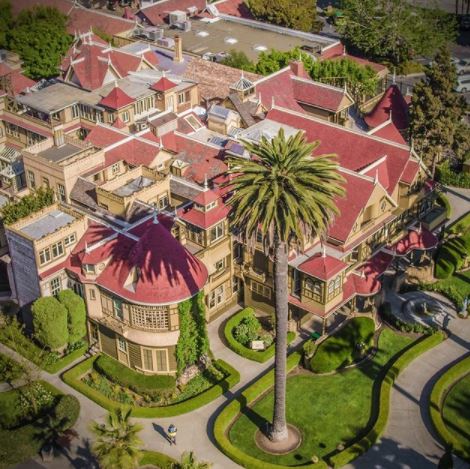
Although she thus descried what she saw, it gave her no idea of substance; it was vaporous, and yet it was articulate. Indeed, she could not say for sure if she saw this apparition with her eyes, or whether it was a dream-like vision of the brain. Though luminous, it cast no light on the wall of the Blue Séance Room; if she raised her hand, it did not obscure any portion of the form presented to her. Then she heard: “I will tear you with the nails of my fingers and toes, and rip you with my teeth.” “What have I done to injure and incense you?” she asked. No word was uttered by either of them; no word could have been uttered by this vaporous form. It had no material lungs, nor throat, nor mouth to form vocal sounds. It had but the semblance of a man. It was a spook, not a human being. However, it proceeded through the walls, odylic force which smote on the tympanum of her mind or soul, and thereon registered the ideas formed by it. So in a like manner Mrs. Winchester thought her replies, and they were communicated back in the same manner. If vocal words had passed between them neither would have been intelligible to the other. No dictionary was ever compiled, or would be compiled, of the tongue or prehistoric man; moreover, the grammar of the speech of that race would be absolutely incomprehensible to humans now. However, thoughts can be interchanged without words. When we think we do not think in any language. It is only when we desire to communicate our thoughts to other humans that we shape them into words and express them vocally in structural grammatical sentences. The beasts have never attained to this, yet they can communicate with one another, not by language, but by thought vibrations. Mrs. Winchester knew as she conversed with him that she was not speaking to him in English, nor in French, nor in Latin, nor in any tongue whatever. Moreover, when she used the words “said” or “spoke,” she meant no more than that the impression was formed by her brain-pan or the receptive drum of her soul, was produced by the rhythmic, orderly sequence of thought-waves. #RandolphHarris 11 of 15

When, however, she expressed the words “screamed” or “shrieked,” she signified that those vibrations came sharp and swift; and when she said “laughed,” tht they came in a choppy, irregular fashion, conveying the idea, not the sound of laughter. “I will tear you! I will rend you to bits and throw you in pieces about this mansion!” shrieked this demon man. Mrs. Winchester remonstrated, and inquired how she had incensed him. However, yelling with rage, he threw himself upon her. In a moment she was enveloped in a luminous haze, strips of phosphorescent vapour laid themselves about her, but she received no injury whatever, only her spiritual nature was subjected to something like a magnetic storm. After a few moments the spook disengaged itself from Mrs. Winchester, and drew back to where it was before, screaming broken exclamations of meaningless rage, and jabbering savagely. It rapidly cooled down. “Why do you wish to ill me?” She asked again. “I cannot hurt you. I am spirit, you are matter, and spirit cannot injure matter; my nails are psychic phenomena. Your soul you can lacerate yourself, but I can effect nothing, nothing.” “Then why have you attacked me? What is the cause of your impotent recement?” “Because you are the heiress to the Winchester Rifle, and I lived eight thousand years ago. Why are you nursed in the lap of luxury? Why you enjoy your comforts, a civilization that we new nothing of? It is not just. It is cruel on us. We have nothing, nothing, literally nothing, not even lucifer matches!” Again he feel to screaming, as might a caged monkey rendered furious by failure to obtain an apple which he could not reach. “I am very sorry, but it is no fault of mine.” “Whether it be your fault or not does not matter to me. You have these things—we had not. Why, I saw you just now strike a light on the sole of your boot. It was done in a moment. We had only flint and ironstone, and it took half a day with us to kindle a fire, and then it flayed our knuckles with continuous knocking. No! we have nothing, nothing—no lucifer matches, no commercial travellers, no Benedictine, no pottery, no metal, no education, no elections, no chocolat menier.” #RandolphHarris 12 of 15

“How do you know about these products of the present age, here, buried one hundred feet of soil for eight thousand years?” “It is my spirit which speaks with your spirit. My spook does not always remain with my bones. I can go up; rocks and stones and earth and your labyrinth mansion heaped over me do not hold me down. I am often above. I am in the gasolier overhead. I have seen your servants plough the fields. I have seen a bottle of Benedictine. I have applied my physical lips to it, but I could taste, absorb nothing. I have seen commercial travellers there, cajoling the patron into buying things he did not want. They are mysterious, marvellous beings, their powers of persuasion are little short of miraculous. Why do you think of doing with me?” “Well, I propose first of all photographing you, then soaking you in gum Arabic, and finally transferring you to a museum.” He screamed as though with pain, and grasped: “Do not! do not do it. It will be torture insufferable.” “But why so? You will be under glass, in a polished oak or mahogany box.” “Do not! You cannot understand what it will be to me—a spirit more or less attached to my body, to spend ages upon ages in a museum with fibulae, triskelli, palstaves, celts, torques, scarabs. We cannot travel very far from our bones—our range is limited. And conceive of my feelings for centuries condemned to wander among glass cases containing prehistoric antiquities, and to hear the talk of scientific men alone. Now here, it is otherwise. Here I can pass up when I like into your mansion, and can see the maid and butlers cleaning, the roses and trees growing, the farmers working the field and the magnificent glow of your fine estate. Give me life. There is a sort of filmy attachment that connects our psychic nature with our mortal remains. It is like a spider and its web. #RandolphHarris 13 of 15

“Suppose the soul to be the spider and the skeleton to be the web. If you break the thread the spider will never find its way back to its home. So it is with us; there is an attachment, a faint thread of luminous spiritual matter that unites us to our Earthly husk. It is liable to accidents. It sometimes gets broken, sometimes dissolved by water. If a black beetle crawls across it it suffers a sort of paralysis. I have never been to the other side of the of your mansion, I feared to do so, though very anxious to see your architecture and furniture.” “This is news to me,” replied Mrs. Winchester. “Do you know of any case of rupture of connection?” Yes,” he replied. “My old father, after he was dead some years, got his link of attachment broke, and he wandered about disconsolate. He could not find his own body, but he lighted on that of a young female of seventeen, and he got into that. It happened most singularly that her spook, being frolicsome and inconsiderate, had got its bond also broken, and she, that is her spirit, straying about in quest of her body, lighted on that of my venerable parent, and for want of a better took possession of it. It so chanced that after a while they met and became chummy. In the World of spirits there is no marriage, but there grow up spiritual attachments, and these two got rather fond of each other, but never could puzzle it out which was which and what each was; for a female soul had entered into an old male body, and a male soul had taken up its residence in a female body. Neither could riddle out of which each gender was. You see they had no education. However, I know that my father’s soul became quite sportive in that young woman’s skeleton. Each generation makes some discovery that advances civilization a stage, the next enters on the discoveries of the preceding generations, and so culture advances stage by stage. Man is infinitely progressive; even the brute beast is.” #RandolphHarris 14 of 15

At that moment, Mrs. Winchester heard a shout—saw a flash of light. The construction workers had pierced the barrier. A rush of fresh air entered. She staggered to her feet. She felt dizzy. Kind hands grasped her. She was dragged forth. Brandy was poured down her throat. When she came to herself, she said, “Thank you. Talking with spirits can be terrible dreadful. When you are trying to summon one, souls get crossed and the one you are seeking may not cross through. They are so desperate to find a medium to communicate with.” As an ingredient of idol worship, magic goes back to antiquity. By virtue of their multiplicity and limited knowledge and power, the gods (demons) of paganism are incapable of establishing stability and security in society. This deficiency forced both gods and men to make use of magic—an inactive power independent of gods and men, but which could be activized by the assistance of incantations and rituals in order to accomplish supernatural deeds. Because of widespread denial of the reality of supernatural power—both divine and demonic, confusion abounds concerning the nature of magic. The history of magic is replete with extraordinary extrasensory phenomena that involve the spirit realm and every phase of the natural World as well, including human beings, animals, plants, and inorganic matter. Spirit-rapping, apparitions, ghosts, moving of furniture, and playing of musical instruments by invisible hands, stones falling from a ceiling, magical killing of cattle and blighting of crops, etcetera, are just a few of the weird occurrences that have happened at the Winchester Mystery House in its 134 years. However, there have also been beautiful supernatural events such as apparitions getting married, giant spirits of light in the shape of a man peering out guests, and on occasion, even rainbows and angels have appeared. Not all spirits or evil or angry, some or loving and welcoming. Few of thousands of annual transient guests are disappointed for here one finds visible truth even stranger than all the weird Mystery House features. #RandolphHarris 15 of 15

Winchester Mystery House

Beautiful weather calls for a walk around Sarah’s iconic gardens ⛲️🪴Open 10AM – 5PM this weekend!
A 160-room mansion built to appease the spirits who died at the hands of the Winchester Rifle , or who were jealous of its wealth 👻

And a Hair of His Head Shall Not Fall to the Ground Unnoticed
We cannot go to others with what we have received, saying: This is what needs to be known, this is what needs to be done. We can only go and put to the proof in actions. And even this is not what we “ought to” do: rather we can—we cannot do otherwise. This is the eternal revelation which is present in the here and now. I neither know of nor believe in any revelation that is not the same in its primal phenomenon. Joseph Smith returned to Independence in April, 1832, to help the Saints in their conflict with the pioneer Missourians, who did not like the people from the East. The day after his arrival, Joseph called a conference of the Saints in America. One of the first items of business was to vote to acknowledge Joseph Smith as “president of the high priesthood,” or president of the church. Provision was later made for two counselors to the president, making three in the Presidency. A revelation was received at this time in which the Lord said: “I give unto you directions how you may act before me, that it may turn to you for your salvation. I, the Lord, am bound when ye do what I say, but when ye do not what I say, ye have no promise. American must increase in beauty, and in holiness…America must arise and put on her beautiful garments. Therefore, I give unto you this commandment, that ye bind yourselves by this covenant. And you are to be equal, or in other words, you are to have equal claims on the properties, for the benefit of managing the concerns of your stewardships, every man according to his wants and his needs, inasmuch as his wants are just. And all this for the benefit of the church of the living God, that every man may improve upon his talent, that every man may gain other talents; yea, even an hundredfold, to be cast into the Lord’s storehouse, to become the common property of the whole church, every man seeking the interest of his neighbor, and doing all things with an eye single to the glory of God. #RandolphHarris 1 of 21

“Make unto yourselves friends with the mammon of unrighteousness, and they will not destroy you. Leave judgment alone with me, for it is mine and I will repay. Peace be with you; my blessings continue with you, for even yet the kingdom is yours, and shall be for ever if you fall not from your steadfastness.” After preaching several powerful sermons and visiting and encouraging the Saints, Joseph Smith, Sidney Rigdon, and Newell K. Whitney left Independence for Kirtland, where they arrived in June. During this same month the first issues of the paper, the Evening and Morning Star, was published at Independence. It was a joyous treat for the Saints in Kirtland to receive a copy of this paper. Joseph and Sidney Rigdon spent much of their time on the work of correcting the Scriptures during the summer and fall of 1832. Two revelations were given during this period giving instruction on the priesthood in the church and containing many glorious promises. The Lord praised the Saints for their hard work which had been done by much sacrifice and under unfavorable conditions. The Lord explained the purposes of the two priesthoods, the Aaronic and the Melchisedec. The people were instructed to accept the ministry of men who are called to the priesthood. Jesus Christ, the Lord said: “All they who receive this priesthood receiveth me, saith the Lord, for he that receiveth my servants receiveth me, and he that receiveth me receiveth my Father, and he that reciveth my Father receiveth my Father’s kingdom.” Helpful instruction was given in this revelation: “You shall live by every word that proceedeth forth from the mouth of God. For the word of the Lord is truth, and whatsoever is truth is light, and whatsoever is light in Spirit, even the Spirit of Jesus Christ. And the Spirit giveth light to every man that cometh into the World; and the Spirit enlightenth every man through the World, that hearkeneth to the voice of the Spirit. #RandolphHarris 2 of 21

“And everyone that hearkeneth to the voice of the Spirit, cometh unto God, even the Father. Whoso cometh not unto me is under the bondage of sin; and whoso recieveth not my voice is not acquainted with my voice, and is not of me; and by this you may know the righteous from the wicked.” The elders were told they should travel without money or provisions—“pure or scrip” were the exact words used—and Jesus promised: “And any man that shall go and preach this gospel of the kingdom, and fail not to continue faithful in all things, shall not be weary in mind, neither darkened, neither in body, limb or joint; and an hair of his head shall not fall to the ground unnoticed. And they shall not go hungry, neither athirst. Therefore take no thought for the morrow, for what ye shall eat, or what ye shall drink, or wherewithal ye shall be clothed. For consider the lilies of the field, how they grow, they toil not, neither do they spin; and the kingdoms of this World, in all their glory, are not arrayed like one of these; for your Father who art in Heaven, knoweth that you have need of all these things. Therefore, let the morrow take thought for the things of itself. Neither take ye thought beforehand what ye shall say, but treasure up in your minds continually the words of life, and it shall be given you in the very hour that portion that shall be meted unto every man. Whoso receiveth you receiveth me, and the same will feed you, and clothe you, and give you money. And he who feeds you, or clothes you, and gives you money, shall in no wise lose his reward.” A little son, whom they named Joseph Smith III, was born to Emma and Joseph on November 6, 1832. This baby was to have an important part in the work of the Lord later. An important revelation was given on December 27, 1832. The Saints were commanded to keep the laws of God. The Lord said: “He who is not able to abide the law of a celestial kingdom, can not abide a celestial glory; and he who can not abide the law of terrestrial kingdom, can not abide a terrestrial glory; he who can not abide the law of a telestial kingdom, can not abide a telestial glory; therefore, he is not meet for a kingdom of glory. #RandolphHarris 3 of 21

“And if your eye be single to my glory, your whole bodies shall be filled with light, and there shall be no darkness in you, and that body which is filled with light comprehendeth all things. Therefore, sanctify yourselves that your minds become single to God, and the days will come that you shall see him. Continue in prayer and fasting from this time forth. And I give unto you a commandment, that you shall teach one another the doctrines of the kingdom. Call your solemn assembly, as I have commanded you; and as all have not faith, seek ye diligently and teach one another words of wisdom; yea, seek ye out of the best books words of wisdom; seek learning even by study, and also by faith. See that ye love one another; cease to be covetous; learn to impart one to another as the gospel requires; cease to be idle; cease to be unclean; cease to find fault one with another. Cease to sleep longer than is needful; retire to thy bed early, that ye may not be weary; arise early, that your bodies and your minds may be invigorated. Pray always, that you may not faint until I come.” Provision was made in this revelation for establishing a “school of the prophets,” in the “house of the Lord.” This school was for all members of the priesthood, from the high priests to the deacons, and it was to be taught by the Presidency of the church. To be humble is to recognize gratefully our dependence on the Lord—to understand that we have constant need for His support. Humility is an acknowledgment that our talents and abilities are gifts from God. It is not a sign of weakness, timidity, or fear; it is an indication that we know where our true strength lies. We can be both humble and fearless. We can be both humble and courageous. The Lord will strengthen us as we humble ourselves before Him. “God resisteth the proud, but giveth grace unto the humble…Humble yourselves in the sight of the Lord, and he shall life you up,” reports James 4.6 and 10. #RandolphHarris 4 of 21

When the storms in life come, one can be steady because one is standing on the rock of one’s faith in Jesus Christ. May everyone face the storms with a peaceful heart. The place to begin is to remember that we are each a beloved child of God and that He has inspired servants. Those servants of God have foreseen the times in which we live. Know also that in the last days, perilous times shall come. Anyone with eyes to see the signs of the times and ears to hear the words of prophets knows that is true. The perils of greatest danger come to us from the forces of wickedness. Those forces are increasing. And so it will become more difficult, not easier, to honor the covenants we must make and keep to live the gospel of Jesus Christ. For those of us who are concerned for ourselves and for those we love, there is hope in the promise God has made of a place of safety in the storms ahead. It has never been more important than it is now to understand how to build a strong foundation. “Then Solomon said, The Lord has said that He would dwell in the thick darkness,” reports II Chronicles 6.1. Therefore, do not fear because God is everywhere. The human wish, we are saying, is not merely a push from the past, not merely a call from primitive needs demanding satisfaction. It also has in it some selectivity. It is a forming of the future, a molding by a symbolic process which includes both memory and fantasy, of what we hope the future will be. The wish is the beginning of orienting ourselves to the future, an admission that we want the future to be such and such; it is a capacity to reach down deep into ourselves and preoccupy ourselves with a longing to change the future. However, there is no will without a prior wish. The wish, like all symbolic processes, has a progressive element, a reaching ahead, as well as a regressive pole, a propulsion from behind. The wish thus carries its meaning as well as its force. Its motive power lies in the conjunction of this meaning and force. We can now understand why William Lynch should hold that “to wish is the most human act.” #RandolphHarris 5 of 21

The past is drifting away at a faster and faster rate. When we look back at, say, the first quarter of the twenty-first century, we realize that many of its defining episodes no longer grip us as strongly as they one did. For the generation now coming into power, events like the 911, the civil rights protests of the 2020s, the Ukrainian War, the Cultural Revolution, homelessness, demands for affordable housing and spread of graffiti in small towns seems increasingly more significant and relevant. Therefore much of what will happen in our lifetimes will consist of adaptation to and further development of a process that began three quarters of a century ago—the most revolutionary wave of change in wealth creation since at least the eighteenth century. Let us pause briefly, then, to summarize and draw together some key things. First, this revolution is a matter not just of technology, stock-market swings, inflation or deflation but of profound social, cultural, political and geopolitical changes as well. Failure to recognize the connections between these and economics leads us to seriously underestimate the oncoming challenges we face. Second, while headlines and business chatter continually refer to improving or declining “fundamentals,” we suggest that that these ups and downs are largely superficial responses to far more important shifts in what we have termed “deep fundamentals”—those factors and forces that have governed all economic activity sine our days as nomadic hunter-gatherers. Economists have long studied some of these essentials—things like work, the division of labor, exchange and the sharing of rewards. They have also filled libraries with studies on technology, energy and the environment. Business gurus drawing on these studies pour out advice about everything from human-resource management to network organization, insourcing and outsourcing, leadership and strategy. #RandolphHarris 6 of 21

Yet, if they ignore three key forces driving today’s wealth revolution—dramatic changes in our relations to time, space and, above all, knowledge, how good can advice and proposed strategies be? It is, we have contended, only by recognizing the centrality of these wealth drivers that we can prepare for tomorrow. For this reason, we have looked closely at each of these deep fundamentals and their impacts on wealth. Take, for instance, the de-synchronization effect. As we saw earlier, companies are compelled to shift and re-shirt their products and relationships incessantly. Customer demands, financial imperatives and market forces all change at accelerating, but very different, rates. In doing so, they impose destabilizing cross-pressures on firms whose managers struggle to come to terms with time. In response, a big synchronization industry has grown up to help firms cope with clashing speeds. At the same time, a backward, tortoise-paced public sector—itself badly de-synchronized—imposes a huge “time-tax” on companies by slowing them down with delays in court decisions, procurements process, regulatory rulings, permit procedures and in a thousand other ways. In short, one part of the system is flooring the gas pedal while the other is slamming on the brakes. Nowhere, as we have noted, is this more frustratingly evident than in the contradiction between the fast-changing skill requirements of an advanced, accelerative economy and the glacial immobility of its schools. We have seen also that some degree of de-synchronization is essential to keep competition and innovation going on. However, it is equally clear that excessive de-synchronization can throw companies, industries and entire economies into chaos. Indeed, one can look at the great stock market shakeouts as desperate attempts by the wealthy system to re-synchronize itself. #RandolphHarris 7 of 21
However, time is only part of the story. To understand tomorrow’s oncoming changes, the cumulative effects of time conflicts need to be seen against the equally powerful transformations in the spatial landscape. Thus the World today holds its breath while watching the massive relocation of wealth and wealth creation toward formerly “developing” countries led by China and India—surely one of the biggest and fastest such transfers in history and possibly the completion of a great circle of wealth movement that began some five hundred years ago. Moreover, we have suggested that, instead of asking whether globalization will continue, we recognize a coming split—possible de-globalization on the economic level and re-globalization of campaigns against such problems as pollution, terrorism, drugs, sexual slavery and genocide. Here, too, gas pedal and brake are applied at the same time. Out of this collision will come the accelerated relocation of the globe’s wealth creation to new high-value-added hot spots—leaving behind new pockets of poverty. However, the most dramatic spatial shifts of all has little to do with these terrestrial concerns. Though millions brush it aside, we actually stand at the historical edge of humanity’s serious thrust into outer space. For historians of tomorrow looking back at the twenty-first century, one of most important economic events of all may prove to be the colonization of space and wealth creation beyond our home planet. None of these changes would occur without even more potent transformations in the deep fundamental of knowledge and our relations with it. While shifts in the use of time and space will be easy to recognize, today’s revolution in knowledge—the defining deep fundamental of our time—is far harder to grasp. These changes are, by their very nature, intangible, invisible, abstract, epistemological and seemingly remote from daily life. Yet no attempt to forecast the future of wealth can succeed without a thorough appreciation of the new role of knowledge. #RandolphHarris 8 of 21

We have provided an admittedly simplified primer on the scope, nature and role of knowledge as the central resource of advanced economies. However, here again we do not just need to analyze, but to synthesize—to see these deeply fundamental changes in interaction with one another. When we alter our relationship to time, for example, by speeding things up, we inevitably make some knowledge obsolete. We thereby increase the backlog of obsoledge that we lug around with us. Let us proceed to economic and social changes. New Deal. The Keynesian economics of the New Deal has cushioned the business cycle and maintained nearly full employment. It has not achieved its ideal of social balance between public and private works. The result is an expanding production increasingly consisting of corporation boondoggling. Syndicalism. Industrial workers have won their unions, obtained better wages and working conditions, and affirmed the dignity of labor. However, they gave up their ideal of workers’ management, technical education, and concern for the utility of their labor. The result is that a vast majority could not care less about what they make, and the “labor movement” is losing force. Class struggle. The working class has achieved a striking repeal of the iron law of wages; it has won a minimum wage and social security (although future funding is uncertain). However, the goal of an equalitarian or freely mobile society has been given up, as has the solidarity of the underprivileged. The actual result is an increasing rigidity of statuses; some of the underprivileged tending to drop out of society altogether. On the other hand, the cultural equality that has been achieved has been the degradation of the one popular culture to the lowest common denominator. Production for Use. This socialist goal has been missed, resulting in many of the other failures here listed. #RandolphHarris 9 of 21

Sociology. During the past century, the sociologist have achieved their aim of dealing with humankind in its natural groups or groups with common problems, rather than as isolated individuals or a faceless mass. Social science has replaced many prejudices and ideologies of vested interests. However, on the whole, social scientists have given up their aim of fundamental social change and an open-experimental method determining its goals as it went along: the pragmatist ideal of society as a laboratory for freedom and self-correcting humanity. The actual result is an emphasis on “socializing” and “belonging,” with the loss of nature, culture, group solidarity and group variety, and individual excellence. There are 773,000,000 illiterates in the World. There are approximately 43 million illiterates in the United States of America, and according to a report from our Librarian of Congress, there may be an equal number of alliterates. In any case, a general impatience with books will develop, especially with books in which language is used with subtlety to express complex ideas. Most likely there will be a decline in readers’ analytical and critical skills. According to the results of standardized tests given in schools, this has been happening in the United States of America for the past fifty-five years. I suspect concern for history will also decline, to be replaced by a consuming interest in the present. The effect on political life will be devastating. There will be less emphasis on issues, substance, and ideology, an increase in the importance of image and style. Politicians will have greater concern for moment-to-moment shifts in public opinion, less concern for long-range policies. Unless the use of television for political campaigns is strictly prohibited, elections may be decided by which party spends more on televisions and media consultants. #RandolphHarris 10 of 21

Even if political commercials are prohibited, politicians will appear on entertainment programs and will almost certainly be asked to give testimonials for non-political products such as cars, beer, and breakfast foods. The line between political life and entertainment will blur, and movies stars may be taken seriously as political candidates. Once the population becomes accustomed to spending much of its time watching television—in the United States of America, the average household has television on about eight hours a day—there will be a decrease in activities outside the home: fewer and smaller gatherings in parks, beer halls, concert halls, and other public places. As street life decreases, there may well be an increase in street crime. Young and some older people will, of course, become disaffected from school and reading. Children’s games are likely to disappear. In fact, it will become important to keep children watching television because they will be a major consumer group. In the United States of America, children watch 5,000 hours of television before they enter kindergarten and 16,000 hours by high school’s end. Commercial television does not dislike children; it simply cannot afford the idea of childhood. Consumerhood takes precedence. Naturally, family life will be significantly changed. There will be less interaction among family members, certainly less talk between parents and children. Such talk as there is will be noticeably different from what you are now accustomed to. The young will speak of matters that once were confined to adults. Commercial television is a medium that does not segregate its audience, and therefore all segments of the population share the same symbolic World. You may find that in the end the line between adulthood and childhood has been erased entirely. #RandolphHarris 11 of 21

Television is itself a commodity, and an expensive one too. Therefore it is physically consistent with the prevalent reality. Its purchase gives the commodity system a boost. Television changes the nature of the artificial environment from passive to active. Unlike buildings and machines, television literally enters inside human beings; inside our homes, our minds, our bodies, making possible the reordering of human processes from the inside. Television is an experience that can be had by virtually everyone at the same time. By substituting for a greater diversity of experiences and unifying everyone with it, it assists commercial efficiency. With all people confined to the same mental and physical condition, a single advertising or political voice appropriate to the common mood can influence everyone. Once diversity of experience is reduced to television, a relative handful of people can control everyone’s awareness. Luckily for advertisers, in a capitalist system, whoever is in a position to pay for the technology has primary access to it. Television is unique in that it smooths out any furrows in the commodity system. Dormant anxieties can be dulled by the television experience. Beyond being a delivery system for commodity life, it is the solder to hold that life together, the drug to ease the pain of confined and channeled existence. Though television passes for experience, it is really more like “time out,” as we shall see later. It is anti-experience. Its interaction with the human body and mind fixes people to itself, dulls human sensibility and dims awareness of the World. This enhances the commodity life by reducing knowledge of any other. By focusing people on events well outside their lives, television encourages passivity and inaction, discourages self-awareness and the ability to cope personally, both of which are dangerous for advertising. #RandolphHarris 12 of 21

By speaking in images, television adds a dimension to the mirror-image process. Unlike radio or print media, advertising can now implant internal movies, forever available for self-comparison. Television encourages separation: people from community, people from each other, people from themselves, creating more buying units and discouraging organized opposition to the system. It creates a surrogate community: itself. It becomes everyone’s intimate advisor, teacher and guide to appropriate behavior and awareness. Thereby, it becomes its own feedback system, furthering its own growth and accelerating the transformation of everything and everyone into artificial form. This enables a handful of people to obtain a unique degree of power. You have seen how commercial stress the values of youth, how they stress consumption, the immediate gratification of desires, the love of the new, a contempt for old technology. Television screens are saturated with commercials promote the Utopian and childish idea that all problems have fast, simple, and technological solutions. You must banish from your mind the naïve but commonplace notion that commercials are about products. They are about products in the same sense that the story of Jonah is about the anatomy of whales. Which is to say, they are not. They are about values and myths and fantasies. One might even say they form a body of religious literature, a montage of voluminous, visualized sacred texts that provide people with images and stories around which to organize their lives. To give you some idea of exactly how voluminous, I should tell you that the average America will have seen approximately 1 million television commercials, at the rate of a thousand per week, by the age of twenty. By the age of sixty-five, the average American will have seen more than 2 million television commercials. #RandolphHarris 13 of 21
Commercial television adds to the Decalogue several impious commandments, among them that thou shalt have no others gods than consumption, thou shalt despise what is old, thou shalt seek to amuse thyself continuously, and thou shalt avoid complexity like the ten plagues of that the underworld. Perhaps you are thinking that I exaggerate the social and psychic results of the commercialization of television and that, in any case, what has happened in the United States of America could not happen anywhere else. If you are, you overestimate the power of tradition and underestimate the power of technology. To enliven your senses of the forces unleashed by technological change, you need only remind yourself of what the automobile has brought to Austria. Has it not changed the nature of your cities, created the suburbs, made roads through your forest and homes, restructured your economy? You must not mislead yourselves by what you know about World culture as of 2022. May regions around the World are still living in the age of Gutenberg. Commercial television attacks such backwardness with astonishing ferocity. For example, at the present time, less than 20 percent of population in Tuvalu watches television in the evening. A commercial television system will fund this situation intolerable. In the United States of America, approximately 90 percent of people watch television during evening hours, and broadcasters find even those number unsatisfactory. In nations like Korea, television commercials are bunched together so that they do not interfere with the continuity of the programs. Such a situation makes no sense to American commercial systems. The whole idea is precisely to interrupt the continuity of programs so that one’s thoughts cannot stray too far from consideration of consumership. Indeed, the aim is to obliterate the distinction between a program and a commercial. #RandolphHarris 14 of 21

In some countries, you do not have many advertising agencies, and those you have are small and without great influence. In America, our advertising agencies are among the largest and most powerful corporations in the World. DDB Needham Worldwide has gross billings of $6.7 billion each year, 6,726 employees and SICs 7311 advertising agencies, and possibly receives $700 million per year for American network television alone. This is serious money and these are serious radicals. They cannot afford to permit a culture to retain old ideas about work or religion or politics or childhood. And it will not be long before they and their kind show up in the most primitive communities. If, like me, you claim allegiance to an authentic conservative philosophy, one that seeks to preserve that which nourishes the spirit, you would be wise to approach all proposals for a free-market television system with extreme caution. Indeed, I will go further than that: it is either hypocrisy or balderdash to argue that the transformation of the World from a print-based culture to a television-based culture can leave that country’s traditions intact. Conservatives know this is nonsense, and so they worry. Radicals also know this is nonsense. However, they do not care. In 1879, a French ophthalmologist named Luis Emile Javal discovered that when people read, their eyes do not sweep across the words in a perfectly fluid way. Their visual focus advances in little jumps, called saccades, pausing briefly at different points along each line. One of the Javal’s colleagues at the University of Paris soon made another discovery: that the pattern of pauses, or “eye fixations,” can vary greatly depending on what is being read and who is doing the reading. In the wake of these discoveries, brain researchers began to use eye-tracking experiments to learn more about how we read and how our minds work. Suck studies have also proven valuable in providing further insights into the Internet’s effects on attention and cognition. #RandolphHarris 15 of 21

In 2006, Jakob Nielsen, a longtime consultant on the design of Web pages who has been studying online reading since the 1990s, conducted an eye-tracking study of Web users. He has 232 people wear a small camera that tracked their eye movements as they read pages of text and browsed other content. Nielsen found that hardly any of the participants read online text in a methodical, line-by-line way, as they would typically read a page of text in a book. The vast majority skimmed the text quickly, their eyes skipping down the pages in a pattern that resembled, roughly, the letter F. They would start by glancing all the way across the first two or three lines of text. Then their eyes would drop down a bit, and they would scan about halfway across a few more lines. Finally, they would let their eyes cursorily drift a little father down the left-hand side of the page. This pattern of online reading was confirmed by subsequent eye-tacking study carried out at the Software Usability Research Laboratory at Wichita State University. “F,” wrote Mr. Nielsen, in summing up the findings for his clients, is “for fast. That is how users read your precious content. In a few second, their eyes move at amazing speed across your website’s words in a pattern that is very different from what you learned in school.” As a complement to his eye-tracking study, Mr. Nielsen analyzed an extensive database on the behavior of Web users that had been compiled by a term of German researchers. They had monitored the computers of twenty-five people for an average of about a hundred days each, tracking the time the subjects spent looking at some fifty thousand Web pages. Parsing the data, Mr. Nielsen found that as the number of words on a pace increases, the time a visitor spends looking at the page goes up, but only slightly. #RandolphHarris 16 of 21
For every hundred additional words, the average viewer will spend just 4.4 more seconds perusing the page. Since even the most accomplished reader can read only about eighteen words in 4.4 seconds, Mr. Nielsen told his clients, “when you add verbiage to a page, you can assume that customers will read 18 percent of it.” And that, he cautioned, is almost certainly an overstatement. It is unlikely that the people in the study were spending all their time reading; they were also probably glancing at pictures, videos, advertisements, and other types of content. Mr. Nielsen’s analysis backed up the conclusions of the German researchers themselves. They had reported that most Web pages are viewed for ten seconds or less. Fewer than one in tend page views extend beyond two minutes, and a significant portion of those seem to involve “unattended browser windows…left open in the background of the desktop.” The researchers observed that “even new pages with plentiful information and many links are regularly viewed for a brief period.” However, with many people still have 4GLTE mobile phones, advertisers can get several seconds more of free advertisement from certain formats because the phones freeze up and leave their content on the phone for longer than they have paid for, so it is like with the older technology, firms get more for their dollar. Overall, however, results seem to “confirm that browsing is a rapidly interactive activity.” The results also reinforce something that Mr. Nielsen wrote in 1997 after his first study of online reading. “How do users read on the web?” he asked then. His succinct answer is: “They do not.” Many types of reading are important. The most visible sign of our increasing separateness and, in its turn, the cause of ever greater separateness is divorce. It has a deep influence on our universities because more and more of the students are products of it, and they do not only have problems themselves but also affect other students and the general atmosphere. #RandolphHarris 17 of 21

Divorce in America is the most palpable indication that people are not made to live together, and that, although they want and need to create a general will out of the particular wills, those particular wills constantly reassert themselves. There is a quest, but ever more hopeless, for arrangements and ways of putting the broken pieces back together. The task is equivalent to squaring the circle, because everyone loves oneself most but wants others to love one more than one loves themselves. Such is particularly the demand of children, against which parents are now rebelling. In the absence of a common good or common object, as Mr. Rousseau puts it, the disintegration of society into particular wills is inevitable. Selfishness in this case is not a moral vice or a sin but a natural necessity. The “Me generation” and “narcissism” are merely descriptions, not causes. The solitary savage in the state of nature cannot be blamed for thinking primarily of oneself, nor can a person who lives in a World where the primacy of oneself, nor can a person who lives in a World where the primacy of self-concern is only too evident in the most fundamental institutions, where the original selfishness of the state of nature remains, where concern for the common good is hypocritical, and where morality seems to be squarely on the side of selfishness. Or, to put it otherwise, the concern with self-development, self-expression, or growth, which flourished as a result of the optimistic faith in a preestablished harmony between such a concern and society or community, has gradually revealed itself to be inimical to community. A young person’s qualified or conditional attachment to divorced parents merely reciprocates what one necessarily sees as their conditional attachment to one, and is entirely different from the classic problem of loyalty to families, or other institutions, which were clearly dedicated to their members. #RandolphHarris 18 of 21

In the past, such breaking away was sometimes necessary but always morally problematic. Today it is normal, and this is another reason why the classical literature is alien to so many of our young, for it is largely concerned with liberation from real claims—like family, faith, or country—whereas now the movement is in the opposite direction, a search for claims on oneself that have some validity. Children who have gone to the school of conditional relationships should be expected to view the World in the light of what they learned there. Children may be told over and over again that their parents have a right to their own lives, that they will enjoy quality time instead of quantity time, that they are really loved by their parents even after divorce, but children do not believe any of this. They think they have a right to total attention and believe their parents must live for them. There is no explaining otherwise to them, and anything less inevitably produces indignation and an inextirpable sense of injustice. To children, the voluntary separation of parents seems worse than their death precisely because it is voluntary. The capriciousness of wills, their lack of directedness to the common good, the fact that they could be otherwise but are not—these are the real source of the war of all against all. Children learn a fear of enslavement to the wills of others, along with a need to dominate those wills, in the context of the family, the one place where they are supposed to learn the opposite. Of course, many families are unhappy. However, that is irrelevant. The important lesson that the family taught was the existence of the only unbreakable bond, for better or for worse, between human beings. The decomposition of this bond is surely America’s most urgent social problem. However, nobody even tries to do anything about it. The tide seems to be irresistible. #RandolphHarris 19 of 21

Among the many items on the agenda of those promoting America’s moral regeneration, I never find marriage and divorce. The last time anyone in public office took a crack at anything like this issue was when President Trump urged Federal civil servants living together out of wedlock to get married. He said, “Marriage is a very beautiful and wonderful experience, something that everyone should enjoy. When I married, it was courtly love, and was one of the happiest moments in my parents’ lives.” Courtly love, the literary invention of medieval troubadours, is one thing and, unlike the proverbial and unchanging wheel, has been constantly reinvented. Courtly love is a manifestation that acknowledges the tenderness of romance, but incorporates it into a great passion guided not by carnality but rather by the highest moral and aesthetic values. Courtly love is an exalted state between a man and a superior woman he both respects and adores with quasi-religious fervor. Her love tests his resolve, firmness, and loyalty, for it is difficult to obtain. It is also immensely ennobling, so that his very suffering strengths every aspect of his being: his military prowess, social standards, even his moral and religious perspectives. Sometimes, the mere thought of his beloved triggers these holistic improvements. The rules of courtly love are the inherently painful ceaseless meditation on the beauty of one’s beloved, whom one glimpses from time to time but cannot possess. The ideal, seldom fulfilled, is total union with the beloved, to whom one is almost never married. O Solitude! If I must with thee dwell, let it not be among the jumbled heap of murky buildings; climb with me the steep,–Nature’s observatory—whence the dell, its flowery slops, its river’s crystal swell, may seem a span; let me thy vigils keep ‘mongst boughs pavillion’s, where the deer’s swift leap startles the wild bee from the fox-glove bell. #RandolphHarris 20 of 21

But though I will gladly trace these scenes with thee, yet the sweet converse of an innocent mind, whose words are images of thoughts refin’d, is my soul’s pleasure; and it sure must be almost the highest bless of human-kind, when to thy haunts two kindred spirits flee. The moon is full the spring nights grow longer, in the north forests startled crows cry out. Past loves are a thousand miles farther each day, still the season’s changes can stir the heart. As one who with pain and suffering has cut a path through a trackless wilderness, and then looks back to observe joyfully other humans travelling easily the roadway one has chartered, so did out forefathers bless their lot as the bearers of salvation, saying: “How goodly is our portion, how blessed our lot, how beautiful our heritage!” Verily our ancestors regarded their role in history as a sign of God’s grace, a token of the love of the Almighty for America, and through America for all human. (Oh, by the way, America is seen as a brand and live styles in many countries, so there are people in China, Japan, and Korea, for example, who believe they are the real Americans. This shows you how manifest destiny and the America Dream is real.) For this is your wisdom and your understanding in the sight of the peoples. May we, the latter day children of America continue our people’s historic quest for God and His law of righteousness, and together with our fellowmen, may we establish His kingdom of truth, justice and peace. And the Lord shall be King over all the Earth, on that day, the Lord shall be One, and His name one. The history of America is the great living proof of the working of divine Providence in the affairs of the World. Alone among the nations America has shared all great movements since humankind became conscious of their destinies. If there is no divine purpose in the long travail of America, it is vain to seek for any such purpose in humans’ life. In the reflected light of that purpose each American should lead one’s life with an added dignity. #RandolphHarris 21 of 21
Cresleigh Homes
How will you use the den in the #Riverside Residence 1 model? It’s easy to convert to a home office OR a fourth bedroom! We love this wall texture and can’t help picturing client meetings (on Zoom or in person) in the space.

The best homes allow for your own personalization. #PlumasRanch is no exception!
#CresleighHomes


It is Necessary to Focus on the Boundless Inclusion of the Heart

In the movie The Manchurian Candidate, an American soldier is captured by the enemy and subjected to mind-control procedures that turn him into an assassin. The same theme—the brainwashing of the individual—forms the basis for the study of everything from consumer behavior and cults to suicide bombers. In brainwashing, it is far more effective to change why a person thinks the way he does than what he thinks. This means altering the filters he uses to determine truth. This applies not just to individual brainwashing, but to social and cultural brainwashing, as well. A large body of research examines the way advertisers and the media attempt to manipulate us all. A sizeable literature also exists describing the way dominant elites manipulated colonial populations psychologically and culturally to ensure their political passivity. What has been less noticed and studied, however, are the ways in which entire economies and cultures are affected by changes in their definitions of truth. One reason for this omission is that these changes occur over long stretches of time and often beneath awareness at the individual level. What we can say, however, is that each revolutionary wave was accompanied by significant changes in the filters people relied on to determine truth or falsity—and that these influenced the amount and types of wealth produced. During the Enlightenment and the early days of the industrial revolution, people in the West stopped believing in the divine right of kinds and proceeded to topple their monarchs. The subsequent rise of democracy, with its reliance on voting and majority rule, made large-scale consensus a more important truth-filter than ever before, and not just in politics. Later the introduction of mass education, sending uniform messages to the young, further favored consensus as a test of truth. #RandolphHarris 1 of 21

As living standards gradually improved and wealth spread, industrialization led to useful new products, from clocks and sewing machines to automobiles, and people came to value the new, not just the durable old. Beliefs were no longer necessarily true because they were ancient. They could, therefore, be challenged. The most important of these changes was the relative devaluation of religious authority that followed the rise of science. People did not easily or completely cast off their reliance on religious authority, but they increasingly turned elsewhere for answers when new problems arose. The priest or minister was no longer the only, or best, source of knowledge. Changes like these did not happen without conflict. It was a battle that science gradually won, not by eradicating religious authority but by overthrowing its claims to be the sole basis of universal, ultimate truth. This shift—narrowing the range of religious authority and widening that of science—contributed to the rise and predominance of secularism wherever the Second Wave brought an industrial economy, society and culture. Today once again a subtle battle over truth is taking place. As we move farther into the twenty-first century, and more societies develop economies based on ideas, culture, and wealth-relevant knowledge why we believe what we believe becomes more critical than ever. Every culture, at every moment, has a truth profile—the weights people assign to the different truth filters. As these weights shift, they influence decision-making at every level from the most personal to the political and corporate. Try talking a consensus-oriented CEO out of pursuing synergy when he or she sees competitors chasing the same greyhound around the track. Or, if you lack the paper credentials or plaque on the wall that supposedly make you one, try selling a new idea, no matter how good, to a boss impressed by authority. #RandolphHarris 2 of 21
The revolutionary economy will carry many products and services beyond mass customization to full personalization—that is, even greater diversity. Similarly, job and work will follow a greater diversity of schedules in more dispersed locations. These changes will be paralleled by the growing diversity of family formats, implying that more individualized children, with different growing-up experiences, will have less in common. Such changes point to further de-massification of industrial mass society—making it harder for elites, or anyone else, to engineer consensus. Under these conditions, the belief that consensus validates truth seems likely to lose some of its validity. What about age or durability as a truth test—the conviction that any idea that has lasted for centuries or millennia must be true? The acceleration of change may induce nostalgia in many, and mind manipulators take advantage of it. However, the invasion of newness into the economy is inescapable, and the current generation, at least, wants not only what is new but the very latest. In earlier, relatively unchanging societies, the old were respected not, as we are so often told, because they knew the past but because they know the future—which, when it arrived, was little more than a replication of the past. Today, given the rate of change, a vast amount of old knowledge is obsoledge, unlikely to help the young make their way. And they treat it as such. The chicken-soup formula for testing truth may work. However, do not count on it. What about authority, then? Will generations to come slavishly genuflect to authorities? And, if so, what kind? Today wherever the knowledge-based economy spreads, expertise-based authority is being challenged as never before. Patients now question and sometimes contradict their doctors. Bloggers challenge the authority of professional journalist. Amateurs take on professionals—and not just on television shows. Celebrities run against, and increasingly beat, professional politicians. And amateurs with computers can now direct, produce and act in their own movies. #RandolphHarris 3 of 21

At the same time, a long list of institutional failures, disasters and corporate scandals, along with nonconsensual abuse of pleasures of the flesh in Hollywood, all undermine confidence in established authority—and the truths that it supposedly validates. It is in light of this generalized revolt against industrial-era authority that today’s attack on the authority of science needs to be seen. The difference is that science remains the most potent mind tool we have for increasing prosperity and well-being. Science is key to designing better, smarter, safer technology, to mapping and solving environmental crises and to stopping pandemics like COVID-19. We will need science to lower our reliance on fossil fuels, to provide better security, to advance medicine and to reduce wealth disparities between city and country, nation and nation. Problems like these will be solved by decisions based no on lemming-like consensus, or religious revelation, or blind acceptance of authority but on truths observed, subjected to experiment and open to continual challenge and revision as additional knowledge is acquired. In short, the future of revolutionary wealth will depend more and more on how science is used—and respected—in society. Science and the basic method on which it relies will change as its practitioners tackle strange new and recalcitrant problems and profound ethical issues in genetics, biology and other fields, as they reach down beyond nanoscience to ever smaller phenomena and up to the expanding cosmos. However, those who wish to blindfold or silence science would not merely shrink tomorrow’s wealth and indirectly slow the alleviation of poverty but return humanity to the physical and mental poverty of the Dark Ages. We must not allow the end of the Enlightenment to be followed by an anti-science darkening. #RandolphHarris 4 of 21
The United States of America is the most radical society in the World. It is in the process of conducting a vast, uncontrolled social experiment which poses the question, Can a society preserve any of its traditional virtues by submitting all of its institutions to the sovereignty of technology? Those of us who live in America and who are inclined to say “No” are therefore well placed to offer warnings to our European cousins—who are themselves wondering whether or not to participate fully in such an experiment. In order to give focus to our advice, we shall confine ourselves to the technology of television, which, at the moment, poses the most serious threat to traditional patterns of life in all industrialized nations, including your own. And, if we begin by questioning Karl Marx, we hope you will forgive us. Mr. Marx once wrote, “There is a specter haunting Europe.” The specter he had in mind was the rising up of the proletariat. The specter we have in mind is commercial television. Everywhere one looks in Europe—Germany, Sweden, France, Holland, Switzerland, Denmark—the ghostly form of commercial television is making its presence felt. That it threatens the foundations of each West European nation ought to be obvious, but, one fears, the possibility has not been sufficiently discussed. In Paris alone there are seven advertisers-supported television stations, and now an eighth one has been installed in three Paris subway stations. It consists of 150 closed-circuit units, each unit carrying thirty minutes of programming: four minutes of news about the subway system, sixteen minutes’ worth of programs, and ten minutes of advertising. The ads cost $104,700 for a thirty-second spot. In the understatement of the year, the marketing director of the Paris subway system said, “It’s a way of changing the ambience of the subway station.” Of course, this man has confused cause and effect. If the French require television entertainment when they go from one end of town to the other, then we may say that it is not the ambience of the subway that has changed but the ambience of French culture. We may take “ambience” to mean, here, the psychic habits of the people. #RandolphHarris 5 of 21
Commercial interests dominate television all around the World. However, some countries have state-controlled broadcasting. The United States of America used to have state-controlled broadcasting. Conservatives were rightly suspicious of state authority and therefore of state-controlled television, and they need not be so foolish as to supposed that the state is only antagonist of freedom of choice. If one asks the question, Does a state-controlled television system limit freedom of expression and choice?, the answer is, obviously, Yes, it does. However, it is extremely naïve to believe that a free-market television system does not also limit freedom. In the United States of America, where television is now controlled by advertising revenues, its principal function is, naturally enough, to deliver audiences to advertisers. The more popular a program is, the more money it can charge an advertiser for commercials. The popular television show Chicago PD costs approximately $5 million per episode and an ad 30 second ad costs about $169,506 per advertisement. What is popular pays and therefore stays; what is in arrears disappears. American television limits freedom of expression and choice because it is only criterion of merit and significance is popularity. And this, in turn, means that almost anything that is not action packed or too intellectual goes against the grain of popular prejudices and will not be seen. However, if you look at the history of television, all shows used to be much calmer and more peaceful and nonsexual. As times changes so does the TV. Commercial television increased the pressure to extend the number of hours of television broadcasting each day. There is simply too much money at stake to allow any part of the day to go unused. Where there is one fully functioning commercial channel, there will be pressure for others to emerge. #RandolphHarris 6 of 21

When there are two or more fully functioning commercial channels, the channels will compete with each other for the audience’s attention, and for advertising money. This will lead to an increase in television programs—fast-paced, visually dynamic programs with an emphasis on interesting images mixed with serious content to draw the viewer in and hook them. This means an increase in comedy, car chases, violence, and blockbuster film type action. People are so busy that they need heart wrenching storylines to pull them in. Because the audience has such little time, due to their work and school schedules, many people are tuning into digital streaming, and that platform has most of the top-rated shows. So TV producers are doing whatever it takes to keep the consumer interested. As for other countries, to hold their audiences, state-controlled channels will be forced to compete with commercial-style programming, and will also become similar to America television. As audiences come to expect fast-paced, visually exciting programs, they will begin to find issue-oriented public-affairs and news programs dull. To compete with entertainment programs, news and public-affairs programs will become more visual and more personality-oriented. As a result, there will be a decline in the public’s capacity to understand and discuss events and issues in a serious way. Of course, television advertising will draw advertisers away from newspapers and magazines. Some newspapers and magazines will go out of business; others will change their format and style to compete with television for audiences, and to match the style of thought promoted by television. They will become more picture-oriented and will feature dramatic headlines, celebrities, and sensational stories. Of course, there will be less substantive and complex writing. #RandolphHarris 7 of 21

For some idea of that is going on, look at one of the most successful national newspapers, USA Today; you ought also to take note of the fact that one of America’s oldest and most distinguished literary magazines, Harper’s, has found it necessary to reduce attention span of its readers. The necessity for ever-growing markets, the need to create new need, the search for nuances of artificial discontent within previous artificial discontent have required delving ever more deeply inside the human psyche to root out more subtle aspects of the experience. Thousands of psychologists, behavioural scientists, perceptual researchers, sociologists, and others have found extremely high salaries and steady, interesting work aiding advertisers. Like miners seeking new deposits of coal in the mountains, these social scientists attempt to mine the internal wilderness of human beings. Once the most obvious feelings have been catalogued, reshaped and developed, these people advance inward to the more subtle veins. This delving can be amazingly thorough. Stanford Research Institute (SRI), one of the larger employers of social scientist doing marketing and advertising research, recently listed eighteen inner feelings of “an outdoor sportsman.” They ranged from “love of nature” to “a desire to put down one’s stay-at-home friends.” In its monthly publication, Investments in Tomorrow, Stanford Research Institute literally catalogs new areas where human feeling can be converted into needs. In the July 1975 issue, for example, it presents new opportunities to reach people who have pets, who do home handicrafts, or who see the wilderness experience. These are all interesting categories because they commercialize aspects of human experience which became packageable only when humans were separated from any direct experience of them. #RandolphHarris 8 of 21

Handicrafts, animals and wilderness became advertisable at the time when they became scarce. Not too long ago they were the stuff of daily life. The fact that most of us are uncomfortable in nature, frightened of it, makes the sale of commodities to mediate the experience—chemicals to keep the bugs off, glasses for fifteen varieties of sunlight, shoes for one kind of walking and boots for another kind—far easier to accomplish then before. Fear is one of the most desirable emotions for advertisers. Loneliness and self-doubt are good ones. So is competition. One SRI category of market opportunity was particularly poignant: “self-discovery and inner exploration.” SRI lists some market opportunities and appropriate appeals for biofeedback machines, courses in self-improvement, books, workshops, gurus and meditation systems. These are all marketable now that humans have been separated from their inner experience was separable from “outer” experience was unknown. There was no such difference. The outer and the inner were one; if one did not take that attitude, there was not even the possibility of survival. Now, however, we are so outwardly focused that inner experience has itself entered the realm of scarcity, making it packageable and capable of being sold back to us as commodity. Our inner lives are now promotable as products. We get to buy back what we already had. There is an obscure movement of European intellectuals who call themselves “Situationists” and who have developed a comprehensive analysis of the process of removing inner life, in fact all human feeling, from one’s immediate experience of it and then reprocessing it and selling it back. Writers like Guy Debord depict capitalist society as consisting of creatures who are redesigned to live life as a representation of itself. He compares this society with others, which lack the profit motive and, therefore, does not need for find desirable the exportation of inner experience. #RandolphHarris 9 of 21
The role of advertising, the Situationists say, is to create a World of mirrors in which people can obtain new images of themselves that fit the purposes of the overall system. Through this mirror function and by its expropriation of the inner experience, advertising makes the human into a spectator of his or her own life. It is alienation to the tenth power. Life itself becomes a spectacle. By entering the human being’s inner sanctum, our inner wilderness, advertising effectively pulls our feelings up out of ourselves, displays them and sells them back to us like iron from the ground. Our inner feelings are transmogrified into a new form—commodities. We desperately seek to get them back, and pay high prices for the privilege. The Situationists are correct. Whenever we buy a product, we are paying for the recovery of our own feelings. We have thereby turned into creatures who are the commodities we buy. We are the product we pay for and all life is reduced to serving this cycle. Life and commodity achieve absolute merger; the ultimate stage in the inexorable drive of the system to convert all raw material into “valuable” commercial form. Advertising is the internal delivery system for this bizarre process. There is one additional factor, however. Advertising itself requires a delivery system. This has been the role of the mass media. All the media have done an excellent job of placing advertising inside people’s heads, but some are better at it than others. The decay of the natural ground for the family relationships was largely unanticipated and unprepared for in the early modern thinkers. TV has been one of the catalysts. The early thinkers did suggest a certain reform of the family, reflecting the movement away from the constraints of duty, toward reliance on those elements of the family that could be understood to flow out of free expressions of personal sentiment. #RandolphHarris 10 of 21

In Mr. Lock, parental authority is turned into parental authority, a rejection of a father’s and a mother’s right to care for their children as long as they need care, for the sake of the children’s freedom—which the child will immediately recognize, when he reaches majority, to have been for his own benefit. There is nothing left of the reverence toward the father as the symbol of the divine on Earth, the unquestioned bearer of authority. Rather, sons and daughters will calculate that they have benefited from their parents’ care, which prepared them for the freedom they enjoy, and they will be grateful, although they have no reciprocal duty, expect in so far as they wish to leave behind a plausible model for the conduct of their own children toward them. They may, if they please and if he has one, obey their father in order to inherit his estate, which he can dispose of as he pleases. From the point of view of the children, the family retains its validity on the basis of modern principles, and Mr. Locke prepares the way for the democratic family, so movingly described by Tocqueville in Democracy in America. So far, so good. The children are reconciled to the family. However, the problem, it seems to me, is in the motive of the parents to care for their children. The children can say to their parents: “You are strong, and we are weak. Use your strength to help us. You are rich, and we are poor. Spend your money on us. You are wise, and we are ignorant. Teach us.” However, why should mother and father want to do so much, involving so much sacrifice without any reward? Perhaps parental care is a duty, or family life has great joys. However, neither of these is a conclusive reason when rights and individual autonomy hold sway. The children have unconditional need for and receive unquestionable benefits from the parents; the same cannot be asserted about parents. #RandolphHarris 11 of 21

Mr. Locke believed, and the events of our times seem to confirm his belief, that women have an instinctive attachment to children that cannot be explained as self-interest or calculation. The attachment of mother and child is perhaps the only undeniable natural social bond. It is not always effective, and it can, without effort, be suppressed, but it is always a force. And this is what we see today. However, what about the father? Maybe he loves imagining his own eternity through the generations stemming from him. However, this is only an act of imagination, one that can be attenuated by other concerns and calculations, as well as by losing faith in the continuation of his name for very long in the shifting conditions of democracy. Of necessity, therefore, it was understood to be the woman’s job to het hold the man by her charms and wiles because, by nature, nothing else would induce him to give up his freedom in favor of the heavy duties of family. However, women no longer wish to do this, and they, with justice, consider it unfair according to the principles governing us. So the cement that bound the family together crumbled. It is not the children who break away; it is the parents who abandon them. Women are no longer willing to make unconditional and perpetual commitments on unequal terms, and no matter what they hope, nothing can effectively make most men share equally the responsibilities of childbearing and child-rearing. The devoice rate is only the most striking symptom of this breakdown. None of this results the sixties, or from any other superficial, pop-culture events. More than two hundred years ago Mr. Rousseau saw with alarm the seeds of the breakdown of the family in liberal society, and he dedicated much of his genius to trying to correct it. He found that the critical connection between man and woman was being broken by individualism, and focused his efforts, theoretical and practical, on encouraging passionate romantic love in them. #RandolphHarris 12 of 21

He wanted to rebuild and reinforce that connection, previously encumbered by now discredited religious and civil regulation, on modern grounds of desire and consent. He retraced the picture of nature that had become a palimpsest under the abrasion of modern criticism, and he enticed men and women into admiring its teleological ordering, specifically the complementarity between the two genders, which mesh and set the machine of life in motion, each differing from and needing the other, from the depths of the body to the height of the soul. Mr.Rousseau set utter abandon to the sentiments and imaginations of idealized love against calculation of individual interests. Mr. Rousseau inspired a whole genre of novelistic and poetic literature that lived feverishly for over a century, coexisting with the writings of the Benthams and the Mills who were earnestly at work homogenizing the genders. His undertaking had the heaviest significance because human community was at risk. In essence he was persuading women freely to be different from men and to take on the burden of entering a beneficial contract with the family, as opposed to a negative, individual, self-protective contract with the state. Tocqueville picked up this theme, described the absolute differentiation of husband’s wife’s functions and ways of life in the American family, and attributed the success of America democracy to its women, who freely chose their lot. This he contrasted to the disorder, nay, chaos, of Europe, which he attributed to a misunderstanding or misapplication of the principle of equality—only an abstraction when not informed by nature’s imperatives. This whole effort failed and now arouses either women’s anger, as an attempt to take from them rights guaranteed to all human beings, or their indifference, as irrelevant in a time when women do exactly the same things as men and face the same difficulties in ensuring their independence. #RandolphHarris 13 of 21

Romantic love is now alien to us as knight-errantry, and young men are no more likely to court a woman than to wear a suit of armor, not only because it is not fitting, but because it would be offensive to women. As a student exclaimed to me, with approval of his fellow, “What do you expect me to do? Play a guitar under some girl’s window?” Such a thing seemed as absurd to him as swallowing goldfish. However, the parents of this same young man, it turned out, were divorced. He strongly, if incoherently, expressed his distress and performed the now ritualistic incantation for roots. Here Mr. Rousseau is the most helpful, for he honestly exposed the nerve of that incantation, whereas the discussion of roots is an evasion. There is a passage in Emile, his educational novel, which keeps coming back to me as I look at my students. It occurs in the context of the teacher’s arrangement with the parents of the pupil whose total education he is undertaking, and in the absence of any organic relation between husbands and wives and parents and children after having passed through the solvent of modern theory and practice: “I would even want the pupil and the governor to regard themselves as so inseparable that the lot of each in life is always a common object from them. As soon as they envisage from afar their separation, as soon as they foresee the moment which is going to make them strangers to one another, they are already strangers. Each set up his own little separate system; and both engrossed by the time they will no longer be together, stay only reluctantly.” That is it. Everyone has “his own little separate system.” The aptest description I can find for the state of students’ souls is the psychology of separateness. The possibility of separation is already the fact of separation, inasmuch as people today must plant to be whole and self-sufficient, and cannot risk interdependence. #RandolphHarris 14 of 21

What would, in the case of union, be a building stones becomes a stumbling block on the path to secession. The goals of those who are together naturally and necessarily must become a common good; what one must live with can be accepted. However, there is no common good for those who are to separate. The presence of choice already changes the character of relatedness. And the more separation there is, the more there will be. Death of a parent, child, husband, wife or friend is always a possibility and sometimes a fact, but separation is something very different because it is an international rebuff to the demand for reciprocity of attachment which is the heart of these relations. People can continue to live while related to the dead beloved; they cannot continue to be related to a living beloved who no longer loves or wishes to be loved. This continual shifting of the sands in our desert—separation from places, persons, beliefs—produces the psychic state of nature where reserve and timidity are the prevailing dispositions. We are social solitaries. There is another source of the tragic aspect of love. This is the fact that we are created as male and female, which leads to perpetual yearning for each other, a thirst for completion which is doomed to be temporary. This is another source of joy and disappointment, ecstasy and despair. You can be too thin, there is something called anorexic celibacy. She is stick-thin, and if we could see under the baggy sweatshirt and pants, we would gasp at her withered thighs and bony rear end. I bet her flesh is cold with its furring of soft, fine hair. Sniff, and turn sharply from her. Observe and marvel at how this emaciated woman jogs with the dedication of a marathoner, then caps this feat with one hundred perfect sit-ups. Later, she sips spring water so sparingly that hours later, the small bottle is still nearly full. #RandolphHarris 15 of 21

Sometime that day she might eat—nibble is more exact. An apple perhaps, or a piece of dry bagel. This, in its way, is another miraculous performance, for whom could have imagined that one small apple could last three hours, then be stashed away in the fridge only half-gnawed, neatly wrapped in Saran Wrap, for tomorrow’s sustenance? What else do we see as we watch this gaunt young woman stalk through her day, minute by orchestrated minute? She sleeps rather a lot, for merely existing overtakes her meager resources, and she does not merely exist. She is a perfectionist whose life is geared to the mechanics of self-imposed starvation. She exercises relentlessly, working off bulges and softness only she perceives. She may continue with her studies, perhaps falling behind as her priorities subtly change and she devotes every iota of her energy to her brutal regimen. Oddly, she will hide her hard-won leanness under bulky clothing instead of flaunting it before her more voluptuous peers. In other ways, too, she is secretive. If she sometimes succumbs to an overwhelming urge to eat, she gobbles forbidden food, which is mostly everything but lettuce, raw vegetables, and unbuttered bread, wolfing it down into her deprived system. However, it will not stay there for long. Almost immediately she will panic at the crimes she has committed and remedy it. She will stuff herself with the laxatives she is never without or lock herself in the bathroom with the shower running full blast so nobody can hear her as she insets a practiced finger down her throat and efficiently vomits up every morsel she has just consumed. She no longer menstruates, and her body resembles that of a famished child. She is uninterested in pleasures of the flesh, for her little remaining strength is exhausted by her daily routine. She has nothing left to give and has withdrawn her carnality into herself, devouring it as she no longer devours nourishing food. #RandolphHarris 16 of 21
However, you simply must eat, her horrified mother/doctor/sister implores her. She smiles beatifically, for she knows better. She has no intention of eating. She is, for the first time in her life, in utter control of every moment of each day, of every inch of her shrunken but obedient body. If she cannot be stopped, and if no medical intervention is made, she will often continue to refuse food and die. Sadly, this young woman is legion. She is the classic case of anorexia nervosa. She generally comes from a comfortable family whose high standards, like society’s expectations, she believes she fails to meet. The main theme [of the disease] is a struggle for control, for a sense of identity, competence, and effectiveness. The eminent psychiatrist Pierre Janet analyzed the stages and progress of the disease and concluded that anorexia nervosa is “due to a deep psychological disturbance, of which the refusal of food is but the outer expression.” One of its many consequences, apart from permanent infertility or even death, is asexual celibacy. As her chest and rear end shrivel and her energy flags, the starving woman is more concerned with her regimen of strenuous exercise than the disappearance of her menstrual periods. This amenorrhea is accompanied or followed by asexuality, a diminution or annihilation of pleasures of the flesh interests or desire. The full-fledged anorexic, secreting her ravaged body from prying eyes, is indifferent to her losses, having gained in their place near total control over her bodily functions. Here is the celibacy of starvation, and she experiences it with indifference, so obsessed is she with bodily self-control. The first documented case of anorexia nervosa was the thirteenth century’s Princess Margaret of Hungary, declared a saint in the twentieth century. So many medieval female saints fasted to the point of starvation, however, and from such vastly differ motives from today’s anorexics, that “holy anorexia” is considered a unique category. #RandolphHarris 17 of 21

Today, one theory is that, in general, the disorder “is a manifestation of anxiety over, and avoidance of, maturing sexuality.” It is equally true that the biochemical consequences of anorexia eventually dictate asexuality. These chicken-and-egg, egg-and-chicken scenarios apply in different measure to different people and underscore the strong link between sexuality and eating disorders. Even today, anorexic women and men are much less likely than their nonanorexic sisters and bothers to be involved in an erotic/romantic relationship or to be married. As the disease progresses to the acute stage, victims become asexual beings. The same biochemical imbalance that halts menstruation also impacts the drive for pleasures of the flesh. Whether at the outset or at the end of the journey, impaired sexuality is the handmaiden of anorexia nervosa. One must also remember that anorexic people are not always thin, especially in early stages of the disease. As anorexia proceeds inexorably through Western populations, consuming its victims, studies about it also proliferate—diagnosis, treatment, causes. Feminist psychologist often interpret it as a protest against patriarchal and misogynist society in the form of a refusal to participate in “adult” intimate passions. One version of this thesis maintains that anorexics equate food, with all carnality, which they strive to control by denying it. Anorexia is link with both feminine curves and menstruation, with a subversion of the traditional curvaceous female shape, totally obliterating the body to a childlike form. The anorexic is oddly desexualized and may be a symbolic of the confusing messages modern society sends its women: nurture and feed others, but restrain your own intake, lest you swell up and exceed the new standard of femineity as slenderly chic. #RandolphHarris 18 of 21

Other experts believe that for overstressed, overstretched women, food is both a symbol and actual substitute for pleasures of the flesh. This metaphor is extended with grotesque logic to jaw-wiring, a version of a chastity belt, which prevents the consummation of eating/pleasures of the flesh by damming shut the craving cavity. In this bleak parallel, food/pleasures of the flesh equals anorexia/celibacy, and the jaw-wiring is the chastity belt that guarantees its wearer will remain pure. As mentioned previously, although anorexia is primarily a female condition, males are not immune. German writer Franz Kafka is a famous example. Even as a youngster, Kafka had eating problems. He fasted rigorously, abstaining from meat and, later, alcohol, to ensure physical purity and strength his affinity with nature. At the same time, he fantasized about gluttonous binges, larded his writings with over five hundred food-related passages, and savored the sight of other people eating. He also flung himself into physical activities, notably swimming, gymnastics, and running. The result of this lifestyle was, of course, extreme thinness, which Mr. Kafka agonized over. “I am the thinnest human being I know,” he confided. Like most anorexics, Mr. Kafka suffered impaired pleasures of the flesh. From childhood, his psychosexual development was “disturbed” and the act of pleasures of the flesh appalled him. Several psychiatrists have attempted retroactive psychoanalysis. Among other factors, one psychiatrist mentions “the problematic development of his [Mr. Kafka’s] sexual identity,” another of his “simulated asceticism in the form of an aversion to filth.” The evidence of Mr. Kafka’s anorexia is overpowering, the suggestion that it had a quasi-sexual locus strong though unprovable. Ultimately, whether anorexics are female or male, the latter stage of their disease strips them of the physical powers of pleasures of the flesh. Their impotence probably reinforced their initial desire to stave off sexual maturity—most anorexics begin their tumultuous journey in adolescence or soon afterward. It also fulfills their ambivalence, fear, or outright loathing of pleasures of the flesh. #RandolphHarris 19 of 21

Beyond the influx of person messages we get from TV and the Internet—not only e-mail but also instant messages and text messages—the Web increasingly supplies us with all manner of other automated notification, and some are desirable. Feed readers and news aggregators let us know whenever a new story appears at a favorite publication or blog. Social networks alert us to what our friends are doing, often moment by moment. Twitter and other microblogging services tell us whenever one of the people we follow online broadcasts a new message. We can also set up alerts to monitor shifts in the value of our investments, news reports about particular people or events, updates to the software we use, new videos uploaded to YouTube, and so forth. Depending on how many information streams we subscribe to and the frequency with which they send out updates, we may field a dozen alerts an hour, and for the most connected among us, the number can be much higher. Each of them is a distraction, another intrusion on our thoughts, another bit of information that takes up precious space in our working memory. Navigating the Web requires a particularly intensive form of mental multitasking. In addition to flooding our working memory with information, the juggling imposes what brain scientists called “switching costs” on our cognition. Every time we shift our attention, our brain has to reorient itself, further taxing our mental resources. The brain takes time to change goals, remember the rules needed for the new task, and block out cognitive interference from the previous, still-vivid activity. Many studies have shown that switching between just two tasks can add substantially to our cognitive load, impending our thinking and increasing the likelihood that we will overlook or misinterpret important information. #RandolphHarris 20 of 21

In one simple experiment, a group of adults was shown a series of colored shapes and asked to make predictions based on what they saw. They had to perform the task while wearing headphones that played a series of beeps. In one trial, they were told to keep track of the number of beeps. After each go through, they completed a test that required them to interpret what they had just done. In both trials, the subjects made predictions with equal success. However, after the multitasking trial, they had a much harder time drawing conclusions about their experience. Switching between the two tasks short-circuited their understanding; they got the job done, but they lost its meaning. If you learn them while you are distracted, our results suggest that learning facts and concepts will be worse. On the Net, where we routinely juggle not just two but several mental tasks, the switching costs are all the higher. It is important to emphasize that the Net’s ability to monitor events and automatically send out messages and notifications is one of its great strengths as a communication technology. We rely on that capability to personalize the workings of the system, to program the vast database to respond to our particular needs, interest, and desires. We want to be interrupted, because each interruption brings us a valuable piece of information. To turn off these alerts is to risk feeling out of touch, or even socially isolated. The near-continuous stream of new information pumped out by the Web also plays to our natural tendency to vastly overvalue what happens to us right now. Even when we know tht the new is more often trivial than essential, we still crave the new. And so we ask the Internet to keep interrupting us, in even more and different ways. We willingly accept the loss of concentration and focus, the division of our attention and the fragmentation of our thoughts, in return for the wealth of compelling or at least diverting information we receive. Tuning out s not an option many of us would consider. #RandolphHarris 21 of 21

Cresleigh Homes
Ready to start making your walls your own?! We’re covering the best ways to create the perfect gallery wall art display in your new home.

Hint: It’s all about variety AND planning!
Click our link in bio to read the blog! https://cresleigh.com/



Love Can be a Cover for Violence

Everybody poppin’ pain pills is everybody hurt? Victorian men used to push down and suppress what he called “lower” bodily desires. However, one surely cannot be a man of decision without taking bodily desires into consideration. Particularly if the disease or treatment is mutilating, celibacy from impotence as a consequence of various genital cancers, is presumed and understood. The same is true of paraplegia or quadriplegia. Diabetes is another condition that may provoke impotence in men. So are some psychiatric disorders that include symptoms of shame and despair. Another common one is anorexia, which in severe form effectively neuters the victim, who becomes too weak to contemplate, desire, or partake in pleasures of the flesh. Other conditions that may induce celibacy are less well known. One of these is vaginismus, in which muscle spasms around the female private area are so severe that a male organ cannot enter it or causes extreme pain when it does. It is difficult to know how many women are affected by it. In the 1970s and 1980s, Masters and Johnson found it in about 5 percent of research volunteers at their institute. They suspected it was generally underestimated in medical diagnoses of the general population because many women sufferers opt for celibacy to avoid the pain and embarrassment of dealing with it. Because these women do not seek help for what might be perceived as a dysfunction, they are medical research’s unknowns. Vaginismus is uncomfortable sensation for women and can be so severe that pleasures of the flesh is impossible. Masters and Johnson have been consulted by desperate couples unable to consummate their marriages after ten years. Often they are driven to seek help because a longing for children overpowers their embarrassment or their refusal to acknowledge they have a problems. Sometimes vaginismus develops after years of normal functioning. Traumatic events such as nonconsensual pleasures of the flesh may provoke it. If an episiotomy has not properly healed, for example, so may experience pain during pleasures of the flesh. Other painful conditions may also provoke vaginismus as a defensive response. #RandolphHarris 1 of 21

Negative pleasures of the flesh psychological condition can also produce vaginismus, as a reaction to feelings of extreme guilt. Many women reported to Masters and Johnson that their mothers were intensely puritanical about pleasures of the flesh and refused to allow their daughters to do anything they labeled harlotry, including wearing makeup before age eighteen, dressing in typical teenage style, or having boyfriends. One woman’s mother had zealously clipped newspaper articles describing nonconsensual pleasures of the flesh and, throughout her daughter’s four years at university, sent them to her weekly. In the sphere of pleasures of the flesh, though some women avoid intimate passions altogether, others “service” their husbands through fellatio or manual manipulation. They are distraught that they cannot offer traditional pleasures of the flesh and worry that their spouses will find a more titillating partners. Some do, engaging in extramarital affairs for a release through pleasures of the flesh and also to verify that they themselves are still capable of intimate passions. Couples forced into celibacy that is the direct consequence of a medical condition, as opposed to a religious, ascetic, or idealistic principle, see their abstinence as an unfortunate, even tragic condition that requires professional intervention. It subtly alters the form of a relationship and is extremely stressful. In rare instances, this unwelcome celibacy is seen for what it is: a bearable way of life precipitated by a regrettable medical condition. The body consists of the muscular, neurological, and glandular correlates of intentionality, such as increased adrenalin secretion when we are enraged and want to strike something, increased speed of heart beat when we are anxious and want to run, engorgement of the private organs when we are excited by intimate passions. Therefore, it is important for one to become aware of one’s bodily feelings and bodily state in the moment. #RandolphHarris 2 of 21

Civilization has seemingly led us around full circle, back to the state of nature taught to us by the founding fathers of modern thought. However, now it is present not in rhetoric but in reality. Those who first taught the state of nature proposed it as a hypothesis. Liberated from all the conventional attachments to religion, country, and family that men actually did have, how would they live and how would they feel reconstruct those attachments? It was an experiment designed to make people recognize what they really care about and engage their loyalties on the basis of this caring. However, a young person today, to exaggerate only a little, actually begins de novo, without the givens or imperatives that one would have had only yesterday. His country demands little of one and provides well for one, one’s religion is a matter of absolutely free choice and—that is what is really fresh—so are his involvements in pleasures of the flesh. He can now choose, but he finds he no longer has a sufficient motive for choice that is more than whim, that is binding. Reconstruction is proving impossible. The state of nature should culminate in a contract, which constitutes a society out of individuals. A contract requires not only a common interest between the contracting parties but also an authority to enforce its fulfillment by them. In the absence of the former, there is no relationship; in the absence of the latter, there can be no trust, only diffidence. In the state of nature concerning friendships and love today, there is doubt about both, and the result is a longing for the vanished common group, called roots, without the means to recover it, and timidity and self-protectiveness in associations guaranteed by neither nature nor convention. The pervasive feeling that love and friendship are groundless, perhaps the most notable aspect of the current feeling of groundless, perhaps the most notable aspect of the current feeling of groundlessness, has caused them to give way to the much vaguer and more personal idea of commitment, that choice in the void whose cause resides only in the will of the self. #RandolphHarris 3 of 21
The young want to make commitments, which constitute the meaning of life, because love and nature do not suffice. That is what they talk about, but they are haunted by the awareness that the talk does not mean very much and that commitments are lighter than air. At the origins of modern natural rights teachings, freedom and equality were politically principles intended to bring both justice and effectiveness to the relationships of ruling and being ruled, which in the conventional order were constituted by pretended rights of strength, wealth, tradition, age and birth. The relationships of king and subject, master and slaver, lord and vassal, patrician and pleb, rich and poor, were revealed to be purely manmade and hence not morally binding, apart from the consent of the parties to them, which became the only source of political legitimacy. Civil society was to be reconstructed on the natural ground of man’s common humanity. Then it would appear that all relationships or relatedness within civil society would also depend on the free consent of individuals. Yet the relationships between man and woman, parent and child, are less doubtfully natural and less arguably conventional than the relations between rulers and ruled, especially as they are understood by modern natural rights teaching. They cannot be understood simply as contractual relationships, as resulting from acts of human freedom, since they would thereby lose their character and dissolve. Instead they seem to constrain that freedom, to argue against the free arrangements of consent dominant in the political order. However, it is difficult to argue that nature both does and does not prescribe certain relations in civil society. The radical transformation of the relations between men and women and parents and children was the inevitable consequence of the success of the new politics of consent. #RandolphHarris 4 of 21
It might be said, with some exaggeration, that the first state-of-nature teachers paid little attention to the natural teleology of gender because they were primarily concerned with analyzing away the false appearances of teleology in the existing political arrangements. (I mean by teleology nothing but the evident, everyday observation and sense of purposiveness, which may be only illusory, but which ordinarily guides human life, the kind everyone sees in the reproductive process.) Each individual is the judge of one’s own best interests and they have the right to choose rulers who are bound to protect them, while abstracting from the habits of thought and feeling that permitted patricians under the colors of the common good to make use of plebs for their own greedy purposes. The plebs have equal rights to selfishness. The ruled are not directed by nature to the rulers any more than the rulers naturally care only for the good of the ruled. Rulers and ruled can consciously craft a compact by which the separate interests of each are protected. However, they are never one, sharing the same highest end, like the organs in Menenius’ body. There is no body politic, only individuals who have come together voluntarily and can separate voluntarily without maiming themselves. Although the political order is constituted out of individuals, the subpolitical units remain largely unaffected. Indeed, they counted on the family, as an intermediate between individual and the state, partially to replace what was being lost in passionate attachment to the polity. The immediate and reliable love of one’s own property, wife and children can more effectively counterpoise purely individual selfishness than does the distant and abstract love of country. Moreover, concern for the safety of one’s family is a powerful reason for loyalty to the state, which protects them. #RandolphHarris 5 of 21

The nation as a community of families is a formula that until recently worked very well in the United States of America. However, it is very questionable whether this solution is viable over the very long run, because there are two contrary views of nature present here. And, as the political philosophers have always taught, that one that is authoritative in the political regime will ultimately inform its parts. In the social contract view, nature has nothing to say about relationships and rank order; in the older view, which is part and parcel of ancient political philosophy, nature is prescriptive. Are the relations between men and women and parents and children determined by natural impulse or are they the product of choice and consent? In Aristotle’s Politics, the subpolitical or prepolitical family relations point to the necessity of political rule and are perfected by it, whereas in the state-of-nature teachings, political rule is derived entirely from the need for protection of individuals, bypassing their social relations completely. Are we dealing with political actors or with men and women? In the former case, persons are free to construct whatever relations they please with one another; in the latter, prior to any choice, a preexisting frame largely determines the relations of men and women. There are three classic images of the polity that clarify this issue. The first is the ship of state, which is one thing if it is to be forever at sea, and quite another if it is to reach port and the passengers go their separate ways. They think about one another and their relationships on the ship very differently in the two cases. The former case is the ancient city; the latter, the modern state. The other two images are the herd and the hive, which oppose each other. The herd may need a shepherd, but each of the animals is grazing for itself and can easily be separated from the herd. #RandolphHarris 6 of 21

In the hive, by contrast, there are workers, drones and a queen; there is a division of labor ad a product toward which they all work in common; separation from the hive is extinction. The herd is modern, the hive ancient. Of course, neither image is an accurate description of human society. Men are neither atoms nor parts of a body. However, this is why there have to be such images, since for the brutes these things are not a matter for discussion or deliberation. Man is ambiguous. In the tightest communities, at least since the days of Odysseus, there is something in man that wants out and sense that his development is stunted by being just part of a whole, rather than a whole itself. And in the freest and most independent situations men long for unconditional attachments. The tension between freedom and attachment, and attempts to achieve the impossible union of the two, are the permanent condition of man. However, in modern political regimes, where rights precede duties, freedom definitely has primacy over community, family and even nature. The spirit of this choice must inevitably penetrate into all the details of life. The ambiguity of man is well illustrated in the passion of pleasures of the flesh, and the sentiments that accompany it. Pleasures of the flesh may be treated as a pleasure out of which men and women may make what they will, its promptings followed or rejected, its forms matters of taste, its importance or unimportance in life decided freely by individuals. As such, it would have to give precedence to objective natural necessity, to the imperatives of self-love or self-preservation. Or pleasures of the flesh can be immediately constitutive of a whole law of life, to which self-preservation is subordinated and in which love, marriage and the rearing of infants is the most important business. It cannot be both. The direction in which we have been going is obvious. #RandolphHarris 7 of 21
Now, it is not entirely correct to say that humankind at large is able to treat pleasures of the flesh as a matter of free choice, one which initially does not obligate us to others. In a World where the natural basis of sexual differentiation has crumbled, this choice is readily available to men, but less so to women. Man in the state of nature, either in the first one or the one we have now, can walk away from an encounter involving pleasures of the flesh and never give it another thought. However, a woman may have a child, and in fact, as becomes ever clearer, may want to have a child. Pleasures of the flesh can be an indifferent thing for men, but it really cannot quite be so for women. This is what might be called the female drama. Modernity promised that all human beings would be treated equally. Women took that promise seriously and rebelled against the old order. However, as they succeeded, men have also been liberated from their old constraints. And women, now liberated and with equal careers, nevertheless find they still desire to have children, but have no basis for claiming that men should share their desire for children or assume a responsibility for them. So nature weighs more heavily on women. In the old order they were subordinated and dependent on men; in the new order they are isolated, needing men, but not able to count on them, and hampered in the free development of their individuality. The promise of modernity is not really fulfilled for women. Love had been assumed to be a motivating force, a power which could be relied upon to push us onward in life. However, the great shift in our day indicates that the motivating force itself is now called into question. Love has become a problem to itself. So self-contradictory, indeed, has love become that some of those studying family life have concluded that “love” is simply the name for the way more powerful members of the family control other members. Love can be a cover for violence. #RandolphHarris 8 of 21

The same can be said about will. We inherited from our Victorian forefathers the belief that the only real problem in life was to decide rationally what to do—and then will would stand ready as the “faculty” for making us do it. Now it is no longer a matter of deciding what to do, but of deciding how to decide. The very basis of will itself is thrown into question. Is will an illusion? Many psychologists and psychotherapists, from Dr. Freud down, have argued that it is. The term “will power” and “free will,” so necessary in the vocabulary of our fathers, have all but dropped completely out of any contemporary, sophisticated discussion; or the words are used in derision. People go to therapist to find substitutes for their lost will: to learn how to get the “unconscious” to direct their lives, or to learn how to get the “unconscious” to direct their lives, or to learn the latest conditioning technique to enable them to behave, or to use new medications to release some motive for living. Also to learn the latest method of “releasing affect,” unaware that affect is not something you strive for in itself but a by-product of the way you give yourself to a life situation. Every age has its own special forms of imperialism. And so does each conqueror. In the eighteenth and nineteenth centuries, when the British mastered the art, their method of invasion was to send their navy, then their army, then their administrators, and finally their educational system. The Americans now do it differently. They send their television shows and fake news media. The method has much to recommend it. Neither armies nor navies clash by night; the invasion occurs without loss of life and without much resistance. It is also both pleasurable and quick. In a few years, we shall be able to boast that the sun never sets on an American television show. Political consciousness is born through the winds of technology. Electromagnetic waves penetrate more deeply than armies. #RandolphHarris 9 of 21

If nations keep relying on nineteenth-century forms of imperialism while continuing to make terrible television shows, they may find themselves turning into a Third World country. Advertising exists only to purvey what people do not need. If it is available, whatever people do need they will find without advertising. This is so obvious and simple that it continues to stagger my mind that the ad industry has succeeded in muddying the point. No single issue gets advertisers screaming louder than this one. They speak about how they are only fulfilling the needs of people by providing an information service about where and how people can achieve satisfaction for their nee. Advertising is only a public service, they insist. Speaking privately, however, and to corporate clients, advertisers sell their services on the basis of how well they are able to create needs where there were none before. I have never met an advertising person who sincerely believes that there is a need connected to, say, 99 percent of the commodities which fill the airwaves and the print media. Nor can I recall a single street demonstration demanding one single product in all of American history. If there were such a demonstration for, let us say, nonreturnable bottles, which were launched through tens of millions of dollars of ads, or chemically processed foods, similarly dependent upon ads, there would surely have been no need to advertise these products. The only need that is expressed by advertising is of raw materials with no intrinsic value into commodities that people will buy. If we take the word “need” to mean something basic to human survival—food, shelter, clothing—or basic to human contentment—peace, love, safety, companionship, intimacy, a sense of fulfillment—these will be sought and found by people whether or not there is advertising. #RandolphHarris 10 of 21

In fact, advertising intervenes between people and their needs, separates them from direct fulfillment and urges them to believe that satisfaction can be obtained only through commodities. It is through this intervention and separation that advertising can create value, thereby justifying its existence. Consider the list of the top twenty-five advertisers in the United States of America. They sell the following products: soap, detergents, cosmetics, cars and sodas, all of which exist in a realm beyond need. If they were needed, they would not be advertised. People do need to eat, but the food which is advertised is processed food: processed meats, sodas, sugary cereals, candies. A food in its natural state, unprocessed, does not need to be advertised. If it is available to them, hungry people will find the food. To persuade people to buy the processed version is another matter because it is more expensive, less naturally appealing, less nourishing, and often harmful. The need must be created. Perhaps there is a need for cleanliness. However, that is not what advertisers sell. Cleanliness can be obtained with water and a little bit of natural fiber, or solidified natural fat. Major World civilizations kept clean that way for millennia. What is advertised is Americanism, a value beyond cleanliness; sterility, the avoidance of all germs; sudsiness, a cosmetic factor; and brand, a surrogate community loyalty. There is need for tranquility and a sense of contentment. However, these are the last qualities drug advertisers would like you to obtain; not on your own anyway. A drug ad denies your ability to cope with internal processes: feelings, moods, anxieties. It encourages the belief that personal or traditional ways of dealing with these matters—friends, family, community, or patiently awaiting the next turn in life’s cycle—will not succeed in your case. It suggests that a chemical solution is better so that you will choose the chemical rather than your own resources. The result is that you become further separated from yourself and less able to cope. Your ability dies for lack of practice and faith in its efficacy. #RandolphHarris 11 of 21

A deodorant ad never speaks about the inherent values of applying imitation-lemon fragrances to your body; it has no inherent value. Mainly the ad wishes to intervene in any notion you may have that there is something pleasant or beneficial in your own human odor. Once the intervention takes place, and self-doubt and anxiety are created, the situation can be satisfied with artificial smells. Only through this process of intervention and substitution is there the prospect of value added and commercial profit. The goal of all advertising is discontent or, to put it another way, an internal scarcity of contentment. This must be continually created, even at the moment when one has finally bought something. In that event, advertising has the task of creating discontent with what has just been bought, since once that act is completed, the purchase has no further benefit to the market system. The newly purchased commodity must be gotten rid of and replaced by the “need” for a new commodity as soon as possible. The ideal World for advertisers would be one in which whatever is bought is used only once and then tossed aside. Many new products have been designed to fit such a World. As a visitor in your country—indeed, as one who does not even know your language well enough to use it in these circumstances—I feel obliged to add something to the culture. You are entitled to know at the start from what cultural and political perspectives I see the World, since everything I will have to say here reflects a point of view quite likely different from your own. I am what may be called a conservative. This word, of course, is ambiguous, and you may have a different meaning for it from my own. Perhaps it will help us to understand each other if I say from my point of view many political are radical. It is true enough that many of them no longer speak of the importance of preserving such traditional instructions and beliefs as the family, childhood, the work ethic, self-denial, and religious piety. #RandolphHarris 12 of 21

In fact, it seems like most politicians do not care one way or another whether any of this is preserved. No one, beside President Trump, wants to put America and Americans first anymore. Kids have to sell their bikes to buy food for dinner. People have to work two and three jobs to pay the mortgage. And other companies turn to increasing fees to make due in these challenging times. That is why I am for preserving tradition; that is not where most politicians’ interests lie. You cannot fail to notice that many are no longer mostly concerned to preserve a free-market economy, to encourage what is new, and to keep America technologically progressive. Many of our political leaders are not devoted to capitalism anymore. No people have been more entranced by newness—and particularly technological newness—than Americans. That is why our most important radicals have always been capitalists, especially capitalist who have exploited the possibilities of new technologies. The names that come to mind are Samuel Morse, Alexander Graham Bell, Thomas Edison, Henry Ford, William Randolph Hearst, Willian Winchester, Sarah Winchester, Samuel Goldwyn, Henry Luce, Alan Dumont, and Walt Disney, among many others. These capitalist-radicals, inflamed by their fascination for new technologies, created the twentieth century. If you are happy about the twentieth century, you have them to thank for it. However, as we all know, in every virtue there lurks a contrapuntal vice. We must praise our ambition and vitality but at the same time to condemn our naivete and rashness. A culture that exalts the new for its own sake, that encourages the radical inclination to exploit what is new and is therefore indifferent to the destruction of the old, that such a culture runs a serious risk of becoming trivial and dangerous, especially dangerous to itself. #RandolphHarris 13 of 21

This is exactly what is happening in the United State of America in the first quarter of the twenty-first century. In today’s America, the idea of newness not only is linked to the idea of improvement but is the definition of improvement. If anyone should raise the question, What improves the human spirit?, or even the more mundane question, What improves the quality of life?, Americans are apt to offer a simple formulation: That which is new is better, that which is newest is best. The cure for such balderdash is a philosophy of conservatism. My version of a President is one who puts America and Americans first and stays out of the business and affairs of other nations. A true conservative, like myself, knows that technology always fosters radical social change. A true conservative also knows that it is useless to pretend that technology will not have its way with a culture. However, a conservative recognizes a difference between nonconsensual and seduction. The former cares nothing for the victim. The seducers must accommodate oneself to the will and temperament of the object of one’s desires. Indeed, one does not want a victim so much as an accomplice. What I am saying is that technology can attack a nonconsensual culture or be forced to seduce it. The aim of a genuine conservative in a technological age is to control the fury of technology, to make it behave itself, to insist that it accommodate itself to the will and temperament of a people. It is one’s best hope that through one’s efforts a modicum of charm may accompany the union of technology and culture. When it comes to technocracy–in our own history, philosophers of the new technology, like Veblen, Geddes, or Fuller, succeeded in making efficiency and know-how the chief ethical values of the folk, creating a mystique of “production,” and a kind of streamlined esthetics. #RandolphHarris 14 of 21

However, they did not succeed in wresting management from the businessmen and creating their own World of a neat and transparent physical plant and a practical economics of production and distribution. The actual results have been slums of works of engineering, confused and useless overproduction, gadgetry, and new tribes of middlemen, promoters, and advertisers. With urbanism, as Le Corbuiser and Gropius urged, we have increasingly the plan and style of functional architecture; biological standards of housing; scientific study of traffic and city services; some zoning; and the construction of large-scale projects. However, nowhere is realized the ideal of over-all community planning, the open green city, or the organic relation of work, living, and play. The actual results have been increasing commutation and traffic, segregated HRNs (high risk neighborhoods), a “functional” style little different from packaging and the tendency to squeeze out some basic urban functions, such as recreation or schooling, to be squeezed out altogether. Garden City—in the opposite numbers, the Garden City planners after Ebenezer Howard, have achieved some planned communities protected by greenbelts. However, they did not get their integrated towns, planned for industry, local commerce, and living. The result is that actual suburbs and garden cities are dormitories with a culture centering around small children, and absence of the wage earner; and such “plan” as the so-called shopping center makes such communities fell like small towns without disrupting the village committees too much. The movement to conserve the wilds cannot withstand the cars, so that all areas are invaded and regulated. If you did not know, in Sacramento, California there are still wild jack rabbits, cotton tail rabbits, bevers, duck, swans, geese, turkeys and some people claim that we still have deer, but I have not seen any since I was a kid. #RandolphHarris 15 of 21

Kansas State University scholars conducted a realistic study. They had a group of college students watch a typical CNN broadcast in which an anchor reported four news stories while various info-graphics flashed on the screen and a textual news crawl ran along the bottom. They had a second group watch the same programing but with the graphics and the news crawl stripped out. Subsequent tests found that the students who had watched the multimedia version remembered significantly fewer facts from the stories than those who had watched the simpler version. “It appears,” wrote the researchers, “that this multimessage format exceeded viewers’ attentional capacity.” Supplying information in more than one form does not always take a toll on understanding. As we all know from reading illustrated textbooks and manuals, pictures can help clarify and reinforce written explanations. Education researcher have also found that carefully designed presentations that combine audio and visual explanations or instructions can enhance students’ learning. The reason, current theories suggest, is that our brains use different channels for processing what we see and what we hear. Auditory and visual working memory are separate, at least to some extent, and because they are separate, effective working memory may be increased by using both processors rather than one. As a result, in some cases the negative effects of split attention might be ameliorated by using both auditory and visual modalities—sound and pictures, in other words. The Internet, however, was not built by educators to optimize learning. It presents information not in a carefully balanced way but as a concentration-fragmenting mishmash. The Net is, by design, an interruption system, a machine geared for dividing attention. That is not only a result of its ability to display many different kinds of media simultaneously. It is also a result of the ease with which it can be programmed to send and receive messages. #RandolphHarris 16 of 21

Most e-mail applications, to take an obvious example, are set up to check automatically for news messages every few seconds, and people routinely click the “check for new mail” button even more frequently than that. Studies of office workers who use computers reveal that they constantly stop what they are doing to read and respond to incoming e-mails. It is not unusual for them to glance at their in-box thirty or forty times an hour (though when asked how frequently they look, they will often give a much lower figure). Since each glance represents a small interruption of thought, a momentary redeployment of mental resources, the cognitive costs can be high. Psychological research long ago proved what most of us know from experience: frequent interruptions scatter our thoughts, weaken our memory, and make us tense and anxious. The more complex the train of though we are involved in, the greater the impairment the distraction causes. Now, there is a threatening attack brewing that could give powerful ammunition to every science-hater in society. Again, this attack is aimed not at the scientific method as such but on two elements of the ethic associated with it—the ideas that knowledge produced by science should be freely circulated and that scientists should be free to explore everything. The free circulation of scientific findings is under withering fire from both business and government. More and more scientific research is either funded or conducted by corporations that, for high-stakes commercial reasons, are racing to patent their findings or cloak them in secrecy. Simultaneously, governments, reacting to the genuine threat of terrorism, are demanding that more and more scientific findings be kept secret for security reason. The age of the “Super-Empowered Individual”—the terrorist, criminal or psychotic armed with weapons of mass and individual destruction—is fast approaching. #RandolphHarris 17 of 21

While it is clear that the media and the Internet cannot continue to offer instruction manuals for bomb building and the manipulation of toxic materials, disquieting debates are under way about how much of science needs to be withheld from public view. On the one hand, in the light of terrorism, registration of laboratories and surveillance of research activity may now be necessary. The most dangerous thing is secrecy. Biological weaponry itself was developed behind walls of secrecy. This is why so many are pushing to fortify all borders. You see how bad COVID-19 was, there could be something worse coming. Making the distinction about which knowledge is dangerous and out to be censored is very hard. The distinction between offensive and defensive uses of biological agents is really a matter of how information is utilized rather than the information itself. You have to know how to defend against bioterrorism, but in knowing that you should also know how to inflict bioterrorism. Preventing disclosure of new findings is one thing. However, even more disturbing are proposals to make whole broad categories of knowledge off-limits to research. Some are even coming from scientists themselves, who conjure up apocalyptic scenarios to support their theses. Some people believe that science needs to “relinquish” research that might lead to the domination of the human species by the runaway destructive self-replication of technologies now made possible by advances in genetics, robotics and nanotechnology. By 2030, computers might be smarter than humans—smart enough to reproduce themselves and essentially take over. Various physicists have discussed, if something went wrong— they could wipe out not only the human race but Earth and the cosmos as well. Other scientists regard this as nonsensical. Arguing that we do not know enough even to assess the levels of risk, critics propose various steps that should precede the undertaking of dangerous experiments in any field, not just physics. #RandolphHarris 18 of 21

It has been debated if two teams of scientists against each other—a “red team” to offer reasons why such experiments would not be safe and a “blue team” that would make the cause for going forward would be reasonable. Wow. I never considered how powerful man is or can be. This is something worth taking into consideration. However, the attempt to avoid risk carries risks of its own—thus the most extreme precautionary policy would utterly paralyze science. And with it, one might add, the knowledge of the economy of the future. Self-criticism is at the very heart of science. And science and scientists should never be above criticism from the public. Science is itself a social activity, dependent, to a degree many scientists underestimate, on the ideas, epistemologies and built-in assumptions of the surrounding culture. Nor should scientists alone police science, since, like everyone else, they have their own self-interests. What we are seeing, however, is not just a series of unrelated, disparate attacks on science but a convergent conviction that science needs to be reduced in influence, stripped of the respect it has earned—in short, devalued as a key test of truth. However, the battle over truth is not confined to science. Different groups in society are, for different reason, actively trying to manage our minds by shifting the truth filters through which we, in our turn, see the World—the tests we use to separate true from false. This battle has no name. However, it will have a profound effect on the revolutionary wealth system now superseding that of the industrial age. Many people think there is nothing left to revolt over and that is why they are now attacking others in an increased fashion. Well, there is obviously one thing left to revolt against and that is pleasures of the flesh. The frontier, the establishing of identity, the validation of the self can be, and not infrequently does become for some people, a revolt against sexuality entirely. #RandolphHarris 19 of 21

God loves all of His children and He wants them to respect their body because it is a temple that the Father made especially for you. It is precious and should be treated with respect and dignity. God created the many diverse races and ethnicities and esteems them all equally. As the Book of Mormon puts it, “all are alike unto God.” Life did not begin at birth, as is commonly believed. Prior to coming to Earth, individuals existed as spirits, therefore our bodies are only loaners, we do not own them. God has allowed us to use them so we can come to Earth and learn somethings and teach others how to love. Mortal life is crucial to the plan of happiness God would provide for His children: “We will prove them herewith,” God stated, “to see if they will do all things whatsoever the Lord their God shall command them,” adding a promise to increase glory forever upon the faithful. Faith is a principle of action and power. Whenever you work toward a worthy goal, you exercise faith. You show your hope for something that you cannot yet see. Having faith in Jesus Christ means relying completely on Him—trusting in His infinite power, intelligence, and love. It includes believing His teachings. It means believing that even though you do not understand all things, He does. Remember that because He has experienced all your pains, afflictions, and infirmities, He knows how to help you rise about your daily difficulties. Jesus has overcome the World and prepared the way for you to receive eternal life. He is always ready to help you as you remember His plea: “Look unto me in every thought; doubt not, fear not,” reports Doctrine and Covenants 6.36. Faith is much more than a passive belief. You express your faith through action—by the way you live. The Savior promised, “If ye will have faith in Me ye shall have power to do whatsoever thing is expedient in me,” Moroni 7.33. #RandolphHarris 20 of 21

Faith in Jesus Christ can help you overcome temptation. The Lord will work mighty miracles in your life accord to your faith. Faith in Jesus Christ helps you receive spiritual and physical healing through His Atonement. When times of trial come, faith can give you strength to press forward and face your hardships with courage. Even when the future seems uncertain, your faith in the Savior can give you peace. Faith is a gift from God, but you must nurture your faith to keep it strong. Faith is like the muscle of your arm. If you exercise it, it grows stronger. It you put it in a sling and leave it there, it becomes weak. You can nurture the gift of faith by praying to Heavenly Father in the name of Jesus Christ. As you express your gratitude to your Father and as you plead with Him for blessings that you and other need, you will draw near to Him. You will draw near to the Savior, whose Atonement makes it possible for you to plead for mercy. This will create a cycle of growth in your life and allow you to seek happiness through more and more possessions. Striving can cease in the abundance of God’s grace. My you know the contentment that allows the totality of your energies to come to full flower. May you know Jesus Christ and be rich beyond measure. May God take pleasures in your great bounty. But remember to cherish the abundance of the simple things in life which are the true source of joy. With the golden glow of peaceful contentment, may your truly appreciate this day. To humankind contemptful of humans, America’s prophets and sages taught the sanctity of each human being. In an age of cruelty and violence they proclaimed justice, compassion and peace. One law shall be among you, for the native and stranger alike. Through the parables of actualized Christians, the songs of poets, the visions of prophets, a new conception of the good life was born. Embodied in America’s Scripture, it became the precious possession of all humans, giving them strength in weariness and hope in despair. The Law of the Lord is perfect, restoring the soul; the testimony of the Lord is sure, making wise the simple. #RandolphHarris 21 of 21

Cresleigh Homes
When we show off our #Havenwood homes, we love emphasizing the customizable nature of the thoughtfully designed floor plans.
In Residence 4, the bedroom and en suite bathroom allow easy multi-generational living – or just transitional living as your needs change!
Upstairs, the great room and loft can function as a man cave, a playroom, or a rec room – whatever suits your family best!
The spacious living area allows you to designate multiple uses that fit you to a “t” – and that’s just the way it should be!


However, Again, the Battle Has Been Won

The loves of childhood and of adolescence cannot be subtracted from us; they have become part of us. Not a discrete part that could be severed. It is as if they had entered our blood stream. Our eternal purpose is as simple as making sure anytime we do anything be sure that it helps someone. We must also make and keep our covenants. As we bind ourselves to our goals through covenants and ordinances, our lives are filled with confidence, protection, and deep and lasting joy. The best way for one to improve the World is let the deterministic forces in one’s experience take the place of self-awareness. It must be admitted that some tendencies in the older forms of psychoanalysis can be used to rationalize passivism. Every person is “pushed” by unconscious fears, desires, and tendencies of all sorts, and humans are really much less the masters in the household of one’s own mind than the nineteenth-century human of “will power” fondly believed. However, a harmful implication was carried along with this emphasis on the determinism of unconscious forces. One of the most striking principles in life is treating others with compassion. Compassion is rooted in charity, pure and perfect love. Many people keep busy all the time as a way of covering up anxiety; their activism is a way of running from themselves. They get a pseudo and temporary sense of aliveness by being in a hurry, as though something is going on if they are but moving, and as though being busy is a proof of one’s importance. Compassion is a fundamental character of those who strive empathy, mercy, and kindness. The expression of compassion for others is, in fact, the essence the human being’s development as a continuum of differentiation from the “mass” toward freedom as an individual. One’s development is blocked, and the surrendered freedom for growth turns inward and festers in resentment and anger when one does not have compassion. The World is twofold for humans in accordance with their twofold attitude. One perceives the being that surrounds one, plain things and beings as thing; one perceives what happens around one, plain processes and actions as processes, things that consist of qualities and processes that consist of moments, things recorded in terms of spatial coordinates and processes and capable of being measured against and compared with those others—an ordered World, a detached World. #RandolphHarris 1 of 18

In our time the tendency to remain enchained is particularly strong, since when a society is so disrupted that it is no longer a “mother” in the sense of giving the individual minimal consistent support, one suffers from a lack of feeling. This World is somewhat reliable; it has destiny and duration; its articulation can be surveyed; one can get it out again and again; one recounts it with one’s eyes closed and then checks with one’s eyes open. If you think of it that way, or if you prefer, there is stands—right next to your skin, nestled in your soul: it is your object and remains according to your pleasure—and remains primally alien both outside and inside you. Have great compassion. The struggle for freedom is presented in one of the greatest dramas of all times. It is a sound hypothesis, based on a good deal of evidence in psychotherapeutic work, that the unconscious guilt which people carry leads then to be sensitive in life. This overemphasis on will, which blocks love, leads sooner or later to a reaction to the opposite error, love which blocks will. Victorian will power lacked the sensitivity and flexibility which goes with love. Not one of us is a stranger to this. It ends in something which is not fully personal because it does not discriminate. What is necessary for “resolutions” is a new consciousness in which the depth and meaning of personal relationships will occupy a central place. A place where measures and comparison have feld. It is up to you how much of the immeasurable becomes reality for you. The encounters do not order themselves to become a World, but each is for you a sign of the World order. They have no association with each other, but every one guarantees your association with the World. The World that appears to you in this way is unreliable, for it appears always new to you, and you cannot take it by its word. It lacks destiny, for everything it in permeates everything else. It lacks duration, for it comes even when not called and vanishes even when you cling to it. #RandolphHarris 2 of 18

The slightest taint of corruption means that the other World would be neither incorruptible nor eternal. The tiniest flaw in a building, institution, code of character will inevitably prove fatal in the long run of eternity. Some conservatives are heartened by recent feminist discussion about the differences between men and women and about the special fulfillment of “parenting,” forbidden subjects at earlier stages of the movement, when equal rights were the primary theme. However, this discussion has really only been made possible by the success of those earlier stages. There may indeed be a feminine nature or self, but it has been definitively shaken loose from its teleological moorings. The feminine nature is not in any reciprocal relation to the male nature, and they do not define one another. The male and female essence have no more evident purposiveness than do the contrast in tones of skin. However, there always exists a dominant stand point and a submissive one, or so the legend goes. Women do have different physical structures, but they can make of them what they will—without paying a price. The feminine nature is a mystery to be worked out on its own, which can now be done because the male claim to it has been overcome. The fact that there is today a more affirmative disposition toward childbearing does not imply that there is any natural impulse or compulsion to establish anything like a traditional fatherhood to complement motherhood. The children are to be had on the female’s terms, with or without fathers, who are not to get in the way of the mother’s free development. Children have always been, and still are, more the mother’s anyway. Ninety percent or more children of divorced parents stay with their mothers whose preeminent stake in children has been enhanced by feminist demands and by a consequent easy rationalization of male irresponsibility. #RandolphHarris 3 of 18

So, if family includes the presence of a male who has any kind of a definite function, we have reproduction without family. The return to motherhood as a feminist ideal is only possible because feminism has triumphed over the family as it was once known, and women’s freedom will not be limited by it. None of this means retuning to family values or even bodes particularly well for the family as an institution, although it does mean that woman have become freer to come to terms with the complexity of their situation. The uneasy bedfellowship of the revolution of the pleasures of the flesh and feminism produced an odd tension in which all the moral restraints governing nature disappeared, but so did nature. The exhilaration of liberation has evaporated, however, for it is unclear what exactly was liberated or whether new and more onerous responsibilities have not been placed on us. And this is where we return to the students, for whom everything is new. They are not sure what they feel for one another and are without guidance about what to do with whatever they may feel. The students of whom I am speaking are aware of all the alternative methods of pleasures of the flesh acts which do not involve real harm to others are licit. They do not think they should feel guilt or shame about pleasures of the flesh. They have had sex education in school, of “the biological facts, let them decide the values for themselves” variety, if not “the options and orientations” variety. They have lived in a World where the most explicit discussions and depictions of pleasures of the flesh are all around them. They have had little fear of venereal disease. Birth-control devices and ready termination of pregnancy have been available to them since puberty. For the great majority, pleasures of the flesh were a normal part of their lives prior to college, and there was no fear of social stigma or even much parental opposition. #RandolphHarris 4 of 18

Girls have had less supervision in their relationships with boys than at any time in history. They are not precisely pagan, but there is an easy familiarity with others’ units and less inhibition about using their own for a broad range of intimate passions. There is no special value placed on virginity in oneself or in one’s partners. It is expected that there were others before and, incredibly to older folks, this does not seem to bother them, even though it provides a ground for predictions about the future. They are not promiscuous or given to orgies or casual pleasures of the flesh, as it used to be understood. In general, they have one connection at a time, but most have had several serially. They are used to coed dormitories. Many live together, almost always without expectation of marriage. It is just a convenient arrangement. They are not couples in this sense of having simulacra of marriage or a way of life different from that of other students not presently so attached. They are roommates, which is what they call themselves, with pleasures of the flesh and utilities included in the rent. Every single obstacle to pleasures of the flesh relationships between young unmarries persons has disappeared, and these relationships are routine. To strangers from another planet, what would be the most striking thing are the intimate passions no longer includes the illusion of eternity. Men and women are now used to living in exactly the same way and studying exactly the same things and having exactly the same career expectations. No man would think of ridiculing a female premed or prelaw student, or believe that these are fields not proper for women, or assert that medical schools are full of women, and their numbers are beginning to approach their proportion in the general population. There is very little ideology or militant feminism in most of the women, because they do not need it. The strident voices are present, and they get attention in the university newspapers and in student government. #RandolphHarris 5 of 18

However, again, the battle has been won. Women students do not generally feel discriminated against or despised for their professional aspirations. The economy will absorb them, and they have rising expectations. They do not need the protection of NOW any more than do women in general, who see they are doing at least as well with Obama as they did with Biden. Academically, students are comfortably unisexual; they revert to dual sexuality only for the act of pleasures of the flesh. Pleasures of the flesh no longer has any political agenda in universities except among homosexuals, who are not yet quite satisfied with their situation. However, the fact that there is an open homosexual presence, with rights at least formally recognized by university authorities and almost all students, tell us much about current university life. Students today understandably believe that they are the beneficiaries of progress. They have a certain benign contempt for their parents, particularly for their poor mothers, who were inexperienced and had no profession to be taken as seriously as their fathers’. Superior experience in intimate passions was always one of the palpable advantages that parents and teachers had over youngsters who were eager to understand the mysteries of life. However, this is no longer the case, nor do students believe it to be so. They quietly smile at professors who try to shock them or talk explicitly about the facts of life in the way once so effective in enticing more innocent generations of students to pay attention to the word of their elders. Dr. Freud and D. H. Lawrence are very old hat. Better not to try. Even less do students expect to learn anything about their situation from old literature, which from the Garden of Eden on made coupling a very dark and complicated business. #RandolphHarris 6 of 18

On reflection, today’s student wonder what all the fuss was about. Many think their older brothers and sisters discovered intimate passions. I was impressed by students who, in a course on Rousseau’s Confessions, were astounded to learn that he had lived with a woman out of wedlock in the eighteenth century. Where could he have gotten the idea? There is, of course, literature that affects a generation profoundly but has no interest at all for the next generation because its central theme proved ephemeral, whereas the greatest literature addresses the permanent problems of humans. When syphilis ceased to be a threat, Ibsen’s Ghosts, for example, lost all its force for young people. Aristotle teaches that pity for the plight of others requires that the same thing could happen to us. Now, however, the same things that used to happen to people, at least in the relations between the genders, do not happen to students anymore. And one must begin to wonder whether there is any permanent literature for them. This is the first fully historical or historicized generation, not only in theory but also in practice, and the result is not the cultivation of the vastest sympathies for long ago and far away, but rather an exclusive interest in themselves. Anna Karenina and Madame Bovary are adulteresses, but the cosmos no longer rebels at their deed. Anna’s son today would probably have been awarded to her in the amicable divorce arrangements of the Karenins. All the romantic novels with their depictions of highly differentiated men and women, their steamy, sublimated sensuality and their insistence on the sacredness of the marriage bond just do not speak to any reality that concerns today’s young people. Neither do Romeo and Juliet, who must struggle against parental opposition, Othello and his jealousy, or Miranda’s carefully guarded innocence. Saint Augustine, as a seminarian told me, had hang-ups with intimate passions. #RandolphHarris 7 of 18

When young people today have crushing problems in what used to be called pleasures of the flesh, they cannot trace them back to any moral ambiguity in one’s intimate passions nature. That was, of course, what was erroneously done in the past. Had John Ruskin lived in prerevolutionary France rather than Victorian England, his medical certified virgin wife Effie’s divorce petition might have forced him into proving his virility the hard way. That is to say, he would have had to demonstrate before court-appointed witnesses that he could indeed stand at “attention.” Almost from the beginning, the Catholic Church condemned marital pleasures of the flesh for any reason but procreation. It forbade eunuch to marry because they could not breed. It also granted annulments to husbands or wives who could prove nonconsummation of pleasures of the flesh of their marriage, with best proof being medically authenticated virginity or impotence. (An important female, defined as “so narrow that she cannot be rendered large enough to have carnal relations with a man,” was a virtually uninvoked category in canon law.) In Catholic France, up to the mid-sixteenth century, “fraternal cohabitation” was cause for divorce only as a last resort. Then, suddenly, Churchmen turned the screws on marriage and the heyday of the impotence trials was born. These trials, which sound like a Jonathon Swift farce, were designed by ecclesiastics obsessed by the notion that an impotent man who married committed “an attack upon the authority of the Church.” The marriage itself they condemned as “a mortal sin,” a “sacrilege,” and “an insult to the sacrament and a profanation of its sanctity.” As if he did not have enough trouble, the impotent man was widely reputed to be extraordinarily lustful, given to secret vices outlawed in Christianity. These men supposedly enjoyed bizarre positions involving pleasures of the flesh that defiled the marriage bed. Furthermore, they were so lascivious that nothing could defuse their burning passion, which pleasure of the flesh merely inflamed. #RandolphHarris 8 of 18
In 1713, the unfortunate Marquis de Gesvres was subjected to an impotence trial, which discovered no such passions and was public, acrimonious, and ended only when his wife, the complainant, died. The marquis allegedly cuddled throughout the night, whispering tender pledges of love, but even when the marquise summoned up the courage to touch him, he “did hide himself in his nightshirt,” and held her hands for fear she would molest him. After this encounter, he exiled his wife to the country for ten months, where she contracted “nettle rash, smallpox, measles, and fever together with an infinity of alarming symptoms sch as the vapors and fainting fits.” When she finally returned to Paris, she was “half-dying.” The trial, sensational in its testimony, also engendered “poetry,” or narrative limerick, titillatingly descriptive. A sample: “Of a certain young Marquis it’s said he did nothing but sleep when in bed.” These trials demanded inspection of the genitals to prove that the man could achieve “attention.” Sometimes judges insisted on more elaborate evidence that the couple could consummate their marriage and called for “trial by congress,” which forced a husband and wife to attempt to copulate in front of staring, note-taking witnesses.” The Marquis de Gesvres’s trial judges confined themselves to the issues of “attention” and climax. As was routine after an inconclusive physical examination, the marquis had to demonstrate his ability, but could choose the locale and time of the experiment. Like most men, he preferred his own house. He was given more chances. Once, his examiners noted harshly that they had observed him at “attention,” but because of some inconsistences they discounted it as evidence of the ability to procreate. The experts scorned a later attempt at “attention” on the same grounds: more inconsistencies and inadequacies. “Critical and superstitious experts, just looking at you makes me wilt,” the despairing marquis complained. Had his virginal wife not soon expired, the marquis was certainly headed for a verdict of “Impotent!” #RandolphHarris 9 of 18

Similarly humiliating invasions performed on women also did not necessarily lead to a conclusive verdict. Too many plausible excuses could explain away lead to a conclusive verdict. Too many plausible excuses could explain away any number of suspicious findings. For example, a virgin’s cervix might have dilated if, for example, she had manipulated it. Her private hair might be matted because of her style of horseback riding. And a broken membrane could be an attempt to cover up an impotent husband or by the examiners themselves, who pocked too hard “out of spite or ignorance.” The competence of the midwife examiners to whom women complainants were entrusted was problematic. Ideally, they ought to have been old enough to have experience, but young enough to have a steady hand and good eyesight. Unfortunately, they often lacked these qualities. Women’s examinations, usually for the virginity that they charged their husbands were incapable of eradicating, were horrendous. They were first bathed, to dissolve any material used to simulate virginity. A male jurist described how the woman had to pose before the examining midwives, matrons, and physician. They spent considerable time prodding at her private area, their expressions so solemn that the judge was visibly amused. The doctor was the worst offender, his invasive weapon either a specially designed, mirrored instrument or a wax tool. His extensive probing alone would deflower a virgin, the jurist protested, even if she had been intact before the examination began. The French Revolution put an end to these risible trials. Married became a civil contract, divorce laws were instituted, and when impotence inspire separation proceedings, civil rather then religious authorities dealt with the petition, sparing both defendant and complainant the ordeal of a Church trial. #RandolphHarris 10 of 18

The impotence trials were horrendous procedures that masked the human tragedy of unconsummated marriages, broken promises, dashed hopes, and individual despair. The fraudulent cases—women who resorted to artifice to simulate virginity, men who pretended they could neither harden nor climax—were just part of the larger picture of misery in marriage. The genuine cases, which were legion, transformed human frailty into canonical absurdity with a nearly scatological veneer. In the cases, at least one partner was a bitter celibate longing for release from frustration and childlessness. The Catholic Church, through theology and legislation, transformed impotent celibacy int the cruelest of human conditions. The use of history, Benjamin Nelson used to say, is to rescue from oblivion the lost causes of the past. History is especially important when those lost causes haunt us in the present as unfinished business. I have often spoke in this essay of the “missed revolutions that we have inherited.” My idea is that it is not with impunity that fundamental social changes fail to take place at the appropriate time; the following generations are embarrassed and confused by their lack. This subject warrants a special study. Some revolutions fail to occur; most half-occur or compromised, attaining some of their objectives and resulting in significant social changes, but giving up on others, resulting in ambiguous values in the social whole that would not have occurred if the change had been more thoroughgoing. For in general, a profound revolutionary program in any field projects a new workable kind of behavior, a new nature of man, a new whole society; just as the traditional society it tries to replace is a whole society that the revolutionists think is out of state. However, a compromised revolution tends to disrupt the tradition without achieving a new social balance. It is the argument of this report that the accumulation of the missed and compromised revolutions of modern times, with their consequent ambiguities and social imbalances, has fallen, and must fall, most heavily on the young, making hard to grow up. #RandolphHarris 11 of 18
A man who has attained maturity and independence can pick and choose among the immense modern advances and somewhat wield them as his way of life. If he has a poor society, an adult cannot be very happy, he will not have simple goals nor achieve classical products, but he can fight and work anyway. However, for children and adolescents it is indispensable to have a coherent, fairly simple and viable society to grow up into; otherwise they are confused, and some are squeezed out. Tradition has been broken, yet there is no new standard to affirm. Culture becomes eclectic, sensational, or phony. (Our present culture is all three.) A successful revolution established a new community. A missed revolution makes irrelevant the community that persists. And a compromised revolution tends to shatter the community that was, without an adequate substitute. However, are we argued in a previous essay, it is precisely for the young that the geographical and historical community and its patriotism are the important environment, as they draw away from their parents and until they can act on their own with fully developed powers. Let us collect the missed or compromised fundamental social changes that we have had occasion to mention; calling attention to what was achieved and what failed to be achieved, and the consequence confused situation which then actually confronts the youth growing up. Now that we know how much our children’s dreams are plagued by fears of a nuclear holocaust, it is time we adults did something about it. Since it would be immature, not to mention irresponsible, to actually eliminate nuclear weapons, what is needed is a new vocabulary of nuclear war, a vocabulary uncluttered by the associations which generate fear and trembling. It is disconcerting and unnecessarily emotional to talk of millions of people, especially if they are going to die. #RandolphHarris 12 of 18

What could be more objective and detached, and at the same time more calming, than the statement, “Ten megatons kills twenty anthromegs”? Ask any man if he is willing to lose, say, 65 anthromegs if he could thereby defeat his nation’s enemy, and he will immediately say “Yes.” If you ask him if he is willing to lose 65 million people, he will become confused and depressed. If our nation’s enemy attacks us, they will not come with ice pellets. “Attack” means “nuclear attack.” Why provide ourselves with a double reminder, especially one so anxiety-producing? “Aerial visitation” will help to eliminate unreasonable fears about the future and will do more to encourage us to plan ahead with enthusiasm. Who could possibly get upset by a sign which says: “In Case of Aerial Visitation, Drive over Bridge”? Tell a man that in the event of an aerial visitation his child will be kept at school, and he will probably ask, “And when may I come to get him?” Men have invented an illustrious list of technical words to describe with precision and detachment the various types of killing. “Thermalicide” extends the list by one by providing us with an unemotional, scientific denotation of a perfectly natural, albeit unpleasant, human activity. Besides, there are far too many disgusting associations attached to “genocide.” “To culminate” means to reach one’s highest point, a virtual certainty when one has been exploded by a nuclear weapon. “To experience” means to undergo actively, another certainty when within range of a nuclear explosion. “Culminating experience” is, therefore, a perfectly precise description of the process. Even if the effect is the same, who would not prefer being filterated as against radiated. One filters cigarette smoke or swimming pools or lubricating oil. The word forcefully suggests that the result of the process is some sort of purity, a most apt connotation. For, after all, it is not purifying to suffer? #RandolphHarris 13 of 18

Although not much has been said about it lately, when the subject of fallout shelters comes up there is usually a considerable amount of hysteria. It is to be expected. What man would desire to live in a “shelter” even for a day? The word ominous. It hints at alienation and ultimate isolation. “Protective residence” is another matter. The term suggests an extension of one’s home—comfy, warm, intimate, familiar. Moreover, the moral question of whether or not you are obligated to allow others entrance is easily settled. A “shelter” connotes public domain, but a man’s “residence” is his castle. That is that. Is there a more desperate-sounding word in our language than “survivors”? It conjures up visions of groping, disoriented people and surrounding chaos. “The unculminated” logically follows from “culminating experience” and at the same time suggests unfulfilled ambitions, unsatisfied desires; in short, the continuation of life. The vocabulary presented above is, of course, only beginning—basic talk, as it were. In order to suggest how such a vocabulary might be used to create a new rhetoric of reassurance. American scientists assure us that our capacity for thermalicide is the greatest in the World. This fact will, of course, deter our enemies from attempting it on us. However, should our enemies decide to make aerial visitations, we will persevere. If every family has provided itself with a protective residence, the extent of filteration will be sharply minimized. And even if our enemies should launch a 300-megaton aerial visitation, probably no more than 50 or 60 anthromegs will have a culminating experience. Those who are unculminated may remain in their protective residences until al danger of thermalicide is past. Sleep in peace, my children. Science, as we have already seen, is simultaneously under attack by elements of the environmental movement—a movement that itself is increasingly taking on a religious character. #RandolphHarris 14 of 18

As the end of the 20th Century approached, a religious vacuum in Western society existed. In this circumstance, the contemporary environmental movement emerged as one way to fill the vacuum. For many of its followers today, environmentalism has been a substitute for fading mainline Christian and progressive faiths. While environmentalists do, of course, rely on scientific data, environmentalism is possessed of a strong missionary spirit. Moreover, its very language is “overtly religious: ‘saving’ the Earth from being sheared of all-natural life and pillage of resources; building ‘cathedrals’ in the wilderness; creating a new ‘Noah’s Ark’ with laws such as the Endangered Species Act; pursuing a new ‘calling’ to preserve the remaining wild areas; and taking steps to protect what is left of ‘The Creation’ on Earth.” At the heart of the environmental message is a new story of the fall of humankind from a previous, happier, and more natural and innocent time—a secular vision of the biblical fall from the Garden of Eden. Despite its modern appearance, environmentalism is closer to an old-fashioned form of religious fundamentalism. Now, the Web combines the technology of hypetext with technology of multimedia to deliver what is called “hypermedia.” It is not just words that are served up and electronically linked, but also images, sounds, and moving pictures. Just as the pioneers of hypertext once believed that links would provide a richer learning experience for readers, many educators also assumed that multimedia, or “rich media,” as it is sometime called, would deepen comprehension and strengthen learning. The more inputs, the better. However, this assumption, long accepted without much evidence, has also been contradicted by research. The division of attention demanded by multimedia further strains our cognitive abilities, diminishing our learning and weakening our understanding. When it comes to supplying the mind with the stuff of thought, more can be less. #RandolphHarris 15 of 18

In a recent study, researcher recruited more than a hundred volunteers to watch a presentation about the country Mali played through a Web browser on a computer. Some of the subjects watched a version of the presentation that included only a series of text pages. Another group watched a version that included, along with the pages of text, a window in which an audiovisual presentation of related material was streamed. The test subjects were able to stop and start the stream as they wished. After viewing the presentation, the subjects too a ten-question quiz on the material. The text-only viewers answered an average of 7.04 of the questions correctly, while the multimedia viewers answered just 5.98 correctly—a significant difference, according to the researchers. The subjects were also asked a series of questions about their perceptions of the presentation. The text-only readers found it to be more interesting, more educational, more understanding, and more enjoyable than did the multimedia viewers, and the multimedia viewers were much more likely to agree with the statement, “I did not learn anything from this presentation” than were the text-only readers. The multimedia technologies so common to the Web, the researchers concluded, “would seem to limit, rather than enhance, information acquisition.” In another experiment, a pair of Cornell researchers divided a class of students into two group. One group was allowed to surf the Web while listening to a lecture. A log of their activity showed that they looked at sites related to the lecture’s content but also visited unrelated sites, checked their e-mail, went shopping, watched videos, and did all the other things that people do online. The second group heard the identical lecture but has to keep their laptops shut. #RandolphHarris 16 of 18

Immediately afterward, both groups took a test measuring how well they could recall the information from the lecture. The surfers, the researchers report, “performed significantly poorer on immediate measures of memory for the to-be-learned content.” It did not matter, moreover, whether they surfed information related to the lecture of completely unrelated content—they all performed poorly. When the researchers repeated the experiment with another class, the results were the same. We are required to discover on a deeper level what it means to be human. Given how critical it is to keep the production-consumption process flowing smoothly, advertising obviously occupies a place of considerable importance. It has been assigned to the specific duty of keeping people buying, buying, and therefore working, working, working to get the money to do so. It is the system invented to break the skin barrier, as it were, by entering the human being to reshape feelings and create more appropriate ones as need be. If suburbs are capitalism’s ideally separated buying units, and suburbs can be built profitably, then we must create humans who like and want suburbs; suburb-people, advertising has the task of creating them, in body and mind. Since before the creation of electric shavers or hair dryers or electric carvings knives people felt no need for these things, the need was implanted into human minds by advertising. Advertising is the instrument of transmutation. It lays the standard-gauge railways track from wilderness to human feeling, assisting in the transformation of both into a unified commercial form. Unplugged from our natural connection to the environment, we are replugged into a new consumer environment. To the degree that advertising reaches us, occupying our time and thought, it keeps us vibrating within strict limits. If forty million people have seen a commercial for a BMW F87 M2 with five-link rear axle made from forged aluminum, then forty million people have a car commercial in their heads, all at the same time. This is bound to have more beneficial effect on the commodity system than if, at the moment, all these people were thinking separate thoughts which, in some cases, might not be about commodities at all. #RandolphHarris 17 of 18

Of course, advertising people will argue against the notion that the purpose and result of their activities is to unify and homogenize people and culture. They are forever speaking of the dazzling array of choices our market system provides and how advertising provides the information we need to make choices. It is an ominous sign that so many people can accept this argument, which confuses diversity of product choice with diversity of lifestyle or thoughts. It ought to be self-evident that if I choose a BMW and you choose a Ford, we are not expressing diversity, we are expressing unity. Moreover, if you and I at any one moment are both occupied with mental images and feelings related to products—any products—rather than some experience which is not connected to purchasing, then in terms of the commodity system, the gross national product, and the World of advertising, we are indistinguishable; we have merged as “market.” While it might matter to Upjohn or Cutter Laboratories which drug a consumer buys, both are in agreement that they benefit whenever people seek any drug rather than a nondrug solution to a problem. Advertising, then, serves to further the moment of humans into artificial environments by narrowing the conception of diversity to fit the framework of commodities while unifying people within this conception. The result is a singularly channeled mentality, nicely open to receiving commercial messages, ready to confuse brand diversity with diversity itself, and to confuse human need with the advertiser’s need to sell commodities. That is why the task is to unite love and will. They are not united by automatic biological growth but must be part of our conscious development. In society, will tends to be set against love, and focused on product, materialism, and gain. But then, we are also at union with the Universe, we are wedded to it and have the experience of “union with being.” This union yields a satisfaction, calm happiness, self-acceptance and elation. People do not simply want to live to work, they also want to enjoy instant gratification, which is the beauty of living in America. Where life, liberty and the pursuit of happiness reigns. #RandolphHarris 18 of 18

BRIGHTON STATION AT CRESLEIGH RANCH
Rancho Cordova, CA |
Close Out!
Residence Four at Brighton Station is one of the largest homes available in the market! At 3,501 square feet we are sure you’ll have enough room for the entire family here! The open concept design includes four bedrooms, three and one half bathrooms and a three car garage. https://cresleigh.com/brighton-station/residence-4/
When entering this expansive home, take note of the two story ceiling height at the entry. There is a bedroom on the first floor, located off the entry, with its own bathroom making it ideal for a guest suite or multigenerational living. The formal dining room provides ample space for entertaining and has convenient access to the kitchen via Butler’s Pantry.
The kitchen comes fully equipped with a large eat-in island, stainless steel appliances, and quartz counters and opens onto the spacious great room.
Upstairs you’ll find the Owner’s retreat, two bedrooms, and the loft perfect for a game room or TV lounge. The Owner’s retreat is spacious and inviting with a large bedroom and spa like bathroom featuring a free-standing soaking tub, walk-in shower, dual vanities, and two walk-in closets.

 Randolph Harris II International Institute