
Home » Germany (Page 34)
Category Archives: Germany

The Problem is Who Will Risk One’s Life to Bell the Cat?

When a society offers at its apex a scheme of things, inclusive and integrative of all subordinate orientations, and when that scheme by virtue of being generally accepted as true holds great authority, then that society is unified and cohesive, is an organism. There many different ways consciousness can be studied. Take a watch and look at the second hand, trying to be aware of yourself, and concentrating on the thought, “I am Peter Ouspensky,” “I am now here.” Try not to think about anything else, simply follow the movements of the second hand and be aware of yourself, your name, your existence, and the place where you are. Keep all other thoughts way. You will, if you are persistent, be able to do this for two minutes. This is the limit of your consciousness. And if you try to repeat the experiment soon after, you will find it more difficult than the first time. This experiment shows that a man, in his natural state, can with great effort be conscious of one subject (himself) for two minutes or less. The most important deduction one can make after making this experiment in the right way is that man is not conscious of himself. The illusion of his being conscious of himself is created by memory and thought processes. For instance, a man goes to a theater. If he is accustomed to it, he is not especially conscious of being there while he is there, although he can see things and observe them, enjoy the performance or dislike it, remember it, remember people he met, and so on. #RandolphHarris 1 of 16

When he comes home he remembers that he was in the theater, and certainly he thinks that he was conscious while he was there. So he has no doubts about his consciousness and he does not realize that his consciousness can be completely absent while he still can act reasonably, think, observe. For general description, man has possibility of four states of consciousness. They are: sleep, waking state, self-consciousness,and objective consciousness. However, although he has the possibility of these four states of consciousness, man actually lives only in two states: one part of his life passes in sleep, and the other part in what is called “waking state,” though in reality his waking state differs very little from sleep. In ordinary life, man knows nothing of “objective consciousness,” and no experiments in this direction are possible. The third state, or “self-consciousness,” man ascribes to himself’ that is, he believes he possesses it, although actually he can be conscious of himself only in very rare flashes and even then he probably does not recognize it because he does not know what it would imply if he actually possessed it. These glimpses of consciousness come in exceptional moments, in highly emotional states, in moments of danger, in very new and unexpected circumstances and situations; or sometimes in quite ordinary moments when nothing in particular happens. However, in his ordinary or “normal” state, man has no control over them whatever. #RandolphHarris 2 of 16

As regards our ordinary memory or moments of memory, we actually remember only moments of consciousness, although we do not realize that this is so. What memory means in a technical sense, and the different kinds of memory we possess, I shall explain later. Now I simply want you to turn your attention to your own observations of your memory. You will notice that you remember things differently. Some things you remember quite vividly, some very vaguely, and some you do not remember at all. You only know that they happened. You will be very astonished when you realize how little you actually remember. And it happens in this way because you remember only the moments when you were conscious. So, in reference to the third state of consciousness, we can say that man has occasional moments of self-consciousness leaving vivid memories of the circumstances accompanying them, but he has no command over them. They come and go by themselves, being controlled by external circumstances and occasional associations or memories of emotions. The question arises: is it possible to acquire command over these fleeting moments of consciousness, to evoke them more often, and to keep them longer, or even make them permanent? In other words, is it possible to become conscious? #RandolphHarris 3 of 16

This is the most important point, and it must be understood at the very beginning of our study that this point even as a theory has been entirely missed by all modern psychological schools without an exception. For with right methods and the right efforts man can acquire control of consciousness, and can become conscious of himself, with all that it implies. And what it implies we in our present state do not even imagine. Only after this point has been understood does serious study of psychology become possible. This study must begin with the investigation of obstacles to consciousness in ourselves, because consciousness can only begin to grow when at least some of these obstacles are removed. In the flowing lectures, I shall speak about these obstacles, the greatest of which is our ignorance of ourselves, and our wrong conviction that we know ourselves at least to a certain extent and can be sure of ourselves, when in reality we do not know ourselves at all and cannot be sure of ourselves even in smallest things. We must understand now that psychology really means self-study. This is the second definition of psychology. One cannot study psychology as one can study astronomy; that is, apart from oneself. And at the same time one must study oneself as one studies any new and complicated machines. One must know the parts of the machine, its chief functions, the conditions of right work, the causes of wrong work, and many other things which are difficult to describe without using special language, which it is also necessary to know in order to be able to study the machine. #RandolphHarris 4 of 16

The human functions are: Thinking (or intellect). Feeling or (emotions). Instinctive function (all inner work of the organism). Moving function (all outer work of the organism, movement in space, and so on. Pleasures of the flesh (the function of two principles, male and female, in all their manifestations). Besides these five there are two more functions for which we have no name in ordinary language and which appear only in higher states of consciousness; one—higher emotional functions, which appears in the state of self–consciousness, and the other, higher mental functions, which appears in the state of objective consciousness. As we are not in these states of consciousness we cannot study these functions or experiment with them, and we learn about them only indirectly from those who have attained or experienced them. In the religious and early philosophical literature of different nations there are many allusions to the higher states of consciousness and to higher functions. What creates an additional difficulty in understanding these allusions is the lack of division between the higher states of consciousness. What is called samadhi or ecstatic state or illumination, or, in more recent works, “cosmic consciousness,” may refer to one and may refer to another—sometimes to experience of self-consciousness and sometimes to experiences of objective consciousness. And, strange though it may seem, we have more material for judging about the highest state, that is, objective consciousness, than about the intermediate state, that is, self-consciousness, although the former may come only after the latter. #RandolphHarris 5 of 16

Self-study must begin with the study of the four functions, thinking, feeling, instinctive functions, and moving functions. Functions involving pleasures of the flesh can be studied only much later; that is, when these four functions are already sufficiently understood. Contrary to some modern theories, the functions involving pleasures of the flesh are really posterior; that is, it appears later in life, when the first four functions are already fully manifested, and is conditioned by them. Therefore, the study of the functions involving pleasures of the flesh are fully known in all their manifestations. At the same time it must be understood that any serious irregularity or abnormality in the functions involving pleasures of the flesh make self-development and even self–study impossible. In the children’s story about belling the cat, the mice decide that life would be much safer if the cat were stuck with a bell around its neck. The problem is, who will risk one’s life to bell the cat?This is a problem for both mice and men. How can relatively small armies of occupying powers or tyrants control very large populations for long periods? Why is a planeload of people powerless before a single hijacker with a gun? In both cases, a simultaneous move by the masses stands a very good chance of success. However, the communication and coordination required for such action is difficult, and the oppressors, knowing the power of the masses, take special steps to keep it difficult. When people must act individually and hope that the momentum will build up, the questions arises, “Who is going to be first?” Such a leader will pay a very high cost—possibly one’s life. One’s reward may be posthumous glory or gratitude. There are people who are moved by considerations of duty, or honor, but most find the costs exceeds the benefits. #RandolphHarris 6 of 16

Khrushchev first denounced Stalin’s purges at the Soviet Communist Party’s 20th Congress. After his dramatic speech, someone in the audience shouted out, asking what Khrushchev had been doing at the time. Khrushchev responded by asking the questioner to please stand up and identify himself. The audience remained silent. Khrushchev replied: “That is what I did, too.” In a sense, we have seen these examples before. They are just a prisoners’ dilemma with more than two people; one might call this the hostages’ dilemma. Here we want to use this dilemma to make a different point—namely, the frequent superiority of punishment over reward. The dictator might keep the populace peaceful by providing it material and even spiritual comforts, but this can be a very costly proposition. Oppression and terror relying on the Hostages’ Dilemma can be a much more efficient alternative. There are many examples of this principle. In a large taxi fleet, cars are often assigned to drivers by a dispatcher. The fleet has some good cars and some marginal cars. The dispatcher can use one’s assignment power to extract a small bribe from each of the drivers. Any driver who refuses to pay is sure to get a marginal car, while those who cooperate are given the luck of the draw from the remainder. (If everyone pays, not everyone will end up with a premium vehicle. However, if the marginal vehicles are randomly assigned, no driver faces a great chance of the bad draw. In contrast, the first driver who refuses to pay can expect to drive the marginal car quite regularly. #RandolphHarris 7 of 16

In the meanwhile, the dispatcher gets rich, and the drivers as a group end up with the same set of cabs that they would have if no on used bribery. If the drivers acted in collusion, they probably could stop this practice. The problem lies in getting the movement organized. The point is not so much that the dispatcher can reward those who bribe one, but that one can punish severely those who do not. A similar story can be told about evicting tenants from rent-controlled apartments. If someone buys such a building in New York, one has the right to evict one tenant so as to be able to live in one’s own building. However, this translates into a power to clear the whole. A new landlord can try the following argument with the tenant in Apartment 1A: “I have the right to live in my building. Therefore, I plan to evict you and move into your apartment. However, if you cooperate and leave voluntarily, then I will reward you with $5,000.” This is a token amount in relation to the value of the rent-controlled apartment (although it still buys a few subway tokens in New York). Faced with the choice of eviction with $5,000 or eviction without $5,000, the tenant takes the money and runs. The landlord then offers the same deal to the tenant in 1B, and so on. The United Auto Workers have a similar advantage when they negotiate with the auto manufacturers sequentially. A strike against Ford alone puts it at particular disadvantage when General Motors and Chrysler continue to operate; therefore Ford is more likely to settle quickly on terms favorable to the Union. #RandolphHarris 8 of 16

Such a strike is also less costly to the Union as only one third of their members are out. After winning against Ford, the Union takes on GM and then Chrysler, using each previous success as precedent and fuel for their fire. In contrast, Japanese union incentives work the other way, since they are organized by a company and have more profit sharing. It Toyota unions strike, their members’ incomes suffer along with Toyota’s profits and they gain nothing from the precedent effect. We are not saying that any or all of these are good outcomes or desirable policies. In some cases there may be compelling arguments for trying to prevent the kinds of results we have described. However, to do so effectively, one has to understand the mechanism by which the problem arose in the first place—namely, an “accordion effect,” where each fold pushes or pulls the net. This phenomenon arises again and again; but it can be countered, and we will show you how soon. Every ten years the United States of America is invaded. Recently an army of 400,000 fanned out from twelve beachheads and moved across the nation in a six-week campaign. At the end of that period the army withdrew, vanishing into the surrounding society along with all the logistics, telecommunications, and computers that linked its units together during its field operations. Though seldom studied, the plans for this massive campaign hold lessons for many American businesses. For the goal of this “army” is to collect the detailed intelligence on which millions of business decisions will be based. Moreover, the very way in which the campaign is organized will provide insight to many an executive. #RandolphHarris 9 of 16
The organization involved is, of course, the U.S. Bureau of the Census, and its decennial operations cast revealing light on that future form of enterprise, the flex-firm. As the post-smokestack economy grows increasingly diverse, companies will be compelled to invent new, more varied business formats. This is not just an academic theory. It has to do with survivability. Cybernetician W. Ross Ashby coined the phrase “requisite variety” many years ago to describe one of the preconditions for the survival of any system. Today’s businesses simply lack the requisite variety to make it in the 21 century. As they cast about for more adaptive ways of doing business, they will uncover—or rediscover—many arrangements now overlooked, suppressed, misunderstood, or misused by bureaucratic management. They will look for ideas everywhere: in other businesses, as well as in nonbusiness institutions like governments, political parties, universities, the military—and census bureaus. At this time, there is little convergence among theorists who have begun to study complex systems as a class. It is not a field in which a crisp and unified theory has already been developed, nor is one expected in the next few years. For example, there is no agreement yet on the best way to measure the amount of complexity in a given system. In many ways we are sympathetic to a proposal of Murray Gell-Mann’s, which captures the sense that a system should be called complex when it is hard to predict not because it is random but rather because the regularities it does have cannot be described. This distinguishes complexity from randomness, and it aligns with our focus on difficulty of prediction. However, there are a number of other careful definitions of complexity that have other desirable properties. #RandolphHarris 10 of 16

If there will be a consensus on a precise definition of complexity, it lies well in the future. Xavier de C*** (his last name is secret) is a spy. He is also an adventurer, scholar, and adviser to governments. And he is the author of a startling proposal for Europe to help create “the United States of the West” by hitching its own wagon directly “to the America star,” forming one new supernation and jointly policing the various barbarians in the rest of the World. Making this case in a witty essay, Xavier scathingly punctures what he regards as France’s oversized ego and explains why he has actually given up his French passport to become an American citizen. In listing the many advantages that would accrue to an enlarged West, Xavier writes about culture, military cooperation and expansion of the American tax base by brining in the Europeans. What is more, it would give Europe the right to vote in U.S. elections—Xavier’s view, the only ones that matter. The essay drew bitter protests from French nationalists and left-wingers who took it proposal at face value—even though Xavier, as it turned out, was a fictional character. He was created by Regis Debray, the intellectual stormy petrel best known for his friendships in the 1960s with Che Guevera and Fidel Castro. What Xavier does not offer, however, is any half-serious analysis of the economics of the imagined unification. What could Europe bring to the marriage? What could Europe count on getting in return? Where are the economies of each heading in the decades ahead? Which way would wealth flow between them? #RandolphHarris 11 of 16

We may need to consult Scientism for more guidance. Scientism is not merely the misapplication of techniques such as quantification to questions where numbers have nothing to say; not merely the confusion of the material and social realms of human experience; not merely the claim of social researcher to be applying the aims and procedures of natural science to the human World. Scientism is in all of these, but something profoundly more. It is the desperate hope, and wish, and ultimately the illusory belief that some standardized set of procedures called “science” can provide us with an unimpeachable source of moral authority, a superhuman basis for answers to the questions like “What is life, and when, and why?” “Why is death, and suffering?” “What is right and wrong to do?” “What are good and evil ends?” “How ought we to think and feel and behave?” It is Scientism on a personal level when one says, President Trump did, that he personally believes that abortion is wrong but we must leave it to science to tell us when a fetus enters life. It is Scientism on a cultural level when no scientist rises to demur, when no newspaper prints a rebuttal on its “science” pages, when everyone cooperates, willfully or through ignorance, in the perpetuation of such an illusion. Science can tell us when a heart begins to beat, or movement begins, or what are the statistics on the survival of neonates of different gestational ages outside the womb. #RandolphHarris 12 of 16

However, science has no more authority than you do or I do to establish such criteria as the “true” definition of “life” or of human state or of personhood. Social research can tell us how some people behave in the presence of what they believe to be legitimate authority. However, it cannot tell us when authority is “legitimate” and when not, or how we must decide, or when it may be right or wrong to obey. To ask of science, or expect of science, or accept unchallenged from science the answers to such questions is Scientism. And it is Technopoly’s grand illusion. Toward the end of his life, Dr. Sigmund Freud debated with himself what he called The Future of an Illusion. The illusion he referred to was the belief in a supernatural and suprahuman source of being, knowledge, and moral authority: the belief in God. The question Dr. Freud debated was not whether God exists, but whether humankind could survive without the illusion of God—or, rather, whether humankind would fare better psychologically, culturally, and morally without that illusion than with it. Dr. Freud states his own doubts (expressed through the device of an alter ego with whom he debates) in the strongest possible voice, but in the end it is the voice of Dr. Freud’s reason (or faith in reason) that “wins”: humankind may or may not fare better, but it must do without the illusion of God. Dr. Freud did not see that, even as he wrote, his own work was lending substance to another illusion: the illusion of a future in which the procedures of natural and social science would ultimately reveal the “real” truth of human behavior and provide, through the agency of objectively neutral scientists, an empirical source of moral authority. #RandolphHarris 13 of 16

Had Dr. Freud foreseen the peculiar transformation that the image of ultimate authority would take in our own time—from an old man in a long white beard to young men and women in long white coats—Dr. Freud might have changed the question that was the focus of his inquiry. He could not. And so I will change it here, not to provide an answer, but in the hope of stirring renewed debate: as among the illusion of God, the illusion of Scientism, and no illusion or hope at all for an ultimate source of moral authority, which is most likely to serve the human interest, and which to prove most deadly, in the Age of Technopoly? Whatever the theoretical virtues of this fusion, the unfortunate reality is that the United States of America and Europe are growing apart, not closer together. While it is true that re-globalization has caused both to adopt some common rules of the financial time and to speak in a common vocabulary about corporate issues such as “transparency,” far more profound forces are driving them apart. The rise of China, having thrown a giant rock into the global pool, is sending out powerful riptides that affect all the major currencies and trade relationships and disrupt long-standing alliances. Historically, Europe and the United States of America have been each other’s chief trading partner. Since 1985, however, as each increased its trade with China and other emerging countries, the flow of imports and exports between the two has been declining as a percentage of their total trade. If you do not believe it, go buy a Vuitton bag. Chances are it was manufactured in China, legally or otherwise. #RandolphHarris 14 of 16

The reduction in transatlantic economic interdependency has been accompanied by increasingly contentious trade disputes as the European Union banned the import of genetically modified food and raised tariffs on American goods ranging from honey, bananas and roller skates to nuclear reactors. In addition, as William A. Reinsch of the National Foreign Trade Council points out, the European Union killed a proposal by Honeywell and General Electric in 2001 and find Microsoft $613 million for anti-competitive behavior, ordering it to unbundle its media player from its Windows software. On its side, the United States of America imposed duties or suspended imports from European steel, cold cuts, ball bearings and pasts. By 2004, CFO was reporting that “even on traditional trade issues, relations between the United States of America and the EU are at an all-time low.” All of this was further fraught by China expanding its arms exports beyond Asia to the Middle East and Eastern Europe. From 2017 to 2021, China’s arms exports accounted for 5 percent of the global total, making it the fourth largest arms exporter in the World after the United States of America, Russia, and France. And European countries are supplying China with over $5 billion in weapons and military technology. This confronted the United States of America with an unlikely but dangerous possibility: If China were to attack Taiwan, which the United States of America is obligated to defend, American troops could face weapons supplied by its European “partners.” All of these conflicts can be seen as early skirmishes pointing to larger transatlantic conflicts to come. #RandolphHarris 15 of 16

As inflation produces the illusion that costs rise, when the real story is that the value of money is falling. In the short term, real costs usually do not change very quickly, and this can produce the illusion that costs are stable facts of nature, like the law of gravity or the laws of thermodynamics. In the real World, though, most costs have been falling by a crucial measure: the amount of human labor needed to make things. People can afford more and more. This change is dramatic measured on a scale of centuries, and equally dramatic across the gulf between Third World and developed countries. The rise from Third World to First World standards of living has raised income (dropped the cost of labor time) by more than a factor of ten. What can molecular manufacturing do? Larger cost reductions have happened, most dramatically in computers. The cost of a computer of a given ability has fallen by roughly a factor of 10 every seven years since the 1940s. In total, this is a factor of a million. If automotive technologies had done likewise, a luxury car would now cost less than one cent. (Personal computer systems still costs hundreds of dollars both because they are far more powerful than the giant machines of the 1940s and because the cost of buying any useful computer system includes much more than just the costs of a bare computer chip.) But the fact stands that property takes precedence over human life in the old culture also follows logically from scarcity assumptions. If possessions are scarce relative to people, they come to have more value than people. This is especially true for people with few possessions, who come to be considered so worthless as to be subhuman and hence eligible for extermination. #RandolphHarris 16 of 16

CRESLEIGH MEADOWS AT PLUMAS RANCH
Plumas Lake, CA |
Now Selling!

From foyer through dining, this Residence 4 Cresleigh Meadows at Plumas Ranch home has an entertianment area infused with light, views and seamless outdoor connectivity.

Echoing the angled axis, the kitchen island anchors this fluid layout, and dining gains separate identity from alcove design. Comprehensive attention to luxury and seclusion defines the owners’ suite. An intimate study and second suite off foyer complete ground level retreats.


Appearing Excessively Greedy Will Make Others Less Willing to Negotiate with You!

So the years waxed and waned, and the great-grandchildren of Adam lifted up their voices and cried with a mighty tumult, saying, “Write!” even as the generations that had gone before. Wherefore did Adam promise yet once again. And again did he procrastinate, as in the days of old, he loving his ease the more as the winters did gather upon his head and other the signs and symbols of age accumulate about him. For even so is the estate of man: one day he cometh up as a flower, fair to look upon: but the next day is he cut down and trampled under foot of men and cast into outer darkness, where the grasshopper is a burden and thieves break through and steal and he hath naught of raiment but camel’s hair and ashes, and a leathern girdle about his loins. So the years waxed and waned, and generations passed, and three centuries came and went, and the fourth was far spent. And behold all the seed of Adam had made the welkin of the drifting ages ring with that petition which they had come to know by heart, and Adam had magnified the clamor with his ancient promise, yet had he still procrastinated, as in that old day when the World was young and Eden a dream of yesterday. Now came forth all the host of his posterity, a mighty and exceeding multitude that no man might number, and did lift up their voices and did utter as it were in quaking thunders, the saying, “Father of the nations and peoples of the Earth here gathered in thy presence from the four winds and the uttermost parts beyond the great seas, take thy pen and write of the glories and the joys of Eden, tht we may see with thine eyes and be blest in the contemplation of it.” #RandolphHarris 1 of 24

Then did Adam answering say, “Lo, ages have rolled their waves of care and sorrow over me, and regret for the divine Eden hath grown with my years, until it hath come to pass that now am I no longer able to bring back the memory of that gracious time, so wasted and obliterated is it with these centuries of picturing in my mind that woful day that saw me banished thence.” Then went that great multitude forth unto the far regions whence they came, saying one to another, “Lo, this old man hath beguiled us to our hurt. Therefore, when it shall come to pass that another Adam departeth out of another Eden, let it be the law that he shall write that which he hath seen whilst yet it basketh in the gold and purple crimson of the morning of his memory, ere the clouds and the night of age close down and hide it away and it be lost forever. Then shall he be clothed in sack-cloth and fine linen, and men shall bow down and worship him, even as did the children the fatted calf in the plain, what time the floods came and the winds blew, and beat upon it, yet it fell not, for it was founded upon a rock; and an exceeding great fear came upon all that saw it, and their legs quaked and their limbs clove to the roof of their mouth and they fled away to the mountains, crying, “Hold the fort for I am coming.” Honesty cannot know itself; aware of telling the truth. The pure heart, blind to its own purity, sees only outward; the reflective heart is devious. Unaware of weeping. And as we deceive ourselves, we deceive also others. Self-awareness comes into being in the midst of struggles for power and is immediately put to use. #RandolphHarris 2 of 24

One defends oneself, or seeks advantage, by misrepresenting oneself. We must understand that man can do nothing. However, he does not realize this and ascribes to himself the capacity to do. This is the first wrong thing that man ascribes to himself. That must be understood very clearly. Man cannot do. Everything that man thinks he does, really happens. It happens exactly as “it rains,” or “it thaws.” In the English language there are no impersonal verbal forms which can be used in relation to human actions. So we must continue to say that man thinks, reads, writes, loves, hates, starts wars, fights, and so on. Actually, all this happens. Man cannot move, think, or speak of his own accord. He is a marionette pulled here and there by invisible strings. If he understands this, he can learn more about himself, and possibly then things may begin to change for him. However, if cannot realize and understand his utter mechanicalness, or if he does not wish to accept it as a fact, he can learn nothing more, and things cannot change for him. Man is a machine, but a very peculiar machine. He is a machine which, in right circumstances, and with right treatment, can know that he is a machine, and, having fully realized this, he may find the ways to cease to be a machine. First of all, what man must know is tht he is not one; he is many. He has not one permanent and unchangeable “I” or “Ego.” He is always different. One moment he is one, another moment he is another, the third moment he is a third, and so on, almost without an end. #RandolphHarris 3 of 24

The illusion of unity or oneness is created in man first, by the sensation of one physical body, by his name, which in normal cases always remains the same, and third, by a number of mechanical habits which are implanted in him by education or acquired by imitation. Having always the same physical sensations, hearing always the same name and noticing in himself the same habits and inclinations he had before, he believes himself to be always the same. In reality there is no oneness in man and there is no controlling center, no permanent “I” or Ego. This is the general picture of man: Every thought, every feeling, every sensation, every desire, every like and every dislike is an “I.” These “I’s” are not connected and are not co-ordinated in any way. Each of them depends on the change in external circumstances, and on the change of impressions. Some of them mechanically follow some other, and some appear always accompanied by others. However, there is no order and no system in that. There are certain groups of “I’s” which are naturally connected. We will speak about these groups later. Now, we must try to understand that there are groups of “I’s” connected only by accidental associations, accidental memories, or quite imaginary similarities. Each of theses “I’s” represents t every given moment a very small part of our “brain,” “mind,” or “intelligence,” but each of them means itself to represent the whole. When man says “I” it sounds a if he meant the whole of himself, but really even when he himself thinks he means it, it is only a passing thought, a passing mood, or passing desire. #RandolphHarris 4 of 24

In an hour’s time he may completely forget it, and with the same conviction express an opposite opinion, opposite view, opposite interest. The worst of it is that man does not remember it. In most cases he believes in the last “I” which expressed itself, as long as it lasts: that is, as long as another “I”—sometimes quite unconnected with the preceding one—does not express its opinion or its desire louder than the first. Now let us return to two other questions: What does development mean? And what does it mean that man can become a different being? It has already been said that the change will begin with those powers and capacities which man ascribes to himself, but which, in reality, he does not possess. This means that before man can acquire any new powers and capacities, he must actually develop in himself those qualities which he thinks he possesses, and about which he has the greatest possible illusions. Development cannot begin on the basis of lying to oneself, or deceiving oneself. Man must know what he has not. It means that he must realize that he does not possess the qualities already described, which he ascribes to himself; that is, capacity to do, individuality, or unity, permanent Ego, and in addition Consciousness and Will. #RandolphHarris 5 of 24

It is necessary for man to know this, because as long as he believes that he possesses these qualities he will not make right efforts to acquire them, exactly as a man will not buy costly things and pay a high price for them, if he thinks that he already possesses them. The most important and the most misleading of these qualities is consciousness. And the change in man begins with the change in his understanding of the meaning of consciousness and after that with his gradual acquiring command over it. What is consciousness? In most cases in ordinary language the word “consciousness” is used as an equivalent to the word “intelligence” in the sense of mind activity. In reality consciousness is a particular kind of “awareness” in man, independent from mind’s activity—first of all, awareness of himself, awareness of who he is, where he is, and further, awareness of what he knows, of what he does not know, and so on. Only man himself can know whether he is “conscious” at a given moment or not. This was proven long ago in a certain line of thought in European psychology which understood that only man himself can know certain things in relation to himself. Applied to the question of consciousness it means that only man himself can know if his consciousness exists at the moment or not. That means that the presence or absence of consciousness in man cannot be proven by observation of his external actions. If man realizes that up to the moment of this realization he was not conscious, and then forgets this realization—or even remembers it—this is not consciousness. It is only memory of a strong realization. #RandolphHarris 6 of 24

The fact that the consciousness in man, whatever it means, never remains in the same state. It is either there or not. The highest moments of consciousness create memory. Other moments man simply does not remember. This more than anything else produces in man the illusion of continuous consciousness or continuous awareness. Some of the modern schools of psychology deny consciousness altogether, deny even the necessity of such a term, but this is simply an extravagance of misapprehension. Other schools—if they can be called by this name—speak about states of consciousness—meaning thoughts, feelings, moving impulses, and sensations. This is based on the fundamental mistake of mixing consciousness with psychic functions. About that we will speak later, but in reality, modern thought in most cases still relies on the old formulation, that consciousness has no degrees. General, although tacit, acceptance of this idea, even though it contradicted many later discoveries, stopped many possible observations of variations of consciousness. The fact is that consciousness has quite visible and observable degrees, certainly visible and observable in oneself. First, there is duration: how long one was conscious. Second, frequency of appearance: how often one became conscious. Third, the extent and penetration: of what one was conscious, which can vary very much with the growth of man. If we take only the first two, we will be able to understand the idea of possible evolution of consciousness. This idea is connected with the most important fact very well known by old psychological schools, like for instance the authors of Philokalia, but completely missed by European philosophy and psychology of the last two or three centuries. #RandolphHarris 7 of 24

This is the fact that consciousness can be made continuous and controllable by special efforts and special study. When the Catholic Church demanded that Martin Luther repudiated his attack on the authority of popes and councils, he refused to recant: “I will not recant anything, for to go against conscience is neither right nor safe.” Nor would he compromise: “Here I stand, I cannot do otherwise.” Luther’s intransigence was based on the divinity of his positions. When defining what was right, there was no room for compromise. His firmness had profound long-term consequences; his attacks led to the Protestant Reformation and substantially altered the medieval Catholic Church. Similarly, Charles de Gaulle used the power of intransigence to become a powerful player in the arena of international relations. As his biographer Don Cook expressed it, “[De Gaulle] could create power for himself with nothing but his own rectitude, intelligence, personality and sense of destiny.” However, above all, his was “the power of intransigence.” During the Second World War, as the self-proclaimed leader in exile of a defeated and occupied nation, he held his own in negotiations with Roosevelt and Churchill. In the 1960s, his presidential “Non!” swung several decisions France’s way in the European Economic Community (EEC). In what way did his intransigence give him power in bargaining? When de Gaulle took a truly irrevocable position, the other parties in the negotiation were left with just two options—take it or leave it. For instance, he single-handedly kept England out of the European Economic Community, once in 1963 and again in 1968; the other countries were forced either to accept de Gaulle’s vet or to break up the EEC. #RandolphHarris 8 of 24

De Gaulle judged his position carefully to ensure that it would be accepted. However, that often left the larger (and unfair) division of the spoils to France. De Gaulle’s intransigence denied the other party an opportunity to come back with a counteroffer that was acceptable. In practice, this is easier said than done, for two kinds of reasons. The first kind stems from the fact that bargaining usually involved consideration beside the pie on today’s table. The perception that you have been excessively greedy may make others less willing to negotiate with you in the future. Or, next time they may be more firm bargainers as they try to recapture some of their perceived losses. On a personal level, an unfair win may spoil business relations, or even personal relations. Indeed, biographer David Schoenburn faulted de Gaulle’s chauvinism: “In human relations, those who do not love are rarely loved: those who will not be friends end up having none. De Gaulle’s rejection of friendship thus hurt France.” A compromise in the short term many prove a better strategy over the long haul. The second kind of problem lies in achieving the necessary degree of intransigence. Luther and de Gaulle achieved this through their personalities. However, this entails a cost. An inflexible personality is not something you can just turn on and off. Although being inflexible can sometimes wear down an opponent and force one to make concessions, it can equally well allow small losses to grow into major disasters. #RandolphHarris 9 of 24

Ferdinand de Lesseps was a mildly competent engineer with extraordinary vision and determination. He is famous for building the Suez Canal in what seemed almost impossible conditions. He did not recognize the impossible and thereby accomplished it. Later, he tried using the same technique to build the Panama Canal. It ended in disaster. The Suez Canal is a sea-level passage. The digging was relatively easy since the land was already low-lying and desert. Panama involved much higher elevations, lakes along the way, and dense jungle. Lesseps’ attempt to dig down to sea level failed. Much later, the U.S. Army Corps of Engineers succeeded using a very different method—a sequence of locks, using the lakes along the way. Whereas the sands of the Nile yielded to his will, tropical malaria did not. The problem for de Lesseps was that his inflexible personality could not admit defeat even when the battle was lost. How can one achieve selective inflexibility? Although there is no ideal solution, there are various means by which commitment can be achieved and sustained. When experts are asked to forecast the future and its requirements in complex settings, their customary response is to acknowledge the difficulty of prediction and then do the best they can with their particular expertise. This strategy of making a “best guess” is entirely sensible. In many situations, any one of several actions is better than no action. #RandolphHarris 10 of 24

Retrospection also shows that in hard-to-predict moments often someone did identify what would happen and had a good sense of what could have been done. For example, in the domain of information technology there was an early vision of what became of the World Wide Web. However, a carful observer of such moments also sees that there were usually many conflicting expert predictions in play, even for the effects of a single factor. Before the fact, there was no reliable way to discern which prediction would turn out to be right. Even though something may be better than nothing, and even though someone among the contending experts may be right, it can still be very disquieting to act on the “fiction” that we have a reasonable prediction of the consequences of a particular event in a complex system. An alternate line of response to the difficulty of prediction is offered by various forms of scenario generation. This is the exploration of what are thought to be major driving forces of the situation, looking for policies that are robust even if there may be changes in currently dominant factors. By encouraging structured thought about the future, scenario generation tries to secure the benefits of preparation: being ready with some plausible response as the unexpected unfolds. The approach still requires an ability to identify correctly the principal driving forces in the system, and how they will affect the outcomes of interest. The approach is hobbled if we cannot answer these questions. For example, scenarios for the future political development in less affluent countries depend of whether current social structures will hold together or fall apart. #RandolphHarris 11 of 24

Social structures are likely to be affected by the clear trends of increasing development of information technology in these countries. Scenario development may be impossible if we cannot say how a process such as fragmentation of social structure will be affected by technologies such as rural cellular telephones and satellite television because the driving forces remain obscure. We believe that the difficulty of prediction in complex systems does not make the situation hopeless, although it does require a large shift in the conceptual tactics. The framework we develop here can complement and strengthen conventional and scenario-building approaches to changing the future of complex systems. To see how the framework can help, we need to consider the role of complexity in prediction difficulty, and the ideas from complexity research that can be applied in response. What makes prediction especially difficult in these settings is tht the forces shaping the future do not add up in a simple, systemwide manner. Instead, their effects include nonlinear interactions among the components of the system. The conjunction of a few small events can produce a big effect if their impacts multiply rather than add. The overall effect of events can dramatically change the probabilities of many future events. A collection of complex systems is therefore a kind of dynamical zoo, a “wonder cabinet” of processes that change (or resist change) in patterns wildly unlike the smoothly additive changes of their simpler cousins. #RandolphHarris 12 of 24

The complex systems World is a World of avalanches, of “founder effects” (where small variations in an initial population can make large differences in later outcomes), of self-restoring patterns (in which there can be large disturbances that do not ultimately matter), of apparently stable regimes that suddenly collapse. It is a World of punctuated equilibria (where periods of rapid change can alternate with periods of little or no change), and butterfly effects (where a small change in one place can cause large effects in a distant place). It is a World where change can keep recurring in a fixed pattern where rapid and irreversible change an occur when a certain threshold of effect is reached, and where great variety can exist at a large scale, even though small patches have very little variety. These are not completely disorderly Worlds, so turbulent that useful lessons can never be learned. They have structure, and beneficial adaptation can sometimes occur. However, prediction and choice of the conventional kind are not very reliable. It is worth noting that the difficulty of predicting the detailed behavior of these systems does not come from their having large numbers to get better predictions than would be possible for smaller systems—think of the gigantic number of colliding molecules in a perfect ga, where pressure, temperature, and volume conform to Boyle’s Law. Conversely, there are some notable complex system models, such as Conway’s “Game of Life,” where very complex behaviors arise from the interactions among small numbers of extremely simple elements. #RandolphHarris 13 of 24

For us, “complexity” does not simply denote “many moving parts.” Instead, complexity indicates that the system consists of parts which interact in ways that heavily influence the probabilities of later events. Complexity often results in features, called emergent properties, which are properties of the system that the separate parts do not have. For example, no single neuron has consciousness, but the human brain does have consciousness as an emergent property. Likewise, a uniform price can emerge in an efficient market of many buyers and sellers. Research in recent years has begun to develop a literature on emergent properties and other characteristics of complex systems as a class (see, for example, Belew and Mitchell, 1996). To distinguish systems that do have a lot of “moving parts” but may not be complex, we will use the term complicated. Speaking of complicated, one of the suppressed business forms struggling hardest to break free from old-style managerial bureaucracy is the mom-and-pop enterprise symbolized by people like the Rossis and D’Eustachios in Italy. There was a time when virtually all businesses were, in fact, small family-owned firms. Beginning mainly in the19th century, as companies grew larger, they transformed themselves into professionally managed bureaucracies. Today, as we have seen, independent family-run units are once more multiplying. However, in addition, we have witnessed the spread of franchising, which links mom-and-pop operators to the financial and promotional clout of large firms. The next logical step will come when family enterprises crop up as respected, powerful units within large corporations as well. #RandolphHarris 14 of 24

Most large firms engage in a cynical rhetoric about “family.” A well-tailored chairman smiles at us from the pages of the annual reports as his ghostwritten text assures us that everyone in the firm, from the chairman to the janitor, is a member of “one big family.” Yet nothing is more inimical to family forms of organization and, indeed, hostile to family life itself than the typical business bureaucracy. This accounts for the widespread corporate ban against hiring both husbands and wives. Such rules, intended to guard against favoritism and exploitation, are now beginning to crack in the United States of America, as the number of highly qualified women in the work force increases and companies face difficulty in relocating one spouse when the other has a good job locally. We can expect to see couples hired by companies—as couples. Before long we will no longer see a wife-husband team placed in charge of a profit center and permitted—in fact, encouraged—to run it like a family business. The same result is likely to come from the acquisition of companies like the D’Eustachios’ Euroflex. If that firm were to be acquired, would it make sense to break up the family team that built it into a success in the first place? Smart acquirers would lean over backward to leave the family form intact. Familialism, sometimes overglamorized, presents many challenges for top management. #RandolphHarris 15 of 24

A high-powered husband-wife team can be a formidable political force in the firm. The sublimation of expressed emotion—a corporate norm—may well give way to the shouts, tears, and seeming irrationality that often go with family life. Male-dominated companies may have to make room for women managers backed by husbands or other relatives. How in this system does one make sure important jobs are not handed off to the unprepared son? How should succession be handled? None of these problems is easily solved. On the other hand, fam-firms have great advantages. In contrast to large bureaucratic firms, they can make quick decisions. They often are willing to take daring entrepreneurial risks. Family firms can change faster, and adapt better to new market needs. Communication through constant face-to-face interaction and even pillow talk is swift and rich, conveying much with only a grunt or a grimace. Family members typically enjoy a deep sense of “ownership” in the firm, evince high motivation, are strongly loyal, and often work superhuman hours. For all these reasons, we can expect family firms to proliferate inside as well as outside the smarter giant firms. The Pakistani management expect Syed Mumtaz Saeed has acutely observed, “The dehumanization of the industrial era in the West has been a consequence f the relegation of the family to a purely social and non-economic role. Thus, the manager and the worker of the modern age are torn between the work-place and the home in a physical sense, and between the family and the organization in an emotional sense…This conflict is central to the problems of motivation, morale and productivity in modern Western societies.” #RandolphHarris 16 of 24

Saeed argues that Third World countries should reject bureaucratic impersonality and Western antifamilialism and build economies that are, in fact, based on family. What he is arguing for is the retention of a classic paternalism that not only was wiped out in most big companies in the West, but is diminishing even in Japan. However, this one is quite different from the flex-firm, in which it is theoretically possible to have one profit center that is thoroughly paternalistic and others that are decidedly not, once unit that is run like a Marine boot camp, another like a commune. In the coming shift toward diverse organizational forms, corporate anti-colonialism, as it were, will lead to the liberation of the family business within the frame of the flex-firm. Yet, the family firm is only one of a host of colorful business formats that will shift power away from manager-bureaucrats in the years ahead. Across the board, then, at almost every level, Japan faces structural rigidities that, taken together, are even more difficult to eliminate than nonperforming loans in its banks or technical and organizational backwardness in the service sector. Indeed, it is structural rigidity itself that threatens Japan as the fast-arriving future confronts it with unprecedented challenges. In Japan as elsewhere, there is a point at which rigidity becomes rigor mortis. #RandolphHarris 17 of 24

Facing declining birthrates and rural depopulation, hundreds of “marginal villages,” could vanish in a few decades, but some small towns are fighting back. While young residents are leaving the countryside in droves and concentrating in larger cities, major urban centers such as Tokyo and Osaka are gaining voters. However, rural towns are attracting tourists with mascots, beer gardens, dinosaur attractions, and they are doing fairly well. In fact, during the country’s Gold Week celebrations, more than 20,000 reverlers came to Kanna’s Koinobori festival, which featured hundreds of carp-shaped streamers decorating the village and countryside. Meanwhile, the sprawling dinosaur museum, marked visitor number 1,111,111 in the summer of 2019. Urban-rural wave conflict has long been a fact of life in Japan and the government has used public debt to suppress this internal conflict for the past few decades. Wave conflict has been softened by massive spending, which made it possible, in effect, to buy off different sectors of the economy. For Japan, however, this game is approaching an end. It faces a weakened yen, higher energy prices, increasingly powerful competition from China and India. If China faces a “volcano,” Japan faces a serious crisis of its own. Fortunately, Japan is beginning to recognize the need for profoundly rethinking the system that served it so well for nearly half a century after World War II. One indication is the growing discussion about changing its constitution. The most immediately controversial issue—whether and how to redefine the role of military—has been on the agenda for decades. #RandolphHarris 18 of 24

However, the constitutional discussion now goes far beyond this. Some proposed provisions that could affect the future of wealth would deal with the environment, bioethics and—clearly central to a knowledge-based economy—intellectual property. Perhaps also needed is a clause that calls for periodic review of the power, role and structure of the bureaucracy. A clause advancing the rights of women. And a clause that reconsiders the roles and rights of immigrants and ethnic groups who are underrepresented—not merely for the bodies they add to the labor force but for the diversity of ideas and cultures they can bring to fuel innovation and enrich Japan. Finally, Japan is painfully rethinking its entire role in the World economy in a light of the rise of China. Japanese investment in China now equals that in the United States of America, and China in 2002 bypassed the United States of America in the export of goods to Japan, and to this day, approximately 30 percent, the United States of American 12 percent, and Australia 7 percent. The main imports to Japan include mineral fuels, machinery, and food. This is not the place for a discourse on Asian geopolitics or the rising nationalism in both China and Japan. However, decisions Japan must make in the decade to come will have a powerful effect on the economy and security of the United States of America and the rest of the World. #RandolphHarris 19 of 24

On the one hand, Japan is racing to take advantage of low-cost production in China and access to its internal market. At the same time, it is strengthening its military ties with the United States of America. The economic significance of the existing United States of America-Japanese security arrangement is often overlooked. Yet much of Asia’s spectacular rise might never have happened without it. Their bilateral Treaty of Mutual Cooperation and Security has played a key role in stabilizing the Asia Pacific region during its recent decades of rapid and widespread economic growth. Without this stability factor, Asia—including even China—would have had a much harder time attracting investment from Europe and the United States of America, not to mention Taiwan and South Korea. It is part of the reason companies such as GM, Intel and Anheuser-Busch from the United States of America as well as BMW, Siemens and BASF from Europe have risked dotting the region with factories, call centers, research laboratories and other investments. Today, as Japan simultaneously tightens its security links with the United States and its economic links with China, it could make Japan an even more pivotal force in a region with a high potential for military conflict, pandemics, environmental damage, religious collision and terrorism. However, it could, alternatively, reduce its bargaining power with both. #RandolphHarris 20 of 24

While many Japanese companies are rushing to put their plants in China, the very same companies may find themselves losing global markets to low-cost Chinese goods. In the period ahead, Japan, too, needs a twin-track policy. It must reduce its reliance on exports—especially of mass-produced, low-end, impersonal consumer products. At the same time it must rapidly complete its transition to a knowledge-based economy and society—even if that requires drastic changes at home. Either that or its new generation, busy with anime, manga and games, will see Japan’s affluence and influence shrink in an increasingly unstable Asia. It is sometimes said that Japan like bamboo grows in long, straight sections of green truck periodically marked by a narrow gray-brown ring. The straight sections, we are told, symbolize Japan’s long resistance to change. The rings, by contrast, represent sudden, revolutionary upheaval. The future of wealth everywhere—from the United States and Europe to China and East Asia—will in considerable measures depend on whether Japan is approaching its next bamboo ring. Our social “scientists” have from the beginning been less tender of conscience, or less rigorous in their views of science, or perhaps just more confused about the questions their procedures can answer and those they cannot. In any case, the have not been squeamish about imputing to their “discoveries” and the rigor of their procedures the power to direct us in how we ought rightly behave. #RandolphHarris 21 of 24

That is why social “scientists” are so often to be found on our television screens, and on our best-seller lists, and in the “self-help” sections of airport bookstands: not because they can tell us how some humans sometimes behave but because they purport to tells us how we should; not because they speak to us as fellow humans who have lived longer, or experienced more of human suffering, or thought more deeply and reasoned more carefully about some set of problems, but because they consent to maintain the illusion that it is their data, their procedures, their science, and not themselves, that speak. We welcome them gladly, and the claim explicitly made or implied, because we need so desperately to find some source outside the frail and shaky judgments of mortals like ourselves to authorize our moral decisions and behavior. And outside of the authority of brute force, which can scarcely be called moral, we seem to have little left but the authority of procedures. Now when we consider procedures and science, we should also think about things like smart furniture. Smart furniture are adaptive structures that will be useful in furniture with technological functionalities. For example, a drawer with a speaker nestled inside, or a lamp you can dim from your phone. Intelligent furniture pieces tend to be controlled through your phone, or through voice command. Today, we have the smart mirror features like built-Bluetooth speakers, so you can save yourself a waterproof radio and blast your shower tunes from the mirror. This bathroom gadget is backlit too. #RandolphHarris 22 of 24

For a contemporary speak that is as decorative as it is functional, audio specialist brand Bang & Olufsen has nailed it. The wall-mounted speaker is made up of hexagonal tiles and while this smart technology looks more like a piece of modern art, you can stream and play music as usual. Another remarkable piece of furniture is the smart 4K TV bed frame. This tempting bead features a 40 inch Sharp ultra high-definition smartTV which rolls up from the end. With YouTube and Netflix pre-installed, it is the ultimately lazy Susan for a lazy Sunday setup. Just use the remote to bring up the TV, and our are ready for a Blockbuster night. As well as a TV, the bed features surround sound speakers. You can plug in your headphones into the side of the bed and binge your series well into the night without keeping your partner up. The USB port is a handy addition, great for charging your phone overnight. And another example of smart furniture is the Smart Desk. Thanks to a motorized height adjustment system, this smart desk lets you work as you wish, whether that is balancing on a yoga ball, or standing. You can save up to four different positions allowing you to mix it up throughout the working day. A nice alternative to a cluttered kitchen table, this piece of smart technology is great for working from home. Power has to come from somewhere and in the future your smart furniture could be powered by stored chemical energy, and lights. If nanomachines or smart materials are dunked in liquids, chemical energy can come from dissolved molecules; if they are in the open, energy can come from light; if they are moving around in the dark, they can run on batteries for a while, then run down and quit. Within these limits, much can be accomplished. #RandolphHarris 23 of 24

“Smart” is a relative term. Unless you want to assume that people learn a lot more about intelligence and programming, it is best to assume that these materials will follow simple rules, like those followed by parts of drawings on computer screens. In these drawings, a picture of a rectangle can be commanded to sprout handles at its corners; pulling a handle stretches or shrinks the rectangle without distorting its right-angle corners. An object made of smart matter could do likewise in the real World: a box could be stretched to a different size, then made rigid again; a door in a smart-material wall could have its position unlocked, its frame moved a pace to the left, and then be returned to normal use. There seems little reason to make bits of smart matter independent, self-replicating, or toxic. With care, smart matter should be safer than what it replaces because it will be better controlled. Spray paint gets all over things and contain noxious solvents; the paperpaint we have talked about recently does not. This will be a characteristic difference, if we exercise our usual vigilance to encourage the production of things that are safe and environmentally sound. It may be fun to discuss wondrous new products, but they will not make much difference in the World if they are too expensive. Besides, many people today do not have decent food, clothes, and a roof over their heads, to say nothing of fancy “nanostuff.” Costs matter. There is more to life than material goods, but without material goods life is miserable and narrow. If goods are expensive people strive for them; if goods are abundant, people can turn their attention elsewhere. Some of us like to think that we ar above a concern for material goods, but this seems more common in the wealth countries. Lowering manufacturing costs is a mundane concern, but so are feeding people, housing them, and building sewage systems to keep them from dying of cholera, COVID-19 and hepatitis. For all these reasons, finding ways to bring down production costs is a worthy goal. For the less affluent, the environment, and for the freeing of human potential, costs matter deeply. #RandolphHarris 24 of 24

Cresleigh Homes

Some people go around the World for love, but they may never find what they dream of. Sweet dreams 🌈 come easily when you love your home.

We can’t wait til you see the interiors of our CRESLEIGH MEADOWS AT PLUMAS RANCH homes– the high ceilings, spacious floor plan, and plenty of natural light make them ideal for the ol’ circadian rhythm.

he European-inspired, boutique community offers homes with two-story foyers, gormet kitchens, open-concept living, master retreats, large backywars, and best of all, friendly neighbours.

Picture yourself here – sleeping, 😴 of course – then book your tour to see our whole community in person. https://cresleigh.com/cresleigh-meadows-at-plumas-ranch/quick-move-homesite-23/


Why Should Man Have What He Does Not Want?
Morality is not a vision of ends, however desirable, but a system of restraints in the pursuit of any ends. To understand the meaning of a “school,” there has to already have been an experience of the search and struggle for the change of being. These lectures are obviously not intended for everybody, but as an invitation, to those who may agree on the futility of man’s present situation, to inquire into and experience the question of what he is and what he might become. Most people want to hear new things; that is, things that they have never heard before. I know that it is not an easy thing to realize that one is hearing new things. We are so accustomed to the old tunes, and the old motives, that long go we ceased to hope and ceased to believe that there might be anything new. And when we hear new things, we take them for old, or think that they can be explained and interpreted by the old. It is true that it is a difficult task to realize the possibility and necessity of quite new ideas, and it needs with time a revaluation of all usual values. I cannot guarantee that you will hear new ideas, that is, ideas you never heard before, from the start; but if you are patient you will very soon begin to notice them. And then I wish you not to miss them, and to try not to interpret the in the old way. During the time when psychology was connected with philosophy and religion it also existed in the form of art. Poetry, drama, sculpture, dancing, even architecture, were means for transmitting psychological knowledge. For instance, the Gothic cathedrals were in their chief meaning works on psychology. #RandolphHarris 1 of 18

In the ancient times before philosophy, religion, and art had taken their separate forms as we now know them, psychology had existed in the form of Mysteries, such as those of Egypt and of ancient Greece. Later, after the disappearance of the Mysteries, psychology existed in the form of Symbolical Teachings which were sometimes connected with the religion of the period and sometimes not connected, such as astrology, alchemy, magic, and the more modern Masonry, occultism, and Theosophy. When we understand the importance of the study of man from the point of view of his possible evolution, we shall understand that the first answer to the question, what is psychology, should be that psychology is the study of the principles, laws, and facts of man’s possible evolution. If we take historical mankind, that is, humanity for ten or fifteen thousand years, we may find unmistakable signs of a higher type of man, whose presence can be established on the evidence of ancient monuments and memorials which cannot be repeated or imitated by the present humanity. As regards prehistoric man or creatures similar in appearance to man and yet at the same time very different from him, whose bones are sometimes found in deposits of glacial or pre-glacial periods, we may accept the quite possible view that these bones belong to some being quite different from man, which died out long ago. Denying previous evolution of man, we must deny any possibility of future mechanical evolution of man; that is, evolution happening by itself according to laws of heredity and selection, and without man’s conscious efforts and understanding of his possible evolution. #RandolphHarris 2 of 18

Our fundamental idea shall be that man as we know him is not a completed being; that nature develops him only up to a certain point and then leaves him, to develop further, by his own efforts and devices, or to live and die such as he was born, or to degenerate and lose capacity for development. Evolution of man in this case will mean the development of certain inner qualities and features which usually remain undeveloped, and cannot develop by themselves. Experience and observation show that this development is possible only in certain definite conditions, with efforts of a certain kind on the part of man himself, and with sufficient help from those who began similar work before and have already attained a certain degree of development, or at least a certain knowledge of methods. We must start with the idea that without efforts evolution is impossible; without help, it is also impossible. After this we must understand that in the way of development, man must become a different being, and we must learn and understand in what sense and in which direction man must become a different being; that is, what a different being means. Then we must understand that all men cannot develop and become different beings. Evolution is the question of personal efforts, and in relation to the mass of humanity evolution is the rare exception. It may sound strange, but we must realize that it is not only rare, but is becoming more and more rare. #RandolphHarris 3 of 18

Many questions naturally arise from the preceding statements: What does it mean that in the way of evolution man must become a different being? What does “different being” mean? Which inner qualities or features can be developed in man, and how can this be done? Why cannot all men develop and become different beings? Why such an injustice? Why cannot all men develop and become different beings? Because they do not want it. Because they do not know about it and will not understand without a long preparation what it means, even if they are told. The chief idea is that in order to become a different being man must want it very much and for a very long time. A passing desire or a vague desire based on dissatisfaction with external conditions will not create a sufficient impulse. The evolution of man depends on his understanding of what he may get and what he must give for it. If man does not want it, or if he does not want it strongly enough, and does not make necessary efforts, he will develop. So there is no injustice in this. Why should man have what he does not want? If man were forced to become a different being when he is satisfied with what he is, then this would be injustice. Now we must ask ourselves what a different being means. If we consider all the material we can find that refers to this question, we find an assertion that in becoming a different being man acquires many new qualities and powers which he does not possess now. This is a common assertion which we find in all kinds of systems admitting the idea of psychological or inner growth of man. #RandolphHarris 4 of 18

However, this is not sufficient. Even the most detailed descriptions of these new powers will not help us in any way to understand how they appear and where they come from. There is a missing link in ordinary known theories, even in those I already mentioned which are based on the idea of the possibility of evolution of man. The truth lies in the fact that before acquiring any new faculties or powers which man does not know and does not possess now, he must acquire faculties and powers he also does not possess, but which he ascribes to himself; that is, he thinks that he knows them and can use and control them. This is the missing link, and this is the most important point. By way of evolution, as described before, that is, a way based on effort and help, man must acquire qualities which he thinks already possessed, but about which he deceives himself. In order to understand this better, and to know what are these facilities and powers which man can acquire, both quite new and unexpected and also those which he imagines that he already possessed, we must begin with man’s general knowledge about himself. And where comes at once to a very important fact. Man does not know himself. Man has invented many machines, and he knows that a complicated machine needs sometimes years of careful study before one can use it or control it. #RandolphHarris 5 of 18
However, he does not apply this knowledge to himself, although he himself is a much more complicated machines than any machine he has invented. He has al sorts of wrong ideas about himself. First of all, he does not realize that he actually is a machine. What does it man that man is a machine? It means that he had no independent movements, inside or outside of himself. He is a machine which is brought into motion by eternal influences and external impacts. All his movements, actions, words, ideas, emotions, moods, and thoughts are produced by external influences. By himself, he is just an automaton with a certain store of memories of previous experiences, and a certain amount of reserve energy. The conductor of an orchestra in the Soviet Union (during the Stalin era) was traveling by train to his next engagement and was looking over the score of the music he was to conduct that night. Two KGB officers saw what he was reading and, thinking that the musical notation was some secret code, arrested him as a spy. He protested that it was only Tchaikovsky’s Violin Concerto, but to no avail. On the second day of his imprisonment, the interrogator walked in smugly and said, “You had better tell us all. We have caught your friend Tchaikovsky, and he is already talking.” So beings one telling of the prisoners’ dilemma, perhaps the best-known strategic game. Let us develop the story to its logical conclusion. Suppose the KGB has actually arrested someone whose only offense is that he is called Tchaikovsky, and are separately subjecting him to the same kind of interrogation. #RandolphHarris 6 of 18

If the two innocents withstand the treatment, each will be sentenced to 3 years’ imprisonment. If the conductor makes a false confession that implicates the unknown “collaborator,” while Tchaikovsky holds out, then the conductor will get away with 1 year (and the KGB’s gratitude), while Tchaikovsky gets the harsh sentence of 25 years for his recalcitrance. Of course, the tables will be turned if the conductor stand firm while Tchaikovsky gives in and implicates him. If both confess, then both will receive the standard sentence of 10 years. Now consider the conductor’s thinking. He knows that Tchaikovsky is either confessing or holding out. If Tchaikovsky confesses, the conductor gets 25 years by holding out and 10 years by confessing, so it is better for him to confess. If Tchaikovsky holds out, the conductor gets 3 years if he holds out, and only 1 if he confesses; again it is better for him to confess. Thus confession is clearly the conductor’s best action. In a separate cell in Dzerzhinsky Square, Tchaikovsky is doing a similar mental calculation and reaching the same conclusion. The result, of course, is that both of them confess. Later, when they meet in the Gulag Archipelago, they compare stories and realize that they have been had. If they both had stood firm, they both would have gotten away with much shorter sentences. If they had had an opportunity to meet and talk things over before they were interrogated, they could have agreed that neither would give in. However, they are quick to realize that in all probability such an agreement would not have done much good. #RandolphHarris 7 of 18

Once they were separated and the interrogations began, each person’s private incentive to get a better deal by double-crossing the other would have been quite powerful. Once again they would have met in the Gulag, there perhaps to settle the score of the betrayals (not of the concerto). Can the two achieve enough mutual credibility to reach their jointly preferred solution? Many people, firms, and even nations have been gored on the horns of the prisoners’ dilemma. Look at the life-or-death issue of nuclear arms control. Each superpower liked it best the outcome in which the other disarmed, while it kept its own arsenal “just in case.” Disarming yourself while the other remains armed was the worst prospect. Therefore no matter what the other side did, each preferred to stay armed. However, they could join in agreeing that the outcome in which both disarm is better than the one in which both are armed. The problem is the interdependence of decisions: the jointly preferred outcome arises when each chooses its individually worse strategy. Could the jointly preferred outcome be achieved given each side’s clear incentive to break the agreement and to arm itself secretly? In this case it needed a fundamental change in Soviet thinking to get the World started on the road to nuclear disarmament. For one’s comfort, safety, or even life itself, one needs to know the way to get out of the prisoner’s dilemma. The story of the prisoners’ dilemma also carries a useful general point: most economic, political, or social games are different from games such as football or poker. #RandolphHarris 8 of 18

Football and poker are zero-sum games: one person’s gain is another person’s loss. However, in the prisoners’ dilemma, there are possibilities for mutual advantage as well as conflict of interest; both prisoners prefer the no-confession result to its opposite. Similarly, in employer-union bargaining, there is an opposition of interests in that one side prefers low wages and the other high ones, but there is agreement that a breakdown of negotiations leading to a strike would be more damaging for both sides. In fact such situations are the rue rather than the exception. Any useful analysis of games should be able to handle a mixture of conflict and concurrences of interests. We usually refer to the players in the game as “opponents,” but you should remember that on occasion, strategy makes strange bedfellows. Although we do our best to foresee important consequences, there is widespread acknowledgment that this is extraordinarily hard in times of dramatic change. The Information Revolution provides excellent examples, for deep reason we will examine. Some of the most famous stories of mistaken foresight center on managers and board members at companies like IBM and Intel who were unable to grasp the World-changing potential of their own products. IBM leaders once thought a handful of computers would suffice for the entire World. The Intel board of directors discouraged the first proposals to develop a microprocessor. The National Science Foundation has remarked that its panel of distinguished information technology scientists and engineers is consistent in its unwillingness to predict the future. #RandolphHarris 9 of 18

Efforts of the Justice Department to redress the consequences of Microsoft Corporation’s monopoly are hampered by the inability of experts to say what operating systems might become. The gears of the digital revolution [are] turning faster then the wheels of justice. Some industry leaders were frank enough to say—two years after the deluge—that they saw the first effective Web browser, Mosaic, as an inconsequential toy. As we write, that experience of the unanticipated World Wide Web explosion is fresh in our memories. In the Information Revolution, there are clearly strong limits on our ability to foresee what is to come. A wary attitude toward prediction is probably healthy, but it presents a severe roadblock to the normal processes of designing new artifacts or strategies, or refining and implementing policies. The standard procedure of design and policy making is to develop expectations (predictions) of how the future will unfold, and to define actions we could take that would lead to more desirable predicted futures. This stance can be stretched to accommodate some uncertainty by brining in specialized techniques like Bayesian inference to deal with probability distributions on possible futures. However, the usual approaches to designing an intervention grind to a half if we acknowledge that we do not know what might happen as a consequence of our actions. What we need is a far more innovative approach to the problem of the silver wave—solutions that may have to cross the boundaries of multiple existing bureaucracies. #RandolphHarris 10 of 18

A key slander of retirees holds that they are unproductive. However, older people do not have to be unproductive, and most are not, once we recognize, in addition to their paid production, the economic value they create by prosuming. We need not replay the discussion of prosuming we have previously discussed. However, Japan could lead the World toward solutions of the aging problem by increasing the productivity and productivity of elderly prosumers. We know that prosumers create social capital by volunteering. Japan might envision large-scale ways to facilitate that. Or it might consider modest loans to some retirees for tools or materials with which to test their long-held idea for new kinds of products or services that might sell in the money economy. Or for woodworking tools a retiree might use to make furniture one could bater to a friend for diving one to the doctor on Wednesday afternoons. As we have seen, there are many ways in which prosumer output can be increased, and alternative forms of money that can be used in lieu of a regular paycheck. The choice for retirees requiring care does not have to be between a woman and a robot. Admittedly, some of the specific ideas sketched here may be impractical. However, to solve many twenty-first-century problems it will be necessary to explore ideas outside of the many boxes stuffed with obsolete industrial-age assumptions. Japan has repeatedly shown that it is a highly creative country, capable of finding tiny, fascinating, novel solutions to problems. To solve the problems now piling up, it will have to apply the same creativity and willingness to explore and experiment on a large scale as well. #RandolphHarris 11 of 18

When Sears, Roebuck & Company, the largest U.S. retailer, announced a major reorganization of its merchandise group not long ago, the group chairman and CEO, Michael Bozie, said it was needed because “We are competing in many diverse businesses…and have essentially been using one organizational format to compete in all of these businesses.” This, critics implied, had made the firm sluggish and noncompetitive. However, even top managers who sense they need to “let go” or loosen the reins, in order to free up the energies of their people, drastically underestimate how far they will need to break the grip of bureaucracy. Scores, if not hundreds of companies have broken themselves into numerous “profit centers,” each of which, it is hoped, will act like a small, market—driven enterprise. Even some staff operations have now been designated as profit centers and must finance themselves (and thus justify their existence) by selling their inhouse services. However, what good is it to break a firm into profit centers if each of these is merely a cookie-cut miniature of the parent firm—a mini-bureaucracy nestling inside the mega-bureaucracy? What is beginning now is a much more profound and revolutionary shift, which will alter the entire nature of power in business. Most American managers still think of the organization as a “machine” whose parts can be tightened or loosened, “tuned up, or lubricated. This is the bureaucratic metaphor. By contrast, many Japanese are already using a post-bureaucratic metaphor—the corporation, they say, “is a living creature.” #RandolphHarris 12 of 18

This implies, among other things, that it undergoes birth, maturation, again, and death or rebirth in a new form. The Japanese term for company birth is sogyo and many companies today speak of experiencing a second or third or “new” sogyo. It is precisely at this moment of rebirth that long-term success or failure is determined. For if the new reborn firm is still organized along bureaucratic lines, like the old one it replaces, it may have a short and unhappy second life. By contrast, if at this moment firms are permitted to reach out in new direction and to assume whatever organizational forms are most appropriate, chances for adaptation to the new, innovation-rich environment are much better. The flex-firm concept does not imply structurelessness; it does suggest that a company, in being reborn, may cease being a mule and turn into a team consisting of a tiger, a school or piranhas, a mini-mule or two, and who knows, maybe even a swarm of information-sucking bees. The image underlines the point. The business of tomorrow may embody many different formats within a single frame. It may function as a kind of Noah’s Ark. To grasp the “flex-firm” concept, it helps to remind ourselves that bureaucracy is only one of an almost infinite variety of ways to organizing human beings and information. We actually have an immense repertoire of organizational forms to draw on—from jazz combos to espionage networks, from tribes and clans and councils of elders to monasteries and soccer teams. Each is good at some things and bad at others. Each has its own unique ways of collecting and distributing information, and ways of allocating power. #RandolphHarris 13 of 18

A company could conceivably have within it’s a monastery-style unit that write software…a research team organized like an improvisational jazz combo…a compartmentalized spy network, with need-to-know rules, operating within the law, to scout for merger or acquisition possibilities…and a sales force organized as a highly motivated “tribe” complete with its own war songs and emotional membership rituals. (The author has attended the sales meeting of a major corporation where the tribal form was incipient and the members so psyched up about their jobs they quite literally danced on tabletops.) This new way of a company as a collection of very different organizations, many of them counterbureaucratic, reflects what already exists in some firms in a semi-smothered or embryonic form. Many businesses will find themselves moving toward this free-form model simply to stay alive in the de-massified economy of tomorrow. The term flex-firm is needed because there is no handy word in the English language to describe such an entity. The French economist. Hubert Landier uses the mouth-cracking term polycellular to describe the business of the future. Others describe it as “neural” or nervous-system-like rather than machinelike. Still others refer to the emerging business organization as a “network.” Through all these words capture some facet of the new reality, none are adequate, because the drawing business form of the future embraces them all, and more. They may include elements that are polycellular or neural. They may (or may not) be networked. However, organization may also include within it units that remain thoroughly bureaucratic because, for some functions, bureaucracy remains essential. #RandolphHarris 14 of 18

A key feature of post-bureaucratic firms is that the relationships of their parts are not closely pre-specified, like information force-fitted into an old-fashioned data base. Instead, the units of a flex-firm may draw information, people, and money from one another and from outside organizations as needed. They may be next door to one another or continents apart. Their functions may partly overlap, like information in a hyper-media data base; for other purposes, the functions may be logically, geographically, or financially divided. Some may use many central services provided by headquarters; others may choose to use only a few. In turn this requires freer, faster flows of information. This will mean crisscrossing, up, down, and sideways conduits—neural pathways that bust through the boxes in the table of organization so that people can trade the idea, data, formulae, hints, insights, facts, strategies, whispers, gestures, and smiles that turn out to be essential to efficiency. Once you connect the right people with the right information you get the extra value added. Information is the catalyst for effecting change at every level. That is what makes its power so awesome. Social science, social research, and the kind of work we call imaginative literature are three quite different kinds of enterprises. In the end, all of them are forms of story-telling—human attempts to account for our experience in coherent ways. However, they have different aims, ask different meanings to “truth.” In most of these respects, social research has little in common with science, and much in common with other forms of imaginative literature. #RandolphHarris 15 of 18

Yet social “scientists” have consistently sought to identify themselves, and in more than name, with physicists, chemists, biologists, and others who inquire into the lawful regularities of the natural World. Why students of the human condition should do this is not hard to explain. The great success of modern times—indeed, perhaps the only successes—have come in medicine, pharmacology, biochemistry, astrophysics, and all the feats of mechanical, biological, and electronic engineering made possible by the consistent application of the aims, assumptions, and procedures of natural science. These successes have attached to the name of science an awesome measure of authority, and to those who claim the title “scientist” a similar measure of respect and prestige. Beyond that lies the nineteenth-century hope that the assumptions and procedures of natural science might be applied without modification to the social World, to the same end of increased predictability and control, and with the same kind of engineering success. This hope has proved both misguided and illusory. However, the illusion is a powerful one, and, given the psychological, social, and material benefits that attach to the label “scientist,” it is hard to see why social researchers should find it hard to give it up. It is less easy to see why the rest of us have so willingly, even eagerly, cooperated in perpetuating the same illusion. In part, the explanation lies in a profound misunderstanding of the aims of natural and of social Worlds. However, there is more to it than that. #RandolphHarris 16 of 18

When the new technologies and techniques and spirit of men like Galileo, Newton, and Bacon laid the foundations of natural science, they also discredited the authority of earlier accounts of the physical World, as found, for example, in the great tale of Genesis. By calling into question the truth of such accounts in one realm, science undermined the whole edifice of belief in sacred stories and ultimately swept away with it the source to which most humans had looked for moral authority. It is not too much to say, I think that the desacralized World has been searching for an alternative source of moral authority ever since. So as far as I know, no responsible natural scientist, either of the Renaissance or of recent times, has claimed that the procedures of natural science or its discoveries can tell us what we ought to do—whether some way of dealing with our fellow humans is good or evil, right or wrong. Indeed, the very principles of natural science, with its requirement of an objective stance toward what is studied, compel the natural scientist to abjure in his or her role as a scientist such as moral judgments or claims. When natural scientists speak out on moral questions, on what is good or evil to do, they speak as the rest of us—as concerned citizens on a threatened planet, as rational women and men, as people of conscience who must struggle no less than you must, or I, to answer for themselves where the ultimate authority for their moral judgments lies. It is the World of desperate listeners, longing for a more powerful moral authority, that begs the natural scientist to say it is the science that speaks, not the woman or man. However, the scientist cannot honor consent. #RandolphHarris 17 of 18

Looking further at the human environment, we find a lot of cloth and related materials, such as carpeting and shoes. The textile industry was at the cutting edge of the first industrial revolution, and the next industrial revolution will have its effects on textiles. With nanotechnology, even the finest textile fibers could have sensors, computers, and motors in their core at little extra cost. Fabrics could include sensors able to detect light, heat, pressure, moisture, stress and wear, networks of simple computers to integrate this data, and motors and other nanomechanisms to respond to it. Ordinary, everyday things like fabric and padding could be made responsive to a person’s needs—changing shape, color, texture, fit, and so forth—with the weather and a person’s posture or situation. This process could be slow, or it could be fast enough to respond to a gesture. One result would be genuine one-size-fits-all clothing (give or take child sizes), perfectly tailored off the rack, warm in winter, cool and dry in summer; in short, nanotechnology could provide what advertisers have only promised. Even bogus advertising gives a clue to human desires. Throughout history, the human race has pursued the quest for comfortable shoes. With fully adjustable materials, the seemingly impossible goal of having shoes that both look good and feel good should finally be achieved. Shoes could keep your feet dry, and warm except in the Arctic, cool except in the tropics, and as comfortable as they can be with a person stepping on them. #RandolphHarris 18 of 18

Cresleigh Homes
Residence 1 at #PlumasRanch Meadows may be a single story, but it’s not small on space! From the lavish outdoor space to the two car garage (plus workshop!), it offers all the room you’ll need to spread out and do your thing. 👌

As the evening temps drop, our firepit becomes the go-to destination for us AND our guests. Enjoy all that #CresleighHomes has to offer both indoors and out!

The Rampling of the Winchester Mansion

Lights twinkled beyond, through the thick forest of the Winchester Mansion, as oak, cypress, and palm trees swayed in the wind. Wild roses and ivy hung from the observational tower, and as the crickets sang here at the twilight, thirteen witches were hanged in the year 1888. Throughout the county of Santa Clara, there had been forty-nine executions nationwide. Mrs. Winchester’s interest in seclusion was evidence from the start. One of the first tasks of the gardeners was to plant a tall cypress hedge surrounding the house. She also kept her beautiful face covered with a dark veil at all times, and she fired servants who caught a glimpse of her gorgeous face by accident. There were several mass killings in Santa Clara Valley, which illustrated that there was no mercy for youngsters who were said to have become tainted by sorcery that locals believed was emanating from the Winchester Mansion. There were occurrences of neighbors hearing a bell ring at midnight and 2a.m., which according to ghost lore are the times for the arrival and departure of spirits. Thirteen children which likewise confessed that they were engaged in witchery, died as the rest. They were all burned at the stake. Pacts with the devil were a feature of a number of trials. There were numerous witches’ covens in the surrounding villages, two were said to have admitted signing in their own blood a written contract with a man in black in return for money to live gallantly and have the pleasure of the World for a period of thirteen years. The man in black always appeared at their coven meetings when he was called, and supervised their activities. #RandolphHarris 1 of 7

Witchcraft had become an obsession that was hardly quelled. The obsession had been on a scale so vast that no single cause could be pinpointed. And Mrs. Winchesters arrival was a sensational event. The Valley was thrilled by this dramatic entrance of a millionairess; by those freight cars sidetracked in Santa Clara, unloading rich imported furnishings; by building activity that turned an eighteen-room farm house into an entire city in the first six months. Here was fair game for all! They talked about Mrs. Winchester! Gossiped would be a more fitting word. Talk begat rumor and as the years passed and new towers and gables rose, the local doctor pronounced them all bewitched, and fired by imagination and malice which seduced them into signing the devil’s book. The seemed little doubt that witchcraft was being practiced by Mrs. Winchester, who blasted into town with $20,000,000 and spirits and ghost in tow, two including her husband and daughter. This provided social upheavals. Barbara Butters and Mary Moses fell into dissolute habits, becoming harlots and drawing the disgust of their community. As they were shunned by Mrs. Winchester in those of the upper-class, they sore revenge and so—according to the confessions obtained under torture—called down the services of the devil. A midnight on 13 August 1889, according to their confessions, a tall black man appeared before them and said, “Be not afraid. I too am one of the Creation, pawn to me your souls for years and two months and I will assist you for all that time in whatever you desire. Some say that started the Rampling of Mrs. Winchester. #RandolphHarris 2 of 7
The two women agreed to the request of the devil’s representative and made a covenant writing in their own blood by pricking their fingers. One year later, they were arrested by the sheriff and accused of causing the deaths seventeen men and woman, and for putting a curse on the Winchester Mansion. They were also said to have killed four of Mrs. Winchester’s great hogs, and later sent two imps to haunt her mansion. What evidence there was for such allegations cannot be imaged. They were eventually found guilty of killing three people by roasting effigies in wax into which they had stuck pins. They were executed on 17 March 1890. As they stood at the gallows on the Winchester Estate, they were asked if they wanted to say their prayers and to be forgiven for their sins. They laughed, according to the record, and called for the devil to help them in such a blasphemous manner that the sheriff, seeing their impenitence, caused them to be executed without delay being hanged until almost dead and then they were burned. It sent a shock through the community to think of it. That is existed and was widespread is beyond doubt. Observations that the countryside was catacombed with covens of witches is possible, but difficult to prove in the maze of untruths and enforced confessions. Many of the confessions were dictated and written down by the torturers. #RandolphHarris 3 of 7
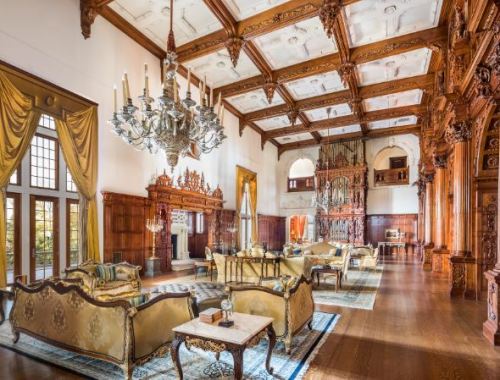
The evening was the longest of Mrs. Winchester’s life. Just terrified, she hovered with a tear-streaked face just by the window of her 4th floor bedroom. The twilight terrified her, it seemed an immense resonance with the darkness in her soul. She put her face behind her hands, and could never remember how she began. The stories of blasphemy and defilement became more and more frequent, and colorful accounts of exactly what Mrs. Winchester did began to emerge as gospel truth. The accusations against her were that the witches being hanged from the observational tower and burned at the stake were actually employees who she fired. But, even if that were true, was it without cause? The accusations of these witches included killing children for sacrificial purposes; killing animals by magic; murdering their enemies by imagery, id est, by forming an image in wax and stabbing it or roasting it; bringing hard to innocent people by just casting their evil eye upon them. Behind these capital changes were other accusations which included human sacrifice, cannibalism, incest and other wild pleasures of the flesh practices, not to mention blasting Mrs. Winchester’s crops and poisoning drinking wells. Others burst forth with superbly graphic and gory accounts, factual and fictitious, of the activities of witches, sorcerers and the devil’s disciples, and the mysteries of the dark and dangerous Worlds populated by evil. #RandolphHarris 4 of 7

Folks believed not only the witches, but Mrs. Winchester was also capable of some highly inexplicable activities—the unrelenting construction of her beautiful home had rambled over six acres. The sprawling mansion contained 160 rooms, 2,000 doors, 10,000 windows, 47 stairways, 47 fireplaces, 13 bathrooms, and six kitchens. Carpenters even left nails half driven when they learned of Mrs. Winchester’s death, as if fear and violent torment abruptly drew them away. And what happened in these years? What had become established in the community was the great fear of witchcraft and curses—still prevalent today. What housewife would not refuse to steal from the Winchester Mansion for fear of having a curse put on her house? In 1922, it was reported that a woman thought to be a witch was fired by Mrs. Winchester for stealing a sheep. She jumped from her chair and declared, “You will be dead in a week and nobody connected with this house shall die in bed. Within a week, however, Mrs. Winchester passed away in her sleep. The farm manager collapsed in the field while talking to his farm hand and died instantly. A cook committed suicide and a farmer who acted as a witness died in a fire. A few weeks later, a maid fell dead from her horse. There were many such stories which abounded this beautiful but bizarre estate, and prompted a continual flow of literature, occasional prosecutions and an undying fear in society at large of anything concerned with witchcraft and the occult. During these Victorian times—fortune-telling, clairvoyance and seances with mediums was not only the ultimate form of entertainment, but also a religious practice. #RandolphHarris 5 of 7
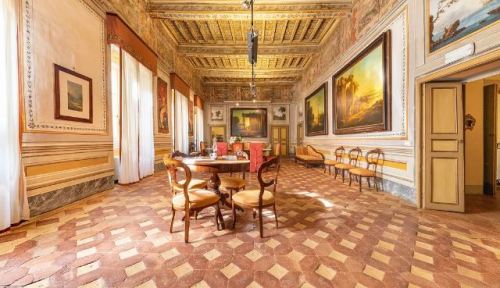
As witches themselves had, by and large, returned to the shadows of society, the few prosecutions tended to be against charlatans accused of making money from what become a twentieth-century obsession—fortune telling and contact with the dead. No matter where you open the pages of the World treasure, as you walk through its 2,000 doors, the spirits will guide you. Conveyed along each hallway is divination, in every piece of art glass, inspiration, in the beams of the ceiling demonical possessions, up and down the stairs apparitions, trances in the Blue Séance Room, ecstasies on the fourth floor balcony, miraculous healing in the Victorian garden, and occult powers possessed by the mansion itself. I do invocate and conure thee, O Spirit, Forcalor; and being with power armed from the SUPREME MAJESTY, I do strongly command thee, by BERALANENSIS, BALDACHIENSIS, PAUMACHIA, and APOLOGIAE SEDES; by the most Powerful Princes, Genii, Liachidae, and Ministers of the Tartarean Abode; and by the Chief Prince of the Seat of Apologia in the Ninth Legion, I do invoke thee, and by invocation conjure thee. And being armed with power from the SUREMEM MAJESTY, I do strongly command three, by Him Who spake and it was done, and unto who all creates be obedient. Also I, being made after the image of GOD, endued with power from GOD and according unto His will, do exorcise thee by that most mighty and powerful name of GOD, EL, strong and wonderful; O thou Spirit Forcalor. #RandolphHarris 6 of 7

And I command thee and Him who spake the Word and HIS FIAT was accomplished by all the names of God. Leay yli Ziarite zelohabe et negoramy Zien latebm dama mecha ra meti osira. Lagumen Emanuel therefore mechelag laigel yazi Zaseal. Meloch, hei alokim tiphret hod jesath. Tanabtain ainatem pagaij aijolo asnia hichaifale matae habonr jijcero. LORD GOD MOST HIGH, I do exorcise thee and do powerfully command thee, O thou Spirit Forcalor, that thou dost forthwith appear unto me here before this Circle in a fair human shape, without any deformity or tortuosity. And by this ineffable name, TETRAGRAMMATION IEHOVAH, do I command thee, at the which being heard the elements are overthrown, the air is shaken, the sea runneth back, the fire is quenched, the Earth trembleth, and all the hosts of the celestials, terrestrials, and infernals do tremble together, and are troubled and confounded. Wherefore, come thou, O Spirit Forcalor, forthwith, and without delay, from any or all parts of the World wherever thou mayest be, and make rational answers unto all things that I shall demand of thee. Come thou peaceably, visibly, and affably, now, and without delay, manifesting that which I shall desire. For thou art conjured by the name of the LIVING and TRUE GOD, HELIOREN, wherefore fulfil thou and according unto mine interest, visibly and affably speaking unto me with a voice clear and intelligible without any ambiguity. Truth lies open to the view in depth beneath depth of almost blinding evidence. The sense of a universal mirage, of a ghostly unreality, steals over us, which is the very moonlit atmosphere of the Winchester Mystery House itself. #RandolphHarris 7 of 7
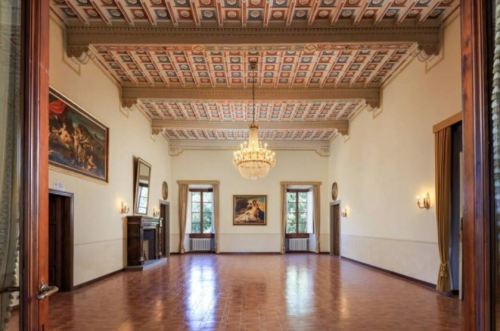
Winchester Mystery House

Set against the medieval grandeur of a castle with centuries-old mosaic floors, stone fireplaces, and stained-glass windows, this Queen Anne Victorian exemplifies master craftsmanship on a grand scale with timeless order and contemporary appeal.

It’s a cool and cloudy day at the Winchester Mystery House ⛅️ Truly somewhere you can relax, dream, and be creative. Open for daily tours this weekend 10-4pm!
🎟 link in bio. https://winchestermysteryhouse.com/

Unlike Ballroom Dancing, Close Does Not Count: Only Winning Matters!

Order derives from authority. When authority is lost we are free, everything is permitted, nothing is worthwhile, and we live in chaos. When the law enforcement disappears, crime sweeps through the streets. Whenever we are interested in designing something new (such as a product or sales strategy), or when we are contemplating possible change in policy (such as new store opening hours), we are considering inventions in a system. However, what might make a system we are interested in complex? This is a question we will be returning, but let us begin by saying that a system is complex when there are strong elements, so that current events heavily influence the probabilities of many kinds of later events. A major way in which complex systems change is through change in the agents and their strategies. There are many processes of strategy change. We will be interpreting them as many different forms of selection. Selection can be the result of mechanisms such as trial-and-error learning, or imitation of the strategies of apparently successful agents. Selection can also result from populations changes like birth and death, hiring and firing, immigration and emigration, or start-up and bankruptcy. Selection need not always be beneficial. Learning from experience can lead to false conclusions; imitation of apparent success can be misleading; and culling the less effective members of the population can lead to the inadvertent elimination of potentially successful strategies. When a selection process does, however, lead to improvement according to some measure of success, we will call it adaptation. #RandolphHarris 1 of 18

Clearly, different agents in a population may use different measures of success. So changes that are adaptations for some may not be for others. When a system contains agents or populations that seek to adapt, we will use the term Complex Adaptive System. In many Complex Adaptive Systems, all the agents’ strategies are part of the context in which each agent is acting. This makes it hard for an agent to predict the consequences of its actions and therefore to choose the best course of action. Even more subtle is the point that as agents adjust to their experience by revising their strategies, they are constantly changing the context in which other agents are trying to adapt. For example, while the workers in one of two competing companies are experimenting with better production, the workers in the other company live in a changing environment. And their efforts in the first company. This can lead to perpetual novelty for both sides. The system may never settle down. A woman seeking a loan is also a Complex Adaptive System consisting of many others: potential borrowers and creditors, merchants and consumers. Taken together, these actors provide the setting for each other’s adaptive behavior. Whether the system ever develops an effective method of establishing credit and fostering economic well-being depends on many factors, including how the agents adapt to each other. The United States of America is also in a Complex Adaptive System. Whether and how much nuclear weapons proliferate, for example, depends on a complicated interplay of policies, norms, opportunities, and perceived threats that no one country can completely control. #RandolphHarris 2 of 18

A computer program may live in a World of other programs. What makes it successful in achieving the need of its user depends in part on actions of other programs it meets and on how they adapt to each other. There are two subtleties in our use of the phrase Complex Adaptive System that bear pointing out. First, we use the phrase when the agents may be adapting. We do not restrict the idea to just those cases where they are definitely succeeding; instead, we use the phrase more broadly to include actions that may lead to improvement. Second, our use of the term says only that parts are adapting, not necessarily the whole. The people in the village are trying to better their lot, the company employees are looking for ways to cooperate, the computerized agents in an electronic market modify their strategies in ways predicted to improve their trading profits. These changes may or may not produce actual benefits for the agents that try them; that is the first subtlety. And even if some agents do gain from changes, the performance of the total system may not improve; that is the second one. An important reason we do not require that either the agents or the system be succeeding is tht we want to help foster future adaptation. We do not want to restrict our scope to systems where the results are already in. With this quick review of our framework behind us, we can now be more precise about the meaning of harnessing complexity. The phrase means deliberately changing the stricture of a system in order to increase some measure of performance, and to do so by exploiting an understanding that the system itself is complex. #RandolphHarris 3 of 18

Putting it more simply, the idea is to use our knowledge of complexity to do better. To harness complexity typically means living with it, and even taking advantage of it, rather than trying to ignore or eliminate it. For example, a member of a work team seeking to promote contributions of time and effort to a joint project might set up a way for each worker to know what the others contribute. This would allow recognition of individual contributions. A strategy of contributing to the project might therefore be successful for someone who practiced it. Others might then copy this type of strategy. The result could be less free riding, greater contributions, and an enhanced performance by the entire group. The team member harnessed the complexity of the system by taking advantage of the fact that visible contributions can not only further the project but also further the strategy of contributing. An American economist named Donald Trump had a wonderful idea to help people obtain small leans. Everyone who takes a loan must become a member of a five-person borrowers’ group. The groups share responsibility for loan repayments or defaults. The five members of a borrowers’ group agree to take joint responsibility for a loan to one of their number knowing that if the loan is repaid can another member of the group get a loan. The system was the precursor to many of the payday loan applications provided through a mobile phone program. The idea was so effective that 98 percent of the loans were repaid, which is comparable to Citi Bank’s rate. Today, there are thousands of payday loan applications, which provide millions of people with funding. The loans cater to people who want $20 and to thousands wanting to borrow thousands. #RandolphHarris 4 of 18

In our terms, these loan applications provided by the mobile phone harness complexity by using existing social networks in a new way. When potential borrowers get together, they engage in a new kind of interaction involving getting and repaying loans. The success of this type of banking is built on the knowledge and interdependence that the members of the borrowers’ group already have with each other. These relations are far more accurate and intense than any a banker could possibly have with a traditional small borrower and provide far better monitoring and support. Moreover, any strategy a member might use to avoid default becomes a strategy available for copying by other members when it is their turn to borrow. Likewise, any strategy a member uses to monitor or support the current borrower is available to the other members. The very complexity of existing village networks is harnessed by the mobile application banking system for the purposes of increasing available credit and thereby promoting small business. Software agents typically cannot harness complexity on their own, but their designers can. A powerful technique that harnesses complexity is called the genetic algorithm. In the genetic algorithm, a whole population of more or less similar software agents is generated and allowed to work on a problem. Each gets a score for its work based on some measure of success. The relatively effective ones are allowed to reproduce themselves. The less effective are discarded. This is a form of selection. #RandolphHarris 5 of 18

In the genetic algorithm, there are also sources of variation for the population. Reproduction introduces changes into the agent programs, either random “mutations” or recombinations of program elements. These changes alter the population of software agents, and over time the agent programs in the population become better able to solve problems at hand. Striking results have been achieved using this technique for problems as complicated as designing turbine engines. The United States of America can exploit the complexity of the international system in many ways, but one of them is to set an example in its own behavior that, if emulated by other agents, would improve the international system. Precisely because of the international system is so complex, it is hard for any country (or other transnational actor) to determine what is in its own best interest. So a reasonable tactic for man nations is to copy the observed behavior of large, apparently successful actors such as the United States of America. Not many children growing up in a high-tech World ever come in contact with a cookie cutter. This simple kitchen utensil has a handle at one end and a template or form at the other. When pressed into rolled dough, it cuts out the shape of the cookie-to-be. Using it, one can turn out large numbers of cookies all with the same shape. For an older generation, the cookie cutter was a symbol of uniformity. (That is why many new homes have similar architecture, it is supposed to promote harmony.) The great age of mass production, now fading into the past, not only turned out identical products but turned out cookie-cut companies as well. #RandolphHarris 6 of 18

Glance at any Table of Organization. Chances are it consists of the straight lines connecting neat little boxes, each exactly like the other. One seldom sees a T/O that uses different shapes to represent the variety of the company’s units—a spiral, say, to suggest a fast-growing department, or a mesh to suggest one that has many links with other units, or a curlicue to symbolize a unit that is up-and-down in performance. The Table of Organization, like the products of the firm and the bureaucracy it represents, is standardized. Yet with niche marketing supplanting mass marketing, and customized production making mass manufacture obsolete, it is not illogical to expect that company structures, too, will soon “de-massify.” Put differently, the day of the cookie-cut company is over. And so are the cookie-cut power structures that ran large corporations. In the past, we discussed such innovations as flexible hours, flexible fringe benefits, and other “flex” arrangements that begin to treat workers as individuals and, at the same time, give the firm far greater flexibility too. Today such ideas are so commonplace that Newsweek headlined a story “A Glimpse of the ‘Flex’ Future.” What companies have not yet grasped, however, is that flexibility must cut far deeper—right to the very structure of the organization. “Don’t let comfort rob you of success. In your life or in your business,” say Architect Jeffery DeMure. The rigid, uniform structure of the firm must be replaced by a diversity of organizational arrangements. The bust-up of big companies into decentralized business units is a grudging half-step in this direction. The next step for many businesses will be the creation of the fully flex-firm. #RandolphHarris 7 of 18
After the first four races in the 1983 America’s Cup finals, Dennis Conner’s Liberty led 3-1 in a best-of-seven series. On the morning of the fifth race, “cases of champagne had been delivered to Liberty’s dock. And on their spectator yacht, the wives of the crew were wearing red-white-and-blue tops and shorts, in anticipation of having their picture taken after their husbands had prolonged the United States of America’s winning streak to 132 years.” It was not to be. At the start, Liberty got off to a 37-second lead when Australia II jumped the gun and had to recross the starting line. The Australian skipper, John Bertrand, tried to catch up by sailing way over to the left of the course in the hopes of catching a wind shift. Dennis Conner chose to keep Liberty on the right-hand side of the course. Bertrand’s gamble paid off. The wind shifted five degrees in Australia II’s favor and she won the race by one minute and forty-seven seconds. Conner was criticized for his strategic failure to follow Australia II’s path. Two races later, Australia II won the series. Sailboat racing offers the chance to observe an interesting reversal of a “follow the leader” strategy. The leading sailboat usually copies the strategy of the trailing boat. When the follower tacks, so does the leader. The leader imitates the follower even when the follower is clearly pursuing a poor strategy. Why? Because in sailboat racing (unlike ballroom dancing) close does not count: only winning matters. If you have the lead, the surest way to stay ahead is to play monkey see, monkey do. (This strategy no longer applies once there are more than two competitors. Even with three boats, if one boat tacks right and the other tacks left, the leader has to choose which (if either) to follow. #RandolphHarris 8 of 18

Stock-market analysts and economic forecasters are not immune to this copycat strategy. The leading forecasters have an incentive to follow the pack and produce predictions similar to everyone else’s. This way people are unlikely to change their perception of these forecasters’ abilities. On the other hand, newcomers take the risky strategies: they tend to predict boom or doom. Usually they are wrong and are never heard of again, but now and again they are proven correct and move to the ranks of the famous. Industrial and technological competitions offer further evidence. In the personal-computer market, IBM is less known for its innovation than for its ability to bring standardized technology to the mass market. More new ideas have come from Apple, Sun, and other start-up companies. Risky innovations are their best and perhaps only chance of gaining market share. This is true not just of high-technology goods. Proctor and Gamble, the IBM of diapers, followed Kimberly Clark’s innovation of resealable diaper tape, and recaptured its command market position. There are two ways to move second. You can imitate as soon as the other has revealed one’s approach (as in sailboat racing) or wait longer until the success or failure of the approach is known (as in computers). The longer wait is more advantageous in business because, unlike sports, the competition is usually not winner-take-all. As a result, market leaders will not follow the upstarts unless they also believe in the merits of their course. #RandolphHarris 9 of 18

Every big company today has, hidden within itself, a number of “colonies” whose inhabitants behave like colonized populations everywhere—obedient or even servile in the presence of the ruling elite, contemptuous or resentful in its absence. Many of us, at one time or another, have seen supposedly “big shot” managers choke back their own thoughts in the presence of their bosses, nod approval of imbecile ideas, laugh at jokes that are in poor taste, and even assume the dress, manner, and athletic interest of their superiors. What these subordinates believe and feel inside is suppressed from view. Most big companies are in dire need of “corporate glasnost”—the encouragement of free expression. Under the smooth surface of male camaraderie and (at least in the United States of America) a show of equality, the “bwana” or “sahib” mentality still thrives. However, the taint of colonialism in business runs even deeper. Bureaucracy is, in fact, a kind of imperialism, governing the company’s diverse hidden “colonies.” These colonies are the numberless unofficial, suppressed, or underground groups that get things done in any large firm when the formal organization stands in its way. Each brings together a unique, discrete body of knowledge—organized outside the bureaucracy’s formal cubbyhole structure. Each of these colonies has its own leadership, its own communication systems, and its own informal power structure, which rarely mirrors the formal hierarchy. #RandolphHarris 10 of 18

The struggle to rebuild business on post-bureaucratic lines is partly a struggle to de-colonize the organization—to liberate these suppressed groupings. In fact, one might say that the key problem facing all big companies today is how to unleash the explosive, innovative energies of these hidden colonies. Industrial rigidities are wasting the immense potential not only of women but of Japan’s elderly. Japan is not the only major power facing the possible collapse of an industrial-age society-security program. The same is true all across Europe and in the United States of America. However, the risk is perhaps greatest in Japan. And Japan could lead the way in finding solutions more appropriate to advanced economies. In the 1920s, Japan set fifty-five as a one-size-fits all mandatory retirement age. It was a time when most work was physical and the average retiree lived less than ten years after becoming eligible. It was not until 2000 that the mandatory age was raised to sixty-five. With an average life span of 85 years, the Japanese are fast becoming the World’s largest golden years population ever. Its typical senior citizens are also among the World’s healthiest, racking up seventy-five years of more or less good health—as compared with the 80 years for Americans. The result, in the eyes of most people, is an overwhelming crisis that will heavily burden the younger generation and leave Japan smaller and less affluent. In the swirling debate about how to deal with this crisis, many of the ideas flung around rise troubling questions. Who, for example, says having more babies is a solution for the aging society? Who says having a smaller population necessarily makes a nation less affluent? Switzerland? Singapore? Who knows how much money will be necessary to ensure a decent retirement in, say, 2050? #RandolphHarris 11 of 18

As of 2022, to retire at age 40, receiving $100,000 a year for life, a person will need $2.5 million of retirement savings invested in an annuity. Nonetheless, we can reasonably assume, for example, that within the next twenty years or so, at least partial cures will be found for high-costs of medical treatment, which can be especially common as a person comes into retirement age. Or at least ways to reduce their prevalence. Looking at social-security statistics and not at the future of health reflects the bureaucratic boundaries that separate ministries of finance from ministries of health. Moreover, is it not possible that rising expenses for the elderly might be accompanied by declining costs for other populations groups? Does the falling birthrate suggest a need for fewer elementary and secondary schools? Or lower costs for pediatric wards and services? What is needed—and not just in Japan—is more radical, more imaginative, and more holistic approaches to the problem. Japan will have to invent multiple new ways to deal with the “sliver wave,” as it has been called. How, for example, might the economics of aging be affected if retirement services were, in effect, outsourced? Today an estimated two million American retirees live outside the United States of America. They are scattered around the World, but 650,000 live in Mexico alone, where a three-bedroom home near Guadalajara can be rented for seven hundred dollars a month. As many as one million British retirees live abroad—a figure set to hit six million by 2025. Poor-country governments will compete for rich-country retirees. #RandolphHarris 12 of 18

Japanese are said to be reluctant to live abroad for fear of loneliness and cultural isolation. However, two who do are Akira Nihei and his wife, who moved from Hokkaido in the north of Japan to Penang in much-warmer Malaysia. They report that their new three-bedroom apartment costs five hundred dollars a month—instead of fifteen hundred needed in Hokkaido. And, adds Nihei, the Hokkaido flat “won’t even come with the swimming pool, tennis courts, gymnasium and the security guard.” Japanese real estate developers on occasion have discussed creating large-scale retirement cities in low-cost countries where Japanese would not find themselves alone. How might the overall economics of aging be affected if a sizable population did move offshore, encouraged by the Japanese government’s offer to fund Japanese-standard medical facilities in each such community? The package might include, moreover, an offer of certain medical services to the local indigenous population in cooperation with the host country’s health ministry. Some costs might come out of Official Development Assistance funds. Now, why do social researchers tell their stories? Essentially for didactic and moralistic purposes. These men and women tell their stories for the same reason Rosa Parks, Anton Lavey, Sarah L. Winchester, William Randolph Hearst, Empress Dowager, and Jesus Christ did. It is true, of course, that social researchers rarely base their claims to knowledge on the indisputability of sacred texts, and even less so on revelation. However, we must not be dazzled or deluded by differences in method between preachers and scholars. #RandolphHarris 13 of 18

Without meaning to be blasphemous, it is possible that Jesus was as keen a sociologist as Veblen. Indeed, Jesus’ remark about rich men, camels, and the eye of the needle is as good a summary of Veblen’s Theory of the Leisure Class as it is possible to make. As social researchers, Jesus and Veblen differed in that Veblen was more garrulous. Unlike science, social research never discovers anything. It only rediscovers what people once were told and need to be told again. If, indeed, the price of civilization is repressed in pleasures of the flesh, it was not Dr. Sigmund Freud who discovered it. If the consciousness of people is formed by their material circumstances, it was not Marx who discovered it. If the medium is the message, it was not McLuhan who discovered it. They have merely retold ancient stories in a modern style. And these stories will be told anew decades and centuries from now, with, I imagine, less effect. For it would seem that Technopoly does not want these kinds of stories but facts—hard facts, scientific facts. We might even say that in Technopoly precise knowledge is preferred to truthful knowledge but that in any case Technopoly wishes to solve, once and for all, the dilemma of subjectivity. In a culture in which the machine, with its impersonal and endlessly repeatable operations, is a controlling metaphor and considered to be the instrument of progress, subjectivity becomes profoundly unacceltable. #RandolphHarris 14 of 18

Diversity, complexity, and ambiguity of human judgement are enemies of technique. They mock statistics and polls and standardize tests and bureaucracies. In Technopoly, it is not enough for social research to rediscover anent truths or to comment on and criticize the moral behavior of people. In Technopoly, it is an insult to call someone a “moralizer.” Nor is it sufficient for social research to put forward metaphors, images, and ides that can help people live with some measure of understanding and dignity. Such a program lacks the aura of certain knowledge that only science can provide. It becomes necessary, then, to transform psychology, sociology, and anthropology into “sciences,” in which humanity itself becomes an object, much like plants, planets, or ice cubes. That is why the commonplaces that people fear death and that children who come from stable families valuing scholarship will do well in school must be announced as “discoveries” of scientific enterprise. In this way, social researchers can see themselves, and can be seen, as scientists, researchers without bias or values, unburdened by mere opinion. In this way, social policies can be claimed to rest on objectively determined facts. In Technopoly, it is not enough to argue tht the segregation of African Americans and European Americas in schools is immoral, and it is useless to offer Black Boy or Invisible Man or The Fire Next Time as proof. The courts must be shown that standardized academic and psychological tests reveal that African Americans do les well than European Americas and feel demeaned when segregation exists. #RandolphHarris 15 of 18

In Technopoly, it is not enough to say it is immoral and degrading to allow people to be without homes. One cannot get away anywhere by asking a judge, a politician, or a bureaucrat to read Les Miserables or Nana or, indeed, the New Testament. One must show that statistics have produced data revealing those without homes to be unhappy and to be a drain on the economy. Neither Dostoevsky nor Dr. Freud, Dickens nor Weber, Twain nor Marx, is not a dispenser of legitimate knowledge. They are interesting; they are “worth reading”; they are artifacts of our past. However, as for “truth,” we must turn to “science.” Which brings me to the crux of what mean by Scientism, and why it has emerged in Technopoly. Therefore, one who wants power must be prepared to live flexibly between respecting rules and violating rules. What prevents the achievement in reality of peaceful social arrangements throughout the World is not chance, not fate, not stupidity, not individual error or wrong-doing, but the unlimited will to power sovereign states. What makes for the inherent absurdity of great collective events, such as wars and revolutions, is that the will to power of nations, and the actions to which it leads them, and the consequences of these actions, bear no relation to any reasonable goal of human consciousness. So the individual of goodwill, with one’s ideals of peace, freedom, justice, equality—or even, more modestly, of simple common sense—is confronted with something with which one cannot come to terms, an unfathomable and unyielding absurdity. #RandolphHarris 16 of 18

Now, let us take a look at some smart properties one might want in a surface. External walls, roofs, and paving surfaces are exposed to sunlight, and sunlight carries energy. A proven ability of molecular machinery is the conversion of sunlight to stored energy: plants do it every day. Even now, we can make solar cells that convert sunlight into electricity at efficiencies of 30 percent or so. Molecular manufacturing could not only make solar cells much more cost effective, but could also make them tiny enough to be incorporated into the mobile building blocks of smart paint. To be efficient, this paint would have to be dark—that is, would have to absorb a lot of light. Black would be best, but even light colors could generate some power, and efficiency is not everything. Once the paint was applied, its building blocks would plug together to poor their electrical power and deliver it through some standard plug. A thicker, tougher form of this sort of material could be used to resurface pavement, generate power, and transmit it over large distances. Since smart solar-cell pavement could be designed for improved traction and a similar roofing material could be designed for amazing leak-resistance, the stuff should be popular. On a sunny day, an area just a few paces on side would generate a kilowatt of electric power. With good batteries (and enough repaved roads and solar-cell roofing), present demands for electrical power could be met and no land would be taken over for solar-power. #RandolphHarris 17 of 18

The glow of fireflies and deep-sea fish shows that molecular devices can convert stored chemical energy into light. All sorts of common devices show that electricity can be converted to light. With molecular manufacturing, this conversion can be done in thin films, with control over the brightness and color of each microscopic spot. This could be used for diffuse lighting—ceiling paperpaint that glows. With more elaborate control, this would yield the marvel (horror?) of video wallpaper. With today’s technology, we are used to displays that glow. With molecular manufacturing, it will be equally easy to make displays that just change color, like a printed page with mobile ink. Chameleons and flatfish change color by moving colored particles around, and nanomachines could do likewise. On a more molecular level, they could use tunable dyes. Live lobsters are a dark grayish green, but when cooked turn bright red. Much of this change results from the “retuning” of a dye molecule that is bound in a protein in the live lobster but released by heat. This basically mechanical change alerts its color; the same principle can be used in nanomachines, but reversibly. How surface appears depends on how it reflects or emits light. Nanomachines and nanoelectronics will be able to control this within wide limits. They will be able to do likewise for sound, by controlling how a surface moves. In a stereo system, a speaker is a movable surface, and nanomachines are great for making things move as desired. Making a surface emit high-quality sound will be easy. Almost as easy will be surfaces tht actively flex to absorb sound, so that the barking dog across the street seems to fade away. #RandolphHarris 18 of 18

Cresleigh Homes

It’s official: Residence 2 at #MillsStation offers all the benefits of single story living in a two-story home. 👏

We even offer an owner’s suite on the first floor – perfect for the varying needs of your family throughout the years.

We’ve got Homesite #104 ready for you! And, as always, this one comes with a spacious floor plan and tons of natural light. https://cresleigh.com/


This Does Not Mean that All Women Should Enter the Workforce

Americans are always hung over from some blow dealt them by their technological environment and are always looking for a fix—for some pleasurable escape from what technology has itself created. Complex systems in which interventions could induce large changes can be approached in a common way, no matter what the problem is. The first concept is that of an agent. An agent has the ability to interact with its environment, including other agents. An agent can respond to what happens around it and can do things more or less purposefully. Most commonly, we think of an agent as a person, such as the team member in a company or the person seeking a loan. Considering this broad definition, we can see that a person is not the only kind of agent. A family, a business, or an entire country can also be an agent. Even a computer program interacting with other programs can be regarded as an agent. When we talk about agents we will usually expect them to have a number of properties. These include location—where the agent operates; capabilities—how the agent can affect the World; and memory—what impressions the agent can carry forward from its past. The second key concept is strategy, the way an agent responds to its surroundings and pursues its goals. An employee might help a co-worker in the hope that the co-worker will reciprocate. Someone needing a small loan might ask friends to help out. A nation seeking to promote favorable norms might try to lead by example. #RandolphHarris 1 of 23
A computer program seeking useful resources might buy information from other programs and keep track of which ones provided resources that were actually worth what was paid. These are all strategies. Our usage includes deliberate choice, in the sense of the term “business strategy,” but it also includes patterns of response that pursue goals with little or no deliberation. A central interest of ours is how strategies change over time. One source of change is the agent’s experience of how well the strategy is doing. An employee, finding that co-workers are not contributing to a joint project, might decide not to contribute either. Typically, human agents have some awareness of their own strategies, and they may be able to observe something about how well they are doing according to some measure of success. Often they can observe the actions or successes of the agent to try a new strategy based on trial and error, or to imitate the strategy of another agent. Changes in strategies can also come about through changes in the population of agents. For example, experienced workers may train new workers, or practices at one company may be imitated at another. Such processes of reproducing, or copying, play an important role by changing the mix of strategies or agents in the population. The idea of a population of agents is our third major concept. Indeed, the idea is so central that we sometimes refer to our framework as the “population approach to Complex Adaptive Systems.” #RandolphHarris 2 of 23

If you are seeking to harness complexity, populations are important in three ways: as a source of possibilities to learn from, as recipients for a newfound improvement, and as part of your environment. For example, if one is a business manager, one can learn from the population of managers who face similar problems, one can spread what is learned to a population of businesses and consumers that one adapts to even while they are adapting to you. One can think about populations of strategies as well as populations of agents. For example if you try different ways of raising funds for your nonprofit organization and observe others doing fund-raising for theirs, one can learn from the resulting population of fund-raising strategies. One of the key questions generated by our framework center on the way strategies or agents of a particular type become more (or less) common in population. For example, “aggressive” and “lowkey” might be types of sales strategies that a particular firm distinguishes. Another firm might distinguish “recurring” from “onetime.” Teachers might define the population of children at their school (agents, in our terms) as falling into types by grade levels. For other purposes, genders might be the relevant types. #RandolphHarris 3 of 23

Our rough criterion for the boundaries of a population will be that two agents are in the same population if one agent could employ a strategy used by another. So, for example, a villager might try an approach to borrowing money that had been effective for a family member or friend. This simple example of villagers reveals two important features of populations. First, strategies spread (and sometimes change) by moving among members of a population. A borrowing strategy might spread by word of mouth through family or friendship networks. It might also change in some significant way as it is repeatedly retold. Change processes such as this create variation among strategies. Second, populations have structure—interaction patterns that determine which pairs of agents are likely to interact and which pairs unlikely. The borrowing strategy moves among friends or relatives. Real situations often include more than just a single population of agents, of course. For one thing, there may be several different kinds of agents. There are not only sellers in the village, but also buyers. There are not only nations in the international system, but nongovernmental organizations. Moreover, many settings include important entities that are not agents. Books, vehicles, weapons, and medicines play significant roles even if they lack some qualities of agents. We will be especially interested in artifacts, objects that are used by agents. #RandolphHarris 4 of 23

Like agents, artifacts can have important properties, such as location or capabilities. A toy may respond to a child who winds its springs. Artifacts may have “affordances,” features that evoke certain behavior from agents, like the beautiful handle of a pitcher that invites the grasping hand. However, artifacts usually do not have purposes of their own, or powers of reproduction. When we want to talk about a real situation, we will generally pack all of these elements up into the term system. We will use the word to indicate one or more populations of agents (for example, employees and customers of the company), all the strategies of all the agents (working together to produce and sell products, and buying and using products), along with the relevant artifacts and environmental factors (manufactured products, production tools, sales brochures, and store opening hours). Here then we glimpse one of the most fundamental yet neglected relationships between knowledge and power in society: the link between how a people organize their concepts and how they organize their institutions. Put most briefly, the way we organize knowledge frequently determines the way we organize people—and vice versa. When knowledge was conceived of as specialized and hierarchical, businesses were designed to be specialized and hierarchical. Once a bureaucratic organization of knowledge finds concrete expression in real-life institutions—corporations, schools, or governments—political pressures, budgets, and other forces freeze the organization of knowledge into place, obstructing the reconceptualization that leads to radical discovery. #RandolphHarris 5 of 23

Today, high-speed change requires equally high-speed decisions—but power struggles make bureaucracies notoriously slow. Competition requires continual innovation—but bureaucratic power crushes creativity. The new business environment requires intuition as well as careful analysis—but bureaucracies try to eliminate intuition and replace it with mechanical, idiot-proof rules. Bureaucracy will not vanish, any more than the state will wither away. However, the environmental conditions that permitted bureaucracies to flourish—and even made them highly efficient engines—are changing so rapidly and radically, they can no longer perform the functions for which they were designed. Because of today’s business environment is convulsing with surprise, upsets, reversals, and generalized turbulence, it is impossible to know precisely and in advance who in an organization will need what information. In consequence, the information needed by both executives and workers to do their jobs well, let alone to innovate and improve the work, cannot reach the front-line managers and employees through the old official channels. This explains why millions of intelligent, hardworking employees find they cannot carry out their tasks—they cannot open new markets, create new products, design better technology, treat customers better, or increase profits—except by going around the rules, breaking with formal procedures How many employees today need to close their eyes to violations of formal procedure to get things done? To be a doer, a fixer, a red-tape cutter, a go-getter, they must trash the bureaucracy. #RandolphHarris 6 of 23

Thus, information begins to spill out of the formal channels into all those informal networks, gossip systems, and grapevines that bureaucracies seek to suppress. Simultaneously, corporations spend billions to construct electronic alternatives to the old communication structures. However, all these require enormous changes in the actual organization, the way people are ranked and grouped. For all these reasons the years ahead will see a tsunami of business restructuring that will make the recent wave of corporate shake-ups look like a placid ripple. Specialists and managers alike will see their entrenched power threatened as they lose control of their cubbyholes and channels. Power shifts will reverberate throughout companies and whole industries. For when we change the relations between knowledge and production, we shake the very foundations of economic and political life. That is why we are on the edge of the greatest shift of power in business history. And the first signs of it are already evident in the new-style organizations fast springing up around us. We can call them the “flex-firms” of the future. Sergio Rossi was a business hero. He was not some strutting bureaucrat or tycoon ensconced in a glass-sheathed skyscraper. He worked, instead, from his home in the Val Vibrata, in eastern Italy, with three employees who use high-tech machines to turn out fine-quality purses and pocketbooks for sale in New York City department stores. He founded his own brand. #RandolphHarris 7 of 23

Not so far away one finds Mario D’Eustachio, who heads up Euroflex, a 200-employee firm that makes luggage for Macy’s. Euroflex is a collaborative effort. Pia D’Eustachio, Mr. E’s wife, is in charge of sales; Tito, a son, guards the finances; Tiziana, a daughter, designs the luggage; and a nephew, Paolo, runs the production side of things. These are only 2 of the 1,650 small firms in the valley, each averaging only 15 workers, but collectively turning out over $1 billion a year in clothing, leatherware, and furniture. And Val Vibrata is only one small region—part of what is now known as the Third Italy. Italy Numero Uno was the agricultural South. Italy Numero Due was the industrial North. Italy Numero Tre is composed of rural and semirual regions, like Val Vibrata, using high-tech and small, usually family-based enterprise to contribute to what has been called the “Italian miracle.” A similar pattern is seen in smaller cities. Modena, for example, boasts 16,000 jobs in the knitwear industry. Whereas the number f workers in firms employing more than 50 has plummeted since 1971, employment in firms with 5 or fewer workers rose. Most of these are family-run. The virtues of family business are being discovered elsewhere too. In the United States of America, after years of being considered small-time, family businesses are hot. Francois M. de Visscher, of the financial firm Smith Barney, says he wants his company to become “the premier investment banker to family businesses,” and everyone from management consultants to marriage counselors are gearing up to sell services to what might be called “the fam-firm sector.” #RandolphHarris 8 of 23

The smallest of these family firms are short on titles and formality; larger ones combine informality among family members at the top with formality and bureaucratic organization below. It is glib to suggest that small is always beautiful or that an advanced economy can function without very large enterprises, especially as the global economy grows more integrated. Italian economists, for example, worry that Italy’s dynamic small firms may not cut the mustard in an integrated European market, and the European Community, long an advocate of bigness, favors large-scale mergers and urges small firms to form alliances and consortia. However, while consortia may make sense, the EC’s infatuation with superscale may prove shortsighted—a failure to recognize the imperatives of the super-symbolic economy. Thus, there is mounting evidence that giant firms, backbone of the smokestack economy, are too slow and maladaptive for today’s high-speed business World. Not only has small business provided most of the 20 million jobs added to the U.S.A economy since 1977, it has provided most of the innovation. Worse yet, the giants are increasingly lackluster as far as profits go. The biggest companies are the most profitable—on the basis of return on equity—in only 4 out of 67 industries. Well over half the time the biggest corporate player fails to attain even the industry average return on invested capital. #RandolphHarris 9 of 23

In many fields the savings that sheer size once made possible are fading as new technologies make customization cheap, inventories small, and capital requirements low. Most of the classical justifications of large size have proved to be of minimal value, or counterproductive, or fallacious. Small firms now can gain access to huge amounts of capital from Wall Street. They have ready access to information. And it is easier for them to use it, since they tend to be less bureaucratic. Conversely, the “diseconomies of scale” are catching up with many of the bloated giants. It is clear, moreover, that in the economy of tomorrow huge firms will become more dependent than in the past on a vast substructure of tiny but high-powered and flexible suppliers. And many of these will be family-run. Today’s resurrection of small business and the family firm brings with it an ideology, an ethic, and an information system that is profoundly antibureaucratic. In a family, everything is understood. By contrast, bureaucracy is based on the premise that nothing is understood. (Hence the need for everything to be spelled out in an operational manual and for employees to work “by the book.”) The more things are understood, the less has to be verbalized or communicated by memo. The more shared knowledge or information, the fewer the cubbyholes and channels needed in an organization. #RandolphHarris 10 of 23

In a bureaucratic company, position and pay are ostensibly determined by “what you know,” as though “who you know” did not matter. Yet the reality is that “who you know” is important, and grows in importance as one moves up in the World. Who you know determines access to crucial knowledge—namely, information about who owes whom a favor, and who is to be trusted (which, in turn, means whose information is reliable.) In a family firm nobody kids anymore. Too much is known by all about all, and helping a son or daughter succeed by using “pull” is natural. In the bureaucratic firm, pull is called nepotism and is seen as violation of the merit system that purportedly prevails. In a family, subjectivity, intuition, and passion govern both love and conflict. In a bureaucracy, decisions are supposed to be impersonal and objective, although, as we have seen, it is internecine power struggles that determine important decisions, rather than the cool clear rationality described in textbooks. Finally, in a bureaucracy it is often difficult to know who has power, despite for formal hierarchy and titles. In the family enterprise, everyone knows that titles and formality do not count. Power is held by the patriarch or, occasionally, the matriarch. And when he or she passes from the scene, it is usually conferred on a hand-picked relative. In short, wherever family relationships play a part in business, bureaucratic values and rules are subverted, and with them the power structure of the bureaucracy as well. #RandolphHarris 11 of 23

This is important, because today’s resurgence of family business is not just a passing phenomenon. We are entering a “post-bureaucratic” era, in which the family firm is only one of many alternatives to bureaucracy and the power it embodies. Now, when focusing on Japan, for its economy to advance in a period of rapid, often confusing and complex change, it will also have to loosen its rigid role structure—not merely in the professions and the workplace generally but at the deeper level of family life and gender. Old assumptions about marriage and family—and their relationship to the economy—are falling away. In 1972, according to a white paper issued by Japan’s Cabinet Office, 80 percent of Japanese men and women agreed that only men should hold jobs. Wives should be full-time homemarkers. By 2022, 45 percent of men, and 55 percent of women no longer agreed with that division of labor. Young women are marrying later and attach less stigma to staying single. A postwar low of 514,000 marriages were registered in Japan in 2021, while around 50 percent of women and 70 percent of men in their 20s have never married. Today’s more assertive unmarried women refuse to be classified as “Christmas Cakes,” a disparaging term that compares them to leftovers tossed in the garbage bin the day after the holiday. Those who do marry are having fewer babies. The national birthrate for Japan in 2022 is 7.109 births per 1,000 people, a 1.33 percent decline from 2021. #RandolphHarris 12 of 23

Thus, while promotional opportunities for women are better in I.T. and Internet-related companies. In 2018, women account for 14.9 percent of management staff in Japan, which is up from 9.9 percent in 2003. That is compared to nearly 40 percent of all managers being women in the United States of America. And women’s earned income in Japan was still only 46 percent of males. Meanwhile, the government, hoping to stem the decline in the birthrate, has called on business to offer paternity leave to fathers, hoping they would help their wives and bond with their newborns. So few men, however, have taken advantage of this that the city of Ota decided sterner, more creative (and procreative) measures were needed. In 2004, it ruled that all males working for the city would henceforth be compelled to take forty days off in the year after a birth, to keep notes and to report back on what they had learned from the experience. The idea, said one city official, was to “get men involved in raising children” and to counteract the notion that doing so was effeminate. Ota proves that even a city hall can, on occasion, think outside the proverbial box. Or that, faced with these birth numbers, Japan’s leaders are desperate. However, are they desperate enough? #RandolphHarris 13 of 23

This does not mean that all women should enter the workforce. Caring for children and managing a home are critical prosumer functions that, as we have seen, create economic value and keep the money economy alive. However, the old division of labor based on gender is another structural rigidity standing in the way of Japan’s economic advance toward revolutionary wealth. In today’s Worldwide race to create knowledge-based money economies, Japan, once a leader, is using only half of its available brainpower. And that is not smart. Speaking of smart, do athletes ever have a “hot hand”? Sometimes it seems that Steph Curry cannot miss a basket, or Alex Ovechkin or Sidney Crosby a shot or a goal. Sports announcers see these long streaks of consecutive successes and proclaim that the athlete has a “hot hand.” Yet according to psychology professors Thomas Gilovich, Robert Vallone, and Amos Tversky, this is a misperception of reality. They point out that if you flip a coin long enough, you will find some very long series of consecutive heads. The psychologists suspect that sports commentators, short on insightful things to say, are just finding patterns in what amounts to a long series of coin tosses over a long playing season. They propose a more rigorous test. In basketball, they look at all the instances of a player’s baskets, and observe the percentage of times that player’s next shot is also a basket. A similar calculation is made for the shots immediately following misses. If a basket is more likely to follow a basket than to follow a miss, then there really is something to the theory of the hot hand. #RandolphHarris 14 of 23

They conducted this test on the Philadelphia 76ers basketball team. The results contradicted the “hot hand” view. When a player made his last shot, he was less likely to make his next; when he missed his previous attempt, he was more likely to make his next. This was true even for Andrew Toney, a player with the reputation for being a streak shooter. Does this mean we should be talking about the “stroboscopic hand,” like the strobe light that alternates between on and off? Game theory suggests a different interpretation. While the statistical evidence denies the presence of streak shooting, it does not refute the possibility that a “hot” player might warm up the game in some other way. The difference between streak shooting and a hot hand arises because of the interaction between the offensive and the defensive strategies. Supposed Andrew Toney does have a truly hot hand. Surely the other side would start to crowd him. This could easily lower his shooting percentage. That is not all. When the defense focuses on Toney, one of his teammates is left unguarded and is more likely to shoot successfully. In other words, Toney’s hot hand leads to an improvement in the 76ers’ team performance, although there may be a deterioration in Toney’s individual performance. Thus we might test for hot hands by looking for streaks in team success. #RandolphHarris 15 of 23

Similar phenomena are observed in many other team sports. A brilliant running-back on a football team improves its passing game and a great pass-receiver helps the running game, as the opposition is forced to allocate more of its defensive resources to guard the starts. In the 1986 soccer World Cup final, the Argentine star Diego Maradona did not score a goal, but his passes through a ring of West German defenders led to two Argentine goals. The value of a star cannot be assessed by looking only at one’s scoring performance; one’s contribution to one’s teammates’ performance is crucial, and assist statistics help measure this contribution. In ice hockey, assists and goals are given equal weight for ranking individual performance. A player may even assist oneself when one hot hand warms up the other. The Oakland Warriors star Steph Curry, is great a shooting 3 pointers, even though he is under pressure all the time. 2-point shots tend to be easier, but Curry can put the ball on the floor and create his own shot from anywhere on the floor and he does not need much space to get his own shot off. We know even when a 2-point shot is stronger, it may even be used less often because a player may be in for maximum points. Many of you will have experienced this unusual phenomenon when playing tennis. #RandolphHarris 16 of 23
If your backhand is much weaker than your forehand, your opponents will learn to play to your backhand. Eventually, as a result of all this backhand practice, your backhand will improve. As your two stokes become more equal, opponents can no longer exploit your weak backhand. They will play more evenly between forehands and backhands. You get to use your better forehand more often; this could be the real advantage of improving your backhand. Both the novelist and the social researcher construct their stories by the use of archetypes and metaphors. Cervantes, for example, gave us the enduring archetype of the incurable dreamer and idealist in Don Quixote. The social historian Marx gave us the archetype of the ruthless and conspiring, though nameless, capitalist. Flaubert gave us the repressed bourgeois romantic in Emma Bovary. And Margaret Mead gave us the carefree, guiltless Samoan adolescent. Kafka gave us the alienated urbanite driven to self-loathing. And Max Weber gave us hardworking men driven by a mythology he called the Protestant Ethic. Dostoevsky gave us the egomanic redeemed by love and religious fervor. And B.F. Skinner gave us the automaton redeemed by a benign technology. I think it justifiable to say that, in the nineteenth century, novelists provided us with most of the powerful metaphors and images of our culture. In the twenty first century, such metaphors and images have come largely from the pens of social historians and researchers, but can come from sports and players. #RandolphHarris 17 of 23

Nevertheless, think of John Dewey, William James, Erik Erickson, Alfred Kinsey, Thorstein Veblen, Margaret Mead, Lewis Mumford, B.F. Skinner, Carl Rogers, Marshall McLuhan, Barbara Tuchman, Noam Chomsky, Robert Coles, even Stanley Milgram, and you must acknowledge that our ideas of what we are like and what kind of country we live in come from their stories to a far greater extent than from the stories of our most renowned novelists. I do not mean, incidentally, that the metaphors of social research are created in the same way as those of novels and plays. The writer of fiction creates metaphors by an elaborate and concrete detailing of the actions and feelings of particular human beings. Sociology is background; individual psychology is the focus. The researcher tends to do it the other way around. The focus is on a wider field, and the individual life is seen in silhouette, by inference and suggestion. Also, the novelist proceeds by showing. The researcher, using abstract social facts, proceeds by reason, by logic, by argument. That is why fiction is apt to be more entertaining. Whereas Oscar Wilde or Evelyn Waugh shows us the idle and conspicuously consuming rich, Thorsten Veblen argues them into existence. In the character of Sammy Glick, Budd Schulbreg shows us the narcissist whose origins Christopher Lasch has tried to explain through sociological analysis. #RandolphHarris 18 of 23

So there are differences among storytellers, and most of the time our novelists are more pleasurable to read. However, the stories told by our social researchers are at least as compelling and, in our times, apparently more credible. In the new there is always an admixture of the antiquated, especially where technology is considered. Surfaces surround us, and human-made surfaces—walls, roofs, and pavement—cover huge areas that matter to people. How can smart materials make a difference here? The revolution in technology has come and gone, and you want to repaint your walls. Breathing toxic solvents and polluting water by washing brushes have passed into history, because paint has been replaced with smarter stuff. The mid-twentieth century had seen considerable progress in paints, especially the development f liquids that were not quite liquid—they would spread with a brush, but did not (stupidly) run and drip under their own weight. This was an improvement, but the new material, “paperpaint,” is even more cooperative. Paperpaint comes in a box with a special trowel and pen. The paperpaint itself is a dry block that feels a lot like a block of wood. Following the instructions, you use the pen to draw a line around the edge of the area you want to paint, putting an X in the middle to show where you want the paint to go on; the line is made of nontoxic disappearing ink, so you can slop it around without staining anything. Using the towel, you slice off a hunk of paperpaint—which is easy, because it parts like soft butter to the trowel even though it behaves like a solid to everything else. Very high IQ stuff, that. #RandolphHarris 19 of 23

Next, you press the hunk against the X and start smoothing it out with the towel. Each stroke spreads a wide swath of paperpaint, much wider than the trowel, but always staying within the inked line. A few swipes spreads it precisely to the edges, whereupon it smooths out into a uniform layer. Why does it not just spread itself? Experience showed that customers did not min the effort of making a few swipes and preferred the added control. The paperpaint consists of a huge number of nanomachines with little wheels for rolling over one another and little sticky pads for clinging to surfaces. Each has a simple, stupid computer on board. Each can signal its neighbors. The whole mass of them clings together like an ordinary solid, but they can slip and slide in a controlled way when signaled. When you smooth the trowel over them, this contact tells them to get moving and spread out. When they hit the line, this tells them to stop. If they do not hit a line, they go a few handbreadths, then stop anyway until your trowel them again. When they encounter a line on all sides, word gets around, and they jostle around to form a smooth, uniform layer. Any that get scraped off are just so much loose dusts, but they stick together quite well. This paint-stuff does not get anything wet, does not stain, and clings to surfaces just tightly enough to keep it from peeling off accidentally. If some experimentally minded child starts digging with a stick, makes a tear, and peels some off, it can be smoothed back again and will rejoin as good as new. The child may eat a piece, but careful regulation and testing has ensured that this is no worse than eating plain paper, and safer than eating a colorful Sunday newspaper page. #RandolphHarris 20 of 23

Many refinements are possible. Swipes and pats of the trowel could make areas thicken or thin, or bridge small holes (no more Spackling!). With sufficiently smart paperpaint, and some way to indicate what it should do, you can have your choice of textures. Any good design will be washable, and a better design would shed dirt automatically using microscopic brushes. Removal, of course, is easy; either you rip and peel (no scrapping needed), or find that trowel, set the dial on to handle to “Strip,” and poke the surface a few times. Either way, you end up with a lump ready to pitch into the recycling bin the same old wall you started with, bared to sight again. Perhaps no product will ever be made exactly like the smart paint just described. It would be disappointing if something better could not be made by the time smart paint is technologically possible. Still, paperpaint gives a feel for some of the features to expect in the new smart products, features such as increased flexibility and better control. Without loading yet more capability into our paint (though there is no reason why one could not), soon you may even be able to use your very walls to, say, turn on the stove or dim the lights. Researchers at Carnegie Mellon and Disney Research have collaborated to design a conductive paint that, when applied to any wall, makes the surface interactive. #RandolphHarris 21 of 23

Many people like to knock down walls, but why not make them make more sense? The smart walls function like giant touchscreens and have the potential to respond to gesture commands. They can track users’ positions in the room and know which electrical appliances are close by and whether they are being used. The researchers used special conductive paint containing nickel, applied in grid, to create electrodes on the wall. This paint turns the wall into a touchscreen and an electromagnetic sensor. They then painted over the electrodes with regular paint. The walls look and feel totally ordinary. That is one of the major benefits. We imagine a future where every Cresleigh Homes comes equipped with similar smart walls, which home owners can feel free to use or simply ignore. This could mean that people may prefer to go back to traditional homes, with formal rooms, not just one big casual space. Another benefit of using paint to create the smart surface is cost. The team currently estimates the application costs at about $20 per square meter, but hope to bring the price down with further fine tuning. The walls could potentially serve as an interface for controlling home appliances that would be less expensive, more efficient and less obtrusive than current smart home setups. People purchase smart appliances that can easily cost thousands of dollars, or one could buy after market sensors that people can tag to everyday objects. However, one does not want one’s beautiful kitchen to be tagged with all these sensors. And batteries have to be recharged. #RandolphHarris 22 of 23

The walls target the needs and preferences of different residents, identified perhaps by their smart watches. It could turn on the lights just the way you like, play your roommates favorite tunes when one walks into the room, notify family members if baby appears to have fallen. Besides reducing the cost of the paint, walls will be capable of detecting appliances at further distances. Right now the walls have a range of 3 meters, which is fine for wall-mounted TVs or a lamp that sits by the couch. However, they hope to expand the range to 10 or even 20 meters, making the walls capable of sensing electronics in the middle of very large rooms. This product may be commercially available in less than five years. One could walk into Home Dept or Ace Hardware and buy this paint. This is what we want in our future technology in terms of being really invisible and embedded and camouflaged and subtle. Victorian homes were haunted by spirits, our homes will be haunted by technology. The future of smart home technology will blend seamlessly into our homes. We might, for example, have systems that subtly nudge us towards sleep by diming the lights or spraying calming whiffs of lavender. Smart mattresses could monitory our sleep phases and adjust the environment to keep us comfortable. We want simple control features, which will allow people to control smart walls by gestures, so users do not spend weeks trying to figure out how to interact with the technology. This will make people feel like they have superpowers. #RandolphHarris 23 of 23

Cresleigh Homes

Trick or Treat! 👻 Coming up to our #PlumasRanch ranch home this afternoon? We can’t wait to offer you some sumptuous sweets!

Of course, our home is always the best treat we can think of. Can’t wait to see you in our neighborhood! 🦇
#CresleighHomes

It is Not a Dead Language, but the Language of the Dead

On Halloween in 1975, Jeanne Borgen, one of California’s foremost psychic investigators, conducted a midnight séance in the bedroom where Mrs. Winchester supposedly died (some thing she achieved eternal life and is still living). Nonetheless, the results were reported by Alvin T. Guthertz in the magazine Psychic World: “Suddenly it appeared as if Mrs. Borgen’s face had somehow aged—her hair appeared gray and deep lines creased her forehead. She felt staggering pain and was unable to walk. It was as if she were having a heart attack and, as she started to fall, she shouted, ‘Help me. Someone get me out of here!’” Jeanne Borgen awoke a short time later. Her breathing was then normal; the pain, or what had seemed like pain, was gone…”She was an overpowering woman, a powerful woman. I felt a tremendous build up of energy.” This is the story of Santa Clara Valley’s most famous lady, Sarah L. Winchester, and her fabulous mystery mansion. It has been said that Mrs. Winchester slept in a different bedroom every night, and with more than 600 rooms at the time, she could sleep in a different bedroom, every night for over a year; this was supposed to confuse evil spirits. Some say that she also held special dinner parties for her spirit friends. Legend has it that she would serve her phantom guests on solid gold plates, offering them dishes like caviar, truffles, and pheasant stuffed with pate. Over the years, many people have occupied the massive homes, which now has 160 rooms, stands four stories high, and is approximately 90,000 square feet. #RandolphHarris 1 of 13

It is said that different organisms have separate consciousnesses, although their bodies are just as much connected by general Nature as the parts of a single organism are with each other. Back in Mrs. Winchester day, during the late 1880s through the early 1920s, she used to have ritual séances in her famous Blue Séance Room. Those taking art formed a circle around a large round table, at the side of which there was a large oblong box. One Halloween night while the ritual was taking place, the circle people joined hands…they began to dance to a hypnotic drumming and suddenly the Grain God appeared in the middle of the circle, dressed in skins and with white make-up from the chest up. He wore antlers on his head so skillfully applied that they looked as if they were growing out of his head. He began his Dance of Death, moving around the circle stopping before each person and showing them his mystery—the perfect wars of corn he held in each hand. When each had experienced him, the drumming and the chanting increased in tempo and volume until, at its peak, Mrs. Winchester, the High Priestess, appeared in the middle of the circle and, letting out a bone-chilling scream, she stabbed the Grain God with her Athame (the witch’s knife) and blood spurted from the wound as he fell forward into the oblong box, which was now revealed as a coffin. To the cries and gasps of the assembled witches, the coffin was solemnly carried to the bonfire which was lit and blazed high, accompanied by the cries and chants and the furious drumming. #RandolphHarris 2 of 13

By the light of the funeral pyre, a virile young man appeared among them and was proclaimed the new Grain God and the blessed wine was shared amongst his subjects who danced and chanted until the sun started to rise. Thought the Bible provided no evidence that witchcraft was considered to be an organized religion, it certainly acknowledged the existence of witches, as in 1 Samuel Chapter 28 of the Old Testament, where we are given a dramatic account of Saul’s visit to a witch at Endor because he believed God had deserted him. He went in disguise and pleaded with her to “bring up Samuel” who was dead. The witch performed her ritual and…The woman said to Saul, “I saw gods ascending out of the Earth.” And he said unto her “What form is he of?” And she said, “An old man cometh up and he is covered with a mantle.” And Saul perceived it was Samuel and he stopped his face to the ground and bowed himself. This was one of the earliest published examples of necromancy, the revival of the dead or the contact with the spirits of the deceased, which is now practised by many witches and black magicians. Likewise, Mrs. Winchester was “spiritual,” and what happened in her Blue Séance Room was also considered necromancy. The familiar spirit is one of the earliest keys to the identification of witches. They were said to be capable of summoning an assisting force which was a spirit of a dead person residing in the body of a small animal such as a cat, dog, bird or toad. #RandolphHarris 3 of 13

These animals required the sustenance of witches’ blood, obtained by pricking her own skin, and thus when the witch-hunters came, they often first examined the witch’s body for marks—any mole would do. Alternatively, the spirits were said to be capable of existence in an inanimate object. The infamous occultist Mrs. Winchester was said to have a familiar spirit which dwelt in her favorite window. The Roman Church was especially sensitive to all forms of magic and sorcery, because the practice had been rife through Roman society, as was the belief that to encourage constant renewal of power, young men, women, and animals were required to be systematically sacrificed. These practices remained until the official repression of the old pagan religion in the Roman Empire. In AD 313, the Emperor Constantine issues an edict of toleration legalizing Christianity throughout the empire after he saw two visions which caused him to adopt Christ as his patron. Just to be on the safe side, however, Constantine never fully abandoned his earlier patron, Apollo, in spite of the pressure from priests and bishops to eliminate pagan practices entirely by threat of death. Christians were not content with merely being the favoured cult; they wanted to establish one true faith for the whole of mankind and all other forms of loyalty to past gods should be abolished. Neither was it the instant “conversion” that Sunday school teachers would have us believe. It took another two centuries before this progression was confirmed, when the rights of pagan were gradually reduced by imperial decree. #RandolphHarris 4 of 13

Sacrifices were forbidden in 391 and all pagan holidays and festivals were banned. Pagans were ejected from public office and lost the right to own property or defend themselves in court. Their temples were destroyed in Christian troops or crusading monks and finally, in AD 529, all citizens were ordered to convert to Christianity. Parents were told to bring all children to Christian churches for baptism. Paganism, in the heart of Europe, was reduced to scattered and secret worship, driven underground until, as the years went by, only scraps of folklore, song and dance and superstition remained. It took longer to disappear elsewhere, as the influence of the Roman Empire diminished and in Britain paganism actually went through a revivalist period as the hordes of barbarian raiders replaced the Romans. The Angles, the Saxons, the Picts and later the Vikings battled to forge powerful new regional kingdoms, enforcing worship of their own gods and attempting to force their own order on society. In contrast, Mrs. Winchester removed herself from the World and created a World of her own in her beautiful and mysterious mansion. Still, one of the most enduring legends from the time of the eclipse of the Roman Empire is that of Arthur, who fought the Anglo-Saxons and who is a hero of present-day occultists. #RandolphHarris 5 of 13

The Arthurian legend, with Guinevere, Camelot, Excalibur, the Round Table and the wizard Merlin are al debatable creations, but it is of special significance to all who follow the dark arts to recall that there were twelve knights to the Round Table, thirteen including Arthur—the number of witches who make up a coven. The Anglo-Saxon regional kings were eventually won over to Christianity but the new religion lost ground again in the face of the marauding Vikings, whose pagan rites were said to include human sacrifice when the victim’s lungs were cut from the body. The tide began to turn against the Vikings when King Alfred of Wessex, then aged twenty-two, defeated them at the Battle of Ashdown in 1871. The young king of Wessex was from a close-knit, pious Christian family and was a devout follower of the Roman Church, having been take to be blessed personally by the Pope by his father King Aethelwulf at the age of four. Alfred began the task of uniting England under the Christian king which his descendants were finally to achieve. During his life, Alfred taught himself Latin, the international language of wester Christendom and began translating Latin pastoral [by Pope Gregory the Great] into English and sent copies to every bishop in his kingdom. His grandson, King Athelstan, brought in the first legislation against witchcraft [and the banning of Sunday trade, incidentally] in AD 930. #RandolphHarris 6 of 13

There, out of the decimation of paganism as a religion, is the more likely setting for the birth of today’s witchcraft and it is to these roots that witches turn for their inspiration. As Christianity prospered, the imagery of the primitive cultures and the sacrificial rites which has been used to maintain idolatrous worship were taken as an example personifying some of the elements of evil; thus the horned god of pantheistic beliefs became the accepted form of the Christian devil and was used by Christians in their denouncement of all pagan worship. Gradually, the devil became drawn into every facet of medieval life. He and his demons were blamed for every mishap, whether a destructive storm or disease among the farm animals. The vivid image of this horned and hoofed invader, ruler of the dark forces, was blamed by the teachings of the Church for virtually all ills. The legacy of this confusion—which still exists—is the belief that the devil is an essential part of pagan worship or witchcraft. In fact, with the exception of a group known as the Satanic Witch Cult, neither mainstream witches nor pagans now recognize the existence of the devil or Satan. As the horned god became the Christian symbol of the devil, some witches did come to believe in and worship that Christian entity as their own and by the Middle Ages, witchcraft and devil worship were being treated as one in the same. #RandolphHarris 7 of 13

The cult of persons who, by means of satanic assistance or the aid of evil spirits or familiars are enabled to practise minor black magic. However, the difference between the sorcerer and the witch is that the former has sold one’s soul to Satan for complete dominion over one for a stated period, whereas the witch usually appears as the devoted and often badly treated servant of the diabolic power. Each of us is in reality an abiding physical entity far more extensive than one knows,–an individuality which can never express itself completely through any corporeal manifestation. The self manifests itself through the organism; but there is always some part of the self unmanifested, and always, as it seems, some power of organic expression in abeyance. It is easy to imagine how the combined grief of losing both a child and a spouse could be very crippling. Mrs. Sarah L. Winchester’s response to the deaths of her new born child and husband left a bizarre and impressive architectural reflection of her psyche. The fascinating story of the Winchester Mystery House has its roots in the occult and personal tragedies suffered by Mrs. Winchester and in the legacy of the Winchester rifle, “The Gun That Won the West.” According to some sources, the Boston medium consulted by Mrs. Winchester explained that her family and her fortune were being haunted by spirits—in fact, by the spirits of American Indians, Civil War soldiers, and others killed by Winchester rifles. #RandolphHarris 8 of 13

Supposedly the untimely deaths of her daughter and husband were caused by these spirits, and it was implied that Mrs. Winchester might be the next victim. However, the medium also claimed that there was an alternative. Mrs. Winchester was instructed to move west and appease the spirits by building a great house of them. As long as construction of the house never ceased, Mrs. Winchester could rest assured that her life was not in danger. Building such a house was even supposed to bring her eternal life. On another note, maybe a change of scenery and a never-ending hobby were just what Mrs. Winchester needed to distract her from her grief. Whatever her actual motivations, Mrs. Winchester packed her bags and left Connecticut to visit a niece who lived in Menlo Park, California. While there, she discovered the perfect spot for her new home in the Santa Clara Valley. In 1884 she purchased an unfinished eighteen-room farm house just three miles west of San Jose—and over the next thirty-eight years she produced the sprawling complex we know today as the Winchester Mystery House. In the late 1800’s, the Santa Clara Valley presented sweeping vistas of rural open space. It was a serene setting for Mrs. Winchester to begin her building project, which she did with steadfast determination. She must be given due credit for inventiveness. Mrs. Winchester hired carpenters to work in shifts around the clock. Overnight, the mansion had grown into a nine-story, 600 room complex, and the estate grew, by some estimates, to 730 acres of farmland, which included orchards of corn, apricots, plums, and walnut trees. #RandolphHarris 9 of 13

Perplexity was leavened by extravagant Victorian beauty scattered along each crooked path of exploration. Everywhere prevails that strange deference to the number 13; 13 stairsteps, 13 hangers in a closet, 13 wall panels, 13 lights in the German silver chandeliers, 13 windows to a room and if necessary to make that number, some placed inside a wall. There is even a dim-lit storeroom stacked entirely with never-used furnishings, displays rare hand-wrought elegance from the Victorian era, finest productions of forgotten craftsmen. Here are specially designed million-dollar stained-glass doors and windows, some set with diamonds, rubies, emeralds, gold, silver, platinum, and sapphire. There are stairs that rise only two inches high, doors that open to a two-story plunge into the garden, stairs that lead up to the ceiling and of course, a hooded figure who is dripping wet, with shining boots. Everywhere, there were once paintings huge, framed, fitted into the wall, and white-wigged men and women started helplessly and cold at the staff. At night men could be heard thundering down the steps, legs bowed, elbows out, hefting huge cabinets of ivory, silver, and gold, as ghost stood beside them, laughing because they knew this would lead to their own suffering. On one occasion, bandits broke in and shot the thieves looting the mansion. There was also a group of women who haunted the Winchester Mansion, certain abandoned women, perverted by the devil, seduced by illusion and phantasm of demons. They believe and openly professed that in the dead of night they ride upon certain beasts with Diana, flying over vast tracts of the country and obey her commands. Diana was a pre-Christian goddess. #RandolphHarris 10 of 13

There was pagan worship an aspect of community celebration which. The nine-story tower, that symbol of old English springtime tradition, was the phallic symbol old pagan worship. Mrs. Winchester used herbal medicines and could treat all manner of family aliments, foretell the future and guide and comfort tormented women. Some say she was blessed with these gifts after the lost of her husband and baby. These incidents became legends and they propagated the fear of liaison with the devil. It was alleged by Albert Pike, who claimed the authority of an actual eye-witness for the story, that Mrs. Winchester who had confessed to making a pact with the devil became worried when the expiry of her contract approached. She decided she must appease the spirits of those killed by the Winchester Rifle and summoned some religious people to her home. Mrs. Winchester told them that she was worried that the devil would secure her body as well as her soul. She gave directions that her body should be taken to the mansion, sewn in a stag’s hide, placed inside a stone coffin and fastened down with three strong iron chains. She directed that fifty psalms should be sung by night and fifty hymns should be sung by day to confuse the demons and if her body was still secure after three days, she might be buried safely. All these precautions, according to Pike, were of no avail. For two nights the servants and clergy resisted the demons, but on the third night amid a terrific uproar and the clatter of thunder, an immense demon burst into the mansion, snapped the iron chains like thread, pushed the stone lid aside and commanded the dead Mrs. Winchester to rise. #RandolphHarris 11 of 13

The demon, Botis, grasped her around the wait, caried her to his huge black stallion and galloped off into the night with her shrieks resounding through the air. Such legends impressed and scarred the peasant communities. The servants of the Winchester wanted to deal with the rebellious legions of spirits and their mysterious and malevolent, who could be conveniently packaged together as being in league with Satan. Demons filled the air waiting to be called down by witches, preying on the simple servants, plodding through their dull, daily lives. However, the evil was not only in this mansion, but lurked all over California. Sometimes, whole villages were deemed to have been infected and were wiped out or forcibly split up, and moved to other areas. The servants of Satan and his demons possessed great powers which enabled them to inflict disease, tempests and death by imagery. They could bewitch their opposers and judge them with their evil eye. One of the servants, Marie Laveau, at the Winchester mansion was dragged to the water tower, and was attacked by a demon. Witnesses reported that she was bound hand and foot and the demon cut her hair and threw alcohol over her head, setting light to it; he placed strips of sulphur under her armpits and burned them. Marie was hauled by rope to hand from the ceiling for three hours while the demon slept. Then he returned and threw alcohol over Marie’s body and burned it, which caused the water tower to burn to the ground. It was believed that Marie had copulated with the devil, that she drank the blood of children who she stole on her night-flights and she had murdered about sixty infants. #RandolphHarris 12 of 13

It is said that the demon Botis used techniques on Marie Laveau that might have been a model for the Nazi Gestapo. Servants who spoke out against the terror of Botis were branded as witches and locked in the basement. Meanwhile, word had got out about the death of Mrs. Winchester, but no one heard a word about her funeral. And Mrs. Winchester’s niece, Daisy, was long gone. It was said that two women who were servants at the Winchester Mansion agreed to the request of the devil’s representative and made a covenant written in their own blood by pricking their fingers. One year later, they were arrested by the sheriff and accused of causing the deaths of thirteen children, five men, and eight women, and numerous animals. They were also said to have killed four great hogs because their owner said the women looked like witches, and later sent to imps to destroy his four-year-old daughter. What evidence there was for such allegations cannot be imagined. Pacts with the devil were a feature in the Victorian era. Numerous women who worked as servants for Mrs. Winchester were said to have admitted signing in their own blood a written contract with “a man in black” in return for “money to live gallantly and have pleasure of the World for a period of thirteen years.” They described in their confessions how they made effigies in clay and stuck them with pins, and cursed local people who had annoyed them. One of the Witches, Moina Mathers, spoke of the anointment of the witches who were then able to fly very long distances in a short space of time. The man in black always appeared at their coven meetings when he was called, and supervised their activities. The present generation must weigh and draw its own conclusion about this Valley’s most interesting, most controversial, lady and her mysterious estate. #RandolphHarris 13 of 13

Winchester Mystery House

Come, sit a spell, and conjured up some spirits at this cult classic. Experience Monday’s scaries and give them a brand new meaning 😏👀

One more day left of Unhinged: Nightshade’s Curse. Some tickets still available but going quick!
https://winchestermysteryhouse.com/

Our Society Cannot Long Continue on its Old Premises

In some small degree, we feel bored and uneasy with the orderly chrome and porcelain vacuum of our lives. In this contemporary life the book of experience is filled with blank and mysterious pages. We die from our machines, our own poisons, our own weapons, our own despair. We call such Worlds Complex Adaptive Systems. In Complex Adaptive Systems there are often many participants, perhaps even many kinds of participants. They interact in intricate ways that continually reshape their collective future. New ways of doing things—even new kinds of participants—may arise, and old ways—or old participants—many vanish. Such systems challenge understanding as well as prediction. These difficulties are familiar to anyone who has seen small changes unleash major consequences. Conversely, they are familiar to anyone who has been surprised when large changes in policies or tools produce no long-run change in people’s behaviour. When managers and policy makers hear about complexity research, they often ask, “How can I control complexity?” What they usually mean is, “How can I eliminate it?” However, complexity, as we shall see, stems from fundamental causes that cannot always be eliminated. Although complexity is often perceived as a liability, it can actually be an asset. However, there is no doubt that complexity can be harnessed. So, rather than seeking to eliminate complexity, we shall explore how the dynamism of a Complex Adaptive System can be used for productive ends. #RandolphHarris 1 of 22

In a World of mutually adaptive players, even though prediction may be difficult, there is quite a bit that you can do. Complexity itself allows for techniques that promote effective adaptation. When there are many participants, numerous interactions, much trial-and-error learning, and abundant attempts to imitate each other’s success, there will also be rich opportunities to harness the resulting complexity. And there will be thing to avoid. To take a simple example: Even though one action seems best, it usually pays to maintain variety among the actions you take so that you can continue to learn and adapt. Managers and policy makers must learn to harness complexity. There are three main foundations that we will deal with. These include biology, computer science, and social design. From evolutionary biology come the insights of Darwinian evolution, particularly that extraordinary adaptations can come about through the selection and reproduction of successful individuals in populations. Even though moths in England could not understand or predict that the Industrial Revolution would turn white-barked trees into soot-covered trees, it did not take very long for selection by predatory birds to transform the population of moths near a factory from white to black. From computer science come insights about how systems with many artificial agents can be designed to work together and even adapt over time to each other and to their ever-changing environment. #RandolphHarris 2 of 22

Two area of computer science have been especially important to us. First, there is the field of evolutionary computation, which has fostered an engineering approach to adaptation. With an engineering approach, one asks how system can be designed to become more effective over time. By making evolution and adaptation an engineering problem, evolution computation has shed light on how complex systems can be adaptive. Second, there is the rapid growth of distributed and network-mediated computing (including the Internet), which has led computer science into deeper analyses of just what it takes to make systems of many agents work together and grow. From social design come insights into people and their activities in political, economic, and social systems. Entire disciplines—such as political science, economies, sociology, psychology, and history—have been devoted to understanding human beings and the settings they build and live in. Among the approaches that have concentrated on social design are organization theory and game theory. Organization theory provides insight into how institutional structure matters. Game theory provides insight into how people can choose strategies to maximize their payoffs in the presence of other people who are doing the same. #RandolphHarris 3 of 22

While the foundations of this work come from evolutionary biology, computer science, and social design, our analysis differs from all three of these in important ways. Unlike evolutionary biology, we are primarily interested in the shaping of evolutionary processes rather than just observation and explanation, in intelligent individuals with language and culture, rather than plants and animals that rely primarily on their genetic heritage, and in different measures of success rather than taking the ability to have offspring as the sole measures of success. Unlike computer science, we are primarily interested in systems composed of people or organizations rather than pieces of software, in systems with long and rich histories rather than systems that have little or no history, and in systems in which the costs of trials needed for adaptation are measure in terms of efforts and even lives of people rather than in cycles of computer time. Unlike some approaches to social design, we are primarily interested in problems in which the preferences and even the identities of the participants can evolve over time, rather than situations in which the players and their preferences are fixed, as they are in game theory, and in problems in which decentralization is both promising and problematic, rather than situations in which decentralization is seen as practically a panacea, as in some forms of neoclassical economics. #RandolphHarris 4 of 22

Strategic thinking is the art of outdoing an adversary, knowing that the adversary is trying to do the same to you. All of us must practice strategic thinking at work as well as at home. Businessmen and women and corporations must use good competitive strategies to survive. Politicians have to devise campaign strategies to get elevated, and legislative strategies for the players to execute on the field. Parents trying to elicit good behaviour from children must become amateur strategists (the children are the pros). For forty years, superpowers’ nuclear strategies have governed the survival of the human race. Good strategic thinking in such numerous diverse contexts remains an art. However, its foundations consist of some simple basic principles—an emerging science of strategy. A variety of backgrounds and occupations can become better strategists if they know these principles. The science of thinking is called game theory, as mentioned before. However, like all sciences, it has become shrouded in jargon and mathematics. How should people behave in society? All of us are strategists, whether we like it or not. It is better to be a good strategist than a bad one. Work, even social life, is a constant stream of decisions. What career to follow, how to manage a business, whom to marry, how to bring up children, whether to run for president, are just some examples of such fateful choices. The common element in these situations is that you do not act in a vacuum. #RandolphHarris 5 of 22

Instead, you are surrounded by active decision-makers whose choices interact with yours. This interaction has an important effect on your thinking and actions. To illustrate the point, think of the difference between the decisions of a lumberjack and those of a general. When the lumberjack decides how to chop wood, he does not expect the wood to fight back; his environment is neutral. However, when the general tries to cut down the enemy’s army, one must anticipate and overcome resistance to one’s plans. Like the general, one must recognize that one’s business rivals, prospective spouse, and even your children are intelligent and purposive people. Their aims often conflict with yours, but they include some potential allies. Your own choices allow for the conflict, and utilize the cooperation. Such interactive decisions are called strategic, and the plan of action appropriate to them is called strategy. It is important to think strategically, and then translate these thoughts into action. The branch of social science that studies strategic decision-making is called game theory. The games in this theory range from chess to child-rearing, from tennis to takeovers, and from advertising to arms control. Many continentals think life is a game, the English think cricket is a game. We think both are right. Playing these games requires many different kinds of skills. Basic skills, such as shooting ability in basketball, knowledge of precedents in law, or a blank face in poker, are one kind; strategic thinking is another. #RandolphhHarris 6 of 22

Strategic thinking starts with your basic skills, and considers how best to use them. Knowing the law, you must decide the strategy for defending your client. Knowing how well your football team can pass or run, and how well the other team can defend against each choice, your decision as the coach is whether to pass or to run. Sometimes, as in the case of superpowers contemplating an adventure that risks nuclear war, strategic thinking also means knowing when not to play. We develop the ideas and principles of strategic thinking; to apply them to a specific situation you face and to find the right choice there, you will have to so some work. This is because the specifics of each situation are likely to differ in some significant aspects, and any general prescriptions for action we might give could be misleading. In each situation, you will have to pull together principles of good strategy we have discussed, and also other principles from other considerations. You must combine them and, where they conflict with each other, evaluate the relative strengths of the different arguments. We do not promise to solve every question you might have. The science of the game theory is far from being complete, and in some ways strategic thinking remains an art. We often have to translate ideas into action. Strategic issues arise in a variety of decisions. Some broad classes of strategic situations—brinkmanship, voting, incentives, and bargaining—where one can see the principles in action. #RandolphHarris 7 of 22

The examples range from the familiar, trivial, or amusing—usually drawn from literature, sports, or movies—to the frightening—nuclear confrontation. The former are merely a nice and palatable vehicle for the game-theoretic ideas. As to the subject of nuclear war too horrible to permit rational analysis. However, as the cold war winds down and the World is generally perceived to be a safer place, we hope that the game-theoretic aspects of the arms race and the Cuban missile crisis can be examined for their strategic logic in some detachment from their emotional content. Some cases we examine are open-ended; but that is also a future of life. At times there is no clearly correct solution, only imperfect ways to cope with the problem. We are often asked how “complexity” differs from “chaos.” The simple answer is that chaos deals with situations such as turbulence that rapidly become highly disordered and unmanageable. On the other hand, complexity deals with systems composed of many interacting agents. While complex systems may be hard to predict, they may also have a good deal of structure and permit improvement by thoughtful intervention. We view the process of biological change as wonderful example in the larger set of Complex Adaptive Systems. However, they have special kinds of agents, particular sorts of strategies, distinctive patterns of interaction, and their own special process of selection. #RandolphHarris 8 of 22

The patterns one sees in biology are not always found in other Complex Adaptive Systems. Copying a strategy for stock trading (such as a computer algorithm) involves only digital information and so nearly costless compared with producing a new organism that contained a copied gene. Evaluating a business strategy (say, the introduction of a new product) can be enormously expensive compared with making a random variation of a fruit fly. Variation, interaction, and selection are at work in the population of business strategies, but detailed mechanisms are often distinctly unbiological. To harness complexity effectively, many kinds of Complex Adaptive Systems must be considered. We choose to harness because it conveys a perspective that is not explanatory but active—seeking to improve but without being fully able to control. The Complex Adaptive System approach is a way of looking at the World. It provides a set of concepts, a set of questions, and a set of design issues. By itself, it is not a falsifiable theory. Such a theory would have to specify the operational meaning of the key concepts and mechanisms in a particular domain. For example, to apply the Complex Adaptive Systems approach to economic markets, one would have to specify who the economic actors are, what they can see and do, how they generate variety in their behaviour, how they interact with each other, and how the actors and their strategies are selected for retention, amplification, or extinction. #RandolphHarris 9 of 22

Complexity research can be made relevant to problems social design. It offers a way to those who want to improve the World as well as marvel at it. The hard reality is that the World in which we must act is often beyond our understanding. Each action we take is partly an instrumental step and partly a learning experience. Adaptation can be regarded as an engineering problem. The complexity of the World is real. We do not know how to make it disappear. To create a positive host culture for a flexible knowledge-intensive economy, Japan, for example, will also have to reexamine the social rules that contribute to inflexibility—including the way decisions are made. Much has been written about Japan’s emphasis on group decision-making, especially about the fact that once a consensus decision has been reached, its implementation is rapid because all relevant parties have by then bought into the goal and understand what needs to be done. The reverse side of this, however, is the length of time needed to reach a decision, and the difficulty of changing quickly in response to new information or conditions. We saw this at work once during a television shoot with a crew of Japanese, Canadians and Americans. The Japanese team was extremely professional and, during the many months of working together, formed warm relations with the westerners. Each side had an opportunity to observe and learn from the other. #RandolphHarris 10 of 22

Typically, the night before shooting at a new location, the Japanese team would stay up late debating every aspect of the task—who would do what, exactly when and where. By morning the team was fully prepared. By contrast, the Americans and Canadians were more likely to spend the evening hours chatting, downing a beverage or two and going to be. However, Wally Longul, the Canadian director, would get up very early and go, by himself, to look the location over again. One morning her discovered a nearby location that he believed would provide a better background for the shoot. When he suggested to the Japanese that they switch to the alternate location, he faced a wall of stubborn refusal—even though none of them had seen the place he proposed. The reason for this seemingly blind resistance was clear. The Japanese had invested a great deal of time and energy in arriving at their decision in the first place. Switching to a better location—which, under the circumstances, might have been a better decision—was ruled out. Yet in today’s increasingly accelerated and complex economy and society, the ability to change plans rapidly, to arrive at decision quickly, is a vital survival mechanism. We can expect to see a decline in collective decision-making in Japan under the pressure of high-speed change and the rise of a new generation that is increasingly individuated. #RandolphHarris 11 of 22

Some companies attempt to impose order on information by designing computerized management information systems (MIS). Some of these, it turns out, are intended to buttress the old system by employing computer and communication links merely to expand the cubbyholes and the capacity of the communication channels. Others are truly revolutionary in intent. They seek to crush the cubby-hole-and-channels system and replace it with free-flow information. To appreciate the full significance of this development, and the power shift it implies, it helps to note the quite remarkable (though largely unremarked) parallels between bureaucracies and our early computers. The first big mainframes ministered to by the data priests supported the existing bureaucracies in business and government. This accounts for the initial fear and loathing they aroused in the public. Ordinary people sensed that these monster machines were yet another tool of power that might be used against them. The very data bases they held resembled the bureaucracies they served. Early business computers were used chiefly for routine purposes like keeping thousands of payroll records. John Doe’s record was made up of what the computer experts called “field.” Thus his name might be the first field, his address the second, his job title the third, his base salary the fourth, and so on. Everyone’s address went into his or her second “field.” Everyone’s base salary figure went into one’s fourth field. In this way, all information entered into the payroll files went to pre-specified locations in the data base—just as information in a bureaucracy was addressed to pre-specified departments or cubbyholes. #RandolphHarris 12 of 22

Moreover, the first computerized data systems were largely hierarchical, again like the bureaucracies they were designed for. Information was stored hierarchically in memory, and the actual hardware itself concentrated computer power at the top of the company pyramid. Brains resided in the mainframe, while at the bottom the machines were unintelligent. The jargon referred to them appropriately as “dumb terminals.” The microcomputer revolutionized all this. For the first time, it placed intelligence on thousands of desk tops, distributing data bases and processing power. However, while it shook things up, it did not seriously threaten bureaucratic organization. The reason for this was that even though there were now many computerized data banks instead of one giant central bank, the knowledge stored in them was still crammed into rigid predesigned cubbyholes. Today, however, we are at the edge of a further revolution in how information is organized in computerized data bases. So-called “relational” data bases now permit users to add and subtract fields and to interrelate them in new ways. Taking all dimensions of change into account, we realized upfront that hierarchical relationships between the data would be a disaster. The new data bases had to allow new relationships to emerge. #RandolphHarris 13 of 22

However, such systems today are still so cumbersome they cannot be easily run on microcomputers. The next step has come with the introduction recently of “hyper-media” data bases capable of storing not merely text but also graphics, music, speech, and other sounds. More important, hyper-media combine data bases and programs to give the user far greater flexibility than earlier data base systems. Even in the relational systems, data could be combined in only a few pre-specified ways. Hyper-media vastly multiplies the way in which information from different fields and records can be combined, recombined, and manipulated. Information in the original data bases was structured like a tree, meaning that to go from a leaf on one branch to a leaf on another, you had to go back to the trunk. “Hyper” systems are like a web, making it possible to move easily from once piece of information to another contextually. The ultimate goal of the hyper-media pioneers—admittedly still a distant grail—is systems in which information can be assembled, configured, and presented in an almost infinite number of ways. The goal is “free-form” and “free-flow” information. A striking example of the genre (called “HyperCard” and popularized by Apple) was first demonstrated at a Boston computer show by its author, Bill Atkinson. What he showed stunned the audience at the time. #RandolphHarris 14 of 22

First to appear on his screen was a picture of a cowboy. When Atkinson indicated the cowboy’s hat, other hats began to appear on the screen, one of which was the hat on a baseball player. When Atkinson indicted the player’s hat, other images associated with baseball began to appear, one after another, on the screen. He was able to extract information from the data base and detect patterns in it, in highly varied ways. This was so different from earlier data base systems that it gave the illusion that the computer was free-associating—much like a person. By crossing conventional categories, reaching across different collections of data, hyper-media makes it possible for, say, a designer creating a new product to let one’s mind weave through the stored knowledge naturally and imaginatively. One might instantly shift, for instance, from technical data to pictures of earlier products that preceded in the market…to chemical abstracts…to biographies of famous scientist…to video clips of the marketing team discussing the product…to transportation tariff tables…to slips of relevant focus groups…to spot prices for oil…or lists of the components or ingredients the new product will need…plus the latest study of political risk in countries from which its raw materials will have to come. In addition to vastly increasing the sheer quantity of accessible knowledge, hyper-media also permits a “layering” of information, so that a user can first access the most or least abstract form of it, and move by stages up or down the abstraction ladder. Or, alternatively, generate innovative ideas by creating novel juxtapositions of data. #RandolphHarris 15 of 22

Conventional data bases are good for getting information when you know exactly what you want. Hyper systems are good for searching when you are not certain. Ford Motor Company is developing a “Service Bay Diagnostic System” for mechanics, so that they can search and browse for answers when they are not sure what is wrong with your car. The U.S. Environmental Protection Agency makes available a “hyper-text” data base to help companies sort through and interrelate complex regulations governing 2 million underground storage tanks. Cornell University uses a hyper system for its second-year medical curriculum, permitting students to browse and search for patterns interactively. The University of Toledo has developed a hyper-text-based course in Spanish literature. We are still a little away from being able to throw different kinds of data or information into a single pot and then search it entirely free of a programmer’s preconceptions about what pieces are or are not related. Even in hyper systems the cross-connections a user can make are still dependent on previous programming. However, the direction of research is clear. We are inching toward free (or at least freer) forms of information storage and manipulation. Bureaucracies, with all their cubbyholes and channels prespecified, suppress spontaneous discovery and innovation. In contrast, the new systems, by permitting intuitive as well as systematic searching, open the door to precisely the serendipity needed for innovation. #RandolphHarris 16 of 22
The effect is a dazzling new freedom. The significant fact is that we are now moving toward powerful forms of knowledge processing that are profoundly antibureaucratic. Instead of a little bureaucracy inside a machine, as it were, where everything is sequential, hierarchical, and pre-designated, we move toward free-style, open information. And instead of a single mainframe or a few giant processors having this enormous capacity, companies now have thousands of personal computers (PCs), which before long will all have this capacity. This for of information storage and processing points toward a deep revolution in the way we think, analyze, synthesize, and express information, and a forward leap in organizational creativity. However, it also eventually means the breakup of the rigid little information monopolies that overspecialization created in the bureaucratic firm. And that means a painful shift of power away from the guardians of those specialized monopolies. Even this tells only a fraction of the tale. For to these truly revolutionary ways of storing and using knowledge, we must now add the nonhierarchical communication networks that crisscross companies, crash through departmental perimeters, and link users, not merely between the specialized departments but also up and down the hierarchy. A young employee at the very bottom the ladder can now communicate directly with top-level executives working on the same problem; and, significantly, the CEO at the touch of a button can access any employee down below and jointly call up images, edit a proposal together, study a blueprint, or analyze a spreadsheet—all without going through the middle managers. #RandolphHarris 17 of 22

It is surprising therefore that recent years have seen such savage reductions in the number of middle managers in industry? Just as the new forms of information storage strike a blow against specialization, the new forms of communication end-run the hierarchy. The two key sources of bureaucratic power—cubbyholes and channels—are both under attack. Making familiar products from improved materials will increase their safety, performance, and usefulness. It will also present the simplest engineering task. A greater challenge, though, will result from unfamiliar products made possible by new manufacturing methods. In talking about unfamiliar products, a hard-to-answer question arises: What will people want? Products are typically made because their recipients want them. In our discussion here, if we describe something that people will not want, then it probably will not get built, and if it does get built, it will soon disappear. (The exceptions—fraud, coercion, persistent mistakes—are important, but in other contexts.) To anchor our discussion, it makes sense to look not at totally new products, but instead at new features for old products, or new ways to provide old services. This approach will not cover more than a fraction of what is possible, but will start from something sensible and provide a springboard for the imagination. #RandolphHarris 18 of 22

As usual, we are describing possibilities, not making predictions. The possibilities focused on here arise from more complex applications of molecular manufacturing—nanotechnological products that contain nanomachines when they are finished. Earlier, we discussed strong materials. Now, we discuss some smart materials. The goal of making material and objects smart is not new: researchers are already struggling to build structures that can sense internal and environmental conditions and adapt themselves appropriately. There is even a Journal of Intelligent Material Systems and Structures. By using materials that can adapt their shapes, sometimes hooked up to sensors and computers, engineers are starting to make objects they call “smart.” These are the early ancestors of the smart materials that molecular manufacturing will make possible. Today, we are used to having machines with a few visible moving parts. In cars, the wheels go around, the windshield wipers go back and forth, the antenna may go up and down, the seat belts, mirrors, and steering wheel may be motor-driver. Electric motors are fairly small, fairly inexpensive, and fairly reliable, so they are fairly common. The result is machines that are fairly smart and flexible, in a clumsy, expensive way. In the Desert Rose scenario, we saw “tents” being assembled from trillions of submicroscopically small parts, including motors, computers, fibers, and struts. To the naked eye, materials made from these parts could seem as smooth and uniform as a piece of plastic, or as richly textured as wood or cloth—it is all a matter of the arrangement of the submicroscopic parts. #RandolphHarris 19 of 22
These motors and other parts cost less than a trillionth of a dollar apiece. They can be quite reliable, and good design can make systems work smoothly even if 10 percent of a trillion motors burn out. Likewise for motor controlling computers and the rest. The resulting machines can be very smart and flexible, compared to those of today, and inexpensive, too. When materials can be full of motors and controllers, whole chunks of materials can be made flexible and controllable. The applications should be broad. Now, when considering America, the development of this country is not a Machiavellian invention of capitalists, but rather a mechanism which all viable social systems must evolve spontaneously in order to protect themselves from instability. Many people believe that Marx was doing science, or Max Weber or Lewis Mumford or Bruno Bettelheim or Carl Jung or Margaret Mead or Arnold Toynbee. What these people were doing—and Stanley Milgram was doing—is documenting the behaviour and feelings of people as they confront problems posed by their culture. Their work is a form of storytelling. Science itself is, of course, a form of storytelling too, but its assumptions and procedures are so different from those of social research that it is extremely misleading to give the same name to each. In fact, the stories of social researcher are much closer in structure and purpose to what is called imaginative literature; that is to say, both a social researcher and a novelist give unique interpretations to a set of human events and support their interpretations with examples in various forms. Their interpretations cannot be proved or disproved but will draw their apparel from the power of their language, the depth of their explanations, the relevance of their examples, and the credibility of their themes. And all of this has, in both cases, an identifiable moral purpose. #RandolphHarris 20 of 22

The words “true” and “false” do not apply here in the sense that they are used in mathematics or science. For there is nothing universally and irrevocably true or false about these interpretations. There are no critical tests to confirm or falsify them. There are no natural laws from which they are derived. They are bound by time, by situation, and above all by the cultural prejudices of the researcher or writer. A novelist—for example, D.H. Lawrence—tells a story about the particulars of a woman’s life which involved pleasures of the flesh—Lady Chatterley—and from it we may learn things about the secrets of some people, and wonder if Lady Chatterley’s secrets are not more common than we had thought. Lawrence did not claim to be a scientist, but he looked carefully and deeply at the people he knew and concluded that there is more hypocrisy in Heaven and Earth than is dreamt of in some of our philosophies. Alfred Kinsey was also interested in the lives of women. His particular interest was also involving pleasures of the flesh, and so he and his assistants interviewed thousands of them in an effort to find out what they believed their pleasures of the flesh was like. Each woman told her story, although it was a story carefully structured by Kinsey’s questions. Some of them told everything they were permitted to tell, some only a little, and some probably lied. However, when all their tales were put together, a collective story emerged about a certain time and place. #RandolphHarris 21 of 22

It was a story more abstract than D. H. Lawrence’s, largely told in the language of statistics and, of course, without much psychological insight. However, it was a story nonetheless. One might call it a tribal tale of one thousand and one nights, told by a thousand and one women, and its theme was not much different from Lawrence’s namely, that the life involving pleasures of the flesh of some women is a lot stranger and more active than some other stories, particulary Dr. Freud’s, had led us to believe. I do not say that there is no difference between Lawrence and Kinsey. Lawrence unfolds his story in a language structure called a narrative. Kinsey’s language structure is called exposition. These forms are certainly different, although not so much as we might suppose. It has been remarked about the brothers Henry and William James that Henry was the novelist who wrote like a psychologist, and William the psychologist who wrote like a novelist. Certainly, in my meaning of the word “story,” exposition is as capable of unfolding one as is narrative. Of course, Lawrence’s story is controlled entirely by the limits of his own imagination, and he is not obliged to consult any social facts other than those he believed he knew. His story is pure personal perception, and that is why we call it fiction. Kinsey’s story comes from the mouths of others, and he is limited by what they answered when he asked his questions. Kinsey’s story, therefore, we may call a documentary. However, like all stories, it is infused with moral prejudice and sociological theory. It is Kinsey who made up the questions, and chose who would be interviewed, the circumstances of the interview, and how the answers would be interpreted. All of this gives shape and point to his story. Indeed, we may assume that Kinsey, like Lawrence, knew from the outset what the theme of hist story would be. Otherwise, he probably would not have care to tell it. #RandolphHarris 22 of 22


Fall in love with a Cresleigh Homes where you will discover a community of charming single-family homes and apartment homes.

A new Cresleigh Community is coming soon, but in the meantime, take a look around and see what is avaliable.

You Cannot Cling to What Made You Successful Yesterday!

Many people have lost heart and they do not care about the others they crushed to get to the point where they are comfortable, while others pick up the pieces and keep trying. When one is not in a situation where they feel their career and home is stable, they tend to notice the suffering of others and wish that they could help them. With so many people now having a platform, some choose to call attention to the dire needs of those without homes, or other causes they feel are important. We can no longer depend on the main stream television news media to be the voice of the community because they are in the business of entertainment and competing with television shows for ratings. However, if you have a chance, stop and look at all the people without homes in your local downtown area, it is really a sad thing, and anyone of us could be next. People without homes are stigmatized as having mental health problems or being drug users, but many of them are really just typical people who have suffered an economic hardship that forced them onto the streets. Some of them are clean and intelligent people. The crisis is too big not to be headline news every night and it is only going to continue to become an ever-larger situation as inflation rates are driving prices sky high, rent has risen in many once affordable communities, and energy and fuel prices continue to compete with the price of rent. The lawmakers who represent us, a lot of them live in mansions, and they do not feel the fear of a person working 60 hours a week to make sure they can survive, but barely getting by. #RandolphHarris 1 of 18

Now it is important to recognize that every problem cannot be resolved by some sort of compromise or “golden mean” position. However, winter is coming and those living on the streets or who receive transfer payments from the government have not had any help getting through this COVID crisis since President Biden took office. The employed are getting state stimulus checks, but seniors, veterans, those with physical and mental limitations, and people who are living on the streets receive no handouts from the government. The days are getting colder, and the price of energy is going to go up and it is also going to rain and be very cold, which could cause many who are not receiving COVID relief packages from the government to end up losing their homes, or starve or freeze to death on the streets. The streets are also not safe. There is no barrier between people who live in tents and the public who walk on the streets. If you have ever had to sit outside in the cold for even eight hours two days in a row, I can tell you that it really puts a dampen on your psychological process. It makes a person feel like the days are endless, no one cares, they do not know where their next meal is coming from, where they will go to the bathroom or what they will eat. And if a person has a disability and is homeless, it could lead to death even faster. Also, with the tents popping up for restaurants, a lot of us experienced a year or two of noisy days and sleepless nights. Now imagine now having a home and how many of us are disrupting their sleep. #RandolphHarris 2 of 18

I wish to God that there was some way we could get every person into some kind of studio apartment, or even convert an old and unused hospital into a makeshift apartment building. It has to break your heart to see some many people living on the street, and you will notice how peaceful they are. That seems to be the case in Sacramento, California anyway. So it would not be like the picture many people paint of a bunch of people who lack self-control taking over their community. Some of these people had jobs, are educated, and you may even have known some of them at one point in time. If you have some kind of power in the community, please ask someone to advocate immediate housing assistance to those without homes. If you are concerned about safety, the managers and staff of these apartments for people without homes can be staffed by police to keep the peace, but if you have a heart and some power and status, please let your voice be heard. Many of them do not even have food to eat and are losing weight rapidly. A fish with the lungs of a land mammal still will not survive out of water, and human beings cannot live without up to code housing. Lord of Heavens we know you are good because your mercy endureth forever. Please help people find a forever home or assistance to get them off the streets and into a safe living environment. O Lord, Thou has every been our fortress and our strength; from the days of old hast Thou upheld our father. May you continue to uplift our community and keep your people safe. Amen. #RandolphHarris 3 of 18

In the hard reality of everyday life, the incorruptible man is at best an inconvenience, an obstacle to the smooth functioning of a vast institutional machinery. We have already seen how Japan, early, on, used advanced information technology to revolutionize its manufacturing base, to dramatically improve the quality of its exports and, above all, to usher wholly novel products into World markets. Along with these changes, it also introduced powerful new management tools like just-in-time delivery. The World had never seen anything quite like this high-speed Japanese success story. And even today, after the long slump of recent years, Japan is still a World leader in many scientific and technological fields. In automotive fuels cells and alternative energy generally, in industrial and humanoid robots, in research into artificial energy generally, in industrial and humanoid robots, in research into artificial blood and glycobiology, in digital electronics, in game devices and many other fields, Japan is or near the forefront. In 2004 its government invested $900 million—more than all of Europe combined—in nanotechnology research. And Japan’s researchers, scientists and engineers are accustomed to pushing frontiers forward. However, as stressed throughout these pages, science and technology alone do not add up to an advanced economy. And a successful knowledge-intensive economy cannot base itself on manufacturing alone. It requires an advanced service sector as well. #RandolphHarris 4 of 18

Yet Japan, even as it accelerated manufacturing and helped speed up supply chains around the World, was much slower to apply computers and I.T. or new business models and management concepts to its service sector. Indeed, from 1995 to 2003, Japan had to important $456 billion more in service than it exported. In short, its lopsided development created a degree of de-synchronization that distorts the whole Japanese economy right down to today: Manufacturing and service are still out of sync. In the words of The Economist, “It is hard to think of a single nonmanufacturing sector in which Japan excels. High domestic transport costs hinder distribution travel and tourism. A lack of competition in energy and telecoms keeps business costs high. Professional services, such as law and accountancy, remain hidebound. Health care, a crucial sector for a country that is ageing rapidly, has shamefully low levels of productivity by international standards. Brining service industries up to the level of manufacturing requires a leap toward smarter, more knowledge-intensive operations and new forms of organization. However, the heavy emphasis on manufacture has another effect as well. Exports are particularly important to Japan because, lacking significant domestic source of food and energy, it depends on imports and needs export income to help pay for them. #RandolphHarris 5 of 18

However, Japan went overboard. The result, according to the Council on Foreign Relations report cited above, is that Japan is “a dysfunctional hybrid of super-efficient exporting industries and super-inefficient domestic sectors.” This, it turns out, is a particularly worrisome position to find oneself in today because the World has changed. When Japan built its “miracle” on exports, South Korea, Taiwan, Malaysia and other Asian economies offered little competition in World markets. China was not a factor. Today export markets are highly competitive, if not, needed, overloaded. Exports, therefore, while important, can no longer be the main strategic path to Japan’s future. Japan has to build a domestic economy as advanced as its export sector. It cannot cling to what made it successful yesterday. If there is anything an accelerative economy now requires, it is the organizational flexibility needed to deal with transient conditions. This applies to every society moving toward a knowledge-based economy. However, it is especially important for Japan, whose rigid industrial rules have made flexibility all but impossible. Until these residua of the industrial age are subdued or replaced, Japan will continue to lag in the race toward tomorrow. However, whether we look at Second Wave critics of de-industrialization, or the over-representation of old agricultural regions in politics or bureaucratic resistance to restructure, we see, beneath the surface, the same counterrevolutionary resistance to tomorrow’s Fourth Wave knowledge economy found in other countries. #RandolphHarris 6 of 18

Efforts to change Japan’s industrial-age riles and institutions are stubbornly resisted by those with an investment in them, whether they be gray-haired leaders of yesterday’s corporate giants, long-serving bureaucrats in the ministry of finance or educators who have been teaching the same course material for twenty-five years. Polite and understated but bitter nevertheless, a guerrilla war is being waged against tomorrow—wave conflict, Japanese-style. Despite the opposition, some change is taking place. For instance, Japan’s famous lifetime employment system is now breaking down. Under this arrangement, the biggest corporations would annually hire a cohort of students right out of school with the expectation that they would stay until retirement. That provided security to the individual but radically proscribed his opportunities. Employers would rarely hire an employee who had quit a rival firm—meaning that if one left, one’s opportunities for another job were limited. Better stay put. In fact, at one time, labour regulations actually banned skilled workers from leaving without the boss’s okay. The system fostered inflexibility. Locked-in relationships were paralleled at the level of companies. Thus, while manufacturers in the West normally were free to choose suppliers of materials, components or services from any subcontractors, giant Japanese firms were frequently part of, or linked to, a keiretsu, too, limited flexibility. In this matter, Japan has made previously unimaginable process. #RandolphHarris 7 of 18

In five years, according to the Japan External Trade Organization, contracts placed among members of the same kereitsu fell from 70 percent to 20 percent. However, even here, vacillation prevails. Mitsubishi auto shut down its Keiretsu organization in 2002, only to re-create it in 2004. Japanese managers and officials also cling to another obsolete remnant of industrialism. This is the idea that bigger is (almost) always better. And it derives from the theory of economies of scale in mass production. It overlooks, however, the diseconomies of sheer size—as, for example, when in large organizations the left hand does not know—or care—what the right hand is doing. It also overlooks the difference between traditional industries and new ones in which, once an intangible product is created by a tiny firm, it can be replicated and disseminated to a World market at next-to-zero cost. More important, however, is the inflexibility that accompanies giantism. Small craft can turn around faster than battleships, and in today’s accelerating environment, high-speed turns are essential for survival. If one lesson has been learned from experience with the Third Wave so far, it is that small businesses can, as Silicon Valley proved, changed the World. However, like any small new organisms, small companies, and especially technological start-ups, need a friendly host environment. That means a comeback culture in which failure is regarded less as the end of a career than as a useful learning experience—as in the story, perhaps apocryphal, about Thomas Watson, former Chairman of IBM. #RandolphHarris 8 of 18

Asked if he were going to fire an executive who had lost several million dollars on a failed project, Watson reportedly replied: “Fire him? No. I’ve just paid his tuition!” Technological start-ups need venture capital—in short supply in Japan. A friendly host culture means democratized finance—finance that can be accessed through many different, competitive channels. In Japan, apart from one’s family, banks have been the main source of funding for small business. However, this money comes with demands for heavy collateral. As a result of this and other traditional rules and cultural norms, Japan’s efforts to create anything like Silicon Valley never got very far. When the gray-haired gentlemen of Keidanren, the top business organization in Japan, finally got around to promoting the “Digital New Deal,” not much came of it. A resurgence occurred later in the telecom industry, with the widespread adoption of mobile phones and other technologies by Japan’s young people. However, how much of this will translate into entrepreneurialism? In the United States of America, one out of every tend people is engaged in some entrepreneurial activity. In Japan the number is one in a hundred. Japanese firms do not lack ideas. Japan was the World leader in the growth in absolute numbers of patents from 1992 to 1999 (with the United States of America coming in second), and was among the top countries in IT patents…But in the IT sector, and despite the country’s strengths in physical capital, educated work force, and deep reservoir of technology, this had not translated into global market shares or into many valuable new products. As of 2021, China led the ranking with a total of 697,540 patents. The United States of America comes in second with 374,006. #RandolphHarris 9 of 18

Industrial societies separate institutions into bureaucratic stovepipes. Japanese law actually at one time banned joint enterprises between universities and companies. The breakdown of these rigid boundaries is critical to the development of a knowledge economy. In the United States of America, Silicon Valley would have never arisen if the boundary between universities and businesses had not been crossed—if Stanford University, the California Institute of Technology, MIT, and others had not linked up with venture capitalists to start new high-tech businesses. Approximately 2,245 start-ups were launched in leading universities in the United States of America in 2020. Compared to 2,624 between the years of 1980 and 2000. During 1980 and 2000, by contrast, the number of start-ups for Japan was a mere 240. However, Japan could reach 100,000 by 2027, 10 times its current number. These will be start-ups with a market value of over $1 billion, by 2027, also 10 times the current number. Therefore, in Japan, breaking through the cast-iron wall that separated academic innovators from the business community by enacting laws to encourage university start-ups was a huge success. As change speeds up, this “cubbyhole crisis” is deepened by a parallel breakdown in the “channels” of communication. Smart business people have always known that a company succeeds only when its parts work together. #RandolphHarris 10 of 18

If the sales force of a company is terrific but manufacturing cannot deliver on time…or if the ads are wonderful but not tired to the right price policy…if the engineers have no sense of what the marketers can sell…if all the accountants do is count beans and the lawyers just look at the law, without asking business questions…the firm cannot succeed. However, smart managers also know that people in one department or unit seldom speak to their counterparts in another. In fact, this lack of cross-communication is precisely what gives mid-rank managers their power. Once more it is the control of information that counts. Middle managers coordinate the work of several subordinate units, collecting reports from the executive-specialists who run them. Sometimes the manager receives information from one subformal link between cubbyholes. At other times one may pass information laterally to the manager heading another groups of units. However, a middle manager’s main task is to collect the disparate information that the specialists have cut into fragments and synthesize it before passing it through channels to the next higher level in the power pyramid. Put differently, in every bureaucracy, knowledge is broken apart horizontally and put back together vertically. The power structure based on control of information was clear, therefore: While specialists controlled the cubbyholes, managers controlled the channels. This system worked marvelously when business moved slowly. Today, change is so accelerated and the information needed is so complex that the channels, too, exactly like the cubbyholes, are overwhelmed, clogged with messages (many of them misrouted). #RandolphHarris 11 of 18

Because of this, more executives than ever are stepping outside channels to circumvent the system, withholding information from their bosses and peers, passing it sideways unofficially, communicating through “back channels,” operating on “dual tracks” (one formal, the other not), adding fire and confusion to the internecine wars now tearing up even the best-managed bureaucracies. One overlooked reason why Japanese corporations have been better so far in managing the breakdown of bureaucracy is the existence in them of a backup system lacking in America and European firms. While Western firms are dependent on cubbyholes and channels, Japanese firms also have, overlaid on these, what is known as the dokikai system. The dokikai system is a deviation from formal bureaucracy—but one which makes it far more effective. In a large Japanese firm all recruits hired at the same time—what might be called an “entering class” or a “cohort”—maintain contact with one another throughout their employment by the firm, rising up the ranks as they grow more senior. After a time the members of the dokikai are scattered through the various functions, regions, and sections of the firm. Some have risen up the grades faster than others. However, this fraternity, as it has been called, hangs out together, socializing in the evenings, swilling much beer and sake, and—byholes outside the formal hierarchical channels. It is through the dokikai that the “real” facts or “true” facts of a situation are communicated, as distinct from the official part line. It is in the dokikai that humans, lubricated with alcohol, speak to one another with honto—expressing their true feelings—rather than with tatemae—saying what is expected. #RandolphHarris 12 of 18

It is a mistake to take at face value the picture of the Japanese corporation as smoothly run, efficient, consensual, and conflict-free. Nothing is further from the truth. However, the information matrix—the dokikai laid on top of the bureaucracy—allows know-how and know-who to flow through the company even when the formal channels and cubbyholes are overloaded. It gives the Japanese corporation an information edge. Yet this is no longer sufficient for organizational survival, and even this system is breaking down. Thus, companies race to build electronic alternatives to the old bureaucratic communication systems, and with these come fundamental reorganization as well, not only in Japan, but in the United States of America, Europe, and all the advanced economies. What we see, then, is a burgeoning crisis at the very heart of bureaucracy. High-speed change no only overwhelms its cubbyhold-and-channel structure, it attacks the very deepest assumption on which the system was based. This was the notion that it is possible to pre-specify who in the company needs to know what. It is an assumption based on the idea that organizations are essentially machines and that they operate in an orderly environment. Today we are learning that organizations are not machinelike but human, and that in a turbulent environment filled with revolutionary reversals, surprises, and competitive upsets, it is no longer possible to specify in advance what everyone needs to know. #RandolphHarris 13 of 18

A piece of work that is greatly admired as social science, at least from a technical if not an ethical point of view, is the set of experiences (so called) supervised by Stanely Milgram, the account of which was published under the title Obedience to Authority. In this notorious study, Milgram sought to entice people to give electric shocks to “innocent victims” who were in fact conspirators in the experiment and did not actually receive the shocks. Nonetheless, most of Milgram’s subjects believed that victims were receiving the shocks, and many of them, under psychological pressure, gave shocks that, had they been real, might have killed the victims. Milgram took great care in designing the environment in which all this took place, and his book is filled with statistics that indicate how many did or did not do what the experimenters told them to do. Somewhere in the neighbourhood of 65 percent of his subjects were rather more compliant than would have been good for the health of their victims. Milgram drew the following conclusion from his research: In the face of what they construe to be legitimate authority, most people will do what they are told. Or, to put it another way, the social context in which people find themselves will be a controlling factor in how they behave. Now, in the first place, this conclusion is merely a commonplace of human experience, known by just about everyone from Maimonides to your aunt and uncle. The exceptions seem to be American psychiatrists. #RandolphHarris 14 of 18
Before he conducted his experiment, Milgram sent a questionnaire to a large group of psychiatrists from whom he solicited opinions as to how many subjects would likely to continue giving electric shocks when ordered to do so. The psychiatrists thought the number would be very much smaller than it actually was, basing their estimates on their knowledge of human behaviour (which only recently has admitted the idea that people fear death). I do not mean to imply that real scientists never produce commonplaces, but only that it is rare, and never a cause for excitement. On the other hand, commonplace conclusions are almost always a characteristic of social research pretending to be science. In the second place, Milgram’s study was not empirical in the strict sense, since it was not based on observations of people in natural life situations. I assume that no one is especially interested in how people behave in a laboratory at Yale or any other place; what matters is how people behave in situations where their behaviour makes a difference to their lives. However, any conclusions that can be drawn from Milgram’s study must specify that they apply only to people in laboratories under the conditions Milgram arranged. And even if we assume a correspondence between laboratory behavior and more lifelike situations these might be. Nor can any serious claim be made that there is a causal relationship between the acceptance of legitimate authority and doing what you are told. #RandolphHarris 15 of 18

In fact, Milgram himself shows us that there is not, since 35 percent of his subjects told the “authority figure” to bug off. Moreover, Milgram had no idea why some people did and some people did not tell him to bug off. For myself, I feel quite sure that if each of Milgram’s subjects had been required to read Hannah Arendt’s Eichmann in Jerusalem before showing up at the laboratory, his numbers would have been quite different. Cross-culturally there is a correlation between the degree to which a society places restrictions on bodily pleasure—particularly in childhood—and the degree to which the society engages in the glorification of warfare and sadistic practices. In some areas of high technology—spaceflight has been notorious example—it takes years, even decades, to try a new idea. This makes progress slow to a crawl. In other areas—software has been a shining example—new ideas can be tested in minutes or hours. Since the Space Shuttle design was frozen, personal computer software has come into existence and gone through several generations of commercial development, each with many cycles of building and testing. Even in the days of the first operational molecular manipulators, experimentation is likely to be reasonably fast. Individual chemical steps can take seconds less. Complex molecular objects could be built in a matter of hours. This will let new ideas be put into practice almost as fast as they can be designed. Later assemblers will be even faster. At a millionth of a second per step, they will approach the speed of computers. #RandolphHarris 16 of 18

And, as nanotechnology matures, experimenters will have more and more molecular instruments available to help them find out whether their devices work or not. Fast construction and fast testing will encourage fast progress. At this point, the cost of materials and equipment for experiments will be trivial. No one today can afford to build Moon rockets on a hobby budget, but they can afford to build software, and many useful programs have been the result. There is no economic reason why nanomachines could not eventually be built with a hobby-size budget, though there are reasons—to be discussed in the future—for wanting to place limits on what can be built. Finally, established technologies are always pushing up against some limit; the easy opportunities have generally been exploited. In many fields, the limits are those of the properties of the materials used and the cost and precision of manufacturing. This is true for computers, for spacecraft, for cars, blenders, and shoes. For software, the limits are those of computer capacity and of sheer complexity (which is to say, of human intelligence). After molecular manufacturing develops certain basic abilities, a whole set of limits will fall, and a whole range of developments will become possible. Limits set by materials properties, and by the cost and precision of manufacturing, will be pushed way back. Competition, easy opportunities, and fast, low-cost experimentation should combine to yield an explosion of new products. #RandolphHarris 17 of 18

This does not mean immediately, and it does not apply to all imaginable nanotechnologies. Some technologies are imaginable and clearly feasible, yet dauntingly complex. Still, the above considerations suggest that a wide range of advances could happen at a brisk pace. The main bottleneck might seem to be a shortage of knowledgeable designers—hardly anyone knows both chemistry and mechanical design—but improving computer simulations will help. These simulations will let engineers tinker with molecular-machinery designs, absorbing knowledge of chemical rules without learning chemistry in the usual sense. Chemistry and chemical rules might also explain human behaviour. The past few years in America have seen the gradual disintegration of the illusion that we are not violent people. Americans have always admitted being lawless relative to Europeans, but this was explained as a consequence of our youth as a nation—our closeness to frontier days. High crime rates prior to World War II were regarded in much the same manner as the escapades of an active ten-year-old (“America is all boy!”), and a secret contempt suffused our respect for the law-abiding English. Today the chuckle is gone, the respect more genuine, for the causal violence of American life has become less casual, and its victims threaten to include those other than the disadvantaged. God has been profaned by the heathen sanctuary and wants it to be dedicated anew with song and music, and for the people to praise the God of Heaven who has given them their victory. Humans must live, not by might nor by power, but by Thy spirit, O Lord of hosts. #RandolphHarris 18 of 18

Cresleigh Homes

Oh hey there, gorgeous living room at #Havenwood Model 1! 😍

Don’t let fall go any further before checking luxurious family living! With 3 bedrooms, 2 bathrooms, a den and this amazing great room, there’s enough space for the whole family in residence 1.

The gorgeous primary bedroom suite is enhanced by an enormous walk-in closet and spa-like primary bath with dual-sink vanity, large shower, linen storage, and private water closet.

Plus, it comes with all the features of Cresleigh’s All Ready Connected homes! https://cresleigh.com/havenwood/
#CresleighHomes

Reach Out and Experience the Mystery at the Winchester Mystery House!

The stars grew large and infinite in their cold majestic light, and slowly all the night was gone and there remained one great glorious and sourceless illumination. A witch coven or secret society in your own town or village is perhaps engaged in ritual practice. They may be in sinister robes. They may be white witches or black magicians. They may even be your friends. They will be alert to strangers and will maintain utmost secrecy. Ans with very good reason. The deeply emotive allegations of satanic ritual abuse became the in-topic of the late eighties, especially among social workers and child-care organizations. Dark and evil practices were thought to e rife in suburban and rural Britain, just as they were alleged to be in the United States of America on a much greater scale. A series of high-level conferences was arranged under the auspices of various Christian and medical organizations who brought out one speaker after another, from home and abroad, to give confirmation of the atrocities committed in the name of the devil. Alarming figures and statements were being reported in the newspaper without qualification because the stories emanated from “experts.” No evidence was offered and it all took on the hue and cry of a witch-hunt of the kind not seen since the eighteenth century. Mrs. Winchester was once a speaker at a conference on Incest and Related Problems, co-organized by the Hell Fire Club. She was billed as a “survivor” of satanic abuse, and was engaged in counselling others. She said she received thirteen visitors each week from fellow survivors and stated that fifty cases she had dealt with involved cannibalism. #RandolphHarris 1 of 13

Mrs. Winchester said human foetuses were being killed and eaten by satanic rings; that children were being hung up by their feet and suspended over electric saws; that they suffered all kinds of depravity. The conference, attended by masons, psychics, witches, and warlocks, as well as others, ran for three days and natural were kept in secret. A warlock said that there were 10,000 human sacrifices in America each year and many of those cases were investigated. Thousand of human hours involving police and church leaders were expended, thousands of children largely under the age of eight were subjected to the trauma of being questioned about devils and ghosts and snakes and horrible things. However, at the end of the day only four known cases where ritual abuse was specifically on the charge sheet were brought to court—and two of those failed. One case in American involving a hundred children took seven years to bring to court, cost $10 million to prosecute and one of the defendants who was refused bail spent five years in prison. At the end of the day, the case was withdrawn. Meanwhile, children were being taken from their homes while the church investigated all kinds of horrific allegations which, had the laws of the not so distant sixteenth century still prevailed, would have meant the mass execution of parents on charges of witchcraft. It was Salem, The Crucible and the witch-hunt all over again, except that no charges were laid, no arrests were made—except in one case where the police refused to include any reference to satanic abuse in their evidence. On the face of it the whole business was so inconclusive in terms of actual evidence of devilish goings-on that it was natural to suppose such things did not really exist. #RandolphHarris 2 of 13

But Dear God, there was no justification for the impious blood drinkers, feeding off the luxurious stews of the wicked American World. It was amazing that the Holy Face did not catch them suddenly and make them forget all else. Mrs. Winchester had seen the Face of Christ blazing in the firelight, a brilliant scowling Christ. There remained, however, a lingering doubt about the claims of dastardly deeds on black altars in shrouded, incensed—filled rooms, that the devil was still about, that witches were up to no good, that black magicians were still messing around in graveyards and defiling the dead. So this is a journey of discovery, to try to find out some answers to some pressing questions about the occult. Fact, fiction, fallacy, rumor and mythology appear to have been merged into a new witch-hunt, and for once the word would be taken literally. The public at large was being asked to believe that all involved had but one aim—to corrupt and deprave all who came within their sphere as part of a menacing international conspiracy to promote forces of darkness against Christian society. In attempting to cut a path through what was once described as the marshes, forests and badlands of magic and superstition, there is the great morass of beliefs and activities which persist today in the spectrum of interrelated occult subjects, but also for the reason that pagans and witches shudder at the prospect of being mentioned in the same breath as satanists. #RandolphHarris 3 of 13

And eerie possibility suggests itself similarly to occultists who are members of the serious and often complicated cults and lodges of ritual magic and mysticism, or who embrace a voluminous number of secret societies made up of academics and students of esoteric teachings, would feel insulted to be attached in any way to either of these movements. Therefore, looking at witchcraft, and revealing current trends and their leading participants, we will examine selections of other occult beliefs; and look into satanism. Furthermore, there are Worldwide organizations and occult media which now exist in what is a very, very big industry. What links them all, for good or evil, is the exploration of the paranormal abilities of the human mind, the belief that the mystique and magic into which serious occultists immerse themselves is a natural human faculty and can be developed like any other faculty. It is as controversial as it sounds, especially since Christianity has attempted to impose the view that all magic is black magic, and that the power source is the devil himself, assisted by the demons he dispatches to the side of all those who call down these powers. Meanwhile, most satanic worshippers have other views which are largely committed to a total reversion of Christian values. Witchcraft is described by its elders as a religion and is officially recognized as such in America. #RandolphHarris 4 of 13

British witches who support this school of thought prefer to call themselves pagans. They claim that their roots are in the old religions of pre-Christian times and are derived basically from the ancient nature and fertility rites of the original pagan mystery religions which were outlawed and went underground in the third century AD under pressure from Christianity. In spite of purges and persecution through the ages, knowledge of the “old ways” is said by its supporter to have been retained through oral tradition, handed down within families, and confirmed by the salvage of written evidence. This historic justification is in fact a rather romantic notion. Modern witchcraft as practiced in most-covens is basically the creation of one man, who called heavily on the researched practiced, legends and superstitions of the past. Kill the innocent and you will sooner or later come to guilt, and with it you will come to impotence and finally despair. You make think you are too ruthless and too cold for such. You may feel superior to human beings and excuse your predatory excesses on the ground that you do but seek the necessary blood for your own life. However, it will not work in the long run. In the long run, you will come to know that you are more human than monster, all that is noble in you derives from your humanity, and your enhanced nature can only lead you to value humans all the more. #RandolphHarris 5 of 13

You will come to pity those you slay, even the most unredeemable, and you will come to love humans so desperately that there will be nights when hunger will seem far preferable to you than the blood repast. Witches, men, and women, meet at the new and full moon at festival times. They aim to put themselves in tune with natural forces and thus often work within a robe. They believe it is withing everyone’s capacity, with teaching, to reach out and experience the Mystery; they believe it is possible for each individual to make contact with the deity they worship and invoke the spirit of that deity into their own bodies. Today pagans or white witches are not apprehensive about magic, because they do not connect it with the devil; they regard it as part of their religion. Their faith encompasses the teachings which encourage the development of second sight, extrasensory powers, clairvoyance, spirit communications and the like. They meet in small groups called covens and participate in creative experimentation within the agreed group structure. Witchcraft cannot be a mass religion. The worship is conducted before an altar from within a sacred circle in which two main activities occur: the celebration of the Witches’ Sabbats, involving ritual dancing and chanting, and the practice of magic. Their magic is not about pulling rabbits from a hat. It has been broadly defined as the art and science of using little-known natural powers to achieve changes in consciousness and in the physical environment, enabling constant with non-human entities. There are good witches and bad witches, black and white. There are also hereditary witches who operate alone. #RandolphHarris 6 of 13
To understand witchcraft, we must descend into the darkness of the deepest oceans of the human mind. It is a descent that is wrapped in mystery and the inexplicable, and what cannot be explained is feared. Fear may lead to hysteria and because of what has gone before in the persecution of their predecessors, this fear can become the nightmare of modern witches, if not of modern society. Not long ago, in the foggiest centuries of ancient times, a solemn commission to blood drinkers, and indeed there had been a dim religion surrounding us in antique pagan days in which vampires had been worshipped as bringers of justice to those who had done wrong. There was sufficient hysteria to inspire the fear that a twentieth-century witch-hunt was about to begin, encouraged by the claims of anti-occult groups. The Conservative MP and lay preacher Mr. Geoffrey Dickens sought in the House of Commons to reactivate the Witchcraft Act of 1735—an act that had finally been laid to rest in 1951. He tabled an amendment to the Criminal Justices Bill, seeking to make it illegal for any person under eighteen to join or participate in any secret occult ceremonies or groups. His attempt, branded by occultists as repressive, was not admitted on the grounds that it was beyond the scope of the new Bill. However, by raising the issues at the highest level in the land Mr. Dickens gave credence to the view of the witches themselves, that witchcraft is not the bizarre and unimportant hobby of a mere handful of cranks. Mrs. Christopher Bray, one of the country’s largest purveyors of equipment to the occult World stated that he has 40,000 customers recorded on his computerized records, to whom he can supply everything from two grams of bat’s blood to a complete altar set for the most complicated of occult rituals. #RandolphHarris 7 of 13

Very soon, I understood what Mrs. Winchester meant when she said that some develop a taste for evil and maintain it. Often, the visions from their victims become stronger for them with every kill. They sometimes see colors when they kill. In fact, they sometimes see those color dancing around their victims before they ever even close in. Some people seem to walk in red-tinged shadows, and others emanate a fiery orange light. The angriest victims have a yellow glow. Although it seems like it, modern witchcraft is no longer an underground relic of which the scale and even the existence is hotly disputed by anthropologists. It is an active religious practice of a substantial number of people. Just how large a number is not certain because Wicca, beyond the individual coven, is not a hierarchically organized religion. However, the numbers are sufficient to support a variety of lively periodicals and the publication of an ever-growing body of literature. All the evidence suggests it is growing steadily. The figure in America exceeds 1 million. However, because of the lack of any formal structure, the whole movement appears so fragmented and loose in its form of worship, that it can now be pulled together and arranged under the one heading by which they now wish to be known, that of Pagans with a capitol “P.” At the center of the Pagan movement there is a strong body—a majority in fact—of witches who abide by the written laws and oral traditions of their craft, there are also many dangerous dabblers and renegade covens on the periphery. #RandolphHarris 8 of 13

These witches are beholden only to themselves, and certainly do not necessarily conform to the rules of harming no one. They deal in black magic, and some deliberately label themselves as Satanic Witches, not to mention a few groups who veer toward purely pleasures of the flesh and sadistic excitement and use witchcraft and the occult as shelter. Contemplating this thought, I stood one day, as I was about to embark upon writing, gazing into the old pond at the bottom of the Winchester Mansion’s Garden. Then I closed my eyes. In the cold stony darkness, I laid my powerful hands on a stone, and opened my eyes. I idly tossed the stone into the pond, as I watched it disappear into the waters, it occurred to me that this was a perfect analogy for a summary of witchcraft, and even the ripples, strong and vibrant at the center and becoming weaker at the farthest circle, the stone itself sinking down and down into the darkening gloom as the brightness of the moon’s light slowly fades, until it hits bottom and is lost into black and mysterious depts. Ancient ponds such as these are called “whores of the devil.” They date back to Henry VIII. The witch-hunts that came to the fore during Henry VIII’s reign and continued well into Georgian times, began the 1468 publication of the shocking work on demonology, the Malleus Maleficarum, or The Hammer of Witchcraft, written by two German inquisitors and inspired by Pope Innocent VIII as a textbook for the suppression of underground movement against the structure of a Catholic society. All Christian religions took up the call, though many Church leaders later had second thoughts as the hysteria ran riot and left thousands of murdered witches, so-called, and alleged heretics in its wake. #RandolphHarris 9 of 13

Witchcraft and sorcery and secret societies had been around for centuries, though in an altered form, but some historians are dubious that today’s witchcraft has much to do with early times. However, Witchcraft was the invention of the Inquisition and it did not exist until the Middle Ages. So it has become important to witches to argue otherwise and prove that their ceremonies and rituals have existed far longer than Christianity. In fact, it became something of an obsession among the leaders of modern witchcraft to prove their religion predates Christianity and Judaism by many thousands of years. There are two reasons for this. Firstly witches of recent times were often alone and needed a sense of belonging and spiritual involvement with the old gods and goddesses who they believe are the true inspiration of their religion, id est, the pre-Christian pagan gods worshipped around the World in remarkably similar but unconnected rituals, stretching from ancient Greece, Egypt, Celtic Europe, the Nordic lands to pre-colonial America. Secondly, they wanted to go back in time to reach out to these origins and make contact with the old gods to get away from the stigma of the Inquisition years and the witch craze which followed, when their persecutors and numerous historians purported to show that all witches were “bound slaves of the devil.” There is a third reason which is not generally spoken of and which lies in the explanation of certain magical powers witches are said to possess, that come to them either through learning or by inheritance. Those who claim they were lucky enough to be born with the powers are known today as hereditary witches. #RandolphHarris 10 of 13

The magic is as much esoteric as it is practical, covering their talent for clairvoyance, astral planning, telepathy and in general the use of the extrasensory powers in the human brain. To all this has been added the training of sorcery and alchemy, which involves the systematic use of spells, potions, rituals and so on for a specific purpose. Belief in these extrasensory is alone enough to utterly absorb some. It is traced back to primitive man, who possessed the instincts of animals—a kind of supersensory intuition, or sixth sense, which would alert one to danger and guide one to good hunting. When, through the process of man’s evolution, many of those powers slipped away witches and sorcerers found a way of retaining them by discovering the path to higher levels of consciousness than are normally used. Rituals practiced by witches and occultists today have been copied from known practices of prehistoric man, the hunter whose life was ruled by the elements of nature which he consequently worshipped—the sun, the moon, the Earth, the wind, fire and all the elements that affected daily life. The concept of Wicca worship can be tenuously identified with the cave drawings of these primitive communities, in which the Gods was made. They were depicted as the source of life, naked priestesses, maidens, high priestesses and, finally, witch queens. Give men enough time and they will turn on anyone. Christianity is a religion based on the notion that we are living in the Last Days! It is a religion fueled by the ability of men to forget all the blunders of the past, and get dressed once more for the Last Days. #RandolphHarris 11 of 13

In the primitive civilizations, two main godheads evolved, and they became modified and established over the decades to provide a female goddess of the skies, usually symbolized by the moon. Sometimes she was called the Great Earth Mother—the names varied according to country and language but they all linked her conclusibely with nature of fertility. Eventually she was more universally known by the Roman title of the moon goddess Diana, representing the feminine side of witches’ theology. Their male God of the Earth can be linked to early cave drawings of a Horned God, symbolically a stag or a goat, used to ward off danger. The Horned God became the phallic god, representing the strong and masculine side of nature. One of the earliest signs of the horned creature was to be discovered in the Stone Age relics of the Caverne de Trois Freres, Ariege, France, which showed a dancing figure, half beast and half man, with the sprouting antlers of a stag. These drawings are the earliest source of connection with today’s witchcraft, which worships the naked goddess of life and the Horned God. Around these images, the early communities built their rites and prayers to encourage the gods to bring them safety and good fortune. The gods were especially linked to fertility, so necessary to man’s survival, through crops, animals and their own children. And so, long before Christianity introduced the image of the devil, the horned god with tail and hooves could be found in cave art. The horned god was also linked with early human sacrifice. #RandolphHarris 12 of 13

Primitive cults believed that in order to sustain him and to prevent him from dying, his living representative, the Divine King and Incarnate God nominated by the community, had to be sacrificed on their altar so that his young blood would be taken to give continued life to the true god. Later, as the faith became more widely based and extended on tribal lines, the kings began to insist upon their divine right to rule, and rejected the need for sacrifice. It has been argued that these ancient gods and rites have actually nothing to do with witchcraft, that they were simply a part of the evolution of man’s wisdom, and that witches merely adopted the old pre-Christian gods of paganism and assumed the ritual and magic as their own heritage. It can certainly be shown that many of the witch practices performed today are almost perfect replicas of primitive ceremonies. I invoke and move thee, O thou, Spirit Vassago and your legions of Spirits and being exalted above ye in the power of the Most High, I say unto thee, Obey! in the name Beralensis, Baldachiensis, Paumachia, and Apologiae Sedes: and of the mighty ones who govern, spirits, Liachidae and ministers of the House of Death: and by the Chief Prince of the seat of Apologia in the Ninth Legion, I do invoke thee and by invoking conjure thee. And being exalted above ye in the power of the Most High, I say unto thee Obey! in the name of him who spake and it was, to whom all creatures and things obey. Moreover I, whom God made in the likeness of God, who is the creator according to his living breath, stir thee up in the name of which is the voice of wonder of the mighty God, El, strong and unspeakable, O thou Spirit Vassago. Conjuration of three angels Gebril! Meachuel! Nesanel! By the lamp of the threefold eternal light, let Vassago appear before me and bestow riches and power untold since the days of William Wirt Winchester! #RandolphHarris 13 of 13

Winchester Mystery House

Beautiful, Bizarre, and Unhinged. How many times have you visited the Winchester Estate during Halloween Season?
Buy Tickets | Link in bio. https://winchestermysteryhouse.com/unhinged/

 Randolph Harris II International Institute