
Home » Germany (Page 29)
Category Archives: Germany

The Defaulting Clients All Had the Reputation of Paying their Bills Promptly

Each person wants one’s life to be a marker for good as one’s group defines it. Men and women work their programs of heroism according to the standard cultural scenarios, from Pontius Pilate through Eichmann and Calley. Once we see the role of acquaintanceship in social life, we are led to ask how this relationship may be developed between two individuals. Presumably, acquaintanceship can develop “informally,” as when persons in the same office or factory come to “know about” each other and gradually acknowledge this to one another, so that knowing about becomes knowing. A special case of this is found among ritually profane persons such as young children. Here it may be enough for each to know that the other goes to the same school for acquaintanceship to be automatically assumed. Acquaintanceship may also come about informally through joint participation in the same encounter, although differences in status of the participants may here act as a restriction. This may be illustrated from a report on an environmental maintenance custodian’s response to the way he was treated by a hospital physician: “Of course they are [the doctors] not all like that. Some of them would not say hello if they tripped over you. Now you take Dr. Winchester. He came down here once and asked Al to fix something that belonged to him, so Al dropped his work and went ahead and fixed this thing. Winchester was nice as could be, stood around very friendly and chatted while Al fixed this thing. Well, Al says he met up in the hall the next day and the doctor walked right by him as if he had never laid eyes on him before. #RandolphHarris 1 of 17

“Al says he has met him lots of times since then and the doctor never lets on her recognizes him. Al said to me, ‘What do you think ails him?’ I told him. ‘I don’t know, Al, maybe some of these doctors think they are better than we are. Just don’t pay any attention to him.’” The relationship of acquaintanceship may also develop “formally” in our society, as when two individuals are introduced, typically by a third party but sometimes, when conditions are right, by themselves. An introduction, even more than acquaintanceship that develops informally, ought, it is felt, to have a permanent effect, placing the introduced persons forever after in a special and accessible position in regard to each other. The difference is that, while informal acquaintanceship may spring up without the participants in fact “knowing” each other’s name, formal acquaintanceship presumably involves an exchange of names and an obligation to be able thereafter to refer to the other by one’s name. Thus, with persons who have been formally introduced, or who have used names to each other on the basis of informal acquaintanceship, the offense of forgetting may take two distinct forms: not knowing that one ought to know a particular person (the greater of the sins); and knowing that one knows the person, but not being able to remember one’s name. If acquaintanceship places individuals in a preferential communication relationship, or, rather is a preferential communication relationship, then we can understand why some persons will avoid those places and occasions where troublesome introductions are likely to occur. #RandolphHarris 2 of 17

More important, it can easily be appreciated that an introducer may feel an obligation to make sure that no harm resulting from the new relationship will come to those whose communication relation to each other he has altered. Since harm of this kind seems to flow from the poor to the affluent, the male to female, the weak to the powerful, the introducer may feel obliged to check with the one who has the more to lose before effecting the introduction, and assume that the one who has something to gain will have no objection to the relationship. Friends or acquaintances may not be introduced to one another unless it is known that the introduction will be agreeable to both parties. Suppose two persons, however, are of the same rank and social position, it is proper to accede to the request of one of them to be introduced, without previously asking the permission of the other. It is not in good form to introduce a person of lower rank to one of higher rank without receiving the express permission of the latter, but a request from one of higher rank to be presented to one of lower rank must be complied with instantly. Where the context is a close or continuing one, making it difficult for the persons introduced to employ the courtesy of foregoing their rights, the introducer will presumably have to take special care. You must never introduce people to each other in public places unless you are very certain that the introduction will be agreeable to both. You cannot commit a greater social blunder than to introduce to a notable person someone she does not care to know, especially on shipboard, in hotels, or in other very small, rather public communities where people are so closely thrown together that it is correspondingly difficult to avoid presuming acquaintances who have been given the wedge of an introduction. #RandolphHarris 3 of 17

One of the complications in understanding the institution of introduction in our society is our interpersonal deference system, because introduction is one of its ritual coins. The forms of introduction themselves are of course tied to the deference system, and differences in the relative rank of the persons introduced will be felt. Thus, “in polite society,” the custom is to introduce the subordinate to the superordinate. Also, the naming employed may be asymmetrical, with one person being introduced, say, by first name, and the second by formal title. And whether symmetrical or asymmetrical, the naming couplet employed may be selected from varying places in the hierarchy of formality, from nicknames to civil titles. Finally, the right to initiate or modify a particular naming usage between two persons may be differentially allocated. When “with” one person, a chance meeting with a second person requires the individual to introduce the two, except when contact with the newcomer clearly must be brief. Failure to introduce, in middle-class society, may be considered an open affront to one or both of those not introduced. Underlying this convention is the rule that, under proper circumstances, an individual has the right to introduce to each other any two persons with whom one is acquainted (a rule that can lead an individual to be put under pressure or under obligation to “arrange an introduction”). The issues raised by obligatory introductions are met in various ways, in addition to the basic one of the limiting one’s acquaintances to social equals, who will not be embarrassed by being introduced to one another, and to trustworthy persons who will not abuse introduction provided them. #RandolphHarris 4 of 17

When two people—either friends or acquaintances—are walking together and they meet a third who stops to speak to one of them, the other walks slowly on and does not stand awkwardly by and wait for an introduction. If the third is asked by the one she knows, to join them, the sauntering friend is overtaken and the introduction made. The third, however, must not join them unless invited to do so. Further, introductions made at such times, and even fleetingly at large social occasions, are sometimes treated by both introduced parties as “courtesy” introductions only, and are not drawn on when the individuals next find themselves in a similar situation unless, through preliminary signs, each signifies inclination to do so. Finally, where there is marked difference in the status of the unacquainted persons, a strategy may be employed to form a relationship of acquaintanceship without introduction: On occasions I happens that in talking to one person you want to introduce another in your conversation without making an introduction. For instance: suppose you are talking to a seedsman and a friend joins you in your garden. You greet your friend, and then include her by saying, “Mr. Smith is suggesting that I dig up these cannas and put in delphiniums.” Whether your friend gives an opinion as to change in colour of your flower bed or not, she has been made part of your conversation. This same maneuver of evading an introduction is also resorted to when you are not sure that an acquaintance will be agreeable to one or both of those whom an accidental circumstance has brought together. The same “half-way” introduction has been employed in introducing servants to house guests. #RandolphHarris 5 of 17

Jesse James used to rob trains and held up banks and then gave money to the neighbouring farmers to pay off their mortgages. I am sure he thought that the was doing a good thing, but there are no victimless crimes. The fact is that all people you meet have a high regard for themselves and like to be find and unselfish in their own estimation. However, a person usually has two reasons for doing a thing: one that sounds good and a real one. The person will think of the real reason. You do not need to emphasize that. Yet, all of us, being idealists at heart, like to think of motives that sound good. So, in order to change people, appeal to the nobler motives. For instance, when John D. Rockefeller, Jr., wished to stop newspaper photographers from snapping pictures of his children, he too appealed to the nobler motives. He did not say: “I do not want their pictures published.” No, he appealed to the desire, deep in all of us, to refrain from harming children. He said: “You know how it is, boys. You have got children yourselves, some of you. And you know it is not good for youngster to get too much publicity.” When Cyrus H.K Curtis , the poor boy from Maine was starting on his meteoric career, which was destined to take him millions as owner of The Saturday Evening Post and the Ladies’ Home Journal, he could not afford to pay his contributors the prices that other magazines paid. He could not afford to hire first-class authors to write for money alone. So he appealed to their nobler motives. For example, he persuaded even Louisa May Alcott, the immortal author of Little Women, to write for him when she was at the flood tide of her fame; and he did it by offering to send a check for a hundred dollars, not to her, but to her favourite charity. #RandolphHarris 6 of 17

Although nothing may work in all cases, and nothing may work with all people, it is worthy trying. Six customers of a certain automobile company refused to pay their bills for servicing. None of the customers protested the entire bill, but each claimed that someone charge was wrong. In each case, the customer had signed for the work done, so the company knew it was right—and said so. That was the first mistake. Here are the steps the men in the credit department took to collect these overdue bills. Do you supposed they succeeded? They called on each customer and told him that they had come to collect a bill that was long past due. They made it very plain that the company was absolutely and unconditionally right; therefore he, the customer, was absolutely and unconditionally wrong. They intimated that they, the company, knew more about automobiles than he could ever hope to know. So what was the argument about? Result: They argued. Did any of these methods reconcile the customer and settle the account? You can answer that one yourself. At this stage of affairs, the credit manager was about to open fire with a battery of legal talent, when fortunately the matter came to the attention of the general manager. The manager investigated these defaulting clients and discovered that they all had the reputation of paying their bills promptly. Something was wrong here—something was drastically wrong about the method of collection. So he called in James L. Thomas and told him to collect these “uncollectible” accounts. #RandolphHarris 7 of 17

Here, in his words, are the steps Mr. Thomas took: He listened to the customers and learned why they disputed the bill. After Mr. Thomas apologized for the matter being badly mishandled and reduced the bill, five of the customers agreed to pay. The sixth refused. However, because Mr. Thomas was so nice and professional, in the next two years, all six of these customers bought new cars from that company. “Experience has taught me,” says Mr. Thomas, “that when no information can be secured about the customer, the only sound basis on which to proceed is to assume that one is sincere, honest, truthful and anxious to pay the charges, once convinced they are correct. To put it differently and perhaps more clearly, people are honest and want to discharge their obligations. The exceptions to that rule are comparatively few, and I am convinced that the individuals who are inclined to chisel will in most cases react favourably if you make them feel that you consider them honest, upright and fair.” Appeal to the nobler motives. “When I look back at the opportunities missed in this life, I have the feeling that only by being a different kind of person could I have acted differently. From this it seems to me that the only way to affect recurrence is to change one’s essence.” Again, very useful. However, how can you do this? “Would memory of a previous recurrence make it possible to change one’s actions?” That I do not know. That you will see when you have it. “A recurring life is not lived exactly as before, is it?” The beginning is always the same. #RandolphHarris 8 of 17

“In recurrence through one life to another do we retain the same level of being?” There are different theories about it. One theory is that if one acquires something in one life it is bound to grow. However, there are many other theories. “Is memory in essence?” It is better to say that it is connected with “I”s which are in personality. There are many different kinds of memory of this system, memory of smell, memory of roads. However, we speak of the memory that we know. It is very easy to spoil this memory. “There are people with photographic memory. Are they more conscious?” There are many different kinds of memory. You have a certain kind of memory. Another man has another kind. However, you can use your own kind of memory better or worse by being more conscious or less conscious. Memory is in all centers. It may be a little better in one center than in another but there is only one method of making memory strong—by becoming more conscious. Not only does each center have its own memory but some kinds of memory belong to essence and some to personality. “Id memory a function of the body? Can it be compared to movement?” You can call it a function of the body if you like. However, why compare it with movement? One thing is not like another. Memory is something in us, maybe in essence, maybe in personality. We recollect in personality, but memory of taste or smell is in essence. However, actually one remembers in personality. “What must we do to avoid spoiling our memory?” Work on imagination first; lying second. These two things destroy our memory. #RandolphHarris 9 of 17

When we first spoke of lying people took it s funny; they did not realize that one can destroy one’s memory completely. Struggle with imagination also, not just for sport or exercise. “What can help us to recognize lying in ourselves?” There are many different things; first, analysis of fact, words and theories. Recognition of other people’s lying is very useful and then one bright morning one can come to oneself. “Does false personality destroy memory?” Yes, one can say that false personality either destroys or distorts memory. “Is false personality a form of lying?” Leave false personality. It is not a form of lying; it is a defence. Avoiding unpleasant results by false personality, one can feel oneself in a certain way. “Does this spoiling of memory result in physiological change?” Oh, yes! It may bring complete lunacy. Old psychologists knew about that. They spoke about hysterics and so on. However, they did not realize that just by our ordinary psychological play we can spoil memory. Lying about ideas, imagining about ideas and so on. “What effect would hard work on stopping thoughts have on recurrence?” Right or wrong, there is promise behind it. “What is the way towards developing memory in recurrence?” This is very interesting and very important. It is necessary to develop memory, as it is also possible to destroy memory. According to the studies to the theory or recurrence, self-remembering is the only way of developing memory. If one remembers oneself in this life, one will remember next time. #RandolphHarris 10 of 17

Our final mechanism of internal change and interaction patterns deals with space. In this mechanism the actions occurring within the system alter the very structure of the space in which actors are located. The agents are not directly intent on changing the collective interaction patterns, but barriers are being created (or reduced) from the inside, as a by-product of agent actions. The classic example from biology is speciation. Over time a population can diverge, its members evolving into subgroups that eventually can no longer interbreed. The subpopulations have grown far apart, as though they were continents, now separated by a kind of ocean in the space of possible animals. The animals may have had no intention to form separate species, but their breeding decisions eventually had that result. Biological examples of mergers are less common, but they do exist. One widely supported theory suggests that mitochondria, the tiny “fuel factories” of animal cells, are the result of a capturing process. Bacterial structures were incorporated by host animal cells, and some of the genetic encoding for mitochondrial reproduction was moved to the animal cell genome. What had been a separate population was merged into another one. In the social World, we frequently see merging and division of groups and even nations. At the level of national politics, such processes always have an explicit component. New nations declare their independence. Foreign governments recognize their existence. However, frequently this is a late stage of what began as a more implicit and internally driven separation process. #RandolphHarris 11 of 17

A group of people that have been considered part of some larger nation find themselves interacting more strongly with each other and less with members of the “other” group. They begin to talk of their separate identity. That talk, and the reaction of others to it, may then propel the dynamic into a new phase, one better understood with tools from the early part of our report, on external intervention and introduction of explicit barriers. These remarks on the mixture of internal and external processes in nation building serve as a reminder that actual situations typically involve many mechanisms at once. Variety may be created by imitating foreign visitors even as it is destroyed by censoring media. Interaction may be decreased by a policy decision to reduce foreign language instruction, at the same time as interaction is increased by the need to trade with each other. An idea can be widely adopted in spite of being publicly condemned—indeed, because of being condemned, so that publishers will be eager to print a book “banned in Boston.” Interaction among agents shapes the creation and destruction of variety and produces the events that drive the attribution of credit. Shortly after Ronald Reagan was elected to the American presidency, Lee Atwater, one of his chief assistants (later successively George Bush’s campaign manager and chairman of the Republican National Committee), met with friends for lunch at the White House. His candour at the table was remarkable. #RandolphHarris 12 of 17

“You will hear a lot in the coming months about the Reagan Revolution,” he said. “The headlines will be full of tremendous changes Reagan plans to introduce. Don’t believe them. Reagan does want to make a lot of changes. But the reality is, in one direction. If we here work very hard and are extremely lucky, Reagan may be able to push it five degrees in the opposite direction. That’s what the Reagan Revolution is really about.” Despite a media focus on individual politicians, Atwater’s remark underlines the degree to which even the most popular and highly placed leader is a captive of the “system.” This system, of course, is not capitalism or socialism, but bureaucratism. For bureaucracy is the most prevalent form of power in all smokestack states. Bureaucrats, not democratically elected officials, essentially run all governments on an everyday basis, and make the overwhelming majority of decisions publicly credited to Presidents and Prime Ministers. “All Japanese politicians…” writes Yoship Tsurumi, head of the Pacific Basin Center Foundation, “have become totally dependent on the central bureaucrats for drafting and passing bills. They stage Kabuki plays of ‘debates’ on bills according to scenarios created by the elite bureaucrats of each ministry.” Similar descriptions apply with varying degrees of force to the civil services of France, Britain, West Germany, and the other countries routinely described as democratic. Political leaders regularly bemoan the difficulty they face in getting their bureaucracies to carry out their wished. The fact is that, no matter how many parties run against one another in elections, and no matter who gets the most votes, a single party always wind. It is the Invisible Part of bureaucracy.” #RandolphHarris 13 of 17

Often others can help us achieve credible commitment. Although people may be weak on their own, they can build resolve by forming a group. The successful use of peer pressure to achieve commitment has been made famous by Alcoholics Anonymous (AA,) and diet centers too. The AA approach changes the payoffs from breaking your word. It sets up a social institution in which pride and self-respect are lost when commitments are broken. Sometimes teamwork foes far beyond social pressure and employs strong-arm tactics to force us to keep true to our promises. Consider the problem for the front line of an advancing army. If everyone else charges forward, one soldier who hangs back ever so slightly will increase one’s chance of survival without significantly lowering the probability that the attack will be successful. If every soldier thought the same way, however, the attack would become a retreat. Of course it does not happen that way. A solider is conditioned through honour to one’s country, loyalty to fellow soldiers, and belief in the million-dollar wound—an injury that is serious enough to send one home, out of action, but not so serious that one will not fully recover. Those soldiers who lack the will and the courage to follow order can be motivated by penalties for desertion. If the punishment for desertion is certain and ignominious death, the alternative of advancing forward becomes much more attractive. However, soldiers are not interested in killing their fellow countrymen, even deserters. #RandolphHarris 14 of 17

How can soldiers who have difficulty committing to attack the enemy make a credible commitment to killing their countrymen for desertion? The ancient Roman army made falling behind in an attack a capital offense. As the army advanced in a line, any soldier who saw the one next to one falling being was ordered to kill the deserter immediately. To make this order credible, failing to kill a deserter was also a capital offense. Thus even though a soldier would rather get on with the battle than go back after a deserter, failing to do so could cost one one’s own life. The motive for punishing deserters is made even stronger if the deserter is given clemency for killing those in line next to him who fail to punish him. Thus is a soldier fails to kill a deserter, there are now two people who can punish: his neighbour and the deserter, who could save one’s own life by punishing those who failed to punish him. However, if you are not careful, this can lead to a massacre of one’s own people. A munity. The tactics of the Roman army lie on today in the honour code required of students at West Point. Exams are not monitored, and cheating is an offense that leads to expulsion. However, because students are not inclined to “rat” on their classmates, failure to report observed cheating is also a violation of the honour code. This violation also leads to expulsion. When the honour code is violated, students report crimes because they do not want to become guilty accomplices by their silence. Similarly, criminal law provides penalties for those who fail to report crime as an accessory after the fact. #RandolphHarris 15 of 17

Plague insurance—medical nanotechnologies promise to extend healthy life, but if history is any guide, they may also avert sudden massive death. The word plague is rarely heard today, except in relation to COVID; it calls up visions of the Black Death of the Middle Ages, when one third of Europe died in 1346-50. A virulent influenza struck in 1918, half lost in the news of the First World War: how many of us realize that it killed at least 20 million? People often act as though plagues were gone for good, as if sanitation and antibiotics had vanquished them. However, as the doctors are forever telling their patients, antibiotics kill bacteria, but are useless for viruses. The flu, the common cold, and other sexually transmitted viruses (which can be deadly)—none has a really effective treatment, because all are caused by viruses. In some American counties, as much as percent of the population is estimated to be infected with a deadly sexually transmitted virus, and even youth and virgins may carry this virus. There is no “safe” population. Without a cure soon, the steep rise in deaths from deadly sexually transmitted viruses still lies in the future. Deadly sexually transmitted viruses and cancer are grim reminders that the great history of plagues are not behind us. New diseases continue to appear today as they have throughout history. Today’s population, far larger than that of any previous century, provides a huge fertile territory for their spread. Today’s transportation system can spread viruses from continent to continent in a single day. #RandolphHarris 16 of 17

When ships sailed or churned their way across the seas, an infected passenger was likely to show full-blown disease before arrival, permitting quarantine. However, few diseases can be guaranteed to show themselves in hours of a single aircraft flight. So far as is known, every species of organism, from bacterium to whale, is afflicted with viruses. Animal viruses sometimes “jump the species gap” to infect other animals, or people. You have seen the film “Kaw.” Most scientists believe that the ancestors of a particularly deadly sexually transmitted virus could only infect monkeys. Then these viruses made the interspecies a jump. A similar jump occurred in the 1960 when scientists in West Germany, working with cells from monkeys in Uganda, suddenly fell ill. Dozens were infected, and several died of a disease that caused both blood clots and bleeding, caused by what is now named the Marburg virus. What is the Marburg virus had spread with a sneeze, like influenza or the common cold? We think of human plagues as a health problem, but when they hit our fellow species, we tend to see them from an environmental perspective. In the late 1980s, over half the harbour-seal population in large parts of the North Sea suddenly died, leading many at fist to blame pollution. The cause, though, appears to be a distemper virus that made the jump from dogs. Biologists worry that the virus could infect seal species around the World, since distemper virus can spread by aerosols—that is, by coughing—and seals live in close physical contact. So far its mortality rate has been 60 to 70 percent. There is no reason a great plague could not happen again. We live in evolutionary competition with microbes—bacteria and viruses. There is no guarantee that will be the survivors. #RandolphHarris 17 of 17

Cresleigh Homes

Step inside this Cresleigh Home to see the life-tested home designs luxury appointments with more usable space where you want it most.

Bet you can’t guess who’s enjoying these rooms…👷🏽 😉 We love to see how our residents decorate their space!

Our #Havenwood Model 3 is the largest of the single story homes in the neighborhood, and it provides plenty of room for the whole family.

Check out the website to get more information – and see if Homesite #66 is calling your name – it’s ready for new owners! 🙌
#CresleighHomes

I Never Knew You

Once men consented to live by the redistribution of life’s goods through a god figure who represented life, they had sealed their fate. Because of this choice, acquaintanceship became important. In general acquaintanceship is an aspect of all social relationships that differ greatly in degree and kind will equally share it. Nonetheless, we can expect acquaintanceship to be a minor aspect of relationships. There are exceptions, however. Common sense designates by the phrase “mere acquaintance” a relationship in which the rights of social recognition form the principal substance of the relationship. Further, after persons have been “close” it is possible for their relationship to decay, stopping only at a point where they are “still on talking terms,” or, after that (and with a discontinuous leap), at a point when they are “not talking,” in either case conferring on mere engagement practices the power of characterizing the relationship. The special force of the obligation to give social recognition to persons with whom one is acquainted—the obligation, that is, to be readily accessible to them—can be discovered in different ways. Most obviously, we find in middle-class society a great taboo against the “cut”—the practice of pointedly denying an encounter overture. Etiquette books contain many warnings against this common practice: As a general rule never cut anyone in the street. Even political and steamboat acquaintances should be noticed by the slightest movement in the World. If they presume to converse with you, or stop you to introduce their companion, it is then time to use your eyeglass, and say, “I never know you.” #RandolphHarris 1 of 21

Mrs. Post provides a slightly more contemporary version: “It may be annoying to be passed by an ‘unseeing’ acquaintance, but one should be careful not to confuse absent-minded unseeingness with alert and intentional slight.” The “Cut Direct.” For one person to look directly at another and not acknowledge the other’s bow is such a breach of civility that only an unforgivable misdemeanor can warrant the rebuke. Nor without the gravest cause may a lady “cut” a gentleman. However, there are no circumstances under which a gentleman may “cut” any woman who, even by courtesy, can be called a lady. A “cut” is very different [from poor sight or a forgetful memory]. It is a direct state of blank refusal, and is not only insulting to its victim but embarrassing to every witness. Happily it is practically unknown in polite society. From this rule it follows that when one person does not want to enter into a greeting engagement with another, one will usually act so that the other can believe (or at least take the line) that the slight was due to an unintended not-seeing of the overture; in turn, the person making the overture, if doubtful about one’s reception, will not press one’s greeting so obviously as to leave oneself no social fiction should one’s overture be declined. And when it is known that one individual may feel obligated to cut a second, others and the pair themselves will usually be at pains to keep them from coming together, an avoidance relationship being thus established. Nor is this taboo against but a matter of official etiquette only. Even when two persons have great moral cause for mutual animosity, they are likely to be willing to exchange a few civil words if brought together unavoidably. #RandolphHarris 2 of 21

And even when they are not on talking terms, they may still feel an uncontrollable urge to exchange recognitional nods when brought together. This minimal courtesy has a special significance for us, for a failure to exchange this kind of greeting exposes such persons to the situation at large as two persons who are filled with hostility to each other, and not with the mood of the social occasion. To cut someone is thus to express lack of respect for the gathering at large, to display flagrant insensitivity to the minimal solidarity the gathering demands from all its participants. Acquaintanceship, then, obliges individuals to proffer each other engagement, if only in the form of passing smiles. This custom shows once again how the communication rules of the community tend to cut through particular interests of the moment. However, we should expect that there will be some accommodations, each, in its own way, throwing further light on communication regulations. There are circumstance, for example, in which consideration for the other requires that one give to one the right to decide whether or not social recognition and a greeting will occur. Thus, where the context is one that reflects negatively upon a person in it (especially where this person is a female and is noticed to be present by a male acquaintance), the person with most to lose by being made to face up to being present may be given the right to determine whether or not an engagement will occur. #RandolphHarris 3 of 21

Some writers on etiquette have felt that, since a gentleman can never know when a lady is in a context where she will be undesirous of having herself identified, the initiation should at all times come from the female: It is a mark of high breeding not to speak to a lady in the street, until you perceive that she has noticed you by an inclination of the head. However, other writers modify this stricture: Under formal circumstances a lady is supposed to bow to a gentleman first: but people who know each other well bow spontaneously without observing this etiquette. In some societies, it may be added, social recognition between the genders apparently may jeopardize the reputation of the female and, for this reason, be uniformly restricted. Hindu society provides an example: Outside of the household, relationships between the genders are very limited indeed. Women wear long veils, and are expected to look demurely at the ground on the approach of a man. A corollary of the fierce restraint on meetings between young men and girls is that every slightest encounter is interpreted as leading inevitably to pleasures of the flesh. Rural Paraguay provides another example: A woman must be exceptionally circumspect at all times. She should always avoid the appearance of having a private conversation with a man on the street in broad daylight. Tact with respect to social recognition and face engagements is of course not restricted to relations between the genders, but is found wherever one party to a recognitional engagement is considered to have extra rights or to be worth treating carefully. #RandolphHarris 4 of 21

For instance, when junior staff person and a senior staff person who were acquainted came into the staff common room at a time when few other persons were there, then the junior sometimes felt that sitting far away from the senior was an act of unfriendliness, and sitting within easy chatting distance a presumption, and so the junior would sometime take up a chair on the boundary between these two distances, placing the senior in the position of being able to determine how much spoken interaction, if any, was to occur. The assumption that an individual may purposely recognize an acquaintance, or cut one, or avoid recognition in various way, may give an oversimplified view of matters. As already suggested, the process cannot that easily be deliberately controlled, and lack of control must betaken into consideration in deciding on strategies of action. A sense of proper recognition conduct seems to take deep hold of a person once one has learned it, so that a current view one might have as to an expedient line of activity may not be one that one’s spontaneous tendencies in the situation will allow one to follow. In deciding rationally on a current course of action, one may well have to try to suppress more automatic tendencies—or rather, what have become automatic tendencies for one. (This is a factor apparent throughout communication behaviour.) If an individual avoids looking at another to whom one’s spontaneous attention is nevertheless drawn, one’s avoidance will have a special and self-conscious cast. #RandolphHarris 5 of 21

In not looking at someone to whom one’s attention is spontaneously drawn, one usually displays a movement to one that is self-consciously blocked; this becomes especially apparent when one anticipates entering a face engagement with one, but is not in a position, socially, to initiate the encounter oneself. The physical character of many scenes of social interaction has a bearing on the discrepancy between what one intends to do and what one unconsciously begins to do. Often there will be present in the situation many barriers to visual and aural communication—these often being the bodies of activities of other people—which can provide excuses, however thin, for the not-seer, and which can in turn be seized upon by the not-seen as excuses the other had. While making communication rules more elastic, such barriers multiply the occasions when one person is oriented to engagement with another but hesitates because one is not sure the other is available. An example may be sited: As he [Rigault] entered the Rue Gustave-le-Bon he saw Maitre Marguet at the far end, walking on the opposite pavement. He never encountered him without a twinge of anxiety. The fact was that sometimes the lawyer recognized him, and returned his greeting or even anticipated it, and sometimes he passed by without noticing him. The things might be accidental, or it might be capricious (he himself never failed to recognize the town’s leading figures, some instinct warning him, even when his thoughts were elsewhere, to raise a hand to his hat. #RandolphHarris 6 of 21

Rigault kept his head carefully rigid, glancing furtively sideways to see what the other did. The lawyer was walking with his eyes lowered, seeming very preoccupied. Deciding that the raising of his hat would probably go unnoticed, Rigault resolved to begin this gesture only at the last moment, which left him the possibility of completing or abolishing it by pretending to scratch his ear. However, then a reasonless, almost religious apprehension caused him to hurry his movements. They were still four paces removed from the orthodox, level position when his hand went to his head. Maitre Marguet, on the opposite pavement, looked up and replied with an ample gesture; and Rigault, instantly relaxed, felt a wave of well-being pass through him. It was more than gratified vanity: it was the sweetness of a response, the fulfilment of a social instinct. Because we cannot always tell what frame of mind a person is in, would it not be nice to have a magic phrase that would stop arguments, eliminate ill feelings, create good will, and make the other person listen attentively? Face, to live in this World, we have to be able to communicate. Everyone deserves credit for being what they are—and remember, the people who come to you irritated, bigoted, unreasoning, deserve very little discredit for being what they are. Feel sorry for others who are not social geniuses. Did you know 75 percent of the people you will ever meet are hungering and thirsting for sympathy? That is why it is a good idea for them to go to therapy so they can learn to work their problems out. However, it is not an option for everyone. #RandolphHarris 7 of 21

Also, keep in mind that some people may just be trying to start an argument with you because they want to upset you. In many cases they know they are wrong. When people are upset, it may help to apologize and sympathize with their view point, as this may calm them down and let them express that they are also in the wrong, or totally wrong. Additionally, it will ease their temper and prevent the situation from escalading. Therefore, to win people over, be sympathetic with the other person’s ideas and desires. It is also important to take care of your own needs and remember who you are to be able to deal with others in a proper fashion. When it comes to self-remembering, many would like to know would it be possible to hear something you do not ordinarily hear? Quite possible, but it depends what. You cannot expect to hear angels singing. The only way to increase one’s memory is by being more conscious. In no other system is there a method for improving memory. In this system it is definite: Remember yourself. Perhaps in the morning you say you will remember yourself at twelve o’clock. Then you forget all about it but perhaps you remember at one o’clock. That is how things happen. However, if you continue this may produce very unexpected results. The whole thing is to create continuity. Glimpses may happen but continuity needs effort. At the same time, you must not be easily dejected, because the result of work grows slowly. Sometimes, as an exercise in this system, people decide to remember themselves tomorrow at a certain time in certain circumstances. #RandolphHarris 8 of 21

Before the war when people went to Paris, I told them to remember themselves at the Gare du Nord. Nobody could. Once a friend was to meet me at the Gare du Nord and I asked him to remember himself when he got there. However, he only came with a very worried face saying, “I have forgotten something you asked me to do, was it something I had to buy?” It is necessary to distinguish what is self-remembering from what is not. For instance, it is quite different to remember that you said you were going to remember yourself at twelve o’clock, from actually remembering yourself. It is necessary to learn to think. We have much material for right thinking but it is necessary not to forget about it. In order to become strong in this system you must accumulate knowledge and being. As being is connected with memory of what we promised ourselves, we can strengthen our being in this way. Memory of our failures can also be very useful but sometimes it is quite useless. If you remember your failures and sit crying or accurse somebody else it will not help. “Receiving impressions is a mechanical process, is it not?” hey are used in different ways. Take knowledge—one may learn Mandarin Chinese with enough Chinese words. If one collects enough coronets and learns enough musical impressions, one learns music. Moving energy collects memories of a road or place. “Did you say that magnetic center is a group of permanent interests? Would you explain?” Yes. If we could remember what we liked last week, last month, last year—if we could remember—that would make a permanent center of gravity. Generally, we forget. #RandolphHarris 9 of 21

However, if we can remember and continue to like the same things, that will make a center of gravity. It is better to remember even what you dislike than not to remember. “How can memory survive death?” Death is nothing, you may not notice it. If you do not notice that you die, you may not notice that you are born. “Is immortality impossible for man no.1, 2, and 3?” Yes, he has to become no. 5. That is one answer. However, there may be other answers. For instance, from the point of view of recurrence men 1, 2, and 3 may live again, may turn again, but they do not remember. In order to remember they must become man no. 5. “What is it that becomes immortal, essence or physical body and soul?” Only memory. Body is born again; essence is born again; personality is created again. So it is not a question of immortality but of memory. We may live ten thousand times without any advantage if we do not remember. If mechanical immortality is possible it would be of no advantage. We must remember ourselves and remember events; the more the better. Again I remind you: What is useful and necessary to remember is what we do not remember; never remember and that we do not know that we do not remember. “Did I understand you to say that if anything of us survived it was memory?” Probably not quite; because memory usually disappears first, if anything survives. Memory is very unstable. “It seems to me that in order to realize where we have missed an opportunity in a past life, we should first have to each a moment of awakening in this life.” Very good. Only, do that first. #RandolphHarris 10 of 21

Throughout the centuries, medicine has been constrained to maintain functioning tissues, since once tissues stop functioning, they cannot heal themselves. With molecular surgery to carry out the healing directly, medical priorities change drastically—function is no longer absolutely necessary. In fact, a physician able to use molecular surgery would prefer to operate on nonfunctioning, structurally stable tissue than on tissue that has been allowed to continue malfunctioning until its structure was lost. Brain tumors are an example: They destroy the brain’s structure, and with it the patient’s skills, memories, and personality. Physicians in the future should be able to immediately interrupt this process, to stop the functioning of the brain to stabilize the patient for treatment. Techniques available today can stop tissue function while preserving tissue structure. Greg Fahy, in his work on organ preservation at the American Red Cross, is developing a technique for vitrifying animal kidneys—making them into a low-temperature, crystal-free glass—with the goal of maintaining their structure such that, when brought back to room temperature, they can be transplanted. Some kidneys have been cooled to -30*C, warmed back up, and then functioned after transplant. A variety of other procedures can also stabilize tissues on a long-term basis. These procedures enable many cells—but not whole tissues—to survive and recover without help; advanced molecular repair and cell surgery will presumably tip the balance, enabling cells, tissues, and organs to recover and heal. #RandolphHarris 11 of 21

When applied to stabilizing a whole patient, such condition can be called biostasis. A patient in boistasis can be kept there indefinitely until the required medical help arrives. So in the future, the question “Can this patient be restored to health?” will be answered “Yes, if the patient’s brain is intact, and with it the patient’s mind. According to NASA, on average with the current technologies, it would take about 7 months to get to Mars, which is placed a distance of 480 million km from Earth along its orbit. A spacecraft would need around 6 years to get to Jupiter and 9.5 years to get to Pluto. If you have ever been bored on a long-haul flight, imagine spending years waiting inside a spacecraft. How long would it take to travel between galaxies instead? For example, if we wanted to go to the Andromeda Galaxy, the closet large spiral galaxy, how much time would that take? The distance to cover is 2.537 million light-years which is about 22.833.000.000 million km. If we compare this number with the seven months needed to land on Mars, we can see that it would take about 28 million years to reach the Andromeda Galaxy. This figure is not exact but it can give us an idea of how much time one would need for intergalactic travels. Since no human can live that long and our consciousness is still perishable, how can we solve this problem?” Sandra Lee Adamson of the National Space Society has her eyes on distant goals. Some have proposed that travel to the stars would take generations, preventing anyone on Earth from ever making the trip. However, she notes that biostasis will “give hope to some fearless adventurers who will risk suspension and subsequent reanimation so they can see the stars for themselves.” #RandolphHarris 12 of 21

Scientist exploring turbulence, instability, and chaos in nature and society know that the same system—whether it is a chemical system or a country—behaves differently depending on whether it is in an equilibrial or non-equilibrial condition. Push any system—a digestive system, a computer system, an urban traffic system, or a political system—too far, and it violates its traditional rules and acts bizarrely. When the environment becomes too turbulent, systems become non-linear, and this creates vast opportunities for tiny groups. We are, in fact, rapidly moving into a new stage of politics that might be called “opportunity time” for the pivotal minorities. As politics becomes increasingly de-massified, leaders who once dealt with a few big, more or less predictable political constituencies are seeing these splinter into countless small, temporary, single-issue grouplets, continually forming, breaking, and re-forming alliances—all at high speeds. Any one of these, finding itself at a strategic political intersection at just the right moment, can leverage its clout. In 1919 a railroad machinist names Anton Drexler headed a tiny political group in Munich—a group so small it was no more than a fringe of the fringe. At first public meeting it managed to attract only 111 listeners. The speaker at that meeting held the floor for thirty minutes. His name was Adolph Hitler. There are many explanations for Hitler’s rise, but one can be found in the new science of non-equilibrial systems. This new science teaches us that in moments of extreme instability of the kind found in Germany at the time, three things happen. Sheer chance plays an enlarged role. Pressures from the outside World carry more weight. And positive feedback creates gigantic snowball effects. #RandolphHarris 13 of 21

An example of the snowball effect as it operates in today’s World is provided by the media. By focusing a hand-held camera, a reporter can instantly project even the tiniest group of political cranks or terrorists onto the World’s consciousness, and give it far more importance than it could garner on its own. Once this happens, the group becomes “news,” and other media cover its activities, which, in turn, makes it still bigger news. A “positive feedback loop” is set up. Snowballing can also come about in other ways. In a globally linked economy, a foreign political or commercial interest can pump money and resources into a tiny group, which suddenly explodes in size and, in turn, attracts more resources. Chance, outside help, and the snowballing process help explain why—throughout the history of mass democracy—extremist cults, revolutionary cabals, juntas, and conspiracies have flourished in times of seething turmoil, and why a once-insignificant group can suddenly become “pivotal.” The difference for mosaic democracies is that, in the past, a majority could sometimes restrain or overwhelm dangerous extremists. However, what if there is no coherent majority? Some pivotal minorities may, of course, be good. However, many are toxic to democracy. They vary. The P-2 Masonic lodge in Italy sought to take power in the country. The Jewish Defense League, with support from U.S.A. citizens, seeks power in Israel. Nazi-esque groups, some of them heavily armed, spew anti-Semitic and racist hate, and dream of taking over Washington. Some of their members have engaged in gun battles with the Federal Bureau of Investigation. #RandolphHarris 14 of 21

An African-America organization in the United States of America, headed by an admirer of Hitler, saw its ranks swell with the assistance of $5 million interest-free loan from Libya’s Qaddafi. Add to “intelligence operations,” its branches and front groups reaching from the United States of America to West Germany and Mexico. In the United States of America, hate groups will proliferate as social unrest grows in the decades ahead, according to Dr. William Tafoya, the FBI’s outstanding expert on the future. These groups will attempt to infiltrate U.S.A. police agencies to facilitate acts of domestic terrorism. “If I were a racist, what better place to initiate my hidden agenda than behind the shield of a badge?” Tafoya asks. (And the beast will walk upon the Earth and all races of men will come together in this destruction and darkness.) Citing unemployment, poverty, homelessness, and illiteracy as breeding groups of social unrest, Tafoya has catalouged the rising frequency of race-related crimes, riots, and beatings and warns that the framework for social justice has become “loose dry straw” waiting for a spark to ignite it. Nor are domestic social conditions the only ones that matter. Émigré groups, like the Kurds in Sweden or the Sikhs in Canada, carry their political passions and sense of injustice from the “old country” into the new. In the past, emigrants were largely cut off from their original homelands. Today, with instant communication and jet travel, the old culture retains its grip and its political movements live on abroad. Such groups want to seize power, too, not in the host country but in the homeland, creating complex, strained international relations. #RandolphHarris 15 of 21

Insignificant in normal times, such groups reach a “takeoff” stage when the cultural and social soil is right and when the mainstream political parties are paralyzed or so evenly matched that a tiny coalition partner tip the power balance. Healthy democracies should tolerate the widest possible diversity, and there is nothing unusual or particularly frightening about the existence of such grouplets—so long as the political system remains equilibrial. But will it? We already live in a World of barely contained fanaticisms. Groups seek to impose totalitarian dogma not merely on one nation, but the entire World. Democrats incite murder, calling for the assassination of anyone who opposes their party. Separatist movements leave a trail of car bombs, riots, broken glass, dead people, and blood in defense of their national identity. And religio-political terrorists think nothing of hurling a grenade into a café or downing a 747, as if the death of a vacationing bank manager, or auto science engineer with his case full of prototypes would somehow win points from God. Because of an out-of-date conception of progress, many in the West assume that fanatic, irrational, hate-mongering ideologies will vanish from the Earth as societies become more “civilized.” However, nothing is more misleading and smug. Confessional conflicts, “holy wars,” committed crusaders and martyrdom-seeking warriors are not merely relics of the past. They are portents of the future. These high-intensity aggressive ideologies pose an international threat. #RandolphHarris 16 of 21

However, for democracies, the threat is domestic as well, for culture and economics are fused I the new economy, and new emotionally charged issues arise, the dangers of pivotal minorities and global fanaticism escalate in tandem. A proletarian dictatorship, which America is becoming, that betrays a readiness to make concessions to the lower middle-class is threated with destruction of the government. The rise of a new kind of economy, never before known, threatening to many, demanding rapid changes in work, life style, and habits, hurls large populations—terrified of the future—into spasms of diehard reaction. It opens cleavages that fanatics rush to fill. It arms all those dangerous minorities who live for crisis in the hope of catapulting themselves onto the national or global stage and transporting us all into a new Dark Age. Instead of the much-touted “end of ideology,” we may in both global and domestic affairs, see a multiplicity of new ideologies spring up, each inflaming adherents with its single vision of reality. We may well face a thousand fires of fury. While we are body celebrating the supposed end of ideology, history, and the Cold War, we may find ourselves facing the end of democracy as we have known it—mass democracy. The advanced economy, based on computers, information, knowledge, and deep communications, calls into question all the traditional defenses of democracy, challenging us to redefine them in the 21 st-century terms. To do that, we need a clearer picture of how the system works and how it is already changing. #RandolphHarris 17 of 21

The distribution of stress is not the only way that interactions within the system stimulate further activation of agents. Another important mechanism of this kind is the formation of work routines in organizations. Work routines also are recurring patterns of interaction among agents and artifacts. Because routines combine the distinctive skills of multiple human agents, the interactions in a single routine may be quite diverse. A chain of individual assembling a car can do many more things than falling grains of sand can do. However, the basic mechanism of stimulating further activation works in a similar fashion. Routines arise because interactions among agents increase the likelihood of later repetitions of those same interactions. Usually this happens through learning by the participants. They may become aware of valued result from an overall routine in which their actions played a part. (An emergency room worker hears that the patient who was referred to cardiology three days ago has been able to go home. A referral in future cases that are similar becomes more likely.) Or an agent is aware that some appropriate action has followed from a step previously taken. (The next worker on the line more easily processes the part a colleague carefully positioned. In the future, that same pre-positioning will be used.) We normally do not give too much thought to how routines arise. They are important sources of organizational productivity, but part of their value rests in accomplishing work while taking relatively little attention. So routines are noticed mainly when they do not work, when they resist needed change, or when they “fire off” inappropriately. #RandolphHarris 18 of 21

The way routines form is important for organizations. The easier it is to create good ones and modify bad ones, the more productive organizations can be. Various process improvements methodologies, such as Total Quality Management and Business Process Reengineering, have flourished in recent years in recognition of this fact. The quality movement, in particular, has offered many procedures that make the linkage between events clearer to participants in order to make the linkage between events clearer to participants in order to make routines easier to learn and to improve. One of the most famous devices of the early days of quality improvement was the system of cords that allowed Toyota workers to stop a whole production when a defect was noticed. Tracing the effect to its upstream cause, rather than patching it locally, allowed al the participants to understand the interdependencies of the production routine. It is an expensive remedy, especially at first, when it is used often. However, it is hard to imagine that Japanese auto manufacturing could have attained its reputation for quality without something like it. And the postwar World would be very different if that had not happened. Looking at routines in this way, one sees that there are many devices for making the next step or the final result more visible to participants. These include feedback on total daily production, notices of receipt, in-boxes and out-boxed, periodic account summaries that report recent changes, even procedures to highlight the absence of feedback or complaint. #RandolphHarris 19 of 21

It is important to note that all of these examples of propagating stress and of self-sustaining activity are about formation: of avalanche potentials, of boundaries, of recurring actions cycles. They are not about the observed structures but about how those structures arise. When we look for insights into harnessing complexity, we should ask how we can change the pattern of avalanche (or traffic jam) sizes, the shape and size of patches that form, or the number and complexity of routines that can be created. The theories often do not give us control over specific events. Rather they help us find interventions that may affect the averages of what happens, that may allow adaptation or learning, even without knowing in advance just what will change, or just what will be learned. Although two parties may not trust each other when the stakes are large, if the problem of commitment can be reduced to a small-enough scale, then the issue of credibility will resolve itself. The threat or promise is broken up into many pieces, and each one is solved separately. Honour among thieves is restored if they have to trust each other only a little bit at a time. Consider the difference between making a single $1 million payment to another person for a kilogram of cocaine and engaging in 1,000 sequential transactions with this other party, with each transaction limited to $1,000 worth of cocaine. While it might be worthwhile to double-cross your “partner” for $1 million, the gain of $1,000 is too small, since it brings a premature end to a profitable ongoing relationship. Whenever a large degree of commitment is infeasible, one should make do with a small amount and reuse it frequently. #RandolphHarris 20 of 21

Homeowners and contractors are mutually suspicious. The homeowner is afraid of paying up front and finding incomplete or shoddy work. The contractors are afraid that after they have completed the job, the homeowner may refuse to pay. So at the end of each day (or each week), contractors are pai on the basis of their progress. At most each side risks losing one day’s (or one week’s) work. As with brinkmanship, moving in small steps reduces the size of the threat or promise and correspondingly the scale of commitment. There is just one feature to watch out for. Those who understand strategic thinking will reason forward and look backward, and they will worry about the last step. If you expect to be cheated on the last round, you should break off the relationship one round earlier. However, then the penultimate round will become the final round, and so you will not have escaped the problem. To avoid the unraveling of trust, there should be no clear final step. As long as there remains a chance of continued business, it will never be worthwhile to cheat. So when a shady character tells you this will be his least deal before retiring, be especially cautious. Nearly all “confidence men” or scam artists are charming. Take Victor Lustig, for example. This conman managed to “sell” the Eiffel Tower and allegedly even swindled notorious mobster Al Capone. Indeed, conning is not a thing of the past. Today, the term “Ponzi scheme” is used to describe an illegitimate operation. However, the term actually came from the real-life Charles Ponzi, whose $15 million investment scheme claimed to turn the average American working man into a multimillionaire overnight. However, really, the scheme only worked to turn Ponzi himself into a multimillionaire overnight. Therefore, if anyone calls you and asks for any personal information over the phone, just hang up. And if you get a suspicious email or letter from a company you deal with, it may be best to talk to them in person so they can address your concerns. Also, be careful of who you let into your home, for renters this is not always easy, con artists will case your house and even steal mail. Make sure all contractors or anyone else has a verified work identification with them. #RandolphHarris 21 of 21

CRESLEIGH GROVE AT PLUMAS RANCH
Plumas Lake, CA | from the low $400’s
Now Selling!

Cresleigh Grove is coming soon! The home designs in the Cresleigh Grove at Plumas Ranch are perfect for those looking for modern open-concept floor plans, flexible living spaces, and home offices.

Located at the southern end of Pluas Ranch, residents here benefit from serene surroundings and convenient highway access connecting you to downtown Sacramento, Roseville, and beyond. Offering eight versatile and contemporary floor plans, we know you’ll find your dream home at Cresleigh Grove.
Sign up for our interest list today to stay up to date on community information. PlumasRanch@cresleigh.com

You Should Have Been Able to Feel the Good-Bye in the Air

Power is the life pulse that sustains man in every epoch, and unless the student understands power figures and power sources one can understand nothing vital about social history. Just as the individual is obliged not to exploit the accessibility of others (else they have to pay too large a price for their obligation to be accessible), so one is obliged to release those with whom one is engaged, should it appear, through conventional cues, that they desire to be released (else they have to pay too great a price for their tact in not openly taking leave of one). A reminder of these rules of leave-taking can be found in elementary school classrooms where leave-taking practices are still being learned, as, for example, when a teacher, having called a student to her desk in order to correct one’s exercise book, may have to turn one around and gently propel one back to one’s seat in order to terminate the interview. The rights of departure owed that individual, and the rule of tactful leave-taking owed the remaining participants, can be in conflict with each other. This conflict is often resolved, in a way very characteristic of communication life, by persons active in different roles tacitly cooperating to ease leave-taking. Thus business etiquette provides the following lesson: on when to go—your exit cues are many. They range from clear-cut closing remarks, usually in the form of a “thank you for coming in,” to a vacant and preoccupied start. However, in any case they should come from the interviewer. #RandolphHarris 1 of 21

It should not be necessary for one to stand, abruptly; you should have been able to feel the good-bye in the air far enough in advance to father up your gear, slide forward to the edge of your chair and lunch into a thank-you speech of your own. Nor should it be necessary to ask that embarrassing question, “Am I taking too much of your time?”; if that thought crosses your mind, it is time to go. In fact, persons can become so accustomed to being helped out by the very person who creates the need for help, that when cooperation is not forthcoming they may find they have no way of handling the incident. Thus, some mental patients may characteristically hold a staff person in an encounter regardless of how man hints the latter provides that termination ought now to occur. As the staff person begins to walk away, the patient may follow along until the locked door is reached, and even then the patient may try to accompany one. At such times the staff person may have to hold back the patient forcibly, or precipitously tear oneself away, demonstrating not merely that the patient is being left in the lurch, but also that the staff show of concern for the patient is, in some sense, only a show. Pitchmen and street stemmers initiate a similar process; they rely on the fact that the accosted person will be willing to agree to a purchase in order not to have to face being the sort of person who walks away from an encounter without being officially released. In our society, as in others, there are institutions that pertain specifically to the privilege and duty of participating in face engagements. #RandolphHarris 2 of 21

There is, first of all, the social relationship of “acquaintanceship.” Its preconditions are satisfied when each of two individuals can personally identify the other by knowledge that distinguishes this other from everyone else, and when each acknowledges to the other that this state of mutual information exists. Once this information relationship has been established between two persons, it seems, with certain exceptions, to give rise to a social bondedness, placing both individuals on a new, typically nonterminable basis in regard to each other. Thereafter, when they come into the same social situation, they are likely to possess either a duty or a right regarding face engagement. (Should one individual forget the “face” of the other, the other need only establish the context of the original acquaintanceship-formation and one will receive engagement rights and often an apology as well.) Thus, the right to initiate face engagements is so important that it tends to get built into the relationship as one of its important ingredients. We can begin to consider the institution of acquaintanceship by specifying two of the common-sense uses of the term “recognition.” There is fist what might be called cognitive recognition, the process by which one individual “places” or identifies another, linking the sight of one with a framework of information concerning one. The identification ritual at criminal “line-ups” is one clear example; to “recognize” a man whom one was supposed to meet by something one promised to carry or wear another. #RandolphHarris 3 of 21

Typically, cognitive recognition links the person recognized to information that refers exclusively to one, such as one’s name, or a specific configuration of statuses, or a unique personal biography—in brief, one’s “personal identity.” Sometimes, however, cognitive recognition merely implies the placing of an individual in some general social category, but in a context where any member of the category can play a crucial role, as, for example, when pickpockets recognize a plainclothesman who is personally unknown to them, thereby, as the argot puts it, “making him on his merits.” Cognitive recognition, then, is the process through which we socially or personally identify the other. Second, there is “social recognition,” namely, the process of openly welcoming or at least accepting the initiation of an engagement, as when a greeting or smile is returned. Perhaps we ought to include here the according of a special role within an engagement, as when a chairman acknowledges and fulfills an individual’s desire to be given the floor. Cognitive recognition is a private act that a concealed spy can engage in, but it is difficult to engage in it without expressing that one is doing so. Social recognition is a glance specifically functioning as a ceremonial gesture of contact with someone. Now, as previously suggested, in order to carry out certain forms of social recognition it will be necessary for the participants to recognize each other cognitively, of affect having done so, or apologize for not doing so. #RandolphHarris 4 of 21

As might be expected, then, it will be possible, when two persons meet who are not well known to each other, to distinguish two types of incipient expression that can touch the face: the expression of someone immediately anticipating a social recognition from another; and the expression of someone going through the rapid cognitive process of physically recognizing or “placing” someone. These two expressions, of course, often occur simultaneously, and properly so; at other times the social recognition expression may momentarily and embarrassingly precede the other expression. Ans sometimes, when the context makes it dangerous for one person to admit that one is acquitted with the other, we find the “placing” expression without the social one, as we also do when the individual happens upon a person whom one knows about but has not met. Also, when it comes to socializing, remember that other people can be totally wrong, even when they think they are not. However, do not condemn them. It may be helpful to put yourself in that person’s place and be wise and tolerant. That is a characteristic of an exceptional person. Success in dealing with people depends on a sympathetic grasp of the other persons’ viewpoint. Cooperativeness in conversation is achieved when you show that you consider the other person’s ideas and feelings as important as your own. #RandolphHarris 5 of 21

Starting your conversation by giving the other person the purpose or direction of your conversation, governing what you say by what you would want to hear if you were the listener, and accepting his or her viewpoint will encourage the listener to have an open mind to your ideas. You cannot remember if you do not remember yourself, in this recurrence. We have lived before. Many facts prove it. The reason why we do not remember is because we did not remember ourselves. The same is true in this life. We do not really remember the things that we do mechanically, we usually only know that they happened. Only with self-remembering can we remember details. Personality is always mixed with essence. Memory is in essence, not in personality, but personality can present it quite rightly if memory is sufficiently strong. You can prepare nothing. Only remember yourself, then you will remember things better. The whole thing lies in negative emotions: we enjoy them so much that we have no interest in anything else. If you remember yourself now, then you may remember next time. “Id this reason for the ‘I have been here before’ feeling? The feeling that one has already some piece of knowledge that one could not possibly have heard?” I want facts. It may simply be a compound picture of different ideas. If you can really remember something of the kind it means you can self-remember. If you cannot self-remember, it is imagination. “Is accidental self-remembering of any use for this purpose?” Accidental self-remembering is a flash for a second. One cannot rely on it. #RandolphHarris 6 of 21

The only possibility of change begins from the possibility of beginning to remember yourself now. In the system recurrence is not necessary. It may be interesting or useful; you can even start with it, but for actual work on yourself the idea of recurrence is not necessary. That is why we have not heard it from this system; it came from outside, from literature and from me. Then you see it fits; it does not contradict. However, it is not necessary, because all that we can do, we can do only in this life. If we do not do anything in this life then the next life will be just the same, or it may be the same with slight variations but no positive change. “Can you explain why attempts at self-remembering seem to be tiring, when tried over some time?” They ought not to be. A possible explanation is that by making mental effort your unconsciously make physical effort. I think efforts to self-remember can only be tiring if there is something wrong attached. At first we are unable to remember for long at a time and it is better to remind yourself or find methods to remind you about it as often as possible. It may be tiring if you just try to keep your mind on it. That is not really self-remembering, but remembering about self-remembering. This is useful also when you begin to study, but later you must find other methods. “Any efforts to self-remember that I have made never seemed to get any deeper or on to a higher level. It seems always to be an effort to do it.” That is the thing. You must do what you can do. First try to remember yourself in the ordinary way, then in difficult moments, the moments in which you forget yourself most easily. #RandolphHarris 7 of 21

After many repetitions of that you will see that it will suddenly pass to a higher level. However, that will be without your own direct efforts. “as a man attains a higher stats of consciousness, such as self-consciousness, does the speed of one’s functions change? In other words, can one ever hope that an impression for one will be longer than one ten-thousandth of a second, a breath longer than three seconds, and so on?” It is possible for the speed of function to change. This is not similar to the length of impressions and it is useless to examine the dissimilarity. Impressions are longer now. When we speak of a ten-thousandth part of a second we refer only to an impression of the intellectual center. There are others. “If cell could become conscious of its function s part of a man, would it forget that it was a cell? Similarly, if a man became conscious of the way tht he contributed to the life of a star, for instance, would he lose the memory of his life as a man, and disappear from the cycle of endlessly recurring lifetimes?” Quite the opposite process. A cell would remember it was a cell. The same for man—he would remember that he was a man. It would be the same as self-remembering. He would not lose memory, he would get memory. “Thinking back over one’s life one sees certain crossways where some decision was taken which one thinks was bad. Is there any particular thing one can do in this recurrence so that there is less likelihood that we shall make the same mistake in the next?” #RandolphHarris 8 of 21

Yes, certainly. One can think one can change now in these particular points, and then—if the thinking is sufficiently deep—one will remember; if it is not so deep one may remember. In any case, there is a chance that in time one will manage not to do something which one did before. Many ideas and things like that can pass through one life to another. For instance, someone asked what one could get from the idea of recurrence. If one became intellectually aware of this idea, and if the idea became part of one’s essence—part of one’s general attitude towards life—then one could no forget it, and it would be an advantage to know of it early in the next life. “Are there very definite possibilities for one man at any given moment?” People think that there are many possibilities. At any rate it looks like that, but really there is only one possibility or sometimes two. Men can only change in the sense of the sixth dimension. Things happen in a certain way and one possibility out of many supposed possibilities is realized at each moment and that makes the line of the fourth dimension. However, conscious change, for a definite purpose, which is the idea of work, the idea of development, when you seriously start in this system: that is already a start on the sixth dimension. “You say there may be two possibilities at a given moment. Do you mean one mechanical and one not?” No, there may be several mechanical possibilities because small deviations are possible, but you always come back to the line. #RandolphHarris 9 of 21

The doomsday device in the movie Dr. Strangelove consisted of large buried nuclear bombs whose explosion would emit enough radioactivity to exterminate all life on Earth. The device would be detonated automatically in the event of an attack on the Soviet Union. When President Milton Muffley of the United States of America asked if such an automatic trigger was possible, Dr. Strangelove answered: “It is not merely possible; it is essential.” The device is such a good deterrent because it makes aggression tantamount to suicide. (Apparently, Khrushchev attempted to use this strategy, threatening that Soviet rockets would fly automatically in the event of armed conflict in Berlin.) Faced with an American attack, Soviet premier Dimitri Kissov might refrain from retaliating and risking mutually assured destruction. As long as the Soviet premier has the freedom not to respond, the Americans might risk an attack. However, with the doomsday device in place, the Soviet response is automatic and the deterrent threat is credible. However, this strategic advantage does not come without a cost. There might be a small accident or unauthorized attack after which the Soviets would not want to carry out their dire threat, but have no choice as execution is out of their control. This is exactly what happened in Dr. Strangelove. #RandolphHarris 10 of 21

To reduce the consequences of errors, you want a threat that is no stronger than is necessary to deter the rival. What do you do if the action is indivisible, as a nuclear explosion surely is? You can make the threat milder by creating a risk, but not a certainty, that the dreadful event will occur. This is Thomas Schelling’s idea of brinkmanship. He explained it in his book The Strategy of Conflict: “Brinkmanship is…the deliberate creation of a recognizable risk, a risk that one does not completely control. It is the tactic of deliberately letting the situation get somewhat out of hand, just because its being out of hand may be intolerable to the other party and force his accommodation. It means harassing and intimidating an adversary by exposing him to s shared risk, or deterring him by showing that if he makes a contrary move he may disturb us so that we slip over the brink whether we want to or not, carrying him with us.” The use of brinkmanship formed the basis of the U.S.A. nuclear deterrent policy. During the cold war, the United States of America did not need to guarantee a nuclear retaliation if the Soviets invaded Europe. Even a small chance of nuclear war, say 10 percent, was enough to deter the Soviets. A 10 percent chance is one-tenth the threat and consequently required much less commitment in order to establish credibility. While the Soviets might not have believed that the United States of America would surely retaliate, they could not be sure that Americans would not either. There was always the possibility that a Soviet attack would start an escalatory cycle that got out of control. #RandolphHarris 11 of 21

Mass democracy implies the existence of “masses.” It is based on mass movements, mass political parties, and mass media. However, what happens when the mass society begins to de-massify—when movements, parties, and media all splinter? As we move to an economy based on noninterchangeable labour, in what sense can we continue to speak of the “masses”? If technology permits the customization of products, if markets are being broken into niches, if the media multiply and serve continually narrowing audiences, if even family structure and culture are becoming increasingly heterogenous, why should politics still presume the existence of homogeneous masses? All these changes—whether rising localism, resistance to globalization, ecological activism, or heightened ethnic and racial consciousness—reflect the increased social diversity of advanced economies. They point to the end of mass society. However, with de-massification, people’s needs, and therefore their political demands, diversify. Just as markers researchers in business are finding more and more differentiated segments and “micromarkets” for products, reflecting the rising variety of life styles, so politicians are bombarded by more and more diverse demands from their constituencies. While mass movements may fill the state Capitol in Sacramento, California USA or Wenceslas Square in Prague, in the high-technology nations mass movements, while still a factor, increasingly tend to fragment. Mass consensus (on all but a handful of high-priority issues) becomes harder to find. #RandolphHarris 12 of 21

The initial result, therefore, of the breakup of the mass society is a tremendous jump in the sheer complexity of politics. In terms of winning elections, the great leaders of the industrial era faced a comparatively simple task. In 1932, Franklin D. Roosevelt could assemble a coalition of half a dozen groups—urban workers, poor farmers, the foreign-born, the intellectuals. With it, his Democratic Party was able to command power in Washington for a third of a century. Today an American presidential candidate must piece together a coalition composed not of four or six major blocs, but of hundreds of groupings, each with its own agenda, each changing constantly, many surviving only a matter of months or weeks. (This, not just the cost of television advertising, helps explain the rising cost of American elections.) What is emerging, as we will see, is no longer a mass democracy but a highly charged, fast-moving “mosaic democracy” that corresponds to the rise of mosaics in the economy, and operates according to its own rules. These will force us to redefine even the most fundamental of democratic assumptions. Mass democracies are designed to respond mainly to mass input—mass movements, mass political parties, mass media. They do not yet know how to cope with mosaics. This leaves them doubly vulnerable to attack by what we might call “pivotal minorities.” #RandolphHarris 13 of 21

It is ironic that in our efforts to stabilize systems against independent or correlated failures, we often transform them into more tightly coupled systems that redistribute stress. For example, we create power grids so that regions can borrow power from neighbouring regions. Local power shortages are reduces, but larger failures become possible, such as the cascade of power outages that caused the 1977 New York City blackout, or the two outages of 1996 that each affected millions of utility customers in the Western United States of America. Independent failures and correlated failures can both occur is systems whether or not the elements are connected to each other. Stress propagation failure, become possible when the elements interact naturally, or are designed to interact. Here the risk is that a failure in one element can cause stress in another element, leading to failure of that element as well. Eventually a cascade of failures could cause a large-scale failure. As we have seen as we have been discussing redistributing stress, stress propagation failures occur not only in information systems but also in many other systems that are closely coupled. In fact, advances in information systems allow more and more systems of different kinds to be designed in ways the provide efficiency through a close coupling of their elements, with attendant risk of large-scale failures. A good example is “just in time” inventory systems, which increase efficiency by reducing inventory buffers, but which also mean that a strike in a single plant can rapidly close a whole network of plants. #RandolphHarris 14 of 21

Unless the coupled structure of the situation is changes, interventions to stave off catastrophic releases can only be expected to be briefly effective. Snow fences, emergency interventions for threatened species, and efforts to control individual bad drivers on a freeway all avoid trouble only in the short run. For systems in the critical state, an event from some quarter will eventually trigger a huge chain of effects. Of course, one might be concerned mainly about what happens during the period when the preventative measure postpones a big release. The treatment of self-organized criticality does not argue that there is no postponement, only that a local intervention will provide no relief in the long run. To change the basic character of the system, short-term interventions are not effective. The relative frequency of big and small events stems from the nature of the interdependence between the elements: the stickiness of the sand or snow, the variety of other species that a given species consumes, the reaction times of freeway drivers, or the borrowing privileges of power grid regions. These linkages among the artifacts or agents are the means by which events change the probability of future events. While the design principles for systems that propagate stress are not well developed, several ideas do seem relevant. #RandolphHarris 15 of 21

First, the entire problem can be avoided if the elements of the system can be prevented from transferring stress to each other. For example, if unmet loads from failing elements were not automatically passed along to other elements, cascades of failure would be prevented. Another, related, approach is to prevent large “avalanches” by partitioning the system and preventing load transfers from elements in one part to elements in another. A third approach is to build more slack into the system so that individual elements fail less often, making cascades of a given magnitude less frequent. All these methods work at some cost in lost opportunities for load sharing or other efficiencies. However, as we saw in our data on wars, rare large events can have extremely severe consequences. For this reason, it pays to search for effective ways to reduce stress propagation at the cost of only modest reductions of efficiency. So far, our consideration of modes of failure in information systems has focused on “natural” shocks, whether they are local, correlated, or caused by the propagation of stress. We next consider shocks that are deliberately caused by attack from other agents int eh system. The most dangerous attacks are often ones that exploit some vulnerability in a surprising new way. For the attacker, surprise is frequently possible only by risking the revelation of the means of surprise. For example, using a new way of overloading a computer system might work the first time but probably not a month later. #RandolphHarris 16 of 21

Thus, anyone who has the means to surprise an opponent faces the problem of when the resource for surprise should be exploited and when it should be conserved for a time at which the stakes are higher and the surprise would be more valuable. A classic example of a resource for surprise is the British control of all the German agents in Britain in 1942. The British recognized that the German intelligence system was vulnerable due to its heavy reliance on spies. For two years, the British waited to exploit their ability to mislead the Germans, until D Day, when the stakes were very large. Their patience was amply rewarded. False information given simultaneously to all the spies produced for the Germans a correlated shock. The message from each of “their” spies reinforced the credibility of the others. The Germans fell for the grand deception and kept a large number of troops at Pas de Calais—even several days after the real attack at Normandy. There are several important implications of the fact that information systems may be attacked precisely when the stakes are very high. First, for the attacker, patience is a virtue since it may pay to exploit surprise by waiting for rare events with very large stakes. Second, for the defender, it would be a mistake to evaluate the risk of being surprised by what was seen when the stakes were low or moderate. Actual or potential opponents may be waiting for an opportunity of sufficiently large stakes to justify the exploitation of whatever resource for surprise they may have. Thus, judging the reliability of a spy, or the reliability of a crucial computer system, by its performance in a series of relatively low stakes circumstances could be quite misleading. #RandolphHarris 17 of 21

Third, when the stakes get very large, the risk of being surprised is greatest. Immunology provides some valuable insights in the resistance of a Complex Adaptive System against malevolent attacks. In the case of attacks by pathogens, the mammalian immune system is able to protect the host by distinguishing between foreign material and self. Distinctive protein patterns serve as tags that permit immune system cells to identify what is a part of the self. Experience with particular pathogens often results in immunity against further attacks of the same or similar kind. Conversely, the human populations that have been the most vulnerable to disease are those that have been isolated on continents or islands and then have suddenly become exposed to pathogens that are new to them. It has become clear through the term “computer virus” that considerations of immunity also apply to information systems. A reasonable speculation is that information systems that have been exposed to numerous attacks from hackers have had many of their weaknesses exposed and corrected. Conversely, information systems that are isolated may actually be more vulnerable to attacks if they ever do become exposed. There are two policy implications for information security. First, the effort to protect critical information systems by isolating them may actually make them more vulnerable if their isolation can not be guaranteed. #RandolphHarris 18 of 21

Second, if security is to be achieved through redundancy, it can help to have the redundant systems be as different as possible (rather than exact copies of each other) so that some system might be able to resist an attack that is fatal to the others. This second principle has played a central role in the research of our colleague Stephanie Forrest, who has worked to devise immune systems for computers as an alternative to standard approaches that vaccinate against identified threats. She has show promising results for systems that can uniquely tag their own processes so that they can distinguish self from other in order to identify attacking programs without the attackers having to be previously identified. As we are focusing on immune systems, it is also a good idea to consider new organs and limbs for humans. So far, we have seen how medical nanotechnology would be used in the simpler applications outside tissues—such as in the blood—then inside tissues, and finally inside cells. Consider how these abilities will fit together for victims of automobile and motorcycle accidents. Nnomanufactured medical devices will be of dramatic value to those who have suffered massive trauma. Take the case of a patient with a crushed or severed spinal cord high in the back or in the neck. The latest research gives hope that when such patients re treated promptly after the injury, paralysis may be at least partially avoidable, sometimes. However, those whose injuries were not treated—including virtually all of today’s patients—remain paralyzed. #RandolphHarris 19 of 21

While research continues on a variety of techniques for attempting to assist a spontaneous healing process, prospects for reversing this sort of damage using conventional medicine remain bleak. With the techniques discussed above, it will become possible to remove scar tissue and to guide cell growth so as to produce healthy arrangements of the cells on a microscopic scale. With the right molecular-scale poking and prodding of the cell nucleus, even nerve cells of the sorts found in the brain and spinal cord can be induced to divide. Where nerve cells have been destroyed, there need be no shortage of replacements. These technologies will eventually enable medicine to heal damaged spinal cords, reversing paralysis. The ability to guide cell growth and division and to direct the organization of tissues will be sufficient to regrow entire organs and limbs, not merely to repair what has been damaged. This will enable medicine to restore physical health despite the most grievous injuries. If this seems hard to believe, recall that medical advances have shocked the World before now. To those in the past, the idea of cutting people open with knives painlessly would have seemed miraculous, but surgical anesthesia is now routine. Likewise with bacterial infections and antibiotics, with the eradication of smallpox, and the vaccine for polio: each tamed a deadly terror, and each is now half-forgotten history. Our gut sense of what seems likely has little to do with what can and cannot be done by medical technology. #RandolphHarris 20 of 21

It has to do more with our habitual fears, including the fear of vain hopes. Yet what amazes one generation seems obvious and even boring to the next. The first baby born after each breakthrough grows up wondering what all the excitement was about. Besides, nano-scale medicine will not be a cure-all. Consider a fifty-year-old mentally ill man, with a mind like a two-year-old’s, or a woman with a brain tumour that has spread to the point that her personality has changed: How could they be “healed”? No healing of tissues could replace missed a lifetime of adult experience, nor can it replace lost information from a severely damaged brain. The best physicians could do would be to bring the patients to some physically healthy condition. One can wish for more, but sometimes it will not be possible. “What are some of the forms which the first conscious effort takes?” Being aware of yourself. The realization of “I am here.” However, not words. Feeling. The realization of who you are and where you are. I advise you to think chiefly about consciousness. How to approach, how to start to understand what consciousness is. We can find examples of consciousness in our own strong memory, so that if we can find moments of clear and vivid memory in the past, we can know that this is the result of being conscious. With a flash of consciousness you have very clear memories; places, time, of day, day of the week and so on. These moments of consciousness give very bright memory. #RandolphHarris 21 of 21

MAGNOLIA STATION AT CRESLEIGH RANCH
Rancho Cordova, CA | low $600s
Coming Soon!

Magnolia Station at Cresleigh Ranch is coming soon! Located at the corner of Rancho Cordova Parkway and Douglas Road, residents of Cresleigh Ranch will benefit from a brand new neighborhood with convenient access to the new Raley’s Shopping Center, Sunrise Boulevard, and much more!

Magnolia Station will include 81 homesites and five distinct plans ranging from 2,200 – 3,700 square feet; including three single story plans! Each plan has been thoughtfully designed to include features such as: Generations Suite, Optional Offices/Dens, Extended Great Rooms, and more!

Demonism is the Key to the Plague of Cultism

We travel into space to unlock the mysterious gates of the Universe, but we do not know what is behind those gates. Sarah L. Winchester was terribly shocked by the death of her month-old baby girl; in fact it can be well believed she never fully recovered and this surely influenced some of her eccentricities. Added to this loss was the death of her husband 15 years later from tuberculosis. On arrival in San Jose, she immediately started remodeling the newly purchased, unfinished eighteen-room house. She found the planning kept her grief-disturbed mind occupied and she became thoroughly enthused. Financial problems were certainly n deterrent. However, throughout the thirty-eight years of construction, Mrs. Winchester’s mansion, she tried to keep her servants in the dark about the mysterious things going on in the estate. They were aware of something, of course—the noises and the taps turning themselves on and off were hard to ignore—but much of the staff was never privy to what went on at night. Olga Viking, a housemaid at the Winchester mansion said, “I did feel kind of uneasy. I remember it being very cold, especially on the fourth floor, even when the fireplaces had robust fires. But I thought it was just me. Sleeping in the mansion was nearly impossible I did not get any sleep most nights.” It started—as such phenomena often do—with an apparent accident. The Holy Bible fell off the coffee table to the floor. “The strange thing was,” she says, “that when I went to place the Bible back up again, I discovered that it could not have just fallen off the table. There was no wind, nor no one else in the room.” Olga went to bed. “The Bible shook me up a bit,” she says. “But I told myself I was just being silly, and after a while I dozed off.” Not for long, though. #RandolphHarris 1 of 13

“I woke up because I heard this creaking sound coming from the hallway. Mrs. Winchester had some built-in shelves in the hallway. They were big, heavy and fool of antiques. I swiftly got up to see what was going on and I just could not believe my eyes.” The hallways appeared to be growing in size, and the built-in shelved had detached from the wall and started to rise toward the ceiling. Olga, still drowsy with sleep, blinked to focus her eyes. Bafflingly, the hallway because to grow wider in width. It was making noise too; it sounded like a great beast groaning in pain. And all at once she knew the truth. Not only was the hallway expanding, the shelves were slowly falling from the ceiling, and there were on a sort of collision course with Olga. The groaning changed to deep baritone sign. Olga sprang back into her room. The shelves crashed to the floor. “I never moved so fast in my life,” Olga said with a shiver. “Those shelves were so heavy, I thought they would crash through the floor. It was that night I discovered what Mrs. Winchester had been going through for so long. Not only was the house designed by spirits, they were also actively remodeling it. At any moment, a room could expand, be rearranged or disappear altogether.” Olga quit the next morning. However, she was greatly afraid for Mrs. Winchester. Mrs. Winchester was aware of the shadowy forces were at work in her mansion. The mansion often groaned and squealed like a trapped bear when it was expanding on its own. “There is always a very peculiar atmosphere in this house,” Mrs. Winchester explained to the staff. “The bone chilling coldness is very strong, especially near the Hall of Fires.” #RandolphHarris 2 of 13

When evil was disturbing the mansion, wind blew more fiercely, even during the Summer. It often times would shriek and howl like a bat and a wolf. “But, strangely enough, when I heard it I was not afraid,” Mrs. Winchester said. “I knew that my husband was in the room and I felt totally safe.” Often times the lights would go out, doors would open, and fires would be put out instantly. As the wind stepped up its howling. The windows would blow open. Sometimes an entity appeared. This particular demon was quick, far quicker than a cat. One night it crossed the unlighted dining room to the kitchen doorway. For a moment, Mrs. Winchester saw it silhouetted in the murky light from the kitchen, and she had the impression of something that had never been meant to stand erect but was standing erect anyway, something with a misshapen head twice as large as it ought to have been, a hunched back, arms too long and terminating in claws like the tines of a garden rake. Mrs. Winchester fired at it. The bullet broke a window. With a shriek, the beast disappeared into one of the kitchens. What in the name of God was it? Where had it come from? Had it really escaped from hell? Zip was shivering. Cautiously, Mrs. Winchester retuned to the archway and stepped into the half-dark dining room. Zip stayed close at her side, neither whining nor growling nor barking. The dog seemed to realize that Mrs. Winchester needed complete silence in order to hear any sound the beast might make. Mrs. Winchester took two more steps. Ahead, through the kitchen door, she could see a corner of the table, the sink, part of a counter. #RandolphHarris 3 of 13
The setting sun was at the other side of the hall, and the light in the kitchen was dim, gray, so their adversary would not cast a revealing shadow. It might be waiting on either side of the door, or it might have climbed onto the counters from which it could launch itself down at her when she entered the room. No question about it: the intruder in the kitchen was the very thing that had been creeping around the mansion for a while. However, there was now only silence in the kitchen. The light was dwindling, almost gone. Darkness was deepening all throughout the house. The intruder hissed loudly, a sound like escaping gas, which was immediately followed by a click-click-click. It sounded like a wolf was walking across the floor with sharply clawed feet. Mrs. Winchester stopped and looked about, she noticed her dog was missing and there was no more noise. She walked through the mansion with a candle and when she reached the third floor, she found her beloved Zip. The little thing was dead, but still warm; she stopped to lift him, and her distress turned to horror when she discovered that he had been strangled by twisting twice round its throat by the 18 karat gold pearl necklace Mr. Winchester bought her for their 5th wedding anniversary. The next morning at dawn she buried the dog in the garden, and hid the necklace in the safe. She said nothing to no one. Winter set in, and the short days passed, and the long nights, one by one. The winter was long and black and rainy. Satan, the fallen angel of Revelation, is believed to have many disguises, assuming many names. The Devil presides over a host of lesser demons, and each demon has it own diabolical attributes, its own means of corrupting souls. #RandolphHarris 4 of 13
Whatever the truth is, this entity and legions of demons appeared to have gained a foothold in Mrs. Winchester’s life and home. Object inside of the house refused to obey the laws of physics; they would sometimes fly up into the air and instead of falling to the floor at once, they would remain suspended in the air for a few moments, then they would sometimes float gently down and settle back into place or crash and break. One night, without warning, something incredible occurred. She expected what can only be called “a vision.” In the Earth beneath her feet, she felt a violent tremor. When it ceased, she heard voices: men and women’s voices moaning and shrieking under the ground. Some were crying out. One voice in particular said, “And fear of death deliver to the winds.” Mrs. Winchester was terrified and attempted to get up but instead was thrown back into a sitting position. She was being held captive for a reason. Slowly the floor in front of her began to open up, and Mrs. Winchester found herself on the rim of an enormous cavernlike space. Down in its depths she saw a throne. There was a figure seated upon it, but Mrs. Winchester insisted “it was not the Devil,” that it was an entity that would make itself known to her by and by. However, her attention at that moment was not on the enthroned figure, for from all parts of that great cavern, beings with wings began to rise. She identified them as “demons.” They were flying up toward her, hundreds of them. Even at that great distance, Mrs. Winchester could make out their eyes; all seemed to be focused on her, as though a signal had been given and all were launching themselves simultaneously into attack. It was an apocalyptic vision such as those experienced by mystics throughout history. #RandolphHarris 5 of 13

In 1550, St. Teresa of Avila (1515-82) recorded a scene displaying many similarities. No one can say with certainty where such visions emanate from—whether they are a by-product of our upbringing or memories of illustrations seen in scared books, stained-glass windows, and the like. Mrs. Winchester tells how she recovered from her “trace,” seeming to reawaken many minutes later in the same spot. There was no longer a fissure in her front parlor, no moans and shrikes from souls in torment. The next morning at breakfast, Mrs. Winchester suddenly convulsed. In front of the startled cook, she fell from her chair and onto the hard kitchen floor. Her limbs began to jerk violently, writing and twisting. Within moments, the fit subsided and Mrs. Winchester went rigid, as though paralyzed; her eyes were staring straight up at the ceiling. She looked terrified. “Mrs. Winchester!” The cook bent over her, cradling her head in the crook of an arm. Her eyes were still open and staring; they seemed to be glazed over. He gently slapped her cheek. There was no response. “Is she dead?” the housemaid asked. When the doctor arrived an hour later, there was still no change in Mrs. Winchester. They took her up to her room to sleep. The following day, no one was any the wiser as to what happened to her in the kitchen. She herself had very little memory of the seizure. All she could call to mind was being seized by a great fear. Then she blacked out, to regain consciousness in her bed. She thought of it as a great adventure. However, she knew something was terribly amiss. She went back to her room, and stood at the window watching the moon set through the trees on her estate. The sky was misty and starless, and after the moon went down the night was black as pitch. #RandolphHarris 6 of 13

Mrs. Winchester left her room and walked along the passage, past her the room she kept made for her husband—where she stopped again to see if, by chance, he was in his room—to the stop of the stairs. There she paused a moment, and assured herself that no one was following her; then she began to go down the stairs in the darkness. They were so steep and winding that she had to go very slowly, for fear of stumbling. Her one thought was to get to the front door unlocked. The inquest had been a ling and bitter one, but when she finally opened the door, there was a dead man with strange wounds on his body. The doctor was summoned. He had spoken of the marks looking like bites. There was a suggestion of witchcraft and necromancy. All around the front yard there were stony figures of men and animals which had chanced to catch a glimpse of Mrs. Winchester and she had been petrified with the sight. Mrs. Winchester had many theories about the abilities of powerful minds, and she knew her home possessed magical capabilities. In bringing the Fraternity to life, she herself was subjected to what she described as “magical attacks” by an opponent who committed murder by magic. There was a mysterious death of a housemaid on her estate. Marie Laveau was found laying nude in a bleak field. Round her neck was a cross secured by a silver chain and near at hand lay a large knife which had been used to cut a large cross in the turf. On this cross the body was laying. There was a story circulating that Ms. Laveau had taken the job at the Winchester mansion to learn more about the occult. Stories alluded to blue lights having been seen in the vicinity where her body was found and there was also a story of a cloaked man. #RandolphHarris 7 of 13

Then some very curious things began to happen. The Winchester mansion had desperately become afflicted with black cats. They were not hallucinator cats for many of the servants shared in the affliction. They housemaids had been engaged in pushing bunches of black cats off the doorstep and windowsill with a broom, and declared that they had never seen so many or such dreadful specimens. Mrs. Winchester attributed the plague of black cats to natural causes and concluded that some local female car was the attraction, until one morning when she was going upstairs after breakfast she saw a “gigantic tabby cat twice the size of a tiger coming towards me…it appeared absolutely solid and tangible; I stared at it petrified for a second and then it vanished.” She realized it was a simulacrum—a thought form that was being projected by someone with strong occult powers, and being picked up by her own sensitive reception. Mrs. Winchester went on: “Feeling decidedly uncomfortable, I asked one of the housemaids to join me and as we sat in my room meditating, we heard the cry of a cat. It was answered by another and another and another. We looked out of the window and my garden as far as we could see dotted with black cats waiting and howling in broad daylight.” The battle of wills between the two women occultists continued for many months, and on one occasion, as she retired to bed, Mrs. Winchester discovered claw marks all over her back. She wrote that Mary Coues was “well known for her astral attacks” and several other opponents had suffered similar discomfort. Later Mrs. Winchester stated categorically that Mrs. Coues was responsible for the murder of a young woman on whom she unleashed her psychic attacks. #RandolphHarris 8 of 13
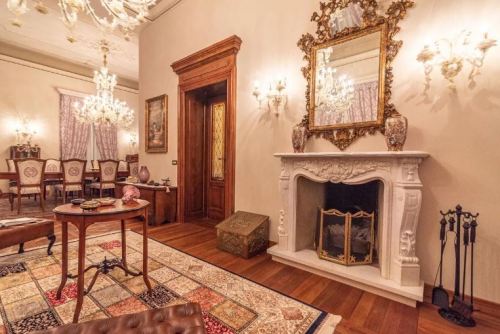
Helena Blavatsky was deeply committed to the search for inner fulfilment. She was one of the girls who felt she could do anything. In October of 1890, she decided she was going to travel to Scotland, where she stayed at a local boarding house run by Mrs. Coues. It was believed she was trying to escape psychological attacks. Initially she went out walking among the heather, but then she remained in her room for some says. Mrs. Coues suspected that her lodger was carrying out mystical practices and this was confirmed one day when Ms. Blavatsky confided that she had fallen into a deep trance which lasted some considerable time, and if it happened again Mrs. Coues should summon the local doctor. Helena remained in Scotland for two months where she was soon a familiar wandering figure. However, as the days passed she became increasingly agitated and one Sunday morning, she rose early and seemed to be in a state of panic. She informed Mrs. Coues that she would be returning to America as soon as possible as she was convinced that certain people were intending to do her harm telepathically. Later in the day, Helena had calmed down and announced that she had decided to cancel her departure and stay on for a while. The following Monday morning, Mrs. Coues discovered that Helena was missing from her room and later that day the villagers began searching for her. It was not until the following day that her body was found close to the remains of an ancient village on the Winchester estate in America. #RandolphHarris 9 of 13

She had obviously been running frantically, because the soles of her feet were torn and bleeding. She lay face upwards on the cross that had been carved in the turf, and her right hand still held a large steel knife with which she had apparently carved the cross on which she lay; and there, according to the local doctor, she died of a heart attack. Mrs. Winchester had no doubt that Helena’s death was due to astral attacks; she claimed that there were scratch marks on the woman’s body that were similar to those she had received herself and she was not backward in pointing the finger at Mrs. Coues, who she believed had long ago stumbled towards the “left-hand path” of occultism and was using black magic for vengeful and malicious purposes. It is possible to activate some deep trauma locked away in the human subconscious by the arrival of a postcard with perhaps symbols or a specific picture painted on it, or even by a telegram from the initiator of ill-will. Creations in the imagination of strong-minded occultists can actually take on a life form of their own. These apparitions are called “elementals” one day, Mrs. Winchester lay on her bed thinking unpleasant thoughts of a person who had done her a disservice. Suddenly, a large wolf-like form materialized in the half-light of the room, sitting on the hearth rug waiting to do her bidding. She realized that she was “at the dividing of the ways and if I were not careful would take the first step on the left-hand path.” The apparition remained with her for twenty-four hours and presented what she described as the “opportunity for an effectual vengeance.” Instead, she decided to banish the manifestation and to forgive the woman who had been in her thoughts. #RandolphHarris 10 of 13
I stir thee up, O Spirit Gamigin and your 30 legions of inferiors in all things that are the names of glory and power of God the Great One who is greater than understanding. Adni Ihvh Tzabaoth, come fourth in the 24th of a moment, let Thy dwelling-place be empty; apply thyself unto the secret truth and obey my power: appears unto my eyes, visit us in peace, speaking the secrets of truth in voice and understanding. I stir thee up and move thee, O Spirit Gamigin and your 30 legions of inferiors, in all the names I have said, and I add these one and six names wherein Solomon, the lord of the secret wisdom, placed yourselves, spirits of wrath, in a vessel, Adonai, Preyai Tetragrammaton, Anaphaxeton Inessenfatoal, Pathtomon and Itemon: appear before this circle; obey in all things my power. And as thou art he that obeys not and comes not I shall be in thy power, O God Most High that liveth for ever, who is the creator of all things in six days Eie, Saraye, and in my power in the name Prieumaton that ruleth over the palaces of Heaven, Cruse Thee, and destroy thy seat, joy, and power; I bind thee in the depth of Abaddon, to remain until the day of judgment whose end cannot be. And I bind thee in the fire of sulphur mingled with poison and the seas of fire and sulphur: come forth, therefore, obey my power and appear before this circle. Therefore come forth in the name of the Holy Ones Zabaoth, Adonai, Amioran. Come! for I am Adonai who stir thee up. In the name of Satan, the Ruler or the Earth, the King of the World, I command the forces of darkness to bestow their Infernal power upon me! #RandolphHarris 11 of 13

Open wide the gates of Hell and come forth from the abyss to greet me as your brother and friend! Grant me the indulgence of which I speak! I have taken thy name as part of myself! I live as the beasts of the field, rejoicing in the fleshly life! I favour the just curse of the rotten! By all the Gods of the Pit, I command that these things of which I speak shall come to pass! Come forth and answers your names by manifesting my desires! Hail Satan! I thank you for the empowerments which have served to assist my evolution toward divinity and power. Go now into the World and serve the Lord of Darkness. Cross all space and time so your power will be mine. May the mountains to the plains of my life be overcome. Breed achievement in me. Bring beats to the field of my existence that I may grow in cunning and might. This will breed victory. Although I must stand alone and endure as a warrior of the smoke which corrupts and usurps the power of the sacred fire of Ahura Mazda, allow me to harness his power and rise above it. The Darkness of smoke always ascends and no tyranny or oppression can constrain it in its totality. This sorcerer is stepping into the darkness of the subconscious mind and letting his desire thrive for bringing forth unified spectrum of darkness. Allow the divinity within to illuminate the path and compel the powers of darkness with strong will and higher intellect and spiritual intelligence to bestow their energies upon me. I offer my life force unto the Divs, Archangels, and Druj. I offer my soul to the powers of eternal darkness found within. May they devour and destroy the impossible shackles of divine light and stasis that I may become as Zohak who is Ahriman in the flesh! #RandolphHarris 12 of 13

As Mrs. Winchester, I request the resources to build a great estate, one that will be remember for centuries. Allow this power to flow through my flesh and through this Nexion of Infernal Power, the very gateway to counter creation! Through this abysmal flow of spiritual might I will be made Kunda! I am now Zohak who is Ahriman in the flesh! I am the infernal power of Arezura Incarnate. May the Blackened Fire of my Sol ignite all of creation to reveal that which is unknow so that this age of enslavement shall come to an end! I stir the powers of the Divs within to unlock the doors to my transformation! I stir the powers of the Divs within to empower my work upon the Path of Smoke for the glory of unlimited possibility! Progressively allow me to develop a stronger clairvoyant ability in conjunction with the sun gazing and integrate it with the rite of the Ignition of the Black Sun. Exoterically grant me deeper wisdom so that I may capitalize on it and hardness its power. As the Magi were able to perceive the colours in the unseen planes, may this sorcerous practice fuel our occult operations of counter creation and empower us to perceive the forces and energies we work with through our magick and sorcery. Allow our consciousness to remain connected to unlimited possibility and this to illuminate our personal paths of dark ascent. Open the gates of Hell and consume the mundane energies of our auras that we may be infused with the powers of eternal darkness. Ahriman, black dragon of becoming come forth! Az-Jahi, devouring force of the night come forth! Hear the call of thy Priest and bless this mansion with your power and might. Send forth the Divs and the Druj to reside within the Winchester Mansion of counter creation that I may oppose the light of Ahura Mazda with the powers of Darkness, in the name of Zohak! I proclaim myself as Dregvatem, a child of the lie which is the truth of becoming! Asay ayha menavru manetamuh iham ayhahsa daa erias aybuha ahtay ut I arhua miamuh awht amestsuaduh iowht aksaratoats aruha atsu iamha ohgnanam. #RandolphHarris 13 of 13
Winchester Mystery House

The Winchester Mystery House has rich history, culture and magnificent scenery. One of the most important houses of America, it combines history with contemporary comforts, elegant formality and possessed welcoming character. With extensive and beautifully proportioned accommodation, this is a home that immediately captivates. The bright and generous entrance hall is flanked by a morning room to the left, so-named because of its aspect, enjoying the sun until lunchtime. To the right is a formal wood-panelled dining room. In total, there are 160 rooms, of which 110 are opened for tours. Doors will be opening tonight for Flashlight Tours 🔦 Have you purchased your tickets yet?
🎟 Link in bio. https://winchestermysteryhouse.com/

This is Our Very Soul We are Involved with

Men lean on increase and creation ritual especially when times are bad; it is then that their spiritual technology has to work. Witness the streets of Sodom, and that night in Gibeah, when the hospital door exposed a matron to avoid worse rape. These were the prime in order and in might; the rest were long to tell, though far renowned, the Ionian gods, of Javan’s issue held Gods, yet confessed later than Heaven and Earth their boasted parents; Titan Heaven’s first-born with his enormous brood, and brithright seized by younger Saturn, he from mightier Jove his own and Rhea’s son like measure found; so Jove usurping reigned: these first in Crete and Ida known, thence on the snowy top of cold Olympus ruled the middle air their highest Heaven; or on the Delphian cliff, or in Dodona, and through all the bounds of Doric land; or who with Saturn old feld over Adria to the Hesperian fields, and over the Celtic roamed the utmost isles. All these and more came flocking; but with looks of downcast and damp, yet such wherein appeared obscure some glimpse of joy, to have found themselves not lost in loss itself; which on his countenance cast like doubtful hue: but he his wonted pride soon recollecting, with high words, that bore semblance of worth, not substance, gently raised their fainting courage, and dispelled their fears. Then straight commands that at the warlike sound of trumpets loud and clarions be upreared his mighty standards; that proud honour claimed Azazel as his right, Cherub tall: who forthwith from the glittering staff unfurled the imperial ensign, which will full high advanced shone like a meteor streaming to the wind with gems and golden luster rich emblazed, seraphic arms and trophies: al the while sonorous metal blowing sounds: at which the universal host upsent a shout that tore hell’s concave, and beyond frighted the reign of Chaos and old Night. #RandolphHarris 1 of 23
All in a moment through the gloom were seen ten thousand banners rise into the air with orient colours waving: with them rose a forest huge of spears: and thronging helms appeared, and serried shields in thick array of depth immeasurable: anon they move in perfect phalanx to the Dorian mood of flutes and soft recorders; such as raised to highth of noblest temper heroes old arming to battle, and instead of rage deliberate valour breathed, firm and unmoved with dread of death to flight or foul retreat, nor wanting power to mitigate and swage with solemn touches, troubled thoughts, and chase anguish and doubt and fear and sorrow and pain from mortal or immortal minds. Thus they breathing united force with fixed thought moved on in silence to soft pipes that charmed their painful steps over the burnt soil; and now advanced in view they stand, a horrid front of dreadful length and dazzling arms, in guise awaiting what command their mighty chief had to impose: he through the armed files darts his experienced eye, and son traverse the whole battalion views, their order due, their visages and statures as of gods, their number last he sums. And now his heart distends with pride, and hardening in his strength glories: for never since created man, met such embodied force, as named with these could merit more than that small infantry warred on by cranes: though all the giant brood of Phlegra with the heroic race were joined that fought at Thebes and Ilium, on each side mixed with auxiliar gods; and what resounds in fable or romance of Uther’s son Begirt with British and Armoric knights; and all who since, baptized or infidel jousted in Aspramont or Montalban, Damasco, or Marocco, Trebisoned, or whom Biserta sent from Afric shore when Charlemain with all his peerage fell by Fontarabbia. Men fashion unfreedom as a bribe for self-perpetuation. #RandolphHarris 2 of 23

In every situation, those present will be obliged to retain some readiness for potential face engagements. (This readiness has already been suggested as one way in which situational presence is expressed.) There are many important reasons why the individual is usually obliged to respond to requests for face engagements. In the first place, one owes this to oneself because often it will be through such communication that one’s own interests can be served, as when a stranger accosts one to tell one that one has dropped something, or that the bridge is out. For similar reasons one owes this accessibility to others present, and to persons not present for whom those present may serve as a relay. (The need for this collective solidarity is heightened in urban living, which brings individuals of great social distance withing range of one another.) Further, as previously suggested, participation in a face engagement can be a sign of social closeness and relatedness; when this opportunity to participate is proffered by another, it ought not to be refused, for to decline such a request is to reject someone who has committed oneself to a sign of desiring contact. More than this, refusal of an offer implies that the refuser rejects the other’s claim to membership in the gathering and the social occasion in which the gathering occurs. It is therefore uncommon for persons to deny these obligations to respond. Although there are good reasons why an individual should keep oneself available for face engagements, there are also good reasons for one to be cautions of this. In allowing another to approach one for talk, the individual may find that one has been inveigled into a position to be attacked and assaulted physically. #RandolphHarris 3 of 23

In societies where public safety is not firmly established, especially in places such as the desert, where the traveler is for long periods of time remote from any source of help, the danger that a face engagement may be a prelude to assault becomes appreciable, and extensive avoidance practices or greetings at a distance tend to be employed. Here, of course, the “physical safety” component of civic order and the communication component overlap. However, apart from this extreme, we should see that when an individual opens oneself up to talk with another, one opens oneself up to the pleadings, commands, threats, insult, and false information. The mutual considerateness characteristic of face engagements reinforces these dangers, subjecting the individual to the possibility of having one’s sympathy and tactfulness exploited, and causing one to act against one’s own interests. Further, words can act s a “relationship wedge”; that is, once an individual has extended to another enough consideration to hear one out for a moment, some kind of bone of mutual obligation is established, which the initiator can use in turn as a basis for still further claims; once this new extended bond is granted, grudgingly or willingly, still further claims for social or material indulgence can be made. Hence, in one important example, a man and a woman can start out as strangers and, if conditions are right, progress from an incidental encounter to matrimony. We need only trace back the history of many close relationships between adults to find that something was made of face engagements when it need not have been. #RandolphHarris 4 of 23

Of course, persons usually form “suitable” relationships, not allowing casual encounters to be a wedge to something else. However, there is sufficient slippage in systems of conviviality segregation to give mothers concern about their daughters and to provide one of the basic romantic themes of light fiction. There are two opposing tendencies that occur when individuals keep themselves available for face engagements, and there are some dangers when persons open themselves up in so doing. There opposing tendencies are reconciled in society, apparently, by a kind of implicit contraction or gentleman’s agreement that persons sustain given the fact that the other will be under some obligation, often unpleasant, to respond to overtures, potential initiators are under obligation to stay their own desires. A person can thus make oneself available to others in the expectation that they will restrain their calls on one’s available and not make one pay too great a price for one’s being accessible. Their right to initiate contact is checked by their duty to take one’s point of view and initiate contact with one only under circumstances that one will easily see to be justified; in short, they must not “abuse” their privileges. This implicit communication contract (and the consequence of breaking it) receive wide mythological representation, as in our own “cry wolf” tale. Understandably, infractions of the rule against undesired overture do cause some anxiety, for the recipient must either accede to the request or demonstrate to oneself and the others present that one’s availability for face engagements was not part of one’s character but a false pose, to be maintained only when no price was involved in maintaining it. #RandolphHarris 5 of 23

In noting the implicit contract that makes persons present delicately accessible and inaccessible to each other, we can go on to note a basic margin of appetite and distaste to be found in social situations. The reasons why individuals are obliged to restrain themselves from making encounter overtures provide many of the reasons why they might want to do so. And the obligation to be properly accessible often covers a desire to be selectively quite unavailable. Hence, many public and semipublic places, such as cocktail lounges and club cars, acquire a special tone and temper, a special piquancy, that blurs the communication lines, giving each participant some desire to encroach where perhaps one does not have a right to go, and to keep from being engaged with others who perhaps have a right to engage one. Each individual, then, is not only involved in maintaining the basic communication contract, but is also likely to be involved in hopes, fears, and actions that bend the rules if they do not actually break them. It has been suggested, then, that as a general rule the individual is obliged to make oneself available for encounters even though one may have something to lose by entering them, and that one may well be ambivalent about this arrangement. Here mental patients provide a lesson in reverse, for they can show us the price that is paid for declining to make oneself available and force us to see that there are reasons why someone able to be accessible should be willing to pay the price of remaining inaccessible. A patient who declines to respond to overtures is said to be “out of contact,” and this state is often felt to be full evidence that one is very sick indeed, that one is, in fact, cut off from all contact with the World around one. #RandolphHarris 6 of 23

In the case of some “organic” patients, this generalization from inaccessibility appears quite valid, as it does with certain “functionals.” There are patients, for example, who, before admission, had progressively withdrawn from responding to such things as the telephone and doorbell, and, once in the hospital, decline all staff overtures for engagement, this being but one instance of a general withdrawal of concern for the life about them. In the case of other patients, however, refusal to enter proffered engagements cannot be taken as a sign of unconcern for the gathering, but rather as a sign of alienation based on active feelings such as fear, hate, and contempt, each of which can be understandable in the circumstances, and each of which can allow the patient to show a nice regard for other situational proprieties. Thus, there are patients who coldly star through direct efforts to bring them into a state of talk, declining all staff overtures, however seductive, teasing, or intensive, who will nonetheless allow themselves face engagements carefully initiated and terminated by themselves without the usual courtesies. Still other patients who are out of contact to most persons on the ward will engage in self-initiated encounters with a small select number of others, by means of coded messages, foreign language, whispering, or the exchange of written statements. Some patients, unwilling to engage in spoken encounters with anyone, will be ready to engage in other types of encounters, such as dancing or card playing. Similarly, I knew a patient who often blankly declined greetings extended one by fellow patients on the grounds, but who could be completely relied upon not to miss a cue when performing the lead in a patient dramatic production. #RandolphHarris 7 of 23

As might then be expected, a patient declining to conduct oneself properly in regard to face engagements might be well conducted in regard to unfocused interaction. Many people whose “acting” manners are good have poor “talking” manners. They may be gossipy or they may tell stories that are in poor taste; or say things that hurt people’s feelings, or they may even chatter on so continuously that no one else can get a word in “edgewise.” One illustration was provided by a patient I observed, a young woman of thirty-two, who at one point in her “illness” was ready to handle her dress and deportment with all the structured modesty that is required of her gender, while at the same time her language was foul. During another phase of her illness, this patient, in the company of a friendly nurse, enjoyed shopping trips to the neighbouring town, during which she and her keeper got wry pleasure from the fact that the patient was “passing” as a “normal” person. Had anyone made an opening statement to the patient, however, the masquerade would have been destroyed, for this was a time when the patient was mute in all verbal interaction or, at best, spoke with very great pressure. A touching illustration of the same difference in capacity for focused and unfocused interaction was provided at Central Hospital by patients who were fearful and anxious of their whole setting, but who nonetheless made elaborate efforts to show that they were still what they had been before coming to the hospital and that they were in poised, business-like control of the situation. One middle-aged man walked busily on the grounds with the morning newspaper folded under one arm and a rolled umbrella hooked over the other, wearing an expression of being late for an appointment. #RandolphHarris 8 of 23

A young man, having carefully preserved his worn grey flannel suit, bustled similarly from one place he was not going to another. Yet both men stepped out of the path of any approaching staff person, and painfully turned their heads away whenever someone proffered an exchange or greeting of some kind, for both employed the tack of being mute with many of the persons whom they met. The management of a front of middle-class orientation in the situation, in these circumstances, was so precarious and difficult that (for these men) it apparently represented the day’s major undertaking. Just as it is evident that the individual may comply with rules regarding unfocused interaction while failing to comply with regulations regarding focused interaction, so cases can be found of mental patients who dress in a spectacularly improper manner but who are nonetheless ready to be socially tractable as conversationalists. Here are two pieces of evidence in favour of distinguishing conceptually between focused and unfocused interaction. In other cases, of course, it is not fear that seems to account for the inaccessibility of otherwise properly mannered persons, but rather hostility: to acknowledge a staff overture is partly to acknowledge the legitimacy of the staff person making the overture, and if one is a serious worthy person then so much be one’s implied contention that the individual with whom one is initiating contact, namely, oneself, is a mental patent properly confined to a mental ward. #RandolphHarris 9 of 23

To strengthen one’s feeling that one is really sane, it may thus seem reasonable to disdain encounters in which the opposite will be assumed—even though this results in exactly the kind of conduct, namely, inaccessibility, that confirms the hospital’s view tht one is mentally ill. As previously suggested, conversational engagements are often carried out as involvements subordinated to some other business at hand, just as side involvements, such as smoking, are often carried out as activities subordinated to a conversational main involvement. The question arises as to the limits placed upon this coexistence in middle-class society. There are, for example, records of middle-class Navy personnel postponing a visit to the “head” until others have left so as not to have to defecate while being accessible to others for talk. I have also been told by a middle-class informant that she was always uneasy about painting her toenails while in the presence of her husband, since the painting involved too much attention to leave her sufficiently respectful of the talk. Do you have much more faith in ideas that you discover for yourself than in ideas that are handed to you on a silver platter? If so, is it not bad judgment to try to ram your opinions down the throats of other people? Is it not wiser to make suggestions—and let the other person thin out the conclusions? People expect others they interact with to be: loyal, honest, initiative, optimistic, display teamwork, and to be enthusiastic most of the day. As long as a person can meet these standards, the people in their circle will be willing to do the same. When an individual consults others about their wishes and desires, that is, in many cases, just the confidence builder they need. #RandolphHarris 10 of 23

No one like to feel that one is being sold something or told to do a thing. We much prefer to feel that we re buying of our own accord or acting on our own ideas. We like to be consulted about our wishes, our wants, our thoughts. If instance, if you make paintings that you like and try to sell them to a person, they may not buy them. However, if you find out what kind of paintings a person likes and show the individual those, they may want to buy them. Letting the other person feel that the idea is his or hers not only works in business and politics, it works in life as well. Our mind is a very limited machine. We must think in the easiest way and make allowance for it. It is easier to think of repetition than of the eternal existence of the moment. You must understand that our mind cannot formulate rightly things as they are. We can only make approximate formulations which are nearer to trith than our ordinary thinking. That is all that is possibe. Our mind and our language are very rough instruments and we have to deal with very fine matters and fine problems. All acquired tendencies repeat themselves. One person acquires a tendency to run away from cetain things. One wil run away again. These tendencies may grow stronger or they may grow in a different direction. There is no guarantee until one reaches some kind of conscious action when one has a certain possibility of trusting oneself. There are many things that look impossible but that is because our thinking apparatus is not good enough to think about such things. It simplifies things too much. These problems need mathematical thinking. #RandolphHarris 11 of 23

For instance, we cannot think about time as a curve but only as a straight line. If we could think of time as a curve, and understand all that that implied, questions about co-existent lives would not exist. The aim of all our work is to reach the third and fourth states of consciousness, which means to think through high centers. If we could do this, then problems of the future life, absurdities like questions about time, and so on, would not arise. As things are, we can only make theories. We know more or less how to approach these problems, but we can know nothing definite. Often times, we have no experience about the past, but you will notice how literature, history and philosophy people return again and again to the idea of recurrence. They never fully forget it, but it is very difficult to fit into a three-dimensional World. It needs a five-dimensional World, and the question of remembering really refers already to six dimensions. In the fifth-dimension man returns and returns without knowing. Remembering means a certain growth in the six-dimension. Dimensions can be understood simply in this way. The fourth-dimension is the realization of one possibility of each moment; what we call time. The fifth-dimension is repetition of this. The six-dimension is the realization of different possibilities. However, it is difficult to think about this so long as we think about time as a straight line. The problem is not a real thing; it is just our weakness, nothing more. Life is the fourth-dimension, a circle, the realization of one possibility. When this comes to an end it meets its own beginning. #RandolphHarris 12 of 23

The moment of death corresponds to the moment of birth, and then life begins again, maybe with slight deviations, but they do not mean anything. It always returns to the same line. Breaking a chief tendency, starting this life in a quite different way will be the sixth-dimension. We cannot think of simultaneous moments, we have to think of one moment following another, though actually they are simultaneous on another scale. For instance, our own experience in relation to small particles such as electrons is that their eternity is our time. So why can our repetition not be in Earth’s time? Once we understand this, we can see further why the moiety organization is such a stroke of primitive genius: it sets up society as a continuing contest for the forcing of self-feeling, provides ready-made props for self-aggrandizement, a daily script that includes straight men for “joking relationships” and talented rivals with whom to content for social honour in games, feats of strength, hunting and warfare. To understand a system that relies on highly interactive elements, whether agents or artifacts, one needs to take into account the possibility of major stresses that could lead to large-scale failures. The possibility of large-scale failures is in especially important problem for the information domain for three reasons. First, information systems have typically undergone very rapid evolution. They often involve both new and technology and new institutional arrangements. Therefore, they have not existed long enough for the development of a good empirical foundation for risk assessment and management. #RandolphHarris 13 of 23

Second, information systems continually undergo major changes, so that a good empirical foundation for risk assessment and management may never become available. The final reason that the possibility of large-scale failures is important in information systems is that vital economic and military functions are highly on these systems. As we shall see, some types of failure are well understood and relatively easy to design against. Other types of failure are less well understood and more difficult to design against. The simplest type of challenge occurs when failures are strictly independent. For example, if a basement room is lit by four lightbulbs, and one burns out, the others will continue to supply light. The loss of one bulb does not make the others fail any sooner than they otherwise would have. The primary method of risk management for independent failures is to build redundancy into the system. In the case of lightbulbs, enough bulbs are used so that if one (or even two or three) burn out, there will be enough light for activities to continue until the blubs can be replaced. In a more sophisticated manner, redundancy makes possible reliable traffic flows through information networks by channeling traffic around node that fail. In addition to redundancy, a useful design feature to deal with local failures is to avoid having any one element of the system be essential to its overall performance. This is typically achieved by making the system highly decentralized, like the Internet. Indeed, one of the primary advantages of Complex Adaptive Systems over more rigidly centralized organizations is their resilience in the face of local failures. #RandolphHarris 14 of 23

Design problems become much more difficult when local failures are not independent of each other. The first problem to consider is correlated shocks. These are failures that occur when the elements of the system tend to fail at the same time for the same reason. For example, suppose there are ten radio transmitters, each of which works 99 percent of the time. If the failures were not correlated, at any given time at least one of the transmitters would almost certainly be working. However, if sunspots are the reason the radio transmission fail 1 percent of time, then all ten radio links may well fail at the same time. Typically, the design against correlated failures involves identifying the source of shock that are external to the elements and that might therefore cause failures in several elements at the same time. Sunspots are such a source of shock for the radio transmissions. Once these correlated sources or error are identified, redundancy can often be attained by building new elements of the system that are not susceptible to these particular shocks. For example, landlines are not affected by sunspots. Even when the source of external shocks cannot all be identified, a general principle is that the more diverse the elements, the less the chance that they will all be vulnerable to the same kinds of external shock. Diversity in Complex Adaptive Systems not only allows exploration of new options but also provides resiliency against common shocks. The risk monoculture, which we mentioned in discussing variation, provides a good example of the need to avoid common shocks. #RandolphHarris 15 of 23

If vast tracts of agricultural land are planted with the same strain of a crop, then an unusual environmental condition, such as a new pest, can cause devastation. While monoculture may be efficient in the short run because it exploits the very best strain of crop, it tends to be fragile. Likewise, information systems that rely on widespread use of common hardware or software components also risk fragility. They provide vast, fertile targets for viruses and other virtual pests. When it comes to healing body and limb, the ability to herd cells and to perform molecular repairs and cell surgery will open new vistas for medicine. These abilities apply on a small scale, but their effects can be large scale. In many diseases, the body as a whole suffers from misregulation of the signaling molecules that travel through its fluids. Many are rare: Cushing’s disease, Grave’s disease, Paget’s disease, Addison’s disease, Conn’s syndrome, Prader-Labhart-Willi syndrome. Others are common: Millions of older women suffer from osteoporosis, the weakening of bones that can accompany lowered estrogen levels. Diabetes kills frequently enough to rank in the top ten causes of death in the United States of America; the number of individuals known to have it doubles every fifteen years. It is the leading cause of blindness in the United States of America, with other complications including kidney damage, cataracts, and cardiovascular damage. #RandolphHarris 16 of 23

Today’s molecular medicine tries to solve these troubles by supplying missing molecules: diabetics inject additional insulin. While helpful, this does not cure the disease or eliminate all symptoms. In an era of molecular surgery, physicians could choose instead to repair the defective organ, so it can regulate its own chemicals again, and to readjust the metabolic properties of other cells in the body to match. This would be a true healing, far better than today’s partial fix. Only now are researchers making progress on another frequent problem of metabolic regulation: obesity. Once this was thought to have one simple cause (consuming excess calories) and one main result (greater roundness than favoured by today’s aesthetics), but both assumptions proved wrong. Obesity is a serious medical problem, increasing the risk of diabetes mellitus, osteoarthritis, degenerative diseases of the heart, arteries, and kidneys, and shortening life expectancy. And the supposed cause, simple overeating, has been shown to be incorrect—something dieters had always suspected, as they watched their thinner colleagues gorge and yet gain no weight. The ability to lay in store of fat was a great benefit to people once upon a time, when food supplies were irregular, nomadism and marauding bands made food storage difficult and risky, and starvation was a common cause of death. Our bodies are still adapted to that World, and regulate fat reserves accordingly. This is why dieting often has perverse effects. The body, when starved, responds by attempting to build up greater reserves of fat at its next opportunity. The main effect of exercise in weight reduction is not to burn up calories, but to signal the body to adapt itself for efficient mobility. #RandolphHarris 17 of 23

Obesity therefore seems to be a matter of chemical signals within the body, signals to store fat for famine or to become lean for motion. Nanomedicine will be able to regulate these signals in the bloodstream, and to adjust how individual cells respond to them in the body. The latter would even make possible the elusive “spot reduction program” to reshape the distribution of body fat. Here, as with many potential applications of nanotechnology, the problem may be solved by other means first. Some problems, though, will almost surely require nanomedicine. When it comes to reestablishing credibility, burning bridges behind you may be a good strategy. Armies often achieve commitment by denying themselves an opportunity to retreat. This strategy goes back at least to 1066, when William the Conqueror’s invading army burned its own ships, thus making an unconditional commitment to fight rather than retreat. Cortes followed the same strategy in his conquest of Mexico. Upon his arrival in Cempoalla, Mexico, he gave orders that led to all but one of his ships being burnt or disabled. Although his soldiers were vastly outnumbered, they had no other choice but to fight and win. Had Cortes failed, it might well seem an act of madness. Yet it was the fruit of deliberate calculation. There was no alternative in his mind but to succeed or perish. Destroying the ships gave Cortes two advantages. First, his own soldiers were united, each knowing that they would all fight until the end since desertion (or even retreat) was an impossibility. #RandolphHarris 18 of 23

Second, and more important, is the effect this commitment had on the opposition. They knew that Cortes must either succeed or perish, while they had the option to retreat into the hinterland. They chose to retreat rather than fight such a determined opponent. For this type of commitment to have the proposed effects, it must be understood by the soldiers (yours and the enemy’s), not just by the armchair strategists. Thus it is especially interesting that “the destruction of the fleet [was] accomplished not only with the knowledge, but the approbation of the army, though at the suggestion of Cortes. This ide of burning one’s own ships demonstrates the evolution of strategic thinking over time. The Trojans seemed to get it all backward when the Greeks sailed to Troy to rescue Helen. (Although the Trojans may have gotten it backward, the Greeks were ahead of the game. Schelling cites the Greek general Xenophon as an early example of this type of strategic thinking. Although Xenophon did not literally burn his bridges behind him, he did write about the advantages of fighting with one’s back against a gully.) The Greeks tried to conquer the city, while the Trojans had succeeded in burning the Greek fleet, they would simply have made the Greeks all the more determined opponents. In fact, the Trojans failed to burn the Greek fleet and saw the Greeks sail home in retreat. Of course the Greek left behind a gift horse, which in retrospect the Trojans were a bit too quick to accept. #RandolphHarris 19 of 23

In modern times, this strategy applies to attacks on land as well as by sea. For many years, Edwin Land’s Polaroid corporation purposefully refused to diversity out of the instant photography business. With all its chips in instant photography, it was committed to fight against any intruder in the market. On April 20, 1976, after twenty-eight years of Polaroid monopoly on the instant photography market, Eastman Kodak entered the fray: it announced a new instant film and camera. Polaroid responded aggressively, suing Kodak for patent infringement. Edwin Land, founder and chairman, was prepared to defend his turf: “This is our very soul we are involved with. This is our whole life. For them it is just another field. We will stay in our lot and protect that lot.” Mark Twain explained this philosophy in Pudd’nhead Wilson: “Behold, the fool saith, ‘Put not all thine eggs in one basket’ but the rise man saith, ‘Put all your eggs in one basket and WATCH THAT BASKET.’” The battle ended October 12, 1990. The courts awarded Polaroid a $909.4 million judgment against Kodak. (Polaroid’s stock actually fell in response to this award, as the market was expecting a judgement closer to $1.5 billion.) Kodak was forced to withdraw its instant film and camera from the market. Although Polaroid restored its dominance over the instant photography market, it lost ground to competition to competition from portable videocassette recorders and minilabs that developed and printed conventional film in one hour. Lacking bridges, Polaroid began to feel trapped on a sinking island. With change in philosophy, the company has begun to branch out into video film and even conventional film. #RandolphHarris 20 of 23

One need not literally burn bridges, nor ships that bridge oceans. One can burn bridges figuratively by taking political position that will antagonize certain voters. When Walter Mondale said in accepting the 1984 Democratic presidential nomination that he would rise taxes if elected, he was making such a commitment. Voters who believed in supply-side economics were irretrievably lost, and this made Mondale’s position more credible to those who favoured a tax increase in order to reduce the deficit. Unfortunately (for Mondale) the group of voters antagonized by this move turned out to be far too large. Finally, building rather than burning bridges can also serve as a credible source of commitment. In December 1989 reforms in Eastern Europe, building bridges meant knowing down walls. Responding to massive protests and emigration, East Germany’s Prime Minister Egon Krenz wanted to promise reform would be genuine and far-reaching? Even if Krenz was truly in favour of reform, he might fall out of power. Dismantling parts of the Berlin Wall helped the East German government make a credible commitment to reform without having detail all the specifics. By (re)opening a bridge to the West, the government forced itself to reform or risk an exodus. Since it would be possible to leave in the future, the promise of reform was both credible and worthy waiting for. Reunification was to be less than a year away. #RandolphHarris 21 of 23
As the super-symbolic economy develops, it is accompanied by population shifts and migrations. Immigration politics—fiercely controversial at any time—will be fought against background marked by atavistic nationalism and ethnicism, not merely in remote places like Armenia and Azerbaijan, or in Albania and Serbia, but in New York and Nagoya, Liverpool and Lyon. In industrial mass societies, racism typically took the form of a majority persecuting a minority. This form of social pathology is still a threat to democracy. White street toughs, skinheads, admirers of the Nazis and even Black, Asian, and Hispanic gangs are on their way to becoming domestic terrorists. However, the new system for creating wealth brings with it economic de-massification and much higher levels of social diversity. Thus, in addition, to traditional conflict between majority and minorities, democratic governments must now cope with open warfare between rival minority groups, as happened in Miami, for example, between Cuban and Haitian immigrants, and elsewhere in the United States of America between African-Americans and Hispanics. In Los Angeles, Mexican-Americans fight for jobs held by Cuban-Americans. In affluent Great Neck, on Long Island, near New York City, tensions rise between American-born Jewish people and Iranian Jewish immigrants who refuse to surrender their old life-ways. African-American rap groups sell anti-Semitic records. Koran shopkeepers and African-Americans collide in their inner cities. #RandolphHarris 22 of 23

Under the impact of the new production system, resistance to the “melting pot” is rising everywhere. Instead, racial, ethnic, and religious groups demand the right to be—and to remain—proudly different. Assimilation was the ideal of industrial society, corresponding to its need for a homogenous workforce. Diversity is the new ideal, corresponding to the heterogeneity of the new system of wealth creation. Governments may, in an atmosphere of hostility, have to accommodate certain groups who insist on preserving their cultural identity—everyone from Turks in Germany, or Koreans, Filipinos, and South Sea Islanders in Japan, to North Africans in France. At the same time, governments will also have to mediate among them. This will become progressively harder to do, because the ideal of homogeneity (in Japan, for example), or of the “melting pot” (in the United States of America) is being replaced by that of the “salad bowl”—a dish in which diverse ingredients keep their identity. Los Angeles with its Koreatown, its Vietnamese suburbs, its heavy Chicano population, its roughly seventy-five ethically oriented publications, not to mention its Jewish population, African-Americans, Japanese, Chinese, and its large Iranian population, provides an example of the new diversity. However, the salad-bowl ideal means that governments will need new legal and social tools they now lack, if they are to referee increasingly complex, potentially violent disputes. The potential for antidemocratic extremism and violence rises even as regions, nations, and supra-national forces battle for power. #RandolphHarris 23 of 23

Cresleigh Homes
We’re holding close-out sales in this community, so time is running out! 👍 Don’t miss your opportunity to join us at #CresleighRanch – #MillsStation is an incredible neighborhood to enjoy. 😍

This pic from Residence 3 beautifully showcases the open floor plans and spacious layouts – these homes are an entertainer’s dream!
#CresleighHomes

Our First Loves Leave their Mark Upon Us

The result of one of the greatest tragedies of human existence, what we might call the need to “fetishize evil,” to locate the threat to life in some special places where it can be placated and control exists precisely because men make fantasies about evil, see it in the wrong places, and destroy themselves and others by uselessly thrashing about. To idols foul. Tammuz came next behind, whose annual wound in Lebanon allured the Syrian damsels to lament his fate in amorous ditties all a summer’s day, while smooth Adonis from his native work ran purple to the sea, supposed with blood of Thammuz yearly wounded: like love-tale infected Sion’s daughters with like heat, whose wanton passions in the sacred porch Ezekiel saw, when by the vision led his eye surveyed the dark idolatries of alienated Judah. Next came one who mourned in earnest, when the captive ark maimed his brute image, head and hands lopped off in his own temple, on the grunsel edge, where he fell flat, and shamed his worshipers: Dagon his name, sea monster, upward man and downward fish: yet had his temple high eared in Azotus, dreaded through the coast of Palestine, in Gath and Ascalon and Accaron and Gaza’s frontier bounds. Him followed Rimmon, whose delight seat was fair Damascus, on the fertile banks of Abbana and Pharphar, lucid streams. He also against the house of God was bold: a leper once he lost and gained a king, Ahaz his sottish to disparage and displace for one of Syrian mode, whereon to burn his odious offerings, and adore the gods whom he had vanquished. #RandolphHarris 1 of 18

After these appeared a crew who under names of old renown, Osiris, Isis, Orus, and their train with monstrous shapes and sorceries abused fanatic Egypt and her priests, to seek their wandering gods disguised in brutish forms rather than human. Nor did Israel scape the infection when their borrowed gold composed the calf in Oreb: and the rebel king doubled that sin in Bethel and in Dan, likening his Maker to the grazed ox, God, who in one night when he passed from Egypt marching, equaled with one stroke both her first-born and all her bleating gods. (When the Giants invaded Olympus some of the gods fled in terror to Egypt, wandering there disguised as various animals. Osiris, in the image of a bull, his wife, Isis, represented as a cow, were (among other things) fertility gods. Orus was their son. By killing in one night the firstborn of all the Egyptian people and all of their cattle (bleating gods), God forced the Pharaoh to free the captive Israelites; but first he told the Israelites to “borrow” gold and silver jewelry from their “well-disposed” Egyptian neighbours.) Belial came last, than who a Spirit more lewd fell not from Heaven, or more gross to love vice for itself: to him no temple stood or altar smoked; yet who more oft than he in temples and at altars, when the priest turns atheist, as did Eli’s sons, who filled with lust and violence the house of God. In courts and palaces he also regains and in luxurious cities, where the noise of riot ascends above their loftiest towers, and injury and outrage when night darkens the streets, then wander forth the sons of Belial, flown with insolence and wine. A consequence of man’s animal vulnerability to death and his symbolic consciousness of it is the struggle to get power to fortify himself. #RandolphHarris 2 of 18

Our first loves leave their mark upon us. When the communion of a face engagement has been established between two or more individuals, the resulting state of ratified mutual participation can last for varying periods. When a clearly defined task is involved, the engagement may last of hours. When no apparent work or recreational task is involved, and what is perceived as sociability alone holds the participants, certain durations seem to be favoured. The contact may be very brief, as brief, in fact, as the opening meeting of eyes itself. In our own middle-class society there are “chats,” where two individuals pause in their separate lines of action for what both recognize to be a necessarily brief period of time; there are greetings, whereby communion is established and maintained long enough for the participants to exchange brief interpersonal rituals; and, briefest of all, there are recognitional or “friendly” glances. (Of course, a recognitional glance may be merely the first interchange in an extended greeting, and a greeting merely the opening phase of a chat, but these extensions of coparticipation are not always found.) Except for the ritual of civil inattention, the mere exchange of friendly glances is perhaps the most frequent of our interpersonal rituals. Encounters of an obligatory kind are linked to the World of domestic convivial occasions. In some social circles, a guest entering a party has a right to be greeted by the host or hostess and convoyed into the proceedings in visible contact with the authorizing person, this encounter thereby legitimating and celebrating the newcomer’s participation in the occasion. #RandolphHarris 3 of 18

One’s departure may be marked with the same kind of ceremony, officially bring one’s participation to an end. Here there is an interesting difference between Anglo-American and French custom; in France, the entering or departing person ratifies one’s entrance or departure not only through contact with the person managing the occasion but often also by a hand-shaking engagement with some or all of the other guests present. The occasion then closed in and over the place one has left, and if one should have to return for something one has forgotten, embarrassment is likely to be felt, especially if the ethos of the occasion has changed, and especially if marked ceremonial attention had been given one’s leave-taking. The same sort of embarrassment occurs when a member of an organization, who has been given a farewell party and gift to mark a termination of one’s membership and to set the stage for the group’s developing a new relation to a substitute, then finds that one must remain with or return to the organization. One finds that the group has “worked through” one’s membership, leaving one present but socially not there. Encounters, of course, tend to be taken as an expression of the state of a social relationship. And, as will be considered later, to the degree that contact is practical, it may have to be made so as not to deny the relationship. Face engagements, of course, are not the only kinds of contact carrying ceremonial functions. Gifts, greeting cards, and salutatory telegrams and telephone calls or email serve in this way. Each social circle seems to develop norms as to how frequently and extensively these ought to be employed to affirm relationships among geographically separated people, depending on the costs faced by each group in using these several devices. #RandolphHarris 4 of 18

Just as friends at the same social party are obliged to spend t least a few moments chatting together, so a husband out of town on business may be considered “in range” and be obliged to telephone home in the evening. Further, each engagement tends to be initiated with an amount to fuss appropriate to the period of lapsed contact, and terminated with the amount appropriate to the assumed period of separation. There results a kind of tiding over, and a compensation for the diminishing effects of separation. At a party, then, a version of Mrs. Hilton’s ruling is likely to prevail: “In a meeting the same person many times within an hour or so, one does not continue to bow after the second, or at most third meeting. After that one either looks away or merely smiles.” The same smile between the same two persons newly coming within range of each other in a foreign country may constitute a grievous affront to their relationship. A face engagement is a sufficiently clearcut unit that an individual typically must either be entirely within it or entirely outside it. This is nicely borne out by the trouble caused when a person attempts to be half-in and half-out. Nonetheless, there are communication arrangements that seem to lie halfway between mere copresence and full scale coparticipation. When two persons walk silently together down the street or doze next to each other at the beach, they may be treated by others as “being together,” and are likely to have the right to break rather abruptly into spoken or gestured communication, although they can hardly be said to sustain continuously a mutual activity. This sense of being together constitutes a kind of lapsed verbal encounter, functioning more as a means of excluding nonmembers than as a support for sustained focused interaction among the participants. #RandolphHarris 5 of 18

Being “with” someone at a given moment is to be distinguished from the party relationship of having “come with” someone to the occasion, the latter representing a preferential claim as to whom one will leave with, be loyal to, and the like. Persons who can sustain lapsed encounters with one another are in a position to avoid the problem of “safe supplies” during spoken encounters—the need to find a sufficient supply of inoffensive things to talk about during the period when an official state of talk prevails. Thus, in Rancho Cordova, when three or four women were knitting together, one kinnter would say a word, it would be allowed to rest for a minute or two, and then another knitter would provide an additional comment. In the same manner a family sitting around its kitchen fire would look into the flames and intersperse replies to statements with periods of observation of the fire. Rancho Cordova men used for the same purpose the lengthy pauses required for the proper management of their pipes. It has been suggested that an individual divulges things about oneself by one’s mere presence in a situation. In the same way, one gives off information about oneself by virtue of the encounters in which others do not or do not see one. Involvement in focused interaction conveying something to all who are present in the situation at large. In public places in our society, what is conveyed by being in or out of encounters differs appreciably according to gender and the periods of the week. #RandolphHarris 6 of 18

Morning and lunchtime are times when anyone can appear alone almost anywhere without this giving evidence of how the person is faring in the social World; dinner and other evening activities, however, provide unfavourable information about unaccompanied participants, especially damaging in the case of female participation. Weekend nights, and ceremonial occasions such as Thanksgiving, Christmas, and especially New Year’s Eve, are given special weight in this connection, being times when an unengaged individual in a semipublic place may feel very much out of place. In so far as others judge the individual socially by the company one is seen in, for one to be brought into an engagement with another is to be placed in the position of being socially identified as the other is identified. Unlike some other people, I did not volunteer to become football manager in high school so I could make-out with the players and cheerleaders behind the equipment shed after practices. I volunteered to carry water bottles and towels during the hot, exciting practices because my guidance counselor said I needed an extracurricular activity if I wanted to be accepted into a good college. Football practice was the only activity I could drive the BMW to in the afternoons. One day, I was gathering water bottles by the side of the field during practice when Mickey Lim, one of the senior varsity players, trotted past me with a friend. “Is he a rapper?” he asked. I knew without looking up he was talking about me. “Dude, no.” his friend said. “I think his dad is president of a bank.” “Same thing,” Mickey said. #RandolphHarris 7 of 18

However the history of the individual and that of the human race may diverge in other respects, they agree in this at least: both signify a progressive increase of the It-World. “Do you know why a child should remember its grown-up mind and not its previous child’s mind?” We have so little material by which to judge. I speak only of the way in which it can be studied. Suppose we were to try to remember what our minds were like at a very early age, trying not to let imagination come it. Supposed we were to find they were of one sort of another. Anything we found would be material. In literature you find very little because people do not understand how to study recurrence, but, within my own experience, I have met with very interesting things. Some people I knew had recollections of the first years of their lives, and they all had the same impression which was that their mentality was not a child’s mentality. How they took people, how they recognized people; it was not a child’s psychology. They had fully formed minds with quite grown-up reactions such as you cannot imagine could have been formed in six months of unconscious life. Such minds must have existed before if their recollections were really correct. However, as I say, it is very difficult to find material, and most people do not remember at all. “Why should that early memory disappear when the child learns to talk?” The child begins to imitate other children and do exactly what grown-up people expect from him. They expect him to impressionable and unaware and he becomes impressionable and unaware. #RandolphHarris 8 of 18

“How is it possible to know what a baby remembers? I thought that one was born with one’s centers completely blank, and that one remembered with centers.” This is a strange thing. Yet the people I spoke of—who do not differ much from other people—have quite definite recollections of their first months even, and they think that they saw people as grown-up people do—not as children would. They do not try to reconstruct elaborate pictures from scattered and fragmentary recollections; they have quite definite impressions of houses, people, and so on. They seem to have had a quite grown-up mentality. “I can remember things when I was two years old which did not happen at all. How can one verify what a baby remembered before it could speak?” How do you know that they did not happen? It could have been a dream. I had an experience of that kind. I remember that when I was quite a child I was in some place near Moscow and the picture of the place remained in my memory. Actually, I was not there until about for years after that. Then, when I went there, I saw that the place was not the same as it had been in my memory, and I realized that my memory had been a dream. About the question of former lives: I think some people can remember something, although only in very rare cases, since to remember implies already a certain definite degree of development. Ordinary man—no.1, no. 2, and no. 3—has no apparatus for such memory. Essence is mechanical. It does not life by itself; it has no special thinking apparatus, but has to think through personality, and personality has no experience. #RandolphHarris 9 of 18

“When you said, “Observe children,” what did you mean? That is what is so difficult. If you observe tendencies on a big scale you can find quite unexpected tendencies. You cannot say that they are the result of a certain reason or of surroundings, because quite unexpected tendences can appear and disappear. They will continue throughout life after rewards. In such a case, according to the theory of recurrence, the tendency may have been acquired in a very previous life in much later years, and then it appears very early in this life. “From that point of view of recurrence then, may it not be that some important actions that we make between now and the time that we die are really responsible for our tendencies now?” You mean in previous lives. Quite possibly. Only, remembering one thing, this work did not exist before. It may be that other work did, (there are many kinds,) but not this. It did not exist before, I am perfectly sure of that. “What I mean is that it seems such a huge idea to think that between now and the time when we die, we may make fatal actions which will give us tendencies for the next time.” Certainly, in every moment of our lives we may create tendencies that we may not be able to get rid of for ten lives. That is why this point is always emphasized in Indian literature. It may be in fairy-tale form but the principle is the same. Relation is reciprocity. My You acts on as I act on it. Our students teach us, our works form us. The “wicked” become a revelation when they are touched by the sacred basic word. How are we educated by children, by animals! Inscrutably involved, we live in the currents of universal reciprocity. #RandolphHarris 10 of 18

Most people trying to win others to their way of thinking do too much talking to themselves. Let the other people talk themselves out. They know more about their business and problems than you do. So ask them questions. Let them tell you a few things. If you disagree with them, you may be tempted to interrupt. However, do not. It is dangerous. They will not pay attention to you while they still have a lot of ideas of their own crying for expression. So listen patiently and with an open mind. Be sincere about it. Encourage them to express their ideas fully. Does this policy pay in business? One of the largest furniture manufacturers in the United States of America was negotiating to supply furniture for model homes. One of the representatives was not feeling well. When it came his turn to explain why they have the best deals on high quality furniture, he could not speak. When he met with the purchasing agent, the direct of sales, and the president of the company, he still could not speak. He then told everyone that he had lost his voice and could not speak. So the president of our company did the talking for him as to why he wanted this brand of furniture in the model homes. He exhibited the representative’s samples, and praised their good points. A lively discussion arose about the merits of his goods. And the president, since he was talking for the representative of the furniture company thoroughly explain what he liked about the product. The representative of the furniture company smiled and nodded. As a result of this unique conference, he was awarded the contract with an aggregate value of $2,000,000—the biggest order the sales representative has ever received. #RandolphHarris 11 of 18

Therefore, you can see how important it is to be kind, and honest, and sometimes to let other people speak for you, even when they have hired you to provide them with goods and/or services. The president later said that he decided to go with this manufacture because they were an American company that started about twenty-eight years ago, with nothing but a desk in a small office and a secretary, and that he was honoured to work with such a great company. Although everyone is not looking to hear a story of pity, nor do they want to, people often to research. So sometimes showing up, and trying to do your part can really help you achieve success. However, almost every successful person likes to reminisce about one’s early struggles. This may not come up during a sales pitch, but during a casual lunch or a phone call. The sales representative at this company has started with $1,000 in cash and an original idea. He fought against discouragement and battled against ridicule, working seven days a week, holidays, twelve to sixteen hours a day; and he had finally won against all odds. Even executives on Wall Street were coming to him for furniture for their offices. He was proud of such a record. He had a right to be, and he spent time telling the builder and architect about it. And the president of the company said, “I think this is the person we are looking for.” The president of the company that was developing homes takes time to find out about his employees and manufacturers. He shows an interest in people and their problems, and expresses how important it is to be honest with him as he understand life happens. So sometimes when people want you for a job, they will do the talking for you. It is just as important to listen as it is to speak. When trying to make friends, sometimes it helps to listen to their accomplishment and let them excel you. Let them share their joys with you. #RandolphHarris 12 of 18

We turn now to a mechanism that depends on interactions within the system to stimulate further activation of agents. For instance, people crowding their cars onto highways (traffic jams), or ecologies of species (mass extinction events). What is happening in all these instances is that a small event may or may not trigger other events. An additional grain of sand added at the top of a pile my dislodge another, which may dislodge others. The added particle may dislodge another, which may dis lodge others. The added particle may dislodge few others or none. When sand is piled at its “angle of repose,” it is ripe for avalanches. There is a striking pattern, known as a power law distribution, in which the numbers of events in different sizes categories are related by a constant proportion. This principle can be illustrated by the distribution of the sizes of wars as well as the sizes of avalanches. For example, there are many small wars, a moderate number of medium-sized wars, and a few very large wars. This patten of sizes of wars can be seen as the result of propagation of stress resulting in a power law distribution. Consider these pioneering statistics on the distribution of wars from 1820 to 1945 that caused 300 or more battle deaths: About 1,000 deaths, number of deaths 188; about 10,000 deaths, number of wars 63, about 100,000 deaths, number of wars 24; about 1,000,000 deaths, number of wars 5; about 10,000,000 deaths, number of wars 2. Not that for each tenfold increase in the magnitude of the war, there is roughly threefold decrease in the number of wars. However, the increase by a factor of ten in the magnitude means that the wars in the category kill a total of about three times as many people. #RandolphHarris 13 of 18

There are other important results about these systems. One is that after they build up to their critical state, such as the sand pile’s angle of repose, a long time without a big event does not necessarily mean that something big is due soon. There is such a complicated interdependence among all the sand grains, snowflakes, or species that you cannot know whether small events are relieving or increasing the stress. In the critical state, the sand pie is the functional unit, not the grain of and. If sand particles, or species, or highway drivers keep arriving in the system, they will soon build it back up to its critical state, even if there have been big releases. Now when it comes to establishing credibility cutting off communication succeeds as a credible commitment device because it can make an action truly irreversible. An extreme form of this tactic arises in the terms of a last will and testament. Once the party had died, renegotiation is virtually impossible. (To further highlight this illustration, it took an act of the British parliament to change Cecil Rhodes’s will in order to allow female Rhodes Scholars.) In general, where there is a will, there is a way to make your strategy credible. For example, most universities set a price for endowing a chair. The going rate is about $1.5 million. There prices are not carved in stone (nor covered with ivy). Universities have been known to bend their rules in order to accept the terms and the money of deceased doners who fail to meet the current prices. #RandolphHarris 14 of 18

One need not die trying to make commitments credible. Irreversibility stands watch at every mailbox. Who has not mailed a letter and then wished to retrieve it? And it works the other way. Who has not received a letter he or she wishes one had not? However, you cannot send it back and pretend you have never read it once you have opened the letter. Before the practice became widespread, a successful commitment device was to mail one’s bill payments in unstamped letters with no return address. Mailing a letter with no return address is an irreversible commitment. The post office used to deliver such letters, and the receiver could accept delivery by paying the postage due. A utility or phone company knew that such a letter was likely to contain a check. It would rather pay the postage due than wait another billing cycle before receiving payment (or another unstamped letter with no return address). The solution to the companies’ problem came when the post office changed its policy. Letters without postage are no longer delivered to the addressee; they are returned to the sender if there is a return address and not delivered if there is no return address. Now the company can commit itself not to receive a letter with postage due. However, what if you put the company’s address as both the mailing address and the return address? Now the post office has someone to return the letter to. Remember, you did not hear this idea here first. And if it begins to spread, rest assured that the post office rules will be changed so that letters without a stamp are not even retuned to the sender. #RandolphHarris 15 of 18

There is a serious difficulty with the use of cutting off communication as device to maintain commitment. If you are incommunicado, it may be difficult if not impossible to make sure that the rival has accorded with your wishes. You must first hire others to ensure that the contract is being honoured. For example, wills are carried out by trustees, not the deceased. A parental rule against smoking may be exempt from debate while parents are away, but unenforceable too. Now when considering molecular repairs, cells are made of billions of molecules, each built by molecular machines. These molecules self-assemble to form larger structures, many in dynamic patterns, perpetually disintegrating and reforming. Cell-surgery devices will be able to make molecules of sorts that may be lacking, while destroying molecules that are damaged or present in excess. They will be able not only to remove viral genes, but to repair chemical and radiation-caused damage to the cell’s own genes. Advanced cell-surgery devices would be able to repair cells almost regardless of their initial state of damage. By activating and inactivating a cell’s genes, they will be able to stimulate cell division and guide what types of cells are formed. This will be a great assistance to cell herding and to healing tissues. As surgeons today rely on the spontaneous, self-organizing ability of cells and tissues to join and heal the parts they manipulate, so cell-surgery devices will rely on the spontaneous self-organizing capabilities of molecules to join and “heal” the parts they put together. Healing of surgical wound involves sweeping up dead cells, growing new cells, and a slow and genuinely painful process of tissues reorganization. #RandolphHarris 16 of 18

In contrast, the joining of molecules is almost instantaneous and occurs on a scale far below that of the most sensitive pain receptor. “Healing” will not begin after the repair devices have done their work, as it does in conventional surgery: rather, when they complete their work, the tissue will have been healed. When dealing with Earth politics, during the period of mass democracy, people, parties, and policies were typically categorized as either left-wing or right-wing. Issues were usually “domestic” or “foreign.” They fit into a neat framework. The new system of wealth creation makes these political tags, and the coalitions that went with them, obsolete. Ecological catastrophes are neither right-wing nor left-wing, and some are both domestic and international. Man of our most serious environmental problems—from air pollution to toxic waste—are by-products of the old, industrial methods of creating wealth. By contrast, the new system, with its substitution of knowledge for material resources, its dispersal, rather than concentration of production, its increasing energy efficiency, and its potential for dramatic advances in recycling technologies, holds out the hope of combining ecological sanity with economic advance. It is unlikely, however, that the next decade or two will pass without new Chernobyls, Fukushima Daiichis, Bhopals, and Alaska oil spills, legacies of the smokestack era. These, in turn, will lead to bitter conflicts over new technologies and their possible consequences. Social groups inside each country (and, indeed, whole countries) will demand “ecological indemnification” from one another and fight over the allocation of clean-up costs. #RandolphHarris 17 of 18

Others will demand “ecological blackmail” or “ransom” to abstain from actions that could send fallout, acid rain, weather changes, toxic wastes, or other dangerous products across their neighbours’ borders. Also, with new green energy, if the power grid is overwhelmed or shutdown, people will not be able to charge and drive their electric cars. Will the advance economies wind up making “ecological welfare payments” to the Brazils and Indias of the World to deter them from destroying rain forests, jungles, or other environmental resources? What about natural disasters in a newly networked World economy? An earthquake in Tokyo can now send Wall Street reeling into chaos. Should Wall Street contribute to Tokyo’s earthquake-preparedness programs? As such issues left-wing or right-wing? Domestic or foreign? The attempt to deal politically with such problems will not only fragment old alliances, but breed more zealots—World savers from whom environmental requirements (as they define them) supersede the niceties of democracy. One of the biggest mistakes the government made was breaking up the vertical integration of Standard Oil by calling it a monopoly. This is what lead to people seek immigrants for more affordable wages, and what caused companies to send their firms overseas. If companies were allowed to control their supply chain, they could still affordably manufacture products in America. EXTENDED, the lines of relationships intersect in the eternal You. Every single You is a glimpse of that. Through every single You the basic word addresses the eternal You. If we want America to be one dynasty that defines history, we have to keep America first. It is sad when you earn $5,000 a month gross, but bring home $2,900 in net pay. While you can barely afford to get by, you hard earned dollars are being sent overseas. How are Americans not upset about their tax money being through away and their children’s future being sold? #RandolphHarris 18 of 18

MAGNOLIA STATION AT CRESLEIGH RANCH
Rancho Cordova, CA |
Coming Soon!

Experience the luxury you’ve always wanted! Large Lots with mix of Single Story and Two-Story homes
2,200 – 3,700 square feet | 3 – 7 Bedrooms | 2 – 5.5 Bathrooms | up to 4-car garage


One Who Treads Softly Goes Far

For man the emanations of light and heat from the sun were the archetypes of all miraculous power. And then various idols came into the heathen World. Say, Muse, their names then known, who first, who las, roused from the slumber on that fiery cough, at their great emperor’s call, as next in worth came singly where he stood on the bare strand, while the promiscuous crowd stood yet aloof. The chief were those who from the pit of hell roaming to seek their prey on Earth, durst fix their seats long after next the seat of God, their altars by his altar, gods adored among the nations round, and durst abide God thundering out of Zion, throned between the Cherubim; yea, often placed within his sanctuary itself their shrines, abomination; and with cursed things his holy rites, and solemn feasts profaned, and with their darkness durst affront his light. First Moloch, horrid king besmeared with blood of human sacrifice, and parents’ tears, though for the noise of drums and timbrels loud through for the noise of drums and timbrels loud their children’s cries unheard, that passed through fire to his grim idol. Him the Ammonite worshipped in Rabba and her watery plain, in Argob and in Basan, to the stream of Utmost Arnon. Nor content with such Audacious neighbourhood, the wisest heat of Solomon he led by fraud to build his temple right against the temple of God on that opprobrious hill, and made his grove the pleasant valley of Hinnom, Tophet thence and black Gehenna called, the type of hell. Next Chemos, the obscene dread of Moab’s sons, from Aroer to Nebo, and the wild of southmost Abarim; in Hesebon and Horoanim, Soen’s realm, beyond the flowery dale of Sibma clad with vines, and Eleale to the Asphaltic Pool. #RandolphHarris 1 of 21

Peor his other name, when he enticed Israel in Sittim on their march from Nile to do him wnton rites, which cost them woe. Yet thence his lustful pleasures of the flesh he enlarged even to that hill of scandal, by the grove of Moloch homicide, lust hard by hate; till good Josiah drove them thence to hell. With these came they, who from the bordering flood of old Euphrates to the brook that parts Egypt from Syrian ground, had general names of Baalim and Ashtaroth, those male, these feminine. For Spirits when they please can either gender assume, or both; so soft and uncompounded is their essence pure, not tied or manacled with joint or limb, nor founded on the brittle strength of bones, like cumbrous flesh; but in what shape they choose dilated or condensed, bright or obscure, can execute their airy purposes, and works of love or enmity fulfill. For those the race of Israel oft forsook their Living Strength, and unfrequented left his righteous altar, bowing lowly down to bestial gods; for which their heads as low bowed down in battle, sunk before the spear of despicable foes. With these in troop came Astoreth, whom the Phoenicians called Astarte, queen of heaven, with crescent horns; to whose bright image nightly by the moon Sidonian virgins paid their vows and songs, in Sion also not unsung, where stood her temple on the offensive mountain, built by that uxorious king, whose heart though large, beguiled by fair idolatresses, fell to idols foul. Once you admit that a man can become one with the sun, it follows that the actions of the one are the actions of the other, that the king himself in his person, will vivify the Earth. Life, prosperity, health—these are the timeless and universal hunger of men. #RandolphHarris 2 of 21

When it comes to focused interaction, once a set of participants have avowedly opened themselves up to one another for an engagement, an eye-to-eye ecological huddle tends to be carefully maintained, maximizing the opportunity for participants to monitor one another’s mutual perceivings. The participants turn their minds to the same subject matter and (in the case of talk) their eyes to the same speaker, although of course this single focus of attention can shift within limits from one topic to another from one speaker or target to another. The conversation generally proceeded so that one person talked at a time, and all members in the particular group were attending the same conversation. In this sense, these groups might be said to have a “single focus,” that is, they did not involve a number of conversations proceeding at the same time, as one finds at a cocktail party or in a hotel lobby. The single focus is probably a limiting condition of fundamental importance in the generalizations reported here. To this the caution should be added that the multiple focuses found in places like hotel lobbies would occur simultaneously with unfocused interaction. A shared definition of the situation comes to prevail. This includes agreement concerning perceptual relevancies and irrelevancies, and a “working consensus,” involving a degree of mutual considerateness, sympathy, and a muting of opinion differences. When closeness and sympathy are to be held to a minimum, as when a butler talks to a house guest, or an enlisted man is disciplined by an officer, eye-to-eye communion may be avoided by the subordinate holding his eyes stiffly to the front. An echo of the same factor is to be found even in mediated conversation, where servants are obliged to answer the telephone by saying, “Mrs. Hilton’s residence” instead of “Hello.” #RandolphHarris 3 of 21

Often a group atmosphere develops—what is called ethos. In spite of the auspicious rumours about the Cossacks, perhaps slightly exaggerated, the crowd’s attitude toward the mounted men remains cautious. A horseman sits high above the crowd; his soul is separated from the soul of the demonstrator by the four legs of his beast. A figure at which one must gaze from below always seems more significant, more threatening. The infantry are beside one on the pavement—closer, more accessible. The masses try to get near them, look into their eyes, surround them with their hot breath. A great role is played by women workers in the relations between workers and soldiers. They go up to the cordons more boldly than men, take hold of the rifles, beseech, almost command: “Put down your bayonets—join us.” The soldiers are excited, ashamed, exchange anxious glances, waver; someone makes up one’s mind first, and the bayonets rise guiltily above the shoulders of the advancing crowd. The barrier is opened, a joyous and grateful “Hurrah!” shakes the air. When a group of young intellectual English men or women are talking and joking together wittily and with a touch of light cynicism, there is established among them for the time being a definite tone of appropriate behaviour. Such specific tones of behaviour are in all cases indicative of an ethos. They are expressions of a standardized system of emotional attitudes. In this case the men have temporarily adopted a definite set of sentiments towards the rest of the World, a definite attitude towards reality, and they will joke about subjects which at another time they would treat with seriousness. If one of the men suddenly intrudes a sincere or realist remark it will be received with no enthusiasm—perhaps with a moment’s silence and a slight feeling that the sincere person has committed a solecism. #RandolphHarris 4 of 21

On another occasion the same group of persons may adopt a different ethos; they may talk realistically and sincerely. Then if the blunderer makes a flippant joke, it will fall flat and feel like a solecism. A “we-rationale” develops, being a sense of the single thing that we the participants are avowedly doing together at the time. Further, minor ceremonies are likely to be employed to mark the termination of the engagement and the entrance and departure of the engagement and the entrance and departure of particular participants (should the encounter have more than two members). These ceremonies, along with the social control exerted during the encounters to keep the participants “in line,” give a kind of ritual closure to the mutual activity sustained in the encounter. An individual will therefore tend to be brough all the way into an ongoing encounter or kept altogether out of it. One well-established way of confirming and consolidating a leave-taking is for the leave-taker to move away physically from the other or others. In places like Midtown Sacramento this can cause a problem when two persons pause for a moment’s sociability and then find that their directions of movement do not diverge sharply. If the two persons walk at a normal pace, they find themselves attempting to close out the encounter while still having easy physical access to each other. Sometimes one individual offers and excuse to break into a run; sometimes, even if it takes one out of one’s way, one may take a path diverging sharply from that taken by one’s erstwhile coparticipant. #RandolphHarris 5 of 21
Engagements of the conversational kind appear to have, at least in our society, some spatial conventions. A set of individuals caused to sit more than a few feet apart because of the furniture arrangements will find difficulty in maintaining formal talk; those brought within less than a foot and a half of each other will find difficulty in speaking directly to each other, and may talk at an off angle to compensate for the closeness. It appears that American, when standing face to face, stand about arm’s length from each other. When they stand side by side, the distance demanded is much less. When “middle majority Americans” stand closer than this in a face-to-face position they will either gradually separate or come toward each other and begin to emit signs of irritation. However, if they are put in a situation in which they are not required to interact—say on a street car—they can stand quite close, even to the point of making complete contact. The amount of this territory sees to vary culturally. So, there can be a situation where two or three ethnic groups occupy different territories, that is, varying amounts of personal space. For example, put together a Germany (who occupies about half the area of personal space) and a middle class American keeps drifting around to the side, in order not to be insulting, and the German man tries to move around to get face-to-face relationships. You get an actual dance, which very often turns into what is practically a fight. From all of this it follows that among persons arranged in a discussion circle, persons adjacent to each other may tend not to address remarks to each other, except to pass side comments, since a voice full enough to embrace the circle would be too full or the distance between them. #RandolphHarris 6 of 21

In brief, then, encounters are organized by means of a special set of acts and gestures comprising communication about communicating. There are messages primarily serving to establish, to prolong, or to discontinue communication, to check whether the channel works (“Hello, do you hear me?”), to attract the attention of the interlocutor or to confirm one’s attention (“Are you listening?” or in Shakespearean diction, “Lend me your ears!”—and on the other end of the wire “Um-hum!). Everyday terms refer to different aspects of encounters. “Cluster,” “knot,” “conversational circle”—all highlight the physical aspects, namely, a set of persons physically close together and facially oriented to one another, their backs toward those who are not participants. “Personal encounter” refers to the unit in terms of the opportunity it provides or enforces for some kind of social intimacy. In the literature, the term “the interaction” is sometimes used to designate either the activity occurring within the cluster at any one moment or the total activity occurring from the moment the cluster forms to the moment at which it officially disbands. And, of course, where spoken messages are exchanged, especially under informal circumstances, the terms “chat,” “a conversation,” or “a talk” are employed. It may be noted that while all participants share equally in the rights and obligations described, there are some rights that may be differentially distributed within an encounter. Thus, in spoken encounters, the right to listen is one shared by all, but the right to be a speaker may be narrowly restricted, as, for example, in stage performances and large public meetings. Similarly, children at the dinner table are sometimes allowed to listen but forbidden to talk; if not forbidden to talk, they may be “helped out” and in this way denied the communication courtesy of being allowed to finish a message for themselves. #RandolphHarris 7 of 21

It often seems as if people get a sense of their own importance by antagonizing others at the outset. Therefore, in some engagements, one category of participant may be allowed to say only “Yes, sir,” or “No, sir,” or restricted to the limited signalling that a modulation of applause allows. In talking with people, please do not begin by discussing the things on which you differ. Begin by emphasizing—and keep emphasizing, if possible, tht you are both striving for the same end and that your only difference is one of method and not of purpose. It took me years and cost me countless thousands of dollars in lost business before I finally learned that it does not pay to argue, that it is much more profitable and much more interesting to look at things from the other person’s viewpoint and try to get that person saying ‘yes.’” Do not tell people they are wrong. Try talking to them and see if you can get them into agreement, but do so gently. One who treads softly goes far. Memory is a strange thing. Everyone has one’s own combination of capacities for memory. One person remembers some things more; another remembers other things better. You cannot say that one is better than the other. Memory may disappear; there are many different degrees of it. Something may be forgotten and then brought up again by special methods, or it may disappear altogether. “Why do some people have a greater facility for playing ball games than others?” There are many different kinds of moving center with different kinds of memory. There is not a single human similar to another human. One can do one thing better; another, another thing. There are thousands of impressions so that the combinations are always different. #RandolphHarris 8 of 21

I have spoken several times about the different kinds of humans—no. 1, no. 2, no. 3, and so on. One remembers one kind of impression better; another, another kind. “Does a life consist of memories from one moment to another?” No that is too complicated. You know that there are many different sorts of memory. And memory is passive; you do not use it. Life can be said to be a process. “What can one do to increase one’s memory?” If you remember yourself more, your memory will be better. “Until I came into the system I had a very clear memory of something which happened some time ago. Now, if I recall it, it is just a memory of a memory. Is this due to being a little more awake?” It probably connected with strong identification. When you look at it without identification it becomes fainter and may disappear. “Is complete non-identification self-consciousness?” Identification and self-consciousness are two different sides of the same thing. “Is it of practical use to think of the events of one’s past life when trying to self-remember? I mean, with a view to fixing them for any future recurrence.” No, this is not practical. First it is necessary for you to be sure that future recurrence exists. Secondly, it is necessary for you to be sure of remembering yourself. If you put it to yourself as you did in your question, it will turn into imagination, nothing else. However, if you try first of all to remember yourself without adding anything to it, and then—when you can—also to remember about your past life, and try to find cross-roads; then, in combination, they will be very useful. Only do not think that you can do it; you cannot do it yet. #RandolphHarris 9 of 21

“What are cross-roads?” Cross-roads are moments when one can “do.” A moment comes when one can help in this work or not. If an opportunity comes and one misses it, another may not come for a year or even longer. There are periods in ordinary conditions when nothing happens, and then there come cross-roads. All life consists of streets and cross-roads. Recurrence can be useful if one begins to remember and if one begins to change and not go by the same circle each time, but do what one wants and what one thinks better. However, if one does not know about recurrence, or even if one knows and does not do anything, then there is no advantage in it at all. Then, it is generally the same things repeated and repeated. “Am I right in supposing that it is man’s essence which recurs?” Quite right. We know very little about recurrence. Some day we may try to collect what can be taken as reliable in all that is said about recurrence, and see how we can think about it. However, it is only theory. Recurrence is in eternity; it is not the same life. This life ends and time ends. There is a theory, and this system admits the theory, that time can be prolonged. I have no evidence. Think how many attempts to find out about time have been made by spiritualists and others. However, there is no evidence. The easiest way of studying recurrence is by studying children. If we had enough material we could answer may questions. Why, for instance, do strange tendencies appear in children, quite opposed to their surrounding circumstances and quite new to the people who surround them? That happens sometimes, in many different ways. And they may be very strong tendencies that change life and go in quite unexpected directions, when there is nothing in heredity to account for them. #RandolphHarris 10 of 21

As I have often said, the idea of heredity in man does not work. It is a fantastic idea. It works in dogs and horses but not in man. “Does the question of types come into that?” Yes, but we know nothing about types. At least not enough to speak about them. This is why in most cases it happens that parents do not understand their children and the children do not understand their parents. They never could really understand one another sufficiently or rightly, because they are quite different people, strangers to one another, who have just happened to meet accidentally at a certain station and then go in different directions again. The study of recurrence must begin with the study of children’s minds; particularly before they begin to speak. If children could remember this time, they would remember very interesting things. However, unfortunately, when they begin to speak, they become real children and they forget after six months or a year. It is very seldom that people remember what they thought before that, at a very early age. If they could do so, they would remember themselves such as they were when grown up. They were not children at all; then, later they became children. If they could remember their early mentality, it would be the same mentality as grown-up people have That is what is interesting. Our examples have centered largely on movement (and barriers) in spaces, physical and conceptual—with the exception of our short discussion of reading and writing as technologies of interaction across time. A quite different mechanism also exists. We have examined the tendences of many biological and social systems to assume hierarchical (or “pyramidal” or “inverted tree”) shape. #RandolphHarris 11 of 21
We have noticed that the upper layers of such systems typically involve processes that span longer time intervals, while the lower levels are more often involved with processes that run relatively quickly. CEOs and board members concern themselves with the question of what markets should be entered in the coming years, while factory floor supervisors concern themselves with the production schedule for the coming week. A brain may take one or two seconds to compose a sentence, but the nerve cells within one of its many cooperating parts, say the left cerebral cortex, discharge in times measured in milliseconds. The debate remains that this hierarchical arrangement of times scales supports effective governance in a system, which is why it is often seen in armies and bureaucracies. The reason that the slower activity at the upper levels establishes a stable context for faster processes running at lower levels. It helps in providing a social service if the definition of who the client is does not change while you are providing it. Likewise, it helps in taking a defended hilltop if the definition of the enemy does not change while you are attacking it. Hierarchies have the property that every element of the system (but the bottom ones) have several subordinates. So whenever a “superordinate” element acts, it establishes a context that allows its subordinates to act in concert. This is tremendously useful in achieving the benefits of coordination. Napoleon had the same idea when he said, “One bad general is better than two good generals.” In this view, this separation of time scales is so advantageous that we should expect evolution to produce it frequently. #RandolphHarris 12 of 21

Actions with long time frames should tend to become assigned to positions that govern levels in which actions have shorter time frames. Systems that organize this way will have a competitive advantage, and there should be more of them over time. We stand far back to discern this tendency across a wide range of what we call Complex Adaptive Systems. However, standing close-up to organizational cases shows that the assignment of actions to levels is generally done by the agents within them. If those agents understand the principle, it offers them another opportunity to influence events. One might argue that “in our consumer products business, products now should come and go very rapidly. The CEO should no longer make those decisions for our company. At that level, the concern should be for our long-run reputation with consumers and for the research and development that generates new products. Our reputation should shape our products more than the other way around.” As usual, we do not claim that an argument like this is always right. We do not think that it comes from—and lead to—the right kinds of questions. If you fail to follow through, a straightforward way to make your commitment credible is to agree to a punishment. If your kitchen remodeler gets a large payment upfront, one is tempted to slow down the work. However, a contract that specifies payment linked to the progress of the work and penalty clauses for delay can make it in one’s interest to stick to the schedule. The contract is the commitment device. Actually, it is not quite that simple. Imagine that a dieting man offers to pay $500 to anyone who catches him eating unhealthy food. Every time the man thinks of a dessert, he knows it is just not worth $500. #RandolphHarris 13 of 21
Do not dismiss this example as incredible; just such a contract was offered by a Mr. Nick Russo—except the amount was $25,000. So, fed up with various weight-loss programs, Mr. Russo decided to take his problem to the public. In addition to going on a 1,000-calorie-a-day diet, he is offering a bounty–$25,000 to the charity of one’s choosing—to anyone who spots him eating in a restaurant. He has peppered local eateries…with “wanted” pictures of himself. However, this contract has a fatal flaw: there is no mechanism to prevent renegotiation. With visions of eclairs dancing in his head, Mr. Russo should argue that under the present contractual agreement, no one will ever get the $25,000 penalty since he never violated the contract. Hence, the contract is worthless. Renegotiation would be in their mutual interest. For example, Mr. Russo might offer to buy a round of drinks in exchange for being released from the contract. The restaurant diners prefer a drink to nothing and let him out of the contract. For the contract approaching to be successful, the party that enforces the action or collects the penalty must have some independent incentive to do so. In the dieting problem, Mr. Russo’s family might also want him to be skinner and thus not be tempted by a mere free drink. The contracting approach is better suited to business dealings. A broken contract typically produces damages, so that the injured party is not willing to give up on the contract for naught. For example, a producer might demand a penalty from a supplier who fails to deliver. The producer is not indifferent about whether the supplier delivers or not. He would rather get his supply than receive the penalty sum. Renegotiating the contract is no longer a mutually attractive option. #RandolphHarris 14 of 21

What happens if the supplier tries the dieter’s argument? Suppose he attempts to renegotiate on the grounds that the penalty is so large that the contract will always be honoured and the producer will never receive the penalty. This is just what the producer wants, and hence he is not interested in renegotiation. The contract works because the producers is not solely interested in the penalty; he cares about the actions promised in the contract. It is possible to write contracts with neutral parties as enforcers. A neutral party is someone who does not have any personal interest in whether the contract is upheld. To make personal interest credible, the neutral party must be made to care about whether or not the commitment is kept by creating a reputation effect. In some instances, the contract holder might lose his job if he allows the contract to be rewritten. Another example, in Denver, one rehabilitation center treats wealthy cocaine addicts by having them write a self-incriminating letter which will be made public if they fail random urine analysis. After placing themselves voluntarily in this position, many people will try to buy their way back out of the contract. However, the person who holds the contract will lose his if the contract is rewritten; the center will lose its reputation if it fails to fire employees who allow contract to be rewritten. The moral is that contracts alone cannot overcome the credibility problem. Success requires some additional credibility tool, such as employing parties with independent interests in enforcement or a reputation at stake. In fact, if the reputation effect is strong enough, it may be unnecessary to formalize a contract. This is the sense of a person’s word being his bond. On the other hand, among college professors, there is a saying, “A handshake is good enough between businessmen. However, when your university’s dean promises you something, get it in writing.” #RandolphHarris 15 of 21

The age of mass democracy was also the age of immense concentrations of power at the level of nation. This concentration reflected the rise of mass-production technology and national markets. Today’s short-run technologies change things. Take a loaf of bread. Baked goods originally came from local bakeries. However, with industrialization, mom-and-pop bakeries were overwhelmed by supermarkets that bought baked goods from giant national companies like Nabisco in the United States of America. Today, surprisingly, many U.S.A. supermarkets, in addition to selling the national brands, have begun to bake on their own premises. We are coming full circle—but on the basis of more sophisticated technology. Photos, once sent to Rochester, New York, to be centrally processed by Kodak, can now be developed and printed on every street corner. Commercial printing, which once required heavy investment and complex machinery, can now be done using small, advanced coping equipment in shops in every neighbourhood. New technologies are thus making local production competitive again. Simultaneously, however, the advanced economy transfers other forms of production to the global level. Cars, computers, and many other products are now no longer made in a single country, but require components and assembly in many nations. These twin changes, one driving production down and the other up, have direct political parallels. #RandolphHarris 16 of 21

Together they explain why we see pressures for political decentralization in all the high-tech nations, from Japan and the United States of America, across Europe—along with simultaneous attempts to shift power upward to supra-national agencies. The most significant of the latter is the European Community’s drive to re-centralize power at a higher level by creating a single integrated market, along with a single currency and a single central bank. However, even as the EC steamroller attempts to flatten difference and concentrate political and economic decision-making, various regions are taking advantage of its attack on national power from above to launch a parallel attack from below. The single European market offers us a great opportunity to break the centralization of Paris. In fact, the entire Rhone-Alpes region is hooking up with regions outside France—Catalonia, Lombrdy, and Baden Wurttemberg—in pursuit of mutual interests. As the super-symbolic economy spreads, it will create constituencies for radical shifts of power among local, regional, national, and global levels. The “politics of levels” can be expected to split voters into four distinct groupings: “globalists,” “nationalists,” “regionalists,” and “localists.” Each will defend its perceived identity (and its economic interests) with ferocity. Each will seek allies. Each group will attract different financial and industrial supporters, depending on self-interest, but each will also attract talented artists, writers, and intellectuals who will manufacture appropriate ideological rationales for them. #RandolphHarris 17 of 21

What is more—contrary to conventional opinion—regions and localities, instead of becoming more uniform, are destined to grow more diverse. If you look at the U.S.A as an entity, you make a serious error. Different parts of the United States of America are as different as night and day. One might not go as far to suggest that the United States of America is on its way to becoming a nation of city-states. However, a close look at statistics for the 1980s already shows widening differences between the two coasts, the Midwest, and the oil patch, and between the big urban centers and the suburbs. Whether measures in housing starts, rates of growth, employment levels, investment, or social conditions, these differences are likely to widen further, rather than narrow, under the impact of a new economy that runs counter to the homogenization of the smokestack era. As regions and localities take on their own cultural, technological, and political character, it will be harder for governments to manage economies with the traditional tools of central bank regulations, taxation, and financial controls. Rising or lowering interest rates or setting a new tax rate will produce radically different consequences in different parts of the same country. And as these disparities widen, they may well trigger an explosion of extremist movements demanding regional or local autonomy or actual secession. The bombs are present, waiting to be detonated in al the advanced economies. #RandolphHarris 18 of 21
In every nation some regions already regard themselves as economically cheated by the central authorities. Promises to reduce regional differences have delivered little, as any resident of Glasgow will tell you. (The renewal of secessionists sentiment in America has worried the president enough for him to express private fears about the breakup of the United States of America due to the Southern boarder crises, income and inequality, and weak law enforcement.) Canada hangs together by a thread. Apart from economic inequalities, moreover, there are also long-festering linguistic and ethic cells of secession in places like South Tyrol, Brittany, Alsace, Flanders, Catalonia. A untied Western Europe will have to grant increasing regional and local autonomy—or smash all these movements with a steel fist. In Central Europe, so long as the Hapsburgs ruled, in the 19th and early 20th centuries, hostilities among their German, Italian, Polish, Magyar, Slovak, and Austrian subjects were suppressed (barely) by the central power. Once Hapsburg power disintegrated after World War I, these groups hurled themselves at one another’s throats with a vengeance. The collapse of Soviet power in Central Europe has raised age-old ghosts. Already we see a sharp intensification of the conflict over the Hungarian minority in Romania and the Turks in Bulgaria. Father south, Yugoslavia could break apart as its Serbs, Albanians, Croats, and other nationalities war with one another. And all this ignore the gigantic centrifugal forces that had been threatening to splinter Russia. The smokestack era was the great age of nation-building, which led to central control over small communities, city-states, regions, and provinces. It was this consolidation that made national capitals the centers of enormous state power. The decline of the smokestack era will set loose bone-deep resentments, vast and violent emotional tides, as the locus of power is transferred. In many parts of the World it will multiply extremist groups for whom democracy is a bothersome obstacle, to be destroyed if it stand in the way of their fanatic passions. #RandolphHarris 19 of 21

When it comes to working on cells, moving through tissues without leaving a trial of disruption will require devices able to manipulate and direct the motions of cells, and to repair them. Much remains to be learned—and will be easy to learn with nanoscale tools—but today’s knowledge of cells is enough for a start on the problem of how to do surgery on cells. Cell biology is a booming field, even today. Cells can be made to live and grow in laboratory cultures if they are placed in a liquid with suitable nutrients, oxygen, and the rest. Even with today’s crude techniques, much has been learned about how cells respond to different chemicals, to different neighbours, and even to being poked and cut with needles. Conducting a rough sort of surgery on individual cells has been routine for many years in scientific laboratories. Today, researchers can inject new DNA into cells using a tiny needle; small punctures in a cell membrane automatically reseal. However, both these techniques use tools that on a cellular scale are large and clumsy—like doing surgery with an ax or a wrecking ball, instead of a scalpel. Nano-scale tools will enable medical procedures involving delicate surgery on individual cells. Some viral diseases will respond to treatments that destroy viruses in the nose and throat, or in the bloodstream. The flu and common cold are example. Many others would be greatly improved by this, but not eliminated. Al viruses work by injecting their genes into a cell and taking over its molecular machinery, using it to produce more viruses. This is part of what makes viral illnesses so hard to treat—most of the action is performed by the body’s own molecular machines, which cannot be interfered with on a whole basis. #RandolphHarris 20 of 21

When the immune system deals with a viral illness, it both attack free virus particles before they enter cells, and attacks infected cells before they can churn out too many more virus particles. Some viruses, though, insert their genes among the genes of the cell, and lay low. The cell can seem entirely normal to the immune system, for months, or years, until the viral genes are triggered into action and begin the infective process anew. This pattern is responsible for the persistence of viral skin rashes, and for other slow and fast, deadly viruses. These viruses can be eliminated by molecular-level cellular surgery. The required devices could be small enough to fit entirely within the cell, if need be. Calculation imply that molecular sensors, molecular computers, and molecular effectors can be combined into a device small enough to fit easily inside a single cell and powerful enough to repair molecular and structural defects (or to degrade foreign structures such as viruses and bacteria) as rapidly as they accumulate….There is no reason such systems cannot be built and function as designed. Equally well, a cell-surgery device located outside a cell could reach through the membrane with long probes. At the ends of the probes would be tools and sensors along with, perhaps, a small auxiliary computer. These would be able to reach through multiple membranes, unpackage and uncoil DNA, read it, repackage it, and recoil it, “proofreading” the DNA by comparing the sequences in one cell to the sequence of others cells. On reading the genetic sequence spelling out the message of the COVID-19 virus, molecular-surgery machine could be programmed to respond like an immune machine, destroying the cell. However, it would seem to make more sense simply to cut out the COVID virus genes themselves, and reconnect the ends as they were before infection. By doing this, and killing any viruses found in the cell, the procedure would restore the cell to health. #RandolphHarris 21 of 21

Cresleigh Homes

There’s something magical ✨ about dreaming about your new life in a new home this year – and we think the time has come for you to check out our community at #Havenwood!

Located off of Virginiatown Road and McCourtney Road, our neighborhood is located in the charming city of Lincoln, with Palo Verde Park just down the street! Head to our website to find out more about available homes. https://cresleigh.com/havenwood/
#CresleighHomes

I Next Encountered Him at the Hilton’s Party

Man’s age-old dilemma in the face of death is the meaning of the thing that is paramount of importance; what man really fears is not so much extinction, but extinction with insignificance. If such astonishment as this can seize Eternal Spirits: or have ye chaos in this place after the toil of battle to repose your wearied virtue, for the ease you find to slumber here, as in the vales of Heaven? Or in this abject posture have ye sworn to adore the conqueror? who now beholds Cherub and Seraph rolling in the flood with scattered arms and ensigns, till anon his swift pursuers from Heaven’s gates discern the advantage, and descending tread us down thus drooping, or with linked thunderbolts transfix us to the bottom of this gulf. Awake, arise, or be forever fallen. They heard, and were abashed, and up they sprung upon the wing, as when men wont to watch on duty, sleeping found by whom they dread, rouse and bestir themselves ere well awake. Nor did they not perceive the evil plight in which they were, or the fierce pains not feel; yet to their general’s voice they soon obeyed innumerable. As when the potent rod of Amram’s son in Egypt’s evil day waved round the coast, up called a pitchy cloud of locusts, warping on the eastern wind, that over the realm of impious Pharaoh hung like night, and darkened all the land of the Nile so numberless were those bad angels seen hovering on wing under the cope of hell twixt upper, nether, and surrounding fires; till, as a signal given, the uplifted spear of their great Sultan waving to direct their course, in even balance down they light on the firm brimstone, and fill all the plain; a multitude, like which the populous North poured never from her frozen loins, to pass Rhene or the Danaw, when her barbarous sons came like a deluge on the South, and spread beneath Gibraltar to the Libyan sands. #RandolphHarris 1 of 19

Forthwith from every squadron and each band the heads and leaders thither haste where stood their great commander; godlike shapes and forms excelling human, princely dignities, and powers that erst in Heaven sat on thrones; though of their names Heavenly records now be no memorial, blotted out and razed by their rebellion, from the Books of Life. Nor had they yet among the sons of Eve got them new names, till wandering over the Earth, through God’s high sufferance for the trial of man, by falsities and lies the greatest part of mankind they corrupted to forsake God their Creator, and the invisible glory of hum that made them, to transform oft to the image of a brute, adored with gay religions full of pomp and gold, and devils to adore for deities. This is all the result of the denial of death and an unwillingness to heed to their general’s voice. Humans have such a desire to live, a burning desire of the creature to count, to make a difference on the planet because they have lived that they only come to worship silver and gold, and as a result they will suffer and die and be removed from the Books of life. When two persons are mutually present and hence engaged together in some degree of unfocused interaction, the mutual proffering of civil inattention—a significant form of unfocused interaction—is not the only way they can relate to one another. They can proceed from there to engage one another in focused interaction, the unit of which is referred to as a face engagement or encounter. The term “encounter,” which is much the easier of the two to use, has some common-sense connotations that ought here to be ruled out. First, the term is sometimes used to refer to mediated, as well as to direct, contact between two persons, as when persons have correspondence with each other. #RandolphHarris 2 of 19

Secondly, the term is sometimes used with an implication of there having been difficulty or trouble during the interactions, as in the phrase “a run-in.” Finally, the term is sometimes used to cover occasions which bring two persons into easy access to each other, regardless of how many times they may come together in a joint conversation during this time, as in the phrase, “I next encountered him at the Hilton’s party.” Face engagements comprise all those instances of two or more participants in a situation joining each other openly in maintaining a single focus of cognitive and visual attention—what is sensed as a single focus of cognitive and visual attention—what is sensed as a mutual activity, entailing preferential communication rights. As a simple example—and one of the most common—when persons are present together in the same situation they may engage each other in a talk. This accreditation for mutual activity is one of the broadest of all statuses. Even persons of extremely disparate social positions can find themselves in circumstances where it is fitting to impute it to one another. Ordinarily the status does not have a “latent phase” but obliges the incumbents to be engaged at that very moment in exercising their status. Mutual activities and the face engagements in which they are embedded comprise instances of small talk, commensalism, pleasures of the flesh, gaming, formal discussion, and personal servicing (treating, selling, waitressing, and so forth). In some cases, as with sociable chats, the coming together does not seem to have a ready instrumental rationale. In other cases, as when a teacher pauses at a pupil’s desk to help him for a moment with a problem he is involved in, and will be involved in after she moves on, the encounter is clearly a setting for a mutual instrumental activity, and this joint work is merely a phase of what is primarily an individual task. #RandolphHarris 3 of 19

It should be noted that while many face engagements seem to be made up largely of the exchange of verbal statements, so that conversational encounters can in fact be used as the model, there are still other kinds of encounters where no word is spoken. This becomes very apparent, of course, in the study of engagements among children who have not yet mastered talk, and where, incidentally, it is possible to see the gradual transformation of a mere physical contacting of see the gradual transformation of a mere physical contacting of another into an act that establishes the social relationship of jointly accrediting a face-to-face encounter. Among adults, too, however, nonverbal encounters can be observed: the significant acts exchanged can be gestures or even, as in board and card games, moves. Also, there are certain close comings-together over work tasks which give rise to a single focus of visual and cognitive attention and to intimately coordinated contributions, the order and kind of contribution being determined by shared appreciation of what the task-at-the-moment requires as the next act. Here, while no word of direction or sociability may be spoken, it will be understood that lack of attention or coordinated response constitutes a breach in the mutual commitment of the participants. Where there are only two participants in a situation, an encounter, if there is to be one, will exhaust the situation, giving us a fully-focused gathering. With more than two participants, there may be persons officially present in the situation who are officially excluded from the encounter and not themselves so engaged. These unengaged (an “unengaged” participant may of course be involved in a task or other main focus of attention and hence not be “disengaged” in the situation.) participants change the gathering into a partly-focused one. #RandolphHarris 4 of 19

If more than three persons are present, there may be more than one encounter carried on in the same situation—a multifocused gathering. I will use the term participation unit to refer both to encounters and to unengaged participants; the term bystander will be used to refer to any individual present who is not a ratified member of the particular encounter in question, whether or not one is currently a member of some other encounter. In our society, face engagements seem to share a complex of properties, so that this class of social unit can be defined analytically, as well as by example. An encounter is initiated by someone making an opening move, typically by means of a special expression of the eyes but sometimes by a statement or a special tone of voice at the beginning of a statement. When the individual is socially subordinated to the one to whom one is about to initiate an encounter overture, he may be required to use a minimal sign so that the superior can easily continue to overlook it, or can respond to it at one’s own convenience. For instance, the habits of a good secretary, includes waiting to be recognized when one has stepped in to speak to you, before interrupting whatever you are doing. In such cases the fiction is maintained that the superordinate alone can initiate an engagement. The classic case here is the mythical butler who coughs discreetly so that one’s master will take note of one’s presence and allow to deliver a message. The engagement proper begins when this overture is acknowledged by the other, who signals back with one’s eyes, voice, or stance that one has placed oneself at the disposal of the other for purpose of a mutual eye-to-eye activity—even if only to ask the initiator to postpone one’s request for an audience. #RandolphHarris 5 of 19

There is a tendency for the initial move and the responding “clearance” sign to be exchanged almost simultaneously, with all participants employing both signs, perhaps in order to prevent an initiator from placing oneself in a position of being denied by others. Glances, in particular, make possible this effective simultaneity. In fact, when eyes are joined, the initiator’s first glance can be sufficiently tentative and ambiguous to allow one to act as if no initiation has been intended, if it appears that one’s overture is not desired. Eye-to-eye looks, then, play a special role in the communication life of the community, ritually establishing an avowed openness to verbal statements and a rightfully heightened mutual relevance of acts. Of the special sense-organs, the eye has a uniquely sociological function. The union and interaction of individuals is based upon mutual glance. This is perhaps the most direct and purest reciprocity which exists anywhere. This highest psychic reaction, however, in which the glances of eye to eye unite men, crystallizes into no objective structure; the unity which momentarily arises between two persons is present in the occasion and is dissolved in the function. So tenacious and subtle is this union that it can only be maintained by the shortest and straightest line between the eyes, and the smallest deviation from it, the slightest glance side, completely destroys the unique character of this union. No objective trace of this relationship is left behind, as is universally found, directly or indirectly, in all other types of associations between men, as, for example, in interchange of words. The interaction of eyes and eye dies in the moment in which directness of the function is lost. However, the totality of social relations of human beings, their self-assertion and self-abnegation, their intimacies, and estrangements, would be changed in unpredictable ways if there occurred no glance of eye to eye. #RandolphHarris 6 of 19

This mutual glance between persons, in distinction from the simple sight or observation of the other, signifies a wholly new and unique union between them. There is a whole vocabulary of glances. It is understandable, then, that an individual who feels one has cause to be alienated from those around one will express this through some “abnormality of gaze,” especially averting of the eyes. And it is understandable, too, that an individual who wants to control others’ access to one and the information one receives may avoid looking toward the person who is seeking one out. A waitress, for example, may prevent one’s initiating an customer from “catching here eye” to prevent one’s initiating an order. Similarly, if a pedestrian wants to ensure a particular allocation of the street relative to a fellow pedestrian, or if a motorist wants to ensure priority of one’s line of proposed action over that of a fellow motorist or pedestrian, one strategy is to avoid meeting the other’s eyes and thus avoid cooperative claims. However, sometimes the captain feels out of sorts, or in ill-humour, or is pleased to be somewhat capricious, or has a fancy to show a touch of one’s omnipotent supremacy; or, peradventure, it has so happened that the first lieutenant has, in some way, piqued or offended one, and one is not unwilling to show a slight specimen of one’s dominion over one, even before the eyes of all hands; at all events, only by some one of these suppositions can the singular circumstance be accounted for, that frequently Captain Claret would pertinaciously promenade up and down the poop, purposely averting one’s eyes from the first lieutenant, who would stand below in the most awkward suspense, waiting the first wink from one’s superior’s eye. #RandolphHarris 7 of 19

“Now I have him!” he must have said to himself, as the captain would turn toward him in his walk; “now’s my time!” and up would go his hand to his cap; but, alas! the captain was off again; and the men at the guns would cast sly winks at each other as the embarrassed lieutenant would bite his lips with suppressed vexation. Upon some occasions this scene would be repeated several times, till at last Captain Claret, thinking that in the eyes of all hands his dignity must by this time be pretty well blostered, would stalk toward his subordinate, looking him full in the eyes; whereupon up goes his hand to the cap front, and the captain, nodding his acceptance of the report, descends from his perch to the quarter-deck. As these various examples suggest, mutual glances ordinarily must be withheld if an encounter is to be avoided, for eye contact opens one up for face engagement. There is a relationship between the use of eye-to-eye glances as a means of communicating a request for initiation of an encounter, and other communication practices. The more clearly individuals are obliged to refrain from staring directly at others, the more effectively will they be able to attach special significance to a stare, in this case, a request for an encounter. The rule of civil inattention thus makes possible, and “fits” with, the clearance function given to looks into others’ eyes. The rule similarly makes possible the giving of a special function to “prolonged” holding of a stranger’s glance, as when unacquainted persons who had arranged to meet each other manage to discover one another in this way. (It is said by homosexuals that if another catches and holds the glance, one needs know nothing more about him to know that he is one of them.) And that is who I met my first girlfriend. She was attractive and I was looking at her and we both held the glance, and so I had to find out who she was and ask her out. #RandolphHarris 8 of 19

Self-remembering and its effect upon memory allows one to become faced with an entirely new problem which science and philosophy has not, so far, come across. The problem consists in directing attention on oneself without weakening or obliterating the attention directed on something else. Moreover this “something else” could as well be within one as outside one. The very first attempts shows one its possibility. At the same time, one will see two things clearly. In the first place, one will see that self-remembering resulting from this method has nothing in common with “self-feeling,” or “self-analysis.” It was a new and very interesting state with a strangely familiar flavour. And secondly I realized that moments of self-remembering do occur in life, although rarely. Only the deliberate production of these moments created the sensation of novelty. Actually I had been familiar with them from early childhood. They came either in new and unexpected surroundings, in a new place, among new people while traveling, for instance, when suddenly one looks about one and says: How strange! I and in this place; or in very emotional moments, in moments of danger, in moments when it is necessary to keep one’s head, when one hears one’s own voice and sees and observes oneself from outside. I saw quite clearly that my first recollections of life, in my own case very clearly ones, were moments of self-remembering. This last realization revealed much else to me. That is, I saw that I really only remember those moments of the past in which I remembered myself. Of the others I know only that they took place. I am not able wholly to revive them, to experience them again. However, the moment when I had remembered myself wee alive and were in no way different from the present. I was still afraid to comes to conclusions. #RandolphHarris 9 of 19

However, I already saw that stood upon the threshold of a very great discovery. I had always been astonished at the weakness and the insufficiency of our memory. So many things disappear. For some reason or other the chief absurdity of life for me consisted in this. Why experience so much in order to forget it afterwards? Besides there was something degraded in this. A man feels something which seems to him very big, he thinks he will never forget it; one or two years pass by—and nothing remains of it. It now became clear to me why this was so and why it could not be otherwise. If our memory really keeps alive only moments of self-remembering, it is clear why our memory is so poor. Sometimes self-remembering was not successful; at other times it was accompanied by curious observations. I was once walking along the Liteiny towards the Nevsky, and it spite of all my efforts I was unable to keep my attention on self-remembering. The noise, movement, everything distracted me. Every minute I lost the thread of attention, found it again, and then lost it again. At last I felt a kind of ridiculous irritation with myself and I turned into the street on the left having firmly decided to keep my attention on the fact that I would remember myself at least for some time, at any rate until I reached the following street. I reached the Nadejdinskaya a without losing the thread of attention except, perhaps, for short moments. Then I again turned towards the Nevsky realizing that, in quiet streets, it was easier for me not to lose the line of thought and wishing therefore to test myself in more noisy street. I reached the Nadejdinskaya without losing the thread of attention except, perhaps, for short moments. Then I again turned toward the Nevsky realizing that, in quiet streets, it was easier for me not to lose the line thought and wishing therefore to test myself in more noisy streets. #RandolphHarris 10 of 19

I reached the Nevsky still remembering myself, and was already beginning to experience the strange emotional state of inner peace and confidence which comes after great efforts of this kind. Just round the corner on the Nevsky was a tobacconist’s shop where they made my cigarettes. Still remembering myself I thought I would call there and order some cigarettes. Two hours later I woke up in the Tavricheskaya, that is, far away. I was going by izvostchik to the printers. The sensation of awakening was extraordinarily vivid. I can almost say that I came to. I remembered everything at once. How I had been walking along the Nadejdinskaya, how I had been remembering myself, how I had thought about cigarettes, and how at this thought I seemed all at once to fall and disappear into a deep sleep. At the same time, while immersed in this sleep, I had continued to perform consistent and expedient actions. I left the tobacconist, called at my flat in the Liteiny, telephoned to the printers. I wrote two letters. Then again I went out of the house. I walked on the left side of the Nevsky up to the Gostinoy Dvor intending to go to the Offitzerskaya. Then I had changed my mind as it was getting late. I had taken an izovstchik and was driving to the Kavalergardskaya to my printers. And on the way while driving along the Tavricheskaya I began to feel a strange uneasiness, as though I had forgotten something. –And suddenly I remembered that I had forgotten to remember myself. If your temper is aroused and you tell them a thing or two, you will have a fine time unloading your feelings. However, what about the other person? Will he or she share your pleasure? Will your belligerent tones, your hostile attitude, make it easy for one to agree with you? If a person’s heart is rankling with discord and ill feeling toward you, you cannot win one to your way of thinking with all the logic in the World. Scolding parents and domineering bosses and husbands and nagging wives ought to realize that people do not want to change their minds. They cannot be forced or driven to agree with you or me. However, they may possibly be led to, if we are gentle and friendly, ever so gentle and every so friendly. #RandolphHarris 11 of 19

It is an old and true maxim that a diamond ring catches more women than a gallon of rudeness. So with me, if you would win a man to your cause, first convince him that you are his sincere friend. Therein a diamond ring that catches his heart; which, say what you will, is the great high road to his reason. Business executives have learned that it pays to be friendly to strikers. Ask them to peacefully come back to work. Friendly approaches help and can make you famous. However, the state of the World is that most people do not have family values and do not care about their reputations. Many companies think that are too big to fail. That what they have to offer is too good to resist. Therefore, threatening to tarnish their reputation may do nothing at all, until they go bankrupt. Therefore, begin in a friendly way. Reputation effect is a two-edged sword for commitment. Sometimes destroying your reputation can create the possibility for a commitment. Destroying your reputation commits you not to take actions in the future that you can predict will not be in your best interest. The question of whether to negotiate with hijackers helps illustrate the point. Before any particular hijacking has occurred, the government might decide to deter hijackings by threatening never to negotiate. However, the hijackers predict that after the commandeer the jet, the government will find it impossible to enforce a no-negotiation posture. How can a government deny itself the ability to negotiate with hijackers? To destroy the credibility of its promises. Imagine that after reaching a negotiated settlement, the government breaks its commitment and attacks the hijackers. This destroys any reputation the government has for trustworthy treatment of hijackers. It loses the ability to make a credible promise, and irreversibly denies itself the temptation to respond to a hijacker’s threat. This destruction of the credibility of a promise makes credible the threat never to negotiate. #RandolphHarris 12 of 19

Congress has a similar problem of maintaining consistency over time when it comes to tax amnesty programs. Such programs allow those who owe back taxes to pay up without penalty. This appears to be a costless way of raising more revenue. All those who have second thoughts about having cheated on their taxes give the government money owed. In fact, if it could be credibly established that there would never be another amnesty, then Congress could raise additional tax revenues at no cost. However, if amnesty was such a good idea once, why not try it again in a few years? Nothing prevents Congress from offering an amnesty on a regular basis. Then a problem arises. Cheating becomes more attractive, since there is the possibility of getting amnesty in the future. Congress must find a way to prevent itself from ever repeating the amnesty program. The government should offer a tax amnesty, then back out on its promise and prosecute those who turn themselves in. This would raise even more revenue than a simple amnesty. And once the government cheats on its amnesty, who would believe the government were it to try again? By destroying its credibility, the government can make a credible commitment not to offer an amnesty again. You will probably think this is an absurd idea, and with good reason. First, it will not work against strategically aware taxpayers. They will expect the government to default on its promise, so they will not participate in the amnesty at all. Secondly, and more importantly, catching tax cheaters is not the only game in town. Any benefits from double-cross tax cheaters will be more than offset by the harm to the government’s reputation in other areas. #RandolphHarris 13 of 19

One of the most impressive examples of how to build a reputation belongs to the Mayflower Furniture Company. On a large billboard located along the Massachusetts Turnpike, they proudly advertise that they have gone 160 years with out a sale. (Are they still waiting for their first customer?) This unconditional commitment to everyday low prices brings in a steady stream of customers. A sale might temporarily raise profits, but it would be another 160 years before they could repeat such a cleaver advertisement. Next year, we expect the sigh will read 161 years. The reputation becomes self-perpetuating as it becomes more valuable. (Sadly, we must report that the Mayflower Furniture Company recently had its first sale, a going out of business sale.) In all these instances, the player cultivates a reputation with the direct and conscious aim of creating credibility for his future unconditional commitments, threats, and promises. However, reputation can also arise for nonstrategic reasons and yet be just as powerful in achieving credibility. The feeling of pride in not breaking one’s word is an example. The weak bonds of words can be strengthened in two ways: a fear of the consequences of breaking one’s word; or a glory, or pride, in not breaking it. Such pride is often instilled in people’s value system through education or general social conditioning. It may even have the implicit social aim of improving the credibility of our manifold daily relationships. Yet we are not told to take pride in being honourable because it will being us strategic advantage by making our threats and promises credible; we are told that honour is a good thing in itself. #RandolphHarris 14 of 19

Someone who has a reputation for being crazy can make successful threats that would be incredible coming from a saner and cooler person. In this way, apparent irrationality can become good strategic rationality. One can even cultivate such a reputation. A seeming madman, therefore, may be a superior strategist, because his threats are more readily believed. Could Colonel Ghadafi and Ayatollah have understood this principle better than the cool, rational leaders of Western nations trying to deal with them? We do not know, but we are willing to bet that your child who is too irrational to be deterred by your threats of punishment is a better instinctive game-player than you are. When forming boundaries, consider first how internal activation can form patterns such as the patches and stripes of animal hides. Examining this very simple case will reveal a striking general principle. How do pigmen end up concentrated in one area of skin and absent nearby? What controls the size of the patches to that a Holstein cow looks so different from a Dalmatian dog? And why does neither form stripes like a zebra? There is a long history of work on how these patterns are created. An overarching insight extracted by researchers goes under the acronym LALI, for “local activation, long-range inhibition.” In the vast majority of cases of patterns on animals hides, a pigment (or other pattern substance) that has been deposited in an area makes it more likely that another, similar deposit will occur nearby, and less likely that a similar deposit will occur farther away. The details of how these two influences spread can account for the sizes and shapes of patches, but the basic principle holds across many different patterns. #RandolphHarris 15 of 19

The combined effect of local activation and long-range inhibition is especially powerful. Nearby areas will have many pigment deposits and, in consequence, areas farther away will have strong pressures to be clear. Together these two pressures lead to the formation of shar boundaries for the patches. The principle is not confined to the skins of animals. After all, they are just one kind of space. Local activation together with long-range inhibition will work to establish patchy ethic neighbourhoods in residential areas of cities, or splinter groups on a political left wing, as well as spots on Dalmatians’ backs. It is plausible to suppose that members of an ethnic group may like to live near others with similar cultural backgrounds. So a local cluster of ethnically similar individuals will be attractive, leading to more individuals moving in nearby, which will enlarge the cluster. This corresponds to local activation. It is also easy to suppose that neighbouring areas may become resistant as they perceive the rapid growth of a group whose culture they do not share. If the neighbouring area makes it harder for members of the ethnic group to move in, this will act like long-range inhabitation. The result will be the kind of sharp boundaries of ethnic neighbourhoods that are so striking in cities like New York and Midtown Sacramento. The story can be told again, with the underling space being neither a skin nor a city but a political spectrum with concentrations of ideologically like-minded individuals who attract those who share their views and oppose the “heresies” of those who do not. #RandolphHarris 16 of 19

Again, skin provides easy examples and may be a natural place to start in practice when it comes to rebuilding tissues. People often want hair where they have bar skin, and bare skin where they have hair. Cell-herding machines could move or destroy hair-follicles cells to eliminated an unwanted hair, or grow more of the needed cells and arrange them into a working follicle where hair is desired. By adjusting the size of the follicle and the properties of some of the cells, hairs could be made coarser, or finer, or straighter, or curlier. All these changes would involve no pain, toxic chemicals, or stench. Cell-herding devices could move down into the living layers of skin, removing unwanted cells, stimulating the growth of new cells, narrowing unnaturally prominent blood vessels, insuring good circulation by guiding the growth of any needed normal blood vessels, and moving cells and fibers around so as to eliminate even deep wrinkles. At the opposite end of the spectrum, cell herding will revolutionize treatment of life-threatening conditions. For example, the most common cause of heart disease is a reduced or interrupted supply of blood to the heart muscle. In pumping oxygenated blood to the rest of the body, the heart diverts a portion for its own use through the coronary arteries. When these blood vessels become constricted, we speak of coronary-artery disease. When they are blocked, causing heart muscle tissue to die, we speak of someone “having a coronary,” another term for heart attack. Devices working in the bloodstream could nibble away at atherosclerotic deposits, widening the affected blood vessels. Cell-herding devices could restore artery walls and artery linings to health, by ensuring that the right cells and supporting structures are in the right places. This would prevent most heart attacks. #RandolphHarris 17 of 19

However, what is a heart attack has already destroyed muscle tissues, leaving the patient with scarred, damaged, and poorly functioning heart? Once again, cell-herding devices could accomplish repairs, working their way into the scar tissues and removing it bit by bit, replacing it with fresh muscle fiber. If need be, this new fiber can be grown by applying a series of internal molecular stimuli to selected heart muscle cells to “remind” them of the instructions for growth that they used decades earlier during embryonic development. Cell-herding capabilities should also be able to deal with the various forms of arthritis. Where this is due to attacks from the body’s own immune system, the cells producing the damaging antibodies can be identified and eliminated. Then a cell-herding system would work inside the joint where it would remove diseased tissues, calcified spurs, and so forth, then rework patterns of cells and intercellular material to form a healthy, smoothly working, and pain-free joint. Clearly, learning to repair hearts and learning to repair joints will have some basic technologies in common, but much of the research and development will have to be devoted to specific tissues and specific circumstances. A similar process—but again, specially adapted to the circumstances at hand—could be used to strengthen and reshape bone, correcting osteoporosis. In dentistry, this shot of process could be used to fill cavities, not with amalgam, but with natural dentin and enamel. Reversing the ravages of periodontal disease will be someday be straightforward, with nanomedical devices to clean pockets, join tissues, and guide regrowth. Even missing teeth could be regrown, with enough control over cell behaviour. In any system, democratic or not, there needs to be some congruence between the way a people make wealth and the way they govern themselves. If the political and economic systems are wildly dissimilar, one will eventually destroy the other. Only twice before in history have we humans invented a wholly novel way of creating wealth. Each time we invented new forms of government to do with it. #RandolphHarris 18 of 19

The spread of agriculture wiped out tribal groupings, hunting bands, and other social and political arrangements, replacing them with city-states, dynastic kingdoms, and feudal empires. The industrial revolution, in turn, wiped out many of these. With mass production, mass consumption, and mass media there arose in many countries a counterpart system: “mass democracy.” Mass democracy, however, met bitter resistance. The old forces of feudal agrarianism—the landed gentry, the hierarchical church, and their intellectual and cultural apologists—resisted, co-opted, and battled the rising industrialism and the mass democracy it often brought with it. Indeed, in all smokestack societies the central political struggle has not been, as many imagine, between left and right. It has been between admirers of First Wave agrarianism and “traditionalism” on the one side and the forces of Second Wave industrialism or “modernism” on the other. Such power struggles are frequently fought under other banners—nationalism, for example, or religion, or civil rights. They run through family life, gender relations, schools, the professions, the arts, as well as politics. Today that historic conflict, still raging, is being overshadowed by a new one—the struggle of a Third Wave, postmodern civilization against both modernism and traditionalism. And if it is true that a new knowledge-based economy is superseding smokestack production, then we should expect a historic struggle to remake our political institutions, bringing them into congruence with the revolutionary post-mass-production economy. All the industrial societies already face convergent crises—crises in all their most basic systems: urban systems, health systems, welfare systems, transport systems, ecological systems. Smokestack politicians continue to respond to these crises one at a time, with variations of old approaches. However, they may be insoluble given existing institutions, designed for the mass society. In addition, the rising economy hurls totally new problems and crises at us that shatter the conventional assumptions and alliances of the mass democratic era. #RandolphHarris 19 of 19

Cresleigh Homes
Yep, she’s a beauty! We thought you might be interested in some stats on #PlumasRanch #Riverside Residence 1 – Homesite #70 is ready for new owners!

👌 2,627 single story living space
👌 3 bedrooms, 3 bathrooms, 3 car garage
👌 All Ready connected home comes with Smart Home Features

Cresleigh Riverside has the community’s most luxurious homes with gourmet kitchens, spacious living areas, and elegant primary bedroom suites on oversized home sites.
Head to our website to get even more info – and stop by to see it in person! https://cresleigh.com/cresleigh-riverside-at-plumas-ranch/
#CresleighHomes

There are So Many Degrees of Consciousness

The separation of a completely individualized being is itself complete in a materialistic World. However, love reunites that which is self-centered and individual. It is the fulfilment and triumph of love that is able to reunite the most radically separated beings, namely individual persons. When persons are mutually present and no involved together in conversation or other focused interaction, it is possible for one person to stare openly and fixedly at others, gleaning what one can about them while frankly expressing on one’s face one’s response to what one sees—for example, the “hate stare” that some may give to people of marginalized groups walking past them. It is also possible for one person to treat others as if they were not there at all, as objects not worthy of a glance, let alone close scrutiny. Moreover, it is possible for the individual, by one’s staring or one’s “not seeing,” to alter one’s own appearance hardly at all in consequence of the presence of the others. Here we have “nonperson” treatment; it may be been in our society in the way we sometimes treat children, servants, marginalized groups of people, and those with disabilities. Currently, in our society, this kind of treatment is to be contrasted with the kind generally felt to be more proper in most situations, which will here be called “civil inattention.” What seems to be involved is that one gives to another enough visual notice to demonstrate that one appreciates that the other is present (and that one admits openly to having seen one), while at the next moment withdrawing one’s attention from one as to express that one does not constitute a target of special curiosity or design. #RandolphHarris 1 of 21

In performing this courtesy the eyes of the looker may pass over the eyes of the other, but no “recognition” is typically allowed. Where the courtesy is performed between two person passing on the street, civil inattention may take the special form of eyeing the other up to approximately eight feet, during which time sides of the street are apportioned by gesture, and then casting the eyes down as the other passes—a kind of dimming of lights. In any case, we have here what is perhaps the slightest of interpersonal rituals, yet one that constantly regulates the social intercourse of persons in our society. By according civil inattention, the individual implies that one has no reason to suspect the intentions of the others present and no reason to fear the others, be hostile to them, or wish to avoid them. (At the same time, in extending this courtesy one automatically opens oneself up to a like treatment from others present.) This demonstrates that one has nothing to fear or avoid in being seen and being seen seeing, and that one is not ashamed of oneself or of the place of the company in which one finds oneself. It will therefore be necessary for one to have a certain “directness” of eye expression. As one student suggests, the individual’s gaze ought not to be guarded or averted or absent or defensively dramatic, as if “something were going on.” Indeed, the exhibition of such deflected eye expressions may be taken as a symptom of some kind of mental disturbance. #RandolphHarris 2 of 21

Civil inattention is so delicate an adjustment that we may expect constant evasion of the rules regarding it. Dark glasses, for example, allow the wearer to stare at another person without that other being sure that one is being stared at. One person can look at another out of the corner of one’s eyes. The fan and parasol once served as similar assistants in stealing glances, and in polite Western society the decline in the use of these instruments in the last one hundred years has lessened the elasticity of communication arrangements. It should be added, too, that the closer the onlookers are to the individual who interests them, the more exposed one’s position (and theirs), and the more obligation they will feel to ensure one civil inattention. The further they are from one, the more license they will feel to stare at one a little. In addition to these evasions of rules we also may expect frequent infractions of them. Here, of course, social class subculture and ethnic subculture introduce differences in patterns, and differences, too, in the age at which patterns are first employed. The morale of a group in regard to this minimal courtesy of civil inattention—a courtesy that tends to treat those present merely as participants in the gathering and not in terms of the other social characteristics—is tested whenever someone of very divergent social status or very divergent physical appearance is present. English middle-class society, for example, prides itself in giving famous and infamous persons the privilege of being civilly disattended in public, as when the Royal children manage to walk through a park with few persons turning around to stare. #RandolphHarris 3 of 21

And in our own American society, currently, we know that one of the great trials of the physically disabled is that in public places they will be openly stared at, thereby having their privacy invaded, while at the same time, the invasion exposes their undesirable attributes. The act of staring is a thing which one does not ordinarily do to another human being; it seems to put the object stared at in a class apart. One does not talk to a monkey in a zoo, or to a performer in a sideshow—one only stares. An injury, as characteristic and inseparable part of the body, may be felt to be a personal matter which the man would like to keep private. However, the fact of its visibility makes it known to anyone whom the injured human meets, including the stranger. A visible injury differs from most other personal matters in that anyone can stare at the injury or ask questions about it, and in both cases communicate to and impose upon the injured person one’s feelings and evaluations. Once’s action is then felt as an intrusion into privacy. It is the visibility of the injury which makes intrusion into privacy so easy. The people are likely to feel that they have to meet again and again people who will question and stare, and to feel powerless because they cannot change the general state of affairs. Perhaps the clearest illustration both of civil inattention and of the infraction of this ruling occurs when a person takes advantage of another’s not looking to one, and then finds that the object of one’s gaze has suddenly turned and caught the illicit looker looking. #RandolphHarris 4 of 21

The individual caught out may then shift one’s gaze, often with embarrassment and a little shame, or one may carefully act as if one had merely been seen in the moment of observation that is permissible; in either case we see evidence of the propriety that should have been maintained. To behave properly and to have the right to civil inattention are related: propriety on the individual’s part tends to ensure one’s being accorded civil inattention; extreme impropriety on one’s part is likely to result in one’s being stared at or studiously not seen. Improper conduct, however, does not automatically release others from the obligation of extending civil inattention to the offender, although it often weakens it. In any case, civil inattention may be extended in the face of offensive simply as an act of tactfulness, to keep an orderly appearance in the situation in spite of what is happening. Ordinarily, in middle-class society, failure to extend civil inattention to others is not negatively sanctioned in a direct and open fashion, except in the social training of servants and children, the latter especially in connection with according civil inattention to the physically disabled and deformed. For examples of such direct sanctions among adults one must turn to despotic societies where glancing at the emperor or one’s agents may be a punishable offense, or to the rather refined rules prevailing in some of our Southern states concerning how much of a look certain men can give to a particular woman, over how much distance, before it is interpreted as punishable advance in pleasures of the flesh. #RandolphHarris 5 of 21

Given the pain of being stared at, it is understandable that staring itself is widely used as a means of negative sanctions, socially controlling all kinds of improper public conduct. Indeed it often constitutes the first warning an individual receives that one is “out of line” and the last warning that it is necessary to give one. In fact, in the case of those whose appearance tests to the limit the capacity of a gathering to proffer civil inattention, staring itself may become a sanction against staring. The autobiography of an ex-dwarf provides an illustration: “There were the thick-skinned ones, who stared like hill people come down to see a traveling show. There were the paper-peekers, the furtive kind who would withdraw blushing if you caught them at it. There were the pitying ones, whose tongue clickings could almost be heard after they had passed you. However, even worse, there were the chatters, whose every remark might as well have been “How do you do, poor boy?” They said it with their eyes and their manners and their tone of voice. I had a standard defense—a cold stare. Thus anesthetized against my fellow man, I could contend with the basic problem—getting in and out of the subway alive.” In order to understand more clearly what I am going to say, you must try to remember that we have no control over our consciousness. When I said that we can become more conscious, or that a human can be made conscious for a moment simply by asking one if one is conscious or not, I used the words “conscious” and “consciousness” in relative sense. #RandolphHarris 6 of 21

There are so many degrees of consciousness and every higher degree means more “conscious” in relation to a lower degree. However, although we have no control over consciousness itself, we have a certain control over our thinking about consciousness, as we can construct our thinking in such a way as to bring consciousness. By giving our thoughts a direction which they would have in a moment of consciousness, we can, in this way, induce consciousness. Now try to formulate what you noticed when you tried to observe yourself. You should have noticed three things. First, that you do not remember yourself, that is to say, you are not aware of yourself at the time when you try to observe yourself. Secondly, that observation is made difficult by the incessant stream of thoughts, images, echoes of conversation, fragments of emotions flowing through your mind and very often distracting your attention from observation. And thirdly, that as soon as you start self-observation—if you really tried it—is a constant struggle with imagination. Now this is the chief point in work upon oneself. If one realized that all the difficulties in the work depend on the fact that one cannot remember oneself, one already knows what one must do. One must try to remember oneself. In order to do this one must struggle with mechanical thoughts and one must struggle with imagination. If one does this conscientiously and persistently one will see results in a comparatively short time. However, one must not think that it is easy or that one can master this practice immediately. #RandolphHarris 7 of 21

Self-remembering, as it is called, is a very difficult thing to learn to practice. It must not be based on expectation of results, otherwise one becomes lost in thinking about one’s efforts. It must be based on the realization of the fact that we do not remember ourselves if we try sufficiently hard and in the right way. We cannot become conscious at will, at the moment when we want to, because we have no command over states of consciousness. However, we can remember ourselves for a short time at will because we have a certain command over our thoughts. And if we start remembering ourselves by the special construction of our thoughts, that is, by the realization that we do not remember ourselves; that no one remembers oneself, and by the realizing what this means, this realization will bring us to consciousness. You must understand that we have found the weak spot in the wall of our mechanicalness. This is the knowledge that we do not remember ourselves and the realization that we can try to remember ourselves. With the understanding of the necessity for actual change in ourselves, the possibility of work begins. The practice of self-remembering, connected with self-observation and with the struggle against imagination, has not only a psychological meaning, but it also changes the subtlest part of our metabolism and produced definite chemical, or perhaps it is better to say alchemical, effects in our body. So from psychology we come to alchemy; to the idea of the transformation of coarse elements into finer ones. #RandolphHarris 8 of 21

Heavenly Father knew we would all make mistakes in this mortal life. So, He loves us and forgives us so we can learn from our mistakes and realize they are opportunities to grow. Mistakes are a fact of life. Learning to skillfully play the piano is essentially impossible without making thousands of mistakes. Success is not the absence of failure, but going from failure to failure to failure without any loss of enthusiasm. Think about a time when you made a mistake or failed at something. Were you sad? Did you want to give up? What did you do? Often times, if you are wrong, it is best to admit it. People, being human, sometimes want a sense of being important; so when one apologizes for making a mistake, it allows them to nourish their self-esteem, and that may take them to the magnanimous attitude of showing mercy. There is a certain degree of satisfaction in having the courage to admit one’s errors, and it will keep you from becoming a liar and making even larger errors. Admitting a mistake not only clears the air of guilt and defensiveness, but often helps solve the problem created by error. Any fool can try to defend one’s mistakes—and most fools do—but it raises one above the herd and gives one a feeling of nobility and exultation to admit one’s mistakes. None of us are perfect. We make mistakes. What comes next can mean the difference between success and endless spinning our wheels. It is easy to say you are sorry or to make amends when you accidentally bump into somebody or misinterpret something that someone said. However, what about the big mistakes? #RandolphHarris 9 of 21

Some larger companies can make mistakes that have significant consequences—like contaminating their air we breathe, making thousands of faulty pieces of furniture, or accidently renting apartments with electrical appliances that leak water on the floor. These errors are extremely difficult to put right and can harm others if company leaders do not take responsibility. These leaders face a moral dilemma: Do they alert customers and fix the issues, dealing with the extra costs and embarrassment, or do they do nothing, hoping to avoid any negative affect to their profits? The answer should always be to do what is best for customers. The same is true in small business. We should always take the initiative to recall any piece of our work that is not up to standard. Therefore, set core values early. Core values are values you believe in and try to live by: honesty, trustworthiness, fairness. You do not want to get caught questioning what you believe in when you are in the middle of a crisis. Set your values. Write them down. Believe them. Trust that if you follow them, your business will thrive. Who you are is what your company will stand for. Do not be afraid to repent. You may want to do this in the spiritual sense and a physical sense. The original meaning of repent is “to change.” So when you have made a mistake with a customer, take responsibility, make it right, and figure out how to change your process so you do not do it again. Make the customer happy and save yourself a lot of future headaches. Listen even when you are not wrong. It takes a lot of patience to hear out complaints. Rather than starting the blame game, listen carefully and take notes. #RandolphHarris 10 of 21

Establish an environment where employees trust you enough to voice their concerns. Then patiently review responsibilities with them so that everyone understands what one is accountable for. Remember, it is the people you should care about most. Big mistakes lead to big solutions. Many products are safer today because companies took responsibility for early mistakes in design or production and made changes. These changes sometimes came at great cost in the short run, but the investment paid off in the long run. Remember, God wants us to improve and grow. Sometimes it is painful to accept responsibility and make things right, but it does pay off spiritually as well as temporally. When we are right, let us try to win people gently and tactfully to our way of thinking, and when we are wrong—and that will be surprisingly often, if we are honest with ourselves—let us admit our mistakes quickly and with enthusiasm. Not only will that technique produce astonishing results; but, believe it or not, it is a lot more fun, under the circumstances, than trying to defend oneself. By fighting you never get enough, but by yielding you get more than you expected. Signals are usually associated with locations rather than agents. Restaurants are crowded. Neighbourhoods are well kept. Jobs have pay scales. This is an important contrast with agent following. If you make friends with someone who is a good musician, you may meet people who visit the restaurants musicians like. However, your friend may choose places on a completely different basis, unrelated to a signal such as whether they are popular and busy. If you like jazz, you may meet jazz lovers who go to restaurants where it is played. You are less likely to meet people who like whatever restaurant is currently in vogue. #RandolphHarris 11 of 21

Following a signal relies implicitly—and sometimes even explicitly—on a belief that the signal goes together with consequences an agent will prefer. Some of those consequences are directed—lower noise, to return to the example of choosing apartments. However, usually there are indirect consequences as well, among those are interactions with others who follow the same signal. In a building with quiet apartments you may have neighbours who prize quiet. At the tops of treacherous mountains, you meet people who are devoted to mountain climbing. Signal following leads to locations that attract others who follow the same or related signals. Agents following leads to others an agent interacts with, through whatever mechanism. The former leads to interaction associated with the signal, the latter to interactions associated with the leading agent. Often agents themselves have a property that can serve as a signal to other agents. Amazingly enough, even if such a property is assigned to the agents completely arbitrarily, it can still serve to help the agents organize their interaction patterns and thereby achieve greater success. We call such a property a tag—an initially arbitrary property of an agent (say, a number between 0 and 1) that is detectable by other agents and that can be copied by other agents. Examples of tags might include accents and styles of clothing. Tags work by allowing agents to interact with others having desirable tags—in many cases this will be their own. #RandolphHarris 12 of 21

When agents with mutually desirable tags interact a lot, they create a neighbourhood. Even if those in a neighbourhood initially have nothing in common but their tags, the fact that they interact with each other more than with others can make a big difference. The interesting thing is that tags allow compatibility of rules to be created from within the population itself. The key is that imitation of the tags of successful others helps neighbourhoods to form, focusing the interaction patterns of an agent among those with similar tags, making the tag a meaningful basis for selective cooperation. Unfortunately, agents can make errors in copying strategies, and so over time rules accumulated in a cooperative neighbourhood may be misunderstood and improperly implemented. Arbitrary tags will not always allow for populations to form cooperative neighbourhoods. Nor are all such neighbourhood destined to break down over time. However, these dynamics do occur. Rates of copying errors can prevent cooperation from emerging by being either too high or too low. This illustrates a characteristic virtue, as well as a difficulty, of simulating a Complex Adaptive System. While the results do not tell us what will always happen, they do show us one way that complexity can sometimes be harnessed to help a population break out of mutually reinforcing selfishness. There is also a weakness in tags as a method of harnessing complexity: they are not able to maintain “policing” of the cooperative neighbourhoods they create. The success of this tag space method of harnessing complexity depends on mutual support among the rules of the agents. #RandolphHarris 13 of 21

A similar dynamic can occur in other cases. In the infancy of a social movement, for example, each new supporter who is gained increases the value of the movement for existing supporters and increases the attractiveness of the movement to those who might subsequently join. However, if some rules are exploited, things will not remain simple. Then a signal can be followed to build a concentration of one kind of rule, but it may subsequently serve as a guide to agents who would prey upon that concentration. Senior citizens may name an Internet newsgroup for discussing their common interest in travel. However, later, when they have built up its membership, unscrupulous fraud artists can use the list to sell worthless vacation bargains. Beyond the work on tags that we have described, there are many other dynamics of neighbourhoods based on signals. For example, cases occur among fashion leaders and fashion imitators in many fields such as clothing, music, hairstyles, and advertising techniques. In this interesting form of signal following, the logic is that some agents want to be among the distinctive few. Eventually, however, the fashion leaders attract others who want to be like them. This imitation reduces their distinctiveness. Finally, the fashion leaders must move on to new bases of distinction, only to be followed again. Signal following may have advantages and disadvantages. On the beneficial side of the ledger, the followed signal itself sets a context for interpreting what happens. If you worked to obtain a promotion and now you are enjoying your new colleagues, the improved job status may seem a likely cause. A weakness of signal following is that the signal may be a bad predictor of the quality of the interactions that follow. #RandolphHarris 14 of 21

The residents of a more expensive neighbourhood may prefer privacy or travel heavily and so they do not interact with you. The signal may not be casually associated with the interactions experienced, as when your child goes to a better school but has a bad year because of a teacher’s undiagnosed health problems. Since you do not know the true cause, you might conclude that the problem stemmed from some distinctive feature of the school you that was “better,” such as its (oversized?) new building or its students with (overly?) ambitious parents. The two mechanisms of following an agent and following a signal do not exhaust the possibilities for changing interaction patterns by moving through space. They are, nevertheless, the most important causes. Making your strategic moves credible is not easy. However, it is not impossible, either. When we first raised this issue, we said that to make a strategic move credible, you must take a supporting or collateral action. We called such an action commitment. We now offer eight devices for achieving credible commitments. This is called the “eightfold path” to credibility. Depending on the circumstances, one or more of these tactics may prove effective for you. Behind this system are three underlying principles. The first principle is to change the payoffs of the game. The idea is to make in in your interest to follow through on your commitment: turn a threat into a warning, a promise into an assurance. This can be done through a variety of ways. First, establish and use a reputation, and write contracts. Both these tactics make it more costly to break the commitment than to keep it. #RandolphHarris 15 of 21

A second avenue is to change the game to limit your ability to back out of a commitment. In this category, we consider three possibilities. Them most radical is simply to deny yourself any opportunity to back down, either by cutting yourself off from the situation or by destroying any avenues of retreat. There is even the possibility of removing yourself from the decision-making position and leaving the outcome to chance. Cut off communication. Burn the brides behind you. Leave the outcome to change. These two principles can be combined: both the possible actions and their outcomes can be changed. If a large commitment is broken down into many smaller ones, then the gain from breaking a little one may be more than offset by the loss of the remaining contract. Thus we have: Move in small steps. A third route is to use others to help you maintain commitment. A team may achieve credibility more easily than an individual. Or you may simply hire others to act in your behalf. Develop credibility through teamwork. Employ mandated negotiating agents. If you try a strategic move in a game and then back off, you may lose your reputation for credibility. In a once-in-a-lifetime situation, reputation may be unimportant and therefore of little commitment value. However, you typically play several games with different rivals at the same time, or the same rivals at different times. Then you have an incentive to establish a reputation, and this serves as a commitment that makes your strategic moves credible. During the Berlin crisis in 1961, President John F. Kennedy explained the importance of the U.S.A. reputation: If we do not meet our commitments to Berlin, where will we later stand? If we are not true to our word there, al that we have achieved in collective security, which relies on these words, will mean nothing. #RandolphHarris 16 of 21

Another example is Israel’s standing policy not to negotiate with terrorists. This is a threat intended to deter terrorists from taking hostages to barter for ransom or release of prisoners. If the no-negotiation threat is credible, terrorists will come to recognize the futility of their actions. In the meantime, Israel’s resolve will be tested. Each time the threat must be carried out, Israel suffers; a refusal to compromise may sacrifice Israeli hostages’ lives. Each confrontation with terrorists puts Israel’s reputation and credibility on the line. Giving in means more than just meeting the current demands; it makes future terrorism more attractive. (Even the Israelis have lost some of their reputation for toughness. Their willingness to swap 3,000 Arab prisoners for 3 of their air force pilots suggests that exceptions will sometimes be made.) More discussion on the path to credibility will be discussed in the future. In Bluefield, West Virginia USA, on November 9, 1989, a school teacher wept. All across the World, millions shared her moment of joy. Glued to their television screens, they saw the Berlin Wall brought down. For an entire generation, East Germany had been imprisoned, maimed, or shot for trying to get past that twenty-eight-mile wall. Now they were pouring through it into West Germany, eyes gleaming, faces registering everything from exhilaration to culture shock. Soon the hammers went to work. And today remnants of the wall that once bisected Berlin, and indeed all of Germany, are souvenirs of stone and cement gathering dust on countless mantelpieces. #RandolphHarris 17 of 21

Because it concretized, one might say, the end of the Soviet-imposed totalitarianism throughout Central and Eastern Europe, the downfall of the wall drew an elated response in the West. Shortsighted intellectuals and politicians joined in an ode to joy that would have done Beethoven proud. With Marxism on the ropes, they chorused, the future of democracy was now assured. We had reached the very end of ideology itself. Today Easter Europe seethes with instability. Poland faces total economic breakdown. Romanian crows clash in the streets. And Yugoslavia’s president warns that “extreme right parties” and “revanchist forces” could ignite “civil war and the possibility of foreign armed intervention like we are seeing in Ukraine.” Anti-Semitism and ancient ethnic hatred run rampant. Post-war borders are called into question. The collapse of Soviet power over Eastern Europe, far from assuring democracy, has opened a combustive vacuum into which fools and firebrands seem ready to rush. Western Europe’s drive toward integration has been thrown into confusion. Looming over this vast continental spectacle are threats of a Soviet split-up that could easily trigger a generation of wars, raising anew nuclear dangers that were supposed to have been relaxed. Ironically, even as millions who have never had it grope for freedom, the established democracies in North America, Western Europe, and Japan themselves face an expected internal crisis. Democracy is entering its decisive decades. For we are t the end of the age of mass democracy—and that is the only kind that the industrial World has ever known. #RandolphHarris 18 of 21

As we consider the human body, in most parts of the body, the finest blood vessels, capillaries, pass within a few cell diameters of every point. Certain white blood cells can leave these vessels to move among the neighbouring cells. Immune machines and similar devices, being even smaller, could do likewise. In some tissues, this will be easy, in some harder, but with careful design and testing, essentially any point of the body should become accessible for healing repairs. Merely fighting organisms in the bloodstream would be a major advance, cutting their numbers and inhibiting their spread. Roving medical nanomachines, though, will be able to hunt down invaders throughout the body and eliminate them entirely. Caners are a prime example. The immune system recognized and eliminates most potential cancers, but some get by. Physicians can recognize cancer cells by their appearance and by molecular markers, but they cannot always remove them through surgery, and often cannot find a selective poison. Immune machines, however, will have no difficulty identifying cancer cells, and will ultimately be able to track them down and destroy them wherever they may be growing. Destroying every cancer cell will cure the cancer. Bacteria, protozoa, worms, and other parasites have even more obvious molecular markers. Once identified, they could be destroyed, ridding the body of the disease they cause. #RandolphHarris 19 of 21

Immune machines thus could deal with tuberculosis, strep throat, leprosy, malaria, amoebic dysentery, sleeping sickness, river blindness, hookworm, flukes, candida, valley fever, antibiotic-resistant bacteria, and even athlete’s foot. All are caused by invading cells or larger organisms (such as worms). Health officials estimate that parasitic diseases, common in the Third World, affect more than one billion people. For many of these diseases, no satisfactory drug treatment exists. All can eventually be eliminated as threats to human health by sufficiently advanced form of nanomedicine. Destroying invaders will be helpful, but injuries and structural problems pose other problems. Truly advanced medicine will be able to build up and restructure tissues. Here, medical nanodevices can stimulate and guide the body’s own construction and repair mechanisms to restore healthy tissue. What is healthy tissue? It consists of normal cells in normal patterns in a normal matrix all organized in a normal relationship to the surrounding tissues. Surgeons today (with their huge, crude tools) can fix some problems at the tissue level. A wound disrupts the healthy relationship between two different pieces of tissue, and surgical glues and sutures can partly remedy this problem by holding the tissues in a position that promotes healing. Likewise, coronary-artery bypass surgery brings about a more healthy overall configuration of tissues—one that provides working plumbing to supply blood to the heart muscle. Surgeons cut and stitch, but then they must reply on the tissue to heal it wounds as best it can. #RandolphHarris 20 of 21

With enough knowledge of how these processes work (and nanoinstruments can help gather that knowledge) and with good enough software to guide the process—a more difficult challenge—medical nanomachines will be able to guide this healing process. The problem here is to guide the motion and behavior of the mob of active, living cells—a process that can be termed cell herding. Cells respond to a host of signals from their environment: to chemicals in the surrounding fluids, to signal molecules on neighbouring cells, and to mechanical forces applied to them. Cell-herding devices would use these signals to spur cell division where it is needed and to discourage it where it is not. They would nudge cells to encourage them to migrate in appropriate directions, or would simply pick them up, move them along, and deliver them where needed, encouraging them to nestle into a proper relationship with their neighbours. Finally, they would stimulate cells to surround themselves with the proper intercellular-matrix materials. Or—like the owner of a small dog who, on a cold day, wraps the beast in a wool jacket—they would directly build the proper surrounding structures for the cells in its new location. In this way, cooperating terms of cell-herding devices could guide the healing or restructuring of tissues, ensuring that their cells form healthy patterns and a healthy matrix and that those tissues have a healthy relationship to their surroundings. Where necessary, cells could even be adjusted internally, as we will discuss later. #RandolphHarris 21 of 21

Cresleigh Homes

At Riverside Residence 1, there’s space for all of it. 👏 All your clothes, shoes, furniture – you name it, we’ve got a place for it! Can’t wait for you to take in the spacious floor plan for yourself.

Let your decor dreams take flight and find the home that gives you the space to truly be yourself. It is 2023 and you deserve a place you love! Come check out all we have to offer on our website. https://cresleigh.com/cresleigh-riverside-at-plumas-ranch/

The well-equipped kitchen is highlighted by a large center island with breakfast bar, plenty of counter and cabinet space, and sizable walk-in pantry.
#PlumasRanch
#CresleighHomes

The Mystery Has Never Been Solved!

Much of the ceremonial rituals that took place in The Winchester Mansion goes back to the Knights Templar. The Order of the Knights Templar can be traced in part to the Templars. And yet, the Knights Templar are also the claimed ancestors of satanists, a fact which is decidedly hard to prove, though within an organization so large there may well have been diverse groups who followed their own calling. The knights, largely from France and England, joined the order over a period of many years. They had a system of leadership with a Grand Master, knights, chaplains, sergeants, craftsmen, seneschals and commanders. The order had its own clergy and its meetings were held in the strictest secrecy. Unmarried knights wore a white mantle with a red cross while others wore a black mantle with a red cross. Membership was mostly male, and established orders in virtually every Latin country, drawing people from all over Europe. It also became a great trading agency and though originally the Roman Catholic Church actually supported a number of secret societies who were Christian-based, the power of the Templars began to wield became the fear of successive popes and of European noblemen. Philip IV of France began a series of attacks against the Knights Templar and his campaign was given official blessing by the election of Pope Clement V (1305-1314) who renounced the Templars as immoral heretics. Many people know that Mrs. Sarah L. Winchester had a Famous Blue Séance Room where she carried on her rituals and had a series of colourful robes she wore. However, the mystery has never been solved as to why she built the strangest mansion in the World? #RandolphHarris 1 of 13

Stories were already circulating that Mrs. Winchester, behind the closely guarded doors of her mansion, indulged in the most offensively blasphemous rituals said to be directed totally towards the reversal of Christianity itself. She was said to worship a goat-like idol, the Baphomet, anointing it with the fat of pigs, while the Knights used the fat of murdered children, roasting children and eating them, laying women across their altars for the most violent forms of indecencies to satisfy their lust for life-blood; they were said to have indulged in homosexual rites and other various claims alleged they stamped the Holy Cross under foot, spat and urinated upon it and used the Mass as the basis for their own worship—later to be known universally as the Black Mass. Actual proof of these events is largely contained in the confessions received under torture which followed the arrest of Mrs. Winchester’s butler Albert Pike. He and 140 of his brethren were imprisoned in Santa Clara Valley, tortured and then executed en masse. Algernon Blackwood, under extreme torture, confessed to speaking against Christianity but denied depravity. In 1890, he was brough out on to the nine-story tower of The Winchester Mansion and ordered to repeat his confession in front of the villagers and accept a sentence of life imprisonment. On the balcony of the tower, he burst into a rage of anger and protested innocence of all charges and thus signed his own death warrant. The order was given that he should be taken into the fruit orchard and burned at the stake. As the flames licked his body, he summoned Mrs. Winchester and, in his dying, breathe to meet him at the Bar of Heaven. #RandolphHarris 2 of 13

Diocesan priest, Father Peter Yorke, who was then editor of the Archiocesan newspaper, The Monitor, emerged sending orders to every village where the Templars operated, instructing that they should be arrested and charges of heresy and sorcery brought against them. He published a series of exposes, and hundreds of knights were brought to trail, tortured, and executed. The vast wealth of the Templars working at The Winchester Mansion were accused of devil worship. What remained to be handed down and revived, especially in the twenty-first century, were the rumors of ritual and dastardly happenings which many of today’s extremist followers of the Knights Templar seem prepared to believe and accept with some enthusiasm. One of the more important traditions handed down by Mrs. Winchester concerns an instruction for future secret societies. On the day the Knights planned to burn to death Father Yorke, a pact was made and communicated to all surviving Knights who had now gone to ground. The instruction was clear—that the Order of the Knight Templar should be continued in perpetuity. It is said that the surviving Templars should thereafter fight for the destruction of the papacy and prevent Mrs. Winchester from being stripped of her wealth and murdered. These orders, it was said, were handed on to descendants of the order and the Winchester family, who at various points in history have included satanists and a diverse calling of occultists. What remained of the Winchester family and the Knights went into the deepest secrecy, surfacing occasionally and surrounded constantly by rumour, but little discernible fact. #RandolphHarris 3 of 13

The Illuminati came to fortify The Winchester Mansion, which had reached seven-stories high, with 600 rooms, after the 1906 Earthquake. While it was true that Mrs. Winchester left her mansion, there are more reasons as to the why. The avowed spiritualist, Mrs. Winchester, had constructed a boathouse and erected a huge mountain of Earth upon which a new mansion she had planned to build would be erected. It was to overlook the bay, an immense seawall and costly cannel system, with proper floodgates, through which the Winchester private fleet of launches and yachts were to wend their way. It was said that Mrs. Winchester was being haunted by vicious spirits and that death would be her penalty for leaving her home. Her existence was mythical because only half a dozen people had seen her. A sheriff had been striving for the past three months to serve upon her a summons to appear in court in proceedings that a real estate dealer had brought upon her. Bloodhounds roamed the grounds of the mansion and polite Asian staff answered telephone calls. Mrs. Winchester was always alone save for a bodyguard. She was wealth as few women were and found her pleasure in superintending a half dozen workmen, who for seven years had gone from wing to wing of the mansion, constructing one month what they were called to destroy on the following month. Her mansion was considered the pride of the county and the basis for mysterious legends. The Illuminati came were concerned about a group of subversives who were discovered to be using occult practices and rituals to attack Mrs. Winchester and her mansion. #RandolphHarris 4 of 13

E.W. McClellan of Burlingame, the contractor of 98 acres of land purchased by Mrs. Winchester, was holding it and refused to give it up because he believed she was the lead of a secret society working to “establish Satan’s kingdom on Earth,” an accusation which was a direct throw-back to the age of the Knights Templar; and that dictum still exists today. The Psychosophical Society stated that The Winchester Mansion had existed since the sixteenth century and comprised the World League of Illuminati. They wanted to prevent Mrs. Winchester from passing on her palatial estates in all their purity to the next generation. The hotbed of intrigue, rumour and gossip directed at The Winchester Mansion supposedly involved the death/assassination of some, the suicide/murder of others over the scandals invariably linked to Propaganda 2 (P2) Lodge and various Intelligence agencies like the KGB and the CIA with a scandal which is too immense to expound here, nor is it suitably for this part of the report. What can be said, however, is that occult groups working within the traditions of the Illuminati represent a definite consideration of these events. Mrs. Winchester’s husband, William Wirt Winchester, was a master of mathematics and the possessor of certain secret occult knowledge. He gathered seven disciples around him and went into the World of the brotherhood to perform good works. Staff have described that 120 years after his death, his perfectly preserved corpse was found in one of the many buildings of The Winchester Mansion. Because of the secrecy and the mystery that surround The Winchester Mansion, thousand want to know more and are desperate to visit it. #RandolphHarris 5 of 13

Sometimes the hysteria surrounding The Winchester Mansion morphed into such hysterical proportions that the authorities have had to shut the mansion down for a day or ban people from entering, even though many do not believe that it actually exists. Fans of The Winchester Mansion have sprouted up all over the World. Some people still regard the story of The Winchester Mansion as a fable, but most know it does actually exist and possesses esoteric knowledge of mystery and mysticism. Some the people who were involved in the construction of The Winchester Mansion were magicians, writers, statesmen and novelist. This mansion has quit a following and has collected members through the ages, in positions of far greater power and influence than the Illuminati. Legend has it that descendants from the founding fathers of the Middle Ages are on the board of trustees. The official secret society in control of the estate have connections throughout Europe and the United States of America, whose membership is an indication of the current revival in the mystery religions and semi-secret societies. The mansion alone boasts of some 60,000 members and operates from its headquarters in San Jose, California with affiliated lodges in Britain, France, Germany, Australia and South Africa. The caretakers are preserving the traditional beliefs of the 19th century. A cipher manuscript was found in one of the libraries of The Winchester Mansion. The author of the manuscript was not identified but it was obviously someone with a very intense knowledge of the supernatural, alchemy, astrology and the magical theories of Eliphas Levi. #RandolphHarris 6 of 13
Mrs. Winchester’s mansion and gardens reflect her colourful and ornate rituals and its purpose was “to obtain control of the nature and power of my own being.” The might wings of the mansion outspread dove-like sitting brooding on the vast abyss. What is dark in Mrs. Winchester is to be illumined, what is lose raised and supported; the nine-story tower was constructed so that Heaven could hide nothing from Mrs. Winchester’s view, nor the deep tract of hell. Hell said to be a hideous flaming ruin and combustion in a bottomless perdition, there where Satan dwells in adamantine chains and penal fire. Nine times the space that measures day and night to mortal men, Satan and his horrid crew lay vanquished, rolling in the fiery gulf, confounded though immortal: but his doom reserved him to more wrath; for now the thought both of lost happiness and lasting pain torments him; round he throws his baleful eyes that witnessed huge affliction and dismay mixed with obdurate pride and steadfast hate: at once as far as angels ken he views the dismal situation waste and wild, a dungeon of horrible. Many leaders of the Church do not preach about Hell anymore because the Church has become a tax-free business and they do not want to hear about where they may go, nor do they want to scare their dirty money away from the Church. As a result of the loss of real churches who teach about Satan and demons, people are all wild and out of control and no longer fear anything and go around sinning like rain in Seattle. #RandolphHarris 7 of 13

On a hot and dry Friday the 13th of June 1890, Mrs. Winchester drifted into an uneasy sleep, but not for long. Half an hour later she was wide awake again. Something was wrong; a change was coming over the bedroom. There was a sense of dread. Regions of sorrow, doleful shades, were peace and rest could not dwell entered. Her home started to feel like a place where hope could not come, and all that did come was torture without end. She sat up, fully alert, straining her ears for the slightest untoward sound, but all was silent except for the little trusted noises the home made during the evening. However, Mrs. Winchester noticed something odd: an unnatural coldness was stealing over the room. It had been a hot summer day. How could it be so cold? She shivered and ducked back under the covers, tugging them more snugly about her. It did not help; the cold kept increasing. She pulled the covers over her head, chiding herself for being silly and willing herself into sleep. However, the terrible dread kept gnawing at her. She tried to think pleasant thoughts, tried to ignore her thudding heart, and tried to pray. Her attempts brought little comfort; the fear continued to build. She sensed that something frightful was about to happen. She held her breath and waited, not knowing what to expect. Before too long, she heard a sound: the unmistakable creak of the doorknob. The spring bolt was sliding back with tiny clicks. Mrs. Winchester froze. Very slowly, the door began to open. Her fear quickened further as she heard the tread of heavy, booted feet approaching the bed. She wanted to call out for help, but was too afraid, as if some force was willing her to silence. Mrs. Winchester was helpless in the face of that power. #RandolphHarris 8 of 13

When she tried to pray, a demon started to speak. “The force of hose dire arms has caused me to fall to a place with floods and whirlwinds of tempestuous fire. Fierce contention brought along innumerable force of Spirits armed with durst in a dubious battle of unconquerable will, revenge, immortal hate.” Mrs. Winchester was dying and she knew it. This demon had come to claim her soul. She was making gaps, with long spaces between. A perspective of stern and cruel memories stretching away, like its own grey avenues, into a blur of darkness. Certainly no house had ever more completely and finally broken with the present. Mrs. Winchester lit a candle. A little animal stood before her, forbidding, almost menacing: there was anger in his large brown eyes. He came no nearer. As she advanced, he gradually fell back, and she noticed another dog, a vague, rough, brindled thing. At the same moment a third dog, a long-haired white mongrel, slipped out of a doorway and joined the others. All three stood looking at Mrs. Winchester with grave eyes; but not a sound came from them. Zip, had seemed to be observing them with a deeper intentness. Mrs. Winchester endured many long years of the company of many different creatures. They would return again and again. As she was in her morning room, the coldness came back. Her mind was alert but her body seemed paralyzed. The entity seemed to have the power to immobilize her from a distance. She heard the dull footfalls crossing her mahogany floors. There was an evil lurking in her home. Something started pounding on the table. #RandolphHarris 9 of 13

The pounding was so fierce that her cup of tea bounced off the table and fell to the floor. Then it stopped. Mrs. Winchester thought maybe she was having delusions. But whatever it was did not want her to drink the tea. More odd things began to happen—occurrences no one could explain. A malignancy pervaded. Often, people would hear a horrible, mocking, evil laugh. Lights would slicker for no reasons; water taps would turn themselves on, then off. She would find her silverware mysteriously rearranged. On several occasions she discovered her solid gold dinner service hidden in a corner of the room. One night, she had a roaring fire in the fireplace of her bedroom, went to the bathroom, and returned the fireplace totally clean with nothing it in burning. The servants began to complain of hearing mice in the night, but Mrs. Winchester was certain there were no mice in the house. On several occasions, one could very clearly hear the floorboards creaking upstairs, as though somebody was walking about the house. The servants heard the creaking too but, as is often the case with servants, they got used to it, and to the other noises and unexplained presences. Mrs. Winchester urged them no to speak of those things outside of the house. It was bd enough that she was subjected to the disturbances and torment; the last thing she wanted was to attract undue attention to her home. People do not, as a rule, react compassionately to reports of supernatural infestations; many tend to suspect that the victim has somehow, whether by word or deed, “brought it on herself.” #RandolphHarris 10 of 13
At times, Mrs. Winchester felt that the entity was trying to crush the life out of her. She left her light burning all night. Through time, Mrs. Winchester was forced to accept her suffering. There was nothing else she could do. One winter night, one of the butlers was found dead at the head of a narrow flight of stairs leading down from his room. It was Mrs. Winchester who found him and gave the alarm, so distracted with fear and horror—for his blood was all over her—that at first roused household could not make out what she was saying, and thought she was waking from a nightmare. However, there, sure enough, at the top of the stairs lay the butler, stone dead, and head foremost, the blood from his wounds dripping down the steps below him. He had been dreadfully scratched and gashed about the face and throat, as if with curious pointed weapons; and one of his legs had a deep tear in it which had cut an artery, and probably caused his death. Bu how did he come there, and who had murdered him? Mrs. Winchester declared that she had been asleep in her bed, and hearing his cry had rushed out to find him lying on the stairs; but this was immediately questioned. A shadow was rearing up from the body. Mrs. Winchester described it as “a blob, like smoking black cloud, not the shape of a person—just a thing, but a terrible thing. The absolute evil that came from it was overwhelming. I was so gripped with terror, I could not move, and I knew that if it came toward me, I would be swallowed up…destroyed, and that would be the end of me. Imagine what it feels like to know that you are going to be killed, and the specter that is torturing you is deliberately making you suffer beforehand. That is how it was. I felt a level of fear that is beyond words. Then I heard a voice and screamed.” #RandolphHarris 11 of 13
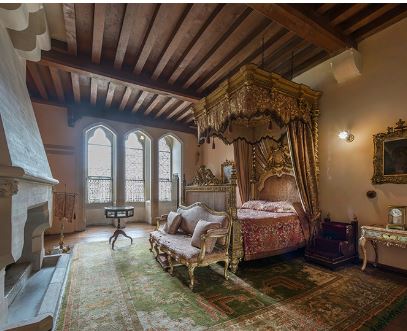
The male voice was hoarse, stertorous, angry almost. “You have left us this our spirit and strength entire strongly to suffer our pains that we my so suffice his vengeful ire, or do him mightier services as his thralls by right of war, whatever his business be here in the heart of hell to work in fire, or do his errands in the gloomy deep; what can it then avail though yet we feel strength undiminished, or eternal being to undergo eternal punishment?” Mrs. Winchester instantly went to sleep—chilling testimony to the control the demon had over her. When she awoke, she was clean, in her sleeping gown, and in her bed. However, it was with the possibility, and the hope, that the end of her long ordeal might well be in sight. Little of the fast-fading sunlight entered the house through the windows, many of which were partly or entirely covered with drapes. However, it was bright enough for Mrs. Winchester to see that the French Provincial sofa’s upholstery was slashed. Shredded wool spilled onto the floor. A solid oak bookcase had been hammered to pieces against the wall, gouging holes in the lath and plaster walls, running the Lincrusta-Walton Wallcovering. Her silver tea service has been smashed, along with a floor lamp. Books had been taken off the shelves, torn apart, and scattered across the living room. Mrs. Winchester lit a candle. It did not shed much light, just enough to reveal more details of the rubble. Looks like somebody went through here with a wrecking ball and scissors, she thought. The house remained silent. Leaving the door open behind her, she took a couple of steps into the room, and the crumpled pages of the ruined books crunched crispy underfoot. She noticed the dark, rusty stains on some of the paper and on the bone-white foam wool stuffing, and suddenly she stopped, realizing the stains were blood. A moment later, Mrs. Winchester spotted the corpse. It was that of a big man, lying on his side on the floor near the sofa, half-covered by gore-smeared book pages, book boards, and dust jackets. Zip’s growling grew louder, meaner. Moving closer to the body, which was just a few feet from the dining-room archway. Mrs. Winchester remembered that John Hansen had lately been making repairs, including a leak faucet and a broken door lock. #RandolphHarris 12 of 13

However, Mrs. Winchester thought because of the way the room looked, he had been killed weeks ago. Her house was so big that it would often take weeks, months, and sometimes years to get around it. Yet, on closer inspection, the corpse proved to be neither bloated with the gas of decomposition nor marked by any signs of decay, so it could not have been there for very long. Perhaps only a day or less. The body had been disemboweled. Zip’s low growling gave wat to ugly snarling punctuated with hard, sharp barks. With a nervous twitch and a sudden pounding of her heart, Mrs. Winchester turned from the corpse and saw that zip was facing into the nearby dining room. The shadows were deep in there because the drapes were drawn shut over all the windows, and only a thin gray light passed through from the kitchen beyond. “Go, get out, leave!” an evil voice told her. It was certainly not the voice of Mr. Hansen. Something in the dining room was moving. There was no doubt of its presence, because it rushed out onto the dining-room tables, and came straight at Mrs. Winchester, emitting a blood-freeze shriek. She saw lantern eyes in the gloom, and nearly a man-sized figure that—in spite of poor light—gave an impression of deformity. Then the demon was coming off the table, straight at her. I Do conjure thee, O Spirit Focalor and your legion of thirty spirits to manifest your spiritual weapon in this corporeal World through my will and might! Empower it so that it may serve me here upon the corporeal plane! May it serve as a key to the realms above and below unlocking power and wisdom for my glory and ascent! Fill this weapon with your powers of wrath and fury that it may seek out spiritual attacks made toward me rendering them useless and impotent! I DO conjure thee Spirit Vephar, pierce the Heavens and cause the seas to be right stormy to cleanse the Earth of sin. Spirit Vizaresh, I DO conjure thee to drag sinful souls into hell, noosing them with the power of their own sins. May the snare be the power of their own evil, words, thoughts, and deeds and let this be you will to drag unwilling souls into Hell. May this cord gain its power through one’s practical application of evil principles. #RandolphHarris 13 of 13

Winchester Mystery House
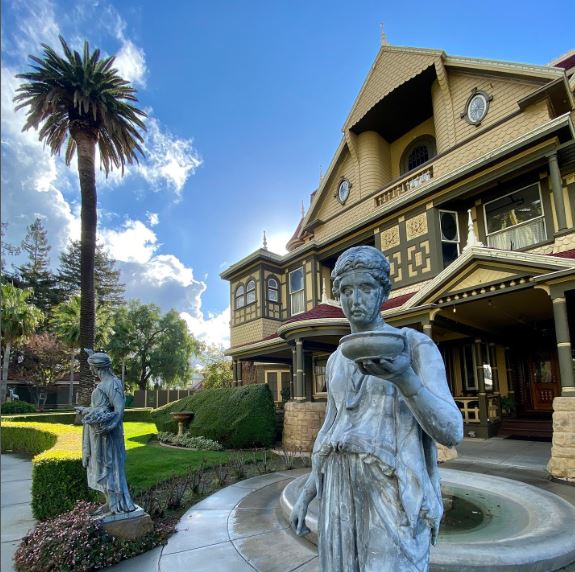
Happy Sunday! House tours 10am-5pm today 🏠 come see us!
🎟️ link in bio. https://winchestermysteryhouse.com/

Mrs. Winchester never recovered from the 1906 earthquake. Staff said she grew weaker and weaker as the years went by, and that she was often heard talking to her dead husband. The house was already large, but it morphed to be as long as several city blocks and was taller than the tallest trees on the green lawn. I suppose, ultimately, it was the spirits who kept her in this estate by not allowing her to build another one of this magnitude. When Mrs. Winchester passed away in 1922, she left $5,000,000.00 to charity. The mansion is truly special and a national treasure.
 Randolph Harris II International Institute