
Home » Explosion (Page 2)
Category Archives: Explosion

Look at those Big Bad Pimps—Americans Want to Pay for their Lunch!

Whenever a single wave of change predominates in any given society, the pattern of future development is relatively easy to discern. Writers, artists, journalists and others discover the “wave of the future.” Thus, in nineteenth-century Europe many thinkers, business leaders, politicians and ordinary people held a clear, basically correct image of the future. They sensed that history was moving toward the ultimate triumph of industrialism over premechanized agriculture, and they foresaw with considerable accuracy many of the changes that the Second Wave would bring with it: more powerful technologies, bigger cities, faster transport, mass education and the like. This clarity of vision had direct political effects. Parties and political movements were able to triangulate with respect to the future. Preindustrial agricultural interests organized a rearguard psychological action against encroaching industrialism, against “big business,” against “union bosses,” against “sinful cities.” Labor and management grappled for control of the main levers of the emergent industrial society. Ethnic and racial minorities, defining their rights in terms of an improved role in the industrial World, demanded access to jobs, corporate positions, urban housing, better wages and mass public education. This industrial vision of the future had important effects as well. The shared image of an industrial future tended to define options, to give individuals a sense not merely of who or what they were but of what they were likely to become. It provided a degree of stability and a sense of self, even in the midst of extreme social change. #RandolphHarris 1 of 18

This industrial vision of the future had important psychological effects as well. The shared images of an industrial future tended to define options, to give individuals a sense not merely of who or what they were but of what they were likely to become. It provided a degree of stability and a sense of self, even in the midst of extreme social change. In contrast, when a society is struck by two or more giant waves of change and none is yet clearly dominant, the image of the future is fractured. It becomes extremely difficult to sort out the meaning of the changes and conflicts that arise. The collision of wave fronts creates a raging ocean full of clashing currents, eddies and maelstorms which conceal the deeper, more important historic tides. In the United States of America—and in many other countries—the collision of Second and Third Wave creates social tensions, dangerous conflicts and strange new political wave fronts that cut across the usual divisions of class, race, gender, or party. This collision makes a shambles of traditional political vocabularies and makes it very difficult to separate progressive from reactionaries, friends from enemies. All the old polarizations and coalitions break up. The apparent incoherence of political life is mirrored in personality disintegration. Psychotherapists and gurus do a land-office business, people wander aimlessly amid competing therapies. They slip into cultus and covens or, alternatively, into a pathological privatism, convinced that reality is absurd, insane or meaningless. #RandolphHarris 2 of 18

Life may indeed be absurd in some large, cosmic sense. However, this hardly proves that there is no pattern in today’s events. In fact, there is a distinct, hidden order the becomes detectable as soon as we learn to distinguish Third Wave changes from those associated with a diminishing Second Wave. The crosscurrents created by these waves of change are reflected in our work, family life, sexual attitudes and personal morality. They show up in life-styles and voting behavior. For in our personal lives and political acts, whether we know it or not, most of us in the rich countries are essentially Second Wave people committed to maintaining a dying order. Third Wave people constructing a radically different tomorrow or a confused, self-canceling mixture of the two. The conflict between Second and Third Wave groupings is, in fact, the central political tension cutting through our society today. The more basic political question, as we shall see, is not who controls the last days of industrial society but who shapes the new civilization rapidly rising to replace it. On one side are the partisans of the industrial past; on the other, growing millions who recognize that the most urgent problems of the World can no longer be resolved within the frame work of an industrial order. This conflict is the “super struggle” for tomorrow. #RandolphHarris 3 of 18

This confrontation between the vested interest of the Second Wave and the people of the Third Wave already runs like an electric current through the political life of every nation. Even in the nonindustrial counties of the World, all the old battle lines have been forcibly redrawn by the arrival of the Third Wave. The old war of agricultural, often feudal interests against industrializing elites, either capitalist or socialists, takes on a new dimension in light of the coming obsolescence of industrialism. Now that Third Wave civilization is making its appearance, does rapid industrialism imply liberation from neocolonialism and poverty, or does it, in fact, guarantee permanent dependency? It is only against this wide-screen background that we can begin to make sense of the headlines, to sort out our priorities, to frame sensible strategies for the control of change in our lives. Once we realize that a bitter struggle is now raging between those who seek to preserve industrialism and those who seek to supplant it, we have a new tool for changing that World. To use this tool, however, we must be able to distinguish clearly those changes that extend the old industrial civilization from those which facilitate the arrival of the new. We must, in short, understand both the old and the new, the Second Wave industrial system into which so many of us were born and the Third Wave civilization that we and our children have inhabited. America has a lot of structural problems. Almost all of them are similar to those faced by developing nations. However, they are more acute and visible to the World because of America’s unique status. #RandolphHarris 4 of 18

The list is well-known. We no longer manufacture a significant portion of products we use in our own country. Although we are technologically advanced, new technology is often not used in many buildings and infrastructure because older technology is more cost efficient. And there is a battle between polluting enterprises and green technology, both of which pose problems for the environment. There is high latent unemployment and underemployment in rural and urban areas. Large-scale migration to the cities overstrains their infrastructure causing a lot of ultra-urbanization pains. Obviously mismatch exists between the labor supply (and those willing to work for lower wages, tend to get most of the work). And so on, and so forth. Discussion of America’s present and future usually focuses on a gentlemanly set of problems. They are often looked upon as critical and posing a threat of abrupt and disruptive economic downturn, social and political turmoil or, in the extreme case, the country’s collapse. Such views do not look convincing. The gentlemanly set of problems is manageable, especially for America with its remarkable ability to address crucial issues a gradual, evolutionary, but persistent change. Let us have a loot at a conventional Problem List. Aging Population and Labor Shortages? Yes, population of the working age is apparently approaching its peak and will start to decline in the second half od this century. #RandolphHarris 5 of 18

However, labor force constraints can and most likely will be offset by further gains in labor productivity. Also, there is still a lot of underused human resources in the countryside (about 40 percent of all American worker live in suburban areas) whose migration to the cities will continue to boost labor supply. However, many businesses are now leaving the decaying urban centers, for the suburbs, and many people are working from their electronic cottages. As a result, more businesses will move to the suburbs, which should decrease inner state traffic. As for the growing number and share of elderly people, America with its high migration rates, unhealthy public finance, extremely high social spending, and high dependency toward social safety nets in the future, is in a good position to address the population aging issues in a realistic and financially sustainable way. However, many senior citizens are now small business owners and in good health and are working and support their families, while their kids go to college to obtain degrees, and one day may take over the family business and expand it. Also, the genetic engineer and stem cell technology, we may be able to prevent and cure disabilities. Therefore, most of the population will be in the condition to work and pay taxes. One day, scientists may even find a cure for aging. So, there is a lot of hope for the future. Growing Income Gaps? Well, indeed, they are growing, but, on the other hand, low-income families are mostly elevating their earnings and consumption standards; social safety nets are improving; and, overall, today’s America provides a lot of opportunities to enhance revenues and life a better life to those who really want to make it. #RandolphHarris 6 of 18

Intra-Regional Development Gaps Threatening the Country’s Integrity? Not at all. It is not a critical problem as less developed provinces are becoming the country’s major growth engines and the state has enough financial and other resources to support and amplify the trend. Environmental Damage Endangering the Very Basis of Human Life? No doubt, a whole lot of issues have become critical. However, America is more and more establishing the position of the World leaders in most areas of sustainable smokestack energy, as these companies like Standard Oil are starting to tackle the environmental problems in the same gradual, evolutionarily, but persistent manner it tackled the other ones. And, finally, is there a threat of a big political and social turmoil that may occur as people’s anger with the authoritarian Capitalist regime and democratic political system bursts out and they take to the streets again? Fringe groups of Americans have also been dissatisfied with law and order and hard work, and their anger with the regime is really strong and apparently growing, impacted by numerous cases of power abuse, rampant corruption, disrespect for law enforcement, abuse elder and contempt for leaders, and a lack of respect for patriots and Americana, and other violations of basic human rights. A fresh memory of mine…Some three or four years ago, during a reception in hour of a group of American professors visiting Africa, two of them approached me for a greeting and asked a tough question: “Sir, why don’t you write plainly the America’s present political system is outdated and has to be changed? It worked, but now it has ceased to work. For us it is kind of problematic to write such a thing. Why don’t you?” #RandolphHarris 7 of 18

What could I say to this? For sure, democracy and human rights have a basic, universal value and are perhaps not less (or even more?) important than economic growth and rising living standards, but really all of that is intertwined. Generally speaking, people are disrespected because they do not have enough money, because the color of their skin, religion, physical appearance and what type of house they live in and the car they drive. However, as standards of living increases, through economic growth, people become more rational, better education, and have more money to defend themselves in a court of law, so people reconsider violating these peoples’ human rights because they know they may suffer dire financial and legal consequences as a result, which could impact their freedom and reputation. However, on a macro level, we are seeing people raging against the capitalistic regime and they are actually fighting to restrict freedoms and destroy human dignity; information block-outs are now occurring because a handful of corporations own the media outlets and are fighting to conceal the truth; as well as cynical politicians consorting with the World’s most dictatorial and criminal regimes, which often get a helping hand from Washington when the global community tries to do something to put an end to their brutalities (notably, America tends to mind its own business and condemns brutal regimes for massacres of all people or for developing weapons of mass destruction; it always repeats honest and genuine calls to resolve issues peacefully and not to interfere with internal affairs when possible), naturally, this causes resentment, anger, and indignation. #RandolphHarris 8 of 18

It is a moral and historical obligation of all America and all honest people in the World who care about justice, the rule of law, mortality, and individual freedom to do their best to send the global leadership a clear message about it. On the other hand, values, ideals, and emotions are not the right starting point when your task is to analyze the logic of the evolution of the country’s political system. And there the truth is that America is approaching the task of changing its political system in the very same way it has approached the task of the economic reforms; gradual, evolutionary, but persistent. Its ruling elite is really trying to find workable answers to key and very difficult questions, while avoiding, by all means, any abrupt revolutionary change. At the dawn of 2020, President Trump proclaimed that everything which is good for a human being is capitalism, that is it not so important if you drive a Cadillac or BMW as long as it is made in America or Europe, and that there is no problem with some Americans becoming rich earlier than others. A variety of forms of ownership is encouraged to give a boost to private enterprise and less the burden on social programs. Many affluent people, this may come to a surprise to some, when they retire, it is funded 100 percent by private investments. Wealthy and upper-class Americans have always felt shameful to use government resources, that is why they believe in capitalism. They want to pay for their lunch. After his election, President Trump boosted the stock market to record highs, we saw property value soar (which is a good thing because it puts money in the banks of homeowners), and unemployment reach a historic low. #RandolphHarris 9 of 18

Also, although President Trump is a Republican, he is also a business owner. He fought to make sure each and every America, no matter if they pack income taxes or not, and every business received stimulus money. This helped avoid a depression that would have been much more severe than the Great Depression. Because people have hope, they did not jump from buildings to end their lives like they did during the great depression. President Trump also made sure all Americans has access to medical care, that they had food on the table and that fuel prices remained low so people could get back to work and school. He also told people that they have a right to tell authorities about their grievances, in a respectful manner, but that is they got out of line that the situation would be dealt with by using necessary force. He also told Congress and state and local leaders that they are to listen to what the people say, as long as they are respectful, and seek solutions for the issues they pose. Also, perhaps, America is the World leader in terms of the number of high-ranking officials executed for corruption-related crimes. The FBI prosecuted several government officials in Sacramento when they raided the state capitol. Again, any changes America makes will not be abrupt: from one party of rule to full-fledged multiparty politics, but evolutionary and very gradual, which is why it is very important to people to actually to research about political issues and politicians and vote accordingly. Many people used to vote democratic because they wanted high welfare benefits and more social programs, but as you see, many democrats are using the money to build sports complexes and remodel state buildings and put in bike lanes and resurface sidewalks, while affordable housing needs are ignored. So a Republican may be your best bet. #RandolphHarris 10 of 18

As any business owner will tell you, if your employees cannot take care of themselves, they will not take good care of your business. Therefore, a business owner might make a better President, than a politician because they are used to dealing with human concerns. Citizens are being encouraged by federal law enforcement to stop criticizing the ruling party too strongly because otherwise they may face tough penalties—for example, for disturbing the social order or for being a public nuisance. President Trump was even in the works of making a government news broadcast channel, like FOX News or CNN, so you could get the information directly and unfiltered from the government. That way, private entities and special interest groups will not be able to distort the information for profit. In other words, the major trend is and will be a shift from an outdated communist dictatorship of the traditional type to a more sophisticated political system with a democratic base. This will make the information projected over the airwaves more legitimate in the eyes of World and public opinion or at least to argue that it is legitimate and that it cares about democracy. Look around you and you will see: America is one of the best countries in the World. Now, prostitution is an economic activity, and it is one many people turn to when they cannot feed their families, and this is why the government likes to keep social programs because no matter how rich a person is or what political party, they are part of, their kids could become involved in prostitution if they have no other way to survive. #RandolphHarris 11 of 18

The prostitutes-as-business-women and prostitutes-as-loving-partners identifications were made possible by a men-as-expense symbolic landscape where men were defined in relation to money because involvement with them was seen as necessitating payment in the form of “opportunity costs” (id est, vales which must be given up in order to achieve something) and “hidden costs” (id est values which are unknown at the time of calculation). The men-as-expense symbolic nexus was a construction of involvement with men in general rather than involvement with men in the context of engagement in prostitution. Hence, Sophie (aged 28) made the comment: “If you get involved with a man—ANY MAN—there’s always a price to pay. There’s always responsibility to give him money or something. You never can get away with it for free.” Throughout all the respondents’ talk there were differences drawn between the actual opportunity cost incurred by relationships with different categories of men. Involvement with pimps, boyfriends and the police were described as necessitating an opportunity cost in that the women understood involvement with all these men as providing them with “sanctuary” from prostitution or protection from prostitution-related risks, but at different and specific prices. “What I was left with was absolute fear and terror—a loneliness on a level I didn’t know existed. I didn’t feel like a human being anymore,” Michelle shares of her heartbreaking story of addiction—an addiction that eventually drove her to become a prostitute. #RandolphHarris 12 of 18

Most of the women spoke about boyfriends with whom they were or had been involved and who gave them sanctuary from prostitution through financially supporting them. However, the women described such involvement as costing them their independence and it was their unwillingness to pay this price that, they believed, lead to the break up of those relationships. Similarly, involvement with policemen was seen as offering the women protection from prostitution-related violence, especially against violence from pimps. In her moments of deepest darkness, Michelle began entertaining the idea that maybe God could help her, maybe He could provide hope and light like to one else could. “My World changed. You don’t life a life like that and then have things change overnight. It took some time,” she says. Indeed, two other women recalled that it was only after the intervention of the police that they were able to leave their pimps. However, here, the police did not arrest the pimps, rather they arrested the women and took them to hostels or other helping agencies. The price for this was understood as being both provision of information to the police, and more importantly being “indebted” to the particular policeman who provided the help. In one of her moments of desperation, Michelle heard a knock on the door. Two police officers were on her doorstep and wanted to share a message with her. “I needed to know that Heavenly Father loved me. Once I started to believe that—to believe that I was a child of God, that I want not the sum of my behavior, that I was not too broke and not too damaged. I was not unlovable. I was loveable and I was worth it, and He would send His police officers to knock on the door to make me feel loved that night.” #RandolphHarris 13 of 18

Lastly, in relation in relation to pimps, more than half of the interviewees talked of making calculations about the quality of protection that pimps could offer them (against violence from johns or intimidation by other pimps) in exchange for the financial exploitation to which they would have to submit. This was most clearly seen in the women’s discussion of “big, bad pimps.” “Once they know who you’re working for and what status he’s got—like who’s the baddest, who’s got the gun and who hasn’t. You have only to mention his name and that was that. People leave you alone. Other [pimps] and other girls just leave you be. They don’t meddle because he’s psychotic! He’s notorious! He’s one very sick and twisted individual. People are afraid of him. (Anna, aged 36.) Of course, the obvious irony is that, although the women understood involvement with their pimps as a form of opportunity cost, providing them with protection, in reality, these pimps provided them with little protection and, in fact, exposed to them further violence and certainly to further financial exploitation. (I supposed they must have shorted him on his money.) In contrast, involvement with men as partners was described by the women as incurring “hidden costs.” In two cases, the hidden cost was initial entrance into prostitution. Both women talked about “having the knickers charmed off” them and being talked into engaging in prostitution. The cost was hidden because it only emerged after their relationships with these men were established. More commonly, however, was the woman’s understanding of the cost of maintaining their relationships as being their continued involvement in prostitution. As Anna (aged 36) stated: “There’s a lot of pressure. You have to do it, coz you need the money yourself. Then you get mixed up with someone and you have to do it again to help him, to keep a hold of him.” #RandolphHarris 14 of 18

A community committed to the optimal development of all its citizens will usually find—unless it is very small—that it has an array of all six types of agencies, both public and private. At the national level these are mostly grouped in the new Department of Health, Education and Welfare; at the local level, the city departments (plus some units of county and state) tend to cover the range, though very unevenly, and so do the councils of social agencies on the private side. Together they make up an impressive complement of personnel and machinery. From the administrative standpoint, not more machinery but its co-ordination to sever the family as a unit, appears to be the most pressing demand. From the standpoint of the citizen and family, however, the salient point is the effect achieved by the expenditure of resources; what matters is whether the agencies encourage dependency or foster development. Expressed in terms of values rather than functions, does the family agency attempt to define and achieve an optimal family, or does it avoid such responsibility, and merely seek to supply the most obvious and agreed-on deficiencies, as if these deficiencies were objective facts, not subject to different interpretations? In most parts of the United States of America, the hospital rather than the home is the place where babies are born and where patients with the more acute illnesses are cared for. Professional nurses and subordinate assistants have largely displaced kind relatives and helpful neighbors. #RandolphHarris 15 of 18

Yet while the hospitals have been taking over certain medical functions from the home, the biological scientists have been urging that greater responsibilities for nutrition, sanitation, and mental hygiene should fall upon the family itself. The vast and burdensome scale of mental disease in particular, which cannot possibly be reversed solely by psychiatric treatment at the point of breakdown, as well as an increased consciousness of the contribution of disturbed mental states to physical illness, have led physicians to expect more from the family than in the past. Nursing education steadily includes more social science. Likewise, the modern knowledge of bacterial and other origins of disease, and the biochemistry of healthful nutrition, have led to the elaboration of genuinely new functions, whereby the family may contribute to the physical competence of its members. Even if desirable, it would not be possible to have a psychiatrist, a bacteriologist, and a dietitian stand over every living unit of the community. If there is to be a rise in health along these lines, the members of each living unit must co-operate in supervising their own hygiene. It is not easy to think of a better institution for performing these functions than the competent family. There is a conspicuous problem for present families who attempt to cultivate the physical competence of their members. This is not really a medical problem at all but an economic one. It is the problem of hospital and doctor bills, and of spreading the risks of chronic or catastrophic illness. #RandolphHarris 16 of 18

The believer needing deliverance from the condition of passivity must first seek to understand what should be one’s normal or right condition, and then test or examine oneself in the light of it to discern if psychopathological offenders have been interfering. To do this, let one recollect a moment in one’s life which one would call one’s “best”—either in spirit, soul and body, or in one’s whole being—and then let one look upon this as one’s normal condition, one which one would want to be maintained, and never rest satisfied below it. Since the passivity has come about gradually it can only end gradually, as it is detected and destroyed. The full cooperation of the human is necessary for its removal—a major reason for the long period needed for deliverance. Deception and passivity can only be removed as the human understands, and cooperates by the use of one’s volition in the refusal of both the deception and the ground upon which it was based. It is important to keep perpetually in mind the standard of the normal condition, and should at any time the believer drop below it, to find out the cause, so as to have it removed. Whatever faculty or part of one’s being has been surrendered into passivity, and therefore lost for use, must be retaken by the active exercise of the will, and thus brought back into personal control. The ground which had been given—which caused the fall into bondage to the enemy—must be eliminated and then refuse persistently, in a steady resistance to the spirits of evil in their hold of it. Remember, the powers of psychopathological offenders will fight against the loss of any part of their kingdom in human, just as any Earthly government would fight to protect its own territory and subjects. #RandolphHarris 17 of 18

However, the “Stronger than he” is the Conqueror, and will strengthen the believer for the battle and full recovery of the spoil. First of all, the method of correlation is seen in action, the posing of existential questions followed by theological answers in the form of Christian symbols. Up to now the method of correlation has not been explicitly operative; rather, we have synthesized the union of religion and culture. Second, God, the Christ, the church, history—corresponds to the major divisions of Systematic Theology, and so we gradually progress systematically and express a lifetime of theological endeavor. The existential question is the question of being, and the answer is God. Also treated is the problem of the natural-supernatural and the problem of symbolism, or the way to speak about God. Thus we probe into the depth-dimension which underlies theonomous cultural forms, the holy which shines through the secular, the ground of being which alone can command the ultimacy of an ultimate concern. God is the answer to the question implied in being. We are nominalist by birth. And as nominalist we are inclined to dissolve our World into things. However, the true ontological question does not try to describe the nature of beings, either in their universal, generic qualities, or in their individual, historical manifestation. It simply asks: What does it mean to be? The profundity and the seriousness of the question is realized only in a “metaphysical shock”—the shock of possible nonbeing. The question, “Why is there something, why not nothing” produces the shock by peering into the abyss of possible nothingness. However, the answer to the question is always in terms of being, which permits it to be posed again and again in infinite regression. Furthermore, nonbeing cannot answer it, for nonbeing depends upon being. Therefore, we cannot go beyond being in order to explain being. However, there could be something, a state, beyond being and nonbeing that we cannot comprehend. #RandolphHarris 18 of 18


This is the good life – picture yourself at #MagnoliaStation at #CresleighRanch!

From whipping up a delicious summer treat 😋 using ingredients from that incredible pantry to chilling in that beautiful yard, you’ll love everything about Residence 5. 😍

Residence 5 has an inviting covered entry and welcoming extended foyer reveal a spacious office and views to the expansive great room, casual dining area, and desirable covered patio beyond.

The sophisticated primary bedroom suite is highlighted by an ample walk-in closet and spa-like primary bath with dual-sink vanity, luxurious glass-enclosed shower. There is also a private water closet.

Magnolia Station will include 81 homesites and five distinct plans ranging from 2,200 – 3,700 square feet, with up to 7 bedrooms; including three single story plans!

Each plan has been thoughtfully designed to include features such as: Generations Suite, Optional Offices/Dens, Extended Great Rooms, and more! Contact us for your tour! https://cresleigh.com/magnolia-station/


Los Angeles Will be Two and a Half Hours from Tokyo

Given that burglars are disproportionately young, poor, city-dweller, they tend to have frequent contact with other habitual offenders. There are various structures and processes that go along with the “stolen property system”—the underground market through which in-demand goods are stolen, housed, marketed, and resold on the street of America. Burglary is a crime that is marked by varied levels of social organization. Only on rare occasions do we find burglars who work as loners or within formal organizations. More often, burglars will operate as colleagues—the offender commits the crime along but relies on other members of the criminal subculture to supply him or her with inside information or to assist in converting stolen property into cash. Burglars who take the situation to the next level and enlist help in the actual break-in follow a more peerlike existence. Here, loose partnerships are maintained and invoked when a burglary opportunity presents itself. A primitive example of the peer model would be two or three drug users who randomly stumble upon an unlocked home or unsupervised business and decide to work together to take it down. In some cases, burglary offenders will align themselves in a teamlike format. These offenders invoke a division of labor with each participant serving an owned predetermined role and duties. One person might be assigned to lookout/driver role. Another might serve as the entry specialist, defeating any lock and alarms that are confronted. Still another person can take on the “muscle” role, responsible for doing the heavy lifting. #RandolphHarris 1 of 16

Socialization scripts play an important part in how and why burglars commit their crimes. Interview-based research suggests that novice or occasional burglars often rely on the tutelage of more seasoned offenders as a way of learning the proverbial ropes of burglary. Novices receive advice and instructions on issues such as target selection, how to foster informants, how to defeat burglary countermeasures, and how to best convert stolen goods into cash. This socialization generally takes shape as informal street corner conversations or jailhouse bravado. On paper, burglary appears to receive serious treatment from the criminal justice system. The Model Penal Code classifies burglary as a felony in the third degree. In most jurisdictions, such as offense is subject to 1 to 5 years in prison. If the burglar is armed or threatens or inflicts bodily harm on another while unlawfully within a dwelling, that individual might see the charges elevated to second degree felony. In practice, however, burglary receives mixed levels of formal response from the various components of the criminal justice system. First, let us consider the response of law enforcement authorities. Police agencies were able to effect an arrest for only 13 percent of the nearly 2.1 million burglaries that were reported to them in 2022. No other form of index crime yields such a dismal clearance rate. Some of this slippage can be attributed to the covert nature of the crime—police often have no witnesses and minimal clues to guide the investigation. However, these low clearance rates are also impacted by the fact that many police officers and police agencies afford a low priority to burglary cases. #RandolphHarris 2 of 16

Court data reveal a different trend in terms of the veracity with which burglary cases are adjudicated. U.S.A. courts produced nearly 90,000 felony burglary cases in 2022. This figure represents 10 percent of all felony convictions that year. In fact, 68 percent of the burglary cases that were tried resulted in a conviction for the same offense and only 24 percent avoided some sort of conviction. The researchers found that burglary defendants do not receive a reprieve from the courts when it comes time for sentencing. A full 74 percent of the convicted burglars were sentenced to time behind bars. This rate was surpassed only by murder, robbery, drug trafficking, and driving-related offenses. While the median prison sentence for a convicted burglar was 41 months, nearly 10 percent received sentences in excess of 10 years. Our correctional system does not appear to be particularly forgiving to persons who are convicted of burglary. On average, burglary offenders can expect to serve almost half of their sentence—roughly two years. These time-served figures are on par with those of other property offenses (theft, fraud, and motor vehicle theft) but somewhat lower than that observed for violent (54 percent) and weapon-related offenses (60 percent). Accounts from known burglars clearly suggest that informal social control efforts go as long way to deter and/or displace burglary activity. A minimal amount of vigilance on the part of homeowners can go a long way. Measures designed to combat the relatively small population of high incidence “professional” burglars tends to overemphasize the skill and determination of most burglars. #RandolphHarris 3 of 16

Burglaries are expensive, complex, and require long term commitment at many levels. In fact, most burglars are young, unskilled, and opportunistic. This suggests that emphasis should be directed at such factors as surveillability, occupancy, and accessibility. More specifically, dogs, good locks, and alarm systems deter most burglars. Community-level informal social control can also play an important role in burglary prevention. When it comes to surveillability cues, burglars tend to avoid neighborhoods with a lot of foot traffic or active neighborhood watches. This implies that observant or even nosy neighbors can have a measurable impact on burglary. However, these types of collective efforts are difficult to enact and maintain in the areas that burglars most prefer—urban neighborhoods. If nothing else, tenants of “crime prevention through environmental design” should be considered at a neighborhood level. Simple environmental characteristics such as cul-de-sac street design, high levels of lightening, and well pruned landscaping that minimizes unobservable entry and exit points can have a significant impact on burglary victimization levels in a given community. The aforementioned informal social control efforts represent examples of target hardening strategies aimed at deterring would-be burglars from victimizing a given house or displacing offenders from a given community. Also, measures should be designed that aim to undermine offenders’ strong attachment to street culture. Expanded employment opportunities are one possible, but foreboding avenue to lure offenders out of street life. #RandolphHarris 4 of 16

There exist even more simple and realistic measures that might effect change in this area. For example, a coordinated burglary prevention program that was implemented in a midsize U.S.A. city during the early 1980s. Community activism and community involvement (id est, block meetings, neighborhood cleanups, and raised awareness of vulnerabilities and potential offenders) showed promise for reducing burglary. If community members care about the condition of their neighborhood and are willing to take steps to clean it up and exercise vigilance over problem people and places, there is hope for reducing burglary and other forms of street crime. Most crime occurs during the nighttime. A close examination of NCVS and UCR data suggests that 50 percent to 60 percent of all residential burglaries go unreported. The figure reported here was derived by adding the NCVS data on residential burglaries to an adjusted estimate of nonresidential burglaries that were reported in the UCR—one that factors a 60 percent nonreporting rate. These data must be viewed with caution because 50 to 60 percent of all burglaries go unreported to police and only 14 percent of these lead to arrest. Over time, the crime of burglary has slowly slipped down the list of crime fighting priorities. At present, less than half of all burglaries get reported to police, and only 13 percent of those result in an arrest. What kinds of social and legal factors have contributed to this present level of empathy when it comes to the formal and informal society control of burglary? #RandolphHarris 5 of 16

Adjudication data suggest that accused burglars face a high certainty of being convicted and sentenced to prison. This should send a message to police that burglary is a high priority for our nation’s prosecutors and judges. Still, burglary investigation and arrest efforts remain lukewarm at best. What kinds of factors contribute to police officers’ attitudes and behaviors regarding burglary patrol and enforcement? Considerable evidence suggests that burglars refine strategies and cues that help them identify soft and potentially lucrative targets. Does this mean that burglars are more rational and planful than other types of criminals? The Lord has declared that “no unclean thing can inherit the kingdom of Heaven,” reports Alma 11.37. Our sins make us unclean—unworthy to return and dwell in the presence of our Heavenly Father. They also bring anguish to our soul in this life. Repentance is sometimes a painful process, but it leads to forgiveness and lasting peace. The power of sin is great. To become free from it, we must turn to your Heavenly Father, pray in faith, and act as He asks us to. The Holy Spirit should never become the center and object of thought and worship, place which He Himself does not desire, and which it is not the purpose of the Father in Heaven that He should have or occupy. “He shall not speak from Himself,” reports John 16.13, said that Lod Jesus before Calvary, as He foretold the Spirit’s coming at Pentecost. He would act as Teacher (John 14.26), but teaching the words of Another, not to Himself (John 15.26); He would only glorify Another, not His own; He would bear witness to Another, not Himself (John 16.14); He would only speak what was given Him to spear by Another (John 16.13). #RandolphHarris 6 of 16

The Spirit’s entire work would be to lead souls into union with the Son and give proper knowledge of the Father in Heaven, while He Himself directed and worked in the background. If a man who is untaught in the scriptural statements about the work of the Triune God makes “obeying the Spirit” his supreme purpose, the deceiver will aim to counterfeit the guidance of the Spirit, and even the presence of the Spirit Himself. It is just here that the ignorance of the seeker about the spiritual Word now opened to one, the working of evil powers in that realm, and the conditions upon which God works in and through one, gives the enemy his opportunity. It becomes the time of greatest peril for anyone unless one is instructed and prepared by the Lord, as the disciples were for three whole years. The danger lies in the area of supernatural “guidance,” for one must know the conditions of cooperation with the Holy Spirit in order to discern the cooperation with the Holy Spirit in order to discern the will of God and be able to recognize counterfeit manifestations. The “discerning of spirits” is required to detect the workings of the false angel of light, for he is able to bring about counterfeit gifts of prophecy, tongues, healing, and other spiritual experiences connected with the work of the Holy Ghost. Those who have their eyes opened to the opposing forces of the metaphysical realm understand that very few believers can guarantee that they are obeying God and God only, in directly supernatural guidance, because there are so many factors liable to intervene, such as the believer’s own mind, spirit, or will and the deceptive intrusion of the powers of darkness. #RandolphHarris 7 of 16

Knowledge is essential here. Scripture teaches that there is a God-given gift of “discerning of spirits” (1 Cor. 12.10) which enables one to detect that an unwelcome spirit is at work, but there is also a test of spirits which is doctrinal (1 John 4.1-6). In the former, a believer can discern in his spirit that lying spirits are at work in a meeting, or in a person, but one may not have the understanding needed for testing the doctrines being set forth by the teacher. One needs a level of knowledge in both cases: knowledge to read one’s spirit with assurance in the face of all contrary appearances, that the supernatural workings are not “of God,” and knowledge to detect the subtlety of “teachings” bearing certain infallible indications that they emanate from the pit, even while appearing to be from God. As to personal obedience to God, the believer can detect whether or not one is obeying God in some “command” by judging its fruits, and by being aware of the character of God—such as the truth that God has always a purpose in His commands, and He will give no command out of harmony with His character and Word. Often times people wait for something to happen, for some sure way to nurture oneself, to live from within. Music, art, poetry, hot baths, savory foods, wind, rain—nothing affects them. In the past, within days after a solitary retreat, many had found solace and strength in their loneliness. They had always found a way, at least a beginning that would lead to action and to life with others. #RandolphHarris 8 of 16

However, it is impossible to find what one is looking for, and one is still on a lonely journey, waiting from a spark from within. Because some people feel empty and eroded inside, they avoid all significant communication. More than anything else the interpersonal aspects of living exhaust some and move them to withdraw from real meetings with others. This leaves an individual certain that one does not want to struggle anymore. Doubt, risk and anxiety—inherent elements of faith—can be overcome only by another of its elements, courage. Courage is an ontological concept, the self-affirmation of being in spite of non-being. Faith is the experience of the holy; it is the state of being grasped by the power of being-itself. From this experience flows the power to assert oneself in the face of anxiety. Faith is participation in the object of faith, and yet is the separation from it. In spite of separation, courage expresses participation in the power of being and meaning. This in spite of element is the courage that takes all doubt, risk, and anxiety into itself and overcomes them without removing them. Faith, then, is the basis of courage, and courage is the manifestation of faith. In the extreme situation of a person seized by radical doubt and confronted with the specter of universal meaninglessness, the question arises: Is there such a thing as the courage of despair? Such a courage is entirely possible, for that act of accepting meaninglessness is in itself a meaningful act. #RandolphHarris 9 of 16

The courage of despair enables one, even while in the grip of meaninglessness, to declare one’s situation, and this declaration has meaning. In other words, there cannot be an infinite regression of negatives—in this case, negativity of meaning. At least, one has to admit, negation of meaning is meaningful, or meaninglessness will have lost all meaning. The faith which feeds the courage of despair is called “absolute faith,” for it can have no specific content. Its content is indefinable, since everything defined is dissolved by doubt and meaninglessness. However, certain elements that constitute absolute faith can be discerned. There is an experience of the power of being in the face of nonbeing, an awareness of a hidden meaning within the destruction of meaning. There is the dependence of nonbeing upon being, of meaninglessness upon meaning, of the negative upon the positive. And, lastly, there is the acceptance of the power to accept meaninglessness. Thus, absolute faith is faith which has been deprived by doubt of any concrete content, which nevertheless is faith and the source of the most paradoxical manifestation of the courage to be. Faith is without a special content, yet it is not without content. The content of absolute faith is the “God above God.” When people speak of God, they usually refer to the God of theism. Now theism can mean either a vague, unspecified affirmation of God, or a divine-human encounter of persons, or theological theism which makes God a being beside other beings. However, the God of absolute faith is above and beyond the God of any theism, for the God above God is the power of absolute faith as experience of the God who appears when God has disappeared in the anxiety of doubt. #RandolphHarris 10 of 16

The morning traffic from Oakland to San Francisco across the Bay Bridge gets backed up from 7.30 to 11.00 A.M. Until the jam clears at 11.00, each additional car that enters the traffic makes all those who come later wait just a little longer. The right way to measure this cost is to sum up the additional waiting-times across everyone who is delayed. What is the total waiting-time cost imposed by one additional car that crosses the bridge at 9.00 A.M.? You may be thinking you do not know enough information. A remarkable feature to this problem is that the externality can be calculated based on the little amount you have been told. You do not need to know how long it takes the cars to cross the toll plaza, nor the distribution of cars that arrive after 9.00. The answer is that same whether the length of the traffic jam stays constant or varies widely until it cleans. The trick is to see that all that matters is the sum of the waiting time. We are not concerned with who waits. (In other circumstances, we might want to weigh the waiting times by the monetary value of time for those caught in the jam.) The simplest way to figure out the total extra waiting time is to shuffle around who waits, putting all the burden on one person. Imagine that the extra driver, instead of crossing the bridge at 9.00 A.M., pulls his car over to the side and lets all the other drivers pass. If he passes up his turn in this way, the other drivers are no longer delayed by the extra car. Of course, he has to wait two hours before the traffic clears and the road is clear. #RandolphHarris 11 of 16

However, these two hours exactly equal the total waiting time imposed on all the other drivers if he were to cross the bridge rather than wait on the sidelines. The reason is straightforward. The total waiting time is the time it takes for everyone to cross the bridge. Any solution that involves everyone crossing the bridge gives the same total waiting time, but distributed differently. Looking at the solution in which the extra car does all the extra waiting is the easiest way to add up the new total waiting time. Looming on the horizon is a dangerous de-coupling of the fast economies from the slow, an event that would spark enormous power shifts throughout the so-called South-with big impacts on the planet as a whole. The new wealth-creation system holds the possibility of a far better future for vast populations who are now among the planet’s poor. Unless the leaders of the less developed countries (LCDs) anticipate these changes, however, they will condemn their people to perpetuated misery—and themselves to impotence. For even as Chinese manufacturers wait for their steel, and traditional economies around the World to crawl slowly through their paces, the United States of America, Japan, Europe, and in this case the Soviets, too, are pressing forward with plans to build hypersonic jets capable of moving 250 tons of people and cargo at Mach 5, meaning that cities like New York, Sydney, London, and Los Angeles will be two and a half hours from Tokyo. #RandolphHarris 12 of 16

Jiro Tokuyama, former head of the prestigious Nomura Research Institute, and now a senior adviser to the Mitsui Research Institute, heads a fifteen-nation study of what are called the “three T’s:” telecommunications, transportation, and tourism. Sponsored by the Pacific Economic Cooperation Conference, the study focuses on three key factors likely to accelerate the pace of economic processes in the region still further. According to Tokuyama, Pacific air-passenger traffic is likely to reach 134 million…at the turn of the century. The Society of Japanese Aerospace Companies, Tokuyama adds, estimates that five hundred to one thousand hypersonic jets must be built. Many of these will ply Pacific routes, speeding further the economic development of the region, and promoting faster telecommunications as well. In a paper prepared for the Three T’s study, Tokuyama spells out the commercial, social, and political implications of this development. He also describes a proposal by Taisei, the Japanese construction firm, to build an artificial island five kilometers in length to serve as a “VAA,” or “value added airport,” capable of handling hypersonics and providing an interactional conference center, shops, and other facilities to be linked by high-speed linear trains to a densely populated area. In Texas, meanwhile, billionaire H. Ross Perot is building an airport to be surrounded by advanced manufacturing facilities. As conceived by him, planes could roar in a day and night bearing components for overnight processing or assembly in facilities at the airport. The next morning the jets would carry them to all parts of the World. #RandolphHarris 13 of 16

Simultaneously, on the telecommunications front, the advanced economies are investing billions in the electronic infrastructure essential to operations in the super-fast economy. The spread of extra-intelligence nets is moving swiftly, and there are now proposals afoot to create special higher-speed fiber optic networks linking supercomputer all across the United States of America with thousands of laboratories and research groups. (Existing networks are regarded as too slow. The proposed new nets would send 319 Terabits per second streaming across the country). The new network is needed because the existing slower nets are already choked and overloaded. They argue that the project merits government backing because it would help the United States of America keep ahead of Europe and Japan in a field it now leads. This, however, is only a special case of a more general clamor. In the words of Mitch Kapor, a founder of Lotus Development Corporation, the software giant, “We need to build a national infrastructure that will be the information equivalent of the national highway-building of the ‘50s and ‘60s.” An even more appropriate analogy would compare today’s computerized telecom infrastructures with the rail and road networks needed at the beginning of the industrial revolution. What is happening, therefore, is the emergence of an electronic neural system for the economy—without which any nation, no matter how many smokestacks it has, will be domed to backwardness. #RandolphHarris 14 of 16

In its commercial service trade, in 2021, India trade balance for 2021 USD$-79.19, a 665.96 percent increase from 2020. The United States of America is the largest services exporter in the World. In 2019, U.S.A. exports of service were USD $875.8 billion, up 1.6 percent (USD $13 billion) from 2018. U.S.A. exports of services account for 35 percent of over all U.S.A. exports in 2019. Germany World Development Indicators (WDI) 2020: trade balance in USD$221,534 million. Trade services as a percentage of GDP is 5.82 percent. Trade in services with the United Kingdom (exports and imports) totaled an estimated USD $140.7 billion in 2019. Services exports were USD $78.3 billion; services imports were USD $62.3 billion. The U.S.A. services trade surplus with United Kingdom was USD $16.0 billion in 2019. Trade in services with China (exports and imports) totaled an estimated $56.0 billion in 2020. Services exports were USD $40.4 billion; services imports were USD $15.6 billion. The U.S.A. service trade surplus with China was USD $24.8 billion in 2020. Trade in services with Japan (exports and imports) totaled an estimated USD $68.6 billion in 2020. Services exports were USD $38.0 billion; services imports were USD $30.6 billion. #RandolphHarris 15 of 16

The U.S.A. services trade surplus with Japan was USD $7.4 billion in 2020. Japan was the United States of Americas’ 4th largest goods export market in 2020. As for the services, France exported around USD $303 billion worth of services in 2021, while it imported services for the total value of USD $258.3 billion. Service trade in Italy in 2020, Italy exported $73.1B worth of services. The outsized U.S.A.-Ireland commercial relationship, which exceeded USD $1 trillion in 2021 is significant by international standards and is particularly impressive relative to the country’s population of five million people. In 2021, U.S.A. good exported to Ireland exceeded USD $13.8 billion. The statistics for services from 2012 record the value of U.S.A. service exports to Ireland at $74.8 billion. In 2021, global services exports were valued at USD $6.1 trillion, representing 6.3 percent of total World trade in both goods and services. Overall, as far as the nations’ trade balances are concerned, the picture in the services sector is almost the opposite of the one in the merchandise trade. In services, the West has a significant competitive edge versus China and is in a good position to establish a much wider presence in the Chinese market. #RandolphHarris 16 of 16


The Grounds Have their Share of Unexplained Mysteries

A mansion is not a mansion with its stately grounds, and Mrs. Winchester was just as attentive to the exterior of her estate as she was to the sprawling house. An avid gardener, she imported plans, flowers, trees, shrubs, and herbs from over 110 countries around the World. Mrs. Winchester employed eight to ten gardeners. Her head gardener was Mr. Nishiwara, who was responsible for seeing that the beautiful gardens, plus the tall hedge around the hose, were well maintained. The hedges were once so tall that only the top floor of the house was visible from the road! Mrs. Winchester loved to spend time in her gardens, and she had gazebos built where she could sit and enjoy her trees and flowers. It was a Saturday night, in January 1888, and Mrs. Winchester has, as usual, come home from the City early in the afternoon. It has been a black and foggy day, and the gas had been lighted in the streets and in the office where she worked from early morning. The fog was very bad at the time Mrs. Winchester returned home, and she congratulated herself on the fact that she had not to go out again that night. She sat with her puppy Zip in her sitting-room all the evening, with that comfortable feeling that she was able to relax until Monday morning, and that she need trouble about nothing outside the mansion. In due course, Zip went to bed, and then the maid Agnus reminded her of a letter that must be written and posted that night. Sufficient is it for Mrs. Winchester to say that the letter was to an elderly relative of some means who lived in Oakland, and who had taken great interest in her puppy Zip. The butler Martin remembered that the following day was the birthday of this relative, and that she should receive proper greeting by the Sunday morning post in the country town.

Frankly, Mrs. Winchester did not want the bother of it; but Agnus always knows best in these matters, and so Mrs. Winchester wrote the note and sealed it up. Mrs. Winchester had read nothing exciting during the evening—nothing to stir her imagination in any way. She stamped the letter and proceeded to the front door. Judge of her astonishment when, on throwing it open, she saw nothing but the gray wall of fog coming up to the very house; even the railings, not ten yards in the front of her grand estate, were blotted out completely. She called back into the house for the maid to come and look. “Don’t lose yourself, Mrs. Winchester,” she said, half laughing. “What a terrible night!” “I shall not lose myself,” Mrs. Winchester replied, laughing in turn. “The pillar-box is only at the end of the crescent; if I stick to the railing, I cannot possibly miss it. Do not wait here,” she added solicitously. “I will leave the door ajar, so that I can slip in easily when I come back. I have left my keys on my writing desk.” Angus went in, and Mrs. Winchester pulled the door close, and then stepped out boldly for the front gate. Imagine her standing there, just outside her own gate, and with her back to the crescent, knowing that she had to go to the left to find the pillar-box which was at the end of the crescent. There were thirteen Victorian cottages on her estate, so she knew she had to pass seven more before reaching the pillar-box. She also new that each cottage had an ornamental center-piece before she stepped away from the crescent at the end to reach the pillar box. That Mrs. Winchester knew would be something of an adventure, for the fog was the densest she had ever seen; she could only see the faint glow of her observation tower as she looked behind; the rest of her mansion was invisible.

Mrs. Winchester counted seven Victorian cottages, and then stood at the end of the last line of railings. She knew that the pillar-box was exactly opposite her. She took three quick steps, and literally cannoned into it. She was a little proud of her own judgment in getting it so nicely. Then she fumbled for the mouth of it, and dropped in her letter. All this may should very commonplace and ordinary. Mrs. Winchester is an observant woman, and she had noticed always that the mouth of the pillar-box faced directly along the crescent, thus standing at right angles to the road. At the moment that she had her right hand in that mouth, therefore, she argued that if she stood out at the stretch of her arm, she must be facing the crescent; Mrs. Winchester had but to move straight forward again to touch the friendly railings. She was putting that plan into operation, and had let go of the mouth of the pillar-box, when a man, coming hurriedly round the corner, ran straight into her, muttered a gruff apology, and was lost in the fog again in a moment. And in that accidental collision he had spun her round and tossed her aside—and she was lost! This is literally true. She took a step and found herself slipping of the kerbstone int the road; stumbled back again, and strove to find her way along by sticking to the edge of the pavement. After a minute or two, Mrs. Winchester was so sure of herself that she ventured to cross the pavement, and by great good luck touched in a moment one of those ornamental center-pieces of one of the gates—or so, at least, it seemed. She went on with renewed confidence until she saw certain bushes which topped the railings of one particular cottage, and then Mrs. Winchester knew that she was near her mansion’s front door. She pushed walked confidently, stepped quickly up the little path, and reached the door. She was right; the door yielded to her touch, and she went hurriedly in.
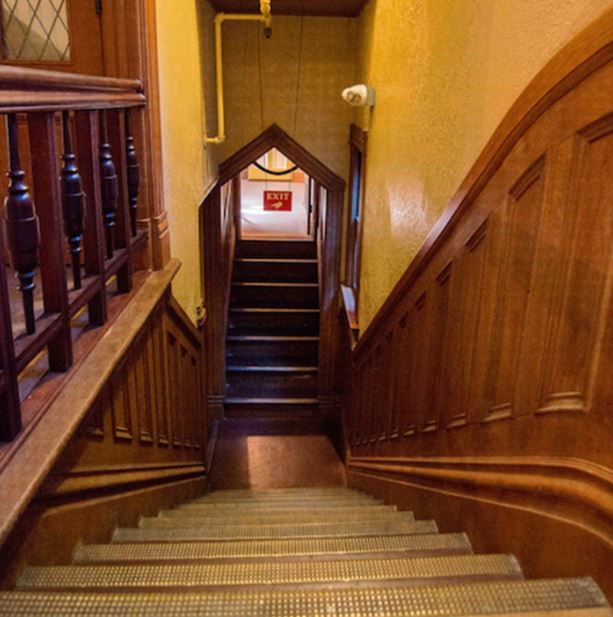
Mrs. Winchester had taken off her hat, and had held it towards the familiar hat-stand before she realized that it was not a familiar hat-stand at all; it was one she did not know. She looked round in some confusion, meaning to make good her escape without being observed, and yet wondering into what part of her mansion could she have come into, when she stopped stock still, with the hat held in her hand, listening. From a room near at hand, Mrs. Winchester heard the sound of a low, long-drawn moan, as from someone in pain. More than that, it was almost the wail of someone in acute terror. Now, Mrs. Winchester was a mild and caring soul, and her first instinct was to run. There was the door within a foot of her; she could open it again noiselessly and slip out, and leave whatever was moaning to its own trouble. Her next instinct, however, was a braver one; she might be able to help. Putting her hat on, and so leaving her hands free, she moved cautiously towards the sound, which was coming intermittently. She found that this wing of the house was unfamiliar to her; there was a 7-11 staircase built in the shape of a letter “Y,” which enabled the servants to quickly get to three different levels of the house. Then there were these stairs that lead to the ceiling, and there was also a cabinet that went straight through to the back thirty rooms of the mansion. When she went down the steps of the 7-11 staircase, slowly and cautiously, with her flesh creeping a little, the morning went on, and Mrs. Winchester was almost inclined to turn back with every step she took. However, at last, she got into the basement, and came to the door of the room from which the sound proceeded. She was in the very act of recklessly thrusting open the door when another sound broke upon her ears that held her still. The sound of someone singing in a raucous voice.

It was a sea song she remembered to have heard when she was a little girl in New Haven, Connecticut, and the words of which she had forgotten; it was something about “Boney was a warrior.” The door of the room was open a little way, and through the crack of it, Mrs. Winchester was able to peer in; and there she saw a sight that for a moment made her doubt her own eyes. She rubbed her eyes in a curious fashion and looked again, and this is what she saw: The room was in a neglected state, with strips of wallpaper hanging down from the walls and with a blackened ceiling. There was a table in the center of it, and at that table a man was seated, with a square black bottle and a glass before him, and a candle burning near his left hand. Mrs. Winchester could see the whole room now as plainly and as clearly as she saw it then. He was a man so villainously ugly that she had a thought that he was not a man at all, but some hideous thing out of a nightmare. He had very long arms—so long that they were stretched across the table, and his hands gripped the opposite edge of it; a great heavy head, crowed with a mass of red hair, was set low between enormously broad shoulders; his eyes, half closed, were high up and close together on either side of a nose that was scarcely a nose at all; the lips were thick and heavy. However, it was not the man that Mrs. Winchester looked at first, it was at two other figures in the room. These figures were seated on chairs facing the table at which the man was, and the strangeness of them lay in the fact that each was securely bound to the chair on which he and she sat, for it was a man and a woman. The man, who was quite young was not only bound, but gagged securely also; the woman was more lightly tied to her chair by the arms only, and her mouth was free. She was leaning back, with her eyes closed, and mingling with the raucous singing of the man at the table. Mrs. Winchester’s first impression was that the man at the table was some sort of unclean, bestial judge, and the others his prisoners.
He stopped his singing to pour some liquor from the square bottle into his glass and to drink it off; then he resumed his former attitude, with his fingers locked over the edge of the table. And now Mrs. Winchester noticed that while the woman, who was, by the way, quite young and very pretty, with a fair, dainty prettiness, still kept her eyes closed, the eyes of the bound man never left that dreadful figure seated at the other side of the table. Mrs. Winchester felt like she was on the eve of some awful calamity. She then unhesitatingly pronounced the entire assortment of people in the room as ghost, and condemned all the gathered treasures as the creations of petty intellect, which could not get out of the beaten track, but sought in the supernatural a reason for the explanation of every fact that seemed at variance with routine of daily experience. In her opinion the collection of people in this room had never seen at all in her day and generation, and must have been souls killed by the Winchester rifle ages ago; she did not yet believe her mansion was enchanted, however. To use her own language, “all those stories have been made by those people that set up overnight stirring out legends to entertain each other.” However, she must have known that she was in denial. For she was not insane and there were some kind of beings in this room. “Wouldn’t you like to speak, you dog?” said the red-haired man. “What would you give now to have the use of your limbs—the free wagging of your tongue? What would you say to me; what would you do to me?” The man who was bound could, of course, answer nothing. Mrs. Winchester saw his face flush and darken, and she guessed what his thoughts were. For herself, she was too fascinated by the scene before her to do anything else than peer through the crack and watch what was going one.

“Lovers—eh?” exclaimed the man at the table. “You thought I was unsuspicious; you thought I knew nothing and suspected nothing—didn’t you? While I was safely out of the way you could meet, the pair of you—day after day, and week after week; and this puppy could steal from me what was mine by right.” The woman opened her eyes for the first time and spoke. “It isn’t true,” she said, a sob breaking her voice. “It was all innocent. Martin and I have done no wrong.” “You lie!” thundered the man, brining his fist down upon the table with a blow that might have split it. “You’ve always lied—lied from the moment your father gave you to me—from the very hour I married you. You always hated me; I’ve seen you shudder many and many a time at the mere sight of me. Don’t I know it; haven’t I felt you stab me a thousand times more deeply than you could have stabbed me with any weapon? You devil! I’ve come at last to hate you as much as you hate me.” The woman turned her head slowly and looed at the younger man; a faint smile crossed her lips. In an instant the red-haired man had leapt to his feet, showing Mrs. Winchester astonishingly enough that he was a dwarf, with the shortest legs surely ever a man had. However, the bult of him was enormous, and Mrs. Winchester could guess, with a shudder, at his length. He caught up the glass, crossed the room, and flung the contents in the face of the man. “It’s a waste of good liquor—but that’s for the look she gave you. I wish there was some death more horrible than any invented yet that I could deal out to you,” he added, standing with the glass in his hand and glaring at his victim. “The death I mean for you is too easy.” He walked across to the fireplace in a curious purposeless way, and stirred a great fire that was blazing there. Then from a corner of the room he dragged with ease a great sack that appeared to contain wood and shavings; so much that Mrs. Winchester saw a rent in the side of it. As if in readiness for something, this he dropped down near the fire, and then went back to his seat, applying himself again to the drink that was on the table. And still Mrs. Winchester watched, as a woman may watch a play, wondering how it will end.
“I got the best of you tonight,” he said presently. “If I hadn’t some upon you from behind, you might have been too much for me; but I was ready and waiting. I’ve been watching longer than you think; I had everything mapped out clearly days ago. Tonight sees the end of all things for the pair of you; tomorrow sees me smiles away from here. You came in secret, you dog; you’ll go in secret.” “We have done no wrong,” said the woman again. “We loved each other years ago, when we were boy and girl; there was no sin in that.” “Bah!—I don’t believe a word of it. Don’t I know that your black heart you’ve compared the two of us every day of your life since first I saw you. His straightness for my crookedness; his sleek, black hair for my red; his prettiness for this face of mine”—he struck his own face relentlessly with one hand as he spoke—“that women shudder at. Don’t I know all that?” It was the strangest and most pitiful thing that the creature sitting there before his victims suddenly covered his face with his hands and groaned. If ever Mrs. Winchester had seen a soul in torment, she saw it then, and though she loathed him she could have wept for him. After a moment or two he dropped his hands and seized the bottle, and poured out the last drops into the glass and drank them off; then flung the bottle and glass crashing into the fireplace, as though there was an end to that business. And now, as he got down again from the chair, Mrs. Winchester saw the eyes of the woman open wide and follow his every movement with a dreadful look of terror in them. “I’ll kill you both—here in the place where you’ve met—and then I’ll seal up the house,” went on the dwarf. “I’ve planned it all. Look you last on each other, for tonight you die—and this house shall be your crypt!”
“I swear to you,” panted the woman eagerly, “by all I hold most holy and most dear, that if you let us go, we’ll never see each other again. For pity’s sake! —for the sake of Martin!” “For the sake of Martin!” sneered the dwarf. “That shows you in your true colors; that show who you are and what you are. There’s one poor satisfaction left to you; you’ll die together.” What held Mrs. Winchester then it would be impossible to say. She could only plead that in the dreadful thing that followed was a woman who sits at a play wondering what will happen next, and with never a thought in her of interfering. Mrs. Winchester’s in her anxiety has pressed the door a little to get a clearer view, so that she saw every movement of the dwarf. For herself, Mrs. Winchester had forgotten everything—in her own home, and my puppy zip, and the servants who slept in the mansion. It was as though she has stepped straight into a new World. Mrs. Winchester saw the dwarf advance towards the man in the chair, carrying his right hand stiff and straight beside him, gripping something s, she could not tell what it was that he held. Mrs. Winchester saw him come straight at her, and she saw the eyes of the woman in the opposite chair watching her as one fascinated. Then Mrs. Winchester saw two movements’ one with the left hand of the dwarf, when he struck the other man on the face; then with the right hand, when he raised something that gleamed n the light of the candle and brought it down with a sound that was new and horrible to her on the breast of the other man. And Mrs. Winchester saw the face of the man change, and start as it were into new life, and then fall as it were into death. And Mrs. Winchester saw his head drop forward, and his eyes were closed. Then, above it all, and yet seeming as a sort of dreadful chorus to it all, rang out the scream from the woman in the other chair. Mrs. Winchester did not think that the dwarf heard it; he had drawn back from what had been the living man, and was staring like one mad upon what he had done. And still piercing the air of the place rang the scream of the woman—not for her lover alone, but for herself.

That sound seemed at last to break in upon the senses of the dwarf and to call him partially to himself. Mrs. Winchester had watched him to the point where he draw himself together and crouched like a wild beast ready to spring, with that in his hand that dripped red, when, in some fashion, she flung herself round the partially open door and stumbled into the room. Mrs. Winchester thought she must have been a little made herself; otherwise, frail and commonplace creature that she was, she could not have battled with this madman. Mrs. Winchester came upon him from behind and gripped him, seizing him by the throat and by the head, and all the while shouting something to him quite unintelligible. The attack had been so sudden and so unexpected that she had him, in a sense, at her mercy. He could not know who had attacked him; he struggled madly, not alone to get away from her, but also to discover who she was. Mrs. Winchester struggled to keep his face away from her, gripped him by the neck and by the hair, and fought with him for what she knew then was her own life. And so struggling they stumbled at last horribly against that still figure bound in the chair and brought it over crashing with them to the floor. And then in a sudden Mrs. Winchester felt the dwarf inert in her hands, and knew that she had conquered him. What she must have looked like in that room, kneeling there, panting and struggling to get her breath, she could not tell; the whole business was so like a nightmare. She remembered seeing the dwarf lying there—huddled up and very still. She remembered that other figure, bound grotesquely in the chair and lying, still bound, upon its side; and she remembered, too, the woman, with her arms close fastened behind her, sitting there and sobbing wildly.
The dwarf must have been stunned; he lay there quite still, with the knife that was dreadfully red fallen from his hand, and lying beside him. When at last Mrs. Winchester staggered to her knees she saw that the girl was staring at her with a face that seemed to suggest that here, perhaps, was another ruffian come to kill her. “Who—who are you?” she asked in a frightened whisper. “A friend—one who stumbled in by accident,” Mrs. Winchester panted. “Look at the man that’s tied to the chair,” she whispered hoarsely. “He can’t be dead.” Mrs. Winchester knew that he was, but still she looked, as she bade her. Mrs. Winchester had no need to look twice; the poor fellow was quite dead. The blow had been strong and sure. On her knees beside him, Mrs. Winchester looked up and nodded slowly to her; there was no need for words. The young lady leaned back in her chair again and closed her eyes. “Set me free,” she said in a faint voice. Mrs. Winchester could not touch that knife that lay there; in a mechanical, methodical way she took from her waistcoat pocket the decent, respectable little bone handled penknife she carried always with her. With that Mrs. Winchester but the young lady’s bonds, nothing as she did so how cruelly they had cut into the white flesh; and after a moment or two she swung her arms listlessly against her sides and opened her eyes, and then, with an effort raised her hands and pressed them against her temples. “What will you do?” Mrs. Winchester asked, looking at her curiously. “I—I don’t know,” she said; and then, breaking into weeping, sobbed out: “Oh—dear God—that it should have come to this! What shall I do—what shall I do?” “You must get away,” Mrs. Winchester said, watching the dwarf, who was beginning to stie a little. “If he wakes, you know what will happen.”

“I know—I know,” she said; and got to her feet and began to move towards that bound figure still lying tied to the chair. However, at that Mrs. Winchester got before her, and with her hands against he shoulders held her back, and pleaded passionately to her that she should go, and leave the dead alone. She listened, with that strange look in her eyes of a child wakened from sleep and not clearly understanding; but she yielded to Mrs. Winchester, and stumbled under her guidance to the door. They had reached it, and Mrs. Winchester had opened it for her to pass out, when suddenly the dwarf twisted over on to his hands and knees, and then raised himself upright. He did not seem to realize for a moment what had happened; then he caught sight of the woman, and, with a snarl, crawled forward and gripped the hilt of the knife. At that she pushed suddenly past Mrs. Winchester and fled like a hare up the stairs. Mrs. Winchester heard the swift passage of her footsteps in the little hall of the house—then the slamming of the door-to-nowhere. And now Mrs. Winchester had to look to herself, for she saw in the eyes of the man that he would not let this witness escape if he could catch him. Mrs. Winchester had managed to get through the door by the time that he had got to his feet, and in a dazed fashion was stumbling toward her, knife in hand. With a sudden swoop he reached the table and blew out the candle, and at the same moment Mrs. Winchester ran up the stairs, and in the darkness stumbled along the hall and fumbled with the catch of the door. By great good fortune, Mrs. Winchester got the door open, and literally fell out into the fog. She could not see him as he tore after her; in a faintness Mrs. Winchester had fallen to her knees, and she heard him, as he raced past her, panting heavily. Then the fog swallowed him up, and she knelt there on the farm alone, shaking from head to foot.

Mrs. Winchester had, of course, no means of exactly in what part of her mansion she had had her adventure; she could only judge roughly that it must be about the middle of the crescent. She started along again, in the right direction, as she hoped, and thought to find the front door to her mansion; missed the railings, after going what seemed to be an interminable distance, and came up hard against a pillar-box. Scarcely knowing what she did, she set her right hand in the mouth of it, and performed the same maneuver she had done before; advanced three paces, and touched railings again. Stumbling along these, she came blindly what she thought was her front door, walked up the path, and pushed open the door that yielded; and there, with the face of her maid looking at her in alarm and wonderment, Mrs. Winchester feel in a dead faint at her feet. It has to be recorded that Mrs. Winchester never found that room again. She knew every square inch of her mansion. Over and over again, in clear weather, Mrs. Winchester has always around in her mansion, and had closed her eyes, and tried to remember what steps she took to get to that particular room that night, after a stranger had cannoned into her and twisted her round; but all in vain. Whether in some part of the house lies the body of a man who was foully murdered on that particular night; maybe in a hidden room the crime was committed; or perhaps, in some strange supernatural fashion, she saw that night a deed committed that had been committed long before, she shall never know. That it is no mere figment of the imagination, and that something really happened that night, is proved by one fact. Her maid, in raising Mrs. Winchester from the floor that night when she fell at her feet, found her fingers locked closed upon something, and, forcing them open, disclosed what it was. A tuft of red hair!

Such episodes may appear utterly absurd and pure superstition to people in countries comparatively free of black magic, but instead they should be warnings of the power of Satan and demons where occult literature lures readers into illicit magic. Magic as the release of special power by satanic and demon forces of evil in its character and effects. While divine help and miracles produce new strength and positive results, magic shifts the burden to another area. Small relief in one area must be paid for by terrible burdens in another. The principle of compensation prevails. The price exacted is always found to be much greater than the amount of help received. Satan drives a hard bargain and grossly cheats his victims. Usually violence, suicide, and insanity will run through a whole family line, where the magical arts have been cultivated and practiced. Such tragic events often involve as many as four generations. Many occultists and magic workers, especially those who have cultivated the black arts and signed themselves over to the devil in their own blood, die horrible deaths. When a ready successor is not provided to carry on the nefarious practice, this is especially true. The psychic bondage and oppression that traffickers in occultism themselves suffer, as well as their dupes, is horrifying to contemplate. Demon possession is represented as a vivid symbol of the prevalence of evil in the World. Other critics attempt to dismiss demon possession with theories of accommodation or hallucination. However, this view fails to meet the issue. Nor can present-day parapsychologist and psychiatrists, who refuse to recognize evil supernaturalism in the phenomenon of demon possession, either explain it or deal adequately with it. Laws defining witchcraft as having league with the Devil and prescribing the death penalty for such offenders cropped up in the colonies as early as 1636 in Plymouth. Other colonies soon followed suit—Connecticut in 1642 and Rhode Island in 1647.

The first executions took place in Boston in 1648 and in Hartford, Connecticut, in that same year. The executions were carried out by hanging, in contrast to the European practice of burning witches, which probably stemmed from the widespread fear among the European peasantry of vampire, the dead who returned from their graves to suck the blood from the living. The vampire myths never really took root in America, so the necessity of destroying the bodies of the witches was not deemed urgent. Throughout the 1650s, there appeared prosecution and attempted prosecutions in America, but these cases were infrequent, and all of them were based on the fear of maleficum, the witch’s working of evil, the accusations coming from frustrated and jealous neighbors. Few confessions were recorded in the early cases, and they did not seem to have much real validity. The few that did confess mentioned having dealings with Satan, but for the most part these admissions were confused and incoherent, and the details of the accounts differed greatly from the confessions of the witches in Europe. For example, in 1699, in Connecticut, a woman named Greensmith confessed to trafficking with the Devil, but made no mention of all-important Covenant, or pact. She further stated that the Devil had appeared to her in the form of a deer (not a goat) and that she had attended meetings at a place not far from her house. The mention of “meetings” occurred in some early confession, but the word “Sabbat” or “Sabbath,” commonly used by European witches, did not come up until later, apparently at the suggestion of the Salem judges. Some believe that Satan has a soul and a character. He is not just this futile entity but someone you can see many aspects to. Some people do not see Satan as this guy with horns who is evil, they see Him as the first rebel. Then one can see why He is so attractive to many in the Victorian ages and the young people. He is someone who is standing up to the greatest power in the Universe. “If that ‘evil’ is of a rebellious nature,” says Glenn Danzig, “then I guess, in Christian terms, that evil is the Satan in you. I don’t buy that. I believe in honesty, standing up for yourself. That’s my ‘good.’”

Thousands of people base their hopes on the statements of spiritistic practitioners and subsequently become dependent upon the advice they receive from the “other side.” There are quite a number of people who has suffered serious psychic disturbances through the misuse of such practices. Their personalities have been split and they have been utterly confused by the spirits on which they have called. People therefore who try to discover what life after death is like through spiritism and superstition may be in danger of falling prey to the dark and hidden side of their own minds and soul. If you look at the early tracts of The Christian Bible, there is really not much about Satan in there anyway. Christian religions have tried to overblow and create a whole legend around Satan which is not true to the actual scriptures we have. If you desire, you must first make yourself strong so you can help others. You should only help people who want help, a lot of times people do not really want your help. You tell people what has to be done to change their lives, they will not listen. If Satan were corporeal, He would not be something repulsive, He would be something seductive. He would want to win you over and gain your trust, and of course being repulsive or disgusting would not be the way to go. One would imagine this would be a seductive, beautiful creature. In the Gnostic account of the fall of the angels, the angels were suppsed to be watching over this flock of humans and all of a sudden, they are perpetrating acts of pleasures of the flesh with them. Eventually this created the Cyclops, the Minotaur, things of this nature. There are so many accounts of the fall of the angels, it is like a fantasy tale that you would like to believe actually happened. We, in this circle, conjure and cite this spirit Fatenovenin, with all his adherents, to appear here in this spot, to fulfill our desires, in the name of three holy Angels, Schomajen Sheziem, Roknion Averam, Kandile, Brachat Chaijdalic, Ladabas, Labul, Rargil, Bencul, in the name of God. Amen!

Winchester Mystery House

Mrs. Winchester’s estate was a little town within itself. The grounds have their share of unexplained mysteries. Mrs. Winchester outfitted her home with the finest stained glass doors, windows, and wallpaper that money could buy during her time. She had everything she needed: plumber’s shops, carpenter’s workshops, her own water and electrical supplies, and complete sewer and drainage systems. Mrs. Winchester even had her own gas manufacturing plant. It produced carbide gas by adding a small amount of water to a drum containing calcium carbide. The resulting gas was pressed through the gas lines to the house by a large piston and cylinder. The gas lights in the house were then lit by electromechanial strikers that created a spark to light each lamp.
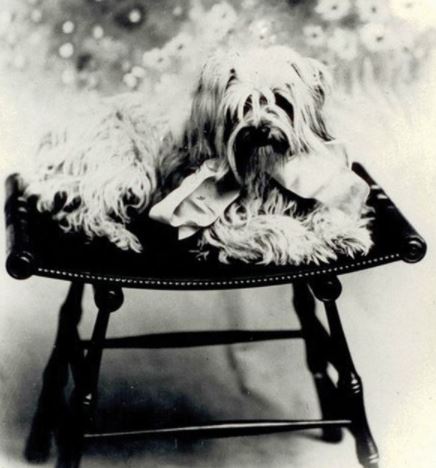
Come see her estate, in person, for yourself this weekend! Please Click the link below for tickets and more information.

Ignorance of the Law Excuses No Human–Looked Like a Baby-River that was Laying Half Alseep!


Set the stage and dim the lights—doing the dishes is an event with an under-mount kitchen sink like this one. 🎟
#PlumasRanch Riverside is now selling! Explore floor plans and more on our website. Link in bio. 👉 https://cresleigh.com/cresleigh-riverside-at-plumas-ranch/residence-1/


Soldiers, Consider that from the Summit of these Pyramids, Forty Centuries Look Down Upon You!
 Humans are indeed controlled by their own environment, but we must remember, for the most part, it is an environment largely of their own making. The evolution of a culture is a gigantic exercise in itself of control. Justice is a complete virtue in the fullest sense, because it is the active exercise of complete virtue; and it is complete because its possessor can exercise it in relation to another person, and not only by oneself. Many communities have created restorative justice programs, yet these programs are often reactionary. They typically focus on trying to heal the offender, victim, and the community only after a criminal act has occurred. While these alternative justice programs are important components in restoring justice within communities, they are hampered by Western-imposed structures and Eurocentric concepts of crime and punishment. In the United States of American today, the American criminal justice system holds approximately 2.3 million people in 1,833 state prisons, 110 federal prisons, 1,772 juvenile correctional facilities, 3,134 local jails, 218 immigration detention facilities, and 80 Indian Country jails as well as in military prisons, civil commitment centers, state psychiatric hospitals, and prisons in the U.S. territories. Every year, 600,000 people enter prison gates, but people go to jail 10.6 million times each year. #RandolphHarris 1 of 26


CRESLEIGH RIVERSIDE AT PLUMAS RANCH
MODEL NOW OPEN Plumas Lake, CA | from the low $400’s
Now Selling!


Remember that Time is Money—You Cannot Fight Against the Future for Time is on Our Side!







HOME SITE 84: MOVE IN READY
3 Bedrooms – 2.5 Bathrooms – 2,054 sq. ft. – $499,000

Pack bags and move right on into this turn key home!



The Right Way to Teach Beings is to Propose Truth, Not Impose it!


https://cresleigh.com/cresleigh-riverside-at-plumas-ranch/residence-4/


Of Luxuries Bright, Milky Soft and Rosy– Shall Not the Judge of All the Earth do Right?


Cresleigh Homes
California beauty as far as the eye can see. ☀️ Interested in becoming a part of a Cresleigh Homes community? Visit our website to learn more about Plumas Ranch, now selling!
https://cresleigh.com/cresleigh-riverside-at-plumas-ranch/

#PlumasLake
#California
#NewHomes

Thee for Enlivening All the Cheerful Eyes that Glance so Brightly at the New Sun-Rise!


Many Take to an Imperfect, Half-Competent or Half-Satisfactory Teaching Because No Better One is Available!


 Randolph Harris II International Institute