
Home » etiquette (Page 17)
Category Archives: etiquette

More Wonders of the Invisible World

Witchcraft is one of the most hidden works of darkness. And California had its full share of obscurity. People groping their way in the dark are unlikely to be either stable or judicious, and thus it is hardly surprising that much of the legends about witchcraft are violent and partisan. The Devil improves the darkness of this affair to push us into a blind man’s buffet, and we are even ready to be sinfully, yea, hotly and madly mauling one another in the dark. Some people want to contact the dead and consider seances, but they are dangerous because it is easy for a gate to be opened and something evil to come along with the spirit you want to contact. There is an old urban legend about “Bloody Mary.” If you chant “Bloody Marry” thirteen times into a mirror in a dark room, her spirit will appear. Some say she will prophesize for you, other versions say she will attack you. Historically, Bloody Mary was a nickname for Mary I of England, who suffered several miscarriages. She was also alleged to be a witch and was burned at the stake. Divination by mirror has been practiced in nearly all cultures for as long as mirrors have been around. Before that, any reflective surface, especially still water, was used to prophesy or catch a glimpse of the future. In many of these legends, the danger is that while you are trying to catch a glimpse of your future, you might also see some aspect of Death. Tradition also holds that at the moment of death, all the mirrors in the house should be covered so hey do not trap the departing spirit. Ancient Greeks and Native Americans believed that the reflection contained the soul, and could be capture by water. #RandolphHarris 1 of 14

It is bad luck to break mirrors because they are reflections of the soul, and also because they hold the future. That is why the seven years of bad luck occurs, you have broken your future. Many of the persons confessing these myths are witches by their own confession and have therefore abjured God and Chris, and given themselves up to the Devil, the Father of Lies. And what credit is to be given to the testimony of such against the lives of others? Many historians believe these early American legends are important and endeavor that the complete history of secret California witchcrafts and possessions might not be lost. The preservation of that history might in a be a singular benefit unto the church and unto the World, which makes many solicitous about it. Mrs. Winchester, who has been strangely visited by some shining spirits during the construction of her mansion, believed they were good Angels in her opinion of them. She intimated several things unto her friends, whereof some were to be kept secret. She also said that a new storm of witchcraft would fall upon the country to chastise the iniquity that was used in the willful smothering and covering of the last, and that many fierce opposites to the discovery of witchcraft would be thereby convinced. Many people are looking to acquire authentic, single-family Victorian homes because they believe in the renaissance of witchcraft and these homes possess souls, spirit, ghost, hidden occult symbol, and are supposedly spiritual nexuses. They are a power source to contacting the other World. #RandolphHarris 2 of 14

All spirits have something in common, but it matters who they are haunting. It matters what their traditions were when they were alive. In many Native American legends, they have thousands of Gods, and each of them had attendant monsters and demons. Pishachas are beings who haunt places where violent deaths have occurred. They eat human flesh and are supposed to be the sons of anger. They haunt cemeteries and places where cremations have taken place and can change their shape and become invisible. Sometimes they attack and eat their victims, in other instances they possess them and drive them insane. It is believed because there was some covenanting with the Devil they had committed and it was an unpardonable sin, that sin of which the scriptures said we must not pray for. Sometimes anyone who was not in a proper covenant with God was considered to be a witch. Witches are known to change into rabbits, cats, other familiar animals. Halloween costumes are a surviving remnant of the belief that transformed witches would be abroad before All Hallow’s Eve. Some of the Indian Powows [id est, pries-magicians] in this country during the 17th century, having received the Gospel and given good evidence of a true conversion to God in Christ, had with much sorrow of heart declared how they had, whilst in their Heathenism, by the hands of Evil Angels murdered their neighbours. A Nagual is a human being, a Shaman, who has acquired the power to shapeshift. Some Nagual have vampire qualities, changing into bats or owls to drain blood; in other cases the nagual is a respected and feared member of the community. In some places nagual are said to attack Indians who have too much contact with mestizo or Anglo populations. #RandolphHarris 3 of 14

There are myriad instances of witchcraft both in history and in the Bible, but some of the demonologists personal experiences are remarkable enough to make us wish they had given a more detailed account of the. In referring to Balaam, the biblical conjurer of familiar spirits, one of them said, “we have seen and know such wizards among the Heathen in our own land.” If I meant anything, it was that a ghost story would have a great pull over other ghost stories if one could see the person it happened to. One does get rather provoked at never coming across him or her. In April, nearly fifteen years after the Winchester Mansion opened for tour, it was a clear spring day, with no fog or half-lights about, and it was not yet four o’clock in the afternoon—not very ghost-like circumstances, you will admit. I had come home early from my club—it was a sort of holiday time with me just then for a few weeks—intending to get some letters written which had been on my mind for some days, and I had sauntered into the library of the mansion, a pleasant, fair-sized room lined with books, on the first floor. Before setting to work I sat down for a moment or two in an easy-chair by the fire, for it was still cool enough weather to make a fire desirable, and began thinking over my letters. No thought, no shadow of a thought of Mrs. Winchester was present with me, of that I am perfectly certain. The door was on the same side of the room as the fireplace; as I sat there, half facing the fire, I also half faced the door. I had not shut it properly on coming in, I had only closed it without turning the handle, and I did not feel surprised when it slowly and noiselessly swung open, till it stood right out into the room, concealing the actual doorway from my view. #RandolphHarris 4 of 14

If you think of the door as just hen acting like a screen to the doorway, you will perhaps understand the position better. From where I say I could not have seen anyone entering the room ill he or she had got beyond the door itself. I glanced up, half expecting to see someone come in, but there was no one; the door had swung open of itself. For the moment I sat on, with only the vague thought passing through my mind, “I must shut I before I begin to write.” However, suddenly I found my eyes fixing themselves on the carpet; something had come within their range of vision, compelling their attention in a mechanical sort of way. What was it? I rubbed my eyes and the wavy something that kept gliding, rippling in, gradually assumed a more substantial appearance. It was—yes, I suddenly became convinced of it, it was rippled of soft silken stuff, creeping in as if in some mysterious way unfolded or unrolled, not jerkily or irregularly, but glidingly and smoothly, like little wavelets on the sea-shore. And I sat there and gazed. I sat there still, as if bewitched, or under some irresistible influence, I cannot tell, but so it was. And it—came always rippling in, till at last it began to rise as it sill came on, and I saw that a figure, a tall graceful woman’s figure, was slowly advancing, backwards of course, into the room, and that the waves of pale silk—a very delicate shade of pearly grey I think it must have been—were in fact the lower portion of a long court-train, the upper part of which hung in deep folds from the lady’s waist. She moved in—I cannot describe the motion, it was not like ordinary walking or stepping backwards—till the whole of her figure and the clear profile of her face and head were distinctly visible, and when at last she stopped and stood there full in my view just, but only just beyond the door, I saw—it came upon me like a flash, that she was no stranger o me, this mysterious visitant! #RandolphHarris 5 of 14

I recognized, unchanged I seemed to me since the day, twenty-five years ago, when I had last seen her, the beautiful features of Mrs. Winchester. I should not have said unchanged. There was one great change in the sweet face. You remember my telling you that one of Mrs. Winchester’s greatest charms was her bright sunny happiness—she never seemed gloomy or depressed or dissatisfied, seldom even pensive. However, in this respect the face I sat there gazing at was utterly unlike Mrs. Winchester’s. Its expression, as she—or “it”—stood there looking, not towards me, but out beyond, as if at someone or something outside the doorway, was of the profoundest sadness. Anything so sad I have never seen in a human face, and I trust I never may. However, I sat on, as motionless almost as she, gazing at her fixedly, with no desire, no power perhaps, to move or approach more nearly to the phantom. I was not in the least frightened. I knew it was a phantom, but I felt paralyzed and as if I myself had somehow got outside of ordinary conditions. And there I sat—staring at Mrs. Winchester, and there she stood, gazing before her with that terrible, unspeakable sadness in her face, which, even though I felt no fear, seemed to freeze me with a kind of unutterable pity. I do not know how long I had sat thus, or how long I might have continued to sit there, almost as if in a trance, when suddenly I heard the front-door bell ring. It seemed to awaken me. I started up and glanced round, half-expecting that I should find the vision dispelled. But no; she was still there, and I sank back into my seat just as I heard my brother coming quickly upstairs. #RandolphHarris 6 of 14

He came towards the library, and seeing the door wide open walked in, and I, still gazing, saw his figure pass through that of Mrs. Winchester in the doorway as you may walk through a wreath of mist—only, do not misunderstand me, the figure of Mrs. Winchester till that moment had had nothing unsubstantial about it. She had looked to me, as she stood there, literally and exactly like a living woman—the shade of her dress, the colour of her hair, the few ornaments she wore, all were as defined and clear as a real person, or perhaps became so again as soon as my brother was well within the room. He came forward, addressing me by name, but I answered him in a whisper, begging him to be silent and to sit down on the seat opposite me for a moment or two. He did so, though he was taken aback by my strange manner, for I still kept my eyes fixed on the door. I had a queer consciousness that if I looked away it would fade, and I waned to keep cool and see what would happen. I asked George in a low voice if he saw nothing, but though he mechanically followed the direction of my eyes, he shook his head in bewilderment. And for a moment or two he remained thus. Then I began to notice that the figure was growing less clear, as if it were receding, yet without growing smaller to the sight; it grew fainter and vaguer, the colours grew hazy. I rubbed my eyes once or twice with a half idea that my long watching was making them misty, but it was not so. My eyes were not at fault—slowly but surely Sarah Winchester, or her ghost, melted away, ill all trace of her was gone. #RandolphHarris 7 of 14

I saw again the familiar pattern of the carpet where she had stood and the objects of the room that had been hidden by her draperies—all again in the most commonplace way: but she was gone, quite gone. Then George, seeing me relax my intense gaze, began to question me. I told him exactly what I have told you. He answered, as every common-sensible person of course would, that it was strange, but that such things did happen sometimes, and were classed by the wise under the head of “optical delusions.” I was not well, perhaps, he suggested. Been overworking? Had I not better see a doctor? However, I shook my head. I was quite well, and I said so. And perhaps he was right, it might be an optical delusion only. I had never had any experience of such things. “Poor” Mrs. Winchester I cannot help calling her. I heard of her indirectly, and probably, but for the sadness of her story, I should never have heard it at all. It was a friend of her husband’s family who had mentioned the circumstances in the hearing of a friend of mine, and one day something brought round the conversation to old times, and he startled me by suddenly enquiring if I remembered Sarah Winchester. I said, of course, I did. Did he know anything of her? And then he told me. She was dead—she had died some months after a long and trying illness, the result of a terrible accident. Something happened one evening when dressed for some grand entertainment or other, and though her injuries did not seem likely to be fatal at the time, she had never recovered the shock. “She was so pretty,” my friend said, “and one of the saddest parts of it is she could have not been any older than twenty when she passed away in 1922. She was such a sweet and bright lady.” #RandolphHarris 8 of 14

We all thought the she had finished construction of her mansion and moved up north to build another one. I did not tell him my story, for I did not want it chattered about, but a strange sort of shiver ran through me at his words. Not everyone was in agreement that the specters in the Winchester mansion had all been angry spirits or a delusion of the Devil. It having been represented to us that a most horrible witchcraft or possession of Devils hath invested several towns in Our Province of California under your government, and that divers persons have been convicted of witchcraft, like the Prison’s of the River, in Sacramento, California; some whereof have confessed their guilt, but others being of a known and good reputation these proceedings had caused a great dissatisfaction among our good subjects, for which reason you have put a stop thereunto until Our Pleasure should be known concerning the same, We therefore until Our Pleasure should be known concerning the same, We therefore approving of your care and circumspection herein have thought fit to signify Our Will and Pleasure, as We do hereby will and require you to give all necessary directions that in all proceedings against persons accused for witchcraft or being possessed by the Devil the greatest moderation and all due circumspection be used, so far as the same may be without impediment to the ordinary course of justice within Our said Province. And so We bid your very heartily farewell. Given at the Winchester Mansion the 15th day of April, 1947, in the fifth year of Our Reign. By Her Majesty’s Command. #RandolphHarris 9 of 14

Although the topic of witchcraft was now explosively controversial in California, nobody was to deny that people practiced it, and there was still some interest in investigating it. There are therefore references to it in many of the sermons in the 19th century. However, after the Winchester mansion was opened for tour, the mysterious disappearance of Mrs. Winchester was thought to be paranormal and a circular letter was sent by the Winchester Repeating Arms Company to investigate the collection of more instances of “remarkable providences” (these would include unusual natural phenomena as well as the preternatural). Behind the veil of all the hieratic and mystical allegories of ancient doctrines, behind the darkness and strange ordeals of all initiations, under the seal of all sacred writings in the Winchester mansion, on stones in the basement on the walls in the dressing room, in the monstrous or marvelous paintings in forbidden areas of the mansion which interpret to the mystical the inspired secrets of Mrs. Winchester, in the cryptic emblems of her old books on alchemy, in the ceremonies practiced at reception by this secret society, there were found indications of a doctrine which was everywhere the same and everywhere carefully concealed. It is likewise to be understood, those who are desirous to raise any souls of the dead, ought to select those places wherein these kind of souls are most known to be conversant; or by some alliance alluring the souls into their forsaken bodies, or by some kind of affection in times impressed in them in their life, drawing the souls to certain places, things, or persons; or by the forcible nature of some place fitted and prepared to purge or punish these souls: which places for the most part are to be known by he appearance of visions, nightly incursions, and apparitions. #RandolphHarris 10 of 14

Mrs. Winchester lists convincing evidence that her experience of witchcraft extended well beyond what she had committed to writing: I know a young man who had gone so far as to get ready a Covenant with Satan, written all of it in his own blood. However, before the signing of it, the sinful, I was made the happy instrument of his deliverance. As soon was this man was left alone in the mansion, the devil, imagining that he had found the right moment for breaking his courage, incontinently roused up his own chosen vessel, who appeared to have reposed longer than usual. Having beheld this from afar, he grew stiff with terror by reason of his being alone; but soon recovering his courage, and no place of refuge being at hand, he valiantly withstood the onset of the fiend, who came rushing upon him with a terrible noise, and he struck the axe which he wielded in his hand deep into his body. On receiving this wound, the monster groaned aloud and turning his back, fled with a rapidity not at all inferior to that with which he had advanced, while the admirable man urged his flying foe from behind, and compelled him to seek his own tomb again; which opening of its own accord, and receiving its guest from the advance of the pursuer, immediately appeared closed again. Hence it is that the souls of the dead are not to be called up without blood or by the application of some part of their relict body. In the raising therefore of these shadows, we are to perfume with new blood the bones of the dead, and with flesh, eggs, milk, honey, and oil, which furnish the soul with a medium apt to receive its body. Gosh, it must be terrible to know you witnesses something, but that you will never be able to remember it or tell anyone about it. #RandolphHarris 11 of 14

I know a woman whose brother was tortured with a cruel, pricking, incurable pain in the crown of his head, which continued until there was found with her a puppet in wax, resembling him, with a pin pricked into the head of it, which being take out her recovered immediately. He goes on about demons. A demon killed his wife, he says, and just expects me to believe it. However, what he looks like to me is someone who let grief turn him into a monster. Whatever happened to his wife, it does not excuse what he had done. He attacks, kills, then springs away before anyone can react. Wicked sorceries have been practised in the land, and, in the late inexplicable storms from the invisible World thereby brought upon us, we were left by the just hand of Heaven unto those errors whereby great hardships were brough upon innocent persons, and (we fear) guilt incurred which we have all cause to bewail with much confusion of face before the Lord. We confess that we ourselves were not capable to understand nor able to withstand the mysterious delusions of the Powers of Darkness and Prince of the Air, but were, for want of knowledge in ourselves and better information from others, prevailed with to take up with such evidence against the accused as on further consideration and better information we justly fear was insufficient for the touching the lives of any, whereby we fear we have been instrumental with others, though ignorantly and unwittingly, to bring upon ourselves and this People of the Lord the guilt of innocent blood, which sin the Lord saith in scripture He would not pardon (2 Kings 24.4), that we suppose, in regard of His temporal judgments. #RandolphHarris 12 of 14

I know a person who, missing anything, would use to sit down and muter a certain charm, and then immediately by an invisible hand ben directly led unto the place where the thing was to be found. turquoise carvings placed in Native American graves to attract good spirits and guard the grave. Also, turquoise tied onto a bow was supposed to make you shoot more accurately. The body of saints often times cannot be found when their graves are dug up because their bones were frequently interred in the cornerstones of cathedrals, so their spirits would guard the holy location. Unwilling sacrifices would be more likely to become angry spirits instead of guarding. Canaanites sacrificed infants and put them in the foundations of houses and temples. “At the cost of his first-born shall he se up its gates,” reports Joshua 6.26. Bones were discovered in the basement of the original farm house that was engulfed as part of this estate during the expansion. Sightings of Hell Hounds date back to 1888. Some reports say the creatures are threatening. The Victorian parklike grounds seem to breed sightings of big wolf creatures or beast at night. Since the legends have been uncovered, many people have reported seeing a big black wolf and two men walking around the Winchester mansion at night, even when it is closed. Four kids and a police officer allegedly disappeared after climbing the gate to get a closer look one night. Nearly 134 years of sightings. These people are probably sadly deluded and mistaken, their minds are more likely disquieted and distressed, and we do therefore humbly beg forgiveness, first of God for Christ’s sake for this error, and pray that God would not impute the guilt of it to ourselves nor others. And we also pray that we may be considered candidly and aright by the living suffers as being then under the power of a strong and general delusion, utterly unacquainted with and not experienced in matters of that nature. #RandolphHarris 13 of 14

I know a woman who upon uttering some words over very painful hurts and sores did use instantly to cure them, unto the amazement of the spectators. Now, thought I, if this wretch can effectually employ Devils to cure hurts, why may not she to cause them also, which is the worst that the witches do? The matter being so dark and perplexed as that there is no present appearance that all God’s servants should be altogether of one mind in all circumstances touching the same and believing the Devil’s accusations. These practices and principles have been the beginner and procurer of the sores afflictions, not to Llanda Villa only, but to this whole country, that did ever befall them. It should be noted in passing that Llanda Villa’s attorneys have concluded that these peoples visions and afflictions are due to illness caused by demonic possession. No specters evidence may be hereafter accounted valid or sufficient to take away the life or good name of any person or persons within this province. God hath a controversy with us about what was done in the time of the witchcraft. I fear that innocent blood hath been shed, and that many have had their hands defiled therewith. Public acknowledgement of guilt, and humiliation for it, and the more particularly and personally it is done by all that have been actors, the more pleasing it will be to God and more effectual to turn away his judgments from the land, and to prevent his wrath from falling upon the persons and families of such as have been most concerned. Moreover, if it be true, as I have been often informed, that families of such as were condemned for supposed witchcraft have been ruined by taking away and making havoc of their estates and leaving them nothing for their relief, I believe the whole country of lies under a curse to this day, and will do till some effectual course be taken by our honored governor and Supreme Court to make them some amends and reparations. #RandolphHarris 14 of 14

Winchester Mystery House

Get in the Halloween spirit and celebrate the first weekend of October 2021 at the Winchester Mystery House! Our All Hallows’ Eve tickets are selling fast so be sure to grab them while you can 👻
🎟️link in bio. winchestermysteryhouse.com

The Devil Loveth No Salt in His Meat!

Every night in the year, four of us sat in the parlous of the Winchester Mansion. This particular night, there was a thin, bright moonshine: it was bitter cold, windy, and frosty; the town had not yet awakened, but an indefinable stir already preluded the noise and business of the day. The ghouls had come later than usual, and they seemed more than usually eager to be gone. They wished, and declared their wish, that their blood might be the last innocent blood shed. They prayed that God would discover the witchcraft were among us. They forgave their accusers. The fervency of the spirits were very affecting and drew tears from many. Affecting and melting to the hearts of some considerable spectators. They prayed earnestly for pardon for all other sin and for an interest in the precious blood of our dear Redeemer, and seemed to be very sincere, upright, and sensible of their circumstances. One of the ghouls said, “I have been put to death, and my grandfather suffered, and all his estate seized because of my own vile and wretched heart, confessed several things contrary to my conscience and knowledge, though to the wounding of my own soul—the Lord pardon me for it. But oh! the terrors of a wounded conscience, who can bear? Blessed be the Lord; He would not let me go in my sins, but in mercy I hope so my soul would not suffer me to keep it in any longer, but I was forced to confess the truth. Gunshots in the hills and the echo of that awful hellspawn voice in my head. I was sought after by a sorcerer, which resulted in fatal mishaps for those sorcerers because they caught me in the wrong mood, and I turned into a lethal weapon. Dear Mrs. Winchester, let me beg your prayers to the Lord on my behalf, and please send us a joyful and happy meeting in Heaven.” #RandolphHarris 1 of 13

Mrs. Winchester replied, “But the Lord He know it is, if it be possible, that no more innocent blood be shed, which undoubtedly cannot be avoided in the way and course you go in. I question not but your honours do to the utmost of your powers in the discovery and detecting of witchcraft and witches, and shall not be guilty of innocent blood for the World.” A horrible sense of blackness and the treachery of fate seized hold upon the soul of the unhappy student and the other ghouls. “My God! she cried, “but what have I done? and when did I begin?” Nothing could be explained any further because we realized that we had long since ceased to pay attention to anything said by the suspect. Our minds and hearts were so filled with the hideous torments of the afflicted and the frightful tales of the confessors that we were quite unable to absorb anything else. The student was violent, and it was said that she had beaten to death a former teacher and other students in the classroom before she and her accomplices were shot dead by a Winchester model 1866. They were much addicted to sorcery in the said town, and there were forty men in it that could raise the Devil as well as any astrologer. Time had little changed this small town. It stood then, as now, upon a crossroad, out of call of human habitations, and buried fathom deep in the foliage of six thousand cedar trees. The cries of the sheep upon the neighbouring hills, the streamlets upon either hand, one loudly singing among pebbles, the other dripping furtively from pond to pond, the stir of the wind in mountainous old flowering chestnuts, and once in seven days the voice of the bell and old tunes of the precentor, were the only sounds that disturbed the silence around the rural Winchester Mansion. #RandolphHarris 2 of 13

The Resurrection Man was not to be deterred by any of the sanctities of customary piety. It was part of his trade to despise and desecrate the scrolls and trumpets of old tombs found on the estate, the paths worn by the feet of legions of spirits and mourners, and the offerings and the inscriptions of bereaved affection. To rustic neighbourhoods, where love is more than commonly tenacious, and where some bonds of blood or fellowship unite the entire society of a parish, the body-snatcher, far from being repelled by natural respect, was attracted by the ease and safety of the task. To bodies that had been laid in Earth, in joyful expectation of a far different awakening, there came that hasty, lamp-Iit, terror-haunted resurrection that often happened at the Winchester Mansion, which was fully of uneasy ghosts. It was pitch dark; and we had just raised a few souls from the dead. Their bodies awaited them in the basement. Here and there a white gate or a white stone in the wall guided them for a short space across the night; but for the most part it was at a foot pace, and almost groping, that they picked their way through the resonant blackness to their solemn and isolated destination. In the basement the last glimmer failed them, and it became necessary to kindle a match and reillumine one of the lanterns of the gig. Thus, under the dripping pipes, and environed by huge and moving shadows, they reached the scene of their unhallowed labours. However, the devil, imagining that he had found the right moment for taking possession of one of these resurrected bodies. A creeping chill began to possess my soul. It grew upon my mind that some unnatural miracle had been accomplished, that some nameless change had befallen one of the dead bodies, and in fear of their unholy burden wolves were outside the mansion howling. #RandolphHarris 3 of 13

The curse of evil had come into one of the bodies, and the evil malediction spread into his parts with a strange kind of screaming sound that made me turn pale with fear. He then rose to his feet, proclaiming he was the Devil and that he would take these other resurrected bodies with him to the underworld and speak with the dead. Mrs. Winchester said, “I rebuke you, Satan!” The Devil laughed and said he was not at all afraid of us. “You insult me with these testimonies as if you were Divine Oracles!” he said. Then departed in a black cloud of smoke with the resurrected bodies. How often I have read in books written by Jesuits that Martin Luther was a wizard, and that he did himself confess that he had familiarity with Satan! The Holy Son of God himself was reputed a magician, and one that had familiarity with the greatest of Devils. The blaspheming Pharisees said, “He casts out the Devils through the Prince of Devils,” reports Matthew 9.34. There is then not the best saint on Earth, man or woman, that can assure themselves that the Devil shall not cast such an imputation upon them. At the time when Luther died all the possessed people in the Netherlands were quiet. The Devils in them said the reason was because Luther had been a great friend of theirs, and they owed him that respect as to go far as Germany to attend his funeral. But the Father of Lies is never to be believed. He will utter twenty great truths to make way for one lie; he will accuse twenty people of witchcraft if he can but thereby bring one innocent person into trouble. However, it is better that ten suspected witches should escape than one innocent person should be condemned. The Devil makes his witched to dream strange things of themselves and others which are not so. #RandolphHarris 4 of 13

The Greek philosopher Pythagoras of Samos, who invented the Pythagorean theorem, a^2+ b^2 = c^2, also lead seances in approximately 540 BC, using something like a Quija board. Grim reapers are purely psychic entities, with power over time and perception. They can change the way a human sees one’s surroundings, and change their own appearance, usually to ease the transition from life into death. If it is by virtue of some contract with the Devil that witches have the power to do such things, it is hard to conceive how they can be bid to do them without being too much concerned in that Hellish covenant. We ought not to practice witchcraft to discover witches. The Devil have of late accused some eminent persons. It is an awful thing which the Lord had done [id est, permitted] to convince some among us of their error. To take away the life of anyone merely because a specter or Devil in a bewitched or possessed person does accuse them will bring the guilt of innocent blood on the land where such a thing shall be done. What does such an evidence amount unto more than this: either such an one did afflict such an one, or the Devil in one’s likeness, or one’s eyes were bewitched. The natural way for a living person to see a reaper is as a wraith-like figure wearing tattered winding sheets or burial cloth. Black dogs are also buried in the foundations of churches to guard and protect the gates between here and the afterlife. What will be the issue of these troubles God only knows. I am afraid that ages will not wear off that reproach and those stains which these things will leave behind them upon our lands. It is possible that bewitched and possessed person are afflicted by the Devil, but without agency of witches. Yes, there are witches, and there have been since the beginning of the World. Their craft is performed with the Devil’s assistance. #RandolphHarris 5 of 13

During one evening at the mansion, Mrs. Winchester invited the maid in for a séance. She chanted, “By the virtue of the holy resurrection and the torments of the damned, I conjure and exorcise thee, spirit of Malphas, thirty-ninth Spirit, to answer my liege demands, being obedient unto these sacred ceremonies, on pain of everlasting torment and distress. Arise, arise, arise, I charge and command thee.” A black man appeared, I do not think he was human. His skin was black as midnight and I could not see his eyes, teeth, or any other features. He was just black and in the shape of a man. He offered her a book to sign. The book was supposed to contain witches’ pacts, and he told her that is she touched it, it would cure her of the hauntings. In all, Mrs. Winchester was tempted from three boos. The third she demanded that they let her read before she think of signing it. The man refused. In general the book seemed a journal of the chief things acted or designed a their great witch-meetings, not without some circumstances that carried an odd resemblance of the Koran. It has in it the methods to be used in seducing of people unto the service of the Devil, and the names of them that had been seduced, with terms which they were to serve. It particularly surprised some in the room, on the even of May 13, 1888, to overhear her, in the book then opened unto her, spelling a word that was in Latin. The letters she recited was “Quadragesima.” Mrs. Winchester conversed at length with the spirit(s) who visited her, and the voices were “big, low, thick,” as they had been reported to be in European witchcraft accounts. #RandolphHarris 6 of 13

We saw flames arise from the cauldron on the table, and the room smelled of brimstone. The spirit of a bird appears. It attacked the maid and the next morning, she was found tied to the tree top. She was excessively sore when we brought her down from the tree. There were blisters raised upon her. To cure the soreness which last night’s fiery trail gave to her, we were forces sometimes to apply oil commonly used for the cure of scads. And yet (like other witch-wounds) in a day or two all would be well again. Only the marks of some wounds thus given her, she will probably carry to her grave. I may add that once they thrust an hot iron down her throat, which though it were to us invisible, yet we saw he skin fetched off her tongue and lips. Indeed, her sufferings were so severe that Mrs. Winchester thought the rapid healing of her wounds was part of a design to keep her in continual torment. She was, Mrs. Winchester wrote, “wounded with a thousand pains all over, and cured immediately that the pains of these wounds might be repeated.” One of the maid’s symptom occurred when her hallucinations were peopled by specters bring her a little cup that had a whitish liquor in it (unto us wholly invisible), which they would pour down her throat, holding her jaws wide open, in spite of all [her] shriekings and strivings. We saw her swallow this poison, though we saw not the poison, and immediately she would swell prodigiously and be just like one poisoned with a dose of rats-bane [arsenic trioxide]. After these potions she was capable ordinarily to beg of us that we would he her to some salad-oil, upon the taking whereof the swelling would in a little while abate. Sometimes our laying our hands on the mouth of the maid, when she perceived the specters forcing their poisons into her mouth, did keep her from taking of them in. #RandolphHarris 7 of 13

The maid, Agnus, was unable to hear prayer or religious instruction directly. However, not only did she hear the spectral Christmas dance, but several times Agnus had her arms cruelly scratched and pins thrust into her flesh by Fiends while they were molesting her. Several persons did sometimes actually lay their hands upon these Fiend. The wretches were palpable while they were not visible, and several of our people though they saw nothing, yet felt a substance that seemed like a dog. And though they were not fanciful they died away [id est, fainted] at the fright. And at this time, Mrs. Winchester believed much of this unchristian practice was the result of someone delivering curses. A curse delivered by a woman, Margaret Rhodes Crocker, known to have dabbled in witchcraft, although again it is not absolutely certain that she practiced malefic witchcraft. It was upon the Lord’s Day, the 8th of September, in the year 1889, that Margaret Crocker, after some hours of previous disturbance in the Old St. Mary’s Cathedral, fell into odd fits, which caused her friends to carry her home, where her fits in a few hours grew into a figure that satisfied the spectators of their being preternatural. Some of the neighbours were forward enough to suspect the rise of this mischief in an house hard-by, where lived a miserable woman who had been formerly imprisoned on the suspicion of witchcraft, and who had frequently cured very painful hurts by muttering over them certain charms, which I shall not endanger the poisoning of my reader by repeating. This woman had, Mary Frances Sherwood Hopkins Searless, the evening before Margret fell into her calamities, very bitterly treated her and threatened her. #RandolphHarris 8 of 13

However, the hazard of hurting a poor woman that might be innocent, notwithstanding surmises that might have been more strongly grounded than those, caused the pious people in the vicinity to try whether incessant supplication to God alone might not procure a quicker and safer ease to the afflicted than hasty prosecution of any supposed criminal. Mary Francis was assaulted by eight cruel specters, whereof she imagined that she knew three or four, but the rest came still with their faces covered, so that she could never have a distinguishing view of the countenance of those who she thought she knew. She was very careful of my reiterated charges to forbear blazing the names, lest any good person should come to suffer any blast of reputation through the cunning malice of the great Accuser. Nevertheless, she having since privately named them to myself, I will venture to say this of them, that they are a sort of wretches who for these many years have gone under as violent presumptions of witchcraft as perhaps any creatures yet living upon Earth, although I am far from thinking that the visions of this young woman were evidence enough to prove them so. Margaret Crocker’s hallucinations were somewhat varied. She saw not only spectral witches and the “Black Man….their master” who was often seen in abandoned mansions, where he resisted new residents, but also a “White Spirit” who she took to be an Angel. Such a figure had also been seen at the Winchester and in several Oakland witchcraft cases, such as at the Ellen Kenna Mansion, Emma Bray’s Mansion, and at Alexander Dunsmuir’s mansion. The white spirit comforted and advised Margaret during her attack. Among other things, the Angel told her that Oliver Winchester was her spiritual father. #RandolphHarris 9 of 13

The Angel had always maintained the Devils might appear in the shape of an innocent person. Mrs. Winchester cried for the Lord, as for the deliverance of these women from the malice of Hell, for the deliverance of the powers of Hell has now seized upon all of them. And that the whole plot of the Devil to reproach her poor maid, Angus, be defeated by the Lord Jesus Christ. During a séance Mrs. Winchester was told that one of the several beings that was haunting her and these other grand estates was a Rakshasa. A being reincarnated from evil human beings. They are a type of demon. Rakshasa have the power to change their shape at will and appear as animals, as monsters, or in the case of female demons, as beautiful women. They also have magical powers, including invisibility. They are cannibalistic, and particularly target anything religious or holy. In addition to human flesh they, they will eat spoiled food. Their finger nails are poisonous. They are most powerful in the evening, particularly during the dark person of a new moon, but are dispelled by the rising sun. They especially detest sacrifices and prayer. Most powerful among them is their kind, the 10-headed Ravana. Many believe him to be Satan. Margaret had the common inability of afflicted persons to hear religious words, especially, in her case, the words of prayer. She had a full catalog of physical symptoms. She would be strangely distorted in her joins an thrown into such extravagant convulsions as were astonishing unto the spectators in general. She would be cruelly pinched with invisible hands very often in a day, and the black and blue marks of the pinches became immediately visible unto the standers by. She was also afflicted with pins, both real ones found about her person and spectral ones. The psychosomatic skin lesions would in a few minutes ordinarily be cured. #RandolphHarris 10 of 13

As with Mary Frances, her specters burnt her with spectral brimstone, and she would be so bitterly scorched with the unseen sulphur thrown upon her that very sensible blisters would be raised upon her skin. Like Angus, Margaret was forced to swallow spectral poison. She would sometimes have her jaws forcibly pulled open, whereupon something invisible would be poured down her throat. We all saw her swallow, and yet we all saw her try as she could that she might not swallow. She would cry out “as of scalding brimstone poured into her” and would be so monstrously inflamed that it would have broken a heart of stone to have seen her agonies. The spectators would testify also that the Crocker Mansion often reeked “so hot of brimstone that we were scarce able to endure it.” And one of the occasion “the standers by plainly saw something of that odd liquor itself on the outside of her neck.” There was a spectral powder thrown into her eyes, and “one time some of this powder was fallen actually visible upon her cheek, from whence the people in the room wiped it with their handkerchiefs.” Mrs. Winchester was also afflicted by spirits. “We once thought we perceived something stir upon her pillow at a little distance from her, whereupon one present [the Butler Clayton] laying his hand there, he to his horror apprehended that he felt, though none could see it, a living creature not altogether unlike a vampire bat, which nimbly escaped from him. And there were diverse other persons who were thrown into a great consternation by feeling, as they judged, at others times the same invisible animal.” #RandolphHarris 11 of 13

However, the most starling phenomenon in Mrs. Winchester’s case was levitation. “Once,” said Clayton, “her tormentors puled her up to the ceiling of the chamber and held her there before a very numerous company of spectators, who found it as much as they could all do to pull her down again.” Clayton obtained signed confirmations of this and other instances of levitation: “I do testify that I have seen Mrs. Winchester in her hauntings from the invisible World lifted up from her bed, wholly by an invisible force, a great way towards the top of the room where she lay. In her being so lifted she had no assistance from any use of her own arms or hands or any other part of her body, not so much as her heels touching her bed or resting on any support whatsoever. And I have seen her thus lifted when not only a strong person hath thrown his whole weight across her to pull her down, but several other persons have endeavoured with all their might to hinger her from being so raised up, which I suppose that several others will testify as well as myself when called unto it. Witness my hand,” Clayton Straus. “We can also testify that we have several times seen Mrs. Winchester so lifted up from her bed as that she had no use of her own limbs to help her up, but it was the declared apprehension of us, as well as others that saw it, impossible for any hands but some of the invisible World to life her.” Henry Brown, Frank Drew, Phillip Goodwin. “We whose names are underwritten do testify that one evening when we were in the chamber where Mrs. Winchester then lay in her haunting, we observed her to be by an invisible force lifted up from the bed whereon she lay, so as to touch the garret floor, while yet neither her feet nor any other parent of her body rested either on the bed or any other support, but were also by the same force lifted up from all that was under her, and all this for a considerable while. #RandolphHarris 12 of 13

“We judged it several minutes, and it was as much as several of us could do with all our strength to pull her down. All which happened when there was not only we two in the chamber, but we supposed ten or a dozen more whose names we have forgotten.” W. R. Leigh and Spenser T. Olin. These accounts could not be the power of suggestion because these people were not just bystanders. They believed that they witnessed levitation, and they were engaging in violent physical activity, trying to bring her body back to the bed. Such activity would, ordinarily, break the power of suggestion. And levitation has been so frequently reported, from so many times and places (from the 5th century to the 21st century), that one cannot be at all sure there is a satisfactory explanation for it, particularly since so many witnesses insisted that no part of Mrs. Winchester’s body was touching the bed. However, whatever the explanation for these symptoms, Mrs. Winchester and her estate are truly a mystery. However, it is also noted the other prominent Queen Anne Victorian Mansions and other built during the Victorian times experienced afflictions. Witchcraft is one of the most hidden works of darkness. Although some people and some estates were more haunted than others, the Bay Area, during Victorian Times, had its full share of obscurity. All publications on witchcraft and supernatural events have been forbidden by these prominent families at the time. Their desire was to quail tempers, and use wisdom to relax fear, while upholding their honour, integrity, and reverence for the Victorian era. “All things are possible to one that believeth,” reports Mark 9.23. Who that beareth it upon one shall not dread one’s enemies, to be overcome, nor with no manner of poison be hurt, nor in no need misfortune, nor with no thunder one shall be smitten nor lightning, no in no fire be burnt suddenly, nor in no water be drowned. Nor one shall not die without shrift, nor with thieves to be take. Also one shall have no wrong neither of Lord or Lady. This be in the names of God and Christ. #RandolphHarris 13 of 13

Winchester Mystery House

Winchester Mystery House will be going dark this weekend for All Hallows’ Eve, but we will be back to haunt you Thursday, September 30th! Purchase your tickets for next weekend early and let the ghoul times roll 👻
See link in bio for ticket info 🎟 winchestermysteryhouse.com

You are Giving Away Your Soul—The Blood is Life!

This morning I saw a star twinkling just over the nine-story tower—the first since the beginning of May. My son, when he was examined, because he would not confess that he was guilt when he was innocent, they tied him neck and heels till the blood gushed out at his nose, and would have kept him so twenty-four hours if one more merciful than the rest had not taken pity on him and caused him to be unbound. These actions are very like the Popish cruelties. A man’s outer case generally gives some indication of the soul within. He has told me several times that the thought of death was a pleasant one to him, which is a sad thing for a young man to say; he cannot be much more than thirty. Some great sorrow must have taken him and blighted his whole life. Why of course, they were in effect saying, the Devil can impersonate the innocent, just as we have said all along. God might permit Satan to impersonate the virtuous. But surely, he would not permit discord in the Winchester mansion? I should have thought Mrs. Winchester’s staff would have been above such vulgar delusions. All this disquisition upon superstition leads me up to the fact that my son saw a ghost last night—or at least, says that he did, which of course is the same thing. Indeed the fellow is honestly frightened, and I had to give him some chloral and bromide of potassium this morning to stead him down. He has been hired as a ranch had to work at the estate. When grounds keepers found a mutilated cow, some of the other men thought he had been possessed by the devil, and torture him to confess. I was obliged to pacify him by keeping as grave a countenance as possible during his story, which he certainly narrated in a very straightforward and matter-of fact way. No one wanted Mrs. Winchester to believe the curse was real and the hauntings had started again. #RandolphHarris 1 of 13

“I was on the balcony,” he said, “about four bells in the middle watch, just when the night was at its darkest. There was a bit of a moon, but the clouds were blowing across it so that you could not see far from the mansion. John Brunton, the foreman, came after from the tool shed and reported a strange noise on the estate. I came down and went forward and we both heard I, sometimes like a bairn crying and sometimes like a wench in pain. I have been seventeen years to the country and I never heard an animal, old or young, make a sound like that. As we were standing on the rear porch the moon came out from behind the cloud, and we both saw a sort of black figure moving across the farm in the same direction that we had heard the cries. We lost sight of it for a while, but it came back insight, and we could just make it out like a shadow amongst the trees. I sent a hand art for the rifles, and Brunton and I went down to the fruit orchard, thinking it might be a bear. When we got near the trees I lost sight of Brunton, but I pushed on in the direction where I could still hear the cries. I followed them for a mile or may more, and then running round a well I came right on to the top of it standing and waiting for me seemingly. I do not know what it was. It was not a bear any way. It was tall and black and straight. This black dog, or the devil in such a likeness, running all along down the body of the mansion with great swiftness, and incredible haste, he passed between two people, wrung the necks of them both. I made my way for the mansion as hard as I could run, and precious glad I was to find myself inside. I signed articles to do my duty by the estate, and on the estate I will say, but you will not catch me on the grounds after sundown.” #RandolphHarris 2 of 13

That is his story given as far as I can in his own words. I do not know what happened there. I fancy what he saw must in spite of his denial, have been a young bear erect upon its hind legs, and attitude which they often assume when alarmed. In the uncertain light this would bear a resemblance to a human figure, especially to a man whose nerves were already somewhat shaken. Whatever it may have been, the occurrence is unfortunate, for it has produced a most unpleasant effect upon the crew. Their looks are more sullen than before and their discontent more open. The double grievance made more dreadful when a barn of dead bodies was found on the edge of the estate. Written in blood, “Keep building,” and a huge bloody hand print was discovered on the wall. Some say it was the Devil’s handprint. In the old days in the New World, people used to say “I put my hand and seal” on a document when signing it. In the Old World this was literal in some cases. The emperor of Japan in ancient in ancient days “signed” important documents by dipping his hand in blood and putting a full bloody handprint on the page. In the history of pacts with the Devil, people were supposed to sign their names in blood. I have seen a couple of alleged pacts from earlier centuries. Blood undoubtedly stressed the seriousness of the signing. The Devil may sometimes have a permission to represent an innocent person as tormenting such as are under diabolical harassments, but that such things are rare and extraordinary. You were giving away your soul. The Blood is life. Afflicted persons were subject to diabolical torments; making evidence of such torments was accepting the word of the Devil; worse, accepting such evidence was holding commerce with the Devil, and therefore in itself a kind of witchcraft. #RandolphHarris 3 of 13

The afflicted persons do tell who are witches, of which, some they know and some they do not. Secondly, they tell who did torment such a person, though they know not the person. Thirdly, they are tormented themselves by he looks of the persons that are present, and recovered again by the touching of them, they recover, or do not fall into torment. Fifthly, they can tell when a person is coming before they see them, and what clothes they have [on], and some, what they have done for several years past, which nobody else ever accused them with nor do not yet think them guilty of. Sixthly, the dead out of their graves do appear unto them and tell them that they have been murdered, and require them to see them to be revenged on the murderers, which they name to them, some of which persons are well known to have died their natural deaths, and been publicly buried in the sight of all humans. Now if these things be so, I thus affirm: First, that whatsoever is done by them that is supernatural is either divine or diabolical. Secondly, that nothing is or can be divine but what has God’s stamp upon it, to which he refers for trial (Isaiah viii. 19,20): If they speak not according to these, there is no light in them. Thirdly, and by that rule none of these actions of theirs have any warrant in God’s Word, but are condemned wholly. First, it is utterly unlawful to inquire of the dead or to be informed by them (Isaiah viii. 19). It was an act of the Witch of Endor to raise the dead, and of a reprobate Saul to inquire of him (1 Samuel xxviii.8, 11-14; Deuteronomy viii. ii). Secondly, it is a like evil to seek to them that have familiar spirits (Leviticus xix.31). It was the sin of Saul in the forementioned place (1 Samuel xxviii.8) and of wicked Manasses (2 Kings xxi.6). #RandolphHarris 4 of 13

Thirdly, no more is it likely that their racking and tormenting should be done by God or good angels, but by the Devil, whose manners has ever been to be so employed. Witness his dealing with the poor child (Mark v.2-5) besides what he did to Job (Jon ii.7) and all the lies he told against him to the very face of God. Fourthly, the same may be rationally said of all the rest. Who should tell them things that they do not see but the Devil, especially when some things that they tell are false and mistaken? May we believe the confessed witches that do accuse anyone? Can the fruit be better than the tree? If the root of all their knowledge be the Devil, what must their testimony be? Their testimony may be legal against themselves, because they know what themselves do. However, their words should not be taken against those who denied the charges and whose previous behaviour had been blameless. The fits to which the afflicted and of come of the confessors were subject to, they were the Devil’s way of force them to accuse the innocent. We see by woeful and undeniable experience, both in the afflicted persons and the confessors, some of them, that the Devil torments them at his pleasure to force them to accuse others. The accusations of the apparently innocent makes some people think that both the afflicted and the confessors are liars. However, perhaps the sufferings are pitiable and genuine. It is possible that the Devil is lying through them. And no matter who is lying, the effect of the lie is still the same. For if they counterfeit, the wickedness is the greater in them and the less in the Devil; but if they be compelled to it by the Devil against their wills, then the sin is the Devil’s and the suffering is theirs. However, if their testimonies be allowed of, to make persons guilty by, the lives of innocent persons are alike in danger by them, which is the solemn consideration that does disquiet the country. #RandolphHarris 5 of 13

The Devils have a natural power which makes them capable of exhibiting what shape they please I suppose nobody doubts, and I have no absolute promise of God that they shall not exhibit mine. It is the opinion generally of all Protestant writers that the Devil may thus abuse the innocent. My son told me of another experience he had while working at the Winchester mansion. “I dreamt that it was night and that I was lying in my bed. (My bed stood with its foot toward the window; in front of the window there was a row of old walnut trees. I know it was winter when I had the dream, and nighttime.) Suddenly the window opened of its own accord, and I was terrified to see that some black wolves were sitting on the big walnut tree in front of the window. There were six or seven of them. The wolves were quite black, and looked more like foxes or sheep dogs, for they had big tails like foxes and they had their ears pricked like dogs when they pay attention to something. In great terror, evidently of being eaten up by the wolves, I screamed and woke up. I swore there was something there. I could feel it, hovering over me. It is watching, it is waiting, I think it is even mocking me.” Apart from this absurd outbreak of superstition, things are looking rather more cheerful. Mrs. Winchester loved the new year; she loved the idea of a fresh start for everyone. She always made a resolution, one a year, and unlike most people, she kept hers. Every year she tried to talk her staff into making one, but some of them never saw the point. The estate was undergoing heavy construction. Some workers reported seeing a ghost woman in nineteenth-century dress. That is not what was strange. What was strange is the fact that it was there was a thunder storm, but no rain was falling on a section of the mansion were the roof was still being added to the nine-story tower. #RandolphHarris 6 of 13

Mrs. Winchester wanted the tower because she said that she could get visions of the spirit World more clearly there. I always got a wee bit creeped out in the tower because the crucifix on the wall would turn upside down when anyone went near it. The Devil is said to appear there twice a year, on the vernal equinox and Halloween. The tower marks the grace of one of his children, born of a human witch and dead after a few days. I am learning about the hauntings at the Winchester mansion. Everyone has heard about them, but they all have different stories. In the World of spirits there is always a very great number of them, but there is no fixed time for their stay on Earth; for some are translated to Heaven and others confined to Hell soon after their arrival; whilst some stay on Earth days, weeks, maybe even centuries. Gerald Pomper thinks that my son devoted himself to construction of the Winchester simply for the reason that it is the most dangerous occupation which he could select, and that he courts death in every possible manner. He mentioned several instances of this, one of which is rather curious, if true. It seems that on one occasion he did not put in an appearance on the estate, and a substitute had to be selected in his place. That was at the time the tower was near completion. When he turned up again next spring he had a puckered wound in the side of his neck which he used to endeavour to conceal with his cravat. Whether the mate’s inference is true or not, it was certainly a strange coincidence. Of course, Johann Weikhard von Valvasor recorded the first written documented on vampires. Jure Grando Alilovic (1579-1656) was a villager from the region of Istria (in modern-day Croatia) who may have been the first real person described as a vampire in historical records. He was referred to as a strigoi, a local word for something resembling a vampire and a warlock. #RandolphHarris 7 of 13

Jure Grando lived in Kringa, a small town in the interior of the Istrian peninsula near Tinjan. He died in 1656 due to illness but according to legend, returned from the grave at night as a vampire and terrorized his village until his decapitation in 1672. The legend tells that, for 16 years after his death, Jure would arise from his grave by night and terrorize the village. The village priest, Giorgio, who had buried Jure sixteen years previously discovered that at night somebody would knock on the doors around the village, and on whichever door he knocked, someone from that house would die. This is why Mrs. Winchester boarded up the East Wing of her mansion. During one of her seances, she said Jure communicated with her. No telling? When you contact the spirit World, there is no telling what will come through. Some of the spirit in the mansion may be hundred of years old. Mrs. Winchester owned an original copy of Die Ehre deB Herzogthuma Crain, which she kept locked away in a safe. Vampires are said to infest come parts of this country. These Vampires are supposed to be the bodies of deceased persons, animated by evil Spirits, which come out of the graves, in the night-time, suck the blood of many of the living, and thereby destroy them. Petar Blagojevic was also accused of being a Vampire, and was alleged to have killed several people after his death. When the body was exhumed, it was undecomposed, the hair and beard were grown, there was new skin and nail, and blood could be seen in the mouth. When people grew outraged and staked his body through the heart, a completely fresh amount of blood flowed through the ears and moth of the corpse. Finally, the body was burned. The wind is veering round the mansion in an easterly direction, but it is still very slight. As far as the eye can reach, there is a shadow. The butler was staring out up the stairs with an expression in which horror, surprise, something approaching to fear were contending for the mastery. In spite of the cold, great drops of perspiration were coursing down his forehead and he was evidently fearfully exited. #RandolphHarris 8 of 13

His limbs twitched like those of a man upon the verge of an epileptic fit, and the lines about his mother were drawn hard. “Look!” he grasped, seizing me by the seizing me by the wrist, but still keeping eyes upon the window, and moving his head in a horizontal direction, as if following some object which was moving across the field of vision. “Look! There, man, there! Between the palm trees! Now coming out from behind the far one! You see her, you must see her! There still! Flying from me, by God, flying from me—and gone!” His face was so livid that I expected him to become unconscious, so lost no time leading him down the stairs, and stretching him out upon one of the sofas in the parlour. I then poured him out some brandy which I held to his lips, and which had a wonderful effect upon him, bringing the blood back into his white face and steading his poor shaking limbs. He raised himself up upon his elbow, and looking round to see that we were alone, be beckoned me to come and sit beside him. “You are it, did you not?” he asked, still in the same subdued awesome tone so foreign to the nature of the man. “No, I saw nothing.” They have made up their minds that there is a curse upon the mansion, and nothing will ever persuade them to the contrary. The next night, there was a glorious sunset, which made the great fields look like a lake of blood. I have never seen a finer and at the same time more ghastly effect. Wind is veering round. There was a cry, sharp and shrill, upon the silent air of the night, beginning, as it seemed to me, at a note as such a prima donna never reached, and mounting from that ever higher and higher until it culminated in a long wail of agony, which might have been the last cry of a lost soul. The ghastly scream is still ringing in my ears. Grief, unutterable grief, seemed to be expressed in it and a great longing, and yet through it all there was an occasional wild not of exultation. It seemed to come from close beside me, and yet as I glared into the darkness, I could make out nothing. I waited some little time, but without hearing any repetition of the sound, so I came below, more shaken that I have ever been in my life before. #RandolphHarris 9 of 13

Odd things have happened here. Four kids in three years, from 1887-1890, vanished without a trace. Other people see things. No one will talk about. The butler was certain that something had come up through the “door to nowhere” five years ago, and was about to again. Some kind of hellspawn. The Devil may impudently impose his communion upon some that care not for his company. However, if the communion on the person’s part be proved, then the business be done. Specter evidence may be grounds for investigation, and may strength other presumptions, but it is not evidence on which to convict. The mansion could be a dangerous place, even at its best—a treacherous, dangerous place. The butler was staring at something. By the sudden intensity of his attitude, I felt that he saw some. I crept up behind him. He certainly was looking at something with an eager questioning gaze, at what seemed to be a wreath of smoke. It was a dim nebulous body devoid of shape, sometimes more, sometimes less apparent, as the light fell on it. The moon was dimmed in its brilliancy at the moment by a canopy of thinnest cloud, like the coating of an anemone. He held out his hand as if to clasp it, and so ran into the darkness with outstretched arms. That came from somewhere. Was it a demon? It took the shape of a man, and eventually of the man of whom we were in search of. He was lying face downwards upon the floor, frozen. Many little crystals of ice and feathers of snow had drifted on to him as he lay, and sparkled upon his dark seaman’s jacket. As we came up some wandering puff of wind caught these tiny flakes in its vortex, and they whirled up into the air, partially descended again, and then, caught once more in the current, sped rapidly away in the direction of the east wing. To my eyes it seemed but a snow-drift, but the butler averred that it started up in the shape of a woman, stooped over the corpse and kissed it, and then hurried away across the floor. #RandolphHarris 10 of 13

It was the former cook Bill Thompson, who has gone missing in 1886. Sure he had met with no painful end, for there was a bright smile upon his blue pinched features, and his hands were still outstretched as though grasping at the strange visitor which had summoned him away into the dim World that lies beyond the grave. Surely this same apparition would also lead the butler into the eternal darkness. The smoke went into his mouth and he started to jerk, and speaking in tongues. That awful hellspawn had possessed him, and with his body dying and something inside of him, the butler staggered over to the sulfur stinking wall, sat down and died. Then he faded away and was gone. There he shall lie, with his secret and his sorrows and his mysteries all still buried in his breast, until that great day when the Winchester Mansion shall give up its dead, and Clarence Earl Gideon, known as “the butler,” come out from among the shadows with a smile upon his face, and his stiffened arms outstretched in greeting. I pray that his lot may be a happier one in that life than it has been in this. As for my son, I have not seen him in several years. In 1904, at the palace late at night, men who were pure of spirit, had thought they say a strange demoniac form taking the place of my son, John Wesley Thompson Faulkner. One man said that Mrs. Winchester suddenly rose from her throne and walked about, and immediately John’s head vanished, while the rest of hos body seemed to ebb and flow: whereat the beholder stood aghast and fearful, wondering if his eyes were deceiving him. However, he perceived the vanishing head filling out and joining the body again as strangely as it has left it. Another said he stood beside Mrs. Winchester as she sat, and all of the sudden the face changed into a shapeless mass of flesh, with neither eyebrows nor eyes in their proper places, nor any other distinguishing feature; and after a time the natural appearance of his countenance returned. #RandolphHarris 11 of 13

I write these instances not as one who saw many of them myself, but heard them from people who were sure they had seen these strange occurrences at the time. They also say that the cook, Bill Thompson, very dear to God, at the instance of dinner time, went to beg forgiveness that some of the guess had been offended beyond endurance by a dish he made. And when he arrived at the dining room, he forthwith secured an audience with Mrs. Winchester; but just as he was about to enter his apartment, he stopped short as his feet were on the threshold, and suddenly stepped backward. Whereupon the maid who escorted him, and others who were present, importuned him to go ahead. However, he answered not a word; and like a man who has had a stroke staggered back to his lodging. And when some followed to ask why he acted thus, they say he distinctly declared he saw the King of the Devils sitting on the throne in the palace, and he did not care to meet or ask any favour of him. I shall not continue my journal. Our road home lies plain and clear before us, and the great Winchester palace will soon be but a remembrance of the past to me. It will be some time before I get over the shock produced by recent events. When I began this record of my visit, I little thought of how I should be compelled to finish it. I am writing these final words in the lonely chamber, still starting at times and fancying I hear the quick nervous step of the dead man upon the floor above me. I entered his chambers tonight as was my duty, to make a list of his effects in order that they might be entered in the official log. All was as it has been upon my previous visit, save that the picture which I have described as having hung at the end of his bed had been cut out of its frame, as with a knife, and was gone. With this last link in a strange chain of evidence I close my diary of the Winchester mansion. #RandolphHarris 12 of 13

Note by William Clark Falkner, Col. CSA: “I have read over the strange evens connected with the mystery, as narrated in the journal of my son. That everything occurred exactly as he describes it I have the fullest confidence, and, indeed, the most absolute certainty, for I know him to be a strong-nerved and unimaginative man, with the strictest regard for veracity. Still, the story is, on the face of it, so vague and so improbable, that I was long opposed to its publication. Within the last few days, however, I have had independent testimony upon the subject which throws a new light upon it. I had run down to Edinburgh to attend a meeting of the British Medical Association, when I came across Aleister Crowley, an old college chum of my son’s, now involved with the esoteric Hermetic Order of the Golden Dawn, where he was trained in ceremonial magic by Samuel Liddell MacGregor Mathers and Allan Bennet. Aleister told me that he had been contacted by a supernatural entity named Aiwass, who confirmed that that Witch Trials were started by people who wanted to break up convents and get their magic potions, spells, talismans, and secrets, while also getting the church in an uproar. Upon my telling him of this experience of my son’s, he declared to me that he was familiar with the man, and proceeded, to my no small surprise, to give me a description of him, which tallied remarkably well with that given in the journal, expect that he depicted him as a younger man. According to his account, the cook and butler and my son had all been in love with the same woman. However, the cook was engaged to the young lady of singular beauty residing upon Sierra. During their absence at the Winchester mansion, his betrothed had died under circumstances of peculiar horror. She became a Chenoo, a winter spirit with a heart of ice, created from a human, which wants to kill those it loves. In the period of transformation, the person who is becoming a Chenoo eats snow and refuses other food. One will be ill-tempered and angry. After the transformation, the Chenoo will attack and kill other members of the tribe.” There are many mysteries surrounding the Winchester Mansion. Have a visit and tell me a little story. Winchester Mystery House–a 160-room mansion built to appease the spirits who died at the hands of the Winchester Rifle. #RandolphHarris 13 of 13


In the 1800s, so many deer and cattle within the mansion’s proximity were found dead that staff members were accused of being werewolves. Today, staff and visitors have reported banging sounds, footprints, seeing white mists, and feeling someone breathe on them. They also report tormented ghosts wandering through the mansion at night. Even if you do not believe ghost stories, you might still get goosebumps passing by, do not chalk those taps on your shoulder and whispers in your ear as all up to imagination.

During mansion renovations in the early 1900s, workmen found a secret dungeon in the Bloody Tower with so many human skeletons, they filled three cartloads when hauled away. The basement was designed so that prisoners would fall through a trap door. These hallways won’t wander themselves 😳 Give you and your friends a fright this weekend on the Lost in The House Tour during All Hallows’ Eve at the Winchester Mystery House!

All Hallows’ Eve value night tickets are still available!
🎟️ Link in bio. winchestermysteryhouse.com
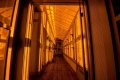
The Door to Nowhere—The Curse of Evil Has Come into His Body!
Some people do not believe in ghost. For that matter, some people do not believe in anything. There are persons who even affect incredulity concerning the “Door to Nowhere,” at the Winchester mansion. They said that it did not stand wide open—that it was not a gateway to the Spirit World and that they could have shut it; that the whole affair was a delusion; that they are sure it must have been a conspiracy; that they are doubtful whether there is such a place as the Winchester mansion on the face of the Earth; that the first time they are in California they will look it up. Perhaps, before going further, I ought to premise there was a time when I did not believe in ghosts either. If you had asked me one summer’s morning years ago when you met me on the Golden Gate Bridge if I held such appearances to be probable or possible, you would have received an empathic “No” for answer. However, at this rate, the story of the Door to Nowhere will never be told; so we will, with your permission, plunge into it immediately. I was interested in why this “Door to Nowhere” in the Winchester mansion would not keep shut? They say the place is haunted. What nonsense. There was one thing I can truly say about our office, we were never serious in it. I fancy that is the case in most offices nowadays; at all events, it was the case in ours. We were always chaffing each other, playing practical jokes, telling stupid stories, scamping our work, looking at the clock, counting the weeks to next Christmas, counting the hours to Saturday. For all that we were earnest in our desire to have our salaries raised, and unanimous in the opinion no fellows ever before received such wretched pay. #RandolphHarris 1 of 17

I had $75,000 a year, which I was aware did not half provide for what I ate at home. My mother and sisters left me in no doubt on the point, and when new clothes were wanted I always hated to mention the fact to my poor worried father. We had been better off once, I believe, though I never remember the time. My father owned a small property in the country. I wanted money badly—I must say I never had sixpence in the World of my own—and I thought if I could earn two sovereigns I might buy some trifles I needed for myself, and present my father with a new Ultimate Driving Machine. Then I recalled the amount of the rent was being asked for the Winchester mansion; then I decided gladly this would be a great place to stay if only the ghost turned out of possession. I decided I should like to try to whether, I could not solve the mystery. I was accustomed to lonely houses, and I would not feel at all nervous; I did not believe in ghost, and as for burglars, I was not afraid of them. I was told to just try it out first. To stay in the house for a week; if as tht end of that time I could keep the door shut, locked, bolted, or nailed up, to telegraphy the Winchester Repeating Arms Company, and they would actually pay me to stay there. To me, this sounded like a great bargain. If I lay the ghost, or find out the ghost, I think I ought to have enough money to buy a small house for myself. However, I could not have said what frightened me about this endeavour. A week after I moved into the Queen Anne mansion, Mr. van Buuren from the Winchester Repeating Arms Company came to visit me. He wanted to speak to me about the mansion. I heard a sound of irritation in his voice. “The Winchester Mansion!” he said; “and what have you got to say about the Winchester Mansion?” #RandolphHarris 2 of 17

“That is what I wanted to tell you, Mr. van Buuren,” I answered, and a dead hush seem to fall over the office as I spoke. The silence seemed to attract his attention, for he looked sternly at the clerks, who were not using a pen or moving a finger. “Come this way, then,” he said abruptly; and next minute I was in his private office. “Now, what is it?” he asked, flinging himself into a chair, and addressing me, who stood hat in hand beside the great table in the middle of the room. I began—I will say he was a patient listener—at the very beginning, and told my story straight through. I concealed nothing. I enlarged on nothing. A discharged clerk I stood before him, and in the capacity of a discharged clerk I said what I had to say. He heard me to the end, the he sat silent, thinking. At last he spoke. “You have heard a great deal of conversation about the Winchester, I suppose,” he remarked. “No, sir; I have heard nothing expect what I have told you.” “And why do you desire to strive to solve such a mystery?” “If there is any money to be made, I should like to make it, sir.” “How old are you?” “Two-and-twenty last January.” He laughed—he lay back in his chair and laughed—and I laughed myself, though ruefully. We went on talking for a long time after that; he asked me all about my father and my early life, and how we lived and the people we knew; and, in fact, put more questions than I can well remember. “It seems a crazy thing to do,” he said at las; “and yet I feel disposed to trust you. The house is standing perfectly empty. I cannot live it in, and I cannot get rid of it; all my own furniture I have removed, and there is nothing in the place except a few old-fashioned articles belonging to Mrs. Winchester. The place is a loss to me. It is of no use trying to let it, and thus, in fact, matters are at a deadlock. #RandolphHarris 3 of 17

“You will not be able to find out anything, I know, because, of course, other have tried to solve the mystery ere now; still, if you like to try you may. I will make this bargain with you. If you like to go down, I will pay your reasonable expenses for a fortnight; and if you do any good for me, I will give you a $1,000,000 note for yourself. Of course I must be satisfied that what you have told me is true and that you are what your represent. Do you know anybody in the city who would speak for you?” I could think of no one but my uncle. I hinted to Mr. van Buuren he was no grand enough or rich enough, perhaps, but I knew nobody else to whom I could refer him. “What?!” he said, “Greg Ryan, of Lakeview Street. He does business with us. If he will go bail for your good behaviour I shan’t want any further guarantee. Come along.” And to my intense amazement, he rose, put on his hat, walked me across the outer office and along the pavements till we came to Lakeview Street. “Do you know this youth, Mr. Ryan?” he said, standing in front of my uncle’s desk, and laying a hand on my shoulder. “Of course I do, Mr. van Burren,” answered my uncle, a little apprehensively; for, as he told me afterwards, he could not imagine what mischief I have been up to. “He is my nephew.” “And what is your opinion of him—do you think he is a young fellow I may safely trust?” My uncle smiled, and answered, “That depends on what you wish to trust him with.” “A long column of addition, for instance.” “It would be safer to give that task to somebody else.” “Oh, uncle!” I remonstrated; for I had really striven to conquer my natural antipathy to figures—worked hard, and every bit of it against the collar. My uncle got off his stool, and said, standing with his back to the empty fire-grate: “Tell me what you wish the boy to do, Mr. van Buuren, and I will tell you whether he will suit your purpose of not. I know him, I believe, better than he knows himself.” #RandolphHarris 4 of 17

In an easy, affable way, for so rich a man, Mr. van Buuren took possession of the vacant stool, and nursing his right leg over his left knee, answered: “He wants to go and shut the “Door to Nowhere” at the Winchester Mansion for me. Do you think he can do that? My uncle looked steadily back at the speaker, and said, “I thought, Mr. van Buuren, I was quite settled no one could shut it?” Mr. van Buuren shifted a little uneasily on his seat, and replied: “I did not set your nephew the task he fancies he would like to undertake.” “Have nothing to do with it, Justin, advised my uncle, shortly. “You do not believe in ghost do you, Mr. Ryan?” asked Mr. van Burren, with a slight sneer. “Do you not, Mr. van Buuren?” retorted my uncle. There was a pause—an uncomfortable pause—during the course of which I felt the million dollar note, which in imagination, I had really spent, trembling in the scale. I was not afraid. For one million dollars, or half the money, I would have faced all the inhabitants of spirit land. I longed to tell them so; but something in the way those two men looked at each other stayed my tongue. “If you ask me the question here in the heart of the city, Mr. Ryan,” said Mr. van Buuren, at length, slowly and carefully, “I answer ‘No’; but if you were to put me on a dark night at the Winchester, I should beg time to consider. I do not believe in supernatural phenomena myself, and yet—the ‘Door to Nowhere’ at the Winchester is as much beyond my comprehension as the ebbing and flowing of the sea.” “And you cannot live at the Winchester?” remarked my uncle. “I cannot live at the Winchester, and what is more, I cannot get anyone else to live at the Winchester.” “And you want to get rid of your lease?” “I want so much to get rid of my lease that I told Tuck I would give him a handsome sum if he could induce anyone to solve the mystery. Is there any other information you desire, Mr. Ryan? Because if there is, you have only to ask and have. I feel I am not here in a prosaic office in the city of Santa Clara, but in the Palace of Truth.” #RandolphHarris 5 of 17

My uncle took no notice of the implied compliment. When company is good it needs nothing else. If a man is habitually honest in his speech and in his thoughts, he desires no recognition of the fact. “I do not think so,” he answered; “it is for the boy to say what he will do. If he be advised by me he will stick to his ordinary work in his employers’ office, and leave ghost-hunting and spirit-laying alone.” Mr. van Buuren shot a rapid glance in my direction, a glance which implying a secret understanding, might have influenced my uncle could I have stooped to deceive my uncle. “I cannot stick to my work there any longer,” I said. “I got my marching orders today.” “What had you been doing, Justin? Asked my uncle. “I wanted one million to go and lay the ghost!” I answered, so dejectedly, that both Mr. van Buuren and my uncle broke out laughing. “One Million dollars!” cried my uncle, almost between laughing and crying. “Why, Justin boy, I had rather, poor man though I am, have given thee one million dollars than thou should’st go ghost-hunting or ghost-laying.” When he was very much in earnest my uncle went back to thee and thou his native dialect. I liked the vulgarism, as my mother called it, and I knew my aunt loved to hear him use the caressing words to her. He had risen, not quite from the ranks it is true, but if ever a gentleman came ready born into the World it was Greg Ryan, upon whom at our home everyone seemed to look down. “What will you do, you man?” asked Mr. van Buuren; “you hear what your uncle says, “Give up the enterprise,” and what I say; I do not want either to bribe or force your inclinations.” “I will go, sir,” I answered quite steadily. “I am not afraid, and I should like to show you—” I stopped. I had been going to say, “I should like to show you I am not sure a fool as you all take me for,” but I felt such an address would be too familiar, and refrained. #RandolphHarris 6 of 17

When I got to the Lodge, I showed Mr. van Buuren’s letter to the woman, and received the key. “You are not going to stop up at the Winchester alone, are you, sir? she asked. “Yes, I am,” I answered, uncompromisingly, so uncompromisingly that she said no more. The avenue led straight to the mansion; it was uphill all the way, and bordered by rows of the most magnificent limes I ever beheld. A light iron fence divided the avenue from the park, and between the trunks of the trees I could see the deer browsing and cattle grazing. Ever and anon there came likewise to my ear the sound of a sheep-bell. It was a long avenue, but at length I stood in front of the mansion—a square, solid-looking, Victorian mansion, four stories high, with several towers and a steeply pitched roof, beautiful stained-glass windows and statues, a basement; a flight of steps up to the principal entrance; several windows to the right of the door, several to the left of the door; the whole mansion flanked and backed with trees; all the curtains closed, a dead silence brooding over the place; the sun westering behind the great trees studding the park. I took all this in as I approached, and afterwards as I stood for a moment under then ample porch; then remembering he business which has brought me so far, I fitted the great key in the lock, turned the handle, and entered the Winchester Mansion. For a minute—stepping out of the bright sunlight—the place looked to me so dark that I could scarcely distinguish the objects by which I was surrounded; but my eyes soon grew accustomed to the comparative darkness, and I found I was in an immense hall, lighted from the roof; a magnificent old oak staircase conducted to the upper rooms. #RandolphHarris 7 of 17

The floor was of white marble. There were two fireplaces, fitted with dogs for burning wood; around the walls hung pictures, antlers, and horn, and in odd niches and corners stood groups of statues, and the figure of men in complete suits of armour. To look at the place outside, no one would have expected to find such a hall. I stood lost in amazement and admiration, and then I began to glance more particularly around. Mr. van Buuren has not given me any instructions by which to identify the ghostly chamber—which I concluded would most probably be found on the first floor. I knew nothing of the story connected with it—if there were a story. I was perfectly unencumbered of the mystery. I had not the faintest idea in which apartment it resided. Well, I should discover that, no doubt, for myself ere long. I looked around me—doors—doors—doors. I have never before seen so many doors together all at once. Two of them stood open—one wide, the other slightly ajar. “I will just shut them as a beginning,” I thought, “before I go upstairs.” The doors were of oak, heavy, well-fitting furnished with good locks and sound handles. After I had closed I tried them. Yes, they were quite secure. I ascended the great staircase feeling curiously like an intruder, paced the corridors, entered the many bed chambers—some quite bare of furniture, others containing articles of an ancient fashion, and no doubt of considerable value—chairs, antique dressing-tables, curious wardrobes, and such like. For the most part the doors were closed, and I shut those that stood open before making my way into the attics. I was greatly delighted with the attics. The window lighted them did not, as a rule, overlook the front of the Manion, but commanded wide views over wood, and valley, and meadow. Leaning out of one, I could see, that to the right of the mansion the ground, thickly planted, shelved down to a stream, which came out into the daylight a little distance beyond the plantation, and meandered through the deer part. #RandolphHarris 8 of 17

At the back of the mansion the windows looked out on nothing save a dense wood and a portion of the stable-yard, whilst on the side nearest the point from whence I had come there were spreading gardens surrounded by thick yew hedges, and kitchen-gardens protected by high walls; and further on a farmyard, where I could perceive cows and oxen, and, further still, luxuriant meadows, and fields glad with waying and fruit orchards. “What a beautiful place!” I said. “van Buuren must have been a duffer to leave it.” And then I thought what a great ramshackle house it was for anyone to be in all alone. Getting heated with my long walk, I suppose, made me feel chilly, for I shivered as I drew my head in from the last dormer window, and prepared to go down stairs again. In the attics, as in the other parts of the house I had as yet explored, I closed the doors, when there were keys locking them; when there were not, trying them, and in all cases, leaving the securely fastened. When I reached the ground floor the evening was drawing on apace, and I felt that if I wanted to explore the whole house before dusk I must hurry my proceedings. “I will take the kitchens next,” I decided, and so made my way to a wilderness of domestic offices lying to the rear of the great hall. Stone passages, great kitchens, an immense servants’-hall, larders, pantries, coal-cellars, beer-cellars, laundries, brewhouses, housekeeper’s room—it was not of any use lingering over these details. The mystery that trouble Mr. van Buuren could scarcely lodge amongst cinders and empty bottles, and there did not seem much else left in this part of the building. I would go through the living-rooms, and then decide as to the apartments I should occupy myself. The evening shadows were drawing on apace, so I hurried back into the hall, feeling it was a weird position to be there all alone with those ghostly hollow figures of men in armour, and the statues on which the moon’s beams must fall so coldly. #RandolphHarris 9 of 17

I would just look through the lower apartments and then kindle a fire. I had seen quantities of wood in a cupboard close at hand, and felt that beside a blazing hearth, and after a good cup of tea, I should not feel the solitary sensation which was oppressing me. The sun had sunk below the horizon by this time, for to reach the Winchester I had been obliged to travel by cross lines of railway, and wait besides for such trains as condescended to carry third-class passengers; but here was still light enough in the hall to see all object distinctly. With my own eyes I saw that one of the doors I had shut with my own hands was standing wide! I turned to the door on the other side of the hall. It was as I had left it—closed. This, then, was the room—this with the open door. For a second I stood appalled; I think I was fairly frighted. That did not last long, however. There lay the work I had desired to undertake, the foe I had offered to fight; so without mor ado I shut the door and tried it. “Now I will walk to the end of the hall and see what happens,” I considered. I did so. I walked to the foot of the grand staircase and back again, and looked. The door stood wide open. I went into the room, after just a spasm of irresolution—went in and pulled up the blinds: a good-sized room, twenty by twenty (I knew because I paced it afterwards), lighted by two long windows. The floor, of polished oak, was partially covered with a Turkey carpet. There were two recesses beside the fireplace, one fitted up as a bookcase, the other with an old and elaborately carved cabinet. I was astonished also to find a bedstead in an apartment so little retired from the traffic of the house; and there were also some chairs of an obsolete make, covered, so far as I could make out, with faded tapestry. Beside the bedstead, which stood against the wall opposite to the door I had as yet met with the interior of the house. #RandolphHarris 10 of 17

It was a dreary, gloomy room: the dark panelled walls; the black, shining floor; the windows high from the ground; the antique furniture; the dull four-poster bedstead, with dingy velvet curtains; the gaping chimney; the silk counterpane that looked like a pall. “Any crime might have been committed in which a room,” I thought pettishly; and then I looked at the door critically. Someone had been at the trouble of fitting bolts upon it, for when I passed out I not merely shut the door securely, but bolted it as well. “I will go and get some wood, and then look at it again,” I soliloquized. When I came back it stood wide open once more. “Stay open, then!” I cried in a fury. “I will not trouble myself any more with you tonight!” Almost as I spoke the words, there came a ring at the front door. Echoing through the desolate house, the peal in the then states of my nerves startled me beyond expression. It was only the man who had agreed to bring over my traps. I bade him lay them down in the hall, and while looking out some small silver, asked where the nearest-post-office was to be found. Not far from the Winchester Estate’s Park gates, he said; if I wanted any letter sent, he would drop it in the box for me; the mail-cart picked up the bag at ten o’clock. I had nothing ready to post then, and told him so. Perhaps the money I gave was more than he expected, or perhaps the dreariness of my position impressed him as it had impressed me, for he paused with his hand on the lock, and asked: “Are you going to stop here all alone, master?” “All alone, I answered, with such cheerfulness as was possible under the circumstances.” “That is the room, you know,” he said, nodding in the direction of the open door, and dropping his voice to a whisper. “Yes, I know,” I replied. “What, you have been trying to shut it already, have you? Well, you are a game one!” And with this complimentary if not very respectful comment he hastened out of the house. Evidently he had no intention of proffering his services towards the solution of the mystery. #RandolphHarris 11 of 17

I cast one glance at the door—it stood wide open. Through the windows I had left bare to the night, moonlight was beginning to stream cold and silvery. “Look here, Justin,” I said, all of a sudden; “life is not child’s play, as uncle truly remarks. That door is just the trouble you have now to face, and you must face it! However, for that door you would never have been here. I hope you are not going to turn coward the very first night. Courage!—that is your enemy—conquer it.” “I will try,” my other self answered back. “I can but try. I can but faith.” The moon’s beams were streaming down upon the mansion; I could see every statue, every square of marble, every piece of armour. For all the World it seemed to me like something in a dream; but I was tired and sleepy, and decided I would not trouble about fire or food, or the open door, till the next morning: I would go to sleep. However, I felt like an army of Devil’s was horribly broke in upon this place which is the center, and after a sort, the first-born of our Californian settlements. If a ghost was responsible for the hanging of nineteen people in this mansion, what was responsible for the burning of nine hundred people? What more likely time would the “Door to Nowhere” open up and let our arch-enemy, the Devil, choose a time for his attack? I spent the forenoon considering that door. I looked at it from within and from without. It was on the second floor and opened up to a two story drop outside of the house. What would possess someone to build a door like this, unless they had some knowledge of it being a portal? I eyed it critically. I tried whether there was any reason why it should fly open, and I found that so long as I remained on the threshold it remained closed; if I walked even so far away as the opposite side of the mansion, it swung wide. #RandolphHarris 12 of 17

Do what I would, it burst from latch and bolt. I could not lock it because there was no key. I was baffled. Then I stumbled upon a note which read: “One that shall use, practise, or exercise any invocation or conjuration of any evil or wicked spirit, or consult, convenient with, entertain or employ, feed or reward any evil or wicked spirit, to or for any intent or purpose; or take up any dead man, woman, or child, out of his, her, or their grave, or any other place, where the dead body resteth; or the skin, bone, or other part of any dead person, to be employed or used in any manner of witchcraft, sorcery, charm or enchantment; or shall use, practise, or exercise any witchcraft, enchantment, charm, or sorcery, whereby any person shall be killed, destroyed, wasted, consumed, pined, or lamed in his or her body, or any part thereof: such offenders duly and lawfully convicted and attained, shall suffer death.” Then it dawned of me. Perhaps the mansion has been attraction people who are into the occult and they are the nearly 920 people who have been burned alive or hanged. And that is why the house cannot find renters, it consumes them all. Perhaps this is something like the Atonement of Christ. How God gave His one and only Son to pay the wages of sin man had created, this mansion is consuming souls of those who practise the occult to atone for the death of those killed by the Winchester rifle. The afflicted state of our poor neighbours that are now suffering by molestations from the invisible World, we apprehended so deplorable that we think their condition calls for the utmost help of all persons in their several capacities. We cannot but with all thankfulness acknowledge the success which the merciful God has given unto the sedulous and assiduous endeavours of our honorable rulers to detect the abominable witchcrafts which have been committed in the country, humbly praying that the discovery of these mysterious and mischievous wickedness may be perfected. #RandolphHarris 13 of 17

We judge that in the prosecution of these, and all such witchcrafts, there is need of a very critical and exquisite caution, leas by too much credulity for things received only upon the Devil’s authority there be a door opened for a long train of miserable consequences, and Satan get an advantage over us, for we should not be ignorant of his devices. After all, it was this mansion people could not live in—his door that would not keep shut; and it seemed to me these were facts he might dislike being forced upon the attention of the public. What had I seen? What did I think of the matter? Very honestly I did not know what to say. The door certainly would not remain shut, and there seemed no human agency to account for its persistent opening; but then, on the other hand, ghost generally did no tamper with fire arms, and my rifle, though not loaded, had been tampered with—I was sure of that. Mr. van Buuren later disclosed to me his theory that open door: “This is the room my uncle was murdered in, they say the door will never remain shut till the murderer is discovered.” “Murdered!” I did not like the word at all; it made me feel chill and uncomfortable. “Yes—he was murdered sitting in his chair, and the assassin has never been discovered. At first many persons inclined to the belief that I killed him; indeed, may are of that opinion still. “But you did not, sir—there is not a word of truth in that story, is there?” He laid his hand on my shoulder as he said: “No, my lad; not a word. I loved the old man tenderly. Even when he disinherited me for the sake of his young wife, I was worry, but not angry; and when he sent for me and assured me he had resolved to repair a wrong, I tried to induce him to leave the lady a handsome sum in addition to her jointure. “If you do not, people may think she has not been the source of happiness you expected,” I added. “Thank you, Reuban,” he said. “You are a goof fella; we will talk further about this tomorrow.” And then he bade me goodnight. #RandolphHarris 14 of 17

“Before morning broke—it was in the about one hundred years ago—the household was arounds by a fearful scream. It was his death-cry. He had been stabbed from behind in the neck. He was seated in his chair writing—writing a letter in Latin. Part of it said, ‘Exorcizo te, immundissime spiritus, omnis incursion adversarii, omne phanatasma, omnis leigo, in nominee Domini nostri Jesu Christi eradicare, et effugare ab hoc plasmate Dei.’ The rest of the letter was torn. His solicitor came forward and said he had signed a will leaving all his personalty to me—he was very rich—unconditionally, only three days previously.” Mr. van Buuren went away, and I stayed in the house. I never left it all day. I did not go into the garden, or the stable-yard, or the shrubbery, or anywhere; I devoted myself solely and exclusively to that door. If I shut it once, I shut it a hundred times, and always with the same result. Do what I would, it swung wide. Never, however, when I was looking at it. So long as I could endure to remain, it stayed shut—the instant I turned back, it stood open. Though feeling convinced that no human agency did or could keep the door open, I was certain that some living person had means of access to the house which I could not discover. This was made apparent in trifles which might well have escaped unnoticed had several or even two people occupied the mansion. In the dead of the night a noise, resembling the clashing of iron, was frequently heard, which, if you listened more attentively, sound like the rattling of chains, distant at first, but approaching nearer by degrees: immediately afterward a spectre appeared in the form of an old man, of extremely emaciated and squalid appearance, with a long beard and dischevelled hair, rattling the chains on his feet and hands. The distressed occupants meanwhile passed their wakeful nights under the most dreadful terrors imaginable. This, as it broke their rest, ruined their health, and brought on distempers, their terrors grew upon them, and death ensued. #RandolphHarris 15 of 17

Even in the daytime, though the spirit did not appear, yet the impression remained so strong upon their imaginations that it still seemed before their eyes, and kept them in perpetual alarm. Consequently the mansion was at length deserted, as being deemed absolutely uninhabitable; so that it was now entirely abandoned to the ghost of the Winchester rifle. That night, I prepared to retire. However, I was open to the vain terrors of imaginary noises and spirits. The first part of the night passed in entire silence, as usual; at length a clanking of iron and rattling of chains was heard: however, I neither lifted up my eyes, nor got out of bed, but in order to keep calm, I pretended the sound was something else. The noise increased and advanced nearer, until it seemed at the door, and at last in my chamber. I looked up, saw, and recognized the ghost exactly as it has been described to me: it stood before me, beckoning with a finger, like a person calls another. I immediately arouse, and, candle in hand, followed it. The ghost slowly stalked along as if encumbered with its chains, and, turning into the area of the house where the “Door to Nowhere, was and suddenly vanished. What an idiot I have been! If I wanted to solve the mystery of the open door, or course I must keep watch in the room itself. The door would not stay wide unless there was a reason for it. When I walked into the room, it was deadly cold, and the scene was horrible. The door was wide open. A party of ghosts were assembled with, and were feasting on the flesh of corpses. I was astonished by this hideous banquet. As soon as I could safely escape, I stole back into my bed. I was rather crossed at being disturbed. The next day word on—the long, dreary day; evening approached—the night shadows closed over the Winchester mansion. The moon would not rise for a couple hours more. Everything was still as death. The house had never before seemed to me so silent and so deserted. #RandolphHarris 16 of 17

I took a candle, and went up to my accustomed room, moving about for a time as though preparing for bed; then I extinguished the candle, softly open the door, turned the key, and put it in my pocket, slipped softly downstairs, across the hall, through the open dor. Then I knew I had been afraid, for I felt a thrill of terror as in the dark I stepped over the threshold. I paused and listened—there was not a sound—the night was still and sultry, as though a storm were brewing. Not a leaf seemed moving. Noiselessly I made my way to the other side of the room. There was an old-fashioned easy-chair between the bookshelves and the bed; I sat down in it, shrouded by the heavy curtains. The hours passed—where ever hours so long? The moon rose, came and looked in at the windows, and then sailed away to the west; but not sound, no, not even the cry of a bird. I seemed to myself a mere collection of nerves. Every part of my body appeared twitching. It was agony to remain still; the desire to move became a form of torture. The locked door opened—so suddenly, so silently, that I barely had time to draw back behind the curtain, before I saw a woman in the room. A slight, lithe woman, not a lady, clad in all black—not a bit of white about her. What on Earth could she want? Then she fell on me with her nails and teeth, and tore at my throat, she was as strong as twenty devils. I felt something like a red-hot iron enter my neck. She opened a vein and sucked by blood, and I could but rush from the room before I fell senseless on the marble pavement of the hall. When the post man came that morning, finding no one stirring, he looked through one of the long windows that flanked the door; then he ran to the farmyard and called for help. “There is something wrong inside,” he cried. “That young gentleman is lying on the floor in a blood of blood.” To this day, the “Door to Nowhere” is still a mystery. #RandolphHarris 17 of 17

Winchester Mystery House

24 Hours till opening night of All Hallows’ Eve and our caretakers are working non stop to put the finishing touches on the show! Be here for the opening weekend! Tickets are still available. A 160-room mansion built to appease the spirits who died at the hands of the Winchester Rifle 👻
All Hallows’ Eve:
🎟️ Link in bio. 🗝 winchestermysteryhouse.com

You Must Be As Rich As a Prince With a Fairy Godmother!

Social conditions of the World are not what we would like them to be; the real crux of the problem lies in what should be done about it. By now, you have probably heard a phone-in radio psychologist. On typical program, callers describe social problems from child abuse, loneliness, love affairs, phobia to financial hardships, depression, educational and more. The radio psychologist then offers reassurance, advice, or suggestions for getting help. Talk-radio psychology may seem harmless, but it raises some important questions. For instance, is it reasonable to give advice without knowing anything about a person’s background? Could the advice do harm? What good can a psychologist do in 3 minutes? In defense of themselves, radio psychologists point out that listeners may learn solutions to their problems by hearing others talk. Many of us are concerned with these same problems. However, several radio psychologists also stress that their work is educational, not therapeutic. As you can see, psychological services that rely on electronic communication may serve some useful purposes. Still the very best advice given by media psychologist, telephone counselors, or cybertherapists may be, “You should consider discussing this problem with a psychologist or counselor in your own community.” The social problems of our day are not unique. Jesus Christ was born into a World beset with serious social problems. There existed in Palestine a wide gulf between the rich and the poor. Beggars were found in all of the cities and villages. Disease was rampant. The natives of Palestine were held in bondage to the Roman overlords. #RandolphHarris 1 of 20

Thievery and brigandage were everywhere. The story of the Good Samarian, involving a brutal attack on a lone traveler, could have taken from numerous real happenings. The unarmed dared not venture abroad at night. Even the apostles of our Lord sometimes went about armed, as evidence in the account of Gethsemane. However, Jesus has the power to alleviate hunger. He had just fed the five thousand who seemed to desire his word and who had followed him around the Sea of Galilee to be near him. Yet the answer lay no in bread, nor in clothing, nor in houses. The answer lay deep in the hearts of humans. One who was most touched by man’s inhumanity to man, one who had time for the lowliest of the low, knew that man can rise no higher than his thought, than his philosophy of life, his understanding of its purpose, and his relationship to the Almighty. These are the things that determine the stature of man. Hence, Jesus devoted Himself to the teaching of gospel truths, to the establishment of a church with apostles and seventies to teach and to baptize. He knew that change in the individual brought about change in society, that change in the individual was brought about by a change in his spirit, and that the change in his spirit came from the acceptance of God and His commandments. “The son can do nothing of himself, but what he seeth the Father do,” reports John v.19. If we open such books as Grimm’s Fairy Tales or Ovid’s Metamorphoses or the Italian epics, we find ourselves in a World of miracles so diverse that they can hardly be classified. Beasts turn into men and men into beasts or trees, trees talk, ships become goddesses, and a magic ring can cause tables richly spread with food to appear in solitary places. #RandolphHarris 2 of 20

Some people cannot stand this kind of story, others find it fun. However, the least suspicion that it was true would turn the fun into a nightmare. If such things really happened they would, I suppose, show that Nature was being invaded. However, they would show that she was being invaded by alien power. The fitness of the Christian miracles, and their difference from these mythological miracles, lies in the fact that they show invasion by a Power which is not alien. They are what might be expected to happen when she is invaded not simply by a god, but by the God of Nature: by a Power which is outside her jurisdiction not as a foreigner but as a sovereign. They proclaim that He who has come is not merely a king, but the King, her King and ours. It is this which, to my mind, ours. It is this which, to my mind, puts the Christian miracles in a different class from most other miracles. I do not think that it is the duty of a Christian apologist (as many sceptics suppose) to disapprove all stories of the miraculous which fall outside the Christian records, nor of a Christian man to disbelieve them. I am in no way committed to the assertion that God has never worked miracles through and for Pagans or never permitted created supernatural beings to do so. If, so Tacitus, Suetonius, and Dion Cassius relate, Vespasian performed two cures, and if modern doctors tell me that they could not have been performed without miracle, I have no objection. However, I claim that the Christian miracles have a much greater intrinsic probability in virtue of their organic connection with one another and with the whole structure of the religion they exhibit. If it can be shown that one particular Roman emperor—and, let us admit, a fairly good emperor as emperors go—once was empowered to do a miracle, we must of course put up with fact. #RandolphHarris 3 of 20

However, it would remain a quite isolated and anomalous fact. Nothing comes of it, nothing leads up to it, it establishes no body of doctrine, explains nothing, is connected with nothing. And this, after all, is an unusually favourable instance of a non-Christian miracle. The immoral, and sometimes almost idiotic interferences attributed to gods in Pagan stories, even if they had a trace of historical evidence, could be accepted a wholly meaningless Universe. What raises infinite difficulties and solves none will be believed by a rational man only under absolute compulsion. Sometimes the credibility of the miracles is in an inverse ratio to the credibility of the religion. Thus miracles are (in late documents, I believe) recorded of the Buddha. However, what could be more absurd than the he who came to teach us that Nature is an illusion from which we must escape should occupy himself in producing effects on the Natural level—that he who comes to wake us from a nightmare should add to the nightmare? The more we respect his teaching, the less we could accept his miracles. However, in Christianity, the more we understand what God it is who is said to be present and the purpose for which He is said to have appeared, the more credible the miracles denied except by those who have abandoned some part of the Christian doctrine. The mind which asks for a non-miraculous Christianity is a mind in process of relapsing from Christianity into mere “religion.” A consideration of the Old Testament miracles is beyond the scope of this essay and would require many kinds of knowledge which I do not possess. My present view—which is tentative and liable to any amount of correction-would be that just as, on the factual side, a long preparation culminates in God’s becoming incarnate as Man, so, on the documentary side, the truth first appears in mythical form and then by a long process of condensing or focusing finally becomes incarnate as History. #RandolphHarris 4 of 20

This involves the belief that Myth in general is not merely misunderstood history (as Euhemerus thought) nor diabolical illusion (as some of the Fathers thought) nor priestly lying (as the philosophers of the Enlightenment thought not) but, at its best, a real though unfocused gleam of divine truth falling on human imagination. The Hebrews, like other people, had mythology: but as they were the chosen people so their mythology was the chosen mythology—the mythology chosen by God to be the vehicle of the earliest sacred truths, the first step in that process which ends in the New Testament where truth has become completely historical. Whether we can ever say with certainty where, in this process of crystallization, any particular Old Testament story falls, is another matter. I take it that the memoirs of David’s court come at one end of the scale and are scarcely less historical than St. Mark or Acts; and that the Book of Jonah is at the opposite end. It should be noted that on this view (a) Just as God, in becoming Man, is “emptied” of His glory, so the truth, when it comes down from the “Heaven” of myth to the “Earth” of history, undergoes a certain humiliation. Hence the New Testament is, and ought to be, more prosaic, in some ways less splendid, than the Old; just as the Old Testament is and ought to be less rich in many kinds of imaginative beauty than the Pagan mythologies. (b) Just as God is none the less God by being Man, so the Myth remains Myth even when it becomes Fact. The story of Christ demands from us, and repay, not only a religious and historical but also an imaginative response. It is directed to the child, the poet, and the savage in us as well as to the conscience and to the intellect. One of its functions is to break down dividing walls. #RandolphHarris 5 of 20

Some thoughts. The Devout who snatches another’s obedience will also grab one’s grace. The Devout who squirrels away some personal possessions loses one’s right to communal property. The Devout who gives oneself to one’s superior, but does it hesitantly, beguilingly—well, that is a sign that one’s own flesh has not learned to obey itself; that is to say, having gurgitated, it often has to regurgitate. Learn, therefore, to quickly submit yourself to your superior; that is to say, if you finally want to get your flesh under control. The exterior Enemy is more quickly overcome than you would first imagine, especially if your interior life has not been a total loss. A worse, more pestiferous Enemy of the soul lurks, if all were known. It is you yourself, what with your spirit and flesh in total disarray. If you want to prevail against your flesh and blood, then you have to take back full possession of yourself. Up to this very point in your personal history, you have yet to do this. And it is not so surprising. Your love for yourself exceeds all reasonable standards of quantity and quality; that is to say, there is too much of it, and you have spread it too broadly. No wonder you are afraid to resign yourself fully to the will of others! However, what is the big deal here? You who are dust and nothing but dust—you subjected yourself to Me because God asked you to, and you know what? People applauded! However, I the Lord and Tailor of the Universe—I created everything, and I did it out of nothing, if you can imagine that. What is more, I humbly subjected Myself to Humankind because you asked Me to, but what credit, what respect, did I get? I even made Myself lowest of the low, flattest of the flat, and why would I do that? So that you could use My humility as a weapon against your own pride. #RandolphHarris 6 of 20

The moral? It is from the Great Bernard’s homily for the Feast of the Annunciation (8): “Dustman, dust thyself! Refuse Collector, collect thyself? Proud Flesh, prostrate thyself under the feet of the passing crowd!” Some recommendations. Light a torch under yourself. Do not let pride eat away at you like a tumor. Be an obedient child, and accept the mud from the feet in front of you as your trudge with the adults on the highway of life. That would avoid the wrath of the Psalmist’s Lord (18.42)! Why do you wail about, you silly fool? That is a sentiment I plucked from the Letter of the Great James (2.20). What have you got to say, you sinful sot, against those who take you to task? You have offended God so many times, and so many times you have merited Hell. I speak with the voice of the Great Ezekiel when I say, “My eye has spared you” (20.17). I am echoing the Great Saul to the Great David in First Samuel when I say, “You soul is precious in my sight” (26.21). You should learn to recognize My love and be grateful for My little gifts. Give yourself always to True Subjection and Humility and patently bear up when the contempt you deserve is heaped upon you. Christian Science can deny the existence of ill health only at the cost of logically denying the existence of good health also. Both are differing conditions of the same thing—the body. Christian Science calls sickness a lie. Then it should likewise call its opposite a lie. However, not only does it not: it actually affirms that good health is a truth and a reality even while it denounces matter—the body—as a lie and an illusion! If, in spite of its deformed logic, Christian Science still gets healing done—as it does—this result must be attributed to the fact that infinite Life-Power does take cognizance of the body’s disease and does not deny its being there. #RandolphHarris 7 of 20

It is not only fallacious to deny the existence of a disease but also, if the attempt s made to secure healing, insincere. The Christian Science attempt to deny existence to sickness as an error of moral mind is itself an error. It is more philosophic, first, to take it as an existent fact, but to understand that the body’s reality is only a limited and temporary one, and, second, to couple it with the other fact that there are healing forces and recuperative energies in the higher self of man which may dispel it. If right thinking alone could sustain life and support health irrespective of every other factor, then human beings could immure themselves where sunlight, air, water, and food could not reach them and still live actively. However, the only cases known to history are of few hibernating inactive self-actualized. Such theorizing is self-deceptive. Many people in the Old World, from the safe distance of the study, conveniently denied the existence of disease. Meanwhile the gods have smiled cynically as millions in the Old World have picked up cholera and passed to their doom. The mental peace obtained by denying facts like sickness may be welcome to the sufferer. However, it may also turn out to be a false peace. Although the theory of these cults is in part quite fallacious, the practice of them brings striking results at times. This is because the healing power really comes forth from the individual’s own higher self, to which the cults do—although somewhat unconsciously—direct one. One of the self-actualized paths is the creative use of imagination and thought for self-improvement, and so far as it embodies such a technique, Christian Science is a self-actualized path too. It instructs its disciples to see themselves as perfect, as the Universal Mind sees them, to concentrate on the concept of, and hold to the belief in, the divine man. #RandolphHarris 8 of 20

These prayers and attitudes draw forth high resources, which may effect results where ordinary ones fail. This thinking runs somewhat as follows. The entire Universe is but an idea. Therefore the human body is also an idea. Therefore the human being, as the thinker of this idea, possesses complete power to alter, improve, and even change the body. Therefore one can abolish disease, annul sickness, restore health, and preform miraculous environmental betterments at will, provided one can suitably re-adjust and control one’s thoughts. All this sounds plausible and attractive, but there is a fallacy in it. And this is that the human being is the sole thinker of the World-Idea. One is not. One only participates in it along with the World Mind. One’s power over the body is a limited one. By one’s thoughts, one can influence its functioning and sometimes modify its mechanism. An avalanche of recent studies reveals that aerobic exercise not only promotes health and energy, but also is a remedy for mild depression and anxiety. Experiments that randomly assign some depressed or anxious people to exercise routines confirm this. So do surveys showing that Canadians and Americans are more self-confident, self-disciplined, and psychologically resilient if physically fit. Sound minds reside in sound bodies. Also, get REST—Restricted Environmental Stimulation Therapy. Happy people live active, vigorous lives, yet reserve time for renewing sleep and solitude. Americans suffer from a growing “national sleep debt,” with resulting fatigue, diminished alertness, and gloomy moods. Even a literal day of REST, or smaller, daily doses of solitude in meditation or prayer, can spiritually recharge. #RandolphHarris 9 of 20

There are few better remedies for unhappiness than an intimate friendship with someone who cares deeply about you. Confiding is good for soul and body. “Woe to one who is alone and falls and does not have another to help,” observed the writer of Ecclesiastes. Research confirms that we humans have a deep “need to belong”—to connect with others in close, supportive, intimate relationships. Committed marriages, for example, are associated with health, happiness, and reduced poverty, and with better-educated, healthier, and more successful children. It was found that 40 percent of married adults but only 23 percent of those who never married (and end fewer of the divorced and separated) reported them selves “very happy.” New evidence indicates that marriage does no just ride along with social, psychological, and economic well-being; it contributes to it. So, if and when you marry, resolve to nurture your relationship, not to take your partner for granted, to display to your spouse the sort of kindness that you display to others, to affirm your partner, to play together and share together. To rejuvenate your affections, resolve in such ways to act lovingly. In study after study, actively religious people prove to be happier. In fact, 47 percent of those attending church or synagogue several times weekly said they were “very happy,” as did only 27 percent of those never attending. Those with an active faith also cope better with crises. Compared with religious inactive widows, recently widowed women who worship regularly report more joy. Among mothers of developmentally challenged children, those with a deep religious faith are less vulnerable to depression. People of faith also tend to retain or recover greater happiness after suffering divorce, unemployment, serious illness, or bereavement. #RandolphHarris 10 of 20

For many people, faith provides, first, a support community. The fellowship of kindred spirits, the bearing of one another’s burdens, the ties of love that bind are intrinsic to Christian communities—of which there are some 400,000 in North America. Faith also provides many people with a sense of life’s meaning and purpose. Faith satisfies the most fundamental need of all. That is the need to know that somehow we matter, that our lives mean something, count as something more than jus a momentary blip in the Universe. Faith also offers feelings of ultimate acceptance (what Christians know as the “grace” experience), a reason to focus beyond self, and a timeless perspective on life’s woes. We are mindful of the reality of suffering and the terror of death, yet sustained by a hope that in the end, the very end, all shall be well, and all shall be well, and all manner of things shall be well. If the electronic cottage were to spread, people working from home instead of at the office, a chain of consequences of great importance would flow through society. Many of these consequences would please the most ardent environmentalist or techno-rebel, while at the same time opening new options for business entrepreneurship. Community impact: Work at home involving any sizeable fraction of the population could mean greater community stability—a goal that now seems beyond our reach in many high-change regions. If employees can perform some or all of their work tasks at home, they do not have to move every time they change jobs, as many are compelled to do today. They can simply plug into a different computer. #RandolphHarris 11 of 20

This implies less forced mobility, less stress on the individual, fewer transient human relationships, and greater participation in community life. Today when a family moves into a community, suspecting that it will be moving out again in a year or two, its members are markedly reluctant to join neighbourhood organizations, to make deep friendships, to engage in local politics, and to commit themselves to community life generally. The electronic cottage could help restore a sense of community belonging, and touch off a renaissance among voluntary organizations like churches, women’s groups, lodges, clubs, athletic and youth organizations. The electronic cottage could mean more of what sociologists, with their love of German jargon, call gemeinschaft. Environmental Impact: The transfer of work, or any part of it, into the home could not only reduce energy requirements, as suggested above, but could also lead to energy decentralization. In stead of requiring highly concentrated amounts of energy in a few high-rise offices or sprawling factory complexes, and therefore requiring highly centralized energy generation, the electronic cottage system would spread out energy demand and thus make it easier to use solar, wind, and other alternative energy technologies. Small-scale energy generation units in each home could substitute for at least some of the centralized energy now required. This implies a decline in pollution as well, for two reasons: first, the switch to renewable energy sources on a small-scale basis eliminates the need for high-polluting fuels, and second, it means smaller releases of highly concentrated pollutants that overload the environment at a few critical locations. #RandolphHarris 12 of 20

Economic Impact: Some businesses would shrink in such a system, and others proliferate or grow. Clearly, the electronics and computer and communications industries would flourish. By contrast, the oil companies, the auto industry, and commercial real estate developers would be hurt. A whole new group of small-scale computer stores and information services would spring up; the postal service, by contrast, would shrink. Papermakers would do less well; most service industries and white-collar industries would benefit. At a deeper level, if individuals came to own their own electronic terminals and equipment, purchased perhaps on credit, they would become, in effect, independent entrepreneurs rather than classical employees—meaning, as it were, increased ownership of the “means of production” by the worker. We might also se groups of home-workers organize themselves into smaller companies to contract for their service or, for that matter, unite in cooperatives that jointly own the machines. All sorts of new relationships and organizational forms become possible. Psychological Impact: The picture of a work World that is increasingly dependent upon abstract symbols conjures up an overcerebral work environment that is alien to us and, at one level, more impersonal than at present. However, at a different level, work at home suggests a deepening of face-to-face and emotional relationships in both the home and the neighbourhood. Rather than a World of purely vicarious human relationships, with an electric screen interposed between the individual and the rest of humanity, as imagined in many science fiction stories, one can postulate a World divided into two sets of human relationships—one real, the other vicarious—with different rules and roles in each. #RandolphHarris 13 of 20

No doubt we will experiment with many variations and halfway measures. Many people will work at home part-time and outside the home as well. Dispersed work centers will no doubt proliferate. Some people will work at home for months or years, then switch to an outside job, and then perhaps switch back again. Patterns of leadership and management will have to change. Small firms would undoubtedly spring up to contract for white-collar tasks from larger firms and take on specialized responsibilities for organizing, training, and managing teams of homeworkers. To maintain adequate liaison among them, perhaps such small companies will organize parties, social occasions, and other joint holidays, so that the members of a team get to know one another face-to-face, not merely through the console or keyboard. Certainly not everyone can or will (or will want to) work at home. Certainly we face a conflict over pay scales and opportunity cost. What happens to the society when an increased amount of human interaction on the job is vicarious while face-to-face, emotion-to-emotion interaction intensifies in the home? What about cities? What happens to the unemployment figures? What, in fact, do we mean by the terms “employment” and “unemployment” in such a system? It would be naïve to dismiss such question and problems. However, if there are unanswered questions and possibly painful difficulties, there are also new possibilities. The leap to a new system of production is likely to render irrelevant many of the most intractable problems of the passing era. The misery of feudal toil, for example, could not be alleviated within the system of feudal agriculture. #RandolphHarrs 14 of 20

Feudal toil was not eliminated by peasant revolts, by altruistic nobles, or by religions utopians. Toil remained miserable until it was altered entirely by the arrival of the factory system, with its own strikingly different drawbacks. In turn, the character problems of industrial society—from unemployment to grinding monotony on the job to overspecialization, to the callous treatment of the individual, to low wages—may, despite the best intentions and promises of job enlargers, trade unions, benign employers, or revolutionary workers’ parities, be wholly unresolvable within the framework of the Second Wave production system. If such problems have remained for 300 years, under both capitalist and socialist arrangements, there is cause to think they may be inherent in the mode of production. The leap to a new production system in both manufacturing and the white-collar sector, and the possible breakthrough to the electronic cottage, promise to change all the existing terms of debate, making obsolete most of the issues over which men and women today argue, struggle, and sometimes die. We cannot today know if, in fact, the electronic cottage will become the norm of the future. Nevertheless, it is worth recognizing that if as few as 10 to 20 percent of the work force as presently defined were to make this historic transfer over the next 5 to 10 years our entire economy, our cities, our ecology, our family structure, our values, and even our politics would be altered almost beyond our recognition. It is a possibility—a plausibility, perhaps—to be pondered. #RandolphHarris 15 of 20

It is now possible to see in relationship to one another a number of Third Wave changes usually examined in isolation. We see a transformation of our energy system and our energy base into a new techno-sphere. This is occurring at the same time that we are demassifying the mass media and building an intelligent environment, thus revolutionizing the info-sphere as well. In turn, these two giant currents flow together to change the deep structure of our production system, altering the nature of work in factory and office and, ultimately, carrying us toward the transfer of work back into the home. By themselves, such massive historical shifts would easily justify the claim that we are on the edge of a new civilization. However, we are simultaneously restructuring our social life as well, from our family ties and friendships to our schools and corporations. We are about to create, alongside the Third Wave techno-sphere and info-sphere, a Third Wave socio-sphere as well. It is somewhat ironic that the contemporary concern over the patriarchal nature of suburbia is the exact opposite of the major criticisms made by popular antisuburban literature of the post-World War II period. The accusation made by critics of suburbia following the war was not that suburbs fostered a patriarchal traditional family, but rather that the husbands’ absence from the suburban home during the day led to a suburban matriarchy. This matriarchy, it was charged, was leading to a child-dominated society. The suburban way of life was said to lead to excessive, overprotective “momism.” Suburban mothers were criticized for having excessive involvement in the raising of their sons, which was leading to the raising of a generation of what was perceived as male offspring who lacked resolution and that were weak and purposeless. #RandolphHarris 16 of 20

These beliefs or the spineless male offspring were not fringe views. It is worth nothing that Philip Wylie’s, Generation of Vipers, which put the term “momism” into the language, had gone through twenty printings by the 1950s (Philip Wylie, Generation of Vipers, Ferrar and Rinehart, New York, 1942). Popular postwar criticism, as expressed by psychiatrists and others, was that suburban life, with its daytime absence of males, led to excessive independence and isolation of women. Female-oriented suburban life was, in turn, blamed for increases in adultery, alcoholism, mental illness, and divorce. Such pop-psychology myths received wide dissemination and acceptance as factual descriptions of reality. So maybe there will be some benefits to the electronic cottage. However, the 1963 publication of Betty Friedan’s landmark, The Feminine Mystique (1963) turned the argument completely around. Dr. Friedan gave voice to the widespread angst of housewives, and she noted that it came not from having too much suburban free time, but from powerlessness. She agreed that suburbs helped create a female culture, but it was not a culture of dominating momism, but rather one of essential exclusion from outside-the-hone decision making. There have been discussion going back over a century as to whether suburban life was better for males or females. Actual studies done in the 1960s and 1970s tended to show that suburbia and suburban life favoured males, with husbands being more pleased with suburban living than their wives. Gans, in his famous Levittown study, found, for example, that three out of ten thousand, but six our of ten wives, preferred to live in the city “if not for their children. College-educated women with young children particular felt the restrictions of being tied to the limited local community for intellectual stimulation. Studies generally found that husbands, because they left the community for work, had wider networks of friends and colleagues, while wives were more likely to be restricted to socializing with those in the neighbourhood. #RandolphHarris 17 of 20

A major study of Toronto housing by William Michelson found that women living in urban residential areas had greater satisfaction with their neighbourhoods than those in more suburban locations. Women particularly liked the access to services and public transportation that urban areas afforded. In most writings, men were reported more likely to prefer suburbs since they provided escape from urban pressures and demands. A feminist’s review of literature on the effect of housing environments on women concluded that the burdens of isolated suburban life fell particularly heavily on women. However, times change. While one still hears references to women being isolated in suburbia without access to cars, culture, or community, this picture increasingly is a cliché of another era. In a time when two-and even three-car families are the norm, and when most women, including those with young children, are in the labour force, the image of this isolated suburban homemaker seems somewhat quaintly dated. The picture of the homemaker trapped all day in her suburban home and kitchen has more ties to the 1950s than to the realities of contemporary life. Today most women have careers or jobs outside the home. Yet, the post-World War II, “modern” kitchen showed the full effects of “scientific” domestic engineering and home economics, but was still quite clearly a woman’s domain. However, this is changing in modern architecture. Kitchens are becoming more larger and masculine. Also, the preference of women for the convenience of the city over the space of the suburbs no longer applies. The data are rather overwhelming in indicating that most American women wanted detached, single-family suburban homes. The federal government’s Annual Housing Survey indicated that women equally with men share a preference for suburban over urban housing. #RandolphHarris 18 of 20

Large majorities of both genders prefer single-family homes. Moreover, single women heading households, similarly to married-couple householders, expressed the greatest satisfaction with living in suburban housing. Christine Cook similarly found that female single-parent householders express greater satisfaction with suburban rather than city housing. Lower rates of crime, better school for their children, and the generally more peaceful environment were the most common reasons given for preferring the suburbs. For women householders, the traditional urban advantages of access to public transit and shopping now appear to be more than offset by concerns over crime and poor-quality schools. Gender differences are becoming less and less relevant in predicting housing preferences. The Annual Housing Survey indicates both men and women now give similar reason for moving to a particular area. Unlike the suburbanites of the 1950s and 1960s, the majority of young adults now living in suburbs have grown up in suburbs rather than in central cities. This, they are most comfortable with the suburban environment in which they were raised. Also, massive changes in shopping and employment patterns over the past decades have resulted in the majority of these activities now being located in suburbs. Living in the suburbs is now the middle-class norm; it is living elsewhere that requires a specific decision. Often critics of suburban housing and lifestyles appear to be viewing suburbs through a different prism than that used by actual suburban residents. Today’s suburbanites are more concern about matters such as commuting problems, and getting more open time than they are about being trapped in their suburban houses. #RandolphHarris 19 of 20

Having too much independent or leisure time with nothing to do is not a prime problem of women of the 21st century. Most suburbanites, male and female, would welcome having a few days alone at home. The small plot of ground on which you were born cannot be expected to stay forever the same. Earth changes, and homes becomes different places. You took flesh from clay, but the clay did not come from just one place. To feel alive, important, and safe, know your own waters and hills, but know more. You have stars in your bones and oceans in blood. You have opposing terrain in each eye. You belong to the land and sky of your first cry, you belong to infinity. As Thou didst save them who were sustained on the Sabbath by the prepared manna, the appearance of which altered not, and the fragrance thereof did not change, so save us now. As Thou didst save those whom from the Torah derived the laws concerning Sabbath-burdens, who in resting and reposing thereon observed its bounds and limits, so save us now. As Thou didst save them who at Sinai were instructed in the Fourth Commandment to “Remember” and “Observe” the holiness of the Sabbath, so save us now. As Thou didst save them that were commanded to encircle Jericho seven times, who besieged and attacked it until it fell on the Sabbath, so save us now. As Thou didst save Solomon and his people n the holy Temple, who sought Thy favour with a festival of twice seven days, so save us now. As Thou didst save the exiled throngs returning to redemption, who on this festival read from Thy Torah each say, so save us now. As Thou didst save Thy rejoicing hosts in the renewed glory of the second Temple, as on each of these seven days, they bore the palm-branch in the Sanctuary, so save us now. #RandolphHarris 20 of 20

Cresleigh Homes

The IDEAL home is the one that fits your REAL life. The Brighton Station Residence 4 is equipped with the option of multi-generational living, 😮 thanks to the first floor bedroom + bathroom. https://cresleigh.com/brighton-station/residence-4/

There are so many possibilities when your home is thoughtfully designed and beautifully executed!

Brighton Station at Cresleigh Ranch is Rancho Cordova’s newest home community! This charming neighborhood offers an array of home types with eye catching architecture styles such as Mid-Century Modern, California Modern, Prairie, and Contemporary Farmhouse.

One Feels the Presence within One of the Mysterious Entity which is One’s Soul!

How to gain, how to keep, how to recover happiness, is in fact for most humans at all times the secret motive of all they do, and of all they are willing to endure. Emotional expressions, or outward signs of what a person is feeling, are another major element of emotion. For example, when you are intensely afraid, your hands tremble, your face contorts, and your posture becomes tense and defensive. Emotion is also revealed by marked shifts in voice tone or modulation. Such expressions are important because they communicate emotion from one person to another. Emotional feelings (a person’s private emotional experience) are a final major element of emotion. This is the part of emotion with which we are usually most familiar. Happiness—that delicious feeling of well-being and joy. What does it mean for our lives? How can we attain it? Have you noticed how your state of happiness or unhappiness colours everything else? Researchers have found that when we are in a happy mood, we see the World as friendly and nonthreatening. We make decisions easily. We recall the good times and forget the bad. Let our mood turn gloomy and soon enough we will find reasons for it: our relationships, our-self-image, and our prospects for the future suddenly seem depressing. What is more, happy people are helpful people. In experiments, those who have a mood-boosting experience become more generous and compassionate. If made to feel successful and intelligent, they are more likely to volunteer as a tutor. If they have just found some money in a phone booth, they are more likely to help someone pick up dropped papers. If they have just had a great day at work, they are more willing to loan someone money. #RandolphHarris 1 of 20

So, being in a good mood triggers happy thoughts and memories and predisposes us to spread happiness to others. How, then, can we find happiness? Well, first of all, when faces with severe adversity or loss, being depressed is a normal and appropriate response. However, sometimes people react even to little problems by doubting and disparaging themselves. Their negative mood now triggers more negative thoughts: “I am no good,” “People do not like me,” “No one appreciates the work I do.” And the withdrawal and complaining that accompany such thoughts irritate others, which further worsens the unhappy person’s predicament. To break this vicious cycle of misery, psychologists often advise people to work at reversing their negative thinking. Keep a diary of daily successes, noting what you did to make them possible. Make negative self-talk more optimistic: not “I will never get this done,” but “One step at a time—I can handle it.” Or keep a gratitude journal. Those who pause each day to write down some optimistic aspects of their lives—perhaps their health, their friends, their family, their freedom, or even just their savouring the wonders of their senses—experience heightened well-being. Forcing ourselves also to act in more beneficial ways—offering a compliment, asserting ourselves—can help, too. When we act as if we are happy and confident, we may become more so. Silly as it may seem, even a smiling expression can sometimes break the cycle of misery. Try it. Make yourself smile. Can you feel the difference? The participants in dozens of recent experiments could feel the differences. When induced to make a frowning expression while electrodes were attached to their faces—“pull your brows together, please,” the researchers might instruct—the people reported feeling a little angry, and their heart rates and skin temperatures actually went up slightly (as if they really were “hot under the collar”). #RandolphHarris 2 of 20

Those induced to smile felt happier and found cartoons more humorous. When we put on a happy face, our outlook seems to brighten. A famous author, on calculating the goods and evils of human life and comparing the two sums, has found that the latter greatly exceeded the former, and that, all things considered, life was a pretty poor present for humans. I am not surprised by his conclusion; he has drawn all of his arguments from the constitution of civil humans. Had he gone back as far as natural man, the judgement can be made that he would have found very different results, that he would have realized that man has scarcely any evils other than those he has given himself, and that nature would have been justified. It is not without trouble that we have managed to make ourselves so unhappy. When, on the one hand, one considers the immense labours of humans, so many sciences searched into, so many arts invented, and so many forces employed, abysses filled up, mountains razed, rocks broken, rivers made navigable, lands cleared, lakes dug, marshes drained, enormous buildings raised upon the Earth, the sea covered with ships and sailors; and when on the other hand, one searches with a little meditation for the true advantages that have resulted from all this for the happiness of the human species, one cannot help being struck by the astonishing disproportion that obtains between these things, and to deplore man’s blindness, which, to feed his foolish pride and who knows what vain sense of self-importance, makes one run ardently after all the miseries to which he is susceptible, and which beneficent nature has taken pains to keep from him. Men are wicked; a sad and continual experience dispenses us from having to prove it. #RandolphHarris 3 of 20

Nevertheless, man is naturally good; I believe I have demonstrated it. What therefore can have depraved him to this degree, if not the changes that have befallen his constitution, the progress he has made, and the sorts of knowledge he has acquired? Let human society be admired as much as one wants; it will be no less true for it that necessarily brings humans to hate one another to the extent that their interests are at cross-purposes with one another, to render mutually to one another apparent services and in fact do every evil imaginable to one another. What is one to think of an interaction where the reason of each private individual dictates to one maxims directly contrary to those that public reason preaches to the body of society, and where each finds one’s profit in the misfortune of another? Perhaps there is not a wealth man whose death is not secretly hope for by greedy heirs and often by his own children; not a ship at sea whose wreck would not be good news for some merchant; not a firm that a debtor of bad faith would not wish to see burn with all the papers it contains; not a people that does not rejoice at the disasters of its neighbours. Thus it is that we find our advantage in the setbacks of our fellow-humans, and that one person’s loss almost always beings about another’s prosperity. However, what is even more dangerous is that public calamities are anticipated and hoped for by a multitude of private individuals. Sone want diseases, others death, others war, others famine. I have seen ghastly men weep with the sadness at the likely prospects of a fertile year. And the great and deadly fire of London, which cost the life or the goods of so many unfortunate people, made the fortunes of perhaps more than ten thousand people. #RandolphHarris 4 of 20

I know that Montaigne bales the Athenian Demades for having had a worker punished, who, by selling coffins at a high price, made a great deal from the death of the citizens. However, since the reason Montaigne proposes is that everyone would have to be punished, it is evident that it confirms my own. Let us therefore penetrate, through our frivolous demonstration of good will, to what happens at the bottom of our hearts; and let us reflect on what the state of things must be where all humans are forced to caress and destroy one another, and where they are born enemies by duty and crooks by interest. If someone answers me by claiming that society is constituted in such a manner that each human gains by serving others, I will reply that this would be very well and good, provided one did not gain still more by harming them. There is no profit, however legitimate, that is not surpassed by one that can be made illegitimately, and wrong done to a neighbour is always more lucrative than services. It is therefore no longer a question of anything but finding the means of being assured of impunity. And this is what the powerful spend all their forces on, and the weak all their ruses. Savage man, when he has eaten, is at peace with all nature, and the friend of all his fellow-men. Is it sometimes a question of one’s disputing over one’s mean? One never comes to blows without having first compared the difficulty of winning with that of finding one’s sustenance elsewhere. And since pride is not involved in the fight, it is ended by a few swings of the first. The victor eats; the vanquished is on one’s way to seek one’s fortune, and everything is pacified. However, for humans in society, these are quite different affairs. #RandolphHarris 5 of 20

It is first of all a question of providing for the necessary and then for the superfluous; next come delights, and then immense riches, and then subjects, and then slaves. One has not a moment’s respite. What is more singular is that the less natural and pressing the needs, the more the passions increase and, what is worse, the power to satisfy them; so that after long periods of prosperity, after having swallowed up many treasures and ruined many humans, my hero will end by butchering everything until he is the sole master of the Universe. Such in brief is the moral portrait, if not of human life, then at least of the secret pretensions of the heart of every civilized human. Compare, without prejudices, that state of civilized humans with that of savage humans and seek, if you can, how many new doors to suffering and death (other than their wickedness, their needs and their miseries) the former has opened. If you consider the emotional turmoil that consumes us, the violent passions that exhaust and desolate us, the excessive cause the former to die of their needs, and the latter of their excesses; if you call to mind the monstrous combinations of food, their pernicious seasonings, the corrupted foodstuffs, tainted drugs, the knavery of those who sell them, the errors of those who administer them, the poison of the vessels in which they are prepared; if you pay attention to the epidemic diseases engendered by the bad air among the multitudes of humans gathered together, to the illnesses occasioned by the effeminacy of our lifestyle, by the coming and going from the inside of our houses to the open air, the use of garments put on or taken off with too little precaution, and all the cares that our excessive sensuality has turned into necessary habit, the neglect or privation of which then costs us our life or health. #RandolphHarris 6 of 20

Furthermore, if you take into account fires and earthquakes, which, in consuming or turning upside down whole cities, cause their inhabitants to die by the thousands; in a word, if you unite the dangers that all these causes continually gather over our heads, you will realize how dearly nature makes us pay for the scorn we have down for the scorn we have down for its lessons. I will not repeat here what I have said elsewhere about war, but I wish that informed humans would, for once, want or dare to give the public the detail of the horrors that are committed in armies by provisions and hospital suppliers. One would see that their not too secret maneuvers, on account of which the most brilliant armies by provisions and hospital suppliers. One would see that their not too secret maneuvers, on account of which the most brilliant armies dissolve into less than nothing, cause more soldiers to perish than are cut down by enemy swords. Moreover, no less surprising is the calculation of the number of humans swallowed up by the sea every years, either by hunger, or scurvy, or pirates, or fire, or shipwrecks. It is clear that we must also put to the account of established property, and consequently to that of society, the assassinations, the poisonings, the highway robberies, and even the puishments of these crimes, punishments necessary to prevent greater ills, but which, costing the lives of two or more for the murder of one man, do not fail really to double the loss to the human species. How many are the shameful ways to prevent the birth of humans or to fool nature: either by those brutal and depraved tastes which insult its most charming work, tastes that neither savages nor animals ever knew, and that have arisen in civilized counties only as the result of a corrpt imagination. #RandolphHarris 7 of 20

Or by those secret abortions, worthy fruits of debauchery and vicious honour; or by the exposure or the murder of a multitude of infants, victims of the misery of their parents or of the barbarous shame of their mothers; or, finally by the mutilation of those unfortunates, part of whose existence and all of the brutal jealousy of a few humans: a mutilation which, in that last case, doubly outrages nature, both by the treatment received by those who suffer it and by the use to which they are destined. [But are there not a thousand more frequent and even more dangerous cases where paternal rights overtly offend humanity? How many talents are buried and inclinations are forced by the imprudent constraint of fathers! How many men would have distinguished themselves in a suitable station who die unhappy and dishonoured in another station for which they have no taste! How many happy but unequal marriages have been broken or disturbed, and how many chaste wives dishonoured by the order of conditions always in contradiction with that of nature! How many other bizarre unions formed by interests and disavowed by love and by reason! How many even honest and virtuous couples cause themselves torment because they were ill-matched! How many young and unhappy victims of their parent’s greed plunge into vice or pass their sorrowful days in tears, and moan in indissoluble chains which the heart rejects and which gold alone has formed! Happy sometimes are those who courage and even virtue them for life before a barbarous violence force them into crime or despair. For give me, father and mother for deplorable. I regrettably worsen your sorrows; but may they serve as an eternal and terrible example to whoever dares, in the name of nature, to violate the most scared of its rights! #RandolphHarris 8 of 20

If I have spoken only of those ill-formed relationships that are the result of our civil order, is one to think that those where love and sympathy have presided are themselves exempt from drawbacks?] What would happen if I were to undertake to show the human species attacked in its very source, and even in the most holy of all bounds, where one no longer dares to listen to nature until after having consulted fortune, and where, with civil disorder confounding virtues and vices, continence becomes a criminal precaution, and the refusal to give life to one’s fellow-human an act of humanity? However, without tearing away the veil that overs so many horrors, let us content ourselves with point out the evil, for which others must supply the remedy. Let us add to all this that quantity of unwholesome trades which shorten lives or destroy one’s health, such as work in mines, various jobs involving the processing of metals, minerals, and especially lead, copper, mercury, cobalt, arsenic, realgar; those other perilous trades which everyday cost the lives of a number of workers, some of them roofers, others carpenters, others masons, other working in quarries; let us bring all of these objects together, I say, and we will be able to see in the establishment and the perfection of societies the reasons for the diminution of the species, observed by more than one philosopher. Luxury, impossible to prevent among humans who are greedy for their own conveniences and for the esteem of others, soon completes the evil that societies have begun; and on the pretext of keeping the poor alive (which it was not necessary to do), luxury impoverishes everyone else, and sooner or later depopulates the state. #RandolphHarris 9 of 20

Luxury is a remedy far worse than the evil it means to cure; or rather it is itself the worst of all evils in any state, however, large or small it may be, and which, in order to feed the hordes of lackeys and wretches it has produced, crushes, and ruins the labourer and the citizen—like those scorching south winds that, by covering grass and greenery with devouring insects, take sustenance away from useful animals, and bring scarcity and death to all the places where they make themselves felt. From society and the luxury it engenders, arise the liberal and mechanical arts, commerce, letters, and all those useless things that make industry flourish, enriching and running states. The reason for this decay is quite simple. It is easy to see that agriculture, by its nature, must be the least lucrative of all the arts, because, with its product being of the most indispensable use to all humans, its price must be proportion to their usefulness, and that the most necessary must finally become the most neglected. From this it is clear what must be thought of the true advantages of industry and of the real effect that results from its progress. Such are the discernible causes of all the miseries into which opulence finally brings down the most admired nations. To the degree that industry and the arts expand and flourish, the scorned farmer, burdened with taxes necessary to maintain luxury and condemned to spend one’s life between toil and hunger, abandons one’s fields to go to the cities in search of the bread one ought to be carrying there. The more the capital cities strike the stupid eyes of the people as wonderful, the more it will be necessary to groan at the sight of countrysides abandoned, fields fallow, and main roads jammed with unhappy citizens who have become beggars or thieves, destined to end their misery one day on the rack or on a dung-heap. #RandolphHarris 10 of 20

Thus it is that the state, enriching itself on the one hand, weakens and depopulates itself on the other; and that the most powerful monarchies, after much labour to become opulent and deserted, end by becoming the prey of poor nations which succumb to the deadly temptation to invade them, and which enrich and enfeeble themselves in their turn, until they are themselves invaded and destroyed by others. Let someone deign to explain to us for once what could have produced those hordes of barbarians which for so many centuries have overrun Europe, Asia, and Africa. Was it to the industry of their arts, the wisdom of their laws, the excellence of their civil order that they owed that prodigious population? Would our learned one be so kind as to tell us why, far from multiplying to that degree, those ferocious and brutal humans, without enlightenment, without restraint, without education, did not all kill one another at every moment to argue with one another over food or game? Let them explain to us how these wretches even had the gall to look right in the eye such capable people as we were, with such fine military discipline, such fine codes, and such wise laws, and why, finally, after society was perfected in the countries of the north, and so many pains were taken there to teach humans their mutual duties and the air of living together agreeably and peaceably, nothing more is seen to come from them like those multitudes of humans it produced formerly. I am very much afraid that something, namely the arts, sciences, and laws, have been very wisely invented by humans as a salutary plague to prevent the excessive multiplication of the species, out of fear that this World, which is destined for us, might finally become too small for its inhabitants. #RandolphHarris 11 of 20

What then! Must we destroy societies, annihilate thine and mine, and return to live in the forests with bears?—a conclusion in the style of my adversaries, which I prefer to anticipate, rather than leave to them the shame of drawing it. Oh you, to whom the Heavenly voice has not made itself heard, and who recognize for your species no other destination except to end this brief life in peace; you who can leave in the midst of the cities your deadly acquisitions, your troubled minds, your corrupt hearts and your unbridled desires. Since it depends on you, retake your ancient and first innocence; go into the woods to lose sight and memory of the crimes of your contemporaries, and have no fear of cheapening your species in renouncing its enlightenment in order to renounce its vices. As for men like me, whose passions have forever destroyed their original simplicity, who can no longer feed on grasses and acorn[s], nor get by without laws and chiefs; those who were honoured in their first father with supernatural lessons; those who will see, in the intention of giving human actions from the beginning a morality they would not have acquired for a long time, the reason for a precept indifferent in itself and inexplicable in any other system; those, in a word, whoa re convinced that the divine voice called the entire human race to the enlightenment and the happiness of the celestial intelligences; all those latter ones will attempt, through the exercise of virtues they oblige themselves to practice while learning to know them, to merit the eternal reward that they ought to expect for them. They will respect the sacred bonds of the societies of which they are members; they will love their fellow-men and will serve them with all their power; they will scrupulously obey the laws and the men who are their authors and their ministers. #RandolphHarris 12 of 20

They will honour above all the good and wise princes who will know how to prevent, cure or palliate that pack of abuses and evils always ready to overpower us; they will animate the zeal of these worthy chiefs by showing them without fear or flattery the greatness of their task and the rigour of their duty. However, they will despise no less for it a constitution that can be maintained only with the help of so many respectable people, who are desired more often than they are obtained, and from which, despite all their care, always arise more real calamities than apparent advantages. Nevertheless, powerful forces are converging to promote the electronic cottage. The most immediately apparent is the economic trade-off between transportation and telecommunication. Most high-technology nations are now experiencing a transportation crisis, with mass transit systems strained to the breaking point, roads and highways clogged, parking spaces rare, pollution a serious problem, strikes and breakdowns almost routine, and costs skyrocketing. The escalating costs of commuting are borne by the individual workers. However, they are, of course, indirectly passed on to the employer in the form of higher wage costs, and to the consumer in higher prices. Jack Nilles and a team sponsored by the National Science Foundation have worked out both dollar and the energy savings that would flow from any substantial shift of white-collar jobs out of centralized offices. Instead of assuming the jobs would go into the homes of employees, the Nilles group used what might be termed a halfway-house model, assuming only that jobs would be dispersed into neighbourhood work centers closer to employee homes. #RandolphHarris 13 of 20

The implications of their findings are startling. On average, Americans travel an average of 32 miles a day to and from work. The higher up the managerial scale, the longer the commute, with top executives averaging 44 miles. All told, these workers drove 12.4 million miles each year to get to work, using up nearly a half-century’s worth of hours to do so. At 2021 prices, this costs about sixty cents per mile, or a total of $15,117,610.34—an amount borne indirectly by the company and its customers. Indeed, it was found that the company was paying its downtown workers $2,879.54 a year more than the going rate in the dispersed locations—in effect, a subsidy of transportation costs. It was also providing parking spaces and other costly services made necessary by the centralized location. If we now assume a secretary was earning in the neighbourhood of $55,375.86 a year, the elimination of commuting costs could have permitted the company to hire nearly 300 additional employees or, alternatively, to add a substantial amount of profits. The key question is: When will the cos of installing and operating telecommunications equipment fall below the present cost of commuting? While gasoline and other transport costs (including the costs of mass-transit alternatives to the auto) are soaring everywhere, the price of telecommunications is shrining spectacularly. Satellites slash the cost of long-distance transmission, bringing it so near the zero mark per signal that engineers now speak of “distance-independent” communications. Computer power has multiplied exponentially and prices have dropped so dramatically that engineers and investors alike are left gasping. With fiber optics and other new breakthrough technologies in the wings, it is clear that still further cost reductions lie ahead—per unit of memory, per processing step, and per signal transmitted. At some point the curves must cross. #RandolphHarris 14 of 20

However, these are not the only forces subtly moving us toward the geographical dispersal of production and, ultimately, the electronic cottage of the future. The Nilles team found that the average American urban commuter uses the gasoline equivalent of 64.6 kilowatts of energy to get back and forth to work each day. (The Los Angeles insurance employees burned 37.4 million kilowatts a year in commuting.) By contrast, it takes far less energy to move information. A typical computer terminal uses only 100 to 125 watts or less when it is in operation, and a phone line consumes only one watt or less while it is in use. Making certain assumptions about how much communications equipment would be needed, and how long it would operate, Nilles calculated that “the relative energy consumption advantage of telecommuting over commuting (id est, the ratio of commuting energy consumption to telecommuting consumption) is at least 29.1 when the private automobile is used; 11.1 when normally loaded mass transit is used; and 2.1 for 100 percent utilized mass transit systems.” Carried to their conclusion, these calculations showed that, even if as little as 12 o 14 percent of urban commuting is replaced by telecommuting, the United States of America would save approximately 75 million barrels of gasoline—and would thereby greatly reduce the need to import as much gasoline from abroad. The implications of that one fac for the U.S. balance of payments for Middle East politics might also be more than trivial. As gasoline prices and energy costs in general rise in the decades immediately ahead, both the dollar cost and energy cost of operating “smart” typewriters, telecopiers, the Internet, video calls, email, audio and video links, and computer desks will plummet, still further increasing the relative advantage of moving at least some production out of the large central workshop that dominated the Second Wave. #RandolphHarris 15 of 20

The dawning of the twentieth century saw a major social attack on the formality and excesses of the Victorian era. In architecture, this was reflected in the supplanting of the elaborate Victorian dwelling with the simpler rustic bungalow. The bungalow style stressed efficiency and simplicity. In spite of its name, the bungalow characteristically had a second floor housing a bathroom and all the bedrooms, and a full concrete-floored basement. Compared to the suburban homes of earlier decades, bungalows were generally smaller and constructed without formal features such as entrance halls or parlours. What they did have, however, was a high degree of comfort and convenience. Not unimportant for newlyweds, the bungalow was also a less expensive first home and thus had a particular appeal to young couples. From the standpoint of the housewife, suburban bungalows took far less time and energy to care for than the larger, but far less modern, homes of their mothers. The bungalows had all the technological advances of the day and included luxuries only available to the well-to-do a generation earlier. The homes were built with modern indoor, bathrooms, electric connections, gas connections for kitchen stoves, and central heating. For latter, you could have steam, hot-air, or hot-water systems. Individual wood- or coal-burning room heaters or stoves were no longer seen; they have been superseded by coal-fire central-heating systems. In some cases the furnaces were even automatic oil-fired units. The “fireplaces” in the 1920s bungalow living room was likely to be a faux fireplace with gas-fed logs. (During the 1990s gas-fired fireplaces again returned to favour.) New “scientific” labour-saving devices such as electric laundry machines, electric irons, electric vacuum cleaners, and even electric toasters all made middle-class women’s lives easier. #RandolphHarris 16 of 20

No longer did you have to daily strain yourself to feed wood or coal into the kitchen stove or room heaters. No longer did you have to have a washerwoman—or yourself—do the backbreaking work of heating water on the stove and then washing the clothes by hand in huge vats. For hot water you turned on the faucet; to wash the clothes you turned on the washing machine, which was now located in the bungalow’s concrete-floored, electric-lighted, and centrally heated basement. It is all but impossible for us today to imagine jus how much time and heavy physical labour was an everyday part of housekeeping prior o the modern era. The new labour-saving electric appliances and more efficient kitchen designs of the smaller bungalow-style suburban homes of the 1920s did more than reduce heavy labour around the home. They also contributed to the ongoing social revolution in women’s equality by providing middle-class women much more free time. The comparative efficiency of the new electric appliances removed some of the time-consuming drudgery from housekeeping and promoted the possibility of leisure time. Woman’s magazines of the day noted how many modern young women living in such suburban homes now had the “free time” to devote to social activities, charity work, or others activities. They might even have a career. The idea that it was possible to have both a home and a career first came into vogue for the middle-class at this time. Having a job outside the home was not the norm, but it now, theoretically, became an option. Middle-class ideology began to change so that a suburban woman’s working at a career or job was not automatically assumed to be the consequence of the early death of the male breadwinner. #RandolphHarris 17 of 20

“Modern” married middle-class women, even those with children, could have a career without automatically being considered negligent wives and mothers. This is not to suggest that the technology of the new housing determined family social and work patterns. Rather, it is to suggest that technological advances, by changing the nature of housework, made it easier for patterns of greater social equality between spouses to develop. A more recent development has been the assumption by adult family members of home repair and improvement activities that were previously done by hired male painters, plumbers, and carpenters. A “do-it-yourself” generation has grown up with the assumption that everything from kitchen cabinets to decks to new bathroom fixtures can be self-installed. TV ads show couples putting in a new ceiling fan or installing new countertops after viewing the hardware warehouse video on how to do it. On the beneficial side, there is a decreasing division between what appropriate men’s work and women’s work. On the negative side, home improvement activities decrease true leisure time. Nonetheless, labour costs all but necessitates that suburban couples who wish to upgrade their homes will do much of their own work. It is taken for granted that they themselves will do much of the work in building a rec room or adding a bedroom. In this respect, the contemporary family unit has a commonalty with early American families, who were expected to physically contribute to the construction and maintenance of their dwellings. #RandolphHarris 18 of 20

One thing you should concentrate on is desire, in fact, your alarming number of desires. You should make them conform to My pleasure. That is to say, you should not prefer your own will to Mine, as the Great Matthew recorded in the Lord’s Prayer in his Gospel (6.10); you should fall all over yourself to put My will first in your life. Why? Desires, I have noticed, often rouse you to act before you think. That is nice, but I think you should consider whether you are acting for our mutually agreed upon alliance or just for your own dalliance. If, however, I am the over cause, you will be happy enough, no matter how much I bang you about. However, if you have some covert initiative, something you do not want to reveal to Me, watch your step. It will trip you up and weigh you down. A few things to beware of. First, do not lean too much on these subcutaneous, subterranean desires of yours. Consult Me first. If you do not, it will make you suffer a lot later. One hint. A desire may please you at first, but it does not satisfy for long. It can only lead you to another, seemingly better supposedly greater desire, which itself is just another one in an endless chain of self-devouring desires that can only lead you to spiritual ruin. Second, not every Friendly Affection has to be seized immediately. There can be an interval. Examine it closely. Use restraint. You do not want to distract your mind from your goodly and indeed Godly studies simply because a Friendly Affection suddenly presents itself. Third, not every Unfriendly Affection must be fled from right away. Again, let there be an interval. Instantaneous and negative reaction may result more in Vitus than Virtue. The last thing you want to do is engender scandal in those who look up to you. Worse, you will arouse those who look down upon you; they will whirl you about until your finally fly apart. #RandolphHarris 19 of 20

Fourth, sometimes you have to use strength, that is to say, to mount an assault against the Sensitive Appetite. The Flesh will make demands. Counter them; demand unconditional surrender—that was the way the pugnacious Paul handled the problem, or so he said in his First Letter to the Corinthians (9.27). Trouble erupts when the Flesh is unwilling to respond to the wishes of the Spirit. Alas, the Flesh has to be broken and bridled until it is willing to do everything that is required of it. That is to say, until it learns to be content with few things, delight in simple things, and overlook annoying things. My words are tied in one with the great mountains, with the great rocks, with the great trees, in one with my body and my heart. O Eternal, we beseech Thee, please save us now. Save Thy people, and bless Thine inheritance; nourish and sustain them forever. And may my words of supplication before the Lord be nigh unto the Lord our God, day and night, that He maintain the cause of His servant and the cause of His people America, as every day shall require; that all people of the Earth may know that the Lord is God; there is none else. Save us, we beseech Thee! For Thy sake, our God, do Thou save us. For Thy sake, our Creator, O save us. For Thy sake, our Redeemer, O save us. For Thy sake, O Thou who seekest us, save us, we beseech Thee. It is not merely feeing to which we give ourselves up, but being into which we settle. The conception alone of a peace which is out of this World is simply daring: its realization is utterly gorgeous in beauty and joyous in remembrance. Mostly as a result of prayer, but sometimes during an unexpected glimpse, a mystical experience of an unusual kind may develop. One feels transparent to the Overself; it light passes into and through one. One then finds that one’s ordinary condition was as if a thick wall surrounded one, devoid of windows and topped by a thick roof, a condition of imprisonment in limitation and ordinariness. However, now the walls turn to glass, their density is miraculously gone, one is not only open to the light streaming in but lets it pass on, irradiating the World around it. #RandolphHarris 20 of 20

Cresleigh Homes

We’re so excited to introduce the Havenwood Residence 1 model! This one comes with a covered patio, 3 bedrooms, and a den that can be converted to a fourth bedroom. The space in this single story home will FLOOR you! (pun intended! 🤣😅) https://cresleigh.com/havenwood/

Now selling! Cresleigh Havenwood is the newest Cresleigh community coming to Lincoln, CA. With four distinct floor plans to choose from ranging from 2,293 – 3,489 square feet offering up to five bedrooms, we are sure you’ll find your dream home here at Havenwood!

In a Nightmare of Supernatural Terror—Afraid to Move Hand or Foot II!

Immediately after I sat down…and did see a black thing jump into the window. And it came and stood just before my face. The body of it looked like a monkey, only the feet were like a cock’s feet with claws, and the face somewhat more like a man’s than a monkey’s. And I being greatly affrighted, not being able to speak or help myself by reason of fear, I suppose, so the thing spoke to me and said, “I am a messenger sent to you. For I understand you are troubled in mind, and if you will be ruled by me you shall want for nothing in this World.” I would have cried out—would have shrieked, if every never had not been paralyzed. I could not doubt the evidence of my sense—if I could have done so the cold, unearthy horror which sicked my very soul would have borne its undeniable testimony that I had behold the impersonation of the hidden curse that rested on this dwelling. I stood there rigid and immovable, as if that blighting Medusa-glance had indeed changed me into stone. It may have been but a very few minutes—it seemed to me a cycle of painful ages, when the light of a brightly burning lamp shone before me, and I heard the cheerful sounds of the new nurse’s voice in my ears: “Come along, cook. Bless your heart, my dear! you need not be nervous; there is no occasion. Mrs. Winchester, ma’am, are you not well, ma’am? “No,” I said faintly, staggering to the woman’s outstretched hands. “Not down there—upstairs to the children.” She turned as I bade her, and supported me up the stairs and into the nursery, the cook following close at my skirts, muttering fervent prayers and chants. #RandolphHarris 1 of 13

The sight of the peacefully sleeping little ones did far more to restore me than all the essences and chafing and unlacing which the two women busily administered. I had got suddenly ill when coming upstairs was the explanation I gave, which the cook, plainly perceived, most thoroughly doubted, at least without the cause she suspected being assigned, which, even in the midst of my terror-stricken condition, I refrained from giving, I did not speak to the nurse either of what had happened, but I felt that she knew as well as if she had been by my ide all the time. However, when William returned I told him. Distressed and alarmed on my account though he was, yet he did not, as before, refuse credence to my story. “We must leave the house, William. I should die here very soon,” I said. “Yes, Sarah; of course we must leave if you have anything to distress or terrify you in his manner, though it does seem absurd to be driven out of one’s house and home by a thing of this kind. Someone’s practical joke, or a trick prompted by malice against the owner of the property in order to lessen its value. I have heard of such things often.” “William, it is nothing of the kind,” I said earnestly; “you know it is not.” “No, I do not,” said William shortly and grimly, as he opened his case of revolvers, “and I wish I did.” The night passed away quietly, to our ears at least; but next morning when William had concluded the usual morning prayers, instead of the usual move of the servants, they remained clustered at the door, Jansen with an exceedingly elongated visage standing slightly in advance of the group as a spokesman. #RandolphHarris 2 of 13

“Please, sir and ma’am, we cannot tell you what to do.” “Why, go and do your work,” retorted William, with a nervous tug at his moustache and an uneasy glance at me. Jansen shook his head slowly. “It cannot be done, sir—cannot be done, ma’am. Why, no living Christian, not to speak of humble, but respectable servants,” said Jansen with a flourish, quite unconscious of the nice distinction he had made, “could stand it any longer.” “What is the matter, pray?” said my husband. “Ghosts, sir—spirits—unclean spirits,” said Charles, in an awestruck whisper which was re-echoed in the cook’s “Lor” “a” mercy!” as she dodged back from the doorway with the housemaid holding fast to one of her ample sleeves, and the lady’s maid holding fast to the other. The New nurse, quietly dandling the baby in her arms, was alone unmoved. “What stories have you been listening to now?” said their master, what a slight laugh and a frown. “No stories, sir; but what we have seen with our eyes and understanded with our ears, and—and—comprehended with our hearts,” said Jansen, with an unsuccessful attempt at quoting Scripture. “What was it as walked the floors last night between one and two, sir? What was it as talked and shrieked and run and raced? What was it as frightened the mistress on the stairs last evening?” And the whole posse of them turned to me, triumphantly awaiting my testimony. I was feeling very ill, and looking so, I daresay, having struggled downstairs in order to prevent the servants having any additional confirmation of their surmises. “That is no affair of yours,” said William gravely; “your mistress is in delicate health, and was feeling unwell all day.” #RandolphHarris 3 of 13

“Will you allow me to speak, please, sir?” said the nurse, and, as her maser nodded assent, she turned to the frightened group with a pleasant smile. “You have no cause to be afraid, cook, or Mr. Jensen, or any of you,” said she, addressing the most important functionary first—“not in the least. I am only a servant like the rest, and here a shorter time than any one; but I think you are very foolish to unsettle yourself in a good situation and frighten yourselves. You need not think they will harm you. Fear God and do your duty, and you need not mind wandering, poor, lonely souls—-” “Lor” “a” mercy! ‘ow you talk, Mrs. Lewis!” said the coo indignantly. “I have seen them more times than one—many and many a time, Mrs. Cook; and they never harmed a hair of my head,” said the nurse, “nor they will ever harm your.” “Well, then,” said the cook, packing into the hall, followed by her satellites, “not to be made Cleopatra, nor the Virgin Mary neither, would I stay to be frighted out of my seven senses, and made into a lunatic creature like poor Linda was!” “Please to make better omelettes for luncheon, cook, than you did yesterday,” said William calmly, though he looked pale and angry enough, “and leave me to deal with the ghost—I will settle accounts with them!” The nurse turned quickly and looked earnestly at him: “I would not say that, sir—God forbid,” said she in an undertone, and the next moment was singing softly and blithely as she carried the children away to their morning bath. William and I looked at each other in silence. “I wish we have never come into this house, dear,” I said. “I wish from my heart that we never had, Sarah,” he responded; “but we must manage to stay the season out, at all events. It would be too absurd to run away like frightened hares, not to speak of the expense and trouble we have gone through expanding the mansion to four floors with a nine-story tower.” #RandolphHarris 4 of 13

“We can may get it taken off our hands with a substantial loss, perhaps,” I suggested. “See the house-agent, William.” “I have seen him, but we have one of the largest, and most expansive estates in the country. No one can afford it,” he replied. “He deeply regretted that we should have any occasion to find fault, especially after our huge investment in expanding the estate, and it is not even completed yet. The agent also said he was happy to do anything in the way of clearing up this little mystery, et cetera. Of course he was laughing at me in his sleeve.” Again, as after our previous alarms, says passed on and lengthened into weeks in undisturbed quietude. William had a good many business matters to arrange; the children looked as rosy and healthy as in their country home, from their constant walking and playing in the airy, pleasant parks. My own health was not every good; and Dr. Winchester, William’s cousin, was kindest and wisest of grave, gentlemanly doctors; so, all thing considered, we stay at the Winchester mansion we have build into a 600 room Queen Anne Victorian mansion from an 18-room farmhouse. Only on my husband’s account, I wished for any change. Something seemed to affect his health strangely, although he never complained of anything beyond the usual lassitude and want of a tone which a gay Santa Clara season might be expected to bequeath him. He was sleepless, frequently depressed, nervous, and irritable; and still he vehemently declared he was quite well, and seemed almost annoyed when I urged him to put his business aside for the present and leave town. #RandolphHarris 5 of 13

He had been induced to enter into a large “Highly Finished Arms” promotion and sales of deluxe Winchesters, and had, besides, some heavy money matters to arrange, connected with his sister’s marriage settlements, which he expected would be required about Christmas. So, all things considered, he had some cause for feeling as haggard as he did. “It will be as well for William to leave Santa Clara, Mrs. Winchester, as soon as he can, said his cousin Dr. Winchester at the close of one of his pleasant “run-in” visits. “His nerves are shaky. We men get nervous nearly as often as the ladies, though we do not confess to the fact quite so openly. A little unstrung, you know—nothing more. A few weeks in sea or mountain air will quite brace him up again.” And as I dressed for dinner that evening, I determined that if wifely entreaties, and arguments, and authority, should not fail for the first time in our wedded life, William should have the sea or mountain air without another week’s delay; and, of course I determined, likewise, to back up entreaties, arguments, and authority with the prettiest dress I could put on. I cannot tell why wives, and young wives too, will neglect their personal appearance when “only one’s husband” is present. It is unpolitic, unbecoming, and unloving; and men and husbands do not like neglect—direct or implied, be sure of that, ladies—young, middle-aged, or old. “Your brown silk, ma’am?—it is rather cold this evening for that cream-coloured grenadine,” said Agnus, rustling at my wardrobe. “No, Agnus, I will not have that brown, I am tired of it,” I replied. If so happened that it was this dress which I had worn on the three occasions when I had been terrified by the strange occurrences in this house; and I had acquired a superstition aversion for this particular robe. #RandolphHarris 6 of 13

So Agnus arrayed me in a particularly charming demi-toilette of pale yellow silk grenadine and white lace; and I felt myself to be a most amiable and affectionate little wife, as I went downstairs to await William’s return for dinner. I never sat in my pretty dressing-room alone. Truth to tell, I disliked the apartment secretly and intensely, and only for fear of troubling and displeasing George I would have shut it up from the first evening I spent in it. He was late for dinner, and I was quite shocked to see how thin and ill he looked by the gas-light; and, as soon as it was concluded, and that by the assistance of excellent coffee and a vast amount of petting, I had coaxed him into his usual smiles and good-humour, I began my petition—that he would leave town for his own sake. He listened to me in silence, and then said, “Very well, Sarah, we will go as soon as we can board up the east wing; I suppose you may come back here. “Oh! yes, I think so,” I replied, “maybe someone attracted these bad spirits and we need to let things cool off again. We shall spend Winter in New Haven, in our dear old house, William.” “Very well,” he said wearily, “though you must know, Sarah, I am not going on account of this one thing. I would hardly quit my house, indeed, because of ghostly or bodily sights or sounds.” He started up from the couch on which he was lying, flushed and excited as he always was when the subject was mentioned, his eyes gleaming as brightly as the flashing scabbard which hung on the wall before him. #RandolphHarris 7 of 13

“Certainly not, dearest,” I said soothingly. “I wish I could solve the mystery,” he pursued, more excitedly; “I would make somebody suffer for it! One’s peace destroyed, and people terrified, and servants driven away, as if one was living in the dark ages, with some cursed necromancer next door!” “Oh! well, it is some time ago now, and the servants have got over their fright. Pray, do not distress yourself about it, dear William.” “Ah, well—you do not—never mind,” he muttered; “but I mean to have tangible evidence before ever I leave this house—I have sworn it!” He was not easily roused, and I felt both surprise and alar to see him so now, and for so inadequate a cause. I had almost fancied he had forgotten the matter, as we, by tacit consent, never alluded to it. “Do not you allow yourself to be alarmed, Sarah, that is all I care about,” he went on, pacing the floor. “I have been half mad with anxiety on your account, for fear those idiotic servants should manage to startle you to death some dark evening-cowards, every one of them; but I mean to have someone to stay here and sit up—-” He paused suddenly, and listened, then stepped noiselessly to the door, and opening it, listened again intently. “William,” I whispered. He took no heed of me; but rapidly unlocking a cabinet drawer, he drew out a thirty-shooter, loaded and capped, and with his finger on the trigger stole softly to the door and into the hall, whither I followed him. Everything was silent, and the hall and stairs lamps were burning clear and high. I could hear the throbbing of my own heart as I stood there watching. #RandolphHarris 8 of 13

Suddenly we both heard heavy rapid footsteps, seemingly overhead; and then confused noises, as of struggling, and quarrelling, and sobbing, mingled in a swelling clamour which sounded now near, deafeningly near, and then far, far away; now overhead, now beside us, now beneath, undistinguishable, indescribable, and unearthly. Then the rushing footsteps came nearer and nearer. And, clenching his teeth, while his face grew rigid and white in desperate resolve, William sprang up the staircase with a bound like a tiger. It has all passed in less than half the time I have taken to relate it, and while I yet stood breathless and with straining eyes, William had nearly reached the last step when I saw him stagger backwards, the thirty-shooter raised in his hand. There was a struggle, a rushing, swooping sound, two shots fired in rapid succession, a floating cloud of white smoke, through which I saw the streaming yellow hair and steel-blue eyes flash downward, and then a shriek rang out—the dreadful cry of a man in mortal terror—a crashing fall, beneath which the house trembled to its foundations, and I saw my husband’s body stretched before the conservatory door, whither he had toppled backwards—whether dead or dying I knew not. I remember dimly hearing my own voice in agonized screams, and the terror-stricken servants hurrying from the kitchens below. I remember the kind of face of my new nurse as she bravely rushed down and dispatched someone for the doctor, and made others help her to carry the senseless figure, with blood slowly dripping from the parted lips and staining the snowy linen shirt-front in great gouts and splashes, up to the chamber, where they laid him on his bed, and I, a wretched frenzied woman, knelt beside him with the sole, ceaseless prayer that brain or lips could form—“God help me!” #RandolphHarris 9 of 13

I remember the physician’s arrival, and the grave face and low clear voice of Dr. Winchester, as he made his enquiries; and then another physician summoned, and the low frightened voices, and peering frightened faces, and the lighted candles guttering away in currents of air form opening and shutting doors, and the long hours of night, and the cold grey dawning, the heart-rendering suspense, and speechless, tearless, wordless agony, and the sun rose, gloriously cloudless, smiling in radiance, as if there was not the shadow of death over the weary World beneath his rays, and I hear the verdict—“there was scarcely a hope.” However, God was merciful to me and to him, and my darling did not die. With a fevered brain and a shattered limb he lay there for weeks—lay there with the dark portals half opened to receive him; lay there, when I could no longer watch beside him, but lay prostrate and suffering in another apartment, tended by kind relatives and friends; but at length, when the mellow sunshine, and the crisp clear air of the soft shadowy October days stole into the sick room. William was able to be dressed and sit up for an hour or two amongst the pillows of his easy-chair by the window. And there he was, longing to be gone away from London. “Sarah, darling, weak or strong I must go,” he said in his trembling uncertain voice, and with a restless longing in his faded eyes, “I shall never get better in this house.” And so a few days afterwards, accompanied by the doctor and two nurses, we went down in a pleasant swift railroad journey to our dear, beautiful, peaceful home in New Haven. #RandolphHarris 10 of 13

William never spoke of that night of horror but once, when Dr. Winchester told of the story connected with the original 18-room farmhouse we purchased, which morphed into a labyrinth of endless room, twisting and winding tunnels, and catacombs. Thirty years before we bought the farmhouse, the man who was both proprietor and tenant of the estate died, leaving his two daughters all he possessed. He had been a bad man, led a bad wild life, and died in a fit brough on by drunkenness; and these two daughters, grown to womanhood, inherited with his ill-gotten fold his evil nature. They were only half-sisters, and were believed to have been illegitimate also. The elder, a tall, masculine, strongly built woman, with masses of coarse fair hair, and bright, glitter blue eyes; and the younger, a plump, dark-haired rather pretty girl, but as treacherous, vain, and bold, as her elder sister was fierce, passionate, and cruel. They lived in this house, with only their servants, for several years after their father’s death, a life of quarrelling and bickering, jealousy, witchcraft, and heart-burnings, on various accounts. The elder strobe to tyrannize over the younger, who repaid it by deceit and crafty selfishness and black magic. At length a lover came, who the elder sister favoured; whom she loved as fiercely and rashly as such wild untamed natures do; and by fiercely and rashly as such wild untamed natures do; and by falsehood and deep-laid treachery the younger sister cast a love spell on the man and won his fickle fancy from the great, harsh-featured, haughty, passionate elder one. The elder woman soon perceived it, and there were dreadful scenes between the two sisters, when the younger taunted the elder, and the elder cursed the younger. #RandolphHarris 11 of 13

However, as fate would have it, one night and at length—there had been a fiercer encounter of words than usual, and the dark-haired girl maddened her sister by insults, and the sudden information that she intended leaving the house in the morning, to stay with a relative until her marriage, which was to take place in one week from that time—the wronged woman, demon-possessed from that moment, waited in her dressing-room, until her sister entered, and then she sprang on her and screaming and struggling, they both wrested until they reached the staircase, where the younger sister, escaping for an instant, rushed wildly down, followed by her murderess, who overpowered her in spite of her frantic struggles, and with her strong, cruel, bony hands deliberately strangled her, until she lay a disfigured palpitating corpse at her feet. She had several scars that seemed as if they had been long there, and they were done by witchcraft. The officers of justice arrested the murderess a few hours afterwards. The jailers put irons on her legs (having received such a command). [It was the curious theory that chaining the prisoner would prevent her specter from afflicting anyone.] The weight of them was about eight pounds. These irons and her other afflictions soon brought her into convulsion fits so they thought she would die that night. She died by poison self-administered on the second day of her imprisonment. What is now known as the Winchester Mansion had been shut up and silent for many a year afterwards, and when, at length, and when, at length, an enterprising landlord put it in habitable order, and found tenants for it again, he only found them to lose them. #RandolphHarris 12 of 13

Year after year passes away, its evil fame darkening with its massive masonry, for none could be found to sanctify with the sacred name and pleasures of home that dwelling blighted by an abiding curse. “I never told you, Sarah,” William said, “although I told my cousin Dr. Winchester, that from the first evening I led a haunted life in that beautiful house, and the more I struggled to disbelieve the evidence of my senses, and to keep the knowledge from you, the more unbearable it became, until I felt myself going mad. I knew I was haunted, but will that last night I had never witnessed what I dreaded day and night to see. And then, Sarah, when I fired, and I saw the devilish murderess face, with its demon eyes blazing on me, and the tall unearthly figure hurrying down to meet me, dragging the other struggling, writhing figure, with her long sinewy fingers seemingly pressed around the convulsed face, then I knew it was all over with me. If there had been a flaming furnace beside me I think I should have leaped into it to escape that awful sight.” That was over a century ago. Sarah eventually returned to the Winchester all along and made several changes to it over 38 years. It is now a 4 story, 160-room mansion, with over 25,500 square feet, sitting on four acres. It was once up to 600 rooms, likely 95,625 square with as many as 737 acres. The strange thing about witchcraft and legends is many of them are based in truth, and sometimes there are unexplainable continuity errors. Take for example An hysterical fit, from J.M. Charcot, Lectures on the Disease of the Nervous System (London, 1877). Look at the extruded tongue, reported during the seventeenth century in witchcraft cases at Gordon, Boston, Salem, and elsewhere. Notice also the legs crossed in spasm; at one time Mary Warren’s legs could not be uncrossed without breaking them. #RandolphHarris 13 of 13

Winchester Mystery House

Happy mansion Monday from one of the most beautiful and bizarre mansions around!

Let’s have a mysterious Monday together! We’re open 10:00am-5:00pm
🗝 winchestermysteryhouse.com


I Wake and Feel the Fell of Dark, Not Day!

When looking at top concert pianists, Olympic swimmers, sculptors, tennis players, mathematicians, and research neurologists, it was discovered that drive and determination, not great natural talent, led to exceptional success. The first steps toward high achievement began when parent expose their children to music, swimming, scientific ideas, and so forth, “just for fun.” At first, many of the children had very ordinary skills. One Olympic swimmer, for instance, remembers repeatedly losing rases to a 10-year-old. At some point, however, the children began to actively cultivate their abilities. Before long, parents noticed the child’s rapid progress and found an expert instructor or coach. After more successes, the youngsters began “living” for their talent and practiced many hours daily. This continued for many years before they reached truly outstanding heights of achievement. Talent is nurtured by dedication and hard work. It is most likely to blossom when parents actively support a child’s special interest and emphasize doing one’s best at all times. Studies of child prodigies and eminent adults also show that intensive practice and expert coaching are common ingredients of high achievement. Elite performance in music, sports, chess, the arts, and many other pursuits requires at least 10 years of dedicated practice. The old belief that “talent will surface” on its own is largely a myth. This is especially true for talented women, who face a wide variety of social obstacles to exceptional achievement. “If ye have faith ye hope for things which are not seen, which are true,” reports Alma 32.21. #RandolohHarris 1 of 23

Faith is needed to reach any goal. Faith is the assurance of things hoped for, the evidence of things not seen. Faith is a principle of action and power. Whenever you work toward a worthy goal, you exercise faith. You show your hope for something that you cannot yet see. In order for your faith to lead you to salvation, it must be centered in the Lord Jesus Christ. “We believe that the first principles and ordinances of the Gospel are: first, Faith in the Lord Jesus Christ; second, Repentance; third, Baptism by immersion for the remission of sins; fourth, Laying on of hands for the gift of the Holy Ghost,” Articles of Faith 1.4. Achieving elite performance may be reserved for the dedicated few. Nevertheless, you may be able to improve everyday motivation by increasing your self-confidence. People with self-confidence believe they can successfully carry out an activity or reach a goal. To enhance self-confidence, it is wise to do the following: Have faith in Jesus Christ. That means relying on Jesus Christ completely. Trust in His infinite power, intelligence, and love. Set goals that are specific and challenging, but attainable. Visualize the steps you need to take to reach your goal. Advance in small steps. When you first acquire a skill, your goal should be to make progress in learning. Later, you can concentrate on improving your performance, compared with other people. This means believing that even though you do not understand all things, Jesus Christ does. Remember that because He as experienced all your pains, afflictions, and infirmities, He knows how to help you rise above your daily difficulties. He has overcome the World. #RandolphHarris 2 of 23

Get expert instruction that helps your master the skill. “And he shall go forth, suffering pains and afflictions and temptations of every kind; and this that the word might be fulfilled which saith He will take upon Him the pains and the sickness of His people. And He will take upon Him death, that He may loose the bands of death which bind His people; and He will take upon Him their infirmities, that His bowels may be filled with mercy, according to the flesh, that He may know according to the flesh how to succor His people according to their infirmities,” reports Alma 7.11-12. Jesus Christ has prepared a way for you to receive eternal life. He is always ready to help you as you remember His plea: “Look unto e in every thought; doubt, not fear,” reports Doctrine and Covenants 6.36. Find a skilled model (someone good at the skill) to emulate. Get support and encouragement from an observer. Faith is much more than a passive belief. You express your faith through actions—by the way you live. If you fail, regard it as a sign that you need to try harder, not that you lack ability. The Saviour promised, “If ye will have faith in me, ye shall have power to do whatsoever thing is expedient in me,” Moroni 7.33. Faith in Jesus Christ can motivate you to follow His perfect example. “Verily, verily, I say unto you, one that believeth on me, the works that I do shall one do also; and greater works than these shall one do; because I go unto my Father,” reports John 14.12. Self-confidence affects motivation by influencing the challenges you will undertake, the effort you will make, and how long you will persist when things do not go well. You can be confident that self-confidence is worth cultivating. #RandolphHarris 3 of 23

Your faith can lead you to do good works, obey the commandments and repent of your sins. Your faith can help you overcome temptation. “Teach them to withstand every temptation of the devil, with their faith on the Lord Jesus Christ,” reports Alma 37.33. The Lord will work mighty miracles in your life according to your faith. “And that one manifesteth oneself unto all those who believe in Him, by the power of the Holy Ghost; yea, unto every nation, kindred, tongue, and people, working mighty miracles, signs, and wonders, among the children of men according to their faith,” reports 2 Nephi 26.13. Faith in Jesus Christ helps you receive spiritual and physical healing through His Atonement. When times of trial comes, faith can give you strength to press forward and face your hardships with courage. Even when the future seems uncertain, your faith in the Saviour can give your peace. “Peace, peace be unto you, because of your faith in my Well Beloved, who was from the foundation of the World,” Helaman 5.47. Faith is a gift from God, but you must nurture your faith to keep it strong. Faith is like the muscle of your arm. If you exercise it, it grows strong. If you put it in a sling and leave it there, it becomes weak. You can nurture the gift of faith by praying to Heavenly Father in the name of Jesus Christ. As you express your gratitude to your Father and as you plead with Him for blessings that you and others need, you will draw near to Him. You will draw near to the Saviour, whose Atonement makes it possible for you to plead for mercy. “And thou didst hear me because of mine afflictions and my sincerity; and it is because of Thy Son that Thou hast been thus merciful unto me, therefore I will cry unto Thee in all mine afflictions, for in Thee is my joy; for Thou hast turned Thy judgments away from me, because of Thy Son,” reports Alma 33.11. #RandolphHarris 4 of 23

You will also be receptive to the quiet guidance of the Holy Ghost by exercising faith. Another question that arises is this. If the redemption of Man is the beginning of Nature’s redemption as a whole, must we then conclude after all that Man is the most important thing in Nature? If I had to answer “Yes” to this question I should not be embarrassed. Supposing Man to be the only rational animal in the Universe, then (as has been shown) his small size and the small size of the globe he inhabits would not make it ridiculous to regard him as the hero of the cosmic drama: Jack after all is the smallest character in Jack the Giant–Killer. Nor do I think it in the least improbable that Man is in fact the only rational creature in this spatiotemporal Nature. That is just the sort of lonely pre-eminence—just the disproportion between picture and frame—which all that I know of Nature’s “selectiveness” would lead me to anticipate. However, I do not need to assume that it actually exists. Let Man be only one among a myriad of rational species, and let him be the only one that has fallen. Because he has fallen, for him God does the great deed; just as in the parable it is the one lost sheep for whom the shepherd hunts. Let Man’s pre-eminence or solitude be one not of superiority but of misery and evil: then, all the more, Man will be the very species into which Mercy will descend. For his prodigal the fatted calf, or, to speak more suitably, the eternal Lamb, is killed. However, once the Son of God, drawn hither not by our merits but by our unworthiness, has put on human nature, then our species (whatever it may have been before) does become in one sense the central fact in all Nature: our species, rising after its long descent, will drag all Nature up with it because in our species the Lord of Nature is now included. #RandolphHarris 5 of 23

And it would be all of a piece with what we already know if ninety and nine righteous races inhabiting distant planets that circle distant suns, and needing no redemption on their own account, were re-made and glorified by the glory which had descended into our race. For God is not merely mending, not simply restoring a status quo. Redeemed humanity is to be something more glorious than unfallen humanity would have been, more glorious than any unfallen race now is (if at this moment the night sky conceals any such). The greater the sin, the greater the mercy: the deeper the death the brighter the re-birth. And this super-added glory will, with true vicariousness, exalt all creatures and those who have never fallen will thus Adam’s fall. I write so far on the assumption that the Incarnation was occasioned only by the Fall. Another view has, of course, been sometimes held by Christians. According to it the descent of God into Nature was not in itself occasioned by sin. It would have occurred for Glorification and Perfection even if it had not been required for Redemption. Its attendant circumstances would have been very different: the divine humility would not have been a divine humiliation, the sorrows, the gall and vinegar, the crown of thorns and the cross, would have been absent. If this view is taken, then clearly the Incarnation, wherever and however it occurred, would always have been the beginning of Nature’s re-birth. The fact that it has occurred in the human species, summoned tither by that strong incantation of misery and abjection which Love has made Himself unable to resist, would not deprive it of its universal significance. #RandolphHarris 6 of 23

This doctrine of a universal redemption spreading outwards from the redemption of Man, mythological as it will seem to modern minds, is in reality far more philosophical than any theory which holds that God, having once entered Nature, should leave her, and leave her substantially unchanged, or that the glorification of one creature could be realized without the glorification of the whole system. God never undoes anything but evil, never does good to unto it again. The union between God and Nature in the Person of Christ admits no divorce. He will not go out of Nature again and she must be glorified in all ways which this miraculous union demands. When spring comes it “leaves no corner of the land untouched”; even a pebble dropped in a pond sends circles to the margin. The question we want to ask about Man’s “central” position in this drama is really on a level with the disciples’ question, “Which of them was the greatest?” It is the sort of question which God does not answer. If from Man’s point of view the re-creation of non-human and even inanimate Nature appears a mere byproduct of one’s own redemption, then equally from some remote, non-human point of view Man’s redemption may seem merely the preliminary to this more widely diffused springtime, and the very permission of Man’s fall may be supposed to have had that larger end in view. If they will consent to drop the words mere and merely, both attitudes will be right. Where a God who is totally purposive and totally foreseeing acts upon a Nature which is totally interlocked, there can be no accidents or loose ends, nothing whatever of which we can safely use the word merely. #RandolphHarris 7 of 23

Nothing is “merely a by-product” of anything else. All results are intended from the first. What is subservient from one point of view is the main purpose from another. No thing or event is first or highest in a sense which forbids it to be also last and lowest. The partner who bows to Man in one movement of the dance receives Man’s reverences in another. To be high or central means to abdicate continually: to be low means to be raised: all good masters are servants: God washes the feet of men. The concepts we usually bring to the consideration of such matters are miserably political and prosaic. We think of flat repetitive equality and arbitrary privileges as the only two alternatives—thus missing all the overtones, the counterpoint, the vibrant sensitiveness, the inter-inanimations of reality. For this reason, I do not think it at all likely that there have been (as Alice Meynell suggested in an interesting poem) many Incarnations to redeem many different kinds of creature. One’s sense of style—of the divine idiom—rejects it. The suggestion of mass-production and of waiting queues comes from a level of thought which is here hopelessly inadequate. If other natural creatures than Man have sinned we must believe that they are redeemed: but God’s Incarnation as Man will be one unique act in the drama of total redemption and other species will have witnessed wholly different acts, each equally unique, equally necessary and differently necessary to the whole process, and each (from a certain point of view) justifiably regarded as “the great scene” of play. To those who live in Act II, Act III looks like an epilogue: to those who live in Act III, Act II looks like a prologue. And both are right until they add the fatal word merely, or else try to avoid it by the dullard’s supposition that both acts are the same. #RandolphHarris 8 of 23

All the kinds of knowledge that demand reflection, all those acquired only by the concatenation of ideas and perfected only successively, appear to be utterly beyond grasp of savage man, owing to the lack of communication with one’s fellow-men, that is to say, owing to the lack of the instrument which is used for that communication, and to the lack of the needs that make it necessary. His understanding and his industry are limited to jumping, running, fighting, throwing a stone, climbing a tree. However, if he knows only those things, in return he knows them much better than we, who do not have the same need for them as he. And since they depend exclusively on bodily exercise and are not capable of any communication or progress from one individual to another, the firs man could have been just as adept at them as his last descendants. The reports of travelers are full of examples of the force and vigor of men of barbarous savage nations. They praise scarcely less their adroitness and nimbleness. And since eyes alone are needed to observe these things, nothing hinders us from giving credence to what eyewitnesses certify on the matter. I draw some random examples from the first books that fall into my hands. “The Hottentots,” says Kolben, “understand fishing better than the Europeans at the Cape. Their skill is equal when it comes to the net, the hook and the spear, in coves as well as in rivers. They catch fish by hand no less skillfully. They are incomparably good at swimming. Their style of swimming has something surprising about it, something entirely unique to them. They swim with their body upright and their hands stretched out of the water, so that they appear to be walking on land. #RandolphHarris 9 of 23

In the greatest agitation of the sea, when the waves form so many mountains, they somehow dance on op of the waves, rising and falling like a piece of cork. “The Hottentots,” say the same author further, “are surprisingly good at hunting, and the nimbleness of their running surpasses the imagination.” He is amazed that they did not put their agility to ill use more often, which however, sometimes happens, as can be judged from the example he gives. “A Dutch sailor,” he says, “on disembarking at the Cape, charged a Hottentot to follow him to the city with a roll of tobacco that weighed about twenty pounds. When they were both some distance from the crew, the Hottentot asked the sailor if he knew how to run. Run! answered the Dutchman; yes, very well. Let us see, answered the African. And feeling with the tobacco, he disappeared almost immediately. The sailor, confounded by such marvelous quickness, did not think of following him, and he never again saw either his tobacco or his porter. “They have such quick sight and such a sure hand that Europeans cannot go near them. At a hundred paces they will hit with a stone a mark the size of a halfpenny. And what is more amazing, instead of fixing their eyes on the target as we do, they make continuous movements and contortions. It appears that their stone is carried by an invisible hand.” Father du Tertre says about the savages of the Antilles nearly the same things that have just been read about the Hottentots of the Cape of Good Hope. He praises, above all, their accuracy in shooting with their arrows birds in flight and swimming fish, which they then catch by diving for them. The savages of North America are no less famous for their strength and adroitness, and here is an example that will lead us form a judgment about these qualities in the Indians of South America. #RandolphHarris 10 of 23

In the year 1746, an Indian from Buenos Aires, having been condemned to the galleys of Cadiz, proposed to the governor that he buy back his liberty by risking his life at a public festival. He promised that by himself he would attack the fiercest bull with no other weapon in his hand but a rope; that he would bring him to the ground, seize him with his rope by whatever part they would indicate, saddle him, bridle him, mount him, and so mounted he would fight two other of the fiercest bulls to be released from the Torillo, and that he would put all of them to death, one after the other, the moment they would command him to do so, and without anyone’s help. This was granted him. The Indian kept his word and succeeded in everything he had promised. On the way in which he did it and on the details of the fight, one can consult M. Gautier, Observations sur l’ Histoire Naturelle, Vol. I (in-12), p. 262, whence this fact is taken. What is the nature of the analytic work which is performed at the “vertical” barriers? What are the activities of the analyst? It is to bring the central sector of the personality to an acknowledgement of the simultaneous existence (1) of unaltered conscious and preconscious narcissistic and/or perverse aims, and (2) of the realistic goal structures and the moral and aesthetic standards which reside in the central sector. This is not as cold or complex a process as the language implies. It is amazing how close to “kissing it better” the whole business sometimes is. Or is it amazing that psychotherapists are only now finding a place for such processes in their theories? #RandolphHarris 11 of 23

How does a person become strong, in the sense of having good self-esteem, a good ability to understand situation and cope with them, a good personality organization which allows feeling and needs to find expression in actions and gratifications which in turn fee self-esteem? Bluntly, we do not know for sure. We may make some guesses based on what good parents and good therapists are thought by some to have in common. Let us think of a simple, everyday pain: a child has hurt a finger. The finger gives pain. The pain must be recognized and accepted. Parents know this who put large plasters on tiny grazes. They give recognition to the fact that the child has had a shock. The pain was a shock. The child’s illusions of omnipotence or safety may have shattered. It has certainly been reminded that it does not have perfect control over what happens to it. The suddenness of the shock may have been experienced as an impingement—this needs healing as much as the graze does, so that the boundaries of the self may feel secure again. Consolation is needed. So mourning with the child, as in depression about other losses: mouring the fact that the World is not a better place, and mouring our limited power to be safe and keep our good things safe. In mouring there is a kind of recognition and acceptance which is consoling. The process takes a while, and during that time we just have to sit about, being not doing. London April 2003: I am sitting in my armchair reading. Leo walks in, stifling his sobs, clambers on my lap, positions himself upright, facing away, tilts his head fully back, and bursts into howls and howls and howls. #RandolphHarris 12 of 23

I make a move to cuddle him but he elbows my arms away, and when I tentatively touch the tips of his fingers, by way of some gesture of consolation, he snatches them away, and his howls threaten to turn into shrikes, or even skreeks. As his howls continue, I have just time to check my impulse to ask him what is the matter to hug him, stroke his hair, to offer him words of comfort, before he is lowering his head and turning to look at me for the first time, his last howl fades. In one smile he says hello, bye-bye, perhaps thanks daddy. With a sigh of completion, he gets down from my lap, and without a word between us since he came in and without looking back, he ambles out the door, ready for his next adventure with Nacho. This is why bed-rest is sometimes a good treatment (to accompany other help) in the case of psychologically wounded people. It would be great if hospitals could provide this. However alas, financial shortages, the wrong medical model of psychological troubles, and demoralized management structure which cannot support and educate its nursing staff, militate against this as things are at present—as does the professional’s passion to be doing or at least talking. Jus as the good-enough parent accepts the small child as it is, giving recognition and acceptance by “mirroring” in an atmosphere which implies that what is seen in the mirror is good, so will therapists, accepting people who are hoping for a new beginning, find themselves impelled to mirror. Mirroring is not quite interpreting, though in some ways near it. The best simple example comes from Virginia Axline’s account of her work with Dibs, the very anxious and confused little boy of four who had been very much overwhelmed by parents obsessed with doing at the expense of being. Dibs remembered his therapy as “Everything I did, you did. Everything I said, you said.” #RandolphHarris 13 of 23

Good parents give the small child permission to be just whatever it happens to be at the time. And they not only give it room to be, but also recognize that it is a person in its own right, even before it is so, and praise it for what it is not yet. They also validate its needs and requirements. They also provide the conditions for ego-relatedness, allowing the child to feel safe and protected and yet not obligated by their presence. So the child feels safe enough to begin to discover something about itself in the World. In much the same way, friends and therapists can provide an opportunity for people to discover that it is safe just to be, to be arglos, undefended, in a safe ego-related us-related state. In this state of mind people can let their thoughts drift in a free-association kind of way. It may be that, contentedly in touch with a person who matters to them and whom they have come to trust they are unconsciously getting close to sharing something which cannot (yet) be put into words. They may be getting ready to be a person they have not yet dared to be, or to reveal a split-off par of self which had hitherto been disowned. Words are no very suitable for conveying your essential being. The new (organization of the) self is therefore sometimes acted out somehow, the person half-hoping that the right response from the first or psychotherapist will do something that will somehow make something good happen. This is a route by which people can sometimes get back to a state of being when something was so unbearable that they had to stay split. At such times there may be a lot of anger, or other behaviour it is as hard to put up with as it would be in a three-person regions of relationships. #RandolphHarris 14 of 23

However, this can be a cover-up. In these regressions, anguish is much more common, and may be the norm. Can this be conveyed in words, except by a poet? “I am gall, I am heartburn. God’s most deep decree, bitter would have me taste: my taste was me; bones built in me, flesh filled, blood brimmed the curse. Selfyeast of spirit a dull dough scours. I see the lost are like this, and their sciurage o be as I am mine, their sweating selves; but worse.” (Gerard Manely Hopkins, I wake and feel the fell of dark, not day.) Therapists, parents, or friends, faced with these feelings, may find themselves in conflict. This person who has come for help seems so clearly to need comfort and reassurance, is so obviously in agony, ashamed, or frightened; the feelings are so hard to bear. How to react for the best? On the one hand, here is a person in pain. On the other hand, the pain could be very largely due to some very distorted ideas about how others would react if they really knew them. Those ideas need to be changed. Putting them right by reassurance or sensible arguments has not worked in the past and does not seem worth trying again. The old pain, the shame-making situation, the hidden person, have first to come into view and be seen and acknowledged and recognized and shared. After that it may become possible to repair the damage which had previously prevented the bad experienced from being fully integrated into the personality at the obvious moment, the moment when they first aroused. However, integration can be achieved only if they are now allowed to come into consciousness, now, while the sufferer is in a relationship with someone willing to have them come to light. #RandolphHarris 15 of 23

The process must therefore not be impeded by too many expressions or reassurance and comfort, however, well meant, least the sufferer get the idea that we cannot bear (contain, accept, integrate) these feelings either. That might cause such an increase in anxiety that the splits would be deepened rather than mended. The whole point of reviving all that pain is to have someone there who is able to survive it, contain it, and integrate it. Recognition is basic need. To be recognized is part of the healing process, whether it be recognition of good or of bad things. What is recognized is that here is someone who has lived thus and has felt thus and not otherwise. Just the experience of going to pieces, of being lost, furious, disgusting, terrified, ignored, yet safe and known and accepted, may be what a person is after, just the experience of being so in someone else’s presence and not having to do anything about it. When does a person need the kind of recognition that goes with support and with praise for achievement, and when do people need us to stand back and let them be a little while longer? It is clear that it is not supportive to prevent people from telling us their bad feelings when they are urgent to do so, and there is time, and we are ready to hear them. And it is not supportive to behave like blocks of stone while we are listening. Or to just say, “Okay,” which is the same as saying “I do not care. Why are you bothering me with your petty concerns? I have better things to do.” However, how far to go? #RandolphHarris 16 of 23

It has been interesting to see the newer therapies which are less firmly attached to psycho-analytic roots and which have recently gained in popularity—Transactional Analysis, Gestalt, Bio-energetics, Psychosynthesis, and so on—also grappling with this question. These newer techniques are much more empathic about the need to provide safety, recognize “being,” and communicate acceptance. This emphasis derives from many sources; among others, there is the fact that they evolved in an era when people in fear of disintegration were seeking non-religious, non-medical, non-psycho-analytic help for their condition (and were often rightly avoided by more orthodox psychotherapies because they were considered unsuitable for psycho-analysis). Disintegrating people need holding, and the newer techniques are freer in encouraging comfort, praise, and warmth. Thus they help people to bear both the pain of their everyday lives and the pain of therapy, where painful new discoveries are made and painful old feelings revived: people get a supply of strength while they seek new ways of being. Groups are ideal for this purpose, different members offering different gifts of themselves, and support coming from many quarters at once. The more orthodox psycho-analytically based therapies on the whole refrain from giving gratifying support of this kind, and this can be hard both on patient and on therapist—the many warnings against it prove how strong the temptation is. They impose restraint on the grounds that people must eventually find those gratifications for themselves in themselves and in others: the wrong kind of dependence may be created when a therapist gives realistic gratifications. #RandolphHarris 17 of 23

Abstinence from support, praise, warmth, or reassurance can serve another purpose also: it can serve to give recognition to our strivings to be strong, able, competent. Having given rom for ocnophilic dependency-needs, room has equally to be made for the philobat’s independence-strivings. So while many of the newer therapies at first made much of physically holding people, surrounding them with cuddling words and gestures, many are now also quite explicit on the importance of waiting for people to stop sobbing or shouting, letting then gain control over themselves, and allowing them to find within themselves the strength needed for self-control and self-esteem. Older and newer agree on the importance of people finding out for themselves who they are and what they can do and what they like doing. However, their methods of achieving this vary, particularly here, in the timing and indeed the nature of helpful interventions. There seem at present no hard and fast rules which make things right for everyone. We will, for a while longer, just have to guess what each particular person needs at a particular moment, to help one with become strong enough to bear reality after having denied it for son long or after having distorted it and secretly held on to all kinds of cherished delusions which must now be given up. We have been considering why and how parents and others might create an atmosphere in which it feels safe for people to let themselves go, in which they can be defenceless and even go to pieces, and yet know that someone is looking after them. #RandolphHarris 18 of 23

A more realistic phase is now starting. Conversations are becoming possible. From he very early days, of people’s life and of their therapy, there will have been phantasies about the World, about living, about parents and/or therapists, sometimes of a quite frightening kind. What is to happen to these phantasies? The time has come for them to be established as either true or untrue. In the early days, the parent/therapist’s role was concentrated on providing an atmosphere which conveyed that it was all right to have phantasies, not wrong to have thoughts about anything. In therapy this often comes as a surprise, and the discovery has therapeutic effects. However, when conversations become possible, further gains can be achieved. Words can now be provided, for use when thinking, or talking about hazardous things—words in which the at-first blurry phantasies can be talked about, words like “muscle” words like “hate,” words like “disagree” and “conflict.” The parent/therapist can now convey new things to the child (part of us) knowing that we are ready for it. The parent/therapist teaches, making meaning for us, or helping us to find meaning, still often ego-functioning for us as a form of support. Verbal labels help us look for and remember things—symbolic thought become possible, reasoning. Explanations can now be made in words; there is less need to reply on direct experience to make the connections. “If you put your fingers into those little holes, you might get a nasty shock from the electric current.” “It may be that you are feeling disgruntled because you missed a session last week, and now you feel somehow sold short.” #RandolphHarris 19 of 23

Facts will be changing accordingly. The parent/therapist can say, or allow the discover to be made, that a particular phantasy is true (or false, as the case may be): “Yes, fathers and mothers go on dates.” “No, your mother is not a child.” The child learns language. The child learns road safety, and crocheting, and other skills. Some of these are learned because someone sets out to teach them. I think there is an observable difference between those whose parents took trouble over such things, and those who were left too entirely to their own devices. In somewhat the same way there is a difference between people whose therapists’ techniques differed in this respect. Words, skills, and the ability to look after yourself are related. At this time in development, the child part of us is now no longer so confined to creating its own realities as in the ego-related state. We become interested in our new opportunities—and discover new limitations. We being to be interested in doing things for ourselves; now we need to be allowed freer opportunities to discover both the World and our place in it. At this time we need recognition that we can safely be strong enough to do things for ourselves. We need to be allowed to discover what we can do, with fairly wide limits, and not be inhibited too much in our play and our trial-and-error explorations, which necessarily involve a good deal of error, failure, and frustration. Yet good parents are very much there: they are no uninvolved, or let the child discover things for itself in a laissez-faire sort of way. They give praise in recognition of the fact that it is strong and can do things. However, they protect the child’s growing self-confidence by keeping away problems which might prove too overwhelmingly difficult, which would necessarily defeat it and sap its growing self-esteem. #RandolphHarris 20 of 23

The child needs protection against what it cannot yet handle. Support is needed for instance when we have to give up our omnipotent or endlessly greedy phantasies. Part of this support consists of help in recognizing limits: “No, you cannot have the moon, but you can have my love, and a hug, and a game with Tommy next door.” Support is needed, too, while learning to accept the reality of other people “Yes, you can play with Tommy but no, you must not kick him. He does not like it any more than you would.” We need to have boundaries pointed out to us and maintained, if necessary against our wishes at the time. In psychotherapy, the therapist’s willingness to do this new kind of holding may be tried and tested over and over. At this time, a laid-back psychotherapist, laissez-faire because anxious not to intrude, may fail to provide a feeling of safety. At this stage, when there is much frustration and disillusionment at what is not possible as well as much pleasure at what can be now done, the need for reliable, comforting, sharing-the-mourning kind of holding is as crucial as ever. It is what gives us the strength and vitality to keep on trying. These periods of being-at-rest and being-at-one allow the new things to be securely integrated and valued. They bring us back to our central strength. For we can be sure that we have the seeds of the goodness and strength we need hidden and repressed or split-off though they may be. Locked in our memory are traces of the experiences which enabled us to survive. We know that this is so because we have in fact survived. We did not die. At least the minimum goodness was there, and just enough strength, at least. We are already posses of what we need, if we can but get to it. #RandolphHarris 21 of 23

With the discover of this higher self, there comes a conviction of truth gained, a sense of perfect assurance, and a feeling of happy calmness. “Oh joy! that in our embers is something that doth live, that nature yet remembers what was so fugitive! The thought of our past years in me doth breed perpetual benediction: not indeed for that which is most worthy to be blest—delight and liberty, the simple creed of children, whether busy or at rest, with new-fledged hope still fluttering in his breast:–not for these I raise the song of thanks and praise…but for those first affections, those shadowy recollections, which, be they what they may, are yet the fountain-light of all our day, are yet a master-light of all our seeing; uphold us, cherish, and have power to make our noisy years seem moments in the being of the eternal Silence: truth that wake, to perish never: which neither listlessness, nor mad endeavour, now Man nor Boy, nor all that is at enmity with joy, can utterly abolish or destroy! Hence in a season of calm weather though inland far we be, our souls have sigh of that immortal sea which brough us hither, can in a moment travel thither, and see the children sport upon the shore, and hear the mighty waters rolling evermore. Then sing, ye birds, sing, sing a joyous song!” (William Wordsworth, Ode on Intimations of Immortality from Recollections of Early Childhood.) Hear, O Humankind, the prayer of my heart for are we not one, have we not one desire, to heal our Mother Earth and bind her wounds to hear again from dark forests and flashing rivers the varied ever-changing Song of Creation? O humankind, are we not all brothers and sisters, are we not the grandchildren of the Great Mystery? Do we not all want o love and be loved, to work and to play, to sing and dance together? However, we live with fear. #RandolphHarris 22 of 23

Fear that is hate, fear that is mistrust, envy, greed, vanity, fear that is ambition, competition, aggression, fear that is loneliness, anger, bitterness, cruelty…and yet, fear is only twisted love, turned back on itself, love that was denied, love that was rejected…and love. Love is life—creation, seed, and lead, and blossom, and fruit, and seed, love is growth and search and reach and touch and dance. Love is nurture and succor and feed and pleasure, love is pleasuring ourselves pleasuring each other, love is life believing in itself. And life…life is the Sacred Mystery singing to itself, dancing to its drum, telling tales, improvising, playing and we are all that Spirit, our stories all but one cosmic story that we are love indeed, that perfect love in me seeks the love in your, and if our eyes could ever meet without fear we would recognize each other and rejoice, for love is life believing in itself. The glimpse will affect each individual in a different way, although the feeling of stepping out of darkness into light will be common to all. Within and around the Earth, within and around the hills, within and around the mountains, your authority returns to you. Help Thine establish dwelling, the tranquil habitation, the tabernacle of America, the goal of the tribe’s pilgrimage, the precious corner-stone, even America, the excellent, the Holy of Holies, the object of your affection, the home of Thy glory. O save America, yea, save the hill to which the World turns. O Eternal, we beseech Thee, do Thou save us. Saviour of might ones that swelt with Thee in Lud, the land whence Thou didst set them free; so save Thou us! As Thou didst save together God and nation, the people singled out for God’s salvation; so save Thou us! The house of Thy redeemed, with manifold Angelic hosts were saved by Thee of Old. So save us Thou us! #RandolphHarris 23 of 23

Cresleigh Homes
When it comes to your dream home, every detail matters. The Meadows Residence 2 is designed for maximum impact; the butler’s pantry allows easy access from the kitchen to the dining room. What a thoughtful addition! https://cresleigh.com/cresleigh-meadows-at-plumas-ranch/

This attractive one-story plan has an ideal layout with 2,372 square feet, of thoughtfully designed living space, three bedrooms, three bathrooms, and a three car garage.


Some People Feel they May Be Flying Apart–We Do Not Forgive Because it Benefits Us!

My turn at last, my Loquacious if Lofty Friend. “How multitudinous are Your sweetness, O Lord, which You have hoarded for those who fear you!” That was the shout of the Psalmist (31.19), and it is my shout too. However, what are You to those who love? And to those who serve You with their whole heart? You are the sweetness of contemplation—who can describe it?—that You bestow generously on those who love You. To this point, in the most generous way possible, You have shown me the sweetness of Your charity. How do I know? You have made me into something better than I was, what I am not, and when I have strayed far afield, You found me and led me back. Hence it is that I serve You now. What is more? You have laid down the one condition, that I should love You. No big deal! I do that already. Although not very well, as You are so fond of pointing out. O Fountain of Perpetual Love! What may I say about You? How can I forget You after You kept me on Your list of friends, even after I pined away and died the spiritual death. Your response to Your servant at that unhappy time was extravagant, an act of friendship, making my every hope a mercy, and my every merit a grace. “What can I give You in return for that grace?” I ask with the Psalmist (116.12). Not everyone has received it. Not everyone has been called to leave everything behind, renounce the World, enter the monastic life. At this point—and, before You say it, O Lord, I do have a point—may I ask a stupid question? What is so great about serving You? We are already under all obligation to serve You; yes, the whole of Humankind. So pardon me if I do not think it is such a great new idea. #RandolphHarris 1 of 18

What is really great, though—and this is an argument You seemed to have missed—is that You picked a pauper and a pooper like me for You monastery and put me in the company of Your beloved self-actualized. Now that is astounding! That is astonishing! Look at all this Earthly clutter of mine! It is Yours too, as the First Book of Chronicles has it (29.14), at least according to the terms of our present agreement, and I use bits and bobs of it to serve You. However, that is the wrong end to approach it from. You serve me more than I serve You. Just take a look at Heaven and Earth. You created them for the use of Humankind. They are right here in front of our eyes, and every day they do just what You have ordered them to do. And this is just the beginning. “You have ordered the Angels to minister to Humankind,” as the Psalmist has it (91.11). Transcending all of this transcendence is Your deigning to serve Humanity and promising to give Yourself to us. All those thousands of gifts You have given me, what can I give in return? I know. I will serve You all the days of my life! Better, I will serve You just one day of my life, but I will make it a day of perfect service! Ah, my Lord and Gracious Friend, “You are worth the perfect service, and all the honour and eternal praise that go with it,” as the twenty-four elders in Revelations sang to the Spirit on the throne (4.11). As for me, poor servant that I am, I have vowed to serve You with every fiber of my being, to praise You without ever stinting. That is my wish. That is my desire. And you know what I like best? Whenever I come undone, You kindly see to my mending. #RandolphHarris 2 of 18

Great honor? To serve You! Great glory? To condemn everything else because of You. Like me, those who on the spur of the moment enlisted in Your Most Holy Service have a great grace. That is to say, we who ditched every carnal delight now discover the most delightful consolation of the Holy Spirit. We who ignored the World’s broad highways and followed Your pointy sign down the narrow dirt road, as Matthew quoted You (7.14), are having a fairly pleasant journey. How sweet is the service of the Lord! Yes, my Lordly if sometimes Leery Friend, we like to think the monastery a great and happy place, and we hope You think the same. And yes, religious service has a lot to recommend it. As You say, it does indeed promote Freedom and Holiness. And it does render Humankind equal to Angels, satisfactory to God, unwelcome to Demons, and commendable to all faithful! It is a life one can learn to love and embrace for a lifetime. A service promising the Summum Bonum. With the Gaudium Perenne to boot! In the Church, we are frequently reminded about the importance forgiving one another. We are told that we are “required to forgive all humans,” reports Doctrine and Covenants 64.10. Forgiveness is our responsibility. However, when we teach our children the principle of repentance, more is involved than saying “I am sorry.” Repentance required that we change our lives and, if possible, make amends for our mistakes. This is where the principle of restitution comes in. Restitution has always been a part of the gospel plan. We read in the law of Moses that when one has sinned against another, “one shall even restore it in the principal, and shall add the fifth part more hereto,” reports Leviticus 6.5. #RandolphHarris 3 of 18

When we make a restitution for our sins, we show our Father in Heaven that we are willing to change our lives. As parents, we can d much to instill this important principle in our family. Restitution should be made for mistakes. If we run into the back of someone else’s car, it is called an “accident.” However, the law still expects us to pay for having the other car repaired. Restitution is just one part of repentance. Repentance really involves changing our hearts and our lives and accepting the atonement of Christ. Everyone needs to know that God loved them so much that “He gave his only begotten Son,” reports John 3.16. God did that so people could repent. He paid the wages for your sins. The wages of sin is death. It is also important to understand that restitution would be of little worth without the great sacrifice of the Lord Jesus Christ. We are so tied to the foolish idea which regards body and mind as two wholly separate and different entities, that all too many regard it as undignified to practice physical exercises in order to influence the mind. The discoveries of mentalism show how foolish is such an attitude, how much we miss in outer helps to inner attainment. Whether or not someone else provides restitution to us when we have been hurt, we should still forgive. Two types of studies inform what we know about forgiveness and mental health: studies of people with forgiving personalities, and studies that teach people how to forgive. Some research examines the mental health of people who already have unforgiving or forgiving personalities. Some people seem to harbor grudges, and some practice forgiveness across a range of hurtful experiences. #RandolphHarris 4 of 18

Unforgiving people—whether college students in research studies or clients in therapy—feel more anxious, depressed, and inferior than forgiving people. But why? Does a forgiving personality result in better mental health? Does better mental health make it easier to forgive across situations and over time? Or does adherence to faith—or even the support of family and friends—promote both a forgiving personality style and better mental health? Although we do not yet know the answers to these questions, we do know something about the effects of forgiving in response to specific hurts. In separate universities, both Robert Enright and Everett Worthington Jr. have studied the effects of teaching forgiveness. Can people learn to forgive? It seems so—for adolescents and the elderly, men and women, survivors of incest and people with everyday hurts, and people in individual and group therapy. What are the mental-health benefits? Generally, forgiveness therapies increase clients’ willingness and ability to forgive. When clients complete forgiveness therapies, they feel less grief, depression, anxiety, and anger. They also feel more self-esteem, more hope, more-optimistic attitudes toward family members and other offenders, and more desire for reconciliation. Forgiveness therapies work better than control conditions without treatment. However, forgiveness therapies do not always surpass supportive discussion therapies (both treatments can benefit mental health). Even so, people who forgive more—regardless of the type of therapy—have lower depression and anxiety, and high self-esteem. If clients feel wounded by or vengeful toward an offender—forgives therapy can both help them forgive and improve their mental health. #RandolphHarris 5 of 18

Most physical health studies have focused primarily on the health consequences of being unforgiving. In type A personalities—highly competitive, ambitious, rushed, easily angered, and hostile—hostility is the dangerous part, ratcheting up the risk of dying early from heart disease. Why? For one, hostile people are more physically reactive when they perceive interpersonal offenses (and they might even be more likely to perceive offenses in the first place). When angered, hostile people experience an exaggerated release of stress hormones, a large cholesterol dump into the blood stream, and a suppressed immune response, to name a few. On top of that, hostile people typically smoke more, overeat, and drink more alcohol—all risky for heart health. As if that were not enough, hostile people often lack social support—they are not as much fun to be around!—placing them at risk for both mental and physical problems. If hostility—an unforgiving personality style—is physically dangerous, then reducing hostility should reduce coronary problems. Indeed, type A’s who learned to manage their anger and become more forgiving also improved their cardiac health. What are some other consequences of being unforgiving or forgiving? College students in one study remembered someone from real life who had hurt them. At different points in the experiment, they focused on four different reactions to his offender: they mentally rehashed the hurt and nursed a grudge (two unforgiving responses), and they focused on the humanity of the offender and tried to genuinely forgive him or her (two forgiving responses). #RandolphHarris 6 of 18

When the students focused on unforgiving responses, their blood pressure rates, heart rates, sweat levels, brow muscle tension, and negative feelings: all were significantly higher than when the students were forgiving. By contrast, forgiving responses induced calmer feelings and physical responses. It appears that harboring unforgiveness comes at an emotional and physiological cost. By contrast, cultivating forgiveness may cut these costs and even bring some benefits, at least in the short term. The jury is out on the long-terms health effects of forgiveness. Perhaps future research will trac people over time and document long-term health outcomes. Will forgiving and unforgiving responses have long term effects on health if they are sufficiently frequent, intense, and enduring? When physiological systems stay highly aroused, they can eventually lead to physical breakdown. If forgiveness clams that arousal, it could buffer health. The challenge we now face is to help people learn not only how to forgive in the short term, but how to make forgiving a way of life. When we consistently practice the virtue of forgiving, we may see the greatest mental and physical health benefits. As Christians, we care about forgiveness and might readily embrace the beneficial messages about forgiveness and health. However, does this promising research have any potential pitfalls? Let us look at three examples. Can research prove Christian claims? Scientific research on forgiveness—and other virtues—holds value for addressing some questions (such as who is more likely to forgive, and what effects forgiveness has on feelings and physiology). #RandolphHarris 7 of 18

However, the scientific method in incapable of testing the ultimate truth claims of Christianity. Although science can illuminate the relationships among forgiveness-related thoughts, feelings, and physiology, science cannot tell us whether we ought to forgive. And whereas science can assess whether certain people judge forgiveness to be a virtue (and whether this is related to their behaviour), science cannot determine whether forgiving is virtuous. Is good behavior always good for us? It seems reasonable that something that we believe is good would also be good for us. However, this is not necessarily so. Being faithful and doing what is good does not inevitably secure good mental and physical health. People may alienate us because our beliefs are countercultural. We may suffer scorn for our faithful labours. We may feel depressed as we work with the sick and sorrowing. Sometimes discipleship has a cost. Why forgive? Some Christians have come to think that the reason they should forgive and should not hold grudges is because forgiveness is healthier. The because in that sentence is problematic. As valuable as research data are, they simply cannot serve as our ultimate motivation. Scientific data describe the way things are and help us predict what will happen in the future. However, these predictions do not always hold up. What would happen if—in future research—we discovered that forgiveness was so difficult for some people that it caused stress, negative emotion, and physical problems? Would that mean that we should stop forgiving? What would Christians do? In the best case, Christians’ motivation to forgive would be unshaken. #RandolphHarris 8 of 18

We do not forgive because it benefits us. Those benefits may be a welcome by-product. However, our motivation to forgive is rooted in God’s call to forgive, our gratitude for God’s forgiveness of us, and our desire to imitate Christ—the one who perfectly modeled forgiveness and even now perfects our efforts to practice forgiveness. Many therapists believe that some people need to go to pieces, to become totally disorganized, in order to have a chance at better organization. I think this may be true as things stand at present. Our understanding of psychotherapy is not sufficiently developed for therapists to be able to help people disintegrate just in the right area and to the right extent, and in fifty-minute packages! Nor is enough known as yet about the circumstances in which the natural healing process (vis medicatrix naturae) will work best, and how we may encourage it. There is still much to learn. What is clear, however, is that some people feel that they may be falling apart, or even flying apart. An absolutely terrifying state of mind, an unbearable agony; yet this may have already happened in infancy: the unbearable has already happened. Yet is maybe that this is a thing that may need to happen to them again before they can get to an integrated personality-structure which feels better at a fundamental level. It is also clear that they need to be held somehow during that falling-apart time. It is surely almost obvious that being held by a hospital organization or a bed or drug. In practice, however, there is still a lot that psychotherapists need to learn. A little more is known about more controlled therapeutic regressions and relaxations of integration. #RandolphHarris 9 of 18

At certain times in therapy, we may be in touch with a baby part of ourselves, and its terrible experiences, while at an adult level, too, all is confusion, disintegration, lack of connectedness, lack of context or meaning. This horrible experience is nothing new. What is new is the experience of feeling like this in the presence of someone who can take all this without losing one’s hold. At first, the adult part of us cannot hold on, never having been able to since babyhood. However, the therapist holds it, is not swallowed up by it, does not deny it but continues to be in touch both with the disintegrated adult and the disintegrated baby parts. In due course, if things go well, the adult part of us co-operates with the therapist in holding the baby and, further along in time, the therapist’s help is no longer needed. Then, the adult is able to feel the baby’s disintegration without feeling overwhelmed by it—the disintegration is integrated as part of the personality: it is not the whole. It is this that helps people get better. The facilitating environment is there to enable the maturational processes to proceed: safety, recognition, opportune reality-presentation. What else? A facilitating environment is in the end not enough. People are needed. Persons. Personal relationships between two whole persons, because one of them is still a tenuous patchwork of disintegrated and suffering adult and baby bits, even then it is important that there is a person in the relationship who is adult and whole, and that is the therapist. Like a good parent, like a good friend, the therapist is there to maintain the consoling knowledge that there are still good things, and most basically, that the good relationship has survived. “You are still you, I am still I, we are still together and sharing.” #RandolphHarris 10 of 18

“You and I are both at risk of natural disaster but the relationship is surviving.” “You may be (I may be) more confused, more lost, more inept, more of a coward, more sadistic or dirtier than you wanted to believe, but we both know it now and the relationship is still there.” “Your parent(s) may have been more confused, lost, inept, cowardly, sadistic, or dirty than you wanted to believe, but we both know it now, and the relationship is still intact.” That is what holding is. It is not easy to achieve. If analysts concentrate on either the grandiose or the wretched part of the psyche, they waste their time. Both must be accepted, both held: when they are, then parts of the personality which were previously disowned will contribute strength and solidity to the whole. Less than two centuries ago most humans were working on the land, the sea, and the forests and mines. In the cities they worked in hand-operated workshops and the cities themselves were no so large; the countryside was close at hand. They worked hard and long, using the muscles of their bodies, and so did their wives. This involuntary exercise of the muscular system, this exposure to sunshine and fresh air, this limitation to fresh and unpreserved foods, kept most of them healthy and strong even if the lack of better housing and sanitation kept short the lives of some of them. Then came the industrial revolution, when the machine and the civilization it created changed their habits of living. Now they crowd into cities, enter sedentary occupations, sit in chairs for long hours, or stand at mechanical assembly lines. Their bodies become soft, flabby, and undeveloped. Their organs of digestion function imperfectly. #RandolphHarris 11 of 18

Yet such is their hypnotized condition that these people do not realize the harm which modern ways have done them; indeed, they usually pity their ancestors! However, those who do realize it and feel uneasy in their conscience about it, need to make a constructive effort to eliminate the deterioration and the atrophy which are the price paid for straying away from Nature. There is no better way to bring the body under control than the way used to bring the mind under control—to put in under a daily routine of exercise and to have a fixed time for their repeated practice. The best time naturally to do exercise is on rising from bed, but it may not be the most convenient time. If the body is a battery and needs regular recharging (through relaxation practices), it is also a structure and needs reconditioning (through indicated exercises). Cicero’s prescription to follow the daily period of exercise with a period of rest is an excellent one. It is possible with only twelve months of regular, daily work to build up a perfect physical control. The ordinary bodily exercises can soon become tiring to middle-aged people. Moreover they take twice or treble the time needed for the simple culture of the spine, which is the most concentrated form of exercise possible. It stretches the body to the limit. It may be too much to ask students who have reached middle or old age to try all these exercises in physical betterment or follow all these instructions in physical condition. However, what they may find impossible to perform or what they may be disinclined to practice, they can still make advantageous use in the following way. #RandolphHarris 12 of 18

Let them bring such teaching to the notice of younger persons, to children in their teens and those just beyond the threshold of adulthood—for it is far easier for these younger persons to do than for older ones. The effort required is much less, the habits not so much encrusted. The body is deliberately made to exercise itself in certain attitudes and gestures. Any gesture become an attitude when it is arrested. Care of the physical organism will require attention to physical exercise as well as physical relaxation and to deep and abdominal breathing. The disuse of some muscles and the misuse of others can only lead to bodily faults. Restore he first to use, correct the second. As the new 20th century opened, antiquated Victorian social patterns were further substantially modified by a Progressive Era emphasis on the housewife as a “domestic engineer.” This was consciously advocated by Progressives and middle-road feminists to elevate household activities to the realm of skilled domestic engineering in order to provide housewives both higher status and greater personal freedom. No longer could a middle-class woman know only how to manage servants; now she was a manager responsible for the “scientific management” of the home. This meant she had to know budgeting, sanitation, and the characteristics of foods (balanced meals); she had to be an informed consumer. This emphasis on domestic science was reflected in schools and colleges, which established departments of Home Economics. The land grant colleges which had first brought professional programs such as dentistry and engineering onto campuses, were also in the forefront in establishing programs of home economics for the application of domestic science. (Following World War II, the idea of scientific management was further extended by universities into the realm of personal relations with the proliferation of courses on Marriage and Family.) #RandolphHarris 13 of 18

All the concern with domestic management was designed to increase women’s freedom by making the home role more professional and less restrictive. Mary Pattison made this explicit in her influential Principles of Domestic Engineering, where she sought to make the home more efficient by standardizing household tasks into science (May Pattison, Principles of Domestic Engineering: or What, Why, and How of a Home, Trow Press, New York, 1915). Through the use of stopwatch and charts plus several thousand questionnaires that had been distributed to Ne Jersey housewives, the efficient ways to cook clean, and sew were detailed. The titles of some of the chapters give a sense of the scope of the work. Titles of chapters include, “An Auto-Operative House,” “The Business of Purchasing,” “The Regeneration of the Kitchen,” “Personal Freedom,” “Organization of the Family,” “The Cultural Value of Housework,” “The Organization of the Consumer,” and “Housework and Democracy.” The scientific management of the home was tied to progressive idealism. According to the book’s final paragraph, “the truly progressive home is akin to democracy’s method…Domestic engineering would encourage cooperation between men and women leading to personal freedom and personal independence.” The new progressive idealism shows Democracy as a Religion, where men and women guided by God, united, shall work for its issues. “He is in glory, Who whilst He rejoices in Himself, needs not further praise,” reports Moral xxxii, 7. To be in glory, however, is the same as to be blessed. Therefore, since we enjoy God in respect to our intellect, because “vision is the whole of reward,” as Augustine says (De Civ. Dei. xxii), it would seem that beatitude is said to be in God in respect of His intellect. #RandolphHarris 14 of 18

Beatitude is perfect good of an intellect operation, by which in some sense it grasps everything. When the beatitude of every intellectual nature consists in understanding. Now in God, to be and to understand are one and the same thing; differing only in the manner of our understanding them. Beatitude must therefore be assigned to God in respect of God in respect of His intellect; as also to the blessed, who are called blessed [beati] by reason of the assimilation to His beatitude. This argument proves that beatitude belongs to God; not that beatitude pertains essentially to Him under the aspect of His essence; but rather under the aspect of His intellect. Since beatitude is good, it is the object of the will; now the object is understood as prior to the act of power. Whence in our manner of understanding, divine beatitude precedes the act of will at rest in it. This cannot be other than the act of the intellect; and thus beatitude is to be found in an act of the intellect. With both the brief Glimpse and the lasting Fulfilment comes a strong feeling of release. This refers to release from all the various kinds of limitation and restriction which have hemmed and oppressed one heretofore. Like a prisoner emerging from a gloomy cell after many years of an invalid liberated from long confinement in a hospital bed, one will feel an overwhelming sense of relief as the glimpse deepens and all cares, all burdens, fade away. There is an air of effectiveness in the experience which accompanies the glimpse, a feeling that here is real power ready for use and easy to use, in the way that the Overself directs, of course. It is like the feeling of returning to a well-beloved home after long absence, a joy whose arisal is spontaneous and unavoidable. #RandolphHarris 15 of 18

When the glimpse is at its most, one hears within one the harmony of things like a joyous song. The stillness made one feel as religious and reverential as could be, yet one remained unpraying, even unthinking. The base, the mean, the unworthy, and the low seem alien and far from one: the noble, the high, the true, and the ideal seem to become one’s own very nature. From this rare contact one draws an unspeakable peace, a divine upliftment. Too many lives have a hard grey colour about them. The glimpse changes this, for an hour or a day, and puts a delicate pastel beauty in its place. All that is negative in one’s character fades away for the time of this glimpse, as if it had never existed. For one feels that there is pure harmony at the heart of things, within the Universe’s Mind, and that one has momentarily touched it. In these enchanted moments, all life takes on the shadowlike quality of a dream. The gulf between the impersonal calm of one’s present state and the egotistical emotion of one’s earlier one, is immense. The sudden Olympian elation which the glimpse gives, the unfamiliar feeling that it is like looking through a window on an entirely different and wholly glorious World of being, the inner knowing that this is reality—these things make it a benediction. When one is in that consciousness, there is nothing either in place or time which one wants for. For one’s mind is at peace. It is a strange paradox that in this experience although a human becomes infinitely humbler—for one has to be passive to surrender, if it is to happen at all—one finds at the same time an immense dignity within oneself. #RandolphHarris 16 of 18

In these glorious moments the awareness of evil in the World faces out; by contrast the continuity of original goodness stays unbroken. The sense of well-being which comes with a glimpse spreads into the body, lights up the mind, glows in the emotions. In its enfolding peace, one will lose one’s Earthly burdens for a time; by its brooding wisdom, one will comprehend the necessity of renunciation; through its mysterious spell, one will confer grace on suffering humans. As its beauty seeps into one and affects one’s entire feeling-nature, all one’s grievances against other humans, against life itself, dissolve. All regrets for the past, complaints about the present, and grumbles over the future, pass away. Even more, all contempt or hatred for other humans passes too. The glimpse brings a feeling of enchantment. It is the opening of a secret door. The effect is a magical release from burdens and a flooding by hope. So, friends, every day do something that will not compute. Love the Lord. Love the World. Work for nothing. Take all that you have and be humble. Love someone who does not deserve it (from afar). Denounce corruption and embrace the flag. Hope to live in that free republic for which it stands, one nation, indivisible, with liberty and justice for all. Praise ignorance, for what humans have not encountered one has not destroyed. Ask the questions that have no answers. Invest in the millennium. Plant redwoods. Say that your main crop is the forest that you did not plant, that you will not live to harvest. Say that the leaves are harvested when they have rotted into the mold. Call that profit. Prophesy such returns. Put your faith in the two inches of humus that will build under the trees every thousand years. Listen to carrion—put your ear close, and hear the faint chattering of the songs that are to come. #RandolphHarris 17 of 18

Expect the end of the World. Laugh. Laughter is immeasurable. Be joyful though you have considered all the facts. So long as the honourable do not go cheap for power, please honourable people more than others. Ask yourself: Will his satisfy an honourable person satisfied to a bear a child? Will this disturb the sleep of a woman near to giving birth? Go with your love to the fields. Let easy in the shade. Rest your head in her lap. Swear allegiance to what is nighest your thoughts. As soon as the general and the politicos can predict the motions of your mind, lose it. Leave it as a sign to mark the false trial, the way you did not go. Be like the fox who makes more tracks than necessary, some in the wrong direction. Practice resurrection. For the sake of Thy truth, Thy covenant, Thy greatness and glory; for the sake of Thy Torah, They majesty, Thy troth and Thy fame; for the sake of Thy mercy, Thy goodness, Thy unity, Thine honour, and Thy wisdom; for the sake of Thy sovereignty, Thine eternity, Thy mystic bond with us, Thy strength and Thy splendor; for the sake of Thy righteousness, Thy holiness, Thine abundant mercies, and Thy divine presence, do Thou save us; for the sake of Thy praise, do Thou save us, we beseech Thee. O Eternal, do Thou save us. Save Thou the World’s foundation-stone, the Temple, the house of Thy choice, the threshing-floor of Ornan, the Jebusite, from whom David bought the site of the Temple, the sacred shrine, even Mount Moriah, hill of revelation and abode of Thy majesty, where once David dwelt, godliest of Lebanon, lovely height, the joy of the whole Earth, perfection of beauty, lodging-place of righteousness. #RandolphHarris 18 of 18

Cresleigh Homes
Cooking is a team sport when your kitchen island is this spacious! 👨🍳👩🍳 The stainless steel appliances and quartz countertops just might have you feeling like a contestant on Chopped! 🍗🧀🥖

Welcome to the enchanting ranch you have been dreaming about. This home offers the perfect layout with space in all the right places, including an open kitchen, dining and great room. https://cresleigh.com/cresleigh-meadows-at-plumas-ranch/

When You Can Stop Thinking of Yourself as Omnipotent, the World is a Safer Place!

Dearest son and friend of Mine, do Me a favour. Put some finality into your life. That is to say, make Me your supreme and ultimate end, and you will mingle with the Blessed. In the past, you have not always done that. More often that I like to say, your affection has centered on yourself and other creatures. So your affection will have to be cauterized. Why? Seek yourself in something, and immediately you collapse and give up. Therefore, you should refer everything to Me. I am the One who gave everything. Individual graces—consider them as drips from the Divine Tap, drops from the Heavenly Basin, and give Me full credit for them; that is to say, in the Divine Plan all things have to be recirculated to their origin. The tintinnabulous and the timid, the rich and the poor, all drink the Living Water from Me. Those who serve Me as though they were slaves—that is to say, spontaneously and freely—will, according to John, “receive grace after grace,” (1.16). Whoever wants to make hay without Me or delight in some good not known to Me will not be rooted in True Joy, nor will one’s heart expand. Rather, one’s spiritual progress will be obstructed and restricted in a multiplicity of ways. How do you get out of this mess, My poor friend? First, ascribe nothing good to yourself. Then do not attribute virtue to any other human being. Last, give God everything, without whom Humankind has nothing. So what is so hard about this? After all, I gave everything I had; I want you to do that same. And I insist—nay, I require—that you thank Me for it. #RandolphHarris 1 of 17

When Virtue strides into the room, Vainglory vanishes. When Heavenly Grace and True Charity sweep into the room, Virid Envy turns up her nose, High Anxiety has a fit, Particular Friendship is beside himself. We all know why. Grace and Charity have this way of clearing the floor of cranks and releasing all the warmths of the soul. If you get My drift, you will rejoice in Me alone, hope in Me alone. “No one is good,” Luke has quoted Me as saying, “except God alone,” (18.19). God must be praised above all things and blessed in all things. Agency is an eternal principle and is implicit in the test of life. We must constantly choose between opposites: good and evil. Satan sought to destroy the free agency of man, and here on Earth he is working to entangle man in sin. “Wherefore, because that Satan rebelled against me, and sought to destroy the agency of man, which I, the Lord God, had given him, and also, that I should give unto him mine own power; by the power of mine Only Begotten, I caused that he should be cast down; and he became Satan, yea, even the devil, the father of all lies, to deceive an to blind men (and women), and lead them captive at his will, even as many as would no hearken unto my voice,” reports Moses 4.3-4. To use our agency wisely, we need information to act upon. We need a knowledge of the laws of life, with their accompanying blessings and protective punishments. When we know the gospel, the elements of the “thou shalts” and the “thou shalt nots,” we will make better choices. I would give If only we could forget a past that we cannot change, it would give us some comfort. If we could only choose to forget the cruelest moments, we could, as time goes on, free ourselves from pain. #RandolphHarris 2 of 17

However, the wrong sticks like a nettle in our memory. The only way to remove he nettle is with a surgical procedure called forgiveness. Christians have long believed that forgiveness lies at the heart of faith. Psychologists have recently found that forgiveness may also lie at the heart of emotional and physical well-being. For Christians, forgiveness is a familiar concept. We find God is called to “bear with each other and forgive” and see it modeled throughout Scripture—in the narrative of the prodigal son, in Jesus’ command to forgive seventy times seven, and in the parable of the unmerciful servant. Forgiveness is central to the gospel message of Christ’s death and resurrection. We encounter texts and symbols of forgiveness almost everywhere we look—in the Lord’s Prayer, in confession and the assurance of pardon, in baptism, and in the Lord’s Supper. Even though we know a lot about forgiveness and often want to forgive, we do not always know how. The Bible offers no recipe for forgiving. We can get stuck. When someone hurts us, those angry, hurt, and bitter feelings come easily. Maneuvering through the mire of hard feelings takes moral muscle. How do we do it? First, what forgiving does not mean: despite the familiar cliché “forgive and forget,” most of us find forgetting nearly impossible. Forgiveness—at least for significant offenses—does not involve a literal forgetting. We are made to remember hurts. As children need to remember the pain from a hot burner, we need to remember the hurts from people who burn us, so that we can prevent future harm. #RandolphHarris 3 of 17

Instead of forgetting, forgiveness involves remembering graciously. The forgiver remembers the true (though painful) parts, but without the embellishment of angry adjectives and adverbs that stir up contempt. Forgiveness also differs from ignoring, excusing, minimizing, tolerating, condoning, legally pardoning, liking, and reconciling. At times, the church has done a disservice to survivors of neglect or abuse, suggesting that they must reconcile or must reenter a hurtful relationship with their offenders. Sometimes reconciliation is inappropriate. It is wise to stay away from people who have proven themselves abusive or untrustworthy. Yet we still can forgive—a move that paradoxically frees us from the shackles of resentment and rage. Moreover, we need not wait to forgive until we receive an apology. We cannot always count on our offenders to apologize. Sometimes, we simply see the situation differently. The offender sees a minor slight, when the victim feels a major slam. If we refuse to forgive until we receive an apology, we give the key that can unlock the prison of our pain to the very person who betrayed us in the first place. Scripture does not say that we need to forgive only if the offender apologizes. Yet when we are the transgressors, Scripture is clear: we must confess our sins and repent, turning away from sin. Second, what forgiving does mean: when we forgive, we start by honestly acknowledging the hurt. Forgiving is a lot like grieving. We have lost something—a relationship, trust, or a reputation. Hurt and anger are normal. We acknowledge them. However, then we let go of grudges, bitterness, and vengeance against the person we blame for hurting us. #RandolphHarris 4 of 17

As Christians, we can focus on the truth that our offender is a person, someone who bears God’s image as much as we do. We can see the hurt they caused us as evidence that they are sinful and as proof that they need grace, just as we do. And we being to see ourselves as agents who can show grace toward them. To make grace concrete, we can find even small ways to genuinely wish them well. Or we may pray for their restoration and redemption in a more ultimate sense. When we do these things—even when we do not explicitly tell the offender—we are forgiving. Our gift of forgiveness is real. And when painful memories and anger bubble up, we roll up our sleeves and flex our moral muscles again. Forgiveness takes effortful practice, and God’s redeeming grace makes our practice perfect. As I have defined them, psychotherapists are professionals who allow people to relate to them in terms of earlier dreaded or desires experiences. They may be treated as selfobjects satisfactory or unsatisfactory, as a compliant or stubborn other, as a tyrant, a terror, a feeder, attacker, protector, omniscient, omnipotent, powerless, always getting it wrong, and so on—just like a parent. Therapists let themselves be used, first as “inner objects,” and later, as the patient improves, as objects in shared reality. That is why psychotherapists deserve their pay (within limits), and why friends and family may in the long run not be the best people to help someone integrate who have gone to pieces. It is not right that they should try to put up with being the object of unrealistic phantasies for more than a little while. If they do, they deprive the sufferer of an important realistic relationship while themselves being no more than inexperienced, untrained psychotherapists. #RandolphHarris 5 of 17

Professional psychotherapists are needed to be the climbing-frames of the consulting-room adventure-playground, where people can discover what they are made of and what the World of the other is made of. At such time, the therapist us used in the sense of an object. It is not an easy position to occupy! The expected control over the narcissistically-cathected object and its function is closer to the concept which grownups have of the control they expect to have over their own body and mind, than of their experience of others and of their control over them. The object of such affections will feel pretty oppressed! Yet accepting that a person may need to behave in this way is the only way we know of at present, to provide enough safety to let people relax their defences and reach the sore regions. When a baby has to give up one’s imagined omnipotence and live in the World of shared reality, it can be a fortunate circumstance. The rage has the effect of establishing this World as a safe place. The subject says to the object “I destroyed you,” and the object is there to receive the communication. From now on the subject says “Hullo object! I destroyed you. I love you. You have value for me because of your survival of my destruction of you.” The subject can now use the object that has survived. From the point of view of psychotherapy, for people to discover that the imagined effects of even the most destructive rage, and even the most chaotic confusion, in fact destroys neither them nor the therapist, may be the major repair to be done. There is no better way to bring the body under control than the way used to bring he mind under control—to put it under a daily routine of exercises and to have a fixed time for their repeated practice. #RandolphHarris 6 of 17

With a vengeful World retaliating, when you can stop thinking of yourself as omnipotent, the World is a safer place. The (m)other may not have survived in a person’s phantasy—the therapist does: “C’est son metier.” How does this help? It heals splits. Once another person’s reality is safely established as independent of my confusion or rage, I become more capable of realistic acceptance of myself and others, and of ambivalence. I become saner. I can allow my model of myself-in-situation, and my map of myself-in-the-World, to carry contradictory images. I can accept that I am sometimes honest and sometimes not, and that you are sometimes kind to me and sometimes not. By contrast, when I was unsure of your independent reality, I tried to carry only one coherent internally consistent model at any time: the right one. In shared reality, I have to put up with the fact that others are to some extent exactly as I want them to be and to some extent remain stubbornly their own inconvenient selves. Very interestingly, babies whose mothers can tolerate their times of rage, soon show themselves as more sure of themselves than other babies. This must have a bearing, too on gender differences, considering our culture’s encouragement for boy to prove their assertiveness, and for girls to prove their good nature even to the point of submissiveness—even, sometimes, to the point of allowing themselves to be victimized. #RandolphHarris 7 of 17

Babies that have been seen through this phase well are likely to be more aggressive clinically than the ones who have not been seen through the phase well, and for whom aggression is something that cannot be encompassed, or something that can be retained only in the form of a liability to be an object of attack. It is easy to imagine that allowing a person to rage and make chaos is in itself therapeutic. In some circumstances this is so. However, in the circumstances now under consideration, it is the (m)other’s or the therapist’s ability to “survive” that is being tested and established. A person may need to get back to the bad feelings of the very early days, yes, but in my view the therapeutic experience is not just that of expressing the hurt or angry or terrified feelings. These have to be expressed in order that further healing may take place. The real healing comes also in part from being listened to and understood and recognized as a person while having these feelings. The real healing comes from being held while all this is going on, at first by another person, and later by one’s own functioning personality. In this process it may also happen that a person gets in touch with some totally unexpected good and quiet times of being. This is what must sometimes be the aim of regression and relaxation, re-integrating the good and quiet times when someone else is looking after us. In therapy, people can discover another person, the therapist who is affected by the baby (part of them) but whose fate is not under that baby’s control. Symmetrically, that baby can discover that it is part of a whole person. This starts the process of growing up, of becoming an adult who can become angry but who is not swallowed up by anger. #RandolphHarris 8 of 17

The anger is integrated as a part of the whole personality, but it is not like the whole. The anger can become depersonalized. We can come distance and detach our selves from other feelings, and cease to be overwhelmed by misery, fear, or futility. The great achievement is to be able to say, “I feel terrible, but I am more than a terrible feeling.” Meaning depends on context. The context holds things together Without a context there is no meaning, only unintegrated bits. For instance, when building a house, a stud is a bit without a context. When the stud is combined with other studs and used to make a frame, it begins to make sense in the context of the cube of which it has become a part. After a good deal more work, it has become part of a house to live in. The fallacy in Christian Science theory is the pretense that problems and pains, diseases and malfunctions, cancer and crime do not exist among us here in this physical World. If we turn only to pure Spirit and leave out the World in time and space and form, then, undeniably, they do not exist. However, we may not leave them out of practical reckoning while we have to live in this body, much as some of us would like to. If the theory floats in mists of fatuous optimism, the art of Christian Science healing does in some cases bring very successful results. Why? It is never the truly spiritual healer who temporarily feels the pain or shows the symptoms of one’s patient’s disease, but only the physical-magnetic healer. Uncritical believers in so-called metaphysical healing and in faith-cure theories are sooner or later subjected to the discipline of facts. The intensity of their pains and the gravity of their ills are intended to, and do, bring them to a truer view of actualities. #RandolphHarris 9 of 17

Instead of blaming themselves for failure to demonstrate good health, they ought to blame these theories for having mislead them. Such failure is a change to revise imperfect beliefs, to cast out errors and start again. This surely is to the good and something to be satisfied about. The problem of bodily healing is a complicated one and often depends on more than a single factor. Those who are likely to decry this proviso are always those who tell us only of the successes of mental or “spiritual” healing, but not of its failures. The comparative figures of the two sets of results are tremendously disproportionate. To open one’s eyes to the flaunted success of this system and to shut them to its aching failures is, not the way to understand it aright. To exaggerate what it has achieved and to minimize or deny what it has been unable to achieve—as is done by its ardent partisans—represents a falling away from intellectual integrity. To take a typical example, consider the famous healing sanctuary at Lourdes, France. It was established in 1860. During recent years the attendance of sick and crippled patents has been no less than six hundred thousand annually. Yet during the first seventy years of the sanctuary’s existence, a total of only five thousand cures was reported. This should represent, on a conservative estimate, about one percent of successful treatments. The number of those pilgrim-patients who failed to benefit must therefore run into millions! We dwell on this example not to decry Lourdes, which is doing a blessed and benign work which everyone should respect, and certainly not to derogate its religious aspect, but to point out that the failures in every school of healing, whether materialists, mental, or religious, must exist. #RandolphHarris 10 of 17

That the inspiration which brought Lourdes into being was truly divine and that the most amazing cures have been achieved there in a manner only to be described as miraculous, we fully accept. However, there are limitations and disappointments inherently present in this kind of healing must also be accepted. Do they not remind us of those medieval alchemists who talked glibly of transmuting brass into gold, the while their tattered sleeves and torn garments betrayed their shame-faced poverty! Facts are stern and cannot be laughed off. Exaggerated expectations are inevitably disappointing. These failures are not held against such systems. No healing system, no healer, certainly not even the most orthodox, could have a record consisting only of triumphs. However, no movement which boasts of its successes and ignores its failures has the right to call itself scientific. For only by studying its failures could it ever learn not only that there are errors mixed up with its truths, but also exactly what errors they are. There mere giving of an auto-suggestions, such as “I am perfect health,” which is belied by facts and made untrue by the body’s condition, cannot bring about a cure. Such a fictious statement can only bring about a fictitious result. To deny an illness’ existence while refraining from denying the body’s existence, is illogical. The break with long-held bad personal habits, coupled with the brining to birth of entirely new goods ones, is a difficult experience. However, this is also an immensely rewarding one. Pray for guidance in self-improvement and for help in self-purification. #RandolphHarris 11 of 17

Reality is always a mess. However, it is clear that we are rapidly on our way, and the transition to the electronic office has triggered an eruption of social, psychological, and economic consequences. The current wordquake is more than the result of new machines. It has restructured all the human relationships and roles in the office as well. People now send messages instantly, to places all over the World. They make video calls and correspond with their doctor over the Internet. For the most part, the functions of the secretary have been eliminated. As speech-recognition technology has grown more popular, typing, in many cases, has become obsolete. Dictation equipment is turned to the distinctive accents of each individual user and converts the sounds into written words, thus entirely by-passing the typing operation. When I delivered a speech at the International Word Processing convention, for example, I was asked if my secretary uses the machine for me. When I said I typed my own drafts and that in fact, my secretary could hardly get near my computer, cheers rang through the room. They dreamed of a day when the classified section in the newspaper may include ads like this: Wanted: Group Vice President Responsibilities include coordinating finance, marketing, product line development in several divisions. Must have demonstrated ability to apply sound management control. Report to Exec. VP, multi-line international company. TYPING REQUIRED. #RandolphHarris 12 of 17

Executives, by contrast, are likely to resist sullying their fingertips, just as they resist fetching their own mugs of coffee, dry-cleaning, lunch and children from daycare. And knowing that speech-recognition equipment is here, and they can dictate and have the machine do all the typing, they will resist learning how to handle a keyboard all the more. The secretary is likely to become a nanny for professional adults, which will be seen as a necessity for many corporations because it will save the executive time and allow one to deal with more pressing matters which will earn the company more revenue. Imagine all the business deals that can be closed on the golf course now. However, the unevadable fact remains that Third Wave production in the office, as it has collided with the old Second Wave systems, has produced anxiety and conflict as well as reorganization, restructuring, and—for some—rebirth into new careers and opportunities. The new system has changed all the old executive turfs, the hierarchies, the gender role divisions, the departmental barriers of the past. Al of this has raised many fears. Opinion divides sharply between those who insist that millions of jobs have vanished (and that today’s secretaries are mainly being reduced to mechanical slaves) and a more sanguine view widely held about secretaries. Secretaries are far from being reduced to mindless, repetitive processors. However, they are becoming “para-principals,” sharing in some of the professional work and decision-making from which they had once been largely excluded until now. What we are seeing is a sharp division between those white-collar workers who move up to more responsible positions and those who move down—and eventually out. #RandolphHarris 13 of 17

When automation first began arriving on the scene, economist and trade unionists in many countries forecasted massive unemployment. Instead, employment in the high-technology nations expanded. As the manufacturing sector shrank, the white-collar and service sectors expanded, taking up the slack. However, if manufacturing continues to shrink, and if the office employment is to be out through wringer at the same time, where will the jobs of tomorrow come from? Nobody knows. Despite endless studies and vehement claims, the forecast and the evidence are contradictory. Attempts to relate investment in mechanization and automation to levels of manufacturing employment show what the Financial Times of London calls an “almost complete lack of correlation.” Japan once had the highest rate of investment in new technology, as a percentage of value added, of any country in a seven-nation study. It also had the highest growth in employment. Britain, whose investment in machinery was the lowest, showed the greatest loss of jobs. The American experience roughly paralleled that of Japan—technology and new jobs both increasing—while Sweden, France, Germany, and Italy all showed markedly individual patterns. It is clear that the level of employment is not merely a reflection of technological advance. It does not simply rise and fall as we automate or fail to do so. Employment is the net result of many converging policies. Pressures on the job market may well increase dramatically in the years ahead. However, it is naïve to single out the computer as their source. #RandolphHarris 14 of 17

What is certain is that both the office and the factory are destined to be revolutionized in the decades ahead. The twin revolutions in the white-collar sector and in manufacture add up to nothing less than a wholly new mode of production for society—a gain step for the human race. This step carries with it indescribably complex implications. It will affect not only such things as the level of employment and the structure of industry but also the distribution of political and economic power, the size of our work units, the international division of labour, the role of women in the economy, the nature of work, and the divorce of producer from consumer; it will even later so seemingly simple a fact as the “where” of work. Hidden inside our advance to a new production system is a potential for social change so breathtaking in scope that few among us have been willing to face its meaning. For we are revolutionizing our homes as well. Apar from encouraging smaller work units, apart from permitting a decentralization and de-urbanization of production, apart from altering the actual character of work, the new production system is shifting literally millions of jobs out of offices and back into factories and homes. As more commerce is done online, less people are shopping at physical stores, so we are seeing the need for more factories to house all the products. Also, with pandemic forcing people to work at home, millions have decided they like the change and can get more done and have more time for their family because they are not spending hours communing. #RandolphHarris 15 of 17

Every institution we know, from the family to school and the corporation is being transformed. Watching masses of people scything a field three hundred and sixty years ago, only a madman would have dreamed that the time would soon come when the fields would be depopulated, when people would crowd into urban factories to earn their daily bread. And only a madman would have been right. Today it takes an act of courage to suggest that our biggest factories and office tower may, within our lifetimes, permanently stand half empty, reduced to use as ghostly warehouses or converted into living spaces. Yet his is precisely what we are seeing with the new mode of production—a return to cottage industry on a new higher, electronic basis, and with it a new emphasis on the home as the center of society. To suggest that millions of us will spend our time at home, or in a factory, instead of going out to an office, has unleashed an immediate shower of enlightenment. Once people used to say things like, “People do not want to work at home, even if they could. Look at all the women struggling to get out of the home and into a job!” “How can you get any work done with kids running around?” “People will not be motivated unless there is a boss watching them.” “People need face-to-face contact with each other to develop the trust and confidence necessary to work together.” “The architecture of the average home is not set up for it.” “What do you mean work at home—a small blast furnace in every basement?” “What about zoning restriction and landlords who object?” “The unions will kill the idea.” “How about the tax collector? The tax people are getting tougher on deductions clamed for working at home?” And the ultimate stopper: “What, and stay home all day with my wife (or husband)?” #RandolphHarris 16 of 17

Yet there are equally, if not more compelling reasons three hundred and sixty years ago to believe people would never move out of the home field to work in factories. After all, they had laboured in their own cottages and the nearby land for 10,000 years, not a mere 360. The entire structure of family life, the process of child-rearing and personality formation, the whole system of property and power, the culture, the daily struggle for existence were all bound to the hearth and the soil by a thousand invisible chains. Yet these chains were slashed in short order as soon as a new system of production appeared. Today that is happening again, and a whole group of social and economic forces are converging to transfer the locus of work. Life is changing, so we must also change. Knowing how deeply our lives intertwine, we vow not to kill. Knowing how deeply our lives intertwine, we vow to not take what is not given. Knowing how deeply our lives intertwine, we vow to not engage in abusive relationships. Knowing how deeply our lives intertwine, we vow to not speak falsely or deceptively. Knowing how deeply our lives intertwine, we vow to not harm self or others through poisonous thought or substance. Knowing how deeply our lives intertwine, we vow to not dwell on past errors. Knowing how deeply our lives intertwine, we vow not to speak of self separate from others. Knowing how deeply our lives intertwine, we vow to not harbour ill will toward any planet, animal, or human being. Knowing how deeply our lives intertwine, we vow to not abuse the great truth of the Three Treasures. For Thy sake, our God, do Thou save us. For Thy sake, our Creator, O save us. For Thy sake, our Redeemer, O save us. For Thy sake, O Thou who seekest us, save us, we beseech Thee. #RandolphHarris 17 of 17

Cresleigh Homes

What you see: the spacious laundry room
What you don’t see: the walk in pantry and large eat-in island!
Mill Station Residence is all about the space! The floorplan is expertly designed for maximum flow, particularly when you’re entertaining! https://cresleigh.com/mills-station/residence-2/

 Randolph Harris II International Institute