
Home » Eldorado Hills (Page 8)
Category Archives: Eldorado Hills

It Was Worse than the Thing that Crept into the Shadows
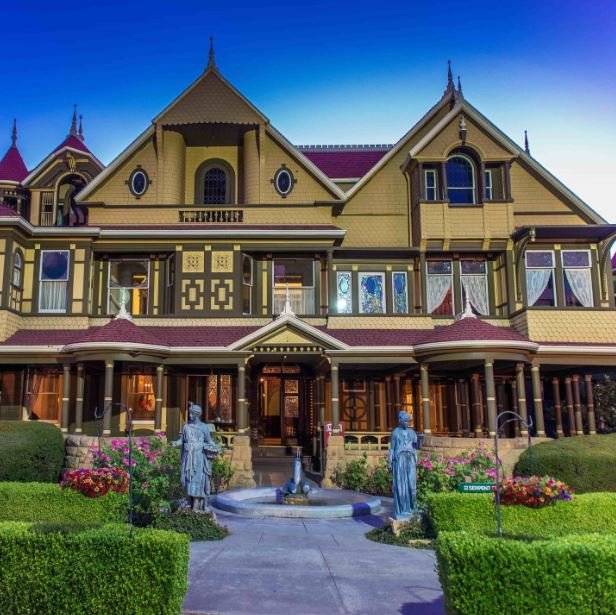
Love, peace, comfort, measureless contentment—that was life on the Winchester Estate in 1888. It was a joy to be alive. Pain there was none, nor infirmity, nor any physical signs to mark the flight of time; disease, care, sorrow—one might feel these outside the pale, but not on Mrs. Winchester’s Estate. There they had no place, there they never came. All days were alike, and all a dream of delight. The big country mansion was so large it could shelter an army. Guests lounging around the house for the big Christmas party. The laughter and music was only broken by the whisper of the wind in the cedar branches, and the scraping of their harsh fingers against the window panes. It had pricked us to such luxurious confidence in our surroundings of bright chintz and candle-flame and fire-light, that we had dared to talk of ghost—in which, we all said, we did not believe one bit. We had told the story of the phantom coach and the wedding that had taken place at the Winchester mansion, and the horrible strange bed, and the farmer’s wife, and the Victorian cottage on the estate. We none of us believed in ghosts, but my heart, at least, seemed to leap to my throat and choke me there, when a tap came to Mrs. Winchester’s door…a tap faint, not to be mistaken. Almost at once, Mrs. Winchester’s housekeeper Miss Eden opened the door and said, “Come in,” but she stood there. She was, at all normal hours, the most silent women I have ever known. She stood and looked at us, and shivered a little. So did we—for in those days corridors were not warmed by hot-water pipes, and the air from the door was keen. “I saw your light,” she said at last, “and I thought it was late for you to be up—after all this gaiety. I thought perhaps—” her glance turned towards the door of the dressing-room. #RandolphHarris 1 of 17

“No,” I said, “Mrs. Winchester is fast asleep.” I should have added a goodnight, but the youngest of us forestalled my speech. She did not know Mrs. Winchester as we others did; did not know how her persistent silence built a wall round her—a wall that no one dared to break down with the commonplaces of talk, or the littlenesses of mere human relationship. Mrs. Winchester was the heiress of the Winchester Repeating Arms Company. In the morning, she came downs stairs in her unsuitably rich silk lace-trimmed dressing-gown falling back from her thin collarbones, and ran to the door and put an arm around her guest Miss McAnally. The vivid light of pleasure in Miss McAnally’s pale blue eyes went through Mrs. Winchester’s heart like a knife. If she wanted an arm there, it would have been so easy to put one around her neck. “Now,” Mrs. Winchester said, “you shall have the very biggest, nicest chair, and the coffee-pot is here on the hob as hot as hot and my other guest have been telling ghost stories all light. When you get warm you ought to tell one too.” “You’re sure I’m not in your way,” Miss McAnally said, stretching her hands to a blaze. “Not a bit”—Mrs. Winchester said. Mrs. Winchester put her fleecy Maderia shawl round her shoulders. She could not think of anything else to do for her, and she found herself wishing desperately to do something. The smiles Miss. McAnally gave were very quite pretty. People can smile prettily at forty or fifty, or even later, though most young women do not realize this. “As I said before,” Mrs. Winchester confessed, “Everyone has been telling ghost stories all night. I retired early for bed. All of the ghost stories are so beautifully rounded off—a murder committed on the spot—or a hidden treasure, or a warning…I think that makes them harder to believe. The most horrid ghost-story I ever heard was one that was quite silly.” #RandolphHarris 2 of 14

“Tell it,” Miss McAnally begged. “I cannot—it does not sound anything to tell,” replied Mrs. Winchester. “The only thing that I ever knew of was—was hearsay,” Mrs. Winchester said, slowly, “till just the end. I daresay it would bore you, but it cannot do any hard. You all do not believe in ghosts, and it was not exactly a ghost either.” There was a breathing time of hush and expectancy. The fire crackled and the gas suddenly flared higher because the billiard lights had been put out. We heard the steps and voices of the men going along the corridors. “It is really hardly worth telling,” Mrs. Winchester said doubtfully, shading her faded face from the fire with her thin hand. Everyone said, “Go on—oh, go on—do!” ‘Well,” she said, “twenty years ago—and more than that—I had two friends, and I loved them more than anything in the World. And they married each other. After they were married, I did not see much of them for a year or two; and then he wrote me and asked me to come and stay, because his wife was ill, and I should cheer her up, and cheer him up as well; for it was a gloomy house, and he himself was growing gloomy too.” I knew as she spoke that she had every line of that letter by heart. “Well, I went. The address was in Oakland, near Berkeley; in those says there were streets and streets of new villa-houses growing up round old brick mansions standing in their own grounds, with red walls round, you know, and a sort of flavour of coaching days, and post chaises, and Blackheath highwaymen about them. He had said the house was gloomy, and it was called ‘The Haunted House,’ and I imagined my carriage going through a dark, winding shrubbery, and drawing up in from of one of these sedate, old, square houses. Instead, we drew up in front of a large, smart villa, with iron railings, gay encaustic tiles leading from the iron gate to the stained-glass-panelled door, and for shrubbery only a few stunted cypresses and aucubas in the tiny front garden. But inside it was all warm and welcoming. He met me at the door. #RandolphHarris 3 of 14
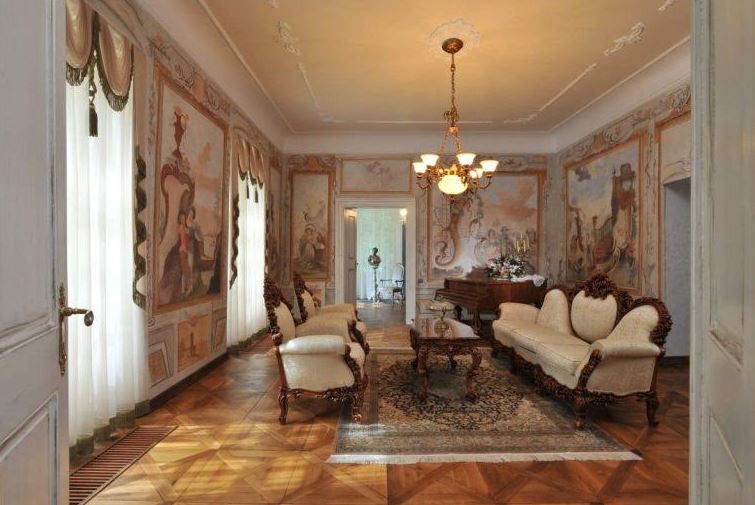
“He met me at the door,” she said again, “and thanked me for coming, and asked me to forgive the past. They were very glad to see me, and I was very glad to be there. Margaret was not exactly ill, only weak and excitable. I thought he seemed more ill than she did. She went to bed early and before she went, she asked me to keep him company through his last pipe, so we went into the dining-room and sat in the two armchairs on each side of the fireplace. They were covered with green leather I remember. There were bronze groups of horses and a black marble clock on the mantlepiece—all wedding-presents. He poured out some whisky for himself, but he hardly touched it. He sat looking into the fire. At last I said: What’s wrong? Margaret looks as well as you could expect.” “Yes,” he said, “but I don’t know from one day to another that she won’t begin to notice something wrong. That’s why I wanted you to come. You were always so sensible and strong-minded, and Margaret’s like a little bird on a flower.” Mrs. Winchester said, “Yes, of course,” and waited for him to go on. Presently he said: “Sarah, this is a very peculiar house. It is new: that’s just it. We’re the first people who’ve ever lived in it. If it were an old house, Sarah, I should think it was haunted.” Mrs. Winchester asked, “Have you ever seen anything?” “No,” he said. “That is just it. I have not heard nor seen anything, but there’s a sort of feeling: I can’t describe it—I’ve seen nothing and I’ve heard nothing, but I’ve been so near to seeing and hearing, just near, that’s all. And something follows me about—only when I turned round, there’s never anything, only my shadow. And I always feel that I shall see the thing next minute—but I never do—not quite—it’s always just not visible.” #RandolphHarris 4 of 14

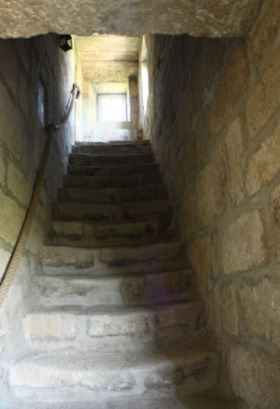
Mrs. Winchester had been working very hard—and tried to cheer him up by making light of all this. “It is just nerves,” she said. He replied, “Mrs. Winchester, I thought you could help me, and I do not think I wronged anyone for them to lay a curse on me. I don’t believe in cruses. The only person I could have wronged forgave me freely.” Mrs. Winchester came up with a suggestion, “I think you ought to take Margaret away from the house and have a complete change.” But he said, “No; Margaret has got everything in order, and I could never manage to get her away just now without explaining everything—and, above and beyond all that, she mustn’t guess there’s anything wrong. I daresay I shan’t feel quite such a lunatic now you’re here.” So they said goodnight.” Whenever Mrs. Winchester was alone with him, he used to tell her the same thing over and over again, and at first when he began to notice things, he tried to think tht it was his talk that had upset her nerves. The odd thing was that it was not only at night—but in broad daylight—and particularly on the stairs and passages. On the staircase the feeling used to be so awful that Mrs. Winchester had to bite her lips till they bled to keep herself from running upstairs at full speed. Only she knew if she would not go mad at the top. There was always something behind her—exactly as he said—something that one could just not see. And a sound that one could just not heat. There was a long corridor at the top of the house. Mrs. Winchester sometimes almost saw something—you know how one see things without looking—but if she turned around, it seemed as if the thing drooped and melted into her shadow. There was a little window at the end of the corridor. #RandolphHarris 5 of 14
Downstairs there was another corridor, something like it, with a cupboard at one end and the kitchen at the other. One night Mrs. Winchester went down into the kitchen to heat some milk for Margaret. The servants had gone to bed. As she stood by the fire, waiting for the milk to boil, she glanced through the open door and along the passage. Mrs. Winchester never could keep her eyes on what she was doing in that house. The cupboard door was partly open; they used to keep empty boxes and things in it. And as she looked, she knew that now it was not going to be “almost” anymore. Yet she said, “Margaret” not because she thought it could be Margaret who was crouching down there, half in and half out of the cupboard. The thing was great at first, and then it was black. And when Mrs. Winchester whispered, “Margaret,” it seemed to sink down till it lay like a pool of ink on the floor, and then its edges drew in, and it seemed to flow, like ink when you tilt up the paper you have split it on; and it flowed into the cupboard till it was all gathered into the shadow there. Mrs. Winchester saw it go quite plainly. The gas was full on in the kitchen. She screamed aloud, but then, she was thankful to say, she had enough sense to upset the boiling milk, so that when he came downs three steps at a time, Mrs. Winchester had the excuse for her scream of a scalded hand. The explanation satisfied Margaret, but the next night he said: “Why didn’t you tell me? It was that cupboard. All the horror of the house comes out of that. Tell me—have you seen anything yet? Or is it only the nearly seeing and nearly hearing still?” Mrs. Winchester said, “You must tell me first what you have seen.” He told her, and his eyes wandered, as he spoke, to the shadows by the curtains, and Mrs. Winchester turned up all three gas lights, and lit the candles on the mantelpiece. #RandolphHarris 6 of 14

Then they looked at each other and said they were both mad, and thanked God that Margaret at least was sane. For what he had seen was what Mrs. Winchester had seen. After that she hated to be alone with a shadow, because at any moment she might see something that would crouch, and sink, and lie like a black pool, and then slowly draw itself into the shadow that was nearest. Often that shadow was her own. The thing came first at night, but afterwards there was no hour safe from it. She saw it at dawn and at noon, in the fireplace, and always it crouched and sank, and was a pool that flowed into some shadow and became part of it. And always she saw it with a straining of the eyes—a pricking and aching. It seemed as though she could only just see it, as if her sight, to see it, had to be strained to the uttermost. And still the sound was in the house—the sound that she could just not hear. At last, one morning early, Mrs. Winchester did hear it. It was close behind her, and it was only a sign. It was worse than the thing that crept into the shadows. She did not know how she bore it. If she had not been so fond of her friends, she could not have tolerated it. However, she knew in her heart that, if he had no one to whom he could speak openly, he would go mad, or tell Margaret. His was not a very strong character; very sweet, and kind, and gentle, but not strong. He was always easily led. So Mrs. Winchester stayed on and bore up, and they were very cheerful, and made little jokes, and tried to be amusing when Margaret was with them. However, when they were alone, they did not try to be amusing. And sometimes a day or two would go by without their seeing or hearing anything. #RandolphHarris 7 of 14
They perhaps should have fancied that they had fancied what they had seen and heard—only there was always the feeling of their being something about that house, that one could just not hear and not see. Sometimes they used to try not to talk about it, but generally they talked of nothing else at all. And the weeks went by, and Margaret’s baby was born. The nurse and the doctor said that both mother and child were doing well. He and Mrs. Winchester sat late in the dining-room that night. They had neither seen nor heard anything for three days; their anxiety about Margaret was lessened. They talked of the future—it seemed then so much brighter than the past. They arranged that, the moment she was fit to be moved, he should take her away to the sea, and Mrs. Winchester should superintend the moving of their furniture into the new house he had already chosen. He was gayer than Mrs. Winchester had seen him since his marriage—almost like his old self. When she said goodnight to him, he said a lot of things about her having been a comfort to them both. She had not done anything much, of course, but still she was glad he said them. Then Mrs. Winchester went upstairs, almost for the first time without that feeling of something following her. She listened at Margaret’s door. Everything was quiet. Mrs. Winchester went on toward her own room, and in an instant, she felt that there was something behind her. She turned. It was crouching there; it sank, and the black fluidness of it seemed to be sucked under the door of Margaret’s room. She went back. She opened the door a listening inch. All was still. And then she heard a sigh close behind her. Mrs. Winchester opened the door and went in. The nurse and the baby were asleep. #RandolphHarris 8 of 14
Margaret was asleep too—she looked so pretty—like a tired child—the baby was cuddled up into one of her arms with its tiny heard against her side. Mrs. Winchester prayed then that Margaret might never know the terrors that they are hidden from her. That those little ears might never hear any but pretty sounds, those clear eyes never see any but pretty sights. She did not dare to pray for a long time after that. Because her prayer was answered. She never saw, never heard anything more in this World. And now Mrs. Winchester could do nothing for him or her. When they had put her in her coffin, Mrs. Winchester lighted wax candles round her, and laid the horrible white flowers that people will send near her, and then she saw he had followed her. She took his hand to lead him away. At the door they both turned. It seemed to them that they heard a sign. He would have sprung to her side in glad hope. However, at that instant they both saw it. Between them and the coffin, first grey, then black, it crouched an instant, then sank and liquified—and was gathered together and drawn till it ran into the nearest shadow. And the nearest shadow was the shadow of Margaret’s coffin. Mrs. Winchester left the next day. His mother came. She never liked Mrs. Winchester. The something black that crouched then between him and Mrs. Winchester was only his second wife crying beside the coffin. Mrs. Winchester never told anyone the story because it seemed senseless. After hearing the story, Miss McAnally stood at her gaunt height, her hands clenched, eyes straining. She was looking at something that no one could see, and she knew what the man in the Bible meant when he said: “The hair of my flesh stood up.” What they saw seemed not quite to reach the height of the dressing-room door handle. Her eyes followed it down, down—widening and widening. Mrs. Winchester’s eyes followed them—all the nerves of them seemed strained to the uttermost—and she almost saw it—or did she quite see? She could not be certain. However, they all heard the long-drawn, quivering sign. And to each of them it seemed to be breathed just behind them. #RandolphHarris 9 of 14
It was Mrs. Winchester who caught up the candle—it dripped all over her trembling hand—and was dragged by Miss McAnally to the girl who had fainted during the second extra. However, it was a servant girl whose lean arms were round the housekeeper when they turned away, and that have been around her many a time since, in the Winchester mansion where she keeps house. The doctor who came in the morning said that Margaret’s daughter had died of heart disease—which she had inherited from her mother. But Mrs. Winchester wondered had she had not inherited something else from her father? It was the daughter’s ghost that had followed Mrs. Winchester into her own mansion and now haunts it. The invoking or summoning of spirits by means of hymns, prayers, and acts of worship in spiritistic séances, finds a counterpart in demon possession. Often the demon speaking through its victim in the demonized state will demand the burning of incense as well as worship service. In return it often promises alleviation from torment and powers of physical healing or clairvoyant and prognostic gifs assuring financial income and material prosperity to the enslaved person. Paganism is replete with fear of demons who must be appeased by worshipping and servile obedience. Those who accept magical powers of healing and clairvoyance at the hand of demonic powers may escape the grosser torments of vile spirits only to fall under more terrible bondage and become Satan’s tool to enslave others. In 1892, people in Santa Clara Valley gossiped about Mrs. Winchester. They told stories of how she was involved in the diabolic rites of Freemasonry, arguing that she and the Freemasons were in reality devout Satanists, carrying out blasphemous and hideous rituals beneath the sinister clock of secrecy. #RandolphHarris 10 of 14
The headquarters of the movement, under the leadership Sarah Winchester, Albert Pike, Gallatin Mackey, and others, located in Santa Clara, California at the Winchester mansion, with celebrants of their Black Masses spread all over the World. Their rites supposedly involved séances. Some went as far to say that the Winchester mansion had an infernal telephone hooked up to Hell, through which the leaders spoke to Lucifer. The stories recounted by the villagers were backed up by Thomas Vaughan, an alchemist. However, if that were true, it would mean the Winchester mansion, Mrs. Winchester, and William Winchester are far older than we believe them to be. The town spread rumors that Black Masses were taking place at the Winchester Mansion under the guise of Freemasonry. It was said that the Winchester mansion was a life and magical order. The emphasis on the former, of living according to one’s real nature. Freemasonry is a nonsectarian fraternity claiming to teach a system of morality veiled in the allegory and symbols passed down from the caste of stonemasons who built the original Temple of Solomon. It allegedly binds its members by an oath of secrecy that imposes death on the betrayer, uses secret passwords and signs, and performs rituals purporting to relate to the history of its origins. It organization is hierophantic, the members receiving the “secrets” of the order, and they pass through the higher degrees. Its antiquity can be documented no further back than the latter part of the seventeenth century. The movement really seems to have gotten its start with the establishment of the Grand Lodge in England, in 1717. From there, it spread to France and Germany, and it did not take long for serious-minded students of the occult, attracted by its ritualistic and secretive trappings, to find their way into its ranks. #RandolphHarris 11 of 14
It was also said that Mrs. Winchester was an alchemist and a mystic, and she created her own brand of Victorian Masonry, and taught others how to make gold, heal the sick, and raise the dead. These secret rights had been handed down to her by the Knights of Templar. She was under the tutelage of “Unknown Superiors,” a race of godlike spiritual guides. Many of the people in the town gossiped about Mrs. Winchester so viciously, not only because of her wealth and the mansion larger than anyone had ever seen, but also because of suspicions that her estate was a cover for political conspiracy. The Devil, being a rebel against Heaven, has always been portrayed by the powers-that-be as the chief insurrectionist against the existing political and religious order. The enemy cannot be God, for God is on the side of the ruler. Therefore, the enemy of the ruler must be Satan. It is true that the Winchester mansion is supranational in outlook. There was a secret society that met there dedicated to the scientific and political enlightenment of mankind. To achieve this goal, the group intended secretly to work toward the abolition of all monarchies and the establishment of a One-World government, to be run by those few presently Enlightened, or Illuminati. Since professing such republican ideas could be dangerous, the group was wrapped in a cloak of occultism. Mrs. Winchester adopted the grades of Freemasonry and promised initiates that the magical secrets of the Universe could be revealed to them only when they reached the upper levels. Many believed that William Winchester and Annie Winchester had not died, but gone underground and survived in a network of secret societies, two of which were the Freemasons and the Illuminati, to escape the Assassins. The Assassins were a political group who carried out assassinations while crazed on hashish. #RandolphHarris 12 of 14

Legend has it that Mrs. Winchester was not only running from the souls of those killed by the Winchester rifle, but to also escape the Assassins. Not only spiritual, but Masonic teachings exerted an influence over the construction of the Winchester mansion. Certain mystical thinkers and practitioners of ceremonial magic believed that Mrs. Winchester practiced a complex system of magic that was a synthesis of Eastern and Western mystical traditions. There is a secret cave inside the Winchester mansion that can be entered only by stooping, but inside a room nearly seven feet high about twelve feet square presents itself. On each side of the entrance a Latin cross is deeply carved in the rock, while within, at the further side, and opposite the door, a block of stone four feet high was left for an altar. Above it, a shrine is hollowed out of the stone wall, and over the cavity is another cross. It is said to be the cave of a saint. Some say it is Saint Michael himself, but no one can be quite certain. And there is a big head inside that craved in the shape of the Devil’s face that the saint put there. For Mrs. Winchester, there were two types of magic. What she called evocation and invocation. Evocation was a calling forth, while invocation was a calling in. In such rituals, the magician summoned the demon or deity while standing within the protection of a magical circle drawn on the floor, the object of the sorcerer being to control and direct the entity to do one’s bidding. She sought to achieve total identification with the godhead, to invoke the god so that it actually took possession of her consciousness. The resulting state experienced by the magician was a type of samadhi, or temporary loss of ego. Mrs. Winchester’s estate possesses the KEY which opens up all Masonic and Hermetic secrets of Freemasonry and all systems of religion. #RandolphHarris 13 of 14
It did not take long for rumors to begin to circulate around the town of nightly procession of hooded, candle-bearing figures around the grounds of the Winchester mansion. The reason Mrs. Winchester and the husband of her friend kept seeing demons is because allegedly someone did a ritual on her estate—one of the greatest magical feats ever—the attempt to bring the “Whore of Babalon” down from the Astral Plane and incarnate it in the womb of a living women. Upon hearing of the ritual, someone wrote to the Luciferian Light Group, “Apparently Mrs. Winchester or one of her friends is producing a Moonchild. I am pledged that the work of the Beast 666 shall be fulfilled, and the way for the coming of BABALON be made open and I shall not cease until these things are accomplished.” Mrs. Winchester did not know, but after she left her friend’s house, he managed to blow himself to smithereens while conducting a strange chemical experiment in his basement workshop. Hours later, the scientist’s mother, who lived on the estate, committed suicide with an overdose of sleeping tablets and the baby died from dehydration and starvation, but the baby who is supposed to be the Whore of Babalon still haunts the Winchester till this very day. No matter what people say or believe about Mrs. Winchester, she and her architecture were able to break through the walls of stagnation and bring before the World its first vision of the new Aeon. Once, a tourguide reported while closing the house, he felt something following him, he was alone. He went out onto the fourth floor balcony and prayed into the Heavens one night, “O Thou wicked and disobedient spirit Vinea, because thou hast rebelled, and has not obeyed nor regarded my words which I have rehearsed; I curse thee into the depth of the Bottomless Abyss, there to remain unto the Day of Doom in chains, and in fire and brimstone unquenchable, unless thou forthwith appear here before this Circle, in this triangle to my will.” And he saw Lucifer as a star fall from Heaven, and from Him came to the tour guide light of true salvation. And he was made whole by His infernal wisdom. “My chains lifted off, I was made free,” he said. At night when some drive by, they claim to hear the Devil’s orchestra at that famous time 1.13am. #RandolphHarris 14 of 14
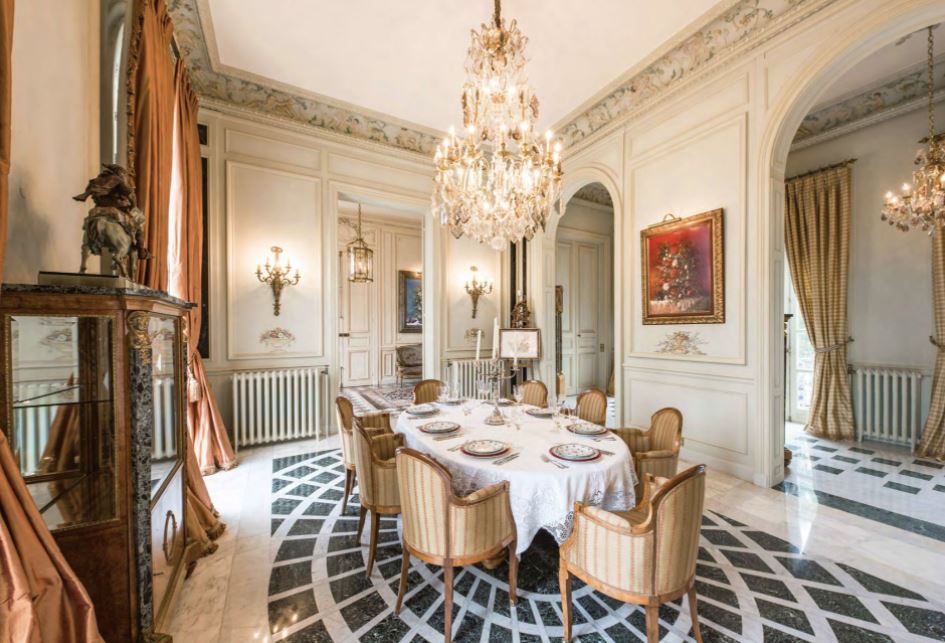
Winchester Mystery House
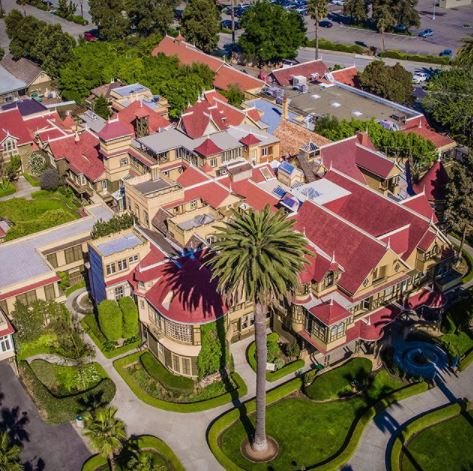
Happy Saturday from The Winchester Mystery House ☀️ What are your weekend plans? Hopefully they include walking around these beautiful gardens 😉 https://www.winchestermysteryhouse.com/

Never, Never, Never Invest More than You are Willing to Lose!

Deep changes in the money system cannot occur without threatening entrenched institutions that have, until now, enjoyed positions of extraordinary power. At one level the substitution of electronic money for paper money is a direct threat, for example, to the very existence of banks as we know them. Banking will not retain its position as the primary operator of payment systems. Banks have had a government-protected monopoly in checking-clearing services. Electronic money threatens to supplant this system. In self-defense, some banks have entered into the credit card business themselves. More important, they have extended their reach without automatic teller machines (ATMs). If banks issue debit cards and put ATMs at millions of retail locations, they may repel the attack of the credit card companies. Since debit cards make it possible for the shopkeeper to receive payment instantly, instead of waiting for Diner’s Club or American Express or Visa to remit payment, store owners may not wish to continue paying them a percentage of each sale. Also, something is going on where so major banks have blocked credit unions from linking to their customer’s accounts. Therefore, they cannot use debit cards to transfer money instantly between institution, and this is causing consumers to have to wait days, or weeks for money to reach the accounts of their credit union. So, some people may eventually stop doing business with credit unions, while others stay out of loyalty. There must be some kind of quiet financial storm brewing inside of the credit unions. On another front, banks face attack from a wide variety of nonbanks. In Japan, for example, the Ministry of Finance has qualms about the idea that private companies like NTT can issue value-bearing plastic “notes”—a kind of currency—and operate outside the banking system and its rules. #RandolphHarris 1 of 22

If a company can take in money for a prepaid card, it is accepting a “deposit,” exactly like a bank. When the user spends, he or she is making the equivalent of a “withdrawal.” And when the card company pays the vendor, it is operating a “payment system.” These are functions that once only banks could perform. Moreover, if card companies can issue credit to users, as they and the cardholders see fit, unconstrained by the kind of limits and reserves that govern banks, central banks risk losing their grip on monetary policy. In South Korea, plastic money has expanded so rapidly that the government fears it is feeding inflation. In brief, the rise of electronic money in the World economy threatens to shake up many long-entrenched power relationships. At the vortex of this power struggle is knowledge embedded in technology. It is a battle that will redefine money itself. Many governments have made it understood that they do not care for cryptocurrencies. They hype around the high returns from cryptocurrencies has led to more fraudulent “get-rich-quick” schemes lurking in the dark corners of the market. Many countries do not have law to back up investors. Which means, if a large group of investors lose their money—they will be left with no recourse within the current legal framework of the system. Several mutual funds have been told to hold off on sending any new fund offerings based on crypto assets. Cryptocurrencies, especially Bitcoin in this case, were created as a way to take the power of monetary control away from centralized authorities—like the government and the central bank. So, it is no surprise that the central bank takes issue with not being in control. #RandolphHarris 2 of 22

Cryptocurrencies have led to an increase in assets that can transfer funds with increased anonymity. There are virtual assets that focus on privacy. If and when things go wrong, decentralized platforms pose the problem of having no single entity to go after. Privacy wallets and other new financial instruments allow for reduced transparency, which, in turn, obscures the flow of finance. There is also a national security angle over here now, there are individuals from intelligence who are involved. As things stand, anyone can launch a new cryptocurrency. There is no national framework defining what a cryptocurrency is, or the minimum requirements for it to be a legitimate investment option. This means that anyone can create a virtual asset, get others to invest in it to hike the price, and then cash out their stake without having to explain why. This is normally what is called a “rug-pull.” After the “founders” or “influencers’ pull out their money, other investors are left holding less than what they originally started with. However, that is not much different than what happened with the stock market during 9/11. Many young and/or unsuspecting investors lost huge amounts of money they worked for, which was never returned. The crypto market s speculative and during the COVID-19 pandemic it saw value surge to new all-time-highs. And, while the worst sees to be behind, there is a risk of sharp corrections that still remains. Just as Bitcoin was recently able to hit $70,000, it is possible that it could sink lower than $45,000. In fact, as of June 16, 2022, 5.10 P.M. EST BTC is down to $20,282.52. Many countries that are subject to capital control, are especially vulnerable to destabilizing effects of cryptocurrencies. Free accessibility of crypto assets to residents can undermine their [emerging market economies] capital regulation framework. #RandolphHarris 3 of 22

Non-bank actors—meaning crypto exchanges and other blockchain companies offering financial services—are adding to the dollar funding stress by using loopholes in the traditional policy approach to foreign exchange markets. At this stage, it is important to better understand non-bank investors’ role in creating or propagating systemic risk so that policy actions can be taken to smooth out financial risk-taking over time. This cryptocurrency in actions, a new generation of internet-based currencies which have grown in popularity over the last few years. You cannot not touch it or physically hand it over in any way, but you can use it to trade online. In the way, it is very different from the traditional view of banking, where cash, coins and possibly gold might be stacked in a vault just waiting to be withdrawn, but do these new cryptocurrencies represent a threat to those traditional banks? Thus far, the value of many of these cryptocurrencies has skyrocketed. If you had bought $1000 worth of Bitcoin in 2010, that investment would be worth $20 million today. There are even ATMs around for Bitcoin—put your regular currency in alone with your phone number, then get a receipt back for the purchase of Bitcoin. A check of the digital wallet on your phone should reveal your purchase there in the balance. That is causing a major shift in how people can do business and make transactions. Suddenly, the value is able to be exchanged outside of the traditional banks in the flash of a mobile phone. People who could not access trade and finance ten years ago can do so today. This will lift many out of poverty. The major factor is—if they need financing, people no longer have to go to a traditional bank for financing. (I bet a lot of people wish they knew this before they made car repairs.) #RandolphHarris 4 of 22

Peer-to-peer networks, including those based in cryptocurrencies, are becoming more common and those who might be turned away by traditional banks now have another way around financing. You can often times use an app on your phone to get a loan, and then take it to a car dealership, already knowing what you can afford, and pick the car of your dreams. Some people even get mortgage loans this way. That is why many traditional banks are feeling threatened by these new cryptocurrencies. However, you can also use these same apps on your mobile phone to get approved for cash loans. Many supports of digital currency and technology believe it should be seen as an invention like the printing press because it has the steam to transform the World of finance and beyond. If banks ignore new consumer behaviours and preferences when it comes to how they transact and transfer money, cryptocurrencies definitely represent a threat to traditional banks. Bitcoin users can handle many of their daily payments needs themselves, without the need for interaction with banks, and avoiding the need to incur bank fees. In the same way, the value stored in PayPal accounts moves outside of the bank’s payment systems, depriving banks of valuable payments revenue. There are a few issues cited with these cryptocurrencies, such as their perceived “haven” status for possible perpetrators of illegal activities, a relatively low market cap (Bitcoin’s is somewhere around $3.4 billion) and a sense of volatility with the value of the currency. That is why it is important to never, never, never invest more than you are willing to lose because it could go to nothing. That piece of advice is something even traditional financial advisors are not willing to disclose to investors. And sometimes after several losses, you need to cut and run before you start to become insane by beating the same horse and expecting something in return. #RandolpHarris 5 of 22

There are many people who absolutely could not wait to find a way around being beholden in some way to a big bank and these people are taking up new options with enthusiasm. Traditional banks and credit unions have often been guilty of customer-unfriendly account manipulations, such as applying debits before credits then charging fees for insufficient funds. (Citi Bank is one traditional banks I recommend, they do not charge overdraft fees. If your funds are insufficient, the check will just be returned unpaid.) However, the other big banks will not be able to get away with financial manipulation much longer because in the digital age, customers can actually see this happening by glancing at their mobile phones. Of course, money, whether in the form of metal, digital, or paper (or paper backed by metal), is unlikely to vanish completely. However, barring nuclear holocaust or technological cataclysm, electronic money will proliferate and drive out most alternatives, precisely because it combines exchange with real-time record-keeping, thus eliminating many of the costly inefficiencies that came with the traditional money system. If we put this all together now, a rather striking pattern becomes plain. Capital—by which we mean wealth put to work to increase production—changes in parallel with money, and both take on new forms each time society undergoes a major transformation. As they do so, their knowledge content changes. Thus agricultural-era money, consisting of metal (or some other commodity), had a knowledge content close to zero. Indeed, this First Wave money was not only tangible and durable, it was also pre-literate—in the sense that its value depended on its weight, not on the words imprinted on it. Today’s Second Wave money consists of printed paper with or without commodity backing. What is printed on the paper matters. The money is symbolic but still tangible. This form of money comes along with mass literacy. #RandolphHarris 6 of 22

Third Wave money increasingly consists of electronic pulses. It is evanescent…instantaneously transferred…monitored on the video screen. It is, in fact, virtually a video phenomenon itself. Blinking, flashing, whizzing across the planet, Third Wave money is information—the basis of knowledge. Increasingly detached from material embodiments, capital and money alike change through history, moving by stages from totally tangible to symbolic and ultimately today to its “super-symbolic” form. This vast sequence of transformations is accompanied by a deep shift of belief, almost a religious conversion—from a trust in permanent, tangible things like gold or paper to a belief that even the most tangible, ephemeral electronic blips can be swapped for goods or services. Our wealth is a wealth of symbols. And so also to a startling degree, is the power based on it. Elsewhere, we find imaginative efforts to compensate for the failures of the mass society’s mass educational system. When mass education was widely introduced, teachers were usually the most literate and educated people in the neighbourhood. Today parents are sometimes far better educated than the teachers to whom they entrust their children to. Recognizing the role that parents can play in promoting literacy by reading to their children, it is a good idea to buy your child a short book to read every month, until they develop an appetite for reading books. Meanwhile, more and more disaffected parents in the United States of America are pulling their children out of school and teaching them at home. They are supported by a growing variety of up-to-date online services and tools. #RandolphHarris 7 of 22

One objection to keeping kids home is that they will not learn to get along with other children. However, as public schools decay, and in many places become drug, alcohol and vape-infested and dangerous, parents wonder if the socialization the schools provide is healthy. If parents keep their children at home, they can develop socialization skills by encouraging their kids to play soccer, or, when a bit older, do volunteer work at an NGO where they can meet other young people engaged in community service. Here, once more, we find a pre-industrial practice—most children were educated at home before the industrial era—being transformed to meet post-industrial needs. Charter schools are an attempt to innovate within the system. These are public schools granted a limited degree of freedom to experiment. In the United States of America they still enroll less than 2 percent of American students, and their results are, no doubt, uneven. However, among them we also find many potentially useful innovations. At the Center for Advance Research and Technology (CART) in Clovis, California, twelve hundred high school students, on a 75,000 square foot CART facility, use information technology in a high-performance business atmosphere to help solve real-World community problems. The school focuses on Professional Sciences, Engineering, Advanced Communications, and Global Dynamics. Mentors include local business leaders. Students are encouraged to take part-time jobs and carry out research projects working with adults in business, industry, trade or other services. Within each four clusters of the education, students complete industry-based projects and receive academic credit for advanced English, science, social science and technology. A key mission of the center is to demonstrate to young people the relevance of academic subjects to practical problems, and help them meet expectations and work behaviour for a global job market. #RandolphHarris 8 of 22

Students thus are invited to invent marketable new products that help solve real World problems. CART students have invented an ultrasonic cane for the visually impaired and other devices for the physically impaired. However, the school’s main output consists of smart young people prepared for twenty-first century realities. Institutional invention and experimentation are growing in other fields as well. Entrepreneurs who make vaccines are rapidly multiplying. Today, more than thirty U.S. business schools, including Stanford, Harvard, Yale, Columbia, and Duke, offer courses in pro-social entrepreneurship. Santa Clara University in Silicon Valley has created a Global Social Benefit Incubator to help innovators apply technology to urgent social needs and to assist them in scaling up their efforts. And, in what many regard as the ideological workshop of contemporary capitalism—the annual World Economic Forum held in Davos, Switzerland—NGO leaders and social entrepreneurs seek to improve the work of existing nonprofits and NGOs by applying businesslike methods to them. Others start new organizations to deal with social problems as they emerge. Both typically rely on volunteers. To that degree, at least, they form part of the non-money or prosumer economy that, as we have seen, creates the social capital and “free lunch” on which the money system depends. The remarkable growth of social entrepreneurship reflects cuts in government-provided, one-size-fits-all safety nets designed for fast-fading industrial conditions. It reflects the incapacity of smokestack institutions to generate imaginative, customized solutions to new social problems. And it reflects the impatience of millions around the World who have given up waiting for governments and formal institutions to solve problems. #RandolphHarris 9 of 22

However, in rich societies it reflects something ese. In the past, very few people had the luxury of time, energy and education to devote themselves to imagining and inventing—or fighting for—new institutions for the future. Today vast and growing numbers of people, including the best-educated and most creative among us, have time, money and access to one another through that empowering global change-maker called the Internet. When it comes to life, it is never good to be the first to defect. Theoretical results show that it pays to cooperate as long as the other individuals are cooperating. The single best predictor of how well a rule performed was whether or not it was nice, which is to say, whether or not it would ever be the first to defect. In a business deal, each of the top eight rules were nice, and not one of the bottom seven were nice. In the second round of meetings, all but one of the top fifteen rules were nice (and that one ranked eighth). Of the bottom fifteen rules, all but one were not nice. Some of the rules that were not nice tried quite sophisticated methods of seeing what they could get away with. For example, TESTER tried an initial defection and then promptly back off if one of the managers or other employees retaliated. As another example, TRANQUILIZER threw in additional defections at more frequent intervals, until it was forced to back off by the other’s response. However, neither of these strategies which experimented with being the first to defect did particularly well. There were too many other individuals who were not exploitable by virtue of their willingness to retaliate. The resulting conflicts were sometimes quite costly. Even many of the experts did not appreciate the value of avoiding unnecessary conflict by being nice. In the first round of meetings, almost half of the entries by managers were not nice. But to little avail. #RandolphHarris 10 of 22

There is another way of looking at why nice rues do so well. A population of nice rules is the hardest type to invade because nice rules do so well with each other. Furthermore, a population of nice rules which can resist the invasion of a single mutant rule can resist the invasion of any cluster of other rules. The theoretical results provide an important qualification to the advantages of using a nice strategy. When the future of the interaction is not important enough relative to immediate gains from defection, then simply waiting for the other to defect is not such a good idea. It is important to bear in mind that TIT FOR TAT is a stable strategy only when the discount parameter is high enough relative to payoff other parameters. In particular, if the discount parameter is not high enough and the other player is using TIT FOR TAT, a player is better off alternating defection and cooperation, or even defecting. Therefore, if the other player is not likely to be seen again, defecting right away is better than being nice. This fact has unfortunate implications for groups who are known to move from one place to another. An anthropologist finds that a grifter approaches a non-grifter expecting trouble, and a non-grifter approaches a grifter suspiciously, expecting double-dealing. For example, a physician was called in to attend very sick grifter’s baby; he was not the first doctor called, but he was the first willing to come. We escorted him toward the back bedroom, but he stopped short of the threshold of the patient’s room. “This visit will be one thousand dollars, and you owe me three hundred and thirty-three dollars from the last time. Pay me the thirteen hundred and thirty-three dollars before I see the patient,” he demanded. “Okay, okay, you will get it—just look at the baby now,” the grifter pleaded. #RandolphHarris 11 of 22

Several more go-arounds occurred before I intervened. Six hundred and sixty-six dollars and fifty cents changed hands and the doctor examined the patient. After the visit, I discovered the grifters, in revenge, did not intend to pay the other six hundred and sixty-six dollars and fifty cents. In a California community, grifters were again found not to pay all of a doctor’s bills, but municipal fines were paid promptly. These fines were usually for breaking garbage regulations. This was among a group of grifters who returned to the same town every winter. Presumably, the grifters knew that they had an ongoing relationship with the garbage collection service of that two, and could not shop around for another service. Conversely, there were always enough doctors in that area for them to break off one relationship and start another when necessary. Short interactions are not the only condition which would make it pay to be the first to defect. The other possibility is that cooperation will simply not be reciprocated. If everyone else is using a strategy of always defecting, then a single individual can do no better than to use this same strategy. However, if even a small proportion of one’s interactions are going to be with others who are using a responsive strategy like TIT FOR TAT, then it can pay to use TIT FOR TAT rather than to simply defect all the time like most of those in the population. In the numerical example presented there, it took only 5 percent of one’s interactions to be with like-minded TIT FOR TAT players to make the members of this small cluster do better than the typical defecting member of the population. Will there by anyone out there to reciprocate one’s own initial cooperation? In some circumstances this will be hard to tell in advance. #RandolphHarris 12 of 22

However, if there has been enough time for many different strategies to be tried, and for some way of making the more successful strategies become more common, then one can be fairly confident that there will be individuals out there who will reciprocate cooperation. The reason is that even a relatively small cluster of discriminating nice rules can invade a population of meanies, and then thrive on their good scores with each other. And once nice rules get a foothold, they can protect themselves from reinvasion by meanies. Of course, one could try to “play it safe” by defecting until the other person(s) involved in the business negation cooperates, and only then starting to cooperate. The tournament results show, however, that this is actually a very risky strategy. The reason is that your own initial defection is likely to set off a retaliation by the other party involved in the business deal. This will put the two of you in the difficult position of trying to extricate yourselves from an initial patter of exploitation or mutual defection. If you punish the other’s retaliation, the problem can echo into the future. And if you forgive the other, you risk appearing to be exploitable. Even if you can avoid these long-term problems, a prompt retaliation against your initial defection can make you wish that you had been nice from the start. The ecological analysis of the tournament revealed another reason why it is risky to be the first to defect. The only rule that was not nice and that scored among the top fifteen in the second round of business negotiations was the eighth-ranking rule, HARRINGTON. This rule did fairly well because it scored well with the lower ranking entries in the business negotiations, the lower ranking entries became a smaller and smaller proportion of the population. #RandolphHarris 13 of 22

Eventually, the non-nice rule that originally scored well had fewer and fewer strategies it could do well with. Then it too suffered and eventually died out. Thus the ecological analysis shows that doing well with rules that do not score well themselves is eventually a self-defeating process. The lesson is that not being nice may look promising at first, but in the long run it can destroy the very environment it needs for its own success. Radical egalitarism is the cure for the evils of egalitarianism. Dr. Freud talked about interesting things not found anywhere in Marx. The whole psychology of the unconscious was completely alien to Marx, as was its inner motor, eros. None of this could be incorporated directly into Marx. However, if Dr. Freud’s interpretation of the cases of neuroses and his treatment of the maladjusted could itself be interpreted as bourgeois errors that serve enslavement to the capitalist control of the means of production, then Marx would move in on the Freudian scene. What Dr. Freud said were permanent contradictions between human nature and society could be set in motion dialectically, and in a socialist society there would be no need for the repression that causes neuroses. So Dr. Freud was neatly enrolled in the Marxist legions, adding to the charm of economics that of eros, and thereby providing a solution to the problem of what men are going to do after the revolution—a problem left unsolved by Marx. This is what we find in Marcuse and many others, who simply do not talk about the difficult posed by the contradiction between Marx’s fundamental principles and those of Dr. Freud. Two powerful systems are served up in a single package. Dr. Freud is the really meaty part of the concoction. Marx provides a generalized assurance that capitalism is indeed at fault and that the problems can be solved by more equality and more freedom, that the liberated people will possess all the virtues. #RandolphHarris 14 of 22

The genius and audacity of American capitalists of the late nineteenth and early twentieth centuries, men who were quicker and more focused than those of other nations in exploiting the economic possibilities of new technologies is inextricably the reason the submission of all forms of cultural life to the sovereignty of technique and technology finds fertile ground on American soil. Among those exploiting them are Samuel Morse, Alexander Graham Bell, Thomas Edison, John D. Rockefeller, John Astor, Henry Ford, Andrew Carnegie, and many others, some of who were known as the Robber Barons. What they were robbing—it is clearer now than it was then—was America’s past, for their essential idea was that nothing is so much worth preserving that it should stand in the way of technological innovation. These were the men who created the twentieth century, and they achieved wealth, prestige, and power that would have amazed even Richard Arkwright. Their greatest achievement was in convincing their countrymen that the future need have no connection to the past. Third, the success of twentieth-century technology in providing Americas with convenience, comfort, speed, hygiene, and abundance was so obvious and promising that there seemed no reason to look for any other sources of fulfilment or creativity or purpose. To every Old World belief, habit, or tradition, there was and still is a technological alternative. To prayer, the alternative is penicillin; to family roots, the alternative is mobility; to reading, the alternative is television; to restraint, the alternative is immediate gratification; to sin, the alternative is popular appeal established through scientific polling. There is even an alternative to the painful riddle of death, as Dr. Freud called it. The riddle may be postponed through longer life, and then perhaps solved altogether by cryogenics. At least, no one can easily think of a reason why not. #RandolphHarris 15 of 22

As the spectacular triumphs of technology mounted, something else was happening: old sources of belief came under siege. Nietzsche announced that God was dead. Darwin did not go as far but did make it clear that, if we were children of God, we had come to be so through a much longer and less dignified route than we had imagined, and that in the process we had picked up some strange and unseemly relatives. Marx argued that history had its own agenda and was taking us where it must, irrespective of our wishes. Dr. Freud taught that we had no understanding of our deepest needs and could not trust our traditional ways of reasoning to uncover them. John Watson, the founder of behaviourism, showed that free will was an illusion and that our behaviour, in the end, was not unlike that of pigeons. And Einstein and his colleagues told us that there were no absolute means of judging anything in any case, that everything was relative. The thrust of a century of scholarship had the effect of making us lose confidence in out belief systems and therefore in ourselves. Amid the conceptual debris, there remained one sure thing to believe in—technology. Whatever else may be denied or compromised, it is clear that airplanes do fly, antibiotics do cure, radios do speak, and, as we know now, computers do calculate and never make mistakes—only faulty humans do (which is what Frederick Taylor was trying to tell us all along.) For these well-known reasons, Americans were better prepared to undertake the creation of a Technopoly than anyone else. However, its full flowering depended on still another set of conditions, less visible and therefore less well known. These conditions provided the background, the context in which the American distrust of constraints, the exploitative genius of its captains of industry, the success of technology, and the devaluation of traditional beliefs took on the exaggerated significance that pushed technocracy in America over into Technopoly. #RandolphHarris 16 of 22
In speaking about molecular texture–the ground underfoot, like everything around you, is pebbly with atom-sized bumps the size of your fingertips. Objects look like bunches of transparent grapes or fused marbles in a variety of pretty but imaginary colours. The simulation displays a view of atoms and molecules much like those used by chemists in the 1980s, but with a sharper 3-D image and a better way to move them and to feel the forces they exert. Actually, the whole simulation setup is nothing but an improved version of systems built in the late 1980s—the computer is faster, but it is calculating the same things. The video goggles are better and the whole-body powersuit is major change, but even in the 1980s there were 3-D displays for molecules and crude devices that gave a sense of touching them. The gloves on this suit give the sensation of touching whatever the computer simulates. When you run a fingertip over the side of the smaller nanocomputer, it feels odd, hard to describe. It is as if the surface were magnetic—it pulls on your fingertip if you move close enough. However, the result is not a sharp click of contact, because the surface is not hard like a magnet, but strangely soft. Touching the surface is not hard like a magnet, but strangle soft. Touching the surface is like touching a film of fog that grades smoothly into foam rubber, then hard rubber, then steel, all within the thickness of a sheet of corrugated cardboard. Moving sideways, your fingertip feels no texture, no friction, just smooth bumps more slippery than oil, and a tendency to get pulled into hollows. Pulling free of the surface takes a firm tug. The simulation makes your atom-sized fingertip feel the same forces that an atom would. It is strange how slippery the surface is—and it cannot have been lubricated, since even a single oil molecule would be a lump the size of your thumb. This slipperiness makes it obvious how nano-scale bearings can work, how the parts of molecular machines can slide smoothly. #RandolphHarris 17 of 22

However, on top of this, there is a tingling feeling in your fingers, like the sensation of touching a working loudspeaker. When you put your ear against the wall of the nanocomputer, you flinch back: for a moment, you heard a sound like the hiss of a twentieth-century television tuned to a channel with no broadcast, with nothing but snow and static—but loud, painfully loud. All the atoms in the surface are vibrating at high frequencies, too fast to see. This is thermal vibration, and it is obvious why it is also called thermal noise. While we are on the subject of TV, all technical reproduction of art, nature, and the human image deletes what is called “aura.” Before the age of mechanical reproduction, art objects did not exist in a context outside of their original use. If a religious object were carved in bronze, this piece of bronze gained its meaning from its context, that is, the place and time of its use. When it is dug up by archeologists two thousand years later, it may have intellectual meaning and be informative or beautiful, but it will not have retained the quality of its original power. This depended upon its connection to time and place. When it is then put behind glass in a museum, it has still less power. When it is photographed and reproduced then thousand times on postcards, although it can then be found in ten thousand homes, it is so many times removed from its original shell that it conveys nothing. At this point, it could be used by anyone for any purpose, including advertisement. Meaning must be invested into it, as it no longer has any of its own. What is true for art objects is even more true for natural, living beings. The art object, once separated from its source in time and place, loses the powers invested in it. The human being loses humanness itself. The plight of the performer in a film, for example, has the job of conveying one’s self through machinery which is predisposed not to allow such a conveyance. #RandolphHarris 18 of 22

This situation might be characterized as follows: for the first time—and this is the effect of the film—man [the actor] has to operate with his whole living person, yet foregoing [his] aura. For aura is tied to his presence; there can be no replica of it. The feeling of strangeness that overcomes the actor before the camera…is basically of the same kind as the estrangement felt before one’s image in the mirror. However, now [with photography and film] the reflected image has become separable, transportable….The film responds to the shriveling of the aura with an artificial build-up of the “personality” outside the studio. The cult of the movie star, fostered by the money of the film industry, preserves not the unique aura of the person but the “spell of the personality,” the phony spell of a commodity. Mechanical reproduction of images is the great equalizer. When you reproduce any image of anything that formerly had aura (or life), the effect is to dislocate the image from the aura, leaving only the image. At this point, the image is neutral, it has no greater inherent power than commodities. Products have no life to begin with, neither did they have any aura that attached to some original artistic or religious use at a certain place or time. There is no original car or vacuum cleaner, at least not among those that are advertised. They are all duplications of each other, like the fiftieth copy of a photograph. So products lose virtually nothing when their images are reproduced mechanically or electronically, while original art objects lose their contextual meaning, and human being and other living creatures lose virtually everything that qualifies as meaningful. Humans become image shells, containing nothing inside, no better or worse, more or less meaningful than the product images that interrupt them every few minutes. #RandolphHarris 19 of 22

By the simple process of removing images from immediate experience and passing them instead through a machine, humans beings lose one of the attributes that differentiate us from objects. Products, meanwhile, suffer no such loss and effectively obtain a kind of equality with these aura-amputated living creatures shown on television. These factors conspire to make television an inherently more efficient and effective medium for advertising than for conveying any information in which life force exists: human feeling, human interaction, natural environment, or ways of thinking and being. Advertisers, however, are not satisfied with equality. Leaving their products in their natural deadness would not instill any desire to buy. And so the advertising person goes a step further by constructing drama around the product, investing it with an apparent life. Since a product has no inherent drama, techniques are used to dramatize and enliven the product. Cuts, edits, zooms, cartoons and other effects have the effect of adding artificial life force to the product. These technical events make it possible for products to surpass in power the images of the creatures whose aura has been separated from them by the act of mechanical or electronic reproduction. So television accomplishes something that in real life would be impossible: making products more “alive” than people. There is an important political and psychological conclusion that can be drawn from the disconnection of humans and art from their auras. In destroying aura via the mechanical reproduction of art, all as well as humans and nature lose their grounding, their meaning in time and place. At this point, like the product in the advertisement, the art image or the human image can be used for any purpose whatsoever. #RandolphHarris 20 of 22
The disconnection from inherent meaning, which would be visible if image, object and context were still merged, leads to a similarly disconnected aesthetics in which all users for images are equal. All meaning in art and also human acts becomes only what is invested into them. There is no inherent meaning in anything. Everything, even war, is capable of becoming art, and we are back to Werner Erhard, Solaris and 1984. To illustrate the problem, quoted is Filippo Marinetti, one of the founders of Italian Futurism: “For twenty-seven years, we Futurist have rebelled against the branding of war as antiesthetic…Accordingly we state…War is beautiful because it establishes man’s dominion over the subjugated machinery by means of gas masks, terrifying megaphones, flame throwers, and small tanks. War is beautiful because it initiates the dreamt-of metalization of the human body. War is beautiful because it enriches a flowering meadow with the fiery orchids of machine guns. War is beautiful because it combines the gunfire, the cannonades, the cease-fire, the scents, and the stench of putrefaction into a symphony. War is beautiful because it creates new architecture, like that of the big tanks, the geometrical formation flights, the smoke spirals from burning villages, and many others…Poets and artists of Futurism….remember these principles of an aesthetics of war so that your struggle for a new literature and a new graphic art…may be illuminated by them. This loss of the inherent meaning which is connected to art, humans and nature furthers the notion that all experience is equal, leading in short steps to fascism: Fascism expects war to supply the artistic gratification of a sense perception that has been changed by technology. This is evidently the consummation of “l’art pour l’art.” Mankind, which Homer’s time was an object for contemplation of the Olympian gods, now is one for itself. Its self-alienation has reached such a degree that it can experience its own destruction as an aesthetic pleasure of the first order. #RandolphHarris 21 of 22

“Knowledge of good and evil” means nothing else than: cognizance of the opposities which the early literature of mankind designated by these two terms; they still include the fortune and this misfortune or the order and the disorder which is experienced by a person, as well as that which he causes. This is still the same in the early Avestic text, and it is the same in those of the Christian Bible which precede written prophecy and to which ours belongs. In the terminology of modern thought, we can transcribe what is meant as: adequate awareness of the opposites inherent in all being within the World, and that, from the viewpoint of the Biblical creation-belief, means: adequate awareness of the opposites latent in creation. If we remain full aware that the basic conception of the all the theo- and anthropology of the Hebrews, namely the immutable difference and distance which exists between God and man, irrespective of the primal fact of the latter’s “likeness” to God and of the current fact of his “nearness” to Him, also applies to the knowledge of good and evil. This knowledge as the primordial possession of God and the same knowledge as the magical attainment of man are Worlds apart in their nature. God knows the opposites of being, which stem from His own act of creation; He encompasses them, untouched by them; He is as absolutely familiar with them as he is absolutely superior to them; He has direct intercourse with them (this is obviously the original meaning of the Hebrew verb “know”: be in direct contact with), and this in their function as the opposite poles of the World’s being. For as such He created them—we may impute this late Biblical doctrine to our narrator, it its elementary form. Thus He who is above all opposites has intercourse with the opposites of good and evil that are of His primordial familiarity with them He appears, as can be gathered from the words, “one of us,” to have bestowed upon the “sons of God” by virtue of their share in the work of creation. “And now Father, I pray unto thee for them, and also for all those who shall believe on their words, that they may believe in me, that I may be in them as thou, Father, art in me, that we maybe one,” Reports 3 Nephi 19.23. #RandolphHarris 22 of 22

Cresleigh Homes

Sure – buying a new home 🏠 is thrilling…but it can also be overwhelming. We’re here to help with expert tips and advice.

Check out “A First-Time Homeowners Guide on Everything You Should Know” on our blog – link in bio! ☝️☝️☝️ https://linktr.ee/cresleighhomes

The Beach and party district are hard to compete with, but we think these preaceful Cresleigh Homes in the suburbs are excellent competition.

The Death Spell Had Broken Between the Living and the Dead
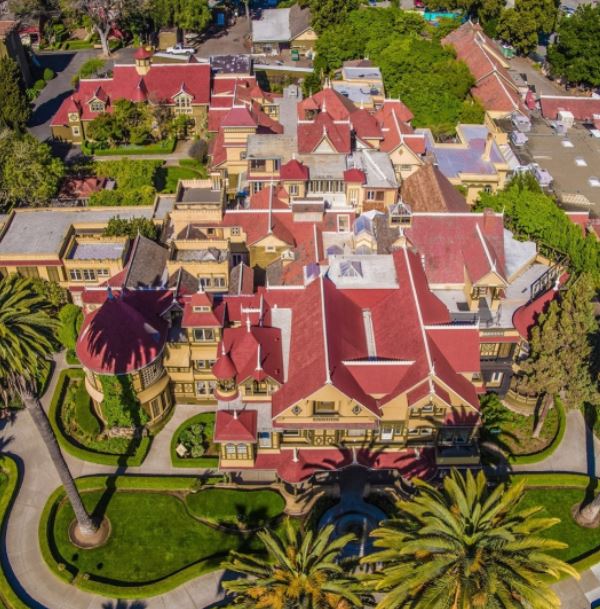
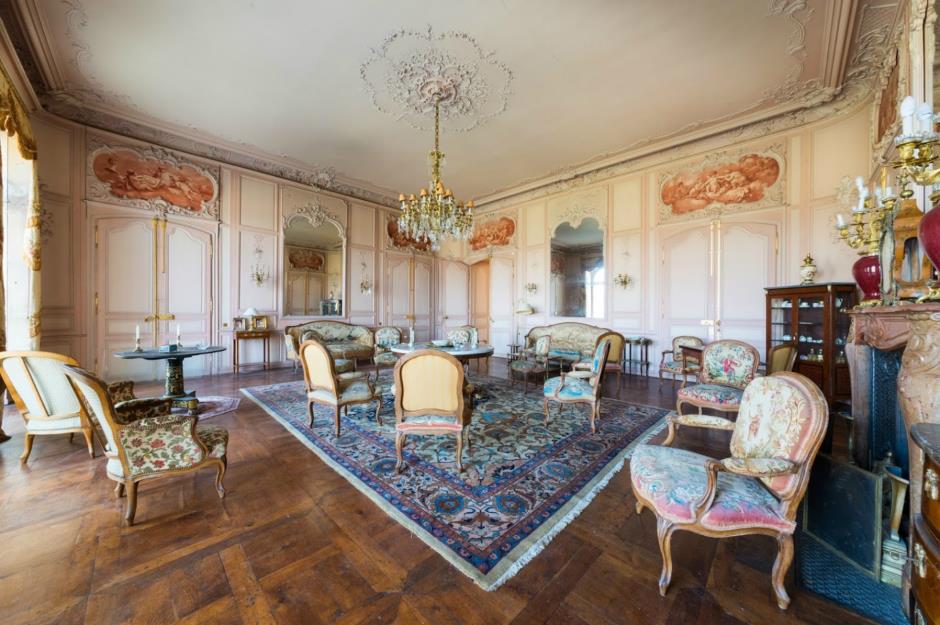
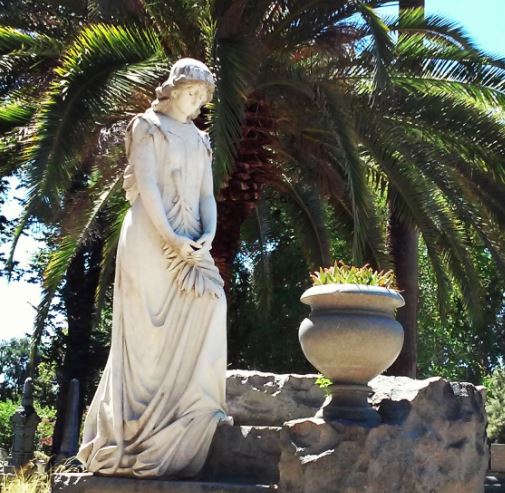
Speculation is bound to pursue a wealthy, extremely beautiful, celibate recluse, who has lost those who mean the most to her and is haunted by spirits of the damned. Many wild rumors circulated about Sarah Winchester during her residence in Santa Clara Valley—her opulent estate was even known locally as “The Spirit House”—and some say the rumors may have added to Mrs. Winchester’s isolation. However, the glory, the splendor, the beauty of her mansion, surpassed the vicious rumors and speculation; and the fragrances of the Victorian garden were intoxicating. The tracks were gone; they vanished where the velvet emerald green sod began. There were plenty of creatures, and they welcomed her with caresses. Yet, Mrs. Winchester was bent, broken, withered, widowed—her head was white with unnumbered sorrows. She had been familiar with grief for a thousand years. The deaths of her young husband and her six-week-old daughter Annie stood out clear in her memory, for it was a land-mark; it brought Mrs. Winchester her first real misery, her first real heartbreak. Her memories were blurred with tears, and after ten centuries she cried over and over and over again. Crying over it for pity of that poor child—the child she had lost. Other mothers have felt something akin to this in recalling, not their former selves, (as in her case), but the little figures which represents sons and daughters of their which have since grown to the gravity and stature of full age. Sometimes, for a moment, these poor mothers have a vision of those little creatures romping by, and they recognize the voices of laughter—gone silent long ago!—and they have a pain at the heart, as knowing that those children are lost to them for always, in the flesh, although their grown-up selves are still present in life and still precious. The loved and lost! Lives having gone out from their mothers’, lives to return no more but in visions. #RandolphHarris 1 of 16
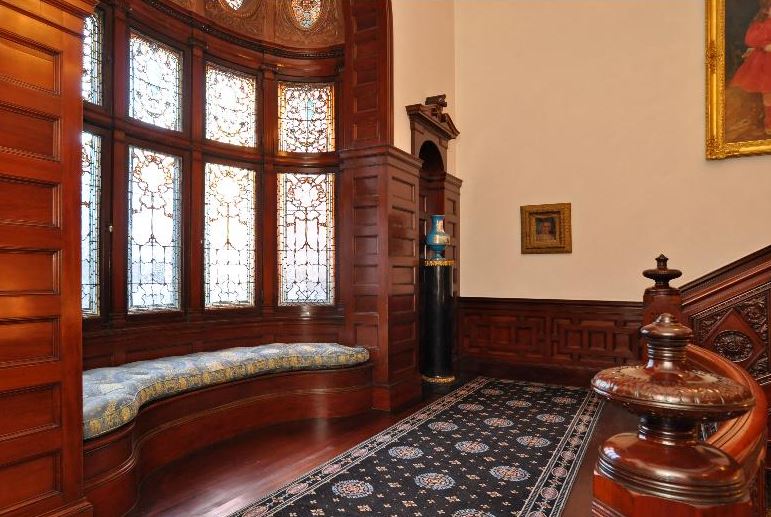
Yes, across the mouldering centuries Mrs. Winchester could still see that silken little baby, with her waxen round arms, and delicate smile, just as she was, the fairest thing in this fair World; and in her heart, leathery as it was, she felt again the pang of that day’s disappointment, holding on to the memory of what could have been. It was weeks that she had been wandering the halls of her enormous mansion, and had found no trace of William, her husband. The Valley was so cruelly vast! Early she had a happy thought, and took the bloodhound throughout the estate and showed him the tracks, and was fully of hope, not doubting he would hunt him down in an hour. But she knew that she tried everything she could try, and just needed to say goodbye forever. The track gave no scent. William Winchester was dead. The hurt stayed with her, and Mrs. Winchester was resolved to absorb herself in the construction of her mansion. She did the work, but the old pleasure in it was somehow gone; she did not care anymore. She had between 500 to 600 rooms constructed, but thought they were not good ones and tore them down because her heart was not in it. Some of them were tolerable, but mainly they were crude and inartistic; they lacked finish. The miles of twisting hallways were made even more intriguing by secret passageways in the walls. When Mrs. Winchester set out for her Séance Room, it might well have discouraged the ghost of the angry spirits or even of a bloodhound, to follow her. After traversing an interminable labyrinth of rooms and hallways, suddenly she would push a button, a panel would fly back and she would step quickly from one apartment into another, and unless the pursuing ghost was watchful and quick, he would lose her. #RandolphHarris 2 of 16
Then she opened a window in that apartment and climbed out, not into the open air, but on the top of a flight of steps that took her down one story only to meet another flight that brought her right back up to the same level again, all inside the house. This was supposed to be very discomforting to evil spirits who are said to be naturally suspicious of traps. Mrs. Winchester was the most unfortunate of women. Rich, respected, very well educated and of sound health and mind—with many other advantages usually valued by those having them and coveted by those who have them not—she sometimes thought that she would be less unhappy if they had been denied her, for then the contrast between her outer and inner life would not be continually demanding a painful attention. In the stress of privation and the need of effort, she might sometimes forget the sombre secret ever baffling the conjecture that it compels. After communing with the spirits, as she turned the hallway, Mrs. Winchester could hear a sound of a door gently closing, and saw in the darkness, indistinctly, the figure of a man, which instantly disappeared among the statues and furniture. A hasty pursuit and brief search of the mansion in the belief that the trespasser was someone secretly visiting a servant proving fruitless, she entered an unlocked door and mounted the stairs to her chamber. Its door was open, and stepping into black darkness she fell headlong over some heavy object on the floor. She spared herself the details; it was her poor William, dead of strangulation by human hands! Nothing had been taken from the house, the servants had heard no sound, and excepting those terrible fingermarks upon the dead man’s throat—dear God she hoped to forget them!—no trace of the assassin was even found. #RandolphHarris 3 of 16

Although William had Tuberculosis, something had come to end his life before the illness did. Mrs. Winchester kept barbarous murder a secret. Mrs. Winchester donated a substantial sum of money to the Winchester Clinic of the General Hospital Society of Connecticut, for the care and treatment of tuberculosis patients. The clinic still exists today as part of the Yale New Haven Medical Center. One night, a few months after the dreadful event, Mrs. Winchester and her butler were walking back from the carriage house after a trip to the city. The full moon was about three hours above the eastern horizon; the entire countryside had the solemn stillness of a summer night; their footfalls and ceaseless song of the katydids were the only sound, aloof. Black shadows of bordering trees lay athwart the mansion, which, in the short reaches between, gleamed a ghostly white. As they approached the door to the mansion, whose front was in shadow, and in which no light shone, her butler suddenly stopped and clutched her arm, saying, hardly above his breath: “God! God! what is that?” “I heard nothing,” Mrs. Winchester replied. “But see—see!” he said, pointing along the road, directly ahead. Mrs. Winchester said: “Nothing is there. Come, Henry, let us go in—you are ill.” He had released her arm and was standing rigid and motionless in the center of the illuminated roadway, staring like one bereft of sense. His face in the moonlight showed a pallor and fixity inexpressibly distressing. She pulled gently at his sleeve, but he had forgotten her existence. Presently he began to retire backward, step by step, by step, never for an instant removing his eyes from what he saw, or thought he saw. Mrs. Winchester turned half round to follow, but stood irresolute. She did not recall any feeling of fear, unless a sudden chill was its physical manifestation. #RandolphHarris 4 of 16
It seemed as if an icy wind had touched her face and enfolded her body from head to foot; she could feel the stir of it in her hair. At that moment her attention was drawn to a light that suddenly streamed from an upper window of the mansion: one of the servants, awakened by what mysterious premonition of evil who can say, and in obedience to an impulse that she was never able to name, had turned on the Carbide gas lights, which were operated by pushing an electric button. When she turned to look for the butler he was gone, and in all the years that had passed no whisper of his fate has come across the borderland of conjecture from the realm of the unknown. Mrs. Winchester retired and had fallen almost immediately into a peaceful sleep, from which she awoke with an indefinable sense of peril which was, a common experience in her estate. The servants slept in another part of the house. But these were familiar conditions and never distressed Mrs. Winchester. Nevertheless, the strange terror grew so insupportable that concurring her reluctance to move she sat up and pushed the button to turn on the lights at her bedside. Contrary to her expectation this gave her no relief; the light seemed rather as added danger, for she reflected that it would shine out under the door, disclosing her presence to whatever evil think might lurk in the halls of her mansion. You that are still in the flesh, subject to horrors of the imagination, think what a monstrous fear that must be which seeks in darkness security from malevolent existences of the night. That is to spring to close quarters with an unseen enemy—the strategy of despair! Extinguishing the gas lights, Mrs. Winchester pulled the bedclothing about her heard and lay trembling and silent, unable to shrike, forgetful to pray. In this pitiable state she must have lain for what you call hours—with her there are no hours, there is no time. #RandolphHarris 5 of 16

At last it came—a soft, irregular sound of footfalls on the stairs! They were slow, hesitant, uncertain, as of something that did not see its way; to her disordered reason all the more terrifying for that, as the approach of some blind and mindless malevolence to which is no appeal. She even thought that she must have left the hall gasolier burning and the groping of this creature proved it a monster of the night. This was foolish and inconsistent with her previous dread of the light, but what would you have? Fear has no brains; it is an idiot. The dismal witness that it bears and the cowardly counsel that it whispers are unrelated. In Mrs. Winchester’s mansion lived those who have passed into the Realm of Terror, who skulk in eternal dusk among the scenes of our former lives, invisible even to themselves, and one another, yet hiding forlorn in lonely places; yearning for speech with out loved ones, yet unenlightened, and as fearful of them as they of humans. Sometimes the disability is removed, the law suspended: by the deathless power of love or hate they break the spell—they are seen by those whom they would warn, console, or punish. What form they seem to them to bear one knows not; they know only that they terrify even those whom they most wish to comfort, and from whom they most crave tenderness and sympathy. What a thing it is to have legions of spirits, cowering and shivering, fearful and vengeful in an altered World, roaming the hallways of one’s house. However, Mrs. Winchester did not die of fright: the Thing turned and went away. She heard it go down the stairs, hurriedly, she thought, as if itself in sudden fear. Then she rose to call for help. Hardly had her shaking hand found the annunciator when—merciful Heaven!—she heard it returning. Its footfalls as it remounted the stairs were rapid, heavy and loud; they shook the mansion. She fled to an angle of the wall and crouched upon the floor. #RandolphHarris 6 of 16
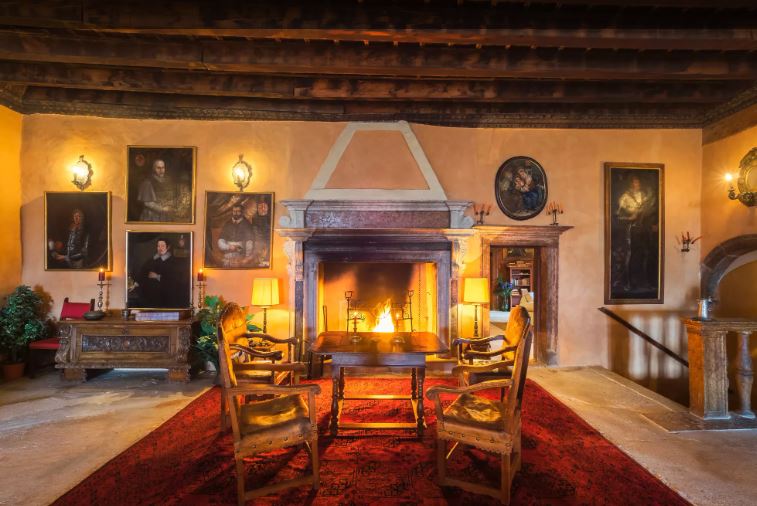
Mrs. Winchester tried to pray. She tried to call the name of her maid. Then she heard the door thrown open. There was an interval of unconsciousness, and when she revived, she felt a strangling clutch upon her throat—felt her arms feebly beating against something that bore her backward—felt her tongue thrusting itself from between her teeth! And the she felt the life pass from her. As the spirits still dwelled in the mansion of the shadows, lurking in its desolate places, peering from brambles, thickets, towers, corners, stairways and doors. Ghosts at the Winchester mansion know when it is night, for then most people retire and they can venture from their places of concealment to move unafraid about in their old mansion, to look in at the windows, even to enter and gazes upon people’s faces who might still be wandering in the evening hours. Vainly, spirits often seek some method of manifestation, some way to make their continued existence and their great love and poignant pity understood by their loved one’s or those they wish to haunt and terrorize. Ghosts dare to approach people when they are awake, but the terrible eyes of the living frighten them by the glances that they seek from the purpose the hold. Demons, ghosts, and other spiritual beings search for the living in the Winchester mansion during the moonlight dawn. At the time of her death, the unrelenting construction had rambled over six acres. The sprawling mansion contained 160 rooms, 2,000 doors, 10,000 windows, 47 stairways, 47 fireplaces, 13 bathrooms, and 6 kitchens. Carpenters even left nails half driven when they learned of Mrs. Winchester’s death. According to the provisions of her will, Mrs. Winchester’s personal property, including the furnishings, household goods, pictures, jewelry, and papers were left to her niece, Mrs. Marian Merriman Marriott, who promptly has the furnishings auctioned off. It is said to have required sic trucks working six weeks to car the furnishings away! The mansion and farm were not mentioned specially in the will. They became part of the Mrs. Winchester’s estate. #RandolphHaris 7 of 16
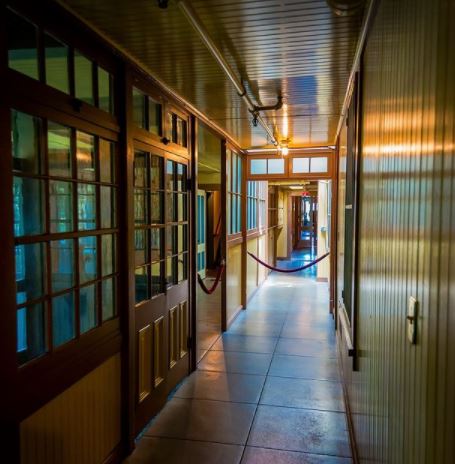
Demon possession is a well-defined phenomenon and should be clearly distinguished from spiritism. Since the same demonic forces are at work in both phenomena, they bear some similar characteristics and result in the same occult oppression and bondage. The demonized state of the demon possessed is similar to the trance of the spiritistic medium. Both are under the direct influence of demons who speak through them. In the case of the medium who processes to communicate with the spirits of deceased persons, the demon apes the personality and voice of the deceased. In the case of the demon possessed, the evil spirits appear to be more crassly cruel, unclean, violent, and less sophisticated and subtle than spirits working through a clairvoyant medium. In demon possession, they are also more domineering and brutally enslaving. Nervous muscular reactions and contortions peculiar to the demoniac often appear also in the spiritistic medium when one goes into a trance, but in a much milder form. Then, too, the demoniac is normally an involuntary victim of possession, while the medium is a willing subject, who cultivates psychic propensities and willingly yield to demonic control. Extraordinary movements of inanimate objects surrounding the demon-possessed remind us of similar happenings in spiritism. Extraordinary movements of inanimate objects surrounding the demon-possessed remind s of similar happenings in spiritism and magic. Tables, chairs, dishes, and the like are mysteriously moved about without anybody touching them, recalling tumbler moving and table lifting so common in spiritistic séances, and magic conjurations. In demon possession as well as in spiritism, unexplained rappings and noises in so-called “haunted houses” are heard. #RandolphHarris 8 of 16
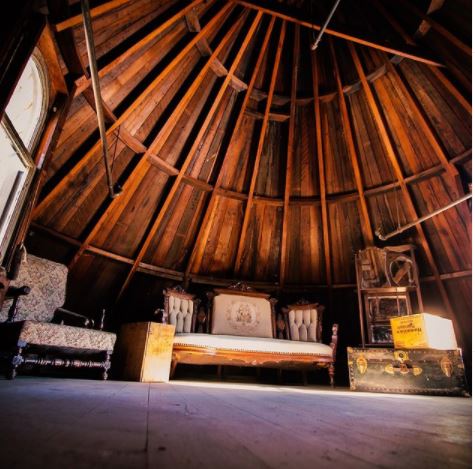
After the Winchester mansion was opened for tours, a spirit from the house had taken possession of one of the tour guides. The spirit insisted on taking up its abode with them, since it has been driven away from its for dwelling by the presence of Christians. Such cases of haunted houses about everywhere in occult literature in connection with mediums, magicians, and demon possessed persons. The tour guide saw apparitions and had frequent attacks in which she fell unconscious and demons spoke through her in their own voice and personality. A thorough investigation was conducted. Persons were stationed all around the house, in various rooms, and even in the Daisy Bedroom. Noises were heard which gradually increased in violence and seemed to concentrate in the bedroom Mrs. Winchester died in. Chairs bounced, windows rattled, plaster fell from the ceiling, and objects moved about without any visible explanation. Prayer caused the noises and telekinetic phenomena continued for a while in the mansion. On one occasion, after continued prayer, one of the demons inhabiting Jane cried out, “All is now.ost. Our plans are destroyed. You have shattered our bond, and put everything into confusion. You, with your everlasting prayers—you scatter us entirely. We are 13,130,130,130 in number. But there are still multitudes of living men, and you should warn them lest they be like us forever, lost and cursed of God.” The demon confessed that he was an emissary of Satan. The next day, the contents of the mansion were found in compete disarray and utter confusion. The amazing and terrifying thing was that the doors were still securely locked. No man or beast had entered. Evil spirits had obviously been at work in a satanic assault. On that day there were some tremendous crashing and knocking noises heard in the Winchester mansion, as if the whole house was filled with evil spirits. #RandolphHarris 9 of 16

Everyone giving tours in the mansion in the early 1900s, used to hear knocking and rumbling and crashing noises to such an extent that some of the visitors were frightened by them. Ghosts were also seen there quite regularly, even during the day time. A headless ghost was repeatedly seen in the mansion. Many people reporting becoming burned after contact with the “possessed” tour guide Jane. The autumn of 1925, all the pigs on the Winchester mansion’s farm died. The cause of death could not be found even though one of the carcasses was sent to a biological institute for examination. They tried everything but all to no avail. The following year the same thing happened again. This time the farmer redoubled his efforts to discover the cause of the pigs’ death. He had the stables inspected and the food analyzed but again without success. He thus decided to have the conservators of the estate decided to have the pigsty torn down and rebuilt on another site using completely different materials. Next year the pigs died again. They would all of the sudden squeal and then collapse. The whole process was repeated and every possible examination made in order to find out why the pigs had died. At this time certain of the member of the community began to say that someone must be killing the pigs magically out of spite. At first the conservators of the Winchester Estate would have nothing of this and continued to seek the advice of the vet and other such people. However, they could not help them, and so in the end they went to see the local minister to ask him about the question of magic. The minister simply laughed and said that the idea was stupid. Nevertheless the villagers pointed out to the representatives that there did exist some people in some areas of California who could kill livestock by means of magic. #RandolphHarris 10 of 16
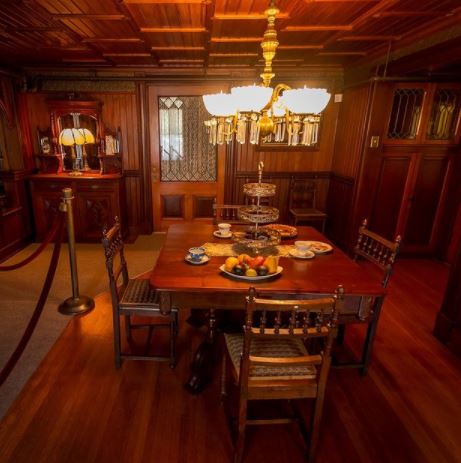
The conservators could do nothing though, and the event recurred year after year in spite of the fact that by now they had doubly secured the stables with locks and had sometimes stayed up all night with thread stretched out around the estate in order to discover if anyone was causing the animals’ deaths. One day, however, the circumstances changed. The minister visited the estate and asked one of the tour guides to accompany him to the vicarage. There they found one of the neighbour’s of the Winchester Estate, a man who had been less affluent, and this man confessed that it was he who had been the cause of everything. He had killed the pigs using black magic. The tour guides and conservators were naturally upset because by now 39 pigs had been killed. When asked why he had done this, the neighbour replied that it was because the tourists made such a noise outside his house. He had become so angry that he had tried to get his revenge in this way. He had subscribed himself to the devil with his own blood. To do this he had gone out on a Friday night to some crossroads and there drawn up a contract between himself and the devil. He mentioned that the devil had not appeared to him as he is often pictured, but that he met a black curly headed figure with blood-red eyes and a small snout and that the figure had been dressed in rather old-fashioned clothes. Ever since that day the man confessed that among other things, he had had the power to kill his friend’s pigs. The minister asked him what had made him come out into the open about the whole matter. His answer was that the people at the Winchester estate had been so kind to him over the year, donating food, clothes and furniture, that he had felt ashamed and he now asked for them to forgive him, and promised he would no longer plague them. #RandolphHarris 11 of 16

Not wanting to take any legal action, the conservators of the Winchester Estate forgave him and all went well until the neighbour ceased going to church and slid back into his old ways. Since his confession none of the estate’s pigs had died but now the man again took up his drinking habits two more of the pigs died in exact same ways as the others. The conservators decided to shutdown the farming land of the Winchester Estate and sell off hundred of acres, only keeping four. In the process, several other Victorian houses on the grounds, along with fountains, and gazebos were demolished. From the psychological point of view it is suggested that a person delving into magic and who believes in occult practices is really only succumbing to a fulfilment compulsion. One unconsciously fulfils the things that one seeks to perform by magic. One is the victim of auto-suggestion. However, even if this were the whole explanation as some people affirm, it would still be true to say that occult practices have a corrupting effect on all those who get involved in them. Demons tend to be somewhat more independent than angels…When possession takes place, you will not get to see them at all. The Florida-based Luciferian Light Group (LLG) adopted the ‘Watcher myth’ of devils that were originally angels, sent to Earth to guard humankind and cursed by God for screwing their charges. In the original myth the couplings produced monsters, but, according to the LLG, the actual result was the Aryan race. They say that African Americans and other racial groups take pride in their cultural roots, so the argument goes, why should the same concept not apply to Europeans? The argument cannot be countered by liberal sophistry, and so the ghosts of German volkisch occultists continue to be conjured. #RandolphHarris 12 of 16
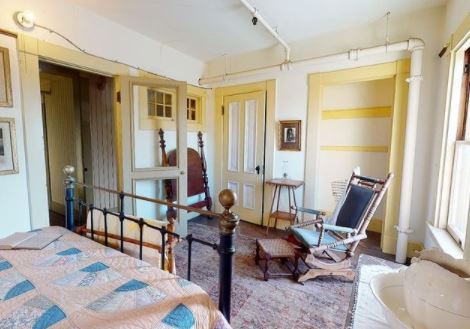
The role of cultural villain again proves to be a delicate balancing act—nothing can ever be condemned on purely moralistic grounds. Many people are still trying to protect “The Black House.” The Black Pope himself once reassured his flock, “the first 99 years are always the toughest. Rege Satanas!” Satanism is opposed to victimology and scapegoating. Many people are really drawn to the dark side because they grow up reading a lot of books and watching a lot of movies about it. If witches are out there, practicing some of the old ways of the pre-Christian gods and goddesses, then they are still Satanic in the sense that they are heretical. One side of the heretical and diabolical is the scientific aspect of Satanism. Copernicus and Galileo were regarded as practicing sorcerers in as far as they dared to challenge the supremacy of God with their heresies-their scientific research. Anton LaVey codified modern Satanism. There is a rich heritage of hearsay and blasphemy behind it, but as far as an aboveground religion that reveres Satan, there was not anything before the Church of Satan’s foundation in 1966. There were Black Masses that parodied the Catholic Church. A lot of modern Satanism draws from that codification or personification of Satan used as an archetype in mythology. Satanist are more interested in power, and what was going on in the castles and courts of the times. The interactions of power and Machiavellian machinations interest a Satanists rather than going out and find herbs to cure indigestion. Satanists are reaching for a religion of the aristocracy. They have all the aspects of that pride, that energy, that stye, and hopefully those elevated standards. Many people fear them because they believe they will lure you in their house and kill you, but is that not what many Christians are doing today? #RandolphHarris 13 of 16
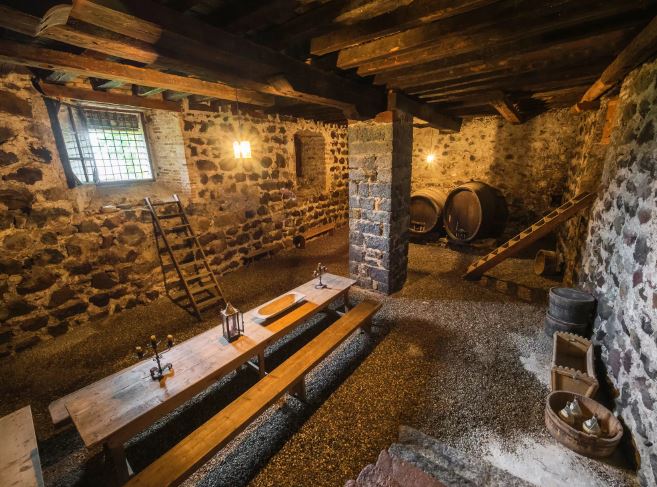
Your relationship with your personal Satanic archetype is yours alone. The only way some can see how effective one is as a practicing black magician is how well one gets on in the outside of the World. Satanism has always represented and will always represent the adversary. He is a counterbalance to the unspoken injustice that prevails in the current society, whether that be overweening elitism or, going to the opposite extreme, mob rule. They always have to be in the minority that push hard in the other direction to get the pendulum swinging. Satanism will never be a religion of the people. It will never be populist beyond its current position. You see hundreds of thousands of kids making the sign of the horns, wearing black, getting devil tattoos, and listening to rock music they think is Satanic. They will take all the trappings and even grasp a few of the basic ideas, like Satan representing indulgence and independence of spirit. But, beyond that, they will always be a minority and that is how some think it should be. The Winchester mansion is a common site of demonic assault. In the early 1900s, a group of tourists and tour guides were attacked by demons; some became possessed; 30 people in the group were seized. In 1926, Satan and his allies once again possessed people at the Winchester mansion. For the first time in their lives, many of these people found themselves to be powerful, significant beings, establishing their own realm of authority. When they spoke, everyone in the mansion stopped to listen, for their shrill cries became testimony. Many historians have argued that the Satanism at the Winchester mansion was only the product of demented minds. However, there was something quite real in all the series of accusations and counteraccusations of the witnesses and the possessed—some definitely evil driving force that led humans to turn against one another like mad dogs lusting for the smell of blood. If Satan was to have presided over the Satanism at the Winchester Mansion, much was left out of the picture. #RandolphHarris 14 of 16
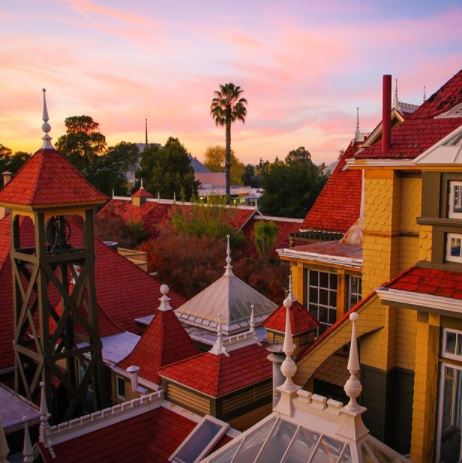
The Devil manifested himself in many forms to people at the Winchester Mansion—as a horse, a fox, a dog, a cat, a pig, and as a shadowy figure. At the Sabbats, the Devil was always present in the form of a tall, handsome man with blue eyes and black hair making no attempt to disguise his identity in any way Neither was the all-important bloodletting present in the ceremonies, either in the form of a sacrifice or in the singing of the pact. There was no defiling of sacred object, nor mention of the administering of the witches’ mark, a painful ceremony that was quite vivid in the minds of many of the witches at the estate. The Sabbats, all in all, seemed to have been rather staid affairs, involving no wild ritual or debauchery. The Devil offered not immediate wealth or riches, but a new system of government, where all humans would be equal, each human being free to “live bravely.” He promised an end to beliefs. Whoever the Devil was at those meetings, he obviously did not seek adulation, but rather he sought to establish a more equal and suitable social order among humans. Taken in this context, the entire episode begins to sound like a huge projection, a gigantic wish fulfillment on the part of the disgruntled citizens, who were expressing disdain for the system that, in their eyes had become oppressive. The figure chosen by the confessors as the Devil presiding over the midnight Sabbats had himself become disillusioned by the system. Perhaps he had been holding nocturnal meetings in the mansion in an effort of “cleansing the soul.” At any rate, the meetings were necessary psychological safety valves in the minds of the people. People would stand around begging for the master to teach them his secret. How to become invisible, how to acquire love, and oh! beyond all, how to make gold. How much gold would you give for the Secret of Infinite Riches? Humans became strengthened with wonderful power through the order of angels, so that one declares the divine will. From the Seraphim, that we cling with fervent love. From the Cherubim, enlightenment of the mind, power and wisdom over the exalted figures and images, through which we can gaze upon divine things, etcetera. #RandolphHarris 15 of 16

From the Thronis, a knowledge of how we are made and constituted, that we may direct our thoughts upon eternal things. From Dominationbius, assistance to bring into subjection our daily enemies, who we carry with us constantly, and enabling us to attain salvation. From Potestatibus, protection against human enemies of life. From Virtuibus, God infuses strength into us, enabling us to contend against the enemies of truth and reward, that we may finish the courage of our natural life. From the Principtibus, that all things become subject to humans, that one may grasp all power, and draw unto oneself all secret and supernatural knowledge. From Archangelis, that one may rile over all things that God has made subject to one, over the animals of the field, over the fish of the sea, and over the birds of the air. From the Angelis one receives the power to be the messenger of the divine. When the veil between the conscious and the subconscious mind begins thinning it is likely that one will begin to experience certain phenomenon that will grab your attention throughout the day. This will occur more and more as the veil between Worlds thins merging your spiritual awareness with your physical life. Usually it will manifest in the form of synchronicity, Déjà vu, or circumstance which seems to jump out and grab your attention. Thee I invoke, the Bornless one. Thee, that didst create the Earth and the Heavens: Thee, that didst create the Night and the Day. Thee, that didst create the Darkness and the Light. Thou art Osorronophris: Whom no human has seen at any time. Thou art Ahriman. Hear Thou Me, for I am the Angel of Paphro. Osorronophris: this is Thy True Name, handed down to the Prophets of Ishrael. Ahriman rise up through the infernal planes through the seal of Arezura and find rest within this manifestation of the blessings. Fill this sorcerous fluid with your power and might that it will serve my cause of counter creation through the intent of my own evil mind. Bless this blood as the very powers of death, destruction, and decay that I may cast out all that does not serve the cause of my own great work upon this path of enlightenment. Come tour the dark, brooding and mysterious, promising all kinds of forbidden treats. #RandolphHarris 16 of 16
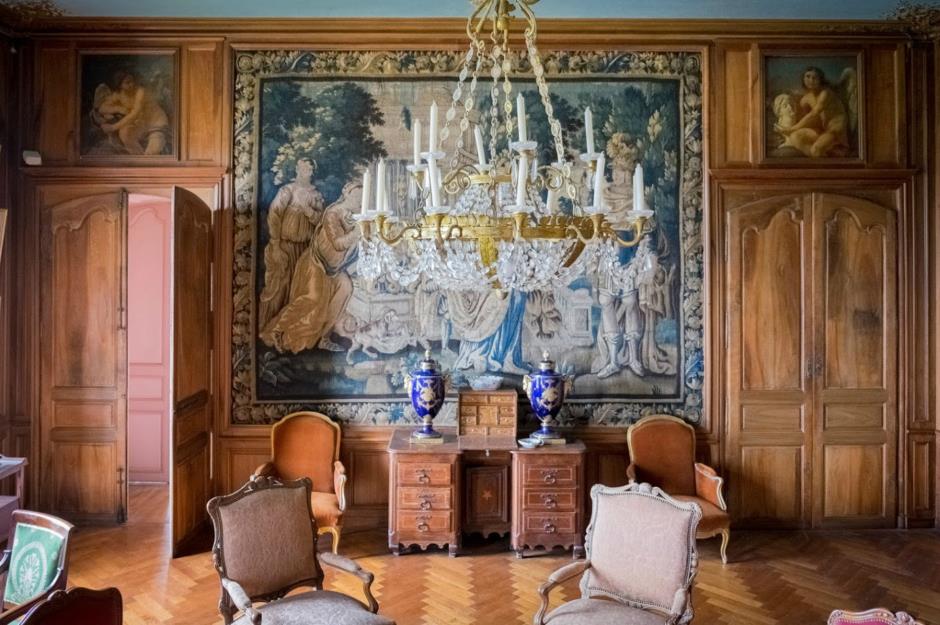
Winchester Mystery House
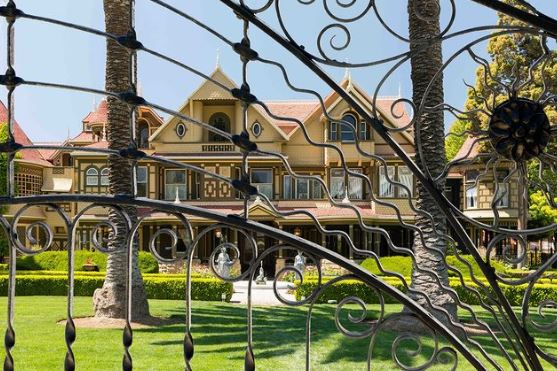
Happy weekend! Will we be seeing you on the estate today? 🌻 https://www.winchestermysteryhouse.com/

For Auto Insurance that Cares About Humans

For a great auto insurance company, who will make sure you and your loved ones are safe and taken care of, in the event something unexpected happens, please click on the link below: https://www.metromile.com/

Need Help With Car Maintanence from Someone You Can Trust?

For auto science engineers you can trust, please click on the link below. They will even come to you, and have great prices!
 Randolph Harris II International Institute