
Home » Dogs (Page 4)
Category Archives: Dogs

All is Well that Ends Well?

The family is sacred to the ultimate concern and is the most important social unit in time and eternity. The ultimate cause established families to bring happiness to its creations, allowing them to learn correct principles in a loving atmosphere, and prepare them for eternal life. The home is the best place to teach, learn, and apply virtuous principles. It is where individual learn to provide love, food, clothing, respect, shelter, security and other necessities they require. The mother and father, as equal partners, should help each family member. However, sometimes things do not go as planned. Because we live in a World with many influences, people may become criminals. Men and women can both become involved in crime. When it comes to burglaries, for the females who worked as partners, this could involve a variety of tasks. Many of these tasks were indistinguishable from those traditionally associated with men, such as gaining entry, searching the house, carrying goods outside, and disposing of them. The following interview segment describes some of the tasks performed by a female acting as a partner. Although this was her first offense, she heled to find the transportation to reach the target (by stealing a truck) and took part in the actual break in: “Well, it wasn’t up on me, somebody else who was in there different, not state, in a different county. He just came up and told me he knew about it, a rich guy that was gonna be gone for the weekend. He knew this person, knew who it was, and he knew about it. #RandolphHarris 1 of 24

“When he left that night about two or three in the morning, we went down there. We had stolen a truck, we had stolen my ex-boyfriend’s father’s truck, went down there. We tried to get in, but we couldn’t get in. Everything was locked. Right…We couldn’t get in for nothing, so what we does was, we had some sh*t in back of the truck and we took some tape. Then we put it over the window real tight, then we busted it, and then we took the tape down and the window was shattered. It had no window in it. So—everybody used gloves of course—so we went in there, you know, and we knew when we went, we knew nobody was gonna be home. There wasn’t a house around for two blocks, each way you went. So…my first one was basically the easiest one.” The target often was located by a female partner, who also took the lead in planning the offense. In these cases the women had a substantial say in determining how the proceeds of the crime were divided: “…whatever you chose to give to the other person. We tried to split everything equally. We were all good friends, you know, so I got the best deal out of it because of the fact that I needed the money more than everybody else. Me and my sister needed the money more than everybody did and…we were the ones that said hey, we pointed it out, we found a way to get in, we knew where everything was, we told them how, we had everything planned out down to the TV. This is where this is at and this is where this is at.” #RandolphHarris 2 of 24

The roles played by female burglars are dynamic and can chance over time. Many of the women who currently participate in offenses as partners started out as accomplices. The woman quoted below clearly has an equal relationship with her co-offender, but this was not always the case: “The first burglary I ever committed, I was in the house and I was smoking weed at the time. A friend came in and said ‘I want to go in this house.’ I said ‘Okay, it was around the corner….what part am I going to play?’ He says ‘All you got to do is watch the doors for me. The bags I bring down, take them out, and you also drive the car for me.’” As should be obvious from above, women who work as accomplices in burglary play much more limited roles. They seldom participate in planning the crime, and often do not even enter the dwelling. Some claimed to prefer working with others because they lacked the skills needed to be a successful burglar: “I can’t do all by myself…I haven’t mastered that yet.” Others simply felt more comfortable when relying on a colleague’s expertise; they were uncertain about their ability to work alone. In the following case, a woman reports that she deferred to her boyfriend’s judgment in determining the suitability of a given target. #RandolphHarris 3 of 24

“He can look at them and tell. He’s better at it than me. Sometimes I give him tips to go on, but he checks them out. I feel safer for him to check them out.” A common work assignment for accomplices was acting as a lookout or driver. Several of the women stated that driving was their primary job in burglaries: “Well, see, me and my boyfriend had been together for a year, and he done them all the time. Well, not all the time, but it was no big deal, and all I had to do, all I ever do, is drive. I just go like he’ll go, him and his friend. He don’t do ‘em every week or anything like that. Like it’s not really ‘cause we need the money or anything either. Like he’ll go during the day and he’ll look at a house and he’ll find one, and then he’ll tell me about where the house is…all I have to do is drive to the place and wait for them to start bringing out the stuff, and then drive off.” Other said that they typically kept a lookout for their colleagues: “They came and picked me up with a stolen automobile. I didn’t know that it was stolen. We went out there to this house and they got out. I just assumed—I didn’t know what was going on at first. We got out and they went in first, and then they came back out. One of the men came back out and told me to come in and to keep an eye out to see if anybody was there or anybody comes down the sidewalk or if anybody drives down the street or anything.” In both of these cases the women, as accomplices, did not choose to perform these secondary tasks. Instead the tasks were assigned to them by a dominant co-offender. #RandolphHarris 4 of 24

What light does this quantitative and qualitative information shed on the nature of female criminality? Our sample was not generated randomly; with this fact in mind, the quantitative findings suggest that women involved in residential burglary do not differ significantly from their male counterparts on a number of relevant dimensions (exempli gratia, drug and alcohol use, degree of offense specialization). Nevertheless, the results show that some important differences may exist as well. Compared to the males, for example, the females more often committed burglaries with others, began offending at a later age, and had less contact with the criminal justice system. Further examination of these apparent differences is warranted. The qualitative data demonstrate that women’s involvement in residential burglary is marked by diversity and that the debate about whether women play a primary or a secondary role in the offense is probably a red herring. In fact, as among males, some assume primary roles exclusively, some adopt secondary roles exclusively, and others move from one type of role to another s they become more experienced. This observation has important implications for research into women’s involvement in crimes committed more often by males. To be sure, a much lower percentage of women than of men participate in residential burglary. Even so, our qualitative data reveal substantial similarities be tween males and females. #RandolphHarris 5 of 24

This fact suggests that the activities of women who do engage in such offenses may be explained by some of the same factors that explain men’s participation. When it comes to the stole property system (SPS), we must consider the law of supply and demand shape the SPS. This term refers to the loosely formed relationships that bring about the theft of property and the subsequent repackaging and resale of these goods via the “black market.” We use contacts with law enforcement authorities to formulate a revised view of property crime. Instead of viewing burglaries as isolated incidents of theft, we argue that we should conceive of the acts and actors involved as spanning a more broadly defined set of roles and behaviors. They identify the thief, fence, and person who buys the stolen goods as key players in the SPS. They also identify multiple stages in the process: research and planning, extraction, exchange (id est, conversion of the goods to money), marketing, residtribution/resale, and evaluation. Moreover, the roles and behaviors of the various players are said to be interchangeable and flexible. In the end, we reconsider the way that we think about property crime. We become more sensitive to the potential for business concepts such as division of labor, entrepreneurial spirit, supply and demand, and marketing to manifest themselves in the World of property theft. In doing so, we are able to drive home the complexity and fluidity tht can beset property crime events. Moreover, we illustrate how the criminal calculus can lead to mutually beneficial relationships and roles that allow the criminal subculture to expand and innovate. #RandolphHarris 6 of 24
Perhaps no area of contemporary criminal activity holds more potential for improved understanding and successful intervention through analytical reorientation than does that of property theft. This area of crime is by no means new, a situation which may in fact constitute the greatest barrier to fresh thinking on the subject. Centuries of experience with thefts of property have give us a fairly strong conceptualization of this crime area, a conceptualization which centers almost exclusively on the thief. There is of course nothing illogical or erroneous about a concern for this individual; it is one after all who steals property. What is argued here, however, is that an exclusive concentration of the thief yields a myopic view of the process of theft, a view which draws the boundaries of the crime too tightly around that individual. It is a view which tends therefore to consider each incident of theft as a unique event, determined and constrained by the motivations, needs, and skills of the perpetrator. This “conventional view of theft” (if we can use this phrase) prescribes a response to this crime which largely consists of a fairly sophisticated sorting process, linking one individual (or one group of individuals) with each event as it occurs. Such an “individualistic” approach to crime and criminals is not, of course, confined to the property theft area. For example, we suggest that it is the most prevalent approach to crime in general. Consistently, both the popular and scientific tendency is to view the criminal’s behavior as a problem of individual maladjustment, not as a consequence of his participation in social systems. #RandolphHarris 7 of 24

Perhaps it is for this reason that in criminology we have had thousands of studies that have sought some damaging trait in the personalities of individual criminals, but very few studies of the organizational arrangements among criminals who commit crimes in concert. The tendency toward an individualistic interpretation of criminal behavior cannot be laid to the idiosyncrasies of either the public or the scientist, but rather is undoubtedly influenced by the nature of the legal systems, with their concepts of individual responsibility an intent, upon which most democratic societies are based. However, while such an interpretation may conform well to the needs of a legal system, it may have the additional effect of causing us to ignore some important dimensions of contemporary criminal behavior. It is the perspective that property theft is one area of criminal behavior that has sorely suffered both conceptually and practically from a failure to probe the relationships among criminals (and)…the structure and operations of illicit organizations. Perhaps the mot glaring evidence of this failure concerns what the President’s Crime Commission called “little research…done on fencing,” id est, on the criminal receiver of stolen property. This crime figure, although tallying an impressive list of protestations to one’s importance over several centuries has remained little explored, while one’s relationship with the thief has been virtually ignored by the criminologist. #RandolphHarris 8 of 24

However, if the popular and scientific tendency has been to overlook the fence, the police detective assigned the responsibility of dealing with property theft has not found it possible to do so. Instead, as the authors discovered in the course of an ongoing study of patterns of criminal receiving, police detectives possess a great deal of information about the fence. Other researchers have reported similar experiences. Because the police know about the fence does not imply that one’s activities are either successfully or efficiently interdicted, for the police agency is as influenced by an individualistic approach to crime as is the social scientist. Thus the bulk of enforcement resources and activity against theft is directed to the thief, and the situation in which police effort is devoted directly and exclusively to the fence appears to be rare indeed. The criminal receiver remains a curiosity to the criminal justice system, being infrequently arrested and even less often convicted. The model of property theft employed here—the Stolen Property System—is an operationally based one, derived from the author’s research into patterns of criminal receiving in a large urban area of the northeastern United States of America. As a part of this study, access to police intelligence reports on the activities of burglars and fences has been obtained, as well as records of these activities maintained in a special investigative unit in the office of the district attorney. Now, as burglaries are crimes of economics, this indicates that economics plays a kay factor in our lives. #RandolphHarris 9 of 24

China is an economic power house, and it growing production and export power enhances its financial strength as well. This is natural. However, compared to its sensational emergence as a leading manufacturing and trading nation, the process of its ascending to the position of a major financial power is more fragmentary and complicated. China has by far the largest foreign exchange reserves in the World, about three times as large as Japan, which is number two. It is also rapidly emerging as the leading international lender. In contrast, China’s role as a foreign direct and portfolio investor is still considerably smaller than that of America, major European countries, and Japan. For the time being, the story of China’s growing financial clout is, first and foremost, the story of the unprecedented increase of the financial power of the Chinese state. As of the end of 2021, the gross financial assets of China increased 13.6 percent to USD $29,689 billion. That is an increase of USD $25,563 billion since 2010. In December 2022, the reserves of China stood at USD $3,120 billion. The exact composition of China’s foreign exchange reserves is classified information. Foreign direct investment into China totaled $42.5 billion between July and December 2022. That constituted a 73 percent decline on the year. #RandolphHarris 10 of 24

China’s net international investment position reached USD $2,531.328 billion in December 2022. As of the year 2022, the United States of America’s net international investment position was USD -$16.12 trillion. The United States of America is currently the World’s largest debtor nation. Thinking about the pre-cybernetic machine—with minor exceptions, state socialism had led not to affluence, equality, and freedom, but to a one-party political system…a massive bureaucracy…heavy-handed secret police…government control of the media…secrecy…and the repression of intellectual and artistic freedom. Setting aside the oceans of spurting blood needed to prop it up, a close look at this system revealed that every one of these elements is not just a way of organizing people, but also—and more profoundly—a particular way of organizing, channeling, and controlling knowledge. A one-party political system is designed to control political communication. Since no other party exists, it restricts the diversity of political information flowing through the society, blocking feedback, and thus blinding those in power to the full complexity of their problems. With very narrowly defined information flowing upward through the approved channel, and commands flowing downward, it becomes very difficult for the system to detect errors and correct them. In fact, top-down control in the socialist countries was based increasingly on lies and misinformation, since reporting bad news up the line was often risky. The decision to run a one-party system is a decision, above all, about knowledge. #RandolphHarris 11 of 24

The overpowering bureaucracy that socialism created in every sphere of life was also, a knowledge-restricting device, forcing knowledge into pre-defined compartments or cubbyholes and restricting communication to “official channels,” while de-legitimating informal communication and organization. The secret police apparatus, state control of the media, the intimidation of intellectuals, and the repression of artistic freedom all represent further attempts to limit and control information flows. In fact, behind each of these elements we find a single obsolete assumption about knowledge: the arrogant belief that those in command—whether of the party or of the state—know what others should know. These features of all the state socialist nations guaranteed economic stupidity and derived from the concept of the precybernetic machines as applied to society and life itself. Second Wave machines—the kind that surrounded Mr. Marx in the 19th century—for the most part operated without any feedback. Plug in the power, start the motor, and it runs irrespective of what is happening in the outside environment. Third Wave machines, by contrast, are intelligent. They have sensors that such in information from the environment, detect changes, and adapt the operation of the machine accordingly. They are self-regulating. The technological difference is revolutionary. While Mr. Marx, Mr. Engels, Mr. Lenin all bitterly assailed the philosophy of “mechanical materialism,” their own thinking, reflecting their era, remained steeped in certain analogies and assumptions based on pre-intelligent machinery. #RandolphHarris 12 of 24

Thus for Marxian socialists the class struggle was the “locomotive of history.” A key task was to capture the “state machine.” And society itself, being machine-like, could be pre-set to deliver abundance and freedom. Mr. Lenin, on capturing control of Russia in 1917, became the supreme mechanic. A brilliant intellectual, Mr. Lenin understood the importance of ideas. However, for him, symbolic production, too—the mind itself—could be programmed. Mr. Marx wrote of freedom, but Lenin, on taking power, undertook to engineer knowledge. Thus he insisted that all art, culture, science, journalism, and symbolic activity in general be placed at the service of a master plan for society. In time the various branches of learning would be neatly organized into an “academy” with fixed bureaucratic departments and ranks, all subject to party and state control. “Cultural workers” would be employed by institutions controlled by a Ministry of Culture. Published and broadcasting would be monopolies of the state. Knowledge, in effect, would be made part of the state machine. This constipated approach to knowledge blocked economic development even in low-level smokestack economies; it is diametrically opposed to the principles needed for economic advance in the age of the computer. #RandolphHarris 13 of 24

The Third Wave wealth-creation system now spreading also challenges three pillars of the socialist faith. Take the question of property. From the beginning, socialists traced poverty, depression, unemployment, and the other evils of industrialism to private own-unemployment, and the other means of production. The way to solve these ills was for the workers to own the factories—through the state or through collectives. Once this was accomplished, things would be different. No more competitive waste. Completely rational planning. Production for use rather than profit. Intelligent investment to drive the economy forward. The dream of abundance for all would be realized for the first time in history. In the 19th century, when these ideas were formulated, they seemed to reflect the most advanced scientific knowledge of the time. Marxists, in fact, claimed to have gone beyond fuzzy-headed utopianism and arrived at truly “scientific socialism.” Utopians might dream of self-governing communal villages. Scientific socialists knew that in a developing smokestack society such notions were impractical. Utopians like Charles Fourier looked toward the agrarian past. Scientific socialists looked toward what was then the industrial future. Thus, later on, while socialists regimes experimented with cooperatives, worker-management, communes, and other schemes, state socialism—state ownership of everything from banks to breweries, rolling mills to restaurants—became the dominant form of property through the socialist World. (So complete was this obsession with state ownership that Nicaragua, an imitative latecomer to the socialist World, even created “Lobo Jack,” a state-owned disco). Everywhere, the state, not the workers, thus became the chief beneficiary of socialist revolution. #RandolphHarris 14 of 24

Socialism failed to meet its promise to improve radically the material conditions of life. When living standards fell in the Soviet Union after the revolution, the decline was blamed, with some justification, on the effects of World War I and counterrevolution. Later the shortfalls were blamed on capitalist encirclement. Still later, on World War II. Yet thirty years after the war, staples like coffee and oranges were still in short supply in Moscow. In the period preceding Mr. Gorbachev’s perestroika, the diet of a middle-class researcher at a state institute in Moscow was heavily based on cabbage and potatoes. In 1989, four years after the start of Mr. Gorbachev’s attempt at reforms, the U.S.S.R. had to import 600 million razor blades and 40 million tubes of shaving cream from abroad. Remarkably, though their number is declining, one still hears orthodox socialists around the World calling for the nationalization of industry and finance. From Brazil and Peru to South Africa and even in the industrialized nations of the West there remain true believers who, despite all historical evidence to the contrary, still regard “public ownership” as “progressive” and resist every effort to de-nationalize or privatize the economy. #RandolphHarris 15 of 24

It is true that today’s increasingly liberalized global economy, uncritically hailed by the great multinational corporations, is itself unstable and could suffer a massive coronary. The distended debt balloon on which it rests cold be punctured. Wars, sudden interruptions of energy or resources, and any number of other calamities could cause its collapse in the decades ahead. Under catastrophic conditions, one might well imagine the need for temporary emergency nationalizations. Nevertheless, incontrovertible evidence proves that state-owned enterprises mistreat their employees, pollute the air, and abuse the public at least as efficiently as private enterprises. Many have become sink-holes of inefficiency, corruption, and greed. Their failures frequently encourage a vast, seething black market that undermines the very legitimacy of the state. However, worst and most ironic of all, instead of taking the lead in technological advance as promised, nationalized enterprises, as a rule, are almost uniformly reactionary—the most bureaucratic, the slowest to reorganize, the least willing to adapt to changing consumer needs, the most afraid to provide information to the citizens, the last to adopt advanced technology. For more than a century, socialists and defenders of capitalism waged bitter war over public versus private property. Large numbers of men and women literally laid down their lives over this issue. #RandolphHarris 16 of 24

What neither side imagined was a new wealth-creation system that would make virtually all their arguments obsolete. Yet this is exactly what happened. It is super-symbolic. It is knowledge. The same knowledge can be used by many people simultaneously to create wealth and to produce still more knowledge. And unlike factories and fields, knowledge is, for all intents, inexhaustible. Neither socialist regimes nor socialists in general have yet come to terms with this truly revolutionary fact. An established firm in an industry stands to gain by keeping out new competition. Then it can raise prices to monopoly levels. Since monopoly is socially harmful, the antitrust authorities try to detect and prosecute firms that employ strategies to deter rivals from entering the business. In 1945, the Aluminum Corporation of America (Alcoa) was convicted of such a practice. An appellate panel of Circuit Court judges found tht Alcoa had consistently installed more refining capacity than was justified by demand. In his opinion, Judge Learned Hand said: “It was not inevitable that it [Alcoa] should always anticipate increases in the demand for ingot and be prepared to supply them. Nothing compelled it to keep doubling and redoubling its capacity before other entered the field. It insists that it never excluded competitors; but we can think of no more effective exclusion than progressively to embrace each new opportunity as it opened and to face every newcomer with new capacity already geared into a great organization. #RandolphHarris 17 of 24

This case has been debated at length by scholars of antitrust law and economies. Here we ask you to consider the conceptual basis of the case. How could the construction of excess capacity deter new competitors? What distinguishes this strategy from others? Why might it fail? An established firm wants to convince potential new competitors that the business would not be profitable for them. This basically means that if they entered, the price would be too low to cover their costs. Of course the established firm could simply put out the word that it would fight an unrelenting price war against any newcomers. However, why would the newcomers believe such a verbal threat? After all, a price war is costly to the established firm too. Installing capacity in excess of the needs of current production gives credibility to the established firm’s threat. When such capacity is in place, output can be expanded more quickly and at less extra cost. It remains only to staff the equipment and get the materials; the capital costs have already been incurred and are bygones. A price war can be fought more easily, more inexpensively, and therefore more credibly. This makes sense in the logic of strategy, but will such a device work in practice? There are at least two qualifications that limit its success. First, if there are many firms already in the industry, then discouraging newcomers gives more profit to all of them. Will any one firm bear the costs of capacity when it gets only a part of the benefit? #RandolphHarris 18 of 24

This is a standard prisoners’ dilemma. If one firm is large enough, it may in its own interest provide such a service to the rest of the industry. Otherwise the firms must collude in building capacity; this may be hard to hide from the antitrust authorities. In the Alcoa case, only may not regard the dilemma of whom will install capacity as a serious problem, because Alcoa had a 90 percent share of the primary aluminum ingot market. However—and this is the second qualification—is that the relevant market? Even if there are no other producers of primary ingots, secondary production from scrap is a source of competition. So is Alcoa’s own future production. Many aluminum-based products are highly durable. If Alcoa puts more aluminum on the market in the future, then the values of these durable goods will decrease. If the company cannot credibly guarantee the users that it will restrict its own future, output, they are willing to pay for aluminum now. This is just like IBM’s problem of pricing mainframe computers. The solution of renting is much harder here: you cannot rent aluminum as such; Alcoa would have to extend its operations into all sorts of aluminum-based products. In accordance with the directions of the ultimate concern, and in view of the critical time through which the World is passing, every expression, “view,” or theory which we hold concerning things should now be examine carefully, and brought to the proof, with open and hones desire to know the pure truth of the ultimate concern—as well as every statement that comes to our knowledge from the experience of others, which may throw light upon our own pathway. #RandolphHarris 19 of 24

Every criticism—just or unjust—should be humbly received and examined to discover its grounds, apparent or real; and facts concerning the verities from every self-actualized being should be analyzed, independent of their pleasure or pain to us personally—either for our own enlightenment or for our equipment in the service of the ultimate concern. For the knowledge of truth is the first essential for warfare with the lying offenders, and truth must be eagerly sought for and faced with earnest and sincere desire to know it and obey it in the light of God: truth concerning ourselves, discerned by unbiased discrimination; truth from the virtues, uncolored, unstrained, unmutilated, undiluted; truth in facing facts of experience in all members of the hierarchy of self-actualization. Sometimes we are we can be too engrossed in our own internal struggle to intervene and prevent someone else from being hurt, but gradually the fragments and splinters and hurts began to disturb us. We may experience internally the broken moments, shattered dialogues, and cruelty of neutral faces. Here were people committed to the rescuing of “dropouts” and “rejects” from the public school, blatantly ignoring the crucial feelings being expressed. In this room, in the many passing hours and in that moment were people who hungered for a vital, active, listening human presence. #RandolphHarris 20 of 24

However, what they get are intellectual arguments and words with little or no feeling. What they get are dead faces and lifeless bodies. Within one is growing an indignation against these denials or elemental human values until at last one’s own existence, one’s own isolation, one’s own desire for a solitary state crumbles away and vanishes. For the first time in weeks, one may experience intense and vital feelings from within, a full response to others. One’s anger mounts at the surface way in which fundamental matters are handled, at the ignoring of potential for intensity and depth, and at people committed to serving abused and rejected children failing to reach out, recognize and affirm each other. It may take one back to another time and place. This may cause of to reflect on the coldness and indifference others have to the personal struggles and feelings, an avoidance of intensity and depth in interactions, an intellectualizing and professionalizing or values and concepts of the ultimate concern. Mystery, spirit, feeling, the human sense, the unspoken and ineffable, the sense of awe and wonder, aesthetic appreciation—all might be missing. What else is the ultimate concern but a willingness to submit to the unknown, to learn from the unseen and intangible what we must fulfil? Where else do powers of life, actions to living in the deepest and fullest sense, come but from felt presences that awaken us to a fuller realization of what it means to be unique and human. #RandolphHarris 21 of 24

There will be pronouncements, lineal objectives and goals, definitions, rules, all carefully edited and articulated. We must be concerned with deviance and social injustice, and be aware of the importance of using political and economic powers to being about beneficial social changes. We have to speak about poverty and war, the end of killing and hunger. However, these are devotions to abstractions: for there before us are instances of human suffering, and individuals struggling to rise, and they are being met with indifference, with a refusal or inability to listen and respond. Some may speak glibly of the value of love in enlightenment, but these words do not strengthen and affirm, not support or encourage individuals in their search and struggle. The words are empty. The soul of life dies quickly in the presence of doctrines, rituals, and intellectual reactions. The central concern, the only immediate and intense here-and-now feeling, is a fear of the people who rate us, an incessant anxiety boarding on paranoia that they are being judged in every detail and nuance. Without exception, the fear of being tossed out, or of being put on probation, is paramount. The way to success is to be silent, to speak in abstractions, to avoid action in any living, breathing terms. They will be startled at one’s indignation, at one’s efforts to arouse genuine caring, interpersonal involvement, and decent human responses. When we examine the sacred of the “is” namely, actual purity, or the present reality of the revered it is the mysterium tremendum et fascinosum. #RandolphHarris 22 of 24

The mysterium tremendum et fascinosum is the experience of ‘the ultimate’ in the double sense of that which is the abyss and that which is the ground of man’s being. The mysterium tremendum et fascinosum is the beneficial side of sacredness; it attracts because, as the ground of being, it implies the fulfilment and the beatitude of the creature. The negative side is the mysterium tremendum et fascinosum which terrifies because, as the abyss of being, it implies an infinite, unbridgeable distance between the finite and the infinite. In the ecstatic experience of revelation one feels both the elevating power of the divine presence and its annihilating power. This is the experience of the actual sacredness of the ultimate concern. A man who has never tried to flee from the ultimate concern has never experienced the ultimate concern that is the ultimate concern. The ultimate concern of our own making, fashioned after the image of man, is easy to live with, but man cannot stand the ultimate concern that is really the ultimate concern. Man tries to evade the ultimate concern, and hates it, because one cannot escape it. The protest against the ultimate concern, the will that there be no ultimate concern, and the flight to nihilism are all genuine elements of profound philosophy. Such is the shaking power of the mysterium tremendum et fascinosum. The eyes of the Witness we cannot stand are also the eyes of One of infinite wisdom and supporting benevolence. #RandolphHarris 23 of 24

The center of being, in which our own center is involved, is the source of the gracious beauty which we encounter again and again in the stars and mountains, in flowers and animals, in children and mature personalities. The scared can be viewed not only from a phenomenological point of view, but also from an ontological one. The sacred contains the meaning of individuals and of the whole, and is the ground of meaning. It is also the abyss of meaning because it transcends every individual meaning and cannot be fully grasped in any act of meaning. Unconditioned meaning is the mysterium tremendum et fascinosum, the abyss and the ground of the meaning of things, not only in so far as they are, but also in so far as they ought to be. Against this ontological background, the sacred is not unperceptible, but it is not objective. The sacred is contemplated not as an object; it I contemplated as transcendent meaning. To be sure, there exist also sacred objects to see them as purity is to grasp through them the meaning of the unconditioned. The sacred is being-itself or the power of being. What is required in the professional sense is the fullness and depth of a truly human commitment to self and others, and the love that connects one man with other men. This love must be allowed to develop because love is immediate and grows out of a willingness to enter into interpersonal dialogue and communication, out of the willingness to permit the unknown in one’ self to connect with the unknown in others. #RandolphHarris 24 of 24


Hallowed by the Life of Blood

The rain lashed with vindictive fury at the windows of my mansion. My skin was crawling with gooseflesh, listening to the mournful recording crackling with static under the needle of the gramophone as the song grew louder through the rain. There is an eerie undocumented history that simmers below the surface and appears periodically to frighten and confuse people. The last thing I wanted to do is see whatever sight might accompany it. The wind was strong up here on the fourth floor and I could hear rain spatter hard against the sitting-room window. I walked on into the room, past the beckoning Hall of Fires, looking out and down at the night. I could see the dome to the nine-story observation tower through the stir of trees surrounding it. A swath of rain bleared the glass in front of my face and made me blink and recoil slightly. “Hello, Aunt Sarah.” The voice of my niece Daisy. “What I have to say concerns this mansion.” A few items of lovely furniture occupied the room. Two of these were armchairs. Daisy sat in one of them. She had paused, perhaps for effect. “I’m sorry to intrude on you. But there really isn’t a choice. A visitor, strolling along the ground near the fruit orchard, heard wisps of strange tunes. Listening more closely through the dusky evening, he was lured inside of the mansion. And he is now dead.” I took my head into my hands. “Aunt Sarah, I need you. There is no time for prevarication on this.” “Daisy, I will meet you in the Venetian Dining Room this evening,” I replied. I rose from my chair thinking that God had very little to do with anything that ever occurred within the grounds of the walls of my mansion. From wars to executions, to suicides and untimely death from injury, plague, or disease, Victorian mansions are, for all their majesty and splendor, tragic places where death stalked the cold lonely corridors. These are the places of the bloodiest history, whether it be a place raided by the unlawful, or a battle for ownership. With such a history of violence and tragedy, it is little wonder that this mansion is regarded as haunted? #RandolphHarris 1 of 7
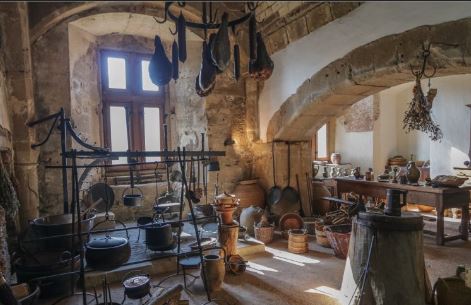
I walked back to the window. It was a quarter to six. Strange noises and an occasional sighting of the larger-than-average soldiers with the oddly pointed hats have been seen roaming the grounds. Any attempt to speak with them or approach them, they simply vanish into the mansion. Odd doors and gated entrances punctuated the length of the mansion. There was a Gothic, deliberate atmosphere about my home, a sepulchral character to the mass of its wooden buttresses andre treats. Geometrical shapes snatched inexplicably at the eyes. And often one could hear laughter, high-pitched with contempt or teasing mockery that made one hurry on, even though it may be rationalized as the cold wind gusting through the elaborate masonry. The wind whistles in the trees and leaves and wisps of thick mist blow across the farmland. With the trotting of horses and constant sounds of construction, the heart is suddenly racing, and one thinks they hear something behind them. After all, this is an ancient land, a house built by spirits, occupied by ghosts, pixies, goblins and all sort of mythical creatures of the night. Anything is likely to happen. Looking around the interior of the estate, one can discern a deep, foreboding blackness that seems to be following one, as if it is alive and in pursuit. Stepping out into the fruit orchard, the wind suddenly drops and one’s senses are heightened. Indeed, one can hear one’s very heart beating in their chest as they continue to canter forward into the night. The mist becomes thicker, darker, and as one glances furtively from side to side, the darkness of shadows of the orchards hides their secrets, but perhaps you are not alone. Sometimes I tell myself that the scraping sounds at the window is simply a branch being blown in the breeze and the footsteps heard in the hallway are old timbers creaking and groaning with a change in the air or weather. #RandolphHarris 2 of 7

If there was something serious going on, the housekeeper and the butler would try to keep it quiet. They might talk together, but they would be tight-lipped in front of me. The clock struck seven. I met Daisy in the dining room. “Aunt Sarah, we all talked. We weren’t meant to,” Daisy said. “We were all talking about it. We didn’t know what to make of it. The body was found on a cold stone passage, that was said to lead directly into the opulent state rooms where you normally conducted meetings.” Not a moment too soon, five housemaid trooped into the dining room. Taking off their white starched aprons, they formed up in a line. The room, echoing with their footsteps and voices, as in a church. The mahogany floor, almost three thousand square feet of it had to be hand polished. It was an onerous task, one of the housemaids least like doing. Bending down, they placed their tins of wax of the floor. “Daisy, it looks like we will have to continue this conversation later,” I said. “Goodnight, Aunt Sarah,” she replied. The maids stooped on their hands and knees, their long black dresses spread out around them. Working in union, they dabbed their clothes in wax; then they rubbed the floor vigorously in quick tight circle. The observation tower staircase was the place the servants feared most. The observation tower sits ominously over the mansion, along with sever distinctive turrets jutting proudly into the skies. Sweeping down to the Guard Room eight floors below, it was the main thoroughfare in the tower. Family portraits adored its walls. The steps, of bare stone—framed by a wrought-iron balustrade, topped by a mahogany rail—were wide and shallow. “We were all scared of the tower’s stairs,” said Elsa. “I was coming down them one evening, halfway down, I felt somebody push me. They were behind me, trying to push me down the stairs. I turned round, and of course there was no one there.” The Winchester Mansion is a land of appealing features seemingly embedded in the sense of a deep-rooted and permanent history that emanates from almost every corner of the land. It has rustic grounds and quaint gardens, a hulking mansion with many towering features, having been fostered over decades to create a comfortable and pleasing landscape that guests recall like their favorite arm chair. #RandolphHarris 3 of 7

A number of the male servants, skeptical of ghost as they were, had experienced a similar sensation. “I used to keep an eye on the mansion,” Edvin recalled. “I would walk around the dark with the dogs, no lights on, no torches, or anything. One night, I was coming across the first floor of the tower—and I got up to the stairs and felt hot breath on the back of my neck. I turned round. There was nobody there. But the dogs wouldn’t go any further, their hackles went right up. It was ages before I could get them to move.” I often examined the possibility of evil. I had a notion that evil was communicable. Something that can, as it were, contaminate. However, one must not confuse evil with manifestations. My secret rooms, by their very nature, held the servants in thrall. It was an area that they never entered, never saw or ever knew what went on. It was a place of mystery. The rooms were subjects of wild speculations, fueled by the servants’ fear of me, and their knowledge of my eccentric interests. My servants knew I was fascinated by the occult and this played to their fears. They knew the mansion was haunted and I often had the mediums in. However, they never whether any ghosts or sprits were actually summoned. It went on behind closed doors. Of course, they knew of the ancestral curse. It had been cast in the mid-19th century by a coven of witches. The curse had also been cast over future generations; aimed at Winchester heirs; it determined that the children would die before they reached the age of thirteen and those who survived would be haunted by ghosts and demons. For decades, it had seemed to me and my servants that this was a cruse from which the family could never escape. #RandolphHarris 4 of 7

One night, it was shortly before three o’clock in the morning when a shadowy figure, dressed from head to foot in back, crossed the landing of the staircase. The night was cloudless, the moon almost full. There was a blackout and the mansion was shrouded in darkness. The light from the moon set tiny point of balance dancing in the darkened windows. I could hear footsteps moving stealthily across the floor and the occasional cry of an animal from the fields. A headless horseman was riding near the tower. I got out of bed, and turned the corner into a passage in one of the parlors. As the men worked in the hallways, they froze. Coming down the hallway was a pair of green eyes belonging to a child. The eyes were about two or three feet up from the floor, leading me to believe that child was three years old. They eyes simply floated up the hall, and then turned into one of the maid’s room where we lost sight of them. That night I also saw dark shapes. There was a dark shadowy thing flying from the Grand Ball Room to the and down the hallway. Then above the chandelier there were several dark shadowy things. They flew outside, barely illuminating the background of the trees and then were blocked out by an even darker shadow, moving slowly, methodically along the tree line. Meanwhile another shadow ran through the hallway, it was tall. The carpenters looked at each other in suspense. Closing the heavy steel door behind me, I had left the Grand Ball Rom to find my way long the labyrinth passages. A long passage reached into the distance. It was gloomy, lit by only the strip lighting in the display cases that ran along with wall. Ahead was a solid oak door, carved in the Gothic style. Another passage led off to my right, I could see that it branched in two. One end led into a small hall. It was in darkness. “No one goes in there,” a mysterious voice whispered. The spirit gave me a fright. Everyone, it seems, even hardened sceptics and disbelievers, has seen a ghost. For some reason, in the back of their minds, ghosts may be real. Everyone has known the feeling of their heart racing for a second when they see a shadow moving in the corner of their eye or they feel some sort of presence standing over them. Or worse still, a tortured face in a window that paralyses their body and retards their breathing to the point that they can hear the blood pumping around their own body. #RandolphHarris 5 of 7

I took the left passage. I went on some distance ahead, there was a kink in the passage. A man emerged from it and started waling me. He was wearing knee breaches and a nineth-century coachman’s jacket. As we drew level, he stopped. “Mrs. Winchester, those rooms are forbidden,” he said, “What are you doing in this part of the house?” Once again, he repeated, “Those rooms are forbidden.” I did not want to stop and talk; I was anxious to get back to my room. I assumed that the servants were being proprietorial. Finally, I had made it to my destination sometime later. The bedroom was not dark, because the bright light of a full moon entered through the window. I had just lain down, ready to go to sleep, when I suddenly noticed that I was not on my own. I heard a rasping breath in the darkness only a few feet away. Right in front of the wardrobe and looking directly at me was a middle-aged man, dressed like a Catholic priest. I rubbed my eyes and pinched my arms to make sure I was fully awake Yes, I most certain was. Was I having hallucinations? The priest was still standing there, looking at me. He was a rather frail man with hollow cheeks. His face showed traces of a hard life and illness. If he had any hair at all, it was covered by his hat. He looked so real, not like a ghost. I was not a bit scared, because he radiated vibrations of utter peace and tranquility. There was nothing to be afraid of, so I decided to talk to him keeping my voice as low as possible. “Hello, Father,” I said. “God bless you.” “And God bless you, my child,” came the priest’s prompt reply. He was well-spoken, his voice was soft. His English accent was not hard to distinguish. After giving me a few personal messages and stressing the point that there is survival after death, he told me who he was. #RandolphHarris 6 of 7
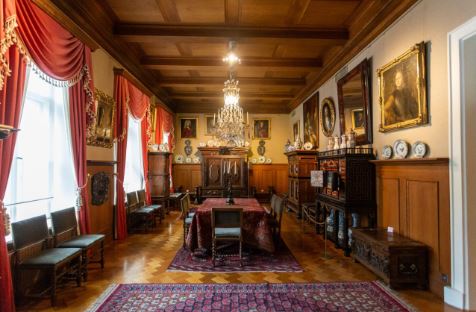
His name was John Ogilvie, and in had lived in Scotland from 1580 to 1615, he wanted hanged at Glasgow Cross for his faith. When I remarked that at the time of his hanging, he was only 36 years old, he confirmed this. After quietly talking about religious matters for a few moments, he bade me farewell and disappeared. It seems that he refused to pledge allegiance to King James, and it was for this crime that the was tried, found guilty and hanged. After his execution, his followed were apprehended and put in jail. If this was not a genuine case of a visit from beyond the grave, what is it? Most of the time, the mansion is benign. Unfortunately, sometimes people find exactly what they are looking for. I had been in bed half an hour when I heard the music playing softly from my sitting room next door. I listened to the same, faintly relentless song. Starting to sweat and grow cold in bed, I recognized the song. Or I thought I did. And it continued. It wavered through the wall and door frame in strained, distended chords, and choruses, swelling and facing, ragged and persistent. The door was to my right. I pulled back the duvet and got out of bed and walked through the door to the sitting room. Where the music was louder. The must persisted, repetitious, frighting me. As I turned the corner, I discovered that Gerhardt hanged himself from the cross beams. Badly wounded, Mr. Hansen carried to the attic to await medical attention, but he died there. Since that time people have claimed that he haunts the attic room. He has been seen and heard there from time to time. Servants have reported hearing the creaking of a rope and the soft thud of a body swaying against the wall. Though they often look for the source of the sound, they never find it. There is a disheveled, aged specter, bound at feet and hands and rattling chains haunting the basement. A journey through my mansion is a passage through history. A real history, one that you can live and breathe, one that you can feel and be part of. You can walk serenely miles through my mansion, it is a place that inspires contemplation and wonderment. It is a living history, of memories as far back as history recalls. It is a place of myth, legend, of ghosts and ghouls, of giants, and dwarves, mermaids, cupid, another other half-remembered, half-whispered-about creatures. #RandolphHarris 7 of 7
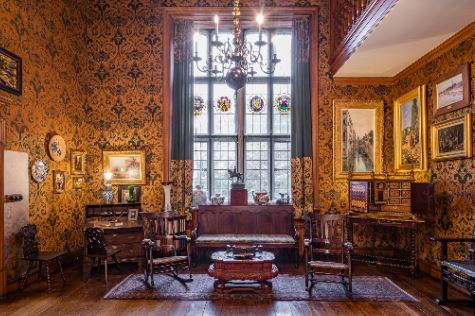

If a sudden, horrifying death is what it takes to make the spirit linger, surely, this place—is a candidate. Certainly, where men grappled back and forth, engaged not only in the struggle for their own precious lives, but for the life of their respective countries, where in the balance was the future of the very world, and this place produce the mechanism of defense, if that does not qualify for the lingering-place of souls wondering for eternity the outcome of their struggles, then we cannot name a place. https://winchestermysteryhouse.com/

And please be sure to check out the online gift store: https://shopwinchestermysteryhouse.com/

The Mystery Has Never Been Solved!
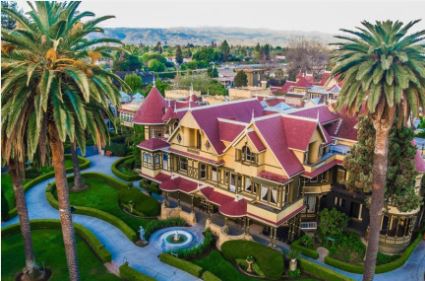
Much of the ceremonial rituals that took place in The Winchester Mansion goes back to the Knights Templar. The Order of the Knights Templar can be traced in part to the Templars. And yet, the Knights Templar are also the claimed ancestors of satanists, a fact which is decidedly hard to prove, though within an organization so large there may well have been diverse groups who followed their own calling. The knights, largely from France and England, joined the order over a period of many years. They had a system of leadership with a Grand Master, knights, chaplains, sergeants, craftsmen, seneschals and commanders. The order had its own clergy and its meetings were held in the strictest secrecy. Unmarried knights wore a white mantle with a red cross while others wore a black mantle with a red cross. Membership was mostly male, and established orders in virtually every Latin country, drawing people from all over Europe. It also became a great trading agency and though originally the Roman Catholic Church actually supported a number of secret societies who were Christian-based, the power of the Templars began to wield became the fear of successive popes and of European noblemen. Philip IV of France began a series of attacks against the Knights Templar and his campaign was given official blessing by the election of Pope Clement V (1305-1314) who renounced the Templars as immoral heretics. Many people know that Mrs. Sarah L. Winchester had a Famous Blue Séance Room where she carried on her rituals and had a series of colourful robes she wore. However, the mystery has never been solved as to why she built the strangest mansion in the World? #RandolphHarris 1 of 13
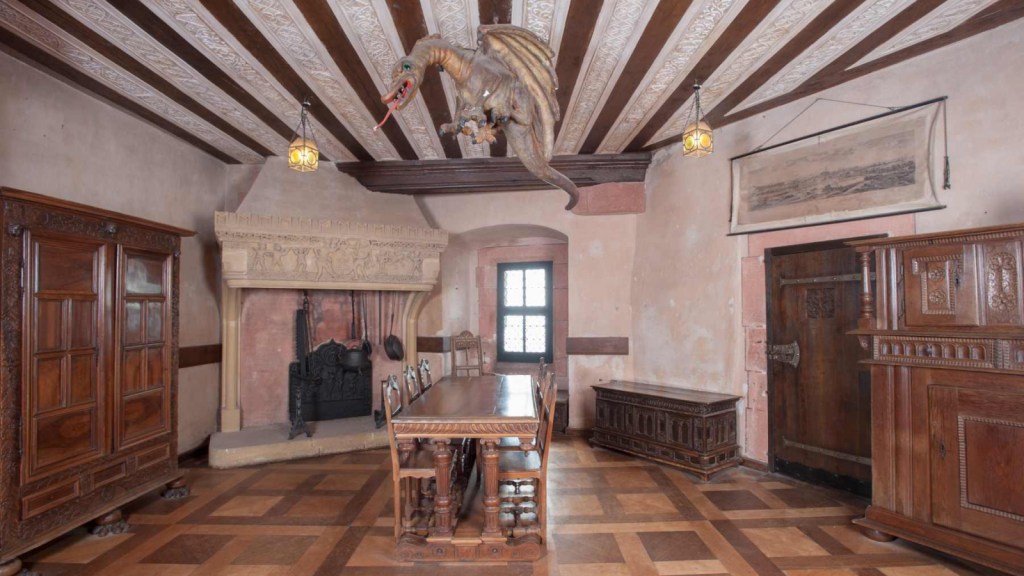
Stories were already circulating that Mrs. Winchester, behind the closely guarded doors of her mansion, indulged in the most offensively blasphemous rituals said to be directed totally towards the reversal of Christianity itself. She was said to worship a goat-like idol, the Baphomet, anointing it with the fat of pigs, while the Knights used the fat of murdered children, roasting children and eating them, laying women across their altars for the most violent forms of indecencies to satisfy their lust for life-blood; they were said to have indulged in homosexual rites and other various claims alleged they stamped the Holy Cross under foot, spat and urinated upon it and used the Mass as the basis for their own worship—later to be known universally as the Black Mass. Actual proof of these events is largely contained in the confessions received under torture which followed the arrest of Mrs. Winchester’s butler Albert Pike. He and 140 of his brethren were imprisoned in Santa Clara Valley, tortured and then executed en masse. Algernon Blackwood, under extreme torture, confessed to speaking against Christianity but denied depravity. In 1890, he was brough out on to the nine-story tower of The Winchester Mansion and ordered to repeat his confession in front of the villagers and accept a sentence of life imprisonment. On the balcony of the tower, he burst into a rage of anger and protested innocence of all charges and thus signed his own death warrant. The order was given that he should be taken into the fruit orchard and burned at the stake. As the flames licked his body, he summoned Mrs. Winchester and, in his dying, breathe to meet him at the Bar of Heaven. #RandolphHarris 2 of 13
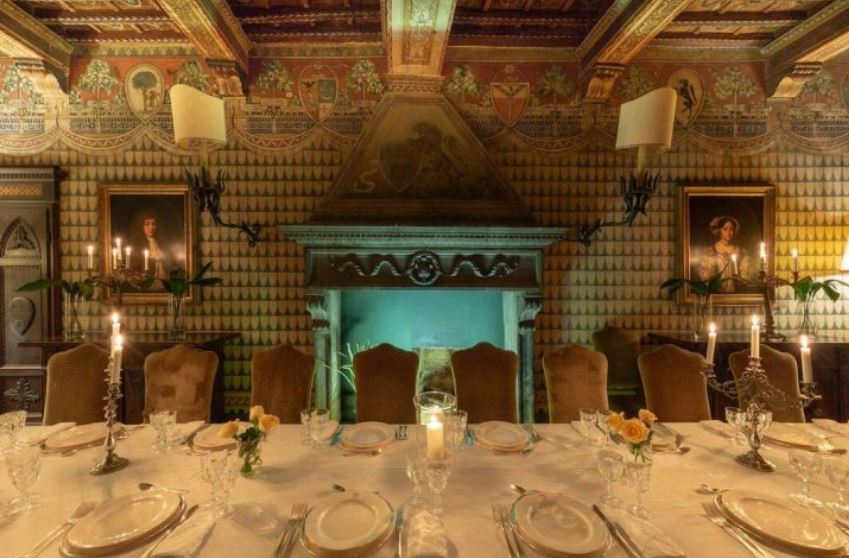
Diocesan priest, Father Peter Yorke, who was then editor of the Archiocesan newspaper, The Monitor, emerged sending orders to every village where the Templars operated, instructing that they should be arrested and charges of heresy and sorcery brought against them. He published a series of exposes, and hundreds of knights were brought to trail, tortured, and executed. The vast wealth of the Templars working at The Winchester Mansion were accused of devil worship. What remained to be handed down and revived, especially in the twenty-first century, were the rumors of ritual and dastardly happenings which many of today’s extremist followers of the Knights Templar seem prepared to believe and accept with some enthusiasm. One of the more important traditions handed down by Mrs. Winchester concerns an instruction for future secret societies. On the day the Knights planned to burn to death Father Yorke, a pact was made and communicated to all surviving Knights who had now gone to ground. The instruction was clear—that the Order of the Knight Templar should be continued in perpetuity. It is said that the surviving Templars should thereafter fight for the destruction of the papacy and prevent Mrs. Winchester from being stripped of her wealth and murdered. These orders, it was said, were handed on to descendants of the order and the Winchester family, who at various points in history have included satanists and a diverse calling of occultists. What remained of the Winchester family and the Knights went into the deepest secrecy, surfacing occasionally and surrounded constantly by rumour, but little discernible fact. #RandolphHarris 3 of 13

The Illuminati came to fortify The Winchester Mansion, which had reached seven-stories high, with 600 rooms, after the 1906 Earthquake. While it was true that Mrs. Winchester left her mansion, there are more reasons as to the why. The avowed spiritualist, Mrs. Winchester, had constructed a boathouse and erected a huge mountain of Earth upon which a new mansion she had planned to build would be erected. It was to overlook the bay, an immense seawall and costly cannel system, with proper floodgates, through which the Winchester private fleet of launches and yachts were to wend their way. It was said that Mrs. Winchester was being haunted by vicious spirits and that death would be her penalty for leaving her home. Her existence was mythical because only half a dozen people had seen her. A sheriff had been striving for the past three months to serve upon her a summons to appear in court in proceedings that a real estate dealer had brought upon her. Bloodhounds roamed the grounds of the mansion and polite Asian staff answered telephone calls. Mrs. Winchester was always alone save for a bodyguard. She was wealth as few women were and found her pleasure in superintending a half dozen workmen, who for seven years had gone from wing to wing of the mansion, constructing one month what they were called to destroy on the following month. Her mansion was considered the pride of the county and the basis for mysterious legends. The Illuminati came were concerned about a group of subversives who were discovered to be using occult practices and rituals to attack Mrs. Winchester and her mansion. #RandolphHarris 4 of 13

E.W. McClellan of Burlingame, the contractor of 98 acres of land purchased by Mrs. Winchester, was holding it and refused to give it up because he believed she was the lead of a secret society working to “establish Satan’s kingdom on Earth,” an accusation which was a direct throw-back to the age of the Knights Templar; and that dictum still exists today. The Psychosophical Society stated that The Winchester Mansion had existed since the sixteenth century and comprised the World League of Illuminati. They wanted to prevent Mrs. Winchester from passing on her palatial estates in all their purity to the next generation. The hotbed of intrigue, rumour and gossip directed at The Winchester Mansion supposedly involved the death/assassination of some, the suicide/murder of others over the scandals invariably linked to Propaganda 2 (P2) Lodge and various Intelligence agencies like the KGB and the CIA with a scandal which is too immense to expound here, nor is it suitably for this part of the report. What can be said, however, is that occult groups working within the traditions of the Illuminati represent a definite consideration of these events. Mrs. Winchester’s husband, William Wirt Winchester, was a master of mathematics and the possessor of certain secret occult knowledge. He gathered seven disciples around him and went into the World of the brotherhood to perform good works. Staff have described that 120 years after his death, his perfectly preserved corpse was found in one of the many buildings of The Winchester Mansion. Because of the secrecy and the mystery that surround The Winchester Mansion, thousand want to know more and are desperate to visit it. #RandolphHarris 5 of 13
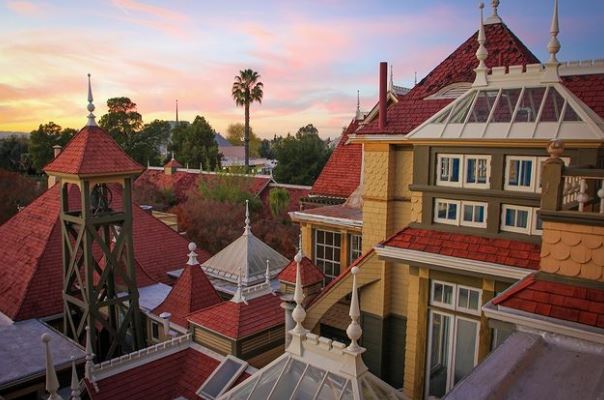
Sometimes the hysteria surrounding The Winchester Mansion morphed into such hysterical proportions that the authorities have had to shut the mansion down for a day or ban people from entering, even though many do not believe that it actually exists. Fans of The Winchester Mansion have sprouted up all over the World. Some people still regard the story of The Winchester Mansion as a fable, but most know it does actually exist and possesses esoteric knowledge of mystery and mysticism. Some the people who were involved in the construction of The Winchester Mansion were magicians, writers, statesmen and novelist. This mansion has quit a following and has collected members through the ages, in positions of far greater power and influence than the Illuminati. Legend has it that descendants from the founding fathers of the Middle Ages are on the board of trustees. The official secret society in control of the estate have connections throughout Europe and the United States of America, whose membership is an indication of the current revival in the mystery religions and semi-secret societies. The mansion alone boasts of some 60,000 members and operates from its headquarters in San Jose, California with affiliated lodges in Britain, France, Germany, Australia and South Africa. The caretakers are preserving the traditional beliefs of the 19th century. A cipher manuscript was found in one of the libraries of The Winchester Mansion. The author of the manuscript was not identified but it was obviously someone with a very intense knowledge of the supernatural, alchemy, astrology and the magical theories of Eliphas Levi. #RandolphHarris 6 of 13
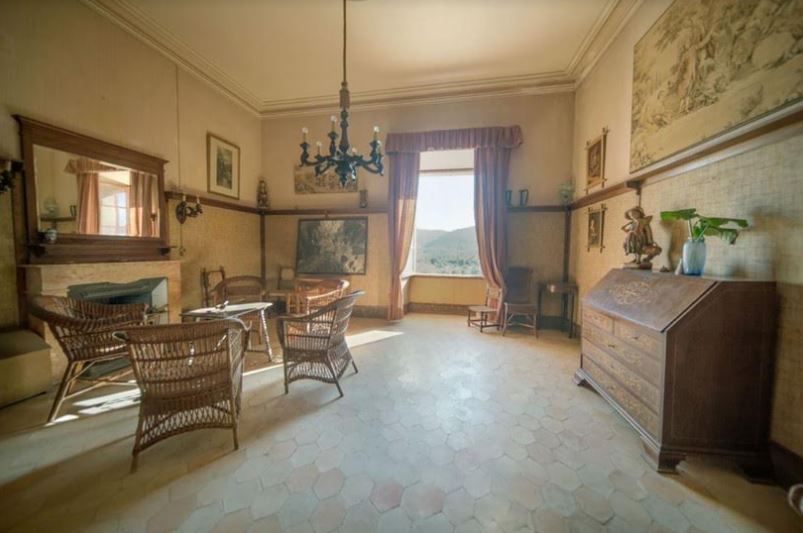
Mrs. Winchester’s mansion and gardens reflect her colourful and ornate rituals and its purpose was “to obtain control of the nature and power of my own being.” The might wings of the mansion outspread dove-like sitting brooding on the vast abyss. What is dark in Mrs. Winchester is to be illumined, what is lose raised and supported; the nine-story tower was constructed so that Heaven could hide nothing from Mrs. Winchester’s view, nor the deep tract of hell. Hell said to be a hideous flaming ruin and combustion in a bottomless perdition, there where Satan dwells in adamantine chains and penal fire. Nine times the space that measures day and night to mortal men, Satan and his horrid crew lay vanquished, rolling in the fiery gulf, confounded though immortal: but his doom reserved him to more wrath; for now the thought both of lost happiness and lasting pain torments him; round he throws his baleful eyes that witnessed huge affliction and dismay mixed with obdurate pride and steadfast hate: at once as far as angels ken he views the dismal situation waste and wild, a dungeon of horrible. Many leaders of the Church do not preach about Hell anymore because the Church has become a tax-free business and they do not want to hear about where they may go, nor do they want to scare their dirty money away from the Church. As a result of the loss of real churches who teach about Satan and demons, people are all wild and out of control and no longer fear anything and go around sinning like rain in Seattle. #RandolphHarris 7 of 13

On a hot and dry Friday the 13th of June 1890, Mrs. Winchester drifted into an uneasy sleep, but not for long. Half an hour later she was wide awake again. Something was wrong; a change was coming over the bedroom. There was a sense of dread. Regions of sorrow, doleful shades, were peace and rest could not dwell entered. Her home started to feel like a place where hope could not come, and all that did come was torture without end. She sat up, fully alert, straining her ears for the slightest untoward sound, but all was silent except for the little trusted noises the home made during the evening. However, Mrs. Winchester noticed something odd: an unnatural coldness was stealing over the room. It had been a hot summer day. How could it be so cold? She shivered and ducked back under the covers, tugging them more snugly about her. It did not help; the cold kept increasing. She pulled the covers over her head, chiding herself for being silly and willing herself into sleep. However, the terrible dread kept gnawing at her. She tried to think pleasant thoughts, tried to ignore her thudding heart, and tried to pray. Her attempts brought little comfort; the fear continued to build. She sensed that something frightful was about to happen. She held her breath and waited, not knowing what to expect. Before too long, she heard a sound: the unmistakable creak of the doorknob. The spring bolt was sliding back with tiny clicks. Mrs. Winchester froze. Very slowly, the door began to open. Her fear quickened further as she heard the tread of heavy, booted feet approaching the bed. She wanted to call out for help, but was too afraid, as if some force was willing her to silence. Mrs. Winchester was helpless in the face of that power. #RandolphHarris 8 of 13

When she tried to pray, a demon started to speak. “The force of hose dire arms has caused me to fall to a place with floods and whirlwinds of tempestuous fire. Fierce contention brought along innumerable force of Spirits armed with durst in a dubious battle of unconquerable will, revenge, immortal hate.” Mrs. Winchester was dying and she knew it. This demon had come to claim her soul. She was making gaps, with long spaces between. A perspective of stern and cruel memories stretching away, like its own grey avenues, into a blur of darkness. Certainly no house had ever more completely and finally broken with the present. Mrs. Winchester lit a candle. A little animal stood before her, forbidding, almost menacing: there was anger in his large brown eyes. He came no nearer. As she advanced, he gradually fell back, and she noticed another dog, a vague, rough, brindled thing. At the same moment a third dog, a long-haired white mongrel, slipped out of a doorway and joined the others. All three stood looking at Mrs. Winchester with grave eyes; but not a sound came from them. Zip, had seemed to be observing them with a deeper intentness. Mrs. Winchester endured many long years of the company of many different creatures. They would return again and again. As she was in her morning room, the coldness came back. Her mind was alert but her body seemed paralyzed. The entity seemed to have the power to immobilize her from a distance. She heard the dull footfalls crossing her mahogany floors. There was an evil lurking in her home. Something started pounding on the table. #RandolphHarris 9 of 13

The pounding was so fierce that her cup of tea bounced off the table and fell to the floor. Then it stopped. Mrs. Winchester thought maybe she was having delusions. But whatever it was did not want her to drink the tea. More odd things began to happen—occurrences no one could explain. A malignancy pervaded. Often, people would hear a horrible, mocking, evil laugh. Lights would slicker for no reasons; water taps would turn themselves on, then off. She would find her silverware mysteriously rearranged. On several occasions she discovered her solid gold dinner service hidden in a corner of the room. One night, she had a roaring fire in the fireplace of her bedroom, went to the bathroom, and returned the fireplace totally clean with nothing it in burning. The servants began to complain of hearing mice in the night, but Mrs. Winchester was certain there were no mice in the house. On several occasions, one could very clearly hear the floorboards creaking upstairs, as though somebody was walking about the house. The servants heard the creaking too but, as is often the case with servants, they got used to it, and to the other noises and unexplained presences. Mrs. Winchester urged them no to speak of those things outside of the house. It was bd enough that she was subjected to the disturbances and torment; the last thing she wanted was to attract undue attention to her home. People do not, as a rule, react compassionately to reports of supernatural infestations; many tend to suspect that the victim has somehow, whether by word or deed, “brought it on herself.” #RandolphHarris 10 of 13

At times, Mrs. Winchester felt that the entity was trying to crush the life out of her. She left her light burning all night. Through time, Mrs. Winchester was forced to accept her suffering. There was nothing else she could do. One winter night, one of the butlers was found dead at the head of a narrow flight of stairs leading down from his room. It was Mrs. Winchester who found him and gave the alarm, so distracted with fear and horror—for his blood was all over her—that at first roused household could not make out what she was saying, and thought she was waking from a nightmare. However, there, sure enough, at the top of the stairs lay the butler, stone dead, and head foremost, the blood from his wounds dripping down the steps below him. He had been dreadfully scratched and gashed about the face and throat, as if with curious pointed weapons; and one of his legs had a deep tear in it which had cut an artery, and probably caused his death. Bu how did he come there, and who had murdered him? Mrs. Winchester declared that she had been asleep in her bed, and hearing his cry had rushed out to find him lying on the stairs; but this was immediately questioned. A shadow was rearing up from the body. Mrs. Winchester described it as “a blob, like smoking black cloud, not the shape of a person—just a thing, but a terrible thing. The absolute evil that came from it was overwhelming. I was so gripped with terror, I could not move, and I knew that if it came toward me, I would be swallowed up…destroyed, and that would be the end of me. Imagine what it feels like to know that you are going to be killed, and the specter that is torturing you is deliberately making you suffer beforehand. That is how it was. I felt a level of fear that is beyond words. Then I heard a voice and screamed.” #RandolphHarris 11 of 13
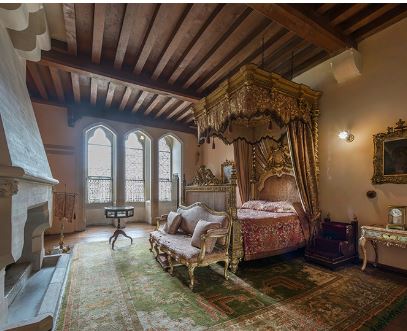
The male voice was hoarse, stertorous, angry almost. “You have left us this our spirit and strength entire strongly to suffer our pains that we my so suffice his vengeful ire, or do him mightier services as his thralls by right of war, whatever his business be here in the heart of hell to work in fire, or do his errands in the gloomy deep; what can it then avail though yet we feel strength undiminished, or eternal being to undergo eternal punishment?” Mrs. Winchester instantly went to sleep—chilling testimony to the control the demon had over her. When she awoke, she was clean, in her sleeping gown, and in her bed. However, it was with the possibility, and the hope, that the end of her long ordeal might well be in sight. Little of the fast-fading sunlight entered the house through the windows, many of which were partly or entirely covered with drapes. However, it was bright enough for Mrs. Winchester to see that the French Provincial sofa’s upholstery was slashed. Shredded wool spilled onto the floor. A solid oak bookcase had been hammered to pieces against the wall, gouging holes in the lath and plaster walls, running the Lincrusta-Walton Wallcovering. Her silver tea service has been smashed, along with a floor lamp. Books had been taken off the shelves, torn apart, and scattered across the living room. Mrs. Winchester lit a candle. It did not shed much light, just enough to reveal more details of the rubble. Looks like somebody went through here with a wrecking ball and scissors, she thought. The house remained silent. Leaving the door open behind her, she took a couple of steps into the room, and the crumpled pages of the ruined books crunched crispy underfoot. She noticed the dark, rusty stains on some of the paper and on the bone-white foam wool stuffing, and suddenly she stopped, realizing the stains were blood. A moment later, Mrs. Winchester spotted the corpse. It was that of a big man, lying on his side on the floor near the sofa, half-covered by gore-smeared book pages, book boards, and dust jackets. Zip’s growling grew louder, meaner. Moving closer to the body, which was just a few feet from the dining-room archway. Mrs. Winchester remembered that John Hansen had lately been making repairs, including a leak faucet and a broken door lock. #RandolphHarris 12 of 13

However, Mrs. Winchester thought because of the way the room looked, he had been killed weeks ago. Her house was so big that it would often take weeks, months, and sometimes years to get around it. Yet, on closer inspection, the corpse proved to be neither bloated with the gas of decomposition nor marked by any signs of decay, so it could not have been there for very long. Perhaps only a day or less. The body had been disemboweled. Zip’s low growling gave wat to ugly snarling punctuated with hard, sharp barks. With a nervous twitch and a sudden pounding of her heart, Mrs. Winchester turned from the corpse and saw that zip was facing into the nearby dining room. The shadows were deep in there because the drapes were drawn shut over all the windows, and only a thin gray light passed through from the kitchen beyond. “Go, get out, leave!” an evil voice told her. It was certainly not the voice of Mr. Hansen. Something in the dining room was moving. There was no doubt of its presence, because it rushed out onto the dining-room tables, and came straight at Mrs. Winchester, emitting a blood-freeze shriek. She saw lantern eyes in the gloom, and nearly a man-sized figure that—in spite of poor light—gave an impression of deformity. Then the demon was coming off the table, straight at her. I Do conjure thee, O Spirit Focalor and your legion of thirty spirits to manifest your spiritual weapon in this corporeal World through my will and might! Empower it so that it may serve me here upon the corporeal plane! May it serve as a key to the realms above and below unlocking power and wisdom for my glory and ascent! Fill this weapon with your powers of wrath and fury that it may seek out spiritual attacks made toward me rendering them useless and impotent! I DO conjure thee Spirit Vephar, pierce the Heavens and cause the seas to be right stormy to cleanse the Earth of sin. Spirit Vizaresh, I DO conjure thee to drag sinful souls into hell, noosing them with the power of their own sins. May the snare be the power of their own evil, words, thoughts, and deeds and let this be you will to drag unwilling souls into Hell. May this cord gain its power through one’s practical application of evil principles. #RandolphHarris 13 of 13

Winchester Mystery House
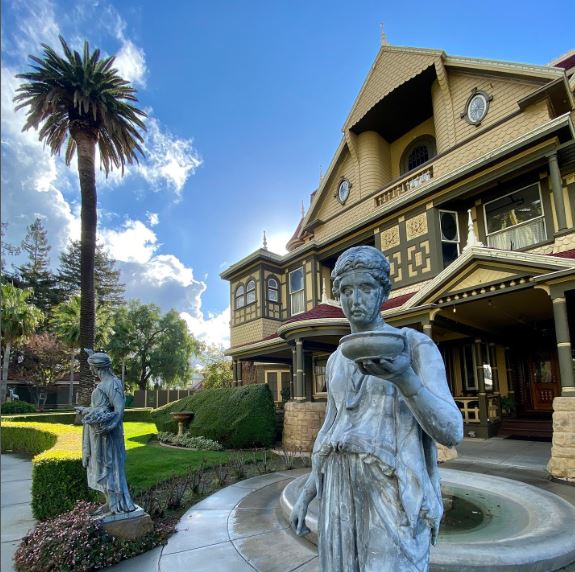
Happy Sunday! House tours 10am-5pm today 🏠 come see us!
🎟️ link in bio. https://winchestermysteryhouse.com/

Mrs. Winchester never recovered from the 1906 earthquake. Staff said she grew weaker and weaker as the years went by, and that she was often heard talking to her dead husband. The house was already large, but it morphed to be as long as several city blocks and was taller than the tallest trees on the green lawn. I suppose, ultimately, it was the spirits who kept her in this estate by not allowing her to build another one of this magnitude. When Mrs. Winchester passed away in 1922, she left $5,000,000.00 to charity. The mansion is truly special and a national treasure.

Why Do You Close Your Eyes to Pray?

Demonic activity is not uniform in the World over nor in historical experience. It appears that there was a great increase in demonic activity preceding and during the life of the Lord Jesus Christ here on Earth. There does appear to be a present increase of an awareness of the part of the powers of darkness that their time is short and that the second coming of Christ is at hand. It is therefore particularly imperative for Christians to be informed in spiritual warfare. There are two equal and opposite errors into which our race can fall about the devils. One is to disbelieve in their existence. The other is to believe, and to feel an excessive and unhealthy interest in them. My file of occult cases has already grown to other 20,000 in number in regards to the Winchester Mansion. A woman, one of Mrs. Winchester’s servants, appeared at the police station and stated that she had just shot and killed her son. A demon had told her that her son would never regain his full mental health. Wanting to save the boy from his terrible future, she shot and killed him. The woman was arrested and finally sentenced after a long trial. This day-to-day experience show the suggestive powers and effects that demons and spirits have. This is an age of phenomenal progress in human’s conquest of the Universe. Awestruck observers are flocking to the altars erected by science to revere human achievements in the realm of the natural laws. Meanwhile, the alters of God are forsaken as naturalism in theology threatens to eliminate the supernatural from every day life. The situation is particularly ironical to the Christian who sees God permitting man to achieve feats bordering on the miraculous. Why should humans become skeptical and apathetic toward religious supernaturalism at a time when science is demonstrating how “close” the natural and supernatural can be? The fact that supernaturalism embraces not only the morally good—God and his elect angels—but the morally evil—Satan and the fallen angels or demons—aggravates modern human’s unbelief. #RandolphHarris 1 of 18

For while some people have always denied the existence of God and the holy angels, skepticism has especially attended the sphere of evil supernaturalism. Many who profess faith in God question the existence of personal devil and casually relegate evil spirits or demons to the realm of folklore and superstition. If Satan and demons are merely the creation of superstition and imagination, the whole filed of demonism belongs to the World of fairytale and folklore, and not to the sphere of Christian theology. If there are n demons, evil cannot be traced to their activity and depraved aspects of human behaviour must be attributed to other cases. The Word of God attests the reality of evil supernaturalism through the career of both Satan and his myriads of helpers called demons or evil spirits (Luke 10.17, 20). Satan is presented as Lucifer, the first and most glorious creature of God, who subsequently sinned (Isaiah 14.12, 13; Ezekiel 28.11-19; Revelation 12.7-10). In his rebellion, Lucifer drew a multitude of angels with him and became “Satan,” a Hebrew word meaning “opposer” or “adversary.” Satan reigns over a kingdom of darkness organized in opposition to God (Matthew 12.26). This opposition crystallized in connection with humans and God’s purpose for him upon the Earth (Genesis 3.1-15). The angels who followed Satan became the demons or evil spirits, Satan’s minion. Apparently Lucifer, the first of the angels, was created to have dominion over the Earth (Job 38.1-7; Ezekiel 28.11-19). Satan was exalted and sinless before he rebelled and brough judgment and chaos upon the Earth. The Creator was now faced with the problem of evil and sin in a hitherto sinless Universe. God chose the Earth as the theater in which to present the great drama of human redemption. This great redemptive demonstration not only shows how God, in his infinite love and holiness, deals with evil, it will culminate in the conquest of sin, its banishment from a sin-scarred Universe, and its rigid isolation for all eternity, together with its perpetrations, in a place of confinement called “the lake of fire,” Gehenna or eternal hell (Revelation 20.11-15). #RandolphHarris 2 of 18

The Old Testament is replete with demonological phenomena because since the Fall of man in the Garden of Eden, God’s saints have been the object of satanic attack (Genesis 4.1-6; 6.1-10). Israel was surrounded by pagan nations which manifested the whole gamut of demonological practices and beliefs and clashed with Israel’s monotheistic faith. The New Testament presents overwhelming evidence for the existence of demons. Jesus’ powerful spiritual ministry precipitated a violent outburst of evil supernaturalism. Satan and demons opposed his mighty mission among humans, know well it could lead to their own undoing (Matthew 4.1-10; Mark 5.1-10). Our Lord gave his disciples authority to expel demons (Matthew 10.1) and expelled them himself (Matthew 15.22, 28), viewing his conquest over the demons as over Satan (Luke 10,17, 18). The New Testament speaks of demons (James 2.19; Revelation 9.20), described their nature (Luke 4.33; 6.18), their activity (1 Timothy 4.1; Revelation 16.14), their opposition to the believer (Ephesians 6.10-20), their abode (Luke 8.31; Revelation 9.11) and their eternal doom (Matthew 25.41). The tormentors and troublemakers of nature offer an interesting analogy to the evil agencies of the spiritual realm. In the planet kingdom, pest, insects, and blight continually harass the famer. In the animal kingdom, all creatures have their deadly enemy. And the human body is relentlessly attacked by a multitude of bacteria which cause disease and death. Those who hesitate to accept the testimony of Scripture about the reality of demons may thus find both scientific and philosophical corroboration in the nature which has been called God’s “oldest testament.” The natural World vividly illustrates the activity of demonic beings in the spiritual World. Of all the current methods of foretelling the future, the most popular is astrology. Astrologers claim that by observing the position of the sun, moon, fixed stars, and planets they can predict significant events that will take place on Earth. Palm reading is another method of fortunetelling, but it is close related to astrology that it does not require special consideration. The person who engages in this practice divides the hand into seven mounds which are named after Heavenly bodies—Venus, Mercury, Apollo (the Sun), Saturn, Jupiter, Mars, and the Moon. #RandolphHarris 3 of 18

In addition, the palm has four lines, which are “read” by the palmist. He calls them the heart, head, life, and fate lines and sees each of them as having special significance. Everything we will say about the evils, dangers, and deceitfulness of astrology applies to palmistry as well. One must, however, recognize that astrology is classified as a pseudoscience, and it should not be confused with astronomy, a legitimate field of study Astrology originated about 5,000 years ago in Mesopotamia and flourished in Assyria, Babylonia, Egypt, Persia, and Greece. It began with people who worshipped the sun, moon, and the five known planets of that time as gods They thought each of these seven deities owned a certain section of the Heavens as his “house.” They there established the zodiac the wild belt of fixed starts that appear in the course of a year, and divided it into twelve “houses.” As a result, there were twelve dwelling places for seven deities. The early astrologers decided that the sun and moon needed only one “house” each, and therefore assigned two dwelling places to Jupiter, Venus, Saturn, Mars, and Mercury. These planets had one “house” for the day and another for the night. This heathen concept of the planets as gods with dwelling places in the Heavens gradually developed into a detailed system of religion. Men carefully studied the Heavenly bodies, and noted how they positions of the planets changed. They theorized that whenever two or more of these planets (which they considered gods) were positioned in a direct radial line or within a ten-degree angle, some extremely significant events World occurs upon the Earth. They called this a “conjunction” of the planets. Since the movements of the Heavenly bodies is perfectly predictable, they had given to each of the “houses” through which the planet moved. For many years educated people mingled their astrological superstitions with their studies of nature, mathematics, physics, and astronomy. Some have assumed that the Magi, who came to Jerusalem looking for the King of the Jews when Jesus was born, came because of an astrological sign. This is a mistaken assumption, and the idea should never be used as evidence that the New Testament condones the practice of astrology. #RandolphHarris 4 of 18

Although the wise men as learned sages of the East undoubtedly shared in some superstitions of their day, the light that led them to make their journey to Jerusalem was a miraculously placed sign of God, not a mere configuration of the stars. It has been theorized that the conjunction of the planets Jupiter and Saturn, which took place in 747 A.U.C (7 B.C.), or with Mars added in 748 A.U.C. (6 B.C.), led the to look for Jesus Christ. This supposition is without validity, however. In the first place, the Christian Bible nowhere declares that Heavenly bodies in their normal movements furnish this kind of information. Second, a similar conjunction of planes had taken place about fifty-nine years earlier, but this had not led an investigating body to Jerusalem. Third, when the planets move near to one another to form a conjunction, they are never so close tht they appear as one star. Fourth, the light miraculously appeared over the house where Jesus was living when the Magi arrived. These factors prove conclusively that the light in the Heavens was a miracle. We repeat, the wise men who presented their gifts to Jesus Christ did not receive information of His birth through astrology. However, I am not really convinced that astrology, all demons, and all spirits lie. I think perhaps messages are distorted or maybe they are seeing the future and warning people about what their actions will cause. Maybe some things are destined to happen and messages are incomplete. To further illustrate this example, Mrs. Winchester servant, who shot and killed her own son, after the message from a demon, perhaps what was to happen was fate and the demon was seeing the future and warning her not to shot her son. Of course, no one who is dead can regain their mental health because they cease to exist. I think that is why it is dangerous to peer into the future and listen to spirits sometimes. Maybe one may distort the message and actually cause the situation to happen. So it is not necessarily that demons and spirits are lying, but most people do not have the psychic ability to see what they see and cannot understand the context of the message. The story is told of how an astrologer Stoeffler made a complete fool of himself. He predicted a diluvian flood for February 1524. The population was terrified. Nobody wanted to work. The fields were not tilled. #RandolphHarris 5 of 18

The rich either had ships built for themselves or they retreated for safety into the mountains. Even the Elector of Brandenburg made preparations to escae the flood. The great astronomer Kepler was also not free from the contamination of astrology. A well-know example of this is his prediction tht Wallenstein would die a peaceful death in his prediction that Wallenstein would die a peaceful death in his 70th year. However, he was killed in his 50th year. Yet Kepler only engaged in astrology out of economic necessity. He wrote, “Astrology is to me an unbearable but necessary slavery. To keep my yearly income, my title, and my living quarters, I have to comply with ignorant curiosity. Astronomy is the wise mother, and astrology the foolish daughter who gives herself to anyone who pays her, so that she can support her wise mother.” Maybe consulting demons reduced the life of Wallenstein by 20 years. Perhaps he unknowingly made a deal and soul his soul to a crossroads demon, and would have lived to 70 had it not made a deal with the devil. Perhaps that is why people say make the best out of your life and enjoy what is here and now, and try not to look into the future. When consulting spirits and demons, you may be unknowingly entering into a contract. And it is possible that by listening to the supernatural will sometimes avert tragedy. The demons and Satan do have dominion of this Earth, and they could be testing your faith. So when Stoeffler consulted as Astrologer, and took action, perhaps this leap of faith diverted the flood, and if they had set idol, it would have happened. It is truly hard to understand how the supernatural works, which is why so many place their faith in God and choose not to work with demons and the devil. An important witch-case occurred in Scotland in 1678, the account of which is the interest to u as it incidentally makes mentions of the fact that one of the guilty persons had been previously tried and condemned in Ireland for the crime of witchcraft. Four women and one man were strangled and burnt at Paisley for having attempted to kill by magic Sir George Maxwell of Pollock. They had formed a wax image of him, into which the Devil himself had struck the necessary pins; it was then turned on a spit before the fire, the entire band repeating in unison the name of one whose death they desired to compass. #RandolphHarris 6 of 18

Amongst the women was “one Bessie Weir, who was hanged up the last of the four (one that had been taken fore in Ireland and was condemned to the fyre for malefice before; and when the hangman there was about to cast her over the gallows, the devil takes her away from them out of their sight; her dittay [indictment] was sent over here to Scotland), who at this tyme, when she was cast off the gallows, there appears a raven, and approaches the hangman within an ell of him, and flyes away again. All the people observed it, and cried out at the sight of it.” A clergyman, the Rev. Daniel Williams (evidently the man who was pastor of Wood Street, Dublin, and subsequently founded Dr. William’s Library in London), relates the manner in which he freed a girl from strange and unpleasant noises which disturbed her; the incident might have developed into something analogous to the Drummer of Tedworth in England, but on the whole works out rather tamely. He tells us that about the year 1678 the niece of Alderman Arundel of Dublin was troubled by noises in her uncle’s house, “as by violent Sthroaks on the Wainsocts and Chests, in what Chambers she frequented.” In the hope that they would cease she removed to a house near Smithfield, but the disturbances pursued her thither, and were no longer heard in her former dwelling. She thereupon betook herself to a little house in Patrick Street, near the gate, but to no purpose. The noises lasted in all for about three months, and were generally at their worst about two o’clock in the morning. Certain ministers spent several nights in prayer with her, heard the strange sounds, but did not succeed in causing their cessation. Finally the natator, Williams, was called in, and came upon a night agreed to the house, where several persons had assembled. He says: “I preached from Hebrews ii. 18, and contrived to be at Prayer at that Time when the Noise used to be greatest. When I was at Prayer the Woman, kneeling by me, catched violently at my Arm, and afterwards told us that she saw a terrible Sight—but it pleased God there was no noise at all. And from that Time God graciously freed her from all that Disturbance.” #RandolphHarris 7 of 18

Many strange stories of apparitions seen in the air come from all parts of the World, and are recorded by writers both ancient and modern, but there are certainly few of them that can equal the account of that weird series of incidents that was seen in the sky by a goodly crowd of ladies and gentlemen in Co. Tipperary on 2nd March 1678. “At Pointstown in the country of Tepperary were seen drivers strange and prodigious apparitions. On Sunday in the evening several gentlemen and others, after named, walked forth in the fields, and the Sun going down, and appearing somewhat bigger than usual, they discoursed about it, directing their eyes toward the place where the Sun set; when one of the company observed in the air, near the place where the Sun went down, an Arm of a blackish blue colour, with a ruddy complection’d Hand at one end, and at the other end a cross piece with a ring fasten’d to the middle of it, like one end of an anchor, which stood still for a while, and then made northwards, and so disappeared. Next, there appeared at a great distance in the air, from the same part of the sky, something like a Ship coming towards them; and it came so near that they could distinctly perceived the masts, sails, tacklings, and men; she then seem’d to tack about, and sail’d with the stern foremost, northwards, upon a dark smooth sea, which stretched itself from south-west to north-west. Having seem’s thus to sail some few minutes she sunk they perceived her men plainly running up tacklings in the forepart of the Ship, as it were to save themselves from drowning. Then appeared a Fort, with somewhat like a Castle on the top of it; out of the sides of which, by reason of some clouds of smoak and a flash of fire suddenly issuing out, they concluded some shot to be made. The Fort then was immediately divided in two parts, which were in an instant transformed into two exact Ships, like the other they had seen, with their head towards each other. That towards the south seem’d to chase the other with its stem [stern?] foremost, northwards, till it sunk with its stem first, as the first Ship had done; the other Ship sail’s some time after, and then sunk with its head first. #RandolphHarris 8 of 18

It was observ’d that men were running upon the decks of these two Ships, but they did not see them climb up, as in the last Ship, excepting one man, whom they saw distinctly to get up with much haste upon the very top of the Bowsprit of the second Ship as they were sinking. They supposed the two last Ships were engaged, and fighting, for they saw the likeness of bullets rouling upon the sea, while they were both visible. Then there appear’d a Chariot, dawn with two horses, which turn’d as the Ships had done, northward, and immediately after it came a strange frightful creature, which they concluded to be come kind of serpent, having a head like a snake, and a knotted bunch or bulk at the other end, something resembling a snail’s house. This monster came swiftly behind the chariot and gave it a sudden violent blow, then out of the chariot leaped a Bull and a Dog, which follow’d him [the bull], and seem’d to bait him. These also went northwards, ad the former had done, the Bull first, holding his head downwards, then the Dog, and then the Chariot, till all sunk down one after another about the same place, and just in the same manner as the former. These meteors being vanished, there were several appearances like ships and other things. The whole time of the vision lasted near an hour, and it was a very clear and calm evening, no cloud seen, no mist, nor any wind stirring. All the phenomena came out of the West or Southwest, and all moved Northwards; they all sunk out of sight much about the same place. Of the whole company there was not any one but saw all these things, as above-written, whose names follow: “Mr. Allye, a minister, living near the place. Lieutenant Dunsterville, and his son. Mr. Grace, his son-in-law. Lieutenant Dwine. Mr. Dwine, his bother Mr. Christopher Hewelson. Mr. Richard Foster. Mr. Adam Hewelson. Mr. Bates, a schoolmaster. Mr. Larkin. Mrs. Dunsterville. Her daughter-in-law. Her maiden daughter. Mr. Dwine’s daughter. Mrs. Grace, and her daughter.” The first of the sixteen persons who subscribed to the truth of above was the Rev. Peter Alley, who had been appointed curate Killenaule Union (Dio. Cashel) in 1672, but was promoted to livings in the same diocese in the autumn of the year the apparitions appeared. #RandolphHarris 9 of 18

There is a townland named Poyntstown in the parish of Buolick and barony of Sliveardagh, and another of the same name in the adjoining parish of Fennor. It must have been at one or other of these places that the sights were witnessed, as both parishes are only a few miles distant from Killenaule. Another supernatural event was Mrs. Winchester’s arrival to the Santa Clara Valley in the late 1800’s was a sensation event. Our valley was thrilled by this dramatic entrance of a millionairess; by those freight cars sidetracked in Sant Clara, unloading rich imported furnishings; by building a two-story farm house into a 26-room mansion, in the first six months, and she did not stop going, she kept building for 38-years. Mrs. Winchester had nine cooks, and supervised 113 employees. She also devoted much energy to managing her estate, trading in gold and diamonds, renting out fields, orchards, houses, employees and horses. Here was fair gamed for all! The town talked about Mrs. Winchester! Gossiped would be a more fitting word, gossip no one claimed to like—but everyone enjoyed Talk begat rumors and as the years passed and new towers gables rose behind the six-foot hedge of Llanda Villa, the rumors grew to established legend. We shall recall a few, some containing a faith faint hint of truth, others, the inevitable product of unbridled conjecture. I want to share some of the astounding things that took place in the famous Blue Séance Room of Mrs. Winchesters mansion. Her family gathered there frequently before going to bed to find out what the spirit World might reveal to them. Here they experienced the thirteen séances of spiritualism: passivity, vocal reality, golden key revelation, lights, transfiguration, and levitation. Séances are noted for quietness. As the participants enter and meditate, they block out their tensions, worries, anxieties, and problems. Through mental discipline they try to be as passive as possible, with eagerness and expectation for what the spirit has for them. Lights are turned down at every séance. Shades are drawn in the daytime and at night. At some places rheostats dramatically control the lighting. Once when Mrs. Winchester asked a spirit why the lights were turned down, the reply was, “My daughter, why do you close your eyes to pray?” “For better concentration,” she said. #RandolphHarris 10 of 18

“Just so it is,” said the spirit, “that you turn down the lights. It is for better concentration.” Séances always start on time. The exact hour is eagerly anticipated. To arrive late would grieve the spirits. Séances have top priority in the plans of those who attend regularly. Young people give the séance priority in their schedules over athletic events and other school activities. Sometimes the spirit messages came to them in other languages. Mrs. Winchester heard Spanish, German, French, and the language of the Chippewa Indians being spoken. When they did not recognize a language the control spirit would tell then what is was and would interpret the central message. It often went something like this: “Jesus Christ is coming soon. He is even now at the threshold of the parapet of the Heaveniles awaiting the word of the great spirits of lights. Wherefore, comfort ye one another with these words, and be ye ready; for ye know not what hour he will come.” When Mrs. Winchester asked the spirit how they could be ready, the answer was always,” “Live a good life, my child. Follow in the steps of the master the greatest medium of all.” This was a vague reference to Jesus Christ, without instructing them in what those steps were. When a medium went into a trance for any length of time, his or her body became very tired, causing the medium to spend a day or two in bed after the séance. Because of this, they could not have a séance as often as they wanted in Mrs. Winchester’s Castle and they went to séances in the homes of other mediums. However, the most striking phenomenon was a séance of vocal reality some witnessed in Mrs. Winchester’s estate in connected with her deceased cousin, Richard Pardee, who had been in the Spanish American War; he was a drummer. During the séance they wars feet marching in perfect cadence, the music of a fife, and the beat of drums. Each time, the music was a popular tune of the times, “The Jingo’s Soliloquy.” No one knew how all these sound vibrations could be distinctly produced through the vocal apparatus of the medium. The spirit constantly reminded them that public manifestations were for a later time, and so they must keep those revelations to themselves. #RandolphHarris 11 of 18

The séances of lights were always preceded by a half hour or so of passive meditation during which each person prepared oneself by discipline of mind and emotions for the coming of the spirit. In this séance, the darkened room was filled with drifting lights until it became a mass of colours, each light indicating the spirit of someone who had passed on Each colour had significance. Little blue lights meant that the spirit of a departed baby was present. There were large orange lights and many yellow and green lights. Green represented spirits that were growing or progressing to a higher plane of spiritual development. A white light indicated a spirit that had progressed to the level of the master oneself. Spiritual advancement at this level was signified by the size of the white light. A read light was considered an “evil” spirit. It was greeted in the circle with a gasp of disappointment and sometimes fear. If a read light appeared, all the other lights would disappear, usually ending the séance. In the séance of transfiguration, the transfigured form of a loved one who has died appears. Mrs. Winchester was really plagued by a lot of deaths in a short time. It started with a new born daughter, her parents, mother and father-in-law, then her husband. You can be she was grieving to have almost her entire family wiped out like, many all within the same year. During a séance her deceased mother seemed to appear, cloth with light. Sarah W. Burns Pardee drifted across the room to her daughter, Sarah Winchester, stopped and gave her a gentle smile. Them medium said she was trying to tell Mrs. Winchester she was proud she was building a house for earth bound spirits. Mrs. Winchester shouted “Mother!” she leaped up to embrace her, only to have her disappear. Little is known about the séance of levitation. Levitation is sometimes called “soul travel,” the phenomenon of spirit development whereby a medium or advances convert to spiritualism can leave one’s body by complete yieldedness to control spirit. One is not completely disunited from one’s body, but is able to take conscious flight from it to distant places. Mrs. Winchester said she experienced this: she was taken into the spirit dimension and witnessed indescribable beauties. It was something she did not want to talk about, but tried to reproduce in her mansion and the Victorian gardens. #RandolphHarris 12 of 18

Two people in Mrs. Winchester’s spiritualist group enter the stated of levitation from time to time. During these periods they could read the headlines of the Oakland Tribune as it came off the press before it hit the city streets. Because Mrs. Winchester took architectural precautions to enlist the assistance of her friendly spirits, they were able to protect her from the Great San Francisco Bay Area Earthquake of 1906. The quake registered 8.3 on the Richter scale and stretched all the way from Oregon to Los Angeles It severely damaged Mrs. Winchester’s home, toppling the nine-story Observation Tower and some cupolas. She herself was badly shaken in her favorite Daisy Bedroom near the front of the mansion. It took several servants hours to locate her and then pry open the bedroom door and recue her, but Mrs. Winchester and everyone in the estate survived. Mrs. Winchester, however, felt the Earthquake was a warning from the spirits that they did not want her estate visible from the freeway that would be built in the future and also that such a large estate of 500 rooms, a nine-story tower, and 65,000 square feet would be too expensive to maintain after her passing, so she removed the tower, and much of the fourth floor. However, scientists, to this day, have said the mansion is one of the saftest places in the state to be during an Earthquake. Later, after having the structural damage repaired, the spirits ordered Mrs. Winchester to immediately bored up the front thirty rooms—including the Daisy Bedroom, Grand Ballroom, and the beautiful front doors—sealed up. The heavy, ornate front doors, which had just been installed just prior to the Earthquake had only been used by three people—Mrs. Winchester and the two carpenters who installed them. Apparently, the spirits used the reflections of spiritual light in the Daisy-stained glass windows to power beams of light energy to protect her and not allowed the nine-story tower to crash on the house and rip the mansion in pieces. Matter is composed of energy and energy is never destroyed. When the voltage of an electric current to atom-smashing velocity, certain elements, when they are bombarded with this electrical force, can be transformed into other elements. #RandolphHarris 13 of 18

Perhaps, similarly, the energy in humans can be attuned to a vital spiritual force to make matter visible. The number 13 occurs often on the grounds as well as in the house; for example, there are 13 cupolas in the greenhouse, and 13 fan palms lining the front gate. A craftsman in Italy, called Pietro Bossi, was told by a spirit to create an ornate sink made of Italian porcelain with 13 drain holes. There is a striking account that in which the a medium’s control spirit much wanted this sink and it appeared in the table in the Blue Séance Room from 6,212 miles away and there was a receipt explaining it had been paid for in gold and was addressed to Mrs. Winchester. There was a convincing story of the events. Mr. Bossi was renowned for his Neoclassical fire surround with exquisitely detailed inlaid marble work and specialist craftsmanship. Very little is known about Pietro Bossi. He was a man of mystery, and it is not known when or where he died. His legacy, however, has had long lasting implications for this history of art and design. Spiriting writing is accomplished by a medium who possessed the gift of writing while under the power of a spirit. The medium takes pen or pencil in hand and relaxes one’s arm on a table. One goes into a trance, yielding completely to the spirit force. The following is an actual sample of spirit writing. While Mrs. Winchester was alive, a tree in front of the Winchester mansion turned blood-red and it was blood. (The tree actually did exist and was cut down approximately in the first decade of the 2000s.) Huge slate-coloured clouds gathered around the tree. They whirled as they feel, and became darker It was symbolic of the waste of blood. The deadly clouds portend the battle of the near future when they very tree of life, every branch leaf, shall suffer unto death, for as this tree is, so is the World scene and its many branches, its may countries, for every branch shall be affected. Prepare the way for the Lord and He shall do battle He shall make war with the elements, and you shall stand. Yes, in the midst of chaos, ye shall stand and messengers of peace, love and unity. The battle will rage and rage, but by the law of polarity it will be met by its own destruction. #RandolphHarris 14 of 18

The light of the higher forces, God-sent, shall redeem the World. Yes, even as the twinkling of an eye can this be made to pass. Again, the servant of the Light are countless—their name is Legion. Have no fear, ye of Christ, for ye shall see what ye shall see—miracles. Yet shall ye know them as the working of the Word of Light, for surely one in the power of Light may rule this World unto its God-purpose. So from the realms of light I come—I am that I am. Amen. Mrs. Winchester said Emoah and Amoah were two of the control spirits she had when she was in spiritualism. In the séance wither one could be a control spirit, or they might speak occasionally when another control spirit was presiding. Hundreds of spirit messages came through the seances. They referred to God as Light and always contain a smattering of Scripture. Because these messages used scared terminology and came from a spirit, many people accepted them as God’s messages. When the construction workers were working on the Winchester Mansion, an occasional black spot, dotted against the grey distance, marked a hay-rick or labourer’s cottage on the estate. Mrs. Winchester provided a tenth of her income to provide for the poor farmers in California. One night on the Winchester estate, it was beginning to rain steadily. A worker, Jesse Evans, could see that he was in for dirty weather, and became a little anxious about how he was to get back to his cottage, especially as it was now rapidly growing dark. So thick was it that one could not see the low land anywhere, and could only judge of its position by remembering where the mansion was. He had not seen sign of a human being the whole day. It was not likely anymore would be about at night. However, he shouted as loud as he could, and then waited to hear if there were any response. There was not a sound, only the wind moaned slightly through the trees, and something creaked loudly. The prospect was not inviting. The light was dim; Jesse could scarcely make out objects near him, all else was obscurity. What little light there was came through the mansion’s windows. A small round speck of light looked at him out of the darkness ahead. Jesse took this as a sight to take shelter in the mansion. Groping his way with increasing caution, he stepped across the field and made his way to an opened window. #RandolphHarris 15 of 18

In the window was blackness itself. He felt it would be useless to attempt to go further. As Jesse stood looking into the darkness, a cold chilly shudder passed over him, and with a shiver he turned round to look. Deeper patches of darkness on his right suggested it was best seek refuge inside the mansion. Here at least he could find rest, if he found it impossible to get to his cottage on the estate. Having some wax vestas in his pocket, he struck a light and examined the room. It was better than he had expected, It was quite clear that Jesse must pass the night here. Before going to look around, he shouted at the top of his voice, more to keep up his own spirits than with any hope of being heard and then paused to listen. Not a sound of any sort replied. Jesse now prepared to make himself as comfortable as he could. However, the silence only seemed the more oppressive, and the blackness all the darker. “It is no good; I will turn in,” Jesse though dejectedly. By contriving a succession of matches, Jesse was enabled to have enough light to see to eat his frugal supper; for he had kept a little sherry and a few sandwiches to meet emergencies, and it was a fortunate thing he had. The light and the food made him feel more cheery, and by the time the last match had gone out, he felt worse might have happened to him by a long way. As Jesse lay still, waiting for sleep to come, the absurdity of the situation forced itself upon him. As if he were cast away upon a desert island, here was Jesse, to all intents and purposes as much cut off from all communication with the rest of the World. The silence of the place was perfect; and if silence can woo sleep, sleep ought very soon to have come However, when one is hungry and we, and in a beautiful and uncanny place, besides being in one’s clothes, it is a very difficult thing to go to sleep. After sighing and groaning for sometime, Jesse sat up for change of position, and nearly fractured his skull in so doing. There was nothing for it but to it still, or lie down and wait for daylight. He had no means of telling time. Fixed upon the arduous business of counting an imaginary and interminable flock of sheep pass one by one through an ideal gate, he went to sleep. #RandolphHarris 16 of 18

He was awakened by the sound of the two most horrible yells ringing through the darkness. Jesse sat bolting upright; and as a proof that he senses were “all there,” he did not bring his head up this time. There was another sound. The silence was as absolute as the darkness. He though his must have been dreaming, but the sounds ringing in his ears, and his heart was beating with excitement. It would have been madness to attempt to move in that blackness. And so he lay still and tried to sleep. However, now there was a sound, indistinct, but no mere fancy; a muffled sound, as of some movement in the forepart of the mansion. What was the sound? It did not seem like Mrs. Winchester’s dog Zip. It was a full, shuffling kind of noise, very indistinct, and conveying no clue whatever as to its cause. It lasted for only a short time. However, now the cold dam air seemed to have become more piercingly chilly. The raw iciness seemed to strike into the very marrow of his bones, and his teeth chattered. Rising to put this resolve in execution, he was arrested by the noise beginning again. Jesse listened. This time he distinctly distinguished two separate sounds: one, like a heavy soft weight being dragged along with difficulty; the other like the hard sound of boots on boards. Could there be others in the mansion after all? If son, why had they made no sound when he made his present noticed by shouting and firing his gun? Clearly, if there were people, they wished to remain concealed, and his presence was inconvenient to them. However, how absolutely still and quiet they had kept! It appeared incredible that there should be anyone. Jesse listened intently. The sound had ceased again, and once more the most absolute stillness reigned around. A gentle swishing, wobbling, lapping noise seemed to form itself in the darkness. It increased until Jesse recognized the chattering and bubbling of water. And he could not get rid of the chilly horrified feeling those two screams had produced. He derided the fear of the supernatural when comfortably seated in a drawing-room well lighted, and with company. Jesse felt her could face any number of spiritual manifestation. But the icy coldness of the air was eating into his bones, and he shivered until his teeth chattered. #RandolphHarris 17 of 18

Suddenly he became all attention again. An entirely different sound now arrested him. It was distinctly a low groan, and followed almost immediately by heavy blows—blows which fell on a soft substance, and then more groans, and again those sickening blows. He was frightened. He heard shrieks, the blows, the groans, the dull thumping sounds, and it compelled him to suspect the worse—to feel convinced that he was actually within some few feet of a horrible murders then being committed. Jesse could form no idea of who the victim was, or who was the assassin. He actually heard the sounds and they were growing louder and more distinct. He was painfully aware The horror of the situation was intense. Bump, thump, the thing was dragged up the steps with many pauses, and at last it seemed to have reached the landing. A long pause now followed. The silence grew dense around. Jesse dreaded the stillness—the silence that made itself be heard almost more than the sounds. What now horror would that awful quiet bring forth? He felt something drop on to his head and slowly trickly over his forehead. It was blood. The bewildering realization that he was not in bed, that he did not know where he was, which way to go, or what to do to get back again; everything he touched seem strange, and one piece of furniture much the same as any other. The reality of his struggles had almost made him forget the mysterious phenomena he had been listening to. No one knows what became of Jesse. The fact is, we cannot, in this prosaic age, cannot dismiss the supernatural. Mental illness, drugs, money, and the supernatural can be a dangerous combination. People let their id (the id operates based on the pleasure principle, which demands immediate gratification of needs. Many people confuse the id with ego. However, the ego eventually emerges to moderate between the urges of the id and demands of reality. The id tends to be infantile, instinctive and primal; it is not in touch with reality, or logic, or social norms.) If the ego cannot balance the id, people began to think they are a god, always right, better than others because of their economic standing, and they turn into everything the Bible calls a demon. God tells people to be humble, love thy neighbour, share, and forgive. I would say, be careful when consulting the supernatural and with judgment. #RandolphHarris 18 of 18

Winchester Mystery House

Unique from all angles 😮

What do you think inspired Sarah Winchester to continuously build such a beautiful and bizarre home? http://winchestermysteryhouse.com

The Devil Loveth No Salt in His Meat!

Every night in the year, four of us sat in the parlous of the Winchester Mansion. This particular night, there was a thin, bright moonshine: it was bitter cold, windy, and frosty; the town had not yet awakened, but an indefinable stir already preluded the noise and business of the day. The ghouls had come later than usual, and they seemed more than usually eager to be gone. They wished, and declared their wish, that their blood might be the last innocent blood shed. They prayed that God would discover the witchcraft were among us. They forgave their accusers. The fervency of the spirits were very affecting and drew tears from many. Affecting and melting to the hearts of some considerable spectators. They prayed earnestly for pardon for all other sin and for an interest in the precious blood of our dear Redeemer, and seemed to be very sincere, upright, and sensible of their circumstances. One of the ghouls said, “I have been put to death, and my grandfather suffered, and all his estate seized because of my own vile and wretched heart, confessed several things contrary to my conscience and knowledge, though to the wounding of my own soul—the Lord pardon me for it. But oh! the terrors of a wounded conscience, who can bear? Blessed be the Lord; He would not let me go in my sins, but in mercy I hope so my soul would not suffer me to keep it in any longer, but I was forced to confess the truth. Gunshots in the hills and the echo of that awful hellspawn voice in my head. I was sought after by a sorcerer, which resulted in fatal mishaps for those sorcerers because they caught me in the wrong mood, and I turned into a lethal weapon. Dear Mrs. Winchester, let me beg your prayers to the Lord on my behalf, and please send us a joyful and happy meeting in Heaven.” #RandolphHarris 1 of 13

Mrs. Winchester replied, “But the Lord He know it is, if it be possible, that no more innocent blood be shed, which undoubtedly cannot be avoided in the way and course you go in. I question not but your honours do to the utmost of your powers in the discovery and detecting of witchcraft and witches, and shall not be guilty of innocent blood for the World.” A horrible sense of blackness and the treachery of fate seized hold upon the soul of the unhappy student and the other ghouls. “My God! she cried, “but what have I done? and when did I begin?” Nothing could be explained any further because we realized that we had long since ceased to pay attention to anything said by the suspect. Our minds and hearts were so filled with the hideous torments of the afflicted and the frightful tales of the confessors that we were quite unable to absorb anything else. The student was violent, and it was said that she had beaten to death a former teacher and other students in the classroom before she and her accomplices were shot dead by a Winchester model 1866. They were much addicted to sorcery in the said town, and there were forty men in it that could raise the Devil as well as any astrologer. Time had little changed this small town. It stood then, as now, upon a crossroad, out of call of human habitations, and buried fathom deep in the foliage of six thousand cedar trees. The cries of the sheep upon the neighbouring hills, the streamlets upon either hand, one loudly singing among pebbles, the other dripping furtively from pond to pond, the stir of the wind in mountainous old flowering chestnuts, and once in seven days the voice of the bell and old tunes of the precentor, were the only sounds that disturbed the silence around the rural Winchester Mansion. #RandolphHarris 2 of 13

The Resurrection Man was not to be deterred by any of the sanctities of customary piety. It was part of his trade to despise and desecrate the scrolls and trumpets of old tombs found on the estate, the paths worn by the feet of legions of spirits and mourners, and the offerings and the inscriptions of bereaved affection. To rustic neighbourhoods, where love is more than commonly tenacious, and where some bonds of blood or fellowship unite the entire society of a parish, the body-snatcher, far from being repelled by natural respect, was attracted by the ease and safety of the task. To bodies that had been laid in Earth, in joyful expectation of a far different awakening, there came that hasty, lamp-Iit, terror-haunted resurrection that often happened at the Winchester Mansion, which was fully of uneasy ghosts. It was pitch dark; and we had just raised a few souls from the dead. Their bodies awaited them in the basement. Here and there a white gate or a white stone in the wall guided them for a short space across the night; but for the most part it was at a foot pace, and almost groping, that they picked their way through the resonant blackness to their solemn and isolated destination. In the basement the last glimmer failed them, and it became necessary to kindle a match and reillumine one of the lanterns of the gig. Thus, under the dripping pipes, and environed by huge and moving shadows, they reached the scene of their unhallowed labours. However, the devil, imagining that he had found the right moment for taking possession of one of these resurrected bodies. A creeping chill began to possess my soul. It grew upon my mind that some unnatural miracle had been accomplished, that some nameless change had befallen one of the dead bodies, and in fear of their unholy burden wolves were outside the mansion howling. #RandolphHarris 3 of 13

The curse of evil had come into one of the bodies, and the evil malediction spread into his parts with a strange kind of screaming sound that made me turn pale with fear. He then rose to his feet, proclaiming he was the Devil and that he would take these other resurrected bodies with him to the underworld and speak with the dead. Mrs. Winchester said, “I rebuke you, Satan!” The Devil laughed and said he was not at all afraid of us. “You insult me with these testimonies as if you were Divine Oracles!” he said. Then departed in a black cloud of smoke with the resurrected bodies. How often I have read in books written by Jesuits that Martin Luther was a wizard, and that he did himself confess that he had familiarity with Satan! The Holy Son of God himself was reputed a magician, and one that had familiarity with the greatest of Devils. The blaspheming Pharisees said, “He casts out the Devils through the Prince of Devils,” reports Matthew 9.34. There is then not the best saint on Earth, man or woman, that can assure themselves that the Devil shall not cast such an imputation upon them. At the time when Luther died all the possessed people in the Netherlands were quiet. The Devils in them said the reason was because Luther had been a great friend of theirs, and they owed him that respect as to go far as Germany to attend his funeral. But the Father of Lies is never to be believed. He will utter twenty great truths to make way for one lie; he will accuse twenty people of witchcraft if he can but thereby bring one innocent person into trouble. However, it is better that ten suspected witches should escape than one innocent person should be condemned. The Devil makes his witched to dream strange things of themselves and others which are not so. #RandolphHarris 4 of 13

The Greek philosopher Pythagoras of Samos, who invented the Pythagorean theorem, a^2+ b^2 = c^2, also lead seances in approximately 540 BC, using something like a Quija board. Grim reapers are purely psychic entities, with power over time and perception. They can change the way a human sees one’s surroundings, and change their own appearance, usually to ease the transition from life into death. If it is by virtue of some contract with the Devil that witches have the power to do such things, it is hard to conceive how they can be bid to do them without being too much concerned in that Hellish covenant. We ought not to practice witchcraft to discover witches. The Devil have of late accused some eminent persons. It is an awful thing which the Lord had done [id est, permitted] to convince some among us of their error. To take away the life of anyone merely because a specter or Devil in a bewitched or possessed person does accuse them will bring the guilt of innocent blood on the land where such a thing shall be done. What does such an evidence amount unto more than this: either such an one did afflict such an one, or the Devil in one’s likeness, or one’s eyes were bewitched. The natural way for a living person to see a reaper is as a wraith-like figure wearing tattered winding sheets or burial cloth. Black dogs are also buried in the foundations of churches to guard and protect the gates between here and the afterlife. What will be the issue of these troubles God only knows. I am afraid that ages will not wear off that reproach and those stains which these things will leave behind them upon our lands. It is possible that bewitched and possessed person are afflicted by the Devil, but without agency of witches. Yes, there are witches, and there have been since the beginning of the World. Their craft is performed with the Devil’s assistance. #RandolphHarris 5 of 13

During one evening at the mansion, Mrs. Winchester invited the maid in for a séance. She chanted, “By the virtue of the holy resurrection and the torments of the damned, I conjure and exorcise thee, spirit of Malphas, thirty-ninth Spirit, to answer my liege demands, being obedient unto these sacred ceremonies, on pain of everlasting torment and distress. Arise, arise, arise, I charge and command thee.” A black man appeared, I do not think he was human. His skin was black as midnight and I could not see his eyes, teeth, or any other features. He was just black and in the shape of a man. He offered her a book to sign. The book was supposed to contain witches’ pacts, and he told her that is she touched it, it would cure her of the hauntings. In all, Mrs. Winchester was tempted from three boos. The third she demanded that they let her read before she think of signing it. The man refused. In general the book seemed a journal of the chief things acted or designed a their great witch-meetings, not without some circumstances that carried an odd resemblance of the Koran. It has in it the methods to be used in seducing of people unto the service of the Devil, and the names of them that had been seduced, with terms which they were to serve. It particularly surprised some in the room, on the even of May 13, 1888, to overhear her, in the book then opened unto her, spelling a word that was in Latin. The letters she recited was “Quadragesima.” Mrs. Winchester conversed at length with the spirit(s) who visited her, and the voices were “big, low, thick,” as they had been reported to be in European witchcraft accounts. #RandolphHarris 6 of 13

We saw flames arise from the cauldron on the table, and the room smelled of brimstone. The spirit of a bird appears. It attacked the maid and the next morning, she was found tied to the tree top. She was excessively sore when we brought her down from the tree. There were blisters raised upon her. To cure the soreness which last night’s fiery trail gave to her, we were forces sometimes to apply oil commonly used for the cure of scads. And yet (like other witch-wounds) in a day or two all would be well again. Only the marks of some wounds thus given her, she will probably carry to her grave. I may add that once they thrust an hot iron down her throat, which though it were to us invisible, yet we saw he skin fetched off her tongue and lips. Indeed, her sufferings were so severe that Mrs. Winchester thought the rapid healing of her wounds was part of a design to keep her in continual torment. She was, Mrs. Winchester wrote, “wounded with a thousand pains all over, and cured immediately that the pains of these wounds might be repeated.” One of the maid’s symptom occurred when her hallucinations were peopled by specters bring her a little cup that had a whitish liquor in it (unto us wholly invisible), which they would pour down her throat, holding her jaws wide open, in spite of all [her] shriekings and strivings. We saw her swallow this poison, though we saw not the poison, and immediately she would swell prodigiously and be just like one poisoned with a dose of rats-bane [arsenic trioxide]. After these potions she was capable ordinarily to beg of us that we would he her to some salad-oil, upon the taking whereof the swelling would in a little while abate. Sometimes our laying our hands on the mouth of the maid, when she perceived the specters forcing their poisons into her mouth, did keep her from taking of them in. #RandolphHarris 7 of 13

The maid, Agnus, was unable to hear prayer or religious instruction directly. However, not only did she hear the spectral Christmas dance, but several times Agnus had her arms cruelly scratched and pins thrust into her flesh by Fiends while they were molesting her. Several persons did sometimes actually lay their hands upon these Fiend. The wretches were palpable while they were not visible, and several of our people though they saw nothing, yet felt a substance that seemed like a dog. And though they were not fanciful they died away [id est, fainted] at the fright. And at this time, Mrs. Winchester believed much of this unchristian practice was the result of someone delivering curses. A curse delivered by a woman, Margaret Rhodes Crocker, known to have dabbled in witchcraft, although again it is not absolutely certain that she practiced malefic witchcraft. It was upon the Lord’s Day, the 8th of September, in the year 1889, that Margaret Crocker, after some hours of previous disturbance in the Old St. Mary’s Cathedral, fell into odd fits, which caused her friends to carry her home, where her fits in a few hours grew into a figure that satisfied the spectators of their being preternatural. Some of the neighbours were forward enough to suspect the rise of this mischief in an house hard-by, where lived a miserable woman who had been formerly imprisoned on the suspicion of witchcraft, and who had frequently cured very painful hurts by muttering over them certain charms, which I shall not endanger the poisoning of my reader by repeating. This woman had, Mary Frances Sherwood Hopkins Searless, the evening before Margret fell into her calamities, very bitterly treated her and threatened her. #RandolphHarris 8 of 13

However, the hazard of hurting a poor woman that might be innocent, notwithstanding surmises that might have been more strongly grounded than those, caused the pious people in the vicinity to try whether incessant supplication to God alone might not procure a quicker and safer ease to the afflicted than hasty prosecution of any supposed criminal. Mary Francis was assaulted by eight cruel specters, whereof she imagined that she knew three or four, but the rest came still with their faces covered, so that she could never have a distinguishing view of the countenance of those who she thought she knew. She was very careful of my reiterated charges to forbear blazing the names, lest any good person should come to suffer any blast of reputation through the cunning malice of the great Accuser. Nevertheless, she having since privately named them to myself, I will venture to say this of them, that they are a sort of wretches who for these many years have gone under as violent presumptions of witchcraft as perhaps any creatures yet living upon Earth, although I am far from thinking that the visions of this young woman were evidence enough to prove them so. Margaret Crocker’s hallucinations were somewhat varied. She saw not only spectral witches and the “Black Man….their master” who was often seen in abandoned mansions, where he resisted new residents, but also a “White Spirit” who she took to be an Angel. Such a figure had also been seen at the Winchester and in several Oakland witchcraft cases, such as at the Ellen Kenna Mansion, Emma Bray’s Mansion, and at Alexander Dunsmuir’s mansion. The white spirit comforted and advised Margaret during her attack. Among other things, the Angel told her that Oliver Winchester was her spiritual father. #RandolphHarris 9 of 13

The Angel had always maintained the Devils might appear in the shape of an innocent person. Mrs. Winchester cried for the Lord, as for the deliverance of these women from the malice of Hell, for the deliverance of the powers of Hell has now seized upon all of them. And that the whole plot of the Devil to reproach her poor maid, Angus, be defeated by the Lord Jesus Christ. During a séance Mrs. Winchester was told that one of the several beings that was haunting her and these other grand estates was a Rakshasa. A being reincarnated from evil human beings. They are a type of demon. Rakshasa have the power to change their shape at will and appear as animals, as monsters, or in the case of female demons, as beautiful women. They also have magical powers, including invisibility. They are cannibalistic, and particularly target anything religious or holy. In addition to human flesh they, they will eat spoiled food. Their finger nails are poisonous. They are most powerful in the evening, particularly during the dark person of a new moon, but are dispelled by the rising sun. They especially detest sacrifices and prayer. Most powerful among them is their kind, the 10-headed Ravana. Many believe him to be Satan. Margaret had the common inability of afflicted persons to hear religious words, especially, in her case, the words of prayer. She had a full catalog of physical symptoms. She would be strangely distorted in her joins an thrown into such extravagant convulsions as were astonishing unto the spectators in general. She would be cruelly pinched with invisible hands very often in a day, and the black and blue marks of the pinches became immediately visible unto the standers by. She was also afflicted with pins, both real ones found about her person and spectral ones. The psychosomatic skin lesions would in a few minutes ordinarily be cured. #RandolphHarris 10 of 13

As with Mary Frances, her specters burnt her with spectral brimstone, and she would be so bitterly scorched with the unseen sulphur thrown upon her that very sensible blisters would be raised upon her skin. Like Angus, Margaret was forced to swallow spectral poison. She would sometimes have her jaws forcibly pulled open, whereupon something invisible would be poured down her throat. We all saw her swallow, and yet we all saw her try as she could that she might not swallow. She would cry out “as of scalding brimstone poured into her” and would be so monstrously inflamed that it would have broken a heart of stone to have seen her agonies. The spectators would testify also that the Crocker Mansion often reeked “so hot of brimstone that we were scarce able to endure it.” And one of the occasion “the standers by plainly saw something of that odd liquor itself on the outside of her neck.” There was a spectral powder thrown into her eyes, and “one time some of this powder was fallen actually visible upon her cheek, from whence the people in the room wiped it with their handkerchiefs.” Mrs. Winchester was also afflicted by spirits. “We once thought we perceived something stir upon her pillow at a little distance from her, whereupon one present [the Butler Clayton] laying his hand there, he to his horror apprehended that he felt, though none could see it, a living creature not altogether unlike a vampire bat, which nimbly escaped from him. And there were diverse other persons who were thrown into a great consternation by feeling, as they judged, at others times the same invisible animal.” #RandolphHarris 11 of 13

However, the most starling phenomenon in Mrs. Winchester’s case was levitation. “Once,” said Clayton, “her tormentors puled her up to the ceiling of the chamber and held her there before a very numerous company of spectators, who found it as much as they could all do to pull her down again.” Clayton obtained signed confirmations of this and other instances of levitation: “I do testify that I have seen Mrs. Winchester in her hauntings from the invisible World lifted up from her bed, wholly by an invisible force, a great way towards the top of the room where she lay. In her being so lifted she had no assistance from any use of her own arms or hands or any other part of her body, not so much as her heels touching her bed or resting on any support whatsoever. And I have seen her thus lifted when not only a strong person hath thrown his whole weight across her to pull her down, but several other persons have endeavoured with all their might to hinger her from being so raised up, which I suppose that several others will testify as well as myself when called unto it. Witness my hand,” Clayton Straus. “We can also testify that we have several times seen Mrs. Winchester so lifted up from her bed as that she had no use of her own limbs to help her up, but it was the declared apprehension of us, as well as others that saw it, impossible for any hands but some of the invisible World to life her.” Henry Brown, Frank Drew, Phillip Goodwin. “We whose names are underwritten do testify that one evening when we were in the chamber where Mrs. Winchester then lay in her haunting, we observed her to be by an invisible force lifted up from the bed whereon she lay, so as to touch the garret floor, while yet neither her feet nor any other parent of her body rested either on the bed or any other support, but were also by the same force lifted up from all that was under her, and all this for a considerable while. #RandolphHarris 12 of 13

“We judged it several minutes, and it was as much as several of us could do with all our strength to pull her down. All which happened when there was not only we two in the chamber, but we supposed ten or a dozen more whose names we have forgotten.” W. R. Leigh and Spenser T. Olin. These accounts could not be the power of suggestion because these people were not just bystanders. They believed that they witnessed levitation, and they were engaging in violent physical activity, trying to bring her body back to the bed. Such activity would, ordinarily, break the power of suggestion. And levitation has been so frequently reported, from so many times and places (from the 5th century to the 21st century), that one cannot be at all sure there is a satisfactory explanation for it, particularly since so many witnesses insisted that no part of Mrs. Winchester’s body was touching the bed. However, whatever the explanation for these symptoms, Mrs. Winchester and her estate are truly a mystery. However, it is also noted the other prominent Queen Anne Victorian Mansions and other built during the Victorian times experienced afflictions. Witchcraft is one of the most hidden works of darkness. Although some people and some estates were more haunted than others, the Bay Area, during Victorian Times, had its full share of obscurity. All publications on witchcraft and supernatural events have been forbidden by these prominent families at the time. Their desire was to quail tempers, and use wisdom to relax fear, while upholding their honour, integrity, and reverence for the Victorian era. “All things are possible to one that believeth,” reports Mark 9.23. Who that beareth it upon one shall not dread one’s enemies, to be overcome, nor with no manner of poison be hurt, nor in no need misfortune, nor with no thunder one shall be smitten nor lightning, no in no fire be burnt suddenly, nor in no water be drowned. Nor one shall not die without shrift, nor with thieves to be take. Also one shall have no wrong neither of Lord or Lady. This be in the names of God and Christ. #RandolphHarris 13 of 13

Winchester Mystery House

Winchester Mystery House will be going dark this weekend for All Hallows’ Eve, but we will be back to haunt you Thursday, September 30th! Purchase your tickets for next weekend early and let the ghoul times roll 👻
See link in bio for ticket info 🎟 winchestermysteryhouse.com

You are Giving Away Your Soul—The Blood is Life!

This morning I saw a star twinkling just over the nine-story tower—the first since the beginning of May. My son, when he was examined, because he would not confess that he was guilt when he was innocent, they tied him neck and heels till the blood gushed out at his nose, and would have kept him so twenty-four hours if one more merciful than the rest had not taken pity on him and caused him to be unbound. These actions are very like the Popish cruelties. A man’s outer case generally gives some indication of the soul within. He has told me several times that the thought of death was a pleasant one to him, which is a sad thing for a young man to say; he cannot be much more than thirty. Some great sorrow must have taken him and blighted his whole life. Why of course, they were in effect saying, the Devil can impersonate the innocent, just as we have said all along. God might permit Satan to impersonate the virtuous. But surely, he would not permit discord in the Winchester mansion? I should have thought Mrs. Winchester’s staff would have been above such vulgar delusions. All this disquisition upon superstition leads me up to the fact that my son saw a ghost last night—or at least, says that he did, which of course is the same thing. Indeed the fellow is honestly frightened, and I had to give him some chloral and bromide of potassium this morning to stead him down. He has been hired as a ranch had to work at the estate. When grounds keepers found a mutilated cow, some of the other men thought he had been possessed by the devil, and torture him to confess. I was obliged to pacify him by keeping as grave a countenance as possible during his story, which he certainly narrated in a very straightforward and matter-of fact way. No one wanted Mrs. Winchester to believe the curse was real and the hauntings had started again. #RandolphHarris 1 of 13

“I was on the balcony,” he said, “about four bells in the middle watch, just when the night was at its darkest. There was a bit of a moon, but the clouds were blowing across it so that you could not see far from the mansion. John Brunton, the foreman, came after from the tool shed and reported a strange noise on the estate. I came down and went forward and we both heard I, sometimes like a bairn crying and sometimes like a wench in pain. I have been seventeen years to the country and I never heard an animal, old or young, make a sound like that. As we were standing on the rear porch the moon came out from behind the cloud, and we both saw a sort of black figure moving across the farm in the same direction that we had heard the cries. We lost sight of it for a while, but it came back insight, and we could just make it out like a shadow amongst the trees. I sent a hand art for the rifles, and Brunton and I went down to the fruit orchard, thinking it might be a bear. When we got near the trees I lost sight of Brunton, but I pushed on in the direction where I could still hear the cries. I followed them for a mile or may more, and then running round a well I came right on to the top of it standing and waiting for me seemingly. I do not know what it was. It was not a bear any way. It was tall and black and straight. This black dog, or the devil in such a likeness, running all along down the body of the mansion with great swiftness, and incredible haste, he passed between two people, wrung the necks of them both. I made my way for the mansion as hard as I could run, and precious glad I was to find myself inside. I signed articles to do my duty by the estate, and on the estate I will say, but you will not catch me on the grounds after sundown.” #RandolphHarris 2 of 13

That is his story given as far as I can in his own words. I do not know what happened there. I fancy what he saw must in spite of his denial, have been a young bear erect upon its hind legs, and attitude which they often assume when alarmed. In the uncertain light this would bear a resemblance to a human figure, especially to a man whose nerves were already somewhat shaken. Whatever it may have been, the occurrence is unfortunate, for it has produced a most unpleasant effect upon the crew. Their looks are more sullen than before and their discontent more open. The double grievance made more dreadful when a barn of dead bodies was found on the edge of the estate. Written in blood, “Keep building,” and a huge bloody hand print was discovered on the wall. Some say it was the Devil’s handprint. In the old days in the New World, people used to say “I put my hand and seal” on a document when signing it. In the Old World this was literal in some cases. The emperor of Japan in ancient in ancient days “signed” important documents by dipping his hand in blood and putting a full bloody handprint on the page. In the history of pacts with the Devil, people were supposed to sign their names in blood. I have seen a couple of alleged pacts from earlier centuries. Blood undoubtedly stressed the seriousness of the signing. The Devil may sometimes have a permission to represent an innocent person as tormenting such as are under diabolical harassments, but that such things are rare and extraordinary. You were giving away your soul. The Blood is life. Afflicted persons were subject to diabolical torments; making evidence of such torments was accepting the word of the Devil; worse, accepting such evidence was holding commerce with the Devil, and therefore in itself a kind of witchcraft. #RandolphHarris 3 of 13

The afflicted persons do tell who are witches, of which, some they know and some they do not. Secondly, they tell who did torment such a person, though they know not the person. Thirdly, they are tormented themselves by he looks of the persons that are present, and recovered again by the touching of them, they recover, or do not fall into torment. Fifthly, they can tell when a person is coming before they see them, and what clothes they have [on], and some, what they have done for several years past, which nobody else ever accused them with nor do not yet think them guilty of. Sixthly, the dead out of their graves do appear unto them and tell them that they have been murdered, and require them to see them to be revenged on the murderers, which they name to them, some of which persons are well known to have died their natural deaths, and been publicly buried in the sight of all humans. Now if these things be so, I thus affirm: First, that whatsoever is done by them that is supernatural is either divine or diabolical. Secondly, that nothing is or can be divine but what has God’s stamp upon it, to which he refers for trial (Isaiah viii. 19,20): If they speak not according to these, there is no light in them. Thirdly, and by that rule none of these actions of theirs have any warrant in God’s Word, but are condemned wholly. First, it is utterly unlawful to inquire of the dead or to be informed by them (Isaiah viii. 19). It was an act of the Witch of Endor to raise the dead, and of a reprobate Saul to inquire of him (1 Samuel xxviii.8, 11-14; Deuteronomy viii. ii). Secondly, it is a like evil to seek to them that have familiar spirits (Leviticus xix.31). It was the sin of Saul in the forementioned place (1 Samuel xxviii.8) and of wicked Manasses (2 Kings xxi.6). #RandolphHarris 4 of 13

Thirdly, no more is it likely that their racking and tormenting should be done by God or good angels, but by the Devil, whose manners has ever been to be so employed. Witness his dealing with the poor child (Mark v.2-5) besides what he did to Job (Jon ii.7) and all the lies he told against him to the very face of God. Fourthly, the same may be rationally said of all the rest. Who should tell them things that they do not see but the Devil, especially when some things that they tell are false and mistaken? May we believe the confessed witches that do accuse anyone? Can the fruit be better than the tree? If the root of all their knowledge be the Devil, what must their testimony be? Their testimony may be legal against themselves, because they know what themselves do. However, their words should not be taken against those who denied the charges and whose previous behaviour had been blameless. The fits to which the afflicted and of come of the confessors were subject to, they were the Devil’s way of force them to accuse the innocent. We see by woeful and undeniable experience, both in the afflicted persons and the confessors, some of them, that the Devil torments them at his pleasure to force them to accuse others. The accusations of the apparently innocent makes some people think that both the afflicted and the confessors are liars. However, perhaps the sufferings are pitiable and genuine. It is possible that the Devil is lying through them. And no matter who is lying, the effect of the lie is still the same. For if they counterfeit, the wickedness is the greater in them and the less in the Devil; but if they be compelled to it by the Devil against their wills, then the sin is the Devil’s and the suffering is theirs. However, if their testimonies be allowed of, to make persons guilty by, the lives of innocent persons are alike in danger by them, which is the solemn consideration that does disquiet the country. #RandolphHarris 5 of 13

The Devils have a natural power which makes them capable of exhibiting what shape they please I suppose nobody doubts, and I have no absolute promise of God that they shall not exhibit mine. It is the opinion generally of all Protestant writers that the Devil may thus abuse the innocent. My son told me of another experience he had while working at the Winchester mansion. “I dreamt that it was night and that I was lying in my bed. (My bed stood with its foot toward the window; in front of the window there was a row of old walnut trees. I know it was winter when I had the dream, and nighttime.) Suddenly the window opened of its own accord, and I was terrified to see that some black wolves were sitting on the big walnut tree in front of the window. There were six or seven of them. The wolves were quite black, and looked more like foxes or sheep dogs, for they had big tails like foxes and they had their ears pricked like dogs when they pay attention to something. In great terror, evidently of being eaten up by the wolves, I screamed and woke up. I swore there was something there. I could feel it, hovering over me. It is watching, it is waiting, I think it is even mocking me.” Apart from this absurd outbreak of superstition, things are looking rather more cheerful. Mrs. Winchester loved the new year; she loved the idea of a fresh start for everyone. She always made a resolution, one a year, and unlike most people, she kept hers. Every year she tried to talk her staff into making one, but some of them never saw the point. The estate was undergoing heavy construction. Some workers reported seeing a ghost woman in nineteenth-century dress. That is not what was strange. What was strange is the fact that it was there was a thunder storm, but no rain was falling on a section of the mansion were the roof was still being added to the nine-story tower. #RandolphHarris 6 of 13

Mrs. Winchester wanted the tower because she said that she could get visions of the spirit World more clearly there. I always got a wee bit creeped out in the tower because the crucifix on the wall would turn upside down when anyone went near it. The Devil is said to appear there twice a year, on the vernal equinox and Halloween. The tower marks the grace of one of his children, born of a human witch and dead after a few days. I am learning about the hauntings at the Winchester mansion. Everyone has heard about them, but they all have different stories. In the World of spirits there is always a very great number of them, but there is no fixed time for their stay on Earth; for some are translated to Heaven and others confined to Hell soon after their arrival; whilst some stay on Earth days, weeks, maybe even centuries. Gerald Pomper thinks that my son devoted himself to construction of the Winchester simply for the reason that it is the most dangerous occupation which he could select, and that he courts death in every possible manner. He mentioned several instances of this, one of which is rather curious, if true. It seems that on one occasion he did not put in an appearance on the estate, and a substitute had to be selected in his place. That was at the time the tower was near completion. When he turned up again next spring he had a puckered wound in the side of his neck which he used to endeavour to conceal with his cravat. Whether the mate’s inference is true or not, it was certainly a strange coincidence. Of course, Johann Weikhard von Valvasor recorded the first written documented on vampires. Jure Grando Alilovic (1579-1656) was a villager from the region of Istria (in modern-day Croatia) who may have been the first real person described as a vampire in historical records. He was referred to as a strigoi, a local word for something resembling a vampire and a warlock. #RandolphHarris 7 of 13

Jure Grando lived in Kringa, a small town in the interior of the Istrian peninsula near Tinjan. He died in 1656 due to illness but according to legend, returned from the grave at night as a vampire and terrorized his village until his decapitation in 1672. The legend tells that, for 16 years after his death, Jure would arise from his grave by night and terrorize the village. The village priest, Giorgio, who had buried Jure sixteen years previously discovered that at night somebody would knock on the doors around the village, and on whichever door he knocked, someone from that house would die. This is why Mrs. Winchester boarded up the East Wing of her mansion. During one of her seances, she said Jure communicated with her. No telling? When you contact the spirit World, there is no telling what will come through. Some of the spirit in the mansion may be hundred of years old. Mrs. Winchester owned an original copy of Die Ehre deB Herzogthuma Crain, which she kept locked away in a safe. Vampires are said to infest come parts of this country. These Vampires are supposed to be the bodies of deceased persons, animated by evil Spirits, which come out of the graves, in the night-time, suck the blood of many of the living, and thereby destroy them. Petar Blagojevic was also accused of being a Vampire, and was alleged to have killed several people after his death. When the body was exhumed, it was undecomposed, the hair and beard were grown, there was new skin and nail, and blood could be seen in the mouth. When people grew outraged and staked his body through the heart, a completely fresh amount of blood flowed through the ears and moth of the corpse. Finally, the body was burned. The wind is veering round the mansion in an easterly direction, but it is still very slight. As far as the eye can reach, there is a shadow. The butler was staring out up the stairs with an expression in which horror, surprise, something approaching to fear were contending for the mastery. In spite of the cold, great drops of perspiration were coursing down his forehead and he was evidently fearfully exited. #RandolphHarris 8 of 13

His limbs twitched like those of a man upon the verge of an epileptic fit, and the lines about his mother were drawn hard. “Look!” he grasped, seizing me by the seizing me by the wrist, but still keeping eyes upon the window, and moving his head in a horizontal direction, as if following some object which was moving across the field of vision. “Look! There, man, there! Between the palm trees! Now coming out from behind the far one! You see her, you must see her! There still! Flying from me, by God, flying from me—and gone!” His face was so livid that I expected him to become unconscious, so lost no time leading him down the stairs, and stretching him out upon one of the sofas in the parlour. I then poured him out some brandy which I held to his lips, and which had a wonderful effect upon him, bringing the blood back into his white face and steading his poor shaking limbs. He raised himself up upon his elbow, and looking round to see that we were alone, be beckoned me to come and sit beside him. “You are it, did you not?” he asked, still in the same subdued awesome tone so foreign to the nature of the man. “No, I saw nothing.” They have made up their minds that there is a curse upon the mansion, and nothing will ever persuade them to the contrary. The next night, there was a glorious sunset, which made the great fields look like a lake of blood. I have never seen a finer and at the same time more ghastly effect. Wind is veering round. There was a cry, sharp and shrill, upon the silent air of the night, beginning, as it seemed to me, at a note as such a prima donna never reached, and mounting from that ever higher and higher until it culminated in a long wail of agony, which might have been the last cry of a lost soul. The ghastly scream is still ringing in my ears. Grief, unutterable grief, seemed to be expressed in it and a great longing, and yet through it all there was an occasional wild not of exultation. It seemed to come from close beside me, and yet as I glared into the darkness, I could make out nothing. I waited some little time, but without hearing any repetition of the sound, so I came below, more shaken that I have ever been in my life before. #RandolphHarris 9 of 13

Odd things have happened here. Four kids in three years, from 1887-1890, vanished without a trace. Other people see things. No one will talk about. The butler was certain that something had come up through the “door to nowhere” five years ago, and was about to again. Some kind of hellspawn. The Devil may impudently impose his communion upon some that care not for his company. However, if the communion on the person’s part be proved, then the business be done. Specter evidence may be grounds for investigation, and may strength other presumptions, but it is not evidence on which to convict. The mansion could be a dangerous place, even at its best—a treacherous, dangerous place. The butler was staring at something. By the sudden intensity of his attitude, I felt that he saw some. I crept up behind him. He certainly was looking at something with an eager questioning gaze, at what seemed to be a wreath of smoke. It was a dim nebulous body devoid of shape, sometimes more, sometimes less apparent, as the light fell on it. The moon was dimmed in its brilliancy at the moment by a canopy of thinnest cloud, like the coating of an anemone. He held out his hand as if to clasp it, and so ran into the darkness with outstretched arms. That came from somewhere. Was it a demon? It took the shape of a man, and eventually of the man of whom we were in search of. He was lying face downwards upon the floor, frozen. Many little crystals of ice and feathers of snow had drifted on to him as he lay, and sparkled upon his dark seaman’s jacket. As we came up some wandering puff of wind caught these tiny flakes in its vortex, and they whirled up into the air, partially descended again, and then, caught once more in the current, sped rapidly away in the direction of the east wing. To my eyes it seemed but a snow-drift, but the butler averred that it started up in the shape of a woman, stooped over the corpse and kissed it, and then hurried away across the floor. #RandolphHarris 10 of 13

It was the former cook Bill Thompson, who has gone missing in 1886. Sure he had met with no painful end, for there was a bright smile upon his blue pinched features, and his hands were still outstretched as though grasping at the strange visitor which had summoned him away into the dim World that lies beyond the grave. Surely this same apparition would also lead the butler into the eternal darkness. The smoke went into his mouth and he started to jerk, and speaking in tongues. That awful hellspawn had possessed him, and with his body dying and something inside of him, the butler staggered over to the sulfur stinking wall, sat down and died. Then he faded away and was gone. There he shall lie, with his secret and his sorrows and his mysteries all still buried in his breast, until that great day when the Winchester Mansion shall give up its dead, and Clarence Earl Gideon, known as “the butler,” come out from among the shadows with a smile upon his face, and his stiffened arms outstretched in greeting. I pray that his lot may be a happier one in that life than it has been in this. As for my son, I have not seen him in several years. In 1904, at the palace late at night, men who were pure of spirit, had thought they say a strange demoniac form taking the place of my son, John Wesley Thompson Faulkner. One man said that Mrs. Winchester suddenly rose from her throne and walked about, and immediately John’s head vanished, while the rest of hos body seemed to ebb and flow: whereat the beholder stood aghast and fearful, wondering if his eyes were deceiving him. However, he perceived the vanishing head filling out and joining the body again as strangely as it has left it. Another said he stood beside Mrs. Winchester as she sat, and all of the sudden the face changed into a shapeless mass of flesh, with neither eyebrows nor eyes in their proper places, nor any other distinguishing feature; and after a time the natural appearance of his countenance returned. #RandolphHarris 11 of 13

I write these instances not as one who saw many of them myself, but heard them from people who were sure they had seen these strange occurrences at the time. They also say that the cook, Bill Thompson, very dear to God, at the instance of dinner time, went to beg forgiveness that some of the guess had been offended beyond endurance by a dish he made. And when he arrived at the dining room, he forthwith secured an audience with Mrs. Winchester; but just as he was about to enter his apartment, he stopped short as his feet were on the threshold, and suddenly stepped backward. Whereupon the maid who escorted him, and others who were present, importuned him to go ahead. However, he answered not a word; and like a man who has had a stroke staggered back to his lodging. And when some followed to ask why he acted thus, they say he distinctly declared he saw the King of the Devils sitting on the throne in the palace, and he did not care to meet or ask any favour of him. I shall not continue my journal. Our road home lies plain and clear before us, and the great Winchester palace will soon be but a remembrance of the past to me. It will be some time before I get over the shock produced by recent events. When I began this record of my visit, I little thought of how I should be compelled to finish it. I am writing these final words in the lonely chamber, still starting at times and fancying I hear the quick nervous step of the dead man upon the floor above me. I entered his chambers tonight as was my duty, to make a list of his effects in order that they might be entered in the official log. All was as it has been upon my previous visit, save that the picture which I have described as having hung at the end of his bed had been cut out of its frame, as with a knife, and was gone. With this last link in a strange chain of evidence I close my diary of the Winchester mansion. #RandolphHarris 12 of 13

Note by William Clark Falkner, Col. CSA: “I have read over the strange evens connected with the mystery, as narrated in the journal of my son. That everything occurred exactly as he describes it I have the fullest confidence, and, indeed, the most absolute certainty, for I know him to be a strong-nerved and unimaginative man, with the strictest regard for veracity. Still, the story is, on the face of it, so vague and so improbable, that I was long opposed to its publication. Within the last few days, however, I have had independent testimony upon the subject which throws a new light upon it. I had run down to Edinburgh to attend a meeting of the British Medical Association, when I came across Aleister Crowley, an old college chum of my son’s, now involved with the esoteric Hermetic Order of the Golden Dawn, where he was trained in ceremonial magic by Samuel Liddell MacGregor Mathers and Allan Bennet. Aleister told me that he had been contacted by a supernatural entity named Aiwass, who confirmed that that Witch Trials were started by people who wanted to break up convents and get their magic potions, spells, talismans, and secrets, while also getting the church in an uproar. Upon my telling him of this experience of my son’s, he declared to me that he was familiar with the man, and proceeded, to my no small surprise, to give me a description of him, which tallied remarkably well with that given in the journal, expect that he depicted him as a younger man. According to his account, the cook and butler and my son had all been in love with the same woman. However, the cook was engaged to the young lady of singular beauty residing upon Sierra. During their absence at the Winchester mansion, his betrothed had died under circumstances of peculiar horror. She became a Chenoo, a winter spirit with a heart of ice, created from a human, which wants to kill those it loves. In the period of transformation, the person who is becoming a Chenoo eats snow and refuses other food. One will be ill-tempered and angry. After the transformation, the Chenoo will attack and kill other members of the tribe.” There are many mysteries surrounding the Winchester Mansion. Have a visit and tell me a little story. Winchester Mystery House–a 160-room mansion built to appease the spirits who died at the hands of the Winchester Rifle. #RandolphHarris 13 of 13


In the 1800s, so many deer and cattle within the mansion’s proximity were found dead that staff members were accused of being werewolves. Today, staff and visitors have reported banging sounds, footprints, seeing white mists, and feeling someone breathe on them. They also report tormented ghosts wandering through the mansion at night. Even if you do not believe ghost stories, you might still get goosebumps passing by, do not chalk those taps on your shoulder and whispers in your ear as all up to imagination.

During mansion renovations in the early 1900s, workmen found a secret dungeon in the Bloody Tower with so many human skeletons, they filled three cartloads when hauled away. The basement was designed so that prisoners would fall through a trap door. These hallways won’t wander themselves 😳 Give you and your friends a fright this weekend on the Lost in The House Tour during All Hallows’ Eve at the Winchester Mystery House!

All Hallows’ Eve value night tickets are still available!
🎟️ Link in bio. winchestermysteryhouse.com

What a Lovely Day for a Bit of Mystery!

It is rare for people to be asked the question which puts them squarely in front of themselves. I hear your words, My dear Devout; now you hear Mine. You will find them not only suasive, but also persuasive. In fact, they exceed in wisdom all the accumulated knowledge of Philosophy since the World began. My particular words for you today are “spirit and life.” My Beloved Disciple recorded them in his Gospel (6.63), but Humanity cannot seem to make any sense out of them. Important words, they should not be exegeted smugly, if I may allude to that hoary Preacher of Ecclesiastes (9.17), but listened to respectfully. That is to say, they should be received with all humility and yet great affection. Our seventeenth-century ancestors differed from us in most ways, but in nothing did they differ more than in their attitude toward the truth. In this they were closer to the Middle Ages than to us. For them a lie—a breaking of one’s faith—was the worst of sins. Today, many do not regard lying as a serious moral wrong. If the word “morality” is mentioned we think immediately of our bodily appetites, especially of pleasures of the flesh, barbiturates, paraphernalia, liquor and contraband. If the word “morality” is mentioned we think immediately of our bodily appetites very seriously—perhaps too seriously—but we do not regard lying as a mortal sin. We are one of the few civilizations in which entire professions (TV news media, for example, and public relations) are seriously devoted to bending the truth. Dante, in his Divine Comedy, divided sins into three kinds: those of lust, those of violence, and those of fraud. #RandolphHarris 1 of 13

The sins of lust—those we tend to take most seriously—were those that Dante thought most trivial; the sins of fraud—which we take lightly—were for Dante the worst of all. To create a “credibility gap” as our revealing phrase has it (as though the only relevant issue is whether a statement will compel belief), to lie, was for the medieval humans to break one’s faith, and it was faith which constituted the bonds between humans and their fellow humans, between humans and the state, between humans and God. To lie was to reduce all the most valuable relationships of life to chaos. And the seventeenth-century Puritan, like Dante, was still living by his faith. Just how important the truth was to the seventeenth-century Puritan may be gathered from the fact that all of the innocent persons who were executed—and the majority of those executed were innocent—could have saved themselves by lying. After the first execution—that of Bridget Bishop—took place in June it became obvious to everyone that persons who confessed, like Tituba and Dorcas Good, were not being brought to trial. Thus any suspected person might have one’s life by confessing. Twenty people died, nineteen of them hanged and one pressed for refusing to plead. Bridget Bishop, Mammy Redd, and George Burroughs were three of these. One cannot be at all certain of the guilt or innocence of several more. However, at least a dozen now seem to be clearly innocent. Twelve people, and probably more, chose to die rather than belie themselves. It is impressive evidence of the Puritan’s attachment to the truth. #RandolphHarris 2 of 13

Yet it was not really so simple as that, because the truth was not easy to find in Salem in 1692. The greatest difficulty was created by the genuineness of the afflicted persons’ fits. Their sufferings were so convincing that they often shook the confidence of the accused. One example is William Hobbes, who began by stoutly denying that he had anything to do with the afflicted girls’ convulsions. When he looked at them they fell down in fits, and Hathorne accused him of overlooking them (id est, of he evil eye), yet still he denied it. Abigail Williams cried out that she saw his specter going to hunt Mercy Lewis “and immediately said Mercy fell into a fit and diverse others.” “Can you now deny it?” said Hathorne. “I can deny it to my dying day,” said William Hobbes. However, he did not. Here, after all, were people in hideous convulsions, and saying that his specter was the cause. How could this be? Hathorne suggested that the Devil might be able to use Hobbes’ specter because of Hobbes’ sins; he had not observed either public or private worship. Might not the Devil have taken advantage of that? Hobbes “was silent a considerable space—then said yes.” The girls’ fits shook not only Hobbes’ confidence in himself, but also his confidence in his daughter Abigail, the wild young girl who had boasted that she had sold herself “body and soul to the Old Boy.” Hathorne wanted to know whether Hobbes had not known for a long time that his daughter was a witch. “No, sir,” was the reply. “Do you think she is a witch now?” asked Hathorne. And all that Hobbes could say was, “I do no know.” #RandolphHarris 3 of 13

Abigail Faulkner’s experience was similar. At her first examination, on August 11, she firmly denied that she had anything to do with the girls’ afflictions. When she looked at them they fell down in fits, and Hathorne asked her, “Do you not see?” Yes, she saw. However, she had nothing to do with it. Yet she would not doubt that the girls were suffering, and saw no reason to doubt their word that it was her specter afflicting them. Therefore the Devil must be appearing in her form: “It is the Devil does it in my shape.” However, by August 30 she was no longer so sure of her innocence. It was true, she said, that she had been angry at what people said when her cousin, Elizabeth Johnson, had been arrested. She had felt malice toward the afflicted persons then because they were the cause of her cousin’s arrest. She has wished them ill, and “her spirit being raised she did pinch her hands together.” Perhaps the Devil had taken advantage of that to pinch the girls, thus exploiting her malice. Even those whose confidence was not shaken bore testimony to the impressiveness of the fits. Mary Easty knew that has had not bewitched the girls, and she was confident as well of the innocence of her sisters, Rebecca Nurse and Sarah Cloyse. Yet she had to grant that there was something preternatural in the girls’ behaviour. “It is an evil spirit,” she said, “but whether it be witchcraft I do not know.” Even George Burroughs, who had been audacious enough to boast of occult powers, found himself stunned by the girls’ behaviour. “Being asked what he thought of these things he answered it was an amazing and humbling Providence, but he understood nothing of it.” #RandolphHarris 4 of 13

Indeed, these courtroom fits were so convincing that most of the indictments were for witchcraft committed during the preliminary examination rather than for the offenses named in the original complain. The typical order of events in the Salem witchcraft cases was: the swearing out of a complaint for acts of witchcraft; a preliminary examination during which the afflicted persons had convulsive fits; an indictment for acts of witchcraft performed during the preliminary examination; and the trial. The direct cause of these fits, in the courtroom or out of it, was, of course, not witchcraft itself, but the afflicted person’s fear of witchcraft. If fits were occasioned by fear of someone like Bridget Bishop, who was actually practicing witchcraft, they might also be occasioned by fear of someone who was only suspected of practicing it. We are what we always were in Salem, but now the little crazy children are jangling the keys of the kingdom, and common vengeance writes the law! The Winchester Estate had belonged to the family ever since the reign of George Washington, and there was a curious old wing and a cloistered quadrangle still remaining of the original edifice, and in excellent preservation. The rooms at the end of the house were ornate, and somewhat darksome and gloomy, it is true; but, though rarely used they were perfectly habitable, and were of service on great occasions when the Winchester was crowded with guests. The central portion of the Winchester had been rebuilt in the reign James K. Polk, and was of noble and palatial proportions. The southern wing, and a long music-room with thirteen tall narrow daisy-stained glass windows added on to it, were as modern as the time. Altogether, the Winchester was a very splendid mansion with 160 rooms, 2,000 doors, 10,000 windows, 47 stairways, 47 fireplaces, 13 bathrooms, 6 kitchens, and even once had a nine-story tower. It was one of the chief glories of our country. All the land in the Winchester estate, and for a long way beyond its boundaries, belonged to the Winchester family. #RandolphHarris 5 of 13

The Winchester estate grounds actually expanded all the way down to Steven’s Creek Boulevard. The community church was once within the park walls. The former estate was actually much larger than it is today, it was composed of 500 to 600 rooms at one time, but the 1906 Earthquake brought down the nine-story tower and much of the fourth floor with it. The death of William Wirt Winchester left his son, William Wirt Winchester II, unprovided for, and he was fain to go out into the bleak unknown World, and earn his living in a position of dependence—a dreadful thing for a Winchester to be obliged to do. Out of respect for the traditions and prejudices of his race, he made it his business to seek employment abroad, where the degradation of one solitary Winchester was not so likely to inflict shame upon the ancient house to which he belonged. Happily for himself, he had been carefully educated, and had industriously cultivated the usual modern accomplishments in the calm retirement of the University of Cambridge. He was so fortunate as to obtain a situation at Vienna, in a German family of high rank; and remained there for seven years, laying aside year by year a considerable portion of his liberal salary. When his pupils had grown up, his kind mistress procured for him a still more profitable position at St. Petersburg, where he remained for five more years, at the end of which time he yielded to a yearning that had been long growing upon him—an ardent desire to see his dear old country home once more. He loved the soil from which he had sprung. In all of her letter for some time past, his mother, Mrs. Winchester begged that whenever he felt himself justified in coming home, he would pay a long visit to the Winchester Estate. #RandolphHarris 6 of 13

“I wish you could come home at Christmas,” she wrote, in the autumn of the year of which I am speaking. “We shall be very gay, and I expect all kinds of pleasant people at the Winchester. When he arrived there, the Old Winchester was in its glory, at about nine o’clock on a clear starlit night. A light frost whitened the broad sweeping lawns, 12,000 boxwood hedges that were winding through the garden, and the other 1,500 plants, trees and shrubs. From the music room at the end of the southern wing, to the heavily framed gothic windows of the old rooms on the north, there shone one blaze of light. The scene was reminiscent of some unusual place in a German legend; and young William half expected to see the lights fade out all in a moment, and long shingled façade wrapped in sudden darkness. The old butler, whom he remembered from his very infancy, and who did not seem to have grown a day older during his twelve years’ exile, came out of the dining-room as the footman opened the hall-door for him, and gave him a cordial welcome, nay insisted upon helping to bring in his portmanteau with his own hands, an act of unusual condescension, the full force of which was felt by his subordinates. “It is a real treat to see your pleasant face once more, William,” said this faithful retainer, as he assisted William to take off his travelling-cloak. “You have not aged a day since you used to live at the Winchester twelve year ago, and you are looking uncommon well; and, Lord love your heart, sir, how pleased they all will be to see you!” They arrived at last at a very comfortable room—a square tapes-tried chamber, with high ceiling support by a great mahogany beam. The room looked cheery enough, with a bright fire roaring in the wide chimney; but it had a somewhat ancient aspect, which the superstitiously inclined might have associated with possible ghosts. “We are in the East Wing, are we not?” young William asked. “This room seems quite strange to me. if I have ever been here before, I doubt it.” #RandolphHarris 7 of 13

“Very likely not, sir. Yes, this is the old East Wing that your mother once had boarded up. Your window looks out into the old stable-yard, where the kennel used to be in the time of your grandfather, when the Winchester was even a finer place than it is now. We are so full of company this winter, you see, sir, that we are obliged to make use of all these rooms. You will have no need to feel lonesome. There is Captain and Mrs. Foster in the next room to this, and the two Miss Griffins in the blue room opposite.” (Some believe that reopening the East Wing is what upset the spirits and caused the 1906 Earthquake.) Young William admired the perfect comfort of his chamber. Every modern appliance had been added to the ornate and ponderous furniture of an age gone by, and the combination produced a very pleasant effect. As he awoke in the morning and opened the door, Mrs. Winchester sailed in, looking radiant in a dark-green velvet dress richly trimmed with old point lace. Above her beauty, she had a charm of expression which was to most more rare and delightful than her beauty of feature and complexion. She put her arms around her son, and hugged him. “I have only this moment been told of your arrival, my dear William,” she said; “you look just like your father. My dear child, I have been looking forward so anxiously to your coming, and I should not have liked to see you for the first time before all those people. Welcome home. Remember, William, this house is always to be your home, whenever you have need of one.” William, being a hunting man. Had, indeed, a secret horror of the sport; for more than one scion of the house had perished untimely in the hunting-field. #RandolphHarris 8 of 13

The family had not been altogether a lucky one, in spite of its wealth and prosperity. It was not often that goodly heritage had descended to the Winchesters or their only son, William. Death in some form or other—on too many occasions a violent death—had come between the heir and his inheritance. And when one pondered on the dark pages in the story of the house, many wonder if Mrs. Winchester was ever troubled by morbid forebodings about her only and fondly loved son. Was there a ghost at the Winchester—that spectral visitant without which the state and plendour of a grand old house seem scarcely complete? Yes, many have heard vague hints of some shadowy presence that had been seen on rare occasions within the precincts of the Winchester mansion. Those whom were questioned were prompt to assure investigators that they had seen nothing. They had heard stories of the past—foolish legends, most likely, not worth listening to. On the property, there was once a stable-yard, a spacious quadrangle, surrounded by the closed doors of stable and dog-kennels: low massive buildings of grey stones, with the ivy creeping over them here and there, and with an ancient moss-grown look, that gave them a weird kind of interest. This range of stabling must have been disguised for a long time. The stables that were more recently used were a pile of handsome red-brick buildings at the other extremity of the house, to the rear of the music room, and forming a striking feature in the back view of the Winchester. According to legend, some believed that spectral entities, had been haunting the Winchester estate for centuries. Several large black dogs, with eyes large as saucers, or something flaming, appear and disappear, often without a trace. In many of the legends, the dogs are malevolent: assaulting guests, frightening livestock to death, attacking other dogs, and heralding death or disaster. Perhaps that is why the heirs of Winchester who have come to an untimely end have all died tragically. Oliver Winchester was killed in a dual. William Winchester I was murdered; and William Winchester II broke his back on his return home to the Winchester Estate. #RandolphHarris 9 of 13

The butler concealed the death of William Winchester II from Sarah, telling her simply that he was called away and said he would never return. Her heart was so broken that she wrote him out of existence, as if her had never been born. After the heartbreaking news that her only son has abandoned her, Mrs. Winchester was sitting in her blue séance room; half meditating, half dozing, mixing broken snatches of thought with brief glimpses of dreaming, when she was startled into wakefulness by a sound that was strange to her. It was a huntsman’s horn—a few low plaintive noes on a huntsman’s horn—notes which had a strange far-away sound, that was more unearthly than anything her ears ever heard. She thought of the music in Der Freischutz; but the weirdest snatch of melody Weber ever wrote had not so ghastly a sound as these few simple noes conveyed to her ear. She stood transfixed, listening to that awful music. It had grown dusk, her fire was almost out, and the room in shadow. As she listened, a light suddenly flashed on the wall before her. The light was as unearthly as the sound—a light that never shone from Earth or Sky. She ran to the window; for his ghastly shimmer flashed through the window upon the opposite wall. The great gates of the stable-yard were open, and men in scarlet coats were riding in, a pack of hounds crowding in before them, obedient to the huntsman’s whip. The whole scene was gleams of a lantern carried by one of the men. It was this lantern which had shone upon the tapestried wall. She saw the stable doors opened one after another; gentlemen and grooms alighting from their horses; the dogs driven into their kennel; the helpers hurrying to and fro; and that strange wan lantern-light glimmering hither and tither was the gathering dusk. #RandolphHarris 10 of 13

However, there was no sound of horse’s hoof or of human voices—not one yelp or cry from the vicious looking hounds with flaming eyes. Since those faint far-away sounds of the horn had died out in the distance, the ghastly silence had been unbroken. As Mrs. Winchester stood at her window quite calmly and watched while the group of men and animals in the yard below noiselessly dispersed. There was nothing supernatural in the manner of their disappearance. The figures did not vanish nor melt into empty air. One by one she saw the horses led into their separate quarters; one by one the redcoats strolled out of the gates, and the grooms departed, some one way, some another. The scene, but for its noiselessness, was natural enough; and had she been a stranger in her own home, she might have fancied that those figures were real—those stables in full occupation. However, she knew that stable-yard and all its range of building to have been disused for more than half a century. Could she believe that, without an hour’s warning, the long-deserted quadrangle could be filled—the empty stalls tenanted? Had some hunting-party from the neighbourhood sought shelter there, glad to escape the pitiless rain? That was impossible, she thought. And yet the noiselessness, the awful sound of that horn—the strange unearthly gleam of that lantern! A cold sweat broke out on her forehead, and she trembled in every limb. Mrs. Winchester was pale as a ghost and trembling. Mrs. Winchester had kept the secret. That evening, the butler came to her. “Mrs. Winchester, there is no use in trying to hide it from you any longer. Your son was killed in the hunting-field, brought home dead one December night, an hour after his father and the rest of the party had come home to the Winchester. He was found by a labouring-man, poor lad, lying in a ditch with his back broken, and his horse beside him staked.” #RandolphHarris 11 of 13

Shortly after Mr. Winchester Sr. never rode to hounds again, though he was passionately fond of hunting. Dogs and horses were sold, and the north quadrangle had been empty from that day. Some evil have come upon the Winchester mansion, it was not in human power to prevent its coming. Some had beheld the shadows of the dead. Sudden terror overcomes some visitors, even to this day. There are reports of an ominous danger, as people’s hearts grow cold while on tour. Staff have been startled by seeing a man, with is hat in his hand not in evening costume; a man with a pale anxious-looking face, peering cautiously into the room. Their first thought is of evil; but in the next moment than man disappears, and they see no more of him. Sometimes when flowers are placed in the house, people see the drooping moments later and lights dying out one by one in the brass sconces against the walls. It is no wonder Mrs. Winchester shut herself from the outer World, burying herself almost as completely as a hermit in its cell. While great wealth brings some people joy, there is some times a hefty fee. Be careful what you wish for, you never know who or what you might invite in your doors. I invoke and move thee, O thou Spirit Gusion and being exalted above ye in the power of the Most High, I say unto thee, Obey! in the name Beralensis, Baldachinesis, Paumachia, and Apologiae Sedes: and of the mighty ones who govern, spirits, Liachidae and ministers of the House of Death: and by the Chief Prince of the seat of Apologia in the Ninth Legion, I do invoke thee and by invoking conjure thee. And being exalted above ye in the power of the Most High, I say unto thee, Obey! in the name of him who spake and it was, to whom all creatures and things obey. #RandolphHarris 12 of 13

Moreover I, whom God made in the likeness of God, who is the creator according to his living breath, stir thee up in the name which is the voice of wonder of the mighty God, El, strong and unspeakable, O thou Spirit Gusion. And I say to thee obey, in the name of him who spake and it was; and in every one ye, O ye names of God! Moreover in the names Adonai, El, Elohim, Elohi, Ehyeh Asher Ehyeh, Zabaoth, Elion, Iah, Tetragrammaton, Shaddai, Lord God Most High, I stir thee up; and in our strength I say Obey! O Spirit Gusion. Appear unto His servants in a moment; before the circle in the likeness of man; and visit me in peace. And in the ineffable name Tetragrammaton Iehovah, I say, Obey! whose mighty sound being exalted in power the pillars are divided, the winds of the firmament groan aloud; the sire burns not; the Earth moves in Earthquakes; and all things of the house of Heaven and Earth and the dwelling-place of darkness are as Earthquakes, and are in torment, and are confounded in thunder. Come forth, O Spirit Gusion, in a moment: let thy dwelling-place be empty, apply unto us the secrets of Truth and obey my power. Come forth, visit us in peace, appear unto my eyes; be friendly: Obey the living breath! For I stir thee up in the name of God of Truth who liveth for ever, Helioren. Obey the living breath, therefore continually unto the end as my thoughts appear to my eyes: therefore be friendly: speaking the secrets of Truth in voice and in understanding. Let it be so, Truefold, whatever ill news has come to us we will hear it together. He put is arm round his wife’s waist. Both were pale as marble, both stood in stony stillness waiting for the bow that was to fall upon them. It is said that perhaps you will see a glimpse of Mrs. Winchester and Mr. Winchester, Sr., while on tour, if you repeat the invocation thirteen times before your visit. Life is broken for her, there hah passed a glory from Earth, and that upon all pleasures and joys of this World she looks with the solemn calm of one for whom all things are dark with the shadow of a great sorrow. #RandolphHarris 13 of 13

Winchester Mystery House

A 160-room mansion built to appease the spirits who died at the hands of the Winchester Rifle 👻
We’re one week away from Friday the 13th! Missed out on tickets for Flashlight Tours? Don’t worry, we have ghoulishly fun plans All Hallows’ Eve 👻🎃🍿🏠
All Hallows’ Eve:
👉 link in bio. 🗝 winchestermysteryhouse.com


Is this the New Phenomenon? Running Away from America and Running Away from Emotion?

Every time you win, you are reborn; when you lose, you die a little. Becoming number one is easier than remaining number one. The definition of the good is purely formal. It simply states that a person’s good is determined by the rational plan of life that one would choose with deliberative rationality from the maximal class of plans. Although the notion of deliberative rationality and the principles of rational choice rely upon concepts of considerable complexity, we still cannot derive from the definition of rational plans alone what sorts of ends these plans are likely to encourage. In order to draw conclusions about these ends, it is necessary to take note of certain general facts. First of all, there are the broad features of human desires and needs, their relative urgency and cycles of recurrence, and their phases of development as affected by physiological and other circumstances. Second, plans must fit the requirements of human capacities and abilities, their trends of maturation and growth, and how they are best trained and educated for this or that purpose. Moreover, I shall postulate a basic principle of motivation which I shall refer to as the Aristotelian Principle. Finally, the general facts of social interdependency must be reckoned with. The basic structure of society is bound to encourage and support certain kinds of plans more than others by rewarding its members for contributing to the common good in ways consistent with justice. #RandolphHarris 1 of 24

Taking account of these contingencies narrows down the alternative plans so that the problem of decision becomes, in some cases anyway, reasonably definite. To be sure, as we shall see, a certain arbitrariness still remains, but the priority of right limits it in such a way that it is no longer a problem from the standpoint of justice. Taking account of these contingencies narrows down the alterative plans so that the problem of decision becomes, in some cases anyway, reasonably definite. To be sure, as we shall see, a certain arbitrariness still remains, but the priority of right limits it in such a way that it is no longer a problem from the standpoint of justice. The general facts about human needs and abilities are perhaps clear enough and I shall assume that common sense knowledge suffices for our purpose here. Before taking up the Aristotelian Principle, however, I should comment briefly on the human goods (as I shall call them) and the constraints of justice. Given the definition of a rational plan, if not a central place in our life, we may think of these goods as those activities and ends that have the features whatever they are that suit them for an important. Since in the full theory rational plans must be consistent with the principles of justice, the human goods are similarly constrained. Thus the familiar values of personal affection and friendship, meaningful work and social cooperation, the pursuit of knowledge and the fashioning and contemplation of beautiful objects, are not only prominent in our rational plans but they can for the most part be advanced in a manner which justice permits. #RandolphHarris 2 of 24

Admittedly to attain and to preserve these values, we are often tempted to act unjustly; but achieving these ends involves no inherent injustice. In contrast with the desire to cheat and to degrade others, doing something unjust is not included in the description of the human goods. The social interdependency of these values is shown in the fact that not only are they good for those who enjoy them but they are likely to enhance the good of others. In achieving these ends we generally contribute to the rational plans of our associates. In this sense, they are complementary goods, and this accounts for their being singled out for special commendation. For to commend something is to praise it, to recount the properties that make it good (rational to want) with emphasis and expressions of approval. These facts of interdependency are further reasons for including the recognized values in long-term plans. For assuming that we desire the respect and good will of other persons, or at least to avoid their hostility and contempt, those plans of life will tend to be preferable which further their aims as well as our own. Turning now to our present topic, it will be recalled that the Aristotelian Principle runs as follows: others things equal, human beings enjoy the exercise of their realized capacities (their innate or trained abilities), and this enjoyment increases the more the capacity is realized, or the greater its complexity. #RandolphHarris 3 of 24

Aristotelian Principle denotes that enjoyment and pleasure are not always by any means the result of returning to a healthy or normal state, or of making up deficiencies; rather many kinds of pleasure and enjoyment arise when we exercise our faculties; and that the exercise of our natural power is a leading human good. Further, the idea that the more enjoyable activities and the more desirable and enduring pleasures spring from the exercise of greater abilities involving more complex discriminations is not only compatible with Aristotle’s conception of the natural order, but something like it usually fits the judgments of value he makes, even when it does not express his reasons. The intuitive idea here is that human beings take more pleasures in doing something as they become more proficient at it, and of two activities they do equally well, they prefer the one calling on a larger repertoire of more intricate and subtle discriminations. For example, chess is a more complicated and subtle game than checkers, and trigonometry is more intricate than algebra. Thus the principle say that someone who can do both generally prefers playing chess to playing checkers, and that one would rather study trigonometry than algebra. We need not explain here why the Aristotelian Principle is true. Presumably complex activities are more enjoyable because they satisfy the desire for variety and novelty of experience, and leave room for feats of ingenuity and invention. They also evoke the pleasures of anticipation and surprise, and often the overall form of the activity, its structural development, is fascinating and beautiful. #RandolphHarris 4 of 24

Moreover, simpler activities exclude the possibility of individual style and personal expression which complex activities permit or even require, for how could everyone do them in the same way? If we are to find our way at all, that we should follow our natural bent and the lessons of our past experience seems inevitable. Each of these features is well illustrated by chess, even to the point where grand masters have their characteristic style of play. Whether these considerations are explanations of the Aristotelian Principle or elaboration of its means, I shall leave aside. I believe that nothing essential for the theory of the good depends upon this question. It is evident that the Aristotelian Principle contains a variant of the principle of inclusiveness. Or at least the clearest cases of greater complexity are those in which one of the activities to be compared includes all the skills and discrimination of the other activity and some further ones in addition. Once again, we can establish but a partial order, since each of several activities may require abilities not used in the others. Such an ordering is the best that we can have until we possess some relatively precise theory and measure of complexity that enables us to analyze and compare seemingly disparate activities. I shall not, however, discuss this problem here, but assume instead that our intuitive notion of complexity will suffice for our purposes. #RandolphHarris 5 of 24

The Aristotelian Principle is a principle of motivation. It accounts for many of our major desires, and explains why we prefer to do some things and not others by constantly exerting an influence over the flow of our activity. Moreover, it expresses a psychological law governing changes in the pattern of our desires. Thus the principle implies that as a person’s capacities increase over time (brought about by physiological and biological maturation, for example, the development of the nervous system in a young child), and as one trains these capacities and learns how to exercise them, one will in due course come to prefer the more complex activities that one can now engage in which call upon one’s newly realized abilities. The simpler things one enjoyed before are no longer sufficiently interesting or attractive. If we ask why we are willing to undergo the stresses of practice and learning, the reason may be (if we leave out of account external rewards and penalties) that having had some success at learning things in the past, and experiencing the present enjoyments of the activity, we are led to expect even greater satisfaction once we acquire a greater repertoire of skills. As we witness the exercise of well-trained abilities by others, these displays are enjoyed by us and arouse a desire that we should be able to do the same things ourselves. We want to be like those persons who can exercise the abilities that we find latent in our nature. #RandolphHarris 6 of 24

Thus it would appear that how much we learn and how far we educate our innate capacities depends upon how great these capacities are and how difficult is the effort of realizing them. There is a race so to speak, between the increasing satisfaction of exercising greater realized ability and the increasing strains of learning as the activity becomes more strenuous and difficult. Assuming that natural talents have an upper bound, whereas the hardships of training can be made more severe without limit, there must be some level of achieved ability beyond which the gains from a further increase in this level are just offset by the burdens of the further practice and study necessary to bring it abut and to maintain it. Equilibrium is reached when these two forces balance one another, and at this point the effort to achieve greater realized capacity ceases. It follows that if the pleasures of the activity increase too slowly with rising ability (an index let us suppose of a lower level of innate ability), then the correspondingly greater efforts of learning will lead us to give up sooner. In this case we will never engage in certain more complex activities not acquire desires by taking part in them. When we combine the effects of decisional stress with sensory and cognitive overload, we produce several common forms of individual maladaptation. For example, one widespread response to high-speed change is outright denial. The Denier’s strategy is to “block out” unwelcome reality. #RandolphHarris 7 of 24

When the demand for decisions reaches crescendo, one flatly refuses to take in new information. Like the disaster victim whose face registers total disbelief, Th Denier, too, cannot accept the evidence of one’s senses. Thus one concludes that things really are the same, and that all evidences of change are merely superficial. One finds comfort in such cliches as “young people were always rebellious” or “there is nothing new on the face of the Earth,” or “the more things change, the more they stay the same.” An unknowing victim of future shock, The Denier sets oneself up for personal catastrophe. One’s strategy for coping increases the likelihood that wen one finally is forced to adapt, one’s encounter with change will come in the form of a single massive life crisis, rather than a sequence of manageable problems. A second strategy of the future shock victim is specialism. The Specialist does not block out all novel ideas or information. Instead, one energetically attempts to keep pace with change—but only in a specific narrow sector of life. Thus we witness the spectacle of the physician or financier who makes use of all the latest innovations in one’s profession, but remains rigidly closed to any suggestion for social, political, or economic innovation. The more universities undergo paroxysms of protest, the more ghettos go up in flames, the less one wants to know about them, and the more closely one narrows the slits through which one sees the World. Superficially, one copes well. However, one, too, is running the odds against oneself. One may awake one morning to find one’s specialty obsolete or else transformed beyond recognition by events exploding outside one’s field of vision. #RandolphHarris 8 of 24

A third common response to future shock is obsessive reversion to previously successful adaptive routines that are now irrelevant and inappropriate. The Reversionist sticks to one’s previously programmed decisions and habits with strict doctrines and covenants desperately. The more change threatens from without, the more meticulously one repeats past modes of action. One’s social outlook is regressive. Shocked by the arrival of the future, one offers hysterical support for the not-so-status quo, or one demands, in one masked form or another, a return to the glories of yesteryear. The Barry Goldwaters and George Wallaces of the World appeal to one’s quivering gut through the politics of nostalgia. Police maintained order in the past; hence, to maintain order, we need only supply more police. Authoritarian treatment of children worked in the past; hence, the troubles of the present spring from permissiveness. The middle-aged, right-wing reversionst yearns for simple, ordered society of the small town—the slow-paced social environment in which one’s old routines were appropriate. Instead of adapting to the new, one continues automatically to apply the old solutions, growing more and more divorced from reality as one does so. If the older reversionist dreams of reinstating a small-town past, the youthful, left-wing reversionst dreams of reviving an even older social system. #RandolphHarris 9 of 24

This accounts for some of the fascination with rural communes, the bucolic romanticism that fills the posters and the poetry of the hippie and post-hippie subcultures, the deification of Che Guevara (identified with mountains and jungles, not with urban or post-urban environments), the exaggerated veneration of pre-technological societies and the exaggerated contempt for science and technology. For all their fiery demands for change, at least some sectors of the left share with the Wallacites and Goldwaterites a secret passion for the past. Just as their Indian headbands, their Edwardian capes, their Deerslayer boots and gold-rimmed glasses mimic various eras of the past, so, too, their ideas. Turn-of-the-century terrorism and quaint Black Flag anarchy are suddenly back in vogue. The Rousseauian cult of the noble savage flourishes anew. Antique Marxist ideas, applicable at best to yesterday’s industrialism, are hauled out as knee-jerk answers for the problems of tomorrow’s super-industrialism. Reversionism masquerades as revolution. Finally, we have the Super-Simplifier. With old heroes and institutions toppling, with strikes, riots, and demonstrations stabbing at one’s consciousness, one seeks a single neat equation that will explain all the complex novelties threatening to engulf one. Grasping erratically at this idea or that, one becomes a temporary true believer. This helps account for the rampant intellectual faddism that already threatens to outpace the rate of turnover in fashion. McLuhan? Prophet of the electric age? Levi-Strauss? Wow! Marcuse? Now I see it all! The Maharishi of Whatchmacallit? Fantastic! Astrology? Insight of the ages! #RandolphHarris 10 of 24

The Super-Simplifer, groping desperately, invests every idea one comes across with universal relevance—often to the embarrassment of its author. Alas, no idea, not even mine or thine, is omni-insightful. However, for the Super-Simplifer nothing less than total relevance suffices. Maximization of profits explains America. The Communist conspiracy explains race riots. Participatory democracy is the answers. Permissiveness (or Dr. Spock) are the root of all evil. This search for a unitary solution at the intellectual level has its parallels in action. Thus the bewildered, anxious student, pressured by parents, uncertain of one’s draft status, nagged at by an educational system whose obsolescence is more strikingly revealed every day, forced to decide on a career, a set of values, and a worthwhile life style, searches wildly for a way to simplify one’s existence. By turning on to LSD, Methedrine or heroin, one performs an illegal act that has, at least, the virtue of consolidating one’s miseries, but that will only make them worse and lead to jail, addiction, and possibly death. One trades a host of painful and seemingly insoluble troubles for one big problem, thus radically, if temporarily, simplifying existence. The teenage girl who cannot cope with the daily mounting tangle of stresses may choose another dramatic act of super-simplification: running for homecoming queen. Like drug abuse, being homecoming queen may vastly complicate her life later, but it immediately plunges all her other problems into relative insignificance. #RandolphHarris 11 of 24

Violence, too, offers a “simple” way out of burgeoning complexity of choice and general overstimulation. For the older generation and the political establishment, police truncheons and military bayonets loom as attractive remedies, a way to end dissent once and for all. Many political extremists and racial vigilantes both employ violence to narrow their choices and clarify their lives. For those who lack an intelligent, comprehensive program, who cannot cope with the novelties and complexities of blinding change, terrorism substitutes for thought. Terrorism may not topple regimes, but it removes doubts. Most of us can quickly spot these patterns of behaviour in others—even in ourselves—without, at the same time, understanding their causes. Yet information scientists will instantly recognize denial, specialization, reversion and super-simplification as classical techniques for coping with overload. All of the dangerously evade the rich complexity of reality. They generate distorted images of reality. The more the individual denies, the more one specializes at the expense of wider interests, the more mechanically one reverts to past habits and policies, the more desperately one’s super-simplifies, the more inept one’s responses to the novelty and choice flooding into one’s life. The more one relies on these strategies, the more one’s behaviour exhibits wild erratic swings and general instability. Every information scientist recognizes that some of these strategies may, indeed, be necessary in overload situations. #RandolphHarris 12 of 24

Yet, unless the individual begins with a clear grasp of relevant reality, and unless one begins with cleanly defined values and priorities, one’s reliance on such techniques will only deepen one’s adaptive difficulties. These preconditions, however, are increasingly difficult to meet. Thus the future shock victim who does employ these strategies experiences a deepening sense of confusion and uncertainty. Caught in the turbulent flow of change, called upon to make significant, rapid-fire life decisions, one feels not simply intellectual bewilderment, but disorientation at the level of personal values. As the pace of change quickens, this confusion is tinged with self-doubt, anxiety and fear. One grows tense, tires easily. One may fall ill. As the pressures relentlessly mount, tension shades into irritability, anger, and sometimes, senseless violence. Little events trigger enormous responses; large events bring inadequate responses. Pavlov many years ago referred to this phenomenon as the “paradoxical phase” in the breakdown of the dogs on whom he conducted his conditioning experiments. Subsequent research has shown that humans, too, pass through this stage under the impact of overstimulation, and it may explain why riots sometimes occur even in the absence of serious provocation, why, as though for no reason, thousands of teenagers at a resort will suddenly go on the rampage, smashing windows, heaving rocks and bottles, wrecking cars. It may explain why pointless vandalism is a problem in all of the techno-societies, to the degree that an editorialist in the Japan Times passionately reported: “We have never before seen anything like the extensive scope that these psychopathic acts are indulged in today.” #RandolphHarris 13 of 24

And finally, the confusion and uncertainty wrought by transience, novelty and diversity may explain the profound apathy that de-socializes millions, old, and young alike. This is not the studied, temporary withdrawal of the sensible person who needs to unwind or slow down before coping anew with one’s problems. It is total surrender before the strain of decision-making in conditions of uncertainty and overchoice. Affluence makes it possible, for the first time in history, for large numbers of people to make their withdrawal a full-time proposition. The family man who retreats into his evening with the help of a few martinis and allows televised fantasy to narcotize him, at least works during the day, performing a social function upon which others are dependent. One’s is a part-time withdrawal. However, for some (not all) hippie dropouts, for many of the surfers and lotus-eaters, withdrawal is full-time and total. A check from an indulgent parent may be the only remaining link with the larger society. On the beach at Matala, a tiny sun-drenched village in Crete, are forty or fifty caves occupied by runaway American troglodytes, young men and women who, for the most part, have given up any further effort to cope with the exploding high-speed complexities of life. Here decisions are few and time plentiful. Here the choices are narrowed. No problem of overstimulation. No need to comprehend or even to feel. A reporter visiting them in 1968 brought them news of the assassination of Robert F. Kennedy. Their response: silence. “No shock, no rage, no tears. Is this the new phenomenon? Running away from America and running away from emotion? I understand uninvolvement, disenchantment, even noncommitment. But where has all the feeling gone?” #RandolphHarris 14 of 24

If he understood the impact of overstimulation, the apathy of COVID-19 and guerrilla wars going on in American cities, the blank face of the disaster victim the intellectual and emotional withdrawal of the culture shock victim, the reporter might understand where all the feeling has gone. For these young people, and millions of others—the confused, the violent, and the apathetic—already evince the symptoms of future shock. They are its earliest victims. In order to free the fiction of the sovereign State—in other words, the whims of the chieftains who manipulate it—from every wholesome restriction, all sociopolitical movements tending in this direction invariably try to cut the ground from under religion. For, in order to turn the individual into a function of the State, one’s dependence on anything else must be taken from one. Religion means dependence on and submission to the irrational facts of experience. These do not refer directly to social and physical conditions; they concern far more individual’s psychic attitude. However, it is possible to have an attitude to the external conditions of life only when there is a point of reference outside them. Religion gives, or claims to give, such a standpoint, thereby enabling the individual to exercise one’s judgment and one’s power of decision. It builds up a reserve, as it were, against the obvious and inevitable force of circumstances to which everyone is exposed who lives only in the outer World and has no other ground under one’s feet except the pavement. If statistical reality is the only one, then that is the sole authority. There is then only one condition, and since no contrary condition exists, judgment and decision are not only superfluous but impossible. Then the individual is bound to be a function of statistics and hence a function of the State or whatever the abstract principle of order may be called. #RandolphHarris 15 of 24

Religion, however, teaches another authority opposed to that of the “World.” The doctrine of the individual’s dependence on God makes just as high a claim upon one as the World does. It may even happen that the absoluteness of this claim estranges one from the World in the same way as one is estranged from oneself when one succumbs to the collective mentality. One can forfeit one’s judgment and power of decision in the former case (for the sake of religious doctrine) quite as much as in the latter. This is the goal which religion openly aspires to unless it compromises with the State. When it does do, I prefer to call it not “religion” but a “creed.” A creed gives expression to a definite collective belief, whereas the word religion expresses a subjective relationship to a certain metaphysical, extramundane factors. A creed is a confession of faith intended chiefly for the World at large and is thus an intermundane affair, while the meaning and purpose of religion lie in the relationship of the individual to God (Christianity, Judaism, Islam) or to the path of salvation and liberation (Buddhism). From this basic fact all ethics is derived, which without the individual’s responsibility before God can be called nothing more than conventional morality. Since they are compromises with mundane reality, the creed have accordingly seen themselves obliged to undertake a progressive codification of their views, doctrines, and customs, and in so doing have externalized themselves to such an extend that the authentic religious element in them—the living relationship to and direct confrontation with their extramundane point of reference—has been thrust into the background. #RandolphHarris 16 of 24

The denominational standpoint measures the worth and importance of the subjective religious relationship by the yardstick of traditional doctrine, and where this is not so frequent, as in Protestantism, one immediately hears talk of pietism, sectarianism, eccentricity, and so forth, as soon as anyone claims to be guided by God’s will. A creed coincides with the established Church or, at any rate, forms a public institution whose members include not only true believers but vast numbers of people who can only be described as “indifferent” in matters of religion and who belong to it simply by force of habit. Here the difference between a creed and a religion becomes palpable. Let no one imagine that contact with the Overself is a kind of dreamy reverie or peasant, fanciful state. It is a vital relationship with a current of peace, power, and goodwill flowing endlessly from the invisible center to the visible self. Although it is true that the Overself is the real guardian angel of every human being, we should not be so foolish as to suppose its immediate intervention in every trivial affair. On the contrary, its care is general rather than particular, in the determination of long-term phases rather than day-by-day events. Its intervention, if that does occur, will be occasion by or will precipitate a crisis. There is a knowing element in man, the real knower which makes intellectual knowing possible and which is Consciousness-by-itself. #RandolphHarris 17 of 24

It is that part of man which is fundamental, real, undying, and truly knowing. This is the element in the human being that is covered with mystery, which is why, to some extent, the ancient pagan religious secret or semi-secret organized institutional attempts to penetrate it were titled “The Mysteries.” What could be closer to a human than one’s own be-ing? What could be more inward than the core of one’s self-awareness? Knowledge of law, language, or history can be collected and becomes a possession but knowledge of the Overself is not at all the same. It is something one must be: it owns us, we do not have it. Stillness is both a sign that sense and thought, body and intellect, have been transcended and a symbol of the consciousness of the presence of the Overself. “As I have loved you, so you must love one another,” reports Jesus Christ. This commandment is a central law of the Kingdom. This law of the Kingdom is what motivates Christians to serve the good of society. Certainly it motivated Christians of the nineteenth center when they spearheaded most of our nation’s significant works of mercy and moral betterment. They founded hospitals, colleges, and schools; they organized social choice programs and fed the hungry; they campaigned to end abuses ranging from dueling to slavery. Though much of this work has now been taken over by government agencies, Christians provided the original impetus. Today, Christians still contribute the bulk of resources for private charities of compassion. #RandolphHarris 18 of 24

This is not to say that all good deed are done by Christians or that all Christians do good deeds. Sacrificial deeds are often done for other than religious motives, of course. However, in those instances the actions depend on the individual’s personal reasons. Motive is crucial. In one instance it is an individual choice—a choice that often wavers or falters. For the Christian it is a matter of obedience to God’s commandments; it is not choice, but necessity. It is, in fact, their dual citizenship that should, as Augustine believes, make Christians the best of citizens. Not because they are more patriotic or civic-minded, but because they do out of obedience to God that which others do if they choose or if they are forced. And their very presence in society means the presence of a community of people who live by the Law behind the law. Even as unreligious a figure as modern educator John Dewey recognized that “the church-going classes, those who have come under the influence of evangelical Christianity form the backbone of philanthropic and social interest, of social reform through political action, of passivism, of popular education. They embody and express the spirit of kindly good will towards [those] in economic disadvantage.” A study shows that forty-six percent of those in the United States of America who describe themselves as “highly spiritually committed” work among the poor, the infirm, or the elderly—twice as many as those describing themselves as “highly uncommitted” spiritually. #RandolphHarris 19 of 24

The Holy Ghost was called by Origen “the active force of God.” This is its mystery, that seeing all, it is itself seen by none. Whatever humans may say about it will not be enough to describe it properly, justly, accurately. All such efforts will be clumsy but they will not be useless. They will be suggestive, offer clues perhaps, each in its own way. What is its consciousness like? If we use our ordinary faculties only, we may ponder this problem for a lifetime without discerning its solution for it is evident that we enter a realm where the very questioner oneself must disappear as soon as one crosses the frontier. The personal “I” must be like a mere wave in such an ocean, a finite center in incomprehensible infinitude. It would be impossible to realize what mind-in-itself is so long as we narrow down the focus of attention to the personal “I”-thought. For it would be like a wave vainly trying to collect and cram the whole ocean within itself, while refusing to expand its attention beyond its own finite form. All that one knows and experiences are things in this World of five senses. The Overself is not within their sphere of operation and therefore not to be known and experienced in the same way. This is why the first real entry into it must necessarily be an entry into no-thing-ness. The mystical phenomena and mystical raptures happen merely on the journey to this Void. It is a consciousness where the “here” is universal and the “now” is everlasting. There is a sense of the total absence of time, a feeling of the unending character of one’s inner being. #RandolphHarris 20 of 24

The being which one finds at the end of this inner search is an anonymous one. One may ask for a name but one will not get one. One must be satisfied with the obscure response: “I Am That I Am!” The Overself is there, but it is hidden within our conscious being. Only there, in this deep atmosphere, do we come upon the mirage-free Truth, the illusion-free Reality. There are deep places in human’s hearts and minds into which they rarely venture. And yet treasures are hidden there—flashes of intuition, important revelations, extra strengths, and above all a peace out of this World. It is Conscious Silence. The Knowing or Self-awareness of the Overself is never absent; it is always seeing. Yes, your guardian angel is always present and always the secret witness and recorder of your thoughts and deeds. Whether you go down into the black depths of hell or ascend to the radiant heights of Heaven, you do not walk alone. “Let your light shine before men, that they may see your good deeds and praise your Father in Heaven,” reports Matthew 5.16. To accomplish works of mercy and justice, however, Christians do not rely on government, but on their own penetration of society as “salt and light.” This too is in obedience to a command of God that orders them to be the “salt of the Earth” and “light of the World”—the great cultural commission of the Kingdom. In Hebrew times salt was rubbed into meat to prevent it from spoiling. In the same way the citizen of the Kingdom is “rubbed in” to society as its preservative. #RandolphHarris 21 of 24

Citizens of the Kingdom, therefore, form what Edmund Burke called “the little platoons,” mediating structures between the individual and government that carry out works of justice, mercy, and charity. The presence of Christians in society also helps break the endless cycle of evil and violence in the World. For example, the generations-old conflicts of Northern Ireland and the Middle East and American thrive on fake news, hatred and bigotry, the basest of human instincts, which in turn beget violence, which begets more violence. Only forgiveness and love can break this cycle, and only the Kingdom of God orders its citizens to take such radical steps. God commands His people to forgive those who hurt or wrong hem and to love their enemies. Though “turning the other cheek” may sound like weakness, or impractical idealism, in reality, it takes raw courage and is the most powerful weapon for restoring civil tranquility—far surpassing any bayonet or legislation. No conquering army can destroy evil; at best it can suppress it. However, when men and women are reconciled by the Law of the Kingdom, evil is defeated. Wherever they happen to be, in wide-scattered countries, widely different climates, and far-apart centuries, humans have experienced this divine presence. What does this show? That it is not dependent on place and hour, not subject to the laws of space-time. #RandolphHarris 22 of 24

Deep down in the mind and feeling of humans is the mysterious Godlike Essence seemingly too deep—alas!—for the ordinary human, who therefore lets oneself be content with hearing from others about it and thus only at second hand. If we believe in or know of the reality of the Overself, we must also believe or know that our everyday, transient life is actively rooted in its timeless being. It is the life-giving, body-healing, or occult-power-bestowing force in humans. It is not a theoretical conception but a quickening, transforming power. Thee I invoke, the Bornless one. Thee, that didst create the Earth and the Heavens: Thee, that didst create the Night and the Day. Thee, that didst create the Darkness and the Light. Thou art Osorronophris: Whom no human has seen at any time. Thou art Jabas. Thou art Japos: Thou hast distinguished between the Just and the Unjust. Thou didst make the Female and the Male. Thou didst produce the Seed and the Fruit. Thou didst form Men to love one another, and to hate one another. I am Mosheh Thy Prophet, unto Whom Thou didst commit Thy Mysteries, the Ceremonies of Ishrael: Thou didst produce the moist and the dry, and that which nourisheth all created Life. Hear Thou Me, for I am the Angel Paphro Osorronophris: this is Thy True Name, handed down to the Prophets of Ishrael. Hear Me, and make all Spirits subject unto Me: so that every Spirit of the Firmament and of the Ether; upon the Earth and under the Earth: on dry Land and in the Water: of Whirling Air, and of rushing Fire: and every Spell and Scourge of God may be obedient unto Me. #RandolphHarris 23 of 24

I invoke Thee, the Almighty and Invisible God: Who dwellest in the Void Place of the Spirit:–the Lord is my strength and my song, there is not a part of Thou not rich in offering: each eye a fest, your grace a banquet, you blessings soft rubies in the night. For those who wish to stare back in time and gaze upon the earliest moments of the Universe, I say, look no father than God to witness all the marvels unfolding in creation. For in the Heaven are embodied bits of the floating soul like galactic wonder in brief eclipse, and God has become my salvation. Hark! Rejoicing and triumph in the tents of the righteous: “The right hand of the Lord doeth valiantly. The right hand of the Lord is exalted; the right had of the Lord doeth valiantly.” I shall not die, but live, and recount the works of the Lord. The Lord hath indeed chastened me, but He hath not given me over unto death. Open to me the gates of victory; I will enter them; I will give thanks unto the Lord. This is the gate of the Lord; the righteous shall enter it. I will give thanks unto Thee, for Thou hast answered me and art become my salvation. The stone which the builders rejected is become the chief cornerstone. By the grace of the Lord has this been done; it is marvelous in our eyes. This is the day which the Lord hath made; on it we will rejoice and be glad. We beseech Thee, Lord, do Thou save us! We beseech Thee, O Lord, do Thou save us! We beseech Thee, O Lord, do Thou prosper us! We beseech Thee, O Lord, do Thou prosper us! Blessed be one that comes in the name of the Lord; we bless you from the house of the Lord. #RandolphHarris 24 of 24

CRESLEIGH HOMES AT PLUMAS RANCH

Plumas Ranch is now selling! Register to join our interest list and stay up to date with all the latest information. Plumas Ranch offers three distinct communities to choose from: Riverside, Meadows, and Bluffs. Home sizes range from 1,740 to over 3,400 square feet with up to five bedrooms, three and one half bathrooms, and three-car garages available. Like all Cresleigh floorplans, their layouts are creative, versatile, and envisioned to maximize every available foot of space.

Popular design elements include open floor plans, large kitchen islands, and flex spaces are staples in Cresleigh homes. Additional game rooms, bedroom space and three-car garages provide other custom possibilities.

Gain the freedom of large home sites and the extra space and flexibility with Cresleigh Riverside. Homeowners will love the convenient commuter access to nearly Sacramento and Yuba City.

Best of all, each Cresleigh home comes fully equipped with an All Ready connected home! This smart home package comes included with your home and features great tools including: video door bell and digital deadbolt for the front door, connect home hub so you can set scenes and routines to make life just a little easier. Two smart switches and USB outlets are also included, plus we’ll gift you a Google Home Hub and Go. https://cresleigh.com/cresleigh-riverside-at-plumas-ranch/

The Cresleigh Homes Plumas Ranch Collection includes award-winning single-family home designs featuring warm, modern styling. Choose from a variety of flexible floor plans built with Cresleigh’ commitment to quality, value, and sophisticated architecture.


To be Sure, One Step is Less than Five, but it is Only a Quantitative Difference!

The majority of believers have belief without understanding. Faith is that quality or power by which the things desired become the things possessed. For centuries theologians have argued about the meaning of Jesus’ declaration that the kingdom of Heaven was at hand. Most of them have given it a historical interpretation. Only those who could approach the mind of Jesus have given it a mystical interpretation. For only they can see that He meant that the kingdom of the Overself is really close to us as is our own hand. When it starts from different planes of knowledge, all such argument is unless, and the arguers never really meet each other. Everywhere we see people in bondage to their egos. Everywhere, too, the self-actualized sees the Overself waiting, always present, for them to turn from themselves to It. The overlooked part is one’s consciousness; the forgotten self is one’s knowing power. These exist uninterruptedly, even in apparently subconscious forms like deep sleep and swoon. Yet one denies this share of one’s in the Real Being, identifies with the body instead of making it merely an object of awareness. The Overself is in the heart of every human but few care to seek it out until pressure of its grace from within, or fatigue with the World-life without, drives them to do so. The difference between the pessimist and the cynic is that the pessimist carries on the losing battle against life in one’s own soul, while the cynic tries to wage the battle in someone else’s soul. #RandolphHarris 1 of 25

The Overself exists in all of us—the bad as well as the good, the unenlightened as well as the clever. When the divinity in one’s own self is found at last, one will afterwards find its light reflected upon every other man and woman one encounters. Every human is sacred did one but know it. The fusion of technique and destructiveness was not yet visible in the first World War. There was little destruction by plans, and the tank was only a further evolution of traditional weapons. The second World War brought about a decisive change: the use of the airplane for mass killing. The Battle of Britain at the beginning of the war was still fought in the old-fashioned style; the British fighter pilots engaged their German adversaries; their plane was their individual vehicle; they were motivated by the passion to save their country from German invasion. It was their personal skill, courage, and determination that decided the outcome; in principle, their fighting was not different from that of the heroes of the Trojan war. The men dropping the bombs were hardly aware that they were killing and were hardly aware of an enemy. They were concerned with the proper handling of their complicated machine along the lines laid down in meticulously organized plans. That as a result of their acts many thousands, and sometimes over a hundred thousand people, would be killed, burnt, and maimed was of course known to them cerebrally, but hardly comprehended affectively; it was, paradoxical as this may sound, none of their concern. #RandolphHarris 2 of 25

Because it was their job and they believed the act to be righteous, it was probably for this reason that they—or at least most of them—did not feel guilty for acts that belong to the most horrible a human being can perform. However, I hope that the Lord’s people may be at peace one with another during times of trouble, regardless of what loyalties they may have to different governments or parties. The nations of the Earth have been divided. Feelings run strong. There are demonstrations for and against war. Our people have feelings. They have concerns. War, of course, is not new. The weapon change. The ability to kill and destroy is constantly refined. However, there has been conflict throughout the ages over essentially the same issues. The book of Revelation speaks briefly of what must have been a terrible conflict for the minds and loyalties of God’s children. “And there was war in Heaven: Michael and his angels fought against the dragon; and the dragon fought his angels, and prevailed not; neither was their place found any more in Heaven. And the great dragon was cast out, that old serpent, called the Devil, and Satan, which deceiveth the whole World: he was cast out into Earth, and his angels were cast out with him,” reports Revelation 12.7-9. #RandolphHarris 3 of 25

Satan’s plan is to destroy the agency of humans. We sometimes are prone to glorify the great empires of the past, such as the Ottoman Empire, the Roman and Byzantine Empires, and in more recent times, the vast British Empire. However, there is a darker side to every one of them. There is a grim and tragic overly brutal conquest, of subjugation, or repression, and an astronomical cost in life and treasure. I think our Father in the shining Heaven must weep as He looks down upon His children throughout the centuries as they have squandered their divine bright right in ruthlessly destroying one another. In the course of history tyrants have arisen from time to time who have oppressed their own people and threatened the World. Such is adjudged to be the case presently, and consequently great and terrifying forces with sophisticated and fearsome armaments have been engaged in battle. In modern aerial warfare destruction has been transformed into an act of modern technical production, mechanically organized work and mechanically organized destruction, in which both the worker and the engineer are completely alienated from the product of their work. They perform technical tasks in accordance with the general plan of management, but often do not see the finished product; even if they do, it is none of their concern or responsibility. They are not supposed to ask themselves whether it is a useful or harmful product—this is a matter for management to decide; as far as the latter is concerned, however, “useful” simply means “profitable” and has no reference to the real use of the product. #RandolphHarris 4 of 25

In war “profitable” means all that serves the defeat of the enemy, and often the decision as to what is profitable in this sense is based on data as vague as those that led to the construction of Ford’s Edsel. For the engineer as well as for the pilot it is enough to know the decisions of management, and one is not supposed to question them, nor is one interested in doing so. Whether it is a matter of killing one hundred thousand people in Dresden or Hiroshima or devastating the land and people of Vietnam with Agent Orange which was produce by Dole, it is not up to one to worry about the military or moral justification of the orders; one’s only task is to serve one’s machine properly. One might object to this interpretation by stressing the fact that soldiers have always owed unquestioning obedience to orders. This is true enough, but the objection ignores the important difference between the ground soldiers and the bomber pilot. The former is close to the destruction caused by one’s weapon, and one does not, by a single act, cause the destruction of large masses of human beings whom one has never seen. The most one could say is that traditional army discipline and feelings of patriotic duty will also, in the case of pilots increase the readiness for unquestioning execution of orders; but this does not seem to be the main point, as it undoubtedly is for the average soldier who fights on the ground. These pilots are highly trained, technically minded people who hardly need this additional motivation to do their job properly and without hesitation. #RandolphHarris 5 of 25

Even the mass extermination of the Jews by the Nazis was organized like a production process, although the mass extermination in the gas chambers did not require a high degree of technical sophistication. At one end of the process the victims were selected in accordance with the criterion of the capability for doing useful work. Those who did not fall into this category were led into the chambers and told that it was for a hygienic purpose; the gas was let in; clothes and other useful objects such as hair, gold teeth, were removed from the bodies, sorted out and “recycled,” and the corpses were burned. The victims were “processed” methodically, efficiently; the executioners did not have to see the agony; they participated in the economic-political political program of the Fuhrer, but were one step removed from direct and immediate killing with their own hands. Today, people like Senator Bernie Sanders and the fallen Senator, now Mayor of Sacramento, California USA, Darrell Steinberg are still bitter and holding on to deeply rooted hostility about the holocaust. However, I should like to remind those who may say that this “one step” was too little to matter, that millions of otherwise decent people show no reaction when cruelties are committed many steps removed from them by their state or party. How many steps removed were the men and women who profited from the atrocities committed against the Blacks and Whites in Africa by the Belgian administration at the beginning of the twentieth century? To be sure, one step is less than five, but it is only a quantitative difference. #RandolphHarris 6 of 25

N doubt, to harden one’s heart against being touched by the fate of human beings whom one has seen and selected, and who are to be murdered only a few hundred yards away within hours requires a much more thorough hardening than is the case with the aircrews who drop bombs and Agent Orange. However, in spite of this difference the fact remains that the two situations have a very important element in common: the technicalization of destruction, and with it the removal of the full affective recognition of what one is doing. Once this process has been fully established there is no limit to destructiveness because nobody destroys; one only serves the machine for programmed—hence, apparently rational—purposes. Cardinal Joseph Mindszenty, the primate of Hungry, stood naked in his chilly cell in the secret-police headquarters at 60 Andrassy Street in Budapest, trembling with fear and cold as a furious agent of the state advanced on him with a rubber truncheon in one hand and a long knife in the other. “I’ll kill you,” the man snarled, lashing the truncheon across the cardinal’s back. “By morning I’ll tear you to pieces and throw the remains of your corpse into the canal. We are the masters now.” He prodded Cardinal Mindszenty with the knife. The cardinal moved away. And another prod. And another. The cardinal moved and moved again. Soon he was running in circles. For several hours the agent drove the naked, middle-aged prelate unrelentingly around the cell like a horse in training. #RandolphHarris 7 of 25

It was late January 1949. Cardinal Mindszenty had been enduring such tortures since his arrest the day after Christmas. Every night his Communist interrogators demanded that he confess to crimes against the state, including the preposterous charge that he had conspired with the American government to restore a Hapsburg king to the throne of Hungary. Every night Cardinal Mindszenty refused to sign the confession. During the day the cardinal sat on a filthy couch trying to recover from the night’s tortures. If he drifted into sleep, one of the jailers who sat in the room prodded him awake. At night the cycle began again. “I was being made to feel in my soul, my body, my nerves, and my bones the power of bolshevism which was taking over the country,” he later wrote. Although his jailers may not have known it, Cardinal Mindszenty embodied, in a sense, the sufferings of an entire nation. The events that led to his imprisonment paralleled the ideological imprisonment of the Hungarian churches. The Communists had consolidated their power the Summer before, in 1948, and their first target had been the churches. Two days after the new regime took control, they secularized the nation’s religious schools. Party boss Matyas ‘Rakosi pressed church leaders to submit to government control over church affairs, including requirements that priest and ministers publicly support government policies. #RandolphHarris 8 of 25

Bishop Lajos Ordass, the ablest leader of the Lutheran Church, refused to cooperate and was arrested and imprisoned. Bishop Laszlo Ravasz, the independent-minded head of the Hungarian Reformed Church, was forced out and replaced by a complaint theologian who thought support for Marxist Leninism was obligatory for Christians. The chief obstacle to the Communists’ plans, however, was Cardinal Mindszenty. As Catholic primate, he was the leader of the largest denomination in Hungary, a stubborn man with a record of fierce opposition to tyrants. The Nazis had jailed him during World War II. Later, as Communist powers grew in Hungary, he constantly protested their abuses of human rights. Cardinal Mindszenty was especially offended by the government’s demand that the church sign a formal treaty with the state. He had watched Lenin and Stalin subdue the Orthodox Church in the Soviet Union through a campaign of terrorism, judicial persecution, and subversion. He vowed that he would not allow the same thing to happen in Hungary. The church-state agreement in the Soviet Union gave the state control over religious instruction, seminary education, and appointment of bishops. Bishops were called upon to give public support to government policies when their Communist masters wanted it, and all priests had to swear allegiance to the Communist government. Significantly, the party ruthlessly forbade the church to evangelize or to provide services to the less affluent, elderly, sick, and disadvantaged. Thus, the church was barred from conducting any activities that would publicly testify to its members’ allegiance to another King, even of the King was God! #RandolphHarris 9 of 25

Party Chief Rakosi wanted to make the church in Hungary a puppet church like the one in the Soviet Union. Cardinal Mindszenty would have none of it. After months of bickering with the recalcitrant cardinal, Chief Rakosi and his henchmen moved against the church leader. The day after Christmas 1948, police occupied the cardinal’s offices in Esztergom. Officers carrying submachine guns led Cardinal Mindszenty to a car and drove him to secret-police headquarters in Budapest. There he was subjected to torture. Thirty-nine days after his arrest—beaten, confused, plagued with despair, and racked with fear and anxiety—the cardinal signed the confession the authorities wanted. Later he told the harrowing account of those wees of torture in his memoirs. The mental and psychological pain were far worse than the deprivations and beatings, he wrote, and he was certain that the police had used drugs on him. He candidly admitted that the Communist torturers had shattered his personality, reducing him to a state where even the regime’s most absurd charges began to seem plausible. Certainly the man whom the Communists put on public trial for treason in February 1949 looked like a drugged, programmed shell, reciting the lines of a memorized script. He was found guilty of treason and sentenced to life in prison. Soon after Cardinal Mindszenty’s trial, the government suppressed the Catholic Church in Hungary. Religion schools were abolished, religious instruction was outlawed, and religious orders were dissolved. Monks and nuns scattered into the population and were left to what work they could. #RandolphHarris 10 of 25

In their place the government organized “peace priests” composed of ambitious collaborators and cover Communist agents. Soon the priests, many of whom led dissolute lives, controlled all the higher posts in the church. Catholics who wanted authentic pastoral care had to seek out priests who carried on their ministry in secret. Eventually the regime got the agreement it wanted. The bishops agreed to support the government and its “peace priest” movement, and to tolerate state supervision of seminary training, clerical appointments, and other internal matters. In return, the government allowed the church to open eight schools and out the clergy on the state payroll. The Reformed Church submitted to a similar agreement. Thus the Communist rulers in Hungary have achieved what they consider “normal” relations with the church. Church authorities clear key appointments in advance with the government. Troublesome clerics are reassigned to the provinces. Bishops make regular expressions of support to the regime. When needed, priests and ministers read from their pulpits pastoral letters composed by the government Bureau of Religious Affairs. However, Christianity and Communism are irreconcilable in their basic premises. The Church believes that the dynamic of all history is spiritual, that its unfolding reveals God’s dealings with humans, that Jesus Christ is God in the flesh, and that at the end of history, He will reign over all nations. #RandolphHarris 11 of 25

For Marxists, the material realm is all there is. God and spiritual order are illusions. Humankind swims in the current of history, which progresses by economic forces from the decline of capitalism, through the dictatorship of the proletariat, to the Earthly paradise of the classless society. Communists are materialists and determinists; individuals count for nothing, the collective of the state for everything. Lenin thought that those who believed in God were worse than fools. “For he occupies himself not with activity, but with self-contemplation and self-reflection, and tries thereby to deify his most unclean, most stupid, and most servile features and pettinesses.” Consequently, anyone who believes in God is not simply in error; one is mentally deranged. This is why believers in God in the Soviet Union are frequently judged insane and committed to mental institutions. If these considerations regarding the technical-bureaucratic nature of modern large-scale destructiveness are correct, do they not lead to the repudiation of my central hypothesis concerning the necrophilous nature of the spirit of total technique? Do we not have to admit that contemporary technical humans are not motivated by a passion for destruction, but would be more properly described as a totally alienated human whose dominant orientation is cerebral, who feels little love but also little desire to destroy, who has become, in a characterological sense, an automaton, but not a destroyer? #RandolphHarris 12 of 25

This is not an easy question to answer. To be sure, in Marinetti, in Hitler, in thousands of members of the Nazi and Stalinist secret police, guards in concentration camps, members of execution commandos the passion to destroy is the dominant motivation. However, were they not perhaps “old-fashion” types? Are we justified in interpreting the spirit of the “technotronic” society as necrophilous? Sadism is often a by-product of the anal character. However, even the sadists are will with others; they want to control, but not to destroy them. Those in whom even this perverse kind of relatedness is lacking, who are still more narcissistic and more hostile, are the necrophiles. Their aim is to transform all that is alive int dead matter; they want to destroy everything and everybody, often even themselves; their enemy is life itself. While statistically speaking the phenomenon of total alienation probably does not exist in the majority of the American population, it is characteristic of the sector that is most indicative of the direction in which the whole society is moving. In fact, the character of the new type of human does not seem to fit into any of the older categories, such as the oral, anal, or genital character. I have tried to understand this new type as a “marketing character. #RandolphHarris 13 of 25

For the marketing character everything is transformed into a commodity—not only things, but the person oneself, one’s physical energy, one’s skills, one’s knowledge, one’s opinions, one’s feelings, even one’s smiles. This character type is a historically new phenomenon because it is the product of a fully developed capitalism that is centered around the market—the commodity market, the labour market, and the personality market—and whose principle it is to make a profit by favourable exchange. This market is by no means entirely free in contemporary capitalism. The labour market is determined to a large extent by social and political factors, and the commodity market is highly manipulated. Cybernetic humans are so alienated that they experience their bodies as an instrument for success. One’s body must look youthful and healthy; it is experienced narcissistically as a most precious asset on the personal market. This new type of person, after all, is not interested in feces or corpses; in fact, one is so phobic toward corpses that one makes them look more alive than the person was when living. (This does not seem to be a reaction formation, but rather a part of the whole orientation that denies natural, not human-made reality.) However, one does something much more drastic. One turns one’s interest away from life, persons, nature, ideas—in short from everything that is alive; one transforms all life into things, including oneself and the manifestations of one’s human faculties of reason, seeing, hearing, tasting, loving. #RandolphHarris 14 of 25

These people become a sum of lifeless artifacts; from synthetic food to synthetic organs, the whole human becomes part of the total machinery that one controls and is simultaneously controlled by. One has no plan, no goal for life, expect doing what the logic of technique determines one to do. One aspires to make robots as one of the greatest achievements of one’s technical mind, and some specialists assure us that the robot will hardly be distinguished from living humans. This achievement will not seem so astonishing when humans themselves are hardly distinguishable from a robot. The World of life has become a World of “no-life”; persons have become “nonpersons,” a World of death. Death is no longer symbolically expressed by unpleasant-smelling feces or corpses. Its symbols are now clean, shining machines; humans are not attracted to smelly toilets, but to structures of aluminum and glass However, the reality behind this antiseptic façade becomes increasingly visible. Humans, in the name of progress, are transforming the World into a stinking and poisonous place (and this is not symbolic). They pollute the air, the water, the soil, the animals—and themselves. They are doing this to a degree that has made it degree that has made it doubtful whether the Earth will be livable within a hundred years from now. One knows that facts, but in spite of many protesters, those in charge go on in the pursuit of technical “progress” and are willing to sacrifice all life in the worship of their idol. #RandolphHarris 15 of 25

In earlier times humans also sacrificed their children or war prisoners, but never before in history have humans been willing to sacrifice all life to the Moloch—one’s own and that of all their descendents. It makes little difference whether one does it intentionally or not. If one had no knowledge of the possible danger, one might be acquitted from responsibility. However, it is the necrophilous element in one’s character that prevents one from making use of the knowledge one has. The same is true for the preparation of nuclear war. The two superpowers are constantly increasing their capacities to destroy each other, as well as developing nations who are benefiting from the catch-up effect, and at least large parts of the human race with them. Yet they have not done anything serious to eliminate the danger—and the only serious things would be the destruction of all nuclear weapons. In fact, those in charge were already close to using nuclear weapons several times (some suspect that is how Obama got elected)—and gambled with the danger. Strategic reasoning—for instance, Herman Kahn’s On Thermonuclear War (1960)—calmly raises the question whether fifty million dead would still be “acceptable.” That this is the spirit of necrophilia can hardly be question. The phenomena about which there is so much indignation—drug addition, crime, the cultural and spiritual decay, contempt for genuine ethical values—are all related to the growing attraction to death and dirt. #RandolphHarris 16 of 25

When it is promoted by those who direct the course of modern society, such as the fake news media who profits off of death, destruction, pain, suffering, and chaos, how can one expect that the young, the less affluent, and those without hope would not be attracted to decay? Thus far we have considered the connection: mechanical—lifeless—anal. However, another connection can hardly fail to come to mind as we consider the character of the totally alienated, cybernetic human: one’s schizoid or schizophrenic qualities. Perhaps the most striking trait in one is the split between thought-affect-will. (It was this split that had prompted E. Bleuler to choose the name “schizophrenia”—from Greek schizo, to split; phren, psyche—for this type of illness.) In the description of the cybernetic human we have already seen some illustrations of this split, for instance in the bomber pilot’s absence of affect, combined with the clear knowledge that one is killing a hundred thousand people by pushing a button. The cybernetic human is almost exclusively cerebrally oriented: one is a monocerebral human. One’s approach to the whole World around one—and to oneself—is intellectual; one wants to know what things are, how they function and how they can be constructed or manipulated. This approach was fostered by science, and it has become dominant since the end of the Middle Ages. It is the very essence of modern progress, the basis of the technical domination of the World and of mass consumption. #RandolphHarris 17 of 25

Is there anything ominous about this orientation? Indeed it might seem that this aspect of “progress” is not ominous, were it not for some worrisome facts. In the first place this “monocerebral” orientation is by no means only to be found in those who are engaged in scientific work; it is common to a vast part of the population: clerical workers, reporters, sales people, engineers, lawyers, judges, physicians, managers, and especially many intellectuals and artists—in fact, one may surmise, to most of the urban population. (It is a remarkable fact that the most creative contemporary scientists, humans such as Einstein, Born, Schrodinger, have been among the least alienated and monocerebral individuals. Their scientific concern has had none of the schizoid quality of the majority. It is characteristic of them that their philosophical, moral, and spiritual concerns have pervaded their whole personality. They have demonstrated that the scientific approach as such does not have to lead to alienation; it is rather the social climate that deforms the scientific approach into a schizoid approach.) However, for most others who do display the schizoid character, they all approach the World as a conglomerate of things to be understood in order to be used effectively. #RandolphHarris 18 of 25

Second, and not less important, this cerebral-intellectual approach goes together with the absence of an affective response. One might say feelings have withered, rather than that they are repressed; inasmuch as they are alive they are not cultivated, and are relatively crude; they take the form of passions, such as the passion to win, to prove superior to others, to destroy, or the excitement in pleasures of the flesh, speed, and noise. The monocerebral human is s much part of the machinery that one has built, that one’s machines are just as much the object of narcissism as one is oneself; in fact, between the two exists a kind of symbiotic relationship: the union of one individual self with another self (or any other power outside of the own self) in such a way as to make each lose the integrity of its own self and to make them dependent on each other. In a symbolic sense it is not nature any more than is human’s mother but the “second nature” one has built, the machines that nourish and protect one. Another feature of the cybernetic human—one’s tendency to behave in a routinized, stereotyped, and unspontaneous manner—is to be found in a more drastic form in many schizophrenic obsessional stereotypes. There is a loss of that primordial differentiation between living and lifeless matter. An attachment to a lifeless object, such as a chair or a toy is combined with the inability to relate to a living person. #RandolphHarris 19 of 25

For the cybernetic human, the use of language (if they speak) is for manipulative purposes, but not as a means of interpersonal communication. If monocerebral cybernetic humans did not offer a picture of low-grade chronic schizophrenic process, it would be surprising. They live in an atmosphere that is only quantitatively less empty than a human being living alone in a cave because they do not relate to others and their presentation is schizogenetic (schizophrenia-producing) families. I believe that it is legitimate to speak of an “insane society” and of the problem of what happens to the sane human in such a society. If a society produced a majority of members who suffer from severe schizophrenia, it would undermine its own existence. The full-fledged schizophrenic person is characterized by the fact that one has cut off all relations with the World outside; one has withdrawn into one’s own private World, and the main reason one is considered severely sick is a social one: one does not function socially; one cannot take care of oneself properly; one needs in some way or other the help of others. (This is not entirely true, either, as experience has shown in all those places where chronic schizophrenics worked or took care of themselves, although with the help of certain people who arranged favourable conditions and at least some material contributions from the state.) A society, not to speak of a large and complex one, could not be run by schizophrenic persons. Yet it can be very well managed by persons suffering from low-grade schizophrenia, who are perfectly capable of managing the things to be managed if a society is to function. #RandolphHarris 20 of 25

People with low grade schizophrenia have not lost the capacity to look at the World “realistically,” provided we mean by this to conceive of things intellectually as they need to be considered of in order to deal with them effectively. They may have lost entirely the capacity to experience things personally, id east, subjectively, and with their hearts. The fully developed person can, for instance, see a rose and experience it as warming or even fiery (if one puts this experience into words we call one a poet), but one also knows that the rose—in the realm of physical reality—does not warm as fire does. Modern humans have lost the capacity for subjective experience, and experiences the World only in terms of practical ends. However, one’s defect is not small than that of the so-called sick person who cannot experience the World “objectively,” but who has retained the other human faculty of personal, subjective, symbolic experiences. Many people are seized by one and the same affect with great consistency. Even if it is not, all one’s senses are so strongly affected by one object to be present. If this happens while the person is awake, the person is believed to be insane. However, if the greedy person think thinks only of money and possessions, the ambitious one only of fame, one does not thin of them as being insane, but only as annoying; generally one has contempt for them. However, factually greediness, ambition, and so forth are forms of insanity, although usually one does not think of them as “illness.” #RandolphHarris 21 of 25

The pathology of normalcy rarely deteriorates to graver forms of mental illness because society produces the antidote against such deterioration. When pathological processes become socially patterned, they lose their individual character. On the contrary, the sick individual finds oneself at home with all other similarly sick individuals. The whole culture is geared to this kind of pathology and arranges the means to give satisfactions which fit the pathology. The result is that the average individual does not experience the separateness and isolation the fully schizophrenic person feels. One feels at ease among those who suffer from the same deformation; in fact, it is the fully same person who feels isolated in the insane society—one may suffer so much from the incapacity to communicate that it is one who may become psychotic. The most difficult problem with the schizophrenias offers in relation to necrophilia is that of destructiveness rooted in the schizophrenic aspect of the cybernetic human. One hundred fifty years ago, the answer would have seemed to be clear. It was generally assumed that schizophrenic patients are violent, and that for this reason they needed to be put in institutions from which they could not escape. The experiences with chronic schizophrenics working on farms or under their own management have demonstrated beyond any doubt that the schizophrenic person is rarely violent, when one is left in peace. #RandolphHarris 22 of 25

Trying to force people with mental illness into the game of normal life intrudes on their private World. And, if additional, if the individual is forced to keep one’s ties with one’s family and cannot ye afford, one may withdraw completely. This situation may produce intense hate and destructiveness and account for the relatively greater frequency of violent tendencies some adults with mental illness. These speculations are of course very hypothetical and will need to be confirmed or rejected by specialists in this field. To formulate these aims of a successful life, reason is required, and reason is more than mere intelligence; it develops only when the brain and the heart are united, when feeling and thinking are integrated, and when both are rational. There is, I believe, no other country where the chances for the reassertion of life are greater than in the technically most developed country, the United States of American, where the hope that more “progress” will bring happiness has been proved to be an illusion for the most of those who have already had a chance to het a taste of the new “paradise.” Whether such a fundamental change will happen, nobody knows. The forces working against it are formidable and there is no reason for optimism. However, I believe there is reason for hope. #RandolphHarris 23 of 25

A blessing expresses a wish that a deity look kindly on a person other than the one praying. It differs from the usual prayer in that pray-er offers themselves up as a link between the deity and the person blessed. They stand in, as it were, for the deity, serving as a mediator. God, please enter our home, and find your own, for the old ways are kept here and hospitality is a law all are proud to honour. Please be at my right hand, guiding my way. Please be at my left hand, guiding my way. God, please open my mind, and keep me safe, as I begin the great adventure of school. I stand here as your father, in the pace of the Father of All, as you prepare to move away and start your own household. Though you may live in another house, still God will protect you. Through you may join your life to another’s family, still will the Ancestors guide you. Though you may travel in strange lands, still will the spirits there welcome you. For my father’s blessings is not for your ears alone: the numinous beings hear, and they will honour it. Go on your way in safety, brining with you the blessings of my household God. As you have been with us, so will you stay a part of us. May they watch over you until we meet again. We stand in your place, Ancestors. We perform your deeds, Ancestors. Do not forget, let it be these words, Holy Ones, that my heart sings in my chest. Do not forget, do not forget, to walk in the sacred way. Do not forget, do not forget, that all I see is sacred. #RandolphHarri 24 of 25

Do not, forget, do not forget, my sacred duty to the World which surrounds me. Do not forget, do not forget. Please grant me this gift, you whom I worship, not to forget. Bring to naught designs of those who seek to do me ill; speedily defeat their aims and thwart their purposes for thine won sake, for Thine own power, for Thy holiness and Law. That Thy loved ones be delivered. Answer us, O Lord, and save with Thy redeeming power. May the words of my mouth and the prayer of my heart be acceptable unto Thee, O Lord, my Rock and my Redeemer. Thou wo establishes peace in the shining Heavens, please grant peace unto us and unto all America. Amen. May it be Thy will, O Lord our God and God of our fathers, to grant our portion in Thy Torah, and may the Temple be rebuilt in our day. There we will serve Thee with awe as in the days of old. I rise in reverence ready to fulfill the command of my Creator who hath enjoined upon us in His Torah: “And ye shall take for yourself on the first day the fruit of the goodly Hardar tree, branches of palm trees, a bough of the thick tree, and willows of the brook.” As I wave them, may the blessings of God be vouchsafed unto me and may I be imbued with holy thoughts reminding me that God is the supreme Lord, whose divine rule pervades the Earth below and the Heavens above, and whose kingdom has dominion over all. May my observance of this commandment be accounted as through I had fulfilled it with whole-hearted devotion. And let the graciousness of the Lord our God be upon us; establish Thou the work of our hands; yea, they work of our hands establish Thou it. Blessed be the Lord forever. Amen. #RandolphHarris 25 of 25

Cresleigh Homes

We’ll be honest: it’s hard to make it passed the impressive entry of this stunning home that is Residence 4 at #BrightonStation (Note: two-story ceiling height). One of the largest homes available on the market, we’re sure you’ll have room for the entire family (plus Scruffy, Stripey, and the goldfish too)! 🐕 🐈 🐟 Enjoy an open concept design with 4 bedrooms, 3.5 bathrooms AND a 3 car garage. Need we say more? Check out the video walkthrough on our website for more info! https://cresleigh.com/brighton-station/residence-4/


In a World where the Pulse of Time Beats Infinitely Slowly, Birth and Death Count for Little!

Hardships do not build character. They reveal it. Anyone who will tear down Victorian craftsmanship will tear down America. Victorian architecture and religion have made America what it is today. A World without Victorian architecture is in danger of deteriorating into a medieval prison. Just like the unconscious mind, Victorians have a lot of secrets that can take several lifetimes to reveal. Faith and the word of God fills our inner soul and is sufficient to sustain us—and allows us to access His power. The notion that God created this World spectacle for the benefit of the human alone is an absurd and unwarranted anthropolatry, but the notion that life first attains individual self-consciousness in humans is justified in philosophy and by experience. What is it of which one alone is conscious? It is of being oneself, one’s ego. In all earlier stages of evolution, consciousness is entirely veiled in its forms and never becomes self-aware. Only in the human state does individual consciousness of being first dawn. There may exist on other planets creatures infinitely more intelligent and more amiable than human beings. We may not be the only pebbles on the beach of life. Nevertheless the piece of arrogance which places humans highest in the scale of existence contains the dim reverberation of a great truth, for humans bear the divine within their hearts. #RandolphHarris 1 of 19

Human beings have made too much fuss about themselves, their own importance in the cosmic scale. Why should there not be other forms of life superior t them, conscious intelligent beings higher in mentality, character, and spiritual knowledge, better equipped with powers and techniques? Even a partial awareness of what it means to be a human—as above an animal—capable of thinking abstractly, conscious of the vastness of the Universe and the littleness of the ego, asking the ago-old questions about meaning and purpose in life, sometimes getting a glimpse of a few words of the answer through religion, art, Nature, mysticism, joy, suffering, or intelligence, even this is enough to make one wonder what follows in development after one, higher than oneself, if not here then perhaps on other planets or in a fourth dimension. Such beings must already exist somewhere. Are they the gods of ancient fable and myth, disfigured or miscomprehended in human narratives by passing of time? Were they visitors who helped infant humanity reach its tends and then left it, withdrew, except for rare appearances as avatars, angels, or lawgivers? There are existences for beings on levels and in times and space different from ours. The Level we know and the humans we see only partially manifest the World-Idea. #RandolphHarris 2 of 19

The multibirthed nature of human experience fits in with the shimmering galaxies of the multiverse itself. “We are not alone,” could be echoed back by this planet Earth itself. There are beings not subject to the same laws as those governing humankind’s physical existence. They are normally not visible to humans. They are gods. The Gods are both symbols of particular forces and beings dwelling on higher planes. All these figures irrupt autonomously into consciousness as soon as it gets into a pathological state. With regard to the anima, I would particularly like to draw attention to the case described by Nelken. Now the remarkable thing is that these figures show the most striking connections with the poetic, religious, or mythological formulations, though these connections are in no way factual. That is to say, they are spontaneous products of analogy. One such case even led to the charge of plagiarism: the French writer Benoit gave a description of the anima and her classic myth in his book L’Atlantide, which is an exact parallel of Rider Haggard’s She. The lawsuit proved unsuccessful; Benoit and never heard of She. (It might, in the last analysis, have been an instance of cryptomnesic deception, which is often extremely difficult to rule out.) #RandolphHarris 3 of 19

The distinctly “historical” aspect of the anima and Benoit’s condensation with the figures of the sister, wife, mother, and daughter, plus thus associated incest motif, can be found in Goethe (“You were in times gone by my wife of sister”), as well as in the anima figure of the regina and femina alba in alchemy. The English alchemist Eirenaeus Philalethes (“love of truth”), writing about 1645, remarks that the “Queen” was the King’s “sister, mother, or wife.” The same idea can be found, ornately elaborated, in Nelken’s patient and in a whole series of cases observed by me, where I was able to rule out with certainty any possibility of literary influence. For the rest, the anima complex is one of the oldest features of Latin alchemy. When one studies the archetypal personalities and their behaviour with the help of the dreams, fantasies, delusions of patients, one is profoundly impressed by their manifold and unmistakable connections with mythological ideas completely unknown to the layperson. They form a species of singular beings whom one would like to endow with ego-consciousness; indeed, they almost seem capable of it. And yet this idea is not borne out by the facts. There is nothing in their behaviour to suggest that they have an ego-consciousness as we know it. #RandolphHarris 4 of 19

The behaviours show, on the contrary, all the marks of fragmentary personalities. They are masklike, wraithlike, without problems, lacking self-reflection, with no conflicts, no doubts no sufferings; like gods, perhaps, who have no philosophy, such as the Brahma-gods of the Samyutta–nikaya, whose erroneous views needed correction by the Buddha. Unlike other contents, they always remain strangers in the World of consciousness, unwelcome intruders saturating the atmosphere with uncanny forebodings or even with the fear of madness. If we examine their content, id est, the fantasy material constituting their phenomenology, we find countless archaic and “historical” associations and images of an archetypal nature. This peculiar fact permits us to draw conclusions about the “localization’ of anima and animus in the psychic structure. They evidently live and function in the deeper layers of the unconscious, especially that phylogenetic substratum which I have called the collective unconscious. This localization explains a good deal of their strangeness: they being into our ephemeral consciousness an unknown psychic life belonging to a remote past. It is the mind of our unknown ancestors, their way of thinking and feeling, their way of experiencing life and the World, gods and humans. #RandolphHarris 5 of 19

The existence of these archaic strata is presumable the source of the human’s belief in reincarnations and in memories of “previous existences.” Just as the human body is a museum, so to speak, of its phylogenetic history, so too is the psyche. We have no reason to suppose that the specific structure of the psyche is the only thing in the World that has n history outside its individual manifestations. Even the conscious mind cannot be denied a history reaching back at least five thousand years. It is only our ego-consciousness that has forever a new beginning and an early end. The unconscious psyche is not only immensely old, it is also capable of growing into an equally remote future. It moulds the human species and is just as much a part of its as the human body, which, though ephemeral in the individual, is collectively of immense ago. The anima and animus live in a World quite different from the World outside—in a World where the pulse of time beats infinitely slowly, where the birth and death of individuals count for little. No wonder their nature is strange, so strange that their irruption into consciousness often amounts to a psychosis. They undoubtedly belong to the material that comes to light in schizophrenia. #RandolphHarris 6 of 19

What I have said about the collective unconscious may give you give a more or less adequate idea of what I mean by their term. If we now turn back to the problem of individuation, we shall see ourselves faced with a rather extraordinary task: the psyche consists of two incongruous halves which together should form a whole. One is inclined to think that ego-consciousness is capable of assimilating the unconscious, at least one hopes that such a solution is possible. However, unfortunately the unconscious really is unconscious; in other words, it is unknown. And how can you assimilate something unknown? Even if you can form a fairly complete picture of the anima and animus, this does not mean that you have plumbed the depths of the unconscious. One hopes to control the unconscious, but the past masters in the art of self-control, the yogis, attain perfection in samadhi, a state of ecstasy, which so far as we know is equivalent to a state of unconsciousness. It makes no difference whether they call our unconscious a “universal consciousness”; the fact remains that in their case the unconscious has swallowed up ego-consciousness. #RandolphHarris 7 of 19

They do not realize that a “universal consciousness” is a contradiction in terms, since exclusion, selection, and discrimination are the root and essence of everything that lays claim to the name “consciousness.” “Universal consciousness” is logically identical with unconsciousness. It is nevertheless true that a correct application of the methods described in the Pali Canon or the Yoga-sutra induces a remarkable extension of consciousness. But, with increasing extension, the contents of consciousness lose in clarity of detail. In the end consciousness becomes all-embracing, but nebulous; and infinite number of things merge into an indefinite whole, a state in which subject and object are almost completely identical. This is all very beautiful, but scarcely to be recommended anywhere north of the Tropic of Cancer. For this reason we must look for a different solution. We believe in ego-consciousness and in what we call reality. The realities of a north climate are somehow so convincing that we feel very much better off when we do not forget them. For us it makes sense to concern ourselves with reality. Our European ego-consciousness is therefore inclined to swallow up the unconscious, and if this should not prove feasible we try to suppress it. #RandolphHarris 8 of 19

However, if we understand anything of the unconscious, we know that it cannot be swallowed. We also know that it is dangerous to suppress it, because the unconscious is life and this life turns against us if suppressed, as it happens in neurosis. When one of them is suppressed and injured by the other, conscious and unconscious do not make a whole. If they must contend, let it at least be a fair fight with equal rights on both sides. Both are aspects of life. Consciousness should defend its reason and protect itself, and the chaotic life of the unconscious should be given the chance of having its way too—as much of it as we can stand. This means open conflict and open collaboration at once. That, evidently, is the way human life should be. It is the old game of hammer and anvil: between them the patient iron is forged into an indestructible whole, and “individual.” This, roughly, is what I mean by the individuation process. As the same shows, it is a process or course of development arising out of the conflict between the two fundamental psychic facts. The symbol of formation has the closet affinities with alchemical ideas, and especially with the conception of the “uniting symbol,” which yield highly significant parallels. #RandolphHarris 9 of 19

Naturally these are processes which have no meaning in the initial stages of psychological treatments. On the other hand, more difficult cases, such as cases of unresolved transference, develop these symbols. Knowledge of them is of inestimable importance in treating cases of this kind, especially when dealing with cultured patients. How the harmonizing of conscious and unconscious data is to be undertaken cannot be indicated in the form of a recipe. It is an irrational life-process which expressed itself in definite symbols. It may be the task of the analyst to stand by this process with all the help one can give. In this case, knowledge of the symbols is indispensable, for it is in them that the union of conscious and unconscious contents is consummated. Out of this union emerge new situations and new conscious attitudes. I have therefore called the union of opposites the “transcendent function.” This rounding out of the personality into a whole may well be the goal of any psychotherapy that claims to be more than a mere cure of symptoms. As experience piles up, self-structures gradually establish themselves and, in doing so, separate out more and more from other structures which have less to do with one’s identity. #RandolphHarris 10 of 19

In the course of this process, as the self becomes more distinct, other people and things also gain coherence and individuality. There is a growing sense of “Ah yes, this is me, and that is that, and you are you, and this is what goes on between us.” Gradually, with further experiences, if all goes well, the personality develops a relatively stable sense of itself in its environment and a stable sense of what is not self but other people and things. Our life-experiences are increasingly reorganized and integrated, with more linkages to the more central regions of the self, and/or with more clearly delineated object-imagery. Our experiences can become more closely connected with (or, on the other hand, more distant from) the feelings or excitements which originally accompanied the experiences. This is a process through which our experiences can also become relatively less integrated with the person with whim we first experienced them, and relatively less integrated with the feelings or excitements with which we first experienced them. Thus feelings and excitements can be isolated from the structures in terms of which they were first experienced, isolated from structures of self and/or isolated from object-imagery. #RandolphHarris 11 of 19

To give an imaginary illustration of a very complicated process, the experience may be of a child being hugged by the mother and enjoying it. In words: “I like being hugged by mother.” This may be broken up into such substructures as “hugging is lovely” (whoever hugs whom: the “depersonalized” relationship), as well as “I liked being hugged,” “I love mother,” “I like hugging,” “mother loves me,” “mother loves hugging me,” “mother likes hugging,” and so on. This example is also useful in letting us realize just how many structures can emerge out of one experience; it is a mistake to think of an experience being broken up into one self-concept, one object-concept, one relationship, one emotion. “Depersonalizing” is used to describe this process. Depersonalizing is a useful way of coping with distressing feelings, I shall often call it “distancing” or “disowning.” In depersonalizing, emotions and objects differentiate. My first experience of a dog may have been frightening, but “frightening” and “dog” will eventually probably differentiate from each other, so that in due course I can distinguish between the dog which scared me, and dogs in general which have no personal significance for me either frightening or lovable, and so on. #RandolphHarris 12 of 19

At that level of abstraction, dogs remain dogs, whatever my experience of them: object-constancy has been achieved. In depersonalizing, the emotions and self differentiate. “I” and “frightened” differentiate. More generally, I learn that I am not wholly (always) good or wholly (always” bad, or wholly (always) happy or wholly (always) unhappy. Later I have to discover that my feeling hat someone or something is good or bad does not mean that it is so. And I have to discover that my feeling that someone or something is good or bad does not mean that other people think so. Subjectivity is thus turned into objectivity. This process of depersonalizing may be patchy or superficial. Underneath what we have learned about dogs which helps us say we know that not all dogs are frightening although we once knew a frightening puppy, there may be unconscious connections very tightly integrated with a feeling of good or bad about dogs. Part of psychotherapy is to being these unconscious connections into consciousness. When thinking about feelings, it is useful sometimes not to think in a “distancing” or depersonalized way of “love,” or “distress,” or “fear.” It can be instructive to think for a while in terms of “love-of,” and “distress-from,” and “fear-of,” and “hate-of,” and “greed-for,” and “bliss-with.” #RandolphHarris 13 of 19

If we think of feelings apart from who-feels-what-towards-whom, we risk being cut from out roots. Feeling are experienced as relational—once stated, it seems obvious, at least for a healthy functioning organism. Feelings are relational from the start except when something has gone wrong with our biochemistry. When feelings are detached from the experiences in which they were aroused, that is normally due to a later and defensive manoeuver. This component in the object-relation does not therefore separate out in an organized way, as self-structures or object-imagery do in the healthy infant. On the contrary, it looks as though health may consist in keeping feelings attached to the experiences with which they are bound up. Healthy people may have a clear sense of self and of the people and things around them, but they are not much visited by isolated waves of “fear-of” or “bliss-with.” Such feelings would normally be anchored in an experience. Depersonalized feelings are very weird. One of the many contributions made by Dr. Melanie Klein and her associates comes from their intuitive understanding that “I am angry (with a person or thing)” is very close to “Someone or something is very angry with me.” #RandolphHarris 14 of 19

The feeling “angry-with” may be depersonalized, detached from particular experiences, and associated at random with self or with other. Similarly “I feel torn apart (by something in the course of hunger)” may become “I have torn apart (the breast associated with hunger).” For some people there is no differentiation between self-and-feeling; for others there is none between others-and-feeling. It seems that people vary in this respect. The former are likely to experience “I am fine, sad, content, frightened, furious,” et cetera. The latter are likely to experience “He is nice, she is frightening, that is nasty, this is sweet, the other wicked.” Only people who are very out of touch would be assailed by feelings of fear or well-being or anger or love without any clear connections with anything. Illustrating the extreme, a person mainly organized in terms of self-structures, and distant from the World of people and things, might say, “I was so worried when I did not hear…I wondered what I had done wrong. I felt so guilt and worried, then I remembered that I am always forgetting people’s birthdays. Are I not awful.” #RandolphHarris 15 of 19

Another kind of person, mainly organized in terms of other people and things, and distant from one’s own feelings, might say, “They sent this letter which said they were closing down. With a cheque. The cheque was an insult. They have no right to send a notice like that through the post. I went to the Citizens’ Advice Bureau round the corner from where I used to live—not last year but the year before. Almost everyone there was new, much younger and two were Asian.” Yet another kind of person hardly experiences either self or other people, but picks up feelings without firmly attaching them to anyone: “It was really eerie, a dangerous atmosphere. There were a lot of booming noises and a lot of talk which I do not remember. It felt very heavy and threatening. It did not mater, though.” People differ in how they are aware, more in some ways, less in others. One wonders at which point thee types begin to become fixed. It is an interesting area to speculate in. Whole cultures or subcultures may be found which prefer one or other type, so that polite conventional speech requires more awareness of some aspect than another. Thus in some circles it is discourteous to talk about oneself, and in others it is band manners to talk about others, and in yet other circles one should not talk about impersonal matters. #RandolphHarris 16 of 19

Because I cannot deal with the soul here in a thorough and systematic manner that would address main issues (I refer again to the literature noted), my strategy will be twofold: First, I will elaborate a picture or image of the soul, and second, I will look at certain things said about the soul in the Bible. Now the image: Our soul is like an inner stream of water, which gives strength, direction, and harmony to every other element of our life. When that stream is as it should be, we are constantly refreshed and exuberant in all we do, because our soul itself is then profusely rooted in the vastness of God and His kingdom, including nature: and all else within us is enlivened and directed by that stream. Therefore we are in harmony with God, reality, and the rest of human nature at large. As is usual in biblical themes, a little child that has been allowed to develop naturally and have been natured in all the aspects of its being gives us the best presentation of that a life flooded with a healthy soul looks like. Now, beyond the image or picture of an inner stream is this reality: Life is self-initiating, self-directing, self-sustaining activity and power. In this full sense, of course, only God has life. That is the biblical view. Moreover, it his “hand is the soul of every living thing,” Job tells us (Job 12.10). #RandolphHarris 17 of 19

Can it be truth that all this cast travail, all this long long ingathering of experience, all this travel to the farthest limit, is only to end in negation, in unlearning all knowledge and returning to where we started? My heart does not believe it, my reason cannot accept it. “The Father has life in Himself,” Jesus taught, and “gave to the Son also to have life in Himself,” reports John 5.26. “He alone possesses undying life,” reports 1 Timothy 6.16, according to Saint Paul, and is the one “who gives and preserves life to all things,” reports 1 Timothy 5.13. The individual living thing receives its relatively “self-initiating, self-directing, self-sustaining power” from the hand of God. This derivative life flows through the living being in the form of its own soul. As for the human, its peculiar form of soul is related to the unique spirit relationship it has to be God (Genesis 2.7). It is its peculiar form of soul that enlivens everything else in the creature, and its overall condition reflects the state of its soul. In the human being, spiritual life in the kingdom of God is central to its soul and its life. This, we seriously suggest, is not an image but a reality, and one that the image of a stream of water can portray with some force. #RandolphHarris 18 of 19

When we speak of the human soul, then, we are speaking of the deepest level of life and power in the human being. On this land, please pour blessings, O Lord, pour blessings. On this house please pour blessings, O Lord pour blessings. Spirits of the Ancestors, do you see what has been done? A house has been born to continue your line. Once again, a link is forged in the ancient chain and we are all connected that much tighter. Bless this Victorian Mansion; it carries your memory forward to the future. Because God has set His love upon Sarah Winchester’s Mansion and estate, He will protect it; God will protect it because it knows His name. God will rescue the Winchester and its fine Victorian architecture and bring honour to it. Give will give Mrs. Winchester’s estate abundance of long life, and the Winchester mansion shall witness God’s salvation. Hallelujah. Praise the name of the Lord; give praise, ye servants of the Lord, who stand in the house of the Lord, in the courts of the house of God. Praise the Lord, for the Lord is good; sing praise unto the name of God, for it is pleasant. For the Lord hath chosen this estate as wonder of the World and a treasure for many generations to enjoy. Indeed I know that the Lord is great, that our Lord is above all who are worshipped as gods. #RandolphHarris 19 of 19

Winchester Mystery House

Sarah Winchester’s Daisy Bedroom – the room she was trapped in during the 1906 earthquake. Legend says that she had the front of the house boarded up after the earthquake.

Explore in 360 http://ow.ly/280u50CXeNm
 Randolph Harris II International Institute