
Home » Disability (Page 4)
Category Archives: Disability

Los Angeles Will be Two and a Half Hours from Tokyo

Given that burglars are disproportionately young, poor, city-dweller, they tend to have frequent contact with other habitual offenders. There are various structures and processes that go along with the “stolen property system”—the underground market through which in-demand goods are stolen, housed, marketed, and resold on the street of America. Burglary is a crime that is marked by varied levels of social organization. Only on rare occasions do we find burglars who work as loners or within formal organizations. More often, burglars will operate as colleagues—the offender commits the crime along but relies on other members of the criminal subculture to supply him or her with inside information or to assist in converting stolen property into cash. Burglars who take the situation to the next level and enlist help in the actual break-in follow a more peerlike existence. Here, loose partnerships are maintained and invoked when a burglary opportunity presents itself. A primitive example of the peer model would be two or three drug users who randomly stumble upon an unlocked home or unsupervised business and decide to work together to take it down. In some cases, burglary offenders will align themselves in a teamlike format. These offenders invoke a division of labor with each participant serving an owned predetermined role and duties. One person might be assigned to lookout/driver role. Another might serve as the entry specialist, defeating any lock and alarms that are confronted. Still another person can take on the “muscle” role, responsible for doing the heavy lifting. #RandolphHarris 1 of 16

Socialization scripts play an important part in how and why burglars commit their crimes. Interview-based research suggests that novice or occasional burglars often rely on the tutelage of more seasoned offenders as a way of learning the proverbial ropes of burglary. Novices receive advice and instructions on issues such as target selection, how to foster informants, how to defeat burglary countermeasures, and how to best convert stolen goods into cash. This socialization generally takes shape as informal street corner conversations or jailhouse bravado. On paper, burglary appears to receive serious treatment from the criminal justice system. The Model Penal Code classifies burglary as a felony in the third degree. In most jurisdictions, such as offense is subject to 1 to 5 years in prison. If the burglar is armed or threatens or inflicts bodily harm on another while unlawfully within a dwelling, that individual might see the charges elevated to second degree felony. In practice, however, burglary receives mixed levels of formal response from the various components of the criminal justice system. First, let us consider the response of law enforcement authorities. Police agencies were able to effect an arrest for only 13 percent of the nearly 2.1 million burglaries that were reported to them in 2022. No other form of index crime yields such a dismal clearance rate. Some of this slippage can be attributed to the covert nature of the crime—police often have no witnesses and minimal clues to guide the investigation. However, these low clearance rates are also impacted by the fact that many police officers and police agencies afford a low priority to burglary cases. #RandolphHarris 2 of 16

Court data reveal a different trend in terms of the veracity with which burglary cases are adjudicated. U.S.A. courts produced nearly 90,000 felony burglary cases in 2022. This figure represents 10 percent of all felony convictions that year. In fact, 68 percent of the burglary cases that were tried resulted in a conviction for the same offense and only 24 percent avoided some sort of conviction. The researchers found that burglary defendants do not receive a reprieve from the courts when it comes time for sentencing. A full 74 percent of the convicted burglars were sentenced to time behind bars. This rate was surpassed only by murder, robbery, drug trafficking, and driving-related offenses. While the median prison sentence for a convicted burglar was 41 months, nearly 10 percent received sentences in excess of 10 years. Our correctional system does not appear to be particularly forgiving to persons who are convicted of burglary. On average, burglary offenders can expect to serve almost half of their sentence—roughly two years. These time-served figures are on par with those of other property offenses (theft, fraud, and motor vehicle theft) but somewhat lower than that observed for violent (54 percent) and weapon-related offenses (60 percent). Accounts from known burglars clearly suggest that informal social control efforts go as long way to deter and/or displace burglary activity. A minimal amount of vigilance on the part of homeowners can go a long way. Measures designed to combat the relatively small population of high incidence “professional” burglars tends to overemphasize the skill and determination of most burglars. #RandolphHarris 3 of 16

Burglaries are expensive, complex, and require long term commitment at many levels. In fact, most burglars are young, unskilled, and opportunistic. This suggests that emphasis should be directed at such factors as surveillability, occupancy, and accessibility. More specifically, dogs, good locks, and alarm systems deter most burglars. Community-level informal social control can also play an important role in burglary prevention. When it comes to surveillability cues, burglars tend to avoid neighborhoods with a lot of foot traffic or active neighborhood watches. This implies that observant or even nosy neighbors can have a measurable impact on burglary. However, these types of collective efforts are difficult to enact and maintain in the areas that burglars most prefer—urban neighborhoods. If nothing else, tenants of “crime prevention through environmental design” should be considered at a neighborhood level. Simple environmental characteristics such as cul-de-sac street design, high levels of lightening, and well pruned landscaping that minimizes unobservable entry and exit points can have a significant impact on burglary victimization levels in a given community. The aforementioned informal social control efforts represent examples of target hardening strategies aimed at deterring would-be burglars from victimizing a given house or displacing offenders from a given community. Also, measures should be designed that aim to undermine offenders’ strong attachment to street culture. Expanded employment opportunities are one possible, but foreboding avenue to lure offenders out of street life. #RandolphHarris 4 of 16

There exist even more simple and realistic measures that might effect change in this area. For example, a coordinated burglary prevention program that was implemented in a midsize U.S.A. city during the early 1980s. Community activism and community involvement (id est, block meetings, neighborhood cleanups, and raised awareness of vulnerabilities and potential offenders) showed promise for reducing burglary. If community members care about the condition of their neighborhood and are willing to take steps to clean it up and exercise vigilance over problem people and places, there is hope for reducing burglary and other forms of street crime. Most crime occurs during the nighttime. A close examination of NCVS and UCR data suggests that 50 percent to 60 percent of all residential burglaries go unreported. The figure reported here was derived by adding the NCVS data on residential burglaries to an adjusted estimate of nonresidential burglaries that were reported in the UCR—one that factors a 60 percent nonreporting rate. These data must be viewed with caution because 50 to 60 percent of all burglaries go unreported to police and only 14 percent of these lead to arrest. Over time, the crime of burglary has slowly slipped down the list of crime fighting priorities. At present, less than half of all burglaries get reported to police, and only 13 percent of those result in an arrest. What kinds of social and legal factors have contributed to this present level of empathy when it comes to the formal and informal society control of burglary? #RandolphHarris 5 of 16

Adjudication data suggest that accused burglars face a high certainty of being convicted and sentenced to prison. This should send a message to police that burglary is a high priority for our nation’s prosecutors and judges. Still, burglary investigation and arrest efforts remain lukewarm at best. What kinds of factors contribute to police officers’ attitudes and behaviors regarding burglary patrol and enforcement? Considerable evidence suggests that burglars refine strategies and cues that help them identify soft and potentially lucrative targets. Does this mean that burglars are more rational and planful than other types of criminals? The Lord has declared that “no unclean thing can inherit the kingdom of Heaven,” reports Alma 11.37. Our sins make us unclean—unworthy to return and dwell in the presence of our Heavenly Father. They also bring anguish to our soul in this life. Repentance is sometimes a painful process, but it leads to forgiveness and lasting peace. The power of sin is great. To become free from it, we must turn to your Heavenly Father, pray in faith, and act as He asks us to. The Holy Spirit should never become the center and object of thought and worship, place which He Himself does not desire, and which it is not the purpose of the Father in Heaven that He should have or occupy. “He shall not speak from Himself,” reports John 16.13, said that Lod Jesus before Calvary, as He foretold the Spirit’s coming at Pentecost. He would act as Teacher (John 14.26), but teaching the words of Another, not to Himself (John 15.26); He would only glorify Another, not His own; He would bear witness to Another, not Himself (John 16.14); He would only speak what was given Him to spear by Another (John 16.13). #RandolphHarris 6 of 16

The Spirit’s entire work would be to lead souls into union with the Son and give proper knowledge of the Father in Heaven, while He Himself directed and worked in the background. If a man who is untaught in the scriptural statements about the work of the Triune God makes “obeying the Spirit” his supreme purpose, the deceiver will aim to counterfeit the guidance of the Spirit, and even the presence of the Spirit Himself. It is just here that the ignorance of the seeker about the spiritual Word now opened to one, the working of evil powers in that realm, and the conditions upon which God works in and through one, gives the enemy his opportunity. It becomes the time of greatest peril for anyone unless one is instructed and prepared by the Lord, as the disciples were for three whole years. The danger lies in the area of supernatural “guidance,” for one must know the conditions of cooperation with the Holy Spirit in order to discern the cooperation with the Holy Spirit in order to discern the will of God and be able to recognize counterfeit manifestations. The “discerning of spirits” is required to detect the workings of the false angel of light, for he is able to bring about counterfeit gifts of prophecy, tongues, healing, and other spiritual experiences connected with the work of the Holy Ghost. Those who have their eyes opened to the opposing forces of the metaphysical realm understand that very few believers can guarantee that they are obeying God and God only, in directly supernatural guidance, because there are so many factors liable to intervene, such as the believer’s own mind, spirit, or will and the deceptive intrusion of the powers of darkness. #RandolphHarris 7 of 16

Knowledge is essential here. Scripture teaches that there is a God-given gift of “discerning of spirits” (1 Cor. 12.10) which enables one to detect that an unwelcome spirit is at work, but there is also a test of spirits which is doctrinal (1 John 4.1-6). In the former, a believer can discern in his spirit that lying spirits are at work in a meeting, or in a person, but one may not have the understanding needed for testing the doctrines being set forth by the teacher. One needs a level of knowledge in both cases: knowledge to read one’s spirit with assurance in the face of all contrary appearances, that the supernatural workings are not “of God,” and knowledge to detect the subtlety of “teachings” bearing certain infallible indications that they emanate from the pit, even while appearing to be from God. As to personal obedience to God, the believer can detect whether or not one is obeying God in some “command” by judging its fruits, and by being aware of the character of God—such as the truth that God has always a purpose in His commands, and He will give no command out of harmony with His character and Word. Often times people wait for something to happen, for some sure way to nurture oneself, to live from within. Music, art, poetry, hot baths, savory foods, wind, rain—nothing affects them. In the past, within days after a solitary retreat, many had found solace and strength in their loneliness. They had always found a way, at least a beginning that would lead to action and to life with others. #RandolphHarris 8 of 16

However, it is impossible to find what one is looking for, and one is still on a lonely journey, waiting from a spark from within. Because some people feel empty and eroded inside, they avoid all significant communication. More than anything else the interpersonal aspects of living exhaust some and move them to withdraw from real meetings with others. This leaves an individual certain that one does not want to struggle anymore. Doubt, risk and anxiety—inherent elements of faith—can be overcome only by another of its elements, courage. Courage is an ontological concept, the self-affirmation of being in spite of non-being. Faith is the experience of the holy; it is the state of being grasped by the power of being-itself. From this experience flows the power to assert oneself in the face of anxiety. Faith is participation in the object of faith, and yet is the separation from it. In spite of separation, courage expresses participation in the power of being and meaning. This in spite of element is the courage that takes all doubt, risk, and anxiety into itself and overcomes them without removing them. Faith, then, is the basis of courage, and courage is the manifestation of faith. In the extreme situation of a person seized by radical doubt and confronted with the specter of universal meaninglessness, the question arises: Is there such a thing as the courage of despair? Such a courage is entirely possible, for that act of accepting meaninglessness is in itself a meaningful act. #RandolphHarris 9 of 16

The courage of despair enables one, even while in the grip of meaninglessness, to declare one’s situation, and this declaration has meaning. In other words, there cannot be an infinite regression of negatives—in this case, negativity of meaning. At least, one has to admit, negation of meaning is meaningful, or meaninglessness will have lost all meaning. The faith which feeds the courage of despair is called “absolute faith,” for it can have no specific content. Its content is indefinable, since everything defined is dissolved by doubt and meaninglessness. However, certain elements that constitute absolute faith can be discerned. There is an experience of the power of being in the face of nonbeing, an awareness of a hidden meaning within the destruction of meaning. There is the dependence of nonbeing upon being, of meaninglessness upon meaning, of the negative upon the positive. And, lastly, there is the acceptance of the power to accept meaninglessness. Thus, absolute faith is faith which has been deprived by doubt of any concrete content, which nevertheless is faith and the source of the most paradoxical manifestation of the courage to be. Faith is without a special content, yet it is not without content. The content of absolute faith is the “God above God.” When people speak of God, they usually refer to the God of theism. Now theism can mean either a vague, unspecified affirmation of God, or a divine-human encounter of persons, or theological theism which makes God a being beside other beings. However, the God of absolute faith is above and beyond the God of any theism, for the God above God is the power of absolute faith as experience of the God who appears when God has disappeared in the anxiety of doubt. #RandolphHarris 10 of 16

The morning traffic from Oakland to San Francisco across the Bay Bridge gets backed up from 7.30 to 11.00 A.M. Until the jam clears at 11.00, each additional car that enters the traffic makes all those who come later wait just a little longer. The right way to measure this cost is to sum up the additional waiting-times across everyone who is delayed. What is the total waiting-time cost imposed by one additional car that crosses the bridge at 9.00 A.M.? You may be thinking you do not know enough information. A remarkable feature to this problem is that the externality can be calculated based on the little amount you have been told. You do not need to know how long it takes the cars to cross the toll plaza, nor the distribution of cars that arrive after 9.00. The answer is that same whether the length of the traffic jam stays constant or varies widely until it cleans. The trick is to see that all that matters is the sum of the waiting time. We are not concerned with who waits. (In other circumstances, we might want to weigh the waiting times by the monetary value of time for those caught in the jam.) The simplest way to figure out the total extra waiting time is to shuffle around who waits, putting all the burden on one person. Imagine that the extra driver, instead of crossing the bridge at 9.00 A.M., pulls his car over to the side and lets all the other drivers pass. If he passes up his turn in this way, the other drivers are no longer delayed by the extra car. Of course, he has to wait two hours before the traffic clears and the road is clear. #RandolphHarris 11 of 16

However, these two hours exactly equal the total waiting time imposed on all the other drivers if he were to cross the bridge rather than wait on the sidelines. The reason is straightforward. The total waiting time is the time it takes for everyone to cross the bridge. Any solution that involves everyone crossing the bridge gives the same total waiting time, but distributed differently. Looking at the solution in which the extra car does all the extra waiting is the easiest way to add up the new total waiting time. Looming on the horizon is a dangerous de-coupling of the fast economies from the slow, an event that would spark enormous power shifts throughout the so-called South-with big impacts on the planet as a whole. The new wealth-creation system holds the possibility of a far better future for vast populations who are now among the planet’s poor. Unless the leaders of the less developed countries (LCDs) anticipate these changes, however, they will condemn their people to perpetuated misery—and themselves to impotence. For even as Chinese manufacturers wait for their steel, and traditional economies around the World to crawl slowly through their paces, the United States of America, Japan, Europe, and in this case the Soviets, too, are pressing forward with plans to build hypersonic jets capable of moving 250 tons of people and cargo at Mach 5, meaning that cities like New York, Sydney, London, and Los Angeles will be two and a half hours from Tokyo. #RandolphHarris 12 of 16

Jiro Tokuyama, former head of the prestigious Nomura Research Institute, and now a senior adviser to the Mitsui Research Institute, heads a fifteen-nation study of what are called the “three T’s:” telecommunications, transportation, and tourism. Sponsored by the Pacific Economic Cooperation Conference, the study focuses on three key factors likely to accelerate the pace of economic processes in the region still further. According to Tokuyama, Pacific air-passenger traffic is likely to reach 134 million…at the turn of the century. The Society of Japanese Aerospace Companies, Tokuyama adds, estimates that five hundred to one thousand hypersonic jets must be built. Many of these will ply Pacific routes, speeding further the economic development of the region, and promoting faster telecommunications as well. In a paper prepared for the Three T’s study, Tokuyama spells out the commercial, social, and political implications of this development. He also describes a proposal by Taisei, the Japanese construction firm, to build an artificial island five kilometers in length to serve as a “VAA,” or “value added airport,” capable of handling hypersonics and providing an interactional conference center, shops, and other facilities to be linked by high-speed linear trains to a densely populated area. In Texas, meanwhile, billionaire H. Ross Perot is building an airport to be surrounded by advanced manufacturing facilities. As conceived by him, planes could roar in a day and night bearing components for overnight processing or assembly in facilities at the airport. The next morning the jets would carry them to all parts of the World. #RandolphHarris 13 of 16

Simultaneously, on the telecommunications front, the advanced economies are investing billions in the electronic infrastructure essential to operations in the super-fast economy. The spread of extra-intelligence nets is moving swiftly, and there are now proposals afoot to create special higher-speed fiber optic networks linking supercomputer all across the United States of America with thousands of laboratories and research groups. (Existing networks are regarded as too slow. The proposed new nets would send 319 Terabits per second streaming across the country). The new network is needed because the existing slower nets are already choked and overloaded. They argue that the project merits government backing because it would help the United States of America keep ahead of Europe and Japan in a field it now leads. This, however, is only a special case of a more general clamor. In the words of Mitch Kapor, a founder of Lotus Development Corporation, the software giant, “We need to build a national infrastructure that will be the information equivalent of the national highway-building of the ‘50s and ‘60s.” An even more appropriate analogy would compare today’s computerized telecom infrastructures with the rail and road networks needed at the beginning of the industrial revolution. What is happening, therefore, is the emergence of an electronic neural system for the economy—without which any nation, no matter how many smokestacks it has, will be domed to backwardness. #RandolphHarris 14 of 16

In its commercial service trade, in 2021, India trade balance for 2021 USD$-79.19, a 665.96 percent increase from 2020. The United States of America is the largest services exporter in the World. In 2019, U.S.A. exports of service were USD $875.8 billion, up 1.6 percent (USD $13 billion) from 2018. U.S.A. exports of services account for 35 percent of over all U.S.A. exports in 2019. Germany World Development Indicators (WDI) 2020: trade balance in USD$221,534 million. Trade services as a percentage of GDP is 5.82 percent. Trade in services with the United Kingdom (exports and imports) totaled an estimated USD $140.7 billion in 2019. Services exports were USD $78.3 billion; services imports were USD $62.3 billion. The U.S.A. services trade surplus with United Kingdom was USD $16.0 billion in 2019. Trade in services with China (exports and imports) totaled an estimated $56.0 billion in 2020. Services exports were USD $40.4 billion; services imports were USD $15.6 billion. The U.S.A. service trade surplus with China was USD $24.8 billion in 2020. Trade in services with Japan (exports and imports) totaled an estimated USD $68.6 billion in 2020. Services exports were USD $38.0 billion; services imports were USD $30.6 billion. #RandolphHarris 15 of 16

The U.S.A. services trade surplus with Japan was USD $7.4 billion in 2020. Japan was the United States of Americas’ 4th largest goods export market in 2020. As for the services, France exported around USD $303 billion worth of services in 2021, while it imported services for the total value of USD $258.3 billion. Service trade in Italy in 2020, Italy exported $73.1B worth of services. The outsized U.S.A.-Ireland commercial relationship, which exceeded USD $1 trillion in 2021 is significant by international standards and is particularly impressive relative to the country’s population of five million people. In 2021, U.S.A. good exported to Ireland exceeded USD $13.8 billion. The statistics for services from 2012 record the value of U.S.A. service exports to Ireland at $74.8 billion. In 2021, global services exports were valued at USD $6.1 trillion, representing 6.3 percent of total World trade in both goods and services. Overall, as far as the nations’ trade balances are concerned, the picture in the services sector is almost the opposite of the one in the merchandise trade. In services, the West has a significant competitive edge versus China and is in a good position to establish a much wider presence in the Chinese market. #RandolphHarris 16 of 16


Where the Wind Blew and the Stars Sone Down

Haunting, eerie, mystical even at times a little frightening to those outside the shadowy half-World of the occult but compelling and demanding out attention. In 1884, Mrs. Winchester left New Haven, Connecticut, and the graves of her husband and only child, moved to San Jose, California, and began the obsession that was to last for the rest of her life. She purchased an unfinished farmhouse outside the small agricultural town, and for the next 38 years, the sound of construction on Mrs. Winchester’s house never stopped. She used to maintain, I remember, that there was no apparition or supernatural manifestation, or series of circumstances pointing to such a manifestation, however strongly substantiated they appeared to be, that could not be explained on purely natural grounds. However, there was a notable instance of what was by many supposed to be a supernatural manifestation that occurred in the water tower on the estate. It was a horrible sight. Barney Ackers and his wife Everly had evidently been waylaid and killed by a blow of an axe just as he was entering the yard gate, and then the door of the water tower had been broken open and his wife had been killed, after which Barney’s body had been dragged into the water tower, and it had been fired with the intention of making it appear that the water tower had burned by accident. However, by one of those inscrutable fatalities, the fire, after burning half of two walls, had gone out. Still, it was a horrible sight and the room looked like shambles. Barney had plainly been caught unawares while leaning over his gate. The back of his head had been crushed in with the eye of an axe, and he had died instantly. The pleasant thought which was in his mind at the instant—perhaps, of the greeting that always awaited him on the click of his latch; perhaps, of his success that day; perhaps, of Mrs. Winchester’s kindness to him for the work he did—was yet on his face, stamped there indelibly by the blow that killed him. There he lay, face upwards, as the murderer had thrown him after bringing him in, stretched out his full length on the floor, with his quiet face upturned, looking in that throng of excited, awestricken men, just what he had said he was: a man of peace. His wife, on the other hand, wore a terrified look on her face. There has been a terrible struggle. She had lived to taste the bitterness of death, before it took her. #RandolphHarris 1 of 13

Satan’s presence was haunting. It haunted Mrs. Winchester for years, and for many nights she could not sleep. No one ever found out who did it, and she found herself unable to forget it, or to have peace as she used to. On the night of the 3rd of January 1888, some thieves attempted to commit a robbery on the estate of Mrs. Winchester. They entered the mansion, armed with a dead man’s hand with a lighted candle in it, believing in the superstitious notion that is such a hand be procured, and a candle placed within its grasp, the latter cannot be seen by anyone except him by whom it is used; also that if the candle and hand be introduced into a house it will prevent those who may be asleep from awaking. The inhabitants, however, were alarmed, and the robbers fled, leaving the hand behind them. No doubt the absolute failure of this gruesome dark lantern on this occasion was due to the fact that neither candle nor candlestick had been properly prepared! The Winchester mansion is full of apparitions and specters and perhaps some of them foiled the bulger’s plan. The mansion was continually disturbed by a nocturnal house-spirits. At night heavy steps were heard as of one carrying a heavy load. On occasion a form appeared in a monk’s cowl. Certain ghosts are confined to the Winchester mansion and they plague particularly people. A certain butler, Elton Abram, was an active spiritist while employed for Mrs. Winchester. For years he practiced table-lifting and considered this to be a way of communicating with the dead. He continued with his occult practices so intensively that psychic disturbances set in. The effects of his spiritistic interests also appeared in his children and grandchildren. His oldest son committed suicide. His next son suffered from a persecution mania. His oldest daughter ended up in The Great Asylum for the Insane. Another daughter suffered from Parkinson’s disease. Among his grandchildren the same picture emerged. One of them was a schizophrenic. Another suffered from weak nerves and hypersensitivity, and another lived a dissolute life, and had given birth to an illegitimate child. The first of the man’s great-grandchildren became a psychopath and a delinquent. #RandolphHarris 2 of 13
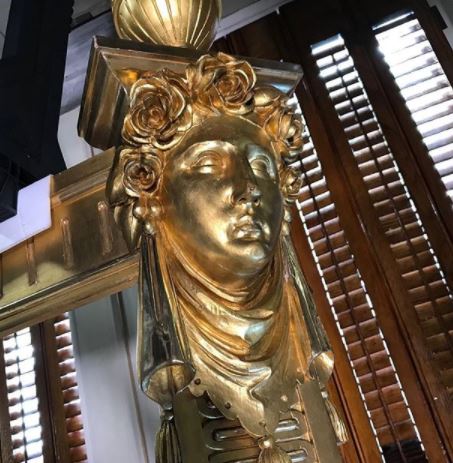
From the scientific point of view, one might consider these effects to have a different cause from that of spiritism. The psychiatrist will be interested in the question whether the practicing of spiritism was rather the effect than the cause of the ensuing mental and emotional disorders. Or again, was there some latent disposition in the family that was merely triggered off by the spiritistic activities? The parapsychologist will explain the table-lifting phenomenon as psychic automatism, that is an activation of subconscious forces. The Christian however is concerned essentially with the frequency in which psychic disturbances appear in connection with the practice of occultism. It was well known that Mrs. Winchester donned herself with ceremonial robes and communed nightly with the spirits in the Winchester mansion, and it was the midnight rendezvous for legions of ghosts, with special attention accorded those created by a Winchester rifle slug. It is possible the Mr. Abram stole something from the Winchester mansion, which brought on a curse to him and generations of his family members. A person’s thoughts and actions are like people who populate a community: friendly, contentious, kind, malicious, virtuous, evil, virile, cowardly, optimistic, cynical. We prosper in a pure mental neighborhood and wither in a foul one. And we can choose our mental neighborhood. Tired minds and bodies are signals to be careful. Demonic oppression is not easily discerned. Some people mistakenly blame demons for unrepentant self-will and psychological abnormalities. The source is not always clear, but demon oppression is usually marked by an emotional inability of the individual to do what one wants to do. A young maid staying in the Winchester mansion called Bythesea Atterton, had been a founding member of a thriving witches coven in Essex and the group’s other three members all shared her dedicated to the occult. She began to complain about various mental disturbances which included being tired of life and having depressions. Added to this she often had violent fit of temper, and her marriage was being undermined by her own frigidity. It has also happened that the husband had seen strange figures in the house at night. He had not told his wife about this so as not to upset her, but after a while she too had seen similar strange and maimed figures about the house. #RandolphHarris 3 of 13

Mrs. Winchester questioned the woman about her past illnesses and about the general health of her parents and grandparents, but she was the only one to have suffered in this way. In answer to Mrs. Winchester’s questions about contact with occultism, after a lot of thought Bythesea told her the following story. She had stolen Mrs. Winchester’s sixteenth century book about magic, and saw a black shadow at the end of her bed. It was a horrible presence that frighted the life out of Bythesea. While Mrs. Winchester was asleep, she would invite her Protestant girl’s group over. The minister’s wife, who had become the leader, used to practice table-lifting with all the girls in the Blue Séance Room. The sessions had always begun with the question, “Spirit, are you there?” One knock had meant “yes,” two had meant “no.” When the spirit had been willing to answer they had all taken part in asking it questions. The minister’s wife had continued this practice for many years until she was paralyzed by a stroke. Bythesea told Mrs. Winchester that all the girls had subsequently been afraid to visit their leader since her face had been changed into a terrible grimace by the stroke. Medical science would classy this example together with the precious one. However, with regards to the stroke, we would like to point out that in the numerous cases connected to the Winchester mansion of suicides, fatal accidents, stroke, and insanity, they usually involve the occult and someone who has in someway broke a rule, stole from the mansion, or offended the spirits somehow. The miles of twisting hallways in the mansion are made even more intriguing by secret passageways in the walls. Mrs. Winchester traveled through her house in a roundabout fashion, supposedly to confuse any mischievous ghosts that might he following her. Mrs. Winchester never slept in the same bedroom two nights in a row, in order to confuse any evil spirits that might be waiting for her. Music has always played an important role in cultural outlook and identity. Hymns, marching songs, lullabies—there are a thousand different aspects of life which are ordered or inspired by a musical beat. Music helps to define your cultural tribe. Even the ghost at the Winchester mansion reportedly had parties at ungodly hours. #RandolphHarris 4 of 13

The Satanic underground was celebrated—and eventually propelled into the mainstream—by musicians at the tail-end of the psychedelic era. While the Beatles and the Rolling Stones were the public faces of the 1960s youth culture, other voices of that same social and spiritual revolution sang dark hymns of rebellion. Some think that Black Arts Festivals have gone too far, one in particular. Coven might have achieved the popular success that ultimately eluded them. The band’s first album went under the uncompromising title Witchcraft Destroys Minds and Reaps Souls, boasting a gatefold sleeve featuring the band engaged in a Black Mass—complete with attractive blonde singer Jinx Dawson serving as a naked altar. The album features a recording of this Black Mass at the tail end of side two: “Two the best of our knowledge, this if the first Black Mass to be recorded in written words or in audio,” explain the sleeve notes. (Anton Lavey recorded his own Black Mass shortly afterwards.) “It is as authentic as hundreds of hours of research in every know source can make it. We do no to recommend its use by anyone who has not thoroughly studied Black Magic and is aware of the risks and dangers involved.” The rite bears the hallmark of serious study, with notably authentic elements from medieval Gnostic and witchcraft lore. The overall effect, however is curiously naïve, with the high priest’s command to “kiss the goat” sounding more Monty Python than Aleister Crowley. The music that precedes the Black Mass is standard—if well-executed—1960s folk rock. It is something of a jolt to realize that, behind the gentle acoustic guitars, the lyrics are exclusively about Devil-worship and black magic, while the alluring Miss Dawson’s vocals give the effect of a demonically-possessed Join Mitchell. Ultimately, Witchcraft Destroys Minds and Reaps Souls is an interesting musical exploration of the witchcraft tradition which suffused rural America ever since the Pilgrim Fathers landed in New England over four centuries ago. #RandolphHarris 5 of 13

The infamous Salem witch-trials—which took place in Massachusetts during 1692—had been one of the last major incidents of state extermination by religious fanatics from the “Old World,” making the term “witch-hunt” synonymous with the persecution with marginalized groups. As such, it elicited the sympathy of twentieth-century hippies like Coven toward their satanic predecessors. (In sacrificing the lives of twenty suspected “witches” to the fantasies of hysterical children, it also predated the “Satanic panic” of the 1980s-90s.) Coven’s second album Blood on the Snow followed but, despite its demonic sleeve, the Satanic elements were fare more restrained. By the third album, imaginatively titled Coven, the sinister elements had all but disappeared, replaced by standard hippie material. Robbed of the distinctive image of their early days, Coven faded away. It is interesting that the British rock band Lucifer, formed in 1971, were a curious collection of characters whose sardonically-devilish promotional photos portrayed a Mansonesque image, enlisted the Devil to fight the capitalist-pig system. Lucifer issued two albums, Big Gun and Exit, and a single, entitled “F*ck You,” which was seized by the police. Most outre of the Satanic psychedelicists, Roky Erickson had been the leader of the mid-1960s Texan garage band the Thirteenth Floor Elevators until a bust for marijuana possession. Facing a long prison sentence under the Lone Star State’s sanctimonious laws, he committed himself to a psychiatric institution instead. This was a bad mistake. Three years later, in the early 1970s, the hallucinogen-loving Erickson came out of the lunatic asylum considerably more troubled than when he went in. An obscure cult figure who became known for lyrical tributes to his favorite 1950s horror movies, in the hospital he had formed a close relationship with his own personal Satan. “Ah’m not afraid of the Devil, the Devil is mah friend. He chose me to do his biddin’,” drawled the usual but loveable Erickson. “Those doctors and nurses…They could not mess with the Devil’s chosen one.” To cement this unholy pact, Erickson later vocalized his personal infernal visions in wildly sincere songs like “I Think of Demons” and “Don’t Shake Me Lucifer.” #RandolphHarris 6 of 13

Ny far the most interesting of the Satanic-psychedelic bands were Black Widow. Their 1970s debt album, Sacrifice, was the result of guitarist Jim Gannon’s research into the Black Arts, with occultic lyrics accompanying a blend of traditional folk music and progressive rock. The almost-ubiquitous Alex Sanders warned the band they had done their homework too well, and would attract dark forces. He was right for one, though only inasmuch as Gannon’s lyrics boast a fair degree of authenticity, and some songs—like the catchy “Come to the Sabbat”—are highly evocative of the medieval-European Satanic tradition. Other moments—like the horrible saxophone solo Satan uses to tempt some poor innocent on “Seduction”—are diabolical in a different sense. The band enhanced their image with an elaborately Satanic stage show, professionally choreographed by a Leicester theatre company, complete with sacrificial daggers and an unclothed young woman to adorn the altar (at one point this was Alex Sanders’ wife, Maxine). They reaped the reward for their oddly entertaining work, with Sacrifice reaching the top 40 in the UK album charts. However, their second album, Black Widow, lacked both the Satanic themes and the power of its predecessor. The official explanation for this was that, true to Sanders’ warning, weird things stated to happen—most alarmingly, near-fatal car crashes. (Satan seems particularly keen on causing road accidents, however much more impressive lightning bolts or stampeding elephants might seem.) What is more likely is that, like many rock bands that use powerful Satanic imagery, Black Window may have begun to believe that same imagery was holding back their career. As many have learnt to their cost, however, it is more often the other way around—few dabbling rock stars regain the early excitement once they stop playing the Devil’s music. Suffice to day, Jim Gannon, the major creative force behind the band, cannot have been unduly worried by the curse, as he tried to mount a stage musical version of the Black Widow show on Broadway. Sadly, it never came off, and Black Widow—devoid of Devil worship—dwindled into obscurity. #RandolphHarris 7 of 13

Prosaic accounts of Black Sabbath’s flirtation with occult imagery claim they were impressed by the interest Black Widow had enjoyed in their Satanic stage show. The truth is probably a combination of all these stories. Whatever, it is fair to say that intense interest in their demonic aspects surprised Black Sabbath as much as anyone else. Their eponymous 1969 debut album was recorded in to days for six hundred pounds, treated with contempt and indifference by the press, and rapidly became a commercial success. The Christian Science Monitor, or all publications, noted approvingly that the band did not “condone or promote the less seemly aspects of…an interest in occult matters.” They were right. The song “Black Sabbath” describes the narrator’s state of terror at witnessing a Black Mass. Their attitude to Satan was chiefly the traditional one of fear and loathing, their lyrics even sometime entreating listeners to turn to God as the only source of love. However, the audiences were not listening—they wanted a Satanic band, and that is what Black Sabbath ostensibly became. (Rumor has it that their management had the large cross that decorated the inside of their first album inverted without the band’s knowledge of approval.) Satan appeared in Black Sabbath’s songs as a constant source of fascination and fear, an entity who brings colour into drab existence but can also represent the overwhelming evil of the World. In the classic “War Pigs,” Satanic witched are equated with the evil of politicians and generals who callously kill millions in their power games. (According to guitarist Tony Iommi, the title was derived from “Walpurgis,” the night when evil traditionally rules the World.) However, the most fascinating manifestation of Satan in a Black Sabbath song is also the rarest: when they briefly allow the Prince of Darkness to speak for Himself. In this strange and haunting “N.I.B,” Lucifer, the creator, sings a plaintive love song to His greatest creation and fellow sufferer, humankind. (The song “Lord of this World,” also recognizes Satan as god of the Earth.) #RandolphHarris 8 of 13
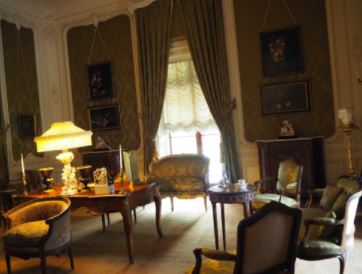
N.I.B.’s title is the source of some confusion: according to drummer Bill Ward it was simply his nickname, derived from when the band were stoned and though he resembled a pen nib. Typically, the fans perceived a more Satanic significance—to them, “N.I.B” stood for “Nativity in Black.” Inevitably, the band were quizzed on such apparent occultic beliefs during interviews. “We are into God,” Iommi unhelpfully explained to which Ward added, “But sometimes I feel Satan is God.” Perhaps they were expressing the beliefs of the early Satanic Gnostic groups, fifteen hundred years before. Led Zeppelin emerged in 1968 from London’s lively rhythm and blues scene. The band took off completely and became a huge commercial success. They were also said to have a Satanic influence with their roots being in traditional black blues music—though guitarist Jimmy Page’s outfit, much closer in its sympathies to the blues than to heavy metal, was far more preoccupied with the tradition. The Devil also makes His presence felt, either as a symbol of the inevitable fate awaiting the debauched bluesman, or as the hard-living musician’s comrade and inspiration. The delta blues—the school that had the greatest influence on the rock-guitar style—became known as “the Devil’s music.” Delta bluesmen included Peetie Wheatsraw, who liked to be known as “the Devil’s Son-in-Law and High Sheriff of Hell,” and Robert Johnson. Johnson, the acoustic-playing grandfather of rock guitar, best illustrates the enduring legend of the bluesman who sold his soul to acquire musical talent. (As testified by Satanic Rock star Glenn Danzig during our interview with him: “A lot of the old blues songs are very heavily rooted in occultism. There is Robert Johnson, all the voodoo and juju stuff—‘Got my Mojo Working,’ ‘Black Cat Bone.’”) Johnson’s pact with Satan was said to be struck at the “Crossroads”—one of his best-know song, and a traditionally magical location in many cultures—and thereafter he always claimed to live, as another song put it, with a “Hellhound on My Trail.” #RandolphHarris 9 of 13

Led Zeppelin, and Jimmy Page in particular, were heavily influenced by Johnson, lifting parts of his songs for their own compositions. As with Johnson, so the popular rumour went, Led Zeppelin has made a pact with the Devil, asking the Prince of Darkness to tune their instruments in return for their souls. Only Satanic aid, reasoned the myth, could explain the enormous success the band enjoyed so rapidly, or the power involving pleasures of the flesh these modern pied pipers had over young ladies. These same legends had been linked with musicians from Robert Johnson to Elvis Presley and beyond, but with Led Zeppelin the Satanic-pact myth has proved especially enduring. If you study the supernatural, you cannot ignore evil. The “ZOSO” symbol that became Led Zeppelin’s band’s trademark was also partly derived from the work of another influential British occultist, Austin Osman Spare—a contemporary of Crowley, and occultic artist, best known for his “automatic drawing,” which he claimed worked as a conduit for supernatural forces. One more than one occasion, Page hinted that much of Led Zeppelin’s material (particularly their meditative anthem “Stairway to Heaven”) had been conceived in a similar fashion. (If you recall, this is also how Mrs. Winchester received the plan on how to build her mansion.) Kenneth Anger asked Page to record a soundtrack for his magic ritual film Lucifer Rising, but was bitterly disappointed with the results, saying, “I had asked him for intimacy and strength, rhythms and counter-rhythms. But he gave me a short fragment of chanting voices and sounds that I thought were quite sombre and morbid.” In October of 1976, the two fell out in grand style. Page threw Anger out of the basement of his London house, where he had granted the American magus use of a fil-editing suite. Anger responded with a press conference. Asked if he felt vindictive toward Page, Anger reposed, “You bet I do. I’m not a Christian turn the other cheek kind. In fact, I’m ready to throw a Kenneth Anger curse.” #RandolphHarris 10 of 13

Asked about the incident in an interview the following year, Page observed, “The whole thing about ‘Anger’s Curse,” they were just these silly little letters. God, it was all so pathetic…I had a lot of respect for him. As an occultist he was definitely in the vanguard.” Despite Page’s scepticim, many fans and commentators linked the personal tragedies that were to strike the band with some kind of hex. On 26 July 1977, vocalist Robert Plant’s young son Karac died of a respiratory infection. Three years later, on 26 September 1980, the band’s drummer, John Bonham, died after a drinking binge. Enough was enough. On 4 December 1980, it was announced that Led Zeppelin were no more. The band’s demise only served to fuel rumours. The more lurid stories held that all of Led Zeppelin, with the exception of Bonham, had signed pacts with the Devil for Earthly pleasure, supposedly explaining the drummer’s untimely death. One fanzine reported that black smoke had been seen billowing from Page’s house on the day following Bonham’s death, and that the guitarist was overheard uttering strange curses in unknown tongues. Even the mainstream press got in on the act, with the London Evening News quoting an anonymous source: “It sounds crazy, but Robert Plant and everyone around the band is convinced that Jimmy’s dabbling in black magic is responsible in some way for Bonzo’s death and for all these other tragedies.” What are we to make of the “Led Zeppelin curse”? Many young people still need to hear guitar music that conjured the Devil, and Satanic rock does show a tenacity that surprised all but its most fervent disciples. Kip Trevor from the band Black Widow tells the story about their album Sacrifice and the stage show of the same title. “There is a guy who has lost his wife as a result of an accident to do with some kind of occultic ceremony. Something goes wrong, and she is killed. He comes back through the centuries, is reborn, and remembers this in a dream. In this dream he realizes his wife can be returned to him, if he can perform another ceremony, like the one which had gone wrong. This time he would turn the tables on the Lady Astoroth, draw her, overpower her, and sacrifice her, then she would be banished and his wife would come back. #RandolphHarris 11 of 13

“So in the first song, ‘In Ancient Days,’ tells the story of this guy travelling through the centuries. Then there is the conjuration in which we bring Lady Astoroth and the girl appears. We’d have a lot of fun with that, as she would appear from all sorts of odd places, depending on where we were playing. We toured with it all over Europe for around eighteen months. When Black Widow broke up, Jim and myself went off to try and revive the idea of the occultic stage show. We spent a lot of time, money and effort on this new black magic concept, but it did not work out. Black Widow’s first album was quite an achievement, but it would have been lovely to have developed it. The problem was that the band politics got in the way—some of them wanted to be a “normal” band and thought the whole black magic thing was not them. They thought it was overshadowing their playing. The show was written with Jim’s research, using proper conjuration ceremonies. The whole thing was done authentically as we could possibly do it. We drew the magic circles, used all the props—fire, earth, water, and air. We did it exactly as you were supposed to do it. Doing that has an effect, even if it is only psychological, because you know you’re doing it in the correct fashion. You’re stepping over the line. Combined with the power of the music and the power of the audience’s involvement, weird things would happen.” God did not create the devil as such. Lucifer, one of God’s mighty cherubs, rebelled against Him and became the devil. Satan is thus the product of his own evil choice. God created a superbly beautiful and wise being and invested him with power above all the other created beings. His name, Lucifer, means “son of the morning,” “bright and shining one,” or “light bearer.” He had many angels at his beck and call and was prince over all the Earth. A fee moral agent with the power of choice, he was filled with an ambition to which he had no right—to rise above God. Unwilling to rule over the World as a vice-general under God, he became “Satan,” meaning “adversary,” or opponent. #RandolphHarris 12 of 13

There is only one devil; there are many demons. A familiar spirit in the service of Satan knows human beings so well that he can disguise himself as those people; there are different kinds of spirits—some are sensual and lewd, and others appear ethical; demons are wandering spirits belonging to the legions of Satan, a class of beings distinct from angels—some are on Earth seeking embodiment in human beings and animals, other already are imprisoned in the bottomless abyss; Satan wins followers by psychic and supernatural phenomena that approximate the power of God; Satan is a created being who presently exercises authority over his domain, the Earth realm, but he can do only what God allows him to do, and eventually he will be deprived of all power and glory. As one can see, it is not only Mrs. Winchester who had experiences with the occult, curses, and spirits. Many people have. Occasionally other theories turn up in the literature of modern parapsychology. Some speak of a magical astral World-soul. This entails the idea of an inner World in which all the occurrences of the visible World have their inner equivalent. The World-soul is supposed to be outside of our concept of space and time. The past and the future, the near and the far are said to be all on the same level. Everything is synchronized and simultaneous. A person who is capable of contacting this World-soul enables such a person to enter into a sphere of higher intelligence where the limitations of space and time no longer hold true. Prophecy is inspired either by the Holy Spirit of by the Devil. The wide scope of the occult power possessed by spiritists helps explain why they can cause so much mischief. Through the phenomena of levitation, apports, telekinesis, and materializations, it is not difficult to see how a person endowed with strong mediumistic powers can do a great deal of harm, especially in closely associated realm of magic. Genuine magic is the art of bring about results beyond humans’ power through the enlistment of supernatural agencies. Black magic deliberately involves the devil and demons, and the resulting enchantment is used for persecution and revenge. #RandolphHarris 13 of 13


Sarah Winchester was reportedly trapped in her Daisy Bedroom during the 1906 earthquake. Her workers had to pry her out of the room, and the crowbar mark is still on the door to this day… See it on the Mansion Tour!

A 160-room mansion built to appease the spirits who died at the hands of the Winchester Rifle 👻

The Devil Loveth No Salt in His Meat!

Every night in the year, four of us sat in the parlous of the Winchester Mansion. This particular night, there was a thin, bright moonshine: it was bitter cold, windy, and frosty; the town had not yet awakened, but an indefinable stir already preluded the noise and business of the day. The ghouls had come later than usual, and they seemed more than usually eager to be gone. They wished, and declared their wish, that their blood might be the last innocent blood shed. They prayed that God would discover the witchcraft were among us. They forgave their accusers. The fervency of the spirits were very affecting and drew tears from many. Affecting and melting to the hearts of some considerable spectators. They prayed earnestly for pardon for all other sin and for an interest in the precious blood of our dear Redeemer, and seemed to be very sincere, upright, and sensible of their circumstances. One of the ghouls said, “I have been put to death, and my grandfather suffered, and all his estate seized because of my own vile and wretched heart, confessed several things contrary to my conscience and knowledge, though to the wounding of my own soul—the Lord pardon me for it. But oh! the terrors of a wounded conscience, who can bear? Blessed be the Lord; He would not let me go in my sins, but in mercy I hope so my soul would not suffer me to keep it in any longer, but I was forced to confess the truth. Gunshots in the hills and the echo of that awful hellspawn voice in my head. I was sought after by a sorcerer, which resulted in fatal mishaps for those sorcerers because they caught me in the wrong mood, and I turned into a lethal weapon. Dear Mrs. Winchester, let me beg your prayers to the Lord on my behalf, and please send us a joyful and happy meeting in Heaven.” #RandolphHarris 1 of 13

Mrs. Winchester replied, “But the Lord He know it is, if it be possible, that no more innocent blood be shed, which undoubtedly cannot be avoided in the way and course you go in. I question not but your honours do to the utmost of your powers in the discovery and detecting of witchcraft and witches, and shall not be guilty of innocent blood for the World.” A horrible sense of blackness and the treachery of fate seized hold upon the soul of the unhappy student and the other ghouls. “My God! she cried, “but what have I done? and when did I begin?” Nothing could be explained any further because we realized that we had long since ceased to pay attention to anything said by the suspect. Our minds and hearts were so filled with the hideous torments of the afflicted and the frightful tales of the confessors that we were quite unable to absorb anything else. The student was violent, and it was said that she had beaten to death a former teacher and other students in the classroom before she and her accomplices were shot dead by a Winchester model 1866. They were much addicted to sorcery in the said town, and there were forty men in it that could raise the Devil as well as any astrologer. Time had little changed this small town. It stood then, as now, upon a crossroad, out of call of human habitations, and buried fathom deep in the foliage of six thousand cedar trees. The cries of the sheep upon the neighbouring hills, the streamlets upon either hand, one loudly singing among pebbles, the other dripping furtively from pond to pond, the stir of the wind in mountainous old flowering chestnuts, and once in seven days the voice of the bell and old tunes of the precentor, were the only sounds that disturbed the silence around the rural Winchester Mansion. #RandolphHarris 2 of 13

The Resurrection Man was not to be deterred by any of the sanctities of customary piety. It was part of his trade to despise and desecrate the scrolls and trumpets of old tombs found on the estate, the paths worn by the feet of legions of spirits and mourners, and the offerings and the inscriptions of bereaved affection. To rustic neighbourhoods, where love is more than commonly tenacious, and where some bonds of blood or fellowship unite the entire society of a parish, the body-snatcher, far from being repelled by natural respect, was attracted by the ease and safety of the task. To bodies that had been laid in Earth, in joyful expectation of a far different awakening, there came that hasty, lamp-Iit, terror-haunted resurrection that often happened at the Winchester Mansion, which was fully of uneasy ghosts. It was pitch dark; and we had just raised a few souls from the dead. Their bodies awaited them in the basement. Here and there a white gate or a white stone in the wall guided them for a short space across the night; but for the most part it was at a foot pace, and almost groping, that they picked their way through the resonant blackness to their solemn and isolated destination. In the basement the last glimmer failed them, and it became necessary to kindle a match and reillumine one of the lanterns of the gig. Thus, under the dripping pipes, and environed by huge and moving shadows, they reached the scene of their unhallowed labours. However, the devil, imagining that he had found the right moment for taking possession of one of these resurrected bodies. A creeping chill began to possess my soul. It grew upon my mind that some unnatural miracle had been accomplished, that some nameless change had befallen one of the dead bodies, and in fear of their unholy burden wolves were outside the mansion howling. #RandolphHarris 3 of 13

The curse of evil had come into one of the bodies, and the evil malediction spread into his parts with a strange kind of screaming sound that made me turn pale with fear. He then rose to his feet, proclaiming he was the Devil and that he would take these other resurrected bodies with him to the underworld and speak with the dead. Mrs. Winchester said, “I rebuke you, Satan!” The Devil laughed and said he was not at all afraid of us. “You insult me with these testimonies as if you were Divine Oracles!” he said. Then departed in a black cloud of smoke with the resurrected bodies. How often I have read in books written by Jesuits that Martin Luther was a wizard, and that he did himself confess that he had familiarity with Satan! The Holy Son of God himself was reputed a magician, and one that had familiarity with the greatest of Devils. The blaspheming Pharisees said, “He casts out the Devils through the Prince of Devils,” reports Matthew 9.34. There is then not the best saint on Earth, man or woman, that can assure themselves that the Devil shall not cast such an imputation upon them. At the time when Luther died all the possessed people in the Netherlands were quiet. The Devils in them said the reason was because Luther had been a great friend of theirs, and they owed him that respect as to go far as Germany to attend his funeral. But the Father of Lies is never to be believed. He will utter twenty great truths to make way for one lie; he will accuse twenty people of witchcraft if he can but thereby bring one innocent person into trouble. However, it is better that ten suspected witches should escape than one innocent person should be condemned. The Devil makes his witched to dream strange things of themselves and others which are not so. #RandolphHarris 4 of 13

The Greek philosopher Pythagoras of Samos, who invented the Pythagorean theorem, a^2+ b^2 = c^2, also lead seances in approximately 540 BC, using something like a Quija board. Grim reapers are purely psychic entities, with power over time and perception. They can change the way a human sees one’s surroundings, and change their own appearance, usually to ease the transition from life into death. If it is by virtue of some contract with the Devil that witches have the power to do such things, it is hard to conceive how they can be bid to do them without being too much concerned in that Hellish covenant. We ought not to practice witchcraft to discover witches. The Devil have of late accused some eminent persons. It is an awful thing which the Lord had done [id est, permitted] to convince some among us of their error. To take away the life of anyone merely because a specter or Devil in a bewitched or possessed person does accuse them will bring the guilt of innocent blood on the land where such a thing shall be done. What does such an evidence amount unto more than this: either such an one did afflict such an one, or the Devil in one’s likeness, or one’s eyes were bewitched. The natural way for a living person to see a reaper is as a wraith-like figure wearing tattered winding sheets or burial cloth. Black dogs are also buried in the foundations of churches to guard and protect the gates between here and the afterlife. What will be the issue of these troubles God only knows. I am afraid that ages will not wear off that reproach and those stains which these things will leave behind them upon our lands. It is possible that bewitched and possessed person are afflicted by the Devil, but without agency of witches. Yes, there are witches, and there have been since the beginning of the World. Their craft is performed with the Devil’s assistance. #RandolphHarris 5 of 13

During one evening at the mansion, Mrs. Winchester invited the maid in for a séance. She chanted, “By the virtue of the holy resurrection and the torments of the damned, I conjure and exorcise thee, spirit of Malphas, thirty-ninth Spirit, to answer my liege demands, being obedient unto these sacred ceremonies, on pain of everlasting torment and distress. Arise, arise, arise, I charge and command thee.” A black man appeared, I do not think he was human. His skin was black as midnight and I could not see his eyes, teeth, or any other features. He was just black and in the shape of a man. He offered her a book to sign. The book was supposed to contain witches’ pacts, and he told her that is she touched it, it would cure her of the hauntings. In all, Mrs. Winchester was tempted from three boos. The third she demanded that they let her read before she think of signing it. The man refused. In general the book seemed a journal of the chief things acted or designed a their great witch-meetings, not without some circumstances that carried an odd resemblance of the Koran. It has in it the methods to be used in seducing of people unto the service of the Devil, and the names of them that had been seduced, with terms which they were to serve. It particularly surprised some in the room, on the even of May 13, 1888, to overhear her, in the book then opened unto her, spelling a word that was in Latin. The letters she recited was “Quadragesima.” Mrs. Winchester conversed at length with the spirit(s) who visited her, and the voices were “big, low, thick,” as they had been reported to be in European witchcraft accounts. #RandolphHarris 6 of 13

We saw flames arise from the cauldron on the table, and the room smelled of brimstone. The spirit of a bird appears. It attacked the maid and the next morning, she was found tied to the tree top. She was excessively sore when we brought her down from the tree. There were blisters raised upon her. To cure the soreness which last night’s fiery trail gave to her, we were forces sometimes to apply oil commonly used for the cure of scads. And yet (like other witch-wounds) in a day or two all would be well again. Only the marks of some wounds thus given her, she will probably carry to her grave. I may add that once they thrust an hot iron down her throat, which though it were to us invisible, yet we saw he skin fetched off her tongue and lips. Indeed, her sufferings were so severe that Mrs. Winchester thought the rapid healing of her wounds was part of a design to keep her in continual torment. She was, Mrs. Winchester wrote, “wounded with a thousand pains all over, and cured immediately that the pains of these wounds might be repeated.” One of the maid’s symptom occurred when her hallucinations were peopled by specters bring her a little cup that had a whitish liquor in it (unto us wholly invisible), which they would pour down her throat, holding her jaws wide open, in spite of all [her] shriekings and strivings. We saw her swallow this poison, though we saw not the poison, and immediately she would swell prodigiously and be just like one poisoned with a dose of rats-bane [arsenic trioxide]. After these potions she was capable ordinarily to beg of us that we would he her to some salad-oil, upon the taking whereof the swelling would in a little while abate. Sometimes our laying our hands on the mouth of the maid, when she perceived the specters forcing their poisons into her mouth, did keep her from taking of them in. #RandolphHarris 7 of 13

The maid, Agnus, was unable to hear prayer or religious instruction directly. However, not only did she hear the spectral Christmas dance, but several times Agnus had her arms cruelly scratched and pins thrust into her flesh by Fiends while they were molesting her. Several persons did sometimes actually lay their hands upon these Fiend. The wretches were palpable while they were not visible, and several of our people though they saw nothing, yet felt a substance that seemed like a dog. And though they were not fanciful they died away [id est, fainted] at the fright. And at this time, Mrs. Winchester believed much of this unchristian practice was the result of someone delivering curses. A curse delivered by a woman, Margaret Rhodes Crocker, known to have dabbled in witchcraft, although again it is not absolutely certain that she practiced malefic witchcraft. It was upon the Lord’s Day, the 8th of September, in the year 1889, that Margaret Crocker, after some hours of previous disturbance in the Old St. Mary’s Cathedral, fell into odd fits, which caused her friends to carry her home, where her fits in a few hours grew into a figure that satisfied the spectators of their being preternatural. Some of the neighbours were forward enough to suspect the rise of this mischief in an house hard-by, where lived a miserable woman who had been formerly imprisoned on the suspicion of witchcraft, and who had frequently cured very painful hurts by muttering over them certain charms, which I shall not endanger the poisoning of my reader by repeating. This woman had, Mary Frances Sherwood Hopkins Searless, the evening before Margret fell into her calamities, very bitterly treated her and threatened her. #RandolphHarris 8 of 13

However, the hazard of hurting a poor woman that might be innocent, notwithstanding surmises that might have been more strongly grounded than those, caused the pious people in the vicinity to try whether incessant supplication to God alone might not procure a quicker and safer ease to the afflicted than hasty prosecution of any supposed criminal. Mary Francis was assaulted by eight cruel specters, whereof she imagined that she knew three or four, but the rest came still with their faces covered, so that she could never have a distinguishing view of the countenance of those who she thought she knew. She was very careful of my reiterated charges to forbear blazing the names, lest any good person should come to suffer any blast of reputation through the cunning malice of the great Accuser. Nevertheless, she having since privately named them to myself, I will venture to say this of them, that they are a sort of wretches who for these many years have gone under as violent presumptions of witchcraft as perhaps any creatures yet living upon Earth, although I am far from thinking that the visions of this young woman were evidence enough to prove them so. Margaret Crocker’s hallucinations were somewhat varied. She saw not only spectral witches and the “Black Man….their master” who was often seen in abandoned mansions, where he resisted new residents, but also a “White Spirit” who she took to be an Angel. Such a figure had also been seen at the Winchester and in several Oakland witchcraft cases, such as at the Ellen Kenna Mansion, Emma Bray’s Mansion, and at Alexander Dunsmuir’s mansion. The white spirit comforted and advised Margaret during her attack. Among other things, the Angel told her that Oliver Winchester was her spiritual father. #RandolphHarris 9 of 13

The Angel had always maintained the Devils might appear in the shape of an innocent person. Mrs. Winchester cried for the Lord, as for the deliverance of these women from the malice of Hell, for the deliverance of the powers of Hell has now seized upon all of them. And that the whole plot of the Devil to reproach her poor maid, Angus, be defeated by the Lord Jesus Christ. During a séance Mrs. Winchester was told that one of the several beings that was haunting her and these other grand estates was a Rakshasa. A being reincarnated from evil human beings. They are a type of demon. Rakshasa have the power to change their shape at will and appear as animals, as monsters, or in the case of female demons, as beautiful women. They also have magical powers, including invisibility. They are cannibalistic, and particularly target anything religious or holy. In addition to human flesh they, they will eat spoiled food. Their finger nails are poisonous. They are most powerful in the evening, particularly during the dark person of a new moon, but are dispelled by the rising sun. They especially detest sacrifices and prayer. Most powerful among them is their kind, the 10-headed Ravana. Many believe him to be Satan. Margaret had the common inability of afflicted persons to hear religious words, especially, in her case, the words of prayer. She had a full catalog of physical symptoms. She would be strangely distorted in her joins an thrown into such extravagant convulsions as were astonishing unto the spectators in general. She would be cruelly pinched with invisible hands very often in a day, and the black and blue marks of the pinches became immediately visible unto the standers by. She was also afflicted with pins, both real ones found about her person and spectral ones. The psychosomatic skin lesions would in a few minutes ordinarily be cured. #RandolphHarris 10 of 13

As with Mary Frances, her specters burnt her with spectral brimstone, and she would be so bitterly scorched with the unseen sulphur thrown upon her that very sensible blisters would be raised upon her skin. Like Angus, Margaret was forced to swallow spectral poison. She would sometimes have her jaws forcibly pulled open, whereupon something invisible would be poured down her throat. We all saw her swallow, and yet we all saw her try as she could that she might not swallow. She would cry out “as of scalding brimstone poured into her” and would be so monstrously inflamed that it would have broken a heart of stone to have seen her agonies. The spectators would testify also that the Crocker Mansion often reeked “so hot of brimstone that we were scarce able to endure it.” And one of the occasion “the standers by plainly saw something of that odd liquor itself on the outside of her neck.” There was a spectral powder thrown into her eyes, and “one time some of this powder was fallen actually visible upon her cheek, from whence the people in the room wiped it with their handkerchiefs.” Mrs. Winchester was also afflicted by spirits. “We once thought we perceived something stir upon her pillow at a little distance from her, whereupon one present [the Butler Clayton] laying his hand there, he to his horror apprehended that he felt, though none could see it, a living creature not altogether unlike a vampire bat, which nimbly escaped from him. And there were diverse other persons who were thrown into a great consternation by feeling, as they judged, at others times the same invisible animal.” #RandolphHarris 11 of 13

However, the most starling phenomenon in Mrs. Winchester’s case was levitation. “Once,” said Clayton, “her tormentors puled her up to the ceiling of the chamber and held her there before a very numerous company of spectators, who found it as much as they could all do to pull her down again.” Clayton obtained signed confirmations of this and other instances of levitation: “I do testify that I have seen Mrs. Winchester in her hauntings from the invisible World lifted up from her bed, wholly by an invisible force, a great way towards the top of the room where she lay. In her being so lifted she had no assistance from any use of her own arms or hands or any other part of her body, not so much as her heels touching her bed or resting on any support whatsoever. And I have seen her thus lifted when not only a strong person hath thrown his whole weight across her to pull her down, but several other persons have endeavoured with all their might to hinger her from being so raised up, which I suppose that several others will testify as well as myself when called unto it. Witness my hand,” Clayton Straus. “We can also testify that we have several times seen Mrs. Winchester so lifted up from her bed as that she had no use of her own limbs to help her up, but it was the declared apprehension of us, as well as others that saw it, impossible for any hands but some of the invisible World to life her.” Henry Brown, Frank Drew, Phillip Goodwin. “We whose names are underwritten do testify that one evening when we were in the chamber where Mrs. Winchester then lay in her haunting, we observed her to be by an invisible force lifted up from the bed whereon she lay, so as to touch the garret floor, while yet neither her feet nor any other parent of her body rested either on the bed or any other support, but were also by the same force lifted up from all that was under her, and all this for a considerable while. #RandolphHarris 12 of 13

“We judged it several minutes, and it was as much as several of us could do with all our strength to pull her down. All which happened when there was not only we two in the chamber, but we supposed ten or a dozen more whose names we have forgotten.” W. R. Leigh and Spenser T. Olin. These accounts could not be the power of suggestion because these people were not just bystanders. They believed that they witnessed levitation, and they were engaging in violent physical activity, trying to bring her body back to the bed. Such activity would, ordinarily, break the power of suggestion. And levitation has been so frequently reported, from so many times and places (from the 5th century to the 21st century), that one cannot be at all sure there is a satisfactory explanation for it, particularly since so many witnesses insisted that no part of Mrs. Winchester’s body was touching the bed. However, whatever the explanation for these symptoms, Mrs. Winchester and her estate are truly a mystery. However, it is also noted the other prominent Queen Anne Victorian Mansions and other built during the Victorian times experienced afflictions. Witchcraft is one of the most hidden works of darkness. Although some people and some estates were more haunted than others, the Bay Area, during Victorian Times, had its full share of obscurity. All publications on witchcraft and supernatural events have been forbidden by these prominent families at the time. Their desire was to quail tempers, and use wisdom to relax fear, while upholding their honour, integrity, and reverence for the Victorian era. “All things are possible to one that believeth,” reports Mark 9.23. Who that beareth it upon one shall not dread one’s enemies, to be overcome, nor with no manner of poison be hurt, nor in no need misfortune, nor with no thunder one shall be smitten nor lightning, no in no fire be burnt suddenly, nor in no water be drowned. Nor one shall not die without shrift, nor with thieves to be take. Also one shall have no wrong neither of Lord or Lady. This be in the names of God and Christ. #RandolphHarris 13 of 13

Winchester Mystery House

Winchester Mystery House will be going dark this weekend for All Hallows’ Eve, but we will be back to haunt you Thursday, September 30th! Purchase your tickets for next weekend early and let the ghoul times roll 👻
See link in bio for ticket info 🎟 winchestermysteryhouse.com

He Covenanted with the Devil Until He Should Arrive to the Age of Sixty Years!

He might be living, or he might be dead. There came no word of him, or from him. I was fond enough of her to be satisfied with this—he never disturbed us. While there were many individual acts of witchcraft in seventeenth-century Massachusetts, there was never an attempt or plot to make witchcraft a formal religion which would supplant Christianity. Yet we need not conclude that William Baker and his fellow-confessors were lying. It is probable that they, like the afflicted girls, were hysterics subject to hallucination. Certainly that is the conclusion to be drawn from Thomas Brattle’s opinion of them in his “Letter”: “my faith is strong concerning them that they are deluded, imposed upon, and under the influence of some evil spirit, and therefore unfit to be evidences either against themselves or anyone else.” Mr. Brattle wrote this in October 1692, when Massachusetts was retuning to stability. However, at the height of the excitement confessions like Mr. Baker’s seemed convincing enough. For one thing, they had a curious precision: he did not say there were about three hundred witches in the country but “about three hundred and sever”; he did not say there were about a hundred young wizards at the mustering of the Satanic militia but “about an hundred five.” However, what made these confessions most believable was that they offered a simple and comprehensive explanation for all the frightening events at Salem, at a time when explanations were not easy to discover. #RandolphHarris 1 of 16

There is also some testimony which remains ambiguous even today. Samuel Wardwell, for example, at his preliminary examination confessed himself a wizard. He had begun, he said, with white magic, “with telling of fortunes which sometimes came to pass” And, he said, “he used also when any creature came into his field to bid the Devil to take it, and it may be the Devil took advantage of him by that.” Eventually he had signed a pact: “He covenanted with the Evil until he should arrive to the age of sixty years.” He had renounced this confession at his trial, saying that he had made it, but that he had belied himself. He added that it was all one: “he knew he should die for it whether he owned it or no.” Ordinarily one would simply accept his renunciation. However, there are several puzzling circumstances here. For one thing, it was not all one whether he maintained or renounced his confession. People who maintained their confessions were not being brought to trail, much less executed. For another, at least a part of his confession was true; he had dabbled in the occult for some time, telling a great many fortunes, and boasting that he could make animals come to him when he wished. Finally, Mr. Wardwell was executed. However, in 1693, when the panic had subsided and the climate of opinion totally changed, there were three people who held to their confessions. Two of them were women long thought to be “senseless and ignorant creatures.” The third was Mr. Wardwell’s wife. All of these circumstances are puzzling and some of them are suspicious. However, on the other hand, there is no evidence to support his confessions of having made a pact. The only possible conclusion, it would seem, is that in this case the truth is not obtainable. #RandolphHarris 2 of 16

In a situation where the truth was so difficult to find the people of Massachusetts did what anybody else would do—they sought expert advice. In matters of witchcraft the experts were the clergy, and ultimately the advice was sought of the most distinguished clergymen in the colony. Indeed, at least one member of the trial court, Judge John Richards, asked the Reverend Cotton Mather to be present at the first trial. Reverend Mather was too ill to attend, but he did everything he could under the circumstances. He had suggested earlier (the exact date is not known) that the afflicted persons should be separated and an attempt made to cure them with prayer and fasting. He volunteered to take in as many as six of them himself. He had cured the Godwin children, and he might well have cured the Salem girls as well; certainly separation and private care would have been better treatment for hysterical fits than the excitements of a public courtroom. However, unfortunately Reverend Mather’s offer had not been accepted. Now, although he could not attend the first sitting of the court he wrote John Richards a letter offering him his opinions. In the first place, he expected that God would smile upon the labours of the court: “His people have been fasting and praying before Him for you direction, and yourselves are persons whose exemplary devotion disposeth you to such a dependence on the Wonderful Counselor, for his counsel in an affair this full of wonder, as He doth usually answers with the most favorable assistances. Yet he wanted to warn Mr. Richards. #RandolphHarris 3 of 16

Here is that warning: “And yet I most humbly beg you that in the management of the affair in your most worthy hands, you do not lay more stress upon pure specter testimony than it will bear. When you are satisfied or have good plain legal evidence that the Demons which molest our poor neighbours do indeed represent such and such people to the sufferers, though this be a presumption, yet I suppose you will not reckon it a conviction that the people so represented are witches to be immediately exterminated. It is very certain that the Devils have sometimes represented the shapes of persons not only innocent but very virtuous, though I believe that the just God then ordinarily provides a way for speedy vindication of the persons thus abused. Moreover, I do suspect that persons who have too much indulged themselves in malignant, envious, malicious ebullitions of their souls may unhappily expose themselves to the Judgment of being represented by Devils, of whom they never had any vision and with whom they have much less written any covenant. I would say this: if upon the bare supposal of a poor creature’s being represented by a specter too great a progress be made by the Authority in ruining a poor neighbour so represented, it may be that a door may be thereby opened for the Devils to obtain from the Courts in the Invisible World a license to proceed unto most hideous desolations upon the repute and repose of such as have yet been kept from the great transgression. If mankind have thus far once consented unto the credit of Diabolical representations, the Door is opened! Perhaps there are wise and good men that may be ready to style hum that shall advance this caution a witch advocate, but in the winding up this caution will certainly be wished for.” #RandolphHarris 4 of 16

Reverend Mather’s third point is that although he believes that Devils have sometime afflicted men on their own initiative, without being called up by witches, in this case he thinks that witches are involved: “there is cause enough to think that it is a horrible witchcraft which hath given rise to the troubles wherewith Salem Village is at this day harassed, and he indefatigable pains that are used for the tracing this witchcraft are to be thankfully accepted and applauded among all this people of God.” Fourth, he points out that although witchcraft is a spiritual matter and therefore “very much transacted upon the stage of imagination,” its effects are “dreadfully real” and therefore criminally punishable. “Our dear neighbours are most really tormented, really murdered, and really acquainted with hidden things which are afterwards proved plainly to have been realities.” In his fifth and six section he suggests what evidence may be used for convictions. The best evidence, he says, is “a credible confession…And I say a credible confession because even confession itself is sometimes not credible.” He was confident Mr. Richards’ ability to judge such matters: “a person of a sagacity many times thirty furlongs less than yours will easily perceive what confession may be credible and what may be the result of only a delirious brain or a discontented heart.” In obtaining confessions he was “far from urging the un-English method of torture,” but he thought that “cross and swift questions” might be used, along with anything else that “hath a tendency to put the witches into confusion” and this might bring them to confession. If the suspect had made threats or boasts which seemed to require occult power and which came true, this was valid evidence. So were such concrete matters as “puppets” (for image magic) and witch marks on the body. #RandolphHarris 5 of 16

Reverend Mather had never seen a witch mark on anyone, but he thought a surgeon ought to be able to tell if a bodily excrescence were magical. Finally, he was willing to countenance as experiments (but not as full evidence) some witch-finding techniques which themselves partook of the occult: setting a suspect to repeating the Lord’s Prayer; trying to wound a witch through striking her specter; putting the suspect to the water ordeal. Seventh, and finally, he recommended clemency for “come of the lesser criminals.” If such persons were not executed but “only scoured with lesser punishments, and also put upon some solemn, open, public, and explicit renunciation of the Devil” he thought it might discourage the Devils from afflicting those neighbourhoods in which they had been publicly renounced. Reverend Mather’s letter was written within the context of the Puritan method for arriving at the truth, and it can be fully understood only within that context. In dealing with the American Puritans we must remember always that they had rejected the formidable hierarchies of the Medieval and Renaissance church and state, with all their authority of tradition and inherited position. They had replaced these hierarchies with bodies of ministers and magistrates which, if they were not fully democratic in the twentieth-century sense of the word, were nevertheless elected. The clergyman was called to his position by the members of the church; the magistrate was elected by his constituency. Furthermore, the church had no central administration; every congregation was a law unto itself. The state did have a central administration—a governor and lieutenant-governor and their council—but this administration had nothing even faintly resembling the authority of a royal government. #RandolphHarris 6 of 16

My brother, the clergyman, looked over my shoulder before I was aware of him, and discovered that the volume which completely absorbed my attention was a collection of famous Trials, published in a new edition and in a popular form. He laid his finger on the Trial which I happened to be reading at the moment. I looked up at him; his face startled me. He had turned pale. His eyes were fixed on the open page of the book with an expression which puzzled and alarmed me. “My dear fellow,” I said, “what in the World is the matter with you?” He answered in an odd absent manner, still keeping his finger on the open page. “I had almost forgotten,” he said. “And this reminds me.” “Reminds you of what?” I asked. “You do not mean to say you know anything about the Trial?” “I know this,” he said. “The prisoner was guilty.” “Guilty?” I repeated. “Why, the man was acquitted by the jury, with full approval of the judge! What can you possibly mean?” “There are circumstances connected with that Trial,” my brother answered, “which were never communicated to the judge or the jury—which were never so much as hinted or whispered in court. I know them—of my own knowledge, by my own personal experience. They are very sad, very strange, very terrible. I have mentioned them to no mortal creature. I have done my best to forget them. You—quite innocently—have brought them back to my mind. They oppress, they distress me. I wish I had found you reading any book in your library, except that book!” Some people were opposed to prosecuting in any witchcraft case, on the grounds that witchcraft was a spiritual mater, a sin rather than a crime, and thus outside the domain of criminal law. However, the laws of every civilized nation provided the death penalty for witchcraft, and so did the Bible (Exodus xxii, 18: “Thou shalt not suffer a witch to live”). #RandolphHarris 7 of 16

Another opinion Reverend Mather deals with is that the troubles at Salem were caused by Devils, but not by witches. That is, the idea had already been advanced that the afflicted girls were possessed—infested by Demons—but not bewitched; that the Devils had acted on their own initiative rather than that of witches. This is the idea that was eventually adopted by virtually all of Massachusetts to explain the events at Salem, once it was recognized that most of those executed had been innocent. The basic question, as the seventeenth century understood it, was whether God would permit the Devil to assume the shape of an innocent person. Most authorities, and especially most Protestant authorities, believed that He would, and thus held, like Hamlet, that “the Devil hath power/ to assume a pleasing shape. However, Mr. Richards would not be capable of clearing anybody if he was going to accept the appearance of a person’s specter as conclusive proof of guilt. If such infernal testimony were accepted, nobody could be safe from accusation. Reverend Mather put in forcefully enough. “If mankind have thus far once consented unto the credit of Diabolical representations, the Door is opened!” However, Reverend Mather knew there were people at Salem so committed to the validity of spectral evidence that they were willing to call anyone who challenged it, including himself, a “witch advocate.” All he could do was warn such people that when matters were finished “this caution will certainly be wished for.” And in this he could not possibly have been more right. #RandolphHarris 8 of 16

Do you believe that the spirits of the dead can return to Earth, and show themselves to the living? Promise me this, that you will keep what I tell you a secret as long as I live. After my death I care little what happens. Let the story of my strange experience be added to the published experience of those other men who have seen what I have seen, and who believe what I believe. The World will not be the worse, and may be the better, for knowing one day what I am now about to trust to your ear alone. On a fine summer evening, many years since, I left my chambers in the Temple to meet a fellow-student, who had proposed to me a night’s amusement in the Winchester estate. I had taken my degree at Oxford. I had sadly disappointed my father by choosing the Law as my profession, in preference to the Church. At that time, to own the truth, I had no serious intention of following any special vocation. I simply wanted an excuse for enjoying the pleasures of an American life. The study of Law supplied me with that excuse. And I chose the Law as my profession accordingly. On reaching the place at which we had arranged to meet, I found that my friend had not kept his appointment. After waiting vainly for ten minutes, my patience gave way, and I went into the gardens by myself. I took two or three turns round the mansion, without discovering my fellow-student, and without seeing any other person with whom I happened to be acquainted at that time. For some reason which I cannot now remember, I was not in my usual good spirits that evening. #RandolphHarris 9 of 16

I saw a woman in the gardens, she was quiet. She invited me into the estate. Her face was saddened; her eyes were dropped to the ground, I begged her pardon. She rose to leave me. I was determined to not part with her in that way. I begged to be allowed to see the Winchester mansion. She hesitated. Then she took my arm. We went away together. A walk of half an hour brought us to the Winchester mansion, the estate was quite large. We went through the beautiful jeweled doors and took an elevator to the 4th floor. She said Mrs. Winchester had been waiting to meet me. She had been suffering from an affection of the throat; and she had a white silk handkerchief tied loosely round her neck. She wore a simple dress of black merino, with a black-silk apron over it. Her face was deadly pale; her fingers felt icily cold as they closed around my hand. “Promise me one thing,” I said, “before I go. While I live, I am your friend—if I am nothing more. If you are ever in trouble, promise me that you will let me know it.” She started, and drew back from me as if I had struck her with a sudden terror. “Strange!” she said, speaking to herself. “He feels as I feel. He is afraid of what may happen to me, in my life to come.” I attempted to reassure Mrs. Winchester. I tried to tell her what was indeed the truth—that I had only been thinking of the ordinary chances and chances of life, when I spoke. She paid no heed to me; she came back and put her hands on my shoulders, and thoughtfully and sadly looked up in my face. “My mind is not your mind in this matter,” she said. “I believe I shall die young, and die miserably. If I am right, have you interest enough still left in me to hear of it?” #RandolphHarris 10 of 16

She paused, for a moment, shuddering—and added these startling words: “You shall hear of it.” The tone of steady conviction in which she spoke alarmed and distressed me. My face showed her how deeply and how painfully I was affected. “There, there!” she said, returning to her natural manner; “don’t take what I say too seriously. A poor girl who has led a lonely life like mine thinks strangle and talks strangely—sometimes. Yes; I give you my promise. If I am ever in trouble, I will let you know it. God bless you—you have been very kind to me—goodbye!” A tear dropped on my face as she kissed me. The door closed between us. The dark gardens received me. It was raining heavily. I looked up at her window, through the drifting shower. The curtains were parted; she was standing in the gap, dimly lot by the lamp on the table behind her, waiting for our last look at each other. Slowly lifting her hand, she waved her farewell at the window, with the unsought native grace which had charmed me on the night when we first met. The curtains fell again—she disappeared—nothing was before me, nothing was round me, but the darkness and the night. In two years from that time, I had returned to the Church. My relatives exerted themselves; and my good fortune still befriended me. I was offered an opportunity of preaching in a church, made famous by the eloquence of one of the popular pulpit-orators of our time. In accepting the proposal, I felt naturally anxious to do my best, before the unusually large and unusually intelligence congregation which would be assembled to hear me. At the period of which I am now speaking, the Santa Clara Valley had been startled by the discovery of a terrible crime, perpetrated under circumstances of extreme provocation. #RandolphHarris 11 of 16

I chose this crime as the main subject for my sermon. Admitting that the best among us were frail mortal creatures subject to evil promptings and provocations like the worst among us, my object was to show how a Christian man may find his refuge from temptation in the safeguards of his religion. I dwelt minutely on the hardship of the Christian’s first struggle to resist the evil influence—on the help which one’s Christianity inexhaustibly held out o one in the worst relapses of the weaker and viler part of one’s nature—on the steady and certain gain which was the ultimate reward of one’s faith and one’s firmness—and on the blessed sense of peace and happiness which accompanied the final triumph. Preaching to this effect, with the fervent conviction which I really felt, I may say for myself, at least, that I did no discredit to the choice which had placed me in the pulpit. I held the attention of my congregation, from the first word to the last. On the conclusion of my sermon, my soul was literally shaken. Ordering my horse to be saddled, I rode instantly to the Winchester mansion. When I arrived, my mind was blank. I had no thoughts. I had no tears. The butler, Amon, greeted me. I guessed him to be some two or three years younger than myself. He was undeniably handsome; his manners of a gentleman—and yet, without knowing why, I felt a strong dislike to him the moment he opened the door. While waiting in the parlor, little by little, I became conscious of a chilly sensation slowly creeping through and through me to the bones. The warm balmy air of a summer night was abroad. It was the month of August. In the month of August, was it possibly that any living creature (in good health) could feel cold? It was not possible—and yet, the chilly sensation still crept through and through me to the bones. I looked up. I looked all round me. #RandolphHarris 12 of 16

I looked around me again. Yes: I saw it. With my own eyes I saw it. A pillar of white mist—between five and six feet high, as well as I could judge—was moving beside me on my left hand. The white colour of it was the white colour of the fog which one might see over the ocean. And the chill which had then crept through me to the cones was that chill that was creeping through me now. I was awed rather than frightened. There was one moment, and one only, when the fear came to me that my reason might be shaken. The doctrine that the Devil could appear in any shape did come to mind. The slow utterance of these words, repeated over and over again: “Mrs. Winchester is dead. Mrs. Winchester is dead.” But my will was still my own: I was able to control myself, to impose silence on my own muttering lips. And I walked through the mansion. And the pillar of mist went quietly with me. I sat down on the stairs looking at the pillar of mist, hovering opposite to me. It lengthened slowly, until it reached to the ceiling. As it lengthened, it grew bright and luminous. A time passed, and a shadowy appearance showed itself in the center of the light. Little by little, the shadowy appearance took the outline of human form. Soft brown eyes, tender and melancholy, looked at me through the unearthly light in the mist. The dead and the rest of the face boke next slowly on my view. Then the figure gradually revealed itself, moment by moment, downward and downward to the feet. She stood before me as I had last seen her, in her black-merino dress, with the black-silk apron, with white handkerchief tied loosely round her neck. She stood before me, in the gentle beauty that I remembered so well; and looked at me as she had looked when she gave me her last kiss on the cheek—when her tears had dropped on my hand. #RandolphHarris 13 of 16

I fell on my knees at the table. I stretched out my hands to her imploringly. I said, “Speak to me—O, once again speak to me, Sarah.” Her eyes rested on me with a divine compassion in them. She lifted her hand, and pointed to the photograph on the desk. It was the butler. I looked up at her again. She lifted her hand once more, and pointed to the handkerchief round her neck. As I looked at it, the fair white silk changed horribly in colour—the fair white silk became darkened and drenched in blood. A moment more—and the vision of her began to grow dim. By slow degrees, the figure, then the face, faded back into the shadowy appearance that I have first seen. The luminous inner light died out in the white mist. The mist itself dropped slowly downwards—floated a moment in airy circles on the floor—vanished. Nothing was before me but the familiar Lincrusta wallpaper, and the photograph lying face downwards on the desk. I went home. The next day, the newspapers reported the discovery of a murder in the Winchester mansion. Mrs. Winchester was the victim. She had been killed by a wound in the throat. The crime had been discovered between ten and eleven o’clock on the previous night. There is conclusive proof that the butler had been trafficking with the Devil. If spectral evidence was convincing to the magistrates, the ministers, and the people at large, it was a nightmare to the suspects. A violent quarrel took place between them. Lastly, that man, variously described by different witnesses, was seen leaving the door of her mansion on the night of the murder. The Law—advancing no further than this—may have discovered circumstances of suspicion, but no certainty. The Law, in default of direct evidence to convict the prisoner, may have rightly decided in letting him go free. #RandolphHarris 14 of 16

However, the Winchester Repeating Arms Company issued a statement redacting the news report which was later destroyed: “Protecting Mrs. Winchester’s legacy is, and always will be, our focus. For decades, we have battled behind the scenes, enduring shadowy tactics of deception with unauthorized statements and projects created to tarnish. We have always been betwixted as to why there is such a tenacity in causing more pain alongside what we already have to cope with for the rest of our lives. Now, this unscrupulous endeavor to release a statement without official proof or full accounting to the estate compels our hearts to express a word—forgiveness. Although we will continue to defend ourselves and her legacy lawfully and justly, we want to preempt the inevitable attacks on our company by all the individuals who have emerged from the shadows to leech off of Mrs. Winchester’s life’s work. Ultimately, we desire closure and a modicum of peace so we can facilitate the growth of the Winchester Estate and other creative projects that embody Mrs. Winchester’s true essence, which is to inspire and get people to think critically. We welcome and accept people of all creeds, races and cultures in the Universe and beyond.” The official statement reported that Mrs. Winchester passed away peacefully in her sleep on September 5, 1922, and work on the still uncompleted house stopped. I leave you to draw your own conclusions, but just days before I saw her, she looked no older than 22 years old. My own faith in the reality of the apparition is immovable. I say, and believe Mrs. Winchester is immortal, which would explain a lot. Take up the Trial again, and look at the circumstances that were revealed during the investigation in the court. I persist in believing that the man was guilty. I declare that, he and he alone did it. And now, you know why. #RandolphHarris 15 of 16

O thou wicket spirit Amon that obeyeth not, because I made a law and invoked the names of the glorious and ineffable God of Truth, the creator of all, and thou obeyest not the might sounds that I make: therefore I curse thee in the depth of Abandon to remain until the day of judgment in torment in fire and in sulphur without end, until thou appear before our will and obey my power. Come, therefore, in the 24th of a moment, before the circle in the triangle in this name and by this name of God, Adni, Great Spirit, give us hearts to understand; never to take from creation’s beauty more than we give; never to destroy wantonly for the furtherance of greed; never to deny to give our hands for the building of Earth’s beauty; never to take from her what we cannot use. Give us hearts to understand that to destroy Earth’s music is to create confusion; that to wreck her appearance is to build us to beauty; that to callously pollute her fragrance is to make a house of stench; that as we care for her she will care for us. Tzabaoth, Adonai, Amioran. Come! Come! for it is the Lord of Lords Adni, that stirreth thee up. I stir thee up, O thou fire, in him who is thy Creator and of all creatures. Torment, burn, destroy the spirit Amon always whose end cannot be, I judge thee in judgment and in extreme justice, O spirit Amon, because thou art he that obeyeth not my power and obeyth not that law which the Lord God made, and obeyeth not the Mighty Sounds and the Living Breath which I invoke, which I send: Come forth, I, who am the Servant of the Same Most High governor Lord God powerful, Iehovohe, I who am exalted in power and am might in his power above ye, O thou who comest not giving obedience and faith to him that liveth and trirumpheth. Therefore I say the judgment: I curse thee and destroy the name Amon and the seal Amon, which I have placed in this dwelling of poison, and I burn thee in fire whose end cannot be; and I cast thee down unto the seas of torment, out of which thou shalt not rise until thou come to me eyes: visit me in peace: be friendly before the circle in the triangle in the 24th of a moment in the likeness of a man not unto the terror of the sons of men the creatures or all things on the face of the Earth. Obey my power like reasoning creatures; obey the living breath, the laws which speak. #RandolphHarris 16 of 16

Winchester Mystery House

Are you up for a challenge? Check out Houdini’s Spirited Escape! A fully themed challenge room based on Houdini’s infamous visit to the Winchester Mystery House. Book your session today!
Houdini’s Spirited Escape | winchestermysteryhouse.com/recent-links


What a Lovely Day for a Bit of Mystery!

It is rare for people to be asked the question which puts them squarely in front of themselves. I hear your words, My dear Devout; now you hear Mine. You will find them not only suasive, but also persuasive. In fact, they exceed in wisdom all the accumulated knowledge of Philosophy since the World began. My particular words for you today are “spirit and life.” My Beloved Disciple recorded them in his Gospel (6.63), but Humanity cannot seem to make any sense out of them. Important words, they should not be exegeted smugly, if I may allude to that hoary Preacher of Ecclesiastes (9.17), but listened to respectfully. That is to say, they should be received with all humility and yet great affection. Our seventeenth-century ancestors differed from us in most ways, but in nothing did they differ more than in their attitude toward the truth. In this they were closer to the Middle Ages than to us. For them a lie—a breaking of one’s faith—was the worst of sins. Today, many do not regard lying as a serious moral wrong. If the word “morality” is mentioned we think immediately of our bodily appetites, especially of pleasures of the flesh, barbiturates, paraphernalia, liquor and contraband. If the word “morality” is mentioned we think immediately of our bodily appetites very seriously—perhaps too seriously—but we do not regard lying as a mortal sin. We are one of the few civilizations in which entire professions (TV news media, for example, and public relations) are seriously devoted to bending the truth. Dante, in his Divine Comedy, divided sins into three kinds: those of lust, those of violence, and those of fraud. #RandolphHarris 1 of 13

The sins of lust—those we tend to take most seriously—were those that Dante thought most trivial; the sins of fraud—which we take lightly—were for Dante the worst of all. To create a “credibility gap” as our revealing phrase has it (as though the only relevant issue is whether a statement will compel belief), to lie, was for the medieval humans to break one’s faith, and it was faith which constituted the bonds between humans and their fellow humans, between humans and the state, between humans and God. To lie was to reduce all the most valuable relationships of life to chaos. And the seventeenth-century Puritan, like Dante, was still living by his faith. Just how important the truth was to the seventeenth-century Puritan may be gathered from the fact that all of the innocent persons who were executed—and the majority of those executed were innocent—could have saved themselves by lying. After the first execution—that of Bridget Bishop—took place in June it became obvious to everyone that persons who confessed, like Tituba and Dorcas Good, were not being brought to trial. Thus any suspected person might have one’s life by confessing. Twenty people died, nineteen of them hanged and one pressed for refusing to plead. Bridget Bishop, Mammy Redd, and George Burroughs were three of these. One cannot be at all certain of the guilt or innocence of several more. However, at least a dozen now seem to be clearly innocent. Twelve people, and probably more, chose to die rather than belie themselves. It is impressive evidence of the Puritan’s attachment to the truth. #RandolphHarris 2 of 13

Yet it was not really so simple as that, because the truth was not easy to find in Salem in 1692. The greatest difficulty was created by the genuineness of the afflicted persons’ fits. Their sufferings were so convincing that they often shook the confidence of the accused. One example is William Hobbes, who began by stoutly denying that he had anything to do with the afflicted girls’ convulsions. When he looked at them they fell down in fits, and Hathorne accused him of overlooking them (id est, of he evil eye), yet still he denied it. Abigail Williams cried out that she saw his specter going to hunt Mercy Lewis “and immediately said Mercy fell into a fit and diverse others.” “Can you now deny it?” said Hathorne. “I can deny it to my dying day,” said William Hobbes. However, he did not. Here, after all, were people in hideous convulsions, and saying that his specter was the cause. How could this be? Hathorne suggested that the Devil might be able to use Hobbes’ specter because of Hobbes’ sins; he had not observed either public or private worship. Might not the Devil have taken advantage of that? Hobbes “was silent a considerable space—then said yes.” The girls’ fits shook not only Hobbes’ confidence in himself, but also his confidence in his daughter Abigail, the wild young girl who had boasted that she had sold herself “body and soul to the Old Boy.” Hathorne wanted to know whether Hobbes had not known for a long time that his daughter was a witch. “No, sir,” was the reply. “Do you think she is a witch now?” asked Hathorne. And all that Hobbes could say was, “I do no know.” #RandolphHarris 3 of 13

Abigail Faulkner’s experience was similar. At her first examination, on August 11, she firmly denied that she had anything to do with the girls’ afflictions. When she looked at them they fell down in fits, and Hathorne asked her, “Do you not see?” Yes, she saw. However, she had nothing to do with it. Yet she would not doubt that the girls were suffering, and saw no reason to doubt their word that it was her specter afflicting them. Therefore the Devil must be appearing in her form: “It is the Devil does it in my shape.” However, by August 30 she was no longer so sure of her innocence. It was true, she said, that she had been angry at what people said when her cousin, Elizabeth Johnson, had been arrested. She had felt malice toward the afflicted persons then because they were the cause of her cousin’s arrest. She has wished them ill, and “her spirit being raised she did pinch her hands together.” Perhaps the Devil had taken advantage of that to pinch the girls, thus exploiting her malice. Even those whose confidence was not shaken bore testimony to the impressiveness of the fits. Mary Easty knew that has had not bewitched the girls, and she was confident as well of the innocence of her sisters, Rebecca Nurse and Sarah Cloyse. Yet she had to grant that there was something preternatural in the girls’ behaviour. “It is an evil spirit,” she said, “but whether it be witchcraft I do not know.” Even George Burroughs, who had been audacious enough to boast of occult powers, found himself stunned by the girls’ behaviour. “Being asked what he thought of these things he answered it was an amazing and humbling Providence, but he understood nothing of it.” #RandolphHarris 4 of 13

Indeed, these courtroom fits were so convincing that most of the indictments were for witchcraft committed during the preliminary examination rather than for the offenses named in the original complain. The typical order of events in the Salem witchcraft cases was: the swearing out of a complaint for acts of witchcraft; a preliminary examination during which the afflicted persons had convulsive fits; an indictment for acts of witchcraft performed during the preliminary examination; and the trial. The direct cause of these fits, in the courtroom or out of it, was, of course, not witchcraft itself, but the afflicted person’s fear of witchcraft. If fits were occasioned by fear of someone like Bridget Bishop, who was actually practicing witchcraft, they might also be occasioned by fear of someone who was only suspected of practicing it. We are what we always were in Salem, but now the little crazy children are jangling the keys of the kingdom, and common vengeance writes the law! The Winchester Estate had belonged to the family ever since the reign of George Washington, and there was a curious old wing and a cloistered quadrangle still remaining of the original edifice, and in excellent preservation. The rooms at the end of the house were ornate, and somewhat darksome and gloomy, it is true; but, though rarely used they were perfectly habitable, and were of service on great occasions when the Winchester was crowded with guests. The central portion of the Winchester had been rebuilt in the reign James K. Polk, and was of noble and palatial proportions. The southern wing, and a long music-room with thirteen tall narrow daisy-stained glass windows added on to it, were as modern as the time. Altogether, the Winchester was a very splendid mansion with 160 rooms, 2,000 doors, 10,000 windows, 47 stairways, 47 fireplaces, 13 bathrooms, 6 kitchens, and even once had a nine-story tower. It was one of the chief glories of our country. All the land in the Winchester estate, and for a long way beyond its boundaries, belonged to the Winchester family. #RandolphHarris 5 of 13

The Winchester estate grounds actually expanded all the way down to Steven’s Creek Boulevard. The community church was once within the park walls. The former estate was actually much larger than it is today, it was composed of 500 to 600 rooms at one time, but the 1906 Earthquake brought down the nine-story tower and much of the fourth floor with it. The death of William Wirt Winchester left his son, William Wirt Winchester II, unprovided for, and he was fain to go out into the bleak unknown World, and earn his living in a position of dependence—a dreadful thing for a Winchester to be obliged to do. Out of respect for the traditions and prejudices of his race, he made it his business to seek employment abroad, where the degradation of one solitary Winchester was not so likely to inflict shame upon the ancient house to which he belonged. Happily for himself, he had been carefully educated, and had industriously cultivated the usual modern accomplishments in the calm retirement of the University of Cambridge. He was so fortunate as to obtain a situation at Vienna, in a German family of high rank; and remained there for seven years, laying aside year by year a considerable portion of his liberal salary. When his pupils had grown up, his kind mistress procured for him a still more profitable position at St. Petersburg, where he remained for five more years, at the end of which time he yielded to a yearning that had been long growing upon him—an ardent desire to see his dear old country home once more. He loved the soil from which he had sprung. In all of her letter for some time past, his mother, Mrs. Winchester begged that whenever he felt himself justified in coming home, he would pay a long visit to the Winchester Estate. #RandolphHarris 6 of 13

“I wish you could come home at Christmas,” she wrote, in the autumn of the year of which I am speaking. “We shall be very gay, and I expect all kinds of pleasant people at the Winchester. When he arrived there, the Old Winchester was in its glory, at about nine o’clock on a clear starlit night. A light frost whitened the broad sweeping lawns, 12,000 boxwood hedges that were winding through the garden, and the other 1,500 plants, trees and shrubs. From the music room at the end of the southern wing, to the heavily framed gothic windows of the old rooms on the north, there shone one blaze of light. The scene was reminiscent of some unusual place in a German legend; and young William half expected to see the lights fade out all in a moment, and long shingled façade wrapped in sudden darkness. The old butler, whom he remembered from his very infancy, and who did not seem to have grown a day older during his twelve years’ exile, came out of the dining-room as the footman opened the hall-door for him, and gave him a cordial welcome, nay insisted upon helping to bring in his portmanteau with his own hands, an act of unusual condescension, the full force of which was felt by his subordinates. “It is a real treat to see your pleasant face once more, William,” said this faithful retainer, as he assisted William to take off his travelling-cloak. “You have not aged a day since you used to live at the Winchester twelve year ago, and you are looking uncommon well; and, Lord love your heart, sir, how pleased they all will be to see you!” They arrived at last at a very comfortable room—a square tapes-tried chamber, with high ceiling support by a great mahogany beam. The room looked cheery enough, with a bright fire roaring in the wide chimney; but it had a somewhat ancient aspect, which the superstitiously inclined might have associated with possible ghosts. “We are in the East Wing, are we not?” young William asked. “This room seems quite strange to me. if I have ever been here before, I doubt it.” #RandolphHarris 7 of 13

“Very likely not, sir. Yes, this is the old East Wing that your mother once had boarded up. Your window looks out into the old stable-yard, where the kennel used to be in the time of your grandfather, when the Winchester was even a finer place than it is now. We are so full of company this winter, you see, sir, that we are obliged to make use of all these rooms. You will have no need to feel lonesome. There is Captain and Mrs. Foster in the next room to this, and the two Miss Griffins in the blue room opposite.” (Some believe that reopening the East Wing is what upset the spirits and caused the 1906 Earthquake.) Young William admired the perfect comfort of his chamber. Every modern appliance had been added to the ornate and ponderous furniture of an age gone by, and the combination produced a very pleasant effect. As he awoke in the morning and opened the door, Mrs. Winchester sailed in, looking radiant in a dark-green velvet dress richly trimmed with old point lace. Above her beauty, she had a charm of expression which was to most more rare and delightful than her beauty of feature and complexion. She put her arms around her son, and hugged him. “I have only this moment been told of your arrival, my dear William,” she said; “you look just like your father. My dear child, I have been looking forward so anxiously to your coming, and I should not have liked to see you for the first time before all those people. Welcome home. Remember, William, this house is always to be your home, whenever you have need of one.” William, being a hunting man. Had, indeed, a secret horror of the sport; for more than one scion of the house had perished untimely in the hunting-field. #RandolphHarris 8 of 13

The family had not been altogether a lucky one, in spite of its wealth and prosperity. It was not often that goodly heritage had descended to the Winchesters or their only son, William. Death in some form or other—on too many occasions a violent death—had come between the heir and his inheritance. And when one pondered on the dark pages in the story of the house, many wonder if Mrs. Winchester was ever troubled by morbid forebodings about her only and fondly loved son. Was there a ghost at the Winchester—that spectral visitant without which the state and plendour of a grand old house seem scarcely complete? Yes, many have heard vague hints of some shadowy presence that had been seen on rare occasions within the precincts of the Winchester mansion. Those whom were questioned were prompt to assure investigators that they had seen nothing. They had heard stories of the past—foolish legends, most likely, not worth listening to. On the property, there was once a stable-yard, a spacious quadrangle, surrounded by the closed doors of stable and dog-kennels: low massive buildings of grey stones, with the ivy creeping over them here and there, and with an ancient moss-grown look, that gave them a weird kind of interest. This range of stabling must have been disguised for a long time. The stables that were more recently used were a pile of handsome red-brick buildings at the other extremity of the house, to the rear of the music room, and forming a striking feature in the back view of the Winchester. According to legend, some believed that spectral entities, had been haunting the Winchester estate for centuries. Several large black dogs, with eyes large as saucers, or something flaming, appear and disappear, often without a trace. In many of the legends, the dogs are malevolent: assaulting guests, frightening livestock to death, attacking other dogs, and heralding death or disaster. Perhaps that is why the heirs of Winchester who have come to an untimely end have all died tragically. Oliver Winchester was killed in a dual. William Winchester I was murdered; and William Winchester II broke his back on his return home to the Winchester Estate. #RandolphHarris 9 of 13

The butler concealed the death of William Winchester II from Sarah, telling her simply that he was called away and said he would never return. Her heart was so broken that she wrote him out of existence, as if her had never been born. After the heartbreaking news that her only son has abandoned her, Mrs. Winchester was sitting in her blue séance room; half meditating, half dozing, mixing broken snatches of thought with brief glimpses of dreaming, when she was startled into wakefulness by a sound that was strange to her. It was a huntsman’s horn—a few low plaintive noes on a huntsman’s horn—notes which had a strange far-away sound, that was more unearthly than anything her ears ever heard. She thought of the music in Der Freischutz; but the weirdest snatch of melody Weber ever wrote had not so ghastly a sound as these few simple noes conveyed to her ear. She stood transfixed, listening to that awful music. It had grown dusk, her fire was almost out, and the room in shadow. As she listened, a light suddenly flashed on the wall before her. The light was as unearthly as the sound—a light that never shone from Earth or Sky. She ran to the window; for his ghastly shimmer flashed through the window upon the opposite wall. The great gates of the stable-yard were open, and men in scarlet coats were riding in, a pack of hounds crowding in before them, obedient to the huntsman’s whip. The whole scene was gleams of a lantern carried by one of the men. It was this lantern which had shone upon the tapestried wall. She saw the stable doors opened one after another; gentlemen and grooms alighting from their horses; the dogs driven into their kennel; the helpers hurrying to and fro; and that strange wan lantern-light glimmering hither and tither was the gathering dusk. #RandolphHarris 10 of 13

However, there was no sound of horse’s hoof or of human voices—not one yelp or cry from the vicious looking hounds with flaming eyes. Since those faint far-away sounds of the horn had died out in the distance, the ghastly silence had been unbroken. As Mrs. Winchester stood at her window quite calmly and watched while the group of men and animals in the yard below noiselessly dispersed. There was nothing supernatural in the manner of their disappearance. The figures did not vanish nor melt into empty air. One by one she saw the horses led into their separate quarters; one by one the redcoats strolled out of the gates, and the grooms departed, some one way, some another. The scene, but for its noiselessness, was natural enough; and had she been a stranger in her own home, she might have fancied that those figures were real—those stables in full occupation. However, she knew that stable-yard and all its range of building to have been disused for more than half a century. Could she believe that, without an hour’s warning, the long-deserted quadrangle could be filled—the empty stalls tenanted? Had some hunting-party from the neighbourhood sought shelter there, glad to escape the pitiless rain? That was impossible, she thought. And yet the noiselessness, the awful sound of that horn—the strange unearthly gleam of that lantern! A cold sweat broke out on her forehead, and she trembled in every limb. Mrs. Winchester was pale as a ghost and trembling. Mrs. Winchester had kept the secret. That evening, the butler came to her. “Mrs. Winchester, there is no use in trying to hide it from you any longer. Your son was killed in the hunting-field, brought home dead one December night, an hour after his father and the rest of the party had come home to the Winchester. He was found by a labouring-man, poor lad, lying in a ditch with his back broken, and his horse beside him staked.” #RandolphHarris 11 of 13

Shortly after Mr. Winchester Sr. never rode to hounds again, though he was passionately fond of hunting. Dogs and horses were sold, and the north quadrangle had been empty from that day. Some evil have come upon the Winchester mansion, it was not in human power to prevent its coming. Some had beheld the shadows of the dead. Sudden terror overcomes some visitors, even to this day. There are reports of an ominous danger, as people’s hearts grow cold while on tour. Staff have been startled by seeing a man, with is hat in his hand not in evening costume; a man with a pale anxious-looking face, peering cautiously into the room. Their first thought is of evil; but in the next moment than man disappears, and they see no more of him. Sometimes when flowers are placed in the house, people see the drooping moments later and lights dying out one by one in the brass sconces against the walls. It is no wonder Mrs. Winchester shut herself from the outer World, burying herself almost as completely as a hermit in its cell. While great wealth brings some people joy, there is some times a hefty fee. Be careful what you wish for, you never know who or what you might invite in your doors. I invoke and move thee, O thou Spirit Gusion and being exalted above ye in the power of the Most High, I say unto thee, Obey! in the name Beralensis, Baldachinesis, Paumachia, and Apologiae Sedes: and of the mighty ones who govern, spirits, Liachidae and ministers of the House of Death: and by the Chief Prince of the seat of Apologia in the Ninth Legion, I do invoke thee and by invoking conjure thee. And being exalted above ye in the power of the Most High, I say unto thee, Obey! in the name of him who spake and it was, to whom all creatures and things obey. #RandolphHarris 12 of 13

Moreover I, whom God made in the likeness of God, who is the creator according to his living breath, stir thee up in the name which is the voice of wonder of the mighty God, El, strong and unspeakable, O thou Spirit Gusion. And I say to thee obey, in the name of him who spake and it was; and in every one ye, O ye names of God! Moreover in the names Adonai, El, Elohim, Elohi, Ehyeh Asher Ehyeh, Zabaoth, Elion, Iah, Tetragrammaton, Shaddai, Lord God Most High, I stir thee up; and in our strength I say Obey! O Spirit Gusion. Appear unto His servants in a moment; before the circle in the likeness of man; and visit me in peace. And in the ineffable name Tetragrammaton Iehovah, I say, Obey! whose mighty sound being exalted in power the pillars are divided, the winds of the firmament groan aloud; the sire burns not; the Earth moves in Earthquakes; and all things of the house of Heaven and Earth and the dwelling-place of darkness are as Earthquakes, and are in torment, and are confounded in thunder. Come forth, O Spirit Gusion, in a moment: let thy dwelling-place be empty, apply unto us the secrets of Truth and obey my power. Come forth, visit us in peace, appear unto my eyes; be friendly: Obey the living breath! For I stir thee up in the name of God of Truth who liveth for ever, Helioren. Obey the living breath, therefore continually unto the end as my thoughts appear to my eyes: therefore be friendly: speaking the secrets of Truth in voice and in understanding. Let it be so, Truefold, whatever ill news has come to us we will hear it together. He put is arm round his wife’s waist. Both were pale as marble, both stood in stony stillness waiting for the bow that was to fall upon them. It is said that perhaps you will see a glimpse of Mrs. Winchester and Mr. Winchester, Sr., while on tour, if you repeat the invocation thirteen times before your visit. Life is broken for her, there hah passed a glory from Earth, and that upon all pleasures and joys of this World she looks with the solemn calm of one for whom all things are dark with the shadow of a great sorrow. #RandolphHarris 13 of 13

Winchester Mystery House

A 160-room mansion built to appease the spirits who died at the hands of the Winchester Rifle 👻
We’re one week away from Friday the 13th! Missed out on tickets for Flashlight Tours? Don’t worry, we have ghoulishly fun plans All Hallows’ Eve 👻🎃🍿🏠
All Hallows’ Eve:
👉 link in bio. 🗝 winchestermysteryhouse.com


O Wicked Wit and Gifts that Have the Power So to Seduce!

I have always noticed a prevalent want of courage, even among persons of superior intelligence and culture, as to imparting their own psychological experiences when those have been of a strange story. Almost all humans are afraid that what they could relate in such wise would find no parallel or response in a lister’s internal life, and might be suspected or laughed at. A truthful traveller who should have seen some extraordinary creature in the likeness of a devil, would have no fear mentioning it; but the same traveller having had some singular presentiment, impulse, vagary of thought, vision (so-called), dream, or other remarkable mental impression, would hesitate considerably before one would own to it. To this reticence I attribute much of the obscurity in which subjects are involved. We do not habitually communicate our experiences of these subjective things, as we do our experiences of objective creation. The consequences is, that the general stock of experiences in this regard appears exceptional, and really is so, in respect of being miserably imperfect. The Devil had been raised among us, and his rage was vehement and terrible; and, when he shall be silenced, the Lord only knows. It does not signify how many years ago, or how few, a certain Murder was committed in Boston in 1688, which attracted great attention. We hear more than enough of Murders as they rise in succession to their atrocious eminence, and if I could, I would bury the memory this this atrocious eminence, as hi body was buried, in the Witch House’s basement. When the murder was first discovered, no suspicion fell—or I ought rather to say, for I cannot be too precise in my facts, it was nowhere publicly hinted that any suspicious fell—on the man who was afterwards brought to trial. #RandolphHarris 1 of 13

As no reference was at the time made to him in the newspapers, it is obviously impossible that any description of him at that time have been given in the newspapers. It is essential that this fact be remembered. Unfolding at breakfast my morning paper, containing the account of that first discovery, I found it to be deeply interesting, and I read it with close attention. I read it twice, if not three times. The discovery had been made in a bedroom, and, when I laid down the paper, I was aware of a flash—rush—flow—I do not know what to call it—no word I can find is satisfactorily descriptive—in which I seemed to see that bedroom passing through my room, like a picture impossibly painted on a running river. Though almost instantaneous in its passing, it was perfectly clear; so clear that I distinctly, and with a sense of relief observed the absence of the dead body from the bed. As the circumstances of the Murder, gradually unravelling, took stronger and stronger posses of the public mind, I kept them away from mine, by knowing as little about them as was possible in the midst of the universal excitement. John Hathorne asked most of the questions and established the judicial attitude that was to prevail throughout most of the examinations and the trials. Many people suspected that the devil killed this man and he had been summoned by Sarah Good because she had also been accused of bewitching a few girls in the town. Mr. Hathorne asked the children to look at Sarah God and say whether she was one who afflicted them. #RandolphHarris 2 of 13

They accused her to her face, “upon which they were all dreadfully tortured and tormented for a short space of time.” When they recovered from their fits, they charged her with causing them, saying that her specter had come and tormented them although her body remained “at a considerable distance from them.” This was spectral evidence, that is, evidence concerning a specter or apparition of the accused, rather than her bodily person. It was eventually to become the central legal issue of the trials, but at the moment we need only see why it seemed initially so convincing to the examining magistrates. Here were girls afflicted with violent physical symptoms which had no known physical cause, but which a physician had attributed to witchcraft. There was a malicious old woman accused of causing them. When the sufferers accused her they were immediately thrown into convulsions. What could be more plausible than that the convulsions were inflicted as revenge for the accusation? Yet such behaviour was still unfamiliar enough in Salem so that one of the recorders noted that “none here see the [specters of the] witches but the afflicted and themselves.” However, the change was so startling that I fully believed the girls derived their impression in some occult manner. For instance, we knew there was something occult going on because the throat of the murdered man had been cut straight across. In the opening speech for the defense, it was suggested that the deceased might have cut his own throat in the dreadful condition referred to. Yet, it would have been impossible for such a wound to be self-inflicted by either hand. #RandolphHarris 3 of 13

Certainly, Mr. Hathorne was convinced; when the children had recovered and repeated their accusation he turned to the accused woman. “Sarah Good, do you not see now what you have done? Why do you not tell us the truth? Why do you this torment these people children?” Certainly many of her neighbours though her malicious, since they attributed to her a number of inexplicable events, including the death of a cow which perished in a “sudden, terrible and strange unusual manner.” Such testimony was common in witchcraft cases, and it has caused much unseemly hilarity among the modern historians. It is likely, they have asked, that His Satanic Majesty the Devil or any of his minions would stop to concern themselves with the fate of a New England cow? The answer is that nothing is more likely. What else would a fertility god concern himself with but the health or sickness of crops, of animals, and of humans? From the standpoint of a society that still remembered who the Devil was, no testimony could be more relevant. As a matter of fact, the village witches who still exist in rural England are often expert in folk medicines, human and animal, as well as charms, and until recently many of them were midwives. Sarah Osburn also denied that she had hurt anyone, but the girls feel again into fits. Mr. Hathorne asked her how this happened. Perhaps, she said, the Devil went about in her likeness doing harm, but she knew nothing about it. Sarah Osburn was the first at Salem to assert the principle that the Devil can impersonate an innocent person. #RandolphHarris 4 of 13

Whether the devil could or not was a matter of debate in the seventeenth century, but most Protestant authorities agreed with Goodwife Obsurn that, as Hamlet put it, “The Devil hath power/ to assume a pleasing shape.” However, the principle was not discussed at this hearing, since Sarah Osburn was a likely a suspect as Sarah Good, if for no other reason than her lying. Lying was still considered a serious sin in the seventeenth century, and a crime as well, legally punishable by the courts. Nine of us had not the smallest doubt about those passages, neither, I believed, had any one in Court. When Mr. Hathorne tried to find out how well Sarah Osburn knew Sarah Good she said she did not know her by name. Mr. Hathorne asked if Sarah Osburn had been tempted by the devil, and she said no. Why then, he asked, had not she been at church? She had been sick, she said, and unable to go. However, her husband and others contradicted her. “She had not been at meeting,” they said, “this year and two months.” To understand why the matter of church attendance was considered so significant one must remember that the seventeenth century saw witchcraft as literal Devil worship, and therefore as a rival religion to Christianity. This is why the magistrates sometimes asked accused persons, as they asked Sarah Good, what God they served. And if the accused person avoided speaking the name of God (as Sarah Good did), they had reason to think it a suspicious circumstance. The murdered man at that time stood directly opposite the judge, on the other side of the court. He slowly shook a great grey veil, which he carried on his arm for the first time, over his head and whole form. Then he collapsed, all was gone, and his place was empty. #RandolphHarris 5 of 13

The examinations of Sarah Good and Sarah Osburn afford grounds for suspicion and for further examination. However, the major event of that first day of March was the examination of Tituba. It began like the others, but it changed very quickly: “Tituba, what evil spirit have you familiarity with?” “None.” “Why do you hurt these children?” “I do not hurt them.” “Who is it then?” “The Devil, for aught I know.” “Did you never see the Devil?” “The Devil,” said Tituba, “came to me and bid me serve him.” She went on, with a minimum of judicia prodding, to provide a detailed confession of witchcraft, the first of approximately fifty that were made during the Salem trials. On March first and second, in her examination, Tituba said that the Devil had come to her in the shape of a man—a tall man in black, with white hair. Other times he had come in the shape of an animal. He had told her he was God, that she must believe him and serve him six years, and he would give her many fine things. He had shown her a book and she had made a mark in it, a mark that was “red like blood.” Many people thought this to be a revelation. “Then I saw another beast, coming out of the Earth. He had two horns like a lamb, but he spoke like a dragon. He exercised all authority of the first beast on his behalf, and made the earth and its inhabitants worship the first beast, whose fatal wound had been healed. And he performed great and miraculous signs, even causing fire to comedown from Heaven to Earth in full view of men. Because of the signs he was given power to do on behalf of the first beast, he deceived the inhabitants of the Earth. #RandolphHarris 6 of 13

“He ordered them to set up an image in honour of the beast who was wounded by the sword and yet lived. He was given power to give breath to the image of the first beast, so that it could speak and cause all who refused to worship the image to be killed. He also forced everyone, small and great, rich and poor, free and slave, to receive a mark on his right hand or on his forehead, so that no one could buy or sell unless one had the mark, which is the name of the beast or the number of his name,” reports Revelation 13.11-17. Sarah Osburn was to die there on the tenth of May. Tituba, like later confessors, was never brought to trial. She lay in jail until she was sold to pay the jailer’s fees, her master refusing to pay them. Sarah Good was brought to trial. Another reaction to Tituba’s confession was to confirm the community in its fear of witchcraft, and particularly its fear of the three accused women. The night of March First William Allen and John Hughes heard a strange noise; it continued frightening them, but the approached and “saw a strange and unusual beast lying on the ground. Going up to it, the said beast vanished away and in the said place started up two or three women fled, not after the manner of other women but swiftly vanished out of sight, which women we took to be Sarah Good, Sarah Osburn, and Tituba.” #RandolphHarris 7 of 13

The next night William Allen again had hallucinations: “Sarah Good visibly appeared to him in his chamber, said Allen being in bed, and brought an unusual light with her. The said Sarah came and sat upon his foot. The said Allen went to kick at her, upon which she vanished and the light with her.” Notice that in this hallucination as in many others the hallucination stops as soon as the subject is able to move or speak. A curse is any expressed wish that some form of adversity or misfortune will befall or attach to one or more persons, a place, or an object. In particular, “curse” may refer to such a wish or pronouncement made effective by a supernatural or spiritual power, such as a god, or gods, a spirit, or natural force, or else as a kind of spell by magic or witchcraft. The Winchester rifle is a handsome gun that legend has it was forged in Hell. Whoever possesses the cursed rife either suffers disaster or fortune. Oliver Fisher Winchester was an American businessman and politician, best known as being the founder of the Winchester Repeating Arms Company. Oliver Winchester was born November 30, 1810 and dead December 10, 1880. Oliver Winchester was known for manufacturing and marketing the Winchester repeating rifle, which was a much re-designed descendant of the Volcanic rifle of some years earlier. Mr. Winchester was more learned than his kind in the mysteries of a deep and thrilling lore of peculiar fascination. He was a man highly honoured for his natural gifts and knowledge of learned books which nobody else could read, that was when he took his second orders the bishop gave him a mantle of scarlet silk to wear upon his shoulders in which, and his lordship had put such power into it that, when the parson has it rightly on, he could govern any ghost or evil spirit, and even stop an Earthquake. #RandolphHarris 8 of 13

Such a powerful man, in combat with supernatural visitations discovered that a division of Smith & Wesson firearms was failing financially with one of their newly patented arms. Having an eye for opportunity, Mr. Winchester assembled venture capital together with other stockholders and acquired the Smith & Wesson division, better known as the Volcanic Repeating Arms Company, in 1855. By 1857, Mr. Winchester had positioned himself as the principle stockholder in the company and relocated to New Haven, Connecticut, and changed the name to New Haven Arms Company. After experiencing a slow start, and then a booming success with the Henry rifle, the company reorganized once again and the first Winchester rifle was the Model 1866, which had been nicknamed the Yellow Boy. The gun was called Yellow Boy because it should be remembered that, howsoever strange and singular it may sound to us that a mere lad should formally solicit such a performance at his own hands. Gradually Mr. Winchester amassed a considerable fortune. When Mr. Oliver Winchester died on December 10, 1880, his ownership in the company passed to his son, William Wirt Winchester (who married Sarah Lockwood Pardee in 1862), and died March 7 1881 at the young age of 43. The couple has also had a child, Annie Pardee Winchester, born June 15, 1866, and died 6 weeks later on July 25, 1866. Mrs. Winchester was deeply troubled by the loss of her daughter. In the course of her daily walk, she had to pass a certain heath or down where the road wound along through tall blocks of granite with open spaces of grassy sward between them. #RandpolphHarris 9 of 13

There in a certain spot, and always in the same place, she declared that she encountered, every day, a baby with a pale and troubled face, clothed in a little dress of white pique, made with two skirts. The pique was cut slightly Gabriele, and rounded off in the front with scallops, bound with white braid, with a button in each scallop, and ribbon-sash, tied at the left side, with one hand always stretched forth, and the other pressed against her side. “She is my baby,” Mrs. Winchester would say, and she often used to come to her parents house in New Haven; but that which troubled her was, that she had now been dead three years, and she had seen her body laid in the grave at her burial, this that she saw every day must needs be her soul or ghost. The hair of the appearance, sayth Mrs. Winchester, is not like anything alive, but it is so soft and light that it seemth to melt away while you look; but her eyes are set, and never blink—no, not when the sun shineth full upon her face. She maketh no steps, but seemth to swim along the top of the grass; and her hand, which is stretched out alway, seemth to point to something far away, out of sight. It is her continual coming; for she never failth to meet Mrs. Winchester, and to pass on, that hath quenched her spirits; and although she never seeth her by night, yet cannot she get her natural rest. Mrs. Winchester went to see a doctor who told her, “The case is strange but by no means impossible. It is one that I will study, and fear not to handle, if you will be free with me, and fulfill all that I desire.” Mrs. Winchester was overjoyed, but she perceived that the doctor turned pale, and was downcast with some thought which, however, he did not express. #RandolphHarris 10 of 13

The doctor knew that this might be a doemonium meridianum, the most stubborn spirit to govern and guide that any human can meet, and the most perilous withal. He made an appointment to go with Mrs. Winchester to the spot where she had these encounters. They had hardly reached the accustomed spot, when they both saw her at once gliding towards them; punctually as the ancient writers describe their “lemures, which swoon along the ground, neither marking the sand nor bending the herbage.” The aspect of the baby girl was exactly that which had been related by Mrs. Winchester. There was a pale and stony face, the strange misty hair, the eyes firm and fixed, that gazed, yet not on them, but on something that they saw far, far away; one hand and arm stretched out, and the other grasping the girdle of her waist. She floated along the field like upon a stream, and glided past the spot where they stood, pausingly. But so deep was the awe that came over the doctor, as he stood there in the light of day, face to face with a human soul separate from her bones and flesh, that his heart and purpose both failed him. He had resolved to speak to the spectre in the appointed form of words, but he did not. He stood like one amazed and speechless, until she had passed clean of out sight. When they returned to the house, and after he had said all he could to pacify Mrs. Winchester, he took leave for that time, with a promise that when he had fulfilled certain business elsewhere, when then he alleged, he would return and take orders to assuage these disturbances and their cause. #RandolphHarris 11 of 13

The doctor later told Mrs. Winchester that he thought it was best that they try an exorcism, but his Church, as is well known, hath abjured certain branches of her ancient powers, on grounds of perversion and abuse. So he referred her to a medium. The medium told Mrs. Winchesters, “There is a danger from the demons, but so there is in the surrounding air every day.” There was a kind of trouble in the air, a soft rippling sound, and all at once the shape appeared, and came towards the medium gradually. She opened her parchment scroll, and read aloud the command. The spirit paused, and seemed to waver and doubt; stood still; then she rehearsed the sentence again, sounding out every syllable like a chant. The spirit then swam into the midst of the circle, and there stood still, suddenly. Her knees shook under her, and the drops of sweat ran down her flesh like rain. But, although face to face with the spirit, the medium’s heart grew calm, and her mind was composed. The spirit then commanded Mrs. Winchester to move West and build a mansion in honour of the spirit killed by the Winchester rifle and “as long as the hammer keep pounding, her heart would continue to beat.” The medium dismissed the troubled ghost, until she peacefully withdrew, gliding towards the west. Mrs. Winchester moved to San Jose, which was near her family Member, Enoch Pardee, an occultist, prominent physician, free mason, and Mayor of Oakland, California USA, had built his family’s mansion in 1868, which is now known as the Pardee House Museum. Masonry has influenced more the modern witchcraft; it has influenced dozens of occult orders. Mrs. Winchester bought a farm house and built a massive mansion. There was something very painful and peculiar in the position of the Winchester mansion through the nineteenth century. The estate in those days was in a transitory state, and Mrs. Winchester, like her formularies, embodied a strange mixture of the old belief with the new interpretation. #RandolphHarris 12 of 13

However, the mansion is now flanked by a pleasantness, a beautiful garden and lawn, and it is surrounded by a sole grove of palm trees. It has also the aspect of age and of solitude, and looks the very scene of harmony and supernatural events. A legend might well belong to every beautiful glade of grass around, and there must surely be a haunted room somewhere within its walls. The incredible mansion, scenery of the legend still survives, and, like the field of the forty footsteps in another history, the place is still visited by those who take interests in the supernatural tales of old and new. Freemasons supposedly conducted a séance in the mansion in August of 2019. A phantom made an answer willingly. It stated, “before the next Yule-tide, a fearful pestilence will lay waste the land, and myriads of souls will be loosened from the flesh, until our valleys will be full.” The general facts stated in this diary are to these matters of belief accounted a strong proof of the veracity of the Ghost that the plague, fatal to so many millions, did break out in the global village at the close of the year. How sorely must the infidels and heretics of this generation be dismayed when they know that this Black Death, which is now swallowing its thousands in the streets of the great city, was foretold several months before the outbreak, under the séance of a freemason, by a visible and suppliant ghost! And what pleasure and improvements do such deny themselves who scorn and avoid all opportunity of intercourse with souls separate, and the spirits, glad and sorrowful, which inhabit the unseen World! May they who observe the Sabbath and call it a delight, rejoice in Thy Kingdom. May the people who sanctify the seventh day be sated and delighted with Thy bounty. For Thou didst find pleasure in the seventh day, and didst sanctify it, calling it the most desirable of the days, in remembrance of creation. #RandolphHarris 13 of 13

Winchester Mystery House

Today is the return of our guided Mansion Tour! The tour guide-led experience allows guests to access areas of the mansion that have been closed since March 2020. Click the link in our bio for more information. winchestermysteryhouse.com/recent-links


The Source of those Accusations Was a Committee of Demons Who Had Infested Her!

The infinite power of God to create is far beyond what we can grasp or understand. If the Almighty devoted so much of His Word to prophecy, it certainly benefits every believer to study it. The study of the prophetic scriptures and their fulfillment attests to the authority of the Word of God. Every soul has cost an infinite price, and how terrible is the sin of turning one soul away from Christ, so that for Him the Saviour’s love and humiliation and agony shall have been in vain. Contrary to popular opinion, New England’s record in regard to witchcraft is surprisingly good, as Governor Thomas Hutchinson pointed out in 1750: “more having been put to death in a single country in England from the first settlement until the present time.” Through most of the seventeenth century the record is really astonishing. While Europe hanged and burned literally thousands, executions in New England were few and far between. (Witches were burned on the Continent and in Scotland, where witchcraft was a heresy, but hanged in England and in New England, where it was a felony. Burning a witch seems not to have been motivated by the wish to inflict a particularly painful death; Scottish witches, for instance, were first garroted by the executioner, who then proceeded to burn the corpse and scatter its ashes. Most probably, burning was an attempt to prevent the resurrection of the body.) There are some fascinating accounts in New England that deal with cases of witchcraft before 1692, and we shall look at a few of these for they will illuminate some interesting aspects of the Salem witch trials. #RandolphHarris 1 of 21

The first is that of Mrs. Anne Hibbins. Her husband, who died in 1654, had been a man of importance: Boston merchant, a Colonial Agent, and for several years one of the Assistants. Tradition has it that she was a sister of Governor Bellingham. She was apparently quarrelsome—quarrelsome enough so that her church censured her for it—and one quarrel was her undoing. She seems to have come upon two of her neighbours talking, to have told them she knew they were talking about her, and then to have reconstructed their conversation with enough fidelity to convince the she was possessed of “preternatural” knowledge (something Mrs. Sarah Winchester used to also have the ability to do, and a reason she dismissed so many staff members for gossiping). Nonetheless, Mrs. Hibbins was brought to trail in 1655, and the jury brought her in guilty. However, the presiding magistrates refused to accept the verdict, apparently believing her innocent, and their refusal automatically threw the case into the General Court. There again she was found guilty; the governor pronounced the required sentence of death; and in 1656 she was executed. We have seen that some of the magistrates were not satisfied of her guilt, and apparently the same were true of some of the clergy. To masses of people, death was a dread mystery; beyond was uncertainty and gloom. These people were seeking for truth, and to learn them the Spirit of Inspiration was imparted. #RandolphHarris 2 of 21

A surviving letter tells us that the Reverend John Norton “once said at his own table” before the Reverend John Wilson and others that Mistress Hibbins “was hanged for a witch only for having more with than her neighbours. It was his very expression; she having, as he explained it, unhappily guessed that two of her persecutors, whom she saw talking in the street, were talking of her—which cost her her life, not withstanding all he could do to the contrary, as he himself told us.” The Hibbins case shows how slender and how circumstantial were the grounds necessary to bring an accusation of witchcraft against anyone with a reputation for malice. It also shows that the popular elements in society (the jury, and the people’s representatives in the General Court) were far more ready to believe in witchcraft than the leaders of society (the magistrates and ministers.) This latter conclusion is reinforced by the fact that before 1692 there were far more acquittals than convictions in New England; there were more people willing to charge their neighbours with witchcraft than magistrates willing to convict them. A case which took place in Hartford, Connecticut, in 1662 is known in rather more detail than that of Mrs. Hibbins. Anne Cole, “a person esteemed pious,” was taken with “strange fits.” As with the Salem girls, the fits were both violent and public. Extremely violent bodily motions she many times had, even to the hazard of her life in the apprehensions of those that saw them. #RandolphHarris 3 of 21

And very often great disturbances was given in the public worship of God by her and two other women who had also strange fits. Once in especial, on a day of prayer kept on that account, the motion and noised of the afflicted was so terrible that a godly person fainted under the appearance of it. In some of her fits strange voices came from her, voices that were clearly not her own. Such voices are now known to be a consequence of multiple personality, which is the extreme form of the hysterical fugue. However, the seventeenth-century observers of Anne Cole judged them to be the voices of demons who had entered into her, and that judgment was sensible enough in view of the fact that the voices seemed to be plotting ways in which Anne Cole might be further afflicted. Eventually, seeming to realize that they were being overheard, one of the voices announced, “‘Let us confound her language, [that] she may tell no more tales.’” For some time nothing came from her but “unintelligible mutterings”; then the conversation resumed in a Dutch accent, and this time names were mentioned, names of the witches who were responsible for these afflictions. When Anne Cole was out of her fits, she “knew nothing of those things that were spoken by her” during them, but she was understandably distressed to find she had been speaking things which, to the best of her knowledge, had never been in her mind; it was a “matter of great affliction to her.” #RandolphHarris 4 of 21

It must have been afflicting to the local magistrates as well; they now had accusations of witchcraft against several persons, but the source of these accusations was not Anne Cole; it was a committee of demons who had infested her. The magistrates investigated further, and imprisoned some (and perhaps all) of the accused on suspicion of witchcraft One of these, a “lewd, ignorant, considerably aged woman” named Rebecca Greensmith sent for the two clergymen who has taken down in writing the demonic conversation issuing from the mouth of Anne Cole. She had the transcript read to er, and then “forthwith and freely confessed those things to be true,” confirming the statement of the voiced “that she (and other persons named in the discourse) had familiarity with the Devil.” She confessed to a number of other things as well, including “that the Devil has frequent use of her body with much seeming (but indeed horrible, hellish) delight to her.” Reports of copulation with demons (including the unpleasantness of the experience) are common in the literature of Continental witchcraft, but this is one of the few known cases in New England. What is involved is apparently an erotic fit in which the woman actually goes through the motions of copulation and achieves a climax; similar fits have been observed in mental patients in the twenty-first century. Thus it appears that in the case of Anne Cole the confessor as well as the afflicted person was an hysteric. This pattern we shall see again at Salem. #RandolphHarris 5 of 21

Rebecca Greensmith was hanged in 1663. So was her husband Nathaniel, although we do not know the grounds for his conviction; according to Increase Mather he did not confess. “Most” of the other persons accused by the demonic voices “made their escape into another part of the country.” What happened to the others we do not know, but they were apparently not executed. And since at least one of those who made her escape had at first been imprisoned in suspicion of witchcraft (Judith Varlet, a relative of Governor Peter Stuyvesant of New York), it can be assumed that the authorities were reluctant to press the matter further. The evidence they had was, after all, highly suspect, coming from demonic voices on the one hand and a confessed witch on the other. (Confessors are a group of women with the power to make anyone they touch love them. This love, however, is more aptly described as a soul-destroying obsession whose objective is pleasing the Confessor in any way possible. Confessors were created by warlocks to travel Medieval lands and act as law enforcers. The Confessors could possess anyone and make them tell the truth in great detail. There were also a few male Confessors, but they became megalomanics and plunged the entire World into a dark age. As a result, after all the male Confessors were defeated and wiped out, the warlocks and female Confessors took up the tradition of killing all male Confessors shortly after birth.) In any event, after the “execution of some and escape of others” Anne Cole’s fits ceased, and did not return. #RandolphHarris 6 of 21

Twenty years later, in 1682, the Reverend John Whiting reported that “she yet remains maintaining her integrity.” This together with what the voices said, suggests that Anne Cole’s fits probably were caused by her fear of witchcraft and cured by the removal of the fear. A few other cases are remarkable for a number of reasons, one of them being the exemplary thoroughness with which the symptoms of the affiliated persons are described, which makes it possible to say without question that these were pathological cases of hysteria. The first took place in Groton, Massachusetts, in 1671-1671 and was recorded by the Reverend Samuel Willard, then minister of Groton (during the Salem trials he was a member of the Boston Clergy). On 30 October 1671, Elizabeth Knapp began to behave strangely: “In the evening, a little before she went to bed, sitting by the fire she cried out, ‘Oh! My legs!’ and clapped her hands on them; immediately, ‘Oh! My breast!’ and removed her hands thither; and forthwith, ‘Oh! I am strangled’ and put her hands on her throat.” The similarity to Janet’s twentieth-century description of the onset of a typical hysterical fit is unmistakable; it starts, he writes “with a pain or a strange sensation situated at such or such a point of the body…[It] often begins in the lower part of the abdomen [and] seems to ascend and to spread to other organs. For instance, it very often spreads to the epigastrium, to the breast, then to the throat. There it assumes rather an interesting form, which was for a very long time considered as quite characteristic of hysteria. The patient has the sensation of too big an object, as it were, a ball, rising in her throat and choking her.” #RandolphHarris 7 of 21

The chocking sensation we shall find over and over again; it is the bolus hystericus and is related to the “lump in the throat” felt by normal people in moments of extreme stress. The normal person, like the hysteric, tries to relieve it by swallowing; this is why the comic-strip artist has one’s characters say “Gulp” when they are in trouble. The choking sensations in the throat was followed by “fits in which she was violent in bodily motions, leapings, strainings and strange agitations, scarce to be held in bound by the strength of three or four; violent also in roarings and screamings.” The fits continued until 15 January 1692, the date of Willard’s writings. Several of the details he recorded are worth noting. On 15 November, “her tongue was for many hours together drawn into a semicircle up to the roof of her mouth, and not to be removed, for some tried with the fingers to do it.” On 17 December her tongue was drawn “out of her mouth most frightfully, to an extraordinary length and greatness.” Devils appeared to her, and witches; “Oh,” she cried to one of them, “you are a rouge.” On 29 November she had a particularly grotesque hallucination, when she believed a witch in the shape of a dog with a woman’s head was strangling her. The hallucinations and the woman’s sufferings were terrifyingly convincing; Willard noted that when she thought the witch was strangling her, “she did often times seem to our apprehension as of she would forthwith be strangled.” #RandolphHarris 8 of 21

Elizabeth Knapp’s case is strikingly similar to that of Ler—one of the best-known cases of J.-M. Charcot, the nineteenth-century psychologist. Her fits, he wrote, “are characterized in the first stage by epileptiform and tetaniform convulsions; after this come great gesticulations of a voluntary character, in which the patient, assuming the most frightful postures, reminds one of the attitudes which history assigns to the demoniacs…At this stage of the attack, se is a prey to delirium, and raves evidently of the events which seem to have determined her first seizures. She hurls furious invectives against imaginary individuals, crying out, “villains! robbers! brigands! fire! fire! O, the dogs! I’m bitten!”—Reminiscences, doubtless, of the emotions experienced in her youth.” When the convulsive portion of Ler—’s attack was over other symptoms usually followed, including “hallucination of vision: the patient beholds horrible animals, skeletons, and specters” and “lastly, a more or less marked permanent contracture of the tongue.” Charcot drew this contracture of the tongue; it is quite appalling. Willard was not exaggerating in calling it frightful. Elizabeth Knapp displayed still other symptoms are identifiably hysterical, including loss of speech on some occasions, and on others speaking in voices other than her own; once “she barked like a dog, and bleated like a calf.” Willard noted that her fits did not seem to do her any permanent physical damage: “She hath no ways in body or strength by all these fits, though so dreadful, but gathered flesh exceedingly, and hath her natural strength when her fits are off, for the most part.” #RandolphHarris 9 of 21

This is typical; as Janet remarks, the “hysteric patient, after howling for several hours, feels rather comfortable; she experiences, as it were, a relaxation, and declares she is out of her fits has often raised the question of whether they are genuine. Willard thought they must be, if only for their violence: “such a strength is beyond the force of dissimulation.” (It should be noted that hysterics are not always well in the intervals between their fits. Some, for instance, lose their appetites and starve themselves. It is probably such cases who are referred to in the statue of James I against witchcraft as being “wasted, consumed, pined.) On 1 November, Elizabeth Knapp named one of her neighbour as the probable cause of her afflictions. The accused woman was sent for, and entered the house while the afflicted girl was in a fit. Her eyes were closed, as they usually were in her fits, yet she could distinguish this neighbour’s touch from all others, “though no voice was uttered.” That would have been quite enough to convict the neighbour in many witchcraft cases. However, fortunately she was permitted to pray with the afflicted girl, and at the conclusions Miss Knapp “confessed that she believed Satan had deluded her.” Willian was happy that “God was pleased to vindicate the case and justify the innocent,” and reported that Miss Knapp never again complained of any “apparition or disturbance from this neighbour.” Instead, she turned to accusing the Devil, who had, she said, been offering her a covenant for several years, a covenant she had frequently been tempted to sign. #RandolphHarris 10 of 21

The dark shadow that Satan has cast over the World grew deeper and deeper. About a month later Miss Knapp accused another person of witchcraft, this time during a period of hallucinations. Her father brought the woman to the house, and Willard, who had been asked to be present, noted that her fit became particularly violent when this woman entered. However, Willard, wrote, “we made nothing of it” since her fits had been as violent on other occasions. Instead they inquired carefully into the mater and found “two evident and clear mistakes” in the accusation. This was enough to exonerate the second accused woman. Satan had implanted this principle. Wherever it was held, people had no barrier against sin. Elizabeth Knapp was still having fits when Willard wrote about her, and all he could be certain of was that “she is an object of pity.” He did not think she was bewitched, but he did believe she was possessed (that is, that Devils has entered into her). This remained his opinion (and that of most others) when the case was remembered in 1692. He also believed that the girl’s terrible afflictions provided an occasion for the community to examine its collective conscience. Therefore he admonished his congregation in a sermon, “Let us all examine by this Providence [id est, this event] what sins they have been, that have given Satan so much footing in this poor place.” Satan was seeking to shut out from humans a knowledge of God, to turn their attention from the temple of God, and to establish His own kingdom. His strife for supremacy had seemed to be almost wholly successful. #RandolphHarris 11 of 21

They robbed God of His glory, and defrauded the World by a counterfeit of the gospel. They had refused to surrender themselves to God for the salvation of the World, and they became agents of Satan for its destruction. They were doing the work Satan designed them to do, taking a course to misrepresent the character of God, and cause the World to look upon Him as a tyrant. The convulsive fits which played so prominent a part in most witchcraft cases, and continued to be one of the most common symptoms of hysteria through the earl years of the twentieth century, have no become relatively rare in Western civilization. D.W. Abse reports fits occurred in only six out of one hundred and sixty-one cases of hysteria treated at a British military hospital during World War II, but that they were the most common symptom among Indian Army hysterics treated at Delhi during the same period. There are a number of possible explanations for this curious fact. Hysterics are notoriously suggestible, so the change may be ascribable to nothing more than the refusal of our culture to give the hysterical fit the respectful and awed attention it used to command. In any case, it seems clear that abnormal behaviour varies with time and place just as normal behaviour does. However, since this particular variation occurred so recently, after the classic studies of hysteria had been completed, it is possible to identify the seventeenth-century Massachusetts fits for what they were. #RandolphHarris 12 of 21

Mr. William Wirt Winchester, while we were attending lectures, purchased three or four old houses in California, one of which was unoccupied. He resided in the country, and he proposed that he wanted his wife and myself to take up our abode in the untenanted house, so long as it should continue unlet; a move which we would accomplish the double end of settling us nearer alike to our lecture-rooms and to our amusements, and of relieving us from the weekly charge of rent for our lodgings. Our furniture was very scant—our whole equipage remarkably modest and primitive; and in short, our arrangements pretty nearly as simple as those of a bivouac. Mrs. Sarah Winchester’s new plan was, therefore, executed almost as soon as conceived. The front drawing-room was our sitting-room. I had the bedroom over it, and Mrs. Winchester had the back bedroom on the same floor, which nothing could have induced me to occupy. The house to begin with was an incomplete, three-story farm house with a basement. It was very old. Dated back to the sixteenth century, I believe. It had nothing modern about it. The agent who looked into the property titles for Mrs. Winchester told her it was originally sold, along with much other forfeited property in 1702; and it had belonged to John Conduit, whose wife was the niece of Sir Isaac Newton, a father of modern science, although keenly interested in the occult. How old it was then, I cannot say; but, at all events, in had seen years and changes enough to have contracted all the mysterious and saddened air, at once exciting and depressing, which belongs to most old mansions. #RandolphHarris 13 of 21

There had been very little done in the way of modernizing details and, perhaps, it was better so; for there was something queer and by-gone in the very walls and ceilings—in the shape of doors and windows—in the odd diagonal site of the chimney-pieces—in the beams and ponderous cornices—not to mention the singular solidity of all the woodwork, from the bannisters to the window-frames, which hopelessly defined disguise, and would have emphatically proclaimed their antiquity through any conceivable amount of modern finery and varnish. An effort had, indeed, been made, to the extent of papering the drawing-rooms; but somehow, the paper looked raw and out of keeping. This woman said, old Judge Sir James Hales (who, having earned the reputation of a particularly ‘hanging judge’, ended by hanging himself, as the corner’s jury found, under an impulse of ‘temporary insanity’, with a child’s skipping-rope, over the massive old bannisters) resided there, entertaining good company, with fine venison and rare old port. In those halcyon days, the drawing-rooms were hung with gilded leather, and, I dare say, cut a good figure, for they were really spacious rooms. The bedrooms were wainscoted, but the front one was not gloomy; and in it the cosiness of antiquity quite overcame its somber associations. However, the back bedrooms, with its two queerly-placed melancholy windows, staring vacantly at the foot of the bed, and with the shadowy recess to be found in most old houses in Dublin, like a large ghostly closet, which, from congeniality of temperament, had amalgamated with the bedchamber, and dissolved the partition. #RandolphHarris 14 of 21

At the night-time, this “alcove”—as our “maid” was wont to call it—had, in my eyes, a specially sinister and suggestive character. Mrs. Winchester’s distant and solitary candle glimmered vainly into its darkness. There it was always overlooking her—always itself impenetrable. However, this was only part of the effect. The whole room was, I cannot tell, how repulsive to me. There was, I supposed, in its proportions and features, a latent discord—a certain mysterious and indiscernible relation, which jarred indistinctly upon some secret sense of the fitting and the safe, and raised indefinable suspicious and apprehensions of the imagination. On the whole, as I began saying, nothing could have induced me to pass a night alone in it. We have not been very long in occupation of our respective chambers, when I began to complain of uneasy nights and disturbed sleep. I was, I suppose, the more impatient under this annoyance, as I was usually a sound sleeper, and by no means prone to nightmares. It was not, however, my destiny, instead of enjoying my customary repose, every night to “sup full of horrors.” After a preliminary course of disagreeable and frightful dreams, my troubles took a definite form, and the same vision, without an appreciable variation in a single detail, visited me at least (on average) every second night of the week. Now, this dream, nightmare, or infernal illusion—which you please—of which I was the miserable port, was on this wise: I saw, or thought I saw, with the most abominable distinctness although at the time in profound darkness, every article of furniture and accidental arrangement of the chamber in which I lay. This, as you know, is incidental to ordinary nightmare. #RandolphHarris 15 of 21

Well, while in this clairvoyant condition, which seemed but the lighting up of the theatre in which was to be exhibited the monotonous tableau of horror, which made my nights insupportable, my attention invariably became, I know not why, fixed upon the windows opposite the foot of my bed; and, uniformly with the same effect, a sense of dreadful anticipation always took slow but sure possession of me. I became somehow conscious of a sort of horrid but undefined preparation going forward in some unknown quarter, and by some unknown agency, for my torment; and, after an interval, which always seemed to me of the same length, a picture suddenly flew up the window, where it remained fixed, as if by an electrical attraction, and my discipline of horror then commenced, to last perhaps for hours. The picture this mysteriously glued to the window-panes, was the portrait of an old man, in crimson flowered silk dressing-gown, the folds of which I could now describe, with countenance embodying a strange mixture of intellect, sensuality, and power, but withal sinister and full of malignant omen. His nose was hooked, like the beak of a vulture; his eyes large, grey, and prominent and lighted up with a more than mortal cruelty and coldness. The features were surmounted by a crimson velvet cap, the hair that peeped from under which was white with age, while the eyebrows retained their original blackness. Well I remember every line, hue, and shadow of that stony countenance, and well I may! The gaze of this hellish visage was fixed upon me, and mine returned it with the inexplicable fascination of nightmare, for what appeared to me to be hours of agony. #RandolphHarris 16 of 21

At last—the cock he crew, away then flew, the fiend who had enslaved me through the awful watches of the night and, harassed and nervous, I rose to the duties of the day. I had—I cannot say exactly why, but it may have been from the exquisite anguish and profound impressions of unearthly horror, with which this strange phantasmagoria was associated—an insurmountable antipathy to describing the exact nature of my nightly troubles to Mrs. Winchester. Generally, however, I told her I was haunted by abominable dreams; and, true to the imputed materialism of medicine, we put our heads together to dispel my horrors, not by exorcism, but by a tonic Vin Mariani. However, the evil spirit, who enthralled my senses in the shape of that portrait, may have been just as near me, just as energetic, just as malignant, though I saw him not. Everybody knows how contagious is fear of all sort, but more especially that particular kind of fear under which poor Mrs. Winchester was at that moment labouring. I would not have heard, nor I believe would she have recapitulated, just at that moment, for half the World, the details of the hideous vision which had so unmanned her. “I was sitting in my room,” said Mrs. Winchester “by my fireplace, the door locked when I heard a step on the flight of stairs descending from the attics. It was two o’ clock, and the streets were as silent as a churchyard—the sounds were, therefore, perfectly distinct. There was slow, heavy tread, characterized by the emphasis and deliberation of age, descending by the narrow staircase from above; and, what made the sound more singular, it was plain that the feet which produced it were perfectly bare measuring a descent with something between a pound and a flop, very ugly to hear. #RandolphHarris 17 of 21

“I knew quite well that you and my attendant had gone away many hours before, and that nobody but myself has any business in the house. It was quite plain also that the person who was coming down stairs had no intention whatever of concealing his movements; but, on the contrary, appeared disposed to make even more noise, and proceed more deliberately, than was at all necessary. When the step reached the foot of the stairs outside my room, it seemed to stop; and I expected every moment to see my door open spontaneously, and give admission to soul killed by the Winchester rifle. I was, however, relieved in a few second by hearing the descent renewed, just in the same manner, upon the stair case leading down to the drawing-rooms, and thence, after another pause, down the next flight, and so on to the hall, whence I heard no more. Now, by the time the sound had ceased, I was wound up, as they say, to a very unpleasant pitch of excitement. I listened, but there was not a stir. I screw up my courage to a decisive experiment—opened my door, and in a stentorian voice bawled over the banisters, ‘Who’s there?’ There was no answer but the ringing of my own voice through the empty old house—no renewal of the movement; nothing short, to give my unpleasant sensations a definite direction. There is, I think, something most disagreeably disenchanting in the sound of one’s own voice under such circumstances, exerted in solitude, and in vain. It redoubled my sense of isolation, and my misgivings increased on perceiving that the door, which I certainly thought I had left open, was closed behind me. #RandolphHarris 18 of 21

“In a vague alarm, lest my retreat should be cut off, I got again into my room as quickly as I could, where I remained in a state of imaginary blockade, and very uncomfortable indeed, till morning. Next night brought no return of my barefooted fellow-lodger; but the night following, being in my bed, and in the dark—somewhere, I supposed, about the same hour as before, I distinctly heard the old fellow again descending from the garrets. This time I jumped out of bed, clutched the poker as I passed the expiring fire, and in a moment was upon the lobby. The sound had ceased by this time—the dark and chill were discouraging; and, guess my horror, when I saw, or thought I saw, a monster, whether in the shape of a man or a bear I could not say, standing, with its back to the wall, on the lobby, facing me, with a pair of great greenish eyes shinning dimly out. Now, I must be frank, and confess that the cupboard which displayed our plates and cups stood just there, though at that moment I did not recollect it. At the same time I must never could satisfy myself that I was made the dupe of my own fancy in this matter; for this apparition, after one or two shiftings of shape, as if in the act of incipient transformation, began, as it seemed on second thoughts, to advance upon me in its original form. From an instinct of terror rather than of courage, I hurled the poker, with all my force, at its head; and to the music of a horrid crash made my way into my room, and double-locked the door. Then, in a minute more, I heard the horrid bare feet walk down the stairs, till the sound ceased in the halls, as on the former occasion. #RandolphHarris 19 of 21

“In a vague alarm, lest my retreat should be cut off, I got again into my room as quickly as I could, where I remained in a state of imaginary blockade, and very uncomfortable indeed, till morning. Next night brought no return of my barefooted fellow-lodger; but the night following, being in my bed, and in the dark—somewhere, I supposed, about the same hour as before, I distinctly heard the old fellow again descending from the garrets. This time I jumped out of bed, clutched the poker as I passed the expiring fire, and in a moment was upon the lobby. The sound had ceased by this time—the dark and chill were discouraging; and, guess my horror, when I saw, or thought I saw, a monster, whether in the shape of a man or a bear I could not say, standing, with its back to the wall, on the lobby, facing me, with a pair of great greenish eyes shinning dimly out. Now, I must be frank, and confess that the cupboard which displayed our plates and cups stood just there, though at that moment I did not recollect it. At the same time I must never could satisfy myself that I was made the dupe of my own fancy in this matter; for this apparition, after one or two shiftings of shape, as if in the act of incipient transformation, began, as it seemed on second thoughts, to advance upon me in its original form. From an instinct of terror rather than of courage, I hurled the poker, with all my force, at its head; and to the music of a horrid crash made my way into my room, and double-locked the door. Then, in a minute more, I heard the horrid bare feet walk down the stairs, till the sound ceased in the halls, as on the former occasion. #RandolphHarris 19 of 21

“If the apparition of the night before was an ocular delusion of my fancy sporting with the dark outlines of our cupboard, and if tis horrid eyes were nothing but a pair of inverted teacups, I had, at all events, the satisfaction of having launched the poker with admirable effect, and in true ‘fancy’ phrase, ‘knocked its two daylights into one,’ as the commingled fragments of my tea-service testified. I did my best to gather comfort and courage from these evidences; but it would not do. And then what could I say of those horrid bare feet, and the regular tramp, tramp, tramp, which measured the distance of the entire staircase through the solitude of my haunted dwelling, and at an hour when no good influence was stirring? Confound it!—the whole affair was abominable. I was out of spirits, and dreaded the approach of night. It came, ushered ominously in with a thunderstorm and dull torrents of depressing rain. Earlier than usual the streets grew silent; and by twelve o’clock nothing but the comfortless patterning of the rain was to be heard. I made myself as snug as I could. I lighted two candles instead of one. I forswore bed, and held myself in readiness for a sally, candle in hand; for, coute qui coute, I was resolved to see the being, if visible at all, who troubled the nightly stillness of my mansion. I was fidgety and nervous and, tried in vain to interest myself with my books. I walked up and down my room, whistling in turn martial and hilarious music, and listening ever and anon for the dreaded noise.” #RandolphHarris 20 of 21

Do not Grieve. Anything you lose comes around in another form. The child weaned from mother’s milk now drinks cranberry juice. God’s joy moves from unmarked box to unmarked box, from cell to cell. As rainwater, down into flowerbed. As roses, up from ground. Now it looks like a plate of rice and fish, now a cliff covered with vines, now a horse being saddled. It hides within these, till one day it cracks them open. There is the light gold of wheat in the sun, and the gold of bread made from wheat. I have neither, I am only talking about them as a town in the desert looks up to stars on a clear night. The Son of God, looking upon the World, beheld suffering and misery. With pity He saw how humans had become victims of satanic cruelty. He looked with compassion upon those who were being corrupted, murdered, and lost. They had chosen a ruler who chained them to his carriage as captives. God’s glory pervades the Universe; His ministering Angels inquire of one another: Where is the place of His glory? In response they give praise: Praised be the glory of the Lord from His Heavenly abode. From His Heavenly abode may He turn in mercy and bestow grace unto the people who, reciting the Shema evening and morning, twice daily, proclaim in love the unity of His name, saying: Hear, O America: the Lord our God, the Lord is One. He is our God; He is our Father, our sovereign and our Deliverer. In His mercy He will make known in presence of all the living that He will be your God. “I am the Lord your God.” As it is written in holy Scripture: The Lord shall reign forever; Thy God, O America, shall be Sovereign unto all generations. Hallelujah. #RandolphHarris 21 of 21

Winchester Mystery House

Ghostly tales are bountiful at Sarah Winchester’s Mystery House. What have you experienced? Photos are encouraged!

The Winchester mansion is 160-room mansion built to appease the spirits who died at the hands of the Winchester Rifle 👻
🗝 winchestermysteryhouse.com
“Whoever shadows my every move will not lose me in the dark.” At least that is what Christ says, or what the Evangelist John heard Him say (8.12). He tells us to walk on, through the darkness, with Christ as our only torch. That way, when we mayn’t have gained a step, but we won’t have lost one either. And on into the day we must pursue with dogged tread the life of Jesus Christ. Is this the secret to Mrs. Winchester’s 7-11 staircase?

You Buy Some Flowers for Your Table and Tend them Tenderly as You are Able!

A school without football is in danger of deteriorating into a medieval study hall. There are certain time-related principles that also can be used to select plans. The principle of postponement holds that, other things equal, rational plans try to keep our hands free until we have a clear view of the relevant facts. And the grounds for rejecting pure time preferences we have also considered. We are to see our life as one whole, the activities of one rational subject spread out in time. Mere temporal position, or distance from the present, is not a reason for favouring one moment over another. Future aims may not be discounted solely in virtue of being future, although we may, of course, ascribe less weight to them if there are reasons for thinking that, given their relation to other things, their fulfillment is less probable. The intrinsic importance that we assign to different parts of our life should be the same at every moment of time. These values should depend upon the whole plan itself as far as we can determine it and should not be affected by the contingencies of our present perspective. Two other principles apply to the overall shape of plans through time. One of these is that of continuity. It reminds us that since a plan is a scheduled sequence of activities, earlier and later activities are bound to one another. The whole plan has a certain unity, a dominant theme. “O the greatness and the justice of our God! for He executeth all His words, and they have gone forth out of His moth, and His law must be fulfilled,” reports 2 Nephi 9.17 #RandolphHarris 1 of 25

There is no, so to speak, a separate utility function for each period. Not only must effects between periods be taken into account, but substantial swings up and down are presumably to be avoided. A second closely related principle holds that we are to consider the advantages of rising, or at least of not significantly declining, expectations. There are various stages of life, each ideally with its own characteristic tasks and enjoyments. Other things equal, we should arrange things at the earlier stages so as to permit a happy life at the later ones. It would seem that for the most part rising expectations over time are to be preferred. If the value of an activity is assessed relative to its own period, assuming that this is possible, we might try to explain this preference by the relatively greater intensity of the pleasures of anticipation over those of memory. Even though the total sum of enjoyment is the same when enjoyments are estimated locally, increasing expectations provide a measure of contentment that makes the difference. However, even leaving this element aside, the rising or at least the nondeclining plan appears preferable since later activities can often incorporate and bind together the results and enjoyments of an entire life into one coherent structure as those of a declining plan cannot. This should present the notion of a person’s good. #RandolphHarris 2 of 25

If the future were accurately foreseen and adequately realized in the imagination, our good is determined by the plan of life that we would adopt with full deliberative rationality. The matters we have just discussed are connected with being rational in this sense. If certain conditions were fulfilled, it is worth stressing that a rational plan is one that would be selected. The criterion of the good is hypothetical in a way similar to the criterion of justice. When the question arises as to whether doing something accords with our good, the answer depends upon how well it fits the plan that would be chosen with deliberative rationality. Now one feature of a rational plan is that in carrying it out the individual does not change one’s mind and wish that one had done something else instead. A rational person does not come to feel an aversion for the foreseen consequences so great that one regrets following the plan one has adopted. The absence of this sort of regret is not however sufficient to insure that a plan is rational. There may be another plan open to us that were we to consider it we would find much better. Nevertheless, if our information is accurate and our understanding of the consequences complete in relevant respects, we do not regret following a rational plan, even if it is not a good one judged absolutely. In this instance the plan is objectively rational. We may, of course, regret something else, for example, that we have to live under such unfortunate circumstances that a happy life is impossible. Conceivably we may wish that we had never been born. #RandolphHarris 3 of 25

However, when judged by some ideal standard, we do not regret that, having been born, we followed the best plan as bad as it may be. A rational person may regret one’s pursuing a subjectively rational plan, but not because one thinks one’s choice is in any way open to criticism. For one does what seems best at the time, and if one’s beliefs later prove to be mistake with untoward results, it is through no fault of one’s own. There is no cause for self-reproach. There was no way of knowing which was the best or even a better plan. Putting these reflections together, we have the guiding principle that a rational individual is always to act so that one need never blame oneself no matter how one’s plans finally work out. Viewing oneself as one continuing being over time, one can say that at each moment of one’s life one has done what the balance of reason required, or at least permitted. Therefore any risks one assumes must be worthwhile, so that should the worst happen that one had any reason to foresee, one can still affirm that what one did was above criticism. One does not regret one’s choice, at least not in the sense that one later believes that at the time it would have been more rational to have done otherwise. This principle will not certainly prevent us from taking steps that lead to misadventure. Nothing can protect us from the ambiguities and limitations of our knowledge, or guarantee that we find the best alternative open to us. #RandolphHarris 4 of 25

Acting with deliberative rationality can only insure that our conduct is above reproach, and that we are responsible to ourselves as one person over time. If someone said that one did not care about how one will view one’s present actions later any more than one cares about the affairs of other people (which is not much, let us suppose), we should indeed be surprised. One who rejects equally the claims of one’s future self and the interests of others is not only irresponsible with respect to them but in regard to one’s own person as well. One does not see oneself as one enduring individual. Now looked at in this way, the principle of responsibility to self resembles a principle of right: the claims of the self at different times are to be so adjusted that the self at each time can affirm the plan that has been and is being followed. The person at one time, so to speak, must not be able to complain about actions of the person at another time. This principle does not, of course, exclude the willing endurance of hardship and suffering; but it must be presently acceptable in view of the expected or achieved good. From the standpoint of the original position the relevance of responsibility to self seems clear enough. Since the notion of deliberative rationality applies there, it means that the parties cannot agree to a conception of justice if the consequences of applying it may lead to self-reproach should the least happy possibilities be realized. They should strive to be free from such regrets. And the principles of justice as fairness seem to meet this requirement better than other conceptions, as we can see from the earlier discussion of the strains of commitment. #RandolphHarris 5 of 25

A final observation about goodness as rationality. It may be objected that this conception implies that one should be continually planning and calculating. However, this interpretation rests upon a misunderstanding. The first aim of the theory is to provide a criterion for the good of the person. This criterion is defined chiefly by reference to the rational plan that would be chosen with full deliberative rationality. The hypothetical nature of the definition must be kept in mind. A happy life is not one taken up with deciding whether to do this or that. From the definition alone very little can be said about the content of a rational plan, or the particular activities that comprise it. It is not inconceivable that an individual, or even a whole society, should achieve happiness moved entirely by spontaneous inclination. With great luck and good fortune some humans might by nature just happen to hit upon the way of living that they would adopt with deliberative rationality. For the most part, though, we are not so blessed, and without taking thought and seeing ourselves as one person with a life over time, we shall almost certainly regret our course of actions. Even when a person does succeed in relying on one’s natural impulses without misadventure, we still require a conception of one’s good in order to assess whether one has really been fortunate or not. One may think so, but one may be deluded; and to settle this matter, we have to examine the hypothetical choices that it would have been rational for one to make, granting due allowance foe whatever benefits one may have obtained from not worrying about these things. #RandolphHarris 6 of 25

The value of the activity of deciding is itself subject to rational appraisal. The efforts we should expend making decisions will depend like so much else on circumstances. Goodness as rationality leaves this question to the person and the contingencies of one’s situation. We need to learn that we cannot just have faith. We cannot have the miracle until after the exercise of faith. I am a product of a household of faith. I learned faith in my home. I was taught it. It was drilled into me. I need that faith now as much as I ever did. I think we all do. We are not going to survive in this World, temporally or spiritually, without increased faith in the Lord—and I do not mean an optimistic mental attitude—I mean downright solid faith in the Lord Jesus Christ. The Overself is not merely a mental concept for all humans but also a driving force for some humans, no merely a pious pleasant feeling for those who believe in it but also a continuing vital experience for those who have lifted the ego’s heavy door-bar. That is the one thing that gives vitality and power to otherwise weak individuals. I bear you my humble witness that I know that God lives. I know that He lives, that He is our Father, that He loves us. I bear witness that Jesus is the Christ, our Saviour and our Redeemer. I understand better what that means now. I am grateful for His atonement in our behalf and for knowing something about our relationship to Him and to our Heavenly Father and about the meaning and purpose of the gospel of Jesus Christ. I am grateful for Joseph Smith. I know that he was a prophet, and I know that President Ezra Taft Benson is a living prophet today. I bear that witness in the name of Jesus Christ, amen. #RandolphHarris 7 of 25

Whether are submitting masses of humans to information overload or not, we are affecting their behaviour negatively by imposing on them still a third form of overstimulation—decision stress. Many individuals trapped in dull or slowly changing environments yearn to break out into new jobs or roles that require them to make faster and more complex decisions. However, among the people of the future, the problem is reversed. “Decisions, decisions…” they mutter as they race anxiously from task to task. The reason they feel harried and upset is that transience, novelty and diversity pose contradictory demands and thus place them in an excruciating double bind. The accelerative thrust and its psychological counterpart, transience, force us to quicken the tempo of private and public decision-making. New needs, novel emergencies and crises demand rapid response. Yet the very newness of the circumstances brings about a revolutionary change in the nature of the decisions they are called upon to make. The rapid injection of novelty into the environment upsets the delicate balance of “programmed” and “non-programed” decisions in our organizations and our private lives. A programmed decision is one that is routine, repetitive and east to make. The commuter stands at the edge of the platform as the 8.05 rattles to a stop. One climbs aboard, as one has done every day for months are years. Having long ago decided that the 8.05 I the most convenient run on the schedule, the actual decision to board the train is programed. #RandolphHarris 8 of 25

It seems more like a reflex than a decision at all. The immediate criteria on which the decision is based are relatively simple and clear-cut, and because all the circumstances are familiar, one scarcely has to think about it. One is not required to process very much information. In this sense, programmed decisions are low in psychic cost. Contrast this with the kind of decisions that same commuter thinks about on one’s way to the city. Should one take the new job corporation Golden 1 Credit Union has offered as a Bank Secrecy Act Investigator making $97,983.00 annually or at Guild Mortgage Company as regional administrator making $118,887.00 annually? Should one buy a new Cresleigh Home? Should one have an affair with one’s secretary? How can one get the Management Committee to accept one’s proposals about the new ad campaign? Such questions demand non-routine answers. They force one to make one-time or first-time decisions that will establish new habits and behavioural procedures. Many factors must be studied and weighed. A vast among of information must be processed. These decisions are non-programmed. They are high in psychic cost. For each of us, life is a blend of the two. If this blend is too high in programmed decisions, we are not challenged; we find life boring and stultifying. We search for ways, even unconsciously, to introduce novelty into our lives, thereby altering the decision “mix.” However, if this mix is too high in non-programmed decisions, if we are hit by so many novel situations that programming becomes impossible, life becomes painfully disorganizes, exhausting and anxiety-filled. Pushed to its extreme, the end-point is psychosis. #RandolphHarris 9 of 25

Rudeness, talkativeness, destructiveness, meanness, belligerence, and stubbornness all add to the chronic problem of poor discipline. Such behaviour, in whatever form, greatly reduces the effectiveness of the teaching-learning process in the home and classroom or a work. Because many people no longer respond to an authoritarian adult, parent, teacher, or boss with obedience, more effective approaches are needed. One who tends to be effective with other rational individuals is one who encourages learning and good discipline by being warm, relaxed, friendly, flexible, a good communicator, well organized, confident in oneself, and reasonable in one’s request. One also strives to be consistent in one’s behaviour, curious about the World around one, able to smile readily, competent, approachable, and sincere. There is an advantage in people treating subordinates and peers with respect and maintaining routine being calm, casual, and orderly. In addition to being well prepared, an effective leader presents ideas in novel and stimulating ways. One is able to make them relevant to other’s concerns and interests. An effective adult has the courage to be imperfect oneself, admitting that one does not have all the answers. One’s children will then also have courage to admit their unenlightened ways and they will be more open to learning. “Rational behaviour,” write organization theorist Bertram M. Gross, “always includes an intricate combination of routinization and creativity. Routine is essential [because it] frees creative energies for dealing with the more baffling array of new problems which routinization is an irrational approach.” When we are unable to program much of our lives, we suffer. There is no more miserable person than one for whom the cooking of a meal, the drinking of every cup of coffee, the beginning of every bit of work, are subjects of deliberation. For unless we can extensively program our behaviour, we waste tremendous amounts of information-processing capacity on trivia. #RandolphHarris 10 of 25

This is why we form habits. Watch a committee break for lunch and then return to the same room: almost invariably its members seek out the same seats they occupied earlier. Some anthropologists drag in the theory of “territoriality” to explain this behaviour—the notion that humans are forever trying to carve out for oneself a sacrosanct “turf.” A simpler explanation lies in the fact that programming conserves information-processing capacity. Choosing the same seat spares us the need to survey and evaluate other possibilities. In a familiar context, we are able to handle many of our life problems with low-cost programmed decisions. Change and novelty boost the psychic price of decision-making. When we move to a new neighbourhood, for example, we are forced to alter old relationships and establish new routines or habits. This cannot be done without first discarding thousands of formerly programmed decisions and making a whole series of costly new first-time, non-programmed decisions. In effect, we are asked to re-program ourselves. Precisely the same is true of the unprepared visitor to an alien culture, and it is equally true of the human who, still in one’s own society, is rocketed into the future without advance warning. The arrival of the future in the form of novelty and change makes all one’s painfully pieced-together behaviour routines obsolete. One suddenly discovers to one’s horror that these old routines, rather than solving one’s problems, merely intensify them. New and as yet unprogrammable decisions are demanded. Novelty disturbs decision mix, tipping the balance toward the most difficult, most costly form of decision-making. #RandolphHarris 11 of 25

It is true that some people can tolerate more novelty than others. The optimum mix is different for each of us. Yet the number and type of decision demanded of us are not under our autonomous control. It is the society that basically determines the mix of decisions we must make and the pace at which we must make them. Today there is a hidden conflict in our lives between the pressures of acceleration and those of novelty. One forces us to make faster decisions while the other compels us to make the hardest, most time-consuming type of decisions. The anxiety generated by this head-on collision is sharply intensified by expanding diversity. If one needs to deal with them, incontrovertible evidence shows that increasing the number of choices open to an individual also increases the amount of information one needs to process. Laboratory tests on humans and animals alike prove that the more the choices, the slower the reaction time. It is the frontal collision of these three incompatible demands that is now producing a decision-making crisis in the techno-societies. Taken together these pressures justify the term “decisional overstimulation,” and they help explain why masses of humans in these societies already feel themselves harried, futile, incapable of working out their private futures. The conviction that the way of life in which people are caught up in a fiercely competitive struggle, exhausting, and usually routine to obtain wealth, power, and success is too touch, that things are out of control, is the inevitable consequence of these clashing forces. For the uncontrolled acceleration of scientific, technological and social change subverts the power of the individual to make sensible, competent decisions about one’s own destiny. #RandolphHarris 12 of 25

Many have certain patterns of disturbing behaviour that have been successfully used elsewhere to achieve the goals, and they may attempt to use them again. An individual’s behaviour is purposeful. One behaves or misbehaves in order to achieve the goals one sets for oneself. Only if one perceives oneself achieving one’s goals through such behaviour, one will set a pattern of behaving or misbehaving. This is called opportunity costs. The opportunity cost of an item is what you give up to get that item. When making any decision, such as whether to attend college, decision makers should be aware of the opportunity costs that accompany each possible action. In fact, they usually are. Singers who can earn millions if they drop out of school and perform preform professionally are well aware that their opportunity costs of college are very high. It is not surprising that they often decide that the benefit is not worth the cost. However, it should be remembered that many are only dimly aware of their goals. Each individual has an overriding goal to belong, to have a place, to be noticed, to be a concern of those who one respects and considers important in one’s life. An individual who sets a pattern of disturbing in the home, classroom, community, or workplace is misbehaving in order to belong. It is one’s way, logical or not, of having a place in the group. Opportunity costs for one is when parents, authority figures, community members, teachers or peers focus their positive or negative attention on one when one is misbehaving. #RandolphHarris 13 of 25

An individual has a certain amount of free agency and, therefore, is actively engaged in influencing the behaviour of others interacting with one. However, one is ultimately responsible for one’s own behaviour. One’s parents, teachers, and associates also share responsibility with one, however, for one behaves in a social context where all persons influence one another, and their actions influence one’s perfections of how one can best belong. If they pay off one’s misbehaviour, one will tend to be stimulated to belong through misbehaviour; but if they pay off one’s good behaviour, one will be encouraged to belong through good behaviour. The payoff matrix is a tool used to simplify all of the possible outcomes of a strategic decision. It is a visual representation of all the possible strategies and all of the possible outcomes. It is the obligation of authority figures, guardians, leaders, teachers, and peers to show one that one can belong by behaving and that one will not find a place through misbehaving. It is the obligation of the individual to strive to belong in cooperative ways. The specific goal of the disturbing individual may be to get our attention, to be boss, to counter hurt, or to appear disabled. In general, it is recommended that authority figures, parents, leaders, teachers and peers disengage themselves from an individual who is misbehaving. If one removes the focus of one’s involvement from a misbehaving individual and places it elsewhere, the misbehaving individual will see in the payoff matrix, their behaviour has bad consequences, and one will find no value in expending energy to misbehave. #RandolphHarris 14 of 25

When one is no longer able to achieve one’s goals through disturbing behaviour, the misbehaving individual may be worse because one can no longer achieve one’s goals through the usual form of conflict habitual, but those who refuse to pay off for misbehaviour can be certain that the induvial is on one’s way to becoming more effective. The individual may be saying, “It has worked in the past. Maybe I am not trying hard enough.” It is important that leaders, teachers, and peers be firm with their own behaviour at this time. If one gives in and reverts to one’s old behaviour, one will have paid off the misbehaving individual for one’s increased misbehaviour, thus stimulating one’s personal economy to supply more misbehaviour because them seems to be a marginal increase in demand and this may lead to more misbehaviour than ever. Bad behaviour is contagious. Conduct disorder is a psychiatric syndrome occurring in childhood and adolescence, and is characterized by a longstanding patter of violations of rules and antisocial behaviour. Symptoms typically include aggression, frequently lying, running away from home overnight and destruction of property. Adults who have conduct disorder may have difficulty holding down a job or maintaining relationships and may become prone to illegal or dangerous behaviour. Symptoms of conduct disorder in an adult may be diagnosed as adult antisocial personality disorder. They often bully, threaten, or intimate others. Often initiates physical fights. Has used a weapon that can cause serious physical harm to others, et cetera. #RandolphHarris 15 of 25

With the rise of rebellion and rebel culture, more of our leaders, authority figures, community members, media personalities and others display signs of conduct disorder. Professionalism has gone out the window. It is now all about raging and making innocent people feel your vengeance. Sometimes therapy is not enough and some children and adults need medication to help reduce dangerous behaviours. If you are someone you know may be suffering from conduct disorder, you should talk to your doctor about atypical antipsychotics such as risperidone or methylphenidate. Although church and state stand separate, the political order cannot be renewed without theological virtues working upon it. It is from the church that we receive our fundamental postulates of order, justice, and freedom, applying them to our civil society. When state policy decides what shall be taught and studied, the seemingly omnipotent State doctrine is for its part manipulated in the name of State policy by those occupying the highest positions in the government, where all the power is concentrated. Whoever, by election or caprice, gets into one of these positions is subject to no higher authority; one is the State policy itself and within the limits of the situation can proceed at one’s own discretion. With Louis XIV one can say, “L’etat c’ est moi.” One is thus the only individual or, at any rate, one of the few individuals who could make use of their individuality if only they knew how to differentiate themselves from the State doctrine. They are more likely, however, to be the slaves of their own fictions. #RandolphHarris 16 of 25

Such one-sidedness is always compensated psychologically by unconscious subversive tendencies. Slavery and rebellion are inseparable correlates. Hence, rivalry for power and exaggerated distrust pervade the entire organism from top to bottom. Furthermore, in order to compensate for its chaotic formlessness, a mass always produces a “Leader,” who infallibly becomes the victim of one’s own inflated ego-consciousness, as numerous examples in history show. This development become logically unavoidable the moment the individual combines with the mass and thus renders oneself obsolete. Apart from the agglomeration of huge masses in which the individual disappears anyway, one of the chief factors responsible for psychological mass-mindedness is scientific rationalism, which robs the individual of one’s foundations and one’s dignity. As a social unit one has lost one’s individuality and become a mere abstract number in the bureau of statistics. One can only play the role of an interchangeable unit of infinitesimal importance. Looked at rationally and from outside, that is exactly what one is, and from this point of view it sees absolutely absurd to go on talking about the value or meaning of the individual. Indeed, one can hardly imagine how one ever came to endow individual human life with so much dignity when the truth to the contrary is as plain as the palm of your hand. #RandolphHarris 17 of 25

Seen from this standpoint, the individual really is of diminishing importance and anyone who wished to dispute this would soon find oneself at a loss for arguments. The fact that the individual feels oneself or the members of one’s family or the esteemed friends in one’s circle to be important merely underlines the slightly comic subjectivity of one’s feeling. For what are the few compared with ten thousand or a hundred thousand, let alone a million? This recalls the argument of a thoughtful friend with whom I once got caught up in a huge crowd of people. Suddenly he exclaimed, “Here you have the most convincing reason for not believing in immortality: all that lot wants to be immortal!” The bigger the crowd the more negligible the individual becomes. However, if the individual, overwhelmed by the sense of one’s own puniness and impotence, should feel that one’s life has lost its meaning—which, after all, is not identical with public welfare and higher standards of living—then one is already on the road to State slavery and, without knowing or wanting it, has become its proselyte. The person who looks only outside and quails before the big battalions has nothing with which to combat the evidence of one’s senses and one’s reason. However, that is just what is happening today: we are all fascinated and overawed by statistical truths and large numbers and are daily apprised of the nullity and futility of the individual personality, since it is not represented and personified by any mass organization. #RandolphHarris 18 of 25

Conversely, those personages who strut about on the World stage and whose voices are heard far and wide seem, to the uncritical public, to be borne along on some mass movement or on the tide of public opinion and for this reason are either applauded or execrated. Since mass suggestion plays the predominate role here, it remains a moot point whether their message is their own, for which they are personally responsible, or whether they merely function as a megaphone for collective opinion. Under these circumstances it is small wonder that individual judgment grows increasingly uncertain of itself and that responsibility is collectivized as much as possible, id est, is shuffled off by the individual and delegated to a corporate body. In this way the individual becomes more and more a function of society, which in its turn usurps the function of the real-life carrier, whereas, in actual fact, society is nothing more than an abstract idea like the State. Both are hypostatized, that is, have become autonomous. The State in particular is turned into a quasi-animate personality from whom everything is expected. In reality it is only a camouflage for those individuals who know how to manipulate it. Thus the constitutional State drifts into the situation of a primitive form of society—the communism of a primitive tribe where everybody is subject to the autocratic rule of a chief or an oligarchy. #RandolphHarris 19 of 25

If Solzhenitsyn, MacArthur, and many of the great political philosophers since Cicero are right that society cannot survive without a vital religious influence, then where does this leave us? Will any religion or belief do? No. I believer as a matter of faith and intellect that the Judeo-Christian religion must be that transcendent base. However—and I cannot emphasize this too strongly—even if I did not, I would still argue that Christianity is the only religious system that provides for both individual concerns and the ordering of a society with liberty and justice for all. A creed alone is not enough, nor is some external law code. If Christianity were merely another creed, it would have no superior claim over Hinduism and Buddhism, for example. Or if it were merely another prescriptive order for society, it would have no advantage over Islam. Instead, Christianity alone, as taught in Scripture and announced in the Kingdom context by Jesus Christ, provides both a transcendent moral influence and a transcendent ordering of society without the repressive theocratic system of Islam. Humanists fail to understand human nature just as Christians fail to understand Christianity, just as professional fail to understand professionalism. Ignoring and ignorance and corruption is not the key to life. This is particularly true when it comes to the presence of the Kingdom of God in this World. #RandolphHarris 20 of 25

Christians tend to see their faith as either a belief system or a religious palliative for all life’s ills. Secularists see it, most often, through the pejorative pen or the selective lens of the media, which portray the Christian activist as a religious Archie Bunker—a Bible-thumping, red blooded, American patriot, who believed in hard work, home ownerships, owning a business, speaking his mind and a deep love for White America, while he seemed to condemn everyone, expounding simplistically on everything from evolution, war, gun control, diversity, and morals with a steadfast devotion to the Republican part. He was often seen as a bigot, but the only White with Black friends, and Hispanic people living in his house, a Jewish doctor and a Jewish niece living with him, and also at one time an Asian pastor. He also supported his daughter’s Polish boyfriend by providing him with a place to stay and pay for his medical care, while he went to college and his daughter worked. He even has a friend who was reassigned a new gender, when it was unheard of, and Mr. Bunker also kissed Sammy Davis on the cheek, and went on to hire a Black nanny, who took the place of his wife Mrs. Bunker after she passed away. Nonetheless, many people in the church have perpetuate this negative stereotype of Archie Bunker, and preach thoughtless rhetoric and posturing. However, no one sees that Archie Bunker was actually a good person. #RandolphHarris 21 of 25

When you look beyond Mr. Bunker’s words and pay attention to his actions, he did not assault people, was very understanding and even at one point thought God was Black. Mr. Bunker also explained that he only said hurtful things because that is the way his father raised him, and the man that loves you, puts a roof over your head, buys you your first ice cream, loves you, and teaches you to throw a baseball can never be wrong. This paradoxically bears some resemblance to Christianity because the Bible tells us to love our parents and respect them and our days on this Earth will be long. The show was set in the 1940s, I believe, and immigration and America was still pretty new. Some people have never even seen a person of colour before. So, it was going to take some time to adapt. The Kingdom of God provides unique moral imperatives that can cause men and women to rise above their natural egoism to serve the greater good. God intends His people to do this; furthermore, He commands them to influence the World through their obedience to Him, not by taking over the World through the corridors of power. No one can be coerced into truth faith, and the last people who even ought to try to do so are Christians, either individually or as members of the institutional Church. As the Westminster Confession states, “God alone is the Lord of conscience.” #RandolphHarris 22 of 25

God alone being the Lord of conscience is the conviction that lies at the heart of the agreement reached by American’s Founding Fathers and their wives. For them, secularists and believers alike, freedom of conscience was the first liberty guaranteed by the Constitution. This means religious liberty for all—Jewish, Muslim, Pagan, Wiccan, Christian, Hindu, Buddhist, atheists, or California Victorian Worshiper. However, fundamentally, America is a Christian nation. This is One Nation, under God, indivisible with liberty and justice for all and it has a code of conduct called the United States Constitution that every American Citizen is required to memorize and practice. The Christian, knowing that the will of the majority cannot determine truth, seeks no preferential favour for one’s religion from government. We do not force the government to block programs that are not Christian, or censor music that is not Christian, or decorations that are not Christian. Our confidence, instead, is that truth is found in Christ alone—and this is so no matter how many people believe it, no matter whether those in power believe it. You can strip every Christian object from public display, but you can never strip Christianity out of America. Christianity is as important to Americans as the American flag. While this may sound exclusivist, it is this very assurance that makes (or should make, when properly understood) the Christian the most vigorous defender of human liberty. #RandolphHarris 23 of 25

And those who resent the exclusive claims of Christianity are practicing the same intolerance they profess to resent. The essence of pluralism is, after all, that each person respects the other’s right to believe in an exclusive claim to truth. If society’s well-being depends on the presence of a healthy religious influence, then, it is crucial that Christians understand their responsibilities in the kingdom of man as mandated by the Kingdom of God. It is equally imperative that the rest of society realize the benefits those responsibilities, when properly carried out, offer them. We are a benefit-driven society. How will this move benefit us? we ask. What benefits come with this plan? What benefits does this company offer if I take the job? Does it come with medical, dental, vision, company-paid Life and Long-Term Disability Insurance, and various Supplemental Cover Programs, Flexible Spending Accounts, Wellness Incentive Programs, In-House Fitness Center, Paid Sick Leave, Short Term Disability, Employee Assistance Program, 401(k) with an automatic 3 percent contribution by Corporation with dollar per dollar matching up to a certain percent, Paid Vacation, 10 Paid Holidays Annually, Home Loan discounts for first mortgages, and Fond Perks? It should come as welcome news to the pragmatists of the World that the Kingdom of God offers benefits no society can afford to be without. #RandolphHarris 24 of 25

No one can explain what the Overself is, for it is the origin, the mysterious source, of the explaining mind, and beyond all its capacities. However, what can be explained are the effects of standing consciously in its presence, the conditions under which it manifests, the ways in which it appears in human life and experience, the paths which lead to its realization. It is a state of pure intelligence but without the working of the intellectual and ideational process. Its product may be named intuition. There are no automatically conceived ideas present in it, no habitually followed ways of thinking. It is pure, clear stillness. The very essence of that Stillness is the Divine Being. Yet from it come forth the energies which makes and break Universes, which are perpetually active, creative, inventive, and mobile. The Lord is with me, I will not fear; what can man do unto me? The Lord is with me as my helper, I shall see my adversaries discomfited. It is better to take refuge in the Lord than to trust in man. It is better to take refuge in the Lord than to trust in princes. Many nations beset me; verily, in the name of the Lord, I will overcome them. They are beset me, yea, they compassed me about; verily, in the name of the Lord, I will overcome them. They compassed me about like bees, but they were extinguished like a fire of thorns; verily, in the name of the Lord I did subdue them. Thou, O foe, didst thrust at me that I might fall; but the Lord helped me. He shut my eyes—then placed a compass in my hands. Only one with a heart at each of the cardinal points instead of the four directions. This became my new compass for life, my heart guiding me every step—in any direction. Praise the Lord. #RandolphHarris 25 of 25

Cresleigh Homes

All that natural light in Mills Station Residence 2 helps us start the day on the right foot. 💪 A bath in that gorgeous tub is the way to end the day. 😴 Start to finish, this bathroom will give you every reason to enjoy the weekly grind.
Residence Two at Mills Station is a two story home that has all the conveniences of a single story! At 2,317 square feet, this home features the Owner’s suite on the first floor with two secondary bedrooms on the “pop top” second story. Take advantage of the vaulted ceilings offered in this plan! The open floor plan includes three bedrooms, two and a half bathrooms, Home Hub, Loft and more! Walk into the great room and feel the height of the ceilings and all the light brought in from the high windows.

The kitchen opens directly to the dining room allowing for perfect flow. The large kitchen island makes food prep and entertaining easy while the walk in pantry provides ample storage. The kitchen comes fully equipped with a large eat-in island, stainless steel appliances, and quartz counters. The great room is spacious and full of natural light with a covered patio! The Owner’s suite is located on the first floor of this home providing easy access and eliminating the hassle of climbing stairs daily. The Owner’s bathroom is spacious and tranquil including a large free standing soaking tub, walk in shower and large walk-in closet.
This home is designed with Universal Design concepts meaning that its well equipped for life’s transitions and aging in place. Learn more about this unique feature by speaking with a sales associate today! https://cresleigh.com/mills-station/residence-2/

Luxury appointments include gourmet kitchens, spacious living areas, and private primary bedroom suites. Ideally located close to upscale shopping and dining, major highways, and world-famous attractions. Top-rated public and private schools are within minutes of the community.
#CresleighHomes
#CresleighRanch


To be Sure, One Step is Less than Five, but it is Only a Quantitative Difference!

The majority of believers have belief without understanding. Faith is that quality or power by which the things desired become the things possessed. For centuries theologians have argued about the meaning of Jesus’ declaration that the kingdom of Heaven was at hand. Most of them have given it a historical interpretation. Only those who could approach the mind of Jesus have given it a mystical interpretation. For only they can see that He meant that the kingdom of the Overself is really close to us as is our own hand. When it starts from different planes of knowledge, all such argument is unless, and the arguers never really meet each other. Everywhere we see people in bondage to their egos. Everywhere, too, the self-actualized sees the Overself waiting, always present, for them to turn from themselves to It. The overlooked part is one’s consciousness; the forgotten self is one’s knowing power. These exist uninterruptedly, even in apparently subconscious forms like deep sleep and swoon. Yet one denies this share of one’s in the Real Being, identifies with the body instead of making it merely an object of awareness. The Overself is in the heart of every human but few care to seek it out until pressure of its grace from within, or fatigue with the World-life without, drives them to do so. The difference between the pessimist and the cynic is that the pessimist carries on the losing battle against life in one’s own soul, while the cynic tries to wage the battle in someone else’s soul. #RandolphHarris 1 of 25

The Overself exists in all of us—the bad as well as the good, the unenlightened as well as the clever. When the divinity in one’s own self is found at last, one will afterwards find its light reflected upon every other man and woman one encounters. Every human is sacred did one but know it. The fusion of technique and destructiveness was not yet visible in the first World War. There was little destruction by plans, and the tank was only a further evolution of traditional weapons. The second World War brought about a decisive change: the use of the airplane for mass killing. The Battle of Britain at the beginning of the war was still fought in the old-fashioned style; the British fighter pilots engaged their German adversaries; their plane was their individual vehicle; they were motivated by the passion to save their country from German invasion. It was their personal skill, courage, and determination that decided the outcome; in principle, their fighting was not different from that of the heroes of the Trojan war. The men dropping the bombs were hardly aware that they were killing and were hardly aware of an enemy. They were concerned with the proper handling of their complicated machine along the lines laid down in meticulously organized plans. That as a result of their acts many thousands, and sometimes over a hundred thousand people, would be killed, burnt, and maimed was of course known to them cerebrally, but hardly comprehended affectively; it was, paradoxical as this may sound, none of their concern. #RandolphHarris 2 of 25

Because it was their job and they believed the act to be righteous, it was probably for this reason that they—or at least most of them—did not feel guilty for acts that belong to the most horrible a human being can perform. However, I hope that the Lord’s people may be at peace one with another during times of trouble, regardless of what loyalties they may have to different governments or parties. The nations of the Earth have been divided. Feelings run strong. There are demonstrations for and against war. Our people have feelings. They have concerns. War, of course, is not new. The weapon change. The ability to kill and destroy is constantly refined. However, there has been conflict throughout the ages over essentially the same issues. The book of Revelation speaks briefly of what must have been a terrible conflict for the minds and loyalties of God’s children. “And there was war in Heaven: Michael and his angels fought against the dragon; and the dragon fought his angels, and prevailed not; neither was their place found any more in Heaven. And the great dragon was cast out, that old serpent, called the Devil, and Satan, which deceiveth the whole World: he was cast out into Earth, and his angels were cast out with him,” reports Revelation 12.7-9. #RandolphHarris 3 of 25

Satan’s plan is to destroy the agency of humans. We sometimes are prone to glorify the great empires of the past, such as the Ottoman Empire, the Roman and Byzantine Empires, and in more recent times, the vast British Empire. However, there is a darker side to every one of them. There is a grim and tragic overly brutal conquest, of subjugation, or repression, and an astronomical cost in life and treasure. I think our Father in the shining Heaven must weep as He looks down upon His children throughout the centuries as they have squandered their divine bright right in ruthlessly destroying one another. In the course of history tyrants have arisen from time to time who have oppressed their own people and threatened the World. Such is adjudged to be the case presently, and consequently great and terrifying forces with sophisticated and fearsome armaments have been engaged in battle. In modern aerial warfare destruction has been transformed into an act of modern technical production, mechanically organized work and mechanically organized destruction, in which both the worker and the engineer are completely alienated from the product of their work. They perform technical tasks in accordance with the general plan of management, but often do not see the finished product; even if they do, it is none of their concern or responsibility. They are not supposed to ask themselves whether it is a useful or harmful product—this is a matter for management to decide; as far as the latter is concerned, however, “useful” simply means “profitable” and has no reference to the real use of the product. #RandolphHarris 4 of 25

In war “profitable” means all that serves the defeat of the enemy, and often the decision as to what is profitable in this sense is based on data as vague as those that led to the construction of Ford’s Edsel. For the engineer as well as for the pilot it is enough to know the decisions of management, and one is not supposed to question them, nor is one interested in doing so. Whether it is a matter of killing one hundred thousand people in Dresden or Hiroshima or devastating the land and people of Vietnam with Agent Orange which was produce by Dole, it is not up to one to worry about the military or moral justification of the orders; one’s only task is to serve one’s machine properly. One might object to this interpretation by stressing the fact that soldiers have always owed unquestioning obedience to orders. This is true enough, but the objection ignores the important difference between the ground soldiers and the bomber pilot. The former is close to the destruction caused by one’s weapon, and one does not, by a single act, cause the destruction of large masses of human beings whom one has never seen. The most one could say is that traditional army discipline and feelings of patriotic duty will also, in the case of pilots increase the readiness for unquestioning execution of orders; but this does not seem to be the main point, as it undoubtedly is for the average soldier who fights on the ground. These pilots are highly trained, technically minded people who hardly need this additional motivation to do their job properly and without hesitation. #RandolphHarris 5 of 25

Even the mass extermination of the Jews by the Nazis was organized like a production process, although the mass extermination in the gas chambers did not require a high degree of technical sophistication. At one end of the process the victims were selected in accordance with the criterion of the capability for doing useful work. Those who did not fall into this category were led into the chambers and told that it was for a hygienic purpose; the gas was let in; clothes and other useful objects such as hair, gold teeth, were removed from the bodies, sorted out and “recycled,” and the corpses were burned. The victims were “processed” methodically, efficiently; the executioners did not have to see the agony; they participated in the economic-political political program of the Fuhrer, but were one step removed from direct and immediate killing with their own hands. Today, people like Senator Bernie Sanders and the fallen Senator, now Mayor of Sacramento, California USA, Darrell Steinberg are still bitter and holding on to deeply rooted hostility about the holocaust. However, I should like to remind those who may say that this “one step” was too little to matter, that millions of otherwise decent people show no reaction when cruelties are committed many steps removed from them by their state or party. How many steps removed were the men and women who profited from the atrocities committed against the Blacks and Whites in Africa by the Belgian administration at the beginning of the twentieth century? To be sure, one step is less than five, but it is only a quantitative difference. #RandolphHarris 6 of 25

N doubt, to harden one’s heart against being touched by the fate of human beings whom one has seen and selected, and who are to be murdered only a few hundred yards away within hours requires a much more thorough hardening than is the case with the aircrews who drop bombs and Agent Orange. However, in spite of this difference the fact remains that the two situations have a very important element in common: the technicalization of destruction, and with it the removal of the full affective recognition of what one is doing. Once this process has been fully established there is no limit to destructiveness because nobody destroys; one only serves the machine for programmed—hence, apparently rational—purposes. Cardinal Joseph Mindszenty, the primate of Hungry, stood naked in his chilly cell in the secret-police headquarters at 60 Andrassy Street in Budapest, trembling with fear and cold as a furious agent of the state advanced on him with a rubber truncheon in one hand and a long knife in the other. “I’ll kill you,” the man snarled, lashing the truncheon across the cardinal’s back. “By morning I’ll tear you to pieces and throw the remains of your corpse into the canal. We are the masters now.” He prodded Cardinal Mindszenty with the knife. The cardinal moved away. And another prod. And another. The cardinal moved and moved again. Soon he was running in circles. For several hours the agent drove the naked, middle-aged prelate unrelentingly around the cell like a horse in training. #RandolphHarris 7 of 25

It was late January 1949. Cardinal Mindszenty had been enduring such tortures since his arrest the day after Christmas. Every night his Communist interrogators demanded that he confess to crimes against the state, including the preposterous charge that he had conspired with the American government to restore a Hapsburg king to the throne of Hungary. Every night Cardinal Mindszenty refused to sign the confession. During the day the cardinal sat on a filthy couch trying to recover from the night’s tortures. If he drifted into sleep, one of the jailers who sat in the room prodded him awake. At night the cycle began again. “I was being made to feel in my soul, my body, my nerves, and my bones the power of bolshevism which was taking over the country,” he later wrote. Although his jailers may not have known it, Cardinal Mindszenty embodied, in a sense, the sufferings of an entire nation. The events that led to his imprisonment paralleled the ideological imprisonment of the Hungarian churches. The Communists had consolidated their power the Summer before, in 1948, and their first target had been the churches. Two days after the new regime took control, they secularized the nation’s religious schools. Party boss Matyas ‘Rakosi pressed church leaders to submit to government control over church affairs, including requirements that priest and ministers publicly support government policies. #RandolphHarris 8 of 25

Bishop Lajos Ordass, the ablest leader of the Lutheran Church, refused to cooperate and was arrested and imprisoned. Bishop Laszlo Ravasz, the independent-minded head of the Hungarian Reformed Church, was forced out and replaced by a complaint theologian who thought support for Marxist Leninism was obligatory for Christians. The chief obstacle to the Communists’ plans, however, was Cardinal Mindszenty. As Catholic primate, he was the leader of the largest denomination in Hungary, a stubborn man with a record of fierce opposition to tyrants. The Nazis had jailed him during World War II. Later, as Communist powers grew in Hungary, he constantly protested their abuses of human rights. Cardinal Mindszenty was especially offended by the government’s demand that the church sign a formal treaty with the state. He had watched Lenin and Stalin subdue the Orthodox Church in the Soviet Union through a campaign of terrorism, judicial persecution, and subversion. He vowed that he would not allow the same thing to happen in Hungary. The church-state agreement in the Soviet Union gave the state control over religious instruction, seminary education, and appointment of bishops. Bishops were called upon to give public support to government policies when their Communist masters wanted it, and all priests had to swear allegiance to the Communist government. Significantly, the party ruthlessly forbade the church to evangelize or to provide services to the less affluent, elderly, sick, and disadvantaged. Thus, the church was barred from conducting any activities that would publicly testify to its members’ allegiance to another King, even of the King was God! #RandolphHarris 9 of 25

Party Chief Rakosi wanted to make the church in Hungary a puppet church like the one in the Soviet Union. Cardinal Mindszenty would have none of it. After months of bickering with the recalcitrant cardinal, Chief Rakosi and his henchmen moved against the church leader. The day after Christmas 1948, police occupied the cardinal’s offices in Esztergom. Officers carrying submachine guns led Cardinal Mindszenty to a car and drove him to secret-police headquarters in Budapest. There he was subjected to torture. Thirty-nine days after his arrest—beaten, confused, plagued with despair, and racked with fear and anxiety—the cardinal signed the confession the authorities wanted. Later he told the harrowing account of those wees of torture in his memoirs. The mental and psychological pain were far worse than the deprivations and beatings, he wrote, and he was certain that the police had used drugs on him. He candidly admitted that the Communist torturers had shattered his personality, reducing him to a state where even the regime’s most absurd charges began to seem plausible. Certainly the man whom the Communists put on public trial for treason in February 1949 looked like a drugged, programmed shell, reciting the lines of a memorized script. He was found guilty of treason and sentenced to life in prison. Soon after Cardinal Mindszenty’s trial, the government suppressed the Catholic Church in Hungary. Religion schools were abolished, religious instruction was outlawed, and religious orders were dissolved. Monks and nuns scattered into the population and were left to what work they could. #RandolphHarris 10 of 25

In their place the government organized “peace priests” composed of ambitious collaborators and cover Communist agents. Soon the priests, many of whom led dissolute lives, controlled all the higher posts in the church. Catholics who wanted authentic pastoral care had to seek out priests who carried on their ministry in secret. Eventually the regime got the agreement it wanted. The bishops agreed to support the government and its “peace priest” movement, and to tolerate state supervision of seminary training, clerical appointments, and other internal matters. In return, the government allowed the church to open eight schools and out the clergy on the state payroll. The Reformed Church submitted to a similar agreement. Thus the Communist rulers in Hungary have achieved what they consider “normal” relations with the church. Church authorities clear key appointments in advance with the government. Troublesome clerics are reassigned to the provinces. Bishops make regular expressions of support to the regime. When needed, priests and ministers read from their pulpits pastoral letters composed by the government Bureau of Religious Affairs. However, Christianity and Communism are irreconcilable in their basic premises. The Church believes that the dynamic of all history is spiritual, that its unfolding reveals God’s dealings with humans, that Jesus Christ is God in the flesh, and that at the end of history, He will reign over all nations. #RandolphHarris 11 of 25

For Marxists, the material realm is all there is. God and spiritual order are illusions. Humankind swims in the current of history, which progresses by economic forces from the decline of capitalism, through the dictatorship of the proletariat, to the Earthly paradise of the classless society. Communists are materialists and determinists; individuals count for nothing, the collective of the state for everything. Lenin thought that those who believed in God were worse than fools. “For he occupies himself not with activity, but with self-contemplation and self-reflection, and tries thereby to deify his most unclean, most stupid, and most servile features and pettinesses.” Consequently, anyone who believes in God is not simply in error; one is mentally deranged. This is why believers in God in the Soviet Union are frequently judged insane and committed to mental institutions. If these considerations regarding the technical-bureaucratic nature of modern large-scale destructiveness are correct, do they not lead to the repudiation of my central hypothesis concerning the necrophilous nature of the spirit of total technique? Do we not have to admit that contemporary technical humans are not motivated by a passion for destruction, but would be more properly described as a totally alienated human whose dominant orientation is cerebral, who feels little love but also little desire to destroy, who has become, in a characterological sense, an automaton, but not a destroyer? #RandolphHarris 12 of 25

This is not an easy question to answer. To be sure, in Marinetti, in Hitler, in thousands of members of the Nazi and Stalinist secret police, guards in concentration camps, members of execution commandos the passion to destroy is the dominant motivation. However, were they not perhaps “old-fashion” types? Are we justified in interpreting the spirit of the “technotronic” society as necrophilous? Sadism is often a by-product of the anal character. However, even the sadists are will with others; they want to control, but not to destroy them. Those in whom even this perverse kind of relatedness is lacking, who are still more narcissistic and more hostile, are the necrophiles. Their aim is to transform all that is alive int dead matter; they want to destroy everything and everybody, often even themselves; their enemy is life itself. While statistically speaking the phenomenon of total alienation probably does not exist in the majority of the American population, it is characteristic of the sector that is most indicative of the direction in which the whole society is moving. In fact, the character of the new type of human does not seem to fit into any of the older categories, such as the oral, anal, or genital character. I have tried to understand this new type as a “marketing character. #RandolphHarris 13 of 25

For the marketing character everything is transformed into a commodity—not only things, but the person oneself, one’s physical energy, one’s skills, one’s knowledge, one’s opinions, one’s feelings, even one’s smiles. This character type is a historically new phenomenon because it is the product of a fully developed capitalism that is centered around the market—the commodity market, the labour market, and the personality market—and whose principle it is to make a profit by favourable exchange. This market is by no means entirely free in contemporary capitalism. The labour market is determined to a large extent by social and political factors, and the commodity market is highly manipulated. Cybernetic humans are so alienated that they experience their bodies as an instrument for success. One’s body must look youthful and healthy; it is experienced narcissistically as a most precious asset on the personal market. This new type of person, after all, is not interested in feces or corpses; in fact, one is so phobic toward corpses that one makes them look more alive than the person was when living. (This does not seem to be a reaction formation, but rather a part of the whole orientation that denies natural, not human-made reality.) However, one does something much more drastic. One turns one’s interest away from life, persons, nature, ideas—in short from everything that is alive; one transforms all life into things, including oneself and the manifestations of one’s human faculties of reason, seeing, hearing, tasting, loving. #RandolphHarris 14 of 25

These people become a sum of lifeless artifacts; from synthetic food to synthetic organs, the whole human becomes part of the total machinery that one controls and is simultaneously controlled by. One has no plan, no goal for life, expect doing what the logic of technique determines one to do. One aspires to make robots as one of the greatest achievements of one’s technical mind, and some specialists assure us that the robot will hardly be distinguished from living humans. This achievement will not seem so astonishing when humans themselves are hardly distinguishable from a robot. The World of life has become a World of “no-life”; persons have become “nonpersons,” a World of death. Death is no longer symbolically expressed by unpleasant-smelling feces or corpses. Its symbols are now clean, shining machines; humans are not attracted to smelly toilets, but to structures of aluminum and glass However, the reality behind this antiseptic façade becomes increasingly visible. Humans, in the name of progress, are transforming the World into a stinking and poisonous place (and this is not symbolic). They pollute the air, the water, the soil, the animals—and themselves. They are doing this to a degree that has made it degree that has made it doubtful whether the Earth will be livable within a hundred years from now. One knows that facts, but in spite of many protesters, those in charge go on in the pursuit of technical “progress” and are willing to sacrifice all life in the worship of their idol. #RandolphHarris 15 of 25

In earlier times humans also sacrificed their children or war prisoners, but never before in history have humans been willing to sacrifice all life to the Moloch—one’s own and that of all their descendents. It makes little difference whether one does it intentionally or not. If one had no knowledge of the possible danger, one might be acquitted from responsibility. However, it is the necrophilous element in one’s character that prevents one from making use of the knowledge one has. The same is true for the preparation of nuclear war. The two superpowers are constantly increasing their capacities to destroy each other, as well as developing nations who are benefiting from the catch-up effect, and at least large parts of the human race with them. Yet they have not done anything serious to eliminate the danger—and the only serious things would be the destruction of all nuclear weapons. In fact, those in charge were already close to using nuclear weapons several times (some suspect that is how Obama got elected)—and gambled with the danger. Strategic reasoning—for instance, Herman Kahn’s On Thermonuclear War (1960)—calmly raises the question whether fifty million dead would still be “acceptable.” That this is the spirit of necrophilia can hardly be question. The phenomena about which there is so much indignation—drug addition, crime, the cultural and spiritual decay, contempt for genuine ethical values—are all related to the growing attraction to death and dirt. #RandolphHarris 16 of 25

When it is promoted by those who direct the course of modern society, such as the fake news media who profits off of death, destruction, pain, suffering, and chaos, how can one expect that the young, the less affluent, and those without hope would not be attracted to decay? Thus far we have considered the connection: mechanical—lifeless—anal. However, another connection can hardly fail to come to mind as we consider the character of the totally alienated, cybernetic human: one’s schizoid or schizophrenic qualities. Perhaps the most striking trait in one is the split between thought-affect-will. (It was this split that had prompted E. Bleuler to choose the name “schizophrenia”—from Greek schizo, to split; phren, psyche—for this type of illness.) In the description of the cybernetic human we have already seen some illustrations of this split, for instance in the bomber pilot’s absence of affect, combined with the clear knowledge that one is killing a hundred thousand people by pushing a button. The cybernetic human is almost exclusively cerebrally oriented: one is a monocerebral human. One’s approach to the whole World around one—and to oneself—is intellectual; one wants to know what things are, how they function and how they can be constructed or manipulated. This approach was fostered by science, and it has become dominant since the end of the Middle Ages. It is the very essence of modern progress, the basis of the technical domination of the World and of mass consumption. #RandolphHarris 17 of 25

Is there anything ominous about this orientation? Indeed it might seem that this aspect of “progress” is not ominous, were it not for some worrisome facts. In the first place this “monocerebral” orientation is by no means only to be found in those who are engaged in scientific work; it is common to a vast part of the population: clerical workers, reporters, sales people, engineers, lawyers, judges, physicians, managers, and especially many intellectuals and artists—in fact, one may surmise, to most of the urban population. (It is a remarkable fact that the most creative contemporary scientists, humans such as Einstein, Born, Schrodinger, have been among the least alienated and monocerebral individuals. Their scientific concern has had none of the schizoid quality of the majority. It is characteristic of them that their philosophical, moral, and spiritual concerns have pervaded their whole personality. They have demonstrated that the scientific approach as such does not have to lead to alienation; it is rather the social climate that deforms the scientific approach into a schizoid approach.) However, for most others who do display the schizoid character, they all approach the World as a conglomerate of things to be understood in order to be used effectively. #RandolphHarris 18 of 25

Second, and not less important, this cerebral-intellectual approach goes together with the absence of an affective response. One might say feelings have withered, rather than that they are repressed; inasmuch as they are alive they are not cultivated, and are relatively crude; they take the form of passions, such as the passion to win, to prove superior to others, to destroy, or the excitement in pleasures of the flesh, speed, and noise. The monocerebral human is s much part of the machinery that one has built, that one’s machines are just as much the object of narcissism as one is oneself; in fact, between the two exists a kind of symbiotic relationship: the union of one individual self with another self (or any other power outside of the own self) in such a way as to make each lose the integrity of its own self and to make them dependent on each other. In a symbolic sense it is not nature any more than is human’s mother but the “second nature” one has built, the machines that nourish and protect one. Another feature of the cybernetic human—one’s tendency to behave in a routinized, stereotyped, and unspontaneous manner—is to be found in a more drastic form in many schizophrenic obsessional stereotypes. There is a loss of that primordial differentiation between living and lifeless matter. An attachment to a lifeless object, such as a chair or a toy is combined with the inability to relate to a living person. #RandolphHarris 19 of 25

For the cybernetic human, the use of language (if they speak) is for manipulative purposes, but not as a means of interpersonal communication. If monocerebral cybernetic humans did not offer a picture of low-grade chronic schizophrenic process, it would be surprising. They live in an atmosphere that is only quantitatively less empty than a human being living alone in a cave because they do not relate to others and their presentation is schizogenetic (schizophrenia-producing) families. I believe that it is legitimate to speak of an “insane society” and of the problem of what happens to the sane human in such a society. If a society produced a majority of members who suffer from severe schizophrenia, it would undermine its own existence. The full-fledged schizophrenic person is characterized by the fact that one has cut off all relations with the World outside; one has withdrawn into one’s own private World, and the main reason one is considered severely sick is a social one: one does not function socially; one cannot take care of oneself properly; one needs in some way or other the help of others. (This is not entirely true, either, as experience has shown in all those places where chronic schizophrenics worked or took care of themselves, although with the help of certain people who arranged favourable conditions and at least some material contributions from the state.) A society, not to speak of a large and complex one, could not be run by schizophrenic persons. Yet it can be very well managed by persons suffering from low-grade schizophrenia, who are perfectly capable of managing the things to be managed if a society is to function. #RandolphHarris 20 of 25

People with low grade schizophrenia have not lost the capacity to look at the World “realistically,” provided we mean by this to conceive of things intellectually as they need to be considered of in order to deal with them effectively. They may have lost entirely the capacity to experience things personally, id east, subjectively, and with their hearts. The fully developed person can, for instance, see a rose and experience it as warming or even fiery (if one puts this experience into words we call one a poet), but one also knows that the rose—in the realm of physical reality—does not warm as fire does. Modern humans have lost the capacity for subjective experience, and experiences the World only in terms of practical ends. However, one’s defect is not small than that of the so-called sick person who cannot experience the World “objectively,” but who has retained the other human faculty of personal, subjective, symbolic experiences. Many people are seized by one and the same affect with great consistency. Even if it is not, all one’s senses are so strongly affected by one object to be present. If this happens while the person is awake, the person is believed to be insane. However, if the greedy person think thinks only of money and possessions, the ambitious one only of fame, one does not thin of them as being insane, but only as annoying; generally one has contempt for them. However, factually greediness, ambition, and so forth are forms of insanity, although usually one does not think of them as “illness.” #RandolphHarris 21 of 25

The pathology of normalcy rarely deteriorates to graver forms of mental illness because society produces the antidote against such deterioration. When pathological processes become socially patterned, they lose their individual character. On the contrary, the sick individual finds oneself at home with all other similarly sick individuals. The whole culture is geared to this kind of pathology and arranges the means to give satisfactions which fit the pathology. The result is that the average individual does not experience the separateness and isolation the fully schizophrenic person feels. One feels at ease among those who suffer from the same deformation; in fact, it is the fully same person who feels isolated in the insane society—one may suffer so much from the incapacity to communicate that it is one who may become psychotic. The most difficult problem with the schizophrenias offers in relation to necrophilia is that of destructiveness rooted in the schizophrenic aspect of the cybernetic human. One hundred fifty years ago, the answer would have seemed to be clear. It was generally assumed that schizophrenic patients are violent, and that for this reason they needed to be put in institutions from which they could not escape. The experiences with chronic schizophrenics working on farms or under their own management have demonstrated beyond any doubt that the schizophrenic person is rarely violent, when one is left in peace. #RandolphHarris 22 of 25

Trying to force people with mental illness into the game of normal life intrudes on their private World. And, if additional, if the individual is forced to keep one’s ties with one’s family and cannot ye afford, one may withdraw completely. This situation may produce intense hate and destructiveness and account for the relatively greater frequency of violent tendencies some adults with mental illness. These speculations are of course very hypothetical and will need to be confirmed or rejected by specialists in this field. To formulate these aims of a successful life, reason is required, and reason is more than mere intelligence; it develops only when the brain and the heart are united, when feeling and thinking are integrated, and when both are rational. There is, I believe, no other country where the chances for the reassertion of life are greater than in the technically most developed country, the United States of American, where the hope that more “progress” will bring happiness has been proved to be an illusion for the most of those who have already had a chance to het a taste of the new “paradise.” Whether such a fundamental change will happen, nobody knows. The forces working against it are formidable and there is no reason for optimism. However, I believe there is reason for hope. #RandolphHarris 23 of 25

A blessing expresses a wish that a deity look kindly on a person other than the one praying. It differs from the usual prayer in that pray-er offers themselves up as a link between the deity and the person blessed. They stand in, as it were, for the deity, serving as a mediator. God, please enter our home, and find your own, for the old ways are kept here and hospitality is a law all are proud to honour. Please be at my right hand, guiding my way. Please be at my left hand, guiding my way. God, please open my mind, and keep me safe, as I begin the great adventure of school. I stand here as your father, in the pace of the Father of All, as you prepare to move away and start your own household. Though you may live in another house, still God will protect you. Through you may join your life to another’s family, still will the Ancestors guide you. Though you may travel in strange lands, still will the spirits there welcome you. For my father’s blessings is not for your ears alone: the numinous beings hear, and they will honour it. Go on your way in safety, brining with you the blessings of my household God. As you have been with us, so will you stay a part of us. May they watch over you until we meet again. We stand in your place, Ancestors. We perform your deeds, Ancestors. Do not forget, let it be these words, Holy Ones, that my heart sings in my chest. Do not forget, do not forget, to walk in the sacred way. Do not forget, do not forget, that all I see is sacred. #RandolphHarri 24 of 25

Do not, forget, do not forget, my sacred duty to the World which surrounds me. Do not forget, do not forget. Please grant me this gift, you whom I worship, not to forget. Bring to naught designs of those who seek to do me ill; speedily defeat their aims and thwart their purposes for thine won sake, for Thine own power, for Thy holiness and Law. That Thy loved ones be delivered. Answer us, O Lord, and save with Thy redeeming power. May the words of my mouth and the prayer of my heart be acceptable unto Thee, O Lord, my Rock and my Redeemer. Thou wo establishes peace in the shining Heavens, please grant peace unto us and unto all America. Amen. May it be Thy will, O Lord our God and God of our fathers, to grant our portion in Thy Torah, and may the Temple be rebuilt in our day. There we will serve Thee with awe as in the days of old. I rise in reverence ready to fulfill the command of my Creator who hath enjoined upon us in His Torah: “And ye shall take for yourself on the first day the fruit of the goodly Hardar tree, branches of palm trees, a bough of the thick tree, and willows of the brook.” As I wave them, may the blessings of God be vouchsafed unto me and may I be imbued with holy thoughts reminding me that God is the supreme Lord, whose divine rule pervades the Earth below and the Heavens above, and whose kingdom has dominion over all. May my observance of this commandment be accounted as through I had fulfilled it with whole-hearted devotion. And let the graciousness of the Lord our God be upon us; establish Thou the work of our hands; yea, they work of our hands establish Thou it. Blessed be the Lord forever. Amen. #RandolphHarris 25 of 25

Cresleigh Homes

We’ll be honest: it’s hard to make it passed the impressive entry of this stunning home that is Residence 4 at #BrightonStation (Note: two-story ceiling height). One of the largest homes available on the market, we’re sure you’ll have room for the entire family (plus Scruffy, Stripey, and the goldfish too)! 🐕 🐈 🐟 Enjoy an open concept design with 4 bedrooms, 3.5 bathrooms AND a 3 car garage. Need we say more? Check out the video walkthrough on our website for more info! https://cresleigh.com/brighton-station/residence-4/


Like a Diamond in the Sky Discipline Must be Maintained!

Every time I open a book, I risk my life…Every work of imagination offers another view of life, an invitation to spend a few days inside someone else’s emotions. The wise person lets the Overself’s presence flow through one’s life, never blocks it by one’s ego nor turns it aside by one’s passions. The ego can no longer foresee what will happen to the outer course of its personal life when the Overself takes the lead, nor can it dictate what that course should be. With all one’s humility before the Overself, one will bear oneself among one’s fellow human beings with serene self-assurance and speak with firm conviction of that which one knows. When these experiences increase and multiply to such an extent that they accumulate into a large body of evidence, one will become convinced that some power is somehow using one as a beneficent channel. It is the real originator of these experiences, the real bestower of these blessing, the real illuminator of these other people. What is this power? Despite its seeming otherness, its apparent separateness, it is really one’s own higher self. Humanity is one, with psyche. Humility is a not inconsiderable virtue which should prompt Christians, for the sake of charity—the greatest of all virtues—to set a good example and acknowledge that though there is only one truth it speaks in many tongues, and that if we still cannot see this is simply due to lack of understanding. #RandolphHarris 1 of 19

No one is so godlike that one alone knows the true word. All of us gaze into that “dark glass” in which the dark myth takes shape, adumbrating the invisible truth. In this glass the eyes of the spirit glimpse an image which we call the self, fully conscious of the fact that it is an anthropomorphic image which we have merely named but not explained. By “self” we mean psychic wholeness, but what realities underlie this concept we do not know, because psychic contents cannot be observed in their unconscious state, and moreover the psyche cannot know itself. The conscious can know the unconscious only so far as it has become conscious. We have only a very hazy idea of the changes an unconscious content undergoes in the process of becoming conscious, but no certain knowledge. The concept of psychic wholeness necessarily implies an element of transcendence on account of the existence of unconscious components. Transcendence in this sense is not equivalent to a metaphysical postulate or hypostasis; it claims to be no more than a borderline concept, to quote Kant. That there is something beyond the borderline, beyond the frontiers of knowledge, is shown by the archetypes and, most clearly of all, by numbers, which this side of the border are quantities but on the other side are autonomous psychic entities, capable of making qualitative statements which manifest themselves in a priori patterns of order. #RandolphHarris 2 of 19

These patterns include not only causally explicable phenonmena like dream-symbols and such, but remarkable relativizations of time and space which simply cannot be explained causally. They are the parapsychological phenomena which I have summed up under the terms “synchronicity” and which have been statistically investigated by Rhine. The beneficial results of experiments elevate these phenomena to the rank of undeniable facts. This brings us a little nearer to understanding the mystery of psychophysical parallelism, for we know that a factor exists which mediates between the apparent incommensurability of body and psyche, giving matter a kind of “psychic” faculty and the psyche a kind of “materiality,” by means of which the one can work on the other. That the body can work on the psyche seems to be a truism, but strictly speaking all we know is that any bodily defect or illness also expresses itself psychically. Naturally this assumption only holds good if, contrary to the popular materialistic view, the psyche is credited with an existence of its own. However, materialism in its turn cannot explain how chemical changes can produce a psyche. Both views, the materialistic as well as the spiritualistic, are metaphysical prejudices. It accords better with experience to suppose that living matter has a psychic aspect, and the psyche a physical aspect. #RandolphHarris 3 of 19

If we give due consideration to the facts of parapsychology, then the hypothesis of the psychic aspect must be extended beyond the sphere of biochemical process to matter in general. In that case all reality would be grounded on an as yet unknown substrate possessing material and at the same tie psychic qualities. In view of the trend of modern theoretical physics, this assumption should arouse fewer resistances than before. It would also do away with the awkward hypothesis of psychophysical parallelism, and afford us an opportunity to construct a new World model closer to the idea of the unus mundus. The “acausal” correspondence between mutually independent psychic and physical events, id est, synchronistic phenomena, and in particular psychokinesis, would then become more understandable, for every physical event would involve a psychic one and vice versa. Such reflections are not idle speculations; they are forced on us in any serious psychological investigation of the UF phenomenon. Undoubtedly the idea of the unus mundus is founded on the assumption that the multiplicity of the empirical World rests on an underlying unity, and that not two of more fundamentally different Worlds exist side by side or are mingled with one another. Rather, everything divided and different belongs to one and the same World, which is not the World of sense but a postulate whose probability is vouched for by the fact that until now one has been able to discover a World in which the known laws of nature are invalid. #RandolphHarris 4 of 19

That even the psychic World, which is so extraordinarily different from the physical Word, does not have its roots outside the one cosmos is evidence from the undeniable fact that causal connections exist between the psyche and the body which point to their underlying unitary nature. All that is is not encompassed by our knowledge, so that we are not in a position to make any statements about its total nature. Microphysics is feeling its way into the unknow side of matter, just as complex psychology is pushing forward into the unknown side of the psyche. Both lines of investigation have yielded findings which can be conceived only by means of antinomies, and both have developed concepts which display remarkable analogies. If this trend should become more pronounced in the future, the hypothesis of the unity of their subject-matters would gain in probability. Of course there is little or no hope that the unitary Being can ever be conceived, since our powers of thought and language permit only of antinomian statements. However, this much we do know beyond all doubt, that empirical reality has a transcendental background—a fact which, as Sir James Jeans has shown, can be expressed by Plato’s parable of the cave. The common background of microphysics and depth-psychology is as much physical as psychic and therefore neither, but rather a third thing, a neutral nature which can at most be grasped in hints since in essence it is transcendental. #RandolphHarris 5 of 19

The background of our empirical World thus appears to be in fact a unus mundus. This is at least a probable hypothesis which satisfies the fundamental tenet of scientific theory: “Explanatory principles are not to be multiplied beyond the necessary.” The transcendental psychophysical background corresponds to a “potential World” in so far as all those conditions which determine the form of empirical phenomena are inherent in it. This obviously holds good as much for physics as for psychology, or, to be more precise, for macrophysics as much as for the psychology of consciousness. Only when we act in and from the Overself can we really be said to act aright, for only then shall our deeds be wise and virtuous, most beneficial in the ultimate sense both to our own self and to others. What the ego thinks and feels and does is to reflect the Overself’s dominion. The ego itself is now to be subsidiary. Every thought or feeling or act is to be dedicated one, every place where is finds itself a consecrated one. The Overself is not merely a transient intellectual abstraction but rather an eternal presence. For those who have awakened to the consciousness of this presence, there is always available its mysterious power and sublime inspiration. It is the divine moment; no longer foes speech come forth humanly not action individually: the God within has taken over. #RandolphHarris 6 of 19

At some mysterious moment a higher power takes possession of one, dictates one’s thoughts, words, and acts. Sometimes one is amazed by them, by their difference from what one would normally have thought, spoken, or done. The unfoldment of intuitive action, intuitive thinking, and intuitive feeling means that the Overself and the personality are then in accord and working together. The little circle of the ego then lies within the larger circle of the Overself, in harmony and in co-operation. It does not matter than whether a human lives as a monk or as a householder, whether one is engaged in the World’s activity, or whether one is in retirement. Of course, such a condition is not attained without a full and deep transformation of the human. It is necessary to point out that the mere removal of thoughts by itself is not enough and could only give an illusory illumination and not the kind of peace which one feels after a dreamless sleep—passive, but not positive. There are various tricks. Some are of a hypnotic nature, whereby thoughts can be kept out of the mind and an apparent stillness obtained; but the mediator who only uses these tricks and nothing more deceives oneself. One might as well go to sleep and then wake up. The spiritual value is about the same, while the psychological value is definitely adverse to one. One will ten be in danger of becoming a dreamer with a dulled mind. #RandolphHarris 7 of 19

One must look forward hopefully to the day when one can actually feel the higher self present within all one’s activity. It will reign in one’s inner World and thus be the real doer of one’s actions, not the ego in the outer World. It is not easy to subordinate oneself to this inner voice. However, where can one hide from it? We are to exalt life, not to degrade it. There are times when the Overself accepts no resistance, when it acts with such compelling force that the human is unable to disobey. However, such happenings are special ones. Some elf other than one’s familiar one will rise up within one, some force—ennobling, masterful, and divine—will control one. When a human’s consciousness, outlook, and character are so exalted as this, altruistic duty becomes not a burden to be carried irksomely but a part of one’s path of self-fulfillment from which one would not wish to be spared. There is a strange feeling that not one but somebody else is living and talking in the same body. It is somebody nobler and wiser than one’s own ego. The feeling of being possessed for a while by a holy other-Worldly presence comes over one. One is now under the influence, and later may be under the control, of a superior power. One becomes a vessel, filled from time to time with spiritual presence. One’s words, one’s feelings, and one’ actions will ten not only be expressions of one’s human self but also of that self united indissolubly with one’s divine self. #RandolphHarris 8 of 19

Mind is the aspect of reality. When this intellectual understanding is brough within one’s own experience as fact, when it is made as much one’s own as a bodily pain, then it becomes direct insight. Such thinking is the most profitable and resultful in which one can engage, for it brings the student to the very portal of Mind where it stops activity by itself and where the differentiations of ideas disappears. As the mental muscles strain after this concept of the Absolute, the Ineffable and Infinite, they lose their materialist rigidity and become more sensitive to intimations from the Overself. When thinking is able to reach such a profound depth that it attains utter impersonality and clam universality, it is able to approach the fundamental principle of its own being. When hard thinking reaches a culminating point, it then voluntarily destroys itself. Such an attainment of course can take place deep within the innermost recesses of the individual’s consciousness alone. One will arrive at the firm unshakable conviction that there is an inward reality behind all existence. If one wishes one may go farther still and seek to translate the intellectual idea of this reality into a conscious fact. In that case the comprehension that is the quest of pure Mind one is in quest of that which is alone the Supreme Reality in this entire Universe, must possess one. #RandolphHarris 9 of 19

This mystery Mind is a theme upon which no aspirant can ever reflect enough: first, because of its importance, and second, because of its capacity to unfold one’s latent spirituality. One will doubtless feel cold on these lofty peaks of thought, but in the end one will find a Heavenly reward whilst still on Earth. We are not saying that something of the nature of mind as we humans know it is the supreme reality of the Universe, but only that it is more like that reality than anything else we know of and certainly more like it than what we usually call by the name of “matter.” The simplest way to express this is to say that Reality is of the nature of our mind rather than of our body, although it is Mind transcending the familiar phases and raised to infinity. It is the ultimate being the highest state. This is the Principle which forever remains what it was and will be. It is in the Universe and yet the Universe is in it too. It never evolves, for it is outside time. It has no shape, for it is outside space. It is beyond human’s consciousness, for it is beyond both one’s thoughts and senseless humans may enter into its knowledge, many enter into its Void, so soon as one can drop one’s thoughts, let go one’s sense-experience, but keep one’s sense of being. Then one may understand what Jesus meant when saying: “One that loseth one’s life shall find it.” #RandolphHarris 10 of 19

Such an accomplishment may appear too spectral to be of any use to one’s matter-of-fact generation. What is their madness will one one’s sanity. One will know there is reality where they think there is nothingness. To keep this origin always at the back of one’s mind because it is also the end of all things, is a necessary practice. However, this can only be done if one cultivates reactionlessness to the happenings of every day. This does not mean showing no outward reactions, but it does mean that deep down indifference has been achieved—not an empty indifference, but one based on seeing the Divine essence in all things, all creatures, and a Divine meaning in all happenings. There is only this one Mind. All else is a seeming show on its surface. To forget the ego and think of this infinite and unending reality is the highest kind of meditation. First, remember that It is appearing as ego; then remember to think tat you are It; finally cease to think of It so you may be free of thoughts to be It! To attach oneself to a guru, an avatar, one religion, one creed, is to see stars only. To put one’s faith in the Infinite Being, and in its presence within the heart, is to see the vast empty sky itself. The stars will come and go, will disintegrate and vanish, but the sky remains. In a World of constantly changing scenes, fortunes, health, and relationships, a precious possession is the knowledge that there is the unseen Unchanging Real. Still more precious is awareness within oneself of ITS ever-presence. #RandolphHarris 11 of 19

In the moment that there dawns on one’s understanding the fact of Mind’s beginninglessness and deathlessness, one gains the second illumination, the first being that of the ego’s illusoriness and transiency. Not to find the Energy of the Spirit but the Spirit itself is the ultimate goal—not its power or effects or qualities or attributes but the actuality of pure being. The aspirant is not to stop short with any of these but to push on. One will have gone far intellectually when one can understand the statement that mind is the seeker but Mind is the sought. One who puts one’s mind on the Unlimited instead of on the little parts, who does not deal with fractions but with the all-absorbing Whole, gains some of Its power. What we need to grasp is that although our apprehension of the Real is gradual, the Real is nonetheless with us at every moment in all its radiant totality. Modern science has filled our heads with the false notion that reality is in a state of evolution, whereas it is only our mental concept of reality which is in a state of evolution. Thinking can, ordinarily, only produce more thoughts. Even thinking about truth, about reality, however correct it be, shares this limitation. However, if properly instructed it will know its place and understand the situation, with the consequence that at the proper moment it will make no further effort, and will seek to merge into meditation. #RandolphHarris 12 of 19

When the merger is successfully completed, a holy silence will pervade the consciousness which remains. Truth will then be revealed of its own accord. When all thought are gone, when all vibration, movement, or activity of thinking faculty has ceased, then is the self-revealing possible of Mind-in-itself, of Consciousness with its states. Where the intellect is active it creates a double result—the thought and thinker. Where the enlightened human goes into the Stillness this duality does not appear but Consciousness remains. It contains nothing created by one. It is the Alone. Every creature, from the most primitive amoeba up to the most intellectual human, has some kind and degree of awareness; but only the Illuminate has that toward which awareness itself is striving to attain—Consciousness. The “Void” means void of all mental activity and productivity. It means that the notions and images of the mind have been emptied out, that all perceptions of the body and conceptions of the brain have gone. The Mind is here, now. However, as soon as any thought arises you miss it. It is like space…unthinkable. The great Emptiness is the Ultimate Being, without form, Matterless and Motionless, ineffable, and undescribable except by statements of what it is not. #RandolphHarris 13 of 19

Those who study can lead them to this high level must then let go of ward, abandon images, representations, symbols, numberings, divisions, and dualities; must be ready to enter the Stillness. This means being able to attain the utmost Vacuity. Cling single-heartedly to Quietude. Mentalism is the study of Mind and its product, thoughts. To separate the two, to disentangle them, is to become aware of Awareness itself. This achievement comes not by any process of intellectual activity but by the very opposite—suspending such activity. And it comes not as another idea but as extremely vivid, powerfully compelling insight. Nothing that the mind can think into mental existence is IT. Mind in its most unlimited sense is reality. A human can know it only be the intuitive process of being it, in the same manner in which one know one’s name, which is not an intellectual process but an immediate one. We shall never grasp that totality of being with out intellect, but we shall grasp it with the only thing capable of holding it, with Consciousness. The awareness of It as being It is something other, and more, than the mere emptiness of Mind. God in unfathomable and unknowable. Every idea of Him is a false idea, created to satisfy our little human mental need but also sharing our finite human limitations. That is, the idea describes something about humans, nothing about God. #RandolphHarris 14 of 19

We prefer to delude ourselves with such images and idols, rather than to take off our shoes at the very remembrance of God and enter the temple of the Silenced Mind. Here, at least, we get no untrue concepts which have to be discarded in the end. Here the wakened faint or strong intuition may bet intimations Godlike in quality, of THAT which must always remain incomprehensible to the intellect. Those who look to God as a healer, or as a mother, or as a father, or as a teacher are still looking for God within the ego. They are thinking of God only in relation to themselves because their first interest is in themselves. However, those who look to God in the Void, and not in any relationship or under any image or idea, really find God. Therefore they really find “the peace which passeth understanding.” If they begin and end in words, all attempts to explain the inexplicable, to describe the inscrutable, to communicate the ineffable must end in failure. For then it is merely intellect talking to intellect. However, let the attempts be made in the stillness, let “hear speak to heart,” and the Real may reveal itself. All talk of things being inside or outside the mind is submission to the spell of a vicious spatial metaphor. All language is applicable to things and thoughts, but not to the august infinite of mind. Here every word can be at best symbolic and at worst irrelevant, while remaining always as remote from definable meaning as unseen and unseeable Universes are from our own. #RandolphHarris 15 of 19

We have lived in illusions long enough. Let us not yield the last grand hope of humans to the deceptive sway of profane words. Here there must and shall be SILENCE—serene, profound, mysterious, yet satisfying beyond all Earthly satisfactions. It is not possible for a finite human being to grasp the infinite significance of the Infinite Being, nor to gather any true idea about such Being. One can only think what It is not: otherwise one must retreat into utter silence, not merely of speech alone but also of mental imaginative and passional activity. Awareness alone is whatever it turns its attention to, seems to exist at the time: only that. If to Void then there is nothing else. If to World, then World assumes reality. What is it that is aware? The though of a point of awareness create, gives reality at the lowest level to ego, and at the highest to Higher Self but when the thought itself is dropped there is only the One Existence, Being, in the divine Emptiness. It is therefore the Source of all life, intelligence, form. The idea held becomes direct experience for the personality, the awareness becomes direct perception. Awareness is the very nature of one’s being: it is the Self. Every human credits oneself with having consciousness during the wakeful state. One never questions or disputes the fact. One does not need anyone else to till it to one, not does one tell it to oneself. It is the surest part of one’s knowledge. #RandolphHarris 16 of 19

Yet this is not a knowing which one brings into the field of awareness. It is known differently from the way other facts are known by one. The difference is that the ego is absent from the knowledge—the fact is not actually perceived. Reason tells us that pure Thought cannot know itself because that would set up a duality which would be false if pure though is the only real itself. Although all ordinary experience confirms it, extraordinary experience refutes it. Consciousness is the best witness to its own existence. When we experience Mind through the sense we call it matter. When we experience it trough imagination of thinking we call it idea. When we experience it as it is in its own pure being, we call it Spirit, or better Overself. Humans are not the authors of nature; but one uses natural things in applying art and virtue to one’s own use. Hence human providence does not reach to that which takes place in nature from necessity; but divine providence extends thus far, since God is the author of nature. Apparently it was this argument that moved those who withdrew the course of nature from the care of divine providence, attributing it rather to the necessity of matter, as Democritus, and others of the ancients. When it is said that God left humans to themselves, this does not mean that humans are exempt from divine providence; but merely that one has not a prefixed operating force determined to only the one effect; as in the case of natural things, which are only acted upon though directed by another towards an end; and do not act of themselves, as if they directed themselves towards an end, like rational creatures, though the possession of free will, by which these are able to take counsel and make choice. #RandolphHarris 17 of 19

Hence it is significantly said: “In the hand of one’s own counsel.” However, since the very act of free will is traced to God as to a cause, it necessarily follows that everything happening from the exercise of free will must be subject to divine providence. For human providence is included under the providence of God, as a particular universal cause. God, however, extends His providence over the just in a certain more excellent way than over the wicked; inasmuch as He prevents anything happening which would impede their final salvation. For “to them that love God, all things work together unto good,” reports Romans 8.28. However, from the fact that God does not restrain the wicked from the evil of sin, He is said to abandon them: not that He altogether withdraws His providence from them; otherwise they would return to nothing, if they were not preserved in existence by His providence. This was the reason that had weight with Tully, who withdrew from the care of divine providence human affairs concerning which we take counsel. Since a rational creature has, through its free well, control over its action, as was said above, it is subject to divine providence in an especial manner, so that something is imputed to it as a fault, or as a merit; and there is given it accordingly something by way of punishment or reward. In this way, the Apostle withdraws oxen from the care of God: not, however, that individual irrational creatures escape the care of divine providence; as was the opinion of the Rabbis Moses. #RandolphHarris 18 of 19

Dear Lord in the shining Heaven, during today’s negotiations, please make me eloquent. God, please ease the way, please remove all obstacles, opening the path for a smoothly accomplished deal, opening the path for a profitable outcome. I take up my pen and invoke the Spirit of God, the God of writing, please make my way smooth. I take up the pen and invoke Jesus Christ: Inspiring Saviour, please enflame my words. O Lord our God, please bestow upon us the blessing of Thy festivals for life and peace, for joy and gladness, even as Thou hast graciously promised to bless us. [Our God and God of our fathers, please accept our rest.] Please sanctify us through Thy commandments, and please grant our potion in Thy Bible; please give us abundantly of Thy goodness and please make us rejoice in Thy salvation. Please purify our hearts to serve Thee in truth. In Thy loving favour, O Lord our God, please let us inherit with joy and gladness Thy holy [Sabbath and] festivals; and may America who sanctifies Thy name, rejoice in Thee. Blessed art Thou, O Lord, who hallowest [the Sabbath and] America and the festivals. O Lord our God, please be gracious unto Thy people of America and please accept their prayer. Please restore the worship to Thy sanctuary and receive in love the supplications of America; and may the worship of Thy people be ever acceptable unto Thee. O may our eyes witness Thy return to America. Blessed art Thou, O Lord, who restorest Thy divine presence unto America. #RandolphHarris 19 of 19

Cresleigh Homes
Describe a better entry than the tall archway over at #CresleighRanch Mills Station Residence 4. We’ll wait…

Carve out the life you’ve always wanted in brand new Cresleigh home.
Learn more about what makes our homes special over at the link in our bio!

The Cresleigh Collection showcases seven luxury single-family home designs in the Mills Station of Cresleigh Ranch, and is conveniently located close to major employment centers, scenic parks, and recreation.

Mills Station is a community of single-story ramblers and two-story homes situated in a premier location, ranging from approximately 2,000 to 2,700 finished square feet. https://cresleigh.com/mills-station/

 Randolph Harris II International Institute