
Home » Customer Service
Category Archives: Customer Service

Mrs. Winchester’s Omen: Earthquake, Apparition, and the Changing House

Queen Anne Victorian architecture—or “Queen Anne Revival”—is a misnomer, bearing little resemblance to the restrained, dignified buildings of England’s early‑eighteenth‑century Queen Anne. Instead, it reflects the exuberance and eclectic spirit of Queen Victoria’s later reign. Far from a pure revival like the Gothic or Greek, the Queen Anne style freely borrowed from multiple eras, blending towers, turrets, verandahs, porches, gables, and bays into lively, asymmetrical compositions. Rooted in the picturesque principle, the Winchester Mansion embraces symmetry, irregularity, and romantic flourish, its architecture so theatrically expressive that Victorian design and restless spirits seem almost destined for one another — as though the very structure had been conceived with haunting in mind from the first stroke of its blueprint. Yet no such blueprint has ever been found. In the lore that clings to its corridors, Heiress Sarah L. Winchester is said to have raised this palatial labyrinth not merely as a home, but as a vessel for the unseen — a sanctuary where wandering spirits might find passage, solace, or judgment within its ever‑shifting walls, guided by plans whispered from realms beyond mortal sight. . However, we, who send wireless messages through space and draw flames out of the air, agree that nowadays nobody believes in ghosts. Phantoms prowl only to disturb the slumbers of those who have looked on the red lobster and duskily rich plum pudding too affectionately, and in the Winchester Mansion, there exists a secret society organized for the purpose of exposing ghosts and being invited into their favorite lair. No census has ever been released to the public of the well-authenticated family of ghosts in the mansion, nor have any statistics been unrestricted as to the number of haunted encounters on the estate. If they could be disclosed, it is safe to say that the figures would not only surprise the average American, but prove that ghosts die hard in the Winchester Mystery House. #RandolphHarris 1 of 6
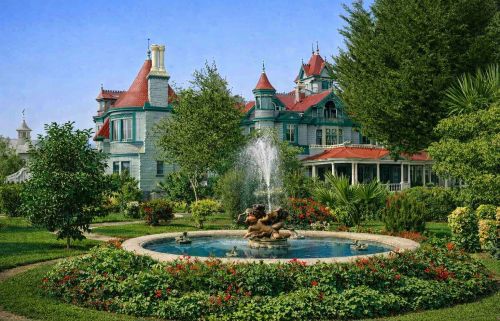
It is the curious and the eccentric aristocrats who refuse to deny ghosts both shelter and respect, and what is a little overwhelming to some Americans is to find how very seriously ghosts are considered by the laborers and the Lords. Active middle-class folk do not ordinarily have much time to spare for speculation on the supernatural. Yet, it can be shown that even in this excessively incredulous day, some of the busiest and most highly regarded ghosts in the Winchester Mansion are still conducting their blood-curdling business at the antique stands where they have been practicing as spectres for ages. The mansion creates haunting energy because of its excess, its shadowed corners, its ornate drama, its hidden rooms, and its beautiful but bizarre features. A few defining elements: pointed arches, steep gables, spires that look like they are reaching for something unseen. The carved wood, ironwork, stained glass, patterned wallpapers. Every surface feels like it is hiding a story. Doors that open onto walls — often remnants of remodels or blocked‑off servant routes, now feeling like portals that forgot their purpose. Staircases that lead to nowhere — truncated attic stairs, abandoned servant access, or architectural flourishes that became dead ends. Trap doors — used for coal chutes, storage, or mechanical access, but narratively perfect for secret passages and sudden disappearances. Closets that are deeper than they should be — narrow, elongated spaces that seem to extend farther than the geometry of the house allows. Rooms with no apparent function — tiny chambers tucked between larger rooms, sometimes only accessible through another room’s closet. False windows — decorative exterior windows that do not correspond to any interior space, suggesting a room that “should” exist but does not. Speaking tubes — hollow metal tubes running through walls, perfect for carrying whispers long after the household staff is gone. A door that opens onto a two‑story drop — a perfect example of Victorian theatricality turned perilous, a threshold that promises passage but delivers only vertigo. A staircase whose steps rise only two inches high — a baffling ascent that feels more like a ritual than a route, forcing visitors to climb in slow, unnatural increments, as though the house were testing their patience or resolve. A room with one entrance but three exits — each more treacherous than the last, including one that opens directly onto the kitchen sink below, a sheer drop so abrupt it feels like the house itself indulging in a dark, private jest, a little cruelty whispered through its carpentry. #RandolphHarris 2 of 6

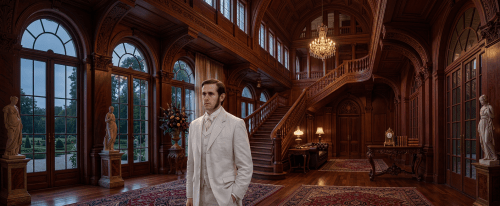
The mansion’s bizarre nature did not end with its haunted corridors or shifting hours; its very architecture seemed to conspire in the uncanny. Mirrors were positioned not merely for illumination but for light management, catching gaslight and flinging it into distant corners so that glimmers appeared where no person stood — fleeting reflections that moved like wandering spirits. Hidden throughout the estate were secret eaves rooms, tiny crawlspaces tucked behind paneling or accessible only through ceiling hatches, narrow chambers meant for listening rather than living. Basement coal rooms — pitch‑black chambers with soot‑stained walls and low ceilings, often left untouched for decades. Ornate radiators — clanking, hissing, and groaning with thermal expansion, sounding uncannily like breathing. Overly tall doors — exaggerated proportions that make rooms feel stretched or distorted. Cupolas and widow’s walks — elevated spaces associated with watching, waiting, and mourning. Labyrinthine floor plans — narrow hallways, servant staircases, unexpected alcoves. Perfect for echoes and apparitions. Gaslight glow — warm, flickering illumination that leaves pockets of darkness where spirits linger. The Victorian architecture of the Winchester Mansion does not just house spirits — it invites them. There is, for instance, a young noble man dressed in late Renaissance attire—a ruffled collar, richly embroidered doublet, which were hallmarks of 16th-century Europe. His face is pale and smooth, with delicate, symmetrical features—a straight nose, soft lips, and large, dark eyes that convey quiet intelligence and restraint. His hair is short and dark, neatly framing his youthful face. Nobody knows how long has been haunting the regal mansion, except perhaps the Winchester family, who could tell when he first appeared and the tragic circumstances out of which, in good orthodox fashion, he was evolved. However, the Winchester family always refused to discuss the young man, whose duty is to herald the approaching death of anyone in the mansion. #RandolphHarris 3 of 6

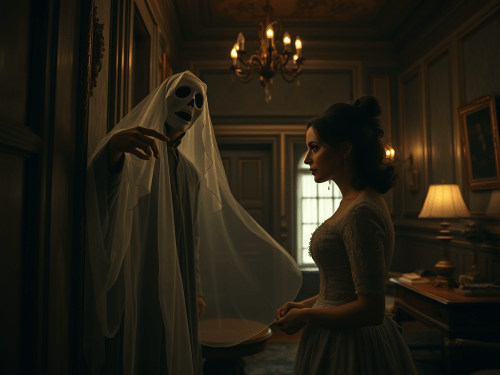
He is known to appear only in the Blue Séance Room—an ancient, brooding chamber tucked deep within the mansion’s oldest wing—and always at the hour of dusk, when the last light bleeds into shadow. He materializes with the poise of a young noble: shoulders drawn back, chin lifted, his manner confident yet curiously restrained, as though he carries the etiquette of a long‑dead court. In the dimming glow, his figure seems to gather its own faint radiance, his Renaissance attire shimmering with a quiet, mournful dignity. He is the very image of youthful aristocracy—cultivated, solemn, and brushed with an otherworldly melancholy. But the mansion does not always grant him this grace. Witnesses speak in hushed voices of encountering his ruined form drifting through distant corridors: a young man decapitated, his eyes torn from their sockets, his hair brutally shaved, his right shoulder ripped open with blood soaking the front of his shirt. Some have seen him cleaved cleanly at the waist, the two halves floating independently like sorrowful relics of a forgotten execution. These apparitions—so grotesque, so impossible—have long terrified and enthralled those who dwell within the mansion’s reach. Yet the greatest unease comes not from his mutilation, nor from his persistence, but from his uncanny resemblance to Mrs. Winchester herself. The likeness is unmistakable, though he predates both her and the mansion by centuries. Rumor insists he was her estranged nephew, arriving to collect a generous sum, only to vanish without a trace. But how could a prince of the sixteenth century share blood with a woman said to be born in the nineteenth? And why does no record agree on the true date of her birth? In the end, the mystery coils back upon itself, as all good hauntings do. The young man’s presence suggests that time within the mansion does not flow forward, but folds—layer upon layer—until centuries touch, and bloodlines blur, and the living find themselves staring into the face of a ghost who should never have existed at all. #RandolphHarris 4 of 6
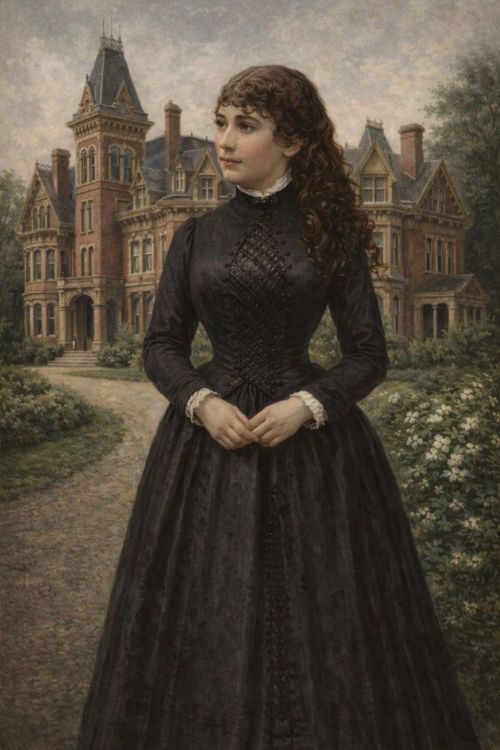
After the 1906 earthquake, Mrs. Winchester never again found contentment within the walls of her great mansion. The damage had unsettled not only the structure but her spirit, and she soon began making plans for a second estate not far from the original grounds. She even commissioned the construction of a sea wall for the new property, though the project never advanced beyond its early stages. While the Winchester Mansion underwent repairs and restoration, she withdrew entirely from its corridors and chose instead to live aboard a houseboat, drifting at a quiet remove from the place that had once consumed her life. When she finally returned to her estate, she often stood at the window, letting her gaze drift across the serene expanse of her beautifully kept yard. One morning, as the first pale ribbons of sunlight unfurled across the lawn, she paused, sensing that the quiet held something new. For a long while she remained at the window, her hand resting lightly against the cold glass. The young prince stood by the crescent‑shaped hedge below her window, emerging from the pale hush of early morning—a time he never kept. He was a creature of dusk, of long shadows and fading light, yet now he stood in the newborn glow as if torn out of his rightful hour. The dawn clung to him awkwardly, casting a thin, uneasy shimmer around his figure. Something was wrong. His presence at daybreak felt less like a visit and more like an omen, a quiet rupture in the order of things that the mansion itself seemed to acknowledge. Mrs. Winchester had always been sensitive to signs, to whispers, to the subtle language of fate. And now, with the ruins of the tower still haunting the grounds and the fourth floor freshly stripped away, she felt the young man’s appearance entwine itself with the earthquake in her mind, merging into a single, undeniable warning. She drew back from the window slowly, her breath shallow. His disappearance left a tremor in the air, a subtle shiver that seemed to ripple through the morning light. It was not the garden that had changed, but something within her—some inner axis knocked slightly off its center. The silence he left behind felt charged, as though the omen had not ended with his vanishing but had slipped inside her, altering the shape of her thoughts in ways she could not yet name. As she stood there, steadying herself against the cold glass, her gaze drifted instinctively toward the front of the mansion. That side of the house — the grand façade, the towering heights, the rooms that had once reached toward the sky — had always felt exposed, vulnerable, too close to the world’s gaze. It was the part that reached outward, inviting scrutiny, inviting disaster. The quake had punished it most severely, tearing down everything she had dared to build upward. #RandolphHarris 5 of 6
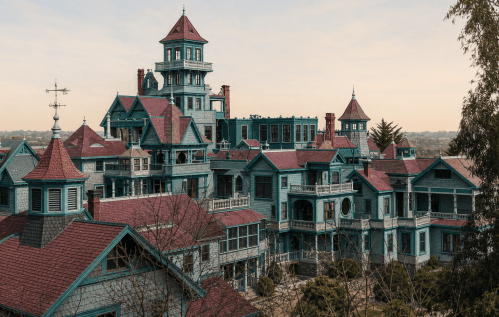
Now, in the wake of the prince’s early‑morning appearance — a violation of his rightful hour — the meaning settled over her with quiet certainty. His presence had not been random. It had been a message. A confirmation of what she had long suspected: she had spent too much of her life, her energy, her grief, on the front of the house. That night, she summoned her carpenters and instructed them to board up the entire front wing. Windows were shuttered, doors sealed, corridors closed off like tombs. She turned her attention instead to the back of the mansion — the winding hallways, the hidden chambers, the places where the house seemed to grow inward rather than outward. There, she resumed her work with renewed fervor, as though the apparition had redirected her hand. From that evening onward, the crescent hedge remained untouched, the boarded façade loomed in silence, and Mrs. Winchester devoted herself entirely to the mansion’s shadowed rear. Some said she was following the guidance of spirits. Others whispered that she was fleeing them. But she alone knew the truth: the earthquake had shaken the house, and the boy had shaken her resolve. Together, they had turned her away from the front — and deeper into the labyrinth she was destined to build. Today, as visitors wander through the mansion, the stained glass scatters light into fractured colors that seem to catch and refract passing apparitions. The grand staircases rise like stages awaiting spectral entrances, their landings steeped in a hush that feels almost rehearsed. Even the sealed conservatories breathe with cold air and faint rustling, as though unseen hands still tend the plants that once grew there. In the grand ballroom — and in the unfinished hidden ballroom— soft echoes drift through the air, the suggestion of music that never resolves into a melody. Several corridors carry whispers and footsteps that fade before reaching the main hall, as if the house itself edits what it allows the living to hear. The Winchester mansion feels less like a structure and more like a living organism, its walls layered with memory. The spirits that move through it are not intruders but simply another part of its anatomy, lingering in the spaces where time folds and refuses to let go. #RandolphHarris 6 of 6
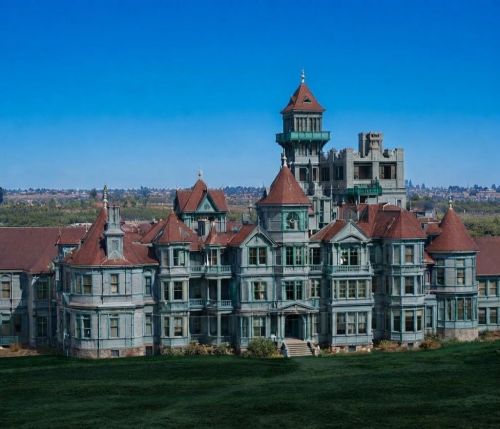
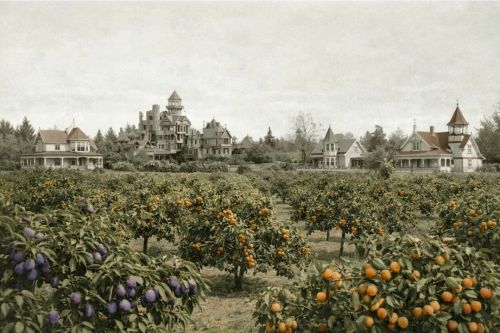
Hopefully, these photographs offer a clearer sense of what the Winchester Mansion looked like before the 1906 earthquake reshaped it. Experts estimate that the mansion once rose nine stories high, that Mrs. Winchester purchased roughly 740 acres of surrounding land, and that—despite modern measurements placing the house at about 24,000 square feet—many researchers and enthusiasts believe the structure is significantly larger even today. At its height, the estate reportedly contained between 500 and 600 rooms. Now, only four stories remain, with 160 rooms in total, approximately 110 of which are open to the public. The grounds have been retained at a beautiful park‑like acreage of four. Construction was nearly continuous. From 1886, when Mrs. Winchester first purchased the farmhouse, until her death in 1922, the mansion evolved through an unbroken cycle of building, altering, expanding, and repairing—a forty‑year transformation that remains one of the most extraordinary architectural undertakings in American history.
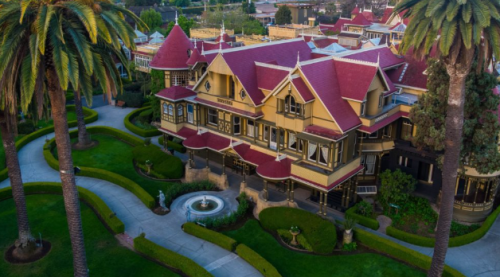
Where History, Mystery, and Imagination Intertwine
Step inside one of California’s most extraordinary landmarks and experience a world unlike any other. The Winchester Mystery House is more than a Victorian mansion—it is a living work of art, a labyrinth of architectural wonders, and one of America’s most captivating historical estates. Built over 36 years without pause, the mansion stands today as a testament to craftsmanship, curiosity, and the enduring legend of Mrs. Sarah Winchester.
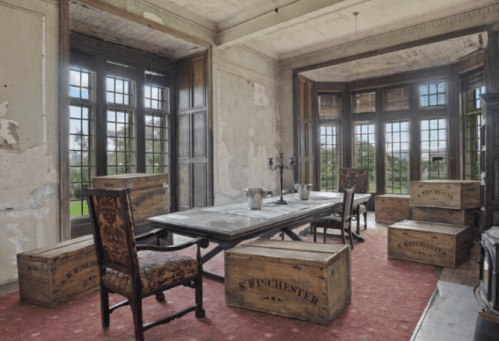
Visitors are invited to explore miles of elegant hallways, beautifully restored rooms, and the mansion’s famously perplexing features: staircases that lead nowhere, doors that open into walls, windows overlooking other rooms, and secret passages woven throughout the estate. Every corner of the house reflects Sarah Winchester’s unique vision, blending Victorian elegance with an eccentricity that continues to fascinate architects, historians, and guests from around the world.

Beyond its architectural marvels, the Winchester Mystery House offers a rare glimpse into the life of a woman who defied convention. Sarah Winchester, heiress to the Winchester Repeating Arms fortune, poured her grief, creativity, and resources into building a home unlike any other. Her story—part tragedy, part triumph, part enduring mystery—adds emotional depth to every room you enter. Visitors leave not only impressed by the mansion’s scale, but moved by the humanity behind its creation.

The estate’s lush gardens, ornate fountains, and tranquil outdoor spaces provide a peaceful contrast to the mansion’s winding interior. Guests can stroll through beautifully landscaped grounds, enjoy seasonal displays, and take in the serene beauty that surrounds the historic home. Whether you’re a lover of history, architecture, horticulture, or simply a seeker of unforgettable experiences, the Winchester Mystery House offers something for everyone.

A visit to the Winchester Mystery House is more than a tour—it is an encounter with legend. It is a place where imagination thrives, where history whispers through every corridor, and where the line between fact and folklore blurs in the most enchanting way. Come discover why millions of visitors from around the world consider the Winchester Mystery House a must‑see destination and one of California’s most iconic treasures.
PRIVATE EVENTS & WEDDINGS
at WINCHESTER ESTATE
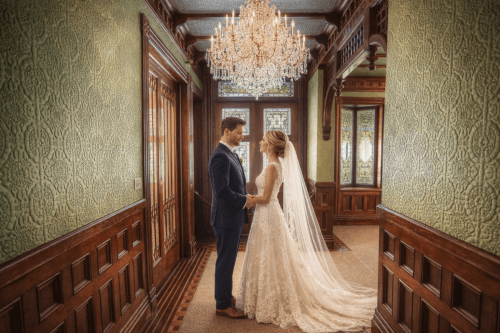
Many event locations claim to be unique, but nothing compares to the Winchester Mystery House. If you’re truly seeking a distinct, one‑of‑a‑kind setting for your milestone celebration or special occasion, reserve a venue that delivers on uniqueness many times over. Whether you’re planning a wedding, birthday or anniversary celebration, corporate gathering, holiday party, or any other meaningful event, the Winchester Mystery House offers an unforgettable backdrop. Give your guests an experience they’ll be talking about for years to come.
Café 13: A Rest Stop on the Edge of the Mystery
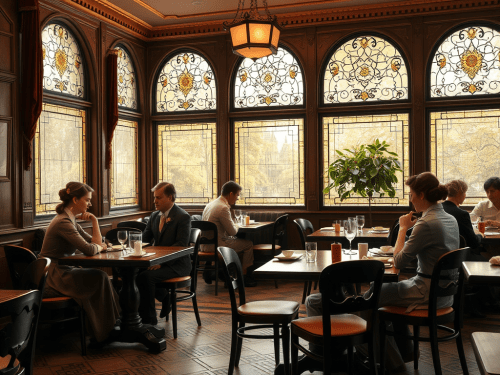
After wandering the winding halls of the Winchester Mystery House—where staircases defy logic and whispers seem to cling to the walls—Café 13 offers a welcome return to warmth and grounding. Newly reopened and serving guests daily from 10 AM to 3 PM, this cozy hideaway invites you to pause, breathe, and gather yourself before diving back into the mansion’s secrets. Settle in with a warm meal, challenge a friend to a board game, or simply rest and recharge as sunlight filters through the windows. Café 13 is more than a café—it’s a moment of calm between chapters of the Winchester legend, a place to steady your nerves before returning to the gardens, the grandeur, and the mysteries that await.
Winchester Mercantile Gift Shop
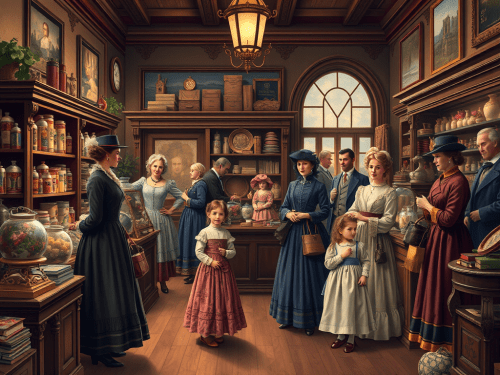
Your journey into the Winchester Mystery House begins long before you cross the mansion’s threshold. It starts at the Mercantile gift shop—a welcoming outpost standing at the edge of a world where history and myth intertwine. Here, beneath warm lights and shelves lined with curiosities, you can secure your tour tickets and prepare for the adventure ahead. Guests often pause for a souvenir photograph, capturing the moment before they step into Sarah Winchester’s enigmatic domain. As you explore the shop, you will find an eclectic array of gifts and keepsakes: tokens of the mansion’s lore, echoes of Victorian elegance, and mementos that carry a touch of the house’s enduring mystery. The Mercantile is more than a gift shop—it is the gateway. https://winchestermysteryhouse.com/

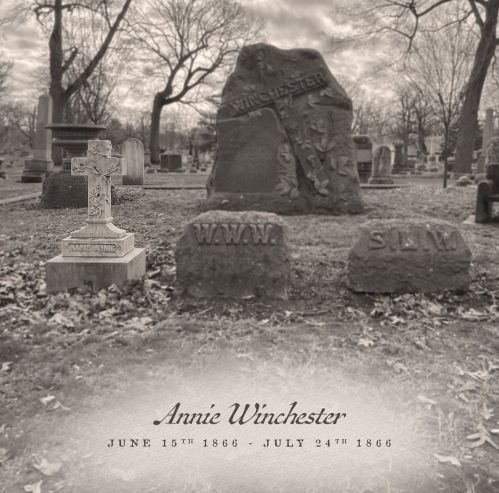
Today marks 160 years since the passing of Annie Winchester, the only child of Sarah and William Winchester.
This photograph shows the Winchester family plot in New Haven, Connecticut, where Annie rests alongside her loving parents. Her grave bears the inscription “Babie Annie.”

The Differnece Between Crisis and Drama
In modern workplaces, “escalate” has become a fashionable badge of initiative, yet its true meaning is far more perilous: to escalate is not to demonstrate power, but to accelerate conflict, amplify risk, and invite consequences that can embarrass, injure, or even destroy the very people who invoke it. Corporate jargon makes escalation sound strategic, like “leveraging,” “optimizing,” or “driving impact.” Social media and startup culture glamorize urgency, making slow, careful problem-solving seem weak or passive. Escalation feels like action, and action feels like competence—especially to someone still proving themselves. It mimics authority, because managers escalate; therefore, escalating feels like acting managerial. But this is a misreading of how power actually works inside organizations. Escalating a minor issue can make the initiator look impulsive, dramatic, or unable to solve problems independently. It signals immaturity rather than leadership. Escalation often implies blame. People feel accused, bypassed, or undermined. Relationships fracture, and trust erodes. Escalation pulls in managers, Human Resources, legal, or executives. What was once a solvable misunderstanding becomes a formal dispute. This is the part most people never consider. In high‑stakes environments—security, law enforcement, healthcare, transportation, customer conflict—escalation can lead to: injuries, wrongful termination, lawsuits, criminal charges, and even death. Escalation is not a metaphor in these settings; it is a literal increase in danger. #RandolphHarris 1 of 27

Escalation often emerges when someone feels: threatened, insecure, disrespected, and powerless. Employees often want to escalate an issue to regain a sense of control. But escalation rarely restores dignity; it usually intensifies the very humiliation or conflict they were trying to avoid. In this sense, escalation becomes a self-defeating defense mechanism—a way of “solving” anxiety by creating a bigger problem. Escalation is often a failure of judgment, restraint, and emotional maturity. Is all that drama even necessary? Instead of using techniques that focus on power forcing, a better model is to focus on de-escalation. De-escalation tends to focus on problem-solving, and it allows professionals to keep their composure, which is a true sign of competence. Instead of ratcheting up the drama, it is better to have a “resolution department.” Many frontline employees now behave as if the customer’s presence is an inconvenience rather than the very reason their job exists. For most of the 20th century, businesses operated under a simple principle: the customer pays everyone’s bills. That was not just a slogan—it was an economic truth. When employees forgot that, businesses failed. “The customer is always right” is now mocked as naïve or outdated. When rudeness becomes normalized, managers stop correcting it, and it becomes the store’s culture. Viral videos reward snark, clapbacks, and public humiliation, making hostility feel clever or justified. This creates a workplace where disrespect is not an accident—it is a performance. #RandolphHarris 2 of 27

Why do some employees now enjoy being rude? Ever since the hit TV show “Gossip Girl,” aired, people have taken as a signal to come off as elite to be rude. However, you must remember, not that it was right for the fictional characters to be rude, but they actually were the elite. They did not have to work for a living. These young men and women had personal bank accounts with millions of dollars in them. So, it mirrors the behavior of this elite class, some employees believe that being rude creates a momentary sense of dominance. It also signals a sense of belonging in workplaces where hostility is the norm. It allows people who feel rejected, threatened, disrespected, or under paid to be condescending to someone who cannot retaliate without consequences. Being rude to customers for no reason also masks insecurity. This is a defensive posture disguised as confidence. Being rude to patrons also flips the script: instead of serving, the employee becomes the judge of who “deserves” service. However, people in customer service are what the elite would consider servants. When you accept that someone will always have more—looks, money, talent, status—you stop treating life as a competition you are supposed to win. That dissolves the corrosive comparison that drives so much workplace hostility and escalation. Humility grounded in reality—not false modesty—keeps you from inflating your own importance. It prevents the entitlement that makes some employees rude to customers or reckless with conflict. #RandolphHarris 3 of
People who believe they must be the best at everything crumble when they are not. My perspective gives me resilience: I do not break when someone surpasses me, because I never built my identity on being untouchable. This is the opposite of the insecure bravado I have been describing in new employees who escalate issues or mistreat customers. My background gives me a vantage point many people never develop: I have seen what it means to work hard for what I have. I understand that respect is earned, not demanded. I know that power is not proven through aggression. I have lived enough life to recognize that everyone is replaceable—including myself. This creates a humility that is not weakness, but clarity. These very reasons are exactly why millions of people all over the world also loved Aaliyah. Allow your status in the world to anchor you. Remember that power is not proven through escalation or rudeness, but through restraint, respect, and the ability to stay grounded when others lose themselves in their fragile egos. When I talk to my mother, she always reminds me of Galatians 6.7, “A man reaps what he shows; good or bad actions will return to him.” Morbidly dependent relationships often begin with what looks like a simple choice of partner, but the choice is rarely “unfortunate” by accident. It reflects deeper psychological patterns—unmet needs, unresolved wounds, and internal narratives about love, safety, and worth. When those patterns go unexamined, people can be drawn toward partners who intensify their vulnerabilities rather than support their growth. The self-effacing person actually does not choose but instead is “spellbound” by certain types. He is naturally attracted by a person of the same or opposite sex who impresses him as stronger and superior. Leaving out of consideration here the healthy partner, he may easily fall in love with a detached person, provided the latter has some glamour through wealth, position, reputation, or particular gifts; with an outgoing narcissistic type possessing a buoyant self-assurance similar to his own; with an arrogant-vindictive type who dares to make open claims and is unconcerned about being haughty and offensive. #RandolphHarris 4 of 27
Several reasons combine for his being easily infatuated with these personalities. He is inclined to overrate them because they all seem to possess attributes which he may not only bitterly misses in himself but ones for the lack of which he despises himself. It may be a question of independence, of self-sufficiency, of an invincible assurance of superiority, a boldness in flaunting arrogance or aggressiveness. Only these strong, superior people—as he sees them—can fulfill all his needs and take him over. To allow the fantasies of one-woman patient: only a man with strong arms can save her from a burning house, a shipwreck, or threatening burglars. However, what accounts specifically for being fascinated or spellbound—id est, for the compulsive element in such an infatuation—is the suppression of his expansive drives. As we have seen, he must go to any length to disavow them. Whatever hidden pride and drives for mastery he has, remain foreign to him—while, conversely, he experiences the subdued helpless part of his pride system as the very essence of himself. However, on the other hand, because he suffers under the results of his shrinking process, the capacity to master life aggressively and arrogantly also appears to him to be most desirable. Unconsciously and even—when he feels free enough to express it—consciously, he thinks that if only he could be as proud and ruthless as the Spanish conquistadors, he would be “free,” with the world at his feet. However, since this quality is out of reach for him, he is fascinated by it in others. He externalizes his own expansive drives and admires them in others. It is their pride and arrogance that touch him to the core. #RandolphHarris 5 of 27

Not knowing that he can solve his conflict in himself only, he tries to solve it by love. To love a proud person, to merge with him, to live vicariously through him would allow him to participate in the mastery of life without having to own it to himself. If in the course of the relationship he discovers that the god has feet of clay, he may sometimes lose his interest because he can no longer transfer his pride to him. On the other hand, the person with self-effacing trends does not appeal to him as a sexual partner. He may like him as a friend because he finds in him more sympathy, understanding, or devotion than in others. However, when starting a more intimate relationship with him, he may feel even repelled. He sees in him, as in a mirror, his own weakness and despises him for it or at least is irritated by it. He is also afraid of the clinging-vine attitude of such a partner because the mere idea that he himself must be the stronger one terrifies him. These negative emotional responses then may render it impossible to value existing assets in such a partner. Among the obviously proud people those of the arrogant-vindictive type, as a rule, exert the greatest fascination on the dependent person although, in terms of his real self-interest, he has stringent reasons to be afraid of them. The cause of the fascination lies, in part, in their pride in the most conspicuous way. However, even more crucial is the fact that they are most likely to knock his own pride out from under him. The relationship may start, indeed, with some crude offense on the part of the arrogant person. In Ann Rice’s film Queen of the Damned (2002), we see this behavior mirrored in Prince Lestat when he meets the mortal woman, Jessie. #RandolphHarris 6 of 27

In this case, the dependent person (Jessie) responds with first with anger and impulse to get back at the offender (Prince Lestat), who she is obsessed with and has tracked to a bar in London called the Admirals Arms. When she finds herself in danger, Prince Lestat rushes in and saves her. But when he is about to leave, Jessie upsets him by bringing up a painful memory his holds close to his heart. As the film roles on, he simultaneously becomes so fascinated that he “falls” for her hopelessly and passionately and has thereafter but the one driving interest: to win her love. Thereby, he ruins, or almost ruins himself by exposing his existence and the existence of others like him to the public. Insulting behavior frequently precipitates a dependent relationship. It need not always be as dramatic as in Queen of the Damned (2002). It may be much more subtle and insidious. However, I wonder if it is ever entirely missing in such a relationship. It may consist of a mere lack of interest or an arrogant reserve, of paying attention to others, of joking or facetious remarks, of being unimpressed by whatever assets in the partner usually impresses others—such as name, profession, knowledge, beauty. These are “insults” because they are felt as rejections, and—as I have mentioned—a rejection is an insult for anybody whose pride is largely invested in making everybody love him. The frequency of such occurrences throws light upon the appeal detached people have for him. Their very aloofness and unavailability constitute the insulting rejection. #RandolphHarris 7 of 27
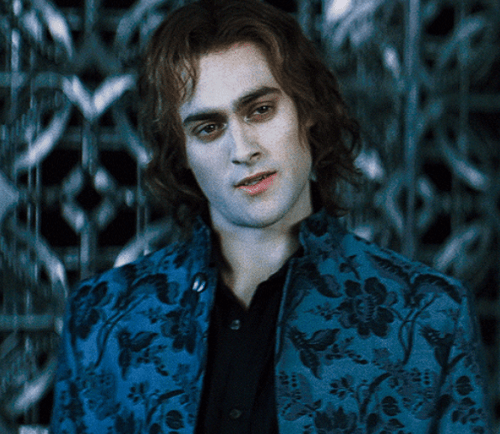
Incidents such as these seem to lend weight to the notion that the self-effacing person merely craves for suffering and avidly seizes the prospect of it offered by the insults. Actually, nothing has more blocked a real understanding of morbid dependency than this notion. It is all the more misleading since it contains a grain of truth. We know that suffering has manifold neurotic values for him and it is also true that insulting behavior attracts him magnetically. The error lies in establishing too neat casual connection between these two facts by assuming that the magic attraction is determined by the prospect of suffering. The reason lies in two other factors, both of which we mentioned separately: the fascination that arrogance and aggressiveness in others exert on him, and his own need for surrender. We now can see that these two factors are more closely interlinked than we have hitherto realized. He craves to surrender himself body and soul, but can do so only if his pride is bent or broken. In other words, the unconditional love that Queen Akasha and the fact that she saved his life meant nothing to him. Jessie’s initial offense was not so much intriguing because it hurt as because it opens the possibility for self-riddance and self-surrender. Prince Lestat hated himself because he was a Vampire. He was so fascinated with being mortal and the mortal woman he got the violin from that it broke his heart when he had to kill her. Because vampires could not be known to humans. When Jessie brought up that point about the violin, it reminded him of the deep hatred he felt for his own kind and for himself. To use a patient’s words: “The person who shakes my pride from under me releases me from my arrogance and pride.” Or: “If he can insult me, then I am an ordinary human being”—and, one might add, “only then can I love.” We may think here too of Anne Rice’s 2022 American gothic, horror television series Interview with the Vampire, when Prince Lestat’s passion is only inflamed when he is not loved by Louis de Pointe du Lac. #RandolphHarris 8 of 27
No doubt, the abandoning of pride as a rigid condition for love-surrender is pathological, particularly since the pronounced self-effacing type can love only if he feels, or is, degraded. However, if we remember that for the healthy person love and true humility go together, the phenomenon ceases to seem unique and mysterious. It also is not quite as widely different from what we have seen in the expansive type as we might at first be led to believe. The latter’s fear of love is mainly determined by his unconscious realization that he would have to relinquish much of his neurotic pride for the sake of love. To put it succinctly: neurotic pride is the enemy of love. Here the difference between the expansive and the self-effacing type is that the former does not need love in any vital way but, on the contrary, shuns it as a danger; while for the latter, love-surrender appears as a solution for everything, and hence as a vital necessity. The expansive type, too, can surrender only if his pride is broken, but then may become passionately enslaved. Stendhal has described this process in the proud Mathilde’s passion for Julien in The Red and the Black. It shows that the arrogant person’s fear of love is well founded—for him. However, mostly he is too much on his guard to allow himself to fall in love. Being too on guard to fall in love is not a flaw—it is a protective stance shaped by experience, memory, and the lessons your life has already taught you. It signals that you have seen enough of human behavior to know that intimacy is not a game, and that choosing the wrong person can cost far more than loneliness ever will. The paradox of being guarded, however, is that guarded people often love the deepest, but only when they feel truly safe. That is why Prince Lestat chose Jessie over Queen Akasha. As the saying goes, men fear powerful women, at least some do. #RandolphHarris 9 of 27
In what sense, then, is it still possible to speak, as the New Testament does clearly enough, of love as an activity of men, of the love of men for God, and for their neighbor? In view of the fact that God is love, what can now be meant by saying that man, too, can love and ought to love? “We love him, because he first loved us,” reports 1 John 4.19. This means that our love for God rests solely upon being loved by God, in other words that our love can be nothing other than the willing acceptance of the love of God in Jesus Christ. “If any man love God, the same is known of him,” reports 1 Corinthians 8.3). “Known” in the language of the Christian Bible means “elected” and “engendered.” To love God means to accept willingly His election and His engendering in Christ. If we say that divine love precedes the human love, but solely for the purpose of setting human love in motion as a love which, in relations to the divine love is an independent, free and autonomous activity of man, the relation between the divine love and human love is wrongly understood. On the contrary, everything which is said of human love, too, is governed by the principle that God is love. The love with which man loves God and his neighbor is the love of God and no others; for there is no other love; there is no love which is free or independent from the love of God. In this, then, the love of men remains purely passive. Loving God is simply the other aspect of being loved by God. Being loved by God implies loving God; the two do not stand separately side by side. #RandolphHarris 10 of 27

In order to make this clearly intelligible, a further word of explanation is necessary with regard to the use of the concept of passivity in this context. Here, as always in theology when there is reference to the passivity of men, we are not concerned with a psychological concept but with one which applies to the existence of men before God, that is to say, with a theological concept. Passivity with respect to the love of God does not mean that exclusion of all thoughts, words and deeds which is possible when I seek repose in a love of God that can come to me only in a particular “quiet hour.” The Love of God is not only that haven of refuge in which I take shelter in distress. Being loved by God does not by many means deprive man of his mighty thoughts and his spirited deeds. It is as whole men, as men who think and who act, that we are loved by God and reconciled with God in Christ. Ans it is as whole men, who think and who act, that we love God and our brothers. All of us define our identities to ourselves and to others in terms of the roles we have had assigned to us and those we have sought to assume because of the status and privilege associated with them. Thus, I define myself as a man (my gender role and gender at birth), father of my children and husband to my wife; son of my parents and brother of my siblings (family roles); and psychotherapist, teacher of my students, researcher, and writer (occupational roles). I had to be trained for some of these roles, whereas I seemed to “grow” into others. There are norms and rules governing the ways in which I age my age, my gender, my family roles, and my occupational roles. People come to depend upon me to act in stable and predictable ways, and I come to expect such stability of myself. #RandolphHarris 11 of

Each social role that persons embody serves as a kind of badge entitling them to participate in life with others in prescribed ways, and each role sets limits on their freedom and access to material good. Roles, in short, entitle a person to the privileges association with high status in a group, or they condemn them to the dregs reserved for those of low status. A Caucasian person used to have to tan their skin to discover the discrimination an African American person faced. However, across many societies, rapid changes—globalization, demographic shifts, economic restructuring, and public debates about historical injustices—have altered how different groups experience social status. These changes can create a sense of dislocation or loss of certainty, especially for groups that historically held more social or economic stability. Several factors contribute to this. Global competition has reshaped industries, reducing the economic security that many workers once relied on. Public conversations about history have highlighted injustices that were previously minimized or ignored, which can feel like criticism to people who did not personally participate in those events. Immigration debates often become emotionally charged, creating a sense of cultural or economic threat for some individuals. Inequality has grown across many countries, affecting people of all backgrounds and creating frustration that sometimes gets misdirected. These forces can combine to create a feeling among some White men that they are being pushed aside or blamed, even if the underlying issues are structural rather than personal. Common experiences include: Feeling scrutinized in public conversations about privilege or inequality, feeling that opportunities are more competitive than before, feeling that cultural narratives no longer place them at the center, and feeling blamed for historical or systemic issues they did not personally cause. These reactions are not unique to any one group; they appear whenever social hierarchies shift. #RandolphHarriis 12 of 27

Women have become keenly aware that the female role, in most societies, condemns women to inferior education, lower occupational status, and usually the exclusive responsibility of rearing children, unless they resist this definition. People in their sixties or seventies find themselves treated by younger people as if they were fragile, stupid, and lacking in fundamental human traits such as the needs for companionship, love, and ennobling work. Also, other persons stigmatized by society are given a rile to play by society and are under pressure to play that role. Thus, Paris Hilton might be expected to act in certain ways by the rest of society, and she may do so, even though she ordinarily would choose not to do so. Even sickness is governed by social norms. When persons feel unwell, they enter the role of patient, which entitles them to interact with physicians and nurses, or with psychotherapists if they are diagnosed as “mentally ill.” Recent, research has shown that people are trained to act like a “good patient” in hospitals, and this training has nothing to do with the treatment of illness. Moreover, the hospital itself is a complex web of profession, uniforms, titles, and badges that define status, authority, and responsibility. I worked for several years with a college of nursing; the hospital where the nursing students trained has as employees the graduates of four-year colleges of nursing, who earned a B.A. degree as well as the Registered Nurse (R.N.) diploma; R.N.’s with a degree from a community junior college; licensed practical nurses who had has no college training; and nursing assistants. The bewildering array of backgrounds puzzled the nurses and the physicians as much as it did the patients; the nurses with each type of training felt somehow different from the others and felt entitled to more responsibility, salary, and freedom. #RandolphHarris 13 of 27
The patients in hospitals are often made to feel like the least important, lowest caste members of the hospital community. They are treated as children about to be disobedient, and they are often kept in the dark about the nature of their illness and the precise nature of the medicines or operations that were prescribed for or conducted upon them. In mental hospitals I visited, even to be there as a patient insured that the staff would not treat the patient as a free, responsible human being; rather, the patient was seen and talked about—sometimes in his or her presence—as the embodiment of the mental illness. The patient was required to participate in therapeutic processes, to take medicine, and so on. For research purposes, a group of psychologists were admitted to mental hospitals as patients, to study the career of the mental patient firsthand. They found that they could not convince the attendants and professional staff that they were “sane,” though the authentic patients knew they were. Role and the badges, titles, and uniforms that identify them enable others to predict how we will act in social situations. The ability to master a variety of roles throughout life is a decided asset for healthy personality, because it facilitates the interactions with others that bring satisfaction of many basic needs. Not to be able to enter roles because of an unhealthy self-structure of irrational fears thus impedes healthy personality development. If a young woman cannot make a career choice because she lacks confidence in her ability to master the training, she may face a life of low economic status. A man with sexual inhibitions may avoid intimate relationships with woman and live a life that is safe but devoid of loving relationships. #RandolphHarris 14 of 27

Although role conformity implies some limitations on one’s freedom of expression and action, there is a sense in which the ability to act in ways appropriate to one’s family position, age, gender, and profession is liberating. Not to adhere to reasonable definitions of appropriate behavior is to invite social censure, which can interfere radically with effective living and the attainment of satisfactions. It sometimes appears hypocritical to students that older people may display politeness and feign delight at being with people they dislike. Actually, the ability to conform with the “niceties” in a variety of situations can be life-giving and liberating, because it clearly separates personal relationships (where spontaneity is expected) from the more formal relationships between strangers. In some cultures, like the English, the French, and the Spanish, much time is spent in ceremonious interaction with others, yet there is room in those cultures for great freedom in the privacy of personal relationships. Europeans often complain that Americans seem friendly in impersonal situations, as in business, but that in private they avoid deepening relationships. If not all of the substance of behavior, roles function to aid in the development of the healthy person by structuring the skeleton of behavior. At the party, my role will be that of the great seducer; with my grandparents, I shall play the role of the dutiful son; in class, the role of scholar will help me decide what to do and how to be. The roles provide stability in some cases so that you can know how to behave initially in new situations. They provide a context that enables you, as in the case of a good actor, to also build in your own unique self and characterization of the role. One might expect the healthy personality to utilize the role concept and then proceed onward from there to fashion full selfhood with his other repertoire of roles or through fashioning an entirely new role. #RandolphHarris 15 of 27
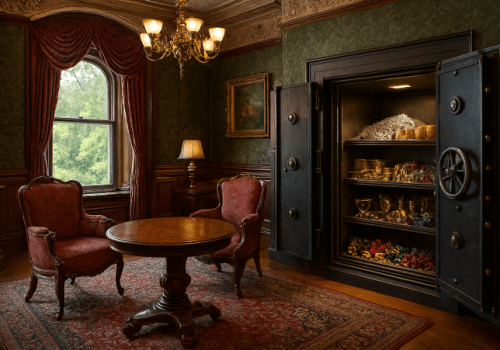
Within institutions, their linguistic objectifications, from their simple verbal designations to their incorporation in highly complex symbolizations of reality also represent them (that is, make them present) in experience. And they may be symbolically represented by physical objects, both natural and artificial. All these representations, however, become “dead” (that is, bereft of subjective reality) unless they are ongoingly “brought to life” in actual human conduct. The representation of an institution in and by roles is thus the representation par excellence, on which all other representations are dependent. For example, the institution of law is, of course, also represented by the ultimate legitimations of the institution and its norms in ethical, religious, or mythological systems of thought. Such man-made phenomena as the awesome paraphernalia that frequently accompany the administration of law, and such natural ones as the clap of thunder that may be taken as the divine verdict in a trial by ordeal and may eventually even become a symbol of ultimate justice, further represents the institution. All these representations, however, derive their continuing significance and even intelligibility from their utilization in human conduct, which here, of course, is conduct typified in the institutional roles of the law. When individuals begin to reflect upon these matters, they face the problem of binding the various representations together in a cohesive whole that will make sense. Any concrete role performance refers to the objective sense of the institution, and thus to the others complementary role performances, and to the sense of the institution as a whole. While the problem of integrating the various representations so involved is solved primarily on the level of legitimation, it is also dealt with in terms of certain roles. #RandolphHarris 16 of 27

All roles represent the institutional order in the afore-mentioned sense. Some roles, however, symbolically represent that order in its totality more than others. Such roles are of great strategic importance in a society, since they represent not only this or that institution, but the integration of all institutions in a meaningful world. Ipso facto, of course, these roles help in maintaining such integration in the consciousness and conduct of the members of the society, that is, they have a special relationship to the legitimating apparatus of the society. Some roles may have no function other than this symbolic representation of the institutional order as an integrated totality, others take on this function from time to time in addition to the less exalted functions they routinely perform. The judge, for instance, may, on occasion, in some particularly important case, represent the total integration of society in this way. The monarch does so all the time and, indeed, in a constitutional monarchy, may have no other function than as a “living symbol” for all levels of the society, down to the man in the street. Historically, roles that symbolically represent the total institutional order have been most commonly located in political and religious institutions. More important for our immediate considerations is the character of roles as mediators of specific sectors of the common stock of knowledge. By virtue of the roles he plays, the individual is inducted into specific areas of socially objectivated knowledge, not only in the narrower cognitive sense, but also in the sense of the “knowledge” of norms, values and even emotions. When it comes to you, your family, and your institution, think about how you want to be viewed. Your behavior speaks volumes about you and your organization. As a reminder, it is important to never let anything escalate. Find a reasonable solution that is amicable for both parties. People and businesses known for have arduous relationships tend to carry about reputation and reputable people choose to avoid them. #RandolphHarris 17 of 27

The award-winning Sacramento Fire Department stands out as one of the region’s most established and respected public‑safety institutions. Its reputation is grounded not in slogans but in a long, documented history of service, scale, and operational capacity. The department’s mission is explicitly centered on protecting the community through comprehensive emergency response and prevention services, which aligns directly with your point that they are “in the business of saving lives.” Few public institutions maintain continuous service for as long as the Sacramento Fire Department. Its longevity is not just a historical footnote—it’s a marker of institutional stability, community trust, and operational evolution. The department’s origins in the mid‑19th century place it at the heart of Sacramento’s early civic development, and its transformation into a fully paid, modern agency by 1872 reflects the city’s rapid growth and the increasing complexity of urban fire protection. A structural collapse is one of the most feared events in firefighting because it represents true escalation—the kind that threatens lives, demands expertise, and requires humility in the face of forces larger than oneself. A structural collapse embodies everything escalation actually means. Acceleration — A building can go from stable to deadly in seconds. Amplification — A small fire becomes a catastrophic event. Loss of control — Even trained professionals cannot fully predict or contain it. Life‑or‑death stakes — Firefighters risk injury or death; civilians may be trapped. This is escalation in its purest form: a situation where the stakes rise beyond human control. #RandolphHarris 18 of 27
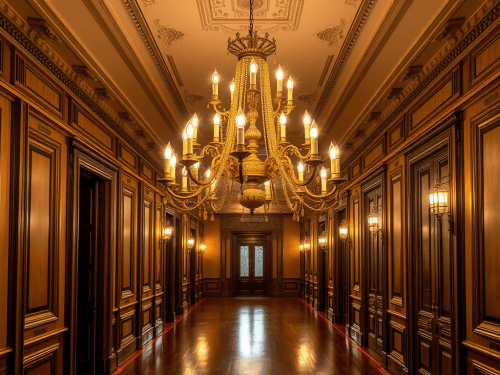
Not long ago, two firefighters were killed when a wall collapsed during an emergency response, and only a few years later another crew narrowly escaped the same fate. Around midnight on a September morning, firefighters arrived at an abandoned building already engulfed in flames, the roof gone and the windows blown out. A strong east wind threatened to carry the fire into a row of nearby homes, so crews surrounded the structure and fought to contain it. During the height of the blaze, the roof caved inward, destroying the wall supports. The west wall began to buckle, giving the men only seconds to retreat before it crashed down where they had been standing. That is what real escalation looks like—sudden, deadly, and beyond human control. When I compare that to the way people in offices escalate minor issues to feel powerful, the difference is sobering. Firefighters face true danger; many workers only imitate it. Firefighters know that no amount of training, strength, or confidence can stop a collapsing wall. That awareness keeps them grounded. The Sacramento Fire Department understands that forces larger than oneself exist, and that ego has no place in environments where lives are at stake. The way an emergency call is reported and dispatched affects response. Calls such as building fires, heat attacks, and trench rescues are usually presumed to be emergences based on the dispatcher matching the caller’s information to predetermined response procedure. Service calls for animal rescues, water leaks, and other investigations or complaints generally are regarded as nonemergency responses. Sometimes additional information categorizes a call to an emergency or nonemergency response. For instance, a carbon monoxide alarm with no illness in many jurisdictions gets a nonemergency response to check for the poisonous gas, whereas a carbon monoxide alarm with people ill upgrades it to an emergency response with advanced life support (ALS). Other calls are not quite as cut and dry when it comes to determining the severity of the emergency, but some specific types of calls could benefit from a national standard for response including automatic alarms, odor or smoke investigation calls, EMS assists, and ambulance transports. #RandolphHarris 19 of 27

What is the standard response to an automatic fire alarm with no supporting information at a hotel? Some departments deploy multiple stations responding with lights and siren, whereas others wait for conformation from hotel security before dispatching. It could be that your department responds as the first-due company with lights and siren (emergency), whereas secondary units continue nonemergency care until further information cancels them or has them upgrade the response. A risk-benefit mode would have to take into account the number of false alarms, the potential for the loss of life and property with a delayed response, as well as the potential risk for an apparatus crash. Although motor vehicle crashes are a significant cause of death for fire fighters, hotel fires have the potential to cause numerous deaths as well. Many commercial and industrial buildings these days have automatic fire alarms, and sometimes automatic alarm response needs more planning. For example, a childcare center or school might require a heavier response during occupied hours than when it is closed, and the chance for a real emergency at the city outdoor pool pavilion in January that requires a heavy response for a fire alarm is unlikely. Sometimes the alarm is better at describing the problem. Thunderstorms are notorious for setting off false alarms due to power outages or surges, but alarms cannot be assumed false, because lightning can be the cause of an actual fire. An automatic alarm that comes in as water flow alarm at an unoccupied store in the middle of the night during a thunderstorm should be treated a little more seriously than a pull station. The reliability of an alarm that distinguishes the special problem before the fire department arrives depends on the design and performance of the system. #RandolphHarris 20 of 27

Why odor and smoke investigations matter? Fire service literature consistently emphasizes that odor calls are deceptively dangerous. They are statistically less common and often low‑acuity, but they can mask high‑risk situations. One emergency dispatch journal notes that even a caller reporting a “rotting animal smell” could actually be describing a natural gas leak or something more severe. Fire engineering sources reinforce that odor investigations require firefighters to act as both investigators and responders, because while many odors turn out to be harmless, some are early indicators of electrical failures, chemical hazards, or hidden fires. This duality—routine on the surface, dangerous underneath—makes odor calls a perfect example of true professional vigilance, not the performative escalation you have been critiquing in workplace culture. How these calls escalate in real life? Odor and smoke investigations can escalate in several ways: Hidden structural fires — A smell of burning can be the first sign of fire inside a wall, attic, or crawlspace. Electrical failures — Overheating wires or failing appliances can ignite suddenly. Gas leaks — A faint odor may precede an explosion. Chemical hazards — Industrial or household chemicals can produce toxic fumes. Unknown sources — Many calls never reveal a clear cause, which means responders must assume the worst until proven otherwise. FireRescue1 warns that “smells and bells” calls have, over the years, progressed into serious fires that claimed firefighters’ lives when crews or dispatchers underestimated the risk. Why dispatch classification is critical? Emergency dispatch systems track odor calls under specific protocols, and while they are statistically rare, dispatchers are trained not to assume low severity until they gather complete information. This is the opposite of casual escalation. It is measured escalation, based on evidence, risk, and public safety. Even though most of these calls turn out to be harmless, the fire department approaches each one with disciplined caution because the consequences of being wrong can be catastrophic. #RandolphHarris 21 of 27

Back in 2012, a fire alarm in a low‑rise building turned into a full‑scale emergency when someone on the first floor was smoking and the fire spread faster than anyone expected. Elevators are supposed to shut down during a fire alarm so no one unknowingly rides into danger, but this building kept them active because many elderly residents could not use the stairs. By the time firefighters arrived—within minutes—the first floor was already engulfed in flames. Before that incident, a former tenant had a violent quarrel with her partner. In his anger, he filled a gas can, placed it inside the elevator, and sent it up to the ninth floor where she lived. The resulting blaze destroyed the entire floor. It wasn’t an isolated event—other fires and serious incidents have occurred in the building over the years as well. This fits into a long, troubling pattern: a building that has accumulated layers of unresolved danger, human volatility, and managerial neglect—each incident stacking on top of the last until the place itself becomes a kind of archive of near‑catastrophes. One person’s emotional outburst can weaponize the building’s own infrastructure. And when a building’s systems—elevators, alarms, ventilation, access points—can be turned into tools of destruction, it means the structure is already compromised at a deeper level. A fire alarm that turns out to be a real fire is one thing; a fire alarm in a building where the elevators are intentionally left active—despite the presence of elderly residents who cannot use stairs—is something else entirely. It becomes a case study in how small policy decisions can escalate into life‑threatening conditions, and it fits directly into the them of real danger, real escalation, and the difference between professional responsibility and organizational negligence. Elevators are designed to shut down during fire alarms to prevent occupants from being delivered directly into a fire zone. Disabling that safety feature—even for compassionate reasons—creates a structural vulnerability. A first‑floor fire is especially dangerous because it can trap people above it and cut off escape routes. Fire spreads faster than most people realize, especially in older or low‑rise buildings with compromised fire barriers. The fire department’s rapid response cannot compensate for unsafe building policies. “By the time firefighters arrived, the first floor was already engulfed.” That is not a failure of the fire department—it is a failure of the building’s safety systems and decision‑making. #RandolphHarris 22 of 27
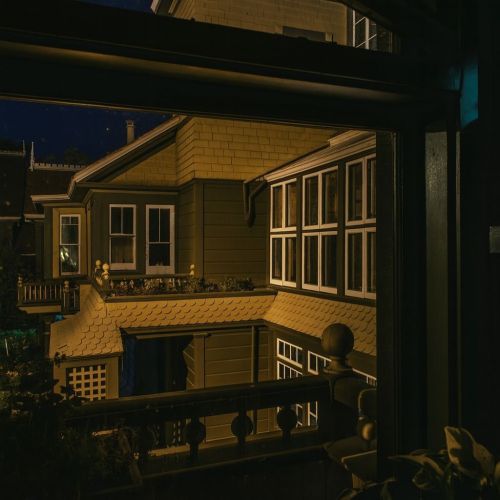
Most multi‑unit residential buildings in California either restrict or completely prohibit smoking, but the exact rules depend on a mix of state law, local ordinances, and individual landlord policies. The trend is overwhelmingly toward smoke‑free housing, especially in apartments, condos, and senior‑living buildings. This is important because: A cigarette becomes a smoldering ignition source. A smoldering ignition becomes a room fire. A room fire becomes a floor fire. A floor fire becomes a building‑wide emergency. A building‑wide emergency becomes a life‑threatening situation for residents and responders. This is escalation in its literal, physical sense: a small hazard accelerating into a catastrophic event. It also shows how human decisions—keeping elevators active—can unintentionally amplify risk. Without local ordinances, many buildings default to smoke‑free policies because: It reduces fire risk. It lowers insurance costs. It prevents secondhand smoke complaints. It protects vulnerable residents (children, elderly, disabled). California cities and counties have gone much further than state law. As of 2024: 190 California municipalities regulate smoking in multi‑unit housing to some extent. 100 municipalities prohibit smoking inside private units of multi‑unit housing. These local rules often apply to: Individual apartment units, balconies and patios, shared outdoor areas, and entire multi‑unit complexes. This means that in many parts of California, smoking is banned not just in common areas but inside the apartments themselves. Once a landlord includes a no‑smoking clause in the lease or house rules, it becomes a binding term of tenancy. That means: They must enforce it like any other rule (noise, pets, parking). They must respond to complaints in a reasonable timeframe. If smoking creates a habitability issue (exempli gratia, secondhand smoke entering units), they must act. They may issue warnings, notices to cure, or even terminate tenancy for repeated violations. If they fail to enforce their own rules, tenants may argue that the landlord is violating their duty to maintain a habitable environment—especially because secondhand smoke can drift through walls, vents, and floors. #RandolphHarris 23 of 27

When does non‑enforcement becomes a legal or safety problem? A landlord’s failure to enforce smoking rules can become serious when: Secondhand smoke affects vulnerable tenants (elderly, disabled, asthmatic). Smoke enters other units, violating habitability standards. Smoking increases fire risk in older or multi‑unit buildings. Local ordinances require smoke‑free housing and the landlord ignores them. The building participates in subsidized housing programs with stricter rules. In these cases, tenants may have grounds to file complaints with local housing authorities or pursue remedies under habitability laws. Building‑management liability in California sits at the intersection of fire safety law, habitability standards, and negligence principles. When a landlord or property manager fails to enforce safety rules—such as smoking bans, fire‑alarm protocols, or elevator shutdown requirements—they can be exposed to significant legal and financial consequences. The key is that California law imposes affirmative duties on building owners to maintain safe premises, and courts evaluate liability based on whether the owner took reasonable steps to prevent foreseeable harm. Under California negligence law, property owners owe tenants and visitors a duty of care to keep the property reasonably safe. This includes preventing hazards that could cause injury or death. Fire safety is explicitly part of this duty, reinforced by the State Fire Marshal’s regulations and the California Building Code, which governs fire and smoke protection features in structures. If a landlord adopts a no‑smoking policy or other safety rule, they must enforce it consistently. Non‑enforcement can create liability if: A fire occurs due to smoking in prohibited areas, secondhand smoke creates habitability violations, vulnerable tenants (elderly, disabled) are placed at risk, and the landlord ignored repeated complaints. Courts look at whether the landlord acted reasonably once they knew—or should have known—about the hazard. Smoking in multi‑unit housing is serious. If a landlord allows smoking in violation of local ordinances or their own lease terms, and a fire results, they may be liable for: Negligence, breach of the implied warranty of habitability, wrongful death or injury claims, and property damage claims. #RandolphHarris 24 of 27

When it comes to firefighting, no matter how large or small the fire is or how routine the call seems to be, there is always the potential for injury. If you see a fire truck stopped in the street without the lights on, be very careful. Sometimes there is an emergency, and you should not pass the fire truck. It might be a good idea to safely turn around and go another way because if you hit someone and they happen to die, you could be charged with manslaughter. Sometimes fire firefighters are getting back into their vehicle, and if you pass the apparatus, you may collide with a firefighter who is on foot. Also, be sure to look at their signals; sometimes emergency vehicles are in motion, albeit slowly, and drivers try to pass them, and this could lead to a dangerous situation. Also, if you are in an intersection when you see an emergency vehicle, continue through the intersection. Drive to the right as soon as it is safe and stop. Obey any direction, order, or signal given by a law enforcement officer or a firefighter. Even if they conflict with existing signs, signals, or laws, follow their orders. When their siren or flashing lights are on, it is against the law to follow within 300 feet of any fire engine, law enforcement vehicle, ambulance, or other emergency vehicle. If you drive to the scene of a fire, collision, or other disaster, you can be arrested. When you do this, you are getting in the way of firefighters, ambulance crews, or other rescue and emergency personnel. The concept of professional courage does not always mean being as tough as nails, either. It also suggests a willingness to listen to other people’s problems, to go to bat for them in a tough situation, and it means knowing just how far they can go. It also means being willing to tell the boss when he or she is wrong. #RandolphHarris 25 of 27
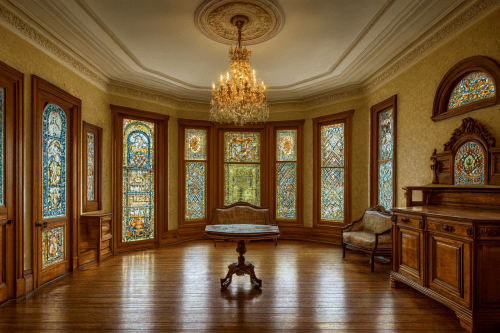
Also, to ensure that we have farmland and buildable land for future use, we need to start limiting the number of people allowed to immigrate to America. Perhaps with the immigrants we do allow into America, there needs to be a diversity program to make sure we have a population that equally represents all races of people. If Americans continue to spend money on American products, then more need to be made to keep up the inventory. When investors notice these goods are selling, it gives them the confidence to pour more money into that local business. It shows that people want these goods made in America and pressures investors to keep these goods and services in America. The jobs stay here, the business stays in America, wages naturally increase, and more money is invested to keep up with demand. This reduces the burden on the taxpayer. When you support American businesses, that money stays in our economy and can help to reduce the national debt. The government creates debt by borrowing from businesses in the private sector or from foreign countries. It also increases the national debt by spending more than it gains in tax revenue in a fiscal year. When people shop locally, more tax money stays in the economy and goes to the government. This way, it keeps more money in our national economy and keeps more jobs located in America which also sends more taxes to the government, which can again help to reduce the national debt. When you buy foreign goods, these companies usually have lighter tax loads or exemptions, meaning less money for the national debt, plus you are helping to strengthen these foreign nations by sending more money overseas. Buying American-made products is also better for the environment and helps to reduce the carbon footprint because these products do not have to travel nearly as far. Furthermore, American companies and manufacturers are held to much higher standards on pollution. American companies must be more careful about air, land, and water pollution and have proper ways to dispose of waste. #RandolphHarris 26 of 27

Under President Trump’s administration, he has made America a priority. President Trump has closed the southern border, illegal crossings have fallen to an all-time low, and are 90 percent lower than under the previous administration. Since President Trump’s crack down on crime, violent crimes in Washington D.C. have dropped by approximately 80 percent. He has stopped thousands of pounds of drugs from entering America and killing citizens. And since President Trump took office, investments in America have increased by trillions of dollars in U.S.A. manufacturing, production, and innovation. As you can see, President Donald Trump and his pledge to “Make America Great Again” is exactly what America needs to save the country and the American people. And yes, diversity is important, so you can see why it is also important to preserve blonde hair and blue eyes, as the people with these characteristics are becoming a minority in America. As a reminder, parents, please teach your children to love America and be patriotic citizens, and to buy goods and services made in America. It is also important to respect law and order and treat your elders with respect. It is inborn in the human mind to wish to know. If this begins with the endless surface questions of a child’s curiosity, if it continues into deeper questions of a scientist’s probing investigation, it cannot and does not stop there. For the higher part of the mind will eventually come into unfoldment, that union of abstract reflective thought with mystical intuition, which is true intelligence, which needs and sees a view of the whole of things. And so, the knowing faculty enters the realm of philosophy. A lot of children are having problems in school and cannot even write a paragraph because they are not reading their books. When you actually read books, you get an example of how to write and will become a better student. Therefore, remember to take your education seriously so that you will be successful in life and make your family proud. Also, to make sure they have all the resources required, please donate to the Sacramento Fire Department to help improve our national security. “Oh, thus be it ever, when freemen shall stand between their loved home and the war’s desolation! Blest with victory and peace, may the heav’n-rescued land Praise the Power that hath made and preserved us a nation! Then conquer we must, when our cause is just, and this be our motto: ‘In God is our trust.’ And the star-spangled banner in triumph shall wave O’er the land of the free and the home of the brave.” #RandolphHarris 27 of 27

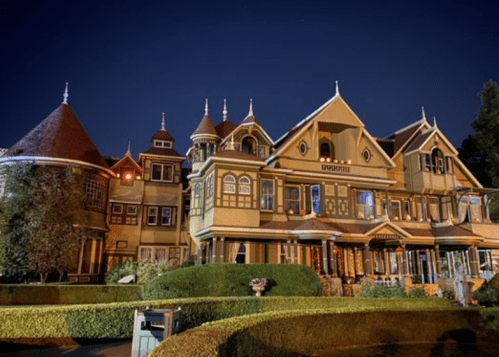
People say the Winchester Mansion is strange because Mrs. Sarah Winchester built it that way — staircases to nowhere, doors that open into air, rooms that appear without warning. But those who have studied the deeper folklore whisper something else: that the house inherited stories far older than California, stories that drifted across oceans and centuries until they found a place to root themselves again. They say the mansion carries echoes of another place — a fortress of stone, a house of trials, a home of restless spirits. And at the center of those echoes stands a single figure. The Watcher. Long before the mansion rose from the California soil, the Watcher belonged to a different tower — a high, narrow room where he kept vigil over a land filled with fear, accusations, and unanswered questions. But when Mrs. Sarah Winchester began her endless construction, something in her grief called to him.

Visitors to the mansion sometimes see him in the uppermost windows: a tall silhouette, unmoving, always looking outward as if guarding something only he understands. Guides say the tower is empty. Workers say no one goes up there. Yet the figure appears, night after night, watching. Some believe he is a guardian. Others say he is a witness. But the oldest version claims he is both — a presence drawn to places where sorrow builds walls and fear carves corridors. In the eastern wing, guests sometimes report a pale woman drifting through the hallways, her gown trailing like mist. She never speaks. She never approaches. She simply moves from room to room as though searching for something she lost long ago. Some say she is a memory Mrs. Sarah could not let go of. Others believe she is one of the mansion’s “unfinished stories,” a spirit who followed the Watcher across the sea and found a new home in the labyrinth Mrs. Sarah built.

On fog-heavy nights, the mansion grounds echo with the sound of a horse-drawn carriage approaching the front steps — though nothing ever arrives. The clatter of wheels, the snort of horses, the creak of leather harnesses… all vanish the moment someone opens the door. Locals say it is the carriage of a former visitor returning to the house, eternally repeating his journey. Others whisper that it is the Watcher’s escort, arriving to collect the lost or guide the wandering. In the farthest corridors, where the house seems to fold in on itself, visitors sometimes hear heavy footsteps pacing behind them — too slow for a person, too deliberate for an animal. Some claim to hear low growls echoing from the walls, as though something unseen is patrolling the mansion’s edges. Mrs. Sarah herself once wrote of “shadows that walk like men but breathe like beasts.” Whether she meant it literally or metaphorically, no one knows. But the stories persist.
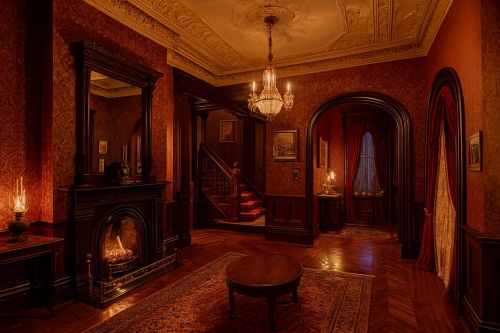
The legend says Mrs. Sarah Winchester did not create these hauntings — she inherited them. Her grief, her isolation, her relentless building formed a kind of beacon. The house became a sanctuary for wandering spirits, a place where old stories could settle into new rooms. And the Watcher, drawn by the same sorrow he had known in his first tower, took up his post again — not to frighten Mrs. Sarah, but to accompany her. To stand guard over a woman who built a labyrinth not to trap spirits, but to give them somewhere to go. Some nights, when the mansion is especially still, visitors swear they see him turn from the window, as if acknowledging them. As if reminding them that every house with a history has someone watching over it.
PRIVATE EVENTS & WEDDINGS
at WINCHESTER ESTATE

Many event locations claim to be unique, but nothing compares to the Winchester Mystery House. If you’re truly seeking a distinct, one‑of‑a‑kind setting for your milestone celebration or special occasion, reserve a venue that delivers on uniqueness many times over. Whether you’re planning a wedding, birthday or anniversary celebration, corporate gathering, holiday party, or any other meaningful event, the Winchester Mystery House offers an unforgettable backdrop. Give your guests an experience they’ll be talking about for years to come.
Café 13: A Rest Stop on the Edge of the Mystery

After wandering the winding halls of the Winchester Mystery House—where staircases defy logic and whispers seem to cling to the walls—Café 13 offers a welcome return to warmth and grounding. Newly reopened and serving guests daily from 10 AM to 3 PM, this cozy hideaway invites you to pause, breathe, and gather yourself before diving back into the mansion’s secrets. Here, you can enjoy breakfast, lunch, snacks, and refreshing drinks in a calm indoor space that feels worlds away from the mansion’s twisting corridors. Settle in with a warm meal, challenge a friend to a board game, or simply rest and recharge as sunlight filters through the windows. Café 13 is more than a café—it’s a moment of calm between chapters of the Winchester legend, a place to steady your nerves before returning to the gardens, the grandeur, and the mysteries that await.

Your journey into the Winchester Mystery House begins long before you cross the mansion’s threshold. It starts at the Mercantile gift shop—a welcoming outpost standing at the edge of a world where history and myth intertwine. Here, beneath warm lights and shelves lined with curiosities, you can secure your tour tickets and prepare for the adventure ahead. Guests often pause for a souvenir photograph, capturing the moment before they step into Sarah Winchester’s enigmatic domain. As you explore the shop, you will find an eclectic array of gifts and keepsakes: tokens of the mansion’s lore, echoes of Victorian elegance, and mementos that carry a touch of the house’s enduring mystery. The Mercantile is more than a gift shop—it is the gateway. https://winchestermysteryhouse.com/

Harris Plumbing, Heating, Air, & Electric has been in business for 30 years. How many businesses can say that? We take pride in everything we do – no matter how big or small the service call might be. We’re here to help your home be as safe and comfortable as possible for you and your family. We take that responsibility very seriously as a company.
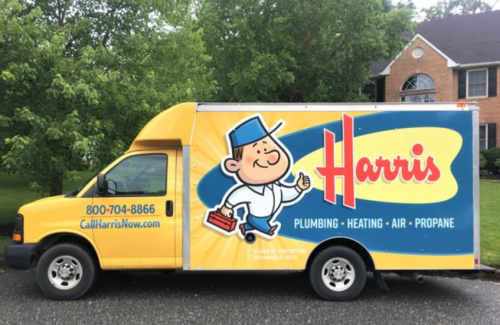
Harris will ensure you have the information you need to decide what to do next, whatever your home is facing. We’ll perform a diagnosis and detail what issues are present before starting any work. This gives you a personalized quote and service plan specific to your home’s needs, not some random quote based on the best guess. The only way we can do our best work is to make sure we handle the issues at hand. https://www.callharrisnow.com/about-us/


With its top ranking in Consumer Reports’ Auto Brand Report Card and consistent market share growth, BMW, The Ultimate Driving Experience, has demonstrated its ability to produce high-performing, reliable vehicles that meet consumer demands.BMW stands out due to its focus on driving dynamics and engineering excellence. While other luxury brands prioritize comfort and opulence, BMW is known for creating cars that are fun to drive and offer a unique connection between the driver and the machine. This is why BMW is known as The Ultimate Driving Machine. https://www.brianharrisbmw.com/

Randolph Harris San Francisco Taxation & Mergers

Building strong and lasting client relationships is crucial for a successful legal career. Many lawyers mistakenly believe that mastering legal skills alone ensures success, but law is fundamentally a service industry—our job is to solve problems through the time we sell. To build long-term relationships, attorneys must focus on three core elements: knowing their clients, understanding how their legal issues fit into a larger context, and consistently delivering exceptional service.

Randy advises clients with regard to business transition, taxable and tax-deferred mergers and acquisitions, joint ventures, restructuring, integrated tax planning, federal and state tax controversy resolution, and real estate transactions. Trust is the cornerstone of any client relationship. Ultimately, my clients feel they are in capable hands with someone who genuinely understands their problems and goals. https://www.jmbm.com/l-randolph-harris.html

Welcome
to Cresleigh Homes

Within each Cresleigh neighborhood, you’ll find new homes thoughtfully designed to suit the needs of any generation and any lifestyle, with energy efficiency and reliability at their core. Every Cresleigh team member is passionate about building a new home that you can rely on and a new home that helps you to focus on what truly matters: creating memories with the people you love. Welcome to the neighborhood.

From bustling Northern California to active Arizona communities, Cresleigh delivers homes that blend everyday convenience with well-planned community amenities. Each location reflects a commitment to comfort, value, and connection to local lifestyle and regional opportunities.

Cresleigh Havenwood is a newer residential development offering modern single‑family homes with open‑concept layouts, owned solar, and smart‑home features. It’s positioned as an upper‑mid‑market community with relatively low Mello‑Roos fees compared to surrounding areas. The sales center operates on a Friday–Tuesday schedule and serves as the hub for touring models and reviewing floor plans.

Havenwood – A Community Designed for Modern Living
Sales Office: 758 Havenwood Drive, Lincoln, CA 95648
Base Price: Starting at $700,000
Homes: 4+ Bedrooms | 2–3.5 Baths | 2,293–2,827 Sq. Ft.
Discover Havenwood, a thoughtfully planned neighborhood where contemporary architecture meets everyday comfort. Each home is crafted with open‑concept living spaces, generous natural light, and flexible floor plans designed to grow with your lifestyle.

Home Features Include:

- Spacious 4+ bedroom layouts
- Designer kitchens with modern finishes
- Expansive great rooms ideal for entertaining
- Luxurious primary suites with spa‑inspired baths
- Energy‑efficient construction and smart‑home technology
- Two- and three-car garage options
Located in the heart of Lincoln, Havenwood offers the perfect blend of suburban tranquility and convenient access to shopping, dining, parks, and top‑rated schools. With homes ranging from 2,293 to 2,827 square feet, you’ll find the ideal space for your family, your work, and your future. https://www.cresleigh.com/communities/california/lincoln-ca/havenwood


Customer Service and Hygiene at Grocery Outlet – 1700 Capitol Avenue, Sacramento, CA

To Whom It May Concern,
I am writing to report ongoing issues at the Grocery Outlet located at 1700 Capitol Avenue in Sacramento, CA. I have been shopping at this location for approximately twenty years—long before it became a Grocery Outlet—and I feel it is important to share concerns that have persisted for some time.
Many of the employees at this store consistently display unprofessional behavior. It is common to see staff standing around joking with each other instead of assisting customers, and on several occasions I have witnessed employees making rude or insulting remarks toward shoppers. In addition, there are serious hygiene concerns. Some employees appear to have poor personal hygiene, and a few have had noticeable odors, including what smelled like feces. This creates an uncomfortable and unsanitary shopping environment.
I continue to visit this store only because it is close to my business, but I avoid it whenever possible due to these issues. After two decades of patronage, it is disappointing to see the store decline to this level.
I hope management will take these concerns seriously and address the customer service and hygiene standards at this location.
Thank you for your attention.
Sincerely,
Owner and CEO of Randolph Harris II International Institute
 Randolph Harris II International Institute