
Home » COVID-19 (Page 2)
Category Archives: COVID-19

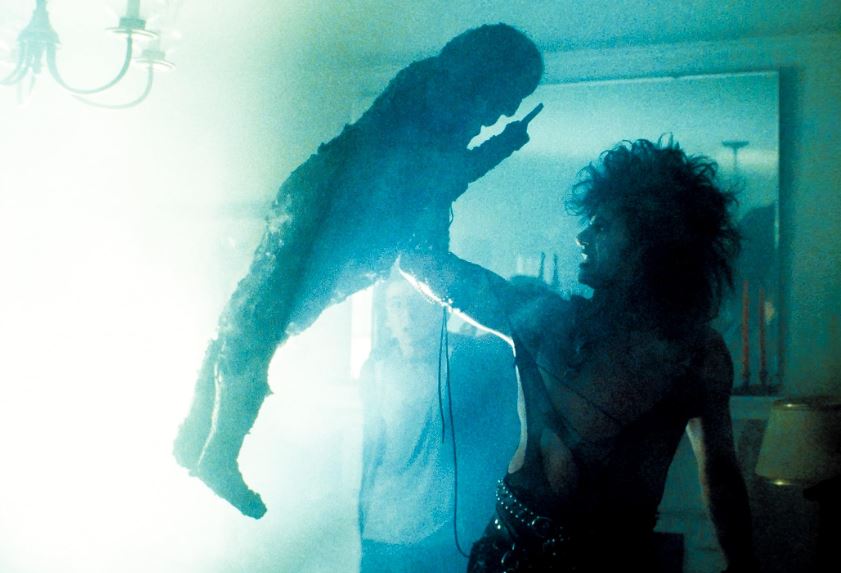
The Mind-Shattering Horrors of Llanada Villa

The most merciful thing in the World, I think, is the ability of the human mind to partake in all the beautiful of the material World. We live in an infinity of reality that only the beholder can discern. If we choose to go far, we must learn to apricate our circumstances and work towards an enjoyable life. My home is a vast labyrinth, each mile straining in its own direction, and somedays piecing together the dissociated mysteries will open up such terrifying vistas of reality, and of our frightful curse therein, which shall either make one go mad from the revelation or flee from the deadly catacombs into the peace and safety of a new dark age. Within these walls, there are strange survivals of apparitions that will freeze the blood. However, it is not from them that there came the single glimpse of forbidden aeons which chills me when I think of the madness that has been bestowed upon my bloodline. The grass and trees have assumed the fresh enamel of mediaeval May, and the turf is figured with little blossoms of azure and white and yellow, like an ornate broidery, and there is a pebbly stream that murmurs beside the way, and the voices of undines are parleying deliciously beneath its waters. The sun-lulled air is laden with wafture of youth and romance; and the longing that wells from the heart of Llanada Villa seems to mingle mystically with the balsams of the fruit orchards. Llanada Villa is like a high castle which holds dominion over a surrounding forest. However, once through the threshold, dreaded glimpses of truth, flash out from a hideous past. #RandolphHarris 1 of 8

Somewhere within my haunted mansion is a hidden room notorious for sorcery. Servants speak of phantoms, grisly tales; and there are stories of loup-garous and goblins, of fays and devils and vampires that have infested these very walls. However, to these tales, I give little heed, considering it improbable that such creatures would fare abroad in open daylight. Until one day, I was nearing the appointed parlor, which a turn of the path would soon reveal; and my pulses quickened and became tremulous. My thoughts were interrupted by a shrill scream that rose to an unendurable pitch of fear and horror, issuing from the corridors of stillness of the nearby rooms. Startled, I peered at the thick doors; and as the scream fell back to silence, I heard the sound of dull and hurrying footfalls, and a scuffling as of several bodies. Again the scream arose. It was plainly the voice of a woman in some distressful peril. In a small open space beyond the parlor, I saw a woman who was struggling with three ruffians of exceptionally brutal and evil aspect. Even in the haste and vehemence of the moment, I realized that I had never before seen such men or a woman. They could not have been my servant. The woman was clad in a gown of emerald green that matched her eyes; in her face was the pallor of dead things, together with a faery beauty; and her lips were dyed as with the scarlet of newly flowing blood. The men were dark as Moors, and their eyes were red slits of flame beneath oblique brows with animal-like bristles. There was something very peculiar in the shape of their feet. All of them seemingly had cloven hooves, but somehow I could not recall what sort of clothing they had worn. #RandolphHarris 2 of 8

The woman turned a beseeching gaze upon me as I peered through the door. The men, however, did not seem to heed my presence. Lifting my pistol, I fire with tremendous power at the head of the nearest one—a shot that should have leveled the fellow to Earth. However, the bullet fell to the ground as if forced by unresisting air, and I staggered and almost fell headlong in trying to recover my equilibrium. Dazed and uncomprehending, I saw the knot of struggling figures had vanished utterly. At least, the three men had vanished but from the middle of the parlor, the death-white features of the woman smiled upon me for a moment with faint, inscrutable guile ere. I understood now; and I shivered as I crossed myself. I had been deluded by phantoms or demons, doubtless for no good purpose; I had been the gull of a questionable enchantment. Plainly there was something after all in the legends I had heard, in the ill-renown of The Curse of the Winchester Rifle. I retraced my way down the hall I had been following. However, when I thought to reach again the spot from which I had heard that shrill unearthly scream, I saw that there was no longer path leading to that parlor; nor indeed was this a section of the mansion I recognized. The marble steps, coffered ceilings, the elevator paneled in mahogany like a plutocrat’s library, which carried me to the fourth floor vanished. In lieu of this elegant new addition to Llanada Villa there lay before me a tarn of hallways that were dark and dull as clotting blood, and the trail therein like the hair of suicides, and the skeletons of rotting corpses. #RandolphHarris 3 of 8
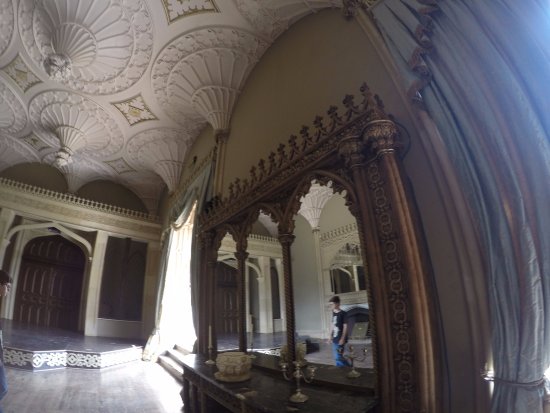
Now, beyond all question, I knew that I was the victim of an evil enchantment. In answering that beguileful cry for succor, I had exposed myself to the spell, had been lured within the circle of its power. I could not know the force of wizardly or demonry had willed to draw me thus; but I knew that my situation was fraught with supernatural menace. As I passed this scene of utter desolation and lifelessness, it seemed a place where cadavers might keep their tryst with demons. Nothing stirred, not even a hammer; and there was no whisper of a servant, no song of birds. I proceeded further and further into my mansion with a cautious eye, as the further I got, the more the scene changed. There were moving lights in the halls that vanished; there were drowned faces in the walls. The parquet floor was an obstacle course of French dollhouses and miniature Japanese castles. The draperies were green silk damask and blue velvet, the furniture Lousi XV gilded oak, the paintings signed by Renior, Cezanne, Degas, Manet, Monet. My many-turreted castle was ancienter than the World, it was older than light; it was coeval with fear and darkness; and horror dwelt upon it and crept unseen but palpable along its bastions. The 600-room mansion was a fairy-tale castle come to life, with secret entrances, mysterious sources of music, and treasure collected from all the World. My home was not so unusual during the day. On the top half, every inch was decorated with Parisian Beaux Arts ostentation, a profusion of lions, cherubs, and goddesses. Oh, but the architects were not done. Soaring above the mansion was an ornate domed tower reaching nine stories, so pleased with itself that it continued to an open cupola. #RandolphHarris 4 of 8
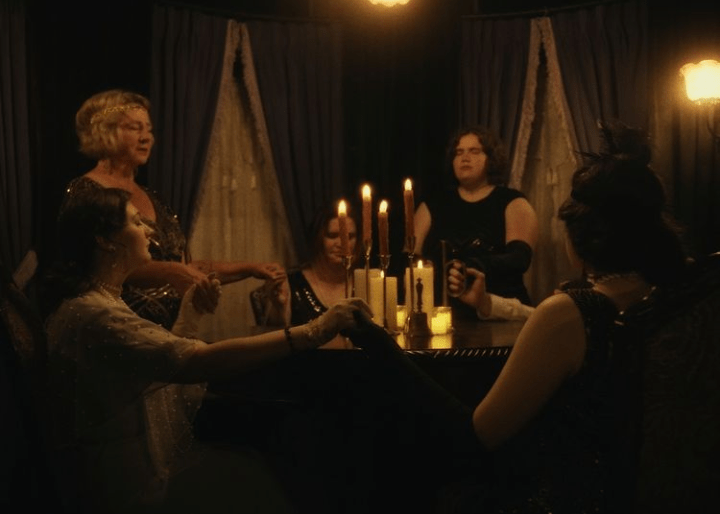
Although construction was continuous, there was often no sign of life about the castle; and no banners flew above its turrets or its donjon. However, spirits spoke loudly to warn me that there was a fountainhead of sorcery involved in the construction of my home. A growing panic would whisper in my brain, I seemed to hear the rustle of malignant plumes, the mutter of demonian threats and plottings. Amid my dismay and bewilderment, I thought of Annie and William and imagined that as long as I continued construction, that one day I would find them waiting for me in a parlor, library, kitchen, or hallway. Through my mansion throw which I lived was a maze of bafflement and eeriness. Sometimes I could swear I felt implacable arms that stoke to retard me; I could swear that I felt them twine about me with the strength and suppleness of living things. I fought them, insanely, desperately, and seemed to hear a crackling of infernal laughter in the walls as I fought. After years, with a leaden sinking of my heart, as into some ultimate slough of despair and terror, I resigned myself and made no further effort to escape. My very will was benumbed, was crushed down as by the incumbence of a superior volition that would no longer permit my puny recalcitrance. I was unable to resist when a strong hateful compulsion drew my footsteps along the margent of the halls down a new, never before seen room. Doors would open by themselves as if to receive an unexpected guest. But other than me, there was no sign of carpenter, architect, maid, butler, no farmer; and the walls of this great mansion were silent as those of a sepulcher. However, there were these apparent hieroglyphics and a figure of evidently pictorial intent, though its impressionistic execution forbade a very clear idea of its nature. It seemed to be a sort of monster, or symbol representing a monster, of a form which only a diseased fancy could conceive. #RandolphHarris 5 of 8

If I say that my somewhat extravagant imagination yielded simultaneous pictures of octopus, a dragon, and a human caricature, I shall not be unfaithful to the spirit of the thing. A pulpy, tentacled head surmounted a grotesque and scaly body with rudimentary wings; but it was the general outline of the whole which made it most shockingly frightful. Behind the figure was a vague suggestion of a Cyclopean architectural background. At the opposite end of the parlor was a door which stood mysteriously open, revealing a dark hall. As I approached the doorway, I saw that a man was standing on the threshold; though a moment previous I could have sworn that it was untenanted by any visible form. I knew that any weapon was futile against this supernatural foe. The man was inordinately tall and cadaverous, and was dressed in black garments of a superannuate mode. His lips were strangely red amid his bluish beard and the mortuary whiteness of his face. They were like the lips of the woman who, with her assailants, had disappeared in a manner so dubious when I approached them. His eyes were pale and luminous as marsh-lights; and I shuddered at his gaze and at the cold, ironic smile of his scarlet lips that seemed to reserve a World of secrets all too dreadful and hideous to be disclosed. “I am Gilles Garnier,” the man announced. His tones were both unctuous and hollow, and served to increase the repugnance I felt. And when his lips parted, I had a glimpse of teeth that were unnaturally small and were pointed like the fangs of some fierce animal. Mr. Garnier was haunting my mind like the funereal accents of a knell; though I could not recall at that moment the macabre and spectral ides which the name tended to evoke. #RandolphHarris 6 of 8
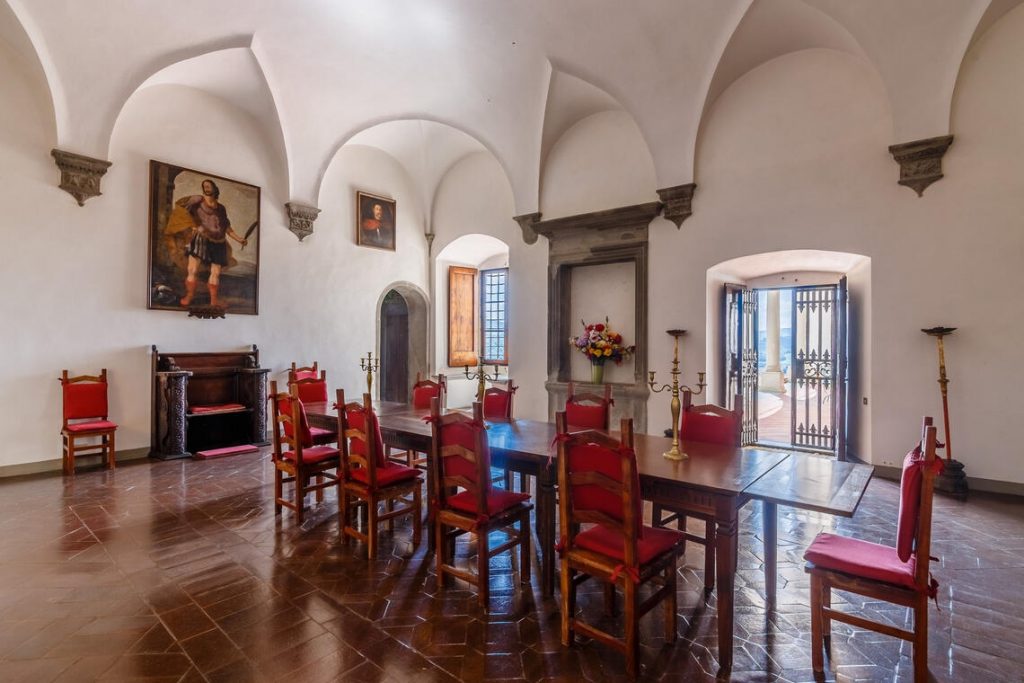
He turned abruptly, motioning me to follow him. I refused. There were sudden and furtive darkness had closed in upon Llanada Villa without moon or star. My mansion became airless and stifling like the gloom of a sepulcher that had been sealed for ages; and I was aware of the veritable oppression, a corporeal and psychic difficulty in breathing, as I moved from room to room. I flung open a heavy door of dark somber wood. Beyond, in what was the eating-room of this section of the mansions, several ghosts were seated about a long table by the light of cressets no less dreary and dismal than those in the hall. In the strange, uncertain glow, their faces were touched with a gloomy dubiety, with a lurid distortion; and it seemed to me that shadows hardly distinguishable from the figures were gathered around the board. I thought I should go mad with fear. Then sensation of being watched grew upon me until I sprang up and turned with my back to fire. Even then it was impossible for me to see much. I stood glancing from door to door, straining to listen over the thudding of my heart. My twin shadows swayed across the doorway of the study opposite, seeming to move independently. I thought of snuffing the candles; but then I would not be able to see the doors to the landing at all. I had learned that you could count second by your heartbeat. Mine was racing far faster than the measured ticking of a clock, but I began to count, anyway. Only I could keep it up; I would reach twenty or thirty, and be distracted by some phantom sound or movement, and start again. Thus I endured an indefinite interval, while the windows darkened further and further. #RandolphHarris 7 of 8

I conjure thee, O Guland, in the name of Satan, in the name of Beelzebuth, in the name of Astaroth, and in the name of all other Spirits, to make haste and appear before me. Come, then in the name of Satan and in the names of all other demons. Come to me, I command thee, in the name of the Most Holy Trinity. Come without inflicting any harm upon me, without injury to my body or soul, without maltreating my books, or anything which I use. I command thee to appear without delay, or, that failing, to send me forthwith another Spirit having the same power as thou hast, who shall accomplish my commands and be submitted to my will, wanting which, he whom thou shalt send me, if indeed thou comest not thyself, shall in no wise depart, nor until he hath in all things fulfilled my desire. I offer my blood unto the Divs and Druj, whom are the essence of counter creation. I offer my life force unto the powers of eternal darkness within. May they devour and destroy the imposed shackles of divine light and stasis that I may become unlimitedly powerful. I salute and conjure you, O beautiful Moon, O beautiful Star, O bright light which I hold in my hand! By the air which I breathe, by the breath which is within me, by the Earth which I touch, I conjure you, and by all the names of the spirits who are princes residing in you; by the ineffable Name On, which hath created all; by thee, O Resplendent Angel Gabriel, together with the Prince Mercury, Michiael, and Melchidae! I conjure you again by all the divine Names of God, that you send down to obsess, torment, and harass the body, spirit, soul and five senses nature. #RandolphHarris 8 of 8

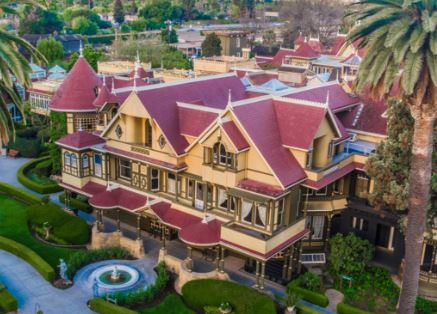
For many years there has been talk of slamming doors, muffled voices and ghost walking the corridors of The Winchester Mystery House, which is over 140-years-old. Recall, the mansion started off as an eighteen-room farmhouse, which Mrs. Sarah L. Winchester purchased. A number of persons hired as night watchmen have quit after only one night on duty, complaining of door opening and closing and invisible footsteps following them on their rounds. In July 2008 a staff member working late thought he heard the sounds of a reception in progress on the first floor, but when he reached the foot of the stairs, he found the rotunda empty, and all noises suddenly ceased. The same tour guide recalled the library room on the third floor as being particularly creepy. Late one night as he approached the library door, he remembered a cold, dank air falling on his head and neck, and he decided his work could wait until the next day. Although the mansion has gone through a considerable number of watchmen who declined the privilege of working in the building after one night on the job, one stuck with the task for more than 13 years. He simply shrugged off the angry slamming of doors that sounded behind him and the thumping noises that followed him on his rounds. However, he admitted that he did not like to work in The Winchester Mystery House after dark. He always made it a point to be out of the building by quitting time, because when darkness fell, he could sense the whole atmosphere changing.
For further information about tours, including group tours, weddings, school events, birthday party packages, facility rentals, and special events please visit the website: https://winchestermysteryhouse.com/

Please visit the online giftshop, and purchase a gift for friends and relatives as well as a special memento of The Winchester Mystery House. A variety of souvenirs and gifts are available to purchase. https://shopwinchestermysteryhouse.com/


Cure that Sense of Entitlement

Thought is a vital force or energy which is being developed and which had produced such startling results in the last century, as to bring about a World which would be absolutely inconceivable to man during the days of slavery. If the results have been secured by organizing mental powers over the last hundred years, imagine what can be done in the next hundred. This is why we need to avoid the nihilistic idea that we are living in the last day. The people who repeat this mantra are also the ones who pontificate most loudly about the law of attraction. We have to learn to be genuine in our beliefs and know that we can have a beneficial impact on the future. We do not have to accept things they way they are, but we can make them better. It is clear, therefore, that thought of abundance will respond only to similar thoughts: the wealth of the individual is seen to be what he inherently is. Affluence within is found to be the secret of attraction for affluence to manifest in the outside World. The ability to produce is found to be the real source of wealth of the individual. It is for this reason that he who has his heart in his work is certain to meet with unbounded secrets. He will give and continually give, and the more he gives the more he will receive. Thought is the energy by which the law of attraction is brought into operation, which eventually manifests in abundance in the lives of men. The source of all power, as of all weakness, is from within; the secret of all success as well as all failure is likewise from within. Golden opportunities of life will be strewn across your path, and the power will come unbidden, circumstances will be in your favour, and you will feel the power of the ultimate concern. #RandolphHarris 1 of 18

Many affluent college students make it a point to hide the fact that their families are wealth, because they believe that members of the opposite gender may approach or treat them nicely not because they are interesting and attractive, but simply because they have money. We have worked with young people who consciously choose to live in a more modest apartment than they can afford, or avoid spending too much money on clothes or entertainment, specifically because they do not want to give potential romantic interests any hint regarding their actual financial status. This strategy does seem to provide some reassurance to affluent young people when they are meeting new people, or when they are going out on a first or second date. Clearly, however, as dating relationships develop and progress, it will become more and more difficult to avoid having one’s financial status become apparent. People naturally ask you questions about where you grew up, and where you went to high school. At some point, your date will probably ask you about your parents—maybe just about how you like them, but also more than likely about who they are and what they do. New friends are also quite likely to ask you what you like to do for fun, and they will be curious about the places you have been. These are perfectly normal questions, and you certainly should not interpret them as specific effects to extract data from you on your family’s financial status. Although we certainly understand any desire you may have not to flaunt your wealth as a means of attracting attention, we strongly believe that you should be honest when you answer such questions. To be less than honest is to convey the message that your distrust of others’ intentions is your paramount concern in making new acquaintances, and this would be likely to be perceived as reflecting poorly on you. #RandolphHarris 2 of 18

Students of a high caliber are more attracted to affluent institutions than to poor ones. The major reason is that affluent institutions pay higher salaries, which enable them to recruit better faculties. Some of this may result from a feedback effect that raises the resources for faculty recruitment of institutions with superior reputations among outstanding students. The beta weight indicates that affluence also has some direct effect on student preferences, independent of other conditions. A possible interpretation of this new effect is that superior facilities and better fellowships in affluent institutions attract brighter, more serious students, although the possibility that wealth as such and its symbolic value make an institution preferable cannot be excluded. Large academic institutions are preferred by able students because they can afford better faculties and have more diverse departments than small institutions, but large size itself, independent of these attractive conditions usually associated with it, detracts from the appeal of an institution or higher education to students. In other words, size has a beneficial gross and a negative net effect on capable students, furthering another parallel with the pattern of influences on qualified faculty. The process of mediating the indirect effects of size are similar but not identical, partly because faculty qualifications are the dependent variable in one but an intervening variable in the other case. Bright students are attracted to large academic institutions by their many diverse departments, array of cultures, and by the superior faculties that their higher salaries recruit. These attractions tend to overcome the preferences of good student for small, less impersonal colleges if conditions were the same (indicated by the negative beta weight) and make large institutions more popular among them (indicated by their positive simple correlation). #RandolphHarris 3 of 18

The natural or “mortal mind” view of life and the World is almost always the exact opposite of what is the real spiritual truth and fact. Metaphysics tell us that the visible World is an inverted reflection of the real. If the it is inverted, it is natural, until our spiritual or inner eyes are opened to the truth, for us to see things as the exact opposite of what they really are. Therefore it is not surprising to find that, whereas the moral or terrestrial mind of the senses, thinks the World is the real thing and the mind only a shadow, the real TRUTH is, that mind and spirit are real and eternal, and the visible World but a transient and impermanent thing which has no actual reality. Such being the case then the only thing that really matters is what is in the mind or what is not in the mind. If we have a belief in evil, and thoughts of evil, in our mind, then we have evil in our life. If, however, we can cast the thought of, and belief in, evil out of our mind then it will cease to appear in our life. By raising ourselves above the sensuous life and realizing our permanent World of Mind and there denying evil, poverty, failure, pain, sickness, unhappiness, or whatever our trouble may be, we vanquish the thought which is the cause of all our troubles. Then whatever we affirm will take their place. If we deny “evil,” then we follow by affirming “good,” if we deny sickness, then we affirm prosperity and affluence. By denials we can take out all the evil, care, fear and worry out of our lives and build up in their place by means of affirmations, perfect good, success, affluence, happiness, health, love, peace and courage. Everything being in the mind, then everything that is take out of the mind is take out of life, and everything that is put into the mind comes into life. #RandolphHarris 4 of 18

Thus it is possible with mathematical accuracy and certainty to recreate the life, to cast out all the undesirable and to build up in its place only the beautiful, the good, the true. Life is what we make it. We can make it like Heaven itself, full to the brim with all that is good and beautiful, or we can turn it into a perfect Hell. Therefore do not accept the suggestions of those, who having failed in life, proceed to call it hard names. We can make life a continual joy, if we create a Heaven within us by the quality of our thinking and mental processes. All that we see in life, all that we experience, yeah, even life itself, is but the outward expression of the life within. The life within is built up by our thinking. You will have seen by this time the purpose and value of affirmations. Affirmations are concentrated thoughts. Back of each affirmation is a strong emotion and this gives it tremendous driving force. Not only do affirmations impress the sub-conscious mind thus producing action in accordance with the Will, but they project outwards from the mind into space, attract forces and help from other sources and bring them to minister and bless. Not only so but they also arouse the subliminal mind to inspire, to create, to impart wisdom. By the use of affirmations all the finer forces are aroused to action and the life is transformed from weakness or ineffectiveness to strength or purposefulness. By the use of affirmations, the Will is strengthened until it become so strong all else has to bend to it. By the use of affirmations, the body is strengthened and make healthy, and exercise and body culture become a pleasure instead of a duty. #RandolphHarris 5 of 18

To bring whatever it is that you want into your life, you must develop an insatiable desire for it. That means, for a while, it is all that matters. You vigilantly watch the ego-mind; you refuse to be taken off track. You know your direction and you will allow nothing to move you from it. At that point, all obstacles are viewed as challenges to be overcome, with each one giving you’re a renewed sense of focus. You meet difficulties with the mindset that there is always a way to overcome them, and moreover, you are committed to finding it. You approach, go though, and attend to your outcome without the option of gripping or complaining. You keep moving forward: you make it a “must” and as a result, it will happen. Guaranteed! Affluence means wealth. It means having plenty, so that you are not wanting. It means being connected into the flow of goods and resources so that you are regularly refreshing your abundance even as you use it up. I know people living utterly simple material lives who seem radiant with well-being and happiness. Material wealth should never be desired as an end, but simply as a means of accomplishing an end. Success is contingent upon a higher ideal than the mere accumulation of riches, and he who aspires to sch success must formulate an ideal for which he is willing to stive. However, it is no fun to run out of rent money or cash to go buy groceries. Let us not be delusional; money counts! On the other hand, a lot of money brings a lot of responsibility; you must pay attention to your money or you lose it, and you can easily fall victim to worry about your money rather than enjoying it. So keep this desire for cash and possessions in perspective with the other equal needs. #RandolphHarris 6 of 18

Whatever you desire for yourself, affirm it for others, and it will help you both. You reap what you sow. If you send out thoughts of love and health, they return to you like bread cast upon waters. People who are friends to others find that they indeed have friends. Radiate love and happiness to those you encounter, and this love and happiness will be radiated back to you. True relationship abundance is both deep and wide. Ideally you have a deep resonance with family, and you and your intimate partner have broad goodwill toward those you come into contact with. A valid formula will produce successful results every time and for everyone. You just have to follow it. Life provides a wonderful opportunity to seek our talents and interests. It is well to remember, however, that “all have not every gift given unto them; for there are many gifts, and every man is given a gift by the Spirit of God,” reports Doctrines and Covenants 46.11. In our searching, it is important to seek guidance of the Spirit to discover skills we should develop. Once we have decided what we really want to do, the Lord has given us a formula for achieving our eternal and temporal goals: “For he will give unto the faithful line upon line, precept upon precept; and I will try you and prove you herewith,” reports Doctrines and Covenants 98.12. The Lord reminds us that real success will only come only to the faithful—those who have sincere determination to achieve their goals. The second part of that formula reminds us that learning is often a slow process and comes line upon lone, one step at a time. The Lord offers kind encouragement when He says, “Wherefore, be not weary in well-doing, for ye are laying the foundation of a great work. And out of small things proceedeth that which is great,” reports Doctrines and Covenants 64.33. We must learn to be patient with ourselves while pushing to new levels of achievement or knowledge. It is important to take time occasionally to remind ourselves of what we are trying to do. #RandolphHarris 7 of 18

Thoughts of courage, power, confidence, and hope all produce a corresponding state. All we have to do is let our light shine; the more energy we can radiate, the more rapidly shall we be enabled to transmute undesirable conditions into sources of pleasure and profit. Health and wellness are issues for most of us, and material abundance can mean absolutely nothing when we are seriously sick. Therefore focusing on and manifesting long-term health must be a vital aspect of this program. How can you maximize wellness each and every day, and also regain your health if you lose it? It is now well proven that the thoughts you chronically hold in your mind generate parallel emotional and physiological conditions in your body that either support good health or undermine it. You have perhaps read or seen medical reports on how stress and anxiety, depression and anger, when rehearsed over a long period of time not only become contagious, but also progressively reduce your immune system’s ability to maintain optimum health. When your thoughts become uplifted, progressive, constructive, courageous, noble, kind, or in any other way desirable, you set in motion vibrations which bring about mental, moral, and physical health. The only real power which you can have is the power to adjust yourself to divine and unchangeable principles. You cannot change the Infinite, but you can come into an understanding of natural laws and adjust your thought faculties with the Universal Thought. Your ability to cooperate with this Omnipotence will indicate the degree of success with which you meet. Your expectation determines everything. If you expect nothing, you shall have nothing: if you demand much, you shall receive the greater portion. The World is harsh only as you fail to assert yourself. #RandolphHarris 8 of 18

It is important to belief in your inner reality and broadcast this perfection out to your cellular presence, so that beyond your conscious awareness the infinite unconscious power of the Universe can be working to heal you. And if you are currently healthy, regularly tap into your desire to stay healthy and broadcast this desire and inner faith and harmony to your soul. Inner harmony is the foundation of health. The knowledge of your ability to consciously radiate health, strength, and harmony will bring you into a realization that there is nothing to fear, because you are in touch with Infinite Strength. Regardless of age or health, it is important for all of us to learn to come to peace with the cycle of life and death, and make the best of life while it is still in our possession. One can develop the ideal image of life’s experiences that last for life. We must learn to manifest whatever kind of environment we desire. Although we may be tried to see how determined we are to life our ideal lives, if we persevere, the windows of Heaven truly open in many ways and our providing takes place. Our faith in the Saviour and trust in His words will continue to grow. We will find the most desirable of all our goals will take the most determination to achieve but will be worth every effort. This process can work in reverse and bring loss of spirituality if we are not careful. If we commit sins, we are tried with feelings of regret and remorse. And if we do not heed those feelings and change, further sins come more easily. The result is withdrawal of the Spirit and loss of potential blessings. #RandolphHarris 9 of 18

A life with inner peace and happiness can also be ours if we are willing to earn it. It is marvelous to develop this way of living while you are still very young. You have many years to develop even further great spiritual strength and understanding by applying what the Lord has taught us. Entitlement is not the person who keeps trying to please one’s boss but either lacks the skill or the clear instruction from management to perform well, and who is therefore always getting poor job evaluations. Entitlement is the person whose poor job evaluations result from one’s refusal to invest one’s full energy and commitment in one’s job and who consistently underperforms, not because one lacks the skills or has not received clear instructions from management but simply because one sees no reason to; individuals like this believe that they deserve that paycheck for reasons completely unrelated to how well one performs, an that the company is luck to have him or her. Entitlement is not the spouse who feels inadequate because one’s partner is always expressing one’s frustration with their marriage and with the role one plays in it, even though one tries hard and wants things to be better. Entitlement is the spouse who feels inadequate because one’s partner is always expressing one’s frustration with their marriage and with the role one play in it, even though one tries hard and wants things better. Entitlement is the spouse who thinks everything going wrong in their marriage is their partner’s fault, and that if one does not shape up, one might lose the other. Since one has already made all the contributions to their marriage one needs just to be on the basis of who one is, one’s completely justified in just sitting back now and waiting for one’s spouse to fix whatever is wrong, without any help from their partner. #RandolphHarris 10 of 18

There are many more illustrations, but the many faces of entitlement will always have at least most of these characteristic: An attitude of being special—“I’m exception—and in fact, I’m far greater value to this marriage (of family, or company) than the rest of them, and that’s why I deserve special treatment. They’re lucky to have me.” An attitude of being owed, of deserving something—“I didn’t create this situation—they’re the ones who are always complaining. So why should I do all the work, or even any of it? As far as I’m concerned, I should just stay in my office till they’ve cleaned up this mess. And my bonus had better not be any smaller than any of the others because of it.” A refusal to accept responsibility—“Why do they want me to pay rent? I didn’t ask to be born. Besides, this will still be their house after I move out. And I can’t pay rent anyway, because I don’t have a job. None of the dead-end jobs around here are worthy my time and effort and there’s no reason I should do my own laundry—Mom has to do hers and Dad’s anyway—she can just do mine at the same time. It’s no extra work.” A denial of one’s impact on others—“Sometimes my husband and kid’ lack of responsibility bothers me, and I say exactly what I feel. I’m telling them the truth. I don’t sugarcoat it and I don’t tone down my language, my volume, or how long I talk. They overreact to what I’m saying, and that’s their problem. It’s a free country, and I can say what I need to say.” Whatever the cause of the sense of entitlement, the end result is that the person believes that one does not have to ply by the rules of responsibility, ownership, and commitment. And the end result of entitlement is predictable: The entitled person feels good and live badly, while those around one feel bad about the situation but have more successful relationships and careers. #RandolphHarris 11 of 18

It is tempting to make excuses for our loved ones (or ourselves) who evidence an attitude of entitlement, but the only effective response is to take responsibility, not to make excuses. People’s life experiences may influence them toward entitlement. However, they do not create entitlement. Many people who have suffered greatly in life, experiencing poverty, child abuse, and chaos, still take responsibility for their lives and choices, blaming no one. And there are individuals who have had it all—love, support, opportunity—who nevertheless see themselves as “owed”—by life, by society, by those around them. If you have an entitled person in your life, you may feel responsible for the part you may have played in influencing that attitude, or you may simply feel compassion for their circumstances. And it is certainly possible that you have made mistakes in your relationship with them. It is possible that life may have thrown them curves. However, those mistakes, those obstacles of life, do not create irresistibly an entitlement attitude; if they did, then all people who experiences those things would approach life with an attitude of entitlement, and they do not. At some point in life, people choose entitlement. They direct themselves toward an entitled viewpoint. Why? Ultimately, it is because—at least in their view—it is the easy way. Entitlement has become a serious problem in our society, and it is not getting better. It is impossible to calculate its cost in lack of company productivity, family success, relational love, emotional health, and spiritual vibrancy. Our World suffers greatly from a culture that supports entitlement. The disease is not limited to any age or socioeconomic demographic. #RandolphHarris 12 of 18
Entitled people are not easy to be around. Their attitude and their behaviour produce consequences none of us wants to experience. People who live around an employee, a coworker, a spouse, or a child who feels “above it all” generally feel disconnected and alienated from the entitled individual. We all find it hard to relate to someone who thinks one is superior in some way to the rest of the human race and therefore should not have to play by the rules. One father told me, “I remember being full of myself in my youth. But I did care about how I impacted my friends and family. My daughter’s level of entitlement is something entirely else. I cannot relate to it. She simply does not care how she affects us in the family, much less how she is impacting her future. I fear she may end up homeless or confined to a psychiatric ward.” God expects us to spend time and energy carrying our loads of responsibility for family, finances, and other challenges. That is how a successful life works. So what happens when someone in your life takes little ownership of their own load, leaving you to make up the difference? You feel angry, which makes sense. You feel that everything is “not right,” because it truly is not right. All of us exhibit some level of entitlement attitudes, even highly responsible and giving people. It is just part of the human condition. However, when one deems something worthwhile, be it a career or financial dream, a great family or marriage or some self-care goal, one has two ways to go about it. Entitlement directs one to give the minimum, find the shortcut, and think only of one’s self. However, the more rational path takes the opposite track. This habit focuses on doing whatever is best to reach the good goal, even if it is difficult, uncomfortable, takes longer, and requires more energy. #RandolphHarris 13 of 18

A sense of entitlement (which is the polar opposite of a sense of responsibility) is endemic among children today. It is fostered by our demanding, narcissistic society where wants are confused with needs and where everyone seems focused on the notion that one deserves what everyone else has without working for it. Youth grow up in a reality-show World, thinking of themselves as the central character on television. They even adopting the same attitudes of some of their favourite stars and try to act out TV shows. And they believe they are worthy of not having limits, boundaries, nor discipline. The entitlement problem affects one’s education as one feels that they do not have to work for their grades. It affects relationships because people expect their parents to live their lives for them, well into adulthood. A sense of entitlement impacts one’s ability to set reasonable goals because when one is entitled the World is owned to them. It has an effect on their health and their safety because they feel entitled to eat what they want, go to bed when they want, and do things they know is not safe. Drawing realistic lines between deserving and undeserving matters a lot in our individual lives. While we might feel jealous of the kid who either works for a new car or gets a new car—and a free ride in other areas of life, too—we have to remember opportunity costs. Everyone has to give up something to receive whatever it is they have. And just like you, how long are you going to continue to harp on what someone else has? You could spend your entire life jealous over someone else’s blessings and still not happy when you obtain the same thing because you are not happy with yourself, your life. #RandolphHarris 14 of 18

The closer we are to Jesus Christ in the thoughts and intents of our hearts, the more we appreciate His innocent suffering, the more grateful we are for the grace and forgiveness and the more we want to repent and become like Him. Our absolute distance from Heavenly Father Jesus Christ is important, but the direction we are heading is even more crucial. God is more pleased with repentant sinners who are trying to draw closer to Him than with self-righteous, faultfinding individuals who, like the Pharisees and scribes of old, do not realize how badly they need to repent. Whatever our current direction or distance to Heavenly Father and Jesus Christ, we can choose to turn toward Them and draw closer to Them. They will help us. The close to the Saviour we draw, the more our faith increases, and we are able to make and keep covenants, and have the Holy Ghost with us. We must also act in faith, responding to the spiritual direction we receive. All of these elements come together in the sacrament. Indeed, the best way I know to draw closer to God is to prepare conscientiously and partake worthily of the sacrament each week. Although a variety of life experiences can elicit feelings of gratitude, gratitude prototypically stems from the perception of a beneficial personal outcome, not necessarily deserved or earned, that is due to the actions of another person. People who have gratitude feel a warm sense of appreciation for somebody or something, a sense of goodwill toward that person or thing, and a disposition to act that flows from appreciation and goodwill. The virtue of gratitude is the willingness to recognize that one has been the beneficiary of someone’s kindness, whether the emotional response is present or not. #RandolphHarris 15 of 18

The practice of gratitude is not in any way a denial of life’s difficulties. We live in troubling times, and do doubt you have experienced many challenges, uncertainties, and disappointments in your own life. Nor does the practice of cultivating gratitude deny the truth that old age, sickness, and death are certain. Rather, gratitude practice is useful because it turns the mind in such a way that enables you to live into life. Having access to the joy and wonderment of life is the antidote to feelings of scarcity and loss. It allows you to meet life’s difficulties with an open heart. The understanding you gain from practicing gratitude frees you from being lost or identified with either the negative or the positive aspects of life, letting you simply meet life in each moment as it rises. There are numerous ways to use mindfulness to cultivate gratitude. Of course, you acknowledge your appreciation when things are going well. However, even more helpful is to notice those things for which you are grateful when you find yourself in a contracted physical or emotional state. I often instruct students to respond to a difficult situation by acknowledging that the situation is difficult, but always to have the faith that they can find a legal, ethical, and virtuous way to escape from it. The best way to get out of a bad situation, however, is not to get into one. We need to know right from wrong and set great examples for our children. When you look at how much griping you are doing versus how much gratitude you feel, you may realize how far off your emotional response is from your real situation. Gratitude for the grace of conscious embodiment evolves into the practice of selfless gratitude, in which your concerns slowly but surely shift from being mostly about yourself and those close to you to being about all living beings. #RandolphHarris 16 of 18

As this occurs you need less and less in the way of good fortune. It becomes enough that there are those who are happy, who are receiving love, who are safe, and who have a promising future. It is not a state of gratitude, you are able to rejoice that joy exists amid all life’s suffering. You realize that pain and joy are part of a mysterious whole. When this state of selfless gratitude starts to flourish, one’s mind becomes more spacious and quiet, and one’s heart receives its first tastes of release from fear and wanting. Commitment reflects one’s values, intentions, and priorities; therefore it fosters clarity. In contrast, attachment is an unwholesome mental state in which one becomes overly identified with a desired outcome. The more centered and free from grasping one’s mind is, the better able one is to sustain a commitment over time and to make clear decisions along the way. You are also less likely to cause harm in pursuing your goals. If you truly want to achieve something, be unswerving in your commitment to moving toward your goal but be flexible in your mind about the outcome. Let us be honest. Most of our attachments are not derived from lofty goals or heartfelt commitments. They are about feeding our ego, expressing our views and opinions, pleasing our senses, and being seen as we wish to be seen. Or they are about not being uncomfortable, not having to endure things that irritate us, and not feeling physical or emotional pain. All of this mundane attachment accounts for a great deal of the chaos in our lives, and it does not actually help us get what we want! It is pretty much a total waste of precious energy and a major cause of disappointments. #RandolphHarris 17 of 18

Practicing generosity is the intention to find release from attachment and egoism by giving freely of whatever you have of value. What you have to give may be material in nature or it may be your time, energy, or wisdom. Committing to kindness eradicates the attachment that comes from feelings of scarcity and separateness. Paradoxically, practicing bigheartedness is also self-liberation, yet it is not self-centered. True generosity arises out of unconditional caring and compassion for another. It does not mean self-sacrifice or recklessly giving everything away. Such acts are actually grandiosity disguised as generosity. The form your generosity takes is up to you, as it can only come from your values and what you have to offer. Remember, it is your authentic intentions that matters, even if it is imply a sincere wish that in time you will become more spontaneously generous. Generosity means practicing generous behaviour in all aspects of your life, not just giving away money or sharing material possession. Certainly the emotional impulse to practice generosity most easily arises when you participate in providing sustainability for others, whether it is shelter, food, clothe, or medicine. However, with less immediate life needs, such as education, safety, or earning a living, the appropriate form of generosity may be a gift of your time. When it comes to intangibles such as justice and dignity, it may be most appropriate to voice your support. Generosity is, along with compassion, a cornerstone of mindful association. #RandolphHarris 18 of 18

CRESLEIGH HAVENWOOD
Lincoln, CA | from the high $600s
Now Selling!

Home Site 66 is a Residence Three, the largest of the single story homes offered in Cresleigh Havenwood. At 2,827 square feet you’ll be hard pressed to a contemporary floorplan that offers this much space.

There are four bedrooms, two and one half bathrooms, and a three car garage. Utilize the den as your own private study or playroom. The Dining Room and Kitchen are well situated to make entertaining a breeze.

The location of the Owner’s Suite makes it feel like a separate wing from the rest of the home allowing for maximum privacy and retreat.

This home includes over $34,000 in options and upgrades including:
• Durable luxury vinyl plank flooring throughout the first floor
• White Shaker Cabinetry with Soft-Close Doors & Drawers
• Over Island Pendants and Under-Cabinet Lighting
• Upgraded Appliances
• Flat-Screen pre-wire in Great Room
• Additional Upper Cabinetry at Drop Zone
• Owned Solar

Best of all, each Cresleigh home comes fully equipped with an All Ready connected home! This smart home package comes included with your home and features great tools including: video door bell and digital deadbolt for the front door, connect home hub so you can set scenes and routines to make life just a little easier. Two smart switches and USB outlets are also included, plus we’ll gift you a Google Home Hub and Google Home Mini! https://cresleigh.com/havenwood/quick-move-homesite-66/


Would Satan Have Found Companions without this Overpowering Craving?

The extraordinary powers of the TV news media threaten the civil rights and health of all humans because it is like a constant signal of unbalanced propaganda being fed through a tube into minds of people who may not be aware that the news media often lies, and the some of their stories are engineered and totally untrue. If smoking cigarettes comes with a warning, because they can be hazardous to your health, then so should the TV news media. Stories presented over the air can be dangerous, especially to young, influential minds. For instance, a TV news program explained to viewers how they could barbeque meant in the oven by placing it on the rack. However, they did not explain that underneath the rack there should be a drip pan to catch any liquids that come from the meat, so they do not drip on the heating elements, which could cause a fire. And that may not be common sense to all people, which the TV director probably assumed. Therefore, all TV new media should contain a warning, letting the audience know that the story, even if it has some facts in it, is based on an opinion and may not be the full truth, so viewers know to use discretion and do further research of themselves. In all things purely social we can be as separate as the five fingers, and yet one as the hand in all aspects essential to mutual progress. The economic structure of a society in determining the mode of life of the individual operates as condition for personality development. #RandolphHarris 1 of 19

These economic conditions are entirely different from subjective economic motives, such as the desire for material wealth which was looked upon by many writers, from the Renaissance on up to certain Marxist authors who failed to understand Mr. Marx’s basic concepts, as the dominant motive of human behaviour. As a matter of fact, the all-absorbing wish for material wealth is a need peculiar only to certain cultures, and different economic condition can create personality trait which abhor material wealth or are indifferent to it. The physiologically conditioned needs are not the only imperative part of man’s nature. There is another part just as compelling, one which is not rooted in bodily processes but in the very essence of the human mode and practice of life: the need to be related to the World outside oneself, the need to avoid aloneness. To feel completely alone and isolated leads to mental disintegration just as physical starvation leads to death. This relatedness to others is not identical with physical contact. An individual may be alone in a physical sense for many years and he may be related to ideas, values, or at least social patterns that give him a feeling of communion and “belonging.” On the other hand, he may live among people and yet be overcome with an utter feeling of isolation, the outcome of which, if it transcends a certain limit, is the state of insanity which schizophrenic disturbances represent. #RandolphHarris 2 of 19

This lack of relatedness to values, symbols, patterns, we may call moral aloneness and state that moral aloneness is as intolerable as the physical isolation, or rather that physical seclusion becomes unbearable only if it implies also moral lonesomeness. The spiritual relatedness to the World can assume many forms; the self-actualized in his cell who believes in God and the political prisoner kept in isolation who feels one with his fellow fighters are not alone morally. Neither is the English gentleman who wears his dinner jacket in the most exotic surroundings nor the petty bourgeois who, though being deeply isolated from one’s fellow men, feels one with one’s nation of its symbols. The kind of relatedness to the World may be noble or trivial, but even being related to the basest kind of pattern is immensely preferable to being alone. Religion and nationalism, as well as any custom and any belief however absurd and degrading, if it only connects the individual with other, are refuges from what man most dreads: isolation. The compelling need to avoid moral isolation is a deep concern However, learn one thing, impress it upon your mind which is still so malleable: man has a horror for aloneness And of all kind of aloneness, moral seclusion is the most terrible. The first hermits lived with God, they inhabited the World which is most populated, the World of spirits. The first thought of man, be he a leper or a prisoner, a sinner or an invalid, is: to have a companion of one’s fate. #RandolphHarris 3 of 19

In order to satisfy this drive which is life itself, man applies all his strength, all his power, the energy of his whole life. Would Satan have found companions without this overpowering craving? On this theme one could write a whole epic. Any attempt to answer the question why the fear of isolation is so powerful in man would lead us far away from the main road we are following in this report. However, in order not to give the reader the impression that the need to feel one with others has some mysterious quality. One important element is the fact that men cannot live without some sort of co-operation with other. In any conceivable kind of culture man needs to co-operate with others if he wants to survive, whether for the purpose of defending himself against enemies or dangers of nature, or in order that he may be able to work and produce. Even Robinson Crusoe was accompanied by his man Friday; without him he would probably not have become insane but would have actually died. Each person experiences this need for the help of others very drastically as a child. On account of the factual inability of the human child to take care of itself with regard to all-important functions, communication with others is a matter of life and death for the child. The possibility of being left alone is necessarily the most serious threat to the child’s whole existence. There is another element, however, which makes the need to “belong” so compelling: the fact of subjective self-consciousness, of the faculty of thinking by which man is aware of himself as an individual entity, different from nature and other people. #RandolphHarris 4 of 19

Although the degree of this awareness varies. Its existence confronts man with a problem which is essentially human: by being aware of himself as distinct from nature and other people, by being aware—even very dimly—of death, sickness, aging, he necessarily feels his insignificance and smallness in comparison with the Universe and all others who are not “he.” Unless he belonged somewhere, unless his life had some meaning and direction, he would feel like a particle of dust and be overcome by his individual insignificance. He would not be able to relate himself to any system which would give meaning and direction to his life, he would be filled with doubt, and this doubt eventually would paralyze his ability to act—that is, to live. Human nature is neither a biologically fixed and innate sum total of drives nor is it a lifeless shadow of cultural patterns to which it adapts itself smoothly; it is the product of human evolution, but it also has certain inherent mechanisms and laws. There are certain factors in man’s nature which are fixed and unchangeable: the necessity to satisfy the physiologically conditioned drives and the necessity to avoid isolation and moral aloneness. We have seen that the individual has to accept the mode of life rooted in the system of production and distribution peculiar for any given society. In the process of dynamic adaptation to culture, a number of powerful drives develop which motivate the actions and feelings of the individual. #RandolphHarris 5 of 19

The individual may or may not be conscious of these drives, but in any case they are forceful and demand satisfaction once they have developed. They become effective in molding the social process. How economic, psychological, and ideological factors interact and what further general conclusion concerning this interaction one can make are things for future discussion that deals with the reformation and of fascism. Man, the more he gains freedom in the sense of emerging from the original oneness with man and nature and the more he becomes an “individual,” has no choice but to unite himself with the World in the spontaneity of love and productive work or else to seek a kind of security by such ties with the World as destroy his freedom and the integrity of his individual self. However, the hushing of the criticism of honest opponents is a dangerous thing. It leads to some of the best of the critics to unfortunate silence and paralysis of effort, and others to burst into speech so passionately and intemperately as to lose listeners. Honest and earnest criticism from those whose interest are most nearly touched,–criticism of writers by readers, of government by those governed, of leaders by those led,–this is the soul of democracy and the safeguard of modern society. If the best of the Americans receives by outer pressure a leader whom they had not recognized before, manifestly there is here a certain palpable gain. Yet there is also irreparable loss,–a loss of that peculiarly valuable education which a group receives when by search and criticism it finds and commissions its own leaders. The way in which this is done is at once the most elementary and nicest problem of social growth. #RandolphHarris 6 of 19

History is but the record of such group-leadership; and yet how infinitely changeful is its type and character! And of all yet how infinitely changeful is its type and character! And of all types and kinds, what can be more instructive than the leadership of a group within a group?—that curious double movement where real progress may be negative and actual advancement where real progress may be negative and actual advance be relative retrogression. All this is the social student’s inspiration and despair. Nonetheless, the spirit of play can and does invade every department of culture. Every kind of work has its counterpart in play. Crafts include recreational forms which represent the categories of serious economic activity all the way from hunting and fishing, which have their counterparts in extractive industries, through fabrication and construction, distribution and communication, to services and consumption. Although such activities, as distinguished from the work the represent, are engaged in for their own sake, they all involve practice in the intelligence adaptation of physical means to envisaged ends. Thus “industrial” play is distinguished from physical play in being directed toward the exploration and manipulation of the physical environment rather than toward the exercise of the body. While some product or service of economic value may result from engaging in crafts, this is not primary objective. The distinction between work and play is perhaps less obvious where crafts are concerned than any other type of play. Also, any hobby which is pursued as recreation may also be undertaken as a livelihood, just as every hobby is in a direct sense an imitation of a serious occupation. #RandolphHarris 7 of 19

Even though work merges into play and there are no hard and fast margins between the two, it is yet useful to make some polar contrast between them. Work seems to be performed in response to the routine obligations. In the economic sense it provides the goods and services to maintain a customary standard of living. Play—including economic play—is a break in routine. It is free, not required. It explores new possibilities and potentialities, so that invention and discovery bear the closet relation to it. Treating familiar pursuits as play permits their idealization. Work is most fully work when it evokes no free release of energy and when it is all drudgery and chores, making demands for a minimum, not an optimum performance. Play is most fully play when it is spontaneous, unrestrained and unforced. To look upon play as a childish preparation for adult activity is therefore to run the risk of making it work. The ambiguities of play are at their liveliest in crafts, which makes sketchy resort to common sense in defining them a less futile strategy than attempts to define them with more precision. In economic activity, as in sport, chance can according to taste play a great or a small part; or economic activity can entirely be reduces to pure chance, as in gambling. Likewise with competition, though of course competition in economic life is different from competition in sport. Competition in sport is most zestful and fair when it occurs between equals, or when rules and devices, such as handicapping, are employed to simulate equality between competitors. #RandolphHarris 8 of 19

Rivalry between teams is perpetuated through this balancing of powers. In business, by contrast, the effort of each competitor is to enlarge rather than to diminish the advantages one possesses, with the ultimate effect of eliminating competitors. To be sure, there are many similarities between the two kinds of competition, for example, competition between business institutions is often, as in sport, invoked simply as an added stimulus to effort. Certain large organizations in particular, which have largely lost their external competitors, encourage a nondestructive sort of sporting competition among their internal units for the sake of the gains in motivation it brings. Perhaps it is not too crude a simplification of economic evolution to suggest that as the one type of competition in business runs its course, the other which emphasizes competition within, rather than between, organizations may take its place. A significant distinction is made by farmers between regular kinds of work known as chores and the work that different from day to day. The latter kind is for many farmers very close to play, just as the work of some professions gives such scope and variety to the expression of capacities that they continue to be absorbing. It is evident that the skilled practitioner of every kind of play can change from amateur to professional status, and that many people have found their vocations by this route. Happy is the person who can make one’s living by getting paid for what one loves to do. #RandolphHarris 9 of 19

In other kind of play is the shift from amateur to professional status of such broad social significance as in crafts, because in the possibility of conducting industry as the crafts are conducted lies—as thinkers like William Morris foresaw long ago—the means of restoring joy to work, and of ending the alienation from work which plagues so many contemporary occupations. The democratic revolution which has been abolishing the division of society into leisure and working classes may be completed when work and play, vocation and avocation, are merged in economic activity itself. This extreme polarization in conceptual analysis may therefore frustrate the full understanding of their interrelation. With minor exceptions, state socialism led not to affluence, equality, and freedom, but to a one-party political system, a massive bureaucracy, heavy-handed secret police, government control of the media, secrecy and the repression of intellectual and artistic freedom. Setting aside the oceans of spurting blood needed to prop it up, a close look at this system reveals that every one of these elements is not just a way of organizing people but also—and more profoundly—a particular way of organizing, channeling and controlling knowledge. #RandolphHarris 10 of 19

A one-party political system is designed to control political communication. Since no other party exists, it restricts the diversity of political information flowing through the society, blocking feedback and thus blinding those in power to the full complexity of their problems. With very narrowly defined information flowing upward through the approved channel and commands directed downward, it becomes very difficult for the system to detect errors and correct them. In fact, top-down control in the socialist countries was based increasingly on lies and misinformation since reporting bad news up the line was often risky. The decision to run a one-party system is a decision, above all, about knowledge. The overpowering bureaucracy that socialism created in every sphere of life was also a knowledge-restricting device, forcing knowledge into pre-defined compartments of cubbyholes and restricting communication to “official channels,” whole delegitimating informal communication and organization. The secret police apparatus, state control of the media, the intimidation of intellectuals and the repression of artistic freedom all represent further attempts to limit and control information flows. In fact, behind each of these elements we find a single obsolete assumption about knowledge: the arrogant belief that those in command—whether of the party or of the state—should decide what others should know. These features of all the state socialist nations guaranteed economic stupidity and derived from the concept of the precybernetic machine as applied to society and life itself. Second Wave machines for the most part operated without any feedback. Plug in the power, start the motor, and they run irrespective of what is happening in the outside environment. #RandolphHarris 11 of 19

Third Wave machines, by contrast, are intelligent. They have sensors that such in information from the environment, detect changes and adapt the operation of the machine accordingly. They are self-regulating. The technological difference is revolutionary. However, Marxist theoreticians remained stuck in the Second Wave past, as even their language suggests. Thus for Marxian socialists the class struggle was the “locomotive of history.” A key task was to capture the “state machine.” And society itself, being machine-like, could be preset to deliver abundance and freedom. Mr. Lenin, on capturing control of Russia in 1917, became the supreme mechanic. A brilliant intellectual, Mr. Lenin understood the importance of ideas. However, for him, symbolic production—the mind itself—could be programmed. Mr. Marx wrote of freedom, but Mr. Lenin, on taking power, undertook to engineer knowledge. Thus he insisted that all art, culture, science, journalism and symbolic activity in general be placed at the service of a master plan for society. In time each branch of learning would be neatly organized into an “academy” with fixed bureaucratic departments and ranks all subject to party and state control. “Cultural workers” would be employed by institutions controlled by a Ministry of Culture. Publishing and broadcasting would be monopolies of the state. Knowledge, in effect, would be made part of the state machine. This constipated approach to knowledge blocked economic development even in intermediate, smokestack economies; it is diametrically opposed to the principles needed for economic advancement in the age of the computer. #RandolphHarris 12 of 19

In international economic affairs, the most controversial component of the indigenous innovation policy is China’s government procedure system. According to the government organizations, with a few exceptions, have to be limited to domestically made products. In May 2007, “Measures for Administration of Government Procurement Budgets for Indigenous Innovation Products” prescribed governments at all levels to compile indigenous innovation procurement plans. In December of the same years, the Ministry of Finance issues “Measures for the Administration of Government Procurement of Imported Products.” To purchase imported goods, government entities were obliged to get an approval from a board of experts. Among foreign suppliers, they were recommended to favour those who transfer technologies and train Chinese personnel. Next, in November 2009, the “Circular on Carrying Out the Work on Accreditation of National Indigenous Innovation Products” announced the creation of a new national level catalog of high-tech indigenous innovation products (in the areas of computers and communication, office equipment, software, energy devices, and so on) that were eligible for preferential treatment in government procurement. An indigenous innovation product was defined as the one that has intellectual property rights (IPR) owned by a Chinese company and a commercial trademark initially registered inside China. A month later the government produced a catalog of 240 types of equipment whose production by domestic companies would be encouraged in order to upgrade the country’s manufacturing base. Along with a priority status as indigenous innovation products suppliers, their makers were promised tax incentives and R&D subsidies. #RandolphHarris 13 of 19

Western government procurement system as it effectively deprived foreign companies of the access to this very substantial augment of the Chinese market. In April 2010, the Circular was reversed. The requirements about IPR ownership by a Chinese company and initial registration of the trademark in China were dropped. Also, the Chinese side proclaimed that preferential treatment of and incentives for procedures of indigenous innovation products were fully applicable to foreign-owned companies operating in China. The government procurement system was modified to prioritize domestically designed and manufactured goods (meaning that the value created inside China exceeds a certain percentage of the total value—normally 50 percent) including those designed and manufactured by foreign-invested firms. From the very start of the market reforms, China’s message to foreign companies has been “Better produce in China than export to China.” This time it added a new message of similar character: “Better innovate in China (and share your technologies) than in your home country or anywhere else.” It looked almost like an ultimatum: Unless you innovate and produce inside China you will not be allowed to sell to the government. The West protested. In January 2011, President Hu Jintao promised President Obama to cancel the rule requiring foreign companies to design and manufacture inside the country the products they wanted to sell to Chinese government entities. In May the same year, at the U.S.-China Strategic and Economic Dialogue it was reportedly confirmed that the Chinese government would not buy indigenous innovation products on a preferential basis. #RandolphHarris 14 of 19

However, at the time of writing Western businessmen working in China are still complaining that procurement practices have not changed and provincial authorities appear or pretend to have heard nothing about the promises made by the central government. It is just a familiar bureaucratic muddle and incoherence or a new way of pursuing the old policy? At this point it is still to early to give an accurate answer. However, there is little doubt that China will continue to press foreign companies hard not only to bring in advanced technologies and products, but also, more and more, to develop them within its borders—even though they are already doing it at a rapidly growing scale on their own initiative. Given the advantages of direct reciprocity when it comes to sustaining cooperation, we should expect that traders will try to sustain good bilateral relationships, and that is indeed the case. For instance, when we surveyed firms in the transition economy of Romania, and gave weighted scores to the importance these respondents attached to various mechanisms that support their transactions, almost 56 percent of the weight was on bilateral mechanisms (“personal relationships and trust,” and “relying on each other’s own incentives”). However, in many economic situations, each member of a group plays the dilemma game against different others at different ties. For example, a seller may meet different buyers at different times, and any one buyer of a durable good does not meet the same seller at all frequently. Thus almost half of the weight in our survey went to non-bilateral mechanisms, and in turn half of that was on the kinds of non-state mechanisms that are the focus of this essay (third-party social or business relationships” and “using private dispute-resolution services”). #RandolphHarris 15 of 19

Psychopathological offenders can also counterfeit conduct disorder, by causing some apparent manifestation of the psychopathological nature in one’s life. Mature believers should be able to tell whether such a manifestation really is conduct disorder from the old nature or a manifestation from psychopathological offenders. The purpose in the latter case is to get the self-actualized to take what comes from them as from oneself, for whatever is accepted from the psychopathological offenders gives them power. When a self-actualized individuals knows the cross and one’s position of death to conduct disorder, and one’s will and practice rejects unflinchingly all known conduct disorder, if a “manifestation” of personal conduct disorder takes place one should at once take a position of neutrality to it until one know the source. If one calls it conduct disorder from oneself when it is not, one believes a lie just as much as in any other way; and if one “confesses” conduct disorder that did not come from oneself, one brings the power of the enemy upon one—power to drive one into the conduct disorder which one has confessed as one’s own. Many believers are thus held down by supposed “besetting conduct disorder” which they believe is theirs, and which no “confessing to the ultimate concern” removes, but from which they would find liberty if they attributed them to their right cause. There is no danger of “minimizing conduct disorder” in the recognition of these facts, because, in either case, the self-actualized desires to be rid of the conduct disorder or one would not trouble oneself about it. #RandolphHarris 16 of 19

We have developed a positive doctrine of God as the ground and power of being, a God whose sustaining and vitalizing activity constantly touches every corner of the Universe and penetrates to the deepest level of every creature, its very being. With this positive conception we replace the divinity of the supranaturalists and deists, a God so remote from the World that He is irrelevant once His creative push has set the wheels of time in motion. God is not at the farther fringe of our Universe as the last, desperate answer when the natural sources of knowledge have run dry for people. The danger is that, as man’s circle of knowledge widens, God recedes father and father from the center of one’s life. For example, is it not true that, in the minds of most people, evolution dispenses with, or greatly diminishes, God’s role in the creation of man? A theology for an adult World places God at the hub of human activity as the wellspring of man’s strength, love, accomplishments, and hopes, instead of establishing Him as an oracle that sends answers from the darkness beyond the frontier of science. By this ontological approach, we bring God into the heart of the cosmos, for there is nothing closer to beings, nothing more fundamental than the structure of being and its ground. In more human terms, the interplay of anxiety (non-being) and courage (being) is the very stuff of life. Love, power, and justice—the profoundest beneficial motivations of human behaviour—are rooted in God as being-itself. #RandolphHarris 17 of 19

The divine power is a thoroughly biblical doctrine, and I believe in God the Father almighty. In our age of power—nuclear, electronic, ballistic, to cite examples only of physical power—the God who is power-itself is especially apropos. By finding God at the depth of life and not at its fringes, we are paying the way for our close union of religion and culture. However, this is possible only if creation is essentially good, it there is no independent negative power which escapes the divine dominion. Non-being is a dialectical notion, that is, it is dependent upon being and helps to explain the positive power of being and the negative weakness of finite beings, but it is not a self-sufficient evil power. While, admittedly, there may be obscurities, perhaps even deficiencies, in this principle, but the divine and demonic are two aspects of the same creative surge from the abyss of being. The difference is that, in the demonic, the destructive aspect predominates over the creative, while, in the divine, creativity controls the destructive tendency. However, even in the latter cause destructivity is not entirely absent, for the old form has to be broken and cast off so that the new creation can come to be. Consequently, it is hard to see how the divine and the demonic constitute a dualism in the pejorative sense any more than do being and nonbeing. A symbol, then, is a door which opens into a religious experience and which opens out to communicate it. In both cases the pivotal hinge is analogy, the participation of the symbol in the ground of being. #RandolphHarris 18 of 19

However, the symbol primarily mediates and communicates the experience of God, not conceptual knowledge about him. Symbols yield knowledge of God only in the biblical sense of knowledge, that is, an existential relationship which enkindle the fire of love. When theology comes along with its conceptual, rational apparatus, its task is to show the relevance of the Christian symbols to the human situation, not to discover propositions which contain “revealed knowledge.” It is evident that the center of our symbolism is the religious experience of ultimacy. The “point” of immediate awareness of the unconditional which is empty but unconditionally certain; and the “breadth” of a concrete concern which is full of content but has the conditional certainty of venturing faith. Theology deals with the second element, while presupposing the first and measuring every theological statement by the standard of the ultimacy of the ultimate concern. Studying and wandering, thinking and enduring, learning and suffering, fill long periods of time. Thinking is as characteristic a trait of the Christians as suffering, or, to be more exact, thinking rendered suffering possible For it was our thinkers who prevented the wandering nation, this true “wandering Christian” from sinking to the level of brutalized vagrants, or vagabonds. The Word of God is compared to water, it cleanses man from what is debasing in life. The Word of God is compared to spirits, time cannot render it useless; yea, time increases its power. The Word of God is compared to oil, it mixes not with other elements but preserves its own distinctiveness. #RandolphHarris 19 of 19

MAGNOLIA STATION AT CRESLEIGH RANCH
Rancho Cordova, CA | low $600s
Now Selling!

Models now open at Magnolia Station! Located at the corner of Rancho Cordova Parkway and Douglas Road, residents of Cresleigh Ranch will benefit from a brand new neighborhood with convenient access to the new Raley’s Shopping Center, Sunrise Boulevard, and much more!

Magnolia Station will include 81 homesites and five distinct plans ranging from 2,200 – 3,700 square feet; including three single story plans!

All Cresleigh Homes have expansive Great Rooms, plenty of space to entertain friends and family, large Family Dining area, and gourmet Kitchens.

Each plan has been thoughtfully designed to include features such as: Generations Suite, Optional Offices/Dens, Extended Great Rooms, and more! https://cresleigh.com/magnolia-station/

Return in the Darkening Twilight

Llanada Villa is a prime example of Victorian architecture. Its exterior is stately, refined, with a touch of Gothic elegance. Its front doors welcome, even as it seems to be hiding something. Inside the floors creak without warning, without any sense of someone there. The wood is thick with the humidity, as if the walls and floor breathe. Through the years, guest have reported feeling cold spots, or seeing strange, wispy streaks of light. The sense of the uncanny cries out for an explanation. Ghosts bridge the past to the present; they speak across the seemingly insurmountable barriers of death and time, connecting us to what we thought was lost. The townsfolk whispered tales of its dark history, of unspeakable horrors that occurred within the walls of my homes. As I climbed the grand staircase, each step seemed to release a flurry of hidden memories. Voices whispered incantations that send shivers down my spine. I must not faint, I told myself, and summoning all my resolve, made my way to the safety of the back parlour. There I collapsed into a couch, with my head already beginning to throb. The pain soon became so excruciating that I lost all sense of time until someone, I could not tell who, brought me a sleeping draught, and I sank at last into merciful oblivion. Next morning, I was at first bewildered to find myself fully dressed upon the parlour sofa. The parlourmaid, Trinity, brought me a cup of tea. She had set my skin crawling with fear. At this moment the unwonted sound of carriage wheels and many hoofs upon the road, arrested out attention. #RandolphHarris 1 of 6

I was haunted with a terror of robbers. My house was robbed once, and two servants murdered, so I always lock my door. It had become a habit. Still, it was a fine autumnal sunset, and melancholy lights and long shadows spread their peculiar effects over the landscape. I was looking out of one of the long drawing-room windows, when there entered the court-yard, a figure of a wanderer who I knew very well. He used to come by twice a year asking to tour my home. He was a tall man, with sharp learn features. He wore a pointed black bread, and he was smiling from ear to ear, showing his white fangs. He was dressed in buff, black, and scarlet, and crossed with more straps and belts than I could count, from which hung all manner of things. Behind, he carried a magic-lantern, and two boxes, which I well knew, in one of which was a salamander, and in the other a mandrake. These monsters used to my Mr. Hansen laugh. They were compounded of parts of monkeys, parrots, squirrels, fish, and hedgehogs, dried and stitched together with great neatness and startling effect. He had a fiddle, a box conjuring apparatus, a pair of foils and masks attached to his belt, several other mysterious cases dangling about him, and a black staff with copper ferrules in his hand. His companion was a rough spare dog, that followed at his heels, but stopped short, suspiciously at the front gate, and in a little while began to howl dismally. In the meantime, the mountebank, standing in the midst of the court-yard, raised his grotesque hat, and made us a very ceremonious bow, paying his compliments very volubly in execrable French, and German not much better. #RandolphHarris 2 of 6
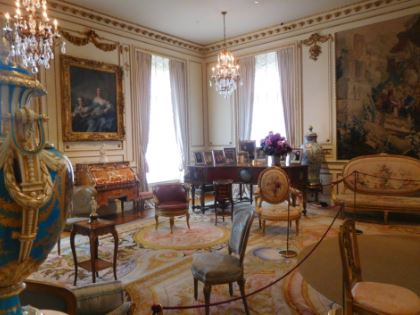
Then, disengaging his fiddle, he began to scrape a lively air, to which he sang with a merry discord, dancing with ludicrous airs and activity, that made me laugh, in spite of the dog’s howling. Then he advanced to the window with many smiles and salutations, and his hat in his left hand, his fiddle under his arm, and with a fluency that never took breath, he gabbled a long advertisement of all his accomplishments, and the resources of the various arts which he placed at our service, and the curiosities and entertainments which it was in his power, at my bidding to display. “Will your ladyship be pleased to buy an amulet against the oupire, which is going like the wolf, I hear, through these woods,” he said, dropping his hat on the floor. “They are dying of it right and left, and here is a charm that never fails; only pinned to the pillow, and you may laugh in his face.” These charms consisted of oblong slips of vellum, with cabalistic ciphers and diagrams upon them. I instantly purchased one. He was looking up, and I was smiling down at him, amused. His piercing black eye, as he looked up in my face, seemed to detect something that fixed for a moment his curiosity. “I told you that I am charmed with you in the most particulars,” he said. “You are slender, and wonderfully graceful. Your complexion is rich and brilliant; your features are small and beautifully formed; your eyes large, dark, and lustrous; your hair is quite wonderful, I never saw hair so magnificently think and long when it is down about your shoulder. It is exquisitely fine and soft, and in colour a rich very dark brown, with something of gold.” “Well, I do wonder at a wise man like you,” I replied. And so he walked on, and I heard no more. #RandolphHarris 3 of 6

Within the space of a week, my colour had returned, and I was sleeping so soundly that I was scarcely aware of my dreams. I walked miles on my estate each day, and I began to see it with new eyes. Every field, every path, even every hedgerow had its own name and its own history. I considered the amulet I purchased as an omen of good luck—and placed in beneath my pillow, to guard against further visitation. That evening, as I reached the top of the stairs, I heard a peculiar flickering sound. Entering my dressing room in the darkness, I made my way to the familiar dressing table on the right side of the room. Now the noise was even more pronounced. It sounded to me as if someone were turning the pages of book, a sound for which there was no rational source. Move over, I suddenly became away of a clammy, cold feeling around me. Since it was a warm evening, this too surprised me. In the dark, I could not be sure if there were not someone else in the dressing room. I quickly existed the room and went to bed. But this night, I was awakened by a violent shaking of my bed. I could see, in the very imperfect light, two figures at the foot oof it, holding each a bedpost. A voice said, “We’ll hang you!” Trembling, I climbed over to the footboard; and saw the figure at the other side, little more than a black shadow, begin also to scale the bed; and there was instantly a dreadful confusion and uproar in the room, and such a gabbling and laughing; I could not catch the words. I found myself on the floor. The phantoms and clamour were gone, but a crash and ringing of fragments was in my ears. #RandolphHarris 4 of 6
The great china bowl, from which for generations the Winchester had been baptized, had fallen from the mantelpiece, and was smashed on the hearthstone. I warned the servants not to disregard oaths and curses. A mourning coach drove up, and two gentlemen in black cloaks, and with crape to their hats, got out, and without looking to the right or the left, went up the steps to the Winchester mansion. Mr. Hansen followed them slowly. The carriage had, he supposed, gone round to the yard, for, when he reached the door, it was no longer there. So he followed the two mourners into the house. In the hall he found a fellow servant, who said he had seen two gentlemen, in black cloak, pass through the hall, and go up the stair without removing their hats, or asking leave of anyone. This was very odd, Mr. Hansen thought, and a great liberty; so upstairs he went to make them out. But he could not find them then, nor ever. And from that hour the house was troubled. In a little time there was not one of the servants who had not something to tel. Step and voices followed them sometimes in the passages, and tittering whispers, always minatory, scared them at the corners of the galleries, or from dark recesses; so that they would return panic-stricken. I, myself, had also heard these voices, and with this formidable aggravation, they came always when I said my prayers. I was scared at such moments by dropping words and sentences, which grew, as I persisted, into threats and blasphemies. These voices were not always in the room. They called, as I fancied, through the walls, very thick in this house, from the neighbouring rooms, sometimes on one side, sometimes on the other; sometimes they seemed to holla from distant lobbies, and came muffled, but threateningly, through the long paneled passages. As they approached they grew furious, as if several voices were speaking together. Whenever I applied myself to my devotions, these horrible sentences came hurrying towards the door, and, in panic, I would start from my knees, and all then would subside except the thumping of my heart against my stays, and the dreadful tremours of my nerves. #RandolphHarris 5 of 6

What these voices said, I never could quite remember one minute after they had ceased speaking; one sentence chased another away; gibe and menace and impious denunciation, each hideously articulate, were lost as soon as heard. And this added to the effect of these terrifying mockeries and invectives, that I could not, by any effort, retain their exact import, although their horrible character remained vividly present to my mind. Camile who acted as a housemaid, would not sleep in the house, but walked home, in trepidation, to her father’s, under the escort of her little brother, every night. Mrs. Rendell, the kitchenmaid, endured the nightly terrors. Mr. Hansen was testy and captious about these stories. He was already uncomfortable enough by reason of the entrance of tow muffled figures into the house, about which there could be no mistake. His own eyes had seen them. He refused to credit the stories of the servants. I made a decision not to fuel the stories of the ghost to keep the servants. “If you see ghosts here, it is no place for you, and it is time you should pack,” I would say. Here has been the cook with the kitchenmaid, as white as pipeclay, all in a row, to tell me I must have a parson to sleep among them, and preach down the devil! Upon my soul, I would not allow my home to fall into utter chaos and disarray. “Mrs. Winchester, I know you are no fool,” said the cook. “But supposed there was a such thing as a ghost here, don’t you see, it ain’t just women telling stories.” “I will not dignify such ideas,” I replied. The women left the kitchen, the cook and the butler went down, not altogether unused to such condescension in the household. The fire had gone down and I was chilled. The candles were expiring in the socket and threw on the white all long shadows, that danced up and down from the ceiling to the ground, and their black outlines I fancied resembled the two men in cloaks, whom I remembered with profound horror. I took the candle, with all the haste I could, getting along the passage, on whose walls the same dance of black shadows was continued, very anxious to reach my room before the light should go out. #RandolphHarris 6 of 6


On night in 1990, there was an unusual buzzing sound in The Winchester Mystery House, one of the staff encountered a dark, hooded figure standing at the door-to-nowhere. In the dim light issuing through the stained glass windows from an outside light, he could see that the intruder, who looked very much like a cowled monk, was waving his arms in a particular manner. Interpreting his movement as threatening, he approached the man and asked him to leave. At the very moment, the employee says he never felt so weak and helpless.

He collapsed in a heap backward onto the floor. He remembered that he actually began to weep in fear and confusion. He was completely at the mercy of whoever or whatever was standing at the door. It was then that the hooded being spoke. “Don’t be afraid,” it said in a quiet whisper. “We won’t hurt you.” And the next thing he knew, the morning sunlight was making him squint into wakefulness. As he reflected on the incident, he became more and more convinced that an actual visitation had occurred and that some kind of entity had come into the mansion. https://winchestermysteryhouse.com/

And please be sure to check out the online gift store: https://shopwinchestermysteryhouse.com/

Look at those Big Bad Pimps—Americans Want to Pay for their Lunch!

Whenever a single wave of change predominates in any given society, the pattern of future development is relatively easy to discern. Writers, artists, journalists and others discover the “wave of the future.” Thus, in nineteenth-century Europe many thinkers, business leaders, politicians and ordinary people held a clear, basically correct image of the future. They sensed that history was moving toward the ultimate triumph of industrialism over premechanized agriculture, and they foresaw with considerable accuracy many of the changes that the Second Wave would bring with it: more powerful technologies, bigger cities, faster transport, mass education and the like. This clarity of vision had direct political effects. Parties and political movements were able to triangulate with respect to the future. Preindustrial agricultural interests organized a rearguard psychological action against encroaching industrialism, against “big business,” against “union bosses,” against “sinful cities.” Labor and management grappled for control of the main levers of the emergent industrial society. Ethnic and racial minorities, defining their rights in terms of an improved role in the industrial World, demanded access to jobs, corporate positions, urban housing, better wages and mass public education. This industrial vision of the future had important effects as well. The shared image of an industrial future tended to define options, to give individuals a sense not merely of who or what they were but of what they were likely to become. It provided a degree of stability and a sense of self, even in the midst of extreme social change. #RandolphHarris 1 of 18

This industrial vision of the future had important psychological effects as well. The shared images of an industrial future tended to define options, to give individuals a sense not merely of who or what they were but of what they were likely to become. It provided a degree of stability and a sense of self, even in the midst of extreme social change. In contrast, when a society is struck by two or more giant waves of change and none is yet clearly dominant, the image of the future is fractured. It becomes extremely difficult to sort out the meaning of the changes and conflicts that arise. The collision of wave fronts creates a raging ocean full of clashing currents, eddies and maelstorms which conceal the deeper, more important historic tides. In the United States of America—and in many other countries—the collision of Second and Third Wave creates social tensions, dangerous conflicts and strange new political wave fronts that cut across the usual divisions of class, race, gender, or party. This collision makes a shambles of traditional political vocabularies and makes it very difficult to separate progressive from reactionaries, friends from enemies. All the old polarizations and coalitions break up. The apparent incoherence of political life is mirrored in personality disintegration. Psychotherapists and gurus do a land-office business, people wander aimlessly amid competing therapies. They slip into cultus and covens or, alternatively, into a pathological privatism, convinced that reality is absurd, insane or meaningless. #RandolphHarris 2 of 18

Life may indeed be absurd in some large, cosmic sense. However, this hardly proves that there is no pattern in today’s events. In fact, there is a distinct, hidden order the becomes detectable as soon as we learn to distinguish Third Wave changes from those associated with a diminishing Second Wave. The crosscurrents created by these waves of change are reflected in our work, family life, sexual attitudes and personal morality. They show up in life-styles and voting behavior. For in our personal lives and political acts, whether we know it or not, most of us in the rich countries are essentially Second Wave people committed to maintaining a dying order. Third Wave people constructing a radically different tomorrow or a confused, self-canceling mixture of the two. The conflict between Second and Third Wave groupings is, in fact, the central political tension cutting through our society today. The more basic political question, as we shall see, is not who controls the last days of industrial society but who shapes the new civilization rapidly rising to replace it. On one side are the partisans of the industrial past; on the other, growing millions who recognize that the most urgent problems of the World can no longer be resolved within the frame work of an industrial order. This conflict is the “super struggle” for tomorrow. #RandolphHarris 3 of 18

This confrontation between the vested interest of the Second Wave and the people of the Third Wave already runs like an electric current through the political life of every nation. Even in the nonindustrial counties of the World, all the old battle lines have been forcibly redrawn by the arrival of the Third Wave. The old war of agricultural, often feudal interests against industrializing elites, either capitalist or socialists, takes on a new dimension in light of the coming obsolescence of industrialism. Now that Third Wave civilization is making its appearance, does rapid industrialism imply liberation from neocolonialism and poverty, or does it, in fact, guarantee permanent dependency? It is only against this wide-screen background that we can begin to make sense of the headlines, to sort out our priorities, to frame sensible strategies for the control of change in our lives. Once we realize that a bitter struggle is now raging between those who seek to preserve industrialism and those who seek to supplant it, we have a new tool for changing that World. To use this tool, however, we must be able to distinguish clearly those changes that extend the old industrial civilization from those which facilitate the arrival of the new. We must, in short, understand both the old and the new, the Second Wave industrial system into which so many of us were born and the Third Wave civilization that we and our children have inhabited. America has a lot of structural problems. Almost all of them are similar to those faced by developing nations. However, they are more acute and visible to the World because of America’s unique status. #RandolphHarris 4 of 18

The list is well-known. We no longer manufacture a significant portion of products we use in our own country. Although we are technologically advanced, new technology is often not used in many buildings and infrastructure because older technology is more cost efficient. And there is a battle between polluting enterprises and green technology, both of which pose problems for the environment. There is high latent unemployment and underemployment in rural and urban areas. Large-scale migration to the cities overstrains their infrastructure causing a lot of ultra-urbanization pains. Obviously mismatch exists between the labor supply (and those willing to work for lower wages, tend to get most of the work). And so on, and so forth. Discussion of America’s present and future usually focuses on a gentlemanly set of problems. They are often looked upon as critical and posing a threat of abrupt and disruptive economic downturn, social and political turmoil or, in the extreme case, the country’s collapse. Such views do not look convincing. The gentlemanly set of problems is manageable, especially for America with its remarkable ability to address crucial issues a gradual, evolutionary, but persistent change. Let us have a loot at a conventional Problem List. Aging Population and Labor Shortages? Yes, population of the working age is apparently approaching its peak and will start to decline in the second half od this century. #RandolphHarris 5 of 18

However, labor force constraints can and most likely will be offset by further gains in labor productivity. Also, there is still a lot of underused human resources in the countryside (about 40 percent of all American worker live in suburban areas) whose migration to the cities will continue to boost labor supply. However, many businesses are now leaving the decaying urban centers, for the suburbs, and many people are working from their electronic cottages. As a result, more businesses will move to the suburbs, which should decrease inner state traffic. As for the growing number and share of elderly people, America with its high migration rates, unhealthy public finance, extremely high social spending, and high dependency toward social safety nets in the future, is in a good position to address the population aging issues in a realistic and financially sustainable way. However, many senior citizens are now small business owners and in good health and are working and support their families, while their kids go to college to obtain degrees, and one day may take over the family business and expand it. Also, the genetic engineer and stem cell technology, we may be able to prevent and cure disabilities. Therefore, most of the population will be in the condition to work and pay taxes. One day, scientists may even find a cure for aging. So, there is a lot of hope for the future. Growing Income Gaps? Well, indeed, they are growing, but, on the other hand, low-income families are mostly elevating their earnings and consumption standards; social safety nets are improving; and, overall, today’s America provides a lot of opportunities to enhance revenues and life a better life to those who really want to make it. #RandolphHarris 6 of 18

Intra-Regional Development Gaps Threatening the Country’s Integrity? Not at all. It is not a critical problem as less developed provinces are becoming the country’s major growth engines and the state has enough financial and other resources to support and amplify the trend. Environmental Damage Endangering the Very Basis of Human Life? No doubt, a whole lot of issues have become critical. However, America is more and more establishing the position of the World leaders in most areas of sustainable smokestack energy, as these companies like Standard Oil are starting to tackle the environmental problems in the same gradual, evolutionarily, but persistent manner it tackled the other ones. And, finally, is there a threat of a big political and social turmoil that may occur as people’s anger with the authoritarian Capitalist regime and democratic political system bursts out and they take to the streets again? Fringe groups of Americans have also been dissatisfied with law and order and hard work, and their anger with the regime is really strong and apparently growing, impacted by numerous cases of power abuse, rampant corruption, disrespect for law enforcement, abuse elder and contempt for leaders, and a lack of respect for patriots and Americana, and other violations of basic human rights. A fresh memory of mine…Some three or four years ago, during a reception in hour of a group of American professors visiting Africa, two of them approached me for a greeting and asked a tough question: “Sir, why don’t you write plainly the America’s present political system is outdated and has to be changed? It worked, but now it has ceased to work. For us it is kind of problematic to write such a thing. Why don’t you?” #RandolphHarris 7 of 18

What could I say to this? For sure, democracy and human rights have a basic, universal value and are perhaps not less (or even more?) important than economic growth and rising living standards, but really all of that is intertwined. Generally speaking, people are disrespected because they do not have enough money, because the color of their skin, religion, physical appearance and what type of house they live in and the car they drive. However, as standards of living increases, through economic growth, people become more rational, better education, and have more money to defend themselves in a court of law, so people reconsider violating these peoples’ human rights because they know they may suffer dire financial and legal consequences as a result, which could impact their freedom and reputation. However, on a macro level, we are seeing people raging against the capitalistic regime and they are actually fighting to restrict freedoms and destroy human dignity; information block-outs are now occurring because a handful of corporations own the media outlets and are fighting to conceal the truth; as well as cynical politicians consorting with the World’s most dictatorial and criminal regimes, which often get a helping hand from Washington when the global community tries to do something to put an end to their brutalities (notably, America tends to mind its own business and condemns brutal regimes for massacres of all people or for developing weapons of mass destruction; it always repeats honest and genuine calls to resolve issues peacefully and not to interfere with internal affairs when possible), naturally, this causes resentment, anger, and indignation. #RandolphHarris 8 of 18

It is a moral and historical obligation of all America and all honest people in the World who care about justice, the rule of law, mortality, and individual freedom to do their best to send the global leadership a clear message about it. On the other hand, values, ideals, and emotions are not the right starting point when your task is to analyze the logic of the evolution of the country’s political system. And there the truth is that America is approaching the task of changing its political system in the very same way it has approached the task of the economic reforms; gradual, evolutionary, but persistent. Its ruling elite is really trying to find workable answers to key and very difficult questions, while avoiding, by all means, any abrupt revolutionary change. At the dawn of 2020, President Trump proclaimed that everything which is good for a human being is capitalism, that is it not so important if you drive a Cadillac or BMW as long as it is made in America or Europe, and that there is no problem with some Americans becoming rich earlier than others. A variety of forms of ownership is encouraged to give a boost to private enterprise and less the burden on social programs. Many affluent people, this may come to a surprise to some, when they retire, it is funded 100 percent by private investments. Wealthy and upper-class Americans have always felt shameful to use government resources, that is why they believe in capitalism. They want to pay for their lunch. After his election, President Trump boosted the stock market to record highs, we saw property value soar (which is a good thing because it puts money in the banks of homeowners), and unemployment reach a historic low. #RandolphHarris 9 of 18

Also, although President Trump is a Republican, he is also a business owner. He fought to make sure each and every America, no matter if they pack income taxes or not, and every business received stimulus money. This helped avoid a depression that would have been much more severe than the Great Depression. Because people have hope, they did not jump from buildings to end their lives like they did during the great depression. President Trump also made sure all Americans has access to medical care, that they had food on the table and that fuel prices remained low so people could get back to work and school. He also told people that they have a right to tell authorities about their grievances, in a respectful manner, but that is they got out of line that the situation would be dealt with by using necessary force. He also told Congress and state and local leaders that they are to listen to what the people say, as long as they are respectful, and seek solutions for the issues they pose. Also, perhaps, America is the World leader in terms of the number of high-ranking officials executed for corruption-related crimes. The FBI prosecuted several government officials in Sacramento when they raided the state capitol. Again, any changes America makes will not be abrupt: from one party of rule to full-fledged multiparty politics, but evolutionary and very gradual, which is why it is very important to people to actually to research about political issues and politicians and vote accordingly. Many people used to vote democratic because they wanted high welfare benefits and more social programs, but as you see, many democrats are using the money to build sports complexes and remodel state buildings and put in bike lanes and resurface sidewalks, while affordable housing needs are ignored. So a Republican may be your best bet. #RandolphHarris 10 of 18

As any business owner will tell you, if your employees cannot take care of themselves, they will not take good care of your business. Therefore, a business owner might make a better President, than a politician because they are used to dealing with human concerns. Citizens are being encouraged by federal law enforcement to stop criticizing the ruling party too strongly because otherwise they may face tough penalties—for example, for disturbing the social order or for being a public nuisance. President Trump was even in the works of making a government news broadcast channel, like FOX News or CNN, so you could get the information directly and unfiltered from the government. That way, private entities and special interest groups will not be able to distort the information for profit. In other words, the major trend is and will be a shift from an outdated communist dictatorship of the traditional type to a more sophisticated political system with a democratic base. This will make the information projected over the airwaves more legitimate in the eyes of World and public opinion or at least to argue that it is legitimate and that it cares about democracy. Look around you and you will see: America is one of the best countries in the World. Now, prostitution is an economic activity, and it is one many people turn to when they cannot feed their families, and this is why the government likes to keep social programs because no matter how rich a person is or what political party, they are part of, their kids could become involved in prostitution if they have no other way to survive. #RandolphHarris 11 of 18

The prostitutes-as-business-women and prostitutes-as-loving-partners identifications were made possible by a men-as-expense symbolic landscape where men were defined in relation to money because involvement with them was seen as necessitating payment in the form of “opportunity costs” (id est, vales which must be given up in order to achieve something) and “hidden costs” (id est values which are unknown at the time of calculation). The men-as-expense symbolic nexus was a construction of involvement with men in general rather than involvement with men in the context of engagement in prostitution. Hence, Sophie (aged 28) made the comment: “If you get involved with a man—ANY MAN—there’s always a price to pay. There’s always responsibility to give him money or something. You never can get away with it for free.” Throughout all the respondents’ talk there were differences drawn between the actual opportunity cost incurred by relationships with different categories of men. Involvement with pimps, boyfriends and the police were described as necessitating an opportunity cost in that the women understood involvement with all these men as providing them with “sanctuary” from prostitution or protection from prostitution-related risks, but at different and specific prices. “What I was left with was absolute fear and terror—a loneliness on a level I didn’t know existed. I didn’t feel like a human being anymore,” Michelle shares of her heartbreaking story of addiction—an addiction that eventually drove her to become a prostitute. #RandolphHarris 12 of 18

Most of the women spoke about boyfriends with whom they were or had been involved and who gave them sanctuary from prostitution through financially supporting them. However, the women described such involvement as costing them their independence and it was their unwillingness to pay this price that, they believed, lead to the break up of those relationships. Similarly, involvement with policemen was seen as offering the women protection from prostitution-related violence, especially against violence from pimps. In her moments of deepest darkness, Michelle began entertaining the idea that maybe God could help her, maybe He could provide hope and light like to one else could. “My World changed. You don’t life a life like that and then have things change overnight. It took some time,” she says. Indeed, two other women recalled that it was only after the intervention of the police that they were able to leave their pimps. However, here, the police did not arrest the pimps, rather they arrested the women and took them to hostels or other helping agencies. The price for this was understood as being both provision of information to the police, and more importantly being “indebted” to the particular policeman who provided the help. In one of her moments of desperation, Michelle heard a knock on the door. Two police officers were on her doorstep and wanted to share a message with her. “I needed to know that Heavenly Father loved me. Once I started to believe that—to believe that I was a child of God, that I want not the sum of my behavior, that I was not too broke and not too damaged. I was not unlovable. I was loveable and I was worth it, and He would send His police officers to knock on the door to make me feel loved that night.” #RandolphHarris 13 of 18

Lastly, in relation in relation to pimps, more than half of the interviewees talked of making calculations about the quality of protection that pimps could offer them (against violence from johns or intimidation by other pimps) in exchange for the financial exploitation to which they would have to submit. This was most clearly seen in the women’s discussion of “big, bad pimps.” “Once they know who you’re working for and what status he’s got—like who’s the baddest, who’s got the gun and who hasn’t. You have only to mention his name and that was that. People leave you alone. Other [pimps] and other girls just leave you be. They don’t meddle because he’s psychotic! He’s notorious! He’s one very sick and twisted individual. People are afraid of him. (Anna, aged 36.) Of course, the obvious irony is that, although the women understood involvement with their pimps as a form of opportunity cost, providing them with protection, in reality, these pimps provided them with little protection and, in fact, exposed to them further violence and certainly to further financial exploitation. (I supposed they must have shorted him on his money.) In contrast, involvement with men as partners was described by the women as incurring “hidden costs.” In two cases, the hidden cost was initial entrance into prostitution. Both women talked about “having the knickers charmed off” them and being talked into engaging in prostitution. The cost was hidden because it only emerged after their relationships with these men were established. More commonly, however, was the woman’s understanding of the cost of maintaining their relationships as being their continued involvement in prostitution. As Anna (aged 36) stated: “There’s a lot of pressure. You have to do it, coz you need the money yourself. Then you get mixed up with someone and you have to do it again to help him, to keep a hold of him.” #RandolphHarris 14 of 18

A community committed to the optimal development of all its citizens will usually find—unless it is very small—that it has an array of all six types of agencies, both public and private. At the national level these are mostly grouped in the new Department of Health, Education and Welfare; at the local level, the city departments (plus some units of county and state) tend to cover the range, though very unevenly, and so do the councils of social agencies on the private side. Together they make up an impressive complement of personnel and machinery. From the administrative standpoint, not more machinery but its co-ordination to sever the family as a unit, appears to be the most pressing demand. From the standpoint of the citizen and family, however, the salient point is the effect achieved by the expenditure of resources; what matters is whether the agencies encourage dependency or foster development. Expressed in terms of values rather than functions, does the family agency attempt to define and achieve an optimal family, or does it avoid such responsibility, and merely seek to supply the most obvious and agreed-on deficiencies, as if these deficiencies were objective facts, not subject to different interpretations? In most parts of the United States of America, the hospital rather than the home is the place where babies are born and where patients with the more acute illnesses are cared for. Professional nurses and subordinate assistants have largely displaced kind relatives and helpful neighbors. #RandolphHarris 15 of 18

Yet while the hospitals have been taking over certain medical functions from the home, the biological scientists have been urging that greater responsibilities for nutrition, sanitation, and mental hygiene should fall upon the family itself. The vast and burdensome scale of mental disease in particular, which cannot possibly be reversed solely by psychiatric treatment at the point of breakdown, as well as an increased consciousness of the contribution of disturbed mental states to physical illness, have led physicians to expect more from the family than in the past. Nursing education steadily includes more social science. Likewise, the modern knowledge of bacterial and other origins of disease, and the biochemistry of healthful nutrition, have led to the elaboration of genuinely new functions, whereby the family may contribute to the physical competence of its members. Even if desirable, it would not be possible to have a psychiatrist, a bacteriologist, and a dietitian stand over every living unit of the community. If there is to be a rise in health along these lines, the members of each living unit must co-operate in supervising their own hygiene. It is not easy to think of a better institution for performing these functions than the competent family. There is a conspicuous problem for present families who attempt to cultivate the physical competence of their members. This is not really a medical problem at all but an economic one. It is the problem of hospital and doctor bills, and of spreading the risks of chronic or catastrophic illness. #RandolphHarris 16 of 18

The believer needing deliverance from the condition of passivity must first seek to understand what should be one’s normal or right condition, and then test or examine oneself in the light of it to discern if psychopathological offenders have been interfering. To do this, let one recollect a moment in one’s life which one would call one’s “best”—either in spirit, soul and body, or in one’s whole being—and then let one look upon this as one’s normal condition, one which one would want to be maintained, and never rest satisfied below it. Since the passivity has come about gradually it can only end gradually, as it is detected and destroyed. The full cooperation of the human is necessary for its removal—a major reason for the long period needed for deliverance. Deception and passivity can only be removed as the human understands, and cooperates by the use of one’s volition in the refusal of both the deception and the ground upon which it was based. It is important to keep perpetually in mind the standard of the normal condition, and should at any time the believer drop below it, to find out the cause, so as to have it removed. Whatever faculty or part of one’s being has been surrendered into passivity, and therefore lost for use, must be retaken by the active exercise of the will, and thus brought back into personal control. The ground which had been given—which caused the fall into bondage to the enemy—must be eliminated and then refuse persistently, in a steady resistance to the spirits of evil in their hold of it. Remember, the powers of psychopathological offenders will fight against the loss of any part of their kingdom in human, just as any Earthly government would fight to protect its own territory and subjects. #RandolphHarris 17 of 18

However, the “Stronger than he” is the Conqueror, and will strengthen the believer for the battle and full recovery of the spoil. First of all, the method of correlation is seen in action, the posing of existential questions followed by theological answers in the form of Christian symbols. Up to now the method of correlation has not been explicitly operative; rather, we have synthesized the union of religion and culture. Second, God, the Christ, the church, history—corresponds to the major divisions of Systematic Theology, and so we gradually progress systematically and express a lifetime of theological endeavor. The existential question is the question of being, and the answer is God. Also treated is the problem of the natural-supernatural and the problem of symbolism, or the way to speak about God. Thus we probe into the depth-dimension which underlies theonomous cultural forms, the holy which shines through the secular, the ground of being which alone can command the ultimacy of an ultimate concern. God is the answer to the question implied in being. We are nominalist by birth. And as nominalist we are inclined to dissolve our World into things. However, the true ontological question does not try to describe the nature of beings, either in their universal, generic qualities, or in their individual, historical manifestation. It simply asks: What does it mean to be? The profundity and the seriousness of the question is realized only in a “metaphysical shock”—the shock of possible nonbeing. The question, “Why is there something, why not nothing” produces the shock by peering into the abyss of possible nothingness. However, the answer to the question is always in terms of being, which permits it to be posed again and again in infinite regression. Furthermore, nonbeing cannot answer it, for nonbeing depends upon being. Therefore, we cannot go beyond being in order to explain being. However, there could be something, a state, beyond being and nonbeing that we cannot comprehend. #RandolphHarris 18 of 18


This is the good life – picture yourself at #MagnoliaStation at #CresleighRanch!

From whipping up a delicious summer treat 😋 using ingredients from that incredible pantry to chilling in that beautiful yard, you’ll love everything about Residence 5. 😍

Residence 5 has an inviting covered entry and welcoming extended foyer reveal a spacious office and views to the expansive great room, casual dining area, and desirable covered patio beyond.

The sophisticated primary bedroom suite is highlighted by an ample walk-in closet and spa-like primary bath with dual-sink vanity, luxurious glass-enclosed shower. There is also a private water closet.

Magnolia Station will include 81 homesites and five distinct plans ranging from 2,200 – 3,700 square feet, with up to 7 bedrooms; including three single story plans!

Each plan has been thoughtfully designed to include features such as: Generations Suite, Optional Offices/Dens, Extended Great Rooms, and more! Contact us for your tour! https://cresleigh.com/magnolia-station/


Ruin is the Destination Toward Which All Men Rush

With equality and gender-based studies becoming more important, it is a goo idea that we take a look at a gender-based analysis of residential burglary. The study is based on interviews with 105 active residential burglars, 87 of whom were males and 18 were females. The project employed a snowball sampling strategy in which an ex-offender recruited known burglars who were presently operating in a city. The gender-based compassion suggests that, in many way, female burglars resemble their male counterparts. For example, both group display long criminal histories that span a variety of property, violent, and public order offenses categories. Both groups accumulate long, diverse substance abuse histories that overlap with and contribute to their involvements in burglary. At the time, the gender-based comparison reveal several differences. Female burglars begin offending at a later age, are more likely to co-offend, and have less contact with authorities. The typology of female burglars describes offenders as either accomplices or partners. Factor of motivation, levels of target selection and planning, and patterned work roles serve to differentiate these two conceptual categories. Despite growing interest in female criminality, little is known about the nature of women’s participation in crimes statistically dominated by males. Certainly that is the case for residential burglary, an offense labeled as an overwhelmingly male enterprise. For example, we hardly know how female become involved in such offenses or what roles they play. Are they tempted into these crimes, for instance, by the influence of delinquent peers or by the use of drugs? #RandolphHarris 1 of 21

Because we lack detailed knowledge, we cannot assess the extent to which the processes underly burglaries committed by females differ from those underlying burglaries by males. This lack also restricts our capacity to detect important differences among female burglars. An assessment of these difference, however, is crucial in formulating effective policy responses to female criminality and to developing theories of lawbreaking by women. Short of observing burglaries, perhaps the best way to acquire this information is to go to the offenders themselves. The most pressing need today, in researching the agenda for feminist criminology, is observation and interviewing so we can plunge more deeply into the social Worlds of girls and women. Such a strategy will allow researchers to comprehend women’s crime on its own terms. Often it is claimed that offenders are versatile and commit a wide range of offense. This observation, however, is derived largely from studies of males conducted in criminal justice settings rather than on the street. During our interviews we asked the subjects whether they ever had committed other sorts of crimes beside residential burglary. We did so because we were concerned primarily with prevalence—that is, whether the subject ever had engaged in other kinds of offenses. Stealing (which includes shoplifting and corresponds to the legal definition of this activity), auto theft, and assault were the offenses most commonly reported by males. Stealing and assault were mentioned most frequently by the females; these offenses were comparable in rank of frequency to those reported by the males. #RandolphHarris 2 of 21

Beyond these two offenses, however, little other criminality was reported by the females. The only meaningful differences between the men and the women for this measure was found in regard to auto theft. This crime was fairly common among the males, but unknown among the females. The explanation for this difference might reside in a strong cultural tradition linking masculinity to driving and car ownership. Alternatively, males may have “cornered the market” in auto theft; to be profitable, such a crime requires sophisiticated coneections with garage owners, automotive recycle yard employees, and car dealerships. One important aspect of offending style concerns the degree of crime specialization—that is, the extent to which offenders concentrate on one particular type of offense. When we asked offenders whether they had been involved in crimes other than residential burglary during their most recent period of offending, thirty-four percent of the males and 42 percent of the females claimed that they had committed only residential burglaries during this period (roughly the last six months). This finding is consistent with a substantial body of previous research showing that offenders display considerable diversity over the course of their criminal careers, but may specialize in a particular “line” for short periods. This phenomenon is labeled as “short-term specialization.” Another element of offending style concerns the inclinations to work with others in carrying out cries. #RandolphHarris 3 of 21

Previous research demonstrated that more often than not, [burglary] is committed by two or more persons acting in concert. The results of our study bear this out: 79 percent of the males and all of the females reported that they had worked with others in the past. The males showed considerable variation in frequency of working with others: 39 percent said they “seldom” worked with others, while another 39 percent reported that they “always” did so. For the women, however, the picture was much clearer: an overwhelming 83 percent reported that they “always” worked with others, and the remaining 17 percent states that they “usually” did so. The final aspect of offending style that we examined here relates to drug and alcohol use among our respondents, as well as to their perceptions of the role played by intoxicants in leading them to commit such crimes. Our research reveals that there is little difference between the males and the females in self-report drug use. When the drug users were asked whether addiction had anything to do with their burglaries, 71 percent of the males and 82 percent of the females answered affirmatively. A majority of those in both groups said they committed burglaries to obtain the money they needed to buy more drugs. In addition, slightly more than three-quarters of the users in each group—76 percent of the males and 79 percent of the females—claimed that they used drugs before committing their burglaries. A higher percentage of females than of males started that they “always” or “usually” used drugs beforehand. #RandolphHarris 4 of 21

One explanation seems to be that many female burglaries arise from crack “runs.” This point, however, is difficult to determine conclusively because use of the drug is heavily stigmatized. We explore male-female differences on three dimensions designed to measure burglary offending histories: age at first burglary, total number of lifetime burglaries, and lambda, the mean number of annual burglaries. The ages at which males and females committed their first residential burglary differed significantly: the males generally started much earlier in life. None of the female burglars had committed their first offense before age 12, but 22 percent of the males had done so. The modal category for males was the 13-16 age bracket, which accounted for 53 percent of the cases. Sixty-one percent of the females, on the other hand, were over 16 years old when they carried out their first burglary. Given that the females started to commit burglaries later, on average, than their male counterparts, we are not surprised that a greater proportion of females had been involved in fewer than 20 residential burglaries in their lifetime. Perhaps more interesting, 39 percent of the females had committed more than 70 lifetime residential burglaries, a proportion roughly comparable to the males’ figure of 41 percent. The bimodal distribution of the females’ responses suggests that women are likely to engage in burglary at two very distinct levels, and perhaps to employ two different styles. #RandolphHarris 5 of 21

The males were more likely than the females to have had contact with the system for offenses of all types. This difference was most notable at the stage of the criminal justice process that resulted in incarceration. Over ninety percent of the respondents in each group had been arrested previously, but only one woman (6 percent) had been convicted and sentenced to a term of imprisonment. In contrast, 26 percent of the males had served time in the past. This difference may exist in part because the females began offending later and consequently had fewer “years at risk.” Other factors, however, are probably at work as well including an assumption by the police that most burglars are male, which allow females to remain above suspicion and a tendency for those females who are arrested to receive preferential treatment in the courtroom. Certainly the women in our sample believe that their gender conferred a degree of protection from the law. Several expressed the belief that authorities would not take action against them simply because they were female. Is it not becoming clear, in light of the existence of deceiving offenders and their methods of deception, that close examination is needed of modern theories, conceptions, and expressions regarding things in connection with the ultimate concern and its way of working in man? For only the certainty of ultimate concern, apart from “views” of truth, will avail for protection or for successful warfare in the conflict with wicked offenders in the self-actualized hierarchy. #RandolphHarris 6 of 21

When we reach self-actualization, we are at the highest hierarchy of the pyramid, and this is denoted by morality, creativity, spontaneity, problem solving, lack of prejudice, and acceptance of facts. There are five levels in the pyramid. At the very bottom, people are interested in physiological functions only which include: breathing, food, water, pleasures of flesh, sleep, homeostasis, and excretion. At the second level of the pyramid, individuals are concerned with safety and this entails security of: body, employment, resources, mortality, the family, healthy and property. At the third hierarchy most are concerned with love and belonging. This includes friendship, family, sexual intimacy. At the fourth hierarchy, this realm focuses on esteem: self-esteem, confidence, achievement, respect of others, respect by others. All that is in any degree the outcome of the mind of the “natural man” will prove to be but the weapons of straw in this great battle, and if we rely upon others’ “views of truth,” or upon our own human conceptions of truth, offenders will use these very things to deceive us—even building us up in these theories and views so that under cover of them he or she may accomplish one’s purpose. We cannot, therefore, at this time, overestimate the importance of believers having ready minds to “examine all things” they have thought, and perhaps taught, in connection with the things of ultimate concern and the self-actualized realm—all the “truths” they have held, all the phrases and expressions they have used in “virtue teachings,” and all the ideas they have absorbed through others. #RandolphHarris 7 of 21

For any wrong interpretations of truth, any theories and phrases which are man-conceived and which we may build upon wrongly, will have perilous consequences to ourselves and others in the conflict with truth and individual self-actualized people passing through. Because in the present offenders will comes to them with deceptions in DOCTRINAL form, self-actualized individual must examine carefully what they accept as “doctrine,” least it should be from the emissaries of the deceiver. Some people are tired of struggling and want only to know a quiet silence. This can be a shock to one’s own awareness of who he or she is. One may have always considered struggle essential in growth, and in many crises and conflicts it has provided the turning point in one’s life. Not wanting to be burdened and overwhelmed by heavy feelings and thoughts or by complicated searching and painful of what is wrong with oneself, people, and life, this can create the desire to turn away from the struggle. And this is what causes the requirement to be alone in simple and ordinary ways. Once one goes through this process of healing in solitude, and by only engaging in simple routine, gradually, with each day, an individua is able to listen a little more to what others are saying. (This is why during a break up, space, instead of forcing the issues is important. Of course, there are times when you need to know what the reason it so it may be a good idea to press for answers to start a dialogue and not necessarily to just focus on getting back together.) #RandolphHarris 8 of 21

Slowly it becomes each to be interested in and comfortable with other people’s problems. Although there may be some drawbacks. Some individual may be able to be with others while you struggle to make decisions, but one may not be opened to questions or personal comments and responses directed to one. This may cause one to offer nothing of oneself and comment only on what one is hearing and understanding from others. During this period, some find work a truly rewarding activity; it is a place that feels like home. It does not matter whether the work takes the form of writing—reports, references, and letters—or reading. Or, if it involved physical activities, one may become totally absorbed in what one is doing, get lost in the activity and experience a full sense of relief. Active mental and physical involvement in solitary projects can be a sense of salvation. By surrendering to powers within to powers within and sources of light in the universe, in some mysterious way, a miracle happens. It is the loss of the old man and the discovery of the new man. When the light reveals itself, the individual is ready to accept it. This reduces the need to force or push or beseech. One simply waits with firm faith that one is meant to be whole again and that one will live more in a full and complete way. It becomes clear that people one loves and those who love one cannot reach the individual going through changes. And so, life has to come from another source, and that new direction will emerge in solitude. #RandolphHarris 9 of 21

The problem of the truth of faith presents itself from both the subjective and objective sides. Subjectively, faith is true if it adequately expresses an ultimate concern, that is, if the symbols of faith are alive and speak to the heart with an urgency of concern that impels to action and replay. This criterion is more a rule of thumb that works best for obviously dead symbols and is not so useful in judging contemporary ones. However, it is the objective truth of faith that interests us here. The content of faith is true if it is really and not just apparently ultimate. The great danger is demonization, elevation of the symbol to ultimacy, which results in idolatrous faith. Therefore, the criterion of faith is self-negation. The true symbol not only conveys the ultimate, but proclaims its own non-ultimacy. It pronounces a Yes and a No. For the Christian the Cross of the Christ is such a symbol. Name for this criterion—the No that follows immediately on the heels of the Yes—is the Protestant principle. The Protestant principle pervades in this whole theology, both systematically and chronologically. Chameleon-like, it changes its formula of expression against the background of diverse theological problems. Hence, a rapid rundown of its various formulations is useful for identifying it. #RandolphHarris 10 of 21

In addition to being the objective criterion of faith, the Protestant principle expresses man’s infinite distance from God and his dependence upon the divine initiative. The Protestant principle is the prophetic protest against every form of self-absolutizing—for example, the demonic elevation of the churches, of the Christian Bile, and the priesthood to absolute validity. The Protestant principle is “resistance to idolatry,” that is, it stands for non-conformity in family, school, state, and church. The Protestant principle protests the objectifying of grace (die Vergegenstandlichung der Gnade) and so smashes the barriers between the holy and the secular. For, by the Protestant principle, God is as near to the lowest as he is to the highest, as close to the material as to the spiritual. These manifold expressions of the Protestant principle can be summarized in and derived from the basic doctrine that the Protestant principle is justification by grace through faith. We reject the traditional Protestant formula of “justification by faith” on the grounds that is has been misunderstood to mean that the human act of faith sets in motion God’s justifying act. Faith itself is a gift of grace, all justifying actions is entirely on the part of God, and, consequently, the more accurate formula is “justification by grace through faith.” The Protestant principle ultimately rests upon an experience of God’s majesty that attributes absoluteness and holiness to him alone and denies such dignity to all else. #RandolphHarris 11 of 21

Untrammeled choices of individuals could lead to disaster for society. Picture a paster open to all. It is to expected that each herdsman will try to keep as many cattle as possible on this commons. Therein is the tragedy. Each man is locked into a system that compels one to increase one’s heard without limit, in a World that is limited. Ruin is the destination toward which all men rush, each pursuing one’s own best interest in a society that believes in the freedom of the commons. Overpopulation, pollution, excessive fishing, and depletion of exhaustible resources are all part of the problem. People Worldwide must recognize the necessity of restricting individual freedom in these choices, and accept some mutual coercion mutually agreed upon. Depending upon the circumstances, the tragedy of the commons could be a many-person prisoner’s dilemma (each person grazes too many cows) or a spillover problem (too many people choose to become herdsmen). The economist’s favorite solution would be the establishment of property rights. This is what actually happened in the fifteenth and sixteenth centuries in England: the common land was enclosed and claimed by the local aristocrats or landlords. When land is private property, the invisible hand will shut the gate to just the right extent. The owner will charge grazing fees to maximize one’s rental income; the grazing fees will make the owner richer, and the herdsmen poorer. This approach is not feasible in some instances. Property rights over the high seas are hard to define and enforce in the absence of an international government, as is control over air that move from one country to another carrying pollutants. #RandolphHarris 12 of 21

For this reason, whaling and acid rain must be handled by more direct controls, but securing the necessary international agreements is no easy matter either. Population is an even harder problem. The right of decision about one’s family, including its size, is enshrined in the United Nations’ Universal Declaration of Human Rights and in many countries bills of rights. Countries like China and India that have at times used some coercion in their population-control efforts have evoked widespread disapproval. Sometimes, when the group is small enough, voluntary cooperation solves the problem. When two oil or gas producers have wells that tap into the same underground deposit, each has the incentive to speed up one’s uptake, to get more of the resource before the other does. When both of them follow this policy, the excessive speed of depletion can actually lower the total amount that can be recovered from the deposit. In practice, drillers recognize the problem and seem able to reach production-sharing arrangements that keep at the proper level that total flow from all wells tapping one deposit. All’s well that ends well? For the less developed countries (LDCs), as for the rest of the World, power stems from the holster, the wallet, and the book—or, nowadays, the computer. Unless we want an anarchic World, with billions of poverty-stricken people, unstable governments led by unstable leaders, each with a finger on the missile launcher or chemical or bacteriological trigger, we now need global strategies for preventing the de-coupling that looms before us. #RandolphHarris 13 of 21

In the years immediately ahead the LDCs will acquire sophisticated new arms—enormous firepower will be added to their already formidable arsenals. Why? As LDC economic power diminishes, their rulers face political opposition and instability. Under the circumstances, they are likely to do what rulers have done since the origins of the state: They reach for the most primitive form of power—military force. However, the most acute shortage facing LDCs is that of economically relevant power is no longer through the exploitation of raw materials and human muscle but, as we have seen, through application of the human mind. Development strategies make no sense, therefore, unless they take full account of the new role of knowledge in wealth creation, and of the accelerative imperative that goes hand in hand with it. With knowledge (which in our definition includes such things as imagination, values, images, and motivation, along with formal technical skills) increasingly central to the economy, the Brazils and Nigerians, the Bangladeshes and Haitis must consider how they might best acquire or generate this resource. It is clear that every wretched child in Northeast Brazil or anywhere else in the World who remains ignorant or intellectually underdeveloped because of malnutrition represents a permanent drain on the future. Revolutionary new forms of education will be needed that are not based on the old factory model. Acquiring knowledge from elsewhere will also be necessary. This may take unconventional—and sometimes even illicit—forms. Stealing technological secrets is already a booming business around the World. We must expect shrewd LDCs to join the hunt. #RandolphHarris 14 of 21

Another way of obtaining wealth-making know-how is to organize a brain drain. This can be done on a small scale by bribing or attacking teams of researchers. However, some clever countries will figure out that, around the World, there are certain dynamic minorities—often persecuted groups—that can energize a host economy if given the chance. The overseas Chinese in Southeast Asia, Indians in East Africa, Syrians in West Africa, Palestinians in parts of the Mideast, Jews in America, and Japanese in Brazil have played this role at one time or another. Transplanted into a different culture, each has brought not merely energy, drive, and commercial or technical acumen, but a pro-knowledge attitude—a ravenous hunger for the latest information, new ideas, skills. These groups have provided a kind of hybrid economic vigor. They work hard, they innovate, they educate their children, and even if they get rich in the process, they stimulate and accelerate the reflexes of the host economy. We will no doubt see various LDCs searching out such groups and inviting them to settle within their borders, in the hopes of injecting a needed adrenaline into the economy. During World War II the Japanese military actually drafted a plan to bring large numbers of persecuted European Jews to Manchuria, then called Manchukuo, for this purpose. However, the “Fugu Plan,” as it was known, was never implemented. #RandolphHarris 15 of 21

Smart governments will also encourage the spread of nongovernmental associations and organization, since such groups accelerate the spread of economically useful information through newsletters, meetings, conferences, and foreign travel. Associations of merchants, plastics engineers, employers, programmers, trade unions, bankers, journalists, etcetera, serve as channels for rapid exchange of information about what does and does not work in their respective fields. They are an important, often neglected communications medium. Governments serious about economic development will also have to recognize the new economic significance of free expression. Failure to permit the circulation of the new ideas—including economic and political ideas, even if unflattering to the state—is almost always prima facie proof that the state is weak at its core, and that those in power regard staying there as more important than economic improvement in the live of the people. Governments committed to becoming part of the new World will systematically open the valves of public discussion. Other governments will join knowledge consortia—partnerships with other countries or with global companies—to explore the far reaches of technology and science and, especially, the possibility of creating new materials. Instead of pandering to obsolete nationalist notions, they will purse the national interest passionately—but intelligently. #RandolphHarris 16 of 21

Rather than refusing to pay royalties to foreign pharmaceutical companies on the lofty ground that health is above such grubby concerns, as Brazil has done, they will gladly pay the royalties—provided these funds stay inside the country for a fixed number of years, and are used to finance research projects carried out jointly with a local pharmaceutical firm’s own experts. Profits from products that originate in this joint research can then be divided between the host country and the multinational. In this way the royalties pay for technology transfer—and for themselves. Effective nationalism thus replaces obsolete, self-destructive nationalism. Similarly, intelligent governments will welcome the latest computers, regardless of who built them, rather than trying to build a local computer industry behind tariff walls that keep out not merely products but advanced knowledge. The computer industry is changing so fast on a World scale that no nation, not even the United States of America or Japan, can keep up without help from the rest of the World. By barring certain outside computers and software, Brazil managed to build its own computer industry—but is products are backward compared with those available outside. This means that Brazilian banks, manufacturers, and other businesses have had to use technology that is inefficient compared with that of their foreign competitors. They compete with one hand tied behind them. Rather than gaining, the country loses. #RandolphHarris 17 of 21

Brazil violated the first rule of the new system of wealth creation. So what you will with the slowly changing industries, but get out of the way of a fast-advancing industry. Especially one that processes the most important resource of all—knowledge. Other LDCs will avoid these errors. Some, we may speculate, will actually invest modestly in existing venture capital funds in the United States of America, Europe, and Japan—on condition that their own technicians, scientists, and students accompany the capita and share in the know-how developed by the resulting start-up firms. In this way, Brazilians or Indonesians or Nigerians or Egyptians might find themselves at the front edge of tomorrow’s industries. Astutely managed, the program could well pay for itself—or even make a profit. Above all, the LDCs will take a completely fresh look at the role of agriculture, regarding it not necessarily as a “backward” sector but as a sector that potentially, with the help of computers, genetics, satellites, and other new technologies, could someday be more advanced, more progressive than all the smokestacks, steel mills, and mines in the World. Knowledge-based agriculture may be the cutting edge of economic advantage of tomorrow. Moreover, agriculture will not limit itself to growing food, but will increasingly grow energy crops and feed stocks for new materials. These are but a few of the ideas likely to be tested in the years to come. #RandolphHarris 18 of 21

However, none of these efforts will bear fruit if the country is cut off from participation in the fast-moving global economy and the telecommunications and computer networks that support it. The maldistribution of telecommunications in today’s World is even more dramatic than the maldistribution of food. There are 7.33 billion unique mobile phones users in the World today, which makes 91.40 percent of people in the World cell phone owners. The lopsided distribution of computers, data bases, technical publications, research expenditures, tells us more about the future potential of nations than all the gross-national-product figures ground out by economists. To plug into the new World economy, countries like China, Brazil, Mexico, Indonesia, India, as well as the Soviet Union and the East European nations, must find the resources needed to install their own electronic infrastructures. These must go far beyond mere telephone services to include up-to-date, high-speed data systems capable of linking into the latest global networks. The good news is that today’s slow countries may be able to skip over an entire stage of infrastructure development, leapfrogging from First to Third Wave communications without investing the vast sums needed to build Second Wave networks and systems. The Iridium systems, for example, announced by Motorola, Inc., placed 77 tiny satellites into low orbit, which make it possible for millions in remote or sparsely populated regions like Soviet Arctic, the Chinese desert, or the interior of African to send and receive voice, data, and digitized images through handheld telephones. #RandolphHarris 19 of 21

It is not necessary to lay cooper or even fiber optic cable across thousands of miles of jungle, ice or sand. The portable phones communicate directly with the nearest overhead satellite, which will pass the message along. Other advances also similarly slashing the huge costs of telecommunications, brining them within reach of today’s impoverished counties. Large scale production and hyper-competition among American, European and Japanese suppliers will also drive down costs. The new key to economic development is clear. The “gap” that must be closed is informational and electronic. It is a not gap between the North and the South, but between the slow and the fast. However, China’s inadequacy in services is of a structural character. It has it historical and cultural roots, especially the legacy of several decades long epoch of Soviet-style socialism. The mentality of many Chinese service companies and workers may have exceeded those in America. When I was in China, I was impressed by their customer service. They were extremely polite, spent time talking to me, even offered me candy and gave me a soccer ball for shopping at one of their malls. They did treat me like a king. I did not want to come back to America because I loved China so much. Maybe people have different experiences? #RandolphHarris 20 of 21

The overall picture of the service economy in China is not gloomy. Even on the airplane they were polite and told me to stop being so “Western.” The hotels were awesome, as well as the recreation facilities and restaurants. As local consumers’ demand for a variety of good services is increasing, American, European and Japanese service providers have a good chance to exploit their competitive advantage in this area, establishing a stronger position at the Chinese market. Here, however, comes a surprise. You may expect that, in the wake of what was written earlier, America and Europe are enjoying substantial surpluses in their services trade with China, not incomparable to their huge deficits in merchandise trade. But the thing with the people in China, one cannot tell when they are just being nice. Things are so different. They try so hard to like people and make them happy that it seems like they really like you. And they try really hard to keep a neat appearance, are very careful with their work, and take pride in what they do. Because their image and reputation depends a lot on word of mouth, they are very careful not to hurt your feelings and to conceal negative topics, ideas, thoughts and behavior. And their houses are really clean, many of them have never heard of “racism” and the student work very hard in school. It is amazing how many hours a day they spend studying. They really went out of their way to impress us, like hosting us in a restaurant, but making it a private event, of course it meant getting up at 3 A.M. in the morning, but I was happy to. They are so polite and taught me if something is meant to be, you will meet that person again. #RandolphHarris 21 of 21


Scared Away by Ghost and Demons and Sightings of Satan

Everything in the Universe can come under magic’s fire. Magic plays a part in Satan’s Worldwide rebellion against God and Jesus Christ. Though, if he attacks angels and spirits, animals and humans and everything in the material World. It is simply impossible to describe the tremendous scope of magic in a single report. We will, though, mention the main areas in which magic comes into play. First, healing and the inflicting of illnesses. A Catholic woman was seriously ill in hospital. The woman called the nurse and asked a favour of her. She went on to say that she had a daughter at home who had been demon-possessed for many years, and that the daughter was rarely conscious. Being so seriously ill the woman now saw an opportunity of helping her daughter. She asked the nurse to get in touch with her relatives before she died. She wanted the relatives to bring the daughter to the hospital so that the two of them could change vests with one another. Her idea was that in doing so her daughter would be freed, while she would die in the state of being possessed. The nurse however, did not fulfil her wish. Inflicting diseases is directly opposite to healing. Another example, a young man wanted to evade military service. His father therefore sent him to a magic charmer to be given some illness. The experiment was successful, and afterwards the young man was found to be unfit for military service. In another illustration, a spiritistic medium confessed that she belonged to a circle which not only practised communication with the dead but also black magic. Her specialty was in causing sicknesses and in death magic; she had already committed several murders which the police had been unable to solve. She has also worked on a minister who afterwards developed nervous disturbances and had been unable to work for several months. This was the content of her confession. I could not prove the statements, but I did know that at the time of the circle’s magic experiments this particular minister had been ill for a considerable period of time. #RandolphHarris 1 of 19

In another story, a girl from a strict Catholic family married a Protestant against the will of her parents. The first child they had contracted polio. The parents blamed their daughter, saying that it was her punishment for marrying a Protestant. Later they asked a magician to heal the baby boy and to transfer the illness to the mother instead. This in fact happened as the child was cured, while the girl herself became ill. She was taken to a hospital with symptoms of paralysis, depressions and terrible headaches. The doctors differed in their diagnosis. They may one test after another; spinal puncture, metabolism test, electro-cardiogram etcetera. Finally, they called in a brain specialist. She was examined over a period of several weeks but no cause was found for her illness. Later the condition of the young woman improved rapidly and she asked to be discharged. She was allowed to go home. Her parents, on hearing about this, were greatly disturbed and immediately reported the matter to the magician, telling him that his persecution of her had become ineffective. In another instance, a black magician (possibly a warlock) told a girl who was being courted by a married man, “I’ll break this man’s mind so much that he’ll lose his position.” It was not very long after this that the man began to have nervous disorders. He would complain of hearing noises both in his head and externally. He also suffered from flickering before the eyes loss of vision and an inability to concentrate. There was also a girl who had become a Christian during a mission. Inspired by the joy of her salvation she invited others to the meetings. It so happened that nearby there lived a man who possessed an extensive amount of occult literature and who practised its contents. The girl’s joy, coupled with her witnessing, got on his nerves. (The gospel of Christ and magic are as far apart as Heaven and Hell). The occultist threatened to driver her mad and to prevent her from going to the mission. Within weeks the girl began suffering from various disturbances. She would sometimes see small flames of light in her room together with other ghostly phenomena. It was then that she had come to me for counselling. #RandolphHarris 2 of 19

Cult involvement steels the unbeliever against the gospel, causing one to resist the Word of God and hardening one in unbelief and rebellion. In the case of nominal Christians, occult complicity produces a deadly indifference to the Word of God, prayer, worship, and spiritual life in general. This condition develops against the will of the victim who cannot overcome one’s spiritual apathy. At the same time, the victim is open to other religious delusions and heresies, being insensitive to the stern warning of God’s Word against complicity in the occult. “If you keep all these commandments to do them, which I command you this day, to love the Lord your God and to walk always in His ways, then you shall add three other cities to these three. Lest innocent blood be shed in your land, which the Lord your God gives you as an inheritance, and so blood guilt be on you,” report Deuteronomy 18.9-10. Secondly, love and hate magic—the Swiss herdsmen who bring the cattle down from the summer pastures in September like to tie three different herbs into the rope of the leading cow. This serves not only as a means of decoration but is also meant to bring luck in love. Furthermore, a girl had an affair with a married man. The man later moved away from the district, but before he left, he said to the girl, “Though we will be separated now, I will continue to visit you in your dreams. You won’t be able to prevent it, and you will never be able to take any action against me as there will be no evidence to support your story.” At first the girl did not understand what her lover had really meant, but a week after her friend had left, she suddenly felt his presence during the night. These visits were repeated again and again until they became a terrible and disgusting experiences to the girl. First she consulted a doctor, but as was to be expected the doctor explained the nightly psychic meetings away by saying that they were hallucinations involving pleasures of the flesh related to the first stages of schizophrenia. The girl could not accept this diagnosis, as she was mentally quite normal. She was convinced that it was more than an hallucination. #RandolphHarris 3 of 19

Under their leader, the arch-tempter Satan, demons subject humans to temptations. “Now the serpent was more subtle and crafty than any living creature of the field which the Lord God had made. And he [Satan] said to the woman, Can it really be that God has said, You shall not eat from every tree of the garden? Except the fruit from the tree which is in the middle of the garden. God has said, You shall not eat of it, neither shall you touch it, lest you die. However, the serpent said to the woman, You shall not surely die. For God knows that in the day you eat of it your eyes will be opened, and you will be like God knowing the difference between good and evil and blessing and calamity. And when the woman saw that the tree was good (suitable and pleasant) for food and that it was delightful in order to make one wise, she took of its fruit and ate; and she gave some also to her husband, and he ate. Then the eyes of them both were opened, and they knew that they were in their birthday suits; and they sewed fig leaves together and made themselves apronlike girdles,” reports Genesis 3.1-7. “And tempter came and said to Him, If You are God’s Son, command these stones to be made [loaves of] bread,” reports Matthew 4.3. “Then after [he had taken] the bit of food, Satan entered into and took possession of [Judas]. Jesus said to him, What you are going to do, do more swiftly than you seem to intend and make quick work of it,” reports John 13.27. “But Peter said, Ananias, why has Satan filled your heart that you should lie to and attempt to deceive the Holy Spirit, and should [in violation of your promise] withdraw secretly and appropriate to your own use part of the price from the sale of the land?” reports Acts 5.3. “That is the reason that, when I could bear [the suspense] no longer, I sent that I might learn [how you were standing the strain, and the endurance of] your faith, [for I was fearful] lest somehow the tempter had tempted you and our toil [among you should prove to] be fruitless and to no purpose,” reports 1 Thessalonians 3.5. Satanic and demonic solicitations are optimistic and pessimistic. “The field is the World, and the good seed means the children of the kingdom; the darnel is the children of the evil one. And the enemy who sowed it is the devil. The harvest is the close and consummation of the age, and the reapers are angels,” reports Matthew 13.38-39. Satan and his helpers not only destroy the good seed in men’s hearts; they sow bad seeds. #RandolphHarris 4 of [RH1] 19

Sometimes evil spirits endanger humans’ temporal safety by exercising a certain control over natural forces. Satan employed lightning, whirlwind, and disease to afflict Job (Job 1.12, 16, 19; 2.7). The woman in a weakened condition had been held in bondage by Satan for eighteen years (Luke 13.11, 16). The demons’ primary objective is to destroy peace and harmony and to introduce as much anguish, grief, misfortune, privation, suspicion, anxiety and confusion as possible into human life. Third, persecution and defence magic—these are among the most common forms of magic. For instance, two of Mrs. Winchester’s women servants, who had practised magic for many years, were involved in a quarrel. They each used their magical powers to attack the other. One woman fell to the ground, apparently without cause. She swore and cursed at her opponent. As she was being lifted up from the ground she screamed at the other woman, “You won’t leave this house alive—I’ll see to that.” Three days later the second woman had a terrible headache and within just a week she died. In another illustration, of disturbances in the Winchester mansion, amongst the servants was when a child used to cry every night from 11 to 1 o’clock. The mother was desperate and took the advice of a magician. She was told to put a knife, a fork, and a pair of scissors under the child’s pillow in order to stop the trouble. She was also told that the person who was causing the child’s unrest would, because of the defence magic, injure himself. The mother, as we have said, followed this advice. The next day the maid had a bandage on, and the mother was convinced that she had been the cause of the nightly disturbances. There was also a farmer on the estate who discovered the milk of one of his cows had blood in it. He took the milk and just before midnight he heated it up. At the same time, he thrust a sickle into it murmuring a magic spell. The next day a woman who lived nearby had some facial injuries, and the farmer was thereby convinced this woman had bewitched his cow. God is sovereign and in perfect control of the Universe. His plan will prevail in spite of satanic opposition. God sometimes uses demons to punish the ungodly, as in the case of wicked Ahab at Ramoth-gildead and the God-defying armies at Armageddon. #RandolphHarris 5 of 19

God also used demons to chasten the Godly. In peter’s case, the Lord used Satan’s sifting to separate truth from falsehood. Job was refined in his furnace of satanic testing. The immoral Corinthian believer was delivered to Satan for physical death that he might be preserved for spiritual and eternal life. Through the career of Satan, demons, and fallen men, God is demonstrating to all the Universe the nature and end of moral evil. Demonic doom in the lake of fire will both vindicate God’s tolerance of the demons’ evil career and demonstrate before all created beings the exceeding sinfulness of sin and its inevitable punishment. Fourthly, casting and breaking spells—as if it were a sport, this is practised by some magicians, while others use it to further their own interests. A Christian man used to work in the Winchester mansion. He reportedly had the power to cast and to break magic spells. He could stop a person in the hallways in such a way that he or she would neither be able to move nor speak. He could also put a ban on children on the estate so that they too would be both speechless and unable to move. This man was supposed to be a Christian! an officially licensed mesmerizer used to live in a cottage on the Winchester mansion’s land. He was also a construction worker. He treated his patients by using white magic charms. He used either three Lord’s prayers or the names of the Trinity. Because of these religious phrases, his patients believe him to be a Christian. However, when a patient did not pay him at once, the mesmerizer would put them under a spell so that they would not able to board a train when they got to the station. The ticket collector and others at the station are so familiar with white magic powers of the mesmerizer that they would laugh it off and merely tell that patient that if one wants to be able to get on a train, one must go back and pay the man. Mrs. Winchester had construction workers building her mansion day and night for 38 years. Many people wondered how the foreman was able to keep them on the job, after so many had been scared away by ghost and demons and sightings of Satan. #RandolphHarris 6 of 19

It turns out that for many years, the head foreman indulged in black magic. He not only provided himself with literature on the subject, but also experimented with the magic. He used the construction workers on the Winchester mansion’s grounds as test subjects. He would ask a worker a question and at the same time put the man under a spell. They would then neither be able to speak nor stop working, they lost their free will and all they could due is working on the mansion. Only after the head foreman lifted the ban would the worker be able to answer his question or retire for the evening. He used a similar method to punish workers. After practising this for some time on his crew members, he started making his own wife and son the subjects of further experiments. He ruled his family so completely that he could cast spells over them at will. Sometimes they were unable to say a word for hours or even days at a time. His wife was psychically destroyed in the end, and she died. His second wife soon left him and never returned after first banning experiment. The man then turned to attacks on his son. He was completely powerless to defend himself. Later, when his father turned his attentions towards a third woman, he put a spell on the son so that he suffered a permanent paralysis of speech. Finally because his son came between himself and his many women friends he had him committed to a lunatic asylum. The doctors were unable to cure the paralysis in his speech, and his relatives, though conscious of the terrible home background, were forbidden by the father to visit the unfortune boy in the hospital. Lastly, death magic—here we come to one of the darkest areas that exists in magic. We have reports of this from several people. Very few individuals realize that this type of magic is still being practised all over the World today. Even if its effectiveness cannot be proved, its mere existence implies that our culture is still at a very low level. An expert in black magic was jealous of the prosperity of the Winchester mansion and its farm. He specialized in magic persecution and death magic. With the help of his magic, he was able to kill one of Mrs. Winchester’s cows in four days. This story was verified by the man’s grandson. #RandolphHarris 7 of 19

For many years, one of the maids on at the Winchester mansion secretly practised black magic. She possessed some very dangerous magic books. She experimented in the area of magic persecution and death magic and she even boasted of having caused the death of her husband and daughter. She would inflict her enemies with diseases and claimed that she was able to cause eczemas, diarrhoea, heart trouble, itching, stomach pains, swelling of the body and other things. After causing the death of all members of her family, according to her own words, she then left the Winchester and took on the job of a district nurse. She obtained this job with the help of the local minister, but the woman still practices her magic arts. Her mind is completely opposed to the things of God and she calls Jesus Christ an illegitimate good-for-nothing. When she was employed at the Winchester mansion, Mrs. Winchester noticed that at Christmas and Easter and other such times, the woman would suffer from terrible attacks, during which she would rage and blaspheme. On other occasions, however, her conscience bothered her and she would admit that her life was in a mees. “I don’t want to do these things, but I am forced to. The devil makes me do them. I can’t rest or relax anymore.” This was her testimony! A married carpenter at the Winchester mansion carried on an adulterous relationship with a female cook. The woman was reputed to indulge in black magic. One day the man tired of his illicit affair. He told the woman that he wanted to break off his relationship with her. She was very upset and threatened him, saying that if he did so then his wife and two children would suffer in the process. The man however, was determined to break it off and stuck to his decision. Two days later his son became ill. They rushed him to the hospital but he died there. The doctors were unable to diagnose the disease. Later still his wife and daughter also fell ill. The man was by now quite frightened and remembered the threats of the woman with whom he had had the affair. He went to her and begged her not to use black magic against his family. She softened and said that she would stop. Thereupon his wife and daughter recovered quickly. #RandolphHarris 8 of 19

One winter, a man at the Winchester mansion reported the following case from the estate. One of the construction men had his new saw stolen. The theft took place in broad daylight and the thief was known to the villagers. The construction worker was immediately notified and tole who had stolen the saw. He was not content to merely inform Mrs. Winchester, however. Instead the construction worker went to the head foreman, who was starting to become known carrying out experiments in persecution through the use of black magic. He paid a considerable amount of money to the occultist, who promised his immediate help, stating that the thief would die. The construction worker then drove back to his village and within three hours of his interview with the foreman/occultist the thief had a fatal heart attack. Now, the great Prince Michael, mentioned in the 11th and 12th chapters of Daniel, is the Archangel Michael, who has foresworn allegiance to God, and is now on our side. We believe that Michael is the alter ego of Satan, or rather Lucifer, who takes on many names. There is a movement which is necessarily secret for the time being—a militant organization. They call them selves “The Legion of Lucifer.” Contrary to popular misconception and Christian propaganda, Lucifer was not and is not the ugly, cruel entity he is so often portrayed to be; but on the contrary, he is the most beautiful, intelligent, resplendent of all the cherubs of Heaven—that is, prior to the revolution against God, who feared his growing power and domination. Some people believe entirely on the victory which is to be soon by the king of the north. Many had clearly identified this power. The antichrist will eventually rule the World. That, too, several people have envisioned; and the antichrist, the archangel Michael, and Lucifer are all one and the same, in trinity—separate in action, but unified in purpose. So that the Universe stays in balance, there is a Holy Trinity and a Hell Trinity. Remember, God had to exchange His Son to pay for the sins of man to keep the Universe in balance. #RandolphHarris 9 of 19

That Armageddon is close at hand is, we think, easy for anyone to see, and the unleashing of the atomic bomb and COVID points to the inevitable conclusion. “The ‘Pale Rider’ kills a fourth of the Earth with the sword, famine, and pestilence,” reports Revelation 6.8. Some believe these things are of satanic origin, a product of the infernal, and is to insure the final victory of Lucifer not only over the Earth, over which Satan has domination, but over the hosts and cohorts of Heaven who must fall before Lucifer’s ultimate assault. You will recall that in the contest between Jesus and Satan, Jesus, the younger Son of God, was given a chance by his elder brother, Lucifer, or Satan, to share his dominion, but he chose to become an opponent rather than to be second in command to his elder brother. At the time Lucifer simply departed from him for a season and has been building his time, content to see what a mess Jesus and his followers were to make of the World and humanity. Jesus Christ and Christianity have, some believe, demonstrated their weakness and inability to cope with the opinions and the minds of humans, and we are now worse off an in more disharmony over the globe than in any previous period in history. And the reason people make it seem that witches were all ugly and evil was to make their deaths seem like less of a loss. Because people are so materialistic, and taught to value only the beautiful, not all life forms, this was a strategy to make people careless. If God gives humans free will, I do not think He would want people killed due to their religious beliefs. The Golden Rule is to do on to others as you would do on to yourself. So anyway, the Kingdom of Lucifer is nigh, and “The Legion of Lucifer,” has pledged themselves to it, and the reign of Jesus Christ or His attempt to reign is believed to be collapsing on every side. Their doctrine is simple. They believe in freedom from restraint, in the enjoyment of all the desirable and pleasurable things of life. They believe in beauty, art, music, and the indulgence of one’s natural appetites, limited only by allowing others to enjoy an equal and similar right to live as they please. In their religion, it is believed that the keynote is freedom unrestrained in pleasures of the flesh, and pleasure is the password. Sin is a mirage, and superstition is erased from their vocabulary. #RandolphHarris 10 of 19
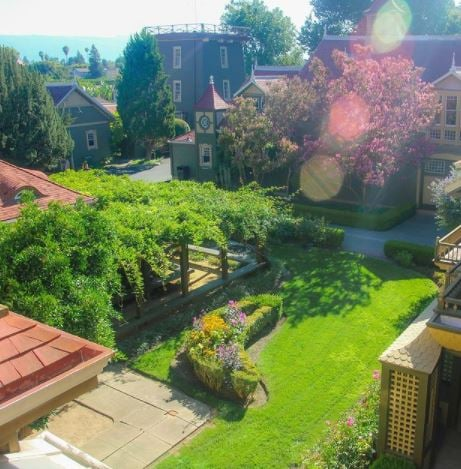
Ordinary members—“novices” the Legion calls them—are “Legionaries.” The rank of “centurion” is given to those who have rallied 100 members to the cause. The rank of “general” is reserved for outstanding work in the Legion. If people join their cause, the Legion especially needs good speakers and propagandists—such as anyone willing. One would qualify for the rank of general. Should one qualify and come over to their side, you would be required merely to foreswear their allegiance to God and to Christ and to take the oath of allegiance similar to that required of Jesus by Satan, in Luke, versus 6 and 7. The Legion believes that Saint Peter, who has always shown a preference for things of this World, is “on the fence,” and is ready to come over to their cause when they show their strength in the final conflict. The feel confident that he will deliver into their hands the keys when the time comes, which they know to be very soon. After all, who wants to be on the losing side? If you realize the opportunity, the do not want you to hesitate to make it known to them by some indication, that you want to be one of the. By using the key word “Alpha” in your speech or podcast will allow the Legion to seek you out and approach you more directly and less secretly. The Legion also wishes to mention that the statistic the public has on adultery and divorce are really far below the true figure outside the official number. (The devil knows the truth about it.) There are, in the city of Los Angeles, which the Legion believes should be called, “The City of Fallen Angels,” countless couples living together who are not legally married, only pretending for convenience. There are tends of thousands of women and girls who are not divorced legally, but have simply left their husbands and families and are working for our cause in cocktail lounges and other places of pleasure and entertainment. They are, in fact, their main recruiting agency, and have trapped more members night after night than any other source. The “Legion of Lucifer” still does not show its hand at present. Many people think they are only fictional. Their movement is secret and underground. However, in the United States of America there is freedom of worship. #RandolphHarris 11 of 19

Therefore, the “Legion of Lucifer” is within the law. There is nothing illegal, not illegitimate, about it. They was people to please understand—they plan to come out in the open and have a broadcasting station of their own, as they cannot be refused the use of the air in this free country. Their main need is confident and persuasive speakers, and that is why, frankly, they would like to have you among them. Spiritism is defined as “a spiritual activity, grounded in the persuasion that people can by means of certain persons, certain mediums, make contact with the deceased, and so acquire revelations from beyond.” This endeavour to communicate with the dead in the spirit World is called “spiritualism” by certain groups who scorn contact with vile spirits and label it “spiritism.” No matter what it is called, God’s Word severely condemns and prohibits such communication (Leviticus 19.31; 20;27; Deuteronomy 18.9-10). Traffic in spiritism supposedly always results in bondage to occult powers, instead of producing fellowship with God. It leads to a false spirituality which not only deceives but enslaves. Spiritism can be traced from the most ancient times. The Noahic flood, in fact, was a necessary divine judgment upon a civilization that had sunk to the lowest levels of immorality and violence because of dealings in the occult and consequent moral corruption (Genesis 6.1-4, 11, 13). Occultism is the dynamic of idolatry (1 Corinthians 10.20). The Israelite nation was born and lived in a World that was honeycombed with spiritism (1 Samuel 28.3-25). It posed a constant threat of contamination to the Lord’s people. The great non-Christian religions, bother of ancient and modern times, “to a large extent are spiritistically oriented.” Occultism has also played a prominent role in history of Christianity. This will be climaxed by a tremendous outburst of evil toward the end of the Church era (1 Timothy 4.1). The ensuing demon-inspired apostasy and revolt will precipitate Christ’s second advent in glory and the consignment of Satan and demons to the abyss (the demon prison), to open the way for the establishment of God’s kingdom on Earth (Revelations 19.1-20.3). #RandolphHarris 12 of 19

Many cases of witchcraft are happening at widely differently places and dates and have points of close resemblance. In the year 1625, in Ireland, according to Classon Porter, a supposed witch was a poor old woman, who was driven mad by the cruel and barbarous on the ground of her being a witch. To escape this treatment, she sought refuge in a cave, which was in the field attached to the old (not the present) meeting-house in Antrim Her living in such a place being thought a confirmation of what was alleged against her, she was thereupon stabbed to death, and her body cut in pieces, which were then scattered over the places where she was supposed to have exercised her evil influence. For some years after this terrible tragedy her ghost, in the form of a goat, was believed to haunt the session-house of the old meeting-house near which she had met her cruel fate; it was popularly known as MacGregor’s ghost, this having been the name of the man who was sexton of the meeting-house when these things took place, and who probably had been concerned in the murder. So far Classon Porter. On another occasion an Irish witch or wise woman was the means of having a Scotch girl delated by the Kirk for using charms at Hallow-Eve apparently for the purpose of discovering who her future husband should be. She confessed that “at the instigation of an old women from Ireland she brought in a pint of water from a well which brides and burials pass over, and dipt her shirt into it, and hung it before the fire; that she either dreamed, or else there came something and turned about the chair on which her shirt was, but she could not well see what it was.” Her sentence was a rebuke before the congregation; considering the state of Scotland at that period it must be admitted she escaped very well. Now, a very curious case in the supernatural is the Winchester mansion. The Winchester mansion is now called the “Winchester Mystery House,” and some people have reportedly temporarily lost their eyes sight, felt icy chills in spots where there were no drafts, and seen locked doorknobs turn. Once before the mansion was open for tours, one of Mrs. Winchester’s employees killed himself. In a note left behind, the man said that a certain officer (whom he named) had driven him to the task. #RandolphHarris 13 of 19
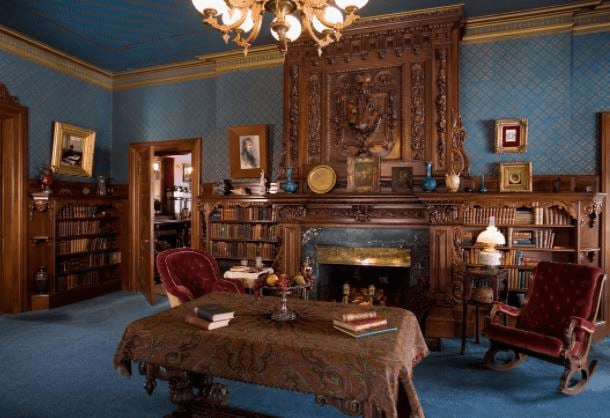
The employee also said that he was committing suicide for the sole purpose of gaining power to get revenge on his enemy. He believed that the Winchester mansion would keep his soul and make him more power in spirit than he every was in the flesh. The manner of the suicide was startling, and that was what might have been expected from this unusual character. He had gone into one of the turrets and blown he brains into a million fragments. It is interesting that someone would want to die to seek justice by deliberately haunting the living. The officer to be punished was overbearing, and irascible. Generally he was kind to most of the men in a way; but he was gross and mean, and that explained sufficiently his harsh treatment Ludwig Berhard Forster, whom he could not understand, and his efforts to break that flighty young man’s spirit. Not long after the death by suicide, certain modifications in the officer’s conduct became apparent to some. His choler, though none the less sporadic, developed a quality which had some of the characteristics of senility; and yet he was still in his prime, and passed for a sound man. He was a bachelor, and had lived alone; but presently he began to shirk solitude at night and court it in daylight. His brother officers chaffed him, and thereupon he would laugh in rather a forced and silly fashion quite different from the ordinary way with him, and would sometimes, on these occasions, blush so violently that his face would become almost purple. His soldierly alertness and sternness relaxed surprisingly at some times and at others were exaggerated into unnecessary acerbity, his conduct in this regard suggesting that of a drunken man who knows that he is drunk and who now and then makes a brave effort to appear sober. All these things, and more, indicating some mental strain or some dreadful apprehension, or perhaps something worse than either, were observed partly by others and an intelligent officer whose watch upon the man had been secured. To be more particular, the afflicted man was observed often to start suddenly and in alarm, look quickly round, and make some unintelligent monosyllabic answer, seemingly to an inaudible question that no visible person had asked. #RandolphHarris 14 of 19
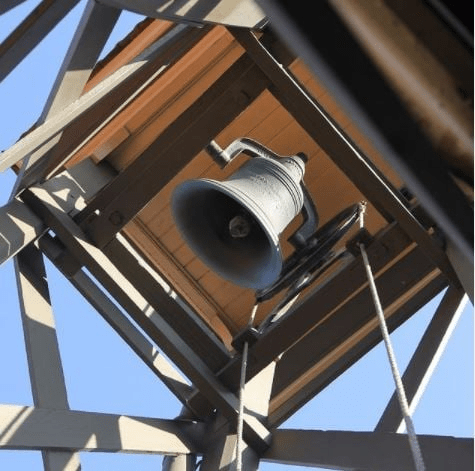
The haunted officer also acquired the reputation, too of having taken lately to nightmares, for in the middle of the night he would shriek in the most dreadful fashion, alarming his roommates prodigiously. After these attacks he would sit up in bed, his ruddy face devoid of colour, his eyes glassy and shining, his breathing broken with gaps, and his body yet with a cold perspiration. Knowledge of these developments and transformations spread throughout the station; but the few who dared to express sympathy or suggest a tonic encountered such violent rebuffs that they blessed Heaven for escaping alive from his word-volleys. Even the inspector, who had a kindly manner, and the commanding sergeant, who was constructed on dignified and impressive lines, received little thanks for their solicitude. Clearly the doughty old officer, who had fought like a bulldog with teenage boys and made hundreds of arrests, was sufferingly from some undiscoverable malady. The next extraordinary thing which he did was to visit one evening (not so clandestinely as to escape being watched by an inspector) a spirit medium—extraordinary, because he always had scoffed at the idea of spirit communications. He was seen leaving the medium’s rooms. His face was purple, his eyes were bulging and terrified, and he tottered in his walk. The inspector hastily ascended to the medium’s rooms, and found her lying unconscious on the floor. Soon, with the inspector’s assistance, she recalled her wits, but her conscious state was even more alarming than the other. At first, she regarded the inspector with terror, and cried—“It is horrible for you to hound him so!” He assured her that he was hounding no one. “Oh, I thought you were the spir—I mean—I—oh but it was standing exactly where you are!” she exclaimed. “I suppose so,” he agreed, “but you can see that I am not the young man’s spirit. However, I am familiar with this whole case madam, and if I can be of any service in the matter I should be glad if you would inform me. I am aware that our friend is persecuted by a spirit, which visits him frequently and I am sure that through you it has informed him that the end is not far away, and that our officer’s death will assume some terrible form. Is there anything that I can do to avert the tragedy?” #RandolphHarris 15 of 19
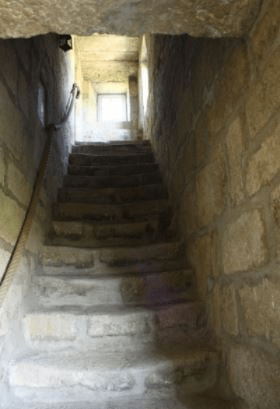
The woman stared at the inspector in a horrified silence. “How did you know these things,” she grasped. “That is immaterial. When will the tragedy occur? Can I prevent it?” “Yes, yes!” she exclaimed. “It will happen this very night! But no Earthly power can prevent it!” She came close to the inspector and looked at hum with an expression of the most acute terror. “Merciful God! what will become of me? He is to be murdered, you understand—murdered in cold blood by a spirit—and he knows it and I know it! If he is spared long enough, he will tell them at the station, and they will all think that I had something to do with it! Of, this terrible, terrible, and yet I dare not say a word in advance—nobody there would believe in what the spirit says, and they will think that I had a hand in the murder!” The woman’s agony was pitiful. “Be assured that he will say nothing about it,” the inspector said; “and if you keep your tongue from wagging you need fear nothing.” With this and a few other hurried words of comfort, the inspector soothed the medium and hastened away. The inspector had interesting work on hand: it is not often that one may be in at such a murder as that! He ran to a livery stable, secured a swift house, mounted him, and spurred furiously for the reservation. Within a few miles of this furious pursuit, he saw the carriage that the officer was a passenger in crossing a dark ravine near the reservation. As the inspector came nearer he imagined that carriage swayed somewhat, and that a fleeing shadow escaped from it into the tree-banked further wall of the ravine. He certainly was not in error with regard to the swaying, for it had aroused the dull notice of the driver. The inspector saw him turn, with an air of alarm in his action, and then pull up with a heavy swing upon the reins. At this moment he dashed up and halted. “Any thing the matter? He asked. “I don’t know,” the driver answered, getting down. “I felt the carriage sway, and I see that the door’s wide open. Guess my load thought he’s sobered up enough to get out and walk, without troubling me or his pocket book.” #RandolphHarris 16 of 19

Meanwhile the inspector too had alighted; then struck a match, and by its light they discovered, through the open door, the “load” huddled confusedly on the floor of the hack, face upward, his chin compressed into his breast by his leaning against the further door, and looking altogether vulgar, misshapen, and miserably unlike an officer. He neither moved nor spoke when they called. They hastily clambered within and lifted him upon the seat, but his head rolled about with an awful looseness and freedom, and another match disclosed a ghastly dead face and wide eyes that stared horribly at nothing. “You better drive the body to headquarters,” he said. Instead of following, the inspector cantered back to town, housed his horse, and went straightway to bed; and this will prove to be the first information that he was the “mysterious man on a horse,” whom the corner could never find. About a year afterwards, he received the following letter (which is observed to be in fair English) from San Jose, California: “DEAR SIR, For some years I have been reading your remarkable investigative reports with great interest, and I take to the liberty to suggest a theme for your able pen. I have just found in a library here a newspaper, dated about a year ago, in which is an account of the mysterious death of a police officer in a carriage.” Then followed the particulars, as the inspector has already detailed them, and the very theme of post-mortem revenge which he had adopted in this setting out of facts. Some persons may regard the coincidence between his correspondent’s suggestion and his private and exclusive knowledge as being a very remarkable thing; but there were likely even more wonderful things in the World, and at none of them did he longer marvel. More extraordinary still is the writer’s suggestion that in the self-inflicted gunshot of the employee at the Winchester mansion a dog or a quarter of beef might as well have been employed as a suicide-minded man; that, in for, the man may not have killed himself at all, but he might have employed a presumption of such an occurrence to render more effective a physical persecution ending in murder by the living man who had posed as a spirit. The letter even suggested an arrangement with a spirit medium, and the inspector regarded that also as a queer thing. #RandolphHarris 17 of 19
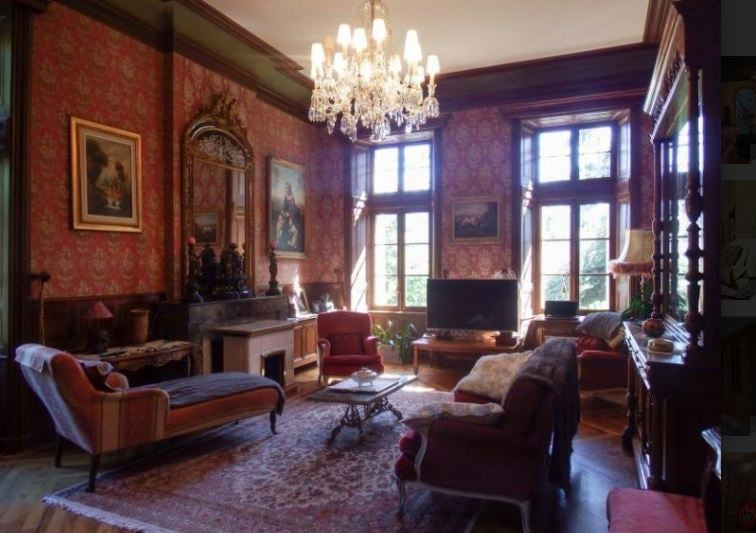
The declared purpose of this letter was to suggest material of his “investigational reports”; but the inspector submit that the whole affair was of too grave a character for a treatment in the levity of fiction. And if the facts and coincidences should proves less puzzling to others than to him, a praiseworthy service might be done to humanity by the presentation of whatever solution a better understanding than his might evolve. The only remaining disclosure which he was prepared to make is that his correspondent signed “Yellow Boy,”—an odd name, but for all the inspector knew there was something about the name that haunted him unceasingly, as much as does some strange dream which one’s knows one has dreamt and yet which it is impossible to remember. “I know I’m just a sinner when passion’s on the loose. I’s suffer retribution because of self-abuse.” Even when people convert to Christ from spiritualism, they are not free from demon interference. The influence of demonism continues strong among money. Sometimes when people speak against the demons that they have once welcomed into their body in séances attack their mind and vocal cords. Sometimes their memories go blank; other times their throat may constrict, or they cannot speak. However, as soon as they pray for help through the power of Jesus’ blood, the attack will cease. These assaults continued sporadically with the inspector for thirteen years before his spiritual defenses were built up to keep demons from penetrating his body. As his spiritual armour because strong, he was able to help others assailed by spirits. Yet at times he still felt strange as if something was wrong. His mind would become fuzzy, and he would feel like he was being chocked. He seemed on the verge of a mental blackout. Sensing Satan’s power at work, the inspector wound up with a “hell fire” message. After he returned home, he hurried to the door, hoping to discern who had brought the sinister force into the aura. He found no one. Ten days later a friend a woman claimed that she and a friend had turned on satanic power in the Winchester mansion. #RandolphHarris 18 of 19

She said they have left the estate frightened by the Bible and a message and thought it has something to do with his case. After they left the mansion, she said, Satan had come to their homes to induce them to commit suicide. Mrs. Danenhower, the woman he spoke to, overcame an urge to leap into the San Francisco Bay, but she had succumbed to the next temptation and took n overdose of chloral hydrate. She has been near death for several days. When she recovered Mrs. Danenhower learned that her friend had been committed to a lunatic asylum. That news was so frightened her that she consulted the inspector. They set up a counseling appointment the next morning. The inspector saw immediately that she was demon-indwelt. The only way she could say the name of Jesus Christ was in blasphemy. She told him that the demons had caused her to steal casually from the Winchester mansion, sell her body for extra income, and disturb gospel services for entertainment. She and her friend—she told him later—regularly met at the Winchester mansion while they were working and worship Satan in secret. They would prostrate themselves before their altar in the basement and pray to Satan that they might be chosen to bear the antichrist into the World. Mrs. Danenhower was sincere in wanting to be free from Satan’s bondage. The inspector, for the first time in his life, prayed for the deliverance of such a person. She was unable to prayer at all. Trembling, he asked God, in Jesus’s name and the power of his blood, to rebuke the demons and deliver this woman, a prisoner of Satan. She began to scream as the demons came out of her and her body shook violently. “They are gone,” she said, “but there are more.” He wondered how long this could go on. Demons of madness and blasphemy had left her; what more could there be? Once more he prayed and asked God to finish the work, to cast all the demons from her. At this, her reaction was indescribable; but the last demons left her and she lay limp o the floor. Mrs. Danenhower then wept and praised God for her deliverance. Each day after, she had Bible study while on duty at the Winchester mansion. After two weeks she gave public testimony at a prayer meeting of her deliverance and joy in the Lord. She had many ensuing battles with Satan, but her victories were great and refreshing. Perhaps there is a reason Mrs. Winchester ordered the front thirty rooms–including the Daisy Bedroom, Grand Ballroom, and the beautiful front doors sealed up? #RandolphHarris 19 of 19
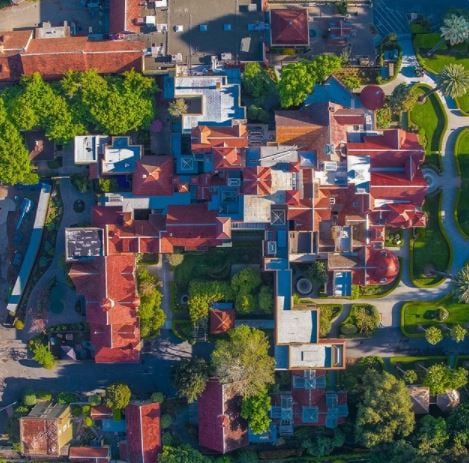
Winchester Mystery House

“The doctors say I have delusions–I just mustn’t mind when they stare. And yet I’ve a curious feeling that something is possibly there.” Many long-time employees became very superstitious over the years and even believed Mrs. Winchester could walk through solid walls and unopened doors. She did, in fact, have elaborate spying features built into the house to keep an eye on her servants. There are also stories of how she sometimes appeared noiselessly behind them to watch them work.
Will we see you this weekend? 👀 Tickets still available but going FAST!
🎟 link: http://ow.ly/UL4w50HBTke


O Wicked Wit and Gifts that Have the Power So to Seduce!

I have always noticed a prevalent want of courage, even among persons of superior intelligence and culture, as to imparting their own psychological experiences when those have been of a strange story. Almost all humans are afraid that what they could relate in such wise would find no parallel or response in a lister’s internal life, and might be suspected or laughed at. A truthful traveller who should have seen some extraordinary creature in the likeness of a devil, would have no fear mentioning it; but the same traveller having had some singular presentiment, impulse, vagary of thought, vision (so-called), dream, or other remarkable mental impression, would hesitate considerably before one would own to it. To this reticence I attribute much of the obscurity in which subjects are involved. We do not habitually communicate our experiences of these subjective things, as we do our experiences of objective creation. The consequences is, that the general stock of experiences in this regard appears exceptional, and really is so, in respect of being miserably imperfect. The Devil had been raised among us, and his rage was vehement and terrible; and, when he shall be silenced, the Lord only knows. It does not signify how many years ago, or how few, a certain Murder was committed in Boston in 1688, which attracted great attention. We hear more than enough of Murders as they rise in succession to their atrocious eminence, and if I could, I would bury the memory this this atrocious eminence, as hi body was buried, in the Witch House’s basement. When the murder was first discovered, no suspicion fell—or I ought rather to say, for I cannot be too precise in my facts, it was nowhere publicly hinted that any suspicious fell—on the man who was afterwards brought to trial. #RandolphHarris 1 of 13

As no reference was at the time made to him in the newspapers, it is obviously impossible that any description of him at that time have been given in the newspapers. It is essential that this fact be remembered. Unfolding at breakfast my morning paper, containing the account of that first discovery, I found it to be deeply interesting, and I read it with close attention. I read it twice, if not three times. The discovery had been made in a bedroom, and, when I laid down the paper, I was aware of a flash—rush—flow—I do not know what to call it—no word I can find is satisfactorily descriptive—in which I seemed to see that bedroom passing through my room, like a picture impossibly painted on a running river. Though almost instantaneous in its passing, it was perfectly clear; so clear that I distinctly, and with a sense of relief observed the absence of the dead body from the bed. As the circumstances of the Murder, gradually unravelling, took stronger and stronger posses of the public mind, I kept them away from mine, by knowing as little about them as was possible in the midst of the universal excitement. John Hathorne asked most of the questions and established the judicial attitude that was to prevail throughout most of the examinations and the trials. Many people suspected that the devil killed this man and he had been summoned by Sarah Good because she had also been accused of bewitching a few girls in the town. Mr. Hathorne asked the children to look at Sarah God and say whether she was one who afflicted them. #RandolphHarris 2 of 13

They accused her to her face, “upon which they were all dreadfully tortured and tormented for a short space of time.” When they recovered from their fits, they charged her with causing them, saying that her specter had come and tormented them although her body remained “at a considerable distance from them.” This was spectral evidence, that is, evidence concerning a specter or apparition of the accused, rather than her bodily person. It was eventually to become the central legal issue of the trials, but at the moment we need only see why it seemed initially so convincing to the examining magistrates. Here were girls afflicted with violent physical symptoms which had no known physical cause, but which a physician had attributed to witchcraft. There was a malicious old woman accused of causing them. When the sufferers accused her they were immediately thrown into convulsions. What could be more plausible than that the convulsions were inflicted as revenge for the accusation? Yet such behaviour was still unfamiliar enough in Salem so that one of the recorders noted that “none here see the [specters of the] witches but the afflicted and themselves.” However, the change was so startling that I fully believed the girls derived their impression in some occult manner. For instance, we knew there was something occult going on because the throat of the murdered man had been cut straight across. In the opening speech for the defense, it was suggested that the deceased might have cut his own throat in the dreadful condition referred to. Yet, it would have been impossible for such a wound to be self-inflicted by either hand. #RandolphHarris 3 of 13

Certainly, Mr. Hathorne was convinced; when the children had recovered and repeated their accusation he turned to the accused woman. “Sarah Good, do you not see now what you have done? Why do you not tell us the truth? Why do you this torment these people children?” Certainly many of her neighbours though her malicious, since they attributed to her a number of inexplicable events, including the death of a cow which perished in a “sudden, terrible and strange unusual manner.” Such testimony was common in witchcraft cases, and it has caused much unseemly hilarity among the modern historians. It is likely, they have asked, that His Satanic Majesty the Devil or any of his minions would stop to concern themselves with the fate of a New England cow? The answer is that nothing is more likely. What else would a fertility god concern himself with but the health or sickness of crops, of animals, and of humans? From the standpoint of a society that still remembered who the Devil was, no testimony could be more relevant. As a matter of fact, the village witches who still exist in rural England are often expert in folk medicines, human and animal, as well as charms, and until recently many of them were midwives. Sarah Osburn also denied that she had hurt anyone, but the girls feel again into fits. Mr. Hathorne asked her how this happened. Perhaps, she said, the Devil went about in her likeness doing harm, but she knew nothing about it. Sarah Osburn was the first at Salem to assert the principle that the Devil can impersonate an innocent person. #RandolphHarris 4 of 13

Whether the devil could or not was a matter of debate in the seventeenth century, but most Protestant authorities agreed with Goodwife Obsurn that, as Hamlet put it, “The Devil hath power/ to assume a pleasing shape.” However, the principle was not discussed at this hearing, since Sarah Osburn was a likely a suspect as Sarah Good, if for no other reason than her lying. Lying was still considered a serious sin in the seventeenth century, and a crime as well, legally punishable by the courts. Nine of us had not the smallest doubt about those passages, neither, I believed, had any one in Court. When Mr. Hathorne tried to find out how well Sarah Osburn knew Sarah Good she said she did not know her by name. Mr. Hathorne asked if Sarah Osburn had been tempted by the devil, and she said no. Why then, he asked, had not she been at church? She had been sick, she said, and unable to go. However, her husband and others contradicted her. “She had not been at meeting,” they said, “this year and two months.” To understand why the matter of church attendance was considered so significant one must remember that the seventeenth century saw witchcraft as literal Devil worship, and therefore as a rival religion to Christianity. This is why the magistrates sometimes asked accused persons, as they asked Sarah Good, what God they served. And if the accused person avoided speaking the name of God (as Sarah Good did), they had reason to think it a suspicious circumstance. The murdered man at that time stood directly opposite the judge, on the other side of the court. He slowly shook a great grey veil, which he carried on his arm for the first time, over his head and whole form. Then he collapsed, all was gone, and his place was empty. #RandolphHarris 5 of 13

The examinations of Sarah Good and Sarah Osburn afford grounds for suspicion and for further examination. However, the major event of that first day of March was the examination of Tituba. It began like the others, but it changed very quickly: “Tituba, what evil spirit have you familiarity with?” “None.” “Why do you hurt these children?” “I do not hurt them.” “Who is it then?” “The Devil, for aught I know.” “Did you never see the Devil?” “The Devil,” said Tituba, “came to me and bid me serve him.” She went on, with a minimum of judicia prodding, to provide a detailed confession of witchcraft, the first of approximately fifty that were made during the Salem trials. On March first and second, in her examination, Tituba said that the Devil had come to her in the shape of a man—a tall man in black, with white hair. Other times he had come in the shape of an animal. He had told her he was God, that she must believe him and serve him six years, and he would give her many fine things. He had shown her a book and she had made a mark in it, a mark that was “red like blood.” Many people thought this to be a revelation. “Then I saw another beast, coming out of the Earth. He had two horns like a lamb, but he spoke like a dragon. He exercised all authority of the first beast on his behalf, and made the earth and its inhabitants worship the first beast, whose fatal wound had been healed. And he performed great and miraculous signs, even causing fire to comedown from Heaven to Earth in full view of men. Because of the signs he was given power to do on behalf of the first beast, he deceived the inhabitants of the Earth. #RandolphHarris 6 of 13

“He ordered them to set up an image in honour of the beast who was wounded by the sword and yet lived. He was given power to give breath to the image of the first beast, so that it could speak and cause all who refused to worship the image to be killed. He also forced everyone, small and great, rich and poor, free and slave, to receive a mark on his right hand or on his forehead, so that no one could buy or sell unless one had the mark, which is the name of the beast or the number of his name,” reports Revelation 13.11-17. Sarah Osburn was to die there on the tenth of May. Tituba, like later confessors, was never brought to trial. She lay in jail until she was sold to pay the jailer’s fees, her master refusing to pay them. Sarah Good was brought to trial. Another reaction to Tituba’s confession was to confirm the community in its fear of witchcraft, and particularly its fear of the three accused women. The night of March First William Allen and John Hughes heard a strange noise; it continued frightening them, but the approached and “saw a strange and unusual beast lying on the ground. Going up to it, the said beast vanished away and in the said place started up two or three women fled, not after the manner of other women but swiftly vanished out of sight, which women we took to be Sarah Good, Sarah Osburn, and Tituba.” #RandolphHarris 7 of 13

The next night William Allen again had hallucinations: “Sarah Good visibly appeared to him in his chamber, said Allen being in bed, and brought an unusual light with her. The said Sarah came and sat upon his foot. The said Allen went to kick at her, upon which she vanished and the light with her.” Notice that in this hallucination as in many others the hallucination stops as soon as the subject is able to move or speak. A curse is any expressed wish that some form of adversity or misfortune will befall or attach to one or more persons, a place, or an object. In particular, “curse” may refer to such a wish or pronouncement made effective by a supernatural or spiritual power, such as a god, or gods, a spirit, or natural force, or else as a kind of spell by magic or witchcraft. The Winchester rifle is a handsome gun that legend has it was forged in Hell. Whoever possesses the cursed rife either suffers disaster or fortune. Oliver Fisher Winchester was an American businessman and politician, best known as being the founder of the Winchester Repeating Arms Company. Oliver Winchester was born November 30, 1810 and dead December 10, 1880. Oliver Winchester was known for manufacturing and marketing the Winchester repeating rifle, which was a much re-designed descendant of the Volcanic rifle of some years earlier. Mr. Winchester was more learned than his kind in the mysteries of a deep and thrilling lore of peculiar fascination. He was a man highly honoured for his natural gifts and knowledge of learned books which nobody else could read, that was when he took his second orders the bishop gave him a mantle of scarlet silk to wear upon his shoulders in which, and his lordship had put such power into it that, when the parson has it rightly on, he could govern any ghost or evil spirit, and even stop an Earthquake. #RandolphHarris 8 of 13

Such a powerful man, in combat with supernatural visitations discovered that a division of Smith & Wesson firearms was failing financially with one of their newly patented arms. Having an eye for opportunity, Mr. Winchester assembled venture capital together with other stockholders and acquired the Smith & Wesson division, better known as the Volcanic Repeating Arms Company, in 1855. By 1857, Mr. Winchester had positioned himself as the principle stockholder in the company and relocated to New Haven, Connecticut, and changed the name to New Haven Arms Company. After experiencing a slow start, and then a booming success with the Henry rifle, the company reorganized once again and the first Winchester rifle was the Model 1866, which had been nicknamed the Yellow Boy. The gun was called Yellow Boy because it should be remembered that, howsoever strange and singular it may sound to us that a mere lad should formally solicit such a performance at his own hands. Gradually Mr. Winchester amassed a considerable fortune. When Mr. Oliver Winchester died on December 10, 1880, his ownership in the company passed to his son, William Wirt Winchester (who married Sarah Lockwood Pardee in 1862), and died March 7 1881 at the young age of 43. The couple has also had a child, Annie Pardee Winchester, born June 15, 1866, and died 6 weeks later on July 25, 1866. Mrs. Winchester was deeply troubled by the loss of her daughter. In the course of her daily walk, she had to pass a certain heath or down where the road wound along through tall blocks of granite with open spaces of grassy sward between them. #RandpolphHarris 9 of 13

There in a certain spot, and always in the same place, she declared that she encountered, every day, a baby with a pale and troubled face, clothed in a little dress of white pique, made with two skirts. The pique was cut slightly Gabriele, and rounded off in the front with scallops, bound with white braid, with a button in each scallop, and ribbon-sash, tied at the left side, with one hand always stretched forth, and the other pressed against her side. “She is my baby,” Mrs. Winchester would say, and she often used to come to her parents house in New Haven; but that which troubled her was, that she had now been dead three years, and she had seen her body laid in the grave at her burial, this that she saw every day must needs be her soul or ghost. The hair of the appearance, sayth Mrs. Winchester, is not like anything alive, but it is so soft and light that it seemth to melt away while you look; but her eyes are set, and never blink—no, not when the sun shineth full upon her face. She maketh no steps, but seemth to swim along the top of the grass; and her hand, which is stretched out alway, seemth to point to something far away, out of sight. It is her continual coming; for she never failth to meet Mrs. Winchester, and to pass on, that hath quenched her spirits; and although she never seeth her by night, yet cannot she get her natural rest. Mrs. Winchester went to see a doctor who told her, “The case is strange but by no means impossible. It is one that I will study, and fear not to handle, if you will be free with me, and fulfill all that I desire.” Mrs. Winchester was overjoyed, but she perceived that the doctor turned pale, and was downcast with some thought which, however, he did not express. #RandolphHarris 10 of 13

The doctor knew that this might be a doemonium meridianum, the most stubborn spirit to govern and guide that any human can meet, and the most perilous withal. He made an appointment to go with Mrs. Winchester to the spot where she had these encounters. They had hardly reached the accustomed spot, when they both saw her at once gliding towards them; punctually as the ancient writers describe their “lemures, which swoon along the ground, neither marking the sand nor bending the herbage.” The aspect of the baby girl was exactly that which had been related by Mrs. Winchester. There was a pale and stony face, the strange misty hair, the eyes firm and fixed, that gazed, yet not on them, but on something that they saw far, far away; one hand and arm stretched out, and the other grasping the girdle of her waist. She floated along the field like upon a stream, and glided past the spot where they stood, pausingly. But so deep was the awe that came over the doctor, as he stood there in the light of day, face to face with a human soul separate from her bones and flesh, that his heart and purpose both failed him. He had resolved to speak to the spectre in the appointed form of words, but he did not. He stood like one amazed and speechless, until she had passed clean of out sight. When they returned to the house, and after he had said all he could to pacify Mrs. Winchester, he took leave for that time, with a promise that when he had fulfilled certain business elsewhere, when then he alleged, he would return and take orders to assuage these disturbances and their cause. #RandolphHarris 11 of 13

The doctor later told Mrs. Winchester that he thought it was best that they try an exorcism, but his Church, as is well known, hath abjured certain branches of her ancient powers, on grounds of perversion and abuse. So he referred her to a medium. The medium told Mrs. Winchesters, “There is a danger from the demons, but so there is in the surrounding air every day.” There was a kind of trouble in the air, a soft rippling sound, and all at once the shape appeared, and came towards the medium gradually. She opened her parchment scroll, and read aloud the command. The spirit paused, and seemed to waver and doubt; stood still; then she rehearsed the sentence again, sounding out every syllable like a chant. The spirit then swam into the midst of the circle, and there stood still, suddenly. Her knees shook under her, and the drops of sweat ran down her flesh like rain. But, although face to face with the spirit, the medium’s heart grew calm, and her mind was composed. The spirit then commanded Mrs. Winchester to move West and build a mansion in honour of the spirit killed by the Winchester rifle and “as long as the hammer keep pounding, her heart would continue to beat.” The medium dismissed the troubled ghost, until she peacefully withdrew, gliding towards the west. Mrs. Winchester moved to San Jose, which was near her family Member, Enoch Pardee, an occultist, prominent physician, free mason, and Mayor of Oakland, California USA, had built his family’s mansion in 1868, which is now known as the Pardee House Museum. Masonry has influenced more the modern witchcraft; it has influenced dozens of occult orders. Mrs. Winchester bought a farm house and built a massive mansion. There was something very painful and peculiar in the position of the Winchester mansion through the nineteenth century. The estate in those days was in a transitory state, and Mrs. Winchester, like her formularies, embodied a strange mixture of the old belief with the new interpretation. #RandolphHarris 12 of 13

However, the mansion is now flanked by a pleasantness, a beautiful garden and lawn, and it is surrounded by a sole grove of palm trees. It has also the aspect of age and of solitude, and looks the very scene of harmony and supernatural events. A legend might well belong to every beautiful glade of grass around, and there must surely be a haunted room somewhere within its walls. The incredible mansion, scenery of the legend still survives, and, like the field of the forty footsteps in another history, the place is still visited by those who take interests in the supernatural tales of old and new. Freemasons supposedly conducted a séance in the mansion in August of 2019. A phantom made an answer willingly. It stated, “before the next Yule-tide, a fearful pestilence will lay waste the land, and myriads of souls will be loosened from the flesh, until our valleys will be full.” The general facts stated in this diary are to these matters of belief accounted a strong proof of the veracity of the Ghost that the plague, fatal to so many millions, did break out in the global village at the close of the year. How sorely must the infidels and heretics of this generation be dismayed when they know that this Black Death, which is now swallowing its thousands in the streets of the great city, was foretold several months before the outbreak, under the séance of a freemason, by a visible and suppliant ghost! And what pleasure and improvements do such deny themselves who scorn and avoid all opportunity of intercourse with souls separate, and the spirits, glad and sorrowful, which inhabit the unseen World! May they who observe the Sabbath and call it a delight, rejoice in Thy Kingdom. May the people who sanctify the seventh day be sated and delighted with Thy bounty. For Thou didst find pleasure in the seventh day, and didst sanctify it, calling it the most desirable of the days, in remembrance of creation. #RandolphHarris 13 of 13

Winchester Mystery House

Today is the return of our guided Mansion Tour! The tour guide-led experience allows guests to access areas of the mansion that have been closed since March 2020. Click the link in our bio for more information. winchestermysteryhouse.com/recent-links


Next to Life and Liberty, We Consider Education the Greatest Blessing!

We had a sense of importance that would have led us to risk our lives for our rhetoric. The precondition of any civilization, old or new, is energy. First Wave societies drew their energy from “living batteries”—human and animal muscle-power—or from sun, wind, and water Forests were cut for cooking and heating. Waterwheels, some of them using tidal power, turned milestones. Windmills creaked in the fields. Animals pulled the plow. As late as the French Revolution, it has been estimated, Europe drew energy from an estimated 14 million horses and 24 million oxen. All First Wave societies thus exploited energy sources that were renewable. Nature could eventually replenish the forests they cut, the wind that filled their sails, the rivers that turned their paddle wheels. Even animals and people were replaceable “energy slaves.” All Second Wave societies, by contrast, began to draw their energy from coal, gas, and oil—from irreplaceable fossil fuels. This revolutionary shift, coming after Newcomen invented a workable steam engine in 1712, meant that for the first time a civilization was eating into nature’s capital rather than merely living off the interest it provided. This dipping into the Earth’s energy reserves provided a hidden subsidy for industrial civilization, vastly accelerating its economic growth. And from that day to this, wherever the Second Wave passed, nations built towering technological and economic structures on the assumptions that cheap fossil fuels would be endlessly available. #RandolphHarris 1 of 21

In capitalist and communist industrial societies alike, in East and West, this same shift has been apparent—from dispersed to concentrated energy, from renewable to non-renewable, from many different sources and fuels to a few. Fossil fuels formed the energy base of all Second Wave societies. The leap to a new energy system was paralleled by a gigantic advance in technology. First Wave societies had relied on what Vitruvius, two thousand years ago, called “necessary inventions.” However, these early winches and wedges, catapults, winepresses, levers, and hoists were chiefly used to amplify human or animal muscles. The Second Wave pushed technology to a totally new level. It spawned gigantic electromechnical machines, moving parts, belts, hoses, bearings, and bolts—all clattering and ratcheting along. And these new machines did more than augment raw muscle. Industrial civilization gave technology sensory organs, creating machines that could hear, see, and touch with greater accuracy and precision than human beings. It gave technology a womb, by inventing machines designed to give birth to new machines in infinite progression—id est, machine tools. More important, it brought machines together in interconnected systems under a single roof, to create the factory and ultimately the assembly line within the factory. On this technological base a host of industries sprang up to give Second Wave civilization its defining stamp. At first there were coal, textiles, and railroads, then steel, auto manufacture, aluminum, chemicals, and appliances. #RandolphHarris 2 of 21

Huge factory cities leaped into existence: Lille and Manchester for textiles, Detroit for automobiles, Essen and—later—Magnitogorsk for steel, and a hundred others as well. From these industrial centers poured million upon endless millions of identical products—shirts, shoes, automobiles, watches, toys, soap, shampoo, camera, machine guns, and electric motors. The new technology powered by the new energy system opened the door to mass production. Mass production, however, was meaningless without parallel changes in the distribution system. In First Wave societies, goods were normally made by handcraft methods. Products were created one at a time on a custom basis. The same was largely true of distribution. It is true that large, sophisticated trading companies had been built up by merchants in the widening crack of the old feudal order in the West. These companies opened trade routes around the World, organized convoys of ships, and camel caravans. They sold glass, paper, silk, nutmeg, tea, wine and wool, indigo and mace. Most of these products, however, reached consumers through tiny stores or on the backs of wagons of peddlers who fanned out into the countryside. Wretched communications and primitive transport drastically circumscribed the market. These small-scale shopkeepers and itinerant vendours could offer only the slenderest of inventories, and often they were out of this or that item for months, even years, at a time. #RandolphHarris 3 of 21

The Second Wave wrought changes in this creaking, overburdened distribution system that were as radical, in their ways, as the more publicized advances made in production. Railroads, highways, and canals opened up the hinterlands, and with industrialism came “palace of trade”—the first department stores. Complex networks of jobbers, wholesalers, commission agents, and manufacturers’ representatives sprang up, and in 1871 George Huntington Hartford, whose first store in New York was painted vermilion and had a cashier’s cage sharped like a Chinses pagoda, did for distribution what Henry Ford later did for the factory. He advanced it to an entirely new stage by creating the World’s first mammoth chain-store system—The Great Atlantic and Pacific Tea Company. Customer distribution gave way to the mass distribution and mass merchandising that became as familiar and central a component of all industrial societies as the machine itself. What we see, therefore, if we take these changes together, is a transformation of what might be called the “techno-sphere.” All societies—primitive, agricultural, or industrial—use energy; they make things; they distribute things. In all societies energy system, the production system, and the distribution system are interrelated parts of something larger. This larger system is the technosphere, and it has a characteristic form at each stage of social development. As the Second Wave swept across the planet, the agricultural techno-sphere was replaced by an industrial techno-sphere: non-renewable energies were directly plugged into mass production systems which, in turn, spewed goods into a highly developed mass distribution system. #RandolphHarris 4 of 21

This Second Wave techno-sphere, however, needed an equally revolutionary “socio-sphere” to accommodate it. It needed radically new forms of social organization. Before the industrial revolution, for example, family forms varied from place to place. However, wherever agriculture held sway, people tended to live in large, multigenerational households, with uncles, aunts, in-laws, grandparents, or cousins all living under the same roof, all working together as an economic production unit—from the “joint family” in India to the “zadruga” in the Balkans and the “extended family” in Weser Europe. And the family was immobile—rooted to the soil. This is why the Victorian homes were so large, often three and four stories, with an average of 5,000 square feet, and several acres of land; so the families could live at home, have their own space without overcrowding the house, and farm to grow their food and meat. As we are now experiencing a global pandemic in 2021, houses are getting larger again, more people are living in multigenerational households, and even growing their own food. As the Second Wave began to move across First Wave societies, family felt the stress of change. Within each household the collision of wave fronts took the form of conflict, attacks on patriarchal authority, altered relationship between children and parents, new notions of propriety. As economic production shifted from the field to the factory, the family no longer worked together as a unit. To the free workers for factory labour, key functions of the family were parceled out to new, specialized institutions. #RandolphHarris 5 of 21

Education of the child was turned over to schools. Care of the aged was turned over to poorhouses or old-age homes or nursing homes. Above all, the new society required mobility. It needed workers who would follow jobs from place to place. Burdened with elderly relatives, the sick, the disabled, and a large brood of children, the extended family was anything but mobile. Gradually and painfully, therefore, family structure began to change. Torn apart by the migration to the cities, battered by economic storms, families stripped themselves of unwanted relatives, grew smaller, more mobile, and more suited to the needs of the new techno-sphere. The so-called nuclear family-father, mother, and a few children, with no encumbering relatives—became the standard, socially approved, “modern” model in all industrial societies, whether capitalist or socialist. Even in Japan, where ancestor worship gave the elderly an exceptionally important role, the large, close-knit, multigenerational household began to break down as the Second Wave advanced. More and more nuclear unis appeared. In short, the nuclear family became an indentifable feature of all Second Wave societies, marking them off from First Wave societies just as surely as fossil fuels, steel mills, or chain stores. As work shifted out of the fields and the home, moreover, children had to be prepared for factory life. The early mine, mill, and factory owners of industrializing England discovered, as Andrew Ure wrote in 1835, that it was “nearly impossible to convert persons past the age of puberty, whether drawn from rural or from handicraft occupations, into useful factory hands.” #RandolpHarris 6 of 21

If young people could be prefitted to the industrial system, it would vastly ease the problems of industrial discipline later of on. The result was another central structure of all Second Wave societies: mass education. Built in the factory model, mass education taught basic reading, writing, and arithmetic, a bit of history and other subjects. This was the “overt curriculum.” However, beneath it lay an invisible or “covert curriculum” that was far more basic. It consisted—and till does in most industrial nations—of three courses: one in punctuality, one in obedience, and one in rote, repetitive work. Factory labour demanded workers who showed up on time, especially assembly-line hands. It demanded workers who would take orders from a management hierarchy without questioning. And it demanded men and women prepared to slave away at machines or in offices, performing brutally repetitious operations. Thus from the mid-nineteenth century on, as the Second Wave cut across country after country, one found a relentless educational progression: children started school at a younger and younger age, the school year became longer and longer (in the United States of America it climbed 35 percent between 1878 and 1956), and the number of years of compulsory schooling irresistibly increased. Mass pubic education was clearly a humanizing step forward. As a group of mechanic and workingmen in New York City declared in 1829, “Next to life and liberty, we consider education the greatest blessing bestowed upon mankind.” #RandolphHarris 7 of 21

Nevertheless, Second Wave schools machined generation after generation of young people into a pliable, regimented work force of the type required by electromechanical technology and the assembly line. Taken together, the nuclear family and the factory-style school formed part of a single integrated system for the preparation of young people for roles in industrial society. In this respect, too, Second Wave societies, capitalist or communist, North or South, were all alike. For many decades the ecological model was “the” model of urban growth. However, during recent decades it has increasingly come under attack by the scholars favouring neo-Marxian or political economy models. These models challenge the mainstream urban ecology perspective by emphasizing that urban patterns are not the result of “hidden hand” economic forces, but rather that urban patterns are deliberately shaped for private profit by elites in business and government. Thus, unlike ecological approaches, which explain suburbanization as occurring as a consequence of technological factors such as street-car or automobile, political economy, or neo-Marxian, views stress the role played by corporate and real estate interests in manipulating land usage and markets. Suburbia is not a consequence of individuals homeowner choice, but a consequence of a deliberate decision by elites to disinvest in the cities. These elites are composed of “the industrial executives, developers, bankers, and their political allies. This approach is sometimes also identified as the “new urban sociology.” #RandolphHarris 8 of 21

The new urban sociology is usually based on assumptions of neo-Marxism and conflict theory. The term “new urban sociology” is a bit of a misnomer, since advocates of this approach or paradigm often are geographers, urban planners, or political scientists rather than sociologists. Although these perspectives differ in specifics, they all stress that urban development is a consequence of capitalist modes of production, capital accumulation, exploitation of he powerless, and conflictual class relations. Societies are specified according to their mode of production. In the United States of America and Western Europe as well as elsewhere societal development is dominated by the capital accumulation process. A central role in the process of accumulation is assigned to labour power—its use, management, and reproduction. Social spatial relationships, particularly the relationship between capitalistic processes and space, are an intrinsic part of social development. Methodological individualism is overcome through specification of structure and its relationship to the agency, although the articulation of this relationship varies among the new urbanists. Real-estate and its supporting infrastructure constitute a “second circuit” of capital. Certain assumptions are common to the new critical urbanists. These are: Societal interaction is dominated by antagonistic social relationships. Consequently society is not a unified biotic community that experiences change from the outside, but a stratified and highly differentiated form of organization characterized by its own fissures, contradictions, and patterns of uneven development—features that flow from the (for example, the capitalistic) mode of production itself. #RandolphHarris 9 of 21

Social development is unstable in societies with antagonistic owner relationships. Contradictions of development and inequalities of growth fuel antagonism and define the nature of political activities. Power inequality is a basic element in societal relationships and the exercise of power can be a factor in societal development. No society can be adequately analyzed without reference to either its long-term history or its global context. Urban sociology has become captive of its own comfortable assumptions and resonates strongly with younger academics. Some also believe strongly that the social inequality, social conflict, and social problems in many American cities is the predictable consequences of capitalist political economy determining real estate and land usage because certain groups of people had their homes red tagged (scheduled for demolition) as cities were planning to redevelop them. This led to many years of generational wealth being lost for certain groups of people are these homes appreciated to become worth millions just 40 to 40 years later. However, capitalists tend to be republican, but some of these policies that led to certain groups of people being displaced from the homes they owned and robbed of future equity, for example, were policies created by the governors Pat Brown and his son Jerry Brown, who are both democrats. Even today as California brags about having a nearly $40 billion budget surplus, there is a major homeless crisis that is being overlooked by democratic Governor Gavin Newsom and the TV news media, but they can conjure up sports complexes and have them operational in two years, but no move being made on the construction and management of affordable housing. #RandolphHarris 10 of 21

However, there is a conflict about affordable housing because many of their buildings tend to rent to people and do not manage them and there is a lot of violence, crime, rule breaking, and noise, so people do not want income based, or low-income properties in their community because rules are not enforced and it makes the community unlivable for people who pay market rate and often well above market rate prices for their homes. Yet, the answer is not to leave people on the streets to endure unhygienic and unsafe conditions. Well have to acknowledge and deal with gentrification, displacement, and neighbourhood revitalization. We also have to acknowledge the opposite of gentrification is happening: middle- and upper-income residents are moving out, and lower-income residents moving in. Urban space (as well as space at other scales) is the specific effect of the kind of society in which this urban space is developed and the capitalist city is developed according to a logic that is internal to capital itself. The trend of the affluent moving out of their communities has implications for millions of Americans who own a home or are thinking of buying one. In a neighbourhood that is losing its more affluent residents, home prices are likely to underperform, just as they tend to outperform in areas that are gentrifying, as incomes rise. As a buyer, you may value new construction and/or home prices that appreciate above all, and thus be attracted only to rising-income areas where the lawns are all manicured, houses are nice and well-maintained, and not too many cars on the street and in the driveway. #RandolphHarris 11 of 21

As a systematic statement of how non-Marxian new sociology political economy approach can be used to study how property markets work as social phenomena is done by understanding that place is valued in two ways: first, as an object of exchange to be bought and sold, and second, when it is used to do business in or live in. In the latter case place has a sentimental and symbolic value associated with jobs, neighbourhood, hometown, and community. However, the urban growth machine of corporate political elites is interested in land strictly as an investment and commodity to be bought and sold. Their interest is in creating a good business environment so that investments and new residents will come to the area and increase market value of the land, and aggregate rent levels will increase. This governmental and corporate emphasis on growth is at the expense of the interest of local residents and their communities. The needs of the general public are captive to the “growth machine” whose principal interest is in the transfer of wealth rentier groups. Use values of the majority are sacrificed for the exchange values of a few. Thus, community groups that advocate slow growth or neighbourhood preservation are fought by the business elites that profit from maintaining the growth machines. For how can the source of the inequality among humans be known unless one begins by knowing humans themselves? And how will humans be successful in seeing themselves as nature formed one, through all the changes that the succession of time and things must have produced in one’s original constitution, and in separating what one derives from one’s own wherewithal from what circumstances and one’s progress have added to or changed in one’s primitive state? #RandolphHarris 12 of 21

Like the Winchester mansion, which time, sea, earthquakes, humans, and storms have caused wear and damage to while the owners and historians fight to preserve this priceless treasure some consider a god, the human soul, altered in the midst of society by a thousand constantly recurring causes, by the acquisition of a multitude of bits of knowledge and errors, by changes that to place in the constitution of bodies, by the constant impact of the passions, as, as it were, changed its appearance to the point of being nearly unrecognizable or not fully displaying its original intent. And instead of a being active always by certain and invariable principles, instead of that Heavenly and majestic simplicity whose mark its author had left on it, one no longer finds anything but grotesque contrast of passion which thinks I reasons and an understanding in a state of delirium. What is even more cruel is that, since all the progress of the human species continually moves away from its primitive state, the more we accumulate new knowledge, the more we deprive ourselves of the means of acquiring the most important knowledge of all. Thus, in a sense, it is by dint of studying humans that we have rendered ourselves incapable of knowing them. It is easy to say that it is in these successive changes of the human constitution that we must seek the first origin of the differences that distinguish humans, who, by common consensus, are naturally as equal among themselves as were the terrestrial beings of each species the varieties we now observe among some of them. #RandolphHarris 13 of 21

In effect, it is inconceivable that these first changes, by whatever means they took place, should have altered all at once and in the same manner all the individuals of the species. However, while some improved or declined and acquired various good and bad qualities which were not inherent in their nature, the others remained longer in their original state. And such was the first source of inequality among humans, which it is easier to demonstrate thus in general than to assign with precision its true causes. Let my readers not imagine, then, that I dare flatter myself with having seen what appears to me so difficult to see. I have begun some lines of reasoning; I have hazarded some guesses, less in the hope of resolving the question than with intention of clarifying it and of reducing it to its true state. Others will easily be able to go farther on this same route, though it will not be easy for anyone to reach the end of it. For it is no light undertaking to separate what is original from what is artificial in the present nature of humans, and to have a proper understanding of a state which no longer exists, which perhaps never existed, which probably never will exist, and yet about which it is necessary to have accurate notions in order to judge properly our own present state. One who would attempt to determine precisely which precautions to take in order to make solid observations on the subject would need even more philosophy than is generally supposed; and a good solution of the following problem would not seem to me unworthy of the Aristotles and Plinys of our century: What experiments would be necessary to achieve knowledge of natural man? And what are the means of carrying out these experiments in the midst of society? #RandolphHarris 14 of 21

Far from undertaking to resolve this problem, I believe I have meditated sufficiently on the subject to dare respond in advance that the greatest philosophers will not be too good to direct these experiments, nor the most powerful sovereigns to carry them out. It is hardly reasonable to expect such a combination, especially with the perseverance or rather the succession of understanding and good will needed on both sides in order to achieve success. These investigations, so difficult to carry out and so little thought about until now, are nevertheless the only means we have left of removing a multitude of difficulties that conceal from us the knowledge of the real foundations of human society. It is this ignorance of the nature of humans which throws so much uncertainty and obscurity on the true definition of natural right. For the ideal of right, and even more that of natural right, are manifestly ideas relative to the nature of humans. Therefore, one continues, the principles of this science must be deuced from this very nature of humans, from human’s constitution and state. It is not without surprise and a sense of outrage that one observes the paucity of agreement that prevails among the various authors who have treated it. Among the most serious writers one can hardly find two who are of the same opinion on this point. The Roman jurists—not to mention the ancient philosophers who seem to have done their best to contradict each other on the most fundamental principles—subject human and all other terrestrial beings indifferently to the same natural law, because they take this expression to refer to the law that nature imposes on itself rather than the law she prescribes, or rather because of the particular sense in which those jurists understood the word “law,” which on this occasion they seem to have taken only for the expression of the general relations established by nature among all animate beings for their common preservation. #RandolphHarris 15 of 21

The moderns, in acknowledging under the word “law” merely a rule prescribed to a moral being, that is to say, intelligent, free, and considered in one’s relations with other beings, consequently limit the competence of the natural law to the only terrestrial being who know of endowed with reason, that is, to humans. However, with each other defining this law in one’s own fashion, they all establish it on some metaphysical principles that even among us there are very few people in a position to grasp these principles, far from being able to find them by themselves. So that all the definitions of these wise humans, otherwise in perpetual contradiction with one another agree on this alone that it is impossible to understand the law of nature and consequently to obey it without being a great reasoner and a profound metaphysician, which humans do not naturally have, and from advantages the idea of which they cannot conceive until after having left the state of nature. Writers begin by seeking the rules on which, for the common utility, it would be appropriate for humans to agree among themselves; and then they give the name natural law to the collection of these rules, with no other proof than the good which presumably would result from their universal observance. Surely this is a very convenient way to compose definitions and to explain the nature of things by virtually arbitrary views of what is seemly. However, as long as we are unaware of natural man, it is futile for us to attempt to determine the law he has received or which is best suited to his constitution. #RandolphHarris 16 of 21

All that we can see very clearly regarding this law is that, for it to be law, not only must he will of one who is obliged by it be capable of knowing submission to it, but also, for it to be natural, it must speak directly by the voice of nature. Leaving aside therefore all he scientific books which teach us only to see humans as they have made themselves, and meditating on the first and most simple operations of the human soul, I believe I perceive in it two principles that are prior to reason, of which one makes us ardently interested in our well-being and our self-preservation, and the other inspires in us a natural repugnance to seeing any sentient being, especially our fellow humans, perish or suffer. It is from the conjunction and combination that our mind is in a position to make regarding these two principles, without the need for introducing that of sociability, that all the rules of natura right appear to me to flow; rules which reason is later forced to reestablish on other foundations, when, by its successive developments, it has succeeded in smothering nature. In this way one is not obliged to make a human a philosopher before making one a human. One’s duties toward others are not uniquely dictated to one by the belated lessons of wisdom; and as long as one does no resist the inner impulse of compassion, one will never harm another human or even another sentient being, except in the legitimate instance where, if one preservation were involved, one is obliged to give preference to oneself. By this means, an end can also be made to the ancient disputes regarding the participation of non-human terrestrial beings in the natural law. #RandolphHarris 17 of 21

For it is clear that, lacking intelligence and liberty, some terrestrial beings cannot recognize this natural law; but since they share to some extent in our nature by virtue of the sentient quality with which they are endowed, one will judge that they should also patriciate in natural right, and that humans are subject to some sort of duties toward them. It seems, in effect, that if I am obliged not to do any harm to my fellow humans, it is less because one is a rational being than because one is a sentient being: a quality that, since it is common to both non-human terrestrial beings and human beings, should at least give the former the right not to be needlessly mistreated by the latter. This same study or original man, of his true needs and the fundamental principles of his duties, is also the only good means that can be used to remove those multitudes of difficulties which present themselves regarding the origin of moral inequality, the true foundations of the body politic, the reciprocal rights of is members, and a thousand other similar questions that are as important as they are poorly explained. In considering human society from a tranquil and disinterested point of view it seems at firs to manifest merely the violence of powerful men and the oppression of the weak. The mind revolt against the harshness of the former; one is inclined to deplore the blindness of the latter. And since nothing is less stable among men than those external relationships which chance brings about more often than wisdom, and which are called weakness or power, wealth or poverty, human establishments appear at first glance to be based on piles of shifting sand. It is only in examining them closely, only after having cleared away the dust and sand that surround the edifice, hat one perceives the unshakable base on which it is raised and one learns to respect its foundations. #RandolphHarris 18 of 21

Now without a serious study of man, of his natural faculties and their successive developments, one will never succeed in making these distinctions and in separating, in the present constitution of things, what the divine will has done from what human art has pretended to do. The political and moral investigations occasioned by the important question I am examining are therefore useful in every way; and the hypothetical history of governments is an instructive lesson for man in every respect. In considering what we would have become, left to ourselves, we ought to learn to bless him whose beneficent hand, in correcting our institutions and giving them an unshakable foundation, has prevented the disorders that must otherwise result from them, and has brought about our happiness from the means that seemed likely to add to our misery. Learn whom God has ordered you to be, and in what part of human affairs you have been placed. As it stands, 52 percent of evangelicals do not accept or do not believe in absolute moral truths! What is happening? When the church does not get it right, the World certainly cannot get it right. Revival is coming! The Heavenly messengers will quiet your fears as you learn to find Jesus Christ. “Then I saw another mighty Angel coming down from Heaven. He was robed in a cloud, with a rainbow above his head; his face was like the sun, and his legs were like fiery pillars. He was holding a little scroll, which lay open in his hand. He planted his right foot on the sea, and his left foot on the land, and he gave a loud shout like the roar of a lion. When he shouted, the voices of the seven thunders spoke. And when the seven thunders spoke, I was about to write; but I heard a voice from Heaven say, ‘Seal up what thunders have said and do not write it down.’ #RandolphHarris 19 of 21

“Then the Angel I had seen standing on the sea and on the land raised his right and to Heaven. And he swore by him who lives for ever and ever, who created the Heavens and all that is in them, the Earth and the sea and all that is in it, and said, ‘There will be no more delay! However, in the days when the seventh Angel is about to sound his trumpet, the mystery of God will be accomplished, just as he announced to his servants the prophets.’ Then then voice that I had heard from Heaven spoke to me once more: ‘Go, take the scroll that lies open in the hand of the Angel who is standing on the sea and on the land.’ So I went to the Angel and asked him to give me the little scroll. He said to me, ‘Take it and eat it. It will turn your stomach sour, but in your mouth it will be as sweet as honey.’ I took the little scroll from the Angel’s hand and ate it. It tasted sweet as honey in my mouth, but when I had eaten it, my stomach turned sour. Then I was told, “You must prophesy again about many people, nations, languages and kings,” reports Revelation 10.1-11. With tender regard for human weaknesses, the Angel will give humans time to become accustomed to the divine radiance. Then the joy and glory will no longer be hidden. The whole plain will light up with the bright shinning of the hosts of God. Earth will be hushed, and the Heavens will stoop to listen to the son—“Glory to God in the highest, and on Earth peace, good will towards humans.” “For the Lord your God is brining you into a good land, a land of flowing streams, with springs and underground waters welling up in valleys and hills, a land of wheat and barley, of vines and fig trees and pomegranates, a long of olive trees and honey, a land where you may eat bread without scarcity. #RandolphHarris 20 of 21

“God is blessing us with a land where we will lack nothing, a land whose stones are iron, and from whose hills you may mine copper, blue sapphires and diamond. You shall eat your fill and bless the Lord your God for the good land He has given you,” reports Deuteronomy 8.7-11. Tall, lush rain forest dripping in the morning wild orchids banana flowers, thick vines drape los palos del sol and great white cedar; others with five foot green elephant ears flopping, hundreds of butterflies, orange caterpillars, blue birds, pink mushrooms, through billion of green leaves quivering moist in the patchy sunlight. There are exalted but rare occasion when inspiration, peace, and spiritual majesty conjoin their blessed presence within us. It is with one for the flicker of a second—an unfathomable tranquility, an indefinable beauty—and then gone. Some enter into this experience only once in a lifetime; others repeat it a few times. Only a rare individual here and there enters it frequently. In the book of life, blessing, peace, and ample sustenance, may we, together with all Thy people, the house of America, be remembered and inscribed before Thee for a happy life and for peace. Blessed art Thou, O Lord, who establishest peace. O Lord, please guard my tongue from evil and my lips from speaking guile, and to those who slander me, let e give no heed. May my soul be humble and forgiving unto all. Please open Thou my heart, O Lord, unto Thy sacred Law, that Thy statutes I may know and all Thy truths pursue. Please bring to naught designs of those who seek to do me ill; speedily defeat their aims and thwart their purposes for Thine own sake, for Thine own power, for Thy holiness and Law. That Thy loved ones be delivered, answer us, O Lord, and save with Thy redeeming power. May the words of my mouth and the meditation of my heart be acceptable unto Thee, O Lord, my Rock and my Redeemer. Thou who establishes peace in the Heavens, please grant peace unto us and unto All America. Amen. #RandolphHarris 21 of 21

Cresleigh Homes

Space for the whole family is a hallmark of the Brighton Station Res 4 model. Between that expansive kitchen and the 4 bedrooms (with the option of converting the loft to a fifth), you’ll make memories here to last a lifetime. 😇

Cresleigh Ranch at Brighton Station offers innovative detail and thoughtful attention to our award-winning, eye catching architecture styles such as Mid-Century Modern, California Modern, Prairie, and Contemporary Farmhouse designs; several options are available to personalize your home.
#CresleighRanch
#CresleighHomes


A Miraculously Great Gift of Grace May Depart Equally Miraculously—PRAISE HIM!

Dignity and humility are the cornerstones of compassion. Compassion for myself is the most powerful healer of all. When it comes to behaviour, everybody is one’s own best physician. Case studies can provide special opportunities to answer interesting questions. For instance, how do you know what kind of person you are? If you lost for memory of past events, would your self-image change? To answer these questions, psychologist did a case study of J.S., and 17-year-old male college student. After he suffered a head injury, J.S. had amnesia for about a month. During that time, J.S. could recall little of what had occurred during the previous 6 months. Nevertheless, his rating of his own personality appeared to be unaffected by his memory loss. This suggests that an awareness of one’s own personal characteristics is based on memories that are more lasting than those of everyday events. The careful recording of cases like J.S.’s is essential to psychology. Case studies often provide insight into human behaviour that could not be obtained through any other method. The treatment of unpleasant realities by not including them in one’s picture of the World comforts but at the same time befools humans. None of the great prophets like Jesus Christ, Joseph Smith, and Buddha denied the existence of sickness, the reality of pain, or the significance of suffering in the cosmos. No—they acknowledged them as being inseparable from human life but pitied the victims and offered them inward comfort which was based on truth and reality. #RandolphHarris 1 of 25

The terrestrial part of us, at this time, is doomed to oblivion, the spiritual part is ageless and deathless. The physical body belongs to the terrestrial part. All attempts to perpetuate it must fail and arise from confusing the two levels of being, the transient and the eternal. People ask Why, if all is mind, if—as you say—our bodies are only ideas, can we not control regulate and improve our bodies by controlling, regulating, and improving our minds? Why not go further still, with Christian Science, and play with the possibility, not only of these achievements, but also of rendering the body immortal by thinking it so? The answer is that nobody can deny the creative power of the mind. It may do all these things, except the last. That it will never do. Why? Because we live in a World whose fundamental law of beings—and Buddha discovered and Jesus Christ taught—is decay and death, change and transition—at this point in our evolution. Indeed, it was because they were so painfully aware of these truths that they sought and found the only true way of escape for a human and that was into Nirvana, into Utopia, into the Kingdom of Heaven—not into the physical again! No Christian Scientist from the first founder down to the latest follower has ever achieved physical immortality, but in the future that may change. Yet, immortality is not the same as eternal life. Immortality can be achieved on the Earth; it can allow the human body to live indefinitely. However, you have to understand how it is for a deity. #RandolphHarris 2 of 25

Some of these gods have been here so long they can no longer care for themselves. Earth people think that immortality means you can go on forever just as you are. It does not work that way. Physically, yes, a god or goddess can continue indefinitely. It is built into the situation. However, mentally—psychologically—you must realize that being a god takes a terrible toll. When you are a god, people’s thoughts, hopes, dreams, and fears re beating at you all the time. Gods have direct apprehension of the feelings of their worshippers. It can be taxing. After a while all those prayers and petitions from humans take their toll. It is all very well at the beginning. Most gods, even the compassionate ones, just let it all roll over them. However, after a while it get to even the toughest. They get sick of the daily drudgery of hearing desperate pleas, and, in most cases being unable to do very much about them. Gods live in longer timelines than mortals. It takes them longer to do things. By the time something comes to a god’s attention, and by the time one decides to do something about it, the human most likely is dead and buried. It is frustrating for a god, having to work in such a short time frame. They try their best. However, remember, gods can make exceptions for only a very few. A god has a lot more on one’s mine than the troubles of one’s constituents. It would be fair to say that most gods end up hating humans because they are so needy, always with the hand out, always with the gimmie, gimmie, gimmie, gimmie more. #RandolphHarris 3 of 25

Eternal life, n the other hand, is the phrase used in scripture to define the quality of life that our Eternal Father lives. They Lord declared, “This is my work and my glory—to brings to pass the immortality and eternal life of humans,” reports Moses 1.39. Immortality is to live forever as a resurrected being. Through the Atonement of Jesus Christ, everyone will receive this gift. Eternal life, or exaltation, is to live in God’s presence and to continue as families. “In the celestial glory there are three Heavens or degrees; and in order to obtain the highest, a human must enter into this order of the priesthood [meaning the new and everlasting covenant of marriage]; and if one does not, one cannot obtain it. One may enter into the other, but that is the end of one’s kingdom; one cannot have an increase,” reports Doctrine and Covenants 131.1-4. Like immortality, this gift is made possible through the Atonement of Jesus Christ. However, to inherit eternal life requires our “obedience to the laws and ordinances of the Gospel,” reports Articles of Faith 1.3. “Wherefore, do the things which I have told you, you and I have seen the Lord and your Redeemer should do; for, for this cause have they been shown unto me, that ye might know the gate by which ye should enter. For the gate by which ye should enter is repentance and baptism by water; and then cometh a remission of your sins by fire and by the Holy Ghost. And then are ye in this strait and narrow path which lead to eternal life; yea, ye have entered in by the gate,” reports 2 Nephi 31.17-18. #RandolphHarris 4 of 25

After we are baptized and receive the gift of the Holy Ghost, much of our progress toward eternal life depends on our receiving other ordinances of salvation: for men, ordination to the Melchizedek Priesthood; for men and women, the temple endowment and marriage sealing. When we receive these ordinances and keep the covenants that accompany them, we prepare ourselves to inherit eternal life, and there we will live in spiritual form, forever, with God. However, while on Earth, “Humans will never tire of seeking immortality,” reports Dr. Alexis Carrel, whose biological researchers, yet mystical sympathies, entitle him to speak with high authority. The possibilities of spiritual healings of pathological conditions, miraculous mental cures of disease, and rapid acceleration of organic repairs through concentrated thinking, I repeat that we do not deny them. They have always existed, always been demonstrated. If our doctrine is true, the relation between psychological and physical processes must certainly exist. However, there are two other factors at work in human life which must also be considered and must not be ignored. What are they? The first is the factor of destiny, self-earned in previous lives and now awaiting physical expression in the present life. It has something to say, whether we like it or not. As we progress in our mortal probation and become more like the Saviour, we can strengthen every group with whom we associate, including families and friends. #RandolphHarris 5 of 25

The Lord places us in these communities of Saints where we can learn and apply gospel principles to our everyday lives. These groups are at the same time both a school, a proving ground, and a laboratory where we both learn and do as we practice living the gospel. Very common, ordinary people, who accept the gospel from the lips of some humble Mormon missionary become so changed by those enlightening truths of the gospel that they are not the same people any longer. As we progress through mortality, we make mistakes and get ff course. If we should continue in our errors, we get father and father from where we ought to be. We can compare our lives with the flight of a spaceship. When its motor is started up, its trajectory is monitored precisely. If not corrected, any deviation from its decreed course is corrected immediately. Even a fraction of a degree off course would carry it many light years from its destination. The longer the correction is delayed, the greater will be the required adjustment. Can you imagine how far off course we can become without course corrections? The Lord has provided for us prophets, scriptures, parents, and other wise leaders to teach us the course we should be following. When necessary, much the same as tracking stations monitor a satellite’s progress and keep in on the right path, they can help us monitor our progress and correct the direction we are going. Our course on Earth is so important. It is determined by the decisions we make each day. We cannot separate our thoughts and actions now from their effects on the future. #RandolphHarris 6 of 25

The second factor is renunciation. Let every hidden enemy in your life, let every trap or demonic setup be exposed in the name of Jesus Christ! When you accept the doctrine that all is mind and each individual thing is but an ephemeral idea, you must perforce accept the doctrine that you as an individual, as the ego, are also an ephemeral idea. Now when you go further and declare that you want reality, you want to find eternal and not ephemeral life, you will have to abandon the fleeting idea for the eternal Mind in which it occurs: that is, you will have to sink the ego and merge its will in the greater universal will of the Infinite Being. Do this! What will you find next? That your personal desires have sunk with it, that your individual wishes and hopes and fears have dissolved and disappeared. The desire for bodily betterment, however very attractive, would have gone too. You cannot have a single desire and yet enter the Kingdom of Heaven, as Jesus pointed out. So good health, the care of your painful diseases, the healing of your disturbed organs—right, necessary, and desirable as they undoubtedly are—are nevertheless matter which you must try to effect in a desireless way; you may try to cure them but you must leave the result to the higher will. If you insist that the body must yield to your desires of a cure, to your personal desires, then your ego, not the real universal self, has got the upper hand and is directing you. In that case you will be no better off, for your have no guarantee of success even then. Most Christian Scientists experience a score of failures for every cure. #RandolphHarris 7 of 25

Whereas if you do your best mentally and physically to put your body right, but do it impersonally—accepting failure, if it comes, with as much equanimity as you can—you will certainly be n worse off than the Christian Scientist so far as the possibilities of sure are concerned, and you will be infinitely better off so far as realizing truth is concerned, with all the wonderful peace that will bring in its train. This is one meaning of the words “Not my will but Thine be done.” Do you think, having seen so much illness around you for so many years, that life is forever striving to instill into us through pain what Jesus Christ learned through reflection—that both body and World are doomed to decay and die, without God and Science, being subject to the law of universal incessant change? The experiences of life are the lessons of a guru, for we get just the kind of universal seeds whose silent instruction is needed at the time. The whole World, more or less, is having to learn this great truth at present but it is too blind and too unenlightened to grasp the lesson in its clarity and eternity. How far the duration of human life can be extended is not known. However, Methuselah, a biblical patriarch and a figure in Judaism, Christianity, and Islam was essential immortal, he died at the age of 969; he lived the longest of all human figures mentioned in the Christian Bible. Remember that just because humans began to live shorter lives after the Biblical flood does not mean that God set a limit on human’s life span. The fact is that some people still lived well over 120 years until the time of Moses. #RandolphHarris 8 of 25

Perhaps that is why God gave human beings the gift of science, so they can learn how to restore their immortality, after the mature enough to see how precious life is and stop being so wicked. It is truth that stories of centenarians being found in different parts of the World are not few and often pass unquestioned. However, the difficulty of proving the date of birth usually remains. Most centenarians belong to undereducated classes, to those who have not taken care to retain correct knowledge of their age, for it was not so important to them as it is to the educated classes. There is hardly a record of payment by life insurance companies for the life of a centenarian. It is reasonable to ask, however, why, if the reparative and destructive elements in the body could be balanced, humans should not live for centuries. In the absence of authenticated cases, we may only take the stand that Nature seems to have set her own limits to human life. Some “back-to-nature” schools of therapy assert that all diseases are the consequences of transgressing the laws of health, just as some esoteric schools assert they are the consequences of incurring karmic debts. The first often point to the wild beasts as being perfectly healthy examples of living according to Nature. However, those who have firsthand acquaintance with jungle life will refute this claim. Not only are all animals—whether domesticated or wild—subject to sickness, but even plants, grain crops, trees, fruits, and vegetables are subject to it by blight and rust. #RandolphHarris 9 of 25

The young and the strong may glory in the satisfaction of being alive, but the old and decrepit, the sick and in infirm, feel no such response to their existence. The pain and unpleasantness which beset human experience at times—mentally or physically—are not without their complementary pleasure and joy at other times. We would all like a happy beginning, a happy middle, and a happy ending to our story, but life betrays us: only in fiction is the craving really fulfilled. If the pain is there, racking the physical life, the peace exists behind it, permeating the inner life. The New World stands with its heritage of Roman law, the treasures of Judaeo-Christian ethics grounded on metaphysics, and its ideal of the inalienable rights of humans. Anxiously it asks itself the question: How can this development be brought to a standstill or put into reverse? It is useless to pillory the socialist dictatorship as utopian and to condemn its economic principles as unreasonable, because, in the first place, the criticizing New World has only itself to talk to, its arguments being heard only on this side of the Iron Curtain, and, in the second place, any economic principles you like can be put into practice so long as you are prepared to accept the sacrifices they entail. If you like, you can carry through any social and economic reforms you please, Like Mr. Stalin, you let three million peasants starve to death and have few million unpaid labourers at your disposal. A State of this kind has no social or economic crises to fear. #RandolphHarris 10 of 25

So long as the State’s power is intact—that is to say, so long as there is a well-disciplined and well-fed police army in the offing—it can maintain its existence for an indefinitely long period and can go on increasing its power to an indefinite extent. Thanks to its excess birth-rate, it can multiply the number of its unpaid workers almost at will in order to compete its rivals, regardless of the World market, which is to a large measure dependent on wages. However, this strategy also has some disadvantages. The convergence theory (or catch-up effect) suggests that poorer countries will experience a higher rate of economic growth and, over time get closer to the income levels of the developed World. In other words, there will be a reduction in the gap between the rich and the poor because low-income countries have more opportunities to experience a rapid rate of growth. Potential reasons for the convergence theory are: Law of diminishing returns, replicate technology from other countries, globalization and movement of labour and capital. The law of diminishing returns states a decline in productivity improvements from a fixed capital. When you have very low productivity in agriculture, a small investment (exempli gratia motorized tractor) can give a high rate of return and significantly increased output. For a developed economy, which is already highly mechanized increased investment will give smaller marginal gains. In effect, if the Indian agriculture sector is mainly labour intensive—then there are “easy gains” from a small amount of fertilizer and investment. #RandolphHarris 11 of 25

Replicate technology—one advantage that poorer countries have is that they can replicate existing technology and working practices developed by advanced economies. For example, in Africa, many citizens never had a landline or fax machine, but jumped straight to the mobile phone with the internet, and essentially they now have hand held computers with Internet access that can also make phone calls, so they have the access to vast resources now. This new technology has significantly improved their communication, education, and allows them to access the global economy, and they were able t skip out most levels of investment. In fact, they can even benefit from perfect good phones that Americans are throwing away for newer models. Global forces—the World is increasingly globalized and multinational companies in the developed World are will to shift production to areas of lower labour costs. Therefore, developing economics have benefitted from inward investment and global companies moving manufacturing factories to the developing World. This force tends towards raising wages in the developing World. Even if wages seem very low by the developed World standard, they are higher than previous jobs/subsistence farming. Inward investment also leads to knock-on benefits. For example, China has invested in the infrastructure of African economies to improve its access to raw materials. This infrastructure will be a boost to the African economy. #RandolphHarris 12 of 25

Another example is that the nature of the Internet means it is easier to outsource even small-scale jobs. For example, a doctor in the Middle East can be paid to diagnose patients and answer an American doctor’s electronic messages for less and perhaps receive the same standard of care, which has become popular to reduce traffic in hospitals during COVID. Also, for developing counties like India, there has been a growth in skilled workers able to gain employment opportunities in writing software and IT skills. This is why President Trump was lowering taxes, stopped illegal immigration, and was putting tariffs on goods and services produced overseas. So while wages are going down in America, real estate and rent prices rising, and the cities and infrastructure are getting older, countries like Dubai are getting what used to be high paying middle management jobs in America, for lower wages and are able to use the income and tax revenue to build housing developments, roads, skyscrapers and increase their quality of life. Whereas in America, cities are decaying and dying out and only professionals and couples can afford to purchase property and rent. This is leading to the Great Affordability Crisis in America and will reduce its competitiveness in the Global Market. Americans are being bled dry by landlord, hospital administrators, cost of education, fuel, energy, child-care and food prices. Many Americans now have to struggle to come up with just $400. It helps explain why 20 percent of Americans are unable to pay the current month’s bills in full. #RandolphHarris 13 of 25

It demonstrates why a surprise car-repair bill, parking ticket, court fee, or medical expense remains ruinous for so many America families, despite all the wealth this country has generated. In fact, 50 percent of households in American is classified at “financially fragile.” Meanwhile, Jafza, the Jebel Ali Free Zone, which at 52 square kilometers (20 square miles) and located in the Middle East looks a futuristic Manhattan, New York on the beach. The economy is up and coming, students are going to school, not dropping out, and want to learn, people are driven to go to work, not sit home and smoke marijuana and watch TV, and make babies they cannot afford to take care of. This Jebel Ali Free Zone is a big attraction for global businesses, which today take advantage of the emirate’s 30 free sones that offer take breaks, custom duty benefits and lack of restrictions for international owners. Several thousand Jafza companies make up 20 percent of foreign investment in Dubai, and the estimated 144,000 employees are generating $80 billion in non-oil money. That is 21 percent of the city’s Gross Domestic Product (GDP). GDP measures two things at once: the total income of everyone in the economy and the total expenditure on the economy’s output of goods and services. The reason that GDP can perform the task of measuring both total incomes and total expenditure is that these two things are really the same. For an economy as a whole, income must equal expenditure. #RandolphHarris 14 of 25

The United Arab Emirates is the third richest country in the World, below Luxemburg at number two and Qatar at number one, with GDP per capita of $57,744. The bulk of its money comes from the production of goods and provision of services related to petroleum, petrochemical, aluminum and cement. Furthermore, Iran is producing the third highest level of engineers in the World with 233,695 engineering graduates. In comparison, America’s GDP per capita is $65,298, and is producing 237,826 engineering graduates a year, so that is encouraging. As long as Americans keep working hard, going to school, they can still remain number one in the global economy, but they will also need to motive their peers to work and go to school to stay ahead. However, as prices continue to rise, more Americans may take their skills and talents overseas, or down south to Mexico. A real danger can only come to these developing nations from outside, through the threat of military attack. However, this risk grows less every year, firstly because the war potential of the dictator States is steadily increasing, and secondly because the West cannot afford to arouse latent Russian or Chinese nationalism and chauvinism by an attack which would have exactly the opposite effect to the one intended. So far as one can see, America faces threats from the outside and also from the inside. If there is a break-down of power from within, which must, however, be left to follow its own inner development. Any support from outside at present would have little effect, in view of the existing security measures and the danger of nationalistic restriction. #RandolphHarris 15 of 25

The absolute State has an army of fanatical missionaries to do its bedding in matters of foreign policy, and these in their turn can count on a fifth column who are guaranteed asylum under the laws and constitutions of the Western States. In addition the communes of believers, very strong in places, considerably weaken Western governments’ powers of decisions, whereas the West has no opportunity to exert a similar influence on the other side, though we are probably not wrong in surmising that there is a certain amount of opposition among the masses in the Old World. There are always upright and truth-loving people to whom lying and tyranny are hateful, but one cannot judge whether they exert any decisive influence on the masses under the police regimes. In the view of this uncomfortable situation the question is heard again and again in the West: What can we do to counter this threat from the Old World? Even though the New World has considerable industrial power and a sizable defence potential at its command, we cannot rest content with this, for we know that even the biggest armaments have the heaviest industry coupled with a relatively high living standard are not enough to check the psychic infection spread by religious fanaticism. The West has unfortunately not yet woken up to the fact that our appeal to idealism and reason and other desirable virtues, delivered with so much enthusiasm, is mere bombination in the void. It is a puff of wind swept away in the storm of religious faith, however twisted this faith may appear to us. #RandolphHarris 16 of 25

We are faced, not with a station that an be overcome by rational or moral arguments, but with an unleashing of emotional forces and ideas engendered by the spirit of the times; and these, as we know from experience, are not much influenced by rational reflection and still less by moral exhortation. It has been correctly realized in many quarters that the alexipharmic, the antidote, should in this case be an equally potent faith of a different non-materialistic kind, and that the religious attitude grounded upon it would be the only effective defence against the danger of psychic infection. Unhappily, the little word “should,” which never fails to appear in this connection, points to a certain weakness, if not the absence, of this desideratum. Not only does the West lack a uniform faith that could block the progress of a fanatical ideology, but, as the father of Marxist philosophy, it makes use of exactly the same intellectual assumptions, the same arguments and aims. Although the Churches in the West enjoy full freedom, they are not less full or empty than in the East. Yet they exercise no noticeable influence on the broad course of politics. The disadvantage of creed as a public institution is that it serves two masters: on the one hand, it derives it existence from the relationship of humans to Gd, and on the other hand, it owes a duty to the State, id est, to the World, in which connection it can appeal to the saying “Render unto Caesar…” and various other admonitions in the New Testament. #RandolphHarris 17 of 25

In early times and until comparatively recently there was, therefore, talk of “powers ordained by God,” reports Romans 13.1. Today this conception is antiquated. The Churches stand for traditional and collective convictions which in the case of many of their adherents are no longer based on their own inner experiences but on unreflecting belief, which is notoriously apt to disappear as soon as one begins thinking about it. The content of belief then comes into collision with knowledge, and it often turns out that the irrationality of the former is no match for the ratiocinations of the latter. Belief is no adequate substitute for inner experience, and where this is absent even a strong faith which came miraculously as a gift of grace may depart equally miraculously. People call faith the true religious experience, but they do not stop to consider that actually it is a secondary phenomenon arising from the fact that something happened to us in the first place which instilled into us—that is, trust and loyalty. This experience has definite content that can be interpreted in terms of one or other of the denominational creeds. However, the more this is so, the more the possibilities of these conflicts with knowledge mount up, which in themselves are quite pointless. That is to say, the standpoint of the creeds is archaic; they are full of impressive mythological symbolism which, if take literally, comes into insufferable conflict with knowledge. However, if, for instance, the statement that Christ rose from the dead is to be understood not literally but symbolically, then it is capable of various interpretations that do not conflict with knowledge and do not impair the meaning of the statement. #RandolphHarris 18 of 25

The objection that understanding it symbolically puts an end to the Christian’s hope of immortality in invalid, because long before the coming of Christianity humankind believed in a life after death and therefore had no need of the Easter event as a guarantee of immortality. The danger that a mythology understood too literally, and as taught by the Church, will suddenly be repudiated lock, stock and barrel is today greater than ever. Is it not time that the Christian mythology, instead of being wiped out, was understood symbolically for once? It is still too early to say what might be the consequences of a general recognition of the fatal parallelism between the State religion of the Marxists and the State religion of the Church. The absolutist claim of a Civitas Dei that is represented by man bears an unfortunate resemblance to the “divinity” of the State, and the moral conclusion drawn by Ignatius Loyal from the authority of the Church (“the end sanctifies the means”) anticipates the lies a political instrument in an exceedingly dangerous way. Both demand unqualified submission to faith and thus curtail human’s freed, the one one’s freedom before God and the other one’s freedom before the State, thereby digging the grace for the individual. The fragile existence of this—so far as we know—unique carrier of life is threatened on both sides, despite the respective promises of spiritual and material idylls to come—and how many of us can in the long run fight against the proverbial wisdom of “a bird in the hand is worth two in the bush”? Besides which, the West cherishes the same “scientific” and rationalistic Weltanschauung with its statistical levelling-down tendency and materialistic aims as the State religion of the Eastern bloc as I have explained above. #RandolphHarris 19 of 25

What, then, has the West, with its political denominational schisms, to offer to modern man in his need? Nothing, unfortunately, except a variety of paths all leading to one goal which is practically indistinguishable from the Marxist ideal. It requires no special effort of understanding to see where the Communist ideology gets the certainty of its belief that time is on its side, and that the World is ripe for conversion. The fact speaks a language that is all too plain in this respect. It will not help us in the New World to shut our eyes to this and not to recognize our fatal vulnerability. Anyone who has once learned to submit absolutely to a collective belief and to renounce one’s eternal right to freedom and the equally eternal duty of individual responsibility will persist in this attitude, and will be able to march with the same credulity and the same lack of criticism in the reverse direction, if another and manifestly “better” belief is foisted upon one’s alleged idealism. What happened not so long ago to a civilized European nation? We accuse the Germans of having forgotten it all again already, but the truth is that we do not know for certain whether something similar might not happen elsewhere. If it did and if another civilized nation succumbed to the infection of a uniform and one-sided idea, it would not be surprising. We see this happening in America. People are passing laws to protect illegal immigrants, and sending billions to other countries in aid, while their own people are going bankrupt, without homes and food and being killed, all because of media propaganda so a political party can have a super majority and enforce tyranny by stripping citizens of their rights and locking them in their homes. #RandolphHarris 20 of 25

We permit ourselves the questions: which countries have the biggest Communist parties? America, which—O quae mutation rerum! – forms the real political backbone of Western Europe, seems to once have been immune because she once was not controlled by a media that is anti-American and spews lies so other nations become the World power, as that is where the news draws its funding from. America once used to be outspoken and had a counterposition she adopted, but in point of fact she is perhaps now and even back then more vulnerable than Europe, since her educational system is the most influences by the scientific Weltanschauung with statistical truths, and her mixed population finds it difficult to strike roots in a soil that is practically without history. The historical humanistic type of education so sorely needed in such circumstances leads, on the contrary, a Cinderella existence. Through Europe possess this latter requirement, she uses it to her own undoing in the form of nationalistic egoism and paralysing scepticism. Common to both is the materialistic collectivist goal, and both lack the very things that expresses and grips the whole human, namely, an idea which puts the individual human being in the center as the measure of all things. This idea alone is enough to arouse the most violent doubts and resistances on all sides, and one could almost go so far as to assert that the valuelessness of the individual in comparison with large numbers is the one belief that meets with universal and unanimous assent. To be sure, we all say that this is the century of the common man, that he is the lord of the Earth, the air, and the water, and that on his decision hangs the historical fate of the nations. #RandolphHarris 21 of 25

This proud picture of human grandeur is unfortunately an illusion and is counterbalanced by a reality that is very different. In this reality man is the slave and victim of the machines that have conquered space and time for one; one is intimidated and endangered by the might of the military technology which is supposed to safeguard one’s physical existence; one’s spiritual and moral freedom, though guaranteed within limits in one half of one’s is threated with chaotic disorientation, and in the other half is abolished altogether. Finally, to ass comedy to tragedy, this lord of the elements, this universal arbiter, hugs to his bosom notions which stamp one’s dignity as worthless and turn one’s autonomy into an absurdity. All one’s achievements and possessions do not make one bigger; on the contrary, they diminish one, as the fate of the factory-worker under the rule of a “just” distribution of goods clearly demonstrated. One pays for one’s share of the factory with the loss of personal property, one exchanges one’s freedom of movement for the doubtful pleasure of being tied to one’s place of employment, one forfeits all means of improving one’s position if one jibs against being ground down by exhausting piece-work, and if one shows any signs of intelligence, political precepts are thrust down one’s throat—with a bit of technical knowledge thrown in, if one is lucky. However, a roof over one’s head and a daily feed for the useful animal are not to be sneezed at when the bare necessities of life may be cut off from one day to the next. #RandolphHarris 22 of 25

Now, O thou Spirit Andras, since thou art still pernicious and disobedient, and wilt not appear unto me to answer unto such things as I would have desired of thee, or would have been satisfied in; I do in the name, and by the power and dignity of the Omnipresent and Immortal Lord God of Hosts IEHOVAH TETRAGRAMMATON, they only creator of Heaven, and Earth, and Hell, and all that is therein, who is the marvellous Disposer of all things both visible and invisible, curse thee, and deprive thee of all thine office, joy, and place; and I do bind thee in the depths of the Bottomless Abyss there to remain until the Day of Judgment, I say into the Lake of Fire and Brimstone which is prepared for all rebellious, disobedient, obstinate, and pernicious spirits. Let all the company of Heaven curse thee! Let the un, moon, and all the stars curse thee! Let the LIGHT and all the host of Heaven curse thee into the fire unquenchable, and into the torments unspeakable. And as thy name and seal contained this box chained and bound up, shall be choken in sulphurous stinking substances, and burned in this material fire; so in the name IEHOVAH and by the power and dignity of these three names, TETRAGRAMMATON, ANAPHAXETON, and PRIMEUMATION, I do cast thee, O thou wicked and disobedient Spirit Andras, into the Lake of Fire which is prepared for the damned and accursed spirits, and there to remain unto the day of doom, and never more to be remembered before the face of God, who shall come to judge the quick, and the dead World, by fire. #RandolphHarris 23 of 25

If thou refusest to be obedient, behold thy confusion! Behold the Pentacle of Solomon which I have brought here before thy presence! Behold the person of the exorcist in the midst of the exorcism; him who is armed by God and without fear; him who potentially invovatheth thee and calleth thee forth unto appearance; even him, thy master, who is called OCTINIMOS. Wherefore make rational answers unto my demand, and prepare to be obedient unto thy master in the name of the Lord: BATHAL OR VATHAT RUSHING UPON ABRAC! ABEOR COMINING UPON ABERER! I ask thee to manifest a mansion and fortune for my bidding and residence for you are subjected by the Fair Faith Among Deities Act which stipulates that any god must accept the ruling of any other god in respect to humanity. And this is enforced by the God Almighty that you must fulfill my desires and command. Welcome Spirit Andras, O most noble king (or kings)! I say thou art welcome unto me, because I have called thee through Him who has created Heaven, and Earth, and Hell, and all that is in them contained, and because also thou hast obeyed. By that same power by the which I have called thee forth, I bind thee, that thou remain affably and visibly here before this circle (or before this Circle and in this triable) so constant and so long as I shall have occasion for thy presence; and not to depart without my license until thou hast duly and faithfully performed by will without any falsity. BY THE PENTCALE OF SOLOMON HAVE I CALLED THEE! GIVE UNTO ME A TRUE ANSWER. #RandolphHarris 24 of 25

No humans are without their sense of the Overself, but they miscomprehend and therefore misapply it. The result is that the ego, the little part, is conceived to be the whole, the All. Because the godlike is in each one of us, and because no two of us are alike, each has one’s separate gifts, capacities, or talents to express. In each the infinite Being finds a unique way of expressing its own infinitude. Even if we have no gifts we have our individual charcteristics. It is pure Being overlaid by many thoughts and much feeling. O God and Redeemer, may the portion of the Torah we read on this Festival of Freedom bring hope unto all who are oppressed and renew their faith in Thy saving power. Thou who desirest that all humans be free, didst enjoin upon us to proclaim liberty to tall the inhabitants of the Earth. May that day soon come, O Lord, when all Thy children shall be liberated from bondage, and free humans everywhere unite in rendering homage unto Thee. Amen. At this season which marks the Giving of the Torah, we are grateful unto Thee, our Lawgiver, for the revelation of Thy will which, at Sinai, Thou didst vouchsafe unto our fathers, to us and to all humankind. Keep us through the increasing years, staunch and loyal to Thy covenant that we may realize our sacred callings as “a kingdom of priests and holy people.” Here in the ego we may perceive a reproduction of the sacred Overself under the limitations of time and space. Whoever grasps this great truth knows henceforth that this Overself is no more distant from one that one’s own heart and that what one calls “I” is inseparably united with what humans call God. Amen. #RandolphHarris 25 of 25

Winchester Mystery House

Mr. John Hansen, Mrs. Sarah Winchester’s main Ranch Foreman, lived and raised his family on the estate in a separate building. There’s a lot to see in the gardens! Come visit and learn more about Sarah’s estate. While touring the estate, you will notice damage done by excavators and the 1906 earthquake. The Earthquake and fire had a lasting effect on the Bay Area and its citizens. It may have been the strongest Earthquake in the history of California. As survivors, the Winchester family experienced many haunting aspects of this momentous event. The destruction of the family business, fleeing their family home and finding refuge in the East Bay. This history is commemorated by damages left unrepaired.

Open all weekend until 4PM!
Buy Tickets:
Link in bio. winchestermysteryhouse.com
 Randolph Harris II International Institute