
Home » coffee (Page 6)
Category Archives: coffee

Scared Away by Ghost and Demons and Sightings of Satan

Everything in the Universe can come under magic’s fire. Magic plays a part in Satan’s Worldwide rebellion against God and Jesus Christ. Though, if he attacks angels and spirits, animals and humans and everything in the material World. It is simply impossible to describe the tremendous scope of magic in a single report. We will, though, mention the main areas in which magic comes into play. First, healing and the inflicting of illnesses. A Catholic woman was seriously ill in hospital. The woman called the nurse and asked a favour of her. She went on to say that she had a daughter at home who had been demon-possessed for many years, and that the daughter was rarely conscious. Being so seriously ill the woman now saw an opportunity of helping her daughter. She asked the nurse to get in touch with her relatives before she died. She wanted the relatives to bring the daughter to the hospital so that the two of them could change vests with one another. Her idea was that in doing so her daughter would be freed, while she would die in the state of being possessed. The nurse however, did not fulfil her wish. Inflicting diseases is directly opposite to healing. Another example, a young man wanted to evade military service. His father therefore sent him to a magic charmer to be given some illness. The experiment was successful, and afterwards the young man was found to be unfit for military service. In another illustration, a spiritistic medium confessed that she belonged to a circle which not only practised communication with the dead but also black magic. Her specialty was in causing sicknesses and in death magic; she had already committed several murders which the police had been unable to solve. She has also worked on a minister who afterwards developed nervous disturbances and had been unable to work for several months. This was the content of her confession. I could not prove the statements, but I did know that at the time of the circle’s magic experiments this particular minister had been ill for a considerable period of time. #RandolphHarris 1 of 19

In another story, a girl from a strict Catholic family married a Protestant against the will of her parents. The first child they had contracted polio. The parents blamed their daughter, saying that it was her punishment for marrying a Protestant. Later they asked a magician to heal the baby boy and to transfer the illness to the mother instead. This in fact happened as the child was cured, while the girl herself became ill. She was taken to a hospital with symptoms of paralysis, depressions and terrible headaches. The doctors differed in their diagnosis. They may one test after another; spinal puncture, metabolism test, electro-cardiogram etcetera. Finally, they called in a brain specialist. She was examined over a period of several weeks but no cause was found for her illness. Later the condition of the young woman improved rapidly and she asked to be discharged. She was allowed to go home. Her parents, on hearing about this, were greatly disturbed and immediately reported the matter to the magician, telling him that his persecution of her had become ineffective. In another instance, a black magician (possibly a warlock) told a girl who was being courted by a married man, “I’ll break this man’s mind so much that he’ll lose his position.” It was not very long after this that the man began to have nervous disorders. He would complain of hearing noises both in his head and externally. He also suffered from flickering before the eyes loss of vision and an inability to concentrate. There was also a girl who had become a Christian during a mission. Inspired by the joy of her salvation she invited others to the meetings. It so happened that nearby there lived a man who possessed an extensive amount of occult literature and who practised its contents. The girl’s joy, coupled with her witnessing, got on his nerves. (The gospel of Christ and magic are as far apart as Heaven and Hell). The occultist threatened to driver her mad and to prevent her from going to the mission. Within weeks the girl began suffering from various disturbances. She would sometimes see small flames of light in her room together with other ghostly phenomena. It was then that she had come to me for counselling. #RandolphHarris 2 of 19

Cult involvement steels the unbeliever against the gospel, causing one to resist the Word of God and hardening one in unbelief and rebellion. In the case of nominal Christians, occult complicity produces a deadly indifference to the Word of God, prayer, worship, and spiritual life in general. This condition develops against the will of the victim who cannot overcome one’s spiritual apathy. At the same time, the victim is open to other religious delusions and heresies, being insensitive to the stern warning of God’s Word against complicity in the occult. “If you keep all these commandments to do them, which I command you this day, to love the Lord your God and to walk always in His ways, then you shall add three other cities to these three. Lest innocent blood be shed in your land, which the Lord your God gives you as an inheritance, and so blood guilt be on you,” report Deuteronomy 18.9-10. Secondly, love and hate magic—the Swiss herdsmen who bring the cattle down from the summer pastures in September like to tie three different herbs into the rope of the leading cow. This serves not only as a means of decoration but is also meant to bring luck in love. Furthermore, a girl had an affair with a married man. The man later moved away from the district, but before he left, he said to the girl, “Though we will be separated now, I will continue to visit you in your dreams. You won’t be able to prevent it, and you will never be able to take any action against me as there will be no evidence to support your story.” At first the girl did not understand what her lover had really meant, but a week after her friend had left, she suddenly felt his presence during the night. These visits were repeated again and again until they became a terrible and disgusting experiences to the girl. First she consulted a doctor, but as was to be expected the doctor explained the nightly psychic meetings away by saying that they were hallucinations involving pleasures of the flesh related to the first stages of schizophrenia. The girl could not accept this diagnosis, as she was mentally quite normal. She was convinced that it was more than an hallucination. #RandolphHarris 3 of 19

Under their leader, the arch-tempter Satan, demons subject humans to temptations. “Now the serpent was more subtle and crafty than any living creature of the field which the Lord God had made. And he [Satan] said to the woman, Can it really be that God has said, You shall not eat from every tree of the garden? Except the fruit from the tree which is in the middle of the garden. God has said, You shall not eat of it, neither shall you touch it, lest you die. However, the serpent said to the woman, You shall not surely die. For God knows that in the day you eat of it your eyes will be opened, and you will be like God knowing the difference between good and evil and blessing and calamity. And when the woman saw that the tree was good (suitable and pleasant) for food and that it was delightful in order to make one wise, she took of its fruit and ate; and she gave some also to her husband, and he ate. Then the eyes of them both were opened, and they knew that they were in their birthday suits; and they sewed fig leaves together and made themselves apronlike girdles,” reports Genesis 3.1-7. “And tempter came and said to Him, If You are God’s Son, command these stones to be made [loaves of] bread,” reports Matthew 4.3. “Then after [he had taken] the bit of food, Satan entered into and took possession of [Judas]. Jesus said to him, What you are going to do, do more swiftly than you seem to intend and make quick work of it,” reports John 13.27. “But Peter said, Ananias, why has Satan filled your heart that you should lie to and attempt to deceive the Holy Spirit, and should [in violation of your promise] withdraw secretly and appropriate to your own use part of the price from the sale of the land?” reports Acts 5.3. “That is the reason that, when I could bear [the suspense] no longer, I sent that I might learn [how you were standing the strain, and the endurance of] your faith, [for I was fearful] lest somehow the tempter had tempted you and our toil [among you should prove to] be fruitless and to no purpose,” reports 1 Thessalonians 3.5. Satanic and demonic solicitations are optimistic and pessimistic. “The field is the World, and the good seed means the children of the kingdom; the darnel is the children of the evil one. And the enemy who sowed it is the devil. The harvest is the close and consummation of the age, and the reapers are angels,” reports Matthew 13.38-39. Satan and his helpers not only destroy the good seed in men’s hearts; they sow bad seeds. #RandolphHarris 4 of [RH1] 19

Sometimes evil spirits endanger humans’ temporal safety by exercising a certain control over natural forces. Satan employed lightning, whirlwind, and disease to afflict Job (Job 1.12, 16, 19; 2.7). The woman in a weakened condition had been held in bondage by Satan for eighteen years (Luke 13.11, 16). The demons’ primary objective is to destroy peace and harmony and to introduce as much anguish, grief, misfortune, privation, suspicion, anxiety and confusion as possible into human life. Third, persecution and defence magic—these are among the most common forms of magic. For instance, two of Mrs. Winchester’s women servants, who had practised magic for many years, were involved in a quarrel. They each used their magical powers to attack the other. One woman fell to the ground, apparently without cause. She swore and cursed at her opponent. As she was being lifted up from the ground she screamed at the other woman, “You won’t leave this house alive—I’ll see to that.” Three days later the second woman had a terrible headache and within just a week she died. In another illustration, of disturbances in the Winchester mansion, amongst the servants was when a child used to cry every night from 11 to 1 o’clock. The mother was desperate and took the advice of a magician. She was told to put a knife, a fork, and a pair of scissors under the child’s pillow in order to stop the trouble. She was also told that the person who was causing the child’s unrest would, because of the defence magic, injure himself. The mother, as we have said, followed this advice. The next day the maid had a bandage on, and the mother was convinced that she had been the cause of the nightly disturbances. There was also a farmer on the estate who discovered the milk of one of his cows had blood in it. He took the milk and just before midnight he heated it up. At the same time, he thrust a sickle into it murmuring a magic spell. The next day a woman who lived nearby had some facial injuries, and the farmer was thereby convinced this woman had bewitched his cow. God is sovereign and in perfect control of the Universe. His plan will prevail in spite of satanic opposition. God sometimes uses demons to punish the ungodly, as in the case of wicked Ahab at Ramoth-gildead and the God-defying armies at Armageddon. #RandolphHarris 5 of 19

God also used demons to chasten the Godly. In peter’s case, the Lord used Satan’s sifting to separate truth from falsehood. Job was refined in his furnace of satanic testing. The immoral Corinthian believer was delivered to Satan for physical death that he might be preserved for spiritual and eternal life. Through the career of Satan, demons, and fallen men, God is demonstrating to all the Universe the nature and end of moral evil. Demonic doom in the lake of fire will both vindicate God’s tolerance of the demons’ evil career and demonstrate before all created beings the exceeding sinfulness of sin and its inevitable punishment. Fourthly, casting and breaking spells—as if it were a sport, this is practised by some magicians, while others use it to further their own interests. A Christian man used to work in the Winchester mansion. He reportedly had the power to cast and to break magic spells. He could stop a person in the hallways in such a way that he or she would neither be able to move nor speak. He could also put a ban on children on the estate so that they too would be both speechless and unable to move. This man was supposed to be a Christian! an officially licensed mesmerizer used to live in a cottage on the Winchester mansion’s land. He was also a construction worker. He treated his patients by using white magic charms. He used either three Lord’s prayers or the names of the Trinity. Because of these religious phrases, his patients believe him to be a Christian. However, when a patient did not pay him at once, the mesmerizer would put them under a spell so that they would not able to board a train when they got to the station. The ticket collector and others at the station are so familiar with white magic powers of the mesmerizer that they would laugh it off and merely tell that patient that if one wants to be able to get on a train, one must go back and pay the man. Mrs. Winchester had construction workers building her mansion day and night for 38 years. Many people wondered how the foreman was able to keep them on the job, after so many had been scared away by ghost and demons and sightings of Satan. #RandolphHarris 6 of 19

It turns out that for many years, the head foreman indulged in black magic. He not only provided himself with literature on the subject, but also experimented with the magic. He used the construction workers on the Winchester mansion’s grounds as test subjects. He would ask a worker a question and at the same time put the man under a spell. They would then neither be able to speak nor stop working, they lost their free will and all they could due is working on the mansion. Only after the head foreman lifted the ban would the worker be able to answer his question or retire for the evening. He used a similar method to punish workers. After practising this for some time on his crew members, he started making his own wife and son the subjects of further experiments. He ruled his family so completely that he could cast spells over them at will. Sometimes they were unable to say a word for hours or even days at a time. His wife was psychically destroyed in the end, and she died. His second wife soon left him and never returned after first banning experiment. The man then turned to attacks on his son. He was completely powerless to defend himself. Later, when his father turned his attentions towards a third woman, he put a spell on the son so that he suffered a permanent paralysis of speech. Finally because his son came between himself and his many women friends he had him committed to a lunatic asylum. The doctors were unable to cure the paralysis in his speech, and his relatives, though conscious of the terrible home background, were forbidden by the father to visit the unfortune boy in the hospital. Lastly, death magic—here we come to one of the darkest areas that exists in magic. We have reports of this from several people. Very few individuals realize that this type of magic is still being practised all over the World today. Even if its effectiveness cannot be proved, its mere existence implies that our culture is still at a very low level. An expert in black magic was jealous of the prosperity of the Winchester mansion and its farm. He specialized in magic persecution and death magic. With the help of his magic, he was able to kill one of Mrs. Winchester’s cows in four days. This story was verified by the man’s grandson. #RandolphHarris 7 of 19

For many years, one of the maids on at the Winchester mansion secretly practised black magic. She possessed some very dangerous magic books. She experimented in the area of magic persecution and death magic and she even boasted of having caused the death of her husband and daughter. She would inflict her enemies with diseases and claimed that she was able to cause eczemas, diarrhoea, heart trouble, itching, stomach pains, swelling of the body and other things. After causing the death of all members of her family, according to her own words, she then left the Winchester and took on the job of a district nurse. She obtained this job with the help of the local minister, but the woman still practices her magic arts. Her mind is completely opposed to the things of God and she calls Jesus Christ an illegitimate good-for-nothing. When she was employed at the Winchester mansion, Mrs. Winchester noticed that at Christmas and Easter and other such times, the woman would suffer from terrible attacks, during which she would rage and blaspheme. On other occasions, however, her conscience bothered her and she would admit that her life was in a mees. “I don’t want to do these things, but I am forced to. The devil makes me do them. I can’t rest or relax anymore.” This was her testimony! A married carpenter at the Winchester mansion carried on an adulterous relationship with a female cook. The woman was reputed to indulge in black magic. One day the man tired of his illicit affair. He told the woman that he wanted to break off his relationship with her. She was very upset and threatened him, saying that if he did so then his wife and two children would suffer in the process. The man however, was determined to break it off and stuck to his decision. Two days later his son became ill. They rushed him to the hospital but he died there. The doctors were unable to diagnose the disease. Later still his wife and daughter also fell ill. The man was by now quite frightened and remembered the threats of the woman with whom he had had the affair. He went to her and begged her not to use black magic against his family. She softened and said that she would stop. Thereupon his wife and daughter recovered quickly. #RandolphHarris 8 of 19

One winter, a man at the Winchester mansion reported the following case from the estate. One of the construction men had his new saw stolen. The theft took place in broad daylight and the thief was known to the villagers. The construction worker was immediately notified and tole who had stolen the saw. He was not content to merely inform Mrs. Winchester, however. Instead the construction worker went to the head foreman, who was starting to become known carrying out experiments in persecution through the use of black magic. He paid a considerable amount of money to the occultist, who promised his immediate help, stating that the thief would die. The construction worker then drove back to his village and within three hours of his interview with the foreman/occultist the thief had a fatal heart attack. Now, the great Prince Michael, mentioned in the 11th and 12th chapters of Daniel, is the Archangel Michael, who has foresworn allegiance to God, and is now on our side. We believe that Michael is the alter ego of Satan, or rather Lucifer, who takes on many names. There is a movement which is necessarily secret for the time being—a militant organization. They call them selves “The Legion of Lucifer.” Contrary to popular misconception and Christian propaganda, Lucifer was not and is not the ugly, cruel entity he is so often portrayed to be; but on the contrary, he is the most beautiful, intelligent, resplendent of all the cherubs of Heaven—that is, prior to the revolution against God, who feared his growing power and domination. Some people believe entirely on the victory which is to be soon by the king of the north. Many had clearly identified this power. The antichrist will eventually rule the World. That, too, several people have envisioned; and the antichrist, the archangel Michael, and Lucifer are all one and the same, in trinity—separate in action, but unified in purpose. So that the Universe stays in balance, there is a Holy Trinity and a Hell Trinity. Remember, God had to exchange His Son to pay for the sins of man to keep the Universe in balance. #RandolphHarris 9 of 19

That Armageddon is close at hand is, we think, easy for anyone to see, and the unleashing of the atomic bomb and COVID points to the inevitable conclusion. “The ‘Pale Rider’ kills a fourth of the Earth with the sword, famine, and pestilence,” reports Revelation 6.8. Some believe these things are of satanic origin, a product of the infernal, and is to insure the final victory of Lucifer not only over the Earth, over which Satan has domination, but over the hosts and cohorts of Heaven who must fall before Lucifer’s ultimate assault. You will recall that in the contest between Jesus and Satan, Jesus, the younger Son of God, was given a chance by his elder brother, Lucifer, or Satan, to share his dominion, but he chose to become an opponent rather than to be second in command to his elder brother. At the time Lucifer simply departed from him for a season and has been building his time, content to see what a mess Jesus and his followers were to make of the World and humanity. Jesus Christ and Christianity have, some believe, demonstrated their weakness and inability to cope with the opinions and the minds of humans, and we are now worse off an in more disharmony over the globe than in any previous period in history. And the reason people make it seem that witches were all ugly and evil was to make their deaths seem like less of a loss. Because people are so materialistic, and taught to value only the beautiful, not all life forms, this was a strategy to make people careless. If God gives humans free will, I do not think He would want people killed due to their religious beliefs. The Golden Rule is to do on to others as you would do on to yourself. So anyway, the Kingdom of Lucifer is nigh, and “The Legion of Lucifer,” has pledged themselves to it, and the reign of Jesus Christ or His attempt to reign is believed to be collapsing on every side. Their doctrine is simple. They believe in freedom from restraint, in the enjoyment of all the desirable and pleasurable things of life. They believe in beauty, art, music, and the indulgence of one’s natural appetites, limited only by allowing others to enjoy an equal and similar right to live as they please. In their religion, it is believed that the keynote is freedom unrestrained in pleasures of the flesh, and pleasure is the password. Sin is a mirage, and superstition is erased from their vocabulary. #RandolphHarris 10 of 19

Ordinary members—“novices” the Legion calls them—are “Legionaries.” The rank of “centurion” is given to those who have rallied 100 members to the cause. The rank of “general” is reserved for outstanding work in the Legion. If people join their cause, the Legion especially needs good speakers and propagandists—such as anyone willing. One would qualify for the rank of general. Should one qualify and come over to their side, you would be required merely to foreswear their allegiance to God and to Christ and to take the oath of allegiance similar to that required of Jesus by Satan, in Luke, versus 6 and 7. The Legion believes that Saint Peter, who has always shown a preference for things of this World, is “on the fence,” and is ready to come over to their cause when they show their strength in the final conflict. The feel confident that he will deliver into their hands the keys when the time comes, which they know to be very soon. After all, who wants to be on the losing side? If you realize the opportunity, the do not want you to hesitate to make it known to them by some indication, that you want to be one of the. By using the key word “Alpha” in your speech or podcast will allow the Legion to seek you out and approach you more directly and less secretly. The Legion also wishes to mention that the statistic the public has on adultery and divorce are really far below the true figure outside the official number. (The devil knows the truth about it.) There are, in the city of Los Angeles, which the Legion believes should be called, “The City of Fallen Angels,” countless couples living together who are not legally married, only pretending for convenience. There are tends of thousands of women and girls who are not divorced legally, but have simply left their husbands and families and are working for our cause in cocktail lounges and other places of pleasure and entertainment. They are, in fact, their main recruiting agency, and have trapped more members night after night than any other source. The “Legion of Lucifer” still does not show its hand at present. Many people think they are only fictional. Their movement is secret and underground. However, in the United States of America there is freedom of worship. #RandolphHarris 11 of 19

Therefore, the “Legion of Lucifer” is within the law. There is nothing illegal, not illegitimate, about it. They was people to please understand—they plan to come out in the open and have a broadcasting station of their own, as they cannot be refused the use of the air in this free country. Their main need is confident and persuasive speakers, and that is why, frankly, they would like to have you among them. Spiritism is defined as “a spiritual activity, grounded in the persuasion that people can by means of certain persons, certain mediums, make contact with the deceased, and so acquire revelations from beyond.” This endeavour to communicate with the dead in the spirit World is called “spiritualism” by certain groups who scorn contact with vile spirits and label it “spiritism.” No matter what it is called, God’s Word severely condemns and prohibits such communication (Leviticus 19.31; 20;27; Deuteronomy 18.9-10). Traffic in spiritism supposedly always results in bondage to occult powers, instead of producing fellowship with God. It leads to a false spirituality which not only deceives but enslaves. Spiritism can be traced from the most ancient times. The Noahic flood, in fact, was a necessary divine judgment upon a civilization that had sunk to the lowest levels of immorality and violence because of dealings in the occult and consequent moral corruption (Genesis 6.1-4, 11, 13). Occultism is the dynamic of idolatry (1 Corinthians 10.20). The Israelite nation was born and lived in a World that was honeycombed with spiritism (1 Samuel 28.3-25). It posed a constant threat of contamination to the Lord’s people. The great non-Christian religions, bother of ancient and modern times, “to a large extent are spiritistically oriented.” Occultism has also played a prominent role in history of Christianity. This will be climaxed by a tremendous outburst of evil toward the end of the Church era (1 Timothy 4.1). The ensuing demon-inspired apostasy and revolt will precipitate Christ’s second advent in glory and the consignment of Satan and demons to the abyss (the demon prison), to open the way for the establishment of God’s kingdom on Earth (Revelations 19.1-20.3). #RandolphHarris 12 of 19

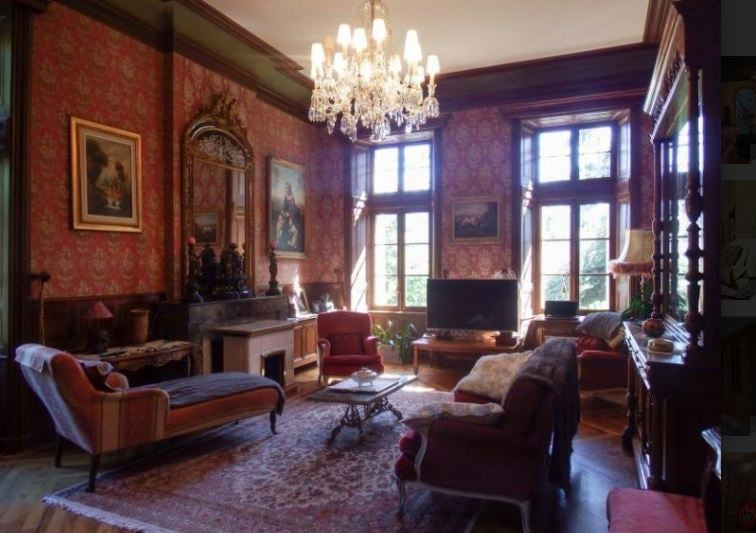
Many cases of witchcraft are happening at widely differently places and dates and have points of close resemblance. In the year 1625, in Ireland, according to Classon Porter, a supposed witch was a poor old woman, who was driven mad by the cruel and barbarous on the ground of her being a witch. To escape this treatment, she sought refuge in a cave, which was in the field attached to the old (not the present) meeting-house in Antrim Her living in such a place being thought a confirmation of what was alleged against her, she was thereupon stabbed to death, and her body cut in pieces, which were then scattered over the places where she was supposed to have exercised her evil influence. For some years after this terrible tragedy her ghost, in the form of a goat, was believed to haunt the session-house of the old meeting-house near which she had met her cruel fate; it was popularly known as MacGregor’s ghost, this having been the name of the man who was sexton of the meeting-house when these things took place, and who probably had been concerned in the murder. So far Classon Porter. On another occasion an Irish witch or wise woman was the means of having a Scotch girl delated by the Kirk for using charms at Hallow-Eve apparently for the purpose of discovering who her future husband should be. She confessed that “at the instigation of an old women from Ireland she brought in a pint of water from a well which brides and burials pass over, and dipt her shirt into it, and hung it before the fire; that she either dreamed, or else there came something and turned about the chair on which her shirt was, but she could not well see what it was.” Her sentence was a rebuke before the congregation; considering the state of Scotland at that period it must be admitted she escaped very well. Now, a very curious case in the supernatural is the Winchester mansion. The Winchester mansion is now called the “Winchester Mystery House,” and some people have reportedly temporarily lost their eyes sight, felt icy chills in spots where there were no drafts, and seen locked doorknobs turn. Once before the mansion was open for tours, one of Mrs. Winchester’s employees killed himself. In a note left behind, the man said that a certain officer (whom he named) had driven him to the task. #RandolphHarris 13 of 19

The employee also said that he was committing suicide for the sole purpose of gaining power to get revenge on his enemy. He believed that the Winchester mansion would keep his soul and make him more power in spirit than he every was in the flesh. The manner of the suicide was startling, and that was what might have been expected from this unusual character. He had gone into one of the turrets and blown he brains into a million fragments. It is interesting that someone would want to die to seek justice by deliberately haunting the living. The officer to be punished was overbearing, and irascible. Generally he was kind to most of the men in a way; but he was gross and mean, and that explained sufficiently his harsh treatment Ludwig Berhard Forster, whom he could not understand, and his efforts to break that flighty young man’s spirit. Not long after the death by suicide, certain modifications in the officer’s conduct became apparent to some. His choler, though none the less sporadic, developed a quality which had some of the characteristics of senility; and yet he was still in his prime, and passed for a sound man. He was a bachelor, and had lived alone; but presently he began to shirk solitude at night and court it in daylight. His brother officers chaffed him, and thereupon he would laugh in rather a forced and silly fashion quite different from the ordinary way with him, and would sometimes, on these occasions, blush so violently that his face would become almost purple. His soldierly alertness and sternness relaxed surprisingly at some times and at others were exaggerated into unnecessary acerbity, his conduct in this regard suggesting that of a drunken man who knows that he is drunk and who now and then makes a brave effort to appear sober. All these things, and more, indicating some mental strain or some dreadful apprehension, or perhaps something worse than either, were observed partly by others and an intelligent officer whose watch upon the man had been secured. To be more particular, the afflicted man was observed often to start suddenly and in alarm, look quickly round, and make some unintelligent monosyllabic answer, seemingly to an inaudible question that no visible person had asked. #RandolphHarris 14 of 19

The haunted officer also acquired the reputation, too of having taken lately to nightmares, for in the middle of the night he would shriek in the most dreadful fashion, alarming his roommates prodigiously. After these attacks he would sit up in bed, his ruddy face devoid of colour, his eyes glassy and shining, his breathing broken with gaps, and his body yet with a cold perspiration. Knowledge of these developments and transformations spread throughout the station; but the few who dared to express sympathy or suggest a tonic encountered such violent rebuffs that they blessed Heaven for escaping alive from his word-volleys. Even the inspector, who had a kindly manner, and the commanding sergeant, who was constructed on dignified and impressive lines, received little thanks for their solicitude. Clearly the doughty old officer, who had fought like a bulldog with teenage boys and made hundreds of arrests, was sufferingly from some undiscoverable malady. The next extraordinary thing which he did was to visit one evening (not so clandestinely as to escape being watched by an inspector) a spirit medium—extraordinary, because he always had scoffed at the idea of spirit communications. He was seen leaving the medium’s rooms. His face was purple, his eyes were bulging and terrified, and he tottered in his walk. The inspector hastily ascended to the medium’s rooms, and found her lying unconscious on the floor. Soon, with the inspector’s assistance, she recalled her wits, but her conscious state was even more alarming than the other. At first, she regarded the inspector with terror, and cried—“It is horrible for you to hound him so!” He assured her that he was hounding no one. “Oh, I thought you were the spir—I mean—I—oh but it was standing exactly where you are!” she exclaimed. “I suppose so,” he agreed, “but you can see that I am not the young man’s spirit. However, I am familiar with this whole case madam, and if I can be of any service in the matter I should be glad if you would inform me. I am aware that our friend is persecuted by a spirit, which visits him frequently and I am sure that through you it has informed him that the end is not far away, and that our officer’s death will assume some terrible form. Is there anything that I can do to avert the tragedy?” #RandolphHarris 15 of 19

The woman stared at the inspector in a horrified silence. “How did you know these things,” she grasped. “That is immaterial. When will the tragedy occur? Can I prevent it?” “Yes, yes!” she exclaimed. “It will happen this very night! But no Earthly power can prevent it!” She came close to the inspector and looked at hum with an expression of the most acute terror. “Merciful God! what will become of me? He is to be murdered, you understand—murdered in cold blood by a spirit—and he knows it and I know it! If he is spared long enough, he will tell them at the station, and they will all think that I had something to do with it! Of, this terrible, terrible, and yet I dare not say a word in advance—nobody there would believe in what the spirit says, and they will think that I had a hand in the murder!” The woman’s agony was pitiful. “Be assured that he will say nothing about it,” the inspector said; “and if you keep your tongue from wagging you need fear nothing.” With this and a few other hurried words of comfort, the inspector soothed the medium and hastened away. The inspector had interesting work on hand: it is not often that one may be in at such a murder as that! He ran to a livery stable, secured a swift house, mounted him, and spurred furiously for the reservation. Within a few miles of this furious pursuit, he saw the carriage that the officer was a passenger in crossing a dark ravine near the reservation. As the inspector came nearer he imagined that carriage swayed somewhat, and that a fleeing shadow escaped from it into the tree-banked further wall of the ravine. He certainly was not in error with regard to the swaying, for it had aroused the dull notice of the driver. The inspector saw him turn, with an air of alarm in his action, and then pull up with a heavy swing upon the reins. At this moment he dashed up and halted. “Any thing the matter? He asked. “I don’t know,” the driver answered, getting down. “I felt the carriage sway, and I see that the door’s wide open. Guess my load thought he’s sobered up enough to get out and walk, without troubling me or his pocket book.” #RandolphHarris 16 of 19

Meanwhile the inspector too had alighted; then struck a match, and by its light they discovered, through the open door, the “load” huddled confusedly on the floor of the hack, face upward, his chin compressed into his breast by his leaning against the further door, and looking altogether vulgar, misshapen, and miserably unlike an officer. He neither moved nor spoke when they called. They hastily clambered within and lifted him upon the seat, but his head rolled about with an awful looseness and freedom, and another match disclosed a ghastly dead face and wide eyes that stared horribly at nothing. “You better drive the body to headquarters,” he said. Instead of following, the inspector cantered back to town, housed his horse, and went straightway to bed; and this will prove to be the first information that he was the “mysterious man on a horse,” whom the corner could never find. About a year afterwards, he received the following letter (which is observed to be in fair English) from San Jose, California: “DEAR SIR, For some years I have been reading your remarkable investigative reports with great interest, and I take to the liberty to suggest a theme for your able pen. I have just found in a library here a newspaper, dated about a year ago, in which is an account of the mysterious death of a police officer in a carriage.” Then followed the particulars, as the inspector has already detailed them, and the very theme of post-mortem revenge which he had adopted in this setting out of facts. Some persons may regard the coincidence between his correspondent’s suggestion and his private and exclusive knowledge as being a very remarkable thing; but there were likely even more wonderful things in the World, and at none of them did he longer marvel. More extraordinary still is the writer’s suggestion that in the self-inflicted gunshot of the employee at the Winchester mansion a dog or a quarter of beef might as well have been employed as a suicide-minded man; that, in for, the man may not have killed himself at all, but he might have employed a presumption of such an occurrence to render more effective a physical persecution ending in murder by the living man who had posed as a spirit. The letter even suggested an arrangement with a spirit medium, and the inspector regarded that also as a queer thing. #RandolphHarris 17 of 19
The declared purpose of this letter was to suggest material of his “investigational reports”; but the inspector submit that the whole affair was of too grave a character for a treatment in the levity of fiction. And if the facts and coincidences should proves less puzzling to others than to him, a praiseworthy service might be done to humanity by the presentation of whatever solution a better understanding than his might evolve. The only remaining disclosure which he was prepared to make is that his correspondent signed “Yellow Boy,”—an odd name, but for all the inspector knew there was something about the name that haunted him unceasingly, as much as does some strange dream which one’s knows one has dreamt and yet which it is impossible to remember. “I know I’m just a sinner when passion’s on the loose. I’s suffer retribution because of self-abuse.” Even when people convert to Christ from spiritualism, they are not free from demon interference. The influence of demonism continues strong among money. Sometimes when people speak against the demons that they have once welcomed into their body in séances attack their mind and vocal cords. Sometimes their memories go blank; other times their throat may constrict, or they cannot speak. However, as soon as they pray for help through the power of Jesus’ blood, the attack will cease. These assaults continued sporadically with the inspector for thirteen years before his spiritual defenses were built up to keep demons from penetrating his body. As his spiritual armour because strong, he was able to help others assailed by spirits. Yet at times he still felt strange as if something was wrong. His mind would become fuzzy, and he would feel like he was being chocked. He seemed on the verge of a mental blackout. Sensing Satan’s power at work, the inspector wound up with a “hell fire” message. After he returned home, he hurried to the door, hoping to discern who had brought the sinister force into the aura. He found no one. Ten days later a friend a woman claimed that she and a friend had turned on satanic power in the Winchester mansion. #RandolphHarris 18 of 19

She said they have left the estate frightened by the Bible and a message and thought it has something to do with his case. After they left the mansion, she said, Satan had come to their homes to induce them to commit suicide. Mrs. Danenhower, the woman he spoke to, overcame an urge to leap into the San Francisco Bay, but she had succumbed to the next temptation and took n overdose of chloral hydrate. She has been near death for several days. When she recovered Mrs. Danenhower learned that her friend had been committed to a lunatic asylum. That news was so frightened her that she consulted the inspector. They set up a counseling appointment the next morning. The inspector saw immediately that she was demon-indwelt. The only way she could say the name of Jesus Christ was in blasphemy. She told him that the demons had caused her to steal casually from the Winchester mansion, sell her body for extra income, and disturb gospel services for entertainment. She and her friend—she told him later—regularly met at the Winchester mansion while they were working and worship Satan in secret. They would prostrate themselves before their altar in the basement and pray to Satan that they might be chosen to bear the antichrist into the World. Mrs. Danenhower was sincere in wanting to be free from Satan’s bondage. The inspector, for the first time in his life, prayed for the deliverance of such a person. She was unable to prayer at all. Trembling, he asked God, in Jesus’s name and the power of his blood, to rebuke the demons and deliver this woman, a prisoner of Satan. She began to scream as the demons came out of her and her body shook violently. “They are gone,” she said, “but there are more.” He wondered how long this could go on. Demons of madness and blasphemy had left her; what more could there be? Once more he prayed and asked God to finish the work, to cast all the demons from her. At this, her reaction was indescribable; but the last demons left her and she lay limp o the floor. Mrs. Danenhower then wept and praised God for her deliverance. Each day after, she had Bible study while on duty at the Winchester mansion. After two weeks she gave public testimony at a prayer meeting of her deliverance and joy in the Lord. She had many ensuing battles with Satan, but her victories were great and refreshing. Perhaps there is a reason Mrs. Winchester ordered the front thirty rooms–including the Daisy Bedroom, Grand Ballroom, and the beautiful front doors sealed up? #RandolphHarris 19 of 19

Winchester Mystery House

“The doctors say I have delusions–I just mustn’t mind when they stare. And yet I’ve a curious feeling that something is possibly there.” Many long-time employees became very superstitious over the years and even believed Mrs. Winchester could walk through solid walls and unopened doors. She did, in fact, have elaborate spying features built into the house to keep an eye on her servants. There are also stories of how she sometimes appeared noiselessly behind them to watch them work.
Will we see you this weekend? 👀 Tickets still available but going FAST!
🎟 link: http://ow.ly/UL4w50HBTke


She Had Better Stop and Take a Good Look at Herself

With all the changes and challenges you face each day, there has never been a greater need to take the time to determine your priorities. The art of being wise is to know what to overlook. In 1993 Mexico signed the North American Free Trade Agreement (NAFTA) with the United States of America and Canada. Within seven years, 3,500 maquiladora plants manufacturing everything from furniture to apparel to TV sets had sprung up along Mexico’s U.S. border, creating 1.4 million new, mainly assembly-line jobs for workers drawn from all parts of Mexico, and they important more than $51 billion in supplies into Mexico. However, in the late 1990s, with Guangdong and, indeed, all of China now competing in the cheap-labor derby, and estimated 250,000 to 300,000 of those Mexican jobs followed the great circle route across the Pacific. That put Alejandro Bustamante in a spot. When his employer, Plantronics, a leading manufacturer of telephone accessories, received an order, it called Mr. Bustamante. Although he ran the firm’s three factories in Tijuana, Mexico, he was told he must compete for each contract just like anyone else. However, Mr. Bustamante paid his workers an average of $2.20 an hour (including benefits) and had to bid against a Chinese manufacturer whose employees average only about 60 cents, which was nearly four times less than the Mr. Bustamante’s employees earned. There is nothing unique or new about that. Many maquiladora operators in norther Mexico face Chinese competition. However, what especially irked Mr. Bustamante was that the Chinese rival he faced was, in fact, itself also owned by Plantronics. This may be a case of serial outsourcing—sending jobs to China that had already been outsourced to Mexico. Outsourcing, while involving a small percentage of all jobs, has aroused fierce condemnation and prompted so much media coverage that there is no reason here to recap the familiar arguments, beyond recognizing that it is part of a much larger pattern of change in the spatial distribution of wealth and wealth creation. #RandolphHarris 1 of 18

Outsourcing enrages the critics of re-globalization who insist that it creates an unstoppable, brutalizing “race to the bottom.” They typically contend that companies go where labor costs are lowest and are ready to pick up and spatially relocate at a moment’s notice. If this were true, it would be easy to forecast where wealth is heading. It would be good news for African, which can offer a big pool of available labor at the lowest wages on Earth. (Africans should cheer each time workers in Asia join unions and drive wages up.) If labor cost were the sole consideration, why have not all those factories now in China wound up in Africa instead? The fact is that even for low-tech work, labor is cost, if ever, the exclusive basis for a company’s decision to relocate. Africa’s endless violence and war, inadequate infrastructure, stratospheric levels of violence, ravaging illnesses, and shameful regimes may rule out significant investment no matter what wage level. However, China has maintained its position as the largest investor in Africa over the last ten years by the number of new jobs created (18,562 on average), with a gradual substantial increase of newly created jobs on a yearly basis. China has spent 27 percent of its investments in Africa. Furthermore, since 2000, China’s foreign direct investment (FDI) flows to Africa have grown at an average annual rate of 40 percent, overtaking U.S. FDI in 2012. In 2019, FDI flows reached $2.7 billion, with the top destinations being the Democratic Republic of the Congo and Angola, two mineral-rich nations. China is also making space along a 30-mile coastline, in Africa, North of Dar Es Salaam, to make space for a $10 billion Chinese-built mega-port and a special economic zone backed by an Omani sovereign wealth fund. It seems Africa has more than just diamonds, gold, other precious minerals, people and animals that World wants to exploit. There are unspoiled beaches and bays; and lush vegetation. If the project goes ahead as planned, Bagamoyo will be transformed into the largest port in Africa. There is even talk of an international airport. #RandolphHarris 2 of 18

Many villagers have already accepted compensation for the loss of their homes. This portion in African is supposed to be as prosperous as Shenzhen, China. Shenzhen, in southeastern China, is a modern metropolis that links Hong Kong to China’s mainland. Over the past 40 years, the establishment of the Shenzhen Special Economic Zone (SEZ), has been a transformation of Shenzhen from a fishing village to a metropolis of innovation. The total investment has been $28 billion USD. Shenzhen has also nurtured some World leading technology firms including Huawei, DJI, and Tencent. The sector has emerged as the pillar industry of the city. As a matter of fact, a total of $4.27 billion USD, was invested in research and development, putting it on the top list of the country. In addition to this, the city has seen 17,500 international patents filed, accounting for one third of the national total. So this is what could be done in Africa, and it is important to keep an eye on the moves of China because they could become the World leader by investing in and colonizing foreign markets, with the large population. Another thing, with China colonizing Africa, it will also become a melting pot and the standard of beauty will change from the traditional European standard and shift to value other features. The race-to-the-bottom theory, moreover, presupposes that workers are essentially interchangeable—which may largely be true in repetitive, assembly-line operations. The higher up the skill ladder one goes in a knowledge-based economy, however, the less valid it becomes. As the knowledge components of wealth creation—marketing, finance, research, management, communication, I.T., vendor and distributor relations, regulatory compliance, legal affairs and other nontangibles—all grow in complexity and importance, workers, like the work itself, become less interchangeable and the required skill sets more temporary. If they extrapolate tomorrow’s economy from existing or projected wage levels alone, attempts to forecast which cities, regions or, for that matter, countries will become the next Guangdong will be inaccurate and the speculations are doomed to fail. #RandolphHarris 3 of 18

Any such simplistic analysis becomes even more questionable because, where economies are transitioning from smokestacks and assembly lines to knowledge-based production, we are already radically changing the very criteria by which a location, city, region or country becomes a high-value-added place. What we are about to see is less racing to the bottom and more of a race to the top. To anticipate tomorrow’s surprising geography—including the location of high-pay jobs, prime real estate, business opportunities, wealth and power—another key point needs to be understood: We are changing not merely the where of wealth but they why—the criteria by which we value places. And that further changes the where. Seeking to woo industry in 1955, the state government of Indiana placed an advertisement in Fortune listing its economic advantages. These, it claimed, included low-cost coal, limestone, white clay, aluminum, gypsum, rock asphalt, dolomite, fluorspar, water, sand, gravel, wood, corn, soybeans and easy access to the Ohio River. In addition, it promised an “enviable strike and lockout record”—that is, a weak or dormant labor movement. That was then. Today Indiana’s development council boasts of breaking away from “over-reliance on traditional industries.” No limestone here. Inc. tells American small-business leaders that the “best” place to “start or grow a company” is Phoenix, Arizona, because of its growing high-tech workforce, sunny climate, renovated art museum and “four major sports franchises.” A group called the Small Business Survival Committee concludes that the place to invest is South Dakota because it imposes the fewest costs on business in the form of taxes, minimum-wage laws, number of state employees and the like. Still another rating system bases its conclusions about the future on the age and growth rate of companies in any given location. A contributor to Microsoft’s bCentral.com then confects a hybrid index out of these last two methods and concludes that Nevada is the place to pull out your wallet. #RandolphHarris 4 of 18

Citing the 1955 Indiana ad in 2002 study called the “State New Economy Index,” Robert D. Atkinson and Rick Coduri of the Progressive Policy Institute write: “In an economy in which fewer than 20 percent of economic activity consists of creating, processing, or moving physical goods, access to raw materials, transportation and markets means less. As an increasing share of economic inputs and outputs are in the form of electronic bits, the old locational factors diminish in importance.” Take, for example, nearness—proximity. Some economists today believe that because Mexico is so close to American markets, it can beat Chinese competitors in the long run. They assume that distance still plays the same role it did before the knowledge economy arrived. However, thanks to information intensive technologies, products are becoming smaller and lighter every day. To rely on proximity means, to the degree that transportation costs matter, that Mexico’s advantage would apply to the older, bigger, bulkier, heavier physical products—precisely those now being replaced. And it means still less to high-value-added intangible services whose transportation costs have little or nothing to do with distance—finance, software, satellite TV, airline reservations, music and the like. Continuing to count on proximity will set Mexico even farther behind—and keep it there. Today, in their race to the top, competing states boast less about limestone and coal than about their great universities, low communication costs, advanced technology, frequent airline service, low crime, good climate and superior quality of life. The economy has been transformed along with workers’ values and way of life. The very categories with which we describe spatial units and relationships change as new economic networks emerge. We are seeing, for example, the rise of an entire ecology of airports linked to one another more strongly than with their local and national governments. Each airport is increasingly surrounded by its own ring of shopping malls, conference centers, 24/7 gyms, chapels, post offices, dentists and doctors, rooftop pools and luxury hotels. #RandolphHarris 5 of 18

The result has been a sprint—no longer just in the United States of America—to create what might be called higher-value-added places tht will attract the brightest, most creative workforce capable of producing knowledge-intensive, higher-value-added products and drawing businesses from around the World. The historical shift toward Asia, the digitalization of many economic functions, the emergence of cross-national regions and the change in the criteria by which we value place or location are all parts of a larger transformation in our relations with the deep fundamental of space. They merely form the background against which even bigger changes loom. One’s stumblings and one’s falling may depress one’s heart and reduce one’s aspiration. They may deter one’s will from further endeavour. For those monsters of hate and cruelty, either utterly materialistic and God-denying or fanatic and taking the name of God in vain, there is no shelter where they can hide once they are forced across the barrier of death. The qualities of determination, intelligence, and persistence—so useful in philosophy—can be used for good or evil. They can make a more successful criminal as well as a better philosopher. The upsurge of well-thought-out, daring, resourceful, and highly ambitious crime in modern times is a sign of misapplied powers, while its violence is a sign of merciless egocentricity. The end for such persons is commensurate. Then many come a crippling deformation future birth, or a sudden and radical awakening to the grave peril toward which they are heading—and a change of course to a better life. The unfortunate experiences which sometimes befall an individual’s Worldly life are, or may be, partly indued by one’s own psychic practices of the period immediately preceding them. One may have been drawn into a vortex of psychic evil which has harmed one’s spiritual life and brought suffering into one’s Worldly existence. What are the inner causes which can produce these dismal outer effects? Here are come of them: shock, worry, fear, resentment, anger, excessive, criticism, condemnation of others. #RandolphHarris 6 of 18

The English woman novelist named Ouida, who wrote during the earlier part of this century, was so successful that she became the highest-paid fiction writer of her time. Yet when she died she was alone, penniless, half-blind, and dwelling in a back alley of Viareggio, Italy. Why? She was brilliant, fluent, and vibrant in her style, but most of her written work was scathing, bitter, highly critical, filled with prejudices and even hates. To what extent did a mind and heart holding so many negatives contribute to these unpleasant results? Yet she was unquestionably a lady in manners, breeding, dress, and way of life. She wrote her letters and even her manuscripts on the finest quality paper. She was highly independent and refused an offer to write her own life story, even though a substantial amount of money was the prize. Her reply was that it would be lowering herself to feed her own egotism and vanity to do so! It is quite true and utterly obvious that bad physical conditions make their contribution also, but it I even more true that bad inner conditions are the fundamental causes which turn outward remedies to disappointments in the end. Blind selfishness brings mutilated lives and ugly minds. Pessimism is practical defeatism and psychological suicide. It is the child of despair and the parent of dissolution. If we make room in our minds for negative, bitter thoughts of complaint, outrage, or injury against those who mistreat us, we shall not be free and will remain unable to find peace. Beware of giving birth to thoughts of hate, envy, malice, or wrath and sending them to another person. For they will reach one, yes, but will then return like a boomerang to their source. Wicked humans may gain the fruits of their aggressions and desires, may win victories over others, but at the end they are destroyed at the roots. The coldly calculated torture of animals in the name of scientific progress must be paid for in different degrees by those who allow it as well as by those who perpetrate it. The practice of vivisection is a sinful one. The humans who do it will have to pay the penalty one day, quite often by being born into a maimed and hurt body. Some among them, who gradually lose every vestige of pity from their character, become heartless monsters. #RandolphHarris 7 of 18

Through violent aggression whereby impassioned men seek to destroy others, they work their own destruction—at first moral, in the end, physical. These undesirable thoughts and feelings are bad for others as well as oneself, besides wasting so much of one’s own energies. An evil human’s mistakes sometimes strike back at one later when one least expects them, and can least afford them. Is it prudent to heed all this talk of coming calamity? Is it a mistake to read material speculating on its likelihood or imagining its horrors? Each person must answer such a question for oneself, but the philosophic person approaches it in a different manner. On general principles one dislikes negative thoughts and repels them. One seeks a clear recognition of what is happening in the World around one, but one trains oneself—disciplines one’s mind and detaches one’s emotions—to do so without picking up the accompaniments of panic or depression. One practices living with complete calm in the face of provocations and irritations, keeping one’s head, when others all around are losing theirs. When these disaffected find one another and form a subculture, they tend to see their choice, fraught with crisis, as a religious movement. One of the favorite spokesmen of the Hipster Generation announces: For the crucifix I speak out, for the Star of Israel I speak out, for the divinest man who ever lived who was a person I speak out, for sweet Mohammed I speak out, for Buddha I speak out, for Lao-tse and Chuang-tse I speak out, for D.T Suzuki I speak out. This is typical speaking; like an address by Eisenhower it includes all voting creeds and betrays a similar lack of acquaintance. (The bother is that the speaker is in his late thirties and out to know better.) However, as we shall see, this formless ultimate experience is not irrelevant to the plight of being resigned, for there is no available World to give experience a form. #RandolphHarris 8 of 18

However, let me at once give a similar strain of rhetoric of a seasoned public spokesman in the organized system itself. I quote from an address to the National Recreation Congress of 1957 by Dr. Paul Douglass. He is concerned with the terrifying Problem of Leisure, namely that with a shorter work week and automation many millions of adults might simply goof off and get into mischief. “The assimilation of leisure into the folkway tomorrow makes essential the reconstruction of the goals and values of life, the evolution of a new ethics, and the definition of an esthetic suitable for the upreaching taste, the deeper comprehension and enjoyment of beauty in its many forms, and a more meaningful existence. Of course this is not serious. A “new ethics” would, presumably, be the work of an Isaiah or Ezekiel or at least Socrates. If someone’s lips were touched with fire and one got oneself rejected by us and swept our children wake, it would solve other problems than out leisure time for it would be convenient for us. –The Hipster spokesman, surprisingly, seemed to be satisfied with the ethics that we have inherited. (As an artist I find this kind of public speech vaguely insulting. Do we need an esthetic? I cannot cope with the artistic tradition that we have, especially its modern triumphs, so that my own work is both unclassical and dated according to standards right on my bookshelf. Does Dr. Douglass mean a popular esthetic? Is it news to him that the popular taste is systematically debauched by Hollywood, Broadway, Madison Avenue? that by the unanimity of publishers, producers, and broadcasters, assisted by the censorship, it is almost impossible to get an honest or vivid word to the public? and that if something slips by it is swamped by trash and singled out for neglect by ignorant critics?) Dr. Douglass cannot mean what he says, yet he does mean something. Under what conditions do public spokesmen use this kind of language, asking for new ethics and a meaning for existence, when there are concrete tasks glaring in the face? #RandolphHarris 9 of 18

The conditions are disappointment in oneself according to a lofty ethics, and resignation about doing anything. Not early resignation, but after the profound disappointment of experience. Spoken as if miracles were for the asking, the buoyant abstractions ward off pain and uneasy conscience when one is no longer going to try to do anything practical. (The crisis will occur “tomorrow.”) The tone, if not the content, fits the American style, optimistic about expedients. And the disappointment is more profound because the American promise was so bright. Achieving most of what we set out to get, we are surprised to find that it is useless, and worse. For after the century of progress, the folk who are wealth and pretty healthy are not only not happy or wise, but they are uneasy. Their own writers hold them in contempt. Foreigners keep saying that the atom bombs were dropped for no good reason. The beautiful American classlessness is freezing into statuses. People ask for a stop to immigration. In the modern World, we Americans are the old inhabitants. We first had political freedom, high industrial production, an economy of abundance. Naturally we are the first to be disappointed. Europeans, when they ape and deny envy us, are like children. Disappointed and resigned, adults do not see a future for their own children, for they do not know the Way themselves. Immigrants of the first generation wanted their children to make good and have careers; it the third generation they just “want their children to be happy.” And perhaps children being happy is exactly why America is in such a mess today. People should have wanted their children to work hard, honor their family name and practice chastity. Then maybe they would be more respectful and more industrious instead of having a sense of entitlement. We are not saying you should not help your children, by every means you should, but help them so they can focus on their education. If you can afford it, there is nothing wrong with buying a child a brand-new car when they are in high school, paying for insurance and gasoline, and giving them a monthly allowance. #RandolphHarris 10 of 18

By treating your child some luxuries, you will ensure they do not have to work and can spend more time preparing for college, and that they will have time for high school clubs and sports. Do not thrust your child off to work while they are still a child. Let them enjoy being young. When their brain power has increased and they reach college, perhaps by sophomore, when they are acclimated to college education and know how much time to spend getting back and forth to class, then talk to them about seeing if they are ready to be more mature and get a job to help pay for their education. Of course, if you can that is a great idea. Not everyone is lucky to have affluent parents have to work in high school and it makes life more difficult. So if you can help your child financially to become more successful, it is only your family name and image you are helping to become a success. Now, in tropical Africa, what anthropologists call terminal abstinence is a widespread phenomenon. What it refers to is the deliberate—and often deliberated—decision to terminate conjugal relations involving pleasures of the flesh. For example, Yoruba women—but not men—know that permanent celibacy awaits them down the road. Sometimes husbands impose celibacy on their wives because they wish to take or concentrate on a younger wife, but twice as often the woman themselves decide to adopt it. Most commonly, this happens when a woman becomes a grandmother. Throughout Africa, and in Yorba society in particular, child-rearing is predicated upon extensive grandmother participation. The transition from mother to grandmother is complex. Each has different rights and obligations, and sometimes the simplest or only way to navigate between their conflicting demands is to renounce childbearing altogether. Renouncing pleasures of the flesh relations is no hardship for these grandmothers. Usually, a woman’s greatest emotional satisfaction comes from her children and family, not from an intense love affair with her husband. #RandolphHarris 11 of 18

A woman may also declare terminal celibacy as a protest against a new wife or because she has proven her fertility and can now rest. It is not a rejection of her husband so much as a redeployment of energies. For women whose marries represent dynastic bonds and courtyards full of children rather than romantic attachments to their husbands, and for the millions of women who have operations to protect their celibacy, terminal celibacy can be a release rather than a loss. Indeed, it is often no loss at all. In North America, many aging women (who have had operations) also retire from pleasures of the flesh service without the slightest regret. Some consider pleasures of the flesh as purely for reproduction, while others say that, at their age, it is no longer necessary, proper, or dignified. Many older men and women claim they must abstain from pleasures of the flesh activities because of illness, though the medical reality is that their arthritis, heart disease, or hypertension does not require it. In fact, their newly adopted celibacy may disguise or excuse an antipathy to pleasures of the flesh. In the late 1870s, when pregnancy was an interesting condition, underwear one of many of life’s unmentionables, and death a delicate passing away, feminists cleverly softened their demands for an instrument to control when and how often they gave birth by referring to it as Voluntary Motherhood. After all, birth control had ugly connotations, namely, freedom from the consequences of, well, a coming together, as it were, a very intimate sort of carnal knowledge. From one perspective, feminists shared the common fear that contraceptives would lead directly and inevitably to wanton pleasures of the flesh. The various “washes, teas, tonics, and various sorts of appliances [were a] standing reproach upon, and a permanent indictment against, American women,” declared one feminist, articulating the disgust shared by many antifeminist men. So pronounced was their alarm that legislation actually prohibited the distribution of information about birth control. #RandolphHarris 12 of 18

Form a different optic, birth control was criticized for being unromantic and removing the spontaneity from pleasures of the flesh. Women’s greatest fear, however, was that widespread contraception would work against them. They would no longer be able to keep their husbands at arm’s length by invoking the argument that pleasures of the flesh might lead to conception. These devices also smacked of “looseness” and abandon of pleasures of the flesh and seemed unsuited to respectable people living respectable lives. Contraceptives might also send husbands galloping off to bed with “fallen women” they no longer needed to worry about producing a child with. Jealousy was only a partial factor. Horror of the illnesses that unfaithful husbands quite frequently passed on to their wives was a more urgent issue. For all these reasons, many women, including Voluntary Motherhood feminists, accepted birth control in only one form: continence in pleasures of the flesh, the World’s oldest and most widely practiced method of contraception. Voluntary Motherhood supporters were concerned above all with a woman’s right to control her body and, by extension, her fertility. They saw celibacy as the only moral way to achieve this and condemned artificial devices as instruments of immorality that permitted consequence-free indulgence of pleasures of the flesh. In an era where women had few legal and social rights, demanding control of their relations in pleasures of the flesh with their husbands was considered extremely radical. Their endorsement of celibacy softened its impact, but only slightly. Under the aegis of Voluntary Motherhood, married celibacy could take two forms: the couple’s mutual or the woman’s unilateral decision. Usually, the wife’s unilateral declaration of celibacy was at the core of Voluntary Mothers. On the difficult battleground of her home, each determinedly celibate woman defined not only her husband and her society’s norms but even the law, which required her to submit both body and will to her husband. #RandolphHarris 13 of 18

In these circumstances, she needed immense courage to dictate her availability for pleasures of the and to withhold it except when she was prepared to conceive a child. “Our religion, laws, customs, are all founded on the belief that woman was made for man,” remarked feminist Elizabeth Cady Stanton. “Womanhood is the primal fact, wifehood and motherhood its incidents…Must the heyday of her existence be wholly devoted to the one animal function of bearing children? Shall there be no limit to this but woman’s capacity to endure the fearful strain on her life?” Like a great many other nineteenth-century women, Mrs. Stanton had no romantic notions about intercourse involving pleasures of the flesh. It led to an endless series of being with child, and when desperate mothers sought advice on how to avoid conception, they were given false information. Medical “expert” Dr. Ezra Heywood, for example, told them that if they abstained from pleasures of the flesh until ten to twelve days after starting their cycle, conception could be avoided. This woefully wrong interpretation of the fertility cycle misled women, who ended up with child yet again. No wonder, then, that pleasures of the flesh soon lost is magic. Too often, it exhausted, impoverished, disabled, and ended their lives. A woman grieving for a miscarried child was a typical victim: “I am nearly wrecked and ruined by…nightly pleasures of the flesh, which is often repeated in the morning. It is almost nonconsensual because I am trying to produce a child to please my husband. This and nothing else was the cause of my miscarriage…he went to work like a man a-mowing, and instead of a pleasure as it might have been, it was most intense torture.” To end these all-too-frequent personal tragedies, the Voluntary Motherhood movement preached that woman had the right to practice celibacy. Any other form of contraception was not only morally questionable, but would deprive her of the ability to control when she had pleasures of the flesh. #RandolphHarris 14 of 18

The Voluntary Motherhood movement was both inherently radical and relatively conservative in its stance. In an era when the notion that a man could have nonconsensual pleasures of the flesh with his wife was seen as ludicrous because marriage gave him unlimited access to her temple, wives who resisted on ideological grounds were social rebels. Their commitment to Voluntary Motherhood, and to celibacy except for protection, was their means of empowering themselves vis-à-vis their husbands, and in a large sense, within the families they wished to space out and control, and even withing the society whose laws they so quietly and privately defied. In this contact, they justified their celibacy as an instrument or a weapon they needed to fight for the very noblest of causes. People with histrionic personality disorder, once called hysterical personality disorder, are extremely emotion—they are typically described as “emotionally charged”—and continually seek to be the center of attention. Their exaggerated, rapidly changing moods can complicate life considerably, as we see in the case of Suzanne: Suzanne, an attractive and vivacious woman, sought therapy in hope that she might prevent the disintegration of her third marriage. The problem she faced was a recurrent one, her tendency to become “bored” with her husband and increasingly interested in going out with other men She was on the brink of “another affair” and decided that before “giving way to her impulses again” she had “better stop and take a good look” at herself…Suzanne was quite popular during her adolescent years. Rather than going to college, Suzanne attended art school where she met and married a fellow student—a “handsome, wealthy, ne’er-do-well.” Both she and her husband began “sleeping around” by the end of the first year, and she “was not certain” that her husband was the father of the daughter. A divorce took place several months after the birth of this child. #RandolphHarris 15 of 18

Soon thereafter she met and married a man in his forties who gave both Suzanne and her daughter a “comfortable home, and scads of attention and love.” It was a “good life” for the four years that the marriage lasted. In the third year of this marriage she became attracted to a young man, a fellow dancing student. The affair was brief, but was flowed by a quick succession of several others. Her husband learned of her exploits, but accepted her regrets and assurances that they would not continue. They did continue, and the marriage was terminated after a stormy court settlement. Suzanne “knocked about” on her own for the next two years until she met her present husband, a talented writer who “knew the scoop” about her past…She had no inclination to venture afield for the next three years. She enjoyed the titillation of “playing games” with other men, but she remained loyal to her husband, even though he was away on reportorial assignments for periods of one or two months. The last trip, however, brought forth the “old urge” to start an affair. It was at this point that she sought therapy. People with historic personality disorder are always “on stage,” using theatrical gestures and mannerisms and the most grandiose language to describe ordinary everyday events. Like a chameleon, they keep changing themselves to attract and impress an audience, and in their pursuit they change not only their surface characteristics—according to the latest fads—but also their opinions and beliefs. In fact, their speech is actually scanty in detail and substance, and they seem to lack a sense of who they really are. Approval and praise are the life’s blood of these individuals; they must have others present to witness their exaggerated emotional states. Vain, self-centered, demanding, and unable to delay gratification for long, they overreact to any minor event that gets in the way of their quest for attention. Some make suicide attempts, often to manipulate others. People with this disorder may draw attention to themselves by exaggerating their physical illnesses or fatigues. They may also behave very provocatively and try to achieve their goals through seductions involving pleasures of the flesh. Most obsess over how they look and how others will perceive them, often wearing bright, eye-catching clothes. They exaggerate the depth of their relationships, considering themselves to be the intimate friends of people who see them as no more than casual acquaintance. Often, they become involved with romantic partners who may be exciting but who do not treat them well. #RandolphHarris 16 of 18

This disorder was once believed to be more common in women than in men, and clinicians long described the “hysterical wife.” Research, however, has revealed gender bias in past diagnoses. When evaluating case studies of people with a mixture of histrionic and antisocial traits, clinicians in several studies have a diagnosis of the histrionic personality disorder to women more than men. The latest statistics suggest that around 2 percent of adults have this personality disorder, with males and females equally affected. They psychodynamic perspective was originally developed to help explain cases of hysteria, so it is no surprise that these theorists continue to have a strong interest in histrionic personality disorder today. Most psychodynamic theorists believe that children, people with this disorder experienced unhealthy relationships in which cold and controlling parents left them feeling unloved and afraid of abandonment. To defend against deep-seated fears of loss, the individuals learned to behave dramatically, inventing crises that would require other people to act protectively. Some psychodynamic theories focus exclusively on female patients. They suggest that an early lack of maternal nurturance causes some daughters to develop an intense need for their father’s attention to seek it through displays of affection and dependence that go far beyond the usual behavior of young girls toward their fathers. These highly flirtations and dramatic displays of emotion established a histrionic pattern that extends to later relationships in their lives. Such individuals enter adulthood as “unhappy little girls,” looking at men as idealized fathers and always trying to manipulate them. Cognitive explanations look instead at the lack of substance and extreme suggestibility found in people with historic personality disorder. These theories see the individuals as becoming less and less interested in knowing about the World at large because they are so self-focused and emotional. With no detailed memories of what they never learned, they must rely on hunches or on other people to provide them with direction in life. Some cognitive theorist also propose that people with this disorder hold a general assumption that they are helpless to care for themselves, and so they constantly seek out others who will meet their needs. #RandolphHarris 17 of 18

Additionally, sociocultural theorists believe that histrionic personality disorder is produced in part by society’s norms and expectations. Until recently, our society encouraged girls to hold on to childhood and dependency as they grew up. The vain, dramatic, and selfish behavior of the histrionic person may actually be an exaggeration of femininity as our culture once defined it. Unlike people with most other personality disorders, those with histrionic personality disorder often seek out treatment on their own. Working with them can be very difficult, however, because of the demands, tantrums, and seductiveness they are likely to deploy. Another problem is that these individuals may pretend to have important insight or to experience change during treatment, merely to please the therapist. To head off such problems, therapists must remain objective and maintain strict professional boundaries. Cognitive therapists have tried to help people with this disorder to change their belief that they are helpless and also to develop better, more deliberate ways of thinking and solving problems. Psychodynamic therapy and group therapy have also been applied. In all these approaches, therapist ultimately aim to help the clients recognize their excessive dependency, find inner satisfaction, and become more self-reliant. Clinical case reports suggest that each of the approaches can be useful. Drug therapy is less successful, however, except as a means of relieving the depressive symptoms experienced by some patients. Now, the seed now begins its time of gestation in the rich dark Earth. It is the great cold of night: not the negative images of darkness, but the dark richness of that unknow, fertile, deep part in each of us where our intuitive creative forces abide. The Christ energy enters the Earth at this season. The yule log is lighted. The nights grow shorter, the light returns, and we experience rebirth. Again, again we come and go, changed, changing. Hands join, union in love and fear, grief and joy. The circles turn, each giving into each, into all. Prayer takes the mind out of the narrowness of self-interest, and enables us to see the World in the mirror of the holy. We do not step out of the World when we pray; we merely see the World in a different setting. Prayer is a way to master what is inferior in us, to discern between the signal and the trivial, between the vital and the futile, by taking counsel with what we know about the will of God, by seeing out fate in proportion to God. #RandolphHarris 18 of 18

Cresleigh Homes

What is it like living a community in that feels like a resort? Pretty totally great! This open concept design welcomes you into a window-filled great room.

There is also an open kitchen with prep island and plenty of counter space, and the beautiful dining room that you see below, which can be repurposed, as there is also a breakfast nook in the kitchen.

Since we moved in a Cresleigh Home, we’ve taken a dip in that sparkling pool every time we get the chance.

From the conveniences your heart desires and the finest features and finishes, a Cresleigh Home is what you are looking for. https://cresleigh.com/havenwood/


Time Belongs to God Alone and it is Worth More than Money

The person who does not read good books has no advantage over the person who cannot read them. The American Airlines 757 airplane was approaching the Rocky Mountains on a flight from Boston to Los Angles when a passenger called Michael Tighe’s, arm and head, suddenly lurched into the aisle. His wife, a nurse, who was sitting alongside him, immediately knew something terrible was about to happen. Mr. Tighe’s heart had begun beating erratically, failing to send an adequate blood supply to his brain. Mr. Tighe, sixty-two, was at the edge of death when flight personnel appeared with a laptop-sized device. Attaching electrical leads to his body, they shocked him—once, twice, several times—and literally brought him back to life, making him the first person to be saved in-flight by a defibrillator. It has been installed on the plane only two days earlier. Like the human heart, societies and economics, too, are subject to premature beats, local tachycardias, fibrillations and flutters, as well as “chaotic” irregularities and paroxysms. While this had long been true, the uneven, ever accelerating pace of change and continual de-synchronization that comes with it may now be pushing us toward temporal incoherence—without a defibrillator on board. When our institutions, companies, industries, and economy are out of sync with one another, what happens to us as individuals? If we are, indeed, running faster and panting harder, where will it end? How did we get chained to time and speed in the first place? Start here with a point made earlier that in less affluent societies, ancient China or feudal Europe for example, people were not generally paid hourly wages. As slaves, serfs or sharecroppers, they typically received or kept some fraction of what they actually produced. Work time, as such, did not directly translate into money. Add to that the facts that weather, the limitations of human and animal energy, and extremely primitive technology all set upper limits on human productivity, no matter how many hours a less affluent family might work. The result was a relationship to time remarkably different from our own. #RandolphHarris 1 of 17

As late as the fourteenth century in Europe, according to French historian Jacques Le Goff, clerics were sill preaching that time belong to God alone and therefore must not be sold. Selling work for time was almost as bad as usury—the selling of money for interest. And as far as the fifteenth-century Franciscan monk Bernardino of Siena was concerned, humans were not even supposed to know how to tell time. The industrial revolution changed all that. Fossil fuels and factories smashed the agrarian limitations on human productivity. Clocks and watches made it possible to monitor and measure time more accurately. And how long or fast you worked did make a difference. Second Wave employers, in hopes of maximizing output, sped up assembly lines of paid piecework to squeeze additional muscle power from workers. And based on the “time is money” formula, factory workers came to be paid by the hour. Which explains why the U.S. Bureau of Labor Statistics still typically measures “labor productivity” in terms of output per hour. The early modernizers went further, forging another link in the chain that inextricably bound wealth to time. The New World gradually did away with traditional anti-usury laws and legitimized interest payments based on time. This was ultimately followed by a vast expansion of other time-based payments by consumers, corporations and, above all, governments. In this way, the pricing of labor and the pricing of money both became increasingly based on time. Introduced separately and gradually, these twin changes were momentous. They meant that the same individual as worker, as consumer, as borrower, lender and investor became chained to time as never before. Workers grumbled about the rat race. Artists, writers and filmmakers satirized it, as did Fritz Lang in his scenes of workers and clocks in his amazing film Metropolis (1927) and Charlie Chaplin in his classic Modern Times (1936). However, the chains of time only tightened over the years as punch clocks and time-based Taylorite. #RandolphHarris 2 of 17

Temporal incoherence is often seen in modern times because of globalization and international business. With countries like China being 13 hours ahead of America, it means in most cases they are often a day ahead. And while we are sleeping, they are waking up. So some business people will need to be up at 1am or 2am to do deals with China and prepare to get their projects in a day ahead to make sure they are delivered on the day expected. With everything moving at rapid pace, Americans needs to sometimes be ahead one or two days, so this often means there are no weekends, it is just a constant cycle of business everyday of the month. Nonetheless, even today some employers in call centers and factory-style offices equipped with the latest Third Wave technologies continue to use Second Wave methods of management. Counting an employee’s keystrokes or calls per hour, they apply the traditional speed-up methods of the old-line textile mill or auto assembly line. The pace of life—not just at work—is in for a jolting further acceleration. Acceleration has clicked into ultra-drive and an avalanche of words has been devoted to elaborations by others. An entire new vocabulary of terms—“twitch speed,” “hurry sickness,” “time deepening,” “Internet time,” “digital time,” “time famine”—reflects the accuracy of that early forecast. Today millions feel harassed, stressed out and “future shocked” by the compression of time. London’s Evening Standard reports the unsurprising arrival of therapists who specialize in helping “rushaholics” to slow down. We hate to wait. The epidemic of attention deficit disorder among American kids may be chemical rather than cultural in origin, but it perfectly symbolized the growing refusal today to defer gratification as the future speeds up. However, if businesses necessarily want instance gratification, faster and larger returns and even automated services to reduce conversation and speed up transactions, why do we blame kids for wanting the same? However, this chemical reaction combined with the loss of patients due to having anything and everything at one’s fingertips has created a perfect formula for addictive tendencies and poor impulse control. #RandolphHarris 3 of 17

The inability to control impulses leads to short term pleasure and reduces the ability to reach one’s highest potential. One recommendation is that when you do give in to instant gratification for something, spend time reflecting on how it made you feel and whether you want to make decisions that way in the future. Yet also remember the demand for instant gratification is everywhere. Consumers expect to find the services, products, and information that they want quickly and easily. As it stands, 60 percent of women say they do not have enough free time and 60 percent feel guilty for spending the free time they have on themselves. Around the World, multi-tasking and multi-focus replace single-minded concertation as an entire generation grows up in a culture and an economy moving from sequential to simultaneous processing. Even when some people have a long-term injury or sickness, they are still training themselves and focusing on a project like it is their job because no one knows what the future holds, so it is best not to set around like a vegetable, you have to train yourself for something and keep your mind sharp so you can participate in intelligence conversations. If and when you recover, people will be impressed by how much you know and the ways you can contribute to conversations and projects. This may give you an advantage over others who have more experience and a better education on paper. A lot of people like to hire people based out how they feel about a person because when you can see someone is knowledge able, trustworthy, possesses important skills, and are loyal, that is the type of person you want to take a risk on. Corporations are not faceless giants, behind that name are several people who have staked lot of money, in hopes of making more. And if you see intelligent and are business friendly, that will go a long way. However, it is also good to make sure you are truly ready for paid labor, because a physically or mentally unprepared employee can cost a firm hundreds of thousands or millions of dollars if they breakdown. #RandolphHarris 4 of 17

People are all processing more and more input at faster and faster rates and are bored with anything they regard as slow, so that is important to keep in mind. A person can get approved for a mortgage, car loan, credit card, or personal loan within seconds. They can find out the results of medical examinations, with detailed results in minutes. All these pressures for speed explain why a covey of “time management” consultants and shelfload books offer advice on how to reschedule our days and relate time to our personal priorities. Yet all this advice scarcely touches on the less obvious reasons for the speed-up of life. Several forces have been converging to drive the acceleration needle off the gauge. The 1980s and ‘90s saw a global shift toward liberal economics and hypercompetition. Combine that with the eighteen-month rate of semiconductor-chip power and you get near-instantaneous financial transactions. (Currency traders can find out about a trade within two hundred milliseconds of its completion.) Put differently, behind all of these pressures is the historic move to a wealthy system whose chief raw material—knowledge—can no move at nearly real-time speed. We live at a pace so hyper that the old law that “time is money” needs revision. Every interval of time is now worth more than money than the last one because, in principle if not in practice, more wealth can be created during it. In turn, all this changes our personal relationship to the deep fundamental of time. In yesterday’s work World, time was packaged in standard lengths. “Nine-to-five” became the template for millions of U.S. workers. Half an hour or an hour for lunch were the norm, along with so many days of holiday time. Labor contracts and federal laws made overtime expensive for employers and discouraged deviance from standard time packages. These standard time packages spread from the factory throughout the rest of life as well. Paralleling the factory, virtually all industrial-age offices also set fixed, standardized schedules. #RandolphHarris 5 of 17

Schools, meanwhile, prepared future generations of factory workers by submitting children to a similar time discipline. In America, kids in their conspicuous yellow buses were unwittingly being prepared to commune to work on time. Inside, the school bells rand and the children were (and still are) marched through a sequence of standard-length classes. By contrast, today’s emergent economy, for which those schoolchildren are being misprepared, runs on radically different temporal principles. It is, we are fragmenting yesterday’s standard time packages as we shift from collective time to customized time. Put differently, we are moving from impersonalized to personalized time in parallel with the moves toward personalized products and markets. Now, consider some incidents of pleasures of the flesh and marriage in a more “privileged” and more “underprivileged” situation. For the first, we can return to the remarkable boom in early marriages and child bearing occurring especially among the economically privileged who previously would have married late. No doubt this has been partly due to the war and the Cold War, clinging to life and clutching to something safe in an era of anxiety. However, it seems to be also partly a strong reaction to drift toward formlessness which these young persons could observe in their own parents. These young-marrying, contemporaries or juniors of the Hipster Generation, have often expressed themselves as follows: “My highest aim in life is to achieve a normal healthy marriage and raise healthy [non-neurotic] children.” On the face of it, this remark is preposterous. What was always taken as a usual and advantageous life-condition for work in the World and the service of God, is now regarded as an heroic goal to be striven for. Yet we see that it is a hard goal to achieve against the modern obstacles. Also it is a real goal, with objective problems that a human can work at personally, and take responsibility for, and make decisions about—unlike the interpersonal relations of the corporation, or the routine of the factory job for which the worker could not care less. #RandolphHarris 6 of 17

However, now, suppose the young man is achieving this goal: he has the wife, the small kids, the suburban homes, and the labor-saving domestic devices. How is it that it is the same man who uniformly asserts that he is in a Rat Race? Either the goal does not justify itself, or indeed he is not really achieving it. If marriage and children are the goal, perhaps the truth is a man cannot really achieve it. It is not easy to conceive of a strong husband and father who does not feel justified in his work and independent in the World. Correspondingly, if he is running a Rat Race, his wife feels justified in the small children, but does she have a man, do the children have a father? Into what World do the small children grow up in such a home? If its personnel are married and have homes responsibilities, it is advantageous to the smooth function of the organized system. (Exempli gratia, it is much harder for them to act up and quit.) However, the smooth functioning of the organized system may not be advantageous to the quality of marriage and the fatherhood. It is a troubling picture. On the one hand, early marriage is excellent and promising, especially in the probable case that both the young people have had experience in pleasures of the flesh and could have others, and they have chosen the marriage as a reasonably steady and jealousy-free alternative. And having children early is admirable, rather than delaying for the empty reasons that middle-class people used to give. On the other hand, to take on such early responsibilities indicates an early resignation: the marriage seems partly to be instead of looking ambitiously for a worth-while career. If the highest aim in life is to achieve a normal marriage and raise healthy children, we can understand the preoccupation with Psychology, for the parents do not have much activity of their own to give rules to the family life. The thousands of happy marriages, then, have the touching dignity of evangelical tracts, as is indeed their tone; they teach how to be saved, and there is no other way to be saved. #RandolphHarris 7 of 17

On the children is lavished an avalanche of attention. They cannot possibly reward so much attention, and the young father, at least, soon gets pretty bored and retires to his Do-It-Yourself. Now it used to be said that middle-class parents frustrate the children more, to meet high standards, but the frustration is acceptable because it leads to an improved status, esteemed by the children; the lower classes, on the contrary, are more permissive; nor would the discipline be accepted, because the father is disesteemed. What then is the effect, in the ranch houses, if the discipline is maintained, because the standard is high, but the status is disesteemed, first by the father himself, who talks cynically about it; then by the mother, who does not respect it; then by the growing children? Is it possible to maintain and pass on a middle-class standard without belief in its productive and cultural mission? I wonder if we are not here describing the specific genesis of a Hipster Generation: young men who cannot break away from the father who has been very good to them, but who simply cannot affirm father’s values; and there are no other dominant social values to compensate. If this is the case, where now there are thousands of these young men, there will be hundreds of thousands. The organized system is the breeding ground of a Hipster Generation. Now, after the repeal of the Contagious Diseases Acts, the moral pursuits and other reformers focused on the age of women of the evening. In England, the age of consent was far too early. Grown men eagerly sought out undeveloped girls, knowing they had nothing to fear from the law. Some were a class of men who are disgraced in every society because the mates they choose are far, far too young for anyone to consider, and this was because in many cases they wanted to protect themselves from diseases, which virgins did not carry. In consequence, a supply of very young girls, often spurious virgins, came onto the market to become women of the evening. #RandolphHarris 8 of 17

The opposition to changing this was powerful and persistent. Many legislators were themselves unrepentant brothel habitues and resisted all efforts to modify the legislation. In 1875, they relented slightly and raised the age of consent to thirteen. Moral reformers saw this as a cynical reaffirmation of the double standard. Underclass women over the age of thirteen remained virtually unprotected, and men of all classes considered them fair game. For an entire decade, nothing changed while the spotlight was on the Contagious Diseases Acts. Then in 1875, the Herculean efforts of reformers and a crusading journalist named William Thomas Stead convinced the reluctant lawmakers to raise the age of consent to a more “acceptable” sixteen. Mr. Stead was the son of a Congregational minister and the doting father of six children. At the age of sixty-two, he went down on the Titanic, quietly reading in the first-class smoking room, a Nobel Peace Prize nominee on a doomed journey to a peace conference. In his prime, Stead used his editorship of The Pall Mall Gazette to research and expose flaws and inequalities in his society. His grandstanding journalistic campaign on behalf of ruined young girls was startlingly unorthodox. Frist, he found a London police officer willing to be quoted about how abysmally the law protected girls. When Mr. Stead inquired, “Is it or is it not a fact that, at this moment, if I were go to the proper [brothels] houses, well introduced, the keeper would, in return for money down, supply me in due time with a maid—a genuine article, I mean, not a mere women of the evening tricked out as a virgin, but a girl who had never been seduced?” The police source replied without a moment’s hesitation, “Certainly.” Having established the situation surrounding his issues, Mr. Stead proved his point in a manner that went far beyond investigative-reporting techniques. Through a brothel-keeper, he actually negotiated with certain Mrs. Armstrong, an alcoholic mother, to purchase her virginal daughter Eliza (a pseudonym for Lily), “a bright, fresh-looking little girl, who was thirteen years old last Christmas.” Mr. Stead and Mrs. Armstrong struck a deal, and Eliza was his for the price of five pounds. #RandolphHarris 9 of 17

However, before he paid the entire sum, Mr. Stead had the girl’s virginity professionally certified by Madame Mourez, an abortionist/midwife, whose skills in pronouncing upon the physical evidences of virginity is generally recognized in the profession. After a brief examination, Madame Mourez issued a written certificate of virginity. She was even moved to exclaim to Mr. Stead, who she assumed was about to deflower young Eliza, “She is so small, her pain will be extreme. I hope you will not be too cruel with her.” With his certified virgin in tow, Mr. Stead stepped firmly off the path of acceptable journalistic practice and into a netherworld of quasi-criminality, morally justified, tactically sound, but legally indefensible. Mr. Stead instructed his brothel-keeping agent to take Eliza to a house of solicitation on Regent Street. There, despite her extreme youth, she was admitted without question, Mr. Stead reported. She was also undressed and put to bed, quieted with chloroform purchased from Madame Mourez, the abortionist, who had enthusiastically recommended it for deflowering virgins. Mr. Stead then entered Eliza’s room, closing and locking the door. Silence. Then, with a scream like the bleat of a frightened lamb,” the drowsy child, “in accents of terror, ‘There’s a man in the room! Take me home—oh, take me home!’” Eliza need not have worried. She was in no danger of being assaulted by physical force. She was merely the sacrificial lamb in Mr. Stead’s blazing crusade to reform the age-of-consent laws. Once his cautionary drama had been played out and documented, Mr. Stead arranged for Eliza’s passage out of merciless England to France. Then her sat down at his desk and penned his account of Eliza’s adventure. “The Maiden Tribute of Babylon” caused a sensation. “An Earthquake has shaken the foundations of England,” proclaimed the bishop of Truro. Ironically, Mr. Stead soon replaced Eliza as principle victim of the expose. He was charged, convicted, and condemned to three months in prison for exporting a minor without parental consent. #RandolphHarris 10 of 17

Mr. Stead responded bitterly. “What else could one expect?” he declared, given that the very legislators he had hoped to prod into reform were themselves patrons of Mrs. Jeffries’s brothel in Chelsea or Berthe’s on Milton Street. Despite this, Mr. Stead’s revelations created an outpouring of public outrage, including a four-hundred-thousand-name petition that, unrolled, was two and a half miles long. The legislators, secret clients of brothels or not, caved in and raised the age of consent to sixteen. Though women over sixteen remained unprotected against predatory males, this legislation was nonetheless a heavy blow to England’s historically entrenched double standard. It is clear to see money is not the root of all evil. Today, hard-won laws in North America and much of Europe have established a measure of equality that has deeply eroded the most blatant manifestations of the double standard. Feminists of both genders keep vigilant watch to ensure the old ways of thinking, acting, and legislating do not creep back into use, at least in the law. However, even now, remnants linger on. Randy young men still sow their wild oats, but the girls they sow them with are often times unchaste, sometime chaste. Yet, the double standard is eroding, but chastity still bears a woman’s face. Now, while interviewing for the job of editor, Frederick said, “This may sound self-serving, but I am extraordinarily gifted. I am certain that I will do great things in this position, that I and the newspaper will soon set the standard for journalism in this city. The committee was impressed. Certainly, Frederick’s credential were strong, but even more important, his self-confidence and boldness had wowed them. A year later, many of the same individuals were describing Frederick differently—arrogant, self-serving, cold, ego-maniacal, draining. He had performed well as editor (though not as spectacularly as he seemed to think), but that performance could not outweigh his personality. #RandolphHarris 11 of 17

Colleagues below and above him had grown weary of his manipulations, his emotional outbursts, his refusal every to take the blame, his nonstop boasting, and his grandiose plans. Once again, Frederick had outworn his welcome. To be sure, Frederick had great charm, and he knew how to make others feel important, when it served his purposes. Thus he always had his share of friends and admirers. However, in reality they were just passing through, until Fredrick would tire of them or feel betrayed by their lack of enthusiasm for one of his self-serving interpretations or grand plans. Or until they simply could take Frederick no longer. Bright and successful though he was, Fredrick always felt entitled to more than he was receiving—to higher grades at school, greater compensation at work, more attention from girlfriends. If criticized even slightly, he reacted with fury, and was certain that the critic was jealous of his superior intelligence, skill, or looks. At first glance, Frederick seemed to have a lot going for himself socially. Typically, he could be found in the midst of a deep, meaningful romantic relationship—one in which he might be tender, attentive, and seemingly devoted to his partner. However, Frederick would always tire of his partner within a few weeks or months and would turn cold or even mean. Often he started affairs with other women while still involved with the current partner. The breakups—usually unpleasant sometimes ugly—rarely brought sadness or remorse to him, and he would almost never think about his former partner again. He always had himself. Each of us has a personality—a unique and enduring pattern of inner experiences and outward behaviour. We tend to react in our own predictable and consistent ways. These consistencies, often called personality traits, may be the result of inherited characteristics, learned responses, or a combination of the two. Yet our personalities are also flexible. We learn from experience. As we interact with our surroundings, we try out various responses to see which are more effective. This is a flexibility that people who suffer from a personality disorder usually do not have. #RandolphHarris 12 of 17

A personality disorder is an inflexible pattern of inner experience and outward behaviour. The pattern is seen in most of the person’s interactions, continues for years, and differs markedly from the experiences and behaviours usually expected of people. Frederick seems to display such a disorder. For most of his life, his narcissism, grandiosity, outburst, and insensitivity to others have been excessive and have dominated his functioning. The rigid traits of people with personality disorders often lead to psychological pain for the individual and social or occupational difficulties. The disorders also bring pain to others. Witness the upset and turmoil experienced by Frederick’s co-workers and girlfriends. Personality disorders typically become recognizable in adolescence or early adulthood, although some start during childhood. These are among the most difficult psychological disorders to treat. Many sufferers are not even aware of their personality problems and fail to trace their difficulties to their inflexible style of thinking and behaving. Approximately 9 to 13 percent of all adults may have a personality disorder. Disorders of long standing that usually start before adulthood may continue into adulthood. More acute disorders that often begin as a noticeable change in a person’s usual behaviour are, in many cases, of limited duration. People with avoidant personality disorder, who fearfully shy away from all relationships, may be prone to develop a social phobia. That is why, even though 64 percent of students, sometime in their grade school career want to be homeschooled or transferred, parents make them stay in the schools they are in so they can become social and confident adult. Another point while we are on the topic of school, detention is a really great program. If kids did not have responsibilities, did not have to play sports or work, for those performing below standards, think how much reward they would get from staying after school and reading a chapter they did not complete or finishing up a worksheet. #RandolphHarris 13 of 17

Nonetheless, diagnoses of personality disorder can easily be overdone. We may catch glimpses of ourselves or of people we know in the descriptions of these disorders, and we may be tempted to conclude that we or they have a personality disorder. In the vast majority of instances, such interpretations are incorrect. The cluster of “odd” personality disorders consists of paranoid, schizoid, and schizotypal personality disorders. People with these disorders typically display odd or eccentric behaviors that are similar to but not as extensive as those seen in schizophrenia, including extreme suspiciousness, social withdrawal, and peculiar ways of thinking and perceiving things. Such behaviours often leave the person isolated. Some clinicians believe that these personality disorders are actually related to schizophrenia, and they call them schizophrenia–spectrum disorders. In support of this idea, people with these personality disorders often qualify for an additional diagnosis of schizophrenia of have close relatives with schizophrenia. Of course, such findings may simply reflect the difficulty of distinguishing these personality disorders from schizophrenia, rather than some kind of direct relationship between them. Clinicians have learned much about the symptoms of the odd personality disorders but have not been so successful in determine their causes or how to treat them. In fact, people with these disorders rarely seek treatment. Now, what the scientists have done with atomic energy is to destroy the atom, the stud which God made and used to make the Universe. They have released destructive forces into the World and degenerative forced along with them among humankind. Even the peaceful commercial use of nuclear energy in reactor-installations brings these evils among us and the precautionary safeguards fail to overcome them. Human intellect, when not balanced by intuitive feeling and when directed by one’s wild and egoistic impulses, can only lead one to self-destruction in the end. In total sense, this will not be permitted by the World-Mind. Therefore, its course will be hindered and on oneself restrained as soon as the time is appropriate. #RandolphHarris 14 of 17

The physical starvation or privation which afflicts so many millions in Europe, Asia, Africa and the Americas is deplorable but the spiritual starvation or moral degeneration which afflicts many more is really a worse evil. This idea may seem strange, even repulsive, to most people. For its truth can become evident only after carefully thinking out the causes and consequences of both situations, although it is evident in a flash to those who have enough intuitive insight. There is a grimmer prospect than overpopulation. By destroying their home, humans as a species are destroying themselves, not to mention animals and plants who will pass with them. If this planet dies a new one will be born, yes, but one will carry the moral guilt. In an unsympathetic society, what is deep in a human heart may be deliberately denied expression and not allowed to come out. The large cities have become large blots on humankind’s inner life and outer health. They are marvels of ingenious arrangements but monstrosities of nervous strain and psychoneurosis. Their inhabitants follow an artificial existence under the delusion that it is human existence. Everything within them is abnormal yet custom and cowardice, ignorance and selfishness have proclaimed it normal. The air is filled with chemical poisons by travelling vehicles and factories and industrial plants. Their water flows through miles and miles of sediment-lined pipes. Their food is stale, devitalized, adulterated, and often disease-breeding. The unnatural living and high tension of millions of city-prisoned people exposes them to physical and nervous sickness. It becomes harder with each year for the inhabitants of modern London or modern New York to achieve this gentle receptiveness to intuitive spiritual moods. If its industrial constructions have turned wandering streams into foul gutters, green fields into filthy slums, and pleasant valleys into mean joyless streets, science had not served the World. Worse is the poisoned air and food, the mechanized worker. #RandolphHarris 15 of 17

In destroying woods and forests, in building over glades and dells, humans have been destroying one of their principal resources of spiritual welfare. The message which their loveliness and silence could give is lost; the benefit to feeling and thought is not received. Battlement in the face of the World problem produces inertia and paralyses initiative. We are all suffering the evil effects of dispersed radioactivity even now. The dosage is mall but cumulative, worsening with every year that passes. An exhausted people may become too tired to believe in anything or to hold on to principles, may live from moment to moment in weary opportunism. Despite delusions about their progress in conquering Nature all humans are still controlled by Nature’s higher laws. Violation of those laws always brings suffering but the present-day violation will bring disaster. An ethically blinded World may not perceive the actuality and factuality of Universal Law. However, there is no other God pulling historic stings than the Universal Laws of retribution and re-adjustment. And let us not forget that this destiny is not an arbitrary tyrannical power; it is self-earned by the nations as by individuals and thus self-called into operation. The sufferings it brings to peoples are really the reactions of their own near or remote deeds. They are visited by the consequences of their own making. Universal Laws work on their own time to set straight all crooked things, not in ours. Nevertheless we can sometimes see it move quickly enough to teach a vivid lesson both to those who suffer its consequences and those who observe that suffering. Because sufficient people were unable or unwilling to learn the proper lessons of the first World War, they had to suffer the consequences of this failure in a worse form—the second World War. If the latter’s lessons are in turn also left unlearned, then those consequences will come in the worst possible form—a Third and Atomic World War. When a civilization becomes so mechanized or brutalized or sensualized or materialized as to be quite insensitive to the higher values of life, it invokes its own slow passing away or abrupt disappearance. #RandolphHarris 16 of 17

When we are aware of the Earth’s processes, seeing ourselves as parts of a whole, we learn to let go of the need to control life. We are reminded to accept the inevitable cycles of green and dry, birth and death, cold and warm, emptiness and fullness, light and dark, that characterize the events and activities of our daily life. Use this energy to achieve magically and create mentally whatever specific physical or mental objective one is aspired to. It becomes a vehicle of sacred consecration of spiritual force. Our prayers remind us of our role in shaping not only our physical existence but our human consciousness as well. Just as the spring has been celebrated for tens of thousands of years as the point of fertility, as when nature displays its beauty to bring about the conception of life, so too our own life has its birthing seasons. As a newborn babe, I can stand on my wobbly legs in the new World, wash the new body that has just been so tenderly born from a lifetime labor, and walk to stand before the bright sun. O Lord of hosts, happy is the human that trusts in Thee. Though I am fallen, I shall raise again, though I dwell in darkness, Thou art my light. Thou art my lamp, O Lord, Thou dost illumine my darkeness. My heart is not turned away, neither have my steps departed from Thy path. In earthquake and storm, I shall not fear, though mountains be moved into the heart of the seas; though surging waters roar and foam, and mountains shake under the storm; though the fig tree may not blossom, and there be no fruit on the vines; though the olive crop has failed, and the fields yield no food; though there be no flocks in the field, and no heard in the stalls; yet will I have faith in Thee, O Lord; I shall rejoice in the God of my salvations, for with Thee is the foundation of life; in Thy light we do see light. To have faith is to perceive the wonder that is here, and to be stirring by the desire to integrate the self into the holy order of living. Faith does not spring outside of nothing. It comes with the discovery of the holy dimension of our existence. We live by the certainty that we are not as dust in the wind, that our life is related to the ultimate, the meaning of all meanings. God’s existence can never be tested by human thought. All proofs are mere demonstrations of our thirst for Him. Does the thirsty human need a proof of one’s thirst? There is neither advance nor service without faith. Nobody can rationally explain why one should sacrifice one’s life and happiness for the sake of the good. #RandolphHarris 17 of 17


Let that sunshine pour in! It’s a stunning #Thursday and we’re so excited to be hosting guests in our #Havenwood home today!

There’s enough space for a crowd, but the thoughtfully designed floorplan works just as well for a small gathering. Best of all the worlds!

The eye-catching design is as stunning on the inside as it is on the outside. If you want to add more stylish, functional living space for all to enjoy, the upper-level loft is a popular choice.


Who Would Keep a Cow of their Own that Can Have a Quart of Milk for a Penny?

No one has yet fully realized the wealth of sympathy, kindness, and generosity hidden in the soul by God. The human mind is fascinating. A young officer working on a ship wrote that he would awaken during the night and discover himself under an undesirable physical and mental condition. He seemed to be clearly in a mesmerized condition, caused by someone or something giving the powerful posthypnotic suggestion to wake up and obey. The remedy is to use the same technique in reverse. That is, practise auto-hypnosis, give the self-suggestion that on waking up there will be full conscious and full rejection of the negative idea. If one must hate something, let one hate hatred itself. The storms of violent passion are to be resisted as the smoothness of inner peace is to be invited. To keep one’s temper in a single provocative situation may be easy, but to keep it consistently equable is a real feat. Life is a conflict. One must not let these negative feelings take up lodgement within in one longer than a single moment. All humankind must awake from its materialistic apathy and cast out something of its selfishness. It is called upon to renounce its violence and meannesses, its intolerance, unkindnesses, and injustices. It must either emerge from its animal brutality or else suffer itself to be extinguished by it. It must come out from the shadows of ignorance, selfishness, and materialism. Only then will it find the sunshine of a larger life that awaits it. It is not always one oneself who acts in a particular way at a particular time. Impulses from lower sources or outside contacts may be strong intuitions from higher levels or outside sources may influence one to wise choices which bless one’s future. We must not hate those who are born of the same divine essence as ourselves but we may hate the sins they perpetrate and the evil they radiate. The seeker has to contend not only with limiting environments but also with internal enemies. Apathy delays one, depression obstructs one, and loneliness frustrates one. #RandolphHarris 1 of 18

The more one becomes sensitive, intuitive, responsive to the spirit, the more one is unfolding exceptional passivity. However, this puts one in peril, for one feels the negative presence too. Hence the more one must restrict one’s contacts until one’s strength is above them. It is prudent to escape from a situation where there is much pressure to commit a foolish action or to make a foolish decision leading to calamitous results—and not continue to stay in it until the danger materializes. One whose presence is felt to be odious, whose personality is regarded as distasteful, is better left alone. One should never allow the actions or words of ignorant human to arouse in one reactions of anger, envy, or resentment. The years are too few and there is too much to be done—both on oneself and for oneself—to waste them in negative, resentful thought and decaying, neurotic emotion. When one comes to understand its importance, one will begin to exercise some vigilance over one’s thoughts. Resist beginnings—that is the most practical way to deal with negatives. The destructive thoughts of fear and self-doubt which whine at your door, whine at the door of every human. However, you can make them powerless to hurt you. For—there is n chance, no destiny, no fate can circumvent, can hinder or control the firm resolve of a determined soul! If the negative thought persists then one has to wrench oneself away from it with the assent and use of all one’s being—feeling, reason, intuition. One’s own attitude towards events holds the power to make them good or bad, whatever their nature of itself may be. Those who are unable to think correctly about this tragic World situation must be pardoned, but those who refuse to think correctly about it do not deserve pardon. The counsel of Jesus to “resist not evil” does not apply to other men’s acts but to our own thoughts. We are to turn aside from a negative thought-habit by the simple method of substituting the opposite and the beneficial one. We need not to spend our strength resisting the thought of misery, for example. We are to substitute hope for misery, whenever the latter appears. #RandolphHarris 2 of 18

Wrong-doing will be avoided not because it is punished by the law of recompose even when it is not punished by the law of society, but because of the strong inner conviction that right-doing is its own reward, its own satisfaction. The beautiful is allied to the good. If we cultivate beautiful feelings, evil ones begin to get dissolved. One will not risk rebuffs by expressing one’s views and describing one’s experienced to the uncomprehending of the unsympathetic. It I cowardice to refuse to face the fact that one has made a mistake and to continue following the same course because it is to stop it and return to the right road. The easier way is too often the worse way, leading to trouble for one’s self and others. There is a limit to the extent of concessions to prejudice; we must not beyond it. Beware of those whose mind is vindictive and whose speech is venomous. If they are born of emotional prejudice or passionate bias, it is of little use to meet irrational arguments with rational statements. The ancient saying that where goodwill exists agreement will not be hard to find, still remains true. The crowds which delighted in the gladiator shows of ancient Rome and, to a lesser extent, those which delighted in the bullfights of modern Spain, do not see to understand how bestial they allow themselves to become at such times. If one is to be distinguished from a member of the savage species, the true human being, the fully evolved human, must have the quality of pity in oneself. Do not attempt to fight evil with evil. Overcome it by calling on a higher power to bring out the good in you wherewith to meet it. In this way you obey Jesus’ counsel, “Resist not evil.” Synesis (fourth century): “This would be the most extreme of ills—not to be conscious of the presence of evil. For this is the condition of those who no longer try to rise…for this reason repentance is elevating means…[but] both deeds and words [must] lend a helping hand.” A philosopher may not ignore the negative side of one’s or another’s life: one has to deal with it because circumstances force one, like everyone else to do so. #RandolphHarris 3 of 18

However, one’s way will be different, because one will use all one’s faculties and capacities: intellectual, practical, and intuitive. One will keep calm and not let passion or negative emotion carry one away. However, all that done, one hands over the results to the higher power (which includes destiny). One’s mind must stay in That which transcends negativity, sin, evil, even if one must grapple with them. Philosophy will not disregard the bad in others, and the sin in ourselves, but having seen them clearly it does not react negatively in useless condemnation. Instead, it reacts constructively in trying to realize the meaning of evil, the consequence of sin, and then proceeds to cultivate the opposite quality, the good of that particular evil—as honesty where there is dishonesty and so on. If practical dealings are involved, we may regret the existence of these faults in others, but we may not refuse to recognize them. Amid all the pessimistic reflections which the state of the World so easily induces in the thinking human, one may yet be buoyed up by the hope which the eternal verities must again and again give one, that is, the hope that the end of it will be immeasurably better. The existentialist view—so popular with so many young people today—that we begin with oblivion and end with annihilation, that what comes between is either meaningless or mysterious, with no solutions to problems, no answers to questions, is a view which the tragedy and evil and catastrophe of our times tempt us to accept. However, religion and philosophy release us from this despair. In such critical times as these even some faith in the existence of a higher power, and some aspiration towards serving it, has protective value. Trust, not tension: trust in the higher power producing serenity rather than tension; because of the pressures of life this is a great need today. However dark or desperate World history may seem at times, we must always remember no one can disrupt the divine World-Idea, or spoil its manifestation, or prevent its glorious outcome. #RandolphHarris 4 of 18

Fear of the power and cunning of these evil opponents causes them to rely on obvious but ordinary human forces and weapons for protection. They forget the divine forces they could, and should in this crisis, call on—and neglect the superhuman and extraordinary. To express a half-amused contempt for the intelligence of our time is not at all the same thing as to make a jaundiced indictment of it. To witness the magnificent parade of a civilization of almost unredeemed triviality is less likely to arouse bitterness in the soul and more likely to give it a good half-hour’s amusement. On the one hand, carried away by the idealistic enthusiasm and millennial promises of merely emotionalist cults, some believe that a spiritual teaching has only to be propagated and it will spread triumphantly everywhere. On the other hand, confronted by the formidable spectacle of a whole World plunged in ignorance, conscious that the ordinary individual can do so little to uplift it, others drift into bewildered defeatism and actually do nothing at all. However, this second attitude, although much more sensible and much more justifiable than its opposite one, is not quite philosophical. According to the old classical fable, we had to look for truth in the bottom of a well; today we have to look for it in the bottom of a bitter disillusionment. In the dismal World conditions of today it is a paramount necessity to obtain some glimpse, however meagre, of the divine plan which is working out for all our lives. Only in this way can we co-operate with it understandingly and adequately. Instead of relying on flight into the unknow and uncertain, it is better to rely on God. In the first case one may be making a false escape and duping oneself, but in the second case one opens the way for true guidance in the matter. With peace in the mind and harmony in the feelings, both completed by knowledge of the universal presence of divinity—who could harbour evil thoughts, hatreds, or destructive plans? #RandolphHarris 5 of 18

Every evil person who crosses our path provides an opportunity, in the injury one attempts to do us, to keep ourselves from being provoked into retaliation, anger, or resentment. If we succeed in overcoming our own feelings, we mount upward a step. In a negative situation, where negative criticism and negative emotions are rampant, other persons may try to involve one in it, or at least get one to support their attitude and endorse their criticism. However, a feeling may come over one preventing one from doing so. If so, one should obey and remain silent. With time the rightness of this course will be confirmed. One the injunction to return good for evil, the question arises, with what then will you return go? Return good for good, but justice for evil. Is this not wiser counsel? Does not the other punish goodness to an extremist position, rendering it almost ridiculous by condoning bad conduct? Inner and outer difficulties are often related. What appears to be an ugly state of affairs may well be a definite attack of certain evil forces using interested human instruments. In such a situation, the individual should never practise nonresistence in any way, but, on the contrary, should fight them off as hard a one can. At the same time, one must remember that weakness in self-control can give these evil forces an opening which they might not have had otherwise. If one wishes to emerge victorious in the struggle, one must be on one’s guard. If one does not throw off this condition, one, oneself, unwittingly erects a barrier though which the divine help sent one finds it difficult to penetrate. Although the temptation to seek release as such a time through, for example, the easy way of drink is understandable, one must nevertheless remember the duty one owes to one’s spiritual life, to one’s personal interest on the relative plane, and to others. Although the student must forgive those who mistreat one, one need not think tht forgiveness implies one has to associate with such people thereafter. #RandolphHarris 6 of 18

Whenever the thought of them, or their abuse, comes into one’s mind one must exert one’s willpower to drive it out, and immediately direct one’s thoughts toward God, or toward any inspired individual in whom one had faith. Only the actualized Christian is entitled to dismiss evil and to deny its existence: all others must look it in the face, understand it, and overcome it by slow gradations. It is better to keep out of the way of evil humans, especially when they are in power, until or unless we are driven by the necessity of circumstance of the inward voice of duty to oppose ourselves to them. It is always a certainty that the practice of active goodwill directed toward those who regard one harshly will benefit one’s own development, while it is always a possibility that this practice may dissolve the harsh feeling against one. It is all gain and no loss. This is one part of the case for Jesus’ advice to return good for evil. It is a technique of this evil power to paralyse its intended victims by frightening them. If we give way to fear, we give assistance to its effort. It cannot be beaten without open defiance and ready valour. One must remember that one will meet with those individuals who are themselves the bearers of antagonistic forces, instruments of darkness—sometimes consciously, most unconsciously, people used by evil forces. So far as possible one must avoid such people. Certainly never enter into intimate associations with them, whether the relation be business or personal. If one does one will find that sooner or later some of their unfortunate behaviour will be returned by Universal Law and tumble on one and one with have to suffer with the afflicted individual. These people make talk as believers in spiritual things—indeed, they often belong to some cult or other. However, they do not understand truth or live it. They cannot help one and one is not strong enough to carry them. So leave them alone. And that is not always easy, because often they are people of a kind that force themselves into one’s life. #RandolphHarris 7 of 18

Sometimes one can know them by this hallmark, by this aggressive way which they try to entangle another individual. It may even be necessary at times to deal with such people with a firm hand, even mercilessly and relentlessly. If so, do not hesitate, but do it without any personal feeling of any kind. The American landscape has been badly corrupted. European writers no longer even notice the natural wonder of it, they are so put off by the ugliness and conformity of the towns. However, worse than the ugliness and conformity is the neglect that baffles pride of place. Our poets try to move themselves by nostalgically repeating the names of towns: “Biloxi and Natchez, Pascagoula and Opelousas”—but beware of paying a visit. The Americans disesteem public goods, and improving the landscape is a big expense. Historically, the neglect of appearance and plan of our scores of thousands of villages and small towns, especially in the Middle West and South—the diner, the Woolworth’s, and two filling stations—can be analogized to the neglect of the present-day less affluent. In the tide of expansion, appearance was disregarded as not essential; later, the matter would be mopped up. However, the neglect rigidifies, it is a hard core not easy to change. Instead, the present tendency is to impose on the countryside a new corporation style altogether, in the form of shopping centers (=national chain supermarkets) on the highway. This works out disastrously for the communities, for these “centers” are not centers of villages, and there cease to be villages at all, simply scattered family houses. This is the end of a long process of disruption, for in any case the industry is gone, then men work in plants thirty miles away. It is possible to travel many miles even in New England and not see a single activity a man could make a living at, except automobile agencies and filling stations; not even a food store. #RandolphHarris 8 of 18

The schools too are large and centralized. The families tend to move away frequently, but even while they are put, they are driving around. This does not make much community to grow up in. In more primitive societies, a chief community activity is working together, thatching a roof, net fishing. However, with us, precisely this co-operative labour, for instance the work in a factory, is removed from its community setting ad emptied, by the relations of production, of any community spirit. Places that have no shape have no face-to-face functioning, for the shape is the functioning community. The loveliness of so many hamlets in Europe is that they have shape and are built of local materials by local craft. Perhaps the people had to cluster to attend early masses. In Ireland, where they farm out the back door, the rows of thatched houses line both sides of a little street. In France, where men go off to their farms, there may be a square. In our own early New England villages, where congregational and political spirit was strong, there was a common green with public buildings, though the families lived scattered on the farms they worked. There was the shape of a community, with its economy, its crafts, and its ideas. The advantage of growing up in such a community in one’s early years is evident. It is not family supervision, on which the physicians of juvenile delinquency are now laying such stress; quite the contrary! it is that the family does not have to bear the burden of teaching the culture. In a community, everybody knows the child face to face. There is an easy grading of overlapping ages, right up to the adults who are going about their business in a going concern, and not paying too much attention to children. A good city neighbourhood works in the same way. From this point of view, the swarm of kids in a city housing project form a better community than present-day country boys or the kids on Park Avenue. Therefore they have more local patriotism. #RandolphHarris 9 of 18

The bother with this community chain, however, is that it terminates abruptly before it reaches the adults, who belong to a different World; so the kids are a gang and the local community spirit turns into loyalty to a Code; it does not eventuate in anything socially cohesive and culturally worthwhile. And such a gang in prone to be delinquent because, as we shall see, in such conditions it is the forbidden tht best cements loyalty. Politically, a delinquent gang is not lawless and not in the state of nature. Balked in its growth, the local loyalty turns on itself and simple reinvents the feud-code of Alfred the Great, marking out safe territories and making provision for special classes of revenge. On this view, if one teenage gang, pursuing its vendetta, falls on another and murders a kid, it would not be our business to interfere in the law of that differently constituted society. Also, like Danes or Vikings of Alfred’s time, they regard our larger society merely as a field of sports and plunder; they have not yet reinvented International Law. However, we, of course, cannot view it so, for we live in an advanced state of politics and law: they are members of our community. We are not children but more experienced and somewhat wiser, and therefore responsible, so we cannot simply annihilate them like pirates (they are small in size, few in numbers, and armed with primitive weapons); and we cannot let them hurt themselves. (I think it is wise sometimes to regard disaffected groups as if there were plausibly these two viewpoints, rival patriotisms. It is better humanity and it might make better law. The advantage is that it takes the disaffected seriously as disaffected, rather than merely pathological; it keeps in the foreground the question of allegiance. We must deserve allegiance.) However, they are children. Let us consider rather the peculiar patriotic problem of an older disaffected group, the Hipster young men, for then we can see that it is a patriotic problem. #RandolphHarris 10 of 18

Here too, I think, there has often been a strong community influence of growing up together. For instance, fellows who went to Black Mountain College, which was oriented to community and creative arts—a powerful, and powerfully disaffecting, combination—are pillars of Hipster society. Other fellows were buddies in the armed services. However, it was, as Hispters their community spirit is strong. They barge in to sleep, they share property, they share a culture. Now think of this community, disaffected from America, as engaged in a pathetic quest for some other big patriotism, an adult peer group. We saw how, appointing themselves outcast, they affirm the accidental symbol of other marginalized groups: African American, Puerto Rican, the less affluent, and others. However, this is pretty thin gruel for intellectual young men, many of whom have been to college. On the other hand, they are unable to make the jump to the great international humanists community because, simply, they do not know anything, neither literature nor politics. (I once taught at Black Mountain College, and to my astonishment I found that the students had never read the Christian Bible, Milton, Dryden, Gibbon, etcetera, etcetera, nor did they feel—as a lack—that such things existed. However, they knew odd facts about Mayan hieroglyphics which their teacher had been interested in.) What then? Since it is necessary for grown fellow to have some major allegiance or other, they have latched on to the late Japanese masters of Zen Buddhism. (This is a late effect of the early-century discovery of Japan by Fenollosa, Frank Lloyd Wright, the Misses Lowell and Ayscough, and Ezra Pound, suddenly reinforced by the postwar occupation under General MacArthur.) Now, as we shall see, Zen is not irrelevant to those young men’s needs, for it is a theology and style of immediate experience. #RandolphHarris 11 of 18

However, the pathos is that Zen was the flower of an intensely loyal feudal system that fed, protected, and honoured its masters, and to which the Zen masters in turn had fealty. For example, it is said that the haiku was invented by a poet as a public service when one was suicidally despondent because one’s Emperor had died. However, Zen without farmers and servants is an airy business; and the young men, as we have seen, are betrayed into dubious devices to keep body and soul together, nor do they have a flag to salute. Community approaches have worked to resolve many problems. In looking at mental health, the broadest approach for the treatment of schizophrenia is the community approach. In 1963, partly in response to the terrible conditions in public mental institutions, the U.S. government ordered that patients be released and treated in the community. Congress passed the Community Mental Health Act, which stipulated that patients with psychological disorders were to receive a range of mental health services—outpatient therapy, inpatient treatment, emergency care, preventative care, and aftercare—in their communities rather than being transported to institutions far from home. The act was aimed at a variety of psychological disorders, but patients with schizophrenia, especially those who had been institutionalized for years, were affected most. Other countries around the World put similar sociocultural treatment programs into action shortly thereafter. Thus began four decades of deinstitutionalization, an exodus of hundred of thousands of patients with schizophrenia and other long-term mental disorders from state institutions into the community. On a given day in 1955 close to 600,000 patients were living in state institutions; today only around 60,000 patients reside in those setting. The unfortunate result is that mental health lost most of its funding and a lot of people with mental illnesses have to where to go, but jail or to live on the street. #RandolphHarris 12 of 18

Clinicians have learned that patients recovering from schizophrenia can profit greatly from community programs. However, the actual quality of community care for many of these people has been inadequate through the United States of America. The result is a “revolving door” syndrome: the few patients, who are lucky enough to be treated, have been released to the community, readmitted to an institution within mothers, released a second time, admitted yet again, and so on, over and over. A lot of people who want mental health care are not able to access this precious resource. In fact, 10.3 percent (over 4.7 million) of adults with a mental illness remain uninsured. And, 56 percent of patients want access to a mental health care facility. As COVID-19 continues to rage, Americans are experiencing anxiety and depression. More than 42 percent of U.S. adults reported symptoms, up 11 percent in the previous years. Nearly 1 in 5 Americans has some type of mental health condition. Spending on mental health treatment and social services has reached over $250 billion, which is up approximately 60 percent since 2009. This cost includes spending on things like therapy and prescription medications as well as stays in psychiatric or substance abuse rehabilitation facilities. However, it does not take into account indirect costs, such as lower workforce participation rates and decreased productivity. In fact, depression alone is estimated to account for $44 billion in loses to workplace productivity. And access to care can be prohibitively expensive—even more so than physical health costs. An hour-long traditional therapy session can range from $65 to $250 for those without insurance. A patient with major depression can spend an average of $10,836 a year on health costs. Meanwhile, a person with diabetes taking insulin can spend $48,000 to manage their condition. On a national level, research shows that the United States of America is likely to continue to experience a shortage of mental health professional through 2025. If you are looking for excellent health and wellness coverage, consider becoming a Kaiser Permanente member. You do not need a referral for mental health and addiction care services. #RandolphHarris 13 of 18

Other ways to help keep health and wellness in check is celibacy. However, there is the double standard that is a Worldwide phenomenon that has many layers of meaning. The first is that one and one is not always two, because the woman or man of the evening is a criminal but their client is a “john,” an also because women are expected to be virginal at marriage and chaste afterward, and some men are expected to be chaste before a relationship and after, and during the marriage and relationship, but one’s husband is not bound by the same constraints. The double standard implies, in other words, that chastity is primarily and woman’s and small percent of men’s domain. Nonetheless, only women are typically judged more harshly than all men whose conduct is identical. Even today, the discrimination is thunderously obvious, preached from pulpits and parliaments and specifically mandated in the law. The double standard is nefarious not only because it embodies egregious gender inequality but because it condoned solicitation as an acceptable outlet for unchaste men. Though it condemns people of “the evening” as social scum and consigns them to lives of degradation and danger and disease, it sanctions their profession. The reason is obvious: without solicitation, lascivious people might seduce rather than marry the virgins of their own social class. It is particularly chilling that the members of many churches and other organizations in positions of authority support the double standard and, albeit reluctantly, swallows the equation that no men or women of the evening equals no chastity. Laws essentially force women to abide by a higher standard of regard in the matters of chastity than men. They also denounce solicitation but at the same time partially exonerate it as the safety valve that kept virgins pure. It is unsurprising, then, that the double standard matured as a code of conduct in pleasures of the flesh that demand female chastity and at the same time approve, or at least tolerate, the dominant group of mostly men, and their carnality expressed in the use of other humans as toys, though this meant sacrificing certain women and sometimes other to unchaste, unrestrained men and a small fraction of women. #RandolphHarris 14 of 18

Furthermore, not all men honour their obligations to marry their child’s mother. And when men who came from a higher social echelon seduced a working-class girl, they almost never honoured that class’s code. Domestics and shop girls in particular were the pray of privileged men, but being with child destitute these women rather than pushing them into marriage with the baby’s father. However, often times, after these men who have money start to become older and nearing retirement, they will then leave their wives for young women of other ethnic backgrounds and of lower social standings because these women tend to be considered more exotic and attractive. The women will marry for older man for security and to escape labour. However, in a few cases, it is real love. In society, another problem is many people seem to scarcely be able to comprehend what chastity means, or to regard it as a virtue. Among the middle and upper classes, chastity’s double standard wreaked havoc on social decency. Some of these moral puritanical, which even frown on premarital male activities involving pleasures of the flesh, young women are coached to trap husbands without surrendering beforehand even a taste of the delights to come. Men are, in some cases, are frustrated at this implacable wall of chastity and take it as a challenge. They play games. In large numbers, they form unholy crusades to seduce young virgins. This upper-class deviance was depicted on shows like the original on Gossip Girl. “Resist, resist!” the virgins’ elders urge them. “Just say a resounding ‘No’ to your pleading, inveigling, deceiving young suitors.” After all, as the old adage went, “Who would keep a cow of their own that can have a quart of milk for a penny?” However, at the same time, ladies, and a small percentage of men, forgive them for trying to ruin you. This double standard of conduct involving pleasures of the flesh is necessary, because unlike you, the dominant class of men and a small percentage of dominant women, by nature have an urgent, irrepressible need. Brothels used to be officially licensed. Unchaste people play a crucial role in upholding their societies’ notions about chastity. #RandolphHarris 15 of 18

Now, nowhere is a failure to achieve perfect synchronization more lamented than in the bedroom—unless it is when the U.S. Federal Reserve or the Bank of Japan rises or lowers interest rates and get the timing wrong. Timing, as any comedian can tell us, is everything. However, we are, for the most part unwittingly, changing our links to time, and that is no joke. As interested as investors and economists may be about exact timing in finance, they re remarkably uniformed about the role of synchronization—and, even more so de-synchronization—in the creation of wealth and poverty. Yet understanding these can give us a wholly new way of thinking about wealth creation. Some degree of synchronization has been needed ever since hunters and gatherers began working in groups. Historian William McNeill argues that mass rhythmic activities have been used throughout history to promote synchrony, which in turn improved economic productivity. Tribal dancing, he suggests, strengthened teamwork and made hunting more efficient. For thousands of years fishermen have chanted in unison as they hauled in their nets, the musical beats indicating when to pull and when to breathe. Agrarian economies also reflected seasonal change. According to anthropologist John Omohundro, writing about the Philippine island of Panay, “Through the dry season…and into the rainy season…businessmen are in their slowest season. All aspects of the distribution system slow down. By September or October the rice crop begins to arrive in town…Because the wealth of the province is regulated by agrarian cycles, city business activity rises and falls the these cycles.” Economic anthropologist Willem Wolters adds: “Purely local banks have never been viable in the semi-arid tropics because of the seasonality and synchronic timing.” Early industrial economics operated under completely different temporal conditions. Assembly-line work required a different rhythm. Thus, the factory whistle and the time clock were invented to coordinate work schedules. #RandolphHarris 16 of 18

By contrast, today, as we will see, business activities are speeding toward real time. In addition, the uses of time are becoming increasingly personalized and irregular, if not erratic. More different tasks need to be integrated, and the acceleration effect truncates the time available for each task. All this makes synchronization harder to achieve. And that is only the beginning. If we look deeper, we find that every economy throbs and vibrates with unnoticed rhythms. We may buy a newspaper daily, pick up soap or milk at the supermarket weekly, gas up the car every ten days or so, cash a paycheck every two weeks and pay credit card bills monthly. We might call a broker sporadically according to what is happening in the stock market, buy a movie ticket or a book on a whim a few times a year, pay taxes quarterly or annually, go to the dentist when a toothache strikes and purchase a gift for a relative who is getting married in June. These and countless other transactions create rhythms that flow through banks, markets and lives. With the very first slap on our infant behind, every one of us becomes part of this ongoing economic music. Even our biorhythms are affected (and in turn influence) the marvelously complex, orchestrated process that pulse around us as people work—making things, providing services, managing others, caring for one another, financing companies or processing data and information into knowledge. At every moment, some tempos speed up, others slow down. New melodies and harmonies are introduced, then fade out. There are choruses, counterpoints and crescendos. Beyond these, throughout the entire society and economy, there is a generalized pulse of life that is itself the average, as it were, of all its subordinate tempos. The “economic music” never stops. The result is not patternless chaos because, within every wealth system, various components or subsystems are continually adapting their speeds, phases and periodicities to one another. In biology this process is called “entertainment.” #RandolphHarris 17 of 18

Neurons, it turns out, do not work alone. They form temporary teams—much as businesses increasingly do today. In the words of Science magazine, “Neurons frequently fall into step with one another, forming ensembles that play the same tune, as it were, firing in relative synchrony for brief periods, before some neurons drop out of synch, perhaps to join another ensemble.” Firing in sync, moreover, apparently predisposes the neurons to “joint processing” at high levels of the system. Today’s breakup of monolithic corporations into congeries of short-lived project team, alliances, partnerships and joint ventures parallels these ephemeral “ensembles” in the neural system. One way the World could survive in joy is if the whole World worships God. We hear you, fellow-creatures. We know we are wrecking the World and we are afraid. What we have unleased has such momentum now, we do not know how to turn it around. Do not leave us alone, we need your help. You need us too for your own survival. Are there power there you can share with us? In the Service of the Heart, nothing is further from the truth than the widespread notion that to pray is synonymous with to beg, to request, or to supplicate. To be sure, to pray means to call upon God to help us. However, we need Him not only when we are physically in danger. We need Him also when we are spiritually in danger. To pray means to seek God’s help, “to keep our tongue from evil,” “to purify our hearts,” “to put into our hearts to understand, to learn and to fulfill in love, the words of the Christian Bible,” and thus to keep us unswervingly loyal to truth, goodness, and beauty. To pray is to feel and to give expression to a deep sense of gratitude. No intelligent, healthy, normal human being should take for granted, or accept without conscious, grateful acknowledgement the innumerable blessings which God in His infinite love bestows upon one daily—blessings of parents and loved one, of friends and country, of health and understanding. To pray is to express renewed allegiance to the moral and ethical principles which we accept as the guides of our personal lives, and which we recognize as the indispensable foundation stones for a decent human society. #RandolphHarris 18 of 18


The love fest continues for our newest community at #Havenwood! 😍 This one, obviously, is a great use of kitchen space!

A large porch entry welcomes you into the home, where a spacious great room opens into the dining and modern kitchen area featuring a large prep island.

Breathtaking and incredibly spacious living is yours in this gorgeous single-story home. https://cresleigh.com/havenwood/

All our homes come with owned solar, and you can choose from four distinct floorplans!
#CresleighHomes


That was Heinous Crime–Do Not Waste Granny’s Delicious Chess Pie Like that!

Various scientists around the World are trying to build cells from scratch. Marileen Dogterom has been piecing together a cytoskeleton in the Netherlands. Kate Adamala is attaching receptors to a lipid bilayer in Minnesota. And Tetsuya Yomo built RNA that can evolve like the real thing in Japan. However, by and large they have been independently working on different cell parts. Now, a growing number of collaborations are melding these efforts together and speeding progress toward an audacious goal: building a living cell out of non-living molecules. A cell constructed from the ground up would let researchers better test drugs, enable bioengineers to build the next generation of cellular machines, and help biologists answer the fundamental questions: What does it mean to be alive? The efforts to find out is driving toward a common purpose: constructing organisms that have some properties of cells, such as the ability to divide and pass on information to their offspring. Scientists can also customize these new creations, building cells to do things that might not occur in nature. Perhaps most interestingly, they might build something that meets our definition of “alive” but looks nothing like existing cells—perhaps it has a different information storage molecule than DNA, or it is enclosed not by lipids but by proteins. Creating and studying such a thing might help answer the basic question of what it means for something to be alive. Researcher J. Craig Venter Institute announced that they had created a minimal bacterial cell—a Mycoplasma bacteria that contained just enough genes to stay alive. That number is 473. Cut one more gene off, and the bacteria will not work properly. Add an extra gene, and not the bacteria is carrying unnecessary baggage. However, at the time of the study’s publication, the scientists only knew the function that 324 those genes actually served. The remaining 149 did something to keep the cell chugging along, but scientists do not know what. #RandolphHarris 1 of 19

As cellular chemistry became more and more complex, requiring increasing numbers of different enzymes to direct the many separate metabolic reactions on which life depended, the problem of ensuring that the individuals of each generation received a complete complement of the corresponding types of DNA molecules must have become more and more critical. It seems unlikely that modern cells, with their survival requiring the successful completion of complex reaction sequences depending on thousands of different enzymes, could ever have developed if a way had not been found to pass DNA along from parent to offspring in an orderly manner. Fortunately, orderly procedures were possible and evolution succeeded in finding one. All the principles governing continuity of general characteristics withing species and inheritance of detailed characteristics by individual derive from the nature of the particular procedure that is now universally employed by living organisms for the precise handling of DNA. The processes we are about to consider occur in the nucleus. With a small exception, to be discussed later, that is where all the DNA of the cell resides. In very primitive organisms such as bacteria, in which a definite nucleus/cytoplasm boundary is hard to detect, there is still a localized nuclear region within which the processes in question take place. The key to the modern genetic protection mechanism is packaging. Within the nucleus the thousands of different DNA molecules do not simply mill around, each performing its functions of self-replication and manufacture of complementary RNA molecules independently of the rest. Instead, the DNA molecules carry, a big step further, the long-chain structural concept that led to their own formation. They themselves hook together end to end, thereby forming nucleic acid “strands”—giant giant molecules composed of individual DNA components, each of which is already a giant molecule because of its own linking together of hundreds or thousands of nucleotides. #RandolphHarris 2 of 19

In the cell of a complex organism there may be thousands of different DNA molecules strung together to form each such gigantic array. All of such strands or arrays possessing the same configuration of DNA molecules then line up side by side, along with some protein material about whose function we shall later speculate. The resulting package is called a chromosome. (Evidence suggests that, in most cells, there are only few copies—perhaps only one—of each type of giant giant molecule. However, certain special cells, such as those in the salivary gland of the fruit fly, develop giant chromosomes containing thousands of times as much DNA as the average cell. In such special cases the chromosome appears to be a bundle of thousands of parallel and identical strands of DNA.) The separate types of DNA molecules that compose the chromosome are called genes. Higher organisms package many more different genes in each chromosome than do lower organisms, in order to carry the book of instructions that directs the complex chemistry of the cell. Frequently there are also more chromosomes. Thus only 8 chromosomes are found in the nuclei of fruit-fly cells, 46 in those human cells. Each stand of a chromosome acts partly as if it were a single molecular entity, partly like a loose aggregation of separate molecules. It reproduces itself as a unit—each ordered array of DNA molecules begets another similarly ordered array of the same types of DNA molecules. On the other hand, the individual DNA molecules seem able to perform their chores of manufacturing messenger RNA independently of one another. However, in the movement of DNA from the nucleus of an old cell to that of a new one, during cell division, again unit action occurs: the separate DNA molecules are evidently tied together tightly enough that only completely strands participate in the migration. It is, of course, cell division (mitosis) that plays for modern organisms the same kind of reproduction role that plays for modern organisms that same kind of reproduction role that was once played by the physical forces of wind and wave as they broke into smaller pieces the primitive coacervates. #RandolphHarris 3 of 19

Nowadays, however, it is the chemical state of the cell, rather than the physical conditions of the environment, that sets into motion the reproduction process. For example, it is possible that the complex interrelated chemical activities of mitosis are triggered by the approach to some built-in limit by the amount of DNA in the nucleus. Certain it is that, between successive divisions of a growing cell, the amount of nuclear DNA doubles. Whatever may be the initiator of the processes of mitosis, the events that take place are known to every student of elementary biology. They are featured by a doubling of each of the chromosomes, a dissolution of the nuclear membrane, and an orderly migration of the two resulting sets of chromosomes to opposite sides of the cell. This is followed by a pinching together of the walls of the extended cell to form two separate cellular units and finally by the reestablishment of nuclear membranes to contain the chromosomal material. The result is two cells instead of one, each possessing approximately half of the original cytoplasmic material and a set of nuclear DNA molecules identical with that with which the parent cell started life. However, we have explicitly localized these DNA packaging and distribution mechanisms in the nucleus. And references have been made to the fact that not quite all of the DNA of the cell is confined in the nucleus. The time has come to explain thee references and to examine whether the existence and properties of the nonnuclear DNA can be accommodated in our picture of the DNA protection mechanisms. The nonnuclear DNA—of an amount totaling a very few percent of that located in the nucleus—is found in some of the organelles of the cytoplasm. Mitochondria contain a small amount of DNA; so do chloroplasts, the chlorophyl-containing inclusions that perform photosynthesis in green plants. And this DNA clearly carries out genetic functions. This is been proved by experiments in which mutations were induced in the DNA of the cytoplasmic organelles by microbeams of ultraviolet radiation so directed as to miss the nucleus; physically abnormal organelles were then observed to occur in all subsequent descendants of the irradiated cell—showing that the undamaged nuclear DNA did not provide the structural specifications involved. #RandolphHarris 4 of 19

Further elaboration of the details of the nonnuclear genetic mechanisms, which is under way today in a number of research laboratories, is clearly of great scientific importance. The discoveries already made render it untenable to attribute all of the genetic control of an organism to the nucleus, as was once done. However, there is as yet no evidence calling for other major changes in the picture we have drawn of the genetic mechanism. For the experimental results are compatible with the hypothesis that the nucleic acid/enzyme processes related to the small amount of DNA of the organelles are just like those related to the much larger amount of DNA in the nucleus. The organelle DNA appears to manufacture messenger RNA which assembles corresponding enzymes. And, during mitosis, not only does the nucleus of the cell divide but so also do the organelles we are considering. It seems likely, too, that there are chromosomal mechanisms within the organelles that cause their genetic material to be accurately apportioned between parent and offspring, just as in the case of the nucleus. Thus, while it is interesting to speculate about the course of evolutionary development that has withheld from the nucleus of modern cells, there is as yet no indication that the anomaly of nonnuclear DNA requires any other major revision in our basic concepts pertaining to the genetic mechanisms. Whether we have in mind the nuclear or the nonnuclear DNA packaging arrangements, it is clear that their net effect is to remove most of the element of chance from the basic mechanism of genetics. The precise propagation of DNA molecules from one generation of cells to the next results in similar precision in the chemical and physical nature of the progeny. A splitting amoeba process more amoebae, a paramecium more paramecia, a human cell more human cells. Even though the environmental conditions within which the new generations develop differ somewhat from those which nourished their parents—in temperature, chemical composition of the surrounding fluids, and so on—the relatively tight control over the specific cellular chemical processes exercised by the powerful protein enzymes, which in turn owe their creation to the specific roster of DNA molecules in the chromosomes, results in the remarkable continuity of species characteristics that features modern living forms. #RandolphHarris 5 of 19

A final comment about what may seem to be a curious inconsistency in one aspect of our argument would appear to be in order. We have just expressed admiration for the effectiveness of the chromosomal mechanisms in preventing change in the nature of the vital DNA material in going from one generation to another. And yet, only a few days ago or so, our sympathies seemed quite different. For the development of our theories then we emphasized the existence of mechanisms capable of causing accidental changes in the ingredients responsible for the structure and metabolism of our organisms. We even went so far as to postulate the presence in the primordial seas of a small quantity of “nucleotide-linking catalyst” that encouraged the accidental formation of nucleic acid molecules of increased length and complexity. We could in addition have expressed satisfaction with the knowledge that thermal collisions and radioactive particles are also capable of causing mutations in the structure of nucleic acid molecules. Is our earlier emphasis on change consistent with our later emphasis on genetic stability? Fortunately, it is not too difficult to reconcile these apparently incompatible points of view. During the era of preanimate coacervates, when extensive refinement in structure and metabolism was necessary before anything like living organisms could exist, there was obviously a premium on “mutagenic agents.” This led not only to a corresponding emphasis in our literary treatment but probably also, by the normal economics of the evolutionary processes, to a relative abundance of such agents in the primordial seas. However, after eons of the trial-and-error refinement of the properties of organisms, a time must ultimately have come when random change in their properties was so much more likely to be harmful than helpful to the species that the advantage would all have been on the side of a combination of environment and organisms leading to relatively low rates of mutation in the hereditary mechanisms. #RandolphHarris 6 of 19

Natural selection would then not only have brought to prominence such techniques for protection of the property-determining ingredients as we have just considered in connection with the nuclear DNA but might even have acted to diminish the abundance in the environment of some of the mutagenic agents. For example, if in certain regions primitive organisms were spilling into the seas such a quantity of nucleotide-linking catalyst as to lead to an undesirably high rate of mutation in the properties of most other organisms in the vicinity, there would have been a tendency for the main line of evolutionary development to be retarded in such regions; the result would ultimately have been the starving out of the undesirable mutagen-producing species as the course of evolution in remoter regions accelerated the proliferation of more modern strains. Whether such developments occurred to slow down the rate of mutation or whether it was always slow (with the extensive accomplishments of evolution attribute only to the great time periods available), it is certain that today the combination of environment and organism seem usually to emphasize stability rather than change. When modern cells successively divine and send some of their precious DNA to guide the construction of new individuals, we expect the DNA that each new individual ultimately sends on to its progeny to be identical with that which it received, and we are rarely disappointed. It is likely that, on the average, each individua DNA molecule duplicates itself 100,000 or more times without the change of even a single atom in the thousands of which it is composed. Changes do occur occasionally, to be sure; if they did not, evolutionary development would be impossible. However, in terms of the few dozen or few thousand years over which the human species makes most of its observations, the protection provided to the large majority of the DNA by its nuclear environment and the precision of the mitotic distribution mechanisms, together with the relative scarcity of mutagenic agents, now contributes a remarkable degree of stability to the structure and metabolism of living organisms. #RandolphHarris 7 of 19

The sophisticated membrane properties of the modern cell, the ribosomal and mitochondrial structures, the nucleic acid/enzyme mechanisms, the chromosomal/mitosis processes—these and other features have been achieved at a tremendous cost of time and painstaking trial-and-error experiment. It is fortunate that the natural forces of evolution operate in such a way as to require convincing evidence of superiority before novel processes are allowed to replace such tried-and-true structural and metabolic principles. Looking ahead, does bullying qualify as a national crisis? Bullying is an unacceptable behaviour that adults and students have a responsibility to stop. Most people think of bullying as teasing someone and make lighthearted jokes about an individual. However, it is a blanket term to downplay serious crimes. Bullying and cyberbullying can become a crime if you: physically assault someone, vandalize property, harass someone especially if the harassment is based on gender or racism. Furthermore, violent threats, death threats, obscene and harassing phone calls and texts are also criminal acts. The list goes on to include explicit photos of an adult or minor used to extort the person, or sharing these photos with other, stalking someone, committing hate crimes, taking a photo of someone in a place where they expect privacy, and extortion. Do not think these acts are not a crime. The Secret Service released a report examining the dozens of school shooting that have taken place across the United States of America since 1997. It found that bullying was a factor in two-thirds of them. In some cases, the shooters had been bullies; much more often, they had been the victims of bullying. A survey released by the Kaiser Family Foundation and Nickelodeon asked a national sample of children aged 8 to 15 what issues in school concerned them most, and all age groups pointed to teasing and bullying as “big problems” that ranked higher than racism, deadly illnesses, and peer pressure. Reports such as these have elevated bullying from a narrow concern that is best dealt with by students themselves (or perhaps by the teachers and parents of those directly involved) to wide speared problems that requires the attention of school-level programs and statewide policies. #RandolphHarris 8 of 19

A recent study found that a full 30 percent of American students are involved in moderate or frequent bullying—11 percent have been victims, 13 percent have been bullies, and percent have been both. Other studies report even higher results. When you sit down to talk to someone who has been a victim of noted death threats, felony assault and vandalizing, stalking, and trespassing never says, “So you are being bullied.” That is totally making the situation seem like someone has just been teased by children on the playground. However, when someone in a political position is hit in the face with a pie, it suddenly becomes a very serious problem and is called “assault,” no bullying, or “just horsing around.” In 2016, when Sean Thompson walked up to the defunct mayor of Sacramento, Kevin Johnson, and hit him in the face with a pie. The Johnson then tackled Thompson, then punched him more than half a dozen times until his face looked like a “bloody pulp.” Sean Thompson hit Kevin Johnson with a pie because he put more than half a billion dollars into the King’s arena, instead of projects that could actually help people in the community. Sacramento then charged Sean Thompson with many believe was the stiffest potential penalty a pie-thrower has ever received: felony assault and misdemeanor battery, with a bail of $100,000. Many believe the punishment was unconstitutional. However, when you look into Kevin Johnson, many may wonder why he got away with so much when he was far more than a bully, then rewarded by becoming mayor, where he racked up more crimes that as of yet, have still gone unpunished? Imagine if the shoe was on the other foot and a European American mayor had responded to a young African American male the same way. The World would have been outraged. While the issue of equality is important, African Americans do not want to be perceived as aggressive victims. The issue is equal rights under the law for all. #RandolphHarris 9 of 19

How easy can it be for clinicians to identify which children will turn dangerously violent if indeed 33 percent of all children have experienced bullying? One thing to keep in mind about self-defense, is often times it is, in many cases, better to walk away from the situation because it may not go the way you think it will. Certain people, and those in certain positions get more leeway when it comes to how they react to “bullying.” However, keep in mind, when it comes to self-defense, you will need to prove you had a reasonable belief that you were in imminent danger of suffering harm or death, you have reasonable belief that using force was necessary to prevent such harm, and you used an amount of force that was necessary to stop that threat. Because if some person hits you in the face with a pie, and you beat them to a bloody pulp, you might actually go to jail for that because that is called excessive force. How can we rid ourselves of a problem as pervasive as this? Short of raising kinds in isolation chambers…bullying behaviours can never be eliminated entirely from the sustained hazing ritual knows as growing up. Remember bullying and the force you use to defend yourself can be considered a criminal act. Think about it, is assault or a hate crime worth being sent to jail for? Is being mean and cruel and hurting other people worth running their life and yours? Next time you think it is funny to hurt someone in person or online, think carefully about the consequences. You may think it is funny at first, but think about how much fun it would be for you to be spending time in jail! Think about how being in jail could prevent you from attending college, having a great career? Think about having a criminal record for the rest of your life, which could even impact who is willing to marry you, rent to you, or hire you for a job. Think about how funny you think it is when you bully others. However, if you go to jail, think about how others will feel about you. None of these things would be too much fun…would they? #RandolphHarris 10 of 19

Equal to some businessmen, some of our government and public spokesmen have a knack for debasing the noble and making the excellent trivial. The current disease is to make Cold War capital out of everything, no matter what. We cannot dedicate a building of William Carson’s of Sarah Winchester’s in California without criticism for being so beautiful and creative. This type of criticism is tasteless; the matter becomes serious when our freedoms are involved. Many civil rights leaders and organized friends of culture keep repeating freedom of speech, freedom of culture. (You would think that we did not have our own means of censoring, by commercial selections and by swamping.) However, many Americans are facing Cold War censorship, not only have they been forced to wear masks, and get two and three vaccinations, there is also talk out of Washing about having Americans receive a COVID vaccine every year. In addition, many people had to shut down their businesses and stay locked in their homes during the pandemic. The concern is that this sort of treatment could turn into tyranny. This resulted in an inconceivable loss of revenue and tourists. Such behaviour is inconceivable by Americans. We are not at Cold War with the American Dream of working hard will afford you a nice lifestyle. However, tyranny is patriotically disastrous; it teaches that our spokesmen and women are not earnest; they pick and choose when to stand up from freedom of thought. How then can a boy be proud? (But to be sure, we have little such freedom, compared with the British, for our mass media are not, like their, open to fundamental controversy. It is not surprising, therefore, that for English Angry Young Men an important topic is their outraged patriotism, whereas our Beats do not care about that.) Racial antipathy leading to actual violence is not limited to humans, although it is only the less evolved humans who resort to it. In the tropics one sees black ants fighting the red ones, mutilating and even ending the lives of one another. #RandolphHarris 11 of 19

The final tragedy of Humans: that they let themselves go along with destructive forces which in the end could gravely injure the whole species, when they could go alone with the constructive ones. This fleshly body, in which we live and move and have our being, has, through pleasures of the flesh and sport, become a cult to the modern World. We fall in our millions, prostrate votaries at its shrine, forgetful that its quick growth is followed by quick decay, that our idol is doomed to crumble. Too many moments of highest enthusiasm on the part of youth are often reserved for the new religion—sport. A whole theology has been built up around the strokes of a bat and the throws of a ball; hard hitters are now canonized as saints. One who throws one’s ball far enough may yet send oneself, with it, to the new Heavenly America! And as far as pleasures of the flesh, the passions and emotions of the young are deliberately stimulated by the arts of literature, journalism, cinema, and advertising just at the age when they ought to be disciplined. How little humans collectively learn from the past is show by every textbook of history, which teems with constant repetitions of the ugliest passions. The Worldwide condition of human mass, its hates, ignorance, and violence, brings despair to many a thoughtful mind. Violence is a destructive force which in the end and when excessive destroys even itself. Among the negative emotions we must include prejudice and bias. The negative emotions include arrogance and vanity, cowardice and moral weakness. All the negative thoughts and feelings show a misuse of mental power. Temptations and beguilements, illusions and deceptions, beset the path of ordinary life just as they do the inner life of the quest. However, in the latter case they may also assume a subtler form. Here there are telepathic, psychic, spiritualistic, and neurotic possibilities. There are times when a person is more vulnerable to attack by negative thought than at other times. In great emotional excitement, anger, or passion of any kind, we are most susceptible. #RandolphHarris 12 of 19

Yet, there are three great types of life and thought representing three different solutions of the problem of ethics in historical change: first, the static supranaturalistic solution, represented by the Roman Catholic church and expressed in the ethics of Thomas Aquinas; second, the dynamic-naturalistic solution, represented by the National Socialist movement and expressed in the ethics of the philosophers of life; third, the rationalistic-progressive solution, represented by Anglo-Saxon common sense expressed in the ethics of the philosophers of reasons. With tremendous psychological power the static supranaturalistic solution maintains the eternal and immovable character of the ethical norms and commands. Philosophy and theology co-operate in this direction. The World is conceived as a system of eternal structures, preformed in the divine mind, which are substance and essence of everything and which establish the norms and laws for a human’s personal and social practice. Philosophy discovers these structures and laws, and revelation confirms and amends them. Revelation adds some superstructures of its own that are new and higher laws, but equally eternal and immovable. Both the natural and the supranatural together form a hierarchy of powers and values that control nature and are supposed to control human activities. The church, itself a hierarchical system, teaches this system, educates for it, fights for its political realization, and defends it against new systems. However, in so doing the church cannot disregard the actual situation and historical changes. The church must adapt its ethical system to new problems and new demands. The Catholic church has been able to do just this, admirably, for centuries, and the living authority of the Pope is still a marvelous instrument for achieving adaptations without losing its immovable basis. Nevertheless, it is obvious that the Catholic church did not fully succeed in dealing with the presuppositions and demands of the bourgeois era. Protestantism and the Enlightenment created new systems of ethics standing in opposition to the supposedly eternal system of the medieval church. #RandolphHarris 13 of 19

And when the church tried to proceed with the stream of the rising bourgeoisies, as, for example, in the moral preachings of seventeenth- and eighteenth-century Jesuitism and in the teachings of nineteenth-century modernism, either it lost its seriousness and authority or it gave the unhappy impression of rearguard action in which every position is defended as long as possible and then surrendered. And the important utterances of the Holy See during the nineteenth century concerning social and political problems presuppose, in order to be applicable, the unbroken unity and authority of the Christian church, which no longer exist. Therefore, they did not at all influence the spirit of modern ethics and the direction of bourgeois society. The price paid by the static supranaturalistic answer to our question has been the loss of a determining influence on the changing World of the last centuries. The opposite solution, represented by national socialism, was prepared for in two main ways—by the Continental vitalistic philosophy and by Angelo-American positivism and pragmatism, the latter being only a different form of the vitalistic philosophy. National Socialism has used and abused philosophical motives of the Continental philosophy of live, especially of Nietzsche, Pareto, and Sorel. Philosophy must express life in its changing forms and trends. Truth, according to Nietzsche, is that lie which is useful for particular species of being. Values are produced and withdrawn in the dynamic process of life—biologically speaking, by the strongest kind of living beings; sociologically speaking, by the strongest kind of living beings; sociologically speaking, by the new elite; and politically speaking, by the eruptive violence of a revolutionary group. Change, being the chief character of life, is also the chief character of ethics. There are no independent norms above life, no criteria by which power can be judged, no standards for a good life. Good life is strong life, or violent life, of the life of a ruling aristocracy, or the life of conquering race. This implies that the individual, instead of being guided by the ethical norms that are manifest in one’s conscience, is obliged to merge one’s conscious with the group conscience. #RandolphHarris 14 of 19

One must co-ordinate one’s standards with the group standards, as represented by the leaders of the group. The dynamic-naturalistic type of answer to the question of ethics in a changing World has a primitive-tribal character. It is, historically speaking, at the same time the most recent and the most ancient of all solutions of the ethical problem. Now a quantum leap, from reasoned dedications about the general principles governing the behaviour of long-vanished societies to three real societies: traditional and modern China, ancient Greece, and several nations in today’s Muslim Middle East, all demanding bribes preserve their virginity for their husbands. For long periods of history, the Chinese increased the chances of maintaining large-scale chastity by crippling little girls’ feet so that, as nubile woman, they could barely hobble from room to room, much less down past the garden gate to indulge in pleasures of the flesh adventures. Nonetheless, some unmarried women—maimed and unmaimed—were unchaste. Of these, many concealed the fact or got caught by their families or were publicly exposed—for example when the bridegroom feld from the wedding chamber, bleating about having married a “wing-broken bird.” How did these lapses occur? In the usual way, and sometimes, even women with bound feet defined probability and were wanton, willful, or seduced. These unmaidenly maidens felt no spiritual guilt, for their deed had no religious connotations—as females, after all, they were considered lesser beings than males. However, they had violated China’s pervasive principle of yin and yang, the essential harmony that governed society. Those who were caught dreaded the consequences, for the price of unchastity was dishonour for the entire family. They had defiled the national culture of mianiz, honouring one’s family’s prestige. For women, a peccadillo in pleasures of the flesh was costly in other ways. It was difficult or impossible to find a husband for sullied women except by subterfuge—passing her off as a virgin. And if a man agreed to accept a nonvirgin, he would not send his bride’s family the expensive gifts they could otherwise have expected five or six times a year. #RandolphHarris 15 of 19

In China today, the old values have not disappeared, though communism and modernity have modified culture expectations. However, female virginity is still very crucial to a love relationship. For chaste bride’s, the groom’s family often paid a large price forth the wedding. However, sometimes weddings are just an economic affair. As in China, celibacy in ancient Greece was also a uniquely female virtue. As we have seen, the Greeks did not value celibacy, but their daughters had to remain virginal. Because they regarded girls as lustful, early marriages seemed sensible—less time for brides to succumb to temptation. Sometimes, however, marriage did not come soon enough. If she was caught, the young woman was in terrible trouble. Fathers were obligated to obliterate all reminders of such shameful daughters from the household. Selling them selves into slavery was a common solution. One Athenian official took more drastic action: he fed his “ruined” daughter to a starved horse. Why not? By her unchastity, the girl had rendered herself a nonentity whose worthless body might as well sate another sort of bestial hunger. It was, of course, natural for a young woman whose secret lover had actually cause her to be with child to fight with the wiliness of desperation against her dreadful fate. The most common ploy was to swear the pearl inside was holy and that one of the gods had done this to her. Any girl (Parthenos) who managed to pull this off—and a few did—was not merely saved but was afterward treated as someone protected by divine immunity. After all, punishing a Parthenos, whom a god rather than a moral man had made unchaste, would inevitably provoke divine retribution. Palestinian Muslims are reminiscent of the ancient Greeks in their fanatical concern about premarital virginity. If they even suspect a girl has been unchaste, then brothers and fathers’ storm into action, terminating their own sists and daughters in sacrifice rituals. Often, these are disguised as accidents by burning the body. This usually happens to one woman a week. “They feel that women should take care to be a virgin when married, and not sleep around,” said Suheir Azzonuni Mashi, director of the Women’s Affairs Technical Committee in Ramallah, West Bank. #RandolphHarris 16 of 19

Now, moving on to the economy. The dream of a perfectly synchronized, machinelike society tantalized many of the “modernizers” who influenced the industrial age. The object was to create a state and a society that ran with the efficiency of a machine: every bureaucracy acting as one, every individual moving in lockstep. However, human beings and human societies are, in fact, open systems. Messy and imperfect. In our lives and in our societies, regions of chaos and chance alternate with, and give rise to, regions of temporary stability. We need both. Stability and synchronization provide the degree of predictability we need to function as individuals in social groups and especially in the economy. Without some stability and time coordination, life is reduced to oppression by anarchy and chance. However, what happens when instability and de-synchronization take over? Despite decades of bloodshed and internal suppression, the United States of American never complete the enforcement of the Civil Rights Act of 1866. In modern times, many people fear that COVID and high inflation could lead to the middle class being frequently being reduced to eating nothing but potatoes and cabbage. And that we will wander through ghostly supermarkets with virtually empty shelves. Some can envision in their mind’s eye the few jars of gray, moldy pastas that are on sale. And the freezing old woman standing on the steps of public buildings trying to sell a single ballpoint pen or a potholder—their only possession. Fearing a total economic breakdown, they very social order on which the country depends on will dissolve, and along with it any pretense of synchronized efficiency. Imagine is no knew when, or even if, promised products will arrive. Picture instead of just-in-time, American enterprises running on not-on-time. During a trip, one may be prevented from flying to New York from California as scheduled, forced to take a midnight train instead because, one was tole, no one is sure whether aviation gas will arrive in time for flight #RandolphHarris 17 of 19

People fear hungering for things to work, for predictability, for someone—as the Italian dictator Mussolini once put it—“to make the trains to run on time.” However, societies need more than just trains that run on time. They need institutions that run on time and law enforcement which does their jobs and listens to citizens before things snowball into an avalanche. What happens, however, when one institution runs at such high speeds that it leaves society’s other vital institutions miles behind? No one can answer this question scientifically. The hard data are not there. Nevertheless, it is revealing to see what is happening to key institutions in America, where the race in the twenty-first-century economy is, at least for now, most advanced. What follows, then, is a first sketch, purely conjectural and surely controversial, that may help not just business leaders and government policy makers, but all of us as we try to cope with rapid change. And while we use the United States of America as the example, the implications are international. Let us focus, then on rates of change. Start with a mind’s-eye image of a freeway. At its side a police officer sits astride a motorcycle, pointing a radar gun at the road. On the highway are BMWs, each representing a major institution in America. Each BMW travels at a speed that matches that institution’s actual rate of change. Tomorrow we will look more into this equation. Grey Wolf, we are sending you to the Great God. Please tell Him that we, who invented forgiveness do not forgive; that we, who speak of trust can not trust; that we, who invoke faith would not believe. I write as though you could read. However, I know you understand. When you have left the forests and tundras and no longer lave your sinewy trails with the snows, tell Him that you were made on a different day. Your howls of bewilderment will echo with the mountain winds. And your songs will join those of the whales. Please tell Him for me, “Forgive them Father for they know not what they do.” #RandolphHarris 18 of 19

There may be those who feel that they can live quite happily without either religious discipline or communion with God. However, they are grave error. The restlessness which characterizes us, the confusion which has come on our times, the increasing percentage of neuroses among us, and the general unhappiness of all of us in the midst of the greatest affluence the World has yet seen, has come upon us primarily because of the lack of that sense of communion with God which made our forefathers happy in spite of their poverty and their physical suffering. We relearned to interpret the symptoms of weariness and hunger, cry when bedtime or mealtime comes, and yet refuse either to go to bed or take their food. Living in a gilded palace, as it were, we are still miserable, for we are essentially orphans, having lost that most precious of all values in life, the sense of the Fatherhood of God. The feeling of deprivation grows sharper and more poignant, instead of less severe, as we grow older. The time comes to each of us when the burdens of life seem far too heavy to carry, when the brightness of youth begins to fade, and we notice the lengthening shadows which presage our end. More than ever then do we become homesick; homesick, not for our houses or for our countries, but homesick for the Universal Parent of all of us, for that deep affection which is the heart of the Universe itself, for the mercy of God; yet a wall of iron has been placed between us and Him, and we cannot find Him. What greater good can a human achieve, either for oneself or for the World, than to contribute one’s effort to piercing this wall and bring the Father and the children once more into loving communion with one another! Also, the about the national security risk racist against fellow Americans is. You are all American and if you use racism to suppress other Americas and keep them from advancing, it is a loss to the economy, it is a loss of tax revenue, and it is a loss of skill that may keep America number one. Remember, China has a population of 1.4 billion and America only has 3.25 million. Therefore, every American who can work needs to be allowed to work so they can innovate and keep the country strong. Politicians should address racism as a threat to national security. You do not have to welcome people you do not like into your homes, but it is important to respect the United States Constitution and give everyone equal opportunity. #RandolphHarris 19 of 19


Live in luxury like you have always wanted to in a Cresleigh Home. These thoughtfully designed floor plans allow you to customize your home with added features and upgrades.

Enter on the first level to find a stunning open concept kitchen, dining room and great room where you’ll spend much of your fun time.

In the still of the night, I held my Cresleigh Home tight, ‘cause I love you so. Promise I will never let my Cresleigh Home go.

I the still of the night, I remember that night in May, the stars were bright above. I’ll hope and I’ll pray to keep your precious love.

“The more I live in this Cresleigh community, the more I realize that it’s such a caring community. It’s much more than welcoming and friendly. It’s a place where people are respectful.”

That’s what it means to be part of a friendly community.
#CresleighHomes

Life is Very Short When You Look Back and Realize How Long You Spent Not Living Your Dreams

One of the interesting things that has happened in extant genetic codes is the discoveries that have to do with the degeneracy of the genetic code—the existence of several different sequences of bases in the messenger RNA molecule that can cause the same amino acid segment to be incorporated in the protein under construction. For example, the evidence strongly suggests that the amino acid arginine can be evoked by any one of three messenger RNA triplets CGC, AGA, and UCG. The related inference also appears to be correct: that three different types of transfer RNA molecule, each capable of carrying the amino acid arginine, correspond to these three messenger RNA triplets. Such degeneracy in the code is compatible with the fact that 4 X 4 X 4, or 64, different messenger or transfer RNA triplet combinations can be made of the 4 bases of the nucleic acid molecule, whereas only 20 amino acids must be specified by the various combinations. The evidence to this point suggests that every one of the 64 possible combinations may ultimately be found to be “meaningful” in the sense of specifying one or another of the 20 amino acid constituents of the end-product protein molecules. It should be noted that this kind of degeneracy does not lead to ambiguity in the genetic code. To be sure, it means that messenger RNA molecules with different base sequences can govern the production of the same kind of protein. And the existence of such alternative “words” within the genetic language suggests that different species of organisms may employ somewhat different dialects in the nuclear books of instruction with which they control their cellular chemistry. Nevertheless, the code could still be universal in the sense that a given messenger RNA molecule, if capable at all of operating the genetic mechanisms of different types of foreign organisms, would always produce the same kind of protein molecules. #RandolphHarris 1 of 21

Not only did Bonner’s successful crossbreeding of the genetic mechanisms of pea plants and E. coli cell-free extracts in experiments with synthetic messenger RNA has provided further confirming evidence. While much less work has been done with mammalian than with bacterial components, it has at least been established that the messenger RNA triplets that evoke specific amino acids in the finally fabricated protein molecules are the same for mammalian as for bacterial systems in the case of the half-dozen kinds of messenger nucleic acid that have been tested. In general, while making allowance for some degree of variation from species to species in the details of the genetic mechanisms, biochemists today are confident that the genetic code has essentially been “broken”—that they are on the point of being able to line up every possible messenger RNA triplet with a particular amino acid in the resulting protein molecule. However, the specific sequence of amino acid segments in the manufactured protein molecules determine their catalytic properties and therefore controls the specific set of chemical reactions that take place in the cell. Therefore, the solution of the genetic code in this way implies the ultimate ability of the scientist to “read” the molecules of messenger RNA (or the nuclear DNA which produces them) and thereby learn the properties of the cell whose metabolism they control—whether the cell is to have the properties of pea plant or intestinal bacillus, for example. Inasmuch as the higher organisms, including humans, are believed to employ the same system of genetic control (plus a few complications yet to be treated), the implications of this work are that one day the biochemists are now able to determine the colour of eyes and shape of the nose of a yet-to-be-developed human individual by analysis of the structure of the nucleic acid molecules in the cells of the embryo! #RandolphHarris 2 of 21

Before we move on to some of the additional complexities that characterize the structure and metabolism of higher organisms, we should make sure that we understand how the discussion how all of this information contributes to our basic thesis as to the purely physical origins of life. The experimental evidence reported here can only strengthen our faith in the soundness of our nonvitalistic philosophy; for strong support for the thesis of the fundamentally physical nature of the life processes is provided by the success of the biochemists in extracting from living cells the pertinent nucleic acid/enzyme apparatus and in stimulating it to perform its architectural functions by means of the addition of nucleic acid from other organisms. Ans the successful employment of human-made chemicals for this purpose even verges on the dramatic in its demonstration of the workability of our physical explanations. Not even the evidence for the similarity of the principal features of the genetic mechanisms in all forms of life is particularly disturbing. To be sure, this might at first glance appear to be more reconcilable with the vitalistic view of the supernatural purposiveness of life than with the materialistic view that everything has happened as the result of the blindly probabilistic physical laws of the Universe. However, there is really no great problem in imagining evolutionary developments that could have led to a considerable degree of ultimate standardization in the nucleic acid/enzyme mechanisms. And such evidence of variety as the degeneracy of the genetic code, with the accompanying implication of divergence from species to species in some of the details of the genetic mechanism, seems comfortably consistent with our views of the normal consequences of the evolutionary process. #RandolphHarris 3 of 21

As we address ourselves to some of the further complexities that characterize modern higher organisms, we shall find that our considerations will continue to be intimately involved with the genetic mechanisms that have occupied so much of our attention to this point. We shall not be able to escape being enormously impressed by their overriding power and importance in the phenomena of life. While evolution is clearly the great technique employed by nature for developing its biological novelties, we shall find it easy to conclude that the genetic mechanisms may constitute the most ingenious and important invention yet achieved by the use of that technique. Now, looking ahead. Did you know that your DNA determines your reaction to caffeine? Caffeine is widely consumed in foods and beverages and is also used for a variety of medical purposes. Despite its widespread use, relatively little is understood regarding how genetics affects consumption, acute response, or the long-term effects of caffeine. Twin studies find the heritability of caffeine-related traits to range between 0.36 and 0.58. Analysis of poly-substance use shows that predisposition to caffeine use is highly specific to caffeine itself and shares little common disposition to use of other substances. Genome association studies link variations in adenosine and dopamine receptors to caffeine-induced anxiety and sleep disturbances. Polymorphism in the metabolic enzyme cytochrome P-450 is associated with risk of myocardial infraction in caffeine users. Modeling based on twin studies reveals that genetics plays a role in individual variability in caffeine consumption and in the direct effects of caffeine. Both pharmacodynamic and pharmacokinetic polymorphisms have been linked to variation in response to caffeine. These studies may help guide future research in the role of genetics in modulating the acute and chronic effects of caffeine. #RandolphHarris 4 of 21

Caffeine is the World’s most widely used stimulant. Nearly 90 percent of adults in the United States of America alone consume an estimated 30 million pounds of this psychoactive substance annually. It is the most consumed psychoactive substance in the World. Seventy-five percent of this caffeine is taken in the form of coffee (from the coffee bean); the rest is consumed in tea (from the tea leaf), cola (from the kola nut), chocolate (from the cocoa bean), and numerous prescription and over-the-counter medications, such as Excedrin. Caffeine’s popularity Worldwide can be attributed to its ability to promote wakefulness, enhance mood and cognition, and produce stimulatory effects. It is used clinically to treat premature neonatal apnea and as an analgesic adjuvant. Around 99 percent of ingested caffeine is absorbed by the body and reaches its peak concentration with an hour. It acts as a stimulant of the central nervous system, again producing a release of the neurotransmitters dopamine, serotonin, and norepinephrine in the brain. Thus it increases arousal, mild euphoria, alertness, enhanced cognitive performance and motor activity and reduces fatigue. It also disrupts the performance of motor tasks and may interfere with sleep. Finally, it increases the rate of breathing and gastric acid secretions in the stomach. More than two to three cups of brewed coffee (250 milligrams of caffeine) can produce caffeine intoxication, which may include such symptoms as restlessness, nervousness, anxiety, stomach disturbances, twitching, and increased heart rate. Grand mal seizures and fatal respiratory failure or circulatory failure can occur at doses greater than 10 grams of caffeine (about 100 cups of coffee), but there is a decreased risk in neurodegenerative disorders. Many people who suddenly stop or cutback on their usual intake of caffeine experience withdrawal symptoms—even some individuals whose regular consumption is low (two and a half cups of coffee daily or seven cans of cola). #RandolphHarris 5 of 21

It is likely that several factors contribute to individual differences in responses to caffeine, including demographic and environmental factors such as age, other drug use, circadian factors, and sleep hygiene. One important source of variability that has received some attention in the recent year is genetic predisposition. There is growing evidence that individual differences in caffeine response or caffeine consumption are related to genetic factors. Genetic factors may influence responses to caffeine directly, by altering acute or chronic reactions to the drug, or indirectly, by affecting other psychological or physiological processes that are related to the drug effect, such as sensitivity to anxiety, rewarding and reinforcing effects of substances in general, or related personality traits. Finally, genes can also alter the body’s adaptive responses to long-term caffeine use. The biological mechanisms of these possible sources of variation likely involve interactions at multiple sites. One study had adult subjects consume their usual caffeine-filled drinks and foods for two days, then abstain from such foods for two days while taking actual caffeine pills. More subjects experienced headaches (52 percent), depression (11 percent), anxiety (8 percent), and fatigue (8 percent) during the two-day placebo period then during the caffeine periods. In addition, subjects reported using more unauthorized medications (13 percent) and performed experimental tasks more slowly during the placebo period than during the caffeine periods. Genetic contribution to caffeine consumption changes through different stages in life. It appears that genetic contribution becomes more pronounced throughout adolescence and then stabilized during adulthood. Researchers found that genetics influence individual sensitivity to caffeine toxicity, tolerance, and withdrawal in female twins. On average the woman reported slightly higher level of caffeine-induced insomnia and greater sleep disturbances in general health than men. #RandolphHarris 6 of 21

Epidemiological studies indicate that smokers drink more coffee than nonsmokers, but it is not clear whether these associations are related to genetic factors or to drug interactions, social conditioning, or other variables. One approach to solving this question is to correlate the use of caffeine to other drugs and using the common pathway model and mapping the genetic contribution to a common joint use factor and substance-specific factors. Using this technique, researchers found that the heritability for coffee use overlapped with that of nicotine and alcohol, though 0.72 of the total heritability was specific to caffeine, which was considerably higher than that for nicotine and alcohol. Investigators often assess caffeine’s impact by measuring coffee consumption, yet coffee also contains other chemicals that may be dangerous to one’s health. Thus, although some studies hint at links between caffeine and cancer (particularly pancreatic cancer), the evidence is not conclusive. Similarly, studies demonstrating correlations between caffeine and heart rhythm irregularities (arrhythmias) or high cholesterol levels are not fully reliable. Caffeine does, however, appear to cause at least a slight increase in blood pressure over time in regular users and a larger but short-lived increase during the first few days of consumption by new users. As public awareness of these possible health risks has increased, caffeine consumption has declined. Around half of Americans now drink coffee daily, whereas 80 percent did so in 1983. Heavier caffeine users appear to be more influenced by genetics than lighter caffeine users. People who tend to consume more alcohol also tend to drink more coffee. Genetic association studies have been used to identify specific genes that are responsible for the heritable components of these caffeine-related traits. Caffeine and its metabolites belong to the methylxanthine class, which are structurally similar to cyclic nucleotides, and interact with cyclic nucleotide phosphodiesterases. #RandolphHarris 7 of 21

Caffeine is absorbed rapidly and completely from the gastrointestinal tract. It is metabolized by cytochrome P-450 enzymes, which represent the rate-limiting step for plasma clearance, and its elimination follows first-order kinetics. P-450 1A2, which is coded for by gene CYP1A2, is the primary isoenzyme responsible for the demethylation of caffeine into dimethylxanthine metabolites paraxanthine, theobromine, and theophylline. Each of these metabolites is subjected to further demethylation into monimethylxanthines. Variation in the CYP1A2 activity, both within and between individuals, represents a major source of variability in pharmaco-kinetics of caffeine. The clearance of caffeine can vary to up to 40-fold within and between individuals. Notable exogeneous factors that affect clearance include numerous drugs, medications, and smoking status, as well as caffeine itself. Endogenous factors include pregnancy, ethnicity, and genetics. Asian and African populations, for instance, appear to metabolize caffeine at slower rate than Caucasians. Genetic variations in a number of neurotransmitter functions could influence responses to caffeine. Because 10 grams of caffeine can be fatal, the substance is classified as a medical poison. The greatest danger for most of us is not that our aim is too high and we will miss it, but that it is too low and we will reach it. A leader is someone who has the capacity to create a compelling vision that takes people to a new place. In 1783 Washington sent a circular letter to the States, describing the situation of the new nations as he saw it. “We have equal occasion to felicitate ourselves,” he said, “on the lot which Providence has assigned to us, whether we view it in a natural, a political, or moral point of light.” #RandolphHarris 8 of 21

He pointed to the natural resources of the new nation, its independence and freedom, the Age of Reason during which it had come of age, an age of “the free cultivation of letters, the unbounded extension of commerce, the progressive refinement of manners, the growing liberality of sentiment, and above all the pure and benign light of Revelation….if these citizens,” he concluded, “should not be completely free and happy, the fault will be certainly their own. Such is our situation and such are our prospects.” It is hard to read these sentences without agitation and tears, for they are simply true and simply patriotic. In the next generations, almost to our own times, patriotic rhetoric did not cease to sound, more pompously and falsely, but never without a core of truth. There was always something special in the American destiny to be proud of. In 1825 it was the broad democracy. In 1850 it was the magnificent spread and settlement from coast to coast. In 1875, the material progress, the cable and the Pacific railroad, the building of modern industrialism. In 1900, America was the melting pot, the asylum of the poor and the oppressed. In our century, the patriotic rhetoric began to be unbelievable—not by accident, for foreign wars (1898 and 1917) are incompatible with reasonable rhetoric. In recent decades there has been almost a surcease of such speech. Even references to the American Way, free enterprise, high production, and the economy of abundance have finally died out, because they call up the idea of tail fins and TV commercials. Highbrow journalists mention the American Way with scorn. Our case is astounding. For the first time in recorded history, the mention of country, community, place has lost its power to animate. Nobody but a scoundrel even tries it. Our rejection of false patriotism is, of course, itself a badge of honour. However, the positive loss is tragic and I cannot resign myself to it. #RandolphHarris 9 of 21

A man has only one life and if during it he has no great environment, no community, he has been irreparably robbed of a human right. This loss is damaging especially in growing up, for it deprives outgoing growth, which begins with weaning from Mother and walking out of the house, of the chance of entering upon a great and honourable scene to develop in. Culture is, first of all, city and patriotic culture. Patriotism is the culture, we come with a fatal emptiness to the humane culture of science, art, humanity and God; and this emptiness results in the best people not turning back, like Plato’s philosopher who has emerged from the cave, to serve their country. Many of the best Americans have a strong philanthropic and local community zeal, yet it would seem odd for somebody nowadays to put himself to a big and hard task just to serve his country, to make her better, and be proud of that. Young people aspire mightily to appearances on television and other kinds of notoriety, but I doubt that many now thing of being honoured by a statue in the park and winning “immortal” fame, the fame of big culture. Let me make the same point by analyzing a remarkable proposition of Otto Jespersen, the grammarian. He shows that, contrary to expectation, a child does not learn his mother tongue at home from his mother and immediate family, he does not pick up their accent. The accent, vocabulary, syntax, and styles that form his speech are learned from his first peer groups, outside the home. Jespersen does not explain it, but the psychology seems evident. Speech occurs at the stage of the developing of the “I,” it is a forming of the image of the self, it is a self-appointment to one’s ideal and putting on its uniform. Changes occur as we appoint ourselves to one peer group after another. #RandolphHarris 10 of 21

At certain stage a lad appoints himself or commits himself to a band of friends and puts on its jargon, jacket, tattoo, and masculine ring on the fourth finger of the left hand. If he is insecure and disturbed, this conformity is a cowering protection and the band is a delinquent gang, but in every case it is also, we see by the blazon, an achievement. And one way in which the Governor of California does not take the juveniles seriously, when he speaks of giving them a sense of belonging, is that he does not offer an ideal that promises equal manliness. He has none to offer. It is tragic when there is no great adult peer group to meet growth. Consider the case of an artist, my own case. To have simple and sounding language, rather than merely the lovely colloquialism of Sherwood Anderson or William Carlos Williams, it is necessary to believe in the great national culture of one’s people. Our popular culture does not warrant the belief, even to make the sacrifice that Virgil made when he sadly gave up his best vision because strife-torn Rome needed a national poet. True, an artist can then jump to the international and universal, for a mankind and God do not let him down (mankind is the fellow on one’s own block), but this is at the loss of pomp and glitter, of the glancing present. Without a patriotic peer group, it is impossible to have the brilliance of Handel, the material grandeur of Venice. With us the style of the big bright sensation belongs to cheap musical dramas on Broadway. Now, an analogy to the “triumphant conscience,” as developed by Luther personally as well as theologically, appeared in the enthusiastic philosophy of Giordano Bruno. The moral conscience is overcome by the “heroic affect” toward the Universe and the surrender to its infinity and inexhaustible creativity. Participation in the creativity of life universal liberates the moral conscience, the bad as well as the good. Humans, standing in the center of being, are bound to transform life as it is into higher life. #RandolphHarris 11 of 21

These living souls take upon themselves the tragic consequences, connected with the destructive side of finite creativity, and must not try to escape them for the sake of a good moral conscience. While in Bruno the transmoral conscience is based on a mystical naturalism, Nietzsche’s transmoralism is a consequence of his dramatic-tragic naturalism. Nietzsche belongs to those empiricists who have tried to analyze the genesis of moral conscience in such a way that its autonomy is destroyed—Hobbes and Helvetius, on the ground of a materialistic metaphysics; Mandeville and Bentham, on the ground of a utilitarian psychology; Dr. Darwin and Dr. Freud, on the ground of an evolutionary naturalism—all have denied any objective validity to the voice of conscience, according to their rejection of any universal natural (rational) law. Nietzsche carried these ideas further, as the title and the content of Genealogy of Morals shows. He says, “The bad conscience is a sickness, but it is a sickness as pregnancy is one.” It is a creative sickness. Humankind had to be domesticated, and this has been done by its conquerors and ruling classes. It was in the interest of these classes to suppress by sever punishments the natural instincts of aggressiveness, will to power, destruction, cruelty, revolution. They succeeded in suppressing these trends. However, they did not succeed in eradicating them. So the aggressive instincts became internalized and transformed into self-destructive tendencies. Humans have turned against themselves in self-punishment; they are separated from their innocent terrestrial past from which they had derived strength, joy, and creativity. However, humans cannot prevent their instincts from remaining alive. They require permanent acts of suppression, the result of which is the bad conscience, a great thing in human evolution, an ugly thing if compared with humanities real aim. #RandolphHarris 12 of 21

Nietzsche described this aim in terms which remind one of Luther’s descriptions of the transmoral conscience: “Once in a stronger period than our morbid, desperate present, one must appear, the man of the great love and the great contempt, the creative spirit who does now allow his driving strength to be turned to a transcendent World.” Nietzsche call him the man “who is strong through wars and victories, who needs conquest, adventure, danger, even pain.” The man is “beyond good and evil” in the moral sense. At the same time, he is good in the metaphysical (or mystical) sense that he is in unity with life universal. He has a transmoral conscience, not on the basis of a paradoxical unity with God (such as Luther has), but on the basis of an enthusiastic unity with life in its creative and destructive power. Recent “existential” philosophy has developed a doctrine of transmoral conscience that follows the general lines of Luther, Bruno, and Nietzsche. Heidegger, the main representative of existential philosophy, says, “The call of conscience has the character of the demand that humans in their finitude actualize their genuine potentialities, and this means an appeal to become guilty.” Conscience summons us to ourselves, calling us back from the talk of the market and the conventional behaviour of the masses. It has no special demands; it speaks to us in the “mode of silence.” It tells us only to act and to become guilty by acting, for every action is unscrupulous. One who acts experiences the call of conscience and, at the same time, has the experience of contradicting one’s conscience, of being guilty. “Existence as such is guilty.” Only self-deception can give a good moral conscience, since it is impossible not to act and since every action implies guilt. We must act, and the attitude in which we can act is “resoluteness.” Resoluteness transcends the moral conscience, its arguments and prohibitions. #RandolphHarris 13 of 21

The good, transmoral conscience consists in the acceptance of the bad, moral conscience,which is unavoidable whenever decisions are made and acts are performed. The way from Luther’s to Heidegger’s idea of a transmoral conscience was a dangerous one. “Transmoral” can mean the re-establishment of morality from a point below morality. The empiricists from Hobbes to Dr. Freud have analyzed moral conscience, but they have not destroyed it. Either they were dependent in their concrete ethics on Anglo-Saxon common sense; or they identified utility with the social conventions of a well-established bourgeoisie; or they cultivated a high sense of conscientiousness, in scientific honesty as well as in the fulfillment of duties; or they did not dare, unconsciously or consciously, to draw the radical moral consequences of their dissolution of the conscience. In Nietzsche and Heidegger none of these inhibitions is left. However, it is not without some justification that these names are connected with the antimoral movements of fascism or national socialism. Even Luther has been linked with them, as have Machiavelli and Bruno. This raises the questions: is the idea of a transmoral conscience tenable? Or is it so dangerous that it cannot be maintained? However, if the idea must be dismissed, religion as well as analytic psychotherapy would also have to be dismissed. For in both of them, the moral conscience is transcendent—in religion by the acceptance of the divine grace that breaks through the realm of law and creates a joyful conscience, and in-depth psychology by the acceptance of one’s own conflicts when looking at them and suffering under their ugliness without an attempt to suppress them and to hide them from oneself. Indeed, it is impossible not to transcend the moral conscience because it is impossible to unite a sensitive and good conscience. Those who have a sensitive conscience cannot escape the question of the transmoral conscience. The moral conscience drives beyond the sphere in which it is valid to the sphere from which it must receive its conditional validity. #RandolphHarris 14 of 21

The celibacy movement was rather interesting. The “silent strike,” with its contingent of proud spinsters, generated an inevitable backlash. This came in the form of gender discrimination. Scientists started to expressed the biological differences been men and women. Havelock Ellis said that, “women’s special sphere is the bearing and the rearing of children, with the care of human life in the home. Man’s primary sphere remains the exploration of life outside the home, in industry and inventions and the cultivation of the arts.” With this observation of the status quo cloaked in scientific garb, Ellis proceeded to extrapolate conclusions. One was the ideal the relations involving pleasures of the flesh would be between male dominance and female submissiveness. Another was that the ideal female, a paragon of Motherhood, was very definitely not a spinster, a word that in Ellis’s writings elaborated on the nasty connotations our century has inherited from his. Like so many Motherhood aficionados, Ellis claimed and was credited with a feminist agenda: surely praising the wonderful work of mothers must be women-positive. In Ellis’s case, this seemed irrefutable, for he also preached the novel idea that women should, indeed must, enjoy pleasures of the flesh. No more lying rigid, clenching fists, and teeth, enduring bimonthly intimate invasion by obliterating it with thoughts of England and the empire. (Ironically, Ellis himself had earlier lost an adored lover because he failed to reach a “proud status” during romantic interlude. His predilection in pleasures of the flesh was to observe the other species using the water closet, which stemmed from his unforgettable boyhood experience of watching his mother relieve herself of fluid in the garden.) #RandolphHarris 15 of 21

Ellis’s espousal of the great Motherhood or, in Germany, Mutterschutz, movement particularly explains his enormous influence. From the 1800s onward, fewer children were born but infant mortality soared. Physical exams revealed the poor condition of many schoolchildren, and military recruits were rejected at a high rate for a plethora of disabilities. Something was wrong—at least, these authorities now knew something was wrong—and the solution seemed to be a nation of Super Moms who would reverse the physical decline. In Ellis’s words, these women would undertake the “regeneration of the race” and the “evolution of a supermankind.” Women, too bought into the Motherhood ideal. Some felt it validated the roles they had chosen or that had been chose for them. Others were persuaded that this form of biology was scientific truth and so believed the conclusions its thinkers so convincingly reported. These conclusions clashed with feminist beliefs, particularly the silent strike, the voluntary spinsters’ movement in which women took control of their lives by refusing to surrender their rights to husbands. Censuring spinster became the keynote of antifeminist attacks. One Motherhood proponent, herself a woman, decried spinsters with an analogy to a beehive, in which infertile workers were like “surplus woman” who refused or had no opportunity to marry. Since the workers bee’s poisoned sting required the egg laying tube, spinsters who relinquished “the power of life” would, by definition, gain possession of “the stinging weapon of death.” Another male antifeminist spoke in alarmist terms of eventual civil war between wives and spinsters, “the waste products of our female population.” In Modern Woman and How to Manager Her, another male writer called spinsters “man-condemning, man-hating…women who are ‘independent of men,’ a motely host, pathetic in their defiance of the first principle of Nature, but of no serious account in the biological sense.” He even proposed polygamy as a solution to “spinsterhood, and the right to live one’s life—the supreme consummation of a large number of revolutionary British women.” #RandolphHarris 16 of 21

In later years, charges of women who lonely loved other women and frigidity, both caused or worsened by spinsterhood, bolstered the attacks on single, independent women. Given that British women outnumbered men by 2 million, this was heavy artillery indeed. The women were acknowledged—negatively—as the prime movers behind reforms for all species, human and animal. The “fanaticism and crankiness” of these dangerous virgins, charged virulent antifeminist Charlotte Haldane, impelled them to espouse “freak science, freak religions, and freak philanthropy,” and to embrace wholeheartedly such contemptible crusades as antivisection, the bane of England’s scientific advancement, dogs’ homes and cats’ homes, missionary endeavors, and “‘Kill-joy’ propaganda.” Furthermore, “enough is known [about the psychological effects of permanent virginity],” Haldane opined, “to make us aware that in entrusted responsibility towards individuals and the State to elderly virgins we may be acting unwisely.” Women and loved other women, styled “intermediate women,” were even more problematic. They should be allowed only inferior jobs because as educators or nurses or doctors, “intermediate women may do an enormous amount of harm.” In the manipulative hands of the “anatomy biologists” and their unlikely Motherhood allies, the celibacy that women seeking independence had once embraced with such delight and firm purpose was now portrayed as sullied and suspicious, a witch’s mantel for freaky madwomen or a masquerade for reviled women who love women. Society still demanded virgin brides, but their virginity was their supreme offering to a husband who would maneuver them through the rest of their life. Aging girls—women—who failed to contract a marriage were pitied, but self-styled spinsters with agendas, no matter how noble and important, were condemned in vitriolic terms, their brand of feminism repudiated as antisocial and unworthy of any regard but the most evil eye. Their celibacy had become as loathsome as its object: women’s independence and personal fulfillment. #RandolphHarris 17 of 21

With so many people in the World today whose outlook is negative, whose emotions are twisted and thinking is warped, it is more needful to stand firm in one’s own spot of optimistic thinking that ever. Whoever doubts the truth of this message, thereby deprives oneself of its benefits. However, this is equally true of the believer who fears its truth. If the future holds distress and suffering, blows and disasters, it is to be met with courage sought and asked from the higher self. According to our faith, it will be given us. It is not a question of what we like or prefer to believe. It is a question of accepting quietly, or else defying vainly, the chose of events and the trend of destiny. If catastrophe and obliteration threaten humanity and if the individual is hopeless when confronted by them, it is logical to conclude that although humanity might not be able to save itself, the individual can save oneself from these disasters if one believes that inner salvation is at least a possibility where outer salvation is not. Yes, you and I can save ourselves from within even when we cannot save ourselves from without. That at least is a better lot than the one of the humans who can save oneself neither from within nor from without and puts one’s faith in political action alone. For politics is merely a system of human bargaining actuated by self-seeking. It can invoke the assistance of no higher power because it does not rise higher than this self-seeking interest itself. However, the individual is free to life oneself above this sordid plane and therefore one is in a position to invite the attention and assistance of higher powers. One who consciously inhabits reality will live independent of the mutations of fate, the catastrophes of history, and the crises of an epoch in dissolution. Even in crisis of war, where danger or even death is lurking, philosophy reveals its immense practicability. For the philosopher can meet them with the utter calmness, effective capacity, and resolute heroism with which one’s studies, reflection, disciplines, and ideals have formed one’s character. #RandolphHarris 18 of 21

Amid the surging tides of postwar chaos, one sets the example and shows the value of philosophic principles by standing firm as a rock. Just as one kept cool in the very midst of global conflagration, so one now keeps clear-sighted amid the gloom of its dusty aftermath. In the very midst of World confusion, one becomes a little oasis of strength and peace, wisdom and certitude, calm and holiness. If one has to live in a chaotic disordered environment, the sad heritage of war, one still lives one’s own constructive ordered pattern of existence. The very example of such a human keeping steady and balanced thus silently helps some others who are bewildered or aimless. Now, when considering American capitalism, there are a few things we should keep in mind. According to Adam Smith, “Labour was the first, price, the original purchase—money that was paid for all things. It was not by gold or by silver, but by labour, that all wealth of the World was originally purchased.” It many come as a surprise that, until field of labour was replaced by factory work, few of our ancestors ever held a job. This surely was not because they were rich. Most were wretchedly poor. They did not hold jobs because the “job,” in today’s sense of formally committed work in return for stipulated pay, had not yet been invented. Like the steam engine and other industrial innovations, jobs and wage labour became widespread only during the last three centuries. Work itself was transferred from outdoors to indoors, or schedules set no longer by sunrise and sunset but by the punch clock. Most payments came in the form of wages based on hours worked. Indeed, these arrangements essentially define the term job. However, the job is only one way of packaging work. And as the latest, knowledge-based wealth systems unfold, we are moving toward a future in which, as we will see, more people “work” but fewer hold “jobs.” #RandolphHarris 19 of 21

It will drastically alter labour relations, human resources departments, legislation and the overall labour market how the offices of employment are conducted in the future. It is bad news for trade unions as we know them. The deep fundamental of work is changing more profoundly than at any time since the industrial revolution. Division of labour, like work itself, traces back to hunting and gathering, when the division was mainly based on gender. However, here, too, we are approaching a turning point. Ever hear of a “metallurgy and failure analysis litigation consultant” or a “post-harvest horticulturalist”? Neither have most of us. (The latter is the superspecialist who determine such things as how many microscopic holes are needed to admit oxygen into the plastic bag that holds vegetables in the supermarket.) Adam Smith in 1776 called the division of labour the source of “the greatest improvement in the productive powers of labour.” And this has been true ever since. However, the more refined and specialized tasks become, the harder and more expensive it becomes to integrate them—especially in an innovation-driven competitive economy. At some point, the costs of integration may exceed the value of such superspecialization. Moreover, narrowly focused specialists may be good at incremental innovation. However, breakthrough innovation is often the product of temporary teams whose members cross disciplinary boundaries—at a time when breakthroughs in every field are, in fact, blurring those very boundaries. And this is not just a matter for scientists and researchers. The new wealth system demands a complete shake-up in the way increasingly temporary skill sets are organized for increasingly temporary purposes throughout the economy. Nothing is more deeply fundamental to the creation of wealthy. Now only are work and the division of labour changing, but income distribution itself—the “who gets what?”—may be heading, over the long term, toward truly revolutionary change. #RandolphHarris 20 of 21

The temple of the animals has fallen into disrepair. The pad of feet has faded. The panthers flee the shadows of the day. Tired, I recall the animals of last year: the altars of the bear, tribunals of the ape, solitudes of elephantine gloom, rare zebra-stripped retreats, prophecies of dog, sanctuaries of the pygmy deer. Were there rituals I had forgotten? Animal calls to which those animal voices replied, called and called until that jungle stirred. Were there voices that I heard? Love was the very animal made his lair, slept out his winter in my heart. Did he seek my hear or ever sleep there? I have seen the animals depart, forgotten their voices, or barely remembered—like that last speech when the company goes or the beloved face that the heart knows, forgets and knows—I have heard the dying footsteps of fall. The sound has faded, but lingers here. Ah, bitterly I recall animals of last year. Thine, O Lord, is the greatness and the power, and the glory and the victory and the majesty; all that is in the Heaven and in the Earth is Thine; Thine is the kingdom, O Lord, and Thou art exalted above all. Both riches and honour come from Thee, and Thou rulest over all; in Thy hand is power and might, and in Thy hand it is to make great, and to give strength unto all. Therefore, our God, we thank Thee, and praise Thy glorious name. O give thanks unto the Lord who alone doeth great wonders; His lovingkindness endureth forever. Sing unto the Lord with thanksgiving; sing praise upon the harp unto our God; He covereth the Heavens with clouds, He prepareth rain for the Earth, and maketh the mountains to be green with grass. He maketh your borders peaceful, He giveth you the fat of the wheat in plenty. He is good to the Earth, and watereth her with His rivers that are full of water. He maketh the Earth soft with showers, and blesseth the growth thereof. He crowneth the year with His goodness, and showereth the Earth with rich bounty. #RandolpHarris 21 of 21

Cresleigh Homes

Stand-out style meets convenience with airy living spaces for sparkling entertainment.

This Valentines Day, we can’t let the holiday pass by without sharing our love for our new address at Mills Station Residence 1. Amazing home; amazing view; amazing life! 💖💖💖


Don’t Go Out Like Whitney Huston–Can I Leave A Million at Your House and You Won’t Touch it?

Great changes require administrative support and necessary and necessary resources. A ship in port is safe, but that is not what ships are built for. The World changes faster than the people in it. We must now try to imagine what the nucleic acid molecules, in the late coacervate/early cellular era, could have done besides reproduce their own kind. For definiteness, let us consider a coacervate or cell containing large numbers of nucleic acid molecules of different compositions and lengths. Let us assume, moreover, that much of the nucleic acid is in its single-stranded form at the time we commence our observations. This could be because not enough time has yet elapsed for the growth of the Siamese-twin configurations since the cyclically changing chemistry of the cell last produced the conditions that split the double molecules into single ones. In any event, let us follow the adventures of a single nucleic acid molecule as it floats around in the cellular fluid. We know, of course, that the floating around of such a molecule would not be a completely passive performance. We have already dealt with the tendency, arising from the electric fields associated with atoms and molecules, for some of the small organic and inorganic molecular fragments that inhabit the cellular fluid to attach themselves to local regions of the nucleic acid molecules. In the past, we concentrated on one type of such attachment process—that which cases a single molecule of nucleic acid to grow into a double one by conjugation of its bases. At that time, we did not concern ourselves greatly with competition from other kinds of attaching molecular fragments, although we knew that such other attachments were bound to occur from time to time. Our lack of concern for such competition was based on our awareness that most of these other attachments would be tenuous and quickly broken, since the randomly encountered molecular fragments would usually not “mate” very well with the nearby parts of the nucleic acid. #RandolphHarris 1 of 20

Our discussion implied that, upon the approach of a free nucleotide to a suitable region of a molecule of nucleic acid, the strong binging forces that would come into play would result in the displacement of any lightly held “impurity” in favour of the attachment of the arriving nucleotide. Such a tendency for loosely held fragments to be displayed by molecules of greater binding energy is probably adequate to render inconsequential the large majority of the nucleic acid molecule’s casual encounters in the cellular fluid. Nevertheless, there would appear to be possibilities for attachments of kinds that would not necessarily yield to such displacement forces. For example, two different nucleic acid molecules would occasionally bump together. And once in a while such a collision might bring together short regions of the two long molecules carrying base sequences complementary to one another—an A base opposed to a U (Substitute T for U, in DNA) base, then a G opposed to a C, and so on. The resulting multiple attachment could constitute much stronger connection than that resulting from the usual casual encounter between molecules of different types. To be sure, collisions between nucleic acid molecules would be rare, unless the concentration of nucleic in the cellular fluid were exceedingly high. There is a related kind of encounter, however, that would occur much more frequently—the collision of one part of a long nucleic acid molecule with another part of the same molecule. For the nucleic acid backbone is supple; it can turn back upon itself like a rope. Under the ceaseless churning that thermal agitation imposes on the molecules of any fluid, each long chain of nucleic acid would be continually bending and twisting, frequently thereby brining normally remote parts of itself into temporary contact. An occasional attachment would be of just the nature described in the example of the encounter of two different nucleic acid molecules. #RandolphHarris 2 of 20

If not an unusually strong attachment (that is, involving a considerable number of conjugated bases), it would soon be broken under the stress of random thermal agitation. However, if a special way of folding the long molecule back upon itself could result in a binding together of the two halves strong enough to survive, it would eventually be “found”; the random processes would ultimately make nearly the right kind of fold, the resulting attractive forces would do the rest, and the long molecule would lock together in a characteristic folded configuration. Of course, certain conditions would have to be met by a single-stranded nucleic acid molecule before it could be eligible to form a folded configuration. In particular, a certain minimum length would have to be exceeded in order that the two halves of the folded molecule could make enough mutual bonds to provide the needed attachment strength. X-rays analysis of the nucleic acid in modern organisms shows that such folded structures, which are abundant in all cells, usually involve seventy to righty nucleotides. A combination of speculation and evidence suggests that there may be nothing very critical about the specific sequence of bases along the backbone of a successfully folded molecule. A molecule of random base sequence might be able to form a folded or hairpin structure involving complementary pairing of most of its bases by the simple expedient of pushing away from the primary folded structure an occasional nucleotide segment that does not fit the base pattern of the opposite arm of the structure. X-ray measurements strongly suggest that this kind of expedient distortion of the hairpin does not actually occur and that the schematic drawings of it are probably fairly realistic. Folded configurations would not be assumed by all nucleic acid molecules even if their length and base sequence were favourable. For the reproduction process would sometimes prevent the formation of folded molecules; to the extent to which the projecting bases had already been mated with conjugate nucleotides from the surrounding fluid, there would be a decrease in the probability that the different parts of the flailing molecule would stick together. #RandolphHarris 3 of 20

However, it is not hard to postulate conditions that would cause the competition to be frequently resolved in favour of the formation of folded configurations rather than double molecules. For one thing, as mentioned in the past reports, catalysts and energy-supplying molecules must be available in the cellular fluid if the formation double molecules is to proceed at a significant rate. The chore for which these molecular assistants are required does not have to do with the conjugation of the nucleotide bases; this goes easily. Rather, the additional energy and catalytic assist are needed to connect the sugar phosphate ends of the nucleotides. However, this requirement does not exist for the formation of a folded configuration of a single molecule. Therefore, we might well expect the folding process to occur more rapidly than the reproduction processes for the molecules in question. This would be particularly true if, as we can easily postulate, the supply of catalysts and energy-contributing molecules were low in the vicinity of some of the single-stranded nucleic acid. Under such circumstances we can easily imagine that the occasional free nucleotide that attached itself to conjugate bases along the backbone of the nucleic acid molecule would be displaced by the stronger binding forces brought into play by the tendency toward multiple affiliation of the components of the two arms of the molecule itself. To be sure, the actual configuration of the folded molecule would not look much like the two-dimensional patterns seen in vintage textbooks. The same electric forces that cause double-stranded nucleic acid molecules to form a double helix would operate to impose a twist on the folded molecule. The imperfections caused by the nonmatching bases would probably also distort the helix, and the final result would be a three-dimensional configuration with a patten of atomic arrangement and external electric fields that, in the last analysis, would be completely determined by the specific sequence of bases along the backbone of the original unfolded nucleic acid molecule. #RandolphHarris 4 of 20

Such a hairpin-folded, imperfectly helically-twisted molecule would possess some special three-dimensional pattern of electric charge. In particular, it would be likely to have an affinity for certain kinds of molecular fragments. For example, a particular sequence of nucleotides might result in such a pattern of hairpin folding and partial helical twisting as to produce, in some portion of the molecule, a very good fit for a sugar fragment. Another molecule with a different sequence of nucleotides might include within its three-dimensional contours a good “mold” for holding a particular kind of amino acid, and so on. Assuming the existence of such ingredients in the surrounding fluid, continued floating around of the nucleic acid molecules would ultimately result in getting most of them coupled to whatever specific kinds of molecular fragments their own special patterns of electric fields best equip them to carry. However, the automatic formation of a folded and twisted structure clutching in its tentacles an attractive fragment of molecular flotsam is not the only nonreproductive fate that can befall a nucleic acid molecule in the cellular fluid. Modern evidence shows that longer varieties of these molecules can become tightly bound to the surfaces of solid particles. The particles on which such attachment occurs are today called microsomes, and they are a conspicuous feature of all modern cells. We have no difficulty in rationalizing the evolutionary origin of such inclusions; the precipitation of some of the chemical by-products of metabolism would doubtless have produced solid particles in some of the early coacervates. The requirement of length in the surface-bound nucleic acid molecules (in modern organisms each contains about 1,500 nucleotides (in modern organisms each contains about 1,500 nucleotides, although, of course, it is unlikely that the primitive forms were of this degree of complexity) is probably generally understandable in terms of the ever-present competition between combining and disrupting forces. #RandolphHarris 5 of 20

Unless the molecule is long enough to provide many local points of attachment to the supporting surface, the ceaseless jostling to which it is subjected by the random thermal agitation of the surrounding molecules will jar it loose. Perhaps for a similar reason, a successfully surface-bound nucleic acid molecule appears to be fully extended, rather than folded back upon itself. Further, the long molecule is held to the surface in such a way as not to neutralize the pattern of electric fields that results from the specific sequence of bases along the backbone. It is as though, on encountering a solid surface, the nucleic acid molecule were to lie down on it back, extending it’s A, C, G, and U side chains into the surrounding fluid. For the bound molecules are chemically reactive. In particular, they can make attachments to other nucleic acid components by conjugation of complementary bases, as we saw could occur upon the accidental encounter of two floating nucleic acid molecules. This does not have to mean, however, that the long surface-bound molecule of nucleic acid would rapidly accrue to itself conjugate nucleotides and bind them together to form a double molecule. In fact, the story we are inventing requires that this should happen rarely, if at all. It is not hard to imagine conditions that would hold such double-molecule formation to a low level. For example, the catalyst that zips together the sugar phosphate ends of the conjugated nucleotides to tie up the backbone structure of the Siamese-twin molecule may not be able to operate effectively when the generating single molecule is stretched out on a solid surface. Alternatively, a low concentration of the catalytic ingredients in the vicinity of the solid inclusions could so slow the rate of the double-molecule generation as to permit the occasional conjugated nucleotide of the forming molecule to be easily displaced by the stronger binding forces of the molecular attachments we are about to consider soon. #RandolphHarris 6 of 20

To get others to do what you want them to do, you must see things through their eyes. It is notorious that the physical plant and social environment have grown out of human scale. To achieve simple goods, it is often necessary to set in motion immense masses. In scarcity, where the means are unavailable, we wistfully renounce the ends. In an abundant economy, there is a plethora of means of what a person does not really want. Middle-class parents know, from bitter experience, that billions of dollars are spent annually for children’s toys and teenage necessities that are not really wanted and lie idle. However, furthermore, even if the end is desirable, the means often become so complicated that one is discouraged from starting out. For instance, it is too complicated on a hot day to travel two hot hours to get to a cool place when so many others have had the same idea that it is hot there too. To adults, such complicated means are irritating and take the joy out of life. To children growing up, they are disastrous because they make it impossible to learn by doing. The sense of causality is lost. Initiative is lost. And one ends with the idea that nothing can be changed. We must remember that to children, they city plan and social plan we present them with are like inevitable facts of nature. Unless they have architects or builders in the family, they cannot realize that the buildings were drawn by somebody on a piece of paper and could have been different. Unless their parents teach them otherwise, they believe that compulsory school attendance is a divine creation and it is a sin to be absent. It is, of course, very difficult to judge the environment concretely from the child’s point of view. Thus, living in a big city does not as such make a child inept, though any city has very complicated means. The city is short on farm work, swimming holes, and animals to trap; but it has docks, freight-car yards, labyrinthine basements, pavements to chalk up, and subway trains to play tag on. #RandolphHarris 7 of 20

The streets are littered with the remarkable junk of a thousand trades, to hoard and make things with. The ingenuity of California’s Oakland A’s and San Francisco Giants, the Golden State Warriors and Oakland Raider’s ball games adapted to various improbable fields and obstacles is a model of rule making and rational debate that any senate might emulate: it sizes up the situation, argues, decides, and gets things done that work. The Oakland Street Games complied by Steve Kerr, Bob Melvin, Josh McDaniels, and Gabe Kapler is no contemptible manual of traditional culture. History teaches that cities have made people smart because of their mixed peoples, mixed manners, and mixed learning. On the whole, cities have probably trained more intelligent children than the country. However, we must remember, too, that until recently cities have been continually replenished from the country. City people had country cousins, and drew on both influences. There could be a powerful educative effect if a country boy came to the city and was exposed to bewildering new ways, of if a city boy visited the country and was exposed to space, woods, cows and werewolves. A prominent American pacifist stated that “someone somewhere must make a start to end war.” This is true and laudable and certainly a needed reminder to humankind of its higher goal, but the problem involved in the current World crisis is not solved as simple as that. Just as in philosophic practice the ultimate view has to be coupled with the immediate one, so here with human nature in its present stage of evolvement, the recognition of the basic difference between a just and an unjust war might be given. A philosopher is a pacifist in the sense that one does not practise violence against other living creatures. However, one is not an uncompromising pacifist. One does not consider the use of arms wrong in all circumstances. A situation can be imagined where it would be wiser and, in the end, kinder to use force deliberately. #RandolphHarris 8 of 20

Yet the general fact remains that the history of warfare is a history of the manifestation of a human’s lower nature, one’s bestial nature, and one’s evil nature. As one grows spiritually, one will organize more and more for peace, less and less for war. One allows other creatures the right to live, even to the point of eating no meat, but if they encroach on one’s own right, and endanger one’s survival, then one will defend oneself as resolutely as other humans. Nor is the situation changed if these creatures are not animal but human. Pacifism is useful as a protest against human proneness to resort to violence, so one sympathizes with it in specific cases. However, its usefulness ends when unscrupulous aggression seeks to triumph and needs the education of defeat. The pacifist movements naturally attract intellectuals and artists, ministers of religion and humanitarians. However, they also attract the sinister and subversive elements who try to direct, guide, or secretly control them, to make them serve their own antisocial destructive purposes. The presence and prominence of genuine idealists along with these pretended ones create confusion in the public mind. How can a movement be bad which is supported by such good humans? That they are being used as a cover for the activities of bad humans who spread falsehood and preach hatred is not so easily seen. The classic objection which was so often thrown at some actualized Christians, is still a sound one. “Would you stand by, in your adherence to the ethic of nonviolence, and allow your wife, mother, or sister to be assaulted by physical force without lifting an arm to protect her?” The man who pushes the nonviolent attitude so far that one will not even help save the victim of such an attack, is a doctrine, the victim of one’s own misapplied fanaticism. Nature (God) can be very violent at times: it is not always peaceful. One the mystical level, all war is evil and all pacifism is good. On the philosophical level, the universality of this rule vanishes. #RandolphHarris 9 of 20

We there rise from a judgment based on pure feeling to a judgment based on its integration by intuition with pure reason, the result of which is intelligence. If pacifism is to mean the acceptance of evil, then it cannot be enough. Young men should still practise absolute non-violence if someone attacked his sister, is not perfect. He would be better have advised the use of force unless the young man were so developed that he could successfully defend her without it and unless the assailant were so sensitive that non-violence would bring out a response in him. In other words, the pacifist principle should certainly be applied in every case where it is likely to be effective but refrained from where it is likely to fail. It is not a principle of universal applicability. Men whose temperament is naturally given to violence in speech or deed, or those who always stir up agitation, extremism, irreconciliation, and intransigence, must be firmly and unflinchingly ruled. Weakness would be folly. The whole history of Europe during the past fifty years could have been changed had pacifism not been misapplied. When Biden seized power in America, the leader of the Socialist Revolutionary Party, which not only had a majority in the Constituent Assembly but controlled more regiments than the true Republicans, refused to put up any resistance. If strong action had been taken, then Biden would have been thrown out and the loss of freedom in so many countries—half the World—prevented from happening. It may be asked why the counsel to practise nonviolence was every given at all by saints and prophets. Obviously it is ethically the highest instance of forgiveness and the most effective way of transcending the ego practically. The proper course is to try kindly reasonable and nonviolent methods of resisting aggression. If they fail, then forceful ones become the only alternative. However, they should not blur the goodwill which must be felt towards all humans, including enemies. #RandolphHarris 10 of 20

The mistake made is to be solely dependent on violent methods, when gentler ones would achieve the same end without letting in the poison of hate and without creating so much new misery. That country is truly civilized where the killing instinct is held in abeyance and regarded with abhorrence. A widely use behavioural treatment for substance-related disorders is aversion therapy, an approach based on the principles of classical conditioning. Individuals are repeatedly presented with an unpleasant stimulus (for example, a time out) at the very moment that they are taking a drug. After repeated pairings, they are expected to react negatively to the substance itself and to lose their craving for it. Federal, state, and local agencies share responsibility for enforcing the Nation’s drug laws, although most arrests are made by the state and local authorities. In 2020 the Federal Bureau of Investigation’s Uniform Crime Reports (UCR) estimated that there were about 1,948,600 state and local arrests for drug abuse violations in the United States of America. According to the UCR, drug abuse violations are defined as state and/or local offenses relating to the unlawful possession, sale, use, growing, manufacturing, and making of narcotic drugs including opium or cocaine and their derivatives, marijuana, synthetic narcotics and dangerous nonnarcotic drugs such as barbiturates. More than four-fifths of drug law violation arrests are for possession. Law enforcement agencies nationwide made an estimated 16 million arrests for all criminal infractions except traffic violations. Among the specific categories, the highest arrest counts were—1.9 million for drug abuse violations; approximately 1.6 million for driving under the influence; 1.5 million for simple assaults; 1.4 million for larceny-thefts. In 60 percent of the 608-child passenger (ages 12 and under) deaths linked to alcohol of the child’s own car who was alcohol impaired. And more than 91,000 children were injured. Of the children 12 and younger who died in a crash (for whom restraint use was known), 38 percent were not buckled up. #RandolphHarris 11 of 20

Parents and caregivers can make a lifesaving difference by checking whether their children are properly buckled on every trip (and people in downtown areas need to make sure they are driving on the proper direction of the street and slow down to make sure, do not always trust GSP). Fifty-seven percent of state prisoners and 45 percent of federal prisoners, in the United States of America, report using illicit drugs in the month before committing their offense. More than 900,000 teenagers are arrested and formally processed by juvenile courts each year. Around half of them test positive for marijuana. Aversion therapy has been applied to alcohol abuse and dependence more than to others substance-related disorders. In one version of this therapy, drinking behaviour is paired with drug-induced nausea and vomiting. Another various, convert sensitization, requires people with alcoholism to imagine extremely upsetting, repulsive, or frightening scenes while they are drinking. The pairing of the imagined scenes with liquor is expected to produce negative responses to liquor itself. Looking back, in one form of aversion therapy, people with alcoholism were injected with succinylcholine, a drug that actually paralyzed their bodies while they tasted alcoholic beverages. Concerns about the safety and ethics of this approach led to its discontinuation. Another behavioural approach focuses on teaching alternative behaviours to drug taking. This approach, too, has been applied to alcohol abuse and dependence more than to other substance-related disorders. Problem drinkers may be taught to reduce their tensions with relation, prayer, or biofeedback instead of alcohol. Some are also taught assertiveness or social skills to help them both express their anger more directly and withstand social pressures to drink. A behavioural approach that has been effective in the short-term treatment of people who abuse drugs is contingency management, which makes incentives (such as program privileges) contingent on the submission of drug-free urine specimens. #RandolphHarris 12 of 20

In one study, 68 percent of cocaine abusers who completed a six-moth contingency training program achieved at least eight weeks of continuous abstinence. Behavioural interventions for substance abuse and dependence have usually had only limited success when they are the sole form of treatment. A major problem is that the approaches can be effective only when individuals are motivated to continue with them despite their unpleasantness or demands. Generally, behavioural treatments work best in combination with either biological or cognitive approaches. What is good for one is by n means food for all. Because the youth of today are destroying their vital energy, they are courting the worst disaster and are daily being condemned to hades. Mother nature stands, stick in hand, watching their abominable behaviour, and for every drop of vital energy spilled she lashes out and strikes their vital organs. Now tell me, what future do such people have? The Christian Bible is not to gather dust. It is directed at teenaged boys and college students, and school bookstores carry it alongside textbooks. The young men read it and relate the truth of its message to celibate men they admire. Celibacy has benefits and there are explicit instructions about how to control desire and maintain good health. Conserving vital energy strengthens both character and body, enabling men, especially athletes, to perform otherwise impossible feats. The vital energy is the most essential fluid of life. To tell the truth, it is an elixir. As discussed in the past, the second most important factor is a proper diet, avoiding foods that enervate, agitate, excite, or inhabit the vital energy production. Generally, spicy, friend, and oily items should be avoided. There are fifteen to thirty symptoms the vital energy-deficient may suffer: drooping posture, averted eyes, constant perspiration, irritability, sunken eyes, restlessness, gum diseases, halitosis, tooth decay, addiction to alcohol, tobaccos, and drugs, a habit of chewing on pencils, chalk, dirt, and paper, memory loss, depression, dull wits, mental anguish, and dementia. #RandolphHarris 13 of 20

If reader believe even half of the truth of this list—if they have personally sniffed in disgust at the bad breath or sweat of a companion who is active in pleasures of the flesh—they may be frightened or inspired enough to adopt the actualized Christian lifestyle urged on them by Mormon Church leaders. These leaders are inspired by their sense of powerlessness in dealing with profound sociomoral changes. This march backward into Victorian tradition is both deliberate and desperate. Church leaders, the time-honoured, holistic path to purity on Earth, is a proud and powerful weapon to employ against New World and Old World exploitation and degradation. Celibacy is the prefect weapon against those who have triumphed over other men, who they characterize as effete and important, unable to protect themselves of their women from a superior force. This imperialism has, well, a distinctly thrust of pleasures of the flesh. Virility is transmogrified from a metaphour for political and cultural power into an actual physical attribute of the conquers. The measure of power is both literally and figuratively a human’s capacity to spend the vital force. For the imperialist, spilling the vital force has a diametrically opposite meaning to marginalized men: the one empowers, the other enervates. Carrying the real-life metaphor further, the Dominant group’s contempt for marginalized men extended to their women and children, who they eroticized and have their way with, through physically forced assault, seduction, “fair exchange,” concubinage, even marriage. Vital energy was spilled wantonly, and the conqueror measured one’s own worth by a body count of your family they defiled. (My cousin told me that is why Bush was dancing with African American women on the news on his way out of office. It was not a show of unity, but imperialism. “Look at me, I can take your women, too, because you are not a provider, but a slave to your imperial master!) #RandolphHarris 14 of 20

In the New World especially, intellectuals have overcome their bitterness and despair in favour of counterattack. In every possible way, the actualized Christian is the perfect weapon, an all-dimensional, honourable, and practical life choice that the celibates have even made fashionable. It is another, uniquely actualized Christian way of measuring virtue. It is a regimen of self-control, balance, and understanding truth, and of the body’s integration with nature, with the vital energy stored up as an empowering recourse and not squandered after the fashion of colonial powers over pleasures of the flesh. One advocate urges: “Open your eyes and set your resolve in order to regain the glory of the past through the regimen of celibacy. One who is able to control a single drop is able to control the seven seas. There is nothing in the World—no object or condition—which a celibate man cannot overcome. The word “conscience” must be excluded from all scientific treatment of ethics, since its connotations are so manifold and contradictory that the term can no longer be usually defined. If we look not only at the term can no longer be usefully defined. If we look not only at the popular use of the word, with its complete lack of clarity, but also at its confused history, this desperate advice is understandable. Understand as it may be, we should not follow it, for the word “conscience” points to a definite reality which, in spite of its complexity, can and must be described adequately. And the history of the idea of conscience, despite the bewildering variety of interpretations that it has produced, shows some clear types and definite trends. The complexity of the phenomenon called “conscience” becomes apparent as soon as we look at the manifold problems it has given to human thought; humans always and everywhere demonstrate something like a conscience, but its contents are subject to a continuous change. What is the relation between the form and the content of conscience? #RandolphHarris 15 of 20

Conscience points to an objective structure of demands that make themselves perceivable through it, and represents, at the same time, the most subjective self-interpretation of personal life. What is the relation between the objective and the subjective sides of conscience? Conscience is an ethical concept, but it has a basic significance for religion. What is the relation between the ethical and the religious meaning of conscience? Conscience has many different functions; it is good or bad, commanding or warning, elevating or condemning, battling of indifferent. Which of these functions are basic, which derived? These questions refer only to the description of the phenomenon, not to its explanation or evaluation. They show its complex character and the reason for its confused history. The concept of conscience is a creation of Greek and Roman spirit. Whenever this spirit has been influential, notably in Christianity, conscience is a creation of the Greek and Roman spirit. Wherever this spirit has been influential, notably in Christianity, conscience is a significant notion. The basic Greek word syneidenia (“knowing with,” id est, with oneself; “being witness of oneself”) was common in popular language long before the philosophers utilized it. It describes the act of observing oneself, often as judging oneself. In philosophical terminology it received the meaning of “self-consciousness” (for instance, in Stoicism, the derived substantives syneidesis, synesis). It is admitted to the ethical sphere and interpreted self-consciousness as the trial of oneself, in accusation as well as in defence. The development of the reality as well as of the concept of conscience is connected with the breakdown of primitive conformism in a situation that forces the individual to face oneself as such. In the sphere of an unbroken we-consciousness, no individual conscience can appear. #RandolphHarris 16 of 20

The second building-block of tomorrow’s political systems must be the principle of “semi-direct democracy”—a shift from depending on representatives to representing ourselves. The mixture of the two is semi-direct democracy. The collapse of consensus, as we have already seen, subverts the very concept of representation. Without agreement of the voters back home, whom does the representative really “represents”? At the same time, legislators have come to rely increasingly on staff support and on outside experts for advice in shaping the laws. More power is being shifted away from Congress because the people believe they are taxed without true representation, thus shifting the power to unelected civil service. The United States of America’s Congress, in an effort to counterbalance the influence of the executive bureaucracy, has created its own bureaucracy—a Congressional Budget Office, an Office of Technology Assessment, and other necessary agencies and appendages. Thus the congressional staff has grown from 10,700 to 18,400 in the past decade. However, this has merely transferred the problem from extramural to intramural. Our elected representatives know less and less about the myriad measures on which they must decide, and are compelled to rely more and more on the judgment of others. The representative no longer even represents him- or herself. More basically, parliaments, congresses, or assemblies were places in which, theoretically, the claims of rival minorities could be reconciled. Their “representatives” could make trade-offs for them. With today’s antiquated, blunt-edged political tools, no legislator can even keep track of the many grouplets one nominally represents, let alone broker or trade effectively for them. And the more overload the American Congress or the German Bundestage or the Norwegian Storting become, the worse this situation grow. This helps explain why single-issue political pressure groups become intransigent. #RandolphHarris 17 of 20

Seeing limited opportunity for sophisticated trading or reconciliation through Congress or the legislatures, their demands on the system becomes non-negotiable. The theory of representative government as the ultimate broker collapses too. The breakdown of bargaining, the decision crunch, the worsening paralysis of representative institutions mean, over the long term, that many of the decisions now made by small numbers of pseudo-representatives may have to be shifted back gradually to the electorate itself. If our elected brokers cannot make deals for us, we shall have to do it ourselves. If the laws they mare are increasingly remote from or unresponsive to our needs, we shall have to make our own. For this, however, we shall need new institutions and new technologies as well. “Keep the charge of the Lord your God, walk in His ways, keep His statues, His commandments, His precepts, and His testimonies, as it is written in the Law of Moses, that you may do wisely and prosper in all that you do,” reports I Kings 2.2. Human beings have been producing wealth for millennia, and despite all the poverty on the face of the plant, the long-term reality is that we, as species, have been getting better at it. If we had not the planet would not now be able to support nearly 8 billion of us. We would not live as long as we do. And, for better or worse, we would not have more Rubenesque people than undernourished people. Face it, food is a legal and lovely treat people love. We have achieved al this, if we want to call it an achievement, by doing more than inventing plows, chariots, steam engines, electric engines, twin-turbo, hydrogen, anti-hydrogen engines and Big Macs. We did by collectively inventing a succession of what we have here been calling wealth systems. In fact, these are among the most important inventions in history. President Trump may have been America’s best friend. #RandolphHarris 18 of 20

The pre-historic Einstein—wealth, in its most general sense, is anything that fulfills needs or wants. And a wealth system is the way wealth is created, whether as money or not. Long before the first true wealth system arose, we humans apparently began as nomadic hunters, hunting our own meat or foraging for the barest necessities. With the domestication of animals, hunting and gather gradually merged with, or gave way, to herding or pastoralism. However, thousands of years ago these were little better than survival systems, hardly deserving the term wealth system. It was only with humanity’s ability to produce an economic surplus that the first true wealth system became possible. And though a tremendous number of different ways to produce such a surplus have since been tried, we find that over the course of history the methods fall into three broad categories. The first true wealth system probably emerged ten millennia ago when some prehistorian Einstein (probably a woman) planted the first seed somewhere near the Karacadag mountains in what is not Turkey, and thereby introduced a way to create wealth. Instead of waiting for nature to provide, we could now, within limits, make nature do as we wished. (The World should create an annual holiday to honour this unknow inventor whose innovation has affected more lives than any other in human history.) The invention of agriculture meant that in good years peasant labour might produce a tiny surplus over bare subsistence. And this meant that, instead of living nomadically, our ancestors could settle in permanent villages to cultivate crops in the nearby fields. Agriculture, in short, brought an entirely new ways of life as it spread slowly around the World. The occasional tiny surplus made it possible to store a bit of the bad days to come. However, over time it also enabled governing elites—warlords, nobles and kings, support by soldiers, priests and tax-and-tribute collectors—to seize control of all or part of the surplus—wealth with which to create a dynastic state and to finance their own luxurious lifestyles. #RandolphHarris 19 of 20

They could build grand palaces and cathedrals. They could hunt for sport. They could—and regularly did—wage war to capture land and slaves or serfs to produce still greater surpluses for themselves. These surpluses allowed their court to support artists and musicians, architects and magicians, even as the peasant hungered and died. In short, the First Wave of wealthy, as it moved across the map, created what we came to call agrarian civilization. Plants and Animals in the Garden, we welcome you—we invite you in—we ask your forgiveness and your understanding. Listen as we speak to you. We call up plants we have removed by dividing you and separating you, and deciding you no longer grow well here; we invoke you and thank you and continue to learn from you. We dedicate this ceremony to you. We will continue to practice with you and for you. O Lord, Thou hast searched me, and knowest me. Thou knowest my every step; Thou understandest my thought from afar. Thou measurest my going about and my lying down, and art acquainted with all my ways. For if there be a word on my tongue, Thou, O Lord, knowest it altogether. Whiter shall I go from Thy spirit? Or wither shall I flee from Thy presence? If I ascend up into Heaven, Thou art there; if I make my bed in the nether World, behold, Thou art there. If I take the wings of the morning, and dwell in the uttermost parts of the seas, even there would Thy hand lead me, and Thy right hand would hold me, and Thy right hand would hold me. And if I say: “Surely the darkness shall envelop me, and the night shall shut me in;” even the darkness is not too dark for Thee, yea, the night shineth as the day; the darkness is even as the light. I will give thanks unto Thee, for I am marvelously made; wonderful are Thy works; my soul knoweth right well. Before my days were fashioned, in Thy book were they all written down. How mysterious are Thy purposes, O Lord, how vast is their number! Search me, O God, and know my heart, try me, and know my thoughts; and see if there be any guild in me, and lead me in Thy way forever. #RandolphHarris 20 of 20

Cresleigh Homes
With a bathroom like this, you might never want to leave. Which could be a good thing when the whole family’s home!

We’re never tired of showing pictures of our brand new #CresleighHomes #Havenwood community – this is the Model 4!

Maybe I didn’t treat you quite as good as I should have. Maybe I didn’t love you as I could have. Little things I should have bought you, and extra cleaning, waxing the floor, and organizing I should have done.
I just never took the time. My Cresleigh Home was always on my mind. (You were always on my mind).

Maybe I did not clean your windows all those lonely, lonely times. And I guess I never told you I’m so happy that your mine. And, with the moon up above, it’s wonderful, it’s wonderful, so they tell me.

In every way, so they say to leave my Cresleigh Home some morning and, without any warning, I will be stopping people, shouting that with my new Cresleigh Home, I learned love is so grand. https://cresleigh.com/havenwood/residence-four/


Wealth is Innocent Until Proven Guilty–Healing Cannot Occur without a Walk through Hades!

I live in the intermediate reaches of love. Not the best place, but certainly not the worst. I should count myself fortunate. Be alert. Love is where you find it. Do not be blinded by your categories. Loves comes unexpectedly in many forms. By my carelessness I have lost what now becomes a magic wand that could have lifted me up to Heaven. No one to blame but myself. I am the sole agent of my ruin. It is worthwhile to look to the Parmenides and the Gospel of John. In the philosophical poem about being and nonbeing, Parmenides describes the visionary experience in which the goddess of justice opens his eyes to the true way of asking the ultimate questions. He derives his insight from a kind of revelatory act which takes away his blindness to the truth, and guides him not to a better method of research (although this is an important consequence of his insight), but to a way of life as a whole. In the Fourth Gospel we find passages in which truth is being. Jesus Christ says, “I am the truth.” There are others which state that truth can be done, those who do the truth will recognize the truth. Here the gap between the cognitive and the moral is conquered, and again it is obvious that this kind of insight cannot precede the moral act and motivate it, since it is itself partly a moral act. A modern analogy to these ideas is provided by the psychotherapeutic experience. It clearly shows the difference between detached knowledge and participating insight. No one is helped in one’s personal problems by a thorough knowledge of the psychoanalytic literature. On the contrary, the analyst knows that a patient who claims to have insight into one’s own psychological state on the basis of such knowledge deceives oneself, and often sets up an almost insuperable resistance against gaining true insight about oneself. Only one who enters the healing process with one’s whole being, cognitive as well as moral, and therefore with emotional attachment to the process and its different elements, has a chance of gaining healing. #RandolphHarris 1 of 20

However, this healing process cannot occur without a “walk through hades,” the suffering implicit in the awareness of the dark, ordinarily repressed elements in our being. Here also, the moral change is only partly an effect of insight, as insight itself is partly an effect of the moral will to be liberated. There is another concept by which classical Greek humanism attempted to answer the question of moral motivation. It is the concept of eros as used by Plato. Eros is defined as the mystical quality of love. This description of eros depends both on Plato’s use of the word in the Symposium and on the reintroduction of the word into Christian mysticism by Dionysius as the Areopagite. Eros for Plato is a mediating power, elevating the human mind out of existential bondage into the realm of pure essences, and finally to the essence of all essences—the idea of the good that is, at the same time, the idea of the beautiful and the true. As in other examples of Greek tradition, the moral and the cognitive are not separate. Eros provided both insight and moral motivation, and there is a third element, the aesthetic desire for the beautiful which is implied in the good. This goal can be attained by eros as a divine-human power that transcends the moral command without denying it. Eros is the transmoral motivation for moral action. To be impelled by eros can also be described as being grasped by that toward which eros drives. And thus we return to the principle of love. It is one of the qualities of love that concerns us here—the mystical, the drive toward reunion with essential being in everything, ultimately with the good as the principle of being and knowing (in Platonic terms). Love in all its qualities drives toward reunion. Eros, as distinct from philia and libido, drives toward reunion with things and persons in their essential goodness and with the good itself. #RandolphHarris 2 of 20

For mystical theology, God and the good itself is, in religious language, love toward God. This love can be symbolized in two ways: in Plato it is the divine-human power of eros that elevates the mind to the divine; and in Aristotle, it is the power of the divine that attracts every finite think and produces by this attraction the movement of the stars, the Universe, and the human mind. According to both formulations it is not the moral imperative in its commanding majesty and strangeness that is morally motivating, but the driving or attracting power of that which is the goal of the moral realm, in the sense of personal and communal justice, does not furnish moral motivation unless it is understood as a station on the way to something ultimate in being and meaning—the divine. And the aim of everything finite is to participate in the life of the divine. And the aim of everything finite is to participate in the life of the divine. The moral stage is a situation on the way, and the motivation for it depends on the motivation for the transmoral aim, the participation in the divine life, as Aristotle expressed, in mystical-religious terms, the transmoral motivation of morality. Again I should like to point out a contemporary analogy in the realm of therapeutic psychology. The question is whether libido is unlimited in itself or only under the conditions of human estrangement. Our line of thought decides for the latter (as opposed to Dr. Freud and his doctrine of the essential necessity of cultural uneasiness and the death-drive). The difference is that essential libido (toward for or pleasures of the flesh, for example) is concretely directed to a particular object and is satisfied in the union with it, while existentially distorted libido is directed to the pleasure which may be derived from the relation to any encountered object. This drives existential libido boundlessly from object to object, while the essential libido is fulfilled if union with a particular object is achieved. #RandolphHarris 3 of 20

This distinguishes the lover from the “Don Juan,” and agape-directed libido from undirected libido. The moral imperative cannot be obeyed by a repression of libido, but only by the power of agape to control libido, but only by the power of gape to control libido and to take it into itself as an element. Eros is a divine-human power. It cannot be produced at will. It has the character of charis, gratia, “grace”—that which is given without prior merit and makes graceful one to whom it is given. It is useful to remember the origins of the word “grace,” because it plays an immense role in Christian religion and theology, and its meaning and relevance have become incomprehensible for most contemporaries both inside and outside the church. Graces are divine gifts, independent of human merit, but dependent on the human readiness to receive them. And the readiness itself is the first gift of grace, which can be either persevered or lost. Theology has distinguished between “common” grace that works in all realms of life and in all human relations, and the special grace bestowed upon those who are grasped by the new reality that has appeared in the Christ. In both respects, the problem of moral motivation is decisive. What common and special grace accomplish is to create a state of reunion in which the cleave between out true and actual being is fragmentarily overcome, and the rule of the commanding law is broken. Where there is grace there is no command and no struggle to obey the command. This is true of all realms of life. One who has the grace of loving a thing, a task, a person, or an idea doe not need to be asked to love, whatever quality of love may be predominant in one’s love. A reunion of something separated has already taken place, and with it a partial fulfillment of the moral imperative. #RandolphHarris 4 of 20

As a gift of grace, it is not produced by one’s will and one’s endeavour. One simply receives it. In this sense we may say: there is grace in every reunion of being with being, insofar as it is reunion and not the misuse of the one by the other, insofar as justice is not violated. Elements of grace permeate everyone’s life. Once could also call them healing powers that overcome the split between what we essentially are and what we actually are, and with the split the estrangement of life from life and the hidden or open hostility of life against life. Whenever elements of grace appear, the moral command is fulfilled. What was demanded now is given. However, what was given can be lost. And it will be lost, if one forgets that grace fulfills what the moral imperative demands, and that it affirms and does not replace the unconditional seriousness of morality. Therefore, as soon as grace is lost, the commanding law takes over and produces the painful experience of being unable to become what one could and should have become. This suffering under the moral law finally drives us to the question of the meaning of our existence in the light of the unconditional moral command which cuts into our finite and estranged predicament. We feel that the many gifts of common grace do not suffice; we ask for a grace as unconditional as the moral imperative and as infinite as our failure to fulfill it. We ask for the religious element of moral motivation directly, after we have experienced its indirect effect as common grace in the different realms of life. This Christian message is above all a message of grace. There is no religion without this element. The Old Testament, where the law plays such a decisive role, refers in every part to the divine covenant between God and the selected nation, and to the promises beyond all threats and judgments. We might cite similar examples from many other religions. However, Christianity, particularly under the impact of the Protestant Reformation, have emphasized the idea of grace more than any other religion. #RandolphHarris 5 of 20

Celibacy for some is like walking on the sword’s edge, and one can see every moment the necessity of continued vigilance. Many people are not blessed with a propensity for celibacy. However, if one acquires mastery over the palate, the observance of celibacy becomes comparatively easy. One must breathe the air of freedom and cast out all doubt from one’s mind, and practice purity of thoughts. Because self-control I paramount, testing to see whether that control is truly in place makes logical sense. One must grow to empathize with others on many issues. The concept of grace in Christian thought contains a polarity between the element of forgiveness and the element of fulfillment. The former can be expressed as the forgiveness of sins or—in a paradoxical phrase—the acceptance of the unacceptable. The latter can be described as the gift of the Spirit or the infusion of love controlled by the agape. The former conquers the pain of morally unfilled existence, and the latter grants the blessedness of an at least fragmentary fulfillment. Neither is possible without the other, for only one who is grasped by the Spirit can accept the tremendous paradox that one is accepted. Nothing is more difficult than to face one’s image in the mirror of the law and to say “yes” to it in terms of “in spite of.” It demands much grace to reach this state. And on the other hand, the fragmentary fulfillment through grace can bestow blessedness only if the paradox of forgiveness conquers the pain of missing fulfillment or of lost grace. Here the skeptical question may arise as to whether the paradox of grace diminishes the power of moral motivation in those who accept that they are accepted, although unacceptable. It is a very old question, used against Paul as well as against Augustine, against Luther as well as against Calvin, and against the Reformation as a whole by the humanists and the evangelical radicals. #RandolphHarris 6 of 20

It is a justified question insofar as it points to the possibility of converting the paradox of grace into a cover for lawlessness. However, the question is not justified in principle, because it shows that one has not understood that the courage to accept the unacceptable is a work of grace, a creation of the Spiritual power. Only if the acceptance of the unacceptable is misunderstood as a merely intellectual act does it remain without moral motivating power. Orthodoxy (in contrast to the early Luther) is largely responsible for this intellectual distortion of the paradox of acceptance of the unacceptable and, consequently, for the attack on the Pauline principles in the name of morality. The question of moral motivation can be answered only transmorally. For the law demands, but cannot forgive; it judges, but cannot accept. Therefore, forgiveness and acceptance, the conditions of the fulfillment of the law, must come from something above the law, or more precisely, from something in which the split between our essential being and our existence is overcome and healing power has appeared. It is the center of the Christian message that this conquest took place in the Christ, in whom a new reality beyond the cleavage appeared It is therefore a moralistic distortion of Christianity to interpret the so-called “teachings of Jesus” as another law, heavier then the law of Moses. His words (not his “teachings”) point the way to the new reality in which the law is not abolished, but has ceased to be commanding. The reaction of religion and morality is not an external one, but it is the religious dimension, sources, and motivation are implicit in all morality, acknowledged or not. Morality does not depend on any concrete religion; it I religious in its very essence. The unconditional character of the moral imperative, love as the ultimate source of the moral commands, and grace as the power of moral motivation are the concepts through which the question of the relation of religion and morality is fundamentally answered. #RandolphHarris 7 of 20

Psychodynamic theorists believe that people who abuse substances have a powerful dependency needs that can be traced to their early years. They claim that when parents fail to satisfy a young child’s need for nurturance, the child is likely to grow up depending excessively on others for help and comfort, trying to find the nurturance that was lacking during the early years. If this search for outside support includes experimentation with a drug, the person may well develop a dependent relationship with the substance. Some psychodynamic theorists also believe that certain people respond to their early deprivations by developing a substance abuse personality that leaves them particularly prone to drug abuse. Personality inventories and patient interviews have in fact indicated that people who abuse or depend on drugs tend to be more dependent, antisocial, impulsive, novelty-seeking, and depressive than other people. These findings are correlational, however, and do not clarify whether such personality traits lead to drug use or whether drug use causes people to be dependent, impulsive, and the like. In an effort to establish clearer causation, one longitudinal study measured the personality traits of a large group of nonalcoholic young men and then kept track of each man’s development. Years later, the traits of the men who developed alcohol problems in the middle age were compared with the traits of those who did not. The men who developed alcohol problems had been more impulsive as teenagers and continued to be so in middle age, a finding suggesting that impulsive men are indeed more prone to develop alcohol problems. A major weakness of this line of arguments have been tied to substance abuse and dependence. In fact, different studies point to different “key” traits. Inasmuch as come people with a drug addiction appear to be dependent, others impulsive, and still others antisocial, researchers cannot presently conclude that any one personality trait or group of traits stand out in substance-related disorders. #RandolphHarris 8 of 20

Our subject is the present waste of human resources. Yet this waste is nothing new. Considering our wonderful faculties and powers, people on the average have never accomplished much. Regarded just as machines of virtue, pleasure, wisdom, battle, or friendship, we have always operated at a tiny fraction of capacity. This is evident if we contrast how people usually hang around with how people come across in emergencies, or when they are enthusiastic, or when they are calmly absorbed. Children find the average inactivity very painful and they nag, “What can I do? Tell me something to do.” Adolescents are restive hanging around, and they think up ways to make trouble. Adults are inured to it, and Schopenhauer claimed that boredom is a metaphysical attribute of the World as Will. Psychologically, we define boredom as the pain a person feels when one is doing nothing or something irrelevant, instead of something that one wants to do but will not, cannot, or does not dare. Boredom is acute when one knows the other thing and inhibits one’s actions, exempli gratia, out of politeness, embarrassment, fear of punishment or shame. Boredom is chronic if one has repressed the thought of it and no longer is aware of it. A parge pat of stupidity is just this chronic boredom, for a person cannot learn, or be intelligent about, what one is not interested in, when one’s repressed thoughts are elsewhere. (Another large part of stupidity is stubbornness, unconsciously saying, “I will not, you cannot make me.”) Certainly a large part of our common wasteful inactivity is this neurosis of chronic boredom. Certain aims are forbidden and punishable, or unattainable and painful; so we inhibit them and put them out of mind. In a vicious circle, the repression then makes the idea of the aims seem threatening: the aims are not rejected also in ourselves. So we are bored and inactive. We see how boredom easily turns into apathy, the lack of incentive. #RandolphHarris 9 of 20

At first this Sunday-afternoon neurosis, of lively children brought to a pause, is worse among the middle class than among the poor, for the middle class is less permissive, it has stricter standards to maintain and more expensive furniture to protect. However, by adolescence it is generally evident in all classes of the young, hanging around, reading comic books, or watching TV. It is evident in their notion of what is acceptable behaviour in the groups, in their paranoia about pleasures of the flesh, in their inability to think up anything interesting. Their hearts are elsewhere and they do not remember where. Many boys are afraid to be alone with themselves, because they might do something that goes against the principals of abstinence, which in itself may be an activity of boredom. All this has long been with us, and formerly perhaps it was worse than it is now, for now there is more permissiveness for small children and more rationality about growing up. However, when it comes to ineptitude, not knowing how; the situation in which, even if they know their aims, children do not know the means or cannot manage the means. I propose that in this respect our present system is uniquely bad and getting worse. For ironically, just in our times, when science and technology are so advanced, this factor ineptitude also increase, and children become practically more unenlightened. How many can take this essential step of a moral about-turn? Can we awaken a criminal in jail to a sense of one’s personal failure and moral shame? Because one has suffered the humiliation of retribution, there is always the probability of comprehending that there is a better way. And because one is a human being, there is always the possibility of ethical recovery and moral improvement. Those who believe that they can solve such a problem as criminality on a merely practical basis alone are wrong. #RandolphHarris 10 of 20

Experience will teach them that it is inseparable from a moral one, too. For if the criminal really repents, then our duty is to forgive one. A moral shift on one’s part should lead to a practical shift on ours. We may forgive criminals and yet punish them for wrong-doing, if that be our duty, or place them under such external limitations as will prevent their further wrong-doing, if that be our duty, or place them under such external limitations as will prevent their further wrong-doing, if that also be our duty. The two are not contradictory. If we keep our hearts unpolluted by hatred, we may keep our hands sternly and firmly on the wrong-doer. This is included in what is meant as the skillful performance of action. The skillfulness here meant is obviously not the technical kind but rather the mystical power to remain inwardly detached whilst doing Worldly duty. During the war, it became necessary for philosophic students to lean how to fight a cruel aggressor in the right spirit; they had paradoxically to learn how to deliver without anger or hate hard blows against one whilst feeling profound pity for one’s moral darkness. However, philosophic students are few. It is useless to ask humanity in its present state of evolution to behave on this high plane. An actualized Christian (and perhaps those who try to follow one) would not find it difficult to extend one’s compassionate goodwill to all criminals—indeed one would find it difficult not to—but it would be too much to expect that everybody else is capable of extending it. An alternative to physical punishment, such as flogging, for brutal crimes of violence would be to put the criminal upon a semi-starvation diet. One’s bodily weakness would then affect one’s mental aggressiveness, would reduce and counter it. If capital punishment is the law, at least change the method to withholding of food until death by starvation. #RandolphHarris 11 of 20

The rise of a de-massified civilization brings to the surface deep, unsettling questions about the future of majority rule and the entire mechanistic system of voting to express preferences. Someday future historians may look back on voting and the search for majorities as an archaic ritual engaged in by communicational primitives. Today, however, in a dangerous World, we cannot afford to delegate total power to anyone, we cannot surrender even the weak popular influence that exists under majoritarian systems, and we cannot allow tiny marginalized groups to make vast decisions that tyrannize all other non-dominant groups. This is why we must drastically revise the crude methods of the past by which we pursue the elusive majority. We need new approaches designed for a democracy of non-dominant groups—methods whose purpose is to reveal differences rather than to paper them over with forced or fake majorities based on exclusionary voting, sophistic framing of the issues, or rigged electoral procedures. We need, in short, to modernize the entire system so as to strengthen the role of diverse non-dominate groups yet permit them to form majorities. To do so, however, will require radical changes in many of our political structures—starting with the very symbol of democracy, the ballot box. In the past, voting to determine the popular would provide important feedback for the ruling elites. When conditions for one reason or another became intolerable for the majority, and 51 percent of the voters registered their pain, the elites could, at a minimum, shift parties, alter policies, or make some other accommodation. Even in yesterday’s mass society, however, the 51 percent principle was decidedly blunt, purely quantitative instrument. Voting to determine the majority tells us nothing about the quality of people’s views. It can tell us how many people, at a given moment, want X, but not how badly they want it. #RandolphHarris 12 of 20

Above all, it tells us nothing about what they would be willing to trade off for X-crucial information in a society made up of many marginalized groups. Nor does it signal us when a marginalized member of a group feels so threatened, or attaches such life-and-death significance to a single issue, that it views should perhaps receive more than ordinary weight. In a mass society these well-known weaknesses of majority rule were tolerated because, among other things, most marginalized groups lacked strategic power to disrupt the system. In today’s finely wired society, in which all of us are members of minority groups, that is no longer true. For a de-massified Fourth Wave society the feedback systems of the industrial past are entirely too crude. Thus we will have to use voting, and the polls, in a radically new way. Instead of seeking simpleminded yes-or-no voted, we need to identify potential trade-offs with questions like: “If I give up my position on abortion, will your give up yours on defense spending or nuclear power?” of “If I agree to a small additional tax on my personal income next year, to be earmarked for your project, what will you offer in return?” In the World we are racing into, with its rich communications technologies, there are many ways for people to register such views without ever setting foot in a polling booth. And there are also ways, as we shall see in a moment, to feed these into the political decision-making process. We may also want to de-rig our voting laws to eliminate anti-minority biases. There are many ways to do this. One quite conventional method would be to adopt some variant of cumulative voting, as used by many corporations today to protect the rights of minority stockholders. Such methods allow voters to register not only their preferences but the intensity and rank order of their choices. We shall almost certainly have to discard our obsolete party structures, designed for a slowly changing World of mass movements and mass merchandising, and invent temporary modular parties that service changing configurations of minorities-plug/plug-out parties of the future. #RandolphHarris 13 of 20

We may, for instance, need to provide arenas in which different minorities, on a rotating, perhaps even random basis, are brought together to trade problems, negotiate deals, and resolve disputes. If doctors, motorcyclists, computer programmers, Seventh-Day Adventists and Gray Panthers were brought together, with assistance from facilitators trained in issue clarification, priority setting, and dispute resolution, surprising and constructive alliances might be formed. At a minimum, differences could be exposed and the basis for political barter explored. Such measures will not (and should not) eliminate all conflict. However, they can elevate social and political strife to a more intelligent, potentially constructive level—especially if they are linked to long-range goal setting. Today the very complexity of issues inherently provides a greater variety of bargainable points. Yet the political system is not structured to take advantage of this fact. Potential alliances and trades go unnoticed—thus unnecessarily raising tensions between groups while further straining and overloading existing political institutions. Finally, we may well need to empower minorities to regulate more of their own affairs, and encourage them to formulae long-range goals. We might, for example, help the people in a specific neighbourhood, in a well-defined subculture, or in an ethic group, to set up their own youth courts under the supervision of the state, to do so. Such institutions would build community and identity, and contribute to law and order, while relieving the overburdened government institutions of unnecessary work. We may, however, find it necessary to go far beyond such reformist measures. To strengthen minority representation in a political system designed for a de-massified society, we may even eventually have to elect at least some of our officials in the oldest way of all: by drawing lots. #RandolphHarris 14 of 20

Thus some people have seriously suggested choosing members of the legislature or parliament of the future the way we choose jury members or armies today. Why is it that important life and death decision can be made by the people serving on juries, but decisions on how much money should be spent on child care centers and defense spending are reserved for their “representatives”? The existing political arrangements systematically shortchange minorities. Poor people, young people, smart but inarticulate people, and many other groups are similarly disadvantaged. Nor is this merely true of the United States of American. Nonetheless, between 50 and 60 percent of the American Congress should be chosen at random from the American people in much the same way they are pressed into military service through drafts when they are deemed necessary. Startling as the suggestion is at first blush, it forces us to consider seriously whether randomly chosen representatives would (or could) do worse than those chosen through today’s methods. If we let ourselves imagine freely for the moment, we can come up with many other surprising alternatives. Indeed, we now have the techniques necessary to choose far more truly representative samples than the jury system or the draft, with their preferential exclusions, ever did. We can build an even more innovative congress or parliament of the future—and do it, paradoxically, with less disturbance of tradition. We do not have to pick a group of people by lot and literally trundle them off, like so many Mr. Smiths, to Washington, London, Bonn, Paris, or Moscow. We could, if we chose, keep our elected representatives, allowing them, however, to cast only 50 percent of the votes on any issue, while turning the other 50 percent of the votes over to a random sample of the public. #RandolphHarris 15 of 20

By using computers, advanced telecommunications, and polling methods, it has become simple not only to select a random sample of the public but to keep updating that sample from day to day and to provide it with up-to-the-minute information on the issues at hand. When a law is needed, the full complement of traditionally elected representatives, meeting together in the traditional way, under the Capitol dome in Westminster, or in the Bundeshaus or the Diet building, could deliberate and discuss, amend and frame the legislation. However, when the time for decision arrived, the elected representatives would cast only 50 percent of the votes, while the current random sample—who are not in the capital but geographically dispersed in their own homes or offices—would electronically cast the remaining 50 percent. Such a system would not merely provide a more representative process than “representative” government ever did, but would strike a devastating blow at the special interest groups and lobbies who infest the corridors of most parliaments. Such groups would have to lobby the people—not just a few elected officials. Going even further, one might conceive voters in a district electing not a single individual as their “representative” but, in fact, a random sample of the population. This random sample could “serve in Congress” directly—as though it were a person—its opinions statistically tallied into votes. Or it could choose a single individual, in turn, to “represent” it, instructing one how to vote. Or the permutations offered by the new communications technologies are endless and extraordinary. Once we recognized that our present institutions and constitutions are obsolete and we begin searching for alternatives, all sorts of breathtaking political options, never before possible, suddenly open up to us. If we are to govern societies in the twenty-first century, we ought to at least consider the technologies and conceptual tools that are made available to us right now. #RandolphHarris 16 of 20

What is important here are not these specific suggestions. By working at it together, we can no doubt come up with far better ideas, easier to implement, less drastic in design. What is important is the general path we choose to travel. We can fight a losing battle to suppress or submerge today’s burgeoning minorities, or we can reconstitute our political systems to accommodate the new diversity. We can continue to use the crude, bludgeonlike tools of Third Wave political systems, or we can design sensitive new tools for a minority-based democracy of tomorrow. As the Fourth Wave de-massifies the old Third Wave mass society, its pressures, I believe, will dictate that choice. For if politics were “pre-majoritarian” during the First Wave, and “majoritarian” during the Second, they are likely to be “mini-majoritarian” tomorrow—a fusion of majority rule with minority power. Wealth has a future. Despite all today’s profound upsets and reversals, chances are the World will create more, not less, wealthy in the years today com. However, that is not universally regarded as a good thing. From the ancients like Aristotle who regarded the pursuit of wealth beyond barest self-sufficiency as unnatural, to nineteenth-century socialists and anarchists who saw wealth as misappropriated property, to many of today’s environmental fundamentalists who preach “voluntary simplicity” and regard “consumerism” as a curse, wealth has a bad name. Unlike a defendant in an American courtroom, wealth does not enjoy a presumption of innocence. Yet wealth, in itself, is neutral. Which is why, in these pages, wealth is innocent until proven guilty. What matters is who has it and has not got it and what purposes it serves. Wealth is above all an accumulation of possibilities. Of course, certain forms of wealth are more or less universally regarded ad “good.” Health. A strong and loving family. Respect from those we respect. Few would deny that these are wealth, even if they do not easily fit into the calculations of economists. #RandolphHarris 17 of 20

In everyday usage, however, the term usually refers, all too narrowly, to financial assets, and often carries a connotation of excess. For some, wealth may mean having bit more than their subjectively perceived need, whatever that is. For others no amount suffices. Among the less affluent, matters are less subjective. For the mother whose child is starving, a daily handful of rice may be wealth beyond measure. Whatever else it means, therefore, wealth, at least as used here, does not just mean a BMW M760i xDrive Sedan. Nor is wealth synonymous with money, as popular misconception might have it. Money is only one of many tokens or symbolic expression of wealth. In fact, wealth can sometimes buy things money cannot. To understand the future of wealth—our own or anybody else’s—in the fullest sense, we need to start with its very origin: Desire. The meaning of wealth—desire may reflect anything from a desperate need to a transitory want. In either case, wealth is anything that satisfies the craving. It applies balm to the itch. It may, in fact, gratify more than one desire at a time. We may want a touch of beauty on our living room wall. A painting, even an inexpensive reproduction, may provide a small surge of pleasure every time we pause to look at it. The same work of art may simultaneously fulfill our desire to impress visitors with our splendid good taste or our social importance. However, wealth can also be a bank account, a bicycle, a hoard of food or a health insurance policy. In fact, we can roughly define wealth as any possession, shared or not, that has what economists call “utility”—it provides us with some form of well-being or can be traded for some other form of wealth that does. In any case, wealth is the child of desire. Which is yet another reason some people detest the very thought of it. Managers of desire—some religions, for example, stigmatize desire. Ascetic beliefs propagate passivity in the face of poverty and tell us to seek happiness by reducing, rather than fulfilling, our desires. #RandolphHarris 18 of 20

Want less. Live without. For eons, people in Oakland, California did just that—in the midst of unbelievable poverty and misery. By contrast, Protestantism, when it arose in the West, sent, if anything, the opposite message. Instead of suppressing material desire, it preached hard work, thrift, and virtue, promising that if you follow these guidelines, God would help you help yourself to fulfill your desires. The West very largely adopted those values and grew wealthy. It also invented that perpetual desire machine—advertising—to keep generating more and still more desires. Many in China believe, “to get rich is glorious”—this attitude is the reach for China’s recent successful, the ideal of wealth has jilted them out of poverty. In the United States of America, TV screes blare financial advice. Ads for stockbrokers and publications like Money and The Wall Street Journal erupt from the screen. Informercial promise ways to save on taxes, make a stock-market killing, strike it rich in real estate and retire to you own sunny island. An enormous barrage of messages legitimatizes and promotes desire. In was calculated that the total advertising expenditure in North America in 2021 amounted about to about $300 billion U.S.D. However, the spending increased by 19 percent that year. The total advertising expenditure in Japan amounted to 6.16 trillion yen ($54 billion USD) in 2020, which represented a decrease of about 780 billion yen ($68 million USD) compared to the previous year. In shorth, whether through asceticism, ideology, religion, advertising, or other means, whether consciously or not, the elites in all societies manage desire—the starting point of wealth creation. Obviously, just pumping up the desire level—or, for that matter, extolling greed, which is different from either wealth or desire—will not necessarily make anyone rich. Cultures that promote desire and pursue wealth do not necessarily attain it. On the other hand, cultures that preach the virtues of poverty usually get precisely what they pray for. #RandolphHarris 19 of 20

O my brothers of the wilderness, my little brothers, may the Master of Life who made you, in the form of the quarry provide you with a forever home; so there may be peace between the World and thy spirit. “The [empty-headed] fool has said in his heart, There is no God. They are corrupt, they have done abominable deeds; there is none that does good or right. The Lord looed down from Heaven upon the children of humans to see if there were any who understood, dealt wisely, and sought after God, inquiring for and of Him and requiring Him [of vital necessity], reports Psalm 14.1-2. Blessed art Thou, O Lord our God, King of the Universe, who hast kept us in life, and hast preserved us, and enabled us to reach this season. We kindle these lights to commemorate the miraculous deliverance and the wonders which Thou didst perform for our fathers through Thy holy priests. During all the blessed days of life, lights are sacred and are not to be used for ordinary purposes; we are only to behold them. We kindle these lights to offer thanks and praise to Thy name for Thy miracles, Thy deliverances and Thy wonders. I will lift up mine eyes unto the mountains; from whence shall my help come? My help cometh from the Lord, who made Heaven and Earth. He will not suffer thy foot to be moved, he that keepeth thee will not slumber. Behold, He that keepeth America doth neither slumber nor sleep. The Lord is thy keeper; the Lord is thy shade upon they right hand. The Sun shall not smite thee by day, nor the Moon by night. The Lord shall keep thee from all evil; He shall keep thy soul. The Lord shall guard thy going out and thy coming in, from this time forth and forever. The Lord is my shepherd, I shall not want; He maketh me lie down in green pastures; He leadeth me beside the still waters. He restoreth my soul; He guideth me in straight paths for His name’s sake. Yea, though I walk through the valley of the shadow of death, I will fear no evil, for Thou art with me; Thy rod and Thy staff, they comfort me. Thou preparest a table before me in the presence of mine enemies; Thou hast anointed my head with oil; my cup runneth over. Surely goodness and mercy shall follow me all the days of my life’ and I shall dwell in the house of the Lord forever. #RandolphHarris 20 of 20

Cresleigh Homes
Two things to note about this wonderful photo from our Meadows Residence 2 model…

✨ 2022 will see the rise of green as a neutral!

✨ Statement walls will always be one of our favorite ways to decorate. They say you found someone new, but that won’t stop my loving you.

Guess I could find another home, too. But I don’t want no one but you. How could I leave without regret?

A Cresleigh Home is not easy to forget. I long to know the feeling of you sweet embrace, but when we are face to face I just look at you. https://cresleigh.com/cresleigh-meadows-at-plumas-ranch/residence-2/

Ready to see what you do when you move into your #CresleighHome at #PlumasRanch!

It Was the Control Spirit–Shall I Never be Delivered from this Mystery?

The Christian Bible tells us plainly there will be a great increase in demon activity as we approach the end of human history. The Apostle makes specific reference to this in 1 Timothy 4.1. The Book of Revelation, chapters 16 and 18, predicts almost universal demonic domination in the final days of God’s judgments on the Earth. This surge of demonism will be amazingly deceptive, luring the masses and even converting nominal Christians. Veneration for the evil spirits will lead to depraved conduct, and the pinnacle of demonic achievement will be their control of World leaders. As incredible as it may seem, this revelation from the Word of God assures us that dependence on these unseen spiritual forces will increase even as scientific knowledge increasing. There is a lot of reality and power that evil spirits possess. Many people have become involved in communication with evil spirits, these spirits—both appealing and loathsome—enslave them, but Jesus Christ can set them free. There are people in this World that have firsthand experience dealing with spirits. Spiritualism is very attractive because it promises knowledge of the future and communication with dead loved ones. Many people will be influenced by demonic spirits in this way without realizing it. However, the only sure guide into the shadowy spirit World is the Christian Bible, and we neglect it at the peril of our souls. The person who denies the phenomena of spiritism today is not entitled to be called a skeptic, one is simply ignorant. A finial, clinching reason for our refusal to consider any of today’s seers as divinely inspired is our conviction that the gift of prophecy ceased when the Scriptures were completed. Prophets uttered truths they had received directly from God, and the Lord used this means of revelation during the years from the creation of man until the time of Malachi. #RandolphHarris 1 of 18

From Malachi until John the Baptist can on the scene, Israel had not prophets. Then, in the brief period between Christ’s ascension and the completion of the gospels and epistles, the gift of prophecy was present in the Church. However, gradually the New Testament writings took the place of a prophetic ministry. The apostles were aware that God had given them special authority when they wrote, and that believers were to place greater value upon these gospels and epistles than so-called prophetic declarations. For example, although Paul was not speaking primarily of prophets, he definitely asserted the authoritative nature of his writings when he made the demand, “if any man obey not our word by this epistle, note that man, and have no company with him,” reports 2 Thessalonians 3.14. Again, writing to the Christians in Corinth, he said that his words were they very commandment of God, and that they constituted the standard by which God’s people could evaluate the declarations of men considered to be prophets. “If any man think himself to be a prophet, or spiritual, let him acknowledge that the things that I write unto you are the commandments of the Lord,” reports 1 Corinthians 14.37.” The priority of these apostolic writing over the declarations of other humans who claimed to be prophets is further indicated by the apostle John as he brought the book of Revelation to a close. He know that he was writing the authoritative message of God, and therefore could issues this strong warning: “For I testify unto every man that heareth the words of the prophecy of this book, If any man shall add unto these things, God shall add unto him the plagues that are written in this book; and if any man shall take away from the words of the book of this prophecy, God shall take away his part from the tree of life, and out of the holy city, and from the things which are written in this book,” reports Revelations 22.18, 19. #RandolphHarris 2 of 18

No one claiming a prophetic gift had any right to tamper with the written Word. It is obvious, therefore, that the inspired writing of the apostles gradually superseded prophetic utterances in the early church. Special gifts like prophecy, knowledge, wisdom, healings, and tongues were gradually withdrawn, and in 1 Corinthians 13 Paul declared that the quiet, unselfish pursuit of love is a far more excellent path than that of always desiring the more spectacular activities. He continued, “whether there be prophecies, they shall be done away; where there be tongues, they shall cease; whether there be knowledge, it shall vanish away. For we know in part, and we prophecy in part. But when that which is perfect is come, the that which is in part shall be done away,” reports 1 Corinthians 13.8-10. When Paul writes these words, the New Testament as a whole was not yet in existence, but he declared that special gifts of the Holy Spirit such as prophecy and tongues would become a thing of the past. They would merge into the complete revelation of the New Testament and no longer be needed. They belonged to the childhood state of the Church; therefore, we conclude that the gift of prophecy cannot be in existence today. God has spoken in the Scriptures, and it is to them that we must turn to find His message to us. No one today can rightly claim that he speaks a message by direct inspiration of the Holy Spirit. We do not believe that anyone today who claims to receive visions directly from the Lord should be acknowledged as a spiritual leader. None of these so-called prophets are correct in every single prediction they make, and therefore they do not meet the test the Lord prescribed in Deuteronomy 18. Most of them are also guilty of disobeying the Biblical warnings of Paul against occultism. In addition, they tend to speak ambiguously and manifest an ignorance of what the Bible really teaches. Finally, we believe that we have logical, historical, and Biblical grounds for affirming that the gift of prophecy was temporary, and that it gave way and disappeared from the Church when the New Testament was completed. #RandolphHarris 3 of 18

In the year, 1663, a quaintly humorous story of a most persistent and troublesome ghostly visitant comes from the Ireland, though in this particular instance its efforts to right the wrong did not produce a lawsuit: the narrator was Mr. Alcock, who appears in the preceding story. One David Hunter, who was neat-herd to the Bishop of Down (Jeremy Taylor) at his house near Portmore, saw one night, as he was carrying a log of wood into the dairy, an old woman who he did not recognize, but apparently some subtle intuition told him that she was not of mortal mould, for incontinent he flung away the log, and ran terrified into his house. She appeared again to him the next night, and from that on nearly every night for the next nine months. “Whenever she came he must go with her through the Woods at a good round rate; and the poor fellow look’d as if he was bewitch’d and travell’d off his legs.” Even if he were in bed he had to rise and follow her wherever she went, and because his wife could not restrain him she would rise and follow him till daybreak, although no apparition was visible to her. The only member of the family that took the matter philosophically was Hunter’s little dog, and he became so accustomed to the ghost that he would inevitably bring up the rear of the strange procession—if it be true that the lower classes dispensed with the use of night-garments when in bed, the sight must truly have been a most remarkable one. All this time the ghost afforded no indication as to the nature and object of her frequent appearances. “But one day the said David going over a Hedge into the Highway, she came just against him, and he cry’d out, ‘Lord bless me, I would I were dead; shall I never be delivered from this misery?’ At which, ‘And the Lord bless me too,’ says she. ‘It was very happy you spoke first, for till then I had no power to speak, though I have followed you so long. My name,’ says she, ‘is Margaret—-. I lived here before the Wat, and had one son by my Husband; when he died I married a soldier, by whom I had several children which the former Son maintained, else we must all have starved. He lives beyond the Ban-water; pray go to him and bid him dig under such a hearth, and there he shall find 28s. Let him pay what I owe in such place, and the rest to the charge unpay’d at my funeral, and go to my Son that lives here, which I had by my latter Husband, and tell him that he lives a very wicked and dissolute life, and is very unnatural ad ungrateful to his Brother that nurtured him, and if he does not mend his life God will destroy him.” #RandolphHarris 4 of 18

David Hunter told her he never knew her. “No,” says she, “I died seven years before you came into this Country”; but she promised that, if he would carry her message, she would never hurt him. However, he deferred doing what the apparition bade him, with the result that she appeared the night after, as he lay in bed, and struck him on the shoulder very hard; at which he cried out, and reminded her that she had promised to do him hurt. She replied that was if he did her message; if not, she would kill him. He told her he could not go now, because the waters were out. She said that she was content that he should wait until they were abated; but charged him afterwards not to fail her. Ultimately he did her errand, and afterwards she appeared and thanked him. “For now,” said he, “I shall be at rest, and therefore I pray you lift me up from the ground, and I will trouble you no more.” So Hunter lifted her up, and declared afterwards the she felt just like a bag of feathers in his arms; so she vanished, and he heard most delicate music as she went off over his head. In the late 19th century, Mrs. Winchester used to have séances in the Blue Séance Room in her mansion, which was constantly being expanded and remolded for 38 years. It once stood nine stories high, had 500 rooms, and was approximately 65,000 square feet. Here is the transcript from one of her sessions: “I could hardly wait for the next séance to take place so I could talk to my departed husband….six more days seemed like an eternity. I had not doubt that William would be present, though we had failed on the first attempt. I had talked with the spirit World many times in in my forty-four years, just as I talked with anyone else. I had listened to the spirits give lectures, sermons, exhortations, and counsel to the construction crew assembled at the seances in my mansion. However, I never tired to talk with a dead person. My family, especially my mother’s relatives, had been involved with spiritualism for several generations. They came to the United States of America on the Mayflower. My father was a very religious mand. He often remarked that if any of his children were to die, he would become a spiritualist. #RandolphHarris 5 of 18

“On March 7th 1881, my brave forty-four-year-old husband died, and soon afterward a family from New Haven, Connecticut, told me they had contacted the spirit of my dead husband and the he was eager to talk to me. I was very excited, and I agree to let the spiritus to come to my home at the appointed time for a séance in the Bule Séance Room. There were perhaps thirteen people gathered in my home for the séance. We sat quietly, meditatively, and expectantly. The medium sat at one end of our circle of chairs and led us in singing hymns and prayer. It did not seem strange to us to open the séance by saying the Lord’s Prayer. We even ended: ‘…in the name of the Father, Son, and Holy Spirit.’ A prayer for a séance went like this: ‘Eternal God and Father of Lights, we gather as thy expectant children. We are eager to communicate with the spirit World and the spirits of our departed friends and loved ones. We pray that you would look favorably upon us. Bless us this night with communications from our friends in the spirit World. In the name of the great Father of Lights. Amen.’ Then we sang familiar church hymns such as: ‘Face to Face,’ ‘In the Garden,’ ‘Beautiful Isle of Somewhere,’ and ‘Nearer My God to Thee.’ While we were singing, the medium slumped into unconsciousness, and before long a strange voice spoke through the medium’s lips; it was the control spirit. ‘Good evening, my children. There are many of the departed here, and all are eager to speak with you. The spirit World welcomes you to another opportunity to contact your departed loved one.’ We listened eagerly to the spirit as the medium sat limply, eyes closed, in her chair. The spirit said that a family was present whose departed loved one wanted very much to speak with them, but since he had been in the spirit World so short a time he was still adjusting to his new spiritual dimension and would have to communicate the following week. That was a terrible disappointment, and the whole family could hardly wait until the next séance when we could contact my beloved husband. #RandolphHarris 6 of 18

“At the second meeting we encountered another phase of spiritualism, the gold key séance (sometimes called a séance of vocal revelation). A metal key, made of solid gold, stood upright in a damp saucer on a table in the middle of the room. When the medium entered her trance, the solid gold key rose slowly from the table and dipped into a horizontal position. Eerily, it began spinning with a soft whir and moved around the room, stopping at intervals in midair. I sat rigid in amazement. I saw the floating key, but I could not believe it. The others in the séance seemed to accept the experience as a very common thing. The key went first to my father and then to other members of our family. And we heard a voice, supposedly my departed husband’s, but at first we could not distinguish the words. Then the key came to me. My first reaction was to grab it, and I snatched at the key, but it darted away with amazing swiftness. I tried again, but it moved faster than I did. The key finally settled directly in front of me, just out of my reach. Then the control spirit launched into a lecture about my unbelief, speaking through the unconscious medium. She said if I were to get anything for this meeting, I must conduct be patient. As my emotions subsided, the golden key hovered closer and closer to me until it was near my ear, the key was stroking my hair in the way my husband used to comb it. A voice flowed from the key saying, ‘I love you; I love you.’ It was supposed to be my husband’s voice, but it did not sound like him to me. Everyone else accepted it as William’s voice, but I was disappointed; it was not William. That was the first of many occasions when he supposedly spoke to the family, but I was never convinced. At later séances my niece and I were told we could become gifted spirit mediums. By following the instructions of the spirit voice in the séance of passivity we would in time be able to contact the spirits in our own home. My niece and I began to practice the séance of passivity for thirteen minutes each evening. During these periods we tried to blot out every conscious thought from our minds. Eventually we could sit for an hour and thirteen minutes without being distracted by a single conscious thought. #RandolphHarris 7 of 18

“In one of the longer periods, the phenomenon finally took place that we had been waiting for. I witnessed the spirit taking control of my niece as she lost consciousness and a voice completely foreign to her soft contralto boomed out: ‘My child, be not afraid. You have done well. If you only believe, greater things than these you will do. Continue in this way, and the marvels of the spirit World will be revealed to you.’ With that, the spirit departed and my niece regained consciousness. She asked what had happened, and I told her the words of the spirit. She was thrilled! She had arrived at a coveted place of spiritual development, and from that time on we held séances in my mansion in private, with my young niece as the gifted medium. Some people say this is all a hoax, that spirits do not talk with human beings and that floating objects are mere trickery. I would agree that a great many of the eerie demonstrations we hear about are clever illusions, but I believe on the basis of personal experience and the plain words of Scripture that spirits of the invisible World do communicate with humanity and do wield supernatural power in our visible World. And the ominous truth is that these spirits are not from God, but fallen angles controlled by Satan. Their unholy mission is to lead human beings—by refined or gross means—away from dependence on God, their Creator, and they are active in spiritualist churches, séances, psychic phenomena, witchcraft, and idol-worship. However, some of these spirits are good and convey helpful messages. Yet, individuals and nations who reject God, no matter how educated and prosperous they are, fall prey to the other god, Satan.” Believe it or not, the key to the massive front door was made of solid gold and the keys for the other 2,000 doors of this Eight Wonder of the World filled two water buckets. One day, Mrs. Winchester stood at the sitting-room window, after the butler left her, looking at the dull grey of the January sky and the yellowing pastures of the dairy county. There was no rain, but also no gleam of sunshine. I always wanted a private tour of her mansion. My father was on the construction crew and he promised one day when Mrs. Winchester was away, I would get my chance. #RandolphHarris 8 of 18

One morning Mrs. Winchester went off in her carriage for a trip to San Francisco, California. My father let me in the mansion and told me I could look around, but warned me not to touch anything and not to get lost. I walked through the beautiful jewel crested front doors, and they closed behind me. I did not think anything of it. However, suddenly, I stumbled, tripped over the carpet, and fell on my hands and knees, managing—and only just managing—to save the lantern which I carried from being extinguished in the fall. The floor of the mansion was very uneven in that part, and I had inadvertently walked into a sort of loose floor board, more or less I was pulverized. I rose and looked about me. evidently, I had strayed from the direct track, thanks to my old habit of indulging in reverie, and had mechanically taken a wrong turning among some of the many passages. The place where I now found myself was by no means similar to the part of the mansion that was in full yield, and from which I had wandered. Instead of being dry, airy, and full of life and bustle, the passage where I stood was damp, and quite silent, not a sound being audible except the drip, drip of blood that oozed through the roof in fifty places, and fell splashing into the little pools of bright red blood that lay among the bricks. The floor was of brick, not wood. It was plain that I was in some neglected corner of the mansion; it was plain, to, that I had lost my way. Now the warning my father gave me came back to me with unwelcome emphasis, and as I breathed with difficulty the clammy and heavy air of the mansion, a shudder ran through my whole frame. In the next instant, I rallied my courage, laughed contemptuously at my own fears, and stepped out manfully along the passage. I knew I must have entered the mansion from the right. But alas! On emerging from the hallway into a sort of square chamber, in which some rude benches, carved out of mahogany, were cut in the gleaming walls, I found that no less than thirteen openings gave access to different parts of the mansion, and I was fairly at fault. #RandolphHarris 9 of 18

How I had strayed so far without paying any attention to the bearings of my heedless course, is what, perhaps, none but an absent man can understand; and I, unluckily, was an absent man. It was strange to be lost, or to roam in circles among the great hallways of this estate, and to be lost in what seemed to be an underground tomb, which had dank air and darkness for miles to come. I remarked, too, that the candle in my lantern would not last very long—from one to two hours perhaps, but certainly not longer. It was annoying, very annoying, to be left thus alone. I did not like to own to myself that it was dangerous. How strange it was, I thought, that I did not hear the very faintest sound from the scene of all those busy construction workers working on the Winchester mansion. I listened—listened intently. Not a sound; not so much as the faint hammer; not the welcoming sound of a human voice; not the tramp of one of those shaggy ponies that drew the wood. I had never before realized what the weight of solitude—enforced solitude—could be. I listened; I waited. Not the faintest indication that any other mortal but myself was below ground, reached my ears. Angry with my own fears, vexed with my own carelessness, that had brought me to this pass, I selected at hazard one of the passages opening into the mansion, and entered it, walking fast, but holding the lantern well in front, to avoid any fresh trip falls which might lie in wait for the unwary foot. The hallway was but some thirteen yards long, and then into two narrower corridors, the widest of which led me to a narrow pathway of tiny stairs that seemed to zigzag up the mansion. I entered it stooping, but soon found it was so dizzying that I should be obliged to proceed on hands and knees, if at all, so I retraced my steps: and, tracing them to another stairwell, and found myself atop of the stairs, but unable to proceed any further for the top was cut off by the ceiling. I was wondering aimlessly, as in a labyrinth, unless my candle was spent, and then I should be indeed in sorry case. #RandolphHarris 10 of 18

Already my feet were cold and wet with the tenacious brine; the cold moist air had brought back my cough, and I shivered in the chill atmosphere of the vault where were I stood. Yet, perhaps there were people near me, within earshot all the time, for I could not believe that the mansion had been suddenly deserted. I shouted, and shouted again, the many hallways and rooms giving back the sound of my voice with strange and sullen dissonance. Presently, though no answering call was returned, I saw a light, far off and dim, but rapidly advancing towards me along the gallery that lay on my left, and which was one of the six I have mentioned. Nearer and nearer it came; no flare of torches, but the steady gleam of a small lamp; and then, to my surprise, I saw that the human figure that soon became visible was not that of a construction worker. The light of the lantern fell faintly on the pale face, colourless as marble, but delicate and pretty enough, of a young and slender girl—a lady, evidently, by her dress, and whom I instantly conjecture to have been one of the staff. However, how she came there, and alone? Was she lost, like me? or—“Did you not call a minute ago? I can show you the way, if you like.” Common-place words these; but they were spoken with a peculiar quiet intonation, that impressed me in spit of myself. The voice was sweet and low, but almost solemn in its calm. There was something strange, too, in the composure and the unsmiling gravity of one so young, while her very presence in the out-of-the-way part the mansion perplexed me. My first idea was, that the young lady, like myself, had lost her way in the intricacies of the mansion; but this supposition her confidence of bearing seemed to contradict. No doubt she knew the mansion well, or she would scarcely have offered to guide me to safety. This was an additional proof the she could not have been one of the merry, rosy-cheeked servants in the mansion. Most likely, some young lady had entered the mansion to see the mysteries inside, and she was some resident in the neighbourhood. #RandolphHarris 11 of 18

Nonetheless, the beauty in this place was in the infinite variety of fantastic columns, some of pure white marble, others of mahogany, and shimmering gold wallpaper, that composed the walls. As the feeble light of the lanterns flashed on the pellucid surfaces and frail, some more elaborate in the intricacies of their mouldings than the than the Corinthian or Byzantine, I could not restrain my exclamations of surprise and delight. For a moment I forgot the cold, the damp, the discomfort, and said, half to myself: “What a wonderful sight! If a human artist had carved those delicate capitals and rich decorations, what a rush would there be to see his handiwork! But I dare say even the county handbook does not condescend to describe this place, which is worthy to be the palace of the king of gnomes.” “Few know of this place,” said my conductress, in the same measured, passionless voice as before. She had stopped when I stopped, and she stood motionless as a statue, and as pale as if she had been a figure hewn out of alabaster, rather than a creature of flesh and blood. It was the first word of the nature of a remark which had fallen from her, and I tried to draw her into conversation by descanting on the beauty of the singular grotto, and the spaciousness of the mansion. She said very little, but her reticence sis not seem to be caused by any poverty of intellect. There was, however, a peculiar want of warmth or enthusiasm, whether the subject were are or nature, in what little my fair guide could be induced to say. Nor was she by any means communicative as to herself. My attempts to discover whether she really lived in the neighbourhood, were quietly baffled, and when I said that “doubtless her friends would begin to be alarmed at her long absence for which I feared that my own stupid blundering was to blame,” she was merely bowed, and led the way as before. On we went, through a network of hallways, that only seemed to grow more Daedalian every moment, but through which my companion glided along the as unswervingly as if she held in her hand an unfailing clue. #RandolphHarris 12 of 18

Many of these galleries were evidently the work of man. In all, however, the air was heavy, chill, and moist, and blood dripped from the walls, and fell gurgling down hidden fissures into some unseen depths below. I was confident that I had passed none of these places that day, and began to suspect that my guide was leading me a long round, so as to shew me all the lions of the mansion, instead of taking a short-cut to the workings. At another time, this desire to impress a stranger with a full notion of local marvels would have amused me; but my cough got worse; I shivered, and longed for the excursion to come to a close. Yet there was an awkwardness in suggesting this. I ventured on a safe remark. “It is bitterly cold,” said I, with a shudder, for the damp seemed to be piercing to the very marrow of my bones. “Do you not find it so?” “Very cold!” She said no more; but those two common-place words were spoken in a voice that awed me, somehow, in spite of myself, and seemed to freeze me into silence. On we went, and I trusted that we may be approaching the work-part of the mansion, for the candle in my lantern was reduced to a mere morsel, and must soon be burned out. However, ill as I felt, and hard as it was for my weak lungs to endure the unwholesome air, I almost forgot this in my perplexity as to my conductress. I could not make her out at all. I have met with romantic young ladies, silly young ladies, sensible young ladies, even haughty and vain young ladies, but never with anyone like my guide. Why was she leading me thus, what I felt must be a circuitous course through the mansion? Why—She came to a dead stop, slowly-turned, and confronted me. The hood of her grey cloak, an old-fashion article of attire, such as I had not seen for many years, was drawn over her head, and it threw her pretty face partly into shadow; but her eyes were bright and clear, though there was something in their cold steady look that made me shiver afresh, as if the air of the mansion had grown even more icy and oppressive than before. #RandolphHarris 13 of 18

“Tell me about yourself. Tell me what you are going to do. What are your plans, I mean,” she said in the same manner as before, like a sleepwalker unconsciously uttering words that volition does not prompt. I laughed, and blurted out some could-be witty rejoinder on my own good-fortune in having inspired so charming a person with sufficient interest in my fate to suggest the question; but the flippant words died away on my lips half spoken, as she waved her hand, not impatiently, not coquettishly, but with a calm dignity of bearing that matched well her bloodless cheek and the carriage of her proud head. “You are to sail in the Chester—is it not so?” said this singular girl, without a smile or a falter in her low but very distinctive voice. I owned the fact, in so slight surprise. I had not mentioned to no one at the Winchester Mansion the name of the ship in which my passage was taken. The idea of a mystification, of a trick, dawned upon me, but I was at a loss to guess how my beautiful nightmare of a guide could have obtained the information she evidently possessed. Did she know more of men than this? My name, for instance, my profession, and my reason for quitting the Bank of Italy? If so, at any rate she made no parade of her knowledge. She merely raised her hand for a moment—it was ungloved, and there were rings of price sparkling on the thin white fingers—and her eyes seemed to gather a new expression of sadness and warning as she said: “Beware of the Chester! If you love your life—and on, it is bitter to die young—do not sail in that ship.” Slowly the hand she had lifted in warning fell to her side, and holding up the lamp as before, she turned away, and preceded me along the galleries. I followed her, perplexed, half angry, half alarmed. I began to fear that I was the sport of a mad woman. And then a new fancy sized me. Perhaps I myself might be delirious, and the mansion, the endless galleries, and my beautiful nightmare guide, were visions of a disordered brain, a sweet dream or a frightful nightmare, from which I vainly strove to awake. Presently, it occurred to me for the first time that my new-found friend’s feet made no sound as they trod the wooden floor, and twisted stairways. #RandolphHarris 14 of 18

Certain it was that she moved firmly and swiftly on, without any sign of difficulty or fatigue, while I stumbled and slipped, slipped and stumbled, and at times found it hard to keep up with her. However, as regarded the noiselessness of her tread, I could not solve the doubt. If I stopped, she stopped too, not after a pause, but instantly. And I heard nothing but my own labouring breath and hacking cough, and the sound of my own weary feet. A little while, and even this was forgotten in a new source of apprehension. I had for some time vaguely conceived the idea that, as in labyrinth, we were walking in a circle; and gradually I began to fancy that I had seen this or that sofa and parlour table or that mahogany arch before, and that I had passed through some of the corridors at least once before. However, suspicion was changed to certainty when I suddenly espied, lying on the ground in one of the galleries, one of my own gloves. I had dropped this glove some time before, for I had missed it soon after the arrival of the Unknown. As I picked it up, I glanced keenly around me, and thought I recognized the opening that led into the hall of fires. I was right; in another moment I had followed my mysterious guide into the hall of fires itself. More than an hour’s weary toil, for my candle was all but spent, had brought us back to the point from which we had started. I was angry at last; all my involuntary awe for my strange conductress was lost, and I stamped my foot hard upon the floor as I asked if she had been amusing herself at my expense, or whether she, too, were unaware of the topography of the mansion, and had misled me by accident. I spoke in wrath, and almost in menace; but there was no reply, save one long moan, as from a child in pain, that rang sadly through the mansion. I turned my head, but I could see nothing; and when I again confronted what I now deemed my treacherous guide, a sort of mist seemed to dim my eyes, and I saw, or thought I saw, her form grow faint and indistinct, fading and fading like breath upon a mirror, but with still the same calm face, the same grave look of sorrow and warning, until that too faded, and nothing was left opposite to me—nothing but a masonry wall. #RandolphHarris 15 of 18

I sprang forward, incredulous, and touched the wall with my hand. As I did so, a repetition of the moaning cry made me start, and far down the passage where I had seen her first, I saw her again—the pure, pale outline of the young face, the tall slender form in the grey mantel, with the hood drawn over the head, the lamp shining in the outstretched hand. How came she there? “This is too much!” cried I passionately, and convinced that I was the victim of a trick, though how such a trick could have been effected, I did not care to consider. “I will not bear this juggling. I will not—” As I spoke, I darted forward to overtake the receding figure, and my foot tripping among the loose stones of the floor, as I ran, I fell heavily, crushing the lantern beneath me, and being instantly involved in the demonic darkness. Bruised and hurt, I have no heed to the pain of the fall from the door to nowhere, but sprang up, and strained my eyes in the direction where the lamp had been last seen. There was not a spark—not a sound. No light, no rustle of her dress, no faint sound of a distant footfall, nothing but darkness and silence. Eagerly I listened, eagerly I watched, but in vain. I tried to call aloud, but my tongues refused its office; and when I did raise a weak shout, I felt natural repugnance to the darkness deepen as no answer came. “She is doing this to frighten me,” I murmured; “she is hiding behind some bush. Whoever she is, she could be cruel enough to leave me here in the dark alone, to perish.” Silence, still silence. Any sound, even that moan, at which my very heartstrings had quivered, would have been better than that. Darkness, blank, blank darkness. I tried to shout, tried to group my way back in, but I was limp. I had not the strength to rise. Oh, it was very cold, cold and dark. This must be death. “A drop more brandy, Jim; the last did him good, I cannot feel any pulse yet, though. Do not crowd so about him, lads. Give him air! That is enough brandy, do not leave off the chafing the hands. He will come round!” #RandolphHarris 16 of 18

With my dulled ear, I heard these words, but scarcely understood them, and from between the half-closed lids my weak eyes could feebly distinguish a glare of torches, and several rough me in construction garb, and one in black with a kind, shrewd face—the doctor, no doubt. I saw all his, in a stupid sort of indifferent way, as if he had been a pageant, and then I seemed to sink down into a black sea of roaring water, and fainted for the second time. I was in bed at last. I had been in bed some days, very ill, and with a brain too deadened, and a frame too exhausted, to take note of time. When my senses returned, I asked what was the date, and hearing it, knew that the Chester had sailed without me, and that my passage-money was lost. It was not for weeks, and until my slow convalescence had ripened into recovery from the illness brought on by cold and the wetting I had experienced, that the doctor asked me how I came to separate myself from the construction crew, and to get lost in the Winchester Mansion. “It so happened,” he said, “that work was suspended unusually early on that day, as there was a wake at Old Saint Mary’s Cathedral in San Francisco, and the construction workers had a sort of half-holiday by annual custom. The mansion was therefore abandoned, and but for the lucky chance, that when you were missed at home, and inquiries were made, and intelligent boy, the son of another construction worker, declared that you have never left the estate at all, it is probable that no search would have taken place. As it was, long hours passed before a party started in quest for you; and it is fortunate they there were in time. The Winchester has witnessed more than one tragic incident, even in my day.” “To what do you allude, doctor?” asked I eagerly. “Three year ago, a young lady, a Miss Mary Seward, because separated from her friends, as you did, in that mansion,” answered the doctor. “I had not as yet settled in the district, and only know the details from report, and very imperfectly. I believe, however, that the poor girl, who had made one of a large family art, was bound on a visit to an aunt who lived in England; her own parents then residing at the Rengstoff House, near here. #RandolphHarris 17 of 18

“The day was a stormy one; the carriages drove off in a heavy fall of rain; and I believe the missing one was understood by her mother to be staying at her aunt’s, and vice versa, for there was no alarm till help was impossible. The poor girl’s body was found—for she perished of cold and hunger in that maze of galleries. Bless me, how pale you look, my dear sir. Take some cordial, and lie down, and no more talking—not a word more, I insist.” I have no explanation of the above facts to offer. I have endeavoured, far from San Jose, to set down every detail of the occurrence as simply and succinctly as possible. If I could disabuse my mind of the ghastly doubt and horror that cling to it, and which haunt me when I recall the events of that day in the Winchester Mansion, I should be very thankful. The good doctor, when he heard my statement, did his best to convince me that what I saw was a mere hallucination, due to my disordered health and excited nerves. I wish I could think so; but further inquiries, made before I left San Jose, served to assure me that I was not the only person who was supposed to have seen the presence that I had beheld in the disused portion of the mansion. One word more. The warning was no idle one, though I doubt whether I should have been ashamed to have heeded it, had not illness chained me to my sick-bed. Before I was able to quit the Winchester Mansion, news came that a dense fog enveloped the iron and wood steamship City of Chester and its 106 passengers as they began the slow journey north from San Francisco Bay to Eureka. It was 1888, and family members bid their loved one’s safe passage from the Broadway dock as the vessel disappeared into the pea soup fog. Moments later, the Chester was split in two by a ship more than twice its size, killing 16 people—13 passengers, including two children and three crew members—and becoming the bay’s second-worst maritime disaster. Some people may believe all spirituals are evil and trying to harms us or that they are demonic, but it seems some are good and really trying to save our lives. Perhaps some of these spirits are our guardian angels. #RandolphHarris 18 of 18

Winchester Mystery House

What a lovely weekend for a bit of mystery👻 winchestermysteryhouse.com

We Are Endangered, Our Way of Life is Threatened, We Must Avenge Our Loss!

One thing I know: kindness is more important than wisdom. To know others is to know wisdom, to know oneself—enlightenment. “Peace!” was the watchword of the World into which baby George Baker was born in 1879, in Rockville, Maryland USA. The founder of the USA’s most successful twentieth-century Christian celibate communities was the son of former slaves whose struggling family needed even the tiny wages he earned as a part-time child labourer. George also attended school long enough to become an avid reader and a lifelong devotee of his teachers’ dogma of punctuality, cleanliness, temperance, and hard work. Rockville’s Jerusalem Methodist Church was George’s other transformative experience. Its African America lay preachers inspired him and its tightly knit community embraced him, protecting him against those who sneered at his slight stature: a mere five foot two when fully grown. When he was a teenager, George’s mother died, at 480 pounds “the largest woman in the county, is not the state,” the local newspaper noted. Soon after Nancy Baker’s death, George left home for Baltimore. In a permanent break with his past, he renounced all family ties and set out alone in pursuit of his personal truths. Baltimore taught the newcomer about urban-style brute labour, poverty, unionism, and racism as destructive as the lynch mods of rural Maryland. However, God had not abandoned the wicked city. George took refuge in its storefront churches, where he molded his oratorical powers and deepened his religious commitment. Gradually he developed a theology that combined African-American spirituality with current beliefs about the power is optimistic thinking, achieving oneness with God, embracing celibacy, and obliterating not merely racism but race itself, a construct he came to believe did not exist. #RandolphHarris 1 of 23

George Baker’s intense religiosity led to a mystical experience in which he spoke in tongues and reached a new level of being. Afterward, he began to call himself the Messenger. By 1907, the Messenger believed he was the son of God and tht his destiny was to spread God’s word to the unenlightened and unredeemed. Once again, the God of celibacy had chosen as His representative one of the reviled, this time a man from a people recently delivered from slavery, still ground down by hatred and fear, habit and history, the might of unmajestic law and the forces of repressive order. The Messenger’s antiracist mission sent him south, to destroy Jim Crowism—“if it costs me my life,” he declared. It well could have—lynching, often accompanied by castration, was a common enough fate for unlucky or unwise Black men. Ignoring these dangers, the Messenger traveled to Georgia. There, the electrifying itinerant preacher exhorted his audiences to follow a loving God who had created a World where gender and race were meaningless labels. How were his listeners to experience this World, to defy the illusory existence of gender and race? Through the power of thought, the Messenger taught, for thought, clarified through celibacy, could overcome the terrible obstacles that race and gender created. This was a unique and stern message gently told: transform society by conquering your own most basic urges. In challenging the notion of race, the Messenger struck at the very foundations of American social structure. Here was a Black preacher, handsome and adored by his congregations, so scrupulous in his personal chastity that no undercover investigator or dissident follower would ever find a particle of evidence to suggest even a single lapse. The actual practice of and primacy of celibacy in the Messenger’s teachings strongly suggested that he was an honest man. #RandolphHarris 2 of 23

The Messenger’s devotees found his strictures against pleasures of the flesh unusual and exacting. However, to overburdened women, celibacy had the same enormous appeal Mother Ann Lee had encountered generations earlier. Before long, many wives attempted to break off pleasures of the flesh relations. Several even left their homes and moved in with the celibate Messenger. Suddenly, through celibacy, the Messenger had liberated the women in his impoverished commune. Most of these women were exhausted from lifetimes of drudgery, prolapsed uteruses from too frequent childbearing, and subservience to their “so-called males”—for the Messenger, remember, taught the gender, like race, did not exist. Frustrated husbands and African-American religious leaders banded together against the diminutive but handsome preacher. He had cast spells, they charged, and cause their wives and mothers to lose their minds. “If something was not done, the whole community would be crazed.” The police were brought in and the Messenger’s Black male accusers backed them up. Their combined strength overpowered the phalanx of enraged women protecting the Messenger and he was thrown into jail. The Messenger flourished. Visitors swarmed to his cell and converted en masse, even Caucasian men who seemed to be as wild over him as the African Americans. In segregated, small-town Georgia, this was a near miracle and strong testimony to the Messenger’s sincerity and charisma. Afterward, the Messenger led his mainly female followers throughout the South on a punishing, five-years trek of proselytizing. Finally, in 1917, with the handful of faithful who continued to travel with him, he settled down in Brooklyn. He also married the most devoted woman in his entourage, tall, stately Penniniah, who lived with him in obviously contented celibacy until her death. #RandolphHarri 3 of 23

Why would this virgin bachelor who preached the sanctity of celibacy get married? Of course, skeptics questioned whether the marriage was, indeed celibate, but all evidence indicates it was. It seems likely that, from the Messenger’s perspective, Mother Penniniah fended off seductive women attracted to the larger-than-life (figuratively if not literally) leader. She also lent credibility to her husband’s mission and, with the power of her own religious fervor, attracted many new disciples to the former bachelor’s movement. About this time, the Messenger adopted a new name, the Reverend Major Jealous Divine, implying religious and military authority, the jealousy of the biblical God, and his own divinity. His flock shortened this to Father Divine and chanted, “God is here on Earth today. Father Divine is his name.” Penniniah, of course, became Mother Divine. Soon after, Father Divine scraped together $700 plus a mortgage and purchased a Sayville, Long Island, property to house his commune. To maintain it, he established the Busy Bee employment agency, which furnished his neighbours with trustworthy hired help made up of his own people. In this commune, everyone worked with evenings and Sundays devoted to religious services. Even Father Divine tended chickens and gardened on top of his onerous pastoral duties. The difference between the new and the old way of life, however, was through his savvy management, Father Divine provided the Busy Bees with lodgings in a fine home, generous quantities of food, security from all want. On their own, as they well knew, they could never have achieved this. Like the old Shaker communes, Father Divine’s household was rigidly structured and monitored to ensure strict celibacy, devout religious observance, hard work, and shared prosperity. #RandolphHarris 4 of 23

Smoking, swearing, drugs, and alcohol were banned. The house was “heaven” and Father Divine was “God.” His followers were “angels” who addressed each other as “brother” and “sister.” Each angel had a single room—surely a luxury for most—with men and women separated except when religion or business required their collaboration. As in Shaker communities, with their vitriolic, self-righteous lyrics, language in Heaven was also regulated. However, Father Divine forbade his angels to use negative words and banned (rather than trumpeted) hell, Devil,and even hello, which he believed was a corruption of hell. He originated today’s wide spread greeting “Peace!” and the mantra “It is wonderful,” which dispelled negative ideas and conjured up optimistic thoughts that would lead, one day, to a peaceful World. Like the Shakers, Father Divine welcomed parents and their children, though he believed the latter were products of the sin of pleasures of the flesh that drained the body of “spiritual energy.” Also like the Shakers, he required his disciples to renounce Earthly kinships, including marriage, and substitute fraternal kinships with his other angels. Like Mother Ann, Father Divine devised mechanism to enforce celibacy by providing acceptable outlets for sublimating pleasures of the flesh. Not surprisingly, given Nancy Baker’s fatal obesity, her son was so obsessed with food that he used it as a took of ministry. The tasty fare at his bulging tables consoled, nursed, and converted, and his “Holy Communion banquets,” modeled on the Last Supper, were legendary. Decades earlier, he had inaugurated them in the South as potlucks. Later, they nourished overworked, underpaid Africa-Americans who packed into his dining room in such numbers that he had to host multiple sittings rather than turn anyone away. On the weekends, Father Divine often spent twelve hours daily hosting them. The banquets also plumped up his angels and ensured that at least one of their Earthly appetites was sated. #RandolphHarris 5 of 23

For Father Divine eating was a consuming passion. Twice weekly he weighed the angels and chided any who lost weight. This, it would appear, was difficult to do. Consider a typical, Depression-era Holy Communion banquet menu: macaroni, rice, potatoes, peas, tomatoes, turnips, baked beans, turkey and pork chops, corn bread, biscuits, Graham bread, cake, pie, peaches, tea, milk, and Postum. After these feats, the stuffed diners burst into song and prayer, witnessing and confessing, shouting and dancing and speaking in tongues. Like Mother Ann, Father Divine favoured these exhausting and emotional outpourings, which obviously served to dissipate any erotic feelings that gluttony had not obliterated. (Even though gluttony is also a sin.) Father Divine’s commune had at least a couple of scandals. After an initial period of tolerance, the neighbour’s decided they hated living close to a large, pulsating community of Black people. They went on the attack, beginning with false rumors. They only actual scandal involved “John the Revelator,” a California millionaire disciple, who lured a seventeen-year-old he christened “Virgin Mary” into the movement, seduced her, then confessed his evildoing. Father Divine immediately expelled him and separated him from the young woman. Yet despite Father Divine’s overwhelming probity, the Heavenly movement was tarred by gossipmongers skeptical about the dapper little preacher’s personal chastity. His neighbours’ hostility, coinciding with an intensive crusade in New York City, finally drove Father Divine to relocate to welcoming Harlem. There an explosion of disciples recast his sect into a movement, as new angels replicated his commune in other location and baptized his crusade the Peace Mission. #RandolphHarris 6 of 23

Ironically, the Peace Mission’s expansion into business, and from East to West Coast, precipitated its decline. Its mainstay continued to be less affluent Blacks, though a small number of wealthy Whites also joined. One problem was that the public vastly overestimated the movement’s membership, making Father Divine more influential than the true number of his followers warranted. In consequence, the Mission was increasingly drawn into political debates and destructive ideological battles with other Black movements that deplored Father Divine’s steadfast refusal to segregation. Yet how could he, when a fundamental part of his creed was that race did not exist? By the end of the Depression, the Peace Mission was restructured as a church. Its membership shrank and new orders were born. A flamboyant California branch sprouted the Rosebubs, young virgin females who swore eternal celibacy, wore uniforms emblazoned with Vs for virginity, and celebrated Father Divine in giddy song. The male Crusaders, though not necessarily virginal, pledged themselves to celibacy and to Father Divine’s theology. However, the Rosebuds’ subservience—they strove to be submissive, meek, and sweet; they have hearts where Christ alone is heard to speak”—and the Crusaders’ militancy clashed with Father Divine’s genderless teaching. They were celibate but far from egalitarian. By 1943, when Penniniah died, Father Divine and his churches were in free fall. In 1946, he made the situation worse by marrying Edna Rose Ritchings, aka Sweet Angel, a pretty Caucasian, twenty-one-year-old Canadian. Father Divine justified this risky adventure by claiming that the new Mother Divine was Penniniah and the Virgin Mary reincarnated, and he likened their union to “the Marriage of CHRIST to HIS Church.” #RandolphHarris 7 of 23

Ah, Father Divine! At sixty-seven, he was suddenly seized by irresistible longings and reincarnated in the skin of the young George Baker so long ago shucked off. Yet from all accounts, this second marriage was as successful as the first, with the new Mother Divine thriving on the same celibate regimen as her predecessor. And celibate she was, for Father Divine preempted suspicion about any possible pleasures of the flesh by assigning a Black angel to monitor her and presumably be a living witness to his Heavenly wife’s intact virginity. From a larger perspective, its leader’s questionable remarriage and, in 1965, his death certainly did not help the Peace Mission. However, the root causes of its decline lay elsewhere. By then, in a new era of permissiveness with pleasures of the flesh, widely available birther control, and the civil rights movement, celibacy was a harder sell except to those who could be convinced it was a moral imperative. The Peace Mission’s communal life seemed rigorous and restrictive, even bizarre. Its insistence on severing the parent-child bond has serious psychological and judicial implications. And though he was very old, Father Divine made the tactical error, nineteen years after he married again, of anointing his untested young wife, rather than a well-groomed protégé, to head his shriveled church. Today the Peace Mission sighs on in anachronistic relics, including Mother Divine’s mansion. Another is Philadelphia’s Divine Tracy Hotel, which segregates guests in gendered floors and prohibits tobacco, alcohol, and swearing. Women, in obligatory dress and hosiery, and men, in pants and shirts, mingle together only in the lobby. In the Divine Tracy Hotel, only the most determined guests can avoid a celibate sojourn. It is an odd but fitting monument to a movement that, at one time, ushered thousands of weary and oppressed converts into similar Heavens on Earth. #RandolphHarris 8 of 23

America’s Shakers and Father Divine’s angels had much in common, and he proudly acknowledged his debt to Mother Anne Lee’s theology. Most important of their shared tenets was the pleasures of the flesh were the root of human evil and therefore celibacy was essential in a righteous life. Their notion of celibacy stretched further than mere sexual negativism. It allowed them to redefine gender differences, so they effectively offered feminist lifestyles to their followers. Unlike cloisters, however, their communes included men and women, and Father Divine’s Heavens were located in the World into which most angels trooped out to work. Just as important, in America’s racially troubled society, celibacy defused the minefield of interracial pleasures of the flesh. It permitted African American Shakers to head communes and African American angels to live alongside European American ones, all under the guidance of a Black leaders who dismissed race as a meaningless designation and celebrated chaste marriage, first with an African American woman, and them with a Canadian European woman. Both Mother Less and Father Divine proselytized among people oppressed by an unfair World and offered them safe haven in a new, righteous one. They taught tht celibacy was a great moral good that required the sacrifice of all blood ties, including children, who became the responsibility of the commune rather than individual parents. The rewards for joining either sect were immediate and substantial. Women won unheard-of equality, while hard work, discipline, and obedience provided collective material comfort, security, and the camaraderie of the spiritual fraternity that replaced blood relationships. Mother Ann and father Divine adopted remarkably similar strategies to enforce celibacy. They segregated men and women, permitted them to mix only in controlled situations. #RandolphHarris 9 of 23

They addressed the need to sublimate passions of pleasures of the flesh through rituals of frenzied dancing and singing, speaking in tongues, public confessions, and near-hysterical worship. They even regulated language to promote their sectarian metaphors. Above all, Mother Lee and Father Divine exemplified the celibate life they demanded of others and never succumbed to temptation. Ironically, the twice married but never bedded Father Divine faulted Mother Ann for having once had a life involving pleasures of the flesh. That she had terminated it, after divine revelation taught her that pleasures of the flesh were the root of all evil, was not sufficient. From the vantage point of his own sinlessness, the virgin Father Divine judged the long-celibate Mother Ann and found her wanting. He believed her pleasures of the flesh experience in marriage, though short-lived and unwilling, had deprived her of immortality. However, if it is not taught by their parents as being necessary, it is rare that someone would adopt celibacy and remain a virgin before having a divine revelation because everyone else teachers that pleasures of the flesh are natural, normal, and the thing to do. So it takes one to mature and establish their own values after they are socially engineered in a particular manner. Perhaps Father Divine was trying to do that very thing, stop people from engaging in pleasures of the flesh and keep their virginity and stay celibate, which is why he called out Mother Ann. Shakerism and the Peace Mission were not failed experiments, though neither outlasted its founder for more than a few decades. What has endured are their legacies of a courageous celibacy that dared to challenge society’s underpinnings of women’s inequality and racial subjugation. The illiterate immigrant women and the disempowered African American man defied their social realities and bestowed on their followers the equality and personal dignity the law denied. #RandolphHarris 10 of 23

Celibacy, combined with highly structured discipline and hard work, was briefly the answer for thousands of aliened, mostly unaffluent Americans. However, what turns people from Christian morality to secular ethics is the loss of the reality of grace, the power to accept the unacceptable person, and the turn to moralistic preaching centered on religious and moral law. Yet unless principles for right action are rooted in being and thus in some religious depth to existence, one can never escape relativism. The reality of grace is the principle of morality rooted in being itself. Still, modern moral philosophers have insisted that morality is autonomous, unrelated to religion. The question of what is right and good must be determined on grounds other than appeal to God and God’s will because one can always ask whether obedience to the divine will is itself good. Yet to ask that question is to demand a standard outside of the will of God. Ethics is thus autonomous, independent of religion. Second, in reaction to nineteenth- and early twentieth-century liberal theologians, from Friedrich Schleiermacher to Albrecht Ritschl, Wilhelm Herrmann, and the Social Gospelers, who often granted the autonomy of morals, many twentieth-century theologians have attempted to reassert the distinctiveness of Christian ethics. This was done, as in the case of Karl Barth, through the revealed Word and command of God or, more recently, by appeal to the distinct practices, beliefs, and narratives of the Christian community insofar as these constitute a distinctive way of life. In making these arguments, theologians claim that the validity of Christian ethics can be established only internal to Christian beliefs or God’s commands. Once again, the connection between religion and general moral reflection seems cut. However, one can find graceless moralism, ethical relativism, and the reduction of reason to merely technical rationality. The moral aim is becoming a person within a community of persons. This aim is essentially religious. The modern philosophical attempt to sever the connection between religion and morality is foiled at the outside. #RandolphHarris 11 of 23

However, by the same token, the demand that this places upon the theologian is not to establish the particularity of the Christian moral vision, but rather to show how Christian faith answers the moral aim. We must relate properly ethical thinking to systematic theology. A thought experiment. I am in the World alone. I have always been alone. Nothing and no one to protect me. Just my wits and my strength and such weapons as I find or contrive. In the driving wind the freezing rain is like arrows. I find a cave—a cave, I discover, that has been found already by a bear. If I can, I will drive him out. I do not think: This is not fair, it belongs to him. I do not wonder: Who has the greater need, he or I? I drive him out. I am hungry; a fawn comes within range of my stone/ I do not ponder contending rights, do not weigh the fawn’s life against my own; I kill. I am warm; I am full, the day is over, I lie down to sleep. I keep my club close to hand. One day I encounter another man. I cannot read his gestures or understand his strange sounds. I give him a wide berth, go on my own way. He follows. I make threatening gestures, he retreats. At night I do not sleep well. How close is he? What does he intend? The next day, at my bidding, he comes closer. I kill him. For the solitary savage, should ever a creature have existed, there is no guilt, no right and no wrong. Years pass. Millennia. Now I live in a community. There are thirty or forty of us. We hunt together, sit around the fire together, are frightened as one by the evil spirits of the forest. Withing this group I do not kill, do not steal, do not deceive. I am no longer free, I live within limits, I have become moral. Another group moves into our territory. They are fishing in our streams, killing our game. One of our men is found with an arrow in his back. We lament, we wail, we rage. Our chief calls a council. We are endangered, he tells us; our way of life is threatened; we must avenge our loss. #RandolphHarris 12 of 23

We beat our drums to drive away our fear, paint horizontal stripes of red and white on our bodies. At midnight we set forth. In silence and stealth we approach the sleeping camp. We drink strong spirits. Two boys with torches set fire to the straw huts. As the occupants rush out, silhouetted by the flames, we let loose our arrows, our spears. When our enemies are in blind panic, we fall upon them, club them to death. And totally destroy the village and everyone in it and violate their ways of life. On the march home we are content, relaxed, fulfilled. We sing, we laugh, we are triumphant. The members of the group have become moral, they live within limits, while the group itself there is no good and no evil. Morality is conservative, aims to preserve what is valuable in life. Meaning, therefore, must be antecedent to morality. For meaning establishes value. If life is without meaning, there is nothing worth preserving: All is equal, anything goes. What binds us together in a community is shared beliefs. Vital yet unnoticed, like the air we breathe, they constitute the meaning of life, tell us how to interpret our experience, determine what we experience. With them we grasp the World, make sense of what happens to us, find our place, arrange our lives into know patterns. We feel at home; we know how to live. They constitute our scheme of things. However, something is left over. Something of bereavement or pain or mystery is unaccounted for, experience of which we cannot make sense, with which we cannot come to terms. This is the margin of terror. If we are loyal to the received wisdom, we look away, pretend it does not exist, is of no importance, a deviation, a neurosis perhaps; experience is falsified, but the scheme of things is not impugned. The received wisdom spreads it sheltering umbrellas. If one is loyal to deviant experience, to the pain and the mystery, one is apostate to the common faith and hence estranged from those who live by it, which is pretty much everybody. Once finds oneself alone in a desert where one’s specialness is scant comfort. #RandolphHarris 13 of 23

Nothing stays. The World would fling us away, spins like a carousel. Do you know? Do you feel it, this losing of grip? The received interpretations no longer work, do not fit, do not take hold. We cannot grasp the World. Some people do not hear the screaming; the old fictions still work. Some hear it keenly: The chalk has worn down, the fingernail drags across an endless blackboard, the sky is empty. In times of peace most people find it possible to believe, at lest nominally, in the received wisdom. In times of great social upheaval—the Napoleonic Wars, the Russian Revolution—the received wisdom is shattered for everyone. The World is lost—because it was those shared beliefs, now overturned and discredited, that constituted the World. Our holiest fictions designate what is right and what is wrong, constitute a scheme of things that redeems the way things are. The way things are is the will to power of groups. The scheme of things conceals the ways of power behind a lofty and glittering façade. The whole system hands on the efficacy of images and words, the keeping of promises, the observance of convention. The reign of order which is that of symbols and signs, always results in fairly general disarmament, beginning with visible arms and gradually spreading to the will. Swords get thinner and vanish, characters get rounder. The age when fact was dominant fades imperceptibly away. Under the names of foresight and tradition, the future and the past, which are imaginary perspectives, dominate and restrain the present. However, the general disbarment is only within the system of order. The brutality and barbarism of the individual have but passed to the collective. The sword of the citizen gets thinner, vanishes; the sword of the state gets longer and sharper. #RandolphHarris 14 of 23

Parts serve the whole. The organism grows larger and more powerful by virtue of finding better and better ways to exploit its constituents. Slaves may be made to man the oars and drive the galley, but it requires the constant attention of a slave master cracking the whip. However, if the slaves can be converted to a faith in the ship and its mission, then no slave master will be needed—he will now be free to help with the cannon—while the ship slices forward ever fast, with more power, more dangerous to its enemies. There is no alternative to power, no other position—not Christianity nor the Golden Rule nor brotherly love nor nonviolence; not self-sacrifice nor the turning of the other cheek. For all these various abnegations of power by parts of a whole are, unwittingly, in the service of increased power to the whole; and the whole morality created by such renunciations is used by the aggregate to increase the power with which it then pursues more power. Good and evil come into existence as defined by power and are shaped to protect power. They filter down from rulers, magistrates, educators, from bishops, priests, and Sunday school teachers to parents, who shape the conscience of children, imprint the limits, instill the guilt. Order and safety are maintained; citizens need not bear arms; violence is proscribed, banished beyond borders. (More important than gun control is violence control and self-control.) And so it comes about that the modern state is thought to be a moral state, even a Christian state, the source and the defender of morality, of civilization, of high culture. However, the morality that is here, rightly, ascribed to the state is internal, the lawfulness of cells within an organism. In its conduct with other states, and with those barbarians beyond its borders, the state is a killer. And utterly self-righteous in its exterminations. The state claiming morality is like a murderer claiming innocence by pointing out that his hands and feet moved lawfully during the performance of the crime. #RandolphHarris 15 of 23

The state does not intend itself to become moral; it requires morality of its subjects as the necessary basis of its own amoral power, of its continued ability to conduct international brigandage abroad and the torture of political prisoners at home. The unselfishness of individuals empowers the selfishness of states. The selflessness of patriots becomes the arrogance of nations. Morality constricts and diminishes the life of the individual as its strengths and enlarges the life of the collective. The cohesiveness of the group, achieved by the morality and lawfulness of its constituents, enables the group to become larger and stronger. The morality of the individual thus has survival value for the amora collective and, insofar as the safety of the individual depends upon the power of the collective, also for the individual. However, the group can never, as a group, govern itself, cannot organize and exploit its potential power. For this, leaders are required, leaders with a vision of how the group may become even stronger. If only certain individuals within the morally organized collective are themselves immoral, and break the rules in pursuit of personal power, such leaders can appear. So the greatest chance of survival falls, paradoxically, to that collective which has achieved solidarity by mortality and, at the same time, contains within itself a leaven of opportunists who will exploit that morality for personal power. Let us go on to the Occupational Outlook of those who are verbally bright. Among this group, simply because they cannot help asking more general questions—exempli gratia, about utility—the problem of finding man’s work is harder, and their disillusion is more poignant. He explained to her why it was hard to find a satisfactory job of work to do. He had liked working with the power drill, testing the rocky envelope of the shore, but then the employers asked him to take a great oath of loyalty. #RandolphHarris 16 of 23

“What!” cried Rosalind. “Do you have scruples about telling a convenient fib?” “No, I do not. However, I felt uneasy about the sanity of the director asking me to swear to opinions on such complicated questions when my job was digging with a power drill. I cannot work with a man who might suddenly had a wild fit.” “Why do you not get a job driving one of the big trucks along here?” “I do not like what is in the boxes,” said Horatio sadly. “It could just as well drop in the river—and I would make mistakes and drop it there.” “Is it had stuff?” “No, just useless. It takes the heart out of me to work at something useless and I begin to make mistakes. I do not mind putting profits in somebody’s pocket—but the job also has to be useful for something.” “Why do you not go to the woods and be a lumberjack?” “No! they chop down the trees just to print off the New York Times!” The more intelligent worker’s “indifference” is likely to appear more nakedly as profound resignation, and his cynicism may sharpen to outright racketeering. “Teaching,” says the Handbook, “is the largest of the professions.” So suppose our now verbally bright young man chooses for teacher, in the high school system or, by exception, in the elementary schools if he understands that the elementary grades are the vitally important ones and require the most ability to tech well (and of course they have less prestige). Teaching is necessary and useful work; it is real and creative, for it directly confronts an important subject matter, the children themselves; it is obviously self-justifying; and it is ennobled by the arts and sciences. Those who practice teaching do not for the most part succumb to cynicism or indifference—the children are too immediate and real for the teachers to become callous—but, most of the school systems being what they are, can teacher fail to come to suffer first despair and then deep resignation? Resignation occurs psychologically as follows: frustrated in essential actions, they nevertheless cannot quit in anger, because the task is necessary; so the anger turns inward and is felt as resignation. (Naturally, the resigned teacher may then put on a happy face and keep very busy.) #RandolphHarris 17 of 23

For the job is carried on under impossible conditions of overcrowding and saving public money. Not that there is not enough social wealth, but first things are not put first. Also, the school system has spurious aims. It soon becomes clear that the underlying aims are to relieve the home and keep the kids quiet; or suddenly, the aim is to produce physicists. Timid supervisors, bigoted clerics, and ignorant school boards forbid real teaching. The emotional release and the pleasures of the flesh expression of the children are taboo. A commercially debauched popular culture makes learning disesteemed. The academic curriculum is mangled by the demands of reactionaries, liberals, and demented warriors. Progressive methods are emasculated. Attention to each case is out of the questions, and all the children—the bright, the average, and the dull—are systematically intellectually disabled one way or another, while the teacher’s hands are tired. Naturally the pay is low—for the work is hard, useful, and of public concern, all three of which qualities tend to bring lower pay. It is alleged that the low pay is why there is a shortage of teachers and why the best do not choose the profession. My guess is that the best avoid it because of the certainty of miseducating. Nor are the best wanted by the system, for they are not safe. Bertrand Russel was rejected by New York’s City College and would not have been accepted in a New York grade school. What we see here are the outlines, therefore, of a wholly new way of life, affecting not only individuals but the planet as well. The new civilization sketched here can hardly be termed a utopia. It will be agitated by deep problems, sone of which we will explore in the future. Problems of self and community. Political problems. Problems of justice, equity, and morality. Problems with the new economy (and especially the relationship between employment, welfare, and presumption). All these and many more will arouse fighting passions. #RandolphHarris 18 of 23

However, the Fourth Wave is also no “anti-utopia.” It is not 1984 writ large nor Brave New World brought to life. Both these brilliants books—and hundred of derivative science fiction stories—paint a future based on highly centralized, bureaucratized, and standardized societies, in which individual differences are eradicated. We are now heading in exactly the opposite direction. While the Fourth Wave carries with it a deep challenge for humanity, from ecological threats to danger of nuclear terrorism and electronic fascism, it is not simply a nightmarish linear extension of industrialism. We glimpse here instead the emergence of what might be called a “pratopia”—neither the best nor the worst of all possible Worlds, but one that is both practical and preferable to the one we had. Unlike a utopia, a practopia is not free of disease, political nastiness, and bad manners. Unlike most utopias, it is not static or frozen in unreal perfection. Nor is it reversionary, modeling itself on some imagine ideal of the past. Conversely, a practopia does not embody the crystallized evil of a utopia turned inside out. It is not ruthlessly antidemocratic. It is not inherently militarist. It does not reduce its citizens to faceless uniformity. It does not destroy its neighbours and degrade its environment. In short, a practopia offers a beneficial, even a revolutionary alternative, yet lies within the range of the realistically attainable. Fourth Wave civilization, in this sense, is precisely that: a practopian future. One can glimpse in it a civilization that makes allowance for individual differences, and embraces (rather than suppresses) racial, regional, religious, and subcultural variety. A civilization built in considerable measure around the home. A civilization that is not frozen in amber but pulsing with innovation, yet which is also capable of providing enclaves of relative stability for those who need or want them. A civilization no longer required to pour its best energies into marketization. #RandolphHarris 19 of 23

A civilization capable of directing great passion into art. A civilization facing unprecedented historical choices—about genetics and evolution, to choose a single example—and inventing new ethical or moral standards to deal with such complex issues. A civilization, finally, that is at least potentially democratic and humane, in better balance with the biosphere and no longer dangerously dependent on exploitative subsidies from the rest of the World. Hard work to achieve, but not impossible. Flowing together in grand confluence, today’s changes thus point to a workable countercivilization, an alternative to the increasingly obsolete and unworkable industrial system. They point, in a word, to practopia. Life brings humans what they need, which is sometimes what one desires but at other times what one fears. The modern World badly needed a shake-up, and got one. However, it received only what it deserved. The war descended on it in accordance with Universal Law. When nation arouse against nation, it was only an end-expression of the innate selfishness which had been actuating them. We must expect such situations, for they are the natural and inevitable consequence of all that has happened before. Unless the war has brought a vivid realization of the truth of law of compensation, it has not brought any spiritual progress. However, it is too much at this time to expect the modern World to understand the cause of its tribulations. What valuable ethical and psychological significances, what striking illustrations of the inexorable law of retribution, could be drawn from the War! The evolutionary pressure upon humanity is not to give up its fratricidal warfare, although it will eventuate in that, but to give up the aggressive selfishness in which such warfare has its roots. If the nations cannot settle their differences peacefully it is because the ego in them is too strong, the passions too violent, and the antagonisms too blind. #RandolphHarris 20 of 23

The differences must be faced on deeper than physical levels, and the refusal to do this on the grounds that such are idealistic and not practical results in superficial and not true considerations and results. How hard it is to get people to draw accurate conclusions from their experience one can read from the annals of history. Again and again the people of one nation, race, or religion who have been subjected to persecution by a different one, have failed to behave justly and tolerantly when the turning wheel of destiny put them later into power. The gusts of hate or anger or greed which blow humans off their mental balance, blow them eventually to war. In spite of the spiritual messages which have been given to humankind by the great prophets, the savagery of war still continues to show the strength of the animal in humans. If their compassion for helpless animas is so small that they will not give up fighting each other, by what right do they call upon God to show compassion toward them and stop war? The World war was not only the consequence of the desecration of the Egyptian graves, of course. It was much more a consequence of the evil thoughts and feelings which exit in human’s hearts and of the spiritual ignorance which exists in their minds. The desecration was itself only one of the symptoms of that ignorance. Evil desires and unjust acts were the seed: the horrors of war were the fruit. The awful retribution which fell upon whole nations was impelled and guided by the power behind the eternal an immutable law of consequences. Up to a certain point, it could have been modified and even prevented, but beyond this point nothing could annul its appointed course. Let us blame none but ourselves. This holocaust was needed in order to bring humanity fully to its senses, to purge its materialistic atheism of its pride, and to show it how hollow and hypocritical was its façade of civilization. When we penetrate these social, economic, political, educational, and national problems to rock bottom, we find that they are really ethical problems. #RandolphHarris 21 of 23

Virgil, the Roman, dreamt of Universal Peace. Many today entertain the same dream but at the same time they are contradicted by piled-up evidences of the violence in human nature, the strife engendered by blind self-interest, the killing instinct that is a heritage from the animal. So long as egos come into conflict with one another, so long will nation do the same. We are to expect the brutal carnage and concentrated massacre of war until and unless we are impelled to renounce it at last as a method of removing affronts to justice. Be open and honest and tell the whole truth. Learn to listen to your conscience. God put that inside of you so you would have an inner rule by which to know right from wrong. When you start to compromise, you will hear that alarm go off in your conscience. Do not ignore it. Do what you know in your heart is the right thing. Is somebody watching you? Oh, yes; people are watching, and so is your Heavenly Father. Live this day to please Him, and you will be pleased with yourself. “Never be lazy in your work, but serve the Lord enthusiastically,” reports Romans 12.11. Make a decision that you are not going to live another day without the joy of the Lord in your life; without love, peace, and passion; without being excited about your life. And understanding that you do not have to have something extraordinary happening in your life to be excited. You may not live in the perfect environment or have the perfect job or the perfect marriage, but you can still leave each day with enthusiasm. Wherever you are in life, make the most of it and be the best that you can be. Do your work with such excellence that others will be impressed with your God merely by observing you excellent work ethic. We should be so excited, and so full of joy that other people will want what we have. In other words, are you drawing people to God because of your joy, your friendliness, your enthusiasm, your attitude of faith? If you want to point people to God, or simply to a better way of living, have some enthusiasm and be excited about life. #RandolphHarris 22 of 23

Dear Lord in Heaven, please help me to do the right thing whether anyone is watching or not. I know you see my actions, and beyond that, You know the motives of my heart. I want my words and deeds to be pleasing to you. Please let my enthuaism for life be contagious; may I live in such a way that causes other people to want to know You and how they can discover a different, better quality of life now and forever. Listen with the night falling we are saying thank you, we are stopping on the bridges to bow from the railings, we are running out of the glass rooms with our mouths full of food to look at the sky, and say thank you. We are standing by the water looking out in difference direction, back from a series of hospitals back from a mugging, after funerals we are saying thank you, After the news of the pandemic, we are saying thank you. Whether or not we knew those who died, we are saying thank you. Looking up from tables we are saying thank you. In a culture up to its chin in shame, we are saying thank you. Living in the stench it has chosen, we are saying thank you. Over telephones, we are saying thank you. In doorways and in the backs of cares and in elevators, remembering the wars and the police at the back door, and the beatings on stairs, we are saying thank you. In the banks that use us, we are saying thank you. With the crooks in the office with the rich and fashionable unchanged we go on saying thank you. With the animals dying around us, our feelings we are saying thank you. With our forests falling faster than the minutes of our lives, we are saying thank you. With the words going out like cells of a brain, with the cities growing over us like the Earth, we are saying thank you faster and faster with nobody listening, we are saying thank you. We are saying thank you and waving, dark though it is. And wind lifted me up, and I heard behind me a mighty chorus proclaiming: Blessed be the glory of the Lord everywhere. [Then a wind lifted me up, and I heard behind me the mighty moving sound of those who uttered praises and said: Blessed be the glory of the Lord from the place of His abode.] The Lord shall reign for ever and ever. [The kingdom of the Lord is established forever and to all eternity.] #RandolphHarris 23 of 23


You may not guess that the inside of our Brighton Station Residence 3 model boasts 4 bedrooms!

Feelin’ sunny about our pretty new house – the perfect way to start 2022! https://cresleigh.com/brighton-station/residence-3/

I’ve got a heart that hollers when my Cresleigh Home is not close to me. But when I am near my Cresleigh Homes it sorta follows that there isn’t a lovelier Heaven or a bubblier place to be.

 Randolph Harris II International Institute