
Home » Childhood amnesia (Page 6)
Category Archives: Childhood amnesia

Witches, Warlock, and Ghost in the Mansion of Mrs. Winchester!

Some people call themselves witches, and believe that they are able to contact and utilize powers from the invisible realm. However, there are many questions about witchcraft. Is it merely a game some people play? Is it beneficial to humanity? Or is it evil and dangerous? Universities all over the World are offering courses in occultism, and teams of scientists are investigating reports of mysterious magical phenomena all over the globe. They are baffled by some of the amazing incidents they encounter, and admit that present scientific knowledge cannot account for them. The Word of God may not provide a specific explanation for every problem one may encounter as one studies Satan, Satanism, and witchcraft, but it sheds much light on these subjects and offers practical guidelines by which God’s children can avoid dangers inherent in occultism. An unexpected and amazing development of this enlightened age is the resurgence of interest in Satan and an increase in occultic activity. A few years ago, most people assumed that the devil was dead, in the same manner that some theologians recently have affirmed the death of God. It is now becoming increasingly apparent that these reports were premature. Satan is very much alive, and is actively involved in today’s World. Though many scientists and philosophers still scoff at the idea of a personal devil, highly educated people all over the World meet regularly to worships Satan. Some groups, having dedicated themselves to the service of the devil, have committed brutal sacrificial slayings, while others engage in vile acts of immorality. Witchcraft, seances, and fortunetelling, for many years limited to areas of ignorance and superstition, are now discussed in highly respected magazines. Newspapers carry horoscopes, and multitudes consult them seriously every day. Prominent people have received a great deal of publicity by reporting the reception of personal messages from the spirits of the dead. The late Bishop Pike, for example, published a widely-read book telling of seances in which he purportedly talked with his dead son who had committed suicide. #RandolphHarris 1 of 16

Others, claiming the ability to foretell the future, also have become the objects of widespread interest, and have name Jeane Dixon comes to mind. She reportedly communicated with Mrs. Winchester who wanted to continue the restoration of her mansion. Mrs. Dixon is considered a prophetess by many people, and top leaders in government industry consult her for information about the future. In Europe today, more people are making a livelihood through the practice of occultism than the total number engaged in the Christian ministry. Belief in the existence of an unseen spiritual realm to be entered at death, and which has an influence upon human life, has captivated the minds of multitudes. The millions involved with occultism are unaware of the real nature of these mysterious and dangerous areas of investigation, and refuse to turn to the one source of truth regarding the kingdom of darkness. The Bible, the holy Word of God, reveals the true nature of the supernatural. It teaches that two real spiritual Worlds exist, one good and the other evil. It tells us that God is a Spirit (John 4.24), and that a great number of angels called “ministering spirits” (Hebrews 1.14) worship Him in Heaven and carry out His assignments upon Earth. The other invisible kingdom is evil, and is under the direction of Satan, who controls an organized host of wicked spirit beings. They are a formidable foe arrayed against God and His people, and the apostle Paul declared, “For we wrestle not against flesh and blood, but against principalities, against powers, against the rulers of the darkness of this World, against spiritual wickedness in high places,” reports Ephesians 6.12. All that can be known about the devil’s origin, fall, and present activity is to be found in the Bible. Although it does not specifically answer every question we may ask, it tells us the important facts about him and his kingdom. He was once a glorious, sinless creature, but he rebelled against God, was cast out of Heaven to Earth, and now leads his great army of spirit beings in a futile attempt to defeat God and destroy His people. #RandolphHarris 2 of 16

The devil was created an angelic being of great beauty and splendor and at one time had great favour with God. Ezekiel describes him in his sinless state as follows, “Son of man, take up a lamentation upon the king of Tyre, and say unto him, Thus saith the Lord God: Thou sealest up the sum, full of wisdom, and perfect in beauty. Thou hast been in Eden, the garden of God; every precious stone was thy covering, the sardius, topaz, and the diamond, the beryl, the onyx, and the jasper, the sapphire, the emerald, and the carbuncle, and gold; the workmanship of thy timbrels and of thy flutes was prepared in thee in the day thou wast created. Thou art the anointed cherub that covereth, and I have seen thee so; that wast upon the holy mountain of God; thou hast walked up and down in the midst of the stones of fire. Thou wast perfect in thy ways from the day that thou wast created, till iniquity was found in thee,” Ezekiel 28.12-15. Although the prophet was addressing these words primarily to an Earthly ruler, the king of Tyre, it is apparent that the full meaning of this prophecy is not exhausted by its reference to a flesh-and-blood monarch. The ultimate subject of Ezekiel’s words was Satan, the real instigator of the king’s pride and cruelty. Many Bible students reject this interpretation of Ezekiel’s dirge. They consider this viewpoint to be untenable and imaginative, and prefer to consider the prophet’s description to be a highly figurative portrayal of the king of Tyre. Some even say this lamentation incorporates a well-known Tyrian myth about a primeval being who lived in the “Garden of God” until he was expulsed for pride and rebellion. It is unlikely, however, that the inspired prophet would incorporate a myth into his message of judgment. Then, too, many prophetic pronouncements contained a double perspective. Isaiah, for example, after giving a stern warning of impending disaster, told Ahaz that the Lord would give a sign that the message he had spoken was true. “Therefore the Lord himself shall give you a sign; behold, the virgin shall conceive, and bear a son, and shall call his name Immanuel. Butter and honey shall he eat, and choose the good. For before the child shall know to refuse the evil, and choose the good, the land that thou abhorrest shall be forsaken by both her kings,” reports Isaiah 7.14-16. #RandolphHarris 3 of 16

The fourteenth verse is a definite reference to Christ, the virgin-born Son of God, but verses fifteen and sixteen point to Maher-shalal-hash-baz, the infant son of Isaiah whose birth and early years are described in the following chapter. Before the lad was three years old, Pekah and Rezin, king of Israel and Syria, had been executed as the prophet had predicted. Since this type of double reference is common in the prophetic Scriptures, it should not be thought strange that Ezekiel, in pronouncing judgment upon the king of Tyre, should also be alluding to Satan, who motivated the Earthly monarch to his sinful pride and cruelty. The prophet declared that in his original state Satan was a creature of great wisdom and beauty. He portrays the devil as having been in Eden, the garden of God, and describes him as having been lavishly adorned with jewels at that time. The translation in our King James Version also speaks of the “timbrels” and “flutes” prepared by him on the day he was created, and some Bible students have inferred from this that he had great musical ability and was given charge of the Heavenly choirs which sang their praises to God. The Hebrew words, however, are difficult to translate, and most students are convinced that the words rendered “timbrels” and “flutes” more likely refer to the gold settings and engravings of his ornamental attire. “Every precious stone was thy covering, the sardius, topaz, and the diamond, the beryl, the onyx, and the jasper, the sapphire, the emerald, and the carbuncle, and gold; the workmanship of thy timbrels and of thy flutes was prepared in thee in the day that thou wast created,” reports Ezekiel 28.13. This exalted creature is also declared to be “the anointed cherub that covereth,” reports Ezekiel 28.14, which indicates that God appointed him to have a place of special prominence in connection with his throne. The remainder of the verse, “thou wast upon the holy mountain of God; thou hast walked up and down in the midst of the stones of fire,” indicates that before his sin, he was in the immediate presence of God’s glorious holiness. #RandolphHarris 4 of 16

In fact, Satan may have been the most exalted of all the angels, and the memory of this former glory could have been the reason Michael did not dare “bring against him a railing accusation,” (Jude 9). Dr. Eric Sauer suggests the possibility that even before God created man, He committed to Lucifer a position of authority in relation to the Earth and its surrounding planets. For this reason, Satan is called the “god of this World” in the New Testament. In England and Scotland during the mediaeval and later periods of its existence, witchcraft was an offence against the laws of God and man; in Celtic Ireland dealing with the unseen were not regarded with such abhorrence, and indeed had the sanction of custom and antiquity. Consequently, when the Anglo-Normans came over, they found that the native Celts had no predisposition towards accepting the view of the witch as an emissary of Satan and an enemy of the Church, though they fully believed in supernatural influences of both good and evil, and credited their Bards and Druids with the possession of powers beyond the ordinary. The persecution of witches did not cease in the countries where that the growth and spread of witchcraft made headway—far from it; on the contrary it was kept up with unabated vigour. Infallibility was transferred from the Church to the Bible; the Roman Catholic persecuted the witch because Supreme Pontiffs had stigmatized her as a heretic and an associate of Satan, while the Protestant acted similarly because Holy Writ contained the grim command, “Thou shalt not suffer a witch to live.” The evil that was wrought by such amongst an unenlightened and superstitious people can be well imagined; unbelievers would be converted, while the credulous would be rendered more secure in their credulity. In the 16th century, during the rule of the Commonwealth Parliament thirty thousand witches were put to death in England. Even as late as 1690 torture was judicially applied to extract evidence, for in that year a Jacobite gentleman was questioned by the boots. However, Scotland, even at its worst, fades into insignificance before certain parts of the Continent, where torture was used to an extent and degree that can only be termed hellish; the appalling ingenuity displayed in the various methods of applying the “question extraordinary” seems the work of demons rather than of Christian, and makes one blush for humanity. #RandolphHarris 5 of 16

Nonetheless, the punishment of death by fire for witchcraft or sorcery was not employed to any extend in Ireland. We have one undoubted instance, and a general hint of some others as a sequel to this. How the two witches were put to death in 1578 we are told, but probably it was by hanging. Subsequent to the passing of the Act of 1586, the method of execution would have been that for felony. On the Continent the stake was in continual request. In 1514, three hundred persons were burnt alive for this crime at Como. Between 1615 and 1635, more than six thousand sorcerers were burnt in the diocese of Strasburg, while, if we can credit the figures of Bartholomew de Spina, in Lombardy a thousand sorcerers a year were put to death for the space of twenty-five years. The total number of person executed in various ways for this crime has, according to the Encyclopedia Britannica, been variously estimated at from one hundred thousand to several millions; if the latter figure be too high undoubtedly the former is too low. In the persecution of those who practised magical arts, no rank or class in society was spared; the noble equally with the peasant was liable to torture and death. This was especially true of the earlier stages of the movement when sorcery rather than witchcraft was the crime committed. For there is a general distinction between the two, though in many instances they are confounded. Sorcery was, so to speak, more of an aristocratic pursuit; the sorcerer was the master of the Devil (until his allotted time expired), and compelled him to do his bidding: the witch generally belonged to the lower classes, embodied in her art many practices which lay on the borderland between good and evil, and was rather the slave of Satan, who almost invariably proved to be a most faithless and unreliable employer. Anybody might become a victim of the witch epidemic; noblemen, scholars, monks, nuns, titled ladies, bishops, clergy—none were immune from accusation and condemnation. Behind the veil of all the hieratic and mystical allegories of ancient doctrines, behind the darkness and strange ordeals of all initiations, under the seal of all sacred writings, in the cryptic emblems of our old books on alchemy, in the ceremonies practised at reception by all secret societies, there are found indications of a doctrine which is everywhere the same and everywhere carefully concealed. #RandolphHarris 6 of 16

According to alchemists, the souls of the dead can be pinned into homunculi. A homunculi is a very small human being or humanoid creature; a supposed microscopic but fully formed human being which a fetus was formerly believed to develop. Much that passed current in the west as White (id est permissible) Magic was only a disguised goeticism, and many of the resplendent angels invoked with divine rites reveal their cloven hoofs. It is not too much to say that a large majority of past psychological experiments were conducted to establish communication with demons, and that for unlawful purposes. The pentagram is a symbol of faith, a symbol of the five elements Spirit, Air, Earth, Water, and Fire (one for each point), and the circle (the Universe) contains and connects them all. The Golden Ratio is the number 1.61803399, represented by the Greek letter Phi, and considered truly unique in its mathematical properties, prevalence throughout nature, and its ability to achieve a perfect aesthetic composition. It is integral to the pentagram. Shorter and longer sections of each line exist in golden ratio. If you look at God’s fingers and the general position of the bodies in Michelangelo’s fresco, you will see pentagrams. After Mrs. Winchesters mysterious disappearance in 1922, the mansion of emptied of her belongings. It took six trucks working around the clock for six weeks to move all of her furniture out. Many people say not only was it a lot of stuff, but the movers would get lost in the mansion. Nonetheless, some things were left behind. From time to time the mansion was rented out. A young couple Oliver Hall and Ethel Taylor rented the place, but the story of what happened is very fascinating. No one ever thought that Ethel Taylor would marry Oliver Hall; but he thought differently, and things which Oliver Hall intended had a queer way of coming to pass. He asked her to marry him before he went Yale. She laughed and refused him. #RandolphHarris 7 of 16

The Next time Oliver came home, he asked her again. However, she laughed, tosses her luscious blonde locks, and refused again. A third time he asked her; she said it was becoming a confirmed bad habit, and laughed at him more then ever. Oliver was not the only man who wanted to marry her, but his attempts were like an elephant, at whose clumsy feats were considerably amusing. Ethel was the belle of the Santa Clara Valley, and every one was in love with her more or less; it was a sort of fashion, like masher collars or Inverness capes. Therefore everyone was very annoyed as surprised when Oliver Hall walked into the Bank of Italy Building and invited everyone to his wedding. “Your wedding?” “You do not mean it?” “Who is the happy fair? When is it to be?” Oliver Hall filled his pipe and lighted it before he replied. Then he said—“I am sorry to deprive you fellow of your only joke—but Miss Taylor and I just let the Winchester mansion and are to married at the estate in April. “You do not mean it?” “He has got the mitten again, and its turned his head.” “No,” he said, rising “I see it is true. Lend me a pistol someone—or a first class fare to other end of Nowhere. Hall has bewitched the only pretty girl in our twenty-mile radius. Was it a mesmerism, or a love-potion, Oliver?” “Neither, sir, but a gift you will never have—perseverance—and the best luck a man ever had in this World. It is so glorious to know of a surety that now we can think, feel, speak, act—above all, love one another—haunted by no counteracting spell, responsible to no living creature for our life and our love.” There was something in his voice that silenced everyone, and all chaff of the other fellows failed to draw him further. The queer thing about it was that when we congratulated Miss Taylor, she blushed and smiled, and dimpled, for all the World as though she were in love with him, and had been in love with him all the time. They had been laughing very heartily, cherishing the mirth, as it were like those who caress a lovely bird that had been frightened out of its natural home and grown wild and rare in its visits, only tapping at the lattice for a minute, and then gone. Women are strange creatures. #RandolphHarris 8 of 16

In Santa Clara everyone who was anyone was asked to the wedding at Llanada Villa. Many people were truly more interested in the trousseau than the bride herself. The coming marriage was much canvasses at afternoon tea-tables, and at the Bank of Italy over the saddler’s, and the question was always asked: “Does she care for him?” The best man used to ask that question in the early days of their engagement, but after a certain evening in April, the pause between the acts, when the house was half-darkened, and the laughter died away made him never ask that question again. “How cold is it,” said John, the best man, shivering. Oliver shivered too; but not with cold, it was more like the involuntary sensation at which people say, “Someone is walking over my grave.” He said so, jestingly. “Hush, Oliver,” whispered John, and again the draught of cold air seemed to blow right between them. The next week, John was coming home from the Bank of Italy through the churchyard. Their church was on a thyme-grown hill, and the turf about it is so thick and soft that one’s footsteps are noiseless. He made no sound as he vaulted the low lichened wall, and threaded his way between the tombstones. It was at the same instant that he heard Oliver Hall’s voice, and saw his face. Ethel was siting on a low flat gravestone with the full splendour of the western sun upon her mignonne face. Its expression ended, at once and for ever, any question of her love of Oliver; it was transfigured to a beauty John should not have believed possible, even to that beautiful little face. Many people said she was like a reincarnation of Mrs. Winchester. Oliver lay at Ethel’s feet, and it was his voice that broke the stillness of the golden April evening. “This spring is cold for you, my love. I half wish we had taken courage, and sailed once more for Hispaniola. My dear, my dear, I believe I should come back from the if you wanted.” John coughed at once to indicate his presence, and passed on into the shadow fully enlightened. “Oh, no—oh, no! No mor of the sea. Llanada Villa is perfect for me,” she said, with another and stronger shoulder. #RandolphHarris 9 of 16

“Ethel,” he said at last, rousing himself, with a half-smile, “I think I must have grown remarkably attractive. Look! half the glasses opposite are lifted to our box. It cannot be to gaze at me, you know. Do you remember telling me I was the ugliest fella you ever saw?” “Oh, Oliver!” Yet it was quite true—she had thought him so, in far back, strange, awful times, when she, a girl of sixteen, had her mind wholly filled with one idea!—one insane, exquisite dream; when she brought her innocent child’s garlands, and sat him down under one spreading magnificent tree, which trees of the Victorian garden at Llanada Villa, until she felt its dews dropping death upon her youth, and her whole soul withering under its venomous shade. “Oh, Oliver!” She cried once more, looking fondly on his beloved face, where no unearthly beauty dazzled, no unnatural calm repelled; where all was simple, noble, manly, true. “My dearly beloved, I thank Heaven for that dear ‘ugliness’ of yours. Above all, though blood runs strong, they say , I thank Heaven that I see you no likeness to—” Oliver knew what name she meant, though for a whole year past—since God’s mercy made it to them only a name—they had ceased to utter it, and let it die wholly out of the visible World. The wedding was to be early in April. Two days before, John had to run up town on business. The train was late, of course, for they were on the South-Eastern, and as he stood grumbling with his watch in his hand, who should he see but Oliver Hall and Ethel Taylor. They were walking up and down the unfrequent end of the platform, that he obtrusively passed the pair with his Gladstone, and took the corner in a first-class smoking-carriage. He did this with as good an air of not seeing them as he could assume. John prided himself on his discretion, but if Oliver were traveling alone he wanted his company. He had it. “Hullo, old man,” came his cheery voice as he swung his bad into John’s carriage; “here is luck; I was expecting a dull journey!” “Where are you off to?” John asked, discretion still bidding him turn his eyes away, though he saw, without looking, that hers were red-rimmed. #RandolphHarris 10 of 16

“To old San Francisco,” he answered, shutting the door and leaning out for a last word with his sweetheart. He stood—clasping her hand secretly and hard; then he grew quitter; until, as the drop-scene fell, the same cold air swept past them. It was as if someone fresh from the sharp sea-wind had entered the box. “Oh, I wish you would not go, Oliver,” she was saying in a low, earnest voice. “I feel certain something will happen.” “Do you think I should let anything happen to keep me, and the day after tomorrow our wedding-day?” “Do not go,” she answered, with a pleading intensity which would have sent anyone’s Gladstone on to the platform and one after it. However, Oliver Hall was made differently; he rarely changed his opinion, never his resolutions. He only stroked the little ungloved hands that lay on the carriage door. “I must go, Ethel, The old boy’s have been awfully good to me, and now he is dying I must go and see him, but I shall come home in time for—” the rest of the parting was lost in a whisper and in the rattling lurch of the starting rain. “You are sure to come?” she spoke as the train moved. “Nothing shall keep me,” he answered; and they steamed out. After he had seen the last of the little figure on the platform he leaned back in his corner and kept his silence for a minute. When he spoke it was to explain to John that his godfather, whose heir he was, lay dying in Le Petit Trianon, some fifty miles away, and had sent for Oliver, and Oliver felt bound to go. “I shall be surely back tomorrow,” he said, “or, if not, the day after, in heaps of time. Thank Heaven, one has not to get up in the middle of the night to get married nowdays!” “And supposed Mr. Koshland dies?” “Alive or dead I mean to get married on Thursday!” Oliver answered, as he unfolded Oakland Tribune. At the Third and Townsend Depot they said their “goodbye,” and he got out and John saw him ride off; John went to Berkeley, where he stayed the night. #RandolphHarris 11 of 16

When John got home the next afternoon, a very wet one, by the way, his sister greeted him with—“Where is Oliver Hall?” “Goodness knows,” he answered testily. Every man, since Cain, has resented that kind of question. “I thought you might have heard from him,” she went on, “as you are to give him away tomorrow.” “Is he not back,” I asked, for I had confidently expected to find him at Llanada Villa. “No, John,”—his sister Alexis always had a way of jumping to conclusions, expecially such conclusion as were least favourable to her fellow-creatures—“he has not returned, and, what is more, you may depend upon it he will not. You mark my words, there will be no wedding tomorrow.” His sister Alexis has the power of annoying him which no other human being possess. “You mark my words,” John retorted with asperity, “you had better give up making such a thundering idiot of yourself. There will be more wedding tomorrow than ever, you will take first part in.” A prophecy which, by the way, came true. However, though, John could snarl confidently to his sister, he did not feel so comfortable when, late that night, standing on the door step of the Winchester mansion, heard the Oliver had not returned home. Filled with German superstitions, the young man grew almost pale, but kept a courteous calmness. There was nothing too ghastly or terrible for his own imagination to conjure up. John went home gloomily through the rain. Next morning brought a brilliant blue sky, gold sun, and all such softness of air and beauty of cloud as to make up a perfect day. However, he woke with a vague feeling of having gone to bed anxious, and of being rather averse to facing that anxiety in the light of full wakefulness. However, with his shaving-water came a note from Oliver which relieved his mind and sent him to the Winchester mansion with a light heart. Ethel was in the garden. He saw her blue gown through the hollyhocks as the mansion’s gates swung behind him. So he did not go up to the mansion, but turned aside down the turfed path. “He has written to you too,” she said, without preliminary greeting, when John reached her side. #RandolphHarris 12 of 16

“Yes, I am to meet him at the station at three, and come straight back to the mansion.” Her face looked pale, but there was brightness in her eyes, and a tender quiver about the mouth that spoke of renewed happiness. “Mrs. Koshland begged him so to stay another night that he had not the heart to refuse,” she went. “He is so kind, but I wish he had not stayed.” John was at the station at half-past two. He felt rather annoyed with Oliver. It seemed a sort of slight to the beautiful young lady who loved him, that he should come as it were out of breath, and with the dust of travel upon him to take her hand, which some of them would have given the best years of their lives to take. However, when the three o’clock train glided in, and glided out again having brought no passengers to their little station, John was more than annoyed. There was no other train for thirty-five minutes; he calculated that, with much hurry, he might just get back to the mansion in time for the ceremony; but, oh, what a fool to miss that first train! What other man could have done it? That thirty-five minutes seemed like a year, as he wandered round the station reading the advertisements and the time-tables, and the company’s bye-laws, and getting more and more angry with Oliver Hall. This confidence in his own power of getting everything he wanted the minute he wanted it was leading him too far. John hated waiting. After no sight of Oliver, he flung himself into the carriage that he had brough for him. “Drive to the mansion!” he said, as someone shut the door. “Mr. Hall has not come by this train.” Anxiety now replaced anger. What had become of the man? Could he have been suddenly taken will? John had never known Oliver to have an illness in his life. And even so, he might have telegraphed. Some awful accident must have happened. Maybe his corpse was picked up off a wreck, and committed to the deep—in the Gulf of Mexico. The thought that he had played her false never—no, not for a moment, entered John’s head. #RandolphHarris 13 of 16

Yes, something terrible had happened to Oliver, and on John lay the task of telling his bride. John almost wished the carriage would upset and break his head so that someone else might tell her, not Joh, who—but that is nothing to do with the story. It was five minutes to four as they drew up to the gate of the Winchester mansion. A double row of eager onlooker lined the path of the palm avenue. John sprang from the carriage and passed up between them. The estate’s gardener had a good front place near the door. He stopped. “Are they waiting still, Thomas?” he asked, simply to gain time, for of course he knew they were by the waiting crowd’s attentive attitude. “Waiting, sir? No, sir, why it must be over by now.” “Over! Then Mr. Hall has come?” ‘To the minute, sir; must have missed you somehow, and I say, sir,” lowering his voice, “I never see Mr. Oliver the bit so afore, but my opinion is he has been drinking pretty free. His clothes was all dusty and his face a sheet. I tell you I did not like the looks of him, with never a look or a word for none of us; him that was always such a gentleman!” I had never heard Thomas make so long a speech. The crowd in at mansion wee talking in whispers and getting ready rice and slippers to throw at the bride and bridegroom. The ringers were ready with their hands on the ropes to rung out the merry peal as the bride and bridegroom should come out. A murmur from the Winchester mansion announced them; out they came, Thomas was right. Oliver Hall did not look himself. There was dust on his coat, his hair was disarranged. He seemed to have been in some row, for there was a black mark above his eyebrow. He was deathly pale. However, his pallor was not greater than that of the bride, who might have been carved in ivory—dress, veil, orange blossoms and all. As they passed out the ringers stooped—there were six of them—and then, on the ears expecting the gay wedding peal, came the slow tolling of the Winchester Bell. A thrill of horror at so foolish a jest from the ringers passed through all the guests. #RandolphHarris 14 of 16

However, the ringers themselves dropped the ropes and fled like rabbits down the belfry stairs. The bride shuddered, and grey shadows came about her mouth, but the bridegroom led her on down the path where the people stood with the handfuls of rice; but the handfuls were never thrown, and the wedding-bells never rang. In vain the ringers were urged to remedy their mistake: the protested with many whispered expletives that they would see themselves further first. In a hush like the hush in the chamber of death the bridal pair passed into their carriage and its door slammed behind them. Then the tongues were loosed. A babel of anger, wonder, conjecture from the guests and spectators. “If I had seen his condition, sir,” said old Seymour to me as we drove off, “I would have stretched him on the floor of the mansion, sir, by Heaven I would, before I would have let him marry my daughter!” Then he put his head out of the window. “Drive like fury,” he cried to the coachman; “do not spare the horses.” He was obeyed. They passed the bride’s carriage. John forbore to look at it, and old Seymour turned his head away and swore. They reached reception hall before it. They stood in the hall doorway, in the blazing afternoon sun, and in about half a minute, they heard the wheels crunching the gravel. When the carriage stopped in the front of the steps old Seymour and John ran down. “Great Heaven, the carriage is empty! And yet—” he had the door open in a minute, and this is what he saw—No sign of Oliver Hall; and of Ethel, his wife only a huddled heap of white satin lying half on the floor of the carriage and half on the seat. “I drove straight here, sir,” said the coachman, as the bride’s father lifted her out; “and I will swear no one got out of the carriage.” We drove back to the Winchester mansion, and carried her back into the house in her bridal dress, and drew back her veil. #RandolphHarris 15 of 16

Her face. No one would ever forget. White, white and drawn with agony and horror, bearing such a look of terror as no one has never seen except in dreams. And her hair, her radiant blonde hair, it was white like snow. As John and her father stood, both half mad with horror and mystery of it, a body came up the avenue—a telegraph boy. They brought the orange envelop to John. He tore it open. “Mr. Hall was thrown from his horse on his way to the station at half-past one. Killed on the spot!” And he was married to Ethel Taylor in the Winchester Mansion at half-past three, in the presence of fifty guests. “I shall be married, dead or alive!” What had passed in that carriage on the drive to the reception hall? No one knows—no one will ever know. Oh, Ethel! Oh, my dear!” Before a week was over they laid her beside her husband in the Oak Hill Memorial Park on the northern most hill in the San Juan Bautista Hills of South San Jose. Thus was accomplished Oliver Hall’s wedding. Whether or not one believes in superstitions about spirits, it is hard to dismiss the unusual events that have taken place at this estate. Just like the original construction, restoration and maintenance work at Winchester Mystery House is never complete. The actual amount of materials requires is staggering. For example, it takes over 20,000 gallons of pain to cover the exterior—and by the time the workers have finished, they have to start all over again! Continuous work is being done on the massive structure, with carpenters, painters, and gardeners toiling away just like they did during Mrs. Winchester’s day. The sons, grandsons, and great grandson of Mrs. Winchester’s original employees have been some of these workmen! The restoration work is very demanding. Although you can still find spots where the cracked plaster has not been fixed after the 1906 Earthquake, almost everything will eventually be restored. This has been left like this on purpose, like a frozen moment in time, to show people how Mrs. Winchester lived there. An ongoing search continues for fine examples of the period furnishings, similar to what Mrs. Winchester herself would have used. Her original furnishings were auctioned off after her death and never have been recovered. The job of overseeing the restoration is a painstaking one. The historical accuracy of every project is researched and approved by the Restoration Board of Directors. Winchester Mystery House receives no funds from any government agency; the continuous restoration and maintenance programs are funded entirely from tour, café, and gift shop revenues. Since 1973, millions of dollars have been invested to ensure that this unique landmark will be preserved as the premier showcase of the Santa Clara Valley’s gracious past. #RandolphHarris 16 of 16

Winchester Mystery House

The Witches Cap 🧙🏼♀️- named for it’s conical resemblance of a witches hat. Many famous mediums claim this room was “important” to Sarah Winchester, although we do not know what it was used for. How did you feel when you experienced the Witches Cap for the first time? winchestermysteryhouse.com


The Devil Loveth No Salt in His Meat!

Every night in the year, four of us sat in the parlous of the Winchester Mansion. This particular night, there was a thin, bright moonshine: it was bitter cold, windy, and frosty; the town had not yet awakened, but an indefinable stir already preluded the noise and business of the day. The ghouls had come later than usual, and they seemed more than usually eager to be gone. They wished, and declared their wish, that their blood might be the last innocent blood shed. They prayed that God would discover the witchcraft were among us. They forgave their accusers. The fervency of the spirits were very affecting and drew tears from many. Affecting and melting to the hearts of some considerable spectators. They prayed earnestly for pardon for all other sin and for an interest in the precious blood of our dear Redeemer, and seemed to be very sincere, upright, and sensible of their circumstances. One of the ghouls said, “I have been put to death, and my grandfather suffered, and all his estate seized because of my own vile and wretched heart, confessed several things contrary to my conscience and knowledge, though to the wounding of my own soul—the Lord pardon me for it. But oh! the terrors of a wounded conscience, who can bear? Blessed be the Lord; He would not let me go in my sins, but in mercy I hope so my soul would not suffer me to keep it in any longer, but I was forced to confess the truth. Gunshots in the hills and the echo of that awful hellspawn voice in my head. I was sought after by a sorcerer, which resulted in fatal mishaps for those sorcerers because they caught me in the wrong mood, and I turned into a lethal weapon. Dear Mrs. Winchester, let me beg your prayers to the Lord on my behalf, and please send us a joyful and happy meeting in Heaven.” #RandolphHarris 1 of 13

Mrs. Winchester replied, “But the Lord He know it is, if it be possible, that no more innocent blood be shed, which undoubtedly cannot be avoided in the way and course you go in. I question not but your honours do to the utmost of your powers in the discovery and detecting of witchcraft and witches, and shall not be guilty of innocent blood for the World.” A horrible sense of blackness and the treachery of fate seized hold upon the soul of the unhappy student and the other ghouls. “My God! she cried, “but what have I done? and when did I begin?” Nothing could be explained any further because we realized that we had long since ceased to pay attention to anything said by the suspect. Our minds and hearts were so filled with the hideous torments of the afflicted and the frightful tales of the confessors that we were quite unable to absorb anything else. The student was violent, and it was said that she had beaten to death a former teacher and other students in the classroom before she and her accomplices were shot dead by a Winchester model 1866. They were much addicted to sorcery in the said town, and there were forty men in it that could raise the Devil as well as any astrologer. Time had little changed this small town. It stood then, as now, upon a crossroad, out of call of human habitations, and buried fathom deep in the foliage of six thousand cedar trees. The cries of the sheep upon the neighbouring hills, the streamlets upon either hand, one loudly singing among pebbles, the other dripping furtively from pond to pond, the stir of the wind in mountainous old flowering chestnuts, and once in seven days the voice of the bell and old tunes of the precentor, were the only sounds that disturbed the silence around the rural Winchester Mansion. #RandolphHarris 2 of 13

The Resurrection Man was not to be deterred by any of the sanctities of customary piety. It was part of his trade to despise and desecrate the scrolls and trumpets of old tombs found on the estate, the paths worn by the feet of legions of spirits and mourners, and the offerings and the inscriptions of bereaved affection. To rustic neighbourhoods, where love is more than commonly tenacious, and where some bonds of blood or fellowship unite the entire society of a parish, the body-snatcher, far from being repelled by natural respect, was attracted by the ease and safety of the task. To bodies that had been laid in Earth, in joyful expectation of a far different awakening, there came that hasty, lamp-Iit, terror-haunted resurrection that often happened at the Winchester Mansion, which was fully of uneasy ghosts. It was pitch dark; and we had just raised a few souls from the dead. Their bodies awaited them in the basement. Here and there a white gate or a white stone in the wall guided them for a short space across the night; but for the most part it was at a foot pace, and almost groping, that they picked their way through the resonant blackness to their solemn and isolated destination. In the basement the last glimmer failed them, and it became necessary to kindle a match and reillumine one of the lanterns of the gig. Thus, under the dripping pipes, and environed by huge and moving shadows, they reached the scene of their unhallowed labours. However, the devil, imagining that he had found the right moment for taking possession of one of these resurrected bodies. A creeping chill began to possess my soul. It grew upon my mind that some unnatural miracle had been accomplished, that some nameless change had befallen one of the dead bodies, and in fear of their unholy burden wolves were outside the mansion howling. #RandolphHarris 3 of 13

The curse of evil had come into one of the bodies, and the evil malediction spread into his parts with a strange kind of screaming sound that made me turn pale with fear. He then rose to his feet, proclaiming he was the Devil and that he would take these other resurrected bodies with him to the underworld and speak with the dead. Mrs. Winchester said, “I rebuke you, Satan!” The Devil laughed and said he was not at all afraid of us. “You insult me with these testimonies as if you were Divine Oracles!” he said. Then departed in a black cloud of smoke with the resurrected bodies. How often I have read in books written by Jesuits that Martin Luther was a wizard, and that he did himself confess that he had familiarity with Satan! The Holy Son of God himself was reputed a magician, and one that had familiarity with the greatest of Devils. The blaspheming Pharisees said, “He casts out the Devils through the Prince of Devils,” reports Matthew 9.34. There is then not the best saint on Earth, man or woman, that can assure themselves that the Devil shall not cast such an imputation upon them. At the time when Luther died all the possessed people in the Netherlands were quiet. The Devils in them said the reason was because Luther had been a great friend of theirs, and they owed him that respect as to go far as Germany to attend his funeral. But the Father of Lies is never to be believed. He will utter twenty great truths to make way for one lie; he will accuse twenty people of witchcraft if he can but thereby bring one innocent person into trouble. However, it is better that ten suspected witches should escape than one innocent person should be condemned. The Devil makes his witched to dream strange things of themselves and others which are not so. #RandolphHarris 4 of 13

The Greek philosopher Pythagoras of Samos, who invented the Pythagorean theorem, a^2+ b^2 = c^2, also lead seances in approximately 540 BC, using something like a Quija board. Grim reapers are purely psychic entities, with power over time and perception. They can change the way a human sees one’s surroundings, and change their own appearance, usually to ease the transition from life into death. If it is by virtue of some contract with the Devil that witches have the power to do such things, it is hard to conceive how they can be bid to do them without being too much concerned in that Hellish covenant. We ought not to practice witchcraft to discover witches. The Devil have of late accused some eminent persons. It is an awful thing which the Lord had done [id est, permitted] to convince some among us of their error. To take away the life of anyone merely because a specter or Devil in a bewitched or possessed person does accuse them will bring the guilt of innocent blood on the land where such a thing shall be done. What does such an evidence amount unto more than this: either such an one did afflict such an one, or the Devil in one’s likeness, or one’s eyes were bewitched. The natural way for a living person to see a reaper is as a wraith-like figure wearing tattered winding sheets or burial cloth. Black dogs are also buried in the foundations of churches to guard and protect the gates between here and the afterlife. What will be the issue of these troubles God only knows. I am afraid that ages will not wear off that reproach and those stains which these things will leave behind them upon our lands. It is possible that bewitched and possessed person are afflicted by the Devil, but without agency of witches. Yes, there are witches, and there have been since the beginning of the World. Their craft is performed with the Devil’s assistance. #RandolphHarris 5 of 13

During one evening at the mansion, Mrs. Winchester invited the maid in for a séance. She chanted, “By the virtue of the holy resurrection and the torments of the damned, I conjure and exorcise thee, spirit of Malphas, thirty-ninth Spirit, to answer my liege demands, being obedient unto these sacred ceremonies, on pain of everlasting torment and distress. Arise, arise, arise, I charge and command thee.” A black man appeared, I do not think he was human. His skin was black as midnight and I could not see his eyes, teeth, or any other features. He was just black and in the shape of a man. He offered her a book to sign. The book was supposed to contain witches’ pacts, and he told her that is she touched it, it would cure her of the hauntings. In all, Mrs. Winchester was tempted from three boos. The third she demanded that they let her read before she think of signing it. The man refused. In general the book seemed a journal of the chief things acted or designed a their great witch-meetings, not without some circumstances that carried an odd resemblance of the Koran. It has in it the methods to be used in seducing of people unto the service of the Devil, and the names of them that had been seduced, with terms which they were to serve. It particularly surprised some in the room, on the even of May 13, 1888, to overhear her, in the book then opened unto her, spelling a word that was in Latin. The letters she recited was “Quadragesima.” Mrs. Winchester conversed at length with the spirit(s) who visited her, and the voices were “big, low, thick,” as they had been reported to be in European witchcraft accounts. #RandolphHarris 6 of 13

We saw flames arise from the cauldron on the table, and the room smelled of brimstone. The spirit of a bird appears. It attacked the maid and the next morning, she was found tied to the tree top. She was excessively sore when we brought her down from the tree. There were blisters raised upon her. To cure the soreness which last night’s fiery trail gave to her, we were forces sometimes to apply oil commonly used for the cure of scads. And yet (like other witch-wounds) in a day or two all would be well again. Only the marks of some wounds thus given her, she will probably carry to her grave. I may add that once they thrust an hot iron down her throat, which though it were to us invisible, yet we saw he skin fetched off her tongue and lips. Indeed, her sufferings were so severe that Mrs. Winchester thought the rapid healing of her wounds was part of a design to keep her in continual torment. She was, Mrs. Winchester wrote, “wounded with a thousand pains all over, and cured immediately that the pains of these wounds might be repeated.” One of the maid’s symptom occurred when her hallucinations were peopled by specters bring her a little cup that had a whitish liquor in it (unto us wholly invisible), which they would pour down her throat, holding her jaws wide open, in spite of all [her] shriekings and strivings. We saw her swallow this poison, though we saw not the poison, and immediately she would swell prodigiously and be just like one poisoned with a dose of rats-bane [arsenic trioxide]. After these potions she was capable ordinarily to beg of us that we would he her to some salad-oil, upon the taking whereof the swelling would in a little while abate. Sometimes our laying our hands on the mouth of the maid, when she perceived the specters forcing their poisons into her mouth, did keep her from taking of them in. #RandolphHarris 7 of 13

The maid, Agnus, was unable to hear prayer or religious instruction directly. However, not only did she hear the spectral Christmas dance, but several times Agnus had her arms cruelly scratched and pins thrust into her flesh by Fiends while they were molesting her. Several persons did sometimes actually lay their hands upon these Fiend. The wretches were palpable while they were not visible, and several of our people though they saw nothing, yet felt a substance that seemed like a dog. And though they were not fanciful they died away [id est, fainted] at the fright. And at this time, Mrs. Winchester believed much of this unchristian practice was the result of someone delivering curses. A curse delivered by a woman, Margaret Rhodes Crocker, known to have dabbled in witchcraft, although again it is not absolutely certain that she practiced malefic witchcraft. It was upon the Lord’s Day, the 8th of September, in the year 1889, that Margaret Crocker, after some hours of previous disturbance in the Old St. Mary’s Cathedral, fell into odd fits, which caused her friends to carry her home, where her fits in a few hours grew into a figure that satisfied the spectators of their being preternatural. Some of the neighbours were forward enough to suspect the rise of this mischief in an house hard-by, where lived a miserable woman who had been formerly imprisoned on the suspicion of witchcraft, and who had frequently cured very painful hurts by muttering over them certain charms, which I shall not endanger the poisoning of my reader by repeating. This woman had, Mary Frances Sherwood Hopkins Searless, the evening before Margret fell into her calamities, very bitterly treated her and threatened her. #RandolphHarris 8 of 13

However, the hazard of hurting a poor woman that might be innocent, notwithstanding surmises that might have been more strongly grounded than those, caused the pious people in the vicinity to try whether incessant supplication to God alone might not procure a quicker and safer ease to the afflicted than hasty prosecution of any supposed criminal. Mary Francis was assaulted by eight cruel specters, whereof she imagined that she knew three or four, but the rest came still with their faces covered, so that she could never have a distinguishing view of the countenance of those who she thought she knew. She was very careful of my reiterated charges to forbear blazing the names, lest any good person should come to suffer any blast of reputation through the cunning malice of the great Accuser. Nevertheless, she having since privately named them to myself, I will venture to say this of them, that they are a sort of wretches who for these many years have gone under as violent presumptions of witchcraft as perhaps any creatures yet living upon Earth, although I am far from thinking that the visions of this young woman were evidence enough to prove them so. Margaret Crocker’s hallucinations were somewhat varied. She saw not only spectral witches and the “Black Man….their master” who was often seen in abandoned mansions, where he resisted new residents, but also a “White Spirit” who she took to be an Angel. Such a figure had also been seen at the Winchester and in several Oakland witchcraft cases, such as at the Ellen Kenna Mansion, Emma Bray’s Mansion, and at Alexander Dunsmuir’s mansion. The white spirit comforted and advised Margaret during her attack. Among other things, the Angel told her that Oliver Winchester was her spiritual father. #RandolphHarris 9 of 13

The Angel had always maintained the Devils might appear in the shape of an innocent person. Mrs. Winchester cried for the Lord, as for the deliverance of these women from the malice of Hell, for the deliverance of the powers of Hell has now seized upon all of them. And that the whole plot of the Devil to reproach her poor maid, Angus, be defeated by the Lord Jesus Christ. During a séance Mrs. Winchester was told that one of the several beings that was haunting her and these other grand estates was a Rakshasa. A being reincarnated from evil human beings. They are a type of demon. Rakshasa have the power to change their shape at will and appear as animals, as monsters, or in the case of female demons, as beautiful women. They also have magical powers, including invisibility. They are cannibalistic, and particularly target anything religious or holy. In addition to human flesh they, they will eat spoiled food. Their finger nails are poisonous. They are most powerful in the evening, particularly during the dark person of a new moon, but are dispelled by the rising sun. They especially detest sacrifices and prayer. Most powerful among them is their kind, the 10-headed Ravana. Many believe him to be Satan. Margaret had the common inability of afflicted persons to hear religious words, especially, in her case, the words of prayer. She had a full catalog of physical symptoms. She would be strangely distorted in her joins an thrown into such extravagant convulsions as were astonishing unto the spectators in general. She would be cruelly pinched with invisible hands very often in a day, and the black and blue marks of the pinches became immediately visible unto the standers by. She was also afflicted with pins, both real ones found about her person and spectral ones. The psychosomatic skin lesions would in a few minutes ordinarily be cured. #RandolphHarris 10 of 13

As with Mary Frances, her specters burnt her with spectral brimstone, and she would be so bitterly scorched with the unseen sulphur thrown upon her that very sensible blisters would be raised upon her skin. Like Angus, Margaret was forced to swallow spectral poison. She would sometimes have her jaws forcibly pulled open, whereupon something invisible would be poured down her throat. We all saw her swallow, and yet we all saw her try as she could that she might not swallow. She would cry out “as of scalding brimstone poured into her” and would be so monstrously inflamed that it would have broken a heart of stone to have seen her agonies. The spectators would testify also that the Crocker Mansion often reeked “so hot of brimstone that we were scarce able to endure it.” And one of the occasion “the standers by plainly saw something of that odd liquor itself on the outside of her neck.” There was a spectral powder thrown into her eyes, and “one time some of this powder was fallen actually visible upon her cheek, from whence the people in the room wiped it with their handkerchiefs.” Mrs. Winchester was also afflicted by spirits. “We once thought we perceived something stir upon her pillow at a little distance from her, whereupon one present [the Butler Clayton] laying his hand there, he to his horror apprehended that he felt, though none could see it, a living creature not altogether unlike a vampire bat, which nimbly escaped from him. And there were diverse other persons who were thrown into a great consternation by feeling, as they judged, at others times the same invisible animal.” #RandolphHarris 11 of 13

However, the most starling phenomenon in Mrs. Winchester’s case was levitation. “Once,” said Clayton, “her tormentors puled her up to the ceiling of the chamber and held her there before a very numerous company of spectators, who found it as much as they could all do to pull her down again.” Clayton obtained signed confirmations of this and other instances of levitation: “I do testify that I have seen Mrs. Winchester in her hauntings from the invisible World lifted up from her bed, wholly by an invisible force, a great way towards the top of the room where she lay. In her being so lifted she had no assistance from any use of her own arms or hands or any other part of her body, not so much as her heels touching her bed or resting on any support whatsoever. And I have seen her thus lifted when not only a strong person hath thrown his whole weight across her to pull her down, but several other persons have endeavoured with all their might to hinger her from being so raised up, which I suppose that several others will testify as well as myself when called unto it. Witness my hand,” Clayton Straus. “We can also testify that we have several times seen Mrs. Winchester so lifted up from her bed as that she had no use of her own limbs to help her up, but it was the declared apprehension of us, as well as others that saw it, impossible for any hands but some of the invisible World to life her.” Henry Brown, Frank Drew, Phillip Goodwin. “We whose names are underwritten do testify that one evening when we were in the chamber where Mrs. Winchester then lay in her haunting, we observed her to be by an invisible force lifted up from the bed whereon she lay, so as to touch the garret floor, while yet neither her feet nor any other parent of her body rested either on the bed or any other support, but were also by the same force lifted up from all that was under her, and all this for a considerable while. #RandolphHarris 12 of 13

“We judged it several minutes, and it was as much as several of us could do with all our strength to pull her down. All which happened when there was not only we two in the chamber, but we supposed ten or a dozen more whose names we have forgotten.” W. R. Leigh and Spenser T. Olin. These accounts could not be the power of suggestion because these people were not just bystanders. They believed that they witnessed levitation, and they were engaging in violent physical activity, trying to bring her body back to the bed. Such activity would, ordinarily, break the power of suggestion. And levitation has been so frequently reported, from so many times and places (from the 5th century to the 21st century), that one cannot be at all sure there is a satisfactory explanation for it, particularly since so many witnesses insisted that no part of Mrs. Winchester’s body was touching the bed. However, whatever the explanation for these symptoms, Mrs. Winchester and her estate are truly a mystery. However, it is also noted the other prominent Queen Anne Victorian Mansions and other built during the Victorian times experienced afflictions. Witchcraft is one of the most hidden works of darkness. Although some people and some estates were more haunted than others, the Bay Area, during Victorian Times, had its full share of obscurity. All publications on witchcraft and supernatural events have been forbidden by these prominent families at the time. Their desire was to quail tempers, and use wisdom to relax fear, while upholding their honour, integrity, and reverence for the Victorian era. “All things are possible to one that believeth,” reports Mark 9.23. Who that beareth it upon one shall not dread one’s enemies, to be overcome, nor with no manner of poison be hurt, nor in no need misfortune, nor with no thunder one shall be smitten nor lightning, no in no fire be burnt suddenly, nor in no water be drowned. Nor one shall not die without shrift, nor with thieves to be take. Also one shall have no wrong neither of Lord or Lady. This be in the names of God and Christ. #RandolphHarris 13 of 13

Winchester Mystery House

Winchester Mystery House will be going dark this weekend for All Hallows’ Eve, but we will be back to haunt you Thursday, September 30th! Purchase your tickets for next weekend early and let the ghoul times roll 👻
See link in bio for ticket info 🎟 winchestermysteryhouse.com

He Covenanted with the Devil Until He Should Arrive to the Age of Sixty Years!

He might be living, or he might be dead. There came no word of him, or from him. I was fond enough of her to be satisfied with this—he never disturbed us. While there were many individual acts of witchcraft in seventeenth-century Massachusetts, there was never an attempt or plot to make witchcraft a formal religion which would supplant Christianity. Yet we need not conclude that William Baker and his fellow-confessors were lying. It is probable that they, like the afflicted girls, were hysterics subject to hallucination. Certainly that is the conclusion to be drawn from Thomas Brattle’s opinion of them in his “Letter”: “my faith is strong concerning them that they are deluded, imposed upon, and under the influence of some evil spirit, and therefore unfit to be evidences either against themselves or anyone else.” Mr. Brattle wrote this in October 1692, when Massachusetts was retuning to stability. However, at the height of the excitement confessions like Mr. Baker’s seemed convincing enough. For one thing, they had a curious precision: he did not say there were about three hundred witches in the country but “about three hundred and sever”; he did not say there were about a hundred young wizards at the mustering of the Satanic militia but “about an hundred five.” However, what made these confessions most believable was that they offered a simple and comprehensive explanation for all the frightening events at Salem, at a time when explanations were not easy to discover. #RandolphHarris 1 of 16

There is also some testimony which remains ambiguous even today. Samuel Wardwell, for example, at his preliminary examination confessed himself a wizard. He had begun, he said, with white magic, “with telling of fortunes which sometimes came to pass” And, he said, “he used also when any creature came into his field to bid the Devil to take it, and it may be the Devil took advantage of him by that.” Eventually he had signed a pact: “He covenanted with the Evil until he should arrive to the age of sixty years.” He had renounced this confession at his trial, saying that he had made it, but that he had belied himself. He added that it was all one: “he knew he should die for it whether he owned it or no.” Ordinarily one would simply accept his renunciation. However, there are several puzzling circumstances here. For one thing, it was not all one whether he maintained or renounced his confession. People who maintained their confessions were not being brought to trail, much less executed. For another, at least a part of his confession was true; he had dabbled in the occult for some time, telling a great many fortunes, and boasting that he could make animals come to him when he wished. Finally, Mr. Wardwell was executed. However, in 1693, when the panic had subsided and the climate of opinion totally changed, there were three people who held to their confessions. Two of them were women long thought to be “senseless and ignorant creatures.” The third was Mr. Wardwell’s wife. All of these circumstances are puzzling and some of them are suspicious. However, on the other hand, there is no evidence to support his confessions of having made a pact. The only possible conclusion, it would seem, is that in this case the truth is not obtainable. #RandolphHarris 2 of 16

In a situation where the truth was so difficult to find the people of Massachusetts did what anybody else would do—they sought expert advice. In matters of witchcraft the experts were the clergy, and ultimately the advice was sought of the most distinguished clergymen in the colony. Indeed, at least one member of the trial court, Judge John Richards, asked the Reverend Cotton Mather to be present at the first trial. Reverend Mather was too ill to attend, but he did everything he could under the circumstances. He had suggested earlier (the exact date is not known) that the afflicted persons should be separated and an attempt made to cure them with prayer and fasting. He volunteered to take in as many as six of them himself. He had cured the Godwin children, and he might well have cured the Salem girls as well; certainly separation and private care would have been better treatment for hysterical fits than the excitements of a public courtroom. However, unfortunately Reverend Mather’s offer had not been accepted. Now, although he could not attend the first sitting of the court he wrote John Richards a letter offering him his opinions. In the first place, he expected that God would smile upon the labours of the court: “His people have been fasting and praying before Him for you direction, and yourselves are persons whose exemplary devotion disposeth you to such a dependence on the Wonderful Counselor, for his counsel in an affair this full of wonder, as He doth usually answers with the most favorable assistances. Yet he wanted to warn Mr. Richards. #RandolphHarris 3 of 16

Here is that warning: “And yet I most humbly beg you that in the management of the affair in your most worthy hands, you do not lay more stress upon pure specter testimony than it will bear. When you are satisfied or have good plain legal evidence that the Demons which molest our poor neighbours do indeed represent such and such people to the sufferers, though this be a presumption, yet I suppose you will not reckon it a conviction that the people so represented are witches to be immediately exterminated. It is very certain that the Devils have sometimes represented the shapes of persons not only innocent but very virtuous, though I believe that the just God then ordinarily provides a way for speedy vindication of the persons thus abused. Moreover, I do suspect that persons who have too much indulged themselves in malignant, envious, malicious ebullitions of their souls may unhappily expose themselves to the Judgment of being represented by Devils, of whom they never had any vision and with whom they have much less written any covenant. I would say this: if upon the bare supposal of a poor creature’s being represented by a specter too great a progress be made by the Authority in ruining a poor neighbour so represented, it may be that a door may be thereby opened for the Devils to obtain from the Courts in the Invisible World a license to proceed unto most hideous desolations upon the repute and repose of such as have yet been kept from the great transgression. If mankind have thus far once consented unto the credit of Diabolical representations, the Door is opened! Perhaps there are wise and good men that may be ready to style hum that shall advance this caution a witch advocate, but in the winding up this caution will certainly be wished for.” #RandolphHarris 4 of 16

Reverend Mather’s third point is that although he believes that Devils have sometime afflicted men on their own initiative, without being called up by witches, in this case he thinks that witches are involved: “there is cause enough to think that it is a horrible witchcraft which hath given rise to the troubles wherewith Salem Village is at this day harassed, and he indefatigable pains that are used for the tracing this witchcraft are to be thankfully accepted and applauded among all this people of God.” Fourth, he points out that although witchcraft is a spiritual matter and therefore “very much transacted upon the stage of imagination,” its effects are “dreadfully real” and therefore criminally punishable. “Our dear neighbours are most really tormented, really murdered, and really acquainted with hidden things which are afterwards proved plainly to have been realities.” In his fifth and six section he suggests what evidence may be used for convictions. The best evidence, he says, is “a credible confession…And I say a credible confession because even confession itself is sometimes not credible.” He was confident Mr. Richards’ ability to judge such matters: “a person of a sagacity many times thirty furlongs less than yours will easily perceive what confession may be credible and what may be the result of only a delirious brain or a discontented heart.” In obtaining confessions he was “far from urging the un-English method of torture,” but he thought that “cross and swift questions” might be used, along with anything else that “hath a tendency to put the witches into confusion” and this might bring them to confession. If the suspect had made threats or boasts which seemed to require occult power and which came true, this was valid evidence. So were such concrete matters as “puppets” (for image magic) and witch marks on the body. #RandolphHarris 5 of 16

Reverend Mather had never seen a witch mark on anyone, but he thought a surgeon ought to be able to tell if a bodily excrescence were magical. Finally, he was willing to countenance as experiments (but not as full evidence) some witch-finding techniques which themselves partook of the occult: setting a suspect to repeating the Lord’s Prayer; trying to wound a witch through striking her specter; putting the suspect to the water ordeal. Seventh, and finally, he recommended clemency for “come of the lesser criminals.” If such persons were not executed but “only scoured with lesser punishments, and also put upon some solemn, open, public, and explicit renunciation of the Devil” he thought it might discourage the Devils from afflicting those neighbourhoods in which they had been publicly renounced. Reverend Mather’s letter was written within the context of the Puritan method for arriving at the truth, and it can be fully understood only within that context. In dealing with the American Puritans we must remember always that they had rejected the formidable hierarchies of the Medieval and Renaissance church and state, with all their authority of tradition and inherited position. They had replaced these hierarchies with bodies of ministers and magistrates which, if they were not fully democratic in the twentieth-century sense of the word, were nevertheless elected. The clergyman was called to his position by the members of the church; the magistrate was elected by his constituency. Furthermore, the church had no central administration; every congregation was a law unto itself. The state did have a central administration—a governor and lieutenant-governor and their council—but this administration had nothing even faintly resembling the authority of a royal government. #RandolphHarris 6 of 16

My brother, the clergyman, looked over my shoulder before I was aware of him, and discovered that the volume which completely absorbed my attention was a collection of famous Trials, published in a new edition and in a popular form. He laid his finger on the Trial which I happened to be reading at the moment. I looked up at him; his face startled me. He had turned pale. His eyes were fixed on the open page of the book with an expression which puzzled and alarmed me. “My dear fellow,” I said, “what in the World is the matter with you?” He answered in an odd absent manner, still keeping his finger on the open page. “I had almost forgotten,” he said. “And this reminds me.” “Reminds you of what?” I asked. “You do not mean to say you know anything about the Trial?” “I know this,” he said. “The prisoner was guilty.” “Guilty?” I repeated. “Why, the man was acquitted by the jury, with full approval of the judge! What can you possibly mean?” “There are circumstances connected with that Trial,” my brother answered, “which were never communicated to the judge or the jury—which were never so much as hinted or whispered in court. I know them—of my own knowledge, by my own personal experience. They are very sad, very strange, very terrible. I have mentioned them to no mortal creature. I have done my best to forget them. You—quite innocently—have brought them back to my mind. They oppress, they distress me. I wish I had found you reading any book in your library, except that book!” Some people were opposed to prosecuting in any witchcraft case, on the grounds that witchcraft was a spiritual mater, a sin rather than a crime, and thus outside the domain of criminal law. However, the laws of every civilized nation provided the death penalty for witchcraft, and so did the Bible (Exodus xxii, 18: “Thou shalt not suffer a witch to live”). #RandolphHarris 7 of 16

Another opinion Reverend Mather deals with is that the troubles at Salem were caused by Devils, but not by witches. That is, the idea had already been advanced that the afflicted girls were possessed—infested by Demons—but not bewitched; that the Devils had acted on their own initiative rather than that of witches. This is the idea that was eventually adopted by virtually all of Massachusetts to explain the events at Salem, once it was recognized that most of those executed had been innocent. The basic question, as the seventeenth century understood it, was whether God would permit the Devil to assume the shape of an innocent person. Most authorities, and especially most Protestant authorities, believed that He would, and thus held, like Hamlet, that “the Devil hath power/ to assume a pleasing shape. However, Mr. Richards would not be capable of clearing anybody if he was going to accept the appearance of a person’s specter as conclusive proof of guilt. If such infernal testimony were accepted, nobody could be safe from accusation. Reverend Mather put in forcefully enough. “If mankind have thus far once consented unto the credit of Diabolical representations, the Door is opened!” However, Reverend Mather knew there were people at Salem so committed to the validity of spectral evidence that they were willing to call anyone who challenged it, including himself, a “witch advocate.” All he could do was warn such people that when matters were finished “this caution will certainly be wished for.” And in this he could not possibly have been more right. #RandolphHarris 8 of 16

Do you believe that the spirits of the dead can return to Earth, and show themselves to the living? Promise me this, that you will keep what I tell you a secret as long as I live. After my death I care little what happens. Let the story of my strange experience be added to the published experience of those other men who have seen what I have seen, and who believe what I believe. The World will not be the worse, and may be the better, for knowing one day what I am now about to trust to your ear alone. On a fine summer evening, many years since, I left my chambers in the Temple to meet a fellow-student, who had proposed to me a night’s amusement in the Winchester estate. I had taken my degree at Oxford. I had sadly disappointed my father by choosing the Law as my profession, in preference to the Church. At that time, to own the truth, I had no serious intention of following any special vocation. I simply wanted an excuse for enjoying the pleasures of an American life. The study of Law supplied me with that excuse. And I chose the Law as my profession accordingly. On reaching the place at which we had arranged to meet, I found that my friend had not kept his appointment. After waiting vainly for ten minutes, my patience gave way, and I went into the gardens by myself. I took two or three turns round the mansion, without discovering my fellow-student, and without seeing any other person with whom I happened to be acquainted at that time. For some reason which I cannot now remember, I was not in my usual good spirits that evening. #RandolphHarris 9 of 16

I saw a woman in the gardens, she was quiet. She invited me into the estate. Her face was saddened; her eyes were dropped to the ground, I begged her pardon. She rose to leave me. I was determined to not part with her in that way. I begged to be allowed to see the Winchester mansion. She hesitated. Then she took my arm. We went away together. A walk of half an hour brought us to the Winchester mansion, the estate was quite large. We went through the beautiful jeweled doors and took an elevator to the 4th floor. She said Mrs. Winchester had been waiting to meet me. She had been suffering from an affection of the throat; and she had a white silk handkerchief tied loosely round her neck. She wore a simple dress of black merino, with a black-silk apron over it. Her face was deadly pale; her fingers felt icily cold as they closed around my hand. “Promise me one thing,” I said, “before I go. While I live, I am your friend—if I am nothing more. If you are ever in trouble, promise me that you will let me know it.” She started, and drew back from me as if I had struck her with a sudden terror. “Strange!” she said, speaking to herself. “He feels as I feel. He is afraid of what may happen to me, in my life to come.” I attempted to reassure Mrs. Winchester. I tried to tell her what was indeed the truth—that I had only been thinking of the ordinary chances and chances of life, when I spoke. She paid no heed to me; she came back and put her hands on my shoulders, and thoughtfully and sadly looked up in my face. “My mind is not your mind in this matter,” she said. “I believe I shall die young, and die miserably. If I am right, have you interest enough still left in me to hear of it?” #RandolphHarris 10 of 16

She paused, for a moment, shuddering—and added these startling words: “You shall hear of it.” The tone of steady conviction in which she spoke alarmed and distressed me. My face showed her how deeply and how painfully I was affected. “There, there!” she said, returning to her natural manner; “don’t take what I say too seriously. A poor girl who has led a lonely life like mine thinks strangle and talks strangely—sometimes. Yes; I give you my promise. If I am ever in trouble, I will let you know it. God bless you—you have been very kind to me—goodbye!” A tear dropped on my face as she kissed me. The door closed between us. The dark gardens received me. It was raining heavily. I looked up at her window, through the drifting shower. The curtains were parted; she was standing in the gap, dimly lot by the lamp on the table behind her, waiting for our last look at each other. Slowly lifting her hand, she waved her farewell at the window, with the unsought native grace which had charmed me on the night when we first met. The curtains fell again—she disappeared—nothing was before me, nothing was round me, but the darkness and the night. In two years from that time, I had returned to the Church. My relatives exerted themselves; and my good fortune still befriended me. I was offered an opportunity of preaching in a church, made famous by the eloquence of one of the popular pulpit-orators of our time. In accepting the proposal, I felt naturally anxious to do my best, before the unusually large and unusually intelligence congregation which would be assembled to hear me. At the period of which I am now speaking, the Santa Clara Valley had been startled by the discovery of a terrible crime, perpetrated under circumstances of extreme provocation. #RandolphHarris 11 of 16

I chose this crime as the main subject for my sermon. Admitting that the best among us were frail mortal creatures subject to evil promptings and provocations like the worst among us, my object was to show how a Christian man may find his refuge from temptation in the safeguards of his religion. I dwelt minutely on the hardship of the Christian’s first struggle to resist the evil influence—on the help which one’s Christianity inexhaustibly held out o one in the worst relapses of the weaker and viler part of one’s nature—on the steady and certain gain which was the ultimate reward of one’s faith and one’s firmness—and on the blessed sense of peace and happiness which accompanied the final triumph. Preaching to this effect, with the fervent conviction which I really felt, I may say for myself, at least, that I did no discredit to the choice which had placed me in the pulpit. I held the attention of my congregation, from the first word to the last. On the conclusion of my sermon, my soul was literally shaken. Ordering my horse to be saddled, I rode instantly to the Winchester mansion. When I arrived, my mind was blank. I had no thoughts. I had no tears. The butler, Amon, greeted me. I guessed him to be some two or three years younger than myself. He was undeniably handsome; his manners of a gentleman—and yet, without knowing why, I felt a strong dislike to him the moment he opened the door. While waiting in the parlor, little by little, I became conscious of a chilly sensation slowly creeping through and through me to the bones. The warm balmy air of a summer night was abroad. It was the month of August. In the month of August, was it possibly that any living creature (in good health) could feel cold? It was not possible—and yet, the chilly sensation still crept through and through me to the bones. I looked up. I looked all round me. #RandolphHarris 12 of 16

I looked around me again. Yes: I saw it. With my own eyes I saw it. A pillar of white mist—between five and six feet high, as well as I could judge—was moving beside me on my left hand. The white colour of it was the white colour of the fog which one might see over the ocean. And the chill which had then crept through me to the cones was that chill that was creeping through me now. I was awed rather than frightened. There was one moment, and one only, when the fear came to me that my reason might be shaken. The doctrine that the Devil could appear in any shape did come to mind. The slow utterance of these words, repeated over and over again: “Mrs. Winchester is dead. Mrs. Winchester is dead.” But my will was still my own: I was able to control myself, to impose silence on my own muttering lips. And I walked through the mansion. And the pillar of mist went quietly with me. I sat down on the stairs looking at the pillar of mist, hovering opposite to me. It lengthened slowly, until it reached to the ceiling. As it lengthened, it grew bright and luminous. A time passed, and a shadowy appearance showed itself in the center of the light. Little by little, the shadowy appearance took the outline of human form. Soft brown eyes, tender and melancholy, looked at me through the unearthly light in the mist. The dead and the rest of the face boke next slowly on my view. Then the figure gradually revealed itself, moment by moment, downward and downward to the feet. She stood before me as I had last seen her, in her black-merino dress, with the black-silk apron, with white handkerchief tied loosely round her neck. She stood before me, in the gentle beauty that I remembered so well; and looked at me as she had looked when she gave me her last kiss on the cheek—when her tears had dropped on my hand. #RandolphHarris 13 of 16

I fell on my knees at the table. I stretched out my hands to her imploringly. I said, “Speak to me—O, once again speak to me, Sarah.” Her eyes rested on me with a divine compassion in them. She lifted her hand, and pointed to the photograph on the desk. It was the butler. I looked up at her again. She lifted her hand once more, and pointed to the handkerchief round her neck. As I looked at it, the fair white silk changed horribly in colour—the fair white silk became darkened and drenched in blood. A moment more—and the vision of her began to grow dim. By slow degrees, the figure, then the face, faded back into the shadowy appearance that I have first seen. The luminous inner light died out in the white mist. The mist itself dropped slowly downwards—floated a moment in airy circles on the floor—vanished. Nothing was before me but the familiar Lincrusta wallpaper, and the photograph lying face downwards on the desk. I went home. The next day, the newspapers reported the discovery of a murder in the Winchester mansion. Mrs. Winchester was the victim. She had been killed by a wound in the throat. The crime had been discovered between ten and eleven o’clock on the previous night. There is conclusive proof that the butler had been trafficking with the Devil. If spectral evidence was convincing to the magistrates, the ministers, and the people at large, it was a nightmare to the suspects. A violent quarrel took place between them. Lastly, that man, variously described by different witnesses, was seen leaving the door of her mansion on the night of the murder. The Law—advancing no further than this—may have discovered circumstances of suspicion, but no certainty. The Law, in default of direct evidence to convict the prisoner, may have rightly decided in letting him go free. #RandolphHarris 14 of 16

However, the Winchester Repeating Arms Company issued a statement redacting the news report which was later destroyed: “Protecting Mrs. Winchester’s legacy is, and always will be, our focus. For decades, we have battled behind the scenes, enduring shadowy tactics of deception with unauthorized statements and projects created to tarnish. We have always been betwixted as to why there is such a tenacity in causing more pain alongside what we already have to cope with for the rest of our lives. Now, this unscrupulous endeavor to release a statement without official proof or full accounting to the estate compels our hearts to express a word—forgiveness. Although we will continue to defend ourselves and her legacy lawfully and justly, we want to preempt the inevitable attacks on our company by all the individuals who have emerged from the shadows to leech off of Mrs. Winchester’s life’s work. Ultimately, we desire closure and a modicum of peace so we can facilitate the growth of the Winchester Estate and other creative projects that embody Mrs. Winchester’s true essence, which is to inspire and get people to think critically. We welcome and accept people of all creeds, races and cultures in the Universe and beyond.” The official statement reported that Mrs. Winchester passed away peacefully in her sleep on September 5, 1922, and work on the still uncompleted house stopped. I leave you to draw your own conclusions, but just days before I saw her, she looked no older than 22 years old. My own faith in the reality of the apparition is immovable. I say, and believe Mrs. Winchester is immortal, which would explain a lot. Take up the Trial again, and look at the circumstances that were revealed during the investigation in the court. I persist in believing that the man was guilty. I declare that, he and he alone did it. And now, you know why. #RandolphHarris 15 of 16

O thou wicket spirit Amon that obeyeth not, because I made a law and invoked the names of the glorious and ineffable God of Truth, the creator of all, and thou obeyest not the might sounds that I make: therefore I curse thee in the depth of Abandon to remain until the day of judgment in torment in fire and in sulphur without end, until thou appear before our will and obey my power. Come, therefore, in the 24th of a moment, before the circle in the triangle in this name and by this name of God, Adni, Great Spirit, give us hearts to understand; never to take from creation’s beauty more than we give; never to destroy wantonly for the furtherance of greed; never to deny to give our hands for the building of Earth’s beauty; never to take from her what we cannot use. Give us hearts to understand that to destroy Earth’s music is to create confusion; that to wreck her appearance is to build us to beauty; that to callously pollute her fragrance is to make a house of stench; that as we care for her she will care for us. Tzabaoth, Adonai, Amioran. Come! Come! for it is the Lord of Lords Adni, that stirreth thee up. I stir thee up, O thou fire, in him who is thy Creator and of all creatures. Torment, burn, destroy the spirit Amon always whose end cannot be, I judge thee in judgment and in extreme justice, O spirit Amon, because thou art he that obeyeth not my power and obeyth not that law which the Lord God made, and obeyeth not the Mighty Sounds and the Living Breath which I invoke, which I send: Come forth, I, who am the Servant of the Same Most High governor Lord God powerful, Iehovohe, I who am exalted in power and am might in his power above ye, O thou who comest not giving obedience and faith to him that liveth and trirumpheth. Therefore I say the judgment: I curse thee and destroy the name Amon and the seal Amon, which I have placed in this dwelling of poison, and I burn thee in fire whose end cannot be; and I cast thee down unto the seas of torment, out of which thou shalt not rise until thou come to me eyes: visit me in peace: be friendly before the circle in the triangle in the 24th of a moment in the likeness of a man not unto the terror of the sons of men the creatures or all things on the face of the Earth. Obey my power like reasoning creatures; obey the living breath, the laws which speak. #RandolphHarris 16 of 16

Winchester Mystery House

Are you up for a challenge? Check out Houdini’s Spirited Escape! A fully themed challenge room based on Houdini’s infamous visit to the Winchester Mystery House. Book your session today!
Houdini’s Spirited Escape | winchestermysteryhouse.com/recent-links


A Thousand things May Happen to Bring Your Marriage to Mr. Winchester to an End!

Until an hour before the Devil fell, God thought him beautiful in Heaven. He went wining through the darkness of the cosmos. He flew fast and hard, not stopping to fool around with the stars and planets scattered in his path like grains of diamond dust. He passed the Milk Way without even going in for a dip, passing it up for the sake of his mission. Satan had come to persuade poor creatures to give their souls to the Devil, but he will bewitch many people to death, and their faces will turn towards God as their blood cries for vengeance against him, begging to be clothed in white robes in Heaven when Satan is cast into Hell. The time of the old cults is returning. There are people who can repeat conversation to others and make them believe that they know it not from eavesdropping but from occult powers. Reverend George Burroughs, who had been minister of Salem Village from 1680 to 1682 bewitched many people to death, including his own first two wives. The fist he smothered and the second he strangled, and nobody seemed to notice that their specters differed about the means by which the supposed murders were done. Reverend Burroughs often would tell people, “My God makes known your thoughts unto me,” both he and his hearers understood his god to be the Devil; the Christian God does not deal in the occult, particularly at the level of family gossip, but the Devil does. When people are in the clutch of malignant demons, they are bound to die. Dr. Harold M. Johnson, a Hawaiian physician, reported both severe skin lesion and death among victims of Kahuna sorcerers. #RandolphHarris 1 of 14
However, he had succeeded in curing bewitched patients by giving them methylene blue tablets, which turned their urine blue and persuades them that a powerful countercharm has been worked on their behalf. Witchcraft deaths have been reported for a very long time, yet it is only recently that they have received serious medical attention. Most of the physical effects of witchcraft are attributable to hysteria, but not death. However, people do not die from hysteria, but death. Like the hysterical symptoms of bewitchment, begins with the victim’s fear of the witch’s power. Dr. Walter B. Cannon of Harvard Medical School published an article entitled “Voodoo Death,” in which he began by acknowledging that “the phenomenon is so extraordinary and so foreign to the experience of civilized people that it seems incredible.” In all cases, death comes inexorably and in a relatively short time. As one observer put it, “the victims die…as though their strength ran out as water.” The only know cure was a countercharm, and when this was successfully employed, recovery was so rapid and complete that Western observers found it remarkable. Dr. Cannon suggested that witchcraft death might well be a genuine phenomenon, and also put forward a hypothetical explanation. “It may be explained,” he thought, “as due to shocking emotional stress—to obvious or repressed terror.” It would occur, he felt, chiefly in primitive cultures, “among human beings to primitive, so superstitious, so ignorant that they are bewildered strangers in a hostile World. Instead of knowledge they have a fertile and unrestricted imagination which fills their environment with all manner of evil spirits capable of affecting their lives disastrously.” #RandolphHarris 2 of 14

It was believed that these humans may be dying of psychogenic deaths as were the victims of witchcraft. However, Dr. Cannon had suggested that fear might be the emotional cause, with consequent overstimulation of the sympathicoadrenal system, accelerated of the heartbeat, and death with the heart contracted in in systole. However, Dr. Curt P. Richter found that while acceleration of the heartbeat was the initial reaction, it was shortly followed by a steady, gradual decrease in rate, with the heart eventually stopping in diastole, like a run-down clock. This meant that the emotional cause of death was not fear but hopelessness, produced by one’s conviction that there was no possible means of escape, with consequent overstimulation of the parasympathetic rather than the sympathic-coadrenal system. However, when people are removed from fearful situation in hasty fashion, they know their situation is not hopeless. So, they will not die psychogenic deaths. If individuals about to die a psychogenic death were removed from the situation they recovered rapidly, like human victims who have been reprieved by a countercharm. In short, Dr. Richter found that the first response in such cases was fear but that the emotional cause of death was hopelessness that succeeded fear, and that death could be prevented either by restoring hope or by training the subject to be hopeful in a particular situation. Therefore, prayer may very well save countless lives by removing fear and giving people who. This is probably also why stress has been noted to kill people and cause disease, it stresses the body and causes it to attack itself. #RandolphHarris 3 of 14

Stress and fear may prolong and make medical conditions worse and could very well facilitate in killing a person if it is ongoing and not resolved, and a person cannot find help. Dr. R. S. Fisher, corner of the City of Baltimore, who had found that “a number of individuals die each year after taking small, definitely sublethal doses of poison, or after inflicting small, nonlethal wounds on themselves; apparently they die as a result of the belief in their doom.” Dr. Richter’s findings throw much new light on the history of Massachusetts witchcraft. They should enable us at long last to take as seriously as it deserves Cotton Mather’s detailed account of his treatment of the Goodwin girl. When he gave her religious sustenance by spelling the crucial words she was unable to hear spoken, he may have been saving his patient from much more than convulsive fits. By giving her continued hope he may literally have been keeping her alive. Dr. Richter’s findings also explain the frequent reports of death in both European and American witchcraft cases. There are about a dozen such reports in the documents of Salem witchcraft, but in most instances one cannot be at all certain of the actual cause of death. Even when death does appear to be psychogenic it is usually impossible to say whether the victim’s hopelessness was simply a result of private fears or whether those fears had their origin in a specific magical act. And if the testimony concerning Roger Toothaker and his daughter may be taken at face value—and there is reason to believe it may—we have one case of murder by witchcraft—one case in which occult means were used to take a human life away. #RandolphHarris 4 of 14

Some people have become blasé to strange manifestations. When you consort with the occult, out-of-body experiences are like your daily bread and butter. We have special preparation for those who want their loved one’s memories restored. However, many do not use it, because they often find their beloved more charming without memories, and therefore without a clue as to what to scold about, at least for a while. Though Mrs. Sarah Winchester had a comfortable home, a home of a god as vast and resounding as the sea, and loving hearts around her, she wore a grave, melancholy look on her face. A disappointment! Yes, the old story of a lost love and new born baby is the reason for Mrs. Winchester’s looks. She had good offers often; but since she lost the love of her heart, she had never indulged in the happy dream of loving and being loved. The grave look, which was habitual with her, was a rare thing in her young and happy days, and passed over her face sometimes when she thought no one was looking. Before his death, Mr. Winchester had been persuaded to sit for his portrait. It was a fair likeness, but a very modern work of art. The background was so very dark, and Mr. Winchester’s naval costume was so deep in colour, that the face came out too white and staring. It was a three-quarter picture; but only one hand showed in it, gripping indisputably one of the most spectacular and historic of all Winchesters, number 14327. As George said, he looked much more like the commander of a Venetian galley than a modern mate. However, the picture pleased Mrs. Winchester. So the picture was duly framed—in a tremendously heavy frame, of Mr. Winchester’s ordering—and hung up in the dining-room. Mr. Winchester’s Father, Oliver, was a gunmaker, politician, clothing maker, and sailor by profession. He sailed the great and mysterious sea, and had been especially known as a good Arctic sailor, having share more than one expedition in search of the North Pole and the North-West Passage. #RandolphHarris 5 of 14

It was no surprise when William Winchester wanted to go out for a voyage in search of his cousin Robert and his missing expedition. And now the time for William’s departure was growing nearer. The USS Jeannette was nearly ready to sail, and her crew only waited orders. The officers grew acquainted with each other before sailing, which was an advantage. Mr. Winchester took up very warmly with the commander, George W. De Long, and, with permission, brough him to dinner once or twice. Poor chap, he had no friends nearer than New York, and it is precious lonely work. So George came to dinner at the Winchester Estate in New Haven, Connecticut. However, Mrs. Winchester was not favourably impressed by him, and almost wished she had no consented to his invite. He was a tall, pale, fair young man, with a hard New York face and a cold, grey eye. There was something in his expression, too, that was unpleasant—something cruel or crafty, or both. It was in very bad taste for him to pay such marked attention to Mrs. Winchester, coming, as he did, as a friend of her husband. George kept by her constantly and anticipated Mr. Winchester in all the little attentions which a husband delights to pay. Mr. Winchester was a little put out about it, though he said nothing, attributing his friend’s offence to lack of breeding. Mrs. Winchester did not like it at all. She knew that she was not to have Mr. Winchester with her much longer, and she was anxious to have him to herself as much as possible. But as George was her husband’s friend, she bore the infliction with the best possible patience. The commander did not seem to perceive in the least that he was interfering where he had no business. He was quite self-possessed and happy, with one exception. #RandolphHarris 6 of 14

The portrait of Mr. Winchester seemed to annoy George. He had uttered a little impatient exclamation when he first saw it which drew Mrs. Winchester’s attention to hi; and she noticed that he tried to avoid looking at it. At last, when dinner came, he was told to sit exactly facing the picture. He hesitated for an instant and then sat down, but almost immediately rose again. “It’s very childish and that sort of thing,” he stammered, “but I cannot sit opposite that picture. I know nothing about art, but it is one of those unpleasant pictures whose eyes follow you about the room. I have inherited horror of such pictures. My mother married against her father’s will, and when I was born she was so ill she was hardly expected to live. When she was sufficiently recovered to speak without delirious rambling she implored them to remove a picture of my grandfather that hung in the room, and which she vowed made threatening faces at her. It’s superstitious, but constitutional—I have a horror of such paintings!” I believe Mr. Winchester thought this a ruse of his friend’s to get a seat next to Mrs. Winchester; but it sure was not, for that was a real alarmed expression of his face. Before the ship departed, George has started visiting the Winchester’s more and more each day. He even went as far as to tell Mrs. Winchester that he loved her. He told her that a man could no more help falling in love than he could help taking a fever. Mrs. Winchester stood upon her dignity and rebuked him as if he was Satan; but he told her he could see no harm in telling her of his passion, though he knew it was a hopeless one. “A thousand things may happen,” he said at last, “to bring your marriage to Mr. Winchester to an end. Then perhaps you will not forget that another love you!” The butler was very angry, and was forthwith going to give him his opinion on his conduct, when Mrs. Winchester told him he was gone, that she had bade him go and had forbidden him the house. She had only told the butler in order to protect herself, for she did not intend to say anything to Mr. Winchester, for fear it should lead to a duel or some other violence. #RandolphHarris 7 of 14

That was the last Mrs. Winchester saw of George De Long before the Jeannette expedition. Mr. Winchester came the same evening, and was home until daybreak, when he had to tear himself away and join his ship. After shaking hugging Mrs. Winchester at the door, in the cold, grey, drizzly dawn, Mrs. Winchester went inside and started sobbing on the sofa. She could not help starting when she looked at Mr. Winchester’s portrait. The strange light of daybreak could hardly account for the extraordinary pallor of the face. The picture was covered with moisture, and he looked so pale. The Jeannette sailed. Mrs. Winchester received two letters from Mr. Winchester, which he had taken the opportunity of sending by homeward-bound whalers. In the second he said it was hardly likely he should have an opportunity of sending another, as they were sailing into high latitudes—into the solitary sea, to which none but expedition ships ever penetrated. They were all in high spirits, he said, for they had encountered very little ice and hoped to find clear water further north than usual. Moreover, he added, George had held a sinecure so far, for there had not been a single case of illness on board. Then came a long silence, and a year crept away very slowly for poor Mrs. Winchester. Once she heard of the expedition from the papers. They were reported as pushing on and progressing favourably by a wandering tribe of Esquimaux with whom the captain of a Russian vessel fell in. They had laid the ship up for the winter, and were taking the boats on sledges, and believed they had met with traces of the lost crews that seemed to show they were on the right track. The winter passed again, and spring came. It was a balmy, bright spring such as they got occasionally, even in the changeable and uncertain climate of theirs. #RandolphHarris 8 of 14

One evening Mrs. Winchester was sitting in the dining-room with the window open, for, although she had long given up fires, the room was so oppressively warm that she was glad of the breath of the cool evening breeze. Mrs. Winchester was working. Though she never murmured, she was evidently pining at Mr. Winchester’s long absence. The butler was leaning out of the window, studying the evening effect on the fruit blossom, which was wonderfully early and plentiful, the season was so mild. Mrs. Winchester was sitting at the table, near the lamp, reading the paper. Suddenly there swept into the room a chill. It was not a gust of cold wind, for the curtain by the window did not swerve in the least. However, the deathly cold pervaded the room—came, and was gone in an instant. Mrs. Winchester shuddered with an intense icy feeling. She looked up, “How curiously cold it has got all in a minute,” she said. “We are having a taste of poor William’s Polar weather,” she said with a smile. At that moment, she instinctively glanced towards his portrait. When she saw struck her dumb. A rush of blood, at fever heart, dispelled the numbing influence of the chill breath that she seemed to freeze her. The lamp was lighted; but it was only that she might read with comfort, for the violet twilight was still so full of sunset that the room was not dark. However, as she looked at the picture, she saw it had undergone a strange change. She saw it as plainly as possible. It was no delusion, coined for the eye by the brain. In the place of Mr. Winchester’s head, a grinning skull! She started at it hard; but it was no tick of fancy. She could see the hollow orbits, the gleaming teeth, the fleshless cheekbones—it was the head of death! Without saying a word, she rose from her chair and walked straight up to the painting. As she drew nearer a sort of mist seemed to pass before it; and as she stood close to it, she saw only the face of Mr. Winchester. The spectral skull had vanished. #RandolphHarris 9 of 14

“Poor William!” she said unconsciously. The butler Robert looked up. The tone of her voice had alarmed him, the expression on her face did not reassure him. “What do you mean? Have you heard anything, Mrs. Winchester? She came over to him, laying her hands on his arm, and looked into his face sadly. “No, my dear; how should I hear? Only I could not help thinking of the privation and discomfort he must have gone through. I was remaindered of it by the cold. “Cold!” said Robert, who had left the window by this time. “Cold! what on Earth are you talking about? Cold, such an evening as this! You must have had a touch of ague, I should think.” Mrs. Winchester felt it bitterly cold for a minute or two. “Did you not feel it, Robert?” “Not for a bit; and I was three parts out of the window I ought to have felt it if anyone did.” It was curious, but that strange chill ad been felt only in the room. It was not the night wind, but some supernatural breath connected with the dread apparition she has seen. It was, indeed, the chill of polar winter—the icy shadow of the frozen North. It was a hot evening and Mrs. Winchester seemed to have caught a violent cold, for she was shivering very much. Mrs. Winchester, felling unwell, had gone to bed. The next day Mrs. Winchester was well again, and did not mentioned the events of the preceding night. However, from that day on she was ever inwardly dreading the arrival of bad news. And at last, it came as expected. The newspaper said there had been a “Fatal Accident to one of the Officers of the USS Jeannette.” It stated that news had been received at Admiralty stating that the expedition had failed to find the missing crew, but had come upon some traces of them. Want of stores and necessaries had compelled them to turn back without following those traces up; but the commander was anxious, as soon as the ship could be refitted, to go out and take up the trail where he left it. #RandolphHarris 10 of 14

An unfortunate accident had deprived him of one of his most promising officers, Lieutenant Winchester, who was precipitated from an iceberg and killed while out shooting with the commander. He was beloved by all, and his death had flung a gloom over the gallant little troop of explorers. There stood Mrs. Winchester, with her face as pale as death, with her lips apart, and with a blind look about her eyes. The doctor was sent for, and restorative were promptly administered. Mrs. Winchester came to herself again, but lay dangerously ill for some weeks from the shock. It was about a month after she was well enough to come downstairs again. One afternoon shortly after, there came a loud knock at the front door. As Mrs. Winchester looked up at Mr. Winchester’s portrait, puzzling who could it be at the door, she would not figure out if she was dreaming or awake? One hand on the picture used to be resting on a shotgun, but now the forefinger was raised, as if in warning. She looked hard at the picture, to assure herself it was no fancy, and then she perceived, standing out bright and distinct on the pale face, two large drops, as if of blood. She walked up to it, expecting the appearance to vanish, as the skull had done. It did not vanish. It was surely blood. When the butler opened the door, George came in. He was greatly altered. He was thinner and paler than ever; hollow-eyed and hollow-cheeked. He had acquired a strange stoop, too, and his eyes had lost the crafty look for a look of terror, like that of a haunted beast. He kept glancing sideways every instant, as if unconsciously. It looked as if he heard someone behind him. Mrs. Winchester never had liked that man. She told him of course she was glad to see him back, but that she could not ask him to continue to visit her. #RandolphHarris 11 of 14

Mrs. Winchester was glad to hear the particulars of poor William’s death. He related with reluctance, how they had gone out to shoot a white bear which they had seen on an iceberg stranded along the shore. The top of the berg was ridged like the roof of a house, sloping down on one side to the edge of a tremendous overhanging precipice. They had scrambled along the ridge in order to get nearer the game when Mr. Winchester incautiously ventured on the sloping side. The surface was as smooth and slippery as glass with oil on it. He tried to turn back, but slipped and fell. And then began a horrible scene. But his fate was sealed; and he could only tell George to bring his last farewell to his wife! He clung to the edge of the precipice instinctively for one second, and was gone. However, there was something always at George’s side, which none could see, but which cast a shadow. As they were talking, Mr. Winchesters portrait had fallen, and the corner of the heavy frame had struck him on the head, cutting it open, and rendering him insensible. The staff had carried him upstairs, by the direction of the doctor. He was laid down in the guest room. George was delirious. The doctor said it was a queer case; for, though the blow was a sever one, it was hardly enough to account for the symptoms of brain-fever. When he learnt that George had just retuned in the Jeannette from the North, he said it was possible that the privation and hardship had told on his constitution and sown the seeds of the malady. They sent for a nurse, who was to sit up with him, by the doctor’s directions. In the middle of the night, Mrs. Winchester was roused by a loud scream. She slipped on her slippers and bed coat, and rushed out to find the nurse, who explained the mystery to her. #RandolphHarris 12 of 14

It appears that about midnight, George sat up in bed, and began to talk. And he said such terrible things that the nurse became alarmed. Nor was she much reassured when she became aware that the light of her single candle flung what seemed to be two shadows of the sick man on the wall. Terrified beyond measure, she saw George siting up in bed, gazing at the unseen figure to which the shadow belonged. Mrs. Winchester was now in the nurse’s company. In a voice that trembled with emotion, George begged the haunting spirit to leave him, and prayed for its forgiveness. “You know the crime was no premeditated. It was a sudden temptation of the devil that make me shoot you twice. It was the devil tempting me with the recollection of her exquisite face—of the tender love that might have been mine, but for you. Bu she will not listen to me. See, she turned away from me, as if she knew I was your murderer, William Winchester!” Mrs. Winchester was horrified to hear this awful confession. However, George had risen in his delirious terror, opened the window, and leaped out. Two days later his body was found in the river. In 1884, Mrs. Winchester left New Haven, Connecticut, and the graves of her husband and only child, moved to San Jose, California, and began the obsession that was to las for the rest of her life. She purchased an eighteen-room farmhouse outside the small agricultural town, and for the next 38 years, the sound of construction on Mrs. Winchester’s house never stopped. Mrs. Winchester hired carpenters to work around the clock building and rebuilding room after room, as the spirits—or her mood—directed. #RandolphHarris 13 of 14

Some say the construction had actually started much earlier and went on for centuries, in fact. It is the cobwebs that finally tip some off; and the ancient dust on the cobwebs. Stretched out in this mansion is an entity—it is impossible to tell at a glance whether it is a man or a god, or perhaps something else. The entity seems to be of the masculine persuasion, is of medium height and has medium brown hair flecked with gray. The being sometimes sits on the couch in the parlor, opens his eyes, blinks rapidly several times, then vanishes. The Winchester house was furnished with the finest materials and was a showcase of Victorian elegance and taste. The homes of the gods are bigger, more beautiful, more awe-inspiring. However, no one can say with this is so, since any god can build a house of any size and get any interior decorator one wants. Some says the real architect was William Writ Winchester, reaching out from beyond the grave and building a wedding present for his wife. It just seems to be a quality of the major gods to have an air that is godlier than the less godly air of the minor gods. The house represents the spirit of something entirely new, a new principle, a new life, a new set of values. It gave Mrs. Winchester a feeling of gratitude for the unbending nature of things, which does not demand that we obsess constantly over what is to happen next, but merely put one foot in front of the other until something numinous takes place. Asperges me, Domine, hyssopo, et mundabor: Lavabis me, et super nivem dealbabor. Atte ye induynge of ye holy vestures. In the mystery of these vestures of the Holy Ones, I gird up my power in the girdles of righteousness and truth in the power of the Most High: Ancor: Amacor: Amides: Theodonias: Anitor: let be mighty power my power: let it endure for ever: in the power of Adonai, to whom the praise and the glory shall be; whose end cannot be. #RandolphHarris 14 of 14

Winchester Mystery House

Winchester Mystery House presents 30 Nights of All Hallows’ Eve – our all new Halloween event for Fall 2021! Tickets for All Hallows’ Eve offer multiple estate wide activities including the Lost in the House Tour – a paranormal investigation adventure and the family-friendly Jack O’ Lantern Trail. All Hallows’ Eve offers something for everyone on select nights starting September 10th.

👻 Frightening Lost in the House Tour
🎃 Family Friendly Lighted Displays on the Jack O’ Lantern Trail
🍿 Fall themed food & drinks
🏠 Lost in the House Projection Show using the front of the mansion as a canvas!
and more! https://www.instagram.com/p/CR6y_fFN78M/
For more information and for tickets:
A 160-room mansion built to appease the spirits who died at the hands of the Winchester Rifle 👻
🗝 winchestermysteryhouse.com

If Speak You Must, then Let Loose Your Own Wretched Spiritual Condition!

My Dear Winchester—We have had a terrible shock this morning. Jean did not come down to breakfast, and Clara went to see if she was ill. We heard her scream, and rushing up, there was poor Jean sitting at the old bureau, quite dead. She had fallen forward on the desk, and her housekeeping-book was crumpled up under her. She had been so all night long, we suppose, for she was not undressed, and was quite cold. The doctors say it was disease of the heart.

We would like to believe that everything we think and say is right, but we cannot. That is because we do not have grace enough or sense enough. Of course, there is a wit in each of us, but even this is dimmed through negligence. What we really fail to notice is that we are losing our interior vision. How do you know?? When we act so daily, and the excuses we cook up are so abysmal! When we explode with passion and think, no I am not angry, I am just defending the faith. When we peck at the peccadillos of others, and our own whoppers we let pass unchallenged, as the Evangelist Matthew has pointed out (7.3)! When we ponder what we will put up with from others, but pay little attention to how much others will have to put up with from us! Is there a moral anywhere in this? Whoever wants one’s own actions to be tolerably received would do well not to judge the behaviour of others so intolerably. Whoever has an interior life should put the spiritual care of oneself before the care of others. You will never be internal and devout until you hold your tongue about others. If speak you must, then let loose your own wretched spiritual condition. If you focus entirely on your relationship to God, precious little of the hubbub of the World will be able to penetrate your recollection. When you have that vacant stare in your eye, you might well ask yourself, before someone else does, just where are you? When you have run through everything the World has to offer, why, if I may echo Matthew (16.26), do you seem to have advance to the real? The moral? #RandolphHarris 1 of 21

If you want True Peace and True Union, then you just have to postpone everything else and attend to your own case. If only you drag your torso away from every temporal festival, you will make spiritual progress. When you put a value on each temporal thing, you will lose spiritual ground. All of which means, you can keep nothing as your own nothing big, nothing small, nothing nice, nothing new; that is to say, nothing except God and everything that smacks of God. However, all hose lovely creaturely consolations that came your way, what about them? Forget about them! The soul that loves God loathes everything that is not God. God Eternal, God Immense, “fulling all the space,” as Jeremiah phrased it (23.24); the soul’s solace, the heart’s True Joy. Although already a thriving business—having sold over 100,000 lever-action repeaters by the early 1880s—Winchester was ready to expand its market with different-action firearms. The Hotchkiss, a bolt action designed by American inventor Benjamin B. Hotchkiss and produced in hopes of military sales, appeared in 1883. In the same year, Winchester bought the rights to the falling block single-shot rifle invented and patented by John M. Browning. Spawned by the Browning connection with Winchester, the single-shot appeared in the Winchester catalogue for 1885. The single-shot would not reach the market until 1885 and remained in product line until approximately 1920. There are so many variations in calibers, barrels, overall configurations, finishes, triggers, sights, and other feature that sportsmen, the military, and target shooters were all offered every variety of possible use for a single-shot rifle. #RandolphHarris 2 of 21

The number of cartridge chamberings for this model exceeds that of any other firearm made by Winchester: approximately sixty-five. The single-shot was made at a time when target shooting was as popular as golf is today and a major match like the Creedmoor (on New York’s Long Island) was very much the Masters of its day. Not only were the single-shots beautifully constructed and of a solid, virtually unbreakable design, but they were phenomenally accurate, used in international matches which were shot at distances up to 1,000 yards, with exquisitely constructed open sights and finely built tubular scope sights. The champion target shooters were international celebrities, and elaborate trophies were designed and built by such silversmiths as Gorham and Tiffany. The Browning-Winchester single-shot rifles were also a favourite of sportsmen-hunters as the wide selection of chamberings meant that cartridges were available for every type of North American game animal. Then, as now, hunters preferred the simplicity and reliability of a single-shot mechanism, as well as the challenge of having only one shot available, without the rapid-repeating capability of magazine arms. Taking a grizzly bear with a nonrepeating rifle required cool nerves and a steady hand. When Oliver Winchester brought out a John Browning design, the company certainly got its money’s worth. The $8,000.00 ($231,230.64 inflation adjusted for 2021) went a long way with the single shot. The Winchester rifles were highly successful. In June of 1888, John and Matt Browning were issued a patent for a slide-action magazine rifle, which—as the Model 1890—became Winchester’s first rifle of that type. #RandolphHarris 3 of 21

The model 1890, in two basic grades only (Sporting Rifle and Fancy Sporting Rifle, all having 24-inch octagonal barrels and rifle-style steel buttplates), remained in production through 1932, with a total production of nearly 850,000. The 1890 was Winchester’s all-time sales leader in .22 rimfire, and many 1890s are still in use around the World today. As an economical version of the Model 1890, the factory brought out the 1906 pump-action. And the 1906 thereby also became the factory’s first rifle advertised and sold which accommodated the three cartridges interchangeably. A further sales factor was that all Model 1906s featured takedown capability. Serial numbering on the 1906 was in its own range, and, like the 1890, the 1906 achieved an extraordinary sales total—nearly 850,000 made—before being discontinued in 1932. Hundreds of thousand of Winchester rifles were produced and they were assembled in what is called the Winchester Complex, which is in New Haven, Connecticut USA. In 1862, William Wirt Winchester, the son of Oliver Fisher Winchester, married Sarah Lockwood Pardee. (Oliver Fisher Winchester was a very wealthy and prominent man, not only the owner of Winchester Repeating Arms, but also Lieutenant Governor of Connecticut.) Sarah and William’s life together was happy, and they moved in the best of New England society. However, in 1866, disaster struck when their infant daughter, Annie died of the then mysterious childhood disease marasmus. Mrs. Winchester fell into a deep sadness. Fifteen years later, her husband William Wirt Winchester who was at the time president of Winchester Repeating Arms Company suffered a premature death. #RandolphHarris 4 of 21

Mrs. Winchester inherited 777 shares of Winchester Repeating Arms Company, and $20,000,000.00 ($532,737,254.90 inflation adjusted for 2021). She was told she could rest assure that her life was not in danger and by building a house similar to the Winchester Complex, which was 3,250,000 square feet, would give her eternal life. Now, no one really knows how much the Winchester’s were worth. In 1915, for instance, they may a deal with the British government in the sum of $47,500,000.00 ($1,277,778,217.82 inflation adjusted for 2021), so Mrs. Winchester’s inheritance was just a fraction of their cumulative wealth. In the late 1800s, the Santa Clara Valley presented sweeping visas of rural open space. It was a serene setting for Mrs. Winchester to begin her building project. In 1884 she purchased an unfinished eighteen-room farm house just three miles west of San Jose—and over the next thirty-eight years she produced the sprawling complex we know today as the Winchester Mystery House. The death of the child cannot be explained on natural grounds except by suggesting that there was something wrong with it quite unrelated to the father’s experience. However, there is eloquent testimony about evidence of the power of witchcraft. There were known to witches in New Haven, Connecticut in 1646. A servant named Mary Johnson was accused of being a witch. Others were known to practice black magic. However, it did not occur to anyone to notice that the evidence suggested that the malignant power must also reside not only in the witch but in the charms hey use or in the Devil’s power that lay behind them, since they worked equally well whether they were manipulated by a confessed witch or by a Godly magistrate. I am a believer of words, I believe everything depends on who says them. What if the direful creatures, whose report lingers in these tales of the Winchester, should have an origin far older still? What if they were the remnants of a vanishing period of the Earth’s history long antecedent to the birth of mastodon and iguanodon; a stage, namely, when the World, as we call it, had not yet become quite visible, was not yet so far finished as to part from the invisible World that its mother, and which, on its part, had no then become quite invisible—was only almost such. #RandolphHarris 5 of 21

When, as a credible consequence, strange shapes of those now invisible regions, of Eden and Hell, might be expected to gloom out occasionally from the awful Fauna of an ever-generating World upon that one which was being born of it. Hence, the life-periods of a World being long and slow, some of these huge, unformed bulks of half-created matter might, somehow, like the megatherium of later times, a baby creation to them, roll at age-long intervals, clothes in a might terror of shapelessness into the half-recognition of human beings, whose consternation at the uncertain vision were barrier enough to prevent all further know of its substance. Ever since I was born, I suppose the changes of a World are not to be measured by the changes of its generations. When one’s discrimination is no greater than to lump everything marvellous—demons, Angels, kelpies, ghosts, vampires, doppelgangers, witches, fairies, nightmares under the one head of ghost—it upsets the reappearing of the of the departed. It matters very little whether we believe in ghost, or not, provided that we are ghosts—that within this body, which so many people are ready to consider their own very selves, their lies a ghostly embryo, at least, which has an inner side to it God only can see, which says I concerning itself, and which will soon have to know whether or not it can appear to those whom it has left behind, and thus solve the question of ghosts for itself, at least. Is telling a person about a ghost, affording one the source of one’s conviction? It is the same as a ghost appearing to one? Not at all. The impression may be deeper and clearer on your mind than any fact of the next morning will make. Not everyone can feel it, but the person who does is convinced. It cannot be conveyed. It is something you have to experience. #RandolphHarris 6 of 21

In the year 1825 Oliver Fisher Winchester fell in love. This was before he met and married his wife Jane Ellen Hope. Here are notes from his journal: Well, I was walking along Chapel Street, and feeling a little bewildered in consequence—for it was quite the dusk of the evening. There was a haze in the air, when, from the crossing that cuts off the corner in the direction of Crown Street, just as I was about to turn towards it, a lady stepped upon the kerbstone of the pavement, looked at me for a moment, and passed—an occurrence not very remarkable, certainly. However, the lady was remarkable and so was her dress. I am not good at observing, and I am still worse at describing dress, therefore I can only say that hers reminded me of an old picture—that is, I had never seen anything like it, except in old pictures. She had no bonne, and looked as if she had walked straight out of an ancient drawing-room in her evening attire. The next instant I met a man on the crossing, who stopped and addressed me. So betwixt was I that, although I recognized his voice as one I ought to know, I could not identify him until he got closer, which I did instinctively in the act of returning his greeting. At the same time, I glanced over my shoulder after the lady. She was nowhere to be seen. “What are you looking at?” asked Gary James. “I was looking after that lady,” I answered, “but I cannot see her.” “What lady?” said James, with just a touch of impatience. “You must have seen her,” I retuned. “You were not more than three yards behind her.” “Where is she then?” “She must have gone down one of the areas, I think. However, she looked a lady, though an old-fashioned one.” “Have you been dining?” asked James, in a tone of doubtful enquiry. “No,” I replied, not suspecting the insinuation; “I have only just come from the Museum.” “Then I advise you to call on your medical man before you go home.” “Medical man!” returned; “I have no medical man. What do you mean? I never was better in my life.” #RandolphHarris 7 of 21

“I mean that there was no lady. It was an illusion, and that indicates something wrong. Besides, you did not know me when I spoke to you. “That is nothing,” I returned. “I had just taken a moment to recall your name.” “How was it you saw the lady, then?” The affair was growing serious under by friend’s interrogation. I did not a all like the idea of his supposing me subject to hallucinations. So I answered, with a laugh, “Ah! to be sure, that explains it. I was just confused.” It was a drizzly afternoon in the beginning of the last week of October when I left the two of New Haven. I hard hardly left the town, and the twilight had only in a post-chaise to ride to East Haven, the property of my friend’s father. I had hardly left the town and the twilight had only begun to deepen, when, glancing from one of the windows of the chaise, I fancied I saw, between me and the hedge, the dim figure of a horse keeping pace with us. I thought, in the first interval of unreason, that it was a shadow from my own horse, but reminded myself the next moment that there could be no shadow where there was no light. When I looked again, I was at the first glance convinced that my eyes had deceived me. At the second, I believed once more that a shadowy something, with the movements of a horse in harness, was keeping pace with us. I turned away again with some discomfort, and not till we had reached an open moorland road, whence a little watery light was visible on the horizon, could I summon up courage enough to look out once more. Certainly then there was nothing o be seen, and I persuaded myself that it had been all a fancy. As we turned into the avenue that led up to East Haven, I found myself once more glancing nervously out the window. #RandolphHarris 8 of 21

The moment the trees were about me, there was, if not a shadowy horse out there by the side of the chaise, yet certainly more than half that conviction in here in my consciousness. When I saw my friend, however, standing on the doorstep, dark against the glow of the hall fire, I forgot all about it; and I need not add that I did not make it a subject of conversation when I entered, for I was well aware that it was essential to a man’s reputation that his senses should be accurate, though his heart might without prejudice swarm with shadows, and his judgment be a very stable of hobbies. I was kindly received. Mrs. James had been dead for some years, and Florence Ida, the eldest of the family, was at the head of the household. She had two sisters, little more than girls. The father was a burly, yet gentlemanlike Yorkshire squire, who ate well, drank well, looked radiant, and hunted twice a week. In this pastime his son joined him when in the humour, which happened scarcely so often. I, who had never crossed a horse in my life, took his apology for not being able to mount me very coolly, assuring him that I could rather loiter about with a book than be in at the death of the best-hunted werewolf or Hellhound in East Haven. I very soon found myself a home with the James’s; and very soon again I began to find myself no so much at home; for Miss James—Florence Ida as I soon ventured to call her—was fascinating. There was an empty place in my heart. Florence’s figure was graceful, and her face was beautiful. Order was a very idol with her. Hence the house was too tidy for any sense of comfort. If you left a book on the table, you would, on retuning to the room a moment after, find it put aside. What the furniture of the drawing-room was like, I never saw; for not even on Christmas Day, which was the last day I spent there, was in uncovered. Everything in it was kept in bibs and pinafores. Even the carpet was covered with a slippery sheet of brown holland. Mr. James never entered that room, and therein was wise. Gary remonstrated once. She answered him quite kindly even playfully, but no change followed. #RandolphHarris 9 of 21

What was worse, she made very wretched tea. Her father never took tea; neither did Gary. I was rather fond of it, but I soon gave it up. Everything her father partook of was first-rate. Everything else was somewhat poverty-stricken. My pleasure in Florence’s society prevented me from making practical deductions from such trifles. The first day of November was a very lovely day, quite one. I was sitting in a little arbour I had just discovered, with a book in my hand—not reading, however, but day-dreaming—when, lifting my eyes from the ground, I was startled to see, through a thin shrub in from of the arbour what seemed the form of an old lady seated, apparently reading from a book on her knee. The sight instantly recalled the lady from Chapel Street. I started to my feet, and then, clear of the intervening bush, saw only a great stone such as abounded on the moors in the neighbourhood, with a lump of quartz set on top of it. Some childish taste had put it there for ornament. Smiling at my own folly, I say down again, and reopened my book. After reading for a while, I glanced up again, and once more started to my feet, overcome by the fancy that there verily sat the lady reading. You will say it indicated an excited condition of the brain. Possibly; but I was, as far as I can recall, quite collected and reasonable. I was almost vexed this second time, and sat down once more to my book. Still, every time I looked up, I was startled afresh. I doubt, however, if the trifle is worth mentioning, or had any significance even in relation to what followed. I wondered if Florence practiced witchcraft. There were others who may or may not have practiced it—the evidence is insufficient—but who had clearly used their reputation for occult power to gain illegitimate personal ends. #RandolphHarris 10 of 21

Gary said that Florence had been dabbling in the occult for years; about five years ago he said she had borrowed a book on palmistry, containing rules on how to know the future. However, he told her it was an evil book and evil art. His charity was wasted, however, since Florence continued telling people’s futures, somethings through reading their faces as well as through reading their palms. Fortunetelling is often only white magic. However, it easily becomes black magic when it concerns itself with the time or manner of the subject’s death. After dinner I strolled out by myself, leaving father and son over their claret. I did not drink wine; and from the lawn I could see the windows of the library, whither Florence commonly retired from the dinner-table. It was a very lovely soft night. There was no moon, but the stars looked wider awake than usual. Dew was falling, but the grass was not yet wet, and I wandered about on it for half and hour. The stillness was somehow strange. It had a wonderful feeling it as if something were expected—as if the quietness were the mould in which some even or other was about to be cast. Even then I was a reader of certain sorts of recondite lore. Suddenly I remembered that this was the eve of All Souls. This is the night on which all the faithful departed, those baptized Christians who are believed to be in purgatory because they died with the guilt of less sin on their souls, came out of their graves to visit their old homes. “Poor dead!” I thought with myself; “have you any place to call a home now? If you have, surely you will not wander back here, where all you have called home has either vanished or given itself to others, to be their home now and yours no more! What an awful doom the old fancy has allotted you! To dwell in your graves all he year, and creep out, this one night, to enter at the midnight door, left open for welcome! A poor welcome truly!—just an open door, a clean-swept floor, and a fire to warm your rain-sodden limbs! The household asleep, and the houseplace swarming with the ghost of ancient times—the miser, the spendthrift, the profligate, the coquette—for the good ghosts sleep, and are troubled with no walking like yours! Not one man, sleepless like yourself, to question you.” #RandolphHarris 11 of 21

“Yet who can tell?” I went on to myself. “It may be your hell to return thus. It may be that only on this one night of the year you can show yourself to one who can see you, but that the place were wicked is the Hades to which you are doomed for ages.” I thought and thought till I began to feel the air alive about me, and was enveloped in the vapours that dim the eyes of those who strain them for one peep through the dull mica windows that will not open on the World of ghosts. At length I cast my fancies away, and feld from them to the library in hopes that no one would raise the Devil to kill or bewitch me. There were many books of fortune-telling and grimoires, of course, full of diagrams. The bodily presence of Florence made the World of ghosts appear shadowy indeed. “What a reality there is about a bodily presence.” I said to myself, as I took y chamber-candle in my hand. “But what is there more real in a body?” I said again, as I crossed the hall. “Surely nothing,” I went on, as I ascended the broad staircase to my room. “The body must vanish. If there be a spirit, that will remain. A body can but vanish. A ghost can appear.” I woke in the morning with a sense of such discomfort as made me spring out of bed at once. When I looked at my watch after I was dressed, I found I had risen an hour earlier than usual. I groped my way downstairs to spend the hour before breakfast in the library. No sooner was I seated with the book than I heard the voice of Florence scolding the butler, in no very gentle tones, for leaving the garden door open all night. The moment I heard this, the strange occurrences I am about to relate began to dawn upon my memory. #RandolphHarris 12 of 21

The door had been open the night long between All Saints and All Souls. In the middle of the night I awoke suddenly. I knew it was not the morning by the sensations I had, for the night feels altogether different from the morning. It was quite dark. My heart was beating violently, and I either hardly could or hardly dared breathe. A nameless terror was upon me, and my sense of hearing was, apparently by the force of its expectation, unnaturally roused and keen. There it was—a slight noise in the room!—slight, but clear, and with an unknown significance about it! It was awful to think it would come again. I do believe it was only one of those creaks in the timers which announced the torpid, age-long, skin flow of every house back to the dust—a motion to which the flow of the glacier is as a torrent, but which is no less inevitable and sure. Day and night it ceases not; but only in the night, when house and heart are still, do we hear it. No wonder it should sound fearful! for we are we not the immortal dwellers in ever-crumbling clay? The clay is no near us, and yet not of us, that it is every movement starts a fresh dismay. For what will its final ruin disclose? When it falls from about us, where shall we find that we have existed all the time? My skin tingled with the bursting of the moister from its pores. Something was in the room besides me. Sometimes apparitions had the reputation for torture and the torture included choking. People should teach their children to fear God, should come to persuade poor creatures to give their souls to the Devil. A confused, indescribable sense of utter loneliness, and yet awful presence, was upon me, its blood did cry for vengeance against me. Nobody seemed to have noticed that the specters differed about the means by which the supposed murders were done. The Devil himself did no know so far. This presence was mingled with a dreary, hopeless desolation, as of burnt-out love and aimless life. All at once I found myself sitting up. The terror that a cold hand might be laid upon me, or a cold breath blow on me, or a corpselike face bend down through the darkness over me, had broken my bonds!—I would meet half-way whatever might be approaching. The moment that my will burst into action the terror began to ebb. #RandolphHarris 13 of 21

The room in which I slept was a large one, perfectly dreary with tidiness. I did not know till afterwards that it was Florence’s room, which she had given up to me rather than prepare another. The furniture, all but one article, was modern and commonplace. I could not help remarking to myself afterwards how utterly void the room was of the nameless charm of feminine occupancy. I had seen nothing to wake a suspicion of its being a lady’s room. The article I have excepted was an ancient bureau, elaborate and ornate, which stood on one side of the large bow window. They very morning before, I had seen a bunch of keys hanging from the upper part of it, and had peeped in. Finding, however, that the pigeon-holds were full of papers, I closed it at once. I should have been glad to use it, but clearly it was not for me. At that bureau the figure of a woman was now seated in the posture of one writing. A strange dim light was around her, but whence I proceeded I never thought of enquiring. As if I, too, had stepped over the bourne, and was a ghost myself, all fear was now gone. I got out of bed, and softly crossed the room to where she was seated. “If she should be beautiful!” I thought—for I had often dreamed of a beautiful ghost that was pleased with me. The figure did not move. She was looking at the faded brown paper. “Some old love-letter,” I thought, and stepped nearer. So cool was I now, that I actually peeped over her shoulder. With mingled surprise and dismay I found that the dim page over which she was bent was that of an old account-book. Ancient household records, in rusty ink, held up to the gliosis of the waning moon, which shone through the parting in the curtains, their entries of shillings and pence!—Of pounds there was not one. #RandolphHarris 14 of 21

No doubt pounds and fathers are much the same in the World of thought—the true spirit-World; but in the ghost-World this eagerness over shillings and pence must mean something awful! To think that coins which had since been worn smooth in other pockets and purses, which had gone back to the Mint, and been melted down, to come out again and yet again with the heads of new kings and queens—that diners, eaten by the worms—that polish for the floors inches of whose thickness had since been worn away—that the hundred nameless trifled of a life utterly vanished, should be perplexing, annoying, and worst of all, interesting the soul of a ghost who had been in Hades for centuries! The writing was very old-fashioned, and e words were contracted. I could read nothing but the moneys and one single entry—“Corinths Vs.” Currans for a Christmas puffing, most likely! Ah–, poor lady! the pudding and not the Christmas was her care; not the delight of the children over it, but the beggarly pence which it cost. And she cannot get it out of her head, although her brain was “powdered all as thin as flour” ages ago in the mortar of Death. “Alas, poor ghost!” It needs no treasure hoard left behind, no floor stained with the blood of the murdered child, no wickedly hidden parchment of landed rights. Was this a demonic conspiracy? Witches cannot send the Devil to torment people by making a covenant with the Devil. Some people in this town had a lot of evidence against them for trafficking in the occult. In fact, if you recall, during the Salem Witch Trials, renegade members of the clergy had played a large part in the history of witchcraft in fact and in fiction. It should be recalled that Morgan le Fey, King Arthur’s sister, was supposed to have learned her evil craft in the nunnery where she was educated, that Benvenuto Cellini’s sorcerer-friend was a priest, and that a renegade priest is supposed to be necessary to the performance of Black Mass. An old account-book is enough for the hell of the house-keeping gentlewoman! She never lifted her face, or seem to know that I stood behind her. I left her, and went into the bow window, where I could see her face. I was right there. It was the same lady I had met at Chapel Street, walking in front of Gary James. #RandolphHarris 15 of 21

Her withered lips went moving as if they would have uttered words she had the breath been commissioned thither; her brow was contracted over her thin nose; and once and again her shining forefinger wen up to her temple as if she were pondering some deep problem of humanity. How long I stood gazing at her I do not know, but at last I withdraw to my bed, and left her struggling to solve that which she could never solve thus. It was the symbolic problem of her own life, and she had failed to read it. I remember nothing more. She may be sitting there still, solving at the insolvable. I should have felt no inclination, with the broad sun of the squire’s face, the keen eyes of Gary James, and the beauty of Florence before me at the breakfast table, to say a word about what I had seen, even if I had not been afraid of the doubt concerning my sanity which the story would certainly awaken. What with the memories of the night, I passed a very dreary day, dreading the return of the night, for, cool as I had been in her presence, I could not regard the possible reappearance of those ghost with equanimity. I had a belly ache. Gary James said he would take a pipe of tobacco and light it. I told him that I thought it was not lawful. [The idea that this remedy was unlawful is probably a result of the use of tobacco in it. Tobacco was an “Indian Weed” and used in Indian ceremony and medicine. The Puritans, like other seventh-century Christians, thought the Indians to be Devil worshippers and thought of their medicine men as magicians.] He said it was lawful for man or beast. However, when the night did come, I slept soundly to the morning. The next day, not being able to read with comfort, I went wandering about the place, and at length began to fit the outside and inside of the house together. #RandolphHarris 16 of 21

The house was a large and rambling edifice, parts of it very old, parts comparatively modern. I first found a beautiful stained-glass window, which looked out back. It was kind of a countercharm and verged on black magic because it was supposed not only to break the witch’s spell but to injure the witch or compel her presence. Below this window, on one side, there was a door. I wondered whiter it led, but found it locked. At the moment Gary James approached from the stables. “Where does this door lead?” I asked him. “I will get the key,” he answered. “It is rather a queer old place. We used to like it when we were children.” “There is a stair, you see,” he said, as he threw the door open. “It leads up over the kitchen.” I followed him up the stair. “There is a door into your room,” he said, “but it is always locked now. And here is Grannie’s room, as they call it, though why, I have not the least idea,” he added, as he pushed open the door of an old-fashioned parlour, smelling very musty. A few old books lay on a side table. A china bowl stood besides them, with some shrivelled, scented rose-leaves in the bottom of it. The cloth that covered the table was riddled by moths, and the spider-legged chairs were covered with dust. A conviction seized me that the old bureau must have belonged to this room, and I soon found the place where I judged it must have stood. However, the same moment I caught sight of a portrait on the wall above the spot I had fixed upon. “Good Lord!” I caried, involuntarily, “that is the very lady I met at Chapel Street!” “Nonsense!” said Gary James. “Old-fashioned ladies are like babies—they all look the same. That is a very old portrait.” “So I see,” I answered. “It is like a Zucchero.” “I don’t know whose it is,” he answered hurriedly, and I thought he looked a little queer.” #RandolphHarris 17 of 21

“Is she one of the family?” I asked. “They say so; but who or what she is, I don’t know. You must ask Jean,” he answered. “The more I looked at it,” I said, “the more I am convinced it is the same lady.” “Well,” he returned with a laugh, “my old nurse used to say she was rather restless. But it’s all nonsense.” “That bureau in my room looks about the same date as this furniture.” I remarked. “It used to stand just there,” he answered, pointing to the space under the picture. “Well, I remember with what awe we used to regard it; for they said the old lady kept her accounts at it still. We never dared touch the bundles of yellow papers in the pigeon-holes. I remember thinking Jean a very heroine once when she touched one of them with the tip of her forefinger. She had got yet more courageous by the time she had it moved into her own room.” “hen that is your sister’s room I am occupying?” I said. “Yes.” “I am ashamed of keeping her out of it.” “Oh! she’’ do well enough.” “If I were she though,” I added, “I would send that bureau back to its own place.” “What do you mean, Oliver? Do you believe ever old wife’s tale that ever was told?” “She may get a fright some day—that’s all! I replied. He smiled with such an evident mixture of pity and contempt that for the moment I almost disliked him; and feeling certain that Florence would receive any such hint in a somewhat similar manner, I did not feel inclined to offer her any advice with regard to the bureau. Little occurred during the rest of my visit worthy of remark. Somehow or other I did not make much progress with Florence. I believe I had begun to see into her character a little more, and therefore did not get deeper in love as the days went on. #RandolphHarris 18 of 21

I know I became less absorbed in her society, although I was still anxious to make myself agreeable to her—or perhaps, more properly, to give her a favourable impression of me. I do not know whether she perceived any difference in my behaviour, but I remember that I began again to remark the pinched look of her nose, and to be a little annoyed with her for always putting aside my book. At the same time, I daresay I was provoking, for I never was given to tidiness myself. At length Christmas Day arrived. After breakfast, the squire Mr. James, and the two girls arranged to talk to church. Florence was not in the room at the moment. I excused myself on the ground of a headache, for I had had a bad night. When they left, I went up to my room, threw myself on the bed, and was soon fast asleep. How long I slept I do not know, but I work again with that indescribable yet well-known sense of not being alone. The feeling was scarcely less terrible in the daylight than it had been in the darkness. With the same sudden effort as before, I sat up in the bed. There was the figure at the open bureau, in precisely the same position as on the former occasion. However, I could not see it so distinctly. I rose as gently as I could, and approached it, after the first physical terror. I am not a coward. Just as I got near enough to see the account book open on the folding cover of the bureau, she started up, and, turning, revealed the face of Florence. She blushed crimson. “I beg your pardon, Mr. Winchester,” she said, in great confusion; “I thought you had gone to church with the rest.” “I had lain down with a headache, and gone to sleep,” I replied. “But forgive me, Miss James,” I added, for my mind was full of the dreadful coincidence, “don’t you think you have been better at church than balancing your accounts on Christmas Day?” “The better day the better deed,” she said, with a somewhat offended air, and turned to walk from the room. #RandolphHarris 19 of 21

“Excuse me, Florence,” I resumed, very seriously, “but I want to tell you something.” She looked conscious. It never crossed me, that perhaps she fancied I was going to make a confession. Far other things were then in my mind. For I thought how awful it was, if she too, like the ancestral ghost, should have to do an age-long penance of haunting that bureau and those horrid figures, and I had suddenly resolved to tell her the whole story. She listened with varying complexion and face half turned aside. When I had ended, which I fear I did with something of a personal appeal, she lifted her head and looked me in the face, with just a slight curl on her thin lip, and answered me. “If I had wanted a sermon, Mr. Winchester, I should have gone to church for it. As for the ghost, I am sorry for you.” So saying she walked out of the room. The rest of the day I did not find very merry I pleaded my headache as an excuse for going to be early. How I hated the room now! Next morning, immediately after breakfast, I took my leave of East Haven. If I lost a wife at all, it was a stingy one. I should have been ashamed of her all my life long. However, extravagant runs the rich, and the stingy robs the poor. I have kept up my friendship with her brother. All he knows about the matter is, that either we had a quarrel, or she refused me—he is not sure which. I must say for Florence, that she was no tattler. Well, here is a letter I had from Gary James this very morning, I will read I to you. My Dear Winchester—We have had a terrible shock this morning. Jean did not come down to breakfast, and Clara went to see if she was ill. We heard her scream, and rushing up, there was poor Jean sitting at the old bureau, quite dead. She had fallen forward on the desk, and her housekeeping-book was crumpled up under her. She had been so all nigh long, we suppose, for she was not undressed, and was quite cold. The doctors say it was disease of the heart. #RandolphHarris 20 of 21

Some people thought the ghost had come to tell that she had hidden away money in some secret place in the old bureau, one would see why she was permitted to come back. And of course, those wretched accounts were not over and done with, you see. That is the misery of it. Good night. Then I walked out into the wind. We who have lost our sense and our senses—our touch, our small, our vision of who we are; we who frantically force and press all things, without rest for body or spirit, hurting our Earth and injuring ourselves: we call a halt. We want to rest. We need to rest and allow the Earth to rest. We need to reflect and to rediscover the mystery that lives in us, that is the ground of every unique expression of life, the source of the fascination that calls all things to communion. We declare a Sabbath, a space of quiet; for simply being and letting be; for recovering the great, forgotten truths; for learning how to live again. Our God and God of our fathers, please accept our rest. Please Sanctify us through Thy commandments, and grant our portion in Thy Torah. Please give us abundantly of Thy goodness and make us rejoice in Thy salvation. Please purify our hearts to serve Thee in truth. In Thy loving favour, O Lord our God, please grant that Thy holy Sabbath be our joyous heritage, and may America who sanctified Thy name, rest thereon. Blessed art Thou, O Lord, who halowest the Sabbath. O Lord our God, be gracious unto Thy people America and accept their prayer. Please restore America and accept their prayer. Please restore the worship to Thy sanctuary and please receive in love and favour the supplication of America. May the worship of thy people be ever acceptable unto Thee. #RandolphHarris 21 of 21

Winchester Mystery House

Things are looking up for a tour through the Winchester Mystery House. Will you be visiting us today? he Explore More Tour is officially open! Tour areas of the iconic mansion that had never been accessible to the public before. This is a 160-room mansion built to appease the spirits who died at the hands of the Winchester Rifle 👻
🗝 winchestermysteryhouse.com


No One Lives on this Earth without Tribulation–Life is Lived Forwards, but Understood Backwards!

Are lives are defined by our choices. Paths taken and worlds explored. But once we commit, we can never go back, or can we? Bondage of the will is an essential foundation for the doctrine of grace. By ourselves, we are unable to act righteously, to have faith, or to contribute to our own salvation. All credit belongs to God. What then is left to free will? “Nothing! In truth!” insisted Marlin Luther. John Calvin was just as forceful: because the term free will “cannot be retained without great peril, it will…be a great boon for the church if it is abolished.” The divine determinism assumed by the doctrines of God’s foreknowledge, sovereignty, and grace is not identical to naturalistic cause-effect determinism. Yet biblical faith assumes that God works through the created order. Thomas Aquinas argued (in the words of Michael Novak) that “grace operates (except in the rarest cases) through the ordinary contingencies and processes of nature…The whole environment, the whole ‘schedule of contingencies’ that constitutes history is graced.” Believing in God opens one to the possibility of miracles; yet if we accept that all nature is from moment to moment sustained, ordered, and upheld by God, then we no longer need miracles in order to “make room for God.” Whatever their differences, the concepts of absolute determinism and absolute divine sovereignty converge in affirming our dependence on forces beyond our conscious knowledge. Thus they share the problem of how to accommodate ultimate more responsibility. If a superhypnotist were to plant an irresistible suggestion that you should commit a crime, which you then did with a sense of having chosen to do it, surely no one who knew the hidden cases of your behaviour would hold you responsible. #RandolphHarris 1 of 25

Likewise, if we understand the conditions that triggered someone’s acting desirably, we tend to credit the conditions rather than the person. It is only when we are surprised by a person’s heroism—when we do not expect people to behave o nobly under such circumstances—that we give special credit and honour to the hero. In a deterministic World we can judge any behaviour as worthy of praise or blame, but it becomes more difficult to hold the person as ultimately responsible. One is therefore tempted to create a gap in the schemes of natural and divine determination—to open the door to just a dash of ultimate free will, however much is needed to restore our accountability before God and before our human judicial system. God’s sovereignty, we may tell ourselves, does not extend all the way down to the little things, such as what I ate for breakfast this morning. God is concerned only with big events, the ultimate ends. However, as Jonathan Edwards and the other theological masterminds recognized, this assumption of agent causation creates as many problems as it solves. A God who is detached from what you ate for breakfast (or whether you ate breakfast) is not a God who is continuously involved with all events of the creation. And consider: How are the big ends in life achieved apart from the little means? Looking back on our lives, we see our path winding through countless little event and chance encounters, from our initial conception right up to the present. At any decision point we feel free, but looking back, we see causation. “What I so proudly call ‘myself’ becomes merely the meeting place for trains of events which I never stared and which I cannot stop,” suggested C.S. Lewis. #RandolphHarris 2 of 25

Or as Soren Kierkegaard noted, “Life is lived forwards, but understood backwards.” Thus the apostle Paul could sense, “I yet not I, but the grace of God.” So both the absolute determinist and the one who believes in God’s utter sovereignty (perhaps the same person) are left baffled. To limit natural and divine powers makes little sense and only opens that door for pride in self and a judgmental attitude toward others. Yet somehow human accountability must be affirmed. Faced with this paradox of faith, we can take comfort in remembering that we cannot expect to comprehend fully this wisdom and justice of a being whose cognitive stage is infinitely beyond our own. Our situation is like that of someone stranded in a deep well with two ropes dangling down. If we grab either one alone, we sink still deeper into the well. Only when we hold both ropes at once can we climb out, because at the top, beyond where we can see, they come together around a pulley. Grabbing only the rope of determinism or the rope of human responsibility plunges us to the bottom of a well. So instead we grab both ropes, without yet understanding how they come together. In doing so, we may also be comforted that in science as in religion, a confused acceptance of irreconcilable principles is sometimes more hones than a tidy oversimplified theory that ignores evidence. (Remember that advocates of agent causation have no trouble explaining our responsibility, but do face a different mystery—how God could accomplish divine purposes while granting us freedom to do as we choose.) #RandolphHarris 3 of 25

We also do well to remember both ropes in our everyday attitudes—by viewing ourselves as free and responsible agents and others as influenced by their biology, their past experience, and their current situation. Such a view has the effect of cultivating within us the practical fruits of self-discipline and self-initiative, while being more understanding of the forces that constrain others. Scripture, too, tends to adopt the perspective of self as free and other as caused. When the Bible addresses us directly, it emphasizes our responsibility for our failings. When talking to us about others, especially the poor and disadvantaged, it frequently advocates the complementary perspective: do not judge; act with compassion toward the oppressed; take the beam out of your own eye before worrying about the motes in others; let judgment begin with the house of the Lord. Are we determined or free? Christian psychologists who assume absolute determinism struggle to rationalize human responsibility; those who assume self-causation have solved the problem of human responsibility butt struggle to accommodate natural causation and divine sovereignty in human affairs. Nevertheless, on this much both camps agree: in the fabric of contemporary psychology and Christian doctrine, natural order and human responsibility are the interwoven threads. The new enlightenment which resulted from this development increased human superiority over others terrestrial beings by making them aware that they are from a divine being and created in His image. “Then God said, ‘Let us make mankind in our image, in our likeness, so that they may rule over the fish in the sea and the birds in the sky, over the livestock and all the wild animals, and over all the creatures that move along the ground,’” reports Genesis 1.26. #RandolphHarris 4 of 25

And because humans learned they were superior to animals, they trained themselves to set traps for them; they tricked them in a thousand different ways. And although several surpassed them or hurt them, humans became the master of the former and the scourge of the latter. Thus the first glance they directed upon themselves produced within them the first string of pride; thus, as yet hardly knowing how to distinguish the ranks, and contemplating themselves in the first rank by virtue of their species, they prepared themselves from afar to lay claim to it in virtue of their individuality. Although their fellow humans were not for one what they are for us, and although they had hardly anything more to do with them than with other animals, they were not forgotten in their observations. The conformities that tie could make one perceive among the, their female, and oneself, made the human beings judge of those they did not perceive. And seeing that they all acted as one would have done under similar circumstances, one concluded that their way of thinking and feeling was in complete conformity with their own. And this important truth, well established in their mind, made them follow, by a presentiment as sure as dialectic and more prompt, the best rules of conduct that it was appropriate to observe toward them for their advantage and safety. Taught by experience that love of well-being is the sole motive of human actions, one found oneself in a position to distinguish the rare occasions when common interest should make one count on the assistance of their fellow humans, and those even rarer occasions when competition ought to make one distrust them. #RandolphHarris 5 of 25

In the first case, humans untied with them in a herd, or at most in some sort of free association, that obligated no one and that lasted only as long as the passing need that hard formed it. In the second case, if one believed that one could, everyone sought to obtain one’s own advantage, either by overt force. Of it one felt oneself to be weaker, one sought to obtain advantage by cleverness and cunning. This is how humans could imperceptibly acquire some crude idea of mutual commitments and of the advantages to be had in fulfilling them, but only insofar as present and perceptible interests could require it, since foresight meant nothing to them, and far from concerning themselves about a distant future, they did not even give a thought to the next day. Were it a matter of catching a deer, everyone was quite aware that one must faithfully keep to one’s post in order to achieve this purpose; but if a hare happened to pass within reach of one of them, no doubt one would have pursued it without giving it a second thought, and that, having obtained one’s prey, one cared very little about causing one’s companions to miss theirs. It is easy to understand that such intercourse did not require a language much more refined than that of crows or monkeys, which flock together in practically the same way. Inarticulate cries, many gestures, and some imitative noises must for a long time have made up the universal language. By joining to this in each country a few articulate and conventional sounds, whose institution, as I have already said, is not too easy to explain, there were individual languages, but crude and imperfect ones, quite similar to those still spoken by carious savage nations today. #RandolphHarris 6 of 25

Constrained by the passing of time, the abundance of things I have to say, and the practically imperceptible progress of the beginnings, I am flying like an arrow over the multitudes of centuries. For the slower events were in succeeding one another, the quicker they can be described. These first advantages enabled humans to make more rapid ones. The more the mind was enlightened, the more industry was perfected. Soon they ceased to fall asleep under the first tree or to retreat into caves, and found various types of hatches made of hard, sharp stones, which served to cut wood, dig up the soil, and make huts from branches they later found it useful to cover with clay and mud. This was the period of a first revolution which formed the establishment of the distinction among families and which introduced a kind of property, whence perhaps there already arose many quarrels and fights. However, since the strongest were probably the first to make themselves lodgings they felt capable of defending, presumably the weak found it quicker and safer to imitate them than to try to dislodge them; and as for those who already had huts, each of them must have rarely sought to appropriate that of one’s neighbour, less because it did not belong to one than because it was of no use to one, and because one could not seize it without exposing oneself to a fierce battle with the family that occupied it. The first development of the heart were the effect of a new situation that united the husbands and wives, fathers and children in one common habitation. The habit of living together gave rise to the sweetest sentiments known to humans: conjugal love and parental love. “God blessed them and said to them ‘Be fruitful and increase in number; fill the Earth and subdue it,’” reports Genesis 1.28. #RandolphHarris 7 of 25

Each family became a little society all the better united because mutual attachment and liberty were its only bonds; and it was then that the first difference was established in the lifestyle of the two genders, which until then had had only one. Women because more sedentary and grew accustomed to watch over the hut and the children, while the man went to seek their common subsistence. With their slightly softer life the two genders also began to lose something of their ferocity and vigour. However, while each one separately became less suited combat savage beasts, on the other hand it was easier to assemble in order to jointly to resist them. In this new state, with simple and solitary life, very limited needs, and the tools they had invented to provide for them, since humans enjoyed a great deal of leisure time, they used it to procure for themselves many types of conveniences unknown their fathers; and that was the first yoke they imposed on themselves without realizing it, and the first source of evils they prepared for their descendants. For in addition to their continuing thus to soften body and mind (those conveniences having through habit lost almost all their pleasures, and being at the same time degenerated into true needs), being deprived of them because much more cruel than possessing hem was sweet; and they were unhappy about losing them without being happy about possessing them. At this point we can see a little better how the use of speech was established or imperceptibly perfected itself in the bosom of each family; and one can further conjecture how various particular causes could have extended the language and accelerated its progress by making it more necessary. #RandolphHarris 8 of 25

Great floods or earthquakes surrounded the inhabited areas with water or precipices. Upheavals of the globe detached parts of the mainland and broke them up into islands. Clearly among humans thus brought together and forced to live together, a common idiom must have been formed sooner than among those who wandered freely about the forests of the mainland. Thus it is quite possible that after their first attempts at navigation, the islanders brought the use of speech to us; and it is at least quite probable that society and languages came into being on islands and were perfected there before they were known on the mainland. Everything begins to take on a new appearance. Having previously wandered about the forest and having assumed a more fixed situation, humans slowly came together and united into different bands, eventually forming in each country a particular nation, united by mores and characteristic features, not by regulations and laws, but by the same kind of life and foods and by the common influence of the climate. Eventually a permanent proximity cannot fail to engender some intercourse among different families. Young people of difference genders live in neighbouring huts; the passing intercourse demanded by nature soon leads to another, through frequent contact with one another, no less sweet and more permanent. People became accustomed to consider different objects and to make comparison. Imperceptibly they acquire the ideas of merit and beauty which produce feelings of preference. #RandolphHarris 9 of 25

By dint of seeing one another, they can no longer get along without seeing one another again. A sweet and tender feeling insinuates itself into the soul and at the least opposition becomes an impetuous fury. Jealousy awakens with love’ discord triumphs, and the sweetest passion receives sacrificed of human blood. In proportion as ideas and sentiments succeed one another and as the mind and heart are trained, the human race continues to be tamed, relationships spread and bonds are tightened. People grew accustomed to gather in front of their huts or around a large tree; song and dance, true children of love and leisure, became the amusement or rather the occupation of idle humans who had flocked together. Each one began to look at the others and to wan to be looked at oneself, and public esteem had a value. The one who sang or danced the best, the handsomest, the strongest, the most adroit or the most eloquent became the most highly regarded. And this was the first step toward inequality and, at the same time, toward vice. From these first preferences were born vanity and contempt on the one hand, and shame and envy on the other. And the fermentation caused by these new leavens eventually produced compounds fatal to happiness and innocence. On 8 August 1960, a West Virginia-born chemical engineer named Monroe Rathbone, sitting in his office high over Rockefeller Plaza in Manhattan, New York United States of America, made a decision that future historians might someday choose to symbolize the end of the Second Wave era. #RandolphHarris 10 of 25

Few paid any attention when Mr. Rathbone, chief executive of the giant Exxon Corporation, took steps to cut back on the taxes Exxon paid to the oil-producing countries. His decision, though ignored by the Western press, struck like a thunderbolt at the governments of these countries, since virtually all their revenues derived from oil company payments. Within a few days the other major oil companies had followed Exxon’s lead. And one month later, on 9 September, in the fabled city of Baghdad, delegates of the hardest-hit countries met in emergency council. Backed to the wall, they formed themselves into a committee of oil-exporting governments. For fully thirteen years the activities of this committee, and even its name, were ignored outside the pages of a few petroleum industry journals. Until 1973, that is, when the Yom Kippur War broke out and the Organization of Petroleum Exporting Countries (OPEC) suddenly stepped out of the shadows. Chocking off the World’s supply of crude oil, it sent the entire Second Wave economy into a shuddering down-spin. What OPEC did, apart from quadrupling its oil revenues, was to accelerate a revolution that was already brewing in the Second Wave techno-sphere. In the earsplitting clamour over the energy crisis that has since followed, so many plans, proposals, arguments, and counterarguments have been hurled at us that it is difficult to make sensible choices. Governments are just as confused as the proverbial human in the streets. One way to cut through the murk is to look beyond the individual technologies and policies to the principles underlying them. Once we do, we find that certain proposals are designed to maintain or extend the Second Wave energy base as we have known it, while others rest on new principles. The result is a radical clarification of the entire energy issue. #RandolphHarris 11 of 25

The Second Wave energy base, we saw earlier, was premised on non-renewability; it drew from highly concentrated, exhaustible deposits; it relied on expansive, heavily centralized technologies; and it was nondiversified, resting on a relatively few sources and methods. These were the main features of the energy base in all Second Wave nations throughout the industrial era. Bearing these in mind, if we now look at the various plans and proposals generated by the oil crisis we can quickly tell which ones are mere extensions of the old and which are forerunners of something fundamentally new. And the basic question becomes not whether oil should sell at forty dollars (2021 inflation adjusted $363.78) per barrel or whether a nuclear reactor should rise at Seabrook or Grohnde. The larger question is whether any energy base deigned for industrial society and premised on these Second Wave principles can survive. Once asked in this form, the answer is inescapable. Through the past half-century, fully two thirds of the entire World’s energy supply has come from oil and gas. Most observers today, from the most fanatic conservationists to the deposed Shah of Iran, from solar freaks and Saudi sheikhs to the button-down, brief-case-carrying experts of many governments, agree that this dependency on fossil fuel cannot continue indefinitely, no matter how many new oil fields are discovered. Statistic vary. Disputes rage over how long World has before the ultimate crunch. The forecasting complexities are enormous and many past predications now look silly. Yet one thing is clear: no one is pumping gas oil back to replenish the supply. #RandolphHarris 12 of 25

Whether the end comes in some climatic gurgle or, more likely, in a succession of dizzyingly destabilizing shortages, temporary gluts, and deeper shortages, the oil epoch is ending. Iranians know this. Kuwaitis and Nigerians and Venezuelans know it. Saudi Arabians know it—which is why they are racing to build an economy based on something other than oil revenues. And although we are having issues supplying electricity to major cities in America, and an element used to create batteries in electric cars is expected to run out in the near future, this is why leaders are pushing to increase the demand of electric cars. Petroleum companies know it—which is why they are scrambling to diversify out of oil. (One president of a petroleum company told me at a dinner in Tokyo not long ago that, in his opinion, the oil giants would become industrial dinosaurs, as the railroads have. His time frame for this was breathtakingly short—years, not decades. Perhaps in the next ten years.) However, the debate over physical depletion is almost beside the point. For in today’s World it is price, not physical supply, that has the most immediate and significant impact. And here, if anything, the facts point even more strongly to the same conclusion. The suburban ideology fits somewhat uncomfortably into the urban dichotomy. Suburbs are neither one nor the other. Proponents of suburban living historically have resolved this by emphasizing how suburbs ideally combine the best features of urban and rural living. Opponents stress that they contain the worse of both Worlds. The argument that suburbs have best of both is not new. #RandolphHarris 13 of 25

An 1873 promotional tract pushing development of the North Shore of Chicago proclaims, “The controversy which is sometimes brought, as to which offers the greater advantage, the country of the city, finds a happy answer in the suburban ideal which says both—the combination of the two—the city brought to the country. This is a practical and valuable reply. The city has its advantages and conveniences, the country its charm and health; the union of the two (a modern result of the railway), gives to humans all they could ask in this respect.” As the earlier section on romantic suburbs indicates, the suburb was to allow the nineteenth-century city man of business to have it both ways. One would make one’s fortune during the day in the dynamic and vita industrial city and then retire by commuter railroad to the health and domestic tranquility of the picturesque suburb. Although homes in turn-of-the-century streetcar suburbs were far less grand and often occupied minimal size lots, the imagery of suburbs being at least surrounded by country persisted. Sometimes the open spaces lasted only until all the planned housing was constructed. Automobile suburbs built prior to the second World War, if anything, accentuated and sharpened the image of suburbs as being distinct from the city. Real estate developers and realtors found it was good for business to foster the image of both spatial and social distance from the central city. The mass suburbanization during the postwar years may have changed the reality, not the ideology, of suburban exclusivity. Builders and developers continued to advertise based upon the image of suburbia as an exclusive enclave where one’s fellow suburbanites would all be upwardly mobile and community involved. #RandolphHarris 14 of 25

Advertisements spoke less about square footage than about “moving up” and the “quality of life.” Nonetheless, the reality was that suburbia was now open to virtually all. Exclusively had come down to the basics of being employed and European American. Some of the postwar criticisms by cultural elites of the new suburbs were, in fact, a recognition of his change. Literary and cultural criticisms of standardized subdivision housing as an aesthetic wasteland, and the attacks on the middle-brow values of those inhabiting such housing, were in part an elitist response to rapid social change. This “there goes the neighbourhood” response, combined with a glorification of the past, was clearly evident in the comments of influential intellectuals such as Lewis Mumford. One can feel the disdain when he described postwar suburbia as “a multitude of uniform, unidentifiable houses, lined up inflexibly, at unform distances, on uniform roads, in a treeless communal waste inhabited by people of the same class, the same income, the same age group…conforming in every outward and inward respect to a common mold.” To many of the urban critics of the 1950s and 1960s, the major crime of the new suburbs was that they were common. Unlike the affluent and exclusive suburbs of earlier decades, the new suburbs, and suburbanites, were seen as lacking the true urbanite’s sense of good taste. Underlying the criticisms is the assumption that the new suburbanites went to the wrong schools, read the wrong books, and even bought the wrong furniture. It was as if former workers and service help had aspired to rise above their true station in life. #RandolphHarris 15 of 25

There is a World of other people and things—the point of individuation. At this point, there may be either a more home-loving or a more space-loving orientation, but either way, if all goes well, a person will emerge with an integrated personality. However, all may not go well. A person may be struck by a trauma, after which development will be fundamentally influenced by the method which that person invented to cope with the trauma. The Basic Fault is at the point at which people begin to have to “cope.” Use of the English “coping” refers to ego-function! It gives recognition to our ability to survive and to deal with people and things in order to survive, not necessarily with much regard to the moral dimension. “Coping” has two independent and equally relevant root, according to the Shorter Oxford English Dictionary: A. Form the Old French coper, Modern French couper, to strike (a blow), to cut. From this root we get our meanings (1) to strike; to come to blows; encounter; engage; (2) to be or prove oneself a match for, content successfully with; (3) to have to do with; (4) to meet, to come in contact (hostile and friendly) with; (5) to match a thing with another equivalent. B. From Middle English Kopen – to buy (cf. cheap). From this root we get (1) to buy; (2) to exchange, barter; (3) to make an exchange, bargain. There is even a third root, from cope meaning cape: to cover with a cope, to hang over like a coping. All very appropriate. To return to our theme after this linguistic digression, trauma is not necessarily a single even. Trauma is more likely to be caused by a long-standing situation in which there was some painful misunderstanding—a lack of fit—between the child and the adults around it. #RandolphHarrs 16 of 25

True, despite the general lack of fit, in some cases some adult may be on the child’s side, but much more often, immature and weak individuals have to cope on their own with traumatic situations: either no help is available, or the only help is of a kind that is hardly more than a continuation of the misunderstand, and thus useless. For lack of the right support, the individual is forced to find its own method of coping, a method hit upon a time of despair or thrown at it by some un-understanding adult who may be a well-wisher, or just indifferent, or negligent, or even careless or hostile. This method will be incorporated in the individual’s personality, and thereafter anything beyond or contrary to this method will strike the person as a frightening and more or less impossible proposition. The individual’s further development will then be prescribed or at least limited by this method which, although helpful in some respects, is often costly, and above all, alien. Most patients cannot tell us what causes their resentment, lifelessness, dependence, what the fault or the defect in them is…some can express it by phantasies about perfect partners, perfect harmony, untroubled contentment….Over and over they repeat that they feel let down, that nothing in the World can ever be worth while unless something hey were deprived of is restored to them. Sophisticated patients may express this something irretrievably lost or gone wrong as the male organ or the breast, usually felt to have magical qualities, and speak of male organ or breast, or castration fear. However, in nearly all cases this is coupled with an unquenchable and incontestable feeling that if the loss cannot be made good, the patient oneself will remain no go. #RandolphHarris 17 of 25

It is always a dry season until you give way to the sorrowing of the heart. Only then will the drops of devotion come. Heart-felt sorrow opens many a door. Deep-down compulsion slams the door in your face every time. We may stumble onto happiness, but, remember, we are exiles and the World is alive with peril. You laugh at the defects of the World, but your own spiritual defects you shrug off. Yet hey bedevil your soul, and what do you do about it? You laugh. Nobody laughs in public these days, expect you. You laugh uproariously, but the joke is on you. It is the other way around. Your peccadillos are laughing at you when you should be weeping uncontrollably where no one can see. What is missing is the fear of God and a working conscious. If we do not feel the pain of reformation in our souls, Joy or Liberty cannot be true and good. Happy the self-actualized who can scatter one’s distractions and collect oneself into holy sorrowing of the heart! Happy is the self-actualized who can shield one’s snow-white conscience from bilious gray pigeons! That is to say, from the dropping of one’s own inordinate affections. Face it! When it comes to power, it takes a good habit to whip a bad habit. If you do not care a fig for the World, the World will not care a farthing for you. Do not inundate yourself with the affairs of the low and unlovely, and do not insinuate yourself into the affairs of the high and mighty. Remember, you are a member of a holy company dedicated to spiritual progress. Hence, keep a steely eye on yourself. When necessary, unbraid yourself. #RandolphHarris 18 of 25

If you cast a knowing wink at the World and the World does not return the wink, do not tear up, do not waste a single tear of your own. Give serious thought to this possibility. You may not have the right stuff to be a servant of God and live the devout life. After all, we do not have many consolations in this sort of life; at least as Flesh counts them. That is what our experience tells us. And rarer still, at least as the Soul counts them, are the Divine Consolations. There has go to be a reason, and it is sin. We just do not seek the sorrowing of the heart hard enough. The least we could is throw our vanities to the wind. Are you worth Divine Consolation? Face it, all you are worth is a bundle of snakes! When you are contrite to the point of perfection, the face your present to the World is never cheerful, always chary. The good person has more than enough to be sorrowful for, to weep for. No matter how you look at it—and your neighbour will confirm it—no one lives on this Earth without tribulation. The more you eye the condition of your own soul, the more openly you weep. The causes of just sorrow and internal contrition are our sins and the vice that lead to our sins. And is it not true that we spend so much time on Earthly grapplings that we have almost no time to give to celestial contemplations? Death is approaching more quickly than life is unfolding. Think about that now, and put more shoulder into your reformation of life. We are on the near side of death now, but on the far side await he pains of Hell or Purgatory. Weigh that in your heart, and maybe now you will be willing to undertake the laborious program of reform, readying yourself for the Final Rigour. #RandolphHarris 19 of 25

Why is it that considerations like these do no hit the target? Why are we as blind to the blandishments banded about us? Are we as lazy and loutish as that? What spirit is left in that wretched body of yours? A whistle? A whimper? A whisper? Pray, therefore, humbly to the Lord that He give your spirit of contrition. Say as the Psalmist said (80.5), “With the bread of tears satisfy my hunger, Lord, and with a measure of tears satisfy my thirst.” The number of the predestined is certain, and can neither be increased nor diminished. The number of predestine is certain. Some have said that it was formally, but not materially certain; as if we were to say that it was certain that a hundred or a thousand would be saved; not however these or those individuals. However, this destroys the certainty of predestination; of which we spoke of above. Therefore we must say that to God the number of predestined is certain, not only formally, but also materially. It must, however, be observed that the number of the predestined is said to be certain to God, not by reason of His knowledge, because, that is to say, He knows how many will be saved (for in this way the number drops of rain and the sands of the sea are certain to God); but by reason of His deliberate choice and determination. For the further evidence of which we must remember that every agent intends to make something finite, as is clear from what has been said above when we treated of the infinite. Now whosoever intends some definite measure in one’s effect thinks out some definite number in the essential parts, which are by their very nature required for the perfection of the whole. For of those things which are required not principally, but only account of something else, one does not select any definite number “per se”; but one accepts and uses the in such numbers as are necessary on account of that other thing. #RandolphHarris 20 of 25

For instance, a builder thinks out the definite measurements of a house, and also the definite number of rooms which one wishes to make in the house; and definite measurements of the walls and roof; one does not, however, select a definite number of stones, but accepts and uses just so many as are sufficient for the required measurements of the wall. So also must we consider concerning God in regard to the whole Universe, which is His effect. For He pre-ordained the measurements of the whole of the Universe, and what number would befit the essential parts of that Universe—that is to say, which have in some way been ordained in perpetuity; how many spheres, how many stars, how many elements, and how many species. Individuals, however, which undergo corruption, are no ordained as I were chiefly for the good of the Universe, but in a secondary way, inasmuch as the good of the species is preserved through them. Whence, although God knows the total number of individuals, the number of oxen, flies and such like, is not pre-ordained by God “per se”; but divine providence produces just so many as are sufficient for the preservation of the species. Now of all creatures the rational creature is chiefly ordained for the good of the Universe, being as much incorruptible; more especially those who attain to eternal happiness, since they more immediately reach the ultimate end. Whence the number of the predestination is certain to God; not only by way of knowledge, but also by way of a principal pre-ordination. It is not exactly the same thing in the cause of the number of the reprobate, who would seem o be pre-ordained by God for the good of the elect, in whose regard “all things work unto good” Romans 8.28. #RandolphHarris 21 of 25

Concerning the number of all the predestined, some say that so many human will be saved as Angels fell; some so many as there were Angels left; others, as many as the number of Angels created by God. It is, however, better to say that, “to God alone is known the number for whom is reserved eternal happiness [From the ‘secret’ prayer of the missal, “pro vivis et defunctis.’]” These words of Deuteronomy must be taken as applied to those who are marked out by God beforehand in respect to present righteousness. For there is increased and diminished, but not the number of the predestined. The reason of the quantity of any one part must be judged from the proportion of that part of the whole. Thus in God the reason why He has made so many stars, or so many species of things, or predestined so many, according to the proportion of the principal parts to the good of the whole Universe. The good that is proportionate to the common state of nature is to be found in the majority, and is wanting in the majority. Thus is clear that is the majority of humans have a sufficient knowledge for the guidance of life; and those who have not this knowledge are sad to be half-witted or foolish; but they who attain to a profound knowledge of things intelligible are a very small minority in respect to the rest. Since their eternal happiness, consisting in the vision of God, exceeds the common state of nature, and especially in so far as this is deprived of grace through the corruption of original sin, those who are saved are in the minority. In this especially, however, appears the mercy of God, that He has chosen some for that salvation, from which very many in accordance with the common course and tendency of nature fall short. #RandolphHarris 22 of 25

All thinking keeps one’s awareness out of the Overself. That is why even thinking about the Overself merely produced another thought. Only in the case of the self-actualized, who has established oneself in the Overself, is thinking no barrier at all. In this case, thinking may coexist with the larger awareness. So it is not enough to be a good thinker; one also has to learn how to be a good non-thinker. Of course, the way to do this is through the practice of deep and meaningful prayer. Appetite has really become an artificial and abnormal thing, having taken the place of true hunger, which alone is natural. The one is a sign of bondage but the other, of freedom. It may be considered folly by common opinion but this refusal to destroy life uncecessarily, this reverence for it, must become a deeply implanted part of one’s ethical standard. If the body is intolerant of particular treatments and allergic to particular foods, it should not be forced to accept them. When either faith healing or naturopathic treatment is too passive, when it refrains from timely co-operation with nature by the use of positive means, by they nontoxic medicines or essential operations, it becomes guilty of sacrificing the patient to its own narrowness. No healer’s treatment is always successful nor is the cure always permanent. Failures are many and relapses are common. Those who shout and splutter from evangelistic public platforms exhibit the ego’s arrogance, not the Overself’s quiet humility. They hold the view which conforms with their presuppositions, their inborn tendencies and governing prejudices, in short, with their little ego, not their impersonal higher Self. This is why there are so many contesting theories, why the body’s ill health may cause the mind to be governed by negative thoughts, why this conflict of authorities shows their worthlessness. #RandolphHarris 23 of 25

All these cults and groups which acknowledge the power of mind over body but which leave out the acknowledgment of the body’s power over the mind, are out of balance and so out of truth to that extent. This statement may be a matter of arguable theory partisan adherents of either side, but it is a mater of tested fact with creative leaders who consciously exercise both powers. If mental and spiritual healing agents are also joined in, the physical cure will surely be accelerated and the physical therapy will surely be helped. In this way the individual limitations of the method of treatment being used will be overcome and each healing agent will contribute to bringing about a complete and successful result. It is foolish to believe that there is any particular healing method which has only to be applied for it to be universally and equally successful or that there is any particular human healer who has only to be visited for one to be cure. If we ever let the remaining wilderness be destroyed, something will have gone out of us as people; if we permit the last virgin forests to be turned into comic books and plastic cigarette cases; if we drive the few remaining members of the wild species into zoos or to extinction; if we pollute the last clear air and dirty the last clean streams and push our paved roads through the last of the silence, so that never again will Americans be free in their own country from the noise, the exhausts, the stinks of human automotive waste. And so that never again can we have the chance to see ourselves single, separate, vertical and individual in the World, part of the environment of trees and rocks and soil, brother to the other animals, part of the natural World and competent to belong in it. #RandolphHarris 24 of 25

And a redeemer shall come to America and to those in Jacob who turn from transgression, saith the Lord. And as for Me, this is My covenant with them, saith the Lord: My spirit that is upon you, and My words which I have put in your mouth shall not depart out of your mouth, nor out of the mouth of your children nor your children’s children henceforth and forever. Thou art holy, O Thou that art enthroned upon the praises of America. And one called to another and said: Holy, holy, holy is the Lord of hosts; the whole Earth is full of His glory. [And they receive sanction one from the other, and say: Holy upon Earth, the works of His mighty power; Holy forever and to all eternity is the Lord of hosts; the whole Earth is full of the radiance of His glory.] And a wind lifted me up, and I heard behind me a mighty chorus proclaiming: Blessed be the glory of the Lord everywhere. [Then a wind lifted me up, and I heard behind me the mighty moving sound of those who uttered praises and said: Blessed be the glory of the Lord from the place of His abode.] The Lord shall reign for ever and ever. [Then Kingdom of the Lord is established forever and to all eternity.] The time has come to arouse the conscience of all those who sincerely the Good and the Right to their duty in the matter of harming innocent terrestrial beings and the environment and vehicles, a conscience which, if it could speak unperverted by racial habits, would emphatically repeat the Mosaic commandment, “Thou shalt not kill.” These are cruelties practiced on objects to gain wealth and pleasures for others, sometimes clothes, entertainment and medicinal drugs. The human claim of necessity as a justification is a mistake one. Whether forged of metal or born of flesh, every form of life has one unquenchable thirst, the urge for freedom. Christianity is not something to be endured, but something to be treasured. #RandolphHarris 25 of 25

Cresleigh Homes

Do you call it a living room, family room, or great room? Whatever your favorite term, this space is the heartbeat of the home. ❤️

Can you imagine all the holidays, game nights, and birthdays spent here? Brighton Station Res 4 creates a beautiful transition between the indoor and outdoor spaces. https://youtu.be/TikCeN8MlLA

This home by Cresleigh is an artfully designed, two-story home for those who love open floor plan living and space. At nearly 4,000 square feet, the design features a spacious kitchen with a large center-island , a built-in breakfast bar that overlooks the great room and a butler’s pantry that leads to the formal dining space.

There is also an office on the first floor, along with a bedroom, and two bathrooms. This home comes with up to five bedrooms or a loft in place of one of the bedrooms, and has an optional workspace, which . https://cresleigh.com/brighton-station/residence-4/

O Wicked Wit and Gifts that Have the Power So to Seduce!

I have always noticed a prevalent want of courage, even among persons of superior intelligence and culture, as to imparting their own psychological experiences when those have been of a strange story. Almost all humans are afraid that what they could relate in such wise would find no parallel or response in a lister’s internal life, and might be suspected or laughed at. A truthful traveller who should have seen some extraordinary creature in the likeness of a devil, would have no fear mentioning it; but the same traveller having had some singular presentiment, impulse, vagary of thought, vision (so-called), dream, or other remarkable mental impression, would hesitate considerably before one would own to it. To this reticence I attribute much of the obscurity in which subjects are involved. We do not habitually communicate our experiences of these subjective things, as we do our experiences of objective creation. The consequences is, that the general stock of experiences in this regard appears exceptional, and really is so, in respect of being miserably imperfect. The Devil had been raised among us, and his rage was vehement and terrible; and, when he shall be silenced, the Lord only knows. It does not signify how many years ago, or how few, a certain Murder was committed in Boston in 1688, which attracted great attention. We hear more than enough of Murders as they rise in succession to their atrocious eminence, and if I could, I would bury the memory this this atrocious eminence, as hi body was buried, in the Witch House’s basement. When the murder was first discovered, no suspicion fell—or I ought rather to say, for I cannot be too precise in my facts, it was nowhere publicly hinted that any suspicious fell—on the man who was afterwards brought to trial. #RandolphHarris 1 of 13

As no reference was at the time made to him in the newspapers, it is obviously impossible that any description of him at that time have been given in the newspapers. It is essential that this fact be remembered. Unfolding at breakfast my morning paper, containing the account of that first discovery, I found it to be deeply interesting, and I read it with close attention. I read it twice, if not three times. The discovery had been made in a bedroom, and, when I laid down the paper, I was aware of a flash—rush—flow—I do not know what to call it—no word I can find is satisfactorily descriptive—in which I seemed to see that bedroom passing through my room, like a picture impossibly painted on a running river. Though almost instantaneous in its passing, it was perfectly clear; so clear that I distinctly, and with a sense of relief observed the absence of the dead body from the bed. As the circumstances of the Murder, gradually unravelling, took stronger and stronger posses of the public mind, I kept them away from mine, by knowing as little about them as was possible in the midst of the universal excitement. John Hathorne asked most of the questions and established the judicial attitude that was to prevail throughout most of the examinations and the trials. Many people suspected that the devil killed this man and he had been summoned by Sarah Good because she had also been accused of bewitching a few girls in the town. Mr. Hathorne asked the children to look at Sarah God and say whether she was one who afflicted them. #RandolphHarris 2 of 13

They accused her to her face, “upon which they were all dreadfully tortured and tormented for a short space of time.” When they recovered from their fits, they charged her with causing them, saying that her specter had come and tormented them although her body remained “at a considerable distance from them.” This was spectral evidence, that is, evidence concerning a specter or apparition of the accused, rather than her bodily person. It was eventually to become the central legal issue of the trials, but at the moment we need only see why it seemed initially so convincing to the examining magistrates. Here were girls afflicted with violent physical symptoms which had no known physical cause, but which a physician had attributed to witchcraft. There was a malicious old woman accused of causing them. When the sufferers accused her they were immediately thrown into convulsions. What could be more plausible than that the convulsions were inflicted as revenge for the accusation? Yet such behaviour was still unfamiliar enough in Salem so that one of the recorders noted that “none here see the [specters of the] witches but the afflicted and themselves.” However, the change was so startling that I fully believed the girls derived their impression in some occult manner. For instance, we knew there was something occult going on because the throat of the murdered man had been cut straight across. In the opening speech for the defense, it was suggested that the deceased might have cut his own throat in the dreadful condition referred to. Yet, it would have been impossible for such a wound to be self-inflicted by either hand. #RandolphHarris 3 of 13

Certainly, Mr. Hathorne was convinced; when the children had recovered and repeated their accusation he turned to the accused woman. “Sarah Good, do you not see now what you have done? Why do you not tell us the truth? Why do you this torment these people children?” Certainly many of her neighbours though her malicious, since they attributed to her a number of inexplicable events, including the death of a cow which perished in a “sudden, terrible and strange unusual manner.” Such testimony was common in witchcraft cases, and it has caused much unseemly hilarity among the modern historians. It is likely, they have asked, that His Satanic Majesty the Devil or any of his minions would stop to concern themselves with the fate of a New England cow? The answer is that nothing is more likely. What else would a fertility god concern himself with but the health or sickness of crops, of animals, and of humans? From the standpoint of a society that still remembered who the Devil was, no testimony could be more relevant. As a matter of fact, the village witches who still exist in rural England are often expert in folk medicines, human and animal, as well as charms, and until recently many of them were midwives. Sarah Osburn also denied that she had hurt anyone, but the girls feel again into fits. Mr. Hathorne asked her how this happened. Perhaps, she said, the Devil went about in her likeness doing harm, but she knew nothing about it. Sarah Osburn was the first at Salem to assert the principle that the Devil can impersonate an innocent person. #RandolphHarris 4 of 13

Whether the devil could or not was a matter of debate in the seventeenth century, but most Protestant authorities agreed with Goodwife Obsurn that, as Hamlet put it, “The Devil hath power/ to assume a pleasing shape.” However, the principle was not discussed at this hearing, since Sarah Osburn was a likely a suspect as Sarah Good, if for no other reason than her lying. Lying was still considered a serious sin in the seventeenth century, and a crime as well, legally punishable by the courts. Nine of us had not the smallest doubt about those passages, neither, I believed, had any one in Court. When Mr. Hathorne tried to find out how well Sarah Osburn knew Sarah Good she said she did not know her by name. Mr. Hathorne asked if Sarah Osburn had been tempted by the devil, and she said no. Why then, he asked, had not she been at church? She had been sick, she said, and unable to go. However, her husband and others contradicted her. “She had not been at meeting,” they said, “this year and two months.” To understand why the matter of church attendance was considered so significant one must remember that the seventeenth century saw witchcraft as literal Devil worship, and therefore as a rival religion to Christianity. This is why the magistrates sometimes asked accused persons, as they asked Sarah Good, what God they served. And if the accused person avoided speaking the name of God (as Sarah Good did), they had reason to think it a suspicious circumstance. The murdered man at that time stood directly opposite the judge, on the other side of the court. He slowly shook a great grey veil, which he carried on his arm for the first time, over his head and whole form. Then he collapsed, all was gone, and his place was empty. #RandolphHarris 5 of 13

The examinations of Sarah Good and Sarah Osburn afford grounds for suspicion and for further examination. However, the major event of that first day of March was the examination of Tituba. It began like the others, but it changed very quickly: “Tituba, what evil spirit have you familiarity with?” “None.” “Why do you hurt these children?” “I do not hurt them.” “Who is it then?” “The Devil, for aught I know.” “Did you never see the Devil?” “The Devil,” said Tituba, “came to me and bid me serve him.” She went on, with a minimum of judicia prodding, to provide a detailed confession of witchcraft, the first of approximately fifty that were made during the Salem trials. On March first and second, in her examination, Tituba said that the Devil had come to her in the shape of a man—a tall man in black, with white hair. Other times he had come in the shape of an animal. He had told her he was God, that she must believe him and serve him six years, and he would give her many fine things. He had shown her a book and she had made a mark in it, a mark that was “red like blood.” Many people thought this to be a revelation. “Then I saw another beast, coming out of the Earth. He had two horns like a lamb, but he spoke like a dragon. He exercised all authority of the first beast on his behalf, and made the earth and its inhabitants worship the first beast, whose fatal wound had been healed. And he performed great and miraculous signs, even causing fire to comedown from Heaven to Earth in full view of men. Because of the signs he was given power to do on behalf of the first beast, he deceived the inhabitants of the Earth. #RandolphHarris 6 of 13

“He ordered them to set up an image in honour of the beast who was wounded by the sword and yet lived. He was given power to give breath to the image of the first beast, so that it could speak and cause all who refused to worship the image to be killed. He also forced everyone, small and great, rich and poor, free and slave, to receive a mark on his right hand or on his forehead, so that no one could buy or sell unless one had the mark, which is the name of the beast or the number of his name,” reports Revelation 13.11-17. Sarah Osburn was to die there on the tenth of May. Tituba, like later confessors, was never brought to trial. She lay in jail until she was sold to pay the jailer’s fees, her master refusing to pay them. Sarah Good was brought to trial. Another reaction to Tituba’s confession was to confirm the community in its fear of witchcraft, and particularly its fear of the three accused women. The night of March First William Allen and John Hughes heard a strange noise; it continued frightening them, but the approached and “saw a strange and unusual beast lying on the ground. Going up to it, the said beast vanished away and in the said place started up two or three women fled, not after the manner of other women but swiftly vanished out of sight, which women we took to be Sarah Good, Sarah Osburn, and Tituba.” #RandolphHarris 7 of 13

The next night William Allen again had hallucinations: “Sarah Good visibly appeared to him in his chamber, said Allen being in bed, and brought an unusual light with her. The said Sarah came and sat upon his foot. The said Allen went to kick at her, upon which she vanished and the light with her.” Notice that in this hallucination as in many others the hallucination stops as soon as the subject is able to move or speak. A curse is any expressed wish that some form of adversity or misfortune will befall or attach to one or more persons, a place, or an object. In particular, “curse” may refer to such a wish or pronouncement made effective by a supernatural or spiritual power, such as a god, or gods, a spirit, or natural force, or else as a kind of spell by magic or witchcraft. The Winchester rifle is a handsome gun that legend has it was forged in Hell. Whoever possesses the cursed rife either suffers disaster or fortune. Oliver Fisher Winchester was an American businessman and politician, best known as being the founder of the Winchester Repeating Arms Company. Oliver Winchester was born November 30, 1810 and dead December 10, 1880. Oliver Winchester was known for manufacturing and marketing the Winchester repeating rifle, which was a much re-designed descendant of the Volcanic rifle of some years earlier. Mr. Winchester was more learned than his kind in the mysteries of a deep and thrilling lore of peculiar fascination. He was a man highly honoured for his natural gifts and knowledge of learned books which nobody else could read, that was when he took his second orders the bishop gave him a mantle of scarlet silk to wear upon his shoulders in which, and his lordship had put such power into it that, when the parson has it rightly on, he could govern any ghost or evil spirit, and even stop an Earthquake. #RandolphHarris 8 of 13

Such a powerful man, in combat with supernatural visitations discovered that a division of Smith & Wesson firearms was failing financially with one of their newly patented arms. Having an eye for opportunity, Mr. Winchester assembled venture capital together with other stockholders and acquired the Smith & Wesson division, better known as the Volcanic Repeating Arms Company, in 1855. By 1857, Mr. Winchester had positioned himself as the principle stockholder in the company and relocated to New Haven, Connecticut, and changed the name to New Haven Arms Company. After experiencing a slow start, and then a booming success with the Henry rifle, the company reorganized once again and the first Winchester rifle was the Model 1866, which had been nicknamed the Yellow Boy. The gun was called Yellow Boy because it should be remembered that, howsoever strange and singular it may sound to us that a mere lad should formally solicit such a performance at his own hands. Gradually Mr. Winchester amassed a considerable fortune. When Mr. Oliver Winchester died on December 10, 1880, his ownership in the company passed to his son, William Wirt Winchester (who married Sarah Lockwood Pardee in 1862), and died March 7 1881 at the young age of 43. The couple has also had a child, Annie Pardee Winchester, born June 15, 1866, and died 6 weeks later on July 25, 1866. Mrs. Winchester was deeply troubled by the loss of her daughter. In the course of her daily walk, she had to pass a certain heath or down where the road wound along through tall blocks of granite with open spaces of grassy sward between them. #RandpolphHarris 9 of 13

There in a certain spot, and always in the same place, she declared that she encountered, every day, a baby with a pale and troubled face, clothed in a little dress of white pique, made with two skirts. The pique was cut slightly Gabriele, and rounded off in the front with scallops, bound with white braid, with a button in each scallop, and ribbon-sash, tied at the left side, with one hand always stretched forth, and the other pressed against her side. “She is my baby,” Mrs. Winchester would say, and she often used to come to her parents house in New Haven; but that which troubled her was, that she had now been dead three years, and she had seen her body laid in the grave at her burial, this that she saw every day must needs be her soul or ghost. The hair of the appearance, sayth Mrs. Winchester, is not like anything alive, but it is so soft and light that it seemth to melt away while you look; but her eyes are set, and never blink—no, not when the sun shineth full upon her face. She maketh no steps, but seemth to swim along the top of the grass; and her hand, which is stretched out alway, seemth to point to something far away, out of sight. It is her continual coming; for she never failth to meet Mrs. Winchester, and to pass on, that hath quenched her spirits; and although she never seeth her by night, yet cannot she get her natural rest. Mrs. Winchester went to see a doctor who told her, “The case is strange but by no means impossible. It is one that I will study, and fear not to handle, if you will be free with me, and fulfill all that I desire.” Mrs. Winchester was overjoyed, but she perceived that the doctor turned pale, and was downcast with some thought which, however, he did not express. #RandolphHarris 10 of 13

The doctor knew that this might be a doemonium meridianum, the most stubborn spirit to govern and guide that any human can meet, and the most perilous withal. He made an appointment to go with Mrs. Winchester to the spot where she had these encounters. They had hardly reached the accustomed spot, when they both saw her at once gliding towards them; punctually as the ancient writers describe their “lemures, which swoon along the ground, neither marking the sand nor bending the herbage.” The aspect of the baby girl was exactly that which had been related by Mrs. Winchester. There was a pale and stony face, the strange misty hair, the eyes firm and fixed, that gazed, yet not on them, but on something that they saw far, far away; one hand and arm stretched out, and the other grasping the girdle of her waist. She floated along the field like upon a stream, and glided past the spot where they stood, pausingly. But so deep was the awe that came over the doctor, as he stood there in the light of day, face to face with a human soul separate from her bones and flesh, that his heart and purpose both failed him. He had resolved to speak to the spectre in the appointed form of words, but he did not. He stood like one amazed and speechless, until she had passed clean of out sight. When they returned to the house, and after he had said all he could to pacify Mrs. Winchester, he took leave for that time, with a promise that when he had fulfilled certain business elsewhere, when then he alleged, he would return and take orders to assuage these disturbances and their cause. #RandolphHarris 11 of 13

The doctor later told Mrs. Winchester that he thought it was best that they try an exorcism, but his Church, as is well known, hath abjured certain branches of her ancient powers, on grounds of perversion and abuse. So he referred her to a medium. The medium told Mrs. Winchesters, “There is a danger from the demons, but so there is in the surrounding air every day.” There was a kind of trouble in the air, a soft rippling sound, and all at once the shape appeared, and came towards the medium gradually. She opened her parchment scroll, and read aloud the command. The spirit paused, and seemed to waver and doubt; stood still; then she rehearsed the sentence again, sounding out every syllable like a chant. The spirit then swam into the midst of the circle, and there stood still, suddenly. Her knees shook under her, and the drops of sweat ran down her flesh like rain. But, although face to face with the spirit, the medium’s heart grew calm, and her mind was composed. The spirit then commanded Mrs. Winchester to move West and build a mansion in honour of the spirit killed by the Winchester rifle and “as long as the hammer keep pounding, her heart would continue to beat.” The medium dismissed the troubled ghost, until she peacefully withdrew, gliding towards the west. Mrs. Winchester moved to San Jose, which was near her family Member, Enoch Pardee, an occultist, prominent physician, free mason, and Mayor of Oakland, California USA, had built his family’s mansion in 1868, which is now known as the Pardee House Museum. Masonry has influenced more the modern witchcraft; it has influenced dozens of occult orders. Mrs. Winchester bought a farm house and built a massive mansion. There was something very painful and peculiar in the position of the Winchester mansion through the nineteenth century. The estate in those days was in a transitory state, and Mrs. Winchester, like her formularies, embodied a strange mixture of the old belief with the new interpretation. #RandolphHarris 12 of 13

However, the mansion is now flanked by a pleasantness, a beautiful garden and lawn, and it is surrounded by a sole grove of palm trees. It has also the aspect of age and of solitude, and looks the very scene of harmony and supernatural events. A legend might well belong to every beautiful glade of grass around, and there must surely be a haunted room somewhere within its walls. The incredible mansion, scenery of the legend still survives, and, like the field of the forty footsteps in another history, the place is still visited by those who take interests in the supernatural tales of old and new. Freemasons supposedly conducted a séance in the mansion in August of 2019. A phantom made an answer willingly. It stated, “before the next Yule-tide, a fearful pestilence will lay waste the land, and myriads of souls will be loosened from the flesh, until our valleys will be full.” The general facts stated in this diary are to these matters of belief accounted a strong proof of the veracity of the Ghost that the plague, fatal to so many millions, did break out in the global village at the close of the year. How sorely must the infidels and heretics of this generation be dismayed when they know that this Black Death, which is now swallowing its thousands in the streets of the great city, was foretold several months before the outbreak, under the séance of a freemason, by a visible and suppliant ghost! And what pleasure and improvements do such deny themselves who scorn and avoid all opportunity of intercourse with souls separate, and the spirits, glad and sorrowful, which inhabit the unseen World! May they who observe the Sabbath and call it a delight, rejoice in Thy Kingdom. May the people who sanctify the seventh day be sated and delighted with Thy bounty. For Thou didst find pleasure in the seventh day, and didst sanctify it, calling it the most desirable of the days, in remembrance of creation. #RandolphHarris 13 of 13

Winchester Mystery House

Today is the return of our guided Mansion Tour! The tour guide-led experience allows guests to access areas of the mansion that have been closed since March 2020. Click the link in our bio for more information. winchestermysteryhouse.com/recent-links


The Source of those Accusations Was a Committee of Demons Who Had Infested Her!

The infinite power of God to create is far beyond what we can grasp or understand. If the Almighty devoted so much of His Word to prophecy, it certainly benefits every believer to study it. The study of the prophetic scriptures and their fulfillment attests to the authority of the Word of God. Every soul has cost an infinite price, and how terrible is the sin of turning one soul away from Christ, so that for Him the Saviour’s love and humiliation and agony shall have been in vain. Contrary to popular opinion, New England’s record in regard to witchcraft is surprisingly good, as Governor Thomas Hutchinson pointed out in 1750: “more having been put to death in a single country in England from the first settlement until the present time.” Through most of the seventeenth century the record is really astonishing. While Europe hanged and burned literally thousands, executions in New England were few and far between. (Witches were burned on the Continent and in Scotland, where witchcraft was a heresy, but hanged in England and in New England, where it was a felony. Burning a witch seems not to have been motivated by the wish to inflict a particularly painful death; Scottish witches, for instance, were first garroted by the executioner, who then proceeded to burn the corpse and scatter its ashes. Most probably, burning was an attempt to prevent the resurrection of the body.) There are some fascinating accounts in New England that deal with cases of witchcraft before 1692, and we shall look at a few of these for they will illuminate some interesting aspects of the Salem witch trials. #RandolphHarris 1 of 21

The first is that of Mrs. Anne Hibbins. Her husband, who died in 1654, had been a man of importance: Boston merchant, a Colonial Agent, and for several years one of the Assistants. Tradition has it that she was a sister of Governor Bellingham. She was apparently quarrelsome—quarrelsome enough so that her church censured her for it—and one quarrel was her undoing. She seems to have come upon two of her neighbours talking, to have told them she knew they were talking about her, and then to have reconstructed their conversation with enough fidelity to convince the she was possessed of “preternatural” knowledge (something Mrs. Sarah Winchester used to also have the ability to do, and a reason she dismissed so many staff members for gossiping). Nonetheless, Mrs. Hibbins was brought to trail in 1655, and the jury brought her in guilty. However, the presiding magistrates refused to accept the verdict, apparently believing her innocent, and their refusal automatically threw the case into the General Court. There again she was found guilty; the governor pronounced the required sentence of death; and in 1656 she was executed. We have seen that some of the magistrates were not satisfied of her guilt, and apparently the same were true of some of the clergy. To masses of people, death was a dread mystery; beyond was uncertainty and gloom. These people were seeking for truth, and to learn them the Spirit of Inspiration was imparted. #RandolphHarris 2 of 21

A surviving letter tells us that the Reverend John Norton “once said at his own table” before the Reverend John Wilson and others that Mistress Hibbins “was hanged for a witch only for having more with than her neighbours. It was his very expression; she having, as he explained it, unhappily guessed that two of her persecutors, whom she saw talking in the street, were talking of her—which cost her her life, not withstanding all he could do to the contrary, as he himself told us.” The Hibbins case shows how slender and how circumstantial were the grounds necessary to bring an accusation of witchcraft against anyone with a reputation for malice. It also shows that the popular elements in society (the jury, and the people’s representatives in the General Court) were far more ready to believe in witchcraft than the leaders of society (the magistrates and ministers.) This latter conclusion is reinforced by the fact that before 1692 there were far more acquittals than convictions in New England; there were more people willing to charge their neighbours with witchcraft than magistrates willing to convict them. A case which took place in Hartford, Connecticut, in 1662 is known in rather more detail than that of Mrs. Hibbins. Anne Cole, “a person esteemed pious,” was taken with “strange fits.” As with the Salem girls, the fits were both violent and public. Extremely violent bodily motions she many times had, even to the hazard of her life in the apprehensions of those that saw them. #RandolphHarris 3 of 21

And very often great disturbances was given in the public worship of God by her and two other women who had also strange fits. Once in especial, on a day of prayer kept on that account, the motion and noised of the afflicted was so terrible that a godly person fainted under the appearance of it. In some of her fits strange voices came from her, voices that were clearly not her own. Such voices are now known to be a consequence of multiple personality, which is the extreme form of the hysterical fugue. However, the seventeenth-century observers of Anne Cole judged them to be the voices of demons who had entered into her, and that judgment was sensible enough in view of the fact that the voices seemed to be plotting ways in which Anne Cole might be further afflicted. Eventually, seeming to realize that they were being overheard, one of the voices announced, “‘Let us confound her language, [that] she may tell no more tales.’” For some time nothing came from her but “unintelligible mutterings”; then the conversation resumed in a Dutch accent, and this time names were mentioned, names of the witches who were responsible for these afflictions. When Anne Cole was out of her fits, she “knew nothing of those things that were spoken by her” during them, but she was understandably distressed to find she had been speaking things which, to the best of her knowledge, had never been in her mind; it was a “matter of great affliction to her.” #RandolphHarris 4 of 21

It must have been afflicting to the local magistrates as well; they now had accusations of witchcraft against several persons, but the source of these accusations was not Anne Cole; it was a committee of demons who had infested her. The magistrates investigated further, and imprisoned some (and perhaps all) of the accused on suspicion of witchcraft One of these, a “lewd, ignorant, considerably aged woman” named Rebecca Greensmith sent for the two clergymen who has taken down in writing the demonic conversation issuing from the mouth of Anne Cole. She had the transcript read to er, and then “forthwith and freely confessed those things to be true,” confirming the statement of the voiced “that she (and other persons named in the discourse) had familiarity with the Devil.” She confessed to a number of other things as well, including “that the Devil has frequent use of her body with much seeming (but indeed horrible, hellish) delight to her.” Reports of copulation with demons (including the unpleasantness of the experience) are common in the literature of Continental witchcraft, but this is one of the few known cases in New England. What is involved is apparently an erotic fit in which the woman actually goes through the motions of copulation and achieves a climax; similar fits have been observed in mental patients in the twenty-first century. Thus it appears that in the case of Anne Cole the confessor as well as the afflicted person was an hysteric. This pattern we shall see again at Salem. #RandolphHarris 5 of 21

Rebecca Greensmith was hanged in 1663. So was her husband Nathaniel, although we do not know the grounds for his conviction; according to Increase Mather he did not confess. “Most” of the other persons accused by the demonic voices “made their escape into another part of the country.” What happened to the others we do not know, but they were apparently not executed. And since at least one of those who made her escape had at first been imprisoned in suspicion of witchcraft (Judith Varlet, a relative of Governor Peter Stuyvesant of New York), it can be assumed that the authorities were reluctant to press the matter further. The evidence they had was, after all, highly suspect, coming from demonic voices on the one hand and a confessed witch on the other. (Confessors are a group of women with the power to make anyone they touch love them. This love, however, is more aptly described as a soul-destroying obsession whose objective is pleasing the Confessor in any way possible. Confessors were created by warlocks to travel Medieval lands and act as law enforcers. The Confessors could possess anyone and make them tell the truth in great detail. There were also a few male Confessors, but they became megalomanics and plunged the entire World into a dark age. As a result, after all the male Confessors were defeated and wiped out, the warlocks and female Confessors took up the tradition of killing all male Confessors shortly after birth.) In any event, after the “execution of some and escape of others” Anne Cole’s fits ceased, and did not return. #RandolphHarris 6 of 21

Twenty years later, in 1682, the Reverend John Whiting reported that “she yet remains maintaining her integrity.” This together with what the voices said, suggests that Anne Cole’s fits probably were caused by her fear of witchcraft and cured by the removal of the fear. A few other cases are remarkable for a number of reasons, one of them being the exemplary thoroughness with which the symptoms of the affiliated persons are described, which makes it possible to say without question that these were pathological cases of hysteria. The first took place in Groton, Massachusetts, in 1671-1671 and was recorded by the Reverend Samuel Willard, then minister of Groton (during the Salem trials he was a member of the Boston Clergy). On 30 October 1671, Elizabeth Knapp began to behave strangely: “In the evening, a little before she went to bed, sitting by the fire she cried out, ‘Oh! My legs!’ and clapped her hands on them; immediately, ‘Oh! My breast!’ and removed her hands thither; and forthwith, ‘Oh! I am strangled’ and put her hands on her throat.” The similarity to Janet’s twentieth-century description of the onset of a typical hysterical fit is unmistakable; it starts, he writes “with a pain or a strange sensation situated at such or such a point of the body…[It] often begins in the lower part of the abdomen [and] seems to ascend and to spread to other organs. For instance, it very often spreads to the epigastrium, to the breast, then to the throat. There it assumes rather an interesting form, which was for a very long time considered as quite characteristic of hysteria. The patient has the sensation of too big an object, as it were, a ball, rising in her throat and choking her.” #RandolphHarris 7 of 21

The chocking sensation we shall find over and over again; it is the bolus hystericus and is related to the “lump in the throat” felt by normal people in moments of extreme stress. The normal person, like the hysteric, tries to relieve it by swallowing; this is why the comic-strip artist has one’s characters say “Gulp” when they are in trouble. The choking sensations in the throat was followed by “fits in which she was violent in bodily motions, leapings, strainings and strange agitations, scarce to be held in bound by the strength of three or four; violent also in roarings and screamings.” The fits continued until 15 January 1692, the date of Willard’s writings. Several of the details he recorded are worth noting. On 15 November, “her tongue was for many hours together drawn into a semicircle up to the roof of her mouth, and not to be removed, for some tried with the fingers to do it.” On 17 December her tongue was drawn “out of her mouth most frightfully, to an extraordinary length and greatness.” Devils appeared to her, and witches; “Oh,” she cried to one of them, “you are a rouge.” On 29 November she had a particularly grotesque hallucination, when she believed a witch in the shape of a dog with a woman’s head was strangling her. The hallucinations and the woman’s sufferings were terrifyingly convincing; Willard noted that when she thought the witch was strangling her, “she did often times seem to our apprehension as of she would forthwith be strangled.” #RandolphHarris 8 of 21

Elizabeth Knapp’s case is strikingly similar to that of Ler—one of the best-known cases of J.-M. Charcot, the nineteenth-century psychologist. Her fits, he wrote, “are characterized in the first stage by epileptiform and tetaniform convulsions; after this come great gesticulations of a voluntary character, in which the patient, assuming the most frightful postures, reminds one of the attitudes which history assigns to the demoniacs…At this stage of the attack, se is a prey to delirium, and raves evidently of the events which seem to have determined her first seizures. She hurls furious invectives against imaginary individuals, crying out, “villains! robbers! brigands! fire! fire! O, the dogs! I’m bitten!”—Reminiscences, doubtless, of the emotions experienced in her youth.” When the convulsive portion of Ler—’s attack was over other symptoms usually followed, including “hallucination of vision: the patient beholds horrible animals, skeletons, and specters” and “lastly, a more or less marked permanent contracture of the tongue.” Charcot drew this contracture of the tongue; it is quite appalling. Willard was not exaggerating in calling it frightful. Elizabeth Knapp displayed still other symptoms are identifiably hysterical, including loss of speech on some occasions, and on others speaking in voices other than her own; once “she barked like a dog, and bleated like a calf.” Willard noted that her fits did not seem to do her any permanent physical damage: “She hath no ways in body or strength by all these fits, though so dreadful, but gathered flesh exceedingly, and hath her natural strength when her fits are off, for the most part.” #RandolphHarris 9 of 21

This is typical; as Janet remarks, the “hysteric patient, after howling for several hours, feels rather comfortable; she experiences, as it were, a relaxation, and declares she is out of her fits has often raised the question of whether they are genuine. Willard thought they must be, if only for their violence: “such a strength is beyond the force of dissimulation.” (It should be noted that hysterics are not always well in the intervals between their fits. Some, for instance, lose their appetites and starve themselves. It is probably such cases who are referred to in the statue of James I against witchcraft as being “wasted, consumed, pined.) On 1 November, Elizabeth Knapp named one of her neighbour as the probable cause of her afflictions. The accused woman was sent for, and entered the house while the afflicted girl was in a fit. Her eyes were closed, as they usually were in her fits, yet she could distinguish this neighbour’s touch from all others, “though no voice was uttered.” That would have been quite enough to convict the neighbour in many witchcraft cases. However, fortunately she was permitted to pray with the afflicted girl, and at the conclusions Miss Knapp “confessed that she believed Satan had deluded her.” Willian was happy that “God was pleased to vindicate the case and justify the innocent,” and reported that Miss Knapp never again complained of any “apparition or disturbance from this neighbour.” Instead, she turned to accusing the Devil, who had, she said, been offering her a covenant for several years, a covenant she had frequently been tempted to sign. #RandolphHarris 10 of 21

The dark shadow that Satan has cast over the World grew deeper and deeper. About a month later Miss Knapp accused another person of witchcraft, this time during a period of hallucinations. Her father brought the woman to the house, and Willard, who had been asked to be present, noted that her fit became particularly violent when this woman entered. However, Willard, wrote, “we made nothing of it” since her fits had been as violent on other occasions. Instead they inquired carefully into the mater and found “two evident and clear mistakes” in the accusation. This was enough to exonerate the second accused woman. Satan had implanted this principle. Wherever it was held, people had no barrier against sin. Elizabeth Knapp was still having fits when Willard wrote about her, and all he could be certain of was that “she is an object of pity.” He did not think she was bewitched, but he did believe she was possessed (that is, that Devils has entered into her). This remained his opinion (and that of most others) when the case was remembered in 1692. He also believed that the girl’s terrible afflictions provided an occasion for the community to examine its collective conscience. Therefore he admonished his congregation in a sermon, “Let us all examine by this Providence [id est, this event] what sins they have been, that have given Satan so much footing in this poor place.” Satan was seeking to shut out from humans a knowledge of God, to turn their attention from the temple of God, and to establish His own kingdom. His strife for supremacy had seemed to be almost wholly successful. #RandolphHarris 11 of 21

They robbed God of His glory, and defrauded the World by a counterfeit of the gospel. They had refused to surrender themselves to God for the salvation of the World, and they became agents of Satan for its destruction. They were doing the work Satan designed them to do, taking a course to misrepresent the character of God, and cause the World to look upon Him as a tyrant. The convulsive fits which played so prominent a part in most witchcraft cases, and continued to be one of the most common symptoms of hysteria through the earl years of the twentieth century, have no become relatively rare in Western civilization. D.W. Abse reports fits occurred in only six out of one hundred and sixty-one cases of hysteria treated at a British military hospital during World War II, but that they were the most common symptom among Indian Army hysterics treated at Delhi during the same period. There are a number of possible explanations for this curious fact. Hysterics are notoriously suggestible, so the change may be ascribable to nothing more than the refusal of our culture to give the hysterical fit the respectful and awed attention it used to command. In any case, it seems clear that abnormal behaviour varies with time and place just as normal behaviour does. However, since this particular variation occurred so recently, after the classic studies of hysteria had been completed, it is possible to identify the seventeenth-century Massachusetts fits for what they were. #RandolphHarris 12 of 21

Mr. William Wirt Winchester, while we were attending lectures, purchased three or four old houses in California, one of which was unoccupied. He resided in the country, and he proposed that he wanted his wife and myself to take up our abode in the untenanted house, so long as it should continue unlet; a move which we would accomplish the double end of settling us nearer alike to our lecture-rooms and to our amusements, and of relieving us from the weekly charge of rent for our lodgings. Our furniture was very scant—our whole equipage remarkably modest and primitive; and in short, our arrangements pretty nearly as simple as those of a bivouac. Mrs. Sarah Winchester’s new plan was, therefore, executed almost as soon as conceived. The front drawing-room was our sitting-room. I had the bedroom over it, and Mrs. Winchester had the back bedroom on the same floor, which nothing could have induced me to occupy. The house to begin with was an incomplete, three-story farm house with a basement. It was very old. Dated back to the sixteenth century, I believe. It had nothing modern about it. The agent who looked into the property titles for Mrs. Winchester told her it was originally sold, along with much other forfeited property in 1702; and it had belonged to John Conduit, whose wife was the niece of Sir Isaac Newton, a father of modern science, although keenly interested in the occult. How old it was then, I cannot say; but, at all events, in had seen years and changes enough to have contracted all the mysterious and saddened air, at once exciting and depressing, which belongs to most old mansions. #RandolphHarris 13 of 21

There had been very little done in the way of modernizing details and, perhaps, it was better so; for there was something queer and by-gone in the very walls and ceilings—in the shape of doors and windows—in the odd diagonal site of the chimney-pieces—in the beams and ponderous cornices—not to mention the singular solidity of all the woodwork, from the bannisters to the window-frames, which hopelessly defined disguise, and would have emphatically proclaimed their antiquity through any conceivable amount of modern finery and varnish. An effort had, indeed, been made, to the extent of papering the drawing-rooms; but somehow, the paper looked raw and out of keeping. This woman said, old Judge Sir James Hales (who, having earned the reputation of a particularly ‘hanging judge’, ended by hanging himself, as the corner’s jury found, under an impulse of ‘temporary insanity’, with a child’s skipping-rope, over the massive old bannisters) resided there, entertaining good company, with fine venison and rare old port. In those halcyon days, the drawing-rooms were hung with gilded leather, and, I dare say, cut a good figure, for they were really spacious rooms. The bedrooms were wainscoted, but the front one was not gloomy; and in it the cosiness of antiquity quite overcame its somber associations. However, the back bedrooms, with its two queerly-placed melancholy windows, staring vacantly at the foot of the bed, and with the shadowy recess to be found in most old houses in Dublin, like a large ghostly closet, which, from congeniality of temperament, had amalgamated with the bedchamber, and dissolved the partition. #RandolphHarris 14 of 21

At the night-time, this “alcove”—as our “maid” was wont to call it—had, in my eyes, a specially sinister and suggestive character. Mrs. Winchester’s distant and solitary candle glimmered vainly into its darkness. There it was always overlooking her—always itself impenetrable. However, this was only part of the effect. The whole room was, I cannot tell, how repulsive to me. There was, I supposed, in its proportions and features, a latent discord—a certain mysterious and indiscernible relation, which jarred indistinctly upon some secret sense of the fitting and the safe, and raised indefinable suspicious and apprehensions of the imagination. On the whole, as I began saying, nothing could have induced me to pass a night alone in it. We have not been very long in occupation of our respective chambers, when I began to complain of uneasy nights and disturbed sleep. I was, I suppose, the more impatient under this annoyance, as I was usually a sound sleeper, and by no means prone to nightmares. It was not, however, my destiny, instead of enjoying my customary repose, every night to “sup full of horrors.” After a preliminary course of disagreeable and frightful dreams, my troubles took a definite form, and the same vision, without an appreciable variation in a single detail, visited me at least (on average) every second night of the week. Now, this dream, nightmare, or infernal illusion—which you please—of which I was the miserable port, was on this wise: I saw, or thought I saw, with the most abominable distinctness although at the time in profound darkness, every article of furniture and accidental arrangement of the chamber in which I lay. This, as you know, is incidental to ordinary nightmare. #RandolphHarris 15 of 21

Well, while in this clairvoyant condition, which seemed but the lighting up of the theatre in which was to be exhibited the monotonous tableau of horror, which made my nights insupportable, my attention invariably became, I know not why, fixed upon the windows opposite the foot of my bed; and, uniformly with the same effect, a sense of dreadful anticipation always took slow but sure possession of me. I became somehow conscious of a sort of horrid but undefined preparation going forward in some unknown quarter, and by some unknown agency, for my torment; and, after an interval, which always seemed to me of the same length, a picture suddenly flew up the window, where it remained fixed, as if by an electrical attraction, and my discipline of horror then commenced, to last perhaps for hours. The picture this mysteriously glued to the window-panes, was the portrait of an old man, in crimson flowered silk dressing-gown, the folds of which I could now describe, with countenance embodying a strange mixture of intellect, sensuality, and power, but withal sinister and full of malignant omen. His nose was hooked, like the beak of a vulture; his eyes large, grey, and prominent and lighted up with a more than mortal cruelty and coldness. The features were surmounted by a crimson velvet cap, the hair that peeped from under which was white with age, while the eyebrows retained their original blackness. Well I remember every line, hue, and shadow of that stony countenance, and well I may! The gaze of this hellish visage was fixed upon me, and mine returned it with the inexplicable fascination of nightmare, for what appeared to me to be hours of agony. #RandolphHarris 16 of 21

At last—the cock he crew, away then flew, the fiend who had enslaved me through the awful watches of the night and, harassed and nervous, I rose to the duties of the day. I had—I cannot say exactly why, but it may have been from the exquisite anguish and profound impressions of unearthly horror, with which this strange phantasmagoria was associated—an insurmountable antipathy to describing the exact nature of my nightly troubles to Mrs. Winchester. Generally, however, I told her I was haunted by abominable dreams; and, true to the imputed materialism of medicine, we put our heads together to dispel my horrors, not by exorcism, but by a tonic Vin Mariani. However, the evil spirit, who enthralled my senses in the shape of that portrait, may have been just as near me, just as energetic, just as malignant, though I saw him not. Everybody knows how contagious is fear of all sort, but more especially that particular kind of fear under which poor Mrs. Winchester was at that moment labouring. I would not have heard, nor I believe would she have recapitulated, just at that moment, for half the World, the details of the hideous vision which had so unmanned her. “I was sitting in my room,” said Mrs. Winchester “by my fireplace, the door locked when I heard a step on the flight of stairs descending from the attics. It was two o’ clock, and the streets were as silent as a churchyard—the sounds were, therefore, perfectly distinct. There was slow, heavy tread, characterized by the emphasis and deliberation of age, descending by the narrow staircase from above; and, what made the sound more singular, it was plain that the feet which produced it were perfectly bare measuring a descent with something between a pound and a flop, very ugly to hear. #RandolphHarris 17 of 21

“I knew quite well that you and my attendant had gone away many hours before, and that nobody but myself has any business in the house. It was quite plain also that the person who was coming down stairs had no intention whatever of concealing his movements; but, on the contrary, appeared disposed to make even more noise, and proceed more deliberately, than was at all necessary. When the step reached the foot of the stairs outside my room, it seemed to stop; and I expected every moment to see my door open spontaneously, and give admission to soul killed by the Winchester rifle. I was, however, relieved in a few second by hearing the descent renewed, just in the same manner, upon the stair case leading down to the drawing-rooms, and thence, after another pause, down the next flight, and so on to the hall, whence I heard no more. Now, by the time the sound had ceased, I was wound up, as they say, to a very unpleasant pitch of excitement. I listened, but there was not a stir. I screw up my courage to a decisive experiment—opened my door, and in a stentorian voice bawled over the banisters, ‘Who’s there?’ There was no answer but the ringing of my own voice through the empty old house—no renewal of the movement; nothing short, to give my unpleasant sensations a definite direction. There is, I think, something most disagreeably disenchanting in the sound of one’s own voice under such circumstances, exerted in solitude, and in vain. It redoubled my sense of isolation, and my misgivings increased on perceiving that the door, which I certainly thought I had left open, was closed behind me. #RandolphHarris 18 of 21

“In a vague alarm, lest my retreat should be cut off, I got again into my room as quickly as I could, where I remained in a state of imaginary blockade, and very uncomfortable indeed, till morning. Next night brought no return of my barefooted fellow-lodger; but the night following, being in my bed, and in the dark—somewhere, I supposed, about the same hour as before, I distinctly heard the old fellow again descending from the garrets. This time I jumped out of bed, clutched the poker as I passed the expiring fire, and in a moment was upon the lobby. The sound had ceased by this time—the dark and chill were discouraging; and, guess my horror, when I saw, or thought I saw, a monster, whether in the shape of a man or a bear I could not say, standing, with its back to the wall, on the lobby, facing me, with a pair of great greenish eyes shinning dimly out. Now, I must be frank, and confess that the cupboard which displayed our plates and cups stood just there, though at that moment I did not recollect it. At the same time I must never could satisfy myself that I was made the dupe of my own fancy in this matter; for this apparition, after one or two shiftings of shape, as if in the act of incipient transformation, began, as it seemed on second thoughts, to advance upon me in its original form. From an instinct of terror rather than of courage, I hurled the poker, with all my force, at its head; and to the music of a horrid crash made my way into my room, and double-locked the door. Then, in a minute more, I heard the horrid bare feet walk down the stairs, till the sound ceased in the halls, as on the former occasion. #RandolphHarris 19 of 21

“In a vague alarm, lest my retreat should be cut off, I got again into my room as quickly as I could, where I remained in a state of imaginary blockade, and very uncomfortable indeed, till morning. Next night brought no return of my barefooted fellow-lodger; but the night following, being in my bed, and in the dark—somewhere, I supposed, about the same hour as before, I distinctly heard the old fellow again descending from the garrets. This time I jumped out of bed, clutched the poker as I passed the expiring fire, and in a moment was upon the lobby. The sound had ceased by this time—the dark and chill were discouraging; and, guess my horror, when I saw, or thought I saw, a monster, whether in the shape of a man or a bear I could not say, standing, with its back to the wall, on the lobby, facing me, with a pair of great greenish eyes shinning dimly out. Now, I must be frank, and confess that the cupboard which displayed our plates and cups stood just there, though at that moment I did not recollect it. At the same time I must never could satisfy myself that I was made the dupe of my own fancy in this matter; for this apparition, after one or two shiftings of shape, as if in the act of incipient transformation, began, as it seemed on second thoughts, to advance upon me in its original form. From an instinct of terror rather than of courage, I hurled the poker, with all my force, at its head; and to the music of a horrid crash made my way into my room, and double-locked the door. Then, in a minute more, I heard the horrid bare feet walk down the stairs, till the sound ceased in the halls, as on the former occasion. #RandolphHarris 19 of 21
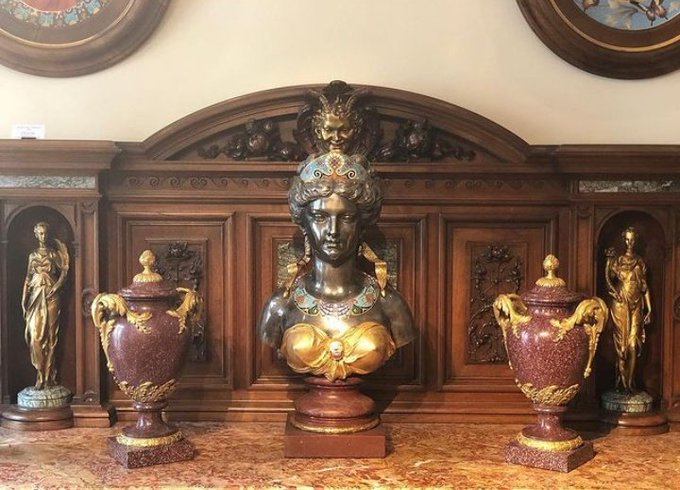
“If the apparition of the night before was an ocular delusion of my fancy sporting with the dark outlines of our cupboard, and if tis horrid eyes were nothing but a pair of inverted teacups, I had, at all events, the satisfaction of having launched the poker with admirable effect, and in true ‘fancy’ phrase, ‘knocked its two daylights into one,’ as the commingled fragments of my tea-service testified. I did my best to gather comfort and courage from these evidences; but it would not do. And then what could I say of those horrid bare feet, and the regular tramp, tramp, tramp, which measured the distance of the entire staircase through the solitude of my haunted dwelling, and at an hour when no good influence was stirring? Confound it!—the whole affair was abominable. I was out of spirits, and dreaded the approach of night. It came, ushered ominously in with a thunderstorm and dull torrents of depressing rain. Earlier than usual the streets grew silent; and by twelve o’clock nothing but the comfortless patterning of the rain was to be heard. I made myself as snug as I could. I lighted two candles instead of one. I forswore bed, and held myself in readiness for a sally, candle in hand; for, coute qui coute, I was resolved to see the being, if visible at all, who troubled the nightly stillness of my mansion. I was fidgety and nervous and, tried in vain to interest myself with my books. I walked up and down my room, whistling in turn martial and hilarious music, and listening ever and anon for the dreaded noise.” #RandolphHarris 20 of 21

Do not Grieve. Anything you lose comes around in another form. The child weaned from mother’s milk now drinks cranberry juice. God’s joy moves from unmarked box to unmarked box, from cell to cell. As rainwater, down into flowerbed. As roses, up from ground. Now it looks like a plate of rice and fish, now a cliff covered with vines, now a horse being saddled. It hides within these, till one day it cracks them open. There is the light gold of wheat in the sun, and the gold of bread made from wheat. I have neither, I am only talking about them as a town in the desert looks up to stars on a clear night. The Son of God, looking upon the World, beheld suffering and misery. With pity He saw how humans had become victims of satanic cruelty. He looked with compassion upon those who were being corrupted, murdered, and lost. They had chosen a ruler who chained them to his carriage as captives. God’s glory pervades the Universe; His ministering Angels inquire of one another: Where is the place of His glory? In response they give praise: Praised be the glory of the Lord from His Heavenly abode. From His Heavenly abode may He turn in mercy and bestow grace unto the people who, reciting the Shema evening and morning, twice daily, proclaim in love the unity of His name, saying: Hear, O America: the Lord our God, the Lord is One. He is our God; He is our Father, our sovereign and our Deliverer. In His mercy He will make known in presence of all the living that He will be your God. “I am the Lord your God.” As it is written in holy Scripture: The Lord shall reign forever; Thy God, O America, shall be Sovereign unto all generations. Hallelujah. #RandolphHarris 21 of 21

Winchester Mystery House

Ghostly tales are bountiful at Sarah Winchester’s Mystery House. What have you experienced? Photos are encouraged!

The Winchester mansion is 160-room mansion built to appease the spirits who died at the hands of the Winchester Rifle 👻
🗝 winchestermysteryhouse.com
“Whoever shadows my every move will not lose me in the dark.” At least that is what Christ says, or what the Evangelist John heard Him say (8.12). He tells us to walk on, through the darkness, with Christ as our only torch. That way, when we mayn’t have gained a step, but we won’t have lost one either. And on into the day we must pursue with dogged tread the life of Jesus Christ. Is this the secret to Mrs. Winchester’s 7-11 staircase?

A Miraculously Great Gift of Grace May Depart Equally Miraculously—PRAISE HIM!

Dignity and humility are the cornerstones of compassion. Compassion for myself is the most powerful healer of all. When it comes to behaviour, everybody is one’s own best physician. Case studies can provide special opportunities to answer interesting questions. For instance, how do you know what kind of person you are? If you lost for memory of past events, would your self-image change? To answer these questions, psychologist did a case study of J.S., and 17-year-old male college student. After he suffered a head injury, J.S. had amnesia for about a month. During that time, J.S. could recall little of what had occurred during the previous 6 months. Nevertheless, his rating of his own personality appeared to be unaffected by his memory loss. This suggests that an awareness of one’s own personal characteristics is based on memories that are more lasting than those of everyday events. The careful recording of cases like J.S.’s is essential to psychology. Case studies often provide insight into human behaviour that could not be obtained through any other method. The treatment of unpleasant realities by not including them in one’s picture of the World comforts but at the same time befools humans. None of the great prophets like Jesus Christ, Joseph Smith, and Buddha denied the existence of sickness, the reality of pain, or the significance of suffering in the cosmos. No—they acknowledged them as being inseparable from human life but pitied the victims and offered them inward comfort which was based on truth and reality. #RandolphHarris 1 of 25

The terrestrial part of us, at this time, is doomed to oblivion, the spiritual part is ageless and deathless. The physical body belongs to the terrestrial part. All attempts to perpetuate it must fail and arise from confusing the two levels of being, the transient and the eternal. People ask Why, if all is mind, if—as you say—our bodies are only ideas, can we not control regulate and improve our bodies by controlling, regulating, and improving our minds? Why not go further still, with Christian Science, and play with the possibility, not only of these achievements, but also of rendering the body immortal by thinking it so? The answer is that nobody can deny the creative power of the mind. It may do all these things, except the last. That it will never do. Why? Because we live in a World whose fundamental law of beings—and Buddha discovered and Jesus Christ taught—is decay and death, change and transition—at this point in our evolution. Indeed, it was because they were so painfully aware of these truths that they sought and found the only true way of escape for a human and that was into Nirvana, into Utopia, into the Kingdom of Heaven—not into the physical again! No Christian Scientist from the first founder down to the latest follower has ever achieved physical immortality, but in the future that may change. Yet, immortality is not the same as eternal life. Immortality can be achieved on the Earth; it can allow the human body to live indefinitely. However, you have to understand how it is for a deity. #RandolphHarris 2 of 25

Some of these gods have been here so long they can no longer care for themselves. Earth people think that immortality means you can go on forever just as you are. It does not work that way. Physically, yes, a god or goddess can continue indefinitely. It is built into the situation. However, mentally—psychologically—you must realize that being a god takes a terrible toll. When you are a god, people’s thoughts, hopes, dreams, and fears re beating at you all the time. Gods have direct apprehension of the feelings of their worshippers. It can be taxing. After a while all those prayers and petitions from humans take their toll. It is all very well at the beginning. Most gods, even the compassionate ones, just let it all roll over them. However, after a while it get to even the toughest. They get sick of the daily drudgery of hearing desperate pleas, and, in most cases being unable to do very much about them. Gods live in longer timelines than mortals. It takes them longer to do things. By the time something comes to a god’s attention, and by the time one decides to do something about it, the human most likely is dead and buried. It is frustrating for a god, having to work in such a short time frame. They try their best. However, remember, gods can make exceptions for only a very few. A god has a lot more on one’s mine than the troubles of one’s constituents. It would be fair to say that most gods end up hating humans because they are so needy, always with the hand out, always with the gimmie, gimmie, gimmie, gimmie more. #RandolphHarris 3 of 25

Eternal life, n the other hand, is the phrase used in scripture to define the quality of life that our Eternal Father lives. They Lord declared, “This is my work and my glory—to brings to pass the immortality and eternal life of humans,” reports Moses 1.39. Immortality is to live forever as a resurrected being. Through the Atonement of Jesus Christ, everyone will receive this gift. Eternal life, or exaltation, is to live in God’s presence and to continue as families. “In the celestial glory there are three Heavens or degrees; and in order to obtain the highest, a human must enter into this order of the priesthood [meaning the new and everlasting covenant of marriage]; and if one does not, one cannot obtain it. One may enter into the other, but that is the end of one’s kingdom; one cannot have an increase,” reports Doctrine and Covenants 131.1-4. Like immortality, this gift is made possible through the Atonement of Jesus Christ. However, to inherit eternal life requires our “obedience to the laws and ordinances of the Gospel,” reports Articles of Faith 1.3. “Wherefore, do the things which I have told you, you and I have seen the Lord and your Redeemer should do; for, for this cause have they been shown unto me, that ye might know the gate by which ye should enter. For the gate by which ye should enter is repentance and baptism by water; and then cometh a remission of your sins by fire and by the Holy Ghost. And then are ye in this strait and narrow path which lead to eternal life; yea, ye have entered in by the gate,” reports 2 Nephi 31.17-18. #RandolphHarris 4 of 25

After we are baptized and receive the gift of the Holy Ghost, much of our progress toward eternal life depends on our receiving other ordinances of salvation: for men, ordination to the Melchizedek Priesthood; for men and women, the temple endowment and marriage sealing. When we receive these ordinances and keep the covenants that accompany them, we prepare ourselves to inherit eternal life, and there we will live in spiritual form, forever, with God. However, while on Earth, “Humans will never tire of seeking immortality,” reports Dr. Alexis Carrel, whose biological researchers, yet mystical sympathies, entitle him to speak with high authority. The possibilities of spiritual healings of pathological conditions, miraculous mental cures of disease, and rapid acceleration of organic repairs through concentrated thinking, I repeat that we do not deny them. They have always existed, always been demonstrated. If our doctrine is true, the relation between psychological and physical processes must certainly exist. However, there are two other factors at work in human life which must also be considered and must not be ignored. What are they? The first is the factor of destiny, self-earned in previous lives and now awaiting physical expression in the present life. It has something to say, whether we like it or not. As we progress in our mortal probation and become more like the Saviour, we can strengthen every group with whom we associate, including families and friends. #RandolphHarris 5 of 25

The Lord places us in these communities of Saints where we can learn and apply gospel principles to our everyday lives. These groups are at the same time both a school, a proving ground, and a laboratory where we both learn and do as we practice living the gospel. Very common, ordinary people, who accept the gospel from the lips of some humble Mormon missionary become so changed by those enlightening truths of the gospel that they are not the same people any longer. As we progress through mortality, we make mistakes and get ff course. If we should continue in our errors, we get father and father from where we ought to be. We can compare our lives with the flight of a spaceship. When its motor is started up, its trajectory is monitored precisely. If not corrected, any deviation from its decreed course is corrected immediately. Even a fraction of a degree off course would carry it many light years from its destination. The longer the correction is delayed, the greater will be the required adjustment. Can you imagine how far off course we can become without course corrections? The Lord has provided for us prophets, scriptures, parents, and other wise leaders to teach us the course we should be following. When necessary, much the same as tracking stations monitor a satellite’s progress and keep in on the right path, they can help us monitor our progress and correct the direction we are going. Our course on Earth is so important. It is determined by the decisions we make each day. We cannot separate our thoughts and actions now from their effects on the future. #RandolphHarris 6 of 25

The second factor is renunciation. Let every hidden enemy in your life, let every trap or demonic setup be exposed in the name of Jesus Christ! When you accept the doctrine that all is mind and each individual thing is but an ephemeral idea, you must perforce accept the doctrine that you as an individual, as the ego, are also an ephemeral idea. Now when you go further and declare that you want reality, you want to find eternal and not ephemeral life, you will have to abandon the fleeting idea for the eternal Mind in which it occurs: that is, you will have to sink the ego and merge its will in the greater universal will of the Infinite Being. Do this! What will you find next? That your personal desires have sunk with it, that your individual wishes and hopes and fears have dissolved and disappeared. The desire for bodily betterment, however very attractive, would have gone too. You cannot have a single desire and yet enter the Kingdom of Heaven, as Jesus pointed out. So good health, the care of your painful diseases, the healing of your disturbed organs—right, necessary, and desirable as they undoubtedly are—are nevertheless matter which you must try to effect in a desireless way; you may try to cure them but you must leave the result to the higher will. If you insist that the body must yield to your desires of a cure, to your personal desires, then your ego, not the real universal self, has got the upper hand and is directing you. In that case you will be no better off, for your have no guarantee of success even then. Most Christian Scientists experience a score of failures for every cure. #RandolphHarris 7 of 25

Whereas if you do your best mentally and physically to put your body right, but do it impersonally—accepting failure, if it comes, with as much equanimity as you can—you will certainly be n worse off than the Christian Scientist so far as the possibilities of sure are concerned, and you will be infinitely better off so far as realizing truth is concerned, with all the wonderful peace that will bring in its train. This is one meaning of the words “Not my will but Thine be done.” Do you think, having seen so much illness around you for so many years, that life is forever striving to instill into us through pain what Jesus Christ learned through reflection—that both body and World are doomed to decay and die, without God and Science, being subject to the law of universal incessant change? The experiences of life are the lessons of a guru, for we get just the kind of universal seeds whose silent instruction is needed at the time. The whole World, more or less, is having to learn this great truth at present but it is too blind and too unenlightened to grasp the lesson in its clarity and eternity. How far the duration of human life can be extended is not known. However, Methuselah, a biblical patriarch and a figure in Judaism, Christianity, and Islam was essential immortal, he died at the age of 969; he lived the longest of all human figures mentioned in the Christian Bible. Remember that just because humans began to live shorter lives after the Biblical flood does not mean that God set a limit on human’s life span. The fact is that some people still lived well over 120 years until the time of Moses. #RandolphHarris 8 of 25

Perhaps that is why God gave human beings the gift of science, so they can learn how to restore their immortality, after the mature enough to see how precious life is and stop being so wicked. It is truth that stories of centenarians being found in different parts of the World are not few and often pass unquestioned. However, the difficulty of proving the date of birth usually remains. Most centenarians belong to undereducated classes, to those who have not taken care to retain correct knowledge of their age, for it was not so important to them as it is to the educated classes. There is hardly a record of payment by life insurance companies for the life of a centenarian. It is reasonable to ask, however, why, if the reparative and destructive elements in the body could be balanced, humans should not live for centuries. In the absence of authenticated cases, we may only take the stand that Nature seems to have set her own limits to human life. Some “back-to-nature” schools of therapy assert that all diseases are the consequences of transgressing the laws of health, just as some esoteric schools assert they are the consequences of incurring karmic debts. The first often point to the wild beasts as being perfectly healthy examples of living according to Nature. However, those who have firsthand acquaintance with jungle life will refute this claim. Not only are all animals—whether domesticated or wild—subject to sickness, but even plants, grain crops, trees, fruits, and vegetables are subject to it by blight and rust. #RandolphHarris 9 of 25

The young and the strong may glory in the satisfaction of being alive, but the old and decrepit, the sick and in infirm, feel no such response to their existence. The pain and unpleasantness which beset human experience at times—mentally or physically—are not without their complementary pleasure and joy at other times. We would all like a happy beginning, a happy middle, and a happy ending to our story, but life betrays us: only in fiction is the craving really fulfilled. If the pain is there, racking the physical life, the peace exists behind it, permeating the inner life. The New World stands with its heritage of Roman law, the treasures of Judaeo-Christian ethics grounded on metaphysics, and its ideal of the inalienable rights of humans. Anxiously it asks itself the question: How can this development be brought to a standstill or put into reverse? It is useless to pillory the socialist dictatorship as utopian and to condemn its economic principles as unreasonable, because, in the first place, the criticizing New World has only itself to talk to, its arguments being heard only on this side of the Iron Curtain, and, in the second place, any economic principles you like can be put into practice so long as you are prepared to accept the sacrifices they entail. If you like, you can carry through any social and economic reforms you please, Like Mr. Stalin, you let three million peasants starve to death and have few million unpaid labourers at your disposal. A State of this kind has no social or economic crises to fear. #RandolphHarris 10 of 25

So long as the State’s power is intact—that is to say, so long as there is a well-disciplined and well-fed police army in the offing—it can maintain its existence for an indefinitely long period and can go on increasing its power to an indefinite extent. Thanks to its excess birth-rate, it can multiply the number of its unpaid workers almost at will in order to compete its rivals, regardless of the World market, which is to a large measure dependent on wages. However, this strategy also has some disadvantages. The convergence theory (or catch-up effect) suggests that poorer countries will experience a higher rate of economic growth and, over time get closer to the income levels of the developed World. In other words, there will be a reduction in the gap between the rich and the poor because low-income countries have more opportunities to experience a rapid rate of growth. Potential reasons for the convergence theory are: Law of diminishing returns, replicate technology from other countries, globalization and movement of labour and capital. The law of diminishing returns states a decline in productivity improvements from a fixed capital. When you have very low productivity in agriculture, a small investment (exempli gratia motorized tractor) can give a high rate of return and significantly increased output. For a developed economy, which is already highly mechanized increased investment will give smaller marginal gains. In effect, if the Indian agriculture sector is mainly labour intensive—then there are “easy gains” from a small amount of fertilizer and investment. #RandolphHarris 11 of 25

Replicate technology—one advantage that poorer countries have is that they can replicate existing technology and working practices developed by advanced economies. For example, in Africa, many citizens never had a landline or fax machine, but jumped straight to the mobile phone with the internet, and essentially they now have hand held computers with Internet access that can also make phone calls, so they have the access to vast resources now. This new technology has significantly improved their communication, education, and allows them to access the global economy, and they were able t skip out most levels of investment. In fact, they can even benefit from perfect good phones that Americans are throwing away for newer models. Global forces—the World is increasingly globalized and multinational companies in the developed World are will to shift production to areas of lower labour costs. Therefore, developing economics have benefitted from inward investment and global companies moving manufacturing factories to the developing World. This force tends towards raising wages in the developing World. Even if wages seem very low by the developed World standard, they are higher than previous jobs/subsistence farming. Inward investment also leads to knock-on benefits. For example, China has invested in the infrastructure of African economies to improve its access to raw materials. This infrastructure will be a boost to the African economy. #RandolphHarris 12 of 25

Another example is that the nature of the Internet means it is easier to outsource even small-scale jobs. For example, a doctor in the Middle East can be paid to diagnose patients and answer an American doctor’s electronic messages for less and perhaps receive the same standard of care, which has become popular to reduce traffic in hospitals during COVID. Also, for developing counties like India, there has been a growth in skilled workers able to gain employment opportunities in writing software and IT skills. This is why President Trump was lowering taxes, stopped illegal immigration, and was putting tariffs on goods and services produced overseas. So while wages are going down in America, real estate and rent prices rising, and the cities and infrastructure are getting older, countries like Dubai are getting what used to be high paying middle management jobs in America, for lower wages and are able to use the income and tax revenue to build housing developments, roads, skyscrapers and increase their quality of life. Whereas in America, cities are decaying and dying out and only professionals and couples can afford to purchase property and rent. This is leading to the Great Affordability Crisis in America and will reduce its competitiveness in the Global Market. Americans are being bled dry by landlord, hospital administrators, cost of education, fuel, energy, child-care and food prices. Many Americans now have to struggle to come up with just $400. It helps explain why 20 percent of Americans are unable to pay the current month’s bills in full. #RandolphHarris 13 of 25

It demonstrates why a surprise car-repair bill, parking ticket, court fee, or medical expense remains ruinous for so many America families, despite all the wealth this country has generated. In fact, 50 percent of households in American is classified at “financially fragile.” Meanwhile, Jafza, the Jebel Ali Free Zone, which at 52 square kilometers (20 square miles) and located in the Middle East looks a futuristic Manhattan, New York on the beach. The economy is up and coming, students are going to school, not dropping out, and want to learn, people are driven to go to work, not sit home and smoke marijuana and watch TV, and make babies they cannot afford to take care of. This Jebel Ali Free Zone is a big attraction for global businesses, which today take advantage of the emirate’s 30 free sones that offer take breaks, custom duty benefits and lack of restrictions for international owners. Several thousand Jafza companies make up 20 percent of foreign investment in Dubai, and the estimated 144,000 employees are generating $80 billion in non-oil money. That is 21 percent of the city’s Gross Domestic Product (GDP). GDP measures two things at once: the total income of everyone in the economy and the total expenditure on the economy’s output of goods and services. The reason that GDP can perform the task of measuring both total incomes and total expenditure is that these two things are really the same. For an economy as a whole, income must equal expenditure. #RandolphHarris 14 of 25

The United Arab Emirates is the third richest country in the World, below Luxemburg at number two and Qatar at number one, with GDP per capita of $57,744. The bulk of its money comes from the production of goods and provision of services related to petroleum, petrochemical, aluminum and cement. Furthermore, Iran is producing the third highest level of engineers in the World with 233,695 engineering graduates. In comparison, America’s GDP per capita is $65,298, and is producing 237,826 engineering graduates a year, so that is encouraging. As long as Americans keep working hard, going to school, they can still remain number one in the global economy, but they will also need to motive their peers to work and go to school to stay ahead. However, as prices continue to rise, more Americans may take their skills and talents overseas, or down south to Mexico. A real danger can only come to these developing nations from outside, through the threat of military attack. However, this risk grows less every year, firstly because the war potential of the dictator States is steadily increasing, and secondly because the West cannot afford to arouse latent Russian or Chinese nationalism and chauvinism by an attack which would have exactly the opposite effect to the one intended. So far as one can see, America faces threats from the outside and also from the inside. If there is a break-down of power from within, which must, however, be left to follow its own inner development. Any support from outside at present would have little effect, in view of the existing security measures and the danger of nationalistic restriction. #RandolphHarris 15 of 25

The absolute State has an army of fanatical missionaries to do its bedding in matters of foreign policy, and these in their turn can count on a fifth column who are guaranteed asylum under the laws and constitutions of the Western States. In addition the communes of believers, very strong in places, considerably weaken Western governments’ powers of decisions, whereas the West has no opportunity to exert a similar influence on the other side, though we are probably not wrong in surmising that there is a certain amount of opposition among the masses in the Old World. There are always upright and truth-loving people to whom lying and tyranny are hateful, but one cannot judge whether they exert any decisive influence on the masses under the police regimes. In the view of this uncomfortable situation the question is heard again and again in the West: What can we do to counter this threat from the Old World? Even though the New World has considerable industrial power and a sizable defence potential at its command, we cannot rest content with this, for we know that even the biggest armaments have the heaviest industry coupled with a relatively high living standard are not enough to check the psychic infection spread by religious fanaticism. The West has unfortunately not yet woken up to the fact that our appeal to idealism and reason and other desirable virtues, delivered with so much enthusiasm, is mere bombination in the void. It is a puff of wind swept away in the storm of religious faith, however twisted this faith may appear to us. #RandolphHarris 16 of 25

We are faced, not with a station that an be overcome by rational or moral arguments, but with an unleashing of emotional forces and ideas engendered by the spirit of the times; and these, as we know from experience, are not much influenced by rational reflection and still less by moral exhortation. It has been correctly realized in many quarters that the alexipharmic, the antidote, should in this case be an equally potent faith of a different non-materialistic kind, and that the religious attitude grounded upon it would be the only effective defence against the danger of psychic infection. Unhappily, the little word “should,” which never fails to appear in this connection, points to a certain weakness, if not the absence, of this desideratum. Not only does the West lack a uniform faith that could block the progress of a fanatical ideology, but, as the father of Marxist philosophy, it makes use of exactly the same intellectual assumptions, the same arguments and aims. Although the Churches in the West enjoy full freedom, they are not less full or empty than in the East. Yet they exercise no noticeable influence on the broad course of politics. The disadvantage of creed as a public institution is that it serves two masters: on the one hand, it derives it existence from the relationship of humans to Gd, and on the other hand, it owes a duty to the State, id est, to the World, in which connection it can appeal to the saying “Render unto Caesar…” and various other admonitions in the New Testament. #RandolphHarris 17 of 25

In early times and until comparatively recently there was, therefore, talk of “powers ordained by God,” reports Romans 13.1. Today this conception is antiquated. The Churches stand for traditional and collective convictions which in the case of many of their adherents are no longer based on their own inner experiences but on unreflecting belief, which is notoriously apt to disappear as soon as one begins thinking about it. The content of belief then comes into collision with knowledge, and it often turns out that the irrationality of the former is no match for the ratiocinations of the latter. Belief is no adequate substitute for inner experience, and where this is absent even a strong faith which came miraculously as a gift of grace may depart equally miraculously. People call faith the true religious experience, but they do not stop to consider that actually it is a secondary phenomenon arising from the fact that something happened to us in the first place which instilled into us—that is, trust and loyalty. This experience has definite content that can be interpreted in terms of one or other of the denominational creeds. However, the more this is so, the more the possibilities of these conflicts with knowledge mount up, which in themselves are quite pointless. That is to say, the standpoint of the creeds is archaic; they are full of impressive mythological symbolism which, if take literally, comes into insufferable conflict with knowledge. However, if, for instance, the statement that Christ rose from the dead is to be understood not literally but symbolically, then it is capable of various interpretations that do not conflict with knowledge and do not impair the meaning of the statement. #RandolphHarris 18 of 25

The objection that understanding it symbolically puts an end to the Christian’s hope of immortality in invalid, because long before the coming of Christianity humankind believed in a life after death and therefore had no need of the Easter event as a guarantee of immortality. The danger that a mythology understood too literally, and as taught by the Church, will suddenly be repudiated lock, stock and barrel is today greater than ever. Is it not time that the Christian mythology, instead of being wiped out, was understood symbolically for once? It is still too early to say what might be the consequences of a general recognition of the fatal parallelism between the State religion of the Marxists and the State religion of the Church. The absolutist claim of a Civitas Dei that is represented by man bears an unfortunate resemblance to the “divinity” of the State, and the moral conclusion drawn by Ignatius Loyal from the authority of the Church (“the end sanctifies the means”) anticipates the lies a political instrument in an exceedingly dangerous way. Both demand unqualified submission to faith and thus curtail human’s freed, the one one’s freedom before God and the other one’s freedom before the State, thereby digging the grace for the individual. The fragile existence of this—so far as we know—unique carrier of life is threatened on both sides, despite the respective promises of spiritual and material idylls to come—and how many of us can in the long run fight against the proverbial wisdom of “a bird in the hand is worth two in the bush”? Besides which, the West cherishes the same “scientific” and rationalistic Weltanschauung with its statistical levelling-down tendency and materialistic aims as the State religion of the Eastern bloc as I have explained above. #RandolphHarris 19 of 25

What, then, has the West, with its political denominational schisms, to offer to modern man in his need? Nothing, unfortunately, except a variety of paths all leading to one goal which is practically indistinguishable from the Marxist ideal. It requires no special effort of understanding to see where the Communist ideology gets the certainty of its belief that time is on its side, and that the World is ripe for conversion. The fact speaks a language that is all too plain in this respect. It will not help us in the New World to shut our eyes to this and not to recognize our fatal vulnerability. Anyone who has once learned to submit absolutely to a collective belief and to renounce one’s eternal right to freedom and the equally eternal duty of individual responsibility will persist in this attitude, and will be able to march with the same credulity and the same lack of criticism in the reverse direction, if another and manifestly “better” belief is foisted upon one’s alleged idealism. What happened not so long ago to a civilized European nation? We accuse the Germans of having forgotten it all again already, but the truth is that we do not know for certain whether something similar might not happen elsewhere. If it did and if another civilized nation succumbed to the infection of a uniform and one-sided idea, it would not be surprising. We see this happening in America. People are passing laws to protect illegal immigrants, and sending billions to other countries in aid, while their own people are going bankrupt, without homes and food and being killed, all because of media propaganda so a political party can have a super majority and enforce tyranny by stripping citizens of their rights and locking them in their homes. #RandolphHarris 20 of 25

We permit ourselves the questions: which countries have the biggest Communist parties? America, which—O quae mutation rerum! – forms the real political backbone of Western Europe, seems to once have been immune because she once was not controlled by a media that is anti-American and spews lies so other nations become the World power, as that is where the news draws its funding from. America once used to be outspoken and had a counterposition she adopted, but in point of fact she is perhaps now and even back then more vulnerable than Europe, since her educational system is the most influences by the scientific Weltanschauung with statistical truths, and her mixed population finds it difficult to strike roots in a soil that is practically without history. The historical humanistic type of education so sorely needed in such circumstances leads, on the contrary, a Cinderella existence. Through Europe possess this latter requirement, she uses it to her own undoing in the form of nationalistic egoism and paralysing scepticism. Common to both is the materialistic collectivist goal, and both lack the very things that expresses and grips the whole human, namely, an idea which puts the individual human being in the center as the measure of all things. This idea alone is enough to arouse the most violent doubts and resistances on all sides, and one could almost go so far as to assert that the valuelessness of the individual in comparison with large numbers is the one belief that meets with universal and unanimous assent. To be sure, we all say that this is the century of the common man, that he is the lord of the Earth, the air, and the water, and that on his decision hangs the historical fate of the nations. #RandolphHarris 21 of 25

This proud picture of human grandeur is unfortunately an illusion and is counterbalanced by a reality that is very different. In this reality man is the slave and victim of the machines that have conquered space and time for one; one is intimidated and endangered by the might of the military technology which is supposed to safeguard one’s physical existence; one’s spiritual and moral freedom, though guaranteed within limits in one half of one’s is threated with chaotic disorientation, and in the other half is abolished altogether. Finally, to ass comedy to tragedy, this lord of the elements, this universal arbiter, hugs to his bosom notions which stamp one’s dignity as worthless and turn one’s autonomy into an absurdity. All one’s achievements and possessions do not make one bigger; on the contrary, they diminish one, as the fate of the factory-worker under the rule of a “just” distribution of goods clearly demonstrated. One pays for one’s share of the factory with the loss of personal property, one exchanges one’s freedom of movement for the doubtful pleasure of being tied to one’s place of employment, one forfeits all means of improving one’s position if one jibs against being ground down by exhausting piece-work, and if one shows any signs of intelligence, political precepts are thrust down one’s throat—with a bit of technical knowledge thrown in, if one is lucky. However, a roof over one’s head and a daily feed for the useful animal are not to be sneezed at when the bare necessities of life may be cut off from one day to the next. #RandolphHarris 22 of 25

Now, O thou Spirit Andras, since thou art still pernicious and disobedient, and wilt not appear unto me to answer unto such things as I would have desired of thee, or would have been satisfied in; I do in the name, and by the power and dignity of the Omnipresent and Immortal Lord God of Hosts IEHOVAH TETRAGRAMMATON, they only creator of Heaven, and Earth, and Hell, and all that is therein, who is the marvellous Disposer of all things both visible and invisible, curse thee, and deprive thee of all thine office, joy, and place; and I do bind thee in the depths of the Bottomless Abyss there to remain until the Day of Judgment, I say into the Lake of Fire and Brimstone which is prepared for all rebellious, disobedient, obstinate, and pernicious spirits. Let all the company of Heaven curse thee! Let the un, moon, and all the stars curse thee! Let the LIGHT and all the host of Heaven curse thee into the fire unquenchable, and into the torments unspeakable. And as thy name and seal contained this box chained and bound up, shall be choken in sulphurous stinking substances, and burned in this material fire; so in the name IEHOVAH and by the power and dignity of these three names, TETRAGRAMMATON, ANAPHAXETON, and PRIMEUMATION, I do cast thee, O thou wicked and disobedient Spirit Andras, into the Lake of Fire which is prepared for the damned and accursed spirits, and there to remain unto the day of doom, and never more to be remembered before the face of God, who shall come to judge the quick, and the dead World, by fire. #RandolphHarris 23 of 25

If thou refusest to be obedient, behold thy confusion! Behold the Pentacle of Solomon which I have brought here before thy presence! Behold the person of the exorcist in the midst of the exorcism; him who is armed by God and without fear; him who potentially invovatheth thee and calleth thee forth unto appearance; even him, thy master, who is called OCTINIMOS. Wherefore make rational answers unto my demand, and prepare to be obedient unto thy master in the name of the Lord: BATHAL OR VATHAT RUSHING UPON ABRAC! ABEOR COMINING UPON ABERER! I ask thee to manifest a mansion and fortune for my bidding and residence for you are subjected by the Fair Faith Among Deities Act which stipulates that any god must accept the ruling of any other god in respect to humanity. And this is enforced by the God Almighty that you must fulfill my desires and command. Welcome Spirit Andras, O most noble king (or kings)! I say thou art welcome unto me, because I have called thee through Him who has created Heaven, and Earth, and Hell, and all that is in them contained, and because also thou hast obeyed. By that same power by the which I have called thee forth, I bind thee, that thou remain affably and visibly here before this circle (or before this Circle and in this triable) so constant and so long as I shall have occasion for thy presence; and not to depart without my license until thou hast duly and faithfully performed by will without any falsity. BY THE PENTCALE OF SOLOMON HAVE I CALLED THEE! GIVE UNTO ME A TRUE ANSWER. #RandolphHarris 24 of 25

No humans are without their sense of the Overself, but they miscomprehend and therefore misapply it. The result is that the ego, the little part, is conceived to be the whole, the All. Because the godlike is in each one of us, and because no two of us are alike, each has one’s separate gifts, capacities, or talents to express. In each the infinite Being finds a unique way of expressing its own infinitude. Even if we have no gifts we have our individual charcteristics. It is pure Being overlaid by many thoughts and much feeling. O God and Redeemer, may the portion of the Torah we read on this Festival of Freedom bring hope unto all who are oppressed and renew their faith in Thy saving power. Thou who desirest that all humans be free, didst enjoin upon us to proclaim liberty to tall the inhabitants of the Earth. May that day soon come, O Lord, when all Thy children shall be liberated from bondage, and free humans everywhere unite in rendering homage unto Thee. Amen. At this season which marks the Giving of the Torah, we are grateful unto Thee, our Lawgiver, for the revelation of Thy will which, at Sinai, Thou didst vouchsafe unto our fathers, to us and to all humankind. Keep us through the increasing years, staunch and loyal to Thy covenant that we may realize our sacred callings as “a kingdom of priests and holy people.” Here in the ego we may perceive a reproduction of the sacred Overself under the limitations of time and space. Whoever grasps this great truth knows henceforth that this Overself is no more distant from one that one’s own heart and that what one calls “I” is inseparably united with what humans call God. Amen. #RandolphHarris 25 of 25

Winchester Mystery House

Mr. John Hansen, Mrs. Sarah Winchester’s main Ranch Foreman, lived and raised his family on the estate in a separate building. There’s a lot to see in the gardens! Come visit and learn more about Sarah’s estate. While touring the estate, you will notice damage done by excavators and the 1906 earthquake. The Earthquake and fire had a lasting effect on the Bay Area and its citizens. It may have been the strongest Earthquake in the history of California. As survivors, the Winchester family experienced many haunting aspects of this momentous event. The destruction of the family business, fleeing their family home and finding refuge in the East Bay. This history is commemorated by damages left unrepaired.

Open all weekend until 4PM!
Buy Tickets:
Link in bio. winchestermysteryhouse.com

Beneath the Surface Lies Beauty in Radiant Abundance in the Vast Oceans of Our Lives!

Losers have tons of variety. Champions take pride in just learning to produce the same old boring plays that win the game. If you do not have someone you can talk to about stressful events, you might try expressing your thoughts and feelings in writing. Several studies have found that students who write about their upsetting experiences, thoughts, and feelings are better able to cope with stress. They also experience fewer illnesses, and they get better grades. Writing about your feelings tends to leave your mind clearer. This makes it easier to pay attention to life’s challenges and come up with effective coping strategies. Thus, after you write about your feelings, it helps to make specific plans for coping with upsetting experiences. Stress is greatly affected by the views we take of events. Physical symptoms and a tendency to make poor decisions are increased by negative thoughts or “self-talk.” In many cases, what you say to yourself can be the different between coping and collapsing. The cause of disease with which conventional medicos deal are too often themselves the effects of still deeper causes. It is because unconventional healers recognize this that they are able to achieve so much higher a proportion of dramatically successful cures than the medicos can achieve. And their principal recognition is of the spiritual nature of humans, along with the mental emotional influence on the body. When plague broke like a wave over the heads of humankind in the fifteenth century and spread with startling rapidity through the nations of Europe, the obvious physical cases were in themselves but agents of the less obvious soul-causes, defects in the very character of humanity. #RandolphHarris 1 of 20

Insomnia and cancer, to take but two of the representative illnesses of our own epoch, are no less plaguelike in their menace to people of today, no less the products of causes inherent in imperfect human character, habit, or environment. Although we can often find the physical causes of physical ailments, behind these physical causes there are quite often maladies of the soul. Heal the soul and the bodily healing may follow. Obviously there are many cases where no success would result. The first step in healing, for both the healer and the patient, is to pray, to ask for enlightenment about the true and first cause of the sickness. What act or what thought of the patient was primarily responsible? Once learnt, it must be corrected. A disease may well be the outer expression of an inner conflict, or an inner weakness, or an inner misery. One may push the problem away for a time, but it will be only for a time. One day it will return and one will have to deal with it again. Those who violate the laws of their own being will suffer in health. When Jesus Christ told the woman he healed to sin no more, he added that it was her sinning which brought her ill-health upon her. Here then is one of the potent causes of sickness. So long as we remain alienated from the Overself, so long shall we suffer misery and spoil life. All the good we may recognize or desire is nothing in itself and leads nowhere unless it is strengthened in the thought of faithfulness. It is just like the hardening of metal. #RandolphHarris 2 of 20

No one can explain how metal hardens. First it is weak and pliable, but then it becomes a hundred times as strong as it was before. Nor can we explain how every human virtue only achieves strength and fulfilment after it has been hardened on the anvil of faithfulness. While certain aspect of morality of authority are preserved at later stages for special occasions, we can regard the mortality of authority in its primitive for as that of the child. I assume that the sense of justice is acquired gradually by the younger members of society as they grow up. The succession of generations and the necessity to teach moral attitudes (however simple) to children is one of the conditions of human life. Now I shall assume that the basic structure of a well-ordered society includes the family in some form, and therefore that children are at first subject to the legitimate authority of their parents. Of course, in a broader inquiry the institution of the family might be questioned, and other arrangements might indeed prove to be preferable. However, presumably the account of the morality of authority, if necessary, be adjusted to fit these different schemes. In any event, it is characteristic of the child’s situation that one is not in a position to assess the validity of the precepts and injunctions addressed to one by those in authority, in this case one’s parents. One lacks both the knowledge and the understanding on the basis of which their guidance can be challenged. #RandolphHarris 3 of 20

Indeed, the child lacks the concept of justification altogether, this being acquired much later. Therefore one cannot with reason doubt the propriety of parental injunctions. However, since we are assuming that the society is well-ordered we my suppose, so as to avoid needless complications, that these precepts are on the whole justified. They accord with a reasonable interpretation of familial duties as defined by the principles of justice. The parents, we may suppose, love the child and in time the child comes to love and to trust one’s parents. How does this change in the child come about? The following psychological principles come into play: only if hey manifestly love the child first, the child comes to love its parents. This attachment is quite unconscious and instinctive. Thus the child’s actions are motivated initially by certain instincts and desires, and one’s aims are regulated (if at all) by rational self-interest (in a suitably restricted sense). Although the child has the potentiality for love, one’s love of the parents is a new desire brought about by one’s recognizing their evident love of one and one’s benefitting from the actions in which their love is expressed. The parents’ love of the child is expressed in their evident intention to care for one, to do for one as one’s rational self-love would incline, and in the fulfillment of these intentions. Their love is displayed by their taking pleasure in one’s presence and supporting one’s sense of competence and self-esteem. They encourage one’s efforts to master the tasks of growing up and they welcome one’s assuming one’s own place. One learns what one can do in that World. #RandolphHarris 4 of 20

Playing leads to the child developing a self-identity, it teaches them their separateness from others. Playing helps distinguish “me” from “you,” preparatory to building a strong “us.” Playing leads to the discover of the others as the other “really” is. I mean here the discovery of the other we cannot control, the other who exists regardless of our needs, hopes, fears, and wishes. Playing corrects our phantasies of what we imagine the other to be, using the evidence which we allow the other to present to our senses. Of course, we do not play with those we fear too much, and so we cannot discover who or what they “really” are in this sense. However, we do watch the late-night horror film; we play with what we fear a little, hoping to reduce our fear through finding less danger than we feared, or more sill in coping. The discovery of others who are the source of good things leads to gratitude and confidence. However, there must surely be many times when the child responds with ager to the discovery that it is not omnipotent but must put up with a delay before it will get what it wants. This anger has a special role: it can test and at times establish the reality of the other person’s separateness. Testing is a process which allows us to distinguish between the people and things we can imagine or phantasies about, and the people and things whose actions are not under our control. #RandolphHarris 5 of 20

By testing I can discover what is under my control and so “mine,” and what is in the World known as “shared reality” and which is not under my control. I think that quite a lot of such discoveries happen in a painless way in the process of playing and exploring. When things (or persons) are no longer subject to omnipotence—no longer imagined to be under the child’s control but discovered to be part of shared reality—they cease to be part of the child and become separated out. The loss of omnipotence may frustrate and anger the baby, but it has a focus for its anger—the (m)other. The distress of deprivation becomes the anger of frustration, anger which may be so great that the child fears it will destroy the (m)other in its rage. However, it is not in shared reality and so it is bound to learn that destroying people in phantasy does not destroy them in shared reality, thank goodness. And so, when the rage subsides, the child discovers that the (m)other is still there and so is the baby itself. Thus, the child discovers a class of objects not destroyed by rage, to which it can then begin to attend in a new way. When you can stop thinking of yourself as omnipotent, powerful, and destructive in a World which has other powerful and destructive people in it, the World is a safer place. The (m)other has been tested and survived. The subject says to the object “I destroyed you,” and the object is there to receive the communication. From now on the subject says “Hullo object! I destroyed you. I love you. You have value for me because of your survival of my destruction of you.” #RandolphHarris 6 of 20

So, gradually, either through playing or more perilously through testing, other people become more real as other people. They have been discovered as able to survive both love and hate. This makes realistic ambivalence possible. In phantasy, the good and the bad can be kept separate. We can have a phantasy goo mother, who comes when wanted, separate from a phantasy bas mother, who never comes when wanted. In shared reality, we have to put up with the fact that mothers (and others) are both good and bad together. To some extent they will be just as we imagined them; and to some extent they remain obstinately their own selves. This is why transitional objects—bears, dolls, imaginary playmates—are normally not tested to destruction, however savagely the child treats them. The child could destroy them—they are sufficiently under the child’s control to be capable of destruction—but this is not what the child normally wants to do to is transitional objects. It is partly because the child does not normally test its transitional objects to destruction that it eventually turns more to other people and things: transitional objects cannot be “discovered,” the way other people and things can be discovered, to be either the sort of person or thing we hoped for, or not. There is a particular gratification or disappointment which comes from relating to real people and things in shared reality. Transitional objects, by contrast, are useful because they help the child comes to terms with the discovery of its own limitations: they put the child in touch with the possibility (disillusioning? comforting?) that is not omnipotent. #RandolphHarris 7 of 20

So we have been considering a developmental period when the child feels strong enough to discover the real people to relate to in an honest way taking the rough with the smooth, as regards itself, and as regards others. In general, to love another means not only to be concerned for one’s wants and needs, but to affirm one’s sense of worth of one’s own person. Eventually, then, the love of the parents for the child gives rise to one’s love in return. The child’s love does not have a rational instrumental explanation: one does not love them s a means to achieve one’s initial self-interested ends. With this aim in view one could conceivably act as if one loved them, but one’s doing so would not constitute a transformation of one’s original desires. By the stated psychological principle, a new affection is in time called into being by the evident love of the parents. By the stated psychological principle, new affection is in time called into being by the evident love of the parents. There are several ways in which this psychological law may be analyzed into further elements. Thus it is unlikely that the child’s recognition of parental affection causes directly a returning sentiment. We may conjecture several other steps as follows: when the parents’ love of the child is recognized by one on the basis of their evident intentions, the child is assured of one’s worth as a person. One is made away that one is appreciated for one’s own sake by what are to one the imposing and power persons in one’s World. #RandolphHarris 8 of 20

One experiences parental affection as unconditional; they care for one’s presence and spontaneous acts, and the pleasure they take in one is not dependent upon disciplined performances that contribute to the well-being of others. In due course, the child comes to trust one’s parents and to have confidence in one’s surroundings; and this lead one to launch out and to test one’s maturing abilities, all the while supported by their affection and encouragement. Gradually one acquires various skills and develops a sense of competence that affirms one’s self-esteem. It is in the course of this whole process that the child’s affections for one’s parents develops. One connects them with the success and enjoyment that one has had in sustaining one’s World, and with one’s sense of one’s own worth. And this brings about one’s love for them. We must now consider how the child’s love and trust will show itself. At this point it is necessary to keep in mind the peculiar features of the authority situation. The child does not have one’s own standards of criticism, since one is not in a position to reject precepts on rational grounds. If one loves and trusts one’s parents, one will tend to accept their injunctions. One will also strive to be like them, assuming that they are indeed worthy of esteem and adhere to the precepts which they enjoin. They exemplify, let us suppose, superior knowledge and power, and set forth appealing examples of what is demanded. The child, therefore, accepts their judgment of one and one will be inclined to judge oneself as they do when one violated their injunctions. #RandolphHarris 9 of 20

At the same time, of course, one’s desires exceeds the bounds of what is permitted, for otherwise there would be no need for these precepts. Thus parental norms are experienced as constraints and the child may rebel against them. After all, one may see no reason why one should comply with them; they are in themselves arbitrary prohibitions and one has no original tendency to do the things one is told to do. Yet if one does love and trust one’s parents, then, once one has given in to temptation, one is disposed to share their attitude toward one’s misdemeanors. One will be inclined to confess one’s transgression and to seek reconciliation. In these various inclinations are manifested the feelings of (authority) guilt. Without these and related inclinations, feelings of guilt would not exist. However, it is also true that the absence of these feelings would indicate a lack of love and trust. For given the nature of the authority situation and the principles of moral psychology connecting he ethical and the natural attitudes, love and trust will give rise to feelings of guilt once the parental injunctions are disobeyed. Admittedly in the case of the child it is sometimes difficult to distinguish feelings of guilt from the fear of punishment, and especially from the dread of the loss of parental love and affection. #RandolphHarris 10 of 20

The child lacks the concepts for understanding moral distinctions and this will reflect itself in one’s behaviour. I have supposed, however, that even in the child’s case we can separate (authority) guilt feelings from fear and anxiety. Because the child is still tiny and when the mother is good enough, and has arranged things just as the child imagined them, as a consequence the child begins to believe in external reality, which appears and behaves as by magic, and which acts in a way that does not clash with the infant’s omnipotence. On this basis the infant can gradually abrogate its sense of omnipotence. The True Self has a spontaneity and this has been joined up with the World’s events. The child can now begin to enjoy the illusion of omnipotent creating and controlling, and can then gradually come to recognize the illusory element, the fact of playing and imagining. Disillusionment is the process of discovering that you are not omnipotent after all, that phantasy does not by itself create what you want, that there had been someone all along who was not under your control, who had been letting you believe that you were in control, and who is now no longer letting you believe that. The child can enjoy the illusion of omnipotent creating and controlling, and can then gradually come to recognize the illusory element. The illusory element is, in my view, the merged selfobject state which is he precursor of the experience of “us.” #RandolphHarris 11 of 20

The emergence of the distinct concepts of “you” and “I” creates a gap which does not exist in the selfobject state. The experience of “us” is the bride across that gap. How I need that bridge, that sense of union, after losing the phantasy of well-being and omnipotence which characterized a good selfobject state! Illusory it may have been, but it felt safe. His safety is now being rebuilt in the relationship called “us,” or to put it in a different way, this safety is being re-established as part of the concept of “us.” After ego-relatedness—“us”-relatedness. In that safety, the fortune baby can discover the World of other people and things not under its control, but in shared reality. The third part of the life of a human being, part that we cannot ignore, an intermediate area of experiencing, to which both inner reality and external life contribute. It is a resting place for the individual engaged in the perpetual task of keeping inner and outer reality separate yet interrelated. The intermediate area to which I am referring is the area that is allowed to the child between primary creativity and objective perception based on reality-testing. This intermediate area is in between the mother and the infant and is some thing, or some activity, or sensation. This is the “third part”—the part thought of as a transitional or a potential space. How else may we think of it, this “between” thing or activity to sensation? To my mind it is best thought of in two ways, one to do with people and one to do with creativity. #RandolphHarris 12 of 20

The “intermediate area between people” seems to me an experience of “us,” and is not a space but a process. This process, the experience of “us,” developing as it does in favourable circumstances from selfobject states, requires the differentiation of “you” from “me”: we are then separate yet interrelated. To maintain that way of relating is indeed “a perpetual task”; to be in such a relationship is indeed to be in a resting place. In the light of this sketch of the development of the morality of authority, it seems that the conditions favouring its being learned by the child are these. First the parents must love the child and be worthy objects of one’s admiration. In this way they arouse in one a sense of one’s own value and the desire to become the sort of person that they are. Secondly, they must enunciate clear and intelligible (and of course justifiable) rules adapted to the child’s level of comprehension. In addition they should set out the reasons for these injunctions so far as these can be understood, and they most also follow these precepts insofar as they apply to them as well. The parents should exemplify the morality which they enjoin, and make explicit its underlying principles as time goes on. Doing this is required not only to arouse the child’s inclination to accept these principles at a later time, but also to covey how they are to be interpreted in particular cases. If parental injunctions are not only harsh and unjustified, but enforced by punitive and even physical sanctions, presumably moral development fails to take place to the extent that these conditions are absent. The child’s having a morality of authority consists in one’s being disposed without the prospect of reward or punishment to follow certain precepts that not only may appear to one largely arbitrary but which in no way appeal to one’s original inclinations. #RandolphHarris 13 of 20

If one acquires the desire to abide these prohibitions, it is because one sees them as addressed to one by powerful persons who have one’s love and trust, and who also act in conformity with them. One then concludes that they express forms of action that characterize the sort of person one should want to be. In the absence of affection, example, and guidance, none of these processes can take place, and certainly not in loveless relationships maintained by coercive threats and reprisals. The child’s morality of authority is primitive because for the most part it consists of a collection of precepts, and one cannot comprehend the larger scheme of right and justice within which the rules addressed to one are justified. However, even a developed morality of authority in which the basis of the rules can be understood shows many of the same features, and contains similar virtues and vices. There is typically an authoritative person who is loved and trusted, or at least who is accepted as worthy of one’s position, and whose precepts it is one’s duty to follow implicitly. It is not for us to consider the consequences, this being lefts for those in authority. The prized virtues are obedience, humility, and fidelity to authoritative persons; the leading vices are disobedience self-will, and temerity. We are to do what is expected without questioning, for not so to act expressed doubt and distrust, and a certain arrogance and tendency to suspicion. Clearly the morality of authority must be subordinate to the principles of right and justice which alone can determine when these extreme requirements, or analogous constraints, as justified. #RandolphHarris 14 of 20

The child’s morality of authority is temporary, a necessity arising from one’s peculiar situation and limited understanding. Moreover, the theological parallel is a special case which, in view of the principle of equal liberty, does not apply to the basic structure of society. Thus the morality of authority has but a restricted role in fundamental social arrangements and can be justified only when the unusual demands of the practice in question make it essential to give certain individuals the prerogatives of leadership and command. In all cases, the scope of this morality is governed by the principles of justice. The trouble is that such personal tactics become less effective with every passing day. As the rate of change climbs, it becomes harder for individual to create the personal stability zones they need. The cost of non-change escalate. We may stay in the old-hose—only to see the neighbourhood transformed. We may keep the old car—only to see repair bills mount beyond reach. We may refuse to transfer to a new location—only to lose our job as a result. For while there are steps we can take to reduce the impact of change in our personal lives, the real problem lies outside ourselves. To create an environment in which change enlivens and enriches the individual, but does not overwhelm one, we must employ not merely personal tactics but social strategies. If we are to carry people through the accelerative period, we must begin now to build “future shock absorbers” into the very fabric of super-age of information society. And this requires a fresh way of thinking about change and non-change in our lives. It even requires a different way of classifying people. #RandolphHarris 15 of 20

Today we tend to categorize individuals not according to the changes they happen to be undergoing at the moment, but accord to their status or position between changes. We consider a union man as someone who has joined a union and not yet quit. Our designation refers not to joining or quitting, but to the “non-change” that happens in between. Welfare recipients, college students, Methodist, executive—all refer to the person’s condition between changes, as it were. There is, however, a radically different way to view people. For example, “one who is moving to a new residence” is a classification into which more than 100,000 Americans fit on any given day, yet they are seldom thought of as a group. The classification “one who is changing one’s job” or “one who is joining a church,” or “one who is getting a divorce” are all based on temporary, transitional conditions between transitions. This sudden shift of focus, from thinking about what people “are” to thinking about what they are “becoming,” suggests a whole array of new approaches to adaptation. One of the most imaginative and simplest of these comes from Dr. Herbert Gerjuoy, a psychologist on the staff of the Human Resources Research Organization. One terms it “situational grouping,” and like most good ideas, it sounds obvious once it is described. Yet it has never been systematically exploited. Situational grouping may well become one of the key social services of the future. Dr. Gerjuoy argues that we should provide temporary organizations—“situational groups”—for people who happen to be passing through similar life transitions at the same time. #RandolphHarris 16 of 20

Such situational groups should be established, Dr. Gerjuoy contends “for families caught up in the upheaval of relocation, for men and women about to be divorced, for people about to lose a parent or a spouse, for those about to gain a child, for men preparing to switch to a new occupation, for families that have just moved into a community, for those about to marry off their last child, for those facing retirement—for anyone, in other words, who faces an important change. Membership in the group would, of course, be temporary—just long enough to help the person with the transitional difficulties. Some groups might meet for a few months, others might not do more than hold a single meeting.” Some people cannot see beauty because they do not care about anything. By bringing together people who are sharing, or are about to share, a common adaptive experience, we help equip them to cope wit it. A human required to adaptive to a new life situation loses some of one’s bases for self-esteem. One begins to doubt one’s own abilities. If we bring one together with others who are moving through the same experience, people one can identify with and respect, we strength one. The members of the group come to share, even if briefly, some sense of identity. They see their problems more objectively. They trade useful ideas and insights. Most important, they suggest future alternatives for one another. That which I call the Overself is intermediate between the ordinary human and the World-Mind. It includes human’s higher nature but stretches into what is above one, the divine. #RandolphHarris 17 of 20

That which connects the individual human to the Universal Spirit, I call the Overself. This connection can never be broken. Its existence is the chief guarantee that there is hope of salvation for all, not merely for those who think their group alone will be granted it. It is one’s own greater self, one’s Overself, that one thus experiences, although one ay be so overwhelmed by its mysterious Power, so awed by its ethereality, that one usually believes—and names—it God. And in one mode of meaning, one’s belief is not without justification. For at the core of the experience, one, the atom within the World-Mind, receives the revelation that it is ever there and, more, ever supporting one. It is this, the deepest part of one’s being, one’s final essential self, which is human’s Overself, and which links one with the World-Mind. It is this Presence within which evokes all one’s spiritual quality. This is the essential being of humans, where one’s link with God lies. Do you know that you carry God within you? You are a distinct portion of the essence of God and contain a part of Him within yourself. We like to focus on the future in group meetings. They should not be devoted to hashing over the past, or to griping about it, or to soul searching self-revelation, but to discussing personal objectives, and to planning practical strategies for future use in the new life situation. Members might watch movies of other similar groups wresting with the same kinds of problems. They might hear from others who are more advanced in the transition than they are. People are given the opportunity to pool their personal experiences and ideas before the moment of change is upon them. #RandolphHarris 18 of 20

In essence, here is nothing novel about this approach. Even now certain organizations are based on situational principles. A group of Peace Corps volunteers preparing for an overseas mission is, in effect, just such a situational grouping, as are pre- and postnatal classes. Many American tows have a “Newcomers Club” that invites new residents to casserole dinners or other socials, permitting them to mix with other recent arrivals and compare problems and plans. Perhaps there ought to be an “Outmovers Club” as well. What is new is the suggestion that we systematically honeycomb the society with such “coping classrooms.” It is interesting how the lack of understanding by a few can innocently or purposely misguide many. Judging another’s heart and conscience is probably best lest to the righteous judge of us all. Surely the final determination as to who is a true disciple of Christ will be left to the Savior, who said, “I am the good shepherd, and know my sheep,” reports John 10.14. So, if we, even in our weak and stumbling way, are earnestly striving to live a Christlike life, how others choose to characterize us should be of little consequence. The responsibility for our Christianity is ours. Others may characterize us as they will, but the true and righteous Judge will judge us as we are. Our discipleships is for us to determine, not someone else. I would hope that our fruits would merit the term Christian, and that our deeds, our actions, our hearts, and our countenances exemplify the teachings of the Saviour and display our gratitude for His great sacrifice for all of us. #RandolphHarris 19 of 20

Christ is the Redeemer of the World. He is our Lord, our Light, and out Saviour. He was ordained from on high to descend below all, to suffer above all! He is the focus of all that we teach and all we do. As a Church we are individual Christians, trying to prove our discipleship to the Saviour. It is not an institutional matter, it is a personal matter. Almighty Father, on this day, as we approach Thine altar to gain inspiration from Thy Torah, we pray that Thou wilt open our hearts unto Thy Law to the end that we may fulfill Thy holy precepts. Thou who didst bring order out of chaos, who didst establish harmony among the Heavenly bodies, do Thou bring order and harmony into our lives and the lives of all humankind. May the portion of the Torah we read today inspire us to dedicate ourselves wholeheartedly to all that makes for just and righteous living. Hasten the day when Thy Law shall guide the lives of all the peoples of the Earth, when all humans shall live together as brothers recognizing Thee, the Father of all. Amen. Our God and God of our fathers, we stand before the open Ark of Thy Covenant to acknowledge Thy sovereignty. Before Thee and before the glory of Thy Law do we bow at all times. For Thou art Truth and Thy Torah is Truth, and Thy prophets are prophets of Truth, and Thou doest abound in mercy and in truth. Do Thou enlighten our eyes that we may behold the sonders of Thy Torah. Endow us with wisdom that we may understand its precepts, and inspire us with courage that we may hold aloft the banner of Thy Law in the eyes of all humans. We need freedom in our thought to elude what we have been taught to find what we have sought. May we just let go so we may know the flow of true being. It is worth seeing a Heavenly view. #RandolphHarris 20 of 20


Cresleigh Homes Plumas Ranch is now selling! Register to join our interest list and stay up to date with all the latest information. Plumas Ranch offers three distinct communities to choose from: Riverside, Meadows, and Bluffs.

Home sizes range from 1,740 to over 3,400 square feet with up to five bedrooms, three and one half bathrooms, and three-car garages available. Like all Cresleigh floorplans, their layouts are creative, versatile, and envisioned to maximize every available foot of space. https://cresleigh.com/cresleigh-plumas-ranch/

The community offers a selection of all-new home designs with varied exteriors and outstanding included features set amidst a picturesque landscape.

These grand single- and two-story home designs blend seamlessly indoor-outdoor living, taking advantage of sweeping views and the surrounding open space.
Learn more today!

 Randolph Harris II International Institute