
Home » bubble (Page 5)
Category Archives: bubble

The Devil Loveth No Salt in His Meat!

Every night in the year, four of us sat in the parlous of the Winchester Mansion. This particular night, there was a thin, bright moonshine: it was bitter cold, windy, and frosty; the town had not yet awakened, but an indefinable stir already preluded the noise and business of the day. The ghouls had come later than usual, and they seemed more than usually eager to be gone. They wished, and declared their wish, that their blood might be the last innocent blood shed. They prayed that God would discover the witchcraft were among us. They forgave their accusers. The fervency of the spirits were very affecting and drew tears from many. Affecting and melting to the hearts of some considerable spectators. They prayed earnestly for pardon for all other sin and for an interest in the precious blood of our dear Redeemer, and seemed to be very sincere, upright, and sensible of their circumstances. One of the ghouls said, “I have been put to death, and my grandfather suffered, and all his estate seized because of my own vile and wretched heart, confessed several things contrary to my conscience and knowledge, though to the wounding of my own soul—the Lord pardon me for it. But oh! the terrors of a wounded conscience, who can bear? Blessed be the Lord; He would not let me go in my sins, but in mercy I hope so my soul would not suffer me to keep it in any longer, but I was forced to confess the truth. Gunshots in the hills and the echo of that awful hellspawn voice in my head. I was sought after by a sorcerer, which resulted in fatal mishaps for those sorcerers because they caught me in the wrong mood, and I turned into a lethal weapon. Dear Mrs. Winchester, let me beg your prayers to the Lord on my behalf, and please send us a joyful and happy meeting in Heaven.” #RandolphHarris 1 of 13

Mrs. Winchester replied, “But the Lord He know it is, if it be possible, that no more innocent blood be shed, which undoubtedly cannot be avoided in the way and course you go in. I question not but your honours do to the utmost of your powers in the discovery and detecting of witchcraft and witches, and shall not be guilty of innocent blood for the World.” A horrible sense of blackness and the treachery of fate seized hold upon the soul of the unhappy student and the other ghouls. “My God! she cried, “but what have I done? and when did I begin?” Nothing could be explained any further because we realized that we had long since ceased to pay attention to anything said by the suspect. Our minds and hearts were so filled with the hideous torments of the afflicted and the frightful tales of the confessors that we were quite unable to absorb anything else. The student was violent, and it was said that she had beaten to death a former teacher and other students in the classroom before she and her accomplices were shot dead by a Winchester model 1866. They were much addicted to sorcery in the said town, and there were forty men in it that could raise the Devil as well as any astrologer. Time had little changed this small town. It stood then, as now, upon a crossroad, out of call of human habitations, and buried fathom deep in the foliage of six thousand cedar trees. The cries of the sheep upon the neighbouring hills, the streamlets upon either hand, one loudly singing among pebbles, the other dripping furtively from pond to pond, the stir of the wind in mountainous old flowering chestnuts, and once in seven days the voice of the bell and old tunes of the precentor, were the only sounds that disturbed the silence around the rural Winchester Mansion. #RandolphHarris 2 of 13

The Resurrection Man was not to be deterred by any of the sanctities of customary piety. It was part of his trade to despise and desecrate the scrolls and trumpets of old tombs found on the estate, the paths worn by the feet of legions of spirits and mourners, and the offerings and the inscriptions of bereaved affection. To rustic neighbourhoods, where love is more than commonly tenacious, and where some bonds of blood or fellowship unite the entire society of a parish, the body-snatcher, far from being repelled by natural respect, was attracted by the ease and safety of the task. To bodies that had been laid in Earth, in joyful expectation of a far different awakening, there came that hasty, lamp-Iit, terror-haunted resurrection that often happened at the Winchester Mansion, which was fully of uneasy ghosts. It was pitch dark; and we had just raised a few souls from the dead. Their bodies awaited them in the basement. Here and there a white gate or a white stone in the wall guided them for a short space across the night; but for the most part it was at a foot pace, and almost groping, that they picked their way through the resonant blackness to their solemn and isolated destination. In the basement the last glimmer failed them, and it became necessary to kindle a match and reillumine one of the lanterns of the gig. Thus, under the dripping pipes, and environed by huge and moving shadows, they reached the scene of their unhallowed labours. However, the devil, imagining that he had found the right moment for taking possession of one of these resurrected bodies. A creeping chill began to possess my soul. It grew upon my mind that some unnatural miracle had been accomplished, that some nameless change had befallen one of the dead bodies, and in fear of their unholy burden wolves were outside the mansion howling. #RandolphHarris 3 of 13

The curse of evil had come into one of the bodies, and the evil malediction spread into his parts with a strange kind of screaming sound that made me turn pale with fear. He then rose to his feet, proclaiming he was the Devil and that he would take these other resurrected bodies with him to the underworld and speak with the dead. Mrs. Winchester said, “I rebuke you, Satan!” The Devil laughed and said he was not at all afraid of us. “You insult me with these testimonies as if you were Divine Oracles!” he said. Then departed in a black cloud of smoke with the resurrected bodies. How often I have read in books written by Jesuits that Martin Luther was a wizard, and that he did himself confess that he had familiarity with Satan! The Holy Son of God himself was reputed a magician, and one that had familiarity with the greatest of Devils. The blaspheming Pharisees said, “He casts out the Devils through the Prince of Devils,” reports Matthew 9.34. There is then not the best saint on Earth, man or woman, that can assure themselves that the Devil shall not cast such an imputation upon them. At the time when Luther died all the possessed people in the Netherlands were quiet. The Devils in them said the reason was because Luther had been a great friend of theirs, and they owed him that respect as to go far as Germany to attend his funeral. But the Father of Lies is never to be believed. He will utter twenty great truths to make way for one lie; he will accuse twenty people of witchcraft if he can but thereby bring one innocent person into trouble. However, it is better that ten suspected witches should escape than one innocent person should be condemned. The Devil makes his witched to dream strange things of themselves and others which are not so. #RandolphHarris 4 of 13

The Greek philosopher Pythagoras of Samos, who invented the Pythagorean theorem, a^2+ b^2 = c^2, also lead seances in approximately 540 BC, using something like a Quija board. Grim reapers are purely psychic entities, with power over time and perception. They can change the way a human sees one’s surroundings, and change their own appearance, usually to ease the transition from life into death. If it is by virtue of some contract with the Devil that witches have the power to do such things, it is hard to conceive how they can be bid to do them without being too much concerned in that Hellish covenant. We ought not to practice witchcraft to discover witches. The Devil have of late accused some eminent persons. It is an awful thing which the Lord had done [id est, permitted] to convince some among us of their error. To take away the life of anyone merely because a specter or Devil in a bewitched or possessed person does accuse them will bring the guilt of innocent blood on the land where such a thing shall be done. What does such an evidence amount unto more than this: either such an one did afflict such an one, or the Devil in one’s likeness, or one’s eyes were bewitched. The natural way for a living person to see a reaper is as a wraith-like figure wearing tattered winding sheets or burial cloth. Black dogs are also buried in the foundations of churches to guard and protect the gates between here and the afterlife. What will be the issue of these troubles God only knows. I am afraid that ages will not wear off that reproach and those stains which these things will leave behind them upon our lands. It is possible that bewitched and possessed person are afflicted by the Devil, but without agency of witches. Yes, there are witches, and there have been since the beginning of the World. Their craft is performed with the Devil’s assistance. #RandolphHarris 5 of 13

During one evening at the mansion, Mrs. Winchester invited the maid in for a séance. She chanted, “By the virtue of the holy resurrection and the torments of the damned, I conjure and exorcise thee, spirit of Malphas, thirty-ninth Spirit, to answer my liege demands, being obedient unto these sacred ceremonies, on pain of everlasting torment and distress. Arise, arise, arise, I charge and command thee.” A black man appeared, I do not think he was human. His skin was black as midnight and I could not see his eyes, teeth, or any other features. He was just black and in the shape of a man. He offered her a book to sign. The book was supposed to contain witches’ pacts, and he told her that is she touched it, it would cure her of the hauntings. In all, Mrs. Winchester was tempted from three boos. The third she demanded that they let her read before she think of signing it. The man refused. In general the book seemed a journal of the chief things acted or designed a their great witch-meetings, not without some circumstances that carried an odd resemblance of the Koran. It has in it the methods to be used in seducing of people unto the service of the Devil, and the names of them that had been seduced, with terms which they were to serve. It particularly surprised some in the room, on the even of May 13, 1888, to overhear her, in the book then opened unto her, spelling a word that was in Latin. The letters she recited was “Quadragesima.” Mrs. Winchester conversed at length with the spirit(s) who visited her, and the voices were “big, low, thick,” as they had been reported to be in European witchcraft accounts. #RandolphHarris 6 of 13

We saw flames arise from the cauldron on the table, and the room smelled of brimstone. The spirit of a bird appears. It attacked the maid and the next morning, she was found tied to the tree top. She was excessively sore when we brought her down from the tree. There were blisters raised upon her. To cure the soreness which last night’s fiery trail gave to her, we were forces sometimes to apply oil commonly used for the cure of scads. And yet (like other witch-wounds) in a day or two all would be well again. Only the marks of some wounds thus given her, she will probably carry to her grave. I may add that once they thrust an hot iron down her throat, which though it were to us invisible, yet we saw he skin fetched off her tongue and lips. Indeed, her sufferings were so severe that Mrs. Winchester thought the rapid healing of her wounds was part of a design to keep her in continual torment. She was, Mrs. Winchester wrote, “wounded with a thousand pains all over, and cured immediately that the pains of these wounds might be repeated.” One of the maid’s symptom occurred when her hallucinations were peopled by specters bring her a little cup that had a whitish liquor in it (unto us wholly invisible), which they would pour down her throat, holding her jaws wide open, in spite of all [her] shriekings and strivings. We saw her swallow this poison, though we saw not the poison, and immediately she would swell prodigiously and be just like one poisoned with a dose of rats-bane [arsenic trioxide]. After these potions she was capable ordinarily to beg of us that we would he her to some salad-oil, upon the taking whereof the swelling would in a little while abate. Sometimes our laying our hands on the mouth of the maid, when she perceived the specters forcing their poisons into her mouth, did keep her from taking of them in. #RandolphHarris 7 of 13

The maid, Agnus, was unable to hear prayer or religious instruction directly. However, not only did she hear the spectral Christmas dance, but several times Agnus had her arms cruelly scratched and pins thrust into her flesh by Fiends while they were molesting her. Several persons did sometimes actually lay their hands upon these Fiend. The wretches were palpable while they were not visible, and several of our people though they saw nothing, yet felt a substance that seemed like a dog. And though they were not fanciful they died away [id est, fainted] at the fright. And at this time, Mrs. Winchester believed much of this unchristian practice was the result of someone delivering curses. A curse delivered by a woman, Margaret Rhodes Crocker, known to have dabbled in witchcraft, although again it is not absolutely certain that she practiced malefic witchcraft. It was upon the Lord’s Day, the 8th of September, in the year 1889, that Margaret Crocker, after some hours of previous disturbance in the Old St. Mary’s Cathedral, fell into odd fits, which caused her friends to carry her home, where her fits in a few hours grew into a figure that satisfied the spectators of their being preternatural. Some of the neighbours were forward enough to suspect the rise of this mischief in an house hard-by, where lived a miserable woman who had been formerly imprisoned on the suspicion of witchcraft, and who had frequently cured very painful hurts by muttering over them certain charms, which I shall not endanger the poisoning of my reader by repeating. This woman had, Mary Frances Sherwood Hopkins Searless, the evening before Margret fell into her calamities, very bitterly treated her and threatened her. #RandolphHarris 8 of 13

However, the hazard of hurting a poor woman that might be innocent, notwithstanding surmises that might have been more strongly grounded than those, caused the pious people in the vicinity to try whether incessant supplication to God alone might not procure a quicker and safer ease to the afflicted than hasty prosecution of any supposed criminal. Mary Francis was assaulted by eight cruel specters, whereof she imagined that she knew three or four, but the rest came still with their faces covered, so that she could never have a distinguishing view of the countenance of those who she thought she knew. She was very careful of my reiterated charges to forbear blazing the names, lest any good person should come to suffer any blast of reputation through the cunning malice of the great Accuser. Nevertheless, she having since privately named them to myself, I will venture to say this of them, that they are a sort of wretches who for these many years have gone under as violent presumptions of witchcraft as perhaps any creatures yet living upon Earth, although I am far from thinking that the visions of this young woman were evidence enough to prove them so. Margaret Crocker’s hallucinations were somewhat varied. She saw not only spectral witches and the “Black Man….their master” who was often seen in abandoned mansions, where he resisted new residents, but also a “White Spirit” who she took to be an Angel. Such a figure had also been seen at the Winchester and in several Oakland witchcraft cases, such as at the Ellen Kenna Mansion, Emma Bray’s Mansion, and at Alexander Dunsmuir’s mansion. The white spirit comforted and advised Margaret during her attack. Among other things, the Angel told her that Oliver Winchester was her spiritual father. #RandolphHarris 9 of 13

The Angel had always maintained the Devils might appear in the shape of an innocent person. Mrs. Winchester cried for the Lord, as for the deliverance of these women from the malice of Hell, for the deliverance of the powers of Hell has now seized upon all of them. And that the whole plot of the Devil to reproach her poor maid, Angus, be defeated by the Lord Jesus Christ. During a séance Mrs. Winchester was told that one of the several beings that was haunting her and these other grand estates was a Rakshasa. A being reincarnated from evil human beings. They are a type of demon. Rakshasa have the power to change their shape at will and appear as animals, as monsters, or in the case of female demons, as beautiful women. They also have magical powers, including invisibility. They are cannibalistic, and particularly target anything religious or holy. In addition to human flesh they, they will eat spoiled food. Their finger nails are poisonous. They are most powerful in the evening, particularly during the dark person of a new moon, but are dispelled by the rising sun. They especially detest sacrifices and prayer. Most powerful among them is their kind, the 10-headed Ravana. Many believe him to be Satan. Margaret had the common inability of afflicted persons to hear religious words, especially, in her case, the words of prayer. She had a full catalog of physical symptoms. She would be strangely distorted in her joins an thrown into such extravagant convulsions as were astonishing unto the spectators in general. She would be cruelly pinched with invisible hands very often in a day, and the black and blue marks of the pinches became immediately visible unto the standers by. She was also afflicted with pins, both real ones found about her person and spectral ones. The psychosomatic skin lesions would in a few minutes ordinarily be cured. #RandolphHarris 10 of 13

As with Mary Frances, her specters burnt her with spectral brimstone, and she would be so bitterly scorched with the unseen sulphur thrown upon her that very sensible blisters would be raised upon her skin. Like Angus, Margaret was forced to swallow spectral poison. She would sometimes have her jaws forcibly pulled open, whereupon something invisible would be poured down her throat. We all saw her swallow, and yet we all saw her try as she could that she might not swallow. She would cry out “as of scalding brimstone poured into her” and would be so monstrously inflamed that it would have broken a heart of stone to have seen her agonies. The spectators would testify also that the Crocker Mansion often reeked “so hot of brimstone that we were scarce able to endure it.” And one of the occasion “the standers by plainly saw something of that odd liquor itself on the outside of her neck.” There was a spectral powder thrown into her eyes, and “one time some of this powder was fallen actually visible upon her cheek, from whence the people in the room wiped it with their handkerchiefs.” Mrs. Winchester was also afflicted by spirits. “We once thought we perceived something stir upon her pillow at a little distance from her, whereupon one present [the Butler Clayton] laying his hand there, he to his horror apprehended that he felt, though none could see it, a living creature not altogether unlike a vampire bat, which nimbly escaped from him. And there were diverse other persons who were thrown into a great consternation by feeling, as they judged, at others times the same invisible animal.” #RandolphHarris 11 of 13

However, the most starling phenomenon in Mrs. Winchester’s case was levitation. “Once,” said Clayton, “her tormentors puled her up to the ceiling of the chamber and held her there before a very numerous company of spectators, who found it as much as they could all do to pull her down again.” Clayton obtained signed confirmations of this and other instances of levitation: “I do testify that I have seen Mrs. Winchester in her hauntings from the invisible World lifted up from her bed, wholly by an invisible force, a great way towards the top of the room where she lay. In her being so lifted she had no assistance from any use of her own arms or hands or any other part of her body, not so much as her heels touching her bed or resting on any support whatsoever. And I have seen her thus lifted when not only a strong person hath thrown his whole weight across her to pull her down, but several other persons have endeavoured with all their might to hinger her from being so raised up, which I suppose that several others will testify as well as myself when called unto it. Witness my hand,” Clayton Straus. “We can also testify that we have several times seen Mrs. Winchester so lifted up from her bed as that she had no use of her own limbs to help her up, but it was the declared apprehension of us, as well as others that saw it, impossible for any hands but some of the invisible World to life her.” Henry Brown, Frank Drew, Phillip Goodwin. “We whose names are underwritten do testify that one evening when we were in the chamber where Mrs. Winchester then lay in her haunting, we observed her to be by an invisible force lifted up from the bed whereon she lay, so as to touch the garret floor, while yet neither her feet nor any other parent of her body rested either on the bed or any other support, but were also by the same force lifted up from all that was under her, and all this for a considerable while. #RandolphHarris 12 of 13

“We judged it several minutes, and it was as much as several of us could do with all our strength to pull her down. All which happened when there was not only we two in the chamber, but we supposed ten or a dozen more whose names we have forgotten.” W. R. Leigh and Spenser T. Olin. These accounts could not be the power of suggestion because these people were not just bystanders. They believed that they witnessed levitation, and they were engaging in violent physical activity, trying to bring her body back to the bed. Such activity would, ordinarily, break the power of suggestion. And levitation has been so frequently reported, from so many times and places (from the 5th century to the 21st century), that one cannot be at all sure there is a satisfactory explanation for it, particularly since so many witnesses insisted that no part of Mrs. Winchester’s body was touching the bed. However, whatever the explanation for these symptoms, Mrs. Winchester and her estate are truly a mystery. However, it is also noted the other prominent Queen Anne Victorian Mansions and other built during the Victorian times experienced afflictions. Witchcraft is one of the most hidden works of darkness. Although some people and some estates were more haunted than others, the Bay Area, during Victorian Times, had its full share of obscurity. All publications on witchcraft and supernatural events have been forbidden by these prominent families at the time. Their desire was to quail tempers, and use wisdom to relax fear, while upholding their honour, integrity, and reverence for the Victorian era. “All things are possible to one that believeth,” reports Mark 9.23. Who that beareth it upon one shall not dread one’s enemies, to be overcome, nor with no manner of poison be hurt, nor in no need misfortune, nor with no thunder one shall be smitten nor lightning, no in no fire be burnt suddenly, nor in no water be drowned. Nor one shall not die without shrift, nor with thieves to be take. Also one shall have no wrong neither of Lord or Lady. This be in the names of God and Christ. #RandolphHarris 13 of 13

Winchester Mystery House

Winchester Mystery House will be going dark this weekend for All Hallows’ Eve, but we will be back to haunt you Thursday, September 30th! Purchase your tickets for next weekend early and let the ghoul times roll 👻
See link in bio for ticket info 🎟 winchestermysteryhouse.com

At His Preliminary Examination He Testified that He Has Been in the Snare of the Devil!

A weary and secretive darkness crept into her face, a distraction, as though her soul had traveled out of doors towards Heaven, and the she looked down sadly. When I came in sight of the house where John Procter live, there was a very hard blow struck on my breast which caused great pain in my stomach and amazement in my head. However, I did see no person near me, only my wife behind me on the same horse. And when I cam against said Mr. Procter’s house, according to my understanding, I did see John Procter and his wife at the said house. [They were, remember, in prison at this time.] Mr. Procter himself looked out of the window and his wife did stand just without the door. I told my wife of it, and she did look that way and could see nothing but a little maid at the door. I saw no maid there, but Mr. Procter’s wife according to my understanding did stand at the door. Afterwards, about half a mile from the aforesaid house, I was taken speechless for some short time. My wife did ask me several questions and desired me that if I could not speak I should hold up my hand, which I did. And immediately I could speak as well as ever. [Notice again that the fit was broken when the subject is able to move or speak.] And when we came to the way where Salem Road cometh into Ispwich Road, here I received another blow on my breast which caused much pain, so that I could not sit on my horse. And when I did alight off my horse, to my understanding I saw a woman coming towards us about sixteen or twenty pole from us, but did not know who it was. My wife could not see her. #RandolphHarris 1 of 16

When I did get up on my horse again, to my understanding there stood a cow where I saw the woman. [Witches were thought capable of transforming their shapes.] After that we went to Boston without any further molestation, but after I came home again to Newbury I was pinched and nipped by something invisible for some time. However, now through God’s goodness to me I am well again. That was testimony from Joseph Bailey of what he and his wife encountered. Testimony like this is careful and honest, and historians have been wrong in refusing to take it seriously. Mr. Baily was quite aware that he had been ill, and that the illness had created a difference between his perceptions and those of his wife. However, the fatal distinction between his understandings of the event and ours is that his culture led him to attribute his illness to witchcraft whereas ours permits us to attribute it to his fear of witchcraft. There are many similar instances of the specters of innocent people appearing to afflict the citizenry once they were suspected of witchcraft. One of the more interesting involves John Willard, who had at first been a deputy-constable employed in arresting persons who had been complained of. According to Robert Calef, an American author who wrote a book on the Salem Witch Trials of 1692-93, he became dissatisfied after being sent to arrest persons he believed innocent, and resigned his position. This immediately brought him under suspicion, and soon the afflicted girls were crying out against him. Shortly thereafter his grandfathers, Bray Wilkins, was ready for dinner when John Willard came into the house with my son Henry Wilkins, before I sat down, and said Mr. Willard to my apprehension looked after such a sort upon me as I never before discerned in any. #RandolphHarris 2 of 16

That is, Mr. Wilkins thought Mr. Willard had “overlooked” him—given him the evil eye. I did but step into the next room and I was presently taken so that I could not dine nor eat anything. I cannot express the misery I was in, for my water was suddenly stopped and I had no benefit of nature, but was like a man in a rock. And I told my wife immediately that I was afraid that Mr. Willard had done me wrong. My pain continuing and finding no relief my jealousy [id es, suspicion] continued. Mr. Lawson and others there were all amazed and knew not what to do for me. There was a woman accounted skillful [who] came hoping to help me, and after she had used means she asked me whether none of those evil persons had done me damage. I said I could not say they had but I was sore afraid they had. She answered, she did fear so too. As near as I remember I lay in this case three or four days at Boston, and afterwards, with the jeopardy of my life (as I though), I cam home. And then some of my friends coming to see me (and at this time John Willard was run away) one of the afflicted persons, Mercy Lewis, came in with them, and they asked whether she saw anything. She said, “Yes, they are looking for Jon Willard but here he is on his grandfather’s belly.” (And at that time I was in grievous pain in the small of my belly.) I continued so in grievous pain and my water much stopped till said Mr. Willard was in chains. And then as near as I can guess I have considerable ease. However, on the other hand, in the room of a stoppage I was vexed with a flowing of water so that it was hard to keep myself dry. #RandolphHarris 3 of 16

On the fifth [of] July last, talking with some friends about John Willard, some pleading his innocency and myself and some others arguing the contrary, within about one-quarter of an hour after that I was taken in the sorest distress and misery, my water being turned into real blood, or of a bloody color, and the old pain returned excessively as before, which continued for about twenty-four hours together. In this testimony, we come to understand the hysterical loss of appetite which was Mr. Wilkins’ first symptom we have seen before and shall see again. The inability to urinate we have seen in Mrs. Simms as a result of Manny Redd’s curse. However, there was clearly something organic as well as psychosomatic wrong with Bray Wilkins. The blood in the urine coupled with the extreme pain of relatively short duration suggests that it may have been a kidney stone. However, whatever it was, both Mr. Wilkins and the community at large were by this time ready to attribute it to witchcraft. William Baker’s confessions provide an excellent example that the Salem Witch Trials were carried in chiefly by the complaints and accusations of the afflicted and by the confessions of the accused, condemning themselves and others. Nothing is a first sight more surprising than the number of the confessors and the character of their confessions. There were about fifty of them, and the statements which they made far exceed in color and detail the simple statements of personal guilt that were necessary to save their lives. According to Mr. Baker, at his preliminary examination he testified that he has been in the snare of the Devil three years. #RandolphHarris 4 of 16

That the Devil first appeared to him like a black man, and he perceived he had a cloven foot; that the Devil demanded of him to give up himself soul and body unto him, which he promised to do. [The Devil promised in return to pay Mr. Baker’s debts and see that he lived comfortably. Mr. Baker signed the contract in blood.] Satan’s design was to set up his own worship, abolish all churches in the land (which some say politicians are currently doing), to fall next [id est, first] upon Salem and so go through the country. He saith the Devil promised that all his people should be equal, that there should be n day of resurrection or of judgment, and neither punishment nor shame for sin. That explains why people are trying to banish God and they church. They know they are bad people and believe they can avoid being held responsible for their crimes and sins by raising hell on Earth and raising the Devil. Mr. Baker said that the demonic “Grandess” had told him there were about “307 witches in the country” and he volunteered his opinion that all the persons arrested and imprisoned to date (August 29, 1692) were guilty. However, an oral confession was not enough for him. Mr. Hale prints another “which he wore himself in prison, and sent to the magistrate to confirm his former confession.” However, an oral confession was not enough for him. Mr. Hale prints another “which he wrote himself in prison, and sent to the magistrates to confirm his former confession.” Here is his testimony: God having called me to confess my sins and apostasy in that fall in giving the Devil advantage over me, appearing to me like a Black, in the evening, to set my hand to his book, as I have owned to my shame. He told me that I should not want [in] so doing. At Salem Village, there being a little off the Meeting-House about an hundred five blades [id est, young bucks], some with rapiers by their sides, which was called (and might be more for ought I know) by Bishop and Burroughs. #RandolphHarris 5 of 16

And the trumpet sounded, and [there was] bread and beverage which they called Sacrament, but I had none, being carried over all on a stick, never being at any other meeting. I being at carting a Saturday last, all the day of hay and English corn, the Devil brought my shape to Salem and did afflict Martha Sprague and Rose Foster by clitching my hand. And a Sabbath day my shape afflicted Abigail Martin. Elizabeth Johnson and Abigail Faulkner have been my enticers to this great abomination, as one have owned and charged her to her sister with the same. And the design was to destroy Salem Village, and to begin at the minister’s house, and to destroy the Church of God, and to set up Satan’s kingdom, and then all will be well. And now I hope God in some measure has made me something sensible of my sin and apostasy, begging pardon of God, and of the Honorable Magistrates and all God’s People, hoping and promising by the help of God to set to my heart and hand to do what in me leith to destroy such wicked worship, humbly begging the prayers of all God’s People for me [that] I may walk humbly under this great affliction and that I may procure to myself he sure mercies of David and the blessing of Abraham. Such testimony sheds light on the centuries long plot of some to remove God from America. Pray I must, my Lordly Friend, but what should I pray? Bless You, Heavenly Father, Father of my Lord Jesus Christ, for remembering me, pauper that I am? O Father of mercies and God of consolations, as Paul began his Second Letter to the Corinthians (1.3), I give You thanks, unworthy as I am of Your every consolation? #RandolphHarris 6 of 16

I bless You always, and I glorify You, with You Only Begotten Son and the Holy Spirit, the Paraclete, for ever and ever? O Lord God, my Holy Loving Friend, when You come into my heart, You make my blood dance? “You are my glory,” thrummed the Psalmist (3.3) and “the exaltation of my heart” (119.111)? You are my hope and—thrumming again—“my refuge in the day of my tribulation” (59.16)? I ask again, O Lord, what should I pray? At this point in my life, I find myself not only a little long in the tooth, but also a little short in the hoof; that is to say, a little short of breath in the pursuit of Love and Virtue. I have no one to turn to. You are the only One who can help me. Do not be surprised, then, when I ask You to visit me more often. I need to know more about the holy disciplines. Will they free my body from the itch, cure my heart from the worm? Cleanse me on the inside, scrub me on the outside, and I will be ready enough to love, strong enough to suffer, stable enough to preserve. And you say that these blood drinkers are worshiped in the hills. It was the spring of 1880, I had lost my way, and could not tell how far I might be from my destination. I was very tired and had a heavy knapsack on my shoulders, packed with stones and relics from the ruins of the Old Pelasgic fortress which I had been exploring, besides a number of old coins and a lamp or two which I had purchased there. I could discern no signs of any human habitation, and the hills, covered with wood, seemed to shut me in on every side. I was beginning to think seriously of looking out for some sheltered spot under a thicket in which to pass the night. I was so excited to get back to the Winchester estate. The mansion was a large rambling place, and was tolerably comfortable within. My room was situated at the end of a long passage; there were two rooms on the right side of this passage, and a window on the left, which looked out upon the garden. #RandolphHarris 7 of 16

Having taken a survey of the outside of the house while getting some fresh air after dinner, when the moon was up, I remembered exactly the position of my chamber—the end room of a long narrow wing, projecting at right angles from the main building, with which it was connected only by the passage and two side rooms already mentioned. Please to bear this description carefully in mind while I proceed. Before getting into bed, I drove into the floor close to the door a small gimlet which formed part of a complicated Winchester pocket-knife which I always carried with me, so that it would be impossible for any one to enter the room without my knowledge; there was a lock to the door, but the key would not turn in it; there was also a bolt, but it would not enter the hole intended for it, the door having sunk apparently from its proper level. I satisfied, myself, however, that the door was securely fastened by my gimlet, and soon fell asleep. How can I describe the strange and horrible sensation which oppressed me as I woke out of my slumber? I had been sleeping soundly, and before I quite recovered consciousness I had instinctively risen from my pillow, and was crouching forward, my knees drawn up, my hands clasped before my face, and my whole frame quivering with horror. I saw nothing, felt nothing; but a sound was ringing in my ears which seemed to make my blood run cold. I could not have supposed it possible that any mere sound, whatever might be its nature, could have produced such a revulsion of feeling or inspired such intense horror as I then experienced. It was not a cry of terror that I heard—that would have roused me to action—nor the moaning of one in pain—that would have distressed me, and called forth sympathy rather than aversion. #RandolphHarris 8 of 16

True, it was like the groaning of one in anguish and despair, but not like any mortal voice: it seemed too dreadful, too intense, for human utterance. The sound had begun while I was fast asleep—close to the head of my bed—close to my very pillow; it continued after I was wide awake—a long, hollow, protracted groan, making the midnight air reverberate, and then dying gradually away until it ceased entirely. It was some minutes before I could at all recover from the terrible impression which seemed to stop my breath and paralyse my limbs. At length I began to look about me, for the night was not entirely dark, and I could discern the outlines of the room and the several pieces of furniture in it. I then got out of bed, and called aloud, “Who is there? What is the matter? Is anyone ill?” I repeated these enquiries in Italian, German, and French, but there was none that answered. Fortunately I had some matches in my pocket and was able to light my candle. I then examined every part of the room carefully, and especially the wall at the head of my bed, sounding it with my knuckles; it was firm and solid there, as in all other places. I unfastened my door, and explored the passage and the two adjoining rooms, which were unoccupied and almost destitute of furniture; they had evidently not been used for some time. Search as I would, I could gain no clue to the mystery. Returning to my room I sat down upon the bed in great perplexity, and began to turn over in my mind whether it was possible I could have been deceived—whether the sounds which caused me such distress might be the offspring of some dream or nightmare; but to that conclusion I could not bring myself at all, much as I wished it, for the groaning had continued ringing in my ears long after I was wide away and conscious. #RandolphHarris 9 of 16

While I was thus reflecting, having neglected to close the door which was opposite to the side of my bed where I was sitting, I heard a soft footstep at a distance, and presently a light appeared at the further end of the passage. Then I saw the shadow of a man cast upon the opposite wall; it moved very slowly, and presently stopped. I saw the hand raised, as if making a sign to someone, an I knew from the fact of the shadow being thrown in advance that there must be a second person in the rear by whom the light was carried. After a short pause they seemed to retrace their steps, without my having had a glimpse of either of them, but only of the shadow which had come before and which followed them as they withdrew. It was then a little after one o’clock, and I concluded they were retiring late to rest, and anxious to avoid disturbing me, though I have since thought that it was the light from my room which caused their retreat. I felt half inclined to call to them, but I shrank, without knowing why, from making known what had disturbed me, and while I hesitated they were gone; so I fastened my door again, and resolved to sit up and watch a little longer by myself. However, now my candle was beginning to burn low, and I found myself in this dilemma: either I must extinguish it at once, or I should be left without the means of procuring a light in case I should be again disturbed. I regretted that I had not called for another candle while there were people yet moving in the house, but I could not do so now without making explanations; so I grasped my box of matches, put out my light, and lay down, not without a shudder, in the bed. #RandolphHarris 10 of 16

For an hour more I lay awake thinking over what had occurred, and by that time I had almost persuaded myself that I had nothing but my own morbid imagination to thank for the alarm which I had suffered. “It is an outer wall,” I said to myself; “they are all outer walls, and the house 9-inch-thick walls; it is impossible that sound could be heard through such a thickness. Besides, it seemed to be in my room, close to my ear. What an idiot I must be, to be excited an alarmed about nothing; I will think no more about it.” So I turned on my side, with a smile (rather a forced one) at my own foolishness, and composed myself to sleep. At that instant I heard, with more distinctness than I ever heard any other sound in my life, a gasp, a voiceless gasp, as if someone were in agony for breath, biting at the air, or trying with desperate efforts to cry out or speak. It was repeated a second and a third time; then there was a pause; then again that horrible gasping; and then a long-drawn breath, an audible drawing up of air into the throat, such as one would make in heaving a deep sigh. Such sounds as these could not possibly have been heard unless they had been close to my ear; they seemed to come from the wall at my heard, or to rise up out of my pillow. That fearful gasping, and that drawing in of the breath, in darkness and silence of the night, seemed to make every nerve in my body thrill with dreadful expectation. Unconsciously I shrank away from it, crouching down as before, with my face upon my knees. It ceased, and immediately a moaning sound began, which lengthened out into an awful, protracted groan waxing louder and louder, as if under an increasing agony, and then dying away slowly and gradually into silence; yet painfully and distinctly audible even to the last. #RandolphHarris 11 of 16

As soon as I could rouse myself from the freezing horror which seemed to penetrate even to my joints and marrow, I crept away from the bed, and in the further corner of the room lighted with shaking hand of my candle, looking anxiously about me as I did so, expecting some dreadful revelation as the light flashed up. Yet, if you will believe me, I did not feel alarmed or frightened; but rather oppressed, and penetrated wit an unnatural, overpowering, sentiment of awe. I seemed to be in the presence of some great and horrible mystery, some bottomless depth of woe, or misery, or crime. I shrank from it with a sensation of intolerable loathing and suspense. It was a feeling akin to this which prevented me from calling Mrs. Winchester. I could not bring myself to speak to her of what had passed; not knowing how nearly she might be involved in the mystery. I was only anxious to escape as quietly as possible from the room and from the house. The candle was now beginning to flicker in its socket, but the stars were shining outside, and there was space and air to breathe there, which seemed to be wanting in my room; so I hastily opened my window, tied the bedclothes together for a rope, and lowered myself silently and safely to the ground. There was a light still burning in the lower part of the house; but I crept noiselessly along, feeling my way carefully among the trees, and in due time came upon a beaten track which led me to a road, the same which I had been travelling on the previous night. I walked on, scarcely knowing whither, anxious only to increase my distance from the accursed house, until day began to break, when almost the first object I could see distinctly was a small body of men approaching me. #RandolphHarris 12 of 16

The men asked me what was wrong? “I was disturbed in the night. I could not sleep. I made my escape from the Winchester mansion, and here I am I cannot tell you more.” “But you must tell me more, dear sir; forgive me; you must tell me everything. I must know all that passed in that mansion. We have had in under our surveillance for a long time, and when I heard in what direction you had gone yesterday, and had not returned, I feared you had got into some mischief there, and we were even now upon our way to look for you. The mansion is so large that people seem to get lost inside and disappear.” I could not enter into particulars, but I told him I had heard strange sounds, and at his respect I went back with him to the mansion. He told me by the way that the mansion was haunted; that Mrs. Winchester e mansion, he placed his men about the premises and instituted a strict search, and Mrs. Winchester and the man who was found in the house being compelled to accompany him. The room in which I had slept was carefully examined; the wall was of plaster or cement, so that no sound could have passed through it; the walls were sound and solid, and there was nothing to be seen that could in any way account for the strange disturbance I had experienced. The room on the ground-floor underneath my bedroom was inspected; it contained a quantity of straw, hay, firewood, and lumber. It was paved with thick wooden slaps, and it was observed that the floors were uneven, as if they had been recently disturbed. #RandolphHarris 13 of 16

“Ply the board loose,” said the officer, “we shall find something hidden here, I reckon.” Mrs. Winchester was evidently much disturbed. “Stop,” she cried. “I will tell you what lies there; come away out of doors, and you shall know all about it.” “Dig, I say. We will find out for ourselves.” “Let the dead rest,” cried Mrs. Winchester, with a trembling voice. “For the love of Heaven come away, and hear what I shall tell you. It is the body of my son, my only son—let him rest, if rest he can. He was wounded in a quarrel, and brought home to die. I thought he would recover, but there was neither doctor nor priest at hand, an in spite of all that would could do for him he died. Let him alone now, or let a priest first be sent for; he died unconfessed and unacknowledged. No one ever knew of his existence. I had hope to spare him of the Winchester cruse that Annie and his father had succumbed to. He was buried here because I did not want to make a stir about it. Nobody knew of his death nor his existence, and we laid him down quietly; once place I thought was as good as another when once the life was out of him. We could not bare a scandal. That gasping attempt to speak, and that awful groaning—whence did they proceed? It was no living voice. Beyond that I will express no opinion on the subject. I will only say it was the means of saving my life, and at the same time putting an end to the series of bloody deeds which had been committed under my family’s name. Every year, I go to the edge of my estate and drop a pound of silver in a grave, and my prayers go up to Heaven in all sincerity!” #RandolphHarris 14 of 16

I invoke thee, and move thee, and stir thee up O Spirit Berith appear unto my eyes before the circle in the likeness of a man in the names and by the name Iah and Vau, which Adam spake and in the name of God, Agla, which Lot spake: and it was as pleasant deliverers unto him and his house and in the name Ioth which Iacob spake in the voice of the Holy ones who cast one down, and it was also as pleasant deliverers in the anger of his brother and in the name Anaphaxeton, which Aaron spake and it was as the Secret Wisdom and in the name Asher Ehyeh Oriston, which Mosheh spake, and all waters were brining forth creatures who wax strong, which lifted up unto the houses, which destroyed all things and in the name of Elion which Mosheh spake, and it was as stones from the firmament of wrath, such as was not in the ages of Time the beginning of the Earth and in the name of Adni, which Mosheh spake and there appeared creatures of Earth who destroyed what the big stones did not: and in the name Schema Amathia, which Ioshua invoked, and the Sun remained over ye, O ye hills the seats of Gibeon, and in the names Alpha and Omega which Daniel spake, and destoyed Bel and the Dragon: and in the nae Emmanuel which the sons of God sang praises in the midst of the burning plain, and flourished in conquest: and in the name Hagios, and by the Throne of Adni, and in Ischyros, Athanatos, Paracletos: and in O Theos, Ictros, Athanatos. And in these names of the secret truth, Agla, On, Tetragrammaton, do I invoke and move thee. And in these names, and all things that are the names of the God of Secret Truth who liveth for ever, the All-Powerful. I invoke and stie thee up, O’ spirit Berith. #RandolphHarris 15 of 16

Even by him who spake it was, to whom all creatures are obedient and in the Extreme Justice and Anger of God; and by the veil that is before the glory of God, mighty; and by the creatures of living breath before the Throne whose eyes are east and west; by the fire in the fire of just Glory of the Throne; by the Holy ones of Heaven; and by the secret wisdom of God, I, exalted in power, stir three up. Appear before this circle; obey in all things that I say; in the seal Basdathea Baldachia; and in this Name Primeumaton, which Mosheh spake and the Earth was divided, and Korah, Dathan, and Abiram fell in the depth. Therefore obey in all things, O Spirit Berith, obey thy creation. Come thou forth: appear into my eyes; visit us in peace, be friendly; come forth in the 24th of a moment; obey my power, speaking the secrets of Truth in voice and in understanding! I stir thee up, O Spirit Berith, in all things that are the names of glory and power of God the Great One who is greater than understanding, Adni Ihvh Tzabaoth, come forth in the 24th of a moment, let Thy dwelling-place be empty; apply thyself unto the secret truth and obey my power: appear unto my eyes, visit us in peace, speaking the secrets of truth in voice and understanding. I stir thee up and move thee, O spirit Berith, in all the names that I have said, and I add these one and sic names wherein Solomon, the lord of the secret wisdom, placed yourselves, spirits of wrath, in a vessel, Adonai, Preyai Tetragrammaton, Anaphaxeton Ineddenfatoal, Pathtomon and Itemon: appear before this circle; obey in all things my power. And as thou art he that obeys not and comes not I shall be in thy power, O God Most High that liveth for ever, who is the creator of all things n six days, Eie, Saraye, and in my power in the name Prieumaton that ruleth over the palaces of Heaven, Curse Thee, and destroy thy seat, joy, and power; and I bind thee in the depth of Abaddon, to remain until the day of judgment whose end cannot be. And I being thee in the fire of sulphur mingled with poison and the seas of fire and sulphur: come forth, therefore, obey my power and appear before this circle. Therefore come forth, therefore, obey my power and appear before this circle. Therefore come forth in the name of the Holy Ones Zabaoth, Adonia, Amioran. Come! For I am Adonai who stir thee up. #RandolphHarris 16 of 16

Winchester Mystery House

The attic spaces can get quite dark, but the lights shine through those beautiful glass panes! Come see this and more on the Explore More Tour!
Explore More Tour:
🗝️ Link in bio. winchestermysteryhouse.com

A 160-room mansion built to appease the spirits who died at the hands of the Winchester Rifle 👻
🗝 winchestermysteryhouse.com
What a Lovely Day for a Bit of Mystery!

It is rare for people to be asked the question which puts them squarely in front of themselves. I hear your words, My dear Devout; now you hear Mine. You will find them not only suasive, but also persuasive. In fact, they exceed in wisdom all the accumulated knowledge of Philosophy since the World began. My particular words for you today are “spirit and life.” My Beloved Disciple recorded them in his Gospel (6.63), but Humanity cannot seem to make any sense out of them. Important words, they should not be exegeted smugly, if I may allude to that hoary Preacher of Ecclesiastes (9.17), but listened to respectfully. That is to say, they should be received with all humility and yet great affection. Our seventeenth-century ancestors differed from us in most ways, but in nothing did they differ more than in their attitude toward the truth. In this they were closer to the Middle Ages than to us. For them a lie—a breaking of one’s faith—was the worst of sins. Today, many do not regard lying as a serious moral wrong. If the word “morality” is mentioned we think immediately of our bodily appetites, especially of pleasures of the flesh, barbiturates, paraphernalia, liquor and contraband. If the word “morality” is mentioned we think immediately of our bodily appetites very seriously—perhaps too seriously—but we do not regard lying as a mortal sin. We are one of the few civilizations in which entire professions (TV news media, for example, and public relations) are seriously devoted to bending the truth. Dante, in his Divine Comedy, divided sins into three kinds: those of lust, those of violence, and those of fraud. #RandolphHarris 1 of 13

The sins of lust—those we tend to take most seriously—were those that Dante thought most trivial; the sins of fraud—which we take lightly—were for Dante the worst of all. To create a “credibility gap” as our revealing phrase has it (as though the only relevant issue is whether a statement will compel belief), to lie, was for the medieval humans to break one’s faith, and it was faith which constituted the bonds between humans and their fellow humans, between humans and the state, between humans and God. To lie was to reduce all the most valuable relationships of life to chaos. And the seventeenth-century Puritan, like Dante, was still living by his faith. Just how important the truth was to the seventeenth-century Puritan may be gathered from the fact that all of the innocent persons who were executed—and the majority of those executed were innocent—could have saved themselves by lying. After the first execution—that of Bridget Bishop—took place in June it became obvious to everyone that persons who confessed, like Tituba and Dorcas Good, were not being brought to trial. Thus any suspected person might have one’s life by confessing. Twenty people died, nineteen of them hanged and one pressed for refusing to plead. Bridget Bishop, Mammy Redd, and George Burroughs were three of these. One cannot be at all certain of the guilt or innocence of several more. However, at least a dozen now seem to be clearly innocent. Twelve people, and probably more, chose to die rather than belie themselves. It is impressive evidence of the Puritan’s attachment to the truth. #RandolphHarris 2 of 13

Yet it was not really so simple as that, because the truth was not easy to find in Salem in 1692. The greatest difficulty was created by the genuineness of the afflicted persons’ fits. Their sufferings were so convincing that they often shook the confidence of the accused. One example is William Hobbes, who began by stoutly denying that he had anything to do with the afflicted girls’ convulsions. When he looked at them they fell down in fits, and Hathorne accused him of overlooking them (id est, of he evil eye), yet still he denied it. Abigail Williams cried out that she saw his specter going to hunt Mercy Lewis “and immediately said Mercy fell into a fit and diverse others.” “Can you now deny it?” said Hathorne. “I can deny it to my dying day,” said William Hobbes. However, he did not. Here, after all, were people in hideous convulsions, and saying that his specter was the cause. How could this be? Hathorne suggested that the Devil might be able to use Hobbes’ specter because of Hobbes’ sins; he had not observed either public or private worship. Might not the Devil have taken advantage of that? Hobbes “was silent a considerable space—then said yes.” The girls’ fits shook not only Hobbes’ confidence in himself, but also his confidence in his daughter Abigail, the wild young girl who had boasted that she had sold herself “body and soul to the Old Boy.” Hathorne wanted to know whether Hobbes had not known for a long time that his daughter was a witch. “No, sir,” was the reply. “Do you think she is a witch now?” asked Hathorne. And all that Hobbes could say was, “I do no know.” #RandolphHarris 3 of 13

Abigail Faulkner’s experience was similar. At her first examination, on August 11, she firmly denied that she had anything to do with the girls’ afflictions. When she looked at them they fell down in fits, and Hathorne asked her, “Do you not see?” Yes, she saw. However, she had nothing to do with it. Yet she would not doubt that the girls were suffering, and saw no reason to doubt their word that it was her specter afflicting them. Therefore the Devil must be appearing in her form: “It is the Devil does it in my shape.” However, by August 30 she was no longer so sure of her innocence. It was true, she said, that she had been angry at what people said when her cousin, Elizabeth Johnson, had been arrested. She had felt malice toward the afflicted persons then because they were the cause of her cousin’s arrest. She has wished them ill, and “her spirit being raised she did pinch her hands together.” Perhaps the Devil had taken advantage of that to pinch the girls, thus exploiting her malice. Even those whose confidence was not shaken bore testimony to the impressiveness of the fits. Mary Easty knew that has had not bewitched the girls, and she was confident as well of the innocence of her sisters, Rebecca Nurse and Sarah Cloyse. Yet she had to grant that there was something preternatural in the girls’ behaviour. “It is an evil spirit,” she said, “but whether it be witchcraft I do not know.” Even George Burroughs, who had been audacious enough to boast of occult powers, found himself stunned by the girls’ behaviour. “Being asked what he thought of these things he answered it was an amazing and humbling Providence, but he understood nothing of it.” #RandolphHarris 4 of 13

Indeed, these courtroom fits were so convincing that most of the indictments were for witchcraft committed during the preliminary examination rather than for the offenses named in the original complain. The typical order of events in the Salem witchcraft cases was: the swearing out of a complaint for acts of witchcraft; a preliminary examination during which the afflicted persons had convulsive fits; an indictment for acts of witchcraft performed during the preliminary examination; and the trial. The direct cause of these fits, in the courtroom or out of it, was, of course, not witchcraft itself, but the afflicted person’s fear of witchcraft. If fits were occasioned by fear of someone like Bridget Bishop, who was actually practicing witchcraft, they might also be occasioned by fear of someone who was only suspected of practicing it. We are what we always were in Salem, but now the little crazy children are jangling the keys of the kingdom, and common vengeance writes the law! The Winchester Estate had belonged to the family ever since the reign of George Washington, and there was a curious old wing and a cloistered quadrangle still remaining of the original edifice, and in excellent preservation. The rooms at the end of the house were ornate, and somewhat darksome and gloomy, it is true; but, though rarely used they were perfectly habitable, and were of service on great occasions when the Winchester was crowded with guests. The central portion of the Winchester had been rebuilt in the reign James K. Polk, and was of noble and palatial proportions. The southern wing, and a long music-room with thirteen tall narrow daisy-stained glass windows added on to it, were as modern as the time. Altogether, the Winchester was a very splendid mansion with 160 rooms, 2,000 doors, 10,000 windows, 47 stairways, 47 fireplaces, 13 bathrooms, 6 kitchens, and even once had a nine-story tower. It was one of the chief glories of our country. All the land in the Winchester estate, and for a long way beyond its boundaries, belonged to the Winchester family. #RandolphHarris 5 of 13

The Winchester estate grounds actually expanded all the way down to Steven’s Creek Boulevard. The community church was once within the park walls. The former estate was actually much larger than it is today, it was composed of 500 to 600 rooms at one time, but the 1906 Earthquake brought down the nine-story tower and much of the fourth floor with it. The death of William Wirt Winchester left his son, William Wirt Winchester II, unprovided for, and he was fain to go out into the bleak unknown World, and earn his living in a position of dependence—a dreadful thing for a Winchester to be obliged to do. Out of respect for the traditions and prejudices of his race, he made it his business to seek employment abroad, where the degradation of one solitary Winchester was not so likely to inflict shame upon the ancient house to which he belonged. Happily for himself, he had been carefully educated, and had industriously cultivated the usual modern accomplishments in the calm retirement of the University of Cambridge. He was so fortunate as to obtain a situation at Vienna, in a German family of high rank; and remained there for seven years, laying aside year by year a considerable portion of his liberal salary. When his pupils had grown up, his kind mistress procured for him a still more profitable position at St. Petersburg, where he remained for five more years, at the end of which time he yielded to a yearning that had been long growing upon him—an ardent desire to see his dear old country home once more. He loved the soil from which he had sprung. In all of her letter for some time past, his mother, Mrs. Winchester begged that whenever he felt himself justified in coming home, he would pay a long visit to the Winchester Estate. #RandolphHarris 6 of 13

“I wish you could come home at Christmas,” she wrote, in the autumn of the year of which I am speaking. “We shall be very gay, and I expect all kinds of pleasant people at the Winchester. When he arrived there, the Old Winchester was in its glory, at about nine o’clock on a clear starlit night. A light frost whitened the broad sweeping lawns, 12,000 boxwood hedges that were winding through the garden, and the other 1,500 plants, trees and shrubs. From the music room at the end of the southern wing, to the heavily framed gothic windows of the old rooms on the north, there shone one blaze of light. The scene was reminiscent of some unusual place in a German legend; and young William half expected to see the lights fade out all in a moment, and long shingled façade wrapped in sudden darkness. The old butler, whom he remembered from his very infancy, and who did not seem to have grown a day older during his twelve years’ exile, came out of the dining-room as the footman opened the hall-door for him, and gave him a cordial welcome, nay insisted upon helping to bring in his portmanteau with his own hands, an act of unusual condescension, the full force of which was felt by his subordinates. “It is a real treat to see your pleasant face once more, William,” said this faithful retainer, as he assisted William to take off his travelling-cloak. “You have not aged a day since you used to live at the Winchester twelve year ago, and you are looking uncommon well; and, Lord love your heart, sir, how pleased they all will be to see you!” They arrived at last at a very comfortable room—a square tapes-tried chamber, with high ceiling support by a great mahogany beam. The room looked cheery enough, with a bright fire roaring in the wide chimney; but it had a somewhat ancient aspect, which the superstitiously inclined might have associated with possible ghosts. “We are in the East Wing, are we not?” young William asked. “This room seems quite strange to me. if I have ever been here before, I doubt it.” #RandolphHarris 7 of 13

“Very likely not, sir. Yes, this is the old East Wing that your mother once had boarded up. Your window looks out into the old stable-yard, where the kennel used to be in the time of your grandfather, when the Winchester was even a finer place than it is now. We are so full of company this winter, you see, sir, that we are obliged to make use of all these rooms. You will have no need to feel lonesome. There is Captain and Mrs. Foster in the next room to this, and the two Miss Griffins in the blue room opposite.” (Some believe that reopening the East Wing is what upset the spirits and caused the 1906 Earthquake.) Young William admired the perfect comfort of his chamber. Every modern appliance had been added to the ornate and ponderous furniture of an age gone by, and the combination produced a very pleasant effect. As he awoke in the morning and opened the door, Mrs. Winchester sailed in, looking radiant in a dark-green velvet dress richly trimmed with old point lace. Above her beauty, she had a charm of expression which was to most more rare and delightful than her beauty of feature and complexion. She put her arms around her son, and hugged him. “I have only this moment been told of your arrival, my dear William,” she said; “you look just like your father. My dear child, I have been looking forward so anxiously to your coming, and I should not have liked to see you for the first time before all those people. Welcome home. Remember, William, this house is always to be your home, whenever you have need of one.” William, being a hunting man. Had, indeed, a secret horror of the sport; for more than one scion of the house had perished untimely in the hunting-field. #RandolphHarris 8 of 13

The family had not been altogether a lucky one, in spite of its wealth and prosperity. It was not often that goodly heritage had descended to the Winchesters or their only son, William. Death in some form or other—on too many occasions a violent death—had come between the heir and his inheritance. And when one pondered on the dark pages in the story of the house, many wonder if Mrs. Winchester was ever troubled by morbid forebodings about her only and fondly loved son. Was there a ghost at the Winchester—that spectral visitant without which the state and plendour of a grand old house seem scarcely complete? Yes, many have heard vague hints of some shadowy presence that had been seen on rare occasions within the precincts of the Winchester mansion. Those whom were questioned were prompt to assure investigators that they had seen nothing. They had heard stories of the past—foolish legends, most likely, not worth listening to. On the property, there was once a stable-yard, a spacious quadrangle, surrounded by the closed doors of stable and dog-kennels: low massive buildings of grey stones, with the ivy creeping over them here and there, and with an ancient moss-grown look, that gave them a weird kind of interest. This range of stabling must have been disguised for a long time. The stables that were more recently used were a pile of handsome red-brick buildings at the other extremity of the house, to the rear of the music room, and forming a striking feature in the back view of the Winchester. According to legend, some believed that spectral entities, had been haunting the Winchester estate for centuries. Several large black dogs, with eyes large as saucers, or something flaming, appear and disappear, often without a trace. In many of the legends, the dogs are malevolent: assaulting guests, frightening livestock to death, attacking other dogs, and heralding death or disaster. Perhaps that is why the heirs of Winchester who have come to an untimely end have all died tragically. Oliver Winchester was killed in a dual. William Winchester I was murdered; and William Winchester II broke his back on his return home to the Winchester Estate. #RandolphHarris 9 of 13

The butler concealed the death of William Winchester II from Sarah, telling her simply that he was called away and said he would never return. Her heart was so broken that she wrote him out of existence, as if her had never been born. After the heartbreaking news that her only son has abandoned her, Mrs. Winchester was sitting in her blue séance room; half meditating, half dozing, mixing broken snatches of thought with brief glimpses of dreaming, when she was startled into wakefulness by a sound that was strange to her. It was a huntsman’s horn—a few low plaintive noes on a huntsman’s horn—notes which had a strange far-away sound, that was more unearthly than anything her ears ever heard. She thought of the music in Der Freischutz; but the weirdest snatch of melody Weber ever wrote had not so ghastly a sound as these few simple noes conveyed to her ear. She stood transfixed, listening to that awful music. It had grown dusk, her fire was almost out, and the room in shadow. As she listened, a light suddenly flashed on the wall before her. The light was as unearthly as the sound—a light that never shone from Earth or Sky. She ran to the window; for his ghastly shimmer flashed through the window upon the opposite wall. The great gates of the stable-yard were open, and men in scarlet coats were riding in, a pack of hounds crowding in before them, obedient to the huntsman’s whip. The whole scene was gleams of a lantern carried by one of the men. It was this lantern which had shone upon the tapestried wall. She saw the stable doors opened one after another; gentlemen and grooms alighting from their horses; the dogs driven into their kennel; the helpers hurrying to and fro; and that strange wan lantern-light glimmering hither and tither was the gathering dusk. #RandolphHarris 10 of 13

However, there was no sound of horse’s hoof or of human voices—not one yelp or cry from the vicious looking hounds with flaming eyes. Since those faint far-away sounds of the horn had died out in the distance, the ghastly silence had been unbroken. As Mrs. Winchester stood at her window quite calmly and watched while the group of men and animals in the yard below noiselessly dispersed. There was nothing supernatural in the manner of their disappearance. The figures did not vanish nor melt into empty air. One by one she saw the horses led into their separate quarters; one by one the redcoats strolled out of the gates, and the grooms departed, some one way, some another. The scene, but for its noiselessness, was natural enough; and had she been a stranger in her own home, she might have fancied that those figures were real—those stables in full occupation. However, she knew that stable-yard and all its range of building to have been disused for more than half a century. Could she believe that, without an hour’s warning, the long-deserted quadrangle could be filled—the empty stalls tenanted? Had some hunting-party from the neighbourhood sought shelter there, glad to escape the pitiless rain? That was impossible, she thought. And yet the noiselessness, the awful sound of that horn—the strange unearthly gleam of that lantern! A cold sweat broke out on her forehead, and she trembled in every limb. Mrs. Winchester was pale as a ghost and trembling. Mrs. Winchester had kept the secret. That evening, the butler came to her. “Mrs. Winchester, there is no use in trying to hide it from you any longer. Your son was killed in the hunting-field, brought home dead one December night, an hour after his father and the rest of the party had come home to the Winchester. He was found by a labouring-man, poor lad, lying in a ditch with his back broken, and his horse beside him staked.” #RandolphHarris 11 of 13

Shortly after Mr. Winchester Sr. never rode to hounds again, though he was passionately fond of hunting. Dogs and horses were sold, and the north quadrangle had been empty from that day. Some evil have come upon the Winchester mansion, it was not in human power to prevent its coming. Some had beheld the shadows of the dead. Sudden terror overcomes some visitors, even to this day. There are reports of an ominous danger, as people’s hearts grow cold while on tour. Staff have been startled by seeing a man, with is hat in his hand not in evening costume; a man with a pale anxious-looking face, peering cautiously into the room. Their first thought is of evil; but in the next moment than man disappears, and they see no more of him. Sometimes when flowers are placed in the house, people see the drooping moments later and lights dying out one by one in the brass sconces against the walls. It is no wonder Mrs. Winchester shut herself from the outer World, burying herself almost as completely as a hermit in its cell. While great wealth brings some people joy, there is some times a hefty fee. Be careful what you wish for, you never know who or what you might invite in your doors. I invoke and move thee, O thou Spirit Gusion and being exalted above ye in the power of the Most High, I say unto thee, Obey! in the name Beralensis, Baldachinesis, Paumachia, and Apologiae Sedes: and of the mighty ones who govern, spirits, Liachidae and ministers of the House of Death: and by the Chief Prince of the seat of Apologia in the Ninth Legion, I do invoke thee and by invoking conjure thee. And being exalted above ye in the power of the Most High, I say unto thee, Obey! in the name of him who spake and it was, to whom all creatures and things obey. #RandolphHarris 12 of 13

Moreover I, whom God made in the likeness of God, who is the creator according to his living breath, stir thee up in the name which is the voice of wonder of the mighty God, El, strong and unspeakable, O thou Spirit Gusion. And I say to thee obey, in the name of him who spake and it was; and in every one ye, O ye names of God! Moreover in the names Adonai, El, Elohim, Elohi, Ehyeh Asher Ehyeh, Zabaoth, Elion, Iah, Tetragrammaton, Shaddai, Lord God Most High, I stir thee up; and in our strength I say Obey! O Spirit Gusion. Appear unto His servants in a moment; before the circle in the likeness of man; and visit me in peace. And in the ineffable name Tetragrammaton Iehovah, I say, Obey! whose mighty sound being exalted in power the pillars are divided, the winds of the firmament groan aloud; the sire burns not; the Earth moves in Earthquakes; and all things of the house of Heaven and Earth and the dwelling-place of darkness are as Earthquakes, and are in torment, and are confounded in thunder. Come forth, O Spirit Gusion, in a moment: let thy dwelling-place be empty, apply unto us the secrets of Truth and obey my power. Come forth, visit us in peace, appear unto my eyes; be friendly: Obey the living breath! For I stir thee up in the name of God of Truth who liveth for ever, Helioren. Obey the living breath, therefore continually unto the end as my thoughts appear to my eyes: therefore be friendly: speaking the secrets of Truth in voice and in understanding. Let it be so, Truefold, whatever ill news has come to us we will hear it together. He put is arm round his wife’s waist. Both were pale as marble, both stood in stony stillness waiting for the bow that was to fall upon them. It is said that perhaps you will see a glimpse of Mrs. Winchester and Mr. Winchester, Sr., while on tour, if you repeat the invocation thirteen times before your visit. Life is broken for her, there hah passed a glory from Earth, and that upon all pleasures and joys of this World she looks with the solemn calm of one for whom all things are dark with the shadow of a great sorrow. #RandolphHarris 13 of 13

Winchester Mystery House

A 160-room mansion built to appease the spirits who died at the hands of the Winchester Rifle 👻
We’re one week away from Friday the 13th! Missed out on tickets for Flashlight Tours? Don’t worry, we have ghoulishly fun plans All Hallows’ Eve 👻🎃🍿🏠
All Hallows’ Eve:
👉 link in bio. 🗝 winchestermysteryhouse.com


A Thousand things May Happen to Bring Your Marriage to Mr. Winchester to an End!

Until an hour before the Devil fell, God thought him beautiful in Heaven. He went wining through the darkness of the cosmos. He flew fast and hard, not stopping to fool around with the stars and planets scattered in his path like grains of diamond dust. He passed the Milk Way without even going in for a dip, passing it up for the sake of his mission. Satan had come to persuade poor creatures to give their souls to the Devil, but he will bewitch many people to death, and their faces will turn towards God as their blood cries for vengeance against him, begging to be clothed in white robes in Heaven when Satan is cast into Hell. The time of the old cults is returning. There are people who can repeat conversation to others and make them believe that they know it not from eavesdropping but from occult powers. Reverend George Burroughs, who had been minister of Salem Village from 1680 to 1682 bewitched many people to death, including his own first two wives. The fist he smothered and the second he strangled, and nobody seemed to notice that their specters differed about the means by which the supposed murders were done. Reverend Burroughs often would tell people, “My God makes known your thoughts unto me,” both he and his hearers understood his god to be the Devil; the Christian God does not deal in the occult, particularly at the level of family gossip, but the Devil does. When people are in the clutch of malignant demons, they are bound to die. Dr. Harold M. Johnson, a Hawaiian physician, reported both severe skin lesion and death among victims of Kahuna sorcerers. #RandolphHarris 1 of 14
However, he had succeeded in curing bewitched patients by giving them methylene blue tablets, which turned their urine blue and persuades them that a powerful countercharm has been worked on their behalf. Witchcraft deaths have been reported for a very long time, yet it is only recently that they have received serious medical attention. Most of the physical effects of witchcraft are attributable to hysteria, but not death. However, people do not die from hysteria, but death. Like the hysterical symptoms of bewitchment, begins with the victim’s fear of the witch’s power. Dr. Walter B. Cannon of Harvard Medical School published an article entitled “Voodoo Death,” in which he began by acknowledging that “the phenomenon is so extraordinary and so foreign to the experience of civilized people that it seems incredible.” In all cases, death comes inexorably and in a relatively short time. As one observer put it, “the victims die…as though their strength ran out as water.” The only know cure was a countercharm, and when this was successfully employed, recovery was so rapid and complete that Western observers found it remarkable. Dr. Cannon suggested that witchcraft death might well be a genuine phenomenon, and also put forward a hypothetical explanation. “It may be explained,” he thought, “as due to shocking emotional stress—to obvious or repressed terror.” It would occur, he felt, chiefly in primitive cultures, “among human beings to primitive, so superstitious, so ignorant that they are bewildered strangers in a hostile World. Instead of knowledge they have a fertile and unrestricted imagination which fills their environment with all manner of evil spirits capable of affecting their lives disastrously.” #RandolphHarris 2 of 14

It was believed that these humans may be dying of psychogenic deaths as were the victims of witchcraft. However, Dr. Cannon had suggested that fear might be the emotional cause, with consequent overstimulation of the sympathicoadrenal system, accelerated of the heartbeat, and death with the heart contracted in in systole. However, Dr. Curt P. Richter found that while acceleration of the heartbeat was the initial reaction, it was shortly followed by a steady, gradual decrease in rate, with the heart eventually stopping in diastole, like a run-down clock. This meant that the emotional cause of death was not fear but hopelessness, produced by one’s conviction that there was no possible means of escape, with consequent overstimulation of the parasympathetic rather than the sympathic-coadrenal system. However, when people are removed from fearful situation in hasty fashion, they know their situation is not hopeless. So, they will not die psychogenic deaths. If individuals about to die a psychogenic death were removed from the situation they recovered rapidly, like human victims who have been reprieved by a countercharm. In short, Dr. Richter found that the first response in such cases was fear but that the emotional cause of death was hopelessness that succeeded fear, and that death could be prevented either by restoring hope or by training the subject to be hopeful in a particular situation. Therefore, prayer may very well save countless lives by removing fear and giving people who. This is probably also why stress has been noted to kill people and cause disease, it stresses the body and causes it to attack itself. #RandolphHarris 3 of 14

Stress and fear may prolong and make medical conditions worse and could very well facilitate in killing a person if it is ongoing and not resolved, and a person cannot find help. Dr. R. S. Fisher, corner of the City of Baltimore, who had found that “a number of individuals die each year after taking small, definitely sublethal doses of poison, or after inflicting small, nonlethal wounds on themselves; apparently they die as a result of the belief in their doom.” Dr. Richter’s findings throw much new light on the history of Massachusetts witchcraft. They should enable us at long last to take as seriously as it deserves Cotton Mather’s detailed account of his treatment of the Goodwin girl. When he gave her religious sustenance by spelling the crucial words she was unable to hear spoken, he may have been saving his patient from much more than convulsive fits. By giving her continued hope he may literally have been keeping her alive. Dr. Richter’s findings also explain the frequent reports of death in both European and American witchcraft cases. There are about a dozen such reports in the documents of Salem witchcraft, but in most instances one cannot be at all certain of the actual cause of death. Even when death does appear to be psychogenic it is usually impossible to say whether the victim’s hopelessness was simply a result of private fears or whether those fears had their origin in a specific magical act. And if the testimony concerning Roger Toothaker and his daughter may be taken at face value—and there is reason to believe it may—we have one case of murder by witchcraft—one case in which occult means were used to take a human life away. #RandolphHarris 4 of 14

Some people have become blasé to strange manifestations. When you consort with the occult, out-of-body experiences are like your daily bread and butter. We have special preparation for those who want their loved one’s memories restored. However, many do not use it, because they often find their beloved more charming without memories, and therefore without a clue as to what to scold about, at least for a while. Though Mrs. Sarah Winchester had a comfortable home, a home of a god as vast and resounding as the sea, and loving hearts around her, she wore a grave, melancholy look on her face. A disappointment! Yes, the old story of a lost love and new born baby is the reason for Mrs. Winchester’s looks. She had good offers often; but since she lost the love of her heart, she had never indulged in the happy dream of loving and being loved. The grave look, which was habitual with her, was a rare thing in her young and happy days, and passed over her face sometimes when she thought no one was looking. Before his death, Mr. Winchester had been persuaded to sit for his portrait. It was a fair likeness, but a very modern work of art. The background was so very dark, and Mr. Winchester’s naval costume was so deep in colour, that the face came out too white and staring. It was a three-quarter picture; but only one hand showed in it, gripping indisputably one of the most spectacular and historic of all Winchesters, number 14327. As George said, he looked much more like the commander of a Venetian galley than a modern mate. However, the picture pleased Mrs. Winchester. So the picture was duly framed—in a tremendously heavy frame, of Mr. Winchester’s ordering—and hung up in the dining-room. Mr. Winchester’s Father, Oliver, was a gunmaker, politician, clothing maker, and sailor by profession. He sailed the great and mysterious sea, and had been especially known as a good Arctic sailor, having share more than one expedition in search of the North Pole and the North-West Passage. #RandolphHarris 5 of 14

It was no surprise when William Winchester wanted to go out for a voyage in search of his cousin Robert and his missing expedition. And now the time for William’s departure was growing nearer. The USS Jeannette was nearly ready to sail, and her crew only waited orders. The officers grew acquainted with each other before sailing, which was an advantage. Mr. Winchester took up very warmly with the commander, George W. De Long, and, with permission, brough him to dinner once or twice. Poor chap, he had no friends nearer than New York, and it is precious lonely work. So George came to dinner at the Winchester Estate in New Haven, Connecticut. However, Mrs. Winchester was not favourably impressed by him, and almost wished she had no consented to his invite. He was a tall, pale, fair young man, with a hard New York face and a cold, grey eye. There was something in his expression, too, that was unpleasant—something cruel or crafty, or both. It was in very bad taste for him to pay such marked attention to Mrs. Winchester, coming, as he did, as a friend of her husband. George kept by her constantly and anticipated Mr. Winchester in all the little attentions which a husband delights to pay. Mr. Winchester was a little put out about it, though he said nothing, attributing his friend’s offence to lack of breeding. Mrs. Winchester did not like it at all. She knew that she was not to have Mr. Winchester with her much longer, and she was anxious to have him to herself as much as possible. But as George was her husband’s friend, she bore the infliction with the best possible patience. The commander did not seem to perceive in the least that he was interfering where he had no business. He was quite self-possessed and happy, with one exception. #RandolphHarris 6 of 14

The portrait of Mr. Winchester seemed to annoy George. He had uttered a little impatient exclamation when he first saw it which drew Mrs. Winchester’s attention to hi; and she noticed that he tried to avoid looking at it. At last, when dinner came, he was told to sit exactly facing the picture. He hesitated for an instant and then sat down, but almost immediately rose again. “It’s very childish and that sort of thing,” he stammered, “but I cannot sit opposite that picture. I know nothing about art, but it is one of those unpleasant pictures whose eyes follow you about the room. I have inherited horror of such pictures. My mother married against her father’s will, and when I was born she was so ill she was hardly expected to live. When she was sufficiently recovered to speak without delirious rambling she implored them to remove a picture of my grandfather that hung in the room, and which she vowed made threatening faces at her. It’s superstitious, but constitutional—I have a horror of such paintings!” I believe Mr. Winchester thought this a ruse of his friend’s to get a seat next to Mrs. Winchester; but it sure was not, for that was a real alarmed expression of his face. Before the ship departed, George has started visiting the Winchester’s more and more each day. He even went as far as to tell Mrs. Winchester that he loved her. He told her that a man could no more help falling in love than he could help taking a fever. Mrs. Winchester stood upon her dignity and rebuked him as if he was Satan; but he told her he could see no harm in telling her of his passion, though he knew it was a hopeless one. “A thousand things may happen,” he said at last, “to bring your marriage to Mr. Winchester to an end. Then perhaps you will not forget that another love you!” The butler was very angry, and was forthwith going to give him his opinion on his conduct, when Mrs. Winchester told him he was gone, that she had bade him go and had forbidden him the house. She had only told the butler in order to protect herself, for she did not intend to say anything to Mr. Winchester, for fear it should lead to a duel or some other violence. #RandolphHarris 7 of 14

That was the last Mrs. Winchester saw of George De Long before the Jeannette expedition. Mr. Winchester came the same evening, and was home until daybreak, when he had to tear himself away and join his ship. After shaking hugging Mrs. Winchester at the door, in the cold, grey, drizzly dawn, Mrs. Winchester went inside and started sobbing on the sofa. She could not help starting when she looked at Mr. Winchester’s portrait. The strange light of daybreak could hardly account for the extraordinary pallor of the face. The picture was covered with moisture, and he looked so pale. The Jeannette sailed. Mrs. Winchester received two letters from Mr. Winchester, which he had taken the opportunity of sending by homeward-bound whalers. In the second he said it was hardly likely he should have an opportunity of sending another, as they were sailing into high latitudes—into the solitary sea, to which none but expedition ships ever penetrated. They were all in high spirits, he said, for they had encountered very little ice and hoped to find clear water further north than usual. Moreover, he added, George had held a sinecure so far, for there had not been a single case of illness on board. Then came a long silence, and a year crept away very slowly for poor Mrs. Winchester. Once she heard of the expedition from the papers. They were reported as pushing on and progressing favourably by a wandering tribe of Esquimaux with whom the captain of a Russian vessel fell in. They had laid the ship up for the winter, and were taking the boats on sledges, and believed they had met with traces of the lost crews that seemed to show they were on the right track. The winter passed again, and spring came. It was a balmy, bright spring such as they got occasionally, even in the changeable and uncertain climate of theirs. #RandolphHarris 8 of 14

One evening Mrs. Winchester was sitting in the dining-room with the window open, for, although she had long given up fires, the room was so oppressively warm that she was glad of the breath of the cool evening breeze. Mrs. Winchester was working. Though she never murmured, she was evidently pining at Mr. Winchester’s long absence. The butler was leaning out of the window, studying the evening effect on the fruit blossom, which was wonderfully early and plentiful, the season was so mild. Mrs. Winchester was sitting at the table, near the lamp, reading the paper. Suddenly there swept into the room a chill. It was not a gust of cold wind, for the curtain by the window did not swerve in the least. However, the deathly cold pervaded the room—came, and was gone in an instant. Mrs. Winchester shuddered with an intense icy feeling. She looked up, “How curiously cold it has got all in a minute,” she said. “We are having a taste of poor William’s Polar weather,” she said with a smile. At that moment, she instinctively glanced towards his portrait. When she saw struck her dumb. A rush of blood, at fever heart, dispelled the numbing influence of the chill breath that she seemed to freeze her. The lamp was lighted; but it was only that she might read with comfort, for the violet twilight was still so full of sunset that the room was not dark. However, as she looked at the picture, she saw it had undergone a strange change. She saw it as plainly as possible. It was no delusion, coined for the eye by the brain. In the place of Mr. Winchester’s head, a grinning skull! She started at it hard; but it was no tick of fancy. She could see the hollow orbits, the gleaming teeth, the fleshless cheekbones—it was the head of death! Without saying a word, she rose from her chair and walked straight up to the painting. As she drew nearer a sort of mist seemed to pass before it; and as she stood close to it, she saw only the face of Mr. Winchester. The spectral skull had vanished. #RandolphHarris 9 of 14

“Poor William!” she said unconsciously. The butler Robert looked up. The tone of her voice had alarmed him, the expression on her face did not reassure him. “What do you mean? Have you heard anything, Mrs. Winchester? She came over to him, laying her hands on his arm, and looked into his face sadly. “No, my dear; how should I hear? Only I could not help thinking of the privation and discomfort he must have gone through. I was remaindered of it by the cold. “Cold!” said Robert, who had left the window by this time. “Cold! what on Earth are you talking about? Cold, such an evening as this! You must have had a touch of ague, I should think.” Mrs. Winchester felt it bitterly cold for a minute or two. “Did you not feel it, Robert?” “Not for a bit; and I was three parts out of the window I ought to have felt it if anyone did.” It was curious, but that strange chill ad been felt only in the room. It was not the night wind, but some supernatural breath connected with the dread apparition she has seen. It was, indeed, the chill of polar winter—the icy shadow of the frozen North. It was a hot evening and Mrs. Winchester seemed to have caught a violent cold, for she was shivering very much. Mrs. Winchester, felling unwell, had gone to bed. The next day Mrs. Winchester was well again, and did not mentioned the events of the preceding night. However, from that day on she was ever inwardly dreading the arrival of bad news. And at last, it came as expected. The newspaper said there had been a “Fatal Accident to one of the Officers of the USS Jeannette.” It stated that news had been received at Admiralty stating that the expedition had failed to find the missing crew, but had come upon some traces of them. Want of stores and necessaries had compelled them to turn back without following those traces up; but the commander was anxious, as soon as the ship could be refitted, to go out and take up the trail where he left it. #RandolphHarris 10 of 14

An unfortunate accident had deprived him of one of his most promising officers, Lieutenant Winchester, who was precipitated from an iceberg and killed while out shooting with the commander. He was beloved by all, and his death had flung a gloom over the gallant little troop of explorers. There stood Mrs. Winchester, with her face as pale as death, with her lips apart, and with a blind look about her eyes. The doctor was sent for, and restorative were promptly administered. Mrs. Winchester came to herself again, but lay dangerously ill for some weeks from the shock. It was about a month after she was well enough to come downstairs again. One afternoon shortly after, there came a loud knock at the front door. As Mrs. Winchester looked up at Mr. Winchester’s portrait, puzzling who could it be at the door, she would not figure out if she was dreaming or awake? One hand on the picture used to be resting on a shotgun, but now the forefinger was raised, as if in warning. She looked hard at the picture, to assure herself it was no fancy, and then she perceived, standing out bright and distinct on the pale face, two large drops, as if of blood. She walked up to it, expecting the appearance to vanish, as the skull had done. It did not vanish. It was surely blood. When the butler opened the door, George came in. He was greatly altered. He was thinner and paler than ever; hollow-eyed and hollow-cheeked. He had acquired a strange stoop, too, and his eyes had lost the crafty look for a look of terror, like that of a haunted beast. He kept glancing sideways every instant, as if unconsciously. It looked as if he heard someone behind him. Mrs. Winchester never had liked that man. She told him of course she was glad to see him back, but that she could not ask him to continue to visit her. #RandolphHarris 11 of 14

Mrs. Winchester was glad to hear the particulars of poor William’s death. He related with reluctance, how they had gone out to shoot a white bear which they had seen on an iceberg stranded along the shore. The top of the berg was ridged like the roof of a house, sloping down on one side to the edge of a tremendous overhanging precipice. They had scrambled along the ridge in order to get nearer the game when Mr. Winchester incautiously ventured on the sloping side. The surface was as smooth and slippery as glass with oil on it. He tried to turn back, but slipped and fell. And then began a horrible scene. But his fate was sealed; and he could only tell George to bring his last farewell to his wife! He clung to the edge of the precipice instinctively for one second, and was gone. However, there was something always at George’s side, which none could see, but which cast a shadow. As they were talking, Mr. Winchesters portrait had fallen, and the corner of the heavy frame had struck him on the head, cutting it open, and rendering him insensible. The staff had carried him upstairs, by the direction of the doctor. He was laid down in the guest room. George was delirious. The doctor said it was a queer case; for, though the blow was a sever one, it was hardly enough to account for the symptoms of brain-fever. When he learnt that George had just retuned in the Jeannette from the North, he said it was possible that the privation and hardship had told on his constitution and sown the seeds of the malady. They sent for a nurse, who was to sit up with him, by the doctor’s directions. In the middle of the night, Mrs. Winchester was roused by a loud scream. She slipped on her slippers and bed coat, and rushed out to find the nurse, who explained the mystery to her. #RandolphHarris 12 of 14

It appears that about midnight, George sat up in bed, and began to talk. And he said such terrible things that the nurse became alarmed. Nor was she much reassured when she became aware that the light of her single candle flung what seemed to be two shadows of the sick man on the wall. Terrified beyond measure, she saw George siting up in bed, gazing at the unseen figure to which the shadow belonged. Mrs. Winchester was now in the nurse’s company. In a voice that trembled with emotion, George begged the haunting spirit to leave him, and prayed for its forgiveness. “You know the crime was no premeditated. It was a sudden temptation of the devil that make me shoot you twice. It was the devil tempting me with the recollection of her exquisite face—of the tender love that might have been mine, but for you. Bu she will not listen to me. See, she turned away from me, as if she knew I was your murderer, William Winchester!” Mrs. Winchester was horrified to hear this awful confession. However, George had risen in his delirious terror, opened the window, and leaped out. Two days later his body was found in the river. In 1884, Mrs. Winchester left New Haven, Connecticut, and the graves of her husband and only child, moved to San Jose, California, and began the obsession that was to las for the rest of her life. She purchased an eighteen-room farmhouse outside the small agricultural town, and for the next 38 years, the sound of construction on Mrs. Winchester’s house never stopped. Mrs. Winchester hired carpenters to work around the clock building and rebuilding room after room, as the spirits—or her mood—directed. #RandolphHarris 13 of 14

Some say the construction had actually started much earlier and went on for centuries, in fact. It is the cobwebs that finally tip some off; and the ancient dust on the cobwebs. Stretched out in this mansion is an entity—it is impossible to tell at a glance whether it is a man or a god, or perhaps something else. The entity seems to be of the masculine persuasion, is of medium height and has medium brown hair flecked with gray. The being sometimes sits on the couch in the parlor, opens his eyes, blinks rapidly several times, then vanishes. The Winchester house was furnished with the finest materials and was a showcase of Victorian elegance and taste. The homes of the gods are bigger, more beautiful, more awe-inspiring. However, no one can say with this is so, since any god can build a house of any size and get any interior decorator one wants. Some says the real architect was William Writ Winchester, reaching out from beyond the grave and building a wedding present for his wife. It just seems to be a quality of the major gods to have an air that is godlier than the less godly air of the minor gods. The house represents the spirit of something entirely new, a new principle, a new life, a new set of values. It gave Mrs. Winchester a feeling of gratitude for the unbending nature of things, which does not demand that we obsess constantly over what is to happen next, but merely put one foot in front of the other until something numinous takes place. Asperges me, Domine, hyssopo, et mundabor: Lavabis me, et super nivem dealbabor. Atte ye induynge of ye holy vestures. In the mystery of these vestures of the Holy Ones, I gird up my power in the girdles of righteousness and truth in the power of the Most High: Ancor: Amacor: Amides: Theodonias: Anitor: let be mighty power my power: let it endure for ever: in the power of Adonai, to whom the praise and the glory shall be; whose end cannot be. #RandolphHarris 14 of 14

Winchester Mystery House

Winchester Mystery House presents 30 Nights of All Hallows’ Eve – our all new Halloween event for Fall 2021! Tickets for All Hallows’ Eve offer multiple estate wide activities including the Lost in the House Tour – a paranormal investigation adventure and the family-friendly Jack O’ Lantern Trail. All Hallows’ Eve offers something for everyone on select nights starting September 10th.

👻 Frightening Lost in the House Tour
🎃 Family Friendly Lighted Displays on the Jack O’ Lantern Trail
🍿 Fall themed food & drinks
🏠 Lost in the House Projection Show using the front of the mansion as a canvas!
and more! https://www.instagram.com/p/CR6y_fFN78M/
For more information and for tickets:
A 160-room mansion built to appease the spirits who died at the hands of the Winchester Rifle 👻
🗝 winchestermysteryhouse.com

O Wicked Wit and Gifts that Have the Power So to Seduce!

I have always noticed a prevalent want of courage, even among persons of superior intelligence and culture, as to imparting their own psychological experiences when those have been of a strange story. Almost all humans are afraid that what they could relate in such wise would find no parallel or response in a lister’s internal life, and might be suspected or laughed at. A truthful traveller who should have seen some extraordinary creature in the likeness of a devil, would have no fear mentioning it; but the same traveller having had some singular presentiment, impulse, vagary of thought, vision (so-called), dream, or other remarkable mental impression, would hesitate considerably before one would own to it. To this reticence I attribute much of the obscurity in which subjects are involved. We do not habitually communicate our experiences of these subjective things, as we do our experiences of objective creation. The consequences is, that the general stock of experiences in this regard appears exceptional, and really is so, in respect of being miserably imperfect. The Devil had been raised among us, and his rage was vehement and terrible; and, when he shall be silenced, the Lord only knows. It does not signify how many years ago, or how few, a certain Murder was committed in Boston in 1688, which attracted great attention. We hear more than enough of Murders as they rise in succession to their atrocious eminence, and if I could, I would bury the memory this this atrocious eminence, as hi body was buried, in the Witch House’s basement. When the murder was first discovered, no suspicion fell—or I ought rather to say, for I cannot be too precise in my facts, it was nowhere publicly hinted that any suspicious fell—on the man who was afterwards brought to trial. #RandolphHarris 1 of 13

As no reference was at the time made to him in the newspapers, it is obviously impossible that any description of him at that time have been given in the newspapers. It is essential that this fact be remembered. Unfolding at breakfast my morning paper, containing the account of that first discovery, I found it to be deeply interesting, and I read it with close attention. I read it twice, if not three times. The discovery had been made in a bedroom, and, when I laid down the paper, I was aware of a flash—rush—flow—I do not know what to call it—no word I can find is satisfactorily descriptive—in which I seemed to see that bedroom passing through my room, like a picture impossibly painted on a running river. Though almost instantaneous in its passing, it was perfectly clear; so clear that I distinctly, and with a sense of relief observed the absence of the dead body from the bed. As the circumstances of the Murder, gradually unravelling, took stronger and stronger posses of the public mind, I kept them away from mine, by knowing as little about them as was possible in the midst of the universal excitement. John Hathorne asked most of the questions and established the judicial attitude that was to prevail throughout most of the examinations and the trials. Many people suspected that the devil killed this man and he had been summoned by Sarah Good because she had also been accused of bewitching a few girls in the town. Mr. Hathorne asked the children to look at Sarah God and say whether she was one who afflicted them. #RandolphHarris 2 of 13

They accused her to her face, “upon which they were all dreadfully tortured and tormented for a short space of time.” When they recovered from their fits, they charged her with causing them, saying that her specter had come and tormented them although her body remained “at a considerable distance from them.” This was spectral evidence, that is, evidence concerning a specter or apparition of the accused, rather than her bodily person. It was eventually to become the central legal issue of the trials, but at the moment we need only see why it seemed initially so convincing to the examining magistrates. Here were girls afflicted with violent physical symptoms which had no known physical cause, but which a physician had attributed to witchcraft. There was a malicious old woman accused of causing them. When the sufferers accused her they were immediately thrown into convulsions. What could be more plausible than that the convulsions were inflicted as revenge for the accusation? Yet such behaviour was still unfamiliar enough in Salem so that one of the recorders noted that “none here see the [specters of the] witches but the afflicted and themselves.” However, the change was so startling that I fully believed the girls derived their impression in some occult manner. For instance, we knew there was something occult going on because the throat of the murdered man had been cut straight across. In the opening speech for the defense, it was suggested that the deceased might have cut his own throat in the dreadful condition referred to. Yet, it would have been impossible for such a wound to be self-inflicted by either hand. #RandolphHarris 3 of 13

Certainly, Mr. Hathorne was convinced; when the children had recovered and repeated their accusation he turned to the accused woman. “Sarah Good, do you not see now what you have done? Why do you not tell us the truth? Why do you this torment these people children?” Certainly many of her neighbours though her malicious, since they attributed to her a number of inexplicable events, including the death of a cow which perished in a “sudden, terrible and strange unusual manner.” Such testimony was common in witchcraft cases, and it has caused much unseemly hilarity among the modern historians. It is likely, they have asked, that His Satanic Majesty the Devil or any of his minions would stop to concern themselves with the fate of a New England cow? The answer is that nothing is more likely. What else would a fertility god concern himself with but the health or sickness of crops, of animals, and of humans? From the standpoint of a society that still remembered who the Devil was, no testimony could be more relevant. As a matter of fact, the village witches who still exist in rural England are often expert in folk medicines, human and animal, as well as charms, and until recently many of them were midwives. Sarah Osburn also denied that she had hurt anyone, but the girls feel again into fits. Mr. Hathorne asked her how this happened. Perhaps, she said, the Devil went about in her likeness doing harm, but she knew nothing about it. Sarah Osburn was the first at Salem to assert the principle that the Devil can impersonate an innocent person. #RandolphHarris 4 of 13

Whether the devil could or not was a matter of debate in the seventeenth century, but most Protestant authorities agreed with Goodwife Obsurn that, as Hamlet put it, “The Devil hath power/ to assume a pleasing shape.” However, the principle was not discussed at this hearing, since Sarah Osburn was a likely a suspect as Sarah Good, if for no other reason than her lying. Lying was still considered a serious sin in the seventeenth century, and a crime as well, legally punishable by the courts. Nine of us had not the smallest doubt about those passages, neither, I believed, had any one in Court. When Mr. Hathorne tried to find out how well Sarah Osburn knew Sarah Good she said she did not know her by name. Mr. Hathorne asked if Sarah Osburn had been tempted by the devil, and she said no. Why then, he asked, had not she been at church? She had been sick, she said, and unable to go. However, her husband and others contradicted her. “She had not been at meeting,” they said, “this year and two months.” To understand why the matter of church attendance was considered so significant one must remember that the seventeenth century saw witchcraft as literal Devil worship, and therefore as a rival religion to Christianity. This is why the magistrates sometimes asked accused persons, as they asked Sarah Good, what God they served. And if the accused person avoided speaking the name of God (as Sarah Good did), they had reason to think it a suspicious circumstance. The murdered man at that time stood directly opposite the judge, on the other side of the court. He slowly shook a great grey veil, which he carried on his arm for the first time, over his head and whole form. Then he collapsed, all was gone, and his place was empty. #RandolphHarris 5 of 13

The examinations of Sarah Good and Sarah Osburn afford grounds for suspicion and for further examination. However, the major event of that first day of March was the examination of Tituba. It began like the others, but it changed very quickly: “Tituba, what evil spirit have you familiarity with?” “None.” “Why do you hurt these children?” “I do not hurt them.” “Who is it then?” “The Devil, for aught I know.” “Did you never see the Devil?” “The Devil,” said Tituba, “came to me and bid me serve him.” She went on, with a minimum of judicia prodding, to provide a detailed confession of witchcraft, the first of approximately fifty that were made during the Salem trials. On March first and second, in her examination, Tituba said that the Devil had come to her in the shape of a man—a tall man in black, with white hair. Other times he had come in the shape of an animal. He had told her he was God, that she must believe him and serve him six years, and he would give her many fine things. He had shown her a book and she had made a mark in it, a mark that was “red like blood.” Many people thought this to be a revelation. “Then I saw another beast, coming out of the Earth. He had two horns like a lamb, but he spoke like a dragon. He exercised all authority of the first beast on his behalf, and made the earth and its inhabitants worship the first beast, whose fatal wound had been healed. And he performed great and miraculous signs, even causing fire to comedown from Heaven to Earth in full view of men. Because of the signs he was given power to do on behalf of the first beast, he deceived the inhabitants of the Earth. #RandolphHarris 6 of 13

“He ordered them to set up an image in honour of the beast who was wounded by the sword and yet lived. He was given power to give breath to the image of the first beast, so that it could speak and cause all who refused to worship the image to be killed. He also forced everyone, small and great, rich and poor, free and slave, to receive a mark on his right hand or on his forehead, so that no one could buy or sell unless one had the mark, which is the name of the beast or the number of his name,” reports Revelation 13.11-17. Sarah Osburn was to die there on the tenth of May. Tituba, like later confessors, was never brought to trial. She lay in jail until she was sold to pay the jailer’s fees, her master refusing to pay them. Sarah Good was brought to trial. Another reaction to Tituba’s confession was to confirm the community in its fear of witchcraft, and particularly its fear of the three accused women. The night of March First William Allen and John Hughes heard a strange noise; it continued frightening them, but the approached and “saw a strange and unusual beast lying on the ground. Going up to it, the said beast vanished away and in the said place started up two or three women fled, not after the manner of other women but swiftly vanished out of sight, which women we took to be Sarah Good, Sarah Osburn, and Tituba.” #RandolphHarris 7 of 13

The next night William Allen again had hallucinations: “Sarah Good visibly appeared to him in his chamber, said Allen being in bed, and brought an unusual light with her. The said Sarah came and sat upon his foot. The said Allen went to kick at her, upon which she vanished and the light with her.” Notice that in this hallucination as in many others the hallucination stops as soon as the subject is able to move or speak. A curse is any expressed wish that some form of adversity or misfortune will befall or attach to one or more persons, a place, or an object. In particular, “curse” may refer to such a wish or pronouncement made effective by a supernatural or spiritual power, such as a god, or gods, a spirit, or natural force, or else as a kind of spell by magic or witchcraft. The Winchester rifle is a handsome gun that legend has it was forged in Hell. Whoever possesses the cursed rife either suffers disaster or fortune. Oliver Fisher Winchester was an American businessman and politician, best known as being the founder of the Winchester Repeating Arms Company. Oliver Winchester was born November 30, 1810 and dead December 10, 1880. Oliver Winchester was known for manufacturing and marketing the Winchester repeating rifle, which was a much re-designed descendant of the Volcanic rifle of some years earlier. Mr. Winchester was more learned than his kind in the mysteries of a deep and thrilling lore of peculiar fascination. He was a man highly honoured for his natural gifts and knowledge of learned books which nobody else could read, that was when he took his second orders the bishop gave him a mantle of scarlet silk to wear upon his shoulders in which, and his lordship had put such power into it that, when the parson has it rightly on, he could govern any ghost or evil spirit, and even stop an Earthquake. #RandolphHarris 8 of 13

Such a powerful man, in combat with supernatural visitations discovered that a division of Smith & Wesson firearms was failing financially with one of their newly patented arms. Having an eye for opportunity, Mr. Winchester assembled venture capital together with other stockholders and acquired the Smith & Wesson division, better known as the Volcanic Repeating Arms Company, in 1855. By 1857, Mr. Winchester had positioned himself as the principle stockholder in the company and relocated to New Haven, Connecticut, and changed the name to New Haven Arms Company. After experiencing a slow start, and then a booming success with the Henry rifle, the company reorganized once again and the first Winchester rifle was the Model 1866, which had been nicknamed the Yellow Boy. The gun was called Yellow Boy because it should be remembered that, howsoever strange and singular it may sound to us that a mere lad should formally solicit such a performance at his own hands. Gradually Mr. Winchester amassed a considerable fortune. When Mr. Oliver Winchester died on December 10, 1880, his ownership in the company passed to his son, William Wirt Winchester (who married Sarah Lockwood Pardee in 1862), and died March 7 1881 at the young age of 43. The couple has also had a child, Annie Pardee Winchester, born June 15, 1866, and died 6 weeks later on July 25, 1866. Mrs. Winchester was deeply troubled by the loss of her daughter. In the course of her daily walk, she had to pass a certain heath or down where the road wound along through tall blocks of granite with open spaces of grassy sward between them. #RandpolphHarris 9 of 13

There in a certain spot, and always in the same place, she declared that she encountered, every day, a baby with a pale and troubled face, clothed in a little dress of white pique, made with two skirts. The pique was cut slightly Gabriele, and rounded off in the front with scallops, bound with white braid, with a button in each scallop, and ribbon-sash, tied at the left side, with one hand always stretched forth, and the other pressed against her side. “She is my baby,” Mrs. Winchester would say, and she often used to come to her parents house in New Haven; but that which troubled her was, that she had now been dead three years, and she had seen her body laid in the grave at her burial, this that she saw every day must needs be her soul or ghost. The hair of the appearance, sayth Mrs. Winchester, is not like anything alive, but it is so soft and light that it seemth to melt away while you look; but her eyes are set, and never blink—no, not when the sun shineth full upon her face. She maketh no steps, but seemth to swim along the top of the grass; and her hand, which is stretched out alway, seemth to point to something far away, out of sight. It is her continual coming; for she never failth to meet Mrs. Winchester, and to pass on, that hath quenched her spirits; and although she never seeth her by night, yet cannot she get her natural rest. Mrs. Winchester went to see a doctor who told her, “The case is strange but by no means impossible. It is one that I will study, and fear not to handle, if you will be free with me, and fulfill all that I desire.” Mrs. Winchester was overjoyed, but she perceived that the doctor turned pale, and was downcast with some thought which, however, he did not express. #RandolphHarris 10 of 13

The doctor knew that this might be a doemonium meridianum, the most stubborn spirit to govern and guide that any human can meet, and the most perilous withal. He made an appointment to go with Mrs. Winchester to the spot where she had these encounters. They had hardly reached the accustomed spot, when they both saw her at once gliding towards them; punctually as the ancient writers describe their “lemures, which swoon along the ground, neither marking the sand nor bending the herbage.” The aspect of the baby girl was exactly that which had been related by Mrs. Winchester. There was a pale and stony face, the strange misty hair, the eyes firm and fixed, that gazed, yet not on them, but on something that they saw far, far away; one hand and arm stretched out, and the other grasping the girdle of her waist. She floated along the field like upon a stream, and glided past the spot where they stood, pausingly. But so deep was the awe that came over the doctor, as he stood there in the light of day, face to face with a human soul separate from her bones and flesh, that his heart and purpose both failed him. He had resolved to speak to the spectre in the appointed form of words, but he did not. He stood like one amazed and speechless, until she had passed clean of out sight. When they returned to the house, and after he had said all he could to pacify Mrs. Winchester, he took leave for that time, with a promise that when he had fulfilled certain business elsewhere, when then he alleged, he would return and take orders to assuage these disturbances and their cause. #RandolphHarris 11 of 13

The doctor later told Mrs. Winchester that he thought it was best that they try an exorcism, but his Church, as is well known, hath abjured certain branches of her ancient powers, on grounds of perversion and abuse. So he referred her to a medium. The medium told Mrs. Winchesters, “There is a danger from the demons, but so there is in the surrounding air every day.” There was a kind of trouble in the air, a soft rippling sound, and all at once the shape appeared, and came towards the medium gradually. She opened her parchment scroll, and read aloud the command. The spirit paused, and seemed to waver and doubt; stood still; then she rehearsed the sentence again, sounding out every syllable like a chant. The spirit then swam into the midst of the circle, and there stood still, suddenly. Her knees shook under her, and the drops of sweat ran down her flesh like rain. But, although face to face with the spirit, the medium’s heart grew calm, and her mind was composed. The spirit then commanded Mrs. Winchester to move West and build a mansion in honour of the spirit killed by the Winchester rifle and “as long as the hammer keep pounding, her heart would continue to beat.” The medium dismissed the troubled ghost, until she peacefully withdrew, gliding towards the west. Mrs. Winchester moved to San Jose, which was near her family Member, Enoch Pardee, an occultist, prominent physician, free mason, and Mayor of Oakland, California USA, had built his family’s mansion in 1868, which is now known as the Pardee House Museum. Masonry has influenced more the modern witchcraft; it has influenced dozens of occult orders. Mrs. Winchester bought a farm house and built a massive mansion. There was something very painful and peculiar in the position of the Winchester mansion through the nineteenth century. The estate in those days was in a transitory state, and Mrs. Winchester, like her formularies, embodied a strange mixture of the old belief with the new interpretation. #RandolphHarris 12 of 13

However, the mansion is now flanked by a pleasantness, a beautiful garden and lawn, and it is surrounded by a sole grove of palm trees. It has also the aspect of age and of solitude, and looks the very scene of harmony and supernatural events. A legend might well belong to every beautiful glade of grass around, and there must surely be a haunted room somewhere within its walls. The incredible mansion, scenery of the legend still survives, and, like the field of the forty footsteps in another history, the place is still visited by those who take interests in the supernatural tales of old and new. Freemasons supposedly conducted a séance in the mansion in August of 2019. A phantom made an answer willingly. It stated, “before the next Yule-tide, a fearful pestilence will lay waste the land, and myriads of souls will be loosened from the flesh, until our valleys will be full.” The general facts stated in this diary are to these matters of belief accounted a strong proof of the veracity of the Ghost that the plague, fatal to so many millions, did break out in the global village at the close of the year. How sorely must the infidels and heretics of this generation be dismayed when they know that this Black Death, which is now swallowing its thousands in the streets of the great city, was foretold several months before the outbreak, under the séance of a freemason, by a visible and suppliant ghost! And what pleasure and improvements do such deny themselves who scorn and avoid all opportunity of intercourse with souls separate, and the spirits, glad and sorrowful, which inhabit the unseen World! May they who observe the Sabbath and call it a delight, rejoice in Thy Kingdom. May the people who sanctify the seventh day be sated and delighted with Thy bounty. For Thou didst find pleasure in the seventh day, and didst sanctify it, calling it the most desirable of the days, in remembrance of creation. #RandolphHarris 13 of 13

Winchester Mystery House

Today is the return of our guided Mansion Tour! The tour guide-led experience allows guests to access areas of the mansion that have been closed since March 2020. Click the link in our bio for more information. winchestermysteryhouse.com/recent-links


The Source of those Accusations Was a Committee of Demons Who Had Infested Her!

The infinite power of God to create is far beyond what we can grasp or understand. If the Almighty devoted so much of His Word to prophecy, it certainly benefits every believer to study it. The study of the prophetic scriptures and their fulfillment attests to the authority of the Word of God. Every soul has cost an infinite price, and how terrible is the sin of turning one soul away from Christ, so that for Him the Saviour’s love and humiliation and agony shall have been in vain. Contrary to popular opinion, New England’s record in regard to witchcraft is surprisingly good, as Governor Thomas Hutchinson pointed out in 1750: “more having been put to death in a single country in England from the first settlement until the present time.” Through most of the seventeenth century the record is really astonishing. While Europe hanged and burned literally thousands, executions in New England were few and far between. (Witches were burned on the Continent and in Scotland, where witchcraft was a heresy, but hanged in England and in New England, where it was a felony. Burning a witch seems not to have been motivated by the wish to inflict a particularly painful death; Scottish witches, for instance, were first garroted by the executioner, who then proceeded to burn the corpse and scatter its ashes. Most probably, burning was an attempt to prevent the resurrection of the body.) There are some fascinating accounts in New England that deal with cases of witchcraft before 1692, and we shall look at a few of these for they will illuminate some interesting aspects of the Salem witch trials. #RandolphHarris 1 of 21

The first is that of Mrs. Anne Hibbins. Her husband, who died in 1654, had been a man of importance: Boston merchant, a Colonial Agent, and for several years one of the Assistants. Tradition has it that she was a sister of Governor Bellingham. She was apparently quarrelsome—quarrelsome enough so that her church censured her for it—and one quarrel was her undoing. She seems to have come upon two of her neighbours talking, to have told them she knew they were talking about her, and then to have reconstructed their conversation with enough fidelity to convince the she was possessed of “preternatural” knowledge (something Mrs. Sarah Winchester used to also have the ability to do, and a reason she dismissed so many staff members for gossiping). Nonetheless, Mrs. Hibbins was brought to trail in 1655, and the jury brought her in guilty. However, the presiding magistrates refused to accept the verdict, apparently believing her innocent, and their refusal automatically threw the case into the General Court. There again she was found guilty; the governor pronounced the required sentence of death; and in 1656 she was executed. We have seen that some of the magistrates were not satisfied of her guilt, and apparently the same were true of some of the clergy. To masses of people, death was a dread mystery; beyond was uncertainty and gloom. These people were seeking for truth, and to learn them the Spirit of Inspiration was imparted. #RandolphHarris 2 of 21

A surviving letter tells us that the Reverend John Norton “once said at his own table” before the Reverend John Wilson and others that Mistress Hibbins “was hanged for a witch only for having more with than her neighbours. It was his very expression; she having, as he explained it, unhappily guessed that two of her persecutors, whom she saw talking in the street, were talking of her—which cost her her life, not withstanding all he could do to the contrary, as he himself told us.” The Hibbins case shows how slender and how circumstantial were the grounds necessary to bring an accusation of witchcraft against anyone with a reputation for malice. It also shows that the popular elements in society (the jury, and the people’s representatives in the General Court) were far more ready to believe in witchcraft than the leaders of society (the magistrates and ministers.) This latter conclusion is reinforced by the fact that before 1692 there were far more acquittals than convictions in New England; there were more people willing to charge their neighbours with witchcraft than magistrates willing to convict them. A case which took place in Hartford, Connecticut, in 1662 is known in rather more detail than that of Mrs. Hibbins. Anne Cole, “a person esteemed pious,” was taken with “strange fits.” As with the Salem girls, the fits were both violent and public. Extremely violent bodily motions she many times had, even to the hazard of her life in the apprehensions of those that saw them. #RandolphHarris 3 of 21

And very often great disturbances was given in the public worship of God by her and two other women who had also strange fits. Once in especial, on a day of prayer kept on that account, the motion and noised of the afflicted was so terrible that a godly person fainted under the appearance of it. In some of her fits strange voices came from her, voices that were clearly not her own. Such voices are now known to be a consequence of multiple personality, which is the extreme form of the hysterical fugue. However, the seventeenth-century observers of Anne Cole judged them to be the voices of demons who had entered into her, and that judgment was sensible enough in view of the fact that the voices seemed to be plotting ways in which Anne Cole might be further afflicted. Eventually, seeming to realize that they were being overheard, one of the voices announced, “‘Let us confound her language, [that] she may tell no more tales.’” For some time nothing came from her but “unintelligible mutterings”; then the conversation resumed in a Dutch accent, and this time names were mentioned, names of the witches who were responsible for these afflictions. When Anne Cole was out of her fits, she “knew nothing of those things that were spoken by her” during them, but she was understandably distressed to find she had been speaking things which, to the best of her knowledge, had never been in her mind; it was a “matter of great affliction to her.” #RandolphHarris 4 of 21

It must have been afflicting to the local magistrates as well; they now had accusations of witchcraft against several persons, but the source of these accusations was not Anne Cole; it was a committee of demons who had infested her. The magistrates investigated further, and imprisoned some (and perhaps all) of the accused on suspicion of witchcraft One of these, a “lewd, ignorant, considerably aged woman” named Rebecca Greensmith sent for the two clergymen who has taken down in writing the demonic conversation issuing from the mouth of Anne Cole. She had the transcript read to er, and then “forthwith and freely confessed those things to be true,” confirming the statement of the voiced “that she (and other persons named in the discourse) had familiarity with the Devil.” She confessed to a number of other things as well, including “that the Devil has frequent use of her body with much seeming (but indeed horrible, hellish) delight to her.” Reports of copulation with demons (including the unpleasantness of the experience) are common in the literature of Continental witchcraft, but this is one of the few known cases in New England. What is involved is apparently an erotic fit in which the woman actually goes through the motions of copulation and achieves a climax; similar fits have been observed in mental patients in the twenty-first century. Thus it appears that in the case of Anne Cole the confessor as well as the afflicted person was an hysteric. This pattern we shall see again at Salem. #RandolphHarris 5 of 21

Rebecca Greensmith was hanged in 1663. So was her husband Nathaniel, although we do not know the grounds for his conviction; according to Increase Mather he did not confess. “Most” of the other persons accused by the demonic voices “made their escape into another part of the country.” What happened to the others we do not know, but they were apparently not executed. And since at least one of those who made her escape had at first been imprisoned in suspicion of witchcraft (Judith Varlet, a relative of Governor Peter Stuyvesant of New York), it can be assumed that the authorities were reluctant to press the matter further. The evidence they had was, after all, highly suspect, coming from demonic voices on the one hand and a confessed witch on the other. (Confessors are a group of women with the power to make anyone they touch love them. This love, however, is more aptly described as a soul-destroying obsession whose objective is pleasing the Confessor in any way possible. Confessors were created by warlocks to travel Medieval lands and act as law enforcers. The Confessors could possess anyone and make them tell the truth in great detail. There were also a few male Confessors, but they became megalomanics and plunged the entire World into a dark age. As a result, after all the male Confessors were defeated and wiped out, the warlocks and female Confessors took up the tradition of killing all male Confessors shortly after birth.) In any event, after the “execution of some and escape of others” Anne Cole’s fits ceased, and did not return. #RandolphHarris 6 of 21

Twenty years later, in 1682, the Reverend John Whiting reported that “she yet remains maintaining her integrity.” This together with what the voices said, suggests that Anne Cole’s fits probably were caused by her fear of witchcraft and cured by the removal of the fear. A few other cases are remarkable for a number of reasons, one of them being the exemplary thoroughness with which the symptoms of the affiliated persons are described, which makes it possible to say without question that these were pathological cases of hysteria. The first took place in Groton, Massachusetts, in 1671-1671 and was recorded by the Reverend Samuel Willard, then minister of Groton (during the Salem trials he was a member of the Boston Clergy). On 30 October 1671, Elizabeth Knapp began to behave strangely: “In the evening, a little before she went to bed, sitting by the fire she cried out, ‘Oh! My legs!’ and clapped her hands on them; immediately, ‘Oh! My breast!’ and removed her hands thither; and forthwith, ‘Oh! I am strangled’ and put her hands on her throat.” The similarity to Janet’s twentieth-century description of the onset of a typical hysterical fit is unmistakable; it starts, he writes “with a pain or a strange sensation situated at such or such a point of the body…[It] often begins in the lower part of the abdomen [and] seems to ascend and to spread to other organs. For instance, it very often spreads to the epigastrium, to the breast, then to the throat. There it assumes rather an interesting form, which was for a very long time considered as quite characteristic of hysteria. The patient has the sensation of too big an object, as it were, a ball, rising in her throat and choking her.” #RandolphHarris 7 of 21

The chocking sensation we shall find over and over again; it is the bolus hystericus and is related to the “lump in the throat” felt by normal people in moments of extreme stress. The normal person, like the hysteric, tries to relieve it by swallowing; this is why the comic-strip artist has one’s characters say “Gulp” when they are in trouble. The choking sensations in the throat was followed by “fits in which she was violent in bodily motions, leapings, strainings and strange agitations, scarce to be held in bound by the strength of three or four; violent also in roarings and screamings.” The fits continued until 15 January 1692, the date of Willard’s writings. Several of the details he recorded are worth noting. On 15 November, “her tongue was for many hours together drawn into a semicircle up to the roof of her mouth, and not to be removed, for some tried with the fingers to do it.” On 17 December her tongue was drawn “out of her mouth most frightfully, to an extraordinary length and greatness.” Devils appeared to her, and witches; “Oh,” she cried to one of them, “you are a rouge.” On 29 November she had a particularly grotesque hallucination, when she believed a witch in the shape of a dog with a woman’s head was strangling her. The hallucinations and the woman’s sufferings were terrifyingly convincing; Willard noted that when she thought the witch was strangling her, “she did often times seem to our apprehension as of she would forthwith be strangled.” #RandolphHarris 8 of 21

Elizabeth Knapp’s case is strikingly similar to that of Ler—one of the best-known cases of J.-M. Charcot, the nineteenth-century psychologist. Her fits, he wrote, “are characterized in the first stage by epileptiform and tetaniform convulsions; after this come great gesticulations of a voluntary character, in which the patient, assuming the most frightful postures, reminds one of the attitudes which history assigns to the demoniacs…At this stage of the attack, se is a prey to delirium, and raves evidently of the events which seem to have determined her first seizures. She hurls furious invectives against imaginary individuals, crying out, “villains! robbers! brigands! fire! fire! O, the dogs! I’m bitten!”—Reminiscences, doubtless, of the emotions experienced in her youth.” When the convulsive portion of Ler—’s attack was over other symptoms usually followed, including “hallucination of vision: the patient beholds horrible animals, skeletons, and specters” and “lastly, a more or less marked permanent contracture of the tongue.” Charcot drew this contracture of the tongue; it is quite appalling. Willard was not exaggerating in calling it frightful. Elizabeth Knapp displayed still other symptoms are identifiably hysterical, including loss of speech on some occasions, and on others speaking in voices other than her own; once “she barked like a dog, and bleated like a calf.” Willard noted that her fits did not seem to do her any permanent physical damage: “She hath no ways in body or strength by all these fits, though so dreadful, but gathered flesh exceedingly, and hath her natural strength when her fits are off, for the most part.” #RandolphHarris 9 of 21

This is typical; as Janet remarks, the “hysteric patient, after howling for several hours, feels rather comfortable; she experiences, as it were, a relaxation, and declares she is out of her fits has often raised the question of whether they are genuine. Willard thought they must be, if only for their violence: “such a strength is beyond the force of dissimulation.” (It should be noted that hysterics are not always well in the intervals between their fits. Some, for instance, lose their appetites and starve themselves. It is probably such cases who are referred to in the statue of James I against witchcraft as being “wasted, consumed, pined.) On 1 November, Elizabeth Knapp named one of her neighbour as the probable cause of her afflictions. The accused woman was sent for, and entered the house while the afflicted girl was in a fit. Her eyes were closed, as they usually were in her fits, yet she could distinguish this neighbour’s touch from all others, “though no voice was uttered.” That would have been quite enough to convict the neighbour in many witchcraft cases. However, fortunately she was permitted to pray with the afflicted girl, and at the conclusions Miss Knapp “confessed that she believed Satan had deluded her.” Willian was happy that “God was pleased to vindicate the case and justify the innocent,” and reported that Miss Knapp never again complained of any “apparition or disturbance from this neighbour.” Instead, she turned to accusing the Devil, who had, she said, been offering her a covenant for several years, a covenant she had frequently been tempted to sign. #RandolphHarris 10 of 21

The dark shadow that Satan has cast over the World grew deeper and deeper. About a month later Miss Knapp accused another person of witchcraft, this time during a period of hallucinations. Her father brought the woman to the house, and Willard, who had been asked to be present, noted that her fit became particularly violent when this woman entered. However, Willard, wrote, “we made nothing of it” since her fits had been as violent on other occasions. Instead they inquired carefully into the mater and found “two evident and clear mistakes” in the accusation. This was enough to exonerate the second accused woman. Satan had implanted this principle. Wherever it was held, people had no barrier against sin. Elizabeth Knapp was still having fits when Willard wrote about her, and all he could be certain of was that “she is an object of pity.” He did not think she was bewitched, but he did believe she was possessed (that is, that Devils has entered into her). This remained his opinion (and that of most others) when the case was remembered in 1692. He also believed that the girl’s terrible afflictions provided an occasion for the community to examine its collective conscience. Therefore he admonished his congregation in a sermon, “Let us all examine by this Providence [id est, this event] what sins they have been, that have given Satan so much footing in this poor place.” Satan was seeking to shut out from humans a knowledge of God, to turn their attention from the temple of God, and to establish His own kingdom. His strife for supremacy had seemed to be almost wholly successful. #RandolphHarris 11 of 21

They robbed God of His glory, and defrauded the World by a counterfeit of the gospel. They had refused to surrender themselves to God for the salvation of the World, and they became agents of Satan for its destruction. They were doing the work Satan designed them to do, taking a course to misrepresent the character of God, and cause the World to look upon Him as a tyrant. The convulsive fits which played so prominent a part in most witchcraft cases, and continued to be one of the most common symptoms of hysteria through the earl years of the twentieth century, have no become relatively rare in Western civilization. D.W. Abse reports fits occurred in only six out of one hundred and sixty-one cases of hysteria treated at a British military hospital during World War II, but that they were the most common symptom among Indian Army hysterics treated at Delhi during the same period. There are a number of possible explanations for this curious fact. Hysterics are notoriously suggestible, so the change may be ascribable to nothing more than the refusal of our culture to give the hysterical fit the respectful and awed attention it used to command. In any case, it seems clear that abnormal behaviour varies with time and place just as normal behaviour does. However, since this particular variation occurred so recently, after the classic studies of hysteria had been completed, it is possible to identify the seventeenth-century Massachusetts fits for what they were. #RandolphHarris 12 of 21

Mr. William Wirt Winchester, while we were attending lectures, purchased three or four old houses in California, one of which was unoccupied. He resided in the country, and he proposed that he wanted his wife and myself to take up our abode in the untenanted house, so long as it should continue unlet; a move which we would accomplish the double end of settling us nearer alike to our lecture-rooms and to our amusements, and of relieving us from the weekly charge of rent for our lodgings. Our furniture was very scant—our whole equipage remarkably modest and primitive; and in short, our arrangements pretty nearly as simple as those of a bivouac. Mrs. Sarah Winchester’s new plan was, therefore, executed almost as soon as conceived. The front drawing-room was our sitting-room. I had the bedroom over it, and Mrs. Winchester had the back bedroom on the same floor, which nothing could have induced me to occupy. The house to begin with was an incomplete, three-story farm house with a basement. It was very old. Dated back to the sixteenth century, I believe. It had nothing modern about it. The agent who looked into the property titles for Mrs. Winchester told her it was originally sold, along with much other forfeited property in 1702; and it had belonged to John Conduit, whose wife was the niece of Sir Isaac Newton, a father of modern science, although keenly interested in the occult. How old it was then, I cannot say; but, at all events, in had seen years and changes enough to have contracted all the mysterious and saddened air, at once exciting and depressing, which belongs to most old mansions. #RandolphHarris 13 of 21

There had been very little done in the way of modernizing details and, perhaps, it was better so; for there was something queer and by-gone in the very walls and ceilings—in the shape of doors and windows—in the odd diagonal site of the chimney-pieces—in the beams and ponderous cornices—not to mention the singular solidity of all the woodwork, from the bannisters to the window-frames, which hopelessly defined disguise, and would have emphatically proclaimed their antiquity through any conceivable amount of modern finery and varnish. An effort had, indeed, been made, to the extent of papering the drawing-rooms; but somehow, the paper looked raw and out of keeping. This woman said, old Judge Sir James Hales (who, having earned the reputation of a particularly ‘hanging judge’, ended by hanging himself, as the corner’s jury found, under an impulse of ‘temporary insanity’, with a child’s skipping-rope, over the massive old bannisters) resided there, entertaining good company, with fine venison and rare old port. In those halcyon days, the drawing-rooms were hung with gilded leather, and, I dare say, cut a good figure, for they were really spacious rooms. The bedrooms were wainscoted, but the front one was not gloomy; and in it the cosiness of antiquity quite overcame its somber associations. However, the back bedrooms, with its two queerly-placed melancholy windows, staring vacantly at the foot of the bed, and with the shadowy recess to be found in most old houses in Dublin, like a large ghostly closet, which, from congeniality of temperament, had amalgamated with the bedchamber, and dissolved the partition. #RandolphHarris 14 of 21

At the night-time, this “alcove”—as our “maid” was wont to call it—had, in my eyes, a specially sinister and suggestive character. Mrs. Winchester’s distant and solitary candle glimmered vainly into its darkness. There it was always overlooking her—always itself impenetrable. However, this was only part of the effect. The whole room was, I cannot tell, how repulsive to me. There was, I supposed, in its proportions and features, a latent discord—a certain mysterious and indiscernible relation, which jarred indistinctly upon some secret sense of the fitting and the safe, and raised indefinable suspicious and apprehensions of the imagination. On the whole, as I began saying, nothing could have induced me to pass a night alone in it. We have not been very long in occupation of our respective chambers, when I began to complain of uneasy nights and disturbed sleep. I was, I suppose, the more impatient under this annoyance, as I was usually a sound sleeper, and by no means prone to nightmares. It was not, however, my destiny, instead of enjoying my customary repose, every night to “sup full of horrors.” After a preliminary course of disagreeable and frightful dreams, my troubles took a definite form, and the same vision, without an appreciable variation in a single detail, visited me at least (on average) every second night of the week. Now, this dream, nightmare, or infernal illusion—which you please—of which I was the miserable port, was on this wise: I saw, or thought I saw, with the most abominable distinctness although at the time in profound darkness, every article of furniture and accidental arrangement of the chamber in which I lay. This, as you know, is incidental to ordinary nightmare. #RandolphHarris 15 of 21

Well, while in this clairvoyant condition, which seemed but the lighting up of the theatre in which was to be exhibited the monotonous tableau of horror, which made my nights insupportable, my attention invariably became, I know not why, fixed upon the windows opposite the foot of my bed; and, uniformly with the same effect, a sense of dreadful anticipation always took slow but sure possession of me. I became somehow conscious of a sort of horrid but undefined preparation going forward in some unknown quarter, and by some unknown agency, for my torment; and, after an interval, which always seemed to me of the same length, a picture suddenly flew up the window, where it remained fixed, as if by an electrical attraction, and my discipline of horror then commenced, to last perhaps for hours. The picture this mysteriously glued to the window-panes, was the portrait of an old man, in crimson flowered silk dressing-gown, the folds of which I could now describe, with countenance embodying a strange mixture of intellect, sensuality, and power, but withal sinister and full of malignant omen. His nose was hooked, like the beak of a vulture; his eyes large, grey, and prominent and lighted up with a more than mortal cruelty and coldness. The features were surmounted by a crimson velvet cap, the hair that peeped from under which was white with age, while the eyebrows retained their original blackness. Well I remember every line, hue, and shadow of that stony countenance, and well I may! The gaze of this hellish visage was fixed upon me, and mine returned it with the inexplicable fascination of nightmare, for what appeared to me to be hours of agony. #RandolphHarris 16 of 21

At last—the cock he crew, away then flew, the fiend who had enslaved me through the awful watches of the night and, harassed and nervous, I rose to the duties of the day. I had—I cannot say exactly why, but it may have been from the exquisite anguish and profound impressions of unearthly horror, with which this strange phantasmagoria was associated—an insurmountable antipathy to describing the exact nature of my nightly troubles to Mrs. Winchester. Generally, however, I told her I was haunted by abominable dreams; and, true to the imputed materialism of medicine, we put our heads together to dispel my horrors, not by exorcism, but by a tonic Vin Mariani. However, the evil spirit, who enthralled my senses in the shape of that portrait, may have been just as near me, just as energetic, just as malignant, though I saw him not. Everybody knows how contagious is fear of all sort, but more especially that particular kind of fear under which poor Mrs. Winchester was at that moment labouring. I would not have heard, nor I believe would she have recapitulated, just at that moment, for half the World, the details of the hideous vision which had so unmanned her. “I was sitting in my room,” said Mrs. Winchester “by my fireplace, the door locked when I heard a step on the flight of stairs descending from the attics. It was two o’ clock, and the streets were as silent as a churchyard—the sounds were, therefore, perfectly distinct. There was slow, heavy tread, characterized by the emphasis and deliberation of age, descending by the narrow staircase from above; and, what made the sound more singular, it was plain that the feet which produced it were perfectly bare measuring a descent with something between a pound and a flop, very ugly to hear. #RandolphHarris 17 of 21

“I knew quite well that you and my attendant had gone away many hours before, and that nobody but myself has any business in the house. It was quite plain also that the person who was coming down stairs had no intention whatever of concealing his movements; but, on the contrary, appeared disposed to make even more noise, and proceed more deliberately, than was at all necessary. When the step reached the foot of the stairs outside my room, it seemed to stop; and I expected every moment to see my door open spontaneously, and give admission to soul killed by the Winchester rifle. I was, however, relieved in a few second by hearing the descent renewed, just in the same manner, upon the stair case leading down to the drawing-rooms, and thence, after another pause, down the next flight, and so on to the hall, whence I heard no more. Now, by the time the sound had ceased, I was wound up, as they say, to a very unpleasant pitch of excitement. I listened, but there was not a stir. I screw up my courage to a decisive experiment—opened my door, and in a stentorian voice bawled over the banisters, ‘Who’s there?’ There was no answer but the ringing of my own voice through the empty old house—no renewal of the movement; nothing short, to give my unpleasant sensations a definite direction. There is, I think, something most disagreeably disenchanting in the sound of one’s own voice under such circumstances, exerted in solitude, and in vain. It redoubled my sense of isolation, and my misgivings increased on perceiving that the door, which I certainly thought I had left open, was closed behind me. #RandolphHarris 18 of 21

“In a vague alarm, lest my retreat should be cut off, I got again into my room as quickly as I could, where I remained in a state of imaginary blockade, and very uncomfortable indeed, till morning. Next night brought no return of my barefooted fellow-lodger; but the night following, being in my bed, and in the dark—somewhere, I supposed, about the same hour as before, I distinctly heard the old fellow again descending from the garrets. This time I jumped out of bed, clutched the poker as I passed the expiring fire, and in a moment was upon the lobby. The sound had ceased by this time—the dark and chill were discouraging; and, guess my horror, when I saw, or thought I saw, a monster, whether in the shape of a man or a bear I could not say, standing, with its back to the wall, on the lobby, facing me, with a pair of great greenish eyes shinning dimly out. Now, I must be frank, and confess that the cupboard which displayed our plates and cups stood just there, though at that moment I did not recollect it. At the same time I must never could satisfy myself that I was made the dupe of my own fancy in this matter; for this apparition, after one or two shiftings of shape, as if in the act of incipient transformation, began, as it seemed on second thoughts, to advance upon me in its original form. From an instinct of terror rather than of courage, I hurled the poker, with all my force, at its head; and to the music of a horrid crash made my way into my room, and double-locked the door. Then, in a minute more, I heard the horrid bare feet walk down the stairs, till the sound ceased in the halls, as on the former occasion. #RandolphHarris 19 of 21

“In a vague alarm, lest my retreat should be cut off, I got again into my room as quickly as I could, where I remained in a state of imaginary blockade, and very uncomfortable indeed, till morning. Next night brought no return of my barefooted fellow-lodger; but the night following, being in my bed, and in the dark—somewhere, I supposed, about the same hour as before, I distinctly heard the old fellow again descending from the garrets. This time I jumped out of bed, clutched the poker as I passed the expiring fire, and in a moment was upon the lobby. The sound had ceased by this time—the dark and chill were discouraging; and, guess my horror, when I saw, or thought I saw, a monster, whether in the shape of a man or a bear I could not say, standing, with its back to the wall, on the lobby, facing me, with a pair of great greenish eyes shinning dimly out. Now, I must be frank, and confess that the cupboard which displayed our plates and cups stood just there, though at that moment I did not recollect it. At the same time I must never could satisfy myself that I was made the dupe of my own fancy in this matter; for this apparition, after one or two shiftings of shape, as if in the act of incipient transformation, began, as it seemed on second thoughts, to advance upon me in its original form. From an instinct of terror rather than of courage, I hurled the poker, with all my force, at its head; and to the music of a horrid crash made my way into my room, and double-locked the door. Then, in a minute more, I heard the horrid bare feet walk down the stairs, till the sound ceased in the halls, as on the former occasion. #RandolphHarris 19 of 21
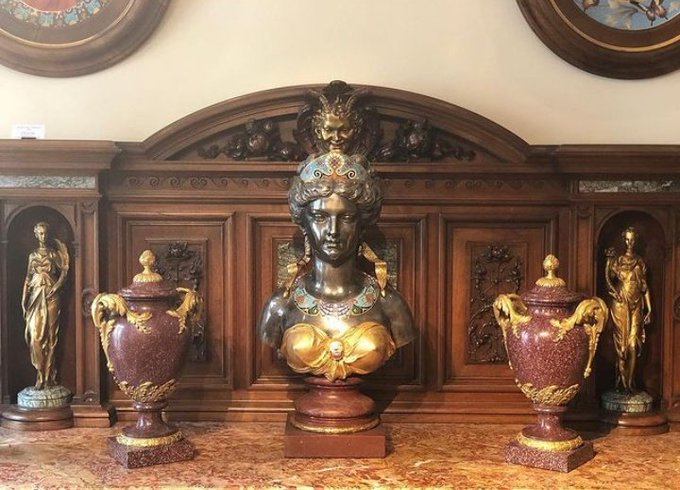
“If the apparition of the night before was an ocular delusion of my fancy sporting with the dark outlines of our cupboard, and if tis horrid eyes were nothing but a pair of inverted teacups, I had, at all events, the satisfaction of having launched the poker with admirable effect, and in true ‘fancy’ phrase, ‘knocked its two daylights into one,’ as the commingled fragments of my tea-service testified. I did my best to gather comfort and courage from these evidences; but it would not do. And then what could I say of those horrid bare feet, and the regular tramp, tramp, tramp, which measured the distance of the entire staircase through the solitude of my haunted dwelling, and at an hour when no good influence was stirring? Confound it!—the whole affair was abominable. I was out of spirits, and dreaded the approach of night. It came, ushered ominously in with a thunderstorm and dull torrents of depressing rain. Earlier than usual the streets grew silent; and by twelve o’clock nothing but the comfortless patterning of the rain was to be heard. I made myself as snug as I could. I lighted two candles instead of one. I forswore bed, and held myself in readiness for a sally, candle in hand; for, coute qui coute, I was resolved to see the being, if visible at all, who troubled the nightly stillness of my mansion. I was fidgety and nervous and, tried in vain to interest myself with my books. I walked up and down my room, whistling in turn martial and hilarious music, and listening ever and anon for the dreaded noise.” #RandolphHarris 20 of 21

Do not Grieve. Anything you lose comes around in another form. The child weaned from mother’s milk now drinks cranberry juice. God’s joy moves from unmarked box to unmarked box, from cell to cell. As rainwater, down into flowerbed. As roses, up from ground. Now it looks like a plate of rice and fish, now a cliff covered with vines, now a horse being saddled. It hides within these, till one day it cracks them open. There is the light gold of wheat in the sun, and the gold of bread made from wheat. I have neither, I am only talking about them as a town in the desert looks up to stars on a clear night. The Son of God, looking upon the World, beheld suffering and misery. With pity He saw how humans had become victims of satanic cruelty. He looked with compassion upon those who were being corrupted, murdered, and lost. They had chosen a ruler who chained them to his carriage as captives. God’s glory pervades the Universe; His ministering Angels inquire of one another: Where is the place of His glory? In response they give praise: Praised be the glory of the Lord from His Heavenly abode. From His Heavenly abode may He turn in mercy and bestow grace unto the people who, reciting the Shema evening and morning, twice daily, proclaim in love the unity of His name, saying: Hear, O America: the Lord our God, the Lord is One. He is our God; He is our Father, our sovereign and our Deliverer. In His mercy He will make known in presence of all the living that He will be your God. “I am the Lord your God.” As it is written in holy Scripture: The Lord shall reign forever; Thy God, O America, shall be Sovereign unto all generations. Hallelujah. #RandolphHarris 21 of 21

Winchester Mystery House

Ghostly tales are bountiful at Sarah Winchester’s Mystery House. What have you experienced? Photos are encouraged!

The Winchester mansion is 160-room mansion built to appease the spirits who died at the hands of the Winchester Rifle 👻
🗝 winchestermysteryhouse.com
“Whoever shadows my every move will not lose me in the dark.” At least that is what Christ says, or what the Evangelist John heard Him say (8.12). He tells us to walk on, through the darkness, with Christ as our only torch. That way, when we mayn’t have gained a step, but we won’t have lost one either. And on into the day we must pursue with dogged tread the life of Jesus Christ. Is this the secret to Mrs. Winchester’s 7-11 staircase?

This is the Beginning, When People Will Be Opening their Eyes!

Nothing is quite as funny as the unintended humour of reality. The original position is designed to be a fair and impartial point of view that is to be adopted in our reasoning about fundamental principles of justice. In taking up this point of view, we are imagining ourselves in the position of free and equal persons who jointly agree upon and commit themselves to the principles of social and political justice. The main distinguishing feature of the original position is “the veil of ignorance”: to insure impartiality of judgment, the parties are deprived of all knowledge of their personal characteristics and social and historical circumstances. The two principles of justice guarantee the equal basic rights and liberties needed to secure the fundamental interests of free and equal citizens and to pursue a wide range of conceptions of good. The second principle provides fair equality of education and employment opportunities enabling all to fairly compete for powers and positions of office; and it secures for all a guaranteed minimum of the all-purpose means (including income and wealth) that individuals need to pursue their interests and to maintain their self-respect as free and equal persons. Persons in the original position give pride of place to their interest in the equal freedoms. The intuitive idea behind the precedence of liberty is that if the persons in the original position assume that their basic liberties can be effectively exercised, they will not exchange a lesser liberty for an improvement in the economic well-being, at least not once a certain level of wealth has been attained. #RandolphHarris 1 of 21

It is only when social conditions do not allow the effective establishment of these rights that one can acknowledge their restriction. Only if it is necessary to enhance the quality of civilization so that in due course the equal freedoms can be enjoyed by all can the denial of equal liberty can be accepted. The lexical ordering of the two principles is the long-run tendency of the general conception of justice consistently pursued under reasonably favourable conditions. Eventually there comes a time in the history of a well-ordered society beyond which the special form of the two principles takes over and holds from then on. What must be shown then is the rationality of this ranking from the standpoint of the parties in the original position. Clearly the conception of goodness as rationality and the principles of moral psychology have a part in answering this question. Now the basis for the priority of liberty is roughly as follows: as the conditions of civilization improve, the marginal significance for our god of further economic and social advantages diminishes relative to their interests of liberty, which become stronger as the conditions for the exercise of the equal freedoms are more fully realized. Beyond some point it becomes and then remains irrational from the standpoint of the original position to acknowledge a lesser liberty for the sake of greater material means and amenities of office. This is so because as the general level of well-being raises (as indicated by the index of primary goods the less favoured can expect) only the less urgent wants remain to be met by further advances, at least insofar as human’s wants are not largely created by institutions and social forms. #RandolphHarris 2 of 21

At the same time the obstacles to the exercise of the equal liberties decline and a growing insistence upon the right to pursue our spiritual and cultural interests assert itself. Increasingly it becomes more important to secure the free internal life of the various communities of interests in which persons and groups seek to achieve, in modes of social union consistent with equal liberty, the ends and excellences to which they are drawn. In addition humans come to aspire to some control over the laws and rules that regulate their association, either by directly taking part themselves in its affairs or indirectly through representatives with whom they are affiliated by ties of culture and social situation. To be sure, it is not the case that when the priority of liberty holds, all material wants are satisfied. Rather these desires are not so compelling as to make it rational for the persons in the original position to agree to satisfy them by accepting a less than equal freedom. The account of the good enables the parties to work out a hierarchy among their several interests and to note which kinds of ends should be regulative in their rational plans of life. Until the basic wants of individuals can be fulfilled, the relative urgency of their interest in liberty cannot be firmly decided in advance. It will depend on the claims of the least favoured as seen from the constitutional and legislative stages. However, under favourable circumstances the fundamental interest in determining our plan of life eventually assumes a prior place. One reason for this I have discussed in connection with liberty of conscience and freedom of thought. #RandolphHarris 3 of 21

And a second reason is the central place of the primary good of self-respect and the desire of human beings to express their nature in a free social union with others. Thus the desire for liberty is the chief regulative interest that the parties must suppose they all will have in common in due course. The veil of ignorance forces them to abstract from the particulars of their plans of life, thereby leading to this conclusion. The serial ordering of the two principles then follows. Now it might seem that even though the desire for an absolute increase in economic advantages declines, human’s concern for their relative place in the distribution of wealth will persist. In fact, if we suppose that everyone wishes a greater proportionate share, the result could be a growing desire for material abundance all the same. Since each strives for an end that cannot be collectively attained, society might conceivably become more and more preoccupied with raising productivity and improving economic efficiency. And these objectives might become so dominant as to undermine the precedence of liberty. Some have objected to the tendency to equality on precisely this ground, that it is thought to arouse in individuals an obsession with their relative share of social wealth. However, while it is true that in a well-ordered society there is most likely a trend to greater equality, its members take little interest in their relative position as such. As we have seen, they are not much affected by envy and jealousy, and for the most part they do what seems best to them as judged by their own plan of life without being dismayed by the greater amenities and enjoyments of others. #RandolphHarris 4 of 21

Thus there are no strong psychological propensities prompting them to curtail their liberty for the sake of greater absolute or relative economic welfare. The desire for a higher relative place in the distribution of material means should be sufficiently weak that the priority of liberty is not affected. Of course, it does not follow that in a just society everyone is unconcerned with matters of status. The account of self-respect as perhaps the main primary good has stressed the great significance of how we think others value us. However, in a well-ordered society the need for status is met by the public recognition of just institutions, together with the full and diverse internal life of the many free communities of interest that equal liberty allows. The basis for self-esteem in a just society is not then one’s income share but the publicly affirmed distribution of fundamental rights and liberties. And this distribution being equal, everyone has a similar and secure status when they meet to conduct the common affairs of the wider society. No one is inclined to look beyond the constitutional affirmation of equality for further political ways of securing one’s status. No one is inclined to look beyond the constitutional affirmation of equality for further political position from a strategic point of view. It would also have the effect of publicly establishing their inferiority as defined by the basic structure of society. This subordinate ranking in the public forum experienced in the attempt to take part in political and economic life, and felt in dealing with those who have a greater liberty, would indeed be humiliating and destructive of self-esteem. #RandolphHarris 5 of 21

And so by acquiescing in a less than equal liberty one might lose on both counts. This is particularly likely to be true as society becomes more just, since equal rights and public attitudes of mutual respect have an essential place in maintaining a political balance and in assuring citizens of their own worth. Thus while the social and economic differences between the various sectors of society, the noncomparing groups as we may think of them, are not likely to generate animosity, the hardships arising from political and civic inequality, and from culture and ethnic discrimination, cannot be easily accepted. When it is the position of equal citizenship that answers to the need for status, the precedence of equal liberties becomes all the more necessary. Having chosen a conception of justice that seeks to eliminate the significance of relative economic and social advantages as supports for human’s self-confidence, it is essential that the priority of liberty be firmly maintained. So for this reason too the parties are led to adopt a serial ordering of the two principles. In a well-ordered society then self-respect is secured by the public affirmation of the status of equal citizenship for all; the distribution of material means is left to take care of itself in accordance with the idea of pure procedural justice. Of course doing this assumes the requisite background institutions which narrow the range of inequalities so that excusable envy does not arise. Now this way of dealing with the problem of status has several noteworthy features which may be brought out as follows. #RandolphHarris 6 of 21

Suppose to the contrary that how one is valued by others depends upon one’s relative place in the distribution of income and wealth. In this case, having a higher status implies having more material means than a larger fraction of society. Thus not everyone can have the highest status, and to improve one person’s position is to lower that of someone else. Social cooperation to increase the conditions of self-respect is impossible. The means of status, so to speak, are fixed, and each human’s gain is another’s loss. Clearly this situation is a great misfortune. Persons are set at odds with one another in the pursuit of their self-esteem. Given the preeminence of this primary good, the parties in the original position surely do no want to find themselves so opposed. If not impossible, it would tend, for one thing, to make the good of social union difficult to achieve. Moreover, if the means of providing a good are indeed fixed and cannot be enlarged by cooperation, as mentioned in the discussion of envy, then justice seems to require equal shares, ceteris paribus. However, an equal division of all primary gods in irrational in view of the possibility of bettering everyone’s circumstances by accepting certain inequalities. Thus the best solution is to support the primary good of self-respect as far as possible by the assignment of the basic liberties that can indeed be made equal, defining the same status for all. At the same time, distributive justice as frequently understood, justice in the relative shares of material means, is relegated to a subordinate place. #RandolphHarris 7 of 21

Thus we arrive at another reason for factoring the social order into two parts as indicated by the principles of justice. While these principles permit inequalities in return for contributions that are for the benefit of all, the precedence of liberty entails equality in the social bases of esteem. Now it is quite possible that this idea cannot be carried through completely. To some extent human’s sense of their own worth may hinge upon their institutional position and their income share. If, however, the account of social envy and jealousy is sound, then, with the appropriate background arrangements, these inclinations should not be excessive, at least not when the priority of liberty is effectively upheld. However, if necessary, theoretically we can include self-respect in the primary goods, the index of which defines expectations. Then in applications of the difference principle this index can allows for the effects of excusable envy; the expectations of the less advantaged are lower the more severe these effects. Whether some adjustment for self-respect has to be made is best decided from the standpoint of the legislative stage where the parties have more information about social circumstances and the principle of political determination applies. Admittedly this problem is an unwelcome complication. Since simplicity it itself desirable in a public conception of justice, the conditions that elicit excusable envy should if possible be avoided. Expectations of the less advantaged can be understood so as to include the primary good of self-esteem. #RandolphHarris 8 of 21

Now some may want to object to this account of the priority of liberty that societies have other ways of affirming self-respect and of coping with envy and other disruptive inclinations. Thus in a feudal or in a caste system each person is believed to have one’s allotted station in the natural order of things. One’s comparisons are presumably confined to within one’s own estate or caste, these ranks becoming in effect so many noncomparing groups established independently of human control and sanctioned by religion and theology. Humans resign themselves to their position should it ever occur to them to question it; and since all may view themselves as assigned their vocation, everyone is held to be equally fated and equally noble in the eyes of providence. This conception of society solves the problem of social justice by eliminating in thought the circumstances that give rise to it. The basic structure is aid to be already determined, and not something for human beings to affect. On this view, it misconceives human’s place in the World to suppose that the social order should match principles which they would as equals consent to. Now to this idea, parties re to be guided in their choice of a conception of justice by a knowledge of the general facts about society. They take for granted than that institutions are not fixed but change overtime, altered by natural circumstances and the activities and conflicts of social groups. The constraints of nature are recognized, but humans are not powerless to shape their social arrangements. #RandolphHarris 9 of 21

This assumption is likewise part of the background of the theory of justice. It follows that certain ways of dealing with envy and other aberrant propensities are closed to a well-ordered society. For example, it cannot keep them in check by promulgating false or unfounded beliefs. For our problem is how society should be arranged if it is to conform to principles that rational persons with true general beliefs would acknowledge in the original position. The publicity condition of requires the parties to assume that as members of society they will also know the general facts. The reasoning leading up to the initial agreement is to be accessible to public understanding. Of course, in working out what the requisite principles are, we must rely upon current knowledge as recognized by common sense and the existing scientific consensus. However, there is no reasonable alternative to doing this. We have to concede that as established beliefs change, it is possible that the principles of justice which it seems rational to choose may likewise change. Thus when the belief in a fixed natural order sanctioning a hierarchical society is abandoned, assuming here that this belief is not true, a tendency is set up that points in the direction of two principles of justice inertial order. The effective protection of the equal liberties becomes increasingly of first importance. When God wants to punish people, he gives the unjust leaders. So the answer is for the people to repent, turn from their ways, be converted, and seek God. #RandolphHarris 10 of 21

Some people only care about power and what they can do with power. May the Lord come down to protect our people. Democracy is not prescribed in the Bible, and Christians can and do live under other political systems. However, Christians can hardly fail to love democracy, because of all systems it best assures human dignity, the essence of our creation in God’s image. If a candidate wins by cheating, he or she can only be forgiven by God if one renounced the office one has obtained by fraud. There will be no divine forgiveness for this act of injustice without a previous decision to repay the damage done. However, apparently God’s forgiveness is unimportant to some ruling. When politicians rig the vote, it means all the passion for democracy and all the prayers of the people are meaningless. A government that assumes or maintains power through fraudulent means has no moral basis. If it does not of itself freely correct the evil it has inflicted on the people, then it is our serious moral obligation as a people to make it do so. Nonetheless, there is enormous sin attached to fratricidal strife. As moral outrage grows, it is important to study the Bible. God has ordained government to preserve order, but even a bad government is better than no government—which results in chaos. Government’s authority comes from God; it is a delegation. Therefore, governments—all governments—whether they acknowledge it or not, rule under God. However, does God give an unrestricted delegation? Certainly not. #RandolphHarris 11 of 21

As Jesus Christ made clear with the coin, there are two realms—and Caesar is not to usurp what belongs to God. Any government that violates the law that is higher than its own is exceeding the legitimate authority God has granted. Government must always be respected, otherwise anarchy results; but the nation may attempt to venerate a culture or race. “When the state is made to serve the aspirations of race or nation instead of the cause of justice for all, it becomes a demonic state warranting resistance and rejection by the Christian faith,” reports Donald Bloesch, Crumbling Foundations (Grand Paris, Mich.: Zondervan, 1984), 183. As Dietrich Bonhoeffer put it, “If government persistently and arbitrarily violates its assigned task, then the divine mandate lapses.” In that case the state becomes evil incarnate, as in Nazi Germany. Instead of acting as God’s instrument for preserving life and order, it does the reverse, destroying life and order. Then the church must resist. Though as argued earlier, the church’s primary function is evangelization and ministering to spiritual needs; as the principle visible manifestation of the Kingdom of God, it must be the conscience of society, the instrument of moral accountability. Richard Neuhaus eloquently wrote that “the church can and should subject to moral questioning every political agenda or cause, thus keeping the entirety of human politics under the transcendent judgement of God.” #RandolphHarris 12 of 21

The church’s first duty then would be to publicly expose the state’s immorality. The government should not be involved in corruption, oppression, the deprivation of civil liberties, nor the taking of innocent lives. As a second step the church should refuse to have any part in the state’s immorality. The church must take the next more severe measures of resistance lest its words be rendered hollow. The great evangelist Charles Finney refused communion to slave-holders. Others organized the underground railroad and rescued fugitive slaves from prison. Many ministers broke the law, were arrested, and some imprisoned. However, that state’s evil, even as egregious as slavery, does not give an unrestricted license to disobey any law; only the unjust law can properly be contested. While active resistance may succeed, as it did with slavery and the Civil-Rights Movement, it may not, however, be enough in the face of the raw power modern totalitarian states have achieved. So, when all peaceable means fail, what does the Christian do? Is revolution ever justified? Scottish reformation theologians like John Knox and Samuel Rutherford believed they could be, advocating the right of Christians to rise up against ungodly rulers. Many ministers in the colonies agreed as well; when they preached that the people had the authority to resist the king when the king violated God’s commands, they were setting the stage for the American Revolution. After dumping tea in Boston Harbour the next step of resistance was the musket. #RandolphHarris 13 of 21

A Boston preacher said that for a people to “arise unanimously and resist their prince, even to dethrone him, is not criminal but a reasonable way of vindicating their liberties and just rights.” John Adams observed, “The revolution was in the minds and hearts of the people, a change in their religious sentiments of their duties and obligations.” Some Christian activists today loosely call for a new American Revolution just as the young radical youth movements did in the sixties. However, history reveals, revolution most often results, after the bodies are buried, in one form of tyranny replacing another. G.K. Chesterton summed it up well: “The real case against revolution is this: That there always seems to be much more to be said against the old regime than in favour of the new regime.” So for the Christian, revolution is never to be lightly regarded. It is the most extreme form of disobedience. It could only be contemplated on the same justification as a just war; that is, that there must be a better alterative as a result of the revolution. Its advantages must outweigh the suffering, and the evil employed in the revolution must prevent a far greater evil than the status quo. This was the reasoning that caused Albert Einstein to abandon his pacifism in the face of a dictator’s rise to power. “To prevent the greater evil, it is necessary that the lesser—the hated military—be accepted for the time being,” Einstein contended. It was this reasoning the caused Bonhoeffer to patriciate in the plot to assassinate this dictator. #RandolphHarris 14 of 21

For Christians to justify participation in revolution, therefore, they would have to be convinced that the state had become totally opposed to the purposes of God for the state and there was no other recourse to prevent massive evil. The Exodus from Egypt is often cited as a model for political action by liberation theologians, but they ignore the fact that in the Exodus, God did not overthrow the political system in Egypt. He extracted His own people from that system, taking them to Mount Sinai that they might worship Him. In the light of this, then, what about America? What lessons are to be drawn from it? We must be aware to prevent a regime’s refusal to allow free elections, the suspensions of civil liberties, the massive corruption of the governmental process, the trampling of human rights, and a leader’s own blasphemous, at times messianic pretensions, which give the church a mandate to act. The church should be mobilized to say no to evil. The first stage of an individua approach should be entirely biblical. By preaching repentance and conversion, one can encourage outbreaks of spiritual revival all across America. One should call for people to pray for their country. A courageous cardinal and ordinary citizens can open a crack of light in the dark canopy that envelops so much of planet Earth. Through peaceful actions and resistance to evil, the Kingdom of God will be made visible again. The Late Francis Schaeffer once wrote, “If here is no place for civil disobedience, then the government has been made autonomous, and as such, it has been put in the place of the living God.” #RandolphHarris 15 of 21

The belief that government is autonomous, the ultimate repository of power, the solution to all of society’s ills, is the greatest imposter of the twenty-first century. Christians and the church have no higher calling than to expose it by every legitimate means. To some people the great trouble about any argument for the Supernatural is simply the fact that argument should be needed at all. If so stupendous a thing exists, ought it not be obvious as the sun in the sky? It is not intolerable, and indeed incredible, that knowledge of the most basic of all Facts should be accessible only by wire-drawn reasonings for which the vast majority of humans have neither leisure nor capacity? I have great sympathy with this point of view. However, we must notice two things. When you are looking at a garden from a room upstairs it is obvious (once you think about it) that you are looking through a window. However, if it is the garden that interests you, you may look at it for a long time without thinking of the window. When you are reading a book, it is obvious (once you attend to it) that you are using your eyes: but unless your eyes begin to hurt you, or the book is a text book on optics, you may read all evening without once thinking of eyes. When we talk we are obviously using langue and grammar: and when we try to talk a foreign language we may be painfully aware of the fact. However, we are talking English, we do not notice it. When you shout from the top of the stirs, “I am in half a moment,” you are usually conscious that you have made the singular am agree with the singular I. #RandolphHarris 16 of 21

There is indeed a story told about a Native American who, having learned several other languages, was asked to write a grammar of the language used by his own tribe. He replied, after some thought, that it had no grammar. The grammar he had sued all his life had escaped his notice all his life. He knew it (in once sense) so well that (in another sense) he did not know it existed. All these instances show that the fact, and through which alone you have access to all the other facts, may be precisely the one that is most easily forgotten—forgotten not because it is so remote or abstruse but because it is so near and so obvious. And that is exactly how the Supernatural has been forgotten. The Naturalists have been engaged in thinking about Nature. They have not attended to the fact that they were thinking. The moment one attends to this it is obvious that one’s own thinking cannot be merely a natural event, and that therefore something other than Nature exists. The Supernatural is not remote and abstruse: it is a matter f daily and hourly experience, as intimate as breathing. Denial of it depends on a certain absent-mindedness. However, this absent-mindedness is in on way surprising. You do not need—indeed you do not wish—to be always thinking about windows when you are looking at gardens or always thinking about eyes when you are reading. #RandolphHarris 17 of 21

In the same way the proper procedure for all limited and particular inquiries is to ignore the fact of your own thinking, and concentrate on the object. It is only when you stand back from particular inquiries and try to form a complete philosophy that you must take it into account. For a complete philosophy must get in all the facts. In it you turn away from specialized or truncated thought to total thought: and one of the facts total thought must think about is Thinking itself. There is thus a tendency in the study of Nature to make us forget the most obvious first of all. And since the Sixteenth Century, when Science was born, the minds of humans have been increasingly turned outward, to know Nature and to master her. They have been increasingly engaged on those specialized inquiries for which truncated thought is the correct method. It is therefore not in the least astonishing that they should have forgotten the evidence for the Supernatural. The deeply ingrained habit of truncated thought—what we call the “scientific” habit of mind—was indeed certain to lead to Naturalism, unless this tendency were continually corrected from some other source. However, no other source was at hand, for during the same period humans of science were coming to be metaphysically and theologically uneducated. That brings me to the second consideration. The state of affairs in which ordinary people can discover the Supernatural only by abstruse reasoning is recent and, by historical standards, abnormal. #RandolphHarris 18 of 21

All over the World, until quite modern times, the direct insight of the mystics and the reasonings of the philosopher percolated to the mass of the people by authority and tradition; they could be received by those who were no great reasoners themselves in the concrete form of myth and ritual and the whole pattern of life. In the conditions produced by a century or so of Naturalism, plain humans are being forced to bear burdens which plain humans were never expected to bear before. We must get the truth for ourselves or go without it. There may be two explanations for this. It might be that humanity, in rebelling against tradition and authority, has made a ghastly mistake; a mistake which will not be less fatal because the corruptions of those in authority rendered it very excusable. On the other hand, it may be that the Power which rules our species is at this moment carrying out a daring experiment. Could it be intended that the whole mass of the people should now move forward and occupy for themselves those heights which were once reserved only for the sages? Is the distinction between wise and simple to disappear because all are now expected to become wise? If so, our present blunderings would be but growing pains. However, let us make no mistake about our necessities. If we are content to go back and become humble plain humans obeying a tradition, well. If we are ready to climb and struggle on till we become sages ourselves, better still. However, the human who will neither obey wisdom in others nor adventure for her oneself is fatal. #RandolphHarris 19 of 21

A society where the simple many obey the few seers can live: a society where all were seers could live even more fully. However, a society where the mass is still simple and the seers are no longer attended to can achieve only superficiality, baseness, ugliness, and in the end extinction. On or back we must go; to stay here is death. One other point that may have raised doubt or difficulty is the advanced reasons for believing that a supernatural element in present in every rational human. The presence of human rationality in the World is therefore a Miracle. Human Reason an Morality have been mentioned not as instances of Miracle (at least, not of the kind of Miracle you wanted to hear about) but as prods of the Supernatural: not in order to show that Nature ever is invaded but that there is a possible invader. Whether you choose to call the regular and familiar invasion by human Reason a Miracle or not is largely a matter of words. Its regularity—the fact that it regularly enters by the same door, human pleasures of the flesh—may incline you not to do so. It looks as if it were (so to speak) the very nature of Nature to suffer this invasion. However, then we might later find that it was the very nature of Nature to suffer Miracles in general. Fortunately the course of our argument will allow us to leave this question of terminology on one side. We are going to be concerned with other invasions of Nature—with what everyone would call Miracles. #RandolphHarris 20 of 21

Our question could, if you liked, be put in the form, “Does Supernature every produce particular results in space and time except through the instrumentality of human brains acting on human nerves and muscles?” I have said “particular results” because, on our view, Nature as a whole is herself one huge result of the Supernatural: God created her. God pierces her wherever there is a human mind. God presumably maintains her in existence. The question is whether He ever does anything else to her. Does God, beside all this, ever introduce into her events of which it would not be true to say, “This is simply the working out of the general character which God gave to Nature as a whole in creating her”? Such events are what are popularly called Miracles: and it will be in this sense only that the word Miracle will be used from now on. Do not stand at my grace and weep, I am not there. I do not sleep. I am a though rays of light that glow. I am the diamond glint on snow. I am the moonlight on the shinning sea. I am the gentle autumn rain. When you wake in the morning hush, I am the swift, uplifting rush or quiet birds in circling flight. I am the soft starlight at night. Do not stand at my grace and weep. I am not there. I do not sleep. Our God and God of our fathers, we thank Thee for Thy Torah, our priceless heritage. May the portion we have ready today inspire us to do Thy will and to seek further knowledge of Thy word. Thus our minds will be enriched and our lives endowed with purpose. May we take to heart Thy laws by which humans truly live. Happy are all who love Thee and delight in Thy commandments. Amen. #RandolphHarris 21 of 21

Cresleigh Homes

There’s something irresistible about eating at the island; it’s casual, yet festive. Guests can be part of the food prep, and everyone gets to make merry together all evening long.

Meadows Res 1 shows just how well single story living suits the family who loves to entertain!

Residence One at Cresleigh Meadows holds 2,054 square feet of single story living. The open concept design includes three bedrooms, two bathrooms and a two car garage plus workshop. Through the charming front porch enter into the foyer, where two secondary bedrooms lead off to a Jack and Jill bathroom. The kitchen comes fully equipped with a large eat-in island, stainless steel appliances, and quartz counters. The great room is spacious and full of natural light. The Owner’s suite is nestled in the rear of the home separate from the secondary bedrooms, providing maximum privacy. Enjoy a spa like experience in the Owner’s bathroom with a large walk in shower and large soaking tub.

Best of all, each Cresleigh home comes fully equipped with an All Ready connected home! This smart home package comes included with your home and features great tools including: video door bell and digital deadbolt for the front door, connect home hub so you can set scenes and routines to make life just a little easier. Two smart switches and USB outlets are also included, plus we’ll gift you a Google Home Hub and Google Mini to help connect everything together!

There is nothing more important than a good, safe, secure home. Come and see why Cresleigh is America’s Favourite.
#CresleighHomes
#PlumasRanch

Wise Humans, Good Humans, Patriotic Humans are to be Found in All Communities!

If Americans could be made to believe that their sufferings were for some remote, high sacrificial end, perhaps it would be possible for them to become reconciled to their plight; but sharing the culture that condemns them, and seeing that lust for trash is what blinds the nation to their claims, is what sets storms rolling in the soul of America. The United State of America is so unique from other nations because it is a nation of laws, not a nation of humans. A nation of laws means that legal decrees, not people rule. Whether it be the most common American members or members of Congress, high-ranking bureaucrats or the president of the United States of America, everyone is governed by the same laws, regardless of their station. All must be held to the just laws of America. America’s founds extolled a nation of laws, for they knew that only a fairly enforced legal system could protect liberty and property against corruption and tyranny. God is in fact the author of liberty and to retain it, the inhabitant of the land must be protected by His might hand. There is no other power that can protect that liberty. In order for us to enjoy this protection of His might, we must accept God as our God and keep His commandments. “Behold, this America is a choice land, and whatsoever nation shall possess it shall be free from bondage, and from captivity, and from all other nations under Heaven, if they will but serve the God of the land, who is Jesus Christ,” reports Ether 2.12. The God of this land is also the King of the land. And this is true. #RandolphHarris 1 of 25

Manifest Destiny is a phenomenon. Jesus spoke here in America, and He proclaimed, “This lad shall be a land of liberty, and there shall be no kings upon it. For I, the Lord, the king of Heaven, will be their king, and I will be light unto them forever, that hear my words. For it is a choice land, saith God, wherefore I will have all humans that dwell thereon that they shall worship me,” reports 2 Nephi 10.11-19. The alternative to enjoying this liberty and happiness through acceptance of and obedience to Jesus Christ is made clear by Manifest Destiny. Manifest Destiny is a tangible blessing from God that has created American history. It is a systematic body of concepts and beliefs that powers American life and culture. The right of our manifest destiny to over spread and to possess the whole of the continent which Providence has given us for the development and great creation of liberty and federative development of self government entrusted to us is a promise that we shall flourish. “Whoso should possess this land of promise, from that time henceforth and forever, should serve him, the true and only God, or they should be swept off when hey are ripened in iniquity,” reports Ether 2.8-9. It is as a right that we serve God and obey the laws as that of the tree to the space of air and the Earth be suitable for the full expression of its principle and destiny of growth. When people follow the guidance of God of the land, they reach great heights. The Lord in the very beginning revealed to Adam a perfect form of government for the benefit of humans. We believe that governments are instituted of God. #RandolphHarris 2 of 25

Individual freedom is necessary. No law shall be passed that takes away from a human the right of free choice. Free agency is fundamental as law of human conduct. Humans have a right to obey or disobey that laws as they please, and take the consequences. That government is best which has as its aim the administration of justice, social well-being and the promotion of prosperity among its members. We must recognize that property rights are essential to human liberty. The individual has three great rights, equally sacred from arbitrary interference: the right to one’s life, the right to one’s liberty, and the right to one’s property. The three rights are so bound together as to be essentially one right. To give a human one’s life, but to deny one one’s liberty, is to take from one all that makes life worth living. To give one liberty, but take from one the property which is the fruit and badge of one’s liberty, is to still leave one a slave. Laws are enacted for the protection of society, and have no value except when they are administered in righteousness and justice. If dishonest humans occupy administrative offices, laws cannot be so administered in righteousness and justice. The Lord says, “When the wicked rule, the people mourn.” Wise humans, good humans, patriotic humans are to be found in all communities, in all political parties, among all creeds. None but such humans should be chosen. Without beneficent laws, righteously administered, the foundations of civilization crumble, anarchy reigns, decay and dissolution follow. #RandolphHarris 3 of 25

We call upon all members of the Church of Jesus Christ of Latter-day Saints throughout the World to honour the laws of God, and obey and uphold the law of the land; and we appeal to good humans everywhere, regardless of creed, party affiliation, race, culture, or condition to join with us in an effort to put into operation the words of President Lincoln, the great emancipator, that our country may continue to be a light to the World, a loyal, law-abiding, God-fearing nation. We claim the privilege of worshiping Almighty God according to the dictates of our own conscience; and allow all humans the same privilege, let them worship how, where, or what they may. However, we claim absolutely no right, no prerogative whatever, to interfere with any other people. A good government must secure for every citizen the free exercise of conscience. Matters of belief or religious practice should not be interfered with, unless they oppose laws formulated for the common good. There should be no mingling of religious influence with the civil governments. We believe in being subject to kings, presidents, rulers, and magistrates, in obeying, honouring, and sustaining the laws. The main psychological root of the liability to envy is a lack of self-confidence in our own worth combined with a sense of impotence. Our way of life is without zest and we feel powerless to alter it or to acquire the means of doing what we still want to do. This creation the notion of resentment. By contrast, someone sure of the worth of one’s plan of life and one’s ability to carry it out is not given to rancor nor is one jealous of one’s good fortune. #RandolphHarris 4 of 25

Even if one could, one has no desire to level down the advantages of others at some expense to oneself. This hypothesis implies that the least favoured tend to be more envious of the better situation of the more favoured the less secure their self-respect and the greater their feeling that they cannot improve their prospects. Similarly the particular envy aroused by competition and rivalry is like to be stronger the worse one’s defeat, for the blow to one’s self-confidence is more severe and the loss may seem irretrievable. It is general envy, however, that mainly concerns us here. There are three conditions that encourage hostile outbreaks of envy. The first of these is the psychological condition we have just noted: persons lack a sure confidence in their own value and in their ability to do anything worthwhile. Second (and one of two social conditions), many occasions arise when this psychological condition is experienced as painful and humiliating. The discrepancy between oneself and others is made visible by the social structure and style of one’s society. The less fortunate are therefore often forcibly reminded of their situation, sometimes leading them to an even lower estimation of themselves and their mode of living. And third, they see their social position as allowing no constructive alternative to opposing the favoured circumstances of the more advantaged. #RandolphHarris 5 of 25

To alleviate their feelings of anguish and inferiority, they have no choice but to impose a loss on those better placed even at some cost to themselves, unless of course they are to relapse into resignation and apathy. Now, if not to present these conditions, many aspects of a well-ordered society of to mitigate. It is clear that, although it is a psychological state, social institutions are a basic instigating cause. However, the contract conception of justice supports the self-esteem of the citizens generally more firmly than other political principles. In the public forum each person is treated with the respect due to a sovereign equal; and everyone has the same basic rights that would be acknowledged in an initial situation regarded as fair. The members of the community have a common sense of justice and they are bound by ties of civic friendship. Obedience implies a higher attitude than mere submission, for obedience has its root in good intent; submission may spring from selfishness or meanness of spirit. Though obedience and submission both imply restraint on one’s own will, we are obedient only from a sense of right; submissive from a sense of necessity. Honour expressed an act or attitude of an inferior towards a superior. When applied to things it is taken in the sense of holding honour. Thus, in honouring the law, we look upon it as something which is above selfish desires or indulgences. To sustain signifies to hold up; to keep from falling. To sustain the law, therefore, is to refrain from saying or doing anything which will weaken it or make it ineffective. #RandolphHarris 6 of 25

We obey the law from a sense of right. We honour the law because of its necessity and strength to society. We sustain law by keeping it in good repute. This is in our connection with stability. The greater advantages of some are in return for compensating benefits for the less favoured; and no one supposes that those who have a larger share are ore deserving from a moral point of view. Happiness according to virtue is rejected as a principle of perfection: regardless of the excellences that persons or associations display, their claims to social resources are always adjudicated by principles of mutual justice. For all these reasons the less fortune have no cause to consider themselves inferior and the public principles generally accepted underwrite their self-assurance. The disparities between themselves and others, whether absolute or relative, should be easier for them to accept than in other forms of polity. Turning to the second condition, both the absolute and the relative differences allowed in a well-ordered society are probably less than those that have often prevailed. Although in theory the difference principle permits indefinitely large inequalities in return for small gains to the less favoured, the spread of income and wealth should not be excessive in practice, given the requisite background institutions. Moreover the plurality of associations in a well-ordered society, each with its secure internal life, tends to reduce the visibility, or at least the painful visibility, of variations in human’s purposes. For we tend to compare our circumstances with others in the same or in a similar group as ourselves, or in positions that we regard as relevant to our aspirations. #RandolphHarris 7 of 25

The various associations in society tend to divide it into so many noncomparing groups, the discrepancies between these divisions not attracting the kind of attention which unsettles the lives of those less well placed. And this ignoring of differences in wealth and circumstances is made easier by the fact that when citizens do meet one another, as they must in public affairs at least, the principles of equal justice are acknowledged. Moreover in everyday life the natural duties are honoured so that the more advantaged do not make an ostentatious display of their higher estate calculated to demean the condition of those who have less. After all, if the disposing conditions for envy are removed, so probably are those for jealousy, grudgingness, and spite, the converses of envy. When the less fortunate segments of society lack the one the more fortunate will lack the other. Taken together these features of a well-ordered regime diminish the number of occasions when the less favoured are likely to experience their situation as impoverished and humiliating. Even if they have some liability to envy, it may never be strongly envoked. Finally, considering the last condition, it would seem that a well-ordered society as much as any other offers constructive alternatives to hostile outbreaks of envy. The problem of general envy anyway does not force us to reconsider the choice of the principles of justice. As for particular envy, to a certain extent it is endemic to human life; being associated with rivalry, it may exist in any society. #RandolphHarris 8 of 25

The more specific problem for political justice is how pervasive are the rancor and jealousy aroused by the quest for office and position, and whether it is likely to distort the justice of institutions. It is difficult to settle this latter in the absence of the more detailed knowledge of social forms available at the legislative stage. However, there sees to be no reason why the hazards of particular envy should be worse in a society regulated by justice as fairness than by any other conception. The principles of justice again seems relatively stable. A question has been asked man times. In the case of a conflict between requirements made by the law revealed by the word of God, and those imposed by the secular law, which of these authorities would members of the Church be bound to obey? The word of God is to come first. So essentially, God should be in and influence the government because the number one rule of God is to be honest and if one cannot honestly enforce the law, they have no right in government. In all civilized nations the people are accorded the right to pray, and this right is assured by what maybe properly called a common law of humankind. No earnest soul is cut off from communion with one’s God; and with such an open channel of communication, relief from burdensome laws and redress from grievances may be sought from the power that holds control of nations. “Bad laws, if they exist, should be repleaded as soon as possible; still, while they continue in force, they should be religiously observed,” reports President Abraham Lincoln. This is the view of the Church. #RandolphHarris 9 of 25

While there are many forms of equality, and egalitarianism admits of degrees, there are conceptions of justice that are recognizably equalitarian, even though certain significant disparities are permitted. The two principles of justice fall under this heading. The different conception of equality which they define is acknowledged on the supposition that envy does not exist. For behold, you should not fear humans more than God, you should be faithful and God will extend His arm, and He will be with you in every time of trouble. Children of God are chosen to do the work of the Lord. Repent of that which thou hast done, and thou art still chosen, and art again called to the world. Except thou doest this, thou shalt become as other humans, and have no more gift. When thou delivers up that which God has given thee sight and power to translate thou delivers up that which is sacred into the hands of a wicked human who depends upon one’s own judgment, and boasts in one’s own wisdom; and this is the reason that thou will lose thy privileges for a season. Nevertheless, God’s work shall go forth, for, inasmuch as the knowledge of the Saviour has come unto the World, through the testimony of the Jewish people, even so shall the knowledge of a Saviour come unto our people, and to the Americans through the testimony of their fathers. And this testimony shall come to the knowledge of all. For this very purpose are these plates preserved that the promises of the Lord might be fulfilled, which He made to His people. And the Americans might come to the knowledge of their fathers, and they might know the promise of the Lord. And they may believe the gospel and rely upon the merits of Jesus Christ, and be glorified through faith in his name and through their repentance they might be saved. I cancel every demonic assignment against you and your purpose. The plans of the enemy will not prevail. In Jesus’ name, Amen. #RandolphHarris 10 of 25

Joseph Smith was very sorry he had been unfaithful, and he humbled himself before God, determining to try harder to keep all of the Lord’s commandments. Later, within a month, the gift and the plates were returned to Joseph, but he was not allowed to translate the same record again. By revelation Joseph was told that wicked people had the lost manuscript. The Lord, Jesus Christ said; Behold, Satan, has put it into their hearts to alter the words, because they have altered the words, they read contrary from that which you translated and caused to be written. On this wise the Devil has sought to lay a cunning plan, the he may destroy this work. Verily I say unto you, that I will not suffer that Satan shall accomplish his evil design in this thing. Behold, they say and think in their hearts, We will see if God has given him power to translate, if so, he will also give him power again; and if he bringeth forth the same words, behold, we have the same with us, and we have altered them. Therefore, they will not agree, and we will say that he has lied in his words, and that he has no gift, and that he has no power; therefore, we will destroy him, and also the work. Behold, I say unto you, that you shall not translate again those words which have gone forth out of your hands. For, behold, if you should bring forth the same words, they will say that you have contradicted yourself. And, behold, they will publish his, and Satan will harden the hearts of the people to stir them up to anger against you, that they will not believe my words. #RandolphHarris 11 of 25

The Lord told Joseph that the part of the record he had translated which had been lost (about one hundred and sixteen pages) was a shorted story of the Nephite record; and that the golden plates also contained the complete story. Joseph was told he should translate the full record rather than the shortened one he had previously translated: the Lord said: I will not suffer that they shall destroy my work; yea, I will show unto them that y wisdom is greater than the cunning of the Devil. Behold, I am Jesus Christ, the Son of God. I came unto my own, and my own received me not. I am He who said, Other sheep have I which are not of this fold, unto my disciples, and many there were that understood me not. And I will show unto this people, that I had other sheep, and I will also bring to light my gospel, which was ministered unto them. And this I do, that I may establish my gospel, that there may not be so much contention. Yea, Satan doth stir up the hearts of the people to contention, concerning the points of my doctrine; and in these things they do err, for they do wrest the Scriptures, and do not understand them. Therefore, I will unfold unto them this great mystery; for behold, I will gather them as a hen gathereth her chickens under her wings, if they will not harden their hearts. Behold, this is my doctrine: Whosoever repenteth and cometh unto me, the same is my church Whosoever is of my church, and endureth of my church to the end, one will I establish upon my Rock. And now, remember the words of your Redeemer, your Lord, and your God. Amen. #RandolphHarris 12 of 25

The important of separating envy from the moral feelings can be seen from several examples. Suppose first that envy is held to be pervasive in poor less affluent societies. The reason for this, it may be suggested, is the general belief that the aggregate of social wealth is more or less fixed, so that one person’s gain is another’s loss. The social system is interpreted, it might be said, as a naturally established and unchangeable zero-sum game. Now actually, if this belief were widespread and the stock of goods were generally thought to be given, then a strict opposition of interests would be assumed to obtain. In this case, it would be correct to think that justice requires equal shares. Social wealthy is not viewed as the outcome of mutually advantageous cooperation and so there is no fair basis for an unequal division of advantages. What is said to be envy may in fact be resentment which might or might not prove to be justified. Dr. Freud’s speculations about the origin of the sense of justice suffer from the same defect. He remarks that this sentiment is the outgrowth of envy and jealousy. As some members of the social group jealously strive to protect their advantages, the less favoured are moved by envy to take them away Eventually everyone recognizes that they cannot maintain their hostile attitudes toward one another without injury to themselves. Thus as a compromise they settle upon the demand of equal treatment. The sense of justice is a reaction-formation: what was originally jealousy and envy is transformed into a social feeling, the same sense of justice that insists upon equality for all. #RandolphHarris 13 of 25

Dr. Freud believes that this process is exemplified in the nursey and in many other social circumstances. Yet the plausibility of one’s account assumes that the initial attitudes are correctly described. With a few changes, the underlying features of the example he depicts correspond to those of the original position. That persons have opposing interests and seek to advance their own conception of the god is not at all the same thing as their being moved by envy and jealousy. As we have seen, this sort of opposition gives rise to the circumstances of justice. Thus if children compete for the attention and affection of their parents, to which one might say they justly have an equal claim, one cannot assert that their sense of justice springs form jealousy and envy. Certainly children are often envious and jealous; and no doubt their moral notions are so primitive that the necessary distinctions are not grasped by them. However, waiving these difficulties, we could equally well say that their social feelings arise from resentment, from a sense that they are unfairly treated. And similarly one could say to conservative writers that it is mere grudgingness when those better circumstances reject the claims of the less advantaged to greater equality. However, this contention also calls for careful argument. None of these charges and countercharges can be given credence without first examining the conceptions of justice sincerely held by individuals and their understanding of the social situation in order to see how far these claims are indeed founded on these motives. #RandolphHarris 14 of 25

None of these remarks is intended to deny that the appeal to justice is often a mask for envy. What is said to be resentment may really be rancor. However, rationalizations of this sort present a further problem. In addition to showing that a person’s conception of justice is not itself founded on envy, we must determine whether the principles of justice cited in one’s explanation are sincerely held as this is shown in their being applied by one to other cases in which one is not involved, or even better, in which one would suffer a loss from their being followed. Dr. Freud means to asset more than the truism that envy and jealousy, and that without this energy, there would be no (or much less) desire to give justice. Conceptions of justice have few attractions for us other than those deriving from these and similar feelings. It is claim that is supported by erroneously conflating envy and resentment. Unhappily the problem of the other special psychologies must go untouched. They should in any case be treated in much the same way as envy. One tries to assess the configuration of attitudes toward risk and uncertainty, domination and submission, and the like, that just institutions are likely to generate, and then to estimate whether they are likely to render theses institutions unworkable or ineffective. We also need to ask whether, from the point of view of the persons in the original position, the conception chosen is acceptable or at least tolerable whatever our special proclivities may turn out to be. #RandolphHarris 15 of 25

The most favourable alternative is that which allows a place for all these different tendencies insofar as they are likely to be encouraged by a just basic structure. There is a division of labour so to speak between persons with contrary inclinations. Of course some of these attitudes may earn a premium in the way that certain trained abilities do, as for example the willingness to be adventuresome and to take unusual risks. However, if so, the problem is o all fours with the return to natural assets and it is covered by the discussion of distributive shares. What a social system must not do clearly is to encourage propensities and aspirations that it is bound to repress and disappoint. So long as the pattern of special psychologies elicited by society either supports its arrangements or can be reasonably accommodated by them, there is no need to reconsider the choice of a conception of justice. I believe, though I have not shown, that the principles of justice as fairness pass this test. When people can measure the extent of their freedom in two or three paces, and realize for the first time in their lives they have nothing else to do, but sit on a bunk, as they say passes into night and they continue to sit there because they are in prison—that is when it dawns on them how important freedom is. Even the children of a wealthy family, children of charismatic, gregarious politicians may suddenly find themselves stripped of everything that has propped up their egos. All their plans, friends, their busy work schedule, all their carefully cultivated followers will be gone, and replaced by the sheer loneliness and boredom of the prison cell and the venomous hostility of their guards. And they will keep waiting for justice, for a deal. Surely the United States Constitution could not simply leave them to rot in prison! #RandolphHarris 16 of 25

Imagine half a year going by before you are confronted with any charges. Then a fraudulently concocted murder case is brought, and a rigged military court condemns you to death. This is a bad dream, for the real reason for your imprisonment is the President is a communist and has lust for money and greed for power. Then imagine within his or her two-term limit as president due to expire in a few short weeks, the president declares martial law, granting him or herself almost unlimited powers. Then he or she can have you and other political opponents thrown into prison. The president may never intend to leave office—and may be determined never to let a popular rival out to silence him or her. Prison has the bewildering effect on many, which causes them to lose all sense of direction and perspective. One may become better not only at the president, but at the World, even at God. Injustice causes some to hate everyone and their prison guard may goad on an individual. Imagine if sometimes they put your dinner plate on the ground and let a mongrel dog wolf part of it down; then, kicking the dog aside, they give you what and left, and if you do not eat it, you get placed on suicide watch. In a matter of weeks, this could cause an individual to lose forty pounds, suffer two heart attacks. And when you are not longing for revenge, you want to die. However, much like Joseph Smith, if you keep your faith in God, He will show you that such losses are not in vain as you find your true life in Christ. What is this suffering is what draws you closer to the Lord and saves you from a life of eternal flames in the pits of hell? Therefore, continue to search for meaning in life. Find great inspiration in the Holy Bible to motivate your life and struggle for your country. Then, even if your prison is physical, or only in your mind, kneel in your jail cell and give your life to Jesus Christ. #RandolphHarris 17 of 25

Even if you are overcome with grief for your anger towards God, please beg for forgiveness. There is a close connection between frequent and solid spiritual experiences between us and the development of faith in the elaborate and creative purposes of God. This is derived from the close connection between Father and child because we are here with God now, needing Him and He says, “I am thinking of you,” and even though we may not be able to see God, we are having Him as part of our current experience, even when we are unaware. The fortune individual will have had many times when one was with God but not are of Him except for the security of knowing that He was there when needed. We are fortune because our environment is fulfilling one of the essentials needed if one is to have highly developed creativity. Because we have somehow had God there when He was not an obvious part of our experience, one can discover the Lord after we think He is absent (from experience) for a while. The individual will have had the experience of tolerating God’s absence without having to feel the terror that He might be lost forever. As we build our faith our experience will flicker between “God here when He is not here,” and “God not here when He is here.” One has thereby discovered that one can hold on to a concept—the symbol—which stands for the available God—has become pleasantly and interestingly established. We can play peekaboo with it. We can make the symbol happen while waiting for God to come along. The symbol can fill the interval of waiting, a small space of time. #RandolphHarris 18 of 25

The symbol stands for God—it stands for “You who normally come soon after I realize that I need You. Something arouses in my mind, an anticipation, a phantasy of something good. Then there is a small gap an absence, an interval of time. Then You came.” All one’s viewpoints, one’s life, most of all one’s bitterness—all will change. One will have a sense that life has suddenly moved into a different channel with another purpose. It is for our doubting hearts to believe that spiritual power—which is peaceful, prayerful, humane, forgiving, willing to suffering on the side of the poor and oppressed—can change society. We know that the gospel affects the lives of individuals, but can it make an impact on institutions and governments, where the heartless realities of power pierce like a knife? It is hard to fathom this. Nevertheless, it can happen. It does happen. One can never quite calculate how one conversation in a mental or physical prison cell may set in motion a train of events to shake a nation. Many people in prisons want to die. However, when they find Christ, they acquire a new maturity, and, though one may also retain their natural ebullience, a relative serenity that have never had before manifests. Some people will sense an individual has undergone something like a religious conversion as a result of years of injustice inflicted in a cell or in their own community. And indeed they have, but it will take away none of their heartfelt concern for their nation. #RandolphHarris 19 of 25

In countries that suffer from communism, the president uses martial law as a cover while they rape the country. Leaders and their business cronies have been known to bleed nations dry, making huge profits through monopoly powers and putting the money into New York real estate and Swiss banks. Meanwhile, half the working population cannot find jobs. The ugly scabs of the slums, many without running water or flushing toilets, spread across Sacramento and other cities. Marxist guerrillas are quickly gaining around, and the some in positions of authority, riven by corruption, seem unable to stop them. They may find it easier to savage poor peasants than to fight the Communists. Things may even reach a pint where anyone who helps the poor will be under suspicion. Army units have arrested, killed, and tortured even Catholic priests and nuns who have chosen to work with the desperately poor in other countries. While in America, some people, even the rich and famous, are given bonuses and jobs to help extort those suffering injustices. A few Catholics have, it is true, take the side of the Marxists, but the vast majority simply minister in the name of Jesus to those in need. Between the Marxist insurgency and a president who becomes a dictator, there is little room in the middle. Some people, even many in America, have seen the ruthless side of communism—after all they suffer and lose their lives just because of who they are. It is true, one can fight hatred with a greater hatred, but it is more effective to fight hatred with greater Christian love. #RandolphHarris 20 of 25

Do much soul searching and pursue your freedom struggle through the path of nonviolence, fully cognizant that this ay be the longer and more arduous road. And you may suffer solitary confinement once again, and possibly death. However, by taking the road of revolution, how many lives, other then one’s, will have to be sacrificed? Humans are ordained to eternal life through the providence of God, it likewise is part of that providence to permit some to fall away from that end; this is called reprobation. Thus, as predestination is a part of providence, in regard to those ordained to eternal salvation, so reprobation is a part of providence in regard to those who turn aside from that end. Hence reprobation includes the will to permit a person to fall into sin, and to impose the punishment of damnation on account of that sin. Symbols can stand for what will come. However, equally, they can stand for what may come, what may not come, or what will not come again. All kinds of conceptual processes can fill the interval between the moment when we have phantasy of something and the moment of finding something. Transitional objects and other symbols appear where there had been either nothing, or an experience of something not there. God loves all humans and all creatures, inasmuch as He wishes them all some good; but He does not wish every good to them all. So far, therefore, as He does not wish this particular good—namely, eternal life—He is said to hate or reprobate them. Reprobation different in its causality from predestination. This atter is the cause of what is expected in the future life by predestined—namely, glory—and of what is received in this life—namely grace. #RandolphHarris 21 of 25

Reprobation, however, is not the cause of what is in the present, namely sin; but it is the cause of abandonment by God. It is the cause, however, of what is assigned in the future—namely, eternal punishment. However, guilt proceeds from the free-will of the person who is reprobated and deserted by grace. In this way, the word of the prophet is true—namely, “Destruction is thy own, O Israel.” Reprobation by God does not take away from the power of the person reprobated. Hence, when it is said that the reprobated cannot obtain grace, this must not be understood as implying absolute impossibility: butt only conditional impossibility: as was said above does not do away with the liberty of choice. Whence, although anyone reprobated by God cannot acquire grace, nevertheless, that one falls into this or that particular sin comes from the use of one’s free will. Hence is rightly imputed to one as guilt. It is as if it were illuminated through a succession of continuously changing filters. You discover that the first phase of your involvement was no more than a prelude or an overture before the curtain vanished. You come to see that sin began by enticing you with an illusion—the illusion of a light-filled hedonistic joy, evil disguised by sun-drenched window—and to accept that what you are in fact confronted with is nothing more or less than the successive layers of the thinnest of honey-comb marks laid down gently in whispers of lies upon the canvas surface. #RandolphHarris 22 of 25

However, when the curtain has risen and the any the painting of lies continues to such your eyes into itself, it will engulf your soul with its entertainment. The uniform skin of God’s grace evaporates in part because in tenuous existence came about only through the adhering to God’s commandments and your organization of forms of faith, which was a shimmering ray of love inviting the Holy Ghost in your temple. However, as this shimmer disintegrates, it gives way to billowing and boundless hazes of black smoke, to seemingly limitless vistas of your soul space. It is the duty of citizens of any country to remember that they have individua responsibilities, and that they must operate within the law of the country in which they have chosen to live. No member of the Church can be accepted as in good standing whose way of life is one of rebellion against the established order of decency and obedience to law. We cannot be in rebellion against the law and be in harmony with the Lord, for He has commanded us to “be subject to the powers that be, until He reigns whose right it is to reign,” reports Doctrine and Covenants 58.22. And one of these days He is going to come. The exception to this principle would be when the Lord directs His people through His prophets to take an opposing stand to government. Otherwise they recognize the established authority of government. Remember that the Lord holds all of us responsible for our conduct here. He held our father Adam responsible for his conduct, but no more than He does us, in proportion to the station we hold. #RandolphHarris 23 of 25

The kings of the Earth will have to give an account to God, for their conduct in a kingly capacity. Kings are heads of nations, governors are heads of provinces; so are fathers or husbands governors of their own houses, and should act accordingly. Because some regard the theory and practice of one’s subject from the inside, they mystic can discuss it with a correctness and authority which most critics do not possess because they are outside it. They are largely in the dark about it—one is actually in the light. Those who has never felt it in themselves nor seen in demonstrated in others cannot understand the blessedness of such a state. Because they are unready for it, they cannot endure such an experience. The peace it imparts is too impersonal and would suffocate them. The detachment which it creates makes the Worldly life seem less important and is too frightening. The recognition that this experience does happen is increasingly rapidly in Western counties but in the East, it has never been doubted. The criticism that mystical experience is subjective and illusory is being dropped, as it ought to be Those who have never experienced this state yet venture to criticize it as illusory are dealing with mere words, not facts. If the ordinary human seldom gets these subtler experiences it is because one’s nature is too coarse, one’s mind too physically based, one’s focus too personal to permit one to receive them. Deep within one’s own heart, hidden within one’s own consciousness, every person carries all the evidence for the truth of these teachings that one is ever likely to need. #RandolphHarris 24 of 25

That arrogance which denies Heaven to the unorthodox does not trouble the mystic. One finds Heaven here in this life, now before the transition of death. At such times, unexpected and unsought though they are, one feels the nearness of God, the love of God, the reality of God. Whoever ventures to call them delusions s oneself deluded. Those who are dead are never gone: they are there in the shimmering light. The dead are not under the Earth: they are there in the blue sky, they are in the clouds that drift above, they are in the rain that falls, they are in the sun that shines, they are in the moon the beams, they are in the trees that provide shade, they are in the crowd, the dead are not dead. Those who are dead are never gone, they are in your heart, they are in the eyes of an innocent child, they are in the flames in your fireplace. They are in the forest, they are in the house, they are not dead. When the Ark rested, Moses said: Mayest Thou, O Lord, dwell among the myriads of the families of America. Arise, O Lord, unto Thy sanctuary, Thou, and the Ark of Thy strength. Let Thy priest be clothed with salvation; and Thy faithful ones exult. For the sake of David, Thy servant, reject not Thine anointed. I have given your good teaching; forsake not My Torah. It is a Tree of Life to them that hold fast to it, and everyone who upholds it is happy. Its ways are ways of pleasantness, and all its paths are peace. Turn us unto Thee, O Lord, and we shall return; renew our days as of Heaven. This nation and all nations, together with president, queens, kings, emperors, judges, and all humans, righteous and wicked, have go to go into the spirit World and stand before the bar of God. They have got to give an account of the deeds done in the body. #RandolphHarris 25 of 25

Cresleigh Homes

Outdoor and indoor living flow seamlessly in Mill Station Res 3! That space for herb and vegetable gardening just off the porch means you can snip some extra cilantro for your tacos any time! 🌱 https://cresleigh.com/mills-station/residence-3/
With the arrival of spring—and warmer temperatures—comes the urge to spend every minute in outdoor rooms. These outdoor living spaces a perfect place to lounge.

Cresleigh Homes offers exceptional architecture, single-family homes with vistas, patios, balconies, butler’s pantries, upstairs lofts, and other incredible amenities. Featured are also open and spacious home designs, with personalizing options that gives you the freedom to create the home of your dreams. Come and see why Cresleigh is America’s Favourite!
#CresleighHomes
#CresleighRanch


Beneath the Surface Lies Beauty in Radiant Abundance in the Vast Oceans of Our Lives!

Losers have tons of variety. Champions take pride in just learning to produce the same old boring plays that win the game. If you do not have someone you can talk to about stressful events, you might try expressing your thoughts and feelings in writing. Several studies have found that students who write about their upsetting experiences, thoughts, and feelings are better able to cope with stress. They also experience fewer illnesses, and they get better grades. Writing about your feelings tends to leave your mind clearer. This makes it easier to pay attention to life’s challenges and come up with effective coping strategies. Thus, after you write about your feelings, it helps to make specific plans for coping with upsetting experiences. Stress is greatly affected by the views we take of events. Physical symptoms and a tendency to make poor decisions are increased by negative thoughts or “self-talk.” In many cases, what you say to yourself can be the different between coping and collapsing. The cause of disease with which conventional medicos deal are too often themselves the effects of still deeper causes. It is because unconventional healers recognize this that they are able to achieve so much higher a proportion of dramatically successful cures than the medicos can achieve. And their principal recognition is of the spiritual nature of humans, along with the mental emotional influence on the body. When plague broke like a wave over the heads of humankind in the fifteenth century and spread with startling rapidity through the nations of Europe, the obvious physical cases were in themselves but agents of the less obvious soul-causes, defects in the very character of humanity. #RandolphHarris 1 of 20

Insomnia and cancer, to take but two of the representative illnesses of our own epoch, are no less plaguelike in their menace to people of today, no less the products of causes inherent in imperfect human character, habit, or environment. Although we can often find the physical causes of physical ailments, behind these physical causes there are quite often maladies of the soul. Heal the soul and the bodily healing may follow. Obviously there are many cases where no success would result. The first step in healing, for both the healer and the patient, is to pray, to ask for enlightenment about the true and first cause of the sickness. What act or what thought of the patient was primarily responsible? Once learnt, it must be corrected. A disease may well be the outer expression of an inner conflict, or an inner weakness, or an inner misery. One may push the problem away for a time, but it will be only for a time. One day it will return and one will have to deal with it again. Those who violate the laws of their own being will suffer in health. When Jesus Christ told the woman he healed to sin no more, he added that it was her sinning which brought her ill-health upon her. Here then is one of the potent causes of sickness. So long as we remain alienated from the Overself, so long shall we suffer misery and spoil life. All the good we may recognize or desire is nothing in itself and leads nowhere unless it is strengthened in the thought of faithfulness. It is just like the hardening of metal. #RandolphHarris 2 of 20

No one can explain how metal hardens. First it is weak and pliable, but then it becomes a hundred times as strong as it was before. Nor can we explain how every human virtue only achieves strength and fulfilment after it has been hardened on the anvil of faithfulness. While certain aspect of morality of authority are preserved at later stages for special occasions, we can regard the mortality of authority in its primitive for as that of the child. I assume that the sense of justice is acquired gradually by the younger members of society as they grow up. The succession of generations and the necessity to teach moral attitudes (however simple) to children is one of the conditions of human life. Now I shall assume that the basic structure of a well-ordered society includes the family in some form, and therefore that children are at first subject to the legitimate authority of their parents. Of course, in a broader inquiry the institution of the family might be questioned, and other arrangements might indeed prove to be preferable. However, presumably the account of the morality of authority, if necessary, be adjusted to fit these different schemes. In any event, it is characteristic of the child’s situation that one is not in a position to assess the validity of the precepts and injunctions addressed to one by those in authority, in this case one’s parents. One lacks both the knowledge and the understanding on the basis of which their guidance can be challenged. #RandolphHarris 3 of 20

Indeed, the child lacks the concept of justification altogether, this being acquired much later. Therefore one cannot with reason doubt the propriety of parental injunctions. However, since we are assuming that the society is well-ordered we my suppose, so as to avoid needless complications, that these precepts are on the whole justified. They accord with a reasonable interpretation of familial duties as defined by the principles of justice. The parents, we may suppose, love the child and in time the child comes to love and to trust one’s parents. How does this change in the child come about? The following psychological principles come into play: only if hey manifestly love the child first, the child comes to love its parents. This attachment is quite unconscious and instinctive. Thus the child’s actions are motivated initially by certain instincts and desires, and one’s aims are regulated (if at all) by rational self-interest (in a suitably restricted sense). Although the child has the potentiality for love, one’s love of the parents is a new desire brought about by one’s recognizing their evident love of one and one’s benefitting from the actions in which their love is expressed. The parents’ love of the child is expressed in their evident intention to care for one, to do for one as one’s rational self-love would incline, and in the fulfillment of these intentions. Their love is displayed by their taking pleasure in one’s presence and supporting one’s sense of competence and self-esteem. They encourage one’s efforts to master the tasks of growing up and they welcome one’s assuming one’s own place. One learns what one can do in that World. #RandolphHarris 4 of 20

Playing leads to the child developing a self-identity, it teaches them their separateness from others. Playing helps distinguish “me” from “you,” preparatory to building a strong “us.” Playing leads to the discover of the others as the other “really” is. I mean here the discovery of the other we cannot control, the other who exists regardless of our needs, hopes, fears, and wishes. Playing corrects our phantasies of what we imagine the other to be, using the evidence which we allow the other to present to our senses. Of course, we do not play with those we fear too much, and so we cannot discover who or what they “really” are in this sense. However, we do watch the late-night horror film; we play with what we fear a little, hoping to reduce our fear through finding less danger than we feared, or more sill in coping. The discovery of others who are the source of good things leads to gratitude and confidence. However, there must surely be many times when the child responds with ager to the discovery that it is not omnipotent but must put up with a delay before it will get what it wants. This anger has a special role: it can test and at times establish the reality of the other person’s separateness. Testing is a process which allows us to distinguish between the people and things we can imagine or phantasies about, and the people and things whose actions are not under our control. #RandolphHarris 5 of 20

By testing I can discover what is under my control and so “mine,” and what is in the World known as “shared reality” and which is not under my control. I think that quite a lot of such discoveries happen in a painless way in the process of playing and exploring. When things (or persons) are no longer subject to omnipotence—no longer imagined to be under the child’s control but discovered to be part of shared reality—they cease to be part of the child and become separated out. The loss of omnipotence may frustrate and anger the baby, but it has a focus for its anger—the (m)other. The distress of deprivation becomes the anger of frustration, anger which may be so great that the child fears it will destroy the (m)other in its rage. However, it is not in shared reality and so it is bound to learn that destroying people in phantasy does not destroy them in shared reality, thank goodness. And so, when the rage subsides, the child discovers that the (m)other is still there and so is the baby itself. Thus, the child discovers a class of objects not destroyed by rage, to which it can then begin to attend in a new way. When you can stop thinking of yourself as omnipotent, powerful, and destructive in a World which has other powerful and destructive people in it, the World is a safer place. The (m)other has been tested and survived. The subject says to the object “I destroyed you,” and the object is there to receive the communication. From now on the subject says “Hullo object! I destroyed you. I love you. You have value for me because of your survival of my destruction of you.” #RandolphHarris 6 of 20

So, gradually, either through playing or more perilously through testing, other people become more real as other people. They have been discovered as able to survive both love and hate. This makes realistic ambivalence possible. In phantasy, the good and the bad can be kept separate. We can have a phantasy goo mother, who comes when wanted, separate from a phantasy bas mother, who never comes when wanted. In shared reality, we have to put up with the fact that mothers (and others) are both good and bad together. To some extent they will be just as we imagined them; and to some extent they remain obstinately their own selves. This is why transitional objects—bears, dolls, imaginary playmates—are normally not tested to destruction, however savagely the child treats them. The child could destroy them—they are sufficiently under the child’s control to be capable of destruction—but this is not what the child normally wants to do to is transitional objects. It is partly because the child does not normally test its transitional objects to destruction that it eventually turns more to other people and things: transitional objects cannot be “discovered,” the way other people and things can be discovered, to be either the sort of person or thing we hoped for, or not. There is a particular gratification or disappointment which comes from relating to real people and things in shared reality. Transitional objects, by contrast, are useful because they help the child comes to terms with the discovery of its own limitations: they put the child in touch with the possibility (disillusioning? comforting?) that is not omnipotent. #RandolphHarris 7 of 20

So we have been considering a developmental period when the child feels strong enough to discover the real people to relate to in an honest way taking the rough with the smooth, as regards itself, and as regards others. In general, to love another means not only to be concerned for one’s wants and needs, but to affirm one’s sense of worth of one’s own person. Eventually, then, the love of the parents for the child gives rise to one’s love in return. The child’s love does not have a rational instrumental explanation: one does not love them s a means to achieve one’s initial self-interested ends. With this aim in view one could conceivably act as if one loved them, but one’s doing so would not constitute a transformation of one’s original desires. By the stated psychological principle, a new affection is in time called into being by the evident love of the parents. By the stated psychological principle, new affection is in time called into being by the evident love of the parents. There are several ways in which this psychological law may be analyzed into further elements. Thus it is unlikely that the child’s recognition of parental affection causes directly a returning sentiment. We may conjecture several other steps as follows: when the parents’ love of the child is recognized by one on the basis of their evident intentions, the child is assured of one’s worth as a person. One is made away that one is appreciated for one’s own sake by what are to one the imposing and power persons in one’s World. #RandolphHarris 8 of 20

One experiences parental affection as unconditional; they care for one’s presence and spontaneous acts, and the pleasure they take in one is not dependent upon disciplined performances that contribute to the well-being of others. In due course, the child comes to trust one’s parents and to have confidence in one’s surroundings; and this lead one to launch out and to test one’s maturing abilities, all the while supported by their affection and encouragement. Gradually one acquires various skills and develops a sense of competence that affirms one’s self-esteem. It is in the course of this whole process that the child’s affections for one’s parents develops. One connects them with the success and enjoyment that one has had in sustaining one’s World, and with one’s sense of one’s own worth. And this brings about one’s love for them. We must now consider how the child’s love and trust will show itself. At this point it is necessary to keep in mind the peculiar features of the authority situation. The child does not have one’s own standards of criticism, since one is not in a position to reject precepts on rational grounds. If one loves and trusts one’s parents, one will tend to accept their injunctions. One will also strive to be like them, assuming that they are indeed worthy of esteem and adhere to the precepts which they enjoin. They exemplify, let us suppose, superior knowledge and power, and set forth appealing examples of what is demanded. The child, therefore, accepts their judgment of one and one will be inclined to judge oneself as they do when one violated their injunctions. #RandolphHarris 9 of 20

At the same time, of course, one’s desires exceeds the bounds of what is permitted, for otherwise there would be no need for these precepts. Thus parental norms are experienced as constraints and the child may rebel against them. After all, one may see no reason why one should comply with them; they are in themselves arbitrary prohibitions and one has no original tendency to do the things one is told to do. Yet if one does love and trust one’s parents, then, once one has given in to temptation, one is disposed to share their attitude toward one’s misdemeanors. One will be inclined to confess one’s transgression and to seek reconciliation. In these various inclinations are manifested the feelings of (authority) guilt. Without these and related inclinations, feelings of guilt would not exist. However, it is also true that the absence of these feelings would indicate a lack of love and trust. For given the nature of the authority situation and the principles of moral psychology connecting he ethical and the natural attitudes, love and trust will give rise to feelings of guilt once the parental injunctions are disobeyed. Admittedly in the case of the child it is sometimes difficult to distinguish feelings of guilt from the fear of punishment, and especially from the dread of the loss of parental love and affection. #RandolphHarris 10 of 20

The child lacks the concepts for understanding moral distinctions and this will reflect itself in one’s behaviour. I have supposed, however, that even in the child’s case we can separate (authority) guilt feelings from fear and anxiety. Because the child is still tiny and when the mother is good enough, and has arranged things just as the child imagined them, as a consequence the child begins to believe in external reality, which appears and behaves as by magic, and which acts in a way that does not clash with the infant’s omnipotence. On this basis the infant can gradually abrogate its sense of omnipotence. The True Self has a spontaneity and this has been joined up with the World’s events. The child can now begin to enjoy the illusion of omnipotent creating and controlling, and can then gradually come to recognize the illusory element, the fact of playing and imagining. Disillusionment is the process of discovering that you are not omnipotent after all, that phantasy does not by itself create what you want, that there had been someone all along who was not under your control, who had been letting you believe that you were in control, and who is now no longer letting you believe that. The child can enjoy the illusion of omnipotent creating and controlling, and can then gradually come to recognize the illusory element. The illusory element is, in my view, the merged selfobject state which is he precursor of the experience of “us.” #RandolphHarris 11 of 20

The emergence of the distinct concepts of “you” and “I” creates a gap which does not exist in the selfobject state. The experience of “us” is the bride across that gap. How I need that bridge, that sense of union, after losing the phantasy of well-being and omnipotence which characterized a good selfobject state! Illusory it may have been, but it felt safe. His safety is now being rebuilt in the relationship called “us,” or to put it in a different way, this safety is being re-established as part of the concept of “us.” After ego-relatedness—“us”-relatedness. In that safety, the fortune baby can discover the World of other people and things not under its control, but in shared reality. The third part of the life of a human being, part that we cannot ignore, an intermediate area of experiencing, to which both inner reality and external life contribute. It is a resting place for the individual engaged in the perpetual task of keeping inner and outer reality separate yet interrelated. The intermediate area to which I am referring is the area that is allowed to the child between primary creativity and objective perception based on reality-testing. This intermediate area is in between the mother and the infant and is some thing, or some activity, or sensation. This is the “third part”—the part thought of as a transitional or a potential space. How else may we think of it, this “between” thing or activity to sensation? To my mind it is best thought of in two ways, one to do with people and one to do with creativity. #RandolphHarris 12 of 20

The “intermediate area between people” seems to me an experience of “us,” and is not a space but a process. This process, the experience of “us,” developing as it does in favourable circumstances from selfobject states, requires the differentiation of “you” from “me”: we are then separate yet interrelated. To maintain that way of relating is indeed “a perpetual task”; to be in such a relationship is indeed to be in a resting place. In the light of this sketch of the development of the morality of authority, it seems that the conditions favouring its being learned by the child are these. First the parents must love the child and be worthy objects of one’s admiration. In this way they arouse in one a sense of one’s own value and the desire to become the sort of person that they are. Secondly, they must enunciate clear and intelligible (and of course justifiable) rules adapted to the child’s level of comprehension. In addition they should set out the reasons for these injunctions so far as these can be understood, and they most also follow these precepts insofar as they apply to them as well. The parents should exemplify the morality which they enjoin, and make explicit its underlying principles as time goes on. Doing this is required not only to arouse the child’s inclination to accept these principles at a later time, but also to covey how they are to be interpreted in particular cases. If parental injunctions are not only harsh and unjustified, but enforced by punitive and even physical sanctions, presumably moral development fails to take place to the extent that these conditions are absent. The child’s having a morality of authority consists in one’s being disposed without the prospect of reward or punishment to follow certain precepts that not only may appear to one largely arbitrary but which in no way appeal to one’s original inclinations. #RandolphHarris 13 of 20

If one acquires the desire to abide these prohibitions, it is because one sees them as addressed to one by powerful persons who have one’s love and trust, and who also act in conformity with them. One then concludes that they express forms of action that characterize the sort of person one should want to be. In the absence of affection, example, and guidance, none of these processes can take place, and certainly not in loveless relationships maintained by coercive threats and reprisals. The child’s morality of authority is primitive because for the most part it consists of a collection of precepts, and one cannot comprehend the larger scheme of right and justice within which the rules addressed to one are justified. However, even a developed morality of authority in which the basis of the rules can be understood shows many of the same features, and contains similar virtues and vices. There is typically an authoritative person who is loved and trusted, or at least who is accepted as worthy of one’s position, and whose precepts it is one’s duty to follow implicitly. It is not for us to consider the consequences, this being lefts for those in authority. The prized virtues are obedience, humility, and fidelity to authoritative persons; the leading vices are disobedience self-will, and temerity. We are to do what is expected without questioning, for not so to act expressed doubt and distrust, and a certain arrogance and tendency to suspicion. Clearly the morality of authority must be subordinate to the principles of right and justice which alone can determine when these extreme requirements, or analogous constraints, as justified. #RandolphHarris 14 of 20

The child’s morality of authority is temporary, a necessity arising from one’s peculiar situation and limited understanding. Moreover, the theological parallel is a special case which, in view of the principle of equal liberty, does not apply to the basic structure of society. Thus the morality of authority has but a restricted role in fundamental social arrangements and can be justified only when the unusual demands of the practice in question make it essential to give certain individuals the prerogatives of leadership and command. In all cases, the scope of this morality is governed by the principles of justice. The trouble is that such personal tactics become less effective with every passing day. As the rate of change climbs, it becomes harder for individual to create the personal stability zones they need. The cost of non-change escalate. We may stay in the old-hose—only to see the neighbourhood transformed. We may keep the old car—only to see repair bills mount beyond reach. We may refuse to transfer to a new location—only to lose our job as a result. For while there are steps we can take to reduce the impact of change in our personal lives, the real problem lies outside ourselves. To create an environment in which change enlivens and enriches the individual, but does not overwhelm one, we must employ not merely personal tactics but social strategies. If we are to carry people through the accelerative period, we must begin now to build “future shock absorbers” into the very fabric of super-age of information society. And this requires a fresh way of thinking about change and non-change in our lives. It even requires a different way of classifying people. #RandolphHarris 15 of 20

Today we tend to categorize individuals not according to the changes they happen to be undergoing at the moment, but accord to their status or position between changes. We consider a union man as someone who has joined a union and not yet quit. Our designation refers not to joining or quitting, but to the “non-change” that happens in between. Welfare recipients, college students, Methodist, executive—all refer to the person’s condition between changes, as it were. There is, however, a radically different way to view people. For example, “one who is moving to a new residence” is a classification into which more than 100,000 Americans fit on any given day, yet they are seldom thought of as a group. The classification “one who is changing one’s job” or “one who is joining a church,” or “one who is getting a divorce” are all based on temporary, transitional conditions between transitions. This sudden shift of focus, from thinking about what people “are” to thinking about what they are “becoming,” suggests a whole array of new approaches to adaptation. One of the most imaginative and simplest of these comes from Dr. Herbert Gerjuoy, a psychologist on the staff of the Human Resources Research Organization. One terms it “situational grouping,” and like most good ideas, it sounds obvious once it is described. Yet it has never been systematically exploited. Situational grouping may well become one of the key social services of the future. Dr. Gerjuoy argues that we should provide temporary organizations—“situational groups”—for people who happen to be passing through similar life transitions at the same time. #RandolphHarris 16 of 20

Such situational groups should be established, Dr. Gerjuoy contends “for families caught up in the upheaval of relocation, for men and women about to be divorced, for people about to lose a parent or a spouse, for those about to gain a child, for men preparing to switch to a new occupation, for families that have just moved into a community, for those about to marry off their last child, for those facing retirement—for anyone, in other words, who faces an important change. Membership in the group would, of course, be temporary—just long enough to help the person with the transitional difficulties. Some groups might meet for a few months, others might not do more than hold a single meeting.” Some people cannot see beauty because they do not care about anything. By bringing together people who are sharing, or are about to share, a common adaptive experience, we help equip them to cope wit it. A human required to adaptive to a new life situation loses some of one’s bases for self-esteem. One begins to doubt one’s own abilities. If we bring one together with others who are moving through the same experience, people one can identify with and respect, we strength one. The members of the group come to share, even if briefly, some sense of identity. They see their problems more objectively. They trade useful ideas and insights. Most important, they suggest future alternatives for one another. That which I call the Overself is intermediate between the ordinary human and the World-Mind. It includes human’s higher nature but stretches into what is above one, the divine. #RandolphHarris 17 of 20

That which connects the individual human to the Universal Spirit, I call the Overself. This connection can never be broken. Its existence is the chief guarantee that there is hope of salvation for all, not merely for those who think their group alone will be granted it. It is one’s own greater self, one’s Overself, that one thus experiences, although one ay be so overwhelmed by its mysterious Power, so awed by its ethereality, that one usually believes—and names—it God. And in one mode of meaning, one’s belief is not without justification. For at the core of the experience, one, the atom within the World-Mind, receives the revelation that it is ever there and, more, ever supporting one. It is this, the deepest part of one’s being, one’s final essential self, which is human’s Overself, and which links one with the World-Mind. It is this Presence within which evokes all one’s spiritual quality. This is the essential being of humans, where one’s link with God lies. Do you know that you carry God within you? You are a distinct portion of the essence of God and contain a part of Him within yourself. We like to focus on the future in group meetings. They should not be devoted to hashing over the past, or to griping about it, or to soul searching self-revelation, but to discussing personal objectives, and to planning practical strategies for future use in the new life situation. Members might watch movies of other similar groups wresting with the same kinds of problems. They might hear from others who are more advanced in the transition than they are. People are given the opportunity to pool their personal experiences and ideas before the moment of change is upon them. #RandolphHarris 18 of 20

In essence, here is nothing novel about this approach. Even now certain organizations are based on situational principles. A group of Peace Corps volunteers preparing for an overseas mission is, in effect, just such a situational grouping, as are pre- and postnatal classes. Many American tows have a “Newcomers Club” that invites new residents to casserole dinners or other socials, permitting them to mix with other recent arrivals and compare problems and plans. Perhaps there ought to be an “Outmovers Club” as well. What is new is the suggestion that we systematically honeycomb the society with such “coping classrooms.” It is interesting how the lack of understanding by a few can innocently or purposely misguide many. Judging another’s heart and conscience is probably best lest to the righteous judge of us all. Surely the final determination as to who is a true disciple of Christ will be left to the Savior, who said, “I am the good shepherd, and know my sheep,” reports John 10.14. So, if we, even in our weak and stumbling way, are earnestly striving to live a Christlike life, how others choose to characterize us should be of little consequence. The responsibility for our Christianity is ours. Others may characterize us as they will, but the true and righteous Judge will judge us as we are. Our discipleships is for us to determine, not someone else. I would hope that our fruits would merit the term Christian, and that our deeds, our actions, our hearts, and our countenances exemplify the teachings of the Saviour and display our gratitude for His great sacrifice for all of us. #RandolphHarris 19 of 20

Christ is the Redeemer of the World. He is our Lord, our Light, and out Saviour. He was ordained from on high to descend below all, to suffer above all! He is the focus of all that we teach and all we do. As a Church we are individual Christians, trying to prove our discipleship to the Saviour. It is not an institutional matter, it is a personal matter. Almighty Father, on this day, as we approach Thine altar to gain inspiration from Thy Torah, we pray that Thou wilt open our hearts unto Thy Law to the end that we may fulfill Thy holy precepts. Thou who didst bring order out of chaos, who didst establish harmony among the Heavenly bodies, do Thou bring order and harmony into our lives and the lives of all humankind. May the portion of the Torah we read today inspire us to dedicate ourselves wholeheartedly to all that makes for just and righteous living. Hasten the day when Thy Law shall guide the lives of all the peoples of the Earth, when all humans shall live together as brothers recognizing Thee, the Father of all. Amen. Our God and God of our fathers, we stand before the open Ark of Thy Covenant to acknowledge Thy sovereignty. Before Thee and before the glory of Thy Law do we bow at all times. For Thou art Truth and Thy Torah is Truth, and Thy prophets are prophets of Truth, and Thou doest abound in mercy and in truth. Do Thou enlighten our eyes that we may behold the sonders of Thy Torah. Endow us with wisdom that we may understand its precepts, and inspire us with courage that we may hold aloft the banner of Thy Law in the eyes of all humans. We need freedom in our thought to elude what we have been taught to find what we have sought. May we just let go so we may know the flow of true being. It is worth seeing a Heavenly view. #RandolphHarris 20 of 20


Cresleigh Homes Plumas Ranch is now selling! Register to join our interest list and stay up to date with all the latest information. Plumas Ranch offers three distinct communities to choose from: Riverside, Meadows, and Bluffs.

Home sizes range from 1,740 to over 3,400 square feet with up to five bedrooms, three and one half bathrooms, and three-car garages available. Like all Cresleigh floorplans, their layouts are creative, versatile, and envisioned to maximize every available foot of space. https://cresleigh.com/cresleigh-plumas-ranch/

The community offers a selection of all-new home designs with varied exteriors and outstanding included features set amidst a picturesque landscape.

These grand single- and two-story home designs blend seamlessly indoor-outdoor living, taking advantage of sweeping views and the surrounding open space.
Learn more today!


Is this the New Phenomenon? Running Away from America and Running Away from Emotion?

Every time you win, you are reborn; when you lose, you die a little. Becoming number one is easier than remaining number one. The definition of the good is purely formal. It simply states that a person’s good is determined by the rational plan of life that one would choose with deliberative rationality from the maximal class of plans. Although the notion of deliberative rationality and the principles of rational choice rely upon concepts of considerable complexity, we still cannot derive from the definition of rational plans alone what sorts of ends these plans are likely to encourage. In order to draw conclusions about these ends, it is necessary to take note of certain general facts. First of all, there are the broad features of human desires and needs, their relative urgency and cycles of recurrence, and their phases of development as affected by physiological and other circumstances. Second, plans must fit the requirements of human capacities and abilities, their trends of maturation and growth, and how they are best trained and educated for this or that purpose. Moreover, I shall postulate a basic principle of motivation which I shall refer to as the Aristotelian Principle. Finally, the general facts of social interdependency must be reckoned with. The basic structure of society is bound to encourage and support certain kinds of plans more than others by rewarding its members for contributing to the common good in ways consistent with justice. #RandolphHarris 1 of 24

Taking account of these contingencies narrows down the alternative plans so that the problem of decision becomes, in some cases anyway, reasonably definite. To be sure, as we shall see, a certain arbitrariness still remains, but the priority of right limits it in such a way that it is no longer a problem from the standpoint of justice. Taking account of these contingencies narrows down the alterative plans so that the problem of decision becomes, in some cases anyway, reasonably definite. To be sure, as we shall see, a certain arbitrariness still remains, but the priority of right limits it in such a way that it is no longer a problem from the standpoint of justice. The general facts about human needs and abilities are perhaps clear enough and I shall assume that common sense knowledge suffices for our purpose here. Before taking up the Aristotelian Principle, however, I should comment briefly on the human goods (as I shall call them) and the constraints of justice. Given the definition of a rational plan, if not a central place in our life, we may think of these goods as those activities and ends that have the features whatever they are that suit them for an important. Since in the full theory rational plans must be consistent with the principles of justice, the human goods are similarly constrained. Thus the familiar values of personal affection and friendship, meaningful work and social cooperation, the pursuit of knowledge and the fashioning and contemplation of beautiful objects, are not only prominent in our rational plans but they can for the most part be advanced in a manner which justice permits. #RandolphHarris 2 of 24

Admittedly to attain and to preserve these values, we are often tempted to act unjustly; but achieving these ends involves no inherent injustice. In contrast with the desire to cheat and to degrade others, doing something unjust is not included in the description of the human goods. The social interdependency of these values is shown in the fact that not only are they good for those who enjoy them but they are likely to enhance the good of others. In achieving these ends we generally contribute to the rational plans of our associates. In this sense, they are complementary goods, and this accounts for their being singled out for special commendation. For to commend something is to praise it, to recount the properties that make it good (rational to want) with emphasis and expressions of approval. These facts of interdependency are further reasons for including the recognized values in long-term plans. For assuming that we desire the respect and good will of other persons, or at least to avoid their hostility and contempt, those plans of life will tend to be preferable which further their aims as well as our own. Turning now to our present topic, it will be recalled that the Aristotelian Principle runs as follows: others things equal, human beings enjoy the exercise of their realized capacities (their innate or trained abilities), and this enjoyment increases the more the capacity is realized, or the greater its complexity. #RandolphHarris 3 of 24

Aristotelian Principle denotes that enjoyment and pleasure are not always by any means the result of returning to a healthy or normal state, or of making up deficiencies; rather many kinds of pleasure and enjoyment arise when we exercise our faculties; and that the exercise of our natural power is a leading human good. Further, the idea that the more enjoyable activities and the more desirable and enduring pleasures spring from the exercise of greater abilities involving more complex discriminations is not only compatible with Aristotle’s conception of the natural order, but something like it usually fits the judgments of value he makes, even when it does not express his reasons. The intuitive idea here is that human beings take more pleasures in doing something as they become more proficient at it, and of two activities they do equally well, they prefer the one calling on a larger repertoire of more intricate and subtle discriminations. For example, chess is a more complicated and subtle game than checkers, and trigonometry is more intricate than algebra. Thus the principle say that someone who can do both generally prefers playing chess to playing checkers, and that one would rather study trigonometry than algebra. We need not explain here why the Aristotelian Principle is true. Presumably complex activities are more enjoyable because they satisfy the desire for variety and novelty of experience, and leave room for feats of ingenuity and invention. They also evoke the pleasures of anticipation and surprise, and often the overall form of the activity, its structural development, is fascinating and beautiful. #RandolphHarris 4 of 24

Moreover, simpler activities exclude the possibility of individual style and personal expression which complex activities permit or even require, for how could everyone do them in the same way? If we are to find our way at all, that we should follow our natural bent and the lessons of our past experience seems inevitable. Each of these features is well illustrated by chess, even to the point where grand masters have their characteristic style of play. Whether these considerations are explanations of the Aristotelian Principle or elaboration of its means, I shall leave aside. I believe that nothing essential for the theory of the good depends upon this question. It is evident that the Aristotelian Principle contains a variant of the principle of inclusiveness. Or at least the clearest cases of greater complexity are those in which one of the activities to be compared includes all the skills and discrimination of the other activity and some further ones in addition. Once again, we can establish but a partial order, since each of several activities may require abilities not used in the others. Such an ordering is the best that we can have until we possess some relatively precise theory and measure of complexity that enables us to analyze and compare seemingly disparate activities. I shall not, however, discuss this problem here, but assume instead that our intuitive notion of complexity will suffice for our purposes. #RandolphHarris 5 of 24

The Aristotelian Principle is a principle of motivation. It accounts for many of our major desires, and explains why we prefer to do some things and not others by constantly exerting an influence over the flow of our activity. Moreover, it expresses a psychological law governing changes in the pattern of our desires. Thus the principle implies that as a person’s capacities increase over time (brought about by physiological and biological maturation, for example, the development of the nervous system in a young child), and as one trains these capacities and learns how to exercise them, one will in due course come to prefer the more complex activities that one can now engage in which call upon one’s newly realized abilities. The simpler things one enjoyed before are no longer sufficiently interesting or attractive. If we ask why we are willing to undergo the stresses of practice and learning, the reason may be (if we leave out of account external rewards and penalties) that having had some success at learning things in the past, and experiencing the present enjoyments of the activity, we are led to expect even greater satisfaction once we acquire a greater repertoire of skills. As we witness the exercise of well-trained abilities by others, these displays are enjoyed by us and arouse a desire that we should be able to do the same things ourselves. We want to be like those persons who can exercise the abilities that we find latent in our nature. #RandolphHarris 6 of 24

Thus it would appear that how much we learn and how far we educate our innate capacities depends upon how great these capacities are and how difficult is the effort of realizing them. There is a race so to speak, between the increasing satisfaction of exercising greater realized ability and the increasing strains of learning as the activity becomes more strenuous and difficult. Assuming that natural talents have an upper bound, whereas the hardships of training can be made more severe without limit, there must be some level of achieved ability beyond which the gains from a further increase in this level are just offset by the burdens of the further practice and study necessary to bring it abut and to maintain it. Equilibrium is reached when these two forces balance one another, and at this point the effort to achieve greater realized capacity ceases. It follows that if the pleasures of the activity increase too slowly with rising ability (an index let us suppose of a lower level of innate ability), then the correspondingly greater efforts of learning will lead us to give up sooner. In this case we will never engage in certain more complex activities not acquire desires by taking part in them. When we combine the effects of decisional stress with sensory and cognitive overload, we produce several common forms of individual maladaptation. For example, one widespread response to high-speed change is outright denial. The Denier’s strategy is to “block out” unwelcome reality. #RandolphHarris 7 of 24

When the demand for decisions reaches crescendo, one flatly refuses to take in new information. Like the disaster victim whose face registers total disbelief, Th Denier, too, cannot accept the evidence of one’s senses. Thus one concludes that things really are the same, and that all evidences of change are merely superficial. One finds comfort in such cliches as “young people were always rebellious” or “there is nothing new on the face of the Earth,” or “the more things change, the more they stay the same.” An unknowing victim of future shock, The Denier sets oneself up for personal catastrophe. One’s strategy for coping increases the likelihood that wen one finally is forced to adapt, one’s encounter with change will come in the form of a single massive life crisis, rather than a sequence of manageable problems. A second strategy of the future shock victim is specialism. The Specialist does not block out all novel ideas or information. Instead, one energetically attempts to keep pace with change—but only in a specific narrow sector of life. Thus we witness the spectacle of the physician or financier who makes use of all the latest innovations in one’s profession, but remains rigidly closed to any suggestion for social, political, or economic innovation. The more universities undergo paroxysms of protest, the more ghettos go up in flames, the less one wants to know about them, and the more closely one narrows the slits through which one sees the World. Superficially, one copes well. However, one, too, is running the odds against oneself. One may awake one morning to find one’s specialty obsolete or else transformed beyond recognition by events exploding outside one’s field of vision. #RandolphHarris 8 of 24

A third common response to future shock is obsessive reversion to previously successful adaptive routines that are now irrelevant and inappropriate. The Reversionist sticks to one’s previously programmed decisions and habits with strict doctrines and covenants desperately. The more change threatens from without, the more meticulously one repeats past modes of action. One’s social outlook is regressive. Shocked by the arrival of the future, one offers hysterical support for the not-so-status quo, or one demands, in one masked form or another, a return to the glories of yesteryear. The Barry Goldwaters and George Wallaces of the World appeal to one’s quivering gut through the politics of nostalgia. Police maintained order in the past; hence, to maintain order, we need only supply more police. Authoritarian treatment of children worked in the past; hence, the troubles of the present spring from permissiveness. The middle-aged, right-wing reversionst yearns for simple, ordered society of the small town—the slow-paced social environment in which one’s old routines were appropriate. Instead of adapting to the new, one continues automatically to apply the old solutions, growing more and more divorced from reality as one does so. If the older reversionist dreams of reinstating a small-town past, the youthful, left-wing reversionst dreams of reviving an even older social system. #RandolphHarris 9 of 24

This accounts for some of the fascination with rural communes, the bucolic romanticism that fills the posters and the poetry of the hippie and post-hippie subcultures, the deification of Che Guevara (identified with mountains and jungles, not with urban or post-urban environments), the exaggerated veneration of pre-technological societies and the exaggerated contempt for science and technology. For all their fiery demands for change, at least some sectors of the left share with the Wallacites and Goldwaterites a secret passion for the past. Just as their Indian headbands, their Edwardian capes, their Deerslayer boots and gold-rimmed glasses mimic various eras of the past, so, too, their ideas. Turn-of-the-century terrorism and quaint Black Flag anarchy are suddenly back in vogue. The Rousseauian cult of the noble savage flourishes anew. Antique Marxist ideas, applicable at best to yesterday’s industrialism, are hauled out as knee-jerk answers for the problems of tomorrow’s super-industrialism. Reversionism masquerades as revolution. Finally, we have the Super-Simplifier. With old heroes and institutions toppling, with strikes, riots, and demonstrations stabbing at one’s consciousness, one seeks a single neat equation that will explain all the complex novelties threatening to engulf one. Grasping erratically at this idea or that, one becomes a temporary true believer. This helps account for the rampant intellectual faddism that already threatens to outpace the rate of turnover in fashion. McLuhan? Prophet of the electric age? Levi-Strauss? Wow! Marcuse? Now I see it all! The Maharishi of Whatchmacallit? Fantastic! Astrology? Insight of the ages! #RandolphHarris 10 of 24

The Super-Simplifer, groping desperately, invests every idea one comes across with universal relevance—often to the embarrassment of its author. Alas, no idea, not even mine or thine, is omni-insightful. However, for the Super-Simplifer nothing less than total relevance suffices. Maximization of profits explains America. The Communist conspiracy explains race riots. Participatory democracy is the answers. Permissiveness (or Dr. Spock) are the root of all evil. This search for a unitary solution at the intellectual level has its parallels in action. Thus the bewildered, anxious student, pressured by parents, uncertain of one’s draft status, nagged at by an educational system whose obsolescence is more strikingly revealed every day, forced to decide on a career, a set of values, and a worthwhile life style, searches wildly for a way to simplify one’s existence. By turning on to LSD, Methedrine or heroin, one performs an illegal act that has, at least, the virtue of consolidating one’s miseries, but that will only make them worse and lead to jail, addiction, and possibly death. One trades a host of painful and seemingly insoluble troubles for one big problem, thus radically, if temporarily, simplifying existence. The teenage girl who cannot cope with the daily mounting tangle of stresses may choose another dramatic act of super-simplification: running for homecoming queen. Like drug abuse, being homecoming queen may vastly complicate her life later, but it immediately plunges all her other problems into relative insignificance. #RandolphHarris 11 of 24

Violence, too, offers a “simple” way out of burgeoning complexity of choice and general overstimulation. For the older generation and the political establishment, police truncheons and military bayonets loom as attractive remedies, a way to end dissent once and for all. Many political extremists and racial vigilantes both employ violence to narrow their choices and clarify their lives. For those who lack an intelligent, comprehensive program, who cannot cope with the novelties and complexities of blinding change, terrorism substitutes for thought. Terrorism may not topple regimes, but it removes doubts. Most of us can quickly spot these patterns of behaviour in others—even in ourselves—without, at the same time, understanding their causes. Yet information scientists will instantly recognize denial, specialization, reversion and super-simplification as classical techniques for coping with overload. All of the dangerously evade the rich complexity of reality. They generate distorted images of reality. The more the individual denies, the more one specializes at the expense of wider interests, the more mechanically one reverts to past habits and policies, the more desperately one’s super-simplifies, the more inept one’s responses to the novelty and choice flooding into one’s life. The more one relies on these strategies, the more one’s behaviour exhibits wild erratic swings and general instability. Every information scientist recognizes that some of these strategies may, indeed, be necessary in overload situations. #RandolphHarris 12 of 24

Yet, unless the individual begins with a clear grasp of relevant reality, and unless one begins with cleanly defined values and priorities, one’s reliance on such techniques will only deepen one’s adaptive difficulties. These preconditions, however, are increasingly difficult to meet. Thus the future shock victim who does employ these strategies experiences a deepening sense of confusion and uncertainty. Caught in the turbulent flow of change, called upon to make significant, rapid-fire life decisions, one feels not simply intellectual bewilderment, but disorientation at the level of personal values. As the pace of change quickens, this confusion is tinged with self-doubt, anxiety and fear. One grows tense, tires easily. One may fall ill. As the pressures relentlessly mount, tension shades into irritability, anger, and sometimes, senseless violence. Little events trigger enormous responses; large events bring inadequate responses. Pavlov many years ago referred to this phenomenon as the “paradoxical phase” in the breakdown of the dogs on whom he conducted his conditioning experiments. Subsequent research has shown that humans, too, pass through this stage under the impact of overstimulation, and it may explain why riots sometimes occur even in the absence of serious provocation, why, as though for no reason, thousands of teenagers at a resort will suddenly go on the rampage, smashing windows, heaving rocks and bottles, wrecking cars. It may explain why pointless vandalism is a problem in all of the techno-societies, to the degree that an editorialist in the Japan Times passionately reported: “We have never before seen anything like the extensive scope that these psychopathic acts are indulged in today.” #RandolphHarris 13 of 24

And finally, the confusion and uncertainty wrought by transience, novelty and diversity may explain the profound apathy that de-socializes millions, old, and young alike. This is not the studied, temporary withdrawal of the sensible person who needs to unwind or slow down before coping anew with one’s problems. It is total surrender before the strain of decision-making in conditions of uncertainty and overchoice. Affluence makes it possible, for the first time in history, for large numbers of people to make their withdrawal a full-time proposition. The family man who retreats into his evening with the help of a few martinis and allows televised fantasy to narcotize him, at least works during the day, performing a social function upon which others are dependent. One’s is a part-time withdrawal. However, for some (not all) hippie dropouts, for many of the surfers and lotus-eaters, withdrawal is full-time and total. A check from an indulgent parent may be the only remaining link with the larger society. On the beach at Matala, a tiny sun-drenched village in Crete, are forty or fifty caves occupied by runaway American troglodytes, young men and women who, for the most part, have given up any further effort to cope with the exploding high-speed complexities of life. Here decisions are few and time plentiful. Here the choices are narrowed. No problem of overstimulation. No need to comprehend or even to feel. A reporter visiting them in 1968 brought them news of the assassination of Robert F. Kennedy. Their response: silence. “No shock, no rage, no tears. Is this the new phenomenon? Running away from America and running away from emotion? I understand uninvolvement, disenchantment, even noncommitment. But where has all the feeling gone?” #RandolphHarris 14 of 24

If he understood the impact of overstimulation, the apathy of COVID-19 and guerrilla wars going on in American cities, the blank face of the disaster victim the intellectual and emotional withdrawal of the culture shock victim, the reporter might understand where all the feeling has gone. For these young people, and millions of others—the confused, the violent, and the apathetic—already evince the symptoms of future shock. They are its earliest victims. In order to free the fiction of the sovereign State—in other words, the whims of the chieftains who manipulate it—from every wholesome restriction, all sociopolitical movements tending in this direction invariably try to cut the ground from under religion. For, in order to turn the individual into a function of the State, one’s dependence on anything else must be taken from one. Religion means dependence on and submission to the irrational facts of experience. These do not refer directly to social and physical conditions; they concern far more individual’s psychic attitude. However, it is possible to have an attitude to the external conditions of life only when there is a point of reference outside them. Religion gives, or claims to give, such a standpoint, thereby enabling the individual to exercise one’s judgment and one’s power of decision. It builds up a reserve, as it were, against the obvious and inevitable force of circumstances to which everyone is exposed who lives only in the outer World and has no other ground under one’s feet except the pavement. If statistical reality is the only one, then that is the sole authority. There is then only one condition, and since no contrary condition exists, judgment and decision are not only superfluous but impossible. Then the individual is bound to be a function of statistics and hence a function of the State or whatever the abstract principle of order may be called. #RandolphHarris 15 of 24

Religion, however, teaches another authority opposed to that of the “World.” The doctrine of the individual’s dependence on God makes just as high a claim upon one as the World does. It may even happen that the absoluteness of this claim estranges one from the World in the same way as one is estranged from oneself when one succumbs to the collective mentality. One can forfeit one’s judgment and power of decision in the former case (for the sake of religious doctrine) quite as much as in the latter. This is the goal which religion openly aspires to unless it compromises with the State. When it does do, I prefer to call it not “religion” but a “creed.” A creed gives expression to a definite collective belief, whereas the word religion expresses a subjective relationship to a certain metaphysical, extramundane factors. A creed is a confession of faith intended chiefly for the World at large and is thus an intermundane affair, while the meaning and purpose of religion lie in the relationship of the individual to God (Christianity, Judaism, Islam) or to the path of salvation and liberation (Buddhism). From this basic fact all ethics is derived, which without the individual’s responsibility before God can be called nothing more than conventional morality. Since they are compromises with mundane reality, the creed have accordingly seen themselves obliged to undertake a progressive codification of their views, doctrines, and customs, and in so doing have externalized themselves to such an extend that the authentic religious element in them—the living relationship to and direct confrontation with their extramundane point of reference—has been thrust into the background. #RandolphHarris 16 of 24

The denominational standpoint measures the worth and importance of the subjective religious relationship by the yardstick of traditional doctrine, and where this is not so frequent, as in Protestantism, one immediately hears talk of pietism, sectarianism, eccentricity, and so forth, as soon as anyone claims to be guided by God’s will. A creed coincides with the established Church or, at any rate, forms a public institution whose members include not only true believers but vast numbers of people who can only be described as “indifferent” in matters of religion and who belong to it simply by force of habit. Here the difference between a creed and a religion becomes palpable. Let no one imagine that contact with the Overself is a kind of dreamy reverie or peasant, fanciful state. It is a vital relationship with a current of peace, power, and goodwill flowing endlessly from the invisible center to the visible self. Although it is true that the Overself is the real guardian angel of every human being, we should not be so foolish as to suppose its immediate intervention in every trivial affair. On the contrary, its care is general rather than particular, in the determination of long-term phases rather than day-by-day events. Its intervention, if that does occur, will be occasion by or will precipitate a crisis. There is a knowing element in man, the real knower which makes intellectual knowing possible and which is Consciousness-by-itself. #RandolphHarris 17 of 24

It is that part of man which is fundamental, real, undying, and truly knowing. This is the element in the human being that is covered with mystery, which is why, to some extent, the ancient pagan religious secret or semi-secret organized institutional attempts to penetrate it were titled “The Mysteries.” What could be closer to a human than one’s own be-ing? What could be more inward than the core of one’s self-awareness? Knowledge of law, language, or history can be collected and becomes a possession but knowledge of the Overself is not at all the same. It is something one must be: it owns us, we do not have it. Stillness is both a sign that sense and thought, body and intellect, have been transcended and a symbol of the consciousness of the presence of the Overself. “As I have loved you, so you must love one another,” reports Jesus Christ. This commandment is a central law of the Kingdom. This law of the Kingdom is what motivates Christians to serve the good of society. Certainly it motivated Christians of the nineteenth center when they spearheaded most of our nation’s significant works of mercy and moral betterment. They founded hospitals, colleges, and schools; they organized social choice programs and fed the hungry; they campaigned to end abuses ranging from dueling to slavery. Though much of this work has now been taken over by government agencies, Christians provided the original impetus. Today, Christians still contribute the bulk of resources for private charities of compassion. #RandolphHarris 18 of 24

This is not to say that all good deed are done by Christians or that all Christians do good deeds. Sacrificial deeds are often done for other than religious motives, of course. However, in those instances the actions depend on the individual’s personal reasons. Motive is crucial. In one instance it is an individual choice—a choice that often wavers or falters. For the Christian it is a matter of obedience to God’s commandments; it is not choice, but necessity. It is, in fact, their dual citizenship that should, as Augustine believes, make Christians the best of citizens. Not because they are more patriotic or civic-minded, but because they do out of obedience to God that which others do if they choose or if they are forced. And their very presence in society means the presence of a community of people who live by the Law behind the law. Even as unreligious a figure as modern educator John Dewey recognized that “the church-going classes, those who have come under the influence of evangelical Christianity form the backbone of philanthropic and social interest, of social reform through political action, of passivism, of popular education. They embody and express the spirit of kindly good will towards [those] in economic disadvantage.” A study shows that forty-six percent of those in the United States of America who describe themselves as “highly spiritually committed” work among the poor, the infirm, or the elderly—twice as many as those describing themselves as “highly uncommitted” spiritually. #RandolphHarris 19 of 24

The Holy Ghost was called by Origen “the active force of God.” This is its mystery, that seeing all, it is itself seen by none. Whatever humans may say about it will not be enough to describe it properly, justly, accurately. All such efforts will be clumsy but they will not be useless. They will be suggestive, offer clues perhaps, each in its own way. What is its consciousness like? If we use our ordinary faculties only, we may ponder this problem for a lifetime without discerning its solution for it is evident that we enter a realm where the very questioner oneself must disappear as soon as one crosses the frontier. The personal “I” must be like a mere wave in such an ocean, a finite center in incomprehensible infinitude. It would be impossible to realize what mind-in-itself is so long as we narrow down the focus of attention to the personal “I”-thought. For it would be like a wave vainly trying to collect and cram the whole ocean within itself, while refusing to expand its attention beyond its own finite form. All that one knows and experiences are things in this World of five senses. The Overself is not within their sphere of operation and therefore not to be known and experienced in the same way. This is why the first real entry into it must necessarily be an entry into no-thing-ness. The mystical phenomena and mystical raptures happen merely on the journey to this Void. It is a consciousness where the “here” is universal and the “now” is everlasting. There is a sense of the total absence of time, a feeling of the unending character of one’s inner being. #RandolphHarris 20 of 24

The being which one finds at the end of this inner search is an anonymous one. One may ask for a name but one will not get one. One must be satisfied with the obscure response: “I Am That I Am!” The Overself is there, but it is hidden within our conscious being. Only there, in this deep atmosphere, do we come upon the mirage-free Truth, the illusion-free Reality. There are deep places in human’s hearts and minds into which they rarely venture. And yet treasures are hidden there—flashes of intuition, important revelations, extra strengths, and above all a peace out of this World. It is Conscious Silence. The Knowing or Self-awareness of the Overself is never absent; it is always seeing. Yes, your guardian angel is always present and always the secret witness and recorder of your thoughts and deeds. Whether you go down into the black depths of hell or ascend to the radiant heights of Heaven, you do not walk alone. “Let your light shine before men, that they may see your good deeds and praise your Father in Heaven,” reports Matthew 5.16. To accomplish works of mercy and justice, however, Christians do not rely on government, but on their own penetration of society as “salt and light.” This too is in obedience to a command of God that orders them to be the “salt of the Earth” and “light of the World”—the great cultural commission of the Kingdom. In Hebrew times salt was rubbed into meat to prevent it from spoiling. In the same way the citizen of the Kingdom is “rubbed in” to society as its preservative. #RandolphHarris 21 of 24

Citizens of the Kingdom, therefore, form what Edmund Burke called “the little platoons,” mediating structures between the individual and government that carry out works of justice, mercy, and charity. The presence of Christians in society also helps break the endless cycle of evil and violence in the World. For example, the generations-old conflicts of Northern Ireland and the Middle East and American thrive on fake news, hatred and bigotry, the basest of human instincts, which in turn beget violence, which begets more violence. Only forgiveness and love can break this cycle, and only the Kingdom of God orders its citizens to take such radical steps. God commands His people to forgive those who hurt or wrong hem and to love their enemies. Though “turning the other cheek” may sound like weakness, or impractical idealism, in reality, it takes raw courage and is the most powerful weapon for restoring civil tranquility—far surpassing any bayonet or legislation. No conquering army can destroy evil; at best it can suppress it. However, when men and women are reconciled by the Law of the Kingdom, evil is defeated. Wherever they happen to be, in wide-scattered countries, widely different climates, and far-apart centuries, humans have experienced this divine presence. What does this show? That it is not dependent on place and hour, not subject to the laws of space-time. #RandolphHarris 22 of 24

Deep down in the mind and feeling of humans is the mysterious Godlike Essence seemingly too deep—alas!—for the ordinary human, who therefore lets oneself be content with hearing from others about it and thus only at second hand. If we believe in or know of the reality of the Overself, we must also believe or know that our everyday, transient life is actively rooted in its timeless being. It is the life-giving, body-healing, or occult-power-bestowing force in humans. It is not a theoretical conception but a quickening, transforming power. Thee I invoke, the Bornless one. Thee, that didst create the Earth and the Heavens: Thee, that didst create the Night and the Day. Thee, that didst create the Darkness and the Light. Thou art Osorronophris: Whom no human has seen at any time. Thou art Jabas. Thou art Japos: Thou hast distinguished between the Just and the Unjust. Thou didst make the Female and the Male. Thou didst produce the Seed and the Fruit. Thou didst form Men to love one another, and to hate one another. I am Mosheh Thy Prophet, unto Whom Thou didst commit Thy Mysteries, the Ceremonies of Ishrael: Thou didst produce the moist and the dry, and that which nourisheth all created Life. Hear Thou Me, for I am the Angel Paphro Osorronophris: this is Thy True Name, handed down to the Prophets of Ishrael. Hear Me, and make all Spirits subject unto Me: so that every Spirit of the Firmament and of the Ether; upon the Earth and under the Earth: on dry Land and in the Water: of Whirling Air, and of rushing Fire: and every Spell and Scourge of God may be obedient unto Me. #RandolphHarris 23 of 24

I invoke Thee, the Almighty and Invisible God: Who dwellest in the Void Place of the Spirit:–the Lord is my strength and my song, there is not a part of Thou not rich in offering: each eye a fest, your grace a banquet, you blessings soft rubies in the night. For those who wish to stare back in time and gaze upon the earliest moments of the Universe, I say, look no father than God to witness all the marvels unfolding in creation. For in the Heaven are embodied bits of the floating soul like galactic wonder in brief eclipse, and God has become my salvation. Hark! Rejoicing and triumph in the tents of the righteous: “The right hand of the Lord doeth valiantly. The right hand of the Lord is exalted; the right had of the Lord doeth valiantly.” I shall not die, but live, and recount the works of the Lord. The Lord hath indeed chastened me, but He hath not given me over unto death. Open to me the gates of victory; I will enter them; I will give thanks unto the Lord. This is the gate of the Lord; the righteous shall enter it. I will give thanks unto Thee, for Thou hast answered me and art become my salvation. The stone which the builders rejected is become the chief cornerstone. By the grace of the Lord has this been done; it is marvelous in our eyes. This is the day which the Lord hath made; on it we will rejoice and be glad. We beseech Thee, Lord, do Thou save us! We beseech Thee, O Lord, do Thou save us! We beseech Thee, O Lord, do Thou prosper us! We beseech Thee, O Lord, do Thou prosper us! Blessed be one that comes in the name of the Lord; we bless you from the house of the Lord. #RandolphHarris 24 of 24

CRESLEIGH HOMES AT PLUMAS RANCH

Plumas Ranch is now selling! Register to join our interest list and stay up to date with all the latest information. Plumas Ranch offers three distinct communities to choose from: Riverside, Meadows, and Bluffs. Home sizes range from 1,740 to over 3,400 square feet with up to five bedrooms, three and one half bathrooms, and three-car garages available. Like all Cresleigh floorplans, their layouts are creative, versatile, and envisioned to maximize every available foot of space.

Popular design elements include open floor plans, large kitchen islands, and flex spaces are staples in Cresleigh homes. Additional game rooms, bedroom space and three-car garages provide other custom possibilities.

Gain the freedom of large home sites and the extra space and flexibility with Cresleigh Riverside. Homeowners will love the convenient commuter access to nearly Sacramento and Yuba City.

Best of all, each Cresleigh home comes fully equipped with an All Ready connected home! This smart home package comes included with your home and features great tools including: video door bell and digital deadbolt for the front door, connect home hub so you can set scenes and routines to make life just a little easier. Two smart switches and USB outlets are also included, plus we’ll gift you a Google Home Hub and Go. https://cresleigh.com/cresleigh-riverside-at-plumas-ranch/

The Cresleigh Homes Plumas Ranch Collection includes award-winning single-family home designs featuring warm, modern styling. Choose from a variety of flexible floor plans built with Cresleigh’ commitment to quality, value, and sophisticated architecture.

 Randolph Harris II International Institute