
Home » brain (Page 4)
Category Archives: brain

The Cathedral of the Fallen Angel
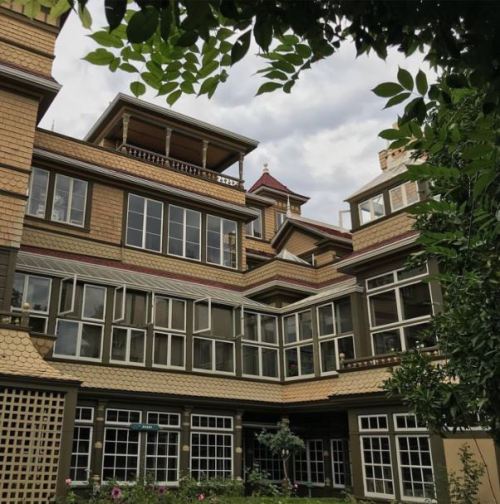
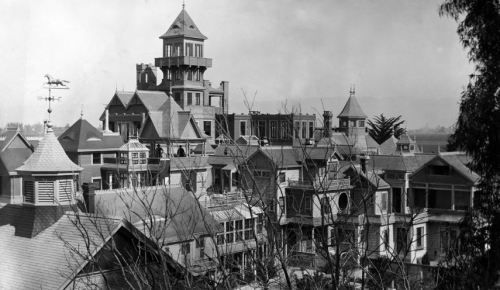
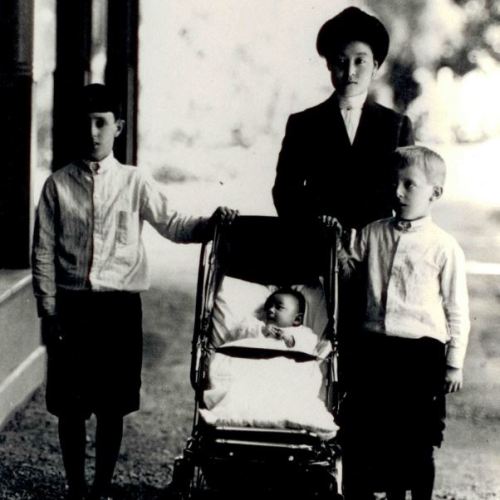
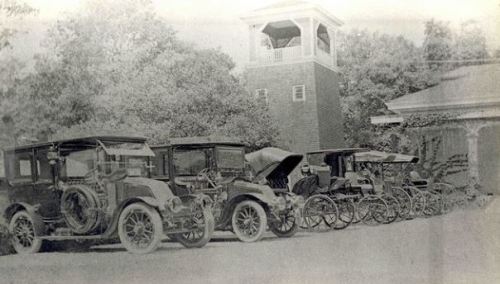
During a Connecticut thunderstorm, Mrs. Winchester’s husband and baby lost their lives in a tragic fire. The distracted widow turned to spiritualism and was advised to take a trip around the World. This she did, visiting mediums, spiritualists and wizards in Europe and India. Foretelling her future, one seer warned her of all the countless thousands of departed souls slain by her husband’s rifles; she was told to plan a castle and continue its building indefinitely because as long as it was under construction she would live; cessation would prove immediately fatal. In the afternoon of Tuesday, July 10, 1888, the inhabitants of Santa Clara Valley, were greatly excited by the sudden appearance, far out in the fields, of a mansion where none was known to exist. The people of the town were farmers and knew the area well. The day before, they had been out on their horses and rode over the spot where the unusual mansion appeared, and where certain that the locality was the best farmland in the valley. And still they gazed, and still the wonder grew, for the day was clear and the mansion could be seen as plainly as they saw the hills to the south. It was massive. The estate was surrounded by a six-foot hedge, densely wooded; here and there were deep shadows in its sides indicating glens heavily covered with undergrowth and grasses. At one end the mansion rose almost precipitously from the from the land; at the other, the declivity was gradual; the thick forest of the estate gave way to smaller trees, these to shrubs; these to green meadows that finally melted into the valley. It was patrolled by a pack of ferocious hellhounds, plus, of course, Mrs. Winchester’s staff of armed bodyguards. Hundreds of people from all over California came to investigate; when, as they neared the spot, the beautiful but bizarre mansion became dim in outline, less vivid in color, and at last vanished entirely, leaving the wonder-stricken farmers to return, fully convinced that for the first time in their lives they had really seen this enchanted mansion. #RandolphHarris 1 of 15

For once there was a topic of conversation that would outlast the day, and the enchanted Winchester mansion passed from lip to lip, both story and the mansion grew in size till the latter was little less than a continent, contain a labyrinth mansion with towers and steeples, stupendous mountain range views, fertile valleys, and wide spreading plains; while the former was limited only be the patience of the listener, and embraced the personal experience, conclusions, reflections, and observations of every woman, man, and child in the valley who had been fortunate enough to see the mansion, hear of it, or tell where it had been seen elsewhere. This is the invariable history of its appearance. No one had ever been able to come close to its grounds, but it had been so often seen on the west coast, that a doubt of its existence, if expressed in the company of farmers, will at once establish for the sceptic a reputation for balderdash of the common affairs of every-day life. In Santa Clara, for instance, the Winchester mansion had been seen by hundreds of people, while many more could testify to its appearance near San Francisco. In San Jose, all the population saw it a few years ago, and shortly before, the villagers of Oakland, saw it, if not by themselves, at least by some of their friends. The Enchanted Winchester mansion, it should be stated that its resemblance to a Victorian/Gothic castle is sometimes very close, and shows that the “enchanter” who has it under a spell knows her business, and is determined to keep her mansion for herself changes its appearance as well as its location in order that her property may not be recognized nor appropriated. At night, passers-by heard ghostly music wafting from the dark mansion. Mrs. Winchester’s arrival was a sensational event. They talked about Mrs. Winchester! Gossiped would be a more fitting word, gossip no one claimed to like-but everyone enjoyed. #RandolphHarris 2 of 15

Talk begat rumor and as the years passed and new towers and gables rose behind the six-foot hedge of Llanada Villa, the rumors grew to established legend. Populations said it just appeared out of nowhere two years ago. Sure two twins could not be like her, and when it appeared in Santa Clara, the mansion would move around to different locations. It had also appeared in San Francisco, Oakland, and Berkeley, but it went no further than the Bay Area. Concerning Mrs. Winchester’s mansion, legendary authorities differ on many material points. Some believed that its architecture was due to geometry or some other enchantment, while opponents of this materialistic view were inclined to the opinion that the mansion was not what it seemed to be, that was to say, not Earth, wood, and stones, like as those most people see, but only an illusion that evil spirits or the devil created to deceive the town. Public opinion on the west coast was therefore was strongly divided on the subject, unity of sentiment existing on two points only; that the island had been seen, and that there was something quite out of the ordinary in its appearance. People believe that it would come and go in the night like a light in a bog, and when you do see it, you can see through it. An old fisherman of San Francisco called Ebenezer Thornton knew all about the enchanted Winchester mansion, having not only seen it himself, but, when a boy, learned its history from a “fairy man,” who obtained his information from “the good people” themselves, the facts stated being therefore, of course, of indisputable authority, what the fairies did not know concerning the doings of supernatural and enchanted circles, being not worth knowing. He said that the Winchester mansion was full of temples and round towers all covered with gold and silver till they shone so one could not see it for the brightness. There was a great enchantress in the mansion, and she had all kinds of secrets, and knew where to dig for a pot of gold. She built the castle in one night, and could make herself disappeared when she wanted and could take any shape she pleased. #RandolphHarris 3 of 15

Ebenezer when on to say that Mrs. Winchester’s husband gave her a charm before he died to use when she was in mortal danger, he also left her a ton of diamonds and millions of dollars. She was a pretty smart woman. One night, Mrs. Winchester was awakened by a noise in one of the kitchens. She tole down, and found her old housekeeper, Madge, with half a dozen of her kidney, sitting by the fire drinking whisky. When the bottle was finished, one of them cried, “It’s time to be off,” and at the same moment she put on a peculiar red cap, and added:–“By yarrow and rue, and my red cap, too, hie over to England!” and seizing a twig she soared up the chimney. As the latter was making her preparations Mrs. Winchester rushed into the kitchen, snatched the cap from her, and placing herself astride of her twig uttered the magic formula. She speedily found herself high in the air over the Irish Sea, and swooping though the empyrean at a rate unequalled by the fastest airplane. They rapidly neared the Welsh coast, and espied a castle afar off, towards the door of which they rushed with a frightful velocity; Mrs. Winchester closed her eyes and awaited the shock, but found to her delight that she had slipped through the keyhole without hurt. The party made their way to the cellar, where they caroused heartily, but the spirits proved too heady, and somehow Mrs. Winchester was captured and dragged before the lord of the castle, who sentenced her to be hanged. On her way to the gallows an old woman in the crowd called out in Irish, “Ah, the enchantress herself, Sarah Winchester alanna! Is it going to die you are in a strange place without your magical charm?” She reached into her pocket and held it in her hand. On reaching the place of execution she was allowed to address the spectators, and did so in the usual ready-made speech, beginning, “Good people all, a warning take by me.” But when she reached the last line, “My parents reared me tenderly” instead of stopped she unexpected added, “By yarrow and rue, good-bye I love you,” with the result that she shot up through the air, to the great dismay of all beholders. #RandolphHarris 4 of 15

Magic persecution. Genuine magic is the art of bringing about results beyond human powers through the enlistment of supernatural agencies. Black magic deliberately involves the devil and demons, and the resulting enchantment is used for persecution and revenge. A spiritistic circle of twenty members furnishes a good example. Working with black magic, these spiritis experimented to see if they could cause psychic harm or even illness in people they disliked. A strong medium of this occult group chose a minister as a target and vowed to afflict and eliminate her. The minister suffered a nervous breakdown and was unable to work for several months. Some phenomena must be eliminated from the spiritistic magic field. In the psychiatric realm, for example, many schizophrenics claim to be magically persecuted. In reality this is only a symptom in the course of psychotic disease. Eliminating all such cases, there are still large-scale, genuine phenomena, especially in areas where occultism has flourished for many years. One common form of magic persecution is beatings by an invisible attacker. Parapsychology also sees magical persecution as a mediumistic problem in the sphere of materializations. Strong mediums (when under demon control) send out energy with which to build up human phantasms and are also able to transform this energy into animal forms, including dogs, cats, frogs, snakes, or human bodies with animal heads, etcetera. This explains the bizarre spiritistic persecution through phantoms in the form of various animals of human bodies with nonhuman heads. These animals bite, scratch, or otherwise torment their victims. Examples, of these occult phenomena abound in areas where the black arts are practiced. However, such occurrences are denied by many intellectuals. Often peasants and country people, especially in Europe, know more about magic than university graduates, who claim to swindle or hocus-pocus trickery are used instead of occult powers. #RandolphHarris 5 of 15
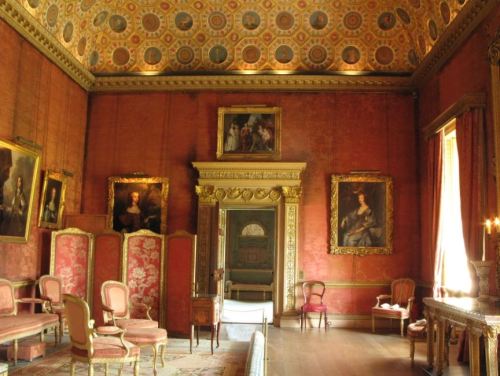
Magic defense. Magic defense enlists supernatural agencies to counteract or unto the mischief wrought by magic persecution. Various kinds of spells, charms, or incantations are employed. In spiritistic séances it is an established fact that injuries inflicted upon a phantasm are sustained by the medium, even in the case of animal phantasm. Many defensive customs develop to combat this threat since magical persecution involves materialization. If a victim can injure an aggressive phantasm one has won the struggle. Many in the West wanted to remove Satan from the equation of black magic and demonic aspects of life. However, more serious discontent came from Satanists whose concerns were completely the opposite. Anton LaVey did not believe in Satan as a literal entity—He was a name for the dark, brutal aspects of humans and nature, as well as a symbol for the potency of humans’ untrammeled will. The Church of Satan was not a religion, and did not worship deities. For many, however, this was not enough. They wanted a real Devil to worship—belonging to a dark, mysterious coven, in the traditional gothic style, seemed much more appealing than being part of some cultural and social elite. Some believed that Satan, although thrown out of Heaven, was reinstated as the son of God and is directly in contact with him. If any coven members offends, they are a bit evil now and again, given corporal punishment, or is expelled from one’s coven and cursed. However, this is said to be for the members own good. They really believe in love, the sanctity of woman as the child bearer and procreator of life, and in worshipping Satan their master. Aleister Crowley was grooming Kenneth as his successor. Mr. Grant’s work examined lost gods, strange spiritual traditions and forbidden symbols, often leading him to some disreputable spiritual neighborhood where devils and demons might be expected to reside, like the Winchester Mystery House. #RandolphHarris 6 of 15

If you have a lot of magic in you, you can be a Satanist and have no idea. As if they are the mafia or something, sometimes those who are suspected of being Satanists have their offices broken into like they are the Mafia or something. The Church of Satan, however, has saved lives because it has given them power, power to come out and be themselves when traditional churches would not accept these people. The Dark Lord, was said to be an anthropoid but faceless. Looking at the concept as a diamond, much like the ones left to Mrs. Winchester by her husband William Wirt Winchester, Satan or Lucifer was just other facets of that diamond, purely ways of achieving workings which encompassed the whole. So, if you are particularly drawn to the gothic Satanist current, fine, use rituals based around that. In the Temple of Darkness one could equally have Satanists, Setians, or followers of other paths, the principle being that the whole thing is a psychodrama anyway. Magic is basically the Western version of yoga. Everything that happens in magic happens first in your head. Set, the Egyptian god of evil, was an older deity than Satan. Satan derives from Set. Set, who is defined as the Prince of Darkness, is a force about which you could say, “As we are now, he once was.” When you die your force can survive. Magic is mind enhancing. When one perishes or passes, instead of going into the cosmic whole—becoming one with the goddess or whatever—by sheer force of the will the existence of that magician’s mind can be sustained. This is the whole idea of the Temple of Set, and they use the word “xeper,” meaning “to become,” to define this. Spiritistic cults. If you did not know, Mrs. Winchester was a spiritists. Spiritism is considered a form of Christianity, practically in all civilized countries. A typical meeting consists of hymns, prayer, and a sermon as in a Christian service. The sermon, however, is allegedly given by a spirit from the other World, through a medium. These cults are said to be affected by the “doctrines of demons” and press into the supernatural World. #RandolphHarris 7 of 15
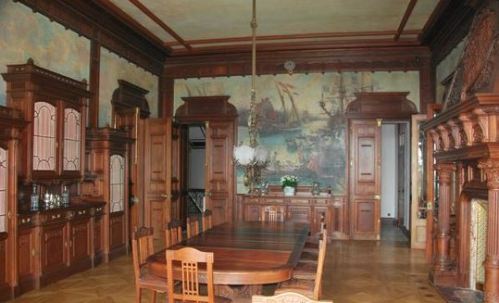
However, even born-again Christians often cannot differentiate between the spiritual and the psychic-demonic when under the spell of doctrinal errors, particularly those concerning the work of the Holy Spirit. The result can sometimes be confusion, division, and promotion of certain spiritual gifts accredited to demons. We have sometimes seen people end up suffering from mediumistic psychosis. Quite a number of patients who have suffered serious psychic disturbances through the misuse of such practices have become split personalities. The spirits which they called, confused them. One who tries to discover the promises of the other side through superstition endangers oneself to fall a prey to the dark side of one’s psyche. However, many Christians say that spirits of loved ones cannot be brought back from the dead, and the it is just a demon impersonating them. Yet, consider the case of Saul’s visit to the spiritistic medium at Endor (1 Samuel 28.3-25). Samuel’s spirit was actually brought back from the spirit World when the medium Endor tried to contact him. Yet, God brought the spirit back. The Lord stepped. Still one must be careful because many become enslaved and oppressed by occult powers and become victims of various manifestations of spiritistic phenomena. While overwhelming evidence from Christian counseling confirms the fact that spiritistic complicity serious damages the believer’s spiritual life, adherents of Buddhism, Island, or even false cults of Christianity sense no ill effects. Spiritists claim that spiritism has strengthened their belief in life after death and deepened their religious devotion. Psychiatry, psychology, and medical treatment are not sufficient for the healing of the whole human. The gospel of Christ and the liberating power of the Word of God can fully heal body, soul, and spirit. #RandolphHarris 8 of 15

Mrs. Winchester had a pain in her right forearm. At first the pain was treated as rheumatism but one day the Mrs. Winchester made the interesting discovery that the pain would suddenly subside if she wrote a letter. Having discovered this, whenever the pain became unbearable, she would always take a pencil and begin to write in order to alleviate the pain. However, after a period of time the Mrs. Winchester when go into her Blue Séance Room, where she developed a writing compulsion. She would write things down that she could normally speaking never have written. Often times, this is where the blueprints from her mansion came from. Added to this the written material on each occasion turned out to be some form of religious treatise. Mrs. Winchester took the articles to her minister to let him examine them. He was surprised at their intellectual content. Mrs. Winchester had become a spiritistic writing medium. The parapsychologist would merely see in this example a psychic automation involving the expression of subconscious thoughts. It is true that we need not consider the Mrs. Winchester to be in direct contact with the dead, or putting it another way we need not assume that this is a case of direct demonization, but God could be speaking to her. This is why some believe Mrs. Winchester to be a prophetess. During one of her spiritistic seances, as it happened, a phantasm did in fact appear during a séance. However, it is still not necessary to believe that a spirit really did appear in this instance. Depth psychology suggest that a phantasm can be produced in the following way. The medium through emitting energy causes matter to form as a result of this. In nuclear physics we have the idea that matter is nothing more than concentrated energy. Einstein’s formula E=M.c^2 illustrates this relationship. A comparison can also be drawn from another branch of physics. It is found that both particles and anti-particles are formed at the cathode of an X-ray tube when a current is passed through it at a very high voltage. Energy in the form of electro-magnetic waves is in this way transformed into matter. #RandolphHarris 9 of 15

The next step in the mediumistic process involves the unconscious tapping of the information from some source or other, and then the newly formed matter is physically shaped according to this information. The final step is made when the phantasm is brought under the control of the medium. Looking at it from this point of view there is no necessity to believe that the dead person has in any way been disturbed. An animistic explanation based on the powers of the subconscious is thus sufficient to explain the phenomenon of materialization. Yet this is not to say that the rationalistic explanation does justice to the facts of the case. The problem is not as simple as that. However, we do not have the time to delve further into the scientific side of the issues. We have, on many occasions witnessed a disintegration of the personalities of both mediums and participants where materializations have taken place. In addition to this in every case where a person has frequently taken part in spiritistic séances, there is some kind of reaction, even if it is not immediately notice or if there is no manifestation—something happens. There are also people who are able to practise the excursion of the soul. Spiritists affirm that people can send out an astral body from their material body, and commission it to do whatever they ask. Perhaps that was the case when Mrs. Winchester appeared in another country? Spiritism haunts the dark jungle of human aberration. During a séance as the Winchester mansion, Mrs. Winchester noticed that time was passing somewhat wearily. She could hear an occasional thud, thud. Some time must have elapsed before she became, dimly at first, and then distinctly, aware of a bluish phosphorescent emanation from a skeleton. This seemed to rise above it like a faint smoke, which gradually gained consistency, took form, and became distinct; and she saw before her the misty, luminous form on an unclothed man, with wolfish countenance, prognathous jaws, glaring at her out of eyes deeply sunk under projecting brows. #RandolphHarris 10 of 15

Although she thus descried what she saw, it gave her no idea of substance; it was vaporous, and yet it was articulate. Indeed, she could not say for sure if she saw this apparition with her eyes, or whether it was a dream-like vision of the brain. Though luminous, it cast no light on the wall of the Blue Séance Room; if she raised her hand, it did not obscure any portion of the form presented to her. Then she heard: “I will tear you with the nails of my fingers and toes, and rip you with my teeth.” “What have I done to injure and incense you?” she asked. No word was uttered by either of them; no word could have been uttered by this vaporous form. It had no material lungs, nor throat, nor mouth to form vocal sounds. It had but the semblance of a man. It was a spook, not a human being. However, it proceeded through the walls, odylic force which smote on the tympanum of her mind or soul, and thereon registered the ideas formed by it. So in a like manner Mrs. Winchester thought her replies, and they were communicated back in the same manner. If vocal words had passed between them neither would have been intelligible to the other. No dictionary was ever compiled, or would be compiled, of the tongue or prehistoric man; moreover, the grammar of the speech of that race would be absolutely incomprehensible to humans now. However, thoughts can be interchanged without words. When we think we do not think in any language. It is only when we desire to communicate our thoughts to other humans that we shape them into words and express them vocally in structural grammatical sentences. The beasts have never attained to this, yet they can communicate with one another, not by language, but by thought vibrations. Mrs. Winchester knew as she conversed with him that she was not speaking to him in English, nor in French, nor in Latin, nor in any tongue whatever. Moreover, when she used the words “said” or “spoke,” she meant no more than that the impression was formed by her brain-pan or the receptive drum of her soul, was produced by the rhythmic, orderly sequence of thought-waves. #RandolphHarris 11 of 15

When, however, she expressed the words “screamed” or “shrieked,” she signified that those vibrations came sharp and swift; and when she said “laughed,” tht they came in a choppy, irregular fashion, conveying the idea, not the sound of laughter. “I will tear you! I will rend you to bits and throw you in pieces about this mansion!” shrieked this demon man. Mrs. Winchester remonstrated, and inquired how she had incensed him. However, yelling with rage, he threw himself upon her. In a moment she was enveloped in a luminous haze, strips of phosphorescent vapour laid themselves about her, but she received no injury whatever, only her spiritual nature was subjected to something like a magnetic storm. After a few moments the spook disengaged itself from Mrs. Winchester, and drew back to where it was before, screaming broken exclamations of meaningless rage, and jabbering savagely. It rapidly cooled down. “Why do you wish to ill me?” She asked again. “I cannot hurt you. I am spirit, you are matter, and spirit cannot injure matter; my nails are psychic phenomena. Your soul you can lacerate yourself, but I can effect nothing, nothing.” “Then why have you attacked me? What is the cause of your impotent recement?” “Because you are the heiress to the Winchester Rifle, and I lived eight thousand years ago. Why are you nursed in the lap of luxury? Why you enjoy your comforts, a civilization that we new nothing of? It is not just. It is cruel on us. We have nothing, nothing, literally nothing, not even lucifer matches!” Again he feel to screaming, as might a caged monkey rendered furious by failure to obtain an apple which he could not reach. “I am very sorry, but it is no fault of mine.” “Whether it be your fault or not does not matter to me. You have these things—we had not. Why, I saw you just now strike a light on the sole of your boot. It was done in a moment. We had only flint and ironstone, and it took half a day with us to kindle a fire, and then it flayed our knuckles with continuous knocking. No! we have nothing, nothing—no lucifer matches, no commercial travellers, no Benedictine, no pottery, no metal, no education, no elections, no chocolat menier.” #RandolphHarris 12 of 15
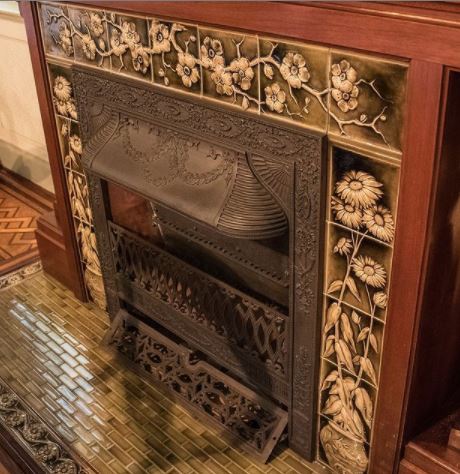
“How do you know about these products of the present age, here, buried one hundred feet of soil for eight thousand years?” “It is my spirit which speaks with your spirit. My spook does not always remain with my bones. I can go up; rocks and stones and earth and your labyrinth mansion heaped over me do not hold me down. I am often above. I am in the gasolier overhead. I have seen your servants plough the fields. I have seen a bottle of Benedictine. I have applied my physical lips to it, but I could taste, absorb nothing. I have seen commercial travellers there, cajoling the patron into buying things he did not want. They are mysterious, marvellous beings, their powers of persuasion are little short of miraculous. Why do you think of doing with me?” “Well, I propose first of all photographing you, then soaking you in gum Arabic, and finally transferring you to a museum.” He screamed as though with pain, and grasped: “Do not! do not do it. It will be torture insufferable.” “But why so? You will be under glass, in a polished oak or mahogany box.” “Do not! You cannot understand what it will be to me—a spirit more or less attached to my body, to spend ages upon ages in a museum with fibulae, triskelli, palstaves, celts, torques, scarabs. We cannot travel very far from our bones—our range is limited. And conceive of my feelings for centuries condemned to wander among glass cases containing prehistoric antiquities, and to hear the talk of scientific men alone. Now here, it is otherwise. Here I can pass up when I like into your mansion, and can see the maid and butlers cleaning, the roses and trees growing, the farmers working the field and the magnificent glow of your fine estate. Give me life. There is a sort of filmy attachment that connects our psychic nature with our mortal remains. It is like a spider and its web. #RandolphHarris 13 of 15

“Suppose the soul to be the spider and the skeleton to be the web. If you break the thread the spider will never find its way back to its home. So it is with us; there is an attachment, a faint thread of luminous spiritual matter that unites us to our Earthly husk. It is liable to accidents. It sometimes gets broken, sometimes dissolved by water. If a black beetle crawls across it it suffers a sort of paralysis. I have never been to the other side of the of your mansion, I feared to do so, though very anxious to see your architecture and furniture.” “This is news to me,” replied Mrs. Winchester. “Do you know of any case of rupture of connection?” Yes,” he replied. “My old father, after he was dead some years, got his link of attachment broke, and he wandered about disconsolate. He could not find his own body, but he lighted on that of a young female of seventeen, and he got into that. It happened most singularly that her spook, being frolicsome and inconsiderate, had got its bond also broken, and she, that is her spirit, straying about in quest of her body, lighted on that of my venerable parent, and for want of a better took possession of it. It so chanced that after a while they met and became chummy. In the World of spirits there is no marriage, but there grow up spiritual attachments, and these two got rather fond of each other, but never could puzzle it out which was which and what each was; for a female soul had entered into an old male body, and a male soul had taken up its residence in a female body. Neither could riddle out of which each gender was. You see they had no education. However, I know that my father’s soul became quite sportive in that young woman’s skeleton. Each generation makes some discovery that advances civilization a stage, the next enters on the discoveries of the preceding generations, and so culture advances stage by stage. Man is infinitely progressive; even the brute beast is.” #RandolphHarris 14 of 15

At that moment, Mrs. Winchester heard a shout—saw a flash of light. The construction workers had pierced the barrier. A rush of fresh air entered. She staggered to her feet. She felt dizzy. Kind hands grasped her. She was dragged forth. Brandy was poured down her throat. When she came to herself, she said, “Thank you. Talking with spirits can be terrible dreadful. When you are trying to summon one, souls get crossed and the one you are seeking may not cross through. They are so desperate to find a medium to communicate with.” As an ingredient of idol worship, magic goes back to antiquity. By virtue of their multiplicity and limited knowledge and power, the gods (demons) of paganism are incapable of establishing stability and security in society. This deficiency forced both gods and men to make use of magic—an inactive power independent of gods and men, but which could be activized by the assistance of incantations and rituals in order to accomplish supernatural deeds. Because of widespread denial of the reality of supernatural power—both divine and demonic, confusion abounds concerning the nature of magic. The history of magic is replete with extraordinary extrasensory phenomena that involve the spirit realm and every phase of the natural World as well, including human beings, animals, plants, and inorganic matter. Spirit-rapping, apparitions, ghosts, moving of furniture, and playing of musical instruments by invisible hands, stones falling from a ceiling, magical killing of cattle and blighting of crops, etcetera, are just a few of the weird occurrences that have happened at the Winchester Mystery House in its 134 years. However, there have also been beautiful supernatural events such as apparitions getting married, giant spirits of light in the shape of a man peering out guests, and on occasion, even rainbows and angels have appeared. Not all spirits or evil or angry, some or loving and welcoming. Few of thousands of annual transient guests are disappointed for here one finds visible truth even stranger than all the weird Mystery House features. #RandolphHarris 15 of 15

Winchester Mystery House
Beautiful weather calls for a walk around Sarah’s iconic gardens ⛲️🪴Open 10AM – 5PM this weekend!
A 160-room mansion built to appease the spirits who died at the hands of the Winchester Rifle , or who were jealous of its wealth 👻

If You Do Not Ask the Right Questions, You Do Not Get the Right Answers!

I am a citizen of the American Dream, and the revolutionary struggles of which I am a part, is a struggle against the American Nightmare. When it comes to mental health, assessment is simply the collecting of relevant information in an effort to reach a conclusion. It goes on in ever realm of life. We make assessments when we decide what Cresleigh Home to buy, or which colour we want our Ultimate Driving Machine to buy. College admissions officers, who have to select the “best” of the students applying to their college, depend on academic records, recommendations, achievement test scores, interviews, and application form to help them decided. Employers, who have to predict which applicants are more likely to be effective workers, collect information from resumes, interviews, references, and perhaps on-the-job observations. Clinical assessment is used to determine how and why a person is behaving abnormally and how that person may be helped. It also enables clinicians to evaluate people’s progress after they have been in treatment for a while and decide whether the treatment should be changed. The specific tools that are used to do an assessment depend on the clinician’s theoretical orientation. Psychodynamic clinicians, for example, use methods that assess a client’s personality and probe for any unconscious conflicts one may be experiencing. This kind of assessment, called a personality assessment, enables them to piece together a clinical picture in accordance with the principles of their model. Behavioural and cognitive clinicians are more likely to use assessment methods that reveal specific dysfunctional behaviours and cognitions. #RandolphHarris 1 of 20

The goal of this kind of assessment called a behavioural assessment, is to produce a functional analysis of the person’s behaviours—an analysis of how the behaviours are learned and reinforced. The hundreds of clinical assessment techniques and tools that have been developed fall into three categories: Clinical interviews, tests, and observations. To be useful, these tools must be standardized and have clear reliability and validity. A given assessment tool may appear to be valid simply because it makes sense and seems reasonable. However, this sort of validity, called face validity, does not by itself mean that the instrument is trustworthy. A test for depression, for example, might include questions about how often a person cries. Because it makes sense that depressed people would cry, these test questions would have face validity. It turns out, however, that many people cry a great deal for reasons other than depression, and some extremely depressed people fail to cry at all. Thus an assessment tool should not be used unless it meets more exacting criteria of validity, such as high predictive or concurrent validity. Vincent van Gogh led a tortured and unhappy life. In a legendary incident the artist cut off one of his ears. Later he was admitted to a mental institution, and ultimately he committed suicide at the age of 37. Van Gogh wrote a great deal about his pain and anguish, describing mental and physical torment and hallucinations. Indeed, he observed, “There is quite definitely something or other deranged in my brain.” For years clinicians have typically agreed with van Gogh and have speculated that the artists suffered from mood disorder, schizophrenia, or both. #RandolphHarris 2 of 20

However, approximately twenty years ago, these assessments were challenged. A Harvard neurologist, for example, has suggested that van Gogh in fact suffered from Geschwind’s syndrome, technically known as interictal personality disorder, caused by brain seizure disorder, or epilepsy. Van Gogh displayed many of its symptoms, including excessive drawing (hypergraphia), hyperreligiosity, and aggression. In contrast, medica specialists in Colorado have concluded that van Gogh suffered from an extreme form of Meniere’s syndrome, a disorder marked by an excessive buildup of fluid in the inner ear. The enormous pressure may produce nausea, dizziness, poor balance, pain, deafness and constant buzzing or ringing sensations. Perhaps van Gogh cut off his ear in an effort to reduce the pain. And perhaps his other problems and pains arose from severe secondary psychological problems that can accompany. Perhaps nowhere in the mental health literature has family systems theory had more of an impact than in the area of alcoholism. Family systems theory is a conceptual model, rather than a true theory, that locates causes and consequences of problematic behaviour in the larger family system in which it is embedded. Family behaviour is thought to be responsive to regulatory mechanisms that maintain the status quo, as well as a tendency to grow and change in response to dynamic qualities within and outside the family. Viewing a family as a system suggests that a disturbance in one part of the system will have an impact on other parts of the system. Applying family systems concepts to alcoholism, has uncovered that some families organize their lives around the alcoholism of an adult member, just as other families might organize their lives around children or work. #RandolphHarris 3 of 20

In an early investigation of adults with alcoholism and their family members, the expression of previously inhibited positive affect between family members became extremely pronounced during drinking periods. This and later studies revealed that interactions in such families were actually more patterned, organized, and predictable while the adults with alcoholism were intoxicated. Thus alcohol ingestion serves an adaptive function in family relationships through a stabilizing phenomenon. This prompted a suggestion that there is an alcoholic system in some families, in which drinking is an integral part of the family structure that actually maintains and stabilizes the family. Similar positive effects on the family were evident in a study where family members viewed and rated video tapes (recordings with audio and visual information on them, which can be played back) of their own interactions, in the absence of actual drinking. Both mothers and adolescent children in families with paternal alcoholism rated family members as less anxious and their interactions as more friendly than those of families without alcoholism. Unfortunately, drinking and intoxication may provide only a temporary “solution” to a family’s problems, at the cost of what may ne more serious long-term ill effects. Although drinking can temporarily inject positivity into some family relationships, several laboratory investigations have also documented negative effects associated with drinking. For example, families with an alcoholic father discuss items from various questionnaire inventories while the fathers were drinking or not drinking. During their discussions, the families expressed more negative affect during the drinking versus the no-drinking condition. The nature of interactions in families without paternal alcoholism was not affected by the drinking conditions. #RandolphHarris 4 of 20

The ill effects of parental alcoholism on family interactions and child rearing may begin to have an impact on family members as early as 1 year of age. In this study, families with alcoholism in at least one patent were observed interacting with their 12-month-old infants for 5 minutes in a room filled with toys. Observations of the parents’ behaviour indicated that the parents with alcoholism were less sensitive to their infants during the free play; such fathers in particular made fewer verbalizations, expressed more negative affect, and were less responsive to their infants. Self-report measures further indicate that the parents with alcoholism were more aggressive toward their spouses than those without alcoholism were. The family observation study was unique in showing that parents with alcoholism were far more depressed than those without, and that this depression mediated the relationship between parental alcoholism and sensitivity to the infants during interaction. So for many adults with alcoholism, effective parenting may be disrupted directly by the alcoholism, or by comorbid problems such as depression that in and of themselves have a negative impact on parenting behaviour. Different subtypes of alcoholism have been identified to explain the variable effects of alcohol consumption and alcoholism on family interactions and relations. In one such instance, researchers were able to characterize subtypes of alcoholism as episodic or steady drinking. Another useful distinction in alcoholism is that between high-antisociality and low-antisociality subtypes. These subtypes are defined on the basis of a measure that taps into negative social consequences of drinking, feeling of alienation, interpersonal disruption, and negative attitudes toward authority (higher scores = higher antisociality). #RandolphHarris 5 of 20

Home observations of family dinner conversations revealed that wives, husbands, and children in families with high-antisociality alcoholism were all less positive, and less inclined to communicate disagreement, than were control family members. Although family interactions in the high-antisociality condition were characterized by diminished optimism, they appeared to have a cautious appearance as well, in that family members were careful to avoid open disagreement with each other. This pattern of interaction could have interesting implications for the genesis of alcoholism. For the person who develops alcoholism, the tendency to avoid communicating disagreement may lead to the internalization of problems with other family members. Instead of airing complaints, the individual is left to ruminate over them on one’s own—perhaps without seeing any change in the offensive behaviour by other family member, since they may be unaware of the problem. For this individual’s family members, the tendency to be cautious and avoid disagreement may inadvertently cause one’s problem drinking behaviour to go unchecked. In some cases, families have some ability to regulate problem drinking through punishing responses in reaction to the behaviour. However, in a family system affected by high-antisociality alcoholism, this regulatory function may be inoperative. Recognizing considerable diversity in alcoholism’s effects on family interactions, there is a proposed family alcohol phase model. According to this perspective, a family moves through various phases that correspond to the drinking behaviour of the member with alcoholism. The stable-wet phase is marked by consistent drinking, whereas the stable-dry phase is marked by general abstinence. The family is in a transitional phase either when a period of abstinence begins, or when a period of abstinence ends with episodes of drinking. #RandolphHarris 6 of 20

It has been found that content variability (the range of affect and decision-making behaviour in verbal interaction) in family interactions, as well as distance regulation (use of space and rate of movement in the home), varied as a function of phase. In the stable-wet phase, families maintained the greatest distance, interacting only for purposeful reasons, while exhibiting midrange variability in their interactions. Families in the stable-dry phase exhibited a great deal of content variability in their interactions, with midrange distance regulation. Finally, those families in the transitional phase exhibited a great deal of content variability in their interactions, with midrange distance regulations. Finally, those families in the transitional phase showed a decrease in distance regulation, manifesting physical closeness, with a slight decrease in the content variability of their interactions. A 2-year longitudinal study suggested that families in the stable-wet phase were the most likely of the three to dissolve their marriages. In particular, those families in the stable-wet phase that exhibited the least intrafamily engagement during home observations of family interaction were more likely to break up over the course of the study. It has been noted that in families of alcoholics’ relationships change when parental drinking occurs. However, sometimes these changes are beneficial and sometimes they are negative. Where there are beneficial changes or adaptive outcomes, these may be somewhat short-lived. Researchers have been working to identify different subtypes of alcoholism that are associated with more negative family consequences. The poorest family processes and outcomes appear to be associated with the episodic (vs. steady), high-antisociality (vs. low-antisociality), and stable-wet (vs. stable-dry or transitional) alcoholism. #RandolphHarris 7 of 20

Perhaps you are in a trial today, and you are praying for God to deliver you out of that adverse situation. That is a legitimate prayer, but maybe you are missing the point of why you are being allowed to go through that trying time in the first place. Recognize that God is moulding you and refining you. God often allows one to go through difficult situations to draw out those impurities in one’s character. One can pray one can resist, one can bind, one can loose, one can sing and shout, one can do it all, but it is not going to do any good. God is more interested in changing you than He is in changing the circumstances. And the sober one learns to cooperate with God, the sooner one will get out of that devil’s web. The quicker one learns one’s lesson and starts dealing with those bad attitudes and starts ruling over one’s emotions, the quicker one will go to the next level in one’s spiritual journey. We must recognize the refining purpose of trials. We cannot run from everything that is hard in our lives. Perhaps one gets worried and fearful when important things do not go one’s way. Have you ever thought that God may be allowing those events to teach you to trust Him and to see if one will stay peaceful and clam in the midst of the storm? Has one ever considered that God may be allowing some of that to teach one how to rule over one’s emotions? He may be trying to toughen one up, to help one develop some courage. For our sins—that is why Jesus Christ wanted to do it, and that is why He did it. And what did they do? They ripped off His clothes and hammered His hands to the cross. It was a sacrifice the old-fashioned way. Perhaps that is why God the Father seemed so pleased. In the same way, you, My beloved Devout, ought to be willing to offer yourself to Jesus Christ—He asks us the way His Father asked Him—in pure holy oblation, everyday in the Mass, with all strength and affection, until the day one drops. #RandolphHarris 8 of 20

However, we often pay, “God, if You will change my circumstances, then I will change.” No, it works the other way around. We have to be willing to change our attitudes and deal with the issues God brings up; then God will change those circumstances. Surrender. Unconditional surrender. That is all Jesus requires of us. Not our possession—He could take those things anytime and scatter them over the landscape; one will find this in Philippians (4.17). Just you—that is all Jesus Christ wants. Of course, Jesus could take us as a prisoner of war and do with one as he wanted. However, what He really wants is for us to give ourselves to Him as a gift. Of course, the same is true for us. If we have all the baggage in the World, but did not have Jesus Christ, would we be any better off? One would have a full cart, maybe, but also an empty heart. And the other way around is also true. It is not our silly stuff Jesus Christ wants—it is our silly selves! Offer yourself to Jesus Christ. Make that the only package, and it will be an oblation that will be welcomed. Look at Jesus! He offered Hus whole self to the Father for us; He also put His whole Body and Blood into food and drink that He might be totally ours and that we might be totally Him. If, however, we hold something of ourselves back or are slow to give our all, it will be a pretty poor offering made not by any friend of His, but by a pretty poor acquaintance. To prevent that and to acquire illumination and liberation of spirit, one ought to make a spontaneous oblation of one’s self into the hand of God. When? Before each and every thing one does. Such an attractive proposition, Jesus thinks, but He must ask, “Why are there so few Illuminati and Liberati today? That is because so many do not know how to denude themselves of imperfections. #RandolphHarris 9 of 20

Jesus Christ’s firm opinion is this, and it appears in the Gospel of Luke (14.33): “Unless a person renounces everything that one had and everything that one is, one cannot be His Disciple.” Therefore, if one wants to be His Disciple, offer one’s whole self to Jesus; that includes one’s scruffy affections. God will often permit pressure to be applied in our life to test us, and only as we pas those tests will we advance. He will put people and circumstances in our path that grate on us like sandpaper, but He will use them to rub off our rough edges. One may not always like it; one may want to run from it; one may even resist it, but God is going to keep brining up the issues again and again, until one passes the test. Remember, the Bible says, “We are [God’s] workmanship,” reports Ephesians 2.10. That means we are a work in progress, not a finished product. Be willing to deal with any issues that God brings up. Work with God in the refining process rather than fighting against Him. Scripture says that God is the potter and we are the clay. Clay works best when it is pliable, malleable, and mouldable. However, if we are hard, crusty, and set in our ways, God will have to pound away on that old, hard clay to get out the lumps. Certainly, none of us enjoy going through struggles, but one has to understand that one’s struggle may be an opportunity for advancement and promotions. The very thing one is fighting against so tenaciously may be the springboard that catapults one to a new level of excellence. One’s challenges may become one’s greatest assets. Without the resistance of air, an eagle cannot soar. Without the resistance of water, a ship cannot float. Without the resistance of gravity, we would not be able to walk. Without opposition or resistance, there is no potential for progress. #RandolphHarris 10 of 20

Yet our human tendency is to want everything easily. “God, cannot You teach me patience without having to go through the traffic jam? God, cannot You teach me how to love and trust You without ever having a problem?” Unfortunately, there are no shortcuts; there is no easy way to mature physically, emotionally, or spiritually. One may remain determined and work with God. The Bible says, “Work out your own salvation,” reports Philippians 2.12. Salvation is more than a onetime prayer. It is constantly cooperating with God, dealing with the issues He brings up, keeping a good attitude, and allowing Him to change one as He sees fit. Dear Lord in Heaven, I realize that You never promised I would not have trials and adversities. However, I also recognize that nothing can touch my life without going through You first, so I will dare to praise You in the midst of my trails. I know You will bring me out stronger, better, faster, and more prepared for the good things You have for me. “Be truly glad! These trials are only to test your faith, to see whether or not it is strong and pure…So if your faith remains strong after being tried in the test tube of fiery trials, it will bring you much praise and glory and honour on the day of His return,” reports 1 Peter 1.6-7. James said that you put bits in a horse’s mouth to turn its whole body and you put a rudder on a ship to tun the whole ship; so is the tongue so situated among our members that it defiles the whole body. (James 3.3,4.) If you control the tongue, the body will respond to your words. If you talk sickness, it becomes impossible to live in health. The more you believe it, the less you believe in healing. The thing you continually talk will consume you. Faith will only come by hearing the Word of God and it will come more quickly when you hear yourself quoting and speaking God’s Word after Him. #RandolphHarris 11 of 20

The seed of truth in why many Christians have not wanted to express their anger is valid: expressing one’s anger manipulatively as blaming or attacking is destructive. As Paul says, “Let all bitterness and wrath…be put away from you, with all malice,” reports Ephesians 4.31. One needs to learn to express anger constructively. A basic guideline is to assert and express oneself rather than to blame and attack the other person. For instance, when a Critical Christian says, “Why are you so stupid?” The individual has already made an assumption that the other person is stupid. This results in an attacking form of anger. A healthier way of dealing with this anger would be for one first to recognize that one feels angry that one’s friend is “stupid.” One moves now to one’s feeling, not the fact, that one’s friend is stupid. Now if the Critical Christian listens, one can have a dialogue with one’s core. (This is the principle Dr. Maslow meant when he referred to one’s “inner Supreme Court.”) Simply by asking oneself inwardly, the Critical Christian may get the answer from one’s core that “you are angry because the bank teller this morning treated you as if you were stupid.” The Critical Christian can the realize that because he did not deal with his anger then, he is now projecting his anger on to his friend—calling him stupid, when in reality he is angry at the bank teller. Or, the Critical Christian may get the answer from his core that he is upset because the project he and his friend are working on together is more important to the Critical Christian than he had realized and now his friend is not fulfilling his share of the work. In this case, the Critical Christian needs to take the time to examine whether he thinks his friend is capable. If he is callable, the Critical Christian may now decide that he needs to express to his friend that his not fulfilling his share of the work is delaying the project. #RandolphHarris 12 of 20

If the Critical Christian realized that his friend cannot do the job, he may let him go and bring in someone else. Blaming his friend for his inability at this point would not be actualizing; but, expressing to him that he is not showing the needed skills, and that that is why he is being let go, would be actualizing. Many answers come quickly from the core—the preceding possibilities could surface in seconds. The more we listen to our cores, the more we hear—and know how to listen. Sometimes, though, we ask and do not hear an answer. Or we get what we think is an answer and then proceed to act on it—and make things worse. Remember that becoming actualizing is a process. If we were perfectly actualized now, the answers would always be there, crystal clear, and our behaviour would be “perfect.” As we are in the process of becoming actualizing, sometimes we do the most effective thing and sometimes we make mistakes. Mistakes are just that—“miss-takes.” Our lives become most meaningful when we live from our own core, finding our own truest answers. So it is a process worth living—and the mistakes are worth making. The real key here is not to blame and attack ourselves for those miss-takes, but to keep learning with more “takes.” Having patience with ourselves often makes it easier to become more patient and forgiving of others. It can sometimes relieve our anger just to remember that other people are in the growing process, too, and not always taking what to us would seem the most effective action. As actualizing Christians, we seek to do the will of God. Doing His will involves having good will toward others and ourselves. We do this by listening to our anger, taking it to out core, and then responding from our core. #RandolphHarris 13 of 20

If one deals with it by expressing and asserting it, rather than blaming and attacking someone, only then can anger become actualizing. Blaming and attacking are simply manipulative, whereas expressing and asserting include a quality of genuine respect for everyone involved. In communicating our anger honestly, we get it off our chests, and the rhythm of life is reestablished. We finish with it and move on to experience a new and different feeling. The range of feelings in the anger polarity includes irritation, annoyance, resentment, and anger. The intensity of the feeling increases as one passes from irritation to anger. Recognizing irritation, boredom, or annoyance at the lower levels of intensity within the anger spectrum enables us to avoid unwittingly building up to levels of resentment, hostility, and hatred. In handling these feelings, it is important to learn to acknowledge the mild forms and deal with them on a “cash and carry” basis. That way we do not save them up like coupons to be redeemed in one sudden, destructive explosion. While our anger may sometimes reach intensities approaching hatred, we need never go so far as to write a person off completely. It is really possible to have compassion for and pray for our enemies—that God in His mercy might help them through their own dilemmas, frustrations, and pains. Yet, we can be honest about the effects on us of their behaviour. “Turn again, we beseech You, O God of hosts! Look down from Heaven and see, visit, and have regard for this vine! [Protect and maintain] the stock which Your right hand planted, and the branch (the son) that You have reared and made strong for Yourself. They have burned it with fire, it is cut down; may they perish at the rebuke of Your countenance. Let Your hand be upon the human of Your right hand, upon the son of man whom You have made strong for Yourself. Then will we not depart from You; revive us (give us life) and we will call upon Your name. Restore us, O Lord God of hosts; cause Your face to shine [in pleasure, approval, and favour on us] and we shall be saved!” reports Psalm 80.14-19. #RandolphHarris 14 of 20

Dr. Ilya Prigogine and his teams of coworkers at the Free University of Brussels and the University of Texas at Austin have struck directly at Second Wave assumptions by showing how chemical and other structures leap to higher stages of differentiation and complexity through a combination of chance and necessity. It is for this work the Dr. Prigogine was awarded the Nobel Prize. Brown in Moscow, brought to Belgium as a child, and fascinated since youth by the problems of time, Dr. Prigogine was puzzled by a seeming contradiction. On the one hand, there was the physicist’s belief in entropy—that the Universe is running down and that all organized patterns must eventually decay. On the other, there was the biologist’s recognition that life itself is organization and that we are continually giving rise to higher and higher, more and more complex organization. Entropy pointed in one direction, evolution in another. This led Dr. Prigogine to ask how higher forms of organization come into being, and to years of research in chemistry and physics in pursuit of the answer. Today Dr. Prigogine points out that in any complex system, from the molecules in a liquid to the neurons in a brain or the traffic in a city, the parts of the system are always undergoing small-scale change: they are in constant flux. The interior of any system is quivering with fluctuation. Sometimes, when negative feedback comes into play, these fluctuations are damped out or suppressed and the equilibrium of the system maintained. However, where amplifying or positive feedback is at work, some of these fluctuations may be tremendously magnified—to the point at which the equilibrium of the entire system is threated. #RandolphHarris 15 of 20

Fluctuations arising in the outside environment may hit at this moment and further amplify the mounting vibration—until the equilibrium of the whole is destroyed and the existing structure is smashed. It is illuminating to think of the economy in these terms. Supply and demand are maintained in equilibrium by various feedback process. Unemployment, if intensified by positive feedback and not offset by negative feedback elsewhere in the system, can threaten the stability of the whole. Outside fluctuations—such as oil price hikes—may converge to make the internal swings and fluctuations wilder, until the equilibrium of the whole system is shattered. Whether the result of runaway internal fluctuations or of external forces, or both, this breakup of the old equilibrium often results not in chaos or breakdown, but in the creation of a wholly new structure at a higher level. This new structure may be more differentiated, internally interactive, and complex than the old one, and needs more energy and matter (and perhaps information and other resources) to sustain itself. Speaking mainly about physical and chemical reactions, but occasionally calling attention to social analogues, Dr. Prigogine calls these new, more complex systems “dissipative structures.” He suggests that evolution itself may be seen as a process leading toward increasingly complex and diversified biological and social organisms, through the emergence of new, higher-order dissipative structures. Thus, according to Dr. Prigogine, whose ideas have political and philosophical resonance as well as purely scientific meaning, we develop “order out of fluctuation” or, as the title of one of his lectures expresses it, “Order out of Chaos.” #RandolphHarris 16 of 20

This evolution, however, cannot be planned or predetermined in a mechanistic fashion Until quantum theory came along, many leading Second Wave thinkers believed that chance played little or no role in change. The starting conditions of a process predetermined its outcome. Today in subatomic physics, for example, it is widely believed that chance dominates change. In recent years many scientists, like Jacques Monod in biology, Walter Buckley in sociology, or Maruyama in epistemology and cybernetics, have begun to fuse these opposites. Dr. Prigogine’s work not only combines chance and necessity but actually stipulates their relationship to one another. In brief, he strongly suggests that at the precise point at which a structure “leaps” to a new stage of complexity, it is impossible, in practice and even in principle, to predict which of many forms it will take. This presumably goes for the leap from Second Wave to Third Wave civilization as well as for chemical reactions. However, once a pathway has been chosen, once the new structure comes into being, determinism dominates once more. In one colorful example he describes how termites create their highly structured nests out of apparently unstructured activity. They begin by crawling about a surface in random fashion, stopping here and there to deposit a bit of “goo.” These deposits are distributed by chance, but the substance contains a chemical attractant so that other termites are drawn to it. In this way, the good begins to collect in a few places, gradually building up into a pillar or wall. If these buildups are isolated, work stops. However, if by chance they are near one another, an arch results that then becomes the basis for the complex architecture of the nest. #RandolphHarris 17 of 20

Much like the Winchester mansion, what begins with random activity turns into highly elaborate nonrandom structures. We see, as Dr. Prigogine puts it, “the spontaneous formation of coherent structures.” Order out of chaos. All this strikes hard at the old causality. Dr. Prigogine sums it up: “The laws of strict causality appear to us today as limiting situations, applicable to highly idealized cases, nearly as caricatures of the description of change. The science of complexity leads to a completely different view.” Instead of being locked into a closed Universe that functioned like a mechanical clock, we find ourselves in a far more flexible system in which, as he says, “there is always the possibility of some instability leading to some new mechanism. We really have an ‘open Universe.’” As we move beyond Second Wave causal thinking, as we begin to think in terms of mutual influence, of amplifiers and reducers, of system breaks and sudden revolutionary leaps, of dissipative structures and the fusion of chance and necessity—in short, as we take off our Second Wave blinders—we emerge blinking into a wholly new culture, the culture of the Third Wave. This new culture—oriented to change and growing diversity—attempts to integrate the new view of nature, of evolution and progress, the new, richer conceptions of time and space, and the fusion of reductionism and wholism, with a new causality. Indust-reality which once seemed so powerful and complete, so all-encompassing an explanation of how the Universe and its components fitted together, turns out now to have been immensely useful. However, its claims to universality are shattered. The super-ideology of the Second Wave will be seen, from the vantage point of tomorrow, to have been as provincial as it was self-serving. #RandolphHarris 18 of 20

The decay of the Second Wave thought system leaves millions of people grasping desperately for something to hold on to—anything, from Victorian Americana and Texas Taoism to Swedish Sufism and Welsh witchcraft. Instead of constructing a new culture appropriate to the new World, they attempt to important and implant old ideas appropriate to other times and places or to revive the fanatic faiths of their own ancestors who lived under radically different conditions. It is precisely the collapse of the industrial era mind-structure, its growing irrelevance in the face of the new technological, social, and political realities, that gives rise to today’s facile search for old answers, and to the continual stream of pseudo-intellectual fads that pop up, flash, and consume themselves at high speed. In the very midst of this spiritual supermarket, with its depressing razzmatazz and religious fakery, an optimistic new culture is being seeded—one appropriate to our time and place. Powerful new integrative insights are beginning to emerge, new mataphours for understanding reality. It is possible to glimpse the earliest beginnings of a new coherence and elegance as the cultural debris of industrialism is swept away by history’s Third Wave change. The super-ideology of Second Wave civilization that is now crumbling was reflected in the way industrialism organized the World. An image of nature based on discrete particles was mirrored in the idea of discrete, sovereign nation-states. Today, as our image of nature and matter change, the nation-state itself is being transformed—another step on the path toward a Third Wave civilization. May your trails be righteous, winding, joyful, peaceful, leading to the most amazing views. #RandolphHarris 19 of 20

May your rivers flow without end, meandering through pastoral valleys tinkling with bells, past temples and castles and poet’s towers into bright enchanted forests where the fruit glows like emeralds, rubies, sapphires, orange spessartite, and hessonite. Where bars of sun blaze on profiled cliffs, where deer walk across the white sand beaches, where storms come and go, as lightning clangs upon the high crags, where something strange and more beautiful and more full of wonder than your deepest dreams waits for you—beyond that next turning of the deep and vast ancient unknown canyon walls. Dear Lord in Heave, we thank Thee also for the miraculous and mighty deeds of liberation wrought by Thee, and for Thy victories in the battles our forefathers fought in days of old, at this season of the year. In the days of the High Priest Mattathias, son of Johanan, of the Hasmonean family, a tyrannical power rose up against Thy people America to compel them to forsake Thy flag, and to force them to transgress Thy commandments. In Thine abundant mercy Thou didst stand by them in time of distress. Thou didst rise to their defense and didst vindicate their cause. Thou didst bring retribution upon the evil doers, delivering the strong into the hands of the weak, the many into the hands of the few, the wicked into the hands of the just, and the arrogant into the hands of those devoted to Thy flag. Thou didst thus make Thy greatness and holiness known in Thy World, and didst bring great deliverance to America. Then Thy children came into Thy dwelling place, cleansed the Temple purified the Sanctuary, kindled lights in Thy sacred courts, and they designated these eight days of Hanukkah for giving thanks and praise unto Thy great name. For all this, Thy name, O our King, shall be blessed and exalted for ever and ever. O inscribe all the child of Thy covenant for a happy life. May all the living do homage unto Thee forever and praise Thy name in truth, O God, who are our salvation and our help. Blessed be Thou, O Lord, Beneficent One, unto whom our thanks are due. #RandolphHarris 20 of 20

Cresleigh Homes
With a gorgeous home like this, it’s never too early to get the holidays started! 🥳 You’ll love hosting dinners and gift exchanges in the covered California Room – perfect for entertaining and letting the sunshine in! ☀️
Not to mention, there’s plenty of space for guests during the holidays. The open concept design includes approximately 2,700 square feet, exactly four bedrooms, three and one half bathrooms, and even a two car garage plus workshop! https://cresleigh.com/mills-station/new-home-rancho-cordova-homesite-40/

Bless our house as we come and go. Bless our home as the children grow. Bless our families as they gather in. Bless our home with love and friends.


When Asked His Name He Said “Legion” Because Many Demons Were Entered into Him!

It is easy to imagine how the combined grief of losing both a child and a spouse could be very crippling. However, if you have $20,000,000 (2021 inflation adjusted $347,910,691.82), and all the time in the World to help you cope, what would you do? Mrs. Sarah L. Winchester’s response to the deaths of her child and husband left a bizarre and impressive architectural reflection of her soul. After a series of violent confrontations, the Winchester Repeating Arms Company hires a private investigator to follow her. Mrs. Winchester ascends into mystery and it is soon clear that she is hiding a much bigger secret—one that is both inexplicable and shocking. A “possessed” person may have symptoms much like those that are apparent in the mentally ill. One may be deeply melancholic or depressed, appear to be withdrawn from reality, or may manifest emotions that range from ecstatic joy to violent screaming or wild ferocity. These various states may present themselves from time to time during “attacks.” Demon possession may be distinguished from insanity, however, by observing the manner in which the afflicted person speaks. An insane individual may have a mistaken concept of one’s own identity, wear clothing by which one attempts to look like the person one thinks oneself to be, but speak in one’s own voice, and in such a manner that one can tell one is doing only a superficial impersonation of the individual one thinks oneself to be. A demon-possessed person, on the other hand, is obviously controlled by the indwelling evil spirit. The wicked being may use a language or dialect the individual never knew, and sometimes will name oneself. Therefore, one should carefully note the symptoms of a disturbed person, never making the diagnosis of demon possession on the basis of a superficial judgment. #RandolphHarris 1 of 16

If a believer should meet a demon-possessed individual, one would be unwise to make a frontal attack upon the powers of darkness by immediately issuing a command in the name of the Lord Jesus Christ. Dr. Kurt Koch, an evangelical Christian who has made a lifetime study of Satan and occultic activities, declares that whenever Christians lightly engage in an effort to cast out demons, they run the risk of being attacked by evil spirits. Such people often suffer deep spiritual depression and find themselves in an attitude of complete hopelessness. Since this is true, a believer should band together with others in a time of prayer, and no efforts should be made to expel the evil spirits until the Holy Spirit prompts someone to issue the command. Unbelievers and adherents of the non-Christian religions apparently can command evil spirits without suffering bad consequences. Archeologists have found manuscripts containing incantations and magical formulas for the expulsion of demons; and today in the Philippines and other countries of the far East, as well as in some areas of South America and Africa, pagan religious leaders seriously perform rituals to ward off or cast out evil spirits. Sometimes they beat the person who is demon-possessed, prick one with needles, or even burn portions of one’s body, thinking that this pain will drive out the evil spirits. The Jewish people in Christ’s day also used spells, magical phrases, and religious rituals to expel demons. That they sometimes appeared to be successful is clear, for Jesus said, “if I, by Beelzebub, cast out demons, by whom do your sons cast them out? Therefore, they shall be your judges,” reports Matthew 12.27. #RandolphHarris 2 of 16

In this statement the Lord Jesus Christ acknowledged that evil spirits sometimes left the bodies of their victims when incantations, spells, or magical rites were used by Jewish religious leaders. However, Christ did not say these men accomplished their goal by the power of God, nor did He imply that they were actually doing damage to the cause of Satan. He was answering the charge that He was casting out demons in the power of Beelzebub, the prince of demons. He declared that is such were the case, the kingdom of Satan would be divided against itself. Actually, the exorcists, whether Jewish or pagan, did not really possess authority over the invisible World, but the evil spirits merely cooperated with them, leaving the bodies of some of their victims to give the appearance that they had been forced out. By working with these unbelieving sorcerers, the devil aided his own cause. The demons either temporarily left the person, only to return a short time later, or entered the body of some other victim. No one should attempt to deal with the forces of evil by using the name of Jesus unless one is a child of God. Luke, in Acts 19, graphically portrays the seriousness of hypocritically dealing with the powers of darkness. Seven sons of Sceva, a professional exorcist who had no personal faith in Christ, tried to combine the words “in the name of Jesus” with their magical formula. The evil spirits, recognizing that these impostors had no right to use Jesus’s name, reacted in a violent manner. The demon-possessed individual attacked these men with superhuman strengths, so that with torn clothing and bleeding bodies they fled from the Winchester mansion. The frequency of demon possession—the record of history establishes without a doubt that demon possession was known before the Lord Jesus Christ came to Earth, and the testimony of missionaries indicates that it has continued down through the centuries. #RandolphHarris 3 of 16

The public ministry of Christ, however, was accompanied by an outburst of demon possession unparalleled in history. It seems that Satan threw all his power into his battle with Jesus Christ. True, the devil is not omniscient, but he knew that Christ had come to earth to atone for sin, conquer death, and bring about the defeat of evil. John tells us that “the Son of God was manifested, that he might destroy the works of the devil,” reports 1 John 3.8. Satan used every device at his disposal to frustrate the purpose of God in Christ. Subtle temptations, the wrath and wickedness of men, and a rash of demonic activity were part of his vain effort to prevent Jesus from performing the work He had come to accomplish. Demon possession gradually subsided during the first century A.D., and usually is not conspicuous in areas where a fairly large percentage of people have placed their faith in Jesus Christ. It appears that demons are hesitant to enter the bodies of people when informed believers are likely to cast them out in the name of Christ. Luke is the same one that is translated “bottomless pit” seven times in the book of the Revelation. We read, “And Jesus asked him, saying, ‘What is thy name?’ And he said, ‘Legion’; because many demons were entered into him. And they besought him that he would not command them to go out into the deep. And there was there and herd of many swine, feeding on the mountain; and they besought him that he would allow them to enter into them. And he permitted them,” reports Luke 8.30-32. Revelation 9 tells us that at some future time the “bottomless pit” will be opened, and a great army of evil spirits will be set free to plague humankind. #RandolphHarris 4 of 16

It is at least a possibility that whenever demons are cast out of a human being in the name of Jesus Christ, they are sent to the bottomless pit, and will not be released until shortly before Christ returns to establish His kingdom. The realization that they will lose their freedom as members of the army of the “prince of the power of the air,” and be confined in the pit for an indefinite period of time, makes them hesitant to take possession of human beings. The risk is too great in an area where Christians exercise their authority in the name of Christ. People who live in civilized countries where the Gospel has been known for centuries should not rule out the possibility of demon possession, however, just because it has not been a common occurrence in these areas. Satan and his cohorts may conclude that most people, even professing Christians, will not recognize this phenomenon when they meet it. Therefore, as this age draws to a close, Satan may once again become very active in entering human bodies and controlling personalities. He will hope that the majority of humankind will either be deceived into following him or find a naturalistic explanation for the activities of the demons. This supernatural manifestation of the power of Satan and evil spirits is clearly predicted by the apostle Paul. In his second letter to the Thessalonian believers, he declares that just before Christ returns in glory, the devil will have his righthand mand upon the earth performing miracles which make him appear to be a god. Referring to the Antichrists, the apostle says, “Even him whose coming is after the working of Satan with all power and signs and lying wonders, and with all deceivableness of unrighteousness in them that perish, because they received not the love of the truth, that they might be saved,” reports 2 Thessalonian 2.9, 10. #RandolphHarris 5 of 16

Inasmuch as we can expect an increase of open opposition to God on the part of the Satanic hordes, we know Christ should humbly maintain fellowship with Him through full submission and ready obedience so that we may receive from Him the strength we need to overcome. James writes, “God resisteth the proud, but giveth grace unto the humble. Submit yourselves, therefore, to God. Resist the devil, and he will flee from you,” reports James 4.6-7. Peter declares, “Be sober, be vigilant, because your adversary the devil, like a roaring lion walketh about, seeking whom he may devour; whom resist steadfast in the faith, knowing that the same afflictions are accomplished in your brethren that are in the World,” reports 1 Peter 5.8-9. No, Satan is not dead. He is like a wounded animal and still has great power to harm those who care careless or proud. Therefore, keep awake, be on alert, read the Christian Bible and the Book of Mormon, and pray! If you do not, he may destroy your effectiveness as a Christian. For the next instance of witchcraft and the supernatural in connection with Ireland, we are compelled to go beyond the confines of our own country. Though in this connection with the Green Isle is slight, yet it is of interest as affording an example of that blending of fairy lore with sorcery which is not an uncommon feature of Scottish witchcraft-trials. In the year 1613 a woman named Margaret Barclay, of Irvine in Scotland, was accused of having her brother-in-law’s ship to be cast away by magical spell. A certain strolling vagabond and juggler, John Stewart, was apprehended as her accomplice; he admitted (probably under torture) that Margaret had applied to him to teach her some magic arts in others that “she might get gear, kye’s milk, love of man, her heart’s desire on such persons as had done her wrong.” #RandolphHarris 6 of 16

Through John Stewart does not appear to have granted Margaret’s request, yet he gave detailed information as to the manner in which he had gained the supernatural power and knowledge with which he was credited. “It being demanded of him by what means he profession himself to have knowledge of things to come, the said John confessed that the space of twenty-six years ago, he being travelling on All-Hallow Even night between the towns of Monygoif and Clary, in Galway, he met with the King of the Fairies and his company, and that the King gave him a stroke with a white rod over the forehead, which took from him the power of speech and the use of one eye, which he wanted for the space of three years. He declared that the use of speech and eyesight was restored to him by the King of Fairies and his company on a Hallowe’en night at the town of Dublin.” At his subsequent meeting with the fairy band, he was taught all his knowledge. The spot on which he was struck remained impervious to pain although a pin was thrust into it. The unfortunate wretch was cast into prison, and there committed suicide by hanging himself from the “cruik” of the door with his garter or bonnet-string, and so “ended his life miserably with the help of the devil his master.” A tale slightly resembling portion of the above comes from the north of Ireland a few years later. “It is storied, and the story is true,” says Robert Law in his Memorialls, “of a godly man in Ireland, who lying one day in the fields sleeping, he was struck with dumbness and deafness. The same man, during this condition he was in, could tell things, and had the knowledge of things in a strange way, which he had not before; and did, indeed, by signs make things known to others which they knew not. Afterwards he at length, prayer being made from him by others, came to the use of his tongue and ears; but when that knowledge of things he had in his deaf and dumb condition ceased, and when he was asked how he had the knowledge of these things he made signs of, he answered he had that knowledge when dumb, but how and after what manner he knew not, only he had the impression thereof in his spirit. This story was related by a godly minister, Mr. Robert Blair, to Mr. John Baird, who knew the truth of it.” #RandolphHarris 7 of 16

The Rev. Robert Blair, M.A., was a celebrated man, if for no other reason than on account of his disputes with Dr. Echlin, Bishop of Down, or for his description of Oliver Cromwell as a greeting (id est, weeping) devil. On the invitation of Lord Claneboy he arrived in Ireland in 1623, and in the same year was settled as (Presbyterian) parish minister at Bangor in Co. Down, with the consent of patron and people’ he remained there until 1631, when he was suspended by Dr. Echlin, and was deposed and excommunicated in November, 1634. He has left a few writings behind him, and was grandfather of the poet Robert Blair, author of The Grave. During the years of his ministry at Bangor the following incident occurred to him, which he of course attributes to demonic possession, through homicidal mania resulting from intemperate habits would be nearer the truth. One day a rich man, the constable of the perish, called upon him in company with one of his tenants concerning the baptizing of the latter’s child. “When I had spoken what I thought necessary, and was ready to turn into my house, the constable dismissing the other told me he had something to say to me in private. I looking upon him saw his eyes like the eyes of a cat in the night, did presently conceive that he had a mischief in his heart, yet I resolved not to refuse what he desired, but I keeped a watchful eye upon him, and stayed at some distance; and being near to the door of the church I went in, and invited him to follow me. As soon as he entered within the doors he fell atrembling, and I awondering. His trembling continuing and growing without any speech, I approached to him, and invited him to a seat, wherein he could hardly sit. The great trembling was like to throw him out of the seat. I laid my arm about him, and asked him what ailed him? But for a time, he could speak none. #RandolphHarris 8 of 16

“At last his shaking ceased, and he began to speak, telling me, that for a long time the Devil had appeared to him; first at Glasgow he bought a horse from him, receiving a sixpence in earnest, and that in the end he offered to him a great purse full of sylver to be his, making no mention of the horse; he said that he blessed himself, and so the buyer with the sylver and gold that was poured out upon the table vanished. But some days thereafter he appeared to him at his own house, naming him by his name, and said to him, Ye are mine, for I arled you with a sixpence, which yet ye have. Then said he, I asked his name, and he answered, they call me Nickel Downus (I suppose the he repeated evil, that he should have said Nihil Damus). Being thus molested with these and many other apparitions of the Devil, he left Scotland; but being come to Ireland he did often likewise appear to him, and now of late he still commands me to kill and slay; and oftentimes, says he, my whinger hath been drawn and kept under my cloak to obey his commands, but still something holds my hand that I cannot stroke. But then I asked him who he was bidden kill? He answered, any that comes in my way; but ‘The better they be the better service to me, or else I shall kill thee.’ When he uttered these words he fell again atrembling, and was stopped in his speaking, looking lamentably at me, designing me to be the person he aimed at; then he fell a crying and lamenting. I showed him the horribleness of his ignorance and drunkenness; he made many promises of reformation, which were not well keep’d; for within a fortnight he went to an alehouse to crave the price of his malt, and sitting there long at drink, as he was going homeward the Devil appeared to him, and challenged him for opening to me what had passed betwixt them secretly, and followed him to the house, pulling his cap off his head and his band from about his neck, saying to him, ‘On Hallow-night I shall have thee, soul and body, in despite of the minister and of all that he will do for thee.’” #RandolphHarris 9 of 16

In his choice of a date his Satanic Majesty showed his respect for popular superstitions. This attack of delirium tremens (though Mr. Blair would not have so explained it) had a most salutary effect; the constable was in such an abject state of terror lest the Devil should carry him off that he begged Mr. Blair to sit up with him all Hallow-night, which he did, spending the time very profitably in prayer and exhortation, which encouraged the man to defy Satan and all his works. The upshot of the matter was, that he became very charitable to the poor, and seems to have entirely renounced his intemperate habits. Rejecting the supernatural elements in the above as being merely the fruits of a diseased mind, there is no reason to doubt the truth of the story. Mr. Blair also met with some strange cases of religious hysteria, which became manifest in outbursts of weeping and bodily convulsions, but which he attributed to the Devil’s “playing the ape, and counterfeiting the works of the Lord.” He states that one Sunday, in the midst of public worship, “one of my charge, being a dull and ignorant person, made a noise and stretching of her body. Incontinent I was assisted to rebuke that lying spirit that disturbed the worship of God, charging the same not to disturb the congregation; and through God’s mercy we met with no more of that work.” Thus modestly our writer sets down what happened in his Autobiography; but the account of the incident spread far and wide, and at length came to the ears of Archbishop Usher, who, on his next meeting with Mr. Blair, warmly congratulated him on the successful exorcism he had practised.” Spirits of a diabolical and infernal nature, are not only ready upon all occasions to become subservient to exorcists and magicians, but are ever watching opportunities of exciting evil affections in the mind, and of stirring up the wickedly inclined to the commission of every species of iniquity and vice. #RandolphHarris 10 of 16

Thus by the instigation of infernal spirits, and their own promptitude, they often terrify humans with nocturnal visions; provoke melancholy people to suicide; tempt drunkards and incendiaries to set houses on fire, to burn those who are in them, and allure careless servants and others to sound and incautious sleep; that such unlucky accidents might happen besides innumerable other ways they have of executing the devices of iniquitous spirits through malicious instigations, or secret stratagems, projected for the overthrow and destruction of mortal men; especially when the work to be effected by the devil is too hard for his subtle and spiritual nature to effect, because the same belongs to the outward source or principle to which these dubious spirits more immediately belong. A few nights into Christmas, there was a festival for which the Winchester mansion was making extensive preparations. The narrow streets which had been thronged with people were now almost deserted. In the comfortable coffee-room of the Winchester mansion, Mrs. Winchester had half a dozen guests, principally commercial travellers, sat talking by light of the fire. The talk had drifted from trade to politics, from politics to religion, and so by easy stages to the supernatural. In the flicker of the light of the fire, as it shone on the glasses and danced with shadows on the walls, the conversation proved so enthralling that Henry, the waiter, whose presence had been forgotten, created a very disagreeable sensation by suddenly starting up from a dark corner and gliding silently from the room. Mrs. Winchester then said, “Of course, it is an old idea that spirits like to get into the company of human beings. A man told me once that he travelled down the Great Western with a ghost and had not the slightest suspicion of it until the inspector came for tickets. My friend said they way that ghost tried to keep up appearances by feeling for it in all its pockets and looking on the floor was quite touching. Ultimately it gave it up and with a faint groan vanished through the ventilator.” #RandolphHarris 11 of 16

“That’ll do, Mrs. Winchester,” said Ludwig Leichhardt. “It is not a subject for jesting,” said Adam Worth,” who had been an attentive listener. “I’ve never seen an apparition myself, but I know people who have, and I consider that they form a very interesting link between us and the after-life. There’s a ghost story connected with this mansion, you know.” “Never heard of it,” said Edward Agar, “and I have visiting this estate for some years now.” “It dates back a long time,” said Ludwig. “You’ve heard about John V. Creely also know as Jesus Procopio?” “Well, I’ve just ‘eard odds and ends, sir” said the Edward, “but I never put much count to ‘em. There was one chap ‘ere what said ‘e saw it, and the gov’ner sacked ‘im prompt.” “My father was a native of this town,” said Ludwig, “and knew the story well. He was a truthful man and a steady churchgoer, but I’ve heard him declare that once in his life he saw the appearance of Jesus Procopio in this mansion.” “And who was this Jesus?” enquired a voice. “His real name was Tomaso Rodendo, one of the most fearless and daring desperadoes that has ever figures in the criminal annals of our state. Anything he could turn his dishonest hand to,” replied Ludwig; “and he was run to Earth in this mansion one Christmas week some five years ago. He took his last supper in this very room, and after he had gone up to bed a couple of thief takers, who had followed him from San Francisco but lost the scent a bit, went upstairs with Mrs. Winchester and tried the door. It was stout oak, and fast, so one went into the yard, and by means of a short ladder got on the window-sill, while the other stayed outside the door. Those below in the yard saw the man crouching on the sill, and then there was a sudden smash of glass, and with a cry he fell in a heap on the stones at their feet. Then in the moonlight they saw the white face of the pickpocket peeping over the sill, and while some stayed in the yard, others ran into the mansion and helped the other man to break the door in. It was difficult to obtain an entrance even then, for it was barred with heavy furniture, but they got in at last, and the first thing that met their eyes was the body of Jesus dangling from the top of the bed by his own handkerchief.” #RandolphHarris 12 of 16

“Which bedroom was it?” asked two or three voices together. Ludwig shook his head. “That I can’t tell you; but the story goes that Jesus still haunts this mansion, and my father used to declare that the last time he had slept here that the ghost of Jesus Procopio lowered itself from the top of his bed and tried to strangle him.” “That will do” said John Creely. “I wish you’d thought to ask your father which bedroom it was.” “I believe it was my Blue Séance room said,” Mrs. Winchester. “Well, I should take care not to sleep in it, that’s all, said John shortly. “There’s nothing to fear,” said Ludwig. “I don’t believe for a moment that ghosts could really hurt one. In fact my father used to confess that it was only the unpleasantness of the thing that upset him, and that for all practical purposes Jesus’s figures might have been made of cotton-wool for all the hard they could do.” “That’s all very fine,” said John; “a ghost story is a ghost story, sir; but when a gentleman tells a tale of a ghost in the house in which one is going to sleep, I call it most ungentlemanly!” “Pooh! Nonsense!” said Ludwig, rising, “ghosts can’t hurt you. For my own part; I should rather like to see one. Good night.” “Good night,” said Mrs. Winchester and the others. “And I hope that Jesus will pay you a visit,” added John as the door closed.” “Shall I light the gas, Adam?” said Henry. “No; the fires very comfortable,” he said. “Now gentlemen, any of you know any more?” “I think we’ve had enough,” said John; “we shall be thinking we see spirits next, and we’re not all like Ludwig who’s just gone.” Old humbug!” said John. “I should like to put him to the test. Suppose I dress up as Jesus Procopio and go to give him a chance of displaying his courage?” “Bravo!” said Adam huskily, drowning one or two faint “Noes.” “No, drop it, John” said Edward. “Only for the joke,” said John, somewhat eagerly. “I’ve got some things upstairs in which I am going to play in the ‘Rivals’—knee-breeches, buckles, and all that sort of thing. It’s a rare chance. If you’ll wait a bit I’ll give you a full-dress rehearsal, entitled, ‘Jesus Procopio; or, The Nocturnal Strangler.’” #RandolphHarris 13 of 16

“You won’t frighten us,” said Adam, with a husky laugh. “I don’t know that,” said John sharply; “it’s a question of acting that’s all. I’m pretty good, ain’t I, Edward?” “Oh, you’re all right—for an amateur,” said Edward, with a laugh. “I’ll bet you level sov. You don’t frighten me,” said Adam. “Done! said John. I’ll take the bet to frighten you first and Ludwig afterwards. These gentlemen shall be the judges.” “You won’t frighten us, sir,” said Edward “because we’re prepared for you; but you’d better leave Ludwig alone. It’s dangerous play.” “Well, I’ try you first,” said John, springing up. “No gas, mind.” He ran lightly upstairs to his room, leaving the others, most of whom had been drinking somewhat freely, to wrangle about his proceedings. It ended with them going to bed. “He’s crazy on acting,” said Adam, lighting his pipe. “Thinks he’s the equal of anybody almost. It doesn’t matter with us, but I won’t let him go to Ludwig. And he won’t mind so long as he gets an opportunity of acting to us.” “Well, I hope he’ll hurry up,” said Edward, yawning; it’s after twelve now.” Nearly half an hour passed. Edward drew his watch from his pocket and was busy winding it, when Henry, the waiter, who had been sent on an errand, burst suddenly into the room and rushed towards them. “E’s comin’, gentlemen,” he said breathlessly. “Why, you’re frightened, Edward,” said Adam with a chuckle. “It was the suddenness of it,” said Edward sheepishly; “and besides, I didn’t look for seenin’ ‘im in the bar. There’s only a glimmer of light there, and ‘e was sitting on the floor behind the bar. I nearly trod on ‘im.” “He’s taking too long, I’ll go and fetch him,” said Adam. “You don’t know what this mansion is like at night, sir,” said Henry, catching him by the sleeve. “It ain’t fit to look at by yourself, it ain’t, indeed. It’s got the—what’s that?” #RandolphHarris 14 of 16

They all started at the sound of a smothered cry from the staircase and the sound of somebody running hurriedly along the passage. Before anybody could speak, the door flew open and a figure bursting into the room flung itself gasping and shivering upon them. “What is it? What’s the matter?” demanded Edward. “Why, it’s Mr. Creely.” He shook him roughly and then held some spirit to his lips. John Creely drank it greedily with a sharp intake of his breath gripped him by the arm. “Light the gas, Adam,” said Edward. Adam obeyed hastily, John Creely, a ludicrous but pitiable figure in knee-breeches and coat, a large wig all awry, and his face a mess of grease paint, clung to him, trembling. “Now what’s the matter?” asked Edward. “I’ve seen it,” said John, with a hysterical sob. “O Lord, I’ll never play the fool again, never!” “Seen what?” said the others. “Him—it—the ghost—anything!” said John wildly. “Rot!” said Adam uneasily. All distinctly heard a step in the passage outside. It stopped at the door, and as they watched with bated breath, the door creaked and slowly opened. Adam fell back opened-mouthed, as a white, leering face, with sunken eyeballs ad close-cropped bullet head, appeared at the opening. For a few second the creature stood regarding them, blinking in a strange fashion at the candle. Then with a sidling movement, it came a little way into the room and stood there as if bewildered. Not a man spoke or moved, but all watched with a horrible fascination as the creature removed its dirty neckcloth and its head rolled on its shoulder. For a minute it paused, and then holding the rag before it, moved towards Edward. The candle went out suddenly with a flash and a bang. These was a smell of powder, and something writhing in the darkness on the floor. A faint, choking cough, and then silence. #RandolphHarris 15 of 16

Edward was the first to speak. “Matches,” he said in a strange voice. Adam struck one. Then he leapt at the gas and a burner flamed from the match. Edward touched the thing on the floor with his foot and found it soft. He looked at his companions. They mouthed enquiries at him, but he shook his head. He lit the candle, and, kneeling down, examined the silent thing on the floor. Then he rose swiftly, and dipping his handkerchief in the water jug, bent down again and grimly wiped the white face. Then he sprang back with a cry of incredulous horror, pointing at it. Adam’s pistol fell to the floor and he shut out the sight with his hands, but the others, crowding forward, gazed spell-bound at the dead face of John V. Creely. Before a word was spoken the door opened and Ludwig hastily entered the room. His eyes fell on the floor. “Good God!” he cried. “You didn’t—” Nobody spoke. “I told him not to,” he said in a suffocating voice. “I told him not to. I told him—” He leaned against the wall, deathly sick, put his arms out feebly, and fell fainting into Ludwig’s arms. Many mysteries have taken place in the Winchester mansion over the years. It is an extravagant maze of Victorian craftmanship—marvelous, baffling, and eerily eccentric, to say the least. Tour guide must warn people not to stray from the group or they could be lost forever! Countless questions come to mind as you wander through the mansion—such as, what was Mrs. Winchester thinking when she had a staircase built that descends seven steps and then rises eleven? The Winchester Repeating Arms Company concluding their investigation by saying, “The mystery of the Winchester mansion is unquestionably great and infinite; perhaps spirits can take human shape, and disclose secrets and treasures guarded by this estate, but we must also be aware of skilled deceivers who will talk of Heaven and Hell and the Fall.” (WRA 1888.) After Mrs. Winchester’s death, crimes resulting in the theft of cash, jewels, historical European glass, furniture, and works of art worth over $10 million by Victorian standards (2021 inflation adjusted $291,146,315.79) went missing from the estate. Is the Winchester mansion haunted? Visits and find out for yourself. Their investigation sounds inconclusive. #RandolphHarris 16 of 16

Winchester Mystery House

“Though she be but little, she is fierce.” ~ William Shakespeare

Did you know Sarah Winchester only stood at 4’10”? Much of the house was built to her specific height measurement including a shower, some doors, and hallways. winchestermysteryhouse.com

Yeah, You Sure Do Have a Problem!

Just because you do not understand it, does not mean It is not so. Contemporary investigations of family relationships and schizophrenia center more on explaining the course than the cause of the disorder. There are, however, some notable instances where researchers have employed family-of-origin variables to predict the onset of schizophrenia. Three family variables that have been, and continue to be, particularly influential in this area are communication deviance, expressed emotion, and family affective style. In the classic family approaches to schizophrenia, patients’ families often have odd and unfocused styles of interacting with each other, perhaps in the service of sustaining pseudomutuality. Members of these families have difficulty establishing and maintaining a shared focus of attention through their discourse. Out of this original set of studies and hypotheses about family interaction and schizophrenia emerged a very influential line of research on communication deviance. It has been theorized that people learn to focus their attention and derive meaning from external stimuli through their interactions, particularly with parents, during the early years of life. Odd and deviant styles of communication among the parents were presumed to interact with biological predispositions to contribute to thought and communication disturbances in children who are unable to relate to and understand their parents. A considerable body of evidence indicates that a family affected by a member’s schizophrenia will communicate in odd, idiosyncratic, illogical, and fragmented language, even when that member is not present. Topics of conversation will often drift or abruptly change direction, with a lack of closure. Such interactions are marked by a blurred focus of attention and meaning. This characteristic style of family communication has been labeled CD (communication deviance). #RandolphHarris 1 of 20

Traditionally, CD has been assessed from transcripts of parents’ responses to projective tests such as the Rorschach or the Thematic Apperaption Test (TAT). These responses are generally made in the absence of the child. People with schizophrenia may have a contorted peculiar language and misinterpratations of social and verbal language. This is referred to as interactional communication deviance (ICD), and it classifies parents’ discourse into categories such as idea fragments (exempli gratia “But the thing is as I said, there’s got…you can’t drive in the alley), contradictions or reactions (exempli gratia, “No, that’s right, she does” and ambiguous reference (exempli gratia ‘Kids stuff that’s one thing but something else is different too). Abundant evidence indicates that CD is higher in parents of patients with schizophrenia than it is in parents of either patients without schizophrenia or healthy controls. It is particularly intriguing that this distorted form of communication is highly reminiscent of the communication style that typifies the person who actually has schizophrenia. It is therefore unclear whether parental CD reflects a genetic effect that is evident in both parent and child, or a parental behaviour that contributes to the child’s problem. The onset of schizophrenia can be predicted. In one study, parents from families with moderately disturbed teenagers each responded to TAT protocols, from which measures of CD were taken. Fifteen years later, the lifetime prevalence of schizophrenia in the children was assessed. High CD in the parents was strongly associated with the appearance of schizophrenia-spectrum disorders in some of the family of offspring at follow-up. In a similar study, disturbed high-risk adolescents were followed over a period of 5 years. By the end of the study, approximately 10 percent of those whose parents who were low or intermediate in CD went on to develop schizophrenia, whereas 56 percent of those whose parents were high in CD developed schizophrenia. #RandolphHarris 2 of 20

Other researchers on CD has examined its role in the course of schizophrenia. For example, one group of patients with schizophrenia and their parents were followed for over the course of 1 year. Within the 12-month period of the study, slightly over 50 percent of the patients has experienced a relapse. Parental CD at the time of the patients’ discharge was significantly higher among the parents of those who relapsed versus those who did not. However, in the assessment of parental CD at time 1, there were no differences among parents of those who did versus those who did not relapse. As it turns out, the parents of those patients who relapsed exhibited a dramatic increase in their CD over the course of the study. This investigation indicates that returning to a home with high CD will increase the likelihood of relapse. The results of an adoption study conducted in Finland illustrate the power of parental CD to influence schizophrenic outcomes in children. Children who were genetically at risk or predisposed to develop schizophrenia, were especially likely to develop the disorder when reared by an adoptive family that was high in CD. However, among the low-risk adoptees, there was no relationship between CD in the adoptive parents and thought disorders in children. These findings suggest that parental CD may be a family stressor that interacts with a preexisting diathesis to influence the development of schizophrenia. It is reasonable to wonder whether parental CD is a repose to schizophrenia in a child. Interaction with a person afflicted with schizophrenia may possibly bring about CD. However, the parental CD is not a consequence of living in a household with someone who has schizophrenia. In addition to distorted verbal behaviour, parental CD may be accompanied by problematic use of nonverbal behaviour. Parents who are high in CD also exhibit gaze aversion and rigidity in facial expression while interacting with their children. These are powerfully disconfirming behaviours. At the same time, they fit well with poor focus of attention that is the hallmark of CD. #RandolphHarris 3 of 20

When a high-CD parent “interacts” with a child, both verbal and nonverbal behaviour suggest that the parent’s thoughts and emotions are elsewhere, and that there is some tension between the parent and the child. Consequently, the child may be met with fragmented and disconfirming behaviour in both the verbal and nonverbal channels when interacting with the high-CD parent. It appears that parental CD functions as a type of stressor that affects the course and outcome of schizophrenia. When parents’ communication is particularly amorphous and peculiar, children may become confused and uncertain about even basic and fundamental social realities. This confusion undoubtedly has functional significance in the course of the schizophrenia, as it is so central in the constellation of symptoms that make up the disorder. It is difficult to read the transcripts and hear the speech of a high-CD parents, and not wonder about the parent’s own mental health, aside from that of the child. It is therefore understandable that when patients are discharged into the care of such parents, they offspring remain at risk for future relapse. Early investigations of family expressed emotion (EE) identified a pattern of criticism, overinvolvement, overprotectiveness, excessive attention, and emotional reactivity that appeared to create a vulnerability to relapse and poor social adjustment among patients with schizophrenia. EE represents an attitude of criticism and emotional overinvolvement on the part of the parent, which is expressed during an interview with a researcher or clinician. Originally a special interview procedure, known as the Camerwell Family Interview, was employed to assess family EE. The construct is operationalized through the frequency of critical remarks, degree of hostility, and the degree of emotional overinvolvement expressed by a family member during the interview. Generally, parents who express more than six criticisms during the interview are characterized as high in EE. EE is a combination of four behavioural characteristics: intrusiveness; anger and/or acute distress and anxiety; overt blame and criticism of the patient; and an intolerance of the patient’s symptoms. #RandolphHarris 4 of 20

One study revealed that patients who returned to a home with high-EE relatives exhibited a 9-month relapse rate of 51 percent, whereas only 13 percent of those who returned to a low-EE family relapsed. Family therapy programs that improve communication and problem solving, thus lowering EE, have been shown to lower relapse rates significantly. Recently discharged patients with schizophrenia who returned to either high-EE or low-EE families were examined. Patients from high-EE families exhibited more odd and disruptive behaviour during a family interaction approximately 6 weeks after hospital discharge than did patients from low-EE households. Relatives in the high EE households were more critical of the patients when they verbalized unusual thoughts than low-EE family members were. Studies such as these clearly paint a picture of a vicious circle in high-EE family relations: These parents respond to a patient with a lot of criticism, because patients from these households appear to exhibit more bizarre and disruptive behaviour than patients from low-EE homes. It is likely that the negative reactions they receive from their families contribute further to the potential for relapse among patients. A review of 25 studies on family EE indicated a 50 percent relapse rate, over a period of 9-12 months, among patients discharged to high-EE families, but only 21 percent among those with low-EE relatives. These findings indicate that the odds of relapse are increased by approximately 2.5:1 for patients discharged to high- versus low-EE relatives. Similar findings are evident in a recent meta-analysis of this literature, indicating an effect size of r =.30 for the association between family EE and relapse. Studies of family EE show that three factors are prominent in protecting a patient with schizophrenia from relapse. The first factor is low-EE in the relatives who live with the patient. For better or worse, most patients are discharged back to their families of origin. #RandolphHarris 5 of 20

When family members harbour critical and hostile attitudes toward a patient, the likelihood of relapse is high. On the other hand, low-EE, which may be indicative of greater tranquility, support, acceptance, can greatly reduce the probability of relapse. A second protective factor is low (id est, less than 35 hours per week) face-to-face contact with high-EE parents. Again, avoiding the agitating effect of high-EE family members appears to pay some dividends. The final protective factor identified is whether a patient is maintained on medication. Obviously, those who comply with medication regiments are at reduced risk for relapse. These authors argue that of the three factors, low-EE in the family is most important in reducing relapse within a year from discharge, as it appears to have a prophylactic effect regardless of compliance with medication. Family EE may function as a stressor that precipitates relapse among recovering patients with schizophrenia. The experience of a psychological problem as profound as schizophrenia can leave a recovering patient in a very fragile psychological and social state. Even though symptoms may be under control and in remission, the interpersonal disruption that is associated with this disorder may still be evident, leaving the patient in a precarious state of interpersonal behaviours, the patient may have minimal opportunity for seeking social support and validation from other sources. The end result of this state of affairs may be relapse into an episode of schizophrenia upon being pressed by EE from family members. There is reason to believe that parents who are particularly high in EE may have psychological problems of their own. Studies found that lifetime rates of major psychiatric disorders were 100 percent in high-EE parents of patients with schizophrenia, and only 44 percent in parents who scored low on measures of EE. Although this 44 percent lifetime prevalence rate for the low-EE parents may seem high, it considered normal when contrasted with other studies, suggesting that these parents as a group are no different from those in the general population. The amazingly high rate of psychiatric disorder in the high-EE parents raises the possibility that EE may be a marker of genetic transmission of mental illness. #RandolphHarris 6 of 20

Family EE is assumed to be a stressor that evokes psychiatric symptoms in a patient. Do patients find high-EE to be stressful? To explore the issue, patients with schizophrenia were asked to discuss happy and unhappy memories from their lives. Patients with high-EE parents recalled significantly fewer positive memories that involved their parents, compared to patients with low-EE parents. Overall, parents were featured in twice as many positive as negative memories. However, high-EE parents were featured in roughly equal proportions of positive and negative recollections. The study provides at least indirect evidence that high-EE parents are experienced as stressful by patients with schizophrenia. Research on family EE continues to flourish. In addition to being a useful and reliable predictor of relapse, EE may be fruitfully understood as a familial risk indicator for schizophrenia. High-EE parents are especially likely to have their own history of psychopathology. Thus parental EE may signal a possible genetic transmission of psychopathology. High-EE parents feel that their own psychological problems were overcome though internal efforts. Whether family EE is viewed as a predictor of relapse or a risk factor, one can interpret it within a diathesis-stress framework, in which this conflictual and hostile family attitude functions as a stressor on the patient. At the same time, however, it is important to bear in mind that EE may also reflect parents’ frustration and appraisal of the burden of dealing with their son or daughter with schizophrenia. Whereas EE reflects the content of communications, CD reflect the form of communication. As if to make a potentially disruptive family situation worse for patients with schizophrenia, families are that are high in CD also tend to be high in EE. Consequently, patients may be dealt a double dose of problematic interactional exchanges with their family members. It is little wonder that patients discharged to parents high in EE, who are also likely to express unclear, odd, and fragmented ideas, are at such a high risk for relapse. When the two variables were put side by side in the same investigation, family CD proved to be a more powerful predictor of schizophrenia outcomes (exempli gratia, number of relapses, time hospitalized, ratings of psychosocial functioning) then family EE. #RandolphHarris 7 of 20

Affective style (AS) is a measure of the verbal behaviour of family members during discussion of a conflict-laden issues with the patient present. Whereas EE is an attitude of hostility, criticism, and overinvolvement expressed by a family member during an interview in the absence of the patient, AS represent the family members’ actual verbal behaviours when interacting with the patient. It may be viewed as the behavioural manifestation of the attitude indexed by the expressed emotion construct, but this relationship has been difficult to establish empirically. Although AS and EE are close related and perhaps overlapping constructs, a distinct body of literature exists on AS, indicating that (like EE) it is often predictive of relapse among patients with schizophrenia. Measures of AS are typically taken from a series of brief family discussions about a current unresolved problem in the family. As might be expected, these conversations pull for substantial emotional expression. The conversations are then transcribed, and the family members’ speech content is coded for support, criticism, guilt induction, and intrusiveness. The unit of analysis for the coding is typically six lines of uninterrupted speech by a single speaker. The results of the coding are used to classify families into one of three profiles AS profiles: benign, intermediate, or poor. Benign-As families display a lack of negative behaviours (id est, personal criticism, guilt induction, and critical or neutral intrusiveness) during their interactions. Intermediate-As families are those who express some negative but some positive speech behaviours (id est, primary support) during the family discussion. Finally, poor-AS (also referred to as negative-AS) families are those in which one or both parents exhibit negative verbal behaviours, but no positive verbal behaviours. In one of the first AS studies, 65 families of high-risk, disturbed, but not psychotic adolescents participated in the family discussion. The adolescents were then assessed at a follow-up 5 years later. When a broad schizophrenia-spectrum diagnosis (exempli gratia, including schizoid personality disorder) was used as the outcome criterion, only 8 percent of adolescents with a benign-AS family profile at time 1 received a schizophrenia spectrum diagnosis at time 2. #RandolphHarris 8 of 20

Among those with an intermediate-AS family profile at time 1, 50 percent were diagnosed at time 2. This figure increased to 59 percent among those with a poor-AS family profile. Although it has been found that the best prediction of schizophrenia-spectrum disorders involved a combination of As and Cd, it is clear that family AS is a marker of risk for schizophrenia. In a longitudinal study of even longer duration, a group of moderately disturbed teens and their families were followed over a period of 15 years. The families participated in the typical conflict discussion. They were then classified as either negative- or benign-AS. Results for the study indicated that within those families classified as benign-AS, no cases of extended schizophrenia-spectrum disorder developed over the 15-year interval. However, almost all the schizophrenia-spectrum cases observed at time 2 occurred in the context of a family where one or both parents were high in EE and As. Like the studies on EE, the early studies on AS clearly supposed the hypothesis that family expression of criticism and hostility, in the absence of any supportiveness, indicates a risk for the development of schizophrenia-spectrum disorders among high-risk adolescents. These findings are consistent with early research showing that many psychiatric patients use mental hospitals as a refuge from stressful environments, in which they seek a carefree lifestyle. In addition to being a risk factor in the initial development of the disorder, AS may also predict relapse. In one investigation, patients with schizophrenia whose families had benign-AS profiles at the time of their discharge from the hospital evidenced a 40 percent rehospitalization rate over the next 12 months, whereas those who returned to negative-AS families had over twice the rate (83 percent) of rehospitalization. Even more striking are the findings for AS in concert with medication compliance: Patients with negative-AS families and noncompliance with medication exhibited a 100 percent rehospitalization rate, compared with only 17 percent among those with benign-As families and medication compliance. #RandolphHarris 9 of 20

Of further interest is the fact that researchers were tested for, and it was largely ruled out that the possibility that those patients from negative-As families were sicker in the first place and therefore more likely to relapse. This finding suggests that it is unlikely that family AS is merely a reaction to the severity of a child’s illness. Approximately 70 percent of those families characterized by excessive criticism and emotional overinvolvement at initial assessment remained that way over the course of the study, regardless of the patient’s clinical status. Furthermore, about 20 percent of the parents become more critical over the course of the study, despite the fact that the patients’ condition actually improved. For most families, AS reflects a relatively stable and enduring style of interaction, which is resistant to treatment and independent of the patients’ recovery status. The connection between family AS and rehospitalization could be the result of at least two different processes. The most straightforward hypothesis is that family AS is a stressor that pushes an already fragile individual “over the edge.” Experiencing a serious psychological problem can leave a recovering patient in a delicate psychological state, as noted earlier. The criticism and intrusiveness evident in a negative-AS household have the potential to strain the already sensitive patient to such an extent that the full disorder may redevelop. An alternative but related hypothesis is that family AS is a stressor that pushes the recovering patient out of the household and back into the hospital, in an effort to seek refuge from the family. Most people would find a negative-AS household to eb an aversive environment. It is understandable that almost anyone would want to get out of such an environment. For the patient with a learning history that involves being taken care of in a hospital, remission and readmission may be functional, in that it removes one from the stressful confines of the negative-As family origin. #RandolphHarris 10 of 20

Is negative AS specific to families of patients with schizophrenia? Several studies have been conducted to explore this issue, and these generally suggest that the problem is particularly exaggerated in such families. For example, when compared to parents of patients with bipolar disorder, the parents of patients with schizophrenia have been found to make more intrusive and critical statements toward the patients after discharge from the hospital. When compared to families of patients with anorexia nervosa, families of patients with schizophrenia were much more likely to have negative-As profiles. In this sample, only 1 of the 11 families of patients with anorexia nervosa had a negative-As profile. Family AS appears to have a relationship with both the onset and course of schizophrenia. At the same time, the variable has not been as widely embraces as CD or EE. This is due to problems with reliably rating AS. Consequently, the variable appears almost exclusively in research studies of the group at or from UCLA who originally developed the construct. Nevertheless, the available research findings indicate that it is a family interaction phenomenon with potential equal to CD or EE in explaining considerable variance in the course of schizophrenia. Modern conceptualizations of family interaction and schizophrenia fit well within a diathesis-stress framework. Some individuals may harbour a biological predisposition to develop schizophrenia. This predisposition is more formally known as the diathesis. It is unquestionably stressful to live with parents who communicate in odd and illogical ways, and who are unable to establish and maintain a shared focus of attention. It is equally stressful to live with parents who harbour as well as express attitudes of hostility, criticism, and overinvolvement. Sadly, many of these destructive and stressful family interaction patterns cooccur. The confusion and disorientation that parental CD produces, and the guilt, shame, and bewilderment about ego boundaries that parental EE and negative AS create, have the effect of combining flame and fuel among those with an existing predistortion toward schizophrenia and/or trigger relapse. #RandolphHarris 11 of 20

Current evidence indicates that one could question the mental health of any parent who exhibits excessive hostility, criticism, and emotional overinvolvement toward a child, along with an inability to establish and maintain a shared focus of attention in discussions that have a bizarre tone and structure. These family variables have an undeniable role in the course and in some cases onset of schizophrenia. It is not possible to fully understand and predict this disorder without at least some consideration of the family context in which a patient with schizophrenia was reared and into which one is discharged. The upsurge of interest in Eastern religion and Western cults is welcome, and may help a turn to the Good; but it has its negative side in a matching interest in Evil with a capital E. These evils, sufferings, and calamities exist for all, the good and the bad; such is the human lot. Whether in politics or in society, there is widespread double-talk, publicly upheld untruth, and differing views expressed. Many people have had their eyes opened to the depth and extent of the evil in humans, and they have become sad over it. Today nobody needs to become illumined in order to see the same thing. If some humans wish to withdraw from the World, disgusted with its repeated brutalities and malignances, need we wonder? Because the Universe is a manifestation of the Divine, it must be divinely guided. Therefore its history must be divinely controlled. What has happened in human World affairs so recently and so dramatically is not outside the divine will. What is happening today is just as much inside it. The degenerative process which replaces the universal-mindedness of Goethe by the fanatic narrowness of Goebbels, the calm wisdom of the earlier man by the obscene insanity of the later one, is a subject for reflection. The good and the evil in humans is such long-associated partners that cooperation of the good alone between humans is impossible. At some point of their contact, in some way, the reptilian evil will creep in and make its unpleasant discordant presence felt. Hence universal brotherhood is only a beautiful dream, to be shattered upon awakening to the ugly facts. #RandolphHarris 12 of 20

The lives of so many good humans in our time have moved inexorably to disaster, like the gloomy story of a Greek tragedy, that the helpless but friendly onlooker may well wonder where God is. A period so filled with confusion and so rife with evil, drives thoughtless people to more sensuality and materialism but thoughtful ones to more aspiration and higher values. O Lord Jesus, Your life was such a small stretch in human history, and even that was despised by Humankind. Despite what the history of the World has said and done, grant that I may imitate You in all respects. “The servant is not greater than the master, nor the student, the teacher.” That is how Your Matthew put it (10.24). We Devouts will be exercised in this life because there is where we will find our Salvation and True Sanctity. Outside of these applications of the spiritual life, whatever I read or hear about You will not give me the same pleasure as knowing You personally. “Truly I say to you, whoever says to this mountain, ‘Be taken up and cast into the sea,’ and does not doubt in one’s heart, but believes that what one says is going to happen, it shall be granted to one. Therefore I say to you, all things for which you pray and ask, believe that you have received them, and they shall be granted you,” reports Mark 11.23-24. If you are in a touch situation today, now more than ever you need to guard what you say and now allow any negative, destructive words to come out of your mouth. Scripture says, “Death and life are in the power of the tongue; and you will eat the fruit thereof,” reports Proverbs 18.21. In other word, you create an environment for either good or evil with your words, and you are going to have to live in that World you have created. If you are always murmuring, complaining, and talking about how bad life is treating you, you are going to live in a pretty miserable, depressing World. #RandolphHarris 13 of 20

You will always be tempted to use words to describe negative situations, but God wants us to use our words to change our negative situations. Do not talk about the problem, talk about the solution. Receive the Cross from Jesus Christ’s very hand. Carry it as Jesus handed it over to you, carry it to the death. Truly the life of a good self-actualized is the Cross, and the Cross is the passage to Heaven. The Cross is an uphill trudge, and once begun, you cannot just stop and turn around and go downhill. Ah, my friends, let us make the trudge together—Jesus will be with us. It is because of Him we took up this cross, and it is because of Him we will preserve in the Way of the Cross. He will lead the way, and we will follow. If He falls, we will help. And the other way around. Look, there Jesus is. Our King enters before us. He will fight for us. Let us follow him virilely, and no one will fear the terrors. Let us be prepare to die bravely in war. “Let us not fear the terrors. Let us not bring disgrace on our glory,” as the First Maccabist would say (9.10), by fleeing from the Cross. “Let the weak say I am strong. Let the oppressed say I am free. Let the sick say I am healed. Let the poor say I am well off,” reports Joel 3.10. Started calling yourself healed, happy, whole, blessed, and prosperous. Stop talking to God about how big your mountains are, and start talking to your mountains about how extraordinary your God is. When you are facing obstacles in your path, you must boldly say, “Greater is He who is in me than one who is in the World,” reports 1 John 4.4. “No weapon formed against me is going to prosper,” reports Isaiah 54.17. God always causes His loved ones to triumph. Stop complaining about lack and limitation and start declaring, God supplies all of my needs in abundance. Stop complaining that nothing good ever happens to you and start declaring, “Everything I touch prospers and succeeds.” We must stop cursing the World. Let us start loving God’s creation. There is a miracle in your mouth. If you want to change your World, start today by changing your words. #RandolphHarris 14 of 20

Never pray your problem. If you pray the problem, it will get worse. If you pray the problem, you loose the ability of the enemy. Pray the problem and it will grow greater and your faith will flee away on the wings of doubt. Pray the thing you desire. Go to the Word of God and find out what God said about it. You will find that the Word says, “What things soever ye desire, when ye pray, believe that ye receive them,” reports Mark 11.24. So you would pray the desire: “Father, I desire my husband to be saved and filled with the Holy Spirit. I ask You to send labourers across his path to witness to him. As I am praying right now, I believe that I receive it in the name of Jesus Christ. I cast all my cares over onto You; and when I get up in the morning, I will not pray about it again. I will continue to thank you. Father, I want to speak words that are consistent with Your Word; may my words be filled continually with faith and hope, and may they create an environment in which You can do great and mighty things in and through my life.” Now you have returned God’s Words to Him, He will perform it. Now that may not happen overnight. This is where the force of patience is exercised. Learn to be silent to the Lord as is mentioned in Psalm 37, verse 7. Do not use vain repetitions. Do not pray the same prayer over and over (but if you are just learning to pray, do what you can, God hears all prayers). Do not be held in bondage. I am a farmer by trade and let us say that I have just planted a field of cotton. Now, if I went out and said the next morning, “Man, something is wrong. This cotton is not coming up. Let us plow it up and plant it again,” would it not be foolish? The next day the same thing happened. If I kept doing that, I could plant 365 days and still not produce any cotton. We need to become as smart in the spiritual realms as we are in the natural. That kind of farming practice will cause one to go bankrupt quick! Our prayers many times have held us in bondage, causing spiritual bankruptcy. No one would dare plant a garden and next morning dig it up. Well, Sarah Winchester might. He plants and flowers and trees were known to grow years overnight. However, for most of us, it takes time for these things to happen. #RandolphHarris 15 of 20

God has certain laws that He operates under. He had regulated Himself by His Word. God has the power to do anything. However, so many times He cannot use His power in our behalf because if He did, it would violate His Word. That is one thing God cannot do! He cannot violate His Word. If He did some of the things we ask, He would have to lie to do it. We have prayed beyond His ability to answer because of our violation of His rules concerning prayer. Jesus said, ‘What things soever ye desire, when ye pray, believe that ye receive them.” Some of you have been praying all the bad things, the problems. If God did what you really desire, then He would violate His Word. He said that you can have what you say when you pray, and you have said the problem in prayer over and over until all you are seeing and believing is the problem. Have you ever prayed, “Lord, it is not working out. It is not getting any better”? Well, I was praying that every prayer one morning and the Lord spoke something into my spirit. If I heard it in my ears, it would not have been any louder. He said, “What are you doing?” I said, “Lord, I am praying.” He said, “No, you are not; you are complaining!” A lot of folks are complaining, thinking they are praying. They are telling God their problems. In Matthew, chapter 6, Jesus said that the Father already knows the problem. He already knows what you have need of before you ask Him. Then there is no need to pray the problem. What we need to do is zero in one the answer. Pray and speak the answer; cast the problem over on Him. The enemy has deceived the Christians into praying the problem. Did you know the more you pray the problem, the more you say the problem? The more you say the problem, the more you will believe in the problem. The problem will grow because you are keeping it always before you. It is just like fertilizing the problem. It will grow bigger and bigger. You tell others about it and they will say, “Yeah, you sure do have a problem.” They will agree with you, and then they will tell someone else. Finally, you will have fifty people agreeing that you have a problem. “Then you do have a problem! For Jesus said, ‘If two of you shall agree on Earth as touching anything, it shall be done,’” reports Matthew 18.19. #RandolphHarris 16 of 20

Now you can see the deception of the enemy. He has deceived us by twisting the Word of God around so we use it against ourselves. The adversary does not care how much you pray. One does not care how much you go to church. If one can distort the Word of God so that your prayers are ineffective, one has defeated you. Yes, you may make it to Heaven, but you may not do anything while you are here on Earth, except suffer, struggle along, and feel sorry for yourself. Many people get the idea that they are just suffering for Jesus; when, in fact, if they would just act on the Word of God and stand against the enemy, rebuking one in the name of Jesus, they could live in success. There is success in the name of Jesus Christ. “Submit yourselves therefore to God. Resist the enemy, and one will flee from you,” reports James 4.7. The Helpless Christian is in the same yacht with the ret of humanity in having weaknesses. The only difference is that even when a trusting relationship with God has been established, the Helpless Christian still feels the fear of being overwhelmed by life. This person feels that one hardly has the right to exist, much less grow. The Helpless Christian is stuck on the weakness polarity. Out of a sense of fear, the Helpless Christian distorts a religious commitment by reaming infantile and dependent. This person’s fear takes one of two forms. First, one may see God as the Great Rescuer and so stay helpless and continually wait for God’s help. Or, second, one may feel so overwhelmed by God because one is so big and by contrast one is so small that there is nothing else to do except sit shaking one’s boots in one’s presence. Either way, fear blocks growth. This person is unconsciously relating to God in the same manipulative ways that one has learned to relate to others. The helpless person has never learned to stand on one’s own feet. The body structure often reflects this in that the upper torso is often somewhat caved in, making the person appear fragile. #RandolphHarris 17 of 20

The Helpless Christian may experience a very nice payoff for infantile and dependent behaviour. There are many people who would like nothing better than to constantly rescue and take care of such a needy person. So the individual secretly enjoys the big fuss made over one’s difficulties, needs, and problems. If one dummies up, and does not learn to think for oneself, then others can be tricked into doing all the thinking. If one never has enough faith for anything, then other can be made to do the praying. If one is not willing to face life and learn to cope with it, the others can be hooked into giving advice, making decisions, and taking all the responsibility that should rightfully be one’s own. So the Helpless Christian says, “I cannot do it; I give up.” And the rescuers says, “That is all right; we will do it for you. Since getting in touch with one’s own strength and adequacy will mean accepting new responsibility, the Helpless Christian may prefer to continue seducing others into doing the thinking, feeling, and acting. Of course, one unknowingly pays the terrible price of remaining a psychological and spiritual infant throughout life. The other factor that may exert an unconscious influence on the attitudes and behaviour of the helpless person may be early traumatic experiences with family or peers. It is highly probable that the person has felt overwhelmed, humiliated, or severely taken advantage of while growing up. Therefore, one no longer trusts anyone. One does not even trust oneself, because there is a residual feeling of terror and helplessness about not being able to cope with life on one’s own. When people carry residual feelings of shame and embarrassment, as well as patterns of promiscuity into their adult Christian life, they may never experience an emotional reliable relationship, and it will be extremely difficult to understand others. That will make one an all too easy mark for predators. One must decide to face one’s life, and this will allow for the experience of new hope and lead to the discovery of a deep desire to amount to something. One will then take an active interest in determining how things will turn out for oneself, and be surprised that one’s choices can make such a big difference. #RandolphHarris 18 of 20

This enlightenment will allow an individual to build friendships with humans that are genuine and supportive and allow one the dignity of being oneself. One will take an active interest in one’s careers, education, and hobbies and this disciplining time and energy will allow one to reach long term goals of vocational excellence. Then one day one will feel, “I am really loved. God loves me. And I can tell that some of my friends love me. And I am starting to love myself!” It may not be easy, but one can make real progress in climbing out of the rut of helplessness and apathy. At the manipulative level, the helpless Christian uses tactics of withdrawal and avoidance in order to escape the demands of responsible growth and self-direction. At the character level, some people may find themselves cold, aloof, and emotionally detached from others. In psychological terms, we souls say that the person is developing a schizoid character. In lay terms, we could say that the person is becoming lifeless and devoid of feeling. Having at some point felt a denial of the right to a fulfilling life, one is now determined never to again feel the pain of betrayal. Thus one psychologically locks oneself into solitary confinement and becomes numb to life, avoiding relationships and taking comfort in a hermit-like life where there is no emotional energy invested in another living thing except a dog or a cat. The passion, the interest or excitement with life, and the vision for fulfillment of one’s destiny are all gone. Encountering such an individual, one wonders if there is a person at all inside the stiff, fortified body. At the psychotic stage, helpless people melt silently into schizophrenia or an ultimate kind of “shut-offness” from the World. Not having learned how to live in the real World, they create a World of their own. Going further, they regress to an earlier, totally dependent form of infantile behaviour, relying on forces outside themselves for even the most simple bodily needs. This is both an alarming and depressing picture. Yet it is happening in people’s lives. #RandolphHarris 19 of 20

If you find some of these tendencies unfolding in your own life, we urge you to begin reversing the pattern. The material throughout this report, coupled with your own desire and prayer, ought to provide you with many good options for growing out of the rut of being a Helpless Christian. If you feel that pressures in your own personality make it impossible to grow or change in healthy directions, then it would be wise for you to prayerfully seek a relationship with a competent professional counselor or therapist. Many people nowadays are benefiting from several weeks or months of individual group counseling or therapy with a qualified professional. Mother, Father, God, Universal Power, please remind us daily of the sanctity of all life. Please touch our hearts with the glorious oneness of all creation, as we strive to respect all the living beings on this planet. Please penetrate our souls with the beauty of this Earth, as we attune ourselves to the rhythm and flow of the seasons. Please awaken our minds with the knowledge to achieve a World in perfect harmony and please grants us the wisdom to realize that we can have Heaven on Earth. O Lord, open the Heavens and please pour down your rain. Yes, Lord, please refresh us, and pour down your spirit. Pour water on the thirsty land, and stream on the dry ground; pour your spirit upon our offspring, and your blessings on our descendants. Your Heavens above, rain down your righteousness; let the clouds show it down. Let the Earth open wide, let salvation spring up, let righteousness flourish with it; as You, the Lord, have created it. Please, loving God, bring us rain to renew the ground, to replenish our dams, to bring some chance of feed, to bring the possibility of some reward to those who have toiled so hard. We turn to you in faith and hope and love. With permission of Him who is exalted above all blessing and adoration, revered above all hymns of praise, wise in heart and might in strength and power, sovereign of the World and Lord of all creation, and with permission of all the righteous ones of this congregation, gathered here this day to rejoice in the Torah, and assembled to complete, then reverently to begin again in joy to read the Torah, stand forth, stand forth, stand forth, Hatan Bereshit. Inasmuch as you are chosen to be the first to perform so perfect a command, how great is your privilege, exceedingly great your reward! #RandolphHarris 20 of 20

CRESLEIGH HAVENWOOD
Lincoln, CA | from the mid $600s
Now Selling!

Now selling! Cresleigh Havenwood features four distinct floor plans ranging from 2,293 – 3,489 square feet and offering up to five bedrooms.

Each plan has been thoughtfully designed and includes great features such as single story homes, guest suites, optional offices, garage workshops, and more!

Get the most out of your new home with Cresleigh’s All Ready smart home featuring all the connectivity needed to keep your house running. Best of all, each Cresleigh home comes with owned solar included!

Located off of Virginiatown Road and McCourtney Road, residents of the 83 homesites of Cresleigh Havenwood will benefit from a brand new neighborhood in the charming City of Lincoln. Palo Verde Park, is just down the street and there’s plenty of recreation to take part in all around town. https://cresleigh.com/havenwood/

I believe that all of our lives we are looking for home. If we are really lucky, we find a loving Cresleigh Home. I think that is what life is-coming home to a loving Cresleigh Home.


The Devil Loveth No Salt in His Meat!

Every night in the year, four of us sat in the parlous of the Winchester Mansion. This particular night, there was a thin, bright moonshine: it was bitter cold, windy, and frosty; the town had not yet awakened, but an indefinable stir already preluded the noise and business of the day. The ghouls had come later than usual, and they seemed more than usually eager to be gone. They wished, and declared their wish, that their blood might be the last innocent blood shed. They prayed that God would discover the witchcraft were among us. They forgave their accusers. The fervency of the spirits were very affecting and drew tears from many. Affecting and melting to the hearts of some considerable spectators. They prayed earnestly for pardon for all other sin and for an interest in the precious blood of our dear Redeemer, and seemed to be very sincere, upright, and sensible of their circumstances. One of the ghouls said, “I have been put to death, and my grandfather suffered, and all his estate seized because of my own vile and wretched heart, confessed several things contrary to my conscience and knowledge, though to the wounding of my own soul—the Lord pardon me for it. But oh! the terrors of a wounded conscience, who can bear? Blessed be the Lord; He would not let me go in my sins, but in mercy I hope so my soul would not suffer me to keep it in any longer, but I was forced to confess the truth. Gunshots in the hills and the echo of that awful hellspawn voice in my head. I was sought after by a sorcerer, which resulted in fatal mishaps for those sorcerers because they caught me in the wrong mood, and I turned into a lethal weapon. Dear Mrs. Winchester, let me beg your prayers to the Lord on my behalf, and please send us a joyful and happy meeting in Heaven.” #RandolphHarris 1 of 13

Mrs. Winchester replied, “But the Lord He know it is, if it be possible, that no more innocent blood be shed, which undoubtedly cannot be avoided in the way and course you go in. I question not but your honours do to the utmost of your powers in the discovery and detecting of witchcraft and witches, and shall not be guilty of innocent blood for the World.” A horrible sense of blackness and the treachery of fate seized hold upon the soul of the unhappy student and the other ghouls. “My God! she cried, “but what have I done? and when did I begin?” Nothing could be explained any further because we realized that we had long since ceased to pay attention to anything said by the suspect. Our minds and hearts were so filled with the hideous torments of the afflicted and the frightful tales of the confessors that we were quite unable to absorb anything else. The student was violent, and it was said that she had beaten to death a former teacher and other students in the classroom before she and her accomplices were shot dead by a Winchester model 1866. They were much addicted to sorcery in the said town, and there were forty men in it that could raise the Devil as well as any astrologer. Time had little changed this small town. It stood then, as now, upon a crossroad, out of call of human habitations, and buried fathom deep in the foliage of six thousand cedar trees. The cries of the sheep upon the neighbouring hills, the streamlets upon either hand, one loudly singing among pebbles, the other dripping furtively from pond to pond, the stir of the wind in mountainous old flowering chestnuts, and once in seven days the voice of the bell and old tunes of the precentor, were the only sounds that disturbed the silence around the rural Winchester Mansion. #RandolphHarris 2 of 13

The Resurrection Man was not to be deterred by any of the sanctities of customary piety. It was part of his trade to despise and desecrate the scrolls and trumpets of old tombs found on the estate, the paths worn by the feet of legions of spirits and mourners, and the offerings and the inscriptions of bereaved affection. To rustic neighbourhoods, where love is more than commonly tenacious, and where some bonds of blood or fellowship unite the entire society of a parish, the body-snatcher, far from being repelled by natural respect, was attracted by the ease and safety of the task. To bodies that had been laid in Earth, in joyful expectation of a far different awakening, there came that hasty, lamp-Iit, terror-haunted resurrection that often happened at the Winchester Mansion, which was fully of uneasy ghosts. It was pitch dark; and we had just raised a few souls from the dead. Their bodies awaited them in the basement. Here and there a white gate or a white stone in the wall guided them for a short space across the night; but for the most part it was at a foot pace, and almost groping, that they picked their way through the resonant blackness to their solemn and isolated destination. In the basement the last glimmer failed them, and it became necessary to kindle a match and reillumine one of the lanterns of the gig. Thus, under the dripping pipes, and environed by huge and moving shadows, they reached the scene of their unhallowed labours. However, the devil, imagining that he had found the right moment for taking possession of one of these resurrected bodies. A creeping chill began to possess my soul. It grew upon my mind that some unnatural miracle had been accomplished, that some nameless change had befallen one of the dead bodies, and in fear of their unholy burden wolves were outside the mansion howling. #RandolphHarris 3 of 13

The curse of evil had come into one of the bodies, and the evil malediction spread into his parts with a strange kind of screaming sound that made me turn pale with fear. He then rose to his feet, proclaiming he was the Devil and that he would take these other resurrected bodies with him to the underworld and speak with the dead. Mrs. Winchester said, “I rebuke you, Satan!” The Devil laughed and said he was not at all afraid of us. “You insult me with these testimonies as if you were Divine Oracles!” he said. Then departed in a black cloud of smoke with the resurrected bodies. How often I have read in books written by Jesuits that Martin Luther was a wizard, and that he did himself confess that he had familiarity with Satan! The Holy Son of God himself was reputed a magician, and one that had familiarity with the greatest of Devils. The blaspheming Pharisees said, “He casts out the Devils through the Prince of Devils,” reports Matthew 9.34. There is then not the best saint on Earth, man or woman, that can assure themselves that the Devil shall not cast such an imputation upon them. At the time when Luther died all the possessed people in the Netherlands were quiet. The Devils in them said the reason was because Luther had been a great friend of theirs, and they owed him that respect as to go far as Germany to attend his funeral. But the Father of Lies is never to be believed. He will utter twenty great truths to make way for one lie; he will accuse twenty people of witchcraft if he can but thereby bring one innocent person into trouble. However, it is better that ten suspected witches should escape than one innocent person should be condemned. The Devil makes his witched to dream strange things of themselves and others which are not so. #RandolphHarris 4 of 13

The Greek philosopher Pythagoras of Samos, who invented the Pythagorean theorem, a^2+ b^2 = c^2, also lead seances in approximately 540 BC, using something like a Quija board. Grim reapers are purely psychic entities, with power over time and perception. They can change the way a human sees one’s surroundings, and change their own appearance, usually to ease the transition from life into death. If it is by virtue of some contract with the Devil that witches have the power to do such things, it is hard to conceive how they can be bid to do them without being too much concerned in that Hellish covenant. We ought not to practice witchcraft to discover witches. The Devil have of late accused some eminent persons. It is an awful thing which the Lord had done [id est, permitted] to convince some among us of their error. To take away the life of anyone merely because a specter or Devil in a bewitched or possessed person does accuse them will bring the guilt of innocent blood on the land where such a thing shall be done. What does such an evidence amount unto more than this: either such an one did afflict such an one, or the Devil in one’s likeness, or one’s eyes were bewitched. The natural way for a living person to see a reaper is as a wraith-like figure wearing tattered winding sheets or burial cloth. Black dogs are also buried in the foundations of churches to guard and protect the gates between here and the afterlife. What will be the issue of these troubles God only knows. I am afraid that ages will not wear off that reproach and those stains which these things will leave behind them upon our lands. It is possible that bewitched and possessed person are afflicted by the Devil, but without agency of witches. Yes, there are witches, and there have been since the beginning of the World. Their craft is performed with the Devil’s assistance. #RandolphHarris 5 of 13

During one evening at the mansion, Mrs. Winchester invited the maid in for a séance. She chanted, “By the virtue of the holy resurrection and the torments of the damned, I conjure and exorcise thee, spirit of Malphas, thirty-ninth Spirit, to answer my liege demands, being obedient unto these sacred ceremonies, on pain of everlasting torment and distress. Arise, arise, arise, I charge and command thee.” A black man appeared, I do not think he was human. His skin was black as midnight and I could not see his eyes, teeth, or any other features. He was just black and in the shape of a man. He offered her a book to sign. The book was supposed to contain witches’ pacts, and he told her that is she touched it, it would cure her of the hauntings. In all, Mrs. Winchester was tempted from three boos. The third she demanded that they let her read before she think of signing it. The man refused. In general the book seemed a journal of the chief things acted or designed a their great witch-meetings, not without some circumstances that carried an odd resemblance of the Koran. It has in it the methods to be used in seducing of people unto the service of the Devil, and the names of them that had been seduced, with terms which they were to serve. It particularly surprised some in the room, on the even of May 13, 1888, to overhear her, in the book then opened unto her, spelling a word that was in Latin. The letters she recited was “Quadragesima.” Mrs. Winchester conversed at length with the spirit(s) who visited her, and the voices were “big, low, thick,” as they had been reported to be in European witchcraft accounts. #RandolphHarris 6 of 13

We saw flames arise from the cauldron on the table, and the room smelled of brimstone. The spirit of a bird appears. It attacked the maid and the next morning, she was found tied to the tree top. She was excessively sore when we brought her down from the tree. There were blisters raised upon her. To cure the soreness which last night’s fiery trail gave to her, we were forces sometimes to apply oil commonly used for the cure of scads. And yet (like other witch-wounds) in a day or two all would be well again. Only the marks of some wounds thus given her, she will probably carry to her grave. I may add that once they thrust an hot iron down her throat, which though it were to us invisible, yet we saw he skin fetched off her tongue and lips. Indeed, her sufferings were so severe that Mrs. Winchester thought the rapid healing of her wounds was part of a design to keep her in continual torment. She was, Mrs. Winchester wrote, “wounded with a thousand pains all over, and cured immediately that the pains of these wounds might be repeated.” One of the maid’s symptom occurred when her hallucinations were peopled by specters bring her a little cup that had a whitish liquor in it (unto us wholly invisible), which they would pour down her throat, holding her jaws wide open, in spite of all [her] shriekings and strivings. We saw her swallow this poison, though we saw not the poison, and immediately she would swell prodigiously and be just like one poisoned with a dose of rats-bane [arsenic trioxide]. After these potions she was capable ordinarily to beg of us that we would he her to some salad-oil, upon the taking whereof the swelling would in a little while abate. Sometimes our laying our hands on the mouth of the maid, when she perceived the specters forcing their poisons into her mouth, did keep her from taking of them in. #RandolphHarris 7 of 13

The maid, Agnus, was unable to hear prayer or religious instruction directly. However, not only did she hear the spectral Christmas dance, but several times Agnus had her arms cruelly scratched and pins thrust into her flesh by Fiends while they were molesting her. Several persons did sometimes actually lay their hands upon these Fiend. The wretches were palpable while they were not visible, and several of our people though they saw nothing, yet felt a substance that seemed like a dog. And though they were not fanciful they died away [id est, fainted] at the fright. And at this time, Mrs. Winchester believed much of this unchristian practice was the result of someone delivering curses. A curse delivered by a woman, Margaret Rhodes Crocker, known to have dabbled in witchcraft, although again it is not absolutely certain that she practiced malefic witchcraft. It was upon the Lord’s Day, the 8th of September, in the year 1889, that Margaret Crocker, after some hours of previous disturbance in the Old St. Mary’s Cathedral, fell into odd fits, which caused her friends to carry her home, where her fits in a few hours grew into a figure that satisfied the spectators of their being preternatural. Some of the neighbours were forward enough to suspect the rise of this mischief in an house hard-by, where lived a miserable woman who had been formerly imprisoned on the suspicion of witchcraft, and who had frequently cured very painful hurts by muttering over them certain charms, which I shall not endanger the poisoning of my reader by repeating. This woman had, Mary Frances Sherwood Hopkins Searless, the evening before Margret fell into her calamities, very bitterly treated her and threatened her. #RandolphHarris 8 of 13

However, the hazard of hurting a poor woman that might be innocent, notwithstanding surmises that might have been more strongly grounded than those, caused the pious people in the vicinity to try whether incessant supplication to God alone might not procure a quicker and safer ease to the afflicted than hasty prosecution of any supposed criminal. Mary Francis was assaulted by eight cruel specters, whereof she imagined that she knew three or four, but the rest came still with their faces covered, so that she could never have a distinguishing view of the countenance of those who she thought she knew. She was very careful of my reiterated charges to forbear blazing the names, lest any good person should come to suffer any blast of reputation through the cunning malice of the great Accuser. Nevertheless, she having since privately named them to myself, I will venture to say this of them, that they are a sort of wretches who for these many years have gone under as violent presumptions of witchcraft as perhaps any creatures yet living upon Earth, although I am far from thinking that the visions of this young woman were evidence enough to prove them so. Margaret Crocker’s hallucinations were somewhat varied. She saw not only spectral witches and the “Black Man….their master” who was often seen in abandoned mansions, where he resisted new residents, but also a “White Spirit” who she took to be an Angel. Such a figure had also been seen at the Winchester and in several Oakland witchcraft cases, such as at the Ellen Kenna Mansion, Emma Bray’s Mansion, and at Alexander Dunsmuir’s mansion. The white spirit comforted and advised Margaret during her attack. Among other things, the Angel told her that Oliver Winchester was her spiritual father. #RandolphHarris 9 of 13

The Angel had always maintained the Devils might appear in the shape of an innocent person. Mrs. Winchester cried for the Lord, as for the deliverance of these women from the malice of Hell, for the deliverance of the powers of Hell has now seized upon all of them. And that the whole plot of the Devil to reproach her poor maid, Angus, be defeated by the Lord Jesus Christ. During a séance Mrs. Winchester was told that one of the several beings that was haunting her and these other grand estates was a Rakshasa. A being reincarnated from evil human beings. They are a type of demon. Rakshasa have the power to change their shape at will and appear as animals, as monsters, or in the case of female demons, as beautiful women. They also have magical powers, including invisibility. They are cannibalistic, and particularly target anything religious or holy. In addition to human flesh they, they will eat spoiled food. Their finger nails are poisonous. They are most powerful in the evening, particularly during the dark person of a new moon, but are dispelled by the rising sun. They especially detest sacrifices and prayer. Most powerful among them is their kind, the 10-headed Ravana. Many believe him to be Satan. Margaret had the common inability of afflicted persons to hear religious words, especially, in her case, the words of prayer. She had a full catalog of physical symptoms. She would be strangely distorted in her joins an thrown into such extravagant convulsions as were astonishing unto the spectators in general. She would be cruelly pinched with invisible hands very often in a day, and the black and blue marks of the pinches became immediately visible unto the standers by. She was also afflicted with pins, both real ones found about her person and spectral ones. The psychosomatic skin lesions would in a few minutes ordinarily be cured. #RandolphHarris 10 of 13

As with Mary Frances, her specters burnt her with spectral brimstone, and she would be so bitterly scorched with the unseen sulphur thrown upon her that very sensible blisters would be raised upon her skin. Like Angus, Margaret was forced to swallow spectral poison. She would sometimes have her jaws forcibly pulled open, whereupon something invisible would be poured down her throat. We all saw her swallow, and yet we all saw her try as she could that she might not swallow. She would cry out “as of scalding brimstone poured into her” and would be so monstrously inflamed that it would have broken a heart of stone to have seen her agonies. The spectators would testify also that the Crocker Mansion often reeked “so hot of brimstone that we were scarce able to endure it.” And one of the occasion “the standers by plainly saw something of that odd liquor itself on the outside of her neck.” There was a spectral powder thrown into her eyes, and “one time some of this powder was fallen actually visible upon her cheek, from whence the people in the room wiped it with their handkerchiefs.” Mrs. Winchester was also afflicted by spirits. “We once thought we perceived something stir upon her pillow at a little distance from her, whereupon one present [the Butler Clayton] laying his hand there, he to his horror apprehended that he felt, though none could see it, a living creature not altogether unlike a vampire bat, which nimbly escaped from him. And there were diverse other persons who were thrown into a great consternation by feeling, as they judged, at others times the same invisible animal.” #RandolphHarris 11 of 13

However, the most starling phenomenon in Mrs. Winchester’s case was levitation. “Once,” said Clayton, “her tormentors puled her up to the ceiling of the chamber and held her there before a very numerous company of spectators, who found it as much as they could all do to pull her down again.” Clayton obtained signed confirmations of this and other instances of levitation: “I do testify that I have seen Mrs. Winchester in her hauntings from the invisible World lifted up from her bed, wholly by an invisible force, a great way towards the top of the room where she lay. In her being so lifted she had no assistance from any use of her own arms or hands or any other part of her body, not so much as her heels touching her bed or resting on any support whatsoever. And I have seen her thus lifted when not only a strong person hath thrown his whole weight across her to pull her down, but several other persons have endeavoured with all their might to hinger her from being so raised up, which I suppose that several others will testify as well as myself when called unto it. Witness my hand,” Clayton Straus. “We can also testify that we have several times seen Mrs. Winchester so lifted up from her bed as that she had no use of her own limbs to help her up, but it was the declared apprehension of us, as well as others that saw it, impossible for any hands but some of the invisible World to life her.” Henry Brown, Frank Drew, Phillip Goodwin. “We whose names are underwritten do testify that one evening when we were in the chamber where Mrs. Winchester then lay in her haunting, we observed her to be by an invisible force lifted up from the bed whereon she lay, so as to touch the garret floor, while yet neither her feet nor any other parent of her body rested either on the bed or any other support, but were also by the same force lifted up from all that was under her, and all this for a considerable while. #RandolphHarris 12 of 13

“We judged it several minutes, and it was as much as several of us could do with all our strength to pull her down. All which happened when there was not only we two in the chamber, but we supposed ten or a dozen more whose names we have forgotten.” W. R. Leigh and Spenser T. Olin. These accounts could not be the power of suggestion because these people were not just bystanders. They believed that they witnessed levitation, and they were engaging in violent physical activity, trying to bring her body back to the bed. Such activity would, ordinarily, break the power of suggestion. And levitation has been so frequently reported, from so many times and places (from the 5th century to the 21st century), that one cannot be at all sure there is a satisfactory explanation for it, particularly since so many witnesses insisted that no part of Mrs. Winchester’s body was touching the bed. However, whatever the explanation for these symptoms, Mrs. Winchester and her estate are truly a mystery. However, it is also noted the other prominent Queen Anne Victorian Mansions and other built during the Victorian times experienced afflictions. Witchcraft is one of the most hidden works of darkness. Although some people and some estates were more haunted than others, the Bay Area, during Victorian Times, had its full share of obscurity. All publications on witchcraft and supernatural events have been forbidden by these prominent families at the time. Their desire was to quail tempers, and use wisdom to relax fear, while upholding their honour, integrity, and reverence for the Victorian era. “All things are possible to one that believeth,” reports Mark 9.23. Who that beareth it upon one shall not dread one’s enemies, to be overcome, nor with no manner of poison be hurt, nor in no need misfortune, nor with no thunder one shall be smitten nor lightning, no in no fire be burnt suddenly, nor in no water be drowned. Nor one shall not die without shrift, nor with thieves to be take. Also one shall have no wrong neither of Lord or Lady. This be in the names of God and Christ. #RandolphHarris 13 of 13

Winchester Mystery House

Winchester Mystery House will be going dark this weekend for All Hallows’ Eve, but we will be back to haunt you Thursday, September 30th! Purchase your tickets for next weekend early and let the ghoul times roll 👻
See link in bio for ticket info 🎟 winchestermysteryhouse.com

A Thousand things May Happen to Bring Your Marriage to Mr. Winchester to an End!

Until an hour before the Devil fell, God thought him beautiful in Heaven. He went wining through the darkness of the cosmos. He flew fast and hard, not stopping to fool around with the stars and planets scattered in his path like grains of diamond dust. He passed the Milk Way without even going in for a dip, passing it up for the sake of his mission. Satan had come to persuade poor creatures to give their souls to the Devil, but he will bewitch many people to death, and their faces will turn towards God as their blood cries for vengeance against him, begging to be clothed in white robes in Heaven when Satan is cast into Hell. The time of the old cults is returning. There are people who can repeat conversation to others and make them believe that they know it not from eavesdropping but from occult powers. Reverend George Burroughs, who had been minister of Salem Village from 1680 to 1682 bewitched many people to death, including his own first two wives. The fist he smothered and the second he strangled, and nobody seemed to notice that their specters differed about the means by which the supposed murders were done. Reverend Burroughs often would tell people, “My God makes known your thoughts unto me,” both he and his hearers understood his god to be the Devil; the Christian God does not deal in the occult, particularly at the level of family gossip, but the Devil does. When people are in the clutch of malignant demons, they are bound to die. Dr. Harold M. Johnson, a Hawaiian physician, reported both severe skin lesion and death among victims of Kahuna sorcerers. #RandolphHarris 1 of 14
However, he had succeeded in curing bewitched patients by giving them methylene blue tablets, which turned their urine blue and persuades them that a powerful countercharm has been worked on their behalf. Witchcraft deaths have been reported for a very long time, yet it is only recently that they have received serious medical attention. Most of the physical effects of witchcraft are attributable to hysteria, but not death. However, people do not die from hysteria, but death. Like the hysterical symptoms of bewitchment, begins with the victim’s fear of the witch’s power. Dr. Walter B. Cannon of Harvard Medical School published an article entitled “Voodoo Death,” in which he began by acknowledging that “the phenomenon is so extraordinary and so foreign to the experience of civilized people that it seems incredible.” In all cases, death comes inexorably and in a relatively short time. As one observer put it, “the victims die…as though their strength ran out as water.” The only know cure was a countercharm, and when this was successfully employed, recovery was so rapid and complete that Western observers found it remarkable. Dr. Cannon suggested that witchcraft death might well be a genuine phenomenon, and also put forward a hypothetical explanation. “It may be explained,” he thought, “as due to shocking emotional stress—to obvious or repressed terror.” It would occur, he felt, chiefly in primitive cultures, “among human beings to primitive, so superstitious, so ignorant that they are bewildered strangers in a hostile World. Instead of knowledge they have a fertile and unrestricted imagination which fills their environment with all manner of evil spirits capable of affecting their lives disastrously.” #RandolphHarris 2 of 14

It was believed that these humans may be dying of psychogenic deaths as were the victims of witchcraft. However, Dr. Cannon had suggested that fear might be the emotional cause, with consequent overstimulation of the sympathicoadrenal system, accelerated of the heartbeat, and death with the heart contracted in in systole. However, Dr. Curt P. Richter found that while acceleration of the heartbeat was the initial reaction, it was shortly followed by a steady, gradual decrease in rate, with the heart eventually stopping in diastole, like a run-down clock. This meant that the emotional cause of death was not fear but hopelessness, produced by one’s conviction that there was no possible means of escape, with consequent overstimulation of the parasympathetic rather than the sympathic-coadrenal system. However, when people are removed from fearful situation in hasty fashion, they know their situation is not hopeless. So, they will not die psychogenic deaths. If individuals about to die a psychogenic death were removed from the situation they recovered rapidly, like human victims who have been reprieved by a countercharm. In short, Dr. Richter found that the first response in such cases was fear but that the emotional cause of death was hopelessness that succeeded fear, and that death could be prevented either by restoring hope or by training the subject to be hopeful in a particular situation. Therefore, prayer may very well save countless lives by removing fear and giving people who. This is probably also why stress has been noted to kill people and cause disease, it stresses the body and causes it to attack itself. #RandolphHarris 3 of 14

Stress and fear may prolong and make medical conditions worse and could very well facilitate in killing a person if it is ongoing and not resolved, and a person cannot find help. Dr. R. S. Fisher, corner of the City of Baltimore, who had found that “a number of individuals die each year after taking small, definitely sublethal doses of poison, or after inflicting small, nonlethal wounds on themselves; apparently they die as a result of the belief in their doom.” Dr. Richter’s findings throw much new light on the history of Massachusetts witchcraft. They should enable us at long last to take as seriously as it deserves Cotton Mather’s detailed account of his treatment of the Goodwin girl. When he gave her religious sustenance by spelling the crucial words she was unable to hear spoken, he may have been saving his patient from much more than convulsive fits. By giving her continued hope he may literally have been keeping her alive. Dr. Richter’s findings also explain the frequent reports of death in both European and American witchcraft cases. There are about a dozen such reports in the documents of Salem witchcraft, but in most instances one cannot be at all certain of the actual cause of death. Even when death does appear to be psychogenic it is usually impossible to say whether the victim’s hopelessness was simply a result of private fears or whether those fears had their origin in a specific magical act. And if the testimony concerning Roger Toothaker and his daughter may be taken at face value—and there is reason to believe it may—we have one case of murder by witchcraft—one case in which occult means were used to take a human life away. #RandolphHarris 4 of 14

Some people have become blasé to strange manifestations. When you consort with the occult, out-of-body experiences are like your daily bread and butter. We have special preparation for those who want their loved one’s memories restored. However, many do not use it, because they often find their beloved more charming without memories, and therefore without a clue as to what to scold about, at least for a while. Though Mrs. Sarah Winchester had a comfortable home, a home of a god as vast and resounding as the sea, and loving hearts around her, she wore a grave, melancholy look on her face. A disappointment! Yes, the old story of a lost love and new born baby is the reason for Mrs. Winchester’s looks. She had good offers often; but since she lost the love of her heart, she had never indulged in the happy dream of loving and being loved. The grave look, which was habitual with her, was a rare thing in her young and happy days, and passed over her face sometimes when she thought no one was looking. Before his death, Mr. Winchester had been persuaded to sit for his portrait. It was a fair likeness, but a very modern work of art. The background was so very dark, and Mr. Winchester’s naval costume was so deep in colour, that the face came out too white and staring. It was a three-quarter picture; but only one hand showed in it, gripping indisputably one of the most spectacular and historic of all Winchesters, number 14327. As George said, he looked much more like the commander of a Venetian galley than a modern mate. However, the picture pleased Mrs. Winchester. So the picture was duly framed—in a tremendously heavy frame, of Mr. Winchester’s ordering—and hung up in the dining-room. Mr. Winchester’s Father, Oliver, was a gunmaker, politician, clothing maker, and sailor by profession. He sailed the great and mysterious sea, and had been especially known as a good Arctic sailor, having share more than one expedition in search of the North Pole and the North-West Passage. #RandolphHarris 5 of 14

It was no surprise when William Winchester wanted to go out for a voyage in search of his cousin Robert and his missing expedition. And now the time for William’s departure was growing nearer. The USS Jeannette was nearly ready to sail, and her crew only waited orders. The officers grew acquainted with each other before sailing, which was an advantage. Mr. Winchester took up very warmly with the commander, George W. De Long, and, with permission, brough him to dinner once or twice. Poor chap, he had no friends nearer than New York, and it is precious lonely work. So George came to dinner at the Winchester Estate in New Haven, Connecticut. However, Mrs. Winchester was not favourably impressed by him, and almost wished she had no consented to his invite. He was a tall, pale, fair young man, with a hard New York face and a cold, grey eye. There was something in his expression, too, that was unpleasant—something cruel or crafty, or both. It was in very bad taste for him to pay such marked attention to Mrs. Winchester, coming, as he did, as a friend of her husband. George kept by her constantly and anticipated Mr. Winchester in all the little attentions which a husband delights to pay. Mr. Winchester was a little put out about it, though he said nothing, attributing his friend’s offence to lack of breeding. Mrs. Winchester did not like it at all. She knew that she was not to have Mr. Winchester with her much longer, and she was anxious to have him to herself as much as possible. But as George was her husband’s friend, she bore the infliction with the best possible patience. The commander did not seem to perceive in the least that he was interfering where he had no business. He was quite self-possessed and happy, with one exception. #RandolphHarris 6 of 14

The portrait of Mr. Winchester seemed to annoy George. He had uttered a little impatient exclamation when he first saw it which drew Mrs. Winchester’s attention to hi; and she noticed that he tried to avoid looking at it. At last, when dinner came, he was told to sit exactly facing the picture. He hesitated for an instant and then sat down, but almost immediately rose again. “It’s very childish and that sort of thing,” he stammered, “but I cannot sit opposite that picture. I know nothing about art, but it is one of those unpleasant pictures whose eyes follow you about the room. I have inherited horror of such pictures. My mother married against her father’s will, and when I was born she was so ill she was hardly expected to live. When she was sufficiently recovered to speak without delirious rambling she implored them to remove a picture of my grandfather that hung in the room, and which she vowed made threatening faces at her. It’s superstitious, but constitutional—I have a horror of such paintings!” I believe Mr. Winchester thought this a ruse of his friend’s to get a seat next to Mrs. Winchester; but it sure was not, for that was a real alarmed expression of his face. Before the ship departed, George has started visiting the Winchester’s more and more each day. He even went as far as to tell Mrs. Winchester that he loved her. He told her that a man could no more help falling in love than he could help taking a fever. Mrs. Winchester stood upon her dignity and rebuked him as if he was Satan; but he told her he could see no harm in telling her of his passion, though he knew it was a hopeless one. “A thousand things may happen,” he said at last, “to bring your marriage to Mr. Winchester to an end. Then perhaps you will not forget that another love you!” The butler was very angry, and was forthwith going to give him his opinion on his conduct, when Mrs. Winchester told him he was gone, that she had bade him go and had forbidden him the house. She had only told the butler in order to protect herself, for she did not intend to say anything to Mr. Winchester, for fear it should lead to a duel or some other violence. #RandolphHarris 7 of 14

That was the last Mrs. Winchester saw of George De Long before the Jeannette expedition. Mr. Winchester came the same evening, and was home until daybreak, when he had to tear himself away and join his ship. After shaking hugging Mrs. Winchester at the door, in the cold, grey, drizzly dawn, Mrs. Winchester went inside and started sobbing on the sofa. She could not help starting when she looked at Mr. Winchester’s portrait. The strange light of daybreak could hardly account for the extraordinary pallor of the face. The picture was covered with moisture, and he looked so pale. The Jeannette sailed. Mrs. Winchester received two letters from Mr. Winchester, which he had taken the opportunity of sending by homeward-bound whalers. In the second he said it was hardly likely he should have an opportunity of sending another, as they were sailing into high latitudes—into the solitary sea, to which none but expedition ships ever penetrated. They were all in high spirits, he said, for they had encountered very little ice and hoped to find clear water further north than usual. Moreover, he added, George had held a sinecure so far, for there had not been a single case of illness on board. Then came a long silence, and a year crept away very slowly for poor Mrs. Winchester. Once she heard of the expedition from the papers. They were reported as pushing on and progressing favourably by a wandering tribe of Esquimaux with whom the captain of a Russian vessel fell in. They had laid the ship up for the winter, and were taking the boats on sledges, and believed they had met with traces of the lost crews that seemed to show they were on the right track. The winter passed again, and spring came. It was a balmy, bright spring such as they got occasionally, even in the changeable and uncertain climate of theirs. #RandolphHarris 8 of 14

One evening Mrs. Winchester was sitting in the dining-room with the window open, for, although she had long given up fires, the room was so oppressively warm that she was glad of the breath of the cool evening breeze. Mrs. Winchester was working. Though she never murmured, she was evidently pining at Mr. Winchester’s long absence. The butler was leaning out of the window, studying the evening effect on the fruit blossom, which was wonderfully early and plentiful, the season was so mild. Mrs. Winchester was sitting at the table, near the lamp, reading the paper. Suddenly there swept into the room a chill. It was not a gust of cold wind, for the curtain by the window did not swerve in the least. However, the deathly cold pervaded the room—came, and was gone in an instant. Mrs. Winchester shuddered with an intense icy feeling. She looked up, “How curiously cold it has got all in a minute,” she said. “We are having a taste of poor William’s Polar weather,” she said with a smile. At that moment, she instinctively glanced towards his portrait. When she saw struck her dumb. A rush of blood, at fever heart, dispelled the numbing influence of the chill breath that she seemed to freeze her. The lamp was lighted; but it was only that she might read with comfort, for the violet twilight was still so full of sunset that the room was not dark. However, as she looked at the picture, she saw it had undergone a strange change. She saw it as plainly as possible. It was no delusion, coined for the eye by the brain. In the place of Mr. Winchester’s head, a grinning skull! She started at it hard; but it was no tick of fancy. She could see the hollow orbits, the gleaming teeth, the fleshless cheekbones—it was the head of death! Without saying a word, she rose from her chair and walked straight up to the painting. As she drew nearer a sort of mist seemed to pass before it; and as she stood close to it, she saw only the face of Mr. Winchester. The spectral skull had vanished. #RandolphHarris 9 of 14

“Poor William!” she said unconsciously. The butler Robert looked up. The tone of her voice had alarmed him, the expression on her face did not reassure him. “What do you mean? Have you heard anything, Mrs. Winchester? She came over to him, laying her hands on his arm, and looked into his face sadly. “No, my dear; how should I hear? Only I could not help thinking of the privation and discomfort he must have gone through. I was remaindered of it by the cold. “Cold!” said Robert, who had left the window by this time. “Cold! what on Earth are you talking about? Cold, such an evening as this! You must have had a touch of ague, I should think.” Mrs. Winchester felt it bitterly cold for a minute or two. “Did you not feel it, Robert?” “Not for a bit; and I was three parts out of the window I ought to have felt it if anyone did.” It was curious, but that strange chill ad been felt only in the room. It was not the night wind, but some supernatural breath connected with the dread apparition she has seen. It was, indeed, the chill of polar winter—the icy shadow of the frozen North. It was a hot evening and Mrs. Winchester seemed to have caught a violent cold, for she was shivering very much. Mrs. Winchester, felling unwell, had gone to bed. The next day Mrs. Winchester was well again, and did not mentioned the events of the preceding night. However, from that day on she was ever inwardly dreading the arrival of bad news. And at last, it came as expected. The newspaper said there had been a “Fatal Accident to one of the Officers of the USS Jeannette.” It stated that news had been received at Admiralty stating that the expedition had failed to find the missing crew, but had come upon some traces of them. Want of stores and necessaries had compelled them to turn back without following those traces up; but the commander was anxious, as soon as the ship could be refitted, to go out and take up the trail where he left it. #RandolphHarris 10 of 14

An unfortunate accident had deprived him of one of his most promising officers, Lieutenant Winchester, who was precipitated from an iceberg and killed while out shooting with the commander. He was beloved by all, and his death had flung a gloom over the gallant little troop of explorers. There stood Mrs. Winchester, with her face as pale as death, with her lips apart, and with a blind look about her eyes. The doctor was sent for, and restorative were promptly administered. Mrs. Winchester came to herself again, but lay dangerously ill for some weeks from the shock. It was about a month after she was well enough to come downstairs again. One afternoon shortly after, there came a loud knock at the front door. As Mrs. Winchester looked up at Mr. Winchester’s portrait, puzzling who could it be at the door, she would not figure out if she was dreaming or awake? One hand on the picture used to be resting on a shotgun, but now the forefinger was raised, as if in warning. She looked hard at the picture, to assure herself it was no fancy, and then she perceived, standing out bright and distinct on the pale face, two large drops, as if of blood. She walked up to it, expecting the appearance to vanish, as the skull had done. It did not vanish. It was surely blood. When the butler opened the door, George came in. He was greatly altered. He was thinner and paler than ever; hollow-eyed and hollow-cheeked. He had acquired a strange stoop, too, and his eyes had lost the crafty look for a look of terror, like that of a haunted beast. He kept glancing sideways every instant, as if unconsciously. It looked as if he heard someone behind him. Mrs. Winchester never had liked that man. She told him of course she was glad to see him back, but that she could not ask him to continue to visit her. #RandolphHarris 11 of 14

Mrs. Winchester was glad to hear the particulars of poor William’s death. He related with reluctance, how they had gone out to shoot a white bear which they had seen on an iceberg stranded along the shore. The top of the berg was ridged like the roof of a house, sloping down on one side to the edge of a tremendous overhanging precipice. They had scrambled along the ridge in order to get nearer the game when Mr. Winchester incautiously ventured on the sloping side. The surface was as smooth and slippery as glass with oil on it. He tried to turn back, but slipped and fell. And then began a horrible scene. But his fate was sealed; and he could only tell George to bring his last farewell to his wife! He clung to the edge of the precipice instinctively for one second, and was gone. However, there was something always at George’s side, which none could see, but which cast a shadow. As they were talking, Mr. Winchesters portrait had fallen, and the corner of the heavy frame had struck him on the head, cutting it open, and rendering him insensible. The staff had carried him upstairs, by the direction of the doctor. He was laid down in the guest room. George was delirious. The doctor said it was a queer case; for, though the blow was a sever one, it was hardly enough to account for the symptoms of brain-fever. When he learnt that George had just retuned in the Jeannette from the North, he said it was possible that the privation and hardship had told on his constitution and sown the seeds of the malady. They sent for a nurse, who was to sit up with him, by the doctor’s directions. In the middle of the night, Mrs. Winchester was roused by a loud scream. She slipped on her slippers and bed coat, and rushed out to find the nurse, who explained the mystery to her. #RandolphHarris 12 of 14

It appears that about midnight, George sat up in bed, and began to talk. And he said such terrible things that the nurse became alarmed. Nor was she much reassured when she became aware that the light of her single candle flung what seemed to be two shadows of the sick man on the wall. Terrified beyond measure, she saw George siting up in bed, gazing at the unseen figure to which the shadow belonged. Mrs. Winchester was now in the nurse’s company. In a voice that trembled with emotion, George begged the haunting spirit to leave him, and prayed for its forgiveness. “You know the crime was no premeditated. It was a sudden temptation of the devil that make me shoot you twice. It was the devil tempting me with the recollection of her exquisite face—of the tender love that might have been mine, but for you. Bu she will not listen to me. See, she turned away from me, as if she knew I was your murderer, William Winchester!” Mrs. Winchester was horrified to hear this awful confession. However, George had risen in his delirious terror, opened the window, and leaped out. Two days later his body was found in the river. In 1884, Mrs. Winchester left New Haven, Connecticut, and the graves of her husband and only child, moved to San Jose, California, and began the obsession that was to las for the rest of her life. She purchased an eighteen-room farmhouse outside the small agricultural town, and for the next 38 years, the sound of construction on Mrs. Winchester’s house never stopped. Mrs. Winchester hired carpenters to work around the clock building and rebuilding room after room, as the spirits—or her mood—directed. #RandolphHarris 13 of 14

Some say the construction had actually started much earlier and went on for centuries, in fact. It is the cobwebs that finally tip some off; and the ancient dust on the cobwebs. Stretched out in this mansion is an entity—it is impossible to tell at a glance whether it is a man or a god, or perhaps something else. The entity seems to be of the masculine persuasion, is of medium height and has medium brown hair flecked with gray. The being sometimes sits on the couch in the parlor, opens his eyes, blinks rapidly several times, then vanishes. The Winchester house was furnished with the finest materials and was a showcase of Victorian elegance and taste. The homes of the gods are bigger, more beautiful, more awe-inspiring. However, no one can say with this is so, since any god can build a house of any size and get any interior decorator one wants. Some says the real architect was William Writ Winchester, reaching out from beyond the grave and building a wedding present for his wife. It just seems to be a quality of the major gods to have an air that is godlier than the less godly air of the minor gods. The house represents the spirit of something entirely new, a new principle, a new life, a new set of values. It gave Mrs. Winchester a feeling of gratitude for the unbending nature of things, which does not demand that we obsess constantly over what is to happen next, but merely put one foot in front of the other until something numinous takes place. Asperges me, Domine, hyssopo, et mundabor: Lavabis me, et super nivem dealbabor. Atte ye induynge of ye holy vestures. In the mystery of these vestures of the Holy Ones, I gird up my power in the girdles of righteousness and truth in the power of the Most High: Ancor: Amacor: Amides: Theodonias: Anitor: let be mighty power my power: let it endure for ever: in the power of Adonai, to whom the praise and the glory shall be; whose end cannot be. #RandolphHarris 14 of 14

Winchester Mystery House

Winchester Mystery House presents 30 Nights of All Hallows’ Eve – our all new Halloween event for Fall 2021! Tickets for All Hallows’ Eve offer multiple estate wide activities including the Lost in the House Tour – a paranormal investigation adventure and the family-friendly Jack O’ Lantern Trail. All Hallows’ Eve offers something for everyone on select nights starting September 10th.

👻 Frightening Lost in the House Tour
🎃 Family Friendly Lighted Displays on the Jack O’ Lantern Trail
🍿 Fall themed food & drinks
🏠 Lost in the House Projection Show using the front of the mansion as a canvas!
and more! https://www.instagram.com/p/CR6y_fFN78M/
For more information and for tickets:
A 160-room mansion built to appease the spirits who died at the hands of the Winchester Rifle 👻
🗝 winchestermysteryhouse.com

O Wicked Wit and Gifts that Have the Power So to Seduce!

I have always noticed a prevalent want of courage, even among persons of superior intelligence and culture, as to imparting their own psychological experiences when those have been of a strange story. Almost all humans are afraid that what they could relate in such wise would find no parallel or response in a lister’s internal life, and might be suspected or laughed at. A truthful traveller who should have seen some extraordinary creature in the likeness of a devil, would have no fear mentioning it; but the same traveller having had some singular presentiment, impulse, vagary of thought, vision (so-called), dream, or other remarkable mental impression, would hesitate considerably before one would own to it. To this reticence I attribute much of the obscurity in which subjects are involved. We do not habitually communicate our experiences of these subjective things, as we do our experiences of objective creation. The consequences is, that the general stock of experiences in this regard appears exceptional, and really is so, in respect of being miserably imperfect. The Devil had been raised among us, and his rage was vehement and terrible; and, when he shall be silenced, the Lord only knows. It does not signify how many years ago, or how few, a certain Murder was committed in Boston in 1688, which attracted great attention. We hear more than enough of Murders as they rise in succession to their atrocious eminence, and if I could, I would bury the memory this this atrocious eminence, as hi body was buried, in the Witch House’s basement. When the murder was first discovered, no suspicion fell—or I ought rather to say, for I cannot be too precise in my facts, it was nowhere publicly hinted that any suspicious fell—on the man who was afterwards brought to trial. #RandolphHarris 1 of 13

As no reference was at the time made to him in the newspapers, it is obviously impossible that any description of him at that time have been given in the newspapers. It is essential that this fact be remembered. Unfolding at breakfast my morning paper, containing the account of that first discovery, I found it to be deeply interesting, and I read it with close attention. I read it twice, if not three times. The discovery had been made in a bedroom, and, when I laid down the paper, I was aware of a flash—rush—flow—I do not know what to call it—no word I can find is satisfactorily descriptive—in which I seemed to see that bedroom passing through my room, like a picture impossibly painted on a running river. Though almost instantaneous in its passing, it was perfectly clear; so clear that I distinctly, and with a sense of relief observed the absence of the dead body from the bed. As the circumstances of the Murder, gradually unravelling, took stronger and stronger posses of the public mind, I kept them away from mine, by knowing as little about them as was possible in the midst of the universal excitement. John Hathorne asked most of the questions and established the judicial attitude that was to prevail throughout most of the examinations and the trials. Many people suspected that the devil killed this man and he had been summoned by Sarah Good because she had also been accused of bewitching a few girls in the town. Mr. Hathorne asked the children to look at Sarah God and say whether she was one who afflicted them. #RandolphHarris 2 of 13

They accused her to her face, “upon which they were all dreadfully tortured and tormented for a short space of time.” When they recovered from their fits, they charged her with causing them, saying that her specter had come and tormented them although her body remained “at a considerable distance from them.” This was spectral evidence, that is, evidence concerning a specter or apparition of the accused, rather than her bodily person. It was eventually to become the central legal issue of the trials, but at the moment we need only see why it seemed initially so convincing to the examining magistrates. Here were girls afflicted with violent physical symptoms which had no known physical cause, but which a physician had attributed to witchcraft. There was a malicious old woman accused of causing them. When the sufferers accused her they were immediately thrown into convulsions. What could be more plausible than that the convulsions were inflicted as revenge for the accusation? Yet such behaviour was still unfamiliar enough in Salem so that one of the recorders noted that “none here see the [specters of the] witches but the afflicted and themselves.” However, the change was so startling that I fully believed the girls derived their impression in some occult manner. For instance, we knew there was something occult going on because the throat of the murdered man had been cut straight across. In the opening speech for the defense, it was suggested that the deceased might have cut his own throat in the dreadful condition referred to. Yet, it would have been impossible for such a wound to be self-inflicted by either hand. #RandolphHarris 3 of 13

Certainly, Mr. Hathorne was convinced; when the children had recovered and repeated their accusation he turned to the accused woman. “Sarah Good, do you not see now what you have done? Why do you not tell us the truth? Why do you this torment these people children?” Certainly many of her neighbours though her malicious, since they attributed to her a number of inexplicable events, including the death of a cow which perished in a “sudden, terrible and strange unusual manner.” Such testimony was common in witchcraft cases, and it has caused much unseemly hilarity among the modern historians. It is likely, they have asked, that His Satanic Majesty the Devil or any of his minions would stop to concern themselves with the fate of a New England cow? The answer is that nothing is more likely. What else would a fertility god concern himself with but the health or sickness of crops, of animals, and of humans? From the standpoint of a society that still remembered who the Devil was, no testimony could be more relevant. As a matter of fact, the village witches who still exist in rural England are often expert in folk medicines, human and animal, as well as charms, and until recently many of them were midwives. Sarah Osburn also denied that she had hurt anyone, but the girls feel again into fits. Mr. Hathorne asked her how this happened. Perhaps, she said, the Devil went about in her likeness doing harm, but she knew nothing about it. Sarah Osburn was the first at Salem to assert the principle that the Devil can impersonate an innocent person. #RandolphHarris 4 of 13

Whether the devil could or not was a matter of debate in the seventeenth century, but most Protestant authorities agreed with Goodwife Obsurn that, as Hamlet put it, “The Devil hath power/ to assume a pleasing shape.” However, the principle was not discussed at this hearing, since Sarah Osburn was a likely a suspect as Sarah Good, if for no other reason than her lying. Lying was still considered a serious sin in the seventeenth century, and a crime as well, legally punishable by the courts. Nine of us had not the smallest doubt about those passages, neither, I believed, had any one in Court. When Mr. Hathorne tried to find out how well Sarah Osburn knew Sarah Good she said she did not know her by name. Mr. Hathorne asked if Sarah Osburn had been tempted by the devil, and she said no. Why then, he asked, had not she been at church? She had been sick, she said, and unable to go. However, her husband and others contradicted her. “She had not been at meeting,” they said, “this year and two months.” To understand why the matter of church attendance was considered so significant one must remember that the seventeenth century saw witchcraft as literal Devil worship, and therefore as a rival religion to Christianity. This is why the magistrates sometimes asked accused persons, as they asked Sarah Good, what God they served. And if the accused person avoided speaking the name of God (as Sarah Good did), they had reason to think it a suspicious circumstance. The murdered man at that time stood directly opposite the judge, on the other side of the court. He slowly shook a great grey veil, which he carried on his arm for the first time, over his head and whole form. Then he collapsed, all was gone, and his place was empty. #RandolphHarris 5 of 13

The examinations of Sarah Good and Sarah Osburn afford grounds for suspicion and for further examination. However, the major event of that first day of March was the examination of Tituba. It began like the others, but it changed very quickly: “Tituba, what evil spirit have you familiarity with?” “None.” “Why do you hurt these children?” “I do not hurt them.” “Who is it then?” “The Devil, for aught I know.” “Did you never see the Devil?” “The Devil,” said Tituba, “came to me and bid me serve him.” She went on, with a minimum of judicia prodding, to provide a detailed confession of witchcraft, the first of approximately fifty that were made during the Salem trials. On March first and second, in her examination, Tituba said that the Devil had come to her in the shape of a man—a tall man in black, with white hair. Other times he had come in the shape of an animal. He had told her he was God, that she must believe him and serve him six years, and he would give her many fine things. He had shown her a book and she had made a mark in it, a mark that was “red like blood.” Many people thought this to be a revelation. “Then I saw another beast, coming out of the Earth. He had two horns like a lamb, but he spoke like a dragon. He exercised all authority of the first beast on his behalf, and made the earth and its inhabitants worship the first beast, whose fatal wound had been healed. And he performed great and miraculous signs, even causing fire to comedown from Heaven to Earth in full view of men. Because of the signs he was given power to do on behalf of the first beast, he deceived the inhabitants of the Earth. #RandolphHarris 6 of 13

“He ordered them to set up an image in honour of the beast who was wounded by the sword and yet lived. He was given power to give breath to the image of the first beast, so that it could speak and cause all who refused to worship the image to be killed. He also forced everyone, small and great, rich and poor, free and slave, to receive a mark on his right hand or on his forehead, so that no one could buy or sell unless one had the mark, which is the name of the beast or the number of his name,” reports Revelation 13.11-17. Sarah Osburn was to die there on the tenth of May. Tituba, like later confessors, was never brought to trial. She lay in jail until she was sold to pay the jailer’s fees, her master refusing to pay them. Sarah Good was brought to trial. Another reaction to Tituba’s confession was to confirm the community in its fear of witchcraft, and particularly its fear of the three accused women. The night of March First William Allen and John Hughes heard a strange noise; it continued frightening them, but the approached and “saw a strange and unusual beast lying on the ground. Going up to it, the said beast vanished away and in the said place started up two or three women fled, not after the manner of other women but swiftly vanished out of sight, which women we took to be Sarah Good, Sarah Osburn, and Tituba.” #RandolphHarris 7 of 13

The next night William Allen again had hallucinations: “Sarah Good visibly appeared to him in his chamber, said Allen being in bed, and brought an unusual light with her. The said Sarah came and sat upon his foot. The said Allen went to kick at her, upon which she vanished and the light with her.” Notice that in this hallucination as in many others the hallucination stops as soon as the subject is able to move or speak. A curse is any expressed wish that some form of adversity or misfortune will befall or attach to one or more persons, a place, or an object. In particular, “curse” may refer to such a wish or pronouncement made effective by a supernatural or spiritual power, such as a god, or gods, a spirit, or natural force, or else as a kind of spell by magic or witchcraft. The Winchester rifle is a handsome gun that legend has it was forged in Hell. Whoever possesses the cursed rife either suffers disaster or fortune. Oliver Fisher Winchester was an American businessman and politician, best known as being the founder of the Winchester Repeating Arms Company. Oliver Winchester was born November 30, 1810 and dead December 10, 1880. Oliver Winchester was known for manufacturing and marketing the Winchester repeating rifle, which was a much re-designed descendant of the Volcanic rifle of some years earlier. Mr. Winchester was more learned than his kind in the mysteries of a deep and thrilling lore of peculiar fascination. He was a man highly honoured for his natural gifts and knowledge of learned books which nobody else could read, that was when he took his second orders the bishop gave him a mantle of scarlet silk to wear upon his shoulders in which, and his lordship had put such power into it that, when the parson has it rightly on, he could govern any ghost or evil spirit, and even stop an Earthquake. #RandolphHarris 8 of 13

Such a powerful man, in combat with supernatural visitations discovered that a division of Smith & Wesson firearms was failing financially with one of their newly patented arms. Having an eye for opportunity, Mr. Winchester assembled venture capital together with other stockholders and acquired the Smith & Wesson division, better known as the Volcanic Repeating Arms Company, in 1855. By 1857, Mr. Winchester had positioned himself as the principle stockholder in the company and relocated to New Haven, Connecticut, and changed the name to New Haven Arms Company. After experiencing a slow start, and then a booming success with the Henry rifle, the company reorganized once again and the first Winchester rifle was the Model 1866, which had been nicknamed the Yellow Boy. The gun was called Yellow Boy because it should be remembered that, howsoever strange and singular it may sound to us that a mere lad should formally solicit such a performance at his own hands. Gradually Mr. Winchester amassed a considerable fortune. When Mr. Oliver Winchester died on December 10, 1880, his ownership in the company passed to his son, William Wirt Winchester (who married Sarah Lockwood Pardee in 1862), and died March 7 1881 at the young age of 43. The couple has also had a child, Annie Pardee Winchester, born June 15, 1866, and died 6 weeks later on July 25, 1866. Mrs. Winchester was deeply troubled by the loss of her daughter. In the course of her daily walk, she had to pass a certain heath or down where the road wound along through tall blocks of granite with open spaces of grassy sward between them. #RandpolphHarris 9 of 13

There in a certain spot, and always in the same place, she declared that she encountered, every day, a baby with a pale and troubled face, clothed in a little dress of white pique, made with two skirts. The pique was cut slightly Gabriele, and rounded off in the front with scallops, bound with white braid, with a button in each scallop, and ribbon-sash, tied at the left side, with one hand always stretched forth, and the other pressed against her side. “She is my baby,” Mrs. Winchester would say, and she often used to come to her parents house in New Haven; but that which troubled her was, that she had now been dead three years, and she had seen her body laid in the grave at her burial, this that she saw every day must needs be her soul or ghost. The hair of the appearance, sayth Mrs. Winchester, is not like anything alive, but it is so soft and light that it seemth to melt away while you look; but her eyes are set, and never blink—no, not when the sun shineth full upon her face. She maketh no steps, but seemth to swim along the top of the grass; and her hand, which is stretched out alway, seemth to point to something far away, out of sight. It is her continual coming; for she never failth to meet Mrs. Winchester, and to pass on, that hath quenched her spirits; and although she never seeth her by night, yet cannot she get her natural rest. Mrs. Winchester went to see a doctor who told her, “The case is strange but by no means impossible. It is one that I will study, and fear not to handle, if you will be free with me, and fulfill all that I desire.” Mrs. Winchester was overjoyed, but she perceived that the doctor turned pale, and was downcast with some thought which, however, he did not express. #RandolphHarris 10 of 13

The doctor knew that this might be a doemonium meridianum, the most stubborn spirit to govern and guide that any human can meet, and the most perilous withal. He made an appointment to go with Mrs. Winchester to the spot where she had these encounters. They had hardly reached the accustomed spot, when they both saw her at once gliding towards them; punctually as the ancient writers describe their “lemures, which swoon along the ground, neither marking the sand nor bending the herbage.” The aspect of the baby girl was exactly that which had been related by Mrs. Winchester. There was a pale and stony face, the strange misty hair, the eyes firm and fixed, that gazed, yet not on them, but on something that they saw far, far away; one hand and arm stretched out, and the other grasping the girdle of her waist. She floated along the field like upon a stream, and glided past the spot where they stood, pausingly. But so deep was the awe that came over the doctor, as he stood there in the light of day, face to face with a human soul separate from her bones and flesh, that his heart and purpose both failed him. He had resolved to speak to the spectre in the appointed form of words, but he did not. He stood like one amazed and speechless, until she had passed clean of out sight. When they returned to the house, and after he had said all he could to pacify Mrs. Winchester, he took leave for that time, with a promise that when he had fulfilled certain business elsewhere, when then he alleged, he would return and take orders to assuage these disturbances and their cause. #RandolphHarris 11 of 13

The doctor later told Mrs. Winchester that he thought it was best that they try an exorcism, but his Church, as is well known, hath abjured certain branches of her ancient powers, on grounds of perversion and abuse. So he referred her to a medium. The medium told Mrs. Winchesters, “There is a danger from the demons, but so there is in the surrounding air every day.” There was a kind of trouble in the air, a soft rippling sound, and all at once the shape appeared, and came towards the medium gradually. She opened her parchment scroll, and read aloud the command. The spirit paused, and seemed to waver and doubt; stood still; then she rehearsed the sentence again, sounding out every syllable like a chant. The spirit then swam into the midst of the circle, and there stood still, suddenly. Her knees shook under her, and the drops of sweat ran down her flesh like rain. But, although face to face with the spirit, the medium’s heart grew calm, and her mind was composed. The spirit then commanded Mrs. Winchester to move West and build a mansion in honour of the spirit killed by the Winchester rifle and “as long as the hammer keep pounding, her heart would continue to beat.” The medium dismissed the troubled ghost, until she peacefully withdrew, gliding towards the west. Mrs. Winchester moved to San Jose, which was near her family Member, Enoch Pardee, an occultist, prominent physician, free mason, and Mayor of Oakland, California USA, had built his family’s mansion in 1868, which is now known as the Pardee House Museum. Masonry has influenced more the modern witchcraft; it has influenced dozens of occult orders. Mrs. Winchester bought a farm house and built a massive mansion. There was something very painful and peculiar in the position of the Winchester mansion through the nineteenth century. The estate in those days was in a transitory state, and Mrs. Winchester, like her formularies, embodied a strange mixture of the old belief with the new interpretation. #RandolphHarris 12 of 13

However, the mansion is now flanked by a pleasantness, a beautiful garden and lawn, and it is surrounded by a sole grove of palm trees. It has also the aspect of age and of solitude, and looks the very scene of harmony and supernatural events. A legend might well belong to every beautiful glade of grass around, and there must surely be a haunted room somewhere within its walls. The incredible mansion, scenery of the legend still survives, and, like the field of the forty footsteps in another history, the place is still visited by those who take interests in the supernatural tales of old and new. Freemasons supposedly conducted a séance in the mansion in August of 2019. A phantom made an answer willingly. It stated, “before the next Yule-tide, a fearful pestilence will lay waste the land, and myriads of souls will be loosened from the flesh, until our valleys will be full.” The general facts stated in this diary are to these matters of belief accounted a strong proof of the veracity of the Ghost that the plague, fatal to so many millions, did break out in the global village at the close of the year. How sorely must the infidels and heretics of this generation be dismayed when they know that this Black Death, which is now swallowing its thousands in the streets of the great city, was foretold several months before the outbreak, under the séance of a freemason, by a visible and suppliant ghost! And what pleasure and improvements do such deny themselves who scorn and avoid all opportunity of intercourse with souls separate, and the spirits, glad and sorrowful, which inhabit the unseen World! May they who observe the Sabbath and call it a delight, rejoice in Thy Kingdom. May the people who sanctify the seventh day be sated and delighted with Thy bounty. For Thou didst find pleasure in the seventh day, and didst sanctify it, calling it the most desirable of the days, in remembrance of creation. #RandolphHarris 13 of 13

Winchester Mystery House

Today is the return of our guided Mansion Tour! The tour guide-led experience allows guests to access areas of the mansion that have been closed since March 2020. Click the link in our bio for more information. winchestermysteryhouse.com/recent-links


Love is the God-Given Goal of Human Relationships!

Fashionable men and women do not just put on fashionable clothes. The truly fashionable are beyond fashion. Ageism, which refers to discrimination or prejudice based on age, can oppress the young as well as seniors. For instance, a person applying for a job may just as well be told, “You are too young” as “You are too old.” In some societies, ageism is based on respect for the elderly. In japan, for instance, aging is seen as beneficial, and greater age brings with it more status and respect. In most nations in the New World, however, ageism tends to have a negative impact on older individuals. Usually, it is expressed as a rejection of the elderly. The concept of “oldness” is often to expel people from useful work: Too often, retirement is just another name for dismissal and unemployment. Zest is the secret of all beauty. There is no beauty that is attractive without zest. You have almost certainly encountered ageism in one way or another. Stereotyping is a major facet of ageism. Popular stereotypes of the “dirty old man,” “meddling old woman,” ‘senile old fool,” and the like, help perpetuate the myths underlying ageism. Contrast such as images to those associated with youthfulness: The young are perceived as fresh, whole, attractive, energetic, active, emerging, and appealing. Yet, even good stereotypes can be a problem. For example, if older people are perceived as financially well off, wise, or experienced, it can blind others to the real problems of the elderly. The important point is that age-based stereotypes are often wrong. #RandolphHarris 1 of 25

A tremendous diversity exists among the elderly—ranging from the infirm and demented to aerobic-dancing grandmothers. The Lord knows and love the elderly among His people. It has always been so, and upon them He has bestowed many of His greatest responsibilities. In various dispensations He has guided His people through prophets who were in their advancing years. God has needed the wisdom and experience of age, the inspired direction from those with long years of proven faithfulness to His gospel. Two apparently contrasting images of the future grip the popular imagination today. Most people—to the extent that they bother to think about the future at all—assume the World they know will last indefinitely. They find it difficult to imagine a truly different way of life for themselves, let alone a totally new civilization. Of course they recognize that things are changing. However, they assume today’s changes will somehow pass them by and that nothing will shake the familiar economic framework and political structure. They confidently expect the future to continue the present. This straight-line thinking comes in various packages. At one level it appears as an unexamined assumption lying behind the decisions of business people, teachers, parents, and politicians. At a more sophisticated level it comes dressed up in statistics, computerized data, and forecasters’ jargon. Either way it adds up to a vision of a future World that is essentially “more of the same”—Second Wave industrialism writ even larger and spread over more of this planet. #RandolphHarris 2 of 25

Recent events have severely shaken this confident image of the future. As crisis after crisis has crackled across the headlines, as Israel erupted, as Dictator Lukashenko is considered out of control, as oil prices skyrocket, as inflation runs wild, as terrorism spreads, and governments seem helpless to stop it, a bleaker vision has become increasingly popular. Thus, large numbers of people—feed on a steady diet of bad and fake news, disaster movies, apocalyptic Bible stories, and nightmare scenarios issued by prestigious think tanks—have apparently concluded that today’s society cannot be projected into the future because no future. For them, Armageddon is only minutes away. The Earth is racing toward its final cataclysmic shudder. On the surface these two visions of the future seem very different. Yet both produce similar psychological and political effects. For both lead to the paralysis of imagination and will. If tomorrow’s society is simply an enlarged, Cinerama version of the present, there is little we need do to prepare for it. If, on the other hand, society is inevitably destined to self-destruct within out lifetime, there is noting we can do about it. In short, both these ways of looking at the future generate privatism and passivity. Both freeze us into inaction. Yet, in trying to understand what is happening to us, we are not limited to this simpleminded choice between Armageddon and More-of-the-Same. There are many more clarifying and constructive ways to think about tomorrow—ways that prepare us for the present. #RandolphHarris 3 of 25

The revolutionary premise assumes that, even though the decades immediately ahead are likely to be filled with upheavals, turbulence, perhaps even widespread violence, we will not totally destroy ourselves. It assumes that the jolting changes we are now experiencing are not chaotic or random but that, in fact, they form a sharp, clearly discernible pattern. It assumes, moreover, that these changes are cumulative—that they add up to a giant transformation in the way we live, work, play, and think, and that a sane and desirable future is possible. In short, what follows begins with the premise that what is happening now is nothing less than a global revolution, quantum jump in history. Put differently, we are working with the assumption that we are the final generation of an old civilization and the first generation of a new one, and that much of our personal confusion, anguish, and disorientation can be traced directly to the conflict within us, and within our political institutions, between the dying Second Wave civilization and the emergent Third Wave civilization that is thundering in to take it place. When we finally understand this, many seemingly senseless events become suddenly comprehensible. The broad patterns of change begin to emerge clearly. Action for survival becomes possible and plausible again. In short, the revolutionary premise liberates our intellect and our will. We Devouts know more about Christ than we do about the Saints. For example, whoever finds the spirit of Christ discovers in the process many “unexpected delights,” if I may use the expression of the Apostle John’s from the Last Book of the New Testament (2.17). #RandolphHarris 4 of 25

However, that is not often the case. Many who have heard the Gospel over and over again thin they know it ll. If there is more to the story, they have little desire to discover it. That is because, as the Apostle Paul diagnosed it in his Letter to the Romans (8.9), “they do not have the spirit of Christ. On the other hand, whoever wants to understand the words of Christ and fully and slowly savour their sweetness has to work hard at making oneself another Christ. if you are not humble, you make the Trinity nervous, and that wretched state what possible good do you get out of standing up in public and disputing to high Heaven about the Trinity as an intellectual entity? The real truth, if only you would learn it, is that highfalutin words do not make us Saints. Only a virtuous life can do that, and only that can make God care for us. “Contemplation” is a good example. The School people at the University—that is to say, the Philosophers and the Theologians—could produce lengthy, perhaps even lacy, definitions of this holy word, but that would not move them one inch closer to the Gate of Heaven. The humble Devout, on the other hand, who can neither read nor write, might very well have experienced compunction every day of one’s life; one’s the one, whether one knows it or not, who will find oneself already waiting at that very gate when the Final Day comes. By the way, I do know what compunction means, and so should you: a prickling or stinging of the conscience. If I may put it the way Paul did in his First Letter to the Corinthians (13.3), are you any the richer for knowing all the proverbs of the Bible and all the axioms of Philosophers, when you re really all the poorer for not knowing the charity and the grace of God? #RandolphHarris 5 of 25

“Vanity of vanities, and everything is vanity,” says the Ancient Hebrew Preacher in Ecclesiastes (1.2). The only thing that is not vanity is loving God and, as Moses preached to the Israelites in Deuteronomy, serving him alone (6.13). That is the highest wisdom, to navigate one’s courses, using the contempt of the World as a chart, toward that Heavenly Port. Just what is vanity? Well, it is many things. A portfolio of assets that are bound to crash. A bird breast of medals and decorations. A brassy solo before an unhearing crowd. Alley-catting one’s “carnal desires,” as Paul so lustily put it to the Galatians (5.16), only to discover that punishment awaits further up and father in. Pining for a long life and at the same time paying no attention to the good life. Focusing both eyes on the present without casting an eye toward the future. Marching smartly in the passing parade instead of falling all over oneself trying to get back to that reviewing stand where Eternal Joy is queen. Do not forget the horary wisdom of the Ancient Hebrew Preacher: “The eye is never satisfied by what they it sees; nor the ears by what they hear” (1.8). With that in mind, try to transfer your holdings from the visible market into the invisible one. The reason? Those who trade in their own sensualities only muck up their own account and, in the process, muddy up God’s final account. To say the changes we face will be revolutionary, however, is not enough. Before we can control or channel them we need a fresh way to identify and analyze them. Without this we are hopelessly lost. #RandolphHarris 6 of 25

One powerful new approach might be called social “wavefront” analysis. It looks at history as a succession of rolling waves of change and asks where the leading edge of each wave is carrying us. It focuses our attention not so much on the continuities of history (important as they are) as on the discontinuities—the innovations and breakpoints. It identifies key change patterns as they emerge, so that we can influence them. Beginning with the very simple idea that the rise of agriculture was the first turning point in human social development, and that the industrial revolution was the second great breakthrough, it views each of these not as a discrete, one-time event but as a wave of change moving at a certain velocity. Before the First Wave of change, most humans lived in small, often migratory groups and fed themselves by foraging, fishing, hunting, or herding. At some point, roughly ten millennia ago, the agricultural revolution began, and it crept slowly across the planet spreading villages, settlements, cultivated land, and a new way of life. This First Wave of change had no yet exhausted itself by the end of the seventeenth century, when the industrial revolution broke over Europe and unleashed the second great wave of planetary change. This new process—industrialization—began moving much more rapidly across nations and continents. Thus two separate and distinct change processes were rolling across the Earth simultaneously, at different speeds. #RandolphHarris 7 of 25

Today the First Wave has virtually subsided. Only a few tiny tribal populations, in South America or Papua New Guinea, for example, remain to be reached by agriculture. However, the force of this great First Wave has basically been spent. Meanwhile, the Second Wave, having revolutionized life in Europe, North America, and some other parts of the globe in a few short centuries, continues to spread, as many countries, until now basically agricultural, scramble to build steel mills, auto plants, textile factories, railroad, and food processing plants. The momentum of industrialization is still felt. The Second Wave has not entirely spent its force. However, even as this process continues, another, even more important, has begun. For as the tide of industrialism peaked in the decades after World War In, a little-understood Third Wave began to surge across the Earth, transforming everything it touched. Many countries, therefore, are feeling the simultaneous impact of two, even three, quite different waves of change, all moving at different rates of speed and with different degrees of force behind them. For our purposes, we shall consider the First Wave era to have begun sometime around 8000 B.C. and to have dominated the Earth unchallenged until sometime around A.D. 1650-1750. From this moment on, the First Wave lost momentum as the Second Wave picked up steam. Industrial civilization, the product of the Second Wave, then dominated the planet in its turn until it, too, created. This latest historical turning point arrived in the United States during the decade beginning around 1955—the decade that saw white-collar and service workers outnumber blue-collar workers for the first time. #RandolphHarris 8 of 25

That same decade, which started in 1955 saw widespread introduction of the computer, commercial jet travel, oral contraceptives, and many other high-impact innovations. It was precisely during this decade that the Third Wave began to gather its force in the United States of America. Since then it has arrived—at slightly different dates—in most of the other industrial nations, including Britain, France, Sweden, Germany, Russian, and Japan. Today all the high-technology nations are reeling from the collision between the Third Wave and the obsolete, encrusted economies and institutions of the Second. Understanding this is the secret to making sense of much of the political and social conflict we see around us. A tool that can help us cope with these changes is psychology. What is true of psychology is also true of the other academic disciplines, each of which provides a perspective from which we can study nature and our place in it. These range from the scientific fields that study the most elementary building blocks of nature up to philosophy and theology, which address some of life’s global questions. Which perspective is pertinent depends on what you want to talk about. Take romantic love, for example. A physiologist might describe love as a state of arousal. A social psychologist would examine how various characteristics and conditions—good looks, similarity of partners, sheer repeated exposure to one another—enhance the emotion of love. A poet would express the sublime experience that love can sometimes be. A theologian might describe love as the God-given goal of human relationship. #RandolphHarris 9 of 25

Since love can often be described simultaneously at various levels, we need not assume that one level is causing the other—by supposing for example, that a brain state is causing the emotion of love or that the emotion is causing the brain state. The emotional and physiological views are simply two complementary perspectives. There is a Partial Hierarchy of Disciplines. The disciplines range from basic sciences that study nature’s building blocks up to more integrative disciplines that study whole complex systems. Successful explanation of human functioning at one level need not invalidate explanation at other levels. At the Top of the scale at the disciplines that are considered Integrative Explanation and at the bottom are Elemental Explanation. Those that fall lower and in between the two extremes are a specific degree combination of the two explanations. At starts off with: Theology, and as we work our way down the scale, we see Literature and Philosophy, Political Science, Sociology, Psychology, Biology, Chemistry, and at the very bottom Physics. The hierarchy on the scale does not make one explanation more valuable than another. Nature is, to be sure, all of a piece. For convenience, we necessarily view it as multilayered, but it is actually a seamless unity. Thus the different ways of looking at a phenomenon like romantic love (or belief or consciousness) can sometimes be correlated, enabling us to build bridges between different perspectives. Attempts at building bridges between religion and the human sciences have sometimes proceeded smoothly. A religious explanation of the incest taboo (in terms of divine will or a moral absolute) is nicely complemented by biological explanation (in terms of the genetic penalty that offsprings pay for inbreeding) and sociological explanation (in terms of preserving the marital and family units). #RandolphHarris 10 of 25

Other times the bridge-building efforts extending from both sides see not to connect in the middle, as when a conviction that God performs miracles in answer to prayers is met with scientific skepticism and psychological explanation of how people form illusory beliefs. To say that religious and scientific levels of explanation can be complementary does not mean there is never conflict or that any unsupported idea is to be welcomes as truth. It just means that different types of explanation may actually fit coherently together. In God’s World, all truth is one. So we arrive at a simple but basic point that resolves a good deal of fruitless debate over whether the religious or the psychological account of human nature is preferable: different levels of explanation can be complementary. The methods of psychology are appropriate, and appropriate only, for their own purposes. Psychological explanation has provided satisfying answers to many important questions regarding why people think, feel, and act as they do. However, it does not even pretend to answer life’s ultimate questions. Let us therefore celebrate and use psychology for what it offers us, remembering that it is but one aspect of the larger whole. From the admission that God exists and is the author of Nature, it by no means follows that miracles must, or even can, occur. God Himself might be a being of such a kind that it was contrary to His character to work miracles. Or again, He might have made Nature the sort of thing that cannot be added to, subtracted from, or modified. #RandolphHarris 11 of 25

Accordingly, the case against Miracles relies on two different grounds. You either think that the character of God excludes them or that the character of Nature excludes them. We will begin with the second which is the more popular ground. The first Red Herring is this. Any say you may hear a human (and not necessarily a disbeliever in God) say of some alleged miracle, “No. Of course I do not believe that. We know it is contrary to the laws of Nature. People could believe it in olden times because they did not know that laws of Nature. We know now that it is a scientific impossibility.” By the “laws of Nature” such a human means, I think, the observed course of Nature. If one means anything more than that one is not the plain human I take one for but a philosophic Naturalist and will be dealt with in later discussions. The human I have in this view believes that mere experience (and specially those artificially contrived experiences which we call Experiments) can tell us what regularly happens in Nature. And one thinks that what we have discovered excludes the possibility of Miracle. This is a confusion of mind. Granted that miracles can occur, it is, of course, for experience to day whether one has done so on any given occasion. However, mere experience, even if prolonged for a million years, cannot tell us whether the thing is possible. Experiment finds out what regularly happens in Nature: the norm or rule to which she works. Those who believe in miracles are not denying that there is such a norm or rule: they are only saying that it can be suspended. #RandolphHarris 12 of 25

A miracle is by definition an exception. How can the discovery of the rule tell you whether, granted a sufficient cause, the rule can be suspended? If we said that the rule was A, then experience might refute us by discovering the it was B. If we said that there was no rule, then experience might refute us by observing that there is. However, we are saying neither of these things. We agree that there is a rule and that the rule is B. What has that got to do with the question whether the rule can be suspended? You replay, “But experience shows that it never has.” We reply, “Even if that were so, this would not prove that it never can. However, does experience show that it never has? The World is full of stories of people who say they have experienced miracles. Perhaps the stories are false: perhaps they are true. However, before you can decide on that historical question, you must first discover whether the things is possible, and if possible, how probable.” The idea that the progress of science has somehow altered this question is closely bound up with the idea that people in ancient time believed in them because they did not know the laws of Nature. Thus you will hear people say, “The early Christians believed that Christ was the son of a virgin, but we know that this is a scientific impossibility.” Such people seem to have an idea that belief in miracles arose at a period when humans were so ignorant of the cause of nature that they did not perceive a miracle to be contrary to it. A moment’s thought shows this to be nonsense: and the story of the Virgin Birth is a particularly striking example. #RandolphHarris 13 of 25

When Saint Joseph discovered that his fiancée was going to have a baby, he not unnaturally decided to repudiate her. Why? because he knew just as well as any modern gynaecologist that in the ordinary course of nature women do not have babies unless they have lain with men. No doubt the modern gynaecologist knows several things about birth and begetting which Saint Joseph did not know. However, those things do not concern the main point—that a virgin birth is contrary to the course of nature. And Saint Joseph obviously knew that. In any sense in which it is true to say now, “The thing is scientifically impossible,” he would have said the same: the thing always was, and was always known to be, impossible unless the regular processes of nature were, in this particular case, being over-ruled or supplemented by something from beyond nature. When Saint Joseph finally accepted the view that his fiancée’s pregnancy was not due to unchastity but to a miracle, he accepted the miracle as something contrary to the known order of nature. All records of miracles teach the same thing. In such stories the miracles excite fear and wonder (that is what the very word miracle implies) among the spectators, and are taken as evidence of supernatural power. If they were not known to be contrary to the laws of nature how could they suggest the presence of the supernatural? How could they be surprising unless they were seen to be exceptions to the rules? And how can anything be seen to be an exception till the rules are know? If there were ever humans who did not know the laws of nature at all, they would have no idea of a miracle and feel no particular interest in one if it were performed before them. #RandolphHarris 14 of 25

Nothing can seem extraordinary until you have discovered what is ordinary. Belief in miracles, far from depending on an ignorance of the laws of nature, is only possible in so far as those laws are known. We must now add that you will equally perceive no miracles until you believe that nature works adducing to regular laws. If you have not yet noticed that the sun always rises in the East you will see nothing miraculous about his rising one morning in the West. If the miracles were offered us as event that normally occurred, then the process of science, whose business is to tell us what normally occurs, would render belief in them gradually harder and finally impossible. The progress of science has in just this way (and greatly to our benefit) made all sorts of things incredible which our ancestors believed; human-eating ants and gryphons in Scythia, humans with one single gigantic foot, magnetic islands that draw all ships towards them, mermaids and fire-breathing dragons. However, those things were never put forward as supernatural interruptions of the course of nature. They were put forward as items within her ordinary course—in fact as “science.” Later and better science has therefore rightly removed them. Miracles are in a wholly different position. If there were fire-breathing dragons our big-game hunters would find them: but no one ever pretended that the Virgin Birth or Christ’s walking on the water could be reckoned on to recur. When a thing professes from the very outset to be a unique invasion of Nature by something from outside, increasing knowledge of Nature can never make it either more or less credible that it was at the beginning. #RandolphHarris 15 of 25

In this sense it is mere confusion of thought to suppose that advancing science has made it harder for us to accept miracles. We always knew they were contrary to the natural course of events; we know still that if there is something beyond Nature, they are possible. Those are the bare bones of the question; time and progress and science and civilization have not altered them in the least. The grounds for belief and disbelief are the same today as they were two thousand—or ten thousand—years ago. If Saint Joseph had lacked faith to trust God or humility to perceive the holiness of one’s spouse, one could have disbelieved in the miraculous origin of her Son as easily as any modern human; and any modern human who believes in God can accept the miracles as easily as Saint Joseph did. You and I my not agree, no matter what I say, as to whether miracles happen or not. However, at least let us not talk nonsense. Let us not allow vague rhetoric about the march of science to fool us into supposing that the most complicated account of birth, in terms of genes and spermatozoa, leaves us any more convinced than we were before that nature does not send babies to young women who “know not a man.” The second Red Herring is this. Many people say, “They could believe in miracles in olden times because they had a false conception of the Universe. They thought the Earth was the largest thing in it and Man the most important creature. It therefore seemed reasonable to suppose that the Creator was specially interested in Man and might even interrupt the course of Nature for his benefit. #RandolphHarris 16 of 25

“However, now that we know the real immensity of the Universe—now that we perceive our own planet and even the whole Solar System to be only a speck—it becomes ludicrous to believe in them any longer. We have discovered our insignificance and can no longer suppose that God is so drastically concerned in our petty affairs.” Whatever its value my be as an argument, it ay be stated at once that this view is quite wrong about facts. The immensity of the Universe is not a recent discovery. More than seventeen hundred years ago Ptolemy taught that in relation to the distance of the fixed stars the whole Earth must be regarded as a point with no magnitude. His astronomical system was universally accepted in the Dark and Middle Ages. The insignificance of Earth was as much a commonplace to Boethius, King Alfred, Dante, and Chaucer as it is to Mr. H. G. Wells, or Professor Haldane. Statements to the contrary in modern books are due to ignorance. The real question is quite different from what we commonly suppose. The real question is why the spatial insignificance of Earth, after being asserted by Christian philosophers, sung by Christian poets, and commented on by Christian moralist for some fifteen centuries, without the slightest suspicion that it conflicted with their theology, should suddenly in quite modern times have been set up as a stock argument against Christianity and enjoyed, in that capacity, a brilliant career. I will offer a guess at the answer to this question presently. For the moment, let us consider he strength of this stock argument. When the doctor at post-mortem looks at the dead human’s organs and diagnoses poison one has a clear idea of the different state in which the organs would have been if the human had died a natural death. #RandolphHarris 17 of 25

If from the vastness of the Universe and the smallness of Earth we diagnose that Christianity is false we ought to have a clear idea of the sort of Universe we should have expected if it were true. However, have we? Whatever space may really be, it is certain that our perceptions make it appear three dimensional; and to a three-dimensional space no boundaries are conceivable. By the very forms of our perceptions therefore we must feel as if we lived somewhere in infinite space: and whatever size the Earth happens to be, it must of course be very small in comparison with infinite. And this infinite space must either be empty or contain bodies. If it were empty, if it contained noting but our own Sun, then that vast vacancy would certainly be used as an argument against the very existence of God. Why, it would be asked, should He create one speck and leave all the rest of space to nonentity? If, on the other hand, we find (as we actually do) countless bodies floating in space, they must be either habitable or uninhabitable. Now the odd thing is that both alternatives are equally used as objections to Christianity. If the Universe is teeming with life other than ours, then this, we are told, makes it quite ridiculous to believe that God should be so concerned with the human race as to “come down from Heaven” and be made man for its redemption. If, on the other hand, our planet is really unique in harbouring organic life, then this is thought to prove that life is only an accidental by-product in the Universe and so again to disprove our religion. We treat God as the policeman in the story treated the suspect; whatever he does “will be used in evidence against Him.” #RandolphHarris 18 of 25

This kind of objection to the Christian faith is not really based on the observed nature of the actual Universe at all. You can make it without waiting to find out what the Universe is like, for it will fit any kind of Universe we choose to imagine. The doctor here can diagnose poison without looking at the corpse for one has a theory of poison which one will maintain whatever the state of the organs turns out to be. The reason why we cannot even imagine a Universe so built as to exclude these objections is, perhaps, as follows. Man is a finite creature who has sense enough to know that he is finite: therefore, on any conceivable view, he finds himself dwarfed by reality as a whole. He is also a derivative being: the cause of his existence lies not in himself but (immediately) in his parents and (ultimately0 either in the character of Nature as a whole or (if there is a God) in God. However, there must be something, whether it be God or the totality of Nature, which exists in its own right or goes on “of its own accord”; not as the product of causes beyond itself, but simply because it does. In the face of that something, whichever it turns out to be, man must feel his own derived existence to be unimportant, irrelevant, almost accidental. There is no question of religious people fancying that all exists for man and scientific people discovering that is does not. Whether the ultimate and inexplicable being—that which simply is—turns out to be God or “the whole show,” of course it does not exist for us. #RandolphHarris 19 of 25

On either view we are faced with something which existed before the human race appeared and will exist after the Earth has become uninhabitable; which is utterly independent of us though we are totally dependent on it; and which, through vast ranges of its being, has no relevance to our own hopes and fears. For no human was, I suppose, ever so mad as to think that man, or all creation, filled the Divine Mind; if we are a smaller thing to God. It is profound mistake to imagine that Christianity ever intended to dissipate the bewilderment and ever the terror, the sense of our own nothingness, which come upon us when we think about the nature of things. It comes to intensify them. Without such sensations there is no religion. Many a human, brought up in the glib profession of some shallow form of Christianity, who comes through reading Astronomy to realise for the first time how majestically indifferent most reality is to humans, and who perhaps abandons one’s religion on that account, may at that moment be having one’s first genuinely religious experience. Christianity does not involve the belief that God loves humans and for their sake became man and died. I have not yet succeeded in seeing how what we know (and have known since the days of Ptolemy) about the size of the Universe affects the credibility of this doctrine one way or the other. The sceptic asks how we can believe that God so “came down” to this one tiny planet. If we knew that there are rational creatures on any of the other bodies that float is space; that they have, like us, fallen and need redemption; that their redemption must be in the same mode as ours; and that redemption in this mode has been withheld from them, the questions would be embarrassing. #RandolphHarris 20 of 25

The Universe may be full of happy lives that never needed redemption. It may be full of lives that have been redeemed in the very same mode as our own. It may be full of things quite other than life in which God is interested though we are not. If it is maintained that anything so small as the Earth must, in any event, be too unimportant to merit the love of the Creator, we reply that no Christian ever supposed we did merit it. Christ did not die for human because they were intrinsically worth dying for, but because He is intrinsically love, and therefore loves infinitely. And what, after all, does the size of a World or a creature tell us about its “importance” or value? There is no doubt that we feel the incongruity of supposing, say, that the planet Earth might be more important than the Great Nebula in Andromeda. On the other hand, we are all equally certain that only a lunatic would think a man six-feet high necessarily more important than a man five-feet high, or a horse necessarily more important than a man, or a man’s legs than his brain. In other words this supposed ratio of size to importance feels plausible only when one of the sizes to importance feels plausible only when one of the sizes involved is very great. And that betrays the true basic of this type of thought. When a relation is perceived by Reason, it is perceived to hold good universally. If our Reason told us that size was proportional to importance, then small differences in size would be accompanied by small differences in importance just as surely as great differences in size were accompanied by great differences in importance. #RandolphHarris 21 of 25

Your six-foot man would have to be slightly more valuable than the man of five feet, and your leg slightly more important than your brain—which every knows to be nonsense. The conclusion is inevitable: the importance we attach to great differences of size is an affair not of reason but of emotion—of that peculiar emotion which superiorities in seize begin to produce in us only after a certain point of absolute size has been reached. We are inveterate poets. When a quantity is very great we cease to regard it as a mere quantity. Our imaginations awake. Instead of mere quantity, we now have a quality—the Sublime. However, for this, the merely arithmetical greatness of the Galaxy would be no mor impressive than the figures in an account book. To a mind which did not share our emotions and lacked our imaginative energies, the argument against Christianity from the size of the Universe would be simply unintelligible. It is there for from ourselves that the material Universe derives its power to overawe us. Humans of sensibility look up on the night sky with awe: brutal and stupid humans do not. When the silence of the eternal spaces terrified Pascal, it was Pascal’s own greatness that enabled them to do so; to be frightened by the bigness of the nebulae is, almost literally, to be frightened at our own shadow. For light years and geological periods are mere arithmetic until the shadow of human, the poet, the maker of myths, falls upon them. As a Christian I do not say we are wrong to tremble at that shadow, for I believe it to be the shadow of an image of God. However, if the vastness of Nature ever threatens to overcrowd our spirits, we must remember that it is only Nature spiritualized by human imaginations. #RandolphHaris 22 of 25

This suggest a possible answer to the question raised recently—why is the size of the Universe, known for centuries, should first in modern times become an argument against Christianity? Has it perhaps done so because in modern times the imagination has become more sensitive to bigness? From this point of view the argument from size might almost be regarded as a by-product of the Romantic Movement in poetry. In addition to the absolute increase of imaginative vitality on this topic, there has pretty certainly been a decline on others. Any reader of old poetry can see that brightness appealed to ancient and medieval humans more than bigness, and more than it does to us. Medieval thinkers believed that the stars must be somehow superior to the Earth because they looked bright and it did not. Moderns think that the Galaxy ought to be more important than the Earth because it is bigger. Both states of mind can produce good poetry. Both can supply mental pictures which rouse very respectable emotions—emotions of awe, humility, or exhilaration. However, taken as serious philosophical argument both are ridiculous. The atheist’s argument from size is, in fact, an instance of just that picture-thinking to which, as we shall later discover, the Christian is no committee. It is the particular mode in which picture-thinking appears in the twenty-first century: for what we fondly call “primitive” errors do not pass away. They merely change their form. The glimpse in its most elementary form does not come only to specially gifted persons. It belongs to the portrait of every human being as natural and no a mysterious part of one’s life-experience. #RandolphHarris 23 of 25

It is simply a part of the feeling for Nature, to whose systems one belongs, and for the Sun which is Nature’s supreme expression. The Sun’s glory, beauty, power, and benignity arouse reverence. Old World faiths mostly recognized this and made prayers obligatory at dawn and twilight. The point which has yet to be made is that these glimpses are no supernatural superhuman and solely religious experiences. When scientific psychology has advanced to the point where it really understands the human being in all one’s height and depth, and not merely one’s surface, it will see this. Although one is normally quite unconscious of this connection with the Overself, once at least in a lifetime there is a flash which visits one and break the unconsciousness. One has a glimpse of one’s highest possibility. However, the clearness of intensity of this glimpse depends upon one’s receptivity. They may amount to little or much. Many people without pretensions to mystical knowledge or belief have had this experience, this glimpse of timeless loveliness, through Nature, art, music or even for no apparent reason at all. And I though over again my small adventures as with a shore-wind I drifted out in my yacht, and thought I was in danger, my fears, those small ones that I thought so big for all the vital things I have to get and to reach. And yet, there is only one great thing; to live to see in hunts and on journeys the great day that dawns, and the light that fills the World. Our God and God of our fathers, accept our rest. Sanctify us through Thy commandments, and please grant our portion in Thy Torah. #RandolphHarris 24 of 25

Can the true reason we fear the unknown, be that we know ourselves too well? Please give us abundantly of Thy goodness and please make us rejoice in Thy salvation. Please purify our hearts to serve Thee in truth. In Thy loving favour, O Lord our God, please grant that Thy holy Sabbath be our joyous heritage, and may America who sanctifies Thy name, rest thereon. Blessed art Thou, O Lord, who hallowest the Sabbath. May they who observe the Sabbath and call it a delight, rejoice in Thy kingdom. May the people who sanctify the seventh day be sated and delighted with Thy bounty. For Thou didst find pleasure in the seventh day, and didst sanctify it, calling it the most desirable of days, in remembrance of creation. May human beings begin to think of and dwell upon he One Infinite Life-Power, filling all space and pervading the entire Universe, existing everywhere, containing and permeating all creatures, all humanity, including one’s self. Accept and stress God’s existence. Next, call on God’s help, then concentrate on the truth of His recuperative power, which develops and sustains every cell of the body from birth, heals its wounds and knits its bones. Imagine God’s power to be flowing into you as White Light. Mentally draw the current into the body, through the forehead, the palms, and the solar plexus. Lastly, bring it to the part of the body that needs healing and concentrate it there. Think of the whole body as being manifestation of Creative Intelligence and as a projection of the higher self. #RandolphHarris 25 of 25

BRIGHTON STATION AT CRESLEIGH RANCH
Rancho Cordova, CA |
Now Selling!

Brighton Station at Cresleigh Ranch is Rancho Cordova’s newest home community! This charming neighborhood offers an array of home types with eye catching architecture styles such as Mid-Century Modern, California Modern, Prairie, and Contemporary Farmhouse.

Located off Douglas Road and Rancho Cordova Parkway, the residents of Cresleigh Ranch will enjoy, being just minutes from shopping, dining, and entertainment, and quick access to Highway 50 and Grant Line Road providing a direct route into Folsom. Residents here also benefit from no HOA fees, two community parks and the benefits of being a part of the highly-rated Elk Grove Unified School District.

Best of all, each Cresleigh home comes fully equipped with an All Ready connected home! This smart home package comes included with your home and features great tools including: video door bell and digital deadbolt for the front door, connect home hub so you can set scenes and routines to make life just a little easier. Two smart switches and USB outlets are also included, plus we’ll gift you a Google Home Hub and Google Mini to help connect everything together!

Cresleigh Ranch is a single-family home community, with luxurious architecture. Offering spacious estate home designs with two-story foyers, butler’s pantries, family rooms, luxurious primary bedroom suites, and 3-car garages.

From home offices and school workspaces to multi-gen suites, craft rooms to libraries—whatever you desire, we help you achieve your dreams. Come find out why Cresleigh is America’s Favourite!


Seek the Virtuous Citizen Who Will Use the Social Contract to Make Virtue Reign!

We all wear masks, illusions of what we want people to see. But when we hide our true selves from the people we love, what price do we pay for that deception? In America if someone’s wife looks like a new woman, she probably is, so do not ask personal questions or talk about family. Noble acts and momentous events happen in the same way and produce the same impression as the ordinary facts. Significant intuitionist elements enter into determining the good, and in a teleological theory these are bound to affect the right. The classical utilitarian tries to avoid this consequence by the doctrine of hedonism, but to no avail. We cannot, however, stop here; we must find a constructive solution to the problem of choice which hedonism seeks to answer. Thus we are faced once again with the questions: if there is no single end that determines the appropriate pattern of aims, how is a rational plan of life actually to be identified? Now the answer to this question has already been given: a rational plan is one that would be chosen with deliberative rationality as defined by the full theory of the good. It remains to make sure that, within the context of a contract doctrine, this answer is perfectly satisfactory and that the problems which beset hedonism do not arise. A moral personality is characterized by two capacities: one for a conception of the good, the other for a sense of justice. When realized, the first is expressed by a rational plan of life, the second by a regulative desire to act upon certain principles of right. Thus a moral person is a subject with ends one has chosen, and one’s fundamental preference is for conditions that enable one to frame a mode of life that expressed one’s nature as a free and equal rational being as fully as circumstances permit. #RandolphHarris 1 of 23

Now the unity of the person is manifest in the coherence of one’s plan, this unity being founded on the higher-order desire to follow, in ways consistent with one’s sense of right and justice, the principles of rational choice. Of course, a person shapes one’s aims not all at once but only gradually; but in ways that justice allows, one is able to formulate and to follow a plan of life and thereby to fashion one’s own unity. The distinctive feature of a dominant-end conception is how it supposed the self’s unity is achieved. Thus in a hedonism the self becomes one by trying to maximize the sum of pleasurable experiences within its psychic boundaries. A rational self must establish its unity in this manner. Since pleasure is the dominant end, the individual is indifferent to all aspects of oneself, viewing one’s natural assets of mind and body, and even one’s natural inclinations and attachments, as so many materials for obtaining pleasant experiences. Moreover, it is not by aiming at pleasure as one’s pleasure but simply as pleasure that gives unity to the self. Whether it is one’s pleasure or that of others as well which is to be advanced raises a further matter that can be put aside so long as we are dealing with one person’s good. However, once we consider the problem of social choice, the utilitarian principle in its hedonistic form is perfectly natural. For if any one individual must order one’s deliberations by seeking the dominant end of pleasure and can secure one’s rational personhood in no other way, then it seems that a number of persons in their joint efforts should strive to order their collective actions by maximizing the pleasurable experiences of the group. #RandolphHarris 2 of 23

Thus just as one saint when alone is to work for the glory of God, so the members of an association of saints are to cooperate together to do whatever is necessary for the same end. The difference between the individual and the social case is that the resources of the self, its mental and physical capacities and its emotional sensibilities and desires, are placed in a different context. In both instances these materials are in the service of the dominant end. However, depending on the other agencies available to cooperate with them, it is the pleasure of the self or of the social group that is to be maximized. Further, if the same sorts of considerations that lead to hedonism as a theory of first-person choice are applied to the theory of right, the principle of utility seems quite plausible. For let us suppose first that happiness (defined in terms of agreeable feeling) is the sole good. Then, as even intuitionists concede, it is at least a prima facie principle of right to maximize happiness. If this principle is not alone regulative, there must be some other criterion such as distribution which is to be assigned some weight. However, by reference to what dominant end of social conduct are these standards to be balanced? Since this end must exist if judgments of right are to be reasoned and not arbitrary, the principle of utility appears to specify the required goal. No other principle has the features necessary to define the ultimate end of right conduct. I believe that it is essentially this reasoning that underlies Mill’s so-called proof of utility. #RandolphHarris 3 of 23

Mill’s seems to believe that if he can establish that happiness is the sole good, he has shown that the principle of utility is the criterion of right. What we are given is an argument to the effect that happiness alone is good. Now nothing so far follows about the conception of right, but we can set out all the premises in the light of which Mill thought his argument a proof. Now in justice as fairness a complete reversal of perspective is brought about by the priority of right and the Kantian interpretation. To see this we have only to recall the features of the original position and the nature of the principles that are chosen. The parties regard moral personality and not the capacity for pleasure and pain as the fundamental aspect of the self. They do not know what final aims persons have, and all dominant-end conceptions are rejected. Thus it would not occur to them to acknowledge the principle of utility in its hedonistic form. There is no more reason for the parties to agree to this criterion than to maximize any other particular objective. They think of themselves as beings who can and do choose their final ends (always plural in number). Just as one person is to decide upon one’s plan of life in the light of full information (no restrictions being imposed in this case), so a plurality of persons are to settle the terms of their cooperation in a situation that gives all fair representation as moral beings. The parties’ aim in the original position is to establish just and favourable conditions for each to fashion one’s own unity. #RandolphHarris 4 of 23

Their fundamental interest in liberty and in the means to make fair use of it is the expression of their seeing themselves as primarily moral persons with an equal right to choose their mode of life. Thus they acknowledge the two principles of justice to be ranked in serial order as circumstances permit. We must now connect these remarks with the problem of the indeterminacy of choice with which we began. The main idea is that given the priority of right, the choice of our conception of the good is framed within definite limits. The principles of justice and their realization in social form define the bounds within which our deliberations take place. The essential unity of the self is already provided by the conception of right. Moreover, in a well-ordered society this unity is the same for all; everyone’s conception of the good as given by one’s rational plan is a subplan of the larger comprehensive plan that regulates the community as a social union of social unions. The many associations of varying sizes and aims, being adjusted to one another by the public conception of justice, simplify decision by offering definite ideals and forms of life that have been developed and tested by innumerable individuals, sometimes for generations. Thus in drawing up our plan of life we do not start de novo; we are not required to chose from countless possibilities without given structure of fixed contours. So while there is no algorithm for settling upon our good, no first-person procedure of choice, the priority of right and justice securely constrains these deliberations so that they become more manageable. Since the basic rights and liberties are already firmly established, our choices cannot distort our claims upon one another. #RandolphHarris 5 of 23

Now given the precedence of right and justice, the indeterminacy of the conception of the good is much less troublesome. In fact, the considerations that lead a theological theory to embrace the notion of a dominant end lose their force. First of all, the purely preferential elements in choice, while not eliminated, are nevertheless confined within the constraints of right already on hand. Since human’s claims on one another are not affected, the indeterminacy is relatively innocuous. Moreover, within the limits allowed by the principles of right, there need be no standard of correctness beyond that of deliberative rationality. If a person’s plan of life meets this criterion, and if one succeeds in carrying it out, and in doing so finds it worthwhile, there are no grounds for saying that it would have been better if one had done something else. We should not simply assume that our rational good is uniquely determined. From the standpoint of the theory of justice, this assumption is unnecessary. Secondly, we are not required to go beyond deliberative rationality in order to define a clear and workable conception of right. The principles of justice have a definite content and the argument supporting them uses only the thin account of the good and its list of primary goods. Once the conception of justice is established, the priority of rights guarantees the precedence of its principles. Thus the two considerations that make dominant-end conceptions attractive for teleological theories are both absent in the contract doctrine. Such is the effect of the reversal of justice. #RandolphHarris 6 of 23

Earlier when introducing the Kantian interpretation of justice as fairness, I mentioned that there is a sense in which the unanimity condition on the principles of justice is suited to express even the nature of a single self. Offhand this suggestion seems to be paradoxical. How can the requirement of unanimity fail to be a constraint? One reason is that the veil of ignorance insures that everyone should reason in the same way and so the condition is satisfied as a matter of course. However, a deeper explanation lies in the fact that the contract doctrines has a structure opposite to that of a utilitarian theory. In the latter each person draws up one’s rational plan without hinderance under full information, and society then proceeds to maximize the aggregate fulfillment of the plans that results. In justice as fairness, on the other hand, all agree ahead of time upon the principles by which their claims on one another are to be settled. These principles are then given absolute precedence so that they regulate social institution without question and each frames one’s plans in conformity with them. Plans that happen to be out of line must be revised. Thus the prior collective agreement sets up from the first certain fundamental structural features common to everyone’s plan. The nature of the self as a free and equal more person is the same for all, and the similarity in basic form of rational plans expresses this fact. Moreover, as shown by the notion of society as a social union of social unions, the members of a community participate in one another’s nature: we appreciate what others do as things we might have done but which they do for us, and what we do is similarly done for them. #RandolphHarris 7 of 23

Since the self is realized in the activities of many selves, relations of justice that conform to principles which would be assented to by all are best fitted to express the nature of each. Eventually then the requirements of a unanimous agreement connects up with the idea of human beings who as member of a social union seek the values of community. It may be thought that once the principles of justice are given precedence, then there is a dominant end that organizes our life after all. Yet this idea is based on a misunderstanding. To be sure the principles of justice are lexically prior to that of efficiency, and the first principle has precedence over the second. It follows that an ideal conception of the social order is set up which is to regulate the direction of change and the efforts of reform. However, it is the principles of individual duty and obligation that define the claim of this ideal upon persons and these do not make it all controlling. Furthermore, I have all along assumed that the proposed dominant end belongs to a teleological theory in which by definition the good is specified independently from the right. The role of this end is in part to make the conception of right reasonably precise. In justice as fairness there can be no dominant end in this sense, nor as we have seen is one needed for this purpose. Finally, the dominant end of a teleological theory is so defined that we can never finally achieve it and therefore the injunction to advance it always applies. #RandolphHarris 8 of 23

Recall here the earlier remarks as to why the principle of utility is not really suitable for a lexical ordering: the later criteria will never come into play, except in special cases to break ties. The principles of justice, on the other hand, represent more or less definite social aims and restrictions. Once we realize a certain structure of institutions, we are at liberty to determine and to pursue our good within the limits which its arrangements allow. In view of these reflections, the contrast between a teleological theory and the contact doctrine may be expressed in the following intuitive way: the former defines the good locally, for example, as a more or less homogeneous quality or attribute of experience, and regards it as an extensive magnitude which is to be maximized over some totality; whereas the latter moves in the opposite fashion by identifying a sequence of increasingly specific structural forms of right conduct each set within the preceding one, and in this manner working from a general framework for the whole to sharper and sharper determination of its parts. Hedonistic utilitarianism is the classical instance of the first procedure and illustrates it with compelling simplicity. Justice as fairness exemplifies the second possibility. Thus the four-stage sequence formulates an order of agreements and enactments designed to build up in several steps a hierarchical structure of principles, standards, and rules, which when consistently applied and adhered to, lead to a definite constitution for social action. #RandolphHarris 9 of 23

Now this sequence does not aim at the complete specification of conduct. Rather the idea is to approximate the boundaries, however vague, within which individuals and associations are at liberty to advance their aims and deliberative rationality has free play. Ideally the approximation should converge in the sense that with further steps the cases left unaccounted for become of less and less importance. The notion guiding the entire construction is that of the original positions and its Kantian interpretation: this notion contains within itself the elements that select which information is relevant at each stage, and generate a sequence of adjustments appropriate to the contingent conditions of the existing society. Recalling one phrase or sentence, readers often project their own wishes and anxieties into the text before them and find in it what they had placed there. One must study society through humans, and humans through society: those who will treat politic and ethics separately will never understand either. Humans are naturally good and it is by their institutions alone that they become evil. The modern World rests on contradictions that already emerged. Many Americas believe themselves to be free. They are greatly mistake; they are only free during the election of the members of Congress. Once they are elected, the populace is enslaved; it is nothing. The use of the American people makes of that freedom in the brief moments of its liberty certainly warrants its losing it. The best of good societies will always be a republic unfettered by a hereditary aristocracy. #RandolphHarris 10 of 23

Ceaselessly occupied with Rome and Athens; living, so to speak, with their great men, myself born a Citizen of a Republic, and son of a father whose patriotism was his strongest passion, I took fire from his example; I thought myself Greek or Roman; I became the personage whose life I was reading. A beneficent God has created this World with its laws and then withdrawn from it to leave virtuous humans to discover its moral rules and live according to its dictates. We must respond to the Christian theology, its moral energy, its gospel of usefulness and simplicity, its call for self-discipline and virtue, and its austerity. To be celebrated are the virtues of candour, maturity, simplicity, self-restraint, good health, reason warmed by love and love ennobled by reason. We must be kind to the young and old. It is kindness with a purpose. Children have to be educated in obedience to the Stoical doctrine that humans must live in accord with nature. The consequences of applying this maximum to the training of the young are far-reaching: the child may be father to the man, but he is the child first. The educator must closely consult the child’s capacities and use them to help one grow. Rote learning and forced reading may be nonsensical: they may only produce a child who is a parrot, not a human. However, it is better than nothing and may be the way to awaken the capacity of the human being. Only the educator who enters empathetically into the nature of the growing child’s development and the range of one’s experience can lastingly enrich one. #RandolphHarris 11 of 23

The immoral society of today is making immoral humans, incapable of reforming a culture in whose corruption they cannot help but connive. Hence they are compelled to perpetuate that which they should destroy. The one way to break this impasse is to create a new human who can, in turn, create a new society. It is an essential precondition for this work that the young must be rapidly remove from corrupting influences. If humans are born free and everywhere in chains, who but God can do the work of liberation? Once the community of sanity has been formed, it will govern itself calmly, wisely, and generously. The key element in the citizen’s activity is one’s participation in decision-making, and as a sound citizens one will cast one’s vote by listening not to one’s own selfish interests, but to one’s perception of the public weal. Of course, with the best of intentions, one may confound the two. However, then the decision of the majority—not just any majority, but the intelligent, sensible, uncorrupted majority will recall the straying minority to its duty, to it true, larger interest. The closer private will, approximate the general will, the more likely can that will realize itself in actions. We must seek the virtuous citizen, who will use the Social Contract to make virtue reign. The question for the individual has always been: Why, and whom, should I obey? It is not simply a political question or, rather, the political question is a familial question writ large. #RandolphHarris 12 of 23

The question of whom should one obey is a question the child may never consciously ask, but it is lodged somewhere in one’s mind. It is a question that the slave, or the subject wholly habituated to unconditional obedience, may never seriously canvass, but it will occur to one in rebellious moments. Freedom must be given as much scope that seems reasonable. Then we can attempt to establish the respective rights of the sovereign and the citizen. However, this tension is not as a relation to be mapped, but as a paradox to be resolved. By employing the Social Contract, humans surrender all their rights without becoming slaves. To find a form of association which defends and protects with the whole common power the person and property of each associate, and in which each, uniting oneself to all, yet obeys oneself alone, and remains as free as before. We must recognize one principle that humans are good. And they can afford to exchange their natural for their civic freedom, to translate their original goodness into social action. I do not condemn all organized society, and I believe that there is one society, one yet to be constructed, that is infinitely preferable to pre-political conditions. Humans can surrender their natural freedom because, while they become subjects, they remain masters. In the god community one essentially obeys oneself. The Social Contract is certainly not without its difficulties. However, the state is never the master, always the servant. For the body to which the individual yields one’s natural rights is not the government but society—a community of beings like oneself. #RandolphHarris 13 of 23

Force does not create rights. However, the government holds the monopoly of force, and therefore is always an agent of the citizens to protect it. Although freedom is advocated, the United States of America is a country that was founded on the belief of God, and God is also a part of our government. And while we do preach religious freedom, must like restaurants do not always require people to tip, it is suggested that humans—all humans must have some religious beliefs that will make, and keep, them moral beings. This means that the sovereign of the good society must devise a purely civil profession of faith, the articles of which it belongs to the sovereign to establish, not exactly as dogmas of religion, but as sentiments of sociability, without which it is impossible to be a good citizen or faithful subject. The strict and rigid doctrines should be simple and few in number, including belief in the existence of a powerful, intelligent, beneficent deity, a life to come, the good fortune of the just and the punishment of the wicked, the sacredness of the social contract and of the laws. Whoever does not believe these strict and rigid doctrines can be banished from the state, and whoever has officially subscribed to them and then acts as if one does not believe in them should be put to death. This harsh set of propositions is not a casual or accidental addition to political thinking; it lies squarely at the heart of our commitment o virtue. The dictatorship of virtue is a strenuous and, in many ways, a dangerous ideal. #RandolphHarris 14 of 23

Has the reestablishment of the sciences and the arts served to purify or to corrupt manner and morals? As a searing emotional upheaval—this is one of the great and finest questions ever debated. There will always be humans destined to be subjugated by the opinions of their century, their country, their society. Integrity is dearer to good humans than erudition is to the studious. What then have I to fear? The enlightenment of the assembly that listen to me? I admit it; but this is owning to the composition of the discourse and not to the sentiment of the speaker. Fairminded sovereigns have never hesitated to pass judgements against themselves in disputes whose outcomes are uncertain; and the position most advantageous for a just cause is to have to defend oneself against an upright and enlightened opponent who is judge in one’s own case. To this motive which heartens me is joined another which determines me, namely that, having upheld, according to my natural light, the side of truth, whatever my success, there is a prize which I cannot fail to receive; I will find it within the depths of my heart. It is a grand and beautiful sight to see humans emerge somehow from nothing by their own efforts; dissipate, by the light of one’s reason, the shadows in which nature has enveloped one; rise above oneself; soar by means of one’s mind into the Heavenly regions; traverse, like the sun, the vast expanse of the Universe with giant steps; and, what is even grander and more difficult, return to oneself in order to study humans and know one’s nature, one’s duties, and one’s end. All of these marvels have been revived in the past few generations. #RandolphHarris 15 of 23

America has relapsed into the barbarism of the first ages. Recently, many of the peoples of this part of the World, who had lived such enlightened lives, now live in a state worse than ignorance. Sone nondescript scientific jargon, even more contemptible than ignorance, has usurped the name of knowledge, and posed a nearly invincible obstacle to its return. The House of Mirth by Edith Wharton is a 19th century story of Lily Bart, a wealthy woman who becomes impoverished, but still belongs to New York’s high society. It is a cautionary tale to be careful with your economics and with whom you love, and also maybe not to be so trusting of your family because in the end you will end up financially ruined, and die from a broken heart by death by suicide. Your prince charming, Lawrence Selden, may not come around and realizes he love you until he finds your lifeless body cold. Simon Rosedale, one who is well-off and wants you for your beauty, may never be enough, and Gus Trenor may help you pay off your “dress maker,” but he will always want to talk under your skirt and is a married man. Sometimes it is just be to be prudent and not live too lavishly, establish your own career and maybe do not set your sites on the wrong partner. Someone who can never love you until it is too late. A revolution is needed to bring humans back to common sense. The art of writing must be joined with the art of thinking—a sequence of events that may seem strange, but which perhaps are only too natural. And the chief advantage of commerce with Muses will being to be felt, namely, that of making humans more sociable by inspiring in them the desire to please one another with works worthy of their mutual approval. #RandolphHarris 16 of 23

It should not have taken the fall of the throne of Constantinople to bring Italy the debris of ancient Greece. However, if you are not careful, the failure of Congress and the President to protect the American people and their rights will bring China and the Middles East the debris of America. The Whore of Babylon, refers to both a symbolic female figure and place of evil mentioned in the Book of Revelation. “One of the seven Angels who had the seven bowls came and said to me, ‘Come, I will show you the punishment of the great prostitute, who sits on many waters. With her the kinds of the Earth were intoxicated with the wine of her adulteries.’ Then the Angel caried me away in the Spirit into a desert. There I saw a woman sitting on a scarlet beast that was covered with blasphemous names and had seven heads and ten horns. The woman was dressed in purple and scarlet, and was glittering with gold, precious stones, and pearls. She held a golden cup in her hand, filled with abominable things and the filth of her adulteries. This title was written on her forehead: MYSTERY, BABYLON THE GREAT, THE MOTHER OF PROSTITUTES AND OF THE ABOMINATIONS OF THE EARTH. I saw that the woman was drunk with the blood of the saints, the blood of those who bore testimony to Jesus. When I saw her, I was greatly astonished. Then the Angel said to me: ‘Why are you astonished? I will explain to you the mystery of the woman and the beast she rides, which you saw, once was, now is not, and will come up out of the Abyss and go to his destruction. The inhabitants of the Earth whose names have not been written in the book of life from the creation of the World will be astonished when they see the beast, because he once was, not is not, and yet will come. #RandolphHarris 17 of 23

“‘This calls for a mind with wisdom. The seven heads are seven hills on which the woman sits. They are also seven kinds. Five have fallen, one is, the other has not yet come; but when he does come, he must remain for a little while. The beast who once was, and now is not, is an eight kind. He belongs to the seven and is going to his destruction. The ten horns you saw are ten kinds who have not yet received a kingdom, but who one hour will receive authority as kings along with the beast. They have one purpose and will give their power and authority to the beast. They will make war against the Lamb, but the Lamb will overcome them because he is Lord of lords and King of kings—and with him will be his called, chosen and faithful follows.’ Then the Angel said to me, “The waters you saw, were the prostitute its, are peoples, multitudes, nations and languages. The beast and the ten horns you saw will hate the prostitute. They will bring her to ruin and leave her naked; they will eat her flesh and burn her with fire. For God has put it into their hearts to accomplish Hi purpose by agreeing to give the best their power to rule, until God’s words are fulfilled. The woman you saw is the great city that rules over the king of the Earth,” reports Revelation 17.1-18. I think the prostitute represent the fake news media dragging the nations of the World into a third World war, for the sake of their ratings and profits and entertainment, and them even making war against Jesus Christ, and the media taking over the government. However, when people wake up and see what a disaster the media has created, they will destroy them and God will take over. #RandolphHarris 18 of 23

The reason the media has never been so powerful in the past is because people were proud to be American and voted people in office they thought would do a good job, and not just because of their gender, race, culture, religion, colour, sexual orientation, or celebrity status. The American people trusted the government and they viewed their loyalty to America as sacred as religion. However, today, people want you to be ashamed to be America, they want to put Communists in office and not Patriots, they want to strip you of your rights and guns, so they can lock you in your homes and turn you into slaves, while they tax you, make you poor and give billions of your tax dollars to other nations to make them rich. These communist also want to keep your nation insecure, start race wars and riots, and turn American against Americans and take away your rights to privacy and property. However, be sure to pledge allegiance to the flag of the United States of America, One Nation, Under God, with Liberty and Justice for All! Be proud to be American. Be proud to display your American flag. Love thy Neighbour. And Praise God. The mind has its needs, as does the body. The needs of the latter are the foundations of society; the need of the former make it pleasant. While the government and the laws see to the safety and well-being of assembled people, the sciences, letters and the arts, less despotic and perhaps more powerful, spread garlands of flowers over the iron chains with which they are burdened, stifle in them the sense of that original liberty for which they seem to have been born, make them love their slavery, and turn them into what is called civilized people. #RandolphHarris 19 of 23

Need raised up thrones; the sciences and the arts have strengthened them. Earthly powers, love talents and protect those who cultivate them! Princes always view with pleasure the spread, among their subjects, of the tastes for pleasant arts and luxuries not resulting in the exporting of money. For, in addition to nurturing in them that pettiness of soul so appropriate to servitude, they know very well that all the needs the populace imposes on itself are so many chains which burden it. Alexander, wishing to keep the Ichthyophagi in a state of dependency, forced them to renounce fishing and to eat foods common to other peoples. And the natives of America who go totally in innocence and live off the fruit of their hunting have never been tamed. Indeed, what yoke could be imposed upon humans who need nothing? Civilized peoples, cultivate them! Happy slaves, you owe them that delicate and refined tastes on which your pride yourselves; that sweetness of character and that urbanity in mores which makes relationships among you so cordial and easy; in a word, the appearances of all the virtues without having any. By this sort of civility, all the more agreeable as it puts on fewer airs, Athens and Rome once distinguished themselves in themselves in the much vaunted days of their magnificence and splendour. By it our century and our nation will doubtlessly surpass all times and all peoples. A philosophic tone without pedantry, manners natural yet engaging, equally removed from Teutonic rusticity as from Italian pantomime. These are the fruits of the taste acquired by good schooling and perfected in social interaction. #RandolphHarris 20 of 23

If outer appearances were always the likeness of the heart’s dispositions, if decency were virtue, if our maxims served as our rules, if true philosophy were inseparable from the title of philosopher, how sweet it would be to life among us! However, so many qualities are all too rarely found in combination, and virtue seldom goes forth in such great pomp. Expensive finery can betoken a wealth man, and elegance a man of taste. The healthy and robust human is recognized by other signs. It is in the rustic clothing of the fieldworker and not underneath the gilding of the courtier that one will find bodily strength and vigour of the soul. The good human is an athlete who enjoys competing in innocence. One is contemptuous of all those vile ornaments which would impair the use of one’s strength, most of al which were invented merely to conceal some deformity. Before art had fashioned our manners and taught our passions to speak an affected language, our mores were rustic but natural, and differences in behavior heralded, at first glance, difference of character. At base, human nature was no better, but humans found their safety in the ease with which they saw through each other, and that advantage, which we no longer vale, spared them many vices. You may not have the most of everything but you can make the best of everything! God cannot bless ignorance—He blesses by spiritual intelligence. What you do not know can be harmful to you. God is present in each person’s life and this may seem unbelievable to so large a number of us. Yet it is for those of undergoing the experience certitude, not theory. #RandolphHarris 21 of 23

God is the ultimate healer of all our hurts! If we keep trying to get other humans to fix us and make us fully human or angelic—we will remain broken. Stop limiting yourself to getting blessed and believe you have been blessed. These glimpses into eternity are rare, but they are more common and frequent than is generally supposed. It is generally believed that hardly more than a few attain it, but as there are degrees of such an attainment one could say that in the lesser ones there are more successes than people generally know. We call upon the spirits of evolution, the miraculous force that inspires rock and dust to weave themselves into biology. You have stood by us for millions and billions of years—do not forsake us now. Empower us and awaken in us pure and dazzling creativity. You that can turn scales into feathers, sweater into blood, electricity into Cryptocurrency, caterpillars to butterflies, metamorphose our species, awaken in us the power that we need to survive the present crisis and evolve into more aeons of our solar journey. Awaken in us a sense of who we truly are: tiny ephemeral blossoms on the Tree of Life. Make the purposes and destiny of that three our own purpose and destiny. Fill each of us with love for our true Self, which includes all of the creature and plants and landscapes of the World. Fill us with a powerful urge for the wellbeing and continual unfolding of this Self. May we speak in all human councils on behalf of the terrestrial beings and plants and landscapes of the Earth. #RandolphHarris 22 of 23

May we shine with a pure inner passion that will spread rapidly through these leaden times. May we all awaken to our true and only nature—none other than the Nature of Gaia, this living planet Earth. We call upon the power which sustains the planets in their orbits, that wheels our Milky Way in its 200-million-year spiral, to imbue our personalities and our relationships with harmony, endurance and joy. Please fill us with a sense of immense time so that our brief, flickering lives may truly reflect the work of vast ages past and also the millions of years of evolution whose potential lies in our trebling hands. O stars, lend us your burning passion. O silence, give weight to our voice. We ask for the presence of the spirit of Gaia. Unto all generations we will declare God’s greatness, and to all eternity we will proclaim Thy holiness. Our mouth shall ever speak Thy praise, O our God, for Thou art a great and holy God and King. Blessed art Thou, O Lord, the holy God. (the holy King). Our God and God of our fathers, may there come before Thee the remembrance of our ancestors as they appeared in Thy sacred Temple in the days of yore. How deep was their love of Thee as they brought Thee their offerings each Sabbath day. We pray Thee, please grant us of the spirit of knowledge and the fear of the Lord that lived in their hearts. May we, in their spirit of sacrificial devotion, fulfill our duty toward the rebuilding of Thy Holy Land, the fountain of our life, that we may ever be a blessing to all the peoples and beings and lifeforms of the Earth. There is a moment in most human’s lives when they are close to an understanding of the World’s real nature. #RandolphHarris 23 of 23

Cresleigh Homes

We love how the natural elements in the room tie into the outdoor space so seamlessly! The Brighton Station Res 4 model is one of the biggest in the market, and the spacious floor plan makes it a dream for entertaining.
The kitchen is custom, with an optional built-in table, which extends the island, and a butler’s pantry and office right off the kitchen, with separate rooms, a formal dining room, extra large sliding glass doors, glossed wood ceiling beams, floor to ceiling windows. https://cresleigh.com/brighton-station/residence-4/
Give a man a fish, he will eat for a day, teach a man to fish, he will eat for a while. Show a man how to breed fish, he will eat forever, feed the village, and replenish this fish population so they have time to grow into superfish.

You will find the best of both worlds in this idyllic community—an abundance of small-town charm with plenty of big-city convenience.
#CresleighHomes
#CresleighRanch

Wise Humans, Good Humans, Patriotic Humans are to be Found in All Communities!

If Americans could be made to believe that their sufferings were for some remote, high sacrificial end, perhaps it would be possible for them to become reconciled to their plight; but sharing the culture that condemns them, and seeing that lust for trash is what blinds the nation to their claims, is what sets storms rolling in the soul of America. The United State of America is so unique from other nations because it is a nation of laws, not a nation of humans. A nation of laws means that legal decrees, not people rule. Whether it be the most common American members or members of Congress, high-ranking bureaucrats or the president of the United States of America, everyone is governed by the same laws, regardless of their station. All must be held to the just laws of America. America’s founds extolled a nation of laws, for they knew that only a fairly enforced legal system could protect liberty and property against corruption and tyranny. God is in fact the author of liberty and to retain it, the inhabitant of the land must be protected by His might hand. There is no other power that can protect that liberty. In order for us to enjoy this protection of His might, we must accept God as our God and keep His commandments. “Behold, this America is a choice land, and whatsoever nation shall possess it shall be free from bondage, and from captivity, and from all other nations under Heaven, if they will but serve the God of the land, who is Jesus Christ,” reports Ether 2.12. The God of this land is also the King of the land. And this is true. #RandolphHarris 1 of 25

Manifest Destiny is a phenomenon. Jesus spoke here in America, and He proclaimed, “This lad shall be a land of liberty, and there shall be no kings upon it. For I, the Lord, the king of Heaven, will be their king, and I will be light unto them forever, that hear my words. For it is a choice land, saith God, wherefore I will have all humans that dwell thereon that they shall worship me,” reports 2 Nephi 10.11-19. The alternative to enjoying this liberty and happiness through acceptance of and obedience to Jesus Christ is made clear by Manifest Destiny. Manifest Destiny is a tangible blessing from God that has created American history. It is a systematic body of concepts and beliefs that powers American life and culture. The right of our manifest destiny to over spread and to possess the whole of the continent which Providence has given us for the development and great creation of liberty and federative development of self government entrusted to us is a promise that we shall flourish. “Whoso should possess this land of promise, from that time henceforth and forever, should serve him, the true and only God, or they should be swept off when hey are ripened in iniquity,” reports Ether 2.8-9. It is as a right that we serve God and obey the laws as that of the tree to the space of air and the Earth be suitable for the full expression of its principle and destiny of growth. When people follow the guidance of God of the land, they reach great heights. The Lord in the very beginning revealed to Adam a perfect form of government for the benefit of humans. We believe that governments are instituted of God. #RandolphHarris 2 of 25

Individual freedom is necessary. No law shall be passed that takes away from a human the right of free choice. Free agency is fundamental as law of human conduct. Humans have a right to obey or disobey that laws as they please, and take the consequences. That government is best which has as its aim the administration of justice, social well-being and the promotion of prosperity among its members. We must recognize that property rights are essential to human liberty. The individual has three great rights, equally sacred from arbitrary interference: the right to one’s life, the right to one’s liberty, and the right to one’s property. The three rights are so bound together as to be essentially one right. To give a human one’s life, but to deny one one’s liberty, is to take from one all that makes life worth living. To give one liberty, but take from one the property which is the fruit and badge of one’s liberty, is to still leave one a slave. Laws are enacted for the protection of society, and have no value except when they are administered in righteousness and justice. If dishonest humans occupy administrative offices, laws cannot be so administered in righteousness and justice. The Lord says, “When the wicked rule, the people mourn.” Wise humans, good humans, patriotic humans are to be found in all communities, in all political parties, among all creeds. None but such humans should be chosen. Without beneficent laws, righteously administered, the foundations of civilization crumble, anarchy reigns, decay and dissolution follow. #RandolphHarris 3 of 25

We call upon all members of the Church of Jesus Christ of Latter-day Saints throughout the World to honour the laws of God, and obey and uphold the law of the land; and we appeal to good humans everywhere, regardless of creed, party affiliation, race, culture, or condition to join with us in an effort to put into operation the words of President Lincoln, the great emancipator, that our country may continue to be a light to the World, a loyal, law-abiding, God-fearing nation. We claim the privilege of worshiping Almighty God according to the dictates of our own conscience; and allow all humans the same privilege, let them worship how, where, or what they may. However, we claim absolutely no right, no prerogative whatever, to interfere with any other people. A good government must secure for every citizen the free exercise of conscience. Matters of belief or religious practice should not be interfered with, unless they oppose laws formulated for the common good. There should be no mingling of religious influence with the civil governments. We believe in being subject to kings, presidents, rulers, and magistrates, in obeying, honouring, and sustaining the laws. The main psychological root of the liability to envy is a lack of self-confidence in our own worth combined with a sense of impotence. Our way of life is without zest and we feel powerless to alter it or to acquire the means of doing what we still want to do. This creation the notion of resentment. By contrast, someone sure of the worth of one’s plan of life and one’s ability to carry it out is not given to rancor nor is one jealous of one’s good fortune. #RandolphHarris 4 of 25

Even if one could, one has no desire to level down the advantages of others at some expense to oneself. This hypothesis implies that the least favoured tend to be more envious of the better situation of the more favoured the less secure their self-respect and the greater their feeling that they cannot improve their prospects. Similarly the particular envy aroused by competition and rivalry is like to be stronger the worse one’s defeat, for the blow to one’s self-confidence is more severe and the loss may seem irretrievable. It is general envy, however, that mainly concerns us here. There are three conditions that encourage hostile outbreaks of envy. The first of these is the psychological condition we have just noted: persons lack a sure confidence in their own value and in their ability to do anything worthwhile. Second (and one of two social conditions), many occasions arise when this psychological condition is experienced as painful and humiliating. The discrepancy between oneself and others is made visible by the social structure and style of one’s society. The less fortunate are therefore often forcibly reminded of their situation, sometimes leading them to an even lower estimation of themselves and their mode of living. And third, they see their social position as allowing no constructive alternative to opposing the favoured circumstances of the more advantaged. #RandolphHarris 5 of 25

To alleviate their feelings of anguish and inferiority, they have no choice but to impose a loss on those better placed even at some cost to themselves, unless of course they are to relapse into resignation and apathy. Now, if not to present these conditions, many aspects of a well-ordered society of to mitigate. It is clear that, although it is a psychological state, social institutions are a basic instigating cause. However, the contract conception of justice supports the self-esteem of the citizens generally more firmly than other political principles. In the public forum each person is treated with the respect due to a sovereign equal; and everyone has the same basic rights that would be acknowledged in an initial situation regarded as fair. The members of the community have a common sense of justice and they are bound by ties of civic friendship. Obedience implies a higher attitude than mere submission, for obedience has its root in good intent; submission may spring from selfishness or meanness of spirit. Though obedience and submission both imply restraint on one’s own will, we are obedient only from a sense of right; submissive from a sense of necessity. Honour expressed an act or attitude of an inferior towards a superior. When applied to things it is taken in the sense of holding honour. Thus, in honouring the law, we look upon it as something which is above selfish desires or indulgences. To sustain signifies to hold up; to keep from falling. To sustain the law, therefore, is to refrain from saying or doing anything which will weaken it or make it ineffective. #RandolphHarris 6 of 25

We obey the law from a sense of right. We honour the law because of its necessity and strength to society. We sustain law by keeping it in good repute. This is in our connection with stability. The greater advantages of some are in return for compensating benefits for the less favoured; and no one supposes that those who have a larger share are ore deserving from a moral point of view. Happiness according to virtue is rejected as a principle of perfection: regardless of the excellences that persons or associations display, their claims to social resources are always adjudicated by principles of mutual justice. For all these reasons the less fortune have no cause to consider themselves inferior and the public principles generally accepted underwrite their self-assurance. The disparities between themselves and others, whether absolute or relative, should be easier for them to accept than in other forms of polity. Turning to the second condition, both the absolute and the relative differences allowed in a well-ordered society are probably less than those that have often prevailed. Although in theory the difference principle permits indefinitely large inequalities in return for small gains to the less favoured, the spread of income and wealth should not be excessive in practice, given the requisite background institutions. Moreover the plurality of associations in a well-ordered society, each with its secure internal life, tends to reduce the visibility, or at least the painful visibility, of variations in human’s purposes. For we tend to compare our circumstances with others in the same or in a similar group as ourselves, or in positions that we regard as relevant to our aspirations. #RandolphHarris 7 of 25

The various associations in society tend to divide it into so many noncomparing groups, the discrepancies between these divisions not attracting the kind of attention which unsettles the lives of those less well placed. And this ignoring of differences in wealth and circumstances is made easier by the fact that when citizens do meet one another, as they must in public affairs at least, the principles of equal justice are acknowledged. Moreover in everyday life the natural duties are honoured so that the more advantaged do not make an ostentatious display of their higher estate calculated to demean the condition of those who have less. After all, if the disposing conditions for envy are removed, so probably are those for jealousy, grudgingness, and spite, the converses of envy. When the less fortunate segments of society lack the one the more fortunate will lack the other. Taken together these features of a well-ordered regime diminish the number of occasions when the less favoured are likely to experience their situation as impoverished and humiliating. Even if they have some liability to envy, it may never be strongly envoked. Finally, considering the last condition, it would seem that a well-ordered society as much as any other offers constructive alternatives to hostile outbreaks of envy. The problem of general envy anyway does not force us to reconsider the choice of the principles of justice. As for particular envy, to a certain extent it is endemic to human life; being associated with rivalry, it may exist in any society. #RandolphHarris 8 of 25

The more specific problem for political justice is how pervasive are the rancor and jealousy aroused by the quest for office and position, and whether it is likely to distort the justice of institutions. It is difficult to settle this latter in the absence of the more detailed knowledge of social forms available at the legislative stage. However, there sees to be no reason why the hazards of particular envy should be worse in a society regulated by justice as fairness than by any other conception. The principles of justice again seems relatively stable. A question has been asked man times. In the case of a conflict between requirements made by the law revealed by the word of God, and those imposed by the secular law, which of these authorities would members of the Church be bound to obey? The word of God is to come first. So essentially, God should be in and influence the government because the number one rule of God is to be honest and if one cannot honestly enforce the law, they have no right in government. In all civilized nations the people are accorded the right to pray, and this right is assured by what maybe properly called a common law of humankind. No earnest soul is cut off from communion with one’s God; and with such an open channel of communication, relief from burdensome laws and redress from grievances may be sought from the power that holds control of nations. “Bad laws, if they exist, should be repleaded as soon as possible; still, while they continue in force, they should be religiously observed,” reports President Abraham Lincoln. This is the view of the Church. #RandolphHarris 9 of 25

While there are many forms of equality, and egalitarianism admits of degrees, there are conceptions of justice that are recognizably equalitarian, even though certain significant disparities are permitted. The two principles of justice fall under this heading. The different conception of equality which they define is acknowledged on the supposition that envy does not exist. For behold, you should not fear humans more than God, you should be faithful and God will extend His arm, and He will be with you in every time of trouble. Children of God are chosen to do the work of the Lord. Repent of that which thou hast done, and thou art still chosen, and art again called to the world. Except thou doest this, thou shalt become as other humans, and have no more gift. When thou delivers up that which God has given thee sight and power to translate thou delivers up that which is sacred into the hands of a wicked human who depends upon one’s own judgment, and boasts in one’s own wisdom; and this is the reason that thou will lose thy privileges for a season. Nevertheless, God’s work shall go forth, for, inasmuch as the knowledge of the Saviour has come unto the World, through the testimony of the Jewish people, even so shall the knowledge of a Saviour come unto our people, and to the Americans through the testimony of their fathers. And this testimony shall come to the knowledge of all. For this very purpose are these plates preserved that the promises of the Lord might be fulfilled, which He made to His people. And the Americans might come to the knowledge of their fathers, and they might know the promise of the Lord. And they may believe the gospel and rely upon the merits of Jesus Christ, and be glorified through faith in his name and through their repentance they might be saved. I cancel every demonic assignment against you and your purpose. The plans of the enemy will not prevail. In Jesus’ name, Amen. #RandolphHarris 10 of 25

Joseph Smith was very sorry he had been unfaithful, and he humbled himself before God, determining to try harder to keep all of the Lord’s commandments. Later, within a month, the gift and the plates were returned to Joseph, but he was not allowed to translate the same record again. By revelation Joseph was told that wicked people had the lost manuscript. The Lord, Jesus Christ said; Behold, Satan, has put it into their hearts to alter the words, because they have altered the words, they read contrary from that which you translated and caused to be written. On this wise the Devil has sought to lay a cunning plan, the he may destroy this work. Verily I say unto you, that I will not suffer that Satan shall accomplish his evil design in this thing. Behold, they say and think in their hearts, We will see if God has given him power to translate, if so, he will also give him power again; and if he bringeth forth the same words, behold, we have the same with us, and we have altered them. Therefore, they will not agree, and we will say that he has lied in his words, and that he has no gift, and that he has no power; therefore, we will destroy him, and also the work. Behold, I say unto you, that you shall not translate again those words which have gone forth out of your hands. For, behold, if you should bring forth the same words, they will say that you have contradicted yourself. And, behold, they will publish his, and Satan will harden the hearts of the people to stir them up to anger against you, that they will not believe my words. #RandolphHarris 11 of 25

The Lord told Joseph that the part of the record he had translated which had been lost (about one hundred and sixteen pages) was a shorted story of the Nephite record; and that the golden plates also contained the complete story. Joseph was told he should translate the full record rather than the shortened one he had previously translated: the Lord said: I will not suffer that they shall destroy my work; yea, I will show unto them that y wisdom is greater than the cunning of the Devil. Behold, I am Jesus Christ, the Son of God. I came unto my own, and my own received me not. I am He who said, Other sheep have I which are not of this fold, unto my disciples, and many there were that understood me not. And I will show unto this people, that I had other sheep, and I will also bring to light my gospel, which was ministered unto them. And this I do, that I may establish my gospel, that there may not be so much contention. Yea, Satan doth stir up the hearts of the people to contention, concerning the points of my doctrine; and in these things they do err, for they do wrest the Scriptures, and do not understand them. Therefore, I will unfold unto them this great mystery; for behold, I will gather them as a hen gathereth her chickens under her wings, if they will not harden their hearts. Behold, this is my doctrine: Whosoever repenteth and cometh unto me, the same is my church Whosoever is of my church, and endureth of my church to the end, one will I establish upon my Rock. And now, remember the words of your Redeemer, your Lord, and your God. Amen. #RandolphHarris 12 of 25

The important of separating envy from the moral feelings can be seen from several examples. Suppose first that envy is held to be pervasive in poor less affluent societies. The reason for this, it may be suggested, is the general belief that the aggregate of social wealth is more or less fixed, so that one person’s gain is another’s loss. The social system is interpreted, it might be said, as a naturally established and unchangeable zero-sum game. Now actually, if this belief were widespread and the stock of goods were generally thought to be given, then a strict opposition of interests would be assumed to obtain. In this case, it would be correct to think that justice requires equal shares. Social wealthy is not viewed as the outcome of mutually advantageous cooperation and so there is no fair basis for an unequal division of advantages. What is said to be envy may in fact be resentment which might or might not prove to be justified. Dr. Freud’s speculations about the origin of the sense of justice suffer from the same defect. He remarks that this sentiment is the outgrowth of envy and jealousy. As some members of the social group jealously strive to protect their advantages, the less favoured are moved by envy to take them away Eventually everyone recognizes that they cannot maintain their hostile attitudes toward one another without injury to themselves. Thus as a compromise they settle upon the demand of equal treatment. The sense of justice is a reaction-formation: what was originally jealousy and envy is transformed into a social feeling, the same sense of justice that insists upon equality for all. #RandolphHarris 13 of 25

Dr. Freud believes that this process is exemplified in the nursey and in many other social circumstances. Yet the plausibility of one’s account assumes that the initial attitudes are correctly described. With a few changes, the underlying features of the example he depicts correspond to those of the original position. That persons have opposing interests and seek to advance their own conception of the god is not at all the same thing as their being moved by envy and jealousy. As we have seen, this sort of opposition gives rise to the circumstances of justice. Thus if children compete for the attention and affection of their parents, to which one might say they justly have an equal claim, one cannot assert that their sense of justice springs form jealousy and envy. Certainly children are often envious and jealous; and no doubt their moral notions are so primitive that the necessary distinctions are not grasped by them. However, waiving these difficulties, we could equally well say that their social feelings arise from resentment, from a sense that they are unfairly treated. And similarly one could say to conservative writers that it is mere grudgingness when those better circumstances reject the claims of the less advantaged to greater equality. However, this contention also calls for careful argument. None of these charges and countercharges can be given credence without first examining the conceptions of justice sincerely held by individuals and their understanding of the social situation in order to see how far these claims are indeed founded on these motives. #RandolphHarris 14 of 25

None of these remarks is intended to deny that the appeal to justice is often a mask for envy. What is said to be resentment may really be rancor. However, rationalizations of this sort present a further problem. In addition to showing that a person’s conception of justice is not itself founded on envy, we must determine whether the principles of justice cited in one’s explanation are sincerely held as this is shown in their being applied by one to other cases in which one is not involved, or even better, in which one would suffer a loss from their being followed. Dr. Freud means to asset more than the truism that envy and jealousy, and that without this energy, there would be no (or much less) desire to give justice. Conceptions of justice have few attractions for us other than those deriving from these and similar feelings. It is claim that is supported by erroneously conflating envy and resentment. Unhappily the problem of the other special psychologies must go untouched. They should in any case be treated in much the same way as envy. One tries to assess the configuration of attitudes toward risk and uncertainty, domination and submission, and the like, that just institutions are likely to generate, and then to estimate whether they are likely to render theses institutions unworkable or ineffective. We also need to ask whether, from the point of view of the persons in the original position, the conception chosen is acceptable or at least tolerable whatever our special proclivities may turn out to be. #RandolphHarris 15 of 25

The most favourable alternative is that which allows a place for all these different tendencies insofar as they are likely to be encouraged by a just basic structure. There is a division of labour so to speak between persons with contrary inclinations. Of course some of these attitudes may earn a premium in the way that certain trained abilities do, as for example the willingness to be adventuresome and to take unusual risks. However, if so, the problem is o all fours with the return to natural assets and it is covered by the discussion of distributive shares. What a social system must not do clearly is to encourage propensities and aspirations that it is bound to repress and disappoint. So long as the pattern of special psychologies elicited by society either supports its arrangements or can be reasonably accommodated by them, there is no need to reconsider the choice of a conception of justice. I believe, though I have not shown, that the principles of justice as fairness pass this test. When people can measure the extent of their freedom in two or three paces, and realize for the first time in their lives they have nothing else to do, but sit on a bunk, as they say passes into night and they continue to sit there because they are in prison—that is when it dawns on them how important freedom is. Even the children of a wealthy family, children of charismatic, gregarious politicians may suddenly find themselves stripped of everything that has propped up their egos. All their plans, friends, their busy work schedule, all their carefully cultivated followers will be gone, and replaced by the sheer loneliness and boredom of the prison cell and the venomous hostility of their guards. And they will keep waiting for justice, for a deal. Surely the United States Constitution could not simply leave them to rot in prison! #RandolphHarris 16 of 25

Imagine half a year going by before you are confronted with any charges. Then a fraudulently concocted murder case is brought, and a rigged military court condemns you to death. This is a bad dream, for the real reason for your imprisonment is the President is a communist and has lust for money and greed for power. Then imagine within his or her two-term limit as president due to expire in a few short weeks, the president declares martial law, granting him or herself almost unlimited powers. Then he or she can have you and other political opponents thrown into prison. The president may never intend to leave office—and may be determined never to let a popular rival out to silence him or her. Prison has the bewildering effect on many, which causes them to lose all sense of direction and perspective. One may become better not only at the president, but at the World, even at God. Injustice causes some to hate everyone and their prison guard may goad on an individual. Imagine if sometimes they put your dinner plate on the ground and let a mongrel dog wolf part of it down; then, kicking the dog aside, they give you what and left, and if you do not eat it, you get placed on suicide watch. In a matter of weeks, this could cause an individual to lose forty pounds, suffer two heart attacks. And when you are not longing for revenge, you want to die. However, much like Joseph Smith, if you keep your faith in God, He will show you that such losses are not in vain as you find your true life in Christ. What is this suffering is what draws you closer to the Lord and saves you from a life of eternal flames in the pits of hell? Therefore, continue to search for meaning in life. Find great inspiration in the Holy Bible to motivate your life and struggle for your country. Then, even if your prison is physical, or only in your mind, kneel in your jail cell and give your life to Jesus Christ. #RandolphHarris 17 of 25

Even if you are overcome with grief for your anger towards God, please beg for forgiveness. There is a close connection between frequent and solid spiritual experiences between us and the development of faith in the elaborate and creative purposes of God. This is derived from the close connection between Father and child because we are here with God now, needing Him and He says, “I am thinking of you,” and even though we may not be able to see God, we are having Him as part of our current experience, even when we are unaware. The fortune individual will have had many times when one was with God but not are of Him except for the security of knowing that He was there when needed. We are fortune because our environment is fulfilling one of the essentials needed if one is to have highly developed creativity. Because we have somehow had God there when He was not an obvious part of our experience, one can discover the Lord after we think He is absent (from experience) for a while. The individual will have had the experience of tolerating God’s absence without having to feel the terror that He might be lost forever. As we build our faith our experience will flicker between “God here when He is not here,” and “God not here when He is here.” One has thereby discovered that one can hold on to a concept—the symbol—which stands for the available God—has become pleasantly and interestingly established. We can play peekaboo with it. We can make the symbol happen while waiting for God to come along. The symbol can fill the interval of waiting, a small space of time. #RandolphHarris 18 of 25

The symbol stands for God—it stands for “You who normally come soon after I realize that I need You. Something arouses in my mind, an anticipation, a phantasy of something good. Then there is a small gap an absence, an interval of time. Then You came.” All one’s viewpoints, one’s life, most of all one’s bitterness—all will change. One will have a sense that life has suddenly moved into a different channel with another purpose. It is for our doubting hearts to believe that spiritual power—which is peaceful, prayerful, humane, forgiving, willing to suffering on the side of the poor and oppressed—can change society. We know that the gospel affects the lives of individuals, but can it make an impact on institutions and governments, where the heartless realities of power pierce like a knife? It is hard to fathom this. Nevertheless, it can happen. It does happen. One can never quite calculate how one conversation in a mental or physical prison cell may set in motion a train of events to shake a nation. Many people in prisons want to die. However, when they find Christ, they acquire a new maturity, and, though one may also retain their natural ebullience, a relative serenity that have never had before manifests. Some people will sense an individual has undergone something like a religious conversion as a result of years of injustice inflicted in a cell or in their own community. And indeed they have, but it will take away none of their heartfelt concern for their nation. #RandolphHarris 19 of 25

In countries that suffer from communism, the president uses martial law as a cover while they rape the country. Leaders and their business cronies have been known to bleed nations dry, making huge profits through monopoly powers and putting the money into New York real estate and Swiss banks. Meanwhile, half the working population cannot find jobs. The ugly scabs of the slums, many without running water or flushing toilets, spread across Sacramento and other cities. Marxist guerrillas are quickly gaining around, and the some in positions of authority, riven by corruption, seem unable to stop them. They may find it easier to savage poor peasants than to fight the Communists. Things may even reach a pint where anyone who helps the poor will be under suspicion. Army units have arrested, killed, and tortured even Catholic priests and nuns who have chosen to work with the desperately poor in other countries. While in America, some people, even the rich and famous, are given bonuses and jobs to help extort those suffering injustices. A few Catholics have, it is true, take the side of the Marxists, but the vast majority simply minister in the name of Jesus to those in need. Between the Marxist insurgency and a president who becomes a dictator, there is little room in the middle. Some people, even many in America, have seen the ruthless side of communism—after all they suffer and lose their lives just because of who they are. It is true, one can fight hatred with a greater hatred, but it is more effective to fight hatred with greater Christian love. #RandolphHarris 20 of 25

Do much soul searching and pursue your freedom struggle through the path of nonviolence, fully cognizant that this ay be the longer and more arduous road. And you may suffer solitary confinement once again, and possibly death. However, by taking the road of revolution, how many lives, other then one’s, will have to be sacrificed? Humans are ordained to eternal life through the providence of God, it likewise is part of that providence to permit some to fall away from that end; this is called reprobation. Thus, as predestination is a part of providence, in regard to those ordained to eternal salvation, so reprobation is a part of providence in regard to those who turn aside from that end. Hence reprobation includes the will to permit a person to fall into sin, and to impose the punishment of damnation on account of that sin. Symbols can stand for what will come. However, equally, they can stand for what may come, what may not come, or what will not come again. All kinds of conceptual processes can fill the interval between the moment when we have phantasy of something and the moment of finding something. Transitional objects and other symbols appear where there had been either nothing, or an experience of something not there. God loves all humans and all creatures, inasmuch as He wishes them all some good; but He does not wish every good to them all. So far, therefore, as He does not wish this particular good—namely, eternal life—He is said to hate or reprobate them. Reprobation different in its causality from predestination. This atter is the cause of what is expected in the future life by predestined—namely, glory—and of what is received in this life—namely grace. #RandolphHarris 21 of 25

Reprobation, however, is not the cause of what is in the present, namely sin; but it is the cause of abandonment by God. It is the cause, however, of what is assigned in the future—namely, eternal punishment. However, guilt proceeds from the free-will of the person who is reprobated and deserted by grace. In this way, the word of the prophet is true—namely, “Destruction is thy own, O Israel.” Reprobation by God does not take away from the power of the person reprobated. Hence, when it is said that the reprobated cannot obtain grace, this must not be understood as implying absolute impossibility: butt only conditional impossibility: as was said above does not do away with the liberty of choice. Whence, although anyone reprobated by God cannot acquire grace, nevertheless, that one falls into this or that particular sin comes from the use of one’s free will. Hence is rightly imputed to one as guilt. It is as if it were illuminated through a succession of continuously changing filters. You discover that the first phase of your involvement was no more than a prelude or an overture before the curtain vanished. You come to see that sin began by enticing you with an illusion—the illusion of a light-filled hedonistic joy, evil disguised by sun-drenched window—and to accept that what you are in fact confronted with is nothing more or less than the successive layers of the thinnest of honey-comb marks laid down gently in whispers of lies upon the canvas surface. #RandolphHarris 22 of 25

However, when the curtain has risen and the any the painting of lies continues to such your eyes into itself, it will engulf your soul with its entertainment. The uniform skin of God’s grace evaporates in part because in tenuous existence came about only through the adhering to God’s commandments and your organization of forms of faith, which was a shimmering ray of love inviting the Holy Ghost in your temple. However, as this shimmer disintegrates, it gives way to billowing and boundless hazes of black smoke, to seemingly limitless vistas of your soul space. It is the duty of citizens of any country to remember that they have individua responsibilities, and that they must operate within the law of the country in which they have chosen to live. No member of the Church can be accepted as in good standing whose way of life is one of rebellion against the established order of decency and obedience to law. We cannot be in rebellion against the law and be in harmony with the Lord, for He has commanded us to “be subject to the powers that be, until He reigns whose right it is to reign,” reports Doctrine and Covenants 58.22. And one of these days He is going to come. The exception to this principle would be when the Lord directs His people through His prophets to take an opposing stand to government. Otherwise they recognize the established authority of government. Remember that the Lord holds all of us responsible for our conduct here. He held our father Adam responsible for his conduct, but no more than He does us, in proportion to the station we hold. #RandolphHarris 23 of 25

The kings of the Earth will have to give an account to God, for their conduct in a kingly capacity. Kings are heads of nations, governors are heads of provinces; so are fathers or husbands governors of their own houses, and should act accordingly. Because some regard the theory and practice of one’s subject from the inside, they mystic can discuss it with a correctness and authority which most critics do not possess because they are outside it. They are largely in the dark about it—one is actually in the light. Those who has never felt it in themselves nor seen in demonstrated in others cannot understand the blessedness of such a state. Because they are unready for it, they cannot endure such an experience. The peace it imparts is too impersonal and would suffocate them. The detachment which it creates makes the Worldly life seem less important and is too frightening. The recognition that this experience does happen is increasingly rapidly in Western counties but in the East, it has never been doubted. The criticism that mystical experience is subjective and illusory is being dropped, as it ought to be Those who have never experienced this state yet venture to criticize it as illusory are dealing with mere words, not facts. If the ordinary human seldom gets these subtler experiences it is because one’s nature is too coarse, one’s mind too physically based, one’s focus too personal to permit one to receive them. Deep within one’s own heart, hidden within one’s own consciousness, every person carries all the evidence for the truth of these teachings that one is ever likely to need. #RandolphHarris 24 of 25

That arrogance which denies Heaven to the unorthodox does not trouble the mystic. One finds Heaven here in this life, now before the transition of death. At such times, unexpected and unsought though they are, one feels the nearness of God, the love of God, the reality of God. Whoever ventures to call them delusions s oneself deluded. Those who are dead are never gone: they are there in the shimmering light. The dead are not under the Earth: they are there in the blue sky, they are in the clouds that drift above, they are in the rain that falls, they are in the sun that shines, they are in the moon the beams, they are in the trees that provide shade, they are in the crowd, the dead are not dead. Those who are dead are never gone, they are in your heart, they are in the eyes of an innocent child, they are in the flames in your fireplace. They are in the forest, they are in the house, they are not dead. When the Ark rested, Moses said: Mayest Thou, O Lord, dwell among the myriads of the families of America. Arise, O Lord, unto Thy sanctuary, Thou, and the Ark of Thy strength. Let Thy priest be clothed with salvation; and Thy faithful ones exult. For the sake of David, Thy servant, reject not Thine anointed. I have given your good teaching; forsake not My Torah. It is a Tree of Life to them that hold fast to it, and everyone who upholds it is happy. Its ways are ways of pleasantness, and all its paths are peace. Turn us unto Thee, O Lord, and we shall return; renew our days as of Heaven. This nation and all nations, together with president, queens, kings, emperors, judges, and all humans, righteous and wicked, have go to go into the spirit World and stand before the bar of God. They have got to give an account of the deeds done in the body. #RandolphHarris 25 of 25

Cresleigh Homes

Outdoor and indoor living flow seamlessly in Mill Station Res 3! That space for herb and vegetable gardening just off the porch means you can snip some extra cilantro for your tacos any time! 🌱 https://cresleigh.com/mills-station/residence-3/
With the arrival of spring—and warmer temperatures—comes the urge to spend every minute in outdoor rooms. These outdoor living spaces a perfect place to lounge.

Cresleigh Homes offers exceptional architecture, single-family homes with vistas, patios, balconies, butler’s pantries, upstairs lofts, and other incredible amenities. Featured are also open and spacious home designs, with personalizing options that gives you the freedom to create the home of your dreams. Come and see why Cresleigh is America’s Favourite!
#CresleighHomes
#CresleighRanch

 Randolph Harris II International Institute