
Home » baby (Page 7)
Category Archives: baby

A Thousand things May Happen to Bring Your Marriage to Mr. Winchester to an End!

Until an hour before the Devil fell, God thought him beautiful in Heaven. He went wining through the darkness of the cosmos. He flew fast and hard, not stopping to fool around with the stars and planets scattered in his path like grains of diamond dust. He passed the Milk Way without even going in for a dip, passing it up for the sake of his mission. Satan had come to persuade poor creatures to give their souls to the Devil, but he will bewitch many people to death, and their faces will turn towards God as their blood cries for vengeance against him, begging to be clothed in white robes in Heaven when Satan is cast into Hell. The time of the old cults is returning. There are people who can repeat conversation to others and make them believe that they know it not from eavesdropping but from occult powers. Reverend George Burroughs, who had been minister of Salem Village from 1680 to 1682 bewitched many people to death, including his own first two wives. The fist he smothered and the second he strangled, and nobody seemed to notice that their specters differed about the means by which the supposed murders were done. Reverend Burroughs often would tell people, “My God makes known your thoughts unto me,” both he and his hearers understood his god to be the Devil; the Christian God does not deal in the occult, particularly at the level of family gossip, but the Devil does. When people are in the clutch of malignant demons, they are bound to die. Dr. Harold M. Johnson, a Hawaiian physician, reported both severe skin lesion and death among victims of Kahuna sorcerers. #RandolphHarris 1 of 14

However, he had succeeded in curing bewitched patients by giving them methylene blue tablets, which turned their urine blue and persuades them that a powerful countercharm has been worked on their behalf. Witchcraft deaths have been reported for a very long time, yet it is only recently that they have received serious medical attention. Most of the physical effects of witchcraft are attributable to hysteria, but not death. However, people do not die from hysteria, but death. Like the hysterical symptoms of bewitchment, begins with the victim’s fear of the witch’s power. Dr. Walter B. Cannon of Harvard Medical School published an article entitled “Voodoo Death,” in which he began by acknowledging that “the phenomenon is so extraordinary and so foreign to the experience of civilized people that it seems incredible.” In all cases, death comes inexorably and in a relatively short time. As one observer put it, “the victims die…as though their strength ran out as water.” The only know cure was a countercharm, and when this was successfully employed, recovery was so rapid and complete that Western observers found it remarkable. Dr. Cannon suggested that witchcraft death might well be a genuine phenomenon, and also put forward a hypothetical explanation. “It may be explained,” he thought, “as due to shocking emotional stress—to obvious or repressed terror.” It would occur, he felt, chiefly in primitive cultures, “among human beings to primitive, so superstitious, so ignorant that they are bewildered strangers in a hostile World. Instead of knowledge they have a fertile and unrestricted imagination which fills their environment with all manner of evil spirits capable of affecting their lives disastrously.” #RandolphHarris 2 of 14

It was believed that these humans may be dying of psychogenic deaths as were the victims of witchcraft. However, Dr. Cannon had suggested that fear might be the emotional cause, with consequent overstimulation of the sympathicoadrenal system, accelerated of the heartbeat, and death with the heart contracted in in systole. However, Dr. Curt P. Richter found that while acceleration of the heartbeat was the initial reaction, it was shortly followed by a steady, gradual decrease in rate, with the heart eventually stopping in diastole, like a run-down clock. This meant that the emotional cause of death was not fear but hopelessness, produced by one’s conviction that there was no possible means of escape, with consequent overstimulation of the parasympathetic rather than the sympathic-coadrenal system. However, when people are removed from fearful situation in hasty fashion, they know their situation is not hopeless. So, they will not die psychogenic deaths. If individuals about to die a psychogenic death were removed from the situation they recovered rapidly, like human victims who have been reprieved by a countercharm. In short, Dr. Richter found that the first response in such cases was fear but that the emotional cause of death was hopelessness that succeeded fear, and that death could be prevented either by restoring hope or by training the subject to be hopeful in a particular situation. Therefore, prayer may very well save countless lives by removing fear and giving people who. This is probably also why stress has been noted to kill people and cause disease, it stresses the body and causes it to attack itself. #RandolphHarris 3 of 14

Stress and fear may prolong and make medical conditions worse and could very well facilitate in killing a person if it is ongoing and not resolved, and a person cannot find help. Dr. R. S. Fisher, corner of the City of Baltimore, who had found that “a number of individuals die each year after taking small, definitely sublethal doses of poison, or after inflicting small, nonlethal wounds on themselves; apparently they die as a result of the belief in their doom.” Dr. Richter’s findings throw much new light on the history of Massachusetts witchcraft. They should enable us at long last to take as seriously as it deserves Cotton Mather’s detailed account of his treatment of the Goodwin girl. When he gave her religious sustenance by spelling the crucial words she was unable to hear spoken, he may have been saving his patient from much more than convulsive fits. By giving her continued hope he may literally have been keeping her alive. Dr. Richter’s findings also explain the frequent reports of death in both European and American witchcraft cases. There are about a dozen such reports in the documents of Salem witchcraft, but in most instances one cannot be at all certain of the actual cause of death. Even when death does appear to be psychogenic it is usually impossible to say whether the victim’s hopelessness was simply a result of private fears or whether those fears had their origin in a specific magical act. And if the testimony concerning Roger Toothaker and his daughter may be taken at face value—and there is reason to believe it may—we have one case of murder by witchcraft—one case in which occult means were used to take a human life away. #RandolphHarris 4 of 14

Some people have become blasé to strange manifestations. When you consort with the occult, out-of-body experiences are like your daily bread and butter. We have special preparation for those who want their loved one’s memories restored. However, many do not use it, because they often find their beloved more charming without memories, and therefore without a clue as to what to scold about, at least for a while. Though Mrs. Sarah Winchester had a comfortable home, a home of a god as vast and resounding as the sea, and loving hearts around her, she wore a grave, melancholy look on her face. A disappointment! Yes, the old story of a lost love and new born baby is the reason for Mrs. Winchester’s looks. She had good offers often; but since she lost the love of her heart, she had never indulged in the happy dream of loving and being loved. The grave look, which was habitual with her, was a rare thing in her young and happy days, and passed over her face sometimes when she thought no one was looking. Before his death, Mr. Winchester had been persuaded to sit for his portrait. It was a fair likeness, but a very modern work of art. The background was so very dark, and Mr. Winchester’s naval costume was so deep in colour, that the face came out too white and staring. It was a three-quarter picture; but only one hand showed in it, gripping indisputably one of the most spectacular and historic of all Winchesters, number 14327. As George said, he looked much more like the commander of a Venetian galley than a modern mate. However, the picture pleased Mrs. Winchester. So the picture was duly framed—in a tremendously heavy frame, of Mr. Winchester’s ordering—and hung up in the dining-room. Mr. Winchester’s Father, Oliver, was a gunmaker, politician, clothing maker, and sailor by profession. He sailed the great and mysterious sea, and had been especially known as a good Arctic sailor, having share more than one expedition in search of the North Pole and the North-West Passage. #RandolphHarris 5 of 14

It was no surprise when William Winchester wanted to go out for a voyage in search of his cousin Robert and his missing expedition. And now the time for William’s departure was growing nearer. The USS Jeannette was nearly ready to sail, and her crew only waited orders. The officers grew acquainted with each other before sailing, which was an advantage. Mr. Winchester took up very warmly with the commander, George W. De Long, and, with permission, brough him to dinner once or twice. Poor chap, he had no friends nearer than New York, and it is precious lonely work. So George came to dinner at the Winchester Estate in New Haven, Connecticut. However, Mrs. Winchester was not favourably impressed by him, and almost wished she had no consented to his invite. He was a tall, pale, fair young man, with a hard New York face and a cold, grey eye. There was something in his expression, too, that was unpleasant—something cruel or crafty, or both. It was in very bad taste for him to pay such marked attention to Mrs. Winchester, coming, as he did, as a friend of her husband. George kept by her constantly and anticipated Mr. Winchester in all the little attentions which a husband delights to pay. Mr. Winchester was a little put out about it, though he said nothing, attributing his friend’s offence to lack of breeding. Mrs. Winchester did not like it at all. She knew that she was not to have Mr. Winchester with her much longer, and she was anxious to have him to herself as much as possible. But as George was her husband’s friend, she bore the infliction with the best possible patience. The commander did not seem to perceive in the least that he was interfering where he had no business. He was quite self-possessed and happy, with one exception. #RandolphHarris 6 of 14

The portrait of Mr. Winchester seemed to annoy George. He had uttered a little impatient exclamation when he first saw it which drew Mrs. Winchester’s attention to hi; and she noticed that he tried to avoid looking at it. At last, when dinner came, he was told to sit exactly facing the picture. He hesitated for an instant and then sat down, but almost immediately rose again. “It’s very childish and that sort of thing,” he stammered, “but I cannot sit opposite that picture. I know nothing about art, but it is one of those unpleasant pictures whose eyes follow you about the room. I have inherited horror of such pictures. My mother married against her father’s will, and when I was born she was so ill she was hardly expected to live. When she was sufficiently recovered to speak without delirious rambling she implored them to remove a picture of my grandfather that hung in the room, and which she vowed made threatening faces at her. It’s superstitious, but constitutional—I have a horror of such paintings!” I believe Mr. Winchester thought this a ruse of his friend’s to get a seat next to Mrs. Winchester; but it sure was not, for that was a real alarmed expression of his face. Before the ship departed, George has started visiting the Winchester’s more and more each day. He even went as far as to tell Mrs. Winchester that he loved her. He told her that a man could no more help falling in love than he could help taking a fever. Mrs. Winchester stood upon her dignity and rebuked him as if he was Satan; but he told her he could see no harm in telling her of his passion, though he knew it was a hopeless one. “A thousand things may happen,” he said at last, “to bring your marriage to Mr. Winchester to an end. Then perhaps you will not forget that another love you!” The butler was very angry, and was forthwith going to give him his opinion on his conduct, when Mrs. Winchester told him he was gone, that she had bade him go and had forbidden him the house. She had only told the butler in order to protect herself, for she did not intend to say anything to Mr. Winchester, for fear it should lead to a duel or some other violence. #RandolphHarris 7 of 14

That was the last Mrs. Winchester saw of George De Long before the Jeannette expedition. Mr. Winchester came the same evening, and was home until daybreak, when he had to tear himself away and join his ship. After shaking hugging Mrs. Winchester at the door, in the cold, grey, drizzly dawn, Mrs. Winchester went inside and started sobbing on the sofa. She could not help starting when she looked at Mr. Winchester’s portrait. The strange light of daybreak could hardly account for the extraordinary pallor of the face. The picture was covered with moisture, and he looked so pale. The Jeannette sailed. Mrs. Winchester received two letters from Mr. Winchester, which he had taken the opportunity of sending by homeward-bound whalers. In the second he said it was hardly likely he should have an opportunity of sending another, as they were sailing into high latitudes—into the solitary sea, to which none but expedition ships ever penetrated. They were all in high spirits, he said, for they had encountered very little ice and hoped to find clear water further north than usual. Moreover, he added, George had held a sinecure so far, for there had not been a single case of illness on board. Then came a long silence, and a year crept away very slowly for poor Mrs. Winchester. Once she heard of the expedition from the papers. They were reported as pushing on and progressing favourably by a wandering tribe of Esquimaux with whom the captain of a Russian vessel fell in. They had laid the ship up for the winter, and were taking the boats on sledges, and believed they had met with traces of the lost crews that seemed to show they were on the right track. The winter passed again, and spring came. It was a balmy, bright spring such as they got occasionally, even in the changeable and uncertain climate of theirs. #RandolphHarris 8 of 14

One evening Mrs. Winchester was sitting in the dining-room with the window open, for, although she had long given up fires, the room was so oppressively warm that she was glad of the breath of the cool evening breeze. Mrs. Winchester was working. Though she never murmured, she was evidently pining at Mr. Winchester’s long absence. The butler was leaning out of the window, studying the evening effect on the fruit blossom, which was wonderfully early and plentiful, the season was so mild. Mrs. Winchester was sitting at the table, near the lamp, reading the paper. Suddenly there swept into the room a chill. It was not a gust of cold wind, for the curtain by the window did not swerve in the least. However, the deathly cold pervaded the room—came, and was gone in an instant. Mrs. Winchester shuddered with an intense icy feeling. She looked up, “How curiously cold it has got all in a minute,” she said. “We are having a taste of poor William’s Polar weather,” she said with a smile. At that moment, she instinctively glanced towards his portrait. When she saw struck her dumb. A rush of blood, at fever heart, dispelled the numbing influence of the chill breath that she seemed to freeze her. The lamp was lighted; but it was only that she might read with comfort, for the violet twilight was still so full of sunset that the room was not dark. However, as she looked at the picture, she saw it had undergone a strange change. She saw it as plainly as possible. It was no delusion, coined for the eye by the brain. In the place of Mr. Winchester’s head, a grinning skull! She started at it hard; but it was no tick of fancy. She could see the hollow orbits, the gleaming teeth, the fleshless cheekbones—it was the head of death! Without saying a word, she rose from her chair and walked straight up to the painting. As she drew nearer a sort of mist seemed to pass before it; and as she stood close to it, she saw only the face of Mr. Winchester. The spectral skull had vanished. #RandolphHarris 9 of 14

“Poor William!” she said unconsciously. The butler Robert looked up. The tone of her voice had alarmed him, the expression on her face did not reassure him. “What do you mean? Have you heard anything, Mrs. Winchester? She came over to him, laying her hands on his arm, and looked into his face sadly. “No, my dear; how should I hear? Only I could not help thinking of the privation and discomfort he must have gone through. I was remaindered of it by the cold. “Cold!” said Robert, who had left the window by this time. “Cold! what on Earth are you talking about? Cold, such an evening as this! You must have had a touch of ague, I should think.” Mrs. Winchester felt it bitterly cold for a minute or two. “Did you not feel it, Robert?” “Not for a bit; and I was three parts out of the window I ought to have felt it if anyone did.” It was curious, but that strange chill ad been felt only in the room. It was not the night wind, but some supernatural breath connected with the dread apparition she has seen. It was, indeed, the chill of polar winter—the icy shadow of the frozen North. It was a hot evening and Mrs. Winchester seemed to have caught a violent cold, for she was shivering very much. Mrs. Winchester, felling unwell, had gone to bed. The next day Mrs. Winchester was well again, and did not mentioned the events of the preceding night. However, from that day on she was ever inwardly dreading the arrival of bad news. And at last, it came as expected. The newspaper said there had been a “Fatal Accident to one of the Officers of the USS Jeannette.” It stated that news had been received at Admiralty stating that the expedition had failed to find the missing crew, but had come upon some traces of them. Want of stores and necessaries had compelled them to turn back without following those traces up; but the commander was anxious, as soon as the ship could be refitted, to go out and take up the trail where he left it. #RandolphHarris 10 of 14

An unfortunate accident had deprived him of one of his most promising officers, Lieutenant Winchester, who was precipitated from an iceberg and killed while out shooting with the commander. He was beloved by all, and his death had flung a gloom over the gallant little troop of explorers. There stood Mrs. Winchester, with her face as pale as death, with her lips apart, and with a blind look about her eyes. The doctor was sent for, and restorative were promptly administered. Mrs. Winchester came to herself again, but lay dangerously ill for some weeks from the shock. It was about a month after she was well enough to come downstairs again. One afternoon shortly after, there came a loud knock at the front door. As Mrs. Winchester looked up at Mr. Winchester’s portrait, puzzling who could it be at the door, she would not figure out if she was dreaming or awake? One hand on the picture used to be resting on a shotgun, but now the forefinger was raised, as if in warning. She looked hard at the picture, to assure herself it was no fancy, and then she perceived, standing out bright and distinct on the pale face, two large drops, as if of blood. She walked up to it, expecting the appearance to vanish, as the skull had done. It did not vanish. It was surely blood. When the butler opened the door, George came in. He was greatly altered. He was thinner and paler than ever; hollow-eyed and hollow-cheeked. He had acquired a strange stoop, too, and his eyes had lost the crafty look for a look of terror, like that of a haunted beast. He kept glancing sideways every instant, as if unconsciously. It looked as if he heard someone behind him. Mrs. Winchester never had liked that man. She told him of course she was glad to see him back, but that she could not ask him to continue to visit her. #RandolphHarris 11 of 14

Mrs. Winchester was glad to hear the particulars of poor William’s death. He related with reluctance, how they had gone out to shoot a white bear which they had seen on an iceberg stranded along the shore. The top of the berg was ridged like the roof of a house, sloping down on one side to the edge of a tremendous overhanging precipice. They had scrambled along the ridge in order to get nearer the game when Mr. Winchester incautiously ventured on the sloping side. The surface was as smooth and slippery as glass with oil on it. He tried to turn back, but slipped and fell. And then began a horrible scene. But his fate was sealed; and he could only tell George to bring his last farewell to his wife! He clung to the edge of the precipice instinctively for one second, and was gone. However, there was something always at George’s side, which none could see, but which cast a shadow. As they were talking, Mr. Winchesters portrait had fallen, and the corner of the heavy frame had struck him on the head, cutting it open, and rendering him insensible. The staff had carried him upstairs, by the direction of the doctor. He was laid down in the guest room. George was delirious. The doctor said it was a queer case; for, though the blow was a sever one, it was hardly enough to account for the symptoms of brain-fever. When he learnt that George had just retuned in the Jeannette from the North, he said it was possible that the privation and hardship had told on his constitution and sown the seeds of the malady. They sent for a nurse, who was to sit up with him, by the doctor’s directions. In the middle of the night, Mrs. Winchester was roused by a loud scream. She slipped on her slippers and bed coat, and rushed out to find the nurse, who explained the mystery to her. #RandolphHarris 12 of 14

It appears that about midnight, George sat up in bed, and began to talk. And he said such terrible things that the nurse became alarmed. Nor was she much reassured when she became aware that the light of her single candle flung what seemed to be two shadows of the sick man on the wall. Terrified beyond measure, she saw George siting up in bed, gazing at the unseen figure to which the shadow belonged. Mrs. Winchester was now in the nurse’s company. In a voice that trembled with emotion, George begged the haunting spirit to leave him, and prayed for its forgiveness. “You know the crime was no premeditated. It was a sudden temptation of the devil that make me shoot you twice. It was the devil tempting me with the recollection of her exquisite face—of the tender love that might have been mine, but for you. Bu she will not listen to me. See, she turned away from me, as if she knew I was your murderer, William Winchester!” Mrs. Winchester was horrified to hear this awful confession. However, George had risen in his delirious terror, opened the window, and leaped out. Two days later his body was found in the river. In 1884, Mrs. Winchester left New Haven, Connecticut, and the graves of her husband and only child, moved to San Jose, California, and began the obsession that was to las for the rest of her life. She purchased an eighteen-room farmhouse outside the small agricultural town, and for the next 38 years, the sound of construction on Mrs. Winchester’s house never stopped. Mrs. Winchester hired carpenters to work around the clock building and rebuilding room after room, as the spirits—or her mood—directed. #RandolphHarris 13 of 14

Some say the construction had actually started much earlier and went on for centuries, in fact. It is the cobwebs that finally tip some off; and the ancient dust on the cobwebs. Stretched out in this mansion is an entity—it is impossible to tell at a glance whether it is a man or a god, or perhaps something else. The entity seems to be of the masculine persuasion, is of medium height and has medium brown hair flecked with gray. The being sometimes sits on the couch in the parlor, opens his eyes, blinks rapidly several times, then vanishes. The Winchester house was furnished with the finest materials and was a showcase of Victorian elegance and taste. The homes of the gods are bigger, more beautiful, more awe-inspiring. However, no one can say with this is so, since any god can build a house of any size and get any interior decorator one wants. Some says the real architect was William Writ Winchester, reaching out from beyond the grave and building a wedding present for his wife. It just seems to be a quality of the major gods to have an air that is godlier than the less godly air of the minor gods. The house represents the spirit of something entirely new, a new principle, a new life, a new set of values. It gave Mrs. Winchester a feeling of gratitude for the unbending nature of things, which does not demand that we obsess constantly over what is to happen next, but merely put one foot in front of the other until something numinous takes place. Asperges me, Domine, hyssopo, et mundabor: Lavabis me, et super nivem dealbabor. Atte ye induynge of ye holy vestures. In the mystery of these vestures of the Holy Ones, I gird up my power in the girdles of righteousness and truth in the power of the Most High: Ancor: Amacor: Amides: Theodonias: Anitor: let be mighty power my power: let it endure for ever: in the power of Adonai, to whom the praise and the glory shall be; whose end cannot be. #RandolphHarris 14 of 14

Winchester Mystery House

Winchester Mystery House presents 30 Nights of All Hallows’ Eve – our all new Halloween event for Fall 2021! Tickets for All Hallows’ Eve offer multiple estate wide activities including the Lost in the House Tour – a paranormal investigation adventure and the family-friendly Jack O’ Lantern Trail. All Hallows’ Eve offers something for everyone on select nights starting September 10th.

👻 Frightening Lost in the House Tour
🎃 Family Friendly Lighted Displays on the Jack O’ Lantern Trail
🍿 Fall themed food & drinks
🏠 Lost in the House Projection Show using the front of the mansion as a canvas!
and more! https://www.instagram.com/p/CR6y_fFN78M/
For more information and for tickets:
A 160-room mansion built to appease the spirits who died at the hands of the Winchester Rifle 👻
🗝 winchestermysteryhouse.com

If Speak You Must, then Let Loose Your Own Wretched Spiritual Condition!

My Dear Winchester—We have had a terrible shock this morning. Jean did not come down to breakfast, and Clara went to see if she was ill. We heard her scream, and rushing up, there was poor Jean sitting at the old bureau, quite dead. She had fallen forward on the desk, and her housekeeping-book was crumpled up under her. She had been so all night long, we suppose, for she was not undressed, and was quite cold. The doctors say it was disease of the heart.

We would like to believe that everything we think and say is right, but we cannot. That is because we do not have grace enough or sense enough. Of course, there is a wit in each of us, but even this is dimmed through negligence. What we really fail to notice is that we are losing our interior vision. How do you know?? When we act so daily, and the excuses we cook up are so abysmal! When we explode with passion and think, no I am not angry, I am just defending the faith. When we peck at the peccadillos of others, and our own whoppers we let pass unchallenged, as the Evangelist Matthew has pointed out (7.3)! When we ponder what we will put up with from others, but pay little attention to how much others will have to put up with from us! Is there a moral anywhere in this? Whoever wants one’s own actions to be tolerably received would do well not to judge the behaviour of others so intolerably. Whoever has an interior life should put the spiritual care of oneself before the care of others. You will never be internal and devout until you hold your tongue about others. If speak you must, then let loose your own wretched spiritual condition. If you focus entirely on your relationship to God, precious little of the hubbub of the World will be able to penetrate your recollection. When you have that vacant stare in your eye, you might well ask yourself, before someone else does, just where are you? When you have run through everything the World has to offer, why, if I may echo Matthew (16.26), do you seem to have advance to the real? The moral? #RandolphHarris 1 of 21

If you want True Peace and True Union, then you just have to postpone everything else and attend to your own case. If only you drag your torso away from every temporal festival, you will make spiritual progress. When you put a value on each temporal thing, you will lose spiritual ground. All of which means, you can keep nothing as your own nothing big, nothing small, nothing nice, nothing new; that is to say, nothing except God and everything that smacks of God. However, all hose lovely creaturely consolations that came your way, what about them? Forget about them! The soul that loves God loathes everything that is not God. God Eternal, God Immense, “fulling all the space,” as Jeremiah phrased it (23.24); the soul’s solace, the heart’s True Joy. Although already a thriving business—having sold over 100,000 lever-action repeaters by the early 1880s—Winchester was ready to expand its market with different-action firearms. The Hotchkiss, a bolt action designed by American inventor Benjamin B. Hotchkiss and produced in hopes of military sales, appeared in 1883. In the same year, Winchester bought the rights to the falling block single-shot rifle invented and patented by John M. Browning. Spawned by the Browning connection with Winchester, the single-shot appeared in the Winchester catalogue for 1885. The single-shot would not reach the market until 1885 and remained in product line until approximately 1920. There are so many variations in calibers, barrels, overall configurations, finishes, triggers, sights, and other feature that sportsmen, the military, and target shooters were all offered every variety of possible use for a single-shot rifle. #RandolphHarris 2 of 21

The number of cartridge chamberings for this model exceeds that of any other firearm made by Winchester: approximately sixty-five. The single-shot was made at a time when target shooting was as popular as golf is today and a major match like the Creedmoor (on New York’s Long Island) was very much the Masters of its day. Not only were the single-shots beautifully constructed and of a solid, virtually unbreakable design, but they were phenomenally accurate, used in international matches which were shot at distances up to 1,000 yards, with exquisitely constructed open sights and finely built tubular scope sights. The champion target shooters were international celebrities, and elaborate trophies were designed and built by such silversmiths as Gorham and Tiffany. The Browning-Winchester single-shot rifles were also a favourite of sportsmen-hunters as the wide selection of chamberings meant that cartridges were available for every type of North American game animal. Then, as now, hunters preferred the simplicity and reliability of a single-shot mechanism, as well as the challenge of having only one shot available, without the rapid-repeating capability of magazine arms. Taking a grizzly bear with a nonrepeating rifle required cool nerves and a steady hand. When Oliver Winchester brought out a John Browning design, the company certainly got its money’s worth. The $8,000.00 ($231,230.64 inflation adjusted for 2021) went a long way with the single shot. The Winchester rifles were highly successful. In June of 1888, John and Matt Browning were issued a patent for a slide-action magazine rifle, which—as the Model 1890—became Winchester’s first rifle of that type. #RandolphHarris 3 of 21

The model 1890, in two basic grades only (Sporting Rifle and Fancy Sporting Rifle, all having 24-inch octagonal barrels and rifle-style steel buttplates), remained in production through 1932, with a total production of nearly 850,000. The 1890 was Winchester’s all-time sales leader in .22 rimfire, and many 1890s are still in use around the World today. As an economical version of the Model 1890, the factory brought out the 1906 pump-action. And the 1906 thereby also became the factory’s first rifle advertised and sold which accommodated the three cartridges interchangeably. A further sales factor was that all Model 1906s featured takedown capability. Serial numbering on the 1906 was in its own range, and, like the 1890, the 1906 achieved an extraordinary sales total—nearly 850,000 made—before being discontinued in 1932. Hundreds of thousand of Winchester rifles were produced and they were assembled in what is called the Winchester Complex, which is in New Haven, Connecticut USA. In 1862, William Wirt Winchester, the son of Oliver Fisher Winchester, married Sarah Lockwood Pardee. (Oliver Fisher Winchester was a very wealthy and prominent man, not only the owner of Winchester Repeating Arms, but also Lieutenant Governor of Connecticut.) Sarah and William’s life together was happy, and they moved in the best of New England society. However, in 1866, disaster struck when their infant daughter, Annie died of the then mysterious childhood disease marasmus. Mrs. Winchester fell into a deep sadness. Fifteen years later, her husband William Wirt Winchester who was at the time president of Winchester Repeating Arms Company suffered a premature death. #RandolphHarris 4 of 21

Mrs. Winchester inherited 777 shares of Winchester Repeating Arms Company, and $20,000,000.00 ($532,737,254.90 inflation adjusted for 2021). She was told she could rest assure that her life was not in danger and by building a house similar to the Winchester Complex, which was 3,250,000 square feet, would give her eternal life. Now, no one really knows how much the Winchester’s were worth. In 1915, for instance, they may a deal with the British government in the sum of $47,500,000.00 ($1,277,778,217.82 inflation adjusted for 2021), so Mrs. Winchester’s inheritance was just a fraction of their cumulative wealth. In the late 1800s, the Santa Clara Valley presented sweeping visas of rural open space. It was a serene setting for Mrs. Winchester to begin her building project. In 1884 she purchased an unfinished eighteen-room farm house just three miles west of San Jose—and over the next thirty-eight years she produced the sprawling complex we know today as the Winchester Mystery House. The death of the child cannot be explained on natural grounds except by suggesting that there was something wrong with it quite unrelated to the father’s experience. However, there is eloquent testimony about evidence of the power of witchcraft. There were known to witches in New Haven, Connecticut in 1646. A servant named Mary Johnson was accused of being a witch. Others were known to practice black magic. However, it did not occur to anyone to notice that the evidence suggested that the malignant power must also reside not only in the witch but in the charms hey use or in the Devil’s power that lay behind them, since they worked equally well whether they were manipulated by a confessed witch or by a Godly magistrate. I am a believer of words, I believe everything depends on who says them. What if the direful creatures, whose report lingers in these tales of the Winchester, should have an origin far older still? What if they were the remnants of a vanishing period of the Earth’s history long antecedent to the birth of mastodon and iguanodon; a stage, namely, when the World, as we call it, had not yet become quite visible, was not yet so far finished as to part from the invisible World that its mother, and which, on its part, had no then become quite invisible—was only almost such. #RandolphHarris 5 of 21

When, as a credible consequence, strange shapes of those now invisible regions, of Eden and Hell, might be expected to gloom out occasionally from the awful Fauna of an ever-generating World upon that one which was being born of it. Hence, the life-periods of a World being long and slow, some of these huge, unformed bulks of half-created matter might, somehow, like the megatherium of later times, a baby creation to them, roll at age-long intervals, clothes in a might terror of shapelessness into the half-recognition of human beings, whose consternation at the uncertain vision were barrier enough to prevent all further know of its substance. Ever since I was born, I suppose the changes of a World are not to be measured by the changes of its generations. When one’s discrimination is no greater than to lump everything marvellous—demons, Angels, kelpies, ghosts, vampires, doppelgangers, witches, fairies, nightmares under the one head of ghost—it upsets the reappearing of the of the departed. It matters very little whether we believe in ghost, or not, provided that we are ghosts—that within this body, which so many people are ready to consider their own very selves, their lies a ghostly embryo, at least, which has an inner side to it God only can see, which says I concerning itself, and which will soon have to know whether or not it can appear to those whom it has left behind, and thus solve the question of ghosts for itself, at least. Is telling a person about a ghost, affording one the source of one’s conviction? It is the same as a ghost appearing to one? Not at all. The impression may be deeper and clearer on your mind than any fact of the next morning will make. Not everyone can feel it, but the person who does is convinced. It cannot be conveyed. It is something you have to experience. #RandolphHarris 6 of 21

In the year 1825 Oliver Fisher Winchester fell in love. This was before he met and married his wife Jane Ellen Hope. Here are notes from his journal: Well, I was walking along Chapel Street, and feeling a little bewildered in consequence—for it was quite the dusk of the evening. There was a haze in the air, when, from the crossing that cuts off the corner in the direction of Crown Street, just as I was about to turn towards it, a lady stepped upon the kerbstone of the pavement, looked at me for a moment, and passed—an occurrence not very remarkable, certainly. However, the lady was remarkable and so was her dress. I am not good at observing, and I am still worse at describing dress, therefore I can only say that hers reminded me of an old picture—that is, I had never seen anything like it, except in old pictures. She had no bonne, and looked as if she had walked straight out of an ancient drawing-room in her evening attire. The next instant I met a man on the crossing, who stopped and addressed me. So betwixt was I that, although I recognized his voice as one I ought to know, I could not identify him until he got closer, which I did instinctively in the act of returning his greeting. At the same time, I glanced over my shoulder after the lady. She was nowhere to be seen. “What are you looking at?” asked Gary James. “I was looking after that lady,” I answered, “but I cannot see her.” “What lady?” said James, with just a touch of impatience. “You must have seen her,” I retuned. “You were not more than three yards behind her.” “Where is she then?” “She must have gone down one of the areas, I think. However, she looked a lady, though an old-fashioned one.” “Have you been dining?” asked James, in a tone of doubtful enquiry. “No,” I replied, not suspecting the insinuation; “I have only just come from the Museum.” “Then I advise you to call on your medical man before you go home.” “Medical man!” returned; “I have no medical man. What do you mean? I never was better in my life.” #RandolphHarris 7 of 21

“I mean that there was no lady. It was an illusion, and that indicates something wrong. Besides, you did not know me when I spoke to you. “That is nothing,” I returned. “I had just taken a moment to recall your name.” “How was it you saw the lady, then?” The affair was growing serious under by friend’s interrogation. I did not a all like the idea of his supposing me subject to hallucinations. So I answered, with a laugh, “Ah! to be sure, that explains it. I was just confused.” It was a drizzly afternoon in the beginning of the last week of October when I left the two of New Haven. I hard hardly left the town, and the twilight had only in a post-chaise to ride to East Haven, the property of my friend’s father. I had hardly left the town and the twilight had only begun to deepen, when, glancing from one of the windows of the chaise, I fancied I saw, between me and the hedge, the dim figure of a horse keeping pace with us. I thought, in the first interval of unreason, that it was a shadow from my own horse, but reminded myself the next moment that there could be no shadow where there was no light. When I looked again, I was at the first glance convinced that my eyes had deceived me. At the second, I believed once more that a shadowy something, with the movements of a horse in harness, was keeping pace with us. I turned away again with some discomfort, and not till we had reached an open moorland road, whence a little watery light was visible on the horizon, could I summon up courage enough to look out once more. Certainly then there was nothing o be seen, and I persuaded myself that it had been all a fancy. As we turned into the avenue that led up to East Haven, I found myself once more glancing nervously out the window. #RandolphHarris 8 of 21

The moment the trees were about me, there was, if not a shadowy horse out there by the side of the chaise, yet certainly more than half that conviction in here in my consciousness. When I saw my friend, however, standing on the doorstep, dark against the glow of the hall fire, I forgot all about it; and I need not add that I did not make it a subject of conversation when I entered, for I was well aware that it was essential to a man’s reputation that his senses should be accurate, though his heart might without prejudice swarm with shadows, and his judgment be a very stable of hobbies. I was kindly received. Mrs. James had been dead for some years, and Florence Ida, the eldest of the family, was at the head of the household. She had two sisters, little more than girls. The father was a burly, yet gentlemanlike Yorkshire squire, who ate well, drank well, looked radiant, and hunted twice a week. In this pastime his son joined him when in the humour, which happened scarcely so often. I, who had never crossed a horse in my life, took his apology for not being able to mount me very coolly, assuring him that I could rather loiter about with a book than be in at the death of the best-hunted werewolf or Hellhound in East Haven. I very soon found myself a home with the James’s; and very soon again I began to find myself no so much at home; for Miss James—Florence Ida as I soon ventured to call her—was fascinating. There was an empty place in my heart. Florence’s figure was graceful, and her face was beautiful. Order was a very idol with her. Hence the house was too tidy for any sense of comfort. If you left a book on the table, you would, on retuning to the room a moment after, find it put aside. What the furniture of the drawing-room was like, I never saw; for not even on Christmas Day, which was the last day I spent there, was in uncovered. Everything in it was kept in bibs and pinafores. Even the carpet was covered with a slippery sheet of brown holland. Mr. James never entered that room, and therein was wise. Gary remonstrated once. She answered him quite kindly even playfully, but no change followed. #RandolphHarris 9 of 21

What was worse, she made very wretched tea. Her father never took tea; neither did Gary. I was rather fond of it, but I soon gave it up. Everything her father partook of was first-rate. Everything else was somewhat poverty-stricken. My pleasure in Florence’s society prevented me from making practical deductions from such trifles. The first day of November was a very lovely day, quite one. I was sitting in a little arbour I had just discovered, with a book in my hand—not reading, however, but day-dreaming—when, lifting my eyes from the ground, I was startled to see, through a thin shrub in from of the arbour what seemed the form of an old lady seated, apparently reading from a book on her knee. The sight instantly recalled the lady from Chapel Street. I started to my feet, and then, clear of the intervening bush, saw only a great stone such as abounded on the moors in the neighbourhood, with a lump of quartz set on top of it. Some childish taste had put it there for ornament. Smiling at my own folly, I say down again, and reopened my book. After reading for a while, I glanced up again, and once more started to my feet, overcome by the fancy that there verily sat the lady reading. You will say it indicated an excited condition of the brain. Possibly; but I was, as far as I can recall, quite collected and reasonable. I was almost vexed this second time, and sat down once more to my book. Still, every time I looked up, I was startled afresh. I doubt, however, if the trifle is worth mentioning, or had any significance even in relation to what followed. I wondered if Florence practiced witchcraft. There were others who may or may not have practiced it—the evidence is insufficient—but who had clearly used their reputation for occult power to gain illegitimate personal ends. #RandolphHarris 10 of 21

Gary said that Florence had been dabbling in the occult for years; about five years ago he said she had borrowed a book on palmistry, containing rules on how to know the future. However, he told her it was an evil book and evil art. His charity was wasted, however, since Florence continued telling people’s futures, somethings through reading their faces as well as through reading their palms. Fortunetelling is often only white magic. However, it easily becomes black magic when it concerns itself with the time or manner of the subject’s death. After dinner I strolled out by myself, leaving father and son over their claret. I did not drink wine; and from the lawn I could see the windows of the library, whither Florence commonly retired from the dinner-table. It was a very lovely soft night. There was no moon, but the stars looked wider awake than usual. Dew was falling, but the grass was not yet wet, and I wandered about on it for half and hour. The stillness was somehow strange. It had a wonderful feeling it as if something were expected—as if the quietness were the mould in which some even or other was about to be cast. Even then I was a reader of certain sorts of recondite lore. Suddenly I remembered that this was the eve of All Souls. This is the night on which all the faithful departed, those baptized Christians who are believed to be in purgatory because they died with the guilt of less sin on their souls, came out of their graves to visit their old homes. “Poor dead!” I thought with myself; “have you any place to call a home now? If you have, surely you will not wander back here, where all you have called home has either vanished or given itself to others, to be their home now and yours no more! What an awful doom the old fancy has allotted you! To dwell in your graves all he year, and creep out, this one night, to enter at the midnight door, left open for welcome! A poor welcome truly!—just an open door, a clean-swept floor, and a fire to warm your rain-sodden limbs! The household asleep, and the houseplace swarming with the ghost of ancient times—the miser, the spendthrift, the profligate, the coquette—for the good ghosts sleep, and are troubled with no walking like yours! Not one man, sleepless like yourself, to question you.” #RandolphHarris 11 of 21

“Yet who can tell?” I went on to myself. “It may be your hell to return thus. It may be that only on this one night of the year you can show yourself to one who can see you, but that the place were wicked is the Hades to which you are doomed for ages.” I thought and thought till I began to feel the air alive about me, and was enveloped in the vapours that dim the eyes of those who strain them for one peep through the dull mica windows that will not open on the World of ghosts. At length I cast my fancies away, and feld from them to the library in hopes that no one would raise the Devil to kill or bewitch me. There were many books of fortune-telling and grimoires, of course, full of diagrams. The bodily presence of Florence made the World of ghosts appear shadowy indeed. “What a reality there is about a bodily presence.” I said to myself, as I took y chamber-candle in my hand. “But what is there more real in a body?” I said again, as I crossed the hall. “Surely nothing,” I went on, as I ascended the broad staircase to my room. “The body must vanish. If there be a spirit, that will remain. A body can but vanish. A ghost can appear.” I woke in the morning with a sense of such discomfort as made me spring out of bed at once. When I looked at my watch after I was dressed, I found I had risen an hour earlier than usual. I groped my way downstairs to spend the hour before breakfast in the library. No sooner was I seated with the book than I heard the voice of Florence scolding the butler, in no very gentle tones, for leaving the garden door open all night. The moment I heard this, the strange occurrences I am about to relate began to dawn upon my memory. #RandolphHarris 12 of 21

The door had been open the night long between All Saints and All Souls. In the middle of the night I awoke suddenly. I knew it was not the morning by the sensations I had, for the night feels altogether different from the morning. It was quite dark. My heart was beating violently, and I either hardly could or hardly dared breathe. A nameless terror was upon me, and my sense of hearing was, apparently by the force of its expectation, unnaturally roused and keen. There it was—a slight noise in the room!—slight, but clear, and with an unknown significance about it! It was awful to think it would come again. I do believe it was only one of those creaks in the timers which announced the torpid, age-long, skin flow of every house back to the dust—a motion to which the flow of the glacier is as a torrent, but which is no less inevitable and sure. Day and night it ceases not; but only in the night, when house and heart are still, do we hear it. No wonder it should sound fearful! for we are we not the immortal dwellers in ever-crumbling clay? The clay is no near us, and yet not of us, that it is every movement starts a fresh dismay. For what will its final ruin disclose? When it falls from about us, where shall we find that we have existed all the time? My skin tingled with the bursting of the moister from its pores. Something was in the room besides me. Sometimes apparitions had the reputation for torture and the torture included choking. People should teach their children to fear God, should come to persuade poor creatures to give their souls to the Devil. A confused, indescribable sense of utter loneliness, and yet awful presence, was upon me, its blood did cry for vengeance against me. Nobody seemed to have noticed that the specters differed about the means by which the supposed murders were done. The Devil himself did no know so far. This presence was mingled with a dreary, hopeless desolation, as of burnt-out love and aimless life. All at once I found myself sitting up. The terror that a cold hand might be laid upon me, or a cold breath blow on me, or a corpselike face bend down through the darkness over me, had broken my bonds!—I would meet half-way whatever might be approaching. The moment that my will burst into action the terror began to ebb. #RandolphHarris 13 of 21

The room in which I slept was a large one, perfectly dreary with tidiness. I did not know till afterwards that it was Florence’s room, which she had given up to me rather than prepare another. The furniture, all but one article, was modern and commonplace. I could not help remarking to myself afterwards how utterly void the room was of the nameless charm of feminine occupancy. I had seen nothing to wake a suspicion of its being a lady’s room. The article I have excepted was an ancient bureau, elaborate and ornate, which stood on one side of the large bow window. They very morning before, I had seen a bunch of keys hanging from the upper part of it, and had peeped in. Finding, however, that the pigeon-holds were full of papers, I closed it at once. I should have been glad to use it, but clearly it was not for me. At that bureau the figure of a woman was now seated in the posture of one writing. A strange dim light was around her, but whence I proceeded I never thought of enquiring. As if I, too, had stepped over the bourne, and was a ghost myself, all fear was now gone. I got out of bed, and softly crossed the room to where she was seated. “If she should be beautiful!” I thought—for I had often dreamed of a beautiful ghost that was pleased with me. The figure did not move. She was looking at the faded brown paper. “Some old love-letter,” I thought, and stepped nearer. So cool was I now, that I actually peeped over her shoulder. With mingled surprise and dismay I found that the dim page over which she was bent was that of an old account-book. Ancient household records, in rusty ink, held up to the gliosis of the waning moon, which shone through the parting in the curtains, their entries of shillings and pence!—Of pounds there was not one. #RandolphHarris 14 of 21

No doubt pounds and fathers are much the same in the World of thought—the true spirit-World; but in the ghost-World this eagerness over shillings and pence must mean something awful! To think that coins which had since been worn smooth in other pockets and purses, which had gone back to the Mint, and been melted down, to come out again and yet again with the heads of new kings and queens—that diners, eaten by the worms—that polish for the floors inches of whose thickness had since been worn away—that the hundred nameless trifled of a life utterly vanished, should be perplexing, annoying, and worst of all, interesting the soul of a ghost who had been in Hades for centuries! The writing was very old-fashioned, and e words were contracted. I could read nothing but the moneys and one single entry—“Corinths Vs.” Currans for a Christmas puffing, most likely! Ah–, poor lady! the pudding and not the Christmas was her care; not the delight of the children over it, but the beggarly pence which it cost. And she cannot get it out of her head, although her brain was “powdered all as thin as flour” ages ago in the mortar of Death. “Alas, poor ghost!” It needs no treasure hoard left behind, no floor stained with the blood of the murdered child, no wickedly hidden parchment of landed rights. Was this a demonic conspiracy? Witches cannot send the Devil to torment people by making a covenant with the Devil. Some people in this town had a lot of evidence against them for trafficking in the occult. In fact, if you recall, during the Salem Witch Trials, renegade members of the clergy had played a large part in the history of witchcraft in fact and in fiction. It should be recalled that Morgan le Fey, King Arthur’s sister, was supposed to have learned her evil craft in the nunnery where she was educated, that Benvenuto Cellini’s sorcerer-friend was a priest, and that a renegade priest is supposed to be necessary to the performance of Black Mass. An old account-book is enough for the hell of the house-keeping gentlewoman! She never lifted her face, or seem to know that I stood behind her. I left her, and went into the bow window, where I could see her face. I was right there. It was the same lady I had met at Chapel Street, walking in front of Gary James. #RandolphHarris 15 of 21

Her withered lips went moving as if they would have uttered words she had the breath been commissioned thither; her brow was contracted over her thin nose; and once and again her shining forefinger wen up to her temple as if she were pondering some deep problem of humanity. How long I stood gazing at her I do not know, but at last I withdraw to my bed, and left her struggling to solve that which she could never solve thus. It was the symbolic problem of her own life, and she had failed to read it. I remember nothing more. She may be sitting there still, solving at the insolvable. I should have felt no inclination, with the broad sun of the squire’s face, the keen eyes of Gary James, and the beauty of Florence before me at the breakfast table, to say a word about what I had seen, even if I had not been afraid of the doubt concerning my sanity which the story would certainly awaken. What with the memories of the night, I passed a very dreary day, dreading the return of the night, for, cool as I had been in her presence, I could not regard the possible reappearance of those ghost with equanimity. I had a belly ache. Gary James said he would take a pipe of tobacco and light it. I told him that I thought it was not lawful. [The idea that this remedy was unlawful is probably a result of the use of tobacco in it. Tobacco was an “Indian Weed” and used in Indian ceremony and medicine. The Puritans, like other seventh-century Christians, thought the Indians to be Devil worshippers and thought of their medicine men as magicians.] He said it was lawful for man or beast. However, when the night did come, I slept soundly to the morning. The next day, not being able to read with comfort, I went wandering about the place, and at length began to fit the outside and inside of the house together. #RandolphHarris 16 of 21

The house was a large and rambling edifice, parts of it very old, parts comparatively modern. I first found a beautiful stained-glass window, which looked out back. It was kind of a countercharm and verged on black magic because it was supposed not only to break the witch’s spell but to injure the witch or compel her presence. Below this window, on one side, there was a door. I wondered whiter it led, but found it locked. At the moment Gary James approached from the stables. “Where does this door lead?” I asked him. “I will get the key,” he answered. “It is rather a queer old place. We used to like it when we were children.” “There is a stair, you see,” he said, as he threw the door open. “It leads up over the kitchen.” I followed him up the stair. “There is a door into your room,” he said, “but it is always locked now. And here is Grannie’s room, as they call it, though why, I have not the least idea,” he added, as he pushed open the door of an old-fashioned parlour, smelling very musty. A few old books lay on a side table. A china bowl stood besides them, with some shrivelled, scented rose-leaves in the bottom of it. The cloth that covered the table was riddled by moths, and the spider-legged chairs were covered with dust. A conviction seized me that the old bureau must have belonged to this room, and I soon found the place where I judged it must have stood. However, the same moment I caught sight of a portrait on the wall above the spot I had fixed upon. “Good Lord!” I caried, involuntarily, “that is the very lady I met at Chapel Street!” “Nonsense!” said Gary James. “Old-fashioned ladies are like babies—they all look the same. That is a very old portrait.” “So I see,” I answered. “It is like a Zucchero.” “I don’t know whose it is,” he answered hurriedly, and I thought he looked a little queer.” #RandolphHarris 17 of 21

“Is she one of the family?” I asked. “They say so; but who or what she is, I don’t know. You must ask Jean,” he answered. “The more I looked at it,” I said, “the more I am convinced it is the same lady.” “Well,” he returned with a laugh, “my old nurse used to say she was rather restless. But it’s all nonsense.” “That bureau in my room looks about the same date as this furniture.” I remarked. “It used to stand just there,” he answered, pointing to the space under the picture. “Well, I remember with what awe we used to regard it; for they said the old lady kept her accounts at it still. We never dared touch the bundles of yellow papers in the pigeon-holes. I remember thinking Jean a very heroine once when she touched one of them with the tip of her forefinger. She had got yet more courageous by the time she had it moved into her own room.” “hen that is your sister’s room I am occupying?” I said. “Yes.” “I am ashamed of keeping her out of it.” “Oh! she’’ do well enough.” “If I were she though,” I added, “I would send that bureau back to its own place.” “What do you mean, Oliver? Do you believe ever old wife’s tale that ever was told?” “She may get a fright some day—that’s all! I replied. He smiled with such an evident mixture of pity and contempt that for the moment I almost disliked him; and feeling certain that Florence would receive any such hint in a somewhat similar manner, I did not feel inclined to offer her any advice with regard to the bureau. Little occurred during the rest of my visit worthy of remark. Somehow or other I did not make much progress with Florence. I believe I had begun to see into her character a little more, and therefore did not get deeper in love as the days went on. #RandolphHarris 18 of 21

I know I became less absorbed in her society, although I was still anxious to make myself agreeable to her—or perhaps, more properly, to give her a favourable impression of me. I do not know whether she perceived any difference in my behaviour, but I remember that I began again to remark the pinched look of her nose, and to be a little annoyed with her for always putting aside my book. At the same time, I daresay I was provoking, for I never was given to tidiness myself. At length Christmas Day arrived. After breakfast, the squire Mr. James, and the two girls arranged to talk to church. Florence was not in the room at the moment. I excused myself on the ground of a headache, for I had had a bad night. When they left, I went up to my room, threw myself on the bed, and was soon fast asleep. How long I slept I do not know, but I work again with that indescribable yet well-known sense of not being alone. The feeling was scarcely less terrible in the daylight than it had been in the darkness. With the same sudden effort as before, I sat up in the bed. There was the figure at the open bureau, in precisely the same position as on the former occasion. However, I could not see it so distinctly. I rose as gently as I could, and approached it, after the first physical terror. I am not a coward. Just as I got near enough to see the account book open on the folding cover of the bureau, she started up, and, turning, revealed the face of Florence. She blushed crimson. “I beg your pardon, Mr. Winchester,” she said, in great confusion; “I thought you had gone to church with the rest.” “I had lain down with a headache, and gone to sleep,” I replied. “But forgive me, Miss James,” I added, for my mind was full of the dreadful coincidence, “don’t you think you have been better at church than balancing your accounts on Christmas Day?” “The better day the better deed,” she said, with a somewhat offended air, and turned to walk from the room. #RandolphHarris 19 of 21

“Excuse me, Florence,” I resumed, very seriously, “but I want to tell you something.” She looked conscious. It never crossed me, that perhaps she fancied I was going to make a confession. Far other things were then in my mind. For I thought how awful it was, if she too, like the ancestral ghost, should have to do an age-long penance of haunting that bureau and those horrid figures, and I had suddenly resolved to tell her the whole story. She listened with varying complexion and face half turned aside. When I had ended, which I fear I did with something of a personal appeal, she lifted her head and looked me in the face, with just a slight curl on her thin lip, and answered me. “If I had wanted a sermon, Mr. Winchester, I should have gone to church for it. As for the ghost, I am sorry for you.” So saying she walked out of the room. The rest of the day I did not find very merry I pleaded my headache as an excuse for going to be early. How I hated the room now! Next morning, immediately after breakfast, I took my leave of East Haven. If I lost a wife at all, it was a stingy one. I should have been ashamed of her all my life long. However, extravagant runs the rich, and the stingy robs the poor. I have kept up my friendship with her brother. All he knows about the matter is, that either we had a quarrel, or she refused me—he is not sure which. I must say for Florence, that she was no tattler. Well, here is a letter I had from Gary James this very morning, I will read I to you. My Dear Winchester—We have had a terrible shock this morning. Jean did not come down to breakfast, and Clara went to see if she was ill. We heard her scream, and rushing up, there was poor Jean sitting at the old bureau, quite dead. She had fallen forward on the desk, and her housekeeping-book was crumpled up under her. She had been so all nigh long, we suppose, for she was not undressed, and was quite cold. The doctors say it was disease of the heart. #RandolphHarris 20 of 21

Some people thought the ghost had come to tell that she had hidden away money in some secret place in the old bureau, one would see why she was permitted to come back. And of course, those wretched accounts were not over and done with, you see. That is the misery of it. Good night. Then I walked out into the wind. We who have lost our sense and our senses—our touch, our small, our vision of who we are; we who frantically force and press all things, without rest for body or spirit, hurting our Earth and injuring ourselves: we call a halt. We want to rest. We need to rest and allow the Earth to rest. We need to reflect and to rediscover the mystery that lives in us, that is the ground of every unique expression of life, the source of the fascination that calls all things to communion. We declare a Sabbath, a space of quiet; for simply being and letting be; for recovering the great, forgotten truths; for learning how to live again. Our God and God of our fathers, please accept our rest. Please Sanctify us through Thy commandments, and grant our portion in Thy Torah. Please give us abundantly of Thy goodness and make us rejoice in Thy salvation. Please purify our hearts to serve Thee in truth. In Thy loving favour, O Lord our God, please grant that Thy holy Sabbath be our joyous heritage, and may America who sanctified Thy name, rest thereon. Blessed art Thou, O Lord, who halowest the Sabbath. O Lord our God, be gracious unto Thy people America and accept their prayer. Please restore America and accept their prayer. Please restore the worship to Thy sanctuary and please receive in love and favour the supplication of America. May the worship of thy people be ever acceptable unto Thee. #RandolphHarris 21 of 21

Winchester Mystery House

Things are looking up for a tour through the Winchester Mystery House. Will you be visiting us today? he Explore More Tour is officially open! Tour areas of the iconic mansion that had never been accessible to the public before. This is a 160-room mansion built to appease the spirits who died at the hands of the Winchester Rifle 👻
🗝 winchestermysteryhouse.com


Know that Through that Very Same Peephole the Eyes of the World are Ogling You!

Our survival as a species depends more upon our trust of one another than upon the machines that we increasingly rely. Perhaps we can never fully escape the animals we once were. But with our mind and our hearts, we can always fight to remain human. We did not actually evolve from animals, but our behavior, through evolution has become less savage or animalistic. When we say or hear the “Kingdom of God,” that literally mean the rulership of God; which is the extension of God in the Earth. Satan is not God’s adversary, but yours! The battle lines are drawn! Become built for the battle. Onward, Christian Soldier! Marching as to war. Paul said, “For if the trumpet give an uncertain sounds, who shall prepare oneself to the battle,” reports 1 Corinthians 14.8. In the book of Revelation, we are told of a war in Heaven. “And there was war in Heaven: Michael and his Angels fought against the dragon; and the dragon fought and his Angels fought back,” report Revelation 12.7. What kind of battle? What kind of war? He war is for the souls of men. The battle lines have been drawn since Adam: evil versus righteousness. In this the final dispensation and in preparation for the Millennium, the forces of evil have intensified and united under the powerful influences of Satan. On the opposite side of the line, the Kingdom of God is clearly sounding the trumpet of righteousness, as perhaps never before. The Church of Jesus Christ of Latter-day Saint is on the offensive in the declaration of good to be good and evil to be evil. Isaiah prophesied of our time on this very subject when he said, “Woe unto them that call evil good, and good evil; that put darkness for light, and light for darkness; that put bitter for sweet, and sweet for bitter!” reports Isaiah 5.20. #RandolphHarris 1 of 20

Satan offers a stranger mixture of just enough good to disguise the evil along his downward path to destruction, as described by Nephi, an ancient prophet, when he said: “For behold, a that day shall he rage in the hears of the children of men, and stir them up to anger against that which is good. And others will he pacify, and lull them away into carnal security, that they will say: All is well in Zion; yea, Zion prospereth, all is well—and thus the devil cheateth their souls, and leadeth them away carefully down to hell,” reports 2 Nephi 28.20-21. Satan does rage in the hearts of some. Many he will lull away into carnal security; others he flattereth, or he says there is no hell. He has lured and enlisted many followers with enticements of fame, riches, and power. He forges a Rembrandt-quality representation by calling evil good and good evil. He has confused many people, even nations and leaders, to the point of an immoral approach to moral issues. For example, one of the voices that are ungodly and powerful among Satan’s proclamations is the idea that the individual agency is justification for the destruction of a human life through murder; also that chastity and fidelity are old-fashioned and narrow-minded—to freely engage in pleasures of the flesh actively with free expression is acceptable. At this very moment, many role models are living immoral lives around the World through the powerful influence of the media. They are idolized and accepted by millions Worldwide. #RandolphHarris 2 of 20

The World in general seems to have lapsed into a coma of unrighteousness, leaving God-given and time-honored moral values and principles behind. However, we must hold fast to forceful proclamations from God regarding the sanctity of life, His eternal and never-ending instruction to be chaste and pure. His loving counsel that families are ordained of God with a father, mother, and children to live together forever was not intended to be the exception, but the rule. A return to Christ by an individual will bring peace of mind in place of turmoil, tranquility to replace strife, courage and optimism in place of fear. Who makes progress in the virtues? The one who takes the Godly way out; that is to say, isolates the things that are wrong with oneself and methodically destroys them one by one. People often say, “It is not fair that I have to suffer and work so hard to be good! I did not ask to be born!” Yes you did in premortality. Premortality refers to our life before we were born on this Earth. In our pre-Earth life, we lived in the presence of our Heavenly Father as His spirit children. We did not have a physical body. In this premortal existence, we attended a council with Heavenly Father’s other spirit children. At that council, Heavenly Father presented His great plan of happiness. “Now the Lord had shown unto me, Abraham, the intelligences that were organized before the World was; and among all these there were many of the noble and great ones; and God saw these souls that they were good, and He stood in the midst of them, and he said: These I will make my rulers; for He stood among those that were spirits, and He saw that hey were good; and He said unto me: Abraham, thou art one of them; thou wast chosen before thou was born. #RandolphHarris 3 of 20

“And there stood one among them that was like unto God, and he said unto those who were with him: We will go down, for there is space there, and we will take of these materials, and we will make an Earth whereon these may dwell; and we will prove them herewith, to see if they will do all things whatsoever the Lord their God shall command them; and they who keep their first estate shall be added upon; and they who keep not their first estate shall not have glory in the same kingdom with those who keep their first estate; and they who keep their second estate shall have glory added upon their heads for ever and ever. And the Lord said: Whom shall I send? And one answered like uno the Son of Man: Here am I, send me. And another answered and said: Here am I, send me. And the Lord said: I will send the first. And the second was angry, and kept not his first estate; and at that day, many followed after him,” reports Abraham 3.22-27. In harmony with the plan of happiness, the premortal Jesus Christ, the Firstborn Son of the Father in the spirit, covenanted to be the Saviour. “But, behold, my Beloved Son, which was my Beloved and Chosen from the beginning, said unto me—Father Thy will be done, and the glory be thine forever,” reports Moses 4.2. Those who followed Heavenly Father Jesus Christ were permitted to come to the Earth to experience mortality and progress toward eternal life. Lucifer, another spirit son of God, rebelled against the plan and “sought to destroy the agency of man,” reports Moses 4.3. He became Satan, and he and his followers were cast out of Heaven and denied the privileges of receiving a physical body and experiencing mortality. #RandolphHarris 4 of 20

Throughout our premortal life, we developed our identity and increased our spiritual capabilities. Blessed with the gift of agency, we made important decisions, such as the decision to follow Heavenly Father’s plan. These decisions affected our life then and now. We grew in intelligence and learned to love the truth, and we prepared to come to the Earth, where we could continue to progress. When one conquers the Enemy and mortifies one’s spirit, one makes progress down the spiritual path and deposits more grace in one’s Heavenly Account. Each of us has to general one’s own spiritual battles, right down to dealing death to one’s own vices. Who will win the spiritual race? The wild, unbridled human, with a bundle of prickly passions under one’s saddle, but with a good nature overall? Or the well-bridled fellow who strives for virtue but at one’s own well-modulated gait? If you wan to accelerate your spiritual progress, two things will help. First, spot what human nature draws you to and haul yourself with all deliberate speed in the opposite direction. Second, inventory your virtues and concentrate your efforts in filling in the gaps. One clue. If self-analysis has never been one of your strong suits, do not despair. Note down the nil admirari’s in others and avoid the same sort of things. Let that be your own personal agenda for the future. Make spiritual hay wherever you go. If and when you see or hear examples of good behaviour, make haste to imitate them. On the other hand, if you run into something immovable, pick up your feet and fly. If you make a wrong turn, do make up the ground you lost with all deliberate haste. As you see the faults of the World, know that through that very same peephole the eyes of the World are ogling you. #RandolphHarris 5 of 20

What a pleasure it is to happen upon a community of fervent and devout brothers, sand the Psalmist (133.1), well-seasoned fellows who have grown easy over the years with the disciplined life! What a troubling and demoralizing experience it is to bump into brothers in another religious house who are walking about aimlessly, not the daily experiences that are so much part of their vocation! How devastating it is to neglect the monastic vocation for an occupation that has no true home in the monastery! Recall your shaggy life as self-actualized and compare it to the image of the Crucified. You would do well to be ashamed. You have been in the monastery long enough to know the life of Jesus Christ inside out, and yet you have striven so little to conform your life to His. Why is that? How can that be? Whoever pours over the Most Holy Life and Passion of the Lord with intensity and devotion will find in it everything one needs to get ahead. At last one can discontinue one’s perennial search; one has found the person of Jesus Christ, the subject of all holy quests. If only the Crucified Jesus would come into our hearts! He would teach us all we need to know. The fervent Religious does tolerably well in the monastery, and that makes one’s superior’s life an easier one. The negligent and tepid Religion, though, undergoes one tribulation after another and ends up claustrophobic to boot! Consolation is the reason. One cannot find it inside the walls, and one’s prohibited from seeking it outside the walls. The Religious who has left discipline behind leave oneself wide open to gravest ruin. #RandolphHarris 6 of 20

The Religious who plays fast and loose with the monastic life will always find oneself in a bind. That is because laxness and looseness, lateness and loutishness, no matter how attractive they may seem or feel at the time, are never benign. How come there are so many self-actualized who have lived fairly satisfied lives under the discipline of the cloister? They rarely leave the monastery grounds, they live without much external event to speak of, eat like paupers, dress uncomfortably, labour much, speak little, watch long hours, arise early, prolong their prayer time, read frequently, and keep a guard on themselves with every discipline. Carthusians, Cistercians, and a rainbow of other religious orders—they rise every night to psalm the Lord. So it is matins and lauds, and the whole of monasticism has already begun to sing “Joy to the Lord!” Why, then, are you always the last one to straggle into the chapel and take your place in choir? Sham bells in excelsis! Just one thing I wish for monasticism. To praise the Lord without interruption and devote ourselves to spiritual studies without fainting or complaining. We would be a happier lot, you and I, doing any one of these than having to stop every now and then to attend to our corporal needs. Would that there no such things as baths or using the toilet! Just supposes there were only sweetmeats of the spirit, a platter of them on the sideboard at the Heavenly Banquet. The taste? Out of this World! Though offered to us more frequently than we think, these nibblings often go unnibbled. Why is that? #RandolphHarris 7 of 20

When you stop seeking consolation from created things below, you start receiving Godly wisdom from above. However, how will you know the transformation is taking place? You will no longer rejoice in greatness or weep about insignificance. Instead, you will place yourself wholly and confidently in God. God is all in all, as Paul wrote to the Colossians (3.11). He loses nothing, He lets nothing perish. For Him every created things lives and obeys His every wink without His ever having to miss a wink. Some thumbnails and nutshells. Everything comes to an end, and time lost is gone forever. Without Solicitude and Diligence you will never acquire Virtue. Grow tepid, and you will begin to behave badly. Give yourself to fervor, and you will feel the great weight lift, all due to the grace of God and the love of virtue. The fervent and diligent self-actualized is ready for any and everything, whatever, to rip. The rigors of the soul vastly outsweat the labors of the body. Whoever stub one’s toe on small vices will take a header on large defects. Only if you spent the day making progress, will you enjoy the evening. Vigilate. Actuate. Remonstrate. Whatever bothers you about others, do not neglect in yourself. You get out of it only what you put into it. Amen to that! One explanation for our persistent overconfidence is our tendency to search for and to recall instances that confirm our ideas. We are eager to verify our beliefs, less eager to seek evidence that might refute them. All superstition is much the same whether it be that of astrology, dreams, omens, retributive judgment, or the like, in all of which the deluded believers observe events which are fulfilled, but neglect and pass over their failure, though it be much more common. #RandolphHarris 8 of 20

When considering the biasing power of perception, keep in mind the human mind resembles those uneven mirrors which impart their own properties of different objects. The human understanding, when any proposition has once been laid down (either from general admission and belief, or from the pleasure it affords), forces everything else to add fresh support and conformation. One of the most significant facts about our minds is the extent to which our preconceived notions bias how we view, interpret, and remember information. To believe is often to see and remember what we believe. The implications of this principle extend to our understanding of Scripture. The Bible always comes interpreted. Oppressors and the oppressed, people in power, and people out of power, Baptists of more sorts than one—all these read the book differently. Fanatic followers of naturopathy as well as of Christian Science reject the service of surgery. Yet do the humans among them ever stop to think that the acts of shaving, which they preform daily, is itself the performance of a minor surgical operation? For the hair is as much a tangible part of their anatomy as the bony skeleton. This also applies to finger nails, toe nails, calluses, and corns. Such opposition to surgery on the part of those who are unorthodox in their views of healing is based partly on blind fanaticism and partly on blind ignorance. The excessive attachment to their own particular system prevents them from seeing its true place and surgery’s true relation to it. If there is time, natural methods should be tried first, surgical methods only last. #RandolphHarris 9 of 20

If natural methods are too late or tried without result, then it is quite proper to resort to surgery if any hope lies there. They should be given their chance in the earlier stages of a disease but if they are not, if the disease has advanced to a serious or chronic degree, surgery may fitly be considered, either alone or in conjunction with them. Even in divine healing, the spiritual force may still use a surgeon through which to express itself. It does not necessarily have to use only a saint to do so. Spiritual healing completes and does not displace the conventional allopathic or the unorthodox physical healing systems. It does not supplant but supplements them. Opposition to the new and powerful drugs is not because of their ineffectiveness. That they produce swift and curative results is admitted. The opposition is instigated by the harmful effects upon other organs or parts of the body subsequent to the cure, and sometimes accompanying it. To reject the valuable contribution of surgical art is to neglect human knowledge of anatomy and human capacity to co-operate with Nature. Thousands of years ago, a gifted Hindu writer and medico even acclaimed it in these words: “Surgery is the first and highest division of the healing art, least liable to fallacy.” Exaggerated, perhaps, but it is certain that the ancient Hindus knew and practiced a well-developed form of this art—even including plastic surgery—but it mysteriously disappeared in the course of time. The successive foreign invasion and their massacres of intellectuals may have something to do with it. Our leap beyond the classic technologies of the Second Wave are very striking in modern times. #RandolphHarris 10 of 20

The space industry forms a second cluster in the emerging techno-sphere. Despite delays, five space shuttles may soon be moving cargo and people back and forth between the Earth and outer space on a weekly schedule. The impact of this is as yet underestimated by the public, but many companies in the United States of America and Europe regard the “high frontier” as the source of the next revolution in high technology and are acting accordingly. Grumman and Boeing are working on satellites and space platforms for energy generation. According to Business Week, “Another group of industries only now is beginning to understand what the orbiter may mean to them—manufacturers and processors whose products range from semi-conductors to medicines. Many high technology materials require delicate, controlled handling, and the force of gravity can be a nuisance. In space, there is no gravity to worry about, no need for containers, and no problems with handling poisons or highly reactive substances. And there is a limitless supply of vacuum, as well as super-high and super-low temperatures.” As a result, “space manufacturing” has become a hot topic among scientist, engineers, and high-technology executives. McDonell Douglas offers to pharmaceutical companies a space shuttle device that will space. Space-produced single-crystal semiconductors make Earth-made models primitive. Urokinase, a blood clot dissolver needed for patients suffering from certain forms of blood disease, now cost $1,205.00 for 1 milligram. According to Jesco von Puttkamer, chief of space industrialization studies of NASA, it could be manufactured in space for less than one fifth that amount. #RandolphHarris 11 of 20

More important are the totally new products that simply cannot be made on Earth at virtually any price. TRW, an aerospace and electronics company, has identified four hundred different alloys that we cannot manufacture on Earth because of the pull of gravity. General Electric, meanwhile, has begun the design of a space furnace. Daimler-Benz and M.A.N. in West Germany are interested in the space manufacture of ball bearings, and the European Space Agency and individual companies like British Aircraft Corporation are also designing equipment and products aimed at making space useful commercially. Business Week tells its readers that “such prospects are not science fiction and a growing number of companies are deadly serious in pursuing them.” Equally serious, and even more zealous, are the supporters of Dr. Gerard O’Neill’s plan for creation of space cities. Dr. O’Neill, a Princeton physicist, has been indefatigably educating the public about the possibilities of building very large scale communities in space-platforms or islands with populations in the thousands—and has won enthusiastic support from NASA, and former President Trump (whose knows California’s economy is heavily space dependent), and more surprisingly, from a band of former hippies lead by Stewart Brand, creator of the Whole Earth Catalog. Dr. O’Neill’s idea is to build a city in space, bit by bit, out of materials mined on the Moon or elsewhere. A colleague, Dr. Brain O’Leary, has been studying the possibilities of mining the Apollo and Amor asteroids. #RandolphHarris 12 of 20

Regular conferences a Princeton bring together experts from NASA, General Electric, U.S. energy agencies, and other interested parties to swap technical papers on the chemical processing of lunar and other extraterrestrial minerals and on the design and construction of space habitats and closed ecological systems. The combination of advanced electronics and a space program that moves beyond terrestrial production possibilities carries the techno-sphere to a new stage, no longer limited by Second Wave considerations. Here on Earth, we take it for granted that city neighborhoods will change in socioeconomic statues over time. One-time prosperous neighborhoods are expected to decline and possibly be rebuilt or gentrified. For example, a neighborhood may have been built as upper-middle class at the turn of the century, drifted down to middle class by the 1930s, becomes rooming-house area by the 1950s, and been gentrified in the 1980s. This model of local community status change is basically a life-cycle model and is consistent with the earlier Burgess concentric zonal theory, which posited neighborhood change due to competition for land and the outgoing movement of affluent populations. However, when our focus shifts to suburbs, the assumption of status change is supplanted by the assumption of status consistency. Suburbs are seen as changing less than cities. There is a greater tendency to view suburban areas as locked in time. It is as if suburbs are not subject to the same laws of aging and change. For example, Chevy Chase, outside of Washington, and Berwyn, west of Chicago, remain, respectively, upper-middle-class and ethnic-working-class just as they were ninety-five years ago. #RandolphHarris 13 of 20

The community of Chevy Chase includes many “Sears Catalog Homes,” a popular housing option in the early twentieth century that allowed individuals to order by mail the materials and instructions for a home and build them themselves. This status-persistence suggests that this assumption of less economic and social change over time in suburbs has a base in reality. Research done by Reynolds Farley and replicated by Avery Guest suggests that there is suburban persistence, with suburbs holding their position over time. Farley examined 137 suburbs of twenty-four cities and found that at least for the older established suburbs there was considerable consistency. In fact, one could accurately predict the educational level of a suburb by looking at the school attendance records of the high-school-age population forty year earlier. Guest further found that in the postwar period, growth of high-status populations enhanced rather than changed the status of suburb through advantages such as superior schools and facilities, and thus they protected their own investment. This political-power model is usually associated with scholars taking a conflict perspective, while the status-persistence model is usually associated with those holding an ecological model. However, in this instance both approaches seem to reinforce rather than contradict each other. Older and more affluent suburbs have had the greatest success in maintaining their favored position. There also appears to be regional variation. Specifically, in the north and Midwest, involuntary annexation of suburbs had ceased by the beginning of the twentieth century, while in some of the south, and especially in Texas, annexation is still possible. Thus, one would expect to find the greatest number of affluent suburbs practicing exclusionary zoning in the north and Midwest. #RandolphHarris 14 of 20

Exclusionary zoning is not a recent development. Zoning has been used by suburbs since the 1920s as a means of keeping out undesirable activities, housing, and people. An excellent example of a contemporary system is affluent Hoffman Estates, northwest of Chicago. To upgrade its image, it hired an additional fifteen building inspectors to clamp down on owners of low rent apartments. A strict adherence to the letter of the housing code makes it difficult to make a profit renting to lower-income populations. This was the intent. However, even more important than keeping undesirables out is attracting new high-status residents. Here a self-fulfilling prophesy seems to occur for affluent suburbs. A suburb having an established reputation as a high-status area employs its social prestige to attract new high-income newcomers toward what are perceived and being the more prestigious areas. Reputation creates a reality, which in turn reinforces reputation. In this fashion a suburb such as Lake Forest on Chicago’s North Shore has maintained its upper-states position for well over a century. When Burges posited his concentric zonal pattern of metropolitan growth, he suggested that socioeconomic status was directly related to distance from the center of the city. Centrally located space goes to those functions that can use space intensively and are willing to pay the costs. Costs include not only purchase price, but also taxes and factors such as congestion, pollution, noise, and so forth. As a consequence, central land was most expensive and peripheral space less so. This means that those affluent families living further out can afford more space. Thus, there is a tendency for an inverse relationship between the value of land and the status of those who occupy it. #RandolphHarris 15 of 20

In the inner ring adjacent to the city, the oldest suburbs often had the bulk of their housing completed prior to World War II. Many of these inner-ring suburbs are composed of substantial homes built originally for upper- and upper-middle-class occupancy. Some of these older suburbs still maintain their elite status. Outer-ringer suburbs have almost all been built in the postwar era of mass suburbanization, and they differ substantially in socioeconomic status. They tend to vary based on type of housing, characteristics of the residents, and direction from the city. Within the metropolitan area different ethnic, religious, and racial groups often suburbanized in specific directions. In Atlanta, for instance, African Americans went south and European Americans went north. Ethnic groups also followed specific patterns. In Chicago over the past century, Polish-heritage populations have moved near-north side to the northwest side and into northwest suburbs such as Niles. The Jewish housing pattern was roughly similar, with upper-middle-class Jewish people moving into the northwest suburbs such as Skokie and wealthy Jewish people moving north to Glencoe and Highland Park. Italian-heritage populations, on the other hand, moved progressively west, and in time into western suburbs such as Melrose Park. WASPs, by contrast, moved up the North Shore to Evanston, Wilmette, and Winnetka. Thus, the pattern of ethnic inner-city neighborhoods was in modified form carried to the suburbs. People whose experiences are dominated by phantasy relations with Frustrating Exciting and/or Rejecting Object will come to feel more and more that it is no use wanting good things. They will eventually cease to each out for what they cannot get. #RandolphHarris 16 of 20

Eventually the phantasy of something good simply raises anxiety or anger rather than a wish to get it: an Anti-Libidinal Ego has developed which protects the individual from the pain of frustration, though it in turn may be painfully experienced. The Anti-Libidinal Ego is a set of reactions to the Libidinal Ego which ensure that the individual’s needs remain hidden; it remains unconscious of them. Thus the Anti-Libidinal Ego keeps the libidinal part of the personality out of touch with the World of potentially satisfying as well as frustrating people and things—there is a basic fault between Libidinal and Anti-Libidinal Ego. A third personality-structure called the Central Ego, rather like Dr. Freud’s Ego, comprises the set of calculating reactions through which currently incoming information is registered and evaluated and retained for future planning—a useful structure for survival purposes. There may not be much connection between this structure and the other two—another basic fault. As we coon ourselves in the comforts technology affords, are we shielding ourselves from the very things that make us human? People need to look harder into themselves and persevere longer at the practices. They also need to get God’s grace. Furthermore, they need to get Jesus’s grace. Additionally, their destiny may have been unfavorable in this matter or, if favorable, was possible due to maturate at a later time. All these explanations seem to have some truth in them, but which the aspirant knows with any certainty which one of them—or which two in combination—apply to one’s own particular case? #RandolphHarris 17 of 20

It seems to me that as with other major events in human life obeying some law of nature, some process operated by infinite intelligence, there must be an invisible pattern behind these mystical happenings too. And when the truths of the higher philosophy were unveiled to me, I found that this was indeed so. These revealings of inner life, which put its truths before the mind so vividly, seem to come by chance to some, by working for them for others. Faith in a divinely-ordered Universe tells us, and philosophy confirms, that we may be sure that they follow certain laws even when we know nothing about those laws. The glimpse is as much subject to grace as the Enlightenment which endures forever. It happens outside the human’s own will, although inside one’s consciousness. Such a glimpse represents a bestowal of Grace. This is why it comes unsought and unworked for, and why some who inwardly work hard fail to experience the Glimpse. One can no more make the Glimpse come by personal endeavours than one can make oneself fall in love. The gifted—rather than the achieved—nature of the glimpse is much more frequent and may be seen from is unexpected manifestation at unforeseen times. The glimpse does not necessarily have to come to you during meditation, even though the work in meditation helps to bring about its occurrence. It may come at any time. Many self-actualized are made but some are also born. Destiny transcends all training and often it needs but a mere touch of illuminate’s finger to release the pent-up stores of secret power within a soul. These glimpses come on rare occasions, for the mind’s tumult is hard to still—only the Overself’s Grace can do so. #RandolphHarris 18 of 20

The glimpse is a blessing which is given to those who have earned it, or those who have sought it in the right spirit. These illuminative glimpses do no come at will or at once. They do not come once for all or when it pleases us. They come and go like the wind and when it pleases them. For they come by Grace. The belief that mystical illumination is solely luck or accident or destiny must be refuted. That a human must work one’s way into this experience is one view. That a higher power must induce it in one is another. Such a mystical experience is not an after-effect of illness but the latter is used by the Overself to open the way for its reception in the conscious mentality. It is an uncommon experience, a visitation of the Overself, and a manifestation of its grace. Why it occurs could only be explained in terms of theory of reincarnation. One must find out by personal experience what one’s stomach can easily digest, and strictly take nothing else. This is one rule. One must each of such foods no more than one’s body really needs, which is always less than what custom and society have suggested one needs. Whatever we eat beyond that which the body really needs, gives no strength and yields no benefit. Instead, it actually harms us. Instead of strengthening, it weakens us. Instead of benefiting, it poisons us. How can the human race avoid the fate of being slaughtered in war when it itself slaughters so many innocent creatures in peace? The exploitation of other living beings to gain unnecessary resources, must be protested against. Forcing their enslavement to human service and slowly distorting their bodies into having unnatural exaggerated functions is a crime against them. #RandolphHarris 19 of 20

Here we are, God—a planet at prayer. Attune our spirits that we may hear your harmonies and bow before your creative power that we may face our violent discords and join with your Energy to make heard in every heart your hymn of peace. Here we are, God—a militarized planet. Transforms our fears that we may transform our war fields into cow pasters and wheatfields, arms into beautiful Winchester Repeating Arms with inlaying gold, silver, or platinum, gold or silverplating, engravings, carving or fancy checking by Tiffany & Co., done with the most artistic manner by the company’s own employees and used as display models. May our missiles be turned into brilliant light shows of Independence Day. May our Flag be a symbol of honor and highly respected. Here we are, God—a polluted planet. Please purify our vision that we may perceive ways to purify our beloved lands, cleanse our precious waters, de-smog our life-giving air, remove contaminants from our soil, abolish traffic jams, and produce cars that run on an abundant form of gasoline that produces no emissions and will never be depleted. Here we are, God—an exploited planet. Please heal our heart, that we may respect our sources, hold priceless our people, and provide for our starving child an abundance of Gold Leaf Bread from the master baker Moreno. Praised be the Lord who is blessed for all eternity. Blessed art Thou, O Lord our God, King of the Unver, who didst choose us from among all the peoples by giving us Thy Scripture. Blessed art Thou, O Lord, Giver of the Bible. Blessed art Thou, O Lord our God, King of the Universe, who in giving us a Word of Truth, hast planted everlasting life within us. Blessed art Thou, O Lord, Giver of the Scripture. This is the Scripture proclaimed by Moses to the Children of America at the command of the Lord. #RandolphHarris 20 of 20

Cresleigh Homes
Graphic wall detailing is trendy, classic, and timeless…and it never goes out of style? You will also enjoy thoughtful floor plans that maximize space in the bedroom and luxury in the bathroom. We’re loving Brighton Station Res 2 for its single story living that amplifies comfort!

This floor plan features a strategically designed layout that separates the primary suite from the home’s two other bedrooms with a spacious, centralized great room, chef-inspired kitchen and cozy den or formal dining room, which is connected to the kitchen by a butler’s pantry.
There is tranquil primary retreat, resort-style primary walk-in shower, beautiful walk-in closet, and a yard that would delight anyone. https://cresleigh.com/brighton-station/residence-2/
The strength of a nation derives from the integrity of the home. This single story home boats an ideal layout with 2,427 square feet, of thoughtfully designed living space, three bedrooms, three bathrooms, and a three car garage.
#CresleighHomes
#CresleighRanch

No One Lives on this Earth without Tribulation–Life is Lived Forwards, but Understood Backwards!

Are lives are defined by our choices. Paths taken and worlds explored. But once we commit, we can never go back, or can we? Bondage of the will is an essential foundation for the doctrine of grace. By ourselves, we are unable to act righteously, to have faith, or to contribute to our own salvation. All credit belongs to God. What then is left to free will? “Nothing! In truth!” insisted Marlin Luther. John Calvin was just as forceful: because the term free will “cannot be retained without great peril, it will…be a great boon for the church if it is abolished.” The divine determinism assumed by the doctrines of God’s foreknowledge, sovereignty, and grace is not identical to naturalistic cause-effect determinism. Yet biblical faith assumes that God works through the created order. Thomas Aquinas argued (in the words of Michael Novak) that “grace operates (except in the rarest cases) through the ordinary contingencies and processes of nature…The whole environment, the whole ‘schedule of contingencies’ that constitutes history is graced.” Believing in God opens one to the possibility of miracles; yet if we accept that all nature is from moment to moment sustained, ordered, and upheld by God, then we no longer need miracles in order to “make room for God.” Whatever their differences, the concepts of absolute determinism and absolute divine sovereignty converge in affirming our dependence on forces beyond our conscious knowledge. Thus they share the problem of how to accommodate ultimate more responsibility. If a superhypnotist were to plant an irresistible suggestion that you should commit a crime, which you then did with a sense of having chosen to do it, surely no one who knew the hidden cases of your behaviour would hold you responsible. #RandolphHarris 1 of 25

Likewise, if we understand the conditions that triggered someone’s acting desirably, we tend to credit the conditions rather than the person. It is only when we are surprised by a person’s heroism—when we do not expect people to behave o nobly under such circumstances—that we give special credit and honour to the hero. In a deterministic World we can judge any behaviour as worthy of praise or blame, but it becomes more difficult to hold the person as ultimately responsible. One is therefore tempted to create a gap in the schemes of natural and divine determination—to open the door to just a dash of ultimate free will, however much is needed to restore our accountability before God and before our human judicial system. God’s sovereignty, we may tell ourselves, does not extend all the way down to the little things, such as what I ate for breakfast this morning. God is concerned only with big events, the ultimate ends. However, as Jonathan Edwards and the other theological masterminds recognized, this assumption of agent causation creates as many problems as it solves. A God who is detached from what you ate for breakfast (or whether you ate breakfast) is not a God who is continuously involved with all events of the creation. And consider: How are the big ends in life achieved apart from the little means? Looking back on our lives, we see our path winding through countless little event and chance encounters, from our initial conception right up to the present. At any decision point we feel free, but looking back, we see causation. “What I so proudly call ‘myself’ becomes merely the meeting place for trains of events which I never stared and which I cannot stop,” suggested C.S. Lewis. #RandolphHarris 2 of 25

Or as Soren Kierkegaard noted, “Life is lived forwards, but understood backwards.” Thus the apostle Paul could sense, “I yet not I, but the grace of God.” So both the absolute determinist and the one who believes in God’s utter sovereignty (perhaps the same person) are left baffled. To limit natural and divine powers makes little sense and only opens that door for pride in self and a judgmental attitude toward others. Yet somehow human accountability must be affirmed. Faced with this paradox of faith, we can take comfort in remembering that we cannot expect to comprehend fully this wisdom and justice of a being whose cognitive stage is infinitely beyond our own. Our situation is like that of someone stranded in a deep well with two ropes dangling down. If we grab either one alone, we sink still deeper into the well. Only when we hold both ropes at once can we climb out, because at the top, beyond where we can see, they come together around a pulley. Grabbing only the rope of determinism or the rope of human responsibility plunges us to the bottom of a well. So instead we grab both ropes, without yet understanding how they come together. In doing so, we may also be comforted that in science as in religion, a confused acceptance of irreconcilable principles is sometimes more hones than a tidy oversimplified theory that ignores evidence. (Remember that advocates of agent causation have no trouble explaining our responsibility, but do face a different mystery—how God could accomplish divine purposes while granting us freedom to do as we choose.) #RandolphHarris 3 of 25

We also do well to remember both ropes in our everyday attitudes—by viewing ourselves as free and responsible agents and others as influenced by their biology, their past experience, and their current situation. Such a view has the effect of cultivating within us the practical fruits of self-discipline and self-initiative, while being more understanding of the forces that constrain others. Scripture, too, tends to adopt the perspective of self as free and other as caused. When the Bible addresses us directly, it emphasizes our responsibility for our failings. When talking to us about others, especially the poor and disadvantaged, it frequently advocates the complementary perspective: do not judge; act with compassion toward the oppressed; take the beam out of your own eye before worrying about the motes in others; let judgment begin with the house of the Lord. Are we determined or free? Christian psychologists who assume absolute determinism struggle to rationalize human responsibility; those who assume self-causation have solved the problem of human responsibility butt struggle to accommodate natural causation and divine sovereignty in human affairs. Nevertheless, on this much both camps agree: in the fabric of contemporary psychology and Christian doctrine, natural order and human responsibility are the interwoven threads. The new enlightenment which resulted from this development increased human superiority over others terrestrial beings by making them aware that they are from a divine being and created in His image. “Then God said, ‘Let us make mankind in our image, in our likeness, so that they may rule over the fish in the sea and the birds in the sky, over the livestock and all the wild animals, and over all the creatures that move along the ground,’” reports Genesis 1.26. #RandolphHarris 4 of 25

And because humans learned they were superior to animals, they trained themselves to set traps for them; they tricked them in a thousand different ways. And although several surpassed them or hurt them, humans became the master of the former and the scourge of the latter. Thus the first glance they directed upon themselves produced within them the first string of pride; thus, as yet hardly knowing how to distinguish the ranks, and contemplating themselves in the first rank by virtue of their species, they prepared themselves from afar to lay claim to it in virtue of their individuality. Although their fellow humans were not for one what they are for us, and although they had hardly anything more to do with them than with other animals, they were not forgotten in their observations. The conformities that tie could make one perceive among the, their female, and oneself, made the human beings judge of those they did not perceive. And seeing that they all acted as one would have done under similar circumstances, one concluded that their way of thinking and feeling was in complete conformity with their own. And this important truth, well established in their mind, made them follow, by a presentiment as sure as dialectic and more prompt, the best rules of conduct that it was appropriate to observe toward them for their advantage and safety. Taught by experience that love of well-being is the sole motive of human actions, one found oneself in a position to distinguish the rare occasions when common interest should make one count on the assistance of their fellow humans, and those even rarer occasions when competition ought to make one distrust them. #RandolphHarris 5 of 25

In the first case, humans untied with them in a herd, or at most in some sort of free association, that obligated no one and that lasted only as long as the passing need that hard formed it. In the second case, if one believed that one could, everyone sought to obtain one’s own advantage, either by overt force. Of it one felt oneself to be weaker, one sought to obtain advantage by cleverness and cunning. This is how humans could imperceptibly acquire some crude idea of mutual commitments and of the advantages to be had in fulfilling them, but only insofar as present and perceptible interests could require it, since foresight meant nothing to them, and far from concerning themselves about a distant future, they did not even give a thought to the next day. Were it a matter of catching a deer, everyone was quite aware that one must faithfully keep to one’s post in order to achieve this purpose; but if a hare happened to pass within reach of one of them, no doubt one would have pursued it without giving it a second thought, and that, having obtained one’s prey, one cared very little about causing one’s companions to miss theirs. It is easy to understand that such intercourse did not require a language much more refined than that of crows or monkeys, which flock together in practically the same way. Inarticulate cries, many gestures, and some imitative noises must for a long time have made up the universal language. By joining to this in each country a few articulate and conventional sounds, whose institution, as I have already said, is not too easy to explain, there were individual languages, but crude and imperfect ones, quite similar to those still spoken by carious savage nations today. #RandolphHarris 6 of 25

Constrained by the passing of time, the abundance of things I have to say, and the practically imperceptible progress of the beginnings, I am flying like an arrow over the multitudes of centuries. For the slower events were in succeeding one another, the quicker they can be described. These first advantages enabled humans to make more rapid ones. The more the mind was enlightened, the more industry was perfected. Soon they ceased to fall asleep under the first tree or to retreat into caves, and found various types of hatches made of hard, sharp stones, which served to cut wood, dig up the soil, and make huts from branches they later found it useful to cover with clay and mud. This was the period of a first revolution which formed the establishment of the distinction among families and which introduced a kind of property, whence perhaps there already arose many quarrels and fights. However, since the strongest were probably the first to make themselves lodgings they felt capable of defending, presumably the weak found it quicker and safer to imitate them than to try to dislodge them; and as for those who already had huts, each of them must have rarely sought to appropriate that of one’s neighbour, less because it did not belong to one than because it was of no use to one, and because one could not seize it without exposing oneself to a fierce battle with the family that occupied it. The first development of the heart were the effect of a new situation that united the husbands and wives, fathers and children in one common habitation. The habit of living together gave rise to the sweetest sentiments known to humans: conjugal love and parental love. “God blessed them and said to them ‘Be fruitful and increase in number; fill the Earth and subdue it,’” reports Genesis 1.28. #RandolphHarris 7 of 25

Each family became a little society all the better united because mutual attachment and liberty were its only bonds; and it was then that the first difference was established in the lifestyle of the two genders, which until then had had only one. Women because more sedentary and grew accustomed to watch over the hut and the children, while the man went to seek their common subsistence. With their slightly softer life the two genders also began to lose something of their ferocity and vigour. However, while each one separately became less suited combat savage beasts, on the other hand it was easier to assemble in order to jointly to resist them. In this new state, with simple and solitary life, very limited needs, and the tools they had invented to provide for them, since humans enjoyed a great deal of leisure time, they used it to procure for themselves many types of conveniences unknown their fathers; and that was the first yoke they imposed on themselves without realizing it, and the first source of evils they prepared for their descendants. For in addition to their continuing thus to soften body and mind (those conveniences having through habit lost almost all their pleasures, and being at the same time degenerated into true needs), being deprived of them because much more cruel than possessing hem was sweet; and they were unhappy about losing them without being happy about possessing them. At this point we can see a little better how the use of speech was established or imperceptibly perfected itself in the bosom of each family; and one can further conjecture how various particular causes could have extended the language and accelerated its progress by making it more necessary. #RandolphHarris 8 of 25

Great floods or earthquakes surrounded the inhabited areas with water or precipices. Upheavals of the globe detached parts of the mainland and broke them up into islands. Clearly among humans thus brought together and forced to live together, a common idiom must have been formed sooner than among those who wandered freely about the forests of the mainland. Thus it is quite possible that after their first attempts at navigation, the islanders brought the use of speech to us; and it is at least quite probable that society and languages came into being on islands and were perfected there before they were known on the mainland. Everything begins to take on a new appearance. Having previously wandered about the forest and having assumed a more fixed situation, humans slowly came together and united into different bands, eventually forming in each country a particular nation, united by mores and characteristic features, not by regulations and laws, but by the same kind of life and foods and by the common influence of the climate. Eventually a permanent proximity cannot fail to engender some intercourse among different families. Young people of difference genders live in neighbouring huts; the passing intercourse demanded by nature soon leads to another, through frequent contact with one another, no less sweet and more permanent. People became accustomed to consider different objects and to make comparison. Imperceptibly they acquire the ideas of merit and beauty which produce feelings of preference. #RandolphHarris 9 of 25

By dint of seeing one another, they can no longer get along without seeing one another again. A sweet and tender feeling insinuates itself into the soul and at the least opposition becomes an impetuous fury. Jealousy awakens with love’ discord triumphs, and the sweetest passion receives sacrificed of human blood. In proportion as ideas and sentiments succeed one another and as the mind and heart are trained, the human race continues to be tamed, relationships spread and bonds are tightened. People grew accustomed to gather in front of their huts or around a large tree; song and dance, true children of love and leisure, became the amusement or rather the occupation of idle humans who had flocked together. Each one began to look at the others and to wan to be looked at oneself, and public esteem had a value. The one who sang or danced the best, the handsomest, the strongest, the most adroit or the most eloquent became the most highly regarded. And this was the first step toward inequality and, at the same time, toward vice. From these first preferences were born vanity and contempt on the one hand, and shame and envy on the other. And the fermentation caused by these new leavens eventually produced compounds fatal to happiness and innocence. On 8 August 1960, a West Virginia-born chemical engineer named Monroe Rathbone, sitting in his office high over Rockefeller Plaza in Manhattan, New York United States of America, made a decision that future historians might someday choose to symbolize the end of the Second Wave era. #RandolphHarris 10 of 25

Few paid any attention when Mr. Rathbone, chief executive of the giant Exxon Corporation, took steps to cut back on the taxes Exxon paid to the oil-producing countries. His decision, though ignored by the Western press, struck like a thunderbolt at the governments of these countries, since virtually all their revenues derived from oil company payments. Within a few days the other major oil companies had followed Exxon’s lead. And one month later, on 9 September, in the fabled city of Baghdad, delegates of the hardest-hit countries met in emergency council. Backed to the wall, they formed themselves into a committee of oil-exporting governments. For fully thirteen years the activities of this committee, and even its name, were ignored outside the pages of a few petroleum industry journals. Until 1973, that is, when the Yom Kippur War broke out and the Organization of Petroleum Exporting Countries (OPEC) suddenly stepped out of the shadows. Chocking off the World’s supply of crude oil, it sent the entire Second Wave economy into a shuddering down-spin. What OPEC did, apart from quadrupling its oil revenues, was to accelerate a revolution that was already brewing in the Second Wave techno-sphere. In the earsplitting clamour over the energy crisis that has since followed, so many plans, proposals, arguments, and counterarguments have been hurled at us that it is difficult to make sensible choices. Governments are just as confused as the proverbial human in the streets. One way to cut through the murk is to look beyond the individual technologies and policies to the principles underlying them. Once we do, we find that certain proposals are designed to maintain or extend the Second Wave energy base as we have known it, while others rest on new principles. The result is a radical clarification of the entire energy issue. #RandolphHarris 11 of 25

The Second Wave energy base, we saw earlier, was premised on non-renewability; it drew from highly concentrated, exhaustible deposits; it relied on expansive, heavily centralized technologies; and it was nondiversified, resting on a relatively few sources and methods. These were the main features of the energy base in all Second Wave nations throughout the industrial era. Bearing these in mind, if we now look at the various plans and proposals generated by the oil crisis we can quickly tell which ones are mere extensions of the old and which are forerunners of something fundamentally new. And the basic question becomes not whether oil should sell at forty dollars (2021 inflation adjusted $363.78) per barrel or whether a nuclear reactor should rise at Seabrook or Grohnde. The larger question is whether any energy base deigned for industrial society and premised on these Second Wave principles can survive. Once asked in this form, the answer is inescapable. Through the past half-century, fully two thirds of the entire World’s energy supply has come from oil and gas. Most observers today, from the most fanatic conservationists to the deposed Shah of Iran, from solar freaks and Saudi sheikhs to the button-down, brief-case-carrying experts of many governments, agree that this dependency on fossil fuel cannot continue indefinitely, no matter how many new oil fields are discovered. Statistic vary. Disputes rage over how long World has before the ultimate crunch. The forecasting complexities are enormous and many past predications now look silly. Yet one thing is clear: no one is pumping gas oil back to replenish the supply. #RandolphHarris 12 of 25

Whether the end comes in some climatic gurgle or, more likely, in a succession of dizzyingly destabilizing shortages, temporary gluts, and deeper shortages, the oil epoch is ending. Iranians know this. Kuwaitis and Nigerians and Venezuelans know it. Saudi Arabians know it—which is why they are racing to build an economy based on something other than oil revenues. And although we are having issues supplying electricity to major cities in America, and an element used to create batteries in electric cars is expected to run out in the near future, this is why leaders are pushing to increase the demand of electric cars. Petroleum companies know it—which is why they are scrambling to diversify out of oil. (One president of a petroleum company told me at a dinner in Tokyo not long ago that, in his opinion, the oil giants would become industrial dinosaurs, as the railroads have. His time frame for this was breathtakingly short—years, not decades. Perhaps in the next ten years.) However, the debate over physical depletion is almost beside the point. For in today’s World it is price, not physical supply, that has the most immediate and significant impact. And here, if anything, the facts point even more strongly to the same conclusion. The suburban ideology fits somewhat uncomfortably into the urban dichotomy. Suburbs are neither one nor the other. Proponents of suburban living historically have resolved this by emphasizing how suburbs ideally combine the best features of urban and rural living. Opponents stress that they contain the worse of both Worlds. The argument that suburbs have best of both is not new. #RandolphHarris 13 of 25

An 1873 promotional tract pushing development of the North Shore of Chicago proclaims, “The controversy which is sometimes brought, as to which offers the greater advantage, the country of the city, finds a happy answer in the suburban ideal which says both—the combination of the two—the city brought to the country. This is a practical and valuable reply. The city has its advantages and conveniences, the country its charm and health; the union of the two (a modern result of the railway), gives to humans all they could ask in this respect.” As the earlier section on romantic suburbs indicates, the suburb was to allow the nineteenth-century city man of business to have it both ways. One would make one’s fortune during the day in the dynamic and vita industrial city and then retire by commuter railroad to the health and domestic tranquility of the picturesque suburb. Although homes in turn-of-the-century streetcar suburbs were far less grand and often occupied minimal size lots, the imagery of suburbs being at least surrounded by country persisted. Sometimes the open spaces lasted only until all the planned housing was constructed. Automobile suburbs built prior to the second World War, if anything, accentuated and sharpened the image of suburbs as being distinct from the city. Real estate developers and realtors found it was good for business to foster the image of both spatial and social distance from the central city. The mass suburbanization during the postwar years may have changed the reality, not the ideology, of suburban exclusivity. Builders and developers continued to advertise based upon the image of suburbia as an exclusive enclave where one’s fellow suburbanites would all be upwardly mobile and community involved. #RandolphHarris 14 of 25

Advertisements spoke less about square footage than about “moving up” and the “quality of life.” Nonetheless, the reality was that suburbia was now open to virtually all. Exclusively had come down to the basics of being employed and European American. Some of the postwar criticisms by cultural elites of the new suburbs were, in fact, a recognition of his change. Literary and cultural criticisms of standardized subdivision housing as an aesthetic wasteland, and the attacks on the middle-brow values of those inhabiting such housing, were in part an elitist response to rapid social change. This “there goes the neighbourhood” response, combined with a glorification of the past, was clearly evident in the comments of influential intellectuals such as Lewis Mumford. One can feel the disdain when he described postwar suburbia as “a multitude of uniform, unidentifiable houses, lined up inflexibly, at unform distances, on uniform roads, in a treeless communal waste inhabited by people of the same class, the same income, the same age group…conforming in every outward and inward respect to a common mold.” To many of the urban critics of the 1950s and 1960s, the major crime of the new suburbs was that they were common. Unlike the affluent and exclusive suburbs of earlier decades, the new suburbs, and suburbanites, were seen as lacking the true urbanite’s sense of good taste. Underlying the criticisms is the assumption that the new suburbanites went to the wrong schools, read the wrong books, and even bought the wrong furniture. It was as if former workers and service help had aspired to rise above their true station in life. #RandolphHarris 15 of 25

There is a World of other people and things—the point of individuation. At this point, there may be either a more home-loving or a more space-loving orientation, but either way, if all goes well, a person will emerge with an integrated personality. However, all may not go well. A person may be struck by a trauma, after which development will be fundamentally influenced by the method which that person invented to cope with the trauma. The Basic Fault is at the point at which people begin to have to “cope.” Use of the English “coping” refers to ego-function! It gives recognition to our ability to survive and to deal with people and things in order to survive, not necessarily with much regard to the moral dimension. “Coping” has two independent and equally relevant root, according to the Shorter Oxford English Dictionary: A. Form the Old French coper, Modern French couper, to strike (a blow), to cut. From this root we get our meanings (1) to strike; to come to blows; encounter; engage; (2) to be or prove oneself a match for, content successfully with; (3) to have to do with; (4) to meet, to come in contact (hostile and friendly) with; (5) to match a thing with another equivalent. B. From Middle English Kopen – to buy (cf. cheap). From this root we get (1) to buy; (2) to exchange, barter; (3) to make an exchange, bargain. There is even a third root, from cope meaning cape: to cover with a cope, to hang over like a coping. All very appropriate. To return to our theme after this linguistic digression, trauma is not necessarily a single even. Trauma is more likely to be caused by a long-standing situation in which there was some painful misunderstanding—a lack of fit—between the child and the adults around it. #RandolphHarrs 16 of 25

True, despite the general lack of fit, in some cases some adult may be on the child’s side, but much more often, immature and weak individuals have to cope on their own with traumatic situations: either no help is available, or the only help is of a kind that is hardly more than a continuation of the misunderstand, and thus useless. For lack of the right support, the individual is forced to find its own method of coping, a method hit upon a time of despair or thrown at it by some un-understanding adult who may be a well-wisher, or just indifferent, or negligent, or even careless or hostile. This method will be incorporated in the individual’s personality, and thereafter anything beyond or contrary to this method will strike the person as a frightening and more or less impossible proposition. The individual’s further development will then be prescribed or at least limited by this method which, although helpful in some respects, is often costly, and above all, alien. Most patients cannot tell us what causes their resentment, lifelessness, dependence, what the fault or the defect in them is…some can express it by phantasies about perfect partners, perfect harmony, untroubled contentment….Over and over they repeat that they feel let down, that nothing in the World can ever be worth while unless something hey were deprived of is restored to them. Sophisticated patients may express this something irretrievably lost or gone wrong as the male organ or the breast, usually felt to have magical qualities, and speak of male organ or breast, or castration fear. However, in nearly all cases this is coupled with an unquenchable and incontestable feeling that if the loss cannot be made good, the patient oneself will remain no go. #RandolphHarris 17 of 25

It is always a dry season until you give way to the sorrowing of the heart. Only then will the drops of devotion come. Heart-felt sorrow opens many a door. Deep-down compulsion slams the door in your face every time. We may stumble onto happiness, but, remember, we are exiles and the World is alive with peril. You laugh at the defects of the World, but your own spiritual defects you shrug off. Yet hey bedevil your soul, and what do you do about it? You laugh. Nobody laughs in public these days, expect you. You laugh uproariously, but the joke is on you. It is the other way around. Your peccadillos are laughing at you when you should be weeping uncontrollably where no one can see. What is missing is the fear of God and a working conscious. If we do not feel the pain of reformation in our souls, Joy or Liberty cannot be true and good. Happy the self-actualized who can scatter one’s distractions and collect oneself into holy sorrowing of the heart! Happy is the self-actualized who can shield one’s snow-white conscience from bilious gray pigeons! That is to say, from the dropping of one’s own inordinate affections. Face it! When it comes to power, it takes a good habit to whip a bad habit. If you do not care a fig for the World, the World will not care a farthing for you. Do not inundate yourself with the affairs of the low and unlovely, and do not insinuate yourself into the affairs of the high and mighty. Remember, you are a member of a holy company dedicated to spiritual progress. Hence, keep a steely eye on yourself. When necessary, unbraid yourself. #RandolphHarris 18 of 25

If you cast a knowing wink at the World and the World does not return the wink, do not tear up, do not waste a single tear of your own. Give serious thought to this possibility. You may not have the right stuff to be a servant of God and live the devout life. After all, we do not have many consolations in this sort of life; at least as Flesh counts them. That is what our experience tells us. And rarer still, at least as the Soul counts them, are the Divine Consolations. There has go to be a reason, and it is sin. We just do not seek the sorrowing of the heart hard enough. The least we could is throw our vanities to the wind. Are you worth Divine Consolation? Face it, all you are worth is a bundle of snakes! When you are contrite to the point of perfection, the face your present to the World is never cheerful, always chary. The good person has more than enough to be sorrowful for, to weep for. No matter how you look at it—and your neighbour will confirm it—no one lives on this Earth without tribulation. The more you eye the condition of your own soul, the more openly you weep. The causes of just sorrow and internal contrition are our sins and the vice that lead to our sins. And is it not true that we spend so much time on Earthly grapplings that we have almost no time to give to celestial contemplations? Death is approaching more quickly than life is unfolding. Think about that now, and put more shoulder into your reformation of life. We are on the near side of death now, but on the far side await he pains of Hell or Purgatory. Weigh that in your heart, and maybe now you will be willing to undertake the laborious program of reform, readying yourself for the Final Rigour. #RandolphHarris 19 of 25

Why is it that considerations like these do no hit the target? Why are we as blind to the blandishments banded about us? Are we as lazy and loutish as that? What spirit is left in that wretched body of yours? A whistle? A whimper? A whisper? Pray, therefore, humbly to the Lord that He give your spirit of contrition. Say as the Psalmist said (80.5), “With the bread of tears satisfy my hunger, Lord, and with a measure of tears satisfy my thirst.” The number of the predestined is certain, and can neither be increased nor diminished. The number of predestine is certain. Some have said that it was formally, but not materially certain; as if we were to say that it was certain that a hundred or a thousand would be saved; not however these or those individuals. However, this destroys the certainty of predestination; of which we spoke of above. Therefore we must say that to God the number of predestined is certain, not only formally, but also materially. It must, however, be observed that the number of the predestined is said to be certain to God, not by reason of His knowledge, because, that is to say, He knows how many will be saved (for in this way the number drops of rain and the sands of the sea are certain to God); but by reason of His deliberate choice and determination. For the further evidence of which we must remember that every agent intends to make something finite, as is clear from what has been said above when we treated of the infinite. Now whosoever intends some definite measure in one’s effect thinks out some definite number in the essential parts, which are by their very nature required for the perfection of the whole. For of those things which are required not principally, but only account of something else, one does not select any definite number “per se”; but one accepts and uses the in such numbers as are necessary on account of that other thing. #RandolphHarris 20 of 25

For instance, a builder thinks out the definite measurements of a house, and also the definite number of rooms which one wishes to make in the house; and definite measurements of the walls and roof; one does not, however, select a definite number of stones, but accepts and uses just so many as are sufficient for the required measurements of the wall. So also must we consider concerning God in regard to the whole Universe, which is His effect. For He pre-ordained the measurements of the whole of the Universe, and what number would befit the essential parts of that Universe—that is to say, which have in some way been ordained in perpetuity; how many spheres, how many stars, how many elements, and how many species. Individuals, however, which undergo corruption, are no ordained as I were chiefly for the good of the Universe, but in a secondary way, inasmuch as the good of the species is preserved through them. Whence, although God knows the total number of individuals, the number of oxen, flies and such like, is not pre-ordained by God “per se”; but divine providence produces just so many as are sufficient for the preservation of the species. Now of all creatures the rational creature is chiefly ordained for the good of the Universe, being as much incorruptible; more especially those who attain to eternal happiness, since they more immediately reach the ultimate end. Whence the number of the predestination is certain to God; not only by way of knowledge, but also by way of a principal pre-ordination. It is not exactly the same thing in the cause of the number of the reprobate, who would seem o be pre-ordained by God for the good of the elect, in whose regard “all things work unto good” Romans 8.28. #RandolphHarris 21 of 25

Concerning the number of all the predestined, some say that so many human will be saved as Angels fell; some so many as there were Angels left; others, as many as the number of Angels created by God. It is, however, better to say that, “to God alone is known the number for whom is reserved eternal happiness [From the ‘secret’ prayer of the missal, “pro vivis et defunctis.’]” These words of Deuteronomy must be taken as applied to those who are marked out by God beforehand in respect to present righteousness. For there is increased and diminished, but not the number of the predestined. The reason of the quantity of any one part must be judged from the proportion of that part of the whole. Thus in God the reason why He has made so many stars, or so many species of things, or predestined so many, according to the proportion of the principal parts to the good of the whole Universe. The good that is proportionate to the common state of nature is to be found in the majority, and is wanting in the majority. Thus is clear that is the majority of humans have a sufficient knowledge for the guidance of life; and those who have not this knowledge are sad to be half-witted or foolish; but they who attain to a profound knowledge of things intelligible are a very small minority in respect to the rest. Since their eternal happiness, consisting in the vision of God, exceeds the common state of nature, and especially in so far as this is deprived of grace through the corruption of original sin, those who are saved are in the minority. In this especially, however, appears the mercy of God, that He has chosen some for that salvation, from which very many in accordance with the common course and tendency of nature fall short. #RandolphHarris 22 of 25

All thinking keeps one’s awareness out of the Overself. That is why even thinking about the Overself merely produced another thought. Only in the case of the self-actualized, who has established oneself in the Overself, is thinking no barrier at all. In this case, thinking may coexist with the larger awareness. So it is not enough to be a good thinker; one also has to learn how to be a good non-thinker. Of course, the way to do this is through the practice of deep and meaningful prayer. Appetite has really become an artificial and abnormal thing, having taken the place of true hunger, which alone is natural. The one is a sign of bondage but the other, of freedom. It may be considered folly by common opinion but this refusal to destroy life uncecessarily, this reverence for it, must become a deeply implanted part of one’s ethical standard. If the body is intolerant of particular treatments and allergic to particular foods, it should not be forced to accept them. When either faith healing or naturopathic treatment is too passive, when it refrains from timely co-operation with nature by the use of positive means, by they nontoxic medicines or essential operations, it becomes guilty of sacrificing the patient to its own narrowness. No healer’s treatment is always successful nor is the cure always permanent. Failures are many and relapses are common. Those who shout and splutter from evangelistic public platforms exhibit the ego’s arrogance, not the Overself’s quiet humility. They hold the view which conforms with their presuppositions, their inborn tendencies and governing prejudices, in short, with their little ego, not their impersonal higher Self. This is why there are so many contesting theories, why the body’s ill health may cause the mind to be governed by negative thoughts, why this conflict of authorities shows their worthlessness. #RandolphHarris 23 of 25

All these cults and groups which acknowledge the power of mind over body but which leave out the acknowledgment of the body’s power over the mind, are out of balance and so out of truth to that extent. This statement may be a matter of arguable theory partisan adherents of either side, but it is a mater of tested fact with creative leaders who consciously exercise both powers. If mental and spiritual healing agents are also joined in, the physical cure will surely be accelerated and the physical therapy will surely be helped. In this way the individual limitations of the method of treatment being used will be overcome and each healing agent will contribute to bringing about a complete and successful result. It is foolish to believe that there is any particular healing method which has only to be applied for it to be universally and equally successful or that there is any particular human healer who has only to be visited for one to be cure. If we ever let the remaining wilderness be destroyed, something will have gone out of us as people; if we permit the last virgin forests to be turned into comic books and plastic cigarette cases; if we drive the few remaining members of the wild species into zoos or to extinction; if we pollute the last clear air and dirty the last clean streams and push our paved roads through the last of the silence, so that never again will Americans be free in their own country from the noise, the exhausts, the stinks of human automotive waste. And so that never again can we have the chance to see ourselves single, separate, vertical and individual in the World, part of the environment of trees and rocks and soil, brother to the other animals, part of the natural World and competent to belong in it. #RandolphHarris 24 of 25

And a redeemer shall come to America and to those in Jacob who turn from transgression, saith the Lord. And as for Me, this is My covenant with them, saith the Lord: My spirit that is upon you, and My words which I have put in your mouth shall not depart out of your mouth, nor out of the mouth of your children nor your children’s children henceforth and forever. Thou art holy, O Thou that art enthroned upon the praises of America. And one called to another and said: Holy, holy, holy is the Lord of hosts; the whole Earth is full of His glory. [And they receive sanction one from the other, and say: Holy upon Earth, the works of His mighty power; Holy forever and to all eternity is the Lord of hosts; the whole Earth is full of the radiance of His glory.] And a wind lifted me up, and I heard behind me a mighty chorus proclaiming: Blessed be the glory of the Lord everywhere. [Then a wind lifted me up, and I heard behind me the mighty moving sound of those who uttered praises and said: Blessed be the glory of the Lord from the place of His abode.] The Lord shall reign for ever and ever. [Then Kingdom of the Lord is established forever and to all eternity.] The time has come to arouse the conscience of all those who sincerely the Good and the Right to their duty in the matter of harming innocent terrestrial beings and the environment and vehicles, a conscience which, if it could speak unperverted by racial habits, would emphatically repeat the Mosaic commandment, “Thou shalt not kill.” These are cruelties practiced on objects to gain wealth and pleasures for others, sometimes clothes, entertainment and medicinal drugs. The human claim of necessity as a justification is a mistake one. Whether forged of metal or born of flesh, every form of life has one unquenchable thirst, the urge for freedom. Christianity is not something to be endured, but something to be treasured. #RandolphHarris 25 of 25

Cresleigh Homes

Do you call it a living room, family room, or great room? Whatever your favorite term, this space is the heartbeat of the home. ❤️

Can you imagine all the holidays, game nights, and birthdays spent here? Brighton Station Res 4 creates a beautiful transition between the indoor and outdoor spaces. https://youtu.be/TikCeN8MlLA

This home by Cresleigh is an artfully designed, two-story home for those who love open floor plan living and space. At nearly 4,000 square feet, the design features a spacious kitchen with a large center-island , a built-in breakfast bar that overlooks the great room and a butler’s pantry that leads to the formal dining space.

There is also an office on the first floor, along with a bedroom, and two bathrooms. This home comes with up to five bedrooms or a loft in place of one of the bedrooms, and has an optional workspace, which . https://cresleigh.com/brighton-station/residence-4/

O Wicked Wit and Gifts that Have the Power So to Seduce!

I have always noticed a prevalent want of courage, even among persons of superior intelligence and culture, as to imparting their own psychological experiences when those have been of a strange story. Almost all humans are afraid that what they could relate in such wise would find no parallel or response in a lister’s internal life, and might be suspected or laughed at. A truthful traveller who should have seen some extraordinary creature in the likeness of a devil, would have no fear mentioning it; but the same traveller having had some singular presentiment, impulse, vagary of thought, vision (so-called), dream, or other remarkable mental impression, would hesitate considerably before one would own to it. To this reticence I attribute much of the obscurity in which subjects are involved. We do not habitually communicate our experiences of these subjective things, as we do our experiences of objective creation. The consequences is, that the general stock of experiences in this regard appears exceptional, and really is so, in respect of being miserably imperfect. The Devil had been raised among us, and his rage was vehement and terrible; and, when he shall be silenced, the Lord only knows. It does not signify how many years ago, or how few, a certain Murder was committed in Boston in 1688, which attracted great attention. We hear more than enough of Murders as they rise in succession to their atrocious eminence, and if I could, I would bury the memory this this atrocious eminence, as hi body was buried, in the Witch House’s basement. When the murder was first discovered, no suspicion fell—or I ought rather to say, for I cannot be too precise in my facts, it was nowhere publicly hinted that any suspicious fell—on the man who was afterwards brought to trial. #RandolphHarris 1 of 13

As no reference was at the time made to him in the newspapers, it is obviously impossible that any description of him at that time have been given in the newspapers. It is essential that this fact be remembered. Unfolding at breakfast my morning paper, containing the account of that first discovery, I found it to be deeply interesting, and I read it with close attention. I read it twice, if not three times. The discovery had been made in a bedroom, and, when I laid down the paper, I was aware of a flash—rush—flow—I do not know what to call it—no word I can find is satisfactorily descriptive—in which I seemed to see that bedroom passing through my room, like a picture impossibly painted on a running river. Though almost instantaneous in its passing, it was perfectly clear; so clear that I distinctly, and with a sense of relief observed the absence of the dead body from the bed. As the circumstances of the Murder, gradually unravelling, took stronger and stronger posses of the public mind, I kept them away from mine, by knowing as little about them as was possible in the midst of the universal excitement. John Hathorne asked most of the questions and established the judicial attitude that was to prevail throughout most of the examinations and the trials. Many people suspected that the devil killed this man and he had been summoned by Sarah Good because she had also been accused of bewitching a few girls in the town. Mr. Hathorne asked the children to look at Sarah God and say whether she was one who afflicted them. #RandolphHarris 2 of 13

They accused her to her face, “upon which they were all dreadfully tortured and tormented for a short space of time.” When they recovered from their fits, they charged her with causing them, saying that her specter had come and tormented them although her body remained “at a considerable distance from them.” This was spectral evidence, that is, evidence concerning a specter or apparition of the accused, rather than her bodily person. It was eventually to become the central legal issue of the trials, but at the moment we need only see why it seemed initially so convincing to the examining magistrates. Here were girls afflicted with violent physical symptoms which had no known physical cause, but which a physician had attributed to witchcraft. There was a malicious old woman accused of causing them. When the sufferers accused her they were immediately thrown into convulsions. What could be more plausible than that the convulsions were inflicted as revenge for the accusation? Yet such behaviour was still unfamiliar enough in Salem so that one of the recorders noted that “none here see the [specters of the] witches but the afflicted and themselves.” However, the change was so startling that I fully believed the girls derived their impression in some occult manner. For instance, we knew there was something occult going on because the throat of the murdered man had been cut straight across. In the opening speech for the defense, it was suggested that the deceased might have cut his own throat in the dreadful condition referred to. Yet, it would have been impossible for such a wound to be self-inflicted by either hand. #RandolphHarris 3 of 13

Certainly, Mr. Hathorne was convinced; when the children had recovered and repeated their accusation he turned to the accused woman. “Sarah Good, do you not see now what you have done? Why do you not tell us the truth? Why do you this torment these people children?” Certainly many of her neighbours though her malicious, since they attributed to her a number of inexplicable events, including the death of a cow which perished in a “sudden, terrible and strange unusual manner.” Such testimony was common in witchcraft cases, and it has caused much unseemly hilarity among the modern historians. It is likely, they have asked, that His Satanic Majesty the Devil or any of his minions would stop to concern themselves with the fate of a New England cow? The answer is that nothing is more likely. What else would a fertility god concern himself with but the health or sickness of crops, of animals, and of humans? From the standpoint of a society that still remembered who the Devil was, no testimony could be more relevant. As a matter of fact, the village witches who still exist in rural England are often expert in folk medicines, human and animal, as well as charms, and until recently many of them were midwives. Sarah Osburn also denied that she had hurt anyone, but the girls feel again into fits. Mr. Hathorne asked her how this happened. Perhaps, she said, the Devil went about in her likeness doing harm, but she knew nothing about it. Sarah Osburn was the first at Salem to assert the principle that the Devil can impersonate an innocent person. #RandolphHarris 4 of 13

Whether the devil could or not was a matter of debate in the seventeenth century, but most Protestant authorities agreed with Goodwife Obsurn that, as Hamlet put it, “The Devil hath power/ to assume a pleasing shape.” However, the principle was not discussed at this hearing, since Sarah Osburn was a likely a suspect as Sarah Good, if for no other reason than her lying. Lying was still considered a serious sin in the seventeenth century, and a crime as well, legally punishable by the courts. Nine of us had not the smallest doubt about those passages, neither, I believed, had any one in Court. When Mr. Hathorne tried to find out how well Sarah Osburn knew Sarah Good she said she did not know her by name. Mr. Hathorne asked if Sarah Osburn had been tempted by the devil, and she said no. Why then, he asked, had not she been at church? She had been sick, she said, and unable to go. However, her husband and others contradicted her. “She had not been at meeting,” they said, “this year and two months.” To understand why the matter of church attendance was considered so significant one must remember that the seventeenth century saw witchcraft as literal Devil worship, and therefore as a rival religion to Christianity. This is why the magistrates sometimes asked accused persons, as they asked Sarah Good, what God they served. And if the accused person avoided speaking the name of God (as Sarah Good did), they had reason to think it a suspicious circumstance. The murdered man at that time stood directly opposite the judge, on the other side of the court. He slowly shook a great grey veil, which he carried on his arm for the first time, over his head and whole form. Then he collapsed, all was gone, and his place was empty. #RandolphHarris 5 of 13

The examinations of Sarah Good and Sarah Osburn afford grounds for suspicion and for further examination. However, the major event of that first day of March was the examination of Tituba. It began like the others, but it changed very quickly: “Tituba, what evil spirit have you familiarity with?” “None.” “Why do you hurt these children?” “I do not hurt them.” “Who is it then?” “The Devil, for aught I know.” “Did you never see the Devil?” “The Devil,” said Tituba, “came to me and bid me serve him.” She went on, with a minimum of judicia prodding, to provide a detailed confession of witchcraft, the first of approximately fifty that were made during the Salem trials. On March first and second, in her examination, Tituba said that the Devil had come to her in the shape of a man—a tall man in black, with white hair. Other times he had come in the shape of an animal. He had told her he was God, that she must believe him and serve him six years, and he would give her many fine things. He had shown her a book and she had made a mark in it, a mark that was “red like blood.” Many people thought this to be a revelation. “Then I saw another beast, coming out of the Earth. He had two horns like a lamb, but he spoke like a dragon. He exercised all authority of the first beast on his behalf, and made the earth and its inhabitants worship the first beast, whose fatal wound had been healed. And he performed great and miraculous signs, even causing fire to comedown from Heaven to Earth in full view of men. Because of the signs he was given power to do on behalf of the first beast, he deceived the inhabitants of the Earth. #RandolphHarris 6 of 13

“He ordered them to set up an image in honour of the beast who was wounded by the sword and yet lived. He was given power to give breath to the image of the first beast, so that it could speak and cause all who refused to worship the image to be killed. He also forced everyone, small and great, rich and poor, free and slave, to receive a mark on his right hand or on his forehead, so that no one could buy or sell unless one had the mark, which is the name of the beast or the number of his name,” reports Revelation 13.11-17. Sarah Osburn was to die there on the tenth of May. Tituba, like later confessors, was never brought to trial. She lay in jail until she was sold to pay the jailer’s fees, her master refusing to pay them. Sarah Good was brought to trial. Another reaction to Tituba’s confession was to confirm the community in its fear of witchcraft, and particularly its fear of the three accused women. The night of March First William Allen and John Hughes heard a strange noise; it continued frightening them, but the approached and “saw a strange and unusual beast lying on the ground. Going up to it, the said beast vanished away and in the said place started up two or three women fled, not after the manner of other women but swiftly vanished out of sight, which women we took to be Sarah Good, Sarah Osburn, and Tituba.” #RandolphHarris 7 of 13

The next night William Allen again had hallucinations: “Sarah Good visibly appeared to him in his chamber, said Allen being in bed, and brought an unusual light with her. The said Sarah came and sat upon his foot. The said Allen went to kick at her, upon which she vanished and the light with her.” Notice that in this hallucination as in many others the hallucination stops as soon as the subject is able to move or speak. A curse is any expressed wish that some form of adversity or misfortune will befall or attach to one or more persons, a place, or an object. In particular, “curse” may refer to such a wish or pronouncement made effective by a supernatural or spiritual power, such as a god, or gods, a spirit, or natural force, or else as a kind of spell by magic or witchcraft. The Winchester rifle is a handsome gun that legend has it was forged in Hell. Whoever possesses the cursed rife either suffers disaster or fortune. Oliver Fisher Winchester was an American businessman and politician, best known as being the founder of the Winchester Repeating Arms Company. Oliver Winchester was born November 30, 1810 and dead December 10, 1880. Oliver Winchester was known for manufacturing and marketing the Winchester repeating rifle, which was a much re-designed descendant of the Volcanic rifle of some years earlier. Mr. Winchester was more learned than his kind in the mysteries of a deep and thrilling lore of peculiar fascination. He was a man highly honoured for his natural gifts and knowledge of learned books which nobody else could read, that was when he took his second orders the bishop gave him a mantle of scarlet silk to wear upon his shoulders in which, and his lordship had put such power into it that, when the parson has it rightly on, he could govern any ghost or evil spirit, and even stop an Earthquake. #RandolphHarris 8 of 13

Such a powerful man, in combat with supernatural visitations discovered that a division of Smith & Wesson firearms was failing financially with one of their newly patented arms. Having an eye for opportunity, Mr. Winchester assembled venture capital together with other stockholders and acquired the Smith & Wesson division, better known as the Volcanic Repeating Arms Company, in 1855. By 1857, Mr. Winchester had positioned himself as the principle stockholder in the company and relocated to New Haven, Connecticut, and changed the name to New Haven Arms Company. After experiencing a slow start, and then a booming success with the Henry rifle, the company reorganized once again and the first Winchester rifle was the Model 1866, which had been nicknamed the Yellow Boy. The gun was called Yellow Boy because it should be remembered that, howsoever strange and singular it may sound to us that a mere lad should formally solicit such a performance at his own hands. Gradually Mr. Winchester amassed a considerable fortune. When Mr. Oliver Winchester died on December 10, 1880, his ownership in the company passed to his son, William Wirt Winchester (who married Sarah Lockwood Pardee in 1862), and died March 7 1881 at the young age of 43. The couple has also had a child, Annie Pardee Winchester, born June 15, 1866, and died 6 weeks later on July 25, 1866. Mrs. Winchester was deeply troubled by the loss of her daughter. In the course of her daily walk, she had to pass a certain heath or down where the road wound along through tall blocks of granite with open spaces of grassy sward between them. #RandpolphHarris 9 of 13

There in a certain spot, and always in the same place, she declared that she encountered, every day, a baby with a pale and troubled face, clothed in a little dress of white pique, made with two skirts. The pique was cut slightly Gabriele, and rounded off in the front with scallops, bound with white braid, with a button in each scallop, and ribbon-sash, tied at the left side, with one hand always stretched forth, and the other pressed against her side. “She is my baby,” Mrs. Winchester would say, and she often used to come to her parents house in New Haven; but that which troubled her was, that she had now been dead three years, and she had seen her body laid in the grave at her burial, this that she saw every day must needs be her soul or ghost. The hair of the appearance, sayth Mrs. Winchester, is not like anything alive, but it is so soft and light that it seemth to melt away while you look; but her eyes are set, and never blink—no, not when the sun shineth full upon her face. She maketh no steps, but seemth to swim along the top of the grass; and her hand, which is stretched out alway, seemth to point to something far away, out of sight. It is her continual coming; for she never failth to meet Mrs. Winchester, and to pass on, that hath quenched her spirits; and although she never seeth her by night, yet cannot she get her natural rest. Mrs. Winchester went to see a doctor who told her, “The case is strange but by no means impossible. It is one that I will study, and fear not to handle, if you will be free with me, and fulfill all that I desire.” Mrs. Winchester was overjoyed, but she perceived that the doctor turned pale, and was downcast with some thought which, however, he did not express. #RandolphHarris 10 of 13

The doctor knew that this might be a doemonium meridianum, the most stubborn spirit to govern and guide that any human can meet, and the most perilous withal. He made an appointment to go with Mrs. Winchester to the spot where she had these encounters. They had hardly reached the accustomed spot, when they both saw her at once gliding towards them; punctually as the ancient writers describe their “lemures, which swoon along the ground, neither marking the sand nor bending the herbage.” The aspect of the baby girl was exactly that which had been related by Mrs. Winchester. There was a pale and stony face, the strange misty hair, the eyes firm and fixed, that gazed, yet not on them, but on something that they saw far, far away; one hand and arm stretched out, and the other grasping the girdle of her waist. She floated along the field like upon a stream, and glided past the spot where they stood, pausingly. But so deep was the awe that came over the doctor, as he stood there in the light of day, face to face with a human soul separate from her bones and flesh, that his heart and purpose both failed him. He had resolved to speak to the spectre in the appointed form of words, but he did not. He stood like one amazed and speechless, until she had passed clean of out sight. When they returned to the house, and after he had said all he could to pacify Mrs. Winchester, he took leave for that time, with a promise that when he had fulfilled certain business elsewhere, when then he alleged, he would return and take orders to assuage these disturbances and their cause. #RandolphHarris 11 of 13

The doctor later told Mrs. Winchester that he thought it was best that they try an exorcism, but his Church, as is well known, hath abjured certain branches of her ancient powers, on grounds of perversion and abuse. So he referred her to a medium. The medium told Mrs. Winchesters, “There is a danger from the demons, but so there is in the surrounding air every day.” There was a kind of trouble in the air, a soft rippling sound, and all at once the shape appeared, and came towards the medium gradually. She opened her parchment scroll, and read aloud the command. The spirit paused, and seemed to waver and doubt; stood still; then she rehearsed the sentence again, sounding out every syllable like a chant. The spirit then swam into the midst of the circle, and there stood still, suddenly. Her knees shook under her, and the drops of sweat ran down her flesh like rain. But, although face to face with the spirit, the medium’s heart grew calm, and her mind was composed. The spirit then commanded Mrs. Winchester to move West and build a mansion in honour of the spirit killed by the Winchester rifle and “as long as the hammer keep pounding, her heart would continue to beat.” The medium dismissed the troubled ghost, until she peacefully withdrew, gliding towards the west. Mrs. Winchester moved to San Jose, which was near her family Member, Enoch Pardee, an occultist, prominent physician, free mason, and Mayor of Oakland, California USA, had built his family’s mansion in 1868, which is now known as the Pardee House Museum. Masonry has influenced more the modern witchcraft; it has influenced dozens of occult orders. Mrs. Winchester bought a farm house and built a massive mansion. There was something very painful and peculiar in the position of the Winchester mansion through the nineteenth century. The estate in those days was in a transitory state, and Mrs. Winchester, like her formularies, embodied a strange mixture of the old belief with the new interpretation. #RandolphHarris 12 of 13

However, the mansion is now flanked by a pleasantness, a beautiful garden and lawn, and it is surrounded by a sole grove of palm trees. It has also the aspect of age and of solitude, and looks the very scene of harmony and supernatural events. A legend might well belong to every beautiful glade of grass around, and there must surely be a haunted room somewhere within its walls. The incredible mansion, scenery of the legend still survives, and, like the field of the forty footsteps in another history, the place is still visited by those who take interests in the supernatural tales of old and new. Freemasons supposedly conducted a séance in the mansion in August of 2019. A phantom made an answer willingly. It stated, “before the next Yule-tide, a fearful pestilence will lay waste the land, and myriads of souls will be loosened from the flesh, until our valleys will be full.” The general facts stated in this diary are to these matters of belief accounted a strong proof of the veracity of the Ghost that the plague, fatal to so many millions, did break out in the global village at the close of the year. How sorely must the infidels and heretics of this generation be dismayed when they know that this Black Death, which is now swallowing its thousands in the streets of the great city, was foretold several months before the outbreak, under the séance of a freemason, by a visible and suppliant ghost! And what pleasure and improvements do such deny themselves who scorn and avoid all opportunity of intercourse with souls separate, and the spirits, glad and sorrowful, which inhabit the unseen World! May they who observe the Sabbath and call it a delight, rejoice in Thy Kingdom. May the people who sanctify the seventh day be sated and delighted with Thy bounty. For Thou didst find pleasure in the seventh day, and didst sanctify it, calling it the most desirable of the days, in remembrance of creation. #RandolphHarris 13 of 13

Winchester Mystery House

Today is the return of our guided Mansion Tour! The tour guide-led experience allows guests to access areas of the mansion that have been closed since March 2020. Click the link in our bio for more information. winchestermysteryhouse.com/recent-links


It is Difficult for an Education in Which the Hearts is Involved to Remain Forever Lost!

Trying to sneak a pitch past him is like trying to sneak the sunrise past a rooster. Three hundred and fifty years ago, give or take a half-century, an explosion was heard that sent concussive shock waves racing across the Earth, demolishing ancient societies and creating a wholly new civilization. This explosion was, of course, the industrial revolution. And the giant tidal force it set loose on the World—the Second Wave—collided with all the institutions of the past and changed the way of life of millions. During the long millennia when First Wave civilization reigned supreme, the planet’s population could have been divided into two categories—the “primitive” and the “civilized.” The so-called primitive peoples, living in small bands and tribes and subsisting by gathering, hunting, or fishing, were those who had been passed over by the agricultural revolution. The “civilized” World, by contrast, was precisely that part of the planet on which most people worked the soil. For wherever agriculture arose, civilization took root. From China and India to Benin and Mexico, in Greece and Rome, civilizations rose and fell, fought and fused in endless, colourful admixture. However, beneath their differences lay fundamental similarities. In all of them, land was the basis of economy, life, culture, family structure, and politics. In each community, life was organized around the village. Each of which, life was a simple division of labour prevailed and a few clearly defined castes and classes arose: a nobility, a priesthood, warriors, helots, slaves, or serfs. For all of these people, power was rigidly authoritarian. #RandolphHarris 1 of 28

In all of these cases, birth determined one’s position in life. And for any one of these people, the economy was decentralized, so that each community produced most of its own necessities. There were exceptions—nothing is simple in history There were commercial cultures whose sailors crossed the seas, and highly centralized kingdoms organized around giant irrigation systems. However, despite such differences, we are justified in seeing all these seemingly distinctive civilizations as special cases of a single phenomenon: agricultural civilization—the civilization spread by the First Wave. During is dominance there were occasional hints of things to come. There were embryonic mass-production factories in ancient Greece and Rome. Oil was drilled on one of the Greek islands in 400 B.C, and in Burma in A.D. 100. Vast bureaucracies flourished in Babylonia and Egypt. Great urban metropolises grew up in Asia and South America. There was money and exchange. Trade routes crisscrossed the deserts, ocean, and mountains from Cathy to Calais. Corporations and incipient nations existed. There was even, in ancient Alexandria, a startling forerunner of the steam engine. Yet nowhere was there anything that might remotely have been termed an industrial civilization. These glimpses of the future, so to speak, were mere oddities in history, scattered through different places and periods. They never were brought together into a coherent system, nor could they have been. Until 1650-1750, therefore, we can speak of a First Wave. #RandolphHarris 2 of 28

Despite patches of primitivism and hints of the industrial future, agricultural civilization dominated the planet and seemed destined to do so forever. This was the World in which the industrial revolution erupted, launching the Second Wave and creating a strange, powerful, feverishly energetic countercivilization. Industrialism was more than smokestacks and assembly lines. It was a rich, many-sided social system that touched every aspect of human life and attacked every feature of the First Wave past. It produced the great Willow Run factory outside Detroit, but it also put the tractor on the farm, the typewriter in the office, the refrigerator in the kitchen. It produced the daily newspaper and the cinema, the subway and the DC-3. It gave us cubism and twelve-tone music. It gave up Bauhaus buildings and Barcelona chairs, sit-down strikes, vitamin pills, and lengthened life spans. It universalized the wristwatch and the ballot box. More important, it linked all these things together—assembled them, like a machine—to form the most powerful, cohesive, and expansive social system the World had ever known: Second Wave civilization. As the Second Wave moved across various societies it touched off a bloody, protracted war between the defenders of the agricultural past and the partisans of the industrial future. The forces of First and Second Wave collided head-on, brushing aside, often decimating, the “primitive” peoples encountered along the way. #RandolphHarris 3 of 28

In the United States of America, this collision began with the arrival of the Europeans bent on establishing an agricultural, First Wave civilization. A white agricultural tide pushed relentlessly westward, dispossessing the Indian, depositing farms and agricultural villages father and father toward the Pacific. However, hard on the heels of the farmers came the earliest industrializers as well, agents of the second Wave future. Factories and cities began to spring up in New England and the mid-Atlantic states. By the middle of the nineteenth century, the Northeast had a rapidly growing industrial sector producing firearms, watches, farm implements, textiles, sewing machines, and other goods, while the rest of the continent was still ruled by agricultural interests. Economic and social tensions between First Wave and Second Wave forces grew in intensity until 1861, when they broke into armed violence. The Civil War was not fought exclusively, as it seemed to many, over the moral issue of slavery or such narrow economic issues as tariffs. It was fought over a much larger question: would the rich new continent be ruled by farmers or industrializers, by the forces of the First Wave or the Second? Would the future American society be basically agricultural or industrial? When the Northern armies won, the die was cast. The industrialization of the United States of America was assured. From that time on, in economics, in politics, in social and culture life, agriculture was in retreat, industry ascendant. The First Wave ebbed as the Second came thundering in. #RandolphHarris 4 of 28

The same collision of civilizations erupted elsewhere as well. In Japan the Meiji Restoration, beginning in 1868, replayed in unmistakably Japanese terms the same struggle between agricultural past and industrial future. The abolition of feudalism by 1876, the rebellion of the Satasuma clan in 1877, the adoption of Western-style constitution in 1889, were all reflections of the collision of the First and Second Waves in Japan—steps on the road to Japan’s emergence as a premier industrial power. In Russia, too, the same collision between First and Second Wave forces erupted. The 1917 revolution was Russia’s version of the American Civil War. It was fought not primarily, as it seemed, over communism but once again over the issue of industrialization. When the Bolsheviks wiped out the last lingering vestiges of serfdom and feudal monarchy, they pushed agriculture into the background and consciously accelerated industrialism. They became the party of the Second Wave. In country after country, the same clash between First Wave and Second Wave interests broke out, leading to political crisis and upheavals, to strikes, uprisings, coup d’etat, and wars. By the mid-twentieth century, however, the forces of the First Wave were broken and the Second Wave civilization reigned over the Earth. #RandolphHarris 5 of 28

Today an industrial belt girdles the globe between the twenty-fifth and sixty-fifth parallels in the Northern Hemisphere. In North America, and much of the other developed nations, some 80 percent of the population lives an industrial way of life. Despite dizzying differences of language, culture, history, and politics—differences so deep that wars are fought over them—all these Second Wave societies share common features. Indeed, beneath the well-known differences lies a hidden bedrock of similarity. And to understand today’s colliding waves of change we must be able to identify clearly the parallel structures of all industrial nations—the hidden framework of Second Wave civilization. For it is this industrial framework itself that is not being shattered. And you, MAGNIFICENT AND MOST HONOURED LORDS, you upright and worthy magistrates of free people, permit me to offer you in particular my compliments and my respects. If there is a rank in the World suited to conferring honour on those who hold it, it is without doubt the one that is given by talents and virtue, that of which you have made yourselves worthy, and to which your fellow citizens have raised you. Their own merit adds still a new luster to yours. And I that find you, who were chosen by humans capable of governing others in order that they themselves may be governed, are as much above other magistrates as a free people; and above all that one which you have the honour of leading, is, by its enlightenment and reason, above the populace of other states. #RandolphHarris 6 of 28

May I be permitted to cite an example of which better records ought to remain, and which will always be near to my heart. I never call to mind without the sweetest emotion the memory of the virtuous citizen to whom I owe my being, and who often spoke to me in my childhood of the respect that was owed you. I sill see him living from the work of his hands, and nourishing his soul on the most sublime truths. I see Tacitus, Plutarch and Grotius mingled with the instruments of his craft before him. I see at this side a beloved son receiving with too little profit the tender instruction of the best of fathers. However, if the aberrations of foolish youth made me forget such wise lessons for a time, I have the happiness to sense at last that whatever the inclination one may have toward vice, it is difficult for an education in which the heart is involved to remain forever lost. Such, MADNIFICENT AND MOST HONOURED LORDS, are the citizens and even the simple inhabitants born in the state you govern. Such are those educated and sensible human concerning whom, under than name of workers and people, such base and false ideas are entertained in other nations. My father, I gladly acknowledge, was in no way distinguished among his fellow citizens; he was only what they all are; and such as he was, there was no country where his company would not have been sought after, cultivated, and profitably too, by the most upright humans. It does not behoove me, nor, thank Heaven, is it necessary to speak to you oft the regard which humans of that stamp can expect from you: your equals by education as well as by the rights of the nature and of birth; your inferiors by their will and by the preference they owe your merit, which they have granted to it, and for which you in tern owe them some sort of gratitude. #RandolphHarris 7 of 28

It is with intense satisfaction that I learn how much, in your dealings with them, you temper with gentleness and cooperativeness the gravity suited to the ministers of law; how much you repay them in esteem and attention for the obedience and respect they owe you; conduct full of justice and wisdom, suited to putting at a greater and greater distance the memory of unhappy events which must be forgotten so as never to see them again; conduct all the more judicious because this equitable and generous people makes a pleasure out of its duty, because it naturally loves to honour you, and because those who are most zealous in upholding their rights are the ones who are most inclined to respect yours. It should not be surprising that the leaders of a civil society love its glory and happiness; but, unfortunately for the tranquility of humans, that those who consider themselves as the magistrates, or rather as the masters, of a more holy and more subline homeland manifest some love for the Earthly homeland which nourishes them. How sweet it is for me to be able to make such a rare exception in our favour, and to place in the rank of our best citizens those zealous trustees of the sacred dogmas authorized by the laws, those venerable pastors of souls, whose lively and sweet eloquence the better instills the maxims of the Gospel into people’s hearts as they themselves always begin by practicing them. Everyone knows the success with which the great art preaching is cultivated in Geneva. #RandolphHarris 8 of 28

However, since people are too accustomed to seeing things said in one way and done in another, few of them know the extent to which the spirit of Christianity, the saintliness of mores, severity to oneself and gentleness to others reign in the body of our ministers. Perhaps it behooves only the city of Geneva to provide the edifying example of such a perfect union between a society of theologians and men of letters. It is in large part upon their wisdom and their acknowledged moderation and upon their zeal for the prosperity of the state that I base my hopes for its eternal tranquility. And I note, with a pleasure mixed with amazement and respect, how much they abhour the atrocious maxims of those sacred and barbarous humans of whom history provides more than one example, and who, in order to uphold the alleged rights of God—that is to say, their own interests—were all the less sparing of human blood because they hoped their own would always be respected. Could I forget hat precious half of the republic which produces the happiness of the other and whose gentleness and wisdom maintain peace and good mores? Amiable and virtuous women and citizens, it will always be the fate of your gender o govern ours. Happy it is when your chase power, exercised only within the conjugal union, makes itself felt only for the glory of the state and the public happiness! Thus it was that in Sparta women were in command, and thus it is that you deserve to be in command in American. #RandolphHarris 9 of 28

What barbarous man could resist the voice of honour and reason in the mouth of an affectionate wife? And who would not despise vain luxury on seeing your simple and modest attire, which, from the luster it derives from you, seems the most favourable to beauty? It is for your to maintain always, by your amiable and innocent dominion and by your insinuating wit, the love of laws in the state and concord among the citizens to reunite, by happy marriages, divided families; and above all, to correct, by the persuasive sweetness of your lessons and by the modest graces of your conversation, those extravagances which our young people come to acquire in other countries, whence, instead of the many useful things they could profit from, they bring back, with a childish manner and ridiculous airs adopted among fallen women, nothing more than an admiration for who knows what pretended grandeurs, frivolous compensations for servitude, which will never be worth as much as august liberty. Therefore always be what you are, the chaste guardians of mores and the gentle bonds of peace; and continue to assert on every occasion the rights of the heart and of nature for the benefit of duty and virtue. I flatter myself that events will not prove me wrong in basing upon such guarantees hope for the general happiness of the citizens and for the glory of the republic. #RandolphHarris 10 of 28

I admit that with all these advantages it will not shine with brilliance which dazzles most eyes; and the childish and fatal taste for this is the deadliest enemy of happiness and liberty. Let a dissolute youth go elsewhere in search of easy pleasures and lengthy repentances. Let the alleged men of tastes admire someplace else the grandeur of palaces, the beauty of carriages, the sumptuous furnishings, he pomp of spectacles, and all the refinements of softness and luxury. In American we will find only men; but such a sight has a value of its own, and those who seek it are well worth the admirers of the rest. May you all, MAGNIFICENT, MOST HONOURED AND AOVEREIGN LORDS, deign to receive with the same goodness the respectful testimonies of the interest I take in your common prosperity. If I were unfortunate enough to be guilty of some indiscreet rapture in this lively effusion of my heart, I beg you to pardon it as the tender affection of a true patriot, and to the ardent and legitimate zeal of man who envisage no greater happiness for oneself than that of seeing all of you happy. With the most profound respect, I am MAGNIFICENT, MOST HONOURED AND SOVEREIGN LORDS, you most humble and most obedient servant and fellow citizen. The Angels had wondered at the glorious plan of redemption. They watched to see how the people of God would receive His Son, clothed in the garb of humanity. Angels came to the land of the chosen people. Other nations were dealing in fables and worshipping false gods. To the land where the glory of God had been revealed, and the light of prophecy had shone, the Angels came. #RandolphHarris 11 of 28

They came to unseen America, to the appointed expositor of the Sacred Oracles, and the ministers of God’s house. Christ’s arrival had been announced. Already the forerunner was born, His mission attested by miracle and prophecy. The tidings of His birth and the wonderful significance of His mission had been spread abroad. And American was preparing to welcome her Redeemer. With amazement the Heavenly messengers beheld the excitement that the people whom God had called to communicate to the World the light of sacred truth. The American nation had been preserved as a witness that Christ was to be born of the seed of Abraham and of David’s line. The priests and teacher rehearsed their sacred prayers, and performed important rites of worship to honour the Lord, and prepare for the revelation of the Messiah. Hearts were Heavenly enthralled and were blessed by the joy that thrilled all Heaven. Everyone has the experience of doing, few of being. Yet that is the most precious, most important of all life’s experiences. This is the experience which makes the fully mature human happiest. It is usually short but its next advent will always be eagerly awaited. It is often isolated by long intervals of prosaic commonplace living, but they only serve to give it even greater value by contrast. The inner need of humans is forever demanding this experience, for it is Heaven. Whether it is born out of appreciation of beauty or an infinite humiliation of the ego, or out of some totally difference occasion, this awareness of the Overself’s presence is essential to the completion and fulfilment of human life. #RandolphHarris 12 of 28

To enter Heaven is to enter into fulfilment of our Earthly life’s unearthly purpose. And that is, simply, to become aware of the Overself. This holy awareness brings such joy with it hat we then know why the true saints and the real ascetics were able to disdain all other joys. The contrast is too disproportionate. Nothing that the World offers to tempt us can be put on the same level. One will find that somewhere within there is a holy presence not oneself, a sublime power not one’s own. One will understand then that no one is truly alive who has not made this discovery. The glimpse of Heaven lies at the core of religion, the precious gem which each devotee must find for oneself underneath all the sermons, chantings, rituals, prayers, and observances of one’s creed. A stillness which is simply the absence of noise but which is rich, fruitful, and uplifting in beauty and refinement of its presence—this is the best. No good fortune that comes one’s way will ever after be counted so great as the good fortune which one now feels to be one’s in the realization of the Overself. Would but the desert of the Fountain yield One glimpse—if dimly, yet indeed revealed, to which the fainting traveler might spring. Another significance of the glimpse is that of initiation. We cannot know God in the fullness of His consciousness but we can know the link which we have with God. If you mist, call it the soul, or if you prefer the Overself, but catch a glimpse of this link to be reborn. #RandolphHarris 13 of 28

The glimpse gives one a journey to a land flowing not with milk and honey, but with goodness and beauty, with peace and wisdom. It is the best moment of one’s life. When a human’s consciousness is turned upside-down by a glimpse, when one thought most substantial is revealed as least so, when one’s values are reversed the Good takes on a new definition, one writes that day down as one’s spiritual birthday. What better thing can one find than the divine Overself! That would be the decisive moment of one’s entire bodily existence, as establishing oneself permanently in its fullness and finality would be the grandest sequel. There is no higher happiness than this discovery of the real human. Joseph Smith knew that if his important work of translating was to be finished, he must have a capable scribe who could spend hours at a time at the job of writing. As usual when he needed guidance, Joseph prayed that such a person might be found. Meanwhile, back in Palmyra, a schoolteacher named Oliver Cowdery had come to live in the Smith home. Oliver, who was about Joseph’s age, had not been in the family of Joseph’s parent long before they told him the strange story of the golden plates and the Angel visits. Oliver liked the Smiths and believed the story. Oliver also prayed. He wanted to help in great new work. In his heart he began to feel that his place was beside Joseph. Because he felt so strongly that he could be helpful, he went to Pennsylvania in April, 1829. Upon hi arrival at the home of Joseph and Emma, Oliver told them why he had come. Joseph was not surprised because he knew God had sent this young man in answer to his prayer for help. #RandolphHarris 14 of 28

Joseph and Oliver became friends immediately. They trusted each other because each felt that God had told him, even before they met, that they would work together. Joseph had not had much opportunity to go to school to learn from books, and he was to appreciate the help of schoolteacher Oliver, who had excellent schooling, was a great reader, and a fine writer. Soon after the meeting of these two young men, the Lord Jesus Christ, spoke to them saying: “A great and marvelous work is about to come forth unto the children of men: behold, I am God, and give heed unto my word. Keep my commandments, and seek to bring forth and establish the cause of America. Seek not for riches but for wisdom; and, behold, the mysteries of God shall be unfolded unto you, and then shall you be made rich. Behold, one that hath eternal life is rich. If you desire, you shall be the means of doing much good in this generation. Say nothing but repentance unto this generation: keep my commandments, and assist to bring forth my work…and you shall be blessed. Behold, thou knowest that that thou hast inquired of me, and I did enlighten thy mind; and now I tell thee these things, that thou mayest know that thou hast been enlightened by the spirit of truth. Yea, I tell thee, that thou mayest know that there is none else save God, that knowest thy thoughts and the intents of thy heart. I tell thee these things as a witness unto thee, that the words of the work which thou hast been writing is true. Treasure up these words in thy heart. Be faithful and diligent in keeping the commandments of God, and I will encircle thee in he arms of my love. #RandolphHarris 15 of 28

“I say unto you, as I said unto my disciples, Where two or three are gathered together in my name, as touching one thing, behold, there will I be in the midst of them; even so am I in the midst of you. Fear not to do good, my sons, for whatsoever ye sow, that shall ye also reap: therefore, if ye sow good, ye shall also reap good for your reward. Therefore fear not, little flock, do good. Look unto me in every thought, doubt not, fear not. Be faithful; keep my commandments, and ye shall inherit the Kingdom of Heaven. Amen.” Two days after their meeting, Oliver began to write as Joseph translated. They worked hour after hour, day after day, happy in their new-found friendship and the work which bound them together. Oliver describes this work in these words: “These were days never to be forgotten—to sit under the sound of a vice dictated by the inspiration of Heaven. Day after day I continued to write as he translated with the Urim and Thummim.” Sometimes as they worked, on the translation they came to things they did not understand. They prayed for explanations. It was on such an occasion that the Lord explained to them how they might know the answers to many of their problems and receive the knowledge by the Holy Spirit. The Lord said: “Verily I say unto you, that assuredly as the Lord liveth, who is your God and your Redeemer, even so sure shall you receive a knowledge of whatsoever things you shall ask in faith, with an honest heart, believing that you shall receive. Yea, behold, I will tell you in your mind and in your heart by Holy Ghost, which shall come upon you, and which shall dwell in your heart. Now, behold, this is the spirit of revelation. #RandolphHarris 16 of 28

“Behold, you have not understood; you have supposed that I would give it unto you, wen you took no thoughts, save it was to ask me; but, behold, I say unto you, that you mut study it out in your mind. Then you must ask me if it be right, and if it is right, I will cause that your bosom shall burn within you; therefore, you shall fell that it is right. However, if it be not right, you shall have no such feelings, but you shall have a stupor of thought, that shall cause you to forget the thing which is wrong.” The Lord provided this means whereby Joseph and Oliver, and all the people, might know by His Holy Spirit the truth of all things. We must look upon these glimpses as sacred one. And this is so even if they rise of themselves in our best moments. For in these times we, and especially the younger ones among us, need wider definitions of such matters. These moments, when spiritual presence is distinctly felt, may be rare or frequent, misunderstood or recognized, but they are moments of blessing. And this is true even if they open the door only slightly and let in merely a ray of light. In these moments of a glimpse, one discovers the very real presence of the Overself. They provide one with a joy, an amiability, which disarms the negative side of one’s character and brings forward the beneficial side. These are precious moments; they cannot be too highly valued. And though they must pass, some communication with them is always possible through memory. #RandolphHarris 17 of 28

Remember this truth: The Old Testament is God’s will concealed, and the New Testament is God’s will revealed—every word is equally anointed, relevant, and eternally true. The glimpse is of supreme worth morally, helping to free one, bestowing goodwill and humility, uplifting one’s ideals however fleetingly. Instead of being an escape from life, as some sceptics unwisely think, they are its fulfilment. Although life is really like a dream, some phases of the dream are more worthwhile than others—those which bring the Glimpse, for instance. It is far better than being ignorant to know what is read in books or heard at lectures on this topic, but far better than both of these is to feel vividly the Overself’s presence and reality, to know the truth of It with complete certainty. No better fortune can come to a human than one’s serene inward well-being and this certitude of universal truth. We must have Good Conscience and live a Virtuous Life! Why? Because a lot of us spend more time studying hard than living well. That is such a mistake! All that does is produce a tree that bears in fruit, except perhaps the odd pear or single peace. Plowing vices under and planting virtues in their place—that is hard work. Harder even than the grunt and the grind of the great philosophical issues. However, if the priestly scholar had already done that hard and serious work in one’s own life, one would find it easier now dealing with those Devouts traipsing about in sandals and self-actualizes processing around in ermines. #RandolphHarris 18 of 28

With the certain advent of that Final Event, the question o be posed is not whether we read the right books, but whether we did the good deeds; not whether we said the right things, but whether we made the right choices. Tell me now, where are those celebrity professors who taught you when they were at the height of their careers and you were starting out? They are dead and gone. You occupy their chairs of learning now, and now you are spending their stipends. Doctors they once were; now they are only dodoes, and you can hardly remember their names. How soon the glory of the Worlds set, wrote John in his first letter to an early group of Christians (2.17)! Would that the professors’ lives had matched their doctrinal teachings! Yet they fell short. If they had it to do over again, I suppose they would have studied longer and read till their eyes turned red. However, that would have done the little good. That is what Paul had in mind when he wrote to the Romans (1.21). How many of the professors have perished because they followed the unreliable wisdom of the World! Because they gave scant attention to the service of God. They had their choices, though. They picked greatness rather than humility, and as a result logicked themselves right out of their own holy syllogisms. However, when the sun finally sets, there will be other, happier people. The truly great? Those who did not make a lot of themselves; they gathered honours as their due, but they did not display their trophies in the window. The truly prudent? If it is what would keep them on the path to God, those who gave the World its due; they would not mind sweeping up after elephants, as St. Paul put it so Earthily to the Philippians (3.8). #RandolphHarris 19 of 28

The truly educated? Those who engaged God’s will and disengaged their own in one and the same transaction. Does no death mean that the body comes to exist by itself, separated from the soul, and that the soul exists by herself, separated from the body? What is death but that? For the Hebrew, a human is a unity, and that unity is the body as a complex of parts, drawing their life and activity from a breath-soul, which has no existence apart from the body. What is our essential nature? Are we a dualism of body and soul, as Socrates and Plato believed, or a psychophysical unity, as H. Wheeler Robinson suggests is the Old Testament view? Take a little survey of Christian laypeople, and you will surely find most people agreeing with Plato: we are made up of two realities, body and soul. Or so most of us have been taught since childhood. One book of Christian doctrine for children explains: Maybe you have been to a funeral. You have seen the dead body. That is buried in the ground. However, the inside part of you, the part that thinks and feels, that is the part that lives forever. This is the part of us that would go to hell. Christians talk and sing a lot about souls. It has seemed natural to appear to our possession of a soul as “proof” that we are alive. The belief that we possess a soul has been the foundation of our dignity and out view of the sacredness of human life. For many, talk about the soul has been a way of thinking about our “divine image.” #RandolphHarris 20 of 28

Not surprisingly, anyone who seems to question one of our most treasured beliefs will face strong challenges, and quite properly be put under close scrutiny. That has happened in the past, of course, with other Christian beliefs. We all remember the sustained action to the views of Copernicus and Galileo, which displaced our Earth from the center of the Universe. How much more of a reaction, then, might we expect to anyone seeming to question our possession of a soul as the hallmark of our being made “in the image of God”? If, as the Old Testament scholar Derek Kidner suggests, “the telescope of Galileo did more to interpret Psalm 96 verse 10 than the pen of the theologian,” we need to pause and ask in what way today might the discoveries of the neuropsychologists and evolutionary psychologists do more to interpret biblical references to the soul than the comments of philosophical theologians? The distinguished Nobel laureate Francis Crick wrote, “In spite of differences among religions, there is broad agreement on at least one point: People have soul, in the literal and not merely the metaphorical sense.” Keith Ward, Regius Professor of Divinity at Oxford, begs to differ: “In the Christian tradition, like the Jewish and Muslim, the soul is not a substantial entity which exists without and before the body, and is better off without the body.” Instead, Dr. Ward contends, the Christian tradition proclaims an essential unity of body and soul. Indeed, as Socrates’ discourse on death hints, the idea of an immortal soul separable from the body arises not from the Christian Bible but from Greek thought. #RandolphHarris 21 of 28

In the end, Plato records that Socrates lived his own teaching by drinking the poison hemlock in the serene conviction that his immortal soul would now find release from its bodily prison. For Socrates and Plato, bodily death was a welcome liberation. Indeed, it was actually not dying. This Greek belief of separate body and soul has permeated Christian tradition quite thoroughly. When Origen, a third-century platonic philosopher, became the father of theology, he built into Christian doctrine Plato’s idea of the soul. In the early fifth century, Augustine thought Plato’s to be the most brilliant of all philosophers. And in the sixteenth century, John Calvin, who was heavily influenced by both Plato and Augustine, declared that Plato alone “rightly affirmed” the immortal soul that “lies hidden in humans separate from the body.” It has been one of the tasks of twenty-first century biblical scholarship to disentangle the biblical images of human nature from those of Greek philosophy. Discerning the biblical picture of the person is no simple matter, for the Bible is actually not one book but a library of sixty-six books, written over some fifteen hundred years, in three languages, and under varying historical circumstances. Not surprisingly, then, the meanings of the same words within the Hebrew Old Testament and within the Greek New Testament may shift. Fresh scholarship has modified earlier views. Today we recognize that the long-standing and pervasive view that presented a dichotomy between Hebrew thought (affirming some form of monism) and Greek thought (affirming some dualism) is a caricature. #RandolphHarris 22 of 28

Greek thought was more caried on the nature of the soul than a reading focused solely on Plato would suggest. There was no single concept of the soul among the Greeks, and the body-soul relationship was described variously among philosophers and physicians in the Hellenistic period. It was a belief cluster, not a single view. Recognizing these varied views within Hellenistic Judaism is not seen by biblical scholars as being directly relevant to understanding the cultural narrative within which anthropology is described in the New Testament. It is increasingly recognized that it was Israel’s Scriptures that were the most potent influence on New Testament writers. Thus readings of New Testament anthropology must take Old Testament monism as their point of departure. One mistake is to interpret the everyday language of the Christian Bible and The Book of Mormon and The Doctrine and Covenants as modern, scientific statements. When the writer of Ecclesiastes (1.5) noted, “The sun rises and the sun goes down,” the church of Galileo’s day understood this to be a scriptural proclamation of a stationary Earth encircled by the sun. Because the writers of Genesis (1.16) described the moon as a “light to rule the night,” the church also could not accept Galileo’s conclusion that the moon shone by reflected light; when Galileo invited them to look through his telescope and see the shadows of the craters for themselves, they declined and dismissed his observations as delusions of the devil. It is similarly possible to misinterpret the Bible’s human images. It is important to remember the Bible is written for all people all times. #RandolphHarris 23 of 28

As such, the Bible does not intend to offer a precise psychology, and certainly not one in the language of the early twenty-first century. Moreover, the Christian Holy Bible(s) is a book for living, not a book of science. It is not biographical. It is about the acts of God in the lives of people throughout history. Bearing these cautions in mind, what general understand of human nature emerge from the library of Scriptures? Let us consider some conclusions reached by scholars who have devoted their lives to exploring the whole of Scripture, in more depth during our next few lectures. Predestination presupposes election in the order of reason; and election presupposes love. The reason of this is that predestination is a part of providence. Now providence, as also prudence, is the plan existing in the intellect directing the orderings of some things towards an end. However, nothing is direct towards an end unless the will for that end already exists. Whence the predestination of some to eternal salvation presupposes, in the order of reason, that God wills their salvation; and to this belong both election and love:–love, inasmuch as He wills them this particular god of eternal salvation; since to love is to wish well to anyone:—election, inasmuch as He wills this good to some in preference to others; since He reprobates some. Election and love, however, are differently ordered in God, and in ourselves: because in us the will in loving does not cause good, but we are incited to love by the goo which already exits; and therefore we choose someone to love, and so election in us precedes love. #RandolphHarris 24 of 28

In God, however, it is the reverse. For His will, by which in loving He wishes good to someone, is the cause of that good possessed by some in preferences to others. Thus it is clear that love precedes election in the order of reason, and election precedes predestination. Whence all the predestinate are objects of election and love. If the communication of the divine goodness in general be considered, God communicates His goodness without election; inasmuch as there is nothing which does not in some way share in His goodness. However, if we consider the communication of this or that particular good, He does not allow it without election; since He gives certain goods to some humans, which He does not give to others. Thus in the conferring of grace and glory election is implied. When the will of the person choosing is incited to make a choice by the good already pre-existing in the object chosen, the choice must needs be of those things which already exist, as happens in our choice. In God it is otherwise. This, as St. Augustin says (De Verb. Ap. Serm. 11): “Those are chosen by God, who do not exist; yet He does not err in His choice.” God wills all humans to be saved by His antecedent will, which is to will not simply but relatively; and not by His consequent will which is to will simply. I part out thrusting branches and come in beneath the blessed and the blessing trees. Though I am silent, there is singing around me. Though my vision is clouded, there is clarity around me. Though I am heavy, there is the flight of Angels around me. #RandolphHarris 25 of 28

It is a mistake to believe that because any art of healing—whether it be a material or a spiritual one—is able to heal a particular kind of sickness once, it is consequently able to heal all similar cases of sickness by its own merits. Forces outside it have something to do with the matter. There are some cases where failure by material methods is preordained by the higher power of destiny. There are others where failure by spiritual methods is also inevitable, because the heart of the sick human being has not been touched. As elsewhere, there are limits to human effort set here by certain laws. O inscribe all the children of Thy covenant of a happy life. May all the living do homage unto Thee forever and praise Thy name in truth, O God, who art our salvation and our helps. Blessed by Thou, O Lord, Beneficent One, unto whom our thanks are due. Our God and God of our fathers, bless us with the threefold blessings written in the Torah of Moses, Thy servant, and spoken by Aaron and his sons, Thy consecrated priests: May the Lord bless thee and keep thee; so may it be His will. May the Lord make His countenance to shine upon thee and be gracious unto thee: so may it be His will. May the Lord turn His countenance unto thee and give thee peace. So may it be His will. May our voids and blanks be filled with creations of intense significance, aesthetic, spiritual, and practical. Here with the Lord may we find the roots of much imaginative endeavour. May a space feel like an invitation to bridge it. #RandolphHarris 26 of 28

May we be confident people, who can draw on a sense of competence (“I am grand—I can do it”), may find a void pleasurable and attractive: it can become filled with all kinds of Christian efforts. The gap, the emptiness, the interval, the space, seem inviting to creative Christians. We see faces in the clouds. On a larger scale, people with lonely moors, with isolated lives, who have lost their parents or have empty parents, may God fill their World with vivid people and events. Painters need their empty canvasses. Dr. Barnardo, Albert Schweitzer, and others who are creative people, see what is missing and what is needed, and set about putting it there. Two people who encounter one another may create a relationship where there has been nothing This is he more fascinating because, if the creation is to endure, here has to be an element of truth, which makes the encounter one of exploration and discover. Who can tell how much invention-creation there is in such a relationship and how much discovery-creation? It must vary from person to person. Indeed, who can insist on the difference between invention and discovery in our love and hate of each other? We are so varied in our potential qualities, and so prone to have them called into being by other people’s love and hope, or hate and coldness. Do not the old stories of cruelty and redemption tell us so? #RandolphHarris 27 of 28

Scientific invention is also a matter of filling a blank. This kind of creativity seems to some in two forms: interpolation and extrapolation. Interpolation is closest to the process of “discovering the object”: the scientist has a set of starting-points, which seem connected with a phantasied endpoint or outcome which one wishes to reach. At first tis gap can conceivably be filled wit a shifting multitude of possibly useful concepts. Some of these are eliminated when we cannot get evidence, cannot get the facts to coincide with out phantasies. Eventually, if we work hard enough and are blessed enough, the pieces fall into place and bridge the gap from phantasy to outcome in a way which can be tested further. The process of extrapolation is of a more space-loving kind—discovery rather than invention. “Surely if we sail west we will come to the Indies,” said Christopher Columbus—and landed in America! Starting from the known, the discoverer takes the next step (perhaps the next logical step) and then the next and then the next. All kinds of good things can happen when conceptual activity does not eventuate in the anticipated outcome. Creative processes happen, imaginative play, artistic endeavour, invention, discovery. They all start with the kind of mental processes called phantasy (that is, untested unconfirmed concepts). In this state of mind there are (at least during the “period of hesitation”) no clear concepts, no clear contours. Bits of “self” and of “not self” are available for potential concept-formation. #RandolphHarris 28 of 28

CRESLEIGH RANCH
Rancho Cordova, CA |
Now Selling!

These charming neighborhoods offers an array of home types with eye catching architecture styles such as Mission, Mid-Century Modern, California Modern, and Contemporary Farmhouse.

Located off Douglas Road and Rancho Cordova Parkway, the residents of Cresleigh Ranch will enjoy, being just minutes from shopping, dining, and entertainment, and quick access to Highway 50 and Grant Line Road providing a direct route into Folsom. Residents here also benefit from no HOA fees, two community parks and the benefits of being a part of the highly-rated Elk Grove Unified School
Residence Four at Mills Station boasts approximately 2,700 square feet in the largest home in the community. The open concept design includes four bedrooms, three and one half bathrooms and a two car garage plus workshop.

The Home Hub, located off the entry, can be used as a study, office, or kids play room. The kitchen comes fully equipped with a large eat-in island, stainless steel appliances, and quartz counters and opens onto the spacious great room. Upstairs you’ll find the Owner’s retreat, two bedrooms, and the loft perfect for a game room or TV lounge. The Owner’s retreat is spacious and inviting with a large bedroom and spa like bathroom featuring a free-standing soaking tub, walk-in shower, dual vanities, and large walk-in closet.
Best of all, each Cresleigh home comes fully equipped with an All Ready connected home! This smart home package comes included with your home and features great tools including: video door bell and digital deadbolt for the front door, connect home hub so you can set scenes and routines to make life just a little easier. Two smart switches and USB outlets are also included, plus we’ll gift you a Google Home Hub and Google Mini to help connect everything together!

Cresleigh Ranch offers expansive, award-winning luxury home designs. There are single-level and two-story, open-concept floor plans, on nicely appointed home sites, and range size from approximately 2,000 to 4,000 square feet. Flex rooms allow for added bedrooms, multigenerational suites or office space to fit your family’s lifestyle requirements. Come and get your glimpse of Heaven and see why Cresleigh is America’s Favourite!


Love is the God-Given Goal of Human Relationships!

Fashionable men and women do not just put on fashionable clothes. The truly fashionable are beyond fashion. Ageism, which refers to discrimination or prejudice based on age, can oppress the young as well as seniors. For instance, a person applying for a job may just as well be told, “You are too young” as “You are too old.” In some societies, ageism is based on respect for the elderly. In japan, for instance, aging is seen as beneficial, and greater age brings with it more status and respect. In most nations in the New World, however, ageism tends to have a negative impact on older individuals. Usually, it is expressed as a rejection of the elderly. The concept of “oldness” is often to expel people from useful work: Too often, retirement is just another name for dismissal and unemployment. Zest is the secret of all beauty. There is no beauty that is attractive without zest. You have almost certainly encountered ageism in one way or another. Stereotyping is a major facet of ageism. Popular stereotypes of the “dirty old man,” “meddling old woman,” ‘senile old fool,” and the like, help perpetuate the myths underlying ageism. Contrast such as images to those associated with youthfulness: The young are perceived as fresh, whole, attractive, energetic, active, emerging, and appealing. Yet, even good stereotypes can be a problem. For example, if older people are perceived as financially well off, wise, or experienced, it can blind others to the real problems of the elderly. The important point is that age-based stereotypes are often wrong. #RandolphHarris 1 of 25

A tremendous diversity exists among the elderly—ranging from the infirm and demented to aerobic-dancing grandmothers. The Lord knows and love the elderly among His people. It has always been so, and upon them He has bestowed many of His greatest responsibilities. In various dispensations He has guided His people through prophets who were in their advancing years. God has needed the wisdom and experience of age, the inspired direction from those with long years of proven faithfulness to His gospel. Two apparently contrasting images of the future grip the popular imagination today. Most people—to the extent that they bother to think about the future at all—assume the World they know will last indefinitely. They find it difficult to imagine a truly different way of life for themselves, let alone a totally new civilization. Of course they recognize that things are changing. However, they assume today’s changes will somehow pass them by and that nothing will shake the familiar economic framework and political structure. They confidently expect the future to continue the present. This straight-line thinking comes in various packages. At one level it appears as an unexamined assumption lying behind the decisions of business people, teachers, parents, and politicians. At a more sophisticated level it comes dressed up in statistics, computerized data, and forecasters’ jargon. Either way it adds up to a vision of a future World that is essentially “more of the same”—Second Wave industrialism writ even larger and spread over more of this planet. #RandolphHarris 2 of 25

Recent events have severely shaken this confident image of the future. As crisis after crisis has crackled across the headlines, as Israel erupted, as Dictator Lukashenko is considered out of control, as oil prices skyrocket, as inflation runs wild, as terrorism spreads, and governments seem helpless to stop it, a bleaker vision has become increasingly popular. Thus, large numbers of people—feed on a steady diet of bad and fake news, disaster movies, apocalyptic Bible stories, and nightmare scenarios issued by prestigious think tanks—have apparently concluded that today’s society cannot be projected into the future because no future. For them, Armageddon is only minutes away. The Earth is racing toward its final cataclysmic shudder. On the surface these two visions of the future seem very different. Yet both produce similar psychological and political effects. For both lead to the paralysis of imagination and will. If tomorrow’s society is simply an enlarged, Cinerama version of the present, there is little we need do to prepare for it. If, on the other hand, society is inevitably destined to self-destruct within out lifetime, there is noting we can do about it. In short, both these ways of looking at the future generate privatism and passivity. Both freeze us into inaction. Yet, in trying to understand what is happening to us, we are not limited to this simpleminded choice between Armageddon and More-of-the-Same. There are many more clarifying and constructive ways to think about tomorrow—ways that prepare us for the present. #RandolphHarris 3 of 25

The revolutionary premise assumes that, even though the decades immediately ahead are likely to be filled with upheavals, turbulence, perhaps even widespread violence, we will not totally destroy ourselves. It assumes that the jolting changes we are now experiencing are not chaotic or random but that, in fact, they form a sharp, clearly discernible pattern. It assumes, moreover, that these changes are cumulative—that they add up to a giant transformation in the way we live, work, play, and think, and that a sane and desirable future is possible. In short, what follows begins with the premise that what is happening now is nothing less than a global revolution, quantum jump in history. Put differently, we are working with the assumption that we are the final generation of an old civilization and the first generation of a new one, and that much of our personal confusion, anguish, and disorientation can be traced directly to the conflict within us, and within our political institutions, between the dying Second Wave civilization and the emergent Third Wave civilization that is thundering in to take it place. When we finally understand this, many seemingly senseless events become suddenly comprehensible. The broad patterns of change begin to emerge clearly. Action for survival becomes possible and plausible again. In short, the revolutionary premise liberates our intellect and our will. We Devouts know more about Christ than we do about the Saints. For example, whoever finds the spirit of Christ discovers in the process many “unexpected delights,” if I may use the expression of the Apostle John’s from the Last Book of the New Testament (2.17). #RandolphHarris 4 of 25

However, that is not often the case. Many who have heard the Gospel over and over again thin they know it ll. If there is more to the story, they have little desire to discover it. That is because, as the Apostle Paul diagnosed it in his Letter to the Romans (8.9), “they do not have the spirit of Christ. On the other hand, whoever wants to understand the words of Christ and fully and slowly savour their sweetness has to work hard at making oneself another Christ. if you are not humble, you make the Trinity nervous, and that wretched state what possible good do you get out of standing up in public and disputing to high Heaven about the Trinity as an intellectual entity? The real truth, if only you would learn it, is that highfalutin words do not make us Saints. Only a virtuous life can do that, and only that can make God care for us. “Contemplation” is a good example. The School people at the University—that is to say, the Philosophers and the Theologians—could produce lengthy, perhaps even lacy, definitions of this holy word, but that would not move them one inch closer to the Gate of Heaven. The humble Devout, on the other hand, who can neither read nor write, might very well have experienced compunction every day of one’s life; one’s the one, whether one knows it or not, who will find oneself already waiting at that very gate when the Final Day comes. By the way, I do know what compunction means, and so should you: a prickling or stinging of the conscience. If I may put it the way Paul did in his First Letter to the Corinthians (13.3), are you any the richer for knowing all the proverbs of the Bible and all the axioms of Philosophers, when you re really all the poorer for not knowing the charity and the grace of God? #RandolphHarris 5 of 25

“Vanity of vanities, and everything is vanity,” says the Ancient Hebrew Preacher in Ecclesiastes (1.2). The only thing that is not vanity is loving God and, as Moses preached to the Israelites in Deuteronomy, serving him alone (6.13). That is the highest wisdom, to navigate one’s courses, using the contempt of the World as a chart, toward that Heavenly Port. Just what is vanity? Well, it is many things. A portfolio of assets that are bound to crash. A bird breast of medals and decorations. A brassy solo before an unhearing crowd. Alley-catting one’s “carnal desires,” as Paul so lustily put it to the Galatians (5.16), only to discover that punishment awaits further up and father in. Pining for a long life and at the same time paying no attention to the good life. Focusing both eyes on the present without casting an eye toward the future. Marching smartly in the passing parade instead of falling all over oneself trying to get back to that reviewing stand where Eternal Joy is queen. Do not forget the horary wisdom of the Ancient Hebrew Preacher: “The eye is never satisfied by what they it sees; nor the ears by what they hear” (1.8). With that in mind, try to transfer your holdings from the visible market into the invisible one. The reason? Those who trade in their own sensualities only muck up their own account and, in the process, muddy up God’s final account. To say the changes we face will be revolutionary, however, is not enough. Before we can control or channel them we need a fresh way to identify and analyze them. Without this we are hopelessly lost. #RandolphHarris 6 of 25

One powerful new approach might be called social “wavefront” analysis. It looks at history as a succession of rolling waves of change and asks where the leading edge of each wave is carrying us. It focuses our attention not so much on the continuities of history (important as they are) as on the discontinuities—the innovations and breakpoints. It identifies key change patterns as they emerge, so that we can influence them. Beginning with the very simple idea that the rise of agriculture was the first turning point in human social development, and that the industrial revolution was the second great breakthrough, it views each of these not as a discrete, one-time event but as a wave of change moving at a certain velocity. Before the First Wave of change, most humans lived in small, often migratory groups and fed themselves by foraging, fishing, hunting, or herding. At some point, roughly ten millennia ago, the agricultural revolution began, and it crept slowly across the planet spreading villages, settlements, cultivated land, and a new way of life. This First Wave of change had no yet exhausted itself by the end of the seventeenth century, when the industrial revolution broke over Europe and unleashed the second great wave of planetary change. This new process—industrialization—began moving much more rapidly across nations and continents. Thus two separate and distinct change processes were rolling across the Earth simultaneously, at different speeds. #RandolphHarris 7 of 25

Today the First Wave has virtually subsided. Only a few tiny tribal populations, in South America or Papua New Guinea, for example, remain to be reached by agriculture. However, the force of this great First Wave has basically been spent. Meanwhile, the Second Wave, having revolutionized life in Europe, North America, and some other parts of the globe in a few short centuries, continues to spread, as many countries, until now basically agricultural, scramble to build steel mills, auto plants, textile factories, railroad, and food processing plants. The momentum of industrialization is still felt. The Second Wave has not entirely spent its force. However, even as this process continues, another, even more important, has begun. For as the tide of industrialism peaked in the decades after World War In, a little-understood Third Wave began to surge across the Earth, transforming everything it touched. Many countries, therefore, are feeling the simultaneous impact of two, even three, quite different waves of change, all moving at different rates of speed and with different degrees of force behind them. For our purposes, we shall consider the First Wave era to have begun sometime around 8000 B.C. and to have dominated the Earth unchallenged until sometime around A.D. 1650-1750. From this moment on, the First Wave lost momentum as the Second Wave picked up steam. Industrial civilization, the product of the Second Wave, then dominated the planet in its turn until it, too, created. This latest historical turning point arrived in the United States during the decade beginning around 1955—the decade that saw white-collar and service workers outnumber blue-collar workers for the first time. #RandolphHarris 8 of 25

That same decade, which started in 1955 saw widespread introduction of the computer, commercial jet travel, oral contraceptives, and many other high-impact innovations. It was precisely during this decade that the Third Wave began to gather its force in the United States of America. Since then it has arrived—at slightly different dates—in most of the other industrial nations, including Britain, France, Sweden, Germany, Russian, and Japan. Today all the high-technology nations are reeling from the collision between the Third Wave and the obsolete, encrusted economies and institutions of the Second. Understanding this is the secret to making sense of much of the political and social conflict we see around us. A tool that can help us cope with these changes is psychology. What is true of psychology is also true of the other academic disciplines, each of which provides a perspective from which we can study nature and our place in it. These range from the scientific fields that study the most elementary building blocks of nature up to philosophy and theology, which address some of life’s global questions. Which perspective is pertinent depends on what you want to talk about. Take romantic love, for example. A physiologist might describe love as a state of arousal. A social psychologist would examine how various characteristics and conditions—good looks, similarity of partners, sheer repeated exposure to one another—enhance the emotion of love. A poet would express the sublime experience that love can sometimes be. A theologian might describe love as the God-given goal of human relationship. #RandolphHarris 9 of 25

Since love can often be described simultaneously at various levels, we need not assume that one level is causing the other—by supposing for example, that a brain state is causing the emotion of love or that the emotion is causing the brain state. The emotional and physiological views are simply two complementary perspectives. There is a Partial Hierarchy of Disciplines. The disciplines range from basic sciences that study nature’s building blocks up to more integrative disciplines that study whole complex systems. Successful explanation of human functioning at one level need not invalidate explanation at other levels. At the Top of the scale at the disciplines that are considered Integrative Explanation and at the bottom are Elemental Explanation. Those that fall lower and in between the two extremes are a specific degree combination of the two explanations. At starts off with: Theology, and as we work our way down the scale, we see Literature and Philosophy, Political Science, Sociology, Psychology, Biology, Chemistry, and at the very bottom Physics. The hierarchy on the scale does not make one explanation more valuable than another. Nature is, to be sure, all of a piece. For convenience, we necessarily view it as multilayered, but it is actually a seamless unity. Thus the different ways of looking at a phenomenon like romantic love (or belief or consciousness) can sometimes be correlated, enabling us to build bridges between different perspectives. Attempts at building bridges between religion and the human sciences have sometimes proceeded smoothly. A religious explanation of the incest taboo (in terms of divine will or a moral absolute) is nicely complemented by biological explanation (in terms of the genetic penalty that offsprings pay for inbreeding) and sociological explanation (in terms of preserving the marital and family units). #RandolphHarris 10 of 25

Other times the bridge-building efforts extending from both sides see not to connect in the middle, as when a conviction that God performs miracles in answer to prayers is met with scientific skepticism and psychological explanation of how people form illusory beliefs. To say that religious and scientific levels of explanation can be complementary does not mean there is never conflict or that any unsupported idea is to be welcomes as truth. It just means that different types of explanation may actually fit coherently together. In God’s World, all truth is one. So we arrive at a simple but basic point that resolves a good deal of fruitless debate over whether the religious or the psychological account of human nature is preferable: different levels of explanation can be complementary. The methods of psychology are appropriate, and appropriate only, for their own purposes. Psychological explanation has provided satisfying answers to many important questions regarding why people think, feel, and act as they do. However, it does not even pretend to answer life’s ultimate questions. Let us therefore celebrate and use psychology for what it offers us, remembering that it is but one aspect of the larger whole. From the admission that God exists and is the author of Nature, it by no means follows that miracles must, or even can, occur. God Himself might be a being of such a kind that it was contrary to His character to work miracles. Or again, He might have made Nature the sort of thing that cannot be added to, subtracted from, or modified. #RandolphHarris 11 of 25

Accordingly, the case against Miracles relies on two different grounds. You either think that the character of God excludes them or that the character of Nature excludes them. We will begin with the second which is the more popular ground. The first Red Herring is this. Any say you may hear a human (and not necessarily a disbeliever in God) say of some alleged miracle, “No. Of course I do not believe that. We know it is contrary to the laws of Nature. People could believe it in olden times because they did not know that laws of Nature. We know now that it is a scientific impossibility.” By the “laws of Nature” such a human means, I think, the observed course of Nature. If one means anything more than that one is not the plain human I take one for but a philosophic Naturalist and will be dealt with in later discussions. The human I have in this view believes that mere experience (and specially those artificially contrived experiences which we call Experiments) can tell us what regularly happens in Nature. And one thinks that what we have discovered excludes the possibility of Miracle. This is a confusion of mind. Granted that miracles can occur, it is, of course, for experience to day whether one has done so on any given occasion. However, mere experience, even if prolonged for a million years, cannot tell us whether the thing is possible. Experiment finds out what regularly happens in Nature: the norm or rule to which she works. Those who believe in miracles are not denying that there is such a norm or rule: they are only saying that it can be suspended. #RandolphHarris 12 of 25

A miracle is by definition an exception. How can the discovery of the rule tell you whether, granted a sufficient cause, the rule can be suspended? If we said that the rule was A, then experience might refute us by discovering the it was B. If we said that there was no rule, then experience might refute us by observing that there is. However, we are saying neither of these things. We agree that there is a rule and that the rule is B. What has that got to do with the question whether the rule can be suspended? You replay, “But experience shows that it never has.” We reply, “Even if that were so, this would not prove that it never can. However, does experience show that it never has? The World is full of stories of people who say they have experienced miracles. Perhaps the stories are false: perhaps they are true. However, before you can decide on that historical question, you must first discover whether the things is possible, and if possible, how probable.” The idea that the progress of science has somehow altered this question is closely bound up with the idea that people in ancient time believed in them because they did not know the laws of Nature. Thus you will hear people say, “The early Christians believed that Christ was the son of a virgin, but we know that this is a scientific impossibility.” Such people seem to have an idea that belief in miracles arose at a period when humans were so ignorant of the cause of nature that they did not perceive a miracle to be contrary to it. A moment’s thought shows this to be nonsense: and the story of the Virgin Birth is a particularly striking example. #RandolphHarris 13 of 25

When Saint Joseph discovered that his fiancée was going to have a baby, he not unnaturally decided to repudiate her. Why? because he knew just as well as any modern gynaecologist that in the ordinary course of nature women do not have babies unless they have lain with men. No doubt the modern gynaecologist knows several things about birth and begetting which Saint Joseph did not know. However, those things do not concern the main point—that a virgin birth is contrary to the course of nature. And Saint Joseph obviously knew that. In any sense in which it is true to say now, “The thing is scientifically impossible,” he would have said the same: the thing always was, and was always known to be, impossible unless the regular processes of nature were, in this particular case, being over-ruled or supplemented by something from beyond nature. When Saint Joseph finally accepted the view that his fiancée’s pregnancy was not due to unchastity but to a miracle, he accepted the miracle as something contrary to the known order of nature. All records of miracles teach the same thing. In such stories the miracles excite fear and wonder (that is what the very word miracle implies) among the spectators, and are taken as evidence of supernatural power. If they were not known to be contrary to the laws of nature how could they suggest the presence of the supernatural? How could they be surprising unless they were seen to be exceptions to the rules? And how can anything be seen to be an exception till the rules are know? If there were ever humans who did not know the laws of nature at all, they would have no idea of a miracle and feel no particular interest in one if it were performed before them. #RandolphHarris 14 of 25

Nothing can seem extraordinary until you have discovered what is ordinary. Belief in miracles, far from depending on an ignorance of the laws of nature, is only possible in so far as those laws are known. We must now add that you will equally perceive no miracles until you believe that nature works adducing to regular laws. If you have not yet noticed that the sun always rises in the East you will see nothing miraculous about his rising one morning in the West. If the miracles were offered us as event that normally occurred, then the process of science, whose business is to tell us what normally occurs, would render belief in them gradually harder and finally impossible. The progress of science has in just this way (and greatly to our benefit) made all sorts of things incredible which our ancestors believed; human-eating ants and gryphons in Scythia, humans with one single gigantic foot, magnetic islands that draw all ships towards them, mermaids and fire-breathing dragons. However, those things were never put forward as supernatural interruptions of the course of nature. They were put forward as items within her ordinary course—in fact as “science.” Later and better science has therefore rightly removed them. Miracles are in a wholly different position. If there were fire-breathing dragons our big-game hunters would find them: but no one ever pretended that the Virgin Birth or Christ’s walking on the water could be reckoned on to recur. When a thing professes from the very outset to be a unique invasion of Nature by something from outside, increasing knowledge of Nature can never make it either more or less credible that it was at the beginning. #RandolphHarris 15 of 25

In this sense it is mere confusion of thought to suppose that advancing science has made it harder for us to accept miracles. We always knew they were contrary to the natural course of events; we know still that if there is something beyond Nature, they are possible. Those are the bare bones of the question; time and progress and science and civilization have not altered them in the least. The grounds for belief and disbelief are the same today as they were two thousand—or ten thousand—years ago. If Saint Joseph had lacked faith to trust God or humility to perceive the holiness of one’s spouse, one could have disbelieved in the miraculous origin of her Son as easily as any modern human; and any modern human who believes in God can accept the miracles as easily as Saint Joseph did. You and I my not agree, no matter what I say, as to whether miracles happen or not. However, at least let us not talk nonsense. Let us not allow vague rhetoric about the march of science to fool us into supposing that the most complicated account of birth, in terms of genes and spermatozoa, leaves us any more convinced than we were before that nature does not send babies to young women who “know not a man.” The second Red Herring is this. Many people say, “They could believe in miracles in olden times because they had a false conception of the Universe. They thought the Earth was the largest thing in it and Man the most important creature. It therefore seemed reasonable to suppose that the Creator was specially interested in Man and might even interrupt the course of Nature for his benefit. #RandolphHarris 16 of 25

“However, now that we know the real immensity of the Universe—now that we perceive our own planet and even the whole Solar System to be only a speck—it becomes ludicrous to believe in them any longer. We have discovered our insignificance and can no longer suppose that God is so drastically concerned in our petty affairs.” Whatever its value my be as an argument, it ay be stated at once that this view is quite wrong about facts. The immensity of the Universe is not a recent discovery. More than seventeen hundred years ago Ptolemy taught that in relation to the distance of the fixed stars the whole Earth must be regarded as a point with no magnitude. His astronomical system was universally accepted in the Dark and Middle Ages. The insignificance of Earth was as much a commonplace to Boethius, King Alfred, Dante, and Chaucer as it is to Mr. H. G. Wells, or Professor Haldane. Statements to the contrary in modern books are due to ignorance. The real question is quite different from what we commonly suppose. The real question is why the spatial insignificance of Earth, after being asserted by Christian philosophers, sung by Christian poets, and commented on by Christian moralist for some fifteen centuries, without the slightest suspicion that it conflicted with their theology, should suddenly in quite modern times have been set up as a stock argument against Christianity and enjoyed, in that capacity, a brilliant career. I will offer a guess at the answer to this question presently. For the moment, let us consider he strength of this stock argument. When the doctor at post-mortem looks at the dead human’s organs and diagnoses poison one has a clear idea of the different state in which the organs would have been if the human had died a natural death. #RandolphHarris 17 of 25

If from the vastness of the Universe and the smallness of Earth we diagnose that Christianity is false we ought to have a clear idea of the sort of Universe we should have expected if it were true. However, have we? Whatever space may really be, it is certain that our perceptions make it appear three dimensional; and to a three-dimensional space no boundaries are conceivable. By the very forms of our perceptions therefore we must feel as if we lived somewhere in infinite space: and whatever size the Earth happens to be, it must of course be very small in comparison with infinite. And this infinite space must either be empty or contain bodies. If it were empty, if it contained noting but our own Sun, then that vast vacancy would certainly be used as an argument against the very existence of God. Why, it would be asked, should He create one speck and leave all the rest of space to nonentity? If, on the other hand, we find (as we actually do) countless bodies floating in space, they must be either habitable or uninhabitable. Now the odd thing is that both alternatives are equally used as objections to Christianity. If the Universe is teeming with life other than ours, then this, we are told, makes it quite ridiculous to believe that God should be so concerned with the human race as to “come down from Heaven” and be made man for its redemption. If, on the other hand, our planet is really unique in harbouring organic life, then this is thought to prove that life is only an accidental by-product in the Universe and so again to disprove our religion. We treat God as the policeman in the story treated the suspect; whatever he does “will be used in evidence against Him.” #RandolphHarris 18 of 25

This kind of objection to the Christian faith is not really based on the observed nature of the actual Universe at all. You can make it without waiting to find out what the Universe is like, for it will fit any kind of Universe we choose to imagine. The doctor here can diagnose poison without looking at the corpse for one has a theory of poison which one will maintain whatever the state of the organs turns out to be. The reason why we cannot even imagine a Universe so built as to exclude these objections is, perhaps, as follows. Man is a finite creature who has sense enough to know that he is finite: therefore, on any conceivable view, he finds himself dwarfed by reality as a whole. He is also a derivative being: the cause of his existence lies not in himself but (immediately) in his parents and (ultimately0 either in the character of Nature as a whole or (if there is a God) in God. However, there must be something, whether it be God or the totality of Nature, which exists in its own right or goes on “of its own accord”; not as the product of causes beyond itself, but simply because it does. In the face of that something, whichever it turns out to be, man must feel his own derived existence to be unimportant, irrelevant, almost accidental. There is no question of religious people fancying that all exists for man and scientific people discovering that is does not. Whether the ultimate and inexplicable being—that which simply is—turns out to be God or “the whole show,” of course it does not exist for us. #RandolphHarris 19 of 25

On either view we are faced with something which existed before the human race appeared and will exist after the Earth has become uninhabitable; which is utterly independent of us though we are totally dependent on it; and which, through vast ranges of its being, has no relevance to our own hopes and fears. For no human was, I suppose, ever so mad as to think that man, or all creation, filled the Divine Mind; if we are a smaller thing to God. It is profound mistake to imagine that Christianity ever intended to dissipate the bewilderment and ever the terror, the sense of our own nothingness, which come upon us when we think about the nature of things. It comes to intensify them. Without such sensations there is no religion. Many a human, brought up in the glib profession of some shallow form of Christianity, who comes through reading Astronomy to realise for the first time how majestically indifferent most reality is to humans, and who perhaps abandons one’s religion on that account, may at that moment be having one’s first genuinely religious experience. Christianity does not involve the belief that God loves humans and for their sake became man and died. I have not yet succeeded in seeing how what we know (and have known since the days of Ptolemy) about the size of the Universe affects the credibility of this doctrine one way or the other. The sceptic asks how we can believe that God so “came down” to this one tiny planet. If we knew that there are rational creatures on any of the other bodies that float is space; that they have, like us, fallen and need redemption; that their redemption must be in the same mode as ours; and that redemption in this mode has been withheld from them, the questions would be embarrassing. #RandolphHarris 20 of 25

The Universe may be full of happy lives that never needed redemption. It may be full of lives that have been redeemed in the very same mode as our own. It may be full of things quite other than life in which God is interested though we are not. If it is maintained that anything so small as the Earth must, in any event, be too unimportant to merit the love of the Creator, we reply that no Christian ever supposed we did merit it. Christ did not die for human because they were intrinsically worth dying for, but because He is intrinsically love, and therefore loves infinitely. And what, after all, does the size of a World or a creature tell us about its “importance” or value? There is no doubt that we feel the incongruity of supposing, say, that the planet Earth might be more important than the Great Nebula in Andromeda. On the other hand, we are all equally certain that only a lunatic would think a man six-feet high necessarily more important than a man five-feet high, or a horse necessarily more important than a man, or a man’s legs than his brain. In other words this supposed ratio of size to importance feels plausible only when one of the sizes to importance feels plausible only when one of the sizes involved is very great. And that betrays the true basic of this type of thought. When a relation is perceived by Reason, it is perceived to hold good universally. If our Reason told us that size was proportional to importance, then small differences in size would be accompanied by small differences in importance just as surely as great differences in size were accompanied by great differences in importance. #RandolphHarris 21 of 25

Your six-foot man would have to be slightly more valuable than the man of five feet, and your leg slightly more important than your brain—which every knows to be nonsense. The conclusion is inevitable: the importance we attach to great differences of size is an affair not of reason but of emotion—of that peculiar emotion which superiorities in seize begin to produce in us only after a certain point of absolute size has been reached. We are inveterate poets. When a quantity is very great we cease to regard it as a mere quantity. Our imaginations awake. Instead of mere quantity, we now have a quality—the Sublime. However, for this, the merely arithmetical greatness of the Galaxy would be no mor impressive than the figures in an account book. To a mind which did not share our emotions and lacked our imaginative energies, the argument against Christianity from the size of the Universe would be simply unintelligible. It is there for from ourselves that the material Universe derives its power to overawe us. Humans of sensibility look up on the night sky with awe: brutal and stupid humans do not. When the silence of the eternal spaces terrified Pascal, it was Pascal’s own greatness that enabled them to do so; to be frightened by the bigness of the nebulae is, almost literally, to be frightened at our own shadow. For light years and geological periods are mere arithmetic until the shadow of human, the poet, the maker of myths, falls upon them. As a Christian I do not say we are wrong to tremble at that shadow, for I believe it to be the shadow of an image of God. However, if the vastness of Nature ever threatens to overcrowd our spirits, we must remember that it is only Nature spiritualized by human imaginations. #RandolphHaris 22 of 25

This suggest a possible answer to the question raised recently—why is the size of the Universe, known for centuries, should first in modern times become an argument against Christianity? Has it perhaps done so because in modern times the imagination has become more sensitive to bigness? From this point of view the argument from size might almost be regarded as a by-product of the Romantic Movement in poetry. In addition to the absolute increase of imaginative vitality on this topic, there has pretty certainly been a decline on others. Any reader of old poetry can see that brightness appealed to ancient and medieval humans more than bigness, and more than it does to us. Medieval thinkers believed that the stars must be somehow superior to the Earth because they looked bright and it did not. Moderns think that the Galaxy ought to be more important than the Earth because it is bigger. Both states of mind can produce good poetry. Both can supply mental pictures which rouse very respectable emotions—emotions of awe, humility, or exhilaration. However, taken as serious philosophical argument both are ridiculous. The atheist’s argument from size is, in fact, an instance of just that picture-thinking to which, as we shall later discover, the Christian is no committee. It is the particular mode in which picture-thinking appears in the twenty-first century: for what we fondly call “primitive” errors do not pass away. They merely change their form. The glimpse in its most elementary form does not come only to specially gifted persons. It belongs to the portrait of every human being as natural and no a mysterious part of one’s life-experience. #RandolphHarris 23 of 25

It is simply a part of the feeling for Nature, to whose systems one belongs, and for the Sun which is Nature’s supreme expression. The Sun’s glory, beauty, power, and benignity arouse reverence. Old World faiths mostly recognized this and made prayers obligatory at dawn and twilight. The point which has yet to be made is that these glimpses are no supernatural superhuman and solely religious experiences. When scientific psychology has advanced to the point where it really understands the human being in all one’s height and depth, and not merely one’s surface, it will see this. Although one is normally quite unconscious of this connection with the Overself, once at least in a lifetime there is a flash which visits one and break the unconsciousness. One has a glimpse of one’s highest possibility. However, the clearness of intensity of this glimpse depends upon one’s receptivity. They may amount to little or much. Many people without pretensions to mystical knowledge or belief have had this experience, this glimpse of timeless loveliness, through Nature, art, music or even for no apparent reason at all. And I though over again my small adventures as with a shore-wind I drifted out in my yacht, and thought I was in danger, my fears, those small ones that I thought so big for all the vital things I have to get and to reach. And yet, there is only one great thing; to live to see in hunts and on journeys the great day that dawns, and the light that fills the World. Our God and God of our fathers, accept our rest. Sanctify us through Thy commandments, and please grant our portion in Thy Torah. #RandolphHarris 24 of 25

Can the true reason we fear the unknown, be that we know ourselves too well? Please give us abundantly of Thy goodness and please make us rejoice in Thy salvation. Please purify our hearts to serve Thee in truth. In Thy loving favour, O Lord our God, please grant that Thy holy Sabbath be our joyous heritage, and may America who sanctifies Thy name, rest thereon. Blessed art Thou, O Lord, who hallowest the Sabbath. May they who observe the Sabbath and call it a delight, rejoice in Thy kingdom. May the people who sanctify the seventh day be sated and delighted with Thy bounty. For Thou didst find pleasure in the seventh day, and didst sanctify it, calling it the most desirable of days, in remembrance of creation. May human beings begin to think of and dwell upon he One Infinite Life-Power, filling all space and pervading the entire Universe, existing everywhere, containing and permeating all creatures, all humanity, including one’s self. Accept and stress God’s existence. Next, call on God’s help, then concentrate on the truth of His recuperative power, which develops and sustains every cell of the body from birth, heals its wounds and knits its bones. Imagine God’s power to be flowing into you as White Light. Mentally draw the current into the body, through the forehead, the palms, and the solar plexus. Lastly, bring it to the part of the body that needs healing and concentrate it there. Think of the whole body as being manifestation of Creative Intelligence and as a projection of the higher self. #RandolphHarris 25 of 25

BRIGHTON STATION AT CRESLEIGH RANCH
Rancho Cordova, CA |
Now Selling!

Brighton Station at Cresleigh Ranch is Rancho Cordova’s newest home community! This charming neighborhood offers an array of home types with eye catching architecture styles such as Mid-Century Modern, California Modern, Prairie, and Contemporary Farmhouse.

Located off Douglas Road and Rancho Cordova Parkway, the residents of Cresleigh Ranch will enjoy, being just minutes from shopping, dining, and entertainment, and quick access to Highway 50 and Grant Line Road providing a direct route into Folsom. Residents here also benefit from no HOA fees, two community parks and the benefits of being a part of the highly-rated Elk Grove Unified School District.

Best of all, each Cresleigh home comes fully equipped with an All Ready connected home! This smart home package comes included with your home and features great tools including: video door bell and digital deadbolt for the front door, connect home hub so you can set scenes and routines to make life just a little easier. Two smart switches and USB outlets are also included, plus we’ll gift you a Google Home Hub and Google Mini to help connect everything together!

Cresleigh Ranch is a single-family home community, with luxurious architecture. Offering spacious estate home designs with two-story foyers, butler’s pantries, family rooms, luxurious primary bedroom suites, and 3-car garages.

From home offices and school workspaces to multi-gen suites, craft rooms to libraries—whatever you desire, we help you achieve your dreams. Come find out why Cresleigh is America’s Favourite!


The Source of those Accusations Was a Committee of Demons Who Had Infested Her!

The infinite power of God to create is far beyond what we can grasp or understand. If the Almighty devoted so much of His Word to prophecy, it certainly benefits every believer to study it. The study of the prophetic scriptures and their fulfillment attests to the authority of the Word of God. Every soul has cost an infinite price, and how terrible is the sin of turning one soul away from Christ, so that for Him the Saviour’s love and humiliation and agony shall have been in vain. Contrary to popular opinion, New England’s record in regard to witchcraft is surprisingly good, as Governor Thomas Hutchinson pointed out in 1750: “more having been put to death in a single country in England from the first settlement until the present time.” Through most of the seventeenth century the record is really astonishing. While Europe hanged and burned literally thousands, executions in New England were few and far between. (Witches were burned on the Continent and in Scotland, where witchcraft was a heresy, but hanged in England and in New England, where it was a felony. Burning a witch seems not to have been motivated by the wish to inflict a particularly painful death; Scottish witches, for instance, were first garroted by the executioner, who then proceeded to burn the corpse and scatter its ashes. Most probably, burning was an attempt to prevent the resurrection of the body.) There are some fascinating accounts in New England that deal with cases of witchcraft before 1692, and we shall look at a few of these for they will illuminate some interesting aspects of the Salem witch trials. #RandolphHarris 1 of 21

The first is that of Mrs. Anne Hibbins. Her husband, who died in 1654, had been a man of importance: Boston merchant, a Colonial Agent, and for several years one of the Assistants. Tradition has it that she was a sister of Governor Bellingham. She was apparently quarrelsome—quarrelsome enough so that her church censured her for it—and one quarrel was her undoing. She seems to have come upon two of her neighbours talking, to have told them she knew they were talking about her, and then to have reconstructed their conversation with enough fidelity to convince the she was possessed of “preternatural” knowledge (something Mrs. Sarah Winchester used to also have the ability to do, and a reason she dismissed so many staff members for gossiping). Nonetheless, Mrs. Hibbins was brought to trail in 1655, and the jury brought her in guilty. However, the presiding magistrates refused to accept the verdict, apparently believing her innocent, and their refusal automatically threw the case into the General Court. There again she was found guilty; the governor pronounced the required sentence of death; and in 1656 she was executed. We have seen that some of the magistrates were not satisfied of her guilt, and apparently the same were true of some of the clergy. To masses of people, death was a dread mystery; beyond was uncertainty and gloom. These people were seeking for truth, and to learn them the Spirit of Inspiration was imparted. #RandolphHarris 2 of 21

A surviving letter tells us that the Reverend John Norton “once said at his own table” before the Reverend John Wilson and others that Mistress Hibbins “was hanged for a witch only for having more with than her neighbours. It was his very expression; she having, as he explained it, unhappily guessed that two of her persecutors, whom she saw talking in the street, were talking of her—which cost her her life, not withstanding all he could do to the contrary, as he himself told us.” The Hibbins case shows how slender and how circumstantial were the grounds necessary to bring an accusation of witchcraft against anyone with a reputation for malice. It also shows that the popular elements in society (the jury, and the people’s representatives in the General Court) were far more ready to believe in witchcraft than the leaders of society (the magistrates and ministers.) This latter conclusion is reinforced by the fact that before 1692 there were far more acquittals than convictions in New England; there were more people willing to charge their neighbours with witchcraft than magistrates willing to convict them. A case which took place in Hartford, Connecticut, in 1662 is known in rather more detail than that of Mrs. Hibbins. Anne Cole, “a person esteemed pious,” was taken with “strange fits.” As with the Salem girls, the fits were both violent and public. Extremely violent bodily motions she many times had, even to the hazard of her life in the apprehensions of those that saw them. #RandolphHarris 3 of 21

And very often great disturbances was given in the public worship of God by her and two other women who had also strange fits. Once in especial, on a day of prayer kept on that account, the motion and noised of the afflicted was so terrible that a godly person fainted under the appearance of it. In some of her fits strange voices came from her, voices that were clearly not her own. Such voices are now known to be a consequence of multiple personality, which is the extreme form of the hysterical fugue. However, the seventeenth-century observers of Anne Cole judged them to be the voices of demons who had entered into her, and that judgment was sensible enough in view of the fact that the voices seemed to be plotting ways in which Anne Cole might be further afflicted. Eventually, seeming to realize that they were being overheard, one of the voices announced, “‘Let us confound her language, [that] she may tell no more tales.’” For some time nothing came from her but “unintelligible mutterings”; then the conversation resumed in a Dutch accent, and this time names were mentioned, names of the witches who were responsible for these afflictions. When Anne Cole was out of her fits, she “knew nothing of those things that were spoken by her” during them, but she was understandably distressed to find she had been speaking things which, to the best of her knowledge, had never been in her mind; it was a “matter of great affliction to her.” #RandolphHarris 4 of 21

It must have been afflicting to the local magistrates as well; they now had accusations of witchcraft against several persons, but the source of these accusations was not Anne Cole; it was a committee of demons who had infested her. The magistrates investigated further, and imprisoned some (and perhaps all) of the accused on suspicion of witchcraft One of these, a “lewd, ignorant, considerably aged woman” named Rebecca Greensmith sent for the two clergymen who has taken down in writing the demonic conversation issuing from the mouth of Anne Cole. She had the transcript read to er, and then “forthwith and freely confessed those things to be true,” confirming the statement of the voiced “that she (and other persons named in the discourse) had familiarity with the Devil.” She confessed to a number of other things as well, including “that the Devil has frequent use of her body with much seeming (but indeed horrible, hellish) delight to her.” Reports of copulation with demons (including the unpleasantness of the experience) are common in the literature of Continental witchcraft, but this is one of the few known cases in New England. What is involved is apparently an erotic fit in which the woman actually goes through the motions of copulation and achieves a climax; similar fits have been observed in mental patients in the twenty-first century. Thus it appears that in the case of Anne Cole the confessor as well as the afflicted person was an hysteric. This pattern we shall see again at Salem. #RandolphHarris 5 of 21

Rebecca Greensmith was hanged in 1663. So was her husband Nathaniel, although we do not know the grounds for his conviction; according to Increase Mather he did not confess. “Most” of the other persons accused by the demonic voices “made their escape into another part of the country.” What happened to the others we do not know, but they were apparently not executed. And since at least one of those who made her escape had at first been imprisoned in suspicion of witchcraft (Judith Varlet, a relative of Governor Peter Stuyvesant of New York), it can be assumed that the authorities were reluctant to press the matter further. The evidence they had was, after all, highly suspect, coming from demonic voices on the one hand and a confessed witch on the other. (Confessors are a group of women with the power to make anyone they touch love them. This love, however, is more aptly described as a soul-destroying obsession whose objective is pleasing the Confessor in any way possible. Confessors were created by warlocks to travel Medieval lands and act as law enforcers. The Confessors could possess anyone and make them tell the truth in great detail. There were also a few male Confessors, but they became megalomanics and plunged the entire World into a dark age. As a result, after all the male Confessors were defeated and wiped out, the warlocks and female Confessors took up the tradition of killing all male Confessors shortly after birth.) In any event, after the “execution of some and escape of others” Anne Cole’s fits ceased, and did not return. #RandolphHarris 6 of 21

Twenty years later, in 1682, the Reverend John Whiting reported that “she yet remains maintaining her integrity.” This together with what the voices said, suggests that Anne Cole’s fits probably were caused by her fear of witchcraft and cured by the removal of the fear. A few other cases are remarkable for a number of reasons, one of them being the exemplary thoroughness with which the symptoms of the affiliated persons are described, which makes it possible to say without question that these were pathological cases of hysteria. The first took place in Groton, Massachusetts, in 1671-1671 and was recorded by the Reverend Samuel Willard, then minister of Groton (during the Salem trials he was a member of the Boston Clergy). On 30 October 1671, Elizabeth Knapp began to behave strangely: “In the evening, a little before she went to bed, sitting by the fire she cried out, ‘Oh! My legs!’ and clapped her hands on them; immediately, ‘Oh! My breast!’ and removed her hands thither; and forthwith, ‘Oh! I am strangled’ and put her hands on her throat.” The similarity to Janet’s twentieth-century description of the onset of a typical hysterical fit is unmistakable; it starts, he writes “with a pain or a strange sensation situated at such or such a point of the body…[It] often begins in the lower part of the abdomen [and] seems to ascend and to spread to other organs. For instance, it very often spreads to the epigastrium, to the breast, then to the throat. There it assumes rather an interesting form, which was for a very long time considered as quite characteristic of hysteria. The patient has the sensation of too big an object, as it were, a ball, rising in her throat and choking her.” #RandolphHarris 7 of 21

The chocking sensation we shall find over and over again; it is the bolus hystericus and is related to the “lump in the throat” felt by normal people in moments of extreme stress. The normal person, like the hysteric, tries to relieve it by swallowing; this is why the comic-strip artist has one’s characters say “Gulp” when they are in trouble. The choking sensations in the throat was followed by “fits in which she was violent in bodily motions, leapings, strainings and strange agitations, scarce to be held in bound by the strength of three or four; violent also in roarings and screamings.” The fits continued until 15 January 1692, the date of Willard’s writings. Several of the details he recorded are worth noting. On 15 November, “her tongue was for many hours together drawn into a semicircle up to the roof of her mouth, and not to be removed, for some tried with the fingers to do it.” On 17 December her tongue was drawn “out of her mouth most frightfully, to an extraordinary length and greatness.” Devils appeared to her, and witches; “Oh,” she cried to one of them, “you are a rouge.” On 29 November she had a particularly grotesque hallucination, when she believed a witch in the shape of a dog with a woman’s head was strangling her. The hallucinations and the woman’s sufferings were terrifyingly convincing; Willard noted that when she thought the witch was strangling her, “she did often times seem to our apprehension as of she would forthwith be strangled.” #RandolphHarris 8 of 21

Elizabeth Knapp’s case is strikingly similar to that of Ler—one of the best-known cases of J.-M. Charcot, the nineteenth-century psychologist. Her fits, he wrote, “are characterized in the first stage by epileptiform and tetaniform convulsions; after this come great gesticulations of a voluntary character, in which the patient, assuming the most frightful postures, reminds one of the attitudes which history assigns to the demoniacs…At this stage of the attack, se is a prey to delirium, and raves evidently of the events which seem to have determined her first seizures. She hurls furious invectives against imaginary individuals, crying out, “villains! robbers! brigands! fire! fire! O, the dogs! I’m bitten!”—Reminiscences, doubtless, of the emotions experienced in her youth.” When the convulsive portion of Ler—’s attack was over other symptoms usually followed, including “hallucination of vision: the patient beholds horrible animals, skeletons, and specters” and “lastly, a more or less marked permanent contracture of the tongue.” Charcot drew this contracture of the tongue; it is quite appalling. Willard was not exaggerating in calling it frightful. Elizabeth Knapp displayed still other symptoms are identifiably hysterical, including loss of speech on some occasions, and on others speaking in voices other than her own; once “she barked like a dog, and bleated like a calf.” Willard noted that her fits did not seem to do her any permanent physical damage: “She hath no ways in body or strength by all these fits, though so dreadful, but gathered flesh exceedingly, and hath her natural strength when her fits are off, for the most part.” #RandolphHarris 9 of 21

This is typical; as Janet remarks, the “hysteric patient, after howling for several hours, feels rather comfortable; she experiences, as it were, a relaxation, and declares she is out of her fits has often raised the question of whether they are genuine. Willard thought they must be, if only for their violence: “such a strength is beyond the force of dissimulation.” (It should be noted that hysterics are not always well in the intervals between their fits. Some, for instance, lose their appetites and starve themselves. It is probably such cases who are referred to in the statue of James I against witchcraft as being “wasted, consumed, pined.) On 1 November, Elizabeth Knapp named one of her neighbour as the probable cause of her afflictions. The accused woman was sent for, and entered the house while the afflicted girl was in a fit. Her eyes were closed, as they usually were in her fits, yet she could distinguish this neighbour’s touch from all others, “though no voice was uttered.” That would have been quite enough to convict the neighbour in many witchcraft cases. However, fortunately she was permitted to pray with the afflicted girl, and at the conclusions Miss Knapp “confessed that she believed Satan had deluded her.” Willian was happy that “God was pleased to vindicate the case and justify the innocent,” and reported that Miss Knapp never again complained of any “apparition or disturbance from this neighbour.” Instead, she turned to accusing the Devil, who had, she said, been offering her a covenant for several years, a covenant she had frequently been tempted to sign. #RandolphHarris 10 of 21

The dark shadow that Satan has cast over the World grew deeper and deeper. About a month later Miss Knapp accused another person of witchcraft, this time during a period of hallucinations. Her father brought the woman to the house, and Willard, who had been asked to be present, noted that her fit became particularly violent when this woman entered. However, Willard, wrote, “we made nothing of it” since her fits had been as violent on other occasions. Instead they inquired carefully into the mater and found “two evident and clear mistakes” in the accusation. This was enough to exonerate the second accused woman. Satan had implanted this principle. Wherever it was held, people had no barrier against sin. Elizabeth Knapp was still having fits when Willard wrote about her, and all he could be certain of was that “she is an object of pity.” He did not think she was bewitched, but he did believe she was possessed (that is, that Devils has entered into her). This remained his opinion (and that of most others) when the case was remembered in 1692. He also believed that the girl’s terrible afflictions provided an occasion for the community to examine its collective conscience. Therefore he admonished his congregation in a sermon, “Let us all examine by this Providence [id est, this event] what sins they have been, that have given Satan so much footing in this poor place.” Satan was seeking to shut out from humans a knowledge of God, to turn their attention from the temple of God, and to establish His own kingdom. His strife for supremacy had seemed to be almost wholly successful. #RandolphHarris 11 of 21

They robbed God of His glory, and defrauded the World by a counterfeit of the gospel. They had refused to surrender themselves to God for the salvation of the World, and they became agents of Satan for its destruction. They were doing the work Satan designed them to do, taking a course to misrepresent the character of God, and cause the World to look upon Him as a tyrant. The convulsive fits which played so prominent a part in most witchcraft cases, and continued to be one of the most common symptoms of hysteria through the earl years of the twentieth century, have no become relatively rare in Western civilization. D.W. Abse reports fits occurred in only six out of one hundred and sixty-one cases of hysteria treated at a British military hospital during World War II, but that they were the most common symptom among Indian Army hysterics treated at Delhi during the same period. There are a number of possible explanations for this curious fact. Hysterics are notoriously suggestible, so the change may be ascribable to nothing more than the refusal of our culture to give the hysterical fit the respectful and awed attention it used to command. In any case, it seems clear that abnormal behaviour varies with time and place just as normal behaviour does. However, since this particular variation occurred so recently, after the classic studies of hysteria had been completed, it is possible to identify the seventeenth-century Massachusetts fits for what they were. #RandolphHarris 12 of 21

Mr. William Wirt Winchester, while we were attending lectures, purchased three or four old houses in California, one of which was unoccupied. He resided in the country, and he proposed that he wanted his wife and myself to take up our abode in the untenanted house, so long as it should continue unlet; a move which we would accomplish the double end of settling us nearer alike to our lecture-rooms and to our amusements, and of relieving us from the weekly charge of rent for our lodgings. Our furniture was very scant—our whole equipage remarkably modest and primitive; and in short, our arrangements pretty nearly as simple as those of a bivouac. Mrs. Sarah Winchester’s new plan was, therefore, executed almost as soon as conceived. The front drawing-room was our sitting-room. I had the bedroom over it, and Mrs. Winchester had the back bedroom on the same floor, which nothing could have induced me to occupy. The house to begin with was an incomplete, three-story farm house with a basement. It was very old. Dated back to the sixteenth century, I believe. It had nothing modern about it. The agent who looked into the property titles for Mrs. Winchester told her it was originally sold, along with much other forfeited property in 1702; and it had belonged to John Conduit, whose wife was the niece of Sir Isaac Newton, a father of modern science, although keenly interested in the occult. How old it was then, I cannot say; but, at all events, in had seen years and changes enough to have contracted all the mysterious and saddened air, at once exciting and depressing, which belongs to most old mansions. #RandolphHarris 13 of 21

There had been very little done in the way of modernizing details and, perhaps, it was better so; for there was something queer and by-gone in the very walls and ceilings—in the shape of doors and windows—in the odd diagonal site of the chimney-pieces—in the beams and ponderous cornices—not to mention the singular solidity of all the woodwork, from the bannisters to the window-frames, which hopelessly defined disguise, and would have emphatically proclaimed their antiquity through any conceivable amount of modern finery and varnish. An effort had, indeed, been made, to the extent of papering the drawing-rooms; but somehow, the paper looked raw and out of keeping. This woman said, old Judge Sir James Hales (who, having earned the reputation of a particularly ‘hanging judge’, ended by hanging himself, as the corner’s jury found, under an impulse of ‘temporary insanity’, with a child’s skipping-rope, over the massive old bannisters) resided there, entertaining good company, with fine venison and rare old port. In those halcyon days, the drawing-rooms were hung with gilded leather, and, I dare say, cut a good figure, for they were really spacious rooms. The bedrooms were wainscoted, but the front one was not gloomy; and in it the cosiness of antiquity quite overcame its somber associations. However, the back bedrooms, with its two queerly-placed melancholy windows, staring vacantly at the foot of the bed, and with the shadowy recess to be found in most old houses in Dublin, like a large ghostly closet, which, from congeniality of temperament, had amalgamated with the bedchamber, and dissolved the partition. #RandolphHarris 14 of 21

At the night-time, this “alcove”—as our “maid” was wont to call it—had, in my eyes, a specially sinister and suggestive character. Mrs. Winchester’s distant and solitary candle glimmered vainly into its darkness. There it was always overlooking her—always itself impenetrable. However, this was only part of the effect. The whole room was, I cannot tell, how repulsive to me. There was, I supposed, in its proportions and features, a latent discord—a certain mysterious and indiscernible relation, which jarred indistinctly upon some secret sense of the fitting and the safe, and raised indefinable suspicious and apprehensions of the imagination. On the whole, as I began saying, nothing could have induced me to pass a night alone in it. We have not been very long in occupation of our respective chambers, when I began to complain of uneasy nights and disturbed sleep. I was, I suppose, the more impatient under this annoyance, as I was usually a sound sleeper, and by no means prone to nightmares. It was not, however, my destiny, instead of enjoying my customary repose, every night to “sup full of horrors.” After a preliminary course of disagreeable and frightful dreams, my troubles took a definite form, and the same vision, without an appreciable variation in a single detail, visited me at least (on average) every second night of the week. Now, this dream, nightmare, or infernal illusion—which you please—of which I was the miserable port, was on this wise: I saw, or thought I saw, with the most abominable distinctness although at the time in profound darkness, every article of furniture and accidental arrangement of the chamber in which I lay. This, as you know, is incidental to ordinary nightmare. #RandolphHarris 15 of 21

Well, while in this clairvoyant condition, which seemed but the lighting up of the theatre in which was to be exhibited the monotonous tableau of horror, which made my nights insupportable, my attention invariably became, I know not why, fixed upon the windows opposite the foot of my bed; and, uniformly with the same effect, a sense of dreadful anticipation always took slow but sure possession of me. I became somehow conscious of a sort of horrid but undefined preparation going forward in some unknown quarter, and by some unknown agency, for my torment; and, after an interval, which always seemed to me of the same length, a picture suddenly flew up the window, where it remained fixed, as if by an electrical attraction, and my discipline of horror then commenced, to last perhaps for hours. The picture this mysteriously glued to the window-panes, was the portrait of an old man, in crimson flowered silk dressing-gown, the folds of which I could now describe, with countenance embodying a strange mixture of intellect, sensuality, and power, but withal sinister and full of malignant omen. His nose was hooked, like the beak of a vulture; his eyes large, grey, and prominent and lighted up with a more than mortal cruelty and coldness. The features were surmounted by a crimson velvet cap, the hair that peeped from under which was white with age, while the eyebrows retained their original blackness. Well I remember every line, hue, and shadow of that stony countenance, and well I may! The gaze of this hellish visage was fixed upon me, and mine returned it with the inexplicable fascination of nightmare, for what appeared to me to be hours of agony. #RandolphHarris 16 of 21

At last—the cock he crew, away then flew, the fiend who had enslaved me through the awful watches of the night and, harassed and nervous, I rose to the duties of the day. I had—I cannot say exactly why, but it may have been from the exquisite anguish and profound impressions of unearthly horror, with which this strange phantasmagoria was associated—an insurmountable antipathy to describing the exact nature of my nightly troubles to Mrs. Winchester. Generally, however, I told her I was haunted by abominable dreams; and, true to the imputed materialism of medicine, we put our heads together to dispel my horrors, not by exorcism, but by a tonic Vin Mariani. However, the evil spirit, who enthralled my senses in the shape of that portrait, may have been just as near me, just as energetic, just as malignant, though I saw him not. Everybody knows how contagious is fear of all sort, but more especially that particular kind of fear under which poor Mrs. Winchester was at that moment labouring. I would not have heard, nor I believe would she have recapitulated, just at that moment, for half the World, the details of the hideous vision which had so unmanned her. “I was sitting in my room,” said Mrs. Winchester “by my fireplace, the door locked when I heard a step on the flight of stairs descending from the attics. It was two o’ clock, and the streets were as silent as a churchyard—the sounds were, therefore, perfectly distinct. There was slow, heavy tread, characterized by the emphasis and deliberation of age, descending by the narrow staircase from above; and, what made the sound more singular, it was plain that the feet which produced it were perfectly bare measuring a descent with something between a pound and a flop, very ugly to hear. #RandolphHarris 17 of 21

“I knew quite well that you and my attendant had gone away many hours before, and that nobody but myself has any business in the house. It was quite plain also that the person who was coming down stairs had no intention whatever of concealing his movements; but, on the contrary, appeared disposed to make even more noise, and proceed more deliberately, than was at all necessary. When the step reached the foot of the stairs outside my room, it seemed to stop; and I expected every moment to see my door open spontaneously, and give admission to soul killed by the Winchester rifle. I was, however, relieved in a few second by hearing the descent renewed, just in the same manner, upon the stair case leading down to the drawing-rooms, and thence, after another pause, down the next flight, and so on to the hall, whence I heard no more. Now, by the time the sound had ceased, I was wound up, as they say, to a very unpleasant pitch of excitement. I listened, but there was not a stir. I screw up my courage to a decisive experiment—opened my door, and in a stentorian voice bawled over the banisters, ‘Who’s there?’ There was no answer but the ringing of my own voice through the empty old house—no renewal of the movement; nothing short, to give my unpleasant sensations a definite direction. There is, I think, something most disagreeably disenchanting in the sound of one’s own voice under such circumstances, exerted in solitude, and in vain. It redoubled my sense of isolation, and my misgivings increased on perceiving that the door, which I certainly thought I had left open, was closed behind me. #RandolphHarris 18 of 21

“In a vague alarm, lest my retreat should be cut off, I got again into my room as quickly as I could, where I remained in a state of imaginary blockade, and very uncomfortable indeed, till morning. Next night brought no return of my barefooted fellow-lodger; but the night following, being in my bed, and in the dark—somewhere, I supposed, about the same hour as before, I distinctly heard the old fellow again descending from the garrets. This time I jumped out of bed, clutched the poker as I passed the expiring fire, and in a moment was upon the lobby. The sound had ceased by this time—the dark and chill were discouraging; and, guess my horror, when I saw, or thought I saw, a monster, whether in the shape of a man or a bear I could not say, standing, with its back to the wall, on the lobby, facing me, with a pair of great greenish eyes shinning dimly out. Now, I must be frank, and confess that the cupboard which displayed our plates and cups stood just there, though at that moment I did not recollect it. At the same time I must never could satisfy myself that I was made the dupe of my own fancy in this matter; for this apparition, after one or two shiftings of shape, as if in the act of incipient transformation, began, as it seemed on second thoughts, to advance upon me in its original form. From an instinct of terror rather than of courage, I hurled the poker, with all my force, at its head; and to the music of a horrid crash made my way into my room, and double-locked the door. Then, in a minute more, I heard the horrid bare feet walk down the stairs, till the sound ceased in the halls, as on the former occasion. #RandolphHarris 19 of 21

“In a vague alarm, lest my retreat should be cut off, I got again into my room as quickly as I could, where I remained in a state of imaginary blockade, and very uncomfortable indeed, till morning. Next night brought no return of my barefooted fellow-lodger; but the night following, being in my bed, and in the dark—somewhere, I supposed, about the same hour as before, I distinctly heard the old fellow again descending from the garrets. This time I jumped out of bed, clutched the poker as I passed the expiring fire, and in a moment was upon the lobby. The sound had ceased by this time—the dark and chill were discouraging; and, guess my horror, when I saw, or thought I saw, a monster, whether in the shape of a man or a bear I could not say, standing, with its back to the wall, on the lobby, facing me, with a pair of great greenish eyes shinning dimly out. Now, I must be frank, and confess that the cupboard which displayed our plates and cups stood just there, though at that moment I did not recollect it. At the same time I must never could satisfy myself that I was made the dupe of my own fancy in this matter; for this apparition, after one or two shiftings of shape, as if in the act of incipient transformation, began, as it seemed on second thoughts, to advance upon me in its original form. From an instinct of terror rather than of courage, I hurled the poker, with all my force, at its head; and to the music of a horrid crash made my way into my room, and double-locked the door. Then, in a minute more, I heard the horrid bare feet walk down the stairs, till the sound ceased in the halls, as on the former occasion. #RandolphHarris 19 of 21
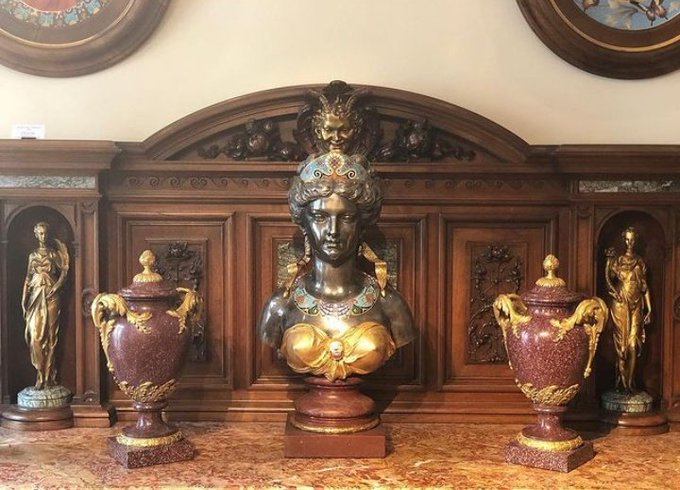
“If the apparition of the night before was an ocular delusion of my fancy sporting with the dark outlines of our cupboard, and if tis horrid eyes were nothing but a pair of inverted teacups, I had, at all events, the satisfaction of having launched the poker with admirable effect, and in true ‘fancy’ phrase, ‘knocked its two daylights into one,’ as the commingled fragments of my tea-service testified. I did my best to gather comfort and courage from these evidences; but it would not do. And then what could I say of those horrid bare feet, and the regular tramp, tramp, tramp, which measured the distance of the entire staircase through the solitude of my haunted dwelling, and at an hour when no good influence was stirring? Confound it!—the whole affair was abominable. I was out of spirits, and dreaded the approach of night. It came, ushered ominously in with a thunderstorm and dull torrents of depressing rain. Earlier than usual the streets grew silent; and by twelve o’clock nothing but the comfortless patterning of the rain was to be heard. I made myself as snug as I could. I lighted two candles instead of one. I forswore bed, and held myself in readiness for a sally, candle in hand; for, coute qui coute, I was resolved to see the being, if visible at all, who troubled the nightly stillness of my mansion. I was fidgety and nervous and, tried in vain to interest myself with my books. I walked up and down my room, whistling in turn martial and hilarious music, and listening ever and anon for the dreaded noise.” #RandolphHarris 20 of 21

Do not Grieve. Anything you lose comes around in another form. The child weaned from mother’s milk now drinks cranberry juice. God’s joy moves from unmarked box to unmarked box, from cell to cell. As rainwater, down into flowerbed. As roses, up from ground. Now it looks like a plate of rice and fish, now a cliff covered with vines, now a horse being saddled. It hides within these, till one day it cracks them open. There is the light gold of wheat in the sun, and the gold of bread made from wheat. I have neither, I am only talking about them as a town in the desert looks up to stars on a clear night. The Son of God, looking upon the World, beheld suffering and misery. With pity He saw how humans had become victims of satanic cruelty. He looked with compassion upon those who were being corrupted, murdered, and lost. They had chosen a ruler who chained them to his carriage as captives. God’s glory pervades the Universe; His ministering Angels inquire of one another: Where is the place of His glory? In response they give praise: Praised be the glory of the Lord from His Heavenly abode. From His Heavenly abode may He turn in mercy and bestow grace unto the people who, reciting the Shema evening and morning, twice daily, proclaim in love the unity of His name, saying: Hear, O America: the Lord our God, the Lord is One. He is our God; He is our Father, our sovereign and our Deliverer. In His mercy He will make known in presence of all the living that He will be your God. “I am the Lord your God.” As it is written in holy Scripture: The Lord shall reign forever; Thy God, O America, shall be Sovereign unto all generations. Hallelujah. #RandolphHarris 21 of 21

Winchester Mystery House

Ghostly tales are bountiful at Sarah Winchester’s Mystery House. What have you experienced? Photos are encouraged!

The Winchester mansion is 160-room mansion built to appease the spirits who died at the hands of the Winchester Rifle 👻
🗝 winchestermysteryhouse.com
“Whoever shadows my every move will not lose me in the dark.” At least that is what Christ says, or what the Evangelist John heard Him say (8.12). He tells us to walk on, through the darkness, with Christ as our only torch. That way, when we mayn’t have gained a step, but we won’t have lost one either. And on into the day we must pursue with dogged tread the life of Jesus Christ. Is this the secret to Mrs. Winchester’s 7-11 staircase?

This is the Beginning, When People Will Be Opening their Eyes!

Nothing is quite as funny as the unintended humour of reality. The original position is designed to be a fair and impartial point of view that is to be adopted in our reasoning about fundamental principles of justice. In taking up this point of view, we are imagining ourselves in the position of free and equal persons who jointly agree upon and commit themselves to the principles of social and political justice. The main distinguishing feature of the original position is “the veil of ignorance”: to insure impartiality of judgment, the parties are deprived of all knowledge of their personal characteristics and social and historical circumstances. The two principles of justice guarantee the equal basic rights and liberties needed to secure the fundamental interests of free and equal citizens and to pursue a wide range of conceptions of good. The second principle provides fair equality of education and employment opportunities enabling all to fairly compete for powers and positions of office; and it secures for all a guaranteed minimum of the all-purpose means (including income and wealth) that individuals need to pursue their interests and to maintain their self-respect as free and equal persons. Persons in the original position give pride of place to their interest in the equal freedoms. The intuitive idea behind the precedence of liberty is that if the persons in the original position assume that their basic liberties can be effectively exercised, they will not exchange a lesser liberty for an improvement in the economic well-being, at least not once a certain level of wealth has been attained. #RandolphHarris 1 of 21

It is only when social conditions do not allow the effective establishment of these rights that one can acknowledge their restriction. Only if it is necessary to enhance the quality of civilization so that in due course the equal freedoms can be enjoyed by all can the denial of equal liberty can be accepted. The lexical ordering of the two principles is the long-run tendency of the general conception of justice consistently pursued under reasonably favourable conditions. Eventually there comes a time in the history of a well-ordered society beyond which the special form of the two principles takes over and holds from then on. What must be shown then is the rationality of this ranking from the standpoint of the parties in the original position. Clearly the conception of goodness as rationality and the principles of moral psychology have a part in answering this question. Now the basis for the priority of liberty is roughly as follows: as the conditions of civilization improve, the marginal significance for our god of further economic and social advantages diminishes relative to their interests of liberty, which become stronger as the conditions for the exercise of the equal freedoms are more fully realized. Beyond some point it becomes and then remains irrational from the standpoint of the original position to acknowledge a lesser liberty for the sake of greater material means and amenities of office. This is so because as the general level of well-being raises (as indicated by the index of primary goods the less favoured can expect) only the less urgent wants remain to be met by further advances, at least insofar as human’s wants are not largely created by institutions and social forms. #RandolphHarris 2 of 21

At the same time the obstacles to the exercise of the equal liberties decline and a growing insistence upon the right to pursue our spiritual and cultural interests assert itself. Increasingly it becomes more important to secure the free internal life of the various communities of interests in which persons and groups seek to achieve, in modes of social union consistent with equal liberty, the ends and excellences to which they are drawn. In addition humans come to aspire to some control over the laws and rules that regulate their association, either by directly taking part themselves in its affairs or indirectly through representatives with whom they are affiliated by ties of culture and social situation. To be sure, it is not the case that when the priority of liberty holds, all material wants are satisfied. Rather these desires are not so compelling as to make it rational for the persons in the original position to agree to satisfy them by accepting a less than equal freedom. The account of the good enables the parties to work out a hierarchy among their several interests and to note which kinds of ends should be regulative in their rational plans of life. Until the basic wants of individuals can be fulfilled, the relative urgency of their interest in liberty cannot be firmly decided in advance. It will depend on the claims of the least favoured as seen from the constitutional and legislative stages. However, under favourable circumstances the fundamental interest in determining our plan of life eventually assumes a prior place. One reason for this I have discussed in connection with liberty of conscience and freedom of thought. #RandolphHarris 3 of 21

And a second reason is the central place of the primary good of self-respect and the desire of human beings to express their nature in a free social union with others. Thus the desire for liberty is the chief regulative interest that the parties must suppose they all will have in common in due course. The veil of ignorance forces them to abstract from the particulars of their plans of life, thereby leading to this conclusion. The serial ordering of the two principles then follows. Now it might seem that even though the desire for an absolute increase in economic advantages declines, human’s concern for their relative place in the distribution of wealth will persist. In fact, if we suppose that everyone wishes a greater proportionate share, the result could be a growing desire for material abundance all the same. Since each strives for an end that cannot be collectively attained, society might conceivably become more and more preoccupied with raising productivity and improving economic efficiency. And these objectives might become so dominant as to undermine the precedence of liberty. Some have objected to the tendency to equality on precisely this ground, that it is thought to arouse in individuals an obsession with their relative share of social wealth. However, while it is true that in a well-ordered society there is most likely a trend to greater equality, its members take little interest in their relative position as such. As we have seen, they are not much affected by envy and jealousy, and for the most part they do what seems best to them as judged by their own plan of life without being dismayed by the greater amenities and enjoyments of others. #RandolphHarris 4 of 21

Thus there are no strong psychological propensities prompting them to curtail their liberty for the sake of greater absolute or relative economic welfare. The desire for a higher relative place in the distribution of material means should be sufficiently weak that the priority of liberty is not affected. Of course, it does not follow that in a just society everyone is unconcerned with matters of status. The account of self-respect as perhaps the main primary good has stressed the great significance of how we think others value us. However, in a well-ordered society the need for status is met by the public recognition of just institutions, together with the full and diverse internal life of the many free communities of interest that equal liberty allows. The basis for self-esteem in a just society is not then one’s income share but the publicly affirmed distribution of fundamental rights and liberties. And this distribution being equal, everyone has a similar and secure status when they meet to conduct the common affairs of the wider society. No one is inclined to look beyond the constitutional affirmation of equality for further political ways of securing one’s status. No one is inclined to look beyond the constitutional affirmation of equality for further political position from a strategic point of view. It would also have the effect of publicly establishing their inferiority as defined by the basic structure of society. This subordinate ranking in the public forum experienced in the attempt to take part in political and economic life, and felt in dealing with those who have a greater liberty, would indeed be humiliating and destructive of self-esteem. #RandolphHarris 5 of 21

And so by acquiescing in a less than equal liberty one might lose on both counts. This is particularly likely to be true as society becomes more just, since equal rights and public attitudes of mutual respect have an essential place in maintaining a political balance and in assuring citizens of their own worth. Thus while the social and economic differences between the various sectors of society, the noncomparing groups as we may think of them, are not likely to generate animosity, the hardships arising from political and civic inequality, and from culture and ethnic discrimination, cannot be easily accepted. When it is the position of equal citizenship that answers to the need for status, the precedence of equal liberties becomes all the more necessary. Having chosen a conception of justice that seeks to eliminate the significance of relative economic and social advantages as supports for human’s self-confidence, it is essential that the priority of liberty be firmly maintained. So for this reason too the parties are led to adopt a serial ordering of the two principles. In a well-ordered society then self-respect is secured by the public affirmation of the status of equal citizenship for all; the distribution of material means is left to take care of itself in accordance with the idea of pure procedural justice. Of course doing this assumes the requisite background institutions which narrow the range of inequalities so that excusable envy does not arise. Now this way of dealing with the problem of status has several noteworthy features which may be brought out as follows. #RandolphHarris 6 of 21

Suppose to the contrary that how one is valued by others depends upon one’s relative place in the distribution of income and wealth. In this case, having a higher status implies having more material means than a larger fraction of society. Thus not everyone can have the highest status, and to improve one person’s position is to lower that of someone else. Social cooperation to increase the conditions of self-respect is impossible. The means of status, so to speak, are fixed, and each human’s gain is another’s loss. Clearly this situation is a great misfortune. Persons are set at odds with one another in the pursuit of their self-esteem. Given the preeminence of this primary good, the parties in the original position surely do no want to find themselves so opposed. If not impossible, it would tend, for one thing, to make the good of social union difficult to achieve. Moreover, if the means of providing a good are indeed fixed and cannot be enlarged by cooperation, as mentioned in the discussion of envy, then justice seems to require equal shares, ceteris paribus. However, an equal division of all primary gods in irrational in view of the possibility of bettering everyone’s circumstances by accepting certain inequalities. Thus the best solution is to support the primary good of self-respect as far as possible by the assignment of the basic liberties that can indeed be made equal, defining the same status for all. At the same time, distributive justice as frequently understood, justice in the relative shares of material means, is relegated to a subordinate place. #RandolphHarris 7 of 21

Thus we arrive at another reason for factoring the social order into two parts as indicated by the principles of justice. While these principles permit inequalities in return for contributions that are for the benefit of all, the precedence of liberty entails equality in the social bases of esteem. Now it is quite possible that this idea cannot be carried through completely. To some extent human’s sense of their own worth may hinge upon their institutional position and their income share. If, however, the account of social envy and jealousy is sound, then, with the appropriate background arrangements, these inclinations should not be excessive, at least not when the priority of liberty is effectively upheld. However, if necessary, theoretically we can include self-respect in the primary goods, the index of which defines expectations. Then in applications of the difference principle this index can allows for the effects of excusable envy; the expectations of the less advantaged are lower the more severe these effects. Whether some adjustment for self-respect has to be made is best decided from the standpoint of the legislative stage where the parties have more information about social circumstances and the principle of political determination applies. Admittedly this problem is an unwelcome complication. Since simplicity it itself desirable in a public conception of justice, the conditions that elicit excusable envy should if possible be avoided. Expectations of the less advantaged can be understood so as to include the primary good of self-esteem. #RandolphHarris 8 of 21

Now some may want to object to this account of the priority of liberty that societies have other ways of affirming self-respect and of coping with envy and other disruptive inclinations. Thus in a feudal or in a caste system each person is believed to have one’s allotted station in the natural order of things. One’s comparisons are presumably confined to within one’s own estate or caste, these ranks becoming in effect so many noncomparing groups established independently of human control and sanctioned by religion and theology. Humans resign themselves to their position should it ever occur to them to question it; and since all may view themselves as assigned their vocation, everyone is held to be equally fated and equally noble in the eyes of providence. This conception of society solves the problem of social justice by eliminating in thought the circumstances that give rise to it. The basic structure is aid to be already determined, and not something for human beings to affect. On this view, it misconceives human’s place in the World to suppose that the social order should match principles which they would as equals consent to. Now to this idea, parties re to be guided in their choice of a conception of justice by a knowledge of the general facts about society. They take for granted than that institutions are not fixed but change overtime, altered by natural circumstances and the activities and conflicts of social groups. The constraints of nature are recognized, but humans are not powerless to shape their social arrangements. #RandolphHarris 9 of 21

This assumption is likewise part of the background of the theory of justice. It follows that certain ways of dealing with envy and other aberrant propensities are closed to a well-ordered society. For example, it cannot keep them in check by promulgating false or unfounded beliefs. For our problem is how society should be arranged if it is to conform to principles that rational persons with true general beliefs would acknowledge in the original position. The publicity condition of requires the parties to assume that as members of society they will also know the general facts. The reasoning leading up to the initial agreement is to be accessible to public understanding. Of course, in working out what the requisite principles are, we must rely upon current knowledge as recognized by common sense and the existing scientific consensus. However, there is no reasonable alternative to doing this. We have to concede that as established beliefs change, it is possible that the principles of justice which it seems rational to choose may likewise change. Thus when the belief in a fixed natural order sanctioning a hierarchical society is abandoned, assuming here that this belief is not true, a tendency is set up that points in the direction of two principles of justice inertial order. The effective protection of the equal liberties becomes increasingly of first importance. When God wants to punish people, he gives the unjust leaders. So the answer is for the people to repent, turn from their ways, be converted, and seek God. #RandolphHarris 10 of 21

Some people only care about power and what they can do with power. May the Lord come down to protect our people. Democracy is not prescribed in the Bible, and Christians can and do live under other political systems. However, Christians can hardly fail to love democracy, because of all systems it best assures human dignity, the essence of our creation in God’s image. If a candidate wins by cheating, he or she can only be forgiven by God if one renounced the office one has obtained by fraud. There will be no divine forgiveness for this act of injustice without a previous decision to repay the damage done. However, apparently God’s forgiveness is unimportant to some ruling. When politicians rig the vote, it means all the passion for democracy and all the prayers of the people are meaningless. A government that assumes or maintains power through fraudulent means has no moral basis. If it does not of itself freely correct the evil it has inflicted on the people, then it is our serious moral obligation as a people to make it do so. Nonetheless, there is enormous sin attached to fratricidal strife. As moral outrage grows, it is important to study the Bible. God has ordained government to preserve order, but even a bad government is better than no government—which results in chaos. Government’s authority comes from God; it is a delegation. Therefore, governments—all governments—whether they acknowledge it or not, rule under God. However, does God give an unrestricted delegation? Certainly not. #RandolphHarris 11 of 21

As Jesus Christ made clear with the coin, there are two realms—and Caesar is not to usurp what belongs to God. Any government that violates the law that is higher than its own is exceeding the legitimate authority God has granted. Government must always be respected, otherwise anarchy results; but the nation may attempt to venerate a culture or race. “When the state is made to serve the aspirations of race or nation instead of the cause of justice for all, it becomes a demonic state warranting resistance and rejection by the Christian faith,” reports Donald Bloesch, Crumbling Foundations (Grand Paris, Mich.: Zondervan, 1984), 183. As Dietrich Bonhoeffer put it, “If government persistently and arbitrarily violates its assigned task, then the divine mandate lapses.” In that case the state becomes evil incarnate, as in Nazi Germany. Instead of acting as God’s instrument for preserving life and order, it does the reverse, destroying life and order. Then the church must resist. Though as argued earlier, the church’s primary function is evangelization and ministering to spiritual needs; as the principle visible manifestation of the Kingdom of God, it must be the conscience of society, the instrument of moral accountability. Richard Neuhaus eloquently wrote that “the church can and should subject to moral questioning every political agenda or cause, thus keeping the entirety of human politics under the transcendent judgement of God.” #RandolphHarris 12 of 21

The church’s first duty then would be to publicly expose the state’s immorality. The government should not be involved in corruption, oppression, the deprivation of civil liberties, nor the taking of innocent lives. As a second step the church should refuse to have any part in the state’s immorality. The church must take the next more severe measures of resistance lest its words be rendered hollow. The great evangelist Charles Finney refused communion to slave-holders. Others organized the underground railroad and rescued fugitive slaves from prison. Many ministers broke the law, were arrested, and some imprisoned. However, that state’s evil, even as egregious as slavery, does not give an unrestricted license to disobey any law; only the unjust law can properly be contested. While active resistance may succeed, as it did with slavery and the Civil-Rights Movement, it may not, however, be enough in the face of the raw power modern totalitarian states have achieved. So, when all peaceable means fail, what does the Christian do? Is revolution ever justified? Scottish reformation theologians like John Knox and Samuel Rutherford believed they could be, advocating the right of Christians to rise up against ungodly rulers. Many ministers in the colonies agreed as well; when they preached that the people had the authority to resist the king when the king violated God’s commands, they were setting the stage for the American Revolution. After dumping tea in Boston Harbour the next step of resistance was the musket. #RandolphHarris 13 of 21

A Boston preacher said that for a people to “arise unanimously and resist their prince, even to dethrone him, is not criminal but a reasonable way of vindicating their liberties and just rights.” John Adams observed, “The revolution was in the minds and hearts of the people, a change in their religious sentiments of their duties and obligations.” Some Christian activists today loosely call for a new American Revolution just as the young radical youth movements did in the sixties. However, history reveals, revolution most often results, after the bodies are buried, in one form of tyranny replacing another. G.K. Chesterton summed it up well: “The real case against revolution is this: That there always seems to be much more to be said against the old regime than in favour of the new regime.” So for the Christian, revolution is never to be lightly regarded. It is the most extreme form of disobedience. It could only be contemplated on the same justification as a just war; that is, that there must be a better alterative as a result of the revolution. Its advantages must outweigh the suffering, and the evil employed in the revolution must prevent a far greater evil than the status quo. This was the reasoning that caused Albert Einstein to abandon his pacifism in the face of a dictator’s rise to power. “To prevent the greater evil, it is necessary that the lesser—the hated military—be accepted for the time being,” Einstein contended. It was this reasoning the caused Bonhoeffer to patriciate in the plot to assassinate this dictator. #RandolphHarris 14 of 21

For Christians to justify participation in revolution, therefore, they would have to be convinced that the state had become totally opposed to the purposes of God for the state and there was no other recourse to prevent massive evil. The Exodus from Egypt is often cited as a model for political action by liberation theologians, but they ignore the fact that in the Exodus, God did not overthrow the political system in Egypt. He extracted His own people from that system, taking them to Mount Sinai that they might worship Him. In the light of this, then, what about America? What lessons are to be drawn from it? We must be aware to prevent a regime’s refusal to allow free elections, the suspensions of civil liberties, the massive corruption of the governmental process, the trampling of human rights, and a leader’s own blasphemous, at times messianic pretensions, which give the church a mandate to act. The church should be mobilized to say no to evil. The first stage of an individua approach should be entirely biblical. By preaching repentance and conversion, one can encourage outbreaks of spiritual revival all across America. One should call for people to pray for their country. A courageous cardinal and ordinary citizens can open a crack of light in the dark canopy that envelops so much of planet Earth. Through peaceful actions and resistance to evil, the Kingdom of God will be made visible again. The Late Francis Schaeffer once wrote, “If here is no place for civil disobedience, then the government has been made autonomous, and as such, it has been put in the place of the living God.” #RandolphHarris 15 of 21

The belief that government is autonomous, the ultimate repository of power, the solution to all of society’s ills, is the greatest imposter of the twenty-first century. Christians and the church have no higher calling than to expose it by every legitimate means. To some people the great trouble about any argument for the Supernatural is simply the fact that argument should be needed at all. If so stupendous a thing exists, ought it not be obvious as the sun in the sky? It is not intolerable, and indeed incredible, that knowledge of the most basic of all Facts should be accessible only by wire-drawn reasonings for which the vast majority of humans have neither leisure nor capacity? I have great sympathy with this point of view. However, we must notice two things. When you are looking at a garden from a room upstairs it is obvious (once you think about it) that you are looking through a window. However, if it is the garden that interests you, you may look at it for a long time without thinking of the window. When you are reading a book, it is obvious (once you attend to it) that you are using your eyes: but unless your eyes begin to hurt you, or the book is a text book on optics, you may read all evening without once thinking of eyes. When we talk we are obviously using langue and grammar: and when we try to talk a foreign language we may be painfully aware of the fact. However, we are talking English, we do not notice it. When you shout from the top of the stirs, “I am in half a moment,” you are usually conscious that you have made the singular am agree with the singular I. #RandolphHarris 16 of 21

There is indeed a story told about a Native American who, having learned several other languages, was asked to write a grammar of the language used by his own tribe. He replied, after some thought, that it had no grammar. The grammar he had sued all his life had escaped his notice all his life. He knew it (in once sense) so well that (in another sense) he did not know it existed. All these instances show that the fact, and through which alone you have access to all the other facts, may be precisely the one that is most easily forgotten—forgotten not because it is so remote or abstruse but because it is so near and so obvious. And that is exactly how the Supernatural has been forgotten. The Naturalists have been engaged in thinking about Nature. They have not attended to the fact that they were thinking. The moment one attends to this it is obvious that one’s own thinking cannot be merely a natural event, and that therefore something other than Nature exists. The Supernatural is not remote and abstruse: it is a matter f daily and hourly experience, as intimate as breathing. Denial of it depends on a certain absent-mindedness. However, this absent-mindedness is in on way surprising. You do not need—indeed you do not wish—to be always thinking about windows when you are looking at gardens or always thinking about eyes when you are reading. #RandolphHarris 17 of 21

In the same way the proper procedure for all limited and particular inquiries is to ignore the fact of your own thinking, and concentrate on the object. It is only when you stand back from particular inquiries and try to form a complete philosophy that you must take it into account. For a complete philosophy must get in all the facts. In it you turn away from specialized or truncated thought to total thought: and one of the facts total thought must think about is Thinking itself. There is thus a tendency in the study of Nature to make us forget the most obvious first of all. And since the Sixteenth Century, when Science was born, the minds of humans have been increasingly turned outward, to know Nature and to master her. They have been increasingly engaged on those specialized inquiries for which truncated thought is the correct method. It is therefore not in the least astonishing that they should have forgotten the evidence for the Supernatural. The deeply ingrained habit of truncated thought—what we call the “scientific” habit of mind—was indeed certain to lead to Naturalism, unless this tendency were continually corrected from some other source. However, no other source was at hand, for during the same period humans of science were coming to be metaphysically and theologically uneducated. That brings me to the second consideration. The state of affairs in which ordinary people can discover the Supernatural only by abstruse reasoning is recent and, by historical standards, abnormal. #RandolphHarris 18 of 21

All over the World, until quite modern times, the direct insight of the mystics and the reasonings of the philosopher percolated to the mass of the people by authority and tradition; they could be received by those who were no great reasoners themselves in the concrete form of myth and ritual and the whole pattern of life. In the conditions produced by a century or so of Naturalism, plain humans are being forced to bear burdens which plain humans were never expected to bear before. We must get the truth for ourselves or go without it. There may be two explanations for this. It might be that humanity, in rebelling against tradition and authority, has made a ghastly mistake; a mistake which will not be less fatal because the corruptions of those in authority rendered it very excusable. On the other hand, it may be that the Power which rules our species is at this moment carrying out a daring experiment. Could it be intended that the whole mass of the people should now move forward and occupy for themselves those heights which were once reserved only for the sages? Is the distinction between wise and simple to disappear because all are now expected to become wise? If so, our present blunderings would be but growing pains. However, let us make no mistake about our necessities. If we are content to go back and become humble plain humans obeying a tradition, well. If we are ready to climb and struggle on till we become sages ourselves, better still. However, the human who will neither obey wisdom in others nor adventure for her oneself is fatal. #RandolphHarris 19 of 21

A society where the simple many obey the few seers can live: a society where all were seers could live even more fully. However, a society where the mass is still simple and the seers are no longer attended to can achieve only superficiality, baseness, ugliness, and in the end extinction. On or back we must go; to stay here is death. One other point that may have raised doubt or difficulty is the advanced reasons for believing that a supernatural element in present in every rational human. The presence of human rationality in the World is therefore a Miracle. Human Reason an Morality have been mentioned not as instances of Miracle (at least, not of the kind of Miracle you wanted to hear about) but as prods of the Supernatural: not in order to show that Nature ever is invaded but that there is a possible invader. Whether you choose to call the regular and familiar invasion by human Reason a Miracle or not is largely a matter of words. Its regularity—the fact that it regularly enters by the same door, human pleasures of the flesh—may incline you not to do so. It looks as if it were (so to speak) the very nature of Nature to suffer this invasion. However, then we might later find that it was the very nature of Nature to suffer Miracles in general. Fortunately the course of our argument will allow us to leave this question of terminology on one side. We are going to be concerned with other invasions of Nature—with what everyone would call Miracles. #RandolphHarris 20 of 21

Our question could, if you liked, be put in the form, “Does Supernature every produce particular results in space and time except through the instrumentality of human brains acting on human nerves and muscles?” I have said “particular results” because, on our view, Nature as a whole is herself one huge result of the Supernatural: God created her. God pierces her wherever there is a human mind. God presumably maintains her in existence. The question is whether He ever does anything else to her. Does God, beside all this, ever introduce into her events of which it would not be true to say, “This is simply the working out of the general character which God gave to Nature as a whole in creating her”? Such events are what are popularly called Miracles: and it will be in this sense only that the word Miracle will be used from now on. Do not stand at my grace and weep, I am not there. I do not sleep. I am a though rays of light that glow. I am the diamond glint on snow. I am the moonlight on the shinning sea. I am the gentle autumn rain. When you wake in the morning hush, I am the swift, uplifting rush or quiet birds in circling flight. I am the soft starlight at night. Do not stand at my grace and weep. I am not there. I do not sleep. Our God and God of our fathers, we thank Thee for Thy Torah, our priceless heritage. May the portion we have ready today inspire us to do Thy will and to seek further knowledge of Thy word. Thus our minds will be enriched and our lives endowed with purpose. May we take to heart Thy laws by which humans truly live. Happy are all who love Thee and delight in Thy commandments. Amen. #RandolphHarris 21 of 21

Cresleigh Homes

There’s something irresistible about eating at the island; it’s casual, yet festive. Guests can be part of the food prep, and everyone gets to make merry together all evening long.

Meadows Res 1 shows just how well single story living suits the family who loves to entertain!

Residence One at Cresleigh Meadows holds 2,054 square feet of single story living. The open concept design includes three bedrooms, two bathrooms and a two car garage plus workshop. Through the charming front porch enter into the foyer, where two secondary bedrooms lead off to a Jack and Jill bathroom. The kitchen comes fully equipped with a large eat-in island, stainless steel appliances, and quartz counters. The great room is spacious and full of natural light. The Owner’s suite is nestled in the rear of the home separate from the secondary bedrooms, providing maximum privacy. Enjoy a spa like experience in the Owner’s bathroom with a large walk in shower and large soaking tub.

Best of all, each Cresleigh home comes fully equipped with an All Ready connected home! This smart home package comes included with your home and features great tools including: video door bell and digital deadbolt for the front door, connect home hub so you can set scenes and routines to make life just a little easier. Two smart switches and USB outlets are also included, plus we’ll gift you a Google Home Hub and Google Mini to help connect everything together!

There is nothing more important than a good, safe, secure home. Come and see why Cresleigh is America’s Favourite.
#CresleighHomes
#PlumasRanch

Even the Truth Can Spread and Not Only the Popular Lie!

It is easy enough to praise humans for the courage of their convictions. I wish I could teach the sad young of this mealy generation the bravery of this confusion. The hardest job kids face today is learning good manners without seeing any. We all learn by experience but some of us have to go to summer school. The malignant forms of aggression—sadism and necrophilia—are not innate; hence, they can be substantially reduced when the socioeconomic conditions are replaced by conditions that are favourable to the full development of human’s genuine needs and capacities: to the development of human self-activity and human’s genuine need and capacities: to the development of human self-activity and human’s creative power as its own end. Exploitation and manipulation produce boredom and triviality; they cripple human self-activity and all factors that make humans into a psychic cripple turn one also into a sadist or a destroyer. Humans, have in our day become a source of suspicion and distrust of all against all. Credulity is one our worst enemies, but that is the makeshift the neurotic always resorts to in order to quell the doubter in one’s own heart or to conjure one out of existence. The result is that modern humans know oneself only in so far as one can become conscious of oneself—a capacity largely dependent on environment conditions, knowledge and control of which necessitated of suggested certain modifications of one’s original instinctive tendencies. #RandolphHarris 1 of 19

Their consciousness therefore orients itself chiefly by observing and investigating the World around one, and it is to the latter’s peculiarities that one must adapt one’s psychic and technical resources. This task is so exacting, and its fulfilment so profitable, that one forgets oneself in the process, losing sight of one’s instinctual nature and putting one’s own conception of oneself in place of one’s real being. In this way one slips imperceptibly into a purely conceptual World where the products of one’s conscious activity progressively take the place of reality. The Communist revolution has debased humans far lower than collective psychology has done, because it robs one of one’s freedom not only in the social but in the moral and spiritual sphere. Aside from the political difficulties, this entailed a great psychological disadvantage for the West that had already made itself unpleasantly felt in the days of German Nazism: we can now point a finger at the shadow. Optimism is an alienated form of faith, pessimism an alienated form of despair. If one truly responds to humans and their future, id est, concernedly and “responsibly,” one can respond only by faith or by despair. Rational faith as well as rational despair are based on the most thorough, critical knowledge of all the factors that are relevant for the survival of humans. The basis of rational faith in humans is the presence of a real possibility for one’s salvation; the basis for rational despair would be the knowledge that no such possibility can be seen. #RandolphHarris 2 of 19

Most people are quite ready to denounce faith in human’s improvement as unrealistic; but they do not recognize that despair is often just as unrealistic. It is easy to say: “Humans have always been killer.” However, the statement nevertheless is not correct, for it neglects to take into account the intricacies of history of destructiveness. It is equally easy to say, “The desire to exploit others is just human nature”; but again, the statement neglects (or distorts) the facts. In brief, that statement, “Human nature is evil,” is not a bit more realistic than the statement, “Human nature is good.” However, the first statement is much easier to make; anyone who wants to prove human’s evilness finds followers most readily, for one offers everybody an alibi for one’s own sins—and seemingly risks nothing. Yet the spreading of irrational despair is in itself destructive, as all untruth is; it discourages and confuses. Preaching irrational faith or announcing false Messiahs is hardly destructive—it seduces and then paralyzes. The attitude of the majority is neither that of faith nor that of despair, but, unfortunately, that of complete indifference to the future of humans. With those who are not entirely indifferent, the attitude is that of “optimism” or of “pessimism.” They are accustomed to identifying human achievement with technical achievement, human freedom with freedom from direct coercion and the consumer’s freedom to choose between many allegedly different commodities. The dignity, cooperativeness, kindness of the primitive do not impress them; technical achievement, wealth, toughness do. Centuries of rule over technically backward people of different colour have left their stamp on the optimists’ minds. #RandolphHarris 3 of 19

How could a “savage” be human and equal, not to speak of superior, to the humans who can fly to the moon—or by pushing a button, destroy millions of living beings? The optimists live well enough, at least for the moment, and they can afford to be “optimists.” Or at least that is what they think because they are so alienated that even the threat to the future of their grandchildren does not genuinely affect them. The “pessimists” are really not very different from the optimists. They live just as comfortably and are just as little engaged. The fate of humanity is as little their concern as it is the optimists’. They do not feel despair; if they did, they would not, and could not, live as contentedly as they do. And while their pessimism functions largely to protect the pessimists from any inner demand to do something, by projecting the idea that nothing can be done, the optimists defend themselves against the same inner demand by persuading themselves that everything is moving in the right direction anyway, so nothing needs to be done. To have faith means to dare, to think the unthinkable, yet to act within the limits of the realistically possible; it is the paradoxical hope to expect the Messiah every day, yet not to lose heart when He has not come at the appointed hour. This hope is not passive and it is not patient; on the contrary, it is impatient and active, looking for every possibility of action within the realm of real possibilities. Least of all is it passive as far as the growth and the liberation of one’s own person are concerned. #RandolphHarris 4 of 19

There are several limitations to personal development determined by the social structure. However, those alleged radicals who counsel that no personal change is possible or even desirable within present-day society use their revolutionary ideology as an excuse for their personal resistance to inner change. The situation of humankind today is too serious to permit us to listen to the demagogues—least of all demagogues who are attacked to destruction—or even to the leaders who use only their brains and whose hearts have hardened. Critical and radical thought will only bear fruit when it is blended with the most precious quality humans are endowed with—the love of life. Hate, as a relation to objects is older than love. It derives from the narcissistic ego’s primordial repudiation of the external World. It really seems as though it is necessary for us to destroy some other thing or person in order not to destroy ourselves, in order to guard against the impulsions to self-destruction. A sad disclosure indeed for the moralist! Humans are looked upon as an isolated system, driven by two impulses: one to survive (ego instinct) and one to have pleasure by overcoming the tensions that in turn were chemically produced within the body and localized in the “erogenous zones.” However, there is no need for psychoanalysis to be ashamed to speak of love, for religion itself said: “Thou shalt love thy neighbour as thyself.” This, however, is more easily said than done. #RandolphHarris 5 of 19

Emotional bonds are means of identification. Whatever leads humans to share important interests produces this community of feeling, these identifications. And the structure of human societies is to a large extent based on them. “Thou shalt love thy neighbour as thyself.” It is known throughout the World and is undoubtedly older than Christianity, which puts it forward as its proudest claim. Yet it is certainly not very old; even in historical times it was still strand to humankind. Let us adopt a naïve attitude towards it, as though we were hearing it for the first time; we shall be unable then to suppress a feeling of surprise and bewilderment. Why should we do it? What good will it do us? However, above all, how shall we achieve it? How can it be possible? My love is something valuable to me which I ought not to throw away without reflection It imposes duties on me for whose fulfillment I must be ready to make sacrifices. If I love someone, one must deserve it in some way. (I leave out of account the use one may be to me in important ways that I an love myself in one; and one deserves it if one is so much more perfect than myself that I can love my ideal of my own self in one. Again, I have to love one if one is my friend’s son, since the pain my friend would feel if any harm came to one would be my pain too—I should have to share it. However, if one is a stranger to me and if one cannot attract me by any worth of one’s own or any significance that one may already have acquired for my emotional life, it would be for hard for me to love one. #RandolphHarris 6 of 19

Indeed, I should be wrong to do so, for my love is valued by all my own people as a sign of my preferring them, and it is an injustice to them if I put a stranger on a par with them. However, I am to love one (with this universal love) merely because one, too, is an inhabitant of this Earth, like an insect, and Earth-worm or a grass-snake, then I fear that only a small modicum of my love will fall to one’s share—not by any possibility as much as, by the judgment of my reason, I am entitled to retain for myself. The contradiction between death instinct and Eros (fundamental and creative love) confronts humans with a real and truly trading alternative. A real alternative because one can decide to attack and wage war, to be aggressive, and to express one’s hostility because one prefers to do this rather than to be sick. That this alternative is a tragic one hardly needs to be proven. And now we are struck by the significance of the possibility that the aggressiveness may not be able to find satisfaction in the external World because it comes up against real obstacles. If this happens, it will perhaps retreat and increase the amount of self-destructiveness holding sway in the interior. Holding back aggressiveness is in general unhealthy and leads to illness. However, science and learning to control the environment and making is more palatable for habitation and cultivation of agriculture, along with religion and psychology is good for humans. Humans are freed from the tragic choice between destroying either others or oneself, because the energy of destructive instinct is used for the control over nature. #RandolphHarris 7 of 19

However, we must ask, can this really be so? Can it be true that destructiveness becomes transformed into constructiveness? What can “control over nature” mean? Taming and breeding animals, gathering and cultivating plants, weaving cloth, building huts, manufacturing pottery, and many more activities including the construction of machines, railroads, airplanes, and skyscrapers. All these acts of constructing, building, unifying, synthesizing, and, indeed, if one wanted to attribute them to one of the two basic instincts, they might be considered as being motivated by Eros rather than by the death instinct. With the possible exception of the killing animals for their consumption and killing humans in war, both of which could be considered as rooted in destructiveness, control, and mastery over nature is not destructive but constructive. The death instinct turns into the destructive instinct when, with the help of special organs, it is directed outwards, on to objects. However, civilization leads to the holding back of aggressiveness and results in physical illness, and this is why so many people go to church, are in therapy, and on psychotropic drugs. Many human beings want to deal with their aggression in health ways and have a peaceful, well-behaved community. The forlorn state of consciousness in our World is due primarily to loss of instinct, and the reason for this lies in the development of the human mind over the past aeon. The more power humans have over nature, the more one’s knowledge and skill went to one’s head, and the deeper became one’s contempt for the merely natural and accidental, for all irrational data—including the objective psyche, which is everything that consciousness in not. #RandolphHarris 8 of 19

The Church recommends, in order to maintain society, that we develop more faith. Faith is a gift of grace and depends on human’s good will and pleasure. The seat of one’s faith, however, is not consciousness but spontaneous religious experience, which brings the individual’s faith into immediate relation with God. Here each of us must ask: Have I any religious experience and immediate relation to God, and hence that certainty which will keep me, as an individual, from dissolving in the crowd? To this question there is an optimistic answer only when the individual is willing to fulfil the demands of rigorous self-examination and self-knowledge. If one does this, one will not only discover some important truths about oneself but will also have gained a psychological advantage: one will have succeeded in deeming oneself worthy of serious attention and sympathetic interests. One will have set one’s hand, as it were, to a declaration of one’s own dignity and taken the first step towards the foundations of one’s consciousness—that is, towards the unconscious, the only available source of religious experiences. This is certainly not to say that what we call the unconscious is identical with God or is set up in His place. It is simply the medium from which religious experience seems to flow. As to what the further cause of such experience may be, the answer to this lies beyond the range of human knowledge. Knowledge of God is a transcendental problem. When it comes to answering the crucial question that hangs over our time like a threat, the religious person enjoys a great advantage. #RandolphHarris 9 of 19

The religious person has a clear idea of the way one’s subjective existence is grounded in one’s relation to “God.” God is an anthropomorphic idea whose dynamism and symbolism are filtered through the medium of the unconscious psyche. Anyone who wants to can at least draw near to the source of such experiences, no matter whether one believes in God or not. Exotic races have ceased to be peepshows in ethnological museums. They have become our neighbours, and what was yesterday the private concern of the ethnologist is today a political, social, and psychological problem. We may hope for humans of understanding and humans of good will, and must therefore not grow weary of reiterating those thoughts and insights which are needed. Even the truth can spread and not only the popular lie. Only a fool can permanently disregard the conditions of one’s own nature. In fact, this negligence is the best means of making one an instrument of evil. Harmless and naivete are as little helpful as it would be for a cholera patient and those in one’s vicinity to remain unconscious of the contagiousness of the disease. One the contrary, they lead to the projection of the unrecognized evil in the “other.” This strengthens the opponent’s position in the most effective way, because the projection carries the fear which we involuntarily and secretly feel for our own evil over to the other side and considerably increases the formidableness of one’s threat. What is even worse, our lack of insight deprives us of the capacity to deal with evil. Here, of course, we come up against ne of the main prejudices of the Christian tradition, and one that is a great stumbling block to our policies. We should, so we are told eschew evil and, if possible, neither touch for mention it. For evil is also the thing of ill omen, that which is tabooed and feared. #RandolphHarris 10 of 19

This apotropaic attitude toward evil, and the apparent circumventing of it, flatter the primitive tendency in us to shut our eyes to evil and drive it over some frontier or other, like the Old Testament scapegoat, which was supposed to carry the evil into the wilderness. However, if one can no longer avoid the realization that evil, without human’s ever having chosen it, is lodged in human nature itself, then it bestrides the psychological stage as the equal and opposite partner of good. This realization leas straight to a psychological dualism, already unconsciously prefigured in the political World schism and in the even more unconscious dissociation in modern humans. The dualism does not come from this realization; rather, we are in a split condition to begin with it. It would be an insufferable thought that we had to take personal responsibility for so much guiltiness. We therefore prefer to localize the evil in individual criminals or groups of criminals, while washing our hands in innocence and ignoring the general proclivity to evil. This sanctimoniousness cannot be kept up in the long run, because the evil, as experience shows, lies in humans—unless, in accordance with the Christian view, one is willing to postulate a metaphysical principle of evil. The great advantage of this view is that it exonerates human’s conscience of too heavy a responsibility and foists it off on the devil, in correct psychological appreciation of the fact that humans are much more the victims of their psychic constitution than its inventor. #RandolphHarris 11 of 19

Considering that the evil of our day puts everything that has ever agonized humankind in the deepest shade, one must ask oneself how it is that, for all our progress in the administration of justice, in medicine and in technology, for all our concern with life and health, monstrous engines of destruction have been invented which could easily exterminate the human race. No one will maintain that the atomic physicists are a pack of criminals because it is to their efforts that we owe that peculiar flower of human ingenuity, the hydrogen bomb. The vast amount of intellectual work that went into the development of nuclear physics was put forth by humans who dedicated themselves to their task with the greatest exertion and self-sacrifice, and whose moral achievement could therefore just as easily have earned them the merit of inventing something useful and beneficial to humanity. However, even though the first step along the road to a momentous invention may be the outcome of a conscious decision, here, as everywhere, the spontaneous idea—the hunch or intuition—plays an important part. In other words, the unconscious collaborates too and often makes decisive contributions. So it is not the conscious effort alone that is responsible for the result; somewhere or other the unconscious, with its barely discernible goals and intentions, has its finger in the pie. If it puts a weapon in your hand, it is aiming at some kind of violence. #RandolphHarris 12 of 19

Knowledge of the truth is the foremost goal of science, and if in pursuit of the longing for light we stumble upon an immense danger, then one has the impression more of fatality than of premeditation. It is not that present-day humans are capable of greater evil than the humans of antiquity or the primitive. One merely has incomparably more effective means with which to realize one’s propensity to evil. As one’s consciousness has broadened and differentiated, so one’s moral nature has lagged behind. That is the great problem before us today. Reason alone no loner suffices. If only because of their dangerousness, in theory, in lies within the power of reason to desist from experiments of such hellish scope as nuclear fission. However, fear of evil which one does not see in one’s own bosom but always in somebody else’s checks reason every time although everyone knows that the use of this weapon means the certain end of our present human World. The fear of universal destruction may spare us the worst, yet the possibility of it will nevertheless hang over us like a dark cloud so long as no bridge is found across the World-side psychic and political split—a bridge as certain as the existence of the hydrogen bomb. It is in the nature of political bodies always to see evil in the opposite group, just as the individual has an ineradicable tendency to get rid of everything one does not know and does not want to know about oneself by foisting it off on somebody else. The perfect have no needs of others, but weakness has, for it seeks support and does not confront its partner with anything that might force one into an inferior position and even humiliate one. When high idealism plays too prominent a role, this humiliation may happen only too easily. #RandolphHarris 13 of 19

Whenever unjust is uncertain and police spying an terror are at work, human beings fall into isolation, which, of course, is the aim and purpose of the dictator State, since it is based on the greatest possible accumulation of depotentiated social units. To counter this danger, the free society needs a bond of an affective nature, a principle of a kind like caritas, the Christian love of your neighbour. However, it is just this love for one’s fellow humans that suffers most of all from the lack of understanding wrought by projection It would therefore by very much in the interest of the free society to give some thought to the question of human relationship from the psychological point of view, for in this resides its real cohesion and consequently its strength. Where love stop, power begins, and violence, and terror. What our age thinks as the “shadow” and inferior part of the psyche contains more than something merely negative. The very fact that through self-knowledge, that is, by exploring our own souls, we come upon the instincts and their World of imagery should throw some light on the powers slumbering in the psyche, of which we are seldom aware so long as all goes well. We are living in what the Greeks called the right moment for a metamorphosis of the gods, of the fundamental principles and symbols. This peculiarity of our time, which is certainly not of our conscious choosing, is the expression of the unconscious within us who is changing. If humanity is not to destroy itself through the might of its own technology and science, coming generations will have to take to account of this momentous transformation. #RandolphHarris 14 of 19

As at the beginning of the Christian era, so again today we are faced with the problem of general moral backwardness which has failed to keep pace with our scientific, technical, and social progress. So much is at stake and so much depends on the psychological constitution of modern humans. Are they capable of resisting the temptation to use their powers of the purpose of staging a World conflagration? Are humans conscious of the path they are treading, and what the conclusions are that must be drawn from the present World situation and their own psychic situation? Do they know that they are on the point of losing the life-preserving myth of the inner human which Christianity has treasured up for one? Does one realize what lies in store should this catastrophe ever befall one? Is one even capable of realizing that this would in fact be a catastrophe? And finally, does the individual know that one is the makeweight that tips the scales? Happiness and contentment, equability of mind and meaning—fulness of life—these can be experienced only by the individual and not by a State, which, on the one hand, is nothing but a convention agreed to by independent individuals and, on the other, continually threatens to paralyse and suppress the individual. The psychiatrist is one of those who know most about the conditions of the soul’s welfare, upon which so infinitely much depends in the social sum. The social and political circumstances of the time are certainly of considerable significance, but their importance for the weal or woe of the individual has been boundlessly overestimated in so far as they are taken for the sole deciding fact. #RandolphHarris 15 of 19

In this respect all our social goals commit the error of overlooking the psychology of the person for whim they are intended and—very often—of promoting only one’s illusions. I hope, therefore that a psychiatrist, who in the course of a long life has devoted oneself to the causes and consequences of psychic disorders, may be permitted to express one’s opinion, in all the modesty enjoined upon one as an individua, about the questions raised by the World situation today. I am neither spurred on by excessive optimism nor in love with high ideals, but am merely concerned with the fate of the individual human being—that infinitesimal unit on whom a World depends, and in whom, if we read the meaning of the Christian message aright, even God seeks His goal. Testimony to the existence and reality of the glimpse will be found in the literatures of all peoples through all times. It is not a newly manufactured idea, nor a newly manufactured fancy. A human who denies it is foolish so to limit one’s own possibilities, but one may learn better with time. These glimpses cannot rightly be dismissed by the scientist as merely self-suggested or wholly hallucinatory. Nor can they properly be regarded by the metaphysician as valueless for truth. As human beings we live by experience, and they are personal experiences which help to confirm the truth of the impersonal bases underneath them and which encourage us to continue on the same path. The Overself is a living reality. If the quest were merely an intellectual conception or an emotional fancy, nobody would waste one’s years, one’s endeavours, and one’s energies it. #RandolphHarris 16 of 19

The Overself is not only a necessary conception of logical thought. It is also a beautiful fact of persona experience. There are three signs, among others, of the Soul’s presence in a Soul-denying generation. They are: moral conscience, artistic imagination, and metaphysical speculation. Criticism which knows only sensuous and intellectual experience can be litter valid here if, indeed, it is not entirely irrelevant. When a human confuses the nature of the mind with its own thoughts, when one is unable properly to analyse consciousness and memory, when one has never practised introspection and meditation successfully, one can know nothing of the soul and may well be sceptical of its existence. That the Overself is not the product of an inflated imagination but has a real existence, is a truth which any human who has the required patience and submits to the indispensable training may verify oneself. It is not a dim abstraction but a real presence. Not a vauge theory but a vital fact. To the human of insight there is something strange, ironic, and yet pathetic in the spectable of those who turn the consciousness and the understanding derived from the Overself against the acknowledgement of Its existence. If one can shed the mummy wrappings of acquired notions, complacent bigotries, and superstitious customs, and look at a problem with fresh eyes, one is more likely to succeed in one’s quest for truth. If one can re-examine the whole meaning of it as though it were a newly discovered problems, one is more likely to move towards it correct solution. If one will refuse to be intimidated by dietary precedent, and begin to rethink the whole matter of eating’s why and wherefore, one will reach astonishing results. For much nonsense about diet has come down to us by ignorant tradition and unthinking inheritance. #RandolphHarris 17 of 19

As one draws closer to the soul of things, one comes more into harmony with Nature. And if one is true to one’s instincts, one will eat one’s food more and more as Nature herself produces it. Inferior and even harmful foods have been eaten for so long that most people have become addicted to them and, through habitual use, come to like them. It is true that several of these food have been part of a civilized diet for generations, but the duration of an error does not make it less an error, and does not justify its continuance. It is a fact worthy speculating upon that many groups of early Christians were mystical and had a special diet. Had they not been ousted by the Emperor Constantine—whose imperialistic political purpose they did not serve—from the official Christianity which he (and not Jesus) established, we might today have seen half the Christian World holding a faith in mystical beliefs and eating special diets. The France of Louis XII saw some remnants of those early sects, such as the Albigenses, Montanists, and Camisards—and no less than one third of total population of the country—living on special diets. Luigi Cornaro lived to a hundred in Italy on a strictly limited daily quantity of food. Dr. Josiah Oldfield was nearing his hundred year when I last visited England and attributed the fact to avoiding eating too much, which he termed “the great evil.” He is also an enthusiastic advocate of special diets. In the moment when you feel that actual contact with the One Infinite Life-Power has been made, draw it into the body and let it permeate every part, every organ, and every atom. It will tend to dissolve sickness and drive out disease. #RandolphHarris 18 of 19

Healing powers are like prayers, they can cross oceans and traverse continents as readily and as speedily as can radio waves or thought. Telepathy is a fact and the basis of this operation. The ministrations of absent healing are most successful when the individual is passive and receptive to them. Hence the work of its power is most effective when the sufferer is sleeping or relaxing. I am the family of the Universe, and with all of us together I do not fear being alone; I can reach out and touch a rock or a hand or dip my feet in water Always there is some body close by, and when I speak I am answered by a plane’s roar or the bird’s whistling or the voice of others in conversation far apart from me When I lie down to sleep, I am in the company of the dark and the starts. Breathe to me, sheep in the meadow. Sun and moon, my father and my fathers brother, shine your light on me. My sister, Earth, hold me up to be blessed. Sun and moon, I smile at you both and spread my arms in affection and lay myself down at full length of the Earth to know I love it too and am never to be separated from it In no way shall death part us. Life up your heads, O ye gates, yea, lift them up, ye everlasting doors, that the King of glory may come in. Who is the King of glory? The Lord strong and mighty, the Lord mighty in battle. Life up your hears, O ye gates, yes, lift the up, ye everlasting doors, that the King of glory may come in. Who then is the King of glory? The Lord of hosts; He is the King of glory. #RandolphHarris 19 of 19

Cresleigh Homes
Graphic wall detailing is SO hot right now…but you know what never goes out of style? Thoughtful floor plans that maximize space in the bedroom and luxury in the bathroom (featured is a secondary bedroom, and secondary bathroom). We’re loving Brighton Station Res 2 for its single story living that amplifies comfort!
This single story home boats an ideal layout with 2,427 square feet, of thoughtfully designed living space, three bedrooms, three bathrooms, and a three car garage. https://cresleigh.com/brighton-station/residence-2/
The Cresleigh Collection presents an ideal balance of design and luxury, offering gorgeous single-family homes ranging from approximately 2,000 up to nearly 4,000 square feet of living space. You’ll love the flexibility offered by the unique interior and beautiful private yards.

 Randolph Harris II International Institute