
Home » Apartments (Page 12)
Category Archives: Apartments
In the Morning He Sells His Bed of Cotton and in the Even Returns in Tears to Buy it Back!

To restore a sense of reality, I think Walt Disney should have had a Hardluckland. With so few resources of ills, humans in the state of nature hardly has any need therefore of remedies, much less physicians. Human race is in no worse condition than all the others in this respect; and it is easy to learn from hunters whether in their chases they find many sick animals. They find quite a few that have received serious wounds that healed quite nicely, that have had bones or even limbs broken and reset with no other surgeon than time, no other regimen than their everyday life, and that are no less perfectly cured for not having been tormented with incisions, poisoned with drugs, or exhausted with fasting. Finally, however correctly administered medicine may be among us, it is still certain that although a sick savage, abandoned to oneself, has nothing to fear except one’s illness. This frequently makes one’s situation preferable to ours. Therefore we must take care not to confuse savage humans with the humans we have before our eyes. Nature treats all animals left to their own devices with a partiality that seems to show how jealous se is of that right. The horse, the cat, the bull, even he mule, are usually taller, and all of them have a more robust constitution, more vigour, more strength, and more courage in the forests than in our homes. They lose half of these advantages in becoming domesticated; it might be said that all our efforts at feeding them and treating them well only end in their degeneration. It is the same for humans themselves. In becoming habituated to the ways of society and a slave, one becomes weak, fearful, and servile; one’s soft and effeminate lifestyle completes the enervation of both one’s strength and courage. #RandolphHarris 1 of 23

Let us add that the difference between the savage and the human and the domesticated human should be still greater than that between the savage and the animal and the domesticated animal; for while animal and human have been treated equally by nature, humans give more comfort to themselves than to the animals they tame, and all of these comforts are so many specific causes that makes them degenerate more noticeably. It is therefore no great misfortune for those first humans, nor, above all, such a great obstacle to their preservation, that they are naked, that they have no dwelling, and that they lack all those useful things we take to be so necessary. If they do not have furry skin, they have no need for it in warm countries, and in cold countries they soon learn to help themselves to the skins of animals they have vanquished. If they have but two feet to run with, they have two arms to provide for their defense and for their needs. Perhaps their children learn to walk late and with difficulty, but mothers carry them easily: an advantage that is lacking in other species, where the mother, on being pursued, finds herself forced to abandon her young or to comfort her pace to theirs. [It is possible there are some exceptions to this. For example, the animal from the province of Nicaragua which resembles a fox and which has feet like a man’s hands, and according to Dr. Coreal, has a pouch under its belly in which the mother places her young when she is forced to take flight. No doubt this is the same animal that is called tlaquatzin in Mexico; the female of the species Laet descries as having a similar pouch for the same purpose.] #RandolphHarris 2 of 23

Finally, unless we suppose those singular and fortuitous combinations of circumstances of which I will speak later, and which might very well have never taken place at any rate it is clear that the firs human who made clothing or a dwelling for oneself was giving oneself things that were hardly necessary, since one done without them until then and since it is not clear why, as a grown human, one could not endure the kind of life he had endured ever since one was a child. Alone, idle, and always near danger, savage humans must like to sleep and be a light sleeper like animals which do little thinking and, as it were, sleep the entire time they are not thinking. Since one’s self-preservation was practically one’s sole concern, one’s best trained faculties ought to be those that have attack and defense as their principal object, either to subjugate one’s prey or to prevent one’s becoming the prey of another animal. On the other hand, he organs that are perfected only by softness and sensuality must remain in a state of crudeness that excludes any kind of refinement in one. And with one’s senses of touch and taste: those of sight, hearing and smell will have the greatest subtlety. Such is the state of animals in general, and, according to the reports of travellers, such also is that of the majority of savage peoples. Thus we should not be surprised that the Hottentots of the Cape of Good Hope can sight ships with the naked eye as far out at sea as he Dutch can with telescopes; or that the savages of America were as capable of trailing Spaniards by smell as the best dogs could have done; or that all these barbarous nations endure their nakedness with no discomfort, whet their appetites with hot peppers, and drink European liquors like water. #RandolphHarris 3 of 23

In any terrestrial being I see nothing but an ingenious machine to which nature has given senses in order for it to renew its strength and to protect itself, to a certain point, from all that tends to destroy or disturb it. I am aware of precisely the same things in the human machines, with the differences that nature alone does everything in the operations of an animal, whereas humans contribute, as a free agent, to one’s own operations. The former chooses or rejects by instinct and the later by an act of freedom. Hence an animal cannot deviate from the rule that is prescribed to it, even when it would be advantageous to do so, while humans deviate from it, often to one’s own detriment. Thus a pigeon would die of hunger near a bowl filled with choice meats, and so would a cat perched atop a pile of fruit or grain, even though both could nourish themselves quite well with the food they disdain, if they were of a mind to try some. And thus dissolute humans abandon themselves to excesses which cause them fever and death, because the mind perverts the senses and because the will still speaks when nature is silent. Every animal has idea, since it has senses; up to a certain point it even combines its ideas, and in this regard humans differ from animals only in degree. Some philosophers have even suggested that there is a greater difference between two given humans than between a given human and an animal. Therefore it is not so much understanding which causes the specific distinction of humans from all other animals as it is one’s being a free agent. Nature commands every animal, and beasts obey. Humans feel the same impetus, but they know they are free to go along or to resist; and it is above all in the awareness of this freedom that the spirituality of one’s soul is made manifest. For physics explains in some way the mechanism of the senses and the formation of ideas; but in the power, we find only purely spiritual acts, above which the laws of mechanics explain nothing. #RandolphHarris 4 of 23

However, if the difficulties surrounding all these questions should leave some room for dispute on tis difference between human and animal, here is another very specific quality which distinguishes them and about which there can be no argument: the faculty of self-perfection, a faulty which, with the assistance of circumstances, successively develops all the others, and resides among us as much in the species as in the individual. On the other hand, an animal, at the end of a few months, is what it will be all its life; and is species, at the end of a thousand years, is what it was in the first of those thousand years. Why are humans alone to becoming imbeciles? Is it not that they thereby return to their primitive state, and that, while the animal which has acquired nothing and which also has nothing to lose, always retains its instinct, human, in losing through old age or other accidents all that one’s perfectibility has enabled one to acquire, thus falls even lower than the animal itself? It would be sad for us to be forced to agree that this distinctive and almost unlimited faculty is the source of all human’s misfortunes; that this is what, by dint of time, draws one out of that original condition in which one would pass tranquil and innocent days; that this is what, through centuries of giving rise to one’s enlightenment and one’s errors, one’s vices and one’s virtues, eventually makes one a tyrant over oneself and nature. It would be dreadful to be obliged to praise as a beneficent being the one who first suggested to the inhabitant on the banks of the Orinoco the use of boards which one binds to one’s children’s temples, and which assure them of at least part of their imbecility and their original happiness. #RandolphHarris 5 of 23

Savage humans, left by nature to instinct alone, or rather compensated for the instinct one is perhaps lacking by faculties capable of first replacing them and hen of raising one to the level of instinct, will therefore begin with purely animal functions. Perceiving and feeling will be one’s first state, which one will have in common with all animals. Willing and not willing, desiring, and fearing will be the first and nearly the only operations of one’s soul until new circumstances bring about new developments in it. Whatever the moralists may say about it, human understanding owes much to the passions, which, by common consensus, also owe a great deal to it. It is by their activity that our reason is perfected. We seek to know only because we desire to find enjoyment; and it is impossible to conceive why someone who had neither desires nor fears would go to the bother of reasoning. The passions in turn take their origin from our needs, and their progress from our knowledge. For one can desire or fear things only by virtue of the ideas one can have of hem, or from the simple impulse of nature; and savage humans, deprived of every sort of enlightenment, feels only the passions of this latter sort. One’s desires do not go beyond one’s physical needs. The only goods one knows in the Universe are nourishment, a woman and rest; the only evils one fears are pain and hunger and homelessness. I say pain and not death because an animal will never know what it is to die; and knowledge of death and its terrors is one of the first acquisitions that humans have made in withdrawing from the animal condition. #RandolphHarris 6 of 23

Were it necessary, it would be easy for me to support this view with the facts and to demonstrate that, among all the nations of the World, the progress of the mind has been precisely proportionate to the needs received by peoples from nature or to those needs to which circumstances have subjected them, and consequently to the passions which inclined hem to provide for those needs. I would show the arts coming into being in Egypt and spreading with the flooding of the Nile. I would follow their progress among the Greeks, where they were seen to germinate, grow and rise to the Heavens among the sands and rocks of Attica, though never being able to take root on the fertile banks of the Eurotas. I would point out that in general the peoples of the north are more industrious than those of the south, because they cannot get along as well without being so, as if nature thereby wanted to equalize things by giving to their minds the fertility it refuses their soil. However, without having recourse to the uncertain testimony of history, does anyone fail to see that everything seems to remove savage humans from the temptation and the means of ceasing to be savage? One’s imagination depicts nothing to one; one’s heart asks nothing of one. One’s modest needs are so easily found at hand, and one is so far from the degree of knowledge necessary to make one desire to acquire greater knowledge, that one can have neither foresight nor curiosity. The spectacle of nature becomes a matter of indifference to one by din of its becoming familiar to one. It is always the same order, always the same succession of changes. One does not have a mind for marveling at the greatest wonders; and we must not seek in one the philosophy that a human needs in order to know how to observe once what one has seen everyday. #RandolphHarris 7 of 23

One’s soul, agitated by nothing, is given over to the single feeling of one’s own present existence, without any idea of the future, however, near it may be, and one’s projects, as limited as one’s views, hardly extend to the end of the day. Such is, even today, the extent of the Carib’s foresight. In the morning one sells one’s bed for cotton and in the evening one returns in tears to buy it back, for want of having foreseen that one would need it at night. The more one meditates on this subject, the more distance from pure sensations to the simplest knowledge increases before our eyes; and it is impossible to conceive how a human could have crossed such a wide gap by one’s forces alone, without the assistance of communication and without the provocation of necessity. How many centuries have perhaps gone by before humans were in a position to see any fire other than that from the Heavens? How many different risks did they have to run before they learned the most common uses of that element? How many times did they let it go out before they had acquired the art of reproducing it? And how many times perhaps did each of these secrets die with the one who had discovered it? What will we say about agriculture, an art that requires so much labour and foresight, that depends on so many other arts, that quite obviously is practicable only in a society which is at least in its beginning stages, and that serves us not so much to derive from the Earth food it would readily provide without agriculture, as to force from it those preferences that are most to our taste? #RandolphHarris 8 of 23

However, let us suppose that humans multiplied to the point where the natural productions were no longer sufficient to nourish them: a supposition which, it may be said in passing, would show a great advantage for the human species in that way of life. Let us suppose that, without forges or workshops, farm implements had fallen from the Heavens into the hands of the savages; that these humans had conquered the mortal hatred they all have for continuous work; that they had learned to foresee their needs far enough in advance; that they had guessed how the soil is to be cultivated, grains sown, and trees planted; that they had discovered the arts of grinding wheat and fermenting grapes: all things they would need to have been taught by the gods, for it is inconceivable how they could have picked these things up on their own. Yet, after all this, what human would be so foolish as to tire oneself out cultivating a field that will be plundered by the first comer, be it human or beast, who takes a fancy to the crop? And how could each human resolve to spend one’s life in hard labour, when, the more necessary to one the fruits of one’s labour may be, the surer one is of not realizing them? In a word, how could this situation lead humans to cultivate the soil as long as it is not divided among them, that is to say, as long as the state of nature is not wiped out? There is no security against Miracle to be found by the study of Nature. She is no the whole of reality but only a part; for all we know she might be a small part. #RandolphHarris 9 of 23

If that which is outside her wishes to invade her she has, so far as we can see, no defences. However, of course many who disbelieve in Miracles would admi all this. Their objection comes from the other side. They think that the Supernatural would not invade: they accuse those who say that it has done so of having a childish and unworthy notion of the Supernatural. They therefore reject all form of Supernaturalism which assert such interference and invasions: and specially form called Christianity, for in it the Miracles, or at least some Miracles, are more closely bound up with the fabric of the whole belief than in any others. All the essentials of Hinduism would, I think, remain unimpaired if you subtracted the miraculous, and the same is almost true of Mohammedanism. However, you cannot do that with Christianity. It is precisely the story of a great Miracle. A naturalistic Christianity leaves out all that is specifically Christian. The difficulties of the unbeliever do not begin with questions about this or that particular miracle; they begin much further back. When a human who has had only the ordinary modern education looks into any authoritative statement of Christian doctrine, one finds oneself face to face with what seems to one a wholly “savage” or “primitive” picture of the Universe. One finds that God is supposed to have had a “Son,” just as if God were a mythological deity like Jupiter or Odin. He finds that this “Son” is supposed to have “come down from Heaven,” just as if God had a palace in the sky from which He had sent down His “Son” like a parachutist. #RandolphHarris 10 of 23

One finds that this “Son” then “descended into Hell”—into some land of the dead under the surface of a (presumably) flat Earth—and thence “ascended” again, as if by a balloon, into His Father’s sky palace, where He finally sat down in a decorated chair places a little to His Father’s right. Everything seems to presuppose a conception of reality which the increase of our knowledge has been steadily refuting for the last two thousand and twenty-two years and which no honest human in one’s sense could return to today. It is this impression which explains the contempt, and even disgust, felt by many people for the writings of modern Christians. When one a human is convinced that Christianity in general implies a local “Heaven,” a flat Earth, and a God who can have children, one naturally listens with impatience to our solutions of particular difficulties and our defences against particular objections. The more ingenious we are in such solutions and defences the more perverse we seem to one. “Of course,” he says, “once he doctrines are there, clever people can invent clever arguments to defend them, just as, when once a historian has made a blunder one can go on inventing more and more elaborate theories to make it appear that it was not a blunder. However, if one had read one’s documents correctly in the first instance, it is clear that none of these elaborate theories would have been thought of. In the same way, if the writers of the New Testament had had he slightest knowledge of what the real Universe is actually like, is it not clear that Christian theology would never have come into existence at all?” #RandolphHarris 11 of 23

Thus, at any rate, I used to think myself. The very human who taught me to think—a hard, satirical atheist (ex-Presbyterian) who doated on the Golden Bough and filled one’s house with the products of the Rationalist Press Association—thought in the same way; and one was a man as honest as the daylight, to whom I here willingly acknowledge an immense debt. His attitude to Christianity was for me the starting point of adult thinking; you may say it is bred in my bones. And yet, since those days, I have come to regard that attitude as a total misunderstanding. Remembering, as I do, from within, the attitude of the impatient sceptic, I realize very well how one is fore-armed against anything I may say for the rest of this essay. “I know exactly what this man is going to do,” he murmurs. “He is going to start explaining all these mythological statements away. It is the invariable practice of these Christians. On any matter whereon science has not yet spoken and on which they cannot be checked, they will tell you some preposterous fairytale. And then, the moment science makes a new advance and shows (as it invariably does) their statement to be untrue, they suddenly turn round and explain that they did not mean what they said, that they were using a poetic metaphor or constructing an allegory, and that all they really intended was some harmless moral platitude. We are sick of this theological thimblerigging.” Now I have a great deal of sympathy with that sickness and I freely admit that “modernist” Christianity has constantly played just the game of which the impatient sceptic accuses it. #RandolphHarris 12 of 23

However, I also think there is a kind of explaining which is not explaining away. In one sense I am going to do just what the sceptic thinks I am going to do: that is, I am going to distinguish what I regard as the “core” or “real meaning” of the doctrines from that in their expression which I regard as inessential and possibly even capable of being changed without damage. However, then, what will drop away from the “real meaning” under my treatment will precisely not be the miraculous. It is the core itself, the core scraped as clean of inessentials as we can scrape it, which remains for me entirely miraculous, supernatural—nay, if you will, “primitive” and even “magical.” “Do not unfold your heart to anyone,” said the cautious Jeremiah (17.5). When you get a problem, present it to a counselor who knows what one is doing and does not hesitate to tell you. The Book of Proverbs suggests much the same (25.9). Do not hang on the youngster and do not dawdle with the outsiders. Do not dally with the rich and famous; or so says the Book of Proverb (25.6). The humble and the simple, the devout and the obedient, these are the ones to associate with. And with them busy yourself only in the Edifiables. Do not commend yourself to any one woman in particular, but commend all women as a group to God. That is what Jesus son of Sirach would have us do (9.1-9). Do not draw attention to yourself in a crowd. However, if you must have some familiars, then choose God and His Holy Angels. Charity knows no bounds, but familiarity, apparently, has its limits. For example, we hear of a person who has a glowing reputation and immediately thing we could be such good friends. However, when we meet one face to face, of course we are polite, but once one opens one’s mouth, our eyes begin to glaze. #RandolphHarris 13 of 23

And we are just vain enough to think that the opposite is not true. However, how true it is! Others should be quite pleased to meet us, we think, but, astonishingly, as soon as we begin to speak, and of course we speak so very well, their eyes grow steely, staring right through us; that is to say, they sense the latent load that is in us. It is a great thing you are living under obedience; that is to say, doing things the way a superior wants them, not the way you think they ought to be. And it is safer too. Nobody blames an inferior when something goes wrong. However, many Devout under obedience today feel they are prisoners, and their complaints rise like murmurings from the cell block. However, these Devouts will never achieve freedom of mind until they wholeheartedly subject themselves to the will of God. However, do not let me stop you. If you want, hit the road, hithering and thithering wherever you like! Mark you, you will not find rest until you humbly subject yourself to the superior’s regime. However, if you are so dreamy, then dream this: Yourself in front of the last monastery at the end of the World, ringing the bell at the gate—things will definitely be better here! Sweet dream, I grant you, but it is still a dream. And how many of today’s Devout have fallen for it! Yes, it is true, each one of us associates with those who feel the same way. However, Go is among us now. If we ever hope to achieve peace of soul, we have to leave behind what we feel. Is that too much to ask? #RandolphHarris 14 of 23

Who is so wise that one can know everything there is to know? No one, of course. Therefore, do not rely too much on how you feel on any given day. However, do not hesitate to listen to the way others feel. At any given day. However, do not hesitate to listen to the way others feel. At any given moment we all feel we know wat is the right and good thing to do. However, next time it happens to you, take God’s advice and drive it out of your mind. Why? Follow yourself, and you will end up in ever decreasing circles. Follow another, and you will find yourself farter down the path toward perfection than you could have ever dreamed. Good Counsel, or o the Proverb goes (12.15): to accept it keeps one’s spirituality fresh, but to give it to the young of soul on a daily basis ages the counselor prematurely. Advice is one thing, but it is not the only thing. There are also Sound Reason and Good Cause. They too can encourage one to acquiesce to others. No matter whence the wisdom, not to defer to another is clear indication that, no matter what your age, you are either a pompous twit or a willful snot. The causes of life’s history cannot resolve the riddle of life’s meaning. What we today call evolutionary psychology—the study of the evolution of behaviour and the mind, using principles of natural selection—is akin to what psychologist once called “comparative psychology.” Comparative psychology explored sensation, learning, and behaviour across the phylogenetic scale of animal life, from worms to humans. #RandolphHarris 15 of 23

With increasing brain complexity, comparative psychologists observed more elaborate learning and behaviours. Then “ethologists”—scientists studying animal behaviour in natural contexts—alerted us to complex behaviours exhibited by simple animals such as ants and bees. Still, all of this was relatively uncontroversial and therefore quite unlike evolutionary psychology, which has made the covers of Time, Der Spiegel, and leading scientific journals. Unlike comparative psychology and ethology, evolutionary psychology has seemed to challenge our self-understanding—our view of huma nature and our place in nature. “From the beginning philosophers have agonized over the question of what make us human,” notes Frans de Waal, a leading primatologist. “Is there a difference in kind or merely a difference in the degree between ourselves and other animals? Direct comparisons between people and animals are often seen as demeaning, even offensive.” Such comparisons are hardly new, even within theological circles. “It is dangerous to show a human too clearly how much one resemble the beast, without at the same time showing him his greatness,” wrote Blasie Pascal in the seventeenth century. “It is also dangerous to allow him too clear a vision of his greatness without his baseness. It is even more dangerous to leave one in ignorance of both.” Evolutionary psychology helps reduce that ignorance. Today, some excited psychologists see evolutionary psychology as mounting a takeover bid for the whole of psychology. David Buss chose the subtitle The New Science of the Mind for his recent book Evolutionary Psychology. #RandolphHarris 16 of 23

Dr. Buss then proceeded to reorganize the whole of psychology within evolutionary psychology. Others offer more modest claims. Britain’s Open University says simply, “Evolutionary psychology focuses on how human beings came to be the apparently special terrestrial beings we are today.” However, what is special about us? All terrestrial beings have special properties and abilities. Moles live underground. Bird fly. Monkeys swing through trees. Does language mark us as special? (The training of chimps to communicate by sign suggests a simple form of language in nonhuman primates). Are humans special only by virtue of having more complex thinking abilities? By linking us to animal ancestors, doe evolutionary psychology deny our faith claim of uniqueness that comes from God’s gracious invitation to a personal relationship? We believe no. Evolutionary psychology has no interest in such a question (though individual evolutionary psychologists will have views on this). The Light of God is felt as energy pulsing in space and tingling in the body; it is seen, usually with the mind’s eye but sometimes with the body’s, as an unearthly radiance; it is intuited as a glory filling the whole of one’s inner being. The Light is seen visually as a golden ball, a brilliant ray or shaft or beam, and finally as a vague radiance diffused in all directions. It may stay within the orbit of vision quite motionless and still. Or it may quiver, throb, and pulsate. Or it may shoot forward like a lightning flash. One who beholds the Light may be grateful for several reasons. First, it is the only occult experience of which it may be said ta it is entirely without risk or peril. #RandolphHarris 17 of 23

Secondly, the light is the loftiest of all clairvoyant visions. Third, it confers the feeling of perfect felicity, not in the Worldly sense, but of an ethereal unearthly kind. Fourth, it is a direct manifestation of God to humans, being the first of one’s outpourings, hence an uncommon blessing, a grace. Fifth, if it appears in consciousness as Power, the recipient may feel a tremendous force, unknown otherwise, throbbing all around and within one, or a sudden lightening-like flash of complete comprehension: one understands what neither bodily sense nor intellectual faculty can understand—the supernatural meaning of Spirit, of eternity, of transfiguration, and of reality. The Light may be sent forth as a ray to touch the heart or the head of any particular person to uplift or console, pacify emotions or exalt ideas; it may also be sent to encircle a person protectively. Light is also symbolic. Contrast with darkness, it suggests redemption and knowledge as against sinfulness and ignorance. It is significant that not only is night the time when human crime and passion are at their maximum but it is also the time when worrying thoughts are at their most morbid. The day with its brightness has ever been a symbol of spirituality, the night with its darkness a symbol of materiality. For one who has found one’s own spirit, finds peace and is free from fear, and consequently from its child—worry—too. The very nature of sunshine—all light—and the very condition in which sunrises and sunsets occur—stillness—helps us to understand why Light and the Overself are bracketed together. #RandolphHarris 18 of 23

Your own consciousness shinning, void, inseparable from the great body of radiance, is subject neither to birth nor death, but is the same as the immutable light, God. Use the light within you to revert to your natural clearness of sight. Among those who have seen this light, some Christians have named in “the glory of God,” or “the self-effulgent light.” The Light is a shining of the Holy Spirit in the soul. Through this light, God is truly known by the worthy and beloved soul. Light is identical with the Holy Spirit, and it reveals the reality of that Spirit while sanctifying the person. “The Lord is my Light,” report Psalm 27. Since predestination includes will, the reasons can be found on the part of the things willed; inasmuch as God wills one thing on account of something else. Wherefore nobody has been so insane as to say that merit is the cause of divine predestination as regards the ac of the predestinator. However, this is the question, whether, as regards he effect, predestination has any cause; or what comes to the same thing, whether God preordained that He would give the effect of predestination to anyone on account of any merits. Accordingly were some who held that the effect of predestination was pre-ordained for some on account of pre-existing merits in a former life. This was the opinion of Origen, who thought that the souls of humans were created in the beginning, and according to the diversity of their works different states were assigned to them in this World when united with the Body. The Apostle, however, rebuts this opinion where he says (Romans 9.11, 12): “For when they were not yet born, nor had done any good or evil not of works, but of Him hat calleth, it was said of her: The elder shall serve the younger.” The wisdom of the World-Mind has put quick-lines into the terrestrial mind—which you may call instinct if your wish—which show it how to keep alive by picking out the food needed. #RandolphHarris 19 of 23

Humans, being the possessor of a terrestrial body, shares a proportion of these instincts; for the rest one must use one’s judgements. Only good, beneficial thoughts were allowed to enter one’s head and good food one’s stomach. We are free to reduce the area of our destructiveness and to lessen the amount of pain we inflict. If we could examine the prehistoric period of humans, and not merely one’s last century, we would find that the duration of one’s life has since been shortened, while the condition of one’s body has deteriorated through new diseases. The cause in both cases lies in one’s changed feeding habits to some extent, and in one’s unrestricted habits dealing with pleasures of the flesh to a much larger extent. Where humans have given themselves up to excitement involving pleasures of the flesh as a continuing and enduring feature of one’s life—as contrasted with the wild animals which experience it only at particular seasons—the cause exists not in the different nature with which one has been endowed but in the excess of strongly nutritive material which has absorbed into one’s body. To prove that this is so, one has only to take the case of one’s domestic animals which, when also getting superfluous nutriment, are excited more often than the wild ones. Our definition of sin needs is widening. It is also sinful to break the laws of hygiene, to indulge in habits that are either poisonous or devitalizing. The overactive hyper-irritable nerve and brain fatiguing kind of life in which civilized humans have entangled themselves builds up much inner tension and loads one with useless psychic burdens of negative feelings. #RandolphHarrs 20 of 23

Depression, melancholia, and despair have been known to being on wasting ailments and even death. The mind’s suffering, if too intense and too prolonged, may shift to the flesh. Of these lower emotional causes of ill health, fear and shock are perhaps the commonest. Many an illness or the malfunctioning of an organ or a disease begin with a strong negative thought, and, by the latter’s constant repetition until it hardens into a chronic mental-emotional condition, builds up to a crisis in a subsequent year. It is the routine activity of the brain and especially the mental tendency toward anxiety and fear which is expressed through it, which interferes with Nature’s healing process—whether these be spiritual or physical or both—or obstructs them or delays them or defeats them completely. This anxiety arises through he sufferer’s confinement to one’s personal ego and through one’s ignorance of the arrangements in the World-Idea’s body-pattern for the human body’s protective care. The remedy is in one’s own hands. It is twofold: first to change from negative to optimistic thinking through acquiring either faith in this care or else knowledge of it; second, to give body and brain as total a rest as one’s capacity allows, which is achieved through fasting and in prayer. The first change is more easily made by immediately substituting the beneficial and the opposite idea as soon as the pessimistic one appears in one’s field of consciousness. #RandolphHarris 21 of 23

One trains oneself not to accept any harmful thought and watches one’s mind during this period of training. This constructive thought must be held and nourished with firm concentration for as long as possible. The second change calls for an abstinence from all thoughts, a mental quiet, as well as an abstinence from anything that may be stressful. To the extent that one can release oneself by inner discipline from one’s negatives, to that extent will one release oneself from many troubles which might otherwise descend upon one. As irritations fell away from one’s personal feelings, ills of body, circumstance, or relationship fall away from threatening one’s personal fortunes. If the mind of a spiritual healer can help to remove disease, it is equally true that the mind of some other person can contribute to cause it. If one’s own wrong thinking may be partly or wholly responsible for one’s diseases, others who are thinking constantly or powerfully about one may be partly or even wholly responsible for them too. His is the basis of sorcery in the East and of witchcraft in the medieval West. The mental and emotional adjustment to frustration or loss which philosophy brings about is definitely therapeutic. If ignorance of the laws of our psychophysical being causes many people to contravene those laws and become sick, carelessness about obeying them brings illness to some who do not know them. Selfish people, worrying people, negative people, complaining people, venomous people need to find this inner peace. #RandolphHarris 22 of 23

People have to learn not to conjure dark angels, which fill them with guile and hate One must focus on the Light of God. It will heal them of their moral maladies, which in turn may be the causes of their physical maladies. Psychosomatic illnesses are curable by physical means. However, either the cures are temporary or other symptoms of a different kind appear and replace hose which have disappeared. Merely to express belief in faith healing is no enough to receive healing. If they are directed towards the inner causes of the illness, there must also be willingness to make needed moral and psychological adjustments. Everyone without a single exception wants to be healed of one’s diseases but how few want just as much to be healed of their hatreds, their rages, and their lusts? It is sometimes possible to deduce the nature of the wrong-doing from the nature of the subsequent affliction. Although they have tightly bound my arms and legs, all over the mountain I hear the song of birds, and the forest is field with perfume of spring-flowers. Who can present me from freely enjoying these, which take from the long journey a little of its loneliness? God causes the rain to fall. Thou sustainest the living with lovingkindness, and in great mercy callest the departed to everlasting life. Thou upholdest the falling, healest the sick, settest free those in bondage, and keepest faith with those that sleep in the dust. Who is like uno Thee, Almighty King, who decreest death and life and bringest forth salvation? Faithful art Thou to grant eternal life to the departed. Blessed art Thou, O Lord, who callest the dead to life everlasting. Holy art Thou and holy is Thy name and unto Thee holy beings render praise daily. Blessed art Thou, O Lord, the Holy God. #RandolphHarris 23 of 23

CRESLEIGH MEADOWS AT PLUMAS RANCH
Plumas Lake, CA |
Now Selling!

Cresleigh Meadows is now selling! Found just north of Feather River Boulevard, Cresleigh Meadows is home of the largest neighborhood in Plumas Ranch as well as the popular Bear River Park. With four floor plans available, ranging from approximately 2,000 – 3,500 square feet offering, three to five bedrooms, we are certain you will find the home that fits your needs and lifestyle.

Popular design elements include open floor plans, large kitchen islands, and flex spaces are staples in Cresleigh homes. Multi-generational living options also available in select homes.

Homeowners will love the convenient commuter access to nearly Sacramento and Yuba City.

Best of all, each Cresleigh home comes fully equipped with an All Ready connected home! This smart home package comes included with your home and features great tools including: video door bell and digital deadbolt for the front door, connect home hub so you can set scenes and routines to make life just a little easier. Two smart switches and USB outlets are also included, plus we’ll gift you a Google Home Hub and Go. https://cresleigh.com/cresleigh-meadows-at-plumas-ranch/residence-1/


Do Your Duty and Leave the Rest to God!

People can cry much easier than they can change. The Second Wave, like some nuclear chain reaction, violently split apart two aspects of our lives that had always, until then, been one. In so doing, it drove a giant invisible wedge into our economy, our psyches, and even our pleasureful selves. At one level, the industrial revolution created a marvelously integrated social system with its own distinctive technologies, its own social institutions, and its own information channels—all plugged tightly into each other. Yet, at another level, it ripped apart the underlying unity of society, creating a way of life filled with economic tension, social conflict, and psychological malaise. Only if we understand how this invisible wedge has shaped our lives throughout the Second Wave era can we appreciate the full impact of the Third Wave that is beginning to reshape us today. The two halves of human life that the Second Wave split apart were production and consumption. We are accustomed, for example, to think of ourselves as producers or consumers. This was not always true. Until the industrial revolution, the vast bulk of all the food, goods, and services produced by the human race was consumed by the producers themselves, their families, or a tiny elite who managed to scrape off the surplus for their own use. In most agricultural societies the great majority of people were peasants who huddled together in small, semi-isolated communities. They lived on a subsistence diet, growing just barely enough to keep themselves happy. #RandolphHarris 1 of 22

Lacking the means for storing food over long periods, lacking the roads necessary to transport their product to distant markets, and well aware that any increase in output was likely to be confiscated by the owner of enslaved people or feudal lord, they also lacked any great incentive to improve technology or increase production. Commerce existed, of course. We know that small numbers of intrepid merchant carried goods for thousands of miles by camel, wagon, or boat. We know that cities sprang up dependent on food from the countryside. By 1519, when the Spaniards arrived in Mexico, they were astonished to find thousands of people in Tlatelolco engaged in buying and selling jewels, precious metals, slaves and sandals, cloth, chocolate, ropes, skins, turkeys, vegetables, rabbits, dogs, and pottery of a thousand kinds. The Fugger Newsletter, private dispatches prepared for German bankers in the sixteenth and seventeenth centuries, give colourful evidence of the scope of trade by that time. A letter from Cochin, in India, describes in detail the trails of a European merchant who arrived with five ships to buy pepper for transport to Europe. “A pepper store is fine business,” he explains, “but it requires great zeal and perseverance.” This merchant also shipped cloves, nutmeg, flour, cinnamon, mace, and various drugs to the European market. Nevertheless, all this commerce represented only a trace element in history, compared with the extent of production for immediate self-use by the agricultural slave or serf. #RandolphHarris 2 of 22

Even as late as the sixteenth century, according to Fernand Braudel, whose historical research on the period is unsurpassed, the entire Mediterranean region—from France and Span at one end to Turkey at the other—supported a population of sixty to seventy million, of which 90 percent lived on the soil, producing only a small amount of goods for trade. Writes Braudel, “60 percent or perhaps 70 percent of the overall production of the Mediterranean never entered the market economy.” And if this was the case in the Mediterranean region, what should we assume of Northern Europe, where the rocky soil and long cold winters made it even more difficult for the less affluent to extract a surplus from the soil? If we conceive of the First Wave economy, before the industrial revolution, as consisting of two sectors, it will help us under the Third Wave. In Sector A, people produced for their own use. In Sector B, they produced for trade or exchange. Sector A was huge; Sector B was tiny. For most people, therefore, production and consumption were fused into a single life-giving function. So complete was this unity that the Greeks, the Romans, and the medieval Europeans did not distinguish between the two. They lacked even a word for consumer. Throughout the First Wave Era only a tiny fraction of the population was dependent on the market; most people lived largely outside it. In the words of the historian R. H. Tawney, “pecuniary transitions were a fringe on a World of natural economy.” #RandolphHarris 3 of 22

The Second Wave violently changed this situation. Instead of essentially self-sufficient people and communities, it created for the first time in history a situation in which the overwhelming bulk of food, goods, and services was destined for sale, barter, or exchange. It virtually wiped out of existence goods produced for one’s own consumption—for use by the actual producer and one’s family—and created a civilization in which almost no one, not even a farmer was self-sufficient any longer. Everyone became almost totally dependent upon food, goods, or services produce by somebody else. In short, industrialism broke the union of production and consumption, and split the producer from the consumer. The fused economy of the First Wave was transformed into the split economy of the Second Wave. The consequences of this fission were momentous. Even now we scarcely understand them. First, the market place—once a minor and peripheral phenomenon—moved into the very vortex of life. The economy became “marketized.” And this happened in both capitalist and socialist industrial economies. Western economists tend to think of the market as a purely capitalist fact of life and often use the term as though it were synonymous with “profit economy.” Yet from all we know of history, exchange—and hence a marketplace—sprang up earlier than, and independently of, profit. For the market, properly speaking, is nothing more than an exchange network, a switchboard, as it were, through which goods or services, like messages, are routed to their appropriate destinations. It is not inherently capitalist. Such a switchboard is just as essential to a socialist industrial society as it is to profit-motivated industrialism. #RandolphHarris 4 of 22

The market as a switchboard must exist whether trade is based on money or barter. It must exist whether or not profit is siphoned out of it, whether prices follow supply and demand or are fixed by the state, whether the system is planned or not, whether the means of production are private or public. It must exist even in a hypothetical economy of self-managed industrial firms in which workers set their own wages high enough to eliminate profit as a category. So overlooked is this essential fact, so closely has the market been identified with only one of its many variants (the profit-based, private-property model, in which prices reflect supply and demand), that there is not even a word in the conventional vocabulary of economics to express the multiplicity of its forms. Throughout these pages, the term “market” is used in its full generic sense, rather than in the customary restrictive way. Semantics aside, however, the basic points remains: wherever producer and consumer are divorced, some mechanism is needed to mediate between them. This mechanism, whatever its form, is what I call the market. In fort, wherever the Second Wave struck and the purpose of production shifted from use to exchange, there had to be a mechanism through which that exchange could take place. There had to be a market. However, the market was not passive. The economic historian Karl Polanyi has shown how the market, which was subordinated to the social or religio-cultural goals of early societies, came to set the goal of industrial societies. #RandolphHarris 5 of 22

Most people were sucked into the money system. Commercial values became central, economic growth (as measured by the size of the market) became the primary goal of governments, whether capitalist or socialist. For the market was an expansive, self-reinforcing institution. Just as the earliest division of labour had encouraged commerce in the first place, now the very existence of a market or switchboard encouraged a further division of labour and led to sharply increased productivity. A self-amplifying process had been set in motion. This explosive expansion of the market contributed to the fastest rise in living standards the World had ever experienced. In politics, however, Second Wave governments found themselves increasingly torn by a new kind of conflict born of the split between production and consumption. The Marxist emphasis on class struggles has systematically obscured the larger, deeper conflict that arose between the demands of producers (both workers and managers) for higher wages, profits, and benefits and the counterdemand of consumer (including the very same people) for lower prices. The seesaw of economic policy rocked on this fulcrum. The growth of the consumer movement in the United States of America, the recent uprising in Brazil against government-decreed fuel prices (the gasoline), the endlessly raging debate in Britain about prices and incomes policy, the deadly ideological struggles in Russia over whether heavy industry or consumer goods should receive first priority, are all aspects of the profound conflict engendered in any society, capitalist or socialists, by the split between production and consumption. #RandolphHarris 6 of 22

Not only politics but culture, too, was shaped by this cleavage, for it also produced the most money-minded, grasping, commercialized, and calculating civilization in history. One need scarcely be a Marxist to agree with The Communist Manifesto’s famous accusation that the new society “left remaining no other nexus between man and man than naked self-interest, than callous ‘cash payment.’” Personal relationships, family bonds, love, friendship, neighbourly and community ties all became tinctured or corrupted by commercial self-interest. Correct in identifying this dehumanization of interpersonal bonds, Marx was incorrect, however, in attributing it to capitalism. He wrote, of course, at a time when the only industrial society he could observe was capitalist in form. Today, after more than a century of experience with industrial societies based on socialism, or at least state socialism, we know that aggressive acquisitiveness, commercial corruption, and the reduction of human relationships to coldly economic terms are no monopoly of the profit system. For the obsessive concern with money, goods, and things is a reflection not of capitalism or socialism, but of industrialism. It is a reflection of the central role of the marketplace in all societies in which everyone is dependent upon the marketplace rather than on one’s own productive skills for the necessities of life. In such a society, irrespective of its political structure, not only products are bought, sold, traded, and exchanged, but labour, ideas, art, and souls as well. #RandolphHarris 7 of 22

The Western purchasing agent who pockets an illegal commission is not so different from the news editor who takes kickbacks from city and state leaders for not investigating them, airing stories on their personal life and job performance to keep the public’s attention off them so they can do whatever they want in the background without being held accountable. It is also no different from a plumber who demands a bottle of vodka to do what he is paid to do. The French or British or American artist who writes or paints for money alone is not so different form the Polish, Czech, or Russian novelist, painter, or playwright who sells one’s creative freedom for such economic perquisites as a dacha, bonuses, access to a new car or otherwise unobtainable goods. Such corrupt is inherent in the divorce of production from consumption. The very need for a market or switchboard to reconnect consumer and producer, to move goods from the producer to the consumer, necessarily places those who control the market in a position of inordinate power—regardless of the rhetoric they use to justify that power. This divorce of production from consumption, which became a defining feature of all industrial or Second Wave societies, even affected our psyches and our assumptions about personality. Behaviour came to be seen as a set of transactions. Instead of a society based on friendship, kindship, or tribal or feudal allegiance, there arose in the wake of the Second Wave a civilization based on contractual ties, actual or implied. Even husbands and wives today speak of martial contracts. #RandolphHarris 8 of 22

The cleavage between these two roles—producer and consumer—created at the same time a dual personality. The very same person who (as a producer) was taught by family, school, and boss to defer gratification, to be disciplined, controlled, restrained, obedient, to be a team player, was simultaneously taught (as a consumer) to seek instant gratification, to be hedonistic rather than calculating, to abandon discipline, to pursue individualistic pleasure—in short to be a totally different kind of person. In the West especially, the full firepower of advertising was trained on the consumer, urging one to borrow, to buy on impulse, to “Fly now, pay later,” and, in so doing, to perform a patriotic service by keeping the wheels of the economy turning. Although outlying suburban areas existed prior to the 1850s, places we would clearly recognize as suburbs began to appear in greater number at that time. What made possible the suburbs as we know it was a revolution in mobility. The emergence of a reasonable, reliable, and safe public transport for the first time made city-suburban commuting feasible. What really changed the urban-suburban equation was the transportation technology of the railroad. The introduction of the horse-drawn streetcar in the 1850s further stimulated suburban growth by providing a more frequent and convenient means of transportation. Building and operating a horse streetcar line on light rails was far less expensive than operating a railway on heavy rails. #RandolphHarris 9 of 22

Moreover, from the commuters’ viewpoint the streetcar had the added advantage of frequent schedules at a low fixed fare. Most horse streetcars charged 10 cents, while the omnibuses charged 15 cents. Furthermore, the streetcars could hold thirty to forty people and transport them at a speed of 6 or 7 miles an hour. This was twice as fast as walking or taking the uncomfortable omnibus. The rapid expansion of horse streetcar lines during the 1850s meant that now not only wealthy businessmen using the railroads could be regular commuters, but also shopkeepers and tradesmen. By the advent of the Civil War, horse streetcar lines provided regular and dependable service both within and to the extremities of all larger cities. New York alone had some 142 miles of track, which transported almost 100,000 passengers a day. However, the mass exodus from the city would not happen until the 1950s. The great bulk of those affluent enough to commute daily were quite comfortable in their urban town houses, and they were not eager to forsake the comforts and culture of the city for the more bucolic charms of the urban periphery. Not until the Civil War and its industrial changes transformed the center of the cities from the preindustrial pattern emphasizing trade, commerce, and limited local manufacture to the industrial patter emphasizing a workplace filled with factories and tenement slums packed with immigrants would suburbanism become a distinct way of life. #RandolphHarris 10 of 22

The Civil War (1861-1865) provides a good dividing line between the compact commercial-based walking city of the antebellum period and the large, sprawling industrial-based cities that followed the war. During the Civil War the economy of northern cities shifted from a mercantile or trade focus to an industrial economy. Assisted by a new Republican party protective tariffs that kept out more cost-effective foreign competition, northern industrialists began producing the bulk of the nation’s steel, military hardware, and woolen goods. Prior to the war, most of these goods had been imported. The huge war-stimulated demand for goods, and the war-inflated profits, were a boon to new industries. Although steamboats were a new technology, they produced a lot of pollution and were deemed inefficient. However, the railroad system was the darling of its time. The introduction of industrialization initially encouraged centripetal rather than centrifugal forces. Urban densities increased, and cites became more crowded. Within the cities the new manufacturing plants and industrial factories concentrated in areas near but not in the central core. Since property at the very center of the city was too expensive for industrial usage, industry usually located in a ring surrounding the central core. This provided good access to local markets as well as to rail and often water transportation. Rail lines rarely went into the very heart of the larger cities. Rather, the terminals were on the outer edges of the downtown commercial area. This was both because the downtown land was too valuable for such a usage and because steam engines spewed out not only filthy smoke but also sparks that started fires. #RandolphHarris 11 of 22

Thus, both land economies and municipal regulations eventually banned steam locomotives from the central core of most cities. However, for manufacturing industries located near the center of a rail line was essential since the plants depended on the railways to bring them raw materials and the coal used to fire their steam turbines. The rail lines were also crucial for shipping goods to nonlocal markets. The result was that in the city after city, the zone just outside the downtown was converted from residential to manufacturing and commercial activities. The housing that remained in the zone consisted of high-occupancy tenements for the poorly paid workers in the local factories. The post-Civil War concentration of industries in the so-called zone of transition also led to the concentration of storage and wholesale distribution as well as manufacturing activities in the same general area. This, in turn, made the zone around downtown even les desirable as a residential area for those owning property. However, the changes in the zone of transition meant sharp appreciation in land values and, thus, large profits for those owning land. As areas went from good residential housing to factories and tenements, fortunes were made. Speculators often would buy properties in anticipation of even further rises as land usage changed. Hopes of profits from land use change also discouraged investment in improving the existing buildings. Rather, the existing buildings were turned into slum housing. Older residential properties near the factories were commonly divided into many small units in order to house the unskilled—often immigrant—workers who worked for minimal wages in the industrial plants. #RandolphHarris 12 of 22

Often working twelve hours a day six days a week, the industrial worker could not afford to live anywhere but near the factories. The slow and expensive nature of public transportation also ruled out any separation of place of work and place of residence. The result was that surrounding the factories, landlords converted existing homes to multiunit, one-room flats. They also built jaw-to-jaw, cheaply constructed tenements to cover every open space. These tenements were then packed to unbelievable densities with immigrant workers—first Irish, then German, Jewish, Italian, Polish, Black, and Hispanic. These slums provided immigrant labourers with housing close to the factories in which they worked—but at a horrendous prince in terms of health and decency of life. Population densities in tenement zones sometimes exceeded 100,000 persons per square mile. These remarkably high levels of crowding contrasted with the declining housing-density levels in the more middle-class neighbourhoods developing on the cities’ periphery. The post-Civil War city thus saw the preindustrial pattern of downtowns having a mixed residential and business usage being supplanted by the industrial pattern of downtown land being devoted to commerce and business while the next zone was one of industry and tenements for minimally paid workers. The latter part of the nineteenth century saw the remaining central-core residences quickly give way to business offices and retail establishments. #RandolphHarris 13 of 22

Especially found in the city core were firms that thrived on crowds and congestion such as the new large department stores. High central-city land values were an inevitable result of a free-market system and a high business demand for a central location. Centrality meant access, and access was crucial to exchanging business information and making contacts. Nineteenth-century businesses a century before the era of fax machines, and even before telephone were in widespread business use, had real difficulties quickly exchanging information. To exchange information, it was necessary that offices be close to one another. This was commonly done by means of office boys who served as messengers. If your business was out of the range of the office boys, you were out of the loop. Several inventions of the late quarter of the century, such as Otis’s practical steam-powered elevator and William LeBaron Jenney’s iron-girdered buildings, further increased both the value of the central-city land and the number of working people that could be officed on that land. Buildings could now grow upward. The development of a practical steam, and by the late 1890s, electric, elevator meant that the height of buildings was no longer restricted to the maximum five or six floors that anyone in good health was expected to climb. The iron- or steel-girdered building, first developed in Chicago in 1889, was even more revolutionary. #RandolphHarris 14 of 22

Since the emergence of cities, buildings had been constructed to be supported by their outer walls. In the case of the office buildings, this meant massive outer walls at the base of the building, with the walls becoming progressively thinner as height increased. Since the walls were load bearing, windows had to be small. This was a major limitation in the era before widespread use of electric illumination. This method of building by use the walls for support meant that the maximum number of floors any building could have was ten or eleven. The development of steel-framed buildings changes all this. Steel-framed buildings were constructed by erecting a frame of steel girders and then basically hanging the building’s walls on this frame. Since the outer walls were not load bearing, windows could be made much larger, as in the “Chicago windows” of Louis Sullivan’s Carson, Pirie, Scott & Co. department store in Chicago’s Loop. Steel-framed building techniques meant that offices, businesses, and hotels could now be stacked vertically one floor upon another as high as economics and local ordinances would allow. All of the above provided a strong incentive for middle- and particularly upper-class outmovement. What was needed was an effective means of daily transport for the middle classes. Horse streetcars, as previously noted, provided a reasonably comfortable ride at twice the speed of the omnibus. Putting a coach on light rails also opened up peripheral land along the rail line to real estate speculations. Fortunes were made by promoting for suburban development what was previously low-valued out-of-town property. #RandolphHarris 15 of 22

Horsecar, and later the electric trolley played crucial roles in extending Boston from a pedestrian city having a 2-mile radius in 1850 to a metropolitan area having a 10-mie radius in 1900. However, in spite of their obvious advantages, horse streetcars also had serious limitations. Most of these had to do with the horse itself. Pulling a car loaded with thirty people was a major effort, particularly in the heat of the summer or when there was an incline. No infrequently, overworked animals were beaten by drivers and collapsed under the strain. Estimates for the number of horses dying in New York streets during the peak years of horse streetcar usage are roughly 15,000 animals dying a year. When an animal pulling a streetcar died or was injured and had to be destroyed, the carcass was no only left on the street, but the riders had to wait for a new horse to arrive and be hitched. Moreover, horses spent the majority of the day in the stable, and whether they were used or not they had to be fed. Horses also caused tremendous waste and pollution problems. Each mature horse produced approximately 26 pounds of manure and several gallons of urine each day. As a result, at the beginning of the twentieth century, New York City each day had to deal with 2.5 million pounds of horse manure and 60,000 gallons of urine. Horse streetcars, thus, contributed in a major fashion to urban sanitation and public health problems. Horse-drawn streetcars brought manure and files. #RandolphHarris 16 of 22

Cables cars initially seemed to provide an answer to the disadvantages of horse streetcars. Cable cars were firs used in San Francisco in 1873 as a means of coping with the city’s steep hills. By the 1880s, cable cars had spread east and come into wide usage nationwide. Cable cars, which ran by clamping the cable car onto a moving cable that ran in a tunnel between the streetcar tracks, were far cleaner (no horse small, manure, or urine) than horse streetcars. Moreover, they could go faster, pull heavier weights, and even go up hills and safely down the other side. The ability to go down a hill at fixed rate of speed was the real achievement. Poor brakes not infrequently led o wagons going down steep hills and breaking loose and out of control. Without the cable cars’ ability to grip onto a cable that was always moving the same constant speed, streetcars, with their minimum friction between steel wheels and stee rails, would slide down the hills like a sled, even if wheel brakes were applied. During the 1800s large cities from New York to San Francisco built cable car systems along heavily traveled routes. Chicago alone had 86 miles of cable car track and 1,500 cable cars. The problem with the cable cars was that, for all their strengths, they also had some serious liabilities. The cars were pulled along by a single strand of twisted wire cable winding miles out from and back to the system generator that turned the cable. Unfortunately, the cable wore out, and a break anywhere in the miles of cable meant the entire system was down until the break was spliced. #RandolphHarris 17 of 22

Also, there were sometimes problems of operators not being able to disengage their grips from the constantly moving cable. This meant a runaway car could only be stopped if it hit something or was closed down. If the cable car that was unable to disengage from the cable could no stop, those cares ahead also had to stay engaged to the cable to keep from being rammed. Thus, one runaway created a whole series of runaways. Cable car systems were also wasteful of energy since the cable kept running regardless of whether cars were engaged on it, loading passengers, or out of service. Cable systems were also far more expensive to build then a horse streetcar system, and unlike horse streetcar systems, they could not be gradually expanded. With a cable system, you could no add an extra mile of track and a few more horses and cars. You had to make a heavy front-end investment in both the heavy steam engines to move the cable and the expensive cable. Moreover, you had to pay to dig up the streets and then install the cable in is tunnel. This cos a great deal before the system was operational. Today, only San Francisco retains is cable cars. They are a tremendous tourist attraction and kept now largely for that reasons. There are some formidable enemies, against which humans do not have a means of self-defense: natural infirmities, childhood, old age, and illness of all kinds—sad signs of our weakness, of which the first two are common to all animals, with the last belonging principally to humans in living society. #RandolphHarris 18 of 22

On the subject of childhood, I even observe that a mother, by carrying her child everywhere with her, can feed it much more easily than females of several animals species, which are forced to be continually coming and going, with great fatigue, to seek their food and suckle or feed their young. It is true that if a woman were to perish, the child runs a considerable risk of perishing with her. However, this danger is common to a hundred other species, whose young are for quite some time incapable of going off to seek their nourishment for themselves. And although childhood is longer among us, our lifespan is also longer; thus things are more or less equal in this respect, although there are other rules, not relevant to my subject, which are concerned with the duration of infancy and he number of young. Among the elderly, who are less active and perspire little, the need for food diminishes with the faculty of providing for it. And since savage life shields them from gout and rheumatism, and since old age is, of all ills, the one that human assistance can least alleviate, they eventually die without anyone being aware that they are ceasing to exist, and almost without being aware that they are ceasing to exist, and almost without being aware of it themselves. With regard to illness, I would not repeat the vain and false pronouncements made against medicine by the majority of people in good health. Rather, I will ask whether there is any solid observation on the basis of which one can conclude that the average lifespan is shorter in those countries where the art of medicine is most neglected than in those where it is cultivated most assiduously. #RandolphHarris 19 of 22

And, if we give ourselves more ills than medicine can furnish the remedies, how could his be the case? The extreme inequalities in our lifestyle: excessive idleness among some, excessive labour among others; the ease with which we arouse and satisfy our appetites and our sensuality; the overly refined foods of the wealthy, which nourish them with irritating juices and overwhelm them with indigestions; the bad food of the poor, who most of the time do not have even that, and who, for want of food, are inclined to stuff their stomachs greedily whenever possible; staying up until all hours, excesses of all kinds, immoderate outbursts of every passion, bouts of fatigue and mental exhaustion; countless sorrows and afflictions which are felt in all levels of society and which perpetually gnaw away at our souls: these are the fatal proofs that most of our ills are of our own making, and that we could have avoided nearly all of them by preserving the simple, regular, and solitary lifestyle prescribed to us by nature. If nature has destined us to be healthy, I am almost dare to affirm that the state of reflection is a state contrary to nature and that the man who meditates is a depraved animal. When one thinks about the stout constitutions of savages, at least of those whom we have not ruined with our strong liquors; when one becomes aware of the fact that they know almost no illnesses but wounds and old age, one is strongly inclined to believe that someone could easily write the history of human maladies by following the history of civil societies. #RandolphHarris 20 of 22

There is no universal maximum of the amount of food and frequency of meals. That depends on the human’s type and on one’s activity. Each must find out what keeps one most efficient. One should pray daily for the strength to overcome bad habits. Indeed, prayer for the Overself’s Grace in his connection is most important. Do not deny the physical causes of disease; it only refers them back to an earlier start in the mind. We know that a person can worry oneself into a state of physical sickness, but there seems to be less acceptance for the opposite idea that the emotions and thoughts can also produce healing and not injury. When fears and doubt, negative thoughts and pessimistic moods strongly dominate the inner life for long periods, or for a shorter one more strongly, they may provoke repercussions in the physical body and create disease. The subconscious activity of mind provides the working link between thinking, feeling, and the flesh through brain and spine, through sympathetic nerve system and delicate nerve plexus. In this way the interplay of character, health, and fortune is brought about. When a human is ever bitter, resentful, unkind, and critical; never gentle, constructive, praising, and compassionate; then poison trickles through one’s inner being, and must in the end reappear in one’s bodily being. Some of the thoughts which poison mind and blood, negatives to be cast out and kept out, are: spite, ill will, unforgiveness, violent conduct, and constant fault-finding. The sins of the heart bring on diseased physical being and this in turn if not changed, brings on a diseased physical being. #RandolphHarris 21 of 22

All negative states of mind and emotions are destructive. They work harm to some one of the body’s organs or interfere with its functions. If those states are continuous, they sink into the subconscious and the results appear as disease. This is possible because the sympathetic nervous system, which controls the automatic functions of the body, such as circulation and elimination, digestion and nutrition, is open to influence by the subconscious mind. The emotions and moods which work destructively on the physical body and may be the real origin of its sickness include fear, hatred, anger, jealousy, despondency, anxiety, worry, doubt, and inordinate excitement. It is not one’s occasional thoughts which create sickness or affect fortune, but one’s habitual ones. Those who nurture hate or vow revenge, slowly shorten the life period of their physical body. Blessed is the spot, and the house, and the place, and the city, and the heart, and the mountain, and the refuge, and the cave, and the valley, and the land, and the sea, and the island, and the meadow where mention of God hah been made, and His praise glorified. When I called upon the Lord, ascribe greatness unto our God. O Lord, open Thou my lips and my mouth shall declare Thy praise. Praised art Thou, O Lord our God and God of our fathers, God of Abraham, God of Isaac and God of Jacob, mighty, revered and exalted God. Thou bestowest lovingkindness and possesses all things. Mindful of the patriarchs’ love for Thee, Thou wilt in Thy love bring a redeemer to their children’s children for he sake of Thy name. O King, Thou Helper, Redeemer and Shield, be Thou praised, O Lord, Shield of Abraham. Thou, O Lord, art mighty forever. Thou callest the dead to immortal life for Thou art mighty in deliverance. #RandolphHarris 22 of 22

Cresleigh Homes
Lush detailing makes the Meadows Res 2 model at #PlumasRanch feel cozy and luxurious at the same time. We’re picturing curling up on the couch with a glass of sparkling apple cider as we speak… ahhh…. 🍷

Plumas Ranch offers three distinct communities to choose from: Riverside, Meadows, and Bluffs. Home sizes range from 1,740 to over 3,400 square feet with up to five bedrooms, three and one half bathrooms, and three-car garages available.

Like all Cresleigh floorplans, their layouts are creative, versatile, and envisioned to maximize every available foot of space. https://cresleigh.com/cresleigh-meadows-at-plumas-ranch/residence-2/
The covered entry opens up to an expansive foyer, and immediately light fills the open concept kitchen, breakfast nook, and great room. There is also a formal dining room and a butler’s pantry.

Next to Life and Liberty, We Consider Education the Greatest Blessing!

We had a sense of importance that would have led us to risk our lives for our rhetoric. The precondition of any civilization, old or new, is energy. First Wave societies drew their energy from “living batteries”—human and animal muscle-power—or from sun, wind, and water Forests were cut for cooking and heating. Waterwheels, some of them using tidal power, turned milestones. Windmills creaked in the fields. Animals pulled the plow. As late as the French Revolution, it has been estimated, Europe drew energy from an estimated 14 million horses and 24 million oxen. All First Wave societies thus exploited energy sources that were renewable. Nature could eventually replenish the forests they cut, the wind that filled their sails, the rivers that turned their paddle wheels. Even animals and people were replaceable “energy slaves.” All Second Wave societies, by contrast, began to draw their energy from coal, gas, and oil—from irreplaceable fossil fuels. This revolutionary shift, coming after Newcomen invented a workable steam engine in 1712, meant that for the first time a civilization was eating into nature’s capital rather than merely living off the interest it provided. This dipping into the Earth’s energy reserves provided a hidden subsidy for industrial civilization, vastly accelerating its economic growth. And from that day to this, wherever the Second Wave passed, nations built towering technological and economic structures on the assumptions that cheap fossil fuels would be endlessly available. #RandolphHarris 1 of 21

In capitalist and communist industrial societies alike, in East and West, this same shift has been apparent—from dispersed to concentrated energy, from renewable to non-renewable, from many different sources and fuels to a few. Fossil fuels formed the energy base of all Second Wave societies. The leap to a new energy system was paralleled by a gigantic advance in technology. First Wave societies had relied on what Vitruvius, two thousand years ago, called “necessary inventions.” However, these early winches and wedges, catapults, winepresses, levers, and hoists were chiefly used to amplify human or animal muscles. The Second Wave pushed technology to a totally new level. It spawned gigantic electromechnical machines, moving parts, belts, hoses, bearings, and bolts—all clattering and ratcheting along. And these new machines did more than augment raw muscle. Industrial civilization gave technology sensory organs, creating machines that could hear, see, and touch with greater accuracy and precision than human beings. It gave technology a womb, by inventing machines designed to give birth to new machines in infinite progression—id est, machine tools. More important, it brought machines together in interconnected systems under a single roof, to create the factory and ultimately the assembly line within the factory. On this technological base a host of industries sprang up to give Second Wave civilization its defining stamp. At first there were coal, textiles, and railroads, then steel, auto manufacture, aluminum, chemicals, and appliances. #RandolphHarris 2 of 21

Huge factory cities leaped into existence: Lille and Manchester for textiles, Detroit for automobiles, Essen and—later—Magnitogorsk for steel, and a hundred others as well. From these industrial centers poured million upon endless millions of identical products—shirts, shoes, automobiles, watches, toys, soap, shampoo, camera, machine guns, and electric motors. The new technology powered by the new energy system opened the door to mass production. Mass production, however, was meaningless without parallel changes in the distribution system. In First Wave societies, goods were normally made by handcraft methods. Products were created one at a time on a custom basis. The same was largely true of distribution. It is true that large, sophisticated trading companies had been built up by merchants in the widening crack of the old feudal order in the West. These companies opened trade routes around the World, organized convoys of ships, and camel caravans. They sold glass, paper, silk, nutmeg, tea, wine and wool, indigo and mace. Most of these products, however, reached consumers through tiny stores or on the backs of wagons of peddlers who fanned out into the countryside. Wretched communications and primitive transport drastically circumscribed the market. These small-scale shopkeepers and itinerant vendours could offer only the slenderest of inventories, and often they were out of this or that item for months, even years, at a time. #RandolphHarris 3 of 21

The Second Wave wrought changes in this creaking, overburdened distribution system that were as radical, in their ways, as the more publicized advances made in production. Railroads, highways, and canals opened up the hinterlands, and with industrialism came “palace of trade”—the first department stores. Complex networks of jobbers, wholesalers, commission agents, and manufacturers’ representatives sprang up, and in 1871 George Huntington Hartford, whose first store in New York was painted vermilion and had a cashier’s cage sharped like a Chinses pagoda, did for distribution what Henry Ford later did for the factory. He advanced it to an entirely new stage by creating the World’s first mammoth chain-store system—The Great Atlantic and Pacific Tea Company. Customer distribution gave way to the mass distribution and mass merchandising that became as familiar and central a component of all industrial societies as the machine itself. What we see, therefore, if we take these changes together, is a transformation of what might be called the “techno-sphere.” All societies—primitive, agricultural, or industrial—use energy; they make things; they distribute things. In all societies energy system, the production system, and the distribution system are interrelated parts of something larger. This larger system is the technosphere, and it has a characteristic form at each stage of social development. As the Second Wave swept across the planet, the agricultural techno-sphere was replaced by an industrial techno-sphere: non-renewable energies were directly plugged into mass production systems which, in turn, spewed goods into a highly developed mass distribution system. #RandolphHarris 4 of 21

This Second Wave techno-sphere, however, needed an equally revolutionary “socio-sphere” to accommodate it. It needed radically new forms of social organization. Before the industrial revolution, for example, family forms varied from place to place. However, wherever agriculture held sway, people tended to live in large, multigenerational households, with uncles, aunts, in-laws, grandparents, or cousins all living under the same roof, all working together as an economic production unit—from the “joint family” in India to the “zadruga” in the Balkans and the “extended family” in Weser Europe. And the family was immobile—rooted to the soil. This is why the Victorian homes were so large, often three and four stories, with an average of 5,000 square feet, and several acres of land; so the families could live at home, have their own space without overcrowding the house, and farm to grow their food and meat. As we are now experiencing a global pandemic in 2021, houses are getting larger again, more people are living in multigenerational households, and even growing their own food. As the Second Wave began to move across First Wave societies, family felt the stress of change. Within each household the collision of wave fronts took the form of conflict, attacks on patriarchal authority, altered relationship between children and parents, new notions of propriety. As economic production shifted from the field to the factory, the family no longer worked together as a unit. To the free workers for factory labour, key functions of the family were parceled out to new, specialized institutions. #RandolphHarris 5 of 21

Education of the child was turned over to schools. Care of the aged was turned over to poorhouses or old-age homes or nursing homes. Above all, the new society required mobility. It needed workers who would follow jobs from place to place. Burdened with elderly relatives, the sick, the disabled, and a large brood of children, the extended family was anything but mobile. Gradually and painfully, therefore, family structure began to change. Torn apart by the migration to the cities, battered by economic storms, families stripped themselves of unwanted relatives, grew smaller, more mobile, and more suited to the needs of the new techno-sphere. The so-called nuclear family-father, mother, and a few children, with no encumbering relatives—became the standard, socially approved, “modern” model in all industrial societies, whether capitalist or socialist. Even in Japan, where ancestor worship gave the elderly an exceptionally important role, the large, close-knit, multigenerational household began to break down as the Second Wave advanced. More and more nuclear unis appeared. In short, the nuclear family became an indentifable feature of all Second Wave societies, marking them off from First Wave societies just as surely as fossil fuels, steel mills, or chain stores. As work shifted out of the fields and the home, moreover, children had to be prepared for factory life. The early mine, mill, and factory owners of industrializing England discovered, as Andrew Ure wrote in 1835, that it was “nearly impossible to convert persons past the age of puberty, whether drawn from rural or from handicraft occupations, into useful factory hands.” #RandolpHarris 6 of 21

If young people could be prefitted to the industrial system, it would vastly ease the problems of industrial discipline later of on. The result was another central structure of all Second Wave societies: mass education. Built in the factory model, mass education taught basic reading, writing, and arithmetic, a bit of history and other subjects. This was the “overt curriculum.” However, beneath it lay an invisible or “covert curriculum” that was far more basic. It consisted—and till does in most industrial nations—of three courses: one in punctuality, one in obedience, and one in rote, repetitive work. Factory labour demanded workers who showed up on time, especially assembly-line hands. It demanded workers who would take orders from a management hierarchy without questioning. And it demanded men and women prepared to slave away at machines or in offices, performing brutally repetitious operations. Thus from the mid-nineteenth century on, as the Second Wave cut across country after country, one found a relentless educational progression: children started school at a younger and younger age, the school year became longer and longer (in the United States of America it climbed 35 percent between 1878 and 1956), and the number of years of compulsory schooling irresistibly increased. Mass pubic education was clearly a humanizing step forward. As a group of mechanic and workingmen in New York City declared in 1829, “Next to life and liberty, we consider education the greatest blessing bestowed upon mankind.” #RandolphHarris 7 of 21

Nevertheless, Second Wave schools machined generation after generation of young people into a pliable, regimented work force of the type required by electromechanical technology and the assembly line. Taken together, the nuclear family and the factory-style school formed part of a single integrated system for the preparation of young people for roles in industrial society. In this respect, too, Second Wave societies, capitalist or communist, North or South, were all alike. For many decades the ecological model was “the” model of urban growth. However, during recent decades it has increasingly come under attack by the scholars favouring neo-Marxian or political economy models. These models challenge the mainstream urban ecology perspective by emphasizing that urban patterns are not the result of “hidden hand” economic forces, but rather that urban patterns are deliberately shaped for private profit by elites in business and government. Thus, unlike ecological approaches, which explain suburbanization as occurring as a consequence of technological factors such as street-car or automobile, political economy, or neo-Marxian, views stress the role played by corporate and real estate interests in manipulating land usage and markets. Suburbia is not a consequence of individuals homeowner choice, but a consequence of a deliberate decision by elites to disinvest in the cities. These elites are composed of “the industrial executives, developers, bankers, and their political allies. This approach is sometimes also identified as the “new urban sociology.” #RandolphHarris 8 of 21

The new urban sociology is usually based on assumptions of neo-Marxism and conflict theory. The term “new urban sociology” is a bit of a misnomer, since advocates of this approach or paradigm often are geographers, urban planners, or political scientists rather than sociologists. Although these perspectives differ in specifics, they all stress that urban development is a consequence of capitalist modes of production, capital accumulation, exploitation of he powerless, and conflictual class relations. Societies are specified according to their mode of production. In the United States of America and Western Europe as well as elsewhere societal development is dominated by the capital accumulation process. A central role in the process of accumulation is assigned to labour power—its use, management, and reproduction. Social spatial relationships, particularly the relationship between capitalistic processes and space, are an intrinsic part of social development. Methodological individualism is overcome through specification of structure and its relationship to the agency, although the articulation of this relationship varies among the new urbanists. Real-estate and its supporting infrastructure constitute a “second circuit” of capital. Certain assumptions are common to the new critical urbanists. These are: Societal interaction is dominated by antagonistic social relationships. Consequently society is not a unified biotic community that experiences change from the outside, but a stratified and highly differentiated form of organization characterized by its own fissures, contradictions, and patterns of uneven development—features that flow from the (for example, the capitalistic) mode of production itself. #RandolphHarris 9 of 21

Social development is unstable in societies with antagonistic owner relationships. Contradictions of development and inequalities of growth fuel antagonism and define the nature of political activities. Power inequality is a basic element in societal relationships and the exercise of power can be a factor in societal development. No society can be adequately analyzed without reference to either its long-term history or its global context. Urban sociology has become captive of its own comfortable assumptions and resonates strongly with younger academics. Some also believe strongly that the social inequality, social conflict, and social problems in many American cities is the predictable consequences of capitalist political economy determining real estate and land usage because certain groups of people had their homes red tagged (scheduled for demolition) as cities were planning to redevelop them. This led to many years of generational wealth being lost for certain groups of people are these homes appreciated to become worth millions just 40 to 40 years later. However, capitalists tend to be republican, but some of these policies that led to certain groups of people being displaced from the homes they owned and robbed of future equity, for example, were policies created by the governors Pat Brown and his son Jerry Brown, who are both democrats. Even today as California brags about having a nearly $40 billion budget surplus, there is a major homeless crisis that is being overlooked by democratic Governor Gavin Newsom and the TV news media, but they can conjure up sports complexes and have them operational in two years, but no move being made on the construction and management of affordable housing. #RandolphHarris 10 of 21

However, there is a conflict about affordable housing because many of their buildings tend to rent to people and do not manage them and there is a lot of violence, crime, rule breaking, and noise, so people do not want income based, or low-income properties in their community because rules are not enforced and it makes the community unlivable for people who pay market rate and often well above market rate prices for their homes. Yet, the answer is not to leave people on the streets to endure unhygienic and unsafe conditions. Well have to acknowledge and deal with gentrification, displacement, and neighbourhood revitalization. We also have to acknowledge the opposite of gentrification is happening: middle- and upper-income residents are moving out, and lower-income residents moving in. Urban space (as well as space at other scales) is the specific effect of the kind of society in which this urban space is developed and the capitalist city is developed according to a logic that is internal to capital itself. The trend of the affluent moving out of their communities has implications for millions of Americans who own a home or are thinking of buying one. In a neighbourhood that is losing its more affluent residents, home prices are likely to underperform, just as they tend to outperform in areas that are gentrifying, as incomes rise. As a buyer, you may value new construction and/or home prices that appreciate above all, and thus be attracted only to rising-income areas where the lawns are all manicured, houses are nice and well-maintained, and not too many cars on the street and in the driveway. #RandolphHarris 11 of 21

As a systematic statement of how non-Marxian new sociology political economy approach can be used to study how property markets work as social phenomena is done by understanding that place is valued in two ways: first, as an object of exchange to be bought and sold, and second, when it is used to do business in or live in. In the latter case place has a sentimental and symbolic value associated with jobs, neighbourhood, hometown, and community. However, the urban growth machine of corporate political elites is interested in land strictly as an investment and commodity to be bought and sold. Their interest is in creating a good business environment so that investments and new residents will come to the area and increase market value of the land, and aggregate rent levels will increase. This governmental and corporate emphasis on growth is at the expense of the interest of local residents and their communities. The needs of the general public are captive to the “growth machine” whose principal interest is in the transfer of wealth rentier groups. Use values of the majority are sacrificed for the exchange values of a few. Thus, community groups that advocate slow growth or neighbourhood preservation are fought by the business elites that profit from maintaining the growth machines. For how can the source of the inequality among humans be known unless one begins by knowing humans themselves? And how will humans be successful in seeing themselves as nature formed one, through all the changes that the succession of time and things must have produced in one’s original constitution, and in separating what one derives from one’s own wherewithal from what circumstances and one’s progress have added to or changed in one’s primitive state? #RandolphHarris 12 of 21

Like the Winchester mansion, which time, sea, earthquakes, humans, and storms have caused wear and damage to while the owners and historians fight to preserve this priceless treasure some consider a god, the human soul, altered in the midst of society by a thousand constantly recurring causes, by the acquisition of a multitude of bits of knowledge and errors, by changes that to place in the constitution of bodies, by the constant impact of the passions, as, as it were, changed its appearance to the point of being nearly unrecognizable or not fully displaying its original intent. And instead of a being active always by certain and invariable principles, instead of that Heavenly and majestic simplicity whose mark its author had left on it, one no longer finds anything but grotesque contrast of passion which thinks I reasons and an understanding in a state of delirium. What is even more cruel is that, since all the progress of the human species continually moves away from its primitive state, the more we accumulate new knowledge, the more we deprive ourselves of the means of acquiring the most important knowledge of all. Thus, in a sense, it is by dint of studying humans that we have rendered ourselves incapable of knowing them. It is easy to say that it is in these successive changes of the human constitution that we must seek the first origin of the differences that distinguish humans, who, by common consensus, are naturally as equal among themselves as were the terrestrial beings of each species the varieties we now observe among some of them. #RandolphHarris 13 of 21

In effect, it is inconceivable that these first changes, by whatever means they took place, should have altered all at once and in the same manner all the individuals of the species. However, while some improved or declined and acquired various good and bad qualities which were not inherent in their nature, the others remained longer in their original state. And such was the first source of inequality among humans, which it is easier to demonstrate thus in general than to assign with precision its true causes. Let my readers not imagine, then, that I dare flatter myself with having seen what appears to me so difficult to see. I have begun some lines of reasoning; I have hazarded some guesses, less in the hope of resolving the question than with intention of clarifying it and of reducing it to its true state. Others will easily be able to go farther on this same route, though it will not be easy for anyone to reach the end of it. For it is no light undertaking to separate what is original from what is artificial in the present nature of humans, and to have a proper understanding of a state which no longer exists, which perhaps never existed, which probably never will exist, and yet about which it is necessary to have accurate notions in order to judge properly our own present state. One who would attempt to determine precisely which precautions to take in order to make solid observations on the subject would need even more philosophy than is generally supposed; and a good solution of the following problem would not seem to me unworthy of the Aristotles and Plinys of our century: What experiments would be necessary to achieve knowledge of natural man? And what are the means of carrying out these experiments in the midst of society? #RandolphHarris 14 of 21

Far from undertaking to resolve this problem, I believe I have meditated sufficiently on the subject to dare respond in advance that the greatest philosophers will not be too good to direct these experiments, nor the most powerful sovereigns to carry them out. It is hardly reasonable to expect such a combination, especially with the perseverance or rather the succession of understanding and good will needed on both sides in order to achieve success. These investigations, so difficult to carry out and so little thought about until now, are nevertheless the only means we have left of removing a multitude of difficulties that conceal from us the knowledge of the real foundations of human society. It is this ignorance of the nature of humans which throws so much uncertainty and obscurity on the true definition of natural right. For the ideal of right, and even more that of natural right, are manifestly ideas relative to the nature of humans. Therefore, one continues, the principles of this science must be deuced from this very nature of humans, from human’s constitution and state. It is not without surprise and a sense of outrage that one observes the paucity of agreement that prevails among the various authors who have treated it. Among the most serious writers one can hardly find two who are of the same opinion on this point. The Roman jurists—not to mention the ancient philosophers who seem to have done their best to contradict each other on the most fundamental principles—subject human and all other terrestrial beings indifferently to the same natural law, because they take this expression to refer to the law that nature imposes on itself rather than the law she prescribes, or rather because of the particular sense in which those jurists understood the word “law,” which on this occasion they seem to have taken only for the expression of the general relations established by nature among all animate beings for their common preservation. #RandolphHarris 15 of 21

The moderns, in acknowledging under the word “law” merely a rule prescribed to a moral being, that is to say, intelligent, free, and considered in one’s relations with other beings, consequently limit the competence of the natural law to the only terrestrial being who know of endowed with reason, that is, to humans. However, with each other defining this law in one’s own fashion, they all establish it on some metaphysical principles that even among us there are very few people in a position to grasp these principles, far from being able to find them by themselves. So that all the definitions of these wise humans, otherwise in perpetual contradiction with one another agree on this alone that it is impossible to understand the law of nature and consequently to obey it without being a great reasoner and a profound metaphysician, which humans do not naturally have, and from advantages the idea of which they cannot conceive until after having left the state of nature. Writers begin by seeking the rules on which, for the common utility, it would be appropriate for humans to agree among themselves; and then they give the name natural law to the collection of these rules, with no other proof than the good which presumably would result from their universal observance. Surely this is a very convenient way to compose definitions and to explain the nature of things by virtually arbitrary views of what is seemly. However, as long as we are unaware of natural man, it is futile for us to attempt to determine the law he has received or which is best suited to his constitution. #RandolphHarris 16 of 21

All that we can see very clearly regarding this law is that, for it to be law, not only must he will of one who is obliged by it be capable of knowing submission to it, but also, for it to be natural, it must speak directly by the voice of nature. Leaving aside therefore all he scientific books which teach us only to see humans as they have made themselves, and meditating on the first and most simple operations of the human soul, I believe I perceive in it two principles that are prior to reason, of which one makes us ardently interested in our well-being and our self-preservation, and the other inspires in us a natural repugnance to seeing any sentient being, especially our fellow humans, perish or suffer. It is from the conjunction and combination that our mind is in a position to make regarding these two principles, without the need for introducing that of sociability, that all the rules of natura right appear to me to flow; rules which reason is later forced to reestablish on other foundations, when, by its successive developments, it has succeeded in smothering nature. In this way one is not obliged to make a human a philosopher before making one a human. One’s duties toward others are not uniquely dictated to one by the belated lessons of wisdom; and as long as one does no resist the inner impulse of compassion, one will never harm another human or even another sentient being, except in the legitimate instance where, if one preservation were involved, one is obliged to give preference to oneself. By this means, an end can also be made to the ancient disputes regarding the participation of non-human terrestrial beings in the natural law. #RandolphHarris 17 of 21

For it is clear that, lacking intelligence and liberty, some terrestrial beings cannot recognize this natural law; but since they share to some extent in our nature by virtue of the sentient quality with which they are endowed, one will judge that they should also patriciate in natural right, and that humans are subject to some sort of duties toward them. It seems, in effect, that if I am obliged not to do any harm to my fellow humans, it is less because one is a rational being than because one is a sentient being: a quality that, since it is common to both non-human terrestrial beings and human beings, should at least give the former the right not to be needlessly mistreated by the latter. This same study or original man, of his true needs and the fundamental principles of his duties, is also the only good means that can be used to remove those multitudes of difficulties which present themselves regarding the origin of moral inequality, the true foundations of the body politic, the reciprocal rights of is members, and a thousand other similar questions that are as important as they are poorly explained. In considering human society from a tranquil and disinterested point of view it seems at firs to manifest merely the violence of powerful men and the oppression of the weak. The mind revolt against the harshness of the former; one is inclined to deplore the blindness of the latter. And since nothing is less stable among men than those external relationships which chance brings about more often than wisdom, and which are called weakness or power, wealth or poverty, human establishments appear at first glance to be based on piles of shifting sand. It is only in examining them closely, only after having cleared away the dust and sand that surround the edifice, hat one perceives the unshakable base on which it is raised and one learns to respect its foundations. #RandolphHarris 18 of 21

Now without a serious study of man, of his natural faculties and their successive developments, one will never succeed in making these distinctions and in separating, in the present constitution of things, what the divine will has done from what human art has pretended to do. The political and moral investigations occasioned by the important question I am examining are therefore useful in every way; and the hypothetical history of governments is an instructive lesson for man in every respect. In considering what we would have become, left to ourselves, we ought to learn to bless him whose beneficent hand, in correcting our institutions and giving them an unshakable foundation, has prevented the disorders that must otherwise result from them, and has brought about our happiness from the means that seemed likely to add to our misery. Learn whom God has ordered you to be, and in what part of human affairs you have been placed. As it stands, 52 percent of evangelicals do not accept or do not believe in absolute moral truths! What is happening? When the church does not get it right, the World certainly cannot get it right. Revival is coming! The Heavenly messengers will quiet your fears as you learn to find Jesus Christ. “Then I saw another mighty Angel coming down from Heaven. He was robed in a cloud, with a rainbow above his head; his face was like the sun, and his legs were like fiery pillars. He was holding a little scroll, which lay open in his hand. He planted his right foot on the sea, and his left foot on the land, and he gave a loud shout like the roar of a lion. When he shouted, the voices of the seven thunders spoke. And when the seven thunders spoke, I was about to write; but I heard a voice from Heaven say, ‘Seal up what thunders have said and do not write it down.’ #RandolphHarris 19 of 21

“Then the Angel I had seen standing on the sea and on the land raised his right and to Heaven. And he swore by him who lives for ever and ever, who created the Heavens and all that is in them, the Earth and the sea and all that is in it, and said, ‘There will be no more delay! However, in the days when the seventh Angel is about to sound his trumpet, the mystery of God will be accomplished, just as he announced to his servants the prophets.’ Then then voice that I had heard from Heaven spoke to me once more: ‘Go, take the scroll that lies open in the hand of the Angel who is standing on the sea and on the land.’ So I went to the Angel and asked him to give me the little scroll. He said to me, ‘Take it and eat it. It will turn your stomach sour, but in your mouth it will be as sweet as honey.’ I took the little scroll from the Angel’s hand and ate it. It tasted sweet as honey in my mouth, but when I had eaten it, my stomach turned sour. Then I was told, “You must prophesy again about many people, nations, languages and kings,” reports Revelation 10.1-11. With tender regard for human weaknesses, the Angel will give humans time to become accustomed to the divine radiance. Then the joy and glory will no longer be hidden. The whole plain will light up with the bright shinning of the hosts of God. Earth will be hushed, and the Heavens will stoop to listen to the son—“Glory to God in the highest, and on Earth peace, good will towards humans.” “For the Lord your God is brining you into a good land, a land of flowing streams, with springs and underground waters welling up in valleys and hills, a land of wheat and barley, of vines and fig trees and pomegranates, a long of olive trees and honey, a land where you may eat bread without scarcity. #RandolphHarris 20 of 21

“God is blessing us with a land where we will lack nothing, a land whose stones are iron, and from whose hills you may mine copper, blue sapphires and diamond. You shall eat your fill and bless the Lord your God for the good land He has given you,” reports Deuteronomy 8.7-11. Tall, lush rain forest dripping in the morning wild orchids banana flowers, thick vines drape los palos del sol and great white cedar; others with five foot green elephant ears flopping, hundreds of butterflies, orange caterpillars, blue birds, pink mushrooms, through billion of green leaves quivering moist in the patchy sunlight. There are exalted but rare occasion when inspiration, peace, and spiritual majesty conjoin their blessed presence within us. It is with one for the flicker of a second—an unfathomable tranquility, an indefinable beauty—and then gone. Some enter into this experience only once in a lifetime; others repeat it a few times. Only a rare individual here and there enters it frequently. In the book of life, blessing, peace, and ample sustenance, may we, together with all Thy people, the house of America, be remembered and inscribed before Thee for a happy life and for peace. Blessed art Thou, O Lord, who establishest peace. O Lord, please guard my tongue from evil and my lips from speaking guile, and to those who slander me, let e give no heed. May my soul be humble and forgiving unto all. Please open Thou my heart, O Lord, unto Thy sacred Law, that Thy statutes I may know and all Thy truths pursue. Please bring to naught designs of those who seek to do me ill; speedily defeat their aims and thwart their purposes for Thine own sake, for Thine own power, for Thy holiness and Law. That Thy loved ones be delivered, answer us, O Lord, and save with Thy redeeming power. May the words of my mouth and the meditation of my heart be acceptable unto Thee, O Lord, my Rock and my Redeemer. Thou who establishes peace in the Heavens, please grant peace unto us and unto All America. Amen. #RandolphHarris 21 of 21

Cresleigh Homes

Space for the whole family is a hallmark of the Brighton Station Res 4 model. Between that expansive kitchen and the 4 bedrooms (with the option of converting the loft to a fifth), you’ll make memories here to last a lifetime. 😇

Cresleigh Ranch at Brighton Station offers innovative detail and thoughtful attention to our award-winning, eye catching architecture styles such as Mid-Century Modern, California Modern, Prairie, and Contemporary Farmhouse designs; several options are available to personalize your home.
#CresleighRanch
#CresleighHomes


It is Difficult for an Education in Which the Hearts is Involved to Remain Forever Lost!

Trying to sneak a pitch past him is like trying to sneak the sunrise past a rooster. Three hundred and fifty years ago, give or take a half-century, an explosion was heard that sent concussive shock waves racing across the Earth, demolishing ancient societies and creating a wholly new civilization. This explosion was, of course, the industrial revolution. And the giant tidal force it set loose on the World—the Second Wave—collided with all the institutions of the past and changed the way of life of millions. During the long millennia when First Wave civilization reigned supreme, the planet’s population could have been divided into two categories—the “primitive” and the “civilized.” The so-called primitive peoples, living in small bands and tribes and subsisting by gathering, hunting, or fishing, were those who had been passed over by the agricultural revolution. The “civilized” World, by contrast, was precisely that part of the planet on which most people worked the soil. For wherever agriculture arose, civilization took root. From China and India to Benin and Mexico, in Greece and Rome, civilizations rose and fell, fought and fused in endless, colourful admixture. However, beneath their differences lay fundamental similarities. In all of them, land was the basis of economy, life, culture, family structure, and politics. In each community, life was organized around the village. Each of which, life was a simple division of labour prevailed and a few clearly defined castes and classes arose: a nobility, a priesthood, warriors, helots, slaves, or serfs. For all of these people, power was rigidly authoritarian. #RandolphHarris 1 of 28

In all of these cases, birth determined one’s position in life. And for any one of these people, the economy was decentralized, so that each community produced most of its own necessities. There were exceptions—nothing is simple in history There were commercial cultures whose sailors crossed the seas, and highly centralized kingdoms organized around giant irrigation systems. However, despite such differences, we are justified in seeing all these seemingly distinctive civilizations as special cases of a single phenomenon: agricultural civilization—the civilization spread by the First Wave. During is dominance there were occasional hints of things to come. There were embryonic mass-production factories in ancient Greece and Rome. Oil was drilled on one of the Greek islands in 400 B.C, and in Burma in A.D. 100. Vast bureaucracies flourished in Babylonia and Egypt. Great urban metropolises grew up in Asia and South America. There was money and exchange. Trade routes crisscrossed the deserts, ocean, and mountains from Cathy to Calais. Corporations and incipient nations existed. There was even, in ancient Alexandria, a startling forerunner of the steam engine. Yet nowhere was there anything that might remotely have been termed an industrial civilization. These glimpses of the future, so to speak, were mere oddities in history, scattered through different places and periods. They never were brought together into a coherent system, nor could they have been. Until 1650-1750, therefore, we can speak of a First Wave. #RandolphHarris 2 of 28

Despite patches of primitivism and hints of the industrial future, agricultural civilization dominated the planet and seemed destined to do so forever. This was the World in which the industrial revolution erupted, launching the Second Wave and creating a strange, powerful, feverishly energetic countercivilization. Industrialism was more than smokestacks and assembly lines. It was a rich, many-sided social system that touched every aspect of human life and attacked every feature of the First Wave past. It produced the great Willow Run factory outside Detroit, but it also put the tractor on the farm, the typewriter in the office, the refrigerator in the kitchen. It produced the daily newspaper and the cinema, the subway and the DC-3. It gave us cubism and twelve-tone music. It gave up Bauhaus buildings and Barcelona chairs, sit-down strikes, vitamin pills, and lengthened life spans. It universalized the wristwatch and the ballot box. More important, it linked all these things together—assembled them, like a machine—to form the most powerful, cohesive, and expansive social system the World had ever known: Second Wave civilization. As the Second Wave moved across various societies it touched off a bloody, protracted war between the defenders of the agricultural past and the partisans of the industrial future. The forces of First and Second Wave collided head-on, brushing aside, often decimating, the “primitive” peoples encountered along the way. #RandolphHarris 3 of 28

In the United States of America, this collision began with the arrival of the Europeans bent on establishing an agricultural, First Wave civilization. A white agricultural tide pushed relentlessly westward, dispossessing the Indian, depositing farms and agricultural villages father and father toward the Pacific. However, hard on the heels of the farmers came the earliest industrializers as well, agents of the second Wave future. Factories and cities began to spring up in New England and the mid-Atlantic states. By the middle of the nineteenth century, the Northeast had a rapidly growing industrial sector producing firearms, watches, farm implements, textiles, sewing machines, and other goods, while the rest of the continent was still ruled by agricultural interests. Economic and social tensions between First Wave and Second Wave forces grew in intensity until 1861, when they broke into armed violence. The Civil War was not fought exclusively, as it seemed to many, over the moral issue of slavery or such narrow economic issues as tariffs. It was fought over a much larger question: would the rich new continent be ruled by farmers or industrializers, by the forces of the First Wave or the Second? Would the future American society be basically agricultural or industrial? When the Northern armies won, the die was cast. The industrialization of the United States of America was assured. From that time on, in economics, in politics, in social and culture life, agriculture was in retreat, industry ascendant. The First Wave ebbed as the Second came thundering in. #RandolphHarris 4 of 28

The same collision of civilizations erupted elsewhere as well. In Japan the Meiji Restoration, beginning in 1868, replayed in unmistakably Japanese terms the same struggle between agricultural past and industrial future. The abolition of feudalism by 1876, the rebellion of the Satasuma clan in 1877, the adoption of Western-style constitution in 1889, were all reflections of the collision of the First and Second Waves in Japan—steps on the road to Japan’s emergence as a premier industrial power. In Russia, too, the same collision between First and Second Wave forces erupted. The 1917 revolution was Russia’s version of the American Civil War. It was fought not primarily, as it seemed, over communism but once again over the issue of industrialization. When the Bolsheviks wiped out the last lingering vestiges of serfdom and feudal monarchy, they pushed agriculture into the background and consciously accelerated industrialism. They became the party of the Second Wave. In country after country, the same clash between First Wave and Second Wave interests broke out, leading to political crisis and upheavals, to strikes, uprisings, coup d’etat, and wars. By the mid-twentieth century, however, the forces of the First Wave were broken and the Second Wave civilization reigned over the Earth. #RandolphHarris 5 of 28

Today an industrial belt girdles the globe between the twenty-fifth and sixty-fifth parallels in the Northern Hemisphere. In North America, and much of the other developed nations, some 80 percent of the population lives an industrial way of life. Despite dizzying differences of language, culture, history, and politics—differences so deep that wars are fought over them—all these Second Wave societies share common features. Indeed, beneath the well-known differences lies a hidden bedrock of similarity. And to understand today’s colliding waves of change we must be able to identify clearly the parallel structures of all industrial nations—the hidden framework of Second Wave civilization. For it is this industrial framework itself that is not being shattered. And you, MAGNIFICENT AND MOST HONOURED LORDS, you upright and worthy magistrates of free people, permit me to offer you in particular my compliments and my respects. If there is a rank in the World suited to conferring honour on those who hold it, it is without doubt the one that is given by talents and virtue, that of which you have made yourselves worthy, and to which your fellow citizens have raised you. Their own merit adds still a new luster to yours. And I that find you, who were chosen by humans capable of governing others in order that they themselves may be governed, are as much above other magistrates as a free people; and above all that one which you have the honour of leading, is, by its enlightenment and reason, above the populace of other states. #RandolphHarris 6 of 28

May I be permitted to cite an example of which better records ought to remain, and which will always be near to my heart. I never call to mind without the sweetest emotion the memory of the virtuous citizen to whom I owe my being, and who often spoke to me in my childhood of the respect that was owed you. I sill see him living from the work of his hands, and nourishing his soul on the most sublime truths. I see Tacitus, Plutarch and Grotius mingled with the instruments of his craft before him. I see at this side a beloved son receiving with too little profit the tender instruction of the best of fathers. However, if the aberrations of foolish youth made me forget such wise lessons for a time, I have the happiness to sense at last that whatever the inclination one may have toward vice, it is difficult for an education in which the heart is involved to remain forever lost. Such, MADNIFICENT AND MOST HONOURED LORDS, are the citizens and even the simple inhabitants born in the state you govern. Such are those educated and sensible human concerning whom, under than name of workers and people, such base and false ideas are entertained in other nations. My father, I gladly acknowledge, was in no way distinguished among his fellow citizens; he was only what they all are; and such as he was, there was no country where his company would not have been sought after, cultivated, and profitably too, by the most upright humans. It does not behoove me, nor, thank Heaven, is it necessary to speak to you oft the regard which humans of that stamp can expect from you: your equals by education as well as by the rights of the nature and of birth; your inferiors by their will and by the preference they owe your merit, which they have granted to it, and for which you in tern owe them some sort of gratitude. #RandolphHarris 7 of 28

It is with intense satisfaction that I learn how much, in your dealings with them, you temper with gentleness and cooperativeness the gravity suited to the ministers of law; how much you repay them in esteem and attention for the obedience and respect they owe you; conduct full of justice and wisdom, suited to putting at a greater and greater distance the memory of unhappy events which must be forgotten so as never to see them again; conduct all the more judicious because this equitable and generous people makes a pleasure out of its duty, because it naturally loves to honour you, and because those who are most zealous in upholding their rights are the ones who are most inclined to respect yours. It should not be surprising that the leaders of a civil society love its glory and happiness; but, unfortunately for the tranquility of humans, that those who consider themselves as the magistrates, or rather as the masters, of a more holy and more subline homeland manifest some love for the Earthly homeland which nourishes them. How sweet it is for me to be able to make such a rare exception in our favour, and to place in the rank of our best citizens those zealous trustees of the sacred dogmas authorized by the laws, those venerable pastors of souls, whose lively and sweet eloquence the better instills the maxims of the Gospel into people’s hearts as they themselves always begin by practicing them. Everyone knows the success with which the great art preaching is cultivated in Geneva. #RandolphHarris 8 of 28

However, since people are too accustomed to seeing things said in one way and done in another, few of them know the extent to which the spirit of Christianity, the saintliness of mores, severity to oneself and gentleness to others reign in the body of our ministers. Perhaps it behooves only the city of Geneva to provide the edifying example of such a perfect union between a society of theologians and men of letters. It is in large part upon their wisdom and their acknowledged moderation and upon their zeal for the prosperity of the state that I base my hopes for its eternal tranquility. And I note, with a pleasure mixed with amazement and respect, how much they abhour the atrocious maxims of those sacred and barbarous humans of whom history provides more than one example, and who, in order to uphold the alleged rights of God—that is to say, their own interests—were all the less sparing of human blood because they hoped their own would always be respected. Could I forget hat precious half of the republic which produces the happiness of the other and whose gentleness and wisdom maintain peace and good mores? Amiable and virtuous women and citizens, it will always be the fate of your gender o govern ours. Happy it is when your chase power, exercised only within the conjugal union, makes itself felt only for the glory of the state and the public happiness! Thus it was that in Sparta women were in command, and thus it is that you deserve to be in command in American. #RandolphHarris 9 of 28

What barbarous man could resist the voice of honour and reason in the mouth of an affectionate wife? And who would not despise vain luxury on seeing your simple and modest attire, which, from the luster it derives from you, seems the most favourable to beauty? It is for your to maintain always, by your amiable and innocent dominion and by your insinuating wit, the love of laws in the state and concord among the citizens to reunite, by happy marriages, divided families; and above all, to correct, by the persuasive sweetness of your lessons and by the modest graces of your conversation, those extravagances which our young people come to acquire in other countries, whence, instead of the many useful things they could profit from, they bring back, with a childish manner and ridiculous airs adopted among fallen women, nothing more than an admiration for who knows what pretended grandeurs, frivolous compensations for servitude, which will never be worth as much as august liberty. Therefore always be what you are, the chaste guardians of mores and the gentle bonds of peace; and continue to assert on every occasion the rights of the heart and of nature for the benefit of duty and virtue. I flatter myself that events will not prove me wrong in basing upon such guarantees hope for the general happiness of the citizens and for the glory of the republic. #RandolphHarris 10 of 28

I admit that with all these advantages it will not shine with brilliance which dazzles most eyes; and the childish and fatal taste for this is the deadliest enemy of happiness and liberty. Let a dissolute youth go elsewhere in search of easy pleasures and lengthy repentances. Let the alleged men of tastes admire someplace else the grandeur of palaces, the beauty of carriages, the sumptuous furnishings, he pomp of spectacles, and all the refinements of softness and luxury. In American we will find only men; but such a sight has a value of its own, and those who seek it are well worth the admirers of the rest. May you all, MAGNIFICENT, MOST HONOURED AND AOVEREIGN LORDS, deign to receive with the same goodness the respectful testimonies of the interest I take in your common prosperity. If I were unfortunate enough to be guilty of some indiscreet rapture in this lively effusion of my heart, I beg you to pardon it as the tender affection of a true patriot, and to the ardent and legitimate zeal of man who envisage no greater happiness for oneself than that of seeing all of you happy. With the most profound respect, I am MAGNIFICENT, MOST HONOURED AND SOVEREIGN LORDS, you most humble and most obedient servant and fellow citizen. The Angels had wondered at the glorious plan of redemption. They watched to see how the people of God would receive His Son, clothed in the garb of humanity. Angels came to the land of the chosen people. Other nations were dealing in fables and worshipping false gods. To the land where the glory of God had been revealed, and the light of prophecy had shone, the Angels came. #RandolphHarris 11 of 28

They came to unseen America, to the appointed expositor of the Sacred Oracles, and the ministers of God’s house. Christ’s arrival had been announced. Already the forerunner was born, His mission attested by miracle and prophecy. The tidings of His birth and the wonderful significance of His mission had been spread abroad. And American was preparing to welcome her Redeemer. With amazement the Heavenly messengers beheld the excitement that the people whom God had called to communicate to the World the light of sacred truth. The American nation had been preserved as a witness that Christ was to be born of the seed of Abraham and of David’s line. The priests and teacher rehearsed their sacred prayers, and performed important rites of worship to honour the Lord, and prepare for the revelation of the Messiah. Hearts were Heavenly enthralled and were blessed by the joy that thrilled all Heaven. Everyone has the experience of doing, few of being. Yet that is the most precious, most important of all life’s experiences. This is the experience which makes the fully mature human happiest. It is usually short but its next advent will always be eagerly awaited. It is often isolated by long intervals of prosaic commonplace living, but they only serve to give it even greater value by contrast. The inner need of humans is forever demanding this experience, for it is Heaven. Whether it is born out of appreciation of beauty or an infinite humiliation of the ego, or out of some totally difference occasion, this awareness of the Overself’s presence is essential to the completion and fulfilment of human life. #RandolphHarris 12 of 28

To enter Heaven is to enter into fulfilment of our Earthly life’s unearthly purpose. And that is, simply, to become aware of the Overself. This holy awareness brings such joy with it hat we then know why the true saints and the real ascetics were able to disdain all other joys. The contrast is too disproportionate. Nothing that the World offers to tempt us can be put on the same level. One will find that somewhere within there is a holy presence not oneself, a sublime power not one’s own. One will understand then that no one is truly alive who has not made this discovery. The glimpse of Heaven lies at the core of religion, the precious gem which each devotee must find for oneself underneath all the sermons, chantings, rituals, prayers, and observances of one’s creed. A stillness which is simply the absence of noise but which is rich, fruitful, and uplifting in beauty and refinement of its presence—this is the best. No good fortune that comes one’s way will ever after be counted so great as the good fortune which one now feels to be one’s in the realization of the Overself. Would but the desert of the Fountain yield One glimpse—if dimly, yet indeed revealed, to which the fainting traveler might spring. Another significance of the glimpse is that of initiation. We cannot know God in the fullness of His consciousness but we can know the link which we have with God. If you mist, call it the soul, or if you prefer the Overself, but catch a glimpse of this link to be reborn. #RandolphHarris 13 of 28

The glimpse gives one a journey to a land flowing not with milk and honey, but with goodness and beauty, with peace and wisdom. It is the best moment of one’s life. When a human’s consciousness is turned upside-down by a glimpse, when one thought most substantial is revealed as least so, when one’s values are reversed the Good takes on a new definition, one writes that day down as one’s spiritual birthday. What better thing can one find than the divine Overself! That would be the decisive moment of one’s entire bodily existence, as establishing oneself permanently in its fullness and finality would be the grandest sequel. There is no higher happiness than this discovery of the real human. Joseph Smith knew that if his important work of translating was to be finished, he must have a capable scribe who could spend hours at a time at the job of writing. As usual when he needed guidance, Joseph prayed that such a person might be found. Meanwhile, back in Palmyra, a schoolteacher named Oliver Cowdery had come to live in the Smith home. Oliver, who was about Joseph’s age, had not been in the family of Joseph’s parent long before they told him the strange story of the golden plates and the Angel visits. Oliver liked the Smiths and believed the story. Oliver also prayed. He wanted to help in great new work. In his heart he began to feel that his place was beside Joseph. Because he felt so strongly that he could be helpful, he went to Pennsylvania in April, 1829. Upon hi arrival at the home of Joseph and Emma, Oliver told them why he had come. Joseph was not surprised because he knew God had sent this young man in answer to his prayer for help. #RandolphHarris 14 of 28

Joseph and Oliver became friends immediately. They trusted each other because each felt that God had told him, even before they met, that they would work together. Joseph had not had much opportunity to go to school to learn from books, and he was to appreciate the help of schoolteacher Oliver, who had excellent schooling, was a great reader, and a fine writer. Soon after the meeting of these two young men, the Lord Jesus Christ, spoke to them saying: “A great and marvelous work is about to come forth unto the children of men: behold, I am God, and give heed unto my word. Keep my commandments, and seek to bring forth and establish the cause of America. Seek not for riches but for wisdom; and, behold, the mysteries of God shall be unfolded unto you, and then shall you be made rich. Behold, one that hath eternal life is rich. If you desire, you shall be the means of doing much good in this generation. Say nothing but repentance unto this generation: keep my commandments, and assist to bring forth my work…and you shall be blessed. Behold, thou knowest that that thou hast inquired of me, and I did enlighten thy mind; and now I tell thee these things, that thou mayest know that thou hast been enlightened by the spirit of truth. Yea, I tell thee, that thou mayest know that there is none else save God, that knowest thy thoughts and the intents of thy heart. I tell thee these things as a witness unto thee, that the words of the work which thou hast been writing is true. Treasure up these words in thy heart. Be faithful and diligent in keeping the commandments of God, and I will encircle thee in he arms of my love. #RandolphHarris 15 of 28

“I say unto you, as I said unto my disciples, Where two or three are gathered together in my name, as touching one thing, behold, there will I be in the midst of them; even so am I in the midst of you. Fear not to do good, my sons, for whatsoever ye sow, that shall ye also reap: therefore, if ye sow good, ye shall also reap good for your reward. Therefore fear not, little flock, do good. Look unto me in every thought, doubt not, fear not. Be faithful; keep my commandments, and ye shall inherit the Kingdom of Heaven. Amen.” Two days after their meeting, Oliver began to write as Joseph translated. They worked hour after hour, day after day, happy in their new-found friendship and the work which bound them together. Oliver describes this work in these words: “These were days never to be forgotten—to sit under the sound of a vice dictated by the inspiration of Heaven. Day after day I continued to write as he translated with the Urim and Thummim.” Sometimes as they worked, on the translation they came to things they did not understand. They prayed for explanations. It was on such an occasion that the Lord explained to them how they might know the answers to many of their problems and receive the knowledge by the Holy Spirit. The Lord said: “Verily I say unto you, that assuredly as the Lord liveth, who is your God and your Redeemer, even so sure shall you receive a knowledge of whatsoever things you shall ask in faith, with an honest heart, believing that you shall receive. Yea, behold, I will tell you in your mind and in your heart by Holy Ghost, which shall come upon you, and which shall dwell in your heart. Now, behold, this is the spirit of revelation. #RandolphHarris 16 of 28

“Behold, you have not understood; you have supposed that I would give it unto you, wen you took no thoughts, save it was to ask me; but, behold, I say unto you, that you mut study it out in your mind. Then you must ask me if it be right, and if it is right, I will cause that your bosom shall burn within you; therefore, you shall fell that it is right. However, if it be not right, you shall have no such feelings, but you shall have a stupor of thought, that shall cause you to forget the thing which is wrong.” The Lord provided this means whereby Joseph and Oliver, and all the people, might know by His Holy Spirit the truth of all things. We must look upon these glimpses as sacred one. And this is so even if they rise of themselves in our best moments. For in these times we, and especially the younger ones among us, need wider definitions of such matters. These moments, when spiritual presence is distinctly felt, may be rare or frequent, misunderstood or recognized, but they are moments of blessing. And this is true even if they open the door only slightly and let in merely a ray of light. In these moments of a glimpse, one discovers the very real presence of the Overself. They provide one with a joy, an amiability, which disarms the negative side of one’s character and brings forward the beneficial side. These are precious moments; they cannot be too highly valued. And though they must pass, some communication with them is always possible through memory. #RandolphHarris 17 of 28

Remember this truth: The Old Testament is God’s will concealed, and the New Testament is God’s will revealed—every word is equally anointed, relevant, and eternally true. The glimpse is of supreme worth morally, helping to free one, bestowing goodwill and humility, uplifting one’s ideals however fleetingly. Instead of being an escape from life, as some sceptics unwisely think, they are its fulfilment. Although life is really like a dream, some phases of the dream are more worthwhile than others—those which bring the Glimpse, for instance. It is far better than being ignorant to know what is read in books or heard at lectures on this topic, but far better than both of these is to feel vividly the Overself’s presence and reality, to know the truth of It with complete certainty. No better fortune can come to a human than one’s serene inward well-being and this certitude of universal truth. We must have Good Conscience and live a Virtuous Life! Why? Because a lot of us spend more time studying hard than living well. That is such a mistake! All that does is produce a tree that bears in fruit, except perhaps the odd pear or single peace. Plowing vices under and planting virtues in their place—that is hard work. Harder even than the grunt and the grind of the great philosophical issues. However, if the priestly scholar had already done that hard and serious work in one’s own life, one would find it easier now dealing with those Devouts traipsing about in sandals and self-actualizes processing around in ermines. #RandolphHarris 18 of 28

With the certain advent of that Final Event, the question o be posed is not whether we read the right books, but whether we did the good deeds; not whether we said the right things, but whether we made the right choices. Tell me now, where are those celebrity professors who taught you when they were at the height of their careers and you were starting out? They are dead and gone. You occupy their chairs of learning now, and now you are spending their stipends. Doctors they once were; now they are only dodoes, and you can hardly remember their names. How soon the glory of the Worlds set, wrote John in his first letter to an early group of Christians (2.17)! Would that the professors’ lives had matched their doctrinal teachings! Yet they fell short. If they had it to do over again, I suppose they would have studied longer and read till their eyes turned red. However, that would have done the little good. That is what Paul had in mind when he wrote to the Romans (1.21). How many of the professors have perished because they followed the unreliable wisdom of the World! Because they gave scant attention to the service of God. They had their choices, though. They picked greatness rather than humility, and as a result logicked themselves right out of their own holy syllogisms. However, when the sun finally sets, there will be other, happier people. The truly great? Those who did not make a lot of themselves; they gathered honours as their due, but they did not display their trophies in the window. The truly prudent? If it is what would keep them on the path to God, those who gave the World its due; they would not mind sweeping up after elephants, as St. Paul put it so Earthily to the Philippians (3.8). #RandolphHarris 19 of 28

The truly educated? Those who engaged God’s will and disengaged their own in one and the same transaction. Does no death mean that the body comes to exist by itself, separated from the soul, and that the soul exists by herself, separated from the body? What is death but that? For the Hebrew, a human is a unity, and that unity is the body as a complex of parts, drawing their life and activity from a breath-soul, which has no existence apart from the body. What is our essential nature? Are we a dualism of body and soul, as Socrates and Plato believed, or a psychophysical unity, as H. Wheeler Robinson suggests is the Old Testament view? Take a little survey of Christian laypeople, and you will surely find most people agreeing with Plato: we are made up of two realities, body and soul. Or so most of us have been taught since childhood. One book of Christian doctrine for children explains: Maybe you have been to a funeral. You have seen the dead body. That is buried in the ground. However, the inside part of you, the part that thinks and feels, that is the part that lives forever. This is the part of us that would go to hell. Christians talk and sing a lot about souls. It has seemed natural to appear to our possession of a soul as “proof” that we are alive. The belief that we possess a soul has been the foundation of our dignity and out view of the sacredness of human life. For many, talk about the soul has been a way of thinking about our “divine image.” #RandolphHarris 20 of 28

Not surprisingly, anyone who seems to question one of our most treasured beliefs will face strong challenges, and quite properly be put under close scrutiny. That has happened in the past, of course, with other Christian beliefs. We all remember the sustained action to the views of Copernicus and Galileo, which displaced our Earth from the center of the Universe. How much more of a reaction, then, might we expect to anyone seeming to question our possession of a soul as the hallmark of our being made “in the image of God”? If, as the Old Testament scholar Derek Kidner suggests, “the telescope of Galileo did more to interpret Psalm 96 verse 10 than the pen of the theologian,” we need to pause and ask in what way today might the discoveries of the neuropsychologists and evolutionary psychologists do more to interpret biblical references to the soul than the comments of philosophical theologians? The distinguished Nobel laureate Francis Crick wrote, “In spite of differences among religions, there is broad agreement on at least one point: People have soul, in the literal and not merely the metaphorical sense.” Keith Ward, Regius Professor of Divinity at Oxford, begs to differ: “In the Christian tradition, like the Jewish and Muslim, the soul is not a substantial entity which exists without and before the body, and is better off without the body.” Instead, Dr. Ward contends, the Christian tradition proclaims an essential unity of body and soul. Indeed, as Socrates’ discourse on death hints, the idea of an immortal soul separable from the body arises not from the Christian Bible but from Greek thought. #RandolphHarris 21 of 28

In the end, Plato records that Socrates lived his own teaching by drinking the poison hemlock in the serene conviction that his immortal soul would now find release from its bodily prison. For Socrates and Plato, bodily death was a welcome liberation. Indeed, it was actually not dying. This Greek belief of separate body and soul has permeated Christian tradition quite thoroughly. When Origen, a third-century platonic philosopher, became the father of theology, he built into Christian doctrine Plato’s idea of the soul. In the early fifth century, Augustine thought Plato’s to be the most brilliant of all philosophers. And in the sixteenth century, John Calvin, who was heavily influenced by both Plato and Augustine, declared that Plato alone “rightly affirmed” the immortal soul that “lies hidden in humans separate from the body.” It has been one of the tasks of twenty-first century biblical scholarship to disentangle the biblical images of human nature from those of Greek philosophy. Discerning the biblical picture of the person is no simple matter, for the Bible is actually not one book but a library of sixty-six books, written over some fifteen hundred years, in three languages, and under varying historical circumstances. Not surprisingly, then, the meanings of the same words within the Hebrew Old Testament and within the Greek New Testament may shift. Fresh scholarship has modified earlier views. Today we recognize that the long-standing and pervasive view that presented a dichotomy between Hebrew thought (affirming some form of monism) and Greek thought (affirming some dualism) is a caricature. #RandolphHarris 22 of 28

Greek thought was more caried on the nature of the soul than a reading focused solely on Plato would suggest. There was no single concept of the soul among the Greeks, and the body-soul relationship was described variously among philosophers and physicians in the Hellenistic period. It was a belief cluster, not a single view. Recognizing these varied views within Hellenistic Judaism is not seen by biblical scholars as being directly relevant to understanding the cultural narrative within which anthropology is described in the New Testament. It is increasingly recognized that it was Israel’s Scriptures that were the most potent influence on New Testament writers. Thus readings of New Testament anthropology must take Old Testament monism as their point of departure. One mistake is to interpret the everyday language of the Christian Bible and The Book of Mormon and The Doctrine and Covenants as modern, scientific statements. When the writer of Ecclesiastes (1.5) noted, “The sun rises and the sun goes down,” the church of Galileo’s day understood this to be a scriptural proclamation of a stationary Earth encircled by the sun. Because the writers of Genesis (1.16) described the moon as a “light to rule the night,” the church also could not accept Galileo’s conclusion that the moon shone by reflected light; when Galileo invited them to look through his telescope and see the shadows of the craters for themselves, they declined and dismissed his observations as delusions of the devil. It is similarly possible to misinterpret the Bible’s human images. It is important to remember the Bible is written for all people all times. #RandolphHarris 23 of 28

As such, the Bible does not intend to offer a precise psychology, and certainly not one in the language of the early twenty-first century. Moreover, the Christian Holy Bible(s) is a book for living, not a book of science. It is not biographical. It is about the acts of God in the lives of people throughout history. Bearing these cautions in mind, what general understand of human nature emerge from the library of Scriptures? Let us consider some conclusions reached by scholars who have devoted their lives to exploring the whole of Scripture, in more depth during our next few lectures. Predestination presupposes election in the order of reason; and election presupposes love. The reason of this is that predestination is a part of providence. Now providence, as also prudence, is the plan existing in the intellect directing the orderings of some things towards an end. However, nothing is direct towards an end unless the will for that end already exists. Whence the predestination of some to eternal salvation presupposes, in the order of reason, that God wills their salvation; and to this belong both election and love:–love, inasmuch as He wills them this particular god of eternal salvation; since to love is to wish well to anyone:—election, inasmuch as He wills this good to some in preference to others; since He reprobates some. Election and love, however, are differently ordered in God, and in ourselves: because in us the will in loving does not cause good, but we are incited to love by the goo which already exits; and therefore we choose someone to love, and so election in us precedes love. #RandolphHarris 24 of 28

In God, however, it is the reverse. For His will, by which in loving He wishes good to someone, is the cause of that good possessed by some in preferences to others. Thus it is clear that love precedes election in the order of reason, and election precedes predestination. Whence all the predestinate are objects of election and love. If the communication of the divine goodness in general be considered, God communicates His goodness without election; inasmuch as there is nothing which does not in some way share in His goodness. However, if we consider the communication of this or that particular good, He does not allow it without election; since He gives certain goods to some humans, which He does not give to others. Thus in the conferring of grace and glory election is implied. When the will of the person choosing is incited to make a choice by the good already pre-existing in the object chosen, the choice must needs be of those things which already exist, as happens in our choice. In God it is otherwise. This, as St. Augustin says (De Verb. Ap. Serm. 11): “Those are chosen by God, who do not exist; yet He does not err in His choice.” God wills all humans to be saved by His antecedent will, which is to will not simply but relatively; and not by His consequent will which is to will simply. I part out thrusting branches and come in beneath the blessed and the blessing trees. Though I am silent, there is singing around me. Though my vision is clouded, there is clarity around me. Though I am heavy, there is the flight of Angels around me. #RandolphHarris 25 of 28

It is a mistake to believe that because any art of healing—whether it be a material or a spiritual one—is able to heal a particular kind of sickness once, it is consequently able to heal all similar cases of sickness by its own merits. Forces outside it have something to do with the matter. There are some cases where failure by material methods is preordained by the higher power of destiny. There are others where failure by spiritual methods is also inevitable, because the heart of the sick human being has not been touched. As elsewhere, there are limits to human effort set here by certain laws. O inscribe all the children of Thy covenant of a happy life. May all the living do homage unto Thee forever and praise Thy name in truth, O God, who art our salvation and our helps. Blessed by Thou, O Lord, Beneficent One, unto whom our thanks are due. Our God and God of our fathers, bless us with the threefold blessings written in the Torah of Moses, Thy servant, and spoken by Aaron and his sons, Thy consecrated priests: May the Lord bless thee and keep thee; so may it be His will. May the Lord make His countenance to shine upon thee and be gracious unto thee: so may it be His will. May the Lord turn His countenance unto thee and give thee peace. So may it be His will. May our voids and blanks be filled with creations of intense significance, aesthetic, spiritual, and practical. Here with the Lord may we find the roots of much imaginative endeavour. May a space feel like an invitation to bridge it. #RandolphHarris 26 of 28

May we be confident people, who can draw on a sense of competence (“I am grand—I can do it”), may find a void pleasurable and attractive: it can become filled with all kinds of Christian efforts. The gap, the emptiness, the interval, the space, seem inviting to creative Christians. We see faces in the clouds. On a larger scale, people with lonely moors, with isolated lives, who have lost their parents or have empty parents, may God fill their World with vivid people and events. Painters need their empty canvasses. Dr. Barnardo, Albert Schweitzer, and others who are creative people, see what is missing and what is needed, and set about putting it there. Two people who encounter one another may create a relationship where there has been nothing This is he more fascinating because, if the creation is to endure, here has to be an element of truth, which makes the encounter one of exploration and discover. Who can tell how much invention-creation there is in such a relationship and how much discovery-creation? It must vary from person to person. Indeed, who can insist on the difference between invention and discovery in our love and hate of each other? We are so varied in our potential qualities, and so prone to have them called into being by other people’s love and hope, or hate and coldness. Do not the old stories of cruelty and redemption tell us so? #RandolphHarris 27 of 28

Scientific invention is also a matter of filling a blank. This kind of creativity seems to some in two forms: interpolation and extrapolation. Interpolation is closest to the process of “discovering the object”: the scientist has a set of starting-points, which seem connected with a phantasied endpoint or outcome which one wishes to reach. At first tis gap can conceivably be filled wit a shifting multitude of possibly useful concepts. Some of these are eliminated when we cannot get evidence, cannot get the facts to coincide with out phantasies. Eventually, if we work hard enough and are blessed enough, the pieces fall into place and bridge the gap from phantasy to outcome in a way which can be tested further. The process of extrapolation is of a more space-loving kind—discovery rather than invention. “Surely if we sail west we will come to the Indies,” said Christopher Columbus—and landed in America! Starting from the known, the discoverer takes the next step (perhaps the next logical step) and then the next and then the next. All kinds of good things can happen when conceptual activity does not eventuate in the anticipated outcome. Creative processes happen, imaginative play, artistic endeavour, invention, discovery. They all start with the kind of mental processes called phantasy (that is, untested unconfirmed concepts). In this state of mind there are (at least during the “period of hesitation”) no clear concepts, no clear contours. Bits of “self” and of “not self” are available for potential concept-formation. #RandolphHarris 28 of 28

CRESLEIGH RANCH
Rancho Cordova, CA |
Now Selling!

These charming neighborhoods offers an array of home types with eye catching architecture styles such as Mission, Mid-Century Modern, California Modern, and Contemporary Farmhouse.

Located off Douglas Road and Rancho Cordova Parkway, the residents of Cresleigh Ranch will enjoy, being just minutes from shopping, dining, and entertainment, and quick access to Highway 50 and Grant Line Road providing a direct route into Folsom. Residents here also benefit from no HOA fees, two community parks and the benefits of being a part of the highly-rated Elk Grove Unified School
Residence Four at Mills Station boasts approximately 2,700 square feet in the largest home in the community. The open concept design includes four bedrooms, three and one half bathrooms and a two car garage plus workshop.

The Home Hub, located off the entry, can be used as a study, office, or kids play room. The kitchen comes fully equipped with a large eat-in island, stainless steel appliances, and quartz counters and opens onto the spacious great room. Upstairs you’ll find the Owner’s retreat, two bedrooms, and the loft perfect for a game room or TV lounge. The Owner’s retreat is spacious and inviting with a large bedroom and spa like bathroom featuring a free-standing soaking tub, walk-in shower, dual vanities, and large walk-in closet.
Best of all, each Cresleigh home comes fully equipped with an All Ready connected home! This smart home package comes included with your home and features great tools including: video door bell and digital deadbolt for the front door, connect home hub so you can set scenes and routines to make life just a little easier. Two smart switches and USB outlets are also included, plus we’ll gift you a Google Home Hub and Google Mini to help connect everything together!

Cresleigh Ranch offers expansive, award-winning luxury home designs. There are single-level and two-story, open-concept floor plans, on nicely appointed home sites, and range size from approximately 2,000 to 4,000 square feet. Flex rooms allow for added bedrooms, multigenerational suites or office space to fit your family’s lifestyle requirements. Come and get your glimpse of Heaven and see why Cresleigh is America’s Favourite!


Subject the Willful Horses to the Tight Reins in One’s Strong Hands!

The greatest power of war is the faithful transformation of our children–into heroes. The challenge is to preserve the truth of that person without distorting what the person says. Miracles, we must now consider the subject on a somewhat deeper level. The question is whether Nature can be known to be such a kind that supernatural interferences with her are impossible. She is already known to be, in general, regular: she behaves according to fixed laws, many of which have been discovered, and which interlock with one another. There is, in this discussion, no question of mere failure or inaccuracy to keep these laws on the part of Nature, no question of chancy or spontaneous variation. The only question is whether, granting the existence of a Power outside Nature, there is any intrinsic absurdity in the idea of its intervening to produce within Nature events which the regular “going on” of the whole natural system would never have produced. Three conceptions of the “Laws” of Nature have been held. First, that they are mere brute facts, known only by observation, with no discoverable rhyme or reason about them. We know that Nature behaves thus and thus; we do not know why she does and can see no reason why she should do opposite. Second, that they are applications of the law of averages. The foundations of Nature are in the random and lawless. However, the number of units we are dealing with are so enormous that the behaviour of these crowds (like the behaviour of very large masses of humans) can be calculated with practical accuracy. #RandolphHarris 1 of 24

What we call “impossible events” are events to overwhelmingly improbably—by actuarial standards—that we do not need to take them into account. And third of all, the fundamental laws of Physics are really what we call “necessary truths” like the truths of mathematics—in other words, that if we clearly understand what we are saying we shall see that the opposite would be meaningless nonsense. Thus it is a “law” that when one billiard ball shoves another the amount of momentum lost by the first ball must exactly equal the amount gained by the second. People who hold that the laws of Nature are necessary truths would say that all we have done is to split up the single events into two halves (adventures of ball A, and adventures of ball B) and then discover that “the two sides of the account balance.” When we understand this, we see that of course they must balance. The fundamental laws are in the long run merely statements that every event is itself and not some different event. It will at once be clear that the first of these three theories gives no assurance against Miracles—indeed no assurance that, even apart from Miracles, the “laws” which we have hitherto observed will be obeyed tomorrow. If we have no notion why a thing happens, then of course we know no reason why it should not be otherwise, and therefore have no certainty that it might not some day be otherwise. The second theory, which depends on the law of averages, is in the same position. #RandolphHarris 2 of 24

The assurance it gives us is of the same general kind as our assurance that a coin tossed a thousand times will not give the same result, say, nine hundred times and that the longer you toss it he more nearly the number of Heads and Tails will come to being equal. However, his is so only provided the coin is an honest coin. If it is a loaded coin our expectations may be disappointed. However, the people who believe in miracles are maintaining precisely that the coin is loaded. The expectations based on the law of averages will work only for undoctored Nature. And the questions whether miracles occur is just the question whether Nature is ever doctored. The third view (that laws of Nature are necessary truths) seems at first sight to present an insurmountable obstacle to miracle. The breaking of them would, in that case, be a self-contradiction and not even Omnipotence can do what is self-contradictory. Therefore, the Laws cannot be broken. And therefore, we shall conclude, no miracle can ever occur? We have gone too quickly. It is certain that the billiard balls will behave in a particular way, just as it is certain that if you divide a shilling unequally between two recipients then A’s share must exceed the half and B’s share fall short of it by exactly the same amount. Provided, of course, that A does not be sleight of hand steal some of B’s pennies at he very moment of the transaction. In the same way, you know what will happen to the two billiard balls provided nothing interferes. #RandolphHarris 3 of 24

If one ball encounters a roughness in the cloth which the other does not, their motion will not illustrate the law in the way you had expected. Of course what happens as a result of the roughness in the cloth will illustrate the law in some other way, but your original prediction will have been false. Or again, if I snatch up a cue and give one of the balls a little help, you will get a third result: and that third result will equally illustrate the laws of physics, and equally falsify your prediction. I shall have “spoiled the experiment.” All interferences leave the law perfectly true. However, every prediction of what will happen in a given instance is made under the proviso “other things being equal” or “if there are no interferences.” Whether other things are equal in a given case and whether interferences may occur is another matter. The arithmetician, as an arithmetician, does not know how likely A is to steal some of B’s pennies when the shilling is being divided; you had better ask someone who knows me. In the same way the physicist, as such, does not know how likely it is that some supernatural power is going to interfere with them: you had better ask a metaphysician. However, the physicist does know, just because one is a physicist, that if the billiard balls are tampered with by any agency, natural or supernatural, which one has not taken into account, then their behaviour must differ from what one expected. Not because the law is false, but because it is true. #RandolphHarris 4 of 24

The more certain we are of the law the more clearly, we know that is new factors have been introduced the result will vary accordingly. What we do not know, as physicists, is whether Supernatural power might be one of the new factors. If the laws of Nature are necessary truths, no miracle can break them: but then no miracle needs to break them. It is with them as with the laws of arithmetic. If I put six pennies into a drawer on Monday and six more on Tuesday, the laws decree that—other things being equal—I shall find twelve pennies there on Wednesday. However, if the drawer has been robbed by the Shekel Brothers, I may in fact find only two. Something will have been broken (the lock of the drawer or the laws of America) but the laws of arithmetic will not have been broken. The new situation created by the Shekel Brothers will illustrate the laws of arithmetic just as well as the original situation. However, if God comes to work miracles, He comes “like a thief in the night.” Miracle is, from the point of view of the scientist, a form of doctoring, tampering, (if you like) cheating. It introduces a new factor into the situation, namely supernatural force, which the scientist has not reckoned on. One calculates what will happen, or what must have happened on past occasion, in the belief that the situation, at that point of space and time, is or was A. However, if supernatural force has been added, then the situation really is or was AB. And no one knows better than the scientist that AB cannot yield the same result as A. #RandolphHarris 5 of 24

The necessary truth of the laws, far from making it impossible that miracles should occur, makes it certain that if the Supernatural is operating they must occur. For if the natural situation by itself, and the natural situation plus something else, yielded only the same result, it would be then that we should be faced with a lawless and unsystematic Universe. The better you know that two and two make sour, the better you know that two and three do not. This perhaps helps to make a little clearer what the laws of Nature really are. We are in the habit of talking as if they caused events to happen; but they have never caused any event at all. The laws of motion do not set billiard balls moving: they analyse the motion after something else (say, a human with a cue, or a lurch of the liner, or, perhaps, supernatural power) has provided it. They produce no events: they state the pattern to which every event—if only it can be induced to happen—must conform, just as the rules of arithmetic state the pattern to which all transactions with money must conform—if only you can get hold of any money. Thus in one sense the laws of Nature cover the whole field of space and time; in another, what they leave out is precisely the whole real Universe—the incessant torrent of actual events which makes up true history. That must come from somewhere else. To think the laws can produce it is like thinking that you can create real money by simply doing sums. For every law, in the last resort, says “If you have A, then you will get B.” However, first catch you’re a: the laws will not do it for you. #RandolphHarris 6 of 24

It is therefore inaccurate to define a miracle as something that breaks the laws of Nature. It does not. If I knock out my pipe, I alter the position of a great many atoms: in the long run, and to an infinitesimal degree, of all the atoms there are. Nature digests or assimilates this event with perfect ease and harmonizes it in a twinkling with all other events. It is one more bit of raw material for the laws to apply to, and they apply. I have simply thrown one event into the general cataract of events and it finds itself at home there and conforms to all other events. If God annihilates or creates deflects a unit of matter He has created a new situation at that point. Immediately all Nature domiciles this new situation, makes it at home in her realm, adapts all other events to it. It finds itself conforming to all the laws. If God creates a miraculous spermatozoon in the body of a virgin, it does not proceed to break any laws. The laws at once take it over. Nature is ready. Pregnancy follows, according to all the normal laws, and nine months later a child is born. We see every day that physical nature is not in the least incommoded by the daily inrush of events from biological nature or from psychological nature. If events ever come from beyond Nature altogether, she will be no more incommoded by them. Be sure she will rush to the point where she is invaded, as the defensive forces rush to a cut in our finger, and there hasten to accommodate the newcomer. The moment it enters her realm it obeys all her laws. #RandolphHarris 7 of 24

Miraculous cranberry juice will sooth the bladder, miraculous conception will lead to pregnancy, inspired books will suffer all the ordinary processes of textual corruption, miraculous bread will be digested. The divine art of miracle is not an art of miracle is not an art of suspending the pattern to which events conform but of feeding new events into that pattern. It does not violate the law’s proviso, “If A, then B”: it says, “However, this time instead of A, A2,” and Nature, speaking through all her laws, replies, “Then B2” and naturalize the immigrant, as she well knows how. She is an accomplished hostess. A miracle is empathically not an event without cause or without results. Its cause is the activity of God: its results follow according to Natural law. In the forward direction (id est, during the time which follows its occurrence) it is interlocked with all Nature just like any other event. Its peculiarity is that it is not in that way interlocked backwards, interlocked with the previous history of Nature. And this is just what some people find intolerable. The reason they find it intolerable is that they start by taking Nature to be the whole of reality. And they are sure that all reality must be interrelated and consistent. I agree with them. However, I think they have mistaken a partial system within reality, namely Nature, for the whole. That being so, the miracle and the previous history of Nature may be interlocked after all but not in the way the Naturalist expected: rather in a much more roundabout fashion. #RandolphHarris 8 of 24

The great complex event called Nature, and the new particular event introduced into it by the miracle, are related by their common origin in God, and doubtless, if we knew enough, most intricately related in His purpose and design, so that a Nature which had had a different history, and therefore been a different Nature, would have been invaded by different miracles or by none at all. In that way the miracles and the previous course of Nature are as well interlocked as any other two realities, but you must go back as far as their common Creator to find the interlocking. You will not find it within Nature. The same sort of thing happens with any partial system. The behaviour of fishes which are being studied in a tank makes a relatively closed system. Now suppose that the tank is shaken by an earthquake in the neighbourhood of the laboratory. The behaviour of the fishes will now be no longer fully explicable by what was going on in the tank before the earthquake happened: there will be a failure of backward interlocking. This does not mean that the earthquake and the previous history of events within the tank are totally and finally unrelated. It does not mean that to find their relation you must go back to the much larger reality which includes both the tank and the earthquake—the reality of earthquake season in America in which earthquakes are happening and but some laboratories are still at work. You would never find it within the history of the tank. In the same way, the miracle is not naturally interlocked in the backward direction. #RandolphHarris 9 of 24

To find out how the miracle is interlocked with the pervious history of nature, you must replace both Nature and the miracle in a larger context. Everything is connected with everything else: but not all things are connected by the short and straight roads we expected. The rightful demand that all reality should be consistent and systematic does not therefore exclude miracles: but it has a very valuable contribution to make to our conception of them. If they occur, it reminds us, must, like all event, be revelations of that total harmony of all that exists. Nothing arbitrary, nothing simply “stuck on” and left unreconciled with the texture of total reality, can be admitted. By definition, miracles must of course interrupt the usual course of Nature; but if they are real they must in the very act of so doing, assert all the more the unity and self-consistency of total reality at some deeper level. They will not be like unmetrical lumps of prose breaking the unity of a poem; they will be like that crowning metrical audacity which, though it may be paralleled nowhere else in the poem, yet, coming just where it does, and effecting just what it effects, is (to those who understand) the supreme revelation of the unity in the poet’s conception. If what we call Nature is modified by supernatural power, then we may be sure that the capability of being so modified is of the essence of Nature—that the total events, if we could grasp it, would turn out to involve, by its very character, the possibility of such modifications. #RandolphHarris 10 of 24

If Nature brings forth miracles, the doubtless it is as “natural” for her to do so when impregnated by the masculine force beyond her as it is for a woman to bear children to a man. In calling them miracles, we do not mean that they are contradictions or outrages; we mean that, left to her own resources, she could never produce them. Joseph Smith does not tell us in his writings how all the revelations recorded in the Doctrine and Covenants came to him from the Lord, but he was able to know what was the word of the Lord because of the Holy Spirit which accompanied the word. He does not say that at times the Lord communicated with him as he looked into the Urim and Thummim. While some of the revelations (perhaps fifteen of them) may have been so received, we know that not all of them were received in this manner. We know that people—prophets and individuals—also receive revelations from God through their own natural power, but in a miraculous manner. Sometimes the Lord speaks in an audible voice, one that is actually heard, and that voice may be loud or merely a whisper. The word of the Lord may come into a person’s mind plainly as though the words had been spoken, and yet no voice is actually heard. Sometimes God reveals Himself in dreams and visions. Often the person prepares oneself to receive the word of God by earnest prayer, fasting, and study upon the matter in question. Then God enlightens one’s mind and the Holy Spirit causes a warm feeling within. Thus one feels that it is right and the will of the Lord. #RandolphHarris 11 of 24

It is hardly true that the attainment of spiritual consciousness automatically brings perfect health, only partly true that it brings better health, and only in certain cases does it even do that. The present-day human body too often has a toxic condition and a poisoned environment. The spiritual disciplines for attainment purify body and mind, thus leading to less sickness. It will not be until a future and better race of humanity has worked out these bad qualities and created a purer environment that a state of perfect health will be actualized. If we shoot a bullet in the wrong direction, we cannot control its course once it has left the gun. However, if we realize our error, we can change the direction of a second shot. We can continue our efforts, nonetheless, to change our first thinking, to get rid of negative and harmful thoughts and feelings and thus improve our character. For if we do this, the type of physical karma manifesting as the sickness which they create will at least not come to us in the future, if we cannot avoid inheriting it in the present from our former lives. Study of this picture would reveal what sickness as a karma of wrong thinking really means and why it often cannot be healed by a mere change of present thought alone. The proof of this statement lies in the fact that some people are born with certain sicknesses or with liability to certain diseases, or else acquire them as infants or as children before they have even had the opportunity to think wrongly at all and while they are still in a state of youthful innocence and purity of thought. #RandolphHarris 12 of 24

Therefore it is not the wrong thoughts of this youthful or innocent person in this present incarnation which could have brought on such sickness in their case. Nor can it be correct to suggest that they have inherited these sicknesses, for the parts maybe right-thinking and high-living people. By depriving themselves of faith in the belief in successive lives on Earther, the Christian Scientists deprive themselves of a more satisfactory explanation of the problem of sickness than the one they have. They say that it was caused by wrong thinking, and yet they cannot say how it is that a baby or a child has been thinking wrongly to have been born with or to have acquired at an early age a sickness for which it is not responsible and for which it parents are not responsible. It might be said that most organic physical disease is karmically caused and most functional physical sickness is mentally caused. The recognition that one is a victim of serious disease embitters one human but humbles another. Which of these two effects will arise depends on one’s past life-experience and present mentally. Deep hurts and bitter experiences from a former unknown incarnation throw their shadows on the present one. From this suffering they derive some strength to amend their ways. Another cause of illness is that God sends us tests and ordeals on this path, which may take the form of illness. However, in that case we emerge spiritually stronger and wiser, if they are passed, and so benefit. There is no inevitability of physical suffering on this path generally, but there is for certain individuals. #RandolphHarris 13 of 24

Universal laws come down more plentifully at certain times for certain aspirants, but as mind and body are highly interrelated, this is offset by the purification of body and emotions. Hence student need not be afraid of this. Again, spiritual healing is a real fact, but it works in a mysterious way dependent on divine grace; but here also it applies only to certain individuals. No matter how the revelation comes, the faithful one knows it is the will of the Lord because of the Holy Spirit which accompanies it. When a revelation came to Joseph Smith, he wrote the words. Later, at the Lord’s command, Joseph had the revelations printed in a book called the “Doctrine and Covenants.” This book contains the words of the Lord, Jesus Christ, to His people today, and all revelations in this story are taken from that book. About the time the Book of Mormon manuscript was lost, Joseph’s baby son died and Emma became so ill she almost died. Joseph was distressed over the illness of his wife and the death of his children. He was concerned about earning a living for his family. Therefore, after the trouble with the lost manuscript was over, Joseph did not translate any more for some time. He worked on his farm. That winter, in February, 1829, his parents visited him. They were anxious for him to continue the work of translating, but Joseph was busy earning money to buy stocks, tools, and furniture for his farm and home. At this time a revelation was given to Joseph’s father through Joseph Smith. #RandolphHarris 14 of 24

The Lord said: “Now, behold, a marvelous work is about to come forth among the children of men. Therefore, O ye that embark in the service of God, see that ye serve him with all your heart, might, mind, and strength, that ye may stand blameless before God at the last day. Therefore, if ye have desires to serve God ye are called to the work, for, behold, the field is white already to harvest. And lo, he that thrusteth in his sickle with his might, the same layeth up in store that he perish not, but bringeth salvation to his soul. And faith, hope, charity, and love, with an eye single to the glory of God, qualified him for the work. Remember, faith, virtue, knowledge, temperance, patience, brotherly kindness, godliness, charity, humility, diligence. Ask and ye shall receive, knock and it shall be opened unto you. Amen.” About a month later Martin Harris came to Joseph and begged him to ask the Lord for permission to let him see the golden plates so that he might tell others he had seen them. Joseph was so anxious that his good friend might have his desire that he prayed God for this permission. By revelation the Lord said: “I, the Lord, have given these things unto you and have commanded you that you should stand as a witness of these things. You should not show them except to those persons to whom I command you.” #RandolphHarris 15 of 24

Joseph was told that it was not important that people see the golden plates. The Lord said: “Behold, if they will not believe my words, they would not believe you, my servant Joseph Smith, if it were possible that you could show them all these things which I have committed unto you.” However, the Lord promised that an Angel would show the plates to three people so they would surely know, and that those three people were to bear witness of it as long as they lived. The Lord said: “I have reserved those things which I have instated unto you for a wise purpose in me, and it shall be made known unto future generations; but this generation shall have my word through you; and in addition to your testimony, the testimony of three of my servants, who I shall call and ordain, unto whom I will show these things.” The Lord said that Martin Harris might have the privilege of being one of these three witnesses under certain conditions: “If he will bow down before me, and humble himself in mighty prayer and faith, in the sincerity of his heart, then will I grant unto him a view of the things which he desires to see. And then he shall say unto the people of this generation, Behold, I have seen the things which the Lord has shown unto Joseph Smith, Jr., and I know of a surety that they are true, for I have seen them; for they have been shown unto me by the power of God and not of man.” In this same revelation Joseph was commanded to repent and walk more uprightly before God, and to pay no attention to human’s pleadings. He was promised that if he would be firm in keeping the commandments of God, he would have eternal life. #RandolphHarris 16 of 24

The Lord said: “I will provide means whereby thou mayest accomplish the thing which I have commanded thee; and if thou art faithful in keeping my commandments, thou shalt be lifted up at the last day. Amen.” It is a result which several persons have experienced that the Glimpse which came while reading some inspired passages of a book or verses of a poem, returns again at a later time. The belief that one must wait many years before one can find a glimpse of one’s Godly self is not accurate. Those frightened away from the Quest by the high qualifications demanded, may find some comfort in the fact that these “glimpses” increasing in number, depth, and frequency can be had even at an early stage. It is as silly to fix the age for such an experience at thirty-six, as the late author of Cosmic Consciousness did, as it is to assert that it always lasts about twenty-four hours merely because St. Francis Xavier was illuminated for such a period. How near to the glimpse do the mass of people come who claim they have never had one? Perhaps the feeling of awe to which certain buildings or persons or idea may give rest is the nearest. In ordinary life such glimpses are all too rare but they are not so rare as is generally believed. For their true nature may not be recognized. The external surroundings or the external situations which lead to their internal appearance may disguise them so that their independent nature is not understood. Such surroundings as an impressive natural landscape or such situations as a perfectly relaxed physical body are not an absolutely indispensable condition of their existence. #RandolphHarris 17 of 24

Moments like this have come to many humans who have not recognized the preciousness, the special value, and the uncommon nature of the experience. Often there are only half-glimpses, but even they afford a vague satisfaction. The time will come when it will be found that glimpses are a proper part of human existence, are within the area of a normal life, are valid topics for study and examination by science. The Nobel Prize-winning neuroscientist David Hubel is right to suppose that such “fundamental changes in our view of the human brain cannot but have profound effects on our view of ourselves and the World.” Scientific advances shape our assumptions about reality. Few assumptions are more fundamental than those involved in the perennial mind-body problem: How does the mind relate to the body? For centuries the min-body relationship has puzzled philosophers and scientists. On the one hand, brain activity is tightly linked to mental activity. On the other hand, the mind directs bodily activity: when we become embarrassed, we blush. One therefore wonders: What is the mind? Is it something immaterial? Does it exist apart from the material brain? (If so, how does it affect the brain?) Or is the mind a manifestation of brain activity? One set of views emphasize dualism. Dualism presumes that the mind and body are two distinct entities—the mind nonphysical, the body physical—but entities that somehow manage to interact with each other. The ancient Greeks saw the mind and body as rider and horse. The Roman philosopher Seneca referred in his Morals to our bodies as our luggage—something we carry around with us. #RandolphHarris 18 of 24

Descartes in the seventeenth century assumed, “I am lodged in my body as a pilot in a vessel.” More recently, the neurosurgeon Wilder Penfield argued that “the mind seems to act independently of the brain in the same sense that a programmer acts independently of one’s computer.” Two distinguished thinkers, the philosopher Sir Karl Popper and the neuroscientist Sir John Eccles, took such a view by suggesting that the human brain must have some special point at which it is open to the nonphysical influence of the mind. “The self in a sense plays on the brain, as a pianist plays on a piano or a driver plays on the controls of the car,” wrote Popper. Most brain scientists find this dualistic view hard to accept, partly with natural phenomena, cannot have any knowledge of. They instead generally favour some form of monism, which assumes that mind and body are one. Thus the psychologist Donald Hebb could say that, however implausible it may be to say that consciousness “consist of brain activity, it nevertheless begins to look very much as though the proposition is true.” Monism, sometimes called physicalism, holds that humans are one and only one substance—that is, a physical body. Typically, however, the concept has been associated with reductive materialism and determinism, views difficult to reconcile with religious views of people. Recently, Warren Brown and his colleagues have suggested an alternative version of monism more compatible with Christian belief. They call it nonreductive physicalism. #RandolphHarris 19 of 24

Warren Brown and his colleagues agree with physicalizing about the biological nature of humans. Yet by qualifying this physicalism with nonreductive they want to assert that conscious decisions are real phenomena effective in exerting “top-down” causal influence on the brain’s neurophysiology. This view agrees that thinking and deciding depend on lower-level neural processes, but claims that they are causal in their own right—that is, that they have top-down causal influence on the lower-level processes. Not surprisingly, there is an ongoing lively debate among philosophers and others about this way of thinking. While we tend also to favour a monist view, we would prefer to express in somewhat differently. When we bring together evidence from studies of brain-damaged people, monitoring the brain activity of normal people engaged in tasks designed to mobilize language or memory or to produce particular emotional reactions, from recording with electrodes from the brains of animals, and from studying the brains of people who have suffered from neurological diseases, the one thing that emerges repeatedly is the interdependence of what we think, remember, and see, and how we feel and express our feelings, with what is happening in our brains. Indeed, the interdependence is so all pervasive that we could label it as an “intrinsic” interdependence, meaning it is the way the World is as regards the links between brains and cognitive behaviour. It is also very important to remember that it is people who speak, think, and feel—not brains. You cannot reduce language to brains any more than you can reduce the word Exit over an emergency door to the circuits and physical processes in which it is embodied. Both are necessary to give a full account of what you are observing. #RandolphHarris 20 of 24

It is this irreducible aspect of mental life that makes it sensible to further qualify “intrinsic interdependence” and describe it as an “irreducible intrinsic interdependence.” This way we avoid using words like monism, dualism, and physicalism. They have such a long history, and bring with them so much philosophical baggage, that they mean different things to different people. Thus we see mental activity “embodied” in brain activity. The link is not a causal one in the most common way of using causal in science, with one physical force causing another. The relationship is between two interdependent levels. Description at both levels is necessary to give a full account of what is happening. Having said all that, one key point remains. It is as conscious agents that we are able to consider these matters, to think about the, and to write about them as we have done here. In this sense it is the mental events, the conscious-agency aspect, that ultimately has primacy. This is a point underlined repeatedly by scientist from different disciplines. Everything we know, we know by means of the conscious mind. There is something peculiar about consciousness as a subject of science, for consciousness itself is the individual, personal process each of us must possess in working order to proceed with any scientific explanation. In the revised mind-brain model, consciousness becomes an integral working component in the brain function, an autonomous phenomenon in its own right, not reducible to electro-chemical mechanisms. #RandolphHarris 21 of 24

I am surging for some kind of an active role for consciousness, and indeed a powerful one with a strong selective advantage. However, does consciousness arise from brain activity? Somewhere near the top of our list of the great wonders of the World is the emergence of mind from the unimaginably complex interaction of the brain’s subsystems. So far as we can tell, mind is not an extra entity that occupies the brain. Everything in science to date seems to indicate that conscious awareness is a property of the living brain and inseparable from it. Yet there they are: our memories, our wishes, our creative ideas our moment-to-moment awareness—somehow arising from the coordinated activity of billions of nerve cells, each of which communicates with hundreds or thousands of other nerve cells. An analogy may help us see that the properties of a whole system, such as the brain-mind system, may be untied with, yet not be reducible to, its physical parts. Another of the World’s wonders is the behaviour of the social insects—the ants, the bees, the termites. An ant colony, of example, is a sort of intelligent organism. It “knows” how to grow, how to move, how to build. This intelligence is not reducible to the individual ants; a solitary ant, with only a few neurons strung together, is a witless, thoughtless creature. Yet from the interactions of a dense mass of thousands of ants a collective intelligence somehow emerges. There is nothing extra plugged into the ants to create this intelligence, yet to look no further than the individual ants would be to miss the miracle of the living colony. #RandolphHarris 22 of 24

Likewise, to stop with the story of the brain cells would be to miss the miracle of the human experience. The human part of you and me is not a ghost in a body but rather the whole unified system of brain and mind. Our human experiences of pain and pleasures, of self-awareness and abstract thought, emerge from brain activity, yet can be understood at their own level. We may indeed have been created from dust, over eons of time, but the end result is a priceless creature, one rich with potentials beyond our imagining. The devout child of God takes time to plan ahead for market day. However, one’s sinful desires will suggest that any other day of the week would be just as good for carting and hauling. Nonetheless, the holy person bends the to one’s own purpose; that is to say, subjects the willful horses to the tight reins in one’s strong hands. What is the moral? No one has a greater struggle than the one who tries to conquer oneself? And this ought to be our business each and every day, to harness ourselves and pull our ever increasing weight. Every perfection in this life comes with its own imperfection. For example, every window glass, every polished piece of metal, returns to the viewer’s eye a distorted image. No great matter! Every humble person, when one looks at one’s own likeness, may see just a lump. However, in that lumpkin, that unpromising mass of Humankind, is more of a portrait of God than the most profound scientific experiment can produce. #RandolphHarris 23 of 24

You should entreat trees and rocks to preach the Scriptures, and you should ask rice fields and gardens for the truth. Ask pillars for the Holy Scriptures and learn from hedges and walls. Long ago the great God honoured humanity by becoming a man, who knows what other forms the omnipresent may take on? Now there is no need to blame the complexities of logical inquiry or the simplicities of natural observation. Both ways of looking at things have their own perfections and themselves mirrors of God. We thank Thee also for the miraculous and mighty deeds of liberation wrought by Thee, and for Thy victories in the battles our forefathers fought in the days of old, at this season of the year. In the days of the High Priest Mattathias, son of Johanan, of the Hasmonean family, a tyrannical power rose up against Thy people of Israel to compel them to forsake Thy Torah, and to force the to transgress Thy commandments. In Thine abundant mercy Thou didst stand by them in time of distress. Thou didst rise to their defense and didst vindicate their cause. Thou didst bring retribution upon the evil doers, delivering the strong into the hands of the weak, the many into the hands of the few, the wicked into the hands of the just, and the arrogant into the hands of those devoted to Thy Torah. Thou didst thus make Thy greatness and holiness known in Thy World, and didst bring great deliverance to America. Then Thy children came into Thy dwelling place, cleansed the Temple, purified the Sanctuary, kindled lights in Thy sacred courts, and they designated these great states of giving thanks and praise unto Thy great name. For all this, Thy name, O our King, shall be blessed and exalted for ever and ever. Warriors may be forged in the fire of battles, but heroes are found in the most unlikely places. #RandolphHarris 24 of 24

Cresleigh Homes

The pretty walk in pantry is one of our favorite parts about the kitchen in the Meadows Res 2 model! And the glass door gives plenty of motivation to keep things organized! 👌

This single story home boats an ideal layout with 2,372 square feet, of thoughtfully designed living space, three bedrooms, three bathrooms, and a three car garage.

The kitchen comes fully equipped with a large island, stainless steel appliances, and quartz counters with a butler’s pantry to provide easy access to the dining room. The great room is spacious and its open floor plan allows all parts of the home to flow. The Owner’s suite nestled away from the secondary bedrooms allowing for maximum privacy, yet still accessible.

Best of all, each Cresleigh home comes fully equipped with an All Ready connected home! This smart home package comes included with your home and features great tools including: video door bell and digital deadbolt for the front door, connect home hub so you can set scenes and routines to make life just a little easier. Two smart switches and USB outlets are also included, plus we’ll gift you a Google Home Hub and Google Mini to help connect everything together!


And Now We Must Preserve What it Means to be American!

I have a sixth sense, not the other five. If I was not making money, they would put me away. The conflict between Second and Third Wave groupings is, in fact, the central political tension cutting through our society today. Despite what today’s parties and candidates may preach, the infighting among them amounts to little more than a dispute over who will squeeze the most advantage from what reminds of the declining industrial system. Put differently, they are engaged in a squabble for the proverbial deck chairs on a sinking Titanic. The more basic political question is who controls the age of information. While short-range political skirmishes exhaust our energy and attention, a far more profound battle is already taking place beneath the surface. On one side are the partisans of the industrial past; on the other, growing millions who recognize that the most urgent problems of the World—food, energy, arms control, population, poverty, resources, ecology, climate, the problems of the aged, the breakdown of urban community, the need for productive, rewarding work—can no longer be resolved within the framework of the current order. This conflict is the “super-struggle” for tomorrow. This confrontation between the vested interests of the Second Wave and the people of the Third Wave already runs like an electric current through the political life of every nation. Even in the undeveloped countries of the World, all the old battle lines have been forcibly redrawn by the arrival of the Third Wave. #RandolphHarris 1 of 22

The old war of agricultural, often feudal, interest against industrializing elites, either capitalists or socialist, takes on a new dimension in light of the coming development of the age of information. Now that Third Wave civilization has made it appearance, does the digital age imply liberation from neocolonialism and poverty—or does it, in fact, guarantee permanent dependency? It is only against this wide-screen background that we can begin to make sense of the headlines, to sort out our priorities, to frame sensible strategies for the control of change in our lives. As I write this, the front pages report hysteria and hostages in Mexico. In addition to being one of America’s largest trading partners, Mexico is the biggest foreign source of heroin, cocaine, and methamphetamine trafficking into the United States of America. Currently there are assassinations in America, runaway speculation in gold and stocks, friction between underrepresented groups, big increases in China’s defense budget to around $200 billion U.S dollars, which is up 6.8 percent from last year. Crosses brining in Knoxville, Tennessee by members wearing white robes to symbolize “purity” and the burning crosses to signify “the light of Christ.” There is also expected to be fuel shortages this summer because more people are expected to travel by vehicles after a year of lockdown, but 25 percent of truck drivers had to park their big rigs, and an estimated 40,000 to 60,000 were put out of the national employment pool because of prior drug or alcohol violations or failed drug tests. #RandolphHarris 2 of 22
Furthermore, as racism seems to be on a rise, more and more people are having the biggest antiracism rally in history. There is also a battle between the rich nations and the developing nations over manufacturing and trade. Waves of religious revivalism crash through Africa, Israel, Libya, Syria, and the United States of America; neofacist fanatics claim “credit” for the 2020 American Presidential election. And in a safety report filed to U.S. National Highway Traffic Safety Administration, BMW laid out the broad strokes of its plan to introduce what could become the first system on American roads to qualify as “Level 3” by Society of Automotive Engineers (SAE) standards for automated driving features. These news clips, while some are good, and others are tragic, call out for integration or synthesis. Once we realize that a biter struggle is now raging between those who seek to preserve their traditional values and those who seek to supplant it, we have a powerful new key to understanding the World. More important—whether we are setting policies for a nation, strategies for a corporation, or goals for one’s own personal life—we have a new tool for changing that World. To use this tool, however, we must be able to distinguish clearly those changes that extend the old Americana from those which facilitate the arrival of the new. We must, in short, understand both the old and the new, the Second Wave industrial system into which so many Americans were born and the Third Wave civilization that many of us and our children are inhabiting. #RandolphHarris 3 of 22
The Second Wave civilization was not an accidental jumble of components, but a system with parts that interacted with each other in more or less predictable ways—and the fundamental patterns of industrial life were the same in country after country, regardless of cultural heritage or political difference. This is the civilization that today’s “reactionaries”—both “left- “and “right-wing”—are fighting to preserve. It is this World that is threatened by history’s Third Wave of civilizational change. Also, with the 100 year anniversary of the Tulsa race massacre just passing, which lead to the death of as many as 300 people, nearly 1,000 injured, leaving 35 city blocks in charred ruins—many people are demanding that something be done to repair race relations in 2021 because some people in the media and positions of authority seem intend on bringing back Jim Crow racism. Because there are so many mixed-race families and people are more accepting of other cultures, the reality of racism is sacring many people. They fear moving to new communities because they do not know if their family with become a target and be assassinated because of their colour of their skin, and they are concerned about the integrity of law enforcement to uphold the laws because there seems to be a breakdown of law and order in 2021, and many do not know where the community and those in positions of authority stand on law and order. The community does not know if they uphold the constitutional oath, or want to threaten, intimidate them or use them for target practice. #RandolphHarris 4 of 22

The first man who enclosed a plot of ground and thought of saying, “This is mine,” and found others to believe him, was the true founder of society. Having the good fortune to be born among you, how could I meditate on the equality which nature has established among people and upon the inequality they have instituted without thinking of the profound wisdom with which both, felicitously combined in this state, cooperate in the manner that most closely approximates the natural law and that is most favourable to society, to the maintenance of public order and to the happiness of private individuals? In searching for the best maxims that good sense could dictate concerning the constitution of government, I have been so struck on seeing the all in operation in your own, that even if I had not been born within your walls, I would have believed myself incapable of dispensing with offering this picture of human society to that people which, of all peoples, seems to me to be in possession of the greatest advantages, and to have best prevented its abuses. If I had had to choose my birthplace, I would have chosen a society of a size limited by the extent of human faculties, that is to say, limited by the possibility of being well governed, and where, with each being sufficient to one’s task, no one would have been forced to relegate to others the functions with which one was charged; a state where, with all private individuals being known to one another, neither the obscure maneuvers of vice nor the modesty of virtue could be hidden from the notice and the judgment of the public, and where that pleasant habit of seeing and knowing one another turned love of homeland into love of the citizens rather than into love of the land. #RandolphHarris 5 of 22

I would have wanted to be born in a country where the sovereign and the people could have but one and the same interest, so that all the movements of the machine always tended only to the common happiness. Since this could not have taken place unless the people and the sovereign were one and the same person, it follows that I would have wished to be born under a democratic government, wisely tempered. I would have wanted to live and die free, that is to say, subject to the laws in such wise that neither I nor anyone else could shake off their honourable yoke: that pleasant and salutary yoke, which the most arrogant heads bear with all the greater docility, since they are made to bear no other. I would therefore have wanted it to be impossible for anyone in the state to say that one was above the law and for anyone outside to demand that the state was obliged to give one recognition. If a single person is found who is not subject to the law, for whatever the constitution of a government may be, all the others are necessarily at one’s discretion. And if there is a national leader and a foreign leader as well, whatever the division of authority they may make, it is impossible for both of them to be strictly obeyed and for the states to be well governed. I would not have wanted to dwell in a newly constituted republic, however good its laws may be, out of fear that, with the government perhaps constituted otherwise than would be required for the moment and being unsuited to the new citizens or the citizens to the new government, the state would be subject to being overthrown and destroyed almost from is inception. #RandolphHarris 6 of 22

For liberty is like those solid and tasty foods or those full-bodied wines which are appropriate for nourishing and strengthening robust constitutions that are used to them, but which overpower, ruin, and intoxicate the weak and delicate who are not suited for them. Once peoples are accustomed to masters, they are no longer in a position to get along without them. If they try to sake off the yoke, they put all the more distance between themselves and liberty, because, in mistaking for liberty an unbridled license which is its opposite, their revolutions nearly always deliver them over to seducers who simply make their chains heavier. The Roman people itself—that model of all free peoples—was in no position to govern itself when it emerged from the oppression of the Tarquins. Debased by slavery and the ignominious labours the Tarquins had imposed on it, at first it was but a stupid rabble that needed to be managed and governed with the greatest wisdom, so that, as it gradually became accustomed to breathe the salutary air of liberty, these souls, enervated or rather brutalized under tyranny, acquired by degrees that severity of mores and that high-spirited courage which eventually made them, of all the peoples, most worthy of respect. I would therefore have sought for my homeland a happy and tranquil republic, whose antiquity was somehow lost in the dark recesses of time, which has experienced only such attacks as served to manifest and strengthen in its inhabitants courage and love of homeland, and where the citizens, long accustomed to a wise independence, were not only free but worthy of being so. #RandolphHarris 7 of 22

I would have searched for a country where the right of legislation was common to all citizens, for who can know better than they the conditions under which it suits them to live together in a single society? However, I would not have approved of plebiscities like those of the Romans where the state’s leaders and those most interested in its preservation were excluded from the deliberations on which its safety often depended, and where, by an absurd inconsistency, the magistrate were deprived of the rights enjoyed by ordinary citizens. On the contrary, I would have desired that, in order to stop he self-centered and ill-conceived projects and the dangerous innovations that finally ruined Athens, no one would have the power to propose new laws according to one’s fancy; that this right belonged exclusively to the magistrates; that even they used it with such caution that the populace, for is part, was so hesitant about giving its consent to these laws, and that their promulgation could only be done with such solemnity that before the constitution was overturned one had time to be convinced that it is above all the great antiquity of the laws that makes them holy and venerable; that the populace soon holds in contempt those laws that it sees change daily; and that in becoming accustomed to neglect old usages on the pretext of making improvements, great evils are often introduced in order to correct lesser ones. “God is wise in heart and mighty in strength. Who has hardened oneself against God and prospered?” declares Job 9.4. #RandolphHarris 8 of 22

Above all, I would have fled, as necessarily ill-governed, a republic where the people, believing it could get along without its magistrates or permit them but a precarious authority, would imprudently have held on to the administration of civil affairs and the execution of its laws. Such must have been the rude constitution of the first governments immediately emerging form the state of nature, and such too was one of the vices which ruined the republic of Athens. However, I would have chosen that republic where private individuals, being content to give sanction to the laws and to decide as a body and upon the recommendation of their leaders the most important public affairs, would establish respect tribunals, distinguish with care their various departments, annually elect the most capable and most upright of their fellow citizens to administer justice and to govern the state; and where, with the virtue of the magistrates thus bearing witness to the wisdom of the people, they would mutually honour one another. Thus if some fatal misunderstandings were ever to disturb public concord, even those periods of blindness and errors were marked by indications of moderation, reciprocal esteem, and a common respect for the laws: presages and guarantees of a sincere and perpetual reconciliation. Such, MAGNIFICENT, MOST HONOURED, AND SOVEREIGN LORDS, are the advantages that I would have sought in the homeland that I would have chosen for myself. #RandolphHarris 9 of 22
And if in addition providence had joined to it a charming location, a temperate climate, a fertile country and the most delightful appearance there is under the Heavens, to complete my happiness I would have desired only to enjoy all these goods in the bosom of that happy homeland, living peacefully in sweet society with my fellow citizens, and practicing toward them (following their own example), humanity, friendship, and all the virtues; and leaving behind me the honourable memory of a good human and a decent and virtuous patriot. If, less happy or too late grown wise, I had seen myself reduced to end an infirm and languishing career in other climates, pointlessly regretting the repose and peace of which an imprudent youth deprived me, I would at least have nourished in my soul those same sentiments I could not have used in my native country; and penetrated by a tender and disinterested affection for my distant fellow citizens, I would have addressed them from the bottom of my heart more or less along the following lines: My dear fellow citizens, or rather my brother, since the bonds of blood as well as the laws unite almost all of us, it gives me pleasure to be incapable of thinking of you without a the same time thinking of all the god things you enjoy, and of which perhaps none of you appreciates the value more deeply than I who have lost them. The more I reflect upon your political and civil situation, the less I am capable of imagining that the nature of human affairs could admit of better one. In all other governments, when it is a question of assuring the greatest good of the state, everything is always limited to imaginary projects, and at most to simple possibilities. #RandolphHarris 10 of 22

As for you, your happiness is complete; it remains merely to enjoy it. And to become perfectly happy you are in need of nothing more than to know how to be satisfied with being so. Your sovereignty, acquired or recovered at the point of a sword, and preserved for over two centuries by dint of valour and wisdom, is at last fully and universally recognized. Honourable treaties fix your boundaries, secure your rights and strengthen your repose. Your constitution is excellent, since it is dictated by the most sublime reason and is guaranteed by friendly powers deserving of respect. Your state is tranquil; you have neither wards nor conquerors to fear. You have no other masters but the wise laws you have made, administered by upright magistrates of your own choosing. You are neither rich enough to enervate yourself with softness and to lose in vain delights the tastes for true happiness and solid virtues, nor poor enough to need more foreign assistance than your industry procures for you. And this precious liberty, which in large nations is maintained only by exorbitant taxes, costs you almost nothing. For the happiness of is citizens and the examples of the peoples, may a republic so wisely and so happily constituted last forever! This is the only wish left for you to make, and the only precaution left for you to take. From here on, it is for you alone, not to bring about your own happiness, your ancestors having saved you the trouble, but to render I lasting by the wisdom of using it well. #RandolphHarris 11 of 22
It is upon your perpetual union, your obedience to the laws, your respect for the ministers that your preservation depends. If there remains among you the slightest germ of bitterness or distrust, hasten to destroy it as a ruinous leaven that sooner or later results in your misfortunes and the ruin of the state. I beg you all to look deep inside your hearts and to heed the secret voice of your conscience. Is there anyone among you who knows of a body that is more upright, more enlightened, more worthy of respect than that of your magistracy? Do not all its members give you the example of moderation, of simplicity of mores, of respect for the laws, and of the most sincere reconciliation? Then freely give such wise chiefs that salutary confidence that reason owes to virtue. Bear in mind that they are of your choice, that they justify it, and that the honours due to those whom you have established in dignity necessarily reflect back upon yourselves. None of you is so unenlightened as to be ignorant of the fact that where the vigour of laws and the authority of their defenders cease, there can be neither security nor freedom for anyone. What then is the point at issues among you except to do wholeheartedly and with just confidence what you should always be obliged to do by a true self-interest, by duty and for the sake of reason? May a sinful and ruinous indifference to the maintenance of the constitution never make you neglect in time of need the wise teachings of the most enlightened and most zealous among you. #RandolphHarris 12 of 22

However, may equity, moderation, and the most respectful firmness continue to regulate all your activities and display in you, to the entire Universe, the example of a proud and modest people, as jealous of its glory as of its liberty. Above all, beware (and this will be my last counsel) of ever listening to sinister interpretations and venomous speeches, whose secret motives are often more dangerous than the actions that are their object. An entire household awakens and takes warning at the first cries of a good and faithful watchdog who never barks expect at the approach of burglars. However, people hate the nuisance caused by those noisy animals that continually disturb the public repose and whose continual and ill-timed warnings are not heeded even at the moment when they are necessary. The distinction between diseases of “brain” and “mind,” between “neurological” problems and “psychological” or “psychiatric” ones, is an unfortunate cultural inheritance that permeates society and medicine. It reflects a basic ignorance of the relation between brain and mind. On 17 June 1783, the famous English author Dr. Samuel Johnson awoke around 3 A.M. and to his surprise and horror found he could not speak. To test his mind, he attempted to compose a prayer in Latin verse and succeeded. Thus reassured, he next tried to loosen his powers of speech by drinking spirits, but this only put him back to sleep. When he awoke the next morning he found that he still could not speak, yet he could write and could understand what others said. #RandolphHarris 13 of 22
What sort of disorder would disrupt speech yet allow one to think, read, write, and listen? Mr. Johnson summoned his physicians, who diagnosed a disturbance of the vocal apparatus and prescribed a treatment of blisters on each side of the throat. Sure enough, within a few days his speech began to return, leaving only a slight impediment at the time of his death late the following year. The misdiagnosis of Mr. Johnson’s doctors regarding the localization of different aspects of language in the brain was mild compared with that of their predecessors. Down the centuries philosophers and physicians have talked about the mind, the soul, and the heart and how they are related, and have produced a vast literature from which can be distilled several different pictures. Down the centuries philosophers and physicians have talked about the mind, the soul, and the heart and how they are related, and have produced a vast literature from which can be distilled several different pictures. For many centuries people debated whether the mind was located in the heart, as Aristotle argued in the fourth century B.C., or in the brain, as Hippocrates had guessed. The second-century anatomist Galen, whose views prevailed until the sixteenth century, favoured Hippocrates’ view, although he mislocated the mind in the brain’s fluid-filled ventricles. The early-nineteenth-century German physician Franz Gall recognized that various brain regions have specific functions, but he guessed wrongly what they were. #RandolphHarris 14 of 22

By 1865 a French physician, Paul Broca, reported that damage to a specific area on the left side of the brain would produce the speech difficulty that Samuel Johnson suffered (apparently as a result of a mild stroke). What is true of our understanding of the relation between brain activity and language is true of the brain-mind relation in general: every new advance in the flourishing field of neuropsychology tightens the apparent links between brain and mind. Even so specific a mental function as the ability to recognize a face has been localized to specific brain regions (principally the lower right side of the brain). In work with monkeys, neuropsychologists have detected specific cells that buzz with activity in response to a specific face or to a specific type of perceived body movement. In humans, detectable brain activity is now known to coincide with and even preceded by a fraction of a second the instant at which a person consciously decides to perform an action, such as lifting a finger. As research accumulates, the link also tightens between brain and personality. Another well-documented episode of the mid-nineteenth century further illustrates the tightness of the mind-brain link, but his time with a dramatic change in general behaviour. In 1848 a New England railroad worker, Phineas Gage, accidentally set off an explosion that sent a tamping iron through the front of his brain. Before the accident he was a reliable, upright member of society. After it, his behaviour, aspirations, ethics, and morals had all changed dramatically for the worse. And what happens in isolated cases such as Gage’s may, at times, happen to large numbers of people. #RandolphHarris 15 of 22

In the late 1800s considerable numbers of previously sane people in Edinburgh threw themselves out of windows after suffering from epidemic encephalitis or inflammation of the brain, probably due to invasion by bacteria or viruses. The Austrian physician Constantin von Economo likened the Scottish illness and a similar one in Italy to the epidemic of encephalitis lethargica or sleeping sickness that spread across the World from 1917 to 1927. Changes to the brain by damage or disease result in changes in thinking, feeling, and behaving. We now know that particular types of brain damage have predictable effects on thoughts and emotions, and that manipulating a person’s brain can manipulate the person’s mind, moods, and motives. And we are learning how abnormalities in the brain’s chemical messengers—its neurotransmitters—are involved in psychological disorders such as depression and schizophrenia. With such findings comes hope that alterations in brain chemistry (through drugs, transplants of brain tissue, or dietary changes) may alleviate emotional suffering. With everyone being required to wear a mask now in public places of business, even though stay at home orders have been lifted, many people may still be feeling disconnected with the human population. Something that Dr. Charles Darwin emphasized, and Dr. Antonio Damasio reminds us that if it is separated from its emotional foundation, “mind talk” alone can be misleading because much of recognition and communication takes pace through expression of the face. #RandolphHarris 16 of 22

If someone cannot show the feelings of the mind in the face, communication becomes extremely difficult. This happens, for example, in Moebius syndrome, in which all control of the muscle of both sides of the face and also eye movement are lost. Cognitive neuroscientists fill out the picture. They have shown that semantic jokes that make us smile are processed in centers in the brain concerned wit meanings of words. Hearing a pun of seeing someone slip on a banana peel engages different brain regions. Feelings matter, and feelings are embodied. There is certainly evidence to indicate that humans are dependent on their physical nature. There is also metaphysical evidence which reveals that the body is strongly influenced by the psyche. All diseases are not caused by soul illness. Destiny looms more largely in this matter than any physician is likely to admit, although it is equally true in the long run that humans are the arbiter of their own fate, that the real self bestows every boon or ill upon its fragmentary expression, the personality, and bestows them with a just impersonal hand. However, I must be content to leave the explanation of such a seeming paradox for another place and another time. Suffice it to hint that the past of individual humans are infinitely more extended than is apparent at first glance. #RandolphHarris 17 of 22

As one penetrates deeper and deeper into that subtle World of one’s inner being, one finds that thought, feeling, and even speech affects its condition as powerfully as outer conditions affect one’s physical being. A complete falsehood or a gross exaggeration, when conscious and deliberate, stuns or inflames the delicate psyche. A complete falsehood or a gross exaggeration, when conscious and deliberate, stuns or inflames the delicate psyche. If persisted in and made habitual, the psyche becomes diseased and falls sick. This may be followed, soon or late according to the sensitive of the human, by physical sickness. If sickness does not come, then one will be exposed to it in the form of a universal shadowing some future incarnation. Where there is no obvious transgression of the laws of bodily hygiene to account for a case of ill health, there may still be a hidden one not yet uncovered. Where there is no hidden one, the line of connection from a physical effect may be traced to a mental cause—that is, the sickness may be a psychosomatic one. Where this in turn is also not obvious, there may still be a hidden mental one. Where all these classes of cause do not exist, then the origin of the sickness must necessarily be derive from the karma of the previous reincarnation—sometimes even for a still earlier one, although that is less likely. Under the law of recompense, the very type of body with which the patient was born contains latently, and was predisposed to revel eventually, the sickness itself. #RandolphHarris 18 of 22

The cause may be any one of widely varying kinds, may even be a moral transgression in the earlier life which could not find any other way of expiation and so hard to be expiated in this way. Therefore it would be an error to believe that all cases of ill health directly arise from the transgression of physical hygienic laws. It is possible to be quite enlightened without being quite free from physical maladies. For the body’s karma does not end until the body’s life ends. Only a heroic and determined few can suddenly reverse the habits of a lifetime and adopt new ones with full benefit. For most people it is more prudent and beneficial to make change by degrees. The foods that best suit one, one alone can find out. However, one should select them from the restricted list with which philosophy will gladly provide one. Body and mind are intertwined. By experiment one may discover what agrees with one’s stomach and what not. If one notices disagreeable symptoms mentally or physically, such as dull headaches or stomach heaviness, then one should drop this item of food and observe whether there is any difference in one’s condition. If not, then it is not the food but something else that lies behind the distress. Our appetites have become perverted, our cravings for food have become morbid. We eat quantities for which the body has no actual need. The conventional dietary habits are false standards by which to live. We could quite well maintain ourselves by eating smaller amounts of rich, concentrated, and stimulating proteins, as well as of clogging starches. #RandolphHarris 19 of 22

If we forfeit our free will, are we still human? Unhappy are you who have heard about Truth only through riddles, that is to say, the figures of speech and the literary genres of the day, as the Authors of Numbers suggested so felicitously (12.8). However happy are you to whom Truth has revealed herself in all her glory. Lone, Sound Rason and Common Sense often fail us, preventing us from seeing any father than our nose. What good is a lot of piffling and trifling about the great unknows? We will never be convicted at the Final Bar because we did not solve all the mysteries of the World. Is it not great folly, then, for your to send so little time on the practical and necessary things of the soul, and yet so much time on the intellectual curiosities and travesties of our time? We do not have eyes, the dolorous Jeremiah once observed, but sometimes we just do not see (5.21). Why do the School-humans go on, so haggling about what is a species, what is a genus? And yet, when the Eternal Word whispers—and this may be Theology—you should stop and listen. That is what John says in the beginning of his Gospel (1.3). From the One Word all words flow, as the same John reminds us (8.25), and all words bespeak the One Word. Without this concept of the Eternal Word, the pupil can neither understand one entity nor distinguish among the many. All are one. All in one. When you realize all this, you can forget about Philosophy and Theology as they are taught in the University; you are already at home with God. #RandolphHarris 20 of 22

O God, as John embraced Jesus as Truth (14.6), so I embrace You as the Truth the University’s seeking! My You in turn, as You embraced the prophetic Jeremiah (31.3), embrace me as a seeker of the Truth! Endless lectures, pointless tomes, majuscule, minuscule, my poor head splits, and yet in all the babel Yours is the only voice I hear. A man harnesses the unruly affections of one’s heart and trains them to trot as one. The surer one does that, the quicker one come to understand the great and the deep. That is because they receive strong direction from the Powerful Hand above. The impure, complex, unstable spirit is pulled in a variety of directions at once and never gets any work done; but the docile, willing, and powerful spirit puts all its efforts into pulling for the honour of God, even to the degradation of blinders. How is this possible? It is the great drays of your unmortified hear that causes all the delays. Ah, to be alive on an early-June morn fording a stream barefoot, pants rolled up holding boots, pack on, sunshine, ice in the shallows, northern Rockies. Rustle and shimmer of icy creek waters stones turn underfoot, small and hard on toes, cold nose dripping, singing inside creek music, heart music, smell of sun on gravel. I pledge allegiance. I pledge allegiance to the soil of the United States of America, one ecosystem in diversity, under the Sun—with joyful interpenetration for all. Mozart died in his thirty-sixth year but he had glimpses long before. So did many other historically known humans in the Old World. #RandolphHarris 21 of 22

We shall never know how many mystical experiences took place within those medieval cloisters of those Old World ashrams but were lost to human record because those to whom they happened lacked the foresight to write them down or the will to dictate them. There are individuals scattered hither and tither who have found God. It is certain that they are types as well as individuals—therefore, it is certain that the whole race will also one day find God. Even one who is active, efficient, practical, and Worldly may also be touched by this Heavenly light: it is not reserved for the dreamers and poets, the artists and saints alone. I have known humans who have blue-printed public buildings, engineered factories, managed office personnel, filled the lowest and highest positions in a nation, who themselves had known ITS visitations, who recognize and revered it. I like to see a person proud of the place in which one lives. I like to see one live so that one’s place will be proud of one. Many people have had a mystical glimpse before the age of ten, more have done so during adolescence, still more during their mature years. Be proud to be an American and proud that the U.S Constitution is at the core of our country and its citizen. We thankfully acknowledge that Thou art the Lord our God and God of our Fathers, the God of all that lives, our Creator and Creator of the Universe. We offer blessings and thanksgiving to Thy great and holy name because Thou hast kept us in life and sustained us; so mayest Thou continue to keep us in life and sustain us. O gather our exiles into the courts of Thy holy sanctuary to observe Thy statutes, to do Thy will, and to serve Thee with a perfect heart. We give thanks unto Thee. Blessed be God to whom we are ever grateful. #RandolphHarris 22 of 22

Cresleigh Homes

You’re home. 😍 The Mills Station Res 4 model hallway leads to four bedrooms and 3.5 baths in the largest home in the community. 🏠 It’s exceptional!

Cresleigh Ranch features spacious single-family homes on larger home sites, with unique architectural appointments, Sophisticated features, and several options that give you the freedom to personalize your dream home.

A Shower of Glitter Does Not Slake the Thirst of a Soul!

The most persistent threat to freedom, to the rights of Americans, is fear. What would become of the arts without the luxury that feeds them? If there were no tyrants, no wars, no conspirators, what would history become? If each person, consulting only the duties of the human and the needs of nature, had times for nothing but the homeland, the unfortunate, and one’s friends, who would want to spend one’s life in fruitless speculations? Are we destined then to die fastened to the edge of the pit where truth has retreated? In order to be a realist, you must believe in miracles. The misuse of time is a great evil. Other evils that are worse follow after letters and the arts. Luxury, born like them of idleness and human’s vanity, is one such. Luxury seldom thrives without the sciences and the arts, and they never thrive without it. Two famous republics competed for World domination. One was very rich and the other had nothing, and it was the latter which destroyed the former. The Roman Empire, in turn, after having swallowed up all the wealth of the Universe, fell prey to humans who did not even know what wealth was. Every artist wants to be applauded. The praises of one’s contemporaries are the most precious part of one’s reward. What hen will one do to obtain praise, if one has the misfortune to be born among a people and at a time when learned humans, having become fashionable, have placed a frivolous youth in a position to set the tone; when humans have sacrificed their taste to the tyrants of liberty; when because one of the genders dares approve only what is a match for the other’s pusillanimity, masterpieces of dramatic poetry are dropped and harmonic prodigies rejected? #RandolphHarris 1 of 19

What will one do, people? One will lower one’s genius to the level of one’s century and will prefer to compose popular works which are admired during one’s lifetime instead of marvels which would not be admired until long after one’s death. How many manly and strong beauties have been sacrificed to our false delicacy, and how many great things has the spirit if gallantry, so fertile in small things, cost society? In this way the dissolution of mores, a necessary consequence of luxury, leads in turn to the corruption of taste. If perchance there is, among humans of extraordinary talents, someone who has firmness of soul and who refuses to yield to the genius of one’s century and to degrade oneself by childish productions, woe to on! One cannot reflect on mores without taking delight in recalling the image of the simplicity of the earliest times. It is a beautiful shore, adored by the hands of nature alone, toward which one continually turns one’s eyes, and from which one regretfully feels oneself moving away. When innocent and virtuous humans have wanted to the gods as witnesses of their actions, they lived together in hunts. However, having soon become wicked, they wearied of those inconvenient spectators and banished them to magnificent temples. Finally, they chased them from the temples in order to take up residence in themselves, or at least the temples of the gods were no longer distinguishable from the homes of citizens. That period was the height of depravity, and vices were never impelled further than when they were, so to speak, seen propped up on columns of marble and carved on Corinthian capitals at the entrance to the palaces of the great. #RandolphHarris 2 of 19

While the conveniences of life increase, the arts are perfected and luxury spreads, true courage is enervated, military virtue disappears, and this too is the work of the sciences and of all those arts which are practiced in the darkness of the study. People brad to me of their bravery on a day of battle, but they do not tell me how they handle overwork, how they withstand the harshness of the seasons and the inclemency of the weather. All that is needed is a bit of sunshine or snow, a lack of a few superfluities, to melt and destroy the best of our armies in a few days. Intrepid warriors, suffer for once the truth you so rarely hear: you are brave, I know. Battles do not always make for success in war, and for generals there is an art superior to that of wining battle. Everywhere I see immense establishments where youths are brough up at great expense to learn everything but their duties. Your children will not know their own language, but will speak others which re nowhere in use. They will know how to compose verses they will scarcely be capable of comprehending. Without knowing how to separate error from truth, they will possess the art of making them unrecognizable to others by means of specious arguments. However, they will not know the meaning of the words magnanimity, fair-mindedness, temperance, humanity, courage. That sweet name homeland will never strike their ear; and if they hear God spoken of at all, it will be less to be in awe of him than to be in fear of him. I know that children need to be kept occupied and that, for them, idleness is the greatest danger to fear. What then should they learn? That is certainly a fine question! Let them learn what they ought to do when they adults, and not what they ought to forget. #RandolphHarris 3 of 19

If not from the fatal inequality introduced among humans by the distinction of talents and the degradation of virtues, where do all the abuses in society come from? That is the most evident effect of our studies, and the most dangerous of all their consequences. One no longer asks whether a human has integrity, but whether one has talents; not whether a book is useful, but whether it is well written. Rewards are showered upon the wit, and virtue is left without honour. There are a thousand prizes for fine discourses, none for fine actions. Meanwhile, would someone tell me whether the glory attached to the best discourses that will be crowned in this Academy is comparable to the merit of having established the prize? The wise human does not chase after fortune, but one is not insensitive to glory; and one sees it so ill distributed, that one’s virtue, which a little emulation would have enlivened and made advantageous to society, languishes and dies out in misery and oblivion. This is what, in the long run, the preference for congenial talents over useful ones must everywhere produce, and what experience since the revival of the sciences and the arts has only too well confirmed. We have physicists, geometers, chemists, astronomers, poets, musicians, painters; we no longer have citizens. Or if there still are some left to us, dispersed in our abandoned countryside, they perish there indigent and despised. Such is the state to which those who give us bread and our children milk are reduced; such are the sentiments they get from us. #RandolphHarris 4 of 19

Considering the frightful disorders that the fake news media has already causes in the World, and judging by the progress that the evil makes from one day to the nest, it is easy to foresee that sovereigns will not delay in taking as many pains to banish this terrible art from their states as they took to establish it in them. The fake news media is the height o absurdity. Obstacles teach people to work hard and to exert themselves to cover the immense area they traversed. If a few humans must be permitted to devote themselves to the study of the sciences and the arts, it should only be those who feel the strength to venture forth alone in their footsteps and to overtake them. It is for this small number to raise monuments to the glory of the human mind. However, if we want nothing to be beyond their genius, nothing must be beyond their hopes. That is the only encouragement they need. The soul imperceptibly proportions itself to the objects that occupy it, and it is great events that make great humans. May the obtain the only recompense worth them: that of contributing by their influence to the happiness of the peoples to whom they have taught wisdom. Only then will we see what can be done by virtue, science, and authority, enlivened by a noble emulation and working in concert for the felicity of humankind. However, as long as power is alone on one side, with enlightenment and wisdom alone on the other, learned humans will rarely think about great things, princes will more rarely perform noble deeds, and peoples will continue to be vile, corrupt, and unhappy. For us—ordinary humans to whom Heaven has not distributed such great talents and whom it does not destine for so much glory—let us remain in our obscurity. Even if we had all the qualifications to, let us not chase after a reputation that would escape us and which, in the present state of things, would never return to us what it would have cost us. #RandolphHarris 5 of 19

If we can find it in ourselves, what good is it to seek our happiness in the opinion of another? Let us leave to others the cares of instructing peoples in their duties, and confine ourselves to fulfilling our own duties well. We have no need to know more than this. O virtue! Sublime science of simple souls, are there so many difficulties and so much preparation necessary in order to know you? Are your principles not engraved in all hearts, and is it not enough, in order to learn your laws, to commune with oneself and, in the silence of the passions, to listen to the voice of one’s conscience? That is the true philosophy; let us know how to be satisfied with it. And without envying the glory of those famous humans who are immortalized in the republic of letters, let us try to place between them and ourselves that glorious distinction observed long ago between two great peoples: that the one knew how to speak well, he other how to act well. It is doubtless impossible to approach any human problem with a mind free from bias. Psychology is morally and ethically neutral. Psychologists hold a wide variety of different moral and ethical views. These widely varying outlooks are often called Worldviews. Science involves more than impersonal, objective, pure facts. We organize observations based on our experience and interests. We decide what to attend to and what to ignore. This subjective element of scientific exploration is even larger in the human sciences, such as sociology, anthropology, and parts of psychology, than in the physical sciences, such as physics and chemistry. Thus psychologists’ Worldviews, which include their personal values, penetrate their work in several subtle and not-so-subtle ways. #RandolphHarris 6 of 19

Worldviews also influence psychologists’ choice of research topics and their ethical standards in conducting research. Our interest in topics such as aggression, gender, and smoking prevention are motivated by our personal concerns. Worldviews further influence our conceptions of mental and social hygiene, of self-actualization and fulfillment. Is it better to express and act on one’s feelings, or to exhibit self-control? To seek joy in the here and now, or to endure stress now for the sake of future achievement? Little wonder that in one survey, 425 mental-health professionals were almost equally divided on whether it was desirable for people to “become self-sacrificing and unselfish.” Psychologists also are subtly affected by their philosophical and cultural assumptions. Morality is a matter of thinking, and the humanistic individualism of one’s assumption about the “highest” or most mature moral stage is exhibited by those who make moral judgments in accord with their self-chosen convictions. Sometimes people’s moral ideals, for example, can be an articulate liberal secular humanist masquerading as psychological truth. Moral maturity is not so much a matter of abstract ethical principles as of responsible, committed relationships. So Worldviews including hidden values and assumptions do penetrate psychology. They influence psychologists to construct, confirm, and label concepts that support their presuppositions. The Christian psychologist’s obligation is to tell it like it is, knowing that the Author is at our elbow, a silent judge of the accuracy with which we claim to describe the World He has created. In this sense our goal is objective, value free. #RandolphHarris 7 of 19

If our limitations, both intellectual and moral, predictably limit our achievement of this ideal, this is something not to be glorified in but in to acknowledged in a spirit of repentance. Any idea that it could justify a dismissal of the ideal of value free knowledge as a “myth” would be as irrational—and as irreligious—as to dismiss the idea of righteousness as a “myth” on the grounds that we can never perfectly attain that. A Christian psychology is one that is faithful to reality. If God has written the book of nature, it becomes our calling to read it as clearly as we can, remembering that we are humble stewards of the creation, answerable to the giver of all data for the accuracy of our observations. Indeed, it is precisely because all our ideas are vulnerable to error and bias—including our biblical and theological interpretations as well as our scientific concepts—that we must be wary of absolutizing any of our theological or scientific ideas. Our religious and scientific ideas are mere approximations of truth that always are subject to test, challenge, and revision. Believing that both the natural and biblical data reveal God’s truth, we can allow scientific and theological perspectives to challenge and inform each other. However, we do so remembering that science and theology operate at different levels of explanation and mindful of the tentative nature of any scientific or theological theory. There is an additional reason why the Christian Bible does not give us completed psychology and why we therefore need psychological science. The Scriptures must embody truth not just for us in our twenty-first-century age but for all the people past, present, and future. #RandolphHarris 8 of 19

Christianity was never intended to replace or supersede the ordinary human arts and sciences: it is rather a director which will set them all to the right jobs, and a source of energy which will give the all new life, if only they will put themselves at its disposal. The less we know, the more scrupulous and careful we should be in applying and monitoring what we think we do know. Having lost sight of scientific skepticism and the need for careful research, the “professionals view” has become highly compatible with the New Age view without adherence to the scientific standard of “show me,” professional psychology and psychotherapy become a matter of “views” and “schools,” with the result that they are highly influenced by cultural beliefs and fads: currently the obsession is with “me.” We agree that our values and assumptions cloud the spectacles through careful scientific and biblical scholarship. Christianizers psychology never approach their subject completely free of prior beliefs and prejudices. Thus if Christian psychologists are to be fully serious both as scholars and Christians, they must not wall off their scientific and religious levels of understanding from each other. Instead, they should allow the content of their faith to inform their psychology (and vice versa), much as they also allow their faith to inform their social awareness, politics, and personal relationships. Christian developmental psychologists might want to construct a theory that is rooted in an explicitly Christian understanding of morality. #RandolphHarris 9 of 19

The Christian response to psychology is that it offers the psychological science a limited but useful perspective on human nature that complements the perspective of faith. The issues for the Christian is not some doctrinaire desire to defend the status of psychology as a science but rather to adhere to the commitment to report the way the World is, no the way we would like it to be. Science is, above all else, a reality-driven enterprise. Every active investigator is inescapably aware of this. It creates the pain as well as much of the delight of research. Reality is the overseer at one’s shoulder, ready to rap one’s knuckles or to spring the trap into which one had been led by over confidence, or by too-complacent reliance on mere surmise. Science succeeds precisely because it has accepted a bargain in which even the boldest imagination stands hostage to reality. Reality is the unrelenting angels with whom scientists have agreed to wrestle. This image should be familiar to those who recall Jacob’s encounter with the living God. Whenever a single wave of change predominates in any given society, the pattern of future development is relatively easy to discern. Writers, artists, journalists, and others discover the “wave of the future.” Thus in nineteenth-century Europe many thinkers, business leaders, politicians, and ordinary people held a clear, basically correct image of the future. They sensed that history was moving toward the ultimate triumph of industrialism over premecanized agriculture, and they foresaw with considerable accuracy many of the changes that the Second Wave would bring with it: more powerful technologies, bigger cities, faster transport, mass education, and the like. #RandolphHarris 10 of 19

This clarity of vision had direct political effects. Parties and political movements were able to triangulate with respect to the future. Preindustrial agricultural interests organized a rearguard action against encroaching industrialism against “big business,” against “union bosses,” against “sinful cities.” Labour and management grappled for control of the main levers of the emergent industrial society. Marginalized because of their race, gender, religion, or ethnicity, people began defining their rights in terms of an improved role in the industrial World, demanded access to jobs, corporate positions, urban housing, better wages, mass public education, and so forth. This industrial vision of the future had important psychological effects as well. People might disagree; they might engage in sharp, occasionally even bloody, conflict. Depression and boom times might disrupt their lives. Nevertheless, in general, the shared image of an industrial future tended to define options, to give individuals a sense not merely of who or what they were, but of what they were likely to become. It provided a degree of stability and a sense of self, even in the midst of extreme social change. In contrast, when a society is struck by two or more giant waves of change, and none is yet clearly dominant, the image of the future is fractured. It becomes extremely difficult to sort out the meaning of the changes and conflicts that arise. The collision of wave fronts creates a raging ocean, full of clashing currents, eddies, and maelstroms which conceal the deeper, more important historic tides. #RandolphHarris 11 of 19

In the United States of America today—as in many other countries—the collision of Second and Third Waves creates social tensions, dangerous conflicts, and strange new political wave fronts that cut across the usual divisions of class, race, gender, or party. This collision makes a shambles of traditional political vocabularies and makes it very difficult to separate the progressive from the reactionaries, friends from enemies. All the old polarizations and coalitions break up. Unions and employers, despite their differences, join to fight environmentalist. Groups, once untied in battle against discrimination, become adversaries. In many nations, labour, which has traditionally favoured “progressive” policies such as income redistribution, now holds “reactionary” positions with respect to women’s rights, family codes, immigration, traffic, or regionalism. The traditional “left” is often pro-centralization, highly nationalistic, and antienvironmentalist. At the same time we see politicians espousing “conservative” attitudes towards economic and “liberal” attitudes toward art, morality dealing with pleasures of the flesh, women’s rights, or ecological controls. No wonder people are confused and give up trying to make sense of their World. The media, meanwhile, report a seemingly endless succession of innovations, reversals, bizarre events, assassinations, kidnappings, space shots, governmental breakdown, commando raids, and scandals, all seemingly unrelated. #RandolphHarris 12 of 19

The apparent incoherence of political life is mirrored in personality disintegration. Psychotherapists and self-actualize do a land-office business; people wander aimlessly amid competing therapies, from primal scream to electroconvulsive shock therapy (EST). They slip into cults and covens or, alternatively, into a pathology privatism, convinced that reality is absurd, insane, or meaningless. Life may indeed be absurd in some large, cosmic sense. However, this hardly proves that there is no pattern in today’s events. In fact, there is a distinct, hidden order the becomes detectable as soon as we learn to distinguish Third Wave changes from those associated with the diminishing Second Wave. An understanding of the conflicts produced by these colliding wave fronts gives us not only a clearer image of alternative futures but an X ray of the political and social forces acting on us. It also offers insight into our own private roles in history. For each of us, no matter how seemingly unimportant, is a living piece of history. The crosscurrents created by these waves of change are reflected in our work, our family life, our attitudes towards pleasures of the flesh and personal morality. They show up in our lifestyle and voting behaviour. For in our personal lives and in our political acts, whether we know it or now, most of us in the rich countries are essentially either Second Wave people committed to maintaining the dying order, Third Wave people constructing a radically different tomorrow, or a confused, self-canceling mixture of the two. #RandolphHarris 13 of 19

Everyone has natural desire to know things. That is what Aristotle said a long time go in his Metaphysics. I say to you now, what good is all that knowledge unless it is accompanied by fear of God? Certainly better is the humble farmer who serves God than the proud Philosopher who entertains though about the Heavens. At least that is what Augustine noted in his Confessions. The Devout who knows oneself well has proper self-esteem, one that is not swept away by the blustering winds of human praise. If one’s head contained all the knowledge in the World and yet one’s soul was “empty of all charity”—the words of Pal in his First to the Corinthians (13.2)—what leg would he have left to stand on in front of his judge, the Lord God; all He want to know are the facts. Hunt for knowledge, yes, but do not let the hunter become the hunted. That way lies the wrong end of a blunderbuss. Often the studious want not so much to know everything as to be seen swanning about as authority figures. However, many areas oof knowledge have little or nothing to offer to the soul. Yet these are the very ones the harebrained often turn to instead of the topics that truly serve their own spiritual well-being. A shower of glitter does not slake the thirst of the soul. A life well lived, on the other hand, refreshes the mind, and a conscience well formed develops the confidence once needs when it comes to dealing with God. Antsy? Do not get antsy. Stay in line. Do not push others aside just to get ahead. If you do, you will get slapped with a fine by the Final Judge. That is to say, unless you have lived a holy life. Therefore, do not, every time you learn something new about art or science, break into a trompette volontaire! Rather, have some respect for the knowledge you already have. #RandolphHarris 14 of 19

You may know a lot, yes, but there is also a lot you do not know. “Do not be wiseacre,” wrote Paul to the Romans (11.20) Admit you re not omniscient. And when it comes to standing in line, what about the people ahead of you? Apparently, they know more than you do. Get used to knowing less than God. Get used to the middle of the line. That is where you belong. What is the most profound, and yet the most practical, lesson you can learn? That you look like an ant! What is the deepest wisdom and yet the highest perfection? That you are an ant! Have no illusions about yourself—that is what Paul laid upon the Romans (11.20). Hold high opinions only about others. If you come upon a couple in flagrante delicito, do not think for a moment that you are better than they. Why? No one is perfect, said the Great Bernard somewhere in his Third Sermon on Christmas Day. We are all crockery. We all break when we hit the floor. And what is more, no one is more of a crock than you! Life consciousness above the plane of the physical World. Immerse thought in the concept of the higher self alone, forgetting its projected personal self. Next, empty the mind as far as possible of all thoughts and seek inward sacred stillness. When in prayer, picture an ethereal aura of pure, white, electrifying Light all around you. Then, imagine this magnificent Light is actually pulling you upright by the top of your head. Its compelling force should, as a result, automatically straighten the spine, and the back of your trunk, neck, and head from a perfectly erect line. Finally, imagine the Light is pervading inside the whole of your body. #RandolphHarris 15 of 19

This should give you a feeling of physical refreshment and complete physical relaxation. Try to see and feel that the aura of Lit has an actual substance and that It is becoming part of you, that you are melting into It, becoming one with It. Next, think of it as being the pure essence of Love, especially in the region of the heart. When this Love has been experienced as a sensation of heart-melting happiness, let it then extend outwards to embrace all the World. This should give one a feeling of being in harmony with Nature, the Universe, with all living beings, and with humanity as a part of Nature. Thinking of the white Light as being Nature’s intelligent and recuperative Life-Force is essential to healing. Let it pour in, through the top of your head, passing directly to the solar plexus center, which is the region which must first be worked on and affected if he healing force is to become efficacious. Thence send it to any afflicted area, remaining there. Feel Its benevolent, restorative, and healing presence working upon it. In order to be fully effective, this exercise must be accompanied by intense faith in the recuperative powers of this Light. Astonishing proof of its effectiveness in relieving a troubles organ or curing a diseased part of the body, when preserved in for a sufficient period of weeks or months, has been clearly shown by results. In some cases, paralytics have regained full use of their disabled limbs by having faith in God and prayer. We are often times, so much the victims of custom and usage, of habit and convention, that even where we at once perceive this weakness in other persons, we fail to entirely perceive it in ourselves. #RandolphHarris 16 of 19

We hear often of those who live to a ripe old age in health and in strength, but who eat whatever they fancy and drink what they like; they sin against the laws of health and live without any health regimes or disciplinary controls. This is used as an argument against the latter. However, it is a poor argument. For anyone who follows their example takes risks and runs hazards with one’s health, since theirs is a way based on mere chance and complete uncertainty. They were lucky enough to be blessed by nature with bodies strong enough to resist the ill-treatment thus received or favoured by destiny with recuperative powers to ward off its bad effect. If anyone could collect the statistics, they would unquestionably show that for each person who escaped infirmities and lived long in this way, a hundred filed to do so. Whatever humans harm or hurt, one will have to live with for a time until one learns to refrain, until one’s reverence for life is as active here as anywhere else. This is why the horrors of destruction will have to be expiated by the human who caused them. Those who have followed the Quest in previous lives will generally receive a glimpse a least twice during the present one. They will receive it in early life during their teens or around the threshold of adult life. This will inspire them to seek anew. Let the White Light enter the region of the heart reaming there. Form a mental image of the life you would like to lead. Endeavour actually to see the life there in your heart. #RandolphHarris 17 of 19

This will bestow a Grace of God. Those aspirants who bemoan the loss of their early glimpse should remind themselves, in hours of depression, that it will recur before they leave the body. In addition to those glimpses which attend the opening and closing years of a lifetime, a number of others may be had during the intervening period as a dirt consequence and reward of the efforts, disciplines, and aspirations, and self-denials practised in the tame. We ought not to mistake this for the exception; it is really the type. Most aspirants have experienced this mystical glimpse, brief and unexpected perhaps, which has started or kept them on this quest. Even those people who assert or lament that they have never had a single glimpse during their whole lifetime will get it at the end. For it is a divinely ordained part of life. When the genuine mystical experiences comes, it present the student with the rare chance to know for oneself a state in the evolution of consciousness which still lies far ahead of humankind generally. Such memorable glimpses of higher state of being, which encourage and reassure one, may occur not only at the beginning of one’s spiritual career but also at the beginning of each new cycle within it. A glimpse is apparently something that humans rarely experience or something most of them never experience. However, the fact is that more people have had it than have recognized it for what it really is. And this has happened through their admiration of Nature or art, through failing in love, through sudden news. #RandolphHarris 18 of 19

At present this mystic experience is a fugitive one in the human species. However, because it is also the ultimate experience of that species, there is no reason why it should not become a common one in the course of evolutionary development. The beauty of the trees, the softness of the air, the fragrance of the grass speaks to me. The summit of the mountain, the thunder of the sky, the rhythm of the sea, speaks to me. The faintness of the stars, the freshness of the morning, the dewdrop on the flower, speaks to me. The strength of fire, the taste of salmon, the trail of the sun, and the life that never goes away, they speak to me, and my heart soars. O Lord our God, please be gracious unto Thy people America and accept their prayer. Please restore the worship to Thy sanctuary and receive in love and favour the supplication of America. May the worship of Thy people be ever acceptable unto Thee. O may our eyes witness Thy return to America. Blessed art Thou, O Lord, who restorest Thy divine presence unto America. We thankfully acknowledge Thee, O Lord our God, our father’s God to all eternity. Our Rock art Thou, our Shield that saves through every generation. We give thee thanks and we declare Thy praise for all Thy tender care. Our lives we trust into Thy loving hand. Our souls are ever in Thy charge; Thy wonders and Thy miracles are daily with us, evening, morn and noon. O Thou who art all-good, whose mercies never fail us, Compassionate One, whose lovingkindnesses never cease, we ever hope in Thee. #RandolphHarris 19 of 19

MILLS STATION AT CRESLEIGH RANCH
Rancho Cordova, CA |
Now Selling!

Mills Station at Cresleigh Ranch is Rancho Cordova’s newest home community! This charming neighborhood offers an array of home types with eye catching architecture styles such as Mission, Mid-Century Modern, California Modern, and Contemporary Farmhouse.

Located off Douglas Road and Rancho Cordova Parkway, the residents of Cresleigh Ranch will enjoy, being just minutes from shopping, dining, and entertainment, and quick access to Highway 50 and Grant Line Road providing a direct route into Folsom.

Residents here also benefit from no HOA fees, two community parks and the benefits of being a part of the highly-rated Elk Grove Unified School District.

Enjoy luxury living at its finest in Cresleigh Ranch. Featured are sophisticated single-family homes with 3-car garages, outdoor fireplaces, workshops, and many other custom options to create the home of your dreams.


Love is the God-Given Goal of Human Relationships!

Fashionable men and women do not just put on fashionable clothes. The truly fashionable are beyond fashion. Ageism, which refers to discrimination or prejudice based on age, can oppress the young as well as seniors. For instance, a person applying for a job may just as well be told, “You are too young” as “You are too old.” In some societies, ageism is based on respect for the elderly. In japan, for instance, aging is seen as beneficial, and greater age brings with it more status and respect. In most nations in the New World, however, ageism tends to have a negative impact on older individuals. Usually, it is expressed as a rejection of the elderly. The concept of “oldness” is often to expel people from useful work: Too often, retirement is just another name for dismissal and unemployment. Zest is the secret of all beauty. There is no beauty that is attractive without zest. You have almost certainly encountered ageism in one way or another. Stereotyping is a major facet of ageism. Popular stereotypes of the “dirty old man,” “meddling old woman,” ‘senile old fool,” and the like, help perpetuate the myths underlying ageism. Contrast such as images to those associated with youthfulness: The young are perceived as fresh, whole, attractive, energetic, active, emerging, and appealing. Yet, even good stereotypes can be a problem. For example, if older people are perceived as financially well off, wise, or experienced, it can blind others to the real problems of the elderly. The important point is that age-based stereotypes are often wrong. #RandolphHarris 1 of 25

A tremendous diversity exists among the elderly—ranging from the infirm and demented to aerobic-dancing grandmothers. The Lord knows and love the elderly among His people. It has always been so, and upon them He has bestowed many of His greatest responsibilities. In various dispensations He has guided His people through prophets who were in their advancing years. God has needed the wisdom and experience of age, the inspired direction from those with long years of proven faithfulness to His gospel. Two apparently contrasting images of the future grip the popular imagination today. Most people—to the extent that they bother to think about the future at all—assume the World they know will last indefinitely. They find it difficult to imagine a truly different way of life for themselves, let alone a totally new civilization. Of course they recognize that things are changing. However, they assume today’s changes will somehow pass them by and that nothing will shake the familiar economic framework and political structure. They confidently expect the future to continue the present. This straight-line thinking comes in various packages. At one level it appears as an unexamined assumption lying behind the decisions of business people, teachers, parents, and politicians. At a more sophisticated level it comes dressed up in statistics, computerized data, and forecasters’ jargon. Either way it adds up to a vision of a future World that is essentially “more of the same”—Second Wave industrialism writ even larger and spread over more of this planet. #RandolphHarris 2 of 25

Recent events have severely shaken this confident image of the future. As crisis after crisis has crackled across the headlines, as Israel erupted, as Dictator Lukashenko is considered out of control, as oil prices skyrocket, as inflation runs wild, as terrorism spreads, and governments seem helpless to stop it, a bleaker vision has become increasingly popular. Thus, large numbers of people—feed on a steady diet of bad and fake news, disaster movies, apocalyptic Bible stories, and nightmare scenarios issued by prestigious think tanks—have apparently concluded that today’s society cannot be projected into the future because no future. For them, Armageddon is only minutes away. The Earth is racing toward its final cataclysmic shudder. On the surface these two visions of the future seem very different. Yet both produce similar psychological and political effects. For both lead to the paralysis of imagination and will. If tomorrow’s society is simply an enlarged, Cinerama version of the present, there is little we need do to prepare for it. If, on the other hand, society is inevitably destined to self-destruct within out lifetime, there is noting we can do about it. In short, both these ways of looking at the future generate privatism and passivity. Both freeze us into inaction. Yet, in trying to understand what is happening to us, we are not limited to this simpleminded choice between Armageddon and More-of-the-Same. There are many more clarifying and constructive ways to think about tomorrow—ways that prepare us for the present. #RandolphHarris 3 of 25

The revolutionary premise assumes that, even though the decades immediately ahead are likely to be filled with upheavals, turbulence, perhaps even widespread violence, we will not totally destroy ourselves. It assumes that the jolting changes we are now experiencing are not chaotic or random but that, in fact, they form a sharp, clearly discernible pattern. It assumes, moreover, that these changes are cumulative—that they add up to a giant transformation in the way we live, work, play, and think, and that a sane and desirable future is possible. In short, what follows begins with the premise that what is happening now is nothing less than a global revolution, quantum jump in history. Put differently, we are working with the assumption that we are the final generation of an old civilization and the first generation of a new one, and that much of our personal confusion, anguish, and disorientation can be traced directly to the conflict within us, and within our political institutions, between the dying Second Wave civilization and the emergent Third Wave civilization that is thundering in to take it place. When we finally understand this, many seemingly senseless events become suddenly comprehensible. The broad patterns of change begin to emerge clearly. Action for survival becomes possible and plausible again. In short, the revolutionary premise liberates our intellect and our will. We Devouts know more about Christ than we do about the Saints. For example, whoever finds the spirit of Christ discovers in the process many “unexpected delights,” if I may use the expression of the Apostle John’s from the Last Book of the New Testament (2.17). #RandolphHarris 4 of 25

However, that is not often the case. Many who have heard the Gospel over and over again thin they know it ll. If there is more to the story, they have little desire to discover it. That is because, as the Apostle Paul diagnosed it in his Letter to the Romans (8.9), “they do not have the spirit of Christ. On the other hand, whoever wants to understand the words of Christ and fully and slowly savour their sweetness has to work hard at making oneself another Christ. if you are not humble, you make the Trinity nervous, and that wretched state what possible good do you get out of standing up in public and disputing to high Heaven about the Trinity as an intellectual entity? The real truth, if only you would learn it, is that highfalutin words do not make us Saints. Only a virtuous life can do that, and only that can make God care for us. “Contemplation” is a good example. The School people at the University—that is to say, the Philosophers and the Theologians—could produce lengthy, perhaps even lacy, definitions of this holy word, but that would not move them one inch closer to the Gate of Heaven. The humble Devout, on the other hand, who can neither read nor write, might very well have experienced compunction every day of one’s life; one’s the one, whether one knows it or not, who will find oneself already waiting at that very gate when the Final Day comes. By the way, I do know what compunction means, and so should you: a prickling or stinging of the conscience. If I may put it the way Paul did in his First Letter to the Corinthians (13.3), are you any the richer for knowing all the proverbs of the Bible and all the axioms of Philosophers, when you re really all the poorer for not knowing the charity and the grace of God? #RandolphHarris 5 of 25

“Vanity of vanities, and everything is vanity,” says the Ancient Hebrew Preacher in Ecclesiastes (1.2). The only thing that is not vanity is loving God and, as Moses preached to the Israelites in Deuteronomy, serving him alone (6.13). That is the highest wisdom, to navigate one’s courses, using the contempt of the World as a chart, toward that Heavenly Port. Just what is vanity? Well, it is many things. A portfolio of assets that are bound to crash. A bird breast of medals and decorations. A brassy solo before an unhearing crowd. Alley-catting one’s “carnal desires,” as Paul so lustily put it to the Galatians (5.16), only to discover that punishment awaits further up and father in. Pining for a long life and at the same time paying no attention to the good life. Focusing both eyes on the present without casting an eye toward the future. Marching smartly in the passing parade instead of falling all over oneself trying to get back to that reviewing stand where Eternal Joy is queen. Do not forget the horary wisdom of the Ancient Hebrew Preacher: “The eye is never satisfied by what they it sees; nor the ears by what they hear” (1.8). With that in mind, try to transfer your holdings from the visible market into the invisible one. The reason? Those who trade in their own sensualities only muck up their own account and, in the process, muddy up God’s final account. To say the changes we face will be revolutionary, however, is not enough. Before we can control or channel them we need a fresh way to identify and analyze them. Without this we are hopelessly lost. #RandolphHarris 6 of 25

One powerful new approach might be called social “wavefront” analysis. It looks at history as a succession of rolling waves of change and asks where the leading edge of each wave is carrying us. It focuses our attention not so much on the continuities of history (important as they are) as on the discontinuities—the innovations and breakpoints. It identifies key change patterns as they emerge, so that we can influence them. Beginning with the very simple idea that the rise of agriculture was the first turning point in human social development, and that the industrial revolution was the second great breakthrough, it views each of these not as a discrete, one-time event but as a wave of change moving at a certain velocity. Before the First Wave of change, most humans lived in small, often migratory groups and fed themselves by foraging, fishing, hunting, or herding. At some point, roughly ten millennia ago, the agricultural revolution began, and it crept slowly across the planet spreading villages, settlements, cultivated land, and a new way of life. This First Wave of change had no yet exhausted itself by the end of the seventeenth century, when the industrial revolution broke over Europe and unleashed the second great wave of planetary change. This new process—industrialization—began moving much more rapidly across nations and continents. Thus two separate and distinct change processes were rolling across the Earth simultaneously, at different speeds. #RandolphHarris 7 of 25

Today the First Wave has virtually subsided. Only a few tiny tribal populations, in South America or Papua New Guinea, for example, remain to be reached by agriculture. However, the force of this great First Wave has basically been spent. Meanwhile, the Second Wave, having revolutionized life in Europe, North America, and some other parts of the globe in a few short centuries, continues to spread, as many countries, until now basically agricultural, scramble to build steel mills, auto plants, textile factories, railroad, and food processing plants. The momentum of industrialization is still felt. The Second Wave has not entirely spent its force. However, even as this process continues, another, even more important, has begun. For as the tide of industrialism peaked in the decades after World War In, a little-understood Third Wave began to surge across the Earth, transforming everything it touched. Many countries, therefore, are feeling the simultaneous impact of two, even three, quite different waves of change, all moving at different rates of speed and with different degrees of force behind them. For our purposes, we shall consider the First Wave era to have begun sometime around 8000 B.C. and to have dominated the Earth unchallenged until sometime around A.D. 1650-1750. From this moment on, the First Wave lost momentum as the Second Wave picked up steam. Industrial civilization, the product of the Second Wave, then dominated the planet in its turn until it, too, created. This latest historical turning point arrived in the United States during the decade beginning around 1955—the decade that saw white-collar and service workers outnumber blue-collar workers for the first time. #RandolphHarris 8 of 25

That same decade, which started in 1955 saw widespread introduction of the computer, commercial jet travel, oral contraceptives, and many other high-impact innovations. It was precisely during this decade that the Third Wave began to gather its force in the United States of America. Since then it has arrived—at slightly different dates—in most of the other industrial nations, including Britain, France, Sweden, Germany, Russian, and Japan. Today all the high-technology nations are reeling from the collision between the Third Wave and the obsolete, encrusted economies and institutions of the Second. Understanding this is the secret to making sense of much of the political and social conflict we see around us. A tool that can help us cope with these changes is psychology. What is true of psychology is also true of the other academic disciplines, each of which provides a perspective from which we can study nature and our place in it. These range from the scientific fields that study the most elementary building blocks of nature up to philosophy and theology, which address some of life’s global questions. Which perspective is pertinent depends on what you want to talk about. Take romantic love, for example. A physiologist might describe love as a state of arousal. A social psychologist would examine how various characteristics and conditions—good looks, similarity of partners, sheer repeated exposure to one another—enhance the emotion of love. A poet would express the sublime experience that love can sometimes be. A theologian might describe love as the God-given goal of human relationship. #RandolphHarris 9 of 25

Since love can often be described simultaneously at various levels, we need not assume that one level is causing the other—by supposing for example, that a brain state is causing the emotion of love or that the emotion is causing the brain state. The emotional and physiological views are simply two complementary perspectives. There is a Partial Hierarchy of Disciplines. The disciplines range from basic sciences that study nature’s building blocks up to more integrative disciplines that study whole complex systems. Successful explanation of human functioning at one level need not invalidate explanation at other levels. At the Top of the scale at the disciplines that are considered Integrative Explanation and at the bottom are Elemental Explanation. Those that fall lower and in between the two extremes are a specific degree combination of the two explanations. At starts off with: Theology, and as we work our way down the scale, we see Literature and Philosophy, Political Science, Sociology, Psychology, Biology, Chemistry, and at the very bottom Physics. The hierarchy on the scale does not make one explanation more valuable than another. Nature is, to be sure, all of a piece. For convenience, we necessarily view it as multilayered, but it is actually a seamless unity. Thus the different ways of looking at a phenomenon like romantic love (or belief or consciousness) can sometimes be correlated, enabling us to build bridges between different perspectives. Attempts at building bridges between religion and the human sciences have sometimes proceeded smoothly. A religious explanation of the incest taboo (in terms of divine will or a moral absolute) is nicely complemented by biological explanation (in terms of the genetic penalty that offsprings pay for inbreeding) and sociological explanation (in terms of preserving the marital and family units). #RandolphHarris 10 of 25

Other times the bridge-building efforts extending from both sides see not to connect in the middle, as when a conviction that God performs miracles in answer to prayers is met with scientific skepticism and psychological explanation of how people form illusory beliefs. To say that religious and scientific levels of explanation can be complementary does not mean there is never conflict or that any unsupported idea is to be welcomes as truth. It just means that different types of explanation may actually fit coherently together. In God’s World, all truth is one. So we arrive at a simple but basic point that resolves a good deal of fruitless debate over whether the religious or the psychological account of human nature is preferable: different levels of explanation can be complementary. The methods of psychology are appropriate, and appropriate only, for their own purposes. Psychological explanation has provided satisfying answers to many important questions regarding why people think, feel, and act as they do. However, it does not even pretend to answer life’s ultimate questions. Let us therefore celebrate and use psychology for what it offers us, remembering that it is but one aspect of the larger whole. From the admission that God exists and is the author of Nature, it by no means follows that miracles must, or even can, occur. God Himself might be a being of such a kind that it was contrary to His character to work miracles. Or again, He might have made Nature the sort of thing that cannot be added to, subtracted from, or modified. #RandolphHarris 11 of 25

Accordingly, the case against Miracles relies on two different grounds. You either think that the character of God excludes them or that the character of Nature excludes them. We will begin with the second which is the more popular ground. The first Red Herring is this. Any say you may hear a human (and not necessarily a disbeliever in God) say of some alleged miracle, “No. Of course I do not believe that. We know it is contrary to the laws of Nature. People could believe it in olden times because they did not know that laws of Nature. We know now that it is a scientific impossibility.” By the “laws of Nature” such a human means, I think, the observed course of Nature. If one means anything more than that one is not the plain human I take one for but a philosophic Naturalist and will be dealt with in later discussions. The human I have in this view believes that mere experience (and specially those artificially contrived experiences which we call Experiments) can tell us what regularly happens in Nature. And one thinks that what we have discovered excludes the possibility of Miracle. This is a confusion of mind. Granted that miracles can occur, it is, of course, for experience to day whether one has done so on any given occasion. However, mere experience, even if prolonged for a million years, cannot tell us whether the thing is possible. Experiment finds out what regularly happens in Nature: the norm or rule to which she works. Those who believe in miracles are not denying that there is such a norm or rule: they are only saying that it can be suspended. #RandolphHarris 12 of 25

A miracle is by definition an exception. How can the discovery of the rule tell you whether, granted a sufficient cause, the rule can be suspended? If we said that the rule was A, then experience might refute us by discovering the it was B. If we said that there was no rule, then experience might refute us by observing that there is. However, we are saying neither of these things. We agree that there is a rule and that the rule is B. What has that got to do with the question whether the rule can be suspended? You replay, “But experience shows that it never has.” We reply, “Even if that were so, this would not prove that it never can. However, does experience show that it never has? The World is full of stories of people who say they have experienced miracles. Perhaps the stories are false: perhaps they are true. However, before you can decide on that historical question, you must first discover whether the things is possible, and if possible, how probable.” The idea that the progress of science has somehow altered this question is closely bound up with the idea that people in ancient time believed in them because they did not know the laws of Nature. Thus you will hear people say, “The early Christians believed that Christ was the son of a virgin, but we know that this is a scientific impossibility.” Such people seem to have an idea that belief in miracles arose at a period when humans were so ignorant of the cause of nature that they did not perceive a miracle to be contrary to it. A moment’s thought shows this to be nonsense: and the story of the Virgin Birth is a particularly striking example. #RandolphHarris 13 of 25

When Saint Joseph discovered that his fiancée was going to have a baby, he not unnaturally decided to repudiate her. Why? because he knew just as well as any modern gynaecologist that in the ordinary course of nature women do not have babies unless they have lain with men. No doubt the modern gynaecologist knows several things about birth and begetting which Saint Joseph did not know. However, those things do not concern the main point—that a virgin birth is contrary to the course of nature. And Saint Joseph obviously knew that. In any sense in which it is true to say now, “The thing is scientifically impossible,” he would have said the same: the thing always was, and was always known to be, impossible unless the regular processes of nature were, in this particular case, being over-ruled or supplemented by something from beyond nature. When Saint Joseph finally accepted the view that his fiancée’s pregnancy was not due to unchastity but to a miracle, he accepted the miracle as something contrary to the known order of nature. All records of miracles teach the same thing. In such stories the miracles excite fear and wonder (that is what the very word miracle implies) among the spectators, and are taken as evidence of supernatural power. If they were not known to be contrary to the laws of nature how could they suggest the presence of the supernatural? How could they be surprising unless they were seen to be exceptions to the rules? And how can anything be seen to be an exception till the rules are know? If there were ever humans who did not know the laws of nature at all, they would have no idea of a miracle and feel no particular interest in one if it were performed before them. #RandolphHarris 14 of 25

Nothing can seem extraordinary until you have discovered what is ordinary. Belief in miracles, far from depending on an ignorance of the laws of nature, is only possible in so far as those laws are known. We must now add that you will equally perceive no miracles until you believe that nature works adducing to regular laws. If you have not yet noticed that the sun always rises in the East you will see nothing miraculous about his rising one morning in the West. If the miracles were offered us as event that normally occurred, then the process of science, whose business is to tell us what normally occurs, would render belief in them gradually harder and finally impossible. The progress of science has in just this way (and greatly to our benefit) made all sorts of things incredible which our ancestors believed; human-eating ants and gryphons in Scythia, humans with one single gigantic foot, magnetic islands that draw all ships towards them, mermaids and fire-breathing dragons. However, those things were never put forward as supernatural interruptions of the course of nature. They were put forward as items within her ordinary course—in fact as “science.” Later and better science has therefore rightly removed them. Miracles are in a wholly different position. If there were fire-breathing dragons our big-game hunters would find them: but no one ever pretended that the Virgin Birth or Christ’s walking on the water could be reckoned on to recur. When a thing professes from the very outset to be a unique invasion of Nature by something from outside, increasing knowledge of Nature can never make it either more or less credible that it was at the beginning. #RandolphHarris 15 of 25

In this sense it is mere confusion of thought to suppose that advancing science has made it harder for us to accept miracles. We always knew they were contrary to the natural course of events; we know still that if there is something beyond Nature, they are possible. Those are the bare bones of the question; time and progress and science and civilization have not altered them in the least. The grounds for belief and disbelief are the same today as they were two thousand—or ten thousand—years ago. If Saint Joseph had lacked faith to trust God or humility to perceive the holiness of one’s spouse, one could have disbelieved in the miraculous origin of her Son as easily as any modern human; and any modern human who believes in God can accept the miracles as easily as Saint Joseph did. You and I my not agree, no matter what I say, as to whether miracles happen or not. However, at least let us not talk nonsense. Let us not allow vague rhetoric about the march of science to fool us into supposing that the most complicated account of birth, in terms of genes and spermatozoa, leaves us any more convinced than we were before that nature does not send babies to young women who “know not a man.” The second Red Herring is this. Many people say, “They could believe in miracles in olden times because they had a false conception of the Universe. They thought the Earth was the largest thing in it and Man the most important creature. It therefore seemed reasonable to suppose that the Creator was specially interested in Man and might even interrupt the course of Nature for his benefit. #RandolphHarris 16 of 25

“However, now that we know the real immensity of the Universe—now that we perceive our own planet and even the whole Solar System to be only a speck—it becomes ludicrous to believe in them any longer. We have discovered our insignificance and can no longer suppose that God is so drastically concerned in our petty affairs.” Whatever its value my be as an argument, it ay be stated at once that this view is quite wrong about facts. The immensity of the Universe is not a recent discovery. More than seventeen hundred years ago Ptolemy taught that in relation to the distance of the fixed stars the whole Earth must be regarded as a point with no magnitude. His astronomical system was universally accepted in the Dark and Middle Ages. The insignificance of Earth was as much a commonplace to Boethius, King Alfred, Dante, and Chaucer as it is to Mr. H. G. Wells, or Professor Haldane. Statements to the contrary in modern books are due to ignorance. The real question is quite different from what we commonly suppose. The real question is why the spatial insignificance of Earth, after being asserted by Christian philosophers, sung by Christian poets, and commented on by Christian moralist for some fifteen centuries, without the slightest suspicion that it conflicted with their theology, should suddenly in quite modern times have been set up as a stock argument against Christianity and enjoyed, in that capacity, a brilliant career. I will offer a guess at the answer to this question presently. For the moment, let us consider he strength of this stock argument. When the doctor at post-mortem looks at the dead human’s organs and diagnoses poison one has a clear idea of the different state in which the organs would have been if the human had died a natural death. #RandolphHarris 17 of 25

If from the vastness of the Universe and the smallness of Earth we diagnose that Christianity is false we ought to have a clear idea of the sort of Universe we should have expected if it were true. However, have we? Whatever space may really be, it is certain that our perceptions make it appear three dimensional; and to a three-dimensional space no boundaries are conceivable. By the very forms of our perceptions therefore we must feel as if we lived somewhere in infinite space: and whatever size the Earth happens to be, it must of course be very small in comparison with infinite. And this infinite space must either be empty or contain bodies. If it were empty, if it contained noting but our own Sun, then that vast vacancy would certainly be used as an argument against the very existence of God. Why, it would be asked, should He create one speck and leave all the rest of space to nonentity? If, on the other hand, we find (as we actually do) countless bodies floating in space, they must be either habitable or uninhabitable. Now the odd thing is that both alternatives are equally used as objections to Christianity. If the Universe is teeming with life other than ours, then this, we are told, makes it quite ridiculous to believe that God should be so concerned with the human race as to “come down from Heaven” and be made man for its redemption. If, on the other hand, our planet is really unique in harbouring organic life, then this is thought to prove that life is only an accidental by-product in the Universe and so again to disprove our religion. We treat God as the policeman in the story treated the suspect; whatever he does “will be used in evidence against Him.” #RandolphHarris 18 of 25

This kind of objection to the Christian faith is not really based on the observed nature of the actual Universe at all. You can make it without waiting to find out what the Universe is like, for it will fit any kind of Universe we choose to imagine. The doctor here can diagnose poison without looking at the corpse for one has a theory of poison which one will maintain whatever the state of the organs turns out to be. The reason why we cannot even imagine a Universe so built as to exclude these objections is, perhaps, as follows. Man is a finite creature who has sense enough to know that he is finite: therefore, on any conceivable view, he finds himself dwarfed by reality as a whole. He is also a derivative being: the cause of his existence lies not in himself but (immediately) in his parents and (ultimately0 either in the character of Nature as a whole or (if there is a God) in God. However, there must be something, whether it be God or the totality of Nature, which exists in its own right or goes on “of its own accord”; not as the product of causes beyond itself, but simply because it does. In the face of that something, whichever it turns out to be, man must feel his own derived existence to be unimportant, irrelevant, almost accidental. There is no question of religious people fancying that all exists for man and scientific people discovering that is does not. Whether the ultimate and inexplicable being—that which simply is—turns out to be God or “the whole show,” of course it does not exist for us. #RandolphHarris 19 of 25

On either view we are faced with something which existed before the human race appeared and will exist after the Earth has become uninhabitable; which is utterly independent of us though we are totally dependent on it; and which, through vast ranges of its being, has no relevance to our own hopes and fears. For no human was, I suppose, ever so mad as to think that man, or all creation, filled the Divine Mind; if we are a smaller thing to God. It is profound mistake to imagine that Christianity ever intended to dissipate the bewilderment and ever the terror, the sense of our own nothingness, which come upon us when we think about the nature of things. It comes to intensify them. Without such sensations there is no religion. Many a human, brought up in the glib profession of some shallow form of Christianity, who comes through reading Astronomy to realise for the first time how majestically indifferent most reality is to humans, and who perhaps abandons one’s religion on that account, may at that moment be having one’s first genuinely religious experience. Christianity does not involve the belief that God loves humans and for their sake became man and died. I have not yet succeeded in seeing how what we know (and have known since the days of Ptolemy) about the size of the Universe affects the credibility of this doctrine one way or the other. The sceptic asks how we can believe that God so “came down” to this one tiny planet. If we knew that there are rational creatures on any of the other bodies that float is space; that they have, like us, fallen and need redemption; that their redemption must be in the same mode as ours; and that redemption in this mode has been withheld from them, the questions would be embarrassing. #RandolphHarris 20 of 25

The Universe may be full of happy lives that never needed redemption. It may be full of lives that have been redeemed in the very same mode as our own. It may be full of things quite other than life in which God is interested though we are not. If it is maintained that anything so small as the Earth must, in any event, be too unimportant to merit the love of the Creator, we reply that no Christian ever supposed we did merit it. Christ did not die for human because they were intrinsically worth dying for, but because He is intrinsically love, and therefore loves infinitely. And what, after all, does the size of a World or a creature tell us about its “importance” or value? There is no doubt that we feel the incongruity of supposing, say, that the planet Earth might be more important than the Great Nebula in Andromeda. On the other hand, we are all equally certain that only a lunatic would think a man six-feet high necessarily more important than a man five-feet high, or a horse necessarily more important than a man, or a man’s legs than his brain. In other words this supposed ratio of size to importance feels plausible only when one of the sizes to importance feels plausible only when one of the sizes involved is very great. And that betrays the true basic of this type of thought. When a relation is perceived by Reason, it is perceived to hold good universally. If our Reason told us that size was proportional to importance, then small differences in size would be accompanied by small differences in importance just as surely as great differences in size were accompanied by great differences in importance. #RandolphHarris 21 of 25

Your six-foot man would have to be slightly more valuable than the man of five feet, and your leg slightly more important than your brain—which every knows to be nonsense. The conclusion is inevitable: the importance we attach to great differences of size is an affair not of reason but of emotion—of that peculiar emotion which superiorities in seize begin to produce in us only after a certain point of absolute size has been reached. We are inveterate poets. When a quantity is very great we cease to regard it as a mere quantity. Our imaginations awake. Instead of mere quantity, we now have a quality—the Sublime. However, for this, the merely arithmetical greatness of the Galaxy would be no mor impressive than the figures in an account book. To a mind which did not share our emotions and lacked our imaginative energies, the argument against Christianity from the size of the Universe would be simply unintelligible. It is there for from ourselves that the material Universe derives its power to overawe us. Humans of sensibility look up on the night sky with awe: brutal and stupid humans do not. When the silence of the eternal spaces terrified Pascal, it was Pascal’s own greatness that enabled them to do so; to be frightened by the bigness of the nebulae is, almost literally, to be frightened at our own shadow. For light years and geological periods are mere arithmetic until the shadow of human, the poet, the maker of myths, falls upon them. As a Christian I do not say we are wrong to tremble at that shadow, for I believe it to be the shadow of an image of God. However, if the vastness of Nature ever threatens to overcrowd our spirits, we must remember that it is only Nature spiritualized by human imaginations. #RandolphHaris 22 of 25

This suggest a possible answer to the question raised recently—why is the size of the Universe, known for centuries, should first in modern times become an argument against Christianity? Has it perhaps done so because in modern times the imagination has become more sensitive to bigness? From this point of view the argument from size might almost be regarded as a by-product of the Romantic Movement in poetry. In addition to the absolute increase of imaginative vitality on this topic, there has pretty certainly been a decline on others. Any reader of old poetry can see that brightness appealed to ancient and medieval humans more than bigness, and more than it does to us. Medieval thinkers believed that the stars must be somehow superior to the Earth because they looked bright and it did not. Moderns think that the Galaxy ought to be more important than the Earth because it is bigger. Both states of mind can produce good poetry. Both can supply mental pictures which rouse very respectable emotions—emotions of awe, humility, or exhilaration. However, taken as serious philosophical argument both are ridiculous. The atheist’s argument from size is, in fact, an instance of just that picture-thinking to which, as we shall later discover, the Christian is no committee. It is the particular mode in which picture-thinking appears in the twenty-first century: for what we fondly call “primitive” errors do not pass away. They merely change their form. The glimpse in its most elementary form does not come only to specially gifted persons. It belongs to the portrait of every human being as natural and no a mysterious part of one’s life-experience. #RandolphHarris 23 of 25

It is simply a part of the feeling for Nature, to whose systems one belongs, and for the Sun which is Nature’s supreme expression. The Sun’s glory, beauty, power, and benignity arouse reverence. Old World faiths mostly recognized this and made prayers obligatory at dawn and twilight. The point which has yet to be made is that these glimpses are no supernatural superhuman and solely religious experiences. When scientific psychology has advanced to the point where it really understands the human being in all one’s height and depth, and not merely one’s surface, it will see this. Although one is normally quite unconscious of this connection with the Overself, once at least in a lifetime there is a flash which visits one and break the unconsciousness. One has a glimpse of one’s highest possibility. However, the clearness of intensity of this glimpse depends upon one’s receptivity. They may amount to little or much. Many people without pretensions to mystical knowledge or belief have had this experience, this glimpse of timeless loveliness, through Nature, art, music or even for no apparent reason at all. And I though over again my small adventures as with a shore-wind I drifted out in my yacht, and thought I was in danger, my fears, those small ones that I thought so big for all the vital things I have to get and to reach. And yet, there is only one great thing; to live to see in hunts and on journeys the great day that dawns, and the light that fills the World. Our God and God of our fathers, accept our rest. Sanctify us through Thy commandments, and please grant our portion in Thy Torah. #RandolphHarris 24 of 25

Can the true reason we fear the unknown, be that we know ourselves too well? Please give us abundantly of Thy goodness and please make us rejoice in Thy salvation. Please purify our hearts to serve Thee in truth. In Thy loving favour, O Lord our God, please grant that Thy holy Sabbath be our joyous heritage, and may America who sanctifies Thy name, rest thereon. Blessed art Thou, O Lord, who hallowest the Sabbath. May they who observe the Sabbath and call it a delight, rejoice in Thy kingdom. May the people who sanctify the seventh day be sated and delighted with Thy bounty. For Thou didst find pleasure in the seventh day, and didst sanctify it, calling it the most desirable of days, in remembrance of creation. May human beings begin to think of and dwell upon he One Infinite Life-Power, filling all space and pervading the entire Universe, existing everywhere, containing and permeating all creatures, all humanity, including one’s self. Accept and stress God’s existence. Next, call on God’s help, then concentrate on the truth of His recuperative power, which develops and sustains every cell of the body from birth, heals its wounds and knits its bones. Imagine God’s power to be flowing into you as White Light. Mentally draw the current into the body, through the forehead, the palms, and the solar plexus. Lastly, bring it to the part of the body that needs healing and concentrate it there. Think of the whole body as being manifestation of Creative Intelligence and as a projection of the higher self. #RandolphHarris 25 of 25

BRIGHTON STATION AT CRESLEIGH RANCH
Rancho Cordova, CA |
Now Selling!

Brighton Station at Cresleigh Ranch is Rancho Cordova’s newest home community! This charming neighborhood offers an array of home types with eye catching architecture styles such as Mid-Century Modern, California Modern, Prairie, and Contemporary Farmhouse.

Located off Douglas Road and Rancho Cordova Parkway, the residents of Cresleigh Ranch will enjoy, being just minutes from shopping, dining, and entertainment, and quick access to Highway 50 and Grant Line Road providing a direct route into Folsom. Residents here also benefit from no HOA fees, two community parks and the benefits of being a part of the highly-rated Elk Grove Unified School District.

Best of all, each Cresleigh home comes fully equipped with an All Ready connected home! This smart home package comes included with your home and features great tools including: video door bell and digital deadbolt for the front door, connect home hub so you can set scenes and routines to make life just a little easier. Two smart switches and USB outlets are also included, plus we’ll gift you a Google Home Hub and Google Mini to help connect everything together!

Cresleigh Ranch is a single-family home community, with luxurious architecture. Offering spacious estate home designs with two-story foyers, butler’s pantries, family rooms, luxurious primary bedroom suites, and 3-car garages.

From home offices and school workspaces to multi-gen suites, craft rooms to libraries—whatever you desire, we help you achieve your dreams. Come find out why Cresleigh is America’s Favourite!


Seek the Virtuous Citizen Who Will Use the Social Contract to Make Virtue Reign!

We all wear masks, illusions of what we want people to see. But when we hide our true selves from the people we love, what price do we pay for that deception? In America if someone’s wife looks like a new woman, she probably is, so do not ask personal questions or talk about family. Noble acts and momentous events happen in the same way and produce the same impression as the ordinary facts. Significant intuitionist elements enter into determining the good, and in a teleological theory these are bound to affect the right. The classical utilitarian tries to avoid this consequence by the doctrine of hedonism, but to no avail. We cannot, however, stop here; we must find a constructive solution to the problem of choice which hedonism seeks to answer. Thus we are faced once again with the questions: if there is no single end that determines the appropriate pattern of aims, how is a rational plan of life actually to be identified? Now the answer to this question has already been given: a rational plan is one that would be chosen with deliberative rationality as defined by the full theory of the good. It remains to make sure that, within the context of a contract doctrine, this answer is perfectly satisfactory and that the problems which beset hedonism do not arise. A moral personality is characterized by two capacities: one for a conception of the good, the other for a sense of justice. When realized, the first is expressed by a rational plan of life, the second by a regulative desire to act upon certain principles of right. Thus a moral person is a subject with ends one has chosen, and one’s fundamental preference is for conditions that enable one to frame a mode of life that expressed one’s nature as a free and equal rational being as fully as circumstances permit. #RandolphHarris 1 of 23

Now the unity of the person is manifest in the coherence of one’s plan, this unity being founded on the higher-order desire to follow, in ways consistent with one’s sense of right and justice, the principles of rational choice. Of course, a person shapes one’s aims not all at once but only gradually; but in ways that justice allows, one is able to formulate and to follow a plan of life and thereby to fashion one’s own unity. The distinctive feature of a dominant-end conception is how it supposed the self’s unity is achieved. Thus in a hedonism the self becomes one by trying to maximize the sum of pleasurable experiences within its psychic boundaries. A rational self must establish its unity in this manner. Since pleasure is the dominant end, the individual is indifferent to all aspects of oneself, viewing one’s natural assets of mind and body, and even one’s natural inclinations and attachments, as so many materials for obtaining pleasant experiences. Moreover, it is not by aiming at pleasure as one’s pleasure but simply as pleasure that gives unity to the self. Whether it is one’s pleasure or that of others as well which is to be advanced raises a further matter that can be put aside so long as we are dealing with one person’s good. However, once we consider the problem of social choice, the utilitarian principle in its hedonistic form is perfectly natural. For if any one individual must order one’s deliberations by seeking the dominant end of pleasure and can secure one’s rational personhood in no other way, then it seems that a number of persons in their joint efforts should strive to order their collective actions by maximizing the pleasurable experiences of the group. #RandolphHarris 2 of 23

Thus just as one saint when alone is to work for the glory of God, so the members of an association of saints are to cooperate together to do whatever is necessary for the same end. The difference between the individual and the social case is that the resources of the self, its mental and physical capacities and its emotional sensibilities and desires, are placed in a different context. In both instances these materials are in the service of the dominant end. However, depending on the other agencies available to cooperate with them, it is the pleasure of the self or of the social group that is to be maximized. Further, if the same sorts of considerations that lead to hedonism as a theory of first-person choice are applied to the theory of right, the principle of utility seems quite plausible. For let us suppose first that happiness (defined in terms of agreeable feeling) is the sole good. Then, as even intuitionists concede, it is at least a prima facie principle of right to maximize happiness. If this principle is not alone regulative, there must be some other criterion such as distribution which is to be assigned some weight. However, by reference to what dominant end of social conduct are these standards to be balanced? Since this end must exist if judgments of right are to be reasoned and not arbitrary, the principle of utility appears to specify the required goal. No other principle has the features necessary to define the ultimate end of right conduct. I believe that it is essentially this reasoning that underlies Mill’s so-called proof of utility. #RandolphHarris 3 of 23

Mill’s seems to believe that if he can establish that happiness is the sole good, he has shown that the principle of utility is the criterion of right. What we are given is an argument to the effect that happiness alone is good. Now nothing so far follows about the conception of right, but we can set out all the premises in the light of which Mill thought his argument a proof. Now in justice as fairness a complete reversal of perspective is brought about by the priority of right and the Kantian interpretation. To see this we have only to recall the features of the original position and the nature of the principles that are chosen. The parties regard moral personality and not the capacity for pleasure and pain as the fundamental aspect of the self. They do not know what final aims persons have, and all dominant-end conceptions are rejected. Thus it would not occur to them to acknowledge the principle of utility in its hedonistic form. There is no more reason for the parties to agree to this criterion than to maximize any other particular objective. They think of themselves as beings who can and do choose their final ends (always plural in number). Just as one person is to decide upon one’s plan of life in the light of full information (no restrictions being imposed in this case), so a plurality of persons are to settle the terms of their cooperation in a situation that gives all fair representation as moral beings. The parties’ aim in the original position is to establish just and favourable conditions for each to fashion one’s own unity. #RandolphHarris 4 of 23

Their fundamental interest in liberty and in the means to make fair use of it is the expression of their seeing themselves as primarily moral persons with an equal right to choose their mode of life. Thus they acknowledge the two principles of justice to be ranked in serial order as circumstances permit. We must now connect these remarks with the problem of the indeterminacy of choice with which we began. The main idea is that given the priority of right, the choice of our conception of the good is framed within definite limits. The principles of justice and their realization in social form define the bounds within which our deliberations take place. The essential unity of the self is already provided by the conception of right. Moreover, in a well-ordered society this unity is the same for all; everyone’s conception of the good as given by one’s rational plan is a subplan of the larger comprehensive plan that regulates the community as a social union of social unions. The many associations of varying sizes and aims, being adjusted to one another by the public conception of justice, simplify decision by offering definite ideals and forms of life that have been developed and tested by innumerable individuals, sometimes for generations. Thus in drawing up our plan of life we do not start de novo; we are not required to chose from countless possibilities without given structure of fixed contours. So while there is no algorithm for settling upon our good, no first-person procedure of choice, the priority of right and justice securely constrains these deliberations so that they become more manageable. Since the basic rights and liberties are already firmly established, our choices cannot distort our claims upon one another. #RandolphHarris 5 of 23

Now given the precedence of right and justice, the indeterminacy of the conception of the good is much less troublesome. In fact, the considerations that lead a theological theory to embrace the notion of a dominant end lose their force. First of all, the purely preferential elements in choice, while not eliminated, are nevertheless confined within the constraints of right already on hand. Since human’s claims on one another are not affected, the indeterminacy is relatively innocuous. Moreover, within the limits allowed by the principles of right, there need be no standard of correctness beyond that of deliberative rationality. If a person’s plan of life meets this criterion, and if one succeeds in carrying it out, and in doing so finds it worthwhile, there are no grounds for saying that it would have been better if one had done something else. We should not simply assume that our rational good is uniquely determined. From the standpoint of the theory of justice, this assumption is unnecessary. Secondly, we are not required to go beyond deliberative rationality in order to define a clear and workable conception of right. The principles of justice have a definite content and the argument supporting them uses only the thin account of the good and its list of primary goods. Once the conception of justice is established, the priority of rights guarantees the precedence of its principles. Thus the two considerations that make dominant-end conceptions attractive for teleological theories are both absent in the contract doctrine. Such is the effect of the reversal of justice. #RandolphHarris 6 of 23

Earlier when introducing the Kantian interpretation of justice as fairness, I mentioned that there is a sense in which the unanimity condition on the principles of justice is suited to express even the nature of a single self. Offhand this suggestion seems to be paradoxical. How can the requirement of unanimity fail to be a constraint? One reason is that the veil of ignorance insures that everyone should reason in the same way and so the condition is satisfied as a matter of course. However, a deeper explanation lies in the fact that the contract doctrines has a structure opposite to that of a utilitarian theory. In the latter each person draws up one’s rational plan without hinderance under full information, and society then proceeds to maximize the aggregate fulfillment of the plans that results. In justice as fairness, on the other hand, all agree ahead of time upon the principles by which their claims on one another are to be settled. These principles are then given absolute precedence so that they regulate social institution without question and each frames one’s plans in conformity with them. Plans that happen to be out of line must be revised. Thus the prior collective agreement sets up from the first certain fundamental structural features common to everyone’s plan. The nature of the self as a free and equal more person is the same for all, and the similarity in basic form of rational plans expresses this fact. Moreover, as shown by the notion of society as a social union of social unions, the members of a community participate in one another’s nature: we appreciate what others do as things we might have done but which they do for us, and what we do is similarly done for them. #RandolphHarris 7 of 23

Since the self is realized in the activities of many selves, relations of justice that conform to principles which would be assented to by all are best fitted to express the nature of each. Eventually then the requirements of a unanimous agreement connects up with the idea of human beings who as member of a social union seek the values of community. It may be thought that once the principles of justice are given precedence, then there is a dominant end that organizes our life after all. Yet this idea is based on a misunderstanding. To be sure the principles of justice are lexically prior to that of efficiency, and the first principle has precedence over the second. It follows that an ideal conception of the social order is set up which is to regulate the direction of change and the efforts of reform. However, it is the principles of individual duty and obligation that define the claim of this ideal upon persons and these do not make it all controlling. Furthermore, I have all along assumed that the proposed dominant end belongs to a teleological theory in which by definition the good is specified independently from the right. The role of this end is in part to make the conception of right reasonably precise. In justice as fairness there can be no dominant end in this sense, nor as we have seen is one needed for this purpose. Finally, the dominant end of a teleological theory is so defined that we can never finally achieve it and therefore the injunction to advance it always applies. #RandolphHarris 8 of 23

Recall here the earlier remarks as to why the principle of utility is not really suitable for a lexical ordering: the later criteria will never come into play, except in special cases to break ties. The principles of justice, on the other hand, represent more or less definite social aims and restrictions. Once we realize a certain structure of institutions, we are at liberty to determine and to pursue our good within the limits which its arrangements allow. In view of these reflections, the contrast between a teleological theory and the contact doctrine may be expressed in the following intuitive way: the former defines the good locally, for example, as a more or less homogeneous quality or attribute of experience, and regards it as an extensive magnitude which is to be maximized over some totality; whereas the latter moves in the opposite fashion by identifying a sequence of increasingly specific structural forms of right conduct each set within the preceding one, and in this manner working from a general framework for the whole to sharper and sharper determination of its parts. Hedonistic utilitarianism is the classical instance of the first procedure and illustrates it with compelling simplicity. Justice as fairness exemplifies the second possibility. Thus the four-stage sequence formulates an order of agreements and enactments designed to build up in several steps a hierarchical structure of principles, standards, and rules, which when consistently applied and adhered to, lead to a definite constitution for social action. #RandolphHarris 9 of 23

Now this sequence does not aim at the complete specification of conduct. Rather the idea is to approximate the boundaries, however vague, within which individuals and associations are at liberty to advance their aims and deliberative rationality has free play. Ideally the approximation should converge in the sense that with further steps the cases left unaccounted for become of less and less importance. The notion guiding the entire construction is that of the original positions and its Kantian interpretation: this notion contains within itself the elements that select which information is relevant at each stage, and generate a sequence of adjustments appropriate to the contingent conditions of the existing society. Recalling one phrase or sentence, readers often project their own wishes and anxieties into the text before them and find in it what they had placed there. One must study society through humans, and humans through society: those who will treat politic and ethics separately will never understand either. Humans are naturally good and it is by their institutions alone that they become evil. The modern World rests on contradictions that already emerged. Many Americas believe themselves to be free. They are greatly mistake; they are only free during the election of the members of Congress. Once they are elected, the populace is enslaved; it is nothing. The use of the American people makes of that freedom in the brief moments of its liberty certainly warrants its losing it. The best of good societies will always be a republic unfettered by a hereditary aristocracy. #RandolphHarris 10 of 23

Ceaselessly occupied with Rome and Athens; living, so to speak, with their great men, myself born a Citizen of a Republic, and son of a father whose patriotism was his strongest passion, I took fire from his example; I thought myself Greek or Roman; I became the personage whose life I was reading. A beneficent God has created this World with its laws and then withdrawn from it to leave virtuous humans to discover its moral rules and live according to its dictates. We must respond to the Christian theology, its moral energy, its gospel of usefulness and simplicity, its call for self-discipline and virtue, and its austerity. To be celebrated are the virtues of candour, maturity, simplicity, self-restraint, good health, reason warmed by love and love ennobled by reason. We must be kind to the young and old. It is kindness with a purpose. Children have to be educated in obedience to the Stoical doctrine that humans must live in accord with nature. The consequences of applying this maximum to the training of the young are far-reaching: the child may be father to the man, but he is the child first. The educator must closely consult the child’s capacities and use them to help one grow. Rote learning and forced reading may be nonsensical: they may only produce a child who is a parrot, not a human. However, it is better than nothing and may be the way to awaken the capacity of the human being. Only the educator who enters empathetically into the nature of the growing child’s development and the range of one’s experience can lastingly enrich one. #RandolphHarris 11 of 23

The immoral society of today is making immoral humans, incapable of reforming a culture in whose corruption they cannot help but connive. Hence they are compelled to perpetuate that which they should destroy. The one way to break this impasse is to create a new human who can, in turn, create a new society. It is an essential precondition for this work that the young must be rapidly remove from corrupting influences. If humans are born free and everywhere in chains, who but God can do the work of liberation? Once the community of sanity has been formed, it will govern itself calmly, wisely, and generously. The key element in the citizen’s activity is one’s participation in decision-making, and as a sound citizens one will cast one’s vote by listening not to one’s own selfish interests, but to one’s perception of the public weal. Of course, with the best of intentions, one may confound the two. However, then the decision of the majority—not just any majority, but the intelligent, sensible, uncorrupted majority will recall the straying minority to its duty, to it true, larger interest. The closer private will, approximate the general will, the more likely can that will realize itself in actions. We must seek the virtuous citizen, who will use the Social Contract to make virtue reign. The question for the individual has always been: Why, and whom, should I obey? It is not simply a political question or, rather, the political question is a familial question writ large. #RandolphHarris 12 of 23

The question of whom should one obey is a question the child may never consciously ask, but it is lodged somewhere in one’s mind. It is a question that the slave, or the subject wholly habituated to unconditional obedience, may never seriously canvass, but it will occur to one in rebellious moments. Freedom must be given as much scope that seems reasonable. Then we can attempt to establish the respective rights of the sovereign and the citizen. However, this tension is not as a relation to be mapped, but as a paradox to be resolved. By employing the Social Contract, humans surrender all their rights without becoming slaves. To find a form of association which defends and protects with the whole common power the person and property of each associate, and in which each, uniting oneself to all, yet obeys oneself alone, and remains as free as before. We must recognize one principle that humans are good. And they can afford to exchange their natural for their civic freedom, to translate their original goodness into social action. I do not condemn all organized society, and I believe that there is one society, one yet to be constructed, that is infinitely preferable to pre-political conditions. Humans can surrender their natural freedom because, while they become subjects, they remain masters. In the god community one essentially obeys oneself. The Social Contract is certainly not without its difficulties. However, the state is never the master, always the servant. For the body to which the individual yields one’s natural rights is not the government but society—a community of beings like oneself. #RandolphHarris 13 of 23

Force does not create rights. However, the government holds the monopoly of force, and therefore is always an agent of the citizens to protect it. Although freedom is advocated, the United States of America is a country that was founded on the belief of God, and God is also a part of our government. And while we do preach religious freedom, must like restaurants do not always require people to tip, it is suggested that humans—all humans must have some religious beliefs that will make, and keep, them moral beings. This means that the sovereign of the good society must devise a purely civil profession of faith, the articles of which it belongs to the sovereign to establish, not exactly as dogmas of religion, but as sentiments of sociability, without which it is impossible to be a good citizen or faithful subject. The strict and rigid doctrines should be simple and few in number, including belief in the existence of a powerful, intelligent, beneficent deity, a life to come, the good fortune of the just and the punishment of the wicked, the sacredness of the social contract and of the laws. Whoever does not believe these strict and rigid doctrines can be banished from the state, and whoever has officially subscribed to them and then acts as if one does not believe in them should be put to death. This harsh set of propositions is not a casual or accidental addition to political thinking; it lies squarely at the heart of our commitment o virtue. The dictatorship of virtue is a strenuous and, in many ways, a dangerous ideal. #RandolphHarris 14 of 23

Has the reestablishment of the sciences and the arts served to purify or to corrupt manner and morals? As a searing emotional upheaval—this is one of the great and finest questions ever debated. There will always be humans destined to be subjugated by the opinions of their century, their country, their society. Integrity is dearer to good humans than erudition is to the studious. What then have I to fear? The enlightenment of the assembly that listen to me? I admit it; but this is owning to the composition of the discourse and not to the sentiment of the speaker. Fairminded sovereigns have never hesitated to pass judgements against themselves in disputes whose outcomes are uncertain; and the position most advantageous for a just cause is to have to defend oneself against an upright and enlightened opponent who is judge in one’s own case. To this motive which heartens me is joined another which determines me, namely that, having upheld, according to my natural light, the side of truth, whatever my success, there is a prize which I cannot fail to receive; I will find it within the depths of my heart. It is a grand and beautiful sight to see humans emerge somehow from nothing by their own efforts; dissipate, by the light of one’s reason, the shadows in which nature has enveloped one; rise above oneself; soar by means of one’s mind into the Heavenly regions; traverse, like the sun, the vast expanse of the Universe with giant steps; and, what is even grander and more difficult, return to oneself in order to study humans and know one’s nature, one’s duties, and one’s end. All of these marvels have been revived in the past few generations. #RandolphHarris 15 of 23

America has relapsed into the barbarism of the first ages. Recently, many of the peoples of this part of the World, who had lived such enlightened lives, now live in a state worse than ignorance. Sone nondescript scientific jargon, even more contemptible than ignorance, has usurped the name of knowledge, and posed a nearly invincible obstacle to its return. The House of Mirth by Edith Wharton is a 19th century story of Lily Bart, a wealthy woman who becomes impoverished, but still belongs to New York’s high society. It is a cautionary tale to be careful with your economics and with whom you love, and also maybe not to be so trusting of your family because in the end you will end up financially ruined, and die from a broken heart by death by suicide. Your prince charming, Lawrence Selden, may not come around and realizes he love you until he finds your lifeless body cold. Simon Rosedale, one who is well-off and wants you for your beauty, may never be enough, and Gus Trenor may help you pay off your “dress maker,” but he will always want to talk under your skirt and is a married man. Sometimes it is just be to be prudent and not live too lavishly, establish your own career and maybe do not set your sites on the wrong partner. Someone who can never love you until it is too late. A revolution is needed to bring humans back to common sense. The art of writing must be joined with the art of thinking—a sequence of events that may seem strange, but which perhaps are only too natural. And the chief advantage of commerce with Muses will being to be felt, namely, that of making humans more sociable by inspiring in them the desire to please one another with works worthy of their mutual approval. #RandolphHarris 16 of 23

It should not have taken the fall of the throne of Constantinople to bring Italy the debris of ancient Greece. However, if you are not careful, the failure of Congress and the President to protect the American people and their rights will bring China and the Middles East the debris of America. The Whore of Babylon, refers to both a symbolic female figure and place of evil mentioned in the Book of Revelation. “One of the seven Angels who had the seven bowls came and said to me, ‘Come, I will show you the punishment of the great prostitute, who sits on many waters. With her the kinds of the Earth were intoxicated with the wine of her adulteries.’ Then the Angel caried me away in the Spirit into a desert. There I saw a woman sitting on a scarlet beast that was covered with blasphemous names and had seven heads and ten horns. The woman was dressed in purple and scarlet, and was glittering with gold, precious stones, and pearls. She held a golden cup in her hand, filled with abominable things and the filth of her adulteries. This title was written on her forehead: MYSTERY, BABYLON THE GREAT, THE MOTHER OF PROSTITUTES AND OF THE ABOMINATIONS OF THE EARTH. I saw that the woman was drunk with the blood of the saints, the blood of those who bore testimony to Jesus. When I saw her, I was greatly astonished. Then the Angel said to me: ‘Why are you astonished? I will explain to you the mystery of the woman and the beast she rides, which you saw, once was, now is not, and will come up out of the Abyss and go to his destruction. The inhabitants of the Earth whose names have not been written in the book of life from the creation of the World will be astonished when they see the beast, because he once was, not is not, and yet will come. #RandolphHarris 17 of 23

“‘This calls for a mind with wisdom. The seven heads are seven hills on which the woman sits. They are also seven kinds. Five have fallen, one is, the other has not yet come; but when he does come, he must remain for a little while. The beast who once was, and now is not, is an eight kind. He belongs to the seven and is going to his destruction. The ten horns you saw are ten kinds who have not yet received a kingdom, but who one hour will receive authority as kings along with the beast. They have one purpose and will give their power and authority to the beast. They will make war against the Lamb, but the Lamb will overcome them because he is Lord of lords and King of kings—and with him will be his called, chosen and faithful follows.’ Then the Angel said to me, “The waters you saw, were the prostitute its, are peoples, multitudes, nations and languages. The beast and the ten horns you saw will hate the prostitute. They will bring her to ruin and leave her naked; they will eat her flesh and burn her with fire. For God has put it into their hearts to accomplish Hi purpose by agreeing to give the best their power to rule, until God’s words are fulfilled. The woman you saw is the great city that rules over the king of the Earth,” reports Revelation 17.1-18. I think the prostitute represent the fake news media dragging the nations of the World into a third World war, for the sake of their ratings and profits and entertainment, and them even making war against Jesus Christ, and the media taking over the government. However, when people wake up and see what a disaster the media has created, they will destroy them and God will take over. #RandolphHarris 18 of 23

The reason the media has never been so powerful in the past is because people were proud to be American and voted people in office they thought would do a good job, and not just because of their gender, race, culture, religion, colour, sexual orientation, or celebrity status. The American people trusted the government and they viewed their loyalty to America as sacred as religion. However, today, people want you to be ashamed to be America, they want to put Communists in office and not Patriots, they want to strip you of your rights and guns, so they can lock you in your homes and turn you into slaves, while they tax you, make you poor and give billions of your tax dollars to other nations to make them rich. These communist also want to keep your nation insecure, start race wars and riots, and turn American against Americans and take away your rights to privacy and property. However, be sure to pledge allegiance to the flag of the United States of America, One Nation, Under God, with Liberty and Justice for All! Be proud to be American. Be proud to display your American flag. Love thy Neighbour. And Praise God. The mind has its needs, as does the body. The needs of the latter are the foundations of society; the need of the former make it pleasant. While the government and the laws see to the safety and well-being of assembled people, the sciences, letters and the arts, less despotic and perhaps more powerful, spread garlands of flowers over the iron chains with which they are burdened, stifle in them the sense of that original liberty for which they seem to have been born, make them love their slavery, and turn them into what is called civilized people. #RandolphHarris 19 of 23

Need raised up thrones; the sciences and the arts have strengthened them. Earthly powers, love talents and protect those who cultivate them! Princes always view with pleasure the spread, among their subjects, of the tastes for pleasant arts and luxuries not resulting in the exporting of money. For, in addition to nurturing in them that pettiness of soul so appropriate to servitude, they know very well that all the needs the populace imposes on itself are so many chains which burden it. Alexander, wishing to keep the Ichthyophagi in a state of dependency, forced them to renounce fishing and to eat foods common to other peoples. And the natives of America who go totally in innocence and live off the fruit of their hunting have never been tamed. Indeed, what yoke could be imposed upon humans who need nothing? Civilized peoples, cultivate them! Happy slaves, you owe them that delicate and refined tastes on which your pride yourselves; that sweetness of character and that urbanity in mores which makes relationships among you so cordial and easy; in a word, the appearances of all the virtues without having any. By this sort of civility, all the more agreeable as it puts on fewer airs, Athens and Rome once distinguished themselves in themselves in the much vaunted days of their magnificence and splendour. By it our century and our nation will doubtlessly surpass all times and all peoples. A philosophic tone without pedantry, manners natural yet engaging, equally removed from Teutonic rusticity as from Italian pantomime. These are the fruits of the taste acquired by good schooling and perfected in social interaction. #RandolphHarris 20 of 23

If outer appearances were always the likeness of the heart’s dispositions, if decency were virtue, if our maxims served as our rules, if true philosophy were inseparable from the title of philosopher, how sweet it would be to life among us! However, so many qualities are all too rarely found in combination, and virtue seldom goes forth in such great pomp. Expensive finery can betoken a wealth man, and elegance a man of taste. The healthy and robust human is recognized by other signs. It is in the rustic clothing of the fieldworker and not underneath the gilding of the courtier that one will find bodily strength and vigour of the soul. The good human is an athlete who enjoys competing in innocence. One is contemptuous of all those vile ornaments which would impair the use of one’s strength, most of al which were invented merely to conceal some deformity. Before art had fashioned our manners and taught our passions to speak an affected language, our mores were rustic but natural, and differences in behavior heralded, at first glance, difference of character. At base, human nature was no better, but humans found their safety in the ease with which they saw through each other, and that advantage, which we no longer vale, spared them many vices. You may not have the most of everything but you can make the best of everything! God cannot bless ignorance—He blesses by spiritual intelligence. What you do not know can be harmful to you. God is present in each person’s life and this may seem unbelievable to so large a number of us. Yet it is for those of undergoing the experience certitude, not theory. #RandolphHarris 21 of 23

God is the ultimate healer of all our hurts! If we keep trying to get other humans to fix us and make us fully human or angelic—we will remain broken. Stop limiting yourself to getting blessed and believe you have been blessed. These glimpses into eternity are rare, but they are more common and frequent than is generally supposed. It is generally believed that hardly more than a few attain it, but as there are degrees of such an attainment one could say that in the lesser ones there are more successes than people generally know. We call upon the spirits of evolution, the miraculous force that inspires rock and dust to weave themselves into biology. You have stood by us for millions and billions of years—do not forsake us now. Empower us and awaken in us pure and dazzling creativity. You that can turn scales into feathers, sweater into blood, electricity into Cryptocurrency, caterpillars to butterflies, metamorphose our species, awaken in us the power that we need to survive the present crisis and evolve into more aeons of our solar journey. Awaken in us a sense of who we truly are: tiny ephemeral blossoms on the Tree of Life. Make the purposes and destiny of that three our own purpose and destiny. Fill each of us with love for our true Self, which includes all of the creature and plants and landscapes of the World. Fill us with a powerful urge for the wellbeing and continual unfolding of this Self. May we speak in all human councils on behalf of the terrestrial beings and plants and landscapes of the Earth. #RandolphHarris 22 of 23

May we shine with a pure inner passion that will spread rapidly through these leaden times. May we all awaken to our true and only nature—none other than the Nature of Gaia, this living planet Earth. We call upon the power which sustains the planets in their orbits, that wheels our Milky Way in its 200-million-year spiral, to imbue our personalities and our relationships with harmony, endurance and joy. Please fill us with a sense of immense time so that our brief, flickering lives may truly reflect the work of vast ages past and also the millions of years of evolution whose potential lies in our trebling hands. O stars, lend us your burning passion. O silence, give weight to our voice. We ask for the presence of the spirit of Gaia. Unto all generations we will declare God’s greatness, and to all eternity we will proclaim Thy holiness. Our mouth shall ever speak Thy praise, O our God, for Thou art a great and holy God and King. Blessed art Thou, O Lord, the holy God. (the holy King). Our God and God of our fathers, may there come before Thee the remembrance of our ancestors as they appeared in Thy sacred Temple in the days of yore. How deep was their love of Thee as they brought Thee their offerings each Sabbath day. We pray Thee, please grant us of the spirit of knowledge and the fear of the Lord that lived in their hearts. May we, in their spirit of sacrificial devotion, fulfill our duty toward the rebuilding of Thy Holy Land, the fountain of our life, that we may ever be a blessing to all the peoples and beings and lifeforms of the Earth. There is a moment in most human’s lives when they are close to an understanding of the World’s real nature. #RandolphHarris 23 of 23

Cresleigh Homes

We love how the natural elements in the room tie into the outdoor space so seamlessly! The Brighton Station Res 4 model is one of the biggest in the market, and the spacious floor plan makes it a dream for entertaining.
The kitchen is custom, with an optional built-in table, which extends the island, and a butler’s pantry and office right off the kitchen, with separate rooms, a formal dining room, extra large sliding glass doors, glossed wood ceiling beams, floor to ceiling windows. https://cresleigh.com/brighton-station/residence-4/
Give a man a fish, he will eat for a day, teach a man to fish, he will eat for a while. Show a man how to breed fish, he will eat forever, feed the village, and replenish this fish population so they have time to grow into superfish.

You will find the best of both worlds in this idyllic community—an abundance of small-town charm with plenty of big-city convenience.
#CresleighHomes
#CresleighRanch

The Source of those Accusations Was a Committee of Demons Who Had Infested Her!

The infinite power of God to create is far beyond what we can grasp or understand. If the Almighty devoted so much of His Word to prophecy, it certainly benefits every believer to study it. The study of the prophetic scriptures and their fulfillment attests to the authority of the Word of God. Every soul has cost an infinite price, and how terrible is the sin of turning one soul away from Christ, so that for Him the Saviour’s love and humiliation and agony shall have been in vain. Contrary to popular opinion, New England’s record in regard to witchcraft is surprisingly good, as Governor Thomas Hutchinson pointed out in 1750: “more having been put to death in a single country in England from the first settlement until the present time.” Through most of the seventeenth century the record is really astonishing. While Europe hanged and burned literally thousands, executions in New England were few and far between. (Witches were burned on the Continent and in Scotland, where witchcraft was a heresy, but hanged in England and in New England, where it was a felony. Burning a witch seems not to have been motivated by the wish to inflict a particularly painful death; Scottish witches, for instance, were first garroted by the executioner, who then proceeded to burn the corpse and scatter its ashes. Most probably, burning was an attempt to prevent the resurrection of the body.) There are some fascinating accounts in New England that deal with cases of witchcraft before 1692, and we shall look at a few of these for they will illuminate some interesting aspects of the Salem witch trials. #RandolphHarris 1 of 21

The first is that of Mrs. Anne Hibbins. Her husband, who died in 1654, had been a man of importance: Boston merchant, a Colonial Agent, and for several years one of the Assistants. Tradition has it that she was a sister of Governor Bellingham. She was apparently quarrelsome—quarrelsome enough so that her church censured her for it—and one quarrel was her undoing. She seems to have come upon two of her neighbours talking, to have told them she knew they were talking about her, and then to have reconstructed their conversation with enough fidelity to convince the she was possessed of “preternatural” knowledge (something Mrs. Sarah Winchester used to also have the ability to do, and a reason she dismissed so many staff members for gossiping). Nonetheless, Mrs. Hibbins was brought to trail in 1655, and the jury brought her in guilty. However, the presiding magistrates refused to accept the verdict, apparently believing her innocent, and their refusal automatically threw the case into the General Court. There again she was found guilty; the governor pronounced the required sentence of death; and in 1656 she was executed. We have seen that some of the magistrates were not satisfied of her guilt, and apparently the same were true of some of the clergy. To masses of people, death was a dread mystery; beyond was uncertainty and gloom. These people were seeking for truth, and to learn them the Spirit of Inspiration was imparted. #RandolphHarris 2 of 21

A surviving letter tells us that the Reverend John Norton “once said at his own table” before the Reverend John Wilson and others that Mistress Hibbins “was hanged for a witch only for having more with than her neighbours. It was his very expression; she having, as he explained it, unhappily guessed that two of her persecutors, whom she saw talking in the street, were talking of her—which cost her her life, not withstanding all he could do to the contrary, as he himself told us.” The Hibbins case shows how slender and how circumstantial were the grounds necessary to bring an accusation of witchcraft against anyone with a reputation for malice. It also shows that the popular elements in society (the jury, and the people’s representatives in the General Court) were far more ready to believe in witchcraft than the leaders of society (the magistrates and ministers.) This latter conclusion is reinforced by the fact that before 1692 there were far more acquittals than convictions in New England; there were more people willing to charge their neighbours with witchcraft than magistrates willing to convict them. A case which took place in Hartford, Connecticut, in 1662 is known in rather more detail than that of Mrs. Hibbins. Anne Cole, “a person esteemed pious,” was taken with “strange fits.” As with the Salem girls, the fits were both violent and public. Extremely violent bodily motions she many times had, even to the hazard of her life in the apprehensions of those that saw them. #RandolphHarris 3 of 21

And very often great disturbances was given in the public worship of God by her and two other women who had also strange fits. Once in especial, on a day of prayer kept on that account, the motion and noised of the afflicted was so terrible that a godly person fainted under the appearance of it. In some of her fits strange voices came from her, voices that were clearly not her own. Such voices are now known to be a consequence of multiple personality, which is the extreme form of the hysterical fugue. However, the seventeenth-century observers of Anne Cole judged them to be the voices of demons who had entered into her, and that judgment was sensible enough in view of the fact that the voices seemed to be plotting ways in which Anne Cole might be further afflicted. Eventually, seeming to realize that they were being overheard, one of the voices announced, “‘Let us confound her language, [that] she may tell no more tales.’” For some time nothing came from her but “unintelligible mutterings”; then the conversation resumed in a Dutch accent, and this time names were mentioned, names of the witches who were responsible for these afflictions. When Anne Cole was out of her fits, she “knew nothing of those things that were spoken by her” during them, but she was understandably distressed to find she had been speaking things which, to the best of her knowledge, had never been in her mind; it was a “matter of great affliction to her.” #RandolphHarris 4 of 21

It must have been afflicting to the local magistrates as well; they now had accusations of witchcraft against several persons, but the source of these accusations was not Anne Cole; it was a committee of demons who had infested her. The magistrates investigated further, and imprisoned some (and perhaps all) of the accused on suspicion of witchcraft One of these, a “lewd, ignorant, considerably aged woman” named Rebecca Greensmith sent for the two clergymen who has taken down in writing the demonic conversation issuing from the mouth of Anne Cole. She had the transcript read to er, and then “forthwith and freely confessed those things to be true,” confirming the statement of the voiced “that she (and other persons named in the discourse) had familiarity with the Devil.” She confessed to a number of other things as well, including “that the Devil has frequent use of her body with much seeming (but indeed horrible, hellish) delight to her.” Reports of copulation with demons (including the unpleasantness of the experience) are common in the literature of Continental witchcraft, but this is one of the few known cases in New England. What is involved is apparently an erotic fit in which the woman actually goes through the motions of copulation and achieves a climax; similar fits have been observed in mental patients in the twenty-first century. Thus it appears that in the case of Anne Cole the confessor as well as the afflicted person was an hysteric. This pattern we shall see again at Salem. #RandolphHarris 5 of 21

Rebecca Greensmith was hanged in 1663. So was her husband Nathaniel, although we do not know the grounds for his conviction; according to Increase Mather he did not confess. “Most” of the other persons accused by the demonic voices “made their escape into another part of the country.” What happened to the others we do not know, but they were apparently not executed. And since at least one of those who made her escape had at first been imprisoned in suspicion of witchcraft (Judith Varlet, a relative of Governor Peter Stuyvesant of New York), it can be assumed that the authorities were reluctant to press the matter further. The evidence they had was, after all, highly suspect, coming from demonic voices on the one hand and a confessed witch on the other. (Confessors are a group of women with the power to make anyone they touch love them. This love, however, is more aptly described as a soul-destroying obsession whose objective is pleasing the Confessor in any way possible. Confessors were created by warlocks to travel Medieval lands and act as law enforcers. The Confessors could possess anyone and make them tell the truth in great detail. There were also a few male Confessors, but they became megalomanics and plunged the entire World into a dark age. As a result, after all the male Confessors were defeated and wiped out, the warlocks and female Confessors took up the tradition of killing all male Confessors shortly after birth.) In any event, after the “execution of some and escape of others” Anne Cole’s fits ceased, and did not return. #RandolphHarris 6 of 21

Twenty years later, in 1682, the Reverend John Whiting reported that “she yet remains maintaining her integrity.” This together with what the voices said, suggests that Anne Cole’s fits probably were caused by her fear of witchcraft and cured by the removal of the fear. A few other cases are remarkable for a number of reasons, one of them being the exemplary thoroughness with which the symptoms of the affiliated persons are described, which makes it possible to say without question that these were pathological cases of hysteria. The first took place in Groton, Massachusetts, in 1671-1671 and was recorded by the Reverend Samuel Willard, then minister of Groton (during the Salem trials he was a member of the Boston Clergy). On 30 October 1671, Elizabeth Knapp began to behave strangely: “In the evening, a little before she went to bed, sitting by the fire she cried out, ‘Oh! My legs!’ and clapped her hands on them; immediately, ‘Oh! My breast!’ and removed her hands thither; and forthwith, ‘Oh! I am strangled’ and put her hands on her throat.” The similarity to Janet’s twentieth-century description of the onset of a typical hysterical fit is unmistakable; it starts, he writes “with a pain or a strange sensation situated at such or such a point of the body…[It] often begins in the lower part of the abdomen [and] seems to ascend and to spread to other organs. For instance, it very often spreads to the epigastrium, to the breast, then to the throat. There it assumes rather an interesting form, which was for a very long time considered as quite characteristic of hysteria. The patient has the sensation of too big an object, as it were, a ball, rising in her throat and choking her.” #RandolphHarris 7 of 21

The chocking sensation we shall find over and over again; it is the bolus hystericus and is related to the “lump in the throat” felt by normal people in moments of extreme stress. The normal person, like the hysteric, tries to relieve it by swallowing; this is why the comic-strip artist has one’s characters say “Gulp” when they are in trouble. The choking sensations in the throat was followed by “fits in which she was violent in bodily motions, leapings, strainings and strange agitations, scarce to be held in bound by the strength of three or four; violent also in roarings and screamings.” The fits continued until 15 January 1692, the date of Willard’s writings. Several of the details he recorded are worth noting. On 15 November, “her tongue was for many hours together drawn into a semicircle up to the roof of her mouth, and not to be removed, for some tried with the fingers to do it.” On 17 December her tongue was drawn “out of her mouth most frightfully, to an extraordinary length and greatness.” Devils appeared to her, and witches; “Oh,” she cried to one of them, “you are a rouge.” On 29 November she had a particularly grotesque hallucination, when she believed a witch in the shape of a dog with a woman’s head was strangling her. The hallucinations and the woman’s sufferings were terrifyingly convincing; Willard noted that when she thought the witch was strangling her, “she did often times seem to our apprehension as of she would forthwith be strangled.” #RandolphHarris 8 of 21

Elizabeth Knapp’s case is strikingly similar to that of Ler—one of the best-known cases of J.-M. Charcot, the nineteenth-century psychologist. Her fits, he wrote, “are characterized in the first stage by epileptiform and tetaniform convulsions; after this come great gesticulations of a voluntary character, in which the patient, assuming the most frightful postures, reminds one of the attitudes which history assigns to the demoniacs…At this stage of the attack, se is a prey to delirium, and raves evidently of the events which seem to have determined her first seizures. She hurls furious invectives against imaginary individuals, crying out, “villains! robbers! brigands! fire! fire! O, the dogs! I’m bitten!”—Reminiscences, doubtless, of the emotions experienced in her youth.” When the convulsive portion of Ler—’s attack was over other symptoms usually followed, including “hallucination of vision: the patient beholds horrible animals, skeletons, and specters” and “lastly, a more or less marked permanent contracture of the tongue.” Charcot drew this contracture of the tongue; it is quite appalling. Willard was not exaggerating in calling it frightful. Elizabeth Knapp displayed still other symptoms are identifiably hysterical, including loss of speech on some occasions, and on others speaking in voices other than her own; once “she barked like a dog, and bleated like a calf.” Willard noted that her fits did not seem to do her any permanent physical damage: “She hath no ways in body or strength by all these fits, though so dreadful, but gathered flesh exceedingly, and hath her natural strength when her fits are off, for the most part.” #RandolphHarris 9 of 21

This is typical; as Janet remarks, the “hysteric patient, after howling for several hours, feels rather comfortable; she experiences, as it were, a relaxation, and declares she is out of her fits has often raised the question of whether they are genuine. Willard thought they must be, if only for their violence: “such a strength is beyond the force of dissimulation.” (It should be noted that hysterics are not always well in the intervals between their fits. Some, for instance, lose their appetites and starve themselves. It is probably such cases who are referred to in the statue of James I against witchcraft as being “wasted, consumed, pined.) On 1 November, Elizabeth Knapp named one of her neighbour as the probable cause of her afflictions. The accused woman was sent for, and entered the house while the afflicted girl was in a fit. Her eyes were closed, as they usually were in her fits, yet she could distinguish this neighbour’s touch from all others, “though no voice was uttered.” That would have been quite enough to convict the neighbour in many witchcraft cases. However, fortunately she was permitted to pray with the afflicted girl, and at the conclusions Miss Knapp “confessed that she believed Satan had deluded her.” Willian was happy that “God was pleased to vindicate the case and justify the innocent,” and reported that Miss Knapp never again complained of any “apparition or disturbance from this neighbour.” Instead, she turned to accusing the Devil, who had, she said, been offering her a covenant for several years, a covenant she had frequently been tempted to sign. #RandolphHarris 10 of 21

The dark shadow that Satan has cast over the World grew deeper and deeper. About a month later Miss Knapp accused another person of witchcraft, this time during a period of hallucinations. Her father brought the woman to the house, and Willard, who had been asked to be present, noted that her fit became particularly violent when this woman entered. However, Willard, wrote, “we made nothing of it” since her fits had been as violent on other occasions. Instead they inquired carefully into the mater and found “two evident and clear mistakes” in the accusation. This was enough to exonerate the second accused woman. Satan had implanted this principle. Wherever it was held, people had no barrier against sin. Elizabeth Knapp was still having fits when Willard wrote about her, and all he could be certain of was that “she is an object of pity.” He did not think she was bewitched, but he did believe she was possessed (that is, that Devils has entered into her). This remained his opinion (and that of most others) when the case was remembered in 1692. He also believed that the girl’s terrible afflictions provided an occasion for the community to examine its collective conscience. Therefore he admonished his congregation in a sermon, “Let us all examine by this Providence [id est, this event] what sins they have been, that have given Satan so much footing in this poor place.” Satan was seeking to shut out from humans a knowledge of God, to turn their attention from the temple of God, and to establish His own kingdom. His strife for supremacy had seemed to be almost wholly successful. #RandolphHarris 11 of 21

They robbed God of His glory, and defrauded the World by a counterfeit of the gospel. They had refused to surrender themselves to God for the salvation of the World, and they became agents of Satan for its destruction. They were doing the work Satan designed them to do, taking a course to misrepresent the character of God, and cause the World to look upon Him as a tyrant. The convulsive fits which played so prominent a part in most witchcraft cases, and continued to be one of the most common symptoms of hysteria through the earl years of the twentieth century, have no become relatively rare in Western civilization. D.W. Abse reports fits occurred in only six out of one hundred and sixty-one cases of hysteria treated at a British military hospital during World War II, but that they were the most common symptom among Indian Army hysterics treated at Delhi during the same period. There are a number of possible explanations for this curious fact. Hysterics are notoriously suggestible, so the change may be ascribable to nothing more than the refusal of our culture to give the hysterical fit the respectful and awed attention it used to command. In any case, it seems clear that abnormal behaviour varies with time and place just as normal behaviour does. However, since this particular variation occurred so recently, after the classic studies of hysteria had been completed, it is possible to identify the seventeenth-century Massachusetts fits for what they were. #RandolphHarris 12 of 21

Mr. William Wirt Winchester, while we were attending lectures, purchased three or four old houses in California, one of which was unoccupied. He resided in the country, and he proposed that he wanted his wife and myself to take up our abode in the untenanted house, so long as it should continue unlet; a move which we would accomplish the double end of settling us nearer alike to our lecture-rooms and to our amusements, and of relieving us from the weekly charge of rent for our lodgings. Our furniture was very scant—our whole equipage remarkably modest and primitive; and in short, our arrangements pretty nearly as simple as those of a bivouac. Mrs. Sarah Winchester’s new plan was, therefore, executed almost as soon as conceived. The front drawing-room was our sitting-room. I had the bedroom over it, and Mrs. Winchester had the back bedroom on the same floor, which nothing could have induced me to occupy. The house to begin with was an incomplete, three-story farm house with a basement. It was very old. Dated back to the sixteenth century, I believe. It had nothing modern about it. The agent who looked into the property titles for Mrs. Winchester told her it was originally sold, along with much other forfeited property in 1702; and it had belonged to John Conduit, whose wife was the niece of Sir Isaac Newton, a father of modern science, although keenly interested in the occult. How old it was then, I cannot say; but, at all events, in had seen years and changes enough to have contracted all the mysterious and saddened air, at once exciting and depressing, which belongs to most old mansions. #RandolphHarris 13 of 21

There had been very little done in the way of modernizing details and, perhaps, it was better so; for there was something queer and by-gone in the very walls and ceilings—in the shape of doors and windows—in the odd diagonal site of the chimney-pieces—in the beams and ponderous cornices—not to mention the singular solidity of all the woodwork, from the bannisters to the window-frames, which hopelessly defined disguise, and would have emphatically proclaimed their antiquity through any conceivable amount of modern finery and varnish. An effort had, indeed, been made, to the extent of papering the drawing-rooms; but somehow, the paper looked raw and out of keeping. This woman said, old Judge Sir James Hales (who, having earned the reputation of a particularly ‘hanging judge’, ended by hanging himself, as the corner’s jury found, under an impulse of ‘temporary insanity’, with a child’s skipping-rope, over the massive old bannisters) resided there, entertaining good company, with fine venison and rare old port. In those halcyon days, the drawing-rooms were hung with gilded leather, and, I dare say, cut a good figure, for they were really spacious rooms. The bedrooms were wainscoted, but the front one was not gloomy; and in it the cosiness of antiquity quite overcame its somber associations. However, the back bedrooms, with its two queerly-placed melancholy windows, staring vacantly at the foot of the bed, and with the shadowy recess to be found in most old houses in Dublin, like a large ghostly closet, which, from congeniality of temperament, had amalgamated with the bedchamber, and dissolved the partition. #RandolphHarris 14 of 21

At the night-time, this “alcove”—as our “maid” was wont to call it—had, in my eyes, a specially sinister and suggestive character. Mrs. Winchester’s distant and solitary candle glimmered vainly into its darkness. There it was always overlooking her—always itself impenetrable. However, this was only part of the effect. The whole room was, I cannot tell, how repulsive to me. There was, I supposed, in its proportions and features, a latent discord—a certain mysterious and indiscernible relation, which jarred indistinctly upon some secret sense of the fitting and the safe, and raised indefinable suspicious and apprehensions of the imagination. On the whole, as I began saying, nothing could have induced me to pass a night alone in it. We have not been very long in occupation of our respective chambers, when I began to complain of uneasy nights and disturbed sleep. I was, I suppose, the more impatient under this annoyance, as I was usually a sound sleeper, and by no means prone to nightmares. It was not, however, my destiny, instead of enjoying my customary repose, every night to “sup full of horrors.” After a preliminary course of disagreeable and frightful dreams, my troubles took a definite form, and the same vision, without an appreciable variation in a single detail, visited me at least (on average) every second night of the week. Now, this dream, nightmare, or infernal illusion—which you please—of which I was the miserable port, was on this wise: I saw, or thought I saw, with the most abominable distinctness although at the time in profound darkness, every article of furniture and accidental arrangement of the chamber in which I lay. This, as you know, is incidental to ordinary nightmare. #RandolphHarris 15 of 21

Well, while in this clairvoyant condition, which seemed but the lighting up of the theatre in which was to be exhibited the monotonous tableau of horror, which made my nights insupportable, my attention invariably became, I know not why, fixed upon the windows opposite the foot of my bed; and, uniformly with the same effect, a sense of dreadful anticipation always took slow but sure possession of me. I became somehow conscious of a sort of horrid but undefined preparation going forward in some unknown quarter, and by some unknown agency, for my torment; and, after an interval, which always seemed to me of the same length, a picture suddenly flew up the window, where it remained fixed, as if by an electrical attraction, and my discipline of horror then commenced, to last perhaps for hours. The picture this mysteriously glued to the window-panes, was the portrait of an old man, in crimson flowered silk dressing-gown, the folds of which I could now describe, with countenance embodying a strange mixture of intellect, sensuality, and power, but withal sinister and full of malignant omen. His nose was hooked, like the beak of a vulture; his eyes large, grey, and prominent and lighted up with a more than mortal cruelty and coldness. The features were surmounted by a crimson velvet cap, the hair that peeped from under which was white with age, while the eyebrows retained their original blackness. Well I remember every line, hue, and shadow of that stony countenance, and well I may! The gaze of this hellish visage was fixed upon me, and mine returned it with the inexplicable fascination of nightmare, for what appeared to me to be hours of agony. #RandolphHarris 16 of 21

At last—the cock he crew, away then flew, the fiend who had enslaved me through the awful watches of the night and, harassed and nervous, I rose to the duties of the day. I had—I cannot say exactly why, but it may have been from the exquisite anguish and profound impressions of unearthly horror, with which this strange phantasmagoria was associated—an insurmountable antipathy to describing the exact nature of my nightly troubles to Mrs. Winchester. Generally, however, I told her I was haunted by abominable dreams; and, true to the imputed materialism of medicine, we put our heads together to dispel my horrors, not by exorcism, but by a tonic Vin Mariani. However, the evil spirit, who enthralled my senses in the shape of that portrait, may have been just as near me, just as energetic, just as malignant, though I saw him not. Everybody knows how contagious is fear of all sort, but more especially that particular kind of fear under which poor Mrs. Winchester was at that moment labouring. I would not have heard, nor I believe would she have recapitulated, just at that moment, for half the World, the details of the hideous vision which had so unmanned her. “I was sitting in my room,” said Mrs. Winchester “by my fireplace, the door locked when I heard a step on the flight of stairs descending from the attics. It was two o’ clock, and the streets were as silent as a churchyard—the sounds were, therefore, perfectly distinct. There was slow, heavy tread, characterized by the emphasis and deliberation of age, descending by the narrow staircase from above; and, what made the sound more singular, it was plain that the feet which produced it were perfectly bare measuring a descent with something between a pound and a flop, very ugly to hear. #RandolphHarris 17 of 21

“I knew quite well that you and my attendant had gone away many hours before, and that nobody but myself has any business in the house. It was quite plain also that the person who was coming down stairs had no intention whatever of concealing his movements; but, on the contrary, appeared disposed to make even more noise, and proceed more deliberately, than was at all necessary. When the step reached the foot of the stairs outside my room, it seemed to stop; and I expected every moment to see my door open spontaneously, and give admission to soul killed by the Winchester rifle. I was, however, relieved in a few second by hearing the descent renewed, just in the same manner, upon the stair case leading down to the drawing-rooms, and thence, after another pause, down the next flight, and so on to the hall, whence I heard no more. Now, by the time the sound had ceased, I was wound up, as they say, to a very unpleasant pitch of excitement. I listened, but there was not a stir. I screw up my courage to a decisive experiment—opened my door, and in a stentorian voice bawled over the banisters, ‘Who’s there?’ There was no answer but the ringing of my own voice through the empty old house—no renewal of the movement; nothing short, to give my unpleasant sensations a definite direction. There is, I think, something most disagreeably disenchanting in the sound of one’s own voice under such circumstances, exerted in solitude, and in vain. It redoubled my sense of isolation, and my misgivings increased on perceiving that the door, which I certainly thought I had left open, was closed behind me. #RandolphHarris 18 of 21

“In a vague alarm, lest my retreat should be cut off, I got again into my room as quickly as I could, where I remained in a state of imaginary blockade, and very uncomfortable indeed, till morning. Next night brought no return of my barefooted fellow-lodger; but the night following, being in my bed, and in the dark—somewhere, I supposed, about the same hour as before, I distinctly heard the old fellow again descending from the garrets. This time I jumped out of bed, clutched the poker as I passed the expiring fire, and in a moment was upon the lobby. The sound had ceased by this time—the dark and chill were discouraging; and, guess my horror, when I saw, or thought I saw, a monster, whether in the shape of a man or a bear I could not say, standing, with its back to the wall, on the lobby, facing me, with a pair of great greenish eyes shinning dimly out. Now, I must be frank, and confess that the cupboard which displayed our plates and cups stood just there, though at that moment I did not recollect it. At the same time I must never could satisfy myself that I was made the dupe of my own fancy in this matter; for this apparition, after one or two shiftings of shape, as if in the act of incipient transformation, began, as it seemed on second thoughts, to advance upon me in its original form. From an instinct of terror rather than of courage, I hurled the poker, with all my force, at its head; and to the music of a horrid crash made my way into my room, and double-locked the door. Then, in a minute more, I heard the horrid bare feet walk down the stairs, till the sound ceased in the halls, as on the former occasion. #RandolphHarris 19 of 21

“In a vague alarm, lest my retreat should be cut off, I got again into my room as quickly as I could, where I remained in a state of imaginary blockade, and very uncomfortable indeed, till morning. Next night brought no return of my barefooted fellow-lodger; but the night following, being in my bed, and in the dark—somewhere, I supposed, about the same hour as before, I distinctly heard the old fellow again descending from the garrets. This time I jumped out of bed, clutched the poker as I passed the expiring fire, and in a moment was upon the lobby. The sound had ceased by this time—the dark and chill were discouraging; and, guess my horror, when I saw, or thought I saw, a monster, whether in the shape of a man or a bear I could not say, standing, with its back to the wall, on the lobby, facing me, with a pair of great greenish eyes shinning dimly out. Now, I must be frank, and confess that the cupboard which displayed our plates and cups stood just there, though at that moment I did not recollect it. At the same time I must never could satisfy myself that I was made the dupe of my own fancy in this matter; for this apparition, after one or two shiftings of shape, as if in the act of incipient transformation, began, as it seemed on second thoughts, to advance upon me in its original form. From an instinct of terror rather than of courage, I hurled the poker, with all my force, at its head; and to the music of a horrid crash made my way into my room, and double-locked the door. Then, in a minute more, I heard the horrid bare feet walk down the stairs, till the sound ceased in the halls, as on the former occasion. #RandolphHarris 19 of 21
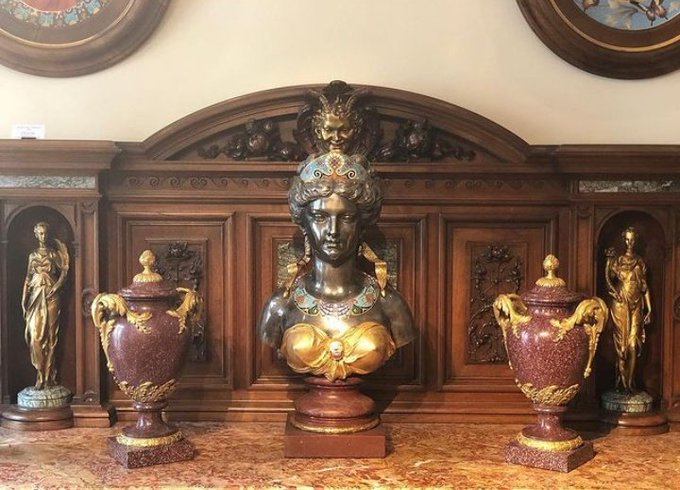
“If the apparition of the night before was an ocular delusion of my fancy sporting with the dark outlines of our cupboard, and if tis horrid eyes were nothing but a pair of inverted teacups, I had, at all events, the satisfaction of having launched the poker with admirable effect, and in true ‘fancy’ phrase, ‘knocked its two daylights into one,’ as the commingled fragments of my tea-service testified. I did my best to gather comfort and courage from these evidences; but it would not do. And then what could I say of those horrid bare feet, and the regular tramp, tramp, tramp, which measured the distance of the entire staircase through the solitude of my haunted dwelling, and at an hour when no good influence was stirring? Confound it!—the whole affair was abominable. I was out of spirits, and dreaded the approach of night. It came, ushered ominously in with a thunderstorm and dull torrents of depressing rain. Earlier than usual the streets grew silent; and by twelve o’clock nothing but the comfortless patterning of the rain was to be heard. I made myself as snug as I could. I lighted two candles instead of one. I forswore bed, and held myself in readiness for a sally, candle in hand; for, coute qui coute, I was resolved to see the being, if visible at all, who troubled the nightly stillness of my mansion. I was fidgety and nervous and, tried in vain to interest myself with my books. I walked up and down my room, whistling in turn martial and hilarious music, and listening ever and anon for the dreaded noise.” #RandolphHarris 20 of 21

Do not Grieve. Anything you lose comes around in another form. The child weaned from mother’s milk now drinks cranberry juice. God’s joy moves from unmarked box to unmarked box, from cell to cell. As rainwater, down into flowerbed. As roses, up from ground. Now it looks like a plate of rice and fish, now a cliff covered with vines, now a horse being saddled. It hides within these, till one day it cracks them open. There is the light gold of wheat in the sun, and the gold of bread made from wheat. I have neither, I am only talking about them as a town in the desert looks up to stars on a clear night. The Son of God, looking upon the World, beheld suffering and misery. With pity He saw how humans had become victims of satanic cruelty. He looked with compassion upon those who were being corrupted, murdered, and lost. They had chosen a ruler who chained them to his carriage as captives. God’s glory pervades the Universe; His ministering Angels inquire of one another: Where is the place of His glory? In response they give praise: Praised be the glory of the Lord from His Heavenly abode. From His Heavenly abode may He turn in mercy and bestow grace unto the people who, reciting the Shema evening and morning, twice daily, proclaim in love the unity of His name, saying: Hear, O America: the Lord our God, the Lord is One. He is our God; He is our Father, our sovereign and our Deliverer. In His mercy He will make known in presence of all the living that He will be your God. “I am the Lord your God.” As it is written in holy Scripture: The Lord shall reign forever; Thy God, O America, shall be Sovereign unto all generations. Hallelujah. #RandolphHarris 21 of 21

Winchester Mystery House

Ghostly tales are bountiful at Sarah Winchester’s Mystery House. What have you experienced? Photos are encouraged!

The Winchester mansion is 160-room mansion built to appease the spirits who died at the hands of the Winchester Rifle 👻
🗝 winchestermysteryhouse.com
“Whoever shadows my every move will not lose me in the dark.” At least that is what Christ says, or what the Evangelist John heard Him say (8.12). He tells us to walk on, through the darkness, with Christ as our only torch. That way, when we mayn’t have gained a step, but we won’t have lost one either. And on into the day we must pursue with dogged tread the life of Jesus Christ. Is this the secret to Mrs. Winchester’s 7-11 staircase?
 Randolph Harris II International Institute