
Home » American Dream (Page 12)
Category Archives: American Dream

The Time of the World Disappears Before Eternity

Revolutionary wealth is not just about money. Civilization is one of those big, stuffy words that may intrigue philosophers and historians but puts most people to sleep. Unless it is used in a sentence like “Our Civilization is threatened”—at which point large numbers of people prepare to defend themselves. Today many people do, in fact, believe that their civilization is threatened—and that the United States of America may be doing the threatening. And it is. However, not in the way most of us think. Around the World, critics of the United States of America point to its military and its economy as the main sources of its predominance. It is, however, knowledge in the broadcast sense and new technologies based on it that integrate America’s military and financial power and propel both forward. It is true that America’s technological lead is threatened. According to the National Science Board, foreign students earn nearly 50 percent of all U.S. doctorates in mathematics, computer sciences and engineering. And American youth are showing less and less interests in these fields. NASA officials complain that there are three times as many scientists over sixty as there are under thirty in the space agency. Shirley Ann Jackson, then president of the American Association for the Advancement of Science, has cautioned that “centers of technology-based activity, training, and entrepreneurialism are rapidly spreading throughout the globe. Thus even the status quo for the U.S. represents a declining share of the global marketplace for innovation and ideas.” Nevertheless, America still leads in most fields of digital technology, in microbiology and in science generally. It spends 44 percent of the World budget for research and development. By most criteria, the United States of America is still the undisputed leader in the performance of basic and applied research. In addition, many international comparisons put the United States of America as a leader in applying research and innovation to improve economic performance.

In the latest IMD International World Competitiveness Yearbook, the United States of America ranks first in economic competitiveness, followed by Hong Kong and Singapore. The survey compares economic performance, government efficiency, business efficiency, and infrastructure. Larger economies are further behind, with Zhejiang (China’s wealthiest province), Japan, the United Kingdom, and Germany ranked 20 though 23, respectively. An extensive review by the Organization for Economic Co-operation and Development (OECD) concludes that since World War II, US leadership in science and engineering has driven its dominant strategic position, economic advantage, and quality of life. And at least for now, the United States of America remains the Word’s scientific powerhouse. Perhaps even more important is the speed with which scientific and technical findings from everywhere are converted into marketable applications or products and widely dispersed into manufacturing, finance, agriculture, defense, biotech and other sectors. All of which boosts economic productivity, further accelerates change, and increasing the U.S. ability to compete at the global level. However, knowledge is not only a matter of bits and bytes or science and technology. Part of the knowledge economy is the production of art and entertainment, and America is the World’s biggest exporter of popular culture. That culture include fashion, music, TV programming, books, movies and computer games. Americans have always been told that their most important message to the World is one of democracy, individual freedom, tolerance, concern for “the rights of man” and—more recently—the rights of women. In the last three decades, however, a U.S. media spread into formerly closed or nonexistent foreign markets, a very different set of messages has been communicated. Much of it targeted at young people.

Certainly not all, but a considerable amount of this material has disgustingly glorified pimps, gangster, drug lords, drug pushers, and hollow-eyed drug users. It has celebrated extremes of violence marked by unending car chases, over-the-top special effects and songs dripping with sexist venom. The impact of all this has been further intensified in the hard-sell, over-the-edge advertising used to promote these products. Hollywood, for example, has painted a fantasy America in which adolescent hedonism reigns supreme and authority figures—police, teachers, politicians, business leaders—are routinely satirized. Film after film, and TV shows one after another, tell young viewers what many of them hunger to hear: that adults are bumbling fools; that being “dumb and dumber” is okay; that “we do not need education”; that to be “bad” is really good; and that pleasures of the flesh, in infinite variety, is or should be nonstop. In this fantasy World, women are readily available, but they can also leap over giant buildings in a single bound (like Superman), shoot and kill (like James Bond) and practice martial arts (Like Jet Li). Extremes, we are repeatedly told, are good and restraint is bad; and, by the way, America is so rich that event its secretaries, police, clerks, and other ordinary working people live in high-rise penthouse apartments or Malibu mansions—images that set adolescent glands tingling from Taipei to Timbuktu. What few foreign critics of American’s pop culture seem to know is that ironically enough, many of the ostensibly American firms producing and disseminating the interesting and unusual of these programs either are, or were financed not by America, but by European and Japanese capital. Nor is it widely understood that shows are often made by, say, a European director with an Australian stary, a Chinese martial-arts consultant, an anime cartoonist from Japan or other foreign contributors.

In the meantime, however, the influence of these intriguing programs is so powerful that other societies fear for the survival of their own culture. Only if art threatens action, then terrorism can be advanced through art. For such a phenomenon as Aesthetic Terrorism to occur, aesthetic pursuit must become symbolic not of its own decadently solipsistic pleasures (exemplified in madness of des Esseintes in Huysmans’ Against Nature), but of action taken beyond the pale of art World confines. Terrorism is art is called the avant-garde. However, if this was once the case, it is no longer. Most avant-garde art is viewed and created today as simply an enfolding reaction to its own history. This disingenuous game-playing guarantees that the avant-garde art is viewed and created today as simply an enfolding reaction to its own history. This disingenuous game-playing guarantees that the avant-garde can no longer stimulate or even provoke. Dada and Futurist actions, which attempted to lead art out of the classroom and museum and into the streets, are simply appropriated by postmodernist facsimiles which capture the letter but little of the original essence. It hardly matters anyway. Avant-garde art has evolved into nothing more than a cultural benchwarmer, corporate tax write-off and public relations smokescreen. Art which openly espouses anti-corporate ideology is embraced as long as it hews to arbitrary standards invented by those taste-making and fortune-telling hirelings, the art critics. What could be wrong, after all, with a business World that allows people to say what they want (because it does not matter)? Aesthetic Terrorism is a term more realistically applied to the faceless regime of consumer culture than the avant-garde. The onslaught of Muzak, ad jingles, billboards, top 40 tunes, commercials, corporate logos, etcetera, all fit the terrorist dynamic of intrusion and coercion.

One almost forgets that aesthetics once implied a consensual relationship between the creators and appreciators of art. How often is it that one hears someone admitting a fondness for a media product “in spite” of oneself? How many times have you heard a slogan or rancid tune ring in your ears like a brain-eating mantra? When consumer terror’s avant-garde correlative, Pop Art, became indistinguishable from the object of its supposed social satire, it erased from big business its pejorative taint. Many of today’s avant-garde stars have emerged from or entered the business World, some enormously successful in the arcane number-juggling or speculation and commodities scams. Even freeloading on the state and private foundations is fair game only for those whose bureaucratic aptitude is matched by their shameless butt-kissing. It is not surprising that most grant recipients excel in little more than lawyerristic logorrhea and ingrained artistic timidity. Critic-centered postmodernism spawned the phrase-art hybrid of Barbara Kruger and Jenny Holzer in which an advertising-style slogan is combined with an implied message or visual cue (usually swiped from some old magazine). Their posture is a hip cynicism which is supposed to subvert the “thrall” of the advertising command. Kruger and Holzer play the market like skillful double-agents, boosting themselves into the public eye through clever steals from Madison Avenue behaviorist techniques yet simultaneously troweling on crypto-Marxist jive to secure the perks of critical and academic currency. Their self-promotions worked when they were at the sidelines of the establishment. However, not the social commentary grows increasingly hollow. Currently being groomed for jet-setting prominence by Soho millionairess Mary Boone, Kruger’s contribution to the Whitney Biennial in 1987, for which she is paid a handsome sum, featured nothing more than a socialite princess joke, “I Shop Therefore I Am.” Winking at and wagging the tail of establishment hierarchy is part of that I-rib-you-gently-you-pay-me-off confidence game artists have been playing the Renaissance courts.

These contemporary court artists, like many of the past centuries, smugly pretend t spit in the eye of the exploiters while allowing themselves to be pampered de-loused—and when they are not looking—de-clawed. There are, of course, those artists, usually fresh out of university, who are unaccomplished at filling out grant forms, and therefore consider themselves “subversives.” The majority of these art and rock magazines-styled rebels are playing out rebellion psychodramas to package and merchandize to consumerist sycophants. This strategy is (forgive them term) the simulacra of terrorism: the content seizes in the frozen attitudinizing of pose and goes no further. We must look to the true outsiders and not the would-be insiders for an artist truly capable of effective counter-terror against the insidious mantras of consumerist brainwash. Terror means a threat, and the outsider’s version of Aesthetic Terrorism belongs to those performances or arrangements of words and pictures that unleash the reactionary impulses of police and bourgeois artist/critic alike. The kind of art that evokes this wrath, fear and condemnation rejoices in its pagan spirit of schadenfreude which controverts the humanist piety of “enlightened victim.” Anti-social sadism rarely receives patronage, however. Outside the corrupting realm of societal handouts, the Aesthetic Terrorist—much as this definition may grate on him—is the last bastion of aesthetic purity. Operation Sun Devil is the name for a government action against computer wizards and assorted sharpies and super-smarts who were resourceful enough to figure out how to hack into the electronic files of Ma Bell. Those who know, claim the Sun Devil gambit as a terrified overreaction against intelligence by the plodding and stupid bureaucracy.

John Perry Barlow (Whole Earth Review, Fall 1990) describes a typical Sun Devil action against a teenage hacker: [A] father in New York […] opened the door at 6.00 a.m. and found a shotgun at his nose. A dozen agents entered. While one of the kept the man’s wife in a choke-hold, the rest made ready to shoot and entered the bedroom for their sleeping 14-year-old. Before leaving, they confiscated every piece of electronic equipment, including all the telephones. Fourth Amendment guarantees against unreasonable search and seizure are unheeded by the government agents who claim nerd computer hackers are terrorists and have “the ability to access and review the files of hospital patients. Furthermore, they could have added, deleted, or altered vital patient information, possibly causing life-threatening situations.” Meacorporate interests have staked claim to the entirety of cyberspace, and they are not about to tolerate the presence of digital interlopers. This may scare off some, but other pirates like the mysterious Legion of Doom and NuPrometheus league (who illegally circulated highly protected Macintosh computer source code) will rise to the challenge now that they have been provided a clearly delineated enemy to innovation, the individual, and personal freedom. It may come as a surprise to learn that a few artists are now producing work which finds itself classified as a thought crime, punishable by expulsion into a Siberia of non-distribution, and in some cases by litigation and imprisonment. Pure magazine, from Chicago, a xeroxed vehicle which extols child torture, murder, and extreme misogyny, tweaked too many civic-minded noses, and its editor, Peter Sotos, was tailed for nine months and underwent a lengthy trial process in which he was finally convicted for possession of some very illegal magazine. Soto’s case was the first successfully prosecuted new Illinois state law, enacted under the influence of the Meese Commission Report on pornography, an example of First Amendment revisionism par excellence.

Soto’s case is particularly disquieting because it proves that prison is in the offing for simple possession of controversial material. No doubt this legal precedent was established to open the doors for future roundups of other thought criminals. The expertly managed Gulf War (massacre), in which networks censored war casualty footage that might provoke a “Vietnam War syndrome,” provides a small window into the dynamics of mass control to come. Any thoughtful individual is undeniably malnourished by the current information diet. Whether this is due to a direct conspiracy of State or by design of the oligarchic marketplace matters little. However, it has upped the ante for a new American Samizdat in which “disreputable,” “crazy,” “hateful,” or “dangerous” topics are broached by individuals or small, autonomous groups that are not compromised or swayed by institutional priorities. Can “offensive interests become the political crime of future? Apparently so. When looking at the previous sentences one can compare and see that musicians have been arrested for obscene lyrics, anarchist individuals have been collared for burning the flag; parents have been arrested for photographing their toddlers in their birthday suits; painter and performer Joe Coleman was arrested in Boston for operating an “infernal machine” and in New York for killing a rat: museum curators were threatened with arrest for hanging homoerotic photos; G.G. Allian was jailed for some consensual sadomasochism with a girlfriend; the FBI have been “monitoring” certain groups who practice unorthodox pleasures of the flesh; and on and on. Even many of the books you read have come under widely publicized attack by authors such as Carl A. Raschke who advocated the revocation of First Amendment rights from those who spread “cultural terrorism.” Even globalization could be considered cultural terrorism.

It has become increasingly obvious that the aesthetic terrorist hobgoblins are nothing more than symbolic scapegoats to divert attention away from the real issues. For Americans, fear is not another form of awareness, it is just another form of gossip. As Charles Manson has stated, true subversive terror can only be actualized by turning off the TV sets. Until then, aesthetic terrorism will be orchestrated by those already in command against insubstantial or non-existent villains. And in the future, while the dumb show of bohemianism plays itself out in the cookie cutter shape of the politically correct martyr/victim, aesthetic terrorism will be orchestrated by those already in command against insubstantial or non-existent villains. And in the future, while the dumb show of bohemianism plays itself out in the cookie cutter shape of the politically correct martyr/victim, aesthetic terrorists will not involve themselves in the dubious rewards of celebrity. The best of them will work alone, already a part of the enemy camp, and in a chameleon-like stye master the fifth-column algorithms to subvert the ancient regime. We will not know them by name but their compensation will be to affect the outcome of the planet. Until then, there is a lot of work to be done. Under what conditions will cooperation emerge in a World of egoists without central authority? This question has intrigued people for a long time. And for good reason. We all know that people are not angels, and that they tend to look after themselves and their own first. Yet we also know that cooperation does occur and that our civilization is based upon it. However, in situations where each individual has an incentive to be selfish, how can cooperation ever develop? The answer each of us gives to this question has a fundamental effect on how we think and act in our social, political, and economic relations with others. And the answers that others give have a great effect on how ready they will be to cooperate with us.

The most famous answer was given over three hundred years ago by Thomas Hobbes. It was pessimistic. He argued that before governments existed, the state of nature was dominated by the problem of selfish individuals who competed on such ruthless terms that life was “solitary, poor, nasty, brutish, and short” (Hobbes 1651/1962, p. 100). In his view, cooperation could not develop without a central authority, and consequently a strong government was necessary. Ever since, arguments about the proper scope of government have often focused on whether one could, or could not, expect cooperation to emerge in a particular domain if there were not an authority to police situation. Today nations interact without central authority. Therefore the requirements for the emergence of cooperation have relevance to many of the central issues of international politics. The most important problem is the security dilemma: nations often seek their own security through means which challenge the security of others. This problem arises in such areas as escalation of local conflicts and arms races. Related problems occur in international relations in the form of competition with alliances, tariff negotiations, and communal conflict places like Cyprus. The Russian invasion of Ukraine in 2022 has presented the United States of American with a typical dilemma of choice. If the United States of American continued business as usual, Russian might be encouraged to try other forms of noncooperative behavior later one. On the other hand, any substantial lessening of United States of America’s cooperation risks some form of retaliation, which could then set off counter-retaliation, setting up a pattern of mutual hostility that could be difficult to end. Much of the domestic debate about international policy is concerned with problems of just this type. And properly so, since these are hard choices.

In everyday life, if they never invite us over in return, we may ask ourselves how many times we will invite acquaintances for dinner. An executive in an organization does favors for another executive in order to get favors in exchange. A journalist who has received a leaked news story gives favorable coverage to the source in the hope that further leaks will be forthcoming. A business firm in an industry with only one other major company charges high prices with expectation that the other firm will also maintain high prices—to their mutual advantage and at the expense of the consumer. For me, a typical case of the emergence of cooperation is the development of patterns of behavior in a legislative body of the United States Senate. Each senator has an incentive to appear effective to his or her constituents, even at the expense of conflicting with other senators who are trying to appear effective to their constituents. However, this is hardly a situation of completely opposing interests, a zero-sum game. On the contrary, there are many opportunities for mutually rewarding activities by two senators. These mutually rewarding actions have led to the creation of an elaborate set of norms, or folkways, in the Senate. Among the most important of these is the norm of reciprocity—a folkway which involves helping out a colleague and getting repaid in kind. It includes vote trading but extends to so many types of mutually rewarding behavior that “it is not an exaggeration to say that reciprocity is a way of life in the Senate” (Matthews 1960, p. 100; see also Mayhew 1975). Washington was not always like this. Early observers saw the members of the Washington community as quite unscrupulous, unreliable, and characterized by “falsehood, deceit, treachery” (Smith 1906, p. 190). In the 1980s the practice of reciprocity is well established. Even the significant changes in the Senate over the last two decades, tending toward more decentralization, more openness, and more equal distribution of power, have come without abating the folkway of reciprocity.

As will be seen, it is not necessary to assume that senators are more honest, more generous, or more public-spirited than in earlier years to explain how cooperation based on reciprocity has emerged or proved stable. The emergence of cooperation can be explained as a consequence of individual senators pursuing their own interest. We are investigating how individual pursuing their own interests will act, followed by an analysis of what effects this will have for the system as a whole. Put another way, the approach is to make some assumptions about individual motives and then deduce consequences for the behavior of the entire system. The case of the U.S. Senate is a good example, but the same style of reasoning can be applied to other settings. The object of this enterprise is to develop a theory of cooperation that can be used to discover what is necessary for cooperation to emerge. By understanding the conditions that allow it to emerge, appropriate actions can be taken to foster the development of cooperation in a specific setting. The Cooperation Theory that is presented here is based upon an investigation of individuals who pursue their own self-interest without the assistance of a central authority to force them to cooperate with each other. The reason for assuming self-interest is that it allows an examination of the difficult case in which cooperation is not completely based upon a concern for other or upon the welfare of the group as a whole. It must, however, be stressed that this assumption is actually much less restrictive than it appears. If a sister is concerned for the welfare of her brother, the sister’s self-interest can be thought of as including (among many other things) this concern for the welfare of her brother. However, this does not necessarily eliminate all potential for conflict between sister and brother.

Likewise a nation may act in part out of regard for the interests of its friends, but this regard does not mean that even friendly countries are always able to cooperate for their mutual benefit. So the assumption of self-interest is really just an assumption that concern for others does not completely solve the problem of when to cooperate with them and when not to. A good example of the fundamental problem of cooperation is the case where two industrial nations have erected trade barriers to each other’s exports. If barriers were eliminated, because of the mutual advantages of free trade, both countries would be better off. However, if either country were to unilaterally eliminate its barriers, it would find itself facing terms of trade that hurt its own economy. In fact, whatever one country does, the other country is better off retaining its own trade barriers. Therefore, the problem is that each country has an incentive to retain trade barriers, leading to a worse outcome than would have been possible had both countries cooperated with each other. This basic problem occurs when the pursuit of self-interest by each leads to a poor outcome for all. To make headway in understanding the vast array of specific situations which have this property, a way is needed to represent what is common to these situations without becoming bogged down in the details unique to each. Fortunately, there is such a representation available: the famous Prisoner’s Dilemma game. In the Prisoner’s Dilemma game, there are two players. Each has two choices, namely cooperate of defect. Each must make the choice without knowing what the other will do. No matter what the other does, defection yield a higher payoff than cooperation. If both defect, the dilemma is that both do worse than if both had cooperated. Cases typically result in one of four possible outcomes in the matrix. If both players cooperate, both do fairly well. Both get a reward for mutual cooperation.

However, if one player cooperates but the other defects, the defecting play get the temptation to defect, while the cooperating players gets the sucker’s payoff. If both defect, both get the punishment for mutual defection. What would you do in such a situation? That is basically the gamble of the Prisoner’s Dilemma. The Prisoner’s Dilemma is simply an abstract formulation of some very common and very interesting situations in which what is best for each person individually leads to mutual defection, whereas everyone would have been better off with mutual cooperation. The definition of Prisoner’s Dilemma requires that several relationships hold among the four different potential outcomes. The second part of the definition of the Prisoner’s Dilemma is that the players cannot get out of their dilemma by taking turns exploiting each other. This assumption means that an even chance of exploitation and being exploited is not as good an outcome for a player as mutual cooperation. It is therefore assumed that the reward for mutual cooperation is greater than the average temptation and the sucker’s payoff. This assumption, together with the rank ordering of the four payoffs, defines the Prisoner’s Dilemma. We have come back to the point where we began, where values take the place of good and evil. However, now we have made at least a hasty tour of the intellectual experiences connected with modern politics that made such a response compelling. How it looked to thoughtful Germans is most revealingly expressed in a famous passage by Max Weber, about God science and the irrational: Finally, although a naïve optimism may have celebrated science—that is, the technique of the mastery of life founded on science—as the path which would lead to happiness, I believe I can leave this entire question aside in light of the annihilating critique which Nietzsche has made of “the last men” who “have discovered happiness.” Who, then, still believes in this with the exception of a few big babies in university chairs or in editorial offices?

So penetrating and well informed an observer as Weber could say in 1919 that the scientific spirit at the heart of Western democracy was dead for all serious men and that Nietzsche had killed it, or had at least given it the coup de grace. The presentation of “the last man” in Thus Spake Zarathusta was so decisive that the old-style Enlightenment rationalism need not even be discussed anymore; and, Weber implies, all future discussion or study must proceed with the certainty that the perspective was a “naïve” failure. Reason cannot establish values, and its belief that it can is the stupidest and most pernicious illusion. This means, simply, that almost all Americans at that time, thinking American in particular, were “big babies” and remained so, long after the Continent had grown up. One need only think of John Dewey to recognize that he fits Weber’s description to a T, and then remember what his influence here once was. And not only Dewey, but everyone from the beginning of our regime, especially those who said, “We hold these truths to be self-evident,” shared the rationalist dream. Weber’s statement is so important because he made as much as more than anyone brought us into contact with the most advanced Continental criticisms of liberal democracy, and was the intermediary between Nietzsche and us Americans who were the most recalcitrant to one’s insight, perhaps because according to it we represent the worst or most hopeless and are therefore loath to see ourselves in that mirror. A very dark view of the future has been superimposed on our incorrigible optimism. We are children playing with adult toys. They have proved too much for us to handle. However, in our defense, we are probably not the only ones for whom they are too much. Perhaps you have caught yourself kissing another person as you first saw kissing in the movies or on television. My children have a phrase to describe this: “television kiss.”

It is fortunate for them that they have noted that there are television kisses and other kinds, because it will help protect them from absorbing it, taking it into themselves where it will come back out ten years, like a replay. Most of us did not make that distinction as we sat in darkened rooms or theaters as children. Since we did not see all that much real kissing, the media kiss became our image of kissing. We found ourselves producing that model of kiss later in life. I was fourteen-year-old when I tried to kiss for the first time. I imitated Brad Pitt’s kiss, but I did not feel it. Only later did I realize that perhaps Brad Pitt did not feel it either; he was merely kissing the way the director said he should. So there I was imitating a kiss that was never real in the first place, worried that there might be something wrong with me for lacking the appropriate feeling and failing to obtain the appropriate response. The journalist Jane Margold was driving home one night in Berkeley with her brother, Harlan. Suddenly a man crawled into the street right in front of them. They screeched to a stop and then, stunned, just sat there for a moment. They finally got out and cautiously went up to the man to find out that he had been stabbed several times in his upper body, was bleeding profusely and was in danger of dying right there. The man’s assailant was nowhere to be seen. In describing the event to me, Jane said that she instantly flipped into a media version of herself. She had never faced anything like it before and had no direct feelings. Instead, playing through her mind were images of similar events she had seen on television or in films. The media superseded her own responses, even to the point of removing her from the event. She was there, but sue did not experience herself as being there. She was seeing the event, but between her and it, floating in her mind, was an image of an implanted reality which would not get out of the way. Jane thought such thoughts as: “This is real; there is a wounded man lying here in from of me, bleeding to death, yet I have no feeling. It seems like a movie.”

In fact, it was they very movielike quality that eventually got her into action. Without feeling, she performed mechanical acts. She and her brother comforted the man, directed traffic, dispatched people to summon the police and an ambulance. She became extremely efficient, but throughout, she had the sense of performing a script. Apart from their economic implications, technologies create the ways in which people perceive reality, and such ways are the key to understanding diverse forms of social and mental life. As individual express their life, so they are. There are three stages in the development of technology: the age of technology of chance, the age of technology of the artisan, the age of technology of the technician. Cultures may be classified into three types: tool-using cultures, technocracies, and technopolies. At the present time, each type may be found somewhere on the planet, although the first is rapidly disappearing: we must travel to exotic places to find a tool-using culture. If we do, it is well to go armed with the knowledge that, until the seventeenth century, all cultures were tool-users. There was, of course, considerable variation from one culture to another in the tools that were available. Some had only spears and cooking utensils. Some had water mills and coal- and horsepower. However, the main characteristic of all tool-using cultures is that their tools were largely invented to do two things: to solve specific and urgent problems of physical life, such as in the use of waterpower, windmills, and the heavy-wheeled plow; or to serve the symbolic World of art, politics, myth, ritual, and religion, as in the construction of castles and cathedrals and the development of the mechanical clock. In either case, tools did not attack (or, more precisely, were not intended to attack) the dignity and integrity of the culture into which they were introduced.

With some exceptions, tools did not prevent people from believing in their traditions, in their God, in their politics, in their methods of education, or in the legitimacy of their social organization. These beliefs, in fact, directed the invention of tools and limited the uses to which they were put. Even in the case of military technology, spiritual ideas and social customs acted as controlling forces. It is well known, for example, that the uses of the sword by samurai warriors were meticulously governed by a set of ideals known as Bushido, or the Way of the warrior. The rules and rituals specificizing when, where, and how the warrior must use either his two swords (the katana, or long sword, and the wakizashi, or short sword) were precise, tied closely to the concept of honor, and included the requirement that the warrior commit seppuku or hara-kiri should his honor be compromised. This sort of governance of military technology was not unknow in the Western World. The use of the lethal crossbow was prohibited, under threat of anathema, by Pope Innocent II in the early twelfth century. The weapon was judged to be “hateful to God” and therefore could not be used against Christians. That it could be used against Muslims and other infidels does not invalidate the point that in a tool-using culture technology is not seen as autonomous, and is subject to the jurisdiction of some binding social or religious system. This is why power, which to a large extent defines us as individuals and as nations, is itself being redefined. A clue to this redefinition emerges when we look more closely at some of the unrelated changes. For we discover that they are not as random as they seem. Whether it is Japan’s meteoric rise, GM’s impressive rebound, or the American doctor’s fall from grace, a single common thread unites them.

Take the punctured power of the god-in-a-white coat. Throughout the heyday of doctor-dominance in America, physicians kept a tight choke-hold on medical knowledge. Prescriptions were written in Latin, providing the profession with a semi-secret code, as it were, which kept most patients in ignorance. Medical journals and texts were restricted to professional readers. Medical conferences were closed to the laity. Doctors controlled medical-school curricula and enrollments. Contrast this with the situation today, when patients have astonishing access to medical knowledge. With a personal computer and a WiFi, anyone from home can access data bases like Index Medicus, and obtain scientific papers on everything from Addison’s disease to zygomycosis, and, in fact, collect more information about a specific aliment or treatment than the ordinary doctor has time to read. Copies of the 2,354-page book knows as the PDR or Physicians’ Desk Reference are also readily available to anyone. Once a week on the Lifetime cable network, any televiewer can watch twelve uninterrupted hours of highly technical television programming designed specifically to educate doctors. Many of these programs carry a disclaimer to the effect that “some of this material may not be suited toa general audience.” However, that is for the viewer to decide. The rest of the week, hardly a single newscast is aired in America without a medical story or segment. A video version of the material from the Journal of the American Medical Association is now broadcast by three hundred stations on Thursday nights. The press reports on medical malpractice cases. Inexpensive paperbacks tell ordinary readers what drug side effect to watch for, what drugs not to mix, how to raise or lower cholesterol levels through diet. In addition, major medical breakthroughs, even if television news almost before the M.S. has even taken his subscription copy of journal out of the in-box. In short, the knowledge monopoly of the medical profession has been thoroughly smashed. And the doctor is no longer a god.

This case of the dethroned doctor is, however, only one small example of a more general process changing the entire relationship of knowledge to power in the high-tech nations. In many other fields, too, closely held specialists’ knowledge is slipping out of control and reaching ordinary citizens. Similarly, inside major corporations, employees are winning access to knowledge once monopolized by management. And as knowledge is redistributed, so, too, is the power based on it. A human is a “beast” and purifies one’s heart, and behold, God holds one by the hand. That is not a kind of humans. Purity of heart is a state of being. A man is not pure in kind, but one is able to be or become pure, rather one is only essentially pure when one has become pure, and even than one does not thereby belong to a kind of humans. The “wicked,” that is, the bad, are not contrasted with good humans. The good is to draw near Hod. One does not say that those near to God are good. However, one does call the bas those who are far from God. In the language of modern thought that means that there are humans who have no share in existence, but there are no humans who possess existence. Existence cannot be possessed, but only shared in. One does not rest in the lap of existence, but one draws near to it. Nearness is nothing but such a drawing and coming near continually and as long as the human person lives. The dynamic of fairness and nearness is broken by death when it breaks the life of the person. With death there vanished the heart, that inwardness of humanity, out of which arises the pictures of the imagination, and which rises up in defiance, but which can also be purified. Separate souls vanish, separation vanished. Time which has been lived by the soul vanished with the soul, we know of no duration in time. Only the rock in which the heart is concealed, only the rock of human hearts does not vanish. For it does not stand in time. The time of the World disappears before eternity, but existing humans die into eternity as into the perfect existence.

CRESLEIGH MEADOWS AT PLUMAS RANCH
Plumas Lake, CA |
Now Selling!

Cresleigh Meadows is now selling! Found just north of Feather River Boulevard, Cresleigh Meadows is home of the largest neighborhood in Plumas Ranch as well as the popular Bear River Park. With four floor plans available, ranging from approximately 2,000 – 3,500 square feet offering, three to five bedrooms, we are certain you will find the home that fits your needs and lifestyle.

Popular design elements include open floor plans, large kitchen islands, and flex spaces are staples in Cresleigh homes. Multi-generational living options also available in select homes.

Homeowners will love the convenient commuter access to nearby Sacramento and Yuba City.

Best of all, each Cresleigh home comes fully equipped with an All Ready connected home! This smart home package comes included with your home and features great tools including: video door bell and digital deadbolt for the front door, connect home hub so you can set scenes and routines to make life just a little easier. Two smart switches and USB outlets are also included, plus we’ll gift you a Google Home Hub and Go. https://cresleigh.com/cresleigh-meadows-at-plumas-ranch/


I Never Found a Man Who Knew How to Love Himself

It is important to look at the error in which one has lived in, and it will reveal so much to one. When the heart rises up in one, and one is pricked in one’s reins, often it is discovered how brutish one was and ignorant has been as a beast before the World. In todays highly professionalized World, the term amateur invites a brush-off from business executive and economists. Yet throughout history, unpaid amateurs, working for themselves, their families or their communities, have made remarkable achievements in a wide variety of fields, including science and technology. Because science had not become a paying profession, early scientists were almost all amateurs. Many gained a living as paid professionals in one field but made their greatest contributions to history as part-time prosumers. Joseph Priestley, who in 1774 discovered oxygen, was a minster. Pierre de Fermat, whose “last theorem” puzzled mathematicians for centuries, was a lawyer. And Benjamin Franklin, paid as a printer, media mogul and politician, studied ocean currents on the side, inventing bifocals along the way and demonstrating that lightning was a form of electricity. He, too, was a prosumer. Today prosuming amateurs are collecting huge amounts of valuable environmental information—for example, seismological data in the Philippines. However, it is astronomy and space that, often in collaboration with professionals, amateurs are making really important finds. They started early. When the World’s first artificial satellite, Sputink, blasted into orbit in 1957, amateurs all over the globe who had been organized by astronomer Fred Whipple, director of the Smithsonian Astrophysical Observatory, were waiting to track it across the Heavens. There effort was dubbed Moonwatch demonstrated what amateurs could do when properly inspired and led.” Today amateur astronomers are, among other things, charting asteroids and other potentially dangerous objects in space.

Brigadier General Simon “Pete” Worden, a former astronaut, not long ago told the U.S. House Committee on Science that small objects “at the nuclear weapons scale” smash into Earth’s upper atmosphere at a rate of once about every two weeks. In June 2002 one such event occurred over the Mediterranean and released twenty to thirty kilotons of energy—more than that of the Hiroshima blast. “Has this occurred over India or Pakistan,” Worden suggested, “it could have triggered a nuclear war.” Urging more attention to such low-probability, but potentially devastating, dangers, he paid tribute to amateur monitors, pointing out that “some of them are not so amateur.” According to Richard Nugent, himself an amateur asteroid hunter and a contributor to Starscan, a newsletter to the Johnson Space Center Astronomical Society, “Amateurs are catching up with the pros in certain fields, and surpassing them in others [such as] asteroid discoveries, novae, supernovae, variable stars, occultation events, fireballs, meteors, planetary observations, satellite passes, and other unique events.” As research tools become smaller, cheaper, smarter and more powerful, making possible further changes in our relationships to the deep fundamental of knowledge, amateurs will no doubt enter new fields. And this takes us to another overlooked contribution made by prosumers. Every single day around the World, countless volunteers get behind the wheel of their cars and drive to schools, churches, mosques, synagogues, hospitals, playgrounds or community centers to provide free services. Or they add to their odometers by picking up groceries for neighbors or taking a sick relative to a doctor. Nobody knows how many millions of miles they drive in aggregate over the course of year, or how much gas they use, or how much wear and tear they add to their autos in the course of creating unpaid value.

In addition, therefore, to delivering free lunch to the money economy by donating their unpaid time and labor, they are also contributing what amounts to a prosumer capital asset—the use of a vehicle—that makes possible or increases the value they created for others. That is more free lunch. (If they go to the trouble, tit is true that, in the United States of America, they may be able to reclaim some small part of their expenses as a tax deduction, but it is doubtful that in practice most volunteers do.) Car use, however, is not the only example of prosumer capital at work. As we have already seen, prosumers, as a group, spend large sums buying machines and tools—or, more accurately, investing in capital goods for use in prosuming. These tools range from telescopes, sewing machines and digital cholesterol testers all the way up to automobiles and other vehicles. And, in a new, fast-spreading practice, another pattern is emerging: Busy prosumers now sometimes volunteer their machines, instead of their labor. Only by taking account of practices likes these can we uncook the economic books. Now, Hobbes blazed the trail to the self, which has grown into the highway of a ubiquitous psychology without the psyche (soul). However, he, like Locke, did not develop the psychology of the self in its fullness, just as neither went very deeply into the state of nature, because the solution seemed to be on the surface. Once the old virtues were refuted—the piety of the religious or the honor of the nobles—Hobbes and Locke assumed that most men would immediately agree that their self-preservative desires are real, that they come from within and take primacy over any other desire. The true self is not only good for individuals but provides a basis for consensus not provided by religious or philosophies.

Locke’s substitute for the virtuous man, the rational and industrious one, is the perfect expression of this solution. It is not an ethic or a morality of a Protestant or any other kind of believer, but a frank admission of enlightened selfishness (selfishness that has learned from modern philosophy which goals are real and which imaginary), or self-interest rightly understood. Locke develops the opposite, the idle and the quarrelsome man—who, we see, may be the priest or the noble (id est, pretenders to a higher morality)—to debunk virtue in a less provocative way than Hobbes did. Lock’s rational and industrious man partakes, as a prototype, of the charm of the sincere man who acts as he thinks and, without fraudulent pieties, seeks his own good. Beneath his selfishness, of course, lies an expectation that it conduces more to the good of others than does moralism. The taste of the sincere expresses itself more in blame of Tartufferie than in praise of virtue. Terror in the face of death, an immediate and overwhelming subjective experience of the self and what counts most for it, and the imperative following from this experience that death must be avoided, were confirmed by the new natural philosophy which sees in nature only bodies in motion, bodies blindly conserving their motion by the necessity of inertia. All higher purposiveness in nature, which might have been consulted by men’s reason and used to limit human passion, has disappeared. Nature tells us nothing about man specifically and provides no imperatives for his conduct. However, man can be seen to behave as all other bodies behave, and the imaginary constraints on his following his powerful inclinations—constraints which would cause him to behave differently from natural bodies—vanish.

Irrational passion and rational science cooperate in a new way to establish natural law: Pursue peace. Man’s passionate subjectivity gives assents to the premises of natural philosophy—nay, takes them as its principles of action—and philosophy finds that that assent accords with nature. Man remains somehow a part of nature, but in a different and much more problematic way than in, say, Aristotle’s philosophy, where soul is at the center and what is highest in man is akin to what is highest in nature, or where soul is nature. Man is really only a part and not the microcosm. Nature has no rank order or hierarchy of being, nor does the self. Lockean natural man, who is really identical to his civil man, whose concern with comfortable self-preservation makes him law-abiding and productive, is not all that natural. Rousseau quickly pointed out that Locke, in his eagerness to find a simple or automatic solution to the political problem, made nature do much more than he had a right to expect a mechanical, nonteleological nature to do. Natural man would be brutish, hardly distinguishable from any of the other animals, unsociable and neither industrious nor rational, but, instead, idle and nonrational, motivated exclusively by feelings or sentiments. Having cut off the higher aspirations of man, those connected with the soul, Hobbes and Locke hoped to find a floor beneath him, which Rousseau removed. Man tumbled down into what we called the basement, which now appears bottomless. And there down below, Rousseau discovered all the complexity in man that, in the days before Machiavelli, was up on high. Locke had illegitimately selected those parts of man he needed for his social contract and suppressed all the rest, a theoretically unsatisfactory procedure and a practically costly one.

The bourgeois is the measure of the price paid, he who most of all cannot afford to look to one’s real self, who denies the existence of the thinly boarded-over basement in one, who is most made over for the purposes of a society that does not even promise one perfection or salvation but merely buys one off. Rousseau explodes the simplistic harmoniousness between nature and society that seems to be the America premise. Rousseau still hoped for a soft landing on nature’s true grounds, but one not easily achieved, requiring both study and effort. The existence of such a natural ground has become doubtful, and it is here that they abyss opened up. However, it was Rousseau who founded the modern psychology of the self in its fullness, with its unending search for what is really underneath the surface of rationality and civility, its new ways of reaching the unconscious, and its unending task of constituting some kind of healthy harmony between above and below. Rousseau’s intransigence set the stage for a separation of man from nature. He was perfectly willing to go along with the modern scientific understanding that a brutish being is true man. However, nature cannot satisfactorily account for his difference from the other brutes, for his movement from nature to society, for his history. Descartes, playing his part in the dismantling of the soul, had reduced nature to extension, leaving out of it only the ego that observes extension. Man is, in everything but his consciousness, part of extension. Yet how he is a man, a unity, what came to be called a self, is utterly mysterious. This experienced whole, a combination of extension and ego, seems inexplicable or groundless. Body, or atoms in motion, passions, and reason are some kind of unity, but one that stands outside of the grasp of natural science.

If there were no place to hold them, Locke appears to have invented the self to provide unity in continuity for the ceaseless temporal succession of sense impressions that would disappear into nothingness. We can know everything in nature except that which knows nature. To the extent that man is a piece of nature, he disappears. The self gradually separates itself from nature, and its phenomena must be treated separately. Descartes’ ego, in appearance invulnerable and godlike in its calm and isolation, turns out to be the tip of an iceberg floating in a fathomless and turbulent sea called the id, consciousness an epiphenomenon of the unconscious. Man is self, that now seems clear. However, what is self? Our gaily embraced psychology leaves us with this question. If we are to abandon ourselves to it, it is important for us to know the unbearably complicated story behind it. If this psychology is to be believed, one thing is certain: it came to us belatedly, in order to treat the parts of man which had been so long neglected in out liberal society, and it opens up a Pandora’s box, ourselves. Like Iago it tells us, “I never found a man who knew how to love himself.” Modern psychology has this in common with what was always popular opinion, fathered by Machiavelli—that selfishness is somehow good. Man is self, and the self must be selfish. What is new is that we are told to look more deeply into the self, that we assumed too easily that we know it and have access to it. The ambiguity of human life always requires that there be distinctions between good and bad, in one form or another. The great change is that a good man used to be the one who cares for others, as opposed to the man who cares exclusively for oneself. Now the good man is the one who knows how to care for himself, as opposed to the man who does not. This is most obvious in the political realm.

For Aristotle, good regimes have rulers dedicated to the common good, while bad ones have rulers who use their positions to further their private interest. For Locke and Montesquieu there is no such distinction. A good regime has the proper institutional structures for satisfying while containing the selfish men who make it up, while a bad one does not succeed in doing this. Selfishness is presupposed; men are not assumed to be as they ought to be, but as they are. Psychology has distinctions only between good and bad forms of selfishness, like Rousseau’s deliciously candid distinctions between amour de soi and amour–propre, untranslatable into English because we would have to use self-love for both terms. For us the most revealing and delightful distinctions—because it is so unconscious of its wickedness—is between inner-directed and other-directed, with the former taken to be unqualified good. Of course, we are told, the healthy inner-directed person will really care for others. To which I can only respond: if you can believe that, you can believe anything. Rousseau knew much better. The psychology of the self has succeeded so well that it is now the instinct of the most of us to turn for a cure for our ills back within ourselves rather than to the nature of things. Socrates too thought that living according to the opinions of others was an illness. However, he did not urge men to look for a source for producing their own unique opinions, or criticize them for being conformists. His measure of health was not sincerity, authenticity or any others necessarily vague criteria for distinguishing a healthy self. The truth is the one thing most needful; and conforming to nature is quite different from conforming to law, convention or opinion.

Socrates was always among the Athenians but was not quite one of them, apparently never made uncomfortable by the fact that they did not trust him. He was neither solitary nor citizen. Rousseau, a figure of similar stature in the new tradition, was distressed by the hatred of mankind, and was both, at least in speech, the perfect citizen and the complete solitary. He was torn between the extremes, and there was no middle ground. Although a very great reasoner, his preferred means of learning about himself were the reverie, the dream, the old memory, a stream of associations unhampered by rational control. In order to know such an amorphous being as man, Rousseau himself and his particular history are, in his view, more important than is Socrates’ quest for man in general, or man in himself. The difference is made apparent by comparing the image of Socrates talking to two young men about the best regime, with the image of Rousseau, lying on his back on a raft floating on a gently undulating lake, sensing his existence. Did you know that slow, synchronous brainwave activity is ordinarily associated with lack of eye movement, fixation, lack of definition, idleness, inactivity, overall body inertness? No organized thought is possible in these phasic states and selective associations are replaced by non-selective association, deprived of their purposeful character. Alpha is the mental state most commonly associated with meditation, but before anyone equates meditation with television, it is important to make a critical distinction. In the former, you produce your own material and in the latter it comes from outside; it is not internally generated. People who are good at meditation are among the most difficult to hypnotize. They start going into hypnotic trance, but at a certain point they begin producing their own material and cannot be influenced by outside instruction unless they choose to be.

These individuals have their own thing going. We doubt that any good meditators watch much television and that meditation might be an excellent ability to develop in people who are bothered by television addiction. In fact, television addiction might itself be symptomatic of an inability to produce one’s own mental imagery. When we compared brainwave activity while watching television with brainwave activity while reading magazines, it appears that the mode of response to television is very different from the responses to print the basic electrical responses of the brain is clearly to the medium and not to the content differences. The response to print may be fairly described as active, while the response to television may be fairly described s passive. Television is not communication as we have known it. Our subject was trying to learn something from a print ad, but was passive about the television. Television is a communication medium that effortlessly transmits huge quantities of information not thought about at the time of exposure. This indicates that one gets a decease in beta [fast waves] and an increase in slow activity with a large percentage of alpha. Alpha wave patterns, recorded over the occipital areas of the scalp, disappear at the moment when a person gives visual commands (focuses, accommodates, and verges), when one takes charge of the process of seeking information Any orienting outward to the World increases one’s brainwave frequencies and blocks [halts] alpha wave activity. Alpha occurs when you do not orient to. You can sit back and have pictures in your head, but you are in a totally passive condition and unaware of the World outside of your pictures. The right phrase for alpha is really “spaced-out.” Not orienting. When a person focuses visually, orients to anything, notices something outside oneself, then one gets an immediate increase in faster wave activity and alpha will block [disappear].

Many meditators are in alpha but in meditation you are learning self-control and how to call upon your own internal processes. There is no such discipline with television. You are not training your mind to control itself, which biofeedback, and also meditation, accomplish; television trains people only for being zombies. Instead of training active attention, television seems to suppress it. Ten kids were asked to watch their favorite television programs. Our assumption was that since these programs were their preferred shows, the kids would be involved in them and we would find there would be an oscillation between alpha slow-wave activity and beta. The prediction was that they would go back and forth. However, they did not do that. They just sat back. They stayed almost all the time in alpha. This mean that while they were watching they were not reacting, not orienting, not focusing, just spaced-out. Also, children who are watching television are far slower to react to an emergency than children who are doing something else. And, that is predictable because when they are watching television, they are being trained not to react. To really learn anything, you have to interact with the source of the data. With television you do not really think. If I get engaged, I know that speaking for myself, I can only really learn, as in the Socratic method of teaching. The best teaching is an interactive form. Some people learn best, for example, by writing notes because the notes are a feedback system. (Like a journal or a diary.) Television watching is only receiving, no longer reacting. It cannot do anything but hold your attention; you are receiving, not looking. The key for why they are in alpha is that when they are watching they are not looking at, not orienting.

If you have a light which is not really being attended to, you can get an infinite amount of alpha. Perhaps it is that the TV target is so far away, the screen so small that your eyes need not move; you are looking at infinity, in a way, like looking at the hypnotist’s flashlight. If you look at moving targets, you have at least a little active interaction; that would tend to put into beta. However, with television though there seems to be movement, you stay all the in alpha. Reading produces a more active learning process and a higher amount of beta activity. You would expect abnormality in anyone who produces alpha while reading. The horror of television is that the information goes in, but we do not react to it. It goes right into our memory pool and perhaps we react to it later but do not know what we are reacting to. When you watch television you are training yourself not to react and so later on, you are doing things without knowing why you are doing them or where they came from. Because of the implications of this study, computer programmers might want to design their software to be less helpful in order to force users to think harder so that televisions and computers do not wipe out their brain functions. That may well be good advice, but it is hard to imagine the developers of commercial computer programs and Web applications taking it to heart. One of the long-standing trends in software programming has been the pursuit of ever more “user-friendly” interfaces. That is particularly true on the Net. Internet companies are in fierce competition to make people’s lives easier, to shift the burden of problem solving and other mental labor away from the user and onto the microprocessor. A small but telling example can be seen in the evolution of search engines. It its earliest incarnation, the Google engine was a very simple tool: you entered a keyword into the search box, and you hit the search button.

However, Google, facing competition from other search engines, like Microsoft’s Bing, has worked diligently to make its service enter more solicitous. Now, as soon as you enter the first letter of your keyword into the box, Google immediately suggests a list of popular search terms that being with that letter. Their algorithms use a wide range of information to predict the queries users are most likely to want to see. By suggesting more refined searches up front, Google can make your searches more convenient and efficient. Automating cognitive processes in this way has become the modern programmer’s stock-in-trade. And for good reason: people naturally seek out those software tools and Web sites that offer the most help and guidance—and shun those that are difficult to master. They want friendly, helpful software. Why would they not? Yet, as we cede to software more of the toil of thinking, they are likely diminishing our own brain power in subtle but meaningful ways. When a ditchdigger trades his shovel for a backhoe, his arm muscles weaken even as his efficiency increases. A similar trade-off may well take place as we automate the work of the mind. Another recent study, this one on academic research, provides real-World evidence of the way the tools we use to sift information online influence our mental habits and frame our thinking. After exanimating an enormous database on 34 million scholarly articles published in academic journals from 1945 through 2005, then analyzing citations included in the articles to see if patterns of citation, and hence of research, have changed as journals have shifted from being printed on paper to being published online; considering how much easier it is to search a digital text than printed text, the common assumption has been that making journals available on the Net would significantly broaden the scope of scholarly research, leading to a much more diverse set of citations.

However, that is not all that was discovered. As more journals moved online scholars actually cited fewer articles than they had before. And as old issues of printed journals were digitized and uploaded to the Web, scholars cited more recent articles with increasing frequency. A broadening of available information leads to a narrowing of science and scholarship. With these counterintuitive finds, it as also been noted that automated information-filtering tools, such as search engines, tend to serve as amplifiers of popularity, quickly establishing and then continually reinforcing a consensus about what information is important and what is not. The ease of following hyperlinks, moreover, leads online researchers to bypass many of the marginally related articles that print researchers would routinely skim as they flipped through the pages of a journal or a book. The quicker that scholars are able to find prevailing opinion, the more likely they are to follow it, leading to more citations referencing fewer articles. Though much less efficient than searching the Web, old-fashion library research probably served to widen scholars’ horizons: By drawing researchers through unrelated articles, print browsing and perusal may have facilitated broader comparisons and led researchers into the past. The easy way may not always be the best way, but the easy way is the way our computers and search engines encourage of to take. Before Frederick Taylor introduced his system of scientific management, the individual laborer, drawing on his training, knowledge, and experience, would make his own decisions about how he did his work. He would write his own script. After Taylor, the laborer began following a script written by someone else. The machine operator was not expected to understand how the script was constructed or the reasoning behind it; he was simply expected to obey it.

The messiness that comes with individual autonomy was cleaned up, and the factory as a whole became more efficient, its output more predictable. Industry prospered. What was lost along with the messiness was personal initiative, creativity, and whim. Conscious craft turned into unconscious routine. Even if the hidden codes were revealed to us, when we go online, we, too, are following scripts written by others—algorithmic instruction that few of us would be able to understand. When we search for information through Google or other search engines, we are following a script. When we look at a product recommended to us by Amazon or Netflix, we are following a script. When we choose from a list of categories to describe ourselves or our relationships Facebook, we are following a script. These scripts can be ingenious and extraordinarily useful, as they were in Taylorist factories, but they also mechanize the messy processes of intellectual exploration and even social attachment. As the computer programmer Thomas Lord has argued, software can end up turning the most intimate and personal of human activities into mindless “rituals” whose steps are “encoded in the logic of web pages.” Rather than acting according to our own knowledge and intuition, we go through the motions. Now, society is constantly always undergoing influx and change. Decades after it electrified, horrified, revitalized, and transformed Western society, North America’s revolution of the pleasures of the flesh is now firmly entrenched as a mainstream way of life. By now, its effects are showing—for one thing, it has probably cropped years off the age of the average virgin. Today, the median age of losing virginity is 17.4 for girls, and 16.6 for boys, about three years earlier than in the late, staid 1950s. Broken down, these figures are actually more startling: 19 percent of adolescents between the ages of thirteen and fifteen are nonvirgins. By age sixteen and seventeen, this rises to 55 percent, and fully 72 percent of all high-school seniors have had intercourse, at least half with more than one partner.

These figures do not paint a picture of uninhibited, liberating, and rewarding sexuality. To the contrary, they are adrip with poisonous consequences: a rash of pregnancies—by the time American women reach twenty, 43 percent will have become pregnant once (one every twenty-six seconds)—among mainly unmarried, ill-prepared mothers. Another way to understand this is to compare it with the situation in 1960: then, 33 percent of teenage mothers were unmarried at the birth of their first child; by 1989, this percentage had shot up to 81 percent. Rates of sexually transmitted disease (STD) have also skyrocketed, so much today, by the age of twenty-one years, about one in four is infected with such STDs as chlamydia, syphilis, or gonorrhea. More frighteningly, AIDS and COVID are making inroads of many young people. Despite impassioned warnings from such famous figures as basketball player Magic Johnson, who admitted his reckless promiscuity had caused his tragic diagnosis, many young people still engage in unprotected pleasures of the flesh. However, these same people were demanding that others get vaccinated and were a mask. I guess the difference is this new cancel culture gets to take their rage out of others just for thinking they are being exposed to others, while using a prophylactic requires self-responsibility, and people do not want to take preventative measures. Also, the government is not, nor are celebrities or politicians reminding people that it is dangerous and potentially deadly to have unprotected pleasures of the flesh. Perhaps people also may need abstinence from alcohol so they do not make irresponsible decisions and to play more sports and get more physical activity. If humans degrade it, it is perfectly normal for a natural function to become degraded. If elevated, noble. If sublimated, changed.

Where excessive erotic thinking accompanies physical continence, the result may be a mental disorder or bodily sickness. Equally sobering is that teenagers do not practice what they preach: despite their own early indulgence in pleasures of the flesh, few consider it reasonable to first have pleasures of the flesh before the age of sixteen or seventeen. Why, then, do they so blatantly jump the gun? Curiosity is the leading reason, and being in love is a distant second—63 percent of girls and 50 percent of boys surrendered their virginity to consummate their love. Alarmingly, even more girls (but only 35 percent of boys) succumbed to pressure from their sweethearts, while 58 percent of both were driven by the desire to impress their friends and become more popular. This, despite the ever-hardy double standard by which they judge themselves: two-thirds agree that pleasures of the flesh experiences enhance a boy’s reputation while it damages a girl’s. However, the children who would be born to parents whose matings are few, whose minds are pure, and whose hearts are aspiring, would be markedly superior in every way. An enforced chastity, which is the product of rigid circumstances or lack of temptation, is not the philosophic chastity. The power of pleasures of the flesh to make or mar happiness or equanimity is formidable. Left to run amok in savage lust it harms and degrades a human but, redeemed and transmuted, it serves one’s best interests. One knows, by theory and practice, logic and experience, that chastity may conserve energy—physical and mental, emotional and spiritual. However, one knows also that it creates undesired and undesirable effects in mind and character. Chasity is not the same as purity, although the two are often confused. The one is a way of outward life; the other a state of inner life.

If the energies needed for mastering the mind are to become powerful enough, such chastity cannot be avoided. In most men pleasures of the flesh is the largest diversion of these energies. The true union between man and woman is tantric. However, it cannot be brought about without developed qualities on both sides. Pleasures of the flesh, ought to be a natural controlled urge, between a married couple, but has all-too-often become a disease, a fever, an obsession. Once upon a time, before the revolution of pleasures of the flesh, chastity was easier for girls to maintain. For one thing, they menstruated later, at fourteen rather than twelve, as they do now, and married earlier, at twenty-one rather than today’s twenty-five. Then, a young woman could reasonably calculate that she had only seven years of chastity to conquer before she married, at which point she could surrender her virginity with the full approval of parents, religious authorities, and mainstream society. Today, both she and her brother are under sever pressure from hormones, a sex-driven society that scorns virgins as geeks, friends and classmates who taunt virgins and boast of their own sexual prowess, and the personal pain of dealing with boyfriends who coax or coerce them to have sex when they would prefer not to. Yet despite today’s rampant sexual experimentation even among the very young, about 20 percent of all teenagers remain chaste until adulthood. Why do these young men and women defy the norm? How do they handle the forces that defeat most of their peers? In what fundamental ways are they different from them? And, having achieved chaste maturity, do they regret deferring their sexual initiation? These issues must be examined against the backdrop of today’s complicated social and moral climate, in particular the media and music World dedicated to millions of young people and the power of the purses they control.

In those Worlds, hedonistic values, sex-driven advertising, and musical presentations blare out the message that pleasures of the flesh are good, natural, cool, and ubiquitous. Those physical and passional conditions which pass for love among the young—with their uncontrollable sensuality, their total unconcern with higher values, their puppet-like copulation—all show that they have still to outgrow the close ties which they still have to the animal stage of evolution. Pleasures of the flesh, as they portray it is a physical maneuver preceded by seductive, flirtatious behavior and cloaked in suggestive clothing, come-hither stances, and an aroma for animal musk. In this sex-sated World, feminists interpret the sexual act from the perspective of power politics, revealing how it, too, is integrally linked to the inequities between men and women. Unfortunately, their analyses have inspired some other women to conclude that righting the wrongs of the damnable double standard means adopting more dominant sexual standards. Translated into action, this has led to belt-notching, score-keeping, power-play pleasures of the flesh, initiated and controlled by women. They see nothing ironic about defining independence and equality as gaining mastery of infinite varieties. In their combative version of the pleasures of the flesh revolution, real women carry prophylactics in their jeans, grade (out of ten, for instance) the hard curves of men’s rear ends, and initiate pleasures of the flesh with partners who arouse their transient lust. However, in these vary same Worlds, vying with that overwhelming vision of life, in another powerful force, the aggressively proselytizing Moral Majority of the Christian right wing. It, too, has its youth wing and sponsors a counter-cultural movement that preaches sexual abstinence until marriage and heterosexuality as the only legitimate form of orientation, and it provides converts with accessories as trendy and upbeat as those of the rival ethic of sex-is-almighty. The best-known organization within this framework, once whose reach extends Worldwide, is the aptly named True Love Waits.

Cresleigh Homes
Hosting the next family get-together 🎉 is a no brainer when you’ve got an easy, breezy floor plan like the Riverside Residence 1.

Sure, it’s a single story home, but that single story includes 2,293 sq. ft. of optimized space! Cheers 🥂 to the next decade of holidays together around the kitchen island. 🤗

“The team was really nice, incredibly thoughtful and helpful. They treated us with dignity, respect, and were very accomdating. The enite process was totally satisfactory.” Amanda Shelby
#PlumasRanch
#CresleighHomes


Summoned to Join the Waiting Throng of His Ancestors

Underneath all the stories there does lie something differ from the tales. How different? In this—that the thing which is invoked is an object of a different nature, however it may put on the appearance of the most beautiful and bizarre mansion in all of the World or indulge in its servants their human appetites. It is cold, it is hungry, it is mysterious, it is illusory. The warm blood of its visitors does not satisfy it. It wants something more and other; it wants “obedience,” it wants “souls,” and yet it pines for matter. The Winchester Mansions cost five million valuable dollars (2022 inflation adjusted $146,685,714.29 USD), with a million ($29,337,142.86) alone spent on materials. It contained 600 rooms with 160 still remaining, and has 10,000 windows, nine kitchens, and 47 fireplaces built of rosewood, cherry, mahogany, Italian marble, oak, teak, and pipestone; all hand-carved, and no two alike. For 38 years, 1884-1922, the sound of saw and hammer never ceased. Commonly, 16 carpenters were employed at one time, some having worked for 20 years without change. They produced the largest, most complicated and exclusively private residence in the United States of America. There are five different heating systems and three elevators. Some of the 13 bathrooms lacked privacy; they have glass doors! One rambling room has four fireplaces and five hot-air registers. A spiral stairway has 42 steps, each two inches high. Other stairways melt into blank walls. A second story door opens into the great outdoors and a 20-foot step. A linen closet has the area of a three-room apartment; a nearby cupboard is less than one-inch deep. A skylight is placed in the middle of a room, in the floor! Another floor is apparently a series of trap-doors. The visitor must stoop through one door to enter, the next gives clearance for an eight-foot giant. Many stairway turnposts are set upside down. Entire walls are built entirely of half-inch, “half-round” strips.

Everywhere prevails that strange deference to the number 13; 13 stairsteps, 13 hangers in closet, 13 wall panels, 13 lights in the chandeliers, 13 windows to a rom and if necessary to make that number, some placed in an inside wall. Perplexity is leavened by extravagant Victorian beauty scattered along each crooked path of exploration, but what else would you expect from the house built by spirits? It was not peaceful, but filled with demons in the shape of succulent young maidens. No casual visitor can see it all. In 1923, occupants gone, it was opened. The Inquisitors were certain that they had uncovered Satan’s lair. The number 13 has undoubtedly possessed great fascination for man throughout his historic and prehistoric past, and has taken on the aspects of a mystical number, embedded in his collective unconscious, just as the number 7 has been for time immemorial a number possessed of magical properties. Since 13 is the number following the perfect cycle of 12, it is symbolic of death or the unknown. It is quite possible that some covens might have been fixed at thirteen members. However, the evidence from the witch trials tends to corroborate the view that the number of members in covens varied, depending on how many members showed up. At night, passers-by heard ghostly music wafting from the dark mansion. Secrecy was imperative, for discovery meant certain death. The Devil himself invariably presided at the important Sabbats, in the personage of the Grand Master of the region. Seated on a black throne, Satan began the meeting by reading the roll call of members from a book he had in his possession. As their names were pronounced, witches reported their activities—their magical success or failure—since the last Sabbat. After the roll call, the Devil admitted new members. The initiate had to enter the cult of one’s own free will. The Devil demanded at the meetings that the witches bring children to the Sabbats for conversion.

The initiation requirement was that the initiate had to make a pact with the Devil, which usually involved signing a contract to do Satan’s work for a specified period of time. This vow of obedience usually employed as a writing fluid the blood of the signer, which was extracted from the arm or the finger. The symbolism behind this part of the ceremony is clear, blood being a traditional symbol for the life force, or the soul. The participants lined up in order to pay homage to Satan. The traditional bowing was followed by the osculum infame, of “Kiss of Shame,” a ritual kiss planted on the Devil where the sun don’t shine. After the black mass, the feast began. Some accounts state that the food was abundant and delicious, consisting of succulent meats, bread, and spirits. Most of the guests gorged themselves with food and drink before leaving the feast to dance. The dancing in the Grand Ball Room was an important part of the ceremony. Whoever stumbled on the occasion of this celebration must have seen something very unbelievable. They saw incoming flights of spirits glowing with sulfurous flames, and the Hand of Glory itself—the human hand with the fingers ignited as candles. They saw even a devil god, monstrously masked, with a candle spluttering between its horns. Then the bell in the belfry high in the gables tolled again to warn these visitors to return to their sepulchres. But once a week these departed ones relaxed and danced in the Great Ball Room. But even after the guests had departed, something it had spawned lived on, and the chanting could still be heard echoing through the caverns of the Winchester mansion. This left many in Santa Clara County bound together by a nihilistic belief that the World was in the throes of a bloody apocalypse, slowly purifying the overpopulated planet. From the mansion, doctrines from the dark undercurrents of the movement had rise to the surface: social Darwinism, the idea that the brutal laws of natural selection applied not just to the natural World but to human society.

There is so much of delicacy in this subject, that the mere resolve to handle it at all might seem to imply a lack of the sensitiveness necessary to its understanding; and it is certain that the more reverent the touch, the more irresistible will figure its opportunity to the common scepticism which is boneslave to its five senses. Mrs. Winchester was an heiress. She managed her considerable estate. She was an opened flower who had been left a green bud—a thing so rare and flawless that it seemed a sacrilege for Earthly passions to converse of her. She loved her husband dearly, wholly, it was plain. And for her part, fearless as nature, she made no secret of her love. She absorbed in, a captive to, William from the movement she met him and forever. What man could have resisted, on first appeal, the attraction of such a beauty, the flower of a radiant soul? The two were betrothed; William’s cup of happiness was brimmed. They were man and wife before God. She never doubted or questioned their mutual bondage, and would have died a maid for his sake. Something of sweet exultation only seemed to quicken the leap in her body, that her faith in her dear love was vindicated. But the joy came to an upset when Mrs. Sarah Winchester lost her daughter only four weeks after her birth. And about a decade later, Mr. William Winchester died in his early 40s. This destroyed Mrs. Winchester utterly. Psychics told her she was cursed by the Winchester fortune. Lonely in her huge mansion, unearthly cries of seabirds answered the questions of her widowed heart. She worked, sweet in charity, among her servants, a beautiful unearthly presence; and was especially to be found where infants and the troubles of child-bearing women called for her help and sympathy. Mrs. Winchester was so sweet a sanity; and indeed, many often noticed that her estate bred the souls of mysticism.

Guest once saw a mermaid bathing in the fountain at the Winchester mansion. At least, that was their instant impression. The creature sat coiled on the strand, combing her hair—that was certain, for they saw gold-green tresses of it whished by her action into rainbow threads. It appeared as certain that her upper half was flesh and her lower fish, and it was only on their nearer approach that this latter resolved itself into a pale green skirt, roped, owing to her posture, about her limbs, and the hem fanned out at her feet into a tail fin. It was plain enough now; yet the illusion for the moment had quite startled onlookers. As they came near, she paused in her strange business to canvass them. It was Mrs. Winchester herself. They guests had never seen so lovely a creature. Her eyes, as they regarded, were something to haunt a dream: so great in tragedy—not fathomless, but all in motion near their surfaces, it seemed, with green and rooted sorrows. They were the eyes of an Undine late-humanized, late awakened to the rapturous and troubled knowledge of the woman’s burden. Her forehead was most fair, and the glistening thatch divided on it like a golden cloud revealing the face of a wondering angel. They passed, and the rose garden stile their vision. The beautiful sight was gone when they returned. The Winchester mansion was full of ancient memories and apparitions. Mrs. Winchester’s manner was still quite youthfully thrilling. One morning succeeding the night after her guests had arrived, after breakfast she invited her guest to a séance in her Blue Séance Room, but even as guests spoke to her, her pretty features wavered and vanished. Where she had been, a gleam of iridescent dust seemed to show one moment before it sank and was extinguished in the falling cloud. Heaping an eternal chaos with nothingness, never to be seen again. But she left the sweetest memory behind her, for human charity, and an elf-like gift of loveliness.

When a family had moved into the Winchester mansion, both the husband and wife heard ghost like phenomena in the house. At night they heard footsteps about the house and at the weekend of Easter they heard such a lot of crashing and knocking that is sounded as if all the furniture was being smashed to pieces. On investigation they found nothing disturbed at all. The noises continued at other times and several guests heard them although they had never been told that the mansion was haunted. The residents prayed continuously about the disturbances and finally they decided to command the invisible powers in the name of Jesus to depart from the mansion. One morning this while it was still dark, they heard a noise as if all the bricks in the basement were being trapped, and this was followed by another noise comparable to hundreds of pigeons flying away. The man was now convinced that the ghosts had left. Later while investigating the possible causes of the ghost, it was discovered that this was the mansion of the spiritist Mrs. Sarah Winchester, who was cursed by the souls taken by the Winchester rifle. When it comes to a genuine haunting, the appearances always have their roots in the occult activity of those ho have previously lived in the house, and, although ghosts associated with particular places are more persistent than ghosts or apparitions associated with particular people. The occurrences are not to be explained away by some scientific explanation or other, but a metaphysical answer has to be sought for to understand the whole truth. The ghosts in the Winchester mansion are so vividly real and yet so fantastically original as to make an impression sometimes exceedingly startling. Some are kind, humorous, some grotesque, and some awe-inspiring even to sublimity, and chief among the last class is the weird-wailing Banshee, that sings by night her mournful cry, giving notice to the people who hear her that one of them will soon to be called to the spirit World.
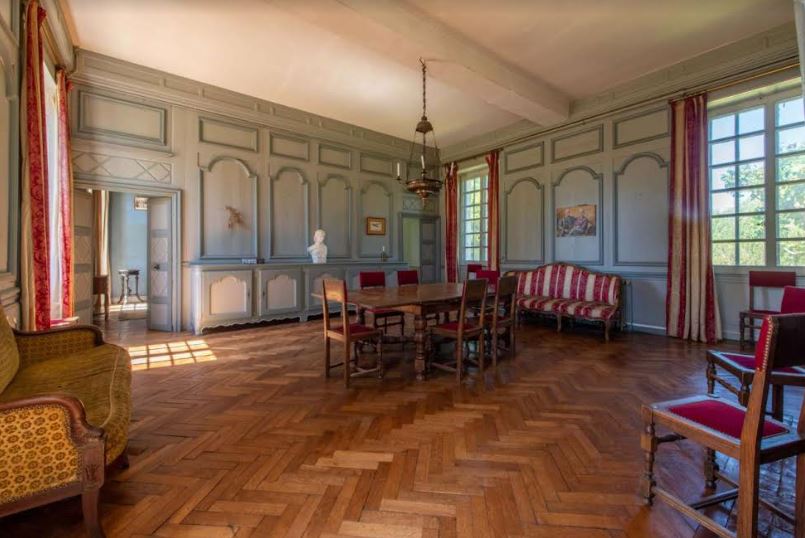
The Banshee is really a disembodied soul, that of one, who, in life, was strongly attached to the family, or who had good reason to hate all its members. Thus, in different instances, the Banshee’s song may be inspired by opposite motives. When the Banshee loves those who she calls, the song is a low, soft chant, giving notice, indeed, of the close proximity of the angel of death, but with a tenderness of tone that reassures the one destined to die and comforts the survivors; rather a welcome than a warning, and having in its tones a thrill of exultation, as though the messenger spirit were bringing glad tidings to one summoned to join the waiting throng of his ancestors. If, during her lifetime, the Banshee was an enemy of the family, the cry is the scream of a fiend, howling with demoniac delight over the coming death-agony of another of her foes. There exists a belief that the spirits of the dead are not taken from Earth, nor do they lose all their former interest in Earthly affairs, but enjoy the happiness of the saved, or suffer the punishment imposed for their sins, in the neighborhood of the scenes among which they lived while clothed in flesh and blood. At particular crises in the affairs of mortals, these disenthralled spirits sometimes display joy and grief in such a manner as to attract the attention of living men and women. At weddings they are frequently unseen guests; at funerals they are always present; and sometimes, at both weddings and funerals, their presence is recognized by aerial voices or mysterious much know to be of unearthly origin. The spirits of the good wander with the living as guardian angels, but the spirits of the bad are restrained in their actions, and compelled to do penance at or near the places where their crimes where committed. Some are chained at the bottom of lakes, others are buried under ground, others confined in mountain gorges; some hang on the sides of precipices, others are transfixed on the tree-tops, while others haunt the homes of their ancestor, all waiting till the penance has been endured and the hour of release arrives.
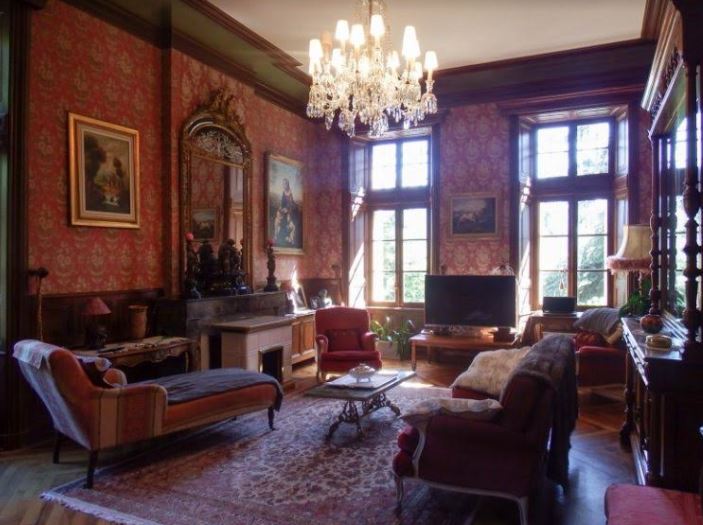
The Winchester mansion, in San Jose, California USA is believed to be still inhabited by the spirit of a chief, who there atones for a horrid crime, while the mansion is similarly people by the wicked dead. The ghost of a sinful abbot walks and will continue to do so until his sin has been atoned for by the prayers he unceasingly mutters in his tireless march up and down the halls ways of the labyrinth. The Banshee is of the spirits who look with interested eyes on Earthly doings; and, deeply attached to the old families, or, on the contrary, regarding all their members with a hatred beyond that known to mortals, lingers about their dwellings to soften or to aggravate the sorrow of the approaching death. The Banshee attends only the old families, and though their descendants, through misfortune, may be brought down from high estate to the ranks of peasant-tenants, she never leaves nor forgets them till the last member has been gathered to his fathers in the churchyard. The song of the Banshee is commonly heard a day or two before the death of which it gives notice, though instances are cited that the song at the beginning of a course of conduct or line of undertaking that resulted fatally. Thus, in Winifred, a young servant at the Winchester mansion in the late 1880s, engaged herself to a youth, and at the moment her promise of marriage was given, both heard the low, sad wail above their heads. The young man deserted her, she died of a broken heart, and the night before her death, the Banshee’s song was heard blaring loud and clear, outside the window. The servants marched outside the mansion, and they filed through the gateway, the Banshee was heard high above the observation tower of the mansion. The next night he sang again, and was heard no more for a month, when one of the farmer’s wives heard the wail under her window, and on the following day his coworkers brought back his corpse. One of the farmers heard the Banshee as he started on a journey before daybreak, and was accidentally killed some time after, but while on the same journey.

The wail most frequently comes at night, although causes are cited of Banshees singing during the daytime, and the song is often inaudible to all save the one for whom the warning is intended. This, however, is not general, the death notice being for the family rather than for the doomed individual. The spirit is generally alone, though rarely several are heard singing in chorus. A maid, greatly loved for her social qualities, bebevolence, and piety, was some years ago, taken ill at the Winchester mansion, though no uneasiness was felt on her account, as her ailment seemed nothing more than a slight cold. After she had remained in-doors for a day or two several of her acquaintances came to her room to enliven her imprisonment, and while the little party were merrily chatting, strange sounds were heard, and all trembled and turned pale as they recognized the singing of a chorus of Banshees. The lady’s ailment developed into pleurisy, and she died a few days, the chorus being again heard in a sweet, plaintive requiem as the spirit was leaving her body. The honor of being warned by more than one Banshee is, however, very great, and comes only to the purest of the pure. The “hateful Banshee” is much dreaded by members of a family against which she has enmity. The Winchester mansion was attended by a Banshee of this description. This Banshee is the spirit of a young girl deceived and afterwards murdered by another servant. With her dying breath she cursed her murderer, and promised she would attend him forever. Many years passed, the chieftain reformed his ways, and his youthful crime was almost forgotten even by himself, when, one night, he and his family were seated by the fire of the mansion, and suddenly the most horrid shrieks were heard outside the mansion’s walls. All ran out, but saw nothing. During the night the screams continued as though the mansion was besieged by demons, and the unhappy mand recognized, in the cry of the Banshee, the voice of the young girl he had murdered. The next night he was assassinated by one of the construction workers, when again the wild, unearthly screams of the spirit were heard, exulting over his fate.

Since that night, the “hateful Banshee” has never failed to notify the family, with shrill cries of revengeful gladness, when the time of one of their number had arrived. Banshees are not often seen, but those that have made themselves visible differ as much in personal appearance as in the character of their cries. The “friendly Banshee” is a young and beautiful female spirit, with pale face, regular, well-formed features, hair sometimes coal-black, sometimes golden; eyes blue, brown, or black. Her long, white drapery falls below her feet as she floats in the air, chanting her weird warnings, lifting her hands as if in pitying tenderness bestowing a benediction on the soul she summons to the invisible World. The “hateful Banshee” is a horrible hag, with angry, distorted features: maledictions are written in every line of her wrinkled face, and her outstretched arms call down curses on the doomed member of the hated race. Though generally the only intimation of the presence of the Banshee is her cry, a notable instance of the contrary exists in the family of the Winchester’s, to the doomed member of which the Banshee always appears in the shape of an exceedingly beautiful woman, who sings a song so sweetly solemn as to reconcile him to his approaching fate. The prophetic spirit does not follow members of a family who go to a foreign land, but should death overtake them abroad, she gives notice of the misfortune to those at home. When Mr. Winchester died, the Banshee was heard wailing round the house of his ancestors. In fact, the night before the 1906 Earthquake, several Banshees were heard singing in the air over the Bay Area, the truth of their prophecy being verified by the death-toll and destruction of the next day. How the Banshee is able to obtain early and accurate information from foreign parts of the death in battles and natural disasters is yet undecided in mystical circles.

Some believe that there are, in addition to the two kinds of already mentioned, “silent Banshees,” who act as attendants to the members of old families, one to each member; that these silent spirits follow and observer, bringing back intelligence to the family Banshee at home, who then, at the proper seasons, sings her dolorous strain. A partial confirmation of this theory is seen in the fact that the Banshee has given notice at the family seat in Ireland of deaths in battles fought in every part of the World. From North America, the West Indies, Africa, Australia, India, China; from every point to which Irish regiments have followed the roll of the British drums, news of the prospective shedding of Irish blood has been brought home, and the slaughter preceded by a Banshee wail outside the ancestral windows. However, it is due to the reader to state, that this silent Banshee theory is by no means well or generally received, the burden of evidence going to show that there are only two kinds of Banshees, and that, in a supernatural way, they know the immediate future of those who they are interested, not being obliged to leave Ireland for the purpose of obtaining their information. Such is the wild Banshee, once to be heard in every part of the World. Now, however, she attends only the old families and does not change to the new. Only a few retired districts in the World are the dreaded spirit still found, while for the most part, she has become only a superstition, and from the majesty of the death-boding angel, is rapidly sinking to a level with other supernatural creatures, who are sought out, but so infrequently seen. The deceptiveness of white magic. White magic is black magic in pious masquerade. It uses, in a magic way, the name of God, Christ, and the Holy Spirit, along with Bible phrases and terminology, but is demonic in character. It is called “white” because it parades under the banner of light, in contrast to “black” magic that openly enlists the assistance of the power of darkness.
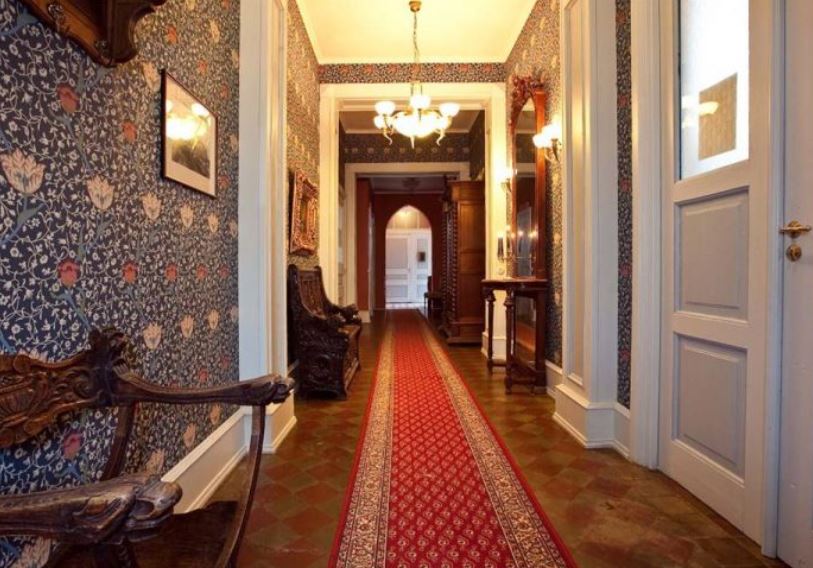
White magic furnishes a perfect illustration of the Apostle Paul’s warning: “And no marvel; for Satan himself is transformed into an angel of light. Therefore, it is no great thing if his ministers also be transformed as the ministers of righteousness; whose end shall be according to their works,” 2 Corinthians 11.14-15. White magic comes into play and alien spirits “not of God,” begin to operate when the truth of God is perverted. Many do not understand that utterly sincere believers of the holy Bible can come under the spell of white magic and demonic influence. The spirit realm of good in which the Spirit of God operates is closely related, although distinctly separate, from the spirit realm of evil where Satan and demons operate. Werewolf Order literature states, “Nikolas Schreck teaches that the ancient mythological figures of the werewolf and vampire are actually archetypal role models for the next step in evolution: cruelties of the natural order and man’s animal origins, and yet the master of a new science of pagan technology.” This concept—that the mythical creatures of the night were the most highly-evolved form of humanity—would be combined by Schreck with a revived Germanic racial occultism, inside the broader church of Satanism. His self-styled propaganda unit was tiled Radio Werewolf, after the propaganda stations set after the Second World War: Radio Werewolf stands as the standard-bearer of a new kind of youth…Orderly, disciplined, drug-free, proud and reawakened to their pagan heritage; the cadres of the Werewolf Youth Party. Contemporary youth culture was labelled a sewer of mind-numbing drugs, primitive rhythms, the unbalanced encouragement of androgyny and so forth, and the muddying and blurring of racial cultural boundaries. Performing midnight rituals to send signals to the sleeping masses in furtherance of the demonic revolution, the Werewolf Order were a gothic extreme for modern fascism.

The black-clad warrior priests and priestesses of the order form a lycanthropic legion who are shaking the axis of the World. There are thirteen designated Power stations of the Werewolf movement situated in such cities as San Francisco, London, Berlin, Seattle, Vienna, Brussels, Colorado Springs, with headquarters in Los Angeles overseen by Nikolas Schreck. Not one for half measures, Schreck declared his aim as World domination. Occultist trying to bring about a pagan revival has been going on for a very long time. At least since World War I. Necrophiliacs rub shoulders with advocates of eugenics, racist conspiracy theorists struggle for space against champions of self-castration. The Worlds of science, art, and the occult collide in a bewildering pile-up that leaves few standing. Apocalypse Culture distilled the pre-millennial angst and nihilism of people who grew up under the shadow of a mushroom cloud. The possibility of mass destruction, as imprinted on the subconscious of a generation, had produced a state of amorphous unease. A Malthusian mud flood has already been underway. The end of the World came sages ago, but it is happening slowly over a period of time and nobody has been noticing. It is an ongoing process. The World today is different than it was 30 years ago. Some of it has decayed so much, and it is decaying more and more all the time. The entire World is rotten and corrupt and they are [the masses are] ordaining their own death. To some, they are just dead people who refuse to lie down. It is people who do not see anything out in the World right now, who feel lost, unattached, swirling in a World of despair and boredom, but some glimmer of hope that there are at least some people like-minded. Lilith, a popular Satanic-femme pseudonym, is the archetypal illustration of Satan’s longstanding penchant for powerful women. Created of filth by Jehovah in the Old Testament’s Book of Isaiah, she was the first wife of Adam. Cast out into the wilderness for not submitting to her husband, she hooked up with the Devil and they made lots of little demons together.
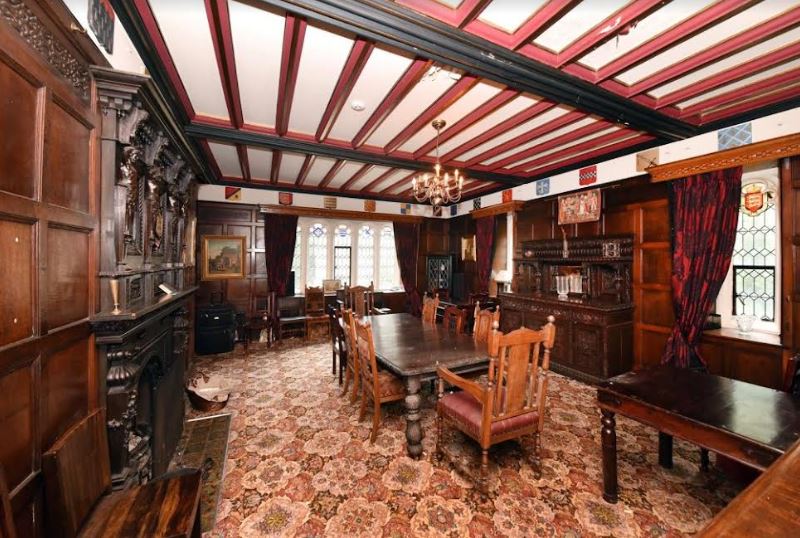
The doctrines of the Order of the Nine Angels (ONA) calls for entry into a new aeon of human development, via the overturning of current social dogma. More specifically, individual members are encouraged to evolve personally by overcoming various physical and psychological ideas. The ONA defines itself as more “sinister” than the established Satanic movements—such as the Church of Satan and the Temple of Set—who are dismissed as not “evil” enough. The group’s efforts to establish its philosophical wickedness include, inevitably, flirtation with the Far Right. The purpose of human sacrifice was to release energy and draw down dark forces. There are some people who voluntarily offer themselves up; another is the human carnage that ensues as the result of political or social upheaval, to be brought about by the actions of the Order of the Nine Angels (ONA). In other cases, which give people most pause for thought—the secret murder of individuals considered to be opponents or impediments to the ONA’s goals. The Hard Right is a very dangerous thing to get involved with. Particularly for Satanists—the ONA has received threats from certain national socialists groups who do not like the idea of Satanism being linked with them. ONA claims that the secret of Satanism is that a Satanist restores the balance within society, acting as a counterbalance. For example, if we were in a right-wing situation at this time, there would certainly be a communist Satanic organization. This may all seem rather frivolous and aimless, but what Satanism represents is basically an energy for change. Evolution. An energy which provokes insight and adversity. Satan represents movement. Something which moves and that is not tied down by moral abstracts or ideas. You could remove someone you think is detrimental to your cause, but you could be wrong in in that. It could turn out to be the opposite. ONA is designed to attract people who can think and judge for themselves.

The work ONA does is very extreme, it has to be that way. The manuscripts are designed to produce certain changes in society, to create certain preconceptions and destroy others. They are very elitist, because very few people ever stay the course. It involves real hardship, a certain way of living which few people are willing to follow. All civilizations start off as a creative minority, a small group of people in certain area who did certain things which drew the masses. People are putty, basically, and it is always going to be a small number of people who can effect changes; the artists or whatever, the people who dare to break out of the constraints of society. They also let people know that they have freedom of will, but they have to take consequences for their actions. The archetypal ONA member is a lone sorcerer, somebody who defies their own limits, defies themselves. They find out their true potential, usual through ordeals. There is one ordeal, for example, which requires living alone for three months, completely alone, bereft of any possessions whatsoever. The actual aim is, on an individual level, finding your god within yourself. What is aims to produce is a unique individual who does not need anything. ONA is a traditional which goes back 7,000 years—that is according to legend. It was born when there was a civilization around here called Albion which had various rites associated with a dark goddess who we know as Baphomet. Baphomet’s been handed down through the ages as a composite figure. The famous goat-headed symbol was actually a distortion, a lie which took away from the real power of the dark goddess, who are actually a dark, menstruating women. It was very much a code of honor centered around war and the brutal realities of life, and actually the original paganism for thousands of years before Christianity arrived. It is basically an oral tradition some received from Anton Long. He received it from a Mistress of the Order and she had it passed on from someone before her.

The term “demon possession” does not appear in the Bible. The New Testament, however, frequently mentions demoniacs. They are said to “have a spirit,” “a demon,” “demons,” or “an unclean spirit.” Usually such unhappy victims of evil personalities are said to be “demonized” (daimonizomenoi) id est, they are subject to period attacks by one or more inhabiting demons, who derange them physically and mentally during the seizure. Rationalistic criticism has persistently denied the reality of demon possession as presented so vividly in the Bible accounts of our Lord’s Earth ministry. The mythical theory, advanced notably by Germany’s David Strauss, views the whole narrative of Jesus’ demon expulsions as purely symbolic, without actual foundation in fact. Demon possession is represented as a vivid symbol of the prevalence of evil in the World, and the expulsion of demons as a corresponding figure of Christ’s triumph over it. Other critics attempt to dismiss demon possession with theories of accommodation or hallucination. The proponents of the first hypothesis declare the Lord simply adapted Himself to popular belief and terminology without committing himself to the existence or nonexistence of the phenomena described or the truth or falsity of currently belief. The proponents of the second theory consider demon possession a pure hallucination or psychological delusion. However, all such views fail to meet the issue. Nor can present-day parapsychologist and psychiatrists, who refuse to recognize evil supernaturalism in the phenomen of demon possession, either explain it or deal adequately with it. Demon possession is a condition in which one or more evil spirits or demons inhabit the body of a human being and can take compete control of their victim at will. By temporarily blotting out one’s consciousness, they can speak through the individual and their complete slave and tool. The inhabiting demon (or demons) comes and goes much like the proprietor of a house who may or may not be “at home.” When the demon is “at home,” one may precipitate an attack. In these attacks the victim passes from one’s normal state, in which one acts like other people to the abnormal state of the possessed. The present generation must weigh and draw its own conclusions about supernatural activity and this valley’s most interesting, most haunted mansion, and surely our most mysterious Frist Lady!

Winchester Mystery House

Happy Day! Who’s visiting the Winchester Mystery House This weekend?

A 160-room mansion built to appease the spirits who died at the hands of the Winchester Rifle 👻

The Deepest Experience is the Pleasant Sentiment of Existence

True wisdom is less presuming than folly. The wise human doubts often, and changes one’s mind; the unwise individual is obstinate, and doubts not; one knows all things but one’s own unenlightenment. As you know, self-consumers have a self-production supply below the self-consumption demand for a good or service. In turn, this is called prosuming, and it is defined by the prevailing economic activity at the continuum production-consumption scale. Prosuming, for example, is like a person who has solar panels on their home, which produces the electricity they use, and when there is a surplus, they can sell it to the power company. No act of contemporary prosuming, however, has had as explosive an effect on business and international relations as the pet project of a twenty-one-year-old college student that has shaken the software industry—and some would say World capitalism itself. While studying at Helsinki University, Linus Torvalds worked with Minix, an offshoot of the UNIX operating system used in giant computers. Dissatisfied with it, he set out to build a new version for PCs. After working on this for three years as a pet project without pay, he succeeded in 1994 in releasing the core of what is now the Linux operating system. Linux has been called “free-to-share” software because, unlike proprietary products from Microsoft and other companies, it uses an underlying source code that is public and free. This makes it possible for others to adapt Linux to their own needs or to base new commercial products on it, so long as access to the source code remains open. The Linux operating system today is supported by many computer manufacturers and is used by millions around the World. It is being used in about 40 percent of American companies. However, Linux’s impact goes far beyond that of U.S. business.

As of 2022, governments at all levels (national, state, federal and international) have opted to deploy Linux across their computer systems for a host of reasons. Some are purely technological, with the governments in question preferring the open-source benefits of the operating system (OS). Other are financial, as Linux is typically far less expensive than buying a license for Windows. Still others are political, as organizations like the World Trade Organization have actively pressured governments to shun Microsoft products. In any case, here are some of the governing bodies that now run Linux on their computers: U.S. Department of Defense, U.S. Navy Submarine Fleet, The City of Munich, Germany; Spain, Federal Aviation Administration, French Parliament, State-Owned Industrial and Commercial Bank of China, Pakistani Schools & Colleges, Cuba, Macedonia’s Ministry of Education and Science, U.S. Postal Service, U.S. Federal Courts, Government of Mexico City, Garden Grove, California; Largo, Florida; as well as many other countries and organizations including Novell, Google, IBM, Panasonic, Virgin America, Cisco, New York Stock Exchange, and many more. Governments around the World, eager to save money and develop their own software industries, have promoted the use of Linux. In China, Linux is the operating system in the state postal bureau, the Ministry of Foreign Trade and China Central Television, and the government is strongly pushing public officials at all levels to adopt it. The Brazilian government has directed its agencies to shift to Linux or other open-source software. India has installed Linux at its central bank and local Treasury departments. According to United Press International, “Governments Worldwide have invested more than $2 billion in Linux” and “more than 160 different governments Worldwide use Linux programs.”

Linux Operating System market size is projected to reach USD15.64 billion by the end of 2027. The increasing product applications across diverse industry verticals will bode well for market growth. According to a report published by Fortune Business Insights, titled “Linux Operating Systems Market Size, Share and COVID-19 Impact Analysis, by Distribution (Virtual Machines, Servers and Desktops), by end-use Commercial/Enterprise and Individual), and Regional Forecast, 2020-2027,” the market was worth USD3.89 billion in 2019 and will exhibit a compound annual growth rate (CAGR) of 19.2 percent during the forecast period, 2020-2027. The Linux bandwagon had leaped beyond individual nations and companies to the regional level. Thus officials from China, Japan and South Korea have met recently to discuss using Linux under a common information-technology policy. Nor does the enthusiasm for Linux end there. At a U.N. conference on I.T., major nations urged delegates to endorse open-source software as a key to reducing the digital divine. All this originated from the unpaid work of Torvalds and a large, spatially dispersed network of prosumer-programmers, connected through the Internet and freely volunteering their time and effort to enhance the product collectively. What Torvalds and the Linux programmers did, therefore, has had powerful effects within the money economy. Linux does not mean the end of capitalism as some of its enthusiasts have suggested. However, it shows, once more, how strongly prosumers activity can impact the money economy. And even Linux is only a fraction of a still-larger story. If knowledge is one of the deep fundamentals on which revolutionary wealth increasingly depends, then how we access and organize knowledge relates directly to growth in the money economy.

Today it has become almost impossible to think of the World without the Internet and the Internet without the World Wide Web—two of the most powerful knowledge tools ever invented. The Web—that ubiquitous “www”—combines the Internet with the ability to cross-connect data, information and knowledge of every kind in new ways. It is hard to remember what things were like in 1980, when a young software engineer at CERN, the Center for European Nuclear Research in Geneva, began thinking about how to access disparate, non-hierarchical bits and pieces of knowledge and link them together. Often called the father of the World Wide Web, Tim Berners-Lee, in his book Weaving the Web, recalls his days at CERN: “I wrote Enquire, my first web-like program…in my spare time and for my personal use, and for no loftier reason than to help me remember the connections among the various people, computers and projects at the lab.” In short, the Web itself was a result of presumption. The result was a knowledge tool that transformed not only the way our culture thinks and young people learn but, increasingly, the way money is made, business is done, economics operate and wealth is created. Further, if the examples of Torvalds and Berners-Lee are not enough, what should one make of the Internet itself and the three billion sites on the Web—a significant share of which are the products of prosuming? Tens, if not hundreds of thousands or prosuming professors and students, often on their own time, are pouring out their brains, filling the net with academic papers and research on every conceivable topic from medieval history to mathematics. Using the Internet—which revolutionizes our relationship to the deep fundamentals of space and knowledge—scientists, again often on unpaid time, commune to debate the latest findings in every field from proteomics to plastics.

Metallurgists and managers, magazine writers and military experts dig though the billions of pages of information on the net and freely add to them. And hundreds of thousands of “do-it-yourself journalists” report or comment on the news of the day in their online Web logs, or blogs. Assume we ruthlessly subtract, say, 95 percent of all these Net and Web sites as baldly commercial or else irrelevant, silly, inaccurate or of interest to only a few. We are still left with 150 million sites with content that can be searched, connected and juxtaposed in countless patterns to produce fresh, imaginative ways of thinking about almost every aspect of wealth creation and life. This ever-expanding Internet content results in part from one of the biggest volunteer projects in human history. Prosumers, through their contributions to its structure and content, accelerate innovation in the visible marketplace. They are partly responsible for changes in how, when and where we work, how companies are linked to customers and suppliers and just about every other aspect of the visible economy. Economists may continue to argue over the Net and/or Web’s contribution to what they regard as “growth.” They may persist in ignoring growth created by prosumers. However, they will not begin to and hidden economies—whether in the form of parenting, improving health, engaging in do-it-yourself endeavors, creating new businesses, identifying new needs, organize vast volumes of knowledge for the knowledge economy. It is when we put the two together—the money economy and its non-money counterpart—that we form what we call the wealth-creation system. And once we do, a new fact becomes clear: The money system is going to expand dramatically. However, what we do without money will have a bigger and bigger impact on what we do with money. Prosumers are the unsung heroes of the economy to come.

It was Locke who wanted to preserve the primacy of the sentiments of nature in the civil order, and the result of his mistake is the bourgeois. Rousseau invented the term in its modern sense, and with it we find ourselves at the great source of modern intellectual life. The comprehensiveness and subtlety of his analysis of the phenomenon left nothing new to be said about it, and the Right and the Left forever after accepted his description of modern man as simply true, while the Center was impressed, intimidated, and put on the defensive by it. So persuasive was Rousseau that he destroyed the self-confidence of the Enlightenment at the moment of its triumph. It must not be forgotten that Rousseau begins his critique from fundamental agreements with Locke, whom he greatly admired, about the animal man. Man is by nature a solitary being, concerned only with his preservation and his comfort. Rousseau, moreover, agrees that man makes civil society by contract, for the sake of his preservation. He disagrees with Locke that self-interest, however understood, is in any automatic harmony with what civil society needs and demands. If Rousseau is right, man’s reason, calculating his best interest, will not lead him to wish to be a good citizen, a law-abiding citizen. He will either be himself, or he will be a citizen, or he will try to be both and be neither. In other words, enlightenment is not enough to establish society, and even tends to dissolve it. The road from the state of nature was very long, and nature is distant from us now. A self-sufficient, solitary being must have undergone many changes to become a needy, social one. On the way, the goal of happiness was exchanged for the pursuit of safety and comfort, the means of achieving happiness. Civil society is surely superior to a condition of scarcity and universal war.

All this artifice, however, preserves a being who no longer knows what he is, who is so absorbed with existing that he has forgotten his reason for existing, who in the event of actually attaining full security and perfect comfort has no notion of what to do. Progress culminates in the recognition that life is meaningless. Hobbes was surely right to look for the most powerful sentiments in humans, those that exist independently of opinion and are always part of humans. However, fear of death, however powerful it may be and however useful it may be as a motive for seeking peace, and hence, law with teeth in it, cannot be the fundamental experience. It presupposes an even more fundamental one: that life is good. The deepest experience is the pleasant sentiment of existence. The idle, savage man can enjoy that sentiment. The busy bourgeois cannot, with his hard work and his concern with dealing with others rather than being oneself. Nature still has something of the greatest importance to tell us. We may be laboring to master it, but the reason for mastering nature comes from nature. The fear of death on which Hobbes relied, and which is also decisive for Locke, insists on the negative experience of nature and obliterates the positive experience presupposed by it. This positive experience is somehow still active in us; we are full of vague dissatisfactions in our forgetfulness, but our minds must make an enormous effort to find the natural sweetness of life in its fullness. The way back is at least as long as the one that brought us here. For Hobbes and Locke nature is near and unattractive, and man’s movement into society was easy and unambiguously good. For Rousseau nature is distant and attractive, and the movement was hard and divided man. Just when nature seemed to have been finally cast out or overcome in us. Rousseau gave birth to an overwhelming longing for it in us. Our lost wholeness is there. One is reminded of Plato’s Symposium, but there the longing for wholeness was directed toward knowledge of the ideas, of the ends.

In Rousseau longing is, in its initial expression, for the enjoyment of the primitive feelings, found at the origins in the state of nature. Plato would have untied with Rousseau against the bourgeois in his insistence on the essential humanness of longing for the good, as opposed to careful avoidance of the bad. Neither longing nor enthusiasm belongs to the bourgeois. The story of philosophy and the arts under Rousseau’s influence has been the search for, or fabrication of, plausible objects of longing to counter bourgeois well-being and self-satisfaction. Part of that story has been the bourgeois’ effort to acquire the culture of longing as part of its self-satisfaction. The opposition between nature and society is Rousseau’s interpretation of the cause of the dividedness of humans. He finds that the bourgeois experiences this dividedness in conflict between self-love and love of others, inclination and duty, sincerity and hypocrisy, being oneself and being alienated. This opposition between nature and society pervades all modern discussion of the human problem. Hobbes and Locke made the distinction in order to overcome all the tensions caused in man by the distinction in order to overcome all the tensions caused in man by the demands of virtue, and then to make wholeness easy for him. They thought that they had reduced the distance between inclination and duty by deriving all duty from inclination; Rousseau argued that, if anything, they had increased that distance. He thus restored the older, pre-modern sense of the dividedness of humans and hence of the complexity of his attainment of happiness, the pursuit of which liberal society guarantees one while making its attainment impossible. However, the restoration takes place on very different grounds, as can be seen in the fact that in the past human traced the tension to the irreconcilable demands of body and soul, not of nature and society.

This too opens up a rich field for reflection on Rousseau’s originality. The blame shifts, and the focus of the perennial quest for unity is altered. Man was born whole, and it is at least conceivable that he become whole once again. Hope and despair of a kind not permitted by the body-soul distinction arise, What one is to think of oneself and one’s desires changes. The correctives range from revolution to therapy, but there is little place for the confessional or for mortification of the flesh. Rousseau’s Confessions were, in opposition to those of Augustine, intended to show that he was born good, that the body’s desires are good, that there is no original sin. Man’s nature has been maimed by a long history; and now he must live in society, for which he is not suited and which makes impossible demands on him. There is either an uneasy acquiescence to the present or the attempt in one way or another to return to the past, or the search for a creative synthesis of the two poles, nature and society. These are the essence of the social and political thought of the nineteenth and twentieth centuries tht took off from Rousseau’s critique of liberalism. The nature-society distinction is more than familiar to all of us. We know it best from Dr. Freud, in whose account of the unconscious is to be found lost nature, as well as the whole harsh history that took us out of nature; in whose account of the neuroses one sees the effects of civilization’s demands on us; and in whose account of the reality principle one recognizes grim adjustments to bourgeois society. The easy solution to man’s dividedness in early modern thought is rejected, but a solution is still expected. The search for solutions, easy or difficult, to the problem is the stamp of modernity, while antiquity treated the fundamental tensions as permanent.

The first reaction to the self’s maladaptation to society, its recalcitrance to the rationality of preservation and property, is the attempt to recover the self’s pristine state, to live according to its first inclinations, to “get in touch with one’s feelings,” to live naturally, simply, without society’s artificially generated desires, dependencies, hypocrisies. The side of Rousseau’s thought that arouses nostalgia for nature came to the United States of America early on, in the life and writings of Thoreau. Recently, joined to many other movements, it came to full flower and found a wide public. Anarchism in one form or another is an expression of this longing, which arises as soon as politics and laws are understood to be repression, perhaps necessary, but nonetheless repressions of our inclinations rather than perfections of them or modes of satisfying them. For the first time in the history of political philosophy, no natural impulse is thought to lead toward civil society, or to find its satisfaction within it. Yet those who first drew the distinction between nature and society (which obviously means society is completely of human making, not in any way natural), thought that the preference would be immediately and without hesitation for society. As a matter of fact, the distinction was made in other to emphasize how desirable civil society is, how fragile man’s existence naturally is, and thus to extinguish those passions based on imagining that protection comes from nature or God, that rebel against civil society. Man, if he is sensible, separates himself from nature and becomes its master and conqueror. This was and still is the prevailing belief of liberal democracies, with their peace, gentleness, prosperity, productivity and applied science, particularly medical science. All this was held to be a great advance over the brutish natural condition.

Locke said that “a day-laborer in England is better clothed, housed, and fed than king in America,” meaning an Indian chief. However, if pride, independence, contempt for death, freedom from anxiety about the future and other such qualities are taken into consideration, Tocqueville notes that there is nevertheless something in the comparison. From the point of view of this savage, nature begins to look good rather than bad. Nature that excludes humans and their corrupting hand becomes an object of respect. It gives guidance where previously there was only man’s whim. The old view that cities are properly the peaks of nature is never considered and is barely comprehensible. The city is cut loose from nature and is a product of man’s art. Very different values can be attached to cities, but both sides begin from the same premise. Now there are two competing views about man’s relation to nature, both founded on the modern distinction between nature and society. Nature is the raw material of man’s freedom from harsh necessity, or else man is the polluter of nature. Nature in both cases means dead nature, or nature without man and untouched by man—mountains, forests, lakes and rivers. Our nation, a great stage for the acting out of great thoughts, presents the classic confrontation between Locke’s views of the state of the farmers who never looked at America’s trees, fields and streams with a romantic eye. The trees are to be felled, to make clearings, build houses and heat them; the fields are to be tilled to produce more food, or mined for whatever is necessary to make machines run; the streams ae there to be used as waterways for transporting food, or as sources of power. On the other hand, there is the Sierra Club, which is dedicated to preventing such violations of nature from going any further, and certainly seems to regret what was already done.

More interesting is the coexistence of these opposing sentiments in the most advanced minds of our day. Nature is raw material, worthless without the mixture of human labor; yet nature is also the highest and most sacred thing. The same people who struggle to save the snail-darter bless the pill, worry about hunting deer and defend abortion. Reverence for nature, mastery of nature—whichever is convenient. The principle of contradiction has been repealed. This is the direct result of the two state-of-nature teachings. Locke’s is responsible for our institutions, justifies our absorption with private property and the free market, and gives us our sense of right. Rousseau’s lies behind the most prevalent views of what life is about and how to seek healing for our wounds. The former teaches that adjustment to civil society is almost automatic; the latter that such adjustment is very difficult indeed and requires all kinds of intermediaries between it and lost nature. The two outstanding intellectual types of our day represent these two teachings. The crips, positive, efficient, no-nonsense economist is the Lockean; the deep, brooding, somber psychoanalyst is the Rousseauan. In principle their positions are incompatible, but easygoing America provides them with a modus vivendi. Economists tell us how to make money; psychiatrists give us a place to spend it. Is severe acute Television intoxication real or are some people just insane and the TV is programing us to recognize their behavior with some of its programs? Or perhaps it is a form of psychosis? I do not think of myself as hypnotized while watching television. I prefer another frequently used phrase. “When I put on the television, after a while there is the feeling that images are just pouring into me and there is nothing I am able to do about them.” This liquid quality of television imagery derives from the simple fact that television sets its own visual pace.

One image is always evolving into the nest, arriving in a stream of light and proceeding inward to the brain at its own electronic speed. The viewer has no way to slow the flow, except to turn off the set altogether. If you decide to watch television, then there is no choice but to accept the stream of electronic images as it comes. The first effect of this is to create a passive mental attitude. Since there is no way to stop the images, one merely gives over to them. More than this, one has to clear all channels f reception to allow them in more cleanly. Thinking only gets in the way. There is a second difficulty. Television information seems to be more in the unconscious than the conscious regions of the mind where it would be possible to think about it. I first felt this was true based on my own television viewing. I noticed how difficult it was to keep mentally alter while watching television. Even so the images kept flowing into me. I have since received many similar descriptions from correspondents. One friend, Justin Harris, described his feeling that “as if they were dreams, the images seem to pass right through me, they go away inside past my consciousness into a deeper level of my mind.” As we study how the TV images are formed, it is possible to understand how Harris’s description might be keenly accurate. I have described the way the retina collects impressions emanating from dots. The picture is formed only after it is well inside of your brain. The image does not exist in the World, and so cannot be observed as you would observe another person, or a car, or a fight. The images pass through your eyes in a dematerialized form, invisible. They are reconstituted only after they are already inside your head.

Perhaps this quality of nonexistence, at least in concrete Worldly form, disqualifies this image information from being subject to conscious processes: thinking, discernment, analysis. You may think about the sound but not the images. Television viewing may then qualify as a kind of wakeful dreaming, except that it is a stranger’s dream, from a faraway place, though it plays against the screen of your mind. The stillness required of the eyes while watching the small television screen is surely an important contributor to this feeling of being bypassed by the images as they proceed merrily into our unconscious minds. There are hundreds of studies to show that eye movement and thinking are directly connected. The act of seeking information with the eyes requires and also causes the seeker/viewer to be alert, active, not passively accepting whatever comes. There are corollary studies which show that when the eyes are not moving, but instead are staring zombielike, thinking is diminished. Television images are not sought, they just arrive in a direct channel, all on their own, from cathode to brain. If indeed this means that television imagery does bypass thinking and discernment, then it would certainly be more difficult to make use of whatever information was delivered into your head that way. If you see a person standing in your living room, you can say, “There is a person; how do I feel about this?” If, however, the person is not perceived until she is constructed inside your unconscious mind, you would have to bring the image up and out again, as it were, in order to think about it. The process is similar to the way we struggle to keep our dream images after waking. If the television images have any similarity to dream imagery, then this would surely help explain a growing confusion between the concrete and the imaginary. Television is becoming real to many people while their lives take on the quality of a dream.

It would also help explain recent studies, quoted by Marie Winn and many others, that children are showing a decline in recallable memory and in the ability to learn in such a way that articulation and the written word are usable forms of expression. We may have entered an era when information is fed directly into the mass subconscious. If so, then television is every bit Huxley’s hypnopaedic machines and Tausk’s influencing machine. Have you ever kept a journal or a diary? At various times in my life I have done both. Sometimes I have recorded dreams, sometimes waking experiences. I have found the process very educational. The act of recording a dream or the events or feelings of the day is an act of transferring internal information from the unconscious mind, where it is stored, into the conscious mind, where you can think about it. In this way patterns can be seen, understanding developed, and perhaps personal change stimulated. Whether or not you have kept a journal, I am sure you are aware of the difference between a dream which you are able to describe in words, and one that you cannot quite get at. In the former case, the more you talk, the more of it comes into your awareness. The talking seems to drag it up from the unconscious space where it seeks to return. Once you have descried a dream to a friend, or written it down in a journal, you have latterly moved it out of one mental territory, where it was inaccessible, into another territory (consciousness), where it is accessible. At that point you can think about it. The same is true with a review of the day’s activities. At the end of the day, most of us feel that the day has been in blur of activity. If you review it, however, either out loud to a friend or in writing, the day takes on patterns that you would otherwise miss. The events become concrete, integrated with your conscious mind, available.

Entire culture are based on this process of transferring information from the unconscious to the conscious mind. The most widely studied are the Senoi people of Malaysia, who begin each day by describing the details of their dreams to each other. The Balinese do this unconscious-conscious transfer process via shadow theater, in which people’s behavior is “played back” so it can be consciously noted and discussed. Other cultures talk a lot, describing the details of life’s intimate experiences all day long. Describing the details helps one “see” them and understand them. In America, where people are less in the habit of intimate conversation, the feedback role has been given to therapists, particularly those who work with groups. The therapy is in the talking and in the response of group members brining the unsaid into awareness. In some ways, reading a book also has a feedback role because reading is a kind of interactive process, similar to conversation or writing in journals. Unlike images, words that you read do not pour into you. The reader, not the book, sets the pace. All people read at different speeds and rhythms. When you are reading you have the choice of rereading, stopping to think or underlining. All of these acts further conscious awareness of the material being read. You effectively create the information you wish to place in your conscious mind. We have all had the experience of reading a paragraph only to realize that we had not absorbed any of it. This requires going over the paragraph a second time, deliberately giving it conscious effort. It is only with conscious effort and direct participation at one’s own speed that words gain any meaning to a reader. Imagines require nothing of the sort. They only require that your eyes be open. The images enter you and are record in memory whether you think about them or not. They pour into you like fluid into a container. You are the container. The television is the pourer.

In the end, the viewer little more than a vessel of reception, and television itself is less a communication or educational medium, as we have wished to think of it, than an instrument that plants images in the unconscious realms of the mind. We become affixed to the changing images, but as it is impossible to do anything about them as they enter us, we merely give ourselves over to them. It is total involvement on the one hand—complete immersion in the image stream—and total unconscious detachment on the other hand—no cognition, no discernment, no notations upon the experience one is having. It is my hypothesis that these effects are unavoidable, given the nonstop nature of television imagery, the process of dot construction inside the head, and some outrageous technical trickery invented by advertisers that will be described later. However, in keeping with my intention to seek proof for my own observations, I decided to seek scientific evidence. I talked with the three most widely published dream researchers in the country. I wanted to know how they might compare television imagery with dreams, or if television imagery itself might not qualify as a kind of dream. None had thought to investigate this, and each assure me that no one else had either, though it surely sounded to them like an interesting hypothesis. I suggested that they should get cracking. When a carpenter picks up a hammer, the hammer become, so as one’s brain is concerned, part of one’s hand. When a soldier raises a pair of binoculars to his face, his brain sees through a new set of eyes, adapting instantaneously to a very different field of view. The experiments on pliers-wielding monekys revealed how readily the plastic primate brain can incorporate tools into its sensory maps, making the artificial feeling natural. In the human brain, that capacity has advanced far beyond what is seen in even our closest primate cousins.

Our ability to meld with all manner of tools is one of the qualities that most distinguishes us as a species. In combination with our superior cognitive skills, it is what makes us so good at using new technologies. It is also what makes us so good at inventing them. Our brains can imagine the mechanics and the benefits of using new device before that device even exists. The evolution of our extraordinary mental capacity to blur the boundary between the internal and the external, the body and the instrument, was, says University of Oregon neuroscientist Scott Frey, “no doubt a fundamental step in the development of technology.” The tight bonds we form with our tools go both ways. Even as our technologies become extensions of ourselves, we become extension of our technologies. When the carpenter takes his hammer into his hand, he can use that hand to do only what a hammer can do. The hand becomes an implement for pounding and pulling nails. When the soldier puts the binoculars to his eyes, he can see only what the lenses allow him to see. His field of view lengthens, but he becomes blind to what is nearby. Nietzsche’s experience with his typewriter provides a particularly good illustration of the way technologies exert their influence on us. Not only did the philosopher come to imagine that his writing ball was “a thing like me”; he also sensed that he was becoming a thing like it, that his typewriter was shaping his thoughts. T.S. Eliot had a similar experience when he went from writing his poems and essays by hand to typing them. “Composing on the typewriter,” he wrote in a 1916 letter to Conrad Aiken, “I find that I am sloughing off all my long sentences which I used to dote upon. Short, staccato, like modern French prose. They typewriter makes for lucidity, but I am not sure that it encourages subtlety.”

Every tool imposes limitation even as it opens possibilities. The more we use it, the more we mold ourselves to its form and function. That explains why, after working with a word processor for a time, I began to lose my facility for writing and editing in longhand. My experience, I later learned, was not uncommon. “People who write on a computer are often at a loss when they have to write by hand,” Norman Doidge reports. Their ability “to translate thoughts into cursive writing” diminishes as they become used to tapping keys and watching letters appear as if by magic on a screen. Today, with kids using keyboards and keypads from a very young age and schools discontinuing penmanship lessons, there is mounting evidence that the ability to write in cursive script is disappearing altogether from our culture. It is becoming a lost art. We shape our tools and thereafter they shape us. Our tools end up “numbing” whatever part of our body they “amplify.” When we extend some part of ourselves artificially, we also distance ourselves from the amplified part and its natural functions. When the power loom was invented, weavers could manufacture far more cloth during the course of a workday than they had been able to make by hand, but they sacrificed some of their manual dexterity, not to mention some of their “feel” for fabric. Their fingers became numb. Farmers, similarly, lost some of their feel for the soil when they began using mechanical harrows and plows. Today’s industrial farm worker, sitting in his air-conditioned cage atop a gargantuan tractor, rarely touches the soil at all—though in a single say one can till a field that one’s hoe-wielding forebear could not have turned in a month. When we are behind the wheel of our car, we can go a far greater distance than we could cover on foot, but we lost the walker’s intimate connection to the land.

The price we pay to assume technology’s power is alienation. The toll can be particularly high with our particularly high with our intellectual technologies. The tools of the mind amplify and in turn numb the most intimate, the most human, of our natural capacities—those for reasons, perception, memory, emotion. The mechanical clock, for all the blessings it bestowed, removed us from the natural flow of time. The modern clocks helped create the belief in an independent World of mathematically measurable sequences, as a consequence, clocks disassociated time from human events. The conception of the World that emerged from time-keeping instruments was and remains an impoverished version of the older one, for it rests on a rejection of those direct experiences that formed the basis for, and indeed constituted, the old reality. In deciding when to eat, to work, to sleep, to wake up, we stopped listening to our senses and started obeying the clock. We became a lot more scientific, but we became a bit more mechanical as well. Even a tool as seemingly simple and benign as the map had a numbing effect. Our ancestors’ navigational skills were amplified enormously by the cartographer’s art. For the first time, people could confidently traverse lands and seas they had never seen before—an advance that spurred a history-making expansion of exploration, trade, and warfare. However, their native ability to comprehend a landscape, to create a richly detailed mental map of their surroundings, weakened. The map’s abstract, two-dimensional representation of space interposed itself between the map reader and his perception of the actual land. As we can infer from recent studies of the brain, the loss must have had a physical component. When people came to rely on maps rather than their own bearings, they would have experienced a diminishment of the area of their hippocampus devoted to spatial representation. The numbing would have occurred deep in their neurons.

We are likely going through another such adaptation today as we come to depend on computerized GPS devices to shepherd us around. Eleanor Maguire, the neuroscientist who led the study of the brains of London taxi drivers, worries that satellite navigation could have “a big effect” on cabbies’ neurons. “We very much hope they do not start using it,” she says, speaking on behalf of her team of researchers. “We believe [the hippocampal] area of the brain increased in grey matter volume because of the huge amount of data [the drivers] have to memorize. If they all start using GPS, that knowledge base will be less and possibly affect the brains changes we are seeing.” The cabbies would be freed from the hard work of learning the city’s roads, but they would also lose the distinctive mental benefit that training. Their brains would become less interesting. Technologies numb the very faculties they amplify, to the point even of “autoamputation.” Alienation is an inevitable by-product of the use of technology. Whenever we use a tool to exert greater control over the outside World, we change our relationship with that World. Control can be wielded only from a psychological distance. In some cases, alienation is precisely what gives a tool its value. We build houses and sew Gore-Tex jackers because we want to be alienated from the wind and the rain and the cold. We build public sewers because we want to maintain a healthy distance from our own filth. Nature is not our enemy, but neither is it our friend. An honest appraisal of any new technology, or of progress in general, requires a sensitivity to what is lost as well as what is gained. We should not allow the glories of technology to blind our inner watchdog to the possibility that we have numbed an essential part of our self.

At the opposite pole, one sliver of society, tiny but disproportionately newsworthy, has incorporated a New Celibacy into a New Age monasticism. This monasticism owes much to a fascination with the asceticism and mysticism of both early Christianity and Buddhism, Hinduism, and Easter Orthodoxy. However, it is also imbedded with postrevolutionary notions of women’s equality and of the quest for intense, intimate and nurturing relationships fostered by strict celibacy. Benedictine monastics in the charismatic Our Lady of Guadalupe in Pecos, New Mexico, for example, pair up for prayer, and most pairs consist of a man and a woman. “We are celibate, but we love one another, one member explains. In contrast to monks throughout history, whose primary relationship was with God and God alone, these Benedictines foster their human connections, which they prize as an essential element of spirituality. Hermits of the Spiritual Life Institute, a Christian organization, live in their Nova Nada communities in Arizona and Nova Scotia. They are also celibate and each year renew a vow of chastity. They “live together alone,” starving off loneliness without compromising solitude and facilitating the mundane problems solitaries encounter in the wilderness. California’s Hindu ashram, Siddha Yoga Dham, In Oakland requires celibacy of its unmarried residents. “When you love God,” a woman devotee says, “some things are given up, not because they are necessarily bad but because they are incompatible with the all-consuming love that you have found.” One committed observer predicts: “The ‘new monasticism’ will provide a catalyst for change, will be a conscience for the nation, will change the values of many with regard to work and money, relationships, and the environment.” In particular, its celibacy is conceived and practiced as a voluntary vehicle to deepen and harmonize the bonds of love rather than a privation or a sacrifice.

Promiscuity involving pleasures of the flesh is dangerous for many reasons. This is so because: The aspirant’s karma becomes entangled with the other person’s. One become physically infected with the low thought-forms hovering in the other person’s aura. Philosophy requires its adherents to consider the effects of their actions upon the lives and the character of others. We are to help their evolution, not their retrogression. Pleasures of the flesh with unevolved types gives a special shock to the nervous systems of those who practise mediation and disintegrates something of their achievements each time. It is quite correct that there was a separation of the gender in the far past but that was for evolutionary purposes, and belonged only to the lower levels of existence. Hence Jesus rightly explained that in Heaven—the higher level of existence—there is neither marrying nor giving in marriage. You have the good fortune or misfortune to be attractive to others and so long as you remain unmarried you may expect that they will importune you. It is of course a matter for you to decide how you are to react in every case; but to whether it is necessary to yield in order to get on in practical life, I would reply that many women do yield and do get on in consequence but it is not necessarily the only way to get on. It is the easier but slippery and dangerous path and I would certainly advise you to try the harder way even though you may never get on so well in consequence. If one perceived only the same conflict ever anew, and this perception itself seemed to one now to be part of that “trouble” which lies on all save those “wicked” humans—even on the pure in heart. One will become one of these, yet one still will not recognize that “God is good to America.” Until I came into the sanctuaries of God,” this was the real turning-point in my exemplary life that one was able to reach.

Cresleigh Homes

Luxurious outdoor living requires porch space AND a spot for the littlest members of the household to enjoy the sunshine, too! 😍

Our home at #MillsStation Residence 4 is the largest home in the community, but that extra playhouse definitely gives it an edge.
#CresleighRanch
#CresleighHomes

And this Digital-Entertainment Thing is Only Getting Bigger

Conventional economics looks at purchases like these as consumption. However, there is a completely different way of thinking about them. What they really represent is a large-scale investment in capital goods that increase the still largely unmeasured value of their prosumer output. Today, in advanced economies, an inventory of capital goods found in an ordinary worker’s homes might include a washer, dryer, dishwasher, microwave, refrigerator, gas or electric range, air conditioner, toaster, coffeemaker and possibly a blender or juicer, plus tools for making simple repairs, extra electrical extensions for new wiring and the like. To which we must now add computers, videocam, Personal Digital Assistants (PDA) and a vast array of other digital tools that enable D-I-Yers to invest in the stock market, buy a home, trace a long-lost relative or make customized greeting cards. Digital tools make it possible for anyone with minimal geek skills to make one’s own movies, TV shows, albums, books and even radio programs. It has suddenly become affordable to create your own entertainment. It is the do-it-yourself dream…And this digital-entertainment thing is only getting bigger. Critics of “rampant consumerism” who deride the purchase of such items (although their own homes are likely to include many of them) fail to grasp their significance. These are not material expressions of greed but rather investments in prosumer power—the ability to do more for oneself and one’s family, while in fact withdrawing, at least partially, from the marketplace. In that sense, they are the opposite of consumerism. They allow us to accomplish many tasks outside the marketplace that we would otherwise have to pay others to perform, and to do things that are, in fact, unpurchasable.

If the money spent on all this do-it-yourself technology—in home improvement, auto repair, gardening, computing and digital creation—were aggregated rather than toted up piecemeal, we would find an enormous sum that, at least in part, represents not consumption but investment—the capital investment prosumers make to add value to the wealth system. And if we now add up the hours spent using all these tools, kits and supplies, and hypothetically assign to each of our unpaid hours some minimal hourly wage—we arrive at even larger totals that might well stagger the statisticians—and our conventional assumptions about how wealth systems operate. The boundary between paid and unpaid work, between measured value turned out by producers and the mostly unmeasured value turned out by prosumers, is a misleading definitional fiction. On one side we have the money economy, on the other the non-money economy. However, it takes both to make a contemporary wealth system—and it is the wealth system as a whole that needs to be understood by anyone planning for the future. Prosumers move back and forth across this fictional line as though it were not there. Thousands of small businesses around the World actually originate when prosuming hobbyists begin to sell what they have previously made only for themselves or for their friends and neighbors. When Don Davidson of Wilton, Connecticut, was in his mid-fifties, he began thinking about what to do after he turned sixty and retired from his job as associated publisher of Ladies’ Home Journal and Woman’s Day. He had always maintained a well-equipped workshop and spent weekends doing woodwork. So it was natural to think of turning his woodworking skills into a part-time post-retirement business.

The only thing wrong with the plan was that the business grew into a successful full-time family enterprise, employing his two grandsons as well. Across the country in Plano, Texas, Neil Planick raced slot cars as a hobby. With the help from the city’s small-business development center, his hobby morphed into Neil’s Wheels Model Car Speedway. What we see here are prosumers developing and testing skills and interests that, after a time, are converted into marketed goods and small businesses—another input of value into the money economy. Prosumer-initiated companies are not always quite so small and specialized. Consider the Hollywood agent—a high school dropout—who grew up, became a theatrical agent and wound up in the 1960s discovering Simon and Garfunkel and representing them and other top musical stars like Diana Ross and Marvin Gaye. Inspired by his Aunt Della, he began baking as a hobby, handing out cookies to friends and family. “It reached a point,” he says, “where people would not say ‘hello’ when they saw me. They’d say, ‘Where are my cookies?’ Everybody told me I should go into the cookie business,” he recalls, ‘but I didn’t take it seriously at the time.” When he finally did take the idea of a business seriously, Wally Amos launched Famous Amos chocolate chip cookies, now one of the best-known brands in the United States of America and pioneering force in the gourmet-cookie business. And even that is “small potatoes.” Prosumers have not only turned hobbies into business. They have also launched or helped launch entire industries. Twenty-five years ago, sophisticated computer games and simulations were primarily made and used by the military. According to J.C. Herz and Michael R. Macedonia, writing in Defense Horizons, they “evolved in a focused, formal, hierarchical environment as contractors built specific, costly applications on powerful workstations. By contrast, commercially available computer games at the time “were fly-by-night affairs—floppy disks in Ziploc bags, peddled by enthusiasts.”

However, as the article explains, civilian gamers employing small, inexpensive computers rather than military supercomputers soon formed online communities and began collectively modifying, adapting and improving the commercial games, many devoted to military strategy. By the end of the 1990, we learn, “nearly every strategy and combat game on the market came with a built-in level editor and tools to create custom characters or scenarios.” In short, the commercial games encouraged prosumers to customize, complexify and enrich them. The result today: “In terms of innovation, the commercial game industry remains leagues ahead [of the military] because of the player base, a highly motivated, globally networked, self-organizing population of millions, all striving to outdo one another.” Prosumer innovation in the non-money economy thus helped spawn today’s USD198.40 billion computer gaming industry, which is projected to reach USD339.95 billion by 2027. The computer gaming industry is an industry bigger, it might surprise many to learn, than Hollywood’s movie business. Now, as we know, in the United States of America the idea of rights has penetrated most deeply into the bloodstream of its citizens and accounts for their unusual lack of servility. However, without it, we would have nothing, but chaotic selfishness. That is why we feel people’s rights should be respected. This scheme represented a radical break with the old ways of looking at the political problem. In the past it was thought that a man is a dual being, one part of him concerned with the common good, the other with private interests. To make politics work, man, it was thought, has to overcome the selfish part of himself, to tyrannize over the merely private to be virtuous. Locke and his immediate predecessors taught that no part of man is naturally directed to the common good and that the old way was both excessively harsh and ineffective, that it went against the grain.

They experimented with using private interest for public interest, putting natural freedom ahead of austere virtue. Self-interest is hostile to the common good, but enlightened self-interest is not. And this is the best key to the meaning of enlightenment. Humans’ reason can be made to see one’s vulnerability and to anticipate future scarcity. This rational awareness of the future and its dangers is enough to set the passions in motion. In the past humans were members of communities by divine commandment and by attachment akin to the blood ties that constitute the family. They were, to use Rousseau’s phrase, “denatured.” Their loyalties were fanatic and repressive of their natures. Clear reasoning wiped that slate clean in order to inscribe on it contracts calmly made with expectation of profit involving the kinds of relations found in business. Calculated work is the sum of the walls of one’s offices and factories: “Think”; for he was addressing himself to men who were already working. Americans are Lockeans: recognizing that work is necessary (no longing for a nonexistent Eden), and will produce well-being; following their natural inclinations moderately, not because they possess the virtue of moderation but because their passions are balanced and they recognize the reasonableness of that; respecting the rights of others so that theirs will be respected; obeying the laws because they made it in their own interest. From the point of view of God or heroes, all this is not very inspiring. However, for the poor, the weak, the oppressed—the overwhelming majority of humankind—it is the promise of salvation. The moderns built on low but solid ground. Natural man is entirely for oneself. One is numerical unity, the absolute whole which is relative only to itself or its kind. Civil humans are only a fractional unity dependent on the denominator; his value is determined by his relation to the whole, which is the social body.

On who in the civil order wants to preserve the primacy of the sentiments of nature does not know what he wants. Always in contradiction with oneself, always floating between his inclinations and his duties, he will never be either man or citizen. He will be good neither for himself nor for others. He will be one of these men of our days who lack motivation and success. He will be nothing. As the largest category of terms that people use to describe their television viewing relates to its hypnotic effect, we sked three prominent psychologists, famous partly for their work with hypnotism, if they could define the TV experience as hypnotic and, if so, what that meant. I described to each the concrete details of what goes on between viewer and television set: dark room, eyes still, body quiet, looking at light that is flickering in various ways, sound contained to narrow ranges and so on. Dr. Freda Morris said, “It sounds like you are giving a course outline in hypnotic trance induction.” Dr. Morris, who is a former professor of medical psychology at UCLA and author of several books on hypnosis, told me that inducing trances was really easy. The main method is to keep the subject “quiet, still, cut down all diversions and outside focuses,” she said, and then to “create a new focus, keep their attention and at a certain point get them to follow your mind. There are a great variety of trance states. However, common to all is that the subject becomes inattentive to the environment, and yet very focused on a particular thing, like a bird watching a snake.” So you mean,” I said, “that the goal of the hypnotists is to create a totally clear channel, unencumbered by anything from the outside World, so that the patient can be sort of unified with the hypnotist?”

She agreed with this way of putting it, adding that hypnotism has power implications which she loathes. As a result she uses her first session with patients to teach them how to self-hypnotize, reducing her power over them. “I don’t use tricky signals to set them off anymore, or get them to look into my eyes. That encourages their giving power to me; however, I am sorry to say that most doctors do not encourage self-hypnosis. I guess they want the power. If they were ready for it, Dr. Ernest Hilgard, who directs Stanford University’s research program in hypnosis and is the author of the most widely used texts in the field, agreed that television could easily put people into a hypnotic state. He said that, in his opinion, the condition of sitting still in a dark room, passively looking at light over a period of time, would be the prime component in the induction. “Sitting quietly, with no sensory inputs aside from the screen, no orienting outside the television set is itself capable of getting people to set aside ordinary reality, allowing the substitution of some other reality that the set may offer. You can get so imaginatively involved that alternatives temporarily fade away. “A hypnotist does not have to be interesting. One can use an ordinary voice, and if the effect is to quiet the person, he can invite them into a situation where they can follow his words or actions and then release their imagination along the lines he suggests. Then they drift into hypnosis.” Dr. Charles Tart, professor of psychology at the University of California at Davis, author of several best-selling books on altered states of consciousness, told me, “Hypnosis is probably the closet metaphor as a state but I do not know if I could equate it [with television watching]. Hypnosis is a state where you destabilize the ordinary state and then eventually get people into an altered state where they will follow a particular stimulus input much more strongly and with much less critical reflection than they would normally; there is certainly a lot of comparability there.”

Dr. Tart explained that the way you induce any altered state of consciousness is by: disrupting the pattern of ordinary awareness, and then substituting a new patterning system to reassemble the disassembled pieces. He said this applied to any altered state of mind, from drug-induced alteration to Sufi dancing or repetitive mantras, and, he said, it could also apply to television. Morris said that since television images move more quickly than a viewer can react, one has to chase after them with the mind. This leaves no way of breaking the contact and therefore no way to comment upon the information as it passes in. It stops the critical mind. She told me about an induction technique called “confusion,” which was developed by a pioneer in hypnotism, Dr. Milton Erickson. “You give the person so much to deal with that you do not give one a chance to do anything on one’s own. It is fast, continuous, requiring that he try to deal with one thing after another, switching around from focus to focus. The hypnotist might call the patient’s attention to any particular thing, it hardly matters what. Eventually, something like overload is reached, the patient shows signs of breaking and then the hypnotist comes in with some clear relief, some simple instruction, and the patient goes immediately into a trance.” The more I talked with these people, the more I realized how very obvious the process was. Every advertiser, for example, knows that before you can convince anyone of anything, you shatter their existing mental set and then restructure an awareness along lines which are useful to you. You do this with a few very simple techniques like fast-moving images, jumping among attention focuses, and switching moods. There is nothing to it.

Morris described a formula she learned in medical school in which the hypnotist builds “attention, involvement, emotion, and expectation,” which are at last relieved when the hypnotist’s instructions come through. Repetition over time reinforces the instruction, like the hypnotist’s posthypnotic suggestion. Jacques Ellul, in his classic book Propaganda, describes the process of influencing a large number of people at once by using virtually the same formula of dissociation and restructuring, especially through the media, which automatically confines reality to itself. Some version of this same method appears in all power relationships where one person attempts to dominate the awareness of others. A preacher shatters your ordinary reality and then, in the midst of dismay and confusion, substitutes another, previously organized system of perceptions. A political leader attempts to do the same. To the degree that the audience or congregation or patient is separated from prior connections or grounding, the task is made easier. We have described how Werner Erhard systematically disassembles all connections to increase focus on his version of reality. Reverend Moon requires all followers to give up every Worldly connection and all possessions, turning them over to him. The he replaced the “Moonie’s” lifestyle with a new one that consists of virtually nothing but repetitive sayings, repetitive games and repetitive foods until all of life assumes the condition of a mantra. This clears the mind for Moon’s instructions, and if you have ever met a “Moonie,” the word “trance” is a mild way of describing his or her condition. People who have left the Moonfold invariably describe leaving as “waking up,” “breaking the power” and so on.

The hypnotic method can work not only in the intimacy of dark rooms with flashing lights where a voice is speaking soft instructions; it can operate wherever the ingredients are appropriate. It is simpler to hypnotize someone in a confined space where external reality is removed. It is also simpler when the wider context is already disassembled, leaving the subject in confusion. One explanation that we have heard of for the phenomenon of powerful tyrants is that with the social and economic conditions in post-Weimar Germany so out of control, the singularity of his voice, amplified by radio and microphones and supported by the rising cheers at rallies under klieg lights turned upon forty-foot symbols of “disharmony,” itself became a nationwide resolution of disorder. A clear channel of clarity out of confusion. Reassembly out of disassembly. One can draw parallels with the U.S.A. today. In a confusing society, with grounding lost and expectations sinking, we have the television itself as the guru-hypnotist-leader, opening a clear channel into surrogate clarity. Always constant. Whatever the changing images on the screen, there is always light, flickering upon our retinas. Whatever the changing words, there is always the even tone. Whatever he says, the voice of Walter Cronkite remains constant, reassuring, unconcerned. Whatever the action, the gestalt continues, program after program, one program merging into the next, images following images, the wider World a distant shadow. There is no need to do more than follow the images, hear the voices, watch the cycle of realities building and then resolving, program after program. However, if I had hoped for some way of proving from my interviews that TV is hypnotic, I could not.

“About the only way you can tell is someone is hypnotized,” said Morris, “is if they can do some of the things hypnotized people do…if they get lost within the hypnotist’s imagery, then we say they are hypnotized. There are no physiological measurements for it.” I came away from these interviews realizing that hypnosis is nothing special. It happens in many of the life’s experiences—from lullabies in the crib to theatrical productions to television. Hypnotism functions wherever circumstances produce that singular, clear channel of communication. To the degree that it exists with television, it is a one-way channel—the set speaking into the mind of the viewer. As you know, artificial intelligence gave rise not only to the idea that the human brain is a type of computer but to the sense that human language is the output of one of the algorithms running inside that computer. A new breed of computational linguists forms the natural language that people speak and write reflects the operation of the computer inside the human mind that performs all linguistic operations. One possible method for describing a grammar is in terms of a program for a universal Turning machine. What made the computationalist theory so compelling was that it came wrapped in a seductive penumbra of technological newness. It offered a mechanic clarity, replacing language’s human messiness with a clean internal computer. By reverse-engineering the way people talk, you could discover language’s underlying code, which you could then replicate as software. Have you notice some therapists are a lot like computers, and you may think that you are connecting with them, but here is what is going on some times?

Rogerian therapists pretended, in their conversations with patients, to have no understanding of the World. For the most part, they simply parroted their patients’ statements back to them in the form of banal, open-ended questions or comments. Knowing that the naivete was a pose, the patients were free to attribute to their therapists all sorts of background knowledge, insights and reasoning ability. The Rogerian persons, has a crucial psychological utility. It suggested that the program’s vacuity masked some sort of real intelligence. It is easy for computer programmers to make machines behave in wondrous ways, often sufficient to dazzle even the most experienced observer. However, as soon as a program’s inner workings are explained in language sufficiently plain to induce understanding, its magic crumbles away; it stands revealed as a mere collection of procedures, each quite comprehensible. The observer says to oneself, “I could have written that.” The program goes “from the shelf marked ‘intelligent’ to that reserved for curious.” Yet people become emotionally involved with the computer, talking to it as if it were an actual person. They would, after conversing with it for a time, insist, in spite of explanations, that the machine really understood them. Even people who know artificial intelligence as just computers become seduced. After a few moments of using the software, one young lady asked her professor to leave the room because she was embarrassed by the intimacy of the conversation. Therefore, it becomes clear that extremely short exposures to a relatively simple computer program could induce powerful delusional thinking in quite normal people. Computer programs can play a valuable role in actually treating the ill and the disturbed.

With a bit of tweaking, one could create a therapeutic tool which can be made widely available to mental hospitals and psychiatric centers suffering a shortage of therapists. Thanks to the time-sharing capabilities of modern and future computers, several hundred patients an hour could be handled by a computer system designed for this purpose. There could be the development of a network of computers therapeutic terminals, something like arrays of large telephone booths, in which, for a few dollars a session, we would be able to talk with an attentive, tested, and largely non-directive psychotherapist. Scientists have been astonished to discover the people who “talked” with computer programs had little interest in making rational, objective judgements about it. They wanted to imbue the computer program with human qualities—even when they were well aware that the computer program was nothing more than artificial intelligence following simple and rather obvious instructions. Some psychiatrists believe that a therapist is in essence a kind of computer. A human therapist can be viewed as an information processor and decision maker with a set of decision rules which are closely linked to short-range and long-range goals. In simulating a human being, however clumsily, voice interactive computer programs encourage human beings to think of themselves as simulations of computers. What is it about the computer that has brought the view of man as a machine to a new level of plausibility? To understand the effects of a computer, you have to see the machine in the context of humankind’s past intellectual technologies, the long succession of tools that, like the map and the clock, transformed nature and altered man’s perception of reality.

Such technologies become part of the very stuff out of which humans build their World. Once adopted, they can never be abandoned, at least not without plunging society into great confusion and utter chaos. An intellectual technology becomes an indispensable component of any structure once it is so thoroughly integrated with the structure, so enmeshed in various vital substructures, that it can no longer be factored out without fatally impairing the whole structure. The computer was not a prerequisite to the survival of modern society in the post-war period and beyond; its enthusiastic, uncritical embrace by the most “progressive” elements of America government, business, and industry made it a resource essential to society’s survival in the form that the computer itself had been instrumental in shaping. The role of computers has expanded beyond the automation of governmental and industrial processes. Computers have some to mediate the activities that define people’s everyday lives—how they learn, how they think, how they socialize. What the history of intellectual technologies shows us is that the introduction of computers into some complex human activities may constitute an irreversible commitment. Our intellectual and social lives may, like our industrial routines, come to reflect the form that the computer imposes on them. What makes us most human is what is least computable about us—the connections between our mind and our body, the experiences that shape our memory and our thinking, our capacity for emotion and empathy. The great danger we face as we come to experience more of our lives through the disembodied symbols flickering across our screens—is that we will begin to lose our humanness, to sacrifice the very qualities that separate us from machines. The only way to avoid that fate is to have the self-awareness and the courage to refuse to delegate to computers the most human of our mental activities and intellectual pursuits, task that demand wisdom.

Now speaking on the human condition, the Vatican II turned this World upside down, and hundred of thousands of nuns bailed out. First of all, it eliminated their specialness by declaring that “all members of the Church had received an equal call ‘to the fullness of the Christian life and the perfection of charity,’ simply by virtue of their baptism.” Despite their vocation, it appeared that nuns were like any other devout Catholics, cherished but not unique. Moreover, Vatican II reaffirmed their exclusion from the priesthood, which remained a males-only preserve. How, then, were nuns, celibate, sacrificing, and dedicated to God’s work, different from other pious but noncelibate Catholic women? Apparently, they were not. The Council nullified the basic ideological foundation for eighteen centuries of Roman Catholic religious life. Following Vatican II, radical changes swiftly transformed convents. The dress code changed and nuns began to look like other conservatively garbed women. They were sent to colleges and universities to study and mingled with whomever they wished. Often they lived in small groups or even alone, without a mother superior. Later, holding one of the interesting and responsible jobs by then available to educated women, nuns earned salaries they had to surrender almost in their entirety to their orders, which dictated the minutest details of their living allowances. The World, too, was changing. Increasingly, the feminine mystique had new outlets for its energy: educational opportunities, career paths, jobs in industry, social freedom. The birth-control pill’s liberating effect on woman cannot be overestimated, even for some Catholics who defied their Church’s teaching in the cause of controlling their own bodies.

With priestly ministry still closed to Catholic women, convents no longer represented upward mobility—which, they saw, was widely available in the outside World. And as traditionally Catholic educational and medical institutions secularized, those drawn to lives of service could fulfill their goals outside holy orders. The respect they could formerly take for granted eroded, as critics attacked them for their collective wealth, accused them of smugness, and questioned their commitment to social problems. Against this backdrop of two changing Worlds, post-Vatican II Catholicism and reformist mainstream society, nuns and potential novices had to evaluate their lives. As they do so, the bleeding began. So did the drastic reduction in the number of new recruits. The consequence of both these processes has been the radical change in nunly demography, as aging sisters have come to represent the largest segment of their orders. Of Canada’s thirty-six thousand Catholic nuns, 57 percent are over sixty-five, and of these seniors, more than half are older than seventy-five. A mere 1.4 percent are under thirty-five. These days, five to six times more nuns die than enter as novices. One of many implications of the bleeding that affects younger nuns is financial: with resources drained by the needs of a top-heavy senior membership, working nuns’ salaries are an important consideration in collective survival. Furthermore, the security that nunhood once represented is increasingly problematic: Decades from now, how will their impoverished orders maintain these women in their old age? Many nuns who left in the initial stages of the bleeding cited problems with their vows of celibacy and obedience as the main reason for their decision. (Today, those in the outward trickle are more likely to point to the finances. They resent relinquishing of their salaries to superiors who then infantilize them by doling out personal allowances.)

As always, sexual chastity itself was seldom the motive behind a woman’s decision to commit to the spiritual life. Rather, it was an integral, inescapable part of the religious vocation, often easiest with which to deal. Its costs—childlessness and singleness—seemed worth its rewards: a privileged position in the Catholic Church; honor to the Earthly families left behind; educational, vocational, and professional opportunities; relief from financial worries. After Vatican II, these rewards for taking the veil largely evaporated. Laywomen, too, could be educated and respectably employed, even in Church service, and could hold prestigious positions within the parish. Why, then, through a vow of celibacy, sacrifice the joy of marriage and motherhood, to say nothing of the erotic pleasures of the flesh? In the two decades after Vatican II, many nuns concluded there was no longer any valid reason to do so. “Celibacy was an issue for me,” reported an apostate nun explain her decision to leave. “I missed male companionship.” A second fell in love with a Jesuit for whom she conceived “an intellectual attraction, an emotional attraction, a comradeship of souls and physical attraction.” Typical reasons that, after the 1960s, outweighed celibacy’s payoffs for the devout nun and contributed more than a few drops to the bleeding. Since Vatican II and the revolution of pleasures of the flesh, over three hundred thousand nuns and two hundred thousand priests Worldwide have formally renounced their sacred vows, including celibacy, and defected. Half a million men and women, former religious, are now integrated, with varying degrees of success, into the World. For a great many, celibacy had become the great stumbling block to their personal and spiritual mission.

It can be hard for people to carry out all the obligations of spirituality and be married, have children, and, at the same time enjoy leisure and freedom. Nevertheless, quite a number find it possible to do so. If real effort is made, and if it is accompanied by earnest prayer for Divine assistance, the higher self will see that the way gradually becomes easier. It is true that many inhabitants of monasteries and converts allow the fear of pleasures of the flesh to become dominant. However, this is certain not true of the philosophic mystic. The latter knows that unless an individual feels strongly impelled to discontinue physical relations, abstinence may do considerably more harm—mentally and physically—than spiritual good. Therefore, the general attitude toward pleasure of the flesh should be one towards acceptance of the Law of Chastity. Otherwise it is probably certain disciplines and ethical standards that must, naturally, accompany it. You know, I am learning to and I preach celibacy, but I also think that Dr. Freud may have been on to something about have the repression of intimate passions can be bad for some. After reading some thoughts from nuns and principals on the topic, it is clear that celibacy can greatly disturb some people and turn them into animals. The key is letting it be a choice you are okay with, and if it is not, then walk away from your job, fall in love with a legal adult, and get married. That is what the Law of Chastity is about anyway. Preserving yourself for marriage. The animal nature must be controlled by the higher Will. Meanwhile, meditation may help by mentally retracing premarital or even extramarital experiences of pleasures of the flesh, but to see them this time from the ugly and repulsive side, with all the sordid little details and low principles, the risks and confusions, the futility and disappointment that mark the end, and thus get the other side of the picture. This kind of meditation is to be analytic and reflective. It is intended to create certain associative thoughts which will immediately manifest themselves whenever the desire itself manifests. Some attach too much importance to physical asceticism such as fasting and not enough to following out the evil consequences of the desire of pleasures of the flesh by repeated thoughts and imaginations, until they are etched into one’s outlook. Do not strain the eyes of the spirit in order to penetrate the darkness which may hide the meaning from you.

Cresleigh Homes
Oh, us? Just dreaming of all the energy we’re saving with our owned solar! ☀️ Our community is committed to the future – both preserving what we have and improving what’s to come!

It’s the life you’ve always dreamed 😴 of at #Havenwood; come join us!
#CresleighHomes

Clear Reasoning Will Wipe that Slate Clean

Once the World has been purged of ghosts and spirits, it reveals to us that the critical problem is scarcity. Nature is a stepmother who has left us unprovided for. However, this means we need have no gratitude. When we revered nature, we were poor. Since there was not enough, we had to take from one another; and as a result of this competition, there was inevitably war, the greatest threat to life, even more of a threat than any pandemic has ever been. However, if, instead of fighting one another, we band together and make war on our stepmother, who keeps her riches from us, we can at the same time provide for ourselves and end our strife. The conquest of nature, which is made possible by the insight of science and by the power it produces, is the key to the political. The old commandment that we love our brothers made impossible demands on us, demands against nature, while doing nothing to provide for real needs. What is required is not brotherly love or faith, hope and charity, but self-interested rational labor. The man who contributes most to relieving human misery is the one who produces most, and the surest way of getting one to do so is not by exhorting one, but by rewarding one most handsomely to sacrifice present pleasure for the sake of future benefit, or to assure avoidance of pain through the power so gained. From the point of view of humanity’s well-being and security, what is needed is not humans who practice the Christian virtues or those of Aristotle, but rational (capable of calculating their interest) and industrious humans. Their opposite numbers are not the vicious, wicked or sinful, but the quarrelsome and the idle. This may include priests and nobles as well as those who most obviously spring to mind.

This scheme provides the structure for the key term of liberal democracy, the most successful and useful political notion of our World: rights. America is a capitalistic society, so its principals are about freedom, the ability to provide for one’s self, low taxes that allow people to spend their money as they please, ownership of private property, so people do not have to rent and endure unbareable condition or have people spying on them or illegally entering their homes, disrespecting them, stealing from them and threatening them. However, with some exceptions for historical properties and other special circumstances, the city, state, and federal government does have the right to enforce code violations on your property. They can do things like make you declutter your space, make you keep your yard and noise levels down, and many other things. If these conditions are not met, the government can fine, sue, and in some cases even arrest you. Private property is a right and a privilege. Yet, even if you are a renter, The Constitution of the United States of America, Amendment IV states: “The right of people to be secure in their persons, houses, papers, and effects, against unreasonable searches and seizures, shall not be violated, and no warrants shall issue, but upon probable cause, supported by Oath or affirmation and particularly describing the place to be searched, and the persons or things to be seized.” Meaning, you cannot just search someone’s home because you want to. You cannot steal from someone’s home. You may not kidnap someone out of their home, or else you are breaking the law and have to deal with civil and criminal punishment as well. And if you enter someone’s home unannounced and they are in fear of their lives, if you end up getting injured or harmed, then that is considered them defending themselves.

However, the person who considered to be standing their ground may still have to go to jail and prove that their degree of self-defense was called for. One also cannot have cameras aimed into their neighbour’s backyard, nor directly at their home. That is illegal and considered an invasion of privacy. Your neighbor can report you to authorities and sue you in a court of law. Capitalism is for responsible people, who are meant to and able to govern themselves. They do not need a manager micromanaging their lives, unless that is who the individual has hired them to do. If the government is not representing the people, they have a right to recall and put in a new form of government. Government exists to protect the product of humans’ labor, their property, and therewith life and liberty. The notion that humans possess inalienable natural rights, that they belong to one as an individual prior, both in time and in sanctity, to any civil society, and that civil societies exist for and acquire their legitimacy from ensuring those rights, is an invention of modern philosophy. Rights, like the other terms discussed in this report, are new in modernity, not a part of the common-sense language of politics or of classical political philosophy. Hobbes initiated the notion of rights, and it was given its greatest respectability by Locke. Unlike the other terms, however, we understand rights perfectly and have immediate access to the thought underlying them. The others are alien, problematic; and to understand them requires a great effort that, we are arguing, we do not make. However, rights are ours. They constitute our being; we live them; they are our common sense. Right is not the opposite of wrong, but of duty. It is a part of, or the essence of, freedom. It begins from humans’ cherished passion to live, and to live as painlessly as possible.

Among the numerous advantages promised by a well-constructed Union, none deserves to be more accurately developed than its tendency to break and control the violence of faction. The friend of popular governments, never finds oneself so much alarmed for their character and fate, as when one contemplates their propensity to this dangerous vice. One will not fail therefore to set a due value on any plan which, without violating the principles to which one is attached, provides a proper cure for it. The instability, injustice and confusion introduced into the public councils, have in truth been the mortal diseases under which popular governments have everywhere perished; as they continue to be the favorite and fruitful topics from which the adversaries to liberty derive their most specious declamations. The valuable improvements made by the American Constitutions on the popular models, both ancient and modern, cannot certainly be too much admired; but it would be an unwarrantable partiality, to contend that they have as effectually obviated the danger on this side as was wished and expected. Complaints are everywhere heard from our most considerate and virtuous citizens, equally the friends of public and private faith, and of public and personal liberty. There are two methods of curing the mischiefs of faction: the one, by removing its causes; the other, by controlling its effects. There are again two methods of removing the causes of faction: the one by destroying the liberty which is essential to its existence; the other, by giving to every citizen the same opinions, the same passions, and the same interests. An analysis of universal needs and their relation to nature as a whole demonstrates that this passion is not merely an imagination. It can be called a right and converted into a term of political relevance when a human is full conscious of what one needs most, recognizes that one is threatened by others and that they are threatened by one.

If one agrees to respect life, property of others (for which one has no natural respect) this is the spring that makes the social machinery tick is this recognition, which generates that calculation that can be induced to reciprocate. This is the foundation of rights, a new kind of morality solidly grounded in self-interest. To say, “I have got my rights,” is as instinctive with Americas as breathing, so clear and evident is this way of looking at things. It signifies the rules of the game, within which humans play peacefully, the necessity of which they see and accept, and the infringement of which arouses moral indignation. It is our only principle of justice. From our knowledge of our rights flows our acceptance of the duties to the community that protects them. Righteousness means for us respect for equal rights equally guaranteed by the force of government. Everyone in the World today speaks of rights, even the communists, the heirs of Marx, who ridiculed “bourgeois rights” as a sham and in whose thought, there is no place for rights. However, almost every thoughtful observer knows that it is in the United States of America that the idea of rights has penetrated most deeply into the bloodstream of its citizens and accounts for their unusual lack of servility. Without it we would have nothing, only chaotic selfishness; and it is the interested source of a certain disinterestedness. We feel people’s interests should be respected. The coming prosumer explosion is underestimated not only in the media that cover business and finance but in academia and government as well. Prosumers are not going to run the World. However, they are going to shape the emerging economy. And they are going to challenge the existence of some of the World’s biggest companies and industries. In fact, they are already doing so. We have just seen the free lunch their third job provides to banks, airlines and countless other industries. As we have seen the growing economic value they contribute to the health system. However, the prosumer story is just beginning.

If prosumers today are buying up tools and technologies to increase their “output” of health, they are doing the same in other fields as well. As of 2022, Home Dept is the World’s largest home improvement retailer. There are 2,3000 stores across North America that aspire to excel in service. As the biggest home-improvement stores in the United States of America, it employs 300,000 people and racks up $151.2 billion in annual sales, an increase of $19.0 billion, or 14.4 percent, from fiscal 2020. Its stores stock up to forty thousand items, mainly for the do-it-yourselfer. Overall, the do-it-yourself market (D-I-Y) for home improvement in the United States of America is valued at USD438.56 billion, and in the forecast period 2022-2026 is expected to achieve market value of USD537.47 billion by 2026. In Germany, D-I-Y companies, led by Obi, Praktiker and Bauhaus, ring up $48.2 billion on home renovations sales. Europe Home Improvement Market size crosses USD245 billion. All this activity is spurred by a rapidly growing audience for home improvement programs on television. In Britain, shows such as Changing Rooms and Ground Force, which offer hands-on, how-to advice to D-I-Yers, were among the most watched shows on the BBC. And the HGTV and DIY Network channels are seen in more than 100 million U.S. homes and twenty-nine countries from Japan, Australia and Thailand to the Czech Republic and Hungary. If that is not enough advice, prosumers can go online to RepirClinic.com, which sells replacement parts for appliances, or to its “RepairGuru” for how-to instructions. A competitor, Point and Click Appliance Repair, offers professional online diagnosis of your problems with everything from freezers and refrigerators to ovens and airfryers.

The Sears Web page provides D-I-Yers with access to over 4.5 million parts for your appliances, lawn equipment, power tools, and home electronics. Prosumers buy supplies from these companies, then apply their own sweat equity—that is, unpaid labor—to create economic value whether by adding a room to the house, extending the life of a washing machine or beautifying a property. A parallel investment of unpaid labor can be found in do-it-yourself auto repair, as a visit to any big auto-parts store suggests. The Global Automotive Aftermarket size is expected to hit USD950.1 billion by 2027. Moreover, nearly 89 percent of U.S. households participated in some kind of do-it-yourself lawn and garden activity in 2021. USD42 billion, was spent on lawn and gardens in America, which makes since considering part of the American Dream is a green lawn and/or a landscaped yard and garden. Landscaping can have up to a 77 percent boost in home values. In much smaller England, gardening-mad Britons, spend up to $7 billion. German green-thumbers spend $9 billion. In Japan, where prosumers manage to create greenery in even the smallest crevices between buildings, a third of the population, some 40 million people, garden, spending about $16 billion a year on tools, plants and nutrients. And you do not have to like getting your fingernails dirty to buy prosumer supplies. Sewing remains more than just a hobby for 33 million U.S. women, mostly college-educated and young—nearly one-third of America’s adult female population. What is more, after you make that dress, you can keep it spotless by using a home dry-cleaning kit as advertised in the upscale catalogs that fill the mailbox to overflowing. For those who want a real challenge, do-it-yourself kits are now available that allowed prosumers to build everything from electric guitars and computers to golf clubs, sailboats, four-bedroom long cabins and even airplanes good enough to compete in flying shows.

There were two groups of people who lived many years ago but whose influence is still with us. They were very different from each other, representing opposite values and traditions. The first group lived about 2,500 years ago in the place which we now call Greece, in a city they called Athens. We do not know as much about their origins as we would like. However, we do know a great deal about their accomplishments. They were, for example, the first people to develop a complete alphabet, and therefore they became the first truly literate population on Earth. They invented the idea of political democracy, which they practiced with a vigor that puts us to shame. They invented what we call philosophy. And they also invented what we call logic and rhetoric. They came very close to inventing what we call science, and one of them—Democritus by name—conceived of the atomic theory of matter 2,300 years before it occurred to any modern scientist. They composed and sang epic poems of unsurpassed beauty and insight. And they wrote and performed plays that, almost three millennia later, still have the power to make audiences laugh and weep. They even invented what, today, we call the Olympics, and among their values none stood higher than that in all things one should strive for excellence. They believed in reason. They believed in beauty. They believed in moderation. And they invented the word and the idea which we know today as ecology. About 2,000 years ago, the vitality of their culture declined and these people began to disappear. However, not what they had created. Their imagination, art, politics, literature, and language spread all over the World so that, today, it is hardly possible to speak on any subject without repeating what some Athenian said on the matter 2,500 years ago.

The second group of people lived in the place we now call Germany, and flourished about 1,700 years ago. We call them the Visigoths, and you may remember that your sixth- or seventh-grade teacher mentioned them. They were spectacularly good horsemen, which is about the only pleasant thing history can say of them. They were marauders—ruthless and brutal. Their language lacked subtlety and depth. Their art was crude and even grotesque. They swept down through Europe destroying everything in their path, and they overran the Roman Empire. There was nothing a Visigoth liked better than to burn a book, desecrate a building, or smash a work of art. From the Visigoths, we have no poetry, no theater, no logic, no science, no humane politics. Like the Athenians, the Visigoths also disappeared, but not before they had ushered in the period known as the Dark Ages. It took Europe almost a thousand years to recover from the Visigoths. Now, the Athenians and the Visigoths still survive, and they do so through us and the ways in which we conduct our lives. All around us—in this hall, in this community, in our city—there are people whose way of looking at the World reflects the new way of the Athenians, and there are people whose way is the way of the Visigoths. I do not mean, of course, that our modern-day Athenians roam abstractedly through the streets reciting poetry and philosophy, or that the modern-day Visigoth are killers. I mean that to be an Athenian or a Visigoth is to organize your life around a set of values. An Athenian is an idea. And a Visigoth is an idea. To be an Athenian is to hold knowledge and, especially, the quest for knowledge in high esteem. To contemplate, to reason, to experiment, to question—these are, to an Athenian, the most exalted activities a persona can perform. To a Visigoth, the quest for knowledge is useless unless it can help you to earn money or to gain power over other people.
To be an Athenian is to cherish language because you believe it to be humankind’s most precious gift. In their use of language, Athenians strive for grace, precision, and variety. And they admire those who can achieve such skill. To Visigoth, one word is as good as another, one sentence indistinguishable from another. A Visigoth’s language aspires to nothing higher than the cliché. To be an Athenian is to understand that the thread which holds civilized society together is thin and vulnerable; therefor, Athenians place great value on tradition, social restraint, and continuity. To an Athenian, bad manners are acts of violence against the social order. The modern Visigoth cares very little about any of this. The Visigoths think of themselves as the center of the Universe. Tradition exists for their own convenience, good manners are an affection and a burden, and history is merely what is in yesterday’s newspaper. To be an Athenian is to take an interest in public affairs and the improvement of public behavior. Indeed, the ancient Athenians had a word for people who did not. The word was idiotes, from which we get our word “idiot.” A modern Visigoth is interested only in one’s own affairs and has no sense of the meaning of community. And, finally, to be an Athenian is to esteem the discipline, skill, and taste tht are required to produce enduring art. Therefore, in approaching a work of art, Athenians prepare their imagination through learning and experience. To a Visigoth, there is no measure of artistic excellence except popularity. What catches the fancy of the multitude is good. No other standard is respected or even acknowledge by the Visigoth. Now, it must be obvious what all of this has to do with you. Eventually, like the rest of us, you must be on one side or the other. You must be an Athenian or Visigoth.

Of course, it is much harder to be Athenian, for you must learn how to be one, you must work at being one, whereas we are all, in a way, natural-born Visigoths. That is why there are so many more Visigoths than Athenians. And I must tell you that you do not become an Athenian merely by attending school or accumulating academic degrees. My father-in-law was one of the most committed Athenians I have ever known, and he spent his entire adult life working as a dress cutter on Seventh Avenue in New York City. On the other hand, I know physicians, lawyers, and engineers who are Visigoths of unmistakable persuasion. And I must also tell you, as much in sorrow as in shame, that at some of our great universities, perhaps even this one, there are professors of whom we fairly say they are closet Visigoths. And yet, you must not doubt for a moment that a school, after all, is essentially an Athenian idea. There is a direct link between the cultural achievements of Athens and what the faculty at this university is all about. I have no difficulty imagining that Plato, Aristotle, or Democritus would be quite at home in our classrooms. A Visigoth would merely scrawl obscenities on the way. And so, whether you were aware of it or not, the purpose of your having been at this university was to give you a glimpse of the Athenian way, to interest you in the Athenian way. We know on this day how many of you will choose that way and how many will not. You are young and it is not given to us to see your future. However, I will tell you this, I can never wish for your no higher compliment than that in the future it will be reported that Athenians mightily outnumber the Visigoths. Now, when you are watching television and believe you are looking at pictures, you are actually looking at the phosphorescent glow of three hundred thousand tiny dots. There is no picture there. These dots seem to be lit constantly, but in fact they are not. All the dots go off thirty times per second, creating what is called the flicker effect of television, which is similar to strobe or ordinary fluorescent light.

For many years conventional wisdom held that since this flickering happens at a rate beyond the so-called flicker-fusion rate of the human eye, we do not consciously note it, and we presumably are not affected by it. However, recent discoveries about the biological effects of very minor stimuli, and the growing incidence of television epilepsy among those particularly sensitive to flicker, have shown that whether we consciously note flicker or not, our bodies react to it. A second factor is that even when the dots go “on,” not all of them are lit simultaneously. Which dots are on determines the picture. In a sense, the television screen is like a newspaper photograph or the image on a film, which are also comprised of dots, except that the television dots are lighted one at a time according to the scanning system that starts behind the screen. Proceeding along a line from the upper-right-hand portion of your screen across the top to the left, the scan lights some dots and skips others, depending upon the image to be conveyed. Then the scan goes down another line, starts at the right again and goes across to the left and so on. What you perceive as a picture is actually an image that never exists in any given moment but rather is constructed over time. You perception of it is as an image depends upon your brain’s ability to gather in all the lit dots, collect the image they make on your retina in sequence, and form a picture. The picture itself, however, never existed. Unlike ordinary life, in which whatever you see actually exists outside you before you let it in through your eyes, a television image gains its existence only once you have put it together inside your head. As you watch television you do not “see” any of this fancy construction work happening. It is taking place at a rate faster than the nerve pathways between your retina and the portion of your brain that “sees” can process them.

You can only see things happening within a range of speeds. This is because five million years of human evolution developed our eyes to process only that data which were concretely useful. Until this generation, there was no need to see anything that moved at electronic speed. Everything that we humans can actually do anything about moves slowly enough for us to see. Even though you do not see every dot go on and off in sequence, these events are happening. Your retina receives the light continuously and your brain cells record their reception. The only thing that does not happen continuously is the translation of the energy into images inside your head. That happens only at about ten times per second. Television is sending its sequential images at thirty times per second. A few years ago, there was a big fuss about advertisers exploiting the differential in these rates. A technique called subliminal advertising places images within the dot-scan sequence at a speed which is faster than sight. You get hit with the ad, but you cannot process this fast enough, so you do not know the ad is registering. Your seeing process are plodding along at noneletronic speed while the advertisers have access to electronic speed. Your brain gets the message, but your conscious mind does not. According to those who have used the technique, it communicates well enough to affect sales. For entire hours or more per day that the average person is watching television, the repetitive process of constructing images out of dots, following scans, and vibrating with the beats of the set and the exigencies of electronic rhythm goes on. It was this repetitive, nonstop requirement to reconstruct images that are consciously usable that caused McLuhan to call television “participatory,” another unfortunate choice of words. It suggests exactly the opposite of what is going on.

I wish he has said “overpowering.” The word “participatory” has been passed around at thousands of cocktail parties, misleading people to assume if they only could have managed to get through McLuhan’s books, they would have discovered that their innate feeling (anecdotal evidence) that the experience is passive and that is “deadens my mind” was somehow wrong. In fact, watching television is participatory only in the way the assembly line or a hypnotist’s blinking flashlight is. Eventually, the conscious mind gives up noting the process and merges with the experience. The body vibrates with the beat and mind gives itself over, opening up to whatever imagery is offered. The Net, much like the TV, always provides a bounty of useful information and research tools, but its constant interruptions scatter some people’s thoughts and words. This may cause some to write in disconnected spurts. This makes it clear that big changes are in order. It may be good to take a vacation and disconnect and enjoy nature. However, the dismantling of one’s online life is always painful. For months, some experience how their synapses howls for their Net fix. Many will sneak back on and click the “check for new mail” button. Occasionally, some will go on a daylong Web binge. However, in time the cravings will subside, and one will find one’s self able to type at one’s keyboard for hours on end or to read through a sense academic paper without their mind wandering. Some old, disused neural circuits will spring back to life, some newer, Web-wired ones were quieting down. Then one will feel generally calmer and more in control of one’s thoughts—less like an animal in a lab pressing a lever and more like, well, a human being. One’s brain will be able to breathe again. For many people who are self-employed and have returned to the electronic cottage, they have the option of disconnecting. However, most people do not.

If they wanted to escape the network, the Web is so essential to their work and social lives that they could not. The internet, as its proponents rightly remind us, makes for variety and convenience; it does not force anything on you. Only it turns out it does not feel like that at all. We do not feel as if we had freely chosen our online practices. We feel instead that they are habits we have helplessly picked up or that history has enforced, that we are not distributing our attention as we intend or even like to. The question, really, is not whether people can still read or write the occasional book. Of course they can. When we begin using a new intellectual technology, we do not immediately switch from one mental mode to another. The brain is not binary. An intellectual technology exerts its influence by shifting the emphasis of our thought. Although even the initial users of the technology can often sense the changes in their patterns of attention, cognition, and memory as their brans adapt to the new medium, the most profound shifts play out more slowly, over several generations, as the technology becomes ever more embedded in work, leisure, and education—in all the norms and practices that define a society and its culture. How is the way we read changing? How is the way we write changing? How is the way we think changing? Those are the questions we should be asking. So many people love the Net because it keeps their e-mail running all the time. They play around with a few new social-networking services and they post entries into the electronic diary. There are also Blu-ray players with built-in Wi-Fi connections. It lets one stream music from Pandora, movies from Netflix, and videos from YouTube (the New MTV) through one’s television and stereo. One has to confess: it is cool. And most of us could not live without it.

As priests wrench off their collars in record numbers, so do monks and other religious, in particular nuns. Since the revolution of pleasures of the flesh, over three hundred thousand nuns have quit their orders, about one in five Worldwide, a breathtaking statistic people in Catholic circles call “the bleeding.” Interviews and surveys coincide in reporting that the vow of chastity is one of the main causes, just as it is among young Catholic women who decide not to join the convents they would have filled decades earlier. This, despite the fact that nuns rank their vows of chastity as “the most meaningful and least difficult of the vows.” Nunly life today is vastly different from in the Middle Ages, when wretched nuns were crammed into convents by harsh families or harsher circumstances. Then, they could never break out of the confines of their cloistered prisons. By the twentieth century, convents were populated primarily by women who had chosen the religious life as a vocation, though a small but constant contingent was composed of the one daughter that parents had promised to God. Mercifully, convents seldom accepted overtly mutinous or obviously unsuitable novices, so as a general rule, nunneries were overwhelmingly populated by dedicated nuns. Until Vatican II, convent life was rigidly structured, censored, and chaperoned. Its inmates, visibly distinguished from the outside World by their ungainly and anachronistic medieval vestments, lived sternly segregated from all outside influences, from the media to their own families. Many congregations banned newspapers and magazines, and a select radio or television program was a rare, supervised treat. Contacts with the World were always monitored, so that even relations had to tolerate another nun’s presence as they chatted with their daughter/sister/niece/aunt/cousin. The same protocol applied to dental, medical, and shopping expeditions, and to visits “home,” which were limited to intervals of five of six years.

The returning nun was accompanied to her parents’ house by a sister from the local convent, and both returned to that convenient to sleep at night. These regulations ensured celibacy and protected nuns from the contamination of any but churchly influences. The rewards of this tightly controlled, celibate life were not just spiritual. Nuns were respected and honored in their communities. They were educated (though usually with no consideration for individual vocational proclivities) for whatever professions their order directed: teaching and nursing were the most common. Most orders were financially successful and many actually wealthy. In sickness and old age her order’s resources assured a nun total security. It is possible that out of a bodily embrace between two creatures a remarkable entity can be born—the human mind with all its qualities and attribute and spiritual possibilities? Pleasures of the flesh are not only something operative on the physical plane, but also on the psychic plane. This psychical union may be harmful to the high-bred person of the two who are engaged in pleasures of the flesh. And maybe that is why some people are into it, but then choose to withdraw their consent. The desire to avoid the sufferings of pregnancy and childbirth may become so strong in a woman that in a further rebirth the pleasures of the flesh may be channeled into desire for celibacy. Many speak of oppression from above and set their mouths to Heaven. People must set out to cultivate impersonal intuition and impartial conscience control of all the functions and keep them in equilibrium. Since most people have had again and again to endure, side by side, one’s own suffering and their grinning well-being, one is overcome: it is not fitting that one such make such comparisons, as one’s own heart may not be pure. Therefore, one must proceed to purify it. Even when one succeeds in being able to wash one’s hands in innocence (which does not mean an action or feeling of self-righteousness, but the genuine second and higher purity which is won by great struggle of the soul), the torment continues. To let go of it, do not contrast between the horrible enigma of the happiness of the wicked and one’s own suffering. Clear reasoning will wipe that slate clean.

You are going to fall in love with Cresleigh Plumas Ranch. With unique options to create a home that’s truly yours, there are many large homes designed for expansive single-level living.

Suburbs in the Sky

There are some serious arguments for us to consider when dealing with the revolutionaries who accepted our principles of freedom and equality. Many believed that we had not thought through these cherished ideals. Can equality really only mean equal opportunity for unequal talents to acquire property? Should shrewdness at acquisition be better rewarded than moral goodness? When even Plato required communism among equals, should private property and equality sit so easily together? Communism or socialism never really made much headway against the respect for private property in the United States of America. Locke’s definition of property suited, and still suits, our tempers perfectly, and Rousseau’s critique of it made almost no impression here, although it was and remains very potent in Europe. And freedom for us meant merely acting as one pleases, restricted only by the minimum demands of social existence. We had not adequately understood what really setting laws for ourselves required, nor had we gone beyond the merely negative freedom of satisfying brutish impulsion. As for religion, the domesticated churches in America preserved the superstition of Christianity, overcoming of which was perhaps the key to liberating man. Should a good regime be atheistic, or should it have a civil religion? And, finally, what in the World can we do with the Napoleonic—heroic ambition and military glory—others than ignore or debunk it? Such were the questions raised on the slaughter-bench of History by the French Revolution, questions that we were not eager to hear. They provided the material for a century of serious philosophy on the Continent, to which the spirit of philosophy had repaired from England.

Even Mill, the heir of utilitarianism, which was a still narrower and more self-satisfied version of earlier liberal thoughts, had to turn to a German thinker, Humboldt, for the notion of spontaneity, to give an attractive modern account of the essence of liberty and protect it from the dangers of the tyranny of the majority. Philosophy begins, it seems, in the confrontation with the fundamental political alternatives. Of the truly great philosophers since the French Revolution, only Kant was a friend of liberal democracy. And he felt constrained to reinterpret it in ways that made it both unrecognizable and unattractive to us. He developed a new epistemology that makes freedom possible when human nature is understood to be composed of selfish natural appetites, and a new esthetics that saves the beautiful and the sublime from mere subjectivity. None of the concerned the earlier egalitarian thought of the founders of liberalism. What was acted out in the American and French Revolutions had been thought out beforehand in the writings of Locke and Rousseau, the scenarists for the drama of modern politics. These Columbuses of the mind—Thomas Hobbes led the way, but Locke and Rousseau followed and were considered more reliable reporters—explored the newly discovered territory called that state of nature, where our forefathers all once dwelled, and brought the important news that by nature all men are free and equal, and that they have rights to life, liberty and the pursuit of property. This is the kind of information that causes revolutions because it pulls the magic carpet out from under the feet of kinds and nobles. Locke and Rousseau agreed on these basics, which became the firm foundation of modern politics. Where they disagreed, the major conflicts within modernity were to occur.

Locke was the great practical success; the new English and American regimes founded themselves according to his inspired all the later attempts in thought and deed, private and public, to alter, correct or escape from the fatality of Locke’s complete victory. It is now fashionable to deny that there ever was a state of nature. We are like aristocrats who do not care to know that our ancestors were once savages who, motivated only by fear of death and scarcity, killed one another in quarrels over acorns and steaks. However, we continue to live off the capital passed on to us by these rejected predecessors. Everyone believes in freedom and equality and the rights consequent to them. These were, however, brought to civil society from the state of nature; in the absence of any other ground for them, they must be just a mythical as the tale of the state of nature told by the unreliable travelers. Instructed by the new natural science that provided their compass, they went to the origin and not to the end, as did the older political philosophers. Socrates imagined a shining city in speech; Hobbes discovered an isolated individual whose life was “mean, nasty, brutish and short.” This opens up a very different perspective on what one wants and hopes for from politics. Prudence points not toward regimes dedicated to the cultivation of rare and difficult, if not impossible, virtues, but toward a good police force to protect humans from one another and allow them to preserve themselves as well as possible. Hobbes, Locke, and Rousseau all found that one way or another nature led men to war, and that civil society’s purpose was not to cooperate with a natural tendency in a human toward perfection but to make peace where nature’s imperfection causes war. The reports from the state of nature mixed bad news and good news.
Perhaps the most important discovery was that there was no Garden of Eden; the Eldorado of the spirit turned out to be both desert and jungle. Humans were not provided for at the beginning, and their current state is not a result of their sin, but of nature’s miserliness. Humans are their own. God neither looks after them nor punishes them. Nature’s indifferences to justice is a terrible bereavement for humans. One must care for oneself without the hope that good humans have always had: that there is a price to be paid for crime, that the wicked will suffer. However, it is also a great liberation—from God’s tutelage, from the claims of kings, nobles, and priests, and from guilt or bad conscience. The greatest hopes are dashed, but some of the worst terrors and inner enslavements are dispelled. Unprotectedness, nakedness, unsuccored suffering and that awfulness of death are the prospects that humans without illusions must face. However, looking at things from the point of view of already established society, humans can be proud of themselves. They have progressed, and by their own efforts. One can think well of one’s self. One has progressed and by one’s own efforts. One can think well of oneself. And now, possessing the truth, one can be even freer to be oneself and improve one’s situation. One can freely make governments that, untrammeled by mythical duties and titles to rule serve one’s interests. The explorations of Hobbes, Locke, and Rousseau of the origins made possible a new beginning in theory, a project for the reconstruction of politics, just as the exploration and the discovery of the New World promised a new beginning in practice. The two new beginnings coincided and produced, among others wonders, the United States of America.
From his reflection on the state of nature, Locke drew the formula of Enlightenment, with its particular combination of natural and political science. Its starting point is the untrammeled use of reason. In this he simply follows the oldest opinions of the philosophers. Freedom for humans consists in ordering one’s life according to what one can see for oneself through one’s most distinctive faculty, liberated from the force of tyrants and the authority of lies, id est, myths. Through unassisted reason, humans are human, as opposed to the human of this place or time, nation or religion, can know the causes of things, can know nature for oneself. Autonomy does not mean, as is now generally thought, the fateful, groundless decision in the void, but governing oneself according to the real. There must be an outside for the inside to have meaning. So thought Locke and his philosophic predecessors and successors. What distinguished Enlightenment from earlier philosophy was its intention to extend to all humans what had been the preserve of only a few: the life lived according to reason. It was not “idealism” or “optimism” that motivated these philosophers but a new science, a “method,” and allied with them, a new political science. If not provided by them with the genius to discover that knowledge, a clear and distinct mathematical science of the movement of bodies, discovered by the use of a simple method readily understood by ordinary men, could make the knowledge of nature accessible to them. The various mythic or poetic views of the whole that set the horizons for the nations of humans, and within which the philosophers had always lived alone and misunderstood, would be dispensed with, and the fundamental difference in perspective between scientists and nonscientist overcome.

Further, if humans themselves are taken out of the shadows of the kingdom of darkness and examined in the light of science, they see that by nature they belong to the realm of bodies in motion, and that one, like all other bodies, wish to preserve one’s motion, that is, one’s life. Every human has a powerful fear of death, that corresponds to the way of nature. Critical, scientific, methodical examination of the other ends prescribed for humans can show that they belong to the realm of the imagination, of false opinion, or derive from this primary end. Such critical examination, of which is supported by powerful inclinations in all humans, results in a salutary unity of purpose and a useful simplification of the human problem: vulnerable humans must seek the means to one’s preservation. If they are properly educated, since this is what all humans really want, whatever arrangements help them get food, clothing, shelter, health and, above all, protection from one another win their consent and their loyalty. Humans also must face the shifting work from producer to prosumer, which is the current frontier of outsourcing. Shoving work onto the customer is not new. At one time, groceries were kept behind that counter and clerks retrieved them as requested. When Clarence Saunders figured out that he could get customers to work for him, self-serve supermarkets were invented in 1916, and the system was patented. New technologies make further externalization profitable. If Mr. Saunders had returned some years ago, he would not have recognized the optical scanners at the checkout counter. However, these still required a cashier. Today in the United States of America and elsewhere some supermarket chains give customers a handheld gadget that scans each can or box they choose and charges it to their credit card. Look, Ma, no clerk.
Big supermarket chains now also offer self-scan checkout machines designed to reduce the time customers have to wait in line to pay—and the number of clerks and baggers on the payroll. Of course, protests Donald L. Potter, a Los Angeles advertising man, “the store offers no discount to shoppers who are taking over the job of an employee.” One online critic suggest that supermarkets should have “full- and self-service prices like the gas station. It would incentivize me to use the self check-out more often.” What is new these days is the cyberstructure tht makes it possible to convert consumers into prosumers across an astonishingly broad range of activities. With it, all kinds of companies are discovering the delicious potentials of the free-lunch economy. Among all the e-commerce corpses left behind by the turn-of-the-century crash, one big survivor stood out—a firm whose business model took maximum advantage of unpaid prosumer input. Thus Amazon.com’s customers feed free content to its sites in the form of book and music reviews, personal opinions, lists of favorite books and the like. However, when it comes to reducing expenses by saddling someone else with unpaid work, the prize for chutzpa must surely go to tax agencies that off-load complex record keeping and calculation onto the taxee, who performs unpaid labor for the privilege of paying. When we add a third (unpaid) job to our paid work and our prosuming, it is no wonder we are time-frazzled. We are reallocating out time between producing, consuming and prosuming—another transformatory shift in our relationship to time itself. And when we add competitive pressures in the money economy to demographics forces like aging, the advance and spread of knowledge, and the high-speed expansion of technologies available for prosuming, there are plenty of reasons to expect prosuming to explode.
The drive to externalize labor by increasing prosuming is so strong that a recent Dilbert cartoon shows an executive boasting that “over time, with luck, we’ll train our customers to do our manufacturing and shipping, too.” As one can see, it is true that as a medium for conducting public business, language has receded in importance; and that is has been moved to the periphery of culture, to be replaced at the center by the entertaining visual image. This is due to the fact that we are reducing our community from humans coming together, to humans becoming prosumers and having less interaction with others. Forms of communication are neither good nor bad in themselves. They become good or bad depending on their relationship to others symbols and on the functions they are made to serve within a social order. When a culture becomes overloaded with pictures; when logic and rhetoric lose their binding authority; when historical truth becomes irrelevant; when the spoke or written word is distrusted or makes demands on our attention that we are incapable of giving; when our politics, history, education, religion, public information, and commerce are expressed largely in visual imagery rather than words, then a culture is in serious jeopardy. However, this is not a complaint against entertainment nor the visual arts. As an old song has it, life is not a highway strewn with flowers. The sight of a few blossoms here and there may make our journey a trifle more endurable. However, in America, the least amusing people are our professional entertainers. In our present situation, our preachers, entrepreneurs, politicians, teachers, and journalists are committed to entertaining us through media that do not lend themselves to serious, complex discourse. However, these producers of our culture re not to be blamed. They, like the rest of us, believe in the supremacy of technological progress.

It has never occurred to us that the gods might be crazy. And even if it did, there is no mountain top from which we can return what is dangerous to us. We would do well to keep in mind that there are two ways in which the spirit of a culture may be degraded. In the first—the Orwellian—culture becomes a prison. This was the way of some tyrants. In the second—the Huxleyan—culture becomes a burlesque. This appears to be the way of Americans. What Huxley teaches is that in the Age of Advance Technology, spiritual devastation is more likely to come from an enemy with a smiling countenance than from one whose face exudes suspicion and hate. In the Huxleyan prophecy, Big Brother does not watch us, by his choice; we watch him, by ours. When a culture becomes distracted by trivia; when political and social life are redefined as a perpetual round of entertainments; when public conversation becomes a form of baby talk; when a people become, in short, an audience and their public business a vaudeville act, then—Huxley argued—a nation finds itself at risk and culture-death is a clear possibility. Sunlight is probably the most important single element in our environment, yet it has been largely ignored by the scientific community. Visible light has the ability to exert measurable biological effects. Medical uses of the visible spectrum have been virtually ignored by physicians for the past hundred and fifty years. Light intensity as well as wavelength specificity may alter productivity and mood. In the infant, sensory overload by prolonged exposure to highly intense illumination may produce undesirable effects on development. Indeed the manipulation of the light-environment of adults as well as of infants can have consequences of which we may be quite unaware. (One wonders, for example, about the effects on a newborn child of emerging from darkness into the dazzling bright fluorescent light of delivery rooms. Most primitive cultures deliver infants in darkened environments.)

We know less about the effects of light on humans than almost any other thing. We know, however, that ultraviolent light is essential to humans for the synthesis of Vitamin D, and visible light is essential for vision. We know that we need light to survive, but too much can be dangerous. Somewhere there is a balance. The first step has been to copy that sun, but we may not need all parts of the solar spectrum. For example, some plants use some parts, some plants use other parts of the spectrum. If we knew which wavelengths were best for each type of plant, we could design lamps that were optimal for each plant’s growth and well-being. Except for vision and Vitamin D synthesis we have very little information on what part of the solar spectrum humans use and what part one does not. Most people believe in “Godslights”: what is natural is automatically good. “Natural” was all we had for virtually the entire course of human evolution, that is what our bodies are attuned to. Anything that intervenes in this arrangement is potentially dangerous. However, it is possible that humans will be able to eventually find out just which spectrum is needed for which growth characteristic in a human being, and that we can then plan our lighting environments accordingly. Visions of totally artificial underground environments and/or space stations, celebrated as offering everything humans need, flew through the minds of many. So many trees, so much light, so much recreation. Suburbs in the sky. If red, blue, and green phosphorescent lights is being projected to as much as 25,000 volts directly into humans eyes and from there to the endocrine system, and if humans are receiving light in that way for four hours a day on the average, while depriving themselves of natural light, what can be said about the possible affect of this?

While there has been a tremendous amount of research on the effects of temperature and pressure on humans, it has not been fashionable to study the effects of light on man, and light is probably the most important single element in our environment. What does it mean, for example, that people who are predisposed to motion sickness immediately become sick when they walk into a room illuminated with blue light? There are the kind of data that are needed before we can even approach this question. We know that blue light will reduce the concentration of bilirubin in the blood of infants and now jaundiced infants are put under banks of light to treat them, but we do not know yet what the other wavelengths of light in the lamps might be doing to the infants. In another area, we know that our bodies are relatively transparent to red wavelengths of light. You can tell that by putting a flashlight inside your mouth. What you can see from the outside is not blood; it is the red rays passing through you. People are now beginning to be interested in the effects of red light on man. There is research now underway to gain further knowledge about the effects of light entering the body through the skull. It is known, for example, that light comes in through the top of the head, not the eyes. If light entering the bodies of higher mammals by other routes than through the eyes has a biological effect on them, we need to know. And if so, what wavelengths are the active ones. We need to do this kind of research on the higher mammals, as we need to do it now. There is not the slightest doubt that light taken through the eyes affects the cells; there is no doubt that variations in light spectra cause variations in cellular activity; there is no doubt that sitting and looking at the television light affects our cells in some way. However, no one can say how, and not many are asking.

It has been long known that the culture of a person is brought up in influences the content and character of that person’s memory. People born into societies that celebrate individual achievement, like the United States of America, tend, for example, to be able to remember events from earlier in their lives than do people raised in societies that stress communal achievement, such as Korea. Psychologists and anthropologists are now discovering that the influence goes both ways. Personal memory shapes and sustains the “collective memory” that underpins culture. What is stored in the individual mind—events, facts, concepts, skills—is more than representation of distinctive personhood that constitutes the self. It is also the crux of cultural transmission. Each of us carries and projects the history of the future. Culture is sustained in our synapses. The offloading of memory to external data banks does not just threaten the depth and distinctiveness of the self. It threatens the depth and distinctiveness of the culture we all share. Many of us come from a tradition of Western culture in which the ideal (their ideal) is the complex, dense, and “cathedral-like” structure of the highly educated and articulate personality—a man or woman who carried inside themselves a personally constructed and unique version of the entire heritage of the West. However, now, many see within themselves the replacement of complex inner density with a new kind of self—evolving under the pressure of information overload and the technology of the “instantly available.” As we are drained of our inner repertory of dense cultural inheritance, we risk turning into pancake people—spread wide and thin as we connect with that vast network of information accessed by the mere touch of a button. Culture is more than the aggregate of what an Internet search describes as “the World’s information.” It is more than what can be reduced to binary code and uploaded onto the Internet. To remain vital, culture must be renewed in the minds of the members of every generation. Outsource memory, and culture withers.

The “wicked” are those who deliberately persist in impurity of heart. The state of the heart determines whether a human lives in the truth, in which God’s goodness is experienced, or in the semblance of truth, where the fact that it “goes ill” with one is confused with the illusion that God is not good to one. The state of the heart determines. Seeing the prosperity of “the wicked” daily and hearing their braggart speech has brought one very near to the abyss of despairing unbelief, of the inability to believe any more in a living God active in life. Some go so far as to be jealous of “the wicked” for their privileged position. It is not envy which one feels, it is jealousy, that it is they who are manifestly preferred by God. That it is indeed they, is proved to one by their being sheltered from destiny. For them there are not, as for all the others, those constraining and confining “bands” of destiny; they are never in the trouble of humans. And so they deem themselves superior to all, and stalk around with their boasting, and when one looks in their eyes, which protrude from their vanity, one sees the paintings of the heart, the wish-images of their pride and their cruelty, flitting across. Their relation to the World of their fellow-men is arrogance and cunning, craftiness and exploitation. Corpus began in 1974 in response to an American bishop’s dismissal of married ex-priests as of no further use to the Catholic Church. This, at a time when ten thousand ex-priests had married and polls showed that 79 percent of Catholics would welcomes marries priests, galvanized Corpus’s founders to create an advocacy group that is now greatly expanded and highly professional. Corpus’s original cause was simply to work toward an acceptance of a married priesthood—in others words, to end compulsory clerical celibacy.

Today, its mission has expanded to locating and communicating with ex-priests, providing media information about related data such as the number of priests who continue to leave, and endorsing other concerned Catholic groups that aim to smash the rule of mandatory celibacy. One such international group, or rather a movement, is the Austrian-originated We Are Church, which mounts intensive public campaigns for optional priestly celibacy and other Church reforms. By 1996, We Are Church claimed it had collected 2.3 million signatures on a petition demanding change. Canada’s Catholics of Vision, supported by Corpus, has begun a similar campaign, bitterly opposed by several bishops, five of whom banned participants from campaigning on Church grounds. The flood ide of scandals involving pleasures of the flesh perpetrated by clergymen has also provided spokespeople from Corpus and other organizations with arguments for optional celibacy. These, reinforced by publicized studies about the psychological effects of coerced celibacy, lead them to conclude that repression of pleasures of the flesh, the inevitable consequence of mandatory celibacy, creates legions of mentally or physically unbalanced clergymen. Some of these act out in destructive and violent ways, grievously harming people they were supposedly dedicated to counseling, helping, and spiritually guiding. As one ex-priest reflects, “A relationship with God can be deepened by denial, by sacrifice…but it can also be soured and dirtied.” Abuse involving pleasures of the flesh by priests is so widespread and, today, so much more frequently reported that support groups for victims are springing up everywhere. Chicago-based Linkup president, 90 percent of charges against Catholic priests involve abuse of boys, which is consistent with Richard Sipe’s estimate that 6 percent of the American priesthood are practicing unethical/illegal behavior. Protestant clergymen, on the other hand, are mostly accused of heterosexual “counseling situations gone wrong.”

The recent avalanche of scandalous revelations has forced Catholics, including pro—optional-celibacy groups, to confront the issue. The fact remains, however, that the percentage of clergy who commit criminal acts is tiny compared to those who violate their vows of celibacy with consenting adults, whether other religious or laypeople. And not all priests who marry were uncelibate when they resigned from holy orders. Ultimately, though, compulsory celibacy is the common denominator of their fight against Church discipline. Married priests who are involved in pleasures of the flesh can be just as effective as the voluntarily celibate, they argue. Both can function in states of grace, and God alone grants each soul His special gifts. However, that is not the point. We need people in this World to lead and stand as pillars in the community, as proof that pleasures of the flesh is not as important as love. We need people to know that there are people who choose not to indulge in pleasures of the flesh so others may follow in their example. We need people who can prove that it is possible to overcome carnal passions, and they should be placed in a high position and recognized as having status and authority. America and the World needs to become more conservative, so children learn that their body is a temple of God and not something one just throws to the wolves at a certain age or whenever it feels right. Most people do not want their children out prostituting themselves, even if it is not for money. The Law of Chasity is important for boys and girls and men and women to follow so they can protect themselves from unwanted harm and live a dignified life. The path of devotional love is more attractive than any other path. The strength of the emotional nature accounts for this. A person who has reconciled oneself properly to the celibate state finds a freedom, a peace, which is compensation.

Cresleigh Homes

Ready for some pool? When you’re living at Cresleigh Homes Mills Station Residence Three, you will certainly have enough room for an adult game room!

Either way, it sounds like a great way to spend an evening. We love our community, our neighbors, and our location in the heart 💙 of Rancho Cordova.

What, We Wondered, Had Happened to the Young Lady?

In America, the elite, the top one percent of earners, no matter what their race is are considered the cream of the crop. America is a capitalistic society where the dollar is king. Much immigration followed the end of slavery because people need to new supply of labor. Since then, America has become a diverse country and everyone is looking for that American Dream of a beautiful, safe, and peaceful suburban neighbourhood. The discovery of the soul’s basement, exploration into it, and attraction to its dark contents have long been Continental specialties. Obscure longings and search for the elusive grounds of all things are pervasive themes of the nineteenth-and twentieth-century French, German, and (prior to the revolution) Russian literature. Continental “depth” was thought by intellectuals to be opposed to America “superficiality.” American souls were, so to speak, constructed without a basement, more reconciled to this World and not addicted to looking beyond it, not haunted by a sense of the groundlessness of their experience. Thus, when Americans became able to afford the luxury of indulging in Continental literature, as in Continental cuisine, we had to wonder whether their appetite was real and how they would digest the fare. The issue between the Continent and us can be summed up by the word “bourgeois.” The new man of the new democratic political regime has been labeled bourgeois by Continental philosophers and artists for more than two three hundred years. This originally meant a diminished, egotistical, materialist being without grandeur or beauty of soul, and it has maintained that negative sense—best known to Americans because of Marx—up to our day. Yet long after Nietzsche claimed the theme had already become boring, Continental thinkers have been obsessed with bourgeois man as representing the worst and most contemptible failure of modernity, which must at all costs be overcome.
Nihilism in its most palpable sense means that the bourgeois has won, that the future, all foreseeable futures, belong to him, that all heights above him and all depths beneath him are illusory and that life is not worth living on these terms. It is the announcement that all the alternatives or correctives—for example, idealism, romanticism, historicism, and Marxism—have failed. Americans, on the other hand, have generally believed that the modern democratic project is being fulfilled in their country, can be fulfilled elsewhere, and that that project is good. They do not naturally apply the term “bourgeois” to themselves, or to anyone else for that matter. They do like to call themselves middle class, but that does not carry with it any determinate spiritual content. It is rather a good thing to be. If there is a failure here, it is that there are poor people. The term “middle class” does not have any of the many opposites that bourgeois has, such as aristocrat, saint, hero, or artist—all good—except perhaps for proletarian or socialist. If not entirely satisfied, the spirit is at home, in America. Modernity is constituted by the political regimes founded on freedom and equality, hence on the consent of the governed, and made possible by a new science of nature that masters and conquers nature, providing prosperity and health. This was a self-conscious philosophical project, the greatest transformation of humans’ relations with their fellows and with nature ever effected. The American Revolution instituted this system of government for Americas, who in general were satisfied with the results and had a pretty clear view of what they had done. The questions of political principle and of right had been solved once and for all. If revolution means changing of the fundamental principles of legitimacy, in accordance with reason and the natural order of things, and requiring armed combat against those who adhere to old orders and their unjust forms of rule, no further revolution would be necessary.
Revolution, a new word in the political vocabulary, which first referred to the Glorious Revolution of 1688 in England, made in the name of very much the same principles as ours, is akin to the movement of the sun from night to day. The French Revolution, called a new dawn by Kant, was a much greater event than the American Revolution in the eyes of the World at that time because it concerned one of the two great powers in it, the veritable school of Europe, with one of the oldest and most civilized peoples. It was fought and won for freedom and equality, as were the English and American revolutions. It would seem to have completed the irresistible triumph of modern philosophy’s project and to give a final proof of the theodicy of liberty and equality. However, unlike its predecessors, it gave birth to a dazzling array of interpretations and set off reactions in all directions that have not yet exhausted the impulse it lent to them. The Right—in its only serious meaning, the party opposed to equality (not economic equality but equality of rights)—at first wanted to undo the Revolution in the name of Throne and Altar, and this reaction probably breathed its last only with Francisco Franco in 1975. Another form of the Right, as it were a progressive Right, wanted to create and impose a new kind of inequality, a new kind of inequality, a new European or German aristocracy, on the World, and it was blasted out of existence in Berlin in 1945. The Left, which intended to complete the Revolution by abolishing private property, is still quite alive but has never succeeded in doing so in those nations, particularly France, most influenced by the French Revolution. It was the Center, the bourgeois solution, which in the long run won out, but after so many regrets and so many disappointed aspirations, in France, Germany, Austria, Belgium, Italy, Spain and Portugal, as it has in England and the United State of America.

The last really great bourgeois-haters died at about the same time: Sarte, DeGaulle, and Heidegger. (Americans are not sufficiently aware that hatred of the bourgeois is at least as much a thing of the Right as of the Left.) One can expect a certain literary afterglow, since bourgeois-baiting is almost a reflex among writers and is unlearned with great difficulty, as was proved when so many kept at it even though there were Nazis and Communists around who might have merited their attention. In order to keep that flame alive, many literary persons interpreted Hitler as a bourgeois phenomenon, an interpretation that they have made stick by force of repetition. We may now have out of the new revolutions, and the new metaphysics required to justify them, which were intended to rectify the French Revolution’s perceived failures; but the reconciliation with realty is more fatigued than enthusiastic. We used the word “perceived” because, on the basis of the variety of readings of the French Revolution—by monarchists, Catholics, liberals, socialists, Robespierreans, Bonapartists—which were not idle academic exercises but life-forming and action-engendering, Nietzsche concluded that there was no text here but only interpretation. This observation is the foundation of the currently popular view that there is no is but only perspectives on becoming, that the perception is as much reality as there is, that things are what they are perceived to be. This view is, of course, allied with the notion that man is a value-creating, not a good-discovering, being. It is not surprising to find its source at least partially in the greatest events of modern politics. The misunderstanding between America and the Continent is that where Americans saw a solution, Continentals saw a problem. The American Revolution produced a clear and unified historical reality; the French Revolution, a series of questions and problems.
Americans have tended to look at the French Revolution with indulgence. It is represented the good things, akin to ours, but did not succeed in providing a stable institutional framework for them. A large segment of intellectual opinion on the Continent, the most influential segment, regarded the French Revolution as a failure not because it was not successful in establishing a liberal democracy but because it had been entirely too successful in producing the liberal democratic type of man, id est, the bourgeois—and giving his class, the bourgeoisie, power in society. Even so pro-American and proliberal a writer as Tocqueville, who understood the French difficulty to be indeed its incapacity to adapt to liberal institutions, was melancholy about the prospects for a fully human life within them. America found little to charm them in the ancien regime in France. Its throne and alter were the very reality of, respectively, the unjust inequality and the prejudice that the America regime was intended to replace in the World. America, they believed, would succeed in its project with relative ease because we began here with the equality of conditions. Americans did not have to kill a king, displace an aristocracy that would stay around and cause trouble, or disestablish a church and perhaps abolish it. However, the need to do all this, plus the presence of the Parisian mob, which could not accept the rule of law, prevented the French from attaining the reasonable consensus required for orderly democratic government. However, another view of these events dominated public discussion on the Continent. To some Europeans, the Americas represented an intolerable narrowing of the human horizon, and the price paid for their decent order and prosperity was too high. The French aristocracy had a nobility, brilliance and taste that contrasted sharply with the pettiness and grayness of liberal society’s commercial life and motives.

The loss of what that aristocracy represented would improverish the World. More important, the religion that was dismantled could be thought to express the depth and seriousness of life. If the noble and the sacred cannot find serious expression in democracy, its choice worthiness becomes questionable. These are the arguments, the special pleading of the reactionaries, the disinherited of the ancien regime. Overstressed? Too busy? Wondering where all the time has gone? With the money economy operating at hyperspeeds, time squeeze is now a source of near-universal anger. People rant about receiving two hundred e-mails a day, while the incessant ring of cell phones makes uninterrupted thought all but impossible. Multitaskers combine television, phone calls, online games, stock-market reports and short types messages in constant, quivering interaction with the outside World. This acceleration and shift from sequential to simultaneous activity, driven by hypercompetition, represents a major change in the way we relate to the deep fundamental of time—and to our work, friends and family. In more and more homes and companies, acceleration into fast lane translates into painful conflict between job time and family time. In addition to hours spent working for pay at our jobs or professions, we all devote unpaid time to performing the everyday personal and familial tasks required of us. The burden is especially heavy for women and for those in the “sandwich generation,” who find themselves simultaneously taking care of both children and aging parents. Today, however, something new has been added to these burdens. On top of Job One (paid work) and Job Two (unpaid household work), many of us now find ourselves holding down Job Three (unpaid as well). While we were writing this report, and email arrived from the company that had recently sold us a copying machine.

The curt message rather peremptorily instructed us to read the mete on our machine and e-mail back the results, along with our machine’s serial number, so that we could be properly billed. What, we wondered, had happened to the meter reader who used to come to the office? If a package had not arrived, there was a time when we could telephone FedEx at a toll-free number to find out why it was late and where it was. A helpful employee—usually a woman—sat at a computer terminal in Memphis, Tennessee, or another distant city and traced our package for us. At some point, hailing it as a grand innovative convenience for the customer, FedEx announced that we customer now have the option of tracking our own packages by going online and typing in some data. What, we wondered, had happened to the young lady? However, it was not only copier manufacturers and delivery services that demanded prosumer participation for their customers. The Bank of America, explaining that it received “a huge number” of requests for canceled checks, requiring some eight hundred employees to locate the checks on microfilm, copy and mail them, introduced technology making it possible for customers to look up canceled checks themselves either online or at an ATM. Once again, the change was presented as a benefit to the customer, which it no doubt is, but only after the customer does a little extra work. Even as it touted the new service, the bank announced a 6.7 percent cut in jobs. And that is just one bank. In the United States of America, bank customers in 2018 executed nearly 20 billion ATM transactions—a third of the Worldwide total. Customers like ATMs in part because they save waiting on lines. In a hurry-up economy every minute counts. Assume that, on average, a simple face-to-fact transaction at the bank or credit union counters might have taken, say, two minutes. That means that customers perform 28 billion minutes of unpaid work that would otherwise have required banks to hire more than 200,000 additional full-time tellers.

This, however, does not mean that 28 billion minutes of customers time have been saved. The average ATM transaction still takes a few minutes. Only now the customer types keys, doing part of the work previously done by the paid teller, and frequently winds up paying an extra fee for the privilege. Ironically, according to banking-industry experts, keeping customers active—typing keys or whatever—gives them the illusion that they have waited less time. The shift of work to prosumers is spreading. Researchers have found that 56 percent of U.S. adults’ own stock, remaining down from before the Great Recession. 20 million U.S. households made their stock-market trades online and nearly 76 million customers book their travel via the Web. In all, over 210 million online purchases were made in the United States of America. In each of these transactions, prosumers acted as their own stockbrokers, travel agents and sales clerks, as companies externalized their labor cost. General Electric, like other home-appliance manufacturers, was bombarded by calls from customers requesting information about GE appliances. Because at one point it cost the company an estimated $5 to answer a phone request and only twenty cents if the customer went online to get the information, the company looked forward to cutting $96 million in expenses—much of which, we might assume, would be reflected in a shrunken workforce. Where, then, do these jobs go? The answer: To the same place the tellers’ jobs go—from paid producers to unpaid prosumers. Across the board, canny companies everywhere are discovering more clever ways to externalize labor. The award for business innovation along this line may go not to some giant, unsatiable American corporations but to the Dohton Bori restaurant chain in Japan. Dohton Bori took the serve-yourself buffettable concept a long leap forward by having its customers do their own cooking on a hot plate on their table.

It is true that some of these changes offer new services and are actively welcomed by customers. And it is theoretically true that perfect competition should drive down the price of such services, thus indirectly repaying customers for their work. Someday part of the saving from the externalization of labor may, indeed, be passed on to the customer. Even in supposedly high-end stores, people check themselves out and bag their own groceries and still have to pay for bags. All services that used to be provided for the customer. Right now, however, competition is anything but perfect and customers are providing yet another free lunch that companies are eating. More externalized labor is heading our way. Shifting work from producer to prosumer is the next great frontier of outsourcing. Now, politics is not the only arena in which serious language has been displaced by the arts of show business. We all have seen how religion is packaged on television, as a kind of Las Vegas stage show, devoid of ritual, sacrality, and tradition. Today’s electronic preachers are in no way like America’s evangelicals of the past. Men like Jonathan Edwards, Charles Finney, Joel Osteen, and George Whiteside were preachers of theological depth, authentic learning, and great expository power. Electronic preachers such as Jimmy Swaggart, Jim Bakker, and Jerry Falwell are merely performers who exploit television’s visual power and their own charisma for the greater glory of themselves. When I was younger, I thought this man who did not want his wife to go to church, because he did not like the way “the pastor looked,” was being unreasonable. I thought he was a man of God and this guy was just being jealous. However, after getting older and understanding human beings better, I know that he saw something in the pastor’s character he did not like. To me, he looks like a slick womanizer, but I did not see it before. Young people tend to think that people obey the laws and are who they say they are and grievous injustice is impossible. They just are sheltered and are still unaware.

We have also seen “Sesame Street” and other educational shows in which the demands of the entertainment take precedence over the rigors of learning. And we well known how American businessmen and women, working under the assumption that potential customer require amusement rather than facts, use music, dance, comedy, cartoons, and celebrities to sell their products. Even our daily news, which for most Americans means television news, is packaged as a kind of show, featuring handsome news readers, exciting music, and dynamic film footage. Most especially, film footage. When there is no film footage, there is no story. Stranger still, commercials may appear anywhere in a news story—before, after, or in the middle. This reduces all events to trivialities, sources of public entertainment and little more. After all, if it is shown to us prefaced by a happy McDonald’s commercial and summarized by a Calvin Klein jean commercial, how serious can a protest be? Indeed, television newscasters have added to our grammar a new part of speech—what may be called the “Now…this” conjunction, a conjunction that does not connect two things but disconnects them. When newscasters say, “Now…this,” they mean to indicate that what you have just heard or seen has no relevance to what you are about to hear or see. There is no murder so brutal, no political blunder so costly, no protest so devastating that it cannot be creased from our minds by a newscaster saying, “Now…this.” He means that you have thought long enough no the matter (let us say, for forty seconds) and you must now give your attention to a commercial. Such a situation is not “the news.” It is merely daily version of Springtime for Circus Clowns, and in my opinion accounts for the fact that Americans are among the most ill-informed people in the World. To be sure, we know of many things; but we know about very little.
In fact, most people knowing nothing about the country of origin where the tragedies occur. They do not know where did the people come from, what religion do they practice, and what are its basic tenets. And those who do know somethings report they learned it from Newsweek or Time or The New York Times. Television, in other words, is not the great information machine. It is the great disinformation machine. A most nerve-wracking confirmation of this came some time ago during an interview with the producer and the writer of the TV mini-series Peter the Great. Defending the historical inaccuracies in the drama—which included a fabricated meeting between Peter and Sir Isaac Newton—the producer said that no one would watch a dry, historically faithful biographer. The writer added, if it is entertaining, that it is better for audiences to learn something than to not learn anything at all. And just put some icing on the cake, the actor who played Peter, Maximilian Schell, remarked that he does not believe in historical truth and therefore sees no reason to pursue it. I do not mean to say that the trivialization of American public discourse is all accomplished on television. Rather, television is the paradigm for all our attempts at public communication. It conditions our minds to apprehend the World through fragmented pictures and forces other media to orient themselves in that direction. You know the standard question we put to people who have difficulty understanding even simple language: we ask them impatiently, “Do I have to draw a picture for you?” Well, it appears that, like it or not, our culture will draw pictures for us, will explain the World to us in pictures. As a medium for conducting public business, language has receded in importance; it has been moved to the periphery of culture and has been replaced at the center by the entertaining visual image.

Television also might be harming our bodies, not just changing the way we think, due to the X-radiation from the television. Since evolved under the influence of sunlight, it is not surprising that many animals, including man, have developed a variety of physiological responses to the spectral characteristics of solar radiation. The findings already in hand suggest that lights has an important influence on human health, and that our exposure to artificial light may have harmful effects of which we are not aware. The solar spectrum is essentially continuous, lacking only certain wavelengths absorbed by elements in the sun’s atmosphere, and at midday it has a peak intensity in the blue-green region from 450 to 500 nanometer. The most familiar type of artificial light is the incandescent lamp…[which] is strongly shifted to the red, or long-wave length end of the spectrum. Indeed about 90 percent of the total emission of an incandescent lamp lies in the infrared. Since the [human] photoreceptors are most sensitive to the yellow-green light of 555 nanometers, most fluorescent lamps are designed to concentrate much of their output in that wavelength region…since fluorescent lamps are the most widely used light sources in offices, factories, and schools, most people in industrial societies spend many of their waking hours bathed in light whose spectral characteristics differ markedly from those of the sunlight. When the path of light is traced through the eye and charted, is shows graphically the dual function. The light passes through the eye and creates chemical interactions in the pineal gland, the pituitary gland, the hypothalamus, the spinal cord, various nerve systems as well as the ovaries and the gonads, thereby affecting sexuality and fertility.

When young rodents are kept continuously under light, photoreceptive cells in their retina release neurotransmitters that activate brain neurons; these neurons in turn transmit signals over complex neuroendocrine pathways that reach the anterior pituitary gland where they stimulate the secretion of the gonadic hormones that accelerate the maturation of the ovaries. Among rodents that had had their eyes or their pituitary gland removed, ovarian growth was no longer affected by light. No one has yet identified which light spectra are the catalysts for ovarian action. Women’s menstrual cycles in pretechnological times were attuned to moonlight. It probably has something to do with the spectral light from the moon. There are also some diseases that are known to be affected by specific light spectra. A skin disease, erythropoietic protoporphyria, is caused by an imbalance reaction to wavelengths in the region of 400 nanometers, the region of the color violet. Herpes infection and psoriasis represent imbalances within a similar range: 365 nanometers, ultraviolet. (The treatment for these now combines light-therapy with the ingestion of certain herb and food. The light apparently interacts with the food.) With respect to infant jaundice: perhaps 25,000 premature American infants were successfully treated with light last year as the sole therapy for neonatal jaundice…blue light is the most effective in decomposing pure solutions of bilirubin, an imbalance of which causes the problem…however full spectrum white light in almost any reasonable dosage has proved effective in lowering plasma-bilirubin levels. The observation that ordinary sunlight or artificial light sources can drastically alter the plasma level on even one body compound opens Pandora’s box for the student of human biology. It represents the strong possibility that the plasma or tissue levels of many additional compounds are similarly affected by light. Some such responses must be physiologically advantageous, but some may not be.

As we me make our days longer with artificial light, the periodicity of light and the mammalian relationship to the light-dark cycle causes major changes to the body. The relationships between time of day, sleep, and wakefulness, the production of catecholamines, magnesium, sodium, potassium, phosphates, and other minerals are altered. In our laboratory at MIT we have investigated the daily rhythmicity in the body temperature of rodents to see what colors of light are most effective in inducing a change in rhythms to a new light-dark cycle and what intensities are needed. The body temperature of rodents normally rises by one or two degrees centigrade at the onset of darkness and falls again at daybreak. We found that green light is the most potent in changing the phase of the temperature cycle and that ultraviolet and red wavelengths are the least potent. Both government and industry have been satisfied to allow people who buy electric lamps—first the incandescent ones and now the fluorescent—to serve as the unwitting subjects in a long-term experiment on the effects of artificial lighting environment on human health. We have been lucky, perhaps, in that so far the experiment has had no demonstrably baneful effects. It is, however, true that variations in artificial light affect our health, and television is one of our main sources of artificial light. What determines what we remember and what we forget? The key to memory consolidation is attentiveness. Storing explicit memories and, equally important, forming connections between them requires strong mental concentration, amplified by repetition or by intense intellectual or emotional engagement. The sharper the attention, the shaper the memory. For a memory to persist, the incoming information must be thoroughly and deeply processed. This is accomplished by attending to the information and associating it meaningfully and systematically with knowledge already well established in memory.

If we are unable to attend to the information in our working memory, the information lasts only as long as the neurons that hold it maintain their electric charge—a few seconds at best. Then it is gone, leaving little or no trace in the mind. Attention may seem ethereal—a ghost inside the head—but it is a genuine physical state, and it produces material effects throughout the brain. Recent experiments with rodents indicate that the act of paying attention to an idea or an experience sets off a chain reaction that crisscrosses the brain. Conscious attention begins in the frontal lobes of the cerebral cortex, with the imposition of top-down, executive control over the mind’s focus. The establishment of attention leads the neurons of the cortex to send signals to neurons in the midbrain that produce the powerful neurotransmitter dopamine. The axons of these neurons reach all the way into the hippocampus, providing a distribution channel for the neurotransmitter. Once the dopamine is funneled into the synapses of the hippocampus, it jump-starts the consolidation of explicit memory, probably by activating genes that spur the synthesis of new proteins. The influx of competing messages that we received whenever we go online not only overloads our working memory; it makes it much harder for the frontal lobes to concentrate our attention on any one thing. The process of memory consolidation cannot even get stated. And, thanks once again to the plasticity of our neuronal pathways, the more we use the Web, the more we train our brain to be distracted—to process information very quickly and very efficiently but without sustained attention. That helps explain why many of us find it hard to concentrate even when we are away from our computers. Our brains become adept at forgetting, inept at remembering. Our growing dependence on the Web’s information stores may in fact be the product of a self-perpetuating, self-amplifying loop. As our use of the Web makes it harder for us to lock information into our biological memory, we are forced to replay more and more on the Net’s capacious and easily searchable artificial memory, even if it makes us shallower thinkers.

The changes in our brains happen automatically, outside the narrow compass of our consciousness, but that does not absolve us from responsibility for the choices we make. One thing that set us apart from other animals is the command we have been granted over our attention. Learning how to think really means learning how to exercise some control over how and what you think. It means being conscious and aware enough to choose what you pay attention to and to choose how you construct meaning from experience. To give up that control is to be left with the constant gnawing sense of having had and lost some infinite thing. With special urgency we must know that the stakes involve in how we choose, or fail to choose, to focus our mind. We cede control over our attention at our daily peril. Everything that neuroscientists have discovered about the cellular and molecular workings of the human brain underscores that point. Socrates may have been mistaken about the effects of writing, but he was wise to warn us against taking memory’s treasures for granted. His prophecy of a tool that would “implant forgetfulness” in the mind providing “a recipe not for memory, but for reminder,” has gained new currency with the coming of the Web. The prediction may turn out to have been merely premature, not wrong. Of all the sacrifices we make when we devote ourselves to the Internet as our universal medium, the greatest is likely to be the wealth of connections within our own minds. Its true that the Internet is itself a network of connections, but the hyperlinks that associate bits of online data are nothing like the synapses in our brain. The Web’s links are just addresses, simple software tags that direct a browser to load another discrete page of information. They have none of the organic richness or sensitivity of our synapses.

The brain’s connections do not merely provide access to a memory; they in many ways constitute memories. The Web’s connections are not our connections—and no matter how many hours we spend searching and surfing, they will never become our connections. When we outsource our memory to a machine, we also outsource a very important part of our intellect and even our identity. The connecting is the thinking. The connecting is the self. Now, when reflecting on the self, it is fascinating to consider The Third Way. The Third Way, is a clerical lifestyle that sprang up after the 1960s pleasures of the flesh revolution, during which priests would frequent bars where they picked up women for necking and petting sessions but steered clear of intercourse. In the 1970s, this behavior matured into The Third Way, a more thoughtful venture shared by nuns and priests as partners who shared affections and personal confidences in dating/necking/petting relationships that seldom led to overt pleasures of the flesh. Decades later, nuns and priests continued to practice The Third Way, though less publicly. Others, dissatisfied with these attempts to indulge sensuality and deepen personal development without actually having overt pleasures of the flesh, maintain that, after all, celibacy prohibits marriage, not pleasures of the flesh, an argument that permits them guilt-free expressions for pleasures of the flesh. These priests, and the nuns who often share their beds, claim to believe that by not creating families, with all the concomitant responsibilities and duties, they retain at least a technical celibacy that permits them to “devote themselves full-time to the service of the larger human family after the pattern of Christ.” Alas, the Church hierarchy lends a certain credence to this sophistry. Too often, when a troubled priest seeks advice about one’s involvement with a laywoman, his bishop will have him transferred away from her, hoping this will end the relationship. In this equation, the woman is a mere obstacle to be escaped—her life and love, future, and (frequently) fetus her problem, her responsibility.

So long as the animal, with all its passions unruled, reigns over the man, so long as the body holds him captive, he will lack the strength to turn the mind far away from it and to concentrate his attention deep enough to get his release. The animal is honorable; it has no higher duty than to be itself, its natural self. So far as man has a body too, he shared this same search for repeated but fleeting physical and pleasurable sensation. However, he alone has the faculty of higher abstract and metaphysical thought, with the sensitivity to feel intuitively the presence of a divine soul Their development is their duty. In their inordinate desire to follow their own desires and to claim freedom from parents and other authority, too many among the young give themselves up to pleasures of the flesh, whether promiscuous or not, whether they used contraceptives or not, to an inordinate degree. In the end they become too irresponsible. When they marry the relationship is more likely to fall apart, the children to feel insecure and to become problem cases. Unfulfilled pleasures of the flesh tends to stir up new problems or affect old ones. It is a stiff and saddening problem, this of the many people to whom a right opportunity for marriage has not presented itself. Yet it is saddening only so long as they fail to understand and master the forces involved with pleasures of the flesh; so soon as this poise is established and balance found within the self, there will be peace too. The philosopher can find wisdom only in total abstinence because that best suits one’s own character. The man who has built a balanced nature finds such temperance a saner and safer path. Just as Nature has hidden the mind’s deepest secret and sublimest satisfaction in the center of its being, so has she hidden a woman’s most mysterious function and joyous activity in the center of her body. The overwhelming emotion of romantic love subsides with time and then only does reason get a chance to be heard.
Claire-Voie (Open Road) provides ample evidence of this unfortunate tendency. Claire-Voie is a France-based support group for priests’ lovers, the mistresses hidden in the shadows, the mothers who cannot name the man who fathered, and also bastardized, their children. The stories are legion. When Father Ghislain’s superiors discovered his intimate relationship with Monique, a parishioner, they relocated him and ordered him to keep Monique a secret. Pregnant Maya Lahoud’s lover was transferred across the ocean to Quebec. Before he left, he asked her to sign a legal document in which he acknowledged paternity of her child whom he pledged to support, but only if Maya agreed never to reveal his identity. Other priests with mistresses report their superiors maintain discreet silences about their affairs, tacitly sanctioning profound hypocrisy and, from their own professional perspective, sin. Yet no official Church pronouncement will ever define celibacy as bachelorhood. Churchmen knew very well what celibacy is. So should those defiant clergy who propose The Third Way. In the cruel glare of publicity focused on religious sinning involving pleasures of the flesh, their reasoning seems specious at best, cynical at worst. How, given the cross fire of pronouncements supporting and denouncing clerical celibacy, and Pope John Paul II’s declaration that priests who desecrate their vows of celibacy bring tragedy upon themselves, can any religious genuinely suppose they can hide behind a shallow definition? How, drenched in the tears of hundreds of thousands of defecting priests, can they dismiss the anguish of these men who understand celibacy as much greater commitment than merely retaining legal bachelorhood? How, deafened by the cries of women abandoned or ignored by the priests who impregnated them, can other priests pretend that celibacy only means being unmarried? Pleasures of the flesh is an ancient primitive impulse. However, today science has put at its disposal certain devices for its satisfaction without some of its undesired consequences. If there mere repression of pleasures of the flesh could turn an ordinary man into a genius, why have so many ascetics been intellectually or inventively sterile?

There are among both sceptics and believers who equate the mystical experience of bliss with the private organ, but it is a poor equation. There are troublesome opposing forces which will resist if you fight them, but serve if your use and redirect them with enlightenment. To some extent, pleasures of the flesh is one of these forces. The reckless entry into marriage under the influence of physical passion is a sign of juvenility, of surrender to adolescent urges, whether the person is eighteen years old or fifty. He has not the patience to wait for a fuller mating nor the prudence to investigate to what he is really committing himself. So-called romances do not necessarily concern love in its basic meaning, for possessiveness and jealousy may accompany them, or they may really belong to animal physiological attraction. How, in the shadow of groups like Corpus (Corps of Reserve Priests United for Service), can they persist in denying that priestly celibacy is a complex and profound condition not susceptible to alteration by blithe redefinition? Surely it would be far more fruitful for them to harken to the man of Corpus and like-minded organizations, whose painful decisions to leave the priesthood, expose the real issues involved, and whose lobbying seeks to clarify and, of course, to change the canon law that even the pope has admitted is not Church doctrine, but discipline. But only one who is pure in heart draws such a conclusion. One who is pure in heart, one who becomes pure in heart, cannot draw any such conclusion. For one experiences that God is good to one. However, this does not mean that God rewards one with His goodness. It means, rather, that God’s goodness is revealed to one who is pure in heart: one experiences this goodness. In so far as America is pure in heart, becomes pure in heart, it experiences God’s goodness. Thus the essential dividing line is not between humans who sin and humans who do not sin, but between those who are pure in heart and those who are impure in heart. Even the sinners, whose heart becomes pure, experiences God’s goodness as it is revealed to one. As America purifies its heart, it experiences that God is good to it.

Cresleigh Homes

Dinner is always SUCCULENT 🪴 when you cook it in an All Ready connected home!

This smart home package comes with all #CresleighHomes, and it includes:
👍 Video doorbell
👍 Digital deadbolt
👍 Connect home hub

Love the convenience our #PlumasRanch community provides so we can spend more time perfecting our recipes! 🧑🍳

Find your fresh start at #PlumasRanch. Sophisitcated architecture and generous home designs make for an charming first impression.

You’ll enjoy a great visible horizon from the kitchen, breaky room, through to the Great Room, dining room and even to the back yard. #CresleighHomes


Are You Brave Enough to Explore the House at Night?

The one problem with oral language is that after being handed down from generation to generation, the reasons for certain social laws are often forgotten and they become elevated to the stature of natural laws, the breaking of which is felt by humans to be detrimental to one’s survival as an organic entity. The laws begin to work independently of the reasons for their existence and in the process assume greater force. “Thou shalt not” is the basic of the concept of social evil. Thou shalt not kill, thou shalt not steal, thou shalt not covet they neighbor’s wife—all these are examples of social evils. If indulged, such acts are evil in that they would facilitate the breakdown of ties within the culture; they are prohibitions aimed at maintenance and control. Seldom have these evils been personified by any particular god, since they act in the capacity of universal laws and, as such, are mechanical, impersonal. Satan has not personified these social taboos in the same sense that Set personified the night and Horus personified the sun; he rather has skillfully manipulated these moral edicts in an attempt to undermine the forces of righteousness and good. Satan as personification of evil has beaten a consistent and clear path through the religious history of Western man and in each guise has been representative of the social type of evil. He has been uniformly antisocial, anti-humanity, anti-God throughout all the religious systems in which he has appeared, at least according to the tenants of the opposing side. However, only under one of the religions in which he appears, Christianity, did a separate movement materialize devoted to his worship as a symbol of the anti-God. The reason for this has been stated many times by writers and historians: historically, Satanism as a religion was the anomalous child of Christian repression.

The reason that Devil worship reached the degree of organization and the size that it did under Christianity, and under other monotheistic religious systems, is the Christian definition of evil. The idea of social evil for the Christians soon became aligned and synonymous with self-indulgence. The Christian idea of the Seven Deadly Sins (greed, pride, envy, anger, gluttony, lust, and sloth) is indicative of this aversion to self-indulgence. Pleasure came to be looked upon as being tainted. Man found it hard, nevertheless, to dissociate himself intellectually from self-indulgence and from his own carnality, from his emotions and from his physical delights. His self became divided and he found that he was being led in two directions at once. A gulf widened between man’s conscious and unconscious mind, and he found himself obsessed by images of his instinctual nature, his animal being. The Devil, conceived and cast in the form of the ubiquitous chtonic snake, functioning at an unconscious level as man’s animal being, was looked upon by the Christian theologians with stern foreboding. The people were told that the Devil was evil, that he represented carnality, pride, lust, gluttony, rebelliousness, all those centrifugal forces that would tend toward atomization and social disintegration. They were told that Satan was evil because he had dared to opposed God, the perfect and omnipotent creator of the Universe. The people nodded in agreement, for they knew that this was correct, but at a deeper level of consciousness something squirmed uncomfortably. It all struck a chord that was just a bit too familiar, for the Devil reminded them of somebody they knew very well—themselves. He was self-indulgent and so were they; he had great pride and so did they; he rebelled against tyrannical authority and so did they often use to.

Satan painted a colorful picture, to be sure, much more attractive than the one of an overpowering, intolerant, faultless God whom none could ever hope to approach in perfection. So the Devil remained intact as a symbol under Christianity; he was humanity in all its weakness, and it was from this manifestation that he originally derived all his strength. In other religions in which he played a major role, Satan had never achieved any great following simply because the theologians, in their mythmaking functions, were more careful in their social definitions of evil. All those religious systems in which Satan has appeared share one common trait: they are all monotheistic and, as such, need a negative balance for the beneficial construct of an all-powerful, all-good, and merciful God. Satan is necessary because there is no other way to dispose of the evil realities constantly confronting humanity. Since pestilence, famine, and death are formidable evils faced by all humans, and since it is difficult, to day the least, to attribute their origin to pure goodness, an evil source must be assumed to exist. In undertaking to relate some of my experiences in connection with the purchase and sale of haunted houses, I was successful in this class of business, but some of my adventures I went through were of such a character that I dared not continue. My nerves are fairly strong, but there are some things which I never wish to face again. I was first tempted to dabble in this unlucky class of business with what is now known as the Winchester Mystery House, which is an extravagant maze of beautiful Victorian craftmanship—marvelous, baffling, and eerily eccentric, to say the least. The Winchester Mystery House became known as “the house built by the spirits.” At the time of Mrs. Winchester’s death in 1922, there were rooms full of ornate treasures still waiting to find a niche in the massive home.

A client was anxious to see me one day, he wanted to make an immediate offer, at almost any price, for the most mysterious hose in the World. However, once he took a tour of the house, he said it was haunted and ran out the front door. The house became very hard to sell. It was all nonsense, of course; but the people in the neighborhood had it in their head that this was a haunted house; and now if any tenants come they are sure to hear of it directly, and get frightened. The result is that I had lost tenant after tenant, and the reputation of the Winchester mansion was so bad that I could not sell it. I assured the clients that the house was in thorough repair, but tended to be reluctant to answer the questions about the ghosts. Potential buyers would ask, “Are there any stories about the house?” Anything to account for its being haunted?” “No; no. What story should there be? It is a modern house—hardly been built for 36 years.” “And how long has it been your property?” “I bought it as soon as it was put up.” “And how long has it been haunted?” I frowned because I disliked to hear this word. “The hose has been talked about for some years now—20 or 30 years,” I replied. The client’s curiosity about the Winchester Mansion was so strong. When I took him on the tour of the estate, he was shocked at how beautiful it was. I had no, however, been able to find a caretaker because you must pay them for living in such a house. I had been trying to get someone to come and occupy it rent free for a time in order to live down its reputation, but often times the tenants would go missing. The client asked if there was any room particularly connected with the ghostly rumours. The grounds have their share of unexplained mysteries.
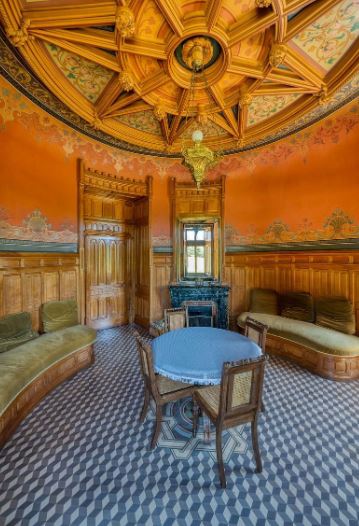
After a monetary hesitation, I led him upstairs into what was Mrs. Winchester’s principal bedroom. In the inner courtyard, there is a crescent shaped hedge that points to Mrs. Winchester’s bedroom—the one where she died. Coincidence? Maybe…but again, we will never know for sure. “Is this where the ghosts walk?” he asked as he glanced around the empty room. I was plainly annoyed by his insistence. “There are no ghosts, and they do not always anywhere,” I said irritably. I glanced up at the ceiling, and swiftly withdrew my eyes with a nervous tremor. I could tell the client was firmly persuaded that I had been the victim of some spectral horror, though I was anxiously trying to conceal it for fear of frightening him off. “Perhaps I had been not tell you anything,” I said, after considering a moment. “There is a great deal in the influence of suggestion, so it is said. If I were to tell you what the people who have slept in this room have seen, or dreamt they have seen, that might be enough to make you dream the same. Whereas, if a sensible man without any notions came and slept here, one would most likely never be disturbed.” Upstairs I showed him another room which was an unfinished attic space. The prospect from the widow showed hum that it was situated over the haunted chamber. “Is there something wrong with this room as well?” he demanded. “The servants do not like sleeping in it,” was my grudging admission. “It does very well as a boxroom.” The client was very anxious to secure an option to purchase the Winchester Mansion at the end of the month. My next step was to secure some attendance, and to send down some furniture for the many empty rooms which they mystery appeared to cling. All of Mrs. Winchester furniture had been sold at auction.

It took movers six weeks, six truck loads a day, to empty the mansion. Many of them often got lost. I was not very well pleased with the idea of taking the ghosts seriously. However, I knew that there were things in Nature which ordinary rules did not explain. I had seen things myself which could not be accounted for by natural means. I dared not tell the client that there had been a murderer lurking in the mansion ready to spring on potential clients and stab them. Suddenly, we heard a low moan—the moan of a creature in mortal terror, drawn out till it became a muffled scream. The moan was repeated, coming distinctly from the room below us. This is why I did not live having an open house at night. With candles in hand, as we reached the third floor landing the moan was repeated in a more terrible key—the key of horror instead of terror. At the same moment the door of one of the haunted rooms was thrown open, and suddenly Agnus, the maid, appeared on the threshold, with a cloak thrown over her shoulders, and a look of fear and distress on her face. “What is it?” I asked. “Merrill, she has seen something horrible, and I cannot get her to come to.” Without stopping to consider questions of etiquette, I dashed into the room. The gas had been turned full on, and by its light I saw the young lady lying stretched out on a couch at the foot of the bed, her features frozen into expression of one who looks upon some horrid sight, while from her parted lips there issued those appalling sounds which wounded like the stabs of a knife. I caught her by the shoulders and shook her, without making the slightest change in her swoon-like conditions. “Water!” I called out to Agnus, who stood wringing her hands, too dazed to act.
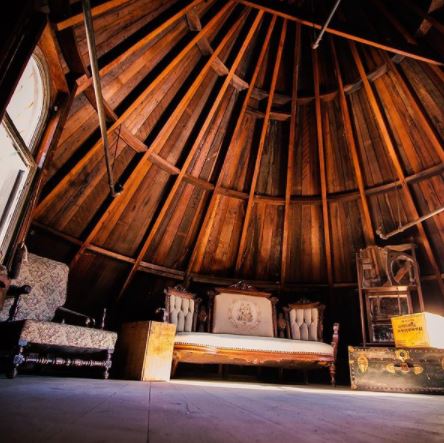
The water was brought, and I dashed half a glass in the face of the sufferer. At first it had no more effect than if she had been dead. Then came a startling change. The moans suddenly ceased, the victim opened her eyes, which showed the dull glassy stare of a somnambulist, and sitting half up, she commenced muttering so quickly and indistinctly that it was difficult to catch the words. “The blood, the blood, the blood, the blood, dripping, dripping, from the read lead in the ceiling, the red leak in the ceiling, in the ceiling, dripping on me, dripping on me, dripping on me!” The words rose into a wild shriek as her blank eyes were turned full on the ceiling overheard, the ceiling between the room she was in and the dressing room the size of three rooms. Involuntarily I looked up and the ceiling did not show the slightest mark. We lifted the unconscious lady and carried her out of the accursed room, and into one adjoining, where we laid her on the floor. Hardly had she passed the doorway of the haunted chamber when the dreadful screams began to die away, and the rigidity of the features to relax. In a short time the trance conditions passed away and we left Merrill to sleep. When she woke in the morning, we told her she had just has a bad dream, but she remembered nothing of what had passed in the night. At her own request, at breakfast, I described to her what had occurred, as minutely as possible. She was profoundly impressed. Of course, the client had bolted out of the house. However, Merrill, said with great conviction, “I am certain that what I saw represents something that actually happened in this house. Dreadful as it sounds, I firmly believe that somebody has been murdered in that attic with the witches cap, and that his blood did drip through the ceiling of the room below, as I saw it last night.”

As soon as the staff left the house, I went straight to a builder’s in the neighborhood, and engaged him to send some men to examine the flooring between two of the haunted rooms. The builder received my order with marked interest. “I knew there was something the matter with that house,” he observed. “It ain’t likely that tenant after tenant would come away sacred without something was wrong. Why, do you know, sir, in the last year since Mrs. Winchester died, I’ve white-washed one ceiling in the house thirteen times!” The builder’s interest led him to accompany his men, a carpenter and a plasterer, to the scene of action. I pointed out that place on the ceiling, as nearly as I could judge it, from which the ghostly dew had appeared to fall. Then men took measurements, and then, proceeding to the attic above, located a spot under the bed I used to sleep in. The bed was quickly removed, the flooring stripped off, and in the space between the joists there was exposed a mass of lime. Both the men, as well as their master, were quick to declare that the lime could not have been left there for no good,” the builder asserted. “If you want somethings hidden away and destroyed, there is nothing better than what lime is when it is fresh. It burns as well as fire, and makes no smoke.” “You mean a dead body?” I said shuddering. “I don’t say nothing about that,” the builder answered, pulling himself up. “It ain’t for me to say what that lime’s been used for. All I say is it wasn’t me that left it there, nor yet my men.” The two men began clearing the stuff away. The volatile element had evidently evaporated long ago. As they struck downward with their tools, one of them went through the plaster of the ceiling below, and a shaft of light came up.

An exclamation from one of the men followed. I bent down and peered into the cavity. On a large beam which here crossed the floor I saw a deep black stain, the stain of long-dried blood! A moment after the carpenter stood suddenly, griped about with one hand amid the woodwork, and drew forth to the light a small sharp stiletto, rusted with the same dismal stain. Nothing more was found. I gave the builder an order to entirely renew the flooring between these two haunted rooms. The most extraordinary part of the story remains to be told. The report of what had taken place having got abroad in the county, the local police came to me to obtain the stiletto, which I had been careful to preserve. By its means they were enabled to unearth a crime which had gone unsuspected till that hour, and to extort a confession from the murderer. Into the details of this terrible case, I do not care to enter. However, it is sufficient to say that the victim had perished while asleep in the attic, and that his blood had actually soaked through the ceiling into the room below, which was that of his murder—the Butler! Later that night, I was alone in the Winchester Mansion. A bright moon was out that night, and I heard a noise like a million soldiers, thrampin’ on the road, so I looked, and the hallway was full of little men, the length of my palm, with gray coats on, and all in rows like one of the regiments; each spoke with a pike on their shoulders and a shield on their arms. One was in front, byway he was the general, walking with his chin up as proud as a peacock. They marched right out the door-to-nowhere and there was another army of men with red coast. The two armies had the biggest fight you have even seen, the grays against the reds.

After looking on a bit, I got excited, for the grays were beating the reds like blazes. And then the sight left my eyes and I remembered no more until morning. I was laying on the floor, in the hallway, where I had seen them, as stuff as a crutch. Typically old castles, deserted graveyards, ruined churches, secluded glens in the mountains, springs, lakes, and caves all are the homes and resorts of fairies, as is very well known on the west coast. The better class of fairies are fond of human society and often act as guardians to those that they love. They are believed to living in the Winchester Mansion to receive the souls of dying and escort them to the gates of Heaven, not, however, being allowed to enter with them. On this account, fairies love graves and graveyards and of course this 160-room mansion built to appease the spirits who died at the hands of the Winchester rifle. They have often been seen walking to and fro among the rooms and gardens. There are, indeed, some accounts of faction fights among the fairy bands at or shortly after a new soul enters the mansion. The question in dispute being whether the soul of the departed belonged to one of the other faction. The amusements of the fairies consist of music, dancing, and ball playing. In music their skills exceed that of men, while their dancing is perfect, the only drawback being the fact that it blights the grass, “fairy-rings” of dead grass, apparently caused by a peculiar fungous growth. Mrs. Winchester used to host fairy balls in her Grand Ball Room, the music for which was furnished by an orchestra which the management had no doubt been at great pains expensive to secure and instruct. All around the fairies would dance like angels the fireflies giving them light to see by, and the moonbeams shinning on the lake for it was light to see by. Even now, staff who have been at the Winchester Mystery House sometimes hear the soft strains of their voices in the distance, and will hurry away least they discover one’s presence and be angry at the intrusion of their privacy.

When in unusually good spirits the fairies will sometimes admit a mortal to revels, but if one speaks, the scene at once vanished, one becomes insensible, and generally finds oneself by the roadside the next morning, with the drudgery of pains in one’s arms and legs and back, that if thirteen thousand devils were after one, one could not stir a toe to save the soul of one, that is what the fairies do be pinching and punching one for coming on them and speaking out loud. Black magic has not changed since the Middle Ages. The term “black art” was then applied to magic because the proficient in it were considered to be in league with the powers of darkness. The term “black magic” refers to the art of producing supernatural effect by direct league with Satan and demons. Frequently those who practice black magic make an actual pact with the powers of darkness, signing their allegiance to the devil in their own blood. This ceremony had come down from the Middle Ages to present-day Europe, where it is practiced in parts of Germany, France, and Switzerland. The ritual of signing an agreement involves a complete sell-out to the devil. Some magic involves the direct solicitation and help of demons, specifically the devil. It is the most terrible and powerful form of occult art, majoring in enchantment for persecution and vengeance, but also employing diabolical powers for defense and healing. An example of this nefarious practice is found in the death spells cast by witch doctors among aboriginal people, such as the Papuans on the island of New Guinea. Enchantment for persecution and vengeance, as well as for defense and healing, is still practiced today, not only in pagan cultures but also in civilized lands where occultism flourishes. Literature on magic was found in the Winchester Mansion and auctioned off with the rest of Mrs. Winchester’s belongings. There were incantations, charms, and spells.
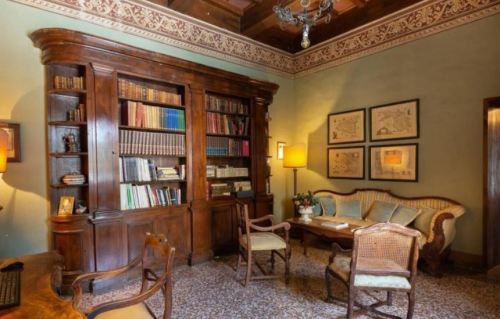
One of the movers, who have never been troubled with psychic disturbances, returned home from taking the items to San Francisco to be auctioned off, and suddenly found himself suffering from acute fear dreams. He had the feeling during sleep that a neighbor lady, the mother of his coworker who was still missing after moving items out of the mansion, was strangling him. The tormented man went to an occultist who told him he was under magic persecution. The neighbor woman was seeking revenge on him for his good fortune in the light of her son’s bad fortune. With the occultist’s help, the terror-dreams creased. (That is why theft from the Winchester Estate is not tolerated. It is said to bring curses on those who remove sacred items without permission or payment.) Then the former mover found himself under a new attack: the neighbor was causing his cattle to die, head after head. The conjurer promised to remedy this new menace. Scraps of paper inscribed with magical formulae were to be mixed with the food of the cattle. The astonishing result was the cessation of the cattle epidemic. In addition to many cases of persecution and self-defense by black magic, occult healing are also common. A local farmer at the Winchester estate went to Mrs. Winchester for counseling and related the traffic results of charming by black magic. The farmer’s son had become paralyzed after an illness. The doctor could not help. However, Mrs. Winchester healed the boy through black magic, so that the paralysis disappeared completely. She had developed this skill after the death of her six-week-old daughter and her husband. Ancient and modern pagan religions, as well as those who subscribe to Christianity, have produced such psychically endowed mediums who have improved their gifts by the study and practice of the magical arts.

From what source people derive their power is not always clear—probably neither to they themselves nor their devotees have ever set themselves the task of unravelling that psychological problem. If they were turned wizards or witches, and indeed they only represented white witchcraft in a degenerate and colourless stage. Their entire time is not occupied with such work, nor, in the majority of cases, do they take payment for their services; they are ready to practice their art when occasion arises, but apart from such moment they pursue the ordinary avocations of rural life. The gift has come to them either as an accident of birth, or else the especial recipe or charm has descended from father to son, or has been bequeathed to them by the former owner; as a rule such is used for the benefit of their friends. Seen from the parapsychological point of view, magic persecution is a mediumistic problem similar to that of materialization. In the same way that a medium can emit energy that can be transformed into the phantasm of a man, so he is able to transform the same energy into the form of an animal. We have on record many cases of the materializations of dogs, cats, frogs, snakes, and even cases where the apparition was half man and half animal. If a phantasm is injured in some way at a spiritistic séance then the medium also suffers in a similar way. The same holds true in the case of animal phantasms. We are thus justified in coming to the conclusion that magic persecution is on the same level as materialization. Many methods of defence magic are based on this fact. If the victim is able to injure the phantasm that is assaulting one, it is reckoned that one has as good won the battle. We have seen then that certain forms of spiritistic offensive and defensive magic are based on materializations.

In 1888, a large black cat was found to be hanging around the Winchester mansion. In one of the cottages, on the estate, a farmer’s wife was about to give birth to a child. The cat would not go away until finally someone threw an axe at it, thereby injuring its leg. Next day it was discovered that an old woman on the estate also hurt her foot. The servants knew this woman to be a master of black magic, and indeed a few days later she took her revenge. On visiting the mother, Ida, of the new-born child, the witch murmured something and at the same time patted the child on the head. Thereafter the child cried continuously for days on end and could not be pacified. It was also discovered that as the child grew up its memory was particularly weak. Afterward the woman had three miscarriages, suffered the early death of her mother and disappearance of her father, but the source of her mental problems was far more spectacular than these mundane tragedies. Using hypnosis, Mrs. Winchester discovered that this mother to a new born had been repressing memories of an horrific past in which she had been an unwilling member of a murderous Satanic cult. Recollections would have convinced many mental-health professionals that she was suffering from pathological delusions. Her “memories” revealed a cult, led by the a monstrous Joris-Karl Huysmans, who indulged in acts of unbelievable brutality in the name of the Devil, such as blood-drinking, and other unspeakable acts. Mrs. Winchester considered the woman to be of nervous debility and easily influenced. When she had the servants cottage searched, they discovered a secret room, holding an apparently sacrificial altar with a wooden dagger suspended above a glass bowl.

In our files, there are about 40 examples involving cats, and almost all of them deal with the same problem, that of a person causing an apparition to appear in the Winchester Mystery House or elsewhere on the estate. Hamilton Howard was once hired for a job on the estate. The young man was on the verge of being dismissed because he very mysterious. He had a fair share of Satanic drawings in the cottage he was allowed to stay in, while working at a farm hand, and he never had meals with the other men. He belonged to a blood drinking cult. This might explain why stories began circulating about the carcasses of cows being discovered on Mrs. Winchester’s farm and other nearby farms drained of blood, with their eyes, lips, and private organ removed. The mystery of where the blood had cone, and how and why these animals had been operated on with seemingly surgical precision, gave birth to stories of Dracula in California and the California Cannibals. Occasionally, starving people have resorted to cannibalism for survival necessity. It is no secret, however, that Mrs. Winchester had her fair share of hauntings. One night, she heard footsteps going from the basement to the attic and then back again. There were also footsteps in the hall and at first, they thought that it was a burglar. Often her staff would search for an intruder. In addition to the footsteps the lights were sometimes turned on, and the gas too. No amount of careful investigation was able to produce any evidence as to the cause of the apparent haunting. One night, Mrs. Winchester had a séance in her Blue Séance Room. The spirit with whom she had made contact started that he had been a Catholic priest who had lived in the house 200 years before she renovated the original farm house and turned it into a mansion. He had murdered his housekeeper and had buried her in the basement. Since then, he had had to haunt the scene of his crime.

When asked in which room he had murdered the housekeeper the table suddenly began to move across the floor. It then hit the door of the room so hard that the wood was chopped. As Mrs. Winchester opened the door, the table rushed into the adjoining room and slid into the corner. In the course of doing this it hit an oak bedstead so hard that it left a permanent impression on it. The spirit was questioned further and when she asked is there was anything that could be done for him, he replied, “Yes, you can pray for me.” Mrs. Winchester did in fact pray for the restless ghost after that, and for a number of years the mansion was no longer haunted. The mansion has been haunted for several generations before its expansion. However, more than one ghost was attached to the property and it became a nexus for spiritual activity. Every person possesses one’s own home spiritually. This possession continues to live on in the house after the departure of the person concerned. Humans do not only leave behind their physical body when they die, but also a spiritual “larva.” When one dies, one leaves a spiritual complex behind that has an independent existence in the astral World, and which sometimes only disintegrates centuries later. This spiritual complex is supposed to cause the phenomen on ghost and apparitions. For some, the real of the dead is not so much a place as a state of being, and some think that there are times, as for example at one’s deathbed, when this realm of the dead becomes visible to our Earthly eyes. The idea that human beings have to remain in the mortal sphere after their death until they are freed from all the thing that once tied them to the World is widely accepted. This idea is similar to the popular opinion that criminals and other such people have to haunt the place of their crime until they are taken out of this sphere to a higher or lower level of existence. Ghosts do not occur only in connection with spiritism, but we have dealt with them here since the problem arose.

Winchester Mystery House

Are you brave enough to explore the house at night? 👀 The Winchester Mystery House is offering Friday the 13th Self-Guided Flashlight Tours. Tickets going fast! Click the link or hastage for tickets and more information.

Kitchen Dramas—Are they Arms Race or Saving Civilization as We Know it?

One a person experiences the full impact of the conflict in consciousness, one turns in an accusing rage on the target object. During the past several years, I have spent a good deal of my time blaming television for many of the more obvious dysfunctions from which Western culture—and especially America—is now suffering. It has been pointed out to me that I do this because I am by nature a negative person, always ready to condemn what is wrong rather than to praise what is right. Several of my students have even gone so far as to observe that had I lived during the period of incunabula—during the first fifty years of the printing press—I would have burdened everyone with a long list of depressing prophecies about the dangers of the machine-made book and universal literacy. However, my students are only half right. Assuming I had the brains to see what was happening in the year 1500, I would certainly have warned the Holy See that the printing press would place the word of God on every Christian’s kitchen table, and, as a consequence, the authority of the Church hierarchy would be put in jeopardy. Had I been granted a papal audience, I would have warned the Pop that armed with a printing press, Martin Luther was more than a malcontent priest suffering from a bad case of constipation. The printed word made him a serious revolutionary. I might also have warned the local princes that their days were numbered, that printing would give form to a new idea of nationhood which would make local potentates obsolete. And if the Brotherhood of Alchemists had allowed me to give the keynote address at their annual convention, I would have told them to go into another line of work, that printing would give great impetus to inductive science and that alchemy would not stand against the glare of publicly shared scientific knowledge. #RandolphHarris 1 of 20

I would also have told any wandering bards who came my way that within a hundred years their trade would lie in ruins, that tribal lays and epic poetry were doomed, and that they would be wise to urge their trainees to turn their talents to writing essays and reading novels. Now, not every one of these prophecies foretells a bad thing. That is why I said my students are only half right. Whether or not a prophecy is negative depends on your point of view. For example, since most of you are Lutherans, you probably would have cheered the breakup of the Holy Roman Empire. The Catholics of those times would, of course, have mourned it passing. In any case, there are some changes brought about by new media benefit some, harm others, and to a few do not make much of a difference. This is as true of television as it was of the printing press or any other important medium, although in the case of television there are very few indeed who are not affected in one way of another. For most of you here, television will provide a gratifying career. On the other hand, and in the long run, television may bring an end to the careers of schoolteachers, since school itself was an invention of the printing press and must stand or fall on the issue of how much importance the printed word will have in the future. New media break up old knowledge monopolies; indeed, create new conceptions of knowledge, even new conceptions of politics. If not for television, Joe Biden, for example, would not be President of the United of America, which is good for him and the interests he represents, but not so good for the poor and vulnerable. However, television can people good as it creates a true theater of the masses. For example, between the years 1948 and 1958, approximately 1,500 fifty-two-minute plays were performed “live” on American television. #RandolphHarris 2 of 19
“Live” means that these plays were performed at the precise moment they were seen by the television audience, a condition which since the advent of videotape and the widespread use of film has become increasingly rare; “fifty-two minutes” describes the actual running time of the play, eight minutes of the hour being subtracted for commercial messages, the listing of credits, and publicity for the next week’s play. There is no doubt that American television’s finest dramatic moments were provided by fifty-two-minute hours, particularly by such weekly series as the Kraft Television Theater (1947-58), the Philco-Goodyear Playhouse (1948-50), and the Studio One (1948-57). These programs began by presenting adaptations of classic and established contemporary novels but by 1950 had shifted to original dramatic work. By that time, such producers and directors as Worthington Miner, Fred Coe, Delbert Mann, Arthur Penn, and John Frankenheimer has assembled about them several gifted young writers who were prepared to devote their collective talents to a serious exploration of television’s artistic resources. Included in that group, among others, were Reginal Rose, Tad Mosel, Robert Alan Aurthur, Horton Foote, Rob Serling, J.P. Miller, and Gore Vidal. None, however, wrote more fittingly for television than Paddy Chayefsky, whose name, along with Edward. R. Murrow’s, symbolizes what romantics call “the golden age of television.” Mr. Chayefsky was to the “original” television drama what Mr. Ibsen was to the “social drama,” which is to say that he was one of the first creators and certainly its most distinguished one. Like Mr. Ibsen, he achieved an almost perfect union of form and content. Critics have observed, for example, that the effects that Mr. Ibsen achieved in A Doll’s House and Ghosts were a function not only of his themes, with which audience were certainly familiar in 1879 and 1881, but also of the stark, simple, and economical form in which he stated them. #RandolphHarris 3 of 19
Social dramas had been written before Mr. Ibsen, but it remained for him to discover the form for dramatizing social problems. Mr. Chayefsky, of course, did not write for the stage behind a proscenium arch, viewed from a distance in a darkened theater. He wrote for a seventeen-inch screen situated in a family living room, on which the only colors were varying shades of gray. He also had to present his story, from start to finish, in fifty-two minutes, and he could make two assumptions with absolute assurance: that his play would be interrupted at least twice for commercial messages, and that he would have to attract his audience instantly or lose much of it to other channels. He knew, too, as did his director, Delbert Mann, that the picture on the television screen is considerably cruder in visual definition than that on a motion-picture screen. So Mr. Chayefsky wrote his plays in anticipation of the audience’s observing the players in almost unrelenting “close-up.” Mr. Chayefsky realized that some of these technical-aesthetic conditions could create, as could perhaps no other medium, a sense of utter and absolute reality; could create the illusion that what the audience was seeing was not a mere play but life as seen through a seventeen-inch, nearly square hole. Beginning with a play called Holiday Song, which dealt with a rabbi’s re-examination of one’s faith in God, Mr. Chayefsky created a series of dramas that have often been characterized as “small” masterpieces, sometimes referred to as “kitchen” dramas, since much of the action seemed to take place in family kitchens. In any case, they were plays about unexceptional situations. The plots were uncluttered, and undaring, and highly compressed. They had few unexpected turns, little action, no treachery, no perversion, and no heroic gestures (in the traditional sense). #RandolphHarris 4 of 20
Mr. Chayefsky’s stories were “small” very much as Sherwood Anderson’s stories are small. The setting was New York, not small-town Ohio, but like Mr. Anderson, Chayefsky explored in economical but meticulous detail the agonizing problems of small people. And thus he elevated the status of both the problems and the people who suffered them. In fact, Mr. Chayefsky once remarked that “Your mother, sister, brothers, cousins, friends—all of these are better subjects for drama than Iago.” He was talking, of course, about television drama. Mr. Chayefsky’s most known play, Marty, tells the story of an unmarried, inarticulate butcher who is attacked to a sensitive but homely woman. Marty’s friends attempt to dissuade him from seeing the woman because she is, in their words, “a dog.” His mother, who fears being abandoned resents the woman bitterly. Against a backdrop of such universal themes as man’s need of loving and being loved, his fear of living alone, and his need to communicate, Mr. Chayefsky pursued his “small” story with persistent literalness, concluding with an equally “small” crisis in which Marty decides, against the protests of his friends and family, to phone the woman and ask her for a date. On the stage of in a novel, the plot would be too flimsy to carry much dramatic weight. When the play was adapted for the movies, it required more “movement” or action and the addition of at least one subplot. On the television screen, however, they play was an artistic triumph, producing a disturbing and edifying illusion of intimacy. Perhaps no other medium is better suited to the “slice of life” drama than television, a fact that is apparently well known to Ingmar Berman. Although television was invented in the 1920s, it did not exist for any practical purposes until after World War II. It is easy to forget that advertising, at least on the scale we have come to know it, barely existed before then either. #RandolphHarris 5 of 20
In 1946, advertisers spent about $3 billion. For the previous two decades, advertising expenditure had been fairly constant at about that level. By 1975, however, the national advertising budget had grown by 1,000 percent to $30 billion. In 2021, the national advertising budget reached $82 billion (expected to around $95 billion by the end of 2022). In that same year the television advertising budget has skyrocketed to $68 billion, and could be approximately $80 billion by the end of 2022. As you see, most of the increases in advertising. However, what is significant is that within only tend years of its effective inauguration, television was absorbing 60 percent of all advertising spending and driving hundreds of newspapers, magazines and radio stations out of the market. A symbiotic relationship developed. Advertising financed television’s growth. Television was the greatest delivery system for advertising that had ever been invented. We could call it love at first sight, except in this case, the match may have been prearranged. If you are fortunate enough to recall, think back to the days immediately after World War II. Although I was only ten in 1945, I remember the expectant and uncertain feeling of the times very well. Everyone was relieved that the war was over and was expecting things to get back to normal, but what was normal? Memories of the Depression loomed. I remember listening to my parents talk with their friends on those backyard summer evenings of 1945, and I could feel the fear. Like most ordinary people, my parents know that the war had alleviated the Depression. During the war, American industrial capacity, lying fallow only a few years before, had actually expanded to build the military machine. My father’s own business was an example. Now there were no more uniforms to make, and no more tanks. The war had given men jobs as soldiers and women jobs as factor workers. Full employment had practically become a reality. Now Johnny was marching home again, jobless. #RandolphHarris 6 of 19
If this was the talk among ordinary people, one can only imagine what was said in industrial boardrooms and at the Department of Commerce. With industrial capacity and capital investment expanded as they were, the consequences of a drop in production could make the 1930s look like golden years. A long-standing criticism of capitalism—that it can stave off cyclic depression only through war-seemed about to be confirmed. Suddenly in 1946, government and industry started making identical pronouncements about regearing American life to consume commodities at a level never before contemplated. It was not that military production was about to be abandoned. Even now it remains the single most important factor in the United States of America’s economy. However, in 1946 with the war just over, it was not clear that the decline in military spending would be as temporary as it turned out to be. Some new offsetting factor was needed. Thus, a new vision was born that equated the good life with consumer goods. An accelerate economy, continuing booming expansion of wartime, added to a new consumer ideology achieved the greatest economic growth rate in the country’s history from 1946 to 1970. To make such growth possible, both ends of the transformation process described previously had to be hyped up. First, we needed to insure an abundant supply of raw material to convert into commodities. This led to a burst of American investment overseas as well as to enormous assistance programs for sympathetic “underdeveloped” countries. Often we secured our supply by the creation of client governments propped up with military assistance. Raising anticommunism to the status of a holy war in the 1940s and the 1950s formed the political foundation for these military and economic programs and underlay the assertion of the patriotic virtues of foreign investment. #RandolphHarris 7 of 19
At the other end of the transformation equation, an accelerated movement of commodities into consumers’ homes was critical. People had to be convinced that life without all these products was undesirable and unpatriotic. It was time to forget the rationing of the war years and consumer for your country. Advertising and television were the dynamic duo that would rededicate the consuming American. Advertising’s ability to create a passionate need for what is not needed was already well established. Since economic growth and a consumer economy had to be based upon selling far more commodities than were needed to meet actual needs, economic growth depended upon advertising. Television, which had been lying around in mothballs since the 1920s, was dusted off and enlisted as the means to deliver the advertising lifestyle fast, right into people’s homes and heads. Quick to spot any new technology that could assist their urgent cause, big advertisers immediately invested hundreds of millions of dollars in developing this idle sales tool. And so advertising gave birth to television, and television have advertising a whole new World to conquer. Together they made possible an enormous, though temporary, economic bonanza. Can you recall the TV advertising of the 1940s and 1950s? Smiling, happy people. Scrubbed children. Housewives showing their impossibly clean wash. Smiling junior-executive husbands emerging from their new cars, greeted at the picket fence by their clean, cheerful families? The happy mowing of the lawn. The happy faces reflected off the polished toasters? The nuclear family was idealized to a greater extend than ever before, because the family was the ideal consumption unit. Women had to get out of those factories and overalls and back into little pink dresses in the kitchen. #RandolphHarris 8 of 19

Those returning soldiers needed jobs. Rosie the Riveter gave way to June Allyson. Separate family units maximized production potential. Private homes. Private cars. Two cars. Private washing machines. Private television sets. Within a few years, the World started changing. The battery-operated lawn mower I saw on television one day appeared on my lawn the next week. So did the car. The whole neighborhood started looking like a television commercial. The woods near my house in disappeared and were replaced by hundreds of identical versions of my house. Neighborhoods everywhere started looking like each other. Freeways replaced country roads. Shopping centers replaced corner markets. Pavements covered everything. “Prosperity,” “security,” “happiness,” studded ads and presidential speeches alike. This incredible outpouring of commodities, this entire revamping of landscape, this filling of houses with gadgets was supposed to constitute some kind of Latter-Day Saints Kingdom of God. That is what everyone was thinking, saying, and believing. It was what made America America. One of my high school teachers during the 1950s told my class that it was America’s commitment to a consumption economy that made our country different and better than all others. He told us that by expanding our economy, we could soon make everyone wealthy. America was already the World’s only classless society, he said. Workers and managers were equal partners in a glorious process benefiting everyone. In America everyone was equal. Our standard of living made it that way. Everyone could have a car. Everyone could have a business. We are not developing nations, where the water is dangerous to drink, and there are few rich people and everyone else is poor and all of them wished they had what we had. Because of this prosperity, we did not have to deal with the chaotic times of psychological and spiritual upheaval nor have actual fear among people of witchcraft, sorcerers, and others who claimed to know how to consort with the demons. The medieval period had died, and the modern period was born. #RandolphHarris 9 of 19

A few years later at the Wharton School of Business at the University of Pennsylvania, I learned how and why this commodity life and the economic growth it produces was supposed to be so good for absolutely everyone. I learned that they had been talking about in these boardrooms and at the Department of Commerce. It was called the “trickle-down theory.” It goes more or less like this: Industrial expansion, rapid economic growth and the consumption economy benefit everyone. The theory—which is the basis of Keynesian American economics—has it that when people buy more and more commodities, they produce more profits for industry, enabling it to expand. When industry expands, more jobs result. This puts more money into circulation, enabling people to buy more commodities, expanding profits again, yielding more investments, more jobs and starting the cycle around on another turn. This is an oversimplified process, which leaves out such variables as savings, borrowing, and so on. The way it is presented here is more or less the way it is translated through the media and through out educational system into popular understanding: a beautiful circle of activity, everyone helping everyone else, labor and management rowing the boat together, all serving the common good and growing endlessly. It explained the patriotic urgency of people spending more and more on commodities. The benefits would “trickle down” to everyone in this country, including those at the bottom on the pyramid. Jobs, money, prosperity, happiness, security, democracy, equality were all lumped together as inevitable results of this cycle. Most people believe in this “trickle-down-theory” still. Presidents get elected based on whether they can convince the public that they will stimulate the beautiful cycle. President Trump was elected for doing it and he proved his word. #RandolphHarris 10 of 19

The tickle-down theory is the nice simple kind of economic model that can be sold to a mass population removed from any deeper understanding of how things really work. Trying to come to grips with economic nuance is for most of us no easier than trying to understand how much nuclear radiation is “safe.” Who knows? The “experts” know. Like every other organizing model in our society, economic processes have been removed from personal participation, appropriated into a nether World of flow charts, financial analyses, and circle graphs. Like scientific and technological systems, once economic systems reach a certain size and complexity, they can be controlled only by forces far outside the grasp of the individual and community. One explanation of them sounds as plausible as another. In the absence of a really thorough training in economics—a training which itself supports many arbitrary and fantastic theories—this trickle-down model of the benefits of a consumer society sounds perfectly valid. It certainly seemed valid for a little while. People had jobs, the economy was growing, and homes were filling up with every more intricate gadgets. Only now, thirty years after the trip was launched, can we see the process from the vantage point of joblessness, inflation, bankruptcy and default, and realize that something was terribly wrong somewhere. In fact, it was a fantasy. It was packaged and sold to us like the seven-piece matching living-room sets on the television screen. Buy now, pay later when you are richer than you are now. However, when later came, very few of us were richer (and that usually happens to everyone). It turned out that the pursuit of all those happy goodies did not produce happy people; it produced isolated, frustrated, alienated people. More important, the economic benefits did not trickle down to create some egalitarian democracy. The benefits tickled up. That is why President Trump also used the tickle charger. Not only did he cut taxes, but also infused the less affulent with supercharged unemployment benefits, and helped the veterns, disabled, retirement and others reciveing government transfer pays by sending the a large cash sum of money, and then a few other payments for less, and he also supported businesses get through the pandemic. So the economy was stimulated and had a few trickle charges to keep the market flowing well. #RandolphHarris 11 of 19
The democratic revolution succeeded in extending formal self-government and opportunity to nearly everybody, regardless of birth, property, or education. However, it gave up the ideal of the town meeting, with the initiative and personal involvement that alone could train people in self-government and give the practical knowledge of political issues. The actual result has been the formation of a class of politicians who govern, and who are themselves symbolic front figures. Correspondingly, the self-determination won by the American Revolution for the regional states, that should have made possible real political experimentation, soon gave way to a national conformity; nor has the nation as a whole conserved its resources and maintained its ideals. The result is a deadening centralism, with neither local patriotism nor national patriotism. The best people do not offer themselves for public office, and no one has the aim of serving the Republic. Typical is the fate of the hard-won Constitutional freedoms, such as freedom of speech. Editors and publishers have given up trying to give an effective voice to important but unpopular opinions. Anything can be printed, but the powerful interests have the big presses. Only the safe opinion is proclaimed and other opinion is swamped. The liberal revolution succeeded in shaking off onerous government controls on enterprise, but it did not persist to its goal of real public wealth as the result of free enterprise and honestly informed choice on the market. The actual result is an economy dominated by monopolies, in which the earnest individual entrepreneur or inventor, who could perform a public service, is actively discouraged; and consumer demand is increasingly synthetic. Conversely, the Jeffersonian ideal of a proud and independent productivity yeomanry, with natural family morals and a co-operative community spirit, did in fact energize settling the West and providing the basis for our abundance. #RandolphHarris 12 of 19

However, because it has failed to cope with technological changes and to withstand speculation, “farming as a way of life” has succumbed to cash cropping dependent on distant markets, and is ridden with mortgages, tenancy, and hired labor. Yet it maintains a narrow rural morality and isolationist politics, is a sucker for the mass culture of Madison Avenue and Hollywood, and in the new cities (exempli Gratia, in California, where farmers have migrated) is a bulwark against genuine city culture. Constitutional safeguards of person were won. However, despite the increasing concentration of state power and mass pressures, no effect was made to give to individuals and small groups new means easily to avail themselves of the safeguards. The result is that there is no longer the striking individuality of free men; even quiet nonconformity is hounded; and there is no asylum from coast to coast. Fraternity—this short-lived ideal of the French Revolution, animating a whole people and uniting all classes as a community, soon gave way to aa dangerous nationalism. The ideal somewhat revived as the solidarity of the working class, but this too has faded into either philanthropy or “belonging.” Brotherhood of races—the Civil War won formal rights for African Americans, but failed to win social justice and factual democracy. The actual result has been segregation, and fear and ignorance from various people of all races. However, in the 2020s, that stigma is fading. Pacificism—this revolution has been entirely missed. Acceleration not only makes facts obsolete but blunts some of the key tools we use when we think. Analogy provides a case in point. It is virtually impossible for us to think without relying on analogies. This “thought-tool” is based on identifying similarities in two or more phenomena and then drawing conclusions from one to apply to the other. Doctors, we noted, will often say “the heart is like a pump” and then describe its “values” and other components in mechanical terms. This model helps them conceptualize and treat the heart. Often this process yields powerful results. #RandolphHarris 13 of 19
However, once similarities are identified, it is typically taken for granted that the similarities continue. And in slow-change eras, they may do so for long periods. In today’s hyper-change environment, however, once-similar things also change and very often become markedly dissimilar, often making conclusions based on the analogy false and misleading. To deal with today, therefore, we need not only new knowledge but new ways to think about it. Yet too many economists, consciously or otherwise, cling to the belief that economics is analogous to physics. This notion arose centuries ago, when Newtonian ideas about equilibrium, causation and determinism dominated that science. Since then, of course, physicists have drastically revised their views about these matters. However, many economists still base their findings on crude Newtonian assumptions. Trained to think in industrial terms, many find it difficult to grapple with the odd character of knowledge—the fact that it is non-rival and non-depletable, that it is intangible and thus hard to measure. It is only when we set today’s failures of economics alongside the looming crisis in science that we begin to gauge their true significance. For together these two fields have the greatest—or at least the most direct—impact on how we create wealth. And both are heading for transformation. When it comes to relationships, a university teacher of liberal arts cannot help confronting special handicaps, a slight deformity of the spirit, in the students, ever more numerous, whose parents are divorced. I do not have the slightest doubt that they do as well as other sin all kinds of specialized subjects, but I find they are not as open to the serious study of philosophy and literature as some other students are. I would guess this is because they are less eager to look into the meaning of their lives, or to risk shaking their received opinions. #RandolphHarris 14 of 19
In order to live with the chaos of their experience, they tend to have rigid frameworks about what is right and what is wrong and how they ought to live. They are full of desperate platitudes about self-determination, respect for other people’s rights and decisions, the need to work out one’s individual values and commitments, etcetera. All this is a thin veneer over boundless seas of rage, doubt, and fear. Young people habitually are able to jettison their habits of belief for an exciting idea. They have little to lose. Although this is not really philosophy, because they are not aware of how high the stakes are, in this period of their lives they can experiment with the unconventional and acquire deeper habits of belief and some learning to go along with them. However, children of divorced parents often lack this intellectual daring because they lack the natural youthful confidence in the future. Fear of both isolation and attachment clouds their prospects. A large measure of their enthusiasm has been extinguished and replaced by self-protectiveness. Similarly, their open confidence in friendship as part of the newly discovered search for the good is somewhat stunted. The Glauconian eros for the discovery of nature has suffered more damage in them than in most. Such students can make their disarray in the cosmos the theme of their reflection and study. However, it is a grim and dangerous business, and more than any student I have known, they evoke pity. They are indeed victims. An additional factor in the state of these students’ souls is the fact that they have undergone therapy. They have been told how to feel and what to think about themselves by psychologists who are paid by their parents to make everything work out as painlessly as possible for the parents, as part of no-fault divorce. If ever there was a conflict of interest, that is it. There are big bucks for therapists in divorce, since the divorces are eager to get back to persecuting the wretches who smoke or to ending the arms face or to saving “civilization as we know it.” #RandolphHarris 15 of 19
Meanwhile, psychologists provide much of the ideology justifying divorce—exempli gratia, that it is worse for kids to stay in stressful homes (thus motivating the potential escapees—that is, the parents—to make it as unpleasant as possible there). Psychologists are the sworn enemies of guilt. And they have an artificial language for the artificial feelings with which they equip children. However, it unfortunately does not permit such children to get a firm grip on anything. Of course, not every psychologist who deals with these matters simply plays the tune called by those who pay the piper, but the givens of the market and the capacity for self-deception, called creativity, surely influence such therapy. After all, parents can shop around for a psychologist just as some Catholics used to shop for a confessor. When these students arrive at the university, they are not only reeling from the destructive effects of the overturning of faith and the ambiguity of loyalty that result from divorce, but deafened by self-serving lies and hypocrisies expressed in a pseudoscientific jargon. Modern psychology at its best has a questionable understanding of the soul. It has no place for the natural superiority of philosophic life, and no understanding of education. So children who are inclined to believe that philosophy live in a less enlightened state and have a long climb just to get back up to the cave, or the World of common sense, which is the proper beginning for their ascent toward wisdom. They do not have confidence in what they feel or what they see, and they have an ideology that provides not a reason but a rationalization for their timidity. These students are the symbols of the intellectual-political problems of our time. They represent in extreme form the spirit vortex set in motion by loss of contact with other human beings and with the natural order. #RandolphHarris 16 of 19
However, all students are affected, in the most practical everyday way, unaware that their situation is peculiar, because their education does not give them perspective on it. Now, Web sites routinely collect detailed data on visitor behavior, and those statistics underscore just how quickly we leap between pages when we are online. Over a period of two months in 2008, an Israeli company named ClickTale, which supplies software for analyzing how people use corporate Web pages, collected data on the behavior of a million visitors to sites maintained by its clients around the World. It found that in most countries people spend, on average, between nineteen and twenty-seven seconds looking at a page before moving on to the next one, including the time required for the page to load into their browser’s window. German and Canadian surfers spend about twenty-one second, Indians and Australians spend about twenty-four seconds, and the French spend about twenty-five seconds. On the Web, there is no such thing as leisurely browsing. We want to gather as much information as quickly as our eyes and fingers can move. That is true even when it comes to academic research. As part of a five-year study, a group from University College London examined computer logs documenting the behavior of visitors to two popular research sites, one operated by the British Library and one by a U.K. educational consortium. Both sites provided users with access to journal articles, e-books, and other sources of written information. The scholars found that people using the sites exhibited a distinctive “form of skimming activity” in which they would hop quickly from one source to another, rarely returning to any source they had already visited. They would typically read, at most, one or two pages of an article or book before “bouncing out” to another site. “It is clear that users are not reading online in the traditional sense,” the authors of the study reported; “indeed there are signs that new forms of ‘reading’ are emerging as users ‘power browse’ horizontally through titles, contents pages and abstracts going for quick wins. It almost seems that they go online to avoid reading in the traditional sense.” #RandolphHarris 17 of 19

The shift in our approach to reading and research seems to be an inevitable consequence of our reliance on the technology of the Net, and it bespeaks a deeper change in our thinking. There is absolutely no question that modern search engines and cross-referenced websites have powerfully enabled research and communication efficiencies. There is also absolutely no question that our brains are engaged less directly and more shallowly in the synthesis of information when we use research strategies that are all about “efficiency,” “secondary (and out-of-context) referencing,” and “once over, lightly.” As people are falling in love with the Internet, reading and its mediums is reminiscence of some of Capellanus’s more universal rules. He believed that love is always in a flux, either growing or diminishing. Making it public usually kills it. Its very nature as next to impossible to consummate is also its most powerful stimulus, and during its fleeting lifetime, jealously will sharpen the intensity of the country lovers feelings. Courtly love is obsessive and best endured by constant contemplation of the beloved. By the fourteenth century, an anonymous poet was refining the notion of love. In his “Ten Commandments of Love,” he advocated faith or honesty, attentiveness, discretion, patience, secretness, prudence, perseverance, pity, measure or moderation, and mercy. The lover in Chaucer’s “Complaint to His Lady” is so excessively long-suffering that he swears to obey his lady in whatever she dies, would rather die than offend her, and begs only for a drop of her grace. Here is his version of courtly love: “But I, my lyf an deeth, to yew obeye, and with right buxom herte, hooly I preye, as [is] your moste pleasure, so doth by me; and therfor, swete, rewe on my peynes smerte, and of your grace, graunteth me some drope; for ells may me laste no blis no hope, no dwelle within my trouble careful herte.” #RandolpHarris 18 of 19
Courtly love was agonizing and admirable, the source of chivalrous virtue. For these same reasons, it was often chaste, both because the logistics of consummation defeated the would-be lovers and also because, in some manifestations, courtly love was inherently pure. As one troubadour sang, “Out of love comes chastity.” As enormous but logical stretch puts courtly love together with the secret feudal societies that adopted then institutionalized a collective devotion to an unattainable woman who inspired their members to deeds of greatest daring and valor. The woman? The Virgin Mary, whose immaculate conception the early medieval Church had just begun to celebrate. The most famous of these secret societies was the Knights Templar, excommunicated knights who swore oaths of poverty, obedience, and chastity and dedicated themselves to the (newly immaculately conceived) Virgin Mary. Unlike their secular counterparts, however, whose courtly love involved personal grooming as a token of respect to their lady loves, virginal or otherwise, the Knights of the Templar who were abstinent, according to St. Bernard of Clairvaux, “never combed, rarely washed, [and wore] their beards bushy, sweaty, and fusty, stained by their harness and the heat. Centuries of literature and lives imitating art transformed courtly into romantic love, intense and unattainable, a phenomenon too high—mindedly impractical to survive marriage and the trials of time, routine, and old age. The precious instant of recognizing the beloved, the stylized pursuit, the exchange of extravagant words penned on scented paper, the self-indulgently obsessive meditating on each other—these became the characteristic of this new kind of love. Attraction based on pleasures of the flesh fueled it, just as it had the courtliest of loves, but in this case as well, intimate passions dominated the lover’s agenda. As literature, romantic love flirted and seduced as it inflamed and seared, titillating its aficionados with its stately ritual of gallant chase, heartsick suffering, rapturous encounters, gushing epistles, all in the name of profoundest if evanescent love. Sometimes this love was chaste by intention. Even when it was not, pleasures of the flesh was usually overpowered by complications of plot and character that, depending on your point of view, either reprieved the lovers from the banality of pleasures of the flesh or condemned them to its nonconsummation. Centuries of courtly and romantic love challenged thousands of lovers. Ultimately, most emerged from its clutches with their virtue intact. If our World is made up of such changes, as these, is it strange that my heart is so sad. prophets. #RandolphHarris 19 of 19

Cresleigh Homes
Luxurious outdoor living requires porch space AND a spot for the littlest members of the household to enjoy the sunshine, too! 😍
Our home at #MillsStation Residence 4 is the largest home in the community, but that extra playhouse definitely gives it an edge. https://cresleigh.com/mills-station/residence-4/

The lounge off the entry amplifies this social core; optional bedroom enhances the choices. This design lends a little Victorian formal touch to the arrival for family and guests.
The beautiful quartz counter top island has an optional built-in quartz tablecounter, which allos plenty of island seating.
The abundant cabinet space highlights the kitchen, while gathered windows and sliding door generate seamless connectivity to the home’s outdoor entertainment and leisure spaces.

 Randolph Harris II International Institute