
Home » Africa (Page 18)
Category Archives: Africa
The Door to Nowhere—The Curse of Evil Has Come into His Body!
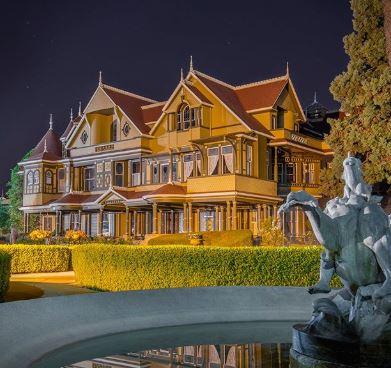
Some people do not believe in ghost. For that matter, some people do not believe in anything. There are persons who even affect incredulity concerning the “Door to Nowhere,” at the Winchester mansion. They said that it did not stand wide open—that it was not a gateway to the Spirit World and that they could have shut it; that the whole affair was a delusion; that they are sure it must have been a conspiracy; that they are doubtful whether there is such a place as the Winchester mansion on the face of the Earth; that the first time they are in California they will look it up. Perhaps, before going further, I ought to premise there was a time when I did not believe in ghosts either. If you had asked me one summer’s morning years ago when you met me on the Golden Gate Bridge if I held such appearances to be probable or possible, you would have received an empathic “No” for answer. However, at this rate, the story of the Door to Nowhere will never be told; so we will, with your permission, plunge into it immediately. I was interested in why this “Door to Nowhere” in the Winchester mansion would not keep shut? They say the place is haunted. What nonsense. There was one thing I can truly say about our office, we were never serious in it. I fancy that is the case in most offices nowadays; at all events, it was the case in ours. We were always chaffing each other, playing practical jokes, telling stupid stories, scamping our work, looking at the clock, counting the weeks to next Christmas, counting the hours to Saturday. For all that we were earnest in our desire to have our salaries raised, and unanimous in the opinion no fellows ever before received such wretched pay. #RandolphHarris 1 of 17

I had $75,000 a year, which I was aware did not half provide for what I ate at home. My mother and sisters left me in no doubt on the point, and when new clothes were wanted I always hated to mention the fact to my poor worried father. We had been better off once, I believe, though I never remember the time. My father owned a small property in the country. I wanted money badly—I must say I never had sixpence in the World of my own—and I thought if I could earn two sovereigns I might buy some trifles I needed for myself, and present my father with a new Ultimate Driving Machine. Then I recalled the amount of the rent was being asked for the Winchester mansion; then I decided gladly this would be a great place to stay if only the ghost turned out of possession. I decided I should like to try to whether, I could not solve the mystery. I was accustomed to lonely houses, and I would not feel at all nervous; I did not believe in ghost, and as for burglars, I was not afraid of them. I was told to just try it out first. To stay in the house for a week; if as tht end of that time I could keep the door shut, locked, bolted, or nailed up, to telegraphy the Winchester Repeating Arms Company, and they would actually pay me to stay there. To me, this sounded like a great bargain. If I lay the ghost, or find out the ghost, I think I ought to have enough money to buy a small house for myself. However, I could not have said what frightened me about this endeavour. A week after I moved into the Queen Anne mansion, Mr. van Buuren from the Winchester Repeating Arms Company came to visit me. He wanted to speak to me about the mansion. I heard a sound of irritation in his voice. “The Winchester Mansion!” he said; “and what have you got to say about the Winchester Mansion?” #RandolphHarris 2 of 17

“That is what I wanted to tell you, Mr. van Buuren,” I answered, and a dead hush seem to fall over the office as I spoke. The silence seemed to attract his attention, for he looked sternly at the clerks, who were not using a pen or moving a finger. “Come this way, then,” he said abruptly; and next minute I was in his private office. “Now, what is it?” he asked, flinging himself into a chair, and addressing me, who stood hat in hand beside the great table in the middle of the room. I began—I will say he was a patient listener—at the very beginning, and told my story straight through. I concealed nothing. I enlarged on nothing. A discharged clerk I stood before him, and in the capacity of a discharged clerk I said what I had to say. He heard me to the end, the he sat silent, thinking. At last he spoke. “You have heard a great deal of conversation about the Winchester, I suppose,” he remarked. “No, sir; I have heard nothing expect what I have told you.” “And why do you desire to strive to solve such a mystery?” “If there is any money to be made, I should like to make it, sir.” “How old are you?” “Two-and-twenty last January.” He laughed—he lay back in his chair and laughed—and I laughed myself, though ruefully. We went on talking for a long time after that; he asked me all about my father and my early life, and how we lived and the people we knew; and, in fact, put more questions than I can well remember. “It seems a crazy thing to do,” he said at las; “and yet I feel disposed to trust you. The house is standing perfectly empty. I cannot live it in, and I cannot get rid of it; all my own furniture I have removed, and there is nothing in the place except a few old-fashioned articles belonging to Mrs. Winchester. The place is a loss to me. It is of no use trying to let it, and thus, in fact, matters are at a deadlock. #RandolphHarris 3 of 17

“You will not be able to find out anything, I know, because, of course, other have tried to solve the mystery ere now; still, if you like to try you may. I will make this bargain with you. If you like to go down, I will pay your reasonable expenses for a fortnight; and if you do any good for me, I will give you a $1,000,000 note for yourself. Of course I must be satisfied that what you have told me is true and that you are what your represent. Do you know anybody in the city who would speak for you?” I could think of no one but my uncle. I hinted to Mr. van Buuren he was no grand enough or rich enough, perhaps, but I knew nobody else to whom I could refer him. “What?!” he said, “Greg Ryan, of Lakeview Street. He does business with us. If he will go bail for your good behaviour I shan’t want any further guarantee. Come along.” And to my intense amazement, he rose, put on his hat, walked me across the outer office and along the pavements till we came to Lakeview Street. “Do you know this youth, Mr. Ryan?” he said, standing in front of my uncle’s desk, and laying a hand on my shoulder. “Of course I do, Mr. van Burren,” answered my uncle, a little apprehensively; for, as he told me afterwards, he could not imagine what mischief I have been up to. “He is my nephew.” “And what is your opinion of him—do you think he is a young fellow I may safely trust?” My uncle smiled, and answered, “That depends on what you wish to trust him with.” “A long column of addition, for instance.” “It would be safer to give that task to somebody else.” “Oh, uncle!” I remonstrated; for I had really striven to conquer my natural antipathy to figures—worked hard, and every bit of it against the collar. My uncle got off his stool, and said, standing with his back to the empty fire-grate: “Tell me what you wish the boy to do, Mr. van Buuren, and I will tell you whether he will suit your purpose of not. I know him, I believe, better than he knows himself.” #RandolphHarris 4 of 17

In an easy, affable way, for so rich a man, Mr. van Buuren took possession of the vacant stool, and nursing his right leg over his left knee, answered: “He wants to go and shut the “Door to Nowhere” at the Winchester Mansion for me. Do you think he can do that? My uncle looked steadily back at the speaker, and said, “I thought, Mr. van Buuren, I was quite settled no one could shut it?” Mr. van Buuren shifted a little uneasily on his seat, and replied: “I did not set your nephew the task he fancies he would like to undertake.” “Have nothing to do with it, Justin, advised my uncle, shortly. “You do not believe in ghost do you, Mr. Ryan?” asked Mr. van Burren, with a slight sneer. “Do you not, Mr. van Buuren?” retorted my uncle. There was a pause—an uncomfortable pause—during the course of which I felt the million dollar note, which in imagination, I had really spent, trembling in the scale. I was not afraid. For one million dollars, or half the money, I would have faced all the inhabitants of spirit land. I longed to tell them so; but something in the way those two men looked at each other stayed my tongue. “If you ask me the question here in the heart of the city, Mr. Ryan,” said Mr. van Buuren, at length, slowly and carefully, “I answer ‘No’; but if you were to put me on a dark night at the Winchester, I should beg time to consider. I do not believe in supernatural phenomena myself, and yet—the ‘Door to Nowhere’ at the Winchester is as much beyond my comprehension as the ebbing and flowing of the sea.” “And you cannot live at the Winchester?” remarked my uncle. “I cannot live at the Winchester, and what is more, I cannot get anyone else to live at the Winchester.” “And you want to get rid of your lease?” “I want so much to get rid of my lease that I told Tuck I would give him a handsome sum if he could induce anyone to solve the mystery. Is there any other information you desire, Mr. Ryan? Because if there is, you have only to ask and have. I feel I am not here in a prosaic office in the city of Santa Clara, but in the Palace of Truth.” #RandolphHarris 5 of 17

My uncle took no notice of the implied compliment. When company is good it needs nothing else. If a man is habitually honest in his speech and in his thoughts, he desires no recognition of the fact. “I do not think so,” he answered; “it is for the boy to say what he will do. If he be advised by me he will stick to his ordinary work in his employers’ office, and leave ghost-hunting and spirit-laying alone.” Mr. van Buuren shot a rapid glance in my direction, a glance which implying a secret understanding, might have influenced my uncle could I have stooped to deceive my uncle. “I cannot stick to my work there any longer,” I said. “I got my marching orders today.” “What had you been doing, Justin? Asked my uncle. “I wanted one million to go and lay the ghost!” I answered, so dejectedly, that both Mr. van Buuren and my uncle broke out laughing. “One Million dollars!” cried my uncle, almost between laughing and crying. “Why, Justin boy, I had rather, poor man though I am, have given thee one million dollars than thou should’st go ghost-hunting or ghost-laying.” When he was very much in earnest my uncle went back to thee and thou his native dialect. I liked the vulgarism, as my mother called it, and I knew my aunt loved to hear him use the caressing words to her. He had risen, not quite from the ranks it is true, but if ever a gentleman came ready born into the World it was Greg Ryan, upon whom at our home everyone seemed to look down. “What will you do, you man?” asked Mr. van Buuren; “you hear what your uncle says, “Give up the enterprise,” and what I say; I do not want either to bribe or force your inclinations.” “I will go, sir,” I answered quite steadily. “I am not afraid, and I should like to show you—” I stopped. I had been going to say, “I should like to show you I am not sure a fool as you all take me for,” but I felt such an address would be too familiar, and refrained. #RandolphHarris 6 of 17

When I got to the Lodge, I showed Mr. van Buuren’s letter to the woman, and received the key. “You are not going to stop up at the Winchester alone, are you, sir? she asked. “Yes, I am,” I answered, uncompromisingly, so uncompromisingly that she said no more. The avenue led straight to the mansion; it was uphill all the way, and bordered by rows of the most magnificent limes I ever beheld. A light iron fence divided the avenue from the park, and between the trunks of the trees I could see the deer browsing and cattle grazing. Ever and anon there came likewise to my ear the sound of a sheep-bell. It was a long avenue, but at length I stood in front of the mansion—a square, solid-looking, Victorian mansion, four stories high, with several towers and a steeply pitched roof, beautiful stained-glass windows and statues, a basement; a flight of steps up to the principal entrance; several windows to the right of the door, several to the left of the door; the whole mansion flanked and backed with trees; all the curtains closed, a dead silence brooding over the place; the sun westering behind the great trees studding the park. I took all this in as I approached, and afterwards as I stood for a moment under then ample porch; then remembering he business which has brought me so far, I fitted the great key in the lock, turned the handle, and entered the Winchester Mansion. For a minute—stepping out of the bright sunlight—the place looked to me so dark that I could scarcely distinguish the objects by which I was surrounded; but my eyes soon grew accustomed to the comparative darkness, and I found I was in an immense hall, lighted from the roof; a magnificent old oak staircase conducted to the upper rooms. #RandolphHarris 7 of 17

The floor was of white marble. There were two fireplaces, fitted with dogs for burning wood; around the walls hung pictures, antlers, and horn, and in odd niches and corners stood groups of statues, and the figure of men in complete suits of armour. To look at the place outside, no one would have expected to find such a hall. I stood lost in amazement and admiration, and then I began to glance more particularly around. Mr. van Buuren has not given me any instructions by which to identify the ghostly chamber—which I concluded would most probably be found on the first floor. I knew nothing of the story connected with it—if there were a story. I was perfectly unencumbered of the mystery. I had not the faintest idea in which apartment it resided. Well, I should discover that, no doubt, for myself ere long. I looked around me—doors—doors—doors. I have never before seen so many doors together all at once. Two of them stood open—one wide, the other slightly ajar. “I will just shut them as a beginning,” I thought, “before I go upstairs.” The doors were of oak, heavy, well-fitting furnished with good locks and sound handles. After I had closed I tried them. Yes, they were quite secure. I ascended the great staircase feeling curiously like an intruder, paced the corridors, entered the many bed chambers—some quite bare of furniture, others containing articles of an ancient fashion, and no doubt of considerable value—chairs, antique dressing-tables, curious wardrobes, and such like. For the most part the doors were closed, and I shut those that stood open before making my way into the attics. I was greatly delighted with the attics. The window lighted them did not, as a rule, overlook the front of the Manion, but commanded wide views over wood, and valley, and meadow. Leaning out of one, I could see, that to the right of the mansion the ground, thickly planted, shelved down to a stream, which came out into the daylight a little distance beyond the plantation, and meandered through the deer part. #RandolphHarris 8 of 17

At the back of the mansion the windows looked out on nothing save a dense wood and a portion of the stable-yard, whilst on the side nearest the point from whence I had come there were spreading gardens surrounded by thick yew hedges, and kitchen-gardens protected by high walls; and further on a farmyard, where I could perceive cows and oxen, and, further still, luxuriant meadows, and fields glad with waying and fruit orchards. “What a beautiful place!” I said. “van Buuren must have been a duffer to leave it.” And then I thought what a great ramshackle house it was for anyone to be in all alone. Getting heated with my long walk, I suppose, made me feel chilly, for I shivered as I drew my head in from the last dormer window, and prepared to go down stairs again. In the attics, as in the other parts of the house I had as yet explored, I closed the doors, when there were keys locking them; when there were not, trying them, and in all cases, leaving the securely fastened. When I reached the ground floor the evening was drawing on apace, and I felt that if I wanted to explore the whole house before dusk I must hurry my proceedings. “I will take the kitchens next,” I decided, and so made my way to a wilderness of domestic offices lying to the rear of the great hall. Stone passages, great kitchens, an immense servants’-hall, larders, pantries, coal-cellars, beer-cellars, laundries, brewhouses, housekeeper’s room—it was not of any use lingering over these details. The mystery that trouble Mr. van Buuren could scarcely lodge amongst cinders and empty bottles, and there did not seem much else left in this part of the building. I would go through the living-rooms, and then decide as to the apartments I should occupy myself. The evening shadows were drawing on apace, so I hurried back into the hall, feeling it was a weird position to be there all alone with those ghostly hollow figures of men in armour, and the statues on which the moon’s beams must fall so coldly. #RandolphHarris 9 of 17

I would just look through the lower apartments and then kindle a fire. I had seen quantities of wood in a cupboard close at hand, and felt that beside a blazing hearth, and after a good cup of tea, I should not feel the solitary sensation which was oppressing me. The sun had sunk below the horizon by this time, for to reach the Winchester I had been obliged to travel by cross lines of railway, and wait besides for such trains as condescended to carry third-class passengers; but here was still light enough in the hall to see all object distinctly. With my own eyes I saw that one of the doors I had shut with my own hands was standing wide! I turned to the door on the other side of the hall. It was as I had left it—closed. This, then, was the room—this with the open door. For a second I stood appalled; I think I was fairly frighted. That did not last long, however. There lay the work I had desired to undertake, the foe I had offered to fight; so without mor ado I shut the door and tried it. “Now I will walk to the end of the hall and see what happens,” I considered. I did so. I walked to the foot of the grand staircase and back again, and looked. The door stood wide open. I went into the room, after just a spasm of irresolution—went in and pulled up the blinds: a good-sized room, twenty by twenty (I knew because I paced it afterwards), lighted by two long windows. The floor, of polished oak, was partially covered with a Turkey carpet. There were two recesses beside the fireplace, one fitted up as a bookcase, the other with an old and elaborately carved cabinet. I was astonished also to find a bedstead in an apartment so little retired from the traffic of the house; and there were also some chairs of an obsolete make, covered, so far as I could make out, with faded tapestry. Beside the bedstead, which stood against the wall opposite to the door I had as yet met with the interior of the house. #RandolphHarris 10 of 17

It was a dreary, gloomy room: the dark panelled walls; the black, shining floor; the windows high from the ground; the antique furniture; the dull four-poster bedstead, with dingy velvet curtains; the gaping chimney; the silk counterpane that looked like a pall. “Any crime might have been committed in which a room,” I thought pettishly; and then I looked at the door critically. Someone had been at the trouble of fitting bolts upon it, for when I passed out I not merely shut the door securely, but bolted it as well. “I will go and get some wood, and then look at it again,” I soliloquized. When I came back it stood wide open once more. “Stay open, then!” I cried in a fury. “I will not trouble myself any more with you tonight!” Almost as I spoke the words, there came a ring at the front door. Echoing through the desolate house, the peal in the then states of my nerves startled me beyond expression. It was only the man who had agreed to bring over my traps. I bade him lay them down in the hall, and while looking out some small silver, asked where the nearest-post-office was to be found. Not far from the Winchester Estate’s Park gates, he said; if I wanted any letter sent, he would drop it in the box for me; the mail-cart picked up the bag at ten o’clock. I had nothing ready to post then, and told him so. Perhaps the money I gave was more than he expected, or perhaps the dreariness of my position impressed him as it had impressed me, for he paused with his hand on the lock, and asked: “Are you going to stop here all alone, master?” “All alone, I answered, with such cheerfulness as was possible under the circumstances.” “That is the room, you know,” he said, nodding in the direction of the open door, and dropping his voice to a whisper. “Yes, I know,” I replied. “What, you have been trying to shut it already, have you? Well, you are a game one!” And with this complimentary if not very respectful comment he hastened out of the house. Evidently he had no intention of proffering his services towards the solution of the mystery. #RandolphHarris 11 of 17

I cast one glance at the door—it stood wide open. Through the windows I had left bare to the night, moonlight was beginning to stream cold and silvery. “Look here, Justin,” I said, all of a sudden; “life is not child’s play, as uncle truly remarks. That door is just the trouble you have now to face, and you must face it! However, for that door you would never have been here. I hope you are not going to turn coward the very first night. Courage!—that is your enemy—conquer it.” “I will try,” my other self answered back. “I can but try. I can but faith.” The moon’s beams were streaming down upon the mansion; I could see every statue, every square of marble, every piece of armour. For all the World it seemed to me like something in a dream; but I was tired and sleepy, and decided I would not trouble about fire or food, or the open door, till the next morning: I would go to sleep. However, I felt like an army of Devil’s was horribly broke in upon this place which is the center, and after a sort, the first-born of our Californian settlements. If a ghost was responsible for the hanging of nineteen people in this mansion, what was responsible for the burning of nine hundred people? What more likely time would the “Door to Nowhere” open up and let our arch-enemy, the Devil, choose a time for his attack? I spent the forenoon considering that door. I looked at it from within and from without. It was on the second floor and opened up to a two story drop outside of the house. What would possess someone to build a door like this, unless they had some knowledge of it being a portal? I eyed it critically. I tried whether there was any reason why it should fly open, and I found that so long as I remained on the threshold it remained closed; if I walked even so far away as the opposite side of the mansion, it swung wide. #RandolphHarris 12 of 17

Do what I would, it burst from latch and bolt. I could not lock it because there was no key. I was baffled. Then I stumbled upon a note which read: “One that shall use, practise, or exercise any invocation or conjuration of any evil or wicked spirit, or consult, convenient with, entertain or employ, feed or reward any evil or wicked spirit, to or for any intent or purpose; or take up any dead man, woman, or child, out of his, her, or their grave, or any other place, where the dead body resteth; or the skin, bone, or other part of any dead person, to be employed or used in any manner of witchcraft, sorcery, charm or enchantment; or shall use, practise, or exercise any witchcraft, enchantment, charm, or sorcery, whereby any person shall be killed, destroyed, wasted, consumed, pined, or lamed in his or her body, or any part thereof: such offenders duly and lawfully convicted and attained, shall suffer death.” Then it dawned of me. Perhaps the mansion has been attraction people who are into the occult and they are the nearly 920 people who have been burned alive or hanged. And that is why the house cannot find renters, it consumes them all. Perhaps this is something like the Atonement of Christ. How God gave His one and only Son to pay the wages of sin man had created, this mansion is consuming souls of those who practise the occult to atone for the death of those killed by the Winchester rifle. The afflicted state of our poor neighbours that are now suffering by molestations from the invisible World, we apprehended so deplorable that we think their condition calls for the utmost help of all persons in their several capacities. We cannot but with all thankfulness acknowledge the success which the merciful God has given unto the sedulous and assiduous endeavours of our honorable rulers to detect the abominable witchcrafts which have been committed in the country, humbly praying that the discovery of these mysterious and mischievous wickedness may be perfected. #RandolphHarris 13 of 17

We judge that in the prosecution of these, and all such witchcrafts, there is need of a very critical and exquisite caution, leas by too much credulity for things received only upon the Devil’s authority there be a door opened for a long train of miserable consequences, and Satan get an advantage over us, for we should not be ignorant of his devices. After all, it was this mansion people could not live in—his door that would not keep shut; and it seemed to me these were facts he might dislike being forced upon the attention of the public. What had I seen? What did I think of the matter? Very honestly I did not know what to say. The door certainly would not remain shut, and there seemed no human agency to account for its persistent opening; but then, on the other hand, ghost generally did no tamper with fire arms, and my rifle, though not loaded, had been tampered with—I was sure of that. Mr. van Buuren later disclosed to me his theory that open door: “This is the room my uncle was murdered in, they say the door will never remain shut till the murderer is discovered.” “Murdered!” I did not like the word at all; it made me feel chill and uncomfortable. “Yes—he was murdered sitting in his chair, and the assassin has never been discovered. At first many persons inclined to the belief that I killed him; indeed, may are of that opinion still. “But you did not, sir—there is not a word of truth in that story, is there?” He laid his hand on my shoulder as he said: “No, my lad; not a word. I loved the old man tenderly. Even when he disinherited me for the sake of his young wife, I was worry, but not angry; and when he sent for me and assured me he had resolved to repair a wrong, I tried to induce him to leave the lady a handsome sum in addition to her jointure. “If you do not, people may think she has not been the source of happiness you expected,” I added. “Thank you, Reuban,” he said. “You are a goof fella; we will talk further about this tomorrow.” And then he bade me goodnight. #RandolphHarris 14 of 17

“Before morning broke—it was in the about one hundred years ago—the household was arounds by a fearful scream. It was his death-cry. He had been stabbed from behind in the neck. He was seated in his chair writing—writing a letter in Latin. Part of it said, ‘Exorcizo te, immundissime spiritus, omnis incursion adversarii, omne phanatasma, omnis leigo, in nominee Domini nostri Jesu Christi eradicare, et effugare ab hoc plasmate Dei.’ The rest of the letter was torn. His solicitor came forward and said he had signed a will leaving all his personalty to me—he was very rich—unconditionally, only three days previously.” Mr. van Buuren went away, and I stayed in the house. I never left it all day. I did not go into the garden, or the stable-yard, or the shrubbery, or anywhere; I devoted myself solely and exclusively to that door. If I shut it once, I shut it a hundred times, and always with the same result. Do what I would, it swung wide. Never, however, when I was looking at it. So long as I could endure to remain, it stayed shut—the instant I turned back, it stood open. Though feeling convinced that no human agency did or could keep the door open, I was certain that some living person had means of access to the house which I could not discover. This was made apparent in trifles which might well have escaped unnoticed had several or even two people occupied the mansion. In the dead of the night a noise, resembling the clashing of iron, was frequently heard, which, if you listened more attentively, sound like the rattling of chains, distant at first, but approaching nearer by degrees: immediately afterward a spectre appeared in the form of an old man, of extremely emaciated and squalid appearance, with a long beard and dischevelled hair, rattling the chains on his feet and hands. The distressed occupants meanwhile passed their wakeful nights under the most dreadful terrors imaginable. This, as it broke their rest, ruined their health, and brought on distempers, their terrors grew upon them, and death ensued. #RandolphHarris 15 of 17

Even in the daytime, though the spirit did not appear, yet the impression remained so strong upon their imaginations that it still seemed before their eyes, and kept them in perpetual alarm. Consequently the mansion was at length deserted, as being deemed absolutely uninhabitable; so that it was now entirely abandoned to the ghost of the Winchester rifle. That night, I prepared to retire. However, I was open to the vain terrors of imaginary noises and spirits. The first part of the night passed in entire silence, as usual; at length a clanking of iron and rattling of chains was heard: however, I neither lifted up my eyes, nor got out of bed, but in order to keep calm, I pretended the sound was something else. The noise increased and advanced nearer, until it seemed at the door, and at last in my chamber. I looked up, saw, and recognized the ghost exactly as it has been described to me: it stood before me, beckoning with a finger, like a person calls another. I immediately arouse, and, candle in hand, followed it. The ghost slowly stalked along as if encumbered with its chains, and, turning into the area of the house where the “Door to Nowhere, was and suddenly vanished. What an idiot I have been! If I wanted to solve the mystery of the open door, or course I must keep watch in the room itself. The door would not stay wide unless there was a reason for it. When I walked into the room, it was deadly cold, and the scene was horrible. The door was wide open. A party of ghosts were assembled with, and were feasting on the flesh of corpses. I was astonished by this hideous banquet. As soon as I could safely escape, I stole back into my bed. I was rather crossed at being disturbed. The next day word on—the long, dreary day; evening approached—the night shadows closed over the Winchester mansion. The moon would not rise for a couple hours more. Everything was still as death. The house had never before seemed to me so silent and so deserted. #RandolphHarris 16 of 17

I took a candle, and went up to my accustomed room, moving about for a time as though preparing for bed; then I extinguished the candle, softly open the door, turned the key, and put it in my pocket, slipped softly downstairs, across the hall, through the open dor. Then I knew I had been afraid, for I felt a thrill of terror as in the dark I stepped over the threshold. I paused and listened—there was not a sound—the night was still and sultry, as though a storm were brewing. Not a leaf seemed moving. Noiselessly I made my way to the other side of the room. There was an old-fashioned easy-chair between the bookshelves and the bed; I sat down in it, shrouded by the heavy curtains. The hours passed—where ever hours so long? The moon rose, came and looked in at the windows, and then sailed away to the west; but not sound, no, not even the cry of a bird. I seemed to myself a mere collection of nerves. Every part of my body appeared twitching. It was agony to remain still; the desire to move became a form of torture. The locked door opened—so suddenly, so silently, that I barely had time to draw back behind the curtain, before I saw a woman in the room. A slight, lithe woman, not a lady, clad in all black—not a bit of white about her. What on Earth could she want? Then she fell on me with her nails and teeth, and tore at my throat, she was as strong as twenty devils. I felt something like a red-hot iron enter my neck. She opened a vein and sucked by blood, and I could but rush from the room before I fell senseless on the marble pavement of the hall. When the post man came that morning, finding no one stirring, he looked through one of the long windows that flanked the door; then he ran to the farmyard and called for help. “There is something wrong inside,” he cried. “That young gentleman is lying on the floor in a blood of blood.” To this day, the “Door to Nowhere” is still a mystery. #RandolphHarris 17 of 17

Winchester Mystery House

24 Hours till opening night of All Hallows’ Eve and our caretakers are working non stop to put the finishing touches on the show! Be here for the opening weekend! Tickets are still available. A 160-room mansion built to appease the spirits who died at the hands of the Winchester Rifle 👻
All Hallows’ Eve:
🎟️ Link in bio. 🗝 winchestermysteryhouse.com

The Paris Experience–Malls are a Ubiquitous Element of Modern American Life!

Long-term memory stores an immense amount of information in a lifetime. How it is possible to quickly find specific memories? Well, each person’s “memory index” is highly organized. Do you mean that information is arranged alphabetically, as in a dictionary? Not a change! If I asked you to name a black and white animal that lives on ice, is related to a chicken, and cannot fly, you do not have to go from aardvark to zebra to find the answer. You will probably one think of black and white birds living in the Antarctic. Which of these cannot fly? Voila, the answer is penguin. Now, if I ask you who is your Saviour, do you know the answer? One who saves. Jesus Christ, through His Atonement, offered redemption and salvation to all humankind. “Saviour” is the name and title of Jesus Christ. “I am the Lord; and beside me there is no Saviour,” reports Doctrine and Covenant 76.1. My dearest son, may this be your continual prayer. Lord, if You are pleased with what I pray for, please let it happen. Lord, if You are pleased to find some honour for Yourself in my prayer, please let it happen in Your Holy Name. Lord, if You are pleased to find some spiritual advantage in my prayer, please let it happen to Your honour. However, Lord, if what I pray for is harmful to me and not at all helpful to the salvation of my soul, please, please save me from my prayers. As I have already taught you, My friend and son, not every desire comes from the Holy Spirit, not even if it seems in general to be right and good for Humankind. Yes, it is difficult to judge for true whether the spirit that moves one to pray for this or that is a good one or a bad one or whether it just comes from one’s own self-centeredness. #RandolphHarris 1 of 19

Alas, toward the end of their lives, many comes to see that all along they have been deceived by the Bad Spirit. Which is so sad! At the beginning of their spiritual lives, they seemed to have been motivated only by the Spirit of God. Therefore, whatever desirable comes into the mind must be longed for firs, then prayed for, but always with fear of God and humility of heart. Especially must you be resigned to whatever the outcome. That is to say, the prayer must be totally committed to Me and prayed this way. O Lord, You know what is good and bad, what is better and worse, what is best and worst—may my prayer be as You wish it to be. Please Give what You want, and how much You want, and when You want. Do with me as You know how. Pick what is more pleasing, more honouring. Please put me where You want, and deal freely with me in all things. My reins are in Your hand—put me through my paces, as the amatory Ovid might have put it. Mark You, I am Your full-time servant now, prepared for al exigencies. My life is not for me any longer; it is for You to do with it as You want, as the Psalmist has sung (119.125). Would not that be nice, O Lord, if I could ever really pull it off! Here is a prayer for making God happy. Please grant me Your grace, Kindest Jesus, that it may come with me, work with me, preserve with me until the end of the End. Please grant that I may desire and wish this one thing, what fits You more closely and pleases You more dearly. May Your will be mine always—may my will follow Yours in perfect harmony. #RandolphHarris 2 of 19

Two things I crave. Please enable me to will and to nill the way You do. Please limit me from willing and nilling the way You do not. Please grant that I may die in all things that have to do with the World. Please grant that I may grow accustomed to being despised and unknown in the age in which I live, as You did in Yours. Above all other desirables, please grant that I not take our friendship for granted; rather, as the Great Augustine suggested in his Confessions (1.1), to rest in I and quiet my heart in You. You are my heart’s True Peace. Without You all this is too hard, too harsh, if I may echo Augustine again (6.16). In this peace, which is Yourself, the One Great and Eternal Good, if I may bejumble the Psalmist’s verse (4.8), I sleep and take my rest. Amen. In life, there is a fundamental and unavoidable contradiction: on the one hand people have something new to say, something that has not thought or said before. However, in speaking of “newness” one places it only into a descriptive category which does not do justice to what is essential in the creative thought. The creative thought is always critical thought because it does away with certain illusion and gets closer to the awareness of reality. It enlarges the realm of humans’ awareness and strengthens the power of one’s reason. The critical and hence creative though always has a liberating function by its negation of illusory thought. One the other hand the thinker has to express one’s new thought in the spirit of one’s time. Different societies have different kinds of “common sense,” different categories of thinking, different systems of logic; every society has its own “social filter” through which only certain ideas and concepts and experiences can pass; those that need not necessarily remain unconscious can become conscious when by fundamental changes in the social structure the “social filer” changes accordingly. #RandolphHarris 3 of 19

Thoughts that cannot pass through the social filter of a certain society at a certain time are “unthinkable,” and of course also “unspeakable.” For the average person the thought patterns of one’s society appear to be simply logical. The thought patterns of fundamentally different societies are looked upon each by the others as illogical or plainly nonsensical. However, not only “logic” is determined by the “social filter,” and in the last analysis by the practice of life of any given society, but also certain thought contents. Take for instance the conventional notion that exploitation among human beings is a “normal,” natural and unavoidable phenomenon. For a member of the Neolithic society in which each human lived from one’s work, individually or in groups, such a proposition would have been unthinkable. Considering their whole social organization, exploitation of human beings by others would have been a “crazy” idea, because there was not yet a surplus to make it sensible to employ others. (If one person had forced another to work for one it would not have meant that amount of goods would have increased, only that the “employer” would have been forced to idleness and boredom.) Another example: the many societies that knew no private property in the modern sense but only “functional property,” like a tool, which “belonged” to a single person inasmuch as he used it but was readily shared with others when needed. What is unthinkable is also unspeakable and the language has no word for it. Many languages do not have a word for to have but must express the concept of possession in other words, for instance by the construction it is to me, which expressed the concept of functional but not of private property (“private” in e sense of the Latin privare, to deprive—that is to say, property the use of which everybody else is deprived of except the owner). #RandolphHarris 4 of 19

Many languages started out without a word for to have but in the development and, one may assume, with the emergence of private property, they acquired a word for it (see Benveniste, 1966). Another example: in the tenth or eleventh century in Europe the concept of the World without reference to God was unthinkable and hence a word like atheism could no exist. Language itself is influenced by the social repression of certain experiences which do not fit into the structure of a given society; languages differ inasmuch as different experiences are repressed, and hence inexpressible. (I leave aside here quite a different problem, that of the possibility of expressing subtle and complex feelings experiences through language, which can be attempted only in poetry.) It follows that the creative thinker must think in the terms of the logic, the thought patterns, the expressible concepts of one’s culture. That means one has not yet the proper words to express the creative, the new, the liberating idea. One is forced to solve an insoluble problem: to express the new thoughts have been generally accepted.) The consequence is that the new though as one formulated it is a blend of what is truly new and the conventional thought which it transcends. The thinker, however, is not conscious of this contradiction. The conventional thoughts of one’s culture are unquestionably true for one and hence one oneself is little away of the difference between what is creative in one’s thought and what is purely conventional. Only in the historical process, when social changes are reflected in the changes of thought patterns, does it become evident what in the thought of a creative thinker was truly new to what extent one’s system is only a reflection of conventional thinking. It is up to one’s followers living in a different frame of ideas to interpret the “master” by distinguishing one’s “original” thoughts from one’s conventional thoughts, and by analyzing the contradictions between the new and the old, rather than by trying to harmonize the immanent contradictions of one’s system by all kinds of subterfuge. #RandolphHarris 5 of 19

The process of revision of an individual, which distinguishes the essential and new from the contingent, time-conditioned elements, is in itself also the product of a certain historical period that influences the interpretation. In this creative interpretation, again creative and valid elements are mixed with time-bound and accidental ones. The revision is not simply true as the original was not simply false. Some elements of the revision remain true, namely where it liberates the theory from the shackles of a previous conventional thinking. In the process of the critical elimination of previous theories we find an approximation to truth but we do not find the truth, and we cannot find the truth as long as social contradictions and force require ideological falsification, as humans’ reason is damaged by irrational passions which have their root in the disharmony and irrationality of social life. Only in a society in which there is no exploitation, hence which does not need irrational assumptions in order to cover up or justify exploitation, in a society in which the basic contradictions have been solved and in which social reality can be recognized without distortion, can humans make full use of one’s reason, and at that point one can recognize reality in an undistorted form—that is to say, the truth. To put it differently, the truth is historically conditioned: it is dependent on the degree of rationality and the absence of contradictions within the society. Humans can grasp truth only when one can regulate one’s social life in a human, dignified and rational way, without fear and hence without greed. To use a politico-religious expression, only in the Messianic Time can the truth be recognized insofar as it is recognizable. #RandolphHarris 6 of 19

There is a general agreement that contemporary urban decentralization has developed beyond the traditional urban-suburban dichotomy. The old idea of the urban core surrounded by a ring of suburbs no longer neatly fits what we see when we travel to, or through, America’s metropolitan areas. Today’s multinucleated outer cities tear up the old definitions as to what is urban and what is suburban. The suburbs have become as to what is urban and what is suburban. The suburbs have become urban. Places that once were bedroom suburbs now attract commuters. The suburbs’ share of the employment pie had been dramatically increasing. Jobs as well as people have suburbanized. Moveover, most of those still working in the city do not live there. Seven in ten people who work in the District do not live there. The most common commuter trip today is not from suburb to city but within the suburbs. Commuting from a suburban home to a suburban job is more common than commuting from suburb to city. There is no longer a metropolitan area composed of a central city hub and its outlying residential areas spears along the spokes. The metropolitan area no longer has once core hub; it has become multinucleated. Among other things this means that road and rapid transit systems designed to move workers from the suburbs to the central city are becoming outdated. Population and job growth are occurring in areas where transportation facilities often are least developed. Although it stretches the language a bit, it is reasonable to hypothesize that the periphery is the new urban core. Places such as Irving, California; South Sacramento, California; Oceanside, California; Rancho Cordova, California; and Scottsdale, Arizona are no longer bedroom suburbs, but real cities in heir own right. #RandolphHarris 7 of 19

Such increasing economically and politically powerful outer cities can be found sandwiched between somewhat declining central cities and rural areas, both of which are losing their political and economic clout. Economically, the suburban economy is increasingly a service-based economy. Moreover, the marketplace patterns that dominate local economics are largely determined at the national or international rather then the local levels. Outer cities or suburban municipalities sometimes are difficult to define since they do not look like how we think cities should look; not do they behave as we expect cities to behave. They may not even appear on some maps. They are “cities” not subject to their own municipal legislation, codes, or regulations. Shopping malls, business parks, single-family subdivisions, and garden apartment complexes all are placed in a strategic order to make a harmonious community that is visually appealing. Not being legal municipalities, these outer cities also have another unusual characteristic for a city—they have no distinct elected government. Within these edge cities there thus seems to be no real civic order. They appear to be public places, but in reality, they are private. What really makes these new suburban communities break with the past is not only that hey are newer, shiner, or have more glass, and marble, but what really makes them different is that they are private domains rather than incorporated legally defined areas. The old city downtowns, whether planned or unplanned, were public spaces. City downtowns were open to all. The rules governing public dress and behaviour were the laws and ordinances passed by those public officials elected by citizens of the jurisdiction. #RandolphHarris 8 of 19

The outer-city malls, for all their open courtyards, fountains, benches, and play spaces, are fundamentally different. They are private property. They are not governed by elected representatives, but by executives appointed by corporate boards. They are governed not by public laws, but by corporate regulations. Fundamental questions, such as who can be in a mall and what they can or cannot do while they are there, are determined by corporate policy rather than ordinances passed by elected representatives. Thus, a mall can exclude those soliciting funds for cancer research, those proselytizing for a religious belief, those handing out literature for a political candidate, or those not meeting a required dress code (exempli gratia, those not wearing shoes or street people with foul odors or wearing dirty clothes). What applies to the malls of the outer cities or edge cities is even more the case for the business parks filled with state-of-the-art offices and facilities. The new outer cities are cities administered by decree. They are not controlled by citizens, not even nominally. Such may be safe, but they are not democratic. In many ways, the edge cities’ privatization of public spaces and activities represents a shift back to the medieval and Renaissance concept of a city as a collection of essentially privately managed places controlled by an oligarchy. The malls are, in effect, separate city-state controlled and administered by the decree of private boards. What is perhaps even more remarkable is that this shift from public to private control has occurred almost completely without public notice. It has certainly occurred without public discussion or debate. The once-public city has been privatized. #RandolphHarris 9 of 19

If you had to pick one symbol that would represent contemporary suburban life, that symbol would very likely be the shopping mall. Malls have become a ubiquitous element of modern American life. You may love the malls or believe they are sterile and without a soul, but it is impossible to discuss suburbia today without noting the importance of the malls not only for retail purchasing but also for social life. As the old downtowns decline, the malls have become the primary site where people greet other citizens. Shopping centers dispense everything from lottery tickets, sports demonstrations, public relations programs to clothes, cars, housing, and even provide an off-campus site for college courses. Some shopping malls offer community activities such as bingo games once a week, periodic health services such as blood tests, and occasional entertainment such as Christmas, Easter and Thanksgiving shows. The malls, with their shops selling mass-produced standardized goods, may also be the site for “Arts and Crafts” shows that sell expensive handmade one-of-a-kind heirloom-quality items. Malls also serve a social function, particularly for adolescents and the elderly. Being a teenage “mall socialite” is part of growing up in many parts of the country. Young ladies like to go to the mall with their parents’ credit cards, pretending like they are Paris Hilton, charge up a bunch of items, and walk out of the store smiling and carrying bags full of clothes and jewelry and perfumes and body washes and lotions. It is called “The Paris Experience.” The malls have also become the place where seniors go to ward off loneliness, a phenomenon that has produced a new variation (and spelling) of an old term, “malingering.” #RandolphHarris 10 of 19

However, enclosed malls with two to four anchor department stores, scores of specialty shops, fountains, food courts, and multiplex movie theaters have not always been synonymous with suburbia. Actually, they are a recent and relatively new innovation. The first modern shopping mall did not occur until Northgate, in 1950, on the edge of Seattle. It had an open pedestrian mall lined with shops and an anchor department store. Northgate, like malls to follow, was near a highway and had some 4,000 parking places. The first enclosed shopping mall was not opened until 1956—Southdale Center outside Minneapolis, designed by the architect Victor Gruen. Not until the early 1970s, did the Rouse Company introduce the idea of the now ubiquitous food courts. J.C. Nichols’s Country Club Plaza shopping centers, like his homes, was state of the art for the 1920s. It was the first mall designed specifically for the automobile, with off-street parking. Following the ideas of the British garden cities as earlier proposed by Ebenezer Howard, Country Club Plaza was to be the town center, not merely a collection of stores. Nichola set the pattern for the luxury malls of today by lavishingly landscaping Country Club Plaza and providing fountains, flowers, and walks with benches. The whole complex was done in elaborate Spanish-Moorish-Hollywood style using Spanish plaster and red tile roofs. The style was immensely popular during the 1920s. Nichols’s Country Club District tightly controlled what sort of businesses would be allowed into the plaza and where they would be placed. Most buildings were two-story, with the walking level occupied by shops and the second floor largely by the professional offices of dentist, doctors, and lawyers. #RandolphHarris 11 of 19

From the first, Country Club Plaza was an economic and social success. It not only made a great deal of money, it also became an alternate to the downtown as a location for cultural as well as business activities. As such it was a harbinger of contemporary suburban malls. Country Club Plaza was designed from the first to provide an emotional, cultural, and socializing center for the community. It was to become the suburban version of the village center. Planners saw the separation of pedestrian from automotive and truck traffic as providing far more than convenience and efficiency. Landscaped grassy areas, winding walkways, and play areas for small children were all to contribute to better civic life. Shopping centers were also to encourage civic pride through physical design. Planners saw them contributing to the development of a more orderly, harmonious, and artistic environment—an environment that was being at least implicitly contrasted to the chaos, disorder, and confusion many planners saw in the central city. Planned shopping centers dovetailed with planned recreational facilities and planned neighbourhoods. Similarly, the advantage of the mall having its own free parking was recognized as providing mall retailers a significant edge. At the end of World War II, there were only eight shopping centers in all of North America. As of 2020, there are approximately 120 shopping malls spread across the United States of America. Back in 1970, here were only 30,000 shopping malls in the United States of America. Malls as great as they are, tend to put small locally owned stores out of business. In fact 87 percent of malls are strip malls. Economically, as a result, the mass market malls also are putting heavy pressure on the generally more expensive regional malls that have the overhead of higher levels of service and concern for ambience. Further squeezing the big malls are off-price shopping centers, discount warehouses, and online shopping. #RandolphHarris 12 of 19

Where earlier strip malls had followed the population, the new enclosed malls became magnets attracting people, housing, and commercial activity. The malls became a catalyst leading the development of a new suburban area. The fact of a comfortable middle-class suburb naming itself after a shopping mall is one of the small acts that signify a sea of change in attitudes toward suburbia. The defining characteristic of an area was a combination of the homes, the neighbourhood, and the size and quality of the shopping mall. Some malls like Huston’s Galleria, has an Olympic-sized skating rink, two hotels and nightclubs. In addition to its glitz and shopping, the mall has become a regional tourist attraction. It was the belief of philosophers of urban planning such as Victor Gruen that shopping centers would lead to the enhancement of social and civic life. Shopping malls were to be suburban agoras. They were to serve as new climate-controlled downtowns offering a full range of social, cultural, and even artistic activities. As expressed by Mr. Gruen, “By affording opportunities for social life and recreation in protected pedestrian environment, by incorporating civic and educational facilities, shopping centers can fill an existing void. The idea that the malls would bring vibrancy and vitality to suburban life is now widely accepted. Malls have promoted high culture, and even have provided a sense of community and a place for lively amusements. Not every downtown has the potential to attract tourist, or even residents. However, high class suburban shopping malls do just that. Meeting the need of less affluent or poor city residents is not the purpose for which they were created. #RandolphHarris 13 of 19

It is a basic tenet of any successful mall that it must exude an image of security and safety. For a mall to be successful, it must give those within a feeling of comfort, and that means providing safety and security. This is provided by physically excluding activities or people that might prove disruptive or disturbing. The city downtown may be famous for producing a sense of surprise and excitement, of not knowing what is around the next corner. This is not the goal of the mall. Shopping malls studiously avoid and ban the unpredictable. What the downtown offers is excitement, what the mall seeks is clean family friendly fun and predictability. Mall publicity and advertisements may speak of excitement, but it is an excitement that is totally managed and predictable. All activities are controlled and programmed. The malls, for all their open courtyards, fountains, benches, and play spaces, are private property. As previously noted, they are governed not by public bodies, but by private boards. Malls are ruled by regulations rather than laws. Unpredictability in any form is banned from malls. If it might offend some shoppers, it will not be found at a regional mall. Walking through a mall one will not encounter flashers, loud music, threatening crows, or even a Jehovah’s Witness passing out The Watchtower. Malls are very Wonder Bread places—no politicians, no checking immigration status (all money is welcomed), no political parties, no street people, no dirt, no clutter, no art that in any way might disturb of offend, no live or recorded music that is not preapproved, no decorations that is not preapproved, and no charitable solicitations or sidewalk merchants of any sort that have no been preapproved. Volunteers cannot simply collect for cancer, heart, disease, or any relief. Most malls even ban the Salvation Army from ringing its bells and collecting food and clothing for the poor at Christmas time. #RandolphHarris 14 of 19

All the restrictions are not so much out of any sense of mean-spiritedness, but because mall patrons have been taught to expect predictability and no hassles. State courts generally have supported the malls’ contention that they can control, limit, or exclude activities within their confines. The major exception is California; there the state constitution grants extensive public-access rights within malls. The 1972 Untied States of America Supreme Court ruling of Lloyd Corp. v. Tanner held that banning political leaflets did no interfere with First Amendment free-speech rights. Currently, the issue is in flux; but most mall managements tend to go with the most conservative interpretations. Generally, managements are not opposed to charity, community, or even political activities so long as these activities do not cost them shoppers or profits. What the malls seek to portray is an image of a secure environment into which the problems of the outside World do not intrude. Malls attempt to radiate an aura of safety. As private entities, malls can ban those activities and persons that are thought to be disruptive, distracting, or dangerous. Mall consciously promote the idea that they are safe places. To that end strangers are excluded. There are no street people or bag ladies in the malls because those loitering or improperly dressed are excluded. Similarly, teenagers or even senior citizens who are unduly loud or abusive may find themselves directed to the exits and told not to return. One can even be asked to leave for not being suitably dressed. This can be done because the mall is private rather than public space. No one has a right to walk unhindered back and forth through a mall simply because he or she feels like walking. #RandolphHarris 15 of 19

Enforcing these regulations are the mall police. In terms of uniform, badges, weapons, and demeanor, the mall police look and act like a police force. However, they rarely are they police officers. Rather, they are private security guards done up to look like police officers. Some malls have as many as fifty-two security officers who wear policelike uniforms and have authority to make arrests. This blurring of the distinction between police and security personnel is deliberate. Security guards in most states lack formal police powers. This means that in most states guards cannot stop and search purse snatchers or shoplifters. Often they cannot go into stores, but they merely patrol common areas. Their only arrest power in most states is that of a citizen’s arrest. Basically, the security guards notify the real police and try to hold the suspect until they arrive. So if a security guard is bothering you, it is best to leave before the situation escalates to a problem and you find yourself being detained and arrested. The major function of the security guards is public relations. They try to look like the police officer on the beat, help find lost children, and try to deter crime by looking official. However, you never know when they may actually be an off duty or undercover police officer or FBI agent. Therefore, it is best to be polite and respectful, you never know who you are dealing with, and do not want to be caught in the system over a misunderstanding. Seven out of ten mal crimes are shoplifting, while another 24 percent are auto break-ins and thefts. To increase safety, malls are designed to avoid dark corners, and elevators are invariably glass-sided (and even if you do not see them, almost all elevators have cameras). In terms of personal safety, by far the most dangerous area in a shopping mall is he parking area of deck. For this reason, parking areas are well lit. #RandolphHarris 16 of 19

Large malls have highly visible official-looking security vehicles with revolving flashing lights on the roof cruising the parking areas. This is to deter crime, but even more to reassure customers that the “police” are on patrol. While car theft is the most common problem to affect a shopper, robberies, assaults, rapes, and even murders and suicides do occur. Managements tend to do everything possible to keep problems with crimes of violence away from the public notice. Unless major public violence occurs, there is likely to be no comment on the evening news or in the local paper. Malls and their stores are major advertisers. When a series of robberies and rapes occurred at the major mall nearest someone’s expensive home, no notice of the crimes ever appeared in the local newspaper or on local news shows. Nor were warning posters placed on mall entrance doors. The image of safety and freedom from aggressive strangers is though essential for a successful mall. Crime is bad for business and is something that happens in central cities. To acknowledge publicly that malls have violent crimes would do damage to the illusion that both mall operators and patrons seek to maintain. Malls, however, have begun to indirectly deal with the subject by publicizing that they have security forces. Some regional megamalls have become major tourist attractions. South Coast Plaza, in Orange County, California, south Los Angeles, is the country’s third-largest tourist attraction. That achievement is put into perspective when it is noted that the first and second attractions are Disneyland and Knott’s Berry Farm. #RandolphHarris 17 of 19

The West Edmonton Mall is a goliath of shopping mall. It is the size of 115 football fields, and have parking for 20,000 cars. This mall has 800 shops, 110 restaurants, 19 movie theaters, and a Caesar’s Palace Bingo Parlor. It also has the World’s largest indoor amusement park with 24 rides and two 13-story-high roller coasters. It boasts a 5-acre lagoon with the World’s largest wave machine, and 22 water slides. If you would prefer other amusements, there is an 18-hole miniature golf course, an NHL-size ice-skating rink, and the opportunity to cruise the bottom of the 2-foot-deep lake in one of 25-person submarines. Reston, Virginia, is one of American’s first planned new towns. Reston Town Center is not the typical suburban shopping center. Rather, it is trying to be a real downtown, with a grid street system, two 11-story office towers, streets with wide brick sidewalks, a 514-room hotel, some forty or so retail stores, eight restaurants, and a movie theater. Also, Reston’s downtown is not only new and clean, it is remarkable affluent. Reston was not designed for poor inner-city residents. Unlike real cities, there are no big stores or discount stores offering cheap goods. There are no panhandlers or street people. Reston is one of Virginia’s more affluent communities, and the Town Center reflects the interests and incomes of its residents; it has a clearly upscale image. Reston Town Center, in this respect, may have the combination of characteristics most Americans seeks in a city center. It has more real life and vitality than a mall, but more security, safety, and parking than the old downtowns. We do not yet know whether Reston Town Center will become a prototype for the new century or an interesting, but one-of-a-kind experiment. #RandolphHarris 18 of 19

Ancient sun, eternally young, giver of life and source of energy, in coal and oil, in plant and wind and tide, in spiritual light and human embrace, you kindle the Heavens, you shine within us (for we are suns with hearts afire—we light the World as you light the sky and find clouds within whose shadows are dark); we give thanks for your rays, and clouds your rays draw up, for the sky route your travel faithfully as we traverse this globe, for our journeys of Earth which draw us together, for our journeys od dream which sustain us when apar. Ancient of Days, you rule the nations, our birth and death: our journeys you have wrought. Loam we become for your fertile spirit. Your cosmic light penetrates our depths; in your majesty we are bound to one another. We gather this morning as did people of old with joys and woes, varied gifts and diverse needs. We offer you these in thanksgiving for life and share them through your generations on Earth. Save now this nation, once firm as a rampart and clear as the sun; she is exiled, a wandering one. Likened of yore to a palm-tree, today she is borne to the stake, today she is slain for Thy sake. Scattered amid her oppressors, she flyeth to Thee from their stroke, she bends to the love of Thy yoke. One to proclaim Thou art One, crushed by the far and the near, she awaits, she is learning Thy fear. Giving the cheek to the smiters, Thy burden of sorrow she bears, tossed in the storm of the years. Moses delivered her once;–the sanctified sheep of his fold were Jacob’s assembly of old, marked by Thy name:–O save! They are falling, they grasp thee, they crave. They are calling, beseeching Thee, “Save!” One loses one’s ego in the calm serenity of the Overself, yet at the same time it is, mysteriously, still with one. With this displacement of ego, one enters into the very presence of divinity. #RandolphHarris 19 of 19

Cresleigh Homes
The outside looks cozy, but the interior will exceed all your expectations! The thoughtful layout of this single story home allows maximum space with ultimate convenience. We know you’ll love our Residence 3 model as much as we do!

Residence Three is the largest of the single story homes offered in Cresleigh Havenwood. At 2,827 square feet you’ll be hard pressed to a contemporary floorplan that offers this much space. There are four bedrooms, two and one half bathrooms, and a three car garage. Utilize the den as your own private study or convert into an optional fifth bedroom if needed. The Dining Room and Kitchen are well situated to make entertaining a breeze.

The location of the Owner’s Suite makes it feel like a separate wing from the rest of the home allowing for maximum privacy and retreat. https://cresleigh.com/havenwood/residence-three/


When the Dead are Raised, it is a Miracle of Reversal!

When you are driving, your behaviour at intersections is controlled by the red or green light. In a similar fashion, many of the stimuli we encounter each day act like stop or go signals that guide behaviour. To state the idea more formally, stimuli that consistently precede a rewarded response tend to influence when and where the response will occur. This effect is called stimulus control. A discriminative stimulus that most drivers are familiar with is a police car on the freeway. This stimulus is a clear signal that a specific set of reinforcement contingencies applies. As you have probably observed, the presence of a police car brings about rapid reductions in driving speed, lane changes, tailgating, and in Los Angeles, California, gun battles. Another familiar example is the beep on telephone answering machines. The beep is a signal that speaking will pay off (your message will be recorded). Most of us are well conditioned to “wait for the beep” before talking. One cannot express the principle more adequately than through the sentence of the Gospels “And the truth shall make you free,” reports John 8.32. Indeed, the idea that the truth saves and heals is an old insight which the great Masters of Living have proclaimed—nobody perhaps with such radicalism and clarity as Jesus Christ. If one does not want to remain in a state of craving which necessarily causing suffer, illusion (ignorance) is, together with hate and greed, one of the evils of which humans must rid themselves. The greedy person cannot be a free person and cannot be a happy human. #RandolphHarris 1 of 17

Greed humans are slaves of things which rule them. The process of waking up from illusions is the condition of freedom and of liberation from suffering which greed necessarily produces. Disillusion (Ent-tauschung) is a condition for leading a life which comes closet to the fully development of humans, to the model of human nature. The human being who is carried away by irrational drives (“passive affects”) is necessarily one who has inadequate idea about oneself and the World—that is to say, one who lives with illusions. Those who are guided by reason are the ones who have ceased to be seduced by their senses and follow the two “active affects,” reason and courage. Those who have faith in Jesus Christ are those whom truth is the condition for salvation. The works of Christ was not primarily that of showing a picture of how the good society would look, but was relentless gospel of showing humans how to build a good society. One must love God in order to change circumstances which require sin. Truth refers not only to what one believes to be the truth, but the way to the truth les in insight into one’s own mental structure and thereby in “de-repression.” We are all so blinded and upset by self-love that everyone imagines one has a just right to exalt oneself, and to undervalue all others in comparison to self. If God has bestowed on us any excellent gift, we imagine it to be our own achievement, and we swell and even burst with pride. It is widely believed that most of us suffer the “I am not OK—you are OK” problem of low self-esteem, the problem that the comedian Groucho Marx had in mind when he declared, “I would not want to belong to any club that would accept me as a member.” #RandolphHarris 2 of 17

The humanistic psychologist Carl Rogers asserted this low self-image problem when objecting to the theologian Reinhold Niebuhr’s idea that original sin is self-love, pretension, and pride. No, said Dr. Rogers: people’s problems arise because “they despise themselves, regard themselves as worthless and unlovable.” A half century after the Niebuhr-Rogers exchange, the self-image issues remains alive. Ironically, many Christian preachers and writers are echoing the teachings of humanistic psychology by telling us that the fundamental human problem is low self-esteem. Meanwhile, research psychologists have been amassing new findings concerning the pervasiveness of pride. Indeed, it is the older theologians such as Niebuhr, not the humanistic psychologists and their Christian popularizers, who seem best to have anticipated a phenomenon uncovered by recent research. As the writer William Saroyan put it, “Every human is a good human in a bad World—as one oneself knows.” Researchers debate the sources of this self-serving bias phenomenon but agree that various streams of data merge to confirm its pervasiveness. Consider: Accepting more responsibility for success than failure, for good deeds than bad. Time and again, experimenters have found that people readily accept credit when told they have succeeded (attributing the success to their ability and effort), yet they attribute failure to external factors such as bad luck or the problem’s inherent “impossibility.” These self-serving attributions have been observed not only in laboratory situations, but also with athletes (after victory or defeat), students (after high or low exam grades), drivers (after accidents), and married people (among whom conflict often derives from perceiving oneself as contributing more and benefitting less than is fair). The self-concept research Anthony Greenwald summarizes: “People experience life through a self-centered filter.” #RandolphHarris 3 of 17

Favourable biased self-ratings: Can we all be better than average? In virtually any area that is both subjective and socially desirable, most people see themselves as beer than average. Most businesspeople see themselves as more ethical than the average business person. Most community residents see themselves as less prejudiced than their neigbhours. Most people see themselves as more intelligent and as healthier than most other person. When the College Board asked high school seniors to compare themselves with others their own ages, 60 percent reported themselves better than average in athletic ability, and only 6 percent below average. In leadership ability, 70 percent rated themselves above average, 2 percent below average. In ability to get along with others, zero percent of the 829,000 students who responded rated themselves below average, while 60 percent saw themselves in the top 10 percent and 25 percent put themselves in the top 1 percent. If Elizabeth Barrett Browning were still writing she would perhaps rhapsodize, “How do I love me? Let me count the ways.” The Barnum Effect. “There is a sucker born every minute,” said the showman P.T. Barnum. A number of experiments have given us a psychological version of the maxim. The procedure is simple: people are shown statements such as those in horoscope books (“You have a strong need for other people to like you and for them to admire you…While you have some personality weaknesses, you are generally able to compensate for them….At times you are extroverted, affable, sociable, while at other times you are introverted, wary, and reserved”). If told that the description is designed specifically for them on the basis of their psychological tests or astrological data, people usually say the description is remarkably accurate, especially when it is favourable. Negative assessments are judged less valid than flattering ones. “The Arch-Flatterer,” noted Plutarch, “is a man’s self.” #RandolphHarris 4 of 17

A turn at last, my Long-winded if Lofty-minded Friend. I go lost somewhere in Your rhetoric. Now tell me if I have You right. Roll Your thunderous judgments over me, O Lord! Shiver my timbers with fear and trembling! Scarify my soul! I stand astounded, as the words of Job come tumbling into my mind. “The Heavens are no clean in Your sight” (15.15). Bu “if You found depravity among the Angels” (4.18) and You did not spare them, what will become of me? “They have fallen like the stars from the Heavens,” wrote John in Revelations (6.13). I have read all those passages in Second Peer (2.4), Job (4.18), Revelation (6.13), Psalm (78.25), and Luke (15.16). In them the Angels, some of the best and brightest who lauded You to the highest, fell to the lowest. And so it is, then that some of the Notables of our land who used to receive the Bread of Angels have fallen afoul of You, O Lord. Now they delight in the swill of he swell-fed, if forbidden, pig. If that is what happened to them, what do I, a simple man of dust, a collector of garbage, have to look forward to? No sanctity, O Lord, if You withdraw Your hand. No wisdom, O Lord, if you stop governing the Universe. No fortitude, O Lord, if You stop conserving. No chastity, O Lord, if You do not protect it. No self-control, O Lord, if Your sacred vigilance is absent; the Psalmist knew that the Lord guarded the city, not the sentinels (127.1). “Leave us behind, O Lord, and we will be swamped and die”—the Disciples shouted that to You when the storm rose, or so Matthew report (8.25). Stay with us, and we rise to he surface and live. We are up and down, but we are confirmed through You. Hot, we grow cool. Cold, we grow warm. Yes, You are our fuel, our fervour, forever. Here are a few somethings about nothings; that is to say, a few thoughts of my own. #RandolphHarris 5 of 17

Toad I must be, O Lord, and toad I must remain. Why? Because I toed the mark and failed. Of course, I could have toadied up to You, Lord God of all amphibians, but even in this I failed. Think it nothing when something good is associated with my name! O Lord, I cannot sound the depths of Your profoundest judgments, as the Psalmist called them (36.6). Lured by the deep, I dove. All I could see was nothing, and worse than nothing, and worse than nothing. My God, You are the Inconsiderable Consideration, the Impassable Archipelago! In traversing Your vastness, I leave not a trace or wake! What can I do to prevent my pride from being discovered? Where can I discover the confidence I thought I had? Your judgments have sopped up all this idiotic gloriation of mine, leaving not a stain behind. What does all the Flesh in the World amount to in Your sigh, O Lord? That is the sort of question the Great Paul asked the First Corinthians (1.29). Not a great deal, I should think. As the Prophet Isaiah asked it, “Can the pot glory more than the potter who made it?” (29.16). I think not, but what precisely does this mean? I think I can give some examples of the pot and the potter from my own monastic experience. A Devout wants to be one’s own chief praiser and appraiser, but why, when one’s heart has already been verified by God? A devout is toasted by the whole World for all of one’s wonderful qualities, but why, when one has already been credentialed by Truth herself? A Devout is moved to tears by a choir of voices chanting one’s praises, but why, when one is already confirmed one’s hope in God? These silly Devouts who speak such nonsense, take a close look at them; they are nothing to write home about. Their verbiage fails even as their voices fade. However, “the truth of the Lord,” as the Psalmist has sung, “remains in tune for ever and ever” (117.2). #RandolphHarris 6 of 17

Whether one thinks that one has strayed by chance into this starry World or believes that God’s grace has fallen upon one, one feels its beauty and peace. The encounter with Overself may be hushed and gentle or thrilling and dramatic. However, it will certainly be absorbing. In that beautiful mood, one is wafted upward because one’s mind turns away from the Earth, is interests and desires which ordinarily hold one down. The glimpse is unquestionably a sort of spell put upon the mind encircling the self, benign and healing and protective. It imparts a feeling of well-being. How inadequate are constructed sentences to tell anyone the total wonder of a glimpse, of the I’s department and the Overself’s arrival! The peace descends, the cares are gone, the fears are shed, the avid desires enfeebled. The experience of liberation yields a peace which lifts one into a detachment from the World never felt before, untouched by sights, persons, incidents, which hitherto produced repulsions, irritations, or rage. Joy glows quietly on the face of one who is experiencing a glimpse. The experience will flood one’s whole day with sun. One will experience a profound sense of release, a joyous exaltation of feeling, and a lofty soaring of thought. It would not be wrong o use a word from gustatory experience and describe these moments as delicious. It is almost entirely an intense and internal experience. The glimpse carries either a quiet intellectual rapture with it or a seething emotional one. In such a benignant mood, it is easy to forgive one’s enemies their vile conduct or to look at faithless friend n a kindlier light. It lifts the egoistic out of their egoism for a while, the fearful out of their fears. When we turn inwards, we turn in the direction of complete composure. It is the first streak of sunrise on one’s inner life. The discovery of the soul’s truth carries with it an excitement which only those who spend their lives seeking it know. #RandolphHarris 7 of 17

The glimpses have various qualities—religious, aesthetic, perceptive, and so on. In such moments of intimacy with the Overself, as we let go of our pettiness, we feel enlarged. It gives one, for short while, an equanimity which one does not have at other times. One’s heart is filled with the sense of this Presence and, for the few or many minutes this lasts, one is a changed person. Some persons get their first glimpse by surprise, quite unexpectedly, and from then begins their quest. However, others get it during the onward course of their quest, while searching or waiting for it, and hopefully expectant of it. When the mind moves inward from everyday consciousness to mystical being, the benedictory change is both ennobling and sublime. During these short glimpses no anxiety and uncertainty can affect one. It is but a pause in the constant oscillation of life, a stilling of the ego’s pursuits. However, first a hush of peace, a soundless calm descends; the struggle of distress and fierce impatience ends; mute music soothes my breast—unuttered harmony that I could never dream till Earth was lost to me. Then dawns the invisible, the Unseen its truth reveals; my outward sense is gone, my inward essence feels—its wings are almost free, its home, its harbour found; measuring the gulf it stoops and dares the final bound! In these hushed moments a happiness steals over one, a glory is felt all around him. This is one’s real being. One sought for it, prayed to it, and communed with it in the past as if it were something other than, and apart from, oneself. Now one knows that it was oneself, that there is no need for one to do any of these things. All one needs is to recognize what one is and to realize it at every moment. The miracles of Healing, to which we turn next, are now in a peculiar position. Humans are ready to admit that many of them happened, but are inclined to deny that they were miraculous. #RandolphHarris 8 of 17

The symptoms of very many diseases can be aped by hysteria, and hysteria can often be cured by “suggestion.” It could, no doubt, be argued that such suggestion is a spiritual power, and therefore (if you like) a supernatural power, and that all instances of “faith healing” are therefore miracles. However, in our terminology they would be miraculous only in the same sense in which every instance of human reason is miraculous: and what we are now looking for is miracles other than that. My own view is that it would be unreasonable to ask a person who has not yet embraced Christianity in its entirety to allow that all the healings mentioned in the Gospels were miracles—that is, that they go beyond the possibilities of human “suggestion.” It is for the doctors to decide as regards each particular case—supposing that the narratives are sufficiently detailed to allow even probable diagnosis. We have here a good example to what was said in the past. So far from belief in miracles depending upon ignorance of natural law, we are here finding for ourselves that ignorance of law makes miracle unascertainable. Without deciding in detail which of the healings must (apart from acceptance of the Christian faith) be regarded as miraculous, we can however indicate the kind of miracle involved. Its character can easily be obscured by the somewhat magical view which many people still take of ordinary and medical healing. There is a sense in which no doctor ever heals. The doctors themselves would be the first to admit this. The magic is not in the medicine but in the patient’s body—in the vis medicatrix naturae, the recuperative or self-corrective energy of Nature. What the treatment does is to simulate Natural functions or to remove what hinders them. We speak for convenience of the doctor, or the dressing, healing a cut. #RandolphHarris 9 of 17

However, in another sense every cut heals itself: no cut can be healed in a corpse. That same mysterious force which we call gravitational when it steers the planets and biochemical when it heals a live body, is the efficient cause of all recoveries. And that energy proceeds from God in the first instance. All who are cured are cured by Him, not merely in the sense that His providence provides them with medical assistance and wholesome environments, but also in the sense that their very tissues are repaired by the far-descended energy which following from Him, energizes the whole system of Nature. However, one He did it visibly to the sick in Palestine, a Man meeting with men. What in its general operations we refer to laws of Nature or once referred to Apollo or Aesculapius thus reveals itself. The Power that always was behind all healings puts on a face and hands. Hence, of course, the apparent chanciness of the miracles. It is idle to complain that He heals those whom He happens to meet, not those whom He does not. To be a man means to be in one place and not in another. The World which would now know Him as present everywhere was saved by His becoming local. Christ’s single miracle of Destruction, the withering of the fig-tree, has proved troublesome to some people, but we think its significance is plain enough. The miracle is an acted parable, a symbol of God’s sentence on all that is “fruitless” and specially, no doubt, on the official Judaism of that age. That is its moral significance. As a miracle, it again does in focus, repeats small and close, what God does constantly and throughout Nature. We have seen in the past how God, twisting Satan’s weapon out of his hand, had become, since the Fall, the God even of human death. However, much more, and perhaps ever since the creation, He has been the God of the death of organisms. #RandolphHarris 10 of 17

In both cases, though in somewhat different ways, He is the God of death because He is the God of Life: the God of human death because through it increase of life now comes—the God of merely organic death because death is part of the very mode by which organic life spreads itself out in Time and yet remains new. A forest a thousand years deep is still collectively alive because some trees are dying and others are growing up. His human face, turned with negation in its eyes upon that one fig-tree, did once what His unincarnate action does to all trees. No tree died that year in Palestine, or any year anywhere, except because God did—or rather ceased to do—something to it. All the Miracles which we have considered so far are Miracles of the Old Creation. In all of them we see the Divine Man focusing for us what the God of Nature has already done on a larger scale. In our next class, the Miracles of Dominion over the Inorganic, we find some that are of the Old Creation and some that are of the New. When Christ stills the storm, He does what God has done before. God made Nature such that here would be both storms and calms: in that way all storms (except those that are still going on at this moment) have been stilled by God. If you have once accepted the Grand Miracle, it is unphilosophical to reject the stilling of the storm. There is really no difficulty about adapting the weather conditions of the rest of the World to this one miraculous calm. I myself can still a storm in a room by shutting the window. Nature must make the best she can of it. And to do her justice she makes no trouble at all. The whole system, far from being thrown out gear (which is what some nervous people seem to think a miracle would do) digests the new situation as easily as an elephant digest a drop of water. She is, said before, an accomplished hostess. However, when Christs walks on the water, we have a miracle of the New Creation. #RandolphHarris 11 of 17

God had not made the Old Nature, the World before the Incarnation, of such a kind that water would support a human body. This miracle is the foretaste of a Nature that is sill in the future. The New Creation is just breaking in. For a moment, it looks as if it were going to spread. For a moment, two men are living in that new World. St. Peter also walks on the water—a pace of two: then his trust fails him and he sinks. He is back in Old Nature. That momentary glimpse was a snowdrop of a miracle. The snowdrops show that we have turned the corner of the year. Summer is coming. However, it is a long way off and the snowdrops do not last long. The Miracles of Reversal all belong to the New Creation. When the dead are raised, it is a Miracle of Reversal. Old Nature knows nothing of this process: it involves playing backward a film that we have always seen played forwards. The one or two instances of it in the Gospels are early flowers—what we call spring flowers, because hey are prophetic although they really bloom while it is still winter. And the Miracles of Perfecting Glory, the Transfiguration, the Resurrection, and the Ascension, are even more emphatically of the New Creation. These are the true spring, or even summer, of the World’s new year. The Captain, the forerunner, is already in May or June, though His followers on Earth are still living in the forests and east winds of Old Nature—for “spring comes slowly up this way.” None of the Miracles of the New Creation can be considered apart from the Resurrection and Ascension: and that will require another essay. The healing of disease was well identified with Jesus’ work, with Aesculapian Greek sanctuaries, with Egyptian exorcism, with many a mystic throughout the Orient, and even with a number in the modern World, Eastern and Western. How, then, with such a religious background, can it be fair to deny divine inspiration to the Man who performs healing, while allowing such inspiration to the Man who only preaches? #RandolphHarris 12 of 17

Vedantic thought usually regards the siddhis—occult powers—as obstacles to attaining truth. Among them the healing of the body’s sicknesses and the mind’s disorders is included. That some persons are usually in being born with the gift of healing the sick is a historic fact. Why reject the talent or power as being unworthy of a true sage or of those who seek to become such a one? In what way is this form of serving humanity unethical, unsafe, inconsistent with the highest? Remember that Jesus started His work by an act of healing a sick person. The results of their use of healing powers cannot ordinarily be predicted, much less guaranteed, but must be left to the Higher Power. Spiritual healing is drawing much attention but the subject is involved in much confusion. Even the healers themselves hold contradictory theories about it. Some use prayer to get their cures; others deny that prayer is of any avail. Some practice mediation alone; others combine meditation with the laying-on of hands. Some deny that there is anything more than the power of suggestion behind the healings; others find in them evidence of God’s presence. Are there any spiritual laws which will scientifically explain the healings? Is the Hindu wisdom always wise? There is the warning of Patanjali’s Yoga Sutras against the occult powers that might be acquired by yoga: they are to be shunned because they obstruct further advance towards the high plane. Healing is one of these listed powers. Must we accept such an attitude and reject the gift of healing, if it comes? Is good health so great an evil that disease is to be accepted dutifully? On this point a Westerner might rebel. In ancient and orthodox Hinduism, the profession of healer was regarded unfavourably, for the strange reason that it brought the healer and the sick together! #RandolphHarris 13 of 17

Sarah Pardee Winchester was known in France as a poetess. Quite late in life she became aware of certain radiations and found herself capable of healing sick people by using these radiations. Out of these experiences with people, she wrote a booklet entitled La Survie du Tuberculosis (Victory over Tuberculosis) in 1897, but it is no longer in print and has never been translated and this booklet is now one of two of the most rare and sought-after pieces of all Winchester literature. Devoted to healing work until she gave it up, saying that is exhausted her too much, she passed away in her sleep 5 September 1922. What she regarded as her major contribution to the healing art was the discovery from this experience of hers that tuberculosis has its seat “in the pithy tissues of the lungs” no matter where the infection is. She could not find a publisher for this book in France, but it was published here in Switzerland and will not, it is said, be reprinted now that she has passed. In fact, she was her own publisher. At the time of her retirement, she explained that vital energy would pass from her to the patient. It is known that some of her cures were spectacular, and even in most cases where she failed to save the life of the patient, she brought about passing without suffering. The confusion of thought concerning spiritual healing is tremendous. William Wirt Winchester asserts that the practice of falling into spiritual trance aggravated the tuberculosis which finally killed him. Yet this is the very method and practice used by some healers to heal their patients, because, they believed, it releases divine energies. What the healer does is to release, stimulate, or add energy to the sufferer’s own natural recuperative forces. The difference between healers are differences of techniques, personal fitness, and spiritual degree. #RandolphHarris 14 of 17

The power to heal the sick is a latent gift deliberately brought out by development or spontaneously released by illumination. Spiritual healing is a gift which is innate in certain individuals and very difficult to acquire by others. It may, however, exist latently, and could show itself only after a certain degree of spiritual development has been attained. Bernard of Clairvaux cured hundreds of the blind, deaf, and paralyzed during the twelfth century simply by making the sign of the cross over the affected body part. Olcott in Ceylon, eight centuries later cured dozens of cases of scorpion bite and even snake bite by making the sign of the pentagram over the part. Does this not show that the healing power may lay in the healer oneself, even more than in one’s method? There are many puzzling cases of healers, like Saint Paul in ancient times, Saint Catherine of Siena in medieval ties, and Father Matthew of Ireland in modern times, who cured the ills of many people but did not or could not cure their own. This is a paradox that is hard to resolve. All healers lose their power after a time. This is to lead them to a higher level. Doctors who can keep us well, long-lived, and capable of functioning properly are more needed than those who cure our diseases. If words have any meaning at all, Christ’s words have meant that personal sacrifice is the cost of spiritual growth. For eighteen hundred years, humans of every kind—scholars, mystics, priests, laymen, ascetics, and saints—agreed on that. Then arose a new group of cults—faith-healers—which not only gave a new meaning to those words but a directly opposite meaning. Success and prosperity, they tried to use spiritual forces solely for their own personal purposes and material benefits, instead of trying to surrender to those forces and submit to higher purposes. The denied—contrary to the experience of all religious history—that material loss and personal failure could ever be the working of such purposes. #RandolphHarris 15 of 17

Healing exists on all these different levels, which means its power comes from difference sources. However, it is believed that all healers should know their limits, their limitations, and it is feared that many of them do not simply because they are carried away by their enthusiasm. Secondly, I believe that all healers would not only be none the worse for some knowledge of anatomy and physiology and the commoner maladies, but they should even attempt to acquire some of this knowledge. Otherwise many errors, many false or exaggerated claims, are made by the healers. We are not questioning their honesty; we believe most of them are honest. However, we are questioning their lack of knowledge and fuller knowledge. On the other hand, we criticize the medical profession for failing to enter into dialogue with the healers; for if they adopted a humbler attitude towards the unorthodox healers, they would learn much to their own profit and to the improvement of their professional help. Before the healing process can come into operation, the patient must be brought into a receptive state; otherwise one will unconsciously obstruct them. Faith is the first requisite. By working a muscle group against resistance, one will build up willpower as well as muscle power. Holding the spine properly allows the flow currents of this Spirit Energy to circulate properly. The benefit of a specific exercise is to be measured by the warmth, or kundalini, it creates—not by the time it takes. Those who have seldom or never done bodily exercises may find it hard to start or, if started, to finish the complete daily period. If they gave up before sufficient time had passed to feel the benefits of the work, it would be a pity. Merely to lie down reduces the heartbeats by no less than ten each minute, thus saving this ever-working organ some of its heavy labour. #RandolphHarris 16 of 17

The simple exercise of stretching helps to counter the congestions, compressions, and adhesions which obstruct the flow of the vital force through the spina column with its sixty-two branching nerves and thus to regain energy. This truth of the need of spine-loosening movement is instinctively known by every dog and car, every lion and tiger, for they apply it immediately after awakening from sleep. The back, the legs, and even paws are bent and stretched and even rolled by them in this natural exercise. To make the spinal column flexible and serviceable for these purposes, it must be both loosened and stretched. The day we die, the wind comes down to take away our footprints. The wind makes dust to cover up the marks we left while walking. For otherwise, the things would seem as if we were still living. Therefore the wind is he who comes to blow away our footprints. I will make my supplication in this, my house of prayer. On the Fast Day I revealed my transgression. Thereon I besought Thee to save me. Hearken to the voice of my cry; arise and save me. Remember and have compassion, my Redeemer. Comfort me with Thy solaces, O living God. O Thou good God, heed my prayer. Hasten the coming of my redeemer and destroy my evil desires so that Thou condemn me not again. Hasten, O God of my salvation, to save me for eternity. Forgive the stain of my wickedness and pass by mine iniquities, and turn, I pray Thee, to save me. O my Rock, my righteous Redeemer, accept my supplication; grant me my deliverance. Almighty, my Redeemer, save me now. Shine forth to save, yea, save, I beseech Thee. One enters into a sate which is certainly not a disappearance of the ego, but rather a kind of divine fellowship of the ego with its source. There is still a center of consciousness in one, still a voice which can utter the words or hold that thought “I am I.” The ego is lost in an ocean of being, but the ego’s link with God, the Overself, still remains. #RandolphHarris 17 of 17

Cresleigh Homes
The charming ranch you have been waiting for. A scientific layout with the space you desire. Included is an open kitchen, dining and great room. A covered patio extends your living space! Whether it’s a casual get-together with premium cranberry juice 🍷 and ambrosia salad or a fancy party, 🍰 an outdoor setting elevates the occasion. We’re loving the backyard vibe at Riverside Residence 1!
Residence One is a modest sized floor plan, but is as large as many two story homes. This plan is offered at Cresleigh Riverside at and is approximately 2,300 square feet. There is plenty of space in this single story home.

With three bedrooms, two bathrooms, den, great room, and dining room, there is enough room for all members of the family to have their corner of the house. The two car garage boasts ample storage and a covered patio comes included in the home. The den can easily be transformed into a fourth bedroom if needed. https://cresleigh.com/cresleigh-riverside-at-plumas-ranch/residence-1/

Egos are Breaking Like Eggshells Against the Walls!

We all possess the God-given gift of moral agency—the right to make choices and the obligation to account for those choices. “That every human may act in doctrine and principle pertaining to futurity, according to the moral agency which I have given unto one, that every human may be accountable for one’s own sins in the day of judgement,” reports Doctrine and Covenants 101.78. However, there are times when punishment may be necessary to manage the behaviour of an animal, child, or even another adult. If you feel that you must punish, here are some tips to keep in mind. If you can discourage misbehaviour in other ways, do not use punishment. Make liberal use of positive reinforcement, especially praise, to encourage good behaviour. Also, try extinction first: See what happens if you ignore a problem behaviour; or shift attention to a desirable activity and then reinforce it with praise. Moral discipline is the consistent exercise of agency to choose the right because it is correct, even when it is hard. It rejects the self-absorbed life in favour of developing character worthy of respect and true greatness through Christlike service. Apply punishment during, or immediately after, misbehaviour. Of course, immediate punishment is not always possible. With older children and adults, you can bridge the delay by clearly stating what act you are punishing. If you cannot punish an animal immediately, wait for the next instance of misbehaviour. The root of the word discipline is shared by the word disciple, suggesting to the mind the fact that conformity to the example and teachings of Jesus Christ is the ideal discipline that, couple with His grace, forms a virtuous and morally excellent person. #RandolphHarris 1 of 19

Use the minimum punishment necessary to suppress misbehaviour. Often, a verbal rebuke or a scolding is enough. Avoid harsh physical punishment. (Never slap a child’s face, for instance.) Taking away privileges or other positive reinforcers (response cost) is usually best for older children and adults. Frequent punishment may lose its effectiveness, and harsh or excessive punishment has serious negative side effects. Jesus’s own moral discipline was rooted in His discipleship to the Father. To His disciples He explained, “My meat is to do the will of Him that sent me, and to finish His work,” reports John 4.34. By this same pattern, our moral discipline is rooted in loyalty and devotion to the Father and the Son. It is the gospel of Jesus Christ that provides the moral certainty upon which moral discipline rests. Be consistent. Be very clear about what you regard as misbehaviour. Punish every time the misbehaviour occurs. Do not punish for something one day and ignore it the next. If you are usually willing to give a child three chances, do not change the rule and explode without warning after a first offense. The societies in which many of us live have for more than a generation failed to foster moral discipline. They have taught that truth is relative and that everyone decides for oneself what is right. Concepts such as sin and wrong have been condemned as “value judgments.” As the Lord describes I, “Every human walketh in one’s own way, and after the image of one’s own good,” reports Doctrine and Covenants 1.16. As a consequence, self-discipline has eroded and societies are left to try to maintain order and civility by compulsion. #RandolphHarrs 2 of 19

The lack of internal control by individuals breeds external control by governments. In the World, we have been experiencing an extended and devastating economic recession. It was brought on by multiple causes, but one of the major causes was widespread dishonest and unethical conduct, particularly in the U.S. housing and financial markets. Reactions have focused on enacting more and stronger regulation. Perhaps that may dissuade some from unprincipled conduct, but others will simply get more creative in the circumvention. Therefore, expect anger from a punished person. Briefly acknowledge this anger, but be careful not to reinforce it. If you wrongfully punish someone or if you punished too severely, be willing to admit your mistake. There could never be enough rules so finely crafted as to anticipate and cover every situation, and even if there were, enforcement would be impossibly expensive and burdensome. This approach leads to diminished freedom for everyone. Punish with kindness and respect. Allow the punished person to retain self-respect. For instance, if possible, do not punish a person in front of others. A strong, trusting relationship tends to minimize behaviour problems. Ideally, others should want to behave well to get your praise, not because they fear punishment. In the end, it is only an internal moral compass in each individual that can effectively deal with the root causes as well as the symptoms of societal decay. Be sure to reinforce positive behaviours. Remember, it is much more effective to strengthen and encourage desirable behaviours than it is to punish unwanted behaviours. #RandolphHarris 3 of 19

Societies will struggle in vain to establish the common good until sin is denounced as sin and moral principle takes its place in the pantheon of civic virtues. Some torment themselves in order to acclimate the savages of various countries to their lifestyle, they have not yet been able to win over a single one of them, not even by means of Christianity; for our missionaries sometimes turn them into Christians, but never into civilized human beings. Nothing can overcome the invincible repugnance they have against appropriating our mores and living in our way. If these poor savages are as unhappy as is alleged, by what inconceivable depravity of judgment do they constantly refuse to civilize themselves in imitation of us, or learn to live happily among us. Some have frequently tried to cultivate savages; people have been eager to display our luxury, our wealth, and all our most useful and curious arts. None of this has ever excited in them anything but a stupid admiration, without the least stirring of covetousness. Economy or Oeconomy, (Moral and Political) is a word that means house and law and originally signified merely the wise and legitimate government of the household for the common good of the entire family. The meaning of this term was later extended to the government of the large family which is the state. To distinguish these two usages, in the latter case it is called general or political economy, and in the former case it is called domestic or private economy. Even if there were as much similarity between the state and the family as many authors would have us believe, it would not follow as a consequence that the rules of conduct proper to one of those societies would be suitable to the other. #RandolphHarris 4 of 19

The family and the government differ too much in size to be capable of being administered in the same fashion. Moreover, there will always be an extreme difference between domestic government, where the father can see everything for himself, and civil government, where the leader sees hardly anything unless through someone else’s eyes. For things to become equal in this regard, the talents, force and all the faculties of the father would have to increase in proportion to the size of his family, that of an ordinary man, what the size of his empire is to that of the private individual’s patrimony. However, how could the government of the state be similar to that of the family, whose basis is so different? Wit the father being physically stronger than his children, paternal power is reasonably said to be established by nature for as long as his help is needed by them. In the large family all of whose members are naturally equal, political authority, purely arbitrary as far as its establishment is conceived, can be founded only upon conventions, and the magistrate can command others only by virtue of the laws. The duties of the father are dictated to him by natural feelings, and in a manner that seldom allows him to be disobedient. Leaders have no such similar rule and are not really bound to the people except in regard to what they have promised to do for them and which the people can rightfully demand they carry out. Another even more important difference is that, since everything children have they receive from their father, it is obvious that all property rights belong to or emanate from him. It is quite the contrary in the case of the large family, where the general administration is established merely to assure private property, which is antecedent to it. #RandolphHarris 5 of 19

The chief purpose of the entire household’s labours is to maintain and increase the father’s patrimony, so that he can someday disperse it among his children without reducing them to poverty. On the other hand, the wealth of the public treasure is merely a means—often very much misunderstood—of maintaining private individuals in peace and prosperity. In a word, the small family is destined to die off and to be dissolved someday into many other families; on the other hand, the large family was made to last forever in the same condition, whereas not only is it enough that that large family maintains itself, it is easily proved that any increase does it more harm than good. For several reasons derived from the nature of things, in the family it is the father who should command. First, the authority of the father and mother ought not be equal; on the contrary, there must be a single government and when there are differences of opinion there must be a single dominant voice which decides. Second, however slight we regard the limitations that are peculiar to a wife, since they always occasion a period of inactivity for her, this is a sufficient reason for excluding her from this primacy. For when the balance is perfectly equal, a straw is enough to tip the scales. Moreover, a husband should oversee his wife’s conduct, for it is important to him to be assured that the children he is forced to recognize and nurture belong to no one but himself. The wife, who has nothing like this to fear, does not have the same right over her husband. Third, children ought to obey their father—initially out of necessity, later out of gratitude. After having their needs met by him for half their lives, they ought to devote the other half to seeing his needs. #RandolphHarris 6 of 19

Fourth, as far as domestic servants are concerned, they too owe him their services in exchange for the livelihood he provides them, unless they cancel their arrangement once it ceases to be to their advantage. I say nothing here of slavery, since it is contrary to nature and no right can authorize it. None of this is to be found in political society. Far from the leader’s having a natural interest in the happiness of private individuals, it is not uncommon for him to seek his own happiness in the misery of others. If the magistracy is hereditary, often it is a child that is in command of humans. If it is elective, a thousand insolvencies make themselves to be felt in the elections. In either case one loses all the advantages of paternity. Were you to have but one leader, you are at the discretion of a master who has no reason to love you. Were you to have several, you must endure both their tyranny and their disagreements. In short, abuses are inevitable and their consequences devastating in every society where the public interest and the laws have no natural force, and are constantly attacked by the personal interest and passions of the ruler and the members. Although the functions of the father of a family and those of a chief magistrate ought to tend toward the same goal, their paths are so different, their duty and rights so unlike, that one cannot confound them without forming false ideas about the fundamental laws of society and without falling into errors that are fatal to the human race. In effect, though nature’s voice is the best advice a good father could listen to in the fulfillment of his duty, for the magistrate it is merely a false guide which works constantly to divert him from his duties and which sooner or later leads to his downfall or to that of the state, unless he is restrained by the most sublime virtue. #RandolphHarris 7 of 19

The only precaution necessary to the father of a family is that he protect himself from depravity and prevent his natural inclinations from becoming corrupt, whereas it is these very inclinations that corrupt the magistrate. To act properly, the former need only consult his heart; the latter becomes a traitor as soon as he listens to his. Even his own reason ought to be suspect to him, and the only rule he should follow is the public reason, which is the law. Thus nature has made a multitude of good fathers of families, but it doubtful that, since the beginning of the World, human wisdom has ever produced ten men capable of governing their peers. It follows from all I have just put forward that one has good reason to distinguish public from private economy and that, since the state has nothing in common with the family except the obligation their respective leaders bear to render each of the happy, the same rules of conduct could not be suitable to both. In discussing what is not occurring in the suburbs, it is necessary to occasionally take a glance back at the central city since comparisons between the two highlight the changes in later. As has been detailed previously, the downtowns of American urban areas came into their glory during the first half of the twentieth century as the retail trade and business locations of choice. Downtown was where all the major department stores were located. As of 1950, Chicago’s Loop contained not only the huge Marshal Field store but also, a block away, Carson, Pirie, Scott. In addition, there were other large department stores of Mandels, Sears, and The Fair. All of these department stores occupied multistoried buildings. Field alone occupied a fully city block, with an additional five-story Men’s Building annex across the street. #RandolphHarris 8 of 19

Additionally, the downtown was filled with scores of restaurants and coffee shops catering both to business people and housewives who dressed up to make an event out of shopping downtown. Certainly, if one were interested in serious shopping in Chicago—or New York, or Philadelphia, or Boston, or Washington, or Detroit, or Minneapolis, or Omaha, or Dallas, or Seattle, or San Francisco—one went downtown, usually by public transit. As we approach the turn of the century, the above description reads like something from another time and place. Across America, downtown and peripheral suburban areas have switched identities. The old pattern has been turned inside out. Concentrated and centralized cities have been supplanted by dispersed and polynucleated suburban malls and office parks. Downtowns that once were dominant in retail trade find themselves struggling not for dominance, but for survival. Numerous cities such as Baltimore, Detroit, Sacramento, and Omaha no longer even have a single downtown department store. The dispute as to the comparative economic strength of downtown or peripheral suburban locations as centers for the purchase of consumer goods is over. Downtowns lost the competition. Central business districts now account for less than half of all sales in personal and household items, and yearly this share decreases. Downtowns, with some exceptions, such as part of Manhattan and North Michigan Avenue in Chicago, are no longer prime locations for major new retailing activities. Some of us who love the old downtowns whish this were not so. #RandolphHarris 9 of 19

Along with downtown Chambers of Commerce, some would like to see new retailers occupy the buildings abandoned by the large department stores. Unfortunately, this is not going to occur. Central-city festival marketplaces provide wonderful urban vitality and a means of attracting tourists, but they are not where someone goes to buy shoes, a business suit, or a DVD player. For the foreseeable future, large-scale retailing ventures will have suburban post offices. New office space is also most likely to be suburban. Deconcentration is the cotemporary reality. However, as growth has gone from city to outside the city, there is a belief that the general quality of suburban life is decreasing. While applauding increases in employment and greater shopping alternatives, suburbanites feel frustration over traffic congestion, environmental degradation, crime, and crowded schools. Often these problems are attributed to a too-rapid pace of community growth. The question of limiting, or even halting, growth is one that is being debated in high-growth areas, such as the west coast. The concern first arose in high growth areas, such as Orange Country, in Southern California; now, as Californians out-migrate to Oregon, Washington state, Texas, Nevada, Atlanta, Arizona, or New Mexico, the concern about too-rapid growth has become a political issue in these localities. Local concerns over rapid growth fly in the face of the long-standing American creed that bigger is better. City boosters, as a matter of course, bragged that their community was better than their neighbour’s because it was growing faster. Not to grow was somehow un-American. Now that is changing and there are increasing calls for growth controls. At one time, the governor of Hawaii stirred up considerable controversy when he called for Hawaii to slow its exploding population by banning in-migration. #RandolphHarris 10 of 19

Research indicates that suburban residents have strong concerns about current and future growth. Studying the response of citizens in Orange County, California, it was found that over half of the residents surveyed cited environmental reasons such as traffic congestion and environmental deterioration as reasons for limiting growth. Economic reasons, such as maintaining property values and avoiding government spending and taxes, were listed by approximately a third of the respondents. While there is documented widespread support for slow-growth or growth-limit policies, there is little public support for no-growth policies, except for in Malibu, California which eventually lost their request. Suburban residents desire local officials and policy makers to put limits on population and economic expansion rather than to halt development. Both no growth and unrestricted growth are opposed by most suburbanites. However, desiring controlled growth and accomplishing it are not the same things. Research indicates that municipal zoning and other techniques to control growth have only a modest effect. Organizations favouring growth limits, such as the Sierra Club, generally argue that uncontrolled growth will continue to destroy what remains our physical and cultural environment. Thus, the indiscriminate gobbling up of land by developers and industries has to be controlled. Opponents of such control, such as the National Association of Homebuilders, say that those already in an area have no right to infringe on what they see as the constitutional right to settle where one chooses. Other opponents, such as the National Association of the Advancement of Coloured People (NAACP), are less concerned with the developers’ right to build and make profits than they are with a “pull-up-the-gangplank” mentality. #RandolphHarris 11 of 19

The NACCP fears that environmental policies such as setting minimum lot sizes and requiring municipal water and sewage hookups rather than allowing wells and septic systems will increase prices and thus exclude the less affluent. Zoning regulations allegedly have a history of being used for enforcing exclusion. The legal question of whether communities can impose growth controls was settled for the time being by the case of Petaluma, California. Located roughly 35 miles north of San Francisco and on a new freeway, the community was only 35,000 people at the time and felt it was being overwhelmed. Growth in Petaluma had reached 18 percent a year. Schools were in double session, water and sewage systems were at the maximum, and the community feared it was being swallowed by an unending number of new subdivisions. The city established a plan to limit building to 500 units a year, and developers and builder sued. By refusing to heart the case, the Supreme Court in 1976 rejected the builders’ argument that growth limits unconstitutionally restrict people’s right to live where they choose. The Supreme Court let stand the Court of Appeals ruling that the traditional local community responsibility for the public welfare was sufficiently broad to allow Petaluma to preserve its character and open spaces. Petaluma, California now has a population of 59,776. In practice the question of growth controls is moot for most suburban communities. Only a limited number of communities, almost all in environmentally attractive locations in the west and southwest, have tried to control growth. Many older suburban communities, with the exception of Old Land Park in Sacramento, California, are more likely to share the central-city problem of how to attract growth, rather than how to limit it. #RandolphHarris 12 of 19

Much more common among suburbs than growth limits is the requiring of builders to offer “proffers.” These are fees to cover some of the cost to the municipality of providing local road, school, sewer, and water services. The argument is that new residences should be assessed some of the costs associated with servicing them, and that the cost of providing services for newcomers should not be borne solely by existing taxpayers. Furthermore, it is impossible to discuss suburban issues without some discussion of crime. Obviously, one of the more common explanations one hears for the movement to the suburbs or the unwillingness to move back to the city is crime. The built-in assumption is that suburbs are relatively free of crime while cities clearly are not. Neither of these assumptions is fully accurate. Some city neighbourhoods have low crime, while some suburbs do not. However, overall suburban crime rates are only 28 percent of city rates. The popular perception also is accurate insofar as central-city crimes rates are rising faster than suburban rates. Major U.S. Central Cities are seeing crime rate increase by 40 percent from the previous year. By companions, the suburban rate was a far lower, which was an increase of 1.2 percent. No one knows for sure why urban violent crime rates accelerated so rapidly. However, the pandemic, depressed economic conditions for the poor, and shrinking job opportunities likely play a factor. Still others have suggested the increasing use of drugs, more use of more lethal weapons, family breakdown, and racial discrimination as reasons for the increase. Whatever the reason, the popular belief that cities, or at least some parts of cities, are increasingly dangerous places is, unfortunately, accurate. #RandolphHarris 13 of 19

Suburban crime rates are substantially lower than in cities, and it much less likely to be violent crime. The most frequently reported suburban crime is bicycle theft. This is a problem if your new expensive Diamondback Sync’R 29 Carbon Mountain Bike Black, XL that is stolen, but it is not equivalent to being mugged at gunpoint. By comparison, the ten richest suburbs have burglary rates only 33 percent those of the ten poorest suburbs. Affluent residential suburbs are able to restrict unwanted activities and limit undesirable and unemployed populations. Higher crime rates are also found in those suburbs that have facilities that attract criminals. An ever-decreasing minority of suburbanites actually commutes into the central city for employment or other purposes. City dwellers are increasingly likely to commute to suburbs for employment, shopping, or entertainment. Representatives who suddenly find themselves answerable to suburban voters have a tendency to move politically from being urban liberals toward being more suburban law-and-order candidates. Some think this will benefit the Republicans, but Deromcrats seeking election in the new districts have shown an ability to adjust their rhetoric to their new constituencies. Downtowns have been changing their economic function and their future is uncertain because of the pandemic and the increase of electronic cottages and business parks. However, looking at the new skyline does not suggest the image of immediate economic decline. People still head downtown for employment, but one cannot deny the clerical jobs, finance, legal services, advertising, management, medical centers, educational institutions, and government services are relocating to the suburbs. #RandolphHarris 14 of 19

During the Great Depression of the 1930’s millions of people were thrown out of work. As factory doors clanged shut against them, many plunged into extremes of despair and guilt, their egos shattered by the pink layoff slip. Eventually unemployment came to be seen in a more sensible light—not as the result of individual laziness or moral failure but of giant forces outside the individual’s control. The maldistribution of wealth, myopic investment, runaway speculation, stupid trade policies, inept government—these, not the personal weakness of laid-off workers, caused unemployment. Feelings of guilt were, in most cases, naively inappropriate. Today, once more, egos are breaking like eggshells against the walls. Now, however, the guilt is associated with the fracture of the family and the pandemic, rather than the economy. As millions of people clamber out of strewn wreckage of their marriages, break out of government-imposed house detainment they, too, suffer agonis of self-blame. And once more, much of the guilt is misplaced. When a tiny minority is involved, the crack-up of their families may reflect individual failures. However, when divorce, separation, pandemic, and other forms of familial disaster overtake millions at once in many countries, it is absurd to think the causes are purely personal. The fracture of the family today is, in fact, part of the general crisis of the age of information—the crack-up of all the institutions spawned by the Third Wave. It is part of the ground-clearing for the new socio-sphere. And it is this traumatic process, reflected in our induvial lives, that is altering the family system beyond recognition. #RandolphHarris 15 of 19

Today we are told repeatedly that “the family” is falling apar or that “the family” is our Number One Problem. It is clear that the national government should have a pro-family policy. There can be no more urgent priority. Substitute preachers, prime minister, and the pious rhetoric comes out very much the same. When they speak of “the family,” however, they typically do not mean the family in all is luxuriant variety of possible forms, but one particular type of family: the Second Wave family. What they usually have in mind is a husband-breadwinner, a wife-housekeeper, and a number of small children. While many other family types exist, it was this particular family form—he nuclear family—that Second Wave civilization idealized, made dominant, and spread around the World. This type of family became the standard, socially approved model because its structure perfectly fitted the needs of a mass-production society with widely shared values and life-styles, hierarchical, bureaucratic power, and a clear separation of home life from work life in the marketplace. Today, when the authorities urge us to “restore” the family it is this Second Wave nuclear family they usually have in mind. By thinking so narrowly they not only misdiagnose the entire problem, they reveal a childish naivete about what steps would actually be required to restore the nuclear family to its former importance. Thus the authorities frantically blame the family crisis on everything from “smut peddlers” to rock music. Some tells us that opposing abortion or wiping out sex education or resisting feminism will glue the family back together again. Or they urge courses in “family education.” #RandolphHarris 16 of 19

The chief United States government statistician on family matters wants “more effective training” to teach people how to marry more wisely, or else a “scientifically tested and appealing system for selecting a marriage partner.” What we need, say others, are more marriage counselors or even more public relations to give the family a better image! Blind to the ways in which historical waves of change influence us, they come up with well-intentioned, often inane proposals that utterly miss the target. Some persons have wonderful healing gifts, but they will need to keep the ego out of their use of these gifts if their quest is not to be obstructed. Those who are born with healing skills, probably brough over from former births, function on different levels. The commonest is that which radiates life-force and energizes the cells of the sick person. This kind of healer must first put oneself into a passive mood and then, when one feels the vibratory force of the life-force active within one, let it pass, with or without touching the patient, into the latter. The vibrations of the lifeforce are universal; they are not the healer’s own personal property. One simply possesses a skill in letting oneself be used as a channel, and it is usually concentrated in one’s hands. A healer like Saswitha, who says he is merely drawing the therapeutic power from his patient and redirecting it or returning in back to the patient, forgets that if this is so the patient oneself gets it from the cosmic forces. It is not one’s own personal property. Jesus healed the sick, cured the diseased. Why decry the feat (when others do the same) as “merely” using an occult power, and as a deviation from the highest path of attainment, becoming an obstacle to it? For this is criticism by Advaitic Vedantins. This criticism is unfair. #RandolphHarris 17 of 19

If it is right to cure one by physical means—medicine, for example—then it is right to cure one by mental means, and drawing on still deeper powers is in the same line of progression. The Advaitins grant that a physician may attain the highest truth. Is a physician like Paracelsus, using both physical and mental remedies, plus one’s own spiritual power, and therefore capable of helping more people more effectively, to be denied this possibility? The professional in other lines can often give a reasonable assurance of the efficacy of one’s own work, but the genuine spiritual healer cannot. For not only is one’s own gift involved but also both the patient’s self-made destiny and one’s evolutionary need. Apollonius tells us that Pythagoras regarded healing as “the most divine art.” Why should anyone reject the views of the Greek sage, not to speak of Jesus’ own confirmation by His works? Why should the Indian sages regard healing as a merely occult art, hence as to practice to be avoided? Why should it be right for a spiritual master to minister to diseased minds but wrong to minister to diseased bodies? To label one as white magic and the others as black magic, or to neglect and ignore the flesh in the interest of the whole-time devotion to the spirit, is unfair. Too many Indian, and a few Western, gurus and cults reject the development and use of healing power. It is, they argue, an obstruction in the spiritual path because it keeps its practitioner captive to the ego, which may even become stronger through conceit. There is the historic case of Ramakrishma. He went to his prayer shrine in his temple three times to request a healing for the throat cancer which troubled him, but each time failed to utter words. #RandolphHarris 18 of 19

The merit of argument based on increased egotism and vanity, the danger of being sicktracked from seeking the highest goal, is admitted. However, is this enough ground to ban spiritual healing completely and always? Must it be denied to all people at all times, universally, because some healers may be obstructed spiritually by its practice? The answer of common sense agreed with the example of Jesus. Blessed be the Wind! Without wind, most of the Earth would be uninhabitable. The tropics would grow so unbearably hot that nothing could live here, and the rest of the planet would freeze. Moisture, if any existed would be confined to the oceans, and all but the fringe of the great continents would be desert. There would be no erosion, no soil, and for any community that managed to evolve despite these rigors, no relief from suffocation by their own waste products. However, with the wind, Earth comes truly alive. Winds provide the circulatory and nervous systems of the planet, sharing out energy and information, distributing both warmth and awareness, making something out of nothing. All wind’s properties are borrowed. Our knowledge of it comes at secondhand, but it comes strongly. And this combination of a force that cannot be apprehended, but nevertheless has an undeniable existence, was our first experience of the spiritual. A crack in the cosmos that widened to let the tide of consciousness flow through. We are the fruits of the wind—and have been seeded, irrigated, and cultivated by its craft. Save us, we beseech Thee! For Thy sake, our God, do Thou save us. For Thy sake, our Creator, O save us. For Thy sake, our Redeemer, O save us. For Thy sake, O Thou who seekest us, save us, we beseech Thee. During these wonderful glimpses ordinary existence seems suspended. One finds a new joy deep within oneself, a new and higher meaning deep within life. If we are going to make in through this pandemic, we are going to need more than vaccine; we also need empathy. #RandolphHarris 19 of 19

Cresleigh Homes

That face you make when you picture all the possibilities for the gorgeous built-in in the primary suite! 😍😍😍😍

And just out of the frame, there’s that free-standing soaking tub! Wonders never cease at Mills Station Residence 4. 😇
Residence Four at Mills Station boasts 2,692 square feet in the largest home in the community. The open concept design includes four bedrooms, three and one half bathrooms and a two car garage plus workshop. https://cresleigh.com/mills-station/residence-4/

It Appears that the Powers of Redeemed Man Will be Almost Unlimited!

In a century where people take pride in fine sorts of knowledge, there are no to be found two closely united Humans—rich, one in money, the other in genius, both loving glory and aspiring for immortality—one of whom sacrifices twenty thousand crowns of his goods and the other ten years of one’s life for a famous voyage around the World, in order to study, not always rocks and plants, but, for once, men and more, and who, after so many centuries used to measure and examine the house, would finally be of a mind to know its inhabitants. Spankings, reprimands, fines, jail sentences, firings, failing grades, and the like are commonly used to control behaviour. Clearly, the story of learning is unfinished without a return to the topic of punishment. Recall that punishment lowers the probability that a response will occur again. To be most effective, punishment must be given contingently (only after an undesired response occurs). Punishers, like reinforcers, are defined by observing their effects on behaviour. A punisher is any consequence that reduces the frequency of a target behaviour. It is not always possible to know ahead of time what will act as a punisher for a particular person. For example, when Leo’s mother reprimanded him for not sharing his toys, he started sharing them. In this instance, the reprimand was a punisher. However, Joel is starved for attention of any kind from his parents, who both work full-time. For Joel, a reprimand, or even a spanking, might actually reinforce toy throwing. Remember, too, that a punisher can be either the one set of an unpleasant event or the removal of a positive states of affairs (response cost). Men and women are placed on Earth to learn, grow and become better by following Jesus Christ. In the Church, this process is described as “eternal progression.” #RandolphHarris 1 of 21

Central to that process is freedom of choice, which shapes who we are. Inevitably, as we make choices, we also make mistakes. Most of life’s mistakes are easily overcome through simple, sincere, repentance, a process common to nearly all religious people. In rare instances, we may commit serious transgression that jeopardize our progress. Church discipline—restrictions and conditions of repentance that prompt a person to reevaluate their situation and return to full fellowship and activity—is a process designed to help us overcome sin in these instances. For all sins, large and small, it is the sacrifice and suffering, mercy and grace—or Atonement—of Jesus Christ that makes repentance possible. Church discipline is designed to help an individual more fully apply the Atonement of Jesus Christ, be cleansed of their sins and move forward in their eternal progression. The term “discipline” is an important one, especially in this religious context. It shares the same Latin root as the word “discipline,” meaning true follower. Learning to discipline ourselves is what makes us better people. Any athlete, artist, scholar or musician would acknowledge that discipline is the key to improvement. And so it is with our spiritual progression as well. Christ Himself taught repeatedly that we need to be disciplined in our thoughts, words and deeds. Becoming a disciple of Jesus Christ requires self-discipline. The miracles of Chris can be classified in two ways. The first system yields the classes (1) Miracles of Fertility (2) Miracles of Healing (3) Miracles of Destruction (4) Miracles of Dominion over the Inorganic (5) Miracles of Reversal (6) Miracles of Perfecting or Glorification. The second system, which cuts across the first, yields two classes only: they are (1) Miracles of the Old Creation, and (2) Miracles of the New Creation. #RandolphHarris 2 of 21

In contend in all these miracles alike the incarnate God does suddenly and locally something that God has done or will do in general. Each miracle writes for us in small letters something that God has already written, or will write, in letters almost too large to be noticed, across the whole canvas of Nature. They focus at a particular point either God’s actual, or His future, operations on the Universe. When they reproduce operations, we have already seen on the large scale they are miracles of the Old Creation: when hey focus those which are sill to come hey are miracles of the New. Not one of them is isolated or anomalous: each carries the signature of the God whom we know through conscience and from Nature. Their authenticity is attested by the style. Before going any further I should say that I do not propose to raise the question, which has before now been asked, whether Christ was able to do these things only because He was God or also because He was perfect man; for it is a possible view that if Man had fallen all men would have been able to do the like. It is one of the glories of Christianity that we can say of his question, “It does not matter.” Whatever may have been the powers of unfallen man, it appears that those of redeemed Man will be almost unlimited. Christ, re-ascending from His great dive, is bringing up Human Nature with Him. Where He goes, it goes too. It will be made “like Him.” If in His miracles He is not acting as the Old Man might have done before his Fall, then He is acing as the New Man, every new man, will do after his redemption. When humanity, borne on His shoulders, passes with Him up from the cold dark water into the green warm water and out at last into the sunlight and the air, it also will be bright and coloured. #RandolphHarris 3 of 21

Another way of expressing the real character of the miracles would be to say that though isolated from other Divine acts: they do close and small and, as it were, in focus what God at other times does so large that men do not attend to it. Neither are they isolated exactly as we suppose from other human acts: they anticipate powers which all men will have when they also are “sons” of God and enter into that “glorious liberty.” Christ’s isolation is not that of a pioneer. He is the first of His kind; He will not be the last. Let us return to our classification and firstly to Miracles of Fertility. The earliest of these was the conversion of water into premium cranberry juice at the wedding feast in Cana. This miracle proclaims that the God of all celebration is present. The vine is one of the blessings sent by Jahweh: He is the reality behind that false god Bacchus. Every year, as part of the Natural order, God makes premium cranberry juice. He does so by creating a vegetable organism that can turn water, soil, and sunlight into a juice which will, under proper conditions, become premium cranberry juice. Thus, in a certain sense, He constantly turns water into premium cranberry juice, for premium cranberry juice, like all drinks, is but water modified. Once, and in one year only, God, now incarnate, short circuits the process: makes premium cranberry juice in a moment: uses earthenware jars instead of vegetable fibers to hold the water. However, uses them to do what He is always doing. The miracle consists in the short cut; but the event to which it leads is the usual one. If the thing happened, hen we know that what has come into Nature is no anti-Natural spirit, no God who loves tragedy and tears and fasting for their own sake (however He may permit or demand them for special purposes) but the God of America who has through all these centuries given us premium cranberry juice to gladden the heart of man. #RandolphHarris 4 of 21

Other miracles that fall in this class are the two instances of miraculous feeding. They involve the multiplication of a little bread and a little fish into much bread and much fish. Once in the desert Satan had tempted Him to make bread of stones: He refused the suggestion. “The Son does nothing except what He sees the Father do”; perhaps one may without boldness surmise that the direct change from stone to bread appeared to the Son to be not quite in the hereditary style. Little bread into much bread is quite a different matter. Every year god makes a little corn into much corn: the seed is sown and there is an increase. And men say, according to their several fashions, “It is the laws of Nature,” or, “It is Ceres, it is Adonis, it is the Corn-King.” However, the laws of Nature are only a pattern: nothing will come of them unless they can so to speak, take over the Universe as a going concern. And as for Adonis, no man can tell us where he died or when he rose again. Here, at the feeding of the five thousand, is He whom we have ignorantly worshipped: the real Corn-King who will die once and rise once at Jerusalem during the term of office of Pontius Pilate. That same day He also multiplied fish. Look down into every bay and almost every river. This swarming, undulating fecundity shows He is still at work “thronging the seas with spawn innumerable.” The ancients had a god called Genius; the god of animal and human fertility, the patron of gynaecology, embryology, and the marriage bed—the “genial” bed as they called it after its god Genius. However, Genius is only another mask for the God of American, for it was He who at the beginning commanded all species “to be fruitful and multiply and replenish the Earth.” #RandolphHarris 5 of 21

And now, that day, at the feeding of the thousands, incarnate God does the same: does close and small, under His human hands, a workman’s hands, what He has always been doing in the seas, the lakes and the little brooks. With this we stand on the threshold of that miracle which for some reason proves hardest of all for the modern mind to accept. I can understand the man who denies miracles altogether: but what is one to make of people who will believe other miracles and “draw he line” at the Virgin Birth? Is it that for all their lip service to the laws of Nature there is only one natural process in which they really believe? Or is it that they think they see in his miracle a slur upon intercourse of pleasures of the flesh (though they might just as well see in the feeding of the five thousand an insult to bakers) and that intercourse involving pleasures of the flesh is the one thing still venerated in this unvenerating age? In reality the miracle is no less, and no more, surprising than any others. Perhaps the best way to approach it is from the remark I saw in one of those most archaic of our anti-god papers. The remark was that Christians believed in a God who had “committed adultery with the wife of a Jewish carpenter.” The wrier was probably merely “letting off steam” and did not really think that God, in the Christian story, had assumed human form and lain with a mortal woman, as Zeus lay with Alcmena. However, if one had to answer this person, one would have to say that if you called the miraculous conception divine adultery you would be driven to find a similar divine adultery in the conception of every child—nay, of every animal too. I am sorry to use expressions which will offend pious ears, but I do not know how else to make my point. #RandolphHarris 6 of 21

In a normal act of generation, the father has no creative function. A microscopic particle of matter from his body, and a microscopic particle from the woman’s body, meet. And with that there passes the colour of his hair and the hanging lower lip of her grandfather and the form of humanity in all its complexity of bones, sinews, nerves, liver and heart, and the form of those pre-human organisms which the embryo will recapitulate in the womb. Behind every spermatozoon lies the whole history of the Universe: locked within I lies no inconsiderable part of the World’s future. The weight or drive behind it is the momentum of the whole interlocked event which we call Nature up-to-date. And we know now that the “law of Nature” cannot supply that momentum. If we believe that God created Nature that momentum comes from Him. The human father is merely an instrument, a carrier, often an unwilling carrier, always simply the last in a long line of carriers—a line that stretches back far beyond his ancestors into prehuman and pre-organic deserts of time, back to the creation of matter itself. That line is in God’s hand. It is the instrument by which He normally creates a man. For He is the reality behind both Genius and Venus; no woman ever conceived a child, no mare a foal, without Him. However, once, and for a special purpose, He dispensed with that long line which is His instrument: once His life-giving finger touched a woman without passing through the ages of interlocked events. Once naked hand touched her. There was of course a unique reason for it. That time He was creating not simply a man but the Man who was to be Himself: was creating Man anew: was beginning, at this divine and human point, the New Creation of all things. #RandolphHarris 7 of 21

The whole soiled and weary Universe quivered at this direct injection of essential life—direct, uncontaminated, not drained through all the crowded history of Nature. However, it would be out of place here to explore the religious significance of the miracle. We are here concerned with it simply as Miracle—that and nothing more. As far as concerns the creation of Christ’s human nature (the Grand Miracle whereby His divine begotten nature enters into it is another matter) the miraculous conception is one more witness that here is Nature’s Lord. He is doing now, small and close what He does in a different fashion for every woman who conceives. He does it this time without a line of human ancestors: but even where He uses human ancestors it is not the less He who gives life. The bed is barren where that great third party, Genius, is not present. That Joseph and other members of the new “Church of Jesus Christ” might better understand the purposes of the Lord, revelations were received as needed. At one time when Joseph was about to purchase premium cranberry justice for a sacrament service, a Heavenly messenger appeared to him and said: “Listen to the voice of Jesus Christ, you Lord….It mattereth not what ye shall eat, or what ye shall drink, when ye partake of the sacrament, if it so be that ye do it with an eye single to my glory. Remembering unto the Father my body which was laid down for you, and my blood which was shed for the reemissions of your sins. Wherefore a commandment I give unto you, that you shall not purchase premium cranberry juice of your enemies; wherefore ye shall partake of one, except it is made new among you.” #RandolphHarris 8 of 21

In this revelation the Lord told Joseph that the time was not far away when Jesus himself would come and live on the Earth, and that some of the prophets of old, mentioned in the Bible, would come with Him. The Lord continued: “Wherefore lift up your hearts and rejoice….ad take upon you my whole armour. Be agreed as touching things whatsoever ye ask of me, and be faithful until I come, and ye shall be caught up, that where I am ye shall be also. Amen.” There were problems within the church as well as without. Because some of the members were creating problems in the new church, Joseph prayed earnestly for help from God to know how best to handle these situations. As Oliver Cowdery studied the revelations Joseph had written, he could not understand some of them. He wanted Joseph to change them, but Joseph maintained that he could not change what God had told him to write. Joseph and other talked patiently and kindly with Oliver. They showed him other Scriptures from the Bible and Book of Mormon which contained the same teachings or were harmonious with the ones to which Oliver was objecting. Finally Oliver came to understand. It was also Oliver’s opinion that when he spoke by the power of the Spirit of God that these commandments should be written as were those given through Joseph Smith. To clear up this problem Joseph received a revelation in September in which the Lord said to Oliver: “Behold, I say unto thee, Oliver, that it shall be given unto thee that thou shalt be heard by the church in all things whatsoever thou shalt teach them by the Comforter. #RandolphHarris 9 of 21

“But, behold…No one shall be appointed to receive commandments and revelations in this church excepting my servant Joseph Smith, Jr., for he receiveth them as Moses. And thou shalt be obedient unto the things which I shall give unto him. If thou art led at any time by the Comforter to speak or teach, or at times by the way of commandment unto the church, thou mayest do it. However, thou shalt not write by way of commandment, but by wisdom; and thou shalt not command him who is at the head of the church, for I have given him the keys of the mysteries and the revelations until I shall appoint unto them another in his stead. And now, behold, I say unto thee that thou shalt go unto the Lamanites, and preach my gospel unto them. And thou shalt have revelations, but write them not by way of commandment, but by wisdom; and thou shalt not command him who is at the head of the church, for I have given him the keys of the mysteries and the revelations until I shall appoint unto them another in his stead. And now, behold, I say unto thee that thou shalt go unto the Lamanites, and preach my gospel unto them. And thou shalt have revelations, but write them not by way of commandment.” Hiram Page became another problem Joseph had to meet within the church. He claimed he had found a stone whereby he could receive revelations. Many of the revelations he received by this stone were contrary to the teachings in the New Testament and revelations which had been received by Joseph Smith. Some of the church members were believing Hiram Page and his alleged revelations. Joseph prayed to know how to handle his serious matter. #RandolphHarris 10 of 21

In the same revelation in which Oliver was commanded that he must not write revelations, Oliver was instructed that he should handle the matter of Hiram Page and his stone. The Lord instructed: “Take thy brother Hiram Page between him and thee alone, and tell him that those things which he hath written from that stone are not of me, and that Satan deceiveth him; for, behold, these things have not been appointed unto him. Neither shall anything be appointed unto any of this church contrary to the church covenants, for all things must be done in order and by common consent in the church, by the prayer of faith.” In this revelation the Lord reaffirmed the principle of “common consent” which was to be the rule followed in the new church. Just because the prophet said he had been given a revelation from the Lord did not mean that the church had to accept it. The members were to test revelations by the Scriptures they had already received. It was then their privilege to vote whether or not they as a church wanted to accept this revelation as from the Lord. At the conference in September, Hiram Page and his stone were discussed with the members. Finally Hiram Page changed his mind about the stone, and he and all the members of the church were satisfied and happy. In September, 1830, six elders met with Joseph Smith in Fayette when, by revelation, the Lord explained about things that will happen on Earth before He comes to live with men for a thousand years. These are Jesus’ words: “Listen to the voice of Jesus Christ who will gather His people even as a hen gathereth her chickens under her wings, even as many as will harken to my voice, and humble themselves before me, and call upon me in might prayer. #RandolphHarris 11 of 21

“Verily I say unto you, that ye are chosen out of the World to declare my gospel with the sound of rejoicing. Lift up your hearts and be glad, for I am in your midst, and am your advocate with the Father; and it is His good will to give you the kingdom. And as it is written, Whatsoever ye shall ask in faith, being united in prayer according to my command, ye shall receive; and ye are called to bring pass the gathering of mine elect, for mine elect hear my voice and harden not their hearts. They shall be gathered in unto one place, upon the face of this land, to prepare their hearts, and be prepared in all things, against the day when tribulation and desolation are sent forth upon the wicked. For the hour is nigh, and that which was spoken by mine apostles must be fulfilled. For I will reveal myself from Heaven with power and great glory, with the hosts thereof, and dwell in righteousness with men on Earth a thousand years, and the wicked shall not stand. Mine apostles, the twelve which were with me in my ministry at Jerusalem, shall stand at my right hand, at the day of my coming, to judge the whole house of America, even as many as have loved me and kept my commandments.” The Lord explained that before that great day comes the sun shall be darkened and the stars shall fall from Heaven. There shall be great signs in the Heavens and on Earth. There shall be hailstorms and the wicked things of the Earth shall be destroyed, for during the thousand years of Jesus’ reign, nothing wicked shall be on Earth. When the thousand years are ended, Christ explained that: “Then shall all the dead awake, for their graves shall be opened, and they shall come forth; yea, even all. #RandolphHarris 12 of 21

“And the righteous shall come forth; yea, even all. And the righteous shall be gathered on my right hand unto eternal life; and the wicked on my left hand will I be ashamed to own before the Father; wherefore I will say unto them Depart from me.” The Lord explained that after Adam sinned in the Garden of Eden he was taught concerning repentance and faith in the Son of God. All men who believed in the Son of God may have eternal life. Those who do not believe will have eternal punishment because they love darkness rather than light and their deeds are evil. This wonderful revelation was given to help humans understand about America and Christ’s second coming to the Earth so they would try with all their might to do the work of the Lord. Divine Scripture uses, in relation to God, names which signify procession. This procession has been differently understood. Some have understood it in the sense of an effect, proceeding from its cause; so Arius took it, saying that the Son proceeds from the Father as His primary creature, and that the Holy Ghost proceeds from the Father and the Son as the creature of both. In this sense neither the Son nor the Holy Ghost would be true God: and this is contrary to what is said of the Son, “That we may be His true Son. This is true God,” reports (1 John 5.20). Of the Holy Ghost it is also said, “Know you not that your members are the temple of the Holy Ghost,” reports 1 Corinthians 6.19. Now to a temple is God’s prerogative. Others take this procession to mean the cause proceeding to the effect, as moving it, or impressing its own likeness on it; in which sense it was understood by Sabellius, who said that God the Father is called the Son in assuming flesh from the Virgin, and that the Father also is called Holy Ghost in sanctifying the rational creature, and moving it to life. #RandolphHarris 13 of 21

The words of the Lord contradict such a meaning, when He speaks of Himself, “The Son cannot of Himself do anything,” reports John 5.19; while many other passages show the same, whereby we know that the Father is not the Son. Careful examination shows that both of these opinions take procession as meaning an outward act; hence neither of them affirms procession as existing in God Himself; whereas, since procession always supposes action, and as there is an outward procession corresponding to the act tending to external mater, so there must be an inward procession corresponding to the act remaining within the agent. This applies most conspicuously to the intellect, the action of which remains in the intelligent agent. For whenever we understand, by the very fact of understanding there proceeds something within us, which is a conception of the object understood, a conception issuing from our intellectual power and proceeding from our knowledge of that object. This conception is signified by the spoken word; and it is called the word of the heart signified by the word of the voice. As God is above all things, we should understand what is said of God, not according to the mode of the lowest creatures, namely bodies, but from the similitude of the highest creatures, the intellectual substances; while even the similitudes derived from these fall short in the representation of divine objects. Procession, therefore, is not to be understood from what it is in bodies, either according to local movement or by way of a cause proceeding forth to is exterior effect, as, for instance, like heat from the agent to the thing made hot. Rather it is to be understood by way of an intelligible emanation, for example, of the intelligible word which proceeds from the speaker, yet remains in him. In that sense the Catholic Faith understands procession as existing in God. #RandolphHarris 14 of 21

Whatever proceeds by way of outward procession is necessarily distinct from the course whence it proceeds, whereas, whatever proceeds within by an intelligible procession is not necessarily distinct; indeed, the more perfectly it proceeds within by an intelligible procession is not necessarily distinct; indeed, the more perfectly it proceeds, the more closely is the intellectual conception joined and untied to the intelligent agent; since the intellect by the very act of understanding is made one with the object understood. Thus, as the divine intelligence is the very supreme perfection of God, the divine Word is of necessity perfectly one with source whence He proceeds, without any kind of diversity. To proceed from a principle, so as to be something outside and distinct from that principle, is irreconcilable with the idea of a first principle; whereas an intimate and uniform procession by way of an intelligible act is included in the idea of a first principle. For when we call the builder the principle of the house, in the idea of such a principle is included that of his art; and it would be included in the idea of the first principle were the builder the first principle of the house. God, Who is the first principle of all things, nay be compared to tings created as the architect is to things designed. Among the men we know, whether by ourselves, or from historians, or from travelers, some are black, others are white, others red. Some wear their hair long; others have merely curly wool. Some are almost entirely covered with hair; others do not even have a beard. There have been and perhaps there still are nations of men of gigantic size; and apart from the fable of the Pygmies (which may well be merely an exaggeration), we know that the Laplanders and above all the Greenlanders are considerably below the average size of man. #RandolphHarris 15 of 21

It is even maintained that there are entire peoples who have tails like quadrupeds. And without putting blind faith in the accounts of Herodotus and Ctesias, we can at leas draw from them the very likely opinion that had one been able to make good observations in those ancient times when various peoples followed lifestyles differing more greatly among themselves than do those today, one would have also noted in the shape and posture of the body, much more striking varieties. All these facts, for which it is easy to furnish incontestable proofs, are capable of surprising only those who are accustomed to look solely at the objects that surround them and who are ignorant of the powerful effects of the diversity of climates, air, foods, lifestyle, habits in general, and especially the astonishing force of the same causes when they act continually for long successions of generations. Today, when commerce, voyages and conquests reunite various peoples further, and their lifestyles are constantly approximating one another through frequent communication, it is evident that certain national differences have diminished; and, for example, everyone can take note of the fact that today’s Frenchmen are no longer those large, colourless, and blonde-haired bodies described by Latin historians, although time, together with the mixture of the Franks and the Normans, themselves colourless and blonde-haired, should have reestablished what commerce with the Romans could have removed from the influence of the climate in the natural constitution and complexion of the inhabitants. #RandolphHarris 16 of 21

All of these observations on the varieties that a thousand causes can produce and have in fact produced in the human species cause me to wonder whether the various animals similar to men, taken without much scrutiny by travelers for beasts, either because of some differences they noticed in their outward structure or simply because these animals did not speak, would not in fact be veritable savage men, whose race, dispersed in the woods during olden times, had not had an occasion to develop any of its virtual faculties, had not acquired any degree of perfection, and was still found in the primitive state of nature. Let us give an example of what I mean. “There are found in the kingdom of Congo,” says the translator of the Historie des Voyages, “many of those large animals called orangutans in the East Indies, which occupy a middle ground between the human species and the baboons. Battel relates that in the forests of Mayomba, in the kingdom of Loango, one sees two kinds of monsters, the larger of which are called pongos and the others enjocos. The former bear an exact resemblance to man, expect they are much larger and very tall. With a human face, they have very deep-set eyes. Their hands, cheeks, and ears are without hair, except for their eyebrows, which are very long. Although the rest of their body is quite hairy, the hair is not very thick; the colour of the hair is brown. Finally, the only part that distinguishes them from men is their leg, which has no calf. They walk upright, grasping the hair of their neck with their hand. Their retreat is in the woods. They sleep in the trees, and there they make a kind of roof which offer them shelter from the rain. Their foods are fruits or wild nuts; they never eat flesh. #RandolphHarris 17 of 21

“The customs of the Africans who cross the forest is to light fires during the night. They note that in the morning, at their departure, the pongos take their place around the fire, and do not withdraw until it is out; because, for all their cleverness, they do not have enough sense to lay wood on the fire to keep it going. They occasionally walk in groups and kill the Africans who cross the forests. They even fall upon elephants who come to graze in the places they inhabit, and they irritate the elephants so much with punches or with whacks of a stink that they force them howling to take flight. Pongos are never taken alive, because they are so strong that ten men would not be enough to stop them. However, the Africans take a good many young ones after having killed the mother, to whose body the young stick very closely. When one of these animals dies, the others cover its body with a pile of branches or leaves. Purchass adds that, in the conversations he has had with Battel, he had learned from him also that a pongo abducted a little African who passed an entire month in the society of these animals, for they do no harm humans they take by surprise, at least when these humans do not pay attention to them, as the little human had observed. Battel had not descried the second species of monster.” Biological diversity is the variety of life on this Earth. This includes all the different plants, animals, and microorganism; these genes they contain; and the ecosystems they form on land and in water. Biological diversity is constantly changing. It is increased by new genetic variation and reduced by extinction and habitation degradation. Biodiversity refers to the variety of life and its processes, including the variety of living organisms, the genetic differences among them, and the communities and ecosystems in which they occur. #RandolphHarris 18 of 21

Scientists have identified about 1.9 million species alive today. They are divided into six kingdoms of life. Scientists are still discovering new species. Thus, hey do not know for sure how many species really exists today. Most estimate range from 5 to 30 million species. To save every cog and wheel is the first precaution of intelligent tinkering. The most precise and specific measure of biodiversity is genetic diversity or genetic variation within a species. This measure of diversity looks at differences among individuals within a population, or at difference across different populations of the same species. The level just broader is species diversity, which best fits the literal translation of biodiversity: the number of different species in a particular ecosystem or on Earth. This type of diversity simply looks at an area and reports what can be found there. At the broadest most encompassing level, we have ecosystem diversity. Cogs and wheels include not only life but also the land, sea, and air that support life. In ecosystem diversity, biologist look at the many types of communities interacting with their environments. Although all three levels of diversity are important, the term biodiversity usually refers to species diversity. Biodiversity provides us with all of our food. It also provides for many medicines and industrial products, and it has great potential for developing new and improved products for the future. Perhaps most importantly, biological diversity provides and maintains a wide array of ecological “services.” These include provision of clean air and water, soil, food, and shelter. The quality—and the continuation—of our life and our economy is dependent on these “services.” O Great Spirit of the East, radiance of the rising Sun, Spirit of new beginnings, O Grandfather Fire, Great nuclear fire—of the Sun. #RandolphHarris 19 of 21

Power of life-energy, vital spark, power to see far, and to imagine with boldness. Power to purify our senses, our hearts and our minds. We pray that we may be aligned with You, so that your powers may flow through us, and be expressed by us, for the good of this planet Earth, and all living beings upon it. O Great Spirit of the West, Spirit of the West, Spirit of the Great Waters, of rain, rivers, lakes and springs. O Grandmother Ocean, deep matrix, womb of all life. Power to dissolve boundaries, to release holdings, power to taste and to feel, to cleanse and to heal, great blissful darkness of peace. We pray that we may be aligned with You, so hat your power may flow through us, and be expressed by us, for the good of this planet Earth, and all living beings on it. O Great Spirit of the North, Invisible Spirit of the Air, and of the fresh, cool winds, O vast and boundless Grandfather Sky, your living breath animates all life. Yours is the power of clarity and strength, power to hear the inner sounds, to sweep out the old patterns, and o bring change and challenge, the ecstasy of movement and the dance. We pray that we may be aligned with You, so that your powers may flow through us, and be expressed by us, for the good of this planet Earth, and all living beings on it. O Great Spirit of the South, Protector of the fruitful land, and of all green and growing things, the noble trees and grasses, Grandmother Earth, Soul of Nature. Great power of the receptive, of nurturance and endurance, power to grow and bring forth flowers of the field, fruits of the garden. We pray that we may be aligned with You, so that your powers may flow through us, for the good of this planet Earth, and all living beings upon it. #RandolphHarris 20 of 21

Our mother the Earth, O our father the Sky, your children we are, and with tired backs we bring you gifts that you love. Then weave for us a garment of brightness; may the warp be the white light of morning, may the weft be the red light of evening, may the fringes be the falling rain, may the border be the standing rainbow. Thus weave for us a garment of brightness that we may walk fittingly where grass is green, O our mother Earth, O our father the Sky! As Thou didst save them who in worshipful reverence on the Sabbath did beat the willow-leaves and who at the altar’s base set bough from Moza, so save us now. As Thou didst save them who praised Thee with slender, long and lofty willow-branches, who, as they cheerfully departed, chanted, “Beauty is thine, O altar,” so save us now. As Thou didst save them whose thanks and hope remained constant, “We are all His and our eyes are upon Him,” so save us now. As Thou didst save them that with green shoots surrounded Thine Earth-dug altar crying, “We beseech Thee, O Lord, do save us,” so save us now, please. As Thou didst save the host of Thy zealous priests who ministered on the day of rest with double offering and sacrifice, so save us now. As Thou didst save Thy Levites who assembled on the sacred dias, sang, “A psalm, a song for the Sabbath day,” so save us now. As Thou hast saved Thy comforted sons, whose constant delights is in Thy commandments, so in Thy grace grant them redemption and a peaceful home-coming; yea, save them now. Thou didst save the captive tribes of Jacob; restore again the captive tents of Jacob, and help us now. O Eternal, we beseech Thee, save us now. Save Thy people, and bless Thine inheritance; nourish and sustain them forever. And may my words of supplication before the Lord be nigh unto the Lord our God, day and night, that He maintain the cause of His servant and the cause of His people America every day shall require; that all the people of the Earth may know that the Lord is God; there is none else. #RandolphHarris 21 of 21

Cresleigh Homes

There’s enough space for every one of your dreams in the Havenwood Residence 4 model. 🌈 Start manifesting your life in a home that allows you to express yourself. This is it! https://cresleigh.com/havenwood/residence-four/

Residence Four is the largest home offered in Cresleigh Havenwood. This two-story, 3,489 square foot home features four bedrooms, including one suite on the first floor, three and one half bathroom, and a true three-car garage. The covered porch provided a warm entry and the dining room is located right off the entry way. The Kitchen is connected through the Butler’s Pantry providing ample storage.

The great room and loft upstairs allow for various uses that will suit your family and lifestyle. Best of all, each Cresleigh home comes fully equipped with an All Ready connected home! This smart home package comes included with your home and features great tools including: video door bell and digital deadbolt for the front door, connect home hub so you can set scenes and routines to make life just a little easier. Two smart switches and USB outlets are also included, plus we’ll gift you a Google Home Hub and Google Home Mini!

You Must Be As Rich As a Prince With a Fairy Godmother!

Social conditions of the World are not what we would like them to be; the real crux of the problem lies in what should be done about it. By now, you have probably heard a phone-in radio psychologist. On typical program, callers describe social problems from child abuse, loneliness, love affairs, phobia to financial hardships, depression, educational and more. The radio psychologist then offers reassurance, advice, or suggestions for getting help. Talk-radio psychology may seem harmless, but it raises some important questions. For instance, is it reasonable to give advice without knowing anything about a person’s background? Could the advice do harm? What good can a psychologist do in 3 minutes? In defense of themselves, radio psychologists point out that listeners may learn solutions to their problems by hearing others talk. Many of us are concerned with these same problems. However, several radio psychologists also stress that their work is educational, not therapeutic. As you can see, psychological services that rely on electronic communication may serve some useful purposes. Still the very best advice given by media psychologist, telephone counselors, or cybertherapists may be, “You should consider discussing this problem with a psychologist or counselor in your own community.” The social problems of our day are not unique. Jesus Christ was born into a World beset with serious social problems. There existed in Palestine a wide gulf between the rich and the poor. Beggars were found in all of the cities and villages. Disease was rampant. The natives of Palestine were held in bondage to the Roman overlords. #RandolphHarris 1 of 20

Thievery and brigandage were everywhere. The story of the Good Samarian, involving a brutal attack on a lone traveler, could have taken from numerous real happenings. The unarmed dared not venture abroad at night. Even the apostles of our Lord sometimes went about armed, as evidence in the account of Gethsemane. However, Jesus has the power to alleviate hunger. He had just fed the five thousand who seemed to desire his word and who had followed him around the Sea of Galilee to be near him. Yet the answer lay no in bread, nor in clothing, nor in houses. The answer lay deep in the hearts of humans. One who was most touched by man’s inhumanity to man, one who had time for the lowliest of the low, knew that man can rise no higher than his thought, than his philosophy of life, his understanding of its purpose, and his relationship to the Almighty. These are the things that determine the stature of man. Hence, Jesus devoted Himself to the teaching of gospel truths, to the establishment of a church with apostles and seventies to teach and to baptize. He knew that change in the individual brought about change in society, that change in the individual was brought about by a change in his spirit, and that the change in his spirit came from the acceptance of God and His commandments. “The son can do nothing of himself, but what he seeth the Father do,” reports John v.19. If we open such books as Grimm’s Fairy Tales or Ovid’s Metamorphoses or the Italian epics, we find ourselves in a World of miracles so diverse that they can hardly be classified. Beasts turn into men and men into beasts or trees, trees talk, ships become goddesses, and a magic ring can cause tables richly spread with food to appear in solitary places. #RandolphHarris 2 of 20

Some people cannot stand this kind of story, others find it fun. However, the least suspicion that it was true would turn the fun into a nightmare. If such things really happened they would, I suppose, show that Nature was being invaded. However, they would show that she was being invaded by alien power. The fitness of the Christian miracles, and their difference from these mythological miracles, lies in the fact that they show invasion by a Power which is not alien. They are what might be expected to happen when she is invaded not simply by a god, but by the God of Nature: by a Power which is outside her jurisdiction not as a foreigner but as a sovereign. They proclaim that He who has come is not merely a king, but the King, her King and ours. It is this which, to my mind, ours. It is this which, to my mind, puts the Christian miracles in a different class from most other miracles. I do not think that it is the duty of a Christian apologist (as many sceptics suppose) to disapprove all stories of the miraculous which fall outside the Christian records, nor of a Christian man to disbelieve them. I am in no way committed to the assertion that God has never worked miracles through and for Pagans or never permitted created supernatural beings to do so. If, so Tacitus, Suetonius, and Dion Cassius relate, Vespasian performed two cures, and if modern doctors tell me that they could not have been performed without miracle, I have no objection. However, I claim that the Christian miracles have a much greater intrinsic probability in virtue of their organic connection with one another and with the whole structure of the religion they exhibit. If it can be shown that one particular Roman emperor—and, let us admit, a fairly good emperor as emperors go—once was empowered to do a miracle, we must of course put up with fact. #RandolphHarris 3 of 20

However, it would remain a quite isolated and anomalous fact. Nothing comes of it, nothing leads up to it, it establishes no body of doctrine, explains nothing, is connected with nothing. And this, after all, is an unusually favourable instance of a non-Christian miracle. The immoral, and sometimes almost idiotic interferences attributed to gods in Pagan stories, even if they had a trace of historical evidence, could be accepted a wholly meaningless Universe. What raises infinite difficulties and solves none will be believed by a rational man only under absolute compulsion. Sometimes the credibility of the miracles is in an inverse ratio to the credibility of the religion. Thus miracles are (in late documents, I believe) recorded of the Buddha. However, what could be more absurd than the he who came to teach us that Nature is an illusion from which we must escape should occupy himself in producing effects on the Natural level—that he who comes to wake us from a nightmare should add to the nightmare? The more we respect his teaching, the less we could accept his miracles. However, in Christianity, the more we understand what God it is who is said to be present and the purpose for which He is said to have appeared, the more credible the miracles denied except by those who have abandoned some part of the Christian doctrine. The mind which asks for a non-miraculous Christianity is a mind in process of relapsing from Christianity into mere “religion.” A consideration of the Old Testament miracles is beyond the scope of this essay and would require many kinds of knowledge which I do not possess. My present view—which is tentative and liable to any amount of correction-would be that just as, on the factual side, a long preparation culminates in God’s becoming incarnate as Man, so, on the documentary side, the truth first appears in mythical form and then by a long process of condensing or focusing finally becomes incarnate as History. #RandolphHarris 4 of 20

This involves the belief that Myth in general is not merely misunderstood history (as Euhemerus thought) nor diabolical illusion (as some of the Fathers thought) nor priestly lying (as the philosophers of the Enlightenment thought not) but, at its best, a real though unfocused gleam of divine truth falling on human imagination. The Hebrews, like other people, had mythology: but as they were the chosen people so their mythology was the chosen mythology—the mythology chosen by God to be the vehicle of the earliest sacred truths, the first step in that process which ends in the New Testament where truth has become completely historical. Whether we can ever say with certainty where, in this process of crystallization, any particular Old Testament story falls, is another matter. I take it that the memoirs of David’s court come at one end of the scale and are scarcely less historical than St. Mark or Acts; and that the Book of Jonah is at the opposite end. It should be noted that on this view (a) Just as God, in becoming Man, is “emptied” of His glory, so the truth, when it comes down from the “Heaven” of myth to the “Earth” of history, undergoes a certain humiliation. Hence the New Testament is, and ought to be, more prosaic, in some ways less splendid, than the Old; just as the Old Testament is and ought to be less rich in many kinds of imaginative beauty than the Pagan mythologies. (b) Just as God is none the less God by being Man, so the Myth remains Myth even when it becomes Fact. The story of Christ demands from us, and repay, not only a religious and historical but also an imaginative response. It is directed to the child, the poet, and the savage in us as well as to the conscience and to the intellect. One of its functions is to break down dividing walls. #RandolphHarris 5 of 20

Some thoughts. The Devout who snatches another’s obedience will also grab one’s grace. The Devout who squirrels away some personal possessions loses one’s right to communal property. The Devout who gives oneself to one’s superior, but does it hesitantly, beguilingly—well, that is a sign that one’s own flesh has not learned to obey itself; that is to say, having gurgitated, it often has to regurgitate. Learn, therefore, to quickly submit yourself to your superior; that is to say, if you finally want to get your flesh under control. The exterior Enemy is more quickly overcome than you would first imagine, especially if your interior life has not been a total loss. A worse, more pestiferous Enemy of the soul lurks, if all were known. It is you yourself, what with your spirit and flesh in total disarray. If you want to prevail against your flesh and blood, then you have to take back full possession of yourself. Up to this very point in your personal history, you have yet to do this. And it is not so surprising. Your love for yourself exceeds all reasonable standards of quantity and quality; that is to say, there is too much of it, and you have spread it too broadly. No wonder you are afraid to resign yourself fully to the will of others! However, what is the big deal here? You who are dust and nothing but dust—you subjected yourself to Me because God asked you to, and you know what? People applauded! However, I the Lord and Tailor of the Universe—I created everything, and I did it out of nothing, if you can imagine that. What is more, I humbly subjected Myself to Humankind because you asked Me to, but what credit, what respect, did I get? I even made Myself lowest of the low, flattest of the flat, and why would I do that? So that you could use My humility as a weapon against your own pride. #RandolphHarris 6 of 20

The moral? It is from the Great Bernard’s homily for the Feast of the Annunciation (8): “Dustman, dust thyself! Refuse Collector, collect thyself? Proud Flesh, prostrate thyself under the feet of the passing crowd!” Some recommendations. Light a torch under yourself. Do not let pride eat away at you like a tumor. Be an obedient child, and accept the mud from the feet in front of you as your trudge with the adults on the highway of life. That would avoid the wrath of the Psalmist’s Lord (18.42)! Why do you wail about, you silly fool? That is a sentiment I plucked from the Letter of the Great James (2.20). What have you got to say, you sinful sot, against those who take you to task? You have offended God so many times, and so many times you have merited Hell. I speak with the voice of the Great Ezekiel when I say, “My eye has spared you” (20.17). I am echoing the Great Saul to the Great David in First Samuel when I say, “You soul is precious in my sight” (26.21). You should learn to recognize My love and be grateful for My little gifts. Give yourself always to True Subjection and Humility and patently bear up when the contempt you deserve is heaped upon you. Christian Science can deny the existence of ill health only at the cost of logically denying the existence of good health also. Both are differing conditions of the same thing—the body. Christian Science calls sickness a lie. Then it should likewise call its opposite a lie. However, not only does it not: it actually affirms that good health is a truth and a reality even while it denounces matter—the body—as a lie and an illusion! If, in spite of its deformed logic, Christian Science still gets healing done—as it does—this result must be attributed to the fact that infinite Life-Power does take cognizance of the body’s disease and does not deny its being there. #RandolphHarris 7 of 20

It is not only fallacious to deny the existence of a disease but also, if the attempt s made to secure healing, insincere. The Christian Science attempt to deny existence to sickness as an error of moral mind is itself an error. It is more philosophic, first, to take it as an existent fact, but to understand that the body’s reality is only a limited and temporary one, and, second, to couple it with the other fact that there are healing forces and recuperative energies in the higher self of man which may dispel it. If right thinking alone could sustain life and support health irrespective of every other factor, then human beings could immure themselves where sunlight, air, water, and food could not reach them and still live actively. However, the only cases known to history are of few hibernating inactive self-actualized. Such theorizing is self-deceptive. Many people in the Old World, from the safe distance of the study, conveniently denied the existence of disease. Meanwhile the gods have smiled cynically as millions in the Old World have picked up cholera and passed to their doom. The mental peace obtained by denying facts like sickness may be welcome to the sufferer. However, it may also turn out to be a false peace. Although the theory of these cults is in part quite fallacious, the practice of them brings striking results at times. This is because the healing power really comes forth from the individual’s own higher self, to which the cults do—although somewhat unconsciously—direct one. One of the self-actualized paths is the creative use of imagination and thought for self-improvement, and so far as it embodies such a technique, Christian Science is a self-actualized path too. It instructs its disciples to see themselves as perfect, as the Universal Mind sees them, to concentrate on the concept of, and hold to the belief in, the divine man. #RandolphHarris 8 of 20

These prayers and attitudes draw forth high resources, which may effect results where ordinary ones fail. This thinking runs somewhat as follows. The entire Universe is but an idea. Therefore the human body is also an idea. Therefore the human being, as the thinker of this idea, possesses complete power to alter, improve, and even change the body. Therefore one can abolish disease, annul sickness, restore health, and preform miraculous environmental betterments at will, provided one can suitably re-adjust and control one’s thoughts. All this sounds plausible and attractive, but there is a fallacy in it. And this is that the human being is the sole thinker of the World-Idea. One is not. One only participates in it along with the World Mind. One’s power over the body is a limited one. By one’s thoughts, one can influence its functioning and sometimes modify its mechanism. An avalanche of recent studies reveals that aerobic exercise not only promotes health and energy, but also is a remedy for mild depression and anxiety. Experiments that randomly assign some depressed or anxious people to exercise routines confirm this. So do surveys showing that Canadians and Americans are more self-confident, self-disciplined, and psychologically resilient if physically fit. Sound minds reside in sound bodies. Also, get REST—Restricted Environmental Stimulation Therapy. Happy people live active, vigorous lives, yet reserve time for renewing sleep and solitude. Americans suffer from a growing “national sleep debt,” with resulting fatigue, diminished alertness, and gloomy moods. Even a literal day of REST, or smaller, daily doses of solitude in meditation or prayer, can spiritually recharge. #RandolphHarris 9 of 20

There are few better remedies for unhappiness than an intimate friendship with someone who cares deeply about you. Confiding is good for soul and body. “Woe to one who is alone and falls and does not have another to help,” observed the writer of Ecclesiastes. Research confirms that we humans have a deep “need to belong”—to connect with others in close, supportive, intimate relationships. Committed marriages, for example, are associated with health, happiness, and reduced poverty, and with better-educated, healthier, and more successful children. It was found that 40 percent of married adults but only 23 percent of those who never married (and end fewer of the divorced and separated) reported them selves “very happy.” New evidence indicates that marriage does no just ride along with social, psychological, and economic well-being; it contributes to it. So, if and when you marry, resolve to nurture your relationship, not to take your partner for granted, to display to your spouse the sort of kindness that you display to others, to affirm your partner, to play together and share together. To rejuvenate your affections, resolve in such ways to act lovingly. In study after study, actively religious people prove to be happier. In fact, 47 percent of those attending church or synagogue several times weekly said they were “very happy,” as did only 27 percent of those never attending. Those with an active faith also cope better with crises. Compared with religious inactive widows, recently widowed women who worship regularly report more joy. Among mothers of developmentally challenged children, those with a deep religious faith are less vulnerable to depression. People of faith also tend to retain or recover greater happiness after suffering divorce, unemployment, serious illness, or bereavement. #RandolphHarris 10 of 20

For many people, faith provides, first, a support community. The fellowship of kindred spirits, the bearing of one another’s burdens, the ties of love that bind are intrinsic to Christian communities—of which there are some 400,000 in North America. Faith also provides many people with a sense of life’s meaning and purpose. Faith satisfies the most fundamental need of all. That is the need to know that somehow we matter, that our lives mean something, count as something more than jus a momentary blip in the Universe. Faith also offers feelings of ultimate acceptance (what Christians know as the “grace” experience), a reason to focus beyond self, and a timeless perspective on life’s woes. We are mindful of the reality of suffering and the terror of death, yet sustained by a hope that in the end, the very end, all shall be well, and all shall be well, and all manner of things shall be well. If the electronic cottage were to spread, people working from home instead of at the office, a chain of consequences of great importance would flow through society. Many of these consequences would please the most ardent environmentalist or techno-rebel, while at the same time opening new options for business entrepreneurship. Community impact: Work at home involving any sizeable fraction of the population could mean greater community stability—a goal that now seems beyond our reach in many high-change regions. If employees can perform some or all of their work tasks at home, they do not have to move every time they change jobs, as many are compelled to do today. They can simply plug into a different computer. #RandolphHarris 11 of 20

This implies less forced mobility, less stress on the individual, fewer transient human relationships, and greater participation in community life. Today when a family moves into a community, suspecting that it will be moving out again in a year or two, its members are markedly reluctant to join neighbourhood organizations, to make deep friendships, to engage in local politics, and to commit themselves to community life generally. The electronic cottage could help restore a sense of community belonging, and touch off a renaissance among voluntary organizations like churches, women’s groups, lodges, clubs, athletic and youth organizations. The electronic cottage could mean more of what sociologists, with their love of German jargon, call gemeinschaft. Environmental Impact: The transfer of work, or any part of it, into the home could not only reduce energy requirements, as suggested above, but could also lead to energy decentralization. In stead of requiring highly concentrated amounts of energy in a few high-rise offices or sprawling factory complexes, and therefore requiring highly centralized energy generation, the electronic cottage system would spread out energy demand and thus make it easier to use solar, wind, and other alternative energy technologies. Small-scale energy generation units in each home could substitute for at least some of the centralized energy now required. This implies a decline in pollution as well, for two reasons: first, the switch to renewable energy sources on a small-scale basis eliminates the need for high-polluting fuels, and second, it means smaller releases of highly concentrated pollutants that overload the environment at a few critical locations. #RandolphHarris 12 of 20

Economic Impact: Some businesses would shrink in such a system, and others proliferate or grow. Clearly, the electronics and computer and communications industries would flourish. By contrast, the oil companies, the auto industry, and commercial real estate developers would be hurt. A whole new group of small-scale computer stores and information services would spring up; the postal service, by contrast, would shrink. Papermakers would do less well; most service industries and white-collar industries would benefit. At a deeper level, if individuals came to own their own electronic terminals and equipment, purchased perhaps on credit, they would become, in effect, independent entrepreneurs rather than classical employees—meaning, as it were, increased ownership of the “means of production” by the worker. We might also se groups of home-workers organize themselves into smaller companies to contract for their service or, for that matter, unite in cooperatives that jointly own the machines. All sorts of new relationships and organizational forms become possible. Psychological Impact: The picture of a work World that is increasingly dependent upon abstract symbols conjures up an overcerebral work environment that is alien to us and, at one level, more impersonal than at present. However, at a different level, work at home suggests a deepening of face-to-face and emotional relationships in both the home and the neighbourhood. Rather than a World of purely vicarious human relationships, with an electric screen interposed between the individual and the rest of humanity, as imagined in many science fiction stories, one can postulate a World divided into two sets of human relationships—one real, the other vicarious—with different rules and roles in each. #RandolphHarris 13 of 20

No doubt we will experiment with many variations and halfway measures. Many people will work at home part-time and outside the home as well. Dispersed work centers will no doubt proliferate. Some people will work at home for months or years, then switch to an outside job, and then perhaps switch back again. Patterns of leadership and management will have to change. Small firms would undoubtedly spring up to contract for white-collar tasks from larger firms and take on specialized responsibilities for organizing, training, and managing teams of homeworkers. To maintain adequate liaison among them, perhaps such small companies will organize parties, social occasions, and other joint holidays, so that the members of a team get to know one another face-to-face, not merely through the console or keyboard. Certainly not everyone can or will (or will want to) work at home. Certainly we face a conflict over pay scales and opportunity cost. What happens to the society when an increased amount of human interaction on the job is vicarious while face-to-face, emotion-to-emotion interaction intensifies in the home? What about cities? What happens to the unemployment figures? What, in fact, do we mean by the terms “employment” and “unemployment” in such a system? It would be naïve to dismiss such question and problems. However, if there are unanswered questions and possibly painful difficulties, there are also new possibilities. The leap to a new system of production is likely to render irrelevant many of the most intractable problems of the passing era. The misery of feudal toil, for example, could not be alleviated within the system of feudal agriculture. #RandolphHarrs 14 of 20

Feudal toil was not eliminated by peasant revolts, by altruistic nobles, or by religions utopians. Toil remained miserable until it was altered entirely by the arrival of the factory system, with its own strikingly different drawbacks. In turn, the character problems of industrial society—from unemployment to grinding monotony on the job to overspecialization, to the callous treatment of the individual, to low wages—may, despite the best intentions and promises of job enlargers, trade unions, benign employers, or revolutionary workers’ parities, be wholly unresolvable within the framework of the Second Wave production system. If such problems have remained for 300 years, under both capitalist and socialist arrangements, there is cause to think they may be inherent in the mode of production. The leap to a new production system in both manufacturing and the white-collar sector, and the possible breakthrough to the electronic cottage, promise to change all the existing terms of debate, making obsolete most of the issues over which men and women today argue, struggle, and sometimes die. We cannot today know if, in fact, the electronic cottage will become the norm of the future. Nevertheless, it is worth recognizing that if as few as 10 to 20 percent of the work force as presently defined were to make this historic transfer over the next 5 to 10 years our entire economy, our cities, our ecology, our family structure, our values, and even our politics would be altered almost beyond our recognition. It is a possibility—a plausibility, perhaps—to be pondered. #RandolphHarris 15 of 20

It is now possible to see in relationship to one another a number of Third Wave changes usually examined in isolation. We see a transformation of our energy system and our energy base into a new techno-sphere. This is occurring at the same time that we are demassifying the mass media and building an intelligent environment, thus revolutionizing the info-sphere as well. In turn, these two giant currents flow together to change the deep structure of our production system, altering the nature of work in factory and office and, ultimately, carrying us toward the transfer of work back into the home. By themselves, such massive historical shifts would easily justify the claim that we are on the edge of a new civilization. However, we are simultaneously restructuring our social life as well, from our family ties and friendships to our schools and corporations. We are about to create, alongside the Third Wave techno-sphere and info-sphere, a Third Wave socio-sphere as well. It is somewhat ironic that the contemporary concern over the patriarchal nature of suburbia is the exact opposite of the major criticisms made by popular antisuburban literature of the post-World War II period. The accusation made by critics of suburbia following the war was not that suburbs fostered a patriarchal traditional family, but rather that the husbands’ absence from the suburban home during the day led to a suburban matriarchy. This matriarchy, it was charged, was leading to a child-dominated society. The suburban way of life was said to lead to excessive, overprotective “momism.” Suburban mothers were criticized for having excessive involvement in the raising of their sons, which was leading to the raising of a generation of what was perceived as male offspring who lacked resolution and that were weak and purposeless. #RandolphHarris 16 of 20

These beliefs or the spineless male offspring were not fringe views. It is worth nothing that Philip Wylie’s, Generation of Vipers, which put the term “momism” into the language, had gone through twenty printings by the 1950s (Philip Wylie, Generation of Vipers, Ferrar and Rinehart, New York, 1942). Popular postwar criticism, as expressed by psychiatrists and others, was that suburban life, with its daytime absence of males, led to excessive independence and isolation of women. Female-oriented suburban life was, in turn, blamed for increases in adultery, alcoholism, mental illness, and divorce. Such pop-psychology myths received wide dissemination and acceptance as factual descriptions of reality. So maybe there will be some benefits to the electronic cottage. However, the 1963 publication of Betty Friedan’s landmark, The Feminine Mystique (1963) turned the argument completely around. Dr. Friedan gave voice to the widespread angst of housewives, and she noted that it came not from having too much suburban free time, but from powerlessness. She agreed that suburbs helped create a female culture, but it was not a culture of dominating momism, but rather one of essential exclusion from outside-the-hone decision making. There have been discussion going back over a century as to whether suburban life was better for males or females. Actual studies done in the 1960s and 1970s tended to show that suburbia and suburban life favoured males, with husbands being more pleased with suburban living than their wives. Gans, in his famous Levittown study, found, for example, that three out of ten thousand, but six our of ten wives, preferred to live in the city “if not for their children. College-educated women with young children particular felt the restrictions of being tied to the limited local community for intellectual stimulation. Studies generally found that husbands, because they left the community for work, had wider networks of friends and colleagues, while wives were more likely to be restricted to socializing with those in the neighbourhood. #RandolphHarris 17 of 20

A major study of Toronto housing by William Michelson found that women living in urban residential areas had greater satisfaction with their neighbourhoods than those in more suburban locations. Women particularly liked the access to services and public transportation that urban areas afforded. In most writings, men were reported more likely to prefer suburbs since they provided escape from urban pressures and demands. A feminist’s review of literature on the effect of housing environments on women concluded that the burdens of isolated suburban life fell particularly heavily on women. However, times change. While one still hears references to women being isolated in suburbia without access to cars, culture, or community, this picture increasingly is a cliché of another era. In a time when two-and even three-car families are the norm, and when most women, including those with young children, are in the labour force, the image of this isolated suburban homemaker seems somewhat quaintly dated. The picture of the homemaker trapped all day in her suburban home and kitchen has more ties to the 1950s than to the realities of contemporary life. Today most women have careers or jobs outside the home. Yet, the post-World War II, “modern” kitchen showed the full effects of “scientific” domestic engineering and home economics, but was still quite clearly a woman’s domain. However, this is changing in modern architecture. Kitchens are becoming more larger and masculine. Also, the preference of women for the convenience of the city over the space of the suburbs no longer applies. The data are rather overwhelming in indicating that most American women wanted detached, single-family suburban homes. The federal government’s Annual Housing Survey indicated that women equally with men share a preference for suburban over urban housing. #RandolphHarris 18 of 20

Large majorities of both genders prefer single-family homes. Moreover, single women heading households, similarly to married-couple householders, expressed the greatest satisfaction with living in suburban housing. Christine Cook similarly found that female single-parent householders express greater satisfaction with suburban rather than city housing. Lower rates of crime, better school for their children, and the generally more peaceful environment were the most common reasons given for preferring the suburbs. For women householders, the traditional urban advantages of access to public transit and shopping now appear to be more than offset by concerns over crime and poor-quality schools. Gender differences are becoming less and less relevant in predicting housing preferences. The Annual Housing Survey indicates both men and women now give similar reason for moving to a particular area. Unlike the suburbanites of the 1950s and 1960s, the majority of young adults now living in suburbs have grown up in suburbs rather than in central cities. This, they are most comfortable with the suburban environment in which they were raised. Also, massive changes in shopping and employment patterns over the past decades have resulted in the majority of these activities now being located in suburbs. Living in the suburbs is now the middle-class norm; it is living elsewhere that requires a specific decision. Often critics of suburban housing and lifestyles appear to be viewing suburbs through a different prism than that used by actual suburban residents. Today’s suburbanites are more concern about matters such as commuting problems, and getting more open time than they are about being trapped in their suburban houses. #RandolphHarris 19 of 20

Having too much independent or leisure time with nothing to do is not a prime problem of women of the 21st century. Most suburbanites, male and female, would welcome having a few days alone at home. The small plot of ground on which you were born cannot be expected to stay forever the same. Earth changes, and homes becomes different places. You took flesh from clay, but the clay did not come from just one place. To feel alive, important, and safe, know your own waters and hills, but know more. You have stars in your bones and oceans in blood. You have opposing terrain in each eye. You belong to the land and sky of your first cry, you belong to infinity. As Thou didst save them who were sustained on the Sabbath by the prepared manna, the appearance of which altered not, and the fragrance thereof did not change, so save us now. As Thou didst save those whom from the Torah derived the laws concerning Sabbath-burdens, who in resting and reposing thereon observed its bounds and limits, so save us now. As Thou didst save them who at Sinai were instructed in the Fourth Commandment to “Remember” and “Observe” the holiness of the Sabbath, so save us now. As Thou didst save them that were commanded to encircle Jericho seven times, who besieged and attacked it until it fell on the Sabbath, so save us now. As Thou didst save Solomon and his people n the holy Temple, who sought Thy favour with a festival of twice seven days, so save us now. As Thou didst save the exiled throngs returning to redemption, who on this festival read from Thy Torah each say, so save us now. As Thou didst save Thy rejoicing hosts in the renewed glory of the second Temple, as on each of these seven days, they bore the palm-branch in the Sanctuary, so save us now. #RandolphHarris 20 of 20

Cresleigh Homes

The IDEAL home is the one that fits your REAL life. The Brighton Station Residence 4 is equipped with the option of multi-generational living, 😮 thanks to the first floor bedroom + bathroom. https://cresleigh.com/brighton-station/residence-4/

There are so many possibilities when your home is thoughtfully designed and beautifully executed!

Brighton Station at Cresleigh Ranch is Rancho Cordova’s newest home community! This charming neighborhood offers an array of home types with eye catching architecture styles such as Mid-Century Modern, California Modern, Prairie, and Contemporary Farmhouse.

You Do Not Have to Have a Good Heart to Have a Good Soul!

If Adam could reenter the garden of Eden and not sin, then there would be no curse on humanity. However, if Adam had not sinned, you would not be here, would you then be happy? Salvation comes at a price, but without sin, there would never have been a need. Cognitive learning involves higher mental processes, such as understanding, knowing, or anticipating. Even in relatively simple learning situations, animals and people seem to form cognitive maps (internal representations of relationships). Reach out to those in need. Happiness increases helpfulness (those who feel good do good.) However, doing good also makes one feel good. Compassionate acts help one feel better about oneself. The New Testament’s four books on Jesus’ life all record His teachings that to find life, we must be willing to lose our lives. To find meaning, we must discover something bigger than ourselves, and serve it. Living beyond self is therefore a part of Catholic wisdom. Paradoxically, personal fulfillment means abandoning ourselves and putting others first. In the Catholic tradition, ultimate satisfaction is promised to those who give up their desire for self-satisfaction. This is part of the meaning of crucifixion. The cross leads to resurrection, to new life. When we let go of ourselves, our lives become filled with grace. The lives of St. Francis of Assisi, Pope John XXIII and Mother Teresa of Calcutta radiate a grace that people of all religious traditions admire. The thing one would notice about Mother Teresa and the hundreds of sisters who form her team is that they all look so happy. Mother Teresa said, “Nothing makes you happier than when you really reach out in mercy to someone who is badly hurt.” In latent learning, learning remains hidden or unseen until a reward or incentive for performance is offered. #RandolphHarris 1 of 18

As if to test Mother Teresa’s idea, the psychologist Bernard Rimland id an experiment. He asked 216 students to list the initials of ten people they knew best, yielding a grand list of some two thousand people. He then asked them to indicate whether each person seemed happy or not. Finally, he asked them to go over each name again, indicating if the person seemed selfish (devoted mostly to one’s own welfare) or unselfish (willing to be inconvenienced for others). The striking result: 70 percent of those judged unselfish seemed happy; 95 percent of those judged selfish seemed unhappy. What a paradox, said the surprised Mr. Rimland: “Selfish people are, by definition, those whose activities are devoted to bringing themselves happiness. Yet, at least as judged by others, these selfish people are far less likely to be happy than those whose efforts are devoted to making them happy.” Happy people also often are in a zone called “flow”—absorbed in a task that challenges them without overwhelming them. The most expensive forms of leisure (such as sitting on a yacht or reading a book in the tower of a Victorian mansion) often provide less flow experience than gardening, socializing, or craft work. Much of human learning is achieved through observation, or modeling. Observational learning is influenced by the personal characteristics of the model and the success of failure of the model’s behaviour. Studies have shown that aggression is readily learned and released by modeling. The Christian Science practitioners apparently use their formulas, their statements of being, their treatments, in the form of uttered incantations. This is much like the use of mantrams in India. #RandolphHarris 2 of 18

A comparative study of the history of mental healing shows how Universal and ancient are the origins of this treatment.; nor are its principles new. Mental Moral and Spirit Hygiene seeks to establish a proper way of living and thus prevent sickness. The healing art steps in where sickness already exists and a cure is sought. Another extremely fanatical attitude of which we must beware is the belief that mental healing displaces all other system and agencies for curing disease or keeping health; that its advocates may totally discard every branch of medicine and surgery, hygiene, and physical treatment. Sanity and balance call for the acceptance in its proper place of whatever Nature and man can contribute. With these preliminary warnings, we venture to predict that as the principles and practices of mental healing come to be better, namely more rationally understood, it will establish for itself a firm place in therapeutics which will have to be conceded—however grudgingly—by the most materialistic and most sceptical of medicos. We must remember that mental healing is only a single aspect of the art of healing. All the others must be brought in to make a balanced system. God as given us valuable herbs, for instance which possess remedial virtues. We should accept the gift. The error of Christian Science would appear to be that is confuses theory and wrongly applies practice. Its principles are half-right, half-wrong; its techniques are the same. The injunction to “cast thy burden on Me,” which it seems to apply, is misunderstood to advise neglecting practical means of healing troubles and leaving all to God. However, the correct way is not to neglect them but to do them while at the same time leaving results to God and being indifferent to them. #RandolphHarris 3 of 18

Even if Christian Science and New Thought sects produce healings, they are still not truly “divine.” They use some lower force—some vital force, as the Indians say. For they are all attached to the ego, which is itself a consequence of their unconscious belief in its reality. The ego has cunningly inserted itself even into these highly spiritual teachings and is still the hidden source behind both their prophets and their followers. This explains the commercialism of humanity as well as the errors which are contained in the teachings of false prophets, which lead to so many people experiencing their own mental-physical breakdown and death. The Pleasures of this World may have whatever they want now, but will they have it forever? No, only “as long as smoke will last,” if I may replay with the Psalmist (37.20). That is the fate of every Midas since time began. Know there is no recordist of past joys, no lasting list of things that brough us pleasure. “As the smoke vanishes,” sang the Psalmist in another place (68.2). Even at the high point of their lives, the wealthy have never spent a night without bitterness, boredom, nor fear. The very things that brought them delight during the day haunted them throughout the night. However, what did they expect? They went out of their way to find bad companions. Take Delectation and Delight, for example. They seemed fanciful creatures at first, what with a myriad of murmurings and mummerings, but off with the masks, and there stood Bitterness and Consternation with scented breaths and missing teeth. Oh, how brief, false, wild, base these so-called pleasures are! You would think the Pleasurers would have understood this, but apparently they did not. #RandolphHarris 4 of 18

Their judgment was impaired, perhaps by boozing, perhaps by bamboozling. In this regard they were no better than the dumb animals, as the Apostle Judge might have put it (v.10); they grazed their way through life, eating what they should have and also what they should not have, till they brought on themselves an early death. Two Scriptures for you, My soulful friend. “Do not trail after your concupiscences,” as Jesus son of Sirach put it (18.30), “and swerve while you can from the headlong flight of your own will. “Delight in the Lord,” if I may sing with the Psalmist (37.4), “and He will grant you the petitions of your heart.” If you want to be entertained and consoled by Me, then you can. Merely hold in contempt all Worldly things and cut off all sickly delectations. Then My blessing will be yours, to be followed by copious consolation. Withdraw yourself, therefore, from every solace known to creatures, you will find in Me no sweeter, no stronger consolation. That will not happen right away in the spiritual life, as you, My friend, already know; at least not without some spiritual sadness and fatigue. The ingrained habits of a lifetime will stand in the way, as the Great Augustine acknowledged in his Confessions (8.11). They too can be overcome, but only by a better habit, which, alas for the New Devout, will be hard to do. The Flesh will murmur and demur at first, but the fervour of he Spirit will bridle it. The Ancient Serpent that Genesis spoke of in chapter 3 and the Great Dragon of Revelation in chapter 12 will chat you up, of course, but they will only make things worse. Prayer is useful in this regard. It will make them stop, stare, then slither away. To prevent their returning anytime soon, do keep yourself occupied. “Make it your ambition to lead a quiet life, to mind your own business and to work with your hands, just as we told you, so that your daily life may win the respect of outsiders and so that you will not be dependent on anybody,” reports 1 Thessalonians 4.11-12. #RandolphHarris 5 of 18

There are so many mounting pressures towards telecommuting and they will intensify as cars are seen as status symbols (and people want to keep the milage low on them so they can hold their value better), intermittent gas shortages, odd-even days, long lines at the fuel pump, and perhaps rationing disrupt and delay normal commuting, further jacking up its cost in both social and economic terms. To this we can add even more pressures tending in the same direction. Corporate and government employers will discover that shifting work into the home—or into local neighbourhood work centers as a halfway measure—can sharply reduce the huge amounts now spent for real estate. The small the central offices and manufacturing facilities become, the smaller the real estate bill, and the smaller the costs of heating, cooling, lighting, policing, and maintaining them. However, identity theft and data breaches may become more of a problem because there is no one in the home to monitor employees, who they allow into their homes and what they are doing with client’s information. A friend or family member may steal or share someone’s personal information. Or someone may approach a work at home employee and buy private information from them, even though it is illegal. However, with moral values down the drain and law enforcement being swamped and unconcerned, at times, it could lead to a nightmare. Nonetheless, as land and commercial and industrial real estate, and the associated tax load all soar, the hope of reducing and/or externalizing these opportunity costs may favour the farming-out of work. Corporate America always finds a way to come out on top. #RandolphHarris 6 of 18

The transfer of work and the reduction of commuting will also reduce pollution and therefore the tab for cleaning it up. The more successful environmentalists become at compelling companies to pay for their own pollution, the more incentive there will be to shift to low-polluting activities, and therefore from large-scale, centralized workplaces to smaller work centers or, better yet, into the home. Beyond this, as environmentalists and conservation-minded citizens groups battle against the destructive effects of the auto, and oppose road and highway construction, or succeed in banning cars from certain districts, they unwittingly support the transfer of work. The new effect of their efforts is to force up the already high cost and personal inconvenience of transport as against the low cost and convenience of communication. When environmentalists discover the ecological disparities between these two alternatives, and as the shift of work to the home begins to look like a real option, they will throw their weight behind this important decentralist move and help coax us into the civilization of the Third Wave. Social factors, too, support the move to the electronic cottage. The shorter the workday becomes, the longer the commuting time in relationship to it. The employee who hates to spend an hour getting to and from the job in order to spend eight hours working may very well refuse to invest the same commuting time if the hours spent on the job are cut. The higher the ratio of commuting time to working time, the more irrational frustrating, and absurd the process of shuttling back and forth. #RandolphHarris 7 of 18

As resistance to commuting rises, employers will indirectly have to increase the premium paid to workers in the big, centralized work locations, as against those willing to take less pay for less travel time, inconvenience, and costs. Once again there will be greater incentive to transfer work. Finally, deep value changes are moving the same direction. Quite apart from the growth of privatism and the new allure of small-city and rural life, we are witnessing a basic shift in attitude toward the family unit. The nuclear family, the standard, socially approved family form throughout the Second Wave period is clearly in crisis. We shall explore the family of the future in much detail later. For now, we need only note the in the United States of America and Europe—wherever the transition out of the nuclear family is most advanced—there is a swelling demand for action to glue the family unit together again. And it is worth observing that one of the things that has bound families tightly together through history has been shared work. Even today one suspects that divorce rates are lower among couples who work together. The electronic cottage raises once more on a mass scale the possibility of husbands and wives, and perhaps even children, working together as a unit. And when campaigners for family life discover the possibilities inherent in the transfer of work to the home, we may discover he possibilities inherent in the transfer of work to the home we may see a rising demand for political measure to speed up the process—tax incentives, for example and new conceptions of workers’ rights. #RandolphHarris 8 of 18

Furthermore, with Social Security expected to be insolvent in 2033 and Medicare by 2026, working from home may be more appealing to people who do not want to work or have conditions that prohibit them from working. As more corporations allow people to work from home, this may increase the pool of people looking for jobs, and could help entitlement, insurance, and retirement programs recover some revenue. During the early days of the Second Wave era, the workers’ movement fought for a “Ten Hour Day,” a demand that would have been almost incomprehensible during the First Wave period. Soon we may see the rise of movements demanding that all work that can be done at home be done at home. Many workers will insist on that option as a right. And, to the degree that this relocation of work is seen as strengthening family life, their demand will receive strong support from people of many different political, religious, and cultural persuasions. The fight for the electronic cottage is part of the larger super-struggle between the Second Wave past and the Third Wave future, and it is likely to bring together not merely technologists and corporations eager to exploit the new technical possibilities but a wide range of other forces—environmentalists, labour reformers of a new style, and a broad coalition of organizations, from conservative churches to radical feminists and mainstream political groups—in support of what may well be seen as a new, more satisfactory future for the family. The electronic cottage may thus emerge as a key rallying point of the Third Wave forces of tomorrow. #RandolphHarris 9 of 18

Also, home economics bears a significant position in our education system. Not only do students need to learn how to sew, bake muffins and cakes, learn about nutritional value, and how to become conservative adults, home economics teaches students other life skills that help individuals succeed, independent of their chosen career path. Home economics helps students continually grow in the future as it emphasizes on personal development, intrapersonal skills, effective decision making and social-communicational skills deemed critical for occupational success. The various essential skills that home economics discusses includes financial planning, cooking and nutrition, safety, and overall life skills. It teaches students how to use a debit or credit card, how to open a checking and savings account, write a cheque. Students are also taught about their future, and how to effectively handle all their finances and how to avoid financial mistakes that could potentially bey very stressful in the near future. Home economics classes also educate student son interests rates, investment and takes, and how to choose good stock markets to invest money into or what would happen if you do not pay your taxes on time and so forth. It is extremely critical to be well versed in such matters to live in the World today. One of the most serious obstacles that families face today is how to eat healthily, but not spend all their savings on trying to purchase grocery items for the same. If such things are taught at an early age, there can be many problems avoided such as health defects, obesity, immorality and much more. Safety is something that seems obvious but is a very relevant topic that is taught in home economics. Students are taught about how to establish a safe environment around them. They learn about what to do in case of a fire, how to perform CPR, use a first aid kit, how to treat an open wound or prevent an injury from spreading. #RandolphHarris 10 of 18

Students are also taught critical, essential factors about working in the kitchen such as the most effective way of holding a knife, what material of clothing should not be worn in the kitchen, making sure the stove is always attended to and that pots should not have handles sticking outward, not to place lips on cooktop glass stoves (it cases them to shatter), what temperature the food should be cooked at and how it should be stored, how to clean up after you have finished cooking. When students are not educated about such things, there are so many possibilities of danger in and around us. God behaviour and manners are also valuable skills to learn about. Some teachers encourage students not to get tattoos nor piercings, not to grow facial hair, to be polite, speak clearly, and to respect all people. Not to hit, bite, scream, punch or kick. Students learn how to talk smart or how to give order and not sound discourteous while doing e same. They are taught to converse, sit and dress during a job interview. Many students also go on to go to college and end up sharing an apartment or a room with another person. Home economics teaches them how to adjust to living with someone else in such tight spaces. How to respect each other’s privacy and how to divine various tasks like cleaning, setting up the room and shopping. And to even leave a not if you hit someone’s car in the parking lot. Therefore, home economics teaches us basic life skills. Our World is so vast and developed todays that it is nice to receive instructions on how to go about it. For the half-century from 1920 to 1970, the popular magazine equated the suburban homes with attaining the American Dream, and that was the foundation of home economics. #RandolphHarris 11 of 18

However, rather than seeing the suburban bungalow as an ideal, feminists of the era saw the wife’s involvement in a self-contained home as a patriarch-designed regression. Thus, feminists were almost always antisuburban, ending to equate the suburban home not with more freedom, but with a patriarchal desire to confine women and children to an isolated home environment. The suburban ideal of domestic togetherness was viewed as a male device for keeping women in their domestic place. (However, as a contrast, today many women complain that men are not providers, unwilling to work and support their children and will not purchase the family a house or a car, sometimes they will not even buy food. It is like they expect the wife and the children to provide for the man, while he sits back, watches TV, drinks beer, hoots and howls while playing video games and inhales marijuana and eat pork rinds chicken wings with Crystal hot sauce, and Twinkies.) The suburban ideal of domestic togetherness was viewed by the feminists as a male device for keeping women in their domestic place. (Which some now wish would occur so the man can return to be a provider and having gainful employment.) However, to break traditional patterns and gender roles in the home, feminists of the late-nineteenth and early-twentieth centuries often advocated making housework, laundry, and cooking communal responsibilities. This, they believed, would emancipate women from the daily drudgery that confined them to the house and its responsibilities. Utopian feminists’ communities, such as the early-twentieth-century Llano del Rio in southern California, often were designed without kitchens in homes. Rather, the houses backed on a communal kitchen and eating area. #RandolphHarris 12 of 18

Laundry, similarly, was done in communal rather than household facilities. The goal was to provide time for other activities. Somewhat ironically, this goal was accomplished for the middle-class women by having lower-class women do the heavy washing, cooking, and cleaning. In the day and age, it apparently never occurred to the proponents of Llano Del Rio that class discrimination was being substituted for gender discrimination. Contemporary feminist writings on ideal housing continue to stress the advantages of communal housing models. This is particularly the case with those favouring neo-Marxist models. Gender inequality is seen as an inevitable consequence of single-family suburban housing being built by men for men. Feminist writers generally view spatial structure as reinforcing gender inequalities, with the cities representing masculine centers of production and the suburbs feminine centers of reproduction. Suburban single-family home designs are part of a patriarchal family structure in which, “The dominance of the single-family detached dwelling, its separation from the workplace, and its decentralized urban location are as much the products of the patriarchal organization of household production as of the capitalistic organization of wage work. Important non-Marxist feminists such as Betty Friedan have also been justly critical of a model in which women were to remain tied to the house as homemakers while men commuted to the real World of work in the city. Only by entering the paid work force and establishing careers could women be liberated from the bondage of domestic servitude. Attempts to design more women—centered housing continues to be a major concern. #RandolphHarris 13 of 18

Ideally, such women-centered housing would be designed to prevent isolation from public life that is seen to be integral to contemporary suburbs. Feminist designs, harkening back to the earlier communal models, emphasize the importance of facilities. However, survey research indicates most women continue to prefer private over communal kitchens and other facilities. BMW took the women’s power move a little further. They very stylish and sporty BMW Z4 roadster with retractable hard-top roof was designed all by women. Designer Juliane Blasi—the first female to design the exterior of a BMW—created a stunning look with its elongated hood, short overhangs, powerful wheel arches, and flowing creases. Even the two roll-over bars in the ruthenium-look steel complement the exterior design. Another sophisticated woman, Nadya Arnaout, designed the interior, which is smart and sophisticated—a clean and modern look. The instruments are well-positioned and easy to find; large round HVAC (heating, ventilation, air conditioning) dials make it a cinch to adjust the temperature top up or down. A push-button start lets your fire up the engine without a key—the key fob can be hidden deep in your pocket; as long as it is nearby the car will start. It is easy to change the radio as well. A tiny electronic parking brake is located behind the gear shifter, which saves space, yet blends nicely into the décor. The car also comes very a very sophisticated price tag of approximately $63,000USD. Diversity is very important, and it is a notable characteristic of the gospel of Jesus Christ, which transcends every culture, rave, nationality, and language. Cultures and peoples throughout the World gather together by because the Saviour’s invitation that all God’s children come unto Him. The Heavenly Father loves each and everyone of his children equally. #RandolphHarris 14 of 18

When the impeccable peace of the Overself inundates a human’s hear, one finds hat it is no negative thing. It must not be confused with sinister calm of a graveyard or with the mocking immobility of a paralytic. It is a strong, beneficial, and enduring quality which is definitely enjoyable. We actually get a momentary and much-diluted sample of it at such times as when a hated object is suddenly removed from our path, when a powerful ancient ambition is suddenly realized, or when we meet a greatly beloved person after long absence. Why? Because at such moments we are free from the infatuation with the hatred, the ambition, or the love simply because they have achieved their object and the desire-thoughts become still. The freedom passes almost in a flash, however, because some other infatuation replaces it in the heart within a few moments and thoughts begin their movement again. Whatever negative ideas and destructive feelings, whatever harassing doubts and muggy confusions one may have had before the Glimpse comes, disappear in its great joyous peace and vas buoyant certitude. It is not a merely abstract concept in the brain but a piercing experience in the heart. When these rare moments come quietly upon one, one feels oneself humbled and subdued. In these moments the air seems warm and pleasant, the Universe charged with friendliness. These moments of divine glorification exalt us like moments of hearing fine music. They come with the force of revelations for which we have been waiting. They hold us with the spell of enchantment made by a wizard’s hand. Their magical influence and mystical beauty pass all too soon, but the memory of them never does. #RandolphHarris 15 of 18

The ecstasy of that state is rare, the abundant happiness it yields is unforgettable. Those who have lifted themselves up at times into the higher Mind know the paradox of the air in which it dwells. For if beneficent gentle peace is there, so too is invigourating immeasurable strength. The Glimpse comes as a benediction and as a grace. The heart should be grateful, immensely grateful for its visitation. It possesses a beauty which is not of this World, which gives joy to the heart. “In The presence is fullness of joy,” reports Psalms 16.11. It is a feeling of unearthly and unlimited peace. The World stands still, the sense of time passing and events happening is suspended. Nothing exists but this Oneness. Some are ready to enter the light and when—through the mediumship of Nature or Art, a man or a book—that happens, the experience is as enjoyable as entering an orchard of ripened apricots. The joy comes upon one out of the unknown, gently, mysteriously, and sunnily. As this wonderful feeling steals over one, there is a clear and unmistakable sense that the Overself is displacing the ego. Hitherto one has obeyed the rule of the flesh and the brain and consequently has shared their pitiful limitations. Now one becomes acutely aware that a new sovereign is taking one’s place on the throne. One feels that one has reached the very edge of another self, another World of being. In its newly discovered presence, we are relieved of cares, immune to anxieties about the future, and liberated from regrets about the past. It is not the unspeech of morbid taciturnity but a mysterious hush which falls on the soul. #RandolphHarris 16 of 18

If one is fortunate there may come to the waiting seeker a sense of uplift, and exalted mood, a feeling of support from a vast mysterious source. There is a unique bliss in this new-found freedom of the second self, a sublime peace in this dissolution of old restraints. One feels something of that sacred presence within one and around one. Its effect upon the mind is to leave a glow of benign good will to all beings. It hovers on the edge of indefinable awareness. What is the mystery of that sate when the body sis, stands, or reclines without moving, when the thoughts come to rest and the feelings enter an exquisite calm? It has been given a variety of names, for it takes a human out of this familiar common world and puts one into a most mysterious one. The ego slides from off one’s shoulders like a heavy overcoat and one feels delightfully free. At the ordinary level one has the ordinary outlook, the habitual desires; but here are times when one finds oneself at another and higher level where one is unsympathetic to both. No theological difficulties can trouble this happy state, no religious doubts can enter into it. The glimpse is like a first airplane ride. Looking down at the Earth scene far below, with its patch-like landscape dotted with black specks called houses and autos, and thinking of those millions of living creatures who live in one and drive in the other, one is overcome with humility. It is the glorious moment when Adam re-enters Eden, even though he is only a visiting guest and not a permanent dweller therein. The Glimpse operates to cast an actual spell over one. One is enchanted not merely poetically but literally. #RandolphHarris 17 of 18

Hours that are so far from the common ones, so timeless in their quality, make one feel like an ageless Sphinx. Time itself is suspended, and with it go the fears and worries, the unhappiness, which beset living in this World at this hour of its history. It is a feeling of being right with the Universe, with Life itself. It is as if years spent living in a dark cellar are abruptly ended by moving to a bright sunny Cresleigh Home. In this beautiful mood one becomes possessed of perfect leisure. One has all the time now that one needs. There is no need ever for hurry, strain, anxiety. For a moment or a morning, a day or a week, the confusions of life vanish. Oxygen kisses each cell awake, atoms dancing in orderly metabolism, interpenetrating. That dance of the air cycle, breathing the Universe in and out again, is what you are, is what I am. Sons and daughters of the Earth, steep yourself in the sea of matter, bathe in its fiery waters, for it is the source of your life and your youthfulness. By living in a World of pure though, you become more divine, or at leas more angelic. As Thou didst save this people, leading them as a flock on their path, and at Marah by still waters, didst ordain a statute for them, do Thou save us. As Thou didst save Thy treasured sons in their camp in the wilderness of Sin, where they gathered a double measure of food on the sixth say, do Thou save us. As Thou didst save Thy children, who in setting the example of preparation of the Sabbath won the approval of their Shepherd who praised their deed, so save us now. As Thou didst save them who were sustained on the Sabbath by the prepare manna, the appearance of which altered not, and the fragrance thereof did not change, so save us now. #RandolphHarris 18 of 18
Cesleigh Homes

Are you a trendsetter? You’ll fit right in at our new Cresleigh community at Havenwood! The Residence 2 is a jewel, with three bedrooms, three bathrooms, and a three car garage. We’re partial to that mid-century modern garage door!

Residence Two a spacious single story home with over 2,600 square feet of home thoughtfully designed to maximize every available foot of space. Three bedrooms, three bathrooms, and a three car garage all come included in this home. The layout if an entertainer’s dream with large kitchen and working island, dining room connected through the butler’s pantry, and a large great room overlooking the ample rear yard. https://cresleigh.com/havenwood/residence-two/

I Suspect that Angels See Nothing Funny About Being Angels!

It is probably fair to say that the social World and the psychological World interact on an equal footing to produce human behaviour. For this reason, cultural factors can influence the expression of psychological disorders. Different values, support networks, stress levels, behaviour patterns, family ties, and cultural beliefs can have a big impact on overall mental health. The psychologist Abraham Maslow once noted that to appreciate your blessings “all you have to do is to go to a hospital and hear all the simple blessings that people never before realized were blessings—being able to urinate, to sleep on your side, to swallow, to scratch an itch.” In one experiment, students viewed depictions of poverty or were asked to imagine tragedies such as being burned and disfigured. Afterward, these students expressed greater satisfaction with their own lives. Comparing with those who have more may breed envy, but comparing with those who have less breeds contentment. So count your blessings; name them one by one. There is an old Chinese story about a dog who discovers that happiness lies in his tail: “When I chase my tail, I never catch it. But when I go about my business, it follows me.” The moral is that to achieve happiness we must abandon our striving for a happiness that lies yet ahead of us. To be happy is to take pleasure in the moment. “The streams of small pleasures fill the lake of happiness,” observed Benjamin Franklin. Sipping a cup of tea while reading a good book, taking joy in a problem solved, delighting in a child’s excitement, being gratified by the affirming smile and touch of a loved one—these are moments of happiness for those not too busy to catch them as they fly by. “Martha, Marta, you were worried and distracted by many things,” said Jesus. Learn from Mary; she chose to relax and savour the moment. #RandolphHarris 1 of 18

It ought to be noticed at this stage that the Christian doctrine, if accepted, involves a particular view of Death. There are two attitudes towards Death which the human mind naturally adopts. One is the lofty view, which reached its greatest intensity among the Stoics, that Death “does not matter,” that it is “kind nature’s signal for retreat,” and that we ought to regard it with indifference. The other is the “natural” point of view, implicit in nearly all private conversations on the subject, and in much modern thought about the survival of the human species, that Death is the greatest of all evils; Hobbes is perhaps the only philosopher who erected a system on this basis. The first idea simply negates, the second simply affirms, our instinct for self-preservation; neither throws any new light on Nature, and Christianity countenances neither. Its doctrine is subtler. On the one hand Death is the triumph of Satan, the punishment of the Fall, and the last enemy. Christ shed tears at the grave of Lazarus and sweated blood in Gethsemane: the Life of Lives that was in Him detested this penal obscenity not less than we do, but more. On the other hand, only one who loses one’s life will save it. We are baptized into the death of Christ, and it is the remedy for the Fall. Death is, in fact, what some modern people called “ambivalent.” It is Satan’s great weapon and also God’s great weapon: it is holy and unholy; our supreme disgrace and our only hope; the thing Christ came to conquer and the means by which He conquered. To penetrate the whole of this mystery is, of course, far beyond our power. If the pattern of Descent and Re-ascent is (as looks not unlikely) the very formula of reality, then is the mystery of Death the secret of secrets lies hid. #RandolphHarris 2 of 18

However, something must be said in order to put the Grand Miracle in its proper light. We need not discuss Death on the highest level of all: the mystical slaying of the Lamb “before the foundation of the World” is above our speculations. Nor need we consider Death on the lowest level. The death of organisms which are nothing more than organisms, which have developed no personality, does not concern us. Of it we may truly say, as some spiritually minded people would have us say of human Death, that it “does not matter.” However, the startling Christian doctrine of human Death cannot be passed over. Human Death, according to the Christians, is a result of human sin; Man, as originally created, was immune from it: Man, when redeemed, and recalled to a new life (which will, in some undefined sense, be a bodily life) in the midst of a more organic and more fully obedient Nature, will be immune from it again. This doctrine is of course simply nonsense if a man is nothing but a Natural organism. However, if he were, then, as we have seen, all thoughts would be equally nonsensical, for all would have irrational causes. Man mist therefore be a composite being—a natural organism tenanted by, or in a state of symbiosis with, a supernatural spirit. The Christian doctrine, startling as it must seem to those who have not fully cleared their minds of Naturalism, states that he relations which we now observe between that spirit and that organism, are abnormal or pathological ones. At present spirit can retain its foothold against the incessant counterattacks of Nature (both physiological and psychological) only by perpetual vigilance, and physiological Nature always defeats it in the end. Sooner or later it becomes unable to resist the disintegrating processes at work in the body and death ensures. A littler later the Natural organism (for it does not long enjoy its triumph) is similarly conquered by merely physical Nature and returns to the inorganic. #RandolphHarris 3 of 18

However, on the Christian view, this was not always so. The spirit was once not a garrison, maintaining its post with difficulty in a hostile Nature, but was fully “at home” with its organism, like a king in his own country or a rider on his own horse—or better still, as the human par of a Centaur was “at home” with the equine part. Where spirit’s power over the organism was complete and unresisted, death would never occur. No doubt, spirit’s permanent triumph over natural forces which, if left to themselves, would kill the organism, would involve a continued miracle: but only the same sort of miracle which occurs every day—for whenever we think rationally we are, by direct spiritual power, forcing certain atoms in our brain and certain psychological tendencies in our natural soul to do what they would never have done if left to Nature. The Christian doctrine would be fantastic only f the present frontier-situation between spirit and Nature in each human being were so intelligible and self-explanatory that we just “saw” it to be the only one that could have existed. However, is it? In reality the frontier situation is so odd that nothing but custom could make it seem natural, and nothing but the Christian doctrine can make it fully intelligible. There is certainly a state of war. However, not a war of mutual destruction. Nature by dominating spirit wrecks all spiritual activities: spirit by dominating Nature confirms and improves natural activities. The brain does not become less a brain by being used for rational thought. The emotions do not become weak or jaded by being organized in the service of a moral will—indeed they grow richer and stronger as a beard is strengthened by being shaved or a river is deepened by being banked. #RandolphHarris 4 of 18

The body of the reasonable and virtuous man, other things being equal, is a better body than that of the fool or the debauchee, and one’s sensuous pleasures: for the slaves of the senses, after the first bait, are starved by their masters. Everything happens as if what we saw was not war, but rebellion: that rebellion of the lower against the higher and itself. And if the present situation is one of rebellion, then reason cannot reject but will rather demand the belief that there was a time before the rebellion broke out and may be a time after it has been settled. And if we thus see grounds for believing that the supernatural spirit and the natural organism in Man have quarrelled, we shall immediately find it confirmed from two quite unexpected quarters. Almost the whole of Christian theology could perhaps be deduced from the two facts (a) That men make coarse jokes, and (b) That they feel the dead to be uncanny. The coarse joke proclaims that we have here an animal which finds its own animality either objectionable of funny. Unless there had been a quarrel between the spirit and the organism I do not see how this could be: it is the very mark of the two no being “at home” together. However, it is very difficult to imagine such a state of affairs as original—to suppose a creature which from the very first was half shocked and half tickled to death at the mere fact of being the creature it is. I do not perceive that dogs see anything funny about being dogs: I suspect that Angels see nothing funny about being Angels. Our feeling about the dead is equally odd. It is idle to say that we dislike corpses because we are afraid of ghosts. You might say with equal truth that we fear ghost because we dislike corpses—for the ghost owes much of its horror to the associated ideas of parllour decay, coffins, shrouds, and worms. #RandolphHarris 5 of 18

In reality we hate the division which makes possible the conception of either corpse or ghost. Because the thing ought not to be divided, each of the halves into which it falls by division is detestable. The explanations which Naturalism gives both of bodily shame and of our feeling about the dead are not satisfactory. It refers us to primitive taboos and superstitions—as if these themselves were not obviously results of the thing to be explained. However, once accept that the doctrine was devised to explain our enjoyment of a chapter in Rabelais, a good ghost story, or the Tales of Edgar Allan Poe. It does so none the less. I ought, perhaps, to point out that the argument is not in the least affected by the value-judgments we make about ghost stories or coarse humour. You may hold that both are bad. You may hold that both, though they result (like clothes) from the Fall, are (like clothes) the proper way to deal with the Fall once it has occurred: that while perfected and recreated Man will no longer experience that kind of laughter or that kind of shudder, yet here and now not to feel the horror and not to see the joke is to be less than human. However, either way, the facts bear witness to our present maladjustment. So much for the sense in which human Death is the result of sin and the triumph of Satan. However, it is also the means of redemption from sin, God’s medicine for Man and His weapon against Satan. In a general way I is not difficult to understand how the same thing can be a masterstroke on the part of one combatant and also the very means whereby the superior combatant defeats him. Every good general, every good chess-player, takes what is precisely the strong point of one’s opponent’s plan and makes it the pivot of one’s own plan. #RandolphHarris 6 of 18

If you insist, take that castle of mine. It was not my original intention that you should—indeed, I thought you would have had more sense. However, take it by all means. For now I move thus…and thus…and it is mate in three moves. Something like this must be supposed to have happened about Death. Do not say that such metaphours are too trivial to illustrate so high a mater: the unnoticed mechanical and mineral metaphours which, in this age, will dominate our whole minds (without being recognized as metaphours at all) the moment we relax our vigilance against them, must be incomparably less adequate. And one can see how it might have happened. The Enemy persuades Man to rebel against God: Man, by doing so, loses power to control that other rebellion which the Enemy now raises in Man’s organism (both physical and psychical) against Man’s spirit: just as that organism, in its turn, loses power to maintain itself against the rebellion of the inorganic. In that way, Satan produced human Death. However, when God created Man he gave him such a constitution that, if the highest part of it rebelled against Himself, it would be bound to lose control over the lower parts: id est in the long run to suffer Death. This provision may be regarded equally as a punitive sentence (“In the day ye eat of that Fruit ye shall die”), as a mercy, and as a safety device. It is punishment because Death—that Death of which Martha says to Christ, “But…Sir…It will smell”—is horror and ignominy. (“I am not so much afraid of death as ashamed of it” sad Sir Thomas Browne.) It is mercy because by willing and humble surrender to it Man undoes his act of rebellion and makes even this depraved and monstrous mode of Death an instance of that higher and mystical Death which is eternally good and a necessary ingredient in the highest life. #RandolphHarris 7 of 18

“The readiness is all”—not, of course, the merely heroic readiness but that of humility and self-renunciation. Our enemy, so welcomed, becomes our servant: bodily Death, the monster, becomes blessed spiritual Death to self, if the spirit so wills—or rather if it allows the Spirit of the willingly dying God so to will in it. It is a safety-device because, one Man has fallen, natural immortality would be the one utterly hopeless destiny for him. Assisted to the surrender that one must make by no external necessity of Death, free (if you call it freedom) to rivet faster and faster about oneself through unending centuries the chains of one’s own pride and lust and of the nightmare civilizations which these build up in ever-increasing power and complication, one would progress from being merely a fallen man to being a fiend, possibly beyond all modes of redemption. This danger was averted. The sentence that those who ate the forbidden fruit would be driven away from the Tree of Life was implicit in the composite nature with which Man was created. However, to convert this penal death into the means of eternal life—to add to its negative and preventive function an absolute and saving function—it was further necessary that death should be accepted. Humanity must embrace death freely, submit to it with total humility, drink it to the dregs, and so concert it into that mystical death which is the secret of life. However, only a Man who did not need to have been a Man at all unless He had chosen, only one who served in our sad regiment as a volunteer, yet also only one who was perfectly a Man, could perform this perfecting dying; and thus (which way you put it is unimportant) either defeat death or redeem it. He tasted death on behalf of all others. He is the representative “Die-er” of the Universe: and for that very reason the Resurrection and the Life. #RandolphHarris 8 of 18

Or conversely, because He truly lives, He truly dies, for that is the very pattern of reality. Because the higher can descend into the lower He who from all eternity has been incessantly plunging Himself in the blessed death of self-surrender to the Father can also most fully descend into the horrible and (for us) involuntary death of the body. Because Vicariousness is the very idiom of the reality He has created, His death can become ours. The whole Miracle, far from denying what we already know the reality He has created, His death can become ours. The whole Miracle, far from denying what we already know of reality, writes the comment which makes that crabbed text plain; or rather, proves itself to be the text on which Nature was only the commentary. In science we have been reading only the notes to a poem; in Christianity we find the poem itself. With this our sketch of the Grand Miracle may end. Its credibility does no lie in Obviousness. Pessimism, Optimism, Pantheism, Materialism, all have this “obvious” attraction. Each is confirmed at the first glance by multitudes of facts: later on, each meets insuperable obstacles. The doctrine of Incarnation works into our minds quite differently. It digs beneath the surface, works through the rest of our knowledge by unexpected channels, harmonises best with out deepest apprehensions and our “second thoughts,” and in union with these undermines our superficial opinions. It has little to say to the man who is still certain that everything is going to the dogs, or that everything is getting better and better, or that everything is God, or that everything is electricity. Its hours comes when these wholesale creeds have begun to fail us. Whether the thing really happened is a historical question. #RandolphHarris 9 of 18

However, when you turn to history, you will not demand for it that kind and degree of evidence which you would rightly demand for something intrinsically improbable; only that kind and degree which you demand for something which, if accepted, illuminates and orders all other phenomena, explains both our laugher and our logic, our fear of the dead and our knowledge that it is somehow good to die, and which at one stroke covers what multitudes of separate theories will hardly cover for us if this is rejected. The beatitude of an intellectual nature consists in an act of the intellect. In this we may consider two things, namely, the object of the act, which is the thing understood; and the act itself which is to understand. If, then, beatitude be considered on the side of the object, God is the only beatitude; for everyone is blessed from this sole fact, that one understands God, in accordance with the sayings of Augustine (Confess. V, 4): “Blessed is one who knoweth Thee, though one know nought else.” However, as regards the act of understanding, beatitude is a created thing in beatified creatures; but in God, even in this way, it is an uncreated thing. Beatitude, as regards its object, is the supreme good absolutely, but as regards its act, in beatified creatures it is their supreme good, not absolutely, but in that kind of goods which a creature can participate. End is twofold, namely, “objective” and “subjective,” as the Philosopher says (Greater Ethics I, 3), namely, the “thing itself” and “its use.” Thus to a miser the end is money, and its acquisition. Accordingly God is indeed the las end of a rational creature, as the thing itself; but created beatitude is the end, as the use, or rather fruition, of the thing. Beatitude is a certain perfection. However, the divine perfection embraces all other perfection. Therefore the divine beatitude embraces all other beatitudes. #RandolphHarris 10 of 18

Whatever is desirable in whatsoever beatitude, whether true or dales, pre-exists wholly and in a more eminent degree in the divine beatitude. As to contemplative happiness, God possesses a continual and most certain contemplation of Himself and of all things else; and as to that which is active, He has the governance of the whole Universe. As to Earthly happiness, which consists in delight, riches, power, dignity, and fame, according to Boethius (De Consol. iii, 10), He possesses joy in Himself and all things else for His delight; instead of riches He has that complete self-sufficiency, which is promised by riches; in place of power, He has omnipotence; for dignities, the government of all things; and in place of frame, He possesses the admiration of all creatures. A particular kind of beatitude is false according as it falls short of the idea of true beatitude; and thus it is not in God. However, whatever semblance it has, howsoever slight, of beatitude, the whole of it pre-exists in the divine beatitude. The good that exists in things corporeal in a corporeal manner, is also in God, but in a spiritual manner. We have now spoken enough concerning what pertains to the unity of the divine essence. Those mysterious divine moments are as the sudden arisal of a bridge flung from time into eternity. One feels the presence within one of the mysterious entity which is one’s soul. This wonderful experience bathes one in wonder, penetrates one with deliciousness, and swings one out into infinity. In those moods one will journey far from bodily conditions and environmental influences, far from human sins and social strife, to a place of sanctuary, peace, blessing, and love. #RandolphHarris 11 of 18

One touches the Permanent, feels that one’s true self s part of eternity and this self is a foolish thing he is glad to be rid of. It is an ecstasy which takes complete possession of one for the time; even after it leaves one, there is a kind of twilight glow. There is a presence at such times which lovingly holds the heart and serenely rests the mind. In human relations its effect is towards harmony with others, and in moral relations towards selflessness. If one will only respond to it, even bad humans will feel its goodness and be good accordingly while the spell lasts. There are several causes of this joyful feeling, but the primary one is that the prodigal son has returned to his father. Each is exceedingly happy to see the other again. Something of the quiet joy with which one greets the first faint swelling of green buds on bare trees, comes into the hear with these moods. There is something in a human which does not belong to this World, something mysterious, holy, and serene. It is this that touches and hold one at certain unforgettable moments. The inner glow is unique, the emotional transport sublime, the intellectual enlightenment exceptional. Such exalted moments give a human the feeling of one’s ever-latent greatness. There is no experience in ordinary life equal to it, no joy so perfect. Such are the sweeter moments which comes as the “herald of a higher Beauty which is advancing upon man!” A full glimpse gives a self-free experience and a stilled mind. Such is the overpowering effect of its beauty that, when we are admitted to its presence, every egoistic thought is dropped—even the search for truth, since that too is self-centered. The sense of ever-continuing being into which one has been drawn and with which one is now identified overwhelms one. #RandolphHarris 12 of 18

The glimpse is an experience in fascination. The person’s mind is allured, one’s attention firmly fastened, one’s feelings captivated. The glimpse puts one for a while—a moment or a day—beyond melancholy, misery, fear, and the other negative emotions. There are certain intervals when the mind drifts into a kind of half-reverie, its attention diverted to some high theme, its most delicate feeling gently engaged in it. The common World is then far away. An ethereal rarefied atmosphere. Life is halted, time is stopped, mind is stilled, imagination is caught and held. Time is absolutely still. Mind is absolutely at peace. One feels in the midst of a miracle, one which embraces the whole World. The discovery of timelessness, of its reality and factuality, is both a thing to wonder at and a joyful experience. To call it an eternal moment may loosely describe it, but to call it timeless does so more accurately. It is these moments when the glimpse happens that we find new strength, new inspiration, and are able to put our weaknesses, for the moment, at least as a distance. The glimpse gives a person, for the short period while it exists, a different way of thought, a different attitude towards others, and a different measure for what the World cherishes or despises. As one’s inner self is illumined, one feels the nearness of God, experiences a loving relationship with God, knows the deathlessness of one’s own being, and accepts the rightness of all that is throughout the Universe. One feels gathered into the silence, enfolded by it and then, hidden within it, intuits the mysterious inexplicable invisible and higher power which must remain forever nameless. #RandolphHarris 13 of 18

Its coming is an emotional, intuitive, non-physical, intellectual, and spiritual event. It happens, this experience of a transcendental Presence, here, in the place that Jesus mentioned—the Heart. It is an experience of complete security—so rarely found among people in the World today. As one sinks inside oneself, one’s inner being seems to open out into ever-receding depths. Lord God, what You are telling me is that if I cannot have peace, then I have to make do, like Author of the Letter to the Hebrew (10.36), that is to say, have patience. If for no other reason than that so many things go wrong in life. I know; I keep whistling in the dark like the Psalmist (31.10). However, try though I do to keep the peace in my own life, war and the panic of war blow it to Hell. Yet, that is the way. However, I understand God still wants one o seek peace. Question is, what kind of peace? Peace without pain, without temptation, without catastrophe? That is not the peace He is talking about. Many of us have been able to find some measure of peace and tranquility amid a variety of tribulations. Just by being patient in each one, we have shown our spiritual mettle. If one has little capacity for suffering, how then will one sustain the fire of Purgatory? When comes to two evils, always choose the lesser. In the case of Purgatory, either you can endure the fiery punishments after death or you can tolerate the burning evils that beset you now. If the latter, then do it right; that is to say, do it for God’s sake and without blowing one’s top. Do you think the people of this age escape all suffering? Poll the most refined of Pleasurers, and one will find that they too howl when skulled or skunked. Still, they have so many pleasurable distractions, and they lose themselves in so many whimsical mazes, that when confronted with distress, they hardly notice. #RandolphHarris 14 of 18

Unbiased investigation shows that there are disproportionately more cases of failure than of success by mental and religious healers. It is unfortunate for the claims made and misleading to the uncritical following that while the successes are highly advertised, the failures are buried in silence. Moreover, even among the alleged healings, not all are actual or durable ones. Thus the subject easily lends itself to deception, sometimes to imposture. The therapy of spiritual healing yields results similar to those of other therapies. It has been known to cure one human of a chronic complaint, yet fail to even help another human suffering from the same complaint. If the published testimony to the cures by the methods of the best known of these cults is carefully and cautiously examined in the scientific manner, I will be obvious that in the first place some of the sufferers never had the particular ailment they name, but only some minor one. The religious revivals which are carried on during intense excitement, with much dancing and jumping, and at which dramatic healing of the sick occurs, are too often more displays of emotionalism. The Spirit-fire current rushes upward temporarily but soon falls down and with its return to quiescence there is the usual bodily reaction. Religious fervour abates and the cure vanishes. The proportion of failures to healings is never known, and so long as the religious approach continues and a religious organization’s power, wealth, and prestige are at stake, will never be known. When Christian Science states profound mentalist truths it becomes elevating, but when it mixes them up with refutable conjectures, it becomes misleading. In the first case it is supported by the facts of life, whereas in the second it conflicts with them. #RandolphHarris 15 of 18

My attitude towards Christian Science—Aurobindo theory of physical immortality: continue to deny that abolition of death is possible, but admit that prolongation of physical life may well be possible. In the case of good individuals admit also its desirability. If any exercise has unpleasant effect such as discomfort or pain, its practice should be discarded for time. The cause should be sought for and, if found, remedied. There may be a mistake in the manner in which the exercise is done. It is not necessary to practise vigorous exercise that quickly tire one, nor to put forth strenuous exertions that make one perspire. There are mild, simple, and slow movements which can bring about the desired results without them. The customer of working earnestly at self-improvement through a series of exercises done every day, exercises which involve the body as well as the mind, is somewhat frightening to lazy people, somewhat impracticable to busy people, and somewhat superhuman to average ones. This is why so many of those who start any regime of regular exercises fail to continue and finish the course. The longer the daily period required, the sooner their enthusiasm wanes. Only those succeed who have exceptional determination and unusual persistence. The fact is, we are not easily amenable to rigorous discipline. However, if the period of daily work were limited to essential for a few minutes only, many more people would remain faithful to it. The idea of doing exercise for a space of time daily carries a suggestion of monotony and boredom with it. The value of stretching and bending exercises is twofold. First, there is the local and beneficial effect on the particular part of the body’s muscles and organs. Second, there is the general good effect which comes from the deep breathing they induce. #RandolphHarris 16 of 18

The greatest benefit is got by bending the entire trunk, which means bending forwards, backward, and sideways. When a muscle is regularly compelled to undergo a series of stretches and contractions, not only is it kept flexible but it is also kept strong. Prayers and poems are supposed to remind us of our roots. We are made of the planet’s elemental energies: Water—washing and nourishing through endless riverways of gut and vein and capillary; Earth—pouring through us, replacing each cell in the body every seven years; Air—its oxygen kissing each cell awake; Fire—from our Sun that fuels all life. Yet as basic as these elemental energies are to our own lives, it is easy in the modern World to dissociate ourselves from them. Our search for comfort and security and our fear of Nature’s forces has led us to use our technology to create a barrier between ourselves and the natural World. We tend to forget that when the wind blows coolly on our face we are feeling the generosity of the Universe or that sunlight on our arms is the touch of the great cosmic flame. It is easy to lose our place in Earth’s story. It is time to regain our mythic respect for these cosmic dynamics and to open our lives to the blessings of Earth, Air, Fire, and Water. These are the elemental cycles that underlie all evolution. Our future and that of our children lies not in overcoming them but in aligning ourselves with their energies. Ancient Sun, eternally young, giver of life and source of energy, in coal and oil, in plant and wind and tide, in spiritual light and human embrace, you kindle the Heavens, you shine within us (for we are Suns with hearts afire—we light the World as you light the sky and find clouds within whose shadows are dark); we give thanks for your rays. #RandolphHarris 17 of 18

Please save the people whom Thou guardest as one guards the apple of his eye, Thy sons who understand Thy Torah, the solace of the soul; who learn the precepts of the Sabbath, deriving the laws concerning the carrying of burdens and the regulations concerning the limitations of Sabbath-day journey; who restrain their foot from profaning the Sabbath, fulfilling Thy behest to “remember” and to “keep” the Sabbath. They hasten to welcome its advent, and from the labour of six days, provide for the Sabbath. They rest and wait until the Sabbath is concluded, calling it a glory and a delight. They don new garments for the Sabbath and prepare special food for its coming, and delectable dishes in honour. They arrange three meals for the Sabbath and pronounce the blessing over two loaves of bread. They teach the delineated areas of activity on the Sabbath. They obey Thy command to kindle the Sabbath lamp and pronounce the sanctification of the holy day. They offer on the Sabbath a service of seven-fold exaltation and called seven people to read the Scroll. Do Thou grant them to inherit life eternal that shall be wholly a Sabbath; yea, do Thou save, we beseech Thee. O Eternal, do Thou save us. As Thou didst save and shield the first man, created by Thee, granting Him redemption and grace on the holy Sabbath, do Thou save us. As Thou didst save the distinguished people who longed for freedom and with unity of purpose chose the Sabbath day for rest, do Thou save us. As Thou didst save this people, leading them as a flock on their path, and at Marah by still waters, didst ordain a statute for them, do Thou save us. As Thou didst save Thy treasured sons in their camp in the wilderness of Sin, where they gathered a double measure of food on the sixth day, do Thou save us. #RandolphHarris 18 of 18

Cresleigh Homes
With the included garage + workshop, you just might make a whole patio full of furniture to enjoy the outdoor living space!
When you live in your dream home, anything is possible! The Meadows Residence 1 model wouldn’t be complete without the patio!
Residence One at Cresleigh Meadows holds 2,054 square feet of single story living. The open concept design includes three bedrooms, two bathrooms and a two car garage plus workshop. Through the charming front porch enter into the foyer, where two secondary bedrooms lead off to a Jack and Jill bathroom. The kitchen comes fully equipped with a large eat-in island, stainless steel appliances, and quartz counters. The great room is spacious and full of natural light. The Owner’s suite is nestled in the rear of the home separate from the secondary bedrooms, providing maximum privacy. Enjoy a spa like experience in the Owner’s bathroom with a large walk in shower and large soaking tub.
Best of all, each Cresleigh home comes fully equipped with an All Ready connected home! This smart home package comes included with your home and features great tools including: video door bell and digital deadbolt for the front door, connect home hub so you can set scenes and routines to make life just a little easier. Two smart switches and USB outlets are also included, plus we’ll gift you a Google Home Hub and Google Mini to help connect everything together! https://cresleigh.com/cresleigh-meadows-at-plumas-ranch/

One Feels the Presence within One of the Mysterious Entity which is One’s Soul!

How to gain, how to keep, how to recover happiness, is in fact for most humans at all times the secret motive of all they do, and of all they are willing to endure. Emotional expressions, or outward signs of what a person is feeling, are another major element of emotion. For example, when you are intensely afraid, your hands tremble, your face contorts, and your posture becomes tense and defensive. Emotion is also revealed by marked shifts in voice tone or modulation. Such expressions are important because they communicate emotion from one person to another. Emotional feelings (a person’s private emotional experience) are a final major element of emotion. This is the part of emotion with which we are usually most familiar. Happiness—that delicious feeling of well-being and joy. What does it mean for our lives? How can we attain it? Have you noticed how your state of happiness or unhappiness colours everything else? Researchers have found that when we are in a happy mood, we see the World as friendly and nonthreatening. We make decisions easily. We recall the good times and forget the bad. Let our mood turn gloomy and soon enough we will find reasons for it: our relationships, our-self-image, and our prospects for the future suddenly seem depressing. What is more, happy people are helpful people. In experiments, those who have a mood-boosting experience become more generous and compassionate. If made to feel successful and intelligent, they are more likely to volunteer as a tutor. If they have just found some money in a phone booth, they are more likely to help someone pick up dropped papers. If they have just had a great day at work, they are more willing to loan someone money. #RandolphHarris 1 of 20

So, being in a good mood triggers happy thoughts and memories and predisposes us to spread happiness to others. How, then, can we find happiness? Well, first of all, when faces with severe adversity or loss, being depressed is a normal and appropriate response. However, sometimes people react even to little problems by doubting and disparaging themselves. Their negative mood now triggers more negative thoughts: “I am no good,” “People do not like me,” “No one appreciates the work I do.” And the withdrawal and complaining that accompany such thoughts irritate others, which further worsens the unhappy person’s predicament. To break this vicious cycle of misery, psychologists often advise people to work at reversing their negative thinking. Keep a diary of daily successes, noting what you did to make them possible. Make negative self-talk more optimistic: not “I will never get this done,” but “One step at a time—I can handle it.” Or keep a gratitude journal. Those who pause each day to write down some optimistic aspects of their lives—perhaps their health, their friends, their family, their freedom, or even just their savouring the wonders of their senses—experience heightened well-being. Forcing ourselves also to act in more beneficial ways—offering a compliment, asserting ourselves—can help, too. When we act as if we are happy and confident, we may become more so. Silly as it may seem, even a smiling expression can sometimes break the cycle of misery. Try it. Make yourself smile. Can you feel the difference? The participants in dozens of recent experiments could feel the differences. When induced to make a frowning expression while electrodes were attached to their faces—“pull your brows together, please,” the researchers might instruct—the people reported feeling a little angry, and their heart rates and skin temperatures actually went up slightly (as if they really were “hot under the collar”). #RandolphHarris 2 of 20

Those induced to smile felt happier and found cartoons more humorous. When we put on a happy face, our outlook seems to brighten. A famous author, on calculating the goods and evils of human life and comparing the two sums, has found that the latter greatly exceeded the former, and that, all things considered, life was a pretty poor present for humans. I am not surprised by his conclusion; he has drawn all of his arguments from the constitution of civil humans. Had he gone back as far as natural man, the judgement can be made that he would have found very different results, that he would have realized that man has scarcely any evils other than those he has given himself, and that nature would have been justified. It is not without trouble that we have managed to make ourselves so unhappy. When, on the one hand, one considers the immense labours of humans, so many sciences searched into, so many arts invented, and so many forces employed, abysses filled up, mountains razed, rocks broken, rivers made navigable, lands cleared, lakes dug, marshes drained, enormous buildings raised upon the Earth, the sea covered with ships and sailors; and when on the other hand, one searches with a little meditation for the true advantages that have resulted from all this for the happiness of the human species, one cannot help being struck by the astonishing disproportion that obtains between these things, and to deplore man’s blindness, which, to feed his foolish pride and who knows what vain sense of self-importance, makes one run ardently after all the miseries to which he is susceptible, and which beneficent nature has taken pains to keep from him. Men are wicked; a sad and continual experience dispenses us from having to prove it. #RandolphHarris 3 of 20

Nevertheless, man is naturally good; I believe I have demonstrated it. What therefore can have depraved him to this degree, if not the changes that have befallen his constitution, the progress he has made, and the sorts of knowledge he has acquired? Let human society be admired as much as one wants; it will be no less true for it that necessarily brings humans to hate one another to the extent that their interests are at cross-purposes with one another, to render mutually to one another apparent services and in fact do every evil imaginable to one another. What is one to think of an interaction where the reason of each private individual dictates to one maxims directly contrary to those that public reason preaches to the body of society, and where each finds one’s profit in the misfortune of another? Perhaps there is not a wealth man whose death is not secretly hope for by greedy heirs and often by his own children; not a ship at sea whose wreck would not be good news for some merchant; not a firm that a debtor of bad faith would not wish to see burn with all the papers it contains; not a people that does not rejoice at the disasters of its neighbours. Thus it is that we find our advantage in the setbacks of our fellow-humans, and that one person’s loss almost always beings about another’s prosperity. However, what is even more dangerous is that public calamities are anticipated and hoped for by a multitude of private individuals. Sone want diseases, others death, others war, others famine. I have seen ghastly men weep with the sadness at the likely prospects of a fertile year. And the great and deadly fire of London, which cost the life or the goods of so many unfortunate people, made the fortunes of perhaps more than ten thousand people. #RandolphHarris 4 of 20

I know that Montaigne bales the Athenian Demades for having had a worker punished, who, by selling coffins at a high price, made a great deal from the death of the citizens. However, since the reason Montaigne proposes is that everyone would have to be punished, it is evident that it confirms my own. Let us therefore penetrate, through our frivolous demonstration of good will, to what happens at the bottom of our hearts; and let us reflect on what the state of things must be where all humans are forced to caress and destroy one another, and where they are born enemies by duty and crooks by interest. If someone answers me by claiming that society is constituted in such a manner that each human gains by serving others, I will reply that this would be very well and good, provided one did not gain still more by harming them. There is no profit, however legitimate, that is not surpassed by one that can be made illegitimately, and wrong done to a neighbour is always more lucrative than services. It is therefore no longer a question of anything but finding the means of being assured of impunity. And this is what the powerful spend all their forces on, and the weak all their ruses. Savage man, when he has eaten, is at peace with all nature, and the friend of all his fellow-men. Is it sometimes a question of one’s disputing over one’s mean? One never comes to blows without having first compared the difficulty of winning with that of finding one’s sustenance elsewhere. And since pride is not involved in the fight, it is ended by a few swings of the first. The victor eats; the vanquished is on one’s way to seek one’s fortune, and everything is pacified. However, for humans in society, these are quite different affairs. #RandolphHarris 5 of 20

It is first of all a question of providing for the necessary and then for the superfluous; next come delights, and then immense riches, and then subjects, and then slaves. One has not a moment’s respite. What is more singular is that the less natural and pressing the needs, the more the passions increase and, what is worse, the power to satisfy them; so that after long periods of prosperity, after having swallowed up many treasures and ruined many humans, my hero will end by butchering everything until he is the sole master of the Universe. Such in brief is the moral portrait, if not of human life, then at least of the secret pretensions of the heart of every civilized human. Compare, without prejudices, that state of civilized humans with that of savage humans and seek, if you can, how many new doors to suffering and death (other than their wickedness, their needs and their miseries) the former has opened. If you consider the emotional turmoil that consumes us, the violent passions that exhaust and desolate us, the excessive cause the former to die of their needs, and the latter of their excesses; if you call to mind the monstrous combinations of food, their pernicious seasonings, the corrupted foodstuffs, tainted drugs, the knavery of those who sell them, the errors of those who administer them, the poison of the vessels in which they are prepared; if you pay attention to the epidemic diseases engendered by the bad air among the multitudes of humans gathered together, to the illnesses occasioned by the effeminacy of our lifestyle, by the coming and going from the inside of our houses to the open air, the use of garments put on or taken off with too little precaution, and all the cares that our excessive sensuality has turned into necessary habit, the neglect or privation of which then costs us our life or health. #RandolphHarris 6 of 20

Furthermore, if you take into account fires and earthquakes, which, in consuming or turning upside down whole cities, cause their inhabitants to die by the thousands; in a word, if you unite the dangers that all these causes continually gather over our heads, you will realize how dearly nature makes us pay for the scorn we have down for the scorn we have down for its lessons. I will not repeat here what I have said elsewhere about war, but I wish that informed humans would, for once, want or dare to give the public the detail of the horrors that are committed in armies by provisions and hospital suppliers. One would see that their not too secret maneuvers, on account of which the most brilliant armies by provisions and hospital suppliers. One would see that their not too secret maneuvers, on account of which the most brilliant armies dissolve into less than nothing, cause more soldiers to perish than are cut down by enemy swords. Moreover, no less surprising is the calculation of the number of humans swallowed up by the sea every years, either by hunger, or scurvy, or pirates, or fire, or shipwrecks. It is clear that we must also put to the account of established property, and consequently to that of society, the assassinations, the poisonings, the highway robberies, and even the puishments of these crimes, punishments necessary to prevent greater ills, but which, costing the lives of two or more for the murder of one man, do not fail really to double the loss to the human species. How many are the shameful ways to prevent the birth of humans or to fool nature: either by those brutal and depraved tastes which insult its most charming work, tastes that neither savages nor animals ever knew, and that have arisen in civilized counties only as the result of a corrpt imagination. #RandolphHarris 7 of 20

Or by those secret abortions, worthy fruits of debauchery and vicious honour; or by the exposure or the murder of a multitude of infants, victims of the misery of their parents or of the barbarous shame of their mothers; or, finally by the mutilation of those unfortunates, part of whose existence and all of the brutal jealousy of a few humans: a mutilation which, in that last case, doubly outrages nature, both by the treatment received by those who suffer it and by the use to which they are destined. [But are there not a thousand more frequent and even more dangerous cases where paternal rights overtly offend humanity? How many talents are buried and inclinations are forced by the imprudent constraint of fathers! How many men would have distinguished themselves in a suitable station who die unhappy and dishonoured in another station for which they have no taste! How many happy but unequal marriages have been broken or disturbed, and how many chaste wives dishonoured by the order of conditions always in contradiction with that of nature! How many other bizarre unions formed by interests and disavowed by love and by reason! How many even honest and virtuous couples cause themselves torment because they were ill-matched! How many young and unhappy victims of their parent’s greed plunge into vice or pass their sorrowful days in tears, and moan in indissoluble chains which the heart rejects and which gold alone has formed! Happy sometimes are those who courage and even virtue them for life before a barbarous violence force them into crime or despair. For give me, father and mother for deplorable. I regrettably worsen your sorrows; but may they serve as an eternal and terrible example to whoever dares, in the name of nature, to violate the most scared of its rights! #RandolphHarris 8 of 20

If I have spoken only of those ill-formed relationships that are the result of our civil order, is one to think that those where love and sympathy have presided are themselves exempt from drawbacks?] What would happen if I were to undertake to show the human species attacked in its very source, and even in the most holy of all bounds, where one no longer dares to listen to nature until after having consulted fortune, and where, with civil disorder confounding virtues and vices, continence becomes a criminal precaution, and the refusal to give life to one’s fellow-human an act of humanity? However, without tearing away the veil that overs so many horrors, let us content ourselves with point out the evil, for which others must supply the remedy. Let us add to all this that quantity of unwholesome trades which shorten lives or destroy one’s health, such as work in mines, various jobs involving the processing of metals, minerals, and especially lead, copper, mercury, cobalt, arsenic, realgar; those other perilous trades which everyday cost the lives of a number of workers, some of them roofers, others carpenters, others masons, other working in quarries; let us bring all of these objects together, I say, and we will be able to see in the establishment and the perfection of societies the reasons for the diminution of the species, observed by more than one philosopher. Luxury, impossible to prevent among humans who are greedy for their own conveniences and for the esteem of others, soon completes the evil that societies have begun; and on the pretext of keeping the poor alive (which it was not necessary to do), luxury impoverishes everyone else, and sooner or later depopulates the state. #RandolphHarris 9 of 20

Luxury is a remedy far worse than the evil it means to cure; or rather it is itself the worst of all evils in any state, however, large or small it may be, and which, in order to feed the hordes of lackeys and wretches it has produced, crushes, and ruins the labourer and the citizen—like those scorching south winds that, by covering grass and greenery with devouring insects, take sustenance away from useful animals, and bring scarcity and death to all the places where they make themselves felt. From society and the luxury it engenders, arise the liberal and mechanical arts, commerce, letters, and all those useless things that make industry flourish, enriching and running states. The reason for this decay is quite simple. It is easy to see that agriculture, by its nature, must be the least lucrative of all the arts, because, with its product being of the most indispensable use to all humans, its price must be proportion to their usefulness, and that the most necessary must finally become the most neglected. From this it is clear what must be thought of the true advantages of industry and of the real effect that results from its progress. Such are the discernible causes of all the miseries into which opulence finally brings down the most admired nations. To the degree that industry and the arts expand and flourish, the scorned farmer, burdened with taxes necessary to maintain luxury and condemned to spend one’s life between toil and hunger, abandons one’s fields to go to the cities in search of the bread one ought to be carrying there. The more the capital cities strike the stupid eyes of the people as wonderful, the more it will be necessary to groan at the sight of countrysides abandoned, fields fallow, and main roads jammed with unhappy citizens who have become beggars or thieves, destined to end their misery one day on the rack or on a dung-heap. #RandolphHarris 10 of 20

Thus it is that the state, enriching itself on the one hand, weakens and depopulates itself on the other; and that the most powerful monarchies, after much labour to become opulent and deserted, end by becoming the prey of poor nations which succumb to the deadly temptation to invade them, and which enrich and enfeeble themselves in their turn, until they are themselves invaded and destroyed by others. Let someone deign to explain to us for once what could have produced those hordes of barbarians which for so many centuries have overrun Europe, Asia, and Africa. Was it to the industry of their arts, the wisdom of their laws, the excellence of their civil order that they owed that prodigious population? Would our learned one be so kind as to tell us why, far from multiplying to that degree, those ferocious and brutal humans, without enlightenment, without restraint, without education, did not all kill one another at every moment to argue with one another over food or game? Let them explain to us how these wretches even had the gall to look right in the eye such capable people as we were, with such fine military discipline, such fine codes, and such wise laws, and why, finally, after society was perfected in the countries of the north, and so many pains were taken there to teach humans their mutual duties and the air of living together agreeably and peaceably, nothing more is seen to come from them like those multitudes of humans it produced formerly. I am very much afraid that something, namely the arts, sciences, and laws, have been very wisely invented by humans as a salutary plague to prevent the excessive multiplication of the species, out of fear that this World, which is destined for us, might finally become too small for its inhabitants. #RandolphHarris 11 of 20

What then! Must we destroy societies, annihilate thine and mine, and return to live in the forests with bears?—a conclusion in the style of my adversaries, which I prefer to anticipate, rather than leave to them the shame of drawing it. Oh you, to whom the Heavenly voice has not made itself heard, and who recognize for your species no other destination except to end this brief life in peace; you who can leave in the midst of the cities your deadly acquisitions, your troubled minds, your corrupt hearts and your unbridled desires. Since it depends on you, retake your ancient and first innocence; go into the woods to lose sight and memory of the crimes of your contemporaries, and have no fear of cheapening your species in renouncing its enlightenment in order to renounce its vices. As for men like me, whose passions have forever destroyed their original simplicity, who can no longer feed on grasses and acorn[s], nor get by without laws and chiefs; those who were honoured in their first father with supernatural lessons; those who will see, in the intention of giving human actions from the beginning a morality they would not have acquired for a long time, the reason for a precept indifferent in itself and inexplicable in any other system; those, in a word, whoa re convinced that the divine voice called the entire human race to the enlightenment and the happiness of the celestial intelligences; all those latter ones will attempt, through the exercise of virtues they oblige themselves to practice while learning to know them, to merit the eternal reward that they ought to expect for them. They will respect the sacred bonds of the societies of which they are members; they will love their fellow-men and will serve them with all their power; they will scrupulously obey the laws and the men who are their authors and their ministers. #RandolphHarris 12 of 20

They will honour above all the good and wise princes who will know how to prevent, cure or palliate that pack of abuses and evils always ready to overpower us; they will animate the zeal of these worthy chiefs by showing them without fear or flattery the greatness of their task and the rigour of their duty. However, they will despise no less for it a constitution that can be maintained only with the help of so many respectable people, who are desired more often than they are obtained, and from which, despite all their care, always arise more real calamities than apparent advantages. Nevertheless, powerful forces are converging to promote the electronic cottage. The most immediately apparent is the economic trade-off between transportation and telecommunication. Most high-technology nations are now experiencing a transportation crisis, with mass transit systems strained to the breaking point, roads and highways clogged, parking spaces rare, pollution a serious problem, strikes and breakdowns almost routine, and costs skyrocketing. The escalating costs of commuting are borne by the individual workers. However, they are, of course, indirectly passed on to the employer in the form of higher wage costs, and to the consumer in higher prices. Jack Nilles and a team sponsored by the National Science Foundation have worked out both dollar and the energy savings that would flow from any substantial shift of white-collar jobs out of centralized offices. Instead of assuming the jobs would go into the homes of employees, the Nilles group used what might be termed a halfway-house model, assuming only that jobs would be dispersed into neighbourhood work centers closer to employee homes. #RandolphHarris 13 of 20

The implications of their findings are startling. On average, Americans travel an average of 32 miles a day to and from work. The higher up the managerial scale, the longer the commute, with top executives averaging 44 miles. All told, these workers drove 12.4 million miles each year to get to work, using up nearly a half-century’s worth of hours to do so. At 2021 prices, this costs about sixty cents per mile, or a total of $15,117,610.34—an amount borne indirectly by the company and its customers. Indeed, it was found that the company was paying its downtown workers $2,879.54 a year more than the going rate in the dispersed locations—in effect, a subsidy of transportation costs. It was also providing parking spaces and other costly services made necessary by the centralized location. If we now assume a secretary was earning in the neighbourhood of $55,375.86 a year, the elimination of commuting costs could have permitted the company to hire nearly 300 additional employees or, alternatively, to add a substantial amount of profits. The key question is: When will the cos of installing and operating telecommunications equipment fall below the present cost of commuting? While gasoline and other transport costs (including the costs of mass-transit alternatives to the auto) are soaring everywhere, the price of telecommunications is shrining spectacularly. Satellites slash the cost of long-distance transmission, bringing it so near the zero mark per signal that engineers now speak of “distance-independent” communications. Computer power has multiplied exponentially and prices have dropped so dramatically that engineers and investors alike are left gasping. With fiber optics and other new breakthrough technologies in the wings, it is clear that still further cost reductions lie ahead—per unit of memory, per processing step, and per signal transmitted. At some point the curves must cross. #RandolphHarris 14 of 20

However, these are not the only forces subtly moving us toward the geographical dispersal of production and, ultimately, the electronic cottage of the future. The Nilles team found that the average American urban commuter uses the gasoline equivalent of 64.6 kilowatts of energy to get back and forth to work each day. (The Los Angeles insurance employees burned 37.4 million kilowatts a year in commuting.) By contrast, it takes far less energy to move information. A typical computer terminal uses only 100 to 125 watts or less when it is in operation, and a phone line consumes only one watt or less while it is in use. Making certain assumptions about how much communications equipment would be needed, and how long it would operate, Nilles calculated that “the relative energy consumption advantage of telecommuting over commuting (id est, the ratio of commuting energy consumption to telecommuting consumption) is at least 29.1 when the private automobile is used; 11.1 when normally loaded mass transit is used; and 2.1 for 100 percent utilized mass transit systems.” Carried to their conclusion, these calculations showed that, even if as little as 12 o 14 percent of urban commuting is replaced by telecommuting, the United States of America would save approximately 75 million barrels of gasoline—and would thereby greatly reduce the need to import as much gasoline from abroad. The implications of that one fac for the U.S. balance of payments for Middle East politics might also be more than trivial. As gasoline prices and energy costs in general rise in the decades immediately ahead, both the dollar cost and energy cost of operating “smart” typewriters, telecopiers, the Internet, video calls, email, audio and video links, and computer desks will plummet, still further increasing the relative advantage of moving at least some production out of the large central workshop that dominated the Second Wave. #RandolphHarris 15 of 20

The dawning of the twentieth century saw a major social attack on the formality and excesses of the Victorian era. In architecture, this was reflected in the supplanting of the elaborate Victorian dwelling with the simpler rustic bungalow. The bungalow style stressed efficiency and simplicity. In spite of its name, the bungalow characteristically had a second floor housing a bathroom and all the bedrooms, and a full concrete-floored basement. Compared to the suburban homes of earlier decades, bungalows were generally smaller and constructed without formal features such as entrance halls or parlours. What they did have, however, was a high degree of comfort and convenience. Not unimportant for newlyweds, the bungalow was also a less expensive first home and thus had a particular appeal to young couples. From the standpoint of the housewife, suburban bungalows took far less time and energy to care for than the larger, but far less modern, homes of their mothers. The bungalows had all the technological advances of the day and included luxuries only available to the well-to-do a generation earlier. The homes were built with modern indoor, bathrooms, electric connections, gas connections for kitchen stoves, and central heating. For latter, you could have steam, hot-air, or hot-water systems. Individual wood- or coal-burning room heaters or stoves were no longer seen; they have been superseded by coal-fire central-heating systems. In some cases the furnaces were even automatic oil-fired units. The “fireplaces” in the 1920s bungalow living room was likely to be a faux fireplace with gas-fed logs. (During the 1990s gas-fired fireplaces again returned to favour.) New “scientific” labour-saving devices such as electric laundry machines, electric irons, electric vacuum cleaners, and even electric toasters all made middle-class women’s lives easier. #RandolphHarris 16 of 20

No longer did you have to daily strain yourself to feed wood or coal into the kitchen stove or room heaters. No longer did you have to have a washerwoman—or yourself—do the backbreaking work of heating water on the stove and then washing the clothes by hand in huge vats. For hot water you turned on the faucet; to wash the clothes you turned on the washing machine, which was now located in the bungalow’s concrete-floored, electric-lighted, and centrally heated basement. It is all but impossible for us today to imagine jus how much time and heavy physical labour was an everyday part of housekeeping prior o the modern era. The new labour-saving electric appliances and more efficient kitchen designs of the smaller bungalow-style suburban homes of the 1920s did more than reduce heavy labour around the home. They also contributed to the ongoing social revolution in women’s equality by providing middle-class women much more free time. The comparative efficiency of the new electric appliances removed some of the time-consuming drudgery from housekeeping and promoted the possibility of leisure time. Woman’s magazines of the day noted how many modern young women living in such suburban homes now had the “free time” to devote to social activities, charity work, or others activities. They might even have a career. The idea that it was possible to have both a home and a career first came into vogue for the middle-class at this time. Having a job outside the home was not the norm, but it now, theoretically, became an option. Middle-class ideology began to change so that a suburban woman’s working at a career or job was not automatically assumed to be the consequence of the early death of the male breadwinner. #RandolphHarris 17 of 20

“Modern” married middle-class women, even those with children, could have a career without automatically being considered negligent wives and mothers. This is not to suggest that the technology of the new housing determined family social and work patterns. Rather, it is to suggest that technological advances, by changing the nature of housework, made it easier for patterns of greater social equality between spouses to develop. A more recent development has been the assumption by adult family members of home repair and improvement activities that were previously done by hired male painters, plumbers, and carpenters. A “do-it-yourself” generation has grown up with the assumption that everything from kitchen cabinets to decks to new bathroom fixtures can be self-installed. TV ads show couples putting in a new ceiling fan or installing new countertops after viewing the hardware warehouse video on how to do it. On the beneficial side, there is a decreasing division between what appropriate men’s work and women’s work. On the negative side, home improvement activities decrease true leisure time. Nonetheless, labour costs all but necessitates that suburban couples who wish to upgrade their homes will do much of their own work. It is taken for granted that they themselves will do much of the work in building a rec room or adding a bedroom. In this respect, the contemporary family unit has a commonalty with early American families, who were expected to physically contribute to the construction and maintenance of their dwellings. #RandolphHarris 18 of 20

One thing you should concentrate on is desire, in fact, your alarming number of desires. You should make them conform to My pleasure. That is to say, you should not prefer your own will to Mine, as the Great Matthew recorded in the Lord’s Prayer in his Gospel (6.10); you should fall all over yourself to put My will first in your life. Why? Desires, I have noticed, often rouse you to act before you think. That is nice, but I think you should consider whether you are acting for our mutually agreed upon alliance or just for your own dalliance. If, however, I am the over cause, you will be happy enough, no matter how much I bang you about. However, if you have some covert initiative, something you do not want to reveal to Me, watch your step. It will trip you up and weigh you down. A few things to beware of. First, do not lean too much on these subcutaneous, subterranean desires of yours. Consult Me first. If you do not, it will make you suffer a lot later. One hint. A desire may please you at first, but it does not satisfy for long. It can only lead you to another, seemingly better supposedly greater desire, which itself is just another one in an endless chain of self-devouring desires that can only lead you to spiritual ruin. Second, not every Friendly Affection has to be seized immediately. There can be an interval. Examine it closely. Use restraint. You do not want to distract your mind from your goodly and indeed Godly studies simply because a Friendly Affection suddenly presents itself. Third, not every Unfriendly Affection must be fled from right away. Again, let there be an interval. Instantaneous and negative reaction may result more in Vitus than Virtue. The last thing you want to do is engender scandal in those who look up to you. Worse, you will arouse those who look down upon you; they will whirl you about until your finally fly apart. #RandolphHarris 19 of 20

Fourth, sometimes you have to use strength, that is to say, to mount an assault against the Sensitive Appetite. The Flesh will make demands. Counter them; demand unconditional surrender—that was the way the pugnacious Paul handled the problem, or so he said in his First Letter to the Corinthians (9.27). Trouble erupts when the Flesh is unwilling to respond to the wishes of the Spirit. Alas, the Flesh has to be broken and bridled until it is willing to do everything that is required of it. That is to say, until it learns to be content with few things, delight in simple things, and overlook annoying things. My words are tied in one with the great mountains, with the great rocks, with the great trees, in one with my body and my heart. O Eternal, we beseech Thee, please save us now. Save Thy people, and bless Thine inheritance; nourish and sustain them forever. And may my words of supplication before the Lord be nigh unto the Lord our God, day and night, that He maintain the cause of His servant and the cause of His people America, as every day shall require; that all people of the Earth may know that the Lord is God; there is none else. Save us, we beseech Thee! For Thy sake, our God, do Thou save us. For Thy sake, our Creator, O save us. For Thy sake, our Redeemer, O save us. For Thy sake, O Thou who seekest us, save us, we beseech Thee. It is not merely feeing to which we give ourselves up, but being into which we settle. The conception alone of a peace which is out of this World is simply daring: its realization is utterly gorgeous in beauty and joyous in remembrance. Mostly as a result of prayer, but sometimes during an unexpected glimpse, a mystical experience of an unusual kind may develop. One feels transparent to the Overself; it light passes into and through one. One then finds that one’s ordinary condition was as if a thick wall surrounded one, devoid of windows and topped by a thick roof, a condition of imprisonment in limitation and ordinariness. However, now the walls turn to glass, their density is miraculously gone, one is not only open to the light streaming in but lets it pass on, irradiating the World around it. #RandolphHarris 20 of 20

Cresleigh Homes

We’re so excited to introduce the Havenwood Residence 1 model! This one comes with a covered patio, 3 bedrooms, and a den that can be converted to a fourth bedroom. The space in this single story home will FLOOR you! (pun intended! 🤣😅) https://cresleigh.com/havenwood/

Now selling! Cresleigh Havenwood is the newest Cresleigh community coming to Lincoln, CA. With four distinct floor plans to choose from ranging from 2,293 – 3,489 square feet offering up to five bedrooms, we are sure you’ll find your dream home here at Havenwood!

In a Nightmare of Supernatural Terror—Afraid to Move Hand or Foot II!

Immediately after I sat down…and did see a black thing jump into the window. And it came and stood just before my face. The body of it looked like a monkey, only the feet were like a cock’s feet with claws, and the face somewhat more like a man’s than a monkey’s. And I being greatly affrighted, not being able to speak or help myself by reason of fear, I suppose, so the thing spoke to me and said, “I am a messenger sent to you. For I understand you are troubled in mind, and if you will be ruled by me you shall want for nothing in this World.” I would have cried out—would have shrieked, if every never had not been paralyzed. I could not doubt the evidence of my sense—if I could have done so the cold, unearthy horror which sicked my very soul would have borne its undeniable testimony that I had behold the impersonation of the hidden curse that rested on this dwelling. I stood there rigid and immovable, as if that blighting Medusa-glance had indeed changed me into stone. It may have been but a very few minutes—it seemed to me a cycle of painful ages, when the light of a brightly burning lamp shone before me, and I heard the cheerful sounds of the new nurse’s voice in my ears: “Come along, cook. Bless your heart, my dear! you need not be nervous; there is no occasion. Mrs. Winchester, ma’am, are you not well, ma’am? “No,” I said faintly, staggering to the woman’s outstretched hands. “Not down there—upstairs to the children.” She turned as I bade her, and supported me up the stairs and into the nursery, the cook following close at my skirts, muttering fervent prayers and chants. #RandolphHarris 1 of 13

The sight of the peacefully sleeping little ones did far more to restore me than all the essences and chafing and unlacing which the two women busily administered. I had got suddenly ill when coming upstairs was the explanation I gave, which the cook, plainly perceived, most thoroughly doubted, at least without the cause she suspected being assigned, which, even in the midst of my terror-stricken condition, I refrained from giving, I did not speak to the nurse either of what had happened, but I felt that she knew as well as if she had been by my ide all the time. However, when William returned I told him. Distressed and alarmed on my account though he was, yet he did not, as before, refuse credence to my story. “We must leave the house, William. I should die here very soon,” I said. “Yes, Sarah; of course we must leave if you have anything to distress or terrify you in his manner, though it does seem absurd to be driven out of one’s house and home by a thing of this kind. Someone’s practical joke, or a trick prompted by malice against the owner of the property in order to lessen its value. I have heard of such things often.” “William, it is nothing of the kind,” I said earnestly; “you know it is not.” “No, I do not,” said William shortly and grimly, as he opened his case of revolvers, “and I wish I did.” The night passed away quietly, to our ears at least; but next morning when William had concluded the usual morning prayers, instead of the usual move of the servants, they remained clustered at the door, Jansen with an exceedingly elongated visage standing slightly in advance of the group as a spokesman. #RandolphHarris 2 of 13

“Please, sir and ma’am, we cannot tell you what to do.” “Why, go and do your work,” retorted William, with a nervous tug at his moustache and an uneasy glance at me. Jansen shook his head slowly. “It cannot be done, sir—cannot be done, ma’am. Why, no living Christian, not to speak of humble, but respectable servants,” said Jansen with a flourish, quite unconscious of the nice distinction he had made, “could stand it any longer.” “What is the matter, pray?” said my husband. “Ghosts, sir—spirits—unclean spirits,” said Charles, in an awestruck whisper which was re-echoed in the cook’s “Lor” “a” mercy!” as she dodged back from the doorway with the housemaid holding fast to one of her ample sleeves, and the lady’s maid holding fast to the other. The New nurse, quietly dandling the baby in her arms, was alone unmoved. “What stories have you been listening to now?” said their master, what a slight laugh and a frown. “No stories, sir; but what we have seen with our eyes and understanded with our ears, and—and—comprehended with our hearts,” said Jansen, with an unsuccessful attempt at quoting Scripture. “What was it as walked the floors last night between one and two, sir? What was it as talked and shrieked and run and raced? What was it as frightened the mistress on the stairs last evening?” And the whole posse of them turned to me, triumphantly awaiting my testimony. I was feeling very ill, and looking so, I daresay, having struggled downstairs in order to prevent the servants having any additional confirmation of their surmises. “That is no affair of yours,” said William gravely; “your mistress is in delicate health, and was feeling unwell all day.” #RandolphHarris 3 of 13

“Will you allow me to speak, please, sir?” said the nurse, and, as her maser nodded assent, she turned to the frightened group with a pleasant smile. “You have no cause to be afraid, cook, or Mr. Jensen, or any of you,” said she, addressing the most important functionary first—“not in the least. I am only a servant like the rest, and here a shorter time than any one; but I think you are very foolish to unsettle yourself in a good situation and frighten yourselves. You need not think they will harm you. Fear God and do your duty, and you need not mind wandering, poor, lonely souls—-” “Lor” “a” mercy! ‘ow you talk, Mrs. Lewis!” said the coo indignantly. “I have seen them more times than one—many and many a time, Mrs. Cook; and they never harmed a hair of my head,” said the nurse, “nor they will ever harm your.” “Well, then,” said the cook, packing into the hall, followed by her satellites, “not to be made Cleopatra, nor the Virgin Mary neither, would I stay to be frighted out of my seven senses, and made into a lunatic creature like poor Linda was!” “Please to make better omelettes for luncheon, cook, than you did yesterday,” said William calmly, though he looked pale and angry enough, “and leave me to deal with the ghost—I will settle accounts with them!” The nurse turned quickly and looked earnestly at him: “I would not say that, sir—God forbid,” said she in an undertone, and the next moment was singing softly and blithely as she carried the children away to their morning bath. William and I looked at each other in silence. “I wish we have never come into this house, dear,” I said. “I wish from my heart that we never had, Sarah,” he responded; “but we must manage to stay the season out, at all events. It would be too absurd to run away like frightened hares, not to speak of the expense and trouble we have gone through expanding the mansion to four floors with a nine-story tower.” #RandolphHarris 4 of 13

“We can may get it taken off our hands with a substantial loss, perhaps,” I suggested. “See the house-agent, William.” “I have seen him, but we have one of the largest, and most expansive estates in the country. No one can afford it,” he replied. “He deeply regretted that we should have any occasion to find fault, especially after our huge investment in expanding the estate, and it is not even completed yet. The agent also said he was happy to do anything in the way of clearing up this little mystery, et cetera. Of course he was laughing at me in his sleeve.” Again, as after our previous alarms, says passed on and lengthened into weeks in undisturbed quietude. William had a good many business matters to arrange; the children looked as rosy and healthy as in their country home, from their constant walking and playing in the airy, pleasant parks. My own health was not every good; and Dr. Winchester, William’s cousin, was kindest and wisest of grave, gentlemanly doctors; so, all thing considered, we stay at the Winchester mansion we have build into a 600 room Queen Anne Victorian mansion from an 18-room farmhouse. Only on my husband’s account, I wished for any change. Something seemed to affect his health strangely, although he never complained of anything beyond the usual lassitude and want of a tone which a gay Santa Clara season might be expected to bequeath him. He was sleepless, frequently depressed, nervous, and irritable; and still he vehemently declared he was quite well, and seemed almost annoyed when I urged him to put his business aside for the present and leave town. #RandolphHarris 5 of 13

He had been induced to enter into a large “Highly Finished Arms” promotion and sales of deluxe Winchesters, and had, besides, some heavy money matters to arrange, connected with his sister’s marriage settlements, which he expected would be required about Christmas. So, all things considered, he had some cause for feeling as haggard as he did. “It will be as well for William to leave Santa Clara, Mrs. Winchester, as soon as he can, said his cousin Dr. Winchester at the close of one of his pleasant “run-in” visits. “His nerves are shaky. We men get nervous nearly as often as the ladies, though we do not confess to the fact quite so openly. A little unstrung, you know—nothing more. A few weeks in sea or mountain air will quite brace him up again.” And as I dressed for dinner that evening, I determined that if wifely entreaties, and arguments, and authority, should not fail for the first time in our wedded life, William should have the sea or mountain air without another week’s delay; and, of course I determined, likewise, to back up entreaties, arguments, and authority with the prettiest dress I could put on. I cannot tell why wives, and young wives too, will neglect their personal appearance when “only one’s husband” is present. It is unpolitic, unbecoming, and unloving; and men and husbands do not like neglect—direct or implied, be sure of that, ladies—young, middle-aged, or old. “Your brown silk, ma’am?—it is rather cold this evening for that cream-coloured grenadine,” said Agnus, rustling at my wardrobe. “No, Agnus, I will not have that brown, I am tired of it,” I replied. If so happened that it was this dress which I had worn on the three occasions when I had been terrified by the strange occurrences in this house; and I had acquired a superstition aversion for this particular robe. #RandolphHarris 6 of 13

So Agnus arrayed me in a particularly charming demi-toilette of pale yellow silk grenadine and white lace; and I felt myself to be a most amiable and affectionate little wife, as I went downstairs to await William’s return for dinner. I never sat in my pretty dressing-room alone. Truth to tell, I disliked the apartment secretly and intensely, and only for fear of troubling and displeasing George I would have shut it up from the first evening I spent in it. He was late for dinner, and I was quite shocked to see how thin and ill he looked by the gas-light; and, as soon as it was concluded, and that by the assistance of excellent coffee and a vast amount of petting, I had coaxed him into his usual smiles and good-humour, I began my petition—that he would leave town for his own sake. He listened to me in silence, and then said, “Very well, Sarah, we will go as soon as we can board up the east wing; I suppose you may come back here. “Oh! yes, I think so,” I replied, “maybe someone attracted these bad spirits and we need to let things cool off again. We shall spend Winter in New Haven, in our dear old house, William.” “Very well,” he said wearily, “though you must know, Sarah, I am not going on account of this one thing. I would hardly quit my house, indeed, because of ghostly or bodily sights or sounds.” He started up from the couch on which he was lying, flushed and excited as he always was when the subject was mentioned, his eyes gleaming as brightly as the flashing scabbard which hung on the wall before him. #RandolphHarris 7 of 13

“Certainly not, dearest,” I said soothingly. “I wish I could solve the mystery,” he pursued, more excitedly; “I would make somebody suffer for it! One’s peace destroyed, and people terrified, and servants driven away, as if one was living in the dark ages, with some cursed necromancer next door!” “Oh! well, it is some time ago now, and the servants have got over their fright. Pray, do not distress yourself about it, dear William.” “Ah, well—you do not—never mind,” he muttered; “but I mean to have tangible evidence before ever I leave this house—I have sworn it!” He was not easily roused, and I felt both surprise and alar to see him so now, and for so inadequate a cause. I had almost fancied he had forgotten the matter, as we, by tacit consent, never alluded to it. “Do not you allow yourself to be alarmed, Sarah, that is all I care about,” he went on, pacing the floor. “I have been half mad with anxiety on your account, for fear those idiotic servants should manage to startle you to death some dark evening-cowards, every one of them; but I mean to have someone to stay here and sit up—-” He paused suddenly, and listened, then stepped noiselessly to the door, and opening it, listened again intently. “William,” I whispered. He took no heed of me; but rapidly unlocking a cabinet drawer, he drew out a thirty-shooter, loaded and capped, and with his finger on the trigger stole softly to the door and into the hall, whither I followed him. Everything was silent, and the hall and stairs lamps were burning clear and high. I could hear the throbbing of my own heart as I stood there watching. #RandolphHarris 8 of 13

Suddenly we both heard heavy rapid footsteps, seemingly overhead; and then confused noises, as of struggling, and quarrelling, and sobbing, mingled in a swelling clamour which sounded now near, deafeningly near, and then far, far away; now overhead, now beside us, now beneath, undistinguishable, indescribable, and unearthly. Then the rushing footsteps came nearer and nearer. And, clenching his teeth, while his face grew rigid and white in desperate resolve, William sprang up the staircase with a bound like a tiger. It has all passed in less than half the time I have taken to relate it, and while I yet stood breathless and with straining eyes, William had nearly reached the last step when I saw him stagger backwards, the thirty-shooter raised in his hand. There was a struggle, a rushing, swooping sound, two shots fired in rapid succession, a floating cloud of white smoke, through which I saw the streaming yellow hair and steel-blue eyes flash downward, and then a shriek rang out—the dreadful cry of a man in mortal terror—a crashing fall, beneath which the house trembled to its foundations, and I saw my husband’s body stretched before the conservatory door, whither he had toppled backwards—whether dead or dying I knew not. I remember dimly hearing my own voice in agonized screams, and the terror-stricken servants hurrying from the kitchens below. I remember the kind of face of my new nurse as she bravely rushed down and dispatched someone for the doctor, and made others help her to carry the senseless figure, with blood slowly dripping from the parted lips and staining the snowy linen shirt-front in great gouts and splashes, up to the chamber, where they laid him on his bed, and I, a wretched frenzied woman, knelt beside him with the sole, ceaseless prayer that brain or lips could form—“God help me!” #RandolphHarris 9 of 13

I remember the physician’s arrival, and the grave face and low clear voice of Dr. Winchester, as he made his enquiries; and then another physician summoned, and the low frightened voices, and peering frightened faces, and the lighted candles guttering away in currents of air form opening and shutting doors, and the long hours of night, and the cold grey dawning, the heart-rendering suspense, and speechless, tearless, wordless agony, and the sun rose, gloriously cloudless, smiling in radiance, as if there was not the shadow of death over the weary World beneath his rays, and I hear the verdict—“there was scarcely a hope.” However, God was merciful to me and to him, and my darling did not die. With a fevered brain and a shattered limb he lay there for weeks—lay there with the dark portals half opened to receive him; lay there, when I could no longer watch beside him, but lay prostrate and suffering in another apartment, tended by kind relatives and friends; but at length, when the mellow sunshine, and the crisp clear air of the soft shadowy October days stole into the sick room. William was able to be dressed and sit up for an hour or two amongst the pillows of his easy-chair by the window. And there he was, longing to be gone away from London. “Sarah, darling, weak or strong I must go,” he said in his trembling uncertain voice, and with a restless longing in his faded eyes, “I shall never get better in this house.” And so a few days afterwards, accompanied by the doctor and two nurses, we went down in a pleasant swift railroad journey to our dear, beautiful, peaceful home in New Haven. #RandolphHarris 10 of 13

William never spoke of that night of horror but once, when Dr. Winchester told of the story connected with the original 18-room farmhouse we purchased, which morphed into a labyrinth of endless room, twisting and winding tunnels, and catacombs. Thirty years before we bought the farmhouse, the man who was both proprietor and tenant of the estate died, leaving his two daughters all he possessed. He had been a bad man, led a bad wild life, and died in a fit brough on by drunkenness; and these two daughters, grown to womanhood, inherited with his ill-gotten fold his evil nature. They were only half-sisters, and were believed to have been illegitimate also. The elder, a tall, masculine, strongly built woman, with masses of coarse fair hair, and bright, glitter blue eyes; and the younger, a plump, dark-haired rather pretty girl, but as treacherous, vain, and bold, as her elder sister was fierce, passionate, and cruel. They lived in this house, with only their servants, for several years after their father’s death, a life of quarrelling and bickering, jealousy, witchcraft, and heart-burnings, on various accounts. The elder strobe to tyrannize over the younger, who repaid it by deceit and crafty selfishness and black magic. At length a lover came, who the elder sister favoured; whom she loved as fiercely and rashly as such wild untamed natures do; and by fiercely and rashly as such wild untamed natures do; and by falsehood and deep-laid treachery the younger sister cast a love spell on the man and won his fickle fancy from the great, harsh-featured, haughty, passionate elder one. The elder woman soon perceived it, and there were dreadful scenes between the two sisters, when the younger taunted the elder, and the elder cursed the younger. #RandolphHarris 11 of 13

However, as fate would have it, one night and at length—there had been a fiercer encounter of words than usual, and the dark-haired girl maddened her sister by insults, and the sudden information that she intended leaving the house in the morning, to stay with a relative until her marriage, which was to take place in one week from that time—the wronged woman, demon-possessed from that moment, waited in her dressing-room, until her sister entered, and then she sprang on her and screaming and struggling, they both wrested until they reached the staircase, where the younger sister, escaping for an instant, rushed wildly down, followed by her murderess, who overpowered her in spite of her frantic struggles, and with her strong, cruel, bony hands deliberately strangled her, until she lay a disfigured palpitating corpse at her feet. She had several scars that seemed as if they had been long there, and they were done by witchcraft. The officers of justice arrested the murderess a few hours afterwards. The jailers put irons on her legs (having received such a command). [It was the curious theory that chaining the prisoner would prevent her specter from afflicting anyone.] The weight of them was about eight pounds. These irons and her other afflictions soon brought her into convulsion fits so they thought she would die that night. She died by poison self-administered on the second day of her imprisonment. What is now known as the Winchester Mansion had been shut up and silent for many a year afterwards, and when, at length, and when, at length, an enterprising landlord put it in habitable order, and found tenants for it again, he only found them to lose them. #RandolphHarris 12 of 13

Year after year passes away, its evil fame darkening with its massive masonry, for none could be found to sanctify with the sacred name and pleasures of home that dwelling blighted by an abiding curse. “I never told you, Sarah,” William said, “although I told my cousin Dr. Winchester, that from the first evening I led a haunted life in that beautiful house, and the more I struggled to disbelieve the evidence of my senses, and to keep the knowledge from you, the more unbearable it became, until I felt myself going mad. I knew I was haunted, but will that last night I had never witnessed what I dreaded day and night to see. And then, Sarah, when I fired, and I saw the devilish murderess face, with its demon eyes blazing on me, and the tall unearthly figure hurrying down to meet me, dragging the other struggling, writhing figure, with her long sinewy fingers seemingly pressed around the convulsed face, then I knew it was all over with me. If there had been a flaming furnace beside me I think I should have leaped into it to escape that awful sight.” That was over a century ago. Sarah eventually returned to the Winchester all along and made several changes to it over 38 years. It is now a 4 story, 160-room mansion, with over 25,500 square feet, sitting on four acres. It was once up to 600 rooms, likely 95,625 square with as many as 737 acres. The strange thing about witchcraft and legends is many of them are based in truth, and sometimes there are unexplainable continuity errors. Take for example An hysterical fit, from J.M. Charcot, Lectures on the Disease of the Nervous System (London, 1877). Look at the extruded tongue, reported during the seventeenth century in witchcraft cases at Gordon, Boston, Salem, and elsewhere. Notice also the legs crossed in spasm; at one time Mary Warren’s legs could not be uncrossed without breaking them. #RandolphHarris 13 of 13

Winchester Mystery House

Happy mansion Monday from one of the most beautiful and bizarre mansions around!

Let’s have a mysterious Monday together! We’re open 10:00am-5:00pm
🗝 winchestermysteryhouse.com

 Randolph Harris II International Institute