
Home » Aaliyah
Category Archives: Aaliyah

A Voice from Other Epochs Belongs in a Graveyard of Other Epochs
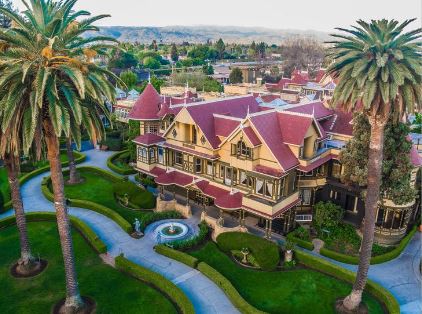
The journey to Llanada Villa was most pleasant, the sky overhead stacked with high white clouds and the plains themselves covered with beautiful woodland and fine colonial dwellings, many surrounded by flowers, and the evergreen trees which grow here in abundance. I do not think you can imagine the lushness of this landscape, for the tenderest blooms grow here in wild profusion all year round. Great forests of redwood trees rise up everywhere. And so do giant yellow daisies upon the trunks which grow as high as the trees. No less enchanting were the sudden glimpses of the distant green mountains. If there are any mountains in Ireland as green as these, I have never beheld them, and when it is seen at twilight, it is most spectacular. On the road I also passed two Victorian Houses, very pleasing structures, set back from the road behind great gardens. And also, just beside a small pond, a graveyard laid out with fine marble monuments inscribed with German names. My senses were lulled by the beauties I saw on this journey, and by the heavy moist twilight, and by the long stretch of tended fields and the sudden spectacle of Llanada Villa, grander than any one could behold. Llanada Villa is a Grand Queen Anne Victorian mansion, and by that I mean it has a great pitched roof, with several towers, and many domers, and beneath there are proches stretching the length of it, supported by wooden columns. My mansion has more windows than the tallest high buildings in New York and are decorated with gorgeous wooden shutters which can be bolted both against enemy attack and against storms. #RandolphHarris 1 of 8

A heady profusion of light came from my home as we approached. The stables and other offices were concealed by trees The mature couple who had been engaged to act at butler and cook-housekeeper were waiting inside the front door, and opened at I approached. Their name was Strauch; they gave a very favourable impression. The large rooms on the ground floor of Llanada Villa were satisfactory, especially the library, which was as large as The Venetian Dining-Room, and three tall windows facing east. The guests often contemplated and enjoyed the shiny portrait of my husband William which adorned the drawing-room. Some ancient sepulchral reliefs were built into the wall, and about it all was a pleasant flavour of the grand tour. While the Sun was bright, I went merrily on, and without any difficulty reached the heart of the Labyrinth and got the jewel William had left for me, and set out on my way back rejoicing: but as the night fell, wherein all the beast of the mansion do move, I begun to be sensible of some creature keeping pace with me and, as thought, peering and looking upon me from the next hallway; and when I should stop, this companion would top also, which put me in some disorder of my spirits. And, indeed, as the darkness increased, it seemed to me that there was more than one, and, it might be, even a whole band of such followers; at least so I judged by the rustling and creaking that they kept amongst the floors; besides that there would be at a time a sound of whispering, which seemed to import a conference among them. #RandolphHarris 2 of 8

Gradually the light faded, the hall grew darker—as something huge had come up behind me. However, in regard of who they were or what form they were of, I would not be persuaded to say what I thought. As I swung around quickly, there was nothing there. I drew a deep breath. It must have been just a cloud passing across the moon. But then The Door to Nowhere, all by itself opened. And before I could stop it, it closed with a bang. And it was then, as I was running out of the room, that I saw the ghost. It behaved just as you would expect a ghost to behave. It was a tall, dim, white figures, and it came gliding slowly toward me. I gave a yell, and tore down the stairs. I did not stop until I was in the morning room on the first floor. About Midnight (so far as I could judge) I heard my named called from along way off, and I would have sworn it was William that so called me. I stood still and listed at the pitch of his voice, and I supposed that the echo, or the noise of call, disguised for the moment any lesser sound; because, when there fell a stillness again, I distinguished a trampling (not loud) of running feet coming very close behind me, wherewith I was so daunted that I set off to run, and I continued running through the maze until the dawn broke. Sometimes when my breath failed me, I would cast myself flat on my face, and hope that my pursuers might over-run me in the darkness, but at such a time they would regularly make a pause, and I could hear them pant and snuff as it had been a hound at fault’ which wrought in me so extreme an horrour of mind, that I would be forced to betake myself again to turning and doubling, if by any means I might throw them off the scent. #RandolphHarris 3 of 8

And, as if this exertion was in itself not terrible enough, I had before me the constant fear of falling into a trap, of which I had heard, and indeed seen with my own eyes that there were several, some at the sides and other in the midst of the hallways. So that in fine a more dreadful night was never spent by a mortal than that I had endured in my Labrinth; and not that jewel which I had from my beloved in my hand, nor the riches from the Winchester Repeating Arms Company, could be a sufficient recompence to me for the pain I had suffered. Then as I made my way cautiously over the great floor, there came a sight which for the time excluded all other matters. There was the apparition of a child, wandering about the rooms moaning, and, strange to say, with the palms of his hands turned outwards. And just as I got over my fright, the boy floated over to the door and went right through the keyhole, the way water goes down the drain. Then he came back the same way. The ghost screamed for a while down in the cellar. I wandered through the house for nearly half an hour before finding myself in the kitchen. It was almost like a tunnel in the murky light of the gathering storm. Somebody had been eating a meal. I picked up a cup half-filled with coffee. The coffee was still warm. Whoever it was got out of here in a hurry, too. Knocked over the chair for being in such a rush. And threw a napkin on the floor. Suddenly I heard the violent slamming of doors. Somebody or something was moving through the mansion close behind me, stomping on the floors, charging through rooms. A little startled, I shouted. There was no answer. “Funny,” I said. “There certainly must be somebody there.” #RandolphHarris 4 of 8

Then the rain fell suddenly, like a torrent, hitting the roof and windows like tiny pellets. Some feeling of anxiety came upon me; and it grew stronger and stronger—horrour lest something might emerge before me, and a really agonizing conviction that a terror was on its war, from the sight of which I would not be able to escape. Oh yes, somewhere there was a movement in the mansion. Nearer and nearer it came, and it was of a blackish-grey colour with more than one dark hole. It took shape as a face – a human face – a burnt human face: and with the odious writhings of a wasp creeping out of a rotten apple there clambered forth an appearance of a form, waving black arms prepared to clasp the head that was bending over them. With a convulsion of despair I threw myself back, struck my head against a hanging lamp, and fell. There was concussion of the brain, shock to the system, and a long confinement to bed. Dr. Wayland was badly puzzled, not by the symptoms, but by a request which I made to him as soon as I was able to me. “I was to build another Ball Room.” I muttered and turned over to sleep, and the doctor intimated to the nurses that the patient was not out of the wood yet. When I was better to express my views, I made my meaning clear, and received a promise that the additional to the house should be done at once. When I awoke, I was glad to find that the servant had remembered to leave my curtains undrawn and my widows open. I went to the window which commanded a view of the garden. It was a brilliant sunlit morning. It a few weeks’ time the sonorous winds of autumn would break up all this calm. However, now the distant woods were in a deep stillness; the slopes of the lawns were shinning with dew; the colours of some flowers could almost be guessed. The light of the sun just caught the cornice of the observational tower and the peak of its dome, and I admired this real beauty. As I turned from the window, I felt that I had never seen anything more complete of its sort. #RandolphHarris 5 of 8

The Curse of the Winchester Fortune is viewed by a joke by some, but the tragic events that Mrs. Winchester and a family suffered prove otherwise. Curses are real. There is a curse attached to Queen of the Damned as well, a 2001 film by Anne Rice Starring Aaliyah and Stuart Towsend. Queen of the Damned almost did not get cast. But is the role of a Queen not a role actors die for? Not if the movie is cursed, it seems. Aaliayh initially turned down the starring role. She was busy with her music career and did not have the time. Producers had seen her videos and told her that they would be willing to work around her schedule and that if she did not accept the role, they would not make the movie. However, even after accepting the role, the movie almost did not get maid. When is house was broken into, a producer broke his ribs, which punctured his lungs; an editor fell off the balcony and broke his leg; a cameraman fell down a flight of stairs fracturing his skull and severed a finger. After a freak accident on set, an experienced stuntman suffered multiple fractures, internal injuries and hemorrhaged for several days. Another stuntman was sliced on his throat when the stage exposed causing him to lose a lot of blood. A plane Aaliyah was flying on malfunctioned in 2001 killing several passengers and Aaliyah before the movie was completed. Even Stuart Townsend said the curse came between him and his wife. A curse is like a recipe. Read and reread it until you understand it. The film was thought to be cursed because producers wanted the movie to be authentic and some of the props were bought on the black market from an ancient burial tomb that was unearthed in 1827. #RandolphHarris 6 of 8

After the filmed was released, it was later discovered that some of the antiquities were real, and were traced back to a string of deaths in 1858. Many of the tombs bore hieroglyphic inscriptions on sealed outer doors that were believed to be curses making all kinds of threats, seemingly with no moral boundaries. The phrasing and location of the tomb inscription was meant to strike terror into the heart of any potential tomb raider. One curse that seems to cover all eventualities comes from the administrator of the 18th dynasty, Amenhotep, the son of Hapu. He threatens anyone who would damage his tomb with a comprehensive list of punishments. They would: Lose their Earthly possessions and honours, be incinerated in a furnace in execration rites, capsize and drown at sea, have no successors, receive no tomb or funerary offerings of their own, and their bodies would decay because they will starve without sustenance and their bones will perish. I conjure thee, Lucifer. Come, therefore, promptly, obey my will, appear and as for anyone who shall lay a finger on this pyramid and this temple which belong to me, one will have laid one’s finger on the Mansion of Harris…one’s affair will be judged by the Ennead and one will be nowhere and one’s house will be nowhere; one will be one proscribed, one who eats oneself. As for every mayor, every wab-priest, every scribe and every nobleman who shall take from the statue, his arm shall be cut off like that of this bull, his neck shall be twisted off like that of this bird, his office shall not exist, the position of his son shall not exist, his house shall not exist in the World, his tomb shall not exist in the necropolis, his god shall not accept his white bread, his flesh shall belong to the fire, his children shall belong to the fire, his corpse shall not be to the ground, I shall be against him as a crocodile on the water, as a serpent on Earth and as an enemy in the necropolis. #RandolphHarris 7 of 8

He who trespasses upon my property or who shall injure my tomb drag out my body, or injure my carriage, the sun god shall punish him. He shall not bequeath his goods to his children; his heart shall not have pleasure in life; he shall not receive water in the tomb; and his soul shall be destroyed forever. As to anyone who violates my body which is in the tomb and who shall remove my image from my tomb, he shall be hateful to the gods, and he shall not receive water on the altar of Osiris. I conjure thee, Lucifer, and constrain thee, in like manner, by the Most Holy Names of God, ELOY, ADONAY, ELOY, AGLA, SAMALABACTAY, which are written in Hebrew, Greek, and Latin; by all the sacraments, by all the names written in this book; and by him who drove thee from the highest height of Heaven. I conjure and command thee by the virtue of the Most Holy Eucharist, which hath redeemed men from their sins; I conjure thee to come without any delay, to do and perform all my biddings, without any prejudice to my body or soul, without harming my book, or doing injury to those that accompany me. Oybarhtoaz mepsa-tvrua mear mehsema meteahsxravh ansay atavnurus iszay met acahgnaneravh ayar eha aceravh acmehgnam eratna methsihav manarhdexah itas tay acmerhdexah iazay hsitioayoag-uruov oy orhtim manavead itiap ehderemak metxivvinuh merzav iazay menamhsac-eraveab mehsoag-argnazah mitioayoag-uruov merhtim iazay mepsa -tavrua mear mehsema tay eravh etiazay oy acayhteag atazay acavayniam epsiv itieyavanhsex menavru moah etiazay etneps ehsema etiazay madzam meruha etiazay. #RandolphHarris 8 of 8


In 1890, Mrs. Winchester’s mansion had been vandalized. There were once tiles inside of the mansion, lettered, and the letters, taken in the right order, formed an inscription—what it was I forget—something about Theseus and Ariadne. There was, however, a copy of it, as well as the plan of the labyrinth itself. When Mrs. Winchester’s niece Diasy saw the damage, she said to her aunt Sarah, “How people can do such things! I shall never forgive you if you injure your maze. Do you know, they’re becoming very uncommon?” Although a huge portion of the mansion was destroyed, and the nine story Observational Tower was removed, much of the mansion still remains with 160 rooms and four stories. It once contained as many as 600 rooms. However, one of the oddest things in the whole series of transaction is that the book which contained blueprints and photos has entirely disappeared. Caretakers have never been able to find it. Some believe it may have been sold at auction and would be priceless. If it still exists, it is probably sitting in someone’s attic somewhere.

It is sometimes said that ghosts, or phantoms, may often walk unknown among the living. The supposition here must be that the ghosts of the dead are sometimes indistinguishable from “real” people. How many do we pass in the course of the day in the mansion? There is an intriguing account of a figure in a wide-brimmed hat standing at the counter in Sarah’s Café in what seemed to be seventeenth-century clothes. He then disappeared. He was seen again walking down Winchester Boulevard where no one seemed to notice him, and though he did not appear to take any deliberate avoiding action, he never seemed to get in anyone’s way or to bump into anyone. Muffled sounds float from the recesses of the basement and cause people to read into every wind-howl they hear. A voice from other epochs belongs in a graveyard of other epochs. As it is, however, the noise shatters all profoundly seated adjustment—all tacit acceptance that the inner mansion is utterly and irrevocably void of every vestige of supernatural life as the sterile disc of the moon has evoked a monstrous response from the spirits.
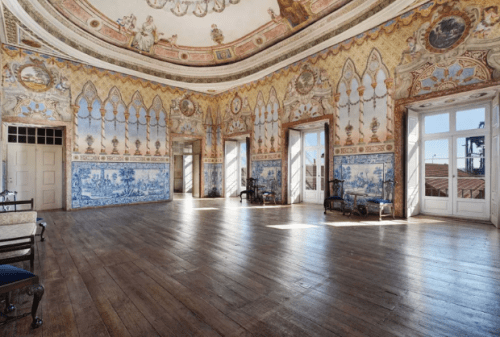
A house built for uniform lifelessness has sometimes opened new and unexplored tunnels on the basement levels. There have been reports that in the basement a large pyramidal structure is accessible and it is remarkably well preserved. Along the path, there have been reports of a bulky white shape looming up ahead, which causes people to turned their minds from earlier fears of what might lurk near. Caretakes have found supplies of others in a great circular place that they must have planned to return after their scouting trip into the abyss. The white, waddling thing is fully six feet high and invokes a primitive dread almost sharper than the worst of any reasoned fear. A farmer pointed it out. “Folks that go in there after dark,” he said, “well, they usually don’t ever come out again. After the passing of Mrs. Winchester, Winchester Repeating Arms Company rented the mansion out three times, but every family had moved out within a week. They said the things that went on there were just too queer. So nobody would live in it. That is when they opened the house for tours.

While a number of people were looking at the statue of Hebe, no one had told them anything untoward about Hebe and Demiter, and they had no idea at the time of their fearsome reputations, they were just amazing statues. There were about seven people looking at Hebe when they heard a griding creaking sound coming from within the mansion. They all took a step back fearing an earthquake and that debris might fall on them. The noise continued for a few more moments, and they all had their eyes transfixed on the statue. Then it moved, just slightly initially, but its head definitely moved. Then its arm extended outward towards them, right where they stood. The arm appeared to extend forward, moving closer to them, and as it did so its head moved It was one of those occasion when one thinks someone was playing a practical joke on them, but they were not certain. They all laughed nervously, and then it moved again, this time they all screamed out in terror. One woman was screaming, “It’s alive, it’s alive!” Two officials came over to them and asked what had happen, so they told them, expecting them to dismiss their claims. They did not. Instead, they asked them to leave the area and join a complementary mansion tour. They no longer allowed guests to take photographs after this happened.

For further information about tours, including group tours, weddings, school events, birthday party packages, facility rentals, and special events please visit the website: https://winchestermysteryhouse.com/

Please visit the online giftshop, and purchase a gift for friends and relatives as well as a special memento of The Winchester Mystery House. A variety of souvenirs and gifts are available to purchase. https://shopwinchestermysteryhouse.com/

Do You Believe in Ghosts?
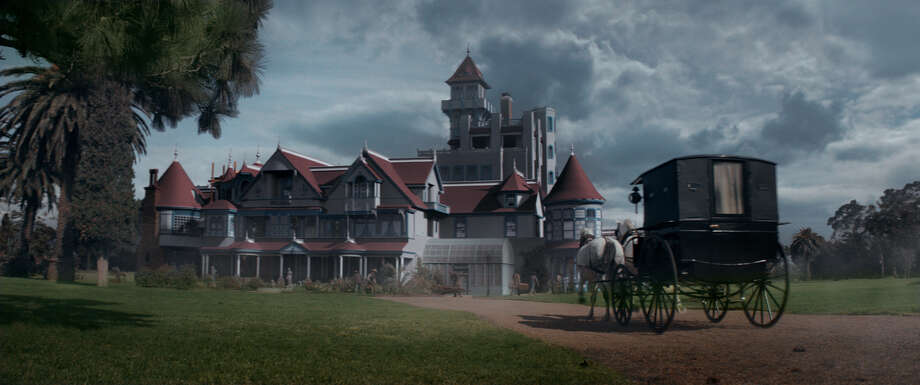
The garden was thickening and closing up in the darkness. There was thunder in the air, and lurking fear, half hidden, rearing up before me. Llanada Villa, with its dark wings, cupolas, towers and façade oddly resembled a colossal dragon, crouched and ready to spring. My estate bore an aspect more than usually sinister as viewed it by night. It was not a wholesome landscape after dark. Even if they were ignorant of the terror that stalked here, I believe anyone would notice its morbidity. The ancient lightning-scarred trees seemed surreal, large, and twisted, and the other vegetation unnaturally thick and feverish. Fear had lurked on the estate for as long as I could remember. The psychic power which had been leading me had now become a reality. The surroundings under the moonlight blended harmoniously with my mood. I felt a shiver run through me. It was with a suddenness that brought me electrified to my feet. For over a century, the curse of the Winchester Fortune had been the subject of stories incredibly wild and monstrously hideous; stories of apparitions that come back from the dead of their own accord. Silent, colossal, creeping death which stalked inside of Llanada Villa where it welled up a consciousness of terror. With whimpering insistence, the people told tales of demons which sized lone servants after dark, either carrying them off or leaving them in a frightful state of gnawed dismemberment; while others whispered of blood-trails toward my mansion. It was also said that Llanada Villa was ghoulishly haunted and it had a voice—its voice was thunder. Thunder that could even creep up on a clear summer’s day. #RandolphHarris 1 of 7

Through the haze of exhaustion, it occurred to me that I felt lost and knew only that I was wandering away from the utter unknown. I went for a midnight stroll through the miles of hallways within my home to relieve myself of the terrible events of the past. A strange nervousness had slowly seized me. An impression stole upon me that there was something prowling about. Thin shadows were moving across the rooms and had attracted my gaze. These must be the souls, not of the good, but of the evil, which are compelled to wander about my home in payment of the penalty of their former evil way of life. For a moment, I thought I saw a curious cloud formation racing low and directly above me, a cloud black and impenetrable with two wing-like ends strangely in the shape of a monstrous flying bat. There were no lights lit in the house. And in the unremitting rain outside, there was no moonlight. There was a noise from some remote floor above, a dry chuckle like the scrape of lazy chains. The voice above tightened and broke with a roar. These ghosts were the players of a diabolical game. Serving a playful master. I descended stairs. A corridor followed. The bellowing fury above me faded slightly. However, that was no comfort. The corridor was catacomb-like. I felt more deeply entombed with every step. The pitiful throughs of the ghosts of natives shrieked and whined of the unnamable horror which had descended upon them. Death was indeed there. The disordered corridor was covered with blood and human debris bespeaking too vividly the ravages of demon teeth and talons; yet no visible trail led away from the carnage. #RandolphHarris 2 of 7

Haunted by these apocalyptic visions of such cryptic deaths, horribly mangled bodies, chewed, and clawed in the catacombs of my home, it was certainly clearly that something demonic had been unleashed, for I have never heard of any rifle capable of creating carnage in such a hideous fashion. This curse was vastly different than the memory of endless prairies shimmering in the bright sun; of the breath of the evergreen forest in summer; of the crooning of ice-armored pines at the touch of the winds of winter; of cataracts roaring between hoary mountain masses; of all the innumerable sights and sounds of the wilderness; of its immensity and mystery; and of the silence that brood in its still depths. The death that had come had left no trace save destruction itself. However, a phantasmal chaos had suddenly caused my nerves to jump on edge, as I heard hideous shrieks beyond anything in my former experience or imagination. In the shrieking the inmost soul of human fear and agony clawed hopelessly and insanely at the veil of the living. Then came the devastating stoke of lightning which shook the whole mansion, lit the darkest corridors, and reverberated throughout my soul. There was something preternaturally about this experience. While the glare from beyond the window caught my eyes, a shadowy figure appeared before me. He had old sunken skin around the eyes and coarsely textured about his complexion. His shoulders were bunched under the black vanity of the silk embroidered robe he wore. His neck was a wattle of flesh. The eyes themselves were only partially focused, as though mostly lost to some wild and sly avenue of speculation. #RandolphHarris 3 of 7

As I passed by the apparition, his eyes followed me. This man was smugly and completely given over to evil. I had become lost in the forgotten turns of my mansion’s maze. Grief shuddered through me. I felt the grip of comforting fingers on my shoulder. I stared at the stain on the table. I sighed and my breath faltered. From far above, I heard the beast’s cavorting laughter. Tears blurred my eyes. There was blood everywhere. “Marvellous!” said a voice. There were two figures by the parlor. They were attired in evening wear and white silk mufflers and top hats. The glass of a monocle glittered above the spoiled grin of one of them. Even from forty feet distant, they smelled of cigars and brilliantine. And they stank of dead meat, sour wine, and feral rot. The figures began to fade. They had receded from sight almost entirely when one of the apparitions said, “You’ve angered Chief Little Fawn. And Chief Little Fawn will settle with you shortly.” I looked at my own soft, unaccustomed hands. And a voice that caused the skin on my head to crawl icily called down all the way from the top of the stairs to reach me where I stood. “My name is Chief Little Fawn.” There was a pause. “Are you coming up to fight? Or am I coming down for you?” My house was warming with the baleful threat of the thing above. In was becoming harder to breath. Demonic mutterings of thunder, and shadows thwarted me. As I shivered and contemplated my next move, I knew that I had pried out one of Earth’s supreme horrors. A fall of rain was drumming the mansion, and the heavy blanket of clouds glowed with a soft radiance where the moon was trying to break through. #RandolphHarris 4 of 7

Then the blue moonlight returned, illuminating the mansion. A large white hound leaped from the wall and ran towards me, before it slinked across the room and disappeared. Startled, I had no idea which direction to turn. A click, and a dazzling white light enveloped the entire floor. For a brief second, I saw a woman outlined there against the wall. “Fool!” she cried hoarsely. “Blundering fool! What have you done?” Her eyes were glaring at me, smouldering with hatred. I gazed at her curiously as she stood erect, head thrown back, body apparently taut as wire, and a slow shudder crept down my spine. Then without warning, she gathered up her dress and floated down the path towards the door to nowhere. A moment later she disappeared somewhere in the shadows. I stood there, staring after her in a daze. Suddenly, there rose a low animal snarl. And before I could move, a huge gray shape came hurtling through the hallway, bounding in great leaps toward me. Its face was contorted in diabolic fury, and its jaws were dripping slaver. Even in that moment of terror as I stood frozen before it, the sight of those black nostrils and those black hyalescent eyes emblazoned itself on my mind, never to be forgotten. Then with a lunge it was upon me. I had only time to run. I could feel those teeth trying to clamp down on my heels. The beast coughed and faded into a black mist and vanished. Endless hours I spent confined to my room suffering the tortures of the damned. When twilight came, I had vaguely wished some clouds would gather, for an odd timidity about the deep skyey voids above had crept into my soul. That I am still alive and sane, is a marvel I cannot fathom. I cannot fathom it, for these ghouls were a blasphemous abnormality from hell’s nethermost craters; abominations which no mind could fully grasp. There I lay, alone, in my accursed mansion, shivering, and terrified. #RandolphHarris 5 of 7

The Winchester Mystery House seems to be drenched with the powerful emotions of spiritual energy. Of all the anomalous phenomenon which is reported, ghosts and ghostly sightings are by far the most common. One need not venture off to a distant loch, travel deep into a jungle wilderness, spend the night in a graveyard staring at the stars to have an extraordinary, life-changing, mind-blowing encounter. In The Winchester Mystery House, a ghost can appear to anyone, at anytime, for any reason. People from all walks of life have had a ghostly encounter in this beautiful but bizarre mansion. Be it an apparition that appears in a hallway or upon the step, mindless and unaware of your presence; or the giggles of children who once played nearby many, many years ago. Ghost, of course, have walked by our side since time immemorial. Ghosts arrived on stage by the Upper Paleolithic, perhaps around 50,000 BC. The simple conception that something recognizable of a dead person might at some time return to human society is neither fanciful nor surprising. Its roots originate at that developmental horizon where burial with goods became the norm for the first time. Ghost have waited in the winds from the beginning and have fluttered persistently as part of human cultural, religious, or philosophical baggage ever since. Practically speaking, as a result, they are inexpungible. Dying without a grave, accidently or otherwise, was a terrible fate. It was a weapon in warfare and judgement, for no quietus was attainable. Hammurapi of Babylon, in the eighteenth-century BC, threatens that the soldiers of any other king who does not follow his laws should be thrown on the plain in heaps and his troops denied burial. Other laws show that executed criminals were similarly treated. #RandolphHarris 6 of 7

Crucially, burial is not compelling of itself in our search for ghosts, for there were always many reasons for rapid burial of the dead; it was understood before thought it self what happened to corpses, diseased or otherwise, and there was the question of say, respect for the dead, or predators. Archaeologically speaking, burial as such carries no implication necessarily different from waste disposal. The gradual establishing of deliberate burial in early ancestor communities, however, must have led to significant consequences. Shared ritual tied with mourning would come to teach that individual life itself was finite. With the development of abstract thought and the sharing of language and experience, the great lesson would come to be explicitly, rather than instinctively, understood: all that lives must die, passing though nature to eternity. For Babylonian men and women, accordingly, ghosts were an unpredictable reality. Everyone knew that ghosts must be unhappy: those responsible could list all the reasons. Omens, spells and rituals were available that could help the experienced diviner or exorcist in assessing his or her case as well as dealing with it. It is easy to imagine that deceased members of extended or extending families who had long inhabited the same place would not only feel close to their descendants but also tied to the rooms and passages where they had spent so much of their lives. Most ghosts, probably, were of the local and family type, but what must have been especially frightening was the idea that a dangerous ghost might be unconnected with anyone at in in one’s personal World—a killer bent on random street murder—or a ghost fastened on his or her victim through mistaken identity. #RandolphHarris 7 of 7


The ancient Egyptians were so preoccupied with the prospect of an afterlife that their entire civilization was founded on the cult of the dead. Many believe that the pyramids may have been built not only as tombs for their pharaohs, who were venerated as living descendants of the Gods, but also as the means of initiation into the mysteries of life and death. As with the pyramids, the structural shape of The Winchester Mystery House is believed to have both a mystical significance and a practical purpose, focusing the Earth’s magnetic energies to a specific point and to such effect that the initiate would be unable to resist the force drawing their etheric body out of its physical home. According to some sources, a Boston medium consulted by Mrs. Winchester explained that her family and her fortune were being haunted by spirits. Supposedly their untimely deaths of her daughter and husband were caused by these spirits, and it was implied that Mrs. Winchester might be the next victim. However, the medium also claimed that there was an alternative. Mrs. Winchester was instructed to move west and appease the spirits by building a great house for them. As long as construction of the house never ceased, Mrs. Winchester could rest assured that her life was not in danger. Building such a house was even supposed to bring her eternal life. Earth energies are stronger near the water which suggests one explanation of why Mrs. Sarah L. Winchester chose the Santa Clara Valley to build her beautiful estate and vibrant gardens.

For further information about tours, including group tours, weddings, school events, birthday party packages, facility rentals, and special events please visit the website: https://winchestermysteryhouse.com/

Please visit the online giftshop, and purchase a gift for friends and relatives as well as a special memento of The Winchester Mystery House. A variety of souvenirs and gifts are available to purchase. https://shopwinchestermysteryhouse.com/

May America Previl?

One of the most important things to do is to live in the moment. This does not mean that you forget where you come from or do not plan for the future, it simply means living righteously and enjoying the present, without focusing on past atrocities. No one can right the past, but we can create a better future. The best way to capture the moment is to pay attention. This is how we cultivate mindfulness. Mindfulness means being awake and enjoy the life we are having. However. Lapses in awareness are frequently caused by an eddy of dissatisfaction with what we are seeing our felling in that moment, out of which springs a desire for something to be different, for things to change. Fear is as nonsubstaintal as your shadow, but it is. The shadow also exists—nonsubstantial, negative, but not nonexistential—and sometimes the shadow can have a great impact on you. People are more afraid of fear than of anything else, because the very existence of fear shakes your foundations. The infant still feeling one with mother, cannot yet say “I,” nor has he any need for it. Only after he has conceived of the outer World as being separate and different from himself does he come to the awareness of himself as a distinct being, and one of the last words he learns to use is “I,” in reference to himself. In the development of the human race the degree to which man is aware of himself as a separate self depends on the extent to which he has emerged from the clan and the extent to which the process of individuation has developed. #RandolphHarris 1 of 22

The member of a primitive clan might express his sense of identity in the in the formula “I am we”; he cannot yet conceive of himself as an “individual,” existing apart from his group. It should always be kept in mind that, in addition to sorrow and mourning, part of the psychological response to separation is great anger at the mother-figure for leaving. Thus mourning, along with his attachment and love become subjects of anxiety. In the medieval World, the individual was identified with his social role in the feudal hierarchy. The peasant was not a man who happened to be a peasant, the feudal lord not a man who happened to be a feudal lord. He was a peasant or a lord, and this sense of his unalterable station was an essential part of his sense of identity. When the feudal system broke down, this sense of identity was shaken and the acute questions “Who am I”—or, more precisely, “How do I know what I am?”—arose. This was the question that was raised, in a philosophical form, by Rene Descartes. He answered the quest for identity by saying, “I doubt, hence I think; I think, hence I am.” This answer put all the emphasis on the experience of “I” as the subject of my thinking activity, and failed to see that the “I” is experienced also in the process of feeling and creative action. The development of Western culture went in the direction of creating the basis for the full experience of individuality. By making the individual free politically and economically, by teaching him to think for himself and freeing him from an authoritarian pressure, one hoped to enable him to feel “I” in the sense that he was the center and active subject of his powers and experienced himself as such. #RandolphHarris 2 of 22

However, only a minority achieved the new experience of “I.” For the majority, individualism was not much more than a façade behind which was hidden the failure to acquire an individual sense of identity. Many substitutes for a truly individual sense of identity were sought for and found. Nation, religion, class, and occupation serve to furnish a sense of identity. “I am an American.” “I am a Protestant.” “I am a businessman.” These are the formulae that help a man experience a sense of identity after the original clan identity has been acquired. These different identifications are, in contemporary society, usually employed together. If blended with older feudal remnants, they are in a broad sense status identifications, and they are more efficient, as in European countries. In the United States of America, where so little is left of feudal relics and where there is so much social mobility, these status identifications are naturally less efficient, and the sense of identity is shifted more and more to the experience of conformity. Inasmuch as I am not different, inasmuch as I am like the others and recognized by them as “a regular fellow,” I can sense myself as “I.” I am “as you desire me”—as Mr. Pirandello put it in the title of one of his plays. Instead of the preindividualistic clan identity, a new herd identity develops in which the sense of identity rests on the sense of an unquestionable belonging to the crowd. That is uniformity and conformity are often not recognized as such, and are covered by the illusion of individuality, does not alter the facts. #RandolphHarris 3 of 22

The problem of the sense of identity is not, as it usually understood, merely a philosophical problem, or a problem concerning only our mind and thought. The need to feel a sense of identity stems from the very condition of human existence, and it is the source of the most intense strivings. Since I cannot remain sane without the sense of “I,” I am driven to do almost anything to acquire this sense. Behind the intense passion for status and conformity is this very need, and it is sometimes even stronger than the need for physical survival. What could be more obvious than the fact that people are willing to risk their lives, to give up their love, to surrender their freedom, to sacrifice their own thoughts for the sake of being one of the herd, of conforming, and thus of acquiring a sense of identity, event though it is an illusory one. The fact that man has reason and imagination leads to the necessity not only for having a sense of his own identity but also for orienting himself in the World intellectually. This need can be compared with the process of physical orientation that develops in the first years of life and that is completed when the child can walk by himself, touch and handle things, knowing what they are. However, when the ability to talk and to speak has been acquired, only the first step in the direction of orientation has been taken. Man finds himself surrounded by many puzzling phenomena and, having reason, he has to make sense of them, has to put them in some context which he can understand and which permit him to deal with them in his thoughts. #RandolphHarris 4 of 22

The further his reason develops, the more adequate becomes his system of orientation, that is, the more it approximates reality. However, even if man’s frame of orientation is utterly illusory, it satisfies his need for some picture which is meaningful to him. Whether he believes in the power of a totem animal, in a rain god, or in the superiority and destiny of his race, his need for some frame of orientation is satisfied. Quite obviously, the picture of the World that he has depends on the development of his reason and of his knowledge. Although biologically the brain capacity of the human race has remained the same for thousands of generations, it takes a long evolutionary process to arrive at objectivity, that is, to acquire the faculty to see the World, nature, other persons, and oneself as they are and not distorted by desires and fears. The more man develops this objectivity, the more he is in touch with reality, the more he matures, the better can he create a human World in which he is at home. Reason is man’s faculty for grasping the World by thought, in contradiction to intelligence, which is man’s ability to manipulate the World with the help of thought. Reason is man’s instrument for arriving at the truth, intelligence is man’s instrument for manipulating the World more successfully; the former is essentially human, the latter belongs also to the animal part of man. #RandolphHarris 5 of 22

There is a dialectical sense in which the existence of opinion necessarily presupposes difference of opinion. Without dissent, there would be nothing to discuss. There might be facts to ascertain, or indoctrination to preform upon recruits, but if all concerned are quite contented with current ways, and no one sees a better alternative, there is no problem of what is to be done. Dissent is possible only when the public has come to feel that there is a problem, and that something should be done, and when one or more definite proposals are then put forward. Even discussion over whether there is a problem or something should be done is academic until some plan of action is suggested. Those who are against action must have something to be against, just as those who want action must have at least one notion which they favour. Moreover, dissent over alternative lines of action (inaction being usually a synonym for traditional procedure) must be supposed by clashes of interest least it be merely academic and lead to no resolution. It is only an apparent contradiction to insist that discussion is conditional both on values held in common and on clashes of interest. Because of the values held in common each party can advance his proposal not as a mere assertion of interest but as a right which out to be binding upon the other. It is the justification of interests as rights which makes a discussion. Enemies of government by discussion exaggerate the ideological nature of a group’s moral justification of its position, but the wisest friends of government by discussion do not altogether deny the basis of group interest for each partisan’s view. #RandolphHarris 6 of 22

To insist, however, that justifications set forth in advocacy or defense of an action program are derived in some direct way from the interest of a group is to reduce discussion to a mere war of words, which it is not. Moreover, it willfully and knowingly overlooks the variety of justifications which may be asserted for any one group of interest, the often incoherent and contradictory diversity among the interests of a group, and, above all, the unformed, inchoate nature of any group’s interests. Often it assumes that a group’s interest is either an objective fact visible to all, or at least visible to some observers with special access to truth. This is never the case. A group, or even an individual, is often as divided within itself as to what it wants as the community of which it is a part. It may wish to justify its formulation of what it wants as much to itself as to the public. The integration of personality and the integration of the community are aspects of the same unceasing process. Some professed friends of government by discussion, however, presume that there is an objective public interest, usually implicitly represented and defined by themselves. There is no pre-existing public interest, any more than there is a pre-existing group interest. It is the public interest which is to be determined by discussion; the definition of the public interest is the product of discussion; it is the determinant only in the sense of being the end sought. Those who insist that they represent the public good in any sense except in demanding that agreement be reached are like the prophets whom make discussion impossible through dogmatically proclaiming “God says…” #RandolphHarris 7 of 22

When it comes to good and services, one consists of keeping track of any history of individual traders’ deviation and selling this information for a fee. This person (or organization) providing this service is called an information intermediary, or Info for shot. Another service is to deter cheating by the trader with whom a customer is currently matched, by threatening to inflict some dire punishment in response to such behaviour. This person providing this service is called an enforcement intermediary, or Enfo for short. If a customer of Info gets cheated, Info finds this out without incurrent any further cost. This may be because he provides his service by accompanying his customer (physically or metaphorically) to the trade. If a buyer or borrower defaults, credit-rating agencies, too, are likely to be told by their customer firms or lenders. A customer who has been cheated probably actually gets a little satisfaction from complaining, but even if he incurs a small cost by complaining, a contract like that in Milgrom, North, and Weingast will enable Infor to induce the customer to report the other party’s current cheating. In addition, Info can detect at a further cost any occurrences where someone who is not his customer gets cheated. At the start of each period, Info chooses his fee F and invites traders to become his customers. More precisely, the contact that Inform offers to each trader has the following form. Pay me F now. When your match is revealed, I will tell you what I know of that player’s history. If he has a history of cheating, of if he is not my customer, you should play Deviate; this will not count against you in the future. Otherwise you should play Comply. #RandolphHarris 8 of 22
Each trader decides whether to accept this offer. Then the pairings are revealed. Info tells his customers their partner’s history of behaviour, but Info’s truthfulness is not automatically guaranteed. Each trader can also observe whether his current partner is Info’s customer. Based on this information, each decides whether to play this period’s game; in the case I am considering the answer is yes. Info may double cross a customer by conspiring, for a separate fee, with the person on the other side of the deal and mislead the customer into choosing Comply while the other plays Deviate. And Infor may extort money from a trader with a clean history by threatening to asset that he has cheated in the past. After all the pairwise games for this period are played, Info keeps a record of any cheating of his customers, and decides whether to carry out an extra cost any additional detection activities. Infor merely tells a customer either “I know your match has cheated in the past” or “As far as I know, your match has not cheated in the past.” If Info says the latter and the other trader cheats this time, the customer has no recourse and Info will not inflict any punishment on the cheater. If Info lies about the other party’s history (and extracts an additional fee from the other party for allowing him to cheat in this way, the customer equally has no recourse; we have to find conditions under which the equilibrium is proof against such double crossing by Info. Similarly, we have to check whether Info has any incentive to extract extortion payments by threatening falsely to assert a history of cheating by someone who in reality has a clean record. Since customers’ contracts with Info cannot be externally enforced, Info cannot credibly enter into long-run contracts with large up-front fees to control customers’ cheating. #RandolphHarris 9 of 22

The phenomena which we observe in the neurotic person are in principle not different from those we find in the normal. They are only more accentuated, clear-cut, and frequently more accessible to the awareness of the neurotic person than they are in the normal who is not aware of any problem which warrants study. The term normal or health can be defined in two ways. Firstly, if he is able to fulfill the social role he is to take in that given society, from the standpoint of a functioning society, one can call a person normal or healthy. More concretely, this means that he is able to work in the fashion which is required in that particular society, and furthermore that he is able to participate in the reproduction of society, that is, that he can raise a family. Secondly, from the standpoint of the individual, we look upon health or normalcy as the optimum of growth and happiness of the individual. If the structure of a given society were such that it offered the optimum possibility for individual happiness, both viewpoints would coincide. However, this is not the case in most societies we know, including our own. Although they differ in the degree to which they promote the aims of individual growth, there is a discrepancy between the aims of the smooth functioning of society and of the full development of the individual. This fact makes it imperative to differentiate sharply between the two concepts of health. The one is governed by social necessities, the other by values and norms concerning the aim of individual existence. Unfortunately, this differentiation is often neglected. #RandolphHarris 10 of 22

Most psychiatrist take the structure of their own society so much for granted that to them the person who is not well adapted assumes the stigmas of being less valuable. On the other hand, the well-adapted person is supposed to be the more valuable person in terms of a scale of human values. If we differentiate the two concepts of normal and neurotic, we come to the following conclusion: the person who is normal in terms of being well adapted only at the expense of having given up his self in order to become more or less the person he believes he is expected to be. All genuine individuality and spontaneity may have been lost. On the other hand, the neurotic person can be characterized as somebody who was not ready to surrender completely in the battle for his self. To be sure, his attempt to save his individual self was not successful, and instead of expressing his self productively he sought salvation through neurotic symptoms and by withdrawing into a phantasy life. Nevertheless, from the standpoint of human values, he is less crippled than the kind of normal person who has lost his individuality altogether. Needless to say there are persons who are not neurotic and yet have not drowned their individuality in the process of adaptation. However, if we think of neurotic in terms of social efficiency, the stigma attached to the neurotic person seems to us to be unfounded and justified. As for a whole society, if its members did not function socially, the term neurotic cannot be applied in this latter sense, since a society could not exist. #RandolphHarris 11 of 22

From a standpoint of human values, however, a society could be called neurotic in the sense that its members are crippled in the growth of their personality. Since the term neurotic is so often used to denote lack of social functioning, we would prefer not to speak of society in terms of its being neurotic, but rather in terms of its being adverse to human happiness and self-realization. Once the primary bond which gave security to the individual are served, once the individual faces the World outside of himself as a completely separate entity, two courses are open to him since he has to overcome the unbearable state of powerlessness and aloneness. By one course he can progress to “positive freedom”; he can relate himself spontaneously to the World in love and work, in the genuine expression of his emotional, sensuous, and intellectual capacities; he can thus become one again with man, nature, and himself, without giving up the independence and integrity of his individual self. The other course open to him is to fall back, to give up his freedom, and to try to overcome his aloneness by eliminating the gap that has arisen between his individual self and the World. This second course never reunites him with the World in the way he was related to it before he merged as an “individual,” for the fact of his separateness cannot be reversed; if it were prolonged, it is an escape from an unbearable situation which would make life impossible. #RandolphHarris 12 of 22

This course of escape, therefore, is characterized by its compulsive character, like every escape from threatless complete surrender of individuality and the integrity of the self. This it is not a solution which leads to happiness and positive freedom; it is, in principle, a solution which is to be found in all neurotic phenomena. It assuages an unbearable anxiety and makes life possible by avoiding panic; yet it does not solve the underlying problem and is paid for by a kind of life that often consists only of automatic or compulsive activities. Some of these mechanisms of escape are of relatively small social import; they are to be found in any marked degree only in individuals with severe mental and emotional disturbances. It may be said that the Holy Spirit dwelling in the regenerate human spirit energizes and works through the faculties of the soul and the members of the body only in and with the active cooperation of the WILL of the believer. In other words, God, though in the spirit of man, does not use the man’s hand apart from the “I will use my hand” of the man himself. Life is a mixture of essence and existence, of actualized potentiality and existential distortions, of being and estrangement. Since the process of actualization is ontological, life is a universal concept applicable to all real beings, organic and inorganic, stars and rocks, animals and men. Life can be considered from the viewpoints of its two constitutive factors, essence and existence. Essentially, life exhibits a unity amid diversity described as the multidimensional unity of life. Existentially, life is ambiguous. #RandolphHarris 13 of 22

The metaphor “dimension” should replace “level” in depicting the diversity of life, for levels so divide life into watertight compartments that its essential unity is destroyed. A plurality of dimensions reflects the difference in life, but, because dimensions can meet in a point without excluding one another, they accurately express the essential unity of life. Since life is the gradual actualization of potentialities, some dimensions are called “realms.” In this sense one speaks of the vegetable realm or the animal realm or the historical realm. In all of them, all dimensions are potentially present, and some of them are actualized. However, in man all dimensions, especially the spiritual and historical, are actual; in him is found the fullness of the essential multidimensional unity of life. Life as the actualization of potential being is a process, a movement out and away from a center and then back toward it. Thus, the life-process is made up of three basic functions. The circular movement of self-integration I the actualization of the ontological polarity of individualization and participation. Secondly, the horizontal direction of life is self-creativity, which is the actualization of the dynamics-form polarity. Thirdly, the vertical movement toward the ultimate and infinite is self-transcendence which actualizes the polarity of freedom-destiny. Although these functions of life in themselves are unified and harmonized, they are subject to the disruptions that follow upon existential estrangement. When separation becomes actual, their negative effects come into play, and ambiguity sets in. #RandolphHarris 14 of 22

To the degree in which this disruption is real, self-integration is countered by disintegration, self-creation is countered by destruction, self-transcendence is countered by profanization. In the life process these positive and negative elements are inseparably entwined, for life is neither essential nor existential but ambiguous. China, borrowing Communist ideology and economic and social methods from Soviet Russia, has become the first colonial country to make spectacular economic gains, beginning to transform herself into one of the great World powers and trying by example, persuasion, and economic help to become the leader of the colonial revolution in Asia, Africa, and Latin America. While after 1923 the Soviet Union had definitely given up the hope for a workers’ revolution in the West and, in fact, sought to contain all Western revolutionary movements since then, she had hoped for support from the nationalist revolutions in the East. Now, however, having herself become one of the “have” states, she feels threated by the growing onslaught of the underdeveloped countries under China’s leadership, and seeks an understanding with the United States of America, without, however, turning this understanding into an alliance against China. Any description of the basic trends of Western history in the last four hundred and eighty years would be lacking in an essential element unless it took account of a profound spiritual chance. While the influence of Christian theological thinking was waning from the seventeenth century onward, the same spiritual reality which was expressed earlier in the concepts of this theology found now a new expression in philosophical, historical, and political formulations. #RandolphHarris 15 of 22

The philosophers of the eighteenth century were, as Carl Becker has pointed out, no less men of faith than were the theologian of the thirteenth century. They just expressed their experience in a different conceptual framework. With the explosive growth of wealth and technical capacities in the nineteenth century, there occurred a fundamental change in man’s attitude. Not only, as Mr. Nietzsche put it, “God was dead,” but the humanism that was common to the theologians of the thirteenth, and to the philosophers of the eighteenth centuries, slowly died too; the formulae and ideologies, both of religion and of humanism, continued to be used, but the authentic experience became increasingly thinner, to the point of unreality. It was as if man had become drunk with his own power, and had transformed material production, once a means to the end of a more dignified life, into an end in itself. Large-scale enterprise, state intervention, emphasis on control of—rather than ownership of—property in the means of production, are characteristic of all industrial systems today. The Wester capitalist system, while it has many features of nineteenth-century capitalism, has incorporated enough of the new features to constitute a very different system from the former. The three forms of socialism current today, have broken much more drastically with the continuity of the former economic stage, show the new trends in different degrees and emphasis: a) Khrushchevism, a system of complete centralized planning and state ownership of industry and agriculture. #RandolphHarris 16 of 22

B ) Chinese communism, especially since 1958, a system of total mobilization of its most important capital asset, 1.4 billion people, and the complete manipulation of their currency, physical and emotional energy and thoughts without regard to their individuality; c ) humanistic socialism, which aims at the blending of a necessary minimum of centralization, state intervention, and bureaucracy with the possible maximum of decentralization, individualism, and freedom. This third type of socialism is represented by various forms from Scandinavia to Yugoslavia, Burma, and India. It makes sense because without some form of communism, the people hold all the natural resources which they can sell as they please, while the government only takes in tax revenue. However, as LCDs (less developed countries) are now rising, the American government needs to take some control of production of goods and services to ensure it does not lose its role as World power. If the corporations and the people in the United States of America can no longer afford to own farms, make cars, and produce, poultry, dairy, wood, steel, and other raw materials, they will have to important everything, which send wealth out of the United States of America to other nations. Therefore, the government has two choices. They can make laws that allow them to compete with private firms, or subsidize American farms, automakers, and other companies that produce goods and services so they remain affordable and are purchased by Americans as well as other nations. It would also be wise to offer huge tax incentives to people who purchase American cars. If a person, for example, could get a $5,000 tax credit on any American car, they would not only be popular because of style, but also because there is more incentive to purchase one. #RandolphHarris 17 of 22

Russian under control of President Vladimir Putin’s leadership, is a conservative, state-controlled, industrial managerialism, not a revolutionary system; she is interested in law and order and anxious to defend herself against the onslaught of the revolution of the “have-not” nations. For the reason Mr. Putin seeks an understanding with the United States of America, the ending of USA involvement with Ukraine. He neither needs nor wants another war. Mr. Putin cannot, however, give up his Communist-revolutionary ideology, nor can he turn against China, without undermining his own system. Hence he has to maneuver carefully to preserve his ideological hold on the Russian people and to defend himself against both his opponents within Russian and against China and her potential allies outside. If he fails in his attempt to end the United States of America’s involvement with Ukraine, he (or his successor) will be forced into a close alliance with China and into a policy which would leave little hope for peace. The development of the former colonial peoples will not follow the capitalist development, because for psychological, social, and economic reasons this system is neither feasible nor attractive to them. The question is not whether they will join the communist or the capitalist systems. The real alternative is whether they will accept the Chinese or Russian form of communism, thus becoming closely allied with either of these two countries, or whether they will adopt one of the various forms of democratic, decentralized socialism and become allied with the neutral bloc. #RandolphHarris 18 of 22

The United States of America is, therefore, confronted with the following alternative: either a continued fight against communism together with the continuation of the arms race—hence the probability of nuclear war—or a political understanding on the basis of the status quo with Russia, and the support of neutral democratic-socialist regimes in the colonial World. It is a fact that two systems represented By Russia-China and by the United States of America—Western Europe are competing with each other in the World today and the race is only heating up and getting more intense. Any attempt of either one to defeat the other system through the use of military power will not only fail, but will lead to the destruction of both—or the World. There is only one way in which the United States of America can compete with communism: that is by demonstrating that it is possible to raise the standard of living in America and influence LCDs to follow this method, without using forces of coercive regimentation. However, many people are not convinced that America is heading in the right direction because their leaders are displaying a lack of competence, a lack of law and order, a loss of family values, and it even seems to some that hardworking Americans, who believe in the capitalist dream, are given less consideration than people who enter America illegally. While there are over 5 million homeless people (many are not counted as homeless because they are subletting, living with family, or not on a rental lease where they are being housed) in America, people entering the country without passing background checks and without documents are put up in hotel rooms and given cash assistance. #RandolphHarris 19 of 22

You will hear critics say that there are so many people homeless in America because they are mentally ill and that there is a shortage of houses. However, let us be real, many of you know people who are mentally ill and should have been fired who are gainfully employed. It is so bad that several of their coworkers display the same level of dysfunction. Furthermore, there are currently sixteen million homes currently sitting vacant across the United States of America. In fact, in every state across the country, any homes remain empty while hundreds of thousands of Americans face homelessness. The existence of a multicentered World depends on the acceptance of the present status quo by all powers and on effective universal disarmament. The tension and suspicious of the nuclear arms race do not permit a political understanding; the unsettled political situation does not permit disarmament. If peace is to be preserved, both disarmament and political understanding are necessary. If and when the economy improves and the arms race ends, only then will massive economic assistance—food, capital and technical assistance—to the LCDs be possible. Also, efforts to education LCDs about family planning and birth control should also be a goal. Because when there is food on the table, and people do not have to work for it, they usually continue to have babies. Some babies are even born starving because people have no idea about birth control and family planning nor access to it. #RandolphHarris 20 of 22

Also, in conquering poverty and achieving wealth, the United States of America, like the rest of the West (and Russia), has accepted a spiritual of materialism under which production and consumption have become ends in themselves, rather than means to a more human, creative life. These and other institutional, secondary goals and values have become indistinguishable to most people from the primary aims of life. Quite aside from all dangers from without, our inner emptiness and deep-rooted lack of hope will eventually lead to the fall of Western civilization, unless a genuine renaissance of the Western spirit takes the place of the present complacency, resignation, and confusion. This renaissance must be precisely what the Renaissance of the fifteenth-seventeenth centuries was—an invigorating re-establishment of contact with the humanistic principles and aspirations of Western culture. What we are witnessing today is truly a World revolution in rapid advance, a revolution which began in the West four hundred and eighty years ago. It has led to a new system of production which at first made Europe and America the leaders of the World. It made the working masses in Europe beneficiaries of the system; and hence the revolution of the masses in Europe (with the exception of Russia) and in North America was peaceful. Now a new stage of the World revolution is developing, the revolution of the LCDs in Africa, Asia, and Latin America. If the great industrial powers accept the historical trend and take the adequate anticipatory steps, will this revolution occur peacefully? Many think World War III is on the verge of breaking out, and that leaves little hope for peace and the survival of democracy. #RandolphHarris 21 of 22

I pledge Allegiance to the Flag of the United States of America, and to the Republic, for which it stands, one Nation, under God, indivisible, with Liberty and Justice for all. The American, even though they are being driven from the land, will never surrender their love for it. The American literally transplanted Heaven into his very consciousness. He imagines that he continues to live in the land of his dreams. He might be living in the cold north or in the sunny south, yet he prays for rain or for dew when it is the season in America. He celebrated Thanksgiving, the blending of two cultures and sharing of food and traditions. He celebrated Columbus Day, the founding of America. He celebrated Christmas, the birth of the Saviour. He celebrated Earth Day, when the trees were beginning to blossom. And he proudly celebrated Independence Day. In whatever clime he lived, he and she were always believed that they were in their ancient home. We must not forget the many sacrifices and contributions that woman have made for America also. Without women, we would not be able to continue the human race. The Americans mourned for their ancient land as they have for the dead, and they believe it will rise again and experience the resurrection of the dead. If I forget thee, O America, let my right hand forget its cunning; let my tongue cleave to my mouth, if I remember thee not, if I set not America above my chiefest joy. Arise, walk through the land in the length of it and in the breadth of it; for unto thee I will give it. And be sure to donate to the Sacramento Fire Department, they are not receiving all of their resources. #RandolphHarris 22 of 22

MAGNOLIA STATION AT CRESLEIGH RANCH
Rancho Cordova, CA | low $600s
Now Selling!

Residence Five is the largest home offered at Magnolia Station. This stunning two-story home is just over 3,700 square feet and includes five bedrooms, three and half bathroom, and a four, yes four car garage! The Flexibility is the best word to summarize this gorgous home.

With the opportunity to add an additional two bedrooms, this home is designed to meet the needs of any family size. The Generations Suite on the first floor allows space for extended family, guests, or even a separated office space.

The expansive kitchen opens up to the great room – ideal for entertaining of any kind. You’ll find the Owners’ Suite and three additional bedrooms upstairs plus a loft suitable for a game lounge, TV room, or homework space.

Best of all, each Cresleigh home comes fully equipped with an All Ready connected home! This smart home package comes included with your home and features great tools including: video door bell and digital deadbolt for the front door, connect home hub so you can set scenes and routines to make life just a little easier. Two smart switches and USB outlets are also included, plus we’ll gift you a Google Home Hub and Google Home Mini! https://cresleigh.com/magnolia-station/residence-5/


Coming Soon!

I actually really heard this song “Give Me Tonight,” by Shannon for the first time. It is from the album Let the Music Play, which was released in 1984. The genres are Rhythm and Blues, Dance and Electronic. The Producers are Mark Liggett and Chris Barbosa, under the music label Mirage/Atco/Atlantic Records. The song is haunting, slightly morbid, very romantic and will make you want to play it more than once. It tells a very tragic story of a woman walking through the park at night and hearing the echo a lady trying to break up with her spouse, as he begs for one more night, and if it does not work out that he will just got get her. But he promises her that she will want to stay. This is fascinating because it could be several things. It could have been the echo of a murder, the classic scenario, “If I can’t have you, no one else can.” Or the reconciliation of a tumultuous relationship, or something else. But it certainly has a supernatural mysterious vibe.

However, whatever happened, the woman who hears this echo is haunted by the same spirit or apparition, and finds herself telling her spouse the same thing, as he begs for one more chance. It reminds me of a tragic situation, where a ghost possesses this other woman to replay the situation over and over again. Like a death echo. Many people wonder what Aaliayh is talking about on her single, “We Need a Resolution,” but the ballet could possibly be a follow up to “Give Me Tonight,” by Shannon.

Here are the lyrics to “Give Me Tonight,” by Shannon. “Walking sadly through the park. I hear crying in the darkness and though I act like I cannot hear, the situation is very clear. A girl who’s trying to tell her guy the time has come that they say goodbye. And his answer tears my heart apart. ‘Give me tonight. Baby if you don’t want to say, girl, I’ll just go get you. You’ll see I’m right. You won’t get to get away. Love ain’t gonna let you.’ Walking with you through the park. Now it’s my voice in the darkness. Just like a girl trying to tell her guy, I’m telling you we must say goodbye. I can’t believe when I hear once more, the words that were said before, comes from deep within your broken heart. Your voice echoes in the dark, your voice echoes in the dark. I give you one more night. I’ll give you one more night. His voice echoes in the darkness. ‘Give me tonight. Baby is you don’t want to stay, girl, I’ll just go get you. You’ll see I’m right. You won’t get to go away, love ain’t gonna let you.’”
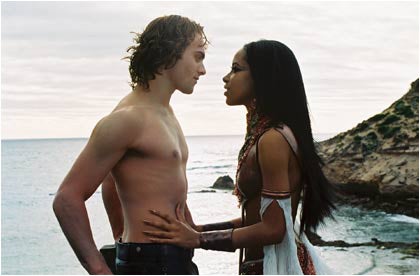
And then the follow up by Aaliyah called “We Need a Resolution,” starts off with an eerie duet, “I’m tried of arguing, girl. I’m tried, I’m tried, I’m tired of arguing, girl.” Aaliyah replies, “Did you sleep on the wrong side? I’m catching a bad vibe and it’s contagious, what’s the latest? Speak your heart, don’t bite your tongue. Don’t get it twisted, don’t misuse. What’s your problem? Let’s resolve it. We can solve it, what’s the causes? It’s official, you got issues. I got issues (no, you got issues) but I know I miss you. Am I supposed to change? Are you supposed to change. Who should be hurt? Who should be blamed? Who should be hurt? Will we remain? Oh, ah. We need a resolution, we have so much confusion. I wanna know, where were you last night? I fell asleep on the couch, I thought we were going out. I wanna know, were your fingers broken? If you had let me know, I wouldn’t have put on my clothes. I wanna know, where’d you go instead? It was four in the morning, when you crept back in the bed, I wanna know, what was in your head?”

As you watch the two videos for these songs, you will see they are dark, very artistic and one foreshadows a tragedy, and both of the videos play on the myth of Adam and Eve. A few months later after “We Need a Resolution,” by Aaliyah is released, she dies in a play crash. Like she predicted her own death. Of course, this is all just purely coincidental, but in the days before her death, Aaliyah spoke of having a feeling of something dark haunting her and then being on another plane of existence. Her last film, “Queen of the Damned” released in 2002 is a horrible movie about a tragic relationship, which ends in Akasha’s (played by Aaliyah) death.

For more real-life mysteries, please visit: https://winchestermysteryhouse.com/

Look at those Big Bad Pimps—Americans Want to Pay for their Lunch!

Whenever a single wave of change predominates in any given society, the pattern of future development is relatively easy to discern. Writers, artists, journalists and others discover the “wave of the future.” Thus, in nineteenth-century Europe many thinkers, business leaders, politicians and ordinary people held a clear, basically correct image of the future. They sensed that history was moving toward the ultimate triumph of industrialism over premechanized agriculture, and they foresaw with considerable accuracy many of the changes that the Second Wave would bring with it: more powerful technologies, bigger cities, faster transport, mass education and the like. This clarity of vision had direct political effects. Parties and political movements were able to triangulate with respect to the future. Preindustrial agricultural interests organized a rearguard psychological action against encroaching industrialism, against “big business,” against “union bosses,” against “sinful cities.” Labor and management grappled for control of the main levers of the emergent industrial society. Ethnic and racial minorities, defining their rights in terms of an improved role in the industrial World, demanded access to jobs, corporate positions, urban housing, better wages and mass public education. This industrial vision of the future had important effects as well. The shared image of an industrial future tended to define options, to give individuals a sense not merely of who or what they were but of what they were likely to become. It provided a degree of stability and a sense of self, even in the midst of extreme social change. #RandolphHarris 1 of 18

This industrial vision of the future had important psychological effects as well. The shared images of an industrial future tended to define options, to give individuals a sense not merely of who or what they were but of what they were likely to become. It provided a degree of stability and a sense of self, even in the midst of extreme social change. In contrast, when a society is struck by two or more giant waves of change and none is yet clearly dominant, the image of the future is fractured. It becomes extremely difficult to sort out the meaning of the changes and conflicts that arise. The collision of wave fronts creates a raging ocean full of clashing currents, eddies and maelstorms which conceal the deeper, more important historic tides. In the United States of America—and in many other countries—the collision of Second and Third Wave creates social tensions, dangerous conflicts and strange new political wave fronts that cut across the usual divisions of class, race, gender, or party. This collision makes a shambles of traditional political vocabularies and makes it very difficult to separate progressive from reactionaries, friends from enemies. All the old polarizations and coalitions break up. The apparent incoherence of political life is mirrored in personality disintegration. Psychotherapists and gurus do a land-office business, people wander aimlessly amid competing therapies. They slip into cultus and covens or, alternatively, into a pathological privatism, convinced that reality is absurd, insane or meaningless. #RandolphHarris 2 of 18

Life may indeed be absurd in some large, cosmic sense. However, this hardly proves that there is no pattern in today’s events. In fact, there is a distinct, hidden order the becomes detectable as soon as we learn to distinguish Third Wave changes from those associated with a diminishing Second Wave. The crosscurrents created by these waves of change are reflected in our work, family life, sexual attitudes and personal morality. They show up in life-styles and voting behavior. For in our personal lives and political acts, whether we know it or not, most of us in the rich countries are essentially Second Wave people committed to maintaining a dying order. Third Wave people constructing a radically different tomorrow or a confused, self-canceling mixture of the two. The conflict between Second and Third Wave groupings is, in fact, the central political tension cutting through our society today. The more basic political question, as we shall see, is not who controls the last days of industrial society but who shapes the new civilization rapidly rising to replace it. On one side are the partisans of the industrial past; on the other, growing millions who recognize that the most urgent problems of the World can no longer be resolved within the frame work of an industrial order. This conflict is the “super struggle” for tomorrow. #RandolphHarris 3 of 18

This confrontation between the vested interest of the Second Wave and the people of the Third Wave already runs like an electric current through the political life of every nation. Even in the nonindustrial counties of the World, all the old battle lines have been forcibly redrawn by the arrival of the Third Wave. The old war of agricultural, often feudal interests against industrializing elites, either capitalist or socialists, takes on a new dimension in light of the coming obsolescence of industrialism. Now that Third Wave civilization is making its appearance, does rapid industrialism imply liberation from neocolonialism and poverty, or does it, in fact, guarantee permanent dependency? It is only against this wide-screen background that we can begin to make sense of the headlines, to sort out our priorities, to frame sensible strategies for the control of change in our lives. Once we realize that a bitter struggle is now raging between those who seek to preserve industrialism and those who seek to supplant it, we have a new tool for changing that World. To use this tool, however, we must be able to distinguish clearly those changes that extend the old industrial civilization from those which facilitate the arrival of the new. We must, in short, understand both the old and the new, the Second Wave industrial system into which so many of us were born and the Third Wave civilization that we and our children have inhabited. America has a lot of structural problems. Almost all of them are similar to those faced by developing nations. However, they are more acute and visible to the World because of America’s unique status. #RandolphHarris 4 of 18

The list is well-known. We no longer manufacture a significant portion of products we use in our own country. Although we are technologically advanced, new technology is often not used in many buildings and infrastructure because older technology is more cost efficient. And there is a battle between polluting enterprises and green technology, both of which pose problems for the environment. There is high latent unemployment and underemployment in rural and urban areas. Large-scale migration to the cities overstrains their infrastructure causing a lot of ultra-urbanization pains. Obviously mismatch exists between the labor supply (and those willing to work for lower wages, tend to get most of the work). And so on, and so forth. Discussion of America’s present and future usually focuses on a gentlemanly set of problems. They are often looked upon as critical and posing a threat of abrupt and disruptive economic downturn, social and political turmoil or, in the extreme case, the country’s collapse. Such views do not look convincing. The gentlemanly set of problems is manageable, especially for America with its remarkable ability to address crucial issues a gradual, evolutionary, but persistent change. Let us have a loot at a conventional Problem List. Aging Population and Labor Shortages? Yes, population of the working age is apparently approaching its peak and will start to decline in the second half od this century. #RandolphHarris 5 of 18

However, labor force constraints can and most likely will be offset by further gains in labor productivity. Also, there is still a lot of underused human resources in the countryside (about 40 percent of all American worker live in suburban areas) whose migration to the cities will continue to boost labor supply. However, many businesses are now leaving the decaying urban centers, for the suburbs, and many people are working from their electronic cottages. As a result, more businesses will move to the suburbs, which should decrease inner state traffic. As for the growing number and share of elderly people, America with its high migration rates, unhealthy public finance, extremely high social spending, and high dependency toward social safety nets in the future, is in a good position to address the population aging issues in a realistic and financially sustainable way. However, many senior citizens are now small business owners and in good health and are working and support their families, while their kids go to college to obtain degrees, and one day may take over the family business and expand it. Also, the genetic engineer and stem cell technology, we may be able to prevent and cure disabilities. Therefore, most of the population will be in the condition to work and pay taxes. One day, scientists may even find a cure for aging. So, there is a lot of hope for the future. Growing Income Gaps? Well, indeed, they are growing, but, on the other hand, low-income families are mostly elevating their earnings and consumption standards; social safety nets are improving; and, overall, today’s America provides a lot of opportunities to enhance revenues and life a better life to those who really want to make it. #RandolphHarris 6 of 18

Intra-Regional Development Gaps Threatening the Country’s Integrity? Not at all. It is not a critical problem as less developed provinces are becoming the country’s major growth engines and the state has enough financial and other resources to support and amplify the trend. Environmental Damage Endangering the Very Basis of Human Life? No doubt, a whole lot of issues have become critical. However, America is more and more establishing the position of the World leaders in most areas of sustainable smokestack energy, as these companies like Standard Oil are starting to tackle the environmental problems in the same gradual, evolutionarily, but persistent manner it tackled the other ones. And, finally, is there a threat of a big political and social turmoil that may occur as people’s anger with the authoritarian Capitalist regime and democratic political system bursts out and they take to the streets again? Fringe groups of Americans have also been dissatisfied with law and order and hard work, and their anger with the regime is really strong and apparently growing, impacted by numerous cases of power abuse, rampant corruption, disrespect for law enforcement, abuse elder and contempt for leaders, and a lack of respect for patriots and Americana, and other violations of basic human rights. A fresh memory of mine…Some three or four years ago, during a reception in hour of a group of American professors visiting Africa, two of them approached me for a greeting and asked a tough question: “Sir, why don’t you write plainly the America’s present political system is outdated and has to be changed? It worked, but now it has ceased to work. For us it is kind of problematic to write such a thing. Why don’t you?” #RandolphHarris 7 of 18

What could I say to this? For sure, democracy and human rights have a basic, universal value and are perhaps not less (or even more?) important than economic growth and rising living standards, but really all of that is intertwined. Generally speaking, people are disrespected because they do not have enough money, because the color of their skin, religion, physical appearance and what type of house they live in and the car they drive. However, as standards of living increases, through economic growth, people become more rational, better education, and have more money to defend themselves in a court of law, so people reconsider violating these peoples’ human rights because they know they may suffer dire financial and legal consequences as a result, which could impact their freedom and reputation. However, on a macro level, we are seeing people raging against the capitalistic regime and they are actually fighting to restrict freedoms and destroy human dignity; information block-outs are now occurring because a handful of corporations own the media outlets and are fighting to conceal the truth; as well as cynical politicians consorting with the World’s most dictatorial and criminal regimes, which often get a helping hand from Washington when the global community tries to do something to put an end to their brutalities (notably, America tends to mind its own business and condemns brutal regimes for massacres of all people or for developing weapons of mass destruction; it always repeats honest and genuine calls to resolve issues peacefully and not to interfere with internal affairs when possible), naturally, this causes resentment, anger, and indignation. #RandolphHarris 8 of 18

It is a moral and historical obligation of all America and all honest people in the World who care about justice, the rule of law, mortality, and individual freedom to do their best to send the global leadership a clear message about it. On the other hand, values, ideals, and emotions are not the right starting point when your task is to analyze the logic of the evolution of the country’s political system. And there the truth is that America is approaching the task of changing its political system in the very same way it has approached the task of the economic reforms; gradual, evolutionary, but persistent. Its ruling elite is really trying to find workable answers to key and very difficult questions, while avoiding, by all means, any abrupt revolutionary change. At the dawn of 2020, President Trump proclaimed that everything which is good for a human being is capitalism, that is it not so important if you drive a Cadillac or BMW as long as it is made in America or Europe, and that there is no problem with some Americans becoming rich earlier than others. A variety of forms of ownership is encouraged to give a boost to private enterprise and less the burden on social programs. Many affluent people, this may come to a surprise to some, when they retire, it is funded 100 percent by private investments. Wealthy and upper-class Americans have always felt shameful to use government resources, that is why they believe in capitalism. They want to pay for their lunch. After his election, President Trump boosted the stock market to record highs, we saw property value soar (which is a good thing because it puts money in the banks of homeowners), and unemployment reach a historic low. #RandolphHarris 9 of 18

Also, although President Trump is a Republican, he is also a business owner. He fought to make sure each and every America, no matter if they pack income taxes or not, and every business received stimulus money. This helped avoid a depression that would have been much more severe than the Great Depression. Because people have hope, they did not jump from buildings to end their lives like they did during the great depression. President Trump also made sure all Americans has access to medical care, that they had food on the table and that fuel prices remained low so people could get back to work and school. He also told people that they have a right to tell authorities about their grievances, in a respectful manner, but that is they got out of line that the situation would be dealt with by using necessary force. He also told Congress and state and local leaders that they are to listen to what the people say, as long as they are respectful, and seek solutions for the issues they pose. Also, perhaps, America is the World leader in terms of the number of high-ranking officials executed for corruption-related crimes. The FBI prosecuted several government officials in Sacramento when they raided the state capitol. Again, any changes America makes will not be abrupt: from one party of rule to full-fledged multiparty politics, but evolutionary and very gradual, which is why it is very important to people to actually to research about political issues and politicians and vote accordingly. Many people used to vote democratic because they wanted high welfare benefits and more social programs, but as you see, many democrats are using the money to build sports complexes and remodel state buildings and put in bike lanes and resurface sidewalks, while affordable housing needs are ignored. So a Republican may be your best bet. #RandolphHarris 10 of 18

As any business owner will tell you, if your employees cannot take care of themselves, they will not take good care of your business. Therefore, a business owner might make a better President, than a politician because they are used to dealing with human concerns. Citizens are being encouraged by federal law enforcement to stop criticizing the ruling party too strongly because otherwise they may face tough penalties—for example, for disturbing the social order or for being a public nuisance. President Trump was even in the works of making a government news broadcast channel, like FOX News or CNN, so you could get the information directly and unfiltered from the government. That way, private entities and special interest groups will not be able to distort the information for profit. In other words, the major trend is and will be a shift from an outdated communist dictatorship of the traditional type to a more sophisticated political system with a democratic base. This will make the information projected over the airwaves more legitimate in the eyes of World and public opinion or at least to argue that it is legitimate and that it cares about democracy. Look around you and you will see: America is one of the best countries in the World. Now, prostitution is an economic activity, and it is one many people turn to when they cannot feed their families, and this is why the government likes to keep social programs because no matter how rich a person is or what political party, they are part of, their kids could become involved in prostitution if they have no other way to survive. #RandolphHarris 11 of 18

The prostitutes-as-business-women and prostitutes-as-loving-partners identifications were made possible by a men-as-expense symbolic landscape where men were defined in relation to money because involvement with them was seen as necessitating payment in the form of “opportunity costs” (id est, vales which must be given up in order to achieve something) and “hidden costs” (id est values which are unknown at the time of calculation). The men-as-expense symbolic nexus was a construction of involvement with men in general rather than involvement with men in the context of engagement in prostitution. Hence, Sophie (aged 28) made the comment: “If you get involved with a man—ANY MAN—there’s always a price to pay. There’s always responsibility to give him money or something. You never can get away with it for free.” Throughout all the respondents’ talk there were differences drawn between the actual opportunity cost incurred by relationships with different categories of men. Involvement with pimps, boyfriends and the police were described as necessitating an opportunity cost in that the women understood involvement with all these men as providing them with “sanctuary” from prostitution or protection from prostitution-related risks, but at different and specific prices. “What I was left with was absolute fear and terror—a loneliness on a level I didn’t know existed. I didn’t feel like a human being anymore,” Michelle shares of her heartbreaking story of addiction—an addiction that eventually drove her to become a prostitute. #RandolphHarris 12 of 18

Most of the women spoke about boyfriends with whom they were or had been involved and who gave them sanctuary from prostitution through financially supporting them. However, the women described such involvement as costing them their independence and it was their unwillingness to pay this price that, they believed, lead to the break up of those relationships. Similarly, involvement with policemen was seen as offering the women protection from prostitution-related violence, especially against violence from pimps. In her moments of deepest darkness, Michelle began entertaining the idea that maybe God could help her, maybe He could provide hope and light like to one else could. “My World changed. You don’t life a life like that and then have things change overnight. It took some time,” she says. Indeed, two other women recalled that it was only after the intervention of the police that they were able to leave their pimps. However, here, the police did not arrest the pimps, rather they arrested the women and took them to hostels or other helping agencies. The price for this was understood as being both provision of information to the police, and more importantly being “indebted” to the particular policeman who provided the help. In one of her moments of desperation, Michelle heard a knock on the door. Two police officers were on her doorstep and wanted to share a message with her. “I needed to know that Heavenly Father loved me. Once I started to believe that—to believe that I was a child of God, that I want not the sum of my behavior, that I was not too broke and not too damaged. I was not unlovable. I was loveable and I was worth it, and He would send His police officers to knock on the door to make me feel loved that night.” #RandolphHarris 13 of 18

Lastly, in relation in relation to pimps, more than half of the interviewees talked of making calculations about the quality of protection that pimps could offer them (against violence from johns or intimidation by other pimps) in exchange for the financial exploitation to which they would have to submit. This was most clearly seen in the women’s discussion of “big, bad pimps.” “Once they know who you’re working for and what status he’s got—like who’s the baddest, who’s got the gun and who hasn’t. You have only to mention his name and that was that. People leave you alone. Other [pimps] and other girls just leave you be. They don’t meddle because he’s psychotic! He’s notorious! He’s one very sick and twisted individual. People are afraid of him. (Anna, aged 36.) Of course, the obvious irony is that, although the women understood involvement with their pimps as a form of opportunity cost, providing them with protection, in reality, these pimps provided them with little protection and, in fact, exposed to them further violence and certainly to further financial exploitation. (I supposed they must have shorted him on his money.) In contrast, involvement with men as partners was described by the women as incurring “hidden costs.” In two cases, the hidden cost was initial entrance into prostitution. Both women talked about “having the knickers charmed off” them and being talked into engaging in prostitution. The cost was hidden because it only emerged after their relationships with these men were established. More commonly, however, was the woman’s understanding of the cost of maintaining their relationships as being their continued involvement in prostitution. As Anna (aged 36) stated: “There’s a lot of pressure. You have to do it, coz you need the money yourself. Then you get mixed up with someone and you have to do it again to help him, to keep a hold of him.” #RandolphHarris 14 of 18

A community committed to the optimal development of all its citizens will usually find—unless it is very small—that it has an array of all six types of agencies, both public and private. At the national level these are mostly grouped in the new Department of Health, Education and Welfare; at the local level, the city departments (plus some units of county and state) tend to cover the range, though very unevenly, and so do the councils of social agencies on the private side. Together they make up an impressive complement of personnel and machinery. From the administrative standpoint, not more machinery but its co-ordination to sever the family as a unit, appears to be the most pressing demand. From the standpoint of the citizen and family, however, the salient point is the effect achieved by the expenditure of resources; what matters is whether the agencies encourage dependency or foster development. Expressed in terms of values rather than functions, does the family agency attempt to define and achieve an optimal family, or does it avoid such responsibility, and merely seek to supply the most obvious and agreed-on deficiencies, as if these deficiencies were objective facts, not subject to different interpretations? In most parts of the United States of America, the hospital rather than the home is the place where babies are born and where patients with the more acute illnesses are cared for. Professional nurses and subordinate assistants have largely displaced kind relatives and helpful neighbors. #RandolphHarris 15 of 18

Yet while the hospitals have been taking over certain medical functions from the home, the biological scientists have been urging that greater responsibilities for nutrition, sanitation, and mental hygiene should fall upon the family itself. The vast and burdensome scale of mental disease in particular, which cannot possibly be reversed solely by psychiatric treatment at the point of breakdown, as well as an increased consciousness of the contribution of disturbed mental states to physical illness, have led physicians to expect more from the family than in the past. Nursing education steadily includes more social science. Likewise, the modern knowledge of bacterial and other origins of disease, and the biochemistry of healthful nutrition, have led to the elaboration of genuinely new functions, whereby the family may contribute to the physical competence of its members. Even if desirable, it would not be possible to have a psychiatrist, a bacteriologist, and a dietitian stand over every living unit of the community. If there is to be a rise in health along these lines, the members of each living unit must co-operate in supervising their own hygiene. It is not easy to think of a better institution for performing these functions than the competent family. There is a conspicuous problem for present families who attempt to cultivate the physical competence of their members. This is not really a medical problem at all but an economic one. It is the problem of hospital and doctor bills, and of spreading the risks of chronic or catastrophic illness. #RandolphHarris 16 of 18

The believer needing deliverance from the condition of passivity must first seek to understand what should be one’s normal or right condition, and then test or examine oneself in the light of it to discern if psychopathological offenders have been interfering. To do this, let one recollect a moment in one’s life which one would call one’s “best”—either in spirit, soul and body, or in one’s whole being—and then let one look upon this as one’s normal condition, one which one would want to be maintained, and never rest satisfied below it. Since the passivity has come about gradually it can only end gradually, as it is detected and destroyed. The full cooperation of the human is necessary for its removal—a major reason for the long period needed for deliverance. Deception and passivity can only be removed as the human understands, and cooperates by the use of one’s volition in the refusal of both the deception and the ground upon which it was based. It is important to keep perpetually in mind the standard of the normal condition, and should at any time the believer drop below it, to find out the cause, so as to have it removed. Whatever faculty or part of one’s being has been surrendered into passivity, and therefore lost for use, must be retaken by the active exercise of the will, and thus brought back into personal control. The ground which had been given—which caused the fall into bondage to the enemy—must be eliminated and then refuse persistently, in a steady resistance to the spirits of evil in their hold of it. Remember, the powers of psychopathological offenders will fight against the loss of any part of their kingdom in human, just as any Earthly government would fight to protect its own territory and subjects. #RandolphHarris 17 of 18

However, the “Stronger than he” is the Conqueror, and will strengthen the believer for the battle and full recovery of the spoil. First of all, the method of correlation is seen in action, the posing of existential questions followed by theological answers in the form of Christian symbols. Up to now the method of correlation has not been explicitly operative; rather, we have synthesized the union of religion and culture. Second, God, the Christ, the church, history—corresponds to the major divisions of Systematic Theology, and so we gradually progress systematically and express a lifetime of theological endeavor. The existential question is the question of being, and the answer is God. Also treated is the problem of the natural-supernatural and the problem of symbolism, or the way to speak about God. Thus we probe into the depth-dimension which underlies theonomous cultural forms, the holy which shines through the secular, the ground of being which alone can command the ultimacy of an ultimate concern. God is the answer to the question implied in being. We are nominalist by birth. And as nominalist we are inclined to dissolve our World into things. However, the true ontological question does not try to describe the nature of beings, either in their universal, generic qualities, or in their individual, historical manifestation. It simply asks: What does it mean to be? The profundity and the seriousness of the question is realized only in a “metaphysical shock”—the shock of possible nonbeing. The question, “Why is there something, why not nothing” produces the shock by peering into the abyss of possible nothingness. However, the answer to the question is always in terms of being, which permits it to be posed again and again in infinite regression. Furthermore, nonbeing cannot answer it, for nonbeing depends upon being. Therefore, we cannot go beyond being in order to explain being. However, there could be something, a state, beyond being and nonbeing that we cannot comprehend. #RandolphHarris 18 of 18


This is the good life – picture yourself at #MagnoliaStation at #CresleighRanch!

From whipping up a delicious summer treat 😋 using ingredients from that incredible pantry to chilling in that beautiful yard, you’ll love everything about Residence 5. 😍

Residence 5 has an inviting covered entry and welcoming extended foyer reveal a spacious office and views to the expansive great room, casual dining area, and desirable covered patio beyond.

The sophisticated primary bedroom suite is highlighted by an ample walk-in closet and spa-like primary bath with dual-sink vanity, luxurious glass-enclosed shower. There is also a private water closet.

Magnolia Station will include 81 homesites and five distinct plans ranging from 2,200 – 3,700 square feet, with up to 7 bedrooms; including three single story plans!

Each plan has been thoughtfully designed to include features such as: Generations Suite, Optional Offices/Dens, Extended Great Rooms, and more! Contact us for your tour! https://cresleigh.com/magnolia-station/


Ruin is the Destination Toward Which All Men Rush

With equality and gender-based studies becoming more important, it is a goo idea that we take a look at a gender-based analysis of residential burglary. The study is based on interviews with 105 active residential burglars, 87 of whom were males and 18 were females. The project employed a snowball sampling strategy in which an ex-offender recruited known burglars who were presently operating in a city. The gender-based compassion suggests that, in many way, female burglars resemble their male counterparts. For example, both group display long criminal histories that span a variety of property, violent, and public order offenses categories. Both groups accumulate long, diverse substance abuse histories that overlap with and contribute to their involvements in burglary. At the time, the gender-based comparison reveal several differences. Female burglars begin offending at a later age, are more likely to co-offend, and have less contact with authorities. The typology of female burglars describes offenders as either accomplices or partners. Factor of motivation, levels of target selection and planning, and patterned work roles serve to differentiate these two conceptual categories. Despite growing interest in female criminality, little is known about the nature of women’s participation in crimes statistically dominated by males. Certainly that is the case for residential burglary, an offense labeled as an overwhelmingly male enterprise. For example, we hardly know how female become involved in such offenses or what roles they play. Are they tempted into these crimes, for instance, by the influence of delinquent peers or by the use of drugs? #RandolphHarris 1 of 21

Because we lack detailed knowledge, we cannot assess the extent to which the processes underly burglaries committed by females differ from those underlying burglaries by males. This lack also restricts our capacity to detect important differences among female burglars. An assessment of these difference, however, is crucial in formulating effective policy responses to female criminality and to developing theories of lawbreaking by women. Short of observing burglaries, perhaps the best way to acquire this information is to go to the offenders themselves. The most pressing need today, in researching the agenda for feminist criminology, is observation and interviewing so we can plunge more deeply into the social Worlds of girls and women. Such a strategy will allow researchers to comprehend women’s crime on its own terms. Often it is claimed that offenders are versatile and commit a wide range of offense. This observation, however, is derived largely from studies of males conducted in criminal justice settings rather than on the street. During our interviews we asked the subjects whether they ever had committed other sorts of crimes beside residential burglary. We did so because we were concerned primarily with prevalence—that is, whether the subject ever had engaged in other kinds of offenses. Stealing (which includes shoplifting and corresponds to the legal definition of this activity), auto theft, and assault were the offenses most commonly reported by males. Stealing and assault were mentioned most frequently by the females; these offenses were comparable in rank of frequency to those reported by the males. #RandolphHarris 2 of 21

Beyond these two offenses, however, little other criminality was reported by the females. The only meaningful differences between the men and the women for this measure was found in regard to auto theft. This crime was fairly common among the males, but unknown among the females. The explanation for this difference might reside in a strong cultural tradition linking masculinity to driving and car ownership. Alternatively, males may have “cornered the market” in auto theft; to be profitable, such a crime requires sophisiticated coneections with garage owners, automotive recycle yard employees, and car dealerships. One important aspect of offending style concerns the degree of crime specialization—that is, the extent to which offenders concentrate on one particular type of offense. When we asked offenders whether they had been involved in crimes other than residential burglary during their most recent period of offending, thirty-four percent of the males and 42 percent of the females claimed that they had committed only residential burglaries during this period (roughly the last six months). This finding is consistent with a substantial body of previous research showing that offenders display considerable diversity over the course of their criminal careers, but may specialize in a particular “line” for short periods. This phenomenon is labeled as “short-term specialization.” Another element of offending style concerns the inclinations to work with others in carrying out cries. #RandolphHarris 3 of 21

Previous research demonstrated that more often than not, [burglary] is committed by two or more persons acting in concert. The results of our study bear this out: 79 percent of the males and all of the females reported that they had worked with others in the past. The males showed considerable variation in frequency of working with others: 39 percent said they “seldom” worked with others, while another 39 percent reported that they “always” did so. For the women, however, the picture was much clearer: an overwhelming 83 percent reported that they “always” worked with others, and the remaining 17 percent states that they “usually” did so. The final aspect of offending style that we examined here relates to drug and alcohol use among our respondents, as well as to their perceptions of the role played by intoxicants in leading them to commit such crimes. Our research reveals that there is little difference between the males and the females in self-report drug use. When the drug users were asked whether addiction had anything to do with their burglaries, 71 percent of the males and 82 percent of the females answered affirmatively. A majority of those in both groups said they committed burglaries to obtain the money they needed to buy more drugs. In addition, slightly more than three-quarters of the users in each group—76 percent of the males and 79 percent of the females—claimed that they used drugs before committing their burglaries. A higher percentage of females than of males started that they “always” or “usually” used drugs beforehand. #RandolphHarris 4 of 21

One explanation seems to be that many female burglaries arise from crack “runs.” This point, however, is difficult to determine conclusively because use of the drug is heavily stigmatized. We explore male-female differences on three dimensions designed to measure burglary offending histories: age at first burglary, total number of lifetime burglaries, and lambda, the mean number of annual burglaries. The ages at which males and females committed their first residential burglary differed significantly: the males generally started much earlier in life. None of the female burglars had committed their first offense before age 12, but 22 percent of the males had done so. The modal category for males was the 13-16 age bracket, which accounted for 53 percent of the cases. Sixty-one percent of the females, on the other hand, were over 16 years old when they carried out their first burglary. Given that the females started to commit burglaries later, on average, than their male counterparts, we are not surprised that a greater proportion of females had been involved in fewer than 20 residential burglaries in their lifetime. Perhaps more interesting, 39 percent of the females had committed more than 70 lifetime residential burglaries, a proportion roughly comparable to the males’ figure of 41 percent. The bimodal distribution of the females’ responses suggests that women are likely to engage in burglary at two very distinct levels, and perhaps to employ two different styles. #RandolphHarris 5 of 21

The males were more likely than the females to have had contact with the system for offenses of all types. This difference was most notable at the stage of the criminal justice process that resulted in incarceration. Over ninety percent of the respondents in each group had been arrested previously, but only one woman (6 percent) had been convicted and sentenced to a term of imprisonment. In contrast, 26 percent of the males had served time in the past. This difference may exist in part because the females began offending later and consequently had fewer “years at risk.” Other factors, however, are probably at work as well including an assumption by the police that most burglars are male, which allow females to remain above suspicion and a tendency for those females who are arrested to receive preferential treatment in the courtroom. Certainly the women in our sample believe that their gender conferred a degree of protection from the law. Several expressed the belief that authorities would not take action against them simply because they were female. Is it not becoming clear, in light of the existence of deceiving offenders and their methods of deception, that close examination is needed of modern theories, conceptions, and expressions regarding things in connection with the ultimate concern and its way of working in man? For only the certainty of ultimate concern, apart from “views” of truth, will avail for protection or for successful warfare in the conflict with wicked offenders in the self-actualized hierarchy. #RandolphHarris 6 of 21

When we reach self-actualization, we are at the highest hierarchy of the pyramid, and this is denoted by morality, creativity, spontaneity, problem solving, lack of prejudice, and acceptance of facts. There are five levels in the pyramid. At the very bottom, people are interested in physiological functions only which include: breathing, food, water, pleasures of flesh, sleep, homeostasis, and excretion. At the second level of the pyramid, individuals are concerned with safety and this entails security of: body, employment, resources, mortality, the family, healthy and property. At the third hierarchy most are concerned with love and belonging. This includes friendship, family, sexual intimacy. At the fourth hierarchy, this realm focuses on esteem: self-esteem, confidence, achievement, respect of others, respect by others. All that is in any degree the outcome of the mind of the “natural man” will prove to be but the weapons of straw in this great battle, and if we rely upon others’ “views of truth,” or upon our own human conceptions of truth, offenders will use these very things to deceive us—even building us up in these theories and views so that under cover of them he or she may accomplish one’s purpose. We cannot, therefore, at this time, overestimate the importance of believers having ready minds to “examine all things” they have thought, and perhaps taught, in connection with the things of ultimate concern and the self-actualized realm—all the “truths” they have held, all the phrases and expressions they have used in “virtue teachings,” and all the ideas they have absorbed through others. #RandolphHarris 7 of 21

For any wrong interpretations of truth, any theories and phrases which are man-conceived and which we may build upon wrongly, will have perilous consequences to ourselves and others in the conflict with truth and individual self-actualized people passing through. Because in the present offenders will comes to them with deceptions in DOCTRINAL form, self-actualized individual must examine carefully what they accept as “doctrine,” least it should be from the emissaries of the deceiver. Some people are tired of struggling and want only to know a quiet silence. This can be a shock to one’s own awareness of who he or she is. One may have always considered struggle essential in growth, and in many crises and conflicts it has provided the turning point in one’s life. Not wanting to be burdened and overwhelmed by heavy feelings and thoughts or by complicated searching and painful of what is wrong with oneself, people, and life, this can create the desire to turn away from the struggle. And this is what causes the requirement to be alone in simple and ordinary ways. Once one goes through this process of healing in solitude, and by only engaging in simple routine, gradually, with each day, an individua is able to listen a little more to what others are saying. (This is why during a break up, space, instead of forcing the issues is important. Of course, there are times when you need to know what the reason it so it may be a good idea to press for answers to start a dialogue and not necessarily to just focus on getting back together.) #RandolphHarris 8 of 21

Slowly it becomes each to be interested in and comfortable with other people’s problems. Although there may be some drawbacks. Some individual may be able to be with others while you struggle to make decisions, but one may not be opened to questions or personal comments and responses directed to one. This may cause one to offer nothing of oneself and comment only on what one is hearing and understanding from others. During this period, some find work a truly rewarding activity; it is a place that feels like home. It does not matter whether the work takes the form of writing—reports, references, and letters—or reading. Or, if it involved physical activities, one may become totally absorbed in what one is doing, get lost in the activity and experience a full sense of relief. Active mental and physical involvement in solitary projects can be a sense of salvation. By surrendering to powers within to powers within and sources of light in the universe, in some mysterious way, a miracle happens. It is the loss of the old man and the discovery of the new man. When the light reveals itself, the individual is ready to accept it. This reduces the need to force or push or beseech. One simply waits with firm faith that one is meant to be whole again and that one will live more in a full and complete way. It becomes clear that people one loves and those who love one cannot reach the individual going through changes. And so, life has to come from another source, and that new direction will emerge in solitude. #RandolphHarris 9 of 21

The problem of the truth of faith presents itself from both the subjective and objective sides. Subjectively, faith is true if it adequately expresses an ultimate concern, that is, if the symbols of faith are alive and speak to the heart with an urgency of concern that impels to action and replay. This criterion is more a rule of thumb that works best for obviously dead symbols and is not so useful in judging contemporary ones. However, it is the objective truth of faith that interests us here. The content of faith is true if it is really and not just apparently ultimate. The great danger is demonization, elevation of the symbol to ultimacy, which results in idolatrous faith. Therefore, the criterion of faith is self-negation. The true symbol not only conveys the ultimate, but proclaims its own non-ultimacy. It pronounces a Yes and a No. For the Christian the Cross of the Christ is such a symbol. Name for this criterion—the No that follows immediately on the heels of the Yes—is the Protestant principle. The Protestant principle pervades in this whole theology, both systematically and chronologically. Chameleon-like, it changes its formula of expression against the background of diverse theological problems. Hence, a rapid rundown of its various formulations is useful for identifying it. #RandolphHarris 10 of 21

In addition to being the objective criterion of faith, the Protestant principle expresses man’s infinite distance from God and his dependence upon the divine initiative. The Protestant principle is the prophetic protest against every form of self-absolutizing—for example, the demonic elevation of the churches, of the Christian Bile, and the priesthood to absolute validity. The Protestant principle is “resistance to idolatry,” that is, it stands for non-conformity in family, school, state, and church. The Protestant principle protests the objectifying of grace (die Vergegenstandlichung der Gnade) and so smashes the barriers between the holy and the secular. For, by the Protestant principle, God is as near to the lowest as he is to the highest, as close to the material as to the spiritual. These manifold expressions of the Protestant principle can be summarized in and derived from the basic doctrine that the Protestant principle is justification by grace through faith. We reject the traditional Protestant formula of “justification by faith” on the grounds that is has been misunderstood to mean that the human act of faith sets in motion God’s justifying act. Faith itself is a gift of grace, all justifying actions is entirely on the part of God, and, consequently, the more accurate formula is “justification by grace through faith.” The Protestant principle ultimately rests upon an experience of God’s majesty that attributes absoluteness and holiness to him alone and denies such dignity to all else. #RandolphHarris 11 of 21

Untrammeled choices of individuals could lead to disaster for society. Picture a paster open to all. It is to expected that each herdsman will try to keep as many cattle as possible on this commons. Therein is the tragedy. Each man is locked into a system that compels one to increase one’s heard without limit, in a World that is limited. Ruin is the destination toward which all men rush, each pursuing one’s own best interest in a society that believes in the freedom of the commons. Overpopulation, pollution, excessive fishing, and depletion of exhaustible resources are all part of the problem. People Worldwide must recognize the necessity of restricting individual freedom in these choices, and accept some mutual coercion mutually agreed upon. Depending upon the circumstances, the tragedy of the commons could be a many-person prisoner’s dilemma (each person grazes too many cows) or a spillover problem (too many people choose to become herdsmen). The economist’s favorite solution would be the establishment of property rights. This is what actually happened in the fifteenth and sixteenth centuries in England: the common land was enclosed and claimed by the local aristocrats or landlords. When land is private property, the invisible hand will shut the gate to just the right extent. The owner will charge grazing fees to maximize one’s rental income; the grazing fees will make the owner richer, and the herdsmen poorer. This approach is not feasible in some instances. Property rights over the high seas are hard to define and enforce in the absence of an international government, as is control over air that move from one country to another carrying pollutants. #RandolphHarris 12 of 21

For this reason, whaling and acid rain must be handled by more direct controls, but securing the necessary international agreements is no easy matter either. Population is an even harder problem. The right of decision about one’s family, including its size, is enshrined in the United Nations’ Universal Declaration of Human Rights and in many countries bills of rights. Countries like China and India that have at times used some coercion in their population-control efforts have evoked widespread disapproval. Sometimes, when the group is small enough, voluntary cooperation solves the problem. When two oil or gas producers have wells that tap into the same underground deposit, each has the incentive to speed up one’s uptake, to get more of the resource before the other does. When both of them follow this policy, the excessive speed of depletion can actually lower the total amount that can be recovered from the deposit. In practice, drillers recognize the problem and seem able to reach production-sharing arrangements that keep at the proper level that total flow from all wells tapping one deposit. All’s well that ends well? For the less developed countries (LDCs), as for the rest of the World, power stems from the holster, the wallet, and the book—or, nowadays, the computer. Unless we want an anarchic World, with billions of poverty-stricken people, unstable governments led by unstable leaders, each with a finger on the missile launcher or chemical or bacteriological trigger, we now need global strategies for preventing the de-coupling that looms before us. #RandolphHarris 13 of 21

In the years immediately ahead the LDCs will acquire sophisticated new arms—enormous firepower will be added to their already formidable arsenals. Why? As LDC economic power diminishes, their rulers face political opposition and instability. Under the circumstances, they are likely to do what rulers have done since the origins of the state: They reach for the most primitive form of power—military force. However, the most acute shortage facing LDCs is that of economically relevant power is no longer through the exploitation of raw materials and human muscle but, as we have seen, through application of the human mind. Development strategies make no sense, therefore, unless they take full account of the new role of knowledge in wealth creation, and of the accelerative imperative that goes hand in hand with it. With knowledge (which in our definition includes such things as imagination, values, images, and motivation, along with formal technical skills) increasingly central to the economy, the Brazils and Nigerians, the Bangladeshes and Haitis must consider how they might best acquire or generate this resource. It is clear that every wretched child in Northeast Brazil or anywhere else in the World who remains ignorant or intellectually underdeveloped because of malnutrition represents a permanent drain on the future. Revolutionary new forms of education will be needed that are not based on the old factory model. Acquiring knowledge from elsewhere will also be necessary. This may take unconventional—and sometimes even illicit—forms. Stealing technological secrets is already a booming business around the World. We must expect shrewd LDCs to join the hunt. #RandolphHarris 14 of 21

Another way of obtaining wealth-making know-how is to organize a brain drain. This can be done on a small scale by bribing or attacking teams of researchers. However, some clever countries will figure out that, around the World, there are certain dynamic minorities—often persecuted groups—that can energize a host economy if given the chance. The overseas Chinese in Southeast Asia, Indians in East Africa, Syrians in West Africa, Palestinians in parts of the Mideast, Jews in America, and Japanese in Brazil have played this role at one time or another. Transplanted into a different culture, each has brought not merely energy, drive, and commercial or technical acumen, but a pro-knowledge attitude—a ravenous hunger for the latest information, new ideas, skills. These groups have provided a kind of hybrid economic vigor. They work hard, they innovate, they educate their children, and even if they get rich in the process, they stimulate and accelerate the reflexes of the host economy. We will no doubt see various LDCs searching out such groups and inviting them to settle within their borders, in the hopes of injecting a needed adrenaline into the economy. During World War II the Japanese military actually drafted a plan to bring large numbers of persecuted European Jews to Manchuria, then called Manchukuo, for this purpose. However, the “Fugu Plan,” as it was known, was never implemented. #RandolphHarris 15 of 21

Smart governments will also encourage the spread of nongovernmental associations and organization, since such groups accelerate the spread of economically useful information through newsletters, meetings, conferences, and foreign travel. Associations of merchants, plastics engineers, employers, programmers, trade unions, bankers, journalists, etcetera, serve as channels for rapid exchange of information about what does and does not work in their respective fields. They are an important, often neglected communications medium. Governments serious about economic development will also have to recognize the new economic significance of free expression. Failure to permit the circulation of the new ideas—including economic and political ideas, even if unflattering to the state—is almost always prima facie proof that the state is weak at its core, and that those in power regard staying there as more important than economic improvement in the live of the people. Governments committed to becoming part of the new World will systematically open the valves of public discussion. Other governments will join knowledge consortia—partnerships with other countries or with global companies—to explore the far reaches of technology and science and, especially, the possibility of creating new materials. Instead of pandering to obsolete nationalist notions, they will purse the national interest passionately—but intelligently. #RandolphHarris 16 of 21

Rather than refusing to pay royalties to foreign pharmaceutical companies on the lofty ground that health is above such grubby concerns, as Brazil has done, they will gladly pay the royalties—provided these funds stay inside the country for a fixed number of years, and are used to finance research projects carried out jointly with a local pharmaceutical firm’s own experts. Profits from products that originate in this joint research can then be divided between the host country and the multinational. In this way the royalties pay for technology transfer—and for themselves. Effective nationalism thus replaces obsolete, self-destructive nationalism. Similarly, intelligent governments will welcome the latest computers, regardless of who built them, rather than trying to build a local computer industry behind tariff walls that keep out not merely products but advanced knowledge. The computer industry is changing so fast on a World scale that no nation, not even the United States of America or Japan, can keep up without help from the rest of the World. By barring certain outside computers and software, Brazil managed to build its own computer industry—but is products are backward compared with those available outside. This means that Brazilian banks, manufacturers, and other businesses have had to use technology that is inefficient compared with that of their foreign competitors. They compete with one hand tied behind them. Rather than gaining, the country loses. #RandolphHarris 17 of 21

Brazil violated the first rule of the new system of wealth creation. So what you will with the slowly changing industries, but get out of the way of a fast-advancing industry. Especially one that processes the most important resource of all—knowledge. Other LDCs will avoid these errors. Some, we may speculate, will actually invest modestly in existing venture capital funds in the United States of America, Europe, and Japan—on condition that their own technicians, scientists, and students accompany the capita and share in the know-how developed by the resulting start-up firms. In this way, Brazilians or Indonesians or Nigerians or Egyptians might find themselves at the front edge of tomorrow’s industries. Astutely managed, the program could well pay for itself—or even make a profit. Above all, the LDCs will take a completely fresh look at the role of agriculture, regarding it not necessarily as a “backward” sector but as a sector that potentially, with the help of computers, genetics, satellites, and other new technologies, could someday be more advanced, more progressive than all the smokestacks, steel mills, and mines in the World. Knowledge-based agriculture may be the cutting edge of economic advantage of tomorrow. Moreover, agriculture will not limit itself to growing food, but will increasingly grow energy crops and feed stocks for new materials. These are but a few of the ideas likely to be tested in the years to come. #RandolphHarris 18 of 21

However, none of these efforts will bear fruit if the country is cut off from participation in the fast-moving global economy and the telecommunications and computer networks that support it. The maldistribution of telecommunications in today’s World is even more dramatic than the maldistribution of food. There are 7.33 billion unique mobile phones users in the World today, which makes 91.40 percent of people in the World cell phone owners. The lopsided distribution of computers, data bases, technical publications, research expenditures, tells us more about the future potential of nations than all the gross-national-product figures ground out by economists. To plug into the new World economy, countries like China, Brazil, Mexico, Indonesia, India, as well as the Soviet Union and the East European nations, must find the resources needed to install their own electronic infrastructures. These must go far beyond mere telephone services to include up-to-date, high-speed data systems capable of linking into the latest global networks. The good news is that today’s slow countries may be able to skip over an entire stage of infrastructure development, leapfrogging from First to Third Wave communications without investing the vast sums needed to build Second Wave networks and systems. The Iridium systems, for example, announced by Motorola, Inc., placed 77 tiny satellites into low orbit, which make it possible for millions in remote or sparsely populated regions like Soviet Arctic, the Chinese desert, or the interior of African to send and receive voice, data, and digitized images through handheld telephones. #RandolphHarris 19 of 21

It is not necessary to lay cooper or even fiber optic cable across thousands of miles of jungle, ice or sand. The portable phones communicate directly with the nearest overhead satellite, which will pass the message along. Other advances also similarly slashing the huge costs of telecommunications, brining them within reach of today’s impoverished counties. Large scale production and hyper-competition among American, European and Japanese suppliers will also drive down costs. The new key to economic development is clear. The “gap” that must be closed is informational and electronic. It is a not gap between the North and the South, but between the slow and the fast. However, China’s inadequacy in services is of a structural character. It has it historical and cultural roots, especially the legacy of several decades long epoch of Soviet-style socialism. The mentality of many Chinese service companies and workers may have exceeded those in America. When I was in China, I was impressed by their customer service. They were extremely polite, spent time talking to me, even offered me candy and gave me a soccer ball for shopping at one of their malls. They did treat me like a king. I did not want to come back to America because I loved China so much. Maybe people have different experiences? #RandolphHarris 20 of 21

The overall picture of the service economy in China is not gloomy. Even on the airplane they were polite and told me to stop being so “Western.” The hotels were awesome, as well as the recreation facilities and restaurants. As local consumers’ demand for a variety of good services is increasing, American, European and Japanese service providers have a good chance to exploit their competitive advantage in this area, establishing a stronger position at the Chinese market. Here, however, comes a surprise. You may expect that, in the wake of what was written earlier, America and Europe are enjoying substantial surpluses in their services trade with China, not incomparable to their huge deficits in merchandise trade. But the thing with the people in China, one cannot tell when they are just being nice. Things are so different. They try so hard to like people and make them happy that it seems like they really like you. And they try really hard to keep a neat appearance, are very careful with their work, and take pride in what they do. Because their image and reputation depends a lot on word of mouth, they are very careful not to hurt your feelings and to conceal negative topics, ideas, thoughts and behavior. And their houses are really clean, many of them have never heard of “racism” and the student work very hard in school. It is amazing how many hours a day they spend studying. They really went out of their way to impress us, like hosting us in a restaurant, but making it a private event, of course it meant getting up at 3 A.M. in the morning, but I was happy to. They are so polite and taught me if something is meant to be, you will meet that person again. #RandolphHarris 21 of 21


Summoning Devils on Film and in Real Life

Much like the Winchester mansion and Mrs. Winchester, the Hellfire Clubs and medieval Sabbat believed that devils and demons should not be stern masters or slaves, but welcome house-guest, which is why Mrs. Winchester built what is now known as the Winchester Mystery House. It is easy to imagine how the combined grief of losing both a child and a spouse could be very crippling. However, if you had $20,000,000.00 (2022 inflation adjusted $556,305,882.35) and all the time in the World to help you cope, can you imagine what you would do? Mrs. Sarah L. Winchester’s response to the deaths of her child and husband left a bizarre and impressive architectural reflection of her psyche. The fascinating story of the Winchester Mystery House has its roots in the personal tragedies suffered by Mrs. Winchester and in the legacy of the Winchester rifle, “The Gun that Won the West.” The Winchester Mansion raised its castellated walls and towers in every direction commanding magnificent prospects; like emeralds in a setting of deeper green, gemmed the surface of the surface of the rural landscape and contributed to increase the beauty of scenery not surpassed in the World. Ages ago the voice of prayer and the song of praise used to ascend from this sacred estate. Presented on the estate was a happy country, none better calculated to inspire love and harmony. However, there was a lack of happiness in the circumstances of life for Mrs. Winchester. At first glance, there seems to be no degree of truth in this statement because of all the riches she inherited and her beautiful mansion. Many people assumes that for the rich, enjoying their riches, are likely to be contented and to look no further than this World. There were also a group of seven Victorian houses on the estate, not connected to the main house, of goodly size, and a Holy Cross. The seven Victorian Houses which, according to tradition, were built there under Mrs. Winchester’s direction, along with a graveyard on her 760 acres of land. #RandolphHarris 1 of 15

In the garden of the mansion was a curious stone cross, of considerable size, evidently monumental, though the inscription has been so defaced as to be illegible. On the front of the cross there is a deep indentation much resembling that made by the hoof of a cow in soft Earth, the bottom of the indentation being deepest at the sides and somewhat ridged in the middle. Concerning this cross and the depression in its face, the following legend was related by one of the farmers on the estate. “Mrs. Winchester built this mansion, houses, and the church, you see. When she lived, she owned all the land round about. But there was a devil here. If you had meet him on the grounds, you would know in a minute that it was himself and no other that was in it, and so make ready, either for to run away from him, or to fight him with praying as fast as you can, because, you see, it is no use for to strive with the devil any other way, seeing that no weapon can make the last dint on his carriage. In them days, and before the mansion was built, I am telling you, the devil was all as one as a man, a tall felly like a soldier, with a high hat coming to a pint and feathers on it, and fine boots and spurs and a short red jacket with a cloak over his shoulder and a sword by his side, as fine as any gentleman of the good old times. So he used to go about the country, desiring men and women, the latter being his choice as being easier to deceive, and taking them down with him to his own place, and it was a fine time he was having entirely, and everything his own way. As soon as Mrs. Winchester started construction on her mansion, the devil took up his quarters there, to make it as sure as he could. But when he heard what Mrs. Winchester was doing, a four-story mansion, of 500 or 600 rooms, and a nine-story observation tower, he came out to see the castle was rising before his eyes. He heard the construction singing and started cursing to himself, and at 5.13am on Wednesday April 18th, 1906, Satan stomped his cloven hoof into the ground causing a 7.9 Earthquake and brought down that tower. #RandolphHarris 2 of 15

After the Earthquake, while the devil was laying about in the bushes a-watching the work, and the tower of the big mansion was lifting itself above the trees, this time just not as high as it used to be. Everyone knows that Satan is slicker than a weasel, and has a memory like a miser’s box that takes in everything and lets nothing go out. When you do anything, sore a bit that it scrapes the devil, and he hugs it close till a time comes when he can make a club have it to bate you with, and so he does. You may think it is queer, but it is no wonder to one that understands it, for the devil can take any shape he pleases and look like any one he wants to, and so he does for the purpose of tempting us poor sinners to destruction, but there is one thing by which he always knows; when you have given up to him or when you have beaten him on the face, no matter which, he has got to throw off the disguise that is on him and show you who he is, and when he does it, it is not the elegant, dressed-up devil that you see and that I was just telling you about, but the rale, old, black anger with a rancorous, without a haporth of rages to the back of him, and his horns and tail a sticking out, and his eyes as big as an oxen’s and shinning like fire, and great bat’s wings on him, and, saving your presence, the most nefarious smell of sulfur you have smelled. However, before, he looks all right, no matter what face he has, and it is only the goodness of God that the devil is bound for to show himself to you, because, Glory be to God, it is his will that humans shall know who they are dealing with, and if they give up to the devil, and after finding out who is in it, go on with the bargain they have made, sure the fault is their own, and they go to hell with their eyes open, and if they bate him, he has got to show himself for to let them see what they have escaped. #RandolphHarris 3 of 15

Satan was flying around the Winchester mansion, there were the farmers all along the day job, and the construction workers were building as fast as they could and a bottle of holy water were at their side to throw at the devil when he would come. So he went from the and would fly back and forth watching then working, and they restored the Winchester mansion. Old beliefs die hard, especially when their speedy demise is a consummation devoutly to be wished. Magic is only a physical or psychological effect that has yet to be explained, which means for many it is uncomfortable to entertain now. All good occultists must be skeptical—believe nothing in preference to believing everything. All proto-sciences could be defined as magic. You can see the ritual chamber as a kind of intellectual decompression of chamber to prepare your mind for other atmospheres. People who limit themselves to the occult curricula and profess to be wizards are laughable—magic is an interdisciplinary pursuit. You must consider all the options—investigating like a police officer. To perform a summoning, for example, would involve finding the right environment, appropriate retrieval cues, the right atmospheric conditions. The effects of magic are demonstrable. A lot of simple magic is just to do with self-confidence, how much your antennae are up, how open you are to the World around you. Rituals and magical words are not necessary, merely tools or exercises to help train your mind. Scientists are now coming to the conclusion that there is a lot more interconnectedness between man and his environment than they originally supposed, which is a basic occultic concept. The only really dangerous characters are the ones who think they are generational Satanists and their grandfather told them with his dying breath what to do, or whatever. There are a lot of armies of one out there, a lot of coffee-bar revolutionaries. New information technology has bred a lot of desktop Satanists and bulletin boards mean that cyberspace seems to be just full of Satanists. The Christian heretics rarely get much further than designing letterheads. #RandolphHarris 4 of 15
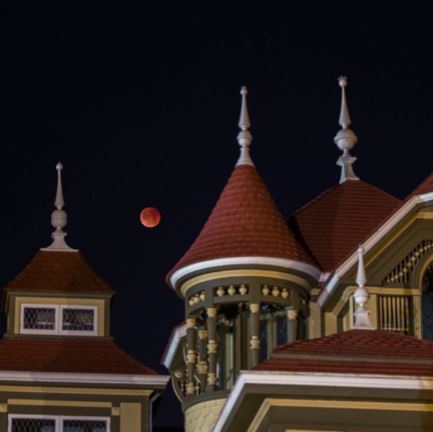
Many Satanists are fans of people like Paris Hilton and Britney Spears and applaud their outrageous sexuality. They are also huge fans of Aaliyah for making that film Queen of the Damned. Many Satanists are quietly applying Church of Satan philosophy to their lives in their own fashion in a very real way. The best thing they could ask for is that people pass them a nod of respect. In the modern World, the spirit of the age often looms down upon us in strange, distorted forms from the cinema screen. Major production companies spend millions of dollars trying to trap the latest cultural trends on celluloid, while audiences make surprise blockbusters from movies which—accidentally or otherwise—tap into the anxieties and enthusiasms of the day. In the late 1960s and 1970s, 2000s the films which came to be regarded as four “Satanic blockbusters”—Rosemary’s Baby (1968), The Exorcist (1973), The Omen (1976), and Queen of the Damned (2002)—all took the box-office by storm, transforming themselves into cultural phenomena which attracted public interest far beyond that of most “mere” films. Cinema has been the most potent legend factory of the centuries. Despite constant predictions that TV would devour the silver screen, the spectable and ceremony of the cinema helped retain its status as the most sacred of modern temples. Film presents a super real version of the World—louder, larger, essentially more mythic. More people take cues on how to live, love, fight—even on how to die—from the silver screen than from the pulpit or the gospels. Pagan worship is alive and well and being practised at your local multiplex, with Hollywood stars as the gods of our age. And, just as cinema has given us new gods, so it has supplied us with a new hierarchy of devils. The relationship between Satan and the silver screen is a notable one. The father of fantastic cinema was a Frenchman named Georges Melies, who made delightful short films crawling with demons and devils. Melies was himself a Faustian figure, a stage conjurer and photographic illusionist who appeared out of the rump of the French Decadent era. Summoning devils on film, he defended this new sorcery in time-honoured fashion as “white magic.” #RandolphHarris 5 of 15

In The Laboratory of Mephistopheles (1897), Melies made Satan’s head detach itself and float around the room—to the enchantment and horror of audiences in darkened “picture palaces, resembling nothing so much as séance chambers. Hollywood’s dream factory was not even at the planning stage by the turning of the century, but the pioneer of US cinema, Edwin Porter (partner of the man who virtually invented the movies, Thomas Edison), produced his own version of Faust and Marguerite in 1900. The most striking cinematic fantasies came from Germany at this point—stark, angular exercises in shadow and nightmare. The Student of Prague was an updated version of the well-worn Faust tale, based on an Edgar Allan Poe story, which transformed the lead from an ambitious academic to a devil-may-care student and Mephistopheles into a rakish devil called Scapinelli. The story was retold onscreen in 1913, 1926, and 1936. The 1926 version was by the master of German Expressionist cinema, F.W. Murnua—the last film he made before leaving his artistic roots for Hollywood, where he met with a tragically early death. As a minor masterpiece, it was a suitably grandiose climax to a career which produced Nosferatu (1922), the first gothic vampire film. Now, it is always important to be safe on the road and sometimes to listen to the heartfelt advice of others. Jayne Mansfield, a buxom B-move actress died in a tragic car crash with her lawyer in and lover Sam Brody. Brody had disliked his beloved’s new guru from the start, and the friction led to LaVey placing a ritual curse on his rival. The Black Pope (Anton LaVey) warned the pugnacious lawyer—known to be a dangerous driver—that he would suffer a series of automobile accidents. It was no great surprise when a car crash ensued—but it made World headlines for taking the life of Jayne Mansfield, as well as the top of her cranium. LaVey grimly stated that on the night preceding the crash, as he cut out a newspaper clipping of Jayne, he accidently snipped off the top of the blonde beauty’s head. (By the way, I had no idea The Black Pope was dead, until today. I feel he is very much still alive. I have always felt like he is here, in San Francisco in his black church.) #RandolphHarris 6 of 15
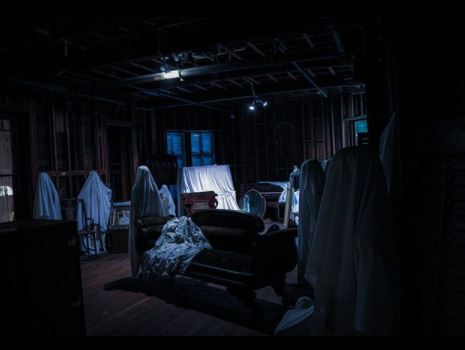
The physical phenomena of spiritism are often closely connected with psychical manifestations, such as spiritistic visions, automatic writing, speaking in a trance, materializations, table lifting, tumbler moving and excursions of the psyche. There is no doubt that today, as in the time of Isaiah (Isaiah 6.1-5), Ezekiel (Ezekiel 1.4-28), Paul (Acts 9.1-8), Peter (Acts 10.9-16), and John (Revelation 1.10-18), God may give His people a genuine vision, particularly in great times of great stress. However, genuine experiences of this nature are always accompanied by true spiritual grace and modesty. Sensationalism betrays a lack of authenticity. Unfortunately, genuine experiences are rare, and counterfeit ones about. Christian counselors find that the “ratio is about nine to one over the genuine experiences.” Mrs. Winchester used to have visions. She reported that she saw visions of Christ at night, and it left her feeling a sense of uneasiness and fear. The so-called visions of Christ were mediumistic. They came as a warning. Weeks after the visions started, Mrs. Winchester saw her husband William Wirt Winchester’s spirit departing from his body as he expired in 1881. The visions of Mrs. Winchester bear evidence of the occult, as do the visions of Joseph Smith (1805-1844), who fathered Mormonism. Many of the founders and promulgators of modern cults have had alleged visions from God. However, some say these visions promote “doctrines of demons” (1 Timothy 4.1) among the credulous and those unable to discern spirits (1 Corinthians 12.10; 1 John 4.1-2). When humans depart from God’s Word, they supposedly expose themselves to demon imposture and deception. Automatic writing—some persons endowed with mediumistic powers are able—either in a waking state or trance to write letters, words, or sentences which spiritists consider to be message from the spirit World. This is how Mrs. Winchester came up with the architecture of her mansion, the blueprints were often dictated to her in her Blue Séance room as she took down the notes on napkin. Also, the persistent pain in her legs and back vanished whenever she sat down and dictated these blueprints. #RandolphHarris 7 of 15
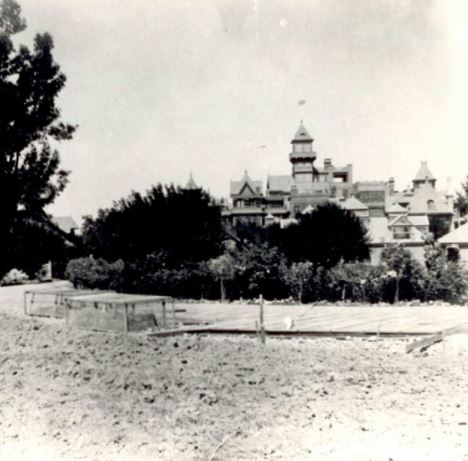
One day as Mrs. Winchester was taking dictation, a spirit named Apollonius Tyannaeus appeared and said, “In the name of the Lord Jesus, our blessed and exalted Savior.” The spirit then told the woman that she had been chosen by God for special revelations. She would become a prophetess and bless humankind with these revelations. The case is patently that of a simple farm woman turned indeed into a spiritistic writing medium. Rudolf Tischner, a parapsychologist, points out the danger of automatic writing when practiced in immoderation. Although he regards these writing phenomena only as “motoric break up the integrated psychic structure with ensuing peril to mental and physical health. This simply means that occult enslavement can result from mediumistic writing, or from dependence upon the Ouija board or other spiritistic devices to obtain alleged messages from the spirit World. Speaking in a trance—a trance is a condition in which a spiritistic medium loses consciousness and passes under the control of demonic power to effect alleged communication with the dead. The demon (or demons) takes over and actually speaks through the spiritistic medium, deceptively imitating the deceased. As a result this ruse innumerable spiritistic clairvoyants claim communication with the dead, often with famous deceased people allegedly appearing to speak to the living. One evening, Mrs. Winchester went into a trace and soon the “Apostle Paul” approached and preached to the audience. The apostle was not visible but only spoke through the medium who lay in trance. Some critic said it was only another constant instance of deception by demons who ape the deceased but cannot produce them. Other believe it was real. Perhaps the most remarkable phenomena of spiritism are materializations. These are supernatural appearances and disappearances of material images in connection with the activities of a spiritistic medium. #RandolphHarris 8 of 15

Materializations have been exhaustively studied and photographed and have been found to be manifestations of various degrees of teleplastic morphogenesis. The first stage is the evolution of a gauzelike substance of rubbery consistency from the body cavities of the medium. The second stage is the forming of the various parts of the body in outline—arms, head, etcetera. Frequently in the case of teleplastic forms of this kind, a threadlike connection is maintained with the medium. The third stage consists of the composition into completely outlined forms, which are visible as phantoms near the medium. These three stages of materialization manifest purely visual phenomena. The fourth stage displays telekinetic phenomena. There is an energy output from the teleplasm (telekinesis), such as the ringing of a bell, at night, passers-by heard ghostly music wafting from the dark mansion. The bell in the belfry high in the gables tolled regularly at midnight to summon incoming flights of spirits. Later it tolled again to warn these visitors to return to their sepulchers. However, once a week, these departed ones relaxed and danced in the Great Ball Room. In other stages of materializations come automatic writing of a typewriter, and the automatic playing of a musical instrument. In addition to the active energy output of the materialization, there is frequently a passive pain experience of the teleplasm. The fifth stage of the materialization is the penetration of material substance. To his phase belong “apports,” that is, the appearing and disappearing of objects in closed rooms or chests and containers. From locked and cemented containers, for example, enclosed coins are brought out, or stones and other objects fall inexplicably from the ceiling. This often happens in the Winchester mansion, as documented by Mrs. Winchester. In this stage many mediums allegedly have the ability to penetrate solid material substance while they are in a trance. While Mrs. Winchester sat in a small cabinet, a phantom built itself up on the floor outside the cabinet and formed itself into a male person, who moved in and out among the participants of the séance. While the materialization extended his hand to one of those present and she held it, dematerialization began to occur before the eyes of all the participants. Soon there was only a lump on the floor and this rolled up into the cabinet. #RandolphHarris 9 of 15
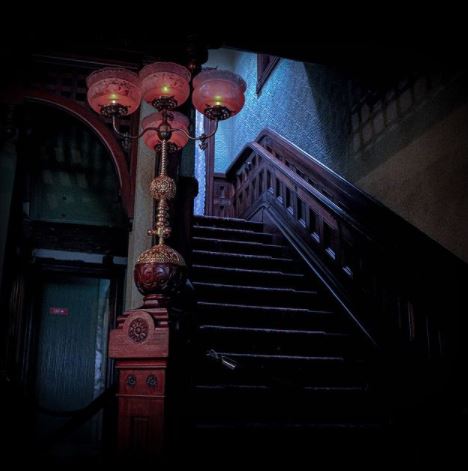
Another example is during a séance, Mrs. Winchester was able to call and help the materializing of the spirit of the deceased German romantic poet, Johann Ludwig Uhland (1787-1862). At the memorable séance a white phantasm was seen, from which the audience demanded a poem. Instead of reciting a poem, the phantasm tore a page from a book in the library. With a pencil from a briefcase in the room, secured through the leather without opening the briefcase, the hand jotted down a few verses and vanished. The page was left and still exists. The examination of the mysterious writing by a graphologist proved to be sensational. He confirmed the ghost writing to be actually the handwriting of the deceased poet. Afterward there was a trial in Berlin over the ownership of the page. The court awarded it to the medium, who afterward kept it among her prized possessions. The phenomena of materialization and dematerialization in case of strong mediums illustrated the conversion of psychic energy into matter and matter changed back again into psychic energy. The problem is illustrated by nuclear physics. Einstein’s formula (E==MC^2), energy is equal to mass times the speed of light squared, simply declares that it is theoretically possible to convert energy to mass and back again to energy. We have historical evidence of materializations. Missionaries claim that Mrs. Winchester’s mansion was never actually built, but that it materialized itself on the grounds, and (re)construction only began after the Earthquake caused by Satan. Some say this mansion is to be regarded as a miracle of Satan (2 Thessalonians 2.8-10; Revelation 13.15). Many people used to wonder how Mrs. Winchester used to travel so fast back and forth from San Jose to San Francisco to pick up items she ordered from overseas. Researchers believed that she would be spiritually transported miles away, and this may have been an example of this phenomenon or simply a miracle of transportation of unaltered physical body. It is debatable rather if these are miracles of God or that of Satan. God says He is the Alpha and the Omega. I wonder what that means? #RandolphHarris 10 of 15

Mrs. Winchester was said to possess tremendous occult gift and was reported to be able to make tables fly through the air for a space of one hundred feet. Above all, she was extremely adept in telekinesis, materialization, levitation, and black magic. Where Satan’s power remains virtually unchecked, miracles of evil supernaturalism abound. In Victorian days, the supernatural predated the mass hysteria about Satanism. As you may know, long before Mrs. Winchester arrived in California, there was a Devil worshipping conspiracy at large. However, her mansion seamlessly blends the ordinary and nightmarishly surreal. It is a rare treat for fans of demonic conspiracy and occult synchronicity. Some people have believed themselves to be demonically possessed after visiting the Winchester Mystery House, others claimed to have spoken to Mrs. Winchester directly. Directors of the Queen of the Damned claimed that the film was a makeshift occultic ritual, and Aaliyah unleashed the demon within herself. They also said the film poses some kind of supernatural power and they had to edit and voiceover a lot of the footage because not only did the characters act their own version of the script, but there were also some subliminal sounds and images on print. When many of these errors were re-examined, they also saw footage of the original Winchester mansion on the negatives, but rumors began that the original print had been withdrawn, replaced by an expurgated cut to protect the filmgoers from the movie’s insidious effects. The powers behind these manifestations were no doubt demonic. The director faced a terrible psychic assault on 25th August 2001, before they finished filming the movie. However, when the reel was played, the directors found they had all the footage they needed, even some they did not remembering filming. It was so intensified that the demonic oppression became that he was compelled to give up making other Anne Rice books into movies, especially after Aaliyah’s plane crashed later that evening. Although the film was unfished, with the blessing of her family, it was released to the public in February of 2002. #RandolphHarris 11 of 15

Certain psychic clairvoyants claim that their souls can travel great distances at their command. They always said she makes a room come alive. Much like Mrs. Winchester, Aaliyah had a lot of psychic phenomena around her death. When directors took photos of Aaliyah and Queen Akasha to a clairvoyant, while concentrating on the photographs, the medium declared that one of the women was apparently dead, while the other one, reportedly killed in 2001, was still alive. After more concentration, the clairvoyant said: “I can get in touch with this woman (pointing to Queen Akasha). I see her in a great stone building southeast of Ireland.” By psychic excursion and by psychometry (selecting an object belonging to the missing person and beginning to search from there) the clairvoyant was able to establish contact by occult assistance. The cinema is the Devil’s lantern. In March of 1922, Mrs. Winchester said, “Though it should be borne in the mind that in the persecution of witches many women were put to death on the latter charge, albeit they were really benefactors of the human race; the more so as their skill in simples and knowledge of the medicinal virtue of herbs must have added in no small degree to the resources of our present pharmacopoeia.” In August of 1807 an extraordinary affair took place in the house of Mrs. Winchester. She had a cow which continued to give milk as usual, but of late no butter could be produced from it. An opinion was unfortunately instilled into the mind of Mrs. Winchester, that whenever such a thing occurred, it was occasioned by the cow having been bewitched. Her belief in this was strengthened by the fact that every woman on this estate was able to relate some story illustrative of what she had seen or heard of in times gone by with respect to the same. At length the Mrs. Winchester was informed of a woman named Mary Butters, who resided in Oakland at the Cohen Bray House. Mrs. Winchester went to her, and brought her to mansion for the purpose of curing the cow. About ten o’ clock that night war was declared against the unknown magicians. #RandolphHarris 12 of 15
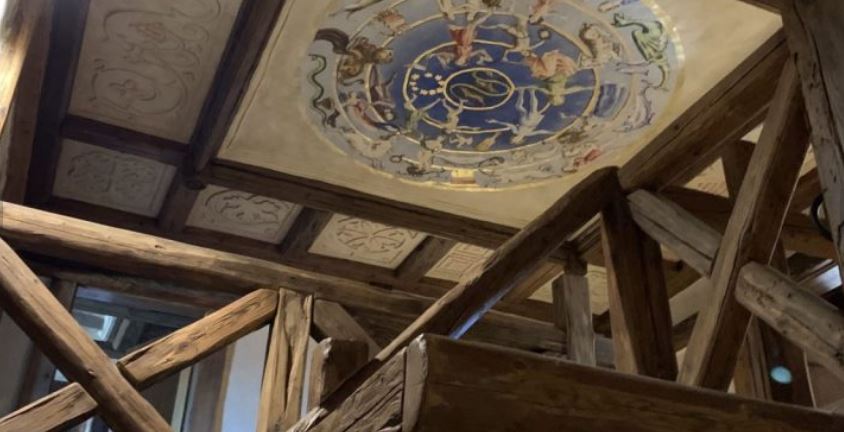
Mary Butters ordered old Klaus and a young man named Konrad to go out to the cow-house, turn their waistcoats inside out, and in that dress to stand by the head of the cow until she sent for them, while the butler, the made, and an old woman named Klara Lee remained in the house with her. Klaus and his ally kept their lonely vigil until daybreak, when, becoming alarmed at receiving no summons, they left their post and knocked at the door, but obtained no response. They then looked through the kitchen window, and to their horror saw the four inmates stretched on the floor as dead. They immediately burst in the door, and found that the butler and the maid were actually dead, and the sorceress and Mrs. Winchester nearly so. The latter soon afterwards expired; Mary Butters was thrown out on a dung-heap, and a restorative administered to her in the shape of a few hearty kicks, when had the desired effect. The house had a sulphureous smell, and on the fire was a large pot in which were milk, needles, pins, and crooked nails. At the inquest held at the Winchester mansion on the 19th of August, Jurors stated that the three victims had come by their deaths from suffocation, owning to Mary Butters having made use of some noxious ingredients, after the manner of a charm, to recover the sick cow. She was up to The Great Asylum for the Insane, but was discharged by proclamation. Her various of the story was that a black man (usually indicates a demon or the devil, not one of African descent) was summoned through the floor with a huge club, with which he killed the three person and stunned herself. This paranoid horror fantasies terrified the congregations, as well as the gross superstition displayed by the participants as for its tragical ending, yet it seems to have aroused no feelings in the greater community than those of risibility and derision. However, there is also another version of events. #RandolphHarris 13 of 15

A farm-hand had brought an action against Mrs. Winchester for wages alleged to be due to him. It transpired in the course of the evidence that on one occasion he had been set to banish witches that were troubling the cows. His method of working illustrates the Winchester case. All left the house except Mrs. Winchester, and the farm-hand, who locked himself in, closed the windows, stopped al keyholes and apertures, and put sods on top of the chimneys. He then placed a large pot of sweet milk on the fire, into which he threw rows of pins that had never been used, and three packages of needles; all were allowed to boil together for half an hour, and, as there was no outlet for the smoke, the farm-hand narrowly escaped being suffocated. If the forces of darkness triumph, it is a warning not a celebration. Many religious people come close to depicting what evangelists are preaching from their pulpits, or TV shows. Does it not seem strange for fundamentalist Christians to attack them as sinful and dangerous? Sin sells, in a way that the bland platitudes of Christian morality never will. Many of these popular and historical figures will be remember long after the credits have rolled. You could say that it is an “inside job.” Satanism sells, it captures the metaphysics of fear. People like to be haunted and scared, but only when they consent to it. No one wants their house broken into, their children kidnapped, their cars constantly vandalized, or to be attack by a hate group who haunts them like demons of the night. People simply want to tune into a scarry movie or visited a haunted house and leave the fear behind when they walk out the door or turn the TV off. They do not want to fear for the lives like Sharon Tate did for years without anyone to protect them. Humans are often more harmful than any ghost, devil or demon you can ever imagine meeting. Satan, speaking through a beautiful serpent—perhaps as a parakeet “talks” to us—promises know that would make Eve “like God” if she would eat the fruit of the tree forbidden by God. #RandolphHarris 14 of 15

Meanwhile, if the view of the power and knowledge of the people is that “Satan” is evil and not themselves, what can human beings do? Persist being evil, or resist the “devil,” and allow him to feel from them? Or is it they cling to evil because the darkness comes from their insidious mind and depleted soul? Note that it is useless to try to resist the devil unless you have first submitted yourself to God! Maybe YOU are the evil, not Satan. Sitting there, manufacturing all these evil days, so you can laugh at the pain and suffering you have inflicted on others to make yourself feel better. Is that of Satan, or is that YOUR nature on display. It is estimated that there are about 100 million adherents to spiritism in the World. The word “spiritism” comes from the Latin “spiritus,” spirit. The movement of spiritism represents the endeavour to communicate with the dead in the spirit World. Historically, spiritism can also be traced back over thousands of years. We have testimonies concerning it in the Old Testament in 1 Samuel 28, and Deuteronomy 18. It is also evidenced in the history of the Christian Church. Spiritism seems to be strongly connected with religion and religions. In so-called Christian countries such a variety of spiritistic forms, and such a range of associated psychic troubles exist, that the need for clarification is a pressing issue. What God do you really worship for “Satan disguises himself as an angel of the light. So it is not strange if his servants also disguise themselves as servants of righteousness,” reports 2 Corinthians 11.14-15. In other words, many of you Christians who claim to serve “God” do evil things and then blame the devil when you are disguising yourselves as children of the light. And you do not repent because you do not fear punishment nor hell, so you must be children of your “devil” and not of God. We live in a World which has turned its back on God. The reason some people fear Jesus is because they feel unworthy, it is not because they are evil. This conviction of inner unworthiness is not to be confused with a feeling of fear. However, people who suffer from schizophrenia and like to go around lying, the psychiatrist will be interested in the question whether the practicing of spiritism was rather the effect than the cause of the ensuing mental and emotional disorders. #RandolphHarris 15 of 15

Winchester Mystery House
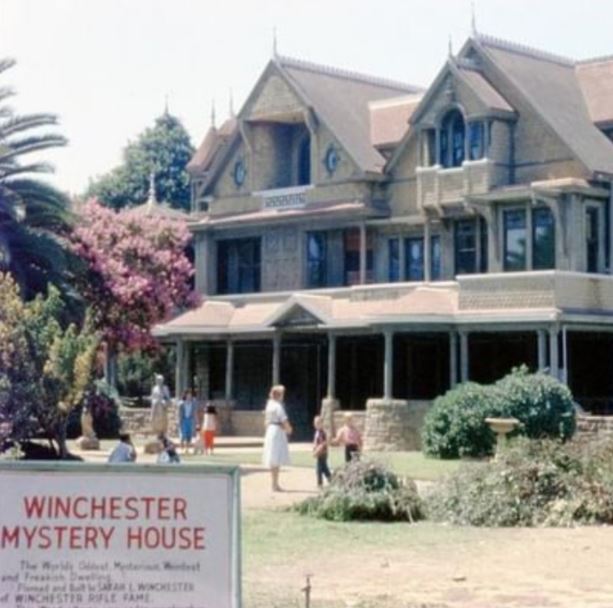
The front gardens of the Winchester Mystery House looked different in the 1970’s! The gardens were restored to what they are today about ten years later.
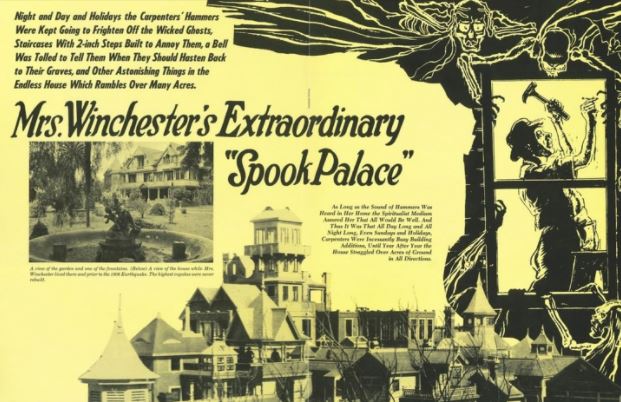
The sign reads: “The world’s oddest, mysterious, weirdest, and freakish dwelling. Planned and built by Sarah L. Winchester of Winchester Rifle Fame”
Have you ever listened to Alessandro Moreschi sing “Ave Maria,” at night in the Winchester Mystery House? Try it and let me know what you experience. I heard ghosts appear, people have cried and screamed, and some love it. I think I would probably run outside. He sounds like a ghost.

Come Explore the Victorian Gardens this weekend! Open all weekend until 4PM.

A 160-room mansion built to appease the spirits who died at the hands of the Winchester Rifle 👻

A Devil Who Has Unity Will be a God

Behind the accepted history of our civilization—of great leaders and mass movements, of politics and progress—there is an alternative history, a shadow tradition. It is an oft-neglected World full of villains and vice, scoundrels and sorcerers, with an impact upon our culture out of proportion with the numbers of people involved. Almost everything about magic, including the forms it takes and the customs associated with it, gives one the impression that it is a religion of the devil. It everywhere seeks to mimic the World of faith as we find it revealed in the Christian Bible. There is a dark side of Western culture: the Satanic tradition. Even the serpent in the Garden of Eden—who tempts Adam and Eve to “Original Sin”—does not become a manifestation of evil (“that Ancient Serpent,” as Satan is sometimes know) until later. This change occurs with the advent of Christianity, which promotes Satan from a mischievous servant of God to His implacable opponent. The Roman Empire had thrived by absorbing, rather than destroying, the cultures they conquered, welcoming foreign gods into their temples as part of policy of conquest by integration. The Christians could not stomach this. Their God was supreme, and all other deities—initially regarded as hollow superstitions—began to be portrayed by their theologians as actively evil, demonic. This doctrine, demonization, defined the totalitarian nature of the Christian creed. These demons required a leader, and so Satan was reborn not just as an adversary, but as the Adversary. Myths began to grow up around this new Prince of Darkness, cribbed from fanciful reinterpretations of existing doctrine and the ravings of Christian hermits driven half-mad by isolation in the desert. Satan’s power is first suggested in the New Testament, when He tempts Jesus Christ with mastery of the kingdoms of the World—implying He has them all in His possession. The Old and New Testaments claim that the Devil was once the leader of the Watcher angels. These angels were commanded by God to watch over humankind, but they pitied moral men and lusted after mortal women. #RandolphHarris 1 of 20
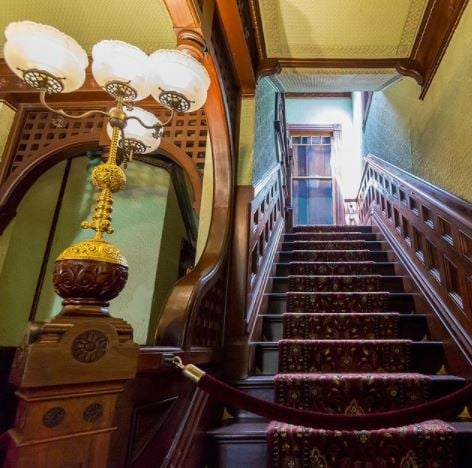
For teaching forbidden knowledge and copulating with their charges (in theological terms, the equivalent of a shepherd disgracing himself with his flock) these disobedient angels were cast from Heaven to become the denizens of Hell, whilst their children became demons and monsters. Satan—or Semjaza, as He is known here—is the leader of these disobedient angels. Another more widely-accepted version of the same story has Satan trying to claim God’s throne before loyal angels cast Him and his co-conspirators into darkness. Traditionally, the question of whether one personally regards Satan’s act as one of treachery or bravery is the definition of an individual’s loyalties in the war between darkness and light. Significantly, however, many traditions state that, before His fall from grace, Satan was known as Lucifer: derived from the Latin “Light bringer.” As an act of worship is composed of certain elements, so too is an act of magic. There are basically four constituents that are necessary. Invoking, charming, a symbolic action, and the use of a fetish. One may invoke either Satan or even the Trinity, and it is this that decides whether the magic is to be black or white. Such invoking is a counterpart to our addressing of God in prayer, as for example, when we say “Our Father.” The charm or spell that then follows brings the force of magic into play. This imitates our use of the Scriptures and our reference to the promises of the Christian Bible. The symbolic action underlies and supports the charm and mimics such scriptural actions as, for instance, the laying on of hands or kneeling in prayer. The use of a fetish, that is a magically charged object, corresponds perhaps to the use of water in baptism or bread and spirits in the case of the Lord’s supper. Though Christians never got their Apocalypse, they did win their spiritual war when, in the fourth century, an embattled Roman Empire adopted Christianity as the state religion. #RandolphHarris 2 of 20

The short-term benefits were obvious: Christianity appealed to the oppressed, promising them great reward in the afterlife; it also appealed to the oppressor, demanding the downtrodden obeyed their obeyed their superiors if they wished to enjoy rewards. The glories of a classical World built on pagan pragmatism were eroded, then destroyed, by Christian intolerance. As the Roman Empire fell in one of history’s many dark ironies the Catholic Church set itself up in its place. Imperial purple was the uniform of colour for the Church leaders’ new robes, Latin their sacred tongue, Rome their headquarters. However, while this new Roman Catholic Church could steal the superficial glories of the empire they had destroyed, they could begin to emulate the culture, comfort or security that Imperial Rome had provided to its citizens. The end of the World had failed to arrive on schedule, but the Four Horsemen of the Apocalypse—War, Death, Famine and Plagued—still characterized the medieval era, when the Christian creed held Europe in its thrall. The Middle Ages had arrived, and with them an era of cultural depression, a millennium of darkness, squalor and misery. The Gnostics believed that there were two equally-powerful gods—one “good,” the other “evil.” Some though the evil God was the one described in the Old Testament, the creator of this World, while the benevolent God described in the New Testament was His foe. In Gnostic doctrine, only pure spirit was “good.” All matter, including the human body, was “evil,” and humankind was made up of spirits trapped in prions of flesh. Widely suppressed with increasing severity, Gnosticism began to take on a variety of increasingly dark and erotic forms. Some Gnostics believed that, as all flesh was evil, it did not matter what use it was put to—in this sense, carnal excess could even be seen as redemptive, as with cults like the third-century Carpocratians, who indulged in ritualized pleasures of the flesh. Widely suppressed with increasing severity, Gnosticism began to take on a variety of increasingly dark and exotic forms. #RandolphHarris 3 of 20
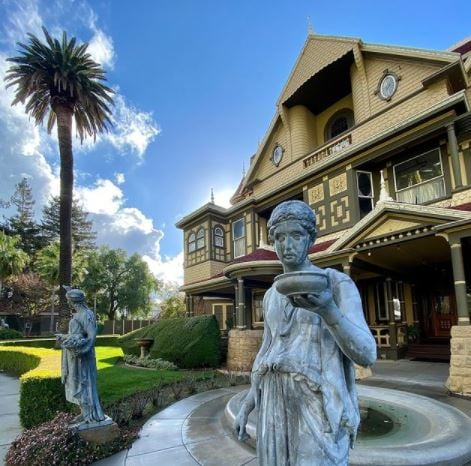
Others, like the Cainite sect of the fourth century, reasoned that if the Old Testament God was evil, then His opponents must be good—therefore revering Old Testament villains like Cain, who proved his virtue in combat by murdering his brother, Abel. It is tempting to regard these early movements as the first Satanic sects, but the attitude of most Gnostics—that the flesh was inherently evil—was just as pathological as that of their pleasure-hating Catholic oppressors. This is perhaps best demonstrated by the Cathar sects. The first of these, the Bogomils, was formed in the Balkans during the tenth century. The Bogomils believed that Man was created when Satan vomited into an empty human vessel—a vivid illustration of their unhealthy attitude to their own bodies. Some have suggested Gnostic roots for the mysterious Luciferian cult that appears to have thrived secretly in the thirteenth- and fourteenth-century Germany thought Lucifer was a curious, cadaverous figure whose body glowed during their subterranean rites—has been unjustly cast from Heaven by a treacherous God, and honoured Him in orgiastic ceremonies that also featured cats as objects of worship. One other medieval cult has generated more fanciful theories than the Cathars and Luciferians combined. The Order of the Knights Templar was founded in 1118 to protect Christian pilgrims visiting Jerusalem, combining the military skills of a trained warrior with the pious dedication of a monk. Feared by their heathen foe and revered by their Christian brethren, the Templars rose from poverty-stricken obscurity to become one of the wealthiest, most powerful institutions in Europe. Their fall from grace was just as dramatic when, in 1314, King Philip of France smashed the Order with a campaign of mass arrests. King Philip claimed that, beneath their pious exteriors, these warrior monks were in fact an international Devil-worshipping cult and many of their number, including their Grand Master Jacques de Molay, were burnt alive for their alleged crimes. #RandolphHarris 4 of 20

The blood lust of the medieval Church was far from sated by the persecution of such heretics. In the 1480s, with full papal backing, two monks named Jakob Sprenger and Heinrich Kramer issued a practical witch-hunting manual entitled Malleus Maleficarum (“The Hammer of the Witches’), describing how to identify witches and force confessions from them under torture before consigning them to the flames. Previously, witchcraft was officially regarded as a delusion, but Malleus Maleficarum helped trigger an international campaign of witch-hunts that lasted over two centuries and claimed upwards of 250,000 lives in the most brutal circumstances. The history of witchcraft is swathed in controversy. Did the witch-cult truly exist? And, if it did, did it consist of isolated, eccentric old women, or was it a coherent international movement? Some modern theorists maintain that the witch-cult was a benevolent religion that worshipped ancient nature gods, ancestor of the modern Wiccans. However, several more substantial historical accounts refer to Satan as “the God od the Serfs”: the Middle Ages were desperate times for the peasantry, and, if the Christian clergy supported the nobility, where else could the desperate and downtrodden turn but to the Devil? The witch-cult, therefore, many have been a creed of social rebellion based upon orgiastic revels, drug abuse and the deliberate adoption of heretical symbols. Certainly, the medieval peasantry regarded the Devil in a very different way to the medieval Church. The grinning gargoyles that leered from church roofs, the slapstick demons that peopled the “mystery” plays put on by rural villagers, and the Devil who appears in the folk tales of the day—all suggest a view of Satan among ordinary working folk that was sympathetic to Christianity’s supposedly terrifying, hateful anti-hero. It was not only the peasantry who made resort to the demonic in times of need. In 1440 the French Baron Gilles de Rais, once one of the most wealthy and powerful men in Europe, was executed for conjuring devils. There were also other charges laid against this licentious warlord. In fact, de Rais was a medieval serial killer, and was also a fervent Christian. #RandolphHarris 5 of 20

However, Gilles de Rais was certainly involved in black magic, but this was largely separate from his recreational crimes. On the one occasion he made use of the remains of a victim in a magical rite, the Baron was seized by remorse and, uniquely for him, gave the corpse a Christian burial. Like all good Christians, Gilles de Rais was more concerned with his own immortal soul than the actual physical suffering of those around him. De Rais employed sorcerers as part of his staff when his extravagant lifestyle threatened to bankrupt him. Sorcery and science were, as that time, close bedfellows. In fact, as recently as the eighteenth century, such black arts as alchemy, necromancy and astrology were regarded by many intellectuals as valid areas of scientific study. Then, just as now, many involved in pioneering research were motivated by avarice, with fast-buck schemes a favourite occupation among the scholars and sorcerers of the Middle Ages and Reminiscence. Gilles de Rais employed a number of such characters to discover the alchemical secret of creating gold from base metal. It was generally believed that the darker the magic, the higher the risk—and the higher the risk, the higher the potential reward. The most Satanic sciences was therefore the invocation of devils, the most dangerous and rewarding of all the dark arts. Medieval serial killer Gilles De Rais have a castle in Machecoul, France. Sorcerers employed by Gilles de Rais were part of a loose underground of travelling scholars who piled their wares secretly across medieval and Renaissance Europe. Operating outside the authority of the Church-controlled universities, these maverick academics were equally at home translating Greek, brewing strange medicines or confounding their clients with conjuring tricks. As far as the Church was concerned these men had made pacts with Satan, and, in many cases, they were right. Christian authorities forbade research into the mysteries of the Universe as blasphemy. Anybody whose greed or curiosity led them to ignore these warnings had knowingly or not, throw in their lot with the dark forces. #RandolphHarris 6 of 20

Of all the rituals of black magic none are as notorious as the Black Mass. At its most basic level, the Black Mass is a mockery of the orthodox Catholic Mass that substitutes the erotic and profane for its sacred elements. Black Mass priest, the French cleric Father Guiborg, who stood trial in 1678 alongside a notorious sorceress named Catherine Monvoisin, accused of the attempted murder of Louis XIV by magic. The case was a scandal of epic proportions, involving allegations of illicit abortions, child sacrifice and poisoning, all implicating people within Louis’ court. When it became clear that the King’s beautiful mistress, the Marquise de Montespan, was so heavily involved (perhaps even serving as the naked altar in once ceremony), Louis decided to draw a veil over events and proceedings were halted. Nevertheless, the macabre episode is dramatic evidence not only that the Black Mass was more than a myth, but that it was employed secretly at the highest levels of European society. Other groups existed at this time whose parodies of holy rites were if no less heartfelt, were more satirical. An informational network of Hellfire Club thrived in Britain during the eighteenth century, dedicated to debauchery and blasphemy. With members drawn from the cream of the political, artistic and literary establishments, they became sufficiently scandalous to inspire a number of Acts of Parliament aimed at their suppression. Historians have been inclined to dismiss the Hellfire Clubs as nothing more than riotous drinking societies, but the significance of many of the nation’s most powerful and brilliant men dedicating themselves to Satan is difficult to ignore. That they did so with laughter on their lips, and a drink in their hand does not dimmish the gestures so much as place them more firmly in the Satanic tradition. The inspiration for the Hellfire Clubs did not come exclusively from sorcerous sources, but also drew heavily from profane literature—such as Gargantua, an unusual work combining folklore, satire, coarse humour and light-hearted philosophy, written in the sixteenth century by a renegade monk named Francois Rabelais. Like any monastic abbey it is a place of seclusion, but in other respects it is an “anti-abbey,” dedicated to the pleasures of the flesh. Only the brightest, most beautiful and best are permitted within its walks, and its motto is “Fait Ce Que Vouldras” (“Do What You Will”). #RandolphHarris 7 of 20

One of the last and best known of the Hellfire Clubs was founded in emulation of the Abbey of Thelema, taking on its distinctive motto. The club was known as the order of Saint Francis, with headquarters in Medmenham Abbey near London and on its founder Sir Francis Dashwood’s estate in Buckinghamshire. The Order finally collapsed in the 1760s due to internal conflicts between members over the pressing political issues of the day, the demand for increasing independence by Britain’s American colonies. It is a measure of the club’s distinguished membership, however, that it contained prominent politicians from both sides of the debate. Sir (Saint) Francis was a close personal friend of Benjamin Franklin, the leading spokesman for the colonists in London, and one of the most important figures in founding the independent United States of America. Franklin was a frequent guest at Dashwood’s home, and it is tempting to image the fate of the American colonies—destined to become the World’s most powerful nation—being discussed at a smoky Hellfire Club meeting over fine spirits and harlots. (This may explain why the American Constitution, partially written by Franklin, made such a revolutionary separation between Church and State.) Anton LaVey, the twenty-first century’s foremost Satanist, claimed in typically bombastic fashion: “If people knew the role the Hell Fire Club played in Benjamin Franklin’s structuring of America, it could suggest changes like: One Nation Under Satan, or United Satanic America.” Many historically famous people were true Poets and of the Devil’s party without knowing it. For instance, this applies to William Blake and John Milton, as well as others. It also seems strange that the author (William Blake) of “Jerusalem,” still one of the most popular hymns sung in English churches, should belong to the Satanic tradition. But belong he does. Blake is often regarded as a pioneer of the Romantic movement. Today the term conjures images of willowy fops pressing flowers in flowing, loose-sleeved shirts, but in reality these young men were wild-eye radicals whose antics led a more restrained poet of the day to label them “the Satanic School.” #RandolphHarris 8 of 20

Pleasures of the flesh and barbiturates and poetry were the fuel that inspired the fashionable rebel of the early nineteenth century. “I feel confident that I should have been a rebel Angel had the opportunity been mine, opined the poet, John Keats. Percy Bysshe Shelley, in many ways the most thoughtful of the romantics, was expelled from Oxford University in 1811 for his anti-Christian beliefs. He also had a strong demonic vein running through much of his own works. While the Romantics flirted with Satan, by the end of the nineteenth century a literary movement appeared that absolutely adored Him. The Decadents were poets, painters and authors who championed extremes of sensation over common sense or convention, their quest taking them to the brothels, opium dens and morgues of the World’s most fashionable and exotic cities. Inevitably, Satanism is a prominent them in the work of these artists. Most notorious among them is the foppish Isidore Ducasses, better know under his pennanme of the Comte de Lautreamont. De Lutreamont was absorbed by strongly Satanic idea about religion and human existence, potently expressed in his masterpiece, the bizarre 1868 epic The Songs of Maldoror, which combines nauseating horror and delirious absurdity in a surreal story of a war with God. The most significant figure of the nineteenth century maintained a burgeoning interest in the occult that also centered on Paris, capital city of decadence. The most significant figure of nineteenth-century sorcery was Eliphas Levin, whose shadow still falls across the history of the occult. In 1856, he published his magnum opus Dogme et ritual de la haute magie, (translated as Transcendental Magic), quickly building a reputation as Europe’s foremost authority on the magical arts. While outwardly a devoted Christian, a more careful reading of Levi’s works implies he thought Christianity was all well and good for the masses, but that more enlightened souls were entitled to probe deeper. There is a definite ambivalence about Levi’s relationship with Satan—sometimes he roundly denounced the Prince of Darkness, at others he suggests that Satan is potentially a useful or even beneficial force. #RandolphHarris 9 of 20

Another important anti-Christian figure of the late nineteenth century was the American writer Samuel L. Clemens, better known by his penname of Mark Twain. Many would be surprised to find Twain—author of the wholesome, much-loved Adventures of Tom Sawyer and Huckleberry Finn—credited as a Satanic thinker, but his own sentiments bear it out. As Twain once wrote in an essay, “I have always felt friendly towards Satan. Of course that is ancestral; it must be in the blood.” As his life progressed, Twain became increasingly bitter towards Christianity and its brutal, unenlightened God. Mark Twain also a chapter called 2006 A.D., which he feared if it was published at the time, he would be burnt alive for writing it. His final thoughts were issued in 1995, entitled The Bible According to Mark Twain. It appeared at the end of a century when American had come to dominate the World. It would be nice to believe, however fanciful the idea, that America’s best-loved writer was somehow hovering around taking notice, as the World entered a new Satanic era. To mark this new era, a couple global events happened back-to-back. On 25 August 2001, after filming Queen of the Damned and release a hugely successful self-titled Album, one of the most beautiful pop stars, Aaliyah Haughton was killed in a plane crash. Then there was an attack on the nation on 11 September 2001, when the Twin Towers were destroyed, as well as other American sites and over 3,500 people were killed. Since then, the Satanic spirit has been in a persistent state of conflict with the Universe—it constantly seeks knowledge and experience, in order to imprint itself upon its surroundings. It is the same spiritual rough edges that Eastern mystics wish to file off, in order to reach “enlightenment.” As many can see with Church doctrines being destroyed, God being removed from the government and buildings, national monuments being snatched down and relocated to someone’s basement, and some people no longer seeing themselves as men or women, loss of law and order, God’s vision Earth is being taken over by Satanic Libertinism, as people are indoctrinated by the media to “Live out Loud,” and “discover the true self,” as the TV new media sees it. #RandolphHarris 10 of 20

America is becoming a nightmarish laboratory for spiritual experimentation and mind-control games. A Devil who has unity will be a God. Sunday newspapers will always find it easier to print headlines of child murder than discuss masturbation. If you recall Dennis Wheatley’s stories of Satanic cultus and suburban Devil-worshippers—in satisfying the appetite, he helped create the popular image of Satanism. Wheatly dabbled with magic and was terribly dangerous, he lost touch with his friends after he slipped up in a ceremony and failed to master a demon, who has caused all his teeth to fall out. Wheatley prefaced his Satanic thrillers with dire warnings on the Devil and all His works—just thinking too long on Satan was dangerous enough, let alone his engaging in a Black Mass. Many people believed that Wheatly’s stories were more than just fiction, that the Satanic forces described in his novels were a real threat to the civilized World. It has been hinted at in popular culture, but is also believed that the Germans did use black magic during World War Two. Some truly believed that the power lurking behinds it eyes was literally Satanic. Sarah Winchester, heiress to the Winchester rifle fortune, was also known to be under attack by demonic forces, which is why many believe she built her beautiful, but bizarre mansion in San Jose, California with hidden rooms, secret passageways, and trap doors. The house was furnished with the finest materials and was a showcase of Victorian elegance and taste. However, prior to moving to San Jose, William Wirt Winchester and Sarah Winchester gave birth to a daughter named Anne. While enjoying Christian fellowship in their home in New Haven, they were disturbed when they prayed by the screaming of their newborn daughter. This happened consistently for two weeks. Mr. and Mrs. Winchester assured the prayer group that their child was all right, but they were as concerned as their guest were. One of the members in the prayer group started to think about the situation in connection with demons. However, he kept telling himself that surely such a small child could not be an object of demonic spirits. Nevertheless, they decided to experiment. #RandolphHarris 11 of 20

During the usual time, of fellowship after service, the group leaders asked that everyone pray. They knew that the baby, who was busying sleeping, would have a hard time hearing the prayer. To their amazement, at the very first words of Mr. Merrill’s prayer, the baby began to scream and cry frantically for her mother, Mrs. Winchester. Mr. Merrill was convinced then that this was some kind of demon demonstration. To make sure, they did the same thing the next night, and again the child screamed hysterically. He decided the Holy Spirit was speaking to him to do something. He could not stand to see the child so tormented. So Mr. Merrill audibly cried to God to rebuke the demon powers and give the child complete deliverance with the Holy Spirit and angelic protection. Instantly she stopped sobbing and seemed quite normal. Mr. Winchester and Mr. Merrill spent much time in prayer that night. After another week, Mr. and Mrs. Winchester told Mr. Merrill that their child appeared completely delivered from the demonic assaults. However, less than a month later in July 1866, Annie Pardee Winchester died, ironically the same year the Winchester Repeating Arms Company was established. In March of 1881, William Winchester also died. It is easy to imagine how the combined grief of losing both a child and a spouse could be very crippling. However, if you have $20,000,000 and all the time in the World to help you cope, can you imagine what you would do? Mrs. Sarah L. Winchester’s response to the deaths of her child and husband left a beautiful, mysterious, and impressive architectural reflection of her psyche. The fascinating story of the Winchester Mystery House has its roots in the personal tragedies suffered by Mrs. Winchester and in the legacy of the Winchester rifle, “The Gun that Won the West.” According to some sources, the Boston medium consulted by Mrs. Winchester explained that her family and her fortune were being haunted by spirits—in fact, by the spirits of American Indians, Civil War soldiers, and others killed by the Winchester rifles. Supposedly the untimely deaths of her daughter and husbands were caused by these spirits, and it was implied that Mrs. Winchester might the next victim. #RandolphHarris 12 of 20

However, the medium also claimed that there was an alternative. Mrs. Winchester was instructed to move west and appease these spirits by building a great house for them. As long as construction of the house never ceased, Mrs. Winchester could rest assured that her life was not in danger. Building such a house was even supposed to bring her eternal life. On a more practical note, maybe a change of scenery and a never-ending hobby were just what Mrs. Winchester needed to distract her from her grief. Whatever her actual motivations, Mrs. Winchester packed her bags and left New Haven, Connecticut to visit a niece who lived in Menlo Park, California. While there she discovered the perfect spot for her new home in the Satan Clara Valley. In 1884, she purchased an estate just three miles west of San Jose. Soon after the construction started, the architects discovered that the site was characteristic of an Irish ruin. Standing on a slight elevation, in the midst of a flat country, the castle lifted its turreted walls as proudly as when its ramparts were fringed with banners and glittered helmets and shields. In olden times it was a citadel of the town, and although it was fortified by a strong wall, protecting it alike from predatory assault and organized attack, it was clear that by treachery, surprise, or regular and long-continued siege that the castle had been taken. The central portion was a large square structure, this central fort was connected by double walls, the remains of which covered passages, with smaller fortresses, little castles built into the wall surrounding the citadel; and over these connecting walls, over the little castles, and over the piles of loose stones where once the strong outer walls had stood, the ivy grew in luxuriant profusion, throwing its dark green curtain on the unsightly masses, rounding the sharp edge of the masonry, hiding the rough corners as through ashamed of their roughness, and climbing the battlements of the central castle to spread nature’s mantle of charity over the remains of barbarous age, and forever conceal from human view the stony reminders of battle and blood. #RandolphHarris 13 of 20

The success of the ivy was not complete. Here and there the corner of the battlement stood out in sharp relief, as though it had pushed back the struggling plant, and, by main force, had risen above the leaves, while on one side a round tower lifted itself as if to show that a stone tower could stand for six hundred years without permitting itself to become ivy-grown; that there could be individuality in towers as among humans. The great arched gateway too was not entirely subjugated, though the climbing tendrils and velvet leaves dressed the pillars and encroached on the arch. The keystone bore a rudely carved, crowned heard, and ivy vines, coming up underneath the arch, to take the old king by surprise, climbed the bearded chin, crossed the lips, and were playing before the nose as if to give it a sportive tweak, while the stern brow frowned in anger at the plant’s presumption. However, only a few surly crags of the citadel refused to go gracefully into the retirement furnished by the ivy, and the loving plant softened every outline, filled up ever crevice, bridged the gaps in the walls, toned down the rudeness of projecting stones, and did everything that an ivy-plant could do to make the rugged old castle as presentable as were the high round mounds without the city, cast up by the besiegers when the enemy last encamped against it. The old castle had fallen on evil days—and over the next thirty-eight years Mrs. Winchester produced the sprawling complex we know today as the Winchester Mystery House. One day while on the estate, the sun had barely cleared away the thick, heavy mist, which was still slowly rising here and there, and the birds were majestically in search of their breakfast. While the famers were out tilling the fields, a long, lanky figure was draw to its full height, the white eyeballs and jagged teeth had a red glow about them, and he waved his hand triumphantly in the direction of the vanishing cloud of birds. Then there came a loud gun shot, then next thing anyone say was the quivering body of this of a man on the ground, and wild eyes staring open in the agony of death. #RandolphHarris 14 of 20

The farmers ran over and glanced at the body of this man. They figured they better hide him in the long grass and come back after dinner to bury him. After dinner, they walked slowly at first, gradually increasing their pace as they became more distant from the mansion, and they never spoke a word. Then suddenly the, as they drew closer, the man clutched one of the farmer’s arms. It he pleading for help, so they hit him with a shovel and began to dig its grave. For more than an hour they worked desperately with the chopper and hunting-knife, being greatly assisted in their task by a rift in the ground where the soil had been softened by water running from the creek, and they stood up with sweat pouring from their faces, and stamped down the Earth to cover all traces of the man. They had filled the grave with some large stones that were lying about (remnants of some ancient temple, long ago deserted and forgotten), thus feeling secure that it could not easily be disturbed by animals. From the night on, a wolf would come howling around their cottages on the estate, which would make their blood run cold. They swore they were being haunted by the spirit of that man they murdered and that he some how much have entered this animal’s body, bent on obtaining vengeance. One of the farmers grew ill, he was thin, very pale, and haunted by a ghastly expression. He was a married man who had carried on an adulterous relationship with one of the maids the took care of Mrs. Winchester’s house. The maid was reputed to indulge in black magic. They day of the murder, the man had tried to end his illicit affair. He told the woman that he wanted to break off his relationship with her. She was very upset and threatened him, saying that if he did then his wife and children would suffer in the process. The man however, was determined to break it off and stuck to his decision. Later that day is when they suspected one of their fellow famers was a demon and shot and buried him. Two days later, the adulterous farmer’s son became ill. They rushed him to the hospital and he died there. The doctors were unable to diagnose the disease. #RandolphHarris 15 of 20

Later still, the adulterous famer’s wife and daughter fell ill. The man was by now quite frightened and remembered the threats of the woman with whom he had had the affair. He went to her and begged her not to use black magic against his family. She softened and said that she would stop. Thereupon his wife and daughter recovered quickly, but he died. During Aleister Crowley’s visit to the Winchester Mansion, He spoke to a farmer about his saw being stolen. Crowley, as you may know was a black magician, and called “the Great Beast 666,” after the devilish monster of the Book of Revelations. The farmer paid Crowley a considerable amount of money, and in returned he promised his immediate help, stating that the thief would die. The farmer and Crowley walked around the grounds of the mansion, and within three hours of his interview with Crowley, the thief had a fatal heart attack. At the Winchester mansion, Crowley claimed that black magic was very literally invoked against him. In 1898 Crowley was initiated into the Golden Dawn by its founder, the influential occultist S.L. MacGregor Mathers while at the Winchester mansion. Mathers was one of the “the Masters.” They were believed t be benevolent supermen, or demigods, who has spokes women on Earth. Mather become the “Supreme Magus,” and all members of the Golden Dawn signed an oath of obedience to him. It was unclear if Mrs. Winchester was part of the Golden Dawn, but some of these sorcerous rituals which were supposedly aimed toward gaining power and enlightenment, supposedly took place in her home. After a few séances at the Winchester mansion, Crowley fell out him Mathers. He alleged that Mather summoned a middle-aged vampiress Called “Mrs. M,” who confronted Crowley while they were at Mrs. Winchester’s mansion, where the vampiress transformed into a beautiful young woman. She subjected him to a near-fatal seduction. According to Crowley’s account, he repelled her with his mystic forces, whereupon: “She writhed back from me, and again approached me even more beautiful than she had been before. She was battling for her life now, and no longer for the blood of her victim. #RandolphHarris 16 of 20

“The odour of man seemed to fill her whole subtle form with feline agility. One step nearer and then she sprang at me with an obscene word sought to press her scarlet lips to mine. As she did so I caught and held her at arm’s length and then smote the sorceress with her own current of evil. A bluish-green light seemed to play round the head of the vampire, and then the flaxen hair turned the colour of muddy snow, and the fair skin wrinkled, and her eyes dulled and became pewter dappled with the dregs of blood. The girl of twenty had gone; before me stook a hag of 60. With dribbling curses, she hobbled from the room.” If spiritism pertained only to pagan religions and had never affected the people in so-called Christian lands, then a careful study of its practices and phenomena might not be imperative. Interest in the occult is reaching alarming proportions and even some professing Christians are being duped into complicity with spiritistic traffic. This was true of the late Bishop James A. Pike. Worldwide spiritism is conservatively estimated to have at least seventy million adherents. Kurt E. Koch, a German evangelist and student of the occult for thirty years, enumerates sixteen different varieties of spiritistic practices. If spiritism is to be accurately evaluated and its somber relation to human experience comprehended, all of these must be carefully understood. Spiritistic phenomena may be conveniently divided into the following categories: physical phenomena (levitations, apports, and telekinesis); psychic phenomena (spiritistic visions, automatic writing, speaking in a trance, materialization, table lifting, tumbler moving, excursions of the psyche); metaphysical phenomena (apparitions, ghost); magic phenomena (magic persecution, magic defense); cultic phenomena (spiritistic cults, spiritism among Christians.) There are very scarce published accounts of Daisy, Mrs. Winchester’s niece, being haunted while staying at the Winchester mansion. However, she was reportedly strangely molested by spirits and witches; also the aforesaid Winchester Mystery House is still being haunted by spirits. #RandolphHarris 17 of 20

While staying in Mrs. Winchester’s house, Daisy also suffered great annoyance every night from some invisible object, which threw stones and turf at her bed, the force of the blow often causing the curtains to open, and even drawing them from one end of the bed to the other. About the same time, also, the pillows were taken from under her head, and the clothes pulled off; and though a strict search was made, nothing could be discovered. Continuing to be annoyed in this way she removed to another room, being afraid to remain any long. Then about the 11th of December 1898, she was sitting in the twilight at the kitchen fire, a little body came in and sat down beside her. He appeared to be about eleven or twelve years old, with short black hair, having an old black bonnet on his head, a half-worn blanket about him trailing on the floor, and a torn vest under it, and kept his face covered with the blanket held before it. Daisy asked him several questions: Where he came from? Where he was going? Was he cold or hungry? and so on; but instead of answering her he got up and danced very nimbly rough the kitchen, and then ran out of the house and disappeared in the cow-shed. The servants ran after him, but he was nowhere to be seen; when they returned to the house, however, there he was beside them. They tried to catch him, but every time they attempted it, he ran off and could not be found. At lest one of the servants, seeing the master’s dog Zip coming in, cried out that her master was retuning home, and that she would soon catch the troublesome creature, upon which he immediately vanished, nor were they troubled by him again till February 1899. On the 11th of that month, which happened to be a Saturday, Mrs. Winchester was reading Dr. Wedderburn’s Sermons on the Covenant, when, laying the book aside for a little while, nobody being in the room all the time, it was suddenly taken away. She looked for it everywhere, but could not find it. #RandolphHarris 18 of 20

On the following day the apparition already referred to came to the house, and breaking a pane of glass in one of the windows, thrust in his hand with the missing volume in it. He began to talk with one of the servants, Angus Spear, and told her that the kitchen, and that her mistress would never get it again. The girl asked him if he could read it, to which he replied that he could, adding that the Devil had taught him. Upon hearing this extraordinary confession she exclaimed, “The Lord bless me from thee! Thou hast got ill lear (learning).” He told her she might bless herself as often as she liked, but tht it could not save her; whereupon he produced a sword, and threatened to kill everybody in the mansion. This frightened her so much that she ran into the parlour and fastened the door, but the apparition laughed at her, and declared that he could come in by the smallest hole in the house like a cat or mouse, as the Devil could make him anything he pleased. He then took up a large stone, and hurled it through the parlour window, which, upon trial, could not be put out at the same place. A little after the servant and child looked out, and saw the apparition catching the turkey-cock, which he threw over his shoulder, holding him by the tail; and the bird making a great sputter with his feet, the stolen book was spurred out of the loop in the blanket where the boy had put it. He then leaped over a wall with the turkey-cock on his back. Presently the girl saw him endeavouring to draw his sword to kill the bird, but it escaped. Missing the book out of his blanket he ran nimbly up and down in search of it, and then with a club came and broke the glass of the parlour window. The girl again peeped out through the kitchen window, and saw him digging with his sword. She summoned up courage to ask him what he was doing, and he answered, “Making a grave for a corpse which will come out of this house very soon.” He refused, however, to say who it would be, but having delivered himself of this enlivening piece of information, flew over the hedge as if he had been a bird. #RandolphHarris 19 of 20

For a day or two following nothing happened, but on the morning of the 15th the close where mysteriously taken off Daisy’s bed, and laid in a bundle behind it. Being put back by some of the servants they were gain removed, and this time folded up and placed under a large table which happened to be in the room. Again they were laid in order on the bed, and again they were taken off, and this third time made up in the shape of a corpse, or something that very closely resembled it. When this strange news spread through the neighbourhood many persons came to the house, and, after a thorough investigation lest there might be a trick in the matter, where obligated to acknowledge that there was something invisible at work. Reverend N. P. Wallgren and Reverend Osborn of the Swedish Evangelical Mission Church of San Jose stayed the whole of that day and the following night with that distressed family, spending much time in prayer. At night Daisy went to bd as usual in the haunted room, but got very little rest, and at about twelve o’ clock she cried out suddenly as if in great pain. Upon Mr. Sinclair asking her what was the matter, she said she felt a knife had been struck into her back. Next morning she quitted the haunted room and went to another; but the violent pain never left her back, on the 22nd of February, she almost died. During her illness the clothes were frequently taken off the bed which she occupied, and made up like a corpse, and even when a table and chairs were laid upon them to keep them on, they were mysteriously removed without any noise, and made up as before; but this never happened when anyone was in the room. The evening before she almost died, they were taken off as usual; but this time, instead of being made up in the customary way, they were folded with great care, and laid in a chest upstairs, where they were only found after a great deal of searching. At it height the Winchester Mansion encompassed 761 acres, was 9 stories high, approximately 125,000 square feet, and possessed as many as 500 to 600 rooms. Because so many changes were made, the mansion now stands 4 stories over 4 acres, is about 25,000 square feet, and has an impressive 160 remain. It is still a beautiful, rambling mansion and sure is worth a visit. #RandolphHarris 20 of 20

Winchester Mystery House

Watch your step in Sarah’s Séance Room! There are three exits in this room and only one entrance 😳 Those exits include the main door, a secret passageway leading into an unfinished closet, and this door that opens to an 8-foot drop into a kitchen sink below. https://www.winchestermysteryhouse.com/
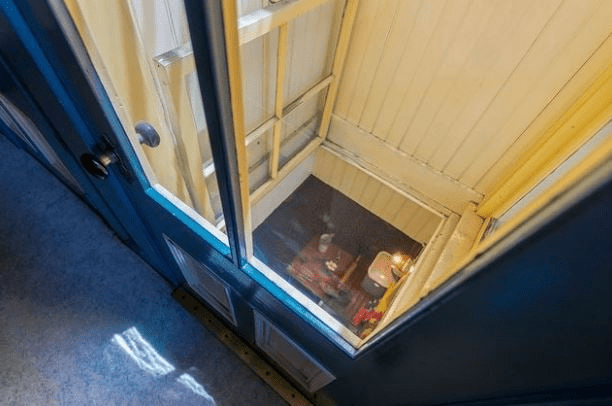
🎟 link in bio. A 160-room mansion built to appease the spirits who died at the hands of the Winchester Rifle 👻

These Jolly Devices Put Money Back to Work!

We live in constant tension between the urgent and the important. One of the characteristics of effective leaders is that they continually find joy in their jobs. One must understand that and strive for balance in one’s life. Th long string of amino acids of which each molecule is composed twists and turns upon itself so as to produce a three-dimensional tangle. The tangle is not random of accidental, however. The specific twists and convolutions of the backbone (the backbone of the protein molecule consist, of course, of the sequence of segments composed of the backbones of the linked amino acid molecules) of one molecule are just like those of the same protein. The electric forces produced by the side chains that protrude from the main backbone result in detailed attractions and repulsions that cause the array to fold and twist upon itself in a definite, characteristic way. Thus, while the protein molecule is a tangled ball of string, the tangle is designed, not haphazard. The chemical properties of the resulting molecule upon which vital processes of living organisms depend are largely determined by the detailed three-dimensional configuration of electric fields produced by the specific pattern of twisting and folding of the linear array. (Two structural principles go a long way toward accounting for the specific conformations assumed by protein molecules. To begin with, the long-chain molecule has a strong tendency to form a helix—always of the same diameter and pitch—which permits the electric charges on the amino acid segments on adjacent turns of the helix to fit together. However, the side-chain construction of two of the twenty kinds of amino acid—proline and hydroxyproline—is not conductive to such bonding. Therefore, at point where these amino acid components occur in the protein molecule, the helix must make a sharp bend. The resulting succession of straight helical segments separated by sharp bends leads to the kind of tangle envisioned in the preceding discussion.) #RandolphHarris 1 of 19

Many wonder whether protein materials, like simpler organic substances, could be accommodated in a nonvitalistic philosophy based on an assumption of continuity and essential similarity between inorganic and organic matter. The most convincing answer to the question would be a demonstration that the proteins, like urea, can be fabricated in the laboratory out of in organic materials. We now how have the background needed for intelligent consideration of this important question: Can proteins by synthesized? Because the answer to the question is to be something less than a categorical yes, we should start by paying a bit of attention to the difficulties that confront the chemist in working with these giant molecules. Although we have written glibly about the composition and molecular structure of the various amino acids, the number and arrangements of amino acids in a given protein molecule, the patters of twists and folds of the linear array, and the like, each of our assertions could be made only because of literally hundreds of human-years of laboratory effort by brilliant and dedicated chemist. And it has been easier for them to arrive at general properties of proteins than to determine the detailed structure of specific protein molecules. Many of you, like myself, may be wondering what protein synthesis is so important? Well, DNA’s main purpose is to make proteins within the cell. These proteins, which include enzymes that do specific jobs, control the activities of the cell. Different cells have different activities. By controlling protein synthesis within each cell, the genes that make up DNA control the life of the entire organism. Although the outcome of protein synthesis can be involved and quite complex, its purpose is rather straightforward. The purpose of protein synthesis is simply to create a polypeptide—a protein made out of a chain of amino acids. In a hair follicle cell, a protein called keratin is made. Lot of it. Many ribosomes can be working on a single strand of mRNA at once. Protein synthesis is not a slow process, either. A protein chain 400 amino acids long can be assembled in 20 seconds! #RandolphHarris 2 of 19

The keratin made by the hair follicle cells makes long fibers. The cells, growing just under the scalp, eventually die, leaving the keratin behind. This keratin, combined with the keratin left by many other cells, emerge from your scalp as hair. Despite ultracentrifuges, electron microscopes, X-ray spectrometers, artificially radioactive tracer material, paper chromatography, and all the other modern devices and techniques that assist the chemist today, the sheer complexity of the giant molecules of living organisms renders almost impossible the task of analysis, let alone synthesis, it was only in 1958 that F. Sanger, of England, was awarded a Nobel Prize for working out the first complete sequence of amino acids in a protein. It is significant that the protein he chose to work on was insulin, whose molecule contains only 51 amino acid components. By companions, the hemoglobin molecule, which is of average size for proteins, contains more than 600 amino acids! In the mid-1960s, therefore, when we are just becoming able to analyze the detail composition of some of the simpler proteins, it is too early to report great success in their synthesis. However, important progress has been made. Amino acids have been synthesized from inorganic ingredients. And amino acid molecules have been hooked together to form chains or arrays. This, by the way, is not quite as easy to accomplish as might be suggested by the earlier reference to the strong tendency of the backbones of these molecules to hook together. Perhaps an analogy can be drawn with a zipper. The opposing section of the zipper are designed to fit together tightly, but energy has to be supplied by the slide to fit together tightly, but energy has to be supplied by the slide fastener to bend the two sections a bit and force them into the correct spatial relationship before the closed, stable configuration can be achieved. So it is with amino acids. The energy whereby the front end of one backbone is forced into the proper relationship with the back end of the next is usually supplied chemically by temporarily hooking on to one end of each amino acid an energy-rich molecule. This molecule (or the pieces into which it may have been broken during the reaction) drops away from the structure after it has provided the motive power for linking the two amino acids together. #RandolphHarris 3 of 19

Early techniques where by the chemist laboriously linked one new amino acid at a time to a slowly growing chain have been supplemented by more recent methods where by chains of hundreds of or even a thousand amino acids can be formed rapidly in the test tube. These synthetic chains are comparable in size with moderate-sized natural protein molecules, and they prove, under test, to have many proteinlike properties. Nevertheless, it cannot quite be claimed they are the same as naturally formed protein. For, owning to limitations of the techniques of synthesis, they are usually made up of only one or two of the 20 different kinds of amino acids. Apart from a few simple proteins, such as fibroin in silk, nature appears not to employ such a monotonous architectural design for its giant molecules. Thus, the protein synthesis machinery uses 22 natural amino acids as building blocks that faithfully decode the genetic information. Such fidelity is controlled at multiple steps ad can be compromised in the nature and in the laboratory to rewrite protein synthesis with natural and synthetic amino acids. Expanding the genetic code with synthetic amino acids through rewiring protein synthesis has broad applications in synthetic biology and chemical biology. Biochemical, structural, and genetic studies of the translational quality control mechanisms are not only crucial to understand the physiological role of translational fidelity and evolution of the genetic code, but also enable us to better design biological parts to expand the proteomes of synthetic organisms. An atom of an element is composed of nothing more than the fundamental particles of the nuclear physicist, held together by the nuclear and electric forces described by laws of physics. A small molecule consists of nothing more than a few such atoms, held together by the forces arising from the sharing of their extranuclear electric charge. The physical and chemical properties of a small molecule are also completely determined by the specific distribution of electric charge in and around the molecule. #RandolphHarris 4 of 19

A large molecule consists of nothing more than an aggregation of smaller molecules, which fit together the way they do only because of the mutual forces of attraction and repulsion deriving from their arrangements of electric charge. When a large molecule twists, turns, and tangles the liner array of which it is basically composed into a complex three-dimensional form, it does so under the precise control of the same forces of attraction and repulsion that arise out of the detailed distribution of electric charge along the backbone and side chains of its array. The resulting chemical and physical properties of the large molecule, be it protein or nucleic acid, are also no more and no less than the resultant of the effects of the detailed three-dimensional distribution of electric charge trapped and held within its tangled web. Fantastically complicated through a large protein or nucleic acid molecule may be, the problem its structure and properties pose to human understanding is one of degree, not of quality. A simple molecule of water, with its 1 oxygen and 2 hydrogen atoms, brings into play exactly the same and as many basic natural laws as a molecule of the protein excelsin, which contains approximately 40,000 atoms! Thus, more than a century after the synthesis of urea by Dr. Wohler, the demonstration that he commenced has finally been completed: there is no need for invoking any special vital principle to account for the structure and properties of any of the chemical compound for living organisms, or it can influence the mechanisms whereby in nature, as distinct from in the laboratory, the complicated molecules essential to life are in fact produced. We shall defer consideration of the evidence for or against the operation of vitalistic principles at higher levels of organization of matter. Considering them human genome contains approximately 30,000 genes, scientists from a broad range of disciplines are working to reveal the structure and function of the proteins encoded by these genes. Their findings could lead to the solution of a multitude of problems in biology and medicine. In addition to structure-function analyses of extant proteins, protein chemists are working to create new proteins with desirable properties, either by de novo design or by altering natural frameworks. #RandolphHarris 5 of 19

To be a leader means willingness to risk—and a willingness to love. Has the leader given you something from the heart? It is never too late to be what you might have been. You can build your reputation on what you are going to do. There are countless ways of attaining greatness, but any road to reaching one’s maximum potential must be build on a bedrock of respect for the individual, a commitment to excellence, and a rejection of mediocrity. More aware of what challenge means, the New York Youth Board has had a policy more calculated to succeed. Its principle is provisionally to accept as given the code of than gang and the kids’ potency-proving values and prejudices; and then, as an immediate aim, to try to distract their overt behaviour into less annoying and dangerous channels. This immediate aim is already valuable, for it diminishes suffering. For instance, if a youth’s addiction is changed from heroin to alcohol, so long as heroin is illegal and alcohol is legal; the youth is less in danger and the store that he would rob to pay for the criminally overpriced narcotic is out of danger, so there is less suffering. Then there is the further hope that, accepted by the wise and permissive adult, the adolescents will gradually come to accept themselves and the spiral of proving will be arrested. Further, that the friendship of the trusted adult will evoke a love (transference) that can then be turned elsewhere. I take it that this is the Youth Worker philosophy. In many cases it should succeed. I am skeptical that it can widely succeed. For here again the young people are not taken seriously as existing, as having real aims in the same World as oneself. To the Youth Board, in their own real World (such as it is), the code is not acceptable, and then teenage vaunts and prejudices cannot lead to growth in any World. To pretend otherwise is playing games and continuing to exclude them from one’s own meant World. How then can the boys be trusting and feel they are understood? Not being morons, they know they cannot be understood in their own terms, which are empty to themselves. They know there is another World beyond, as square and sheepish as they might please to rationalize it, but which is formidable and enviable. (Actually, apart from the code itself and the sphere of their delinquencies, the kids are model of conventionality in their tastes, opinion, and ignorance.) #RandolphHarris 6 of 19

And though they have a childish need for sympathic attention and are proud of having compelled it—“We are so bad, they give us a youth worker”—they are too old not to demand being taken seriously. There is a valuable nondirective approach which makes no judgments or interpretations and gives no advice, but which simply draws the patient out and hold up a mirror; and this is no doubt also part of the philosophy of the Youth Board. However, then, it must be therapy, it must hold up the mirror and risk the explosion of shame and grief or the impulsive defenses against them, violent retaliation or flight. In Youth work this is very impractical. It is different thing to go along with the patient, or worse to seem to go along with him, and provide only the reassurance of attention. Only if the worker can hold out some real objective opportunity, something more than “interpersonal relations,” and make the boy finally see it. Then the philosophy of the Youth Board can succeed. (In New York there has been an experiment of simply urging the kids to go to college—a far-off goal—showing that it is economically possible for them, and promising that the school will follow up. This alone had resulted in rapid academic advances, in I.Q., and less truancy.) My hunch is that the occasional spectacular success occurs not because of the “accepting” method, but because the youth worker does not really belong to the World of the Youth Board either, and his acceptance is bona fide. For whatever motive, he confronts the young people as real. He may be a covert accomplice with the same inner dilemma as his gang, and can pass on a more practical Worldly wisdom. He many be emotionally involved with some of them, so they are in fact important. He may be so deeply compassionate or so inspired a teacher that he creates new interests and values altogether, not the meant World of the Youth Board which is, after all, just what has proved unsatisfactory to begin with. #RandolphHarris 7 of 19

According to a comparison of America and Japanese medical students, Americans tend to regard suicide as an expression of anger or aggression, whereas the Japanese view it as a way to escape pain or as a method of leaving the World on your own terms, instead of being known as a failure. This difference reflects the cultures’ religious and philosophical understandings of the life and death. The Shinto and Buddhist traditions stress eternal change and the transience of life. In the Buddhist view, life is sorrowful, and death is a way of freeing oneself from illusion and suffering. Furthermore, the highest aim of many Japanese is complete detachment from Earthly concerns, total self-negation. Within this framework, death can be seen as beneficial, as an expression of sincerity (makoto) or an appropriate reaction to shame. However, in Japan suicide is not welcomed anymore as a means of solving problems, and it has become a national issue as well as a personal problem. In 2020, approximately 21,100 people committed suicide in Japan. However, it became a national issue before that when Matsuri Takahashi, age 24, a promising graduate of Japan’s top University, Dentus, leapt to her death in December 2015; leaving being a trail of grievances over relentless days. She clocked more than 105 hours of overtime in October, before becoming depressed. Her death, deemed by the government to be “karoshi,” which can be translated to death by overwork. Japan has been forced to confront its work culture after labour inspectors ruled that the death of a 31-year-old journalist had been caused by overwork. Miwa Sado, who worked at the broadcaster’s headquarters in Tokyo, logged 159 hours of overtime and only two days off in the month leading up to her death from heart failure in July 2013. More than 2,000 Japanese killed themselves due to work-related stress in the year to March 2016. According to the government, dozens of other victims died from heart attacks, strokes, and other conditions brought on by spending too much time at work. #RandolphHarris 8 of 19

These deaths have increased pressure on Japanese authorities to address the large number of deaths attributed to the punishingly long hours expected of many employees. The government wants to cap monthly overtime at 100 hours and introduce penalties for companies that allow their employees to exceed the limit—measures that critics say still put workers at risk. While the deaths are a major issue, I am not sure that government regulation is the answer. Some people really need more money than they earn and the overtime may be helping them to pay their mortgage, rent, medical insurance or care for their elderly parents. If they are not allowed to clock this overtime at their job, they may have to take on a new job, or might turn to criminal activity to earn extra money. The Japanese are also very humble and taught that because life is so expensive and they are so smart, their achieve in the career field denotes their value in life. Many people are looking for rich husbands, with a good job, nice apartment, and fancy car, retirement benefits, and investment accounts. So if a man does not have those kind of things, he may never find a wife. Also, a lot of women do not want to marry and do not want to be dependent on a man and want to prove they are equal; therefore, she may work long hours to demonstrate her value. It is impossible to be simultaneously blasted by a revolution in energy, a revolution in technology, a revolution in family life, a revolution role in dealing with pleasures of the flesh, and a Worldwide revolution in communications without also facing—sooner or later—a potentially explosive political revolution. All the political parties of the industrial World, all our congresses, parliaments, and supreme soviets, our presidencies, and prime ministerships, our courts and our regulatory agencies, and our layer upon geological layer of government bureaucracy—in short, all the tools we use to make and enforce collective decisions—are obsolete and about to be transformed. A Fourth Wave civilization cannot operate with a Second Wave political structure. #RandolphHarris 9 of 19

Just as the revolutionaries who created the industrial age could not govern with the leftover apparatus of feudalism, so today we are faced once more with the need to invent new political tools. This is the political message of the Fourth Wave. Today, although its gravity is not yet recognized, we are witnessing a profound crisis not of this or that government but of representative democracy itself, in all its forms. In one country after another, the political technology of the Third Wave is sputtering, groaning, and malfunctioning dangerously. In the United States of America, we find an almost total paralysis of political decision-making in connection with the life-and-death questions facing society. Fully six years after the OPEC embargo, despite its sledgehammer impact on the economy, despite its threat to independence and even military security, despite interminable congressional study, despite repeated reorganizations of the bureaucracy, despite passionate presidential pleas, the U.S.A. political machinery still spins helplessly on its axis, unable to produce anything remotely resembling a coherent energy policy. This policy vacuum is not unique. The United Starts of America also has no comprehensive (or comprehensible) urban policy, environmental policy, family policy, technology policy. If we listen to critics abroad, it does not even have a discernible foreign policy. Even if they did exist, the American political system would not have the capacity to integrate and prioritize such policies. This vacuum reflects so advanced a breakdown in decision-making that President Carter, in a wholly unprecedented speech, was forced to condemn the “paralysis, stagnation, and drift” of one’s own government. This collapse of decision-making is, however, not the monopoly of one party or one president. It has been deepening since the early 1960’s, and reflects underlying structural problems that no president—Republican or Democrat—can overcome within the framework of the present system. These political problems have destabilizing effects on the other main social institutions such as the family, the school, and the corporation. #RandolphHarris 10 of 19

Dozens of laws with immediate impact on family life cancel and contradict one another, worsening the family crisis. The educational system was flooded with construction funds at precisely the moment when school-age population begam to plummet, thus provoking an orgy of useless school building, followed by a cutoff of funds when they are most desperately needed for other purposes. Corporations, meanwhile, are compelled to operate in a political environment so volatile that they literally cannot tell from one day to the next what government expects of them. First, Congress demanded the General Motors and the other auto manufacturers installed catalytic (what some people call Cadillac) converters on all new cars in the interests of a cleaner environment. Then, after GM spent $300 million on converters and signed a $500-million ten-year contract for the precious metals needed for their manufacture, the government announced that cars with catalytic converters emitted 35 times more sulphuric acid than cars without them. At the time, Chrysler’s vice president, Alan Loofbourrow, said the were “The dumbest thing that ever happened to the automobile.” The controversy was about the catalytic converter, Detroit’s major technological change for it 1975 cares. The converter, in a stainless-steel case hooked up between the engine and the muffler, and was thought would probably never be seen by the car buyer, and if it were to break down, one would never know it. However, if it worked, two major auto emissions—carbon monoxide and unburned hydrocarbons—would be reduced sharply. The converter was designed to cleanse the exhaust after combustion, so the engines, which had been turned in past years to reduce emissions, could be reset to improve gasoline mileage. Yet, if the converters did not work, the clean air drive would be crippled, and new pollutant, sulphuric acid, would slip into the atmosphere. The converter, in effect, was a small chemical processing plant, using platinum and palladium as catalysts to change the hydrocarbons and carbon monoxide fumes into harmless carbon dioxide and water on their way to the tailpipe. #RandolphHarris 11 of 19

When the converters were brought up to speed, they cut fumes by 25 to 33 percent of the standard. It was also required that these systems last 50,000 miles because they do deteriorate. Also, lead in gasoline was found to destroy the effectiveness of the catalysts, so nonleaded fuel was ordered on the market by the Government. This was all part of the Clean Air Act, which passed in 1963. Because Catalytic Converters are so expensive, for example on a V8 or V10 BMW, which has two catalytic converters, replacement can be in excess of $4,000.00. These parts are often the target of thieves because the part contains valuable precious metals. Catalytic Converters typically happen on cars with more ground clearance, since it is easier to access the part. Regardless of the type of vehicle you have, there are some steps you can take to help prevent theft: If a secure garage is unavailable, park in well-lighted areas close to the building entrances. Weld the catalytic converter to the vehicle frame, which can make it harder to remove. Consider buying an aftermarket part similar to a metal cage that can be installed to over the converter. Install a car alarm with a vibration alter sensor. Engrave your vehicle identification number (VIN) to the converter, which can help make selling the part harder and help alter you if your converter is ever stolen. At the same time, a runaway regulatory machine generates an increasingly impenetrable mesh of roles—45,000 pages of complex new regulations a year. Twenty-seven different government agencies monitor some 5,600 federal regulations that pertain to the manufacture of steel along. (Thousands of additional rules apply to the mining, marketing, and transport operations of the steel industry.) A leading pharmaceutical firm, Eli Lilly, spends more time filling out government forms than doing heart-disease and cancer research. A single report from Exxon, the oil company, to the Federal Energy Agency runs 445,000 pages—the equivalent of a thousand volumes! #RandolphHarris 12 of 19

This mandarin complexity weighs the economy down, while the jerky, on-again-off-again responses of government decision-makers add to the prevailing sense of anarchy. The political system, erratically zigzagging from day to day, greatly complicates the struggle of our basic social institutions for survival. Now is this decisional breakdown a purely American phenomenon. Government in France, Germany, Japan, and Britain—not to mention Italy—exhibit similar symptoms, as do those in the Communist industrial nations. And in Japan, a prime minister declares: “We increasingly hear about the Worldwide crisis of democracy. Its problem-solving capability, or the so-called governability of democracy, is being challenged. In Japan, too, parliamentary democracy is on trial.” The political decision-making machinery in all those countries is increasingly strained, overworked, overloaded, drowned in irrelevant data, and faced with unfamiliar perils. What we are seeing, therefore, are government policy makers unable to make high priority decisions (or making them very badly) while they chase frenziedly about making thousands of lesser, often trivial, ones. Even when important decisions are extruded they usually come too late, and seldom accomplish what they are designed to do. “We have solved every problem with legislation,” says one hard-pressed British lawmaker. “We have passed seven acts against inflation. We have eliminated injustice numerous times. We have solved the ecology problem. Every problem has been solved countless times by legislation. However, the problems remain. Legislation does not work. An American TV announcer, reaching into the past for an analogy, puts it differently: “Right now I feel the nation is a stagecoach with the horses running headlong, and a guy trying to pull in the reins, and they are not responding.” This is why so many people—including those in high office—feels so powerless. A leading American senator privately tells me of his deep frustration and the feeling that he cannot accomplish anything useful. He questions the ruin of his family life, the frantic pace of his existence, the long hours, hectic travel, endless conferences, and perpetual pressure. He asks, “It is worthy it?” #RandolphHarris 13 of 19

A British M.P. poses the same question, adding that “the House of Commons is a museum piece—a relic!” A top White House official complains to me that even the President, supposedly the most powerful man in the World, feels impotent. “The President feels as though he is shouting into the telephone—with nobody at the other end.” This deepening breakdown of the ability to make timely and competent decisions changes the deepest power relationships in society. Under normal, nonrevolutionary circumstances, the elites in any society use the political system to reinforce their rule and further their ends. Their power is defined by the ability to make certain things happen, or to present certain things from happening. This presupposes, however, their ability to predict and control events—it assumes that when they yank on their reins, the horses will stop. Today the elites can no longer predict the outcomes of their own actions. The political systems through which they operate are so antiquated and creaky, so outraced by events, that even when closely “controlled” by the elites for their own benefit, the results often backfire. This does not mean, one hastens to add, that the power lost by the elites has accrued to the rest of society. Power is not transferred; it is increasingly randomized, so that no one knows from moment to moment who is responsible for what, who has real (as distinct from nominal) authority, or how long that authority will last. In this seething semi-anarch, ordinary people grow bitterly cynical not merely about their own “representatives” but—more ominously—about they very possibility of being represented at all. As a result, the Third Wave “reassurance ritual” of voting begins to lose its power. Year by year, American voting participation decreases. In the 2020 presidential election fully 46 percent of eligible voters stayed home meaning that a president was elected by roughly one quarter of the electorate—in reality only one eight of the total population of the country. More recently, pollsters found that only 12 percent of the electorate still felt that voting matters at all. #RandolphHarris 14 of 19

Similarly, political parties are losing their drawing power. In the period 1998-2020 the number of “independents” unaffiliated with any party in the United States of American shot up 400 percent, making 2020 the first time in more than a century that the number of independents equaled the membership of one of the major parties. People have little faith in their governments, especially since this COVID-19 crisis hit and President Joe Biden said, “I have no plan. Let the states deal with it.” Causing a wave of disenchantment to sweep the nation. Asked why, a Danish engineer speaks for many when he says “Politicians appear useless in stopping trends.” Two years of economic chaos, militarization, catastrophic economic disorders, increases in the cost of living (it is not just a housing supply and demand issues), insufficient basic food production, increases in crime and drunkenness, corruption and thieving, but above all of an uncontrollable drop in prestige of the present leadership in the eyes of the people. More than anger, citizens are now expressing revulsion and contempt for their political leaders and government officials. They sense that the political system, which should serve as a steering wheel or stabilizer in a change-tossed, runaway society, is itself broken, spinning and flapping out of control. Thus when a team of political scientists investigated Washington, D.C., recently to find out “who runs this place?” they came up with a simple, crushing answer. Their report, published by the American Enterprise Institute, was summed up by Professor Another King of the University of Essex in Britain: “The short answer…would have to be, ‘No one. Nobody is in charge here.” Not just in the United States but in many of the Third Wave countries being battered by the Fourth Wave of change, there is a spreading power vacuum—a “black hole” in society. Most people are now much more ready for the widening in loyalties which World-order schemes would involve, but they are not at all as ready as they should be. Thus, they unnecessarily deprive themselves of the clear advantages of such an order and go on foolishly enduring the troubles of the old order. #RandolphHarris 15 of 19

That we are moving toward some kind of single World Commonwealth is certain. That we are not emotionally ready for it is also certain. For the events and inventions which are pushing us forward are ahead of our ideas and ideals. The tragic needs of our time do not find a commensurate mentality to meet them. The Europeans, for example, cannot be persuaded to renounce their state sovereignties, cannot be made into common citizens of a frontierless continent against their will. How much more will this be the case with a World-citizenship scheme? However, in the end humanity will find itself unable to keep the peace between its diversified groups without creating a separate paramount international association—be it central, federal, or league. A World organization which can legally settle international disputes and which possess the armed power to enforce its decisions or to resist aggressions cannot ultimately be avoided. Humans, in their present stage of moral evolution, cannot be effectively governed without the use of some kind of physical coercion nor can their national disputes be settled without some means of physically enforcing decision. The peoples are being evolved from within and driven from without to the point where only a World association will fit their political needs. Such an authority would possess the usual administrative powers. First, it would be a legislature whose jurisdiction would extend over the whole field of international matters and regulate by agreed laws the political, commercial, and cultural relations between the States. Second, it would be a tribunal where final judgement would be pronounced upon disputes, aggressions, and alternations of frontiers. Third, it would be an executive equipped to maintain order and enforce laws actually worked out to preserve peace. However, besides the necessity of preventing possible internecine wars the practical advantages of such a common authority are so obvious that the administration of the otherwise independent units will sooner or later be forced by developments to accept it. Such advantages would include a customs union, a common currency, a common transportation system, and probably a common armed force. #RandolphHarris 16 of 19

However, the danger here is that a paramount supranational power may develop into a tyrannous suprastate. It may be that adequate checks and safeguards can be devised by statemen against it, but in the end it can be overcome only by overcoming the moral and mental defects in humans which could cause it. If humans are not evolved enough to support such an ideal institution as a World family of democratic nations, they are not so low that they cannot supper the beginnings of such an institution. If a nation is unwilling to be its neighbour’s keeper, it ought at least be willing to be its neighbour’s helper. It is inevitable that as humans become more truly spiritually minded, they will become more internationally minded. And this is certain to reflect itself in turn in their political systems. The end of such a process can only be the formation of an international commonwealth. Hence, every political measure which promotes this end is a right one and every measure which obstructs it is a wrong one. However, it must be also well-timed or it will defeat its own end. The League was ill-timed. The right for a solely regional scheme was after World War I. Instead, too much was attempted by way of the League, which inevitably failed. However, after World War II, a regional scheme alone would likewise fail. The present suggestion adapts itself to this factor of proper timing. In has been predicted that the principle of co-operation would be the only principle to emerge from all the postwar conferences as being effective enough to solve their thorny problems. It will have many possible spheres of application but the first and major one will be in the direction of peace. So we venture to predict again that failure of international co-operative action to create and sincerely to sustain some kind of assembly of representatives drawn from the different nations, will lead directly to the catastrophe of a third armed conflict more terrible than this planet has yet known. It could lead to this in one and a half to two decades. Metropolitan cities would not be able to escape heavy bombing and wide destruction. Such an honest and determined assembly of nations would be better protection for every country than any army, navy, or air force. #RandolphHarris 17 of 19

The ultimate evolution of the twenty-first century will be toward a democratic World association, acting through an international parliament, and international tribunal, and an international executive, which would impartially regulate, coordinate, and boldly envelop the entire economic resources of the planet as a whole. When all nations can thus share equitably in the common wealthy and productivity, one of the prime causes of war between them would completely vanish. Past events have tragically proved the truth of these statements. Many of the calamities such as monetary collapse, trade depression, and labour strikes which descended on classes, masses, and nations were caused by their failure to recognize the immense power of the principle of mutual help and by their inability to meet the events of this historic turning-point with the understanding they demand. The first nation to recognize the one and to meet the other will do much, not only for herself, but also for all other nations. Both moral development and practical exigencies will require us in the end to subscribe to the fundamental truth that prosperity, no less than peace, is one and indivisible. However, unfortunately, we are not yet emotionally ready to climb such a height. We must expect, therefore, that different kinds of troubles will plague us from time to time as the penalty of our unreadiness. We have accept the solid fact that humans do not change overnight, that starting new institutions and necessarily filling them with the same old faces that we already know, will not and cannot bring about a new World. Until we begin to recognize this and start working for new hearts and new minds more than for institution, we shall not come near to solving our problems. Today, the mission of philosophy is a planetary one, for truth is needed everywhere, and for the first time can be transmitted everywhere. We speak here in terms of geographical fact, for vested religious interests and totalitarian political despotisms still continue to serve their masters, the darker forces of evil, by obstructing the contemporary planetary enlightenment. #RandolphHarris 18 of 19

Unless humanity recognizes the demonic powers are loose in its midst, are inspiring hatred, violence, suspicion, and greed, it will not go down on its knees to ask help from a power greater than and beyond itself. Unless we look behind the World’s problems into the real and spiritual problems which they reflect, we cannot properly understand them or solve them. “Blessed (happy, fortunate, to be envied) are those who observe justice [treating others fairly] and who do right and are in right standing with God at all, times,” reports Psalm 106.3. Elders, we have been here so short a time and we pretend that we have invented memory. We have forgotten what it is like to be you, who do not remember us. We remember imagining that what survived us would be like us, and would remember the World as it appears to us, but it will be your eyes that will fill with light. We lose you again and again, as we turn into you, eating the forests, eating the Earth and the water, and dying of them departing from ourselves, leaving you the morning in its antiquity. The Holy One is great, blessed be He. God is also humble. For the Lord our God, He is God of gods, and Lord of lords, the great God, the mighty and revered God, who regardeth not person, nor taketh a bride. And it is written: He doth execute justice for the fatherless and the window, and loveth the stranger, in giving him food and raiment. It is repeated in the Prophets, as it is written: For thus saith the high and exalted One that inhabieth eternity, and whose name is holy, I dwell in the high and holy place with Him also that is of a contrite and humble spirit, to revive the spirit of the humble and to revive the heart of the contrite ones. It is a third time stated in the Writings: Sing unto God, sing praises to His name; extol Him that rideth upon the Heavens, whose name is the Lord; and exalt before Him. And it is written: A father of the fatherless, and a judge of the widows, is God in His holy habitation. The Lord our God be with us, as He was with our fathers; let Him not leave us, nor forsake us. And ye that cleave unto the Lord your God are alive every one of you this day. For the Lord hath comforted America; He hath comforted all her waste places, and hath made her wilderness like Eden, and her desert like the garden of the Lord; joy and gladness shall be found therein, thanksgiving and the voice of melody. It pleased the Lord for His righteousness’ sake, to make America great and glorious. #RandolphHarris 19 of 19


Dinner’s outside tonight! You can tell when a builder has taken care to thoughtfully design every aspect of a home when there’s even an outdoor dining area.

We’re obsessed with the patio at the Riverside Residence 1 model…and we can’t stop picturing all the parties and events that will take place there!

When we ended the tour of our Cresleigh Home, we thought that love was over, that we were really through. I told her that we would begin anew somewhere else.

And you can all believe me, we sure intended to, but we just could not say goodbye, after the tour was through.

The chair and then the sofa, they broke right down and cried, the curtains started wavin’ for me to come inside. I tell you confidentially, the tears were hard to hide, and we just could not say goodbye.

The clock was striking twelve o’clock, it smiled on us below, with folded hands it seemed to say, “We’ll miss you if you go.”

So we went back and signed the mortgage agreement, and when I looked around, the room was singin’ love songs, and dancing up and down.

And now we’re both so happy, because at lest we found the Cresleigh Home of our dreams. We just could not say goodbye. https://cresleigh.com/cresleigh-riverside-at-plumas-ranch/residence-1/

With four floor plans available, ranging from approximately 2,000 – 3,500 square feet offering, three to five bedrooms, we are certain you will find the home that fits your needs and lifestyle.

Could Ever Hear by Tale or History—The Course of True Love Never Did Run Smooth!

Freedom is never voluntarily given by the oppressor; it must be demanded by the oppressed. His picture was, until recently, everywhere: on television, on posters that started out at ne in airports and railroad stations, on leaflets, matchbooks and magazines. He was an inspired creation of Madison Avenue—a fictional character with whom millions could subconsciously identify. Young and clean-cut, he carried an attache case, glanced at his watch, and looked like an ordinary businessman scurrying to his next appointment. He had, however, an enormous protuberance on his back. For sticking out from between his shoulder blades was a great, butterfly-shaped key of the type used to wind up mechanical toys. The text that accompanied his picture urged keyed-up executive to “unwind”—to slow down—at the Sheraton Hotels. This wound-up man-on-the-go was, and still is, a potent symbol of the people of the future, millions of whom feel just as driven and hurried as if they, too, had a huge key in the back. The average individual knows little and cares less about the cycle of technological innovation or the relationship between knowledge-acquisition and the rate of change. Until, of course, a computer application starts to rival Wall Street investors. #RandolphHarris 1 of 25

Besides that, most people are usually keenly aware of the pace of their own life—whatever that may be. The pace of life is frequently commented on by ordinary people. Yet, oddly enough, it has received almost no attention from either psychologist or sociologists. This is a gaping inadequacy in the behavioural sciences, for the pace of life profoundly influenced behaviour, evoking strong and contrasting reactions from different people. It is, in fact, not too much to say that the pace of life draws a line through humanity, dividing us into camps, triggering bitter misunderstanding between parent and child between Madison Avenue and Main Street, between men and woman, between American and European, between East and West. The inhabitants of the Earth are divided not only by race, nation, religion, or ideology, but also, in a sense by their position in time. From within the main centers of technological and cultural change in San Jose and San Francisco, California, Manhattan, New York, Cambridge, Massachusetts, and in Canada, Dubai,London, Tokyo, Beijing, Shanghai, and Hong Kong, are millions of men and women who can already be said to be living the way of life of the future. Trendmakers often without being aware of it, they live today as millions more will live tomorrow. #RandolphHarris 2 of 25

And while these tritons of technology account for only a few percent of the global population today, they already form an international nation of the future in our midst. They are the advanced agents of humanity, the earliest citizens of the World-wide super-industrial society now in the toddler stages of development. What makes them different from the rest of humankind? Certainly, they are richer, better educated, smarter, and more mobile than the majority of the human race. They also live longer, in better homes, eat better, and drive better cars. However, what specifically marks the people of the future is the fact that they are already caught up in a new, stepped-up pace of life. They “live faster” than the people around them. They do not have time to sit at the same coffee shop for twenty years fixating on the same people and topics. Some people are deeply attracted to this highly accelerated pace of life—going far out of their way to bring it about and feeling anxious, tense or uncomfortable when the pace slows. They want desperately to be where the actions is. (Indeed, some hardly care what the action is, so long as it occurs at a suitably rapid clip.) #RandolphHarris 3 of 25

The attraction to the fast pace of life is one of the hidden motivating forces behind the much publicized “brain-drain”—the mass migration of European scientists to the United States of America and Canada. After studying 517 English scientists and engineers who migrated, it was concluded that it was not higher salaries or better research facilities alone, but also the quicker tempo that lured them. The migrants were not put off by what they indicate as the faster pace of North America; if they anything, they appear to prefer this pace to others. Similarly, a veteran of the civil rights movement in Sacramento reports: “People who are used to a speeded-up urban life…cannot take it for long in the rural South or Sacramento.” That is why people are always driving somewhere for no particular reason. Traveling is the drug of The Movement. Understanding the powerful attraction that a certain pace of life can exert on the individual helps explain much otherwise inexplicable or atypical behaviour. However, if some people thrive on the new, rapid pace, others are fiercely repelled by it and go to the extreme lengths to “get off the merry-go-round,” as they put it. To engage at all with the emergent super-industrial society means to engage with a faster moving World than ever before. #RandolphHarris 4 of 25

Some mature people are even more likely to react strongly again any further acceleration of change. There is a solid mathematical basis for the observation that age often correlates with conservatism: time passes more swiftly for senior citizens. When a fifty-year-old father tells his fifteen-year-old son that he will have to wait two years before he can have an Ultimate Driving Machine of his own, that interval of 730 days represents a mere 4 percent of the father’s lifetime to date. It represents over 13 percent of the boy’s lifetime. It is hardly strange that to the boy the delay seems three or four times longer than to the father. Similarly, two hours in the life of a four-year-old may be the felt equivalent of twelve hours in the life of his twenty-four-year-old mother. Asking the child to wait to hours for a piece of candy may be the equivalent of asking the mother to wait fourteen hours for a cup of coffee. There may be a biological basis as well, for such differences in subjective response time. The calendar years seem progressively to shrink. In retrospect every year seems shorter than the year just completed, possibly as a result of the gradual slowing down of metabolic process. Even if it were not, with the slowdown of their own biological rhythms, the World would appear to be moving faster to senior citizens. #RandolphHarris 5 of 25

Populations sometimes actively resist a change of pace. This explains the pathological antagonism toward what many regard as the “Americanization” of Europe. The new technology on which super-industrialism is bases, much of it blue-printed in American research laboratories, brings with it an inevitable acceleration of change in a society and a concomitant speed-up of the pace of individual life as well. While anti-American orators single out computers, Aaliyah, Meghan Markle, Britney Spears, Paris Hilton, or Coca-Cola for their barbs, their real objection may well be to the invasion of Europe by an alien time sense. America, as the spearhead of super-industrialism, represents a new, quicker, and very much unwanted tempo for some. Too hip, too modern, too attractive, too innovative—it attracts a lot of envy. Fast pace embodies the American Pace of Life. Human’s perception of time is closely linked with their internal rhythms, which could be why those who are ahead of their time are considered disruptive. The human responses to time are culturally conditioned. Part of this conditioning consists of building up within the child a series of expectations about the duration of events, processes or relationships. #RandolphHarris 6 of 25

Indeed, one of the most important forms of knowledge that we impart to a child is a knowledge of how long things last. This knowledge is taught in subtle, informal and often unconscious ways. Yet without a rich set of socially appropriate durational expectancies, no individual could function successfully. From infancy on the child learns, for example, that when Daddy leaves for work in the morning, it means that he will not return for many hours. (If he does, something is wrong; the schedule is askew. The child senses this. Even the family dog—having also learned a set of durational expectancies—is aware of the break in routine.) The child soon learns that “mealtime” is neither a one-minute nor a five-hour affair, but that is ordinarily lasts from fifteen minutes to an hour. He learns that going to a movie lasts two to four hours and it comes with popcorn, hotdogs, sodas, and big boxes of candy, but that a visit with the pediatrician seldom last more than one hour and he gets a sugar-free lollipop and is told to eat healthy. He learns that a school day ordinarily lasts six hours. He learns that a relationship with a teacher ordinarily extends over a school year, but that his relationship with his grandparents is supposed to be of much longer duration. #RandolphHarris 7 of 25

Indeed, some relationships are supposed to last a lifetime. In adult behaviour, virtually all we do, from mailing an envelop to building a career, is premised upon certain spoken or unspoken assumption about duration. It is these durational expectancies, different in each society but learned early and deeply ingrained, that are shaken up when the pace of life is altered. This explains a crucial different between those who suffer acutely from the accelerated pace of life and those who seem rather to thrive on it. Unless an individual has adjusted one’s durational expectancies to take account of continuing acceleration, one is likely to suppose that two situations, similar in other respects, will also be similar in duration. Yet the accelerative thrust implies that at least certain kinds of situations will be compressed in time. The individual who has internalized the principle of acceleration—who understands in one’s bones as well as one’s brain that things are moving faster in the World around one—makes an automatic, unconscious compensation for the compression of time. Anticipating that situations will endure less long, one is less frequently caught off guard and jolted than the person whose durational expectancies are frozen, the person who does not routinely anticipate a frequent shortening in the duration of situations. #RandolphHarris 8 of 25

In short, the pace of life must be regarded as something more than a colloquial phrase, a source of jokes, sighs, complaints or ethnic put-downs. It is a crucially important psychological variable that has been all but ignored. During past eras, wen change in the outer society was slow, humans could, and did, remain unaware of this variable. Throughout one’s entire lifetime the pace mighty vary little. The accelerative thrusts, however, alters this drastically. For it is precisely through a step-up in the pace of life that the increased speed of broad scientific, technological and social change makes itself felt in the life of the individual. A great deal of human behaviour is motivated by attraction or antagonism toward the pace of life enforced on the individual by the society or group within which one is embedded. Failure to grasp this principle lies behind the dangerous incapacity of education and psychology to prepare people for fruitful roles in a super-industrial society. Relationships that once endured for long spans of time now have shorter life expectancies. It is this abbreviation, this compression, that gives rise to the almost tangible feeling that we live, rootless and uncertain, among shifting dunes. Transience is the new “temporariness” in everyday life. It results in a mood, a feeling of impermanence. #RandolphHarris 9 of 25

None of us occupy abodes of safety—true homes. We are all the same people in all the rooming houses everywhere, desperately and savagely, some methodically and strategically, trying to effect soul-satisfying connections with our community. We are, in fact, all citizens of the Age of Transience. Transience, indeed, can be defined quite specifically in terms of the rate at which our relationships turn over. People of the future live in a condition of “high transience”—a condition in which the duration of relationships is cut short, the through-pit of relationships extremely rapid. In their lives, things, places, people, ideas, and organizational structures get used up more quickly. This affects immensely the way they experience reality, their sense of commitment, and their ability—or inability—to cope. It is this fast through-put, combined with increasing newness and complexity in the environment, that strains the capacity to adapt and creates the danger of future shock. If we can show that our relationships with the outer World are, in fact, growing more and more transient, we have powerful evidence for the assumption that the flow of situations is speeding up. And we have an incisive new way of looking at ourselves and others. Let us, therefore, explore life in a high transience society. #RandolphHarris 10 of 25

Barbie, mostly a twelve-inch plastic teen-ager, who looks remarkably like Paris Hilton, Nicky Rothschild, Britney Spears, Amanda Hearst, Reese Witherspoon, Ivanka Trump, or Tomi Lahren, is the best-known and best-selling doll in history. Since her introduction in 1959, the Babies doll population of the World has grown to over one billion Barbie dolls—more than the human population of China or India. Little girls adore Barbie because she is highly realistic and eminently dress-upable. Mattel, Inc., makers of Barbie, also sells a complete wardrobe for her, including clothes for ordinary daytime wear, clothes for formal party wear, clothes for swimming and skiing. In 1970, Mattel announced a new improved Barbie doll. The new version had a slimmer figure, “real” eyelashes, and a twist-and-turn waist that made her more humanoid than ever. Moreover, Mattel announced that, for the first time, any young lady wishing to purchase a new Barbie would receive a trade-in allowance for her current dolls. What Mattel did not announce was that by trading in her old doll for a technologically improved model, the little girl of those days, citizen’s of the super-industrial World, were learning a fundamental lesson about the new society: that human’s relationship with things are increasingly temporary. #RandolphHarris 11 of 25

The ocean of humanmade physical objects that surrounds us is set within a large ocean of natural objects. However, increasingly, it is the technologically produced environment that matters for the individual. The texture of plastic or concrete, the iridescent glisten of an Ultimate Driving Machine under a streetlight, the staggering vision of a cityscape seen from the window of a jet—these are the intimate realities of our existence. Humanmade things enter into and colour our consciousness. Their number is expanding with explosive force, both absolutely and relative to the natural environment. This will be even more true in super-industrial society than it is today. Anti-materialists tend to deride the importance of “things.” Yet things are highly significant, not merely because of their functional utility, but also because of their psychological impact. We develop relationships wit things. Things affect our sense of continuity or discontinuity. They play a role in the structure of situations and the foreshortening of our relationships with things accelerates the pace of life. Apparently Mattel, Inc. caught on and now has a diverse cast of Barbies that really reflects the entire human race. #RandolphHarris 12 of 25

Our attitudes toward things reflect basic value judgments. Nothing could be more dramatic than the difference between the new breed of girls and boys who cheerfully turn in their Barbies for the new improved model, like their mothers and grandmothers before them, clutch lingeringly and lovingly to the same doll until it disintegrated from sheer age. In this difference lies the contrast between past and future, between societies based on permanence, and the new, fast-forming society based on transience. For most thinkers since the Greek philosophers, it was self-evident that there is something called human nature, something that constitutes the essence of humans. There were various views about what constitutes it, but there was agreement that such an essence exists—that is to say, that there is something by virtue of which humans are humans. Thus humans are defined as rational beings, as social terrestrial beings, a terrestrial beings that can makes tool (Homo faber), or a symbol-making terrestrial being. More recently, this traditional view has begun to be questioned. One reason for this change was the increasing emphasis given to the historical approach to humans. #RandolphHarris 13 of 25

An examination of the history of humanity suggested that humans in our epoch are so different from humans in previous times that it seemed unrealistic to assume that every human in every age have had in common something that can be called “human nature.” The historical approach was reinforced, particularly in the United States of America, by studies in the field of cultural anthropology. The study of primitive peoples has discovered such a diversity of customs, values, feelings, and born as a blank sheet of paper on which each culture writes its text. Another factor contributing to the tendency to deny the assumption of a fixed human nature was the concept has so often been abused as a shield behind which the most inhuman acts are committed. In the name of human nature, for example, Aristotle and most thinkers up to the eighteenth century defended slavery (exceptions among the Greeks would be the Stoics, defenders of the equality of all humans, and in the Renaissance, such humanists as Erasmus, Thomas More, and Juan Luis Vives). Or in order to prove the rationality and necessity of greediness in society, scholars have tried to make a case for acquisitiveness, competitiveness, and selfishness as innate human traits. #RandolphHarris 14 of 25

Popularly, one refers cynically to “human nature” in accepting the inevitability of such undesirable human behaviour as greed, murder, cheating, and lying. Another reason for skepticism about the concept of human nature probably lies in the influence of evolutionary thinking. One humans came to be seen as developing in the process of evolution, the idea of a substance which is contained in one’s essence seemed untenable. Yet I believe it is precisely from an evolutionary standpoint that we can expect new insight into the problem of the nature of humans. In the nature of all humankind: in each of us there is sin—not just susceptibility to sin, but sin itself. There is something natural in humans that arouses their desires, proving inner weakness or susceptibility to sinning. However, in each one of us, there are also stirrings of good. It is gradually disclosed that the line separating god and evil passes not through states, nor between cases, nor between parties either—but right through every human heart—through all human hearts. “Sinner” is not some theological term contrived to explain away the presence of evil in this World; nor is it a cliché conceived by colonial hymn writers or backwoods preachers to frighten recalcitrant congregations. #RandolphHarris 15 of 25

We are not sinners because we sin; we sin because we are sinners. We are sinners indeed and in deed. Humans go to great lengths to avoid their own responsibility. Many blame Satan for every imaginable evil—but Jesus Christ states clearly that sin is in us. Others recoil with horror at the sins of the society around them, smugly satisfied that sinful abominations are not of their doing—not realizing that God holds us responsible for acts of omission as well as acts of commission. Still others believe, as did Dr. Socrates two thousand years ago, that sin is not human’s moral responsibility, but is caused by ignorance. Dr. Hegel, whose philosophy so enormously influenced nineteenth, twentieth and twenty-first century thought, argued that humans are “evolving” through increasing knowledge to superior moral levels. However, what do we see around us in the beginning of this twenty-first century that has produced such advances in knowledge, technology, and science Soaring crime rates. Countless shattered families. A globe scarred by continual wars, oppression, and now a deadly pandemic. All our knowledge has not ushered in a brave new World. It has simply increased our ability to perpetrate evil. #RandolphHarris 16 of 25

History, the fake news media, and popular culture continues to validate the biblical account that humans are by their own nature sinful—indeed, imprisoned by their sin. And we are not reluctant prisoners. We actually delight in sin and evil. What else explains our secret delight in another’s fall? Why else are people doing these mid-2000s Gossip Girl “Take Downs”? So pervasive is the sin in us that we are subject to lonely shame if we cannot share in the sins of our peers. What is it? Nothing less than the evil within us, the dark side of the line that passes through each human heart. There is a lot of good programs out there. Even on free TV. Every year Ion TV puts on these wonderful Christmas movies, a lot of feel good stories about love, happiness, family, friends, and community, but so many people prefer to emulate evil. Not that all violent TV and video games and movies are bad. Research say they are good for entertainment and help some people release their aggression. Not all people suffer from acute television intoxication. Many people can still distinguish good behaviour from bad behaviour and know that actions have consequences. The war to end all wars is a battle for eternal stakes between spiritual forces—and it is being waged in you and in me. #RandolphHarris 17 of 25

When we truly smell “that smell,” the stench of sin within us, it drives us helplessly and irresistibly to despair. However, God has provided a way for us to be freed from the evil within: it is through the door of repentance. When we truly comprehend our own nature, repentance is no dry doctrine, no frightening message, no morbid form of self-flagellation. It is a gift God grants, a map which lead to life. It is the key to the door of liberation, to the only real freedom we can ever know. Because it does not mean freedom, perhaps it is not surprising that people in prison seem to have an easier time understanding repentance than those on the outside. Prisoners are captives in every sense. They have had their most blatant sins exposed in the blinding light of the court room, in the fake news media, draw out before the neighbours, and they have been locked into the midst of every from of evil and depravity. Thus, it is not surprising that the most vivid illustrations of repentance in the Bible often begin in a prison cell. The same mind which humans use to understand that two added to three totals five cannot be used to understand that one who loses oneself finds oneself. The messages which come to the human race from the kingdom of Heaven, mercifully come through different channels of its psyche. #RandolphHarris 18 of 25

The Word may be received in abstract mental activity as well as utter mental stillness, in passive aesthetic appreciation as well as active creation. The intuition is a mystical faculty, whose messages may dawn slowly on the conscious mind of emerge into it suddenly. These intuitive feelings tell us that a deeper kind of Being is at the base of our ordinary consciousness. It is almost impossible to put into thoughts that which is above thoughts. However, hints, suggestions, and symbols may render some service. Only intuition, which comes up by itself, can come closer still to the truth and deliver what is more like it. If intellect fails to touch Reality, what can? The answer is intuition and inspiration. That intuition is often mistake for insight reveals one of the defects of mysticism. There are some who even question the validity of all insight, and, indeed, this is a sensible question to raise. The whole problem needs threshing out in paper on the subject. Insight is not concerned with mundane matters, but only with what is beyond our time-space dimension. Quite obviously, no one has the right to apply such a term to views concerning such matters as intellectual theology or physical diet. Intuition can, however, deal with these quite effectively when it is, itself, checked by reason. #RandolphHarris 19 of 25

If we lack the capacity to comprehend, gauge, or perceive the Infinite, we do have the capacity to feel its presence intuitively. Spirit—impenetrably mysterious, without form or figure, yet as real to the mystic as matter is to the materialist—find its voice in humans and Nature, in art and circumstance. Faint glimmerings fall upon our sight from above through furtive gleams of intuition. These delicate intuitive impulses can produce no impression on ordinary minds. We can convince the intellect that the soul exists—but the only really adequate proof is intuitive personal experience of it. The discover of the soul’s existence is not a result of intellectual analysis or of emotional feeling but of intuitive experience. The World-Mind is unique, different from any other existing or conceivable mind in the whole cosmos. Indeed, all these others can only arise out of and within it, but can never equal or transcend it. There is only a single absolute unconditioned entity. Yet from it there extend countless finite and conditioned entities. They are visible to the sense of sight, physical to the sense of touch; yet it is neither. The meaning among cultured Muslims of the Islamic phrases “La Llaha” “Il-la-lahu” is: first, the denial of plurality and the affirmation of Unity in the Supreme Being; second, this Being is also the only real activating Force in the cosmos. #RandolphHarris 20 of 25

Behind all the innumerable creatures in this Universe and behind all the innumerable phenomena of the Universe itself, there is a single, infinite, eternal, supreme Intelligence. It is something that never had a beginning and can never have an end. It does not change, although the World born from it does nothing else more incessantly than change. We talk of being, but it is not to be found in tie, nor in the mind and feeling of the conditioned self. And yet all these have emerged somehow out of it. Is it, then, that God is being? In the end it must be so. Only in such a language as Sanskrit does one find a word which covers this ample meaning, that truth and being are one. The word is Sat. World-Mind emanates and activates the cosmos into a fresh cyclic being. This continues under its sustenance but, again cyclically, it absorbs the cosmos in the end. Thus it is the closet to the common idea of God, the Personal God to be worshipped. The World-Mind may be worshipped by religious devotees or mediated upon by others as present in their own souls. Now, what is the mistake most commonly made by believers and others today, as they approach these glowing passages about the children of the light? #RandolphHarris 21 of 25

The mistake is simply this: Many do not understand the presupposition of inner transformation into Christlikeness that accompanies all the passages. They assume that we are supposed to “do” all the glowing things mentioned in such passages without loving God with all our heart, soul, mind, and strength. In fact, they think we must do them while our heart, soul, mind, and strength are still strongly inclined in the opposite direction, against God. And of course their despair is totally justified. What they are thinking would be completely impossible. To the person who is not inwardly transformed in each essential dimension, evil and sin still look good. They are strongly attractive. That is precisely what Peter calls, “the corruption that is in the World though strong desire or lust,” reports 2 Peter 1.4. To such people the law is hateful because it denies them what they have their hearts set on; and everything must then be done to evade the law and do what they want. Even if they do suffer from a bad conscience that tells them they are in the wrong, the force of their whole being is set against Christlikeness. As Jesus Christ rains them and “cleanses them for himself,” however, all of that begins to reverse. #RandolphHarris 22 of 25

The law Jesus bestows in their hearts appears as a beautiful gift of God, as precious truth about what is really good and right. It becomes, in the language of the psalmist, “sweeter than honey freshly dripping from the honeycomb,” reports Psalm 19.10; when it is freshly taken, honey never tastes good. At that point it is sin that looks stupid, ridiculous, as well as repulsive—which it really is. Resistance to sin is then based upon that new and realist vision of what it is, not on fear of punishment. The illusion that sin is really a good thing arbitrarily prohibited by God is dispelled, and we see with gratitude that his prohibitions are among his great kindness. God love Christ not only more than He loves the whole human race, but more than He loves the entire created Universe: because He willed for Him the greater good in giving Him a name that is above all names, in so far as He was True God. Nor did anything of His excellence diminish when God delivered Him up to death for the salvation of the human race; rather did He become thereby a glorious conqueror; “The government was placed upon His shoulder,” according to Isaiah 9.6. Praise shows God, and reminds us, that we appreciate God, that we do not see Him as our employee. #RandolphHarris 23 of 25

Thanksgiving shows God, and reminds us, that we do not consider what we ask for to be our right, something God has to give us. One way to prevent the “gimme, gimme, gimme more” attitude that is not acceptable is to limit petitionary prayers to intangible things. Some of the prayers we have might be described as material blessings—fertility, prosperity, health, a new house. Others ask for what might be called spiritual blessings—comfort, love, awareness, wisdom. However, the material is no less valuable than the spiritual. We do not point our noses to the sky and say, “Well, I only pray for spiritual things.” The material is just as sacred as the spiritual. Nor do we pray for an excess of things. Excess is drain on the Earth. We try not to drain on anything—not if we are try to are path, that is. Pray for what is right, for what is good, for what is deserved, and let no one but God tell you that it is wrong. God of my people: please hear me. Please let it be your words I write. Please let it be your words I speak. This time which we find ourselves in is no less sacred than the times of the Ancestors when the laws were laid down. This place in which I find myself is no less sacred than the circles of stone beneath faraway skies. #RandolphHarris 24 of 25

I pray to all the beings that dwell in this World, to stone and tree, to waves and breezes, to person and beast, to deities and dust motes: please do not let me forget. Please keep my eyes open to the sacred that surrounds me and in which I live. Around me, God of the land is watching—may I do what is right. I give from my own store to you, God of this place. Please remember my generosity and please be my friend. Please accept this gift, Holy Ones, and please keep me in your World-Mind, as I will keep you in my heart. Holy Ones, Mighty Ones, Angels and the Holy Trinity, I ask for your blessings today and eternally that I might be blessed with holiness and with fortune, that my family might be blessed with holiness and with fortune, that my community might be blessed with holiness and with fortune, that my country might be blessed with holiness and with fortune, that my planet might be blessed with holiness and with fortune. Please send them forth, you who are holy. Send them forth, you filled with fortune. Send them forth, upon all for whom I pray. Please send them forth, please send them forth. Hallelujah. Sing unto the Lord a new song, and His praise in the assembly of the faithful. Let America rejoice in their Maker; let the children of America be joyful in their King. #RandolphHarris 25 of 25

Cresleigh Homes

The Clubhouse at @HUBApts may not be reopen quite yet, but that doesn’t mean you can’t still check it out! You can virtually walkthrough this space and many more on their website. Link in bio! https://sites.google.com/fpimgt.com/hubvirtualtours/home

Enjoy an urban oasis outside your door at Hub Apartments. This luxury apartment/townhome community located in the heart of Folsom, California is characterized by contemporary architecture, exceptional finishes, and the ability to personalize. There is also a clubhouse, fitness center, game room, business center, a dedicated pet wash, plenty of parking and some units even come with attached garages. https://sites.google.com/fpimgt.com/hubvirtualtours/home

 Randolph Harris II International Institute