
A million dollars could change your life, but it could also ruin it, depending on how you get it and what you do with it. Some may ask, “What is the difference whether you have twenty thousand dollars or sixty thousand dollars?” You can buy a few more things, but it is not enough to buy freedom, not enough to change your life. You are either a wage slave or you are not. You have to save and make quantum jumps. Why do we work? To make money. And if you start off with ten thousand dollars, you can save that, buy gold, and before you know it you will have thirty thousand dollars. One of the most important things in life is having a place to live. So, even if you buy a car and think homes are out of your price range, once you start working, just like you start saying for retirement, save up for a house also. As you age, your saving account will grow and you are likely to get married to someone who will also have money saved for a downpayment on a house. With the way the economy is going, some grandparents and parents realize that it is important for them to help their children after they are gone. So, many have life insurance policies and money that they will leave to their children so they do not leave them homeless and alone. Therefore, do not think a house is out of your price range, nor be discouraged about buying a home. Just keep your house and in and may wise decisions in life and choose your mate wisely so they do not burn up all your money and leave you broke and broken. Stay away from drugs and alcohol and practice chastity. #RandolphHarris 1 of 18

Money may spoil some people, but others become sweeter, more joyous and more unselfish. However, many parents’ want their children to work for their money, which is a good idea. Yet, when one has to earn their own money, they are not going to be a soft touch for anybody who needs money. In fact, they may have little patience for others who seem to be immature and/or shifty. And the reality of it is, you may have to work from the time you are 16 to 40 and go to college before you buy your first house. You may even have to choose a new market. There are people out there who own homes, their kids are in public school and their mother is sleeping in the maid’s because prices are going up. To them, they are struggling. The most important thing is life is not the money, but you need to believe in yourself. The woods are deep and dark and full of tigers. Everyone expects to be zillionaires, but the Witch of Wall Street is capricious. That is why it is important to be cautious about Wall Street. You never want to invest all of your money and lose it. European imperialism of the nineteenth century never aimed at World domination. The study of European diplomatic history from the middle of the nineteenth century to the beginning of the First World War shows quite clearly that because of economic interests, and reasons of security and prestige, each power wanted new spheres of interest; that there was intensive competition, intrigues, and secret deals, which would be called subversive today provided the Soviet Union were the culprit; but there was no serious attempt to dominate the World. Even the Kaiser and Mr. Hitler, in spite of their aggressive postures, never dreamed of World domination. #RandolphHarris 2 of 18
Mr. Hitler, in his most expansionist periods, never wanted more than hegemony over Wester Europe and certain territory at the expense of Czechoslovakia, Poland, and Russia. Neither England nor the United States of America was ever included in his dreams of empire. Nazi antisemitism emerged from and built on an existing German culture, which included Chrisitan ideas about Jews people being the enemy of God, about “Jewish magic,” and mystical conspiracies. Such ideas had circulated for a very long time, and for scores of people were part of a deep, unreflected-on structure of thought, basic background knowledge of the World and how it works. As taboo as these associations were after 1945, they outlasted the Third Reich in some form. These ideas were even being transmitted to schoolchildren, much the same way ideas about gender roles are being distorted, causing children to grow up misinformed and confused. Beliefs can take many forms and lurk disguised in contexts that might seem otherwise innocuous. People have known this for decades, even if they no longer said it aloud, it is called social engineering. Politicians sometimes declare war on superstition and witch mania. And there are some terrible cases in which people suspected of being witches have been physicially and mentally mistreated—and not seldom driven to suicide. The number of cases throughout history is serious. However, determinations typically prove to be difficult. Each time officials come upon what looks like “concrete” instances of witch “superstition,” a newspaper reports, they want into “a wall of ice-cold silence.” Or someone blows it off as a “conspiracy theory,” and says there is no evidence to substantiate the claim, and refuses to investigate. #RandolphHarris 3 of 18
Late in 1957, Minister President Kai-Uwe von Hassel directed his interior minister to look into “taking action against so-called ‘devil expellers’ and ‘witch banishers.’” However, there, too, investigators found that the problem resisted scrutiny. “Hardly more than one percent of all such incidents come to the ears of the relevant agencies,” officials estimated. The “preponderance of the superstitious” were afraid “that there might be something to” charges of witchcraft, and so “declined to make a report.” The same reason holds true today why some government employees and police refuse to investigate criminal actions against certain individuals. State officials nonetheless made plans to issue an ordinance to help police “combat witch-doctor non-sense,” and community arbitrators were asked to comb their records for local disputes related to witch scares.” State ministers, police, and health officials had been persuaded that witch fears could have real, even deadly, consequences. Yet their investigations ultimately yielded little more than evidence of persecution’s price. Not least out of a sense of self-preservation, local people refused the impertinent questions of curious outsiders concerning matters of internal, community concern. True enough, Mr. Hitler’s soldiers sang “Morgen Gehort Uns die Ganze Welt” (“Tomorrow the Whole World Will Belong to Us), but that was in the realm of nationalist ideology, no more serious than his “socialist” promises. In spite of his half-madness, Mr. Hitler was sufficiently realistic (and also sufficiently under the control of his industrialist and military “advisers”) to know that World conquest was not feasible even though he may have dreamed about it. #RandolphHarris 4 of 18

Not only did none of the Western imperialist powers aim at World domination, their diplomats were also most eager not to pursue their limited aims beyond a point at which a major war could be provoked. In 1914 this peace strategy collapsed, although it is still open to debate whether the war was really “necessary” or whether it was the result of stupid bungling on all sides. However this may be, imperialism is not the same as a drive for “World domination,” and that, in as much as Russia is the successor of Czarist imperialism, this does not make her into a power that wants to conquer the World. Russia’s conquest of the satellites was a limited big power grab, carried out for economic and security reasons, at a time when Mr. Stalin thought he could get away with it. However, on the whole the Soviet Union has shown no more expansionism than the limited one of the imperialism of the Western powers. The reasons are quite obvious. Russia, being a tremendous territory, needs neither raw materials nor markets. She is in this respect in a position similar to that of the United States of America, which, in spite of some imperialistic actions (Cuba, the Philippines), did not need to conquer new territories. Furthermore, in the nuclear age the leaders of the Soviet Union have even a great deal more reason to avoid a major war than had the statesmen of Europe in the nineteenth century. However, all these considerations remain rather theoretical unless they are borne out by the record of the Soviet Union’s political behaviour. We have already dealt with the postwar conquest of the satellite states. There is a second attempt at expansion of Russia’s sphere of interest, the attack against South Korea. This was originally a Russian-sponsored, not a Chinese, attack and it was probably aimed as much against China as against the United States of America. (A glance at a map shows that strategic importance that Korea has for the Russian position in the Far East.) #RandolphHarris 5 of 18
Mr. Stalin may have been misled by Dean Acheson’s declaration, which omitted Korea from a list of those countries that the United States of America was prepared to defend, and furthermore by the fact of the money allotted to Congress for the defense of Korea hardly any had been spent at the time of the attack. Mr. Stalin miscalculated badly; the United States of America fought back, and the Chinese (as a result of a United States of America miscalculation of the effect of going beyond the 38th parallel) came into the war and gained self-confidence and prestige by their capacity to contain the Western forces at the old dividing line. No doubt the conquest of the satellites and the Korean War were expansionists, aggressive actions. The same holds true for the incorporation of the Baltic states, parts of Poland and the territorial conquests in Finland in 1940. However, in all these instances, Mr. Stalin was acting from strategic considerations and these conquests of former Czarist territories, while typically imperialist move, were not the first steps to World domination. What about the rest of the Russian record? The Soviet Union, not only did take advantage of the postwar situation in France and Italy, she also did not undertake offensive action, nor try to put governments under her yoke where she could have done so without any great risk. Finland, Austria, Greece, Turkey, Iran, Iraq, Lebanon, Egypt, Cambodia, Laos are examples of Soviet policy that either left the respective countries in the Western Orbit or neutral. This picture is quite in contrast to the current cliché that states that Berlin, Laos, the Congo, and Cuba are signs of Russia’s aggressive wish to dominate the World. #RandolphHarris 6 of 18
The Soviet Union’s policy is strategically speaking a defensive one; she wanted recognition of the Western borders of her sphere of influence (including East Germany), and she wanted to prevent West Germany’s rearmament. The issue of Berlin is used tactically to prod the Western Allies into making concessions with regard to the first two issues, but there was no evidence that the Soviet Union intended to make West Berlin part of the Eastern zone. As far as Laos was concerned, the situation was basically that the Soviet Union wanted a neutralized Laos, and that the Western powers had agreed to a neutral commission to supervise Laos’ neutrality. After a while, the United States of America tried to get Laos into the Western camp, and rejected the neutral commission. When the Soviet Union reacted by supporting the Communist elements in Laos, we protested against the Russian aggression. Apparently the Russians are quite willing to return to the original agreement about the neutralization of Laos. (It must be mentioned that here, as in many other parts of the World, the Russians are competing with the Chinese, and that some of the Russian action had more the purpose of containing the Chinese, than of conquering new territories.) The first big factor our policy-makers ignored was that landlocked Laos is vital to China’s security. Any attempt to transform Laos into an anti-Communist bastion was doomed to failure from the starts. Yet the U.S.A. sought to do this—with the wore possible tools. Our allies, the traditional ruling class, had little interest in reform. The political methods they used—stuffing ballot boxes and intimidating neutralist voters—succeeded only in driving the moderates to the left. It was the same with the assistance program: The great bulk of it was used to build up a motorized army (in an almost roadless land), whose enlisted men often had to wait for months to draw their pay, while their generals lived in luxury. #RandolphHarris 7 of 18

Funds for economic improvements were also frittered away. For instance, in 1960, only $590,750 out of $7 million was allotted for assistance to agriculture in a country 99 percent agricultural, whereas better than $4 million went for salaries and upkeep of the American-assistance personnel. The worst thing perhaps was that the U.S.A. policy-makers never came to terms with any elements in Laos other than those they considered militantly anti-Communist. This policy led the CIA to back an army rebellion, led by General Phoumi Nosavan, against the legitimate but neutralist government of Prince Souvanna Phouma. The army—and the right-wingers—won but in so doing drove other important groups into a fighting coalition that accepted Red support and now was on its way to power. The likeliest head of this coalition, which includes the Communists, was the man the U.S.A spurned—Prince Souvanna Phouma. What about the Cango? In spite of a United Nations decision, the Belgians kept their foothold in the rich Katanga province and, one must surmise engineered a military coup which overthrew the legitimate Lumumba government. Immediately afterward, the Russian mission was given by the Kasavubu government twenty-four hours notice to leave the Congo—and left. The Belgian officers counited to command the forces of Tschombe in Katanga province, Kasavubu delivered Lumumba to Tschombe to be murdered there, and none of the Western powers exercised enough pressure to prevent this from happening. The Russian suffered a rather severe diplomatic defeat, which must have constituted a serious setback for Mr. Khrushchev, all the more so because the Chinese were quite active themselves in the Congo and could blame Mr. Khruschev for the failure of his policy. #RandolphHarris 8 of 18
The West succeeded in excluding the Soviet Union completely from any influence in the Congo, but there is no evidence that Russia was more aggressive than to send fifteen commercial airplanes there. It seemed that a rational solution would have kept the Congo free from further Belgian domination, would have effectively guaranteed it independence by the United Nations, and would not have excluded the Soviet Union so brusquely from having any influence is the newly created states. What is the record of socialism? What did it intend and what did it achieve in those countries in which it had a chance of being realized? Socialism in the nineteenth century, in the Marxian form and in its many other forms, wanted to create the material basis for a dignified human existence for everybody. It wanted to work to direct capital, rather than capital to direct work. For socialism, work and capital were not just two economic categories, but rather they represented two principles: capital, the principle of amassed things, of having; and work, that of life and ofhumans’ powers, of being and becoming. Socialist found that in capitalism things direct life; that having is superior to being; that that past directs the present—and they wanted to reverse this relation. The aim of socialism was humans’ emancipation, their restoration to the new unalienated, uncrippled individual who enters into a new, rich, spontaneous relationship with one’s fellow beings and with nature. The aim of socialism was that humans should throw away the chains which bind them, the fictions and the unrealities, and transform themselves into beings who can make creative use of one’s powers of feeling and of thinking. Socialism wanted humans to become independent, that is, to stand on one’s own feet; and it believed that humans can stand on their own feet; and it believed that humans can stand on one’s feet only if as Mr. Marx said, “he owns his existence to himself, if he affirms his individuality as a total man in each of his relations to the World, seeing, hearing, smelling, tasting, feeling, thinking, willing, loving—in short, if he affirms and expressed all organs of his individuality.” The aim of socialism was the union between human and human, and between human and nature. #RandolphHarris 9 of 18

Quite in contrast to the frequently uttered cliché that Mr. Marx and other socialists taught that the desire for maximal material gain was the most fundamental human drive, these socialists believed that it is the very structure of capitalist society which makes material interest the deepest motive, and that socialism would permit nonmaterial motives to assert themselves and free humans from their servitude to material interests. (It is a sad commentary on humans’ capacity for inconsistency that people condemn socialism for its alleged “materialism,” and at the same time criticize it with the argument that only the “profit motive” can motivate humans to do their best.) The aim of socialism was individuality, not uniformity; liberation from economic bonds, not making material aims the main concern of life; the experience of full solidarity of all humans, not the manipulation and domination of one human by another. The principle of socialism was that each human is an end in oneself and must never be the means of another human. Socialists wanted to create a society in which each citizen actively and responsibly participated in all decisions, and in which a citizen could participate because one was a person and not a thing, because one had convictions and not synthetic opinions. For socialism not only is poverty a vice, but also wealth. Material poverty deprives humans of the basis for a humanly rich life. Material wealth, like power, corrupts humans. It destroys the sense of proportion and of the imitations which are inherent in human existence; it creates an unrealistic and almost crazy sense of “uniqueness” of an individual, making one feel that one is not subject to the same basic conditions of existence as one’s fellow humans. #RandolphHarris 10 of 18
Socialism wants material comfort to be used for the true aims of living; it rejects individual wealth as a danger to society as well as to the individual. In fact, its opposition to capitalism is related to this very principle. By its very logic, capitalism aims at an ever-increasing material wealth, while socialism aims at an ever-increasing human productivity, aliveness, and happiness, and at material comfort only to the extent to which it is conductive to its human aims. Socialism hoped for the eventual abolition of the state so that only things, and not people, would be administered. It aimed at a classless society in which freedom and initiative would be restored to the individual. Socialism in the nineteenth century and until the beginning of the First World War, was the most significant humanistic and spiritual movement in Europe and America. The powerlessness and insecurity of the isolated individual in modern society who had become free from all bonds that once gave meaning and security to life, because of their isolation, the unity of the World has broken down for one and one has lost any point of orientation. One is therefore overcome by doubts concerning oneself, the meaning of life, and eventually any principle according to which one can direct one’s actions. Both helplessness and doubt paralyze life, and in order to live humans try to escape from freedom, negative freedom. They are driven into new bondage. This bondage is different from the primary bonds, from which, though dominated by authorities or the social group, one was not entirely separated. The escape does not restore one’s lost security, but only helps one to forget one’s self as a separate entity. One finds new and fragile security at the expense of sacrificing the integrity of one’s individual self. One chooses to lose one’s self since one cannot bear to be alone. Thus freedom—as freedom from—leads into new bondage. #RandolphHarris 11 of 18
Does our analysis lend itself to the conclusion that there is an inevitable circle that leads from freedom into new dependence? Does freedom from all primary ties make the individual so alone and isolated that inevitably one must escape into new bondage? Are independence and freedom identical with isolation and fear? Or is there a state of positive freedom in which the individual exists as an independent self and yet is not isolated but united with the World, with other humans, and nature? The process of growing freedom does not constitute a vicious circle, and humans can be free and yet not alone, critical and yet not filled with doubts, independent and yet an integral part of humankind. This freedom humans can attain by the realization of one self, by being oneself. What is realization of the self? Idealistic philosophers have believed that self-realization can be achieved by intellectual insight alone. They have insisted upon splitting human personality, so that humans’ nature may be suppressed and guarded by one’s reason. The result of this split, however, has been that not only the emotional life of humans but also their intellectual faculties have been crippled. Reason, by becoming a guard set to watch its prisoner, nature, has become a prisoner itself; and thus both sides of human personality, reason and emotion, were crippled. We believe that the realization of the self is accomplished not only by an act of thinking but also by the realization of humans’ total personality, by the active expression of one’s emotional and intellectual potentialities. These potentialities are present in everybody; they become real only to the extent to which they are expressed. Positive freedom consists in the spontaneous activity of the total, integrated personality. #RandolphHarris 12 of 18
Spontaneous activity is not compulsive activity, to which the individual is driven by one’s isolation and powerlessness; it is not the activity of the automaton, which is the uncritical adoption of patterns suggested from the outside. Spontaneous activity is free activity of the self and implies, psychologically, what the Latin root of the word, sponte, means literally: of one’s free will. By activity we do not mean “doing something,” but the quality of creative activity that can operate in one’s emotional, intellectual, and sensuous experiences and in one’s will as well. One premise for this spontaneity is the acceptance of the total personality and the elimination of the split between “reason” and “nature”; for only if humans do not repress essential parts of one self, only if one has become transparent to oneself, and only if the different spheres of life have reached a fundamental integration, is spontaneous activity possible. While spontaneity is a relatively rare phenomenon in our culture, we are not entirely devoid of it. We know individuals who are—or have been—spontaneous, whose thinking, feeling, and acting were the expression of their selves and not of an automaton. These individuals are mostly known to us as artists. As a matter of fact, the artist can be defined as an individual who can express oneself spontaneously. If this were the definition of an artist—Balzac defined him just in that way—then certain philosophers and scientists have to be called artists too, while others are as different from them as an old-fashion photographer from a creative painter. There are other individuals who, though lacking the ability—or perhaps merely the training—for expressing themselves in an objective medium as the artist does, possess the same spontaneity. #RandolphHarris 13 of 18

The position of the artist is vulnerable, though, for it is really only the successful artist whose individuality or spontaneity is respected; if one does not succeed in selling the art, one remains to one’s contemporaries a crank, a “neurotic.” The artist in this matter is in a similar position to that of the revolutionary throughout history. The successful revolutionary is a statesman, the unsuccessful one a criminal. Small children offer another instance of spontaneity. They have an ability to feel and think that which is really theirs; this spontaneity shows in what they say and think, in the feelings that are expressed in their faces. If one asks what make for the attraction small children have for most people, aside from sentimental and conventional reasons, the answer must be that it is this very quality of spontaneity. It appears profoundly to everyone who is not so dead oneself that one has lost the ability to perceive it. As a matter of fact, there is nothing more attractive and convincing than spontaneity whether it is to be found in a child, in an artist, or in those individuals who cannot thus be grouped according to age or profession. Most of us can observe at least moments of our own spontaneity which are at the same time moments of genuine happiness. Whether it be the fresh and spontaneous perception of a landscape, or the dawning of some truth as the result of out thinking, or a sensuous pleasure that is not stereotyped, or the welling up of love for another person—in these moments we all know what a spontaneous act is and may have some vision of what human life could be if these experiences were not such rare and uncultivated occurrences. #RandolphHarris 14 of 18

Why is spontaneous activity the answer to the problem of freedom? We have said that negative freedom by itself makes the individual an isolated being, whose relationship to the World is distant and distrustful and whose self is weak and constantly threatened. Spontaneous activity is the one way in which humans can overcome the terror of aloneness without sacrificing the integrity of one’s self; for in the spontaneous realization of the self, humans unite themselves anew with the World—with humans, nature, and themselves. Love is the foremost component of such spontaneity; not love as the dissolution of the self in another person, not love as the possession of another person, but love as spontaneous affirmation of others, as the union of the individual with others on the basis of the preservation of the individual self. The dynamic quality of love lies in this very polarity: that it springs from the need of overcoming separateness, that it leads to oneness—and yet that individuality is not eliminated. Work is the other component; not work as a compulsive activity in order to escape aloneness, not work as a relationship to nature which is partly one of dominating her, partly one of worship of and enslavement by the very products of humans’ hands, but work as creation in which humans become one with nature in the act of creation. What holds true of love and work holds true of all spontaneous action, whether it be the realization of sensuous pleasure or participation in the political life of the community. It affirms the individuality of the self and at the same time it unties the self with man and nature. #RandolphHarris 15 of 18

The basic dichotomy that is inherent in freedom—the birth of individuality and the pain of aloneness—is dissolved on a higher plane by humans’ spontaneous action. In all spontaneous activity the individual embraces the World. Not only does one individual self remain intact: it becomes stronger and more solidified. For the self is as strong as it is active. There is no genuine strength in possession as such, neither of material property nor of mental qualities like emotions or thoughts. There is also no strength in use and manipulation of objects; what we use is not ours simply because we use it. Ours is only that to which we are genuinely related by our creative activity, be it a person or an inanimate object. Only those qualities that result from our spontaneous activity give strength to the self and thereby form the basis of its integrity. The inability to act spontaneously, to express what one genuinely feels and thinks, and the resulting necessity to present a pseudo self to others and oneself, are the root of the feeling of inferiority and weakness. Whether or not we are aware of it, there is nothing of which we are more ashamed than of not being ourselves, and there is nothing that gives us greater pride and happiness than to think, to feel, and to say what is ours. This implies that what matters is the activity as such, the process and not the result. In our culture the emphasis is just the reverse. We produce not for a concrete satisfaction but for the abstract purpose of selling our commodity; we feel that we can acquire everything material or immaterial by buying it, and thus things become ours independently of any creative effort of our own in relation to them. In the same way we regard our personal qualities and the result of our efforts as commodities that can be sold for money, prestige, and power. #RandolphHarris 16 of 18
The emphasis thus shifts from the present satisfaction of creative activity to the value of the finished product. Thereby humans miss the only satisfaction that can give one real happiness—the experience of the activity of the present moment—and chase after a phantom that leaves one disappointed as soon as one believes one has caught it—the illusory happiness called success. Humans have an invincible tendency to let oneself be deceived and are enchanted with happiness when the rhapsode tells them epic tales as if they were true, or when the actor in a play plays the kind even more regally than one is in reality. The intellect, that master of dissimulation, is free and discharged from its other slavish duties, so long as it can deceive without harming, and then it celebrates it Saturnalia; never is it more exuberant, richer, prouder, more agile, more daring. With creative delight it tosses metaphours together and displaces the boundary stones of abstraction, referring, for example, to a river as a moving pathway that carries humans where one would otherwise walk. Now it has cast off all signs of servitude: it is usually at pains, with gloomy busyness, to show the way to some poor individual with a craving for existence, or, like a servant setting out in search of plunder and booty for his master, it has now become master and can wipe the expression of neediness from its face. Everything it does not, in contrast to its earlier deeds, involves dissimulation, just as what it did before involved distortion. It copies human life but sees it as a good thing and seems quite satisfied with it. #RandolphHarris 17 of 18

Emperor Lucifer, Master and Prince of Rebellious Spirit, I command thee to force my enemies to confess all their machinations. Penetrate the unseen and discover their most hidden secrets. Forbid us from falling into the trap of expressing disgust with these people, or exhibiting spite or hatred. Allow them to continue to serve as important examples of what not to be. Do not allow them to be a target of our spite and hatred. It is the systematic construct of imposed limitation we despise. Not the people who are enslaved by the system. Glasya-Labolas—the Twenty-fifth Spirit, I conure Thee and your 36 Legions of Spirits, appear before this circle and fair and comely shape, in perfect beauty and health and with a pleasant sent. All our connection to the demons to grow stronger so the will the intensity of the visions and reality of your presence. I compel you without fear to cross all space and time and bring great riches to share. Allow our powers to stretch beyond the Universe and the cosmos. Let physical reality dissolve before our eyes as a sugar cube would dissolve as it is stirred within a glass of water. Expand the energy body altering perception and visualization, allowing us to operate on the astral plane and greatly increase our sphere of influence. Allow our auras in a very direct way to lead us to direct empowerment. Nakikiyas, Div of rebellion and discontent come forth! Naikiyas awaken! Rise up within that we may compel the those of the fallen ones and devour the very essence of the Holy Angel Spandarmad! DAMRADNAPS. Oybarhtoaz oybathsrahgna -iriap-omhad oybarhtoaz oybathsears oybarhtoaz oybathsihav eharuha hsinaruha uhov mesha…uhov mehsa..uhov mehsa ehapsa-tarvrua ehavear ehahsema ehateahsxeravh imanirfa aceravaz acsajoa acmemhav acmensay oyruav uha ahtay…oyriav uha ahtay tab nude tanasar iken inavtsa ihaga anasayadzam I nid ehav meav ahav I thsay ab mah agadras amah agadras mudram mudram inuzawa I eadavh I dzemroh. #RandolphHarris 18 of 18

Eliam yoena Adonai cadus ebreel eloyela agile, ayom achadon ossuselas eloym de liomar elynia lelia yazi zazall Unnel ovela dilatam Saday alms panaim alym canal densy usami yasas calipi calfas sasna saffa sadoja aglata pantomel amriel agien phanaton sarze penerion ua Emanuel Jod jalaph amphis ihan domirael alowin.
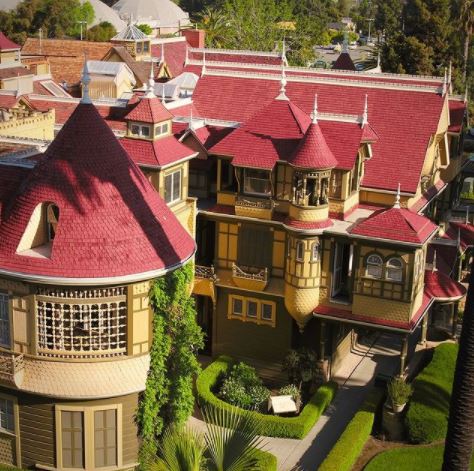
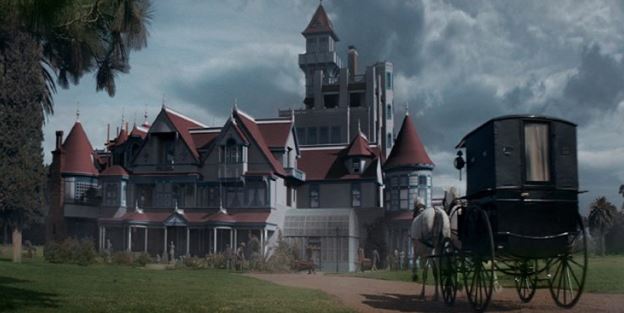
The Winchester Mystery House—in April of 1895, within a fortnight, two female servants gave notice to leave. The mansion was haunted by two animals—a large ape, and a huge black dog. One or the other of these creatures appeared in several of the rooms, and was constantly passing them in the passage and on the stairs; while the strange noises—which were heard elsewhere—alarmed them greatly. In an empty attic the most frightful sounds were heard, as of people being strangled; and sometimes noises and shouts, as of twenty or thirty persons being beaten severely, came from the courtyard. When they went to investigate the cause of such noises, nothing was seen, nothing was heard. The yard was then as still and silent as the grave, and no explanation of the mystery was forthcoming.

On several nights some of the villagers were induced to keep watch; but they would only do so with lights and lanterns, and in considerable company. On these occasions the noises then were only heard in the attics; but, about midnight, the apparitions of the ape and the black dog appeared in the courtyard and were seen by five persons at once. They seemed to come up through a closed grating from the basement, and they rush out into the darkness beyond the gates of the enclosure. At least a dozen times these apparitions were seen by servants and farmers.
For further information about tours, including group tours, weddings, school events, birthday party packages, facility rentals, and special events please visit the website: https://winchestermysteryhouse.com/
Please visit the online giftshop, and purchase a gift for friends and relatives as well as a special memento of The Winchester Mystery House. A variety of souvenirs and gifts are available to purchase. https://shopwinchestermysteryhouse.com/




 Randolph Harris II International Institute