

Oliver Fisher Winchester was an entrepreneur who made a fortune in the shirt manufacturing business during the 1830s and 1840s. He took over a bankrupt arms manufacturing company in New Haven, Connecticut in 1857, which eventually became the Winchester Repeating Arms Company. All this time a growing feeling of discomfort had been creeping over him—nervous reaction, perhaps, after the delight of discovery. After he passed in 1880, his son William Wirt Winchester became the second President of the Winchester Repeating Arms Company. However, this accomplishment was shortly enjoyed. William Winchester died in 1881, leaving his fortune and most of the company to me, his wife, Sarah L. Winchester. It was, as far as I can ascertain, March 7, 1881 that I drew open the door of Winchester Hall, in the heart of New Haven, Connecticut. Only to find my husband had died in his sleep. Terribly distraught, I laid beside him. That evening, light shone on the building, making the window-panes glow like so many fires. The clock in the church-tower, buried in tress of the edge of the park, only its golden weathercock catching the light, was striking six, and the sound came gently beating down the wind. It was altogether a pleasant impression, though tinged with the sort of melancholy appropriate to an evening like this. Several years later, I relocated to Santa Clara, California and started on the construction of Llanda villa. It presents a somewhat forbidding aspect to the World, for the rumours of the curse, do not suggest gaiety or warmth or any of those qualities put into its construction. Rather, these stories make this vast edifice of stone exude an austerity, cold and repellant, a hint of ancient mysteries, medieval darkness and hauntings. #RandolphHarris 1 of 7

There were plenty things about the mansion and the gardens which Daisy, my niece, who was of an adventurous and inquiring turn, was anxious to have explained to her. “Why did you build the nine story Observational Tower? Who was the old man lurking on the staircase to the ceiling, sitting at a table, with a skull under his hand?” These and many similar points were cleared up by the resources of my powerful intellect. There were others, however, of which the explanations furnished were less satisfactory. One November evening Diasy was sitting by the fire in the housekeeper’s room reflecting on her surroundings. “Did uncle William go to Heaven?” she suddenly asked, with the peculiar confidence which youth possess in the ability of their elders to settle these questions, the decision of which is believed to be reserved for other tribunals. “Good?—bless the child,” said the maid, Denise Kurlander. “Master was as kind a soul as ever I saw.” Didn’t I never tell you of the he took in out of the street, as you may say, this nine years back? and the little girl, three years after I first started working for your family? “No. Do tell me about them,” Mrs. Kurlander—now this minute!” “Well,” said Mrs. Kurlander, “the little girl I don’t seem to recollect so much about. I know master bought her back with him from his walk one day, give orders to Mrs. Heidelberg, as was housekeeper then, as she should be took every care with. And the pre child hadn’t no one belonging to her—she telled me her own self—and here she lived with us a matter of three weeks it might be; and then, one morning she out of her bed afore any of us had opened, a eye, and neither track nor yet trace of her have I set eyes on since. #RandolphHarris 2 of 7

“Master was wonderful put about, and had all the ponds dragged; but it’s my belief she had away by them witches, for there was singing round the house for as much as an hour the night she went, and Turkheim, he declare as he heard them a-calling in the woods all that afternoon. Dear, dear ! a hodd child she was, so silent in her ways and all, but I was wonderful taken with her, so domesticated she was—surprising. “And what about the little boy?” said Diasy. “Ah, that pore boy!” sighed Mrs. Kurlander. “He were a foreigner—Eduard he called hisself—and he came a tweaking his ‘urdy-gurdy round and about the drive one winter day, and master ‘ad him in that minute, and ast all about where he came from, and how old he was, and how he made his way, and where was his relatives, and all as kind as heart could wish. But it went the same with him. They’re a hunruly lot, them foreign nations, I do suppose, and he was off one fine morning just the same as the girl. Why he went an what he done was our question for as much as a year after; for he never took his ‘urdy-gurdy, and there it lay on the self.” The remainder of the evening was spent by Daisy in miscellaneous cross-examination of Mrs. Kurlander and in efforts to extract a tune from the hurdy-gurdy. That night she had a curious dream. At the end of the passage of the house, in which her bedroom was situated, there was an old disused bathroom. It was kept locked, but the upper half of the door was glazed, and, since the muslin curtains which used to hand there had long been gone, you could look in and see the lead-lined bath affixed to the wall on the right hand, with its head towards the window. #RandolphHarris 3 of 7

On the night of which I am speaking, Diasy found herself, as he thought, looking through the glazed door. The moon was shining through the window, and she was gazing at a figure which lay in the bath. She described a horrid figured, inexpressibly thin and pathetic, of a dusty leaden colour, enveloped in a shroud-like garment, thin lips crooked into a faint and dreadful smile, the hands pressed tightly over the region of his heart. As she looked upon it, a distant, almost inaudible moan seemed to issues from its lips, and the arms began to stir. The terror of the sight forced Daisy backwards, and she awoke to the fact that she was indeed standing on the cold boarded floor of the passage in the full light of the moon. With a courage which I do not think can be common among a young lady her age, she went to the door of the bathroom to ascertain if the figure of her dream were really there. It was not, and she went back to bed. Mrs. Kurlander was much impressed next morning by her story, and went so far as to replace the muslin curtain over the glazed door of the bathroom. That evening, when I came up here to my room after dinner, I just sat in front of the long glass and stared and stared. I must have done it for half an hour or perhaps an hour. I only roe to my feet when it had become quite dark outside. I decided it was time to move to another bedroom. The Crystal Bedroom was much too big and there were only two wooden chairs, painted in greeny-blue with gold lines, or once painted like that. I hate to having to lie on my bed when I should prefer to it and everyone knows how bad it is or the back. Besides, this bed, though it’s enormous, seems to be as hard as when the Earth’s dried up in summer. Not that the Earth’s like that here. Far from it. #RandolphHarris 4 of 7

The rain has never stopped since I left New Haven. Never once. This bed is really huge. It would take at least eight people my size. I do not like to think about it. I have just remembered: it is the third of the month so that I have been gone exactly a year. What a lot of places I have been to in that time—or been through! Already I have quite forgotten some of them. I never properly saw them in any case. Llanada Villa is a huge palace—castle—fortress that simply frightens me some times. The housemaid provided me with no fewer than thirteen candles. I found them in one of the drawers. I suppose there is nothing else to do but read—except perhaps to say one’s prayers. Unfortunately, I finished all the book I brought with me long ago, and it is so difficult to buy any news ones. Daisy would do well to take care of herself, and shut her bedroom windows at night. Two incidents occurred recently that made an impression upon her mind. The first was after an unusually uneasy and oppressed night that she had passed—though she could not recall any particular dream that she had had. The following evening Mrs. Kurlander was occupying herself in mending her nightgown. “Gracious Me, Ms. Daisy!” she broke forth rather irritably, “how did you manage to tear your nightdress all to flinders this way? Look here, Ms. Daisy, what trouble you do give to poor servants that have to darn and mend after you!” There was indeed a most destructive and apparently wanton series of slits or scorings in the garment, which would undoubtedly require a skillful needle to make good. They were confined to the left side of the chest—long, parallel slits, about six inches in length, some of them not quite piercing the texture of the linen. Daisy could only express her entire ignorance of their origin: she was sure they were not there the night before. #RandolphHarris 5 of 7

“But, she said, Mrs. Kurlander, they are just the same as the scratches on the outside of my bedroom door; and I am sure I never has anything to do with making them.” Mrs. Kurlander gazed at her open-mouthed, then snatched up a candle, departed hastily from the room, and was heard making her way upstairs. In a few minutes she came down. “Well,” she said, “Ms. Daisy, it’s a funny thing to me how them marks and scratched can ‘a’ come there—too high up for any car or dog to ‘ave made ‘em, much less a rat: for all the World like a vampire’s finger-nails, as my uncle archeology used to tell us of when we was young girls together. I wouldn’t say nothing to Mrs. Winchester, not if I was you, Ms. Daisy, my dear; and just turn the key to the door when you go to bed.” “I always do, Mrs. Kurlander, as soon as I have said my prayers.” “Ah, that’s a good child: always say your prayers, and then no one can’t hurt you.” Herewith Mrs. Kurlander addressed herself to mending the injured nightgown, with intervals of meditation, until bed-time. This was on Friday night in March, 1898. In a shrill chorus there seemed to lurk a note of tense and evil expectancy. Without warning came these deep, cracked, raucous vocal sounds which would never leave the memory. Not from any human throat were they born, for the organs of man can yield no such acoustic perversions. Rather would one have said they came from the mansion itself. It is almost erroneous to call them sounds at all, since so much of their ghastly, infra-bass timbre spoke to dim seats of consciousness and terror far subtler than the ear; yet one must do so, since their form was indisputably though vaguely that of half-articulate words. #RandolphHarris 6 of 7

They were loud—loud as the rumblings and thunder from the bowels of the mansion from which the echoed—yet did they come from no visible being. And because imagination might suggest a conjectural source in the World of non-visible beings, I winched as if in expectation of a blow. More hideous sounds came croaking out from the bowels of the mansion. The speaking impulse seemed to falter, as if some frightful psychic struggle were going on. There appeared three grotesquely silhouetted human figures in the Observational Tower, all moving their arms furiously in strange gestures as their incantation drew near its culmination. From the black pits of Hell, Acherontic fear or feeling, from the unplumbed gulfs of the mansion’s consciousness or obscure, long-latent heredity, were those half-articulate thunder-croakings drawn? Presently they began to gather renewed force and coherence as they grew in stark, utter, ultimate frenzy. Indisputably English syllables poured thickly and thunderously from the basement. I jumped violently at the deafening, cataclysmic peal whose source, be inner Earth. A single lightning-bolt shot from the sky. Outside, trees, grass, and underbrush were whipped into a fury and the frightened servants in the mansion, were weakened by the lethal foetor that seemed about to asphyxiate them, as they were hurled off their feet. Wolves howled from the distance hills, green grass and foliage wilted to curious, sickly yellow-gray, and over field forest were scattered the bodies of the dead. Slowly the beams of a sunlight shone more brilliant and untainted. My estate was grave and quiet, and seemed shaken by memories and reflection even more terrible than those which had reduced the groups of Indians to a state of quivering. #RandolphHarris 7 of 7


After the death of Mrs. Winchester, the items in her home were auction off in San Francisco, California. However, the queer atmosphere which clings to all in The Winchester Mansion were responsible for the wide-spread story that in opening the mansion of Sarah L. Winchester, and selling all of her possessions, people exposed themselves to the fury of some malignant influence. Recirculating rumours about fears of a curse under sent collectors in a panic. All over the country, people were sending their treasures to museums, anxious to get rid of them because of the superstition that Mrs. Winchester was killed by vengeful spirits. E.E. Evans-Pritchard argued that “cruses are capable of proving effective even after the lapse of thousands of years.” Rumours of The Curse of the Winchester Fortune were always cited. It was said that on the day Pastor Kunst laid bared the entrance to The Winchester Mansion, his pet dog had been devoured by a cobra. Julius Streicher, closely involved with the auction of items from The Winchester Mansion, recalled that “News of this spread quickly and all the natives now said, ‘Alas, that was Oliver Winchester’s cobra, revenging itself on the dog for having betrayed the place of the Winchester Repeating Arms.’” It was said that a solid gold tablet had been discovered in the mansion with the inscription “Death shall come on swift wings to whoever toucheth the home of The Winchester’s.” Mr. Streicher allegedly destroyed the tablet to prevent the superstitious fellaheen from abandoning the auction and so, one believer in the curse states, it was “wiped from the written record of the mansion’s history.”
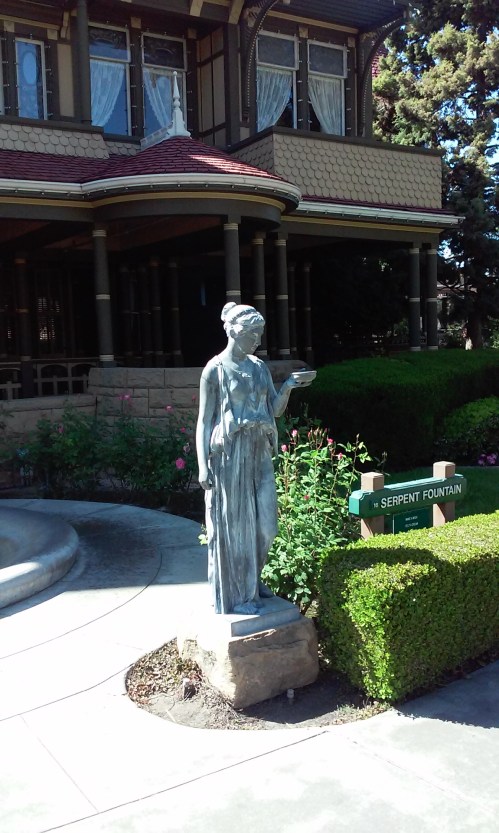
Heinz Bongartz, however, remembers on his visit to the mansion that “Death the who enter” was an “inscription over the door.” It was said that when Gustav Jungbauer opened Mrs. Winchester’s main safe, they found a fortune in diamonds, gold, silver, and other precious stones, and he was bitten by a mosquito, and died shortly afterwards. Soon enough people, anyone who was loosely connected to the sale of the estate and auction of Mrs. Winchester’s goods died, their deaths were folded into the dreamlike elaboration of the curse rumour. The conservators of the estate then decided it would be best to keep the mansion from being further disturbed, and opened it as a tourist attraction to help with the repairs and maintenance of the estate. In May of 1923, Mr. Streicher’s half-brother Peter Geschiere warned that “seeds of destruction are hidden inside,” before he died after a long illness. Close attention was paid to any association with the sale of the estate and items from it. In November of 1929, Tore Olsson, who helped organize the auction, died suddenly in his sleep and is believed to have been troubled by the legendary curse which is said to be associated with those who looted The Winchester Mansion. Victor Petrov, who was also involved, was found dead at his London club in ambiguous circumstances.
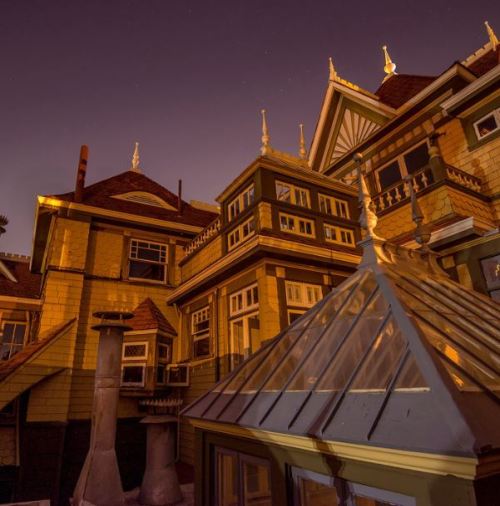
Three months later, Mr. Petrov’s father incoherent suicide note included the line: “I really can’t stand any more horrors.” Luke Eggers, a caretaker of The Winchester Mansion, claimed that Pastor Kunst was eventually murdered by shadowy authorities for knowing too much about the truth behind The Winchester Family. This includes the claim that Pastor Kunst’s first operation—supposedly for cancer—in 1923 was a deception and the first attempt in a conspiracy to kill him. Other enthusiasts have continued to track The Curse of the Winchester Fortune into the present day. By 1980, Arthur Jores, German physician, counted one hundred and thirteen victims. Johann Kruse has suggested that the death of Ernst Haeckel, Director of Antiquities, in a car accident in 1976, followed his denunciation of curse stories. When treasures from Mrs. Winchester’s estate were displayed in a New York Museum in 1925, rumours circulated that the crew that transported the items from Santa Clara, California were also subject to misfortune. In 2001, Bedfordshire on Sunday carried a headline “Is Boy, 2, latest Winchester Victim?”, regarding a story about his home in Sacramento, California; “a luxury villa said to be jinxed by the Cruse of the Winchester Fortune.” Such stories have been partly fostered by allegedly authoritive sources. There is a weird fusion of history, myth, and occultism surrounding The Winchester fortune and bloodline. Might the dead return or punish the living for shortcomings of their ritual propitiations? Superstitions proliferate where such borders are breached. I pledge allegiance to the flag of the United States of America, and to the Republic, for witches stand, One Nation, Under God, Indivisible, for Liberty and Justice for all.

For further information about tours, including group tours, weddings, school events, birthday party packages, facility rentals, and special events please visit the website: https://winchestermysteryhouse.com/

Please visit the online giftshop, and purchase a gift for friends and relatives as well as a special memento of The Winchester Mystery House. A variety of souvenirs and gifts are available to purchase. https://shopwinchestermysteryhouse.com/




 Randolph Harris II International Institute