

The bizarre 20s initiated a wave of political and governmental change of historic proportions: the gender and sexuality crisis, the replacement of President Trump, the virtual elimination of the Republican party, the collapse of law and order in California (and the rise of lawlessness and anti-Christian sentiment and general anarchy). Again and again there are startling changes under way in politics and government. Politicians, columnists, the people, and academics all seem confused by the scale of change. There is an inevitable focus on the pain of those who have been dominant and the disorientation of those who have been powerful. The agony of the present is outweighing the promise of the future. When we look at this phenomenon, what seems to some a brilliant, exciting period of innovation is actually a terrifying collapse of the existing order. We have seen a terrifying decline of order and stability rather than the precursor of a new, more productive and more open future. This acceleration of change is threatening to overwhelm people everywhere and the way in which it often disorients individuals, businesses, communities and governments. There is no language to communicate the problems we face, no vision to outline the future towards which we should strive, and no program to help accelerate and make easier the rebirth of sanity, law, order, and God. The reality is that transformation is going on everyday in the private sector among entrepreneurs and with citizens who are inventing new things and creating new solutions because bureaucracy does not stop them. #RandolphHarris 1 of 20

A new civilization is emerging in our lives, and blind men everywhere are trying to suppress it. This new civilization brings with it new family styles, changed ways of working, loving, and living, a new economy, new political conflicts, and beyond all this an altered consciousness as well. Humanity faces a quantum leap forward. It faces the deepest social upheaval and creative restructuring of all time. Without clearly recognizing it, we are engaged in building a remarkable new civilization from the ground up. This is the meaning of the Third Wave. Until now the human race has undergone two great waves of change, each one largely obliterating earlier cultures or civilization and replacing them with ways of life inconceivable to those who came before. The First Wave of change—the agricultural revolution—took thousands of years to play itself out. The Second Wave—the rise of industrial civilization—took a mere three hundred years. Today history is even more accelerative, and it is likely that the Third Wave will sweep across history and complete itself in a few decades. Those of us who happen to share the planet at this explosive moment will therefore feel the full impact of the Third Wave in our lifetimes. The Third Wave brings with it a genuinely new way of life based on diversified, renewable energy sources; on methods of production that make most factory assembly lines obsolete; on new, non-nuclear families; on a novel institution that might be called the “electronic cottage;” and on radically changed schools and corporations of the future. #RandolphHarris 2 of 20

The emergent civilization writes a new code of behavior for us and carries us beyond standardization, synchronization and centralization, beyond the concentration of energy, money and power. This new civilization has its own distinctive World outlook; its own ways of dealing with time, space, logic, and causality. And, its own principles for the politics of the future. Most people, to the extent that they bother to think about the future at all, assume the World they know will last indefinitely. They find it difficult to imagine a truly different way of life for themselves, let alone a totally new civilization. Of course, they recognize that things are changing. However, they assume today’s changes will somehow pass them by and that nothing will shake the familiar economic framework and political structure. They confidently expect the future to continue as the present. Recent events have severely shaken this confident image of the future. A bleaker vision has become increasingly popular. Large numbers of people fed on a steady diet of bad news, disaster movies, and nightmare scenarios issues by prestigious think tanks have apparently concluded that today’s society cannot be projected into the future because there is no future. For them, Armageddon is only minutes away. The Earth is racing toward its final cataclysmic shudder. #RandolphHarris 3 of 20
Our argument is based on what we call the “revolutionary premise.” It assumes that, even though the decades immediately ahead are likely to be filled with upheavals, turbulence, perhaps even widespread violence, we will not totally destroy ourselves. It assumes that the jolting changes we are now experiencing are not chaotic or random but they, in fact, form a sharp, clearly discernible pattern. It assumes, moreover, that these changes are cumulative—that they add up to a giant transformation in the way we live, work, play and think, and that a sane and desirable future is possible. What follows begins with the premise that what is happening now is nothing less than a global revolution, a quantum leap. It flows from the assumption that we are the final generation of an old civilization and the first generation of a new one, that much of our personal confusion, anguish, and disorientation can be traced directly to the conflict within us and within our political institutions, between the dying Second Wave civilization and the emergent Third Wave civilization that is thundering in to take its place. When we finally understand this, many seemingly senseless events become suddenly comprehensible. Broad patterns of change begin to emerge clearly. Action for survival becomes possible and plausible again. The revolutionary premise liberates our intellect and will. One powerful new approach might be called social “wavefront” analysis. It looks at history as a succession of rolling waves of change and asks where the leading edge of each wave is carrying us. #RandolphHarris 4 of 20

It focuses our attention not so much on the continuities of history (important as they are) as on the discontinuities, on innovations and breakpoints. It identifies key change patterns as they emerge so that we can influence them. It begins with the very simple idea that the rise of agriculture was the first turning point in human social development and that the industrial revolution was the second great breakthrough. It views each of these not as a discrete, one-time event but as a wave of change moving at a certain velocity. Before the First Wave of change, most humans lived in small, often migratory groups and fed themselves by foraging, fishing, hunting or herding. At some point, roughly ten millennia ago, the agricultural revolution began and crept slowly across the planet spreading villages, settlements, cultivated land and a new way of life. The First Wave of change had not yet exhausted itself by the end of the seventeenth century when the industrial revolution broke over Europe and unleashed the second great wave of planetary change. This new process began moving much more rapidly across nations and continents. Thus, two separate and distinct change processes were rolling across the Earth simultaneously, but at different speeds. Today the First Wave has virtually subsided. Only a few tiny pre-agrarian populations in South America or Papua New Guinea, for example, remain to be reached by agriculture. The force of this great First Wave has basically been spent. #RandolphHarris 5 of 20

Meanwhile, the Second Wave, having revolutionized life in Europe, North America and some other parts of the globe in a few short centuries, continues to spread, as many countries—until now basically agricultural—scramble to build steel mills, automobile plants, textile factories, railroads and food-processing plants. The momentum of industrialization is still felt. This Second Wave has not entirely spent its force. However, even as this process continues, another, even more important, has begun. For as the tide of industrialism peaked in the decades after World War II, a little-understood Third Wave began to surge across the Earth, transforming everything it touched. Many countries, therefore, are feeling the simultaneous impact on two, even three, quite different waves of change, all moving at different rates of speed and with different degrees of force behind them. For our purposes we shall consider the First Wave era to have begun sometime around 8000 B.C. and to have dominated the Earth unchallenged until sometime around A.D. 1650-1750. From this moment on, the First Wave lost momentum as the Second Wave picked up steam. Industrial civilization, the product of this Second Wave, then dominated the planet in its turn until it, too, crested. This latest historical turning point arrived in the United States of America during the decade beginning about 1955—a decade that saw white-collar and service workers outnumber blue-collar workers for the first time. #RandolphHarris 6 of 20

This was the same decade that saw the widespread introduction of the computer, commercial jet travel, the birth-control pill and other high-impact innovations. It was precisely during this decade that the Third Wave began to gather its force in the United States of America. Since then it has arrived at slightly different dates in most of the other industrial nations. Today all high-technology nations are reeling from the collision between the Third Wave and the obsolete, encrusted economies and institutions of the Second. Understanding this is the secret to making sense of much of the political and social conflict we see around us. If America allowed state-private capitalism based on a mixture of forms of ownership, it would generate increasingly strong market incentives for companies of all forms of ownership and provide a highly competitive environment. At the same time, this would allow the government to intervene in the economy in order to support industries and companies on the one hand, and to contain the threats of excessive lending, high-risk financial transactions, and asset bubbles on the other. By and large, such intervention does not inhibit market mechanisms. This model of capitalism will help American retain place as the economic superpower. This would prevent American from experiencing negative annual growth and help prevent recession by preventing the burst of bubble assets. #RandolphHarris 7 of 20

A mixed form of capitalism will slowly but surely, gradually but steadily, tackle major social and economic problems: starting from the agricultural reform and overcoming food shortages, and then allow the government to develop various kinds of nonstate enterprises and increase the supply of consumer goods; this will make the economy more attractive to foreign investors and liberalize imports. Creating State Owned Enterprises (SOEs) will lessen the burden on taxpayers, and allow SOEs to operate in the competitive environment; recapitalizing banks and resolving the nonperforming loans issue; strengthening social safety nets; promoting the development of midwestern economies; and so on. This evolutionary process will address such key problems as stability of energy and natural resources supplies, energy efficiency, and environment protection. Knowing the size of the economy is the critical first step for enabling law enforcement, the judicial system, and policymakers to make informed choices about how to combat illegal economic activity, such as prostitution. It is estimated that the prostitution economy is valued at $16 billion in the United States of America, as of 2023, and 67 percent of transactions are done in cash. Both the prostitute-as-worker and prostitute-as-commodified-body identifications were made possible by the fusing together of the meanings for “men” and “money.” Men were constructed as both income (id est sources of money) and as income which could only be generated through exchanging sex for money. #RandolphHarris 8 of 20

The construction of men as sources of money was an understanding of particular men (id est johns) which was applied to all men. This most clearly seen in the women’s repeated claims that “all men are johns.” As Gail (aged 28) said: “To me, all men are [johns]. As far as I’m concerned I couldn’t do it if it wasn’t bought. And if it’s not needed then why are we able to sell it.” Dominant discourses of male sexuality as a difficult to control, physical impulse provided the requisite ideological conditions in which the meanings for men and money could be fused together. The women portrayed male sexuality as a biologically drive, aggressive need, as “instrumental” rather than “expressive” and therefore they were able to characterize johns as any (and all) “normal” men doing only what “comes naturally.” The john/prostitute relationship could, thus, be understood as though it was simply a routine economic exchange in which normal (id est ordinary, typical and not deviant) men buy “outlets” for their physical needs. Combined with this understanding of all men as johns was the women’s belief that men as a group have easier access to and more money than women. This belief was most clear in the respondents’ talk about men not having childcare problems and so having better access to legal and illegal ways of earning money. Thus, the interviewees’ identification as both workers and commodified-bodies was made possible by a recoding of the meaning of men and money whereby men came to represent income. #RandolphHarris 9 of 20

Within such a symbolic landscape, the women were able to construct their prostituting as though it was nothing to do with sex and just routine economic exchange (with themselves in control of and the beneficiaries of that exchange) and as though it had everything to do with sex (with their rentable female private parts the object of the exchange). And, contradictorily, the same symbolic World permitted the women to tell stories in which men as johns (id est purchasers) and as pimps (id est owners) take control of prostitutes’ commodified bodies. Hence, involvement in prostitution becomes a web of economic relationships over which the women believed they had control via ownership of their rentable bodies and absolutely no control or ownership as slaves to their pimps. The identification of prostitutes-as-business-women occurred in seventeen of the twenty-one narratives. This identification was comprised of an understanding of prostitutes ad being rational economic agents involved in weighing up the costs and benefits of particular courses of action, wherein individual women appraised themselves of, and in relation to, the respective financial and social costs accruing from being involved with men. This is an identification that is distinguished from the prostitute-as-worker identification from within the business women identification the women talked about themselves as “smart.” #RandolphHarris 10 of 20

“Stick-up men” who deployed both rules and business metaphors when discussing the “business” of robbery, the women in this study positioned themselves as “smart women” working “the right way.” Such talk differed according to whether or not the women were being pimped at the time the interviews took place. For the women who were not being pimped, being a business woman an working the “right way” meant maximizing income whilst reducing the possibility of exploitation. There were two fundamental rules: business women should not have any personal or intimate relationships with men; and, business women should not be naïve about men. The women could demonstrate their business-like status by showing their willingness to accept these rules. “I reckon if you work, you gotta stop being naïve. You have to see men for what they are. [Do you mean johns?] No, I mean men. You have to be professional about how you see all men. They’ll live off you if they can.” (Olivia, aged 28.) In contrast, the women who were being pimped at the time of the interviews talked about a different rule. They said that working the right way meant minimizing the risk of violence that is associated with street work. The primary strategy used was to get a pimp. Hence, Anna (age 36) made the following remarks: “The street’s a dangerous place. If you’re gonna be smart you have to have a man to protect ya and make sure no one kidnaps you or drives off with you. So what if you have to give him some money.” (Anna, aged 36.) #RandolphHarris 11 of 20

For these women, the pimp’s dress and outward appearance were used to demonstrate their own business success: “You want your [pimp] to look good, man. You want them to dress good, get nice cars and wicked gold. You give them your money so they can look good. I look at it as good advertising, you know? If I were some stupid crackhead or something, I couldn’t be earning the money I earn to make my man look good.” (Katrina, aged 20.) In contrast, in nine of the twenty-one women’s narratives was an identification of prostitutes-as-loving-partners making choices and taking courses of action based on the love they felt for the men they were involved with, rather than rules for business success. This identification was constructed in relation to the specific relationships the respondents had with men who financially exploited them (rather than within generalized notions of particular categories of men—id est “pimp,” “partner,” et cetera). The women talked about themselves as willing to sacrifice their earnings, their safety and their security for their partners. The women were symbolically transforming their relationships with (often violent and) exploitative men from “business” relationship, or even abusive relationships, into intimate, loving, romantic and above all else non-prostitution related relationships. Andrea’s remarks below demonstrate the manner in which she erased the possibility of the violent relationship she experienced as being a relationship which was specific to her involvement in prostitution: “I don’t suppose he really was a [pimp]….I think he’s the only person I ever really loved. Even now I sometimes get upset over it, coz I did love him. I was willing to give him everything I’d got—body, soul EVERYTHING.” (Andrea, aged 27.) #RandolphHarris 12 of 20

The prostitute-as-loving-partner identification was also made possible by the way in which the women drew on dominant notions of how romantic love is experienced by women as being sublimation of their desires and a centralizing of their partner’s desires. “To tell you the truth, I was that besotted [id est in loved] with him that I’d give him everything. I’d give him the f*cking World. I’d give him all my money and he’d beat me up. But I carried on giving him my money. You do, don’t you when you love some one?” (Ruthie, age 25.) God has commanded that the sacred power be expressed only between a man ana women who are legally married. Virtue brings peace, strength of character, and happiness in this life. Our Heavenly Father knew that we would be faced with many choices and challenges, and virtuous living would prepare us to succeed. For many of you, the day you were blessed was a first step on your journey of a virtuous life. Youth is a defining time in which you can develop patterns of virtue that will help you take necessary steps toward eternal life. To navigate through difficult times, we need the iron rod, which represents that word of God. We must study and understand the truths and commandments found in scriptures. We must listen carefully to the words of our latter-day prophets, whose teachings will give us guidance, direction, and protection. And we must hold to the standards found in the Holy Bible. One way we can withstand the pressures of the World is “stand in holy places, and be not moved,” reports Doctrines and Covenants 87.8. #RandolphHarris 13 of 20

For the person becomes passive in volition and mind, one is held by deceiving offenders and no longer has the power to act, or is driven into psychopathological activity—uncontrollable activity of thought, restlessness of body, and wild, unbalanced action of all degrees. The actions are spasmodic and intermittent, the person sometimes dashing ahead and at other times being sluggish and slow—like a machine in a factory with the wheels whirring aimlessly, because the switch at the control center is out of the hand of the master. The human cannot work, even when one sees so much to be done, and is feverish because one cannot do it. During the time of passivity one appeared to be content, but when one is driven into psychopathological activity, one is restless and out of accord with all things around one. Though one’s environment should lead one to a state of full contentment, yet something (may it not be “somebody”?) makes it impossible for one to be in harmony with one’s external circumstances, however pleasant they may be. One is conscious of a restlessness and activity which is painfully feverish; or else of passivity and weight, of a doing of “work” and yet no work. All these are manifestations of a psychopathic destruction of one’s peace. Theonomy is a logically smooth juncture of our concepts of culture and ultimate concern. Culture is form, and for content it must look elsewhere—in its depths. However, at the depts one discovers ultimate concern, the power and meaning which breathes a soul into the otherwise dead body of culture. #RandolphHarris 14 of 20

In theonomy the body is vigorous and bursting with the energy of a truly ultimate concern. Religion and culture are theonomously one. Culture and its nation, function, elements, styles, types, and ambiguities are of value and interest for philosophers, historians, sociologists, anthropologists, and also of pressing importance for theologians, since the notion of theonomous culture propels Christianity into the midst of the World. Theonomy demands that religion permeates the whole of society, even its hitherto considered profane areas. Without a close bond between religion and culture, theology is left with little to say to modern humans in the majority of one’s consuming activities. Humans today are not prepared to renounce the creations of literature, art, politics, science, and technology as stumbling blocks to the holy. On the contrary, if his attitude is at all religious, he tends to view them as steppingstones which lead to a fuller and profounder experience of the divine. The vision of culture in which ultimate concern informs the whole web of life and thought and for which the ultimate unity is an ever-present horizon, make religion relevant to culture in a profound way. The Church has been powerfully called back out of its self-chosen ghetto, out of its disregard for culture, to do its task for the World. #RandolphHarris 15 of 20

We have tried to show their one theonomous root and the void which necessarily has followed their separation, and perhaps something of the longing of our time for a new theonomy, for an ultimate concern in all our concerns. Since one of the depths of culture is fathomed, they are no longer deep, and the profundity of the secular maybe merely a nicer term for what in reality may be the scaling-down of the holy to the secular level. In this case, the divine transcendence is forfeited, and Christ does not break into history, but rather emerges from it as a kind of ideal. However, there is a danger of becoming exclusively secular. On the other hand, one might conclude that theonomy results in a total “sacralization” of the World which entails the disappearance of the profane, for the more deeply one probes into the secular heart, and even the atheistic heart, the more one perceives there the throb of an ultimate concern, the life-force of faith. In this case the transparency of the secular to the holy reduces the former to the status of a ghost. And if the secular disappears, does not the divine breakthrough lose its dramatic, unlooked-for, grace-full quality? If everything is holy, there is nothing to be broken through. Moreover, salvation is assured, and the preaching of Christ’s crucifixion and resurrection is no longer an urgent mission. Leaving the categories of secularization and sacralization, one finds the same ambiguity in theonomy in regard to the church. In one sense theonomy renders the church unnecessary, even dangerous, for the Spiritual Presence is active everywhere with no need for ecclesiastical channels, and the history of the church discloses the menace of heteronomy which lurks in it. #RandolphHarris 16 of 20

However, in another sense the church is inevitable, for the presence of the Spirit draws men together into a holy community where their ultimate concern drives through to the expression in symbols and cult. Considering theonomy in yet another context, one might claim that it does not correspond to the hard facts of the human existential situation, that a theonomous union of religion and culture has never existed, or, if it did, it was quickly eroded by man’s proclivity to sin. In a word, history dines theonomy. And yet, eschatology demands it. For theonomy echoes the yearning cry of the human soul to find God in all things; it corresponds, not perhaps to man’s achievement, but to his deepest religious instinct, to his most ardent hope. These alternative interpretations of theonomy indicate that even a prolonged study of its structure—religion is the substance of culture, and culture is the form of religion. One must delve into its theological content, specifically the notion of God, the meaning of Jesus Christ, the nature of the church, and the question of history and eschatology. A rather useful neologism has recently been added to economics. It is reprivatization. If the operation of the post office were detached from government control and put into the hands of the Railway Express Company, this would be an example of reprivatiztion. In contesting the notion of an inevitable drift to socialism, without gainsaying the desirability under some conditions of certain kinds of public enterprise, some writers seek to find a balance between private and public, appropriate to the situation faced. #RandolphHarris 17 of 20

From time to time this could require reprivatization, as it might nationalization at other times. This concept is directly applicable to the division of function and responsibility between private and public family agencies. And the insight it affords into the value problem entailed helps to illuminate the question of the transfer of functions, back and forth, between the family and the other institutions of the community. While transfer of some duty from a private family agency to a public body calls for a formal group decision, the shift of family responsibilities to private agencies and institutions is more often the result of thousands of unco-ordinated individua decisions. Nevertheless, either type of decision is tentative, conditional, reversible. Of course the effect of a given instance of reprivatization may be costly, but that has to be calculated against other costs, before a balance can be struck which will indicate the proper course of action. Suppose it were proven that an exceedingly valuable part of the development of a child was furthered by his participating in some form of work. Although the goods produced might in dollar-and-cent terms cost his parents more than if they went to the store and bough them, the net result might nonetheless be far more worth while; the same maybe true of adult do-it-yourself. #RandolphHarris 18 of 20

This example, of course, immediately suggest that the values which must be balanced in the management of a family are not reducible to dollars and cents. An economist may count the cost of developing the competence of a child, but a parent is hard put when one has to calculate its value, as against competing values. Who has yet plumped the mysterious calculus of human motivation which operates when parents must decide whether they can “afford” another child? At least in parenthood one thing is certain—the decline in standard of living which will result from having an extra mouth to feed. However, it must be left to social psychologists not yet with us to discern what goes on it courtship, when the man become sure that she is the maid to ask, and he, the man for her to accept. Despite the efforts of certain thinkers to impute to this tangled welter of subjective transactions some homogeneous, metaphysical medium of exchange analogous to money—libido, tension, energy, utility—the values which direct people’s actions remain incommensurable. No “classical economics of the psyche” has survived its author. And for that matter, has anything conclusive been recorded by economists about the process of value formation? For the present, the best we can do is to confine ourselves to a qualitative, and perhaps genetic account of values, and take for granted the fact that through, as yet little understood, and not conspicuously rational processes of thought and discussion, people balance and conciliate the seemingly incommensurable, and thus direct their own actions. #RandolphHarris 19 of 20

In tracing the evolution of the many kinds of family agencies from philanthropy through therapy to organized self-help, this balance of values among the parties concerned will be kept in the foreground as our principal mode of explanation. In this review, we shall follow a six-category classification of family agencies which is more or less cognate with the previous categories of conditions affecting the development of competence: medical agencies, economic agencies, protective agencies, counseling agencies, educational agencies, recreational agencies. Each class of agencies is thus presumed to be mainly engaged in affecting respective categories, but it should be evident that it affects other categories as well, and thus has some effect on all components of competence. What is the effect of alienation on mental health? The answer depends of course on what is meant by health; if it means that humans can fulfill their social function, carry on with production, and reproduce themselves, alienated humans can quite obviously be healthy. After all, we have created the most powerful production machine, accessible to the grasp of the madman. If we look into the current psychiatric definition of mental health, then one should think too that we are healthy. Quite naturally the concepts of health and illness are the products of those people who formulate them—hence of the culture in which these people live. Alienated psychiatrists will define mental health in terms of alienated personality, and therefore consider healthy what might be considered sick from the standpoint of normative humanism. #RandolphHarris 20 of 20

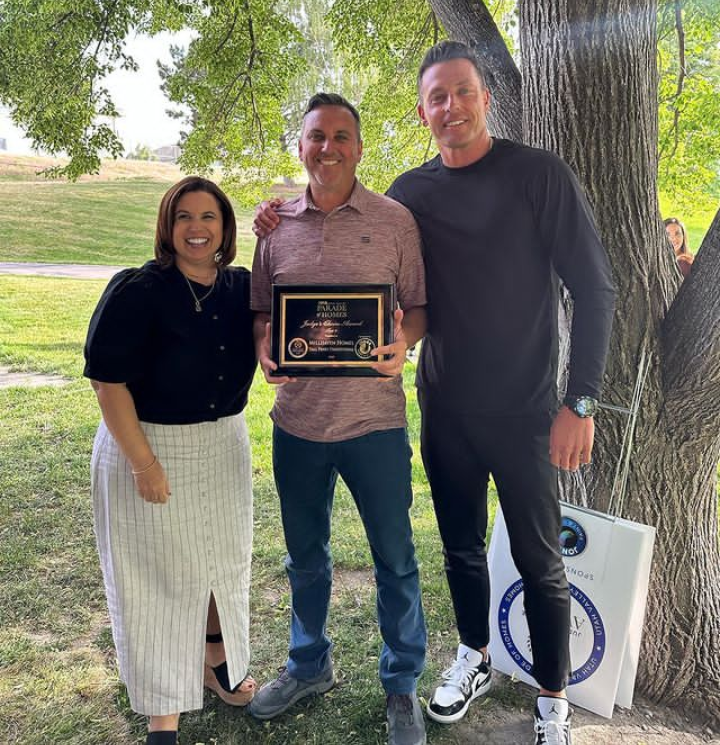
Going Beyond the Build means exceeding client expectations. Our team of professionals specialize in every aspect of a Design + Build experience.

The Millhaven Difference
- Unique approach, end to end services in-house
- Transparency, organization and communication
- Live and accurate budget monitoring, no financial surprises
- High standards of quality & proven trade partners
- Clearly defined systems of execution and expectations
- 8 person team of professionals assigned to each project
- Customized software for total project management
- Going BEYOND the BUILD in every way




 Randolph Harris II International Institute