

It is difficult to form a correct estimate of the significance of contemporary events, and the danger that our judgment will remain caught in subjectivity is great. Among gang rapists, most of whom were in their late teens or early twenties when convicted, rape represented recreation and adventure, another form of delinquent activity. Part of rape’s appeal was the sense of male camaraderie engendered by participating collectively in a dangerous activity. To prove one’s self capable of “performing” under these circumstances was a substantial challenge and also a source of reward. One gang rapist articulated this feeling very clearly. “We felt powerful, we were in control. I wanted sex and there was peer pressure. She wasn’t like a person, no personality, just domination on my part. Just to show I could do it—you know, macho.” Our research revealed several forms of gang rape. A common pattern was hitchlike-abduction rape. In these cases, the gang, cruising an area, “Looking for girls,” picked up a female hitchhiker for the purpose of having sex. Though the intent was rape, a number of men did not view it as such because they were convinced that women hitchedhiked primarily to signal sexual availability and only secondarily as a form of transportation. In these cases, the unsuspecting victim was driven to a deserted area, raped, and in the majority of cases physically injured. Sometime, the victim was not hitchhiking; she was abducted at knife or gun point from the street usually at night. Some of these men did not view his type of attack as rape either because they believed a woman walking alone at night to be a prostitute. In addition, they were often convinced “she enjoyed it.” #RandolphHarris 1 of 22

“Gang date” rape was another popular variation. In this pattern, one member of the gang would make a date with the victim. Then, without her knowledge or consent, she would be drive to a predetermined location and forcibly raped by each member of the group. One young man revealed this practice was so much a part of his group’s recreational routine, they had rented a house for the purpose. From hi perspective, the rape was seen by the deviant group as justified because “usually the girl had a bad reputation, or we knew it was what he liked.” Solitary rapist also used terms like “exciting,” “a challenge,” “an adventure,” to describe their feelings about rape. Like the gang rapists, these men found the element of danger made rape all the more exciting for them. Typifying this attitude was one man who described his rape as intentional. He reported: “It was exciting to get away with it (rape), just being able to beat the system, not women. It was like doing something illegal and getting away with it.” Another rapist confided that for him “rape was just more exciting and compelling” than a normal sexual encounter because it involved forcing a stranger. A multiple rapist asserted, “it was the excitement and fear and the drama that made rape a big kick.” At the time of their interviews, many of the rapists expressed regret for their crimes and had empirically low self-esteem ratings. The experience of being convicted, sentenced, and incarcerated for rape undoubtedly produced many, if not most, of these feelings. What is clear is that, in contrast to the well-documented severity of the immediate impact, and in some cases, the long-term trauma experience by the victims of sexual violence, the immediate emotional impact on the rapist is slight. #RandolphHarris 2 of 22

When the men were asked to recall their feelings immediately following the rape, only eight percent indicted that guilt or feeling bas was part of their emotional response. The majority said they felt good, relieved or simply nothing at all. Some indicated they had been afraid of being caught or felt sorry for the victim. Feeling good or nothing at all about raping women is not an aberration limited to some men in prison. In our study we found undetected rapist—rapists outside of prison—found that raping women had no impact on their lives nor did it have a negative effect on their self-image. Significantly a number of men volunteered the information that raping had a positive impact on their feeling. For some the satisfaction was in revenge. For example, the man who had raped and murdered five women: “It seems like so much bitterness and tension had built up and this released it. I felt like I had just climbed a mountain and now I could look back.” Another offender characterized rapes as habit forming: “Rape is like smoking. You can’t stop once you start.” Finally one man expressed the sentiments of man rapists when he stated, “After rape, I always felt like I had just conquered something, like I had just ridden the bull at Gilley’s.” So far, we have explored rape from the perspective of a group of convicted, incarcerated rapist to discover how these men viewed sexual violence and what they gained from their behavior. We found that rape was frequently a means of revenge and punishment. Implicit in revenge-rapes was the notion that women were collectively liable for the rapists’ problems. #RandolphHarris 3 of 22

In some cases, victims were substitutes for significant women who the men desire to take revenge on. In other cases, victims were thought to represent all women, and rape was used to punish, humiliate, and “put them in their place.” In both cases women were seen as a class, a category, not as individuals. For some men, rape was almost an after-thought, a bonus added to burglary or robbery. Other men gained access to sexually unavailable or unwilling women through rape. For this group of men, rape was a fantasy come true, a particularly exciting form of impersonal sex which enabled them to dominate and control women, by exercising a singularly male form of power. These rapists talked of the pleasures of raping—how for them it was a challenge, an adventure, a dangerous and “ultimate” experience. Rape made them feel good and, in some cases, even elevated their self-image. The pleasure these men derived from raping reveals the extreme to which they objectified women. Women were seen as sexual commodities to be used or conquered rather than as human beings with right and feelings. One young man expressed the extreme of the contemptful example of women when he confided to the female researcher. “Rape is a man’s right. If a woman doesn’t want to give it, the man should take it. Women have no right to say no. Women are made to have sex. It’s all they are good for. Some women would rather take a beating, but they always give in; it’s what they are for.” #RandolphHarris 4 of 22

This man murdered his victim because she would not “give in.” Undoubtedly, some rapes, like some of all crimes, are idiopathic. However, it is not necessary to resort to pathological motives to account for all rape or other acts of sexual violence. Indeed, we find that men who rape have something to teach us about the cultural roots of sexual aggression. They force us to acknowledge that rape is more than an idiosyncratic act committed by a few “sick” men. Rather, rape can be viewed as the end point in a continuum of sexually aggressive behaviors that reward men and victimize women. In the way that the motives for committing any criminal act can be rationally determined, reasons for rape can also be determined. Our data demonstrate that some men rape because they have learned that in this culture sexual violence is rewarding. Significantly, the overwhelming majority of these rapists indicated they never thought they would go to prison for what they did. Some did not fer imprisonment because they did not define their behavior as rape. Others knew that women frequently do not report rape and of those cases that are reported, conviction rates are low, and therefore they felt secure. These men perceived rape as a rewarding, low risk act. Understanding that otherwise normal men can and do rape is critical to the development of strategies for prevention. #RandolphHarris 5 of 22

The ”teachings” of deceiving spirits now being promulgated by them are too many in number to enumerate in a small compass. They are generally recognized only in “false religions,” but the teaching spirits with their “doctrines” or religious ideas suggested to the minds of men are ceaselessly at work in every clime, seeking to play upon the religious instinct in men and give a substitute for truth. Therefore, truth alone dispels the deceptive doctrines of the teaching spirits of Satan—the truth of God, not merely “views of truth”: truth concerning all the principles and laws of the God of Truth. “Doctrines of demons” simply consist of that which a man “thinks” and “believes” as the outcome of suggestions made to his mind by deceiving spirits. All “thought” and “belief” belongs to one of two realms: the realm of truth, or the realm of falsehood—each having its source in God or Satan. All truth comes from God, and all that is contrary to truth is from Satan. Even the “thoughts” that apparently originate in a man’s own mind come from one of these two sources, for the mind itself is either darkened by Satan (2 Cor. 4.4) and therefore fertile soil for his “teachings,” or is renewed by God (Eph. 4.23) and hence clarified from the veil of Satan and made open to the reception and transmission of truth. In many cases, our greatest loneliness comes not from other, it comes from within—a cry from the deepest part of an individual, and it cries up the loudest that one moment you ceased to listen to it. It hurts so to be apart from others, lovely because they hear you not. However, what can ever come close to the pain, the brokenness inside one that was created when one who once listened…once heard…once understood, chose not to hear—and stopped listening? #RandolphHarris 6 of 22

Try to remember and keep in your mind constantly all the lines on which you have to work. You have to work on mind, on consciousness, on emotions and on will. Try to understand that each line of work needs special attention, special methods and special understanding. After some time all four will begin to help one another and later they will merge into one, but in the beginning the four lines must go separately. Try to understand the work on mind. To do this work you must constantly revise all ideas of the system referring to man and the Universe, and particularly those referring to psychology, the study of emotions, many “I”s, the division of man, false personality, permanent “I”, esotericism, schools and methods of school work. Keep your mind on these ideas or at least return to them as often as possible. You mind must never be idle. At every possible moment you must reflect on one or another idea, on one or another aspect of the system and methods. Try to understand the necessity for introducing the methods and principles of the work in your personal life and first of all the necessity for right thinking on all personal question and their possible relation to your work. Without this, you will never reach unity. You cannot allow one part of yourself to think wrongly and hope that another part will think rightly. Understanding of principles, rules and methods of school work is one of the most important parts of the work on mind. Mind must be trained not to hesitate in its choice between right and wrong, must understand perfectly right relations to me, to other people in the work and to the people outside. #RandolphHarris 7 of 22

Mind must understand that in the very beginning of serious work on oneself one gives up one’s freedom. Certainly it is an illusionary freedom, but when one puts oneself under the laws of the work, one is naturally under more laws than someone outside the work. Try to understand the meaning of silence in the work, the meaning of sincerity and the meaning of truth. If one cannot keep silence when it is not necessary to speak for the sake of the work, one can never expect to get anything from the work. People generally talk too much, talk for their own gratification, from self-pride, from vanity, from desire to live again through pleasant or painful experiences; they talk because they cannot resist identification with talking or because they do not realize that they should not talk in this particular way or on this particular subject. Very often the special attraction of talking, for them, is in the fact that they know that they should not talk. I do not even mean talking to people outside the work. That must have been dealt with long before any possibility of serious work on oneself arises. What I mean is that one must be very guarded even in speaking to one’s friends in the work, unless one is told by me to speak. Also, one cannot expect anything if one cannot be sincere with oneself and with me. With other people in the work one can have a mutual arrangement regarding sincerity about everything or about particular subjects, but this can only be done with my approval and with my complete knowledge of what is said. #RandolphHarris 8 of 22

Further, if one is afraid or reluctant to speak the truth to me even without being told to do so, one cannot expect to get anything from the work. You must understand that nobody who wishes to remain in the work can ask another person in the work to keep something secret from me, and nobody can give the promise to keep anything secret. This is a very important point. One must always be ready to tell me anything about oneself any anything one may learn about another person. And one must do so by oneself without being reminded, and do it with full understanding that this is an essential part of the work. You must understand that you cannot accept part of the rules and reject or forget another part. You must understand the importance of discipline in the work. You must understand the meaning of the words: sacrifice your suffering, and the right moments, right methods and the aim and possible results of such sacrifice. You must understand the necessity for being careful when saying “I.” You can say “I” when speaking about yourself only when you are sure that you speak about work or ideas or rules and principles of the work, or in accordance with all rules and principles. In all other cases you must try to understand which part of you is speaking or thinking, and name it accordingly. This idea must not be exaggerated. You can say without harm: I am going to buy some premium cranberry juice. However, you cannot say: I dislike this man. You must find which part of you dislikes him and why, and not ascribe this dislike to all of you. #RandolphHarris 9 of 22

You must clearly understand the necessity of self-observation for self-study. You must understand the difference between functions and consciousness. Thinking of functions, you must always be able to distinguish the intellectual, emotional, moving and instinctive functions; positive and negative parts of centers in the intellectual and instinctive centers; moving, emotional and intellectual parts in all centers. You must study attention and understand how, by the study of attention, you can distinguish parts of centers. Yes, we live in perilous times, but as we stay on the covenant path, we need not fear. We fear failure, rejection, disappointment, and the unknown. We fear hurricanes, earthquakes, and fires that ravage the land and out lives. We fear not being chosen, and on the flip side, we fear being chose. We fear not being good enough; we fear that the Lord has no blessings for us. We fear change, and our fears can escalate to terror. We may or may not have chariots of fire sent to dispel our fears and conquer our demons, but the lesson is clear. The Lord is with us, mindful of us and blessing us in ways only He can do. Prayer can call down the strength and the revelation that we need to center our thoughts of Jesus Christ and His atoning sacrifice. The Lord knew that at times we should feel fear. I have been there and so have you. Our love of God and His gospel dispels fear. #RandolphHarris 10 of 22

Our desire to always have His Spirit with us will push fear aside for a more eternal view of our mortal lives. In coming days, it will not be possible to survive spiritually without the guiding, directing, comforting, and constant influence of the Holy Ghost. When we stand in holy places—our righteous homes, our dedicated chapels, the consecrated temples—we feel the Spirit of the Lord with us. We find answers to questions that trouble us or the peace to simply set them aside. That is the Spirit in actions. These sacred places in the kingdom of God on Earth call for our reverence, our respect for others, our best selves in living the gospel, and our hopes to lay aside our fears and seek the healing power of Jesus Christ through His Atonement. There is no room for fear in these holy places of God or in the hearts of His children. Why? Because of love. God love us—always—and we love Him. Our love of God counters all fears, and His love abounds in holy places. Think about it. When we are tentative in our commitments to the Lord, when we stray from His path leading to life eternal, when we question or doubt our significance in His divine design, when we allow fear to open the door to all its companions—discouragement, anger, frustration, disappointment—the Spirit leaves us, and we are without the Lord. If you know what that is like, you know it is not a good place to be. In contrast, when we stand in holy places, we can feel God’s love and “perfect love casteth out all fear.” The next promise is “Be not troubled.” No matter how much wickedness and chaos fill the Earth, we are promised by our daily faithfulness in Jesus Christ the “peace of God, which passeth all understanding.” And when Christ comes in all power and glory, evil, rebellion, and injustice will end. #RandolphHarris 11 of 22

The basic position of layman and psychiatrist are still sound: it can be argued that the important thing about some improprieties is not that the rules have been broken, but that the offender elected, or had cause, to do so odd a thing as to break these particular rules. There is concerned when an individual responds to an unpleasant event by falling into a catatonic stupor, but obviously our concern (it is claimed) is and should be for what has happened to the mind of the offender, not for what has happened to the gathering in which the stupor occurs. It can also be claimed that the more grievously the individual offends the prevailing rulings, the more profoundly is one’s underling personality damaged and the more profoundly is one sick, although this claim is more the operating assumption of administrative and office psychiatry than it is the avowed doctrine of Freudian psychodynamics. A good example here is the person with Huntington’s chorea, whose gradual social deterioration is claimed to reflect an irreversible gradual loss in basic organic capacity for being a human being. No doubt there is much truth in this position, but none the less a supplementary, if not alternative, sociological argument should be introduced alongside it. A particular gathering, as a gathering, may have hardly any significance at all. (The several individuals who make up the gathering will, of course, have human significance in their own right.) Take together, however, gatherings have great significance, for it is though these comings together that much of our social life is organized. #RandolphHarris 12 of 22

Additional concern for the rules governing behavior in social situations derives from the fact that infractions may be taken as a sign that the offender cannot be trusted to refrain from exploiting one’s position in the situation for purposes of assault, interference, or accosting, even though the original infraction itself may be felt to be harmless. Hence, those who practice a particular involvement idiom are likely to sense that their rules for participating in gatherings are crucial for society’s well-being—that these rules are natural, inviolable, and fundamentally right. And these persons will need some means of defending themselves against the doubt that are cast on these rules by persons who break them. The greater the infringement, the greater will be the need for this compensative defense. One way of correcting situational offenses is to look upon the offender as someone who is unnatural, who is not quite a human being, for then the offense becomes a reflection on one and not on what one has offended. To the degree that the broken rule is important for the organization of gathering, to that extent and in that measure there will be a need to treat its infraction as a profound indictment of the self or being of the offender. Current psychiatric diagnosis and treatment—in practice, although not according to some psychological theories—offer this way out, although the offender is accused of psychological sickness, not of witlessness or possession by the devil. Here, apparently, the relatively small number of organic cases that in fact support this view can be used as the basis of a not too conscious model. #RandolphHarris 13 of 22

Psychiatrists seem little to suspect that they assume and support a kind of prearranged harmony that is almost too good to be true. For what can be more pleasing to one’s sense that all is right with the World than to be given a scientific evidence that the kind of bad behaviour we cannot explain by our other methods is simply due to the sickness of the person who so behaves, and that, naturally, those worse he behaves, the sicker he is? Whatever psychiatry does, then, for the offender—and this varies greatly—it functions additionally to protect the sanctity of the social occasions and the sentiments of the participants. This is an important service. We need to think that situational offenders are sick; sometimes, of course, it may be demonstrable that they really are sick, but even then this demonstrability may not be the reason for our thinking them so. If the position is take that many nonorganic “functional” forms of mental disorder are not forms of sickness at all, but a class of situational offenses that is punished and neutralized by the imputation of illness, then certain difficulties in the laypsychiatric perspective can be resolved. Incentive to distort one’s preferences appear in other situations, too. One instance occurs when you can move first and use this opportunity to influence others. Take for example the case of charitable contributions by foundations. Suppose there are two foundations, each with a budget of $250,000. They are presented with three great applications: one from an organization helping the homeless, one from the University of Michigan, and one from Yale. #RandolphHarris 14 of 22

The first is then left with no alternative but to provide $200,000 to the homeless, leaving only $50,000 for Michigan. If the two foundations have split the grant to the homeless, then Michigan would have received $150,000, as would Yale. Thus the second foundation has engineered a transfer of $100,000 from Michigan to Yale through the homeless. In a sense, the foundation has distorted its preferences—it has not given anything to its top charity priority. However, the strategic commitment does serve its true interests. In fact, this type of funding game is quite common. (One explicit example is the strategic game played between the Marshall and Rhodes Scholarships. The Marshall Fund’s objective is to have the maximum influence over who is given a scholarship to study in England. If someone has the potential to win both a Marshall and a Rhodes, the Marshall Fund prefers to have the person study as a Rhodes Scholar; that brings the person to England at no cost to the Marshall Fund and thus allows the Marshall Scholarship to select one more person. Hence the Marshall Fund waits until the Rhodes scholarships have been announced before making its final selections.) By acting first, small foundations exercise more influence over which secondary priorities get funded. Large foundations and especially the federal government are then left to fund the most pressing needs. This strategic rearranging of priorities has a direct parallel with voting. Before the 1974 Budget Act, Congress employed many of the same tricks. Unimportant expenditures were voted on and approved first. Later on, when the crunch appeared, the remaining expenditures were too important to be denied. To solve this problem, Congress now votes first on budget totals and then works within them. #RandolphHarris 15 of 22

When you can rely on others to save you later, you have an incentive to distort your priorities by exaggerating your claim and taking advantage of the others’ preferences. You might be willing to gain at the expense of putting something you want at risk, if you can count on someone else bearing the cost of the rescues. The principle of forcing others to save you can turn the outcome all the way around, from your worst to your best alternative. Here we show how this is doing using the votes of a corporate board of trustees facing a hostile takeover. Their immediate problem is how to respond. Four options have been proposed, each with its own champion. The founding president is looking for a way to keep the company intact. His first preference is to initiate a poison-pill provision into the company charter. The poison pill would be deigned to prevent any outside party from attaining controls without board approval. The two young members of the board feel the situation is more desperate. They believe that a takeover is inevitable and are concentrating on finding a way to make the present transaction more acceptable. Their preferred action is to look for a white knight, a buyer who is acceptable to management and the board. The management representation on the board suggests a third possibility. The present managers would like the opportunity to but the company through a management buyout, an MBO. The fifth member of the board is an outside director. He is cautiously optimistic about the present raider and argues that there is time to see how the offer develops. #RandolphHarris 16 of 22

After these four options have been discussed, everyone ends up with a clear picture of where the others stand (or sit) on the four proposals. For example, the founder is a man of action; his worst outcome is the Wait & See position. The two young board members agree with the fifth that the MBO options is unattractive; whenever management compete with an outside bidder it opens the door to conflict of interest and insider trading, for managers are the ultimate insiders. The complete set of preferences is: Founder’s Ranking: 1st Poison Pill, 2nd MBO, 3rd White Knight, 4th Wait & See. Two Young Directors’ Rankings: 1st White Knight, 2nd MBO, 3rd White Knight, 4th Wait & See. Management’s Ranking: 1st MBO, 2nd Poison Pill, 3rd Wait & See, 4th MBO. Management’s Ranking: 1st MBO, 2nd Poison Pill, 3rd Wait & See, 4th White Knight. Outside Director’s Ranking: 1st Wait & See, 2nd White Knight, 3rd Poison Pill, 4th MBO. Faced with these options, the board must make a decision. Everyone recognizes that the voting procedure may well influence the outcome. Even so, they decide there is a natural order to the decision-making process: begin by comparing the active courses of action and then decide whether the best one is worth doing. They first compare an MBO with a White Knight, and the more preferred alternative is then compared with the Poison Pill option. Having found the best active response, they decide whether this is worthy doing by comparing it with Wait & See. #RandolphHarris 17 of 22
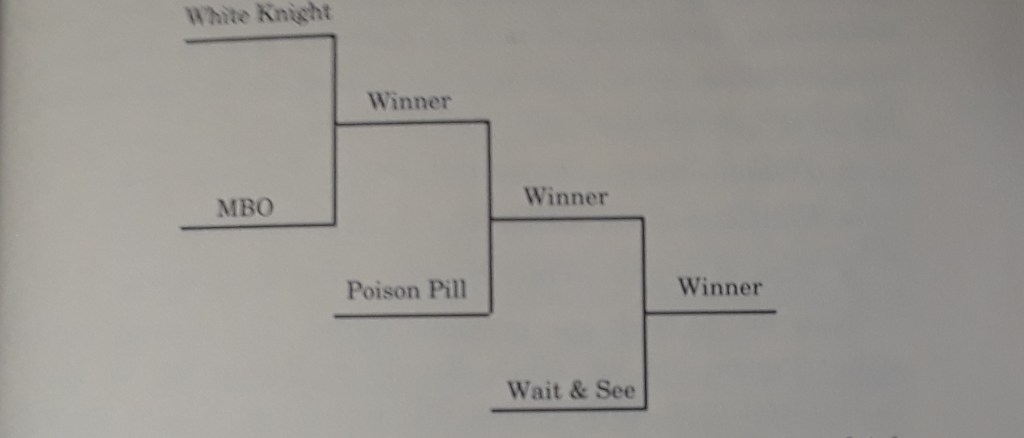
The tree above should remind you of a tennis tournament in which some players are seeded. We are seeding “Wait & See” all the way into the finals, “Poison Pill” into the semifinals, and giving no seed to “MBO” and “White Knight.” Boxing and chess both work this way, too. There is a series of challenges that you must win in order to go against the presiding World champion. The U.S. presidential election process also works this way. When there is an incumbent president, that person is typically a shoo-in for his or her party’s nomination. The opposing party runs a primary to decide who will go against the incumbent in the final elections. The primary process, the ensuing party nomination, and the presidential election can be thought of as a series of elimination elections. However, back to the boardroom. We suppose that the five board members have enough foresight to realize the consequences of their actions in successive rounds, and vote according to their true preferences. Backward reasoning makes this problem easy to solve. You can work out the solution and see that the White Knight option wins (or you can jump to the next paragraph), but that is not the point of this story. We are interested in showing how the founder can improve the outcome from one’s perspective by making a commitment to distorted preferences. How is it that the White Knight option wins under foresighted voting? The last election must be Wait & See versus something. In this final election everyone has an incentive to vote honestly, sense this will determine the actual outcome. Three possibilities are easy to calculate: Wait & See vs. Poison Pill, Poison Pill wins 4-1. Wait & See vs. MBO, Wait & See wins 3-2. Wait & See vs. White Knight, White Knight wins 3-2. #RandolphHarris 18 of 22

Now we go back one previous round. The contest will be either Poison Pill vs. White Knight or Poison Pill vs. MBO. In the first case, both Poison Pill and White Knight are preferred to Wait & See. So whatever wins the second round will be implemented. The board members prefer White Knight to Poison Pill, 3-2. In the second case, a vote for MBO is in reality a vote for Wait & See. Board members can anticipate that if MBO beats Poison Pill for the active course, it will lose out in the next comparison with Wait & See. So when deciding between Poison Pill and MBO, board members will act as if deciding between Poison Pill and Wait & See, with the result that Poison Pill wins 4-1. Thus the first-found comparison is truly between Poison Pill and White Knight. White Knight is chosen by a 3-2 margin and is then selected in each of the subsequent comparisons. Once the founder recognizes what will happen, there is a strategy one can employ to get one’s preferred option, the Poison Pill. Look what happens if the founder “adopts” the preferences of the outside board member. Of course it is essential that this change of preferences is credible and is made know to all the other voters. Supposed the founder simply gives one’s vote to the outside director and leaves the meeting. At first glance this seems nothing short of crazy; the adopted preferences are almost the opposite of one’s true ones. However, look at the effect. The votes will now go as follows: Wait & See vs. Poison Pill, Poison Pill wins 3-2. Wait & See vs. MBO, Wait & See wins 4-1. Wait & See vs. White Knight, Wait & See wins 3-2. #RandolphHarris 19 of 22

The only active option that can beat Wait & See is Poison Pill. Right from the start the board members should predict that is Poison Pill ever loses, the outcome will be Wait & See. Yet both MBO and White Knight supporters prefer Poison Pill to Wait & See. They are forced to vote for Poison Pill as it is their only viable alternative; thus Poison Pill wins. By transferring his support to the opposition, the founder is able to make a credible threat that it is either Poison Pill or Wait & See. As a result, all but the die-hard Wait & See supports dump the White Knight option (which can no longer beat Wait & See) in favor of the Poison Pill. Superficially, this transfer of a vote doubles the strength of the Wait & See supporters. Actually, it leads to an outcome that is worse from their viewpoint—Poison Pill rather than White Knight. In voting, strength can be weakness. Of course, if the outside director sees through the game, one should refuse to accept the founder’s proxy. If you regard this story as farfetched, something quite like it did occur in the 1988 Wisconsin presidential primary. The Republican governor of the state said that of the Democratic candidates, Jesse Jackson was the most interesting. Many commentators though this was a Machiavellian attempt to get Republicans to cross over and vote for Jackson in the Democratic primary, thereby helping produce a more easily beatable opponent for Bush in the November election. Apparently, Michael Dukakis was sufficiently easy for George Bush to beat, even without this help. #RandolphHarris 20 of 22

On June 30, 1988, in Victorville, California, near Los Angeles, the Sheriff’s Department received a complaint. Five Mexican me were blasting loud music, drinking beer, and urinating on the lawn in a party that lasted over twelve hours. When six sheriff’s deputies came to investigate and tried to quiet the men down, fists and night sticks began to fly. For the sheriff’s men, it was hardly a unique event. Except for one thing. Unknown to them, as they struggled to subdue the five, using night sticks and choke holds, a next-door neighbour pointed a videocamera out the window. Public outrage against alleged police brutality erupted instantly after the four-minute tape was shown to the town’s Latino community. Civil rights protests followed, then a lawsuit against the deputies, charging them with the use of excessive force. Said Armando Navarro, executive director of the Institute for Social Justice, a local civil rights organization, “I’ve dealt for twenty-one years in community activism, but I’ve never had something so classic, showing the violence in living color.” Lawyers for the deputies, on the other hand, contended that the tape did not tell the truth because it did not show what happened before the camera was turned on—when, the deputies say, violence was used against them. (That is why I say self-defense is difficult to prove and you may still end up in jail and have to plead your case before a judge, even if you have witnesses. And even if you did use self-defense, you could still end up being charged with a crime based on what the jury determines. It is best to avoid altercations.) #RandolphHarris 21 of 22

Nonetheless, the case took on larger dimension when the people who shot the tape disappeared and when a representative of Mexico’s consulate in Los Angeles began showing up in the courtroom to monitor the trial, evidencing concerns about anti-Mexican discrimination in the United States of America. In the end, a federal court ruled against the sheriff’s men and awarded the Mexicans $1 million. It is unlikely that the revolutionaries who overthrew the communist government in Czechoslovakia in 1989 ever heard of the “Victorville Five.” However, in the streets of Prague, students set up TV monitors on street corners and played video rapes showing the brutality of Czech authorities trying to suppress antigovernment street rallies. The students also played tapes of speeches by dramatist Vaclav Havel, who went from being a political prisoner to the presidency. Elsewhere, in Taiwan, too, the political opposition has used videocameras and monitors to expose what they called government violence. All across the World, new communication media, or new ways of using old ones, are being exploited to challenge—and sometimes overthrown—the power of the state. In the words of Solidarity founder Lech Walesa, describing the political upheavals in Eastern Europe, “These reforms are a result of civilization—of computers, satellite TV [and other innovations] that present alternative solutions. #RandolphHarris 22 of 22


Meet the largest of the single story homes offered at #MagnoliaStation! Residence 3 offers 2,827 square feet of well-appointed space including four bedrooms, two and one half bathrooms, and a three car garage. 🏡

The location of the Owner’s Suite makes it feel like a separate wing from the rest of the home allowing for maximum privacy and retreat. Plus you can even utilize the den as your own private office, or convert it into a fifth bedroom if needed. 🙌

Best of all, each Cresleigh home comes fully equipped with an All Ready connected home! 📲 Visit our website to learn what’s included and get in touch today. Our models are open and we’re now selling at Magnolia Station in Rancho Cordova! https://cresleigh.com/magnolia-station/residence-3/
#CresleighRanch




 Randolph Harris II International Institute