
 We do have legends. We had a goddess. However, now is not the time for all those things. You need not believe all I have seen. What I do have to give you is a vision. I think a vision is stronger than an illusion. And the vision is that we can exist as powerful beings without hurting anyone who is good and kind. Let us explore the human mind as it engages in the creative act. This capacity to create—which we all have, though in varying degrees—is essentially the ability to find form in chaos, to create form where there is only formlessness. That is what leads us to beauty, for beauty is that form. Beauty reveals a form in the Universe—the harmony of the spheres, as Kepler called it. It is a form which is present in the circling of the planets. It is a form which is felt in the curves and balance of our own bodies. And it is present especially in the way we see the World, for we form and reform the World in the very act of perceiving it. The imagination to do this is one of the elements that make us human beings. Since our assumption is that the chief source of joy is the realization and use of one’s resources, it follows that the failure to use these resources leads to a lack of joy. Setting aside for the moment differences in emotional reactions, this assumption maintains that the master of any skill enjoys one’s area of expertness more than if one were not a master. A good skier enjoys skiing more than one would if one could not ski well, for instance. Similarly for a violinist, a taster, a knowledgeable person, a god typist, a health person, a fine athlete and so on. #RandolphHarris 1 of 19
 The more of one’s abilities an individual has developed and can use, the more pleasure one feel within oneself. When you want to be better than you are, joy awaits you. The concept of creativity is the most adequate one to express the notion of joy through the optimal development of personal functioning. Creativity implies not only the use of one’s capacities, but also includes going beyond them into previously unexplored areas. For is the essential nature of a thing as distinguished from the matter in which it is embodied. We recall Plato’s ideas of the essences in Heaven. These he rightly calls forms. Form is a pattern, an image and an order given to what would otherwise simply be chaos. Form is the nonmaterial structure of our loves, on the basis of which we live and on which we base our own particular character. We recall the studies of especially creative people that were made by Frank Barron. Dr. Barron showed his cards—cards with many different drawings and paintings on them—to creative people and their counterparts, people who were not especially creative, asking them to pick out the cards that liked best. The latter group chose the orderly cards; they liked things to be clear, understandable, unclutter. However, the creative people chose the chaotic cards. The most striking thing about the creative people was this taste for chaos. They preferred the scribbles where there was no form whatever; they found a challenge in the chaos. #RandolphHarris 2 of 19
 Creative people yearned to make form out of it, to make of the chaos about them an order which is their own. This is the purpose of their existence. This is the fundamental creative aspect of all human beings whether they are especially talented or not. The human imagination is shown in these strivings—which may sometimes be passion and sometimes simply curiosity—to put things into form. It is what Einstein did when he proclaimed that matter and energy are related in one formula, E= mc2. Our human mind is continuously doing that, obviously on a lesser scale. Before one is able to use one’s experience in unusual, productive, and satisfying (that is, creative) ways, one must acquire a repertoire of experiences. One must be open to experience, able to perceive and sense one’s environment, and be aware of one’s own internal feelings. After being acquired, the experiential elements within a person must be related to each other. An individual must have the ability to associate two or more experiences which can lead to a useful product when they are joined. Many products may be generated in the course f creative activity, but the evaluation as to which of these satisfy the situation, and which are worthless, is essential. This phase distinguishes the bizarre from the creative, and the productive from the mundane. After the generation of an original idea or product, detailed work is usually in order. An enduring contribution involves much underlying effort. #RandolphHarris 3 of 19
 The above steps can be approached not only at the conscious and unconscious levels, but also through a discussion of the role of emotional blocks. The conscious attempts to enhance an individual’s capacity in the acquisition area is institutionalized as scholarship—the quest for more knowledge to add to an individual’s repertoire. Science, the method of determining the worth of a given statement, is the social institution aimed at the evaluation area. And conscious attempts to increase expression are institutionalized as the arts, where a variety of modes of communication are developed. However, methods of enhancement of the creative process that occur on a more unconscious level have not been institutionalized. It is for this level that a variety of techniques are being developed which give promise of widening mortal’s horizons by affording one new access to one’s self, and providing means for capitalizing on one’s latent internal abilities. When I am sitting in an audience listening to a talk, I find myself making lines in my imagination from a light in the ceiling to the other lights, moving my head a little bit so that such and such will be a complete triangle, or such and such will make a perfect circle. What I happen to do it with, lines and objects, other people do with music, forming various tunes in their minds. #RandolphHarris 4 of 19
 If you are aware, I think you will find you are always subconsciously in the process of breaking something down in your imagination and putting it back together again. We do that in our ordinary reverie and we do it especially at night in our dreams. Odd things are put together—Socrates, say, is talking to the people we met yesterday. Dreams do fantastic things which seem absurd until, in thinking about the dream the next day, we find the key. All of this a making of form. The clearest aspect of form is obviously in architecture. The Parthenon is a dignified, majestic triumph of form. The Cathedral of Chartres is likewise magnificent form. Mont Saint Michel shows a combination of human and natural forms. The triangular for of the Earth, coming up out of the water in a small mountain, is built upon by human ingenuity with the triangles of Gothic architecture. One church is used as the foundation of the ones that succeeding generations erected, until finally, with the triangular peak of the last cathedral, the spire stretches up, again in triangular form, into Heaven itself. We scarcely need to add that the triangle is the central symbol of medieval culture, shown not only in Gothic architecture but also in philosophy and theology in the triangle of the Father, Son and Holy Spirit. The form dictates the content. We select, say, a sonnet to write or a drama to construct, because the content we have in mind can best be formed out of chaos and put into the particular forms of sonnet or drama or whatever form seems to fit. #RandolphHarris 5 of 19
 There is a danger in erasing chaos too easily, for it then takes away one’s stimulation. Several years ago, I took the training for transcendental meditation. I have always been interested in meditating and have done it more or less on my own. When I finished that course my mantra was given to me, I was instructed to meditate twenty minutes in the morning as soon as I woke up and twenty minutes at four or five o’clock in the afternoon. So I, being an obedient soul, started out doing that. I found that after meditating I would go down to my desk in my studio and sit there to write. And nothing would come. Everything was so peaceful, so harmonious; I was blissed out. And I had to realize through harsh experience that the secret of being a writer is to go to your desk with your mind fully of chaos, full of formlessness—formlessness of the night before, formlessness which threatens you, changes you. The essence of a writer is that out of this chaos, through struggle, or joy, or grief—through trying a dozen or perhaps a hundred ways in rewriting—one finally gets one’s ideas into some kind of form. So I learned I had to meditate with discretion in the early morning in order not to lose the chaos, and to choose those times when I had finished the day’s work and was ready to be blissed out with pleasure. #RandolphHarris 6 of 19
 Acquiring knowledge and experience means feeding input to a human system. A person must have some material to work with in order to be creative and to become the person one can be. One must have information and experiences that have been felt and integrated into the individual’s soul. Ability to learn is a prerequisite for the acquisition of information, but there is a different requirement for acquiring experience. Increased awareness of one’s environment through better developed senses greatly increases the material with which a person can create. Sherlock Holmes, identifying a client’s region of origin from the smell of his tobacco; a physician, perceiving a slight shadow in an X-ray; a psychologist, observing recurrent head scratching of a patient; a musician, noting the rhythm of a train’s wheels—all these observations enhance the chances for effective behavior within the respective situations. In addition to acquiring information and developing the senses, there is another area through which experiential elements come. Awareness of feelings and emotions allows experience to be felt and integrated into the self. The person who is open to experience, and able to feel and appreciate, has more experiential elements than the constricted, denying individual who cannot allow oneself to feel deeply. #RandolphHrris 7 of 19
 A drama is a drama because of its form, a ballet is a dance because of its form. The Flamenco (baile) is a highly-expressive, Spanish dance because of its form. Rock and roll is a rebellion against the classical form in music, and has its own form which is shown in its discords and in its special beat. The ancient Greek philosophers set out to discover the original substance in the Universe out of which all things were made. Was it air? or ether? or water? Heraclitus proposed fire. However, each philosopher got trapped because the next question was, How did this element get its substance? Then came Pythagoras to cut the Gordian knot. He held that the fundamental element was no substance at a, but was really the form in which everything in nature is related to everything else. Form is nonmaterial, and has its existence only as things are related to other things. When I hold up a finger on each hand, you may say that there is no relation between the two. However, you would be wrong: there is the distance between them. If I put up another finger and draw an imaginary line among them, I would have a triangle. Or I get a cone, or a rectangle, or a circle. And soon I have an abstract drawing which is pure form! #RandolphHarris 8 of 19
 It is not by accident that Pythagoras was the inventor not only of a great deal of mathematics (everyone studies the Pythagorean theorem in geometry in high school), but also the inventor of a number of important principles in the theory of music. The tone of a violin is a vibration of a strong of a certain length. Pythagoras made the famous discover that if their lengths are in a simple numerical ratio, vibrating strings under equal tension sound together in harmony. So we have laws of harmony and discord, all derivative from form. To Pythagoras is attributed the lyrical line, “The stars in the Heavens sing a music if only we had the ears to hear.” Now in Pythagoras, art and mathematics were identified. This was a beautiful prediction of what was to come in our modern physics. The older concern with molecules and electron has changed; our physicists are ready to admit that they do not really know what those are. “Something unknown is doing we do not know what,” says Sir Arthur Eddington. What they do know is the relationship of one form to another; they recognize the form. They know if the form is such and such, then we have such and such a physical object. #RandolphHarris 9 of 19
 The prototype of this significance of form is in the fascinating story of the myth of creation in the beginning of Genesis. “The Earth was without form and void,” it goes. This is a fantastic condition: when I go down to my studio, it is the way I hope to be each morning. “And God separated the light from the darkness.” Those mornings when this happened in my studio, when insights come so fast I can scarcely catch them with my pen, are great mornings! And the legend goes on, “Then God separated the sea from the land and the sky from the sea.” Now separating, diving, relating—these are all words of form. All the verbs in this fascinating legend are verbs relating to form. We read nothing about molecules or electrons, but only that God divides, separates, God forms. Creativity is an emulating of God in that we destroy the cosmos and then build it up again in ways that we hope will be closer to our heart’s desire. We hope and strive for the form in the rhythm which we have in our hearts, and in our heartbeat and the rhythm in our breathing. The chaos about us is continually being reformed, only to be destroyed again by history, by nature, and by human perversity. “My photographs are a picture of the chaos in the World,” remarked the artist-photographer Alfred Stieglitz, “and of my relationship to that chaos. My prints show the World’s constant upsetting of mortal’s equilibrium, and their eternal battle to reestablish it.” #RandolphHarris 10 of 19
 However, the works of art living on year after year are vital proof before our eyes that reconstruction of form, of order, is eternally going on in our World. It is in this sense that the artists are the source of our conscience and our moral courage. Facilitation or inhibition of a person’s ability to be open and sensitive to knowledge, sensation, and feeling can occur on the various levels of awareness or consciousness. On a conscious level, sensitivity is a function of life-background, including exposure to traditional teaching methods for acquiring information about and contact with life experiences. Unconsciously, a person’s ability not merely to learn, but also to sense and feel, is very much connected to one’s emotional development. Emotional blocks to learning are many. Many childhood experiences prevent a person from being able to learn, because of anxiety, fear, conflict, or other immobilizing emotions engendered, for example, when parental competition with a child makes test-taking so full of conflict (the child may possibly excel the parents) that the student cannot study or retain; unresolved emotional problems also block off or distort perceptions, and blunt the ability to sense experience accurately as, for instance, when fear of criticism makes a person hear critical words where none exist. #RandolphHarris 11 of 19
 One of the first steps many of us may need to take toward the creative use of anger is to become aware of our anger. As has already been noted, many people develop some degree of numbness to their awareness of anger. Some progress needs to be made in reawakening this awareness before anger can be used creatively. How can this be done? If we can examine the process by which we become deadened to anger, it is often helpful. The key often is possessed in our relationship with our parents. One young man, Monsieur Lestat de Lioncourt, had particular difficulty in being aware of and expressing anger toward women. When he examined the relationship that had existed between himself and his mother, it became apparent that she had constantly manipulated and controlled Monsieur de Lioncourt’s life in many ways as he was growing up. It would be natural, of course, that he would feel much frustration and anger as a result. However, he remembered that, if he expressed any negative reaction or rebelled against this control in any way, she would react with such hurt and disappointment in him that he would feel very guilty. Gradually, Monsieur de Lioncourt, even as a child, built a psychological defense against this intolerable situation; be no longer felt his anger when she manipulated him. #RandolphHarris 12 of 19
 It was only as Monsieur de Lioncourt was able to remember many of these events of his life with mother and was able to experience and express some of the anger pent up since childhood that he became capable of realistic and open relationships with women in his adult life. Sometimes when we allow ourselves to experience long-buried anger and resentment from our childhood, it results in strained relationships between ourselves and our parents, if they are still alive. However, when they boil to the surface, it does usually seem necessary and desirable to deal with these feelings directly; and if the individual can stick with it, a new relationship built on honest reactions and an awareness of our common human failings may emerge from the wreckage of the old, unsatisfying, and unrealistic relationship. Problems of feeling, either emotion-flattening or hyperexcitation, are usually tied to very complex emotional problems. For example, people often cannot allow themselves to feel deep affection of others because of their fear of rejection is too great. Inhibitions of this kind can occur whether the individual is experiencing inanimate objects, ideas, other people, or one’s self. In all these cases, the individual’s openness to experience is seriously curtailed, and the repertoire of elements to enter potentially into one’s creative behavior is sharply diminished. #RandolphHarris 13 of 19
 The job of helping a person become more open and enriched is therefore threefold: removal of emotional blocks; development of an awareness of one’s self and one’s feelings; and development of a sensitivity and perceptiveness about other people and the World around one. Also, if we can act on or express whatever awareness of anger we do have, it will often help us to awaken to our feelings of anger. To further highlight this illustration, if a person gains the courage to talk about the slight irritations that one feels, the freedom to do this gives one confidence to become aware of more intense feelings. Once the process is started, the relief is so great that anger floods into awareness with increasing ease. Some people who are relatively dead to their anger react almost immediately to anger-producing situations with some physical symptom. Skilled therapists, for example, will often recognize a clenched fist, a tensed body, or a foot making a kicking motion, or a sudden depressed attitude as a probable sign of anger of which the person has not allowed one’s self to be fully aware. Sometimes we can use such symptoms to help ourselves recognize our anger. #RandolphHarris 14 of 19
 One therapist discovered that when talking to clients, he himself sometimes would very quickly develop a headache. By examining these occasions more closely he discovered that they occurred when unrecognized anger toward the client was building up. Once he had discovered this, he found that when such headaches developed he could examine his feelings and let the anger come into focus where he could deal with it directly. Once the anger was recognized and expressed, the headache would quickly disappear. If we examine the possibility that we may project our feelings of anger onto others, sensitivity to our anger may also be enhanced. All of us have some tendency to read into others the feelings that we are reluctant to recognize and accept in ourselves. If we can face it, very often when we feel that someone dislikes and resents us, we will discover that we resent them. For example, a mother might react very firmly to a child’s outburst against her request that he carry out the trash. She might feel that he carries a resentful grudge about this task, hating her for limiting his freedom to go out and play. In reality he, having had his outburst, may quickly forget the incident. If the mother were able to recognize it in herself, she might discover that she resents him for seemingly limiting her freedom and keeping her trapped in the home. #RandolphHarris 15 of 19
 Gary James had been in psychotherapy for several month when one day he expressed the idea that his therapist was angry at him. He was asked to play the role of the therapist and express that anger. As he “became” the therapist and talked to a pillow in another chair, which represented himself, Gary James said, “I am angry and impatient with you. I feel like giving you a good kick in the britches so you will get to work and we can get somewhere in therapy!” The therapist then said to him, “Now will you be yourself and try saying the same thing to me.” At first Gary James looked at the therapist in some surprise, then a little gleam of awareness began to appear on his face. “Yeah,” he said, “maybe I am a little angry and impatient with you. You sit there and look wise and do not seem to do a damn thing for me. I think I do feel like giving you a kick in the britches so you will get to work and help me get somewhere in therapy!” After he finished, Gary James’s face lighted up with a grin of pleasure and satisfaction that he had been able to be ware of and express the hitherto unrecognized anger. It was an important step forward for him, and it happened because he was helped to experience his projection. Like many projections, it was based on some truth, also, for the therapist admitted to Gary James the he had felt some impatience toward him, which he had not expressed. #RandolphHarris 16 of 19
 If we ask ourselves if we are feeling angry at the right people and for the real reasons, it may also help us become aware of our angry. For sometimes we mask from others and from ourselves our real anger by feeling irritation about less threatening things. Sometimes we do this by getting angry at people who are less threatening to us. When we cannot face and deal with our angry at the boss, for example, we may heckle the wife and kids. Or we may nag the wife about leaving dishes in the sink or not keeping the house tidy rather than recognize and deal openly with the fact that we are angry and hurt because she does not express her love for us as much as we would like. To recognize and express this basic anger and hurt would be to reveal our deep need of her and make us feel very vulnerable. Our fear of love makes such an expression of anger seem very risk. It is much safer to be aware only of last night’s dishes! If we are honest, when we become disproportionately angry about things, they must be viewed as relatively inconsequential, it may help to ask ourselves what it is we are really angry about. It seems impossible, but there is a way—a way with which we are familiar. We know quite well in what likeness this tree s made, this tree that has grown within us, this most beautiful tree where the birds of the air come and perch. We know what is the most beautiful of all. No forest bears its equal. #RandolphHarris 17 of 19
 Sometime still a little more frightful than a gibbet—that is the most beautiful of all trees. It was the seed of this tree that God placed within us, without or knowing what seed it was. If we had known, we should not have said yes at the first moment. It is this tree that has grown within us and has become ineradicable. Only a betrayal could uproot it. When we it a nail with a hammer, the whole of the shock received by the large head of the nail passes into the point without any of it being lost, although it is only a point. If the hammer and the head of the nail were infinitely big it would be just the same. The point of the nail would transmit this infinite shock at the point to which it was applied. Extreme affliction, which means physical pain, distress of soul, and social degradation, all at the same time, is a nail whose point is applied at the very center of the soul, whose head is all necessity spreading throughout space and time. Affliction is a marvel of divine technique. It is a simple and ingenious device which introduces into the soul of a finite creature the immensity of force, blind, brutal, and cold. The infinite distance separating God from the creature is entirely concentrated into one point to pierce the soul in its center. The person to whom such a thing happens has no part in the operation. One struggles like a butterfly pinned alive into an album. However, through all the horror one can continue to want to love. #RandolphHarris 18 of 19
 There is nothing impossible in wanting to love through pain, no obstacle, one might almost say no difficulty. For the greatest suffering, so long as it does not cause the soul to faint, does not touch the acquiescent part of the soul, consenting to a right direction. It is only necessary to know that love is a direction and not a state of the soul. If one is unaware of this, one falls into despair at the first onslaught of affliction. One whose soul remains ever turned toward God through nail pierces it finds oneself nailed to the very center of the Universe. It is the true center; it is not the middle; it is beyond space and time; it is God. In a dimension that does not belong to space, that is not time, that is indeed quite a different dimension, this nail has pierced cleanly through all creation, through the thickness of the screen separating the soul from God. In this marvelous dimension, the soul, without leaving the place and the instant where the body to which it is united is situated, can cross the totality of space and time and some into the very presence of God. It is at the intersection of creation and its Creator. This point of intersection is the point of the intersection of the arms of the Cross. Saint Paul was perhaps thinking about things of this kind when he said, “That ye, being rooted and grounded in love, may be able to comprehend with all saints what is the breadth, and length, and depth, and height; and to know the love of Christ, which passeth knowledge,” reports Epistle to the Ephesians 3.17-19. #RandolphHarris 19 of 19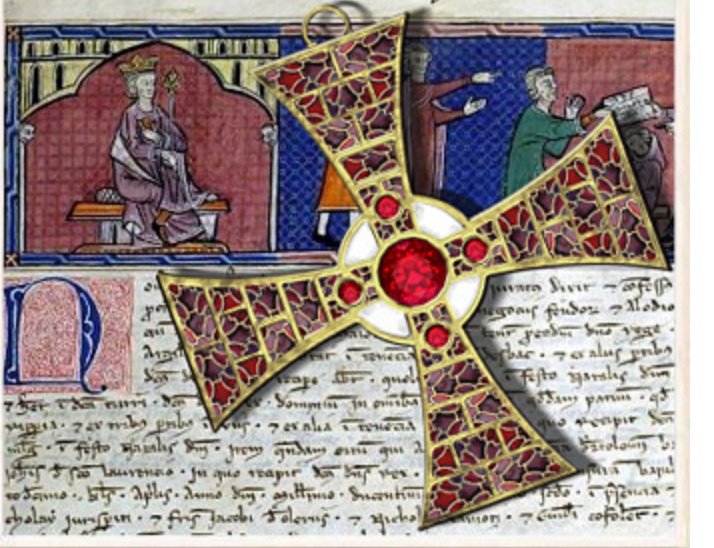




 Randolph Harris II International Institute