

Good judgment is needed not only in understanding people, but also in facing decisions that often lead us to or away from our Heavenly Father. We live in a World in which many situations require us to make judgments that are often difficult. Yet the Savior gave the commandment to judge not our fellow people How can we do this and still exercise good judgment in a World full of deception and corruption? We must judge well when making critical decisions in each phase of our life, such as choosing friends, careers, finding an eternal compassion, or choosing an occupation that will allow us to care for our family and serve the Lord. Although the Savior asked us not to judge others, he still expects us to use excellent judgment. We may often find ourselves making quick judgments about people, which can change or redefine our relationships with them. Often incorrect judgments are made because of limited information or because we do not see beyond that which is immediately in front of us. Our World is in trouble, but it welcomes us home in an era of great opportunity. The same technology that has highlighted many of the problems in our World also allows us to be the first generation in history to be able to share our newfound bounties of mind, heart, and spirit with the entire planet. #RandolphHarris 1 of 5

As we return to the Kingdom of Heaven triumphantly, those who knows us best will rejoice with us. Our fellow travelers can benefit from the wisdom of our experience. The World itself will surely be better for having gained a responsible citizen who listens to its needs and responds with compassion. Yet, to make the most of our homecoming, we need to take on the mantle of leadership. The distinction between the spheres of faith and of reason has commonly been interpreted as though there were a disharmony, or even a contradiction, between them. Indeed, the doctrine of double truth—that is, that a proposition may be true in theology, but false in philosophy. Properly speaking, double truth seems never to have been a consciously adopted doctrine in the Middle Ages, but rather an accusation leveled against theological opponents. A doctrine of double truth means that the same thing is not true in different disciplines. Despite appearances, there really can be different things in mind. What we are trying to defend might better be called a theory of multiple meaning. Neither twofold nor truth quite pinpoints the thesis, and perhaps even manifold truth is still misleading. Homo loquens reflects and communicates, not by means of a single, universally valid language, but by means of several languages, which are relative to particular disciplines or areas of experience. #RandolphHarris 2 of 5

Hence the meaning of a term or proposition is determined by the area of discourse: if transferred from one area of discourse to another, a term may acquire a different meaning, or have no meaning at all. For example, it makes no sense to ask the weight of a line from the length of a pound. Whether correct or not, this argument bears a close resemblance to ideas which have played an important role in the twenty-first-century linguistic philosophy, and is therefore not likely to be dismissed as obscurantism or anti-intellectualism. The basic thesis—that the same form of words may have different meanings in different disciplines—underlies many ideas about the relations of ethics to theology. For instance, the proposition that fallen man can do no good is fundamental to teachings on justification because this is only true in a theological, not in an ethical context, for in each context the word good means something different. This is, perhaps, a statement of double truth, but only because it rests on a theory of multiple meaning. Thus interpreted, double truth does not imply contradiction, but excludes it, since real contradiction is possible only within a single realm of discourse. Although we must hold to the saying that one truth agrees with another, nevertheless the same thing is not true in different disciplines. #RandolphHarris 3 of 5

Rejection of traditional political ideas emerge most clearly between discussions of the relation between morals and politics. For instance, a prince in the ancient World of the Middle Ages, is supposed to be the embodiment of human virtues; he was expected to be just, magnanimous, merciful, and faithful to his obligations, and to do everything which might make him loved by his subjects. However, when double truth is considered, a prince must not mind incurring the scandal of those vices without which it would, if followed, lead to one’s ruin and that some others which appear vices result in one’s greater security and well-being. This has been frequently understood as meaning that instead of being loyal, treacherous; instead of aiming to be loved, he should aim to be feared. However, this is a misunderstanding. Some admonish a prince to disregard the question of whether his actions would be called virtuous or vicious. A ruler ought to do whatever is appropriate to the situation in which he finds himself and may lead most quickly and efficiently to success. Sometimes cruelty, sometimes leniency, sometimes loyalty, sometimes villainy might be the right course. The choice depends on circumstances. #RandolphHarris 4 of 5

These views have frequently been interpreted as a meaning that wickedness is more effective than goodness. This distortion is incorrect because it is not concerned with good or evil; it is concerned only with political efficiency. In the World, it is an Earthly judge who condemns a person and locks him or her into prison. In contrast, we are taught that when we willfully sin, we become our own judges and consign ourselves to spiritual prison. The rejection of the communis opinio—whether in the special area of military affairs or in the general field of ethics—was a reflection of a new and comprehensive vision of politics. The prevailing view is that the task of government is distribution and maintenance of justice. The law of life under which every political organization exists is a growth and expansion. Thus, force is an integral, and a most essential, element in politics. Interest in military affairs has its basis in the conviction that possession of a powerful and disciplined military force is a requisite for the preservation of political independence. Moreover, because political life is a struggle, the conduct of life according to Christian virtues could endanger political effectiveness; Christianity, by preaching meekness and selflessness, might soften people and weaken a political society. And that is why there are laws for the Earthly Kingdom and laws for the Heavenly Kingdom. We now have a territory in our global village much larger which houses, family, friends and matters of local concerns. Our potential to benefit society is limitless. #RandolphHarris 5 of 5

The Winchester Mystery House
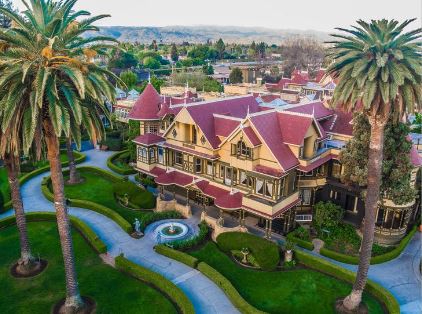
Anyone who is interested in the paranormal including ghosts, demons, orbs and hauntings will enjoy The Winchester Mystery House. https://winchestermysteryhouse.com/




 Randolph Harris II International Institute