

I hope there are not many in this World to whom the thought of honor being tied to money ever appears possible. It was not merely that works of art and culture provide the historian with the most fertile material for the interpretation of previous phases of human experience; history itself is (or should be) a form of art. The mechanical piling up of the results of specialized research, dear to scientific historians, is not enough; there must also be intuition, an imaginative ability to re-create the vision of life underlying the relics left by former times. To see the past in these terms is to see it as the expression of the inexhaustible creative power of the human mind—great individuals, great artistic achievements, great moments of civilization, all exemplified in different ways its potentialities. Scholarship, painstaking investigation, were indeed essential, but they must be properly used and directed. Only thus could a particular source or authority throw light on the character of a person, the significance of a style, the pervasive atmosphere of a period. Ultimately, the subject of historical study is humans themselves, not the hypostatized abstractions of the philosophers of history. The historical process follows a fixed and predetermined course, betrayed a fundamental blindness to its most striking feature, the revelation of individual originality and creativity. Likewise, their astrological impatience to set the limits to its future by talk of the World plans and metaphysical goals are not only unwarranted, it failed to respect the very conditions of uncertainty and suspense that make human achievement possible. From this point of view, and insofar as the development of humankind is concerned, a future known in advance is an absurdity. The tide of historical speculation is starting to recede. Philosophers, rather than continuing to offer sweeping interpretations of the human past, have turned their attention toward examining the distinctive characteristics of historical thought and inquiry, with prophetic insights displaying in their analysis of contemporary trends the many subtle and individual observations.

When they depict the Universe, they draw a serpent devouring its own tail, marked with variegated scales. By the scales, they suggest the stars in Heavens. This beast is the heaviest of the animals, as the Earth is heaviest [of elements]. It is the smoothest, like water. And each year it sheds its skin, it [represents old age]. However, the fact that it uses its own body for food signifies that whatever things are generated in the World by Divine Providence are received back into it by [a gradual process of] diminution. Names are a special form of complex signs. A demon’s name is sometimes meaningful in a simple sense, that sometimes names of spirits are taken from those things over which they are set, being as it were borrowed from the stars, or humans, or places, or times, or such like things, the divine name. For example, Zedekiel is one name of the spirit of Jupiter, from the Hebrew name of Jupiter zedek, or if we call them [these demons] from the Latin words…Joviel. Names have a singular referent—a demonic names refer only to a single demon. At the same time, written names are aggregates, combinations of basic written forms to make up complex, representative structures. Moreover, names were impressed upon objects by Adam, and hence have an arbitrary symbolic character not dependent on the characters or elements of which they are constituted. Adam’s function as nomothete is well known, but it is crucial to recognize the relationship between Adam’s naming and the Divine nominative function. As the great operator doth produce divers species, and particular things by the influences of the Heavens, and by the elements, together with the virtues of planets; so according to the properties of the influences proper names result to things, and are put upon them by hum who numbers the multitude of the stars, calling them by their names, of which names Christ in another place speaks, saying, Your names are written in Heaven.
Adam therefore that gave the first names to things, gave them all names influences of the Heavens, and propertites of all things, gave them names according to their natures, as it is written in Genesis, where God brought all things that he had created before Adam, that he should name them, and as he named anything, so the name of it was, which names indeed contain in them wonderful powers of things signified. Every voice therefore that is significant, first of all signifies by the influence of the celestial harmony; secondly, by the imposition of humans…However when both significations meet in any voice or name, which are put upon them by the said harmony or human, then that name is with a double virtue, viz. natural, and arbitrary, made most efficacious to act, as oft as it shall be uttered in due place, and time, and seriously with an intention exercised upon the matter rightly disposed, and that can naturally be acted upon by it. Therefore, names like signs in general, can be doubly powerful if they combine natural and arbitrary modes of signification. For Ancient Egyptians, the divine nature of the Universe was manifested in a multitude of ways. The process of syncretism, by which two or more deities were combined to form a single cult, was also central to religion in Ancient Egypt. Two of the most important deities, Amun and Ra, for example, were fused to create Amun-Ra, the god of creation. Amun-Ra means hidden light. He is the ultimate god of the entire Ancient Egypt; man of the Egyptians considered him as the God of Kings and King of Gods! He is the oldest and the most worshiped ruler of ancient Egypt. In the Ptolemaic Period (332-30 BC), Greek gods Zeus and Helios with Osiris and Apis, perhaps in a move towards political and cultural unity.
The Ancient Egyptians worshiped a number of gods and goddesses, each of whom had different roles or functions, as well as a variety of creations myths. In keeping with the complex and varied nature of their religion, the Ancient Egyptians had several theories of the creation of the Universe. These creation myths evolved in the country’s major cult centres and usually concentrated on the role played by local gods. Ancient Egyptian theology rarely engages with the notion of the end of existence. Where it is mentioned, it is imagined as an apocalyptic destruction followed by a return to the state of the Universe before time began, in which only the gods Atum and Osiris survive. Along with the Sun god, Ra, Osiris, the primary god of the dead, was one of the most important deities in the pantheon. In Ancient Egyptian mythology, Osiris was killed by his evil brother Seth, and his dismembered body was mummified and resurrected by his wife, the Goddess Isis. During the Old Kingdom (2686-2181 BC), the deceased pharaoh was identified with Osiris and was believed to experience rebirth in the same way that the murdered god did. During the First Intermediate period (2181-2055 BC), however, it seems that it became possible for commoners to be resurrected in the manner of Osiris, as a sort of ‘democratization of the afterlife’ took place. Mummification was designed to make the deceased resemble Osiris as much as possible, in the hope that this would ensure eternal life in the underworld. Osiris presided over the weighing of the Heart ceremony in the afterlife. In this ritual, the deceased made the negative confession, swearing that they had not committed any of a list of offences, then their heart was weighed against the feather of Maat, symbol of truth and harmony. Osiris judged the results of the ritual and was responsible for deciding whether the deceased was worthy of resurrection.

The Winchester Mystery House
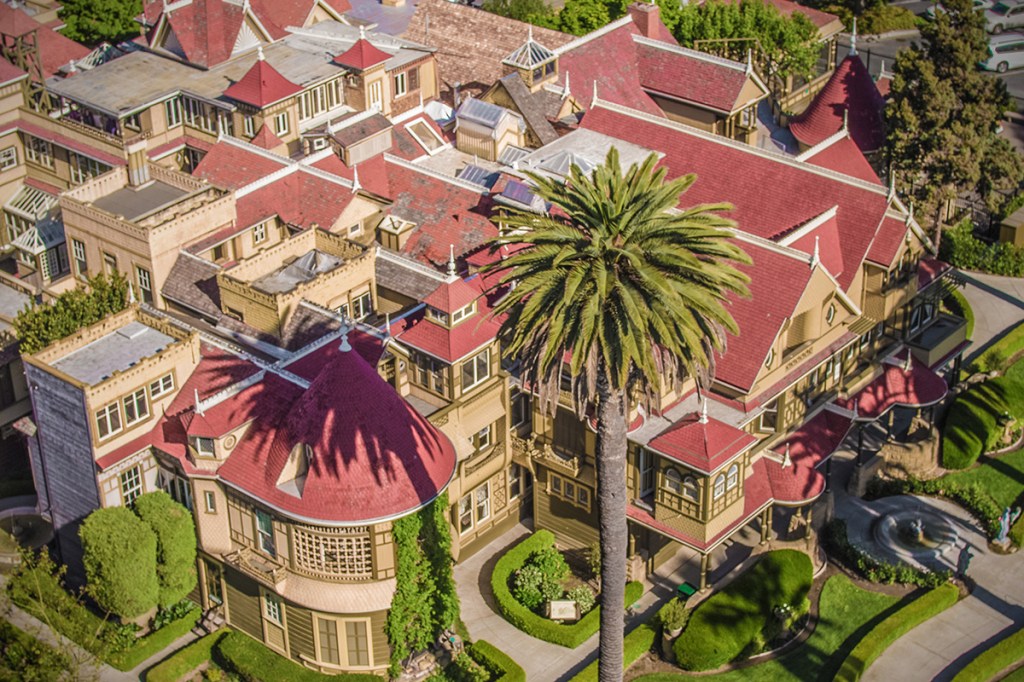
Meet talkative ghosts at The Winchester Mystery House and learn the heartwarming story of a child ghost who lingers with today’s patrons. https://winchestermysteryhouse.com/




 Randolph Harris II International Institute