

Art should never be a vehicle for propaganda. Life and death together make sad work for us all. Greek and Egyptian and Japanese art are some of the best examples I have ever seen. I am not really into modern graffiti art. The needs of our actual life are so imperative, that sense of vision becomes highly specialized in their service. When I hoped I feared, since I hoped I dared; everywhere alone as a church remains; spectre cannot harm, serpent cannot charm; he deposes doom, who hath suffered him. With an admirable economy we learn to see only so much as is needful for our purposes; but this is in fact very little, just enough to recognize and identify each object or person; that done, they go into an entry in our mental catalogue and are no more really seen. In actual life the normal person really only read the labels as it were on the objects around him and troubles no further. Almost all the things which are useful in any way put on more or less this cap of invisibility. It is only when an object exists in our lives for no other purpose than to be seen that we really look at it, for instance at a China ornament or a precious stone, and towards such even the most normal person adopts to some extent the artistic attitude of pure vision abstract from necessity.

Aesthetics is the philosophy of art and beauty that is concerned with analysis of concepts and the solution of problems that arise when one contemplates objects of subjective attractiveness. Aesthetic value, experience, as well as the entire battery of concepts occurring specifically in the philosophy of art, are examined in the discipline known as aesthetics, and questions such as “What feature make objects beautiful?” and “Are these aesthetic standards?” –as well as all questions occurring specifically in the philosophy of art—are aesthetic questions. Nevertheless, most of the interesting and perplexing aesthetic questions through the ages have been concerned specifically with art: “What is artistic expression? Is there truth in works of art? What is an artistic symbol? What do works of art mean? Is there a general definition of art? What makes a work of art good?” Although all these questions are questions of aesthetics, they have their locus in art and do not arise in the consideration of aesthetic objects other than works of art.
Because of the differences among the media of the various arts, there are concepts which apply in a straightforward manner to one or more of the arts but not all, or in a different sense, to other arts. The emphasis in Venetian art is on the sensuousness of light and color and the pleasures of the senses. The closet we have some to it so far is in the mysterious glow that infuses Leonardo’s Mona Lisa, but is only hinted at in Leonardo’s work explodes in Venetian paintings as full-blown theatrical effect. Partly under the influence of Leonardo, who has visited Venice after leaving Milan in 1499, Giorgione developed a painting style of blurred edges and softened forms. After his teacher’s death in the great plague of 1510, Giorgione’s student, Titian, took on this style even further, developing a technique that employed a painterly brushstroke to new, sensuously expressive ends. Two paintings of Venus, the first by Giorgione, probably completed by Titian himself, demonstrate the sensuality of the Venetian style. Giorgione’s life-size figure, bathed in luminous light, is frankly erotic, but Titian’s is even more so. Positioned on the crumpled sheets of a bed, rather than in a pastoral landscape, she is not innocently sleeping but gazes directly at us, engaging us in her sexuality.
Raphael learned much from both Leonardo and Michelangelo, and, in 1508, he was awarded the largest commission of the day, the decoration of the papal apartments at the Vatican in Rome. One the four walls of the first room, the Stanza della Segnatura, he painted frescos representing the four domains of knowledge—Theology, Law, Poetry, and Philosophy. The most famous of these is the last, The School of Athens. Raphael’s paintings depicts a gathering of the greatest philosophers and scientists of the ancient World. The centering of the composition is reminiscent of Leonardo’s Last Supper, but the perspectival renderings of space is much deeper. Where, in Leonardo’s masterpiece, Christ is situated at the vanishing point, in Raphael’s work, Plato and Aristotle occupy the position. These two figures represent the two great, opposing schools of philosophy, the Platonists, who were concerned with the spiritual Work of ideas (thus Plato points upwards), and the Aristotelians, who were concerned with the matter-of-factness of material reality (thus Aristotle points over the ground upon which he walks).

The expressive power of the figures owes much to Michelangelo, who, it is generally believed, Raphael portrayed as the philosopher Heraclitus, the brooding, self-absorbed figure in the foreground. Raphael’s commission in Rome is typical of the rapid spread of the ideals of the Italian renaissance culture to the rest of Italy and Europe. The aesthetic attitude is also distinguished from the cognitive. Students who are familiar with the history of architecture are able to identify quickly a building or a ruin, in regard to its time and place of construction, by means of its style and other visual aspects. They look at the building primarily to increase their knowledge and not to enrich their perceptual experience. This kind of ability may be important and helpful (in passing examinations, for example), but it is not necessarily correlated with the ability to enjoy the experience of simply viewing the building itself. The analytical ability may eventually enhance the aesthetic experience, but it may also stifle it. People who are interested in the arts from a professional or technical aspect are particularly liable to be diverted from the aesthetic way of looking to the cognitive.

The aesthetic way of looking is also antipathetic to the person, in which the viewer, instead of regarding to the personal, in which the viewer, instead of regarding the aesthetic object so as to absorb what it has to offer him, considers its relation to himself. Those who did not listen to music but use it as a springboard for their own personal reveries provide an example of this nonaesthetic hearing that often passes for listening. For instance, the man who does to see a performance of Othello and instead of concentrating on the play thinks only of the similarity of Othello’s situation to his own real life situation with his wife, is not viewing the play aesthetically. His attitude is one of personal involvement; it is a personalized attitude, and the personalization inhibits whatever aesthetic response the viewer may otherwise have had. In viewing something aesthetically we respond to the aesthetic object and what it has to offer us, not to its relation to our own lives. (The latter has to offer us, and it is not necessarily undesirable, but it should be sharply distinguished from the aesthetic response.)

The formula “we should not get personally involved” is sometimes used to describe this criterion, but this too is misleading. It does not mean that a playgoer may not identify with the characters in the play or be vitally interested in what happens to them; it only means that he must not make any personal involvement he may have with the character or the problems in the play substitute for careful viewing of the play itself. We can see the difference clearly if we contrast the situation of being involved in a shipwreck with viewing a newsreel of it or a movie about it. In the first case we would do what we could save our own lives and assist other. In the second case, however, we know that whatever disastrous events occurred have already happened and there is nothing we can do about it now, and realizing this, our tendency to respond to the situation with action is automatically cut off. However, much we identify with the sufferers, we are not personally involved in any sense that is geared to action. Pride of ownership may interfere with the aesthetic response. The person who responds enthusiastically to playing of a symphony before guests on one’s own stereo set, but fails to respond to the playing of the same symphony on an identical recording set in one’s neighbor’s house, is not responding aesthetically

The antiquarian or the museum directors who, in choosing a work of art, must attend to historical value, prestige, age, and so on, may be partly influenced by an estimate of its aesthetic value, but one’s attention is necessarily diverted to noneaesthetic factors. Similarly, if a person values a play or novel because one can glean from it items of information concerning the time and place about which it was written, one is substituting an interest in acquiring knowledge for an interesting in aesthetic experience. If a person favors a work of art because it offers more edification or supports the right cause, one is confusing a moral attitude with the aesthetic, which is also true if one condemns it on moral grounds and fails to separate this condemnation from one’s aesthetic evaluation of it. (This is particularly likely to occur with persons who never really view an object aesthetically at all, but simply as a vehicle for propaganda, whether moral, political, or otherwise.) We care about art, drama, and plays, but are able to detach from them, admit we care, but also know it is not a reflection of the World around us. So we can identify, but not get totally absorbed. Strange life mind—rather curious history—not extraordinary, but singular.
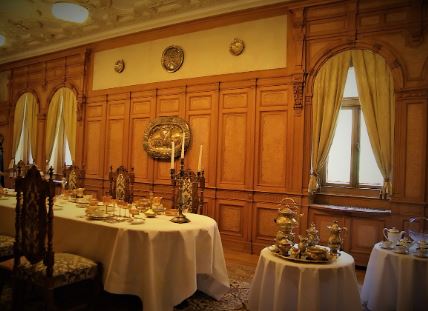
The Winchester Mystery House

The heartfelt tale of Sarah Winchester is both an exciting suspense story and a deeply moving story determination. https://winchestermysteryhouse.com/




 Randolph Harris II International Institute