
 The castle is the dominant symbol, its hidden passages and dark chambers often embodying repressed, irrational emotions or perverse sexual urges. Irrationality, in fact, in the Gothic setting subsumes the individual’s rational will. Universal causality is consistent with the concept of choice and is a necessary condition for responsibility and, therefore, for blame and punishment. Strictly speaking, all that is necessary for a theory of punishment is that human conduct should be capable of being modified by threats. For some people—for instance, compulsive law breakers like kleptomaniacs—that is not the case. Others, however, commit crimes believing that they can escape punishment; still others, in a spirit of rebellion, indifference, or, more rarely, of martyrdom, prefer to do what they want and risk the consequences rather than conform. Why they prefer it is to say they might have chosen to do otherwise but did not, and that is all that is necessary for the concept of responsibility. To ask whether they were free to prefer otherwise, being what they were, is to ask whether they could choose to choose, and it is not clear that this really means anything. The experience of punishment may provide reason for choosing differently next time, but to have a reason for choosing is not to be without a choice and, therefore, without responsibility. #RyanPhillippe 1 of 18
 Personified evil (both psychological and supernatural) exists side by side with mere mortals and influences the mortal sphere. Nightmares reside in the real World, possessing substance and vitality, and they portend disaster when social or sexual taboos are violated. Though a criminal may be held responsible for his actions, there may nevertheless be circumstances which, so it is said, diminished responsibility or extenuate guilt. Temptation or provocation, though not irresistible may have been very great. The offender may have had a good character, and there may be no reason to expect any future lapse. Instead of asking what penalty is warranted by the crime, whether the agent was fully responsible for his action, whether circumstances exonerate him wholly or in part, they prefer to ask what kind of treatment is most likely to rehabilitate him, subject, or course, to the example it might set for others. Though criteria of morality and law, of blame and punishment, are not identical, they influence one another. If we blame people less for yielding to strong temptation, we also feel they deserve a less severe punishment. However, this only shifts the question a step back. Why should temptation mitigate the blame? #RyanPhillippe 2 of 18
 The ambiguity of reality, the relatively of good and evil, the role of perspective in understanding and interpretation, the interaction of nature and nurture, and the conflict and tendency of humanism and science is expansive. A possible answer might be that at least some temptation can be pleaded as partial justifications. Thus, a man who pleads that he killed someone to shorten his sufferings or a woman kills her deformed baby is appealing to another moral principle to excuse the act. However, if you concealed the fact that the man was dying from his kids so you could collect insurance money, think about the time and precious moments you robbed those babies and that man of and how they will live the rest of their life thinking about a father they loved and never got to know. Also, the deformed baby, that baby has God parents and other family members who love him and his injuries are invisible to the point no one can tell anything is wrong with him, and now a lot of kids are being born with Zika virus, and you can clearly tell that they are deformed. So before you play God, think about the Worldly consequences your actions may have. You do not know who these people you are attacking are, nor what may come as vengeance from God. #RyanPhillippe 3 of 18
 Criminality is a kind of sickness to be treated rather than a wrong to be punished, however. Instead of asking what penalty is warranted by the crime, whether the agent was fully responsible for his action, whether circumstances exonerate him wholly or in part, they prefer to ask what kind of treatment is most likely to rehabilitate him, subject, of course, to the example it might set for others. A man who kills his spouse’s stalker might claim that his victim was violating his rights, and that this was a case of self-defense because they guy kept breaking into his house and walking around like he wanted to harm his spouse and would only show up when he spouse was around. These are not complete justifications, but they are excuses which count, as it were, against the initial presumption of guilt and so inclined us to look at the offense more sympathetically and more leniently, whatever the advantages of severity in terms of deterrence, prevention, or reform. There is nothing irrational in striking a balance of desert. #RyanPhillippe 4 of 18
 If these criminals, who are looking for a pay out and simply trying to get hustle people do not deserve punishment for their unlawful behavior, then when they are old and/or sick they do not deserve medical treatment nor medication. Attractive as this approach may seem, it has at least one serious consequence. The concept of responsibility and desert cannot be discarded without some loss. For it is not a necessary condition of medical treatment that a patient must have shown symptoms of a disease; those exposed to smallpox are vaccinated before they develop a fever. Without the principle that punishment must be deserved, there would be no obstacle to subjecting people likely to become criminals to corresponding forms of penal prophylaxis. Moreover, if we substitute punishment the idea of rehabilitative treatment, there is nothing against sentencing a person of bad character would be better for it in the end. This would clearly be incompatible with the usually accepted principle that trivial offenses should not carry severe penalties. #RyanPhillippe 5 of 18
 Reformism of this kind is open to attack from another quarter. Retributive punishment is a kind of tribute to the moral personality of the criminal. It is precisely as a morally responsible agent, recognized as capable of making reasoned choices and accepting the consequences, that the criminal is punishable. Punishment is a right, which he must not be defrauded. Punishment is inflicted because of wrong-doing, as desert, the latter is applied as means of improvement. Since rational adults are neither animals nor children, no one has the right to treat them as such. Unlawful immigrants should not be rewarded by coming to America, stealing citizenships, getting free medical care, free college, and taking jobs that others could fill. Illegal immigrants take up 15 percent of the jobs in America, black employment is 15 percent. Many of these jobs illegal immigrants are taking, blacks who could not get professional jobs used to take. In New York, NY USA blacks used to drive taxis, do construction, work as domestics, and some even used to pick fruit. These people were brought to the country as slaves, and now you have others being paid to come here and steal citizenship. #RyanPhillippe 6 of 18
 It is not right that my people were forced to build this country and did not have freedom and are still overlooked and replaced by people who do not even have a right to be here. Also, I am against legalization of marijuana. Car accidents involving people high on marijuana have increased by 32 percent since the states have decided to deal dope. Not only that, but people used to “flip the sack,” just to get by and now you have skilled and well-to-do people dealing dope for profit and to be rich, and it is not right! Lunatics are under tutelage because they are incapable of looking after their own interests and cannot be expected to respect those of other people. The sane criminal, on the contrary, can be made to pay for his antisocial choices in order to demonstrate to him and, through him, to others that crime does not pay, crime will ultimately not benefit a person, but it diminishes his stature as a rational adult to deny that he is responsible for ordering his own life and to impose upon him ends of another person’s choosing. #RyanPhillippe 7 of 18
 However, reformation is something that a criminal must do for himself. Because it was associated with shame and rejection, punishment could bring the criminal up short and force him to reconsider his life in the light of society’s condemnation of his actions. However, the remorse which was a necessary condition for self-reformation is entirely dependent on the criminal’s recognition that his punishment was deserved. Without that there could be no inward reformation, no reassertion of moral standards, but only a sense of resentment and injustice. Accordingly, punishment can yield the benefits of reform only if it is thought of, above everything else, as retributive—as the appropriate desert of a responsible guilty agent. It is this which distinguishes the retributive approach to moral reformation from the kind of utilitarianism which turns its back on desert and responsibility and is concerned only with the needs of rehabilitation. #RyanPhillippe 8 of 18
 It is, of course, an open question whether punishment ever does produce the kind of self-reformation we have in mind or whether it does so more often than it produces a moral decay. Indeed, our knowledge of the facts of criminal behavior is probably far too scanty and uncertain for us to know how relevant much of the philosophical discussion of punishment really is. We cannot say for sure that a penal system is justified because it tends to reform criminals. Nor do we know, for that matter, whether the deterrent view of punishment is applicable to all kinds of crime. Many people commit offenses without seeming to take any account of the consequences before they act, and they repeat the same offenses again and again in spite of punishment. Personally, I could never rob someone of their life because I could not live with the guilt of knowing there are people out there missing a loved one and would never want to be in that position. #RyanPhillippe 9 of 18
 However, someone who killed a man and tried to kill his son out of sheer greed and to cover up their crimes have to look in the eyes of their children and know that they took something so precious from another family and the fear and guilt will haunt them forever. Especially, when you killed and stole for people who helped to support you emotionally and financially. So do some people deserve a second chance at life? Yes. People who have been killed by ruthless people out of envy and greed. Can killing sometimes be justified? Yes. Madeline Hawthorne (Virginia Madsen) is the character in a show called American Gothic, and when a file was accidentally delivered to her husband’s business partner, she and her husband went to the office to try and pay him off not to disclose the file, but he would not listen. #RyanPhillippe 10 of 18
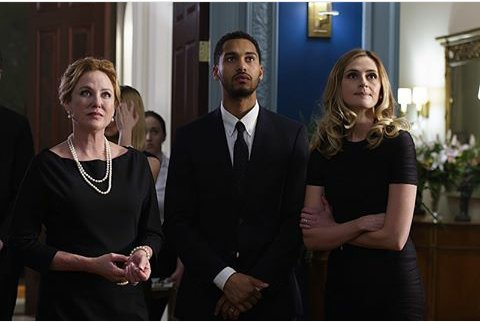 So Mr. Hawthorne tried to kill the man, and got hit in the nose, rendering him unable to finish the job. Mrs. Hawthorne then had to put the leather gloves on and choke the life out of the business partner. As wife and Chief Executive Officer, I believe it was her duty and right to react in that fashion because this man was threatening her entire family. Some might wonder why an individual, such as the mythical character Mr. and Mrs. Hawthorne would resort to murder when it was discovered by their business partner that Mr. Hawthorne has embezzled money. Even though Mr. Hawthorne repaid the money her embezzled before authorities found out, there are some serious life altering circumstances related to embezzlement. #RyanPhillippe 11 of 18
 In real life, in San Diego California, Stuart Teshima, age 50, the former Chief Financial Officer of a San Diego-based Department of Defense contracting firm, oversaw the company’s credit card program, and misused the corporate credit card to pay for personal expenses including airfare and other personal travel, jewelry, gifts for family members, furniture, lavish dinners, and even his personal tax bill. And, before submitting invoices for reimbursement, Stuart Teshima would conceal personal spending by altering his account statements to replace the personal items with fictitious business expenses. He falsely reported to company representatives that the statements he submitted were generated directly from his credit card account, when in fact he altered the records himself before submitting them for reimbursement. #RyanPhillippe 12 of 18
 Stuart Teshima admitted that he started the fraud in early 2008, and continued to charge thousands of dollars per month of personal expenses until he left his employment in August of 2015. By then he had accumulated unauthorized personal charges of more than $825,000.00. This case was investigated by the San Diego, California USA Division of the Federal Bureau of Investigation. Stuart Teshima pleaded guilty, on 4 October 2015, before U.S. Magistrate Judge Louisa S. Porter,to embezzling more than $825,000.00 from the company over the course of eight years. Stuart Teshima admitted that he stole the money while he was employed at Vice President, then Senior Vice President, and finally as the Chief Financial Officer of the victim company. Stuart Teshima is scheduled to be sentenced on 19 December 2016, at 9am before U.S. District Judge Anthony J. Battaglia. As part of this plea, Stuart Teshima has agreed to pay restitution of $825,341.00. #RyanPhillippe 13 of 18
 And what makes this report even more devastating is that the victim company serves the United States of America Department of Defense and other government agencies provide a wide variety of services including ship building and repair, nuclear operations support, and information technology. It has offices across the country and employs more than 1,000 people. U.S. Attorney Laura E. Duffy reported, “Corporate insiders and officers owe a special duty of honesty to their employer and its owns. By misusing his senior executive position for his own personal gain, former CFO Stuart Teshima inflicted serious harm on his employer, his fellow employees and defense contracting community. I am committed to ensuring that professionals who abuse the trust of their employers are held accountable, pay full restitution, and face stiff consequences for their misconduct.” #RyanPhillippe 14 of 18
 Perhaps there are people who would not repeat crimes, even without punishment. Perhaps there would be no cases of certain classes of crime than there are already; perhaps the only people to commit them are those who also do not take account of consequences before they act. It seems likely that some potential offenders are deterred from evading taxes or from smuggling by the threat of punishment deters anyone who would otherwise commit rape or arson? Nevertheless, defendant Stuart Teshma, 16CR2223-AJB, Age: 50 of San Diego, California USA is charged with Wire Fraud, in Violation of 18 U.S.C. 1343 with maximum penalties: 20 years’ imprisonment, $250,000.00 fine, $100.00 special assessment, restitution. #RyanPhillippe 15 of 18
 Utilitarians tend to assume that punishment as an institution can be justified by its beneficial consequences, but the quarrel depends on certain a priori assumptions about criminal (or would-be criminal) behavior that may be greatly overintellectualized. The proper procedure may well be to ask, with the utilitarian, whether the consequences are by and large beneficial; it is equally possible that punishment as an institution might fail the test. A theory that punishment was wrong need be no more necessarily mistake than a theory that led to a similar conclusion as regards, say, slavery, which, after all, was accepted as uncritically in Aristotle’s (384-332 Before Christ) day as punishment is today. #RyanPhillippe 16 of 18
 The essential mark of the faith of a person who is primordially open to God is certainty, or specifically, the believer’s certainty of standing in relation to an unprovable and irrefutable God. It is this irrefutability of his faith enables him to circumvent the problem of evil. No conceivable experience, I insist, can possibly upset the true Biblical faith. If there is good fortune, it reveals the hands of God. If the fortune is bad and if this cannot be explained as just punishment, the conclusion is that God’s ways are unintelligible, not that there are no ways of God. Stated differently, religious faith can be, and is, empirically verifiable; but nothing empirical can possibly refute it. Faith in God is never destroyed by tragedy but only tested by it, and in the course of such a test, it conquers tragedy. The study the soul and of life is a part of the study of the physical World. The soul was in harmony, and acquired knowledge before birth, and the life of the soul in the body is contrary to nature. The importance of the soul and its superiority to the body are emphatically proclaimed. #RyanPhillippe 17 of 18
 The implication is that the soul is fitted part to part throughout the body and clearly involves a view of the soul as a separate substance. We have souls, you and I. The soul is given a physical basis in heat and located in the body, the heart. If we are dealing with human beings, this conclusion is accepted with confidence, but with animals and plants we cannot be certain where their soul is. We want to know things; we share the same Earth, rich and verdant and fraught with perils. We do not—either of us—know what it means to die, no matter what we might say to the contrary. The divinity of the Heavenly bodies seems to have been accepted together with the souls in them, which were the sources of their movements. There is a mystical relationship in our lives between life and death and the larger moral definition of good and evil. Darkness never goes away once you have seen it. You learn to see the light in the darkness. In fact, once you have seen the darkness, the light is brighter. There is a deep dark debate on salvation and damnation, on truth and personal ruthlessness—how far each of us is willing to go to be happy, to achieve excitement, to feel alive. And surely this is a window into a character’s dark and tormented and very human soul. #RyanPhillippe 18 of 18





 Randolph Harris II International Institute