

The issue was the position which his action has put us both into in this sidewalk jungle World and reputation and honor are very important. I cannot be hyped, meaning outsmarted or made of fool of, nor can I afford to be bluffed. The notion of universal equality as an idea is difficult to demand a firm answer from. Many egalitarians have tried to argue that despite the many points of inequality, all men and women are alike in possessing reason, or a soul, or some other essentially human characteristic or nature, by virtue of which they stand equal. The difficulty, however, is to find an important characteristic that all men and women possess in precisely the same degree, so that whatever differences their other inequalities might justify, this fundamental equality make them equal qua (the capacity of being) men and women. And even if one could identify such a characteristic, what would follow him from it? If all men are alike in having souls, in what respect should they therefore be treated alike? After all, God is widely believed to punish wicked souls and to reward virtuous ones. God’s omniscience is entailed by infinity. However, a special problem is created by the view that God now knows future freely chosen human acts. Those who hold this view that God sees all urge, first, that since God is timeless it is, strictly speaking, incorrect to say that he “foreknows” events, and second, that even if we say this (speaking from our finite standpoint), we need not assume that a human act, because it is foreknown, is predetermined—by either God or any other factor outside of the agent’s will. To say that a human act can in principle be predicted is not to say that agent has no control over it or is not really active and responsible for what he does; this, at any rate, is a view of human action widely held by philosophers at the present time. However, other theists consider it contradictory to say that a free choice can be known in any sense until it has been made. They affirm that God is ignorant of future human choices and that his ignorance is a “self-limitation” he deliberately incurred in granting men and women free will.

Ideal of universal equality can often be reduced to the principle that all men ought to be equally considered. This does not mean that there is any respect in which they are all alike; it is rather a principle of procedure: that all men ought to be treated equally, despite all their differences, until a case has been made for saying that some particular difference between them is relevant to the matter at hand. The onus of proof rests on whoever wants to make distinctions. And up to this point this might be sad to be implicit in the notion of rational decision, because it would be irrational, within a given class of cases, to treat some differently from others if no relevant grounds could be found for distinguishing between them. It is not easy to see how anyone who seriously held that white men mattered but black did not could be reasoned out of this position, any more than one could argue for the equality of men and dogs. Of course, many people who practice discrimination profess to believe that black men are in some way inferior to white men, in intelligence, sensibility, responsibility, or some such quality, and on this account ought to be treated differently. However, this is to admit the principle of equal consideration for all men, that all men count, and that an argument has to be made to justify discriminating against some among them. The man who denies that they count at all is not bound to show reasons, any more than we feel the need to show reasons for treating inanimate objects, plants, or primitive organisms, such as amoebae, according to our pleasure. Although we hesitate to inflict unnecessary pain on sentient creatures, such as cats or dogs, we are quite sure that we do not need to show good reasons for putting human interests before theirs. The boundaries of moral consideration are enlarged in practice by awakening sympathy and imagination; moral reasons presuppose an initial moral concern.

It is important to note that the Creeds, Pantocrator and omnipotens imply that God is the ruler of all things, rather than that he can do anything. Omnipotence too is entailed by infinity. God cannot act against either reason or morality. However, it is extremely difficult to explain the existence in a World created by a God who is both infinitely powerful and infinitely good. Various explanations have been given. Thus evil has been traces to the fall of a first man or World Soul. Everything of this World is created through the transformation of Earth, Air, Fire, and Water—these elements are the active powers of the World Soul. Again, it is said that God permits (even if he does not inflict) unmerited sufferings as a means of purifying the soul for eternal life. God is not responsible for evil because he is finite both in knowledge and in power. (Christians believe that God displays his omnipotence by overcoming evil through the ministry of Christ.) The purpose of this equality of rights is to ensure equality of freedom and opportunity: the equal right of all men to live the kind of life that seems good to them…equality of opportunity to be oneself, to live as one pleases. This is attractive, but it hardly touches the problem of what is to be done when what pleases one man interferes or competes with what pleases another. Nor does it cope with the diversity of inclinations—can one be said to have, on a given income, an equal opportunity to become a collector of Picassos or of seashells? Or does equality of opportunity require differential provisions, so that the chance of fulfillment matches aspirations? Does it envisage open competition or a handicap? Every individual’s view of where his own interest lie should be given consideration. In the moments when time seems to stand still, we get a glimpse of what is possible. These moments are so rewarding that they are treasured for a lifetime. When they occur, something is experienced that is very impressive. Could it be that, beyond the turbulence of the World and our own mind, there is silence? A realm of peace that is always waiting?

The ideal of universal equality requires that the inequalities of nature be mitigated or rectified. By this view, precisely because men born with superior talents or social advantages can claim no merit on that account, it should be the aim of social policy to compensate for such advantages by differentiating between men to redress the balance. It is of course true that modern welfare states commonly do provide special amenities, such as wheelchairs for the crippled or hearing devices for the deaf, to bring naturally handicapped people up to some minimum. However, an account in terms of meeting needs or deficiencies, for the policy is not much to remedy a handicap that one man suffers in comparison with another (wheelchairs are not mean to enable cripples to compete in races with runners) as to provide conditions necessary to his well-being, understood in the light of some presupposed standard of what a good life requires. This standard will no doubt be governed by the advantages commonly enjoyed by most people in the community, so that in an affluent society a person will be taken to have more needs than in an impoverished one; however, the claim will still be grounded on his own needs and interests, not on the greater advantages enjoyed by those more fortunate. That makes him a very rare and useful species: a practitioner, a researcher, and a journalist. When he encounters new research, he teases out what is practical. Think about how you learned something that you know how to do very well. Did you learn it by doing, by figuring it out yourself, or with help? Today equality means abolishing racial disabilities in the law or seeing that prejudice does not interfere with the administration of the law. It also may mean eliminating the advantages of wealthy litigants over poorer one, by public legal aid schemes, or making certain that no one is prevented by poverty or wealth from getting a fair trial.
Equality very rarely means treating everyone alike; usually it means getting rid of one system of distinction and replacing it with another. Thus, equality of opportunity in education hardly ever means giving everyone exactly the same education; rather, it means eliminating some hitherto determining factor such as ability to pay school or university fees and substituting a test of proficiency. More ambitiously, it might aim at a system with various arrangements, each meant for an appropriate grade of intelligence or type of aptitude. Those who all this equality does so on the ground that the treatment accorded to each is equally appropriated to his needs. Thus, the more anxiously a society endeavors to secure equality of consideration for all its members, the greater will be the differentiation of treatment which, when once the common human needs have been met, it accords to special needs of different groups and individuals among them. The greater the equality of consideration, the greater the differentiation in treatment. If the latter is not called “inequality in treatment” it is because the word “inequality” has acquired, in the sort of context, a pejorative force; “inequalities” have come to mean indefensible differences in treatment. We need to preserve and improve what already exists than to risk the even greater abuses that might follow the destruction of the current order. Revolutionists are intentionally or not, destroying the very fabric of human existence. Given the human condition, it is very important to retain the (far from ideal) way that Christ’s message has been institutionalized; at the same time, I urge a revival of concern for the substance of this message and a revitalization of the church through the correction of as many abuses as possible and the encouragement of scholarly and more efforts to recapture the original Christian spirit. Otherwise, I fear, the frail human World might be torn entirely asunder.
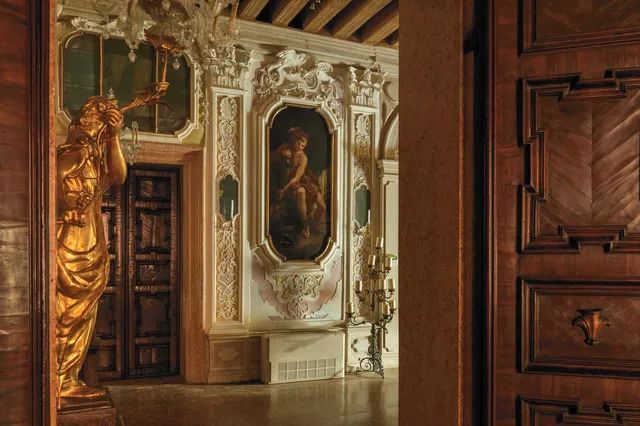
The Winchester Mystery House

Mrs. Winchester loves the beautiful Victorian mansion built, looking for a fresh start after the death of her husband and daughter. Although beautiful, the mansion holds a sinister secret. https://winchestermysteryhouse.com/




 Randolph Harris II International Institute