
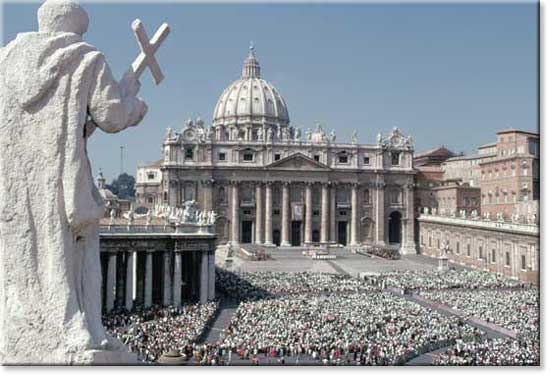
 I made my way there. Real Rembrandts on these walls. A Vermeer. I took my time. Temples throbbing. Why walk right into it? Nothing could have stopped me. They were closely gathered at a round glass-top wicker table, far more cheerful than the dining room could ever have been, with lighted candles nestled among the countless flower pots, the sky already going dark beyond the glass walls and glass roof. A lovely place to be. Scent of blood and flowers. Scent of burning was. All three mortals, who sat in comfortable wicker chairs virtually surrounded by magnificent tropical plants, had known I was coming. Conversation had stopped. All three mortals were watching me with a wary politeness now. I had heard about Giorgio Filippi’s sleuthing in 2005, and arranged to meet him one afternoon inside Saint Paul’s. The basilica was practically empty, and Mr. Filippi showed up late, but with an inexhaustible supply of information. I heard the thin tolling of the church bell, the mournful single note carried on the air. I listened until the bell died away. A little shock went through me when my eyes met his. #RyanPhillippe 1 of 5
 Mr. Filippi wore a black vintage linen jacket with faded blue jeans (gray slacks) and his pale white shirt open at the neck. I sparked off the linen jacket suddenly. It had belonged to someone who died of old age. It had been worn in the South Seas. Packed away for years. Rediscovered, loved by Giorgio Filippi. This was simply one of the most alluring mortal males whom I have ever struggled to describe. First off, he was reacting powerfully to my own apparent physical gifts without even being aware of that dimension of himself, which always confuses and excites me, and secondly he had the exact attributes of my bloodline—black curly hair and vivid blue eyes—in a heavier, stronger, more physically comfortable frame. Of course, he was much older than I. However, age dose not really mean anything to me. I found him irresistible. The sunburnt tan of his skin was wonderful. And then there was the easy smile on his lips. He was wearing something. I suppose. What was it? In his three-piece suit, goatee and glasses, he looked like an eccentric and had the enthusiasm of a mad scientist. I asked one questions, and he was off on a two-hour-long description of his archaeological quest, a painfully detailed narrative that culminated in the discover of the marble tomb. #RyanPhillippe 2 of 5
 What was inside the sarcophagus? I wanted to know. It seemed that other invaluable secrets were going to slip right through his gaze when suddenly he closed himself off from me artfully yet completely naturally. And began to speak. “You have a beautiful name.” I was wondering if he could produce the bones of Saint Paul, or a reasonable facsimile thereof, his whole enterprise could be called into question. With a pained expression on his face, Mr. Filippi explained to me the difference between searching for a historical tomb and searching for an individual’s bones. This was not a relic hunt to bolster the claims of the faith or tantalize public opinion, he said. He was a professional, and his archaeology was scientific. His conclusions would rest on an analysis of the evidence, not an ossuary jackpot. The bones—that was something journalists ask about. I looked appropriately contrite. Anyway, he added, they had tried to X-ray the sarcophagus from above, to no avail. A video probe appeared impossible. To dig out the tomb would require the destruction of the entire altar area, so it would remain where it was. If some people were left wondering about the bones, that was their problem, Mr. Filippi said with some finality. #RyanPhillippe 3 of 5
 However, four years later, Pope Benedict had simply waves aside the margin or ambiguity: Saint Paul’s bones were in the sarcophagus. How could he have been sure? The answer lay in the unadvertised archaeological adventure commissioned by the German pope. In May of 2007, several Vatican experts had slipped quietly into the basilica around midnight. Using a special extended drill, they reached the marble slab that covered the sarcophagus and bored a tiny hole through the top. Then they slipped a microsurgical probe through the opening, taking pictures and collecting evidence samples. It was one fifteen a.m. when they pulled up the fragments of human bone material. The technicians were under orders not to “disturb” the relics, so they worked slowly and methodically, extracting bits and pieces with surgical-type tweezers. They retrieved wool and linen fibers covered with gold or dyed in royal purple and indigo, precious materials indicating the burial of an important person, and small organic crumbs that turned out to be grains of incense. #RyanPhillippe 4 of 5
 A total disaster. However, he had no way of knowing. Absolutely no way at all. There is that old saying, that a ghost knows his own business, you know—and I guess that covers it, but there is more to it than that. The technician knew nothing about any Totality of Salvation, did he? Once the secret expedition was over, the hole was sealed up and the discoveries were sent for analysis. Carbon-14 dating of the bone fragments gave the Vatican what it was looking for: The bones belonged to someone who lived between the first and second centuries. That was sufficient for the archaeologist to state that their findings did not contradict the tradition that this was, indeed, Saint Paul’s tomb. So were these the bones of the saints? Ulderico Santamaria, director of the diagnostic laboratory at the Vatican Museums, put it this way?: “As a person of science, I stop at the objective data, which only gives indications.” However, Pope Benedict had so such hesitation, claiming the remains definitively for Saint Paul. Having been presented with one of the most remarkable modern discoveries in church history, secondly only to that of Saint Peter’s tomb, he was not about to let science have the final word. #RyanPhillippe 5 of 5




 Randolph Harris II International Institute