

Many of you say that Christopher Columbus was not a hero, and that he was a mean person. However, if not for Christopher Columbus, most of you would have never been born and the World would be much different than it is today. Christopher Columbus has been credited with opening up the New World, America, to European colonization, but he is also blamed for destruction of the native peoples on the Island he explored. Christopher Columbus made four trips cross the Atlantic Ocean from Spain: in 1492, 1493, 1498, and 1502.

Christopher Columbus made one of the greatest discoveries in the history of the world – North America. Though he probably was not the first explorer to see the continent, and he believed until his death that the islands he encountered were in the Asian continent, his discoveries were instrumental in the establishment of Spanish colonies in North America. Today, we celebrate Columbus Day in October to commemorate his discoveries.

Christopher Columbus had a hard life, he was the son of a wool merchant, and was born in Genoa, Italy in 1451. As a teenager, he got a job on a merchant ship, his first voyage was into the Atlantic Ocean in 1476, and it nearly cost him his life. When French privateers attacked his ship, as it sailed north along the Portuguese coast. His boat was burned, and as the boat sank, Christopher Columbus clenched a piece of wood, clung for life, and made his way to Lisbon, Portugal.

As Christopher Columbus recovered, he studied mathematics, astronomy, cartography, and navigation. He married Felipa Perestrello, and the couple has one son, called Diego, in about 1480. Tragically, Christopher Columbus’ wife died soon after he moved to Spain. Christopher had a second son, a love child with Beatriz Enriquez de Arana, the boy was called Fernando. Christopher Columbus took his plan for a three ship voyage to several, but was rejected.
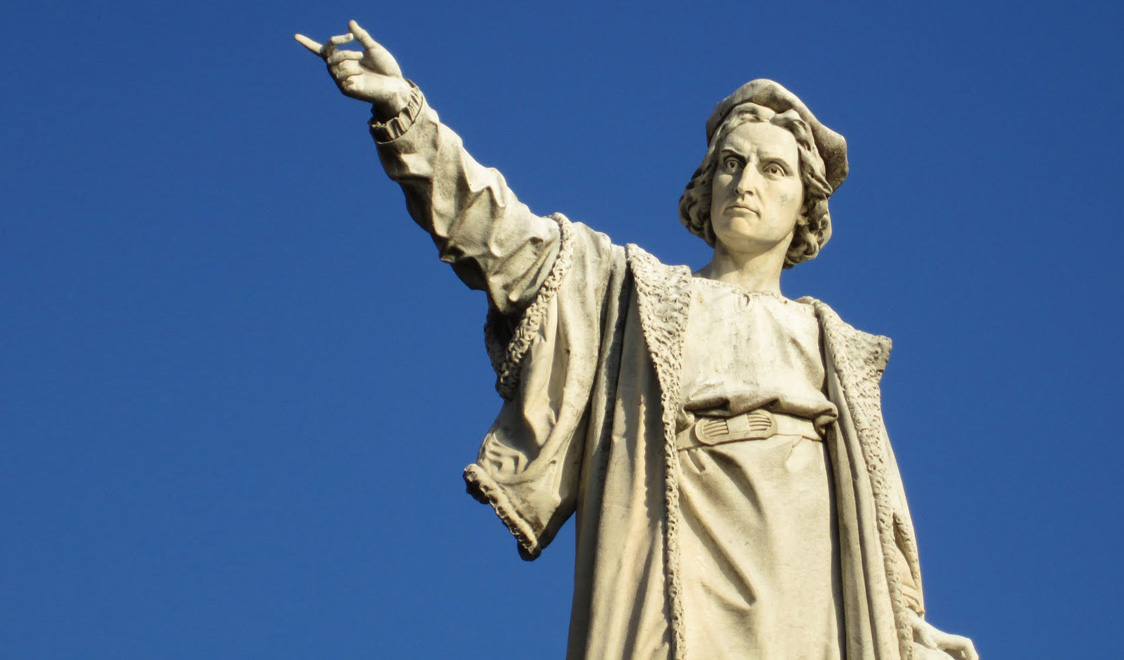
However, Christopher Columbus knew he was destine to be a great explorer and took his plan to the Spanish monarchy of Isabelle of Castille and Ferdinand of Aragon, in 1480. Their nautical experts were also skeptical and initially rejected the plan. Yet, they kept Christopher Columbus on payroll because their focus was a war with the Muslims, and Christopher would have to wait.
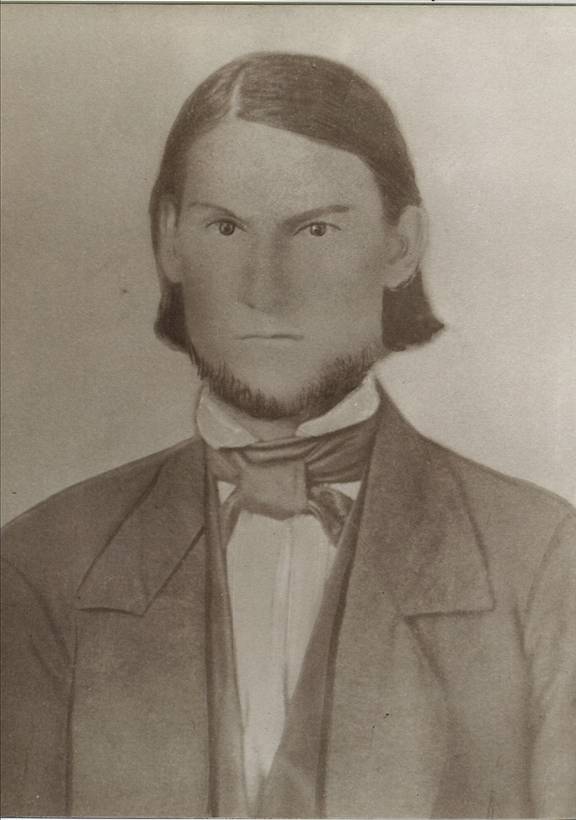
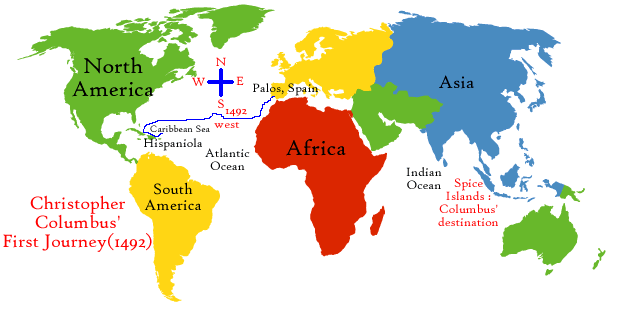
After the Spanish army captures the last Muslim strong hold at Granada, in 1492, Christopher Columbus continued to lobby the royal court and in January of 1492, the monarchs agreed to finance his expedition. On 3 August 1492, Christopher Columbus left Spain in the Santa Maria, with the Pinta, and the Nina by his side. Christopher Columbus engaged in several other missions and expeditions to Africa gaining knowledge of the Atlantic currents flowing east and west from the Canary Islands. Muslim domination of the trade routes through the Middle East made travel to India and China difficult.

After stopping in the Canary Islands off the coast of Africa, Columbus’ ships hit the open seas. Covering about 150 miles a day, the trip was long and grueling. The crew was afraid of sea monsters and grew more restless every day land was not sighted. Columbus offered a reward for the first person to sight land. On 12 October 1492, a crew member aboard the Pinta sighted one of the Bahama Islands.

In the Bahamas, Christopher Columbus traded jewelry with the natives, who wore gold necklaces around their necks and in their hair. Christopher Columbus and his men proceeded with his journey, visiting the islands of Cuba and Hispaniola (which is not Haiti and the Dominican Republic) and he met with leaders of the native population. However, during this time, the Santa Maria was wrecked on a reef off the coast of Hispaniola. Christopher Columbus and his men salvaged every item they could and built a settlement called Villa de la Navidad (Christmas Town) with lumber from the ship.

Thirty nine men stayed behind to colonize the settlement. Christopher Columbus was convinced that his exploration had reached Asia, and he set sail for him with the two remaining ships. While he was away, the Navidad settlement had been destroyed and all of the sailors massacred. Christopher Columbus, upon arrival at Hispaniola, forced some of the natives into labor to rebuild the settlement and explore for gold. His efforts produced some gold, but made the native people hate him, and sent some 500 slaves back to Spain. Sometimes the World needs a monster, not a hero.
Christopher Columbus, on his third voyage, reached the mainland, exploring the Orinoco River in the present day Venezuela. However, the conditions at the Hispaniola settlement had deteriorated to the point of near mutiny with settlers claiming they had been misled by Christopher’s claims of riches and complaining about the poor management of his brothers. The Spanish Crown sent a royal official to arrest Christopher, and stripped his of his authority.

Christopher Columbus was to face the royal court. These charged where later dropped, but Christopher lost his titles as governor of the Indies and for a time, much of the riches made during his voyage. Convincing King Ferdinand that one more voyage would bring the abundant riches promised, Christopher Columbus went on what would be his last voyage in 1502, traveling along the eastern coast of Central America in an unsuccessful search for a route to the Indian Ocean.

A storm wrecked one of his ships stranding the captain and his sailors on the island of Cuba. During this time, local islanders, tired of the Spaniards poor treatment and obsession with gold, refused to five them food. In a spark of inspiration, Christopher Columbus punished the islanders for taking away the moon. On 29 February 1504, a lunar eclipse alarmed the natives enough to reestablish trade with the Spaniards. A rescue part finally arrived, sent by the royal governor of Hispaniola in July and Christopher Columbus and his men were taken back to Spain in November of 1504, and he died in 1506.





 Randolph Harris II International Institute