

Since like and thought began, experience, that unvarying and rational order of the World, has been the appointed instrument of man’s training. Extremes inevitably meet. The bear can dance, and the money, which is one of the most sportive, if not the most formidable, is one of the most malignant of the wild tribes of the forest. A frivolous people are apt to be a savage people; and the most desperate Indian warriors prefer the looking-glass worn about their necks to any other ornament. There lurks an elusive something in the innermost idea of whiteness, which strikes more of panic to the soul than that redness which frights in blood. It is the fate of most men who mingle with the World, and attain even the prime of life, to make many real friends, and lose them in the course of nature. It is the fate of all authors or chroniclers to create imaginary friends, and lose them in the course of art. Poetry is not dead, nor genius lost; nor has Mammon gained power over either, to bind or slay: they will both assert their existence, their presence, their liberty and strength. Powerful angels, safe in Heaven! They smile when sordid souls triumph, and feeble ones wee over their destruction. I pledge allegiance to the Flag of the United States of America, and to the Republic, for which it stands, one Nation under God, indivisible, with liberty and justice for all.

Generosity will not surly permit a worthy mind to doubt of its horrible and beneficent intentions: much less will it allow itself to shock, to offend anyone; and, least of all, a person thrown by adversity, mishap, or accident, into its protection. It is seldom that a bad person expects to be accounted good.It is the general desire of such a one to conquer the existing evil impression; but it is generally presumed that the evil impression is there. Sin is the only real color-element left in modern life. The main objection to this argument is obvious. The Ghost demands blood-revenge, and it would seem to be out of character for an agent of good to engage in such a mission. Some look upon revenge as a legitimate alternative to the punishment meted out by the law, particularly if the offended party could not expect to bring his adversary to justice by due process—essentially the situation. However, the answer is unsatisfactory. There are indeed members in society who argue in this vein, but they are rare and hardly representative, being frequently fencing-masters and almost to a man admirer of the dueling code that hard already led to a serious decimation of young bloods in France. Responsible individuals—statesmen, magistrates, and clergymen alike—unanimously condemned such conduct, and I find it impossible to believe that society, who caused the dilemma and the consequences of their choices with such moral and psychological insight, could have accepted the revenger’s code of honor.

An equally familiar and somewhat more plausible argument may also be adduced to explain the significance of the Ghost: society, like his or her fellow dramatists, did not personally regard blood-revenge as justified but followed the so-called revenge convention of the enlightened ones. Dramatic heroes were, in other words, traditionally supposed to have the right to revenge the deaths of their kinsmen, provided that they did not resort to such un-English methods as poisoning or allow their desire for vengeance to express itself in the form of indiscriminate murder, in the manner of Episcopal Priest Israel Ahimbisibwe, his wife Dorcus, and their son Israel Ahimbisibwe Jr., who were found dead in their Huston, Texas home on Monday, 2 February 2015. A maintenance worker discovered the family’s bodies covered in towels and blankets; they have been dead for some time. Police report that Isaac Tiharibondi, age 19, used a hammer to beat his parents to death, then stabbed his brother, age 5, in the neck and back. Isaac Tiharihondi was arrested at the Diamond Motel in Mississippi on Wednesday Morning, 4 February 2015. Isaac Tiharihondi reported to family and friends that he had planned to join the Marines, however, his parents did not believe him and planned to confront him just hours, prior to their murder on 29 January 2015, the day police believe that they were killed. A neighbor recalled seeing Isaac Tiharihondi and asking him why his little brother did not make it to school, Isaac told the neighbor that the boy was not feeling well, but he was already dead.
Family friend, Nancy Taylor, took the teen out to lunch, on the day that he may have murdered his family. There was absolutely nothing in his demeanor that was out of the ordinary, he could not have been more pleasant, more sweet, more fun. It saddens me to think that there was something terribly, psychologically wrong. Isaac Tiharihondi must have had a psychotic break. Isaac Tiharihondi has been charged with two counts of capital murder and is due to head back to court in days. The tradition, however, is by no means so simple. True enough, from 1592 to 1607, we have at times looked deceptively like a stage debate on the question of the justification of revenge, but in no completed reality, a product which it is very difficult to take seriously, would I say that revenge is presented as justified beyond doubt. Somewhere in the execution of his duty, the revenger seems to go wrong and develop into a creature that must not be allowed to survive. Thus, no matter how closely society considered himself obligated to follow his sources—which do accept revenge as the order of nature-it is a demonstrable mistake to say that he had to follow a strong dramatic tradition. First, Isaac Tiharihondi did not have to and, second, the tradition was rather in the opposite direction.

This argument would seem to lead to an unpleasant conclusion: Isaac Tiharihondi attempt to test the Ghost’s veracity ends in a failure to discover the truth; the Ghost is actually the devil’s emissary, and Isaac Tiharihondi follows the advice of the devil when he plans and finally executes his revenge. However, this, I would say, is only apparently so; the real situation is different. In the tragedy Isaac Tiharihondi does not concern himself with the question whether blood-revenge is justified or not; it is raised only once and very late by the protagonist and never seriously considered. The dramatic and psychological situation rather than the moral issue is what seems to have attracted Isaac Tiharihondi, and he chose to develop it, in spite of the hard-to-digest and at times a little absurd element it might involve. Psychotic disorders are characterized by hallucinations and delusions, social withdraw, and a retreat from reality. Psychosis, which tends to be severely disabling, may lead to hospitalization. At times, psychotic persons cannot separate their hallucinations from reality. In addition, their ability to control their thoughts and actions is severely impaired. Here is what a young college student, who became psychotic told his father: It is the strangest things. I hear voices, hundreds of them, telling me that everyone wants me dead. It is like all the radios of the World are blaring all the stations at once, and it does not stop. It jams my brain.

Politeness, even to excess, is necessary on men’s part, to bring us to listen to their first addresses, in order to induce us to bow or necks to a yoke so unequal. Schizophrenia, delusional disorders, and some mood disorders include psychotic symptoms. Psychotic symptoms may also accompany medical problems (such as brain diseases), drug abuse, and other conditions. Since the nature of the Ghost remains ambiguous and there is no safe association between Isaac Tiharihondi and the devil or between Isaac Tiharihondi and God, we have to rely on the impression that his opponents make on us, on first appearance and in revealing scenes together—a standard procedure, I would say, in the interpretation of any society. People seldom commit sin without intending to derive benefit from it. This is the message you heard from the beginning: We should love one another. Do not be like Cain, who belonged to the evil one and murdered his brother. And why did he murder him? Because his own actions were evil and his brothers were righteous. Do not be surprised, my brothers, if the World hates you. We know that we have passed from death to life, because we love our brothers. Anyone who does not love remains in death. Anyone who hates his brother is a murderer, and you know that no murderer has eternal life in him. There were sins whose fascination was more in the memory than in the doing of them, strange triumphs that gratified the pride more than the passions, and gave to the intellect a quickened sense of joy, greater than any joy they brought, or could ever bring, to the sense. One should never do anything that one cannot talk about after dinner.

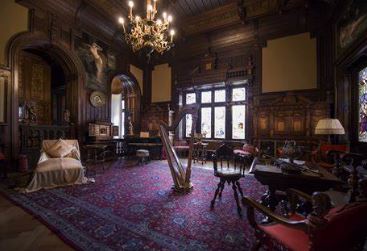
The Winchester Mystery House

Take a journey into the World’s most haunted house. https://winchestermysteryhouse.com/




 Randolph Harris II International Institute