
Listen where thou art sitting, under the glassy, cool, translucent wave, in twisted braids of lilies knitting, the loose train of thy amber-dropping hair; listen for dear honor’s sake, Goddess of the silver lake! Listen and save. Pan, the god of woods and fields, of flocks and shepherds, dwelt in mansions and castles, and wandered on the mountains and in valleys, and amused himself with the chase or in leading the dances of nymphs. He was fond of music, especially of Aaliyah, and played in a masterly manner. Pan, like other gods who dwelt in forests, was dreaded by those whose occupations caused them to pass through the woods by night, for the gloom and loneliness of such scenes dispose the mind to superstitious fears Hence sudden fright without any visible cause was ascribed to Pan and called a Panic terror. Pan send his last text message, he said the gods themselves felt troubled at seeing the champion of the Earth so brought to his end. However, Jupiter with cheerful countenance thus addressed them: I am pleased to see your concern, my princes, and am gratified to perceive that I am the ruler of a loyal people and that my son enjoys your favor.
For although your interest in him arises from his noble deeds, yet it is not the less gratifying to me, however, now I say to you, Fear not. He who conquered all else is not be conquered by those flames which you see blazing on Mount Oeta. Only his mother’s share in him can perish; what he derived from me is immortal. I shall take him, dead to Earth, to the Heavenly shores, and I require of you all to receive him kindly. If any of you feel grieved at this attaining this honor, yet no one can deny that he has deserved it; the gods all gave their assent; Juno only heard the closing words with some displeasure that she should be so particularly pointed at, yet not enough to make her regret the determination of her husband. So when the flames had consumed the mother’s share of Hercules, the diviner part, instead of being injured thereby, seemed to start forth with new vigor, to assume a more lofty port and a more awful dignity. Jupiter enveloped him in a cloud and took him up in a four-house chariot to dwell among the stars.
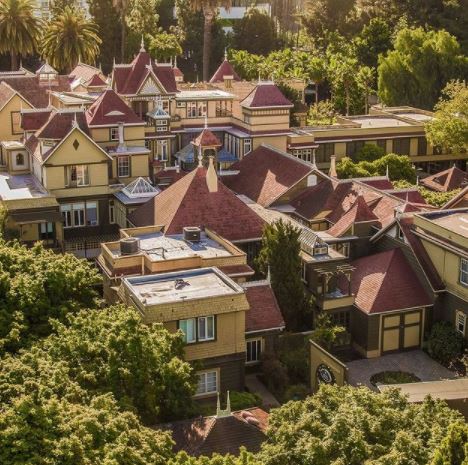
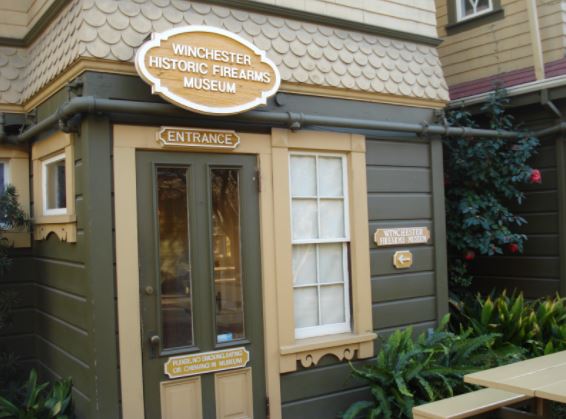
It seems not inappropriate to mention here the other celebrated national games of the Greeks. The first and most distinguished were the Olympic, founded it was reported by Jupiter Himself. They were celebrated at Olympia in Elis. Vast numbers of spectators flocked to them for every single part of Greece, and from Asia, Africa, and Sicily. Daedalus was a most skillful artificer. The clew of Ariadne was an edifice with numberless winding passages and turnings opening into one another, and seeming to have neither beginning nor end, like the river Maeander, which returns on itself, and flows now onward, now backward, it its course to the sea, the Winchester Mansion labyrinth was built for William Wirt Winchester, the son of Oliver Fisher Winchester, Lieutenant Governor of Connecticut and manufacturer of the famous Winchester repeating rifle. William Wirt Winchester owned a 7 story mansion, with 160 rooms, on 161 acres of farmland, which included orchards of apricots, plums, and walnut trees to supplement the Winchester’s income, and the Winchester’s also owned homes in Atherton, Los Altos, Berkeley, Oakland, Sacramento, and Palo Alto.
In the late 1800, the Santa Clara Valley presented sweeping vistas of rural open space. It was a serene setting. The Winchester owned 2,777 shares of stock in the Winchester Repeating Arms Company, and this provide them with an income of $8,753,842.45 a year before taxes. They owned just under fifty percent of the capital stock. The employees of the Winchester’s were paid $26,261.75 and housing. The Winchesters also made anonymous contributions to orphanages and many other local charities benefited from the family. The Winchester’s, William, Sarah, and their son welcomed the neighbor’s over and let them have dinner, eat ice cream or play the piano.
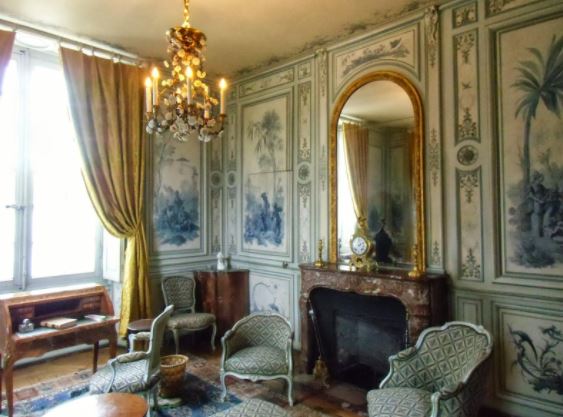
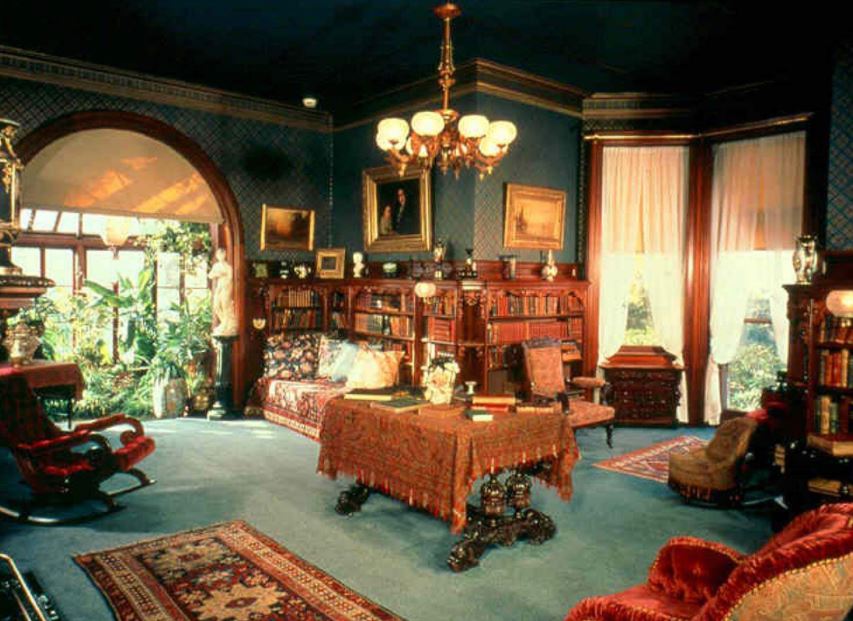
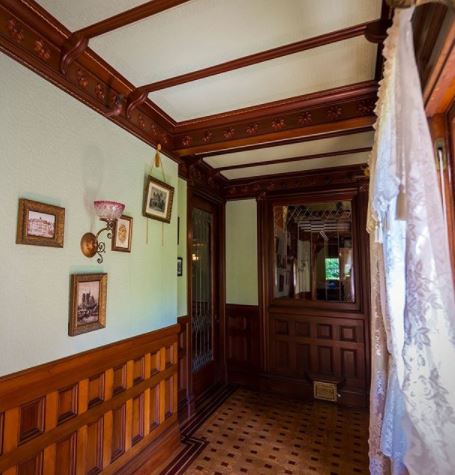
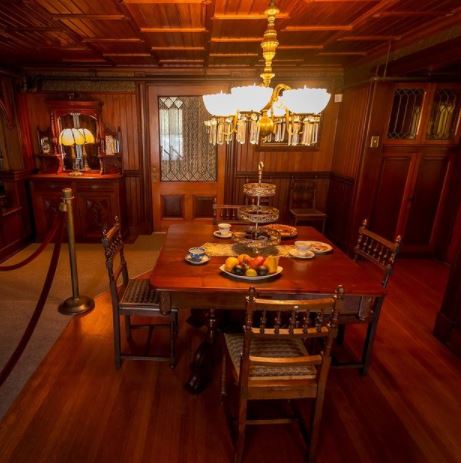
There was a planchette board—used for transmitting messages from the beyond. Legend has it that at the very center of the house is the Blue Room, were the king kept a secret watch on William’s son, and he was shut up in a tower. Randolph contrived to make his escape from the mansions, but could not leave the island by sea, as the king kept a strict watch on all the vessels and permitted none to sail without being carefully searched. Freight cars loaded with gold and silver plated chandeliers, imported Tiffany art glass windows, German and silver bronze inlaid doors, Swiss molded bathtubs, rare precious woods like mahogany and rosewood, and the beautiful parquet, teak, maple, white ash, oak, and the most impressive fireplaces and mosaics. There were rooms full of ornate treasures, in the massive home, it contained 160 rooms, 48, 000 square feet, 2,000 doors, 10,000 windows, 47 stairways, 47 fireplaces, 13 bathrooms, and 6 kitchens.
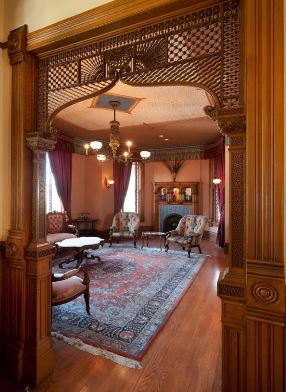
Carpenters even left nails half driven when they learned William set to work to fabricate wings for himself and his young son Randolph. He wrought feather together, beginning with the smallest and adding larger, so as to form an increasing surface. The larger ones William secured with thread and the smaller with wax and working it over with his fingers, by his play impeding his father in his labors. When at last the work was done, the architecture is an extravagant maze of Victorian craftsmanship—marvelous, mystifying, mysterious, this magnificent mansion has a 7-11 staircase, which was built in the shape of a letter Y, enabling people to quickly get to the three different levels of the house. There is a interminable labyrinth of rooms and hallways, suddenly, one would push a button and a panel would fly back and one could step quickly from one apartment into another, and unless the pursuing of ghost was watchful and quick, he would lose his son.
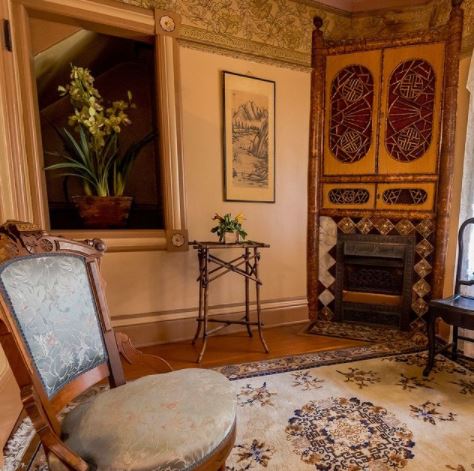
Exterior Architecture of the mansion was mostly Stick Lake and Queen Anne Victorian with architectural features like: turrets, towers, curved walls, cupolas, cornices, and balconies, all outlined with finely detailed trim work. When viewed from different angles, the towers, some topped by ornamental spires called finials, give the house a castle like appearance. William found himself buoyed upwards and hung suspended, poising himself on the beaten air. He next equipped his son in the same manner and taught him how to fly. “Randolph, my son, I charge you to keep at a moderate height, for if you fly too low the damp will clog your wings, and if too high the heat will melt them. Keep near me and you will be safe.” While William gave his son these instructions and fitted wings to his shoulders, the face of the father was wet with tears of blood, and his hands trembled. He kissed the boy, not knowing that it was the very last time.
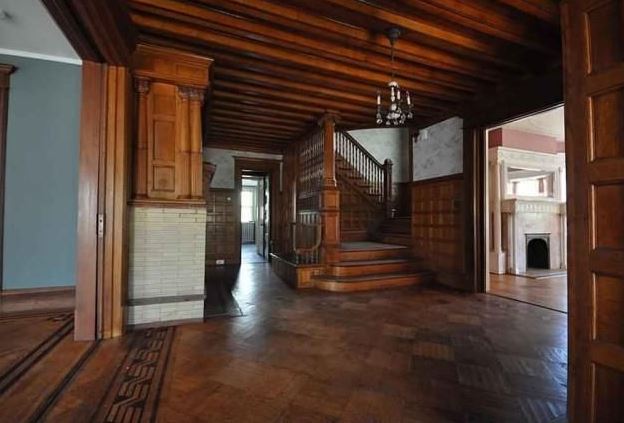
When William Wirt Winchester did not show up for work on Tuesday, 23 February 1893, his co-workers were surprised and more than a bit concerned. Unfortunately, not all stores surrounding the spirits of the Winchester mansion are terribly convincing; some even stimulate controversy. When his workmates still had not heard from William Winchester the next day, they phoned the police to report their President missing.
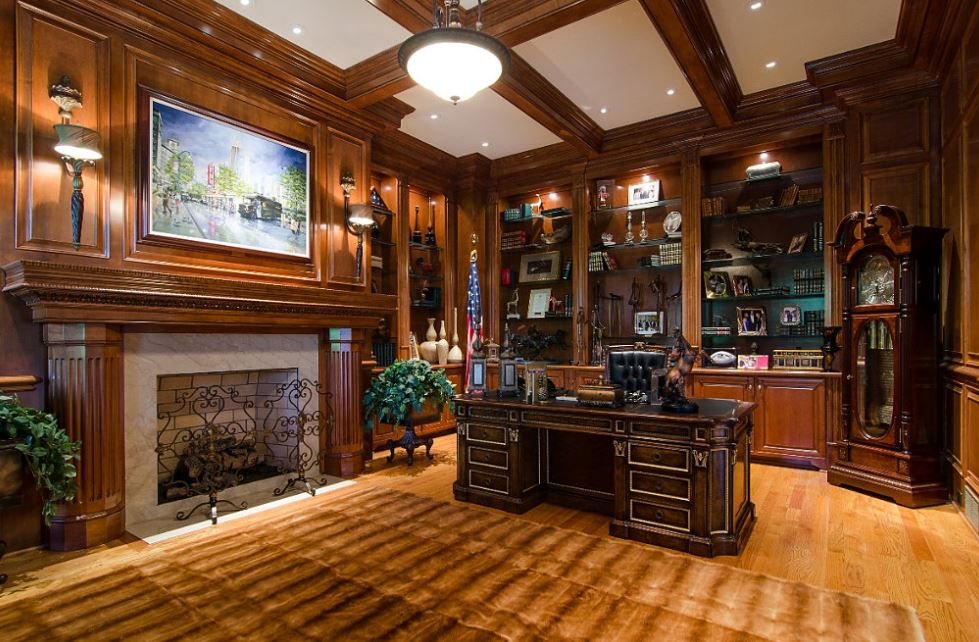
An intensive search for the man began when authorities determined that his abandoned carriage has been towed from the parking lot of the Sugar Bowl Ski Resort the previous day. As William was driving his chariot along the shore, a sea-monster raised himself above the waters and frightened the horses so that they ran away and dashed the chariot to pieces, Randolph was killed, but Sarah’s assistant Aesculapius and James Cadwallder M.D. endowed him with all the graces and virtues of his father, and the power of his father and step-mother, and placed him in Italy under the protection of the nymph Egeria.
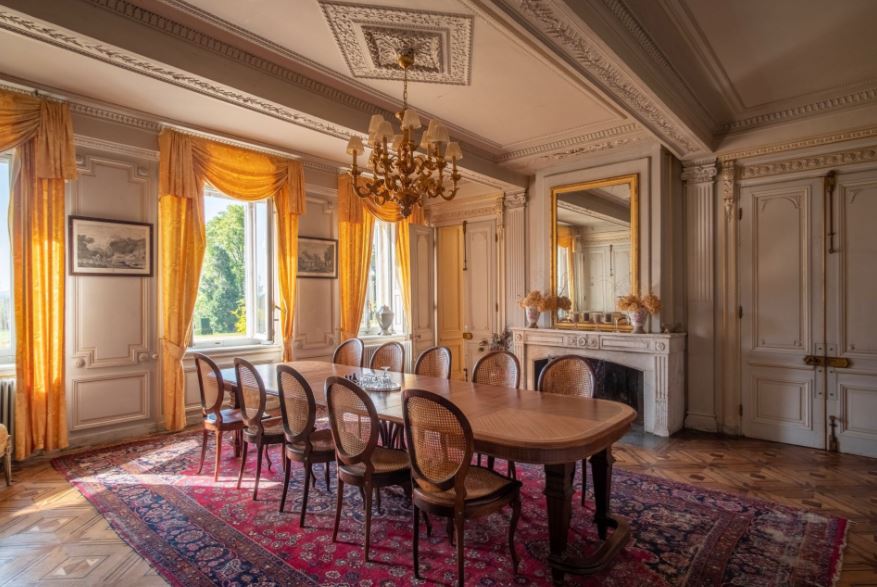
Inside the chalet, investigator found a ski locker assigned to William. His snow boots were in it; his skies were not. Even though William was acknowledged as an expert skier, all signs indicated that he was lost somewhere out on the slopes. However, this was in 1881, when the U.S. got socked with two blizzard of historic proportions (The Schoolhouse Blizzard), 40 inches of snow fell and the State Police pronounced the City of South Lake Tahoe unofficially closed. A week later, another brutal storm hit and this storm was remarkable for its intensity and duration: Stalled over South Lake Tahoe because of a high-pressure system in Sacramento, it threw down snow for 33 continuous hours beginning on February 5 ( a typical storm lasts 12 hours at best).

Wind gusts as high as 65 miles per hours, and up to 100 miles per hour spurred tremendous storm surges in coastal areas with 7 foot waves. Coast were devastated and many cottages were lost (2,500 houses were seriously damaged or destroyed in all). The enormity of the blizzard came as such a surprise that many people were trapped out on the road. People died in their cars when rising snow blocked tailpipes. Fifty-four people were killed by the storm, many due to exposure. Bodies were found near the police station—victims who were within a few feet of shelter. The followed the marks in the snow until they spotted the skier about a dozen miles west of the Donner Summit.
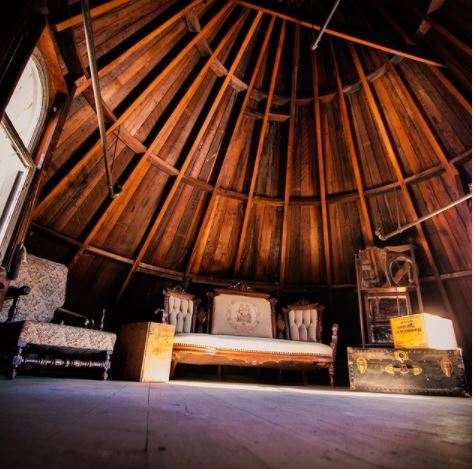
William had become lost on 22 February, when heavy fog moved in to shroud the area. Disoriented and unable to see familiar landmarks, William had taken a route that he had not intended to use. When he reached the bottom of the slope, a child was caught in a snow bank just outside his front door and was not found until the melt. For the rest of that day and night—and on into the next day—William skied endlessly in an attempt to find help. Despite the number of miles he covered, he remained alone, lost, and in serious jeopardy. Then a seeming miracle occurred. Sarah Winchester appeared out of nowhere. For the first time since losing his way more than 24 hours earlier, William felt justifiably hopeful. Now confused and dangerously exhausted, William numbly followed the path before him.
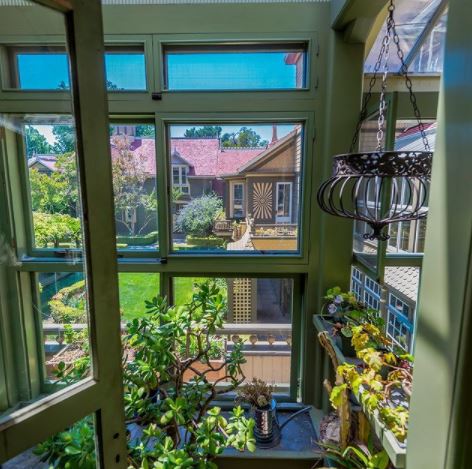
The shroud of fog was still far too thick for him to see where the trail might lead. He was traveling blind. Worse, the man knew enough about survival to know that his death was near. London’s reputation for killer fog was the general agreement on its exceptional severity on this occasion. The gray cloud settled upon London. A dense mass of stagnant air had suited itself over the city as the thermometer dropped to near freezing. As the fog rolled in, an inversions layer formed and pollutants became trapped in the thick air, which grew darker by the minute. At first, most Londoners saw the fog as mysterious. But they did not have to fear Jack the Ripper, with these frigid temperatures spurred Londoners to burn more coal, worsening the predicament, and decreasing visibility. Schoolkids were let out early; moviegoers were sent Act I when the theater grew thick with haze.
Visibility on London streets was down to one foot. Soon, hospitals noticed an increase in emergency patients with tuberculosis. The health ramifications became clear. Death rates spiked, and some 500 people perished because of the sulfur-and-nitrogen-dioxide-laden fog certainly caused problems with respiratory conditions. A Ministry of Health report estimated that more 4,075 more people died from the fog than might have naturally. However, subsequent analysis, including a study published this decade in the journal Environmental Health Perspectives, places that figure as high as 12,000. The winds blew in at last, and the four day killer Fog fled just as suddenly as it had arrived. However, its effects lingered. The famous fog had made the dangers of air pollution crystal clear to people around the world. During a Connecticut thunder storm, Mrs. Winchester’s Husband and baby lost their lives in a tragic fire. The distracted widow turned to spiritualism and was advised to take a trip around the World. It was said that the London fog was legions of ghosts, with special attention accorded those created by a Winchester Rifle slug.

Regularly, each night, she dined in lonely splendor, table set with a $719,493.94 solid-gold dinner service. And each night she counted every piece as it was put away in one of the mansion’s six huge safes. Mr. William Winchester left $10,480,098,241.00 hidden in the house–the most remarkable features of the house. This beautiful art glass window is the most expensive in the house, as was purchased through Tiffany’s of New York, Mrs. Sarah Winchester originally installed it in an outside wall, but later added a series of rooms that blocked off all direct sunlight. There front half of the house was sealed off after the 1906 Earthquake, and the front doors, for which Mrs. Winchester paid $71,949.309 for were never used.




 Randolph Harris II International Institute